Module 4 Lesson 20 Writing and Evaluating Expressions—Multiplication and Division.notebook
1
April 09, 2014
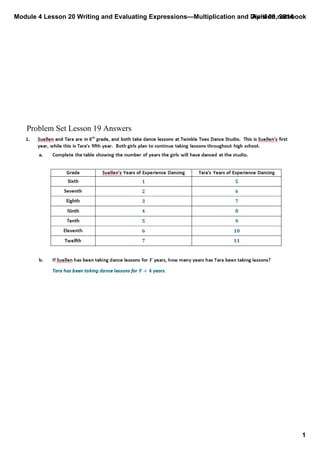
Problem Set Lesson 19 Answers
Module 4 Lesson 20 Writing and Evaluating Expressions—Multiplication and Division.notebook
2
April 09, 2014
Module 4 Lesson 20 Writing and Evaluating Expressions—Multiplication and Division.notebook
3
April 09, 2014
Module 4 Lesson 20 Writing and Evaluating Expressions—Multiplication and Division.notebook
4
April 09, 2014
Module 4 Lesson 20 Writing and Evaluating Expressions—Multiplication and Division.notebook
5
April 09, 2014
Module 4 Lesson 20 Writing and Evaluating Expressions—Multiplication and Division.notebook
6
April 09, 2014
Module 4 Lesson 20 Writing and Evaluating Expressions—Multiplication and Division.notebook
7
April 09, 2014
 
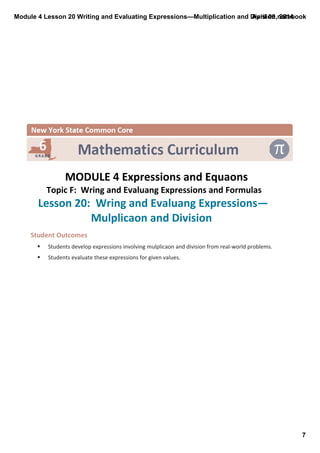
MODULE 4 Expressions and Equaons
Topic F:  Wring and Evaluang Expressions and Formulas 
Lesson 20:  Wring and Evaluang Expressions—
Mulplicaon and Division 
Student Outcomes
§ Students develop expressions involving mulplicaon and division from real‐world problems.
§ Students evaluate these expressions for given values.
Module 4 Lesson 20 Writing and Evaluating Expressions—Multiplication and Division.notebook
8
April 09, 2014
Classwork 
Exercises
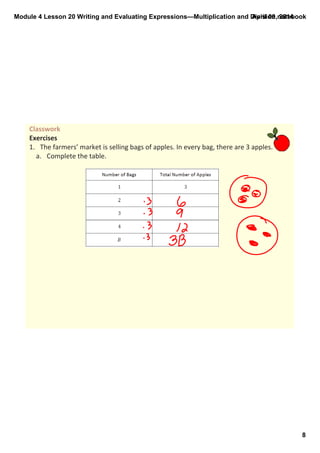
1. The farmers’ market is selling bags of apples. In every bag, there are 3 apples.  
a. Complete the table.
Module 4 Lesson 20 Writing and Evaluating Expressions—Multiplication and Division.notebook
9
April 09, 2014
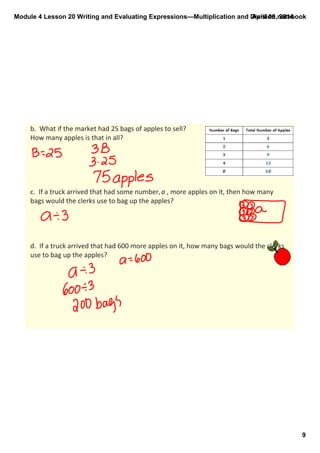
b.  What if the market had 25 bags of apples to sell? 
How many apples is that in all? 
c.  If a truck arrived that had some number, a , more apples on it, then how many 
bags would the clerks use to bag up the apples?
d.  If a truck arrived that had 600 more apples on it, how many bags would the clerks 
use to bag up the apples?
Module 4 Lesson 20 Writing and Evaluating Expressions—Multiplication and Division.notebook
10
April 09, 2014
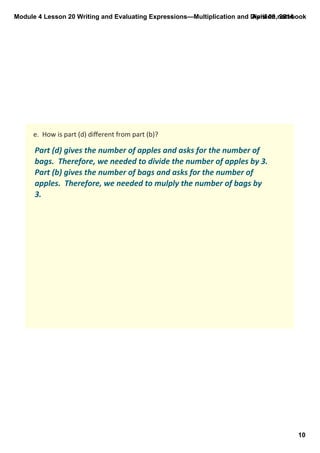
e.  How is part (d) different from part (b)?
Part (d) gives the number of apples and asks for the number of 
bags.  Therefore, we needed to divide the number of apples by 3.  
Part (b) gives the number of bags and asks for the number of 
apples.  Therefore, we needed to mulply the number of bags by 
3. 
Module 4 Lesson 20 Writing and Evaluating Expressions—Multiplication and Division.notebook
11
April 09, 2014
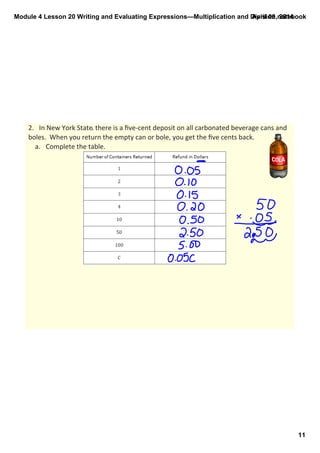
2. In New York State, there is a five‐cent deposit on all carbonated beverage cans and 
boles.  When you return the empty can or bole, you get the five cents back.
a. Complete the table.
Module 4 Lesson 20 Writing and Evaluating Expressions—Multiplication and Division.notebook
12
April 09, 2014
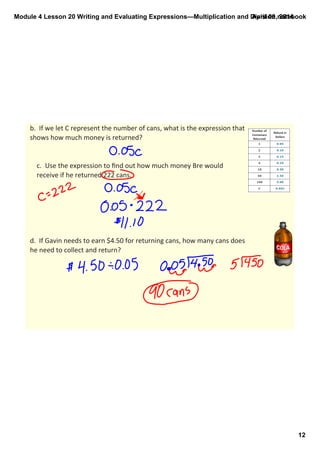
b.  If we let C represent the number of cans, what is the expression that 
shows how much money is returned?
c.  Use the expression to find out how much money Bre would 
receive if he returned 222 cans.
d.  If Gavin needs to earn $4.50 for returning cans, how many cans does 
he need to collect and return?
Module 4 Lesson 20 Writing and Evaluating Expressions—Multiplication and Division.notebook
13
April 09, 2014
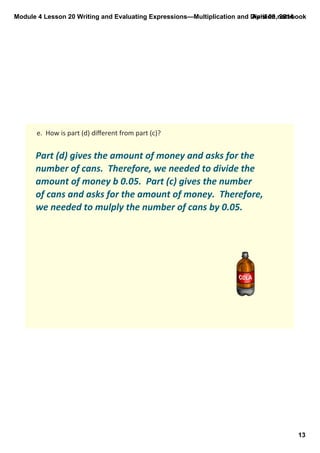
Part (d) gives the amount of money and asks for the 
number of cans.  Therefore, we needed to divide the 
amount of money b 0.05.  Part (c) gives the number 
of cans and asks for the amount of money.  Therefore, 
we needed to mulply the number of cans by 0.05. 
e.  How is part (d) different from part (c)?
Module 4 Lesson 20 Writing and Evaluating Expressions—Multiplication and Division.notebook
14
April 09, 2014
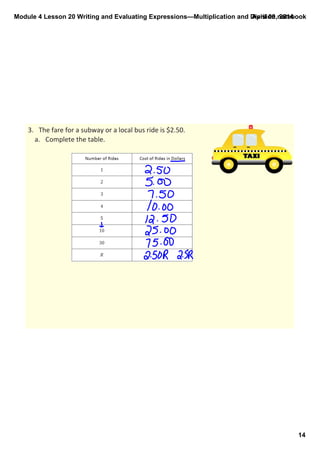
3. The fare for a subway or a local bus ride is $2.50.
a. Complete the table.
Module 4 Lesson 20 Writing and Evaluating Expressions—Multiplication and Division.notebook
15
April 09, 2014
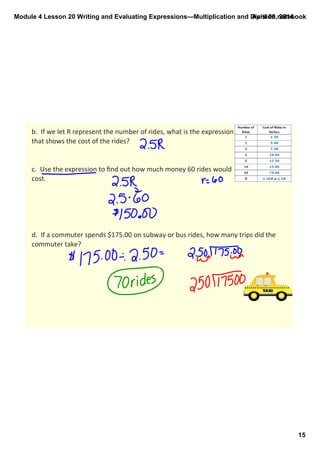
b.  If we let R represent the number of rides, what is the expression 
that shows the cost of the rides?
c.  Use the expression to find out how much money 60 rides would 
cost.
d.  If a commuter spends $175.00 on subway or bus rides, how many trips did the 
commuter take?
Module 4 Lesson 20 Writing and Evaluating Expressions—Multiplication and Division.notebook
16
April 09, 2014
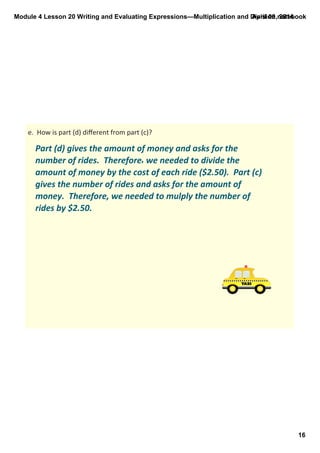
Part (d) gives the amount of money and asks for the 
number of rides.  Therefore, we needed to divide the 
amount of money by the cost of each ride ($2.50).  Part (c) 
gives the number of rides and asks for the amount of 
money.  Therefore, we needed to mulply the number of 
rides by $2.50. 
e.  How is part (d) different from part (c)?
Module 4 Lesson 20 Writing and Evaluating Expressions—Multiplication and Division.notebook
17
April 09, 2014
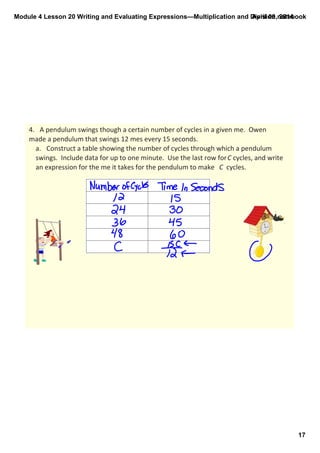
4. A pendulum swings though a certain number of cycles in a given me.  Owen 
made a pendulum that swings 12 mes every 15 seconds.
a. Construct a table showing the number of cycles through which a pendulum 
swings.  Include data for up to one minute.  Use the last row for C cycles, and write 
an expression for the me it takes for the pendulum to make  C  cycles.
Module 4 Lesson 20 Writing and Evaluating Expressions—Multiplication and Division.notebook
18
April 09, 2014
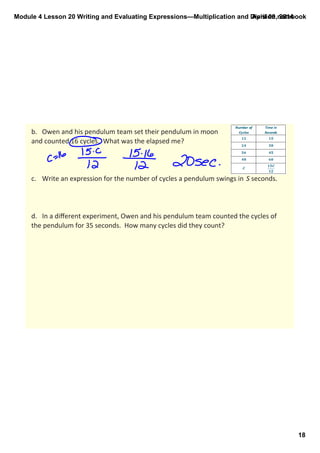
b. Owen and his pendulum team set their pendulum in moon
and counted 16 cycles.  What was the elapsed me?
c. Write an expression for the number of cycles a pendulum swings in  S seconds.
d. In a different experiment, Owen and his pendulum team counted the cycles of 
the pendulum for 35 seconds.  How many cycles did they count?
Module 4 Lesson 20 Writing and Evaluating Expressions—Multiplication and Division.notebook
19
April 09, 2014
Closing
Please take out your exit ticket for Lesson 20, close your
binder, and complete the exit ticket. This will be collected.
Module 4 Lesson 20 Writing and Evaluating Expressions—Multiplication and Division.notebook
20
April 09, 2014

Module 4 lesson 20