1. Planning –Types of Plans – Goals and Plans – Management by Objectives
(MBO) – Contemporary Issues in Planning
2. Designing Organisational Structure – Departmentalisation – Cross Functional
Teams – Mechanistic & Organic Structures – Contingency Factors affecting
Structural Choice – An Overview of Contemporary Organisational designs
3. Importance of HRM – HRM Process
4. Leadership – Contingency Theories of Leadership – Contemporary Views of
Leadership
• Controlling – Control Process – Tools for Measuring Organisational Performance
– Contemporary Issues in Control
Planning
Planning
• Planning is the fundamental management function, which
involves deciding beforehand, what is to be done, when is
it to be done, how it is to be done and who is going to do it.
It is an intellectual process which lays
down an organisation’s objectives and develops various
courses of action, by which the organisation can achieve
those objectives. It chalks out exactly, how to attain a
specific goal.
Importance of Planning
• It helps managers to improve future performance, by establishing
objectives and selecting a course of action, for the benefit of the
organisation.
• It minimises risk and uncertainty, by looking ahead into the future.
• It facilitates the coordination of activities. Thus, reduces overlapping
among activities and eliminates unproductive work.
• It states in advance, what should be done in future, so it
provides direction for action.
• It uncovers and identifies future opportunities and threats.
• It sets out standards for controlling. It compares actual performance
with the standard performance and efforts are made to correct the same.
Types of plans
1. Strategic Plans:
These plans are developed at the highest level of the
organization and provide a roadmap for achieving long-
term goals. Strategic plans focus on the overall direction
and objectives of the organization and cover a time frame
of three years or more. They involve analyzing the
external environment, identifying opportunities and threats,
and formulating strategies to gain a competitive
advantage. For example, a multinational company may
develop a strategic plan to expand its operations into new
international market
Operational Plans:
Operational plans are more specific and are developed at
lower levels of the organization. They outline the
actions and activities required to implement the strategic
plans. Operational plans are shorter-term plans,
covering one year or less, and are focused on achieving
specific objectives within a department or team. For
example, a manufacturing company may develop an
operational plan to increase production efficiency by
implementing new manufacturing processes.
Long-term plans as those with a time frame
beyond three years.
Short-term plans cover one year or less.
Directional Plans
: Directional plans provide general guidelines and flexibility
for managers to adapt to changing circumstances. They set out
broad objectives and allow managers to make decisions based
on the current situation. Directional plans are particularly useful
in uncertain environments where specific plans may not be
practical. For example, a software development company may
have a directional plan to explore new technologies and adapt its
products based on customer feedback.
Specific Plans:
Specific plans are clearly defined and leave no room for
interpretation. They outline the specific actions, resources, and
timelines required to achieve a particular goal. Specific plans
provide clarity and precision, making it easier for employees to
understand what needs to be done. For example, a retail
company may have a specific plan for launching a new product,
including the marketing strategies, distribution channels, and
launch date.
5. Single-Use Plans:
Single-use plans are developed for unique
situations or one-time events. They are
designed to meet specific needs and are not
intended for ongoing use. Examples of single-use
plans include plans for a special project, a
marketing campaign, or an event.
Standing Plans
: Standing plans are ongoing plans that provide
guidance for activities performed repeatedly. They
include policies, rules, and procedures that define
how routine tasks should be carried out. Standing
plans help ensure consistency and efficiency in day-
to-day operations.
Goals and Plans
Goals (Objectives): Goals are desired outcomes or targets that guide management
decisions and form the basis for evaluating performance. Organizations have multiple goals,
including financial goals (related to financial performance) and strategic goals (related to
overall organizational performance). Well-written goals are specific, measurable, challenging
yet attainable, and aligned with the organization's mission.
Plans: Plans are documents that outline how goals will be achieved. They specify the
actions, resources, and timelines required to accomplish the goals. Plans can be strategic or
operational, long-term or short-term, specific or directional, and single-use or standing. The
choice of plan depends on the nature of the goal, the level of uncertainty in the environment,
and the time frame involved.
Management by Objectives (MBO)
Management by Objectives (MBO) is an approach to goal setting and planning that
involves setting mutually agreed-upon goals and using those goals to evaluate
employee performance. Here are the key elements of MBO:
1. Goal Specificity: Goals should be clearly defined, measurable, and aligned with
the organization's overall objectives. Specific goals provide employees with a clear
direction and focus. For example, instead of setting a general goal to improve
customer satisfaction, a specific goal could be to increase the customer satisfaction
rating by 10% within three months.
2. Participative Decision Making: Employees are involved in the goal-setting
process and have a say in determining their individual goals. This increases their
commitment and motivation to achieve those goals. For example, a manager may
hold a team meeting to discuss and collectively set goals for the upcoming quarter.
Management by Objectives (MBO)
3. Explicit Time Period: Goals are set with a specific time frame in mind, allowing for periodic
review and evaluation of progress. This helps to keep employees accountable and ensures that
goals are achieved within the desired time frame. For example, goals may be set for the next
quarter, and progress can be reviewed monthly.
4. Performance Feedback: Regular feedback and performance reviews are provided to
employees to assess their progress towards achieving their goals. This feedback helps identify
areas for improvement and allows for adjustments to be made if necessary. For example,
managers may conduct monthly or quarterly performance reviews to discuss progress, provide
feedback, and make any necessary changes to the goals.
MBO can improve employee motivation, performance, and alignment with organizational
objectives. It provides a structured approach to goal setting and planning, fostering a results-
oriented culture within the organization.
Contemporary Issues in Planning
1. Dynamic Environments:
2. Environmental Scanning:
3. Competitive Intelligence:
4. Shorter Planning Time Frames:
5. Flatter Organizational Hierarchy:
Contemporary Issues in Planning
Planning in today's dynamic business environment presents several challenges.
Here are some contemporary issues that managers need to consider:
1. Dynamic Environments: The external environment is constantly changing,
requiring managers to develop plans that are specific yet flexible. Plans need to
be adaptable to unexpected changes and uncertainties in the market. For
example, a technology company may need to adjust its product development
plans in response to emerging technologies or changing customer preferences.
2. Environmental Scanning: Managers need to engage in environmental
scanning to detect emerging trends and anticipate changes in the business
environment. This involves gathering information about competitors, industry
trends, technological advancements, and customer preferences. For example, a
retail company may conduct market research to understand consumer behavior
and identify new market opportunities.
Contemporary Issues in Planning
3. Competitive Intelligence: Competitive intelligence involves gathering information about
competitors to anticipate their actions and stay ahead in the market. Managers need to ethically
gather and analyze information about their competitors to make informed strategic decisions. For
example, a car manufacturer may analyze competitor pricing strategies and product features to
develop competitive pricing and product positioning.
4. Shorter Planning Time Frames: In rapidly changing industries, long-term planning may be less
effective. Managers may need to focus on shorter planning time frames to respond quickly to market
dynamics and stay competitive. For example, a fashion retailer may plan its inventory and marketing
campaigns on a seasonal or even monthly basis to align with changing fashion trends.
5. Flatter Organizational Hierarchy: In dynamic environments, decision-making and planning
should involve employees at all levels of the organization. Empowering employees to set goals and
develop plans can lead to greater agility and adaptability. For example, a software development
company may adopt an agile project management approach, where cross-functional teams
collaborate to set goals and plan project iterations.
Designing Organisational Structure –
Departmentalisation – Cross Functional Teams –
Mechanistic & Organic Structures – Contingency
Factors affecting Structural Choice – An Overview of
Contemporary Organisational designs
Organizational Structure and Design
•Organizational structure refers to the formal
arrangement of jobs within an organization. It
determines how tasks are divided, coordinated,
and controlled in order to achieve organizational
goals. Organizational design, on the other hand,
is the process of creating or changing the
structure of an organization.
Purposes of Organizing
Organizing serves several purposes within an organization:
1. Dividing work to be done into specific jobs and departments.
2. Assigning tasks and responsibilities associated with individual jobs.
3. Coordinating diverse organizational tasks.
4. Clustering jobs into units.
5. Establishing relationships among individuals, groups, and departments.
6. Establishing formal lines of authority.
7. Allocating and deploying organizational resources.
Work Specialization
Work specialization, also known as division of labor, involves dividing work
activities into separate job tasks. This allows employees to specialize in specific
tasks and increase work output. It makes efficient use of the diverse skills that
workers have.
While work specialization can increase productivity, it can also lead to human
diseconomies such as boredom, fatigue, stress, low productivity, poor quality,
increased absenteeism, and high turnover. Therefore, organizations need to find
the right balance between specialization and employee well-being.
Departmentalization
Departmentalization is the process of grouping common work activities
together. There are five common forms of departmentalization:
1. Functional departmentalization: Jobs are grouped based on common
functions or activities, such as marketing, finance, and operations.
2. Product departmentalization: Jobs are grouped based on specific
products or product lines.
3. Geographic departmentalization: Jobs are grouped based on the
geographic location of the organization or its customers
Chain of Command
authority that extends from upper organizational levels to lower levels. It clarifies
who reports to whom and helps employees know who to go to for guidance
or to resolve issues. It also establishes the formal lines of communication and
decision-making within an organization.
Authority, responsibility, and unity of command are important concepts related to
the chain of command. Authority refers to the rights inherent in a managerial
position to tell people what to do and expect them to do it. Responsibility is the
obligation or expectation to perform assigned duties. Unity of command states
that each person should report to only one manager to avoid conflicting demands.
Span of Control
Span of control refers to the number of employees a manager can efficiently and
effectively manage. Traditionally, managers were believed to be able to directly
supervise only a small number of subordinates, typically around five or six. However,
the trend in recent years has been towards larger spans of control, as organizations
seek to streamline decision-making processes and increase efficiency.
The appropriate span of control depends on various factors, including the skills and
abilities of the manager, the complexity of employee tasks, the physical proximity of
subordinates, the degree of standardized procedures, the organization's information
system, the strength of the organization's culture, and the preferred management style.
Centralization and Decentralization
Centralization refers to the degree to which decision-making authority is concentrated at
the upper levels of an organization. In a centralized organization, top managers make
key decisions with little input from lower levels. Decentralization, on the other hand,
involves distributing decision-making authority to lower-level employees.
The trend in recent years has been towards more decentralization, as organizations
recognize the benefits of empowering employees and allowing those closest to the
problems to make decisions. However, the appropriate level of centralization or
decentralization depends on factors such as the stability of the environment, the
capabilities of lower-level managers, the significance of decisions, and the organization's
culture.
Formalization
Formalization refers to the extent to which an organization's jobs are
standardized and employee behavior is guided by rules and procedures.
Highly formalized organizations have explicit job descriptions, numerous
organizational rules, and clearly defined procedures. In contrast, low
formalization allows employees more discretion in how they perform their work.
While some level of formalization is necessary for consistency and control,
many organizations today rely less on strict rules and standardization. They
recognize the importance of giving employees autonomy and flexibility to make
decisions based on their expertise and the specific circumstances.
CROSS FUNCTIONAL TEAM
It is a work team composed of individuals from various functional specialties.
Many organizations use cross-functional teams. For example, ArcelorMittal, the
world’s biggest steel company, uses cross-functional teams of scientists, plant
managers, and salespeople to review and monitor product innovations.
The concept of cross-functional teams is even being applied in health care. For
instance, at Suburban Hospital in Bethesda, Maryland, intensive care unit (ICU)
teams composed of a doctor trained in intensive care medicine, a pharmacist, a
social worker, a nutritionist, the chief ICU nurse, a respiratory therapist, and a
chaplain meet daily with every patient’s bedside nurse to discuss and debate the
best course of treatment. The hospital credits this team care approach with
reducing errors, shortening the amount of time patients spent in ICU, and
improving communication between families and the medical staff.
Mechanistic and Organic Structures
In organizations, the structure refers to how the
different parts of the organization are organized
and how they interact with each other. Two
common types of organizational structures are
mechanistic and organic structures. Let's explore
these structures in more detail.
Mechanistic Structure
The mechanistic structure is characterized by a high degree of specialization, rigid departmentalization,
a clear chain of command, narrow spans of control, centralization, and high formalization.
- Specialization: In a mechanistic organization, employees have highly specialized roles and tasks.
Each person is trained to perform a specific job.
- Departmentalization: The organization is divided into different departments based on functions or
tasks. Each department has its own set of responsibilities.
- Chain of Command: There is a clear hierarchy of authority, with each person having a superior who
supervises and controls their work.
- Spans of Control: The number of employees reporting to a manager is limited, resulting in a tall
organizational structure with many levels of management.
- Centralization: Decision-making authority is concentrated at the upper levels of the organization. Top
managers have more control over the decision-making process.
- Formalization: There are strict rules, procedures, and policies that guide employee behavior.
Standardized practices are emphasized.
Organic Structure
The organic structure is characterized by cross-functional and cross-hierarchical teams, a free flow of
information, wide spans of control, decentralization, and low formalization.
- Cross-functional Teams: Employees from different functions or departments work together in teams to
achieve common goals. This promotes collaboration and flexibility.
- Cross-hierarchical Teams: Employees at different levels of the organization work together, breaking down
traditional hierarchical barriers. This encourages communication and innovation.
- Free Flow of Information: Information is shared openly and freely across the organization. Communication
channels are open, allowing employees to exchange ideas and knowledge.
- Spans of Control: Managers have a wider span of control, with more employees reporting to them. This
leads to a flatter organizational structure with fewer levels of management.
- Decentralization: Decision-making authority is delegated to lower-level employees. They have more
autonomy and are encouraged to provide input and make decisions.
- Low Formalization: There are fewer rules and procedures, allowing employees to have more flexibility in
their work. Creativity and adaptability are valued.
Contingency Factors Affecting Structural Choice
1. Strategy and Structure
An organization's strategy is its plan of action to achieve its goals. The chosen strategy should align with the
organizational structure to ensure effective goal achievement. Research has shown that different structural
designs work best with different organizational strategies.
- Organic Structure: An organic structure is characterized by flexibility and free-flowing information. It works
well for organizations pursuing meaningful and unique innovations. This structure allows for quick decision-
making and adaptability to changing market conditions.
- Mechanistic Structure: A mechanistic structure is rigid and tightly controlled. It works best for organizations
that want to tightly control costs and ensure efficiency and stability. Companies with routine technologies, such
as insurance companies and banks, often adopt a mechanistic structure.
Contingency Factors Affecting Structural Choice
2. Size and Structure
The size of an organization also influences its structure. Larger organizations tend to have more specialization,
departmentalization, centralization, and rules and regulations compared to smaller organizations. However,
once an organization reaches a certain size, the impact of size on structure diminishes.
- Large Organizations: Typically considered to have more than 2,000 employees, large organizations have
more complex structures to manage the increased number of employees and departments. They often have
more hierarchical levels and formalized processes.
- Small Organizations: Small organizations, with fewer employees, have simpler structures with less
formalization and fewer hierarchical levels. Decision-making is often more centralized, and employees may
have broader job roles.
3. Technology and Structure
Every organization uses technology to convert inputs into outputs. The type of technology employed by
an organization influences its structure.
- Routine Technology: Organizations with routine technologies, such as assembly lines or
standardized processes, often adopt a mechanistic structure. This structure allows for efficient
coordination and control of repetitive tasks.
- Nonroutine Technology: Organizations with nonroutine technologies, such as research and
development or creative industries, often adopt an organic structure. This structure provides flexibility
and adaptability to handle the complexity and uncertainty associated with nonroutine tasks.
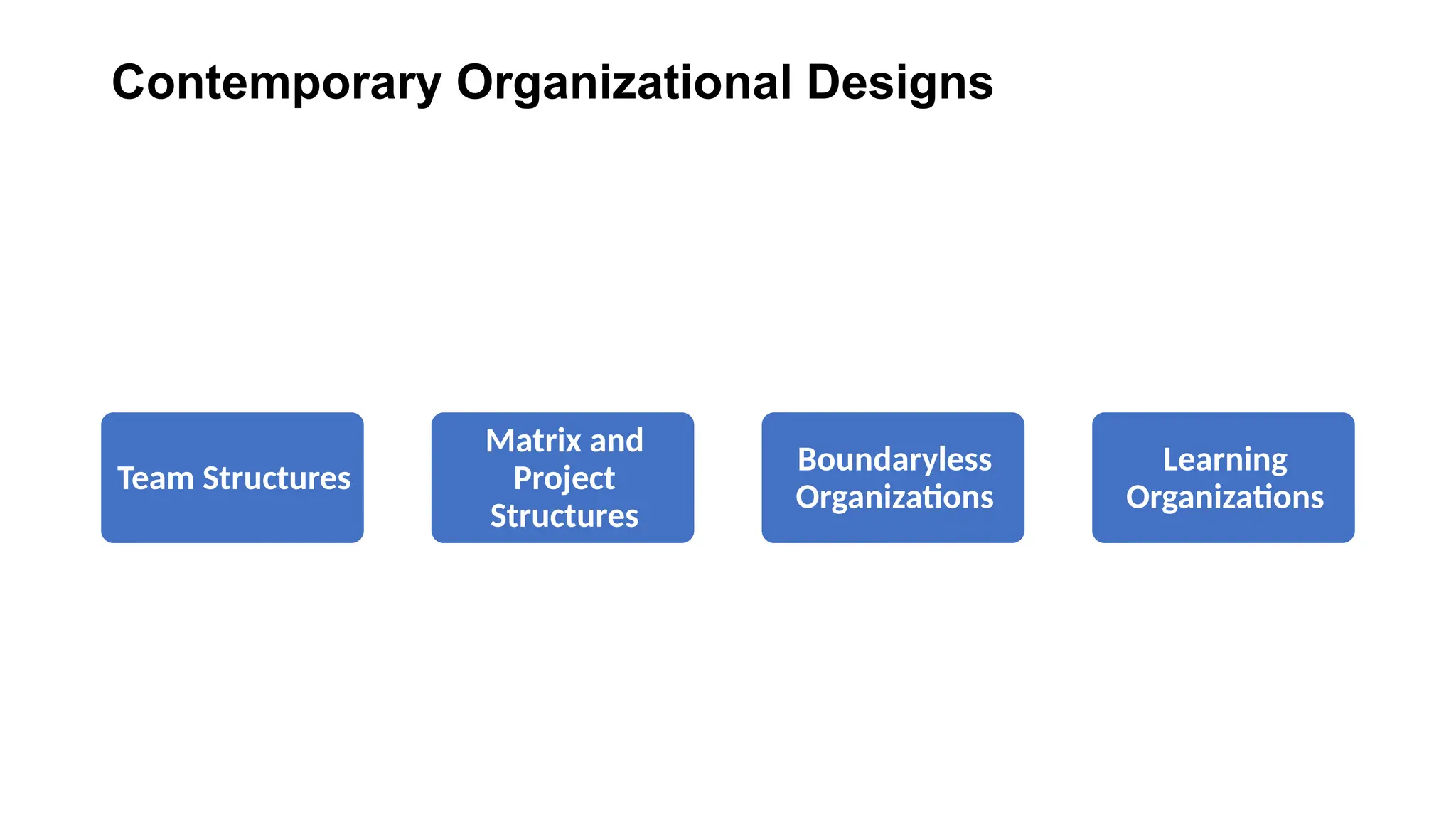
Contemporary Organizational Designs
Team Structures
Matrix and
Project
Structures
Boundaryless
Organizations
Learning
Organizations
Team Structures
A team structure is an organizational structure in which the entire
organization is made up of work teams. In this structure,
employees are empowered and involved in decision-making. The
advantages of team structures include increased employee
involvement, reduced barriers among functional areas, and
improved productivity. However, team structures may lack a clear
chain of command and put pressure on teams to perform.
Matrix and Project Structures
Matrix and project structures are popular contemporary designs that promote flexibility
and faster decision-making. In a matrix structure, specialists from different
functional areas are assigned to work on projects led by a project manager.
This design creates a dual chain of command and requires effective communication
and coordination between managers.
In a project structure, employees continuously work on projects and move on to the
next project once completed.
This structure eliminates rigid hierarchy and allows managers to serve as facilitators
and mentors.
However, assigning people to projects and managing task and personality conflicts
can be challenging.
Boundaryless Organizations
A boundaryless organization is characterized by the absence of predefined
horizontal, vertical, or external boundaries. It promotes flexibility,
responsiveness, and collaboration. Virtual organizations and network organizations
are examples of boundaryless organizations. Virtual organizations rely on a
small core of full-time employees and outside specialists who are hired as
needed. This structure allows for flexibility and access to a global network of
talent. Network organizations combine internal employees with external suppliers
to provide necessary product components or work processes. This approach
allows organizations to focus on their core competencies and outsource other
activities. However, communication difficulties and lack of control can be
disadvantages of boundaryless organizations.
Learning Organizations
Learning organizations have developed the capacity to continuously learn,
adapt, and change. They emphasize knowledge sharing, collaboration, and
empowered work teams. In a learning organization, employees across different
functional specialties and organizational levels share information and
collaborate on work activities. This requires minimal structural and physical
barriers. Empowered work teams make decisions and resolve issues, reducing the
need for traditional hierarchical control. Learning organizations view continuous
learning and application of knowledge as a sustainable source of competitive
advantage.
Importance of HRM
Human Resource Management (HRM) plays a crucial role in organizations for several reasons:
1. Source of Competitive Advantage: HRM can be a significant source of competitive advantage for
organizations. Numerous studies have shown that organizations with people-oriented HR practices tend
to create superior shareholder value and achieve competitive success. This advantage is not limited to
U.S. firms but is applicable worldwide.
2. Part of Organizational Strategies: HRM is an integral part of organizational strategies. To achieve
competitive success through people, managers need to change their mindset about employees and view
them as partners rather than just costs to be minimized. People-oriented organizations, such as Southwest
Airlines and W. L. Gore, prioritize their employees and treat them as valuable assets.
3. Impact on Organizational Performance: The way organizations treat their employees significantly
affects organizational performance. Research has shown that improving work practices can increase market
value by up to 30 percent. Companies recognized as the "Best Companies to Work For" have consistently
outperformed the S&P 500 in terms of shareholder returns. High-performance work practices, which involve
employee involvement, skill development, motivation, and retention, contribute to both individual
and organizational performance.
HRM Process
The HRM process consists of several activities that ensure an organization has qualified and competent employees. These
activities include:
1. Human Resource Planning: This involves forecasting the organization's future workforce needs, identifying the skills and
competencies required, and developing strategies to meet those needs.
2. Recruitment: The process of attracting a pool of qualified candidates for job openings. It includes activities such as job
postings, resume screening, interviewing, and selection.
3. Selection: The process of choosing the best candidate for a job based on their qualifications, skills, and fit with the
organization's culture.
4. Orientation: The process of introducing new employees to the organization, its policies, procedures, and culture. It helps them
acclimate to their new roles and responsibilities.
5. Training: Providing employees with the necessary knowledge, skills, and abilities to perform their jobs effectively. Training
programs can include on-the-job training, workshops, seminars, and online courses.
6. Performance Management: The process of setting performance goals, providing feedback, and evaluating employee
performance. It includes performance appraisals, performance feedback, and performance improvement plans.
7. Compensation and Benefits: Determining and administering the organization's compensation and benefits programs. This
includes salary structures, bonuses, incentives, health insurance, retirement plans, and other employee benefits.
8. Career Development: Supporting employees in their career growth and development. This can involve providing opportunities
for advancement, mentoring programs, training for new roles, and succession planning.
Leadership
A leader is someone who can influence others and who has managerial
authority.
Leadership is what leaders do. It’s a process of leading a group and
influencing that group to achieve its goals.
Are all managers leaders?
Because leading is one of the
four management functions,
yes, ideally, all managers should
be leaders.
Contingency Theories of Leadership
The Fiedler Model:
The Fiedler Model, developed by Fred Fiedler, is a comprehensive contingency model for leadership. It
proposes that effective group performance depends on properly matching the leader's style with the amount
of control and influence in the situation. The model is based on the idea that different leadership styles
are most effective in different types of situations.
Leadership Styles
Fiedler identified two basic leadership styles: task-oriented and relationship-oriented.
1. Task-oriented leaders are primarily focused on productivity and getting the job done. They prioritize
efficiency and task accomplishment over personal relationships with coworkers.
2. Relationship-oriented leaders are primarily interested in building good personal relations with
coworkers. They prioritize collaboration, communication, and maintaining positive relationships within the
team.
To measure a leader's style, Fiedler developed the least-preferred coworker (LPC) questionnaire. This
questionnaire asks leaders to think of the coworker they least enjoyed working with and rate them on a scale
of 1 to 8 for various pairs of contrasting adjectives. A high LPC score indicates a relationship-oriented leader,
while a low LPC score indicates a task-oriented leader.
It's important to note that Fiedler assumed a person's leadership style is fixed regardless of the situation.
However, in reality, effective leaders can and do change their styles to fit different situations.
The Fiedler Model:
Situational Factors
Fiedler's model also takes into account three contingency dimensions that define the key situational factors in leader
effectiveness:
1. Leader-member relations: This refers to the degree of confidence, trust, and respect employees have for their
leader. It can be rated as either good or poor.
2. Task structure: This describes the degree to which job assignments are formalized and structured. It can be rated as
either high or low.
3. Position power: This refers to the degree of influence a leader has over activities such as hiring, firing, discipline,
promotions, and salary increases. It can be rated as either strong or weak.
By evaluating a leadership situation based on these three contingency variables, eight possible situations can be
identified, ranging from highly favorable to highly unfavorable for the leader.
The Fiedler Model:
Matching Leadership Style with the Situation
Fiedler's research found that task-oriented leaders perform better in very favorable and very
unfavorable situations. On the other hand, relationship-oriented leaders perform better in
moderately favorable situations.
Based on this understanding, two approaches can be taken to improve leader effectiveness:
1. Change the leader: If the leader's style does not match the situation, replacing them with a
leader whose style better fits the situation can improve group performance. For example, if a group
is led by a relationship-oriented leader in a highly unfavorable situation, replacing them with a task-
oriented leader may be beneficial.
2. Change the situation: The situation can be modified to better fit the leader's style. This can be
done by restructuring tasks, adjusting the leader's position power, or improving leader-member
relations.
Validity and Criticisms
Research testing the overall validity of the Fiedler Model has provided considerable evidence to
support its effectiveness. However, the model has also faced criticisms. One major criticism is that
it may be unrealistic to assume that a person's leadership style cannot change to fit the situation.
Effective leaders often adapt their styles based on the circumstances. Additionally, the LPC
questionnaire may not be practical in all situations, and assessing the situation variables can be
challenging.
Despite these criticisms, the Fiedler Model highlights the importance of aligning leadership style
with situational factors for effective leadership. It emphasizes the need for leaders to be aware of
their own style and the context in which they are leading in order to maximize group performance.
Situational Leadership Theory
The Situational Leadership Theory (SLT) was developed by Paul
Hersey and Ken Blanchard in the late 1960s. This contingency
theory focuses on the readiness and maturity of followers as
the key factor in determining the most effective leadership style.
Key Concepts
1. Follower Readiness: The theory emphasizes the importance of followers, as it is the followers who
ultimately determine the success or failure of a leader. Readiness refers to the extent to which followers
have the ability and willingness to accomplish a specific task.
2. Leadership Styles: The theory outlines four key leadership styles based on the amount of task-oriented
behavior (directing) and relationship-oriented behavior (supporting) exhibited by the leader:
- Telling (high task, low relationship)
- Selling (high task, high relationship)
- Participating (low task, high relationship)
- Delegating (low task, low relationship)
3. Follower Development Levels: The theory identifies four stages of follower readiness:
- R1: Unable and unwilling
- R2: Unable but willing
- R3: Able but unwilling
- R4: Able and willing
Application of the Theory
The SLT suggests that leaders should adapt their style to the development level of their
followers. For example:
- If followers are at R1 (unable and unwilling), the leader should use a "telling" style, providing
clear direction and structure.
- If followers are at R2 (unable but willing), the leader should use a "selling" style, providing both
directive and supportive behavior.
- If followers are at R3 (able but unwilling), the leader should use a "participating" style, involving
followers in decision-making.
- If followers are at R4 (able and willing), the leader should use a "delegating" style, providing
little direction or support.
Limitations and Criticisms
While the SLT has intuitive appeal and is widely used in leadership
development, research on its effectiveness has been mixed. Criticisms include:
- Lack of clear empirical support for the theory's predictions
- Difficulty in accurately assessing follower readiness and development levels
- Oversimplification of the complex leader-follower relationship
Despite these limitations, the SLT remains a popular and influential framework
for understanding and practicing effective leadership.
Path-Goal Theory of Leadership
Path-Goal Theory is a leadership theory developed by
Robert House that states the leader's job is to assist
followers in attaining their goals and to provide the direction
and support needed to ensure those goals are compatible
with the overall goals of the group or organization.
Leader Behaviors
Path-Goal Theory identifies four main leadership behaviors:
1. Directive Leader: Lets subordinates know what's expected of them, schedules work, and provides
specific guidance on how to accomplish tasks.
2. Supportive Leader: Shows concern for the needs of followers and is friendly and approachable.
3. Participative Leader: Consults with group members and incorporates their suggestions before making
decisions.
4. Achievement-Oriented Leader: Sets challenging goals and expects followers to perform at a high
level.
Situational Factors
Path-Goal Theory proposes two main situational or contingency factors that moderate the relationship
between leadership behavior and outcomes:
1. Environmental Factors: Aspects of the environment outside the control of the follower, such as
task structure, formal authority system, and work group.
2. Follower Characteristics: Personal characteristics of the follower, including locus of control,
experience, and perceived ability.
Predictions
The theory makes several predictions about which leadership behaviors will be most effective in different situations:
- Directive leadership is more effective when tasks are ambiguous or stressful.
- Supportive leadership leads to higher performance and satisfaction when tasks are structured.
- Directive leadership is less effective for subordinates with high perceived ability or experience.
- Supportive leadership is more effective when the formal authority system is clear.
- Directive leadership increases satisfaction when there is conflict within the work group.
- Participative leadership is more satisfying for subordinates with an internal locus of control.
- Achievement-oriented leadership increases effort when tasks are ambiguously structured.
Overall, Path-Goal Theory suggests that effective leaders adapt their behavior to compensate for deficiencies in either the
employee or the work environment in order to maximize employee performance and satisfaction.
Contemporary Views
On Leadership
Contemporary Views On Leadership
1. Leader-Member Exchange (LMX) Theory: This theory suggests that leaders develop different quality
relationships with their followers, creating "in-groups" and "out-groups". Followers in the in-group tend to have
higher performance, job satisfaction, and lower turnover.
2. Transformational-Transactional Leadership: Transformational leaders inspire and motivate followers to
achieve extraordinary outcomes, while transactional leaders use rewards and punishments to guide followers
towards goals.
3. Charismatic-Visionary Leadership: Charismatic leaders use their personality and behaviors to influence
and inspire followers. Visionary leaders are able to create and articulate a compelling vision for the future.
4. Team Leadership: In team-based organizations, leaders need to facilitate the team process, manage the
team's external boundaries, and take on roles like coach, liaison, and conflict manager.
1. Leader-Member Exchange (LMX) Theory
The leader-member exchange (LMX) theory suggests that leaders develop different quality
relationships with their followers. Leaders tend to form "in-groups" of followers with whom they
have a high-quality relationship, and "out-groups" of followers with whom they have a more distant
relationship. Followers in the in-group typically experience higher performance ratings, greater job
satisfaction, and lower turnover compared to those in the out-group. The LMX relationship is
developed early on and tends to remain stable over time. Leaders encourage the LMX relationship
by rewarding in-group members and punishing out-group members.
Example: A department manager at a large tech company has a close working relationship with a few of
their team members who consistently deliver high-quality work. The manager often assigns these in-group
members to important projects, provides them with more resources and development opportunities, and
gives them more positive feedback and recognition. Meanwhile, the manager has a more distant
relationship with other team members, who tend to receive fewer opportunities and less support.
2. Transformational-Transactional Leadership
Transformational leaders are those who inspire and motivate their followers to achieve extraordinary outcomes. They do this
by:
1) Providing individualized consideration to followers' needs and concerns
2) Intellectually stimulating followers to look at problems in new ways
3) Inspiring followers with a compelling vision
4) Modeling the behaviors they want to see in their followers
In contrast, transactional leaders focus on using rewards and punishments to guide followers towards established goals. While
both approaches can be effective, research suggests that transformational leadership is generally associated with higher
follower performance, satisfaction, and commitment.
Example: During a period of major organizational change, the CEO of a manufacturing company adopts a transformational
leadership style. She articulates a bold vision for the company's future, empowers employees to find innovative solutions to
challenges, and provides personalized coaching and support to help everyone adapt to the changes. This inspires the
workforce to go above and beyond, resulting in a successful transformation.
3. Charismatic-Visionary Leadership
Charismatic leaders are those who use their enthusiasm, self-confidence, and
personal charm to influence and inspire their followers. They exhibit characteristics
like having a compelling vision, taking personal risks, and engaging in behaviors
that are out of the ordinary. Visionary leadership refers to the ability to create and
communicate an attractive, realistic vision of the future that is better than the
present state.
Example: Steve Jobs, the co-founder and former CEO of Apple, is widely
regarded as a charismatic and visionary leader. He was able to captivate
audiences with his passionate presentations of new Apple products, clearly
articulating a vision for how the company's innovations would transform the way
people live and work. Jobs' charisma and visionary thinking played a key role in
Apple's meteoric rise and success.
4. Team Leadership
As organizations increasingly rely on teams to accomplish work, the role of the
team leader has become increasingly important. Effective team leaders need
to balance two key priorities: 1) managing the team's external boundaries and
relationships, and 2) facilitating the team's internal processes. This involves
taking on roles such as coach, liaison, conflict manager, and troubleshooter.
Example: When a manufacturing company reorganized into self-managed
work teams, the previous line supervisors had to transition into team leader
roles. Instead of directly overseeing employees, the team leaders had to learn
new skills like facilitating group problem-solving, providing coaching and
feedback, and representing the team's interests to upper management. This
required a significant shift in mindset and capabilities for the former
supervisors.
• Controlling – Control Process – Tools for Measuring Organisational
Performance – Contemporary Issues in Control
What is Controlling?
Controlling is the process of monitoring, comparing, and correcting
work performance. It ensures that activities are completed in ways that
lead to the attainment of organizational goals. All managers should
control their units, even if they are performing as planned, in order to
evaluate actual performance against desired standards.
Effective controls allow managers to know whether organizational
goals are being met and why. Controls provide the critical link back to
the planning process, ensuring that intended actions are being taken.
The Control Process
The control process is a critical management function
that helps ensure an organization is achieving its goals
and objectives. It is a three-step process that involves:
1. Measuring actual performance
2. Comparing actual performance against a standard
3. Taking managerial action to correct deviations or
address inadequate standards
Measuring Actual Performance
The first step in the control process is to measure the organization's actual performance. Managers can use
several different approaches to measure and report on actual performance:
- Personal Observations - Directly observing employee work activities to assess performance. This
provides firsthand knowledge but can be subject to personal biases.
- Statistical Reports - Collecting quantitative data on metrics like productivity, sales, costs, etc. This
provides comprehensive information, but may ignore subjective factors.
- Oral Reports - Verbal updates from employees on their work. This allows for feedback but information can't
be easily documented.
- Written Reports - Formal, documented reports on performance metrics. These are comprehensive and
easy to file/retrieve.
Managers typically use a combination of these approaches to get a well-rounded view of actual performance.
Comparing to Standards
The next step is to compare the actual performance measures against pre-established
performance standards or goals. These standards were likely set during the planning process.
Managers need to determine an acceptable range of variation between actual and standard
performance. Deviations outside this acceptable range require managerial attention.
For example, if a sales manager sets a monthly sales target of $3,600 but actual sales were
$3,777, this represents a positive variance. However, the manager would need to analyze which
specific product lines were over or under the targets to determine if any corrective action is
needed.
Taking Managerial Action
Based on the comparison of actual to standard performance, managers have three potential
courses of action:
1. Do nothing - If performance is within the acceptable range of variation, no action is required.
2. Correct actual performance - If performance is unacceptable, the manager can take
corrective action such as providing training, changing compensation, or addressing other root
causes.
3. Revise the standard - If the standard itself is unrealistic, the manager may need to adjust the
goals or targets.
The key is for managers to analyze the reasons for any significant variances and take
appropriate steps to either improve actual performance or refine the performance standards.
TOOLS FOR MEASURING ORGANISATIONAL
PERFORMANCE
1. Feedforward Control
Definition
Feedforward control is a proactive approach that aims to prevent problems before they occur. It involves taking actions based
on predictions and forecasts to ensure that the desired outcomes are achieved.
Examples
- Quality Control in Fast Food: When McDonald’s opened its first restaurant in Moscow, it sent quality control experts to train
local farmers and bakers. This initiative ensured that the quality of potatoes and bread met McDonald’s standards, allowing the
cheeseburgers to taste the same in Moscow as they do in Omaha.
- Preventive Maintenance: Major airlines conduct scheduled preventive maintenance on aircraft to identify and mitigate
potential structural issues before they lead to accidents. This proactive maintenance can save lives and reduce costs
associated with emergencies.
Importance
Feedforward controls are crucial because they help organizations avoid costly mistakes and maintain consistent quality.
However, they require timely and accurate information, which can sometimes be challenging to obtain.
2. Concurrent Control
Definition
Concurrent control occurs while an activity is in progress. This type of control allows managers to monitor
ongoing processes and make real-time adjustments to ensure that objectives are met.
Examples
- Online Advertising at Google: Nicholas Fox, director of business product management at Google, tracks
metrics such as searches, clicks, and revenue on an hourly basis. If any discrepancies arise, the team can
quickly fine-tune their strategies to optimize performance.
- Management by Walking Around: Leaders like Nvidia’s CEO Jen-Hsun Huang and GE’s CEO Jeff Immelt
practice direct supervision by engaging with employees in their work areas. This hands-on approach allows
them to identify and address potential issues before they escalate.
Importance
Concurrent controls are valuable because they enable managers to make immediate corrections, thus
preventing minor issues from developing into major problems. This type of control fosters a responsive and
adaptive organizational culture.
3. Feedback Control
Definition
Feedback control takes place after an activity has been completed. It involves analyzing the outcomes and
comparing them to the established standards to evaluate performance.
Examples
- Quality Assurance at the Denver Mint: The Denver Mint discovered flaws in Wisconsin quarters through
feedback control. Although the problem was rectified, it highlighted the limitations of feedback control, as the
damage had already occurred.
- Financial Performance Reviews: Organizations often conduct quarterly financial reviews to assess performance
against budgeted figures. Significant variances can prompt managers to develop new strategies for improvement.
Importance
Feedback control provides valuable insights into the effectiveness of planning efforts and can enhance employee
motivation by offering performance evaluations. While feedback control is reactive, it is often the only option
available in certain contexts, such as finance.
In summary, understanding the three types of control—
feedforward, concurrent, and feedback—is essential for effective
management. Each type serves a unique purpose and can be
applied in various contexts to ensure that organizations achieve
their goals. By employing a combination of these controls,
managers can create a robust framework for operational success.
What Are Financial Controls?
Financial controls are processes and procedures that help
organizations manage their financial resources.
They ensure that financial information is accurate, expenses are
monitored, and financial performance is aligned with the
organization's objectives.
Effective financial controls can help prevent fraud, reduce waste,
and improve decision-making.
Types of Financial Controls
• 1. **Financial Ratios**
• Financial ratios are quantitative measures that assess a company's financial health. They are
derived from the two primary financial statements: the balance sheet and the income statement.
Here are some popular financial ratios:
Ratio **Calculation** **Meaning**
Current Ratio Current Assets / Current Liabilities Tests the organization’s ability to meet short-
term obligations.
Acid Test (Current Assets - Inventories) /
Current Liabilities
Tests liquidity more accurately when
inventories are hard to sell.
Debt to Assets Total Debt / Total Assets Measures the degree of leverage and financial
risk.
Times Interest
Earned
Profits before Interest and Taxes /
Total Interest Charges
Indicates how many times the organization can
meet its interest expenses.
Inventory Turnover Sales / Inventory Assesses how efficiently inventory is being
managed.
Total Asset Turnover Sales / Total Assets Measures how efficiently management is using
total assets to generate sales.
Profit Margin on
Sales
Net Profit after Taxes / Total Sales Identifies the profits generated from sales.
Return on
Investment (ROI)
Net Profit after Taxes / Total Assets Measures the efficiency of assets in
generating profits.
2. **Budgets**
Budgets serve dual purposes: they are planning tools and controlling tools.
- Planning Tool: A budget outlines which activities are important and allocates resources
accordingly. For instance, a marketing budget may allocate funds for advertising,
promotions, and events.
- Controlling Tool: Budgets provide quantitative standards against which actual
performance can be measured. If a company overspends in one area, management can
investigate the cause and take corrective action, such as reallocating resources or
adjusting spending in other areas.
3. **Control Mechanisms**
Financial controls can be categorized into three types:
- Feedforward Control: Takes place before a work activity is done. For example, setting a budget
before the start of a financial period.
- Concurrent Control: Occurs while a work activity is in progress. For instance, monitoring expenses
against the budget during the financial period.
- Feedback Control: Takes place after a work activity is completed. An example would be analyzing
financial statements at the end of the quarter to assess performance.
4. **Management by Walking Around (MBWA)**
This informal control mechanism involves managers
interacting directly with employees in their work areas. By
observing operations and engaging with staff, managers
can gain insights into the financial health of the
organization and identify areas for improvement.
Importance of Financial Controls
Implementing effective financial controls is critical for several reasons:
- Risk Management: They help identify and mitigate financial risks, such as fraud or
mismanagement of resources.
- Performance Measurement: Financial controls provide benchmarks for evaluating
organizational performance.
- Resource Allocation: They ensure that resources are allocated efficiently and effectively to
support strategic objectives.
- Decision Making: Accurate financial information aids in making informed business decisions.
What is the Balanced Scorecard?
The balanced scorecard was developed by Robert S.
Kaplan and David P. Norton in the early 1990s. It serves
as a performance measurement system that translates
an organization's strategic objectives into a set of
performance indicators. By doing so, it helps
organizations align their activities with their vision and
strategy, improve internal and external communications,
and monitor organizational performance against strategic
goals.
The Four Perspectives of the Balanced Scorecard
1. Financial Perspective
2. Customer Perspective
3. Internal Processes Perspective
4. Learning, Innovation, and Growth Perspective
The Four Perspectives of the Balanced Scorecard
1. Financial Perspective
- Objective: To measure the financial performance of the
organization.
- Key Metrics: Return on investment (ROI), profit margin,
revenue growth, and cost management.
- Example: A company may set a goal to increase its profit
margin by 10% over the next fiscal year. This goal can be tracked
through regular financial statements and performance reviews.
The Four Perspectives of the Balanced Scorecard
2. Customer Perspective
- Objective: To assess customer satisfaction and retention,
as well as market share.
- Key Metrics: Customer satisfaction scores, net promoter
score (NPS), customer retention rates, and market share
growth.
- Example: A retail chain may implement customer feedback
surveys to measure satisfaction and aim to achieve a
customer satisfaction score of 90% or higher within a year.
The Four Perspectives of the Balanced Scorecard
3. Internal Processes Perspective
- Objective: To evaluate the efficiency and effectiveness of internal
processes that drive value.
- Key Metrics: Process cycle times, quality rates, and operational
efficiency.
- Example: A manufacturing company may track the production cycle
time for a product and set a goal to reduce it by 15% to improve
efficiency and reduce costs.
The Four Perspectives of the Balanced Scorecard
4. Learning, Innovation, and Growth Perspective
- Objective: To foster a culture of continuous improvement and innovation
within the organization.
- Key Metrics: Employee training hours, employee satisfaction scores,
and the number of new products developed.
- Example: A technology firm may invest in employee training programs
and aim to have each employee complete at least 40 hours of professional
development annually to enhance skills and foster innovation.
Importance of the Balanced Scorecard
- Holistic View: The balanced scorecard encourages organizations to look beyond
financial results and consider other critical factors that contribute to long-term success.
- Alignment of Goals: By developing goals across all four perspectives, organizations
can ensure that all departments and employees are aligned with the overall strategy.
- Performance Measurement: It provides a structured approach to measure
performance against strategic objectives, facilitating better decision-making and
resource allocation.
- Continuous Improvement: The balanced scorecard promotes a culture of continuous
improvement by encouraging regular reviews and adjustments based on performance
data.
Practical Application: IBM Global Services Example
At IBM Global Services in Houston, managers developed a balanced scorecard focused on
customer satisfaction as the central strategy. They recognized that the success of their customer-
centric approach depended on effective internal processes and continuous learning and innovation.
The division manager emphasized:
> “The internal processes part of our business is directly related to responding to our customers in
a timely manner, and the learning and innovation aspect is critical for us since what we’re selling
our customers above all is our expertise. Of course, how successful we are with those things will
affect our financial component.”
This example illustrates how a balanced scorecard can be tailored to reflect an organization's
unique strategic priorities while ensuring that all areas of performance are monitored and improved.
The balanced scorecard is an invaluable tool for organizations
seeking to enhance their performance measurement systems. By
incorporating financial, customer, internal processes,
and learning/innovation perspectives, businesses can achieve a
comprehensive understanding of their performance and align their
strategies for long-term success. Implementing a balanced
scorecard not only improves organizational efficiency but also
fosters a culture of accountability and continuous improvement.
Information Controls
Information controls are critical mechanisms that organizations
implement to safeguard their data and ensure the integrity of
their operations. In an era where cyber threats are rampant, the
importance of robust information controls cannot be overstated.
This resource will explore the concept of information controls,
their significance, how they are used in organizational
management, and the various strategies employed to protect
sensitive information.
Understanding Information Controls
Information controls refer to the processes and systems
that organizations use to manage, protect, and monitor
their information assets. These controls are essential for
preventing unauthorized access, ensuring data integrity,
and maintaining compliance with regulations.
Importance
The significance of information controls can be highlighted through recent high-
profile cyber incidents:
- Google and Cyber-Attacks: Cyber-attackers from China targeted Google and 34
other companies to steal sensitive information.
- Heartland Payment Systems: This payments processor suffered the largest-ever
criminal theft of credit card data, affecting millions of individuals.
- Goldman Sachs Incident: An ex-employee stole proprietary "black box" trading
algorithms, highlighting the need for stringent internal controls.
These examples underscore the necessity for organizations to implement effective
information controls to protect against data breaches and maintain trust with
stakeholders.
How Information is Used in Controlling
Role of Information
Managers rely on accurate and timely information to:
1. Monitor Performance: Understanding what is happening within their areas
of responsibility.
2. Compare Standards: Evaluating actual performance against established
standards to identify deviations.
3. Determine Acceptability: Assessing whether deviations from standards are
acceptable or require corrective action.
4. Develop Action Plans: Formulating appropriate responses based on
performance data.
Management Information System (MIS)
A Management Information System (MIS) is a structured system designed to provide
managers with the necessary information on a regular basis. Key characteristics
include:
- Data Processing: An MIS processes and analyzes raw data to produce relevant
information.
- Order and Purpose: The system is organized to ensure that information is easily
accessible when needed.
An analogy can be drawn to a library: while it may contain vast amounts of information,
it is ineffective if users cannot find what they need efficiently. Similarly, organizations
must ensure that their MIS is well-structured and user-friendly.
Controlling Information
Security Breaches
The frequency of data breaches is alarming, with 85% of privacy and security professionals
reporting incidents within their organizations over the past year. This reality necessitates
comprehensive information controls.
Types of Information Controls
Organizations can implement various controls to protect their information, including:
- Data Encryption: Converting data into a coded format that can only be read by authorized users.
- System Firewalls: Barriers that prevent unauthorized access to networks.
- Data Backups: Regularly saving copies of data to prevent loss in case of a breach or failure.
Vulnerabilities
Organizations must be aware of potential vulnerabilities, which can arise from:
- Social Media and Blogs: Sensitive information can inadvertently be exposed through public
channels.
- Search Engines: Confidential data may appear in search results if not properly managed.
Case Study: Walt Disney Company
When Bob Iger became CEO of Walt Disney Company in
2005, he recognized that the brand had lost its appeal
due to perceived quality issues. To combat this, he
introduced the "Disney Difference," focusing on high-
quality creative content and a clear strategy for
maximizing its value. This emphasis on quality not only
revitalized the brand but also led to a top ranking in
Fortune's Most Admired list for product quality.
Benchmarking of Best Practices
Benchmarking is a systematic process of comparing an
organization’s performance metrics to industry bests
or best practices from other organizations. This
practice helps organizations identify areas for
improvement, enhance efficiency, and achieve superior
performance. It is widely used across various sectors,
including healthcare, education, and finance, to drive
quality and cost-effectiveness.
The Cleveland Clinic: A Case Study in Healthcare Benchmarking
The Cleveland Clinic is a prime example of effective benchmarking in the
healthcare sector. Renowned for its high-quality care, particularly in cardiology, the
Cleveland Clinic not only excels in patient outcomes but also demonstrates cost-
effective practices. This dual focus on quality and efficiency makes it a model for
other healthcare organizations aiming to improve their performance.
Key Features of the Cleveland Clinic Model:
- Top-Ranked Heart Program: Attracts patients globally due to its reputation for
excellence.
- Cost-Effectiveness: Implements practices that reduce costs while maintaining
high standards of care.
Benefits of Benchmarking
1. Performance Improvement: Identifying gaps between current
performance and best practices helps organizations to focus on
areas needing enhancement.
2. Learning from Others: Organizations can adopt successful
strategies from both competitors and non-competitors.
3. Standardization of Excellence: Establishing benchmarks
allows for the creation of standards that guide organizational
practices.
Examples of Benchmarking in Various Industries
- Healthcare: The American Medical Association has developed over
100 standard measures of performance to enhance medical care quality.
- Retail: Carlos Ghosn, CEO of Nissan, studied Walmart's operations in
purchasing and logistics to improve efficiency in his own organization.
- Energy: Ameren Corporation utilized internal benchmarking among its
power plant managers to identify performance gaps and opportunities for
improvement.
Internal vs. External Benchmarking
Internal Benchmarking
- Definition: Comparing practices and performance metrics
within the same organization.
- Example: Employee suggestion boxes can be a valuable
source of internal best practices that are often overlooked.
- Benefits: Encourages a culture of continuous improvement
and innovation from within the organization.
External Benchmarking
- Definition: Comparing organizational performance with that
of competitors or industry leaders.
- Example: A hospital studying the patient care models of
leading healthcare institutions to enhance its services.
- Benefits: Provides insights into industry standards and
innovative practices that can be adopted.
Suggestions for Internal Benchmarking
1. Employee Suggestion Programs: Encourage staff to share ideas for improvement.
2. Performance Metrics Review: Regularly analyze performance data across
different departments.
3. Cross-Departmental Collaboration: Foster communication between departments
to share successful practices.
By implementing these strategies, organizations can uncover valuable insights that
may already exist within their own operations, leading to enhanced performance and
competitiveness.
Contemporary Issues in Control for
Managers
Control is a vital managerial function that ensures organizations
operate efficiently and effectively. As businesses navigate
through a complex global landscape, managers face several
contemporary issues in control, including cross-cultural
differences, workplace concerns, customer interactions, and
corporate governance. This resource discusses these issues in
detail, providing insights and examples relevant to today's
business environment.
1. Adjusting Controls for Cross-Cultural Differences
Overview
In a global corporation, control techniques can vary significantly across different countries due to cultural,
legal, and technological differences. Managers often face challenges in measurement and corrective
actions when dealing with foreign operations.
Key Points
- Geographical Separation: Managers of foreign operations are often less controlled by the home office
due to distance, leading to a reliance on formal reports communicated electronically.
- Technological Impact: In technologically advanced nations, managers may use indirect control methods
such as computer-generated reports. In contrast, less advanced countries often rely on direct supervision.
- Legal Constraints: Different countries have varying laws that may restrict corrective actions, such as
layoffs or facility closures.
- Comparability Issues: For example, a company manufacturing apparel in Cambodia may have different
labor costs compared to a facility in Scotland, complicating performance comparisons.
Example
A multinational corporation operating in both the U.S. and a developing country may find that its control
measures, such as performance metrics and corrective actions, need to be adapted to fit the local context
and legal framework.
2. Workplace Concerns
Overview
Modern workplaces face numerous control challenges, including monitoring employee productivity
and preventing workplace violence.
Key Points
- Productivity Losses: Events like the World Cup or March Madness can lead to significant
productivity losses, costing businesses billions.
- Monitoring Employee Behavior: Managers often monitor computer usage to prevent distractions
and ensure employees are focused on work-related tasks.
- Workplace Violence: Incidents of workplace violence have raised concerns, with millions of
workers affected annually. Factors contributing to this include employee stress and poor
communication.
Example
A survey indicated that in the U.S., March Madness could cost businesses approximately $1.8
billion in lost productivity as employees engage in non-work-related activities.
3. Controlling Customer Interactions
Overview
Effective management of customer interactions is crucial for maintaining high
levels of customer satisfaction and loyalty.
Key Points
- Service Profit Chain: This concept links employee performance to customer
satisfaction and ultimately to organizational profitability.
- Employee Engagement: Companies that create a supportive work environment
enable employees to deliver superior service, which enhances customer
satisfaction.
Example
Enterprise Rent-a-Car conducts monthly surveys to gauge customer satisfaction,
linking employee performance to customer experiences. This approach ensures
that employees are motivated to provide high-quality service.
4. Corporate Governance
Overview
Corporate governance involves the structures and processes for decision-making,
accountability, and control within a corporation.
Key Points
- Board of Directors: The role of boards has evolved to ensure they act in the best
interests of shareholders.
- Sarbanes-Oxley Act: This legislation has increased accountability for financial
reporting and transparency, requiring senior managers to certify their companies'
financial results.
Example
The Sarbanes-Oxley Act mandates that board members of publicly traded companies
adhere to stricter governance principles, enhancing oversight and accountability.
Contemporary issues in control present unique
challenges for managers. By understanding and
addressing cross-cultural differences, workplace
concerns, customer interactions, and corporate
governance, organizations can enhance their operational
efficiency and effectiveness. Managers must adapt their
control strategies to navigate these challenges
successfully, ensuring that their organizations remain
competitive in a rapidly changing business landscape.

module 2 mcob aaaaaaaaaaaaaaaaaaaaaa.pptx

  • 2.
    1. Planning –Typesof Plans – Goals and Plans – Management by Objectives (MBO) – Contemporary Issues in Planning 2. Designing Organisational Structure – Departmentalisation – Cross Functional Teams – Mechanistic & Organic Structures – Contingency Factors affecting Structural Choice – An Overview of Contemporary Organisational designs 3. Importance of HRM – HRM Process 4. Leadership – Contingency Theories of Leadership – Contemporary Views of Leadership • Controlling – Control Process – Tools for Measuring Organisational Performance – Contemporary Issues in Control
  • 3.
  • 4.
    Planning • Planning isthe fundamental management function, which involves deciding beforehand, what is to be done, when is it to be done, how it is to be done and who is going to do it. It is an intellectual process which lays down an organisation’s objectives and develops various courses of action, by which the organisation can achieve those objectives. It chalks out exactly, how to attain a specific goal.
  • 6.
    Importance of Planning •It helps managers to improve future performance, by establishing objectives and selecting a course of action, for the benefit of the organisation. • It minimises risk and uncertainty, by looking ahead into the future. • It facilitates the coordination of activities. Thus, reduces overlapping among activities and eliminates unproductive work. • It states in advance, what should be done in future, so it provides direction for action. • It uncovers and identifies future opportunities and threats. • It sets out standards for controlling. It compares actual performance with the standard performance and efforts are made to correct the same.
  • 7.
  • 8.
    1. Strategic Plans: Theseplans are developed at the highest level of the organization and provide a roadmap for achieving long- term goals. Strategic plans focus on the overall direction and objectives of the organization and cover a time frame of three years or more. They involve analyzing the external environment, identifying opportunities and threats, and formulating strategies to gain a competitive advantage. For example, a multinational company may develop a strategic plan to expand its operations into new international market
  • 9.
    Operational Plans: Operational plansare more specific and are developed at lower levels of the organization. They outline the actions and activities required to implement the strategic plans. Operational plans are shorter-term plans, covering one year or less, and are focused on achieving specific objectives within a department or team. For example, a manufacturing company may develop an operational plan to increase production efficiency by implementing new manufacturing processes.
  • 10.
    Long-term plans asthose with a time frame beyond three years. Short-term plans cover one year or less.
  • 11.
    Directional Plans : Directionalplans provide general guidelines and flexibility for managers to adapt to changing circumstances. They set out broad objectives and allow managers to make decisions based on the current situation. Directional plans are particularly useful in uncertain environments where specific plans may not be practical. For example, a software development company may have a directional plan to explore new technologies and adapt its products based on customer feedback.
  • 12.
    Specific Plans: Specific plansare clearly defined and leave no room for interpretation. They outline the specific actions, resources, and timelines required to achieve a particular goal. Specific plans provide clarity and precision, making it easier for employees to understand what needs to be done. For example, a retail company may have a specific plan for launching a new product, including the marketing strategies, distribution channels, and launch date.
  • 13.
    5. Single-Use Plans: Single-useplans are developed for unique situations or one-time events. They are designed to meet specific needs and are not intended for ongoing use. Examples of single-use plans include plans for a special project, a marketing campaign, or an event.
  • 14.
    Standing Plans : Standingplans are ongoing plans that provide guidance for activities performed repeatedly. They include policies, rules, and procedures that define how routine tasks should be carried out. Standing plans help ensure consistency and efficiency in day- to-day operations.
  • 15.
    Goals and Plans Goals(Objectives): Goals are desired outcomes or targets that guide management decisions and form the basis for evaluating performance. Organizations have multiple goals, including financial goals (related to financial performance) and strategic goals (related to overall organizational performance). Well-written goals are specific, measurable, challenging yet attainable, and aligned with the organization's mission. Plans: Plans are documents that outline how goals will be achieved. They specify the actions, resources, and timelines required to accomplish the goals. Plans can be strategic or operational, long-term or short-term, specific or directional, and single-use or standing. The choice of plan depends on the nature of the goal, the level of uncertainty in the environment, and the time frame involved.
  • 16.
    Management by Objectives(MBO) Management by Objectives (MBO) is an approach to goal setting and planning that involves setting mutually agreed-upon goals and using those goals to evaluate employee performance. Here are the key elements of MBO: 1. Goal Specificity: Goals should be clearly defined, measurable, and aligned with the organization's overall objectives. Specific goals provide employees with a clear direction and focus. For example, instead of setting a general goal to improve customer satisfaction, a specific goal could be to increase the customer satisfaction rating by 10% within three months. 2. Participative Decision Making: Employees are involved in the goal-setting process and have a say in determining their individual goals. This increases their commitment and motivation to achieve those goals. For example, a manager may hold a team meeting to discuss and collectively set goals for the upcoming quarter.
  • 17.
    Management by Objectives(MBO) 3. Explicit Time Period: Goals are set with a specific time frame in mind, allowing for periodic review and evaluation of progress. This helps to keep employees accountable and ensures that goals are achieved within the desired time frame. For example, goals may be set for the next quarter, and progress can be reviewed monthly. 4. Performance Feedback: Regular feedback and performance reviews are provided to employees to assess their progress towards achieving their goals. This feedback helps identify areas for improvement and allows for adjustments to be made if necessary. For example, managers may conduct monthly or quarterly performance reviews to discuss progress, provide feedback, and make any necessary changes to the goals. MBO can improve employee motivation, performance, and alignment with organizational objectives. It provides a structured approach to goal setting and planning, fostering a results- oriented culture within the organization.
  • 18.
    Contemporary Issues inPlanning 1. Dynamic Environments: 2. Environmental Scanning: 3. Competitive Intelligence: 4. Shorter Planning Time Frames: 5. Flatter Organizational Hierarchy:
  • 19.
    Contemporary Issues inPlanning Planning in today's dynamic business environment presents several challenges. Here are some contemporary issues that managers need to consider: 1. Dynamic Environments: The external environment is constantly changing, requiring managers to develop plans that are specific yet flexible. Plans need to be adaptable to unexpected changes and uncertainties in the market. For example, a technology company may need to adjust its product development plans in response to emerging technologies or changing customer preferences. 2. Environmental Scanning: Managers need to engage in environmental scanning to detect emerging trends and anticipate changes in the business environment. This involves gathering information about competitors, industry trends, technological advancements, and customer preferences. For example, a retail company may conduct market research to understand consumer behavior and identify new market opportunities.
  • 20.
    Contemporary Issues inPlanning 3. Competitive Intelligence: Competitive intelligence involves gathering information about competitors to anticipate their actions and stay ahead in the market. Managers need to ethically gather and analyze information about their competitors to make informed strategic decisions. For example, a car manufacturer may analyze competitor pricing strategies and product features to develop competitive pricing and product positioning. 4. Shorter Planning Time Frames: In rapidly changing industries, long-term planning may be less effective. Managers may need to focus on shorter planning time frames to respond quickly to market dynamics and stay competitive. For example, a fashion retailer may plan its inventory and marketing campaigns on a seasonal or even monthly basis to align with changing fashion trends. 5. Flatter Organizational Hierarchy: In dynamic environments, decision-making and planning should involve employees at all levels of the organization. Empowering employees to set goals and develop plans can lead to greater agility and adaptability. For example, a software development company may adopt an agile project management approach, where cross-functional teams collaborate to set goals and plan project iterations.
  • 22.
    Designing Organisational Structure– Departmentalisation – Cross Functional Teams – Mechanistic & Organic Structures – Contingency Factors affecting Structural Choice – An Overview of Contemporary Organisational designs
  • 23.
    Organizational Structure andDesign •Organizational structure refers to the formal arrangement of jobs within an organization. It determines how tasks are divided, coordinated, and controlled in order to achieve organizational goals. Organizational design, on the other hand, is the process of creating or changing the structure of an organization.
  • 24.
    Purposes of Organizing Organizingserves several purposes within an organization: 1. Dividing work to be done into specific jobs and departments. 2. Assigning tasks and responsibilities associated with individual jobs. 3. Coordinating diverse organizational tasks. 4. Clustering jobs into units. 5. Establishing relationships among individuals, groups, and departments. 6. Establishing formal lines of authority. 7. Allocating and deploying organizational resources.
  • 25.
    Work Specialization Work specialization,also known as division of labor, involves dividing work activities into separate job tasks. This allows employees to specialize in specific tasks and increase work output. It makes efficient use of the diverse skills that workers have. While work specialization can increase productivity, it can also lead to human diseconomies such as boredom, fatigue, stress, low productivity, poor quality, increased absenteeism, and high turnover. Therefore, organizations need to find the right balance between specialization and employee well-being.
  • 26.
    Departmentalization Departmentalization is theprocess of grouping common work activities together. There are five common forms of departmentalization: 1. Functional departmentalization: Jobs are grouped based on common functions or activities, such as marketing, finance, and operations. 2. Product departmentalization: Jobs are grouped based on specific products or product lines. 3. Geographic departmentalization: Jobs are grouped based on the geographic location of the organization or its customers
  • 27.
    Chain of Command authoritythat extends from upper organizational levels to lower levels. It clarifies who reports to whom and helps employees know who to go to for guidance or to resolve issues. It also establishes the formal lines of communication and decision-making within an organization. Authority, responsibility, and unity of command are important concepts related to the chain of command. Authority refers to the rights inherent in a managerial position to tell people what to do and expect them to do it. Responsibility is the obligation or expectation to perform assigned duties. Unity of command states that each person should report to only one manager to avoid conflicting demands.
  • 28.
    Span of Control Spanof control refers to the number of employees a manager can efficiently and effectively manage. Traditionally, managers were believed to be able to directly supervise only a small number of subordinates, typically around five or six. However, the trend in recent years has been towards larger spans of control, as organizations seek to streamline decision-making processes and increase efficiency. The appropriate span of control depends on various factors, including the skills and abilities of the manager, the complexity of employee tasks, the physical proximity of subordinates, the degree of standardized procedures, the organization's information system, the strength of the organization's culture, and the preferred management style.
  • 29.
    Centralization and Decentralization Centralizationrefers to the degree to which decision-making authority is concentrated at the upper levels of an organization. In a centralized organization, top managers make key decisions with little input from lower levels. Decentralization, on the other hand, involves distributing decision-making authority to lower-level employees. The trend in recent years has been towards more decentralization, as organizations recognize the benefits of empowering employees and allowing those closest to the problems to make decisions. However, the appropriate level of centralization or decentralization depends on factors such as the stability of the environment, the capabilities of lower-level managers, the significance of decisions, and the organization's culture.
  • 30.
    Formalization Formalization refers tothe extent to which an organization's jobs are standardized and employee behavior is guided by rules and procedures. Highly formalized organizations have explicit job descriptions, numerous organizational rules, and clearly defined procedures. In contrast, low formalization allows employees more discretion in how they perform their work. While some level of formalization is necessary for consistency and control, many organizations today rely less on strict rules and standardization. They recognize the importance of giving employees autonomy and flexibility to make decisions based on their expertise and the specific circumstances.
  • 31.
    CROSS FUNCTIONAL TEAM Itis a work team composed of individuals from various functional specialties. Many organizations use cross-functional teams. For example, ArcelorMittal, the world’s biggest steel company, uses cross-functional teams of scientists, plant managers, and salespeople to review and monitor product innovations. The concept of cross-functional teams is even being applied in health care. For instance, at Suburban Hospital in Bethesda, Maryland, intensive care unit (ICU) teams composed of a doctor trained in intensive care medicine, a pharmacist, a social worker, a nutritionist, the chief ICU nurse, a respiratory therapist, and a chaplain meet daily with every patient’s bedside nurse to discuss and debate the best course of treatment. The hospital credits this team care approach with reducing errors, shortening the amount of time patients spent in ICU, and improving communication between families and the medical staff.
  • 32.
    Mechanistic and OrganicStructures In organizations, the structure refers to how the different parts of the organization are organized and how they interact with each other. Two common types of organizational structures are mechanistic and organic structures. Let's explore these structures in more detail.
  • 33.
    Mechanistic Structure The mechanisticstructure is characterized by a high degree of specialization, rigid departmentalization, a clear chain of command, narrow spans of control, centralization, and high formalization. - Specialization: In a mechanistic organization, employees have highly specialized roles and tasks. Each person is trained to perform a specific job. - Departmentalization: The organization is divided into different departments based on functions or tasks. Each department has its own set of responsibilities. - Chain of Command: There is a clear hierarchy of authority, with each person having a superior who supervises and controls their work. - Spans of Control: The number of employees reporting to a manager is limited, resulting in a tall organizational structure with many levels of management. - Centralization: Decision-making authority is concentrated at the upper levels of the organization. Top managers have more control over the decision-making process. - Formalization: There are strict rules, procedures, and policies that guide employee behavior. Standardized practices are emphasized.
  • 34.
    Organic Structure The organicstructure is characterized by cross-functional and cross-hierarchical teams, a free flow of information, wide spans of control, decentralization, and low formalization. - Cross-functional Teams: Employees from different functions or departments work together in teams to achieve common goals. This promotes collaboration and flexibility. - Cross-hierarchical Teams: Employees at different levels of the organization work together, breaking down traditional hierarchical barriers. This encourages communication and innovation. - Free Flow of Information: Information is shared openly and freely across the organization. Communication channels are open, allowing employees to exchange ideas and knowledge. - Spans of Control: Managers have a wider span of control, with more employees reporting to them. This leads to a flatter organizational structure with fewer levels of management. - Decentralization: Decision-making authority is delegated to lower-level employees. They have more autonomy and are encouraged to provide input and make decisions. - Low Formalization: There are fewer rules and procedures, allowing employees to have more flexibility in their work. Creativity and adaptability are valued.
  • 35.
    Contingency Factors AffectingStructural Choice 1. Strategy and Structure An organization's strategy is its plan of action to achieve its goals. The chosen strategy should align with the organizational structure to ensure effective goal achievement. Research has shown that different structural designs work best with different organizational strategies. - Organic Structure: An organic structure is characterized by flexibility and free-flowing information. It works well for organizations pursuing meaningful and unique innovations. This structure allows for quick decision- making and adaptability to changing market conditions. - Mechanistic Structure: A mechanistic structure is rigid and tightly controlled. It works best for organizations that want to tightly control costs and ensure efficiency and stability. Companies with routine technologies, such as insurance companies and banks, often adopt a mechanistic structure.
  • 36.
    Contingency Factors AffectingStructural Choice 2. Size and Structure The size of an organization also influences its structure. Larger organizations tend to have more specialization, departmentalization, centralization, and rules and regulations compared to smaller organizations. However, once an organization reaches a certain size, the impact of size on structure diminishes. - Large Organizations: Typically considered to have more than 2,000 employees, large organizations have more complex structures to manage the increased number of employees and departments. They often have more hierarchical levels and formalized processes. - Small Organizations: Small organizations, with fewer employees, have simpler structures with less formalization and fewer hierarchical levels. Decision-making is often more centralized, and employees may have broader job roles.
  • 37.
    3. Technology andStructure Every organization uses technology to convert inputs into outputs. The type of technology employed by an organization influences its structure. - Routine Technology: Organizations with routine technologies, such as assembly lines or standardized processes, often adopt a mechanistic structure. This structure allows for efficient coordination and control of repetitive tasks. - Nonroutine Technology: Organizations with nonroutine technologies, such as research and development or creative industries, often adopt an organic structure. This structure provides flexibility and adaptability to handle the complexity and uncertainty associated with nonroutine tasks.
  • 38.
    Contemporary Organizational Designs TeamStructures Matrix and Project Structures Boundaryless Organizations Learning Organizations
  • 39.
    Team Structures A teamstructure is an organizational structure in which the entire organization is made up of work teams. In this structure, employees are empowered and involved in decision-making. The advantages of team structures include increased employee involvement, reduced barriers among functional areas, and improved productivity. However, team structures may lack a clear chain of command and put pressure on teams to perform.
  • 40.
    Matrix and ProjectStructures Matrix and project structures are popular contemporary designs that promote flexibility and faster decision-making. In a matrix structure, specialists from different functional areas are assigned to work on projects led by a project manager. This design creates a dual chain of command and requires effective communication and coordination between managers. In a project structure, employees continuously work on projects and move on to the next project once completed. This structure eliminates rigid hierarchy and allows managers to serve as facilitators and mentors. However, assigning people to projects and managing task and personality conflicts can be challenging.
  • 42.
    Boundaryless Organizations A boundarylessorganization is characterized by the absence of predefined horizontal, vertical, or external boundaries. It promotes flexibility, responsiveness, and collaboration. Virtual organizations and network organizations are examples of boundaryless organizations. Virtual organizations rely on a small core of full-time employees and outside specialists who are hired as needed. This structure allows for flexibility and access to a global network of talent. Network organizations combine internal employees with external suppliers to provide necessary product components or work processes. This approach allows organizations to focus on their core competencies and outsource other activities. However, communication difficulties and lack of control can be disadvantages of boundaryless organizations.
  • 43.
    Learning Organizations Learning organizationshave developed the capacity to continuously learn, adapt, and change. They emphasize knowledge sharing, collaboration, and empowered work teams. In a learning organization, employees across different functional specialties and organizational levels share information and collaborate on work activities. This requires minimal structural and physical barriers. Empowered work teams make decisions and resolve issues, reducing the need for traditional hierarchical control. Learning organizations view continuous learning and application of knowledge as a sustainable source of competitive advantage.
  • 44.
    Importance of HRM HumanResource Management (HRM) plays a crucial role in organizations for several reasons: 1. Source of Competitive Advantage: HRM can be a significant source of competitive advantage for organizations. Numerous studies have shown that organizations with people-oriented HR practices tend to create superior shareholder value and achieve competitive success. This advantage is not limited to U.S. firms but is applicable worldwide. 2. Part of Organizational Strategies: HRM is an integral part of organizational strategies. To achieve competitive success through people, managers need to change their mindset about employees and view them as partners rather than just costs to be minimized. People-oriented organizations, such as Southwest Airlines and W. L. Gore, prioritize their employees and treat them as valuable assets. 3. Impact on Organizational Performance: The way organizations treat their employees significantly affects organizational performance. Research has shown that improving work practices can increase market value by up to 30 percent. Companies recognized as the "Best Companies to Work For" have consistently outperformed the S&P 500 in terms of shareholder returns. High-performance work practices, which involve employee involvement, skill development, motivation, and retention, contribute to both individual and organizational performance.
  • 45.
    HRM Process The HRMprocess consists of several activities that ensure an organization has qualified and competent employees. These activities include: 1. Human Resource Planning: This involves forecasting the organization's future workforce needs, identifying the skills and competencies required, and developing strategies to meet those needs. 2. Recruitment: The process of attracting a pool of qualified candidates for job openings. It includes activities such as job postings, resume screening, interviewing, and selection. 3. Selection: The process of choosing the best candidate for a job based on their qualifications, skills, and fit with the organization's culture. 4. Orientation: The process of introducing new employees to the organization, its policies, procedures, and culture. It helps them acclimate to their new roles and responsibilities. 5. Training: Providing employees with the necessary knowledge, skills, and abilities to perform their jobs effectively. Training programs can include on-the-job training, workshops, seminars, and online courses. 6. Performance Management: The process of setting performance goals, providing feedback, and evaluating employee performance. It includes performance appraisals, performance feedback, and performance improvement plans. 7. Compensation and Benefits: Determining and administering the organization's compensation and benefits programs. This includes salary structures, bonuses, incentives, health insurance, retirement plans, and other employee benefits. 8. Career Development: Supporting employees in their career growth and development. This can involve providing opportunities for advancement, mentoring programs, training for new roles, and succession planning.
  • 46.
    Leadership A leader issomeone who can influence others and who has managerial authority. Leadership is what leaders do. It’s a process of leading a group and influencing that group to achieve its goals.
  • 47.
    Are all managersleaders? Because leading is one of the four management functions, yes, ideally, all managers should be leaders.
  • 48.
  • 49.
    The Fiedler Model: TheFiedler Model, developed by Fred Fiedler, is a comprehensive contingency model for leadership. It proposes that effective group performance depends on properly matching the leader's style with the amount of control and influence in the situation. The model is based on the idea that different leadership styles are most effective in different types of situations. Leadership Styles Fiedler identified two basic leadership styles: task-oriented and relationship-oriented. 1. Task-oriented leaders are primarily focused on productivity and getting the job done. They prioritize efficiency and task accomplishment over personal relationships with coworkers. 2. Relationship-oriented leaders are primarily interested in building good personal relations with coworkers. They prioritize collaboration, communication, and maintaining positive relationships within the team. To measure a leader's style, Fiedler developed the least-preferred coworker (LPC) questionnaire. This questionnaire asks leaders to think of the coworker they least enjoyed working with and rate them on a scale of 1 to 8 for various pairs of contrasting adjectives. A high LPC score indicates a relationship-oriented leader, while a low LPC score indicates a task-oriented leader. It's important to note that Fiedler assumed a person's leadership style is fixed regardless of the situation. However, in reality, effective leaders can and do change their styles to fit different situations.
  • 50.
    The Fiedler Model: SituationalFactors Fiedler's model also takes into account three contingency dimensions that define the key situational factors in leader effectiveness: 1. Leader-member relations: This refers to the degree of confidence, trust, and respect employees have for their leader. It can be rated as either good or poor. 2. Task structure: This describes the degree to which job assignments are formalized and structured. It can be rated as either high or low. 3. Position power: This refers to the degree of influence a leader has over activities such as hiring, firing, discipline, promotions, and salary increases. It can be rated as either strong or weak. By evaluating a leadership situation based on these three contingency variables, eight possible situations can be identified, ranging from highly favorable to highly unfavorable for the leader.
  • 51.
    The Fiedler Model: MatchingLeadership Style with the Situation Fiedler's research found that task-oriented leaders perform better in very favorable and very unfavorable situations. On the other hand, relationship-oriented leaders perform better in moderately favorable situations. Based on this understanding, two approaches can be taken to improve leader effectiveness: 1. Change the leader: If the leader's style does not match the situation, replacing them with a leader whose style better fits the situation can improve group performance. For example, if a group is led by a relationship-oriented leader in a highly unfavorable situation, replacing them with a task- oriented leader may be beneficial. 2. Change the situation: The situation can be modified to better fit the leader's style. This can be done by restructuring tasks, adjusting the leader's position power, or improving leader-member relations.
  • 52.
    Validity and Criticisms Researchtesting the overall validity of the Fiedler Model has provided considerable evidence to support its effectiveness. However, the model has also faced criticisms. One major criticism is that it may be unrealistic to assume that a person's leadership style cannot change to fit the situation. Effective leaders often adapt their styles based on the circumstances. Additionally, the LPC questionnaire may not be practical in all situations, and assessing the situation variables can be challenging. Despite these criticisms, the Fiedler Model highlights the importance of aligning leadership style with situational factors for effective leadership. It emphasizes the need for leaders to be aware of their own style and the context in which they are leading in order to maximize group performance.
  • 54.
    Situational Leadership Theory TheSituational Leadership Theory (SLT) was developed by Paul Hersey and Ken Blanchard in the late 1960s. This contingency theory focuses on the readiness and maturity of followers as the key factor in determining the most effective leadership style.
  • 55.
    Key Concepts 1. FollowerReadiness: The theory emphasizes the importance of followers, as it is the followers who ultimately determine the success or failure of a leader. Readiness refers to the extent to which followers have the ability and willingness to accomplish a specific task. 2. Leadership Styles: The theory outlines four key leadership styles based on the amount of task-oriented behavior (directing) and relationship-oriented behavior (supporting) exhibited by the leader: - Telling (high task, low relationship) - Selling (high task, high relationship) - Participating (low task, high relationship) - Delegating (low task, low relationship) 3. Follower Development Levels: The theory identifies four stages of follower readiness: - R1: Unable and unwilling - R2: Unable but willing - R3: Able but unwilling - R4: Able and willing
  • 56.
    Application of theTheory The SLT suggests that leaders should adapt their style to the development level of their followers. For example: - If followers are at R1 (unable and unwilling), the leader should use a "telling" style, providing clear direction and structure. - If followers are at R2 (unable but willing), the leader should use a "selling" style, providing both directive and supportive behavior. - If followers are at R3 (able but unwilling), the leader should use a "participating" style, involving followers in decision-making. - If followers are at R4 (able and willing), the leader should use a "delegating" style, providing little direction or support.
  • 57.
    Limitations and Criticisms Whilethe SLT has intuitive appeal and is widely used in leadership development, research on its effectiveness has been mixed. Criticisms include: - Lack of clear empirical support for the theory's predictions - Difficulty in accurately assessing follower readiness and development levels - Oversimplification of the complex leader-follower relationship Despite these limitations, the SLT remains a popular and influential framework for understanding and practicing effective leadership.
  • 58.
    Path-Goal Theory ofLeadership Path-Goal Theory is a leadership theory developed by Robert House that states the leader's job is to assist followers in attaining their goals and to provide the direction and support needed to ensure those goals are compatible with the overall goals of the group or organization.
  • 59.
    Leader Behaviors Path-Goal Theoryidentifies four main leadership behaviors: 1. Directive Leader: Lets subordinates know what's expected of them, schedules work, and provides specific guidance on how to accomplish tasks. 2. Supportive Leader: Shows concern for the needs of followers and is friendly and approachable. 3. Participative Leader: Consults with group members and incorporates their suggestions before making decisions. 4. Achievement-Oriented Leader: Sets challenging goals and expects followers to perform at a high level.
  • 60.
    Situational Factors Path-Goal Theoryproposes two main situational or contingency factors that moderate the relationship between leadership behavior and outcomes: 1. Environmental Factors: Aspects of the environment outside the control of the follower, such as task structure, formal authority system, and work group. 2. Follower Characteristics: Personal characteristics of the follower, including locus of control, experience, and perceived ability.
  • 61.
    Predictions The theory makesseveral predictions about which leadership behaviors will be most effective in different situations: - Directive leadership is more effective when tasks are ambiguous or stressful. - Supportive leadership leads to higher performance and satisfaction when tasks are structured. - Directive leadership is less effective for subordinates with high perceived ability or experience. - Supportive leadership is more effective when the formal authority system is clear. - Directive leadership increases satisfaction when there is conflict within the work group. - Participative leadership is more satisfying for subordinates with an internal locus of control. - Achievement-oriented leadership increases effort when tasks are ambiguously structured. Overall, Path-Goal Theory suggests that effective leaders adapt their behavior to compensate for deficiencies in either the employee or the work environment in order to maximize employee performance and satisfaction.
  • 62.
  • 63.
    Contemporary Views OnLeadership 1. Leader-Member Exchange (LMX) Theory: This theory suggests that leaders develop different quality relationships with their followers, creating "in-groups" and "out-groups". Followers in the in-group tend to have higher performance, job satisfaction, and lower turnover. 2. Transformational-Transactional Leadership: Transformational leaders inspire and motivate followers to achieve extraordinary outcomes, while transactional leaders use rewards and punishments to guide followers towards goals. 3. Charismatic-Visionary Leadership: Charismatic leaders use their personality and behaviors to influence and inspire followers. Visionary leaders are able to create and articulate a compelling vision for the future. 4. Team Leadership: In team-based organizations, leaders need to facilitate the team process, manage the team's external boundaries, and take on roles like coach, liaison, and conflict manager.
  • 64.
    1. Leader-Member Exchange(LMX) Theory The leader-member exchange (LMX) theory suggests that leaders develop different quality relationships with their followers. Leaders tend to form "in-groups" of followers with whom they have a high-quality relationship, and "out-groups" of followers with whom they have a more distant relationship. Followers in the in-group typically experience higher performance ratings, greater job satisfaction, and lower turnover compared to those in the out-group. The LMX relationship is developed early on and tends to remain stable over time. Leaders encourage the LMX relationship by rewarding in-group members and punishing out-group members. Example: A department manager at a large tech company has a close working relationship with a few of their team members who consistently deliver high-quality work. The manager often assigns these in-group members to important projects, provides them with more resources and development opportunities, and gives them more positive feedback and recognition. Meanwhile, the manager has a more distant relationship with other team members, who tend to receive fewer opportunities and less support.
  • 65.
    2. Transformational-Transactional Leadership Transformationalleaders are those who inspire and motivate their followers to achieve extraordinary outcomes. They do this by: 1) Providing individualized consideration to followers' needs and concerns 2) Intellectually stimulating followers to look at problems in new ways 3) Inspiring followers with a compelling vision 4) Modeling the behaviors they want to see in their followers In contrast, transactional leaders focus on using rewards and punishments to guide followers towards established goals. While both approaches can be effective, research suggests that transformational leadership is generally associated with higher follower performance, satisfaction, and commitment. Example: During a period of major organizational change, the CEO of a manufacturing company adopts a transformational leadership style. She articulates a bold vision for the company's future, empowers employees to find innovative solutions to challenges, and provides personalized coaching and support to help everyone adapt to the changes. This inspires the workforce to go above and beyond, resulting in a successful transformation.
  • 66.
    3. Charismatic-Visionary Leadership Charismaticleaders are those who use their enthusiasm, self-confidence, and personal charm to influence and inspire their followers. They exhibit characteristics like having a compelling vision, taking personal risks, and engaging in behaviors that are out of the ordinary. Visionary leadership refers to the ability to create and communicate an attractive, realistic vision of the future that is better than the present state. Example: Steve Jobs, the co-founder and former CEO of Apple, is widely regarded as a charismatic and visionary leader. He was able to captivate audiences with his passionate presentations of new Apple products, clearly articulating a vision for how the company's innovations would transform the way people live and work. Jobs' charisma and visionary thinking played a key role in Apple's meteoric rise and success.
  • 67.
    4. Team Leadership Asorganizations increasingly rely on teams to accomplish work, the role of the team leader has become increasingly important. Effective team leaders need to balance two key priorities: 1) managing the team's external boundaries and relationships, and 2) facilitating the team's internal processes. This involves taking on roles such as coach, liaison, conflict manager, and troubleshooter. Example: When a manufacturing company reorganized into self-managed work teams, the previous line supervisors had to transition into team leader roles. Instead of directly overseeing employees, the team leaders had to learn new skills like facilitating group problem-solving, providing coaching and feedback, and representing the team's interests to upper management. This required a significant shift in mindset and capabilities for the former supervisors.
  • 68.
    • Controlling –Control Process – Tools for Measuring Organisational Performance – Contemporary Issues in Control
  • 69.
    What is Controlling? Controllingis the process of monitoring, comparing, and correcting work performance. It ensures that activities are completed in ways that lead to the attainment of organizational goals. All managers should control their units, even if they are performing as planned, in order to evaluate actual performance against desired standards. Effective controls allow managers to know whether organizational goals are being met and why. Controls provide the critical link back to the planning process, ensuring that intended actions are being taken.
  • 70.
    The Control Process Thecontrol process is a critical management function that helps ensure an organization is achieving its goals and objectives. It is a three-step process that involves: 1. Measuring actual performance 2. Comparing actual performance against a standard 3. Taking managerial action to correct deviations or address inadequate standards
  • 72.
    Measuring Actual Performance Thefirst step in the control process is to measure the organization's actual performance. Managers can use several different approaches to measure and report on actual performance: - Personal Observations - Directly observing employee work activities to assess performance. This provides firsthand knowledge but can be subject to personal biases. - Statistical Reports - Collecting quantitative data on metrics like productivity, sales, costs, etc. This provides comprehensive information, but may ignore subjective factors. - Oral Reports - Verbal updates from employees on their work. This allows for feedback but information can't be easily documented. - Written Reports - Formal, documented reports on performance metrics. These are comprehensive and easy to file/retrieve. Managers typically use a combination of these approaches to get a well-rounded view of actual performance.
  • 73.
    Comparing to Standards Thenext step is to compare the actual performance measures against pre-established performance standards or goals. These standards were likely set during the planning process. Managers need to determine an acceptable range of variation between actual and standard performance. Deviations outside this acceptable range require managerial attention. For example, if a sales manager sets a monthly sales target of $3,600 but actual sales were $3,777, this represents a positive variance. However, the manager would need to analyze which specific product lines were over or under the targets to determine if any corrective action is needed.
  • 75.
    Taking Managerial Action Basedon the comparison of actual to standard performance, managers have three potential courses of action: 1. Do nothing - If performance is within the acceptable range of variation, no action is required. 2. Correct actual performance - If performance is unacceptable, the manager can take corrective action such as providing training, changing compensation, or addressing other root causes. 3. Revise the standard - If the standard itself is unrealistic, the manager may need to adjust the goals or targets. The key is for managers to analyze the reasons for any significant variances and take appropriate steps to either improve actual performance or refine the performance standards.
  • 77.
    TOOLS FOR MEASURINGORGANISATIONAL PERFORMANCE
  • 78.
    1. Feedforward Control Definition Feedforwardcontrol is a proactive approach that aims to prevent problems before they occur. It involves taking actions based on predictions and forecasts to ensure that the desired outcomes are achieved. Examples - Quality Control in Fast Food: When McDonald’s opened its first restaurant in Moscow, it sent quality control experts to train local farmers and bakers. This initiative ensured that the quality of potatoes and bread met McDonald’s standards, allowing the cheeseburgers to taste the same in Moscow as they do in Omaha. - Preventive Maintenance: Major airlines conduct scheduled preventive maintenance on aircraft to identify and mitigate potential structural issues before they lead to accidents. This proactive maintenance can save lives and reduce costs associated with emergencies. Importance Feedforward controls are crucial because they help organizations avoid costly mistakes and maintain consistent quality. However, they require timely and accurate information, which can sometimes be challenging to obtain.
  • 79.
    2. Concurrent Control Definition Concurrentcontrol occurs while an activity is in progress. This type of control allows managers to monitor ongoing processes and make real-time adjustments to ensure that objectives are met. Examples - Online Advertising at Google: Nicholas Fox, director of business product management at Google, tracks metrics such as searches, clicks, and revenue on an hourly basis. If any discrepancies arise, the team can quickly fine-tune their strategies to optimize performance. - Management by Walking Around: Leaders like Nvidia’s CEO Jen-Hsun Huang and GE’s CEO Jeff Immelt practice direct supervision by engaging with employees in their work areas. This hands-on approach allows them to identify and address potential issues before they escalate. Importance Concurrent controls are valuable because they enable managers to make immediate corrections, thus preventing minor issues from developing into major problems. This type of control fosters a responsive and adaptive organizational culture.
  • 80.
    3. Feedback Control Definition Feedbackcontrol takes place after an activity has been completed. It involves analyzing the outcomes and comparing them to the established standards to evaluate performance. Examples - Quality Assurance at the Denver Mint: The Denver Mint discovered flaws in Wisconsin quarters through feedback control. Although the problem was rectified, it highlighted the limitations of feedback control, as the damage had already occurred. - Financial Performance Reviews: Organizations often conduct quarterly financial reviews to assess performance against budgeted figures. Significant variances can prompt managers to develop new strategies for improvement. Importance Feedback control provides valuable insights into the effectiveness of planning efforts and can enhance employee motivation by offering performance evaluations. While feedback control is reactive, it is often the only option available in certain contexts, such as finance.
  • 81.
    In summary, understandingthe three types of control— feedforward, concurrent, and feedback—is essential for effective management. Each type serves a unique purpose and can be applied in various contexts to ensure that organizations achieve their goals. By employing a combination of these controls, managers can create a robust framework for operational success.
  • 82.
    What Are FinancialControls? Financial controls are processes and procedures that help organizations manage their financial resources. They ensure that financial information is accurate, expenses are monitored, and financial performance is aligned with the organization's objectives. Effective financial controls can help prevent fraud, reduce waste, and improve decision-making.
  • 83.
    Types of FinancialControls • 1. **Financial Ratios** • Financial ratios are quantitative measures that assess a company's financial health. They are derived from the two primary financial statements: the balance sheet and the income statement. Here are some popular financial ratios:
  • 84.
    Ratio **Calculation** **Meaning** CurrentRatio Current Assets / Current Liabilities Tests the organization’s ability to meet short- term obligations. Acid Test (Current Assets - Inventories) / Current Liabilities Tests liquidity more accurately when inventories are hard to sell. Debt to Assets Total Debt / Total Assets Measures the degree of leverage and financial risk. Times Interest Earned Profits before Interest and Taxes / Total Interest Charges Indicates how many times the organization can meet its interest expenses. Inventory Turnover Sales / Inventory Assesses how efficiently inventory is being managed. Total Asset Turnover Sales / Total Assets Measures how efficiently management is using total assets to generate sales. Profit Margin on Sales Net Profit after Taxes / Total Sales Identifies the profits generated from sales. Return on Investment (ROI) Net Profit after Taxes / Total Assets Measures the efficiency of assets in generating profits.
  • 85.
    2. **Budgets** Budgets servedual purposes: they are planning tools and controlling tools. - Planning Tool: A budget outlines which activities are important and allocates resources accordingly. For instance, a marketing budget may allocate funds for advertising, promotions, and events. - Controlling Tool: Budgets provide quantitative standards against which actual performance can be measured. If a company overspends in one area, management can investigate the cause and take corrective action, such as reallocating resources or adjusting spending in other areas.
  • 86.
    3. **Control Mechanisms** Financialcontrols can be categorized into three types: - Feedforward Control: Takes place before a work activity is done. For example, setting a budget before the start of a financial period. - Concurrent Control: Occurs while a work activity is in progress. For instance, monitoring expenses against the budget during the financial period. - Feedback Control: Takes place after a work activity is completed. An example would be analyzing financial statements at the end of the quarter to assess performance.
  • 87.
    4. **Management byWalking Around (MBWA)** This informal control mechanism involves managers interacting directly with employees in their work areas. By observing operations and engaging with staff, managers can gain insights into the financial health of the organization and identify areas for improvement.
  • 88.
    Importance of FinancialControls Implementing effective financial controls is critical for several reasons: - Risk Management: They help identify and mitigate financial risks, such as fraud or mismanagement of resources. - Performance Measurement: Financial controls provide benchmarks for evaluating organizational performance. - Resource Allocation: They ensure that resources are allocated efficiently and effectively to support strategic objectives. - Decision Making: Accurate financial information aids in making informed business decisions.
  • 89.
    What is theBalanced Scorecard? The balanced scorecard was developed by Robert S. Kaplan and David P. Norton in the early 1990s. It serves as a performance measurement system that translates an organization's strategic objectives into a set of performance indicators. By doing so, it helps organizations align their activities with their vision and strategy, improve internal and external communications, and monitor organizational performance against strategic goals.
  • 90.
    The Four Perspectivesof the Balanced Scorecard 1. Financial Perspective 2. Customer Perspective 3. Internal Processes Perspective 4. Learning, Innovation, and Growth Perspective
  • 91.
    The Four Perspectivesof the Balanced Scorecard 1. Financial Perspective - Objective: To measure the financial performance of the organization. - Key Metrics: Return on investment (ROI), profit margin, revenue growth, and cost management. - Example: A company may set a goal to increase its profit margin by 10% over the next fiscal year. This goal can be tracked through regular financial statements and performance reviews.
  • 92.
    The Four Perspectivesof the Balanced Scorecard 2. Customer Perspective - Objective: To assess customer satisfaction and retention, as well as market share. - Key Metrics: Customer satisfaction scores, net promoter score (NPS), customer retention rates, and market share growth. - Example: A retail chain may implement customer feedback surveys to measure satisfaction and aim to achieve a customer satisfaction score of 90% or higher within a year.
  • 93.
    The Four Perspectivesof the Balanced Scorecard 3. Internal Processes Perspective - Objective: To evaluate the efficiency and effectiveness of internal processes that drive value. - Key Metrics: Process cycle times, quality rates, and operational efficiency. - Example: A manufacturing company may track the production cycle time for a product and set a goal to reduce it by 15% to improve efficiency and reduce costs.
  • 94.
    The Four Perspectivesof the Balanced Scorecard 4. Learning, Innovation, and Growth Perspective - Objective: To foster a culture of continuous improvement and innovation within the organization. - Key Metrics: Employee training hours, employee satisfaction scores, and the number of new products developed. - Example: A technology firm may invest in employee training programs and aim to have each employee complete at least 40 hours of professional development annually to enhance skills and foster innovation.
  • 95.
    Importance of theBalanced Scorecard - Holistic View: The balanced scorecard encourages organizations to look beyond financial results and consider other critical factors that contribute to long-term success. - Alignment of Goals: By developing goals across all four perspectives, organizations can ensure that all departments and employees are aligned with the overall strategy. - Performance Measurement: It provides a structured approach to measure performance against strategic objectives, facilitating better decision-making and resource allocation. - Continuous Improvement: The balanced scorecard promotes a culture of continuous improvement by encouraging regular reviews and adjustments based on performance data.
  • 96.
    Practical Application: IBMGlobal Services Example At IBM Global Services in Houston, managers developed a balanced scorecard focused on customer satisfaction as the central strategy. They recognized that the success of their customer- centric approach depended on effective internal processes and continuous learning and innovation. The division manager emphasized: > “The internal processes part of our business is directly related to responding to our customers in a timely manner, and the learning and innovation aspect is critical for us since what we’re selling our customers above all is our expertise. Of course, how successful we are with those things will affect our financial component.” This example illustrates how a balanced scorecard can be tailored to reflect an organization's unique strategic priorities while ensuring that all areas of performance are monitored and improved.
  • 97.
    The balanced scorecardis an invaluable tool for organizations seeking to enhance their performance measurement systems. By incorporating financial, customer, internal processes, and learning/innovation perspectives, businesses can achieve a comprehensive understanding of their performance and align their strategies for long-term success. Implementing a balanced scorecard not only improves organizational efficiency but also fosters a culture of accountability and continuous improvement.
  • 98.
    Information Controls Information controlsare critical mechanisms that organizations implement to safeguard their data and ensure the integrity of their operations. In an era where cyber threats are rampant, the importance of robust information controls cannot be overstated. This resource will explore the concept of information controls, their significance, how they are used in organizational management, and the various strategies employed to protect sensitive information.
  • 99.
    Understanding Information Controls Informationcontrols refer to the processes and systems that organizations use to manage, protect, and monitor their information assets. These controls are essential for preventing unauthorized access, ensuring data integrity, and maintaining compliance with regulations.
  • 100.
    Importance The significance ofinformation controls can be highlighted through recent high- profile cyber incidents: - Google and Cyber-Attacks: Cyber-attackers from China targeted Google and 34 other companies to steal sensitive information. - Heartland Payment Systems: This payments processor suffered the largest-ever criminal theft of credit card data, affecting millions of individuals. - Goldman Sachs Incident: An ex-employee stole proprietary "black box" trading algorithms, highlighting the need for stringent internal controls. These examples underscore the necessity for organizations to implement effective information controls to protect against data breaches and maintain trust with stakeholders.
  • 101.
    How Information isUsed in Controlling Role of Information Managers rely on accurate and timely information to: 1. Monitor Performance: Understanding what is happening within their areas of responsibility. 2. Compare Standards: Evaluating actual performance against established standards to identify deviations. 3. Determine Acceptability: Assessing whether deviations from standards are acceptable or require corrective action. 4. Develop Action Plans: Formulating appropriate responses based on performance data.
  • 102.
    Management Information System(MIS) A Management Information System (MIS) is a structured system designed to provide managers with the necessary information on a regular basis. Key characteristics include: - Data Processing: An MIS processes and analyzes raw data to produce relevant information. - Order and Purpose: The system is organized to ensure that information is easily accessible when needed. An analogy can be drawn to a library: while it may contain vast amounts of information, it is ineffective if users cannot find what they need efficiently. Similarly, organizations must ensure that their MIS is well-structured and user-friendly.
  • 103.
    Controlling Information Security Breaches Thefrequency of data breaches is alarming, with 85% of privacy and security professionals reporting incidents within their organizations over the past year. This reality necessitates comprehensive information controls. Types of Information Controls Organizations can implement various controls to protect their information, including: - Data Encryption: Converting data into a coded format that can only be read by authorized users. - System Firewalls: Barriers that prevent unauthorized access to networks. - Data Backups: Regularly saving copies of data to prevent loss in case of a breach or failure. Vulnerabilities Organizations must be aware of potential vulnerabilities, which can arise from: - Social Media and Blogs: Sensitive information can inadvertently be exposed through public channels. - Search Engines: Confidential data may appear in search results if not properly managed.
  • 104.
    Case Study: WaltDisney Company When Bob Iger became CEO of Walt Disney Company in 2005, he recognized that the brand had lost its appeal due to perceived quality issues. To combat this, he introduced the "Disney Difference," focusing on high- quality creative content and a clear strategy for maximizing its value. This emphasis on quality not only revitalized the brand but also led to a top ranking in Fortune's Most Admired list for product quality.
  • 105.
    Benchmarking of BestPractices Benchmarking is a systematic process of comparing an organization’s performance metrics to industry bests or best practices from other organizations. This practice helps organizations identify areas for improvement, enhance efficiency, and achieve superior performance. It is widely used across various sectors, including healthcare, education, and finance, to drive quality and cost-effectiveness.
  • 106.
    The Cleveland Clinic:A Case Study in Healthcare Benchmarking The Cleveland Clinic is a prime example of effective benchmarking in the healthcare sector. Renowned for its high-quality care, particularly in cardiology, the Cleveland Clinic not only excels in patient outcomes but also demonstrates cost- effective practices. This dual focus on quality and efficiency makes it a model for other healthcare organizations aiming to improve their performance. Key Features of the Cleveland Clinic Model: - Top-Ranked Heart Program: Attracts patients globally due to its reputation for excellence. - Cost-Effectiveness: Implements practices that reduce costs while maintaining high standards of care.
  • 107.
    Benefits of Benchmarking 1.Performance Improvement: Identifying gaps between current performance and best practices helps organizations to focus on areas needing enhancement. 2. Learning from Others: Organizations can adopt successful strategies from both competitors and non-competitors. 3. Standardization of Excellence: Establishing benchmarks allows for the creation of standards that guide organizational practices.
  • 108.
    Examples of Benchmarkingin Various Industries - Healthcare: The American Medical Association has developed over 100 standard measures of performance to enhance medical care quality. - Retail: Carlos Ghosn, CEO of Nissan, studied Walmart's operations in purchasing and logistics to improve efficiency in his own organization. - Energy: Ameren Corporation utilized internal benchmarking among its power plant managers to identify performance gaps and opportunities for improvement.
  • 109.
    Internal vs. ExternalBenchmarking Internal Benchmarking - Definition: Comparing practices and performance metrics within the same organization. - Example: Employee suggestion boxes can be a valuable source of internal best practices that are often overlooked. - Benefits: Encourages a culture of continuous improvement and innovation from within the organization.
  • 110.
    External Benchmarking - Definition:Comparing organizational performance with that of competitors or industry leaders. - Example: A hospital studying the patient care models of leading healthcare institutions to enhance its services. - Benefits: Provides insights into industry standards and innovative practices that can be adopted.
  • 111.
    Suggestions for InternalBenchmarking 1. Employee Suggestion Programs: Encourage staff to share ideas for improvement. 2. Performance Metrics Review: Regularly analyze performance data across different departments. 3. Cross-Departmental Collaboration: Foster communication between departments to share successful practices. By implementing these strategies, organizations can uncover valuable insights that may already exist within their own operations, leading to enhanced performance and competitiveness.
  • 112.
    Contemporary Issues inControl for Managers Control is a vital managerial function that ensures organizations operate efficiently and effectively. As businesses navigate through a complex global landscape, managers face several contemporary issues in control, including cross-cultural differences, workplace concerns, customer interactions, and corporate governance. This resource discusses these issues in detail, providing insights and examples relevant to today's business environment.
  • 113.
    1. Adjusting Controlsfor Cross-Cultural Differences Overview In a global corporation, control techniques can vary significantly across different countries due to cultural, legal, and technological differences. Managers often face challenges in measurement and corrective actions when dealing with foreign operations. Key Points - Geographical Separation: Managers of foreign operations are often less controlled by the home office due to distance, leading to a reliance on formal reports communicated electronically. - Technological Impact: In technologically advanced nations, managers may use indirect control methods such as computer-generated reports. In contrast, less advanced countries often rely on direct supervision. - Legal Constraints: Different countries have varying laws that may restrict corrective actions, such as layoffs or facility closures. - Comparability Issues: For example, a company manufacturing apparel in Cambodia may have different labor costs compared to a facility in Scotland, complicating performance comparisons. Example A multinational corporation operating in both the U.S. and a developing country may find that its control measures, such as performance metrics and corrective actions, need to be adapted to fit the local context and legal framework.
  • 114.
    2. Workplace Concerns Overview Modernworkplaces face numerous control challenges, including monitoring employee productivity and preventing workplace violence. Key Points - Productivity Losses: Events like the World Cup or March Madness can lead to significant productivity losses, costing businesses billions. - Monitoring Employee Behavior: Managers often monitor computer usage to prevent distractions and ensure employees are focused on work-related tasks. - Workplace Violence: Incidents of workplace violence have raised concerns, with millions of workers affected annually. Factors contributing to this include employee stress and poor communication. Example A survey indicated that in the U.S., March Madness could cost businesses approximately $1.8 billion in lost productivity as employees engage in non-work-related activities.
  • 115.
    3. Controlling CustomerInteractions Overview Effective management of customer interactions is crucial for maintaining high levels of customer satisfaction and loyalty. Key Points - Service Profit Chain: This concept links employee performance to customer satisfaction and ultimately to organizational profitability. - Employee Engagement: Companies that create a supportive work environment enable employees to deliver superior service, which enhances customer satisfaction. Example Enterprise Rent-a-Car conducts monthly surveys to gauge customer satisfaction, linking employee performance to customer experiences. This approach ensures that employees are motivated to provide high-quality service.
  • 116.
    4. Corporate Governance Overview Corporategovernance involves the structures and processes for decision-making, accountability, and control within a corporation. Key Points - Board of Directors: The role of boards has evolved to ensure they act in the best interests of shareholders. - Sarbanes-Oxley Act: This legislation has increased accountability for financial reporting and transparency, requiring senior managers to certify their companies' financial results. Example The Sarbanes-Oxley Act mandates that board members of publicly traded companies adhere to stricter governance principles, enhancing oversight and accountability.
  • 117.
    Contemporary issues incontrol present unique challenges for managers. By understanding and addressing cross-cultural differences, workplace concerns, customer interactions, and corporate governance, organizations can enhance their operational efficiency and effectiveness. Managers must adapt their control strategies to navigate these challenges successfully, ensuring that their organizations remain competitive in a rapidly changing business landscape.