Do this problem as practice and then check
yourself!
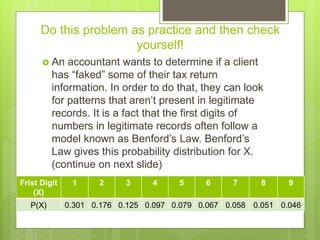
 An accountant wants to determine if a client
has “faked” some of their tax return
information. In order to do that, they can look
for patterns that aren’t present in legitimate
records. It is a fact that the first digits of
numbers in legitimate records often follow a
model known as Benford’s Law. Benford’s
Law gives this probability distribution for X.
(continue on next slide)
Frist Digit
(X)
1 2 3 4 5 6 7 8 9
P(X) 0.301 0.176 0.125 0.097 0.079 0.067 0.058 0.051 0.046
Problem (cont.)
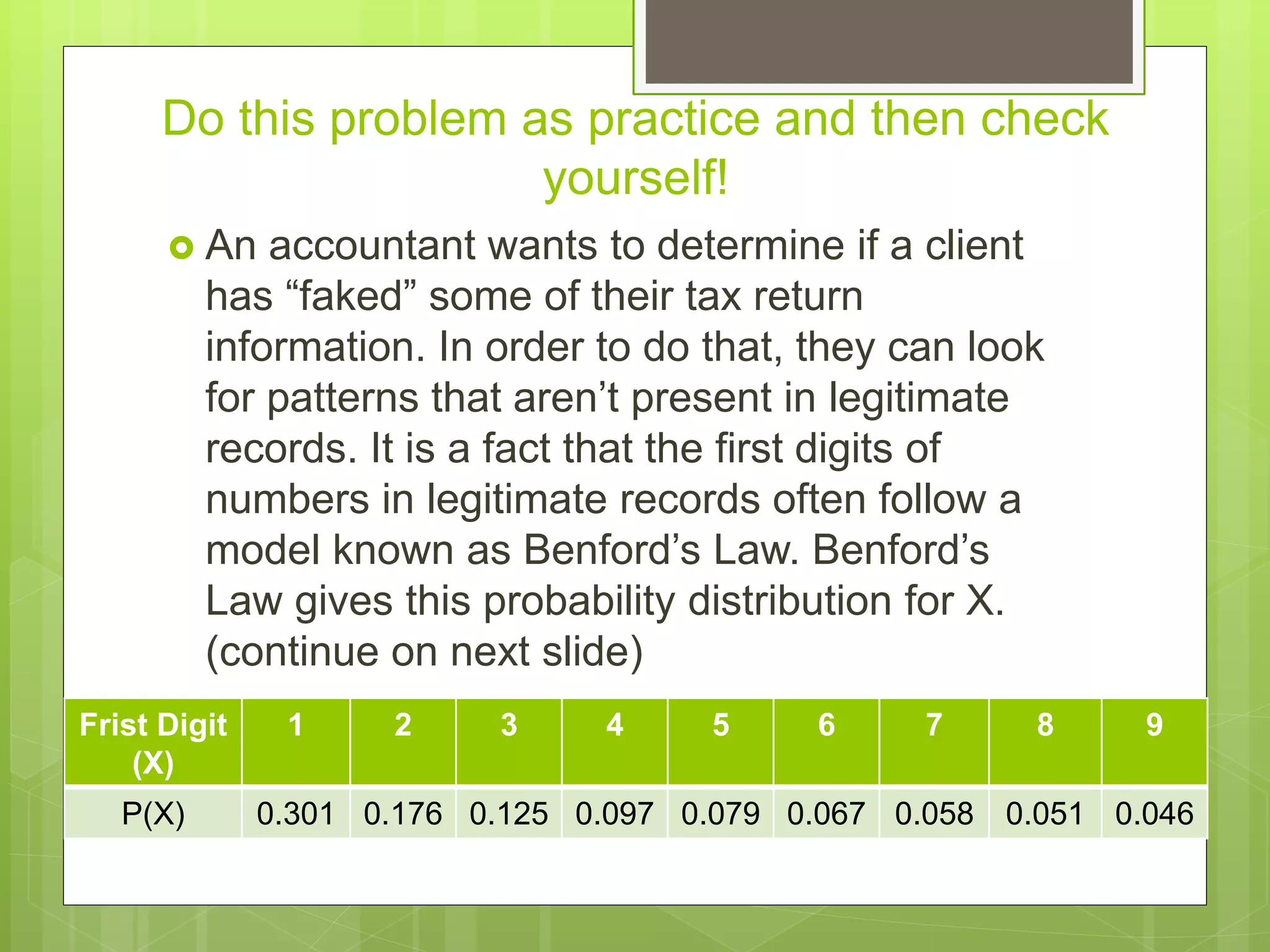
 This accountant inspects a random sample of 250
invoices from their client before accusing them of
committing fraud. The table below shows the
sample data.
 Are these data inconsistent with Benford’s law?
Perform the appropriate significance test at the
𝛼 = 0.05 level to support your answer.
Frist Digit
(X)
1 2 3 4 5 6 7 8 9
P(X) 0.301 0.176 0.125 0.097 0.079 0.067 0.058 0.051 0.046
Before you continue…
 Remember, you must find the actual expected
counts from the proportions given in the
probability model!
 NOW – work the problem on your own
paper before continuing.
 You can check your answers on the following
slides.
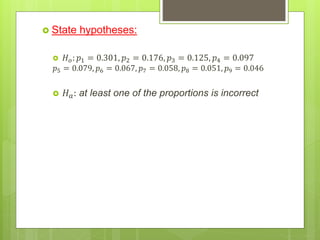
 State hypotheses:
 𝐻 𝑜: 𝑝1 = 0.301, 𝑝2 = 0.176, 𝑝3 = 0.125, 𝑝4 = 0.097
𝑝5 = 0.079, 𝑝6 = 0.067, 𝑝7 = 0.058, 𝑝8 = 0.051, 𝑝9 = 0.046
 𝐻 𝑎: at least one of the proportions is incorrect
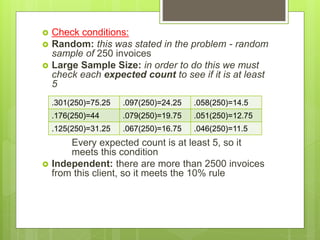
 Check conditions:
 Random: this was stated in the problem - random
sample of 250 invoices
 Large Sample Size: in order to do this we must
check each expected count to see if it is at least
5
Every expected count is at least 5, so it
meets this condition
 Independent: there are more than 2500 invoices
from this client, so it meets the 10% rule
.301(250)=75.25 .097(250)=24.25 .058(250)=14.5
.176(250)=44 .079(250)=19.75 .051(250)=12.75
.125(250)=31.25 .067(250)=16.75 .046(250)=11.5
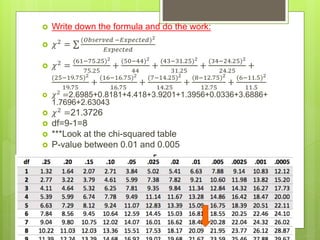
 Write down the formula and do the work:
 𝜒2 =
(𝑂𝑏𝑠𝑒𝑟𝑣𝑒𝑑 −𝐸𝑥𝑝𝑒𝑐𝑡𝑒𝑑)2
𝐸𝑥𝑝𝑒𝑐𝑡𝑒𝑑
 𝜒2 =
(61−75.25)2
75.25
+
(50−44)2
44
+
(43−31.25)2
31.25
+
(34−24.25)2
24.25
+
(25−19.75)2
19.75
+
(16−16.75)2
16.75
+
(7−14.25)2
14.25
+
(8−12.75)2
12.75
+
(6−11.5)2
11.5
 𝜒2 =2.6985+0.8181+4.418+3.9201+1.3956+0.0336+3.6886+
1.7696+2.63043
 𝜒2 =21.3726
 df=9-1=8
 ***Look at the chi-squared table
 P-value between 0.01 and 0.005
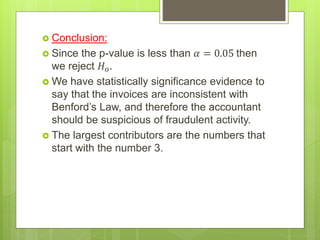
 Conclusion:
 Since the p-value is less than 𝛼 = 0.05 then
we reject 𝐻 𝑜.
 We have statistically significance evidence to
say that the invoices are inconsistent with
Benford’s Law, and therefore the accountant
should be suspicious of fraudulent activity.
 The largest contributors are the numbers that
start with the number 3.

Module 12 lesson 1 Example

  • 1.
    Do this problemas practice and then check yourself!  An accountant wants to determine if a client has “faked” some of their tax return information. In order to do that, they can look for patterns that aren’t present in legitimate records. It is a fact that the first digits of numbers in legitimate records often follow a model known as Benford’s Law. Benford’s Law gives this probability distribution for X. (continue on next slide) Frist Digit (X) 1 2 3 4 5 6 7 8 9 P(X) 0.301 0.176 0.125 0.097 0.079 0.067 0.058 0.051 0.046
  • 2.
    Problem (cont.)  Thisaccountant inspects a random sample of 250 invoices from their client before accusing them of committing fraud. The table below shows the sample data.  Are these data inconsistent with Benford’s law? Perform the appropriate significance test at the 𝛼 = 0.05 level to support your answer. Frist Digit (X) 1 2 3 4 5 6 7 8 9 P(X) 0.301 0.176 0.125 0.097 0.079 0.067 0.058 0.051 0.046
  • 3.
    Before you continue… Remember, you must find the actual expected counts from the proportions given in the probability model!  NOW – work the problem on your own paper before continuing.  You can check your answers on the following slides.
  • 4.
     State hypotheses: 𝐻 𝑜: 𝑝1 = 0.301, 𝑝2 = 0.176, 𝑝3 = 0.125, 𝑝4 = 0.097 𝑝5 = 0.079, 𝑝6 = 0.067, 𝑝7 = 0.058, 𝑝8 = 0.051, 𝑝9 = 0.046  𝐻 𝑎: at least one of the proportions is incorrect
  • 5.
     Check conditions: Random: this was stated in the problem - random sample of 250 invoices  Large Sample Size: in order to do this we must check each expected count to see if it is at least 5 Every expected count is at least 5, so it meets this condition  Independent: there are more than 2500 invoices from this client, so it meets the 10% rule .301(250)=75.25 .097(250)=24.25 .058(250)=14.5 .176(250)=44 .079(250)=19.75 .051(250)=12.75 .125(250)=31.25 .067(250)=16.75 .046(250)=11.5
  • 6.
     Write downthe formula and do the work:  𝜒2 = (𝑂𝑏𝑠𝑒𝑟𝑣𝑒𝑑 −𝐸𝑥𝑝𝑒𝑐𝑡𝑒𝑑)2 𝐸𝑥𝑝𝑒𝑐𝑡𝑒𝑑  𝜒2 = (61−75.25)2 75.25 + (50−44)2 44 + (43−31.25)2 31.25 + (34−24.25)2 24.25 + (25−19.75)2 19.75 + (16−16.75)2 16.75 + (7−14.25)2 14.25 + (8−12.75)2 12.75 + (6−11.5)2 11.5  𝜒2 =2.6985+0.8181+4.418+3.9201+1.3956+0.0336+3.6886+ 1.7696+2.63043  𝜒2 =21.3726  df=9-1=8  ***Look at the chi-squared table  P-value between 0.01 and 0.005
  • 7.
     Conclusion:  Sincethe p-value is less than 𝛼 = 0.05 then we reject 𝐻 𝑜.  We have statistically significance evidence to say that the invoices are inconsistent with Benford’s Law, and therefore the accountant should be suspicious of fraudulent activity.  The largest contributors are the numbers that start with the number 3.