Module 1 Lesson 4.notebook 
1 
September 16, 2013 
Homework: 
Lesson 4 Problem Set 
and CRS + J #1 
Module 1, Lesson 4 
Sept. 16th 
Aim: Identifying Proportional and 
Non-proportional relationships in Tables 
DO NOW: Check HW Answers 
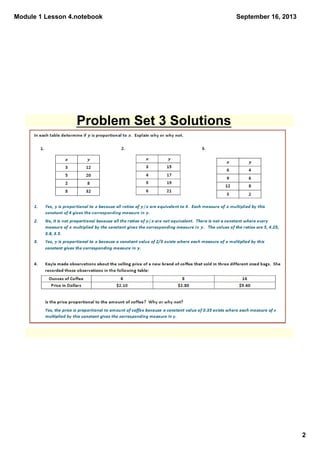
1.) Yes, Proportional 
2.) Not Proportional 
3.) Yes Proportional 
4.) Yes Proportional 
QUIZ 1 
FRIDAY 
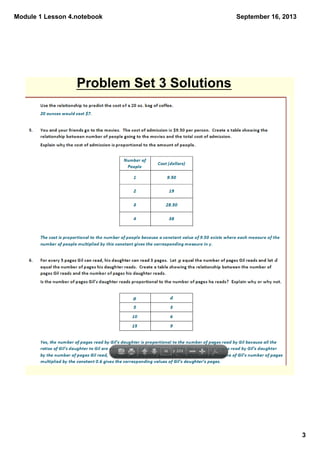
5.) Yes Proportional 
6.) Yes Proportional 
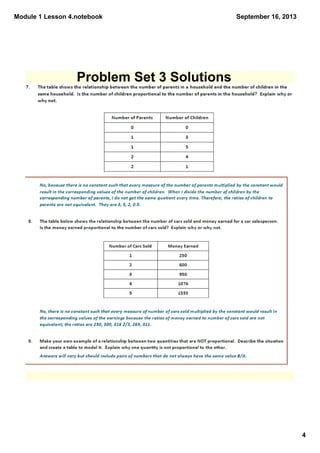
7.) Not Proportional 
8.) Not Proportional 
9.) Answers will vary
Module 1 Lesson 4.notebook 
2 
September 16, 2013 
Problem Set 3 Solutions
Module 1 Lesson 4.notebook 
3 
September 16, 2013 
Problem Set 3 Solutions
Module 1 Lesson 4.notebook 
4 
September 16, 2013 
Problem Set 3 Solutions
Module 1 Lesson 4.notebook 
5 
September 16, 2013
Module 1 Lesson 4.notebook 
6 
September 16, 2013 
Complete the following class work independently. 
Which Team Will Win The Race?? 
· You have decided to run in a long distance race. 
There are two teams that you can join. 
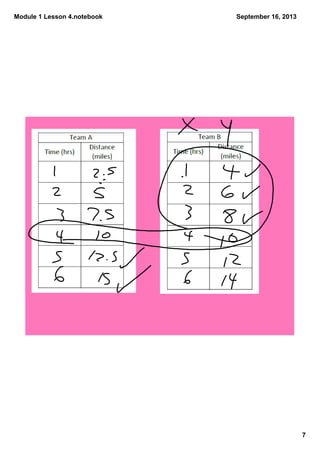
· Team A runs at a constant rate of 2.5 miles per hour. 
· Team B runs 4 miles the first hour and then 2 miles per hour 
after that. 
Task: Create a table for each team showing the distances that 
would be run for times of 1, 2, 3, 4, ,5 and 6 hours.
Module 1 Lesson 4.notebook 
7 
September 16, 2013
Module 1 Lesson 4.notebook 
8 
September 16, 2013 
a. For which team is distance proportional to time? Explain 
your reasoning. 
b. Explain how you know distance for the other team is not 
proportional to time.
Module 1 Lesson 4.notebook 
9 
September 16, 2013 
c. If the race were 2.5 miles long, which team would win? 
Explain. 
If the race were 3.5 miles long, which team would win? 
Explain. 
If the race were 4.5 miles long, which team would win? 
Explain.
Module 1 Lesson 4.notebook 
10 
September 16, 2013 
d. For what length race would it be better to be on Team 
B than Team A? Explain 
e. Using this relationship, if the members on the team 
ran for 10 hours, how far would each member run on each 
team?
Module 1 Lesson 4.notebook 
11 
September 16, 2013 
f. Will there always be a winning team, no matter what 
the length of the course? Why or why not? 
g. If the race is 12 miles long, which team should you 
choose to be on if you wish to win? Why would you 
choose this team? 
h. How much sooner would you finish on that team 
compared to the other team?
Module 1 Lesson 4.notebook 
12 
September 16, 2013 
Closing 
How does knowing two quantities are 
proportional help answer questions 
about the quantities? For example, 
if we know 1 cup = 8 oz, what does 
that allow us to do?
Module 1 Lesson 4.notebook 
13 
September 16, 2013 
EXIT TICKET 
The table below shows the relationship between the 
side lengths of a regular octagon and its perimeter. 
Complete the table. 
If Gabby wants to make an octagon with a side length of 20 inches 
using wire, how much wire does she need? Justify your reasoning 
with an explanation of whether perimeter is proportional to the side 
length.
Module 1 Lesson 4.notebook 
14 
September 16, 2013

Module 1 lesson 4

  • 1.
    Module 1 Lesson4.notebook 1 September 16, 2013 Homework: Lesson 4 Problem Set and CRS + J #1 Module 1, Lesson 4 Sept. 16th Aim: Identifying Proportional and Non-proportional relationships in Tables DO NOW: Check HW Answers 1.) Yes, Proportional 2.) Not Proportional 3.) Yes Proportional 4.) Yes Proportional QUIZ 1 FRIDAY 5.) Yes Proportional 6.) Yes Proportional 7.) Not Proportional 8.) Not Proportional 9.) Answers will vary
  • 2.
    Module 1 Lesson4.notebook 2 September 16, 2013 Problem Set 3 Solutions
  • 3.
    Module 1 Lesson4.notebook 3 September 16, 2013 Problem Set 3 Solutions
  • 4.
    Module 1 Lesson4.notebook 4 September 16, 2013 Problem Set 3 Solutions
  • 5.
    Module 1 Lesson4.notebook 5 September 16, 2013
  • 6.
    Module 1 Lesson4.notebook 6 September 16, 2013 Complete the following class work independently. Which Team Will Win The Race?? · You have decided to run in a long distance race. There are two teams that you can join. · Team A runs at a constant rate of 2.5 miles per hour. · Team B runs 4 miles the first hour and then 2 miles per hour after that. Task: Create a table for each team showing the distances that would be run for times of 1, 2, 3, 4, ,5 and 6 hours.
  • 7.
    Module 1 Lesson4.notebook 7 September 16, 2013
  • 8.
    Module 1 Lesson4.notebook 8 September 16, 2013 a. For which team is distance proportional to time? Explain your reasoning. b. Explain how you know distance for the other team is not proportional to time.
  • 9.
    Module 1 Lesson4.notebook 9 September 16, 2013 c. If the race were 2.5 miles long, which team would win? Explain. If the race were 3.5 miles long, which team would win? Explain. If the race were 4.5 miles long, which team would win? Explain.
  • 10.
    Module 1 Lesson4.notebook 10 September 16, 2013 d. For what length race would it be better to be on Team B than Team A? Explain e. Using this relationship, if the members on the team ran for 10 hours, how far would each member run on each team?
  • 11.
    Module 1 Lesson4.notebook 11 September 16, 2013 f. Will there always be a winning team, no matter what the length of the course? Why or why not? g. If the race is 12 miles long, which team should you choose to be on if you wish to win? Why would you choose this team? h. How much sooner would you finish on that team compared to the other team?
  • 12.
    Module 1 Lesson4.notebook 12 September 16, 2013 Closing How does knowing two quantities are proportional help answer questions about the quantities? For example, if we know 1 cup = 8 oz, what does that allow us to do?
  • 13.
    Module 1 Lesson4.notebook 13 September 16, 2013 EXIT TICKET The table below shows the relationship between the side lengths of a regular octagon and its perimeter. Complete the table. If Gabby wants to make an octagon with a side length of 20 inches using wire, how much wire does she need? Justify your reasoning with an explanation of whether perimeter is proportional to the side length.
  • 14.
    Module 1 Lesson4.notebook 14 September 16, 2013