Module 4 Lesson 13.notebook
1
January 27, 2017
Do Now
Module 4 Lesson 13:
Relative Error
Volume Handout
Homework:
1.)Page 55 1-3
2.) Exam 2/1/17
Module 4 Lesson 13.notebook
2
January 27, 2017
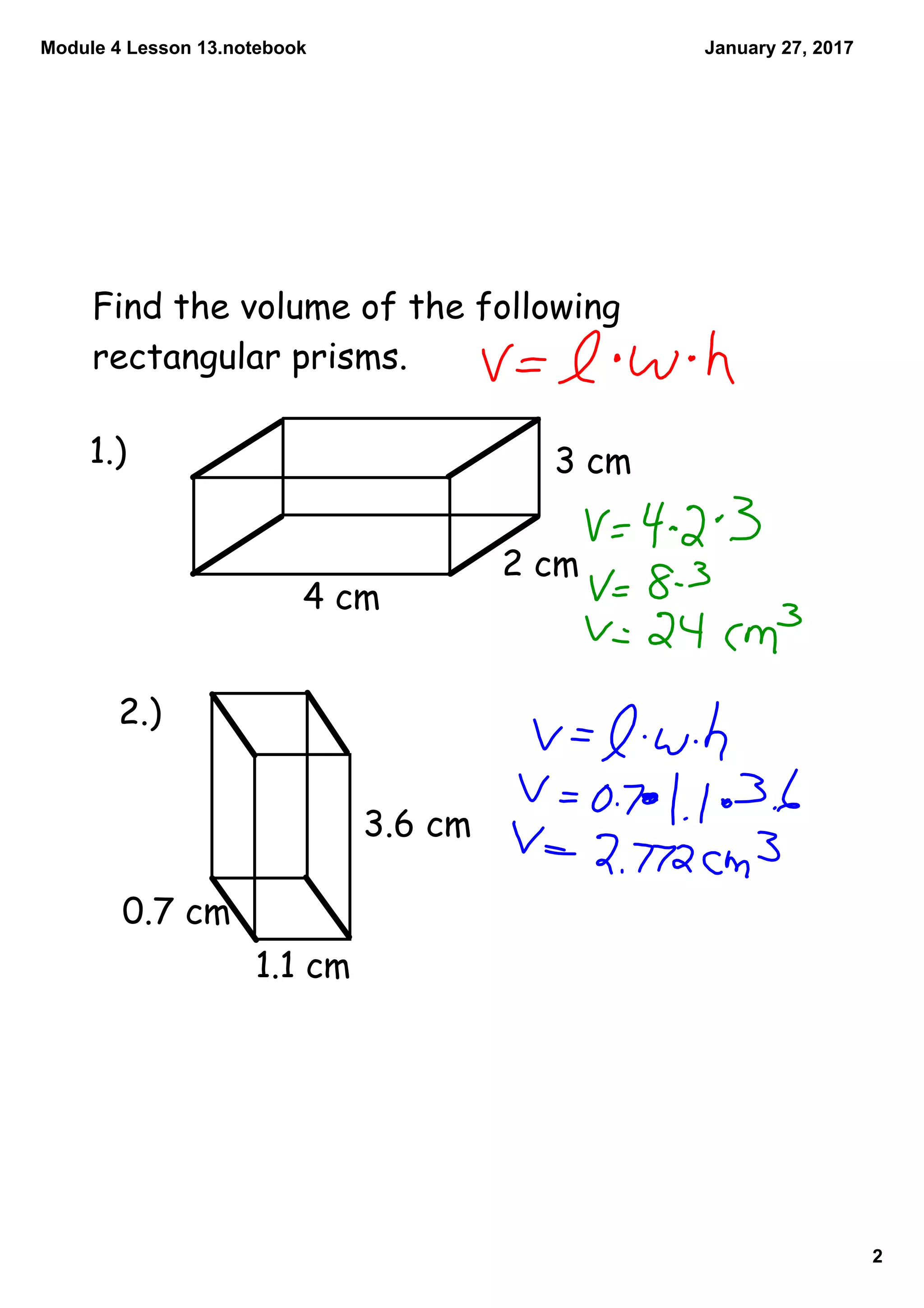
Find the volume of the following
rectangular prisms.
1.)
4 cm
2 cm
3 cm
2.)
3.6 cm
1.1 cm
0.7 cm
Module 4 Lesson 13.notebook
3
January 27, 2017
51
Module 4 Lesson 13.notebook
4
January 27, 2017
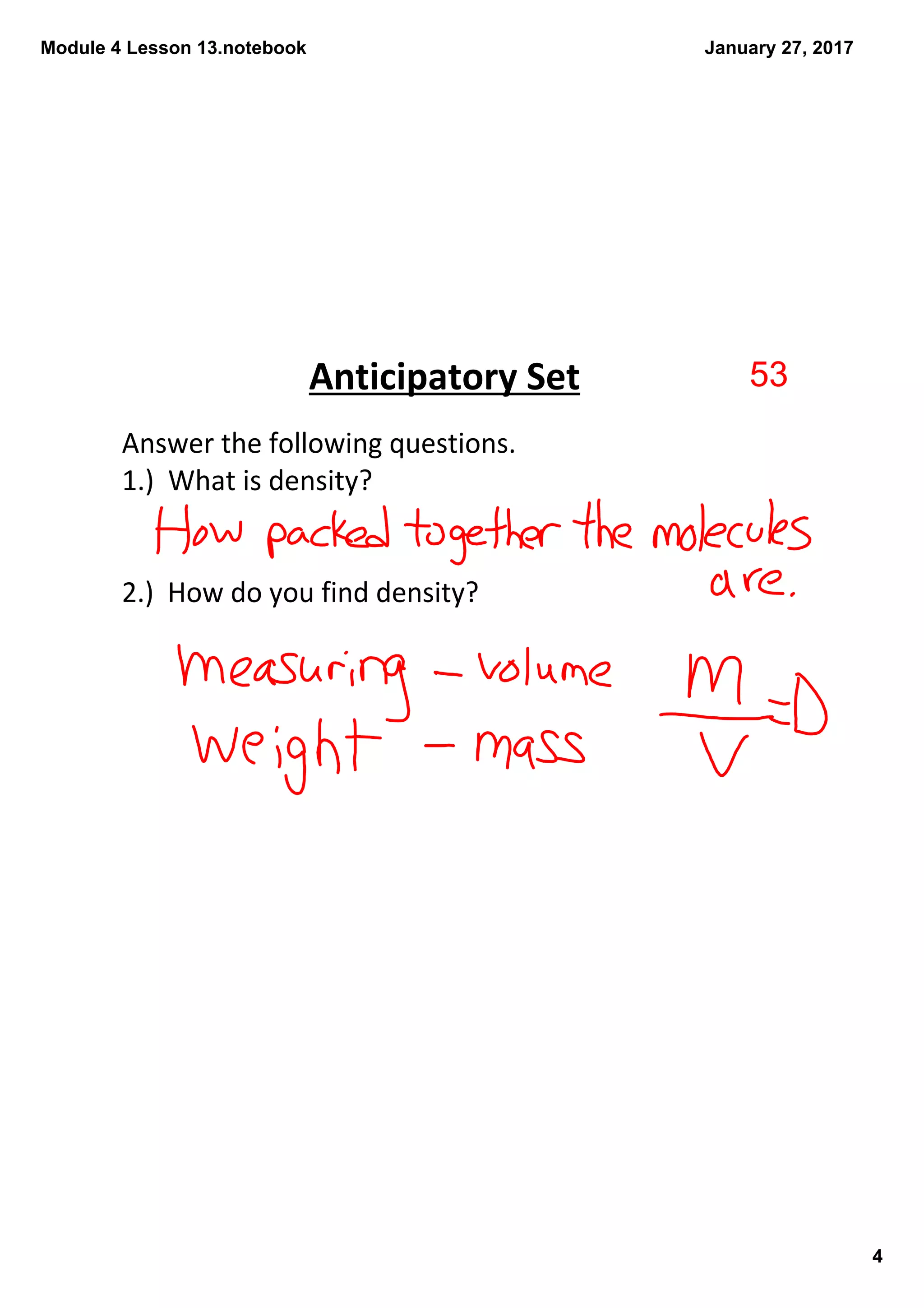
Answer the following questions.
1.)  What is density?
2.)  How do you find density?
Anticipatory Set 53
Module 4 Lesson 13.notebook
5
January 27, 2017
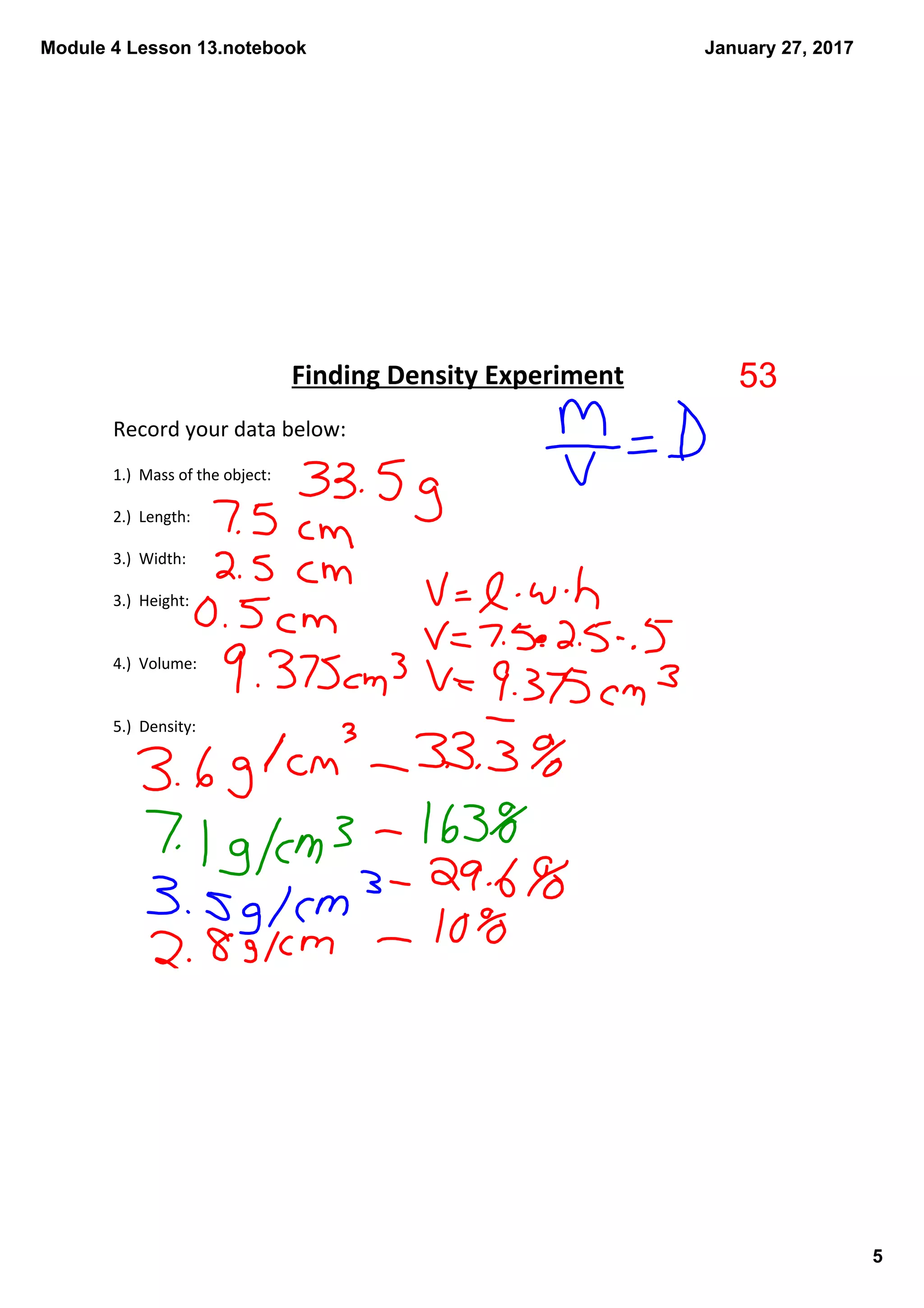
Record your data below:
1.)  Mass of the object:
2.)  Length:
3.)  Width:
3.)  Height:
4.)  Volume:
5.)  Density:
Finding Density Experiment 53
Module 4 Lesson 13.notebook
6
January 27, 2017
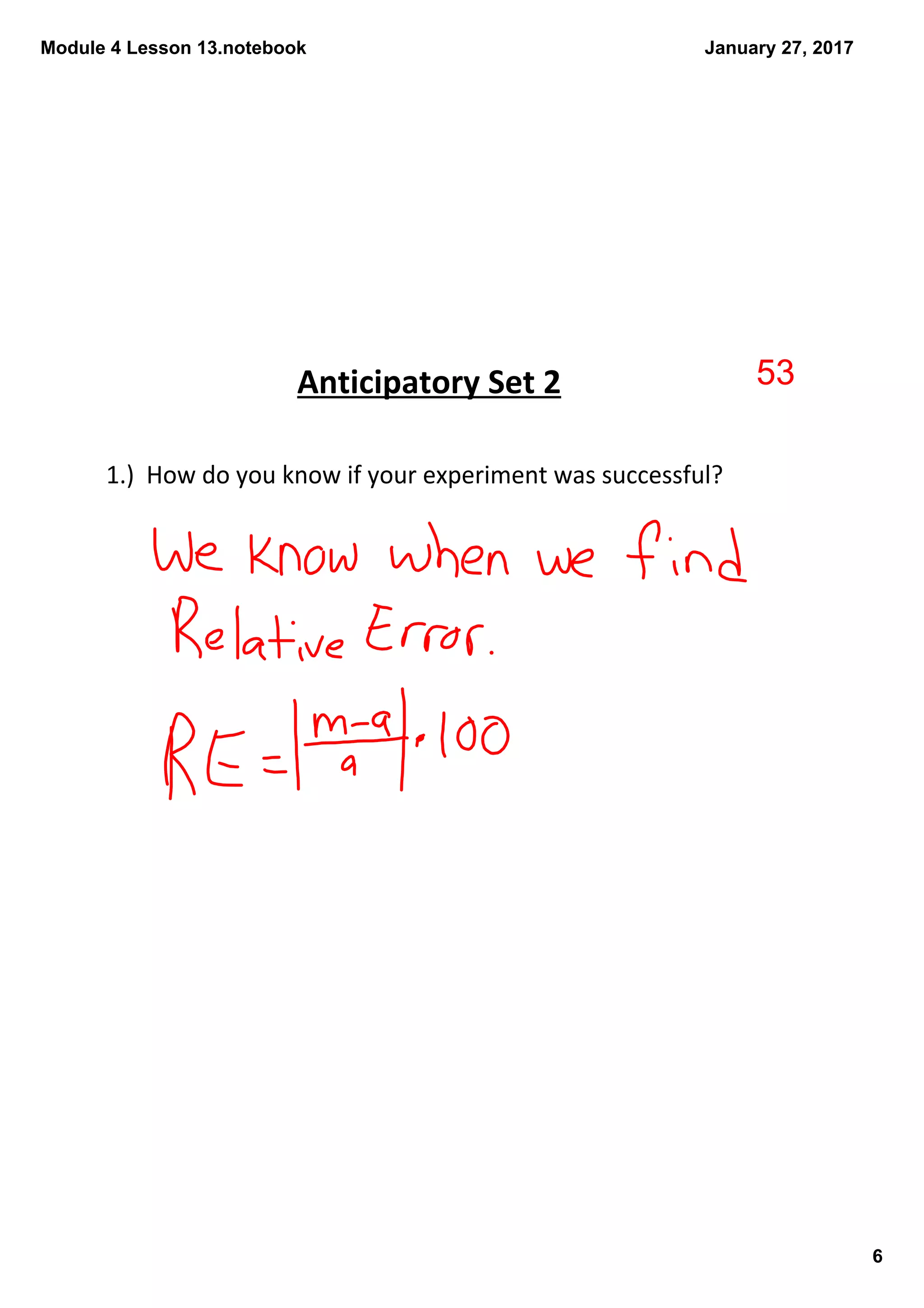
1.)  How do you know if your experiment was successful?
Anticipatory Set 2 53
Module 4 Lesson 13.notebook
7
January 27, 2017
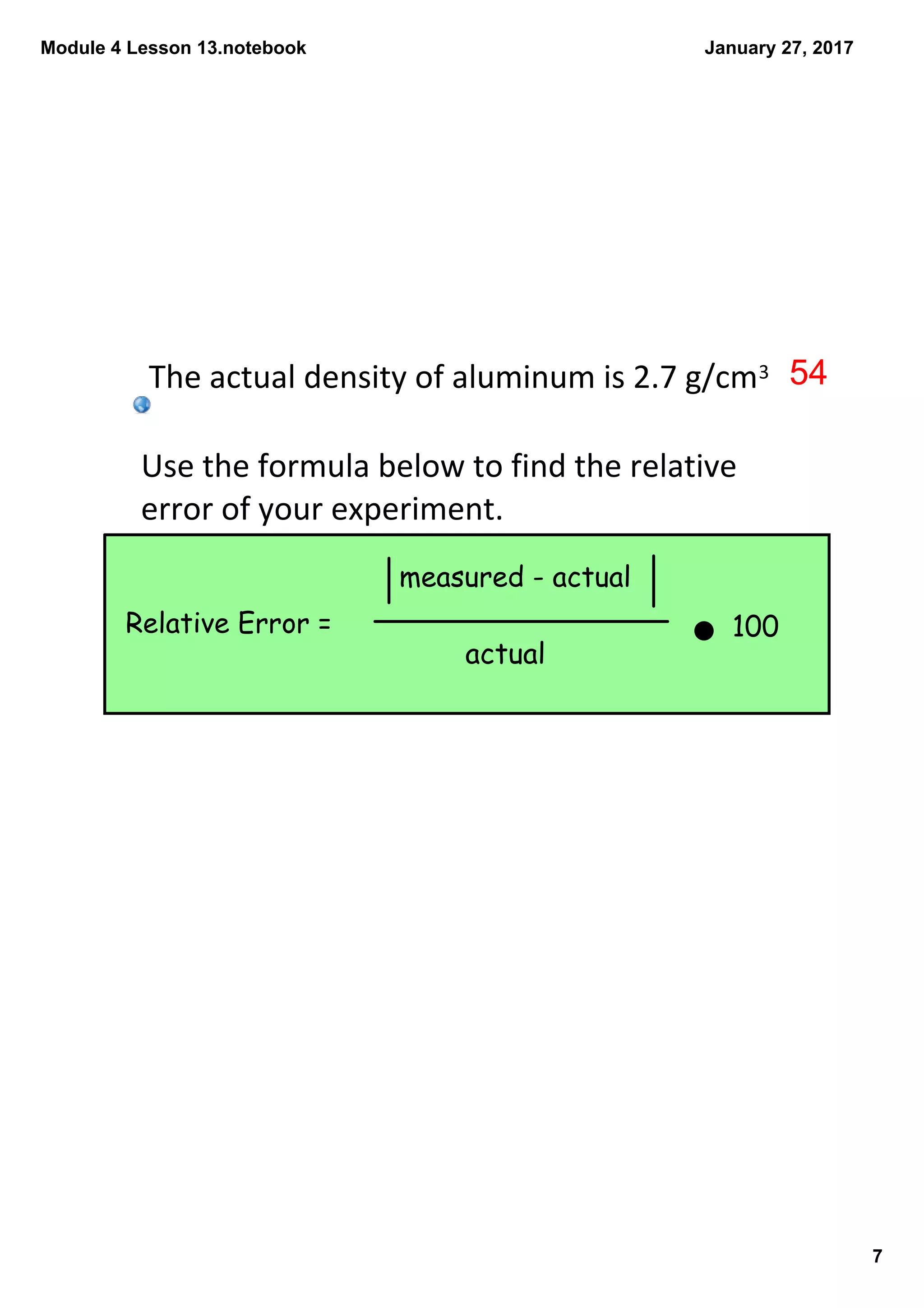
Use the formula below to find the relative 
error of your experiment.
Relative Error =
measured - actual
actual
100
The actual density of aluminum is 2.7 g/cm3 54
Module 4 Lesson 13.notebook
8
January 27, 2017
1.)  How successful was your experiment?  Justify your 
answer.
2.)  What do you think caused any error that you had?
Follow Up Questions
54
Module 4 Lesson 13.notebook
9
January 27, 2017
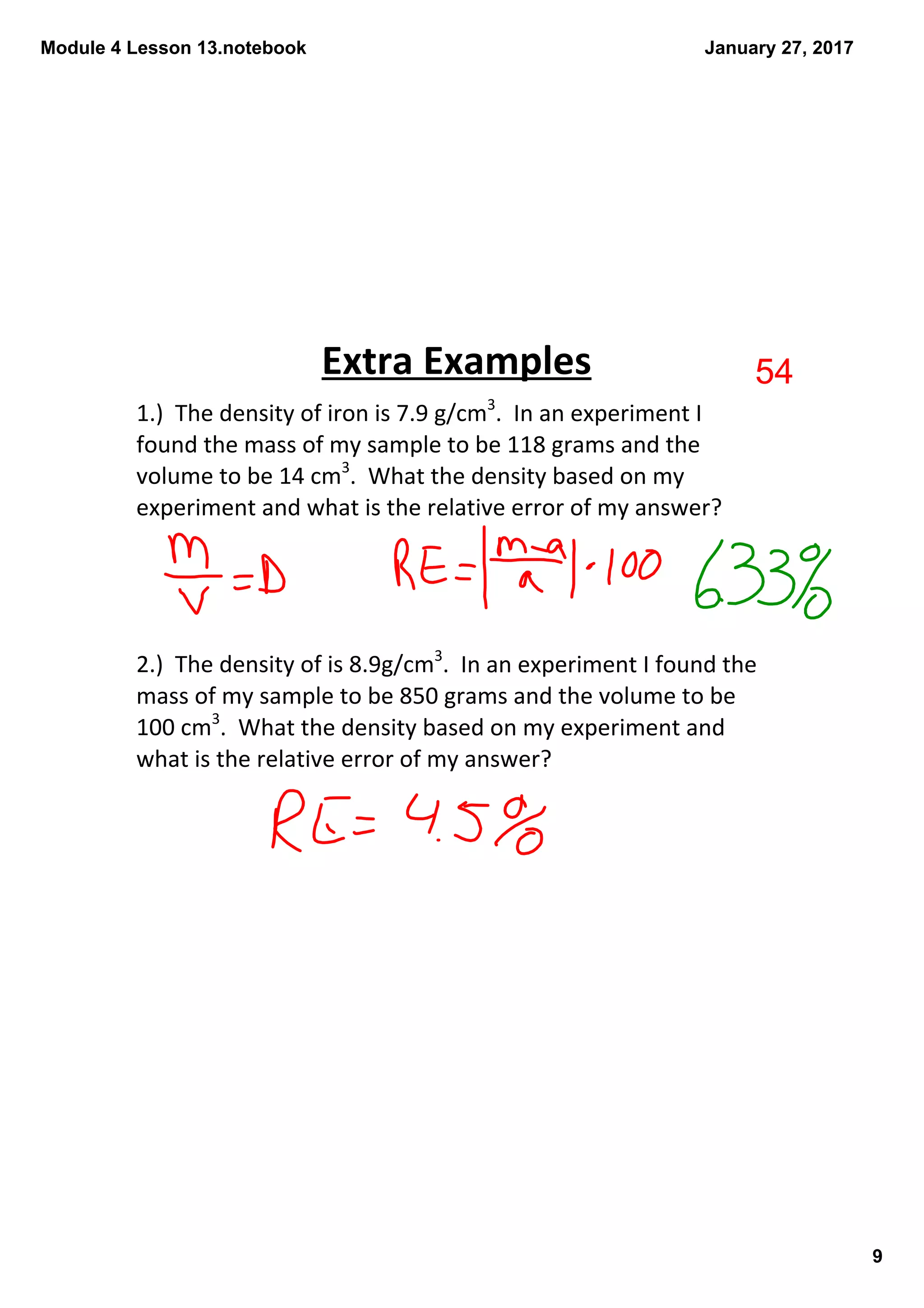
1.)  The density of iron is 7.9 g/cm3
.  In an experiment I 
found the mass of my sample to be 118 grams and the 
volume to be 14 cm3
.  What the density based on my 
experiment and what is the relative error of my answer?
2.)  The density of is 8.9g/cm3
.  In an experiment I found the 
mass of my sample to be 850 grams and the volume to be 
100 cm3
.  What the density based on my experiment and 
what is the relative error of my answer?
Extra Examples 54
Module 4 Lesson 13.notebook
10
January 27, 2017
Closing Activity:
Can you think of a lab that you did in science
this year or last that you could have used
relative error to determine your accuracy?
Module 4 Lesson 13.notebook
11
January 27, 2017
55

Module 4 lesson 13