LECTURE-I
(INTRODUCTION TO PPC)
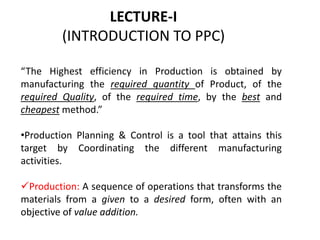
“The Highest efficiency in Production is obtained by
manufacturing the required quantity of Product, of the
required Quality, of the required time, by the best and
cheapest method.”
•Production Planning & Control is a tool that attains this
target by Coordinating the different manufacturing
activities.
Production: A sequence of operations that transforms the
materials from a given to a desired form, often with an
objective of value addition.
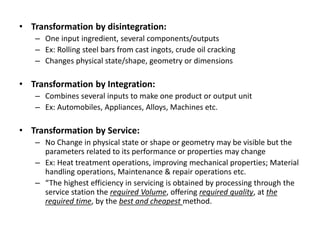
• Transformation by disintegration:
– One input ingredient, several components/outputs
– Ex: Rolling steel bars from cast ingots, crude oil cracking
– Changes physical state/shape, geometry or dimensions
• Transformation by Integration:
– Combines several inputs to make one product or output unit
– Ex: Automobiles, Appliances, Alloys, Machines etc.
• Transformation by Service:
– No Change in physical state or shape or geometry may be visible but the
parameters related to its performance or properties may change
– Ex: Heat treatment operations, improving mechanical properties; Material
handling operations, Maintenance & repair operations etc.
– “The highest efficiency in servicing is obtained by processing through the
service station the required Volume, offering required quality, at the
required time, by the best and cheapest method.
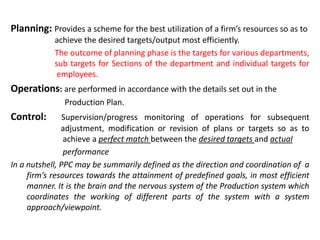
Planning: Provides a scheme for the best utilization of a firm’s resources so as to
achieve the desired targets/output most efficiently.
The outcome of planning phase is the targets for various departments,
sub targets for Sections of the department and individual targets for
employees.
Operations: are performed in accordance with the details set out in the
Production Plan.
Control: Supervision/progress monitoring of operations for subsequent
adjustment, modification or revision of plans or targets so as to
achieve a perfect match between the desired targets and actual
performance
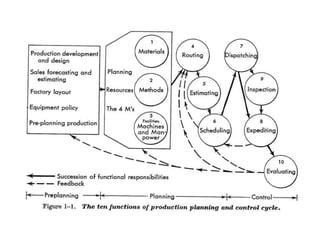
In a nutshell, PPC may be summarily defined as the direction and coordination of a
firm’s resources towards the attainment of predefined goals, in most efficient
manner. It is the brain and the nervous system of the Production system which
coordinates the working of different parts of the system with a system
approach/viewpoint.
PPC will ensure-
 Raw materials, standard parts or semi finished parts available
wherever required, whenever required, to eliminate delays.
 The best methods compatible with the facilities/resources of
the firm (machines, materials, skills) are used for production.
 Equipment design, selection, replacement, maintenance is top
of the notch so as to avoid breakdowns, loss of efficiency
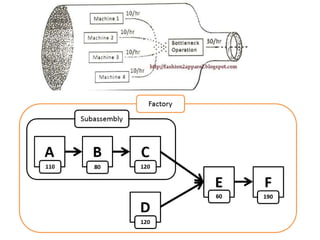
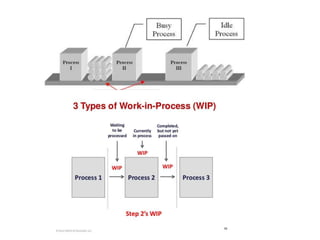
 Materials/components flow smoothly throughout the plant
without any bottlenecks or congestion
 Operation times are well defined before the start of production
to set up performance standards
 Machines are assigned the jobs according to their capability
and capacity.
 Semi finished products arrive at the next station in time,
without any need to wait for processing anywhere in the
system.
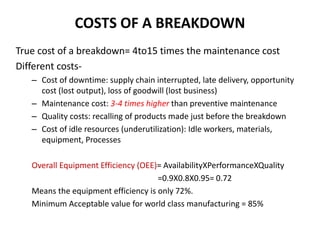
COSTS OF A BREAKDOWN
True cost of a breakdown= 4to15 times the maintenance cost
Different costs-
– Cost of downtime: supply chain interrupted, late delivery, opportunity
cost (lost output), loss of goodwill (lost business)
– Maintenance cost: 3-4 times higher than preventive maintenance
– Quality costs: recalling of products made just before the breakdown
– Cost of idle resources (underutilization): Idle workers, materials,
equipment, Processes
Overall Equipment Efficiency (OEE)= AvailabilityXPerformanceXQuality
=0.9X0.8X0.95= 0.72
Means the equipment efficiency is only 72%.
Minimum Acceptable value for world class manufacturing = 85%
Module 1 (introduction to ppc)

Module 1 (introduction to ppc)

  • 1.
    LECTURE-I (INTRODUCTION TO PPC) “TheHighest efficiency in Production is obtained by manufacturing the required quantity of Product, of the required Quality, of the required time, by the best and cheapest method.” •Production Planning & Control is a tool that attains this target by Coordinating the different manufacturing activities. Production: A sequence of operations that transforms the materials from a given to a desired form, often with an objective of value addition.
  • 2.
    • Transformation bydisintegration: – One input ingredient, several components/outputs – Ex: Rolling steel bars from cast ingots, crude oil cracking – Changes physical state/shape, geometry or dimensions • Transformation by Integration: – Combines several inputs to make one product or output unit – Ex: Automobiles, Appliances, Alloys, Machines etc. • Transformation by Service: – No Change in physical state or shape or geometry may be visible but the parameters related to its performance or properties may change – Ex: Heat treatment operations, improving mechanical properties; Material handling operations, Maintenance & repair operations etc. – “The highest efficiency in servicing is obtained by processing through the service station the required Volume, offering required quality, at the required time, by the best and cheapest method.
  • 3.
    Planning: Provides ascheme for the best utilization of a firm’s resources so as to achieve the desired targets/output most efficiently. The outcome of planning phase is the targets for various departments, sub targets for Sections of the department and individual targets for employees. Operations: are performed in accordance with the details set out in the Production Plan. Control: Supervision/progress monitoring of operations for subsequent adjustment, modification or revision of plans or targets so as to achieve a perfect match between the desired targets and actual performance In a nutshell, PPC may be summarily defined as the direction and coordination of a firm’s resources towards the attainment of predefined goals, in most efficient manner. It is the brain and the nervous system of the Production system which coordinates the working of different parts of the system with a system approach/viewpoint.
  • 4.
    PPC will ensure- Raw materials, standard parts or semi finished parts available wherever required, whenever required, to eliminate delays.  The best methods compatible with the facilities/resources of the firm (machines, materials, skills) are used for production.  Equipment design, selection, replacement, maintenance is top of the notch so as to avoid breakdowns, loss of efficiency  Materials/components flow smoothly throughout the plant without any bottlenecks or congestion  Operation times are well defined before the start of production to set up performance standards  Machines are assigned the jobs according to their capability and capacity.  Semi finished products arrive at the next station in time, without any need to wait for processing anywhere in the system.
  • 7.
    COSTS OF ABREAKDOWN True cost of a breakdown= 4to15 times the maintenance cost Different costs- – Cost of downtime: supply chain interrupted, late delivery, opportunity cost (lost output), loss of goodwill (lost business) – Maintenance cost: 3-4 times higher than preventive maintenance – Quality costs: recalling of products made just before the breakdown – Cost of idle resources (underutilization): Idle workers, materials, equipment, Processes Overall Equipment Efficiency (OEE)= AvailabilityXPerformanceXQuality =0.9X0.8X0.95= 0.72 Means the equipment efficiency is only 72%. Minimum Acceptable value for world class manufacturing = 85%