Modifiers
Modifiers are words,phrases, or clauses that provide description in
sentences.
Modifiers allow writers to take the picture that they have in their heads
and transfer it accurately to the heads of their readers.
It can be a WORD, A PHRASE or A CLAUSE
◦ Word: E.g. Cool and intelligent, Ken is the class hero.
◦ Phrase: The moment Michael saw the ghost, the hair on his hands stood up.
(Shows where..) Be very careful with prepositional phrases.
◦ Clause: The girl, whom you spoke to a minute ago, is dead!
3.
Types of words,phrases and clauses:
◦ adjectives (modify nouns and pronouns) (for example: the RED
house)
◦ adverbs (modify verbs) (for example: he ran QUICKLY)
◦ modifier phrases (modify an action or an actor) (LOOKING AT THE
CLOCK, he noticed that he was late)
4.
Misplaced Modifiers
A misplacedmodifier is a word, phrase, or clause that is improperly separated from the
word it modifies / describes.
Because of the separation, sentences with this error often sound awkward, ridiculous, or
confusing. Furthermore, they can be downright illogical.
Example 1: The young girl was walking the dog in a short skirt.
Example 2: The dog was chasing the boy with the spiked collar.
You can see what's wrong. The dog isn't "in a short skirt" and the boy doesn't have a "spiked
collar." Because the modifier is misplaced, we have to think for a minute before we get the
intended meaning.
5.
Correction of themisplaced modifier
The young girl was walking the dog in a short skirt.
IS CHANGED TO:
The young girl in a short skirt was walking the dog.
The dog was chasing the boy with the spiked collar.
IS CHANGED TO:
The dog with the spiked collar was chasing the boy
Hence, misplace modifiers are words that because of awkward placements, do not
describe what the writer intended them to describe.
6.
How to correctthe misplaced modifier?
1. The first step in identifying modifiers is to read the sentence and look for
descriptive words.
2. You should then look at each descriptive word and try to determine whether
it is an adjective or an adverb or any other modifying phrase.
3. Remember that adjectives modify nouns and pronouns. Do not mistakenly
use an adverb to modify these parts of speech.
4. Underline the modifying word/phrase/clause and determine what it is
supposed to describe.
5. Place modifying words as close as possible to what they describe
7.
Your turn!
1. Thepatient on the psychiatrist’s couch talked about his childhood.
2. The crowd watched the tennis player with swiveling heads.
3. Vonnie put 4 hamburgers on the counter which she was cooking for dinner.
4. Steve carefully hung the new suit that he would wear to his first job
interview in the bedroom closet.
5. Anne ripped the shirt on a car door that she made in sewing class.
6. The newscaster spoke softly into a microphone wearing a bulletproof vest.
8.
Additionally…
You also needto watch the placement of modifiers such as almost, even, hardly,
nearly, often, and only.
A couple of examples should be enough:
1. Big Dog almost ran around the yard twenty times.
2. He nearly ate a whole box of treats
In both sentences--when he "almost ran" and "nearly ate"--nothing happened!
He didn't quite get around to doing either thing. What is intended is:
1. Big Dog ran around the yard almost twenty times.
2. He ate nearly a whole box of cereals.
9.
Your turn
1. Inearly napped for 20 minutes during the biology lecture.
2. Only Nadia reads that book.
10.
Dangling Modifiers
Read thesentences below and try to analyze the meaning they may be
conveying:
◦ Having been thrown in the air, the dog caught the stick.
◦ Smashed flat by a passing truck, Big Dog sniffed at what was left of a half-eaten hamburger.
◦ The writer has unintentionally said something that he (or she) didn't intend. The dog was
not "thrown in the air," and Big Dog was not "smashed flat."
11.
What are danglingmodifiers?
A dangling modifier is a word or phrase that cannot logically describe,
limit, or restrict any word or word group in the sentence.
They are formed when either the word that should be described is
separated from the modifier or the word itself is missing in that sentence
12.
How to correctthem?
Do the following:
1. Check for modifying phrases at the beginning of your sentences.
2. If you find one, underline the first noun that follows it. (That's the
one that is being modified.)
3. Make sure the modifier and noun go together logically. If they
don't, chances are you have a dangling modifier.
13.
4. Rewrite thesentence by:
1. Adding a word or word group that the dangling modifier can logically
modify.
2. Changing the position of the word it is supposed to modify
3. Creating a clear subject
4. Changing the sentence from passive to active
14.
Corrections
Having been thrownin the air, the dog caught the stick.
IS CHANGED TO:
When the stick was thrown in the air, the dog caught it.
Smashed flat by a passing truck, Big Dog sniffed at what was left of a half-eaten
hamburger
IS CHANGED TO:
Big Dog sniffed at what was left of a half-eaten burger that had been smashed by a
passing truck.
A. Sitting onthe top shelf of the refrigerator, Desmond saw Mom’s
pristine birthday cake.
B. Desmond, sitting on the top shelf of the refrigerator, saw Mom’s
pristine birthday cake
C. Sitting on the top shelf of the refrigerator, Mom’s pristine birthday
cake caught Desmond’s attention.
17.
A. Loudly slurpingthe bowl of hot soup, Derrick’s impolite behavior
annoyed the other diner patrons.
B. As Derrick loudly slurped the bowl of hot soup, his impolite
behavior annoyed the other diner patrons.
C. Loudly slurping the hot soup, the other diner patrons were
annoyed by Derrick’s impolite behavior.
18.
A. Seated bythe window, Barbara munched popcorn on the long bus
ride home.
B. Seated by the window, popcorn was munched by Barbara on the
long bus ride home.
C. Barbara munched popcorn seated by the window on the long bus
ride home.
19.
A. Rosalind struggledup the three flights of stairs in her new jeans,
which were too tight for comfort.
B. Too tight for comfort, Rosalind struggled up the three flights of
stairs in her new jeans.
C. In her new jeans, Rosalind struggled up three flights of stairs,
which were too tight for comfort.
20.
A. Twisting inthe strong wind, we knew the hurricane was close as
we watched the trees.
B. We knew the hurricane was close as we watched the trees twisting
in the strong wind.
C. We knew the hurricane was close, twisting in the wind, as we
watched the trees.
21.
A. Applying redtoenail paint, Will asked Rhonda if she could interrupt
her beauty regimen to go to the mall.
B. Will asked Rhonda, who was applying red toenail paint, if she could
interrupt her beauty regimen to go to the mall.
C. Will asked if Rhonda could interrupt her beauty regimen to go to
the mall, which was applying red toenail paint.
22.
A. Struggling withthe algebra problem, the pencil tapped nervously
on Kenneth’s desk.
B. Struggling with the algebra problem, Kenneth’s desk was tapped
nervously with the pencil.
C. Struggling with the algebra problem, Kenneth nervously tapped his
pencil on the desk.
23.
A. Marking hisscore sheet with care, the hope this week was that
Byron would pass his vocabulary quiz.
B. Marking his score sheet with care, Byron hoped that this week he
would pass his vocabulary quiz.
C. Hoping that this week he would pass his vocabulary quiz, the score
sheet was marked carefully by Byron.
24.
A. Splashing inthe puddles left by the thunderstorm, Jessie cooled
her hot feet.
B. Splashing in the puddles left by the thunderstorm, the cool water
refreshed Jessie’s hot feet.
C. Splashing in the puddles, the thunderstorm cooled Jessie’s hot feet.
25.
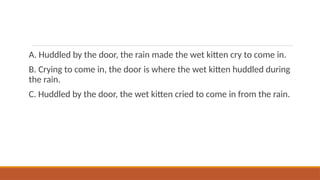
A. Huddled bythe door, the rain made the wet kitten cry to come in.
B. Crying to come in, the door is where the wet kitten huddled during
the rain.
C. Huddled by the door, the wet kitten cried to come in from the rain.
26.
Your turn tomake the corrections!
1. Dancing on their hind legs, the audience cheered wildly
as the elephants paraded by.
2. While turning over the egg, hot oil splashed on my arm.
3. To improve his essay, each page was proofread.












![Misplaced and dangling_modifiers[1]](https://cdn.slidesharecdn.com/ss_thumbnails/misplacedanddanglingmodifiers1-130501074816-phpapp01-thumbnail.jpg?width=640&height=640&fit=bounds)


