Modelling of Laminar-to-Turbulent Flow Transition
on a Marine Propeller Using a RANS Solver
J. Baltazar1
, B. Schuiling2
, M. Kerkvliet2
1Instituto Superior Técnico, Universidade de Lisboa, Portugal
2Maritime Research Institute Netherlands, Wageningen, the Netherlands
NuTTS 2023 Ericeira, Portugal 15-17 October 1
Introduction
NuTTS 2023 Ericeira, Portugal 15-17 October 2
Introduction
Full-scale prediction propellers mostly based on simple
extrapolation methods from model-scale experiments
NuTTS 2023 Ericeira, Portugal 15-17 October 2
Introduction
Full-scale prediction propellers mostly based on simple
extrapolation methods from model-scale experiments
RANS solvers may be used at both model and full scale and
offer an alternative scaling method
NuTTS 2023 Ericeira, Portugal 15-17 October 2
Introduction
Full-scale prediction propellers mostly based on simple
extrapolation methods from model-scale experiments
RANS solvers may be used at both model and full scale and
offer an alternative scaling method
Requires accurate prediction at both Reynolds numbers
NuTTS 2023 Ericeira, Portugal 15-17 October 2
Introduction
Turbulence models (k − ω, SST, k −
√
kL, etc.) are known to
provide a good prediction for fully developed turbulent flows
NuTTS 2023 Ericeira, Portugal 15-17 October 3
Introduction
Turbulence models (k − ω, SST, k −
√
kL, etc.) are known to
provide a good prediction for fully developed turbulent flows
However, these models predict transition at lower Reynolds
number than seen in experiments
NuTTS 2023 Ericeira, Portugal 15-17 October 3
Introduction
Turbulence models (k − ω, SST, k −
√
kL, etc.) are known to
provide a good prediction for fully developed turbulent flows
However, these models predict transition at lower Reynolds
number than seen in experiments
Model-scale experiments in critical Reynolds number regime
NuTTS 2023 Ericeira, Portugal 15-17 October 3
Introduction
Turbulence models (k − ω, SST, k −
√
kL, etc.) are known to
provide a good prediction for fully developed turbulent flows
However, these models predict transition at lower Reynolds
number than seen in experiments
Model-scale experiments in critical Reynolds number regime
Propeller performance prediction at different Reynolds number
regimes using the γ − R̃eθ transition model and compare with
the k − ω SST turbulence model
NuTTS 2023 Ericeira, Portugal 15-17 October 3
IST/MARIN Research Project 2021
Improving Propeller Computations at Model-Scale
NuTTS 2023 Ericeira, Portugal 15-17 October 4
IST/MARIN Research Project 2021
Improving Propeller Computations at Model-Scale
Extensive experimental campaign carried out at MARIN
in 2020 (4 propellers)
NuTTS 2023 Ericeira, Portugal 15-17 October 4
IST/MARIN Research Project 2021
Improving Propeller Computations at Model-Scale
Extensive experimental campaign carried out at MARIN
in 2020 (4 propellers)
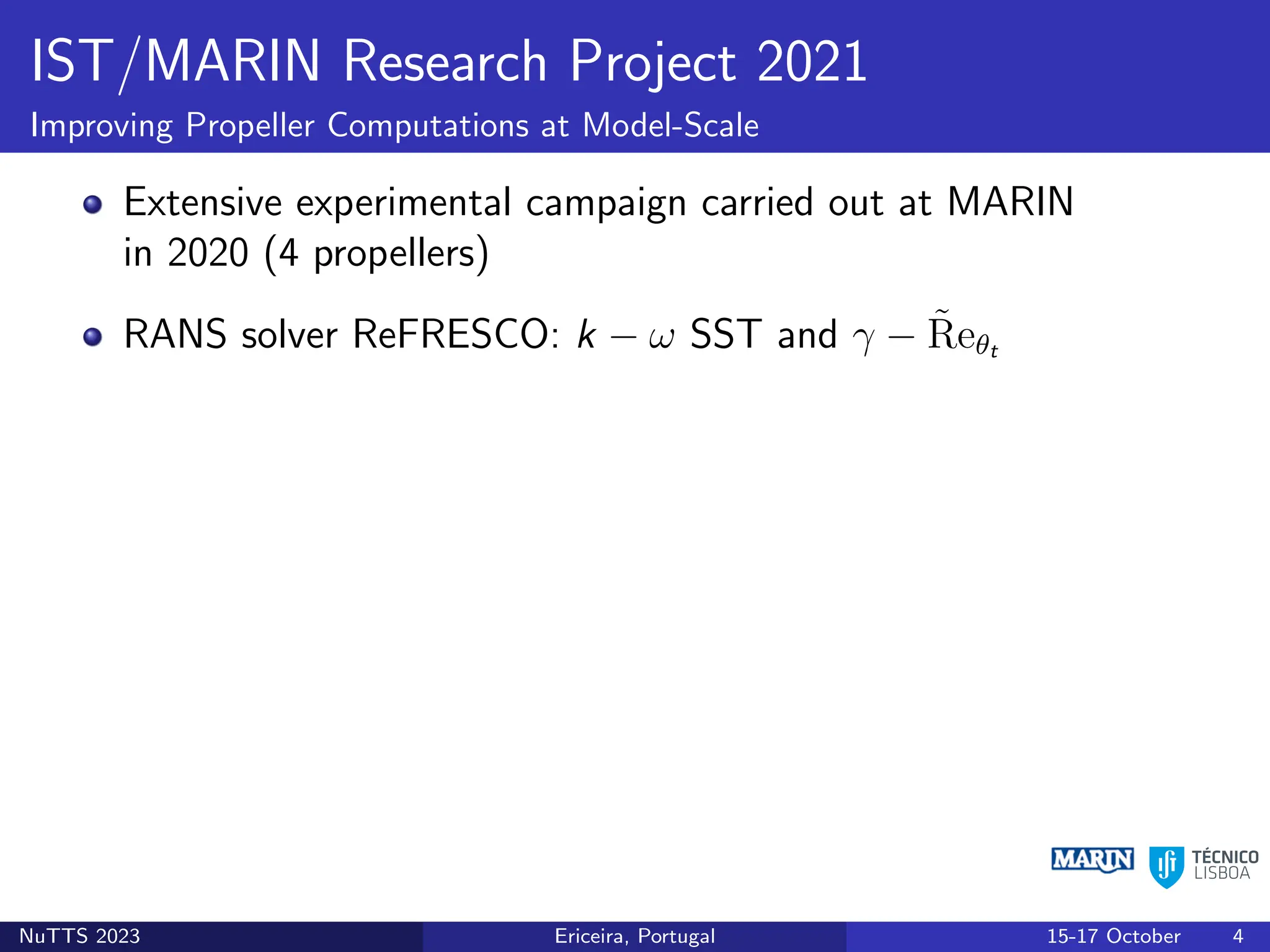
RANS solver ReFRESCO: k − ω SST and γ − R̃eθt
NuTTS 2023 Ericeira, Portugal 15-17 October 4
IST/MARIN Research Project 2021
Improving Propeller Computations at Model-Scale
Extensive experimental campaign carried out at MARIN
in 2020 (4 propellers)
RANS solver ReFRESCO: k − ω SST and γ − R̃eθt
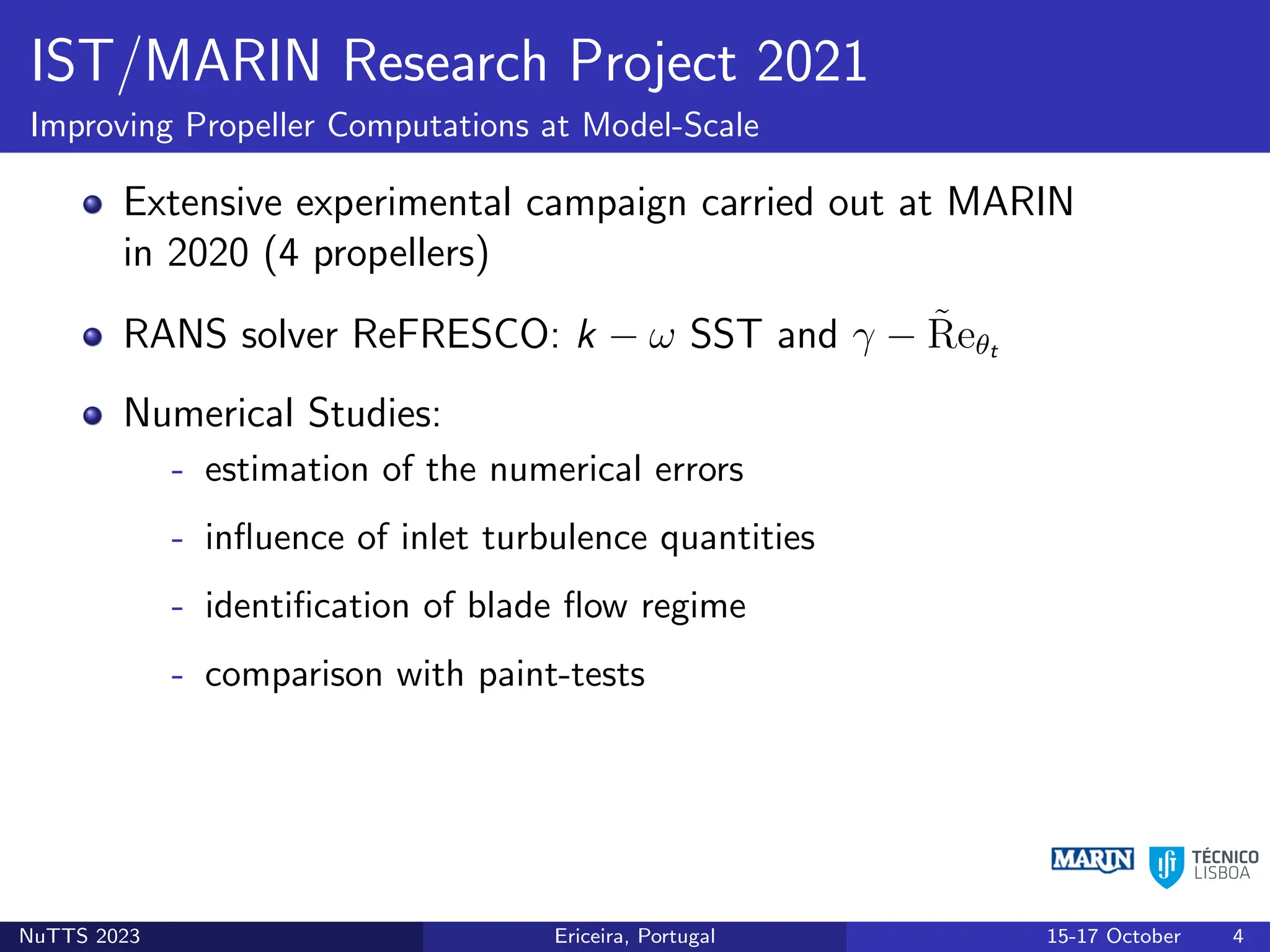
Numerical Studies:
- estimation of the numerical errors
- influence of inlet turbulence quantities
- identification of blade flow regime
- comparison with paint-tests
NuTTS 2023 Ericeira, Portugal 15-17 October 4
IST/MARIN Research Project 2021
Improving Propeller Computations at Model-Scale
Extensive experimental campaign carried out at MARIN
in 2020 (4 propellers)
RANS solver ReFRESCO: k − ω SST and γ − R̃eθt
Numerical Studies:
- estimation of the numerical errors
- influence of inlet turbulence quantities
- identification of blade flow regime
- comparison with paint-tests
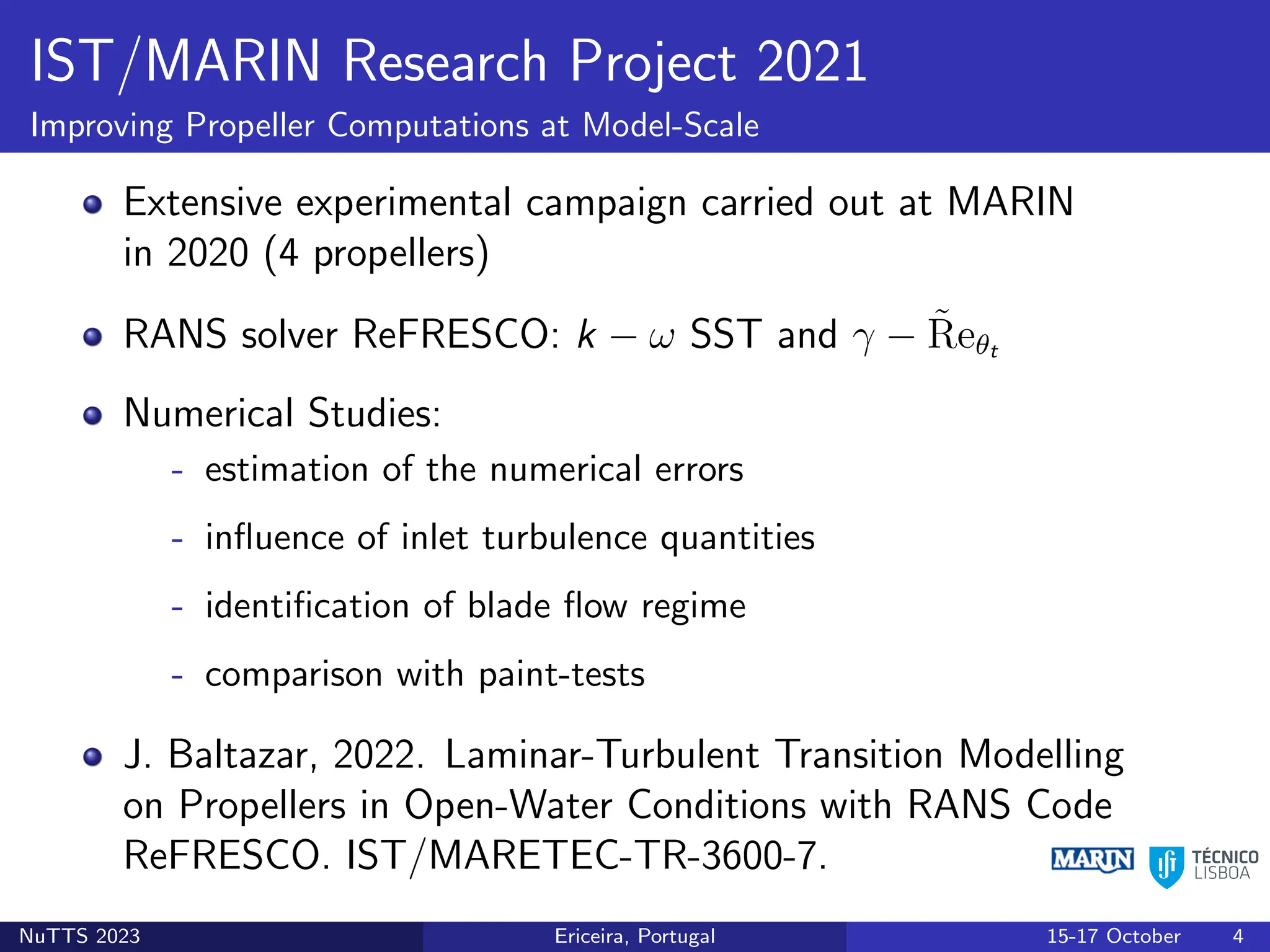
J. Baltazar, 2022. Laminar-Turbulent Transition Modelling
on Propellers in Open-Water Conditions with RANS Code
ReFRESCO. IST/MARETEC-TR-3600-7.
NuTTS 2023 Ericeira, Portugal 15-17 October 4
Propeller S6368
D [m] 0.2714
c0.7R [m] 0.0694
Z 4
P/D0.7R 0.757
AE /A0 0.464
NuTTS 2023 Ericeira, Portugal 15-17 October 5
Experimental Data
n [rps] 6.6(6)1 10.01 12.52 15.01 15.03 20.01
J KT
0.300 0.2344 – 0.2360 0.2390 0.2353
0.568 0.1259 0.1307 0.1290 0.1307 0.1301 0.1279
n [rps] 6.6(6)1 10.01 12.52 15.01 15.03 20.01
J 10KQ
0.300 0.2769 – 0.2712 0.2758 0.2704
0.568 0.1743 0.1731 0.174 0.1724 0.1752 0.1718
1
B. Schuiling, M. Kerkvliet, D. Rijpkema, 2021. How to Paint a Propeller. A Practical Guide to Performing Propeller Paint
Tests and Visualize Turbulence Transition. MARIN Report No. 80358-1-RD.
2
A. Boorsma, 2000. Improving Full Scale Ship Powering Performance Predictions by Application of Propeller Leading Edge
Roughness. Part 1: Effect of Leading Edge Roughness on Propeller Performance. Master Thesis, TU Delft.
3
A. Jonk, H. Willemsen, 1994. Calm Water Model Tests for a 300,000 DWT Crude Oil Carrier. MARIN Report No.
012383-1-VT.
NuTTS 2023 Ericeira, Portugal 15-17 October 6
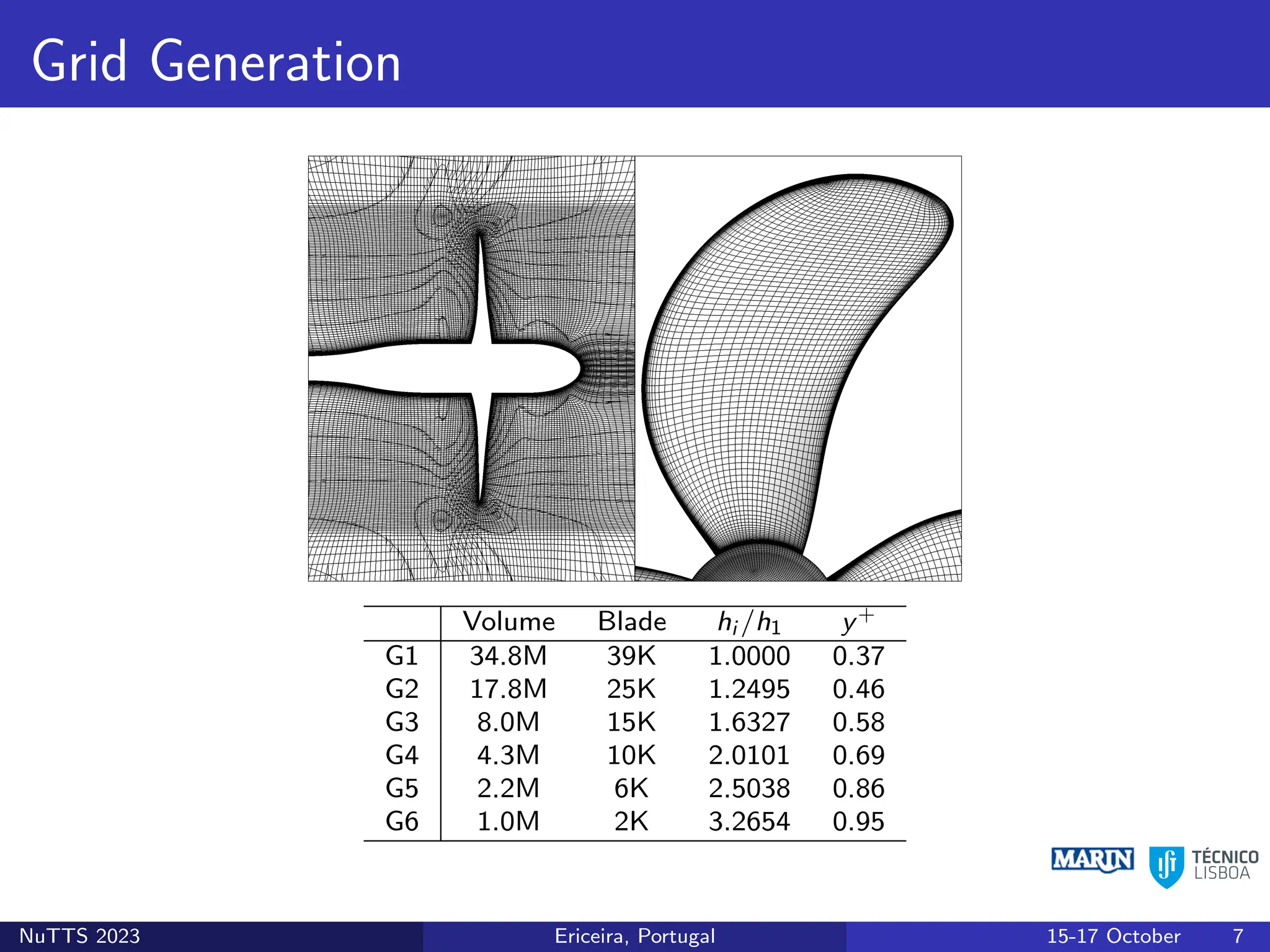
Grid Generation
Volume Blade hi /h1 y+
G1 34.8M 39K 1.0000 0.37
G2 17.8M 25K 1.2495 0.46
G3 8.0M 15K 1.6327 0.58
G4 4.3M 10K 2.0101 0.69
G5 2.2M 6K 2.5038 0.86
G6 1.0M 2K 3.2654 0.95
NuTTS 2023 Ericeira, Portugal 15-17 October 7
Iterative Errors
Monitored from the residuals
Turbulence model:
- residuals < 10−6
Transition model:
- residuals ∼ 10−3 to 10−6, γ ∼ 10−1
Fast iterative convergence of the propeller forces
NuTTS 2023 Ericeira, Portugal 15-17 October 8
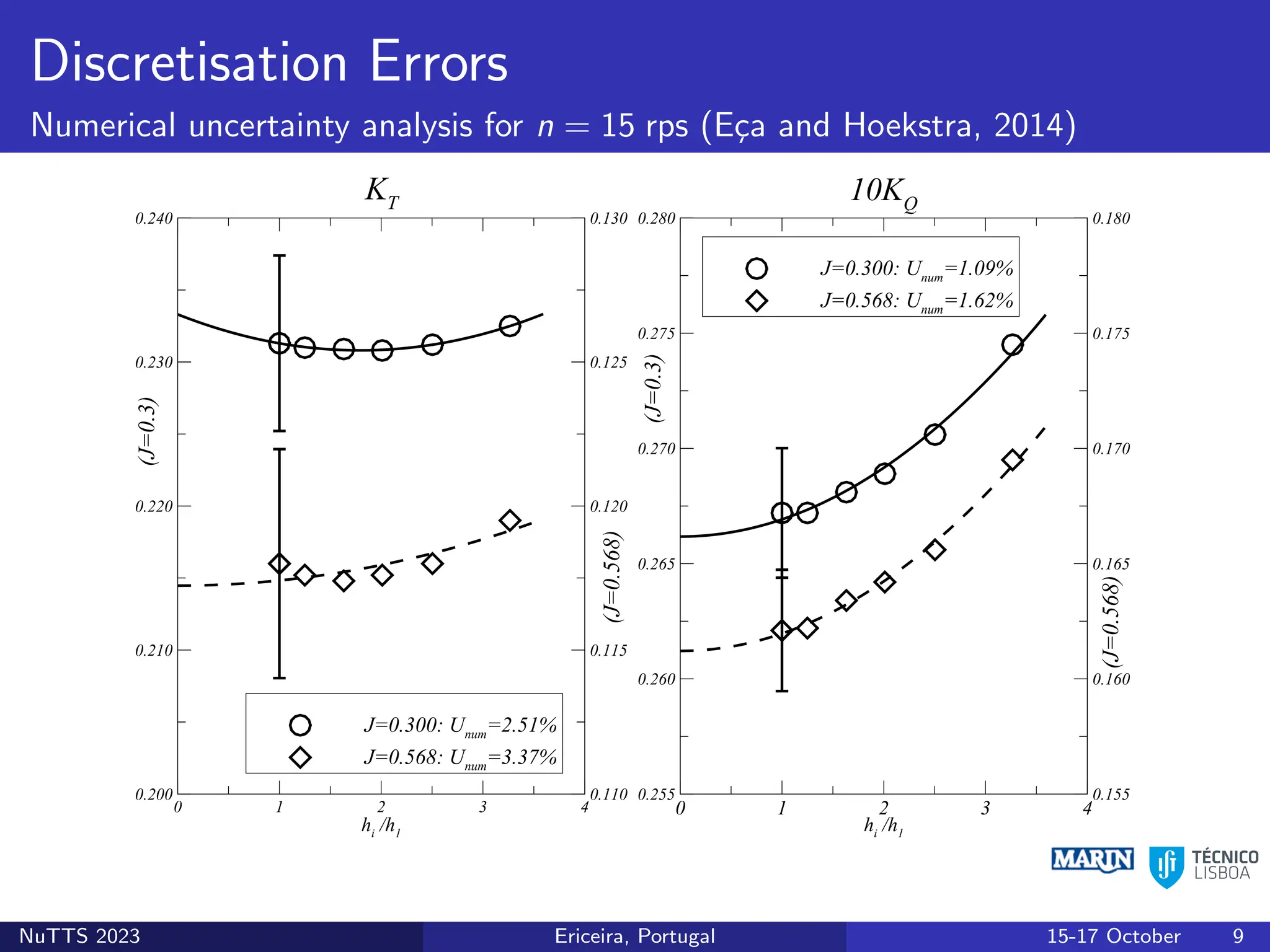
Discretisation Errors
Numerical uncertainty analysis for n = 15 rps (Eça and Hoekstra, 2014)
hi /h1
0 1 2 3 4
0.200
0.210
0.220
0.230
0.240
0.110
0.115
0.120
0.125
0.130
J=0.300: Unum
=2.51%
J=0.568: Unum
=3.37%
KT
(J=0.3)
(J=0.568)
hi /h1
0 1 2 3 4
0.255
0.260
0.265
0.270
0.275
0.280
0.155
0.160
0.165
0.170
0.175
0.180
J=0.300: Unum
=1.09%
J=0.568: Unum
=1.62%
10KQ
(J=0.3)
(J=0.568)
NuTTS 2023 Ericeira, Portugal 15-17 October 9
Techniques to Control the Decay of Turbulence
NuTTS 2023 Ericeira, Portugal 15-17 October 10
Techniques to Control the Decay of Turbulence
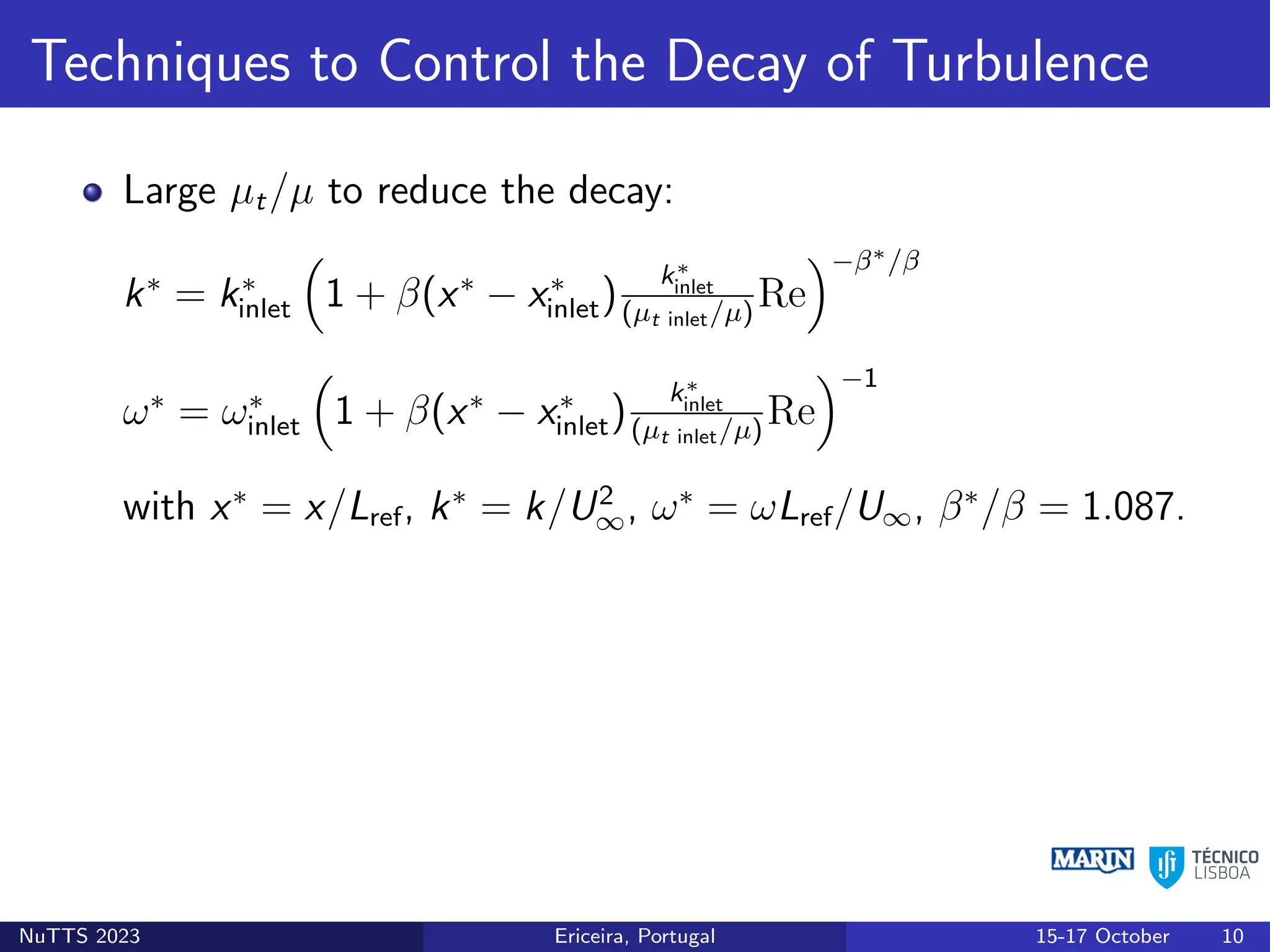
Large µt/µ to reduce the decay:
k∗
= k∗
inlet

1 + β(x∗
− x∗
inlet)
k∗
inlet
(µt inlet/µ)
Re
−β∗/β
ω∗
= ω∗
inlet

1 + β(x∗
− x∗
inlet)
k∗
inlet
(µt inlet/µ)
Re
−1
with x∗
= x/Lref, k∗
= k/U2
∞, ω∗
= ωLref/U∞, β∗
/β = 1.087.
NuTTS 2023 Ericeira, Portugal 15-17 October 10
Techniques to Control the Decay of Turbulence
Large µt/µ to reduce the decay:
k∗
= k∗
inlet

1 + β(x∗
− x∗
inlet)
k∗
inlet
(µt inlet/µ)
Re
−β∗/β
ω∗
= ω∗
inlet

1 + β(x∗
− x∗
inlet)
k∗
inlet
(µt inlet/µ)
Re
−1
with x∗
= x/Lref, k∗
= k/U2
∞, ω∗
= ωLref/U∞, β∗
/β = 1.087.
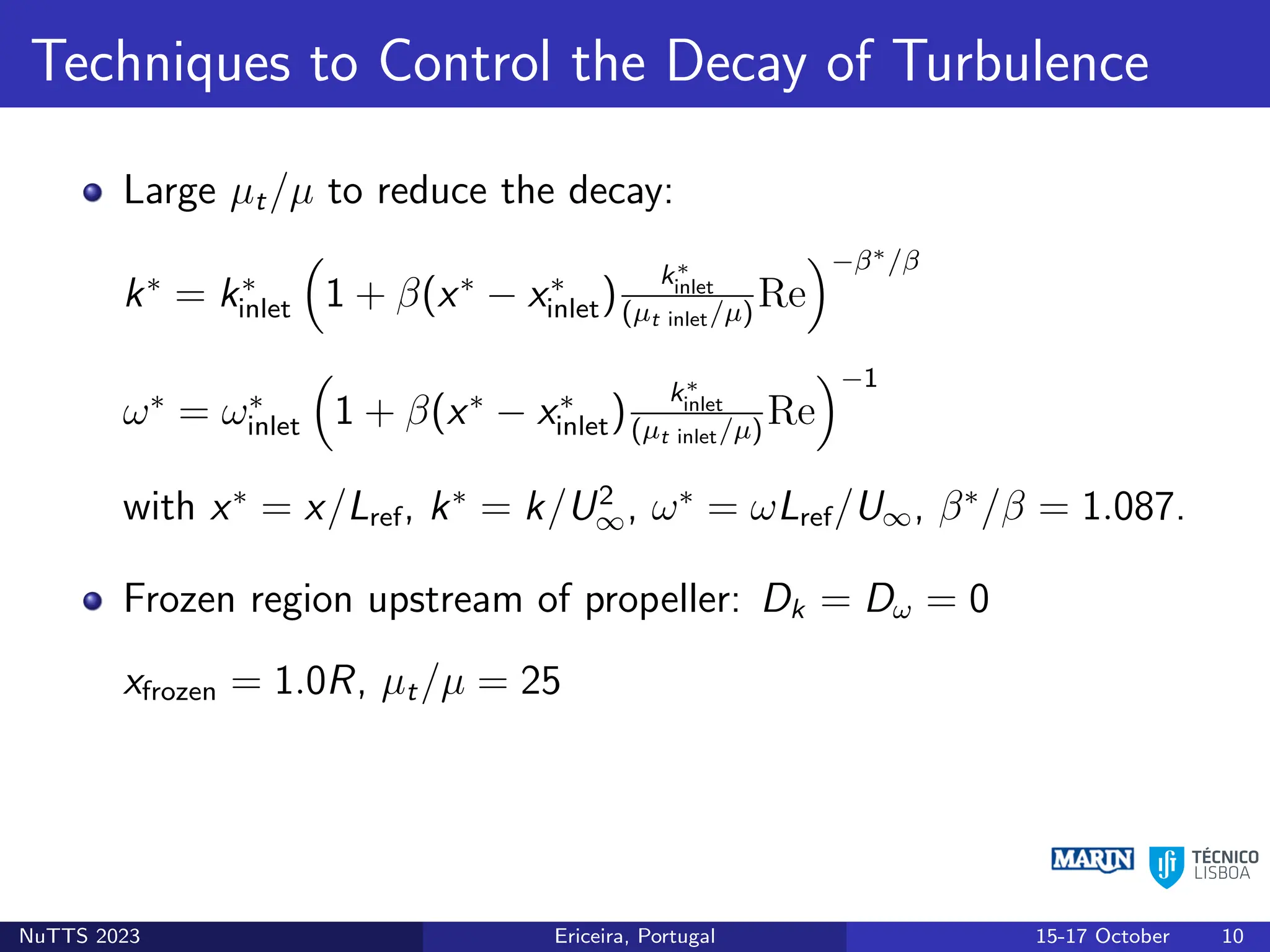
Frozen region upstream of propeller: Dk = Dω = 0
xfrozen = 1.0R, µt/µ = 25
NuTTS 2023 Ericeira, Portugal 15-17 October 10
Techniques to Control the Decay of Turbulence
Large µt/µ to reduce the decay:
k∗
= k∗
inlet

1 + β(x∗
− x∗
inlet)
k∗
inlet
(µt inlet/µ)
Re
−β∗/β
ω∗
= ω∗
inlet

1 + β(x∗
− x∗
inlet)
k∗
inlet
(µt inlet/µ)
Re
−1
with x∗
= x/Lref, k∗
= k/U2
∞, ω∗
= ωLref/U∞, β∗
/β = 1.087.
Frozen region upstream of propeller: Dk = Dω = 0
xfrozen = 1.0R, µt/µ = 25
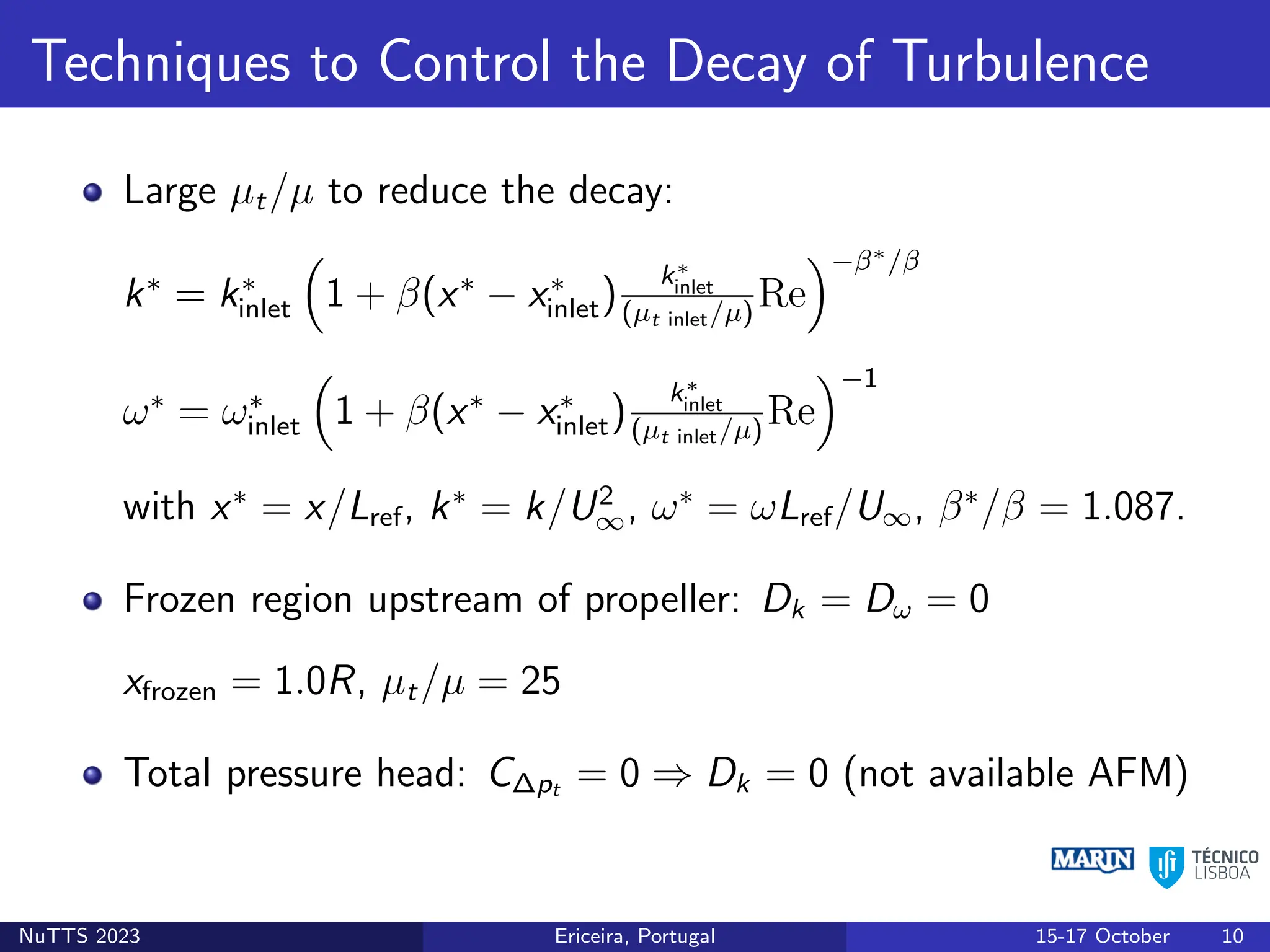
Total pressure head: C∆pt = 0 ⇒ Dk = 0 (not available AFM)
NuTTS 2023 Ericeira, Portugal 15-17 October 10
Transition Identification
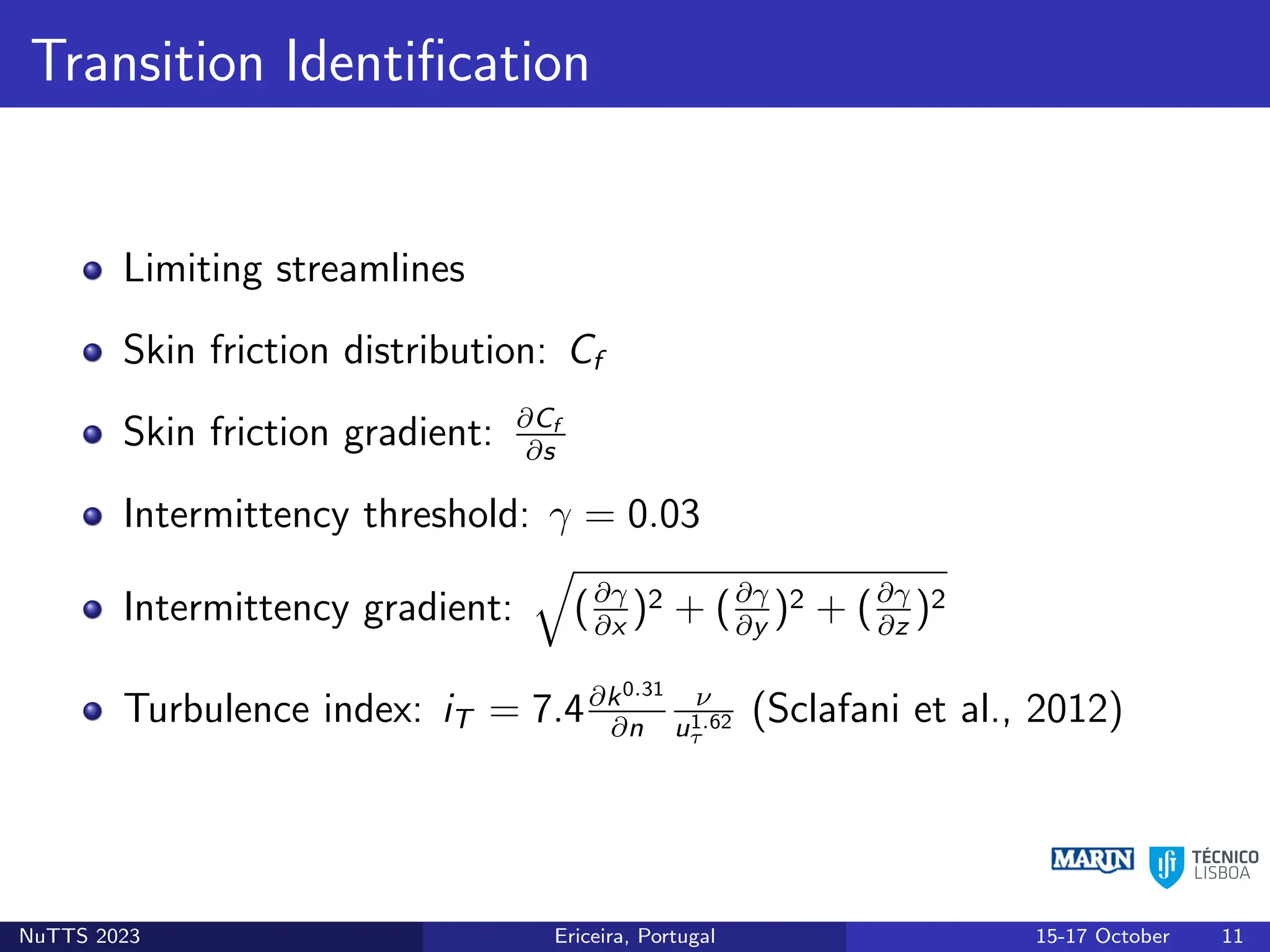
Limiting streamlines
Skin friction distribution: Cf
Skin friction gradient: ∂Cf
∂s
Intermittency threshold: γ = 0.03
Intermittency gradient:
q
(∂γ
∂x
)2 + (∂γ
∂y
)2 + (∂γ
∂z
)2
Turbulence index: iT = 7.4∂k0.31
∂n
ν
u1.62
τ
(Sclafani et al., 2012)
NuTTS 2023 Ericeira, Portugal 15-17 October 11
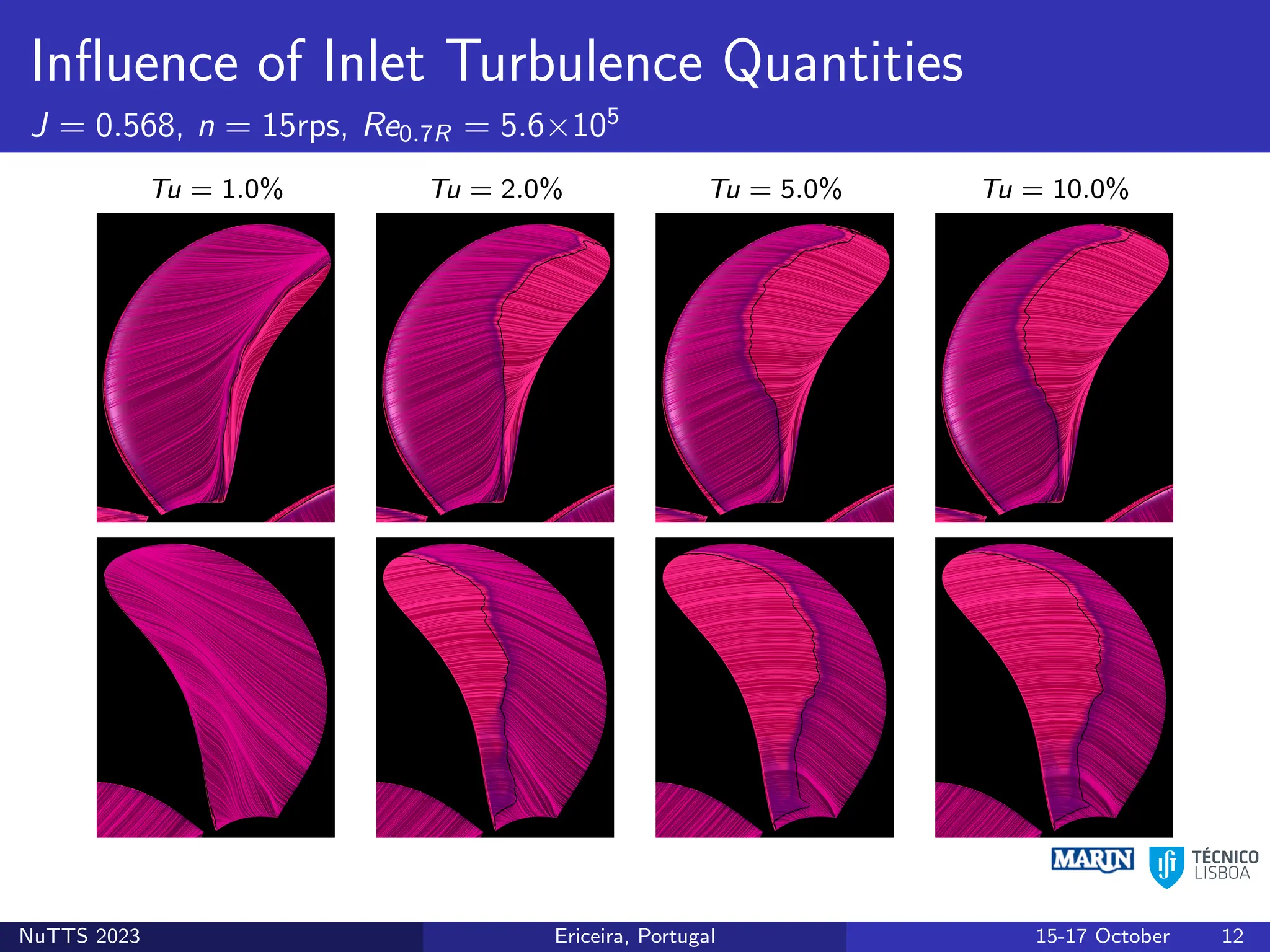
Influence of Inlet Turbulence Quantities
J = 0.568, n = 15rps, Re0.7R = 5.6×10⁵
Tu = 1.0% Tu = 2.0% Tu = 5.0% Tu = 10.0%
NuTTS 2023 Ericeira, Portugal 15-17 October 12
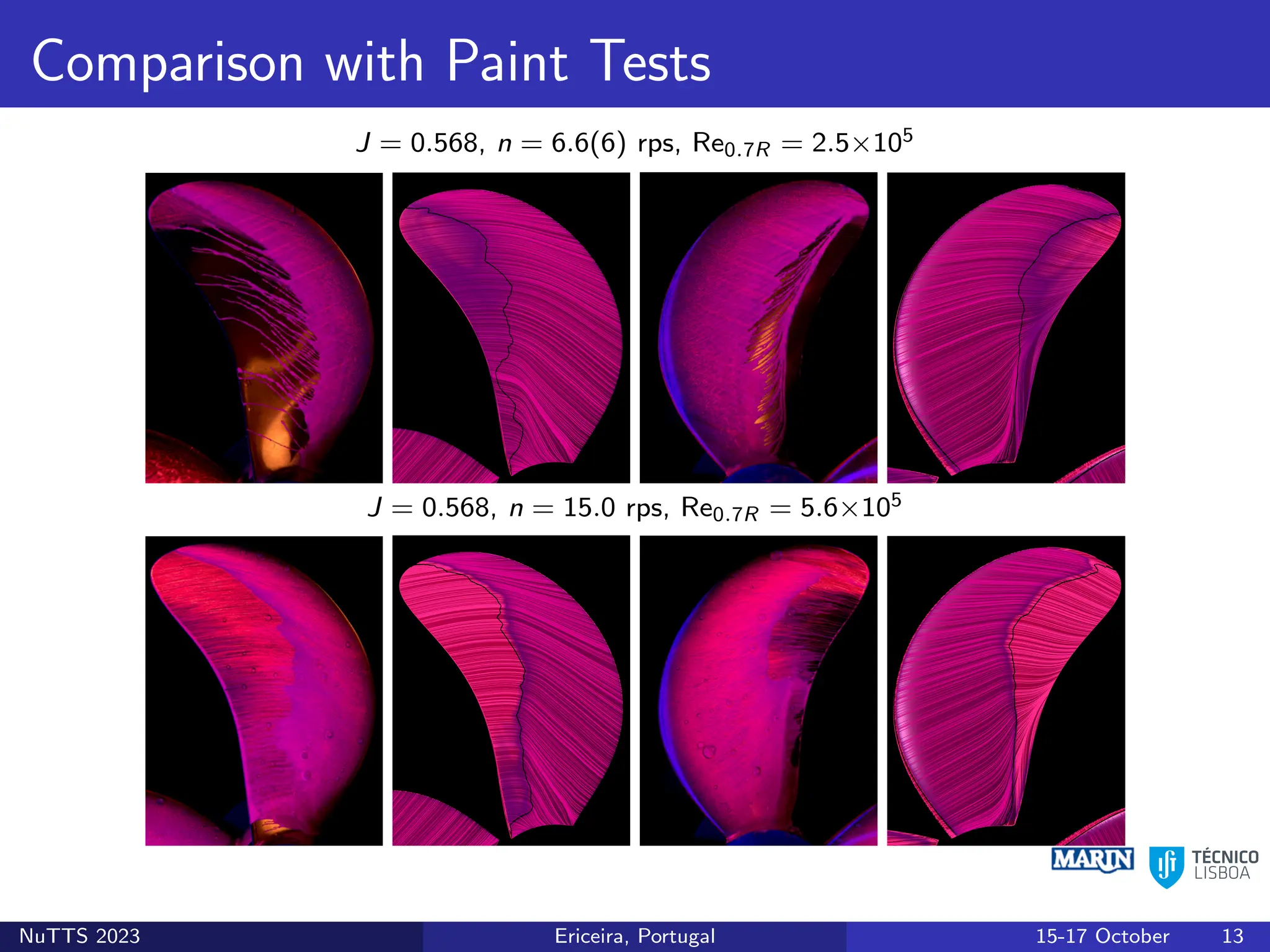
Comparison with Paint Tests
J = 0.568, n = 6.6(6) rps, Re0.7R = 2.5×10⁵
J = 0.568, n = 15.0 rps, Re0.7R = 5.6×10⁵
NuTTS 2023 Ericeira, Portugal 15-17 October 13
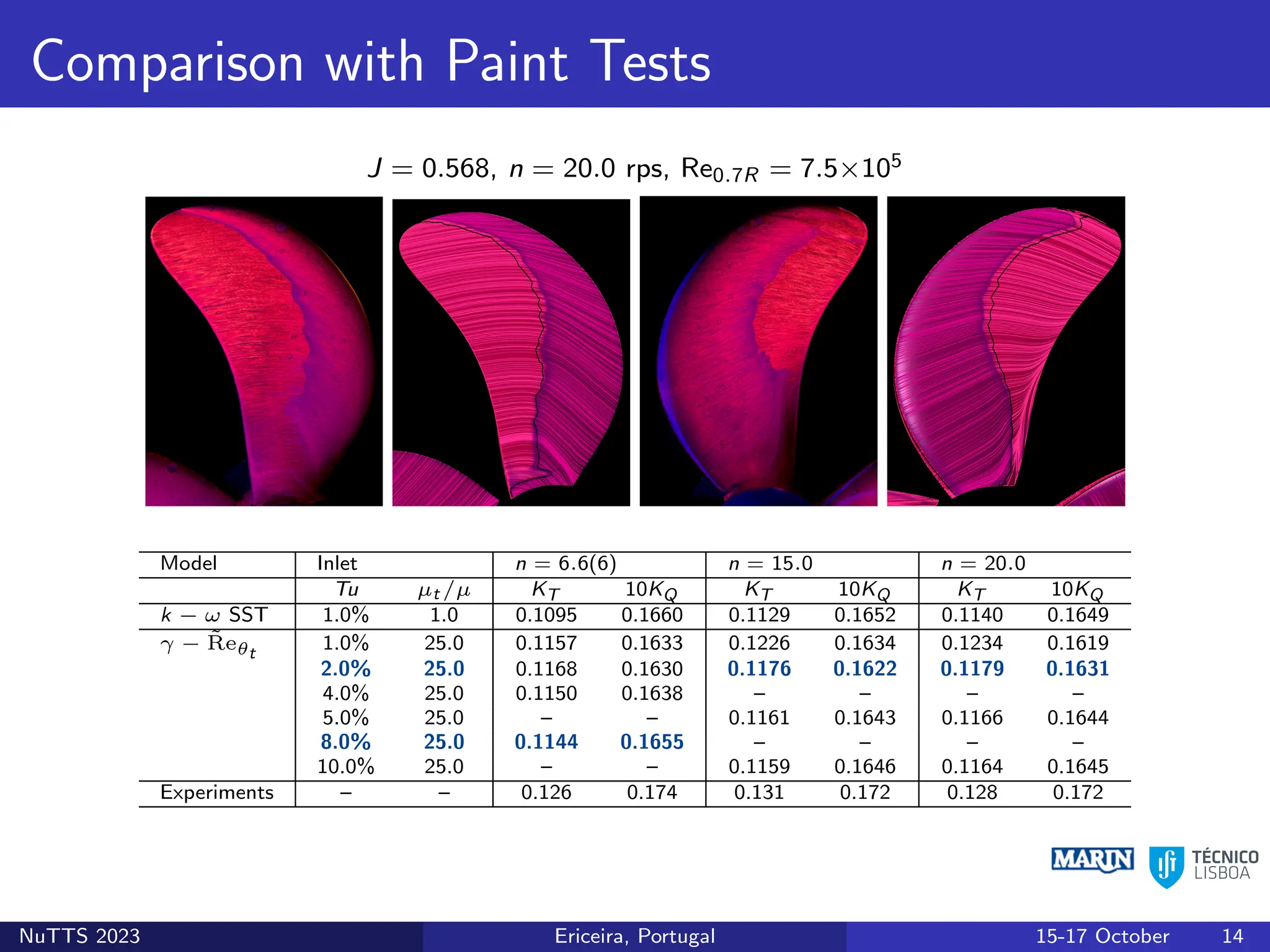
Comparison with Paint Tests
J = 0.568, n = 20.0 rps, Re0.7R = 7.5×10⁵
Model Inlet n = 6.6(6) n = 15.0 n = 20.0
Tu µt /µ KT 10KQ KT 10KQ KT 10KQ
k − ω SST 1.0% 1.0 0.1095 0.1660 0.1129 0.1652 0.1140 0.1649
γ − R̃eθt
1.0% 25.0 0.1157 0.1633 0.1226 0.1634 0.1234 0.1619
2.0% 25.0 0.1168 0.1630 0.1176 0.1622 0.1179 0.1631
4.0% 25.0 0.1150 0.1638 – – – –
5.0% 25.0 – – 0.1161 0.1643 0.1166 0.1644
8.0% 25.0 0.1144 0.1655 – – – –
10.0% 25.0 – – 0.1159 0.1646 0.1164 0.1645
Experiments – – 0.126 0.174 0.131 0.172 0.128 0.172
NuTTS 2023 Ericeira, Portugal 15-17 October 14
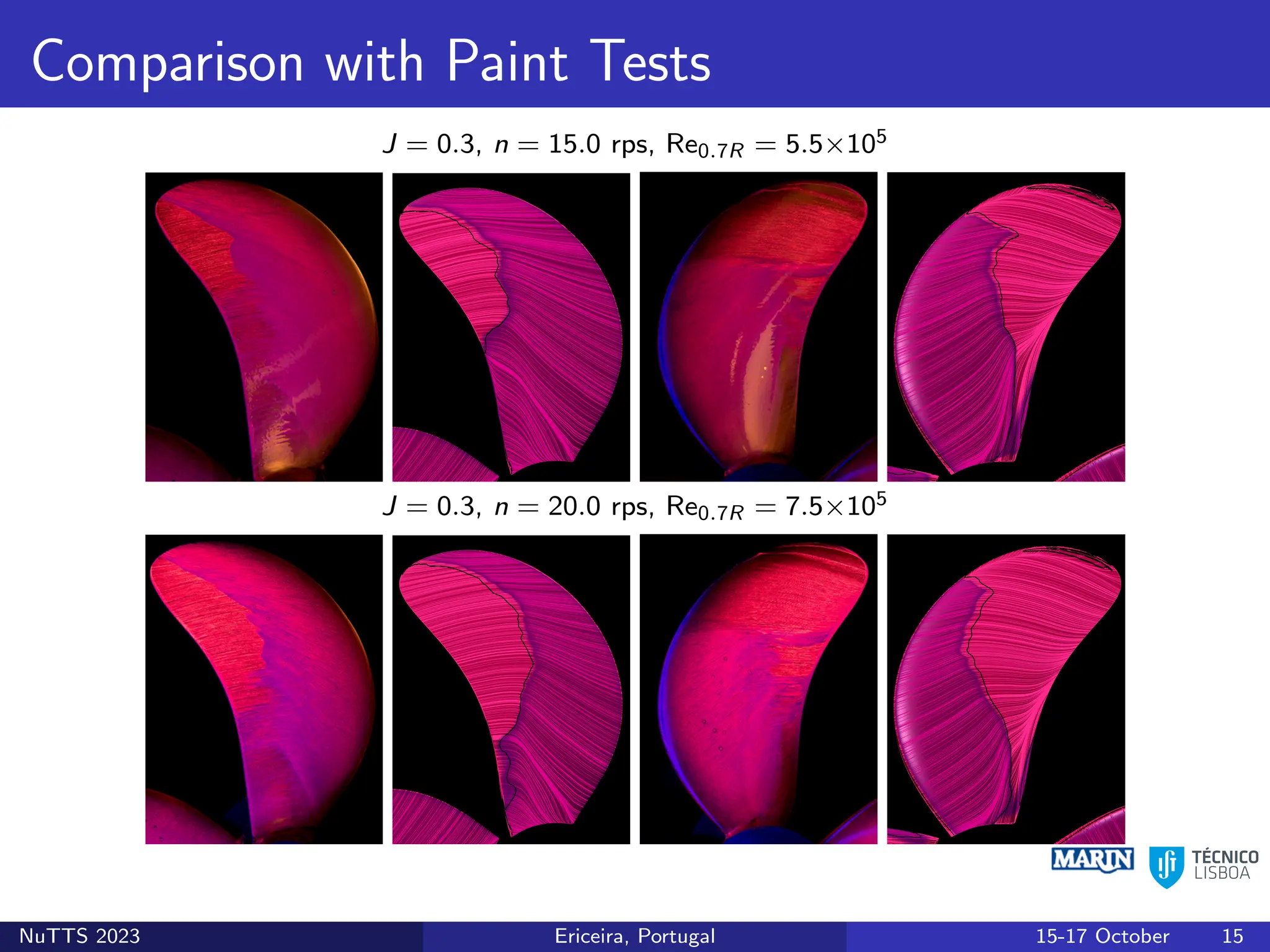
Comparison with Paint Tests
J = 0.3, n = 15.0 rps, Re0.7R = 5.5×10⁵
J = 0.3, n = 20.0 rps, Re0.7R = 7.5×10⁵
NuTTS 2023 Ericeira, Portugal 15-17 October 15
Comparison with Paint Tests
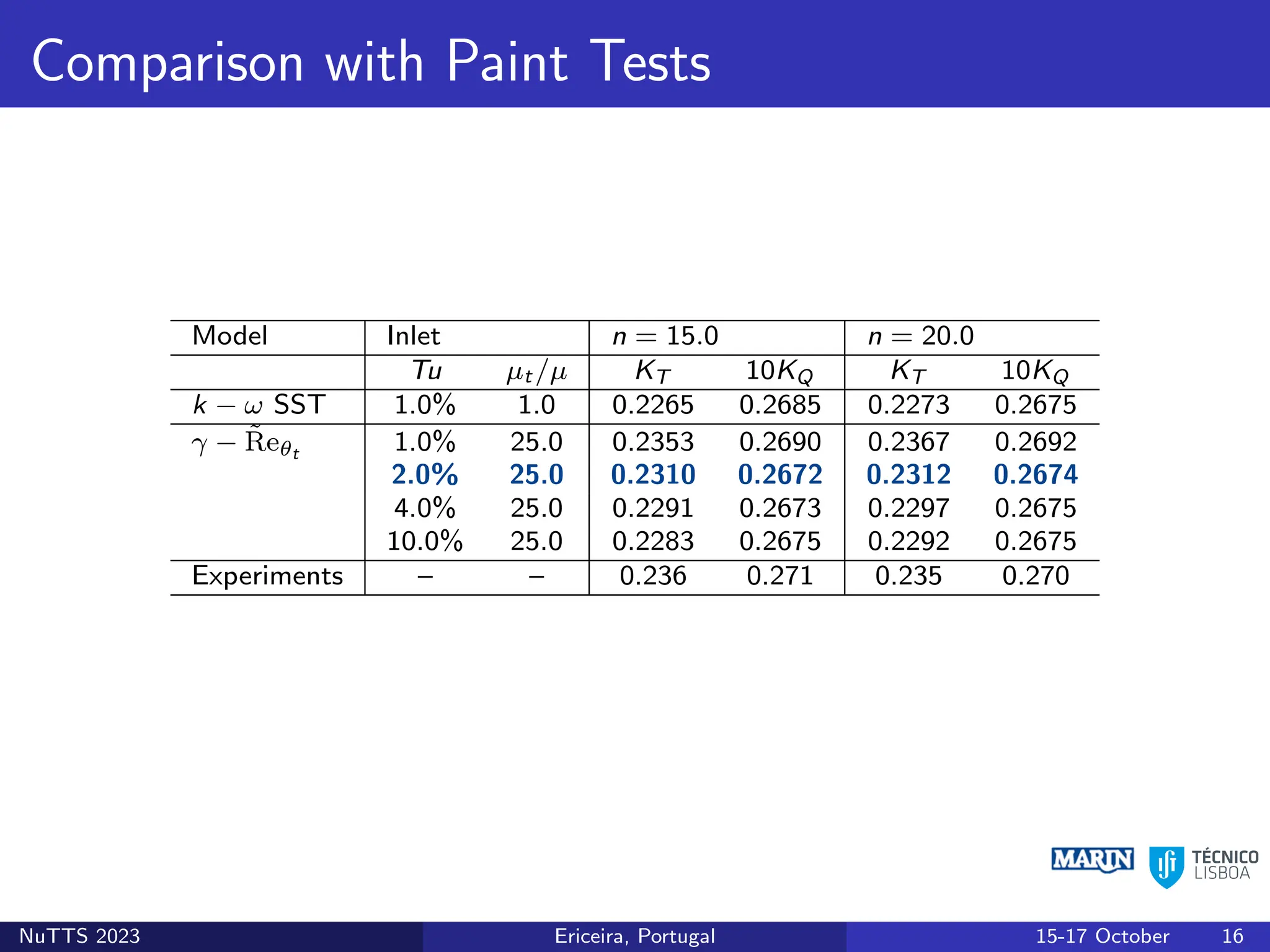
Model Inlet n = 15.0 n = 20.0
Tu µt /µ KT 10KQ KT 10KQ
k − ω SST 1.0% 1.0 0.2265 0.2685 0.2273 0.2675
γ − R̃eθt 1.0% 25.0 0.2353 0.2690 0.2367 0.2692
2.0% 25.0 0.2310 0.2672 0.2312 0.2674
4.0% 25.0 0.2291 0.2673 0.2297 0.2675
10.0% 25.0 0.2283 0.2675 0.2292 0.2675
Experiments – – 0.236 0.271 0.235 0.270
NuTTS 2023 Ericeira, Portugal 15-17 October 16
Conclusions
NuTTS 2023 Ericeira, Portugal 15-17 October 17
Conclusions
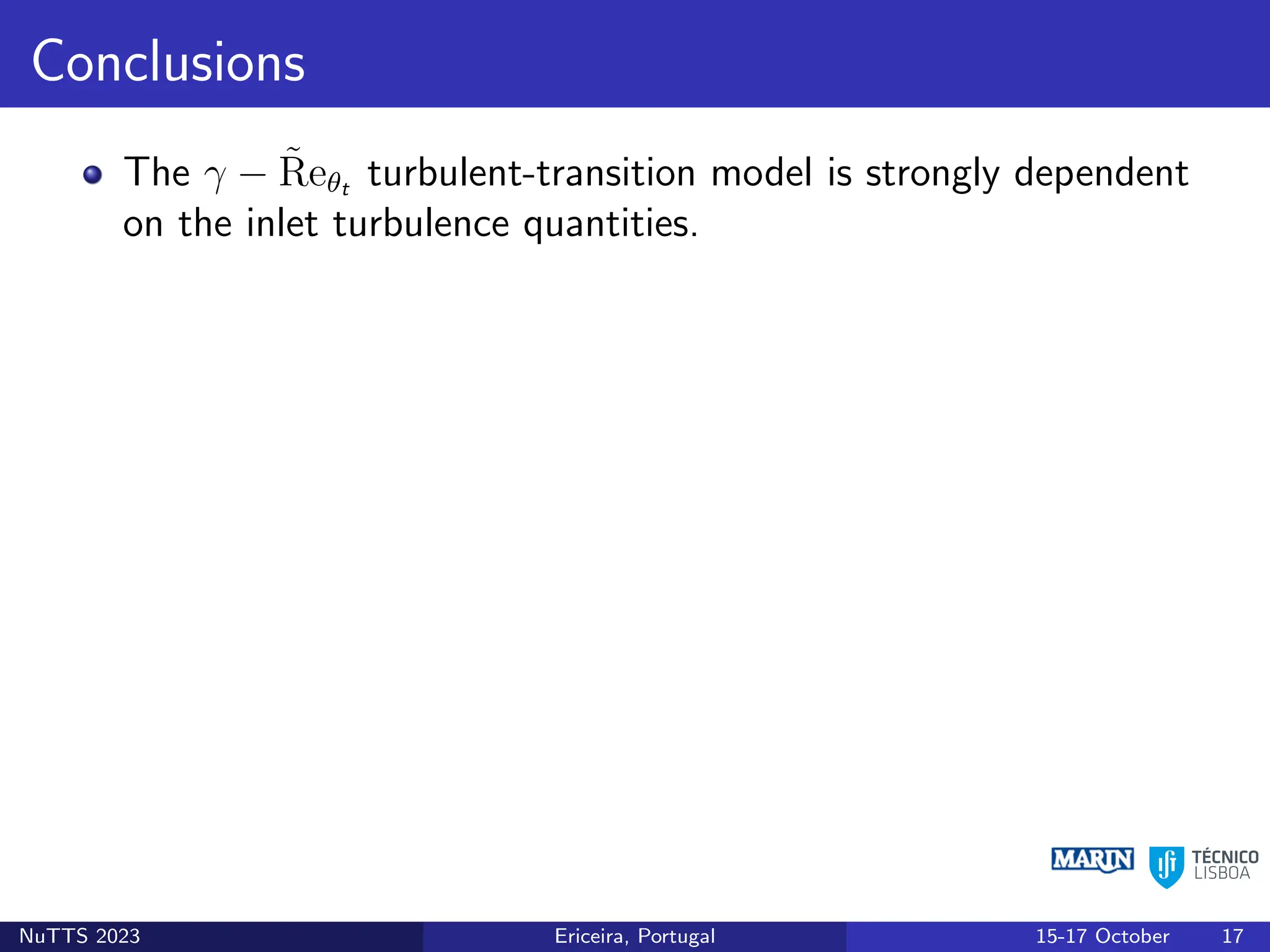
The γ − R̃eθt turbulent-transition model is strongly dependent
on the inlet turbulence quantities.
NuTTS 2023 Ericeira, Portugal 15-17 October 17
Conclusions
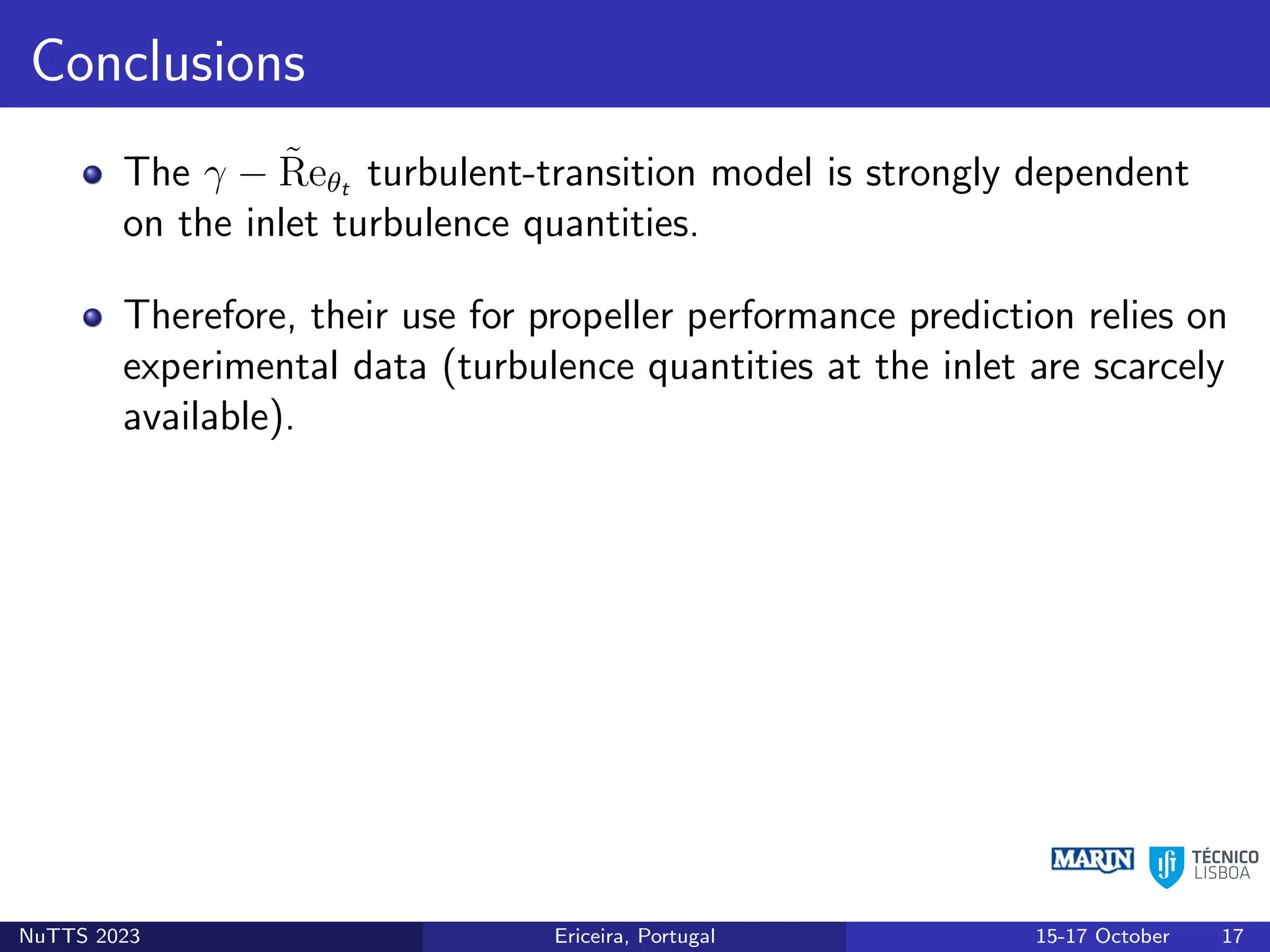
The γ − R̃eθt turbulent-transition model is strongly dependent
on the inlet turbulence quantities.
Therefore, their use for propeller performance prediction relies on
experimental data (turbulence quantities at the inlet are scarcely
available).
NuTTS 2023 Ericeira, Portugal 15-17 October 17
Conclusions
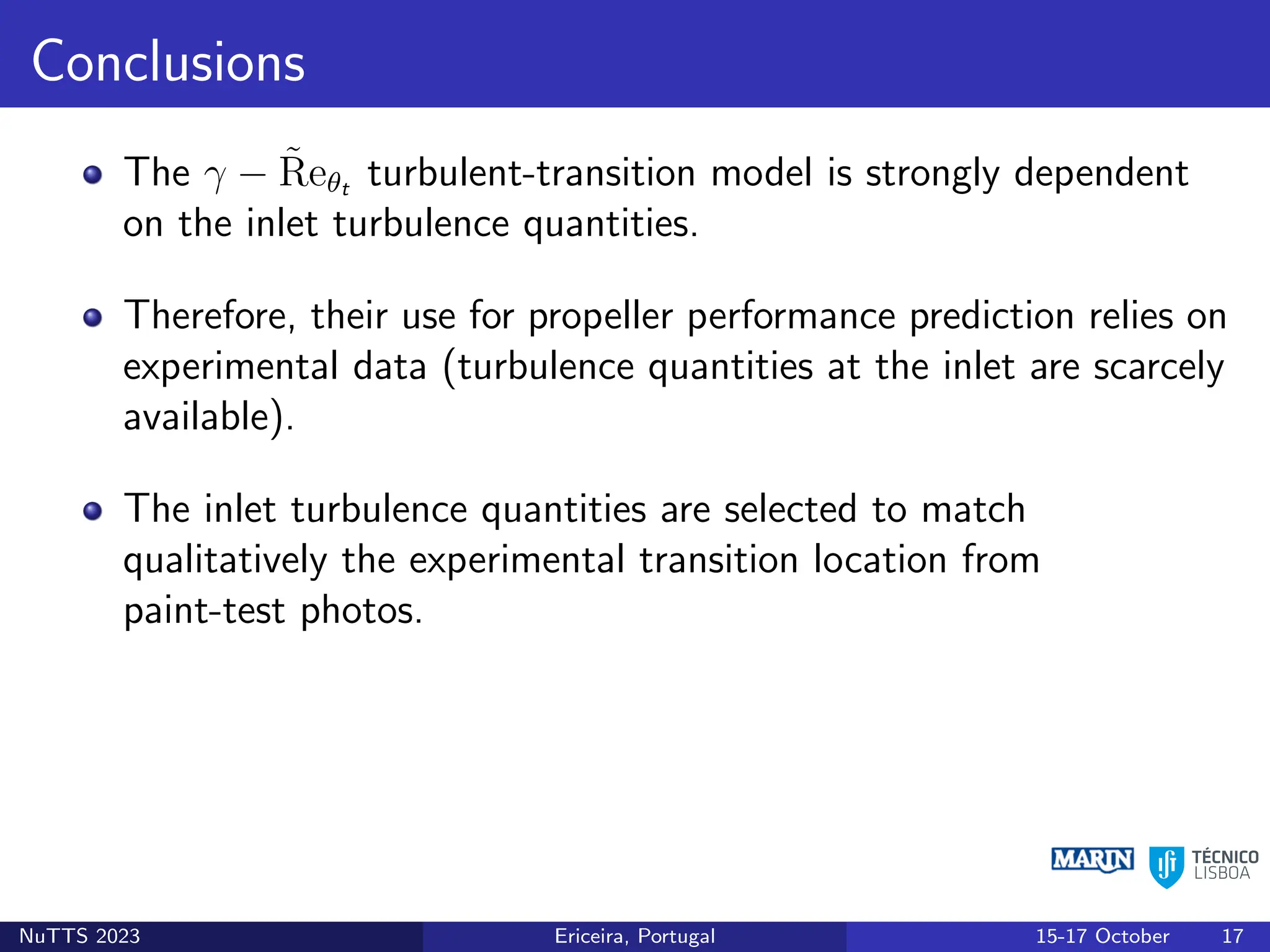
The γ − R̃eθt turbulent-transition model is strongly dependent
on the inlet turbulence quantities.
Therefore, their use for propeller performance prediction relies on
experimental data (turbulence quantities at the inlet are scarcely
available).
The inlet turbulence quantities are selected to match
qualitatively the experimental transition location from
paint-test photos.
NuTTS 2023 Ericeira, Portugal 15-17 October 17
Conclusions
The γ − R̃eθt turbulent-transition model is strongly dependent
on the inlet turbulence quantities.
Therefore, their use for propeller performance prediction relies on
experimental data (turbulence quantities at the inlet are scarcely
available).
The inlet turbulence quantities are selected to match
qualitatively the experimental transition location from
paint-test photos.
The selected inlet turbulence quantities (which may not be
realistic from the physical point of view) are dependent on the
Reynolds number and propeller loading condition.
NuTTS 2023 Ericeira, Portugal 15-17 October 17

Modelling of Laminar-to-Turbulent Flow Transition on a Marine Propeller Using a RANS Solver

  • 1.
    Modelling of Laminar-to-TurbulentFlow Transition on a Marine Propeller Using a RANS Solver J. Baltazar1 , B. Schuiling2 , M. Kerkvliet2 1Instituto Superior Técnico, Universidade de Lisboa, Portugal 2Maritime Research Institute Netherlands, Wageningen, the Netherlands NuTTS 2023 Ericeira, Portugal 15-17 October 1
  • 2.
    Introduction NuTTS 2023 Ericeira,Portugal 15-17 October 2
  • 3.
    Introduction Full-scale prediction propellersmostly based on simple extrapolation methods from model-scale experiments NuTTS 2023 Ericeira, Portugal 15-17 October 2
  • 4.
    Introduction Full-scale prediction propellersmostly based on simple extrapolation methods from model-scale experiments RANS solvers may be used at both model and full scale and offer an alternative scaling method NuTTS 2023 Ericeira, Portugal 15-17 October 2
  • 5.
    Introduction Full-scale prediction propellersmostly based on simple extrapolation methods from model-scale experiments RANS solvers may be used at both model and full scale and offer an alternative scaling method Requires accurate prediction at both Reynolds numbers NuTTS 2023 Ericeira, Portugal 15-17 October 2
  • 6.
    Introduction Turbulence models (k− ω, SST, k − √ kL, etc.) are known to provide a good prediction for fully developed turbulent flows NuTTS 2023 Ericeira, Portugal 15-17 October 3
  • 7.
    Introduction Turbulence models (k− ω, SST, k − √ kL, etc.) are known to provide a good prediction for fully developed turbulent flows However, these models predict transition at lower Reynolds number than seen in experiments NuTTS 2023 Ericeira, Portugal 15-17 October 3
  • 8.
    Introduction Turbulence models (k− ω, SST, k − √ kL, etc.) are known to provide a good prediction for fully developed turbulent flows However, these models predict transition at lower Reynolds number than seen in experiments Model-scale experiments in critical Reynolds number regime NuTTS 2023 Ericeira, Portugal 15-17 October 3
  • 9.
    Introduction Turbulence models (k− ω, SST, k − √ kL, etc.) are known to provide a good prediction for fully developed turbulent flows However, these models predict transition at lower Reynolds number than seen in experiments Model-scale experiments in critical Reynolds number regime Propeller performance prediction at different Reynolds number regimes using the γ − R̃eθ transition model and compare with the k − ω SST turbulence model NuTTS 2023 Ericeira, Portugal 15-17 October 3
  • 10.
    IST/MARIN Research Project2021 Improving Propeller Computations at Model-Scale NuTTS 2023 Ericeira, Portugal 15-17 October 4
  • 11.
    IST/MARIN Research Project2021 Improving Propeller Computations at Model-Scale Extensive experimental campaign carried out at MARIN in 2020 (4 propellers) NuTTS 2023 Ericeira, Portugal 15-17 October 4
  • 12.
    IST/MARIN Research Project2021 Improving Propeller Computations at Model-Scale Extensive experimental campaign carried out at MARIN in 2020 (4 propellers) RANS solver ReFRESCO: k − ω SST and γ − R̃eθt NuTTS 2023 Ericeira, Portugal 15-17 October 4
  • 13.
    IST/MARIN Research Project2021 Improving Propeller Computations at Model-Scale Extensive experimental campaign carried out at MARIN in 2020 (4 propellers) RANS solver ReFRESCO: k − ω SST and γ − R̃eθt Numerical Studies: - estimation of the numerical errors - influence of inlet turbulence quantities - identification of blade flow regime - comparison with paint-tests NuTTS 2023 Ericeira, Portugal 15-17 October 4
  • 14.
    IST/MARIN Research Project2021 Improving Propeller Computations at Model-Scale Extensive experimental campaign carried out at MARIN in 2020 (4 propellers) RANS solver ReFRESCO: k − ω SST and γ − R̃eθt Numerical Studies: - estimation of the numerical errors - influence of inlet turbulence quantities - identification of blade flow regime - comparison with paint-tests J. Baltazar, 2022. Laminar-Turbulent Transition Modelling on Propellers in Open-Water Conditions with RANS Code ReFRESCO. IST/MARETEC-TR-3600-7. NuTTS 2023 Ericeira, Portugal 15-17 October 4
  • 15.
    Propeller S6368 D [m]0.2714 c0.7R [m] 0.0694 Z 4 P/D0.7R 0.757 AE /A0 0.464 NuTTS 2023 Ericeira, Portugal 15-17 October 5
  • 16.
    Experimental Data n [rps]6.6(6)1 10.01 12.52 15.01 15.03 20.01 J KT 0.300 0.2344 – 0.2360 0.2390 0.2353 0.568 0.1259 0.1307 0.1290 0.1307 0.1301 0.1279 n [rps] 6.6(6)1 10.01 12.52 15.01 15.03 20.01 J 10KQ 0.300 0.2769 – 0.2712 0.2758 0.2704 0.568 0.1743 0.1731 0.174 0.1724 0.1752 0.1718 1 B. Schuiling, M. Kerkvliet, D. Rijpkema, 2021. How to Paint a Propeller. A Practical Guide to Performing Propeller Paint Tests and Visualize Turbulence Transition. MARIN Report No. 80358-1-RD. 2 A. Boorsma, 2000. Improving Full Scale Ship Powering Performance Predictions by Application of Propeller Leading Edge Roughness. Part 1: Effect of Leading Edge Roughness on Propeller Performance. Master Thesis, TU Delft. 3 A. Jonk, H. Willemsen, 1994. Calm Water Model Tests for a 300,000 DWT Crude Oil Carrier. MARIN Report No. 012383-1-VT. NuTTS 2023 Ericeira, Portugal 15-17 October 6
  • 17.
    Grid Generation Volume Bladehi /h1 y+ G1 34.8M 39K 1.0000 0.37 G2 17.8M 25K 1.2495 0.46 G3 8.0M 15K 1.6327 0.58 G4 4.3M 10K 2.0101 0.69 G5 2.2M 6K 2.5038 0.86 G6 1.0M 2K 3.2654 0.95 NuTTS 2023 Ericeira, Portugal 15-17 October 7
  • 18.
    Iterative Errors Monitored fromthe residuals Turbulence model: - residuals < 10−6 Transition model: - residuals ∼ 10−3 to 10−6, γ ∼ 10−1 Fast iterative convergence of the propeller forces NuTTS 2023 Ericeira, Portugal 15-17 October 8
  • 19.
    Discretisation Errors Numerical uncertaintyanalysis for n = 15 rps (Eça and Hoekstra, 2014) hi /h1 0 1 2 3 4 0.200 0.210 0.220 0.230 0.240 0.110 0.115 0.120 0.125 0.130 J=0.300: Unum =2.51% J=0.568: Unum =3.37% KT (J=0.3) (J=0.568) hi /h1 0 1 2 3 4 0.255 0.260 0.265 0.270 0.275 0.280 0.155 0.160 0.165 0.170 0.175 0.180 J=0.300: Unum =1.09% J=0.568: Unum =1.62% 10KQ (J=0.3) (J=0.568) NuTTS 2023 Ericeira, Portugal 15-17 October 9
  • 20.
    Techniques to Controlthe Decay of Turbulence NuTTS 2023 Ericeira, Portugal 15-17 October 10
  • 21.
    Techniques to Controlthe Decay of Turbulence Large µt/µ to reduce the decay: k∗ = k∗ inlet 1 + β(x∗ − x∗ inlet) k∗ inlet (µt inlet/µ) Re −β∗/β ω∗ = ω∗ inlet 1 + β(x∗ − x∗ inlet) k∗ inlet (µt inlet/µ) Re −1 with x∗ = x/Lref, k∗ = k/U2 ∞, ω∗ = ωLref/U∞, β∗ /β = 1.087. NuTTS 2023 Ericeira, Portugal 15-17 October 10
  • 22.
    Techniques to Controlthe Decay of Turbulence Large µt/µ to reduce the decay: k∗ = k∗ inlet 1 + β(x∗ − x∗ inlet) k∗ inlet (µt inlet/µ) Re −β∗/β ω∗ = ω∗ inlet 1 + β(x∗ − x∗ inlet) k∗ inlet (µt inlet/µ) Re −1 with x∗ = x/Lref, k∗ = k/U2 ∞, ω∗ = ωLref/U∞, β∗ /β = 1.087. Frozen region upstream of propeller: Dk = Dω = 0 xfrozen = 1.0R, µt/µ = 25 NuTTS 2023 Ericeira, Portugal 15-17 October 10
  • 23.
    Techniques to Controlthe Decay of Turbulence Large µt/µ to reduce the decay: k∗ = k∗ inlet 1 + β(x∗ − x∗ inlet) k∗ inlet (µt inlet/µ) Re −β∗/β ω∗ = ω∗ inlet 1 + β(x∗ − x∗ inlet) k∗ inlet (µt inlet/µ) Re −1 with x∗ = x/Lref, k∗ = k/U2 ∞, ω∗ = ωLref/U∞, β∗ /β = 1.087. Frozen region upstream of propeller: Dk = Dω = 0 xfrozen = 1.0R, µt/µ = 25 Total pressure head: C∆pt = 0 ⇒ Dk = 0 (not available AFM) NuTTS 2023 Ericeira, Portugal 15-17 October 10
  • 24.
    Transition Identification Limiting streamlines Skinfriction distribution: Cf Skin friction gradient: ∂Cf ∂s Intermittency threshold: γ = 0.03 Intermittency gradient: q (∂γ ∂x )2 + (∂γ ∂y )2 + (∂γ ∂z )2 Turbulence index: iT = 7.4∂k0.31 ∂n ν u1.62 τ (Sclafani et al., 2012) NuTTS 2023 Ericeira, Portugal 15-17 October 11
  • 25.
    Influence of InletTurbulence Quantities J = 0.568, n = 15rps, Re0.7R = 5.6×10⁵ Tu = 1.0% Tu = 2.0% Tu = 5.0% Tu = 10.0% NuTTS 2023 Ericeira, Portugal 15-17 October 12
  • 26.
    Comparison with PaintTests J = 0.568, n = 6.6(6) rps, Re0.7R = 2.5×10⁵ J = 0.568, n = 15.0 rps, Re0.7R = 5.6×10⁵ NuTTS 2023 Ericeira, Portugal 15-17 October 13
  • 27.
    Comparison with PaintTests J = 0.568, n = 20.0 rps, Re0.7R = 7.5×10⁵ Model Inlet n = 6.6(6) n = 15.0 n = 20.0 Tu µt /µ KT 10KQ KT 10KQ KT 10KQ k − ω SST 1.0% 1.0 0.1095 0.1660 0.1129 0.1652 0.1140 0.1649 γ − R̃eθt 1.0% 25.0 0.1157 0.1633 0.1226 0.1634 0.1234 0.1619 2.0% 25.0 0.1168 0.1630 0.1176 0.1622 0.1179 0.1631 4.0% 25.0 0.1150 0.1638 – – – – 5.0% 25.0 – – 0.1161 0.1643 0.1166 0.1644 8.0% 25.0 0.1144 0.1655 – – – – 10.0% 25.0 – – 0.1159 0.1646 0.1164 0.1645 Experiments – – 0.126 0.174 0.131 0.172 0.128 0.172 NuTTS 2023 Ericeira, Portugal 15-17 October 14
  • 28.
    Comparison with PaintTests J = 0.3, n = 15.0 rps, Re0.7R = 5.5×10⁵ J = 0.3, n = 20.0 rps, Re0.7R = 7.5×10⁵ NuTTS 2023 Ericeira, Portugal 15-17 October 15
  • 29.
    Comparison with PaintTests Model Inlet n = 15.0 n = 20.0 Tu µt /µ KT 10KQ KT 10KQ k − ω SST 1.0% 1.0 0.2265 0.2685 0.2273 0.2675 γ − R̃eθt 1.0% 25.0 0.2353 0.2690 0.2367 0.2692 2.0% 25.0 0.2310 0.2672 0.2312 0.2674 4.0% 25.0 0.2291 0.2673 0.2297 0.2675 10.0% 25.0 0.2283 0.2675 0.2292 0.2675 Experiments – – 0.236 0.271 0.235 0.270 NuTTS 2023 Ericeira, Portugal 15-17 October 16
  • 30.
    Conclusions NuTTS 2023 Ericeira,Portugal 15-17 October 17
  • 31.
    Conclusions The γ −R̃eθt turbulent-transition model is strongly dependent on the inlet turbulence quantities. NuTTS 2023 Ericeira, Portugal 15-17 October 17
  • 32.
    Conclusions The γ −R̃eθt turbulent-transition model is strongly dependent on the inlet turbulence quantities. Therefore, their use for propeller performance prediction relies on experimental data (turbulence quantities at the inlet are scarcely available). NuTTS 2023 Ericeira, Portugal 15-17 October 17
  • 33.
    Conclusions The γ −R̃eθt turbulent-transition model is strongly dependent on the inlet turbulence quantities. Therefore, their use for propeller performance prediction relies on experimental data (turbulence quantities at the inlet are scarcely available). The inlet turbulence quantities are selected to match qualitatively the experimental transition location from paint-test photos. NuTTS 2023 Ericeira, Portugal 15-17 October 17
  • 34.
    Conclusions The γ −R̃eθt turbulent-transition model is strongly dependent on the inlet turbulence quantities. Therefore, their use for propeller performance prediction relies on experimental data (turbulence quantities at the inlet are scarcely available). The inlet turbulence quantities are selected to match qualitatively the experimental transition location from paint-test photos. The selected inlet turbulence quantities (which may not be realistic from the physical point of view) are dependent on the Reynolds number and propeller loading condition. NuTTS 2023 Ericeira, Portugal 15-17 October 17