KTH ROYAL INSTITUTE
OF TECHNOLOGY
Improving Aerodynamic
Performance of a Truck
a Numerical Based Analysis
Master’s thesis presentation by Johan Malmberg, 15th June 2015
Presentation Outline
•  Background & Motivation
•  Bluff body aerodynamics
•  Forces, coefficients & representative scales
•  Governing equations & approach
•  Case description and setup
•  Results
•  Conclusions & discussion
•  Future work
Background & Motivation
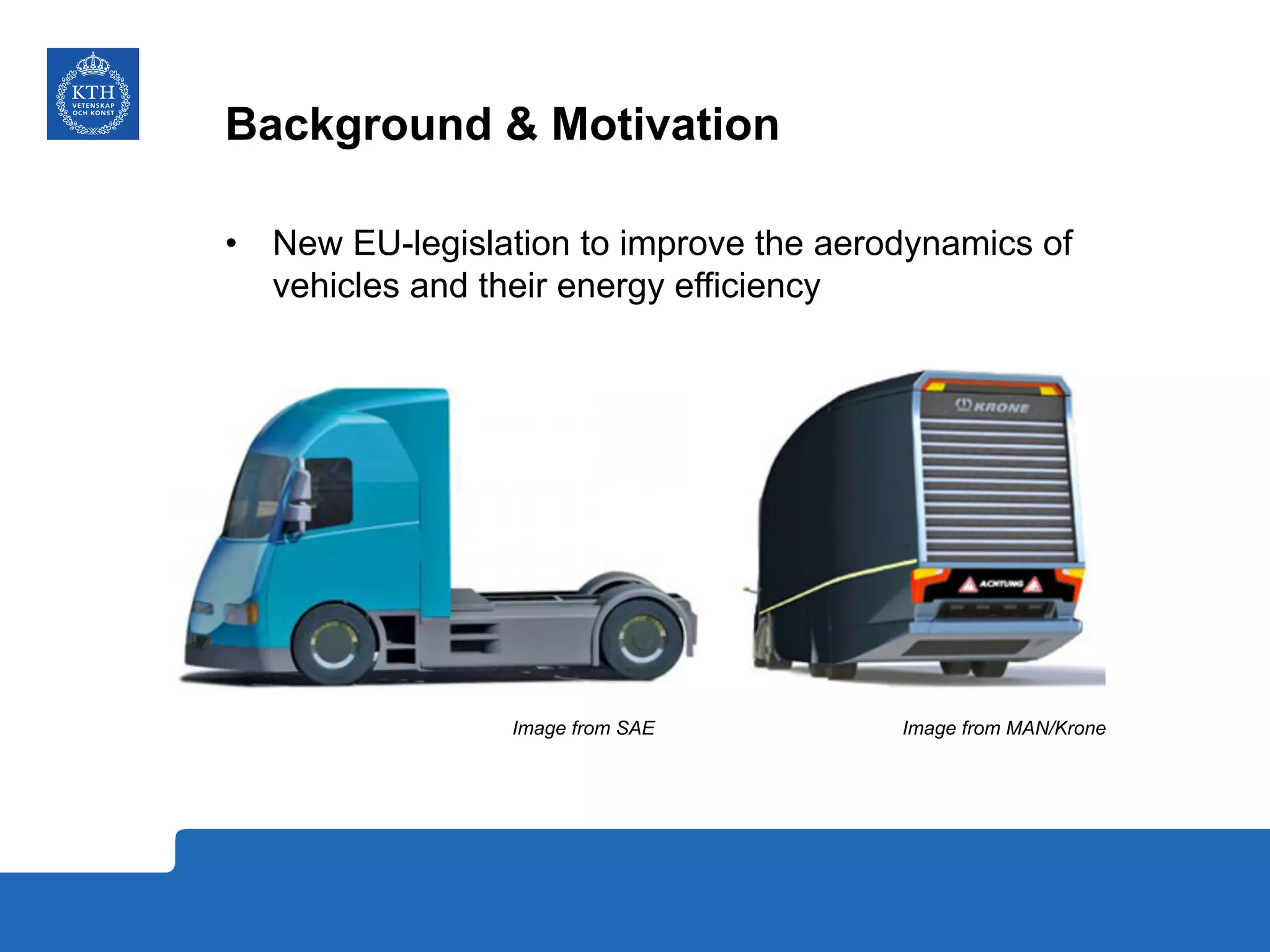
•  New EU-legislation to improve the aerodynamics of
vehicles and their energy efficiency
Image from SAE Image from MAN/Krone
Background & Motivation
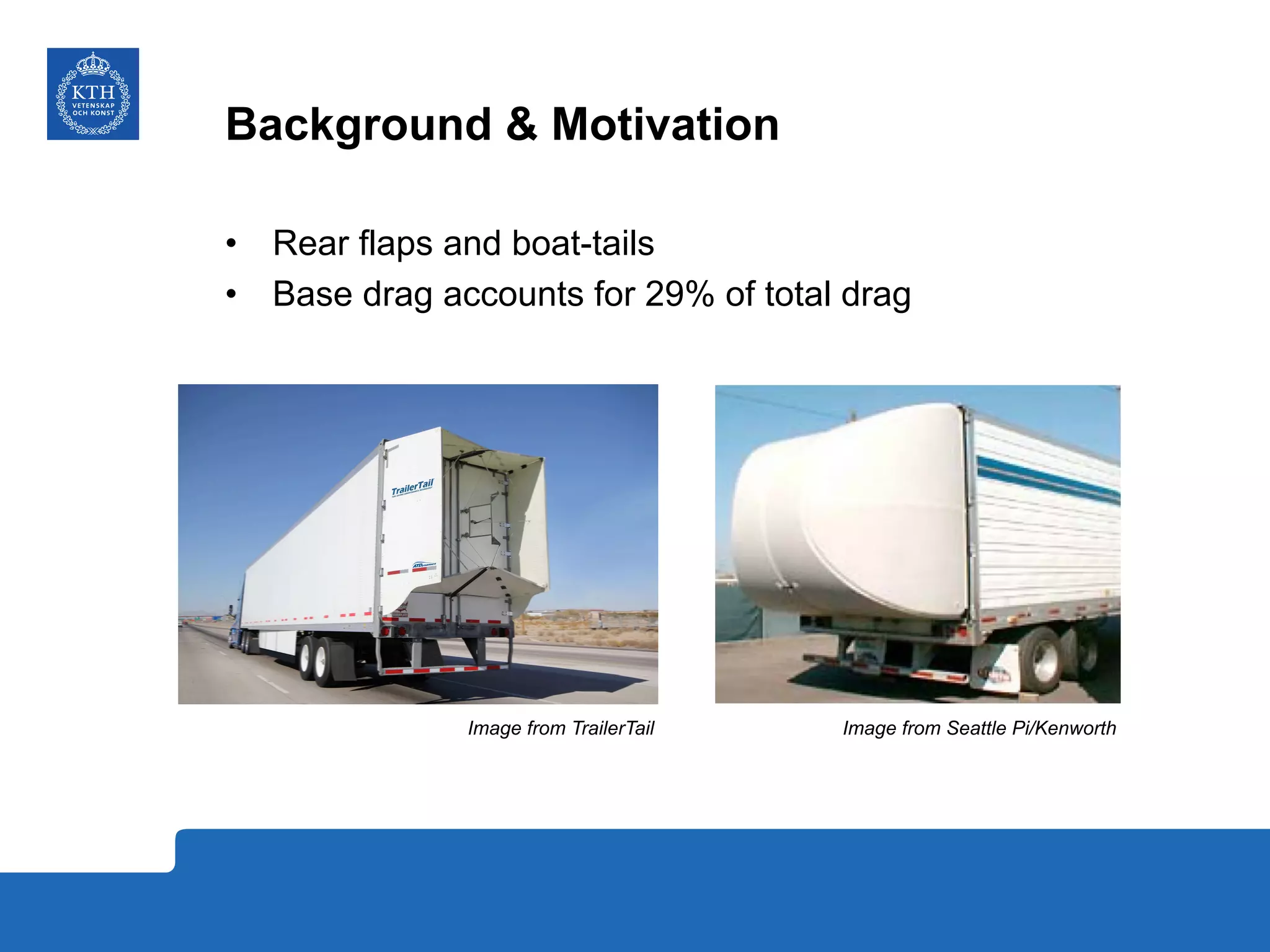
•  Rear flaps and boat-tails
•  Base drag accounts for 29% of total drag
Image from TrailerTail Image from Seattle Pi/Kenworth
Background & Motivation
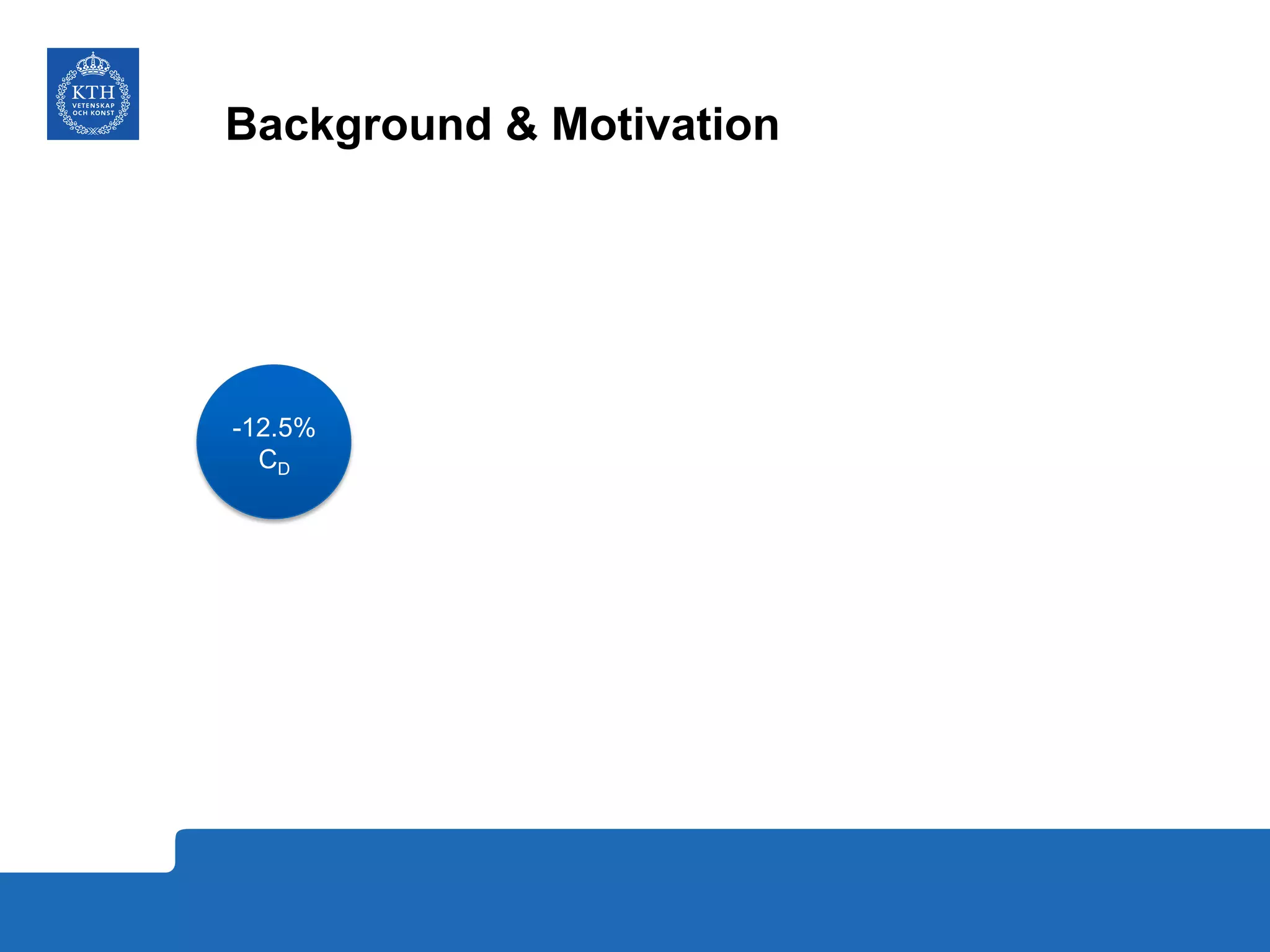
-12.5%
CD
80 km/hr
Background & Motivation
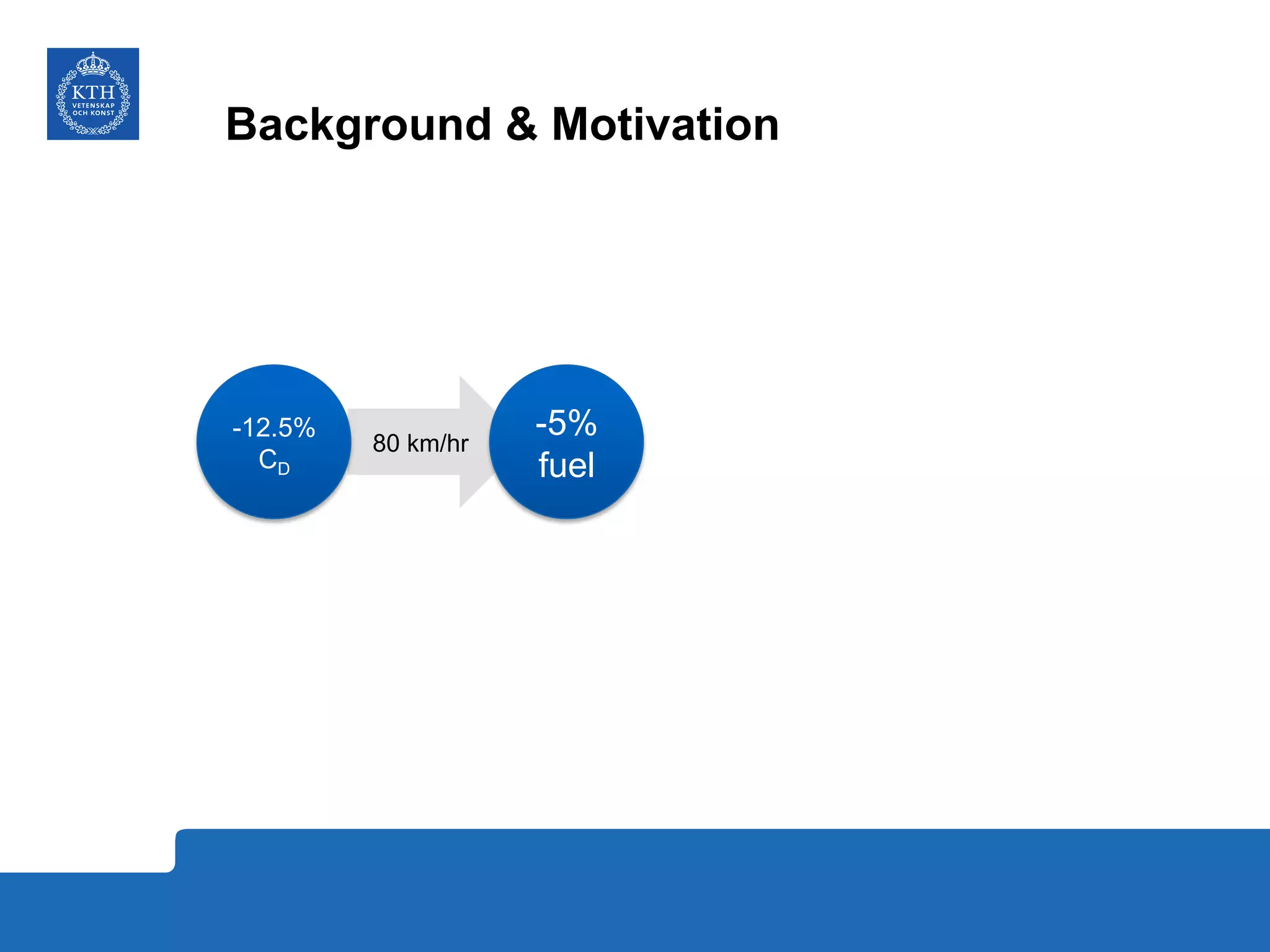
-12.5%
CD
-5%
fuel
80 km/hr
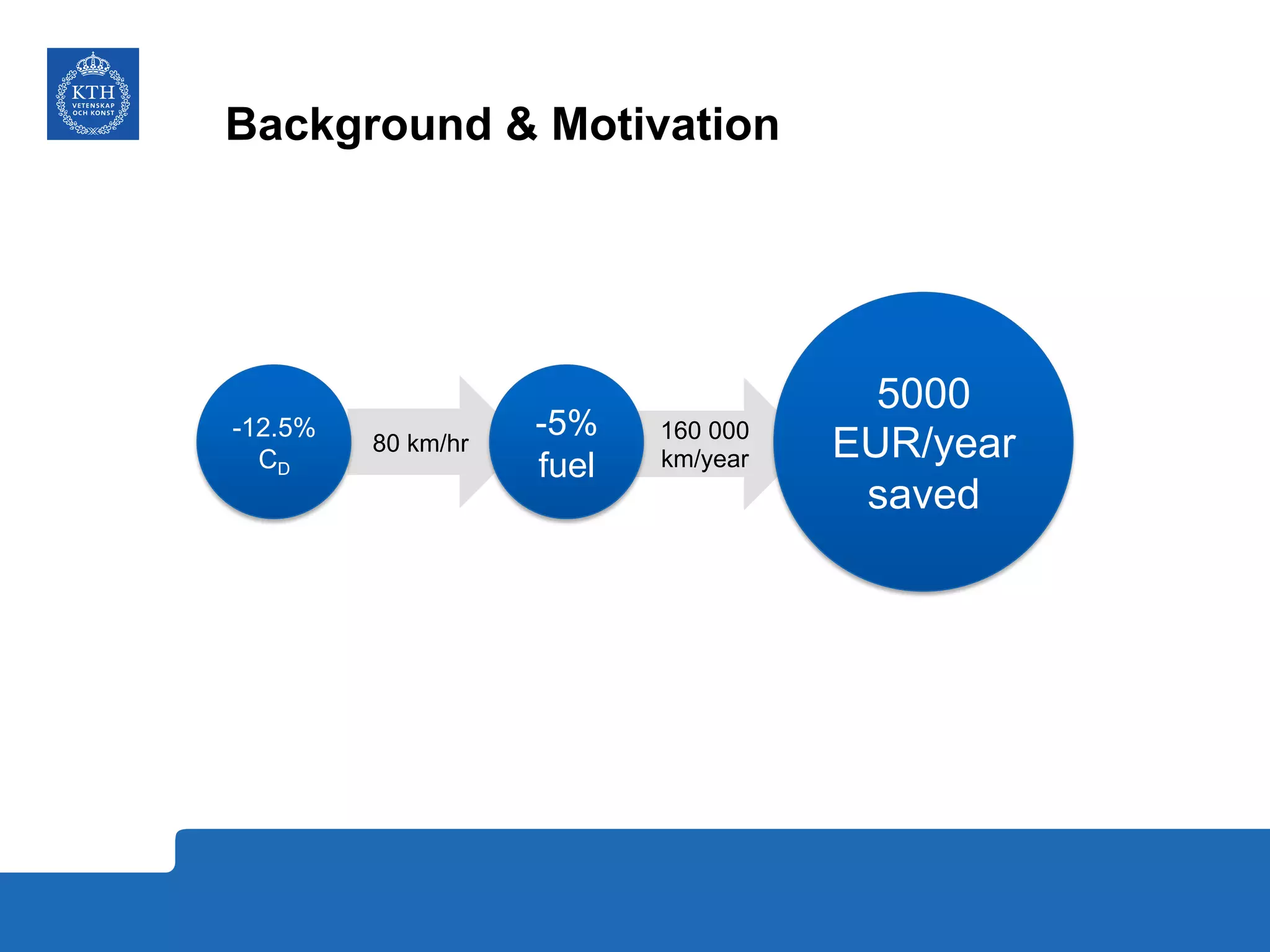
160 000
km/year
Background & Motivation
-12.5%
CD
-5%
fuel
5000
EUR/year
saved
Background & Motivation
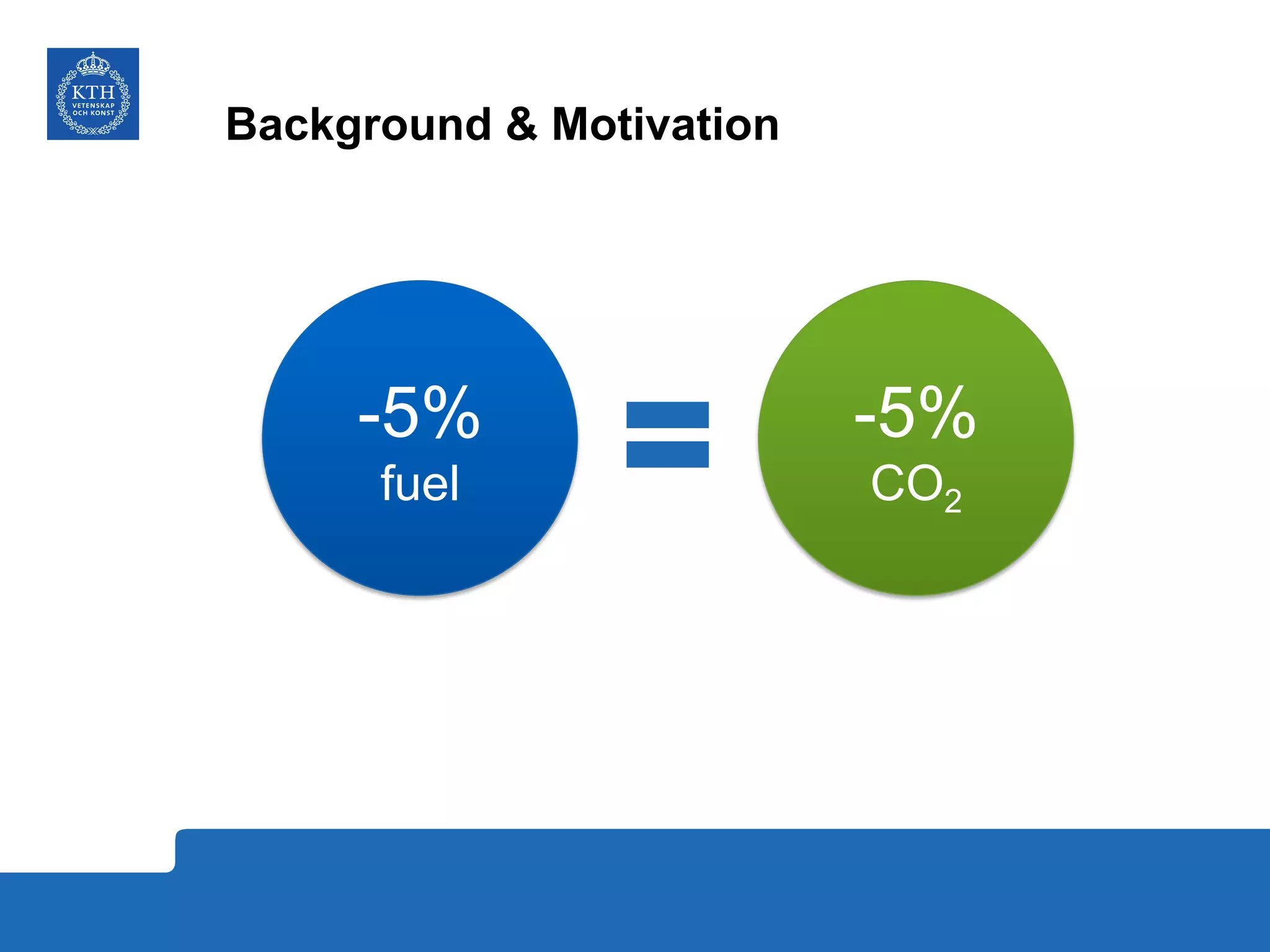
-5%
fuel
-5%
CO2
Bluff body aerodynamics
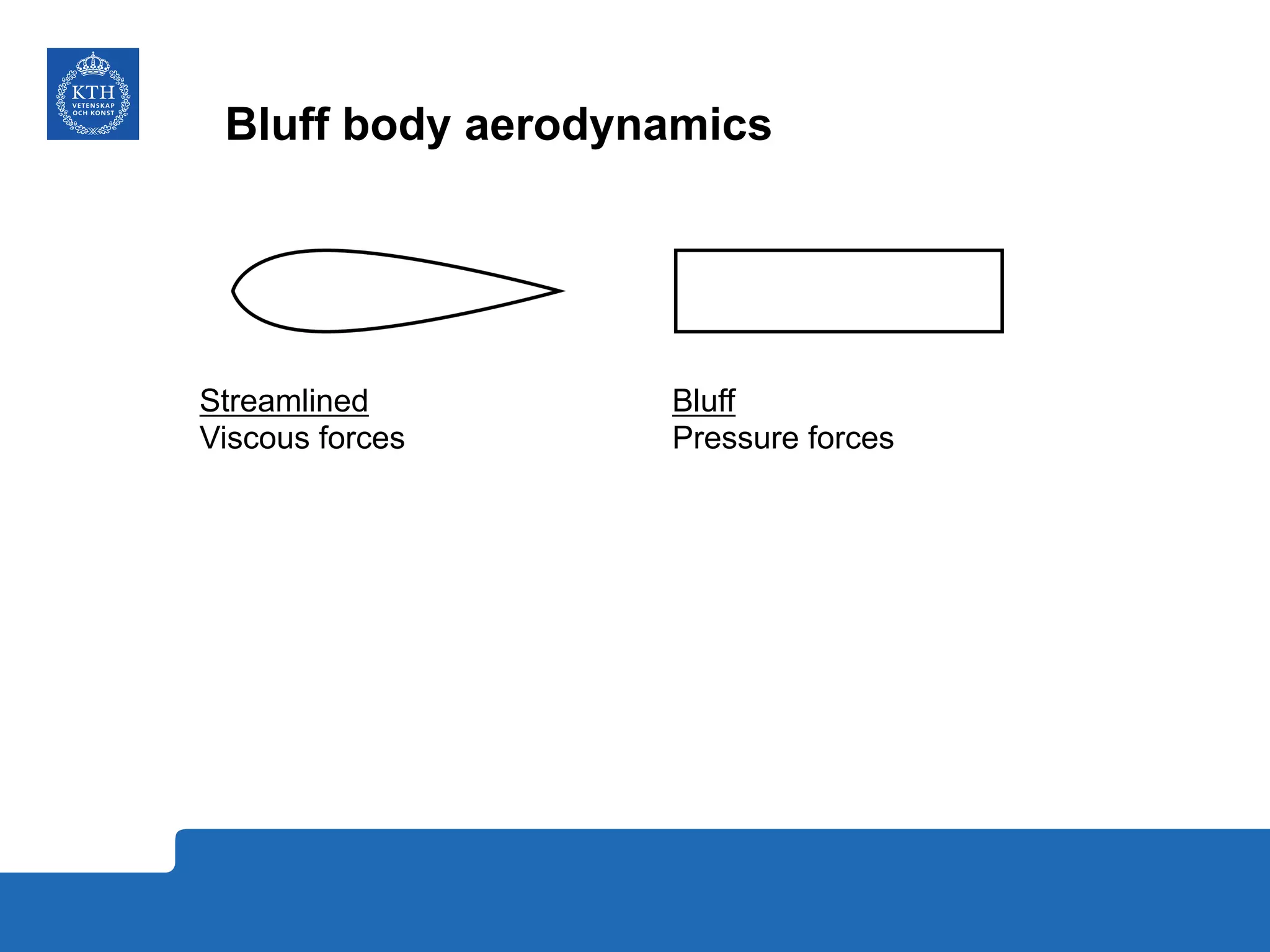
Streamlined
Viscous forces
Bluff
Pressure forces
Bluff body aerodynamics
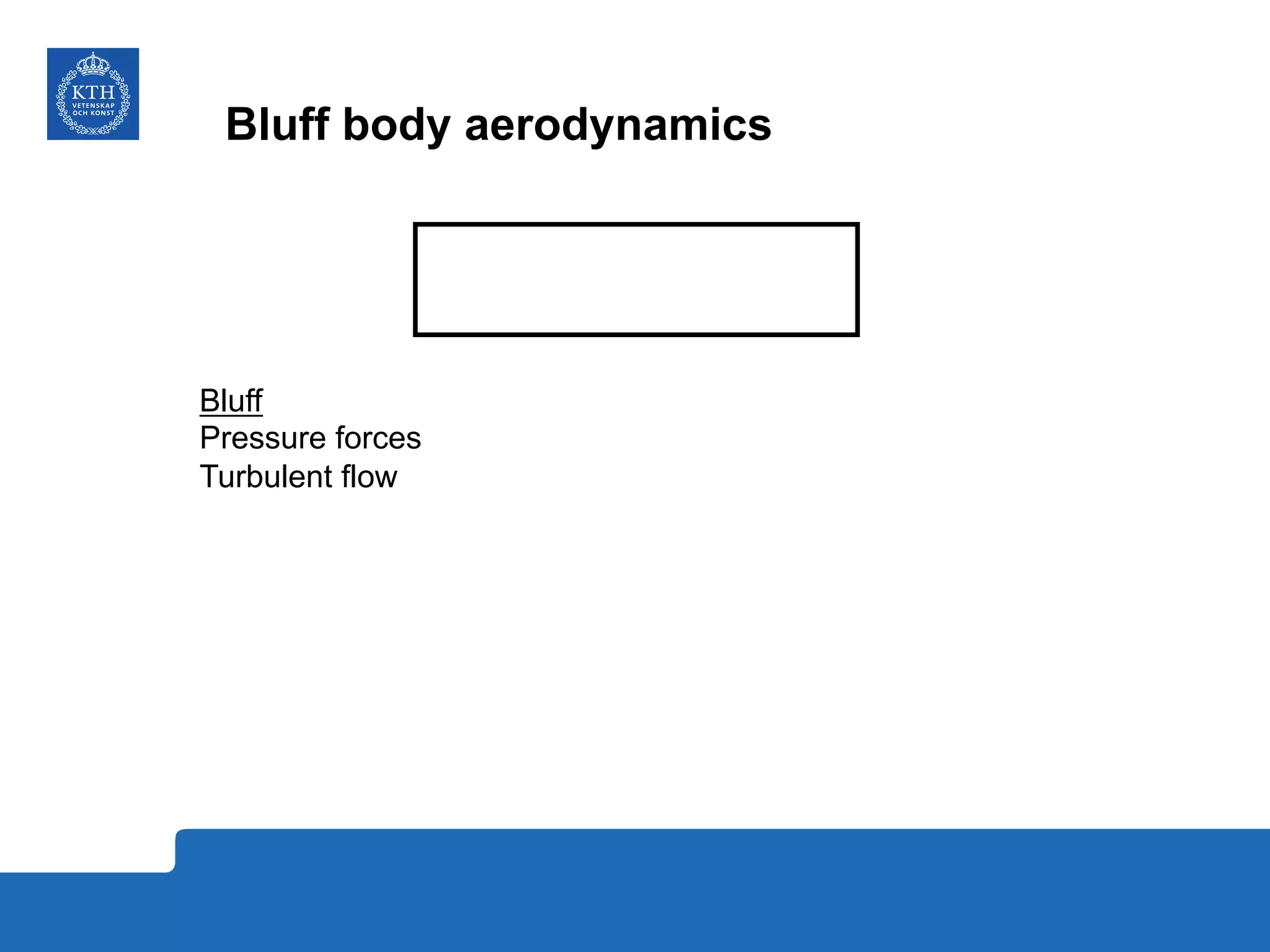
Bluff
Pressure forces
Turbulent flow
Bluff body aerodynamics
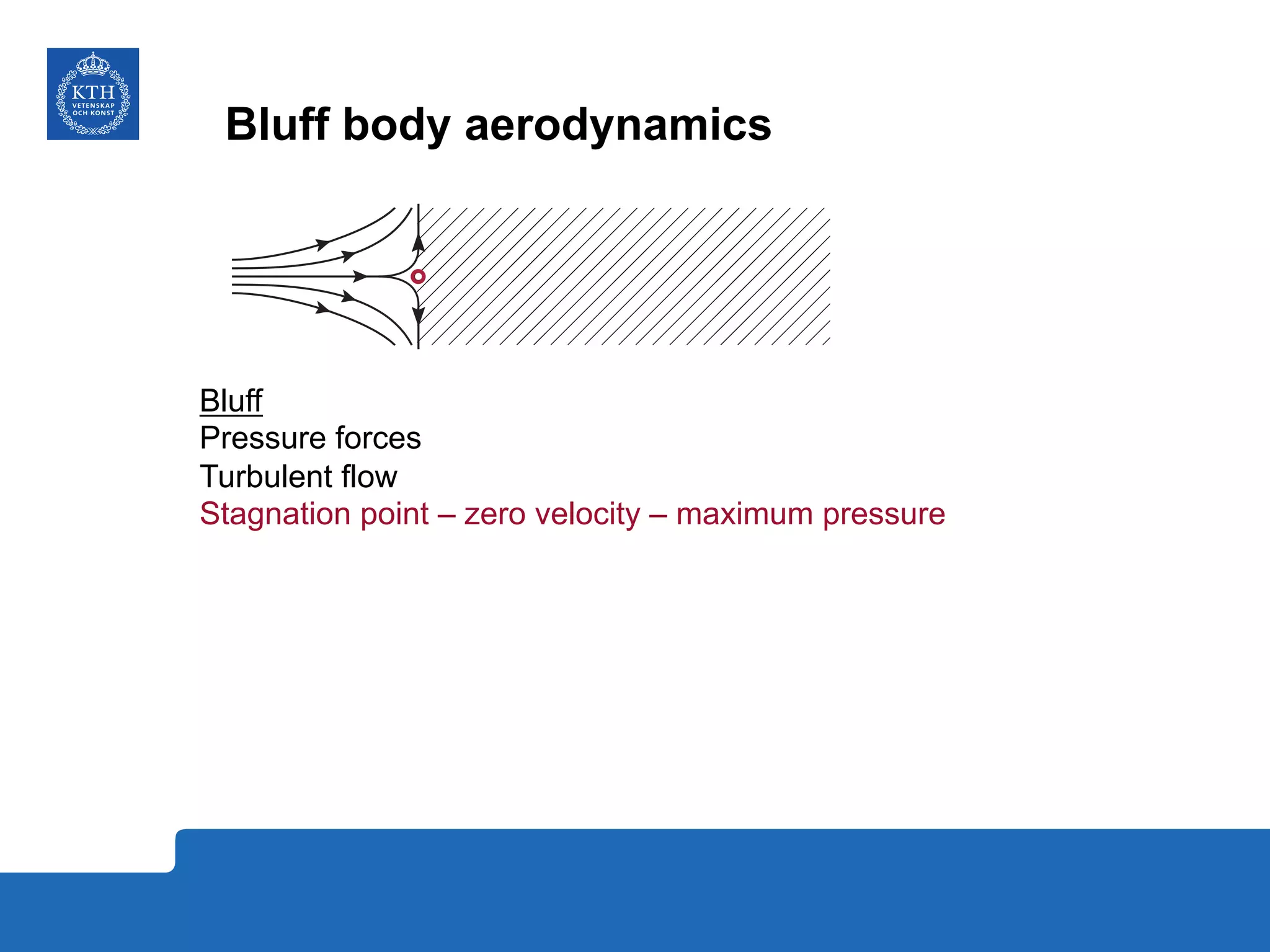
Bluff
Pressure forces
Turbulent flow
Stagnation point – zero velocity – maximum pressure
Bluff body aerodynamics
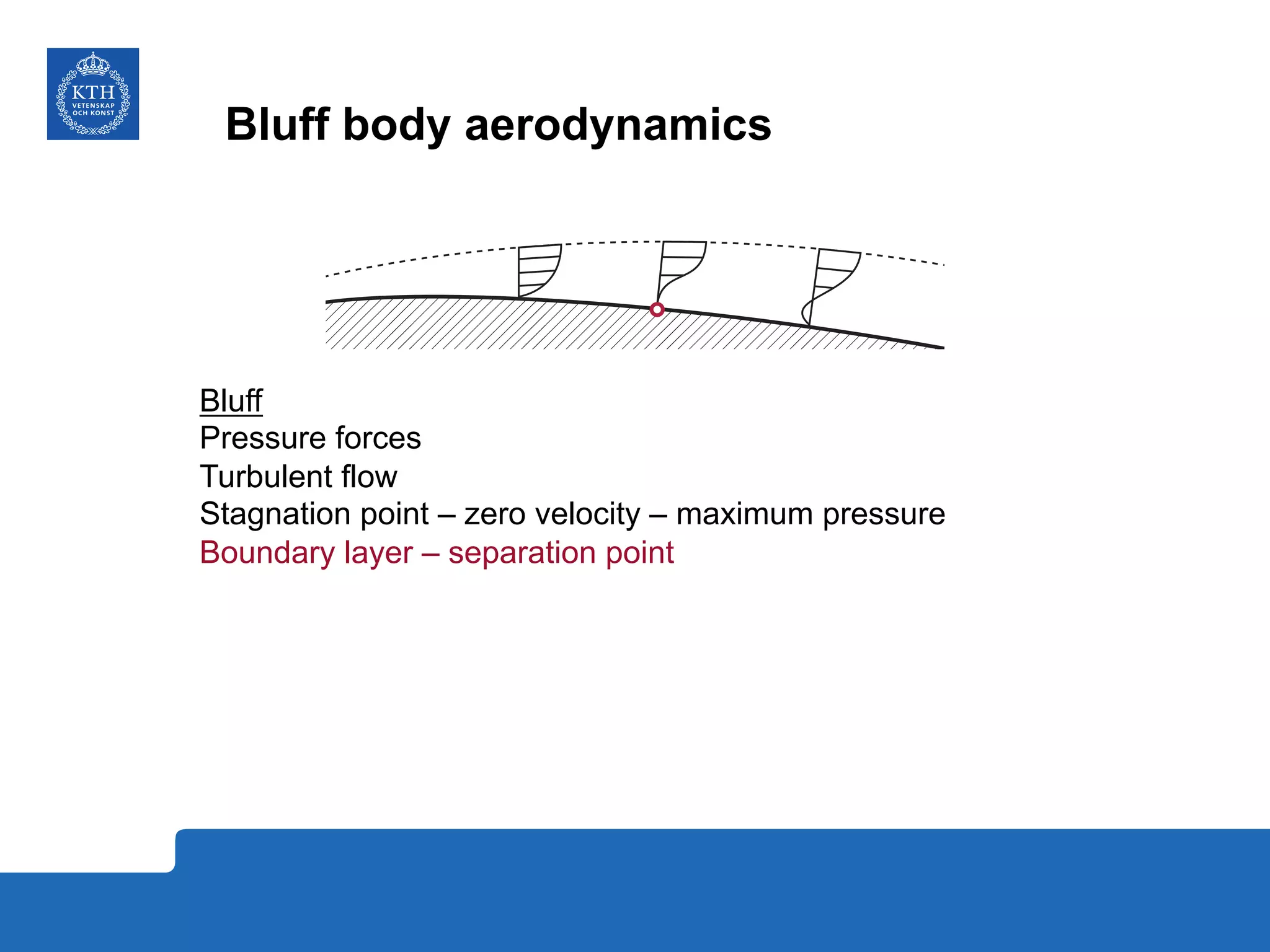
Bluff
Pressure forces
Turbulent flow
Stagnation point – zero velocity – maximum pressure
Boundary layer – separation point
Bluff body aerodynamics
Bluff
Pressure forces
Turbulent flow
Stagnation point – zero velocity – maximum pressure
Boundary layer – separation point
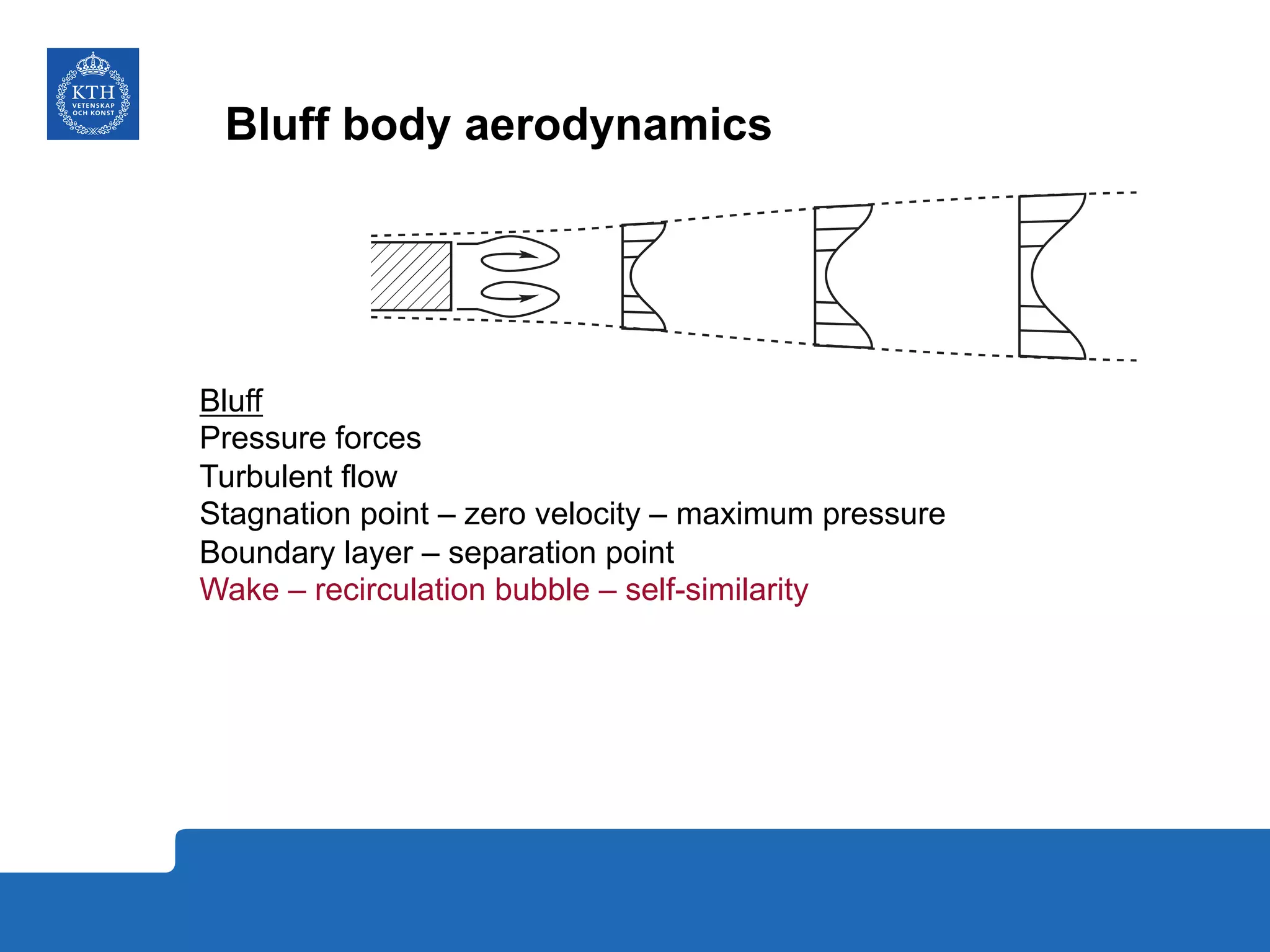
Wake – recirculation bubble – self-similarity
von Kármán vortex street Image from NASA
Bluff body aerodynamics
Bluff
Pressure forces
Turbulent flow
Stagnation point – zero velocity – maximum pressure
Boundary layer – separation point
Wake – recirculation bubble – self-similarity
Forces, coefficients & representative scales
CD =
2FD
ρU2
A
Coefficent of drag
FD = drag force [N]
ρ = fluid density [kg/m3]
U = freestream velocity [m/s]
A = projected area [m2]
Forces, coefficients & representative scales
CD =
2FD
ρU2
A
Coefficent of drag
FD = drag force [N]
ρ = fluid density [kg/m3]
U = freestream velocity [m/s]
A = projected area [m2]
Re =
ρUL
µ
Reynolds number
L = characteristic length [m]
µ = dynamic viscosity [PaŸs]
Governing equations & approach
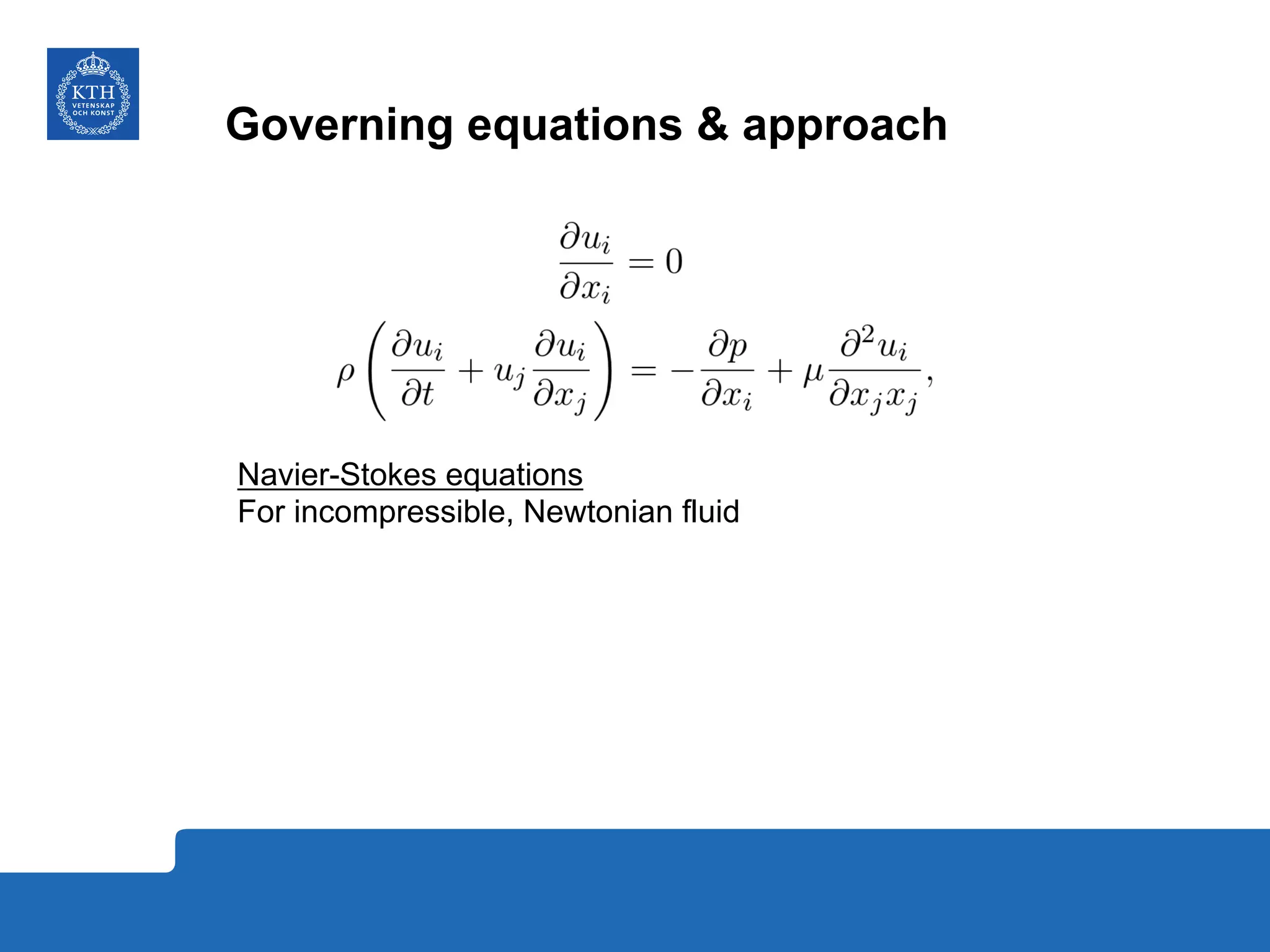
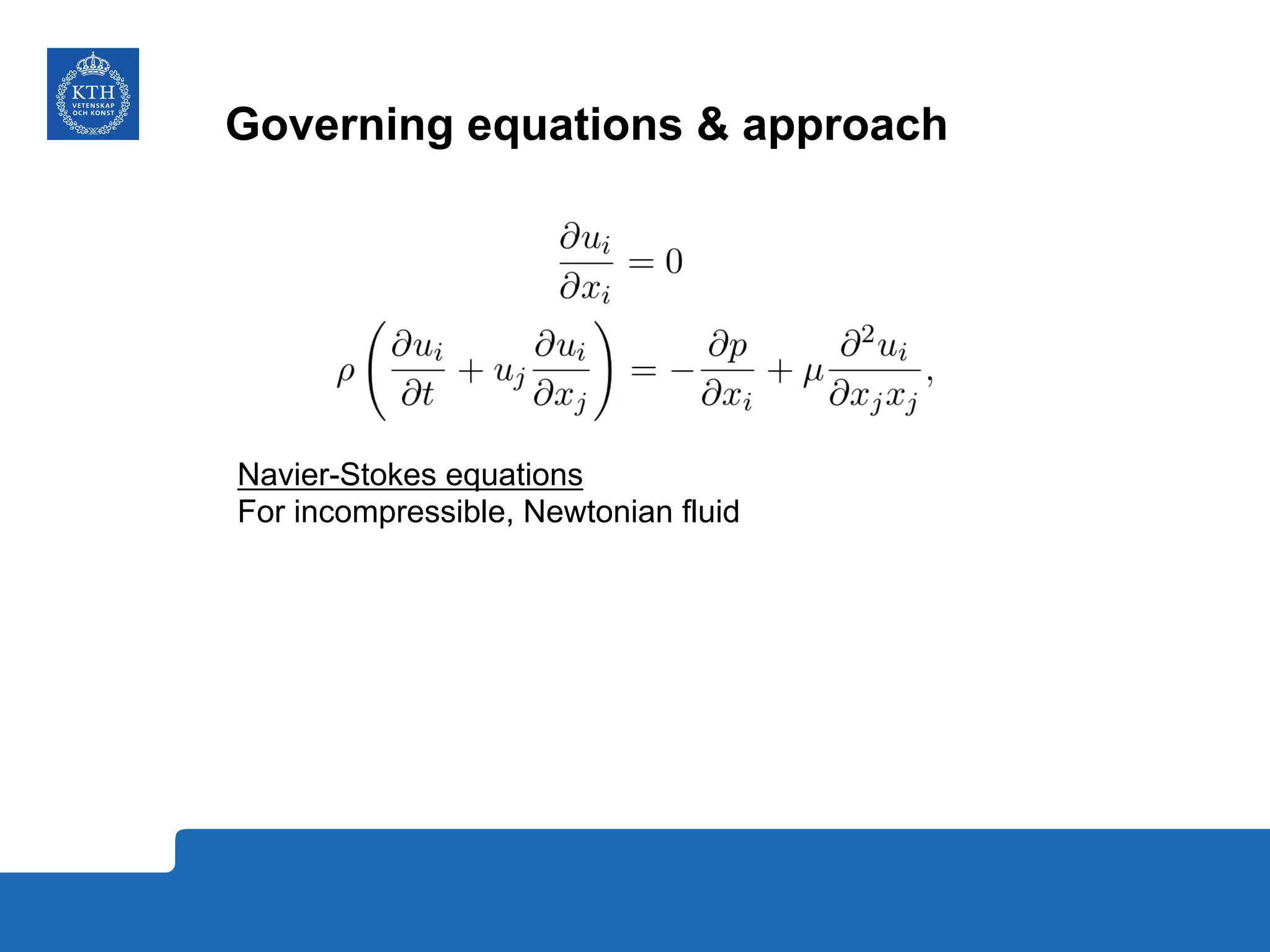
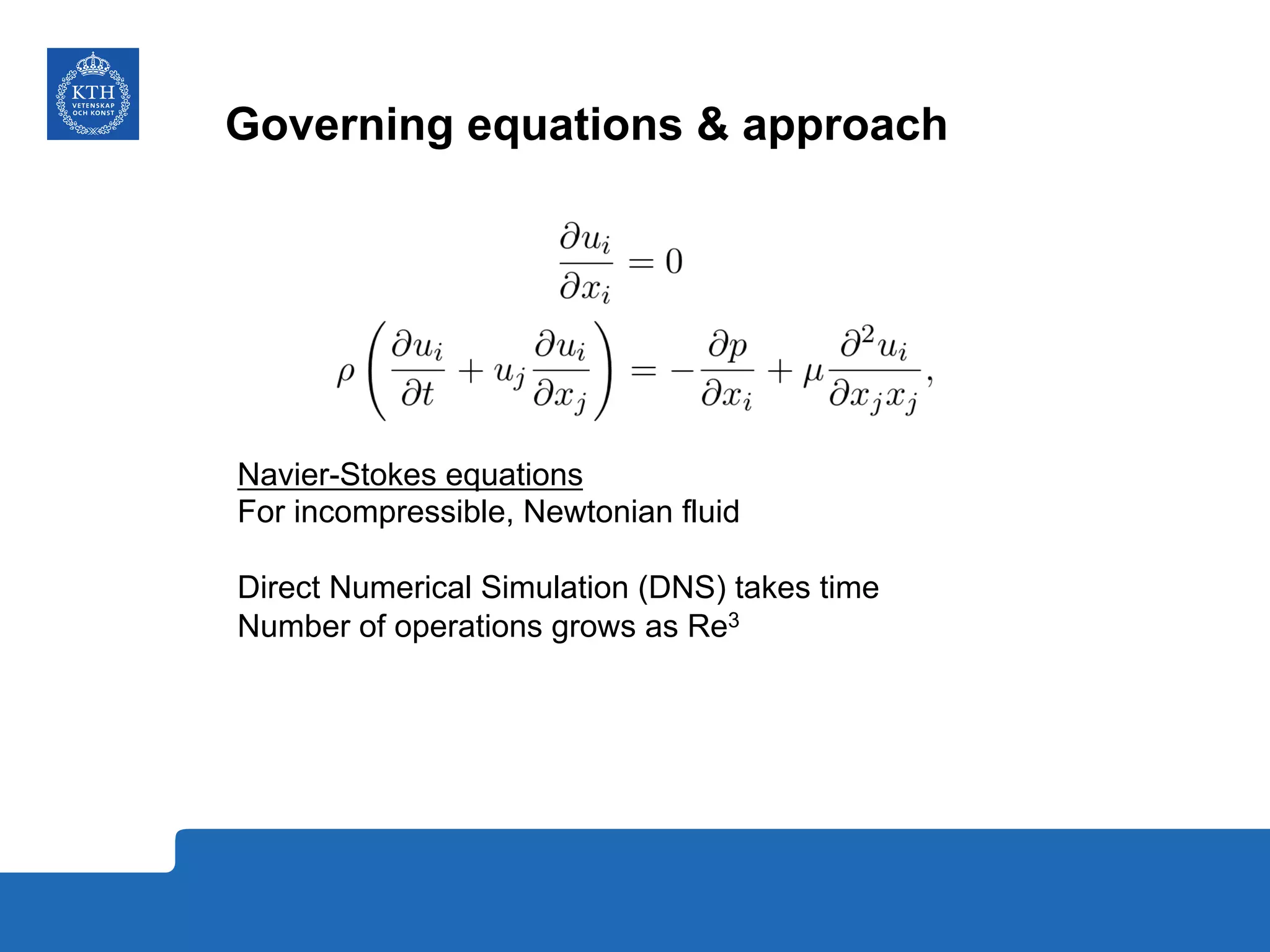
Navier-Stokes equations
For incompressible, Newtonian fluid
Governing equations & approach
Navier-Stokes equations
For incompressible, Newtonian fluid
Governing equations & approach
Navier-Stokes equations
For incompressible, Newtonian fluid
Direct Numerical Simulation (DNS) takes time
Number of operations grows as Re3
Governing equations & approach
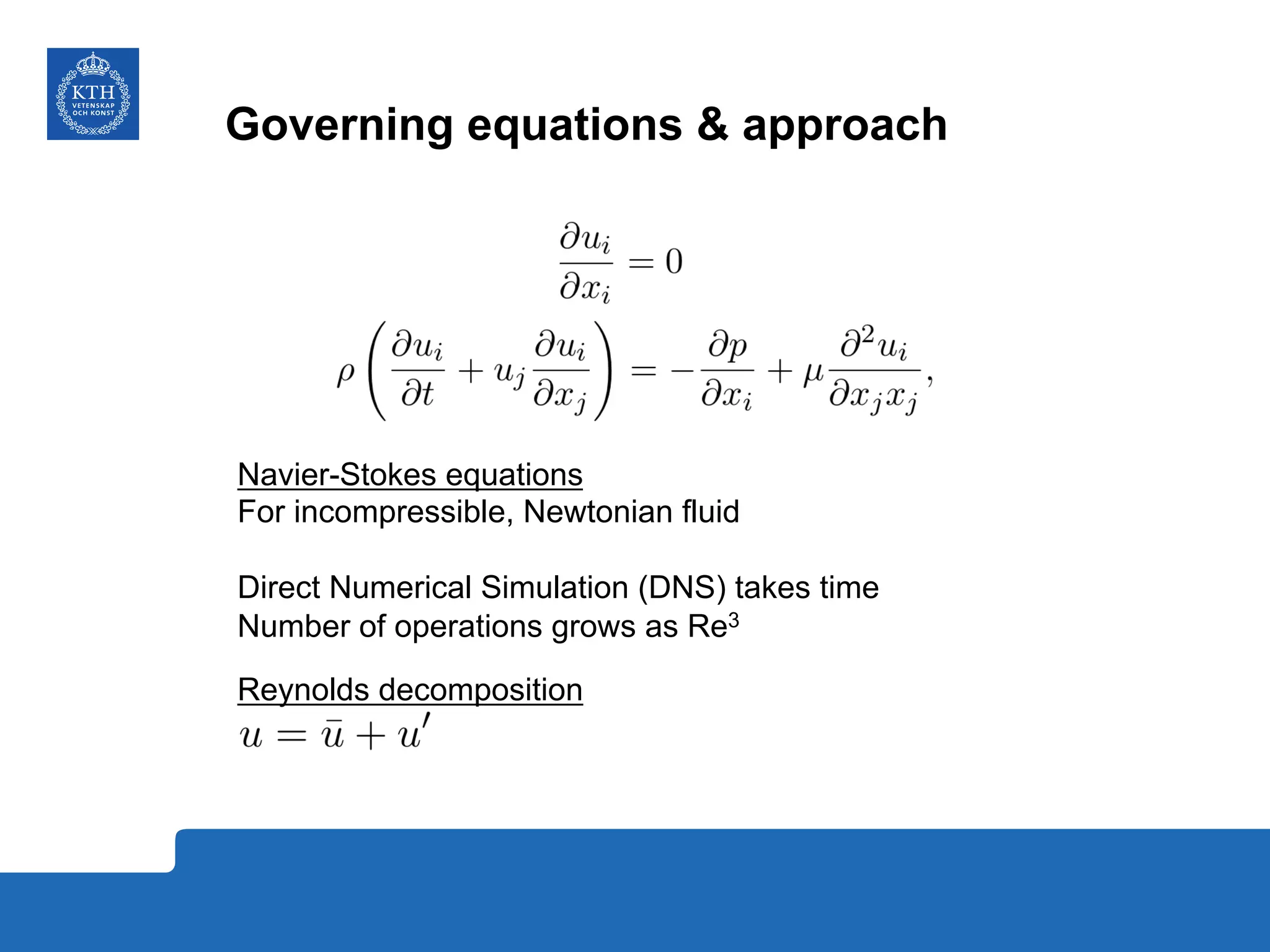
Navier-Stokes equations
For incompressible, Newtonian fluid
Direct Numerical Simulation (DNS) takes time
Number of operations grows as Re3
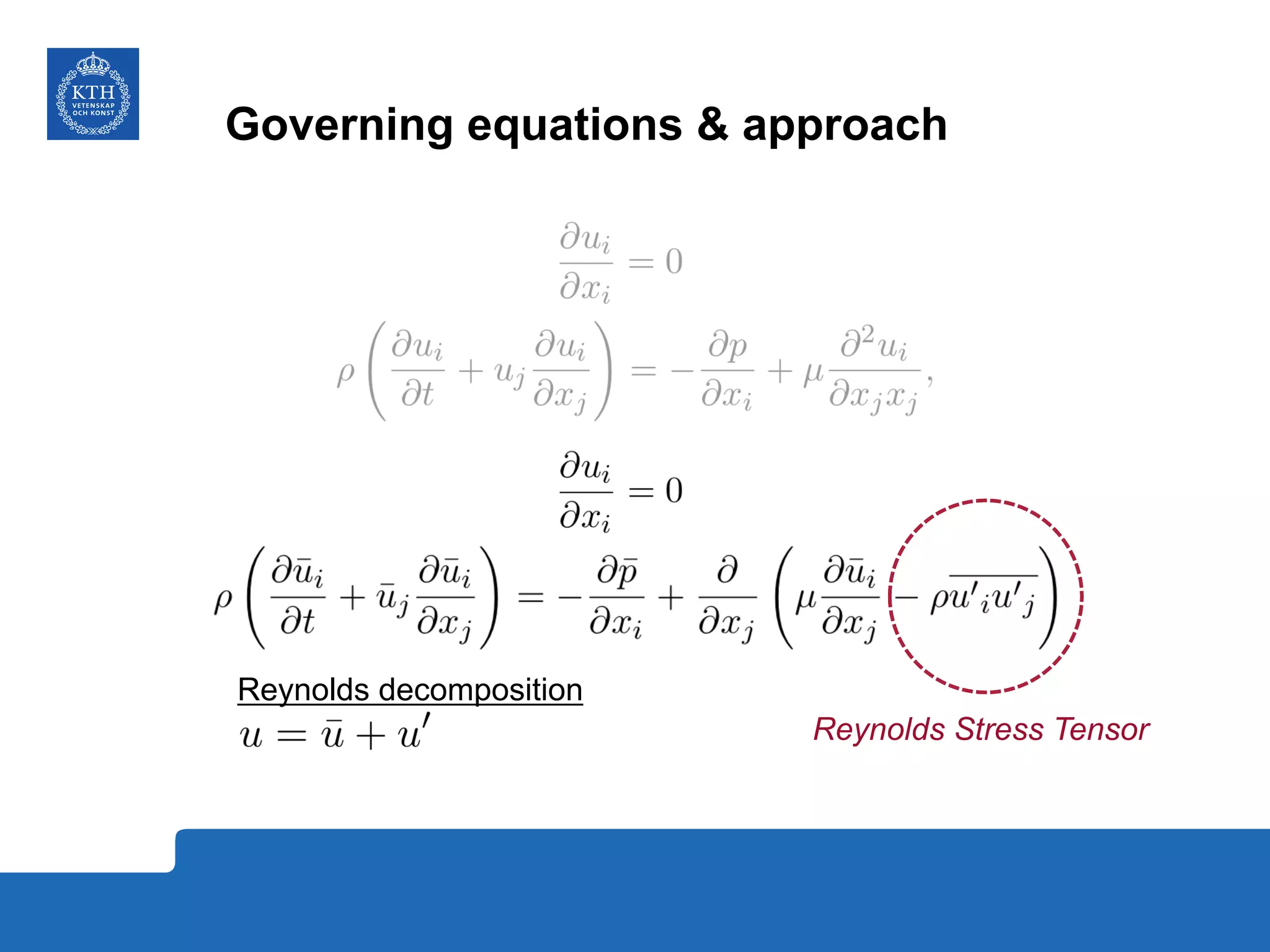
Reynolds decomposition
Governing equations & approach
Reynolds Stress Tensor
Reynolds decomposition
Governing equations & approach
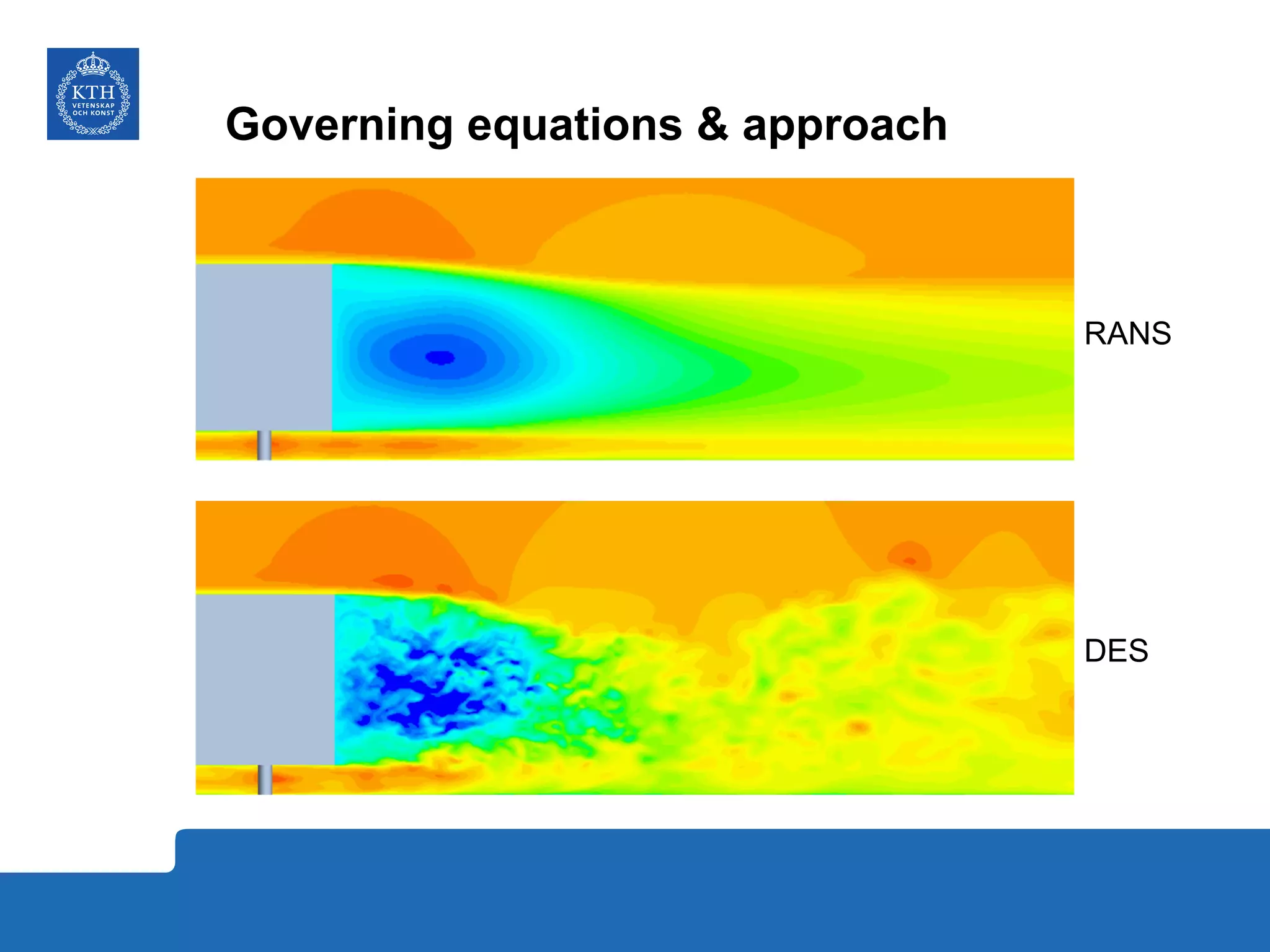
RANS
DES
Case description and setup
Solver
•  3D space
•  Steady-state RANS
•  Segregated flow
•  Incompressible (Ma<0.3)
•  Turbulence model: Eddy-Viscosity SST k-ω
•  Wall functions to resolve boundary layer
Case description and setup
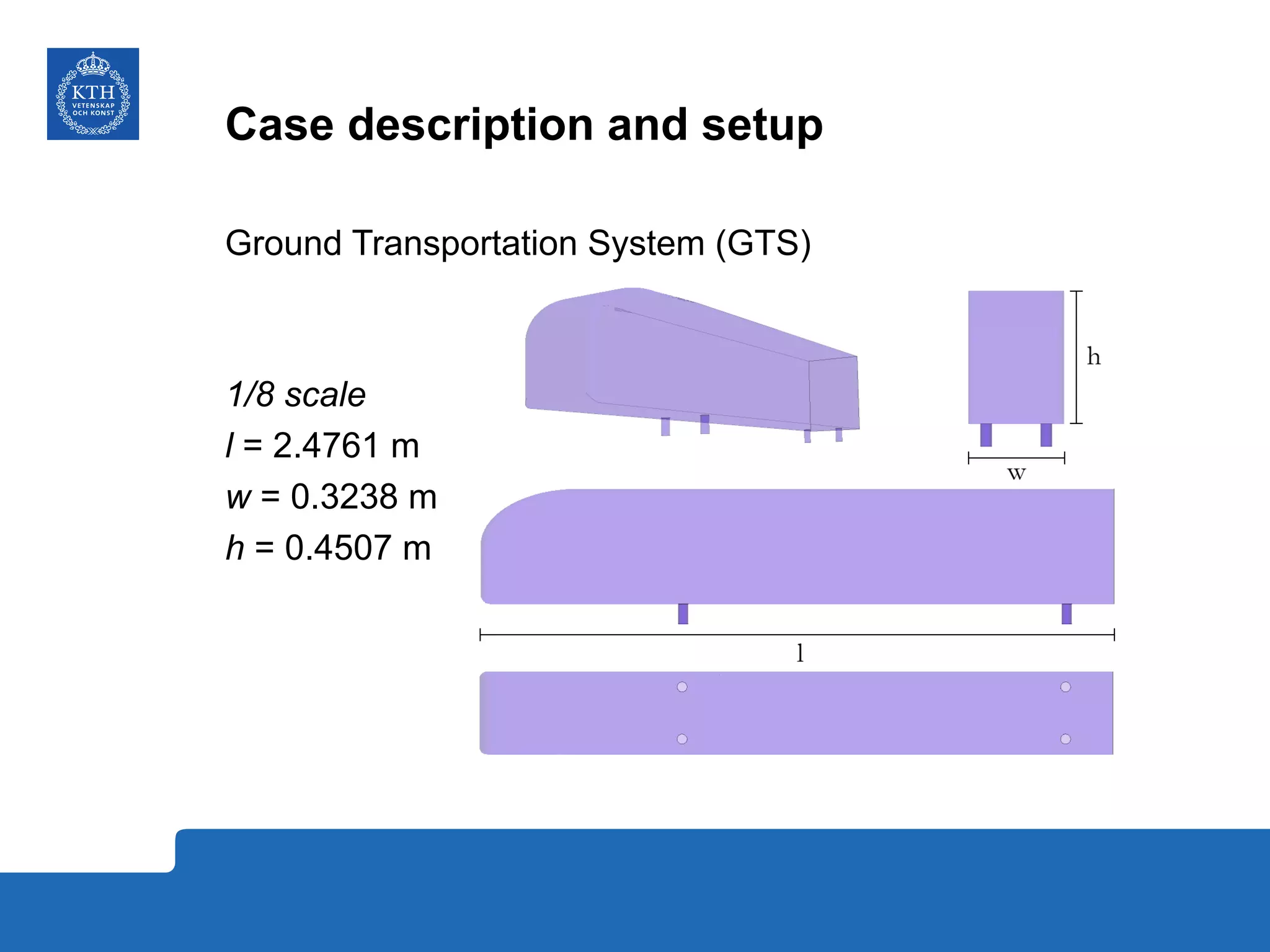
Ground Transportation System (GTS)
1/8 scale
l = 2.4761 m
w = 0.3238 m
h = 0.4507 m
Case description and setup
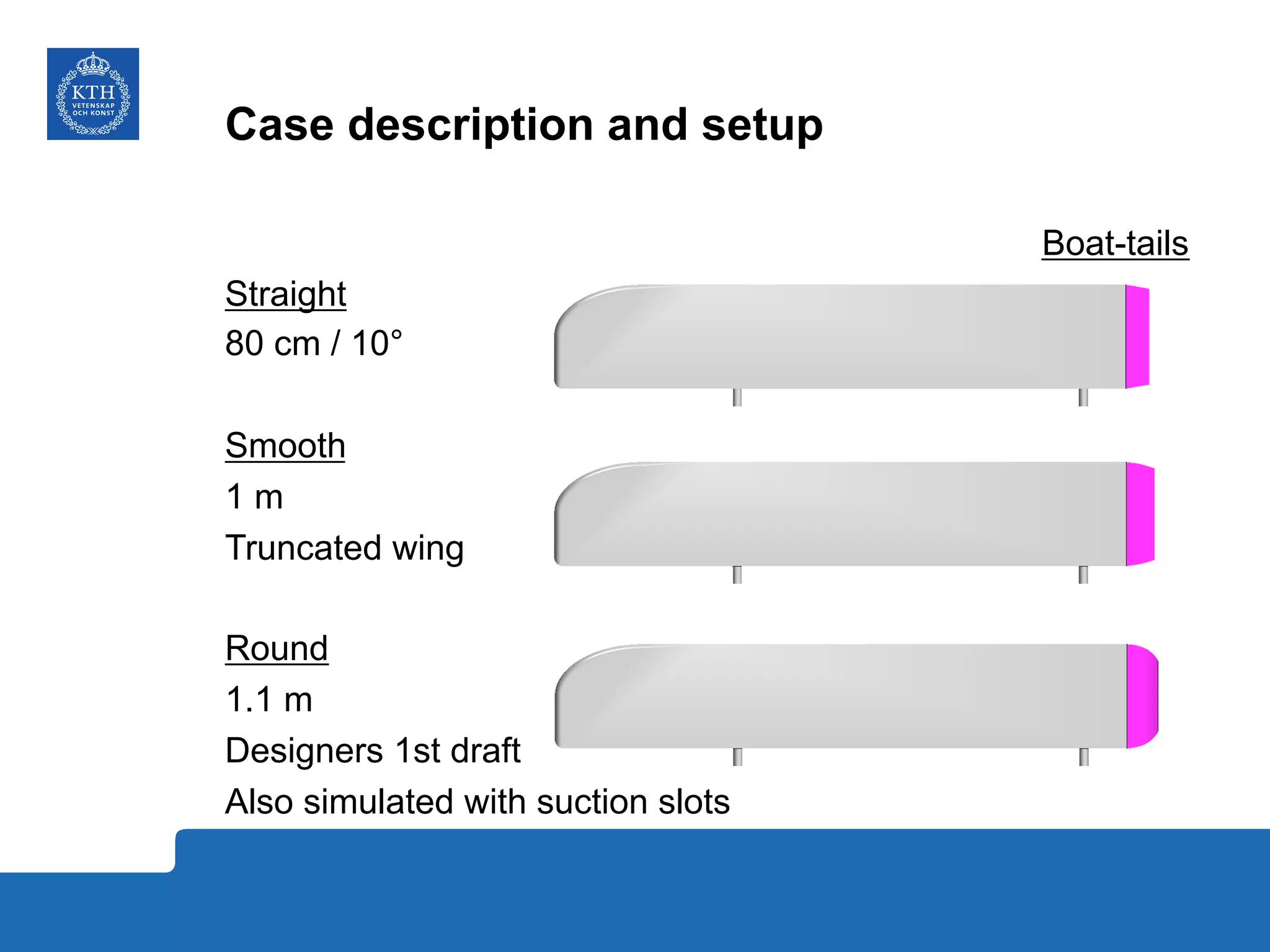
Boat-tails
Straight
80 cm / 10°
Smooth
1 m
Truncated wing
Round
1.1 m
Designers 1st draft
Also simulated with suction slots
Case description and setup
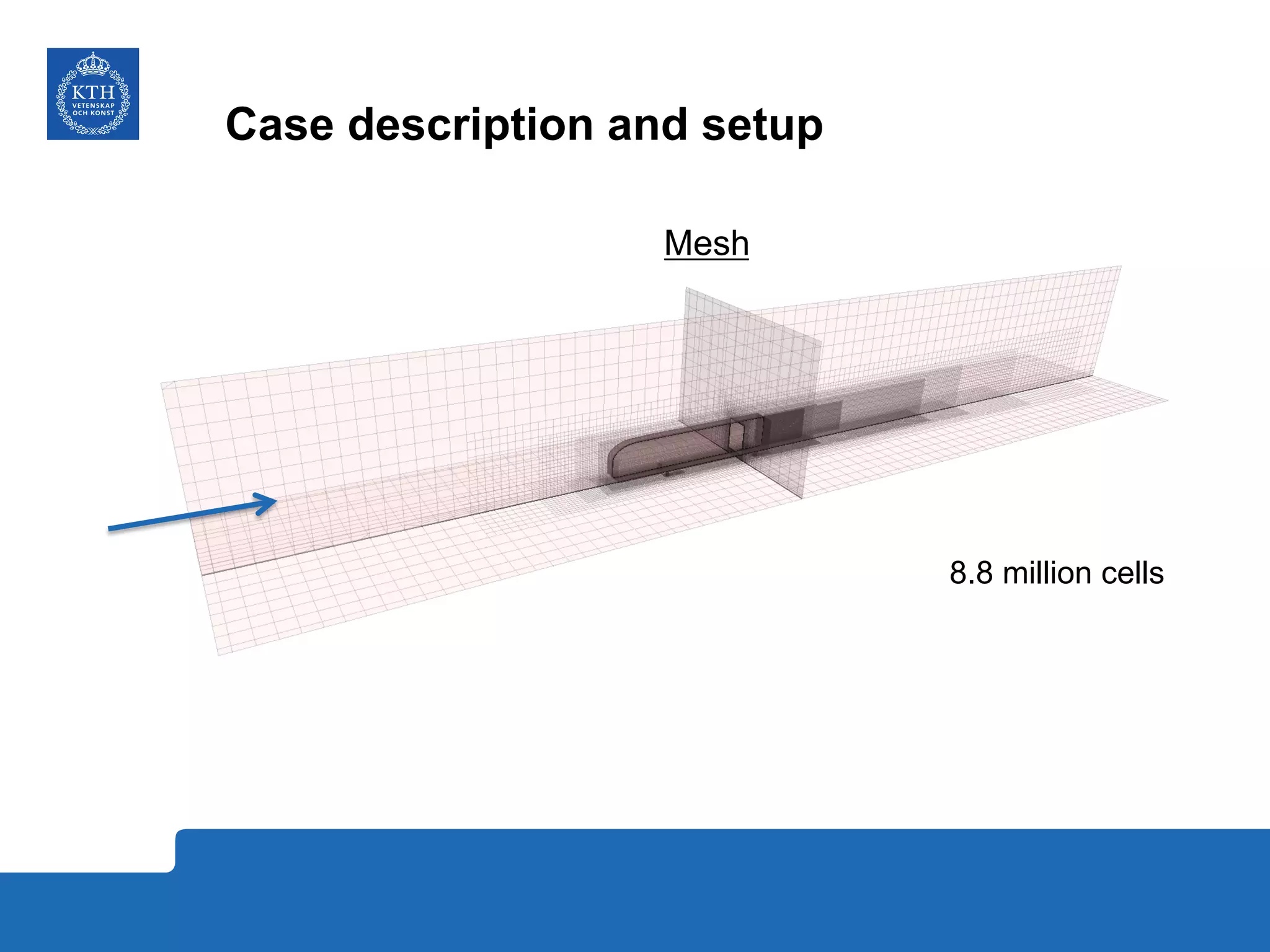
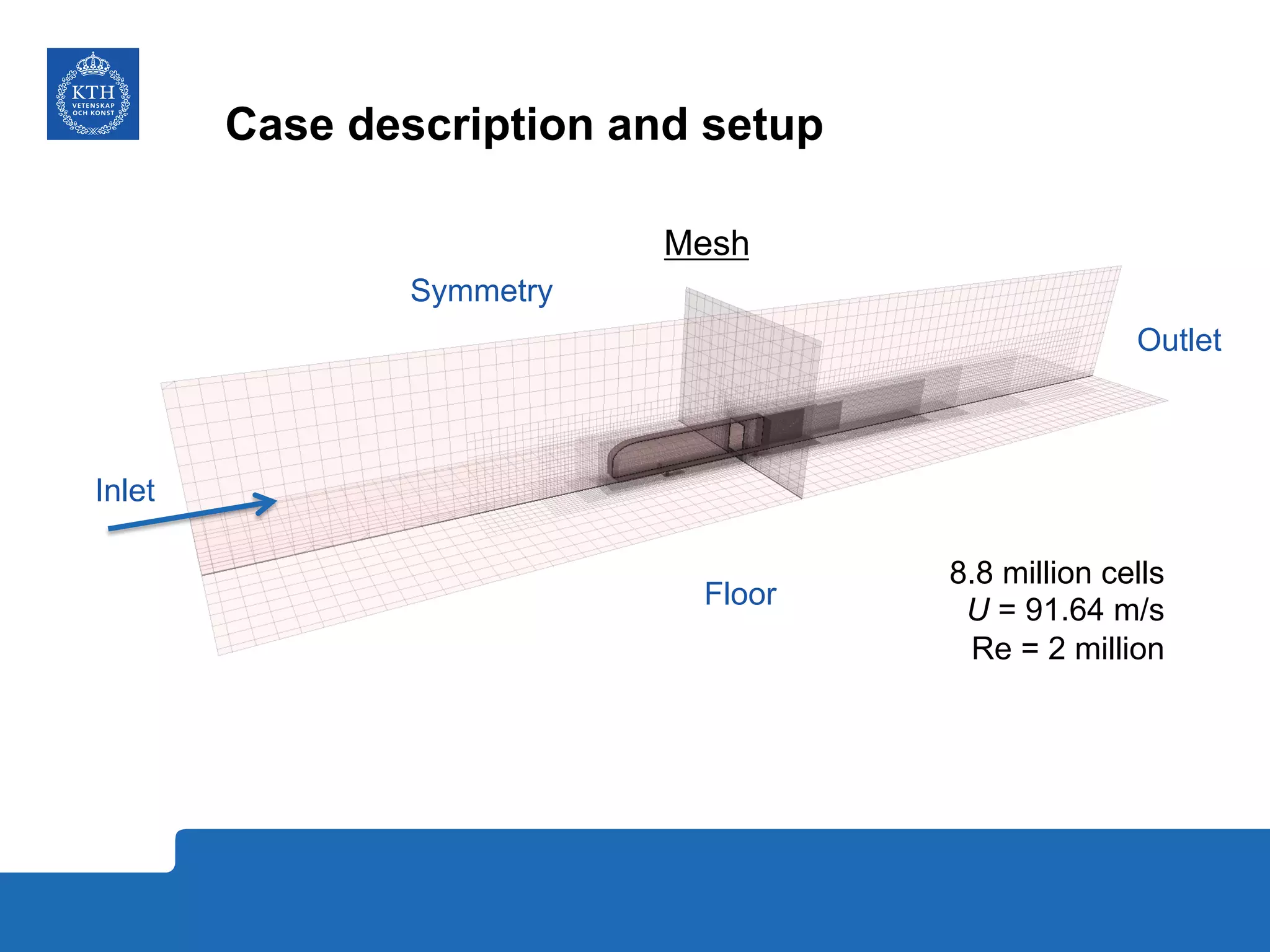
Mesh
8.8 million cells
Case description and setup
Mesh
Inlet
Outlet
Floor
Symmetry
8.8 million cells
U = 91.64 m/s
Re = 2 million
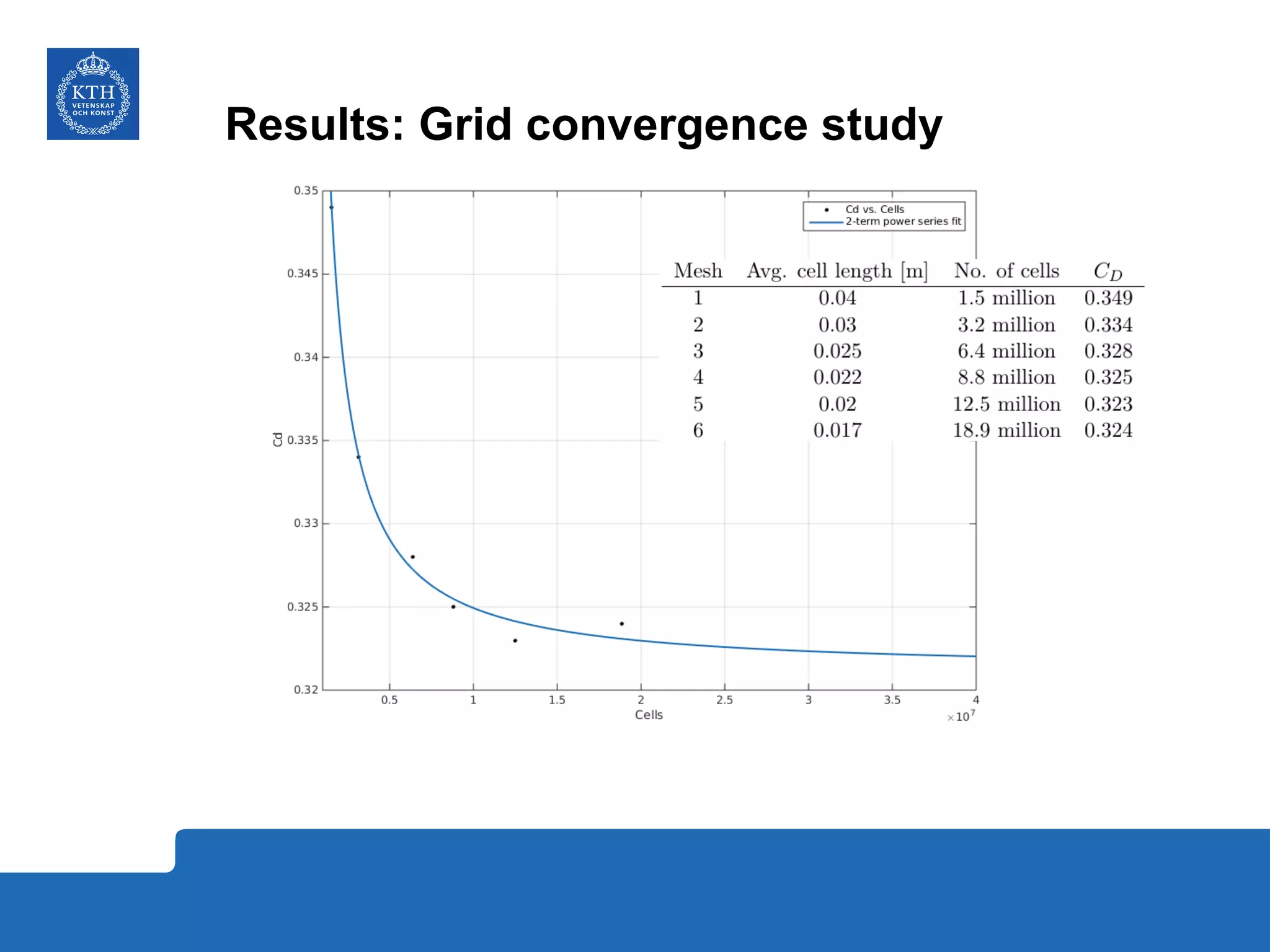
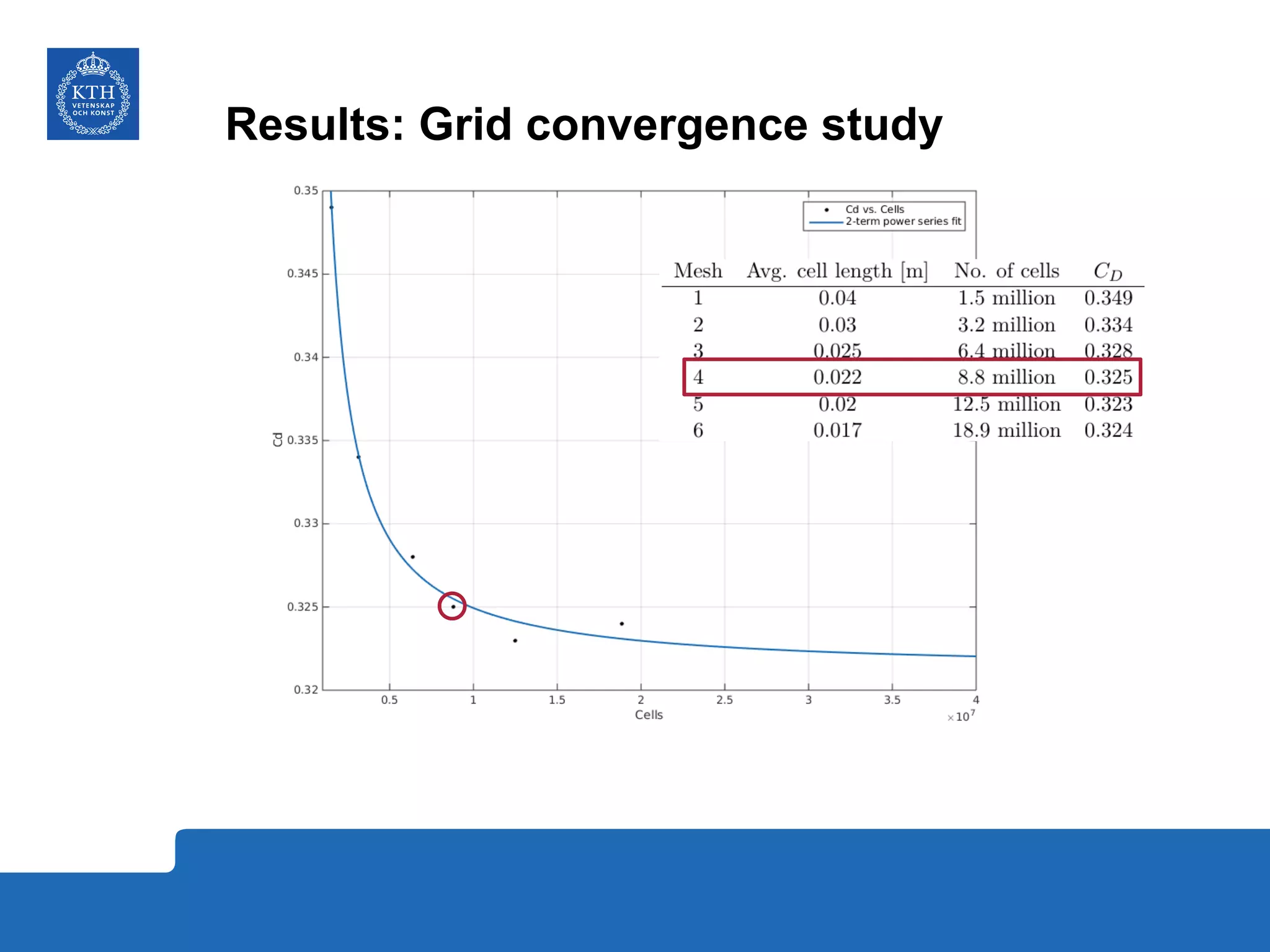
Results: Grid convergence study
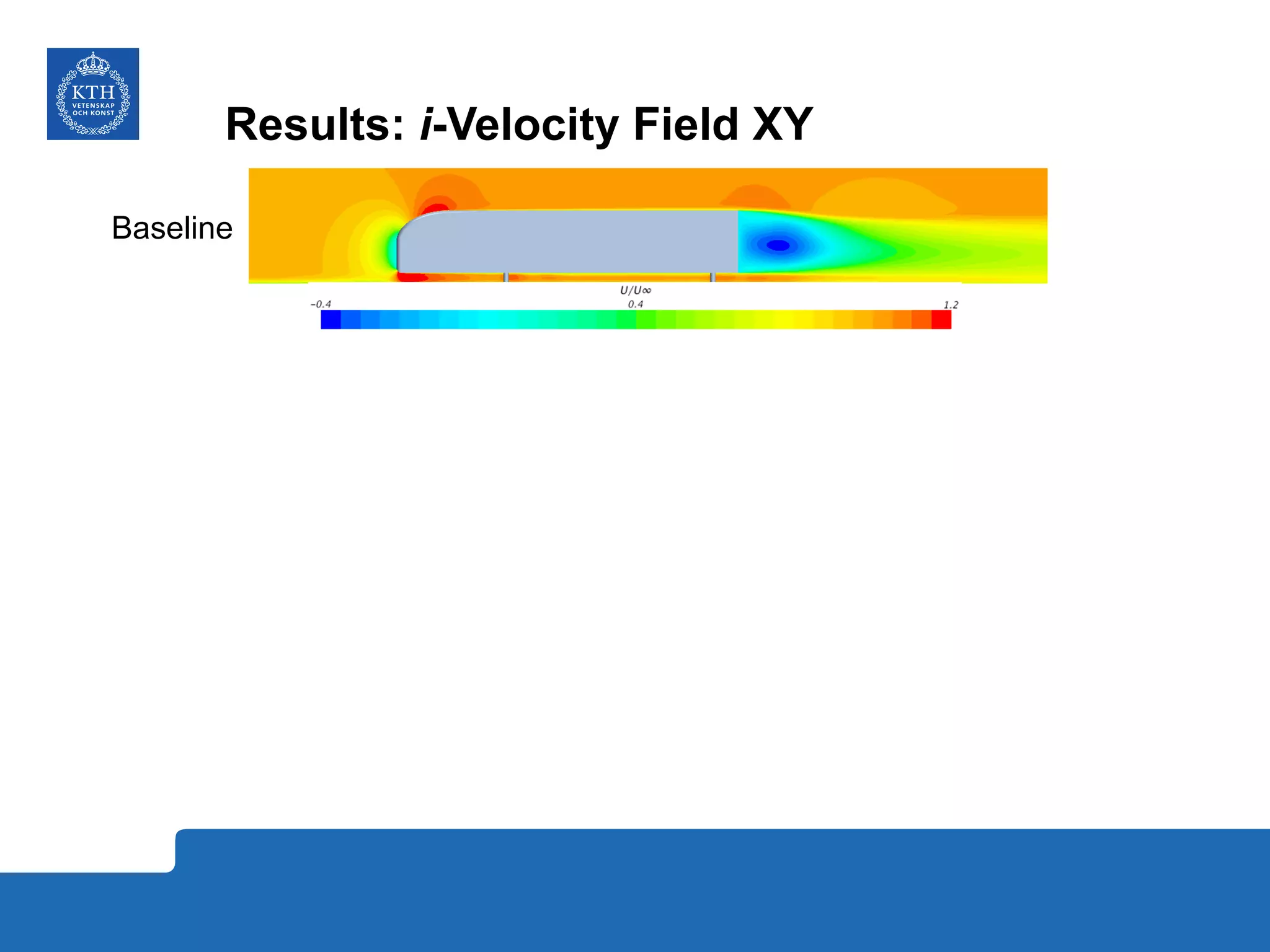
Results: i-Velocity Field XY
Baseline
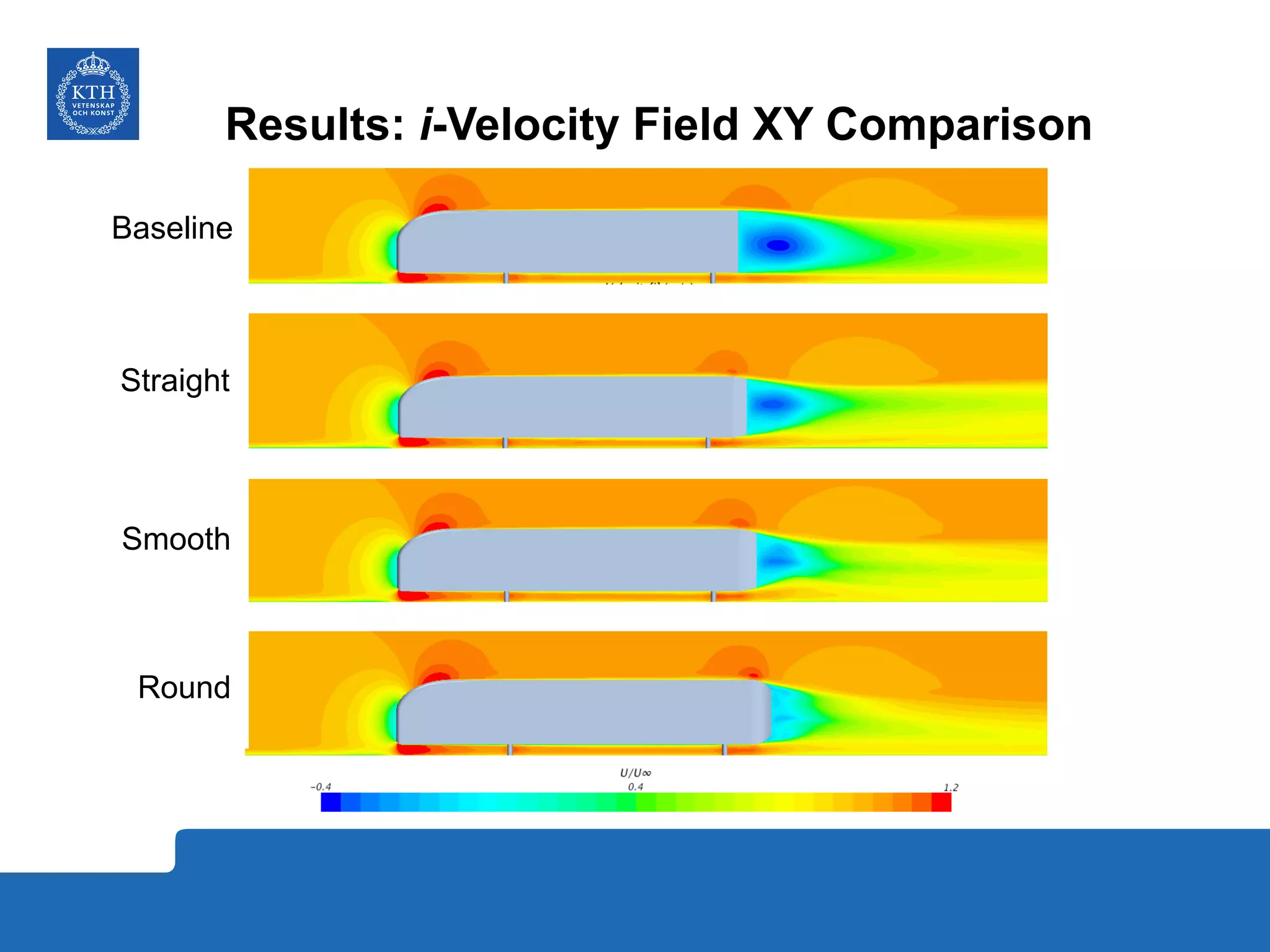
Results: i-Velocity Field XY Comparison
Straight
Baseline
Smooth
Round
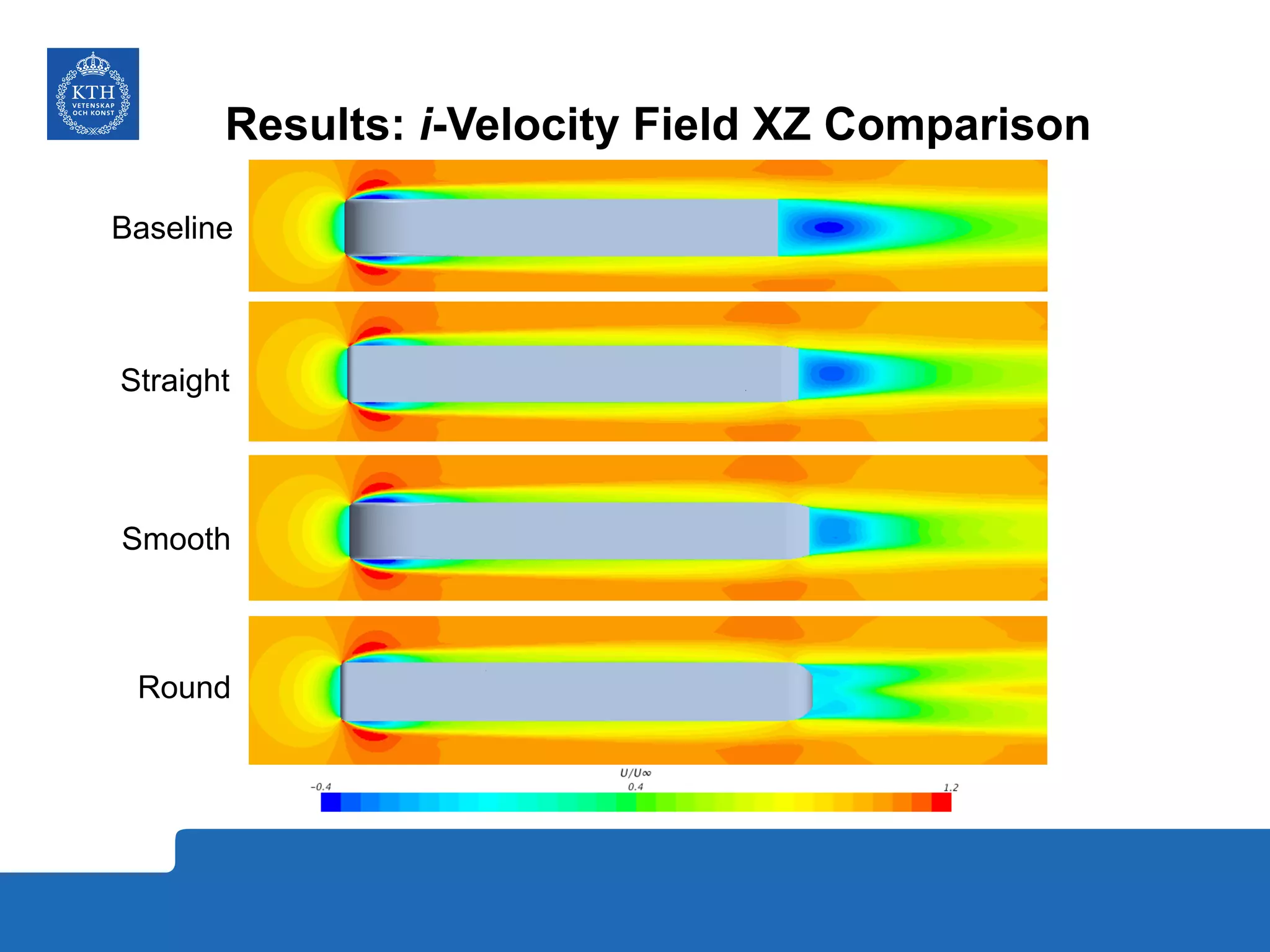
Results: i-Velocity Field XZ Comparison
Straight
Baseline
Smooth
Round
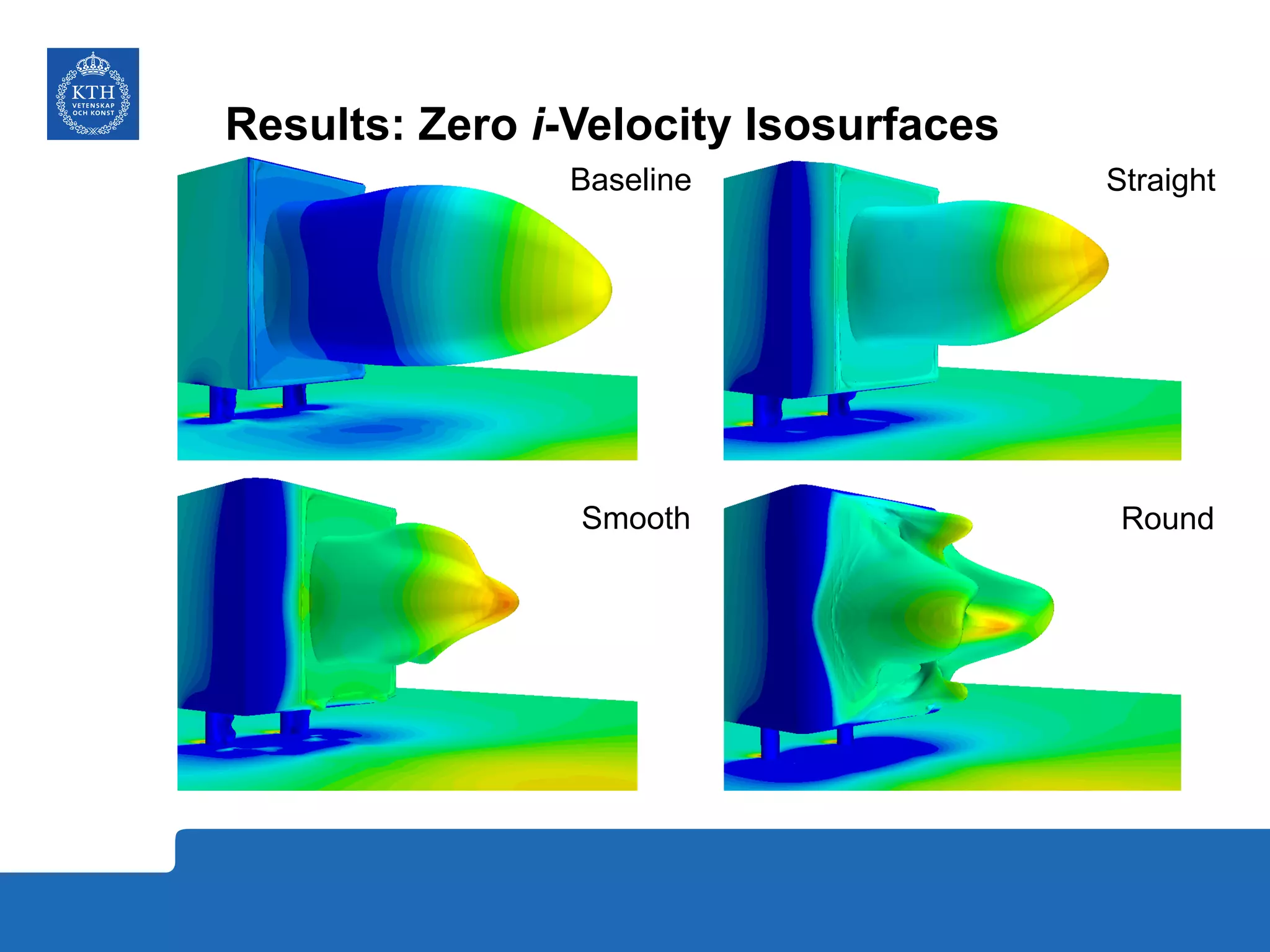
Results: Zero i-Velocity Isosurfaces
StraightBaseline
RoundSmooth
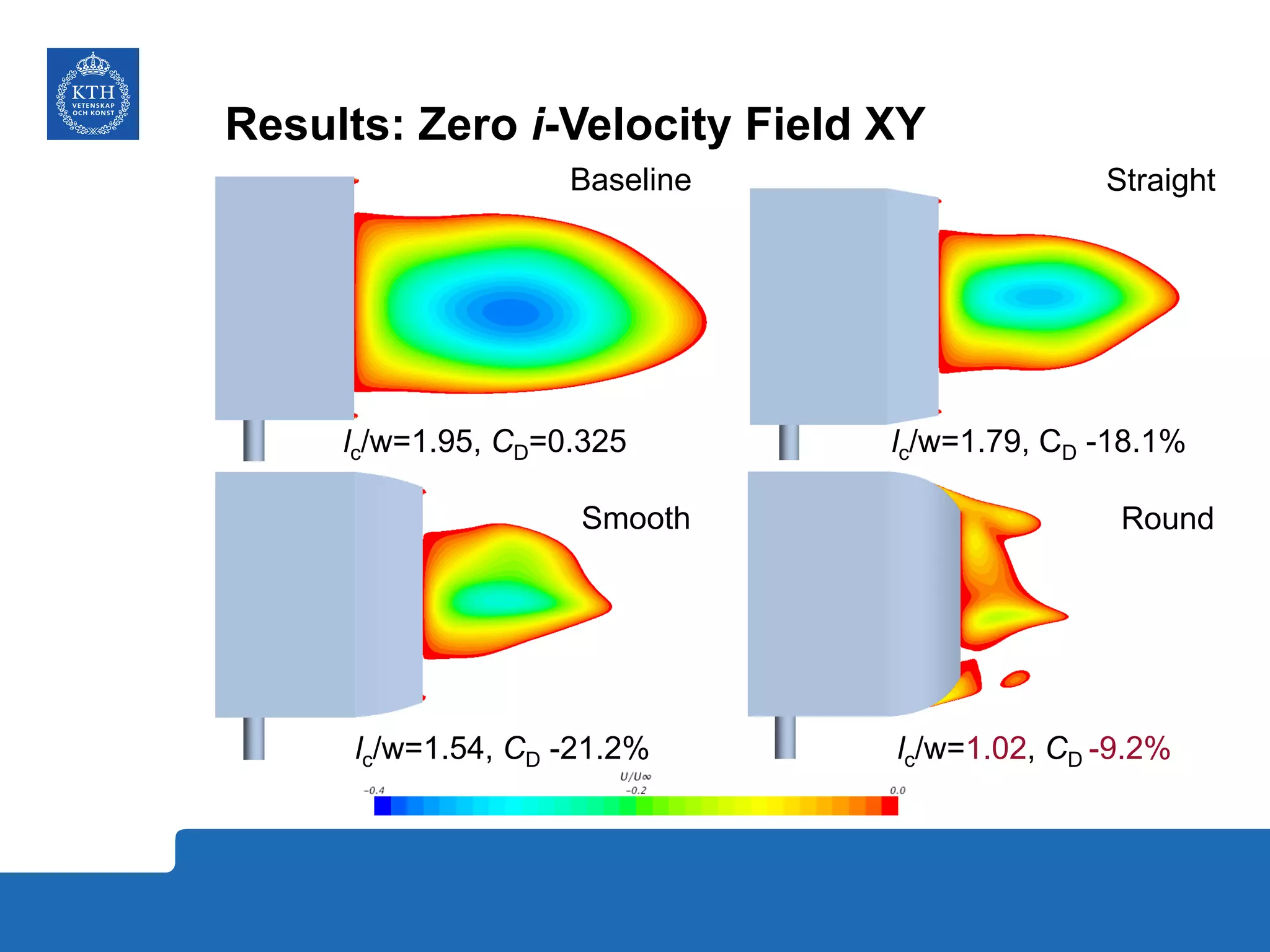
Results: Zero i-Velocity Field XY
lc/w=1.95, CD=0.325 lc/w=1.79, CD -18.1%
lc/w=1.54, CD -21.2% lc/w=1.02, CD -9.2%
StraightBaseline
RoundSmooth
Results: Velocity profiles XY
StraightBaseline
RoundSmooth
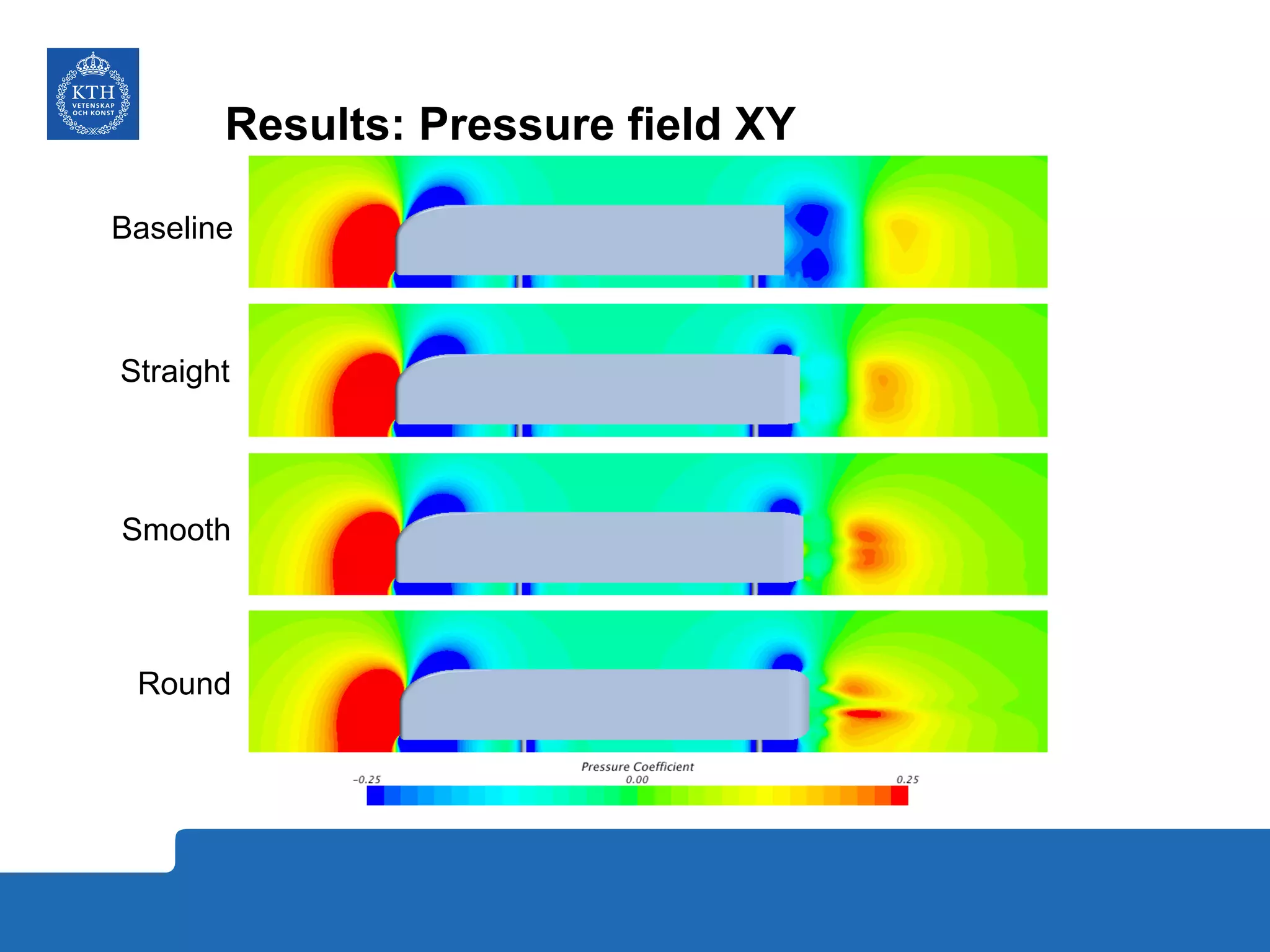
Results: Pressure field XY
Straight
Baseline
Smooth
Round
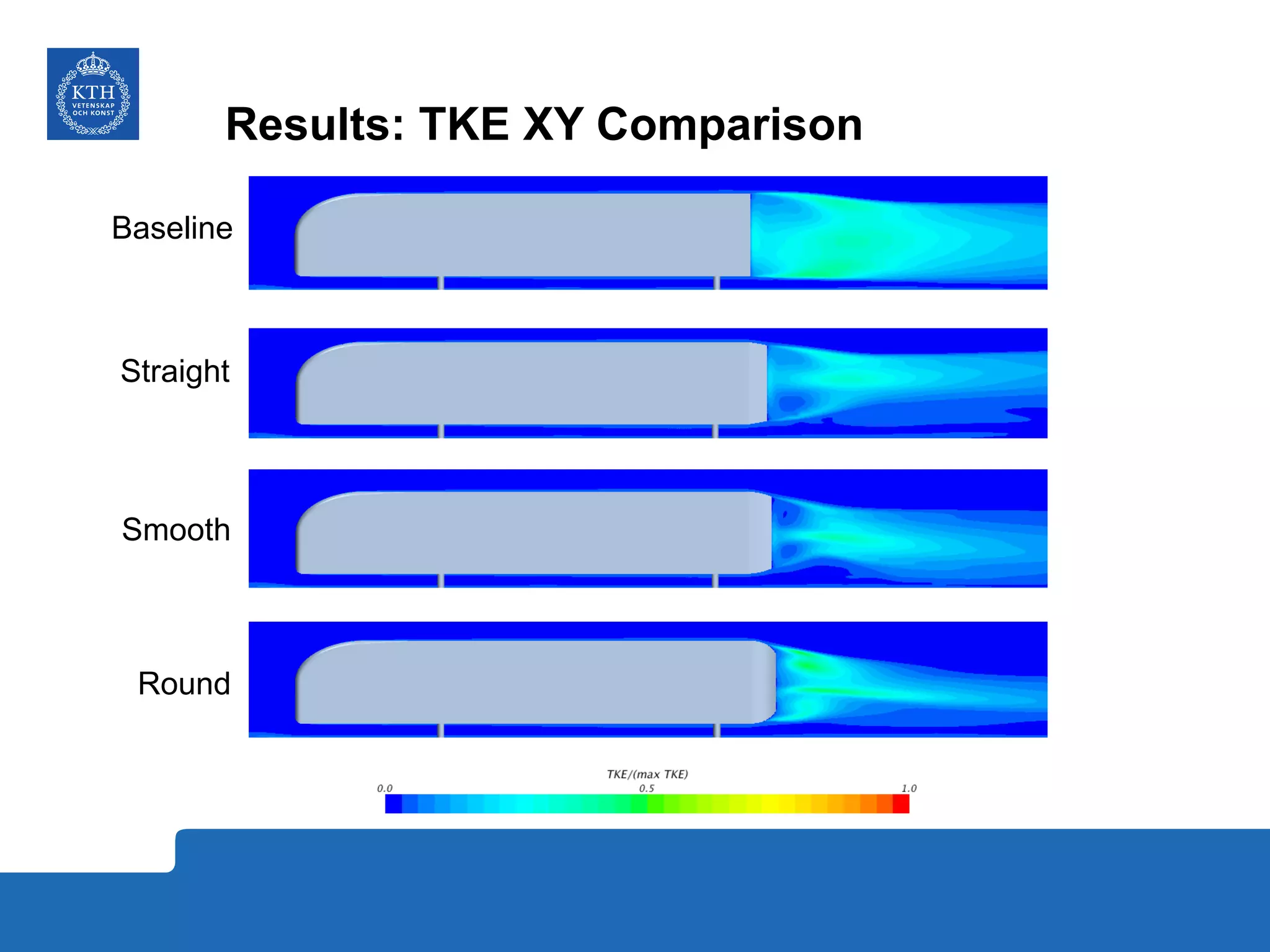
Results: TKE XY Comparison
Straight
Baseline
Smooth
Round
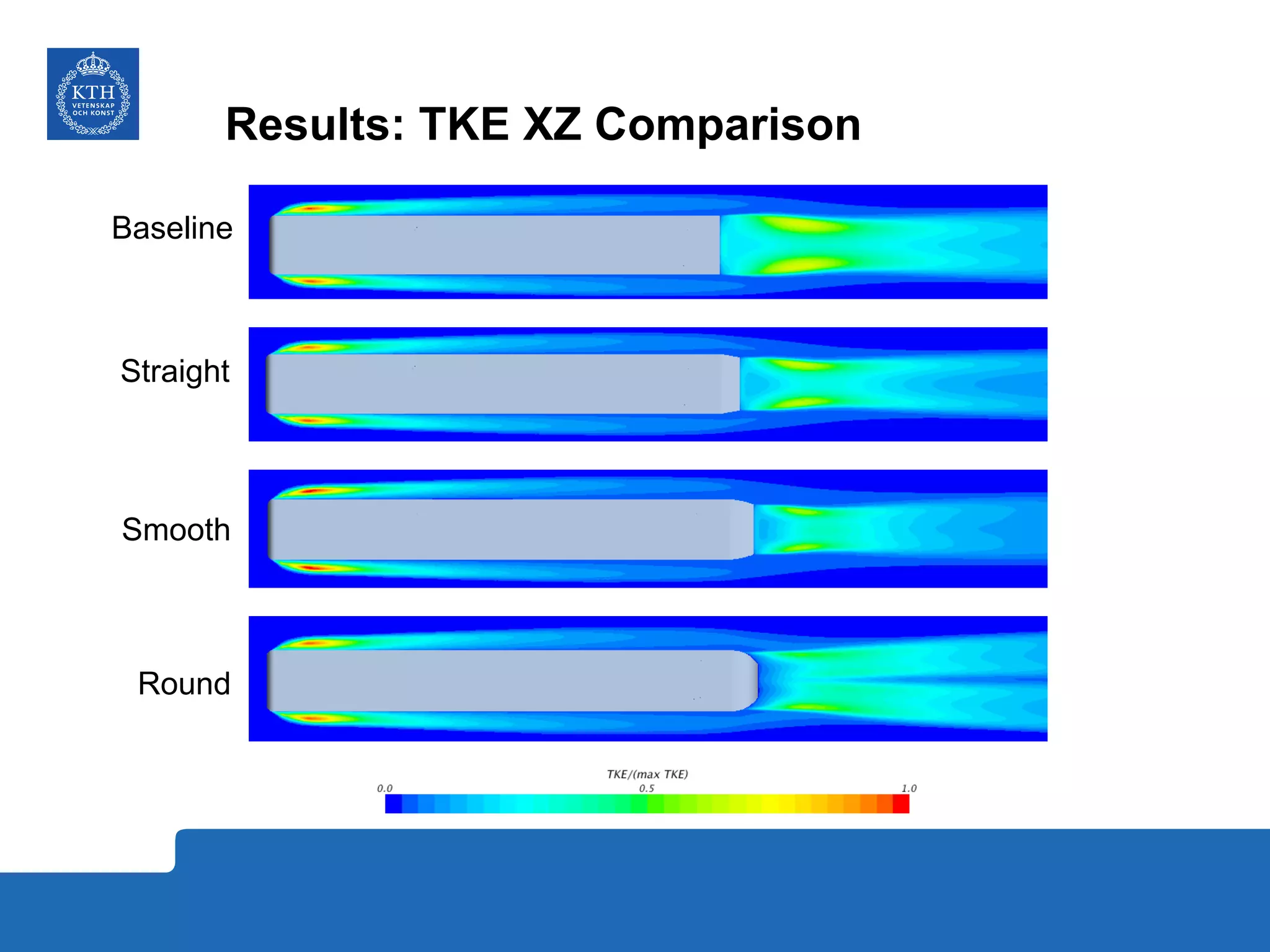
Results: TKE XZ Comparison
Straight
Baseline
Smooth
Round
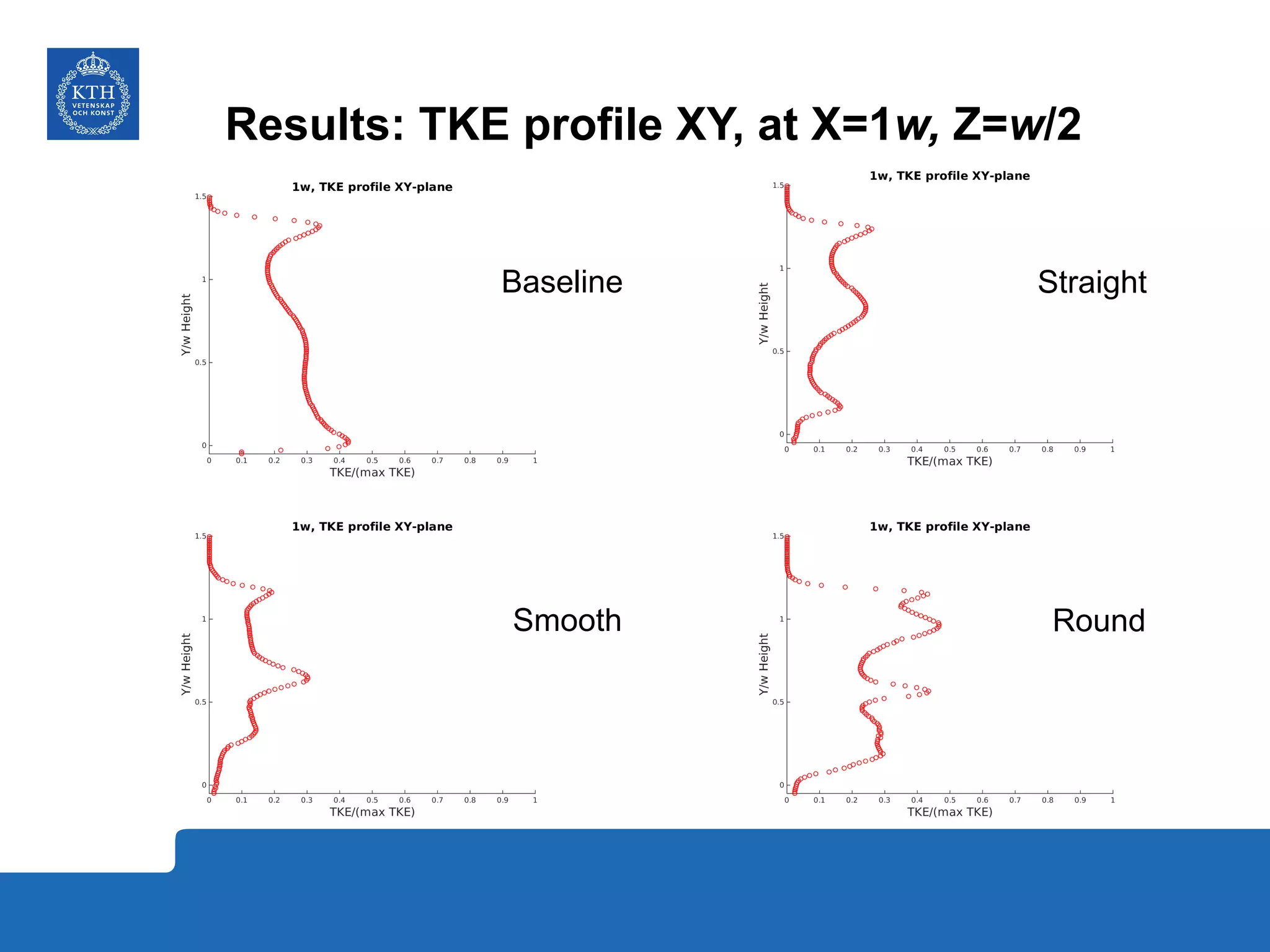
Results: TKE profile XY, at X=1w, Z=w/2
StraightBaseline
RoundSmooth
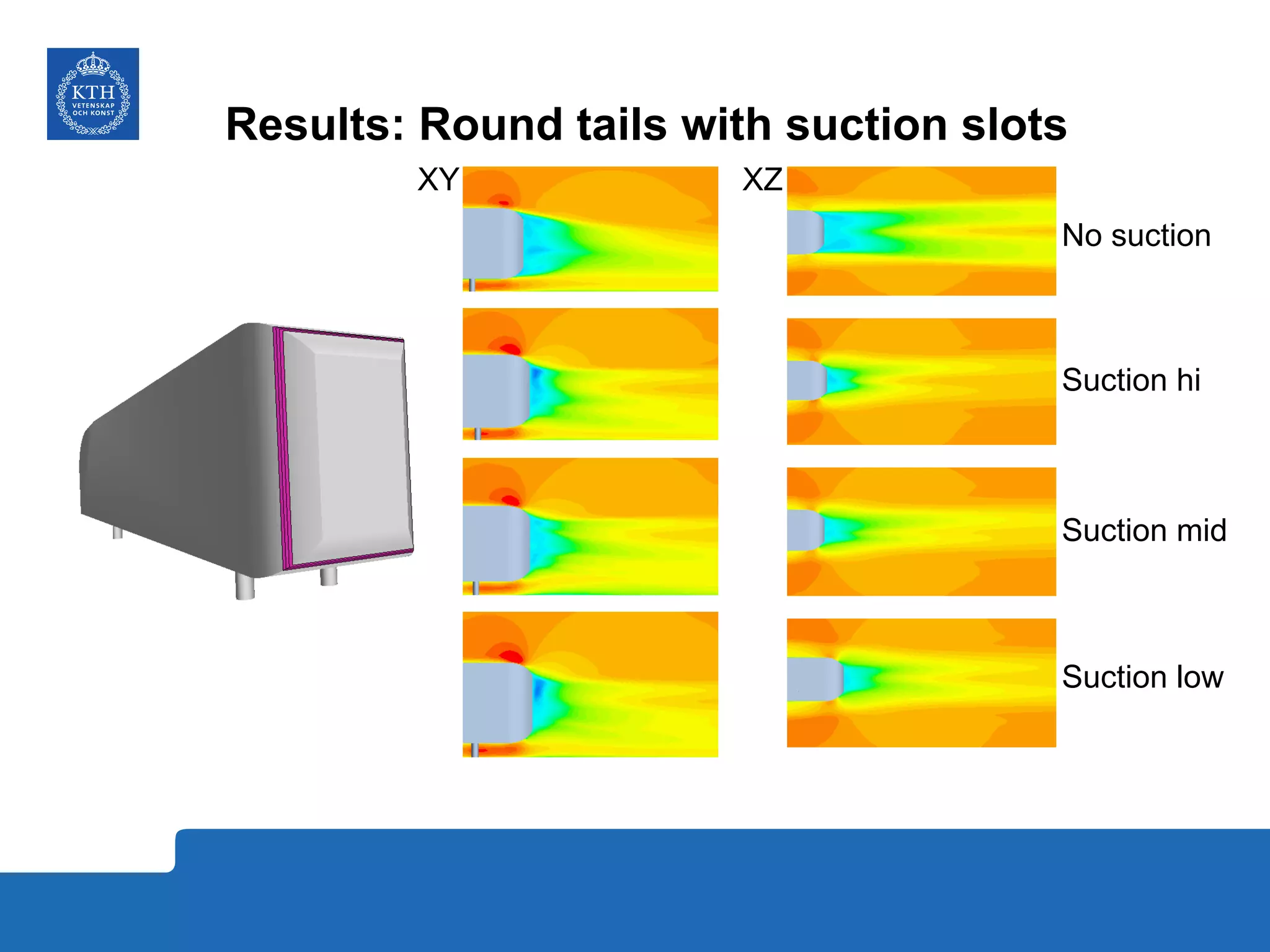
Results: Round tails with suction slots
No suction
Suction hi
Suction mid
Suction low
XY XZ
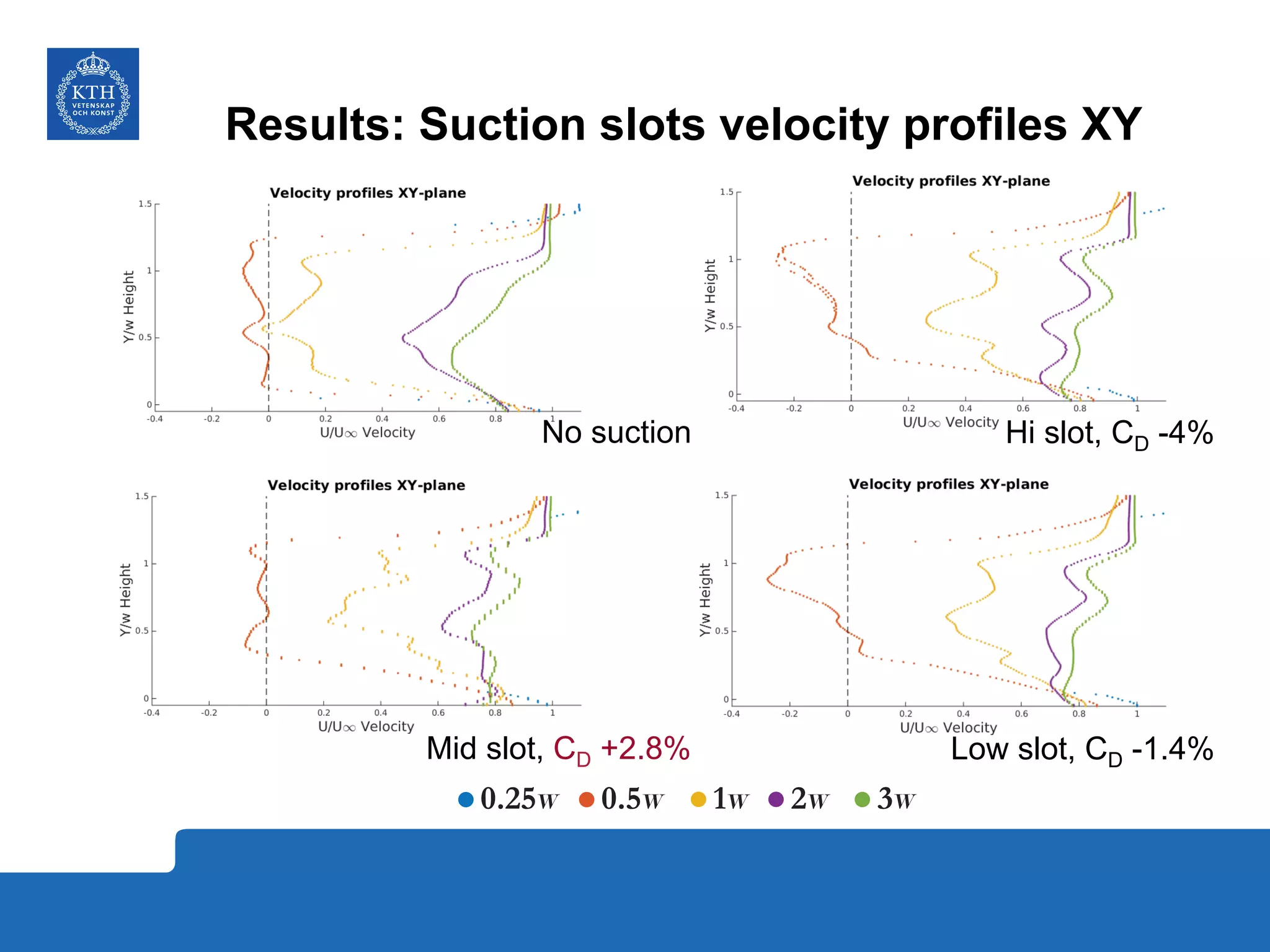
Results: Suction slots velocity profiles XY
Hi slot, CD -4%No suction
Low slot, CD -1.4%Mid slot, CD +2.8%
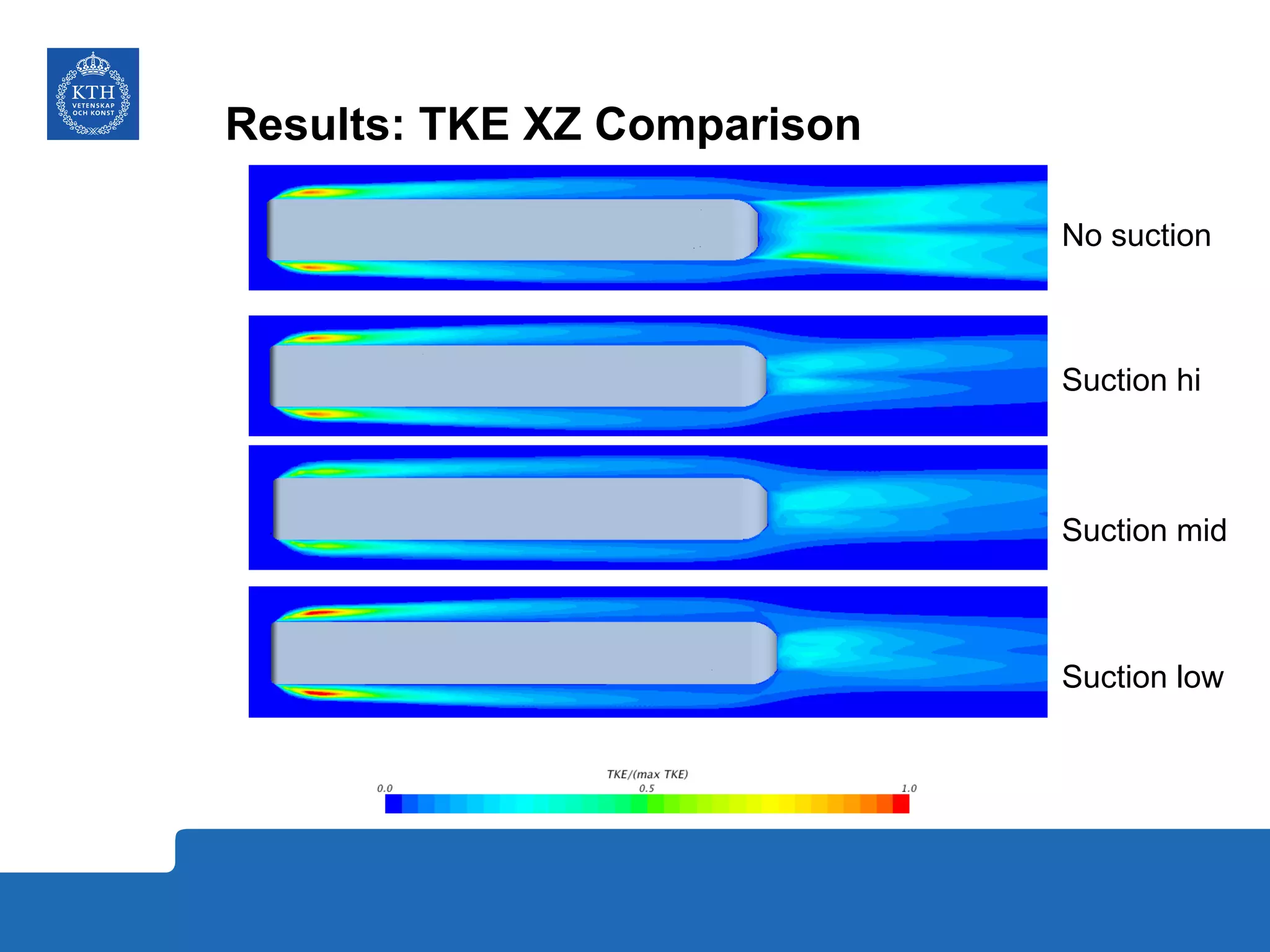
Results: TKE XZ Comparison
No suction
Suction hi
Suction mid
Suction low
Conclusions & discussion
•  Best case: 21.2% reduction in drag
Conclusions & discussion
•  Best case: 21.2% reduction in drag
•  Designing boat-tails is not intuitive
Conclusions & discussion
•  Best case: 21.2% reduction in drag
•  Designing boat-tails is not intuitive
•  The round tail does not have a clear separation point and
no clear steady-state solution
Conclusions & discussion
•  Best case: 21.2% reduction in drag
•  Designing boat-tails is not intuitive
•  The round tail does not have a clear separation point and
no clear steady-state solution
•  Suction can decrease drag, but slot location is critical
Future work
•  Run simulations with unsteady models, for example DES,
to better capture the flow field
Future work
•  Run simulations with unsteady models, for example DES,
to better capture the flow field
•  Suction slots could be elaborated on: suction & blowing,
active control, plasma actuators etc.
Future work
•  Run simulations with unsteady models, for example DES,
to better capture the flow field
•  Suction slots could be elaborated on: suction & blowing,
active control, plasma actuators etc.
•  Use more realistic truck model to make an optimized boat-
tail shape
Future work
•  Run simulations with unsteady models, for example DES,
to better capture the flow field
•  Suction slots could be elaborated on: suction & blowing,
active control, plasma actuators etc.
•  Use more realistic truck model to make an optimized boat-
tail shape
•  Experiment full size with straight boat-tail on real truck
KTH ROYAL INSTITUTE
OF TECHNOLOGY
Thank you!
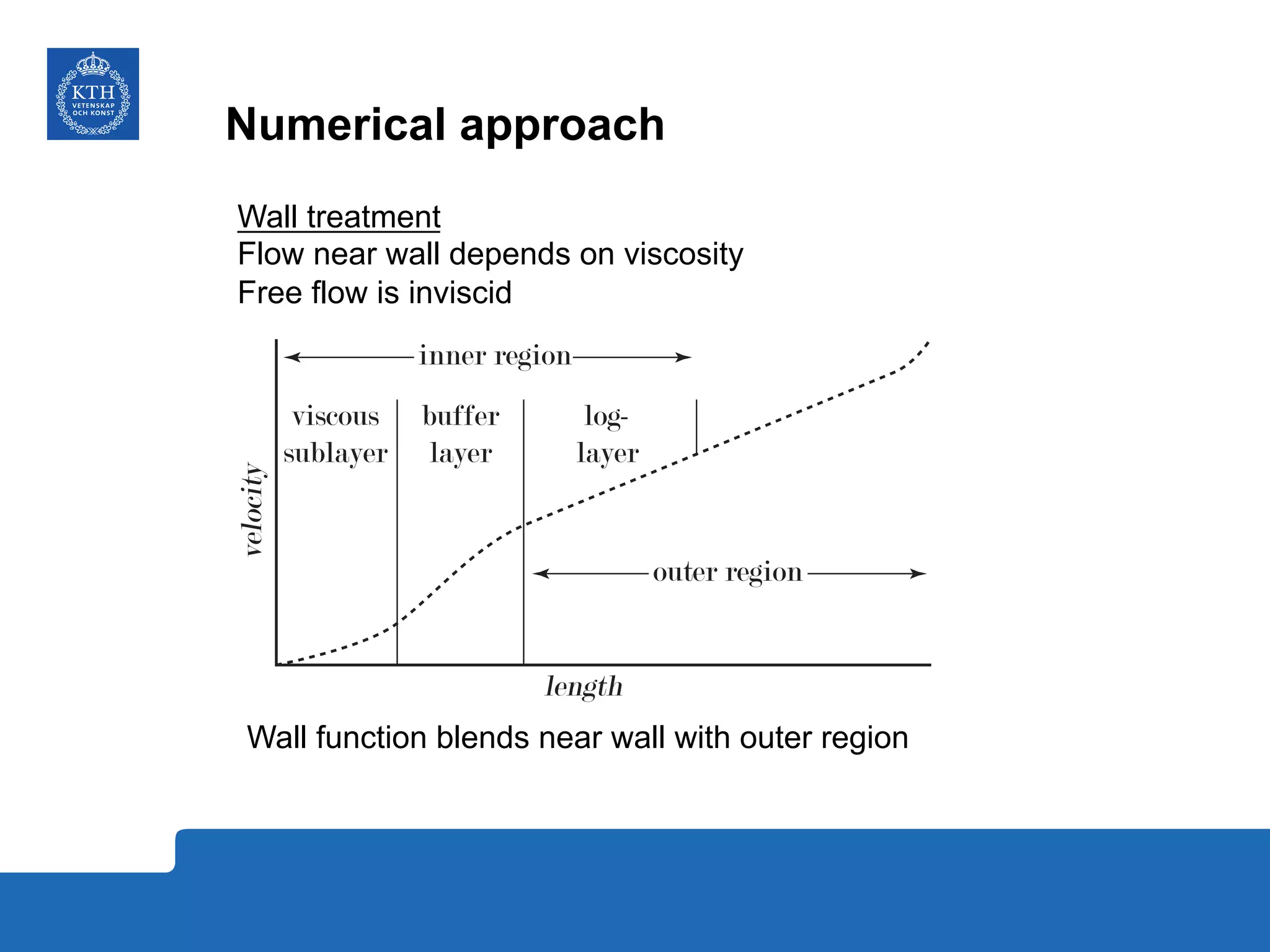
Numerical approach
Wall treatment
Flow near wall depends on viscosity
Free flow is inviscid
viscous
sublayer
buffer
layer
log-
layer
outer region
inner region
Wall function blends near wall with outer region
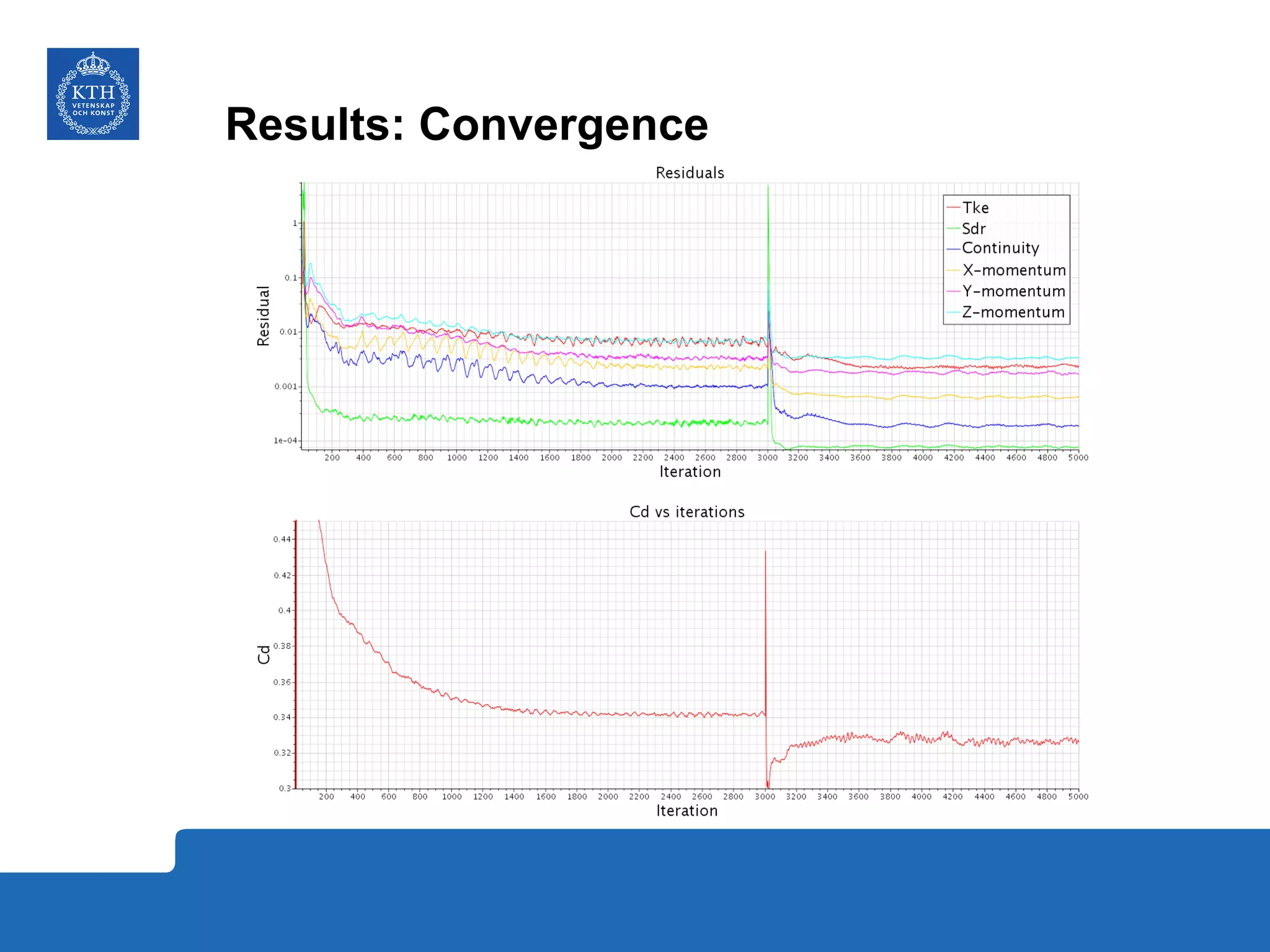
Results: Convergence

johan_malmberg_thesis_pres_final