A Comparison of Panel Method and RANS Calculations
for a Horizontal Axis Marine Current Turbine
J. Baltazar and J.A.C. Falc˜ao de Campos
Marine Environment and Technology Center (MARETEC)
Instituto Superior T´ecnico, Universidade de Lisboa, Portugal
ECFD VI Barcelona, Spain 20-25 July 2014 1 / 24
Motivations
The computational time of the flow around rotors with RANS
Methods is still reasonably high:
Need of good numerical resolution in small regions dominated
by strong viscous effects;
Accurate computations are associated with long computational
times, which makes the method less useful for routine design
studies.
ECFD VI Barcelona, Spain 20-25 July 2014 2 / 24
Motivations
A Panel Method has been used to analyse the flow around the
blades of a marine current turbine:
This method is very efficient from the computational point of
view, which makes them suited for design studies;
However, serious limitations are met due to their inability to
adequately model viscous effects (gap flow, separation
phenomena).
ECFD VI Barcelona, Spain 20-25 July 2014 3 / 24
Objectives
Comparison of Panel Code PROPAN (Baltazar and Falc˜ao de
Campos, 2011) with RANS Code ReFRESCO (Vaz et al., 2009)
to obtain a better insight:
on the viscous effects of a marine current turbine;
on the limitations of the inviscid flow model.
ECFD VI Barcelona, Spain 20-25 July 2014 4 / 24
Panel Code PROPAN
IST in-house low-order potential-based panel method;
Structured surface grids;
Fredholm integral equation solved by the collocation method;
Constant source and dipole distributions;
Influence coefficients calculated using the formulations of
Morino and Kuo (1974);
Wake alignment model with iterative pressure Kutta condition;
Viscous corrections are applied based on 2D section lift and
drag data;
ECFD VI Barcelona, Spain 20-25 July 2014 5 / 24
RANS Code ReFRESCO
Viscous flow CFD code developed within a cooperation led by
MARIN;
Solves the incompressible RANS equations, complemented with
multi-fluid capabilities, turbulence models and cavitation models;
The equations are discretised using a finite-volume approach
with cell-centered collocation variables;
Flow is considered turbulent, κ − ω SST 2-equation model by
Menter (1994) is used;
Second-order convection scheme (QUICK) is used for the
momentum equations;
A fine boundary layer resolution is applied;
Automatic wall functions (equivalent to no wall functions if
y+
< 1).
ECFD VI Barcelona, Spain 20-25 July 2014 6 / 24
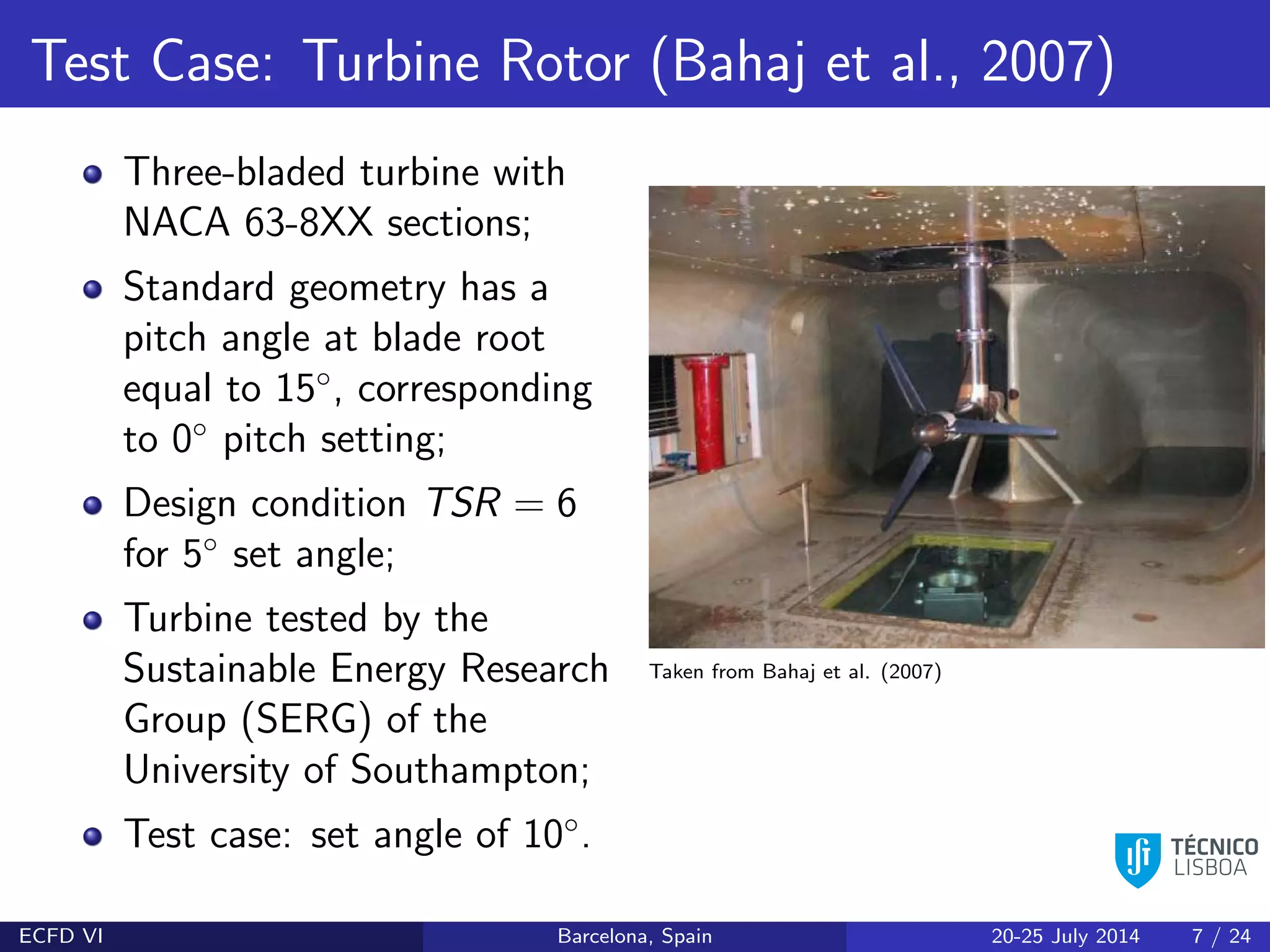
Test Case: Turbine Rotor (Bahaj et al., 2007)
Three-bladed turbine with
NACA 63-8XX sections;
Standard geometry has a
pitch angle at blade root
equal to 15◦
, corresponding
to 0◦
pitch setting;
Design condition TSR = 6
for 5◦
set angle;
Turbine tested by the
Sustainable Energy Research
Group (SERG) of the
University of Southampton;
Test case: set angle of 10◦
.
Taken from Bahaj et al. (2007)
ECFD VI Barcelona, Spain 20-25 July 2014 7 / 24
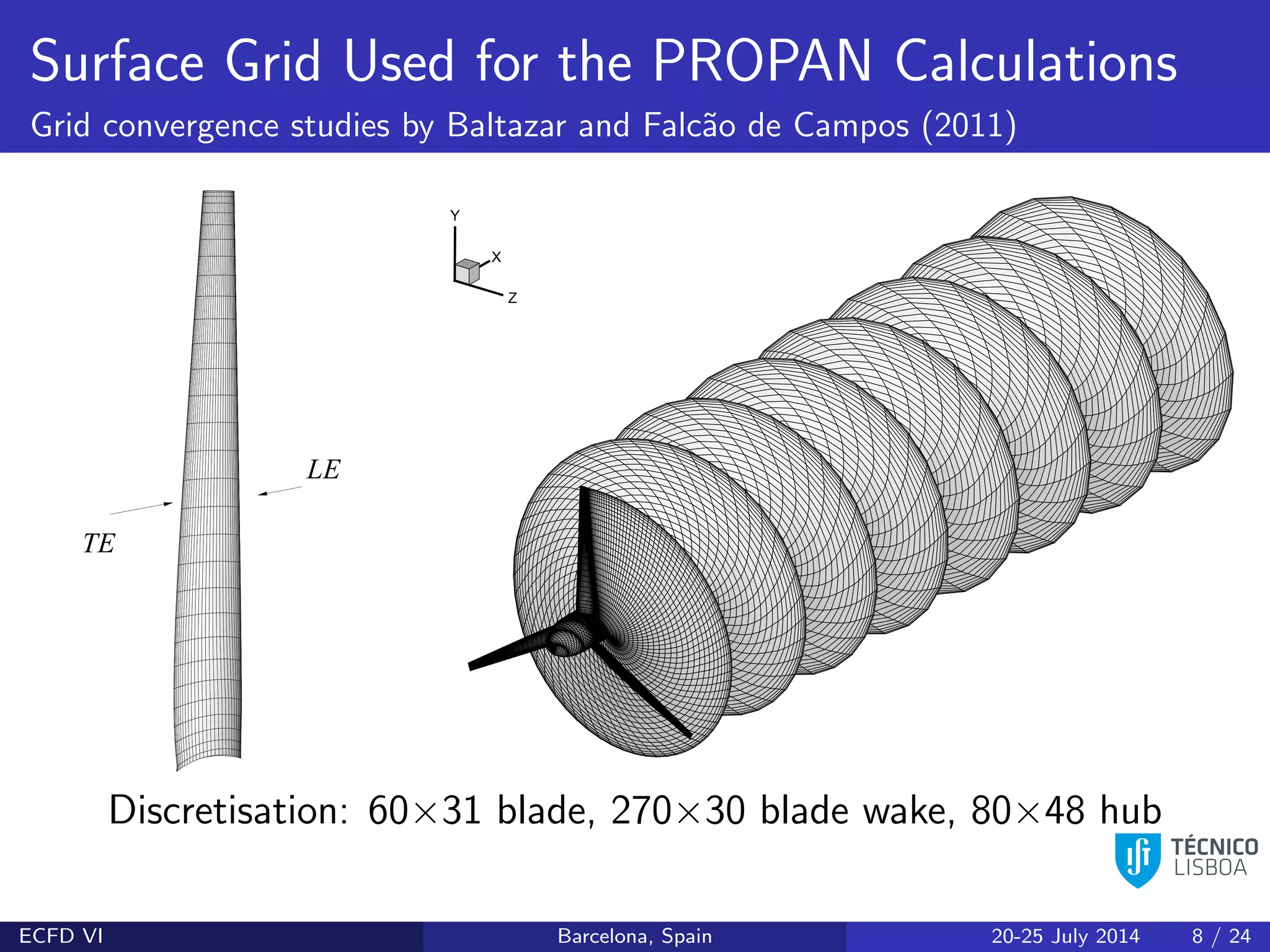
Surface Grid Used for the PROPAN Calculations
Grid convergence studies by Baltazar and Falc˜ao de Campos (2011)
LE
TE
X
Y
Z
Discretisation: 60×31 blade, 270×30 blade wake, 80×48 hub
ECFD VI Barcelona, Spain 20-25 July 2014 8 / 24
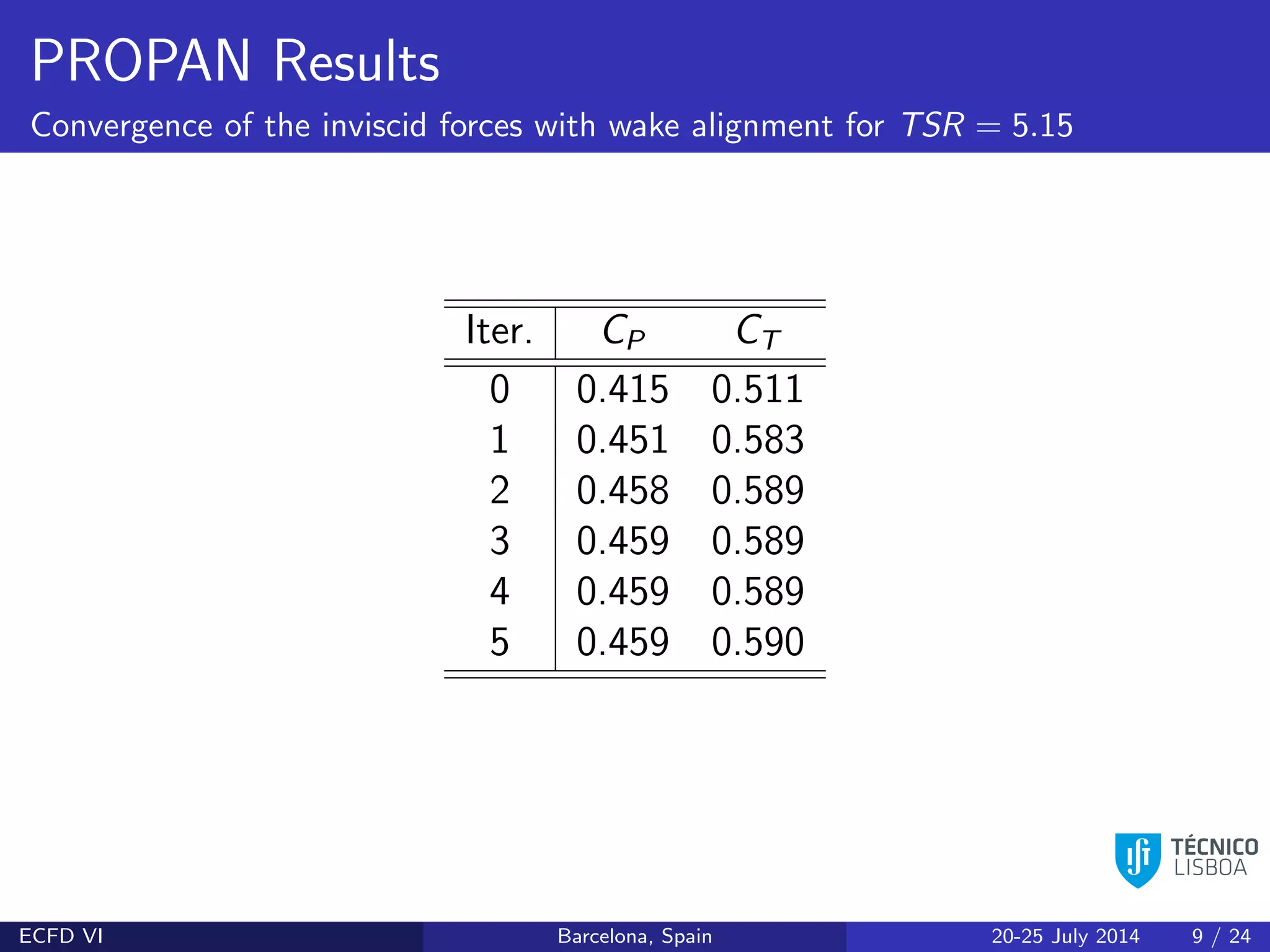
PROPAN Results
Convergence of the inviscid forces with wake alignment for TSR = 5.15
Iter. CP CT
0 0.415 0.511
1 0.451 0.583
2 0.458 0.589
3 0.459 0.589
4 0.459 0.589
5 0.459 0.590
ECFD VI Barcelona, Spain 20-25 July 2014 9 / 24
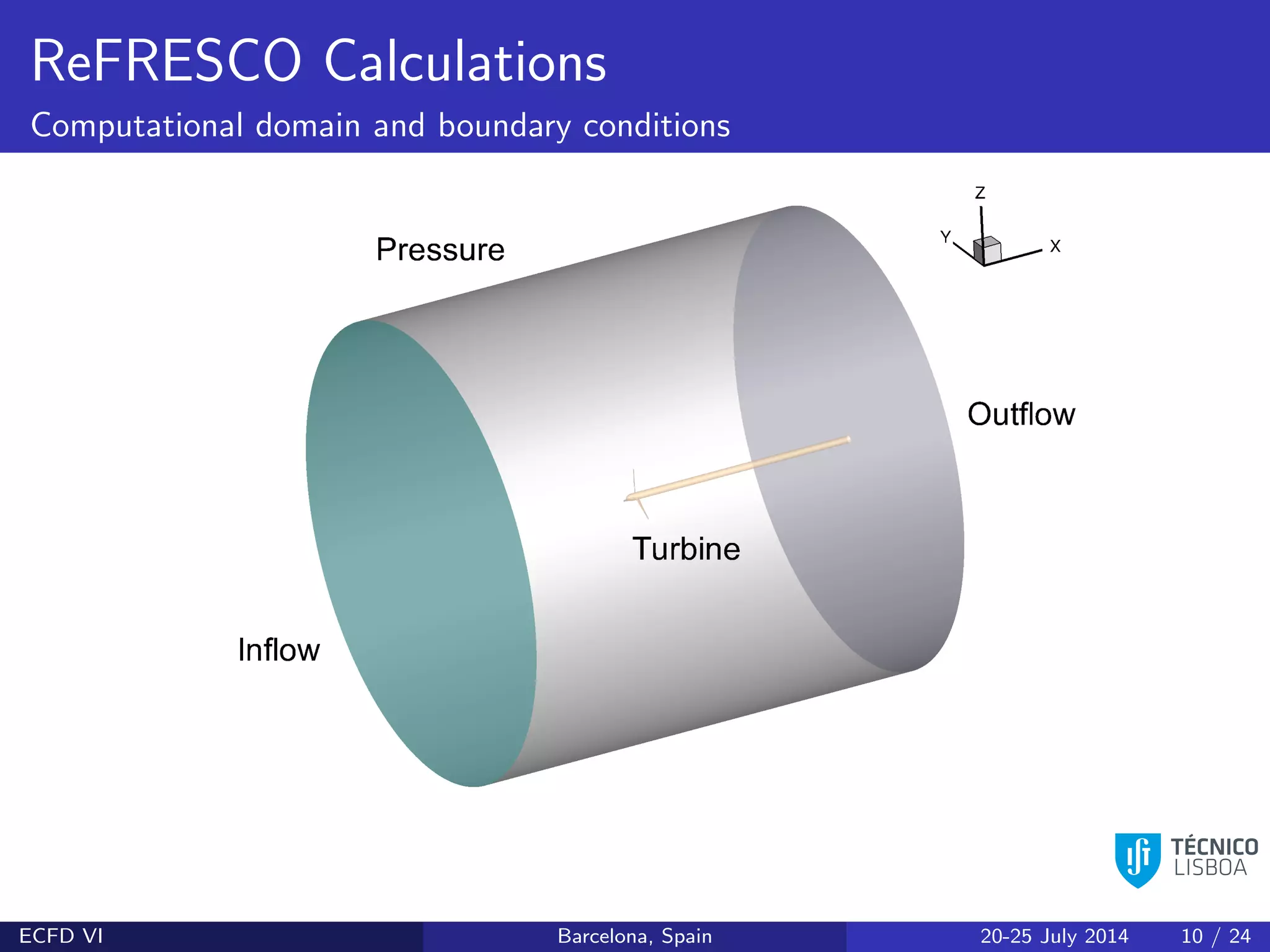
ReFRESCO Calculations
Computational domain and boundary conditions
ECFD VI Barcelona, Spain 20-25 July 2014 10 / 24
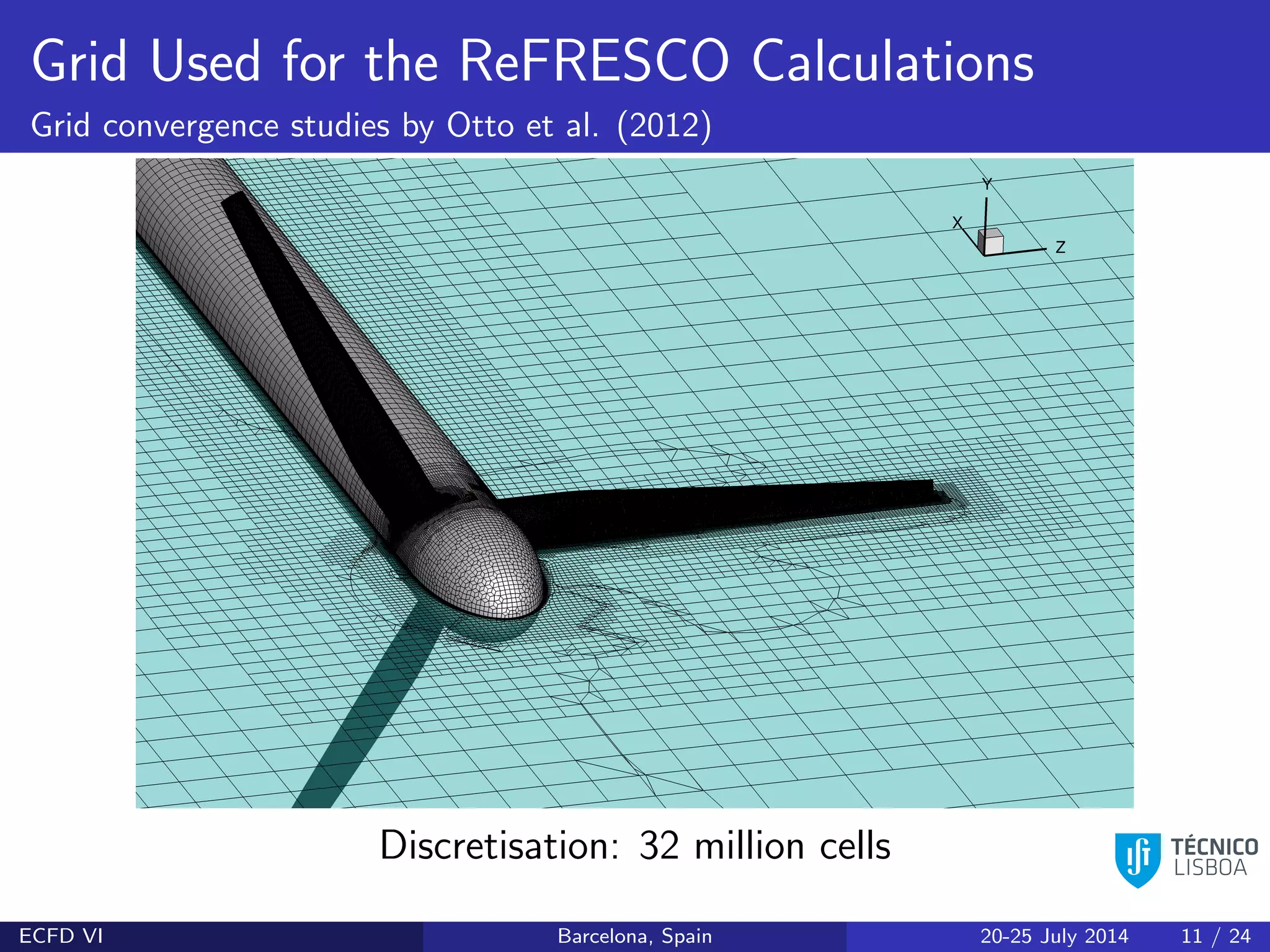
Grid Used for the ReFRESCO Calculations
Grid convergence studies by Otto et al. (2012)
Discretisation: 32 million cells
ECFD VI Barcelona, Spain 20-25 July 2014 11 / 24
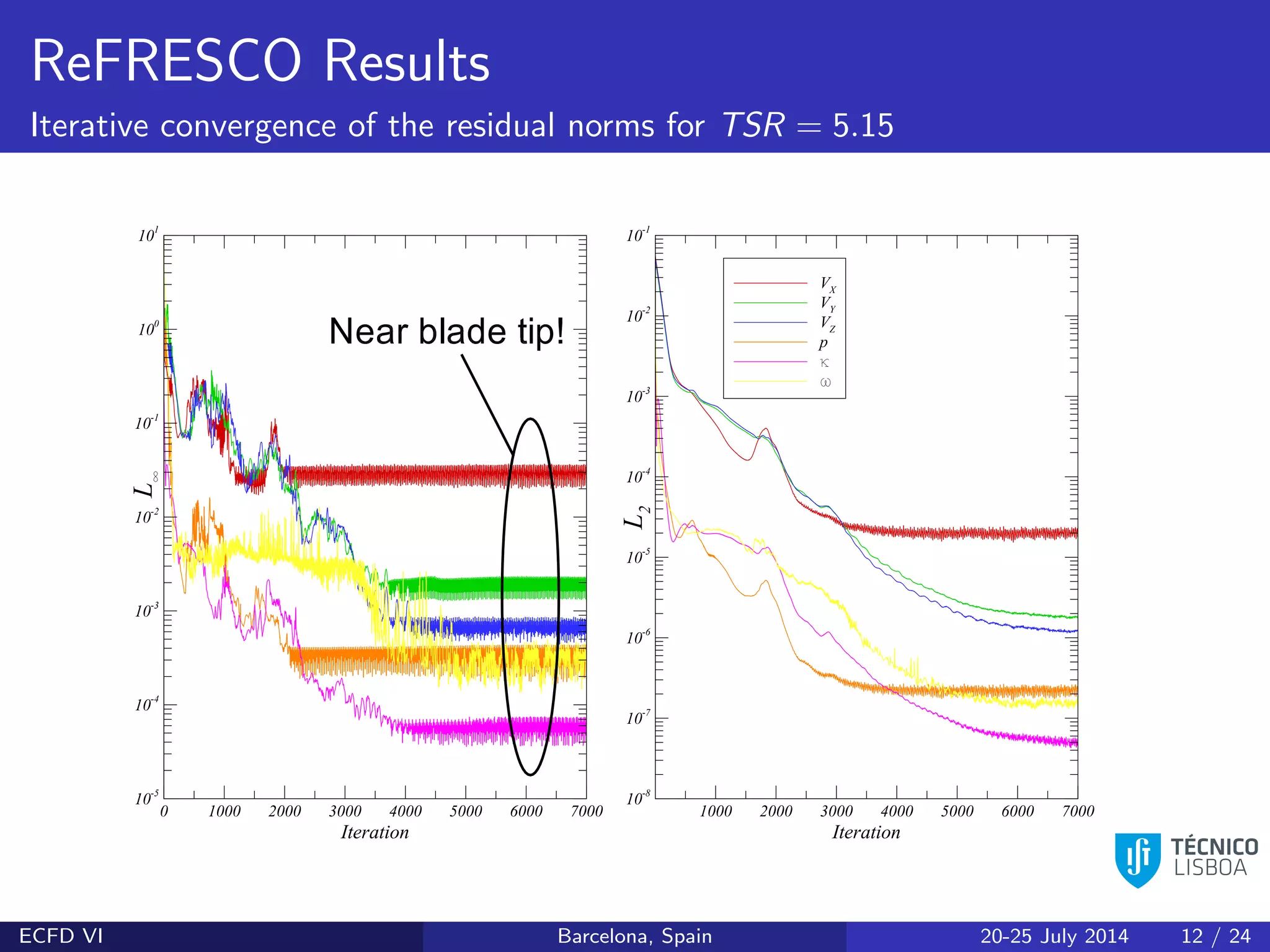
ReFRESCO Results
Iterative convergence of the residual norms for TSR = 5.15
Iteration
0 1000 2000 3000 4000 5000 6000 7000
10
-5
10
-4
10-3
10-2
10-1
10
0
10
1
L
Iteration
1000 2000 3000 4000 5000 6000 7000
10
-8
10-7
10
-6
10
-5
10
-4
10
-3
10
-2
10
-1
VX
VY
VZ
p
L2
ECFD VI Barcelona, Spain 20-25 July 2014 12 / 24
ReFRESCO Results
Iterative convergence of the forces for TSR = 5.15
Iteration
1000 2000 3000 4000 5000 6000 7000
0.40
0.50
0.60
0.70
-1.0
-0.5
0.0
0.5
1.0
CT
CT[%]
CT
CT
[%]
Iteration
1000 2000 3000 4000 5000 6000 7000
0.10
0.20
0.30
0.40
-1.0
-0.5
0.0
0.5
1.0
CP
CP
CP
[%]
CP
[%]
ECFD VI Barcelona, Spain 20-25 July 2014 13 / 24
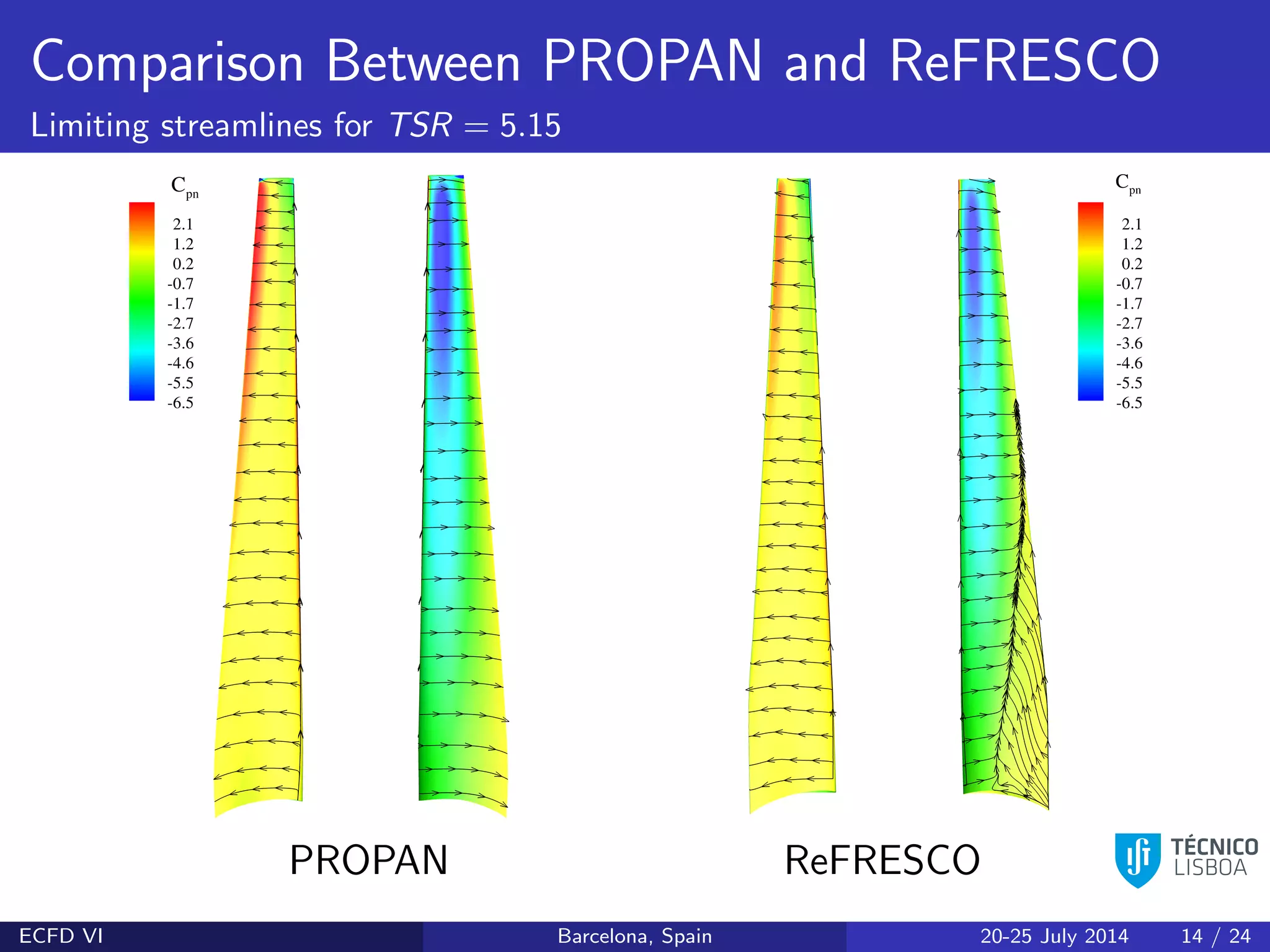
Comparison Between PROPAN and ReFRESCO
Limiting streamlines for TSR = 5.15
PROPAN ReFRESCO
ECFD VI Barcelona, Spain 20-25 July 2014 14 / 24
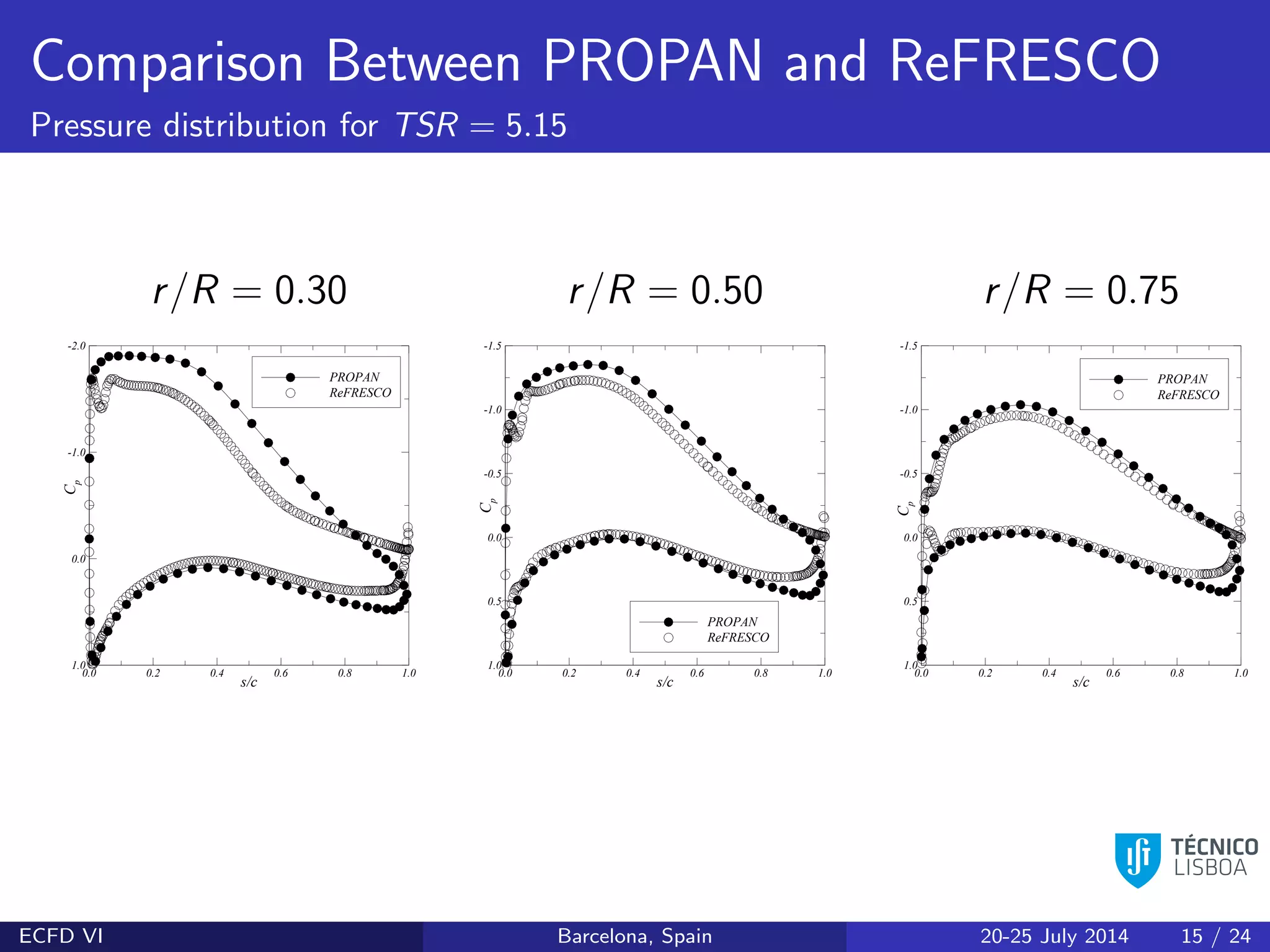
Comparison Between PROPAN and ReFRESCO
Pressure distribution for TSR = 5.15
r/R = 0.30 r/R = 0.50 r/R = 0.75
s/c
0.0 0.2 0.4 0.6 0.8 1.0
-2.0
-1.0
0.0
1.0
PROPAN
ReFRESCO
Cp
s/c
0.0 0.2 0.4 0.6 0.8 1.0
-1.5
-1.0
-0.5
0.0
0.5
1.0
PROPAN
ReFRESCO
Cp
s/c
0.0 0.2 0.4 0.6 0.8 1.0
-1.5
-1.0
-0.5
0.0
0.5
1.0
PROPAN
ReFRESCO
Cp
ECFD VI Barcelona, Spain 20-25 July 2014 15 / 24
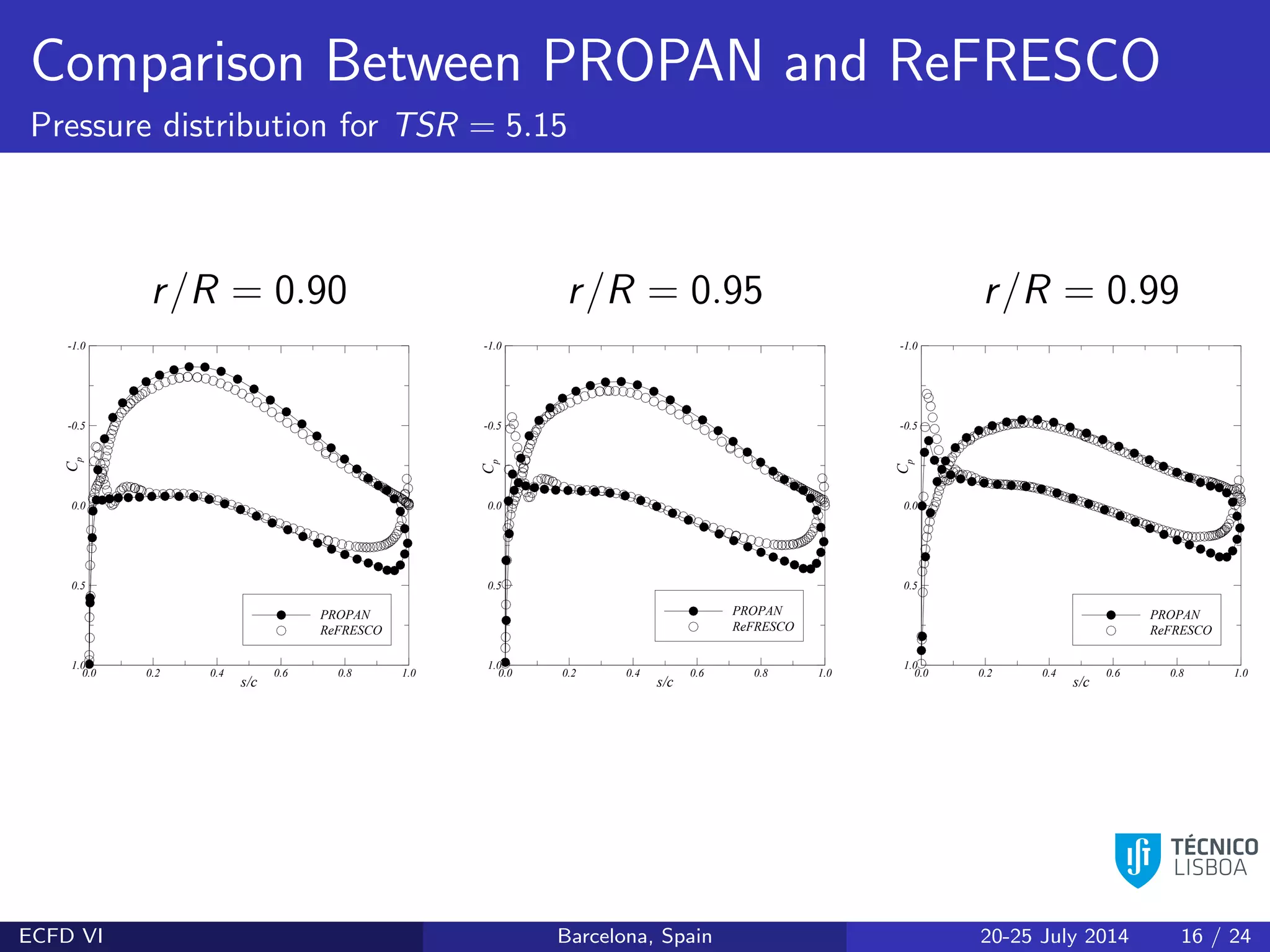
Comparison Between PROPAN and ReFRESCO
Pressure distribution for TSR = 5.15
r/R = 0.90 r/R = 0.95 r/R = 0.99
s/c
0.0 0.2 0.4 0.6 0.8 1.0
-1.0
-0.5
0.0
0.5
1.0
PROPAN
ReFRESCO
Cp
s/c
0.0 0.2 0.4 0.6 0.8 1.0
-1.0
-0.5
0.0
0.5
1.0
PROPAN
ReFRESCO
Cp
s/c
0.0 0.2 0.4 0.6 0.8 1.0
-1.0
-0.5
0.0
0.5
1.0
PROPAN
ReFRESCO
Cp
ECFD VI Barcelona, Spain 20-25 July 2014 16 / 24
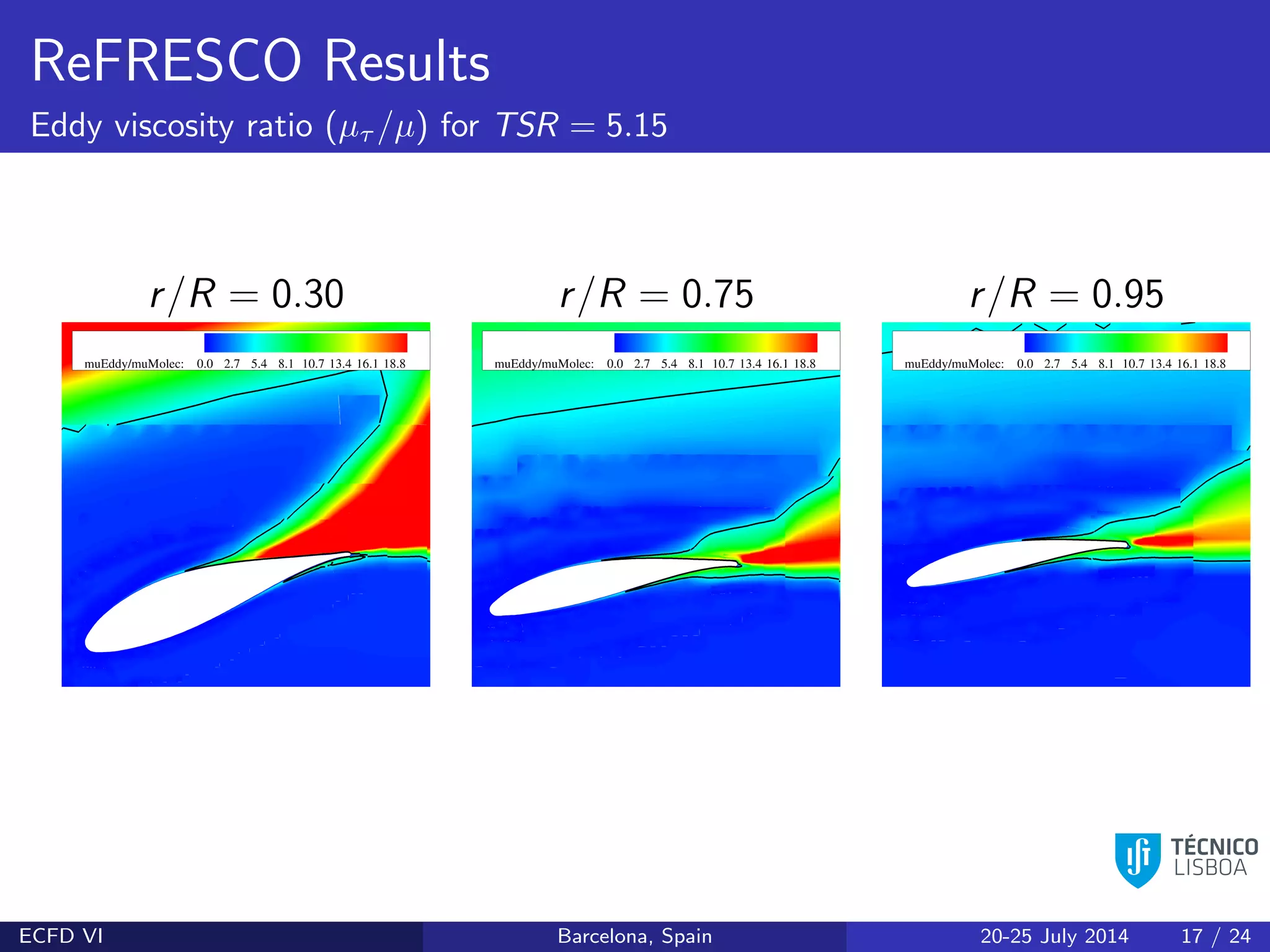
ReFRESCO Results
Eddy viscosity ratio (µτ /µ) for TSR = 5.15
r/R = 0.30 r/R = 0.75 r/R = 0.95
ECFD VI Barcelona, Spain 20-25 July 2014 17 / 24
Comparison Between PROPAN and ReFRESCO
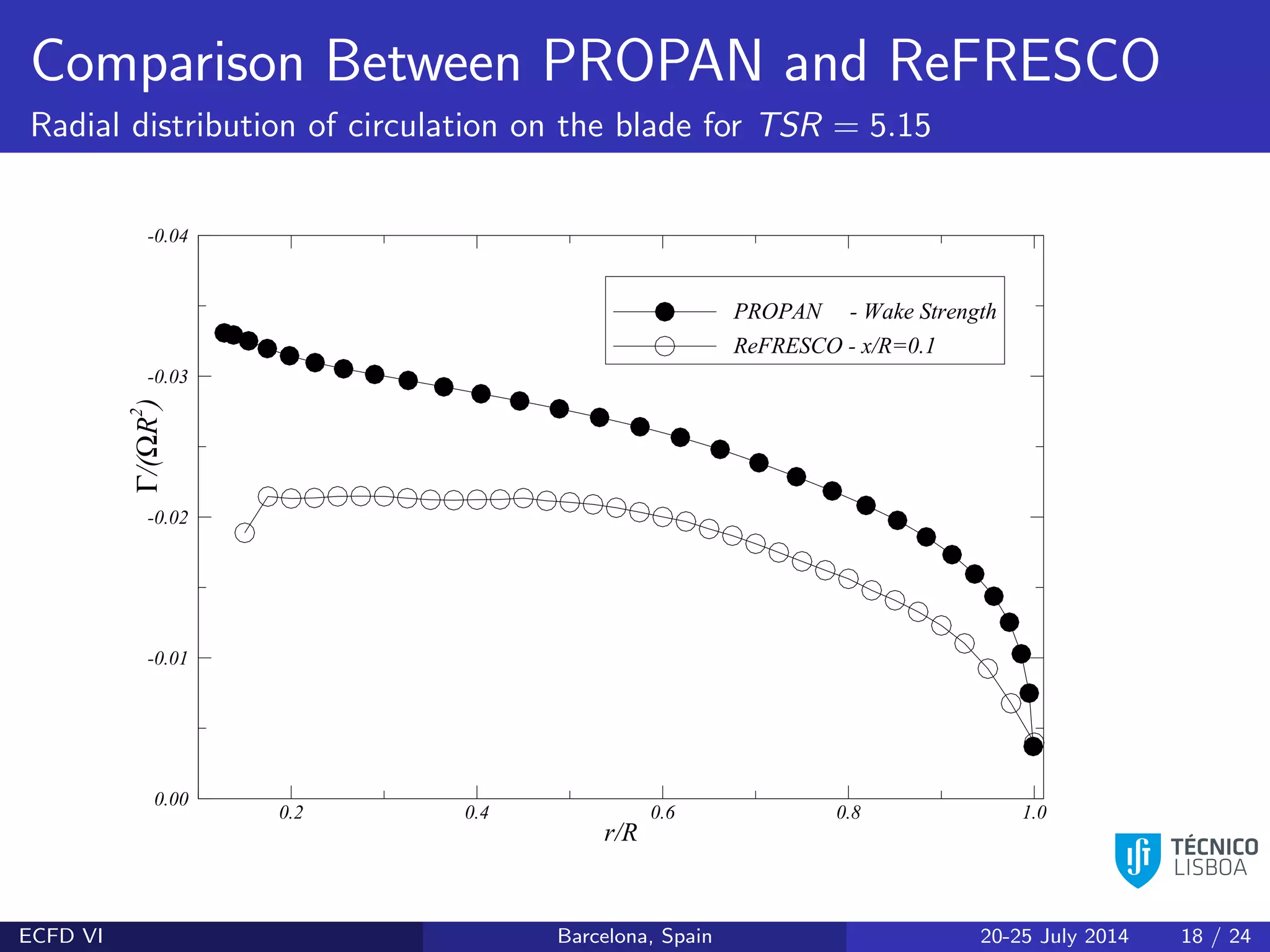
Radial distribution of circulation on the blade for TSR = 5.15
r/R
0.2 0.4 0.6 0.8 1.0
-0.04
-0.03
-0.02
-0.01
0.00
PROPAN - Wake Strength
ReFRESCO - x/R=0.1
Γ/(ΩR
2
)
ECFD VI Barcelona, Spain 20-25 July 2014 18 / 24
Comparison Between PROPAN and ReFRESCO
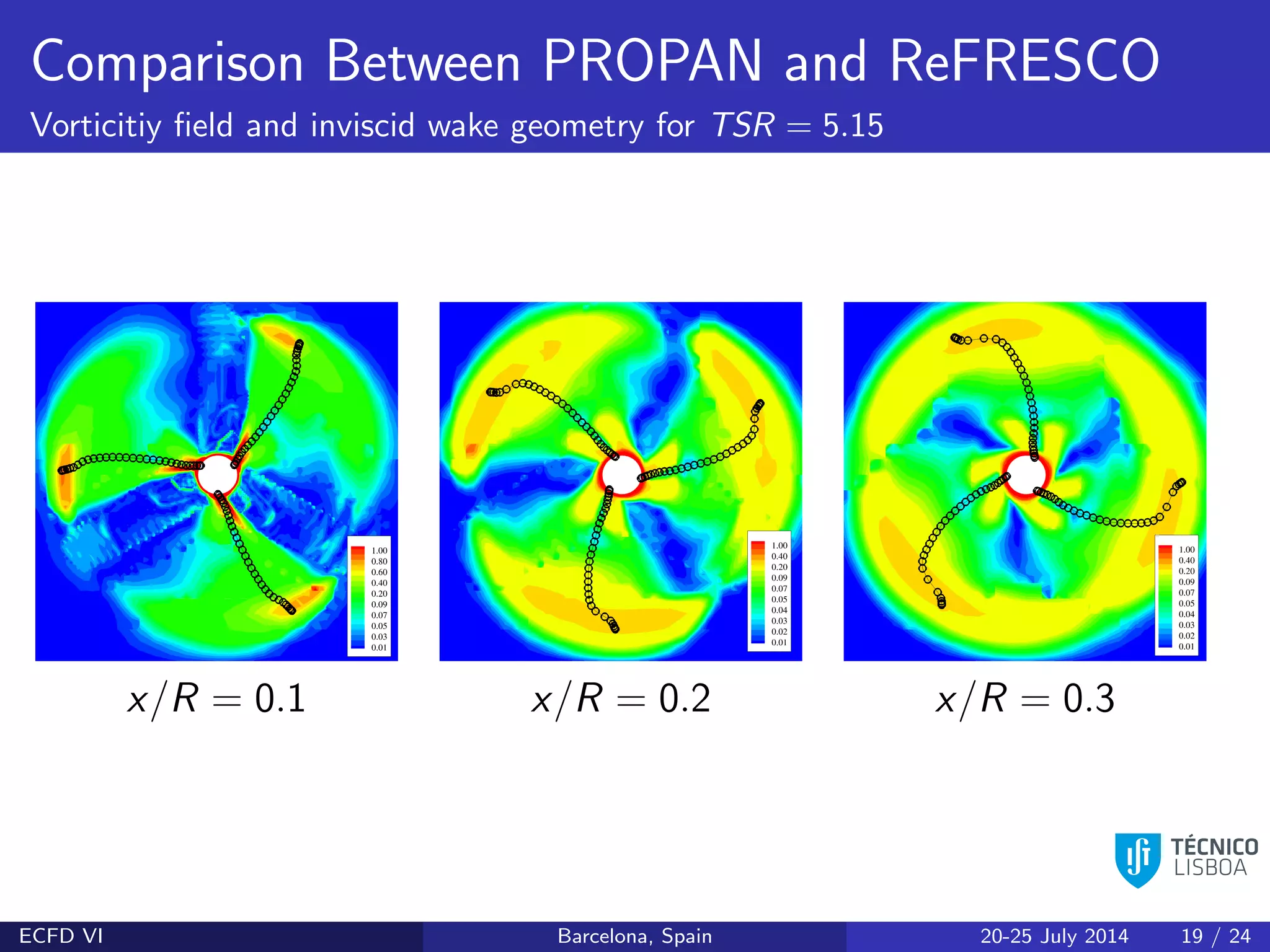
Vorticitiy field and inviscid wake geometry for TSR = 5.15
x/R = 0.1 x/R = 0.2 x/R = 0.3
ECFD VI Barcelona, Spain 20-25 July 2014 19 / 24
Comparison Between PROPAN and ReFRESCO
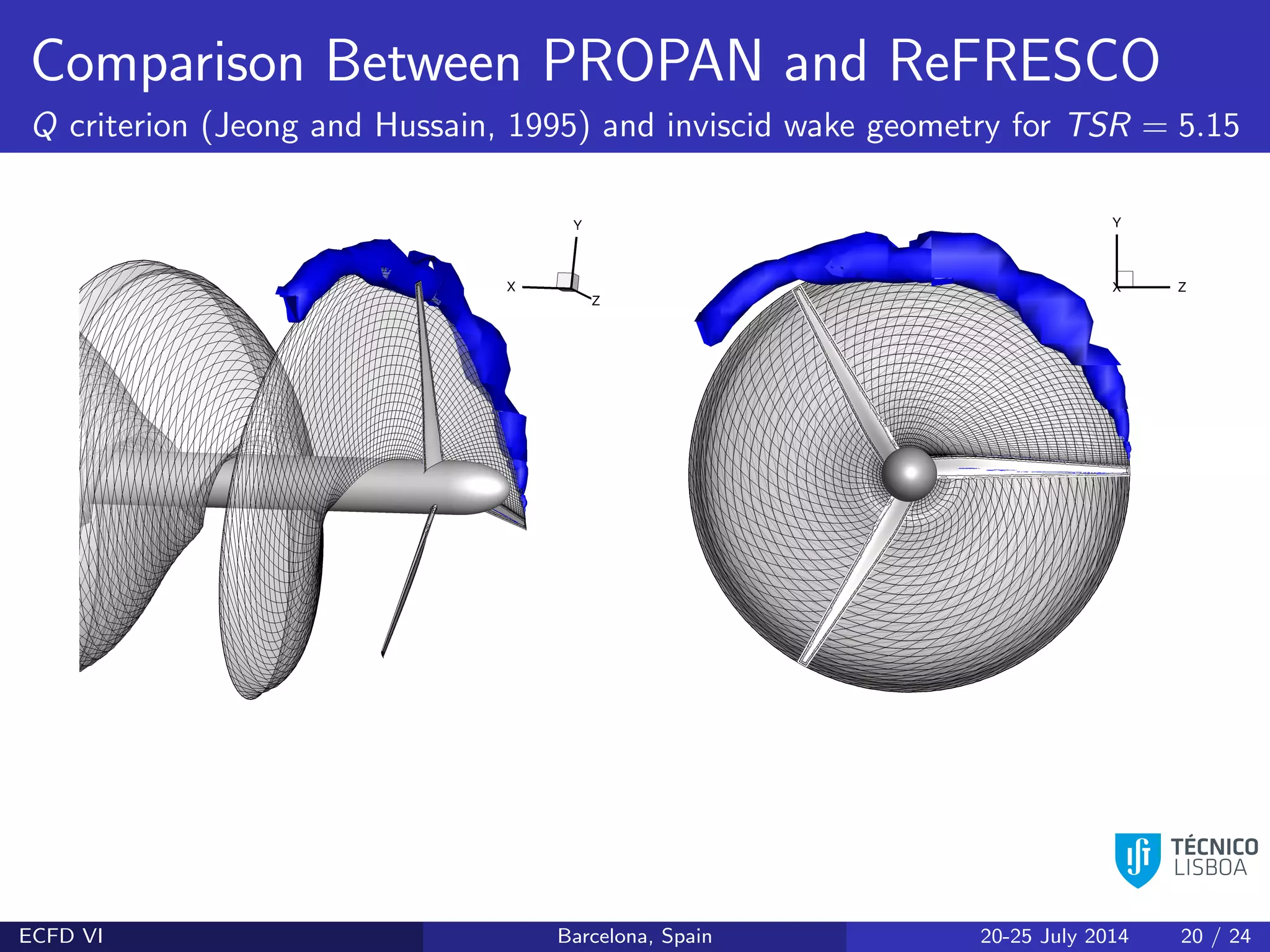
Q criterion (Jeong and Hussain, 1995) and inviscid wake geometry for TSR = 5.15
ECFD VI Barcelona, Spain 20-25 July 2014 20 / 24
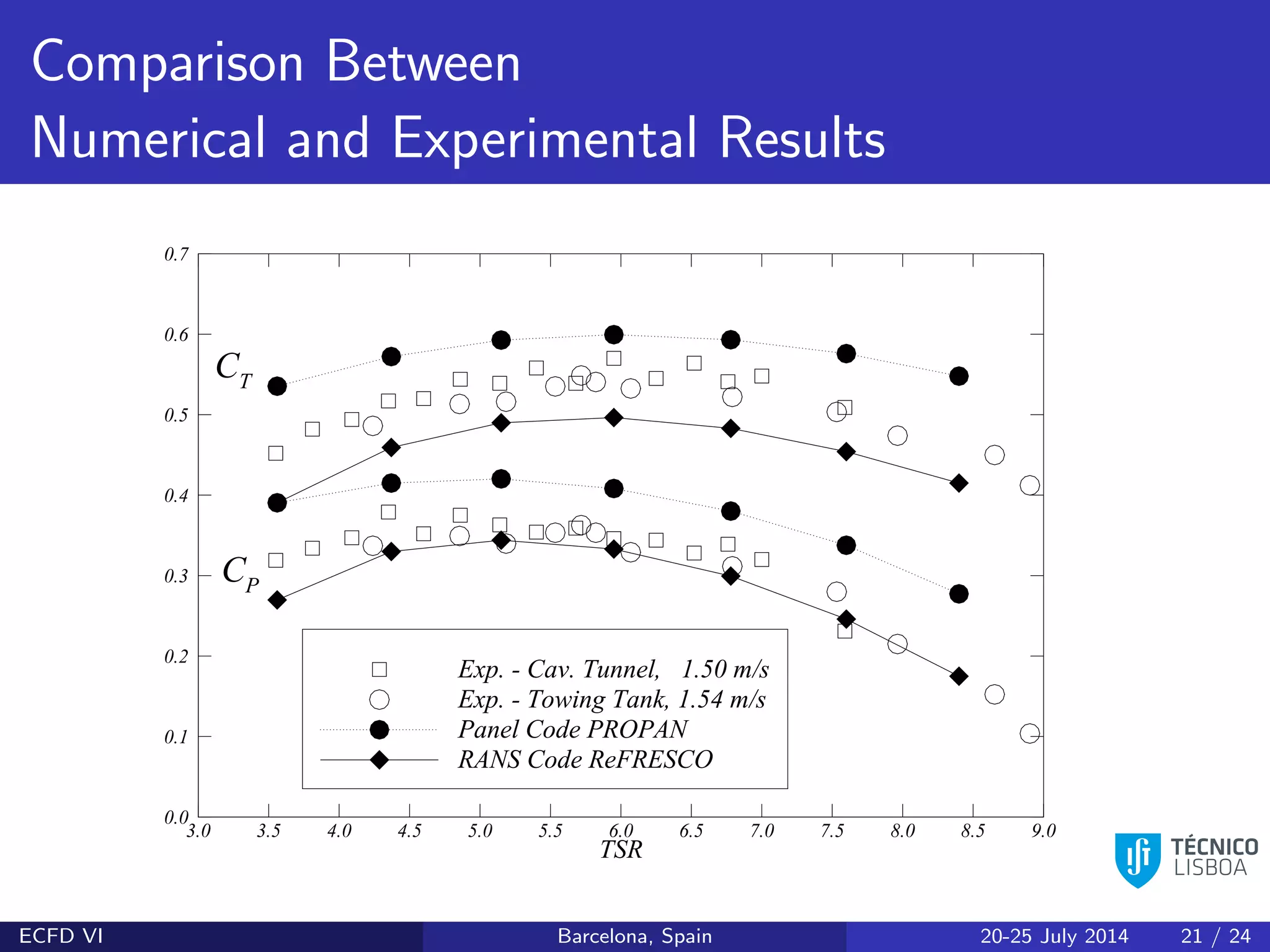
Comparison Between
Numerical and Experimental Results
TSR
3.0 3.5 4.0 4.5 5.0 5.5 6.0 6.5 7.0 7.5 8.0 8.5 9.0
0.0
0.1
0.2
0.3
0.4
0.5
0.6
0.7
Exp. - Cav. Tunnel, 1.50 m/s
Exp. - Towing Tank, 1.54 m/s
Panel Code PROPAN
RANS Code ReFRESCO
CT
CP
ECFD VI Barcelona, Spain 20-25 July 2014 21 / 24
Conclusions
Good agreement of the pressure distributions between the Panel
Method and RANS calculations, except in the region where the
flow is separated;
Due to flow separation, different radial circulation distributions
are obtained between the two methods;
The RANS calculation identifies the tip vortex expansion in the
wake, which is not modelled with the Panel Method;
The Panel Method calculations over-estimate the turbine forces,
which suggest a too high loading of the turbine due to the wake
model;
A better agreement of the turbine forces is obtained in the RANS
calculations, which take into proper account the viscous effects.
ECFD VI Barcelona, Spain 20-25 July 2014 22 / 24
Acknowledgements
The authors acknowledge the use of MARIN code ReFRESCO
in performing the current RANS computations;
The authors would like to acknowledge the assistance of
Mr. Joseph Cherroret in the numerical computations and
post-processing analysis of the results.
ECFD VI Barcelona, Spain 20-25 July 2014 23 / 24
References
A.S. Bahaj, A.F. Molland, J.R. Chaplin, W.M.J. Batten. “Power and Thrust
Measurements of Marine Current Turbines Under Various Hydrodynamic Flow Conditions
in a Cavitation Tunnel and a Towing Tank”. Renewable Energy, Vol. 32, pp. 407–426,
2007.
J. Baltazar, J.A.C. Falc˜ao de Campos. “Hydrodynamic Analysis of a Horizontal Axis
Marine Current Turbine With a Boundary Element Method”. Journal of Offshore
Mechanics and Arctic Engineering, Vol. 133, November 2011.
J. Jeong, F. Hussain. “On the Identification of a Vortex”. Journal of Fluid Mechanics,
Vol. 285, pp. 69–94, 1995.
L. Morino, C.-C. Kuo. “Subsonic Potential Aerodynamics for Complex Configurations: A
General Theory”. AIAA Journal, Vol. 12(2), pp. 191–197, 1974.
W. Otto, D. Rijpkema, G. Vaz. “Viscous-Flow Calculations on an Axial Marine Current
Turbine”. In Proceedings of the ASME 31th International Conference on Ocean, Offshore
and Arctic Engineering, Rio de Janeiro, Brazil, 2012.
G. Vaz, F. Jaouen, M. Hoekstra. “Free-Surface Viscous Flow Computations. Validation
of URANS Code FRESCO”. In Proceedings of the ASME 28th International Conference
on Ocean, Offshore and Arctic Engineering, Honolulu, Hawaii, USA, 2009.
ECFD VI Barcelona, Spain 20-25 July 2014 24 / 24

A Comparison of Panel Method and RANS Calculations for a Horizontal Axis Marine Current Turbine

  • 1.
    A Comparison ofPanel Method and RANS Calculations for a Horizontal Axis Marine Current Turbine J. Baltazar and J.A.C. Falc˜ao de Campos Marine Environment and Technology Center (MARETEC) Instituto Superior T´ecnico, Universidade de Lisboa, Portugal ECFD VI Barcelona, Spain 20-25 July 2014 1 / 24
  • 2.
    Motivations The computational timeof the flow around rotors with RANS Methods is still reasonably high: Need of good numerical resolution in small regions dominated by strong viscous effects; Accurate computations are associated with long computational times, which makes the method less useful for routine design studies. ECFD VI Barcelona, Spain 20-25 July 2014 2 / 24
  • 3.
    Motivations A Panel Methodhas been used to analyse the flow around the blades of a marine current turbine: This method is very efficient from the computational point of view, which makes them suited for design studies; However, serious limitations are met due to their inability to adequately model viscous effects (gap flow, separation phenomena). ECFD VI Barcelona, Spain 20-25 July 2014 3 / 24
  • 4.
    Objectives Comparison of PanelCode PROPAN (Baltazar and Falc˜ao de Campos, 2011) with RANS Code ReFRESCO (Vaz et al., 2009) to obtain a better insight: on the viscous effects of a marine current turbine; on the limitations of the inviscid flow model. ECFD VI Barcelona, Spain 20-25 July 2014 4 / 24
  • 5.
    Panel Code PROPAN ISTin-house low-order potential-based panel method; Structured surface grids; Fredholm integral equation solved by the collocation method; Constant source and dipole distributions; Influence coefficients calculated using the formulations of Morino and Kuo (1974); Wake alignment model with iterative pressure Kutta condition; Viscous corrections are applied based on 2D section lift and drag data; ECFD VI Barcelona, Spain 20-25 July 2014 5 / 24
  • 6.
    RANS Code ReFRESCO Viscousflow CFD code developed within a cooperation led by MARIN; Solves the incompressible RANS equations, complemented with multi-fluid capabilities, turbulence models and cavitation models; The equations are discretised using a finite-volume approach with cell-centered collocation variables; Flow is considered turbulent, κ − ω SST 2-equation model by Menter (1994) is used; Second-order convection scheme (QUICK) is used for the momentum equations; A fine boundary layer resolution is applied; Automatic wall functions (equivalent to no wall functions if y+ < 1). ECFD VI Barcelona, Spain 20-25 July 2014 6 / 24
  • 7.
    Test Case: TurbineRotor (Bahaj et al., 2007) Three-bladed turbine with NACA 63-8XX sections; Standard geometry has a pitch angle at blade root equal to 15◦ , corresponding to 0◦ pitch setting; Design condition TSR = 6 for 5◦ set angle; Turbine tested by the Sustainable Energy Research Group (SERG) of the University of Southampton; Test case: set angle of 10◦ . Taken from Bahaj et al. (2007) ECFD VI Barcelona, Spain 20-25 July 2014 7 / 24
  • 8.
    Surface Grid Usedfor the PROPAN Calculations Grid convergence studies by Baltazar and Falc˜ao de Campos (2011) LE TE X Y Z Discretisation: 60×31 blade, 270×30 blade wake, 80×48 hub ECFD VI Barcelona, Spain 20-25 July 2014 8 / 24
  • 9.
    PROPAN Results Convergence ofthe inviscid forces with wake alignment for TSR = 5.15 Iter. CP CT 0 0.415 0.511 1 0.451 0.583 2 0.458 0.589 3 0.459 0.589 4 0.459 0.589 5 0.459 0.590 ECFD VI Barcelona, Spain 20-25 July 2014 9 / 24
  • 10.
    ReFRESCO Calculations Computational domainand boundary conditions ECFD VI Barcelona, Spain 20-25 July 2014 10 / 24
  • 11.
    Grid Used forthe ReFRESCO Calculations Grid convergence studies by Otto et al. (2012) Discretisation: 32 million cells ECFD VI Barcelona, Spain 20-25 July 2014 11 / 24
  • 12.
    ReFRESCO Results Iterative convergenceof the residual norms for TSR = 5.15 Iteration 0 1000 2000 3000 4000 5000 6000 7000 10 -5 10 -4 10-3 10-2 10-1 10 0 10 1 L Iteration 1000 2000 3000 4000 5000 6000 7000 10 -8 10-7 10 -6 10 -5 10 -4 10 -3 10 -2 10 -1 VX VY VZ p L2 ECFD VI Barcelona, Spain 20-25 July 2014 12 / 24
  • 13.
    ReFRESCO Results Iterative convergenceof the forces for TSR = 5.15 Iteration 1000 2000 3000 4000 5000 6000 7000 0.40 0.50 0.60 0.70 -1.0 -0.5 0.0 0.5 1.0 CT CT[%] CT CT [%] Iteration 1000 2000 3000 4000 5000 6000 7000 0.10 0.20 0.30 0.40 -1.0 -0.5 0.0 0.5 1.0 CP CP CP [%] CP [%] ECFD VI Barcelona, Spain 20-25 July 2014 13 / 24
  • 14.
    Comparison Between PROPANand ReFRESCO Limiting streamlines for TSR = 5.15 PROPAN ReFRESCO ECFD VI Barcelona, Spain 20-25 July 2014 14 / 24
  • 15.
    Comparison Between PROPANand ReFRESCO Pressure distribution for TSR = 5.15 r/R = 0.30 r/R = 0.50 r/R = 0.75 s/c 0.0 0.2 0.4 0.6 0.8 1.0 -2.0 -1.0 0.0 1.0 PROPAN ReFRESCO Cp s/c 0.0 0.2 0.4 0.6 0.8 1.0 -1.5 -1.0 -0.5 0.0 0.5 1.0 PROPAN ReFRESCO Cp s/c 0.0 0.2 0.4 0.6 0.8 1.0 -1.5 -1.0 -0.5 0.0 0.5 1.0 PROPAN ReFRESCO Cp ECFD VI Barcelona, Spain 20-25 July 2014 15 / 24
  • 16.
    Comparison Between PROPANand ReFRESCO Pressure distribution for TSR = 5.15 r/R = 0.90 r/R = 0.95 r/R = 0.99 s/c 0.0 0.2 0.4 0.6 0.8 1.0 -1.0 -0.5 0.0 0.5 1.0 PROPAN ReFRESCO Cp s/c 0.0 0.2 0.4 0.6 0.8 1.0 -1.0 -0.5 0.0 0.5 1.0 PROPAN ReFRESCO Cp s/c 0.0 0.2 0.4 0.6 0.8 1.0 -1.0 -0.5 0.0 0.5 1.0 PROPAN ReFRESCO Cp ECFD VI Barcelona, Spain 20-25 July 2014 16 / 24
  • 17.
    ReFRESCO Results Eddy viscosityratio (µτ /µ) for TSR = 5.15 r/R = 0.30 r/R = 0.75 r/R = 0.95 ECFD VI Barcelona, Spain 20-25 July 2014 17 / 24
  • 18.
    Comparison Between PROPANand ReFRESCO Radial distribution of circulation on the blade for TSR = 5.15 r/R 0.2 0.4 0.6 0.8 1.0 -0.04 -0.03 -0.02 -0.01 0.00 PROPAN - Wake Strength ReFRESCO - x/R=0.1 Γ/(ΩR 2 ) ECFD VI Barcelona, Spain 20-25 July 2014 18 / 24
  • 19.
    Comparison Between PROPANand ReFRESCO Vorticitiy field and inviscid wake geometry for TSR = 5.15 x/R = 0.1 x/R = 0.2 x/R = 0.3 ECFD VI Barcelona, Spain 20-25 July 2014 19 / 24
  • 20.
    Comparison Between PROPANand ReFRESCO Q criterion (Jeong and Hussain, 1995) and inviscid wake geometry for TSR = 5.15 ECFD VI Barcelona, Spain 20-25 July 2014 20 / 24
  • 21.
    Comparison Between Numerical andExperimental Results TSR 3.0 3.5 4.0 4.5 5.0 5.5 6.0 6.5 7.0 7.5 8.0 8.5 9.0 0.0 0.1 0.2 0.3 0.4 0.5 0.6 0.7 Exp. - Cav. Tunnel, 1.50 m/s Exp. - Towing Tank, 1.54 m/s Panel Code PROPAN RANS Code ReFRESCO CT CP ECFD VI Barcelona, Spain 20-25 July 2014 21 / 24
  • 22.
    Conclusions Good agreement ofthe pressure distributions between the Panel Method and RANS calculations, except in the region where the flow is separated; Due to flow separation, different radial circulation distributions are obtained between the two methods; The RANS calculation identifies the tip vortex expansion in the wake, which is not modelled with the Panel Method; The Panel Method calculations over-estimate the turbine forces, which suggest a too high loading of the turbine due to the wake model; A better agreement of the turbine forces is obtained in the RANS calculations, which take into proper account the viscous effects. ECFD VI Barcelona, Spain 20-25 July 2014 22 / 24
  • 23.
    Acknowledgements The authors acknowledgethe use of MARIN code ReFRESCO in performing the current RANS computations; The authors would like to acknowledge the assistance of Mr. Joseph Cherroret in the numerical computations and post-processing analysis of the results. ECFD VI Barcelona, Spain 20-25 July 2014 23 / 24
  • 24.
    References A.S. Bahaj, A.F.Molland, J.R. Chaplin, W.M.J. Batten. “Power and Thrust Measurements of Marine Current Turbines Under Various Hydrodynamic Flow Conditions in a Cavitation Tunnel and a Towing Tank”. Renewable Energy, Vol. 32, pp. 407–426, 2007. J. Baltazar, J.A.C. Falc˜ao de Campos. “Hydrodynamic Analysis of a Horizontal Axis Marine Current Turbine With a Boundary Element Method”. Journal of Offshore Mechanics and Arctic Engineering, Vol. 133, November 2011. J. Jeong, F. Hussain. “On the Identification of a Vortex”. Journal of Fluid Mechanics, Vol. 285, pp. 69–94, 1995. L. Morino, C.-C. Kuo. “Subsonic Potential Aerodynamics for Complex Configurations: A General Theory”. AIAA Journal, Vol. 12(2), pp. 191–197, 1974. W. Otto, D. Rijpkema, G. Vaz. “Viscous-Flow Calculations on an Axial Marine Current Turbine”. In Proceedings of the ASME 31th International Conference on Ocean, Offshore and Arctic Engineering, Rio de Janeiro, Brazil, 2012. G. Vaz, F. Jaouen, M. Hoekstra. “Free-Surface Viscous Flow Computations. Validation of URANS Code FRESCO”. In Proceedings of the ASME 28th International Conference on Ocean, Offshore and Arctic Engineering, Honolulu, Hawaii, USA, 2009. ECFD VI Barcelona, Spain 20-25 July 2014 24 / 24