International Research Journal of Engineering and Technology (IRJET) e-ISSN: 2395-0056
Volume: 10 Issue: 12 | Dec 2023 www.irjet.net p-ISSN: 2395-0072
© 2023, IRJET | Impact Factor value: 8.226 | ISO 9001:2008 Certified Journal | Page 661
Modeling and simulation of distributed generation system
(Zahara Batool1, Satish Saini2)
Department of Electrical Engineering, RIMT University, Punjab
------------------------------------------------------------------------***---------------------------------------------------------------------------
Abstract:
This research investigates the optimal integration of photovoltaic (PV) and wind energy systems in a distributed
generation framework for Leh, a region characterized by its challenging geographical and climatic conditions.
Leveraging the Hybrid Optimized Model for Electric Renewables (HOMER) software, the study focuses on modeling
and simulating a hybrid PV and wind mill distributed generation system to meet the energy demands of Leh
effectively. The research commences with a detailed analysis of the local energy requirements, considering the
seasonal variations and load patterns specific to Leh. The solar and wind resources are assessed for their potential
contributions to the hybrid system, acknowledging their complementary nature in different weather conditions.
Utilizing the capabilities of HOMER, various system configurations and component sizes are systematically evaluated
to optimize the overall performance of the hybrid distributed generation system. Simulations are conducted to
determine the most cost-effective and reliable solution that meets Leh's energy demands while considering the
intermittency and variability of renewable energy sources. The economic feasibility of the proposed system is
examined through metrics such as the levelized cost of energy, net present cost and renewable penetration level.
Additionally, environmental impact assessments highlight the potential reductions in greenhouse gas emissions,
emphasizing the sustainability benefits of integrating renewable energy sources.
INTRODUCTION
Population growth is driving up global energy consumption. Technological innovation also contributes to its improvement.
Thus, a reliable and inexpensive supply of energy that does not harm the environment is critical; these issues can possibly be
met by the ever-evolving renewable energy sources [1]. Higher energy demand result from increased production and
population. The developing world contributes the most to population increase. This population expansion makes it difficult for
energy producers to meet the energy demand. The global pattern of energy growth is seen. Different countries use different
strategies to satisfy their energy needs [2]. Any country's primary energy sources include fossil fuels, nuclear power, and
renewable energy. Although fossil fuels are the most often utilized, they have major faults and environmental effects. Nuclear
energy is not as promising as fossil energy due to operational complexity [3]. According to the World Energy Forum, the
reserves of fossil fuels such as oil, coal, and gas will be exhausted in less than ten decades. Fossil fuels presently account for
more than 79% of primary energy consumed globally, with 57.7% of that used in transportation, and are fast decreasing [4].
Renewable energy systems (RESs) have a reputation for being infinite, eco-friendly, dependable, efficient, and cost-effective,
and are thus regarded as the most probable practical power supply techniques for such places. Furthermore, sustainable
energy holds the key to future development and a healthy global environment, and it is seen as a viable approach of tackling
environmental pollution concerns [5-7]. PV energy is safe and infinite, having several advantages over traditional electrical
energy production method [8]. Renewable energy, wind energy, in particular, produce significantly lower environmental
impact than conventional fossil fuel-based energy. The use of wind energy for the sustainable growth of the society has a
tremendous scope, as it is abundant, available free as a fuel, and can be scaled up or down based on the requirements.
However, as on May 31, 2014, the total cumulative contribution of renewable energy (excluding large hydro) was about
32.8 GW; out of which wind contributed about 21.26 GW (65.85 percent). This is an indicator that wind has been playing the
most important role in renewable market developments in India [9].
India has a tremendous, renewable power capacity of around 100,000 MW that is mainly untapped [10]. Due to capacity
constraints, environmental concerns, and difficult terrain, it is believed that forty percent of the country's communities lack
access to grid energy. As a result, it is critical to electrify isolated settlements using alternative energy sources such as solar,
micro hydro, and wind systems. While stand-alone devices are being employed in various plantations and colonies, the
availability of solar, water, or wind power is not continuous. Running various electricity systems separately may not be cost-
International Research Journal of Engineering and Technology (IRJET) e-ISSN: 2395-0056
Volume: 10 Issue: 12 | Dec 2023 www.irjet.net p-ISSN: 2395-0072
© 2023, IRJET | Impact Factor value: 8.226 | ISO 9001:2008 Certified Journal | Page 662
effective, dependable, or efficient. Combining these specialized renewable energy sources to construct a hybrid power system
is a potential approach [11].
In the context of Leh, a distributed generation system featuring a photovoltaic (PV) and wind hybrid model holds immense
promise for addressing the unique energy challenges faced in this high-altitude region. Leh, situated in the Himalayan region,
experiences extreme weather conditions and is often cut off from the conventional power grid. The integration of PV panels,
leveraging the abundant sunlight at high altitudes, and wind turbines capitalizing on the brisk mountain winds, creates a
robust hybrid model tailored to the specific environmental conditions of Leh. This distributed generation system not only taps
into renewable energy sources but also offers a decentralized solution, reducing dependence on long-distance power
transmission and bolstering the resilience of the local energy infrastructure. The PV-wind hybrid model aligns with the
sustainable development goals of Leh, providing a reliable and continuous power supply to meet the energy needs of the
community while minimizing the environmental impact in this ecologically sensitive region.
LITERATURE REVIEW
Siyuan et al. (2021) proposed a quantitative analytic approach for energy efficiency loss that is used to examine the influence
of dust collection in PV systems. The coupling model of dust concentration and photoelectric conversion efficiency (DC-PCE) is
created using the nonlinear power generation characteristic of PV panels at low irradiance [12]. Bulm et al. (2013) calculate
and compare the levelized cost of electricity (LCOE) of solar photovoltaic (solar power PV) and micro hydro powered village
networks to the typical diesel option. Examine alternate system designs for solar PV, such as decreased hybridization and a
source contingency plan [13]. Akikur et al. (2013) offer a solar energy research in the form of a hybrid and standalone power
generating system utilized to electrify off-grid locations. However, many countries across the world experience varying
degrees of solar radiation, and in those situations, a hybrid solar PV system is regarded as the most effective electrification
choice [14]. Ghosh (2020), explains that despite India's low per capita carbon dioxide emissions and minor historical
emissions, the country's current yearly GHG emissions are the third highest in the world. At the same time, India is very
sensitive to the effects of climate change due to its topography, demographics, and disparities in economic development
throughout the population, which the union government is planning to leverage by using renewable sources [15]. According to
Sitharthan et al. (2018), the growing awareness of climate change has compelled several countries to use Renewable Energy
Resources (RER) for electricity generation. Among the numerous RER, wind power production systems play an important role,
meeting around 28% of global energy demand [16]. Kong et al. (2019), observed that a microgrid is a distributed networked
generation system that can efficiently integrate diverse dispersed generation sources, particularly renewable energy sources,
into the information network. The freestanding wind/solar/battery power system is an example of a standalone microgrid,
with wind and solar power generation being intermittent systems with complicated dynamics and several restrictions [17].
Pal et al. (2018) propose an economic and performance analysis of stand-alone photovoltaic (PV), wind, and PV-wind hybrid
energy systems for India's remote Andaman and Nicobar islands. The best position is determined by using the most solar
insolation and wind speed statistics available from the island's geographic coordinates. The results demonstrate that
implementing a stand-alone PV-wind hybrid system in the aforementioned location is a realistic alternative [18]. Desai et al.
(2019) proposed a Solar PV-Wind Hybrid electricity System that employs renewable sources to satisfy electricity
requirements. The research suggests a Solar PV-Wind-based system that is economical by local government standards to react
to the state's power need, with an irradiance of 2.6 to 7 kWh/Day/m2 and a wind speed of 6.6 to 15.5 miles per hour [19]. Das
et al. (2020), presented that India has a big population and uses around 70% of its energy from fossil fuels. The majority of
Indian power is provided by huge power facilities via the national grid. For an efficient decentralized hybrid renewable energy
solution (wind-hydro-battery) with minimal DG assistance, a HOMER simulation and MCDM technique are utilized [20].
Sharma et al. (2019), stated that for sustainable development, every nation's energy policy has been drastically altered to
allow for high penetration of renewable energy in the power grid, particularly in the distribution network. The HOMER
simulates a large number of setups and determines the best cost-effective arrangement [21].
International Research Journal of Engineering and Technology (IRJET) e-ISSN: 2395-0056
Volume: 10 Issue: 12 | Dec 2023 www.irjet.net p-ISSN: 2395-0072
© 2023, IRJET | Impact Factor value: 8.226 | ISO 9001:2008 Certified Journal | Page 663
METHDOLOGY USED
The Hybrid Optimized Model for Electric Renewables (HOMER) [22], a renewable energy simulation system created by the
United States' National Renewable Energy Laboratory (NREL), was utilized for simulation in the study. Many nations use the
program to simulate the model to verify its viability and feasibility before implementation. The program can simulate various
renewable and non-renewable sources and regulate the time step to achieve the required simulation period. The software
iterates over the specified options to identify the best one, and sensitivity analysis assures project safety. The program offers
several noteworthy advantages. The simulation provides several modifications, particularly the financial variety, which makes
the software more appealing [23].
ENERGY BALANCE EQUATION [24]
The equations governing the energy balance of the different configurations of systems, can be written in the following way,
where Ein is the Energy IN the System and Euse is the Energy Used:
where EFUN and
ETUN are,
respectively, the Net Energy FROM and To the Utility, and EFSN and ETSN are, respectively, the Net Energy FROM and To the
Storage Unit, as defined in the IEC-61724 Standard. EA, EBU, the net energy from Array generation and battery respectively
and EL is the load in the system.
MODELING OF SOLAR GEOMETRY [25]
The rotation of the earth on its axis is designated by a certain angle. The tiltation is around 23.5o. Furthermore, the solar
position in the key altered during the year. Modeling of such schemes is required to harvest maximum energy. The following
are some of the key terms that influence PV array power generation. The simulation includes several variations, including
financial and other variations, making the programming more engaging.
MODELING OF WIND ENERGY
The whole one-year average wind velocity data gathered and inputted is for simulation [26]. The HOMER computes a value for
each hour. The whole hourly simulation data set is organized in a monthly variation pattern.
MODELING OF LOAD CONSUMPTION
During the system modeling, it is assumed that the load demand is mainly provided by two sources, which are expressed as
follows:
( ) ( ) ( ) (3)
where ( )is the power directly delivered from the PV array; ( )is the power produced by wind-turbine set [27].
(1)
(2)
International Research Journal of Engineering and Technology (IRJET) e-ISSN: 2395-0056
Volume: 10 Issue: 12 | Dec 2023 www.irjet.net p-ISSN: 2395-0072
© 2023, IRJET | Impact Factor value: 8.226 | ISO 9001:2008 Certified Journal | Page 664
DESIGNING ASPECTS OF THE PROPOSED SCHEME
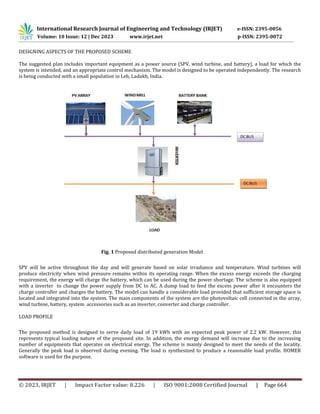
The suggested plan includes important equipment as a power source (SPV, wind turbine, and battery), a load for which the
system is intended, and an appropriate control mechanism. The model is designed to be operated independently. The research
is being conducted with a small population in Leh, Ladakh, India.
SPV will be active throughout the day and will generate based on solar irradiance and temperature. Wind turbines will
produce electricity when wind pressure remains within its operating range. When the excess energy exceeds the charging
requirement, the energy will charge the battery, which can be used during the power shortage. The scheme is also equipped
with a inverter to change the power supply from DC to AC. A dump load to feed the excess power after it encounters the
charge controller and charges the battery. The model can handle a considerable load provided that sufficient storage space is
located and integrated into the system. The main components of the system are the photovoltaic cell connected in the array,
wind turbine, battery, system accessories such as an inverter, converter and charge controller.
LOAD PROFILE
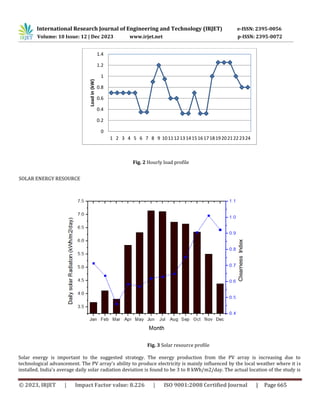
The proposed method is designed to serve daily load of 19 kWh with an expected peak power of 2.2 kW. However, this
represents typical loading nature of the proposed site. In addition, the energy demand will increase due to the increasing
number of equipments that operates on electrical energy. The scheme is mainly designed to meet the needs of the locality.
Generally the peak load is observed during evening. The load is synthesized to produce a reasonable load profile. HOMER
software is used for the purpose.
Fig. 1 Proposed distributed generation Model
International Research Journal of Engineering and Technology (IRJET) e-ISSN: 2395-0056
Volume: 10 Issue: 12 | Dec 2023 www.irjet.net p-ISSN: 2395-0072
© 2023, IRJET | Impact Factor value: 8.226 | ISO 9001:2008 Certified Journal | Page 665
SOLAR ENERGY RESOURCE
0
0.2
0.4
0.6
0.8
1
1.2
1.4
1 2 3 4 5 6 7 8 9 101112131415161718192021222324
Load
in
(kW)
Fig. 3.4 Solar energy resources
Fig. 2 Hourly load profile
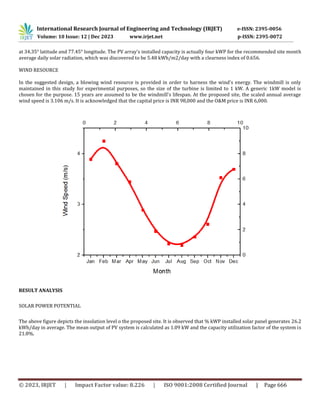
Fig. 3 Solar resource profile
Solar energy is important to the suggested strategy. The energy production from the PV array is increasing due to
technological advancement. The PV array's ability to produce electricity is mainly influenced by the local weather where it is
installed. India's average daily solar radiation deviation is found to be 3 to 8 kWh/m2/day. The actual location of the study is
International Research Journal of Engineering and Technology (IRJET) e-ISSN: 2395-0056
Volume: 10 Issue: 12 | Dec 2023 www.irjet.net p-ISSN: 2395-0072
© 2023, IRJET | Impact Factor value: 8.226 | ISO 9001:2008 Certified Journal | Page 666
at 34.35° latitude and 77.45° longitude. The PV array's installed capacity is actually four kWP for the recommended site month
average daily solar radiation, which was discovered to be 5.48 kWh/m2/day with a clearness index of 0.656.
WIND RESOURCE
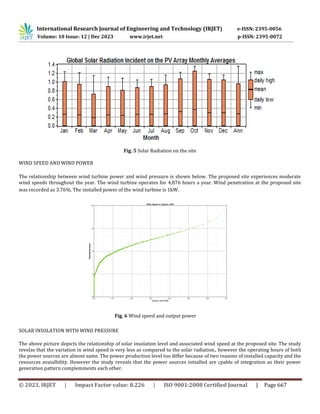
In the suggested design, a blowing wind resource is provided in order to harness the wind's energy. The windmill is only
maintained in this study for experimental purposes, so the size of the turbine is limited to 1 kW. A generic 1kW model is
chosen for the purpose. 15 years are assumed to be the windmill's lifespan. At the proposed site, the scaled annual average
wind speed is 3.106 m/s. It is acknowledged that the capital price is INR 98,000 and the O&M price is INR 6,000.
RESULT ANALYSIS
SOLAR POWER POTENTIAL
The above figure depicts the insolation level o the proposed site. It is observed that % kWP installed solar panel generates 26.2
kWh/day in average. The mean output of PV system is calculated as 1.09 kW and the capacity utilization factor of the system is
21.8%.
International Research Journal of Engineering and Technology (IRJET) e-ISSN: 2395-0056
Volume: 10 Issue: 12 | Dec 2023 www.irjet.net p-ISSN: 2395-0072
© 2023, IRJET | Impact Factor value: 8.226 | ISO 9001:2008 Certified Journal | Page 667
Fig. 5 Solar Radiation on the site
WIND SPEED AND WIND POWER
The relationship between wind turbine power and wind pressure is shown below. The proposed site experiences moderate
wind speeds throughout the year. The wind turbine operates for 4,876 hours a year. Wind penetration at the proposed site
was recorded as 3.76%. The installed power of the wind turbine is 1kW.
Fig. 6 Wind speed and output power
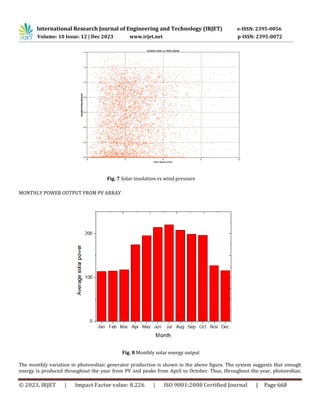
SOLAR INSOLATION WITH WIND PRESSURE
The above picture depicts the relationship of solar insolation level and associated wind speed at the proposed site. The study
revelas that the variation in wind speed is very less as compared to the solar radiation., however the operating hours of both
the power sources are almost same. The power production level too differ because of two reasons of installed capacity and the
resources avaialbility. However the study reveals that the power sources intsalled are cpable of integration as their power
generation pattern complemments each other.
International Research Journal of Engineering and Technology (IRJET) e-ISSN: 2395-0056
Volume: 10 Issue: 12 | Dec 2023 www.irjet.net p-ISSN: 2395-0072
© 2023, IRJET | Impact Factor value: 8.226 | ISO 9001:2008 Certified Journal | Page 668
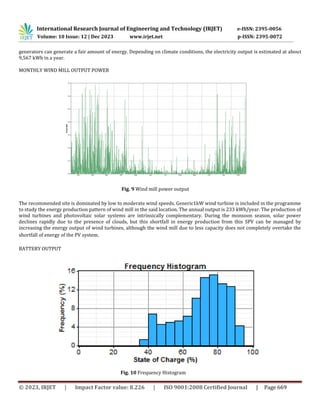
MONTHLY POWER OUTPUT FROM PV ARRAY
The monthly variation in photovoltaic generator production is shown in the above figure. The system suggests that enough
energy is produced throughout the year from PV and peaks from April to October. Thus, throughout the year, photovoltaic
Fig. 7 Solar insolation vs wind pressure
Fig. 8 Monthly solar energy output
International Research Journal of Engineering and Technology (IRJET) e-ISSN: 2395-0056
Volume: 10 Issue: 12 | Dec 2023 www.irjet.net p-ISSN: 2395-0072
© 2023, IRJET | Impact Factor value: 8.226 | ISO 9001:2008 Certified Journal | Page 669
generators can generate a fair amount of energy. Depending on climate conditions, the electricity output is estimated at about
9,567 kWh in a year.
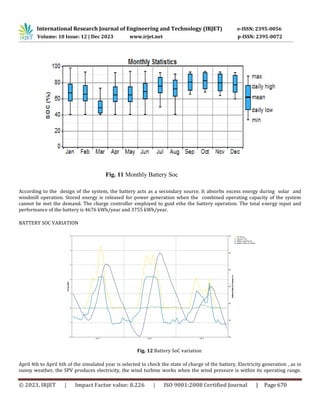
MONTHLY WIND MILL OUTPUT POWER
Fig. 9 Wind mill power output
The recommended site is dominated by low to moderate wind speeds. Generic1kW wind turbine is included in the programme
to study the energy production pattern of wind mill in the said location. The annual output is 233 kWh/year. The production of
wind turbines and photovoltaic solar systems are intrinsically complementary. During the monsoon season, solar power
declines rapidly due to the presence of clouds, but this shortfall in energy production from this SPV can be managed by
increasing the energy output of wind turbines, although the wind mill due to less capacity does not completely overtake the
shortfall of energy of the PV system.
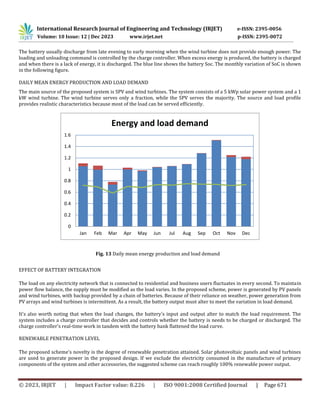
BATTERY OUTPUT
Fig. 10 Frequency Histogram
International Research Journal of Engineering and Technology (IRJET) e-ISSN: 2395-0056
Volume: 10 Issue: 12 | Dec 2023 www.irjet.net p-ISSN: 2395-0072
© 2023, IRJET | Impact Factor value: 8.226 | ISO 9001:2008 Certified Journal | Page 670
According to the design of the system, the battery acts as a secondary source. It absorbs excess energy during solar and
windmill operation. Stored energy is released for power generation when the combined operating capacity of the system
cannot be met the demand. The charge controller employed to guid ethe the battery operation. The total energy input and
performance of the battery is 4676 kWh/year and 3755 kWh/year.
BATTERY SOC VARIATION
Fig. 12 Battery SoC variation
April 4th to April 6th of the simulated year is selected to check the state of charge of the battery. Electricity generation , as in
sunny weather, the SPV produces electricity, the wind turbine works when the wind pressure is within its operating range.
Fig. 11 Monthly Battery Soc
International Research Journal of Engineering and Technology (IRJET) e-ISSN: 2395-0056
Volume: 10 Issue: 12 | Dec 2023 www.irjet.net p-ISSN: 2395-0072
© 2023, IRJET | Impact Factor value: 8.226 | ISO 9001:2008 Certified Journal | Page 671
The battery usually discharge from late evening to early morning when the wind turbine does not provide enough power. The
loading and unloading command is controlled by the charge controller. When excess energy is produced, the battery is charged
and when there is a lack of energy, it is discharged. The blue line shows the battery Soc. The monthly variation of SoC is shown
in the following figure.
DAILY MEAN ENERGY PRODUCTION AND LOAD DEMAND
The main source of the proposed system is SPV and wind turbines. The system consists of a 5 kWp solar power system and a 1
kW wind turbine. The wind turbine serves only a fraction, while the SPV serves the majority. The source and load profile
provides realistic characteristics because most of the load can be served efficiently.
EFFECT OF BATTERY INTEGRATION
The load on any electricity network that is connected to residential and business users fluctuates in every second. To maintain
power flow balance, the supply must be modified as the load varies. In the proposed scheme, power is generated by PV panels
and wind turbines, with backup provided by a chain of batteries. Because of their reliance on weather, power generation from
PV arrays and wind turbines is intermittent. As a result, the battery output must alter to meet the variation in load demand.
It's also worth noting that when the load changes, the battery's input and output alter to match the load requirement. The
system includes a charge controller that decides and controls whether the battery is needs to be charged or discharged. The
charge controller's real-time work in tandem with the battery bank flattened the load curve.
RENEWABLE PENETRATION LEVEL
The proposed scheme's novelty is the degree of renewable penetration attained. Solar photovoltaic panels and wind turbines
are used to generate power in the proposed design. If we exclude the electricity consumed in the manufacture of primary
components of the system and other accessories, the suggested scheme can reach roughly 100% renewable power output.
0
0.2
0.4
0.6
0.8
1
1.2
1.4
1.6
Jan Feb Mar Apr May Jun Jul Aug Sep Oct Nov Dec
Energy and load demand
Fig. 13 Daily mean energy production and load demand
International Research Journal of Engineering and Technology (IRJET) e-ISSN: 2395-0056
Volume: 10 Issue: 12 | Dec 2023 www.irjet.net p-ISSN: 2395-0072
© 2023, IRJET | Impact Factor value: 8.226 | ISO 9001:2008 Certified Journal | Page 672
ENERGY BALANCE OF THE PROPOSED SYSTEM
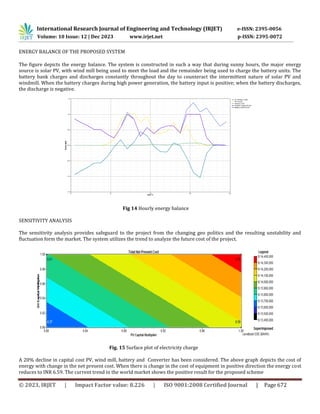
The figure depicts the energy balance. The system is constructed in such a way that during sunny hours, the major energy
source is solar PV, with wind mill being used to meet the load and the remainder being used to charge the battery units. The
battery bank charges and discharges constantly throughout the day to counteract the intermittent nature of solar PV and
windmill. When the battery charges during high power generation, the battery input is positive; when the battery discharges,
the discharge is negative.
SENSITIVITY ANALYSIS
The sensitivity analysis provides safeguard to the project from the changing geo politics and the resulting unstability and
fluctuation form the market. The system utilizes the trend to analyze the future cost of the project.
Fig. 15 Surface plot of electricity charge
A 20% decline in capital cost PV, wind mill, battery and Converter has been considered. The above graph depicts the cost of
energy with change in the net present cost. When there is change in the cost of equipment in positive direction the energy cost
reduces to INR 6.59. The current trend in the world market shows the positive result for the proposed scheme
Fig 14 Hourly energy balance
International Research Journal of Engineering and Technology (IRJET) e-ISSN: 2395-0056
Volume: 10 Issue: 12 | Dec 2023 www.irjet.net p-ISSN: 2395-0072
© 2023, IRJET | Impact Factor value: 8.226 | ISO 9001:2008 Certified Journal | Page 673
ECONOMIC ALALYSIS
The optimal configuration is the one having lowest NPC which comprises 5 kWP PV, 1 kW Wind mill 8 No. of S4KS2P battery
bank and 1 kW converter. The initial capital cost is INR 5,78,980, operating cost INR 13,476/yr, total NPC INR 7,45,247. The
COE is found to be 9.38/kWh and 100% renewable fraction.
The NPC table reveals Solar PV shares maximum cost followed by Generic 1 kW wind mill. Minimum capital are shared by
Battery bank and Converter. The solar PV shares 74 % of total capital, followed by Generic 1 kW with 17 %. The below table
shows NPC summary of the most optimized model.
Table 1 Net Present Cost
Component
Capital Replacement O&M Fuel Salvage Total
(INR) (INR) (INR) (INR) (INR) (INR)
PV 425,000 0 0 0 0 425,000
Generic 1 kW 98,000 40,892 76,700 0 -7,611 207,981
Surrette 4KS25P 43,200 32,139 30,680 0 -9,227 96,792
Converter 6,780 2,829 6,392 0 -527 15,474
System 572,980 75,860 113,772 0 -17,365 745,247
Table 4.3 Annualized cost
Component
Capital Replacement O&M Fuel Salvage Total
(INR) (INR) (INR) (INR) (INR) (INR)
PV 33,246 0 0 0 0 33,246
Generic 1 kW 7,666 3,199 6,000 0 -595 16,270
Surrette 4KS25P 3,379 2,514 2,400 0 -722 7,572
Converter 530 221 500 0 -41 1,210
System 44,822 5,934 8,900 0 -1,358 58,298
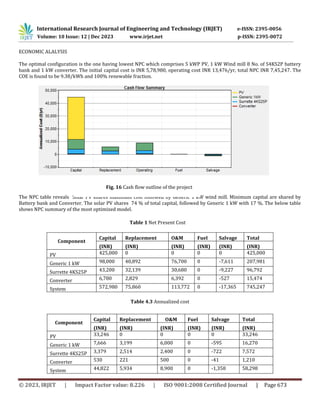
Fig. 16 Cash flow outline of the project
International Research Journal of Engineering and Technology (IRJET) e-ISSN: 2395-0056
Volume: 10 Issue: 12 | Dec 2023 www.irjet.net p-ISSN: 2395-0072
© 2023, IRJET | Impact Factor value: 8.226 | ISO 9001:2008 Certified Journal | Page 674
The system requires the most cash in the first year for device acquisition, installation, and other activities. However, certain
funds are necessary each fiscal year to keep the system in good working order. Some important components must be replaced
after a specific time period. The battery should be changed every 12 years. Every 15 years, the wind turbine setup converter is
changed. The money flow of the system is illustrated in the image below. The preceding tables show the annualized value of
such costs.
CONCLUSION
In this paper, a solar PV-wind based distributed generation model is investigated for a community load in Leh, Ladakh, India.
The important discovery demonstrates that the energy generating strategies are complementary. It concludes that the power
output of the system will increase with the integration of such system, the capacity shortage is limited to 15%, the scheme may
reduce the power shortage with the addition of extra blocks of PV array, the levilised cost of energy is 9.381 INR/kWh, which
will decrease in the near future as the costs of such system are on the decline trend. Because both sources are renewable, the
system is environmentally beneficial and does not disrupt the intended site's natural equilibrium. The benefits of the present
scheme over shadows the little higher cost and hence the scheme is highly recommended.
REFERENCES
[1] Kannan, N., & Vakeesan, D. (2016). Solar energy for future world: - A review. Renewable and Sustainable Energy Reviews,
62, 1092–1105.
[2] Shafiee S, Topal E. When will fossil fuel reserves be diminished? Energy Policy 2009; 37(1):181-9.
[3] IEA, International energy annual 2004. Energy Information Administration; 2006.
[4] Kumar A, Kumar K, Kaushik N, Sharma S, Mishra S. Renewable energy in India: current status and future potentials.
Renewable and Sustainable Energy Reviews 2010;14(October (8)):2434–42.
[5] Himri Y et al. Techno-economical study of hybrid power system for a remote village in Algeria. Energy 2008;33(7):1128–
36.
[6] Sharma R, Tiwari GN. Technical performance evaluation of stand-alone photovoltaic array for outdoor field conditions of
New Delhi. Appl Energy 2012;92:644–52.
[7] Chel A, Tiwari GN. A case study of a typical 2.32 kWp stand-alone photovoltaic (SAPV) in composite climate of New Delhi
(India). Appl Energy 2011;88(4):1415–26.
International Research Journal of Engineering and Technology (IRJET) e-ISSN: 2395-0056
Volume: 10 Issue: 12 | Dec 2023 www.irjet.net p-ISSN: 2395-0072
© 2023, IRJET | Impact Factor value: 8.226 | ISO 9001:2008 Certified Journal | Page 675
[8] <cleanenergycouncil.org.au> [last accessed 10.07.2023]
[9] Wind power developments in India. Sanjay Kumar Kar, Atul Sharma (2015). Renewable and Sustainable Energy Reviews
Volume 48, August 2015, Pages 264-275
[10] Annual report 2004 of Ministry of Non Conventional Energy Sources (MNES), Govt. of India, www.mnes.nic.in
[11] Nayar C.V, Lawrance WB, Phillips SJ. Solar/ wind/ diesel hybrid energy systems for remote areas. Energy Conversion
Engineering Conference IECEC-89, vol. 4. 1989. p. 2029–34.
[12] Siyuan Fan;Yu Wang;Shengxian Cao;Tianyi Sun;Peng Liu; (2021). A novel method for analyzing the effect of dust
accumulation on energy efficiency loss in photovoltaic (PV) system . Energy.
[13] Blum N. U., Wakeling R. S., & Schmidt T. S. (2013). Rural electrification through village grids—Assessing the cost
competitiveness of isolated renewable energy technologies in Indonesia. Renewable and Sustainable Energy Reviews, 22, 482-
496.
[14] Akikur R. K., Saidur R., Ping H. W., &Ullah K. R. (2013). Comparative study of stand-alone and hybrid solar energy systems
suitable for off-grid rural electrification: A review. Renewable and Sustainable Energy Reviews,27, 738-752
[15] Ghosh, Shibani (2020). Litigating Climate Claims in India. AJIL Unbound, 114(), 45–50. doi:10.1017/aju.2020.5
[16] Sitharthan, R.; Swaminathan, J.N.; Parthasarathy, T. (2018). [IEEE 2018 National Power Engineering Conference (NPEC) -
Madurai (2018.3.9-2018.3.10)] 2018 National Power Engineering Conference (NPEC) - Exploration of Wind Energy in India: A
Short Review.
[17] Xiaobing Kong; Xiangjie Liu; Lele Ma; Kwang Y. Lee (2019). Hierarchical Distributed Model Predictive Control of
Standalone Wind/Solar/Battery Power System. IEEE Transactions on Systems, Man, and Cybernetics: Systems ( Volume:
49, Issue: 8, August 2019).
[18] Pal, Pikaso; Mukherjee, V.; Maleki, Akbar (2018). Economic and performance investigation of hybrid PV/wind/battery
energy system for isolated Andaman and Nicobar islands, India. International Journal of Ambient Energy.
[19] Desai, A; Ray, A; Mukhopadhyay, I (2019). Theoretical Analysis of a Solar PV-Wind Hybrid Power System for Energy
Generation in Kutch Region. IOP Conference Series: Earth and Environmental Science
[20] Sayan Das, Avishek Ray, Sudipta De (2020). Optimum combination of renewable resources to meet local power demand in
distributed generation: A case study for a remote place of India. Energy Volume 209, 15 October 2020, 118473.
[21] Harpreet Sharma, Sachin Mishra (2019). Hybrid Optimization Model for Smart Grid Distributed Generation Using HOMER.
2019 3rd International Conference on Recent Developments in Control, Automation & Power Engineering (RDCAPE).
[22] <www.nrel.gov/homer> [accessed August, 2023]
[23] Bhattacharjee S., & Acharya S. (2015). PV–wind hybrid power option for a low wind topography. Energy Conversion and
Management, 89, 942-954.
[24]Arribas L., Cano L., Cruz I., Mata M., &Llobet E. (2010). PV–wind hybrid system performance: A new approach and a case
study. Renewable energy 35(1), 128-137.
[25] Ma T, Yang H, Lu L. Development of a model to simulate the performance characteristics of crystalline silicon photovoltaic
modules/strings/arrays. Sol Energy 2014; 100:31–41.
[26] Ma T, Yang H, Lu L. A feasibility study of a stand-alone hybrid solar–wind– battery system for a remote island. Appl
Energy 2014; 121:149–58.
[27] <www.worldweatheronine.com> [ accessed August, 2023]

Modeling and simulation of distributed generation system

  • 1.
    International Research Journalof Engineering and Technology (IRJET) e-ISSN: 2395-0056 Volume: 10 Issue: 12 | Dec 2023 www.irjet.net p-ISSN: 2395-0072 © 2023, IRJET | Impact Factor value: 8.226 | ISO 9001:2008 Certified Journal | Page 661 Modeling and simulation of distributed generation system (Zahara Batool1, Satish Saini2) Department of Electrical Engineering, RIMT University, Punjab ------------------------------------------------------------------------***--------------------------------------------------------------------------- Abstract: This research investigates the optimal integration of photovoltaic (PV) and wind energy systems in a distributed generation framework for Leh, a region characterized by its challenging geographical and climatic conditions. Leveraging the Hybrid Optimized Model for Electric Renewables (HOMER) software, the study focuses on modeling and simulating a hybrid PV and wind mill distributed generation system to meet the energy demands of Leh effectively. The research commences with a detailed analysis of the local energy requirements, considering the seasonal variations and load patterns specific to Leh. The solar and wind resources are assessed for their potential contributions to the hybrid system, acknowledging their complementary nature in different weather conditions. Utilizing the capabilities of HOMER, various system configurations and component sizes are systematically evaluated to optimize the overall performance of the hybrid distributed generation system. Simulations are conducted to determine the most cost-effective and reliable solution that meets Leh's energy demands while considering the intermittency and variability of renewable energy sources. The economic feasibility of the proposed system is examined through metrics such as the levelized cost of energy, net present cost and renewable penetration level. Additionally, environmental impact assessments highlight the potential reductions in greenhouse gas emissions, emphasizing the sustainability benefits of integrating renewable energy sources. INTRODUCTION Population growth is driving up global energy consumption. Technological innovation also contributes to its improvement. Thus, a reliable and inexpensive supply of energy that does not harm the environment is critical; these issues can possibly be met by the ever-evolving renewable energy sources [1]. Higher energy demand result from increased production and population. The developing world contributes the most to population increase. This population expansion makes it difficult for energy producers to meet the energy demand. The global pattern of energy growth is seen. Different countries use different strategies to satisfy their energy needs [2]. Any country's primary energy sources include fossil fuels, nuclear power, and renewable energy. Although fossil fuels are the most often utilized, they have major faults and environmental effects. Nuclear energy is not as promising as fossil energy due to operational complexity [3]. According to the World Energy Forum, the reserves of fossil fuels such as oil, coal, and gas will be exhausted in less than ten decades. Fossil fuels presently account for more than 79% of primary energy consumed globally, with 57.7% of that used in transportation, and are fast decreasing [4]. Renewable energy systems (RESs) have a reputation for being infinite, eco-friendly, dependable, efficient, and cost-effective, and are thus regarded as the most probable practical power supply techniques for such places. Furthermore, sustainable energy holds the key to future development and a healthy global environment, and it is seen as a viable approach of tackling environmental pollution concerns [5-7]. PV energy is safe and infinite, having several advantages over traditional electrical energy production method [8]. Renewable energy, wind energy, in particular, produce significantly lower environmental impact than conventional fossil fuel-based energy. The use of wind energy for the sustainable growth of the society has a tremendous scope, as it is abundant, available free as a fuel, and can be scaled up or down based on the requirements. However, as on May 31, 2014, the total cumulative contribution of renewable energy (excluding large hydro) was about 32.8 GW; out of which wind contributed about 21.26 GW (65.85 percent). This is an indicator that wind has been playing the most important role in renewable market developments in India [9]. India has a tremendous, renewable power capacity of around 100,000 MW that is mainly untapped [10]. Due to capacity constraints, environmental concerns, and difficult terrain, it is believed that forty percent of the country's communities lack access to grid energy. As a result, it is critical to electrify isolated settlements using alternative energy sources such as solar, micro hydro, and wind systems. While stand-alone devices are being employed in various plantations and colonies, the availability of solar, water, or wind power is not continuous. Running various electricity systems separately may not be cost-
  • 2.
    International Research Journalof Engineering and Technology (IRJET) e-ISSN: 2395-0056 Volume: 10 Issue: 12 | Dec 2023 www.irjet.net p-ISSN: 2395-0072 © 2023, IRJET | Impact Factor value: 8.226 | ISO 9001:2008 Certified Journal | Page 662 effective, dependable, or efficient. Combining these specialized renewable energy sources to construct a hybrid power system is a potential approach [11]. In the context of Leh, a distributed generation system featuring a photovoltaic (PV) and wind hybrid model holds immense promise for addressing the unique energy challenges faced in this high-altitude region. Leh, situated in the Himalayan region, experiences extreme weather conditions and is often cut off from the conventional power grid. The integration of PV panels, leveraging the abundant sunlight at high altitudes, and wind turbines capitalizing on the brisk mountain winds, creates a robust hybrid model tailored to the specific environmental conditions of Leh. This distributed generation system not only taps into renewable energy sources but also offers a decentralized solution, reducing dependence on long-distance power transmission and bolstering the resilience of the local energy infrastructure. The PV-wind hybrid model aligns with the sustainable development goals of Leh, providing a reliable and continuous power supply to meet the energy needs of the community while minimizing the environmental impact in this ecologically sensitive region. LITERATURE REVIEW Siyuan et al. (2021) proposed a quantitative analytic approach for energy efficiency loss that is used to examine the influence of dust collection in PV systems. The coupling model of dust concentration and photoelectric conversion efficiency (DC-PCE) is created using the nonlinear power generation characteristic of PV panels at low irradiance [12]. Bulm et al. (2013) calculate and compare the levelized cost of electricity (LCOE) of solar photovoltaic (solar power PV) and micro hydro powered village networks to the typical diesel option. Examine alternate system designs for solar PV, such as decreased hybridization and a source contingency plan [13]. Akikur et al. (2013) offer a solar energy research in the form of a hybrid and standalone power generating system utilized to electrify off-grid locations. However, many countries across the world experience varying degrees of solar radiation, and in those situations, a hybrid solar PV system is regarded as the most effective electrification choice [14]. Ghosh (2020), explains that despite India's low per capita carbon dioxide emissions and minor historical emissions, the country's current yearly GHG emissions are the third highest in the world. At the same time, India is very sensitive to the effects of climate change due to its topography, demographics, and disparities in economic development throughout the population, which the union government is planning to leverage by using renewable sources [15]. According to Sitharthan et al. (2018), the growing awareness of climate change has compelled several countries to use Renewable Energy Resources (RER) for electricity generation. Among the numerous RER, wind power production systems play an important role, meeting around 28% of global energy demand [16]. Kong et al. (2019), observed that a microgrid is a distributed networked generation system that can efficiently integrate diverse dispersed generation sources, particularly renewable energy sources, into the information network. The freestanding wind/solar/battery power system is an example of a standalone microgrid, with wind and solar power generation being intermittent systems with complicated dynamics and several restrictions [17]. Pal et al. (2018) propose an economic and performance analysis of stand-alone photovoltaic (PV), wind, and PV-wind hybrid energy systems for India's remote Andaman and Nicobar islands. The best position is determined by using the most solar insolation and wind speed statistics available from the island's geographic coordinates. The results demonstrate that implementing a stand-alone PV-wind hybrid system in the aforementioned location is a realistic alternative [18]. Desai et al. (2019) proposed a Solar PV-Wind Hybrid electricity System that employs renewable sources to satisfy electricity requirements. The research suggests a Solar PV-Wind-based system that is economical by local government standards to react to the state's power need, with an irradiance of 2.6 to 7 kWh/Day/m2 and a wind speed of 6.6 to 15.5 miles per hour [19]. Das et al. (2020), presented that India has a big population and uses around 70% of its energy from fossil fuels. The majority of Indian power is provided by huge power facilities via the national grid. For an efficient decentralized hybrid renewable energy solution (wind-hydro-battery) with minimal DG assistance, a HOMER simulation and MCDM technique are utilized [20]. Sharma et al. (2019), stated that for sustainable development, every nation's energy policy has been drastically altered to allow for high penetration of renewable energy in the power grid, particularly in the distribution network. The HOMER simulates a large number of setups and determines the best cost-effective arrangement [21].
  • 3.
    International Research Journalof Engineering and Technology (IRJET) e-ISSN: 2395-0056 Volume: 10 Issue: 12 | Dec 2023 www.irjet.net p-ISSN: 2395-0072 © 2023, IRJET | Impact Factor value: 8.226 | ISO 9001:2008 Certified Journal | Page 663 METHDOLOGY USED The Hybrid Optimized Model for Electric Renewables (HOMER) [22], a renewable energy simulation system created by the United States' National Renewable Energy Laboratory (NREL), was utilized for simulation in the study. Many nations use the program to simulate the model to verify its viability and feasibility before implementation. The program can simulate various renewable and non-renewable sources and regulate the time step to achieve the required simulation period. The software iterates over the specified options to identify the best one, and sensitivity analysis assures project safety. The program offers several noteworthy advantages. The simulation provides several modifications, particularly the financial variety, which makes the software more appealing [23]. ENERGY BALANCE EQUATION [24] The equations governing the energy balance of the different configurations of systems, can be written in the following way, where Ein is the Energy IN the System and Euse is the Energy Used: where EFUN and ETUN are, respectively, the Net Energy FROM and To the Utility, and EFSN and ETSN are, respectively, the Net Energy FROM and To the Storage Unit, as defined in the IEC-61724 Standard. EA, EBU, the net energy from Array generation and battery respectively and EL is the load in the system. MODELING OF SOLAR GEOMETRY [25] The rotation of the earth on its axis is designated by a certain angle. The tiltation is around 23.5o. Furthermore, the solar position in the key altered during the year. Modeling of such schemes is required to harvest maximum energy. The following are some of the key terms that influence PV array power generation. The simulation includes several variations, including financial and other variations, making the programming more engaging. MODELING OF WIND ENERGY The whole one-year average wind velocity data gathered and inputted is for simulation [26]. The HOMER computes a value for each hour. The whole hourly simulation data set is organized in a monthly variation pattern. MODELING OF LOAD CONSUMPTION During the system modeling, it is assumed that the load demand is mainly provided by two sources, which are expressed as follows: ( ) ( ) ( ) (3) where ( )is the power directly delivered from the PV array; ( )is the power produced by wind-turbine set [27]. (1) (2)
  • 4.
    International Research Journalof Engineering and Technology (IRJET) e-ISSN: 2395-0056 Volume: 10 Issue: 12 | Dec 2023 www.irjet.net p-ISSN: 2395-0072 © 2023, IRJET | Impact Factor value: 8.226 | ISO 9001:2008 Certified Journal | Page 664 DESIGNING ASPECTS OF THE PROPOSED SCHEME The suggested plan includes important equipment as a power source (SPV, wind turbine, and battery), a load for which the system is intended, and an appropriate control mechanism. The model is designed to be operated independently. The research is being conducted with a small population in Leh, Ladakh, India. SPV will be active throughout the day and will generate based on solar irradiance and temperature. Wind turbines will produce electricity when wind pressure remains within its operating range. When the excess energy exceeds the charging requirement, the energy will charge the battery, which can be used during the power shortage. The scheme is also equipped with a inverter to change the power supply from DC to AC. A dump load to feed the excess power after it encounters the charge controller and charges the battery. The model can handle a considerable load provided that sufficient storage space is located and integrated into the system. The main components of the system are the photovoltaic cell connected in the array, wind turbine, battery, system accessories such as an inverter, converter and charge controller. LOAD PROFILE The proposed method is designed to serve daily load of 19 kWh with an expected peak power of 2.2 kW. However, this represents typical loading nature of the proposed site. In addition, the energy demand will increase due to the increasing number of equipments that operates on electrical energy. The scheme is mainly designed to meet the needs of the locality. Generally the peak load is observed during evening. The load is synthesized to produce a reasonable load profile. HOMER software is used for the purpose. Fig. 1 Proposed distributed generation Model
  • 5.
    International Research Journalof Engineering and Technology (IRJET) e-ISSN: 2395-0056 Volume: 10 Issue: 12 | Dec 2023 www.irjet.net p-ISSN: 2395-0072 © 2023, IRJET | Impact Factor value: 8.226 | ISO 9001:2008 Certified Journal | Page 665 SOLAR ENERGY RESOURCE 0 0.2 0.4 0.6 0.8 1 1.2 1.4 1 2 3 4 5 6 7 8 9 101112131415161718192021222324 Load in (kW) Fig. 3.4 Solar energy resources Fig. 2 Hourly load profile Fig. 3 Solar resource profile Solar energy is important to the suggested strategy. The energy production from the PV array is increasing due to technological advancement. The PV array's ability to produce electricity is mainly influenced by the local weather where it is installed. India's average daily solar radiation deviation is found to be 3 to 8 kWh/m2/day. The actual location of the study is
  • 6.
    International Research Journalof Engineering and Technology (IRJET) e-ISSN: 2395-0056 Volume: 10 Issue: 12 | Dec 2023 www.irjet.net p-ISSN: 2395-0072 © 2023, IRJET | Impact Factor value: 8.226 | ISO 9001:2008 Certified Journal | Page 666 at 34.35° latitude and 77.45° longitude. The PV array's installed capacity is actually four kWP for the recommended site month average daily solar radiation, which was discovered to be 5.48 kWh/m2/day with a clearness index of 0.656. WIND RESOURCE In the suggested design, a blowing wind resource is provided in order to harness the wind's energy. The windmill is only maintained in this study for experimental purposes, so the size of the turbine is limited to 1 kW. A generic 1kW model is chosen for the purpose. 15 years are assumed to be the windmill's lifespan. At the proposed site, the scaled annual average wind speed is 3.106 m/s. It is acknowledged that the capital price is INR 98,000 and the O&M price is INR 6,000. RESULT ANALYSIS SOLAR POWER POTENTIAL The above figure depicts the insolation level o the proposed site. It is observed that % kWP installed solar panel generates 26.2 kWh/day in average. The mean output of PV system is calculated as 1.09 kW and the capacity utilization factor of the system is 21.8%.
  • 7.
    International Research Journalof Engineering and Technology (IRJET) e-ISSN: 2395-0056 Volume: 10 Issue: 12 | Dec 2023 www.irjet.net p-ISSN: 2395-0072 © 2023, IRJET | Impact Factor value: 8.226 | ISO 9001:2008 Certified Journal | Page 667 Fig. 5 Solar Radiation on the site WIND SPEED AND WIND POWER The relationship between wind turbine power and wind pressure is shown below. The proposed site experiences moderate wind speeds throughout the year. The wind turbine operates for 4,876 hours a year. Wind penetration at the proposed site was recorded as 3.76%. The installed power of the wind turbine is 1kW. Fig. 6 Wind speed and output power SOLAR INSOLATION WITH WIND PRESSURE The above picture depicts the relationship of solar insolation level and associated wind speed at the proposed site. The study revelas that the variation in wind speed is very less as compared to the solar radiation., however the operating hours of both the power sources are almost same. The power production level too differ because of two reasons of installed capacity and the resources avaialbility. However the study reveals that the power sources intsalled are cpable of integration as their power generation pattern complemments each other.
  • 8.
    International Research Journalof Engineering and Technology (IRJET) e-ISSN: 2395-0056 Volume: 10 Issue: 12 | Dec 2023 www.irjet.net p-ISSN: 2395-0072 © 2023, IRJET | Impact Factor value: 8.226 | ISO 9001:2008 Certified Journal | Page 668 MONTHLY POWER OUTPUT FROM PV ARRAY The monthly variation in photovoltaic generator production is shown in the above figure. The system suggests that enough energy is produced throughout the year from PV and peaks from April to October. Thus, throughout the year, photovoltaic Fig. 7 Solar insolation vs wind pressure Fig. 8 Monthly solar energy output
  • 9.
    International Research Journalof Engineering and Technology (IRJET) e-ISSN: 2395-0056 Volume: 10 Issue: 12 | Dec 2023 www.irjet.net p-ISSN: 2395-0072 © 2023, IRJET | Impact Factor value: 8.226 | ISO 9001:2008 Certified Journal | Page 669 generators can generate a fair amount of energy. Depending on climate conditions, the electricity output is estimated at about 9,567 kWh in a year. MONTHLY WIND MILL OUTPUT POWER Fig. 9 Wind mill power output The recommended site is dominated by low to moderate wind speeds. Generic1kW wind turbine is included in the programme to study the energy production pattern of wind mill in the said location. The annual output is 233 kWh/year. The production of wind turbines and photovoltaic solar systems are intrinsically complementary. During the monsoon season, solar power declines rapidly due to the presence of clouds, but this shortfall in energy production from this SPV can be managed by increasing the energy output of wind turbines, although the wind mill due to less capacity does not completely overtake the shortfall of energy of the PV system. BATTERY OUTPUT Fig. 10 Frequency Histogram
  • 10.
    International Research Journalof Engineering and Technology (IRJET) e-ISSN: 2395-0056 Volume: 10 Issue: 12 | Dec 2023 www.irjet.net p-ISSN: 2395-0072 © 2023, IRJET | Impact Factor value: 8.226 | ISO 9001:2008 Certified Journal | Page 670 According to the design of the system, the battery acts as a secondary source. It absorbs excess energy during solar and windmill operation. Stored energy is released for power generation when the combined operating capacity of the system cannot be met the demand. The charge controller employed to guid ethe the battery operation. The total energy input and performance of the battery is 4676 kWh/year and 3755 kWh/year. BATTERY SOC VARIATION Fig. 12 Battery SoC variation April 4th to April 6th of the simulated year is selected to check the state of charge of the battery. Electricity generation , as in sunny weather, the SPV produces electricity, the wind turbine works when the wind pressure is within its operating range. Fig. 11 Monthly Battery Soc
  • 11.
    International Research Journalof Engineering and Technology (IRJET) e-ISSN: 2395-0056 Volume: 10 Issue: 12 | Dec 2023 www.irjet.net p-ISSN: 2395-0072 © 2023, IRJET | Impact Factor value: 8.226 | ISO 9001:2008 Certified Journal | Page 671 The battery usually discharge from late evening to early morning when the wind turbine does not provide enough power. The loading and unloading command is controlled by the charge controller. When excess energy is produced, the battery is charged and when there is a lack of energy, it is discharged. The blue line shows the battery Soc. The monthly variation of SoC is shown in the following figure. DAILY MEAN ENERGY PRODUCTION AND LOAD DEMAND The main source of the proposed system is SPV and wind turbines. The system consists of a 5 kWp solar power system and a 1 kW wind turbine. The wind turbine serves only a fraction, while the SPV serves the majority. The source and load profile provides realistic characteristics because most of the load can be served efficiently. EFFECT OF BATTERY INTEGRATION The load on any electricity network that is connected to residential and business users fluctuates in every second. To maintain power flow balance, the supply must be modified as the load varies. In the proposed scheme, power is generated by PV panels and wind turbines, with backup provided by a chain of batteries. Because of their reliance on weather, power generation from PV arrays and wind turbines is intermittent. As a result, the battery output must alter to meet the variation in load demand. It's also worth noting that when the load changes, the battery's input and output alter to match the load requirement. The system includes a charge controller that decides and controls whether the battery is needs to be charged or discharged. The charge controller's real-time work in tandem with the battery bank flattened the load curve. RENEWABLE PENETRATION LEVEL The proposed scheme's novelty is the degree of renewable penetration attained. Solar photovoltaic panels and wind turbines are used to generate power in the proposed design. If we exclude the electricity consumed in the manufacture of primary components of the system and other accessories, the suggested scheme can reach roughly 100% renewable power output. 0 0.2 0.4 0.6 0.8 1 1.2 1.4 1.6 Jan Feb Mar Apr May Jun Jul Aug Sep Oct Nov Dec Energy and load demand Fig. 13 Daily mean energy production and load demand
  • 12.
    International Research Journalof Engineering and Technology (IRJET) e-ISSN: 2395-0056 Volume: 10 Issue: 12 | Dec 2023 www.irjet.net p-ISSN: 2395-0072 © 2023, IRJET | Impact Factor value: 8.226 | ISO 9001:2008 Certified Journal | Page 672 ENERGY BALANCE OF THE PROPOSED SYSTEM The figure depicts the energy balance. The system is constructed in such a way that during sunny hours, the major energy source is solar PV, with wind mill being used to meet the load and the remainder being used to charge the battery units. The battery bank charges and discharges constantly throughout the day to counteract the intermittent nature of solar PV and windmill. When the battery charges during high power generation, the battery input is positive; when the battery discharges, the discharge is negative. SENSITIVITY ANALYSIS The sensitivity analysis provides safeguard to the project from the changing geo politics and the resulting unstability and fluctuation form the market. The system utilizes the trend to analyze the future cost of the project. Fig. 15 Surface plot of electricity charge A 20% decline in capital cost PV, wind mill, battery and Converter has been considered. The above graph depicts the cost of energy with change in the net present cost. When there is change in the cost of equipment in positive direction the energy cost reduces to INR 6.59. The current trend in the world market shows the positive result for the proposed scheme Fig 14 Hourly energy balance
  • 13.
    International Research Journalof Engineering and Technology (IRJET) e-ISSN: 2395-0056 Volume: 10 Issue: 12 | Dec 2023 www.irjet.net p-ISSN: 2395-0072 © 2023, IRJET | Impact Factor value: 8.226 | ISO 9001:2008 Certified Journal | Page 673 ECONOMIC ALALYSIS The optimal configuration is the one having lowest NPC which comprises 5 kWP PV, 1 kW Wind mill 8 No. of S4KS2P battery bank and 1 kW converter. The initial capital cost is INR 5,78,980, operating cost INR 13,476/yr, total NPC INR 7,45,247. The COE is found to be 9.38/kWh and 100% renewable fraction. The NPC table reveals Solar PV shares maximum cost followed by Generic 1 kW wind mill. Minimum capital are shared by Battery bank and Converter. The solar PV shares 74 % of total capital, followed by Generic 1 kW with 17 %. The below table shows NPC summary of the most optimized model. Table 1 Net Present Cost Component Capital Replacement O&M Fuel Salvage Total (INR) (INR) (INR) (INR) (INR) (INR) PV 425,000 0 0 0 0 425,000 Generic 1 kW 98,000 40,892 76,700 0 -7,611 207,981 Surrette 4KS25P 43,200 32,139 30,680 0 -9,227 96,792 Converter 6,780 2,829 6,392 0 -527 15,474 System 572,980 75,860 113,772 0 -17,365 745,247 Table 4.3 Annualized cost Component Capital Replacement O&M Fuel Salvage Total (INR) (INR) (INR) (INR) (INR) (INR) PV 33,246 0 0 0 0 33,246 Generic 1 kW 7,666 3,199 6,000 0 -595 16,270 Surrette 4KS25P 3,379 2,514 2,400 0 -722 7,572 Converter 530 221 500 0 -41 1,210 System 44,822 5,934 8,900 0 -1,358 58,298 Fig. 16 Cash flow outline of the project
  • 14.
    International Research Journalof Engineering and Technology (IRJET) e-ISSN: 2395-0056 Volume: 10 Issue: 12 | Dec 2023 www.irjet.net p-ISSN: 2395-0072 © 2023, IRJET | Impact Factor value: 8.226 | ISO 9001:2008 Certified Journal | Page 674 The system requires the most cash in the first year for device acquisition, installation, and other activities. However, certain funds are necessary each fiscal year to keep the system in good working order. Some important components must be replaced after a specific time period. The battery should be changed every 12 years. Every 15 years, the wind turbine setup converter is changed. The money flow of the system is illustrated in the image below. The preceding tables show the annualized value of such costs. CONCLUSION In this paper, a solar PV-wind based distributed generation model is investigated for a community load in Leh, Ladakh, India. The important discovery demonstrates that the energy generating strategies are complementary. It concludes that the power output of the system will increase with the integration of such system, the capacity shortage is limited to 15%, the scheme may reduce the power shortage with the addition of extra blocks of PV array, the levilised cost of energy is 9.381 INR/kWh, which will decrease in the near future as the costs of such system are on the decline trend. Because both sources are renewable, the system is environmentally beneficial and does not disrupt the intended site's natural equilibrium. The benefits of the present scheme over shadows the little higher cost and hence the scheme is highly recommended. REFERENCES [1] Kannan, N., & Vakeesan, D. (2016). Solar energy for future world: - A review. Renewable and Sustainable Energy Reviews, 62, 1092–1105. [2] Shafiee S, Topal E. When will fossil fuel reserves be diminished? Energy Policy 2009; 37(1):181-9. [3] IEA, International energy annual 2004. Energy Information Administration; 2006. [4] Kumar A, Kumar K, Kaushik N, Sharma S, Mishra S. Renewable energy in India: current status and future potentials. Renewable and Sustainable Energy Reviews 2010;14(October (8)):2434–42. [5] Himri Y et al. Techno-economical study of hybrid power system for a remote village in Algeria. Energy 2008;33(7):1128– 36. [6] Sharma R, Tiwari GN. Technical performance evaluation of stand-alone photovoltaic array for outdoor field conditions of New Delhi. Appl Energy 2012;92:644–52. [7] Chel A, Tiwari GN. A case study of a typical 2.32 kWp stand-alone photovoltaic (SAPV) in composite climate of New Delhi (India). Appl Energy 2011;88(4):1415–26.
  • 15.
    International Research Journalof Engineering and Technology (IRJET) e-ISSN: 2395-0056 Volume: 10 Issue: 12 | Dec 2023 www.irjet.net p-ISSN: 2395-0072 © 2023, IRJET | Impact Factor value: 8.226 | ISO 9001:2008 Certified Journal | Page 675 [8] <cleanenergycouncil.org.au> [last accessed 10.07.2023] [9] Wind power developments in India. Sanjay Kumar Kar, Atul Sharma (2015). Renewable and Sustainable Energy Reviews Volume 48, August 2015, Pages 264-275 [10] Annual report 2004 of Ministry of Non Conventional Energy Sources (MNES), Govt. of India, www.mnes.nic.in [11] Nayar C.V, Lawrance WB, Phillips SJ. Solar/ wind/ diesel hybrid energy systems for remote areas. Energy Conversion Engineering Conference IECEC-89, vol. 4. 1989. p. 2029–34. [12] Siyuan Fan;Yu Wang;Shengxian Cao;Tianyi Sun;Peng Liu; (2021). A novel method for analyzing the effect of dust accumulation on energy efficiency loss in photovoltaic (PV) system . Energy. [13] Blum N. U., Wakeling R. S., & Schmidt T. S. (2013). Rural electrification through village grids—Assessing the cost competitiveness of isolated renewable energy technologies in Indonesia. Renewable and Sustainable Energy Reviews, 22, 482- 496. [14] Akikur R. K., Saidur R., Ping H. W., &Ullah K. R. (2013). Comparative study of stand-alone and hybrid solar energy systems suitable for off-grid rural electrification: A review. Renewable and Sustainable Energy Reviews,27, 738-752 [15] Ghosh, Shibani (2020). Litigating Climate Claims in India. AJIL Unbound, 114(), 45–50. doi:10.1017/aju.2020.5 [16] Sitharthan, R.; Swaminathan, J.N.; Parthasarathy, T. (2018). [IEEE 2018 National Power Engineering Conference (NPEC) - Madurai (2018.3.9-2018.3.10)] 2018 National Power Engineering Conference (NPEC) - Exploration of Wind Energy in India: A Short Review. [17] Xiaobing Kong; Xiangjie Liu; Lele Ma; Kwang Y. Lee (2019). Hierarchical Distributed Model Predictive Control of Standalone Wind/Solar/Battery Power System. IEEE Transactions on Systems, Man, and Cybernetics: Systems ( Volume: 49, Issue: 8, August 2019). [18] Pal, Pikaso; Mukherjee, V.; Maleki, Akbar (2018). Economic and performance investigation of hybrid PV/wind/battery energy system for isolated Andaman and Nicobar islands, India. International Journal of Ambient Energy. [19] Desai, A; Ray, A; Mukhopadhyay, I (2019). Theoretical Analysis of a Solar PV-Wind Hybrid Power System for Energy Generation in Kutch Region. IOP Conference Series: Earth and Environmental Science [20] Sayan Das, Avishek Ray, Sudipta De (2020). Optimum combination of renewable resources to meet local power demand in distributed generation: A case study for a remote place of India. Energy Volume 209, 15 October 2020, 118473. [21] Harpreet Sharma, Sachin Mishra (2019). Hybrid Optimization Model for Smart Grid Distributed Generation Using HOMER. 2019 3rd International Conference on Recent Developments in Control, Automation & Power Engineering (RDCAPE). [22] <www.nrel.gov/homer> [accessed August, 2023] [23] Bhattacharjee S., & Acharya S. (2015). PV–wind hybrid power option for a low wind topography. Energy Conversion and Management, 89, 942-954. [24]Arribas L., Cano L., Cruz I., Mata M., &Llobet E. (2010). PV–wind hybrid system performance: A new approach and a case study. Renewable energy 35(1), 128-137. [25] Ma T, Yang H, Lu L. Development of a model to simulate the performance characteristics of crystalline silicon photovoltaic modules/strings/arrays. Sol Energy 2014; 100:31–41. [26] Ma T, Yang H, Lu L. A feasibility study of a stand-alone hybrid solar–wind– battery system for a remote island. Appl Energy 2014; 121:149–58. [27] <www.worldweatheronine.com> [ accessed August, 2023]