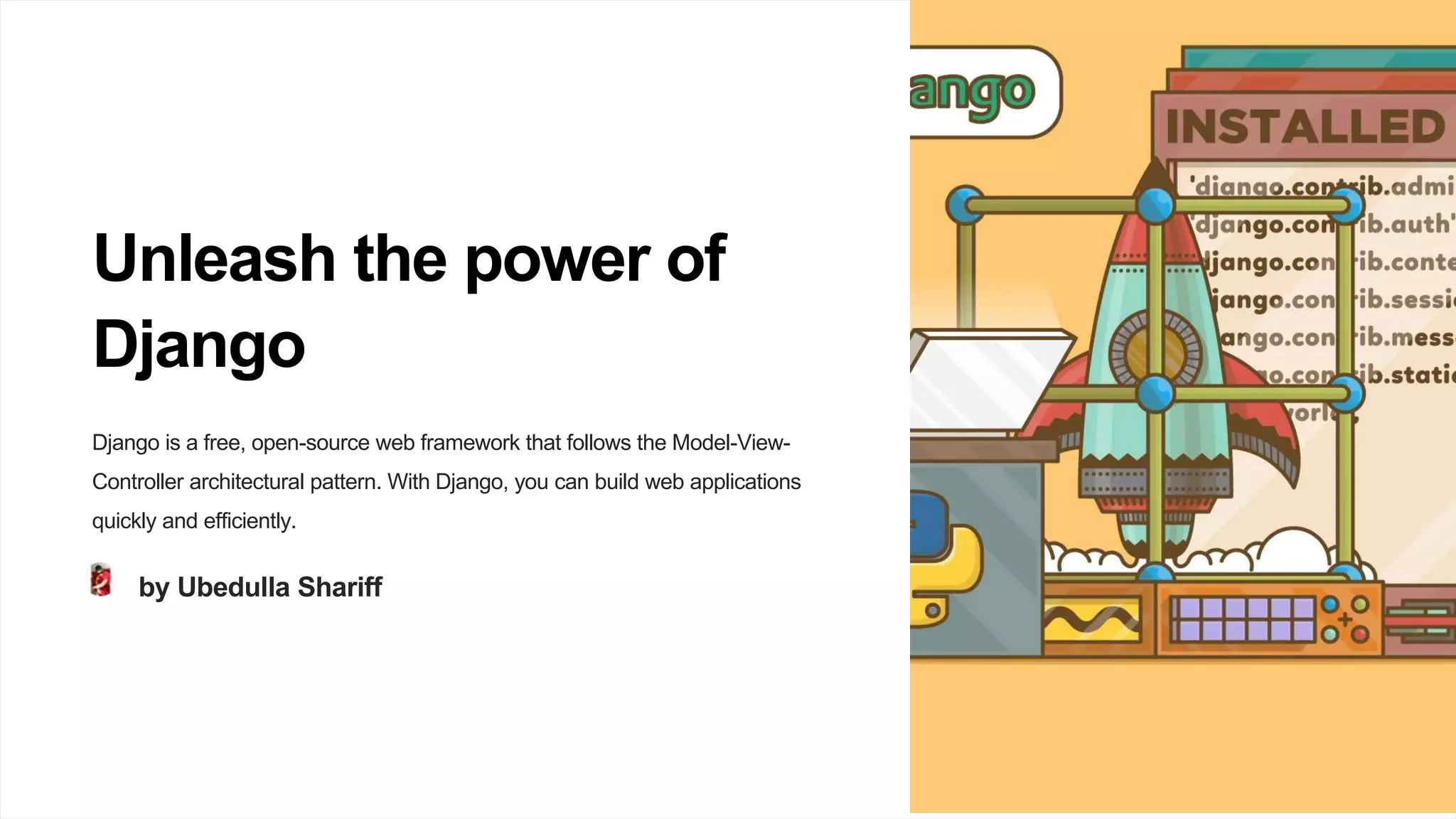
Unleash the power of
Django
Django is a free, open-source web framework that follows the Model-View-
Controller architectural pattern. With Django, you can build web applications
quickly and efficiently.
by Ubedulla Shariff
Features of Django
Fast Development 👨💻
Django makes it easier to build web
applications more quickly than ever
before.
Robust Security 🔒
Django provides a range of security
measures to keep your web
applications secure.
Scalability 📈
Django is highly scalable, which
means it can handle massive
amounts of traffic and data.
Portability 🚀
You can easily deploy Django applications on any web server that supports Python.
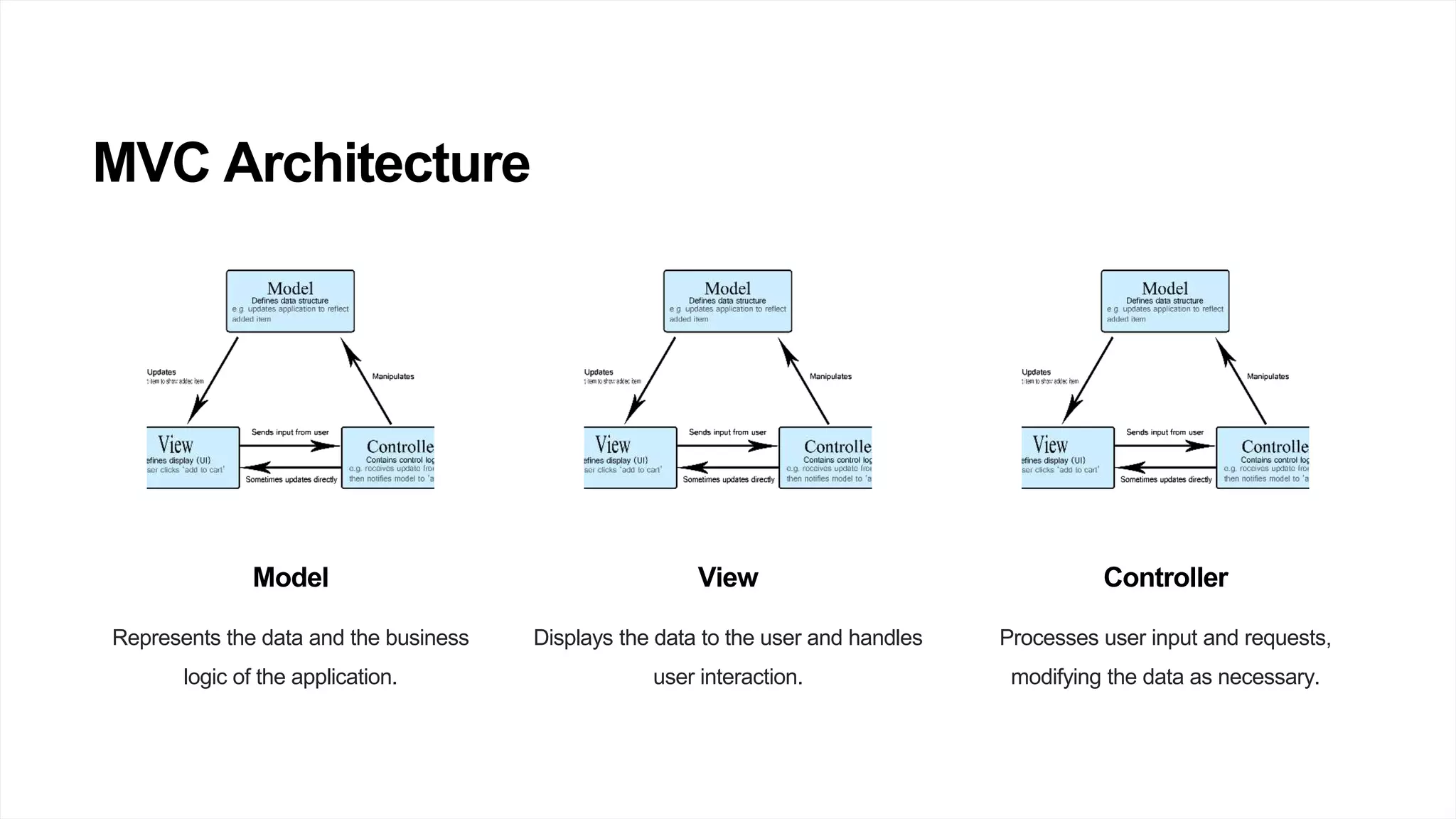
MVC Architecture
Model
Represents the data and the business
logic of the application.
View
Displays the data to the user and handles
user interaction.
Controller
Processes user input and requests,
modifying the data as necessary.
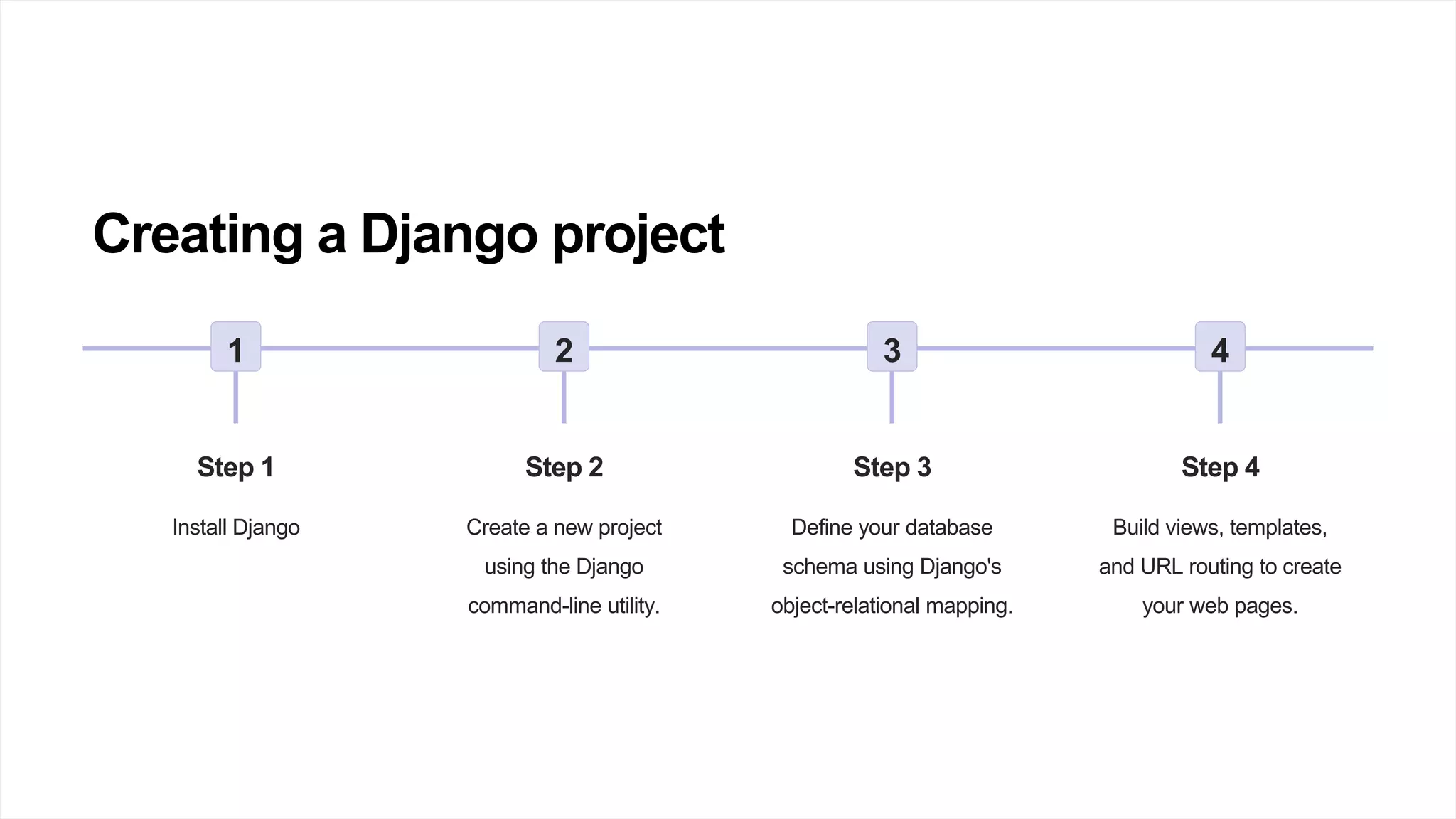
Creating a Django project
1
Step 1
Install Django
2
Step 2
Create a new project
using the Django
command-line utility.
3
Step 3
Define your database
schema using Django's
object-relational mapping.
4
Step 4
Build views, templates,
and URL routing to create
your web pages.
Working with Django Models
Fields
Django supports various types of fields
like CharField, IntegerField, DateField,
etc.
Relationships
You can define relationships between
models like one-to-many and many-to-
many relationships.
Querying the database
You can use Django's powerful query API
to filter, sort, and annotate data in
databases with ease.
Building Views with Django
1 Function-Based Views
A function -based view is a
Python function that takes a
request object and returns a
response object.
2 Class-Based Views
Django provides a set of
class-based views to make it
easier to build complex web
applications.
3 Generic Views
You can use generic views to quickly create common views, like list
views, detail views, and form views.
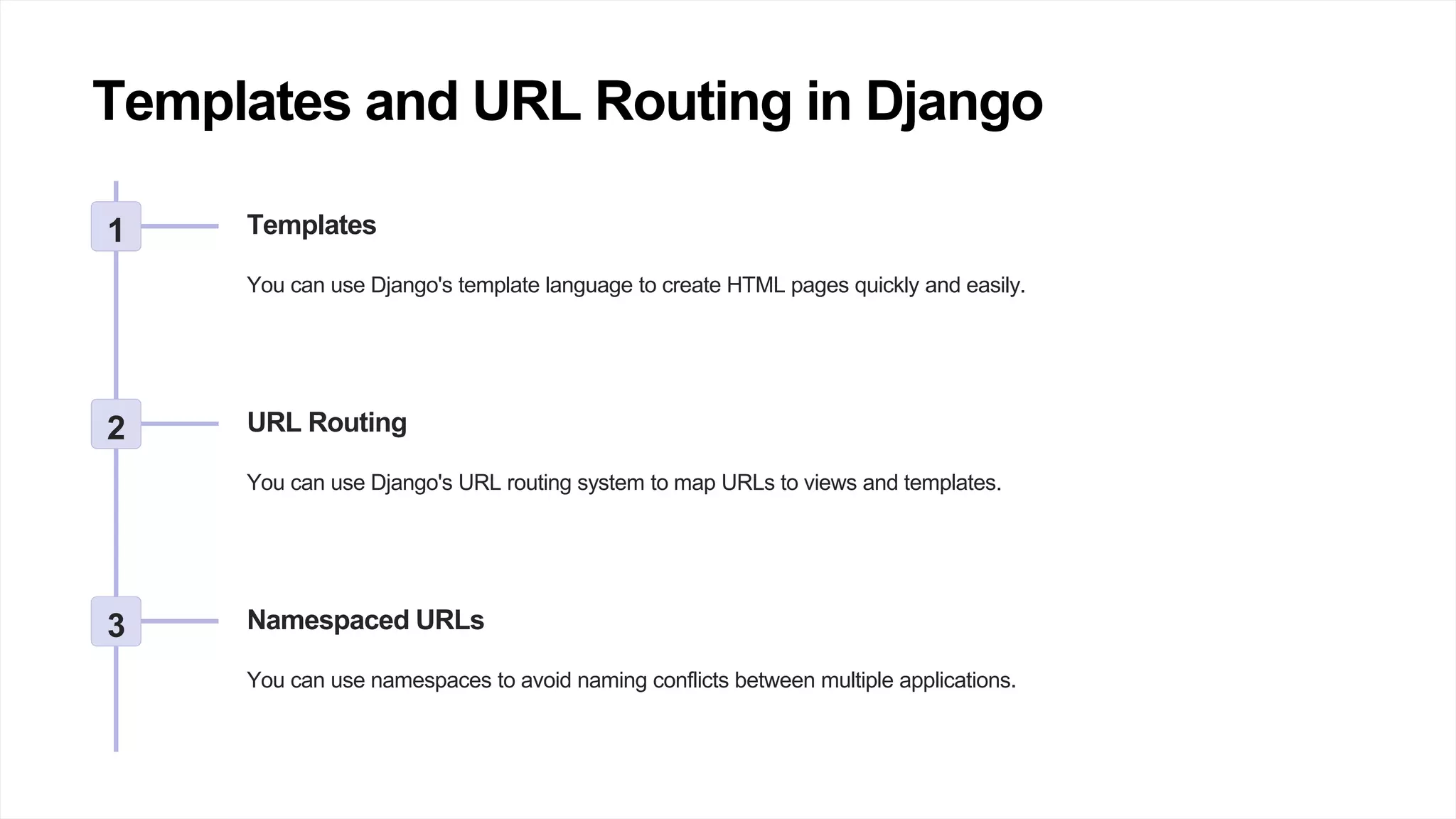
Templates and URL Routing in Django
1 Templates
You can use Django's template language to create HTML pages quickly and easily.
2 URL Routing
You can use Django's URL routing system to map URLs to views and templates.
3 Namespaced URLs
You can use namespaces to avoid naming conflicts between multiple applications.
In Conclusion
Django is a powerful web
framework
It allows you to create complex web
applications quickly and easily.
It provides robust
support for MVC
architecture
Django follows a clear separation of
concerns pattern.
It has a large and active
community
With a huge range of packages and
libraries to extend Django's capabilities.

Unleash-the-power-of-Django.pptx

  • 1.
    Unleash the powerof Django Django is a free, open-source web framework that follows the Model-View- Controller architectural pattern. With Django, you can build web applications quickly and efficiently. by Ubedulla Shariff
  • 2.
    Features of Django FastDevelopment 👨💻 Django makes it easier to build web applications more quickly than ever before. Robust Security 🔒 Django provides a range of security measures to keep your web applications secure. Scalability 📈 Django is highly scalable, which means it can handle massive amounts of traffic and data. Portability 🚀 You can easily deploy Django applications on any web server that supports Python.
  • 3.
    MVC Architecture Model Represents thedata and the business logic of the application. View Displays the data to the user and handles user interaction. Controller Processes user input and requests, modifying the data as necessary.
  • 4.
    Creating a Djangoproject 1 Step 1 Install Django 2 Step 2 Create a new project using the Django command-line utility. 3 Step 3 Define your database schema using Django's object-relational mapping. 4 Step 4 Build views, templates, and URL routing to create your web pages.
  • 5.
    Working with DjangoModels Fields Django supports various types of fields like CharField, IntegerField, DateField, etc. Relationships You can define relationships between models like one-to-many and many-to- many relationships. Querying the database You can use Django's powerful query API to filter, sort, and annotate data in databases with ease.
  • 6.
    Building Views withDjango 1 Function-Based Views A function -based view is a Python function that takes a request object and returns a response object. 2 Class-Based Views Django provides a set of class-based views to make it easier to build complex web applications. 3 Generic Views You can use generic views to quickly create common views, like list views, detail views, and form views.
  • 7.
    Templates and URLRouting in Django 1 Templates You can use Django's template language to create HTML pages quickly and easily. 2 URL Routing You can use Django's URL routing system to map URLs to views and templates. 3 Namespaced URLs You can use namespaces to avoid naming conflicts between multiple applications.
  • 8.
    In Conclusion Django isa powerful web framework It allows you to create complex web applications quickly and easily. It provides robust support for MVC architecture Django follows a clear separation of concerns pattern. It has a large and active community With a huge range of packages and libraries to extend Django's capabilities.