Carmen Martinez
School of Business Administration
Consultancy | Spring 2015
Dr. Sean Jasso
MOD
Designs
Table of Contents
Executive Summary
Overview . . . . . . . . . . . . . . . . . . . . . . . . . . . . . . . . . . . . . . . . . . . . . . . . . . . . . . . . . . . 1
Business Model . . . . . . . . . . . . . . . . . . . . . . . . . . . . . . . . . . . . . . . . . . . . . . . . . . . . . . 2
Company Mission, Vision and Values
Mission Statement . . . . . . . . . . . . . . . . . . . . . . . . . . . . . . . . . . . . . . . . . . . . . . . . . . . 3
Company Vision . . . . . . . . . . . . . . . . . . . . . . . . . . . . . . . . . . . . . . . . . . . . . . . . . . . . . 3
Corporate Values . . . . . . . . . . . . . . . . . . . . . . . . . . . . . . . . . . . . . . . . . . . . . . . . . . . . . 3
The Market
Business Industry and Outlook . . . . . . . . . . . . . . . . . . . . . . . . . . . . . . . . . . . . . . . . 4
Critical Needs of Your Market . . . . . . . . . . . . . . . . . . . . . . . . . . . . . . . . . . . . . . . . . . 5
Target Market . . . . . . . . . . . . . . . . . . . . . . . . . . . . . . . . . . . . . . . . . . . . . . . . . . . . . . . 6
Target Clients . . . . . . . . . . . . . . . . . . . . . . . . . . . . . . . . . . . . . . . . . . . . . . . . . . . . . . . .6
Market Share . . . . . . . . . . . . . . . . . . . . . . . . . . . . . . . . . . . . . . . . . . . . . . . . . . . . . . . . . 7
Description of Products and Services
Product . . . . . . . . . . . . . . . . . . . . . . . . . . . . . . . . . . . . . . . . . . . . . . . . . . . . . . . . . . . . . 9
Product Financials . . . . . . . . . . . . . . . . . . . . . . . . . . . . . . . . . . . . . . . . . . . . . . . . . . . 16
Competition . . . . . . . . . . . . . . . . . . . . . . . . . . . . . . . . . . . . . . . . . . . . . . . . . . . . . . . . . 17
Organization and Management
Proprietorship . . . . . . . . . . . . . . . . . . . . . . . . . . . . . . . . . . . . . . . . . . . . . . . . . . . . . . .18
Business Management Model . . . . . . . . . . . . . . . . . . . . . . . . . . . . . . . . . . . . . . . . . . 18
Roles of Upper Management . . . . . . . . . . . . . . . . . . . . . . . . . . . . . . . . . . . . . . . . . . .19
Roles of Lower Management . . . . . . . . . . . . . . . . . . . . . . . . . . . . . . . . . . . . . . . . . . 20
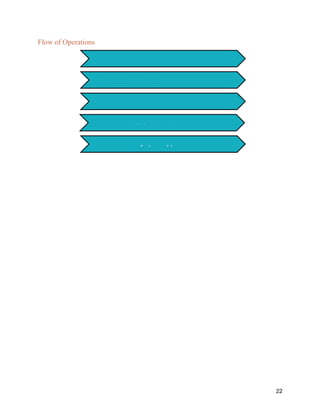
Flow of Operations . . . . . . . . . . . . . . . . . . . . . . . . . . . . . . . . . . . . . . . . . . . . . . . . . . .20
Marketing and Sales Strategy
Market Environment . . . . . . . . . . . . . . . . . . . . . . . . . . . . . . . . . . . . . . . . . . . . . . . . . .21
4P’s & 4C’s and SWOT Analysis . . . . . . . . . . . . . . . . . . . . . . . . . . . . . . . . . . . . . . . . 23
Product Life Cycle . . . . . . . . . . . . . . . . . . . . . . . . . . . . . . . . . . . . . . . . . . . . . . . . . . . 28
Sales Strategy . . . . . . . . . . . . . . . . . . . . . . . . . . . . . . . . . . . . . . . . . . . . . . . . . . . . . . . 29
Financial Management
Start Up Costs . . . . . . . . . . . . . . . . . . . . . . . . . . . . . . . . . . . . . . . . . . . . . . . . . . . . . . .30
Projected Balance Sheet . . . . . . . . . . . . . . . . . . . . . . . . . . . . . . . . . . . . . . . . . . . . . . 32
Projected Income Statement . . . . . . . . . . . . . . . . . . . . . . . . . . . . . . . . . . . . . . . . . . .33
Cash Flows . . . . . . . . . . . . . . . . . . . . . . . . . . . . . . . . . . . . . . . . . . . . . . . . . . . . . . . . . .34
Bibliography . . . . . . . . . . . . . . . . . . . . . . . . . . . . . . . . . . . . . . . . . . . . . . . . . . . . . . . . . . . . ..35
1
Executive Summary
Overview
Our product, the Functional Furniture, is created to be an all in one furniture piece designed to
complement the limited space available within an urban city environment. Our product is composed of
four separate pieces that can convert into 8 pieces of furniture. These pieces that begin with two chairs, a
couch, and a coffee table that can convert into a dining table, two bench seats, and a queen size bed. Our
product is designed to target young adults (ages 20-35) who are looking for an affordable yet
customizable option for their small urban living lifestyles. Due to the confined spaces and desires to
customize their small spaces our product is ideal for this group. Our product can not only be customized
through fabric material but also colors and style. While there are currently comparable products in the
market there are very limited affordable options. Additionally, the customizable options for them are
limited.
Problem
❖ Average size of studio apartments in cities such as San Francisco and New York are about 250 -
400 sq. ft.
❖ High prices for limited space, therefore less money for furnishings
❖ With small spaces, movability is key within the apartment and to another apartment in case you
move
Solution
❖ All-in-One furniture stop
❖ Ideal for small spaces and provides compact option for greater spatial usage
❖ Size and dimensions of our furniture allows for endless possibilities
Opportunities
❖ Furniture is ideal for studio apartments which are most common with large cities
Advantages
❖ Customizability and Affordability can gain wide attention
❖ Furniture pieces resemble the authentic furniture pieces
Business Model
Our company, will use the Huff in order to offer a specialized product to market niches that may be too
small to be worthwhile to large competitors but have the potential to grow quickly (Muller, 2014, pg.
2
254). Because of the vast amount of large competitors we will need to focus on a specific niche in order
to make profit. Additionally, our company will create the furniture and lease out retail spaces within
commercial malls in order to display and sell our furniture pieces. Going forward as we are able to
successfully enter the market and create value and a name for our brand we to operate our own online
store. Being an online retailer as well as having a storefront would allow us to reach a larger audience.
The Huff model allows us to see where our target market is located and the demands that are needed to
fill. Knowing where our target market is located allows us to choose the best location to place our stores.
Retail stores, specifically furniture stores, can be set up to fail if not opened in the right location. Using
the Huff Model allows us to maximize market share while minimizing cannibalization within a
competitive market (Drezner, 2006, Pg. 306).
In addition to the Huff model we will be using GIS software to dissect and area and understand its
capabilities.
3
Company Mission, Vision and Values
Mission Statement
Our mission is to create furniture pieces that not only fit into our consumers homes but help them express
their personality with the pieces we create. We hope to inspire creativity and passion through our products
and hope to our investors.
Company Vision
Our vision is create furniture that helps our consumers everyday life. We aim to provide products that are
both affordable and customizable in order to accommodate the small spaces available to our consumers
and to reach a larger consumer base.
Corporate Values
Our company values allow us to frame, define and reach our vision and mission . . .
Honesty:
❖ We know that our words count and we understand that you listen to them therefore our actions
will mirror them
Accountability:
❖ We promise to take responsibility of our actions
Integrity:
❖ Knowing what is right and always abiding by it
Innovation:
❖ We aim to always look out for what is new and to inspire our consumers with the products we
create
Dependable:
❖ We understand that you count on us, what you expect is what we aim to deliver
Loyal:
❖ Just as we would like to gain and keep your attention, we aim to always keep our consumers
interest at the center of our operations
Quality:
❖ It will be our promise to always put quality over quantity, doing well always
4
The Market
Business Industry and Outlook
Mod Designs will be operating within the furniture store industry specifically within the broad retail
industry. With the current slowly growing economy, mid-market retailers such as Wal-Mart Stores Inc. or
J.C. Penney Co. Inc. have been struggling due to the lack of consumer spending which has caused dollar
stores to increase within the U.S. that cater to low-income shoppers (Capital IQ, 2014, Pg. 1).
Nevertheless, “the U.S. Retail Industry is forecasted to improve throughout 2015, primarily with a
steadily, slowly improving U.S. economy” (Capital IQ, 2014, Pg. 12). The improving economy will
ultimately add disposable incomes to consumer products. The addition of these disposable incomes would
allow consumers to purchase more and purchase expensive items.
It is important to note that barriers to entry within the industry are low. The “top four furniture stores in
America represent about 19.3% of the total industry revenue. Small and independent furniture stores
represent about 60.0% of the industry” (McKitterick, 2015, Pg. 3) While the top companies have built a
reputation for their brand the market itself allows for opportunities for new entrants to exist. The main
barriers to entry within the market consist of start-up costs, product saturation and established distribution
networks. Additionally, in entering the industry capital investments and costs associated with opening a
furniture store must be considered as they cover a wide range of factors. “New entrants must also either
look for new land to build on or vacant property to open a new store. Additionally, operators will need to
design mock rooms and install cash registers, fixtures and fittings” (McKitterick, 2015, Pg. 4) Because of
this Initial starting costs are likely to be considerably high. Furthemore, limited access to distribution
channels represent another significant barrier to entry. These distribution networks between buyers and
sellers take time to develop and therefore will be something that new entrants need to consider.
5
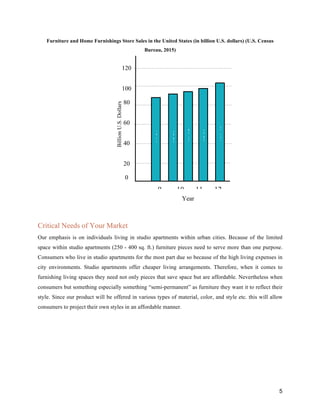
Furniture and Home Furnishings Store Sales in the United States (in billion U.S. dollars) (U.S. Census
Bureau, 2015)
Critical Needs of Your Market
Our emphasis is on individuals living in studio apartments within urban cities. Because of the limited
space within studio apartments (250 - 400 sq. ft.) furniture pieces need to serve more than one purpose.
Consumers who live in studio apartments for the most part due so because of the high living expenses in
city environments. Studio apartments offer cheaper living arrangements. Therefore, when it comes to
furnishing living spaces they need not only pieces that save space but are affordable. Nevertheless when
consumers but something especially something “semi-permanent” as furniture they want it to reflect their
style. Since our product will be offered in various types of material, color, and style etc. this will allow
consumers to project their own styles in an affordable manner.
BillionU.S.Dollars
Year
9 10 11 12
120
100
80
60
40
20
0
86.26
87.29
90.07
97.39
101.49
6
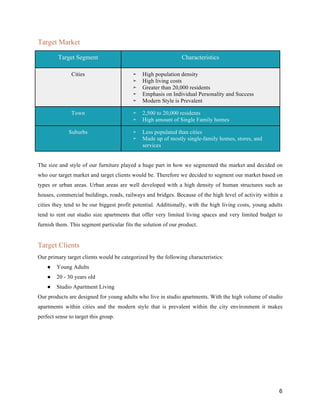
Target Market
Target Segment Characteristics
Cities ➢ High population density
➢ High living costs
➢ Greater than 20,000 residents
➢ Emphasis on Individual Personality and Success
➢ Modern Style is Prevalent
Town ➢ 2,500 to 20,000 residents
➢ High amount of Single Family homes
Suburbs ➢ Less populated than cities
➢ Made up of mostly single-family homes, stores, and
services
The size and style of our furniture played a huge part in how we segmented the market and decided on
who our target market and target clients would be. Therefore we decided to segment our market based on
types or urban areas. Urban areas are well developed with a high density of human structures such as
houses, commercial buildings, roads, railways and bridges. Because of the high level of activity within a
cities they tend to be our biggest profit potential. Additionally, with the high living costs, young adults
tend to rent out studio size apartments that offer very limited living spaces and very limited budget to
furnish them. This segment particular fits the solution of our product.
Target Clients
Our primary target clients would be categorized by the following characteristics:
● Young Adults
● 20 - 30 years old
● Studio Apartment Living
Our products are designed for young adults who live in studio apartments. With the high volume of studio
apartments within cities and the modern style that is prevalent within the city environment it makes
perfect sense to target this group.
7
Market Share
Our primary emphasis of interest within the market has provided us with an interesting opportunity to
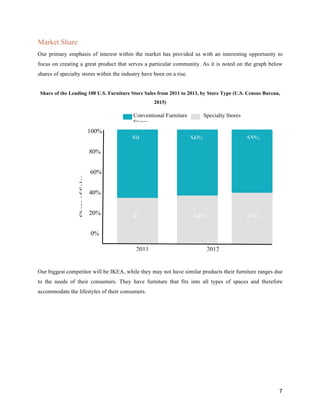
focus on creating a great product that serves a particular community. As it is noted on the graph below
shares of specialty stores within the industry have been on a rise.
Share of the Leading 100 U.S. Furniture Store Sales from 2011 to 2013, by Store Type (U.S. Census Bureau,
2015)
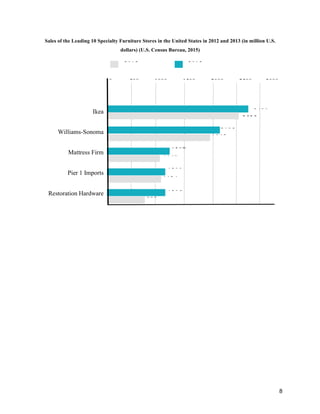
Our biggest competitor will be IKEA, while they may not have similar products their furniture ranges due
to the needs of their consumers. They have furniture that fits into all types of spaces and therefore
accommodate the lifestyles of their consumers.
ShareofSales
100%
80%
60%
40%
20%
0%
2011 2012
2013
Conventional Furniture
Stores
Specialty Stores
41 44% 45%
59 56% 55%
8
Sales of the Leading 10 Specialty Furniture Stores in the United States in 2012 and 2013 (in million U.S.
dollars) (U.S. Census Bureau, 2015)
Ikea
Williams-Sonoma
Mattress Firm
Pier 1 Imports
Restoration Hardware
0 500 1000 1500 2000 2500 3000
2012 2013
2690
2525
2185
1965
1387
1168
1209
1124
1205
890
9
Description of Products and Services
Product
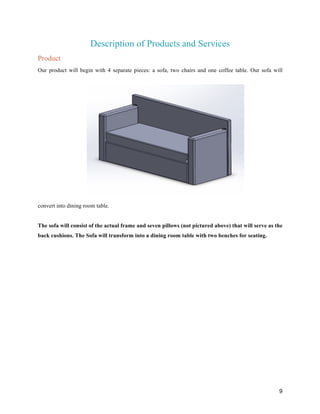
Our product will begin with 4 separate pieces: a sofa, two chairs and one coffee table. Our sofa will
convert into dining room table.
The sofa will consist of the actual frame and seven pillows (not pictured above) that will serve as the
back cushions. The Sofa will transform into a dining room table with two benches for seating.
10
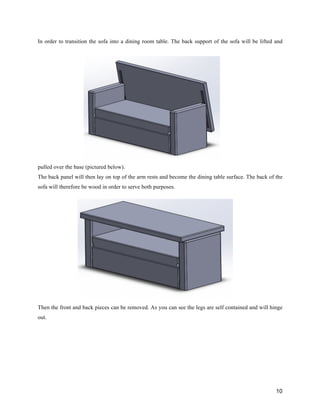
In order to transition the sofa into a dining room table. The back support of the sofa will be lifted and
pulled over the base (pictured below).
The back panel will then lay on top of the arm rests and become the dining table surface. The back of the
sofa will therefore be wood in order to serve both purposes.
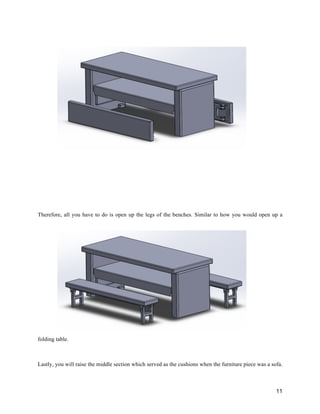
Then the front and back pieces can be removed. As you can see the legs are self contained and will hinge
out.
11
Therefore, all you have to do is open up the legs of the benches. Similar to how you would open up a
folding table.
Lastly, you will raise the middle section which served as the cushions when the furniture piece was a sofa.
12
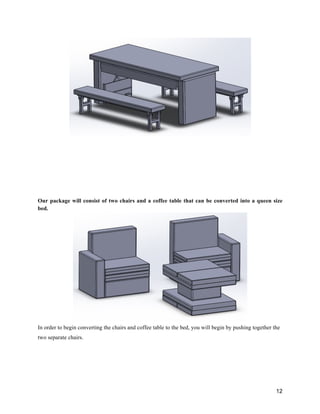
Our package will consist of two chairs and a coffee table that can be converted into a queen size
bed.
In order to begin converting the chairs and coffee table to the bed, you will begin by pushing together the
two separate chairs.
13
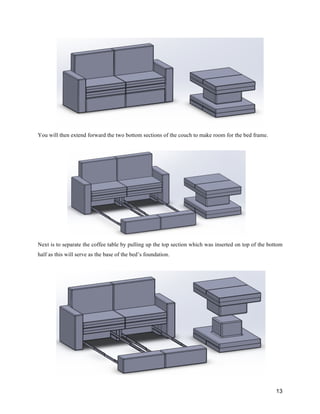
You will then extend forward the two bottom sections of the couch to make room for the bed frame.
Next is to separate the coffee table by pulling up the top section which was inserted on top of the bottom
half as this will serve as the base of the bed’s foundation.
14
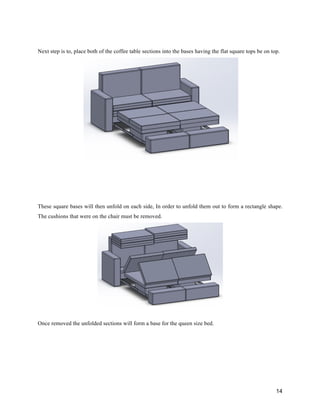
Next step is to, place both of the coffee table sections into the bases having the flat square tops be on top.
These square bases will then unfold on each side, In order to unfold them out to form a rectangle shape.
The cushions that were on the chair must be removed.
Once removed the unfolded sections will form a base for the queen size bed.
15
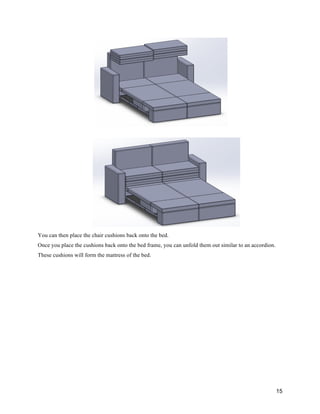
You can then place the chair cushions back onto the bed.
Once you place the cushions back onto the bed frame, you can unfold them out similar to an accordion.
These cushions will form the mattress of the bed.
16
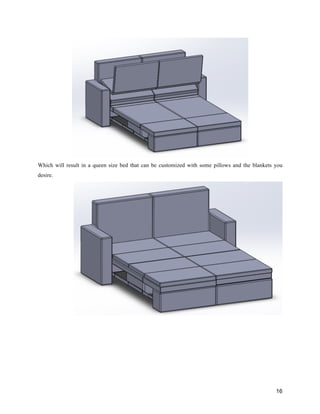
Which will result in a queen size bed that can be customized with some pillows and the blankets you
desire.
17
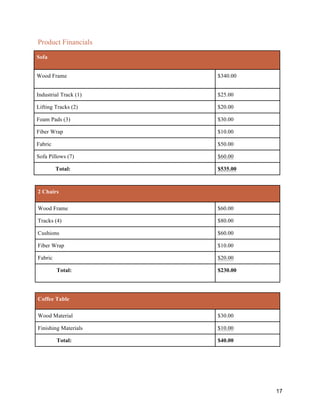
Product Financials
Sofa
Wood Frame $340.00
Industrial Track (1) $25.00
Lifting Tracks (2) $20.00
Foam Pads (3) $30.00
Fiber Wrap $10.00
Fabric $50.00
Sofa Pillows (7) $60.00
Total: $535.00
2 Chairs
Wood Frame $60.00
Tracks (4) $80.00
Cushions $60.00
Fiber Wrap $10.00
Fabric $20.00
Total: $230.00
Coffee Table
Wood Material $30.00
Finishing Materials $10.00
Total: $40.00
18
Competition
Our product serves a specific purpose. It provides modern, comfortable furniture pieces that serve more
than one purpose while saving space in an affordable manner. While we may not be the first of our kind
we do offer customizability and function within our products. Our products resemble the actual furniture
pieces you would expect. While other convertible pieces only barely resemble them.
We recognize that we will be entering into a market that already has very dominant players within it
therefore making the competition within this industry very high.. Specifically, our main competitor will
be Ikea. They offer a range of products for every living space. Furthermore they offer affordable pieces
that can fit into a variety of spaces taking into consideration the size of spaces. Nevertheless they don't
offer products that can serve more than one piece as we do. That is not to say that they can replicate our
products if they are to succeed, they certainly have the means to do so. However, they tend to focus on
what a majority of consumers need or want versus us who would focus and target a specific market.
Internal Competition
Internal competition exists as companies compete based on “customer service, delivery time, quality and
price” (McKitterick, 2015, Pg. 4). Therefore in order to become and remain competitive they need to be
able to provide excellent service to their consumers. Excellent customer service includes, fair prices, short
delivery times, great craftsmanship, durability, and great value.
External Competition
Further competition exists externally. This competition exists between specialized furniture retailers,
department stores, mass merchandisers, and warehouse stores. These type of retailers present a threat
because they can offer products at a lower price due to their economies of scale. Furthermore, “online
retailers are also growing in popularity because they can offer lower markups on prices, as they are able
to save money by not having to pay for physical inventory or a lease” (McKitterick, 2015, Pg. 18).
19
CEO
Employees
Employees
Employees
Employees
Daniel Alvarez
Head of
Research and
Development
Angel Dorado
Head of
Operations
Development
Yanting Ke
Head of
Manufacturing
Eason Liu
Head of
Manufacturing
Employees
EmployeesHead of
Marketing
Head of
Finance
Organization and Management
Proprietorship
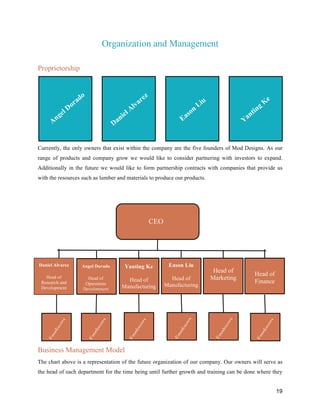
Currently, the only owners that exist within the company are the five founders of Mod Designs. As our
range of products and company grow we would like to consider partnering with investors to expand.
Additionally in the future we would like to form partnership contracts with companies that provide us
with the resources such as lumber and materials to produce our products.
Business Management Model
The chart above is a representation of the future organization of our company. Our owners will serve as
the head of each department for the time being until further growth and training can be done where they
Angel Dorado
Daniel Alvarez
Eason
Liu
Yanting K
e
20
can be replaced to look over the company’s future. Additionally, as of now there is no existing CEO,
however as the company grows someone will be assigned into that position. An outside individual will
become CEO so that the existing owners will have equal power and influence within the company.
Managers and employees within each department will also be hired.
Roles of Upper Management
The implementation of the strategic goals and objectives will be the responsibility of the executive
council which will include the CEO and each of the department heads. Top management will be
responsible for instilling initiatives that can and will impact impact current employee as well as the
operations the company. As a new entrant in the industry, the executive council needs to establish their
goals, objectives and values early on therefore they can instill those within their employees and lower
management.
Additionally, our upper management must consider the future of the company and the initiatives that will
help us reach future goals. They must also consider future needs and wants of communities, customers,
employees, suppliers, and potential shareholders. Lastly, upper management will be responsible for
adopting and carrying out a Code of Ethical Business Conduct. This will provide a guideline to help the
company recognize and deal with ethical issues in order to foster a culture of honesty and accountability.
Upper management will consist of the CEO and the department heads who will carry out the mission,
vision and values of the company.
Chief Executive Officer:
The Company’s CEO’s main responsibility is to ensure that each of the department heads within the
company carry out the mission, vision and values set forth by its owners. Additionally, they will strive to
guarantee that the company’s operation remain ethical and accountable for the actions or inactions
completed by its employees.
Head of Research and Development :
Will be in charge of staying up to date with the perceptions of our products included their strengths and
weaknesses. They will be responsible for finding alternative methods of producing our products that can
be cost efficient while being responsible members of the community. Furthemore they will be responsible
of understanding what competitor products offer and what we can do to stay ahead.
21
Head of Manufacturing:
The head of manufacturing will have the responsibility of ensuring that our products are made with the
best quality materials. Additionally, they will be responsible for ensuring that our demand of product is
met on a consistent fashion.
Head of Operations:
Will be responsible for making sure that our flow of operations is not impeded by unforeseen
circumstances. They will have to constantly analyze our processes and determine if alternative methods
would be more beneficial.
Head of Marketing:
Head of advertising will be responsible for promoting and bringing awareness to our new company and
the products we will offer. They will do so while acting ethically responsible and sharing truthful
information to our consumers.
Head of Finance:
Head of finance will be responsible for dealing with the number side of the company. Ensuring that our
costs remain low in order to produce a profit.
Roles of Lower Management
Department Managers:
Managers should focus on upholding strategic goals, objectives, and tactics implemented by upper
management. They should also look to uphold corporate governance that is also established by upper
management.
22
Flow of Operations
Obtain
Obtain Lumber
3. Construct Frames
2. Obtain Mechanisms
4. Upholstered
5. Assembly
23
Marketing and Sales Strategy
Marketing Environment
As of 2014 the furniture store industry has reached revenue levels of $57.8 billion. However the profit has
been significantly lower at $2.5 billion. Annual growth from 2010 to 2015 has been approximately 1.6%
while it is expected to grow annually 2.1% in 2015 to 2020. Products and services segmentation must also
be considered seeing as how the demand of certain types of products is greater: 38% accounts for living
room furniture, 33% bedroom furniture, 17% dining room furniture, and finally the last 12% accounts for
other types of furniture.
The existing market is dominated by a few key players. A list is provided below:
Ashley Furnitures Inc.
Estimated Market Share 6.3%
Ashley Furniture Industries Inc., is one of the nation’s largest furniture manufacturers and retailers. They
make an import upholstered furniture, leather and hardwood pieces. “The company has its own
manufacturing plants and retail stores and sells its merchandise through other furniture retailers”
(McKitterick, 2015, Pg. 23). Furthermore, it licenses its name to more than 400 Ashley Furniture Home
Stores in the U.S., Canada, Mexico, Central America and Japan.
Inter IKEA Systems BV
Estimated Market Share 5.3%
Ikea is an international furniture retailer that possesses a network of more than 300 stores in 38 countries,
within the United States alone it has 38 operation locations. “In 2010, the company added 15 new stores
to its furniture empire, and earned total company revenue of about 12.5 billion in 2014” (McKitterick,
2015, Pg. 24).
Williams-Sonoma
Estimated Market Share: 4.4%
Founded in 1956 in Sonoma, CA Williams-Sonoma is a “specialty retailer of high-end furniture and
furnishing that sells a range of kitchenware, furniture and linens along with a variety of specialty foods,
soaps and lotions” (McKitterick, 2015, Pg. 25). Its operates within 44 states, in addition to Washington
DC, Puerto Rico and online. “Its products are sold through its brand stores including Pottery Barn,
24
Pottery Barn Kids, PBteen, West Elm, Williams-Sonoma, Rejuvenation and Mark and Graham”
(McKitterick, 2015, Pg. 25).
Rooms To Go Inc.
Estimated market share: 3.5%
“Rooms To Go Inc. operates more than 120 retail furniture stores in the Southeast region of the United
States” (McKitterick, 2015, Pg. 25). The brand tends to appeal to brand-conscious, time-pressed
customers, often offering discounts for individuals who wish to purchase entire rooms of furniture.
Rooms To Go Inc. is expected to be the fourth largest furniture retailer in the industry with sales of about
$2.0 billion in 2015.
4P’s and 4C’s and SWOT Analysis
Product: Our product will consist of 4 separate furniture pieces that can be converted into a total of 8
pieces of furniture. A couch can be converted into a dining room table with two bench seats. The two
chairs and coffee table can be converted into a queen size bed.
Customer Solution: Our product will not only be affordable and comfortable but it will also be
functional and compact. Our aim is to target consumers who live in studio or compact spaces that require
furniture pieces to double in functionality.
Price: The cost to produce our product can start from $765 and can increase to do materials used to
customize in style. We plan on opening our own furniture store therefore we would be able to offer a
lower price than if we were to sell through a distributor. Our current aim is to sell our product for $975.
Customer Cost: In addition to the cost of the furniture pieces there are other costs that a consumer will
have to consider. These costs include time spent learning how to transition the pieces along with delivery
and assembly costs.
Place: We aim to begin by selling our furniture within a store and then ultimately selling them online so
that we can reach a larger audience.
Customer Convenience: As for now it will be hard for to get out name out there seeing as we will be a
new store with only one location. Because of the costs associated with opening a store including leasing
25
costs it would only be feasible to open one location. However, once we sell online consumers will be able
to purchase the furniture pieces online at their convenience rather than having to wait for operating hours.
Promotion: In order to get our brand and store name out there our aim is to open a location within an
existing shopping center this would allow us to take advantage of the existing foot tracking. Then word of
mouth would be our major advertising platform seeing as how our product must be seen and used to be
given value.
Customer Communication: Our employees training of the use of our pieces and how they transition will
allow us to communicate with our customers the easiness of use. Additionally their presence allows our
potential consumers the chance to see the furniture in its use in real time.
Strengths, Weakness, Opportunities, & Threats of Industry
Strengths Weaknesses
❖ Barriers to entry are low
❖ Level of volatility is low
❖ New Brand
Opportunities Threats
❖ Industry globalization is low
❖ Concentration in industry is low
❖ Level of regulation is low
❖ Competition is high
Strengths
Barriers to Entry are Low
Companies who plan to enter this industry will have to deal with relatively low barriers to entry. “The top
four furniture stores in America represent about 19.3% of total industry revenue” (McKitterick, 2015, Pg.
21). Even though these companies have been able to establish strong brands, there is still a vast amount of
room for new brands to emerge. Furthermore, 60% of the industry itself consists of a large number of
small and independent furniture store. The barriers of entry that do exist consist of “regulation and
industry policy which remains light and steady” (McKitterick, 2015, Pg. 21). Technological change has
also “been low during the past five years” (McKitterick, 2015, Pg. 21). The main barriers that new
entrants must take into serious consideration include start-up costs, product saturation and established
distribution networks. The considerable capital investments that are required to open a new furniture store
should be taken into account. As mentioned previously product saturation can become a barrier. Product
26
differentiation within the industry is low therefore this can hinder new companies from attracting
potential customers. Our company has the ability to deal with this issue through the use of a variety of
styles, colors, and materials used etc. Last barrier to consider includes access to distribution channels. As
we know it takes time for buyers and sellers to develop a relationship. Therefore there will be a
significant time investment to consider.
Level of Volatility is Low (McKitterick, 2015, Pg. 27)
It is no surprise that the furniture industry is impacted by economic activity. Specifically the level of
disposable income within households can “defer purchasing furniture if their income is currently lower
than prior years.”Changes in fashion in taste must also be considered as they have an effect on the type of
product demanded from the industry. Within the furniture store industry “revenue has exhibited a low
level of volatility.” With a strong recovery of the housing market revenue has continued to constantly
grow within the past years. “As the economy continues to recover, per capita disposable income and
consumer confidence will gradually gain ground.”
Weaknesses
New Brand
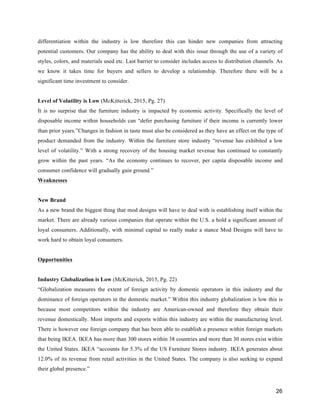
As a new brand the biggest thing that mod designs will have to deal with is establishing itself within the
market. There are already various companies that operate within the U.S. a hold a significant amount of
loyal consumers. Additionally, with minimal capital to really make a stance Mod Designs will have to
work hard to obtain loyal consumers.
Opportunities
Industry Globalization is Low (McKitterick, 2015, Pg. 22)
“Globalization measures the extent of foreign activity by domestic operators in this industry and the
dominance of foreign operators in the domestic market.” Within this industry globalization is low this is
because most competitors within the industry are American-owned and therefore they obtain their
revenue domestically. Most imports and exports within this industry are within the manufacturing level.
There is however one foreign company that has been able to establish a presence within foreign markets
that being IKEA. IKEA has more than 300 stores within 38 countries and more than 30 stores exist within
the United States. IKEA “accounts for 5.3% of the US Furniture Stores industry. IKEA generates about
12.0% of its revenue from retail activities in the United States. The company is also seeking to expand
their global presence.”
27
Concentration in industry is Low (McKitterick, 2015, Pg. 18)
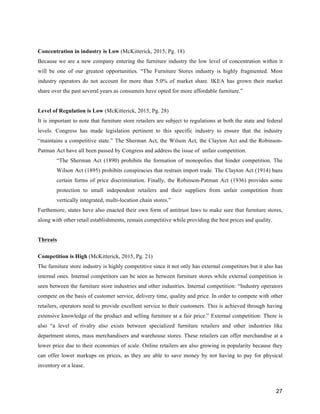
Because we are a new company entering the furniture industry the low level of concentration within it
will be one of our greatest opportunities. “The Furniture Stores industry is highly fragmented. Most
industry operators do not account for more than 5.0% of market share. IKEA has grown their market
share over the past several years as consumers have opted for more affordable furniture.”
Level of Regulation is Low (McKitterick, 2015, Pg. 28)
It is important to note that furniture store retailers are subject to regulations at both the state and federal
levels. Congress has made legislation pertinent to this specific industry to ensure that the industry
“maintains a competitive state.” The Sherman Act, the Wilson Act, the Clayton Act and the Robinson-
Patman Act have all been passed by Congress and address the issue of unfair competition.
“The Sherman Act (1890) prohibits the formation of monopolies that hinder competition. The
Wilson Act (1895) prohibits conspiracies that restrain import trade. The Clayton Act (1914) bans
certain forms of price discrimination. Finally, the Robinson-Patman Act (1936) provides some
protection to small independent retailers and their suppliers from unfair competition from
vertically integrated, multi-location chain stores.”
Furthemore, states have also enacted their own form of antitrust laws to make sure that furniture stores,
along with other retail establishments, remain competitive while providing the best prices and quality.
Threats
Competition is High (McKitterick, 2015, Pg. 21)
The furniture store industry is highly competitive since it not only has external competitors but it also has
internal ones. Internal competitors can be seen as between furniture stores while external competition is
seen between the furniture store industries and other industries. Internal competition: “Industry operators
compete on the basis of customer service, delivery time, quality and price. In order to compete with other
retailers, operators need to provide excellent service to their customers. This is achieved through having
extensive knowledge of the product and selling furniture at a fair price.” External competition: There is
also “a level of rivalry also exists between specialized furniture retailers and other industries like
department stores, mass merchandisers and warehouse stores. These retailers can offer merchandise at a
lower price due to their economies of scale. Online retailers are also growing in popularity because they
can offer lower markups on prices, as they are able to save money by not having to pay for physical
inventory or a lease.
28
Product Life Cycle
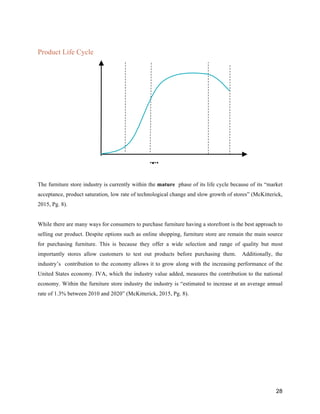
The furniture store industry is currently within the mature phase of its life cycle because of its “market
acceptance, product saturation, low rate of technological change and slow growth of stores” (McKitterick,
2015, Pg. 8).
While there are many ways for consumers to purchase furniture having a storefront is the best approach to
selling our product. Despite options such as online shopping, furniture store are remain the main source
for purchasing furniture. This is because they offer a wide selection and range of quality but most
importantly stores allow customers to test out products before purchasing them. Additionally, the
industry’s contribution to the economy allows it to grow along with the increasing performance of the
United States economy. IVA, which the industry value added, measures the contribution to the national
economy. Within the furniture store industry the industry is “estimated to increase at an average annual
rate of 1.3% between 2010 and 2020” (McKitterick, 2015, Pg. 8).
Time
Sales
Introduction
Growth
Maturity
Decline
29
Sales Strategy
Our sales strategy can be implemented with two stages where the first will help establish the second.
Store Front
Our first stage will involve us in an approach to sell our furniture through the use of a storefront location.
Because our furniture must transition in order to serve its purpose a demonstration is necessary.
Additionally, most consumers like to test out and see furniture before they purchase it. Seeing it in person
allows consumers to see the pieces and if they work for them in style and functionality.
Online Sales
The second stage after locations have established our brand and allowed our brand to gain momentum
will involve creating an online website. The website will allow us to not only reach a larger target
audience but it will also provide the convenience of consumers purchasing our products 24/7.
Additionally, our website will contain tutorials on how our furniture will operate. Since it will already be
assembled all that is left to do is know how to transition them.
30
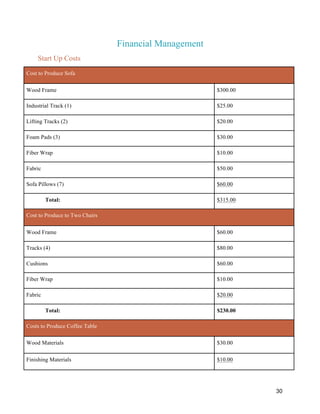
Financial Management
Start Up Costs
Cost to Produce Sofa
Wood Frame $300.00
Industrial Track (1) $25.00
Lifting Tracks (2) $20.00
Foam Pads (3) $30.00
Fiber Wrap $10.00
Fabric $50.00
Sofa Pillows (7) $60.00
Total: $315.00
Cost to Produce to Two Chairs
Wood Frame $60.00
Tracks (4) $80.00
Cushions $60.00
Fiber Wrap $10.00
Fabric $20.00
Total: $230.00
Costs to Produce Coffee Table
Wood Materials $30.00
Finishing Materials $10.00
31
Total: $40.00
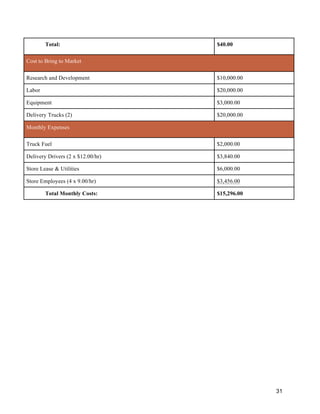
Cost to Bring to Market
Research and Development $10,000.00
Labor $20,000.00
Equipment $3,000.00
Delivery Trucks (2) $20,000.00
Monthly Expenses
Truck Fuel $2,000.00
Delivery Drivers (2 x $12.00/hr) $3,840.00
Store Lease & Utilities $6,000.00
Store Employees (4 x 9.00/hr) $3,456.00
Total Monthly Costs: $15,296.00
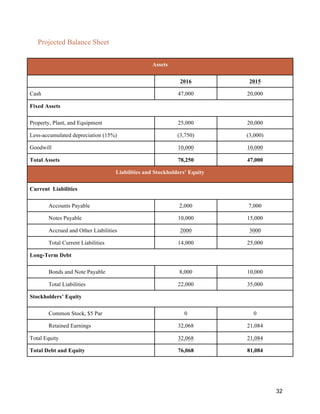
32
Projected Balance Sheet
Assets
2016 2015
Cash 47,000 20,000
Fixed Assets
Property, Plant, and Equipment 25,000 20,000
Less-accumulated depreciation (15%) (3,750) (3,000)
Goodwill 10,000 10,000
Total Assets 78,250 47,000
Liabilities and Stockholders’ Equity
Current Liabilities
Accounts Payable 2,000 7,000
Notes Payable 10,000 15,000
Accrued and Other Liabilities 2000 3000
Total Current Liabilities 14,000 25,000
Long-Term Debt
Bonds and Note Payable 8,000 10,000
Total Liabilities 22,000 35,000
Stockholders’ Equity
Common Stock, $5 Par 0 0
Retained Earnings 32,068 21,084
Total Equity 32,068 21,084
Total Debt and Equity 76,068 81,084
33
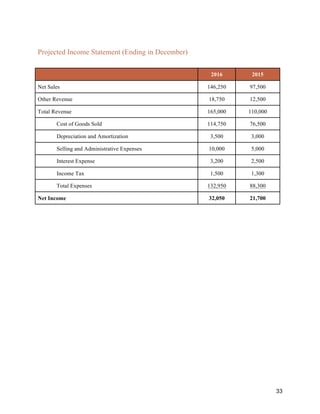
Projected Income Statement (Ending in December)
2016 2015
Net Sales 146,250 97,500
Other Revenue 18,750 12,500
Total Revenue 165,000 110,000
Cost of Goods Sold 114,750 76,500
Depreciation and Amortization 3,500 3,000
Selling and Administrative Expenses 10,000 5,000
Interest Expense 3,200 2,500
Income Tax 1,500 1,300
Total Expenses 132,950 88,300
Net Income 32,050 21,700
34
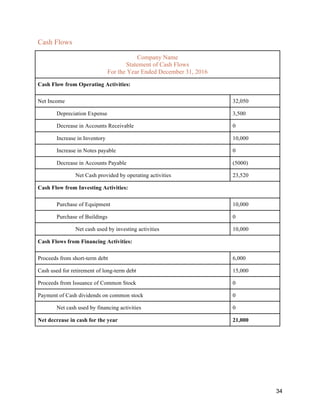
Cash Flows
Company Name
Statement of Cash Flows
For the Year Ended December 31, 2016
Cash Flow from Operating Activities:
Net Income 32,050
Depreciation Expense 3,500
Decrease in Accounts Receivable 0
Increase in Inventory 10,000
Increase in Notes payable 0
Decrease in Accounts Payable (5000)
Net Cash provided by operating activities 23,520
Cash Flow from Investing Activities:
Purchase of Equipment 10,000
Purchase of Buildings 0
Net cash used by investing activities 10,000
Cash Flows from Financing Activities:
Proceeds from short-term debt 6,000
Cash used for retirement of long-term debt 15,000
Proceeds from Issuance of Common Stock 0
Payment of Cash dividends on common stock 0
Net cash used by financing activities 0
Net decrease in cash for the year 21,000
35
Bibliography
Capital IQ. (2014, October 1). Industry Surveys: Retailing: General. Retrieved May 30,
2015.
Drezner, Tammy. 2011. "Cannibalization in a Competitive Environment." International
Regional Science Review 34, no. 3: 306-322. Business Source Complete, EBSCOhost
(accessed May 24, 2015).
McKitterick, W. (2015). Furniture Stores in the US. Retrieved May 16, 2015.
Müller, S., & Haase, K. (2014). Customer segmentation in retail facility location planning.
Business Research, 7(2), 235-261.
U.S. Census Bureau. (2015, March 1). Furniture retail in the U.S. - Statista Dossier.
Retrieved May 5, 2015.

ModDesignsCo.Plan

  • 1.
    Carmen Martinez School ofBusiness Administration Consultancy | Spring 2015 Dr. Sean Jasso MOD Designs
  • 2.
    Table of Contents ExecutiveSummary Overview . . . . . . . . . . . . . . . . . . . . . . . . . . . . . . . . . . . . . . . . . . . . . . . . . . . . . . . . . . . 1 Business Model . . . . . . . . . . . . . . . . . . . . . . . . . . . . . . . . . . . . . . . . . . . . . . . . . . . . . . 2 Company Mission, Vision and Values Mission Statement . . . . . . . . . . . . . . . . . . . . . . . . . . . . . . . . . . . . . . . . . . . . . . . . . . . 3 Company Vision . . . . . . . . . . . . . . . . . . . . . . . . . . . . . . . . . . . . . . . . . . . . . . . . . . . . . 3 Corporate Values . . . . . . . . . . . . . . . . . . . . . . . . . . . . . . . . . . . . . . . . . . . . . . . . . . . . . 3 The Market Business Industry and Outlook . . . . . . . . . . . . . . . . . . . . . . . . . . . . . . . . . . . . . . . . 4 Critical Needs of Your Market . . . . . . . . . . . . . . . . . . . . . . . . . . . . . . . . . . . . . . . . . . 5 Target Market . . . . . . . . . . . . . . . . . . . . . . . . . . . . . . . . . . . . . . . . . . . . . . . . . . . . . . . 6 Target Clients . . . . . . . . . . . . . . . . . . . . . . . . . . . . . . . . . . . . . . . . . . . . . . . . . . . . . . . .6 Market Share . . . . . . . . . . . . . . . . . . . . . . . . . . . . . . . . . . . . . . . . . . . . . . . . . . . . . . . . . 7 Description of Products and Services Product . . . . . . . . . . . . . . . . . . . . . . . . . . . . . . . . . . . . . . . . . . . . . . . . . . . . . . . . . . . . . 9 Product Financials . . . . . . . . . . . . . . . . . . . . . . . . . . . . . . . . . . . . . . . . . . . . . . . . . . . 16 Competition . . . . . . . . . . . . . . . . . . . . . . . . . . . . . . . . . . . . . . . . . . . . . . . . . . . . . . . . . 17 Organization and Management Proprietorship . . . . . . . . . . . . . . . . . . . . . . . . . . . . . . . . . . . . . . . . . . . . . . . . . . . . . . .18
  • 3.
    Business Management Model. . . . . . . . . . . . . . . . . . . . . . . . . . . . . . . . . . . . . . . . . . 18 Roles of Upper Management . . . . . . . . . . . . . . . . . . . . . . . . . . . . . . . . . . . . . . . . . . .19 Roles of Lower Management . . . . . . . . . . . . . . . . . . . . . . . . . . . . . . . . . . . . . . . . . . 20 Flow of Operations . . . . . . . . . . . . . . . . . . . . . . . . . . . . . . . . . . . . . . . . . . . . . . . . . . .20 Marketing and Sales Strategy Market Environment . . . . . . . . . . . . . . . . . . . . . . . . . . . . . . . . . . . . . . . . . . . . . . . . . .21 4P’s & 4C’s and SWOT Analysis . . . . . . . . . . . . . . . . . . . . . . . . . . . . . . . . . . . . . . . . 23 Product Life Cycle . . . . . . . . . . . . . . . . . . . . . . . . . . . . . . . . . . . . . . . . . . . . . . . . . . . 28 Sales Strategy . . . . . . . . . . . . . . . . . . . . . . . . . . . . . . . . . . . . . . . . . . . . . . . . . . . . . . . 29 Financial Management Start Up Costs . . . . . . . . . . . . . . . . . . . . . . . . . . . . . . . . . . . . . . . . . . . . . . . . . . . . . . .30 Projected Balance Sheet . . . . . . . . . . . . . . . . . . . . . . . . . . . . . . . . . . . . . . . . . . . . . . 32 Projected Income Statement . . . . . . . . . . . . . . . . . . . . . . . . . . . . . . . . . . . . . . . . . . .33 Cash Flows . . . . . . . . . . . . . . . . . . . . . . . . . . . . . . . . . . . . . . . . . . . . . . . . . . . . . . . . . .34 Bibliography . . . . . . . . . . . . . . . . . . . . . . . . . . . . . . . . . . . . . . . . . . . . . . . . . . . . . . . . . . . . ..35
  • 4.
    1 Executive Summary Overview Our product,the Functional Furniture, is created to be an all in one furniture piece designed to complement the limited space available within an urban city environment. Our product is composed of four separate pieces that can convert into 8 pieces of furniture. These pieces that begin with two chairs, a couch, and a coffee table that can convert into a dining table, two bench seats, and a queen size bed. Our product is designed to target young adults (ages 20-35) who are looking for an affordable yet customizable option for their small urban living lifestyles. Due to the confined spaces and desires to customize their small spaces our product is ideal for this group. Our product can not only be customized through fabric material but also colors and style. While there are currently comparable products in the market there are very limited affordable options. Additionally, the customizable options for them are limited. Problem ❖ Average size of studio apartments in cities such as San Francisco and New York are about 250 - 400 sq. ft. ❖ High prices for limited space, therefore less money for furnishings ❖ With small spaces, movability is key within the apartment and to another apartment in case you move Solution ❖ All-in-One furniture stop ❖ Ideal for small spaces and provides compact option for greater spatial usage ❖ Size and dimensions of our furniture allows for endless possibilities Opportunities ❖ Furniture is ideal for studio apartments which are most common with large cities Advantages ❖ Customizability and Affordability can gain wide attention ❖ Furniture pieces resemble the authentic furniture pieces Business Model Our company, will use the Huff in order to offer a specialized product to market niches that may be too small to be worthwhile to large competitors but have the potential to grow quickly (Muller, 2014, pg.
  • 5.
    2 254). Because ofthe vast amount of large competitors we will need to focus on a specific niche in order to make profit. Additionally, our company will create the furniture and lease out retail spaces within commercial malls in order to display and sell our furniture pieces. Going forward as we are able to successfully enter the market and create value and a name for our brand we to operate our own online store. Being an online retailer as well as having a storefront would allow us to reach a larger audience. The Huff model allows us to see where our target market is located and the demands that are needed to fill. Knowing where our target market is located allows us to choose the best location to place our stores. Retail stores, specifically furniture stores, can be set up to fail if not opened in the right location. Using the Huff Model allows us to maximize market share while minimizing cannibalization within a competitive market (Drezner, 2006, Pg. 306). In addition to the Huff model we will be using GIS software to dissect and area and understand its capabilities.
  • 6.
    3 Company Mission, Visionand Values Mission Statement Our mission is to create furniture pieces that not only fit into our consumers homes but help them express their personality with the pieces we create. We hope to inspire creativity and passion through our products and hope to our investors. Company Vision Our vision is create furniture that helps our consumers everyday life. We aim to provide products that are both affordable and customizable in order to accommodate the small spaces available to our consumers and to reach a larger consumer base. Corporate Values Our company values allow us to frame, define and reach our vision and mission . . . Honesty: ❖ We know that our words count and we understand that you listen to them therefore our actions will mirror them Accountability: ❖ We promise to take responsibility of our actions Integrity: ❖ Knowing what is right and always abiding by it Innovation: ❖ We aim to always look out for what is new and to inspire our consumers with the products we create Dependable: ❖ We understand that you count on us, what you expect is what we aim to deliver Loyal: ❖ Just as we would like to gain and keep your attention, we aim to always keep our consumers interest at the center of our operations Quality: ❖ It will be our promise to always put quality over quantity, doing well always
  • 7.
    4 The Market Business Industryand Outlook Mod Designs will be operating within the furniture store industry specifically within the broad retail industry. With the current slowly growing economy, mid-market retailers such as Wal-Mart Stores Inc. or J.C. Penney Co. Inc. have been struggling due to the lack of consumer spending which has caused dollar stores to increase within the U.S. that cater to low-income shoppers (Capital IQ, 2014, Pg. 1). Nevertheless, “the U.S. Retail Industry is forecasted to improve throughout 2015, primarily with a steadily, slowly improving U.S. economy” (Capital IQ, 2014, Pg. 12). The improving economy will ultimately add disposable incomes to consumer products. The addition of these disposable incomes would allow consumers to purchase more and purchase expensive items. It is important to note that barriers to entry within the industry are low. The “top four furniture stores in America represent about 19.3% of the total industry revenue. Small and independent furniture stores represent about 60.0% of the industry” (McKitterick, 2015, Pg. 3) While the top companies have built a reputation for their brand the market itself allows for opportunities for new entrants to exist. The main barriers to entry within the market consist of start-up costs, product saturation and established distribution networks. Additionally, in entering the industry capital investments and costs associated with opening a furniture store must be considered as they cover a wide range of factors. “New entrants must also either look for new land to build on or vacant property to open a new store. Additionally, operators will need to design mock rooms and install cash registers, fixtures and fittings” (McKitterick, 2015, Pg. 4) Because of this Initial starting costs are likely to be considerably high. Furthemore, limited access to distribution channels represent another significant barrier to entry. These distribution networks between buyers and sellers take time to develop and therefore will be something that new entrants need to consider.
  • 8.
    5 Furniture and HomeFurnishings Store Sales in the United States (in billion U.S. dollars) (U.S. Census Bureau, 2015) Critical Needs of Your Market Our emphasis is on individuals living in studio apartments within urban cities. Because of the limited space within studio apartments (250 - 400 sq. ft.) furniture pieces need to serve more than one purpose. Consumers who live in studio apartments for the most part due so because of the high living expenses in city environments. Studio apartments offer cheaper living arrangements. Therefore, when it comes to furnishing living spaces they need not only pieces that save space but are affordable. Nevertheless when consumers but something especially something “semi-permanent” as furniture they want it to reflect their style. Since our product will be offered in various types of material, color, and style etc. this will allow consumers to project their own styles in an affordable manner. BillionU.S.Dollars Year 9 10 11 12 120 100 80 60 40 20 0 86.26 87.29 90.07 97.39 101.49
  • 9.
    6 Target Market Target SegmentCharacteristics Cities ➢ High population density ➢ High living costs ➢ Greater than 20,000 residents ➢ Emphasis on Individual Personality and Success ➢ Modern Style is Prevalent Town ➢ 2,500 to 20,000 residents ➢ High amount of Single Family homes Suburbs ➢ Less populated than cities ➢ Made up of mostly single-family homes, stores, and services The size and style of our furniture played a huge part in how we segmented the market and decided on who our target market and target clients would be. Therefore we decided to segment our market based on types or urban areas. Urban areas are well developed with a high density of human structures such as houses, commercial buildings, roads, railways and bridges. Because of the high level of activity within a cities they tend to be our biggest profit potential. Additionally, with the high living costs, young adults tend to rent out studio size apartments that offer very limited living spaces and very limited budget to furnish them. This segment particular fits the solution of our product. Target Clients Our primary target clients would be categorized by the following characteristics: ● Young Adults ● 20 - 30 years old ● Studio Apartment Living Our products are designed for young adults who live in studio apartments. With the high volume of studio apartments within cities and the modern style that is prevalent within the city environment it makes perfect sense to target this group.
  • 10.
    7 Market Share Our primaryemphasis of interest within the market has provided us with an interesting opportunity to focus on creating a great product that serves a particular community. As it is noted on the graph below shares of specialty stores within the industry have been on a rise. Share of the Leading 100 U.S. Furniture Store Sales from 2011 to 2013, by Store Type (U.S. Census Bureau, 2015) Our biggest competitor will be IKEA, while they may not have similar products their furniture ranges due to the needs of their consumers. They have furniture that fits into all types of spaces and therefore accommodate the lifestyles of their consumers. ShareofSales 100% 80% 60% 40% 20% 0% 2011 2012 2013 Conventional Furniture Stores Specialty Stores 41 44% 45% 59 56% 55%
  • 11.
    8 Sales of theLeading 10 Specialty Furniture Stores in the United States in 2012 and 2013 (in million U.S. dollars) (U.S. Census Bureau, 2015) Ikea Williams-Sonoma Mattress Firm Pier 1 Imports Restoration Hardware 0 500 1000 1500 2000 2500 3000 2012 2013 2690 2525 2185 1965 1387 1168 1209 1124 1205 890
  • 12.
    9 Description of Productsand Services Product Our product will begin with 4 separate pieces: a sofa, two chairs and one coffee table. Our sofa will convert into dining room table. The sofa will consist of the actual frame and seven pillows (not pictured above) that will serve as the back cushions. The Sofa will transform into a dining room table with two benches for seating.
  • 13.
    10 In order totransition the sofa into a dining room table. The back support of the sofa will be lifted and pulled over the base (pictured below). The back panel will then lay on top of the arm rests and become the dining table surface. The back of the sofa will therefore be wood in order to serve both purposes. Then the front and back pieces can be removed. As you can see the legs are self contained and will hinge out.
  • 14.
    11 Therefore, all youhave to do is open up the legs of the benches. Similar to how you would open up a folding table. Lastly, you will raise the middle section which served as the cushions when the furniture piece was a sofa.
  • 15.
    12 Our package willconsist of two chairs and a coffee table that can be converted into a queen size bed. In order to begin converting the chairs and coffee table to the bed, you will begin by pushing together the two separate chairs.
  • 16.
    13 You will thenextend forward the two bottom sections of the couch to make room for the bed frame. Next is to separate the coffee table by pulling up the top section which was inserted on top of the bottom half as this will serve as the base of the bed’s foundation.
  • 17.
    14 Next step isto, place both of the coffee table sections into the bases having the flat square tops be on top. These square bases will then unfold on each side, In order to unfold them out to form a rectangle shape. The cushions that were on the chair must be removed. Once removed the unfolded sections will form a base for the queen size bed.
  • 18.
    15 You can thenplace the chair cushions back onto the bed. Once you place the cushions back onto the bed frame, you can unfold them out similar to an accordion. These cushions will form the mattress of the bed.
  • 19.
    16 Which will resultin a queen size bed that can be customized with some pillows and the blankets you desire.
  • 20.
    17 Product Financials Sofa Wood Frame$340.00 Industrial Track (1) $25.00 Lifting Tracks (2) $20.00 Foam Pads (3) $30.00 Fiber Wrap $10.00 Fabric $50.00 Sofa Pillows (7) $60.00 Total: $535.00 2 Chairs Wood Frame $60.00 Tracks (4) $80.00 Cushions $60.00 Fiber Wrap $10.00 Fabric $20.00 Total: $230.00 Coffee Table Wood Material $30.00 Finishing Materials $10.00 Total: $40.00
  • 21.
    18 Competition Our product servesa specific purpose. It provides modern, comfortable furniture pieces that serve more than one purpose while saving space in an affordable manner. While we may not be the first of our kind we do offer customizability and function within our products. Our products resemble the actual furniture pieces you would expect. While other convertible pieces only barely resemble them. We recognize that we will be entering into a market that already has very dominant players within it therefore making the competition within this industry very high.. Specifically, our main competitor will be Ikea. They offer a range of products for every living space. Furthermore they offer affordable pieces that can fit into a variety of spaces taking into consideration the size of spaces. Nevertheless they don't offer products that can serve more than one piece as we do. That is not to say that they can replicate our products if they are to succeed, they certainly have the means to do so. However, they tend to focus on what a majority of consumers need or want versus us who would focus and target a specific market. Internal Competition Internal competition exists as companies compete based on “customer service, delivery time, quality and price” (McKitterick, 2015, Pg. 4). Therefore in order to become and remain competitive they need to be able to provide excellent service to their consumers. Excellent customer service includes, fair prices, short delivery times, great craftsmanship, durability, and great value. External Competition Further competition exists externally. This competition exists between specialized furniture retailers, department stores, mass merchandisers, and warehouse stores. These type of retailers present a threat because they can offer products at a lower price due to their economies of scale. Furthermore, “online retailers are also growing in popularity because they can offer lower markups on prices, as they are able to save money by not having to pay for physical inventory or a lease” (McKitterick, 2015, Pg. 18).
  • 22.
    19 CEO Employees Employees Employees Employees Daniel Alvarez Head of Researchand Development Angel Dorado Head of Operations Development Yanting Ke Head of Manufacturing Eason Liu Head of Manufacturing Employees EmployeesHead of Marketing Head of Finance Organization and Management Proprietorship Currently, the only owners that exist within the company are the five founders of Mod Designs. As our range of products and company grow we would like to consider partnering with investors to expand. Additionally in the future we would like to form partnership contracts with companies that provide us with the resources such as lumber and materials to produce our products. Business Management Model The chart above is a representation of the future organization of our company. Our owners will serve as the head of each department for the time being until further growth and training can be done where they Angel Dorado Daniel Alvarez Eason Liu Yanting K e
  • 23.
    20 can be replacedto look over the company’s future. Additionally, as of now there is no existing CEO, however as the company grows someone will be assigned into that position. An outside individual will become CEO so that the existing owners will have equal power and influence within the company. Managers and employees within each department will also be hired. Roles of Upper Management The implementation of the strategic goals and objectives will be the responsibility of the executive council which will include the CEO and each of the department heads. Top management will be responsible for instilling initiatives that can and will impact impact current employee as well as the operations the company. As a new entrant in the industry, the executive council needs to establish their goals, objectives and values early on therefore they can instill those within their employees and lower management. Additionally, our upper management must consider the future of the company and the initiatives that will help us reach future goals. They must also consider future needs and wants of communities, customers, employees, suppliers, and potential shareholders. Lastly, upper management will be responsible for adopting and carrying out a Code of Ethical Business Conduct. This will provide a guideline to help the company recognize and deal with ethical issues in order to foster a culture of honesty and accountability. Upper management will consist of the CEO and the department heads who will carry out the mission, vision and values of the company. Chief Executive Officer: The Company’s CEO’s main responsibility is to ensure that each of the department heads within the company carry out the mission, vision and values set forth by its owners. Additionally, they will strive to guarantee that the company’s operation remain ethical and accountable for the actions or inactions completed by its employees. Head of Research and Development : Will be in charge of staying up to date with the perceptions of our products included their strengths and weaknesses. They will be responsible for finding alternative methods of producing our products that can be cost efficient while being responsible members of the community. Furthemore they will be responsible of understanding what competitor products offer and what we can do to stay ahead.
  • 24.
    21 Head of Manufacturing: Thehead of manufacturing will have the responsibility of ensuring that our products are made with the best quality materials. Additionally, they will be responsible for ensuring that our demand of product is met on a consistent fashion. Head of Operations: Will be responsible for making sure that our flow of operations is not impeded by unforeseen circumstances. They will have to constantly analyze our processes and determine if alternative methods would be more beneficial. Head of Marketing: Head of advertising will be responsible for promoting and bringing awareness to our new company and the products we will offer. They will do so while acting ethically responsible and sharing truthful information to our consumers. Head of Finance: Head of finance will be responsible for dealing with the number side of the company. Ensuring that our costs remain low in order to produce a profit. Roles of Lower Management Department Managers: Managers should focus on upholding strategic goals, objectives, and tactics implemented by upper management. They should also look to uphold corporate governance that is also established by upper management.
  • 25.
    22 Flow of Operations Obtain ObtainLumber 3. Construct Frames 2. Obtain Mechanisms 4. Upholstered 5. Assembly
  • 26.
    23 Marketing and SalesStrategy Marketing Environment As of 2014 the furniture store industry has reached revenue levels of $57.8 billion. However the profit has been significantly lower at $2.5 billion. Annual growth from 2010 to 2015 has been approximately 1.6% while it is expected to grow annually 2.1% in 2015 to 2020. Products and services segmentation must also be considered seeing as how the demand of certain types of products is greater: 38% accounts for living room furniture, 33% bedroom furniture, 17% dining room furniture, and finally the last 12% accounts for other types of furniture. The existing market is dominated by a few key players. A list is provided below: Ashley Furnitures Inc. Estimated Market Share 6.3% Ashley Furniture Industries Inc., is one of the nation’s largest furniture manufacturers and retailers. They make an import upholstered furniture, leather and hardwood pieces. “The company has its own manufacturing plants and retail stores and sells its merchandise through other furniture retailers” (McKitterick, 2015, Pg. 23). Furthermore, it licenses its name to more than 400 Ashley Furniture Home Stores in the U.S., Canada, Mexico, Central America and Japan. Inter IKEA Systems BV Estimated Market Share 5.3% Ikea is an international furniture retailer that possesses a network of more than 300 stores in 38 countries, within the United States alone it has 38 operation locations. “In 2010, the company added 15 new stores to its furniture empire, and earned total company revenue of about 12.5 billion in 2014” (McKitterick, 2015, Pg. 24). Williams-Sonoma Estimated Market Share: 4.4% Founded in 1956 in Sonoma, CA Williams-Sonoma is a “specialty retailer of high-end furniture and furnishing that sells a range of kitchenware, furniture and linens along with a variety of specialty foods, soaps and lotions” (McKitterick, 2015, Pg. 25). Its operates within 44 states, in addition to Washington DC, Puerto Rico and online. “Its products are sold through its brand stores including Pottery Barn,
  • 27.
    24 Pottery Barn Kids,PBteen, West Elm, Williams-Sonoma, Rejuvenation and Mark and Graham” (McKitterick, 2015, Pg. 25). Rooms To Go Inc. Estimated market share: 3.5% “Rooms To Go Inc. operates more than 120 retail furniture stores in the Southeast region of the United States” (McKitterick, 2015, Pg. 25). The brand tends to appeal to brand-conscious, time-pressed customers, often offering discounts for individuals who wish to purchase entire rooms of furniture. Rooms To Go Inc. is expected to be the fourth largest furniture retailer in the industry with sales of about $2.0 billion in 2015. 4P’s and 4C’s and SWOT Analysis Product: Our product will consist of 4 separate furniture pieces that can be converted into a total of 8 pieces of furniture. A couch can be converted into a dining room table with two bench seats. The two chairs and coffee table can be converted into a queen size bed. Customer Solution: Our product will not only be affordable and comfortable but it will also be functional and compact. Our aim is to target consumers who live in studio or compact spaces that require furniture pieces to double in functionality. Price: The cost to produce our product can start from $765 and can increase to do materials used to customize in style. We plan on opening our own furniture store therefore we would be able to offer a lower price than if we were to sell through a distributor. Our current aim is to sell our product for $975. Customer Cost: In addition to the cost of the furniture pieces there are other costs that a consumer will have to consider. These costs include time spent learning how to transition the pieces along with delivery and assembly costs. Place: We aim to begin by selling our furniture within a store and then ultimately selling them online so that we can reach a larger audience. Customer Convenience: As for now it will be hard for to get out name out there seeing as we will be a new store with only one location. Because of the costs associated with opening a store including leasing
  • 28.
    25 costs it wouldonly be feasible to open one location. However, once we sell online consumers will be able to purchase the furniture pieces online at their convenience rather than having to wait for operating hours. Promotion: In order to get our brand and store name out there our aim is to open a location within an existing shopping center this would allow us to take advantage of the existing foot tracking. Then word of mouth would be our major advertising platform seeing as how our product must be seen and used to be given value. Customer Communication: Our employees training of the use of our pieces and how they transition will allow us to communicate with our customers the easiness of use. Additionally their presence allows our potential consumers the chance to see the furniture in its use in real time. Strengths, Weakness, Opportunities, & Threats of Industry Strengths Weaknesses ❖ Barriers to entry are low ❖ Level of volatility is low ❖ New Brand Opportunities Threats ❖ Industry globalization is low ❖ Concentration in industry is low ❖ Level of regulation is low ❖ Competition is high Strengths Barriers to Entry are Low Companies who plan to enter this industry will have to deal with relatively low barriers to entry. “The top four furniture stores in America represent about 19.3% of total industry revenue” (McKitterick, 2015, Pg. 21). Even though these companies have been able to establish strong brands, there is still a vast amount of room for new brands to emerge. Furthermore, 60% of the industry itself consists of a large number of small and independent furniture store. The barriers of entry that do exist consist of “regulation and industry policy which remains light and steady” (McKitterick, 2015, Pg. 21). Technological change has also “been low during the past five years” (McKitterick, 2015, Pg. 21). The main barriers that new entrants must take into serious consideration include start-up costs, product saturation and established distribution networks. The considerable capital investments that are required to open a new furniture store should be taken into account. As mentioned previously product saturation can become a barrier. Product
  • 29.
    26 differentiation within theindustry is low therefore this can hinder new companies from attracting potential customers. Our company has the ability to deal with this issue through the use of a variety of styles, colors, and materials used etc. Last barrier to consider includes access to distribution channels. As we know it takes time for buyers and sellers to develop a relationship. Therefore there will be a significant time investment to consider. Level of Volatility is Low (McKitterick, 2015, Pg. 27) It is no surprise that the furniture industry is impacted by economic activity. Specifically the level of disposable income within households can “defer purchasing furniture if their income is currently lower than prior years.”Changes in fashion in taste must also be considered as they have an effect on the type of product demanded from the industry. Within the furniture store industry “revenue has exhibited a low level of volatility.” With a strong recovery of the housing market revenue has continued to constantly grow within the past years. “As the economy continues to recover, per capita disposable income and consumer confidence will gradually gain ground.” Weaknesses New Brand As a new brand the biggest thing that mod designs will have to deal with is establishing itself within the market. There are already various companies that operate within the U.S. a hold a significant amount of loyal consumers. Additionally, with minimal capital to really make a stance Mod Designs will have to work hard to obtain loyal consumers. Opportunities Industry Globalization is Low (McKitterick, 2015, Pg. 22) “Globalization measures the extent of foreign activity by domestic operators in this industry and the dominance of foreign operators in the domestic market.” Within this industry globalization is low this is because most competitors within the industry are American-owned and therefore they obtain their revenue domestically. Most imports and exports within this industry are within the manufacturing level. There is however one foreign company that has been able to establish a presence within foreign markets that being IKEA. IKEA has more than 300 stores within 38 countries and more than 30 stores exist within the United States. IKEA “accounts for 5.3% of the US Furniture Stores industry. IKEA generates about 12.0% of its revenue from retail activities in the United States. The company is also seeking to expand their global presence.”
  • 30.
    27 Concentration in industryis Low (McKitterick, 2015, Pg. 18) Because we are a new company entering the furniture industry the low level of concentration within it will be one of our greatest opportunities. “The Furniture Stores industry is highly fragmented. Most industry operators do not account for more than 5.0% of market share. IKEA has grown their market share over the past several years as consumers have opted for more affordable furniture.” Level of Regulation is Low (McKitterick, 2015, Pg. 28) It is important to note that furniture store retailers are subject to regulations at both the state and federal levels. Congress has made legislation pertinent to this specific industry to ensure that the industry “maintains a competitive state.” The Sherman Act, the Wilson Act, the Clayton Act and the Robinson- Patman Act have all been passed by Congress and address the issue of unfair competition. “The Sherman Act (1890) prohibits the formation of monopolies that hinder competition. The Wilson Act (1895) prohibits conspiracies that restrain import trade. The Clayton Act (1914) bans certain forms of price discrimination. Finally, the Robinson-Patman Act (1936) provides some protection to small independent retailers and their suppliers from unfair competition from vertically integrated, multi-location chain stores.” Furthemore, states have also enacted their own form of antitrust laws to make sure that furniture stores, along with other retail establishments, remain competitive while providing the best prices and quality. Threats Competition is High (McKitterick, 2015, Pg. 21) The furniture store industry is highly competitive since it not only has external competitors but it also has internal ones. Internal competitors can be seen as between furniture stores while external competition is seen between the furniture store industries and other industries. Internal competition: “Industry operators compete on the basis of customer service, delivery time, quality and price. In order to compete with other retailers, operators need to provide excellent service to their customers. This is achieved through having extensive knowledge of the product and selling furniture at a fair price.” External competition: There is also “a level of rivalry also exists between specialized furniture retailers and other industries like department stores, mass merchandisers and warehouse stores. These retailers can offer merchandise at a lower price due to their economies of scale. Online retailers are also growing in popularity because they can offer lower markups on prices, as they are able to save money by not having to pay for physical inventory or a lease.
  • 31.
    28 Product Life Cycle Thefurniture store industry is currently within the mature phase of its life cycle because of its “market acceptance, product saturation, low rate of technological change and slow growth of stores” (McKitterick, 2015, Pg. 8). While there are many ways for consumers to purchase furniture having a storefront is the best approach to selling our product. Despite options such as online shopping, furniture store are remain the main source for purchasing furniture. This is because they offer a wide selection and range of quality but most importantly stores allow customers to test out products before purchasing them. Additionally, the industry’s contribution to the economy allows it to grow along with the increasing performance of the United States economy. IVA, which the industry value added, measures the contribution to the national economy. Within the furniture store industry the industry is “estimated to increase at an average annual rate of 1.3% between 2010 and 2020” (McKitterick, 2015, Pg. 8). Time Sales Introduction Growth Maturity Decline
  • 32.
    29 Sales Strategy Our salesstrategy can be implemented with two stages where the first will help establish the second. Store Front Our first stage will involve us in an approach to sell our furniture through the use of a storefront location. Because our furniture must transition in order to serve its purpose a demonstration is necessary. Additionally, most consumers like to test out and see furniture before they purchase it. Seeing it in person allows consumers to see the pieces and if they work for them in style and functionality. Online Sales The second stage after locations have established our brand and allowed our brand to gain momentum will involve creating an online website. The website will allow us to not only reach a larger target audience but it will also provide the convenience of consumers purchasing our products 24/7. Additionally, our website will contain tutorials on how our furniture will operate. Since it will already be assembled all that is left to do is know how to transition them.
  • 33.
    30 Financial Management Start UpCosts Cost to Produce Sofa Wood Frame $300.00 Industrial Track (1) $25.00 Lifting Tracks (2) $20.00 Foam Pads (3) $30.00 Fiber Wrap $10.00 Fabric $50.00 Sofa Pillows (7) $60.00 Total: $315.00 Cost to Produce to Two Chairs Wood Frame $60.00 Tracks (4) $80.00 Cushions $60.00 Fiber Wrap $10.00 Fabric $20.00 Total: $230.00 Costs to Produce Coffee Table Wood Materials $30.00 Finishing Materials $10.00
  • 34.
    31 Total: $40.00 Cost toBring to Market Research and Development $10,000.00 Labor $20,000.00 Equipment $3,000.00 Delivery Trucks (2) $20,000.00 Monthly Expenses Truck Fuel $2,000.00 Delivery Drivers (2 x $12.00/hr) $3,840.00 Store Lease & Utilities $6,000.00 Store Employees (4 x 9.00/hr) $3,456.00 Total Monthly Costs: $15,296.00
  • 35.
    32 Projected Balance Sheet Assets 20162015 Cash 47,000 20,000 Fixed Assets Property, Plant, and Equipment 25,000 20,000 Less-accumulated depreciation (15%) (3,750) (3,000) Goodwill 10,000 10,000 Total Assets 78,250 47,000 Liabilities and Stockholders’ Equity Current Liabilities Accounts Payable 2,000 7,000 Notes Payable 10,000 15,000 Accrued and Other Liabilities 2000 3000 Total Current Liabilities 14,000 25,000 Long-Term Debt Bonds and Note Payable 8,000 10,000 Total Liabilities 22,000 35,000 Stockholders’ Equity Common Stock, $5 Par 0 0 Retained Earnings 32,068 21,084 Total Equity 32,068 21,084 Total Debt and Equity 76,068 81,084
  • 36.
    33 Projected Income Statement(Ending in December) 2016 2015 Net Sales 146,250 97,500 Other Revenue 18,750 12,500 Total Revenue 165,000 110,000 Cost of Goods Sold 114,750 76,500 Depreciation and Amortization 3,500 3,000 Selling and Administrative Expenses 10,000 5,000 Interest Expense 3,200 2,500 Income Tax 1,500 1,300 Total Expenses 132,950 88,300 Net Income 32,050 21,700
  • 37.
    34 Cash Flows Company Name Statementof Cash Flows For the Year Ended December 31, 2016 Cash Flow from Operating Activities: Net Income 32,050 Depreciation Expense 3,500 Decrease in Accounts Receivable 0 Increase in Inventory 10,000 Increase in Notes payable 0 Decrease in Accounts Payable (5000) Net Cash provided by operating activities 23,520 Cash Flow from Investing Activities: Purchase of Equipment 10,000 Purchase of Buildings 0 Net cash used by investing activities 10,000 Cash Flows from Financing Activities: Proceeds from short-term debt 6,000 Cash used for retirement of long-term debt 15,000 Proceeds from Issuance of Common Stock 0 Payment of Cash dividends on common stock 0 Net cash used by financing activities 0 Net decrease in cash for the year 21,000
  • 38.
    35 Bibliography Capital IQ. (2014,October 1). Industry Surveys: Retailing: General. Retrieved May 30, 2015. Drezner, Tammy. 2011. "Cannibalization in a Competitive Environment." International Regional Science Review 34, no. 3: 306-322. Business Source Complete, EBSCOhost (accessed May 24, 2015). McKitterick, W. (2015). Furniture Stores in the US. Retrieved May 16, 2015. Müller, S., & Haase, K. (2014). Customer segmentation in retail facility location planning. Business Research, 7(2), 235-261. U.S. Census Bureau. (2015, March 1). Furniture retail in the U.S. - Statista Dossier. Retrieved May 5, 2015.