Business
Plan
Executive summary 01
Company overview 02
Business structure 02
Nature of the business 02
Industry 02
Vision, mission, and values 02
Background information 03
Business objectives 03
Team 03
Market analysis 04
Market size 04
SWOT analysis 05
Competitive analysis 06
Products and services 07
Customer segmentation 07
Marketing plan 08
Price 08
Product 08
Promotion 08
Place 08
Logistics and operations plan 09
Suppliers 09
Production 09
Facilities 09
Equipment 09
Shipping and fulfilment 09
Inventory 09
Financial plan 10
Income statement 10
Balance sheet 11
Cash-flow statement 11
Business Plan
1
Executive summary
(The shop) will be established to fill the gap in the market by
offering selective items with high quality to the customers.
(The Shop) will focus on three main items: Wood Works,
Accessories and Special items.
• (The Shop) aims to build a well-known brand in Jordan, the plan is to be different from other competitors
as the products have new ideas, quality and all the products selected with consideration.
• The products will cover wide range of ages as the variety of the products will make any one as potential
customer.
• Location will be in west Amman in a busy area.
• The Business needs (100k-120k) JOD
• Current financial state. What do you currently make in revenue?
• Projected financial state. What you foresee making in revenue?
• The ask. How much money are you asking for?
• The team. Who’s involved in the business?
Business Plan
2
Company overview
Green Essence Corp is a Pv installer company established in 2013 build hundreds of commercial and
industrial projects and now we feel it’s the time to expand and establish a new business.
Business structure
Are you a sole proprietorship, general
partnership, limited partnership, or an
incorporated company?
Nature of the business
(The Shop) will sell products made of woods and
epoxy, Accessories (Jewelry, men accessories) and
Special items (Unique items have new ideas)
Vision, mission, and values
(Theshop)willbuildanewbrandthatwill thecustomerdestinationforchosetheirgiftsandforthemself’s.
(The shop) will introduce
Background information
.
Business objectives
Theshortplanisopenashop.
Team
Include an overview of your existing team,
and any predicted hires, with their salaries.
While some of these are statements of
fact, others will require a bit more thought
to define, especially when it comes to
your business’ vision, mission, and values.
This
is where you start getting to the core of why
your business exists, what you hope to
accomplish, and what you stand for.
Business Plan
4
Market analysis
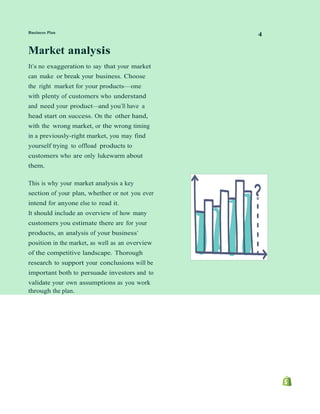
It’s no exaggeration to say that your market
can make or break your business. Choose
the right market for your products—one
with plenty of customers who understand
and need your product—and you’ll have a
head start on success. On the other hand,
with the wrong market, or the wrong timing
in a previously-right market, you may find
yourself trying to offload products to
customers who are only lukewarm about
them.
This is why your market analysis a key
section of your plan, whether or not you ever
intend for anyone else to read it.
It should include an overview of how many
customers you estimate there are for your
products, an analysis of your business’
position in the market, as well as an overview
of the competitive landscape. Thorough
research to support your conclusions will be
important both to persuade investors and to
validate your own assumptions as you work
through the plan.
Market size
This is an estimate of how
many people could
potentially buy your
product. While it’s exciting
to imagine sky-high sales
figures, you’ll want to use as
much relevant independent
data as possible to validate
your estimated potential
market. Since it can be a
daunting process, here are
some general steps you can
take to begin your research:
• Understand your ideal
customer profile,
especially as it relates to
demographics.
• Research relevant industry
trends and trajectory. If your
product serves retirees, try
to find data about how many
people will be retiring in the
next five years, as well as any
information you can find
about consumption patterns
among the group.
industry projected to grow
or decline over the next few
years?
• Make informed guesses.
You’ll never have perfect,
complete information about
the size of your total
addressable market, but the
goal here is to base your
estimates on as many
verifiable data points as is
necessary for a confident
guess.
Free Template | Business Plan
SWOT
analysis
A SWOT analysis looks at your strengths, weaknesses,
opportunities, and threats
.
.
Positive Negative
Internal
External
Strengths
• Previous experience in
import
Strong ad management
experience
•Unique products
• Exclusive deal with
manufacturing company
Opportunities
• Strong growth in
product category sales
• No “market leader” in
category, many shops sell the
same products
Weaknesses
• The sourcing will
need continues
traveling
• Rental expenses
Threats
• Prices in the international
markets
• Cash flow.
Competitive analysis
6
You’ll always have competition in the market, even with an innovative product, so it’s
important to include a competitive overview in your business plan. If you’re entering an
established market, include a list of a few companies you consider direct competitors,
and how you plan to differentiate your products and business.
For example, if you’re selling jewelry, your competitive differentiation could be that unlike
many high-end competitors who offer high-quality products, you donate a percentage of
your profits to a notable charity, or you pass savings on to your customers.
If you’re entering a market where you can’t easily identify direct competitors, consider
your indirect competitors. These are the products that are substitutes for yours. As an
example, if you’re selling an innovative product, it’s too easy to say that because your
product is new you have no competition. Consider what your
potential customers are doing now to solve the same problems your product solves, and
think about how to make sure you stand out from their current solution.
:
• Cost leadership. You have capacity to
offer lower prices than the majority of
your competitors to maximize profits.
• Differentiation. Your product or
service offers something distinct from
the current cost leaders in your industry
and banks on standing out based on
your uniqueness.
• Segmentation. You focus on a very
specific or “niche” target market and
focus on building traction with a
smaller audience before moving on to a
broader market. Companies
• Customization.
• Design.
• Branding.
Products and services
7
While your products or services will feature
prominently in most sections of your
business plan, it’s important to provide a
section that outlines key details about them
for interested readers. Depending on how
many products you offer, you can include
information about your product lines, or
offer more detailed information on each
product if you
only sell a few.
Customer segmentation
Your ideal customer, also known as your target market, is the foundation of your marketing
plan, if not your business plan as a whole. As you make strategic decisions, you’ll keep this
person in mind, which is why an overview of who they are is so important to understand
and include.
Customer segmentation often includes:
• Where do they live?
• What’s their age range?
• What’s their level of education?
• What are some common behavior patterns?
• What do they spend their free time on?
• Where do they work?
• What technology do they use?
• How much do they earn?
• Where are they commonly employed?
• What are their values, beliefs, or opinions?
01
02
03
Marketing plan
8
Your marketing efforts are directly informed by your ideal customer and your plan
should outline your current decisions and your future plans, with a focus on how your
ideas are a fit for your ideal customer. If you’re planning to invest heavily in ads on
Instagram, for example, it might make sense to include whether Instagram is a leading
platform for your audience.
Most marketing plans include answers to four key questions, in as much detail as makes
sense for your plan’s goals:
Price
How much do your products cost, and why have you
made that decision?
Product
What are you selling, and how do you differentiate
it in the market?
Promotion
How will you get your products in front of your
ideal customer?
04 Place
Where will you sell your
products?
Promotion may be the bulk of your plan since you can
more readily dive into the tactical details, but the other three
decisions should be covered at least briefly as important
strategic levers in your marketing mix.
01
02
03
04
05
06
Logistics and operations plan
9
Your logistics and operations are the workflows that you’ll implement to make your ideas
a reality. If you’re writing a business plan for your own planning purposes, this is still an
important section to consider, even though you might not need to include the same level
of detail as if you’re seeking investment.
Suppliers
Where do you get the products, or where are your products produced?
Production
How long does it take to produce your products, and get them shipped to you?
How will you handle a busy season, or an unexpected spike in demand?
Facilities
Where will you and any team members work? Do you plan to have
physical retail space? If yes, where? Physical retail space? If yes,
where?
Equipment
What tools and technology do you require to be up and running? This includes
everything from computers to lightbulbs and everything in between.
Shipping and fulfilment
Will you be handling all the fulfillment tasks in-house or will you use a third-party
fulfillment partner?
Inventory
How much will you keep on hand, and where will it be stored? How will you
ship it to partners if required, and how will you keep track of incoming and
outgoing inventory?
This section should signal to your reader that you’ve got a solid understanding
of your supply chain, and strong contingency plans in place to cover potential
uncertainty. If your reader is you, it should give you
a basis to make other important decisions, like how to price your products to
cover your estimated costs, and at what point you plan to break even on your
initial spending.
Financial plan
10
No matter how great your idea is, a business
lives or dies based on its financial
feasibility. Regardless of the effort, time, and
money you’ve already invested, at the end of
the day people want to work with a business
they expect to be viable for the foreseeable
future.
The level of detail required in your financial
plan will depend on your audience and goals,
but you’ll typically want to include three major
views of your financials: an income
statement, a balance sheet, and a cash-flow
statement. It may also be appropriate to
include financial projections.
Income statement
Your income statement is designed to give readers a look at your revenue sources and
expenses over a given time period. With those two pieces of information, they can see the
all-important bottom line, or the profit or loss your business experienced during that time.
If you haven’t been operating your business yet, you can put together a forecast for the same
information.
Balance sheet
11
Your balance sheet offers a look at how much equity you have in your business. On one side
you list all your business assets (what you own) and on the other side, all your liabilities (what
you owe). That provides a snapshot of your business’ shareholder equity which is calculated
as
Assets - Liabilities = Equity
Cash-flow statement

BusinessPlan_redesignedf word format .docx

  • 1.
  • 2.
    Executive summary 01 Companyoverview 02 Business structure 02 Nature of the business 02 Industry 02 Vision, mission, and values 02 Background information 03 Business objectives 03 Team 03 Market analysis 04 Market size 04 SWOT analysis 05 Competitive analysis 06 Products and services 07 Customer segmentation 07 Marketing plan 08 Price 08 Product 08 Promotion 08 Place 08 Logistics and operations plan 09 Suppliers 09 Production 09 Facilities 09 Equipment 09 Shipping and fulfilment 09 Inventory 09 Financial plan 10 Income statement 10 Balance sheet 11 Cash-flow statement 11
  • 3.
    Business Plan 1 Executive summary (Theshop) will be established to fill the gap in the market by offering selective items with high quality to the customers. (The Shop) will focus on three main items: Wood Works, Accessories and Special items. • (The Shop) aims to build a well-known brand in Jordan, the plan is to be different from other competitors as the products have new ideas, quality and all the products selected with consideration. • The products will cover wide range of ages as the variety of the products will make any one as potential customer. • Location will be in west Amman in a busy area. • The Business needs (100k-120k) JOD • Current financial state. What do you currently make in revenue? • Projected financial state. What you foresee making in revenue? • The ask. How much money are you asking for? • The team. Who’s involved in the business?
  • 4.
    Business Plan 2 Company overview GreenEssence Corp is a Pv installer company established in 2013 build hundreds of commercial and industrial projects and now we feel it’s the time to expand and establish a new business. Business structure Are you a sole proprietorship, general partnership, limited partnership, or an incorporated company? Nature of the business (The Shop) will sell products made of woods and epoxy, Accessories (Jewelry, men accessories) and Special items (Unique items have new ideas) Vision, mission, and values (Theshop)willbuildanewbrandthatwill thecustomerdestinationforchosetheirgiftsandforthemself’s.
  • 5.
    (The shop) willintroduce Background information . Business objectives Theshortplanisopenashop. Team Include an overview of your existing team, and any predicted hires, with their salaries. While some of these are statements of fact, others will require a bit more thought to define, especially when it comes to your business’ vision, mission, and values. This is where you start getting to the core of why your business exists, what you hope to accomplish, and what you stand for.
  • 6.
    Business Plan 4 Market analysis It’sno exaggeration to say that your market can make or break your business. Choose the right market for your products—one with plenty of customers who understand and need your product—and you’ll have a head start on success. On the other hand, with the wrong market, or the wrong timing in a previously-right market, you may find yourself trying to offload products to customers who are only lukewarm about them. This is why your market analysis a key section of your plan, whether or not you ever intend for anyone else to read it. It should include an overview of how many customers you estimate there are for your products, an analysis of your business’ position in the market, as well as an overview of the competitive landscape. Thorough research to support your conclusions will be important both to persuade investors and to validate your own assumptions as you work through the plan.
  • 7.
    Market size This isan estimate of how many people could potentially buy your product. While it’s exciting to imagine sky-high sales figures, you’ll want to use as much relevant independent data as possible to validate your estimated potential market. Since it can be a daunting process, here are some general steps you can take to begin your research: • Understand your ideal customer profile, especially as it relates to demographics. • Research relevant industry trends and trajectory. If your product serves retirees, try to find data about how many people will be retiring in the next five years, as well as any information you can find about consumption patterns among the group. industry projected to grow or decline over the next few years? • Make informed guesses. You’ll never have perfect, complete information about the size of your total addressable market, but the goal here is to base your estimates on as many verifiable data points as is necessary for a confident guess.
  • 8.
    Free Template |Business Plan SWOT analysis A SWOT analysis looks at your strengths, weaknesses, opportunities, and threats . . Positive Negative Internal External Strengths • Previous experience in import Strong ad management experience •Unique products • Exclusive deal with manufacturing company Opportunities • Strong growth in product category sales • No “market leader” in category, many shops sell the same products Weaknesses • The sourcing will need continues traveling • Rental expenses Threats • Prices in the international markets • Cash flow.
  • 9.
    Competitive analysis 6 You’ll alwayshave competition in the market, even with an innovative product, so it’s important to include a competitive overview in your business plan. If you’re entering an established market, include a list of a few companies you consider direct competitors, and how you plan to differentiate your products and business. For example, if you’re selling jewelry, your competitive differentiation could be that unlike many high-end competitors who offer high-quality products, you donate a percentage of your profits to a notable charity, or you pass savings on to your customers. If you’re entering a market where you can’t easily identify direct competitors, consider your indirect competitors. These are the products that are substitutes for yours. As an example, if you’re selling an innovative product, it’s too easy to say that because your product is new you have no competition. Consider what your potential customers are doing now to solve the same problems your product solves, and think about how to make sure you stand out from their current solution. : • Cost leadership. You have capacity to offer lower prices than the majority of your competitors to maximize profits. • Differentiation. Your product or service offers something distinct from the current cost leaders in your industry and banks on standing out based on your uniqueness.
  • 10.
    • Segmentation. Youfocus on a very specific or “niche” target market and focus on building traction with a smaller audience before moving on to a broader market. Companies • Customization. • Design. • Branding. Products and services 7 While your products or services will feature prominently in most sections of your business plan, it’s important to provide a section that outlines key details about them for interested readers. Depending on how many products you offer, you can include information about your product lines, or offer more detailed information on each product if you only sell a few. Customer segmentation Your ideal customer, also known as your target market, is the foundation of your marketing plan, if not your business plan as a whole. As you make strategic decisions, you’ll keep this person in mind, which is why an overview of who they are is so important to understand and include.
  • 11.
    Customer segmentation oftenincludes: • Where do they live? • What’s their age range? • What’s their level of education? • What are some common behavior patterns? • What do they spend their free time on? • Where do they work? • What technology do they use? • How much do they earn? • Where are they commonly employed? • What are their values, beliefs, or opinions?
  • 12.
    01 02 03 Marketing plan 8 Your marketingefforts are directly informed by your ideal customer and your plan should outline your current decisions and your future plans, with a focus on how your ideas are a fit for your ideal customer. If you’re planning to invest heavily in ads on Instagram, for example, it might make sense to include whether Instagram is a leading platform for your audience. Most marketing plans include answers to four key questions, in as much detail as makes sense for your plan’s goals: Price How much do your products cost, and why have you made that decision? Product What are you selling, and how do you differentiate it in the market? Promotion How will you get your products in front of your ideal customer?
  • 13.
    04 Place Where willyou sell your products? Promotion may be the bulk of your plan since you can more readily dive into the tactical details, but the other three decisions should be covered at least briefly as important strategic levers in your marketing mix.
  • 14.
    01 02 03 04 05 06 Logistics and operationsplan 9 Your logistics and operations are the workflows that you’ll implement to make your ideas a reality. If you’re writing a business plan for your own planning purposes, this is still an important section to consider, even though you might not need to include the same level of detail as if you’re seeking investment. Suppliers Where do you get the products, or where are your products produced? Production How long does it take to produce your products, and get them shipped to you? How will you handle a busy season, or an unexpected spike in demand? Facilities Where will you and any team members work? Do you plan to have physical retail space? If yes, where? Physical retail space? If yes, where? Equipment What tools and technology do you require to be up and running? This includes everything from computers to lightbulbs and everything in between. Shipping and fulfilment Will you be handling all the fulfillment tasks in-house or will you use a third-party fulfillment partner? Inventory How much will you keep on hand, and where will it be stored? How will you ship it to partners if required, and how will you keep track of incoming and outgoing inventory?
  • 15.
    This section shouldsignal to your reader that you’ve got a solid understanding of your supply chain, and strong contingency plans in place to cover potential uncertainty. If your reader is you, it should give you a basis to make other important decisions, like how to price your products to cover your estimated costs, and at what point you plan to break even on your initial spending.
  • 16.
    Financial plan 10 No matterhow great your idea is, a business lives or dies based on its financial feasibility. Regardless of the effort, time, and money you’ve already invested, at the end of the day people want to work with a business they expect to be viable for the foreseeable future. The level of detail required in your financial plan will depend on your audience and goals, but you’ll typically want to include three major views of your financials: an income statement, a balance sheet, and a cash-flow statement. It may also be appropriate to include financial projections. Income statement Your income statement is designed to give readers a look at your revenue sources and expenses over a given time period. With those two pieces of information, they can see the all-important bottom line, or the profit or loss your business experienced during that time. If you haven’t been operating your business yet, you can put together a forecast for the same information.
  • 17.
    Balance sheet 11 Your balancesheet offers a look at how much equity you have in your business. On one side you list all your business assets (what you own) and on the other side, all your liabilities (what you owe). That provides a snapshot of your business’ shareholder equity which is calculated as Assets - Liabilities = Equity Cash-flow statement