GENERAL ENGLISH PERTEMUAN 14:
MAY I SPEAK TO MR. FRANK, PLEASE?
By Dean Raiyasmi
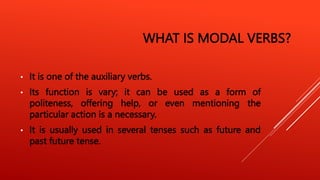
WHAT IS MODAL VERBS?
• It is one of the auxiliary verbs.
• Its function is vary; it can be used as a form of
politeness, offering help, or even mentioning the
particular action is a necessary.
• It is usually used in several tenses such as future and
past future tense.
KINDS OF MODAL VERBS
• There are 10 modal verbs usually used in the grammar.
1. Can - 6. Could
2. Will - 7. Would
3. Shall - 8. Should
4. May - 9. Might
5. Must - 10. Ought to
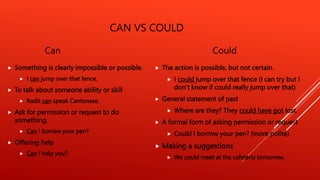
CAN VS COULD
Can
 Something is clearly impossible or possible.
 I can jump over that fence.
 To talk about someone ability or skill
 Radit can speak Cantonese.
 Ask for permission or request to do
something.
 Can I borrow your pen?
 Offering help
 Can I help you?
Could
 The action is possible, but not certain.
 I could jump over that fence (I can try but I
don’t know if could really jump over that)
 General statement of past
 Where are they? They could have got lost.
 A formal form of asking permission or request
 Could I borrow your pen? (more polite)
 Making a suggestions
 We could meet at the cafeteria tomorrow.
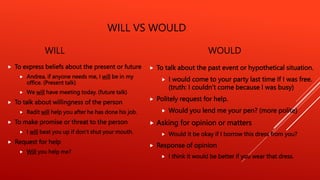
WILL VS WOULD
WILL
 To express beliefs about the present or future
 Andrea, if anyone needs me, I will be in my
office. (Present talk)
 We will have meeting today. (future talk)
 To talk about willingness of the person
 Radit will help you after he has done his job.
 To make promise or threat to the person
 I will beat you up if don’t shut your mouth.
 Request for help
 Will you help me?
WOULD
 To talk about the past event or hypothetical situation.
 I would come to your party last time If I was free.
(truth: I couldn’t come because I was busy)
 Politely request for help.
 Would you lend me your pen? (more polite)
 Asking for opinion or matters
 Would it be okay if I borrow this dress from you?
 Response of opinion
 I think it would be better if you wear that dress.
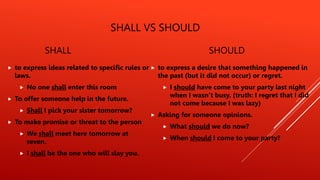
SHALL VS SHOULD
SHALL
 to express ideas related to specific rules or
laws.
 No one shall enter this room
 To offer someone help in the future.
 Shall I pick your sister tomorrow?
 To make promise or threat to the person
 We shall meet here tomorrow at
seven.
 I shall be the one who will slay you.
SHOULD
 to express a desire that something happened in
the past (but it did not occur) or regret.
 I should have come to your party last night
when I wasn’t busy. (truth: I regret that I did
not come because I was lazy)
 Asking for someone opinions.
 What should we do now?
 When should I come to your party?
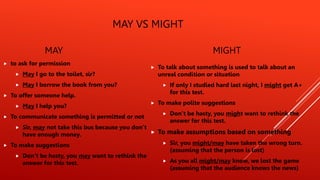
MAY VS MIGHT
MAY
 to ask for permission
 May I go to the toilet, sir?
 May I borrow the book from you?
 To offer someone help.
 May I help you?
 To communicate something is permitted or not
 Sir, may not take this bus because you don’t
have enough money.
 To make suggestions
 Don’t be hasty, you may want to rethink the
answer for this test.
MIGHT
 To talk about something is used to talk about an
unreal condition or situation
 If only I studied hard last night, I might get A+
for this test.
 To make polite suggestions
 Don’t be hasty, you might want to rethink the
answer for this test.
 To make assumptions based on something
 Sir, you might/may have taken the wrong turn.
(assuming that the person is lost)
 As you all might/may know, we lost the game
(assuming that the audience knows the news)
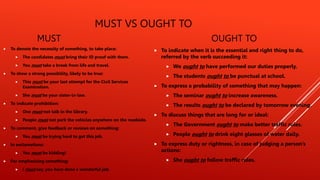
MUST VS OUGHT TO
MUST
 To denote the necessity of something, to take place:
 The candidates must bring their ID proof with them.
 You must take a break from life and travel.
 To show a strong possibility, likely to be true:
 This must be your last attempt for the Civil Services
Examination.
 She must be your sister-in-law.
 To indicate prohibition:
 One must not talk in the library.
 People must not park the vehicles anywhere on the roadside.
 To comment, give feedback or reviews on something:
 You must be trying hard to get this job.
 In exclamations:
 You must be kidding!
 For emphasizing something:
 I must say, you have done a wonderful job.
OUGHT TO
 To indicate when it is the essential and right thing to do,
referred by the verb succeeding it:
 We ought to have performed our duties properly.
 The students ought to be punctual at school.
 To express a probability of something that may happen:
 The seminar ought to increase awareness.
 The results ought to be declared by tomorrow evening.
 To discuss things that are long for or ideal:
 The Government ought to make better traffic rules.
 People ought to drink eight glasses of water daily.
 To express duty or rightness, in case of judging a person’s
actions:
 She ought to follow traffic rules.
THANK YOU FOR YOUR ATTENTION

Modal Auxiliaries Verb.pptx

  • 1.
    GENERAL ENGLISH PERTEMUAN14: MAY I SPEAK TO MR. FRANK, PLEASE? By Dean Raiyasmi
  • 2.
    WHAT IS MODALVERBS? • It is one of the auxiliary verbs. • Its function is vary; it can be used as a form of politeness, offering help, or even mentioning the particular action is a necessary. • It is usually used in several tenses such as future and past future tense.
  • 3.
    KINDS OF MODALVERBS • There are 10 modal verbs usually used in the grammar. 1. Can - 6. Could 2. Will - 7. Would 3. Shall - 8. Should 4. May - 9. Might 5. Must - 10. Ought to
  • 4.
    CAN VS COULD Can Something is clearly impossible or possible.  I can jump over that fence.  To talk about someone ability or skill  Radit can speak Cantonese.  Ask for permission or request to do something.  Can I borrow your pen?  Offering help  Can I help you? Could  The action is possible, but not certain.  I could jump over that fence (I can try but I don’t know if could really jump over that)  General statement of past  Where are they? They could have got lost.  A formal form of asking permission or request  Could I borrow your pen? (more polite)  Making a suggestions  We could meet at the cafeteria tomorrow.
  • 5.
    WILL VS WOULD WILL To express beliefs about the present or future  Andrea, if anyone needs me, I will be in my office. (Present talk)  We will have meeting today. (future talk)  To talk about willingness of the person  Radit will help you after he has done his job.  To make promise or threat to the person  I will beat you up if don’t shut your mouth.  Request for help  Will you help me? WOULD  To talk about the past event or hypothetical situation.  I would come to your party last time If I was free. (truth: I couldn’t come because I was busy)  Politely request for help.  Would you lend me your pen? (more polite)  Asking for opinion or matters  Would it be okay if I borrow this dress from you?  Response of opinion  I think it would be better if you wear that dress.
  • 6.
    SHALL VS SHOULD SHALL to express ideas related to specific rules or laws.  No one shall enter this room  To offer someone help in the future.  Shall I pick your sister tomorrow?  To make promise or threat to the person  We shall meet here tomorrow at seven.  I shall be the one who will slay you. SHOULD  to express a desire that something happened in the past (but it did not occur) or regret.  I should have come to your party last night when I wasn’t busy. (truth: I regret that I did not come because I was lazy)  Asking for someone opinions.  What should we do now?  When should I come to your party?
  • 7.
    MAY VS MIGHT MAY to ask for permission  May I go to the toilet, sir?  May I borrow the book from you?  To offer someone help.  May I help you?  To communicate something is permitted or not  Sir, may not take this bus because you don’t have enough money.  To make suggestions  Don’t be hasty, you may want to rethink the answer for this test. MIGHT  To talk about something is used to talk about an unreal condition or situation  If only I studied hard last night, I might get A+ for this test.  To make polite suggestions  Don’t be hasty, you might want to rethink the answer for this test.  To make assumptions based on something  Sir, you might/may have taken the wrong turn. (assuming that the person is lost)  As you all might/may know, we lost the game (assuming that the audience knows the news)
  • 8.
    MUST VS OUGHTTO MUST  To denote the necessity of something, to take place:  The candidates must bring their ID proof with them.  You must take a break from life and travel.  To show a strong possibility, likely to be true:  This must be your last attempt for the Civil Services Examination.  She must be your sister-in-law.  To indicate prohibition:  One must not talk in the library.  People must not park the vehicles anywhere on the roadside.  To comment, give feedback or reviews on something:  You must be trying hard to get this job.  In exclamations:  You must be kidding!  For emphasizing something:  I must say, you have done a wonderful job. OUGHT TO  To indicate when it is the essential and right thing to do, referred by the verb succeeding it:  We ought to have performed our duties properly.  The students ought to be punctual at school.  To express a probability of something that may happen:  The seminar ought to increase awareness.  The results ought to be declared by tomorrow evening.  To discuss things that are long for or ideal:  The Government ought to make better traffic rules.  People ought to drink eight glasses of water daily.  To express duty or rightness, in case of judging a person’s actions:  She ought to follow traffic rules.
  • 9.
    THANK YOU FORYOUR ATTENTION