Media Kit
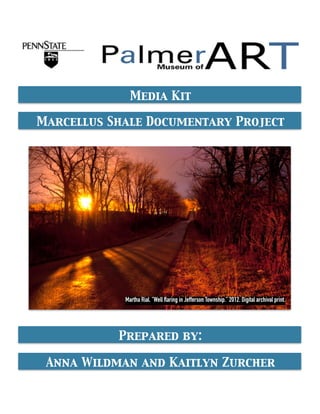
Martha Rial. "Well flaring in Jefferson Township.” 2012. Digital archival print.
Prepared by:
Anna Wildman and Kaitlyn Zurcher
Marcellus Shale Documentary Project
Table of Contents
1. Press Release for “Marcellus Shale Documentary
Project”
2. Fact Sheet for “Marcellus Shale Documentary
Project”
3. Biography for Dana Carlisle Kletchka, Curator of
Education at the Palmer Museum of Art
4. Pitch Letter for the Pittsburgh Post Gazette
5. Feature Story for “Marcellus Shale Documentary
Project”
6. Public Service Announcement for “Marcellus Shale
Documentary Project”
7. Brochure for the Palmer Museum of Art’s Fall 2014
Exhibitions
8. Publicity Photo for the Palmer Museum of Art
9. Print Ad for “Marcellus Shale Documentary Project”
Contact: Anna Wildman
301-828-8382
anw5231@psu.edu
FOR IMMEDIATE RELEASE
‘MARCELLUS SHALE DOCUMENTARY PROJECT’ TO OPEN
SEPT. 23 AT PALMER MUSEUM
UNIVERSITY PARK, Pa., Sept. 20 – The Pennsylvania State University’s
Palmer Museum of Art will host a new exhibition, titled the “Marcellus Shale
Documentary Project,” from Sept. 23 through Dec. 14.
The project features images that tell the personal stories of the citizens of
Pennsylvania who are affected by the Marcellus Shale gas industry. Students, university
faculty and staff, and the community at large are encouraged to visit and learn about the
environmental, social and economic impact of oil drilling.
The exhibit aims to capture and engage communities in the current debate over oil
drilling and provide historical images for the future of the industry. Photographers Noah
Addis, Nina Berman, Brian Cohen, Scott Goldsmith, Lynn Johnson and Martha Rial
survey the negative and positive results of the rise in the gas industry and how it affects
the surrounding communities and environment.
-more-
MARCELLUS SHALE OPENING
2-2-2
The project includes photographs by Penn State faculty members who have
invested a significant amount of energy into documenting the various effects of natural
gas drilling in Pennsylvania. A supplementary exhibition titled “Storied Images:
Marcellus Shale” features students’ work and will be displayed in various venues across
campus and downtown State College. These additional works, supported in part by a
Reinvention Fund grant through Penn State’s Sustainability Institute, widens the audience
and expands the conversation while promoting the critical discourse on sustainability.
The Pittsburgh Center for the Arts, a nonprofit corporation that works to
encourage the creation and understanding of media and still photography for
noncommercial artistic and literary purposes throughout Western Pennsylvania,
organized the documentary project.
The exhibition begins Sept. 23 and continues through Dec. 14. For more
information on the exhibition, please contact the Curator of Education Dana Carlisle
Kletchka, at dck10@psu.edu or 814-863-9188.
For more information about the Palmer Museum of Art, please call 814-865-7672,
or visit the web site at www.palmermuseum.psu.edu.
-30-
Palmer Museum 

of Art
• The Palmer Museum of Art is located in
University Park, Pa., on The Pennsylvania
State University campus.
• The museum serves as a free-admission arts
resource for the Penn State community and
the central Pennsylvanian community at
large.
• The museum is the largest public art
museum between Philadelphia and
Pittsburgh, with 11 galleries, an outdoor
sculpture garden, and a permanent
collection of nearly 7,000 artworks.
• The museum’s permanent collection was
primarily built with funding from
graduating classes, the University, private
donors and the Friends of the Palmer
Museum of Art.
• The Friends of the Palmer is a
membership group founded in 1974 to
help with the museum’s fundraising and
outreach efforts.
• The Palmer Museum presents a schedule of
multiple exhibitions, events and educational
programs per year. At least three special
exhibitions are on display at any given time.
Marcellus Shale
Documentary project

Sept. 23 - Dec. 14, 2014
• The “Marcellus Shale Documentary Project”
features the work of six photographers: Noah
Addis, Nina Berman, Brian Cohen, Scott
Goldsmith, Lynn Johnson and Martha Rial.
• The photographs in the exhibition explore the
positive and negative impacts of fracking and
the gas industry on Pennsylvania citizens and
the environment.
• The goal of the exhibition is to educate
visitors on Marcellus Shale and start
conversations about the debate it has sparked.
• The exhibition at the Palmer Museum is
supplemented by a selection of work from
Penn State faculty and students, collectively
titled “Storied Images: Marcellus Shale.”
• The exhibition was organized by the
Pittsburgh Center for the Arts, a nonprofit
organization that offers arts education
programs and contemporary art exhibitions
throughout western Pennsylvania.
• A series of gallery talks, tours and lecture
events are scheduled throughout the duration
of the exhibition. The schedule is available at
www.palmermuseum.psu.edu.
Fact Sheet
Public Relations Contact: Kaitlyn Zurcher | 412-418-2926 | kiz5038@psu.edu
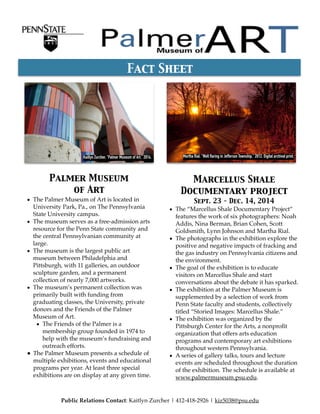
Kaitlyn Zurcher. “Palmer Museum of Art.” 2014. Martha Rial. "Well flaring in Jefferson Township.” 2012. Digital archival print.
Dana Carlisle Kletchka
Dr. Dana Carlisle Kletchka is the curator of education at
the Palmer Museum of Art in University Park, Pa., and the
affiliate assistant professor of art education in the School of
Visual Arts at The Pennsylvania State University, University
Park, Pa.
After receiving a bachelor’s degree in art history and
English from The University of Kansas in 1995, she went on to
receive a master’s degree in art education from The University of
Kansas in 1998. In 2010, she received her doctorate in art
education from Penn State.
As curator of education, she creates the educational and interpretive programming
at the Palmer Museum of Art and works with students, faculty and community members
to create opportunities to learn about the museum’s permanent collections and
exhibitions. She also teaches Art/Art History 409: Museum Studies for the art education
department each spring. In addition, Kletchka is a frequent presenter on art museum
education at national and international art education conferences.
Prior to coming to Penn State in 2000, she was the coordinator of docent and
interpretive programs at the Philbrook Museum of Art in Tulsa, Okla., and the curatorial
intern in museum education at the Spencer Museum of Art at The University of Kansas in
Lawrence, Kan.
She has published several books, journal articles, essays, book reviews, and book
chapters throughout her career. Her essays have appeared in books such as “Judy Chicago
at Penn State”, and her articles have been published in the National Art Education
Association journal “Art Education.”
She received the Outstanding Staff Award in 2010 from Penn State’s Commission
on Lesbian, Gay, Bisexual, and Transgender Equity, a presidential advisory commission,
where she served as a chair.
She is interested in researching postmodern art, contemporary parenting, and
issues affecting the LGBTA community. She is also interested in using social media and
other tools for curating museum experiences.
By Anna Wildman
Curtin Road

University Park, PA 16802-2507

814-865-7672

814-863-8608 (FAX)
September 15, 2014
Kevin Kirkland
Arts and Entertainment Editor
Pittsburgh Post-Gazette
34 Blvd. of the Allies
Pittsburgh, Pa. 15222
Dear Mr. Kirkland,
The Marcellus Shale Formation located in Pennsylvania and four surrounding states has been
the source of much recent debate about the energy industry, the environment and public health. Some
believe the hydraulic fracturing -- better known as “fracking” — of this shale is the answer to our
region’s energy and job problems. Others believe it’s destroying our environment and contaminating
our water supply, putting the health of thousands of people at risk.
Yet many more Pennsylvanians know next to nothing about fracking and its effects. Penn
State’s Palmer Museum of Art and the Pittsburgh Center for the Arts (PCA) want to change that.
The Palmer Museum and PCA recognized the need to educate the public on this issue and to
construct a safe place for conservation and debate. Together we have curated the “Marcellus Shale
Documentary Project,” a photography exhibition that aims to present both the positive and negative
impacts Marcellus Shale has had on the environment and the community.
The “Marcellus Shale Documentary Project” will be on display at the Palmer Museum from
Sept. 23 through Dec. 14, 2014. We plan to have multiple gallery talks, tours and lecture events
scheduled throughout the semester, as well as a supplementary photography exhibit called “Storied
Images: Marcellus Shale” produced by Penn State students and faculty displayed across the campus.
The fracking issue directly affects the people of Western Pennsylvania; these are your
readers, and they deserve to witness all sides of the story. We would love to have a reporter from the
Pittsburgh Post-Gazette come out and cover this campus-wide show. I would be happy to arrange an
interview and tour with our curator, Dana Carlisle Kletchka, at the reporter’s earliest convenience.
If you have any questions about the exhibition or the Palmer Museum, feel free to call me
today at 412-418-2926 or email kiz5038@psu.edu.
Sincerely,
Kaitlyn Zurcher
Public Relations Manager
Palmer Museum of Art
Palmer Museum's Marcellus Shale exhibition sparks debate
by Kaitlyn Zurcher
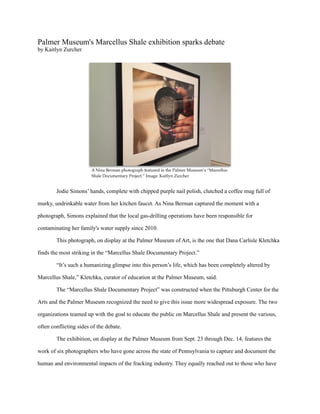
Jodie Simons’ hands, complete with chipped purple nail polish, clutched a coffee mug full of
murky, undrinkable water from her kitchen faucet. As Nina Berman captured the moment with a
photograph, Simons explained that the local gas-drilling operations have been responsible for
contaminating her family's water supply since 2010.
This photograph, on display at the Palmer Museum of Art, is the one that Dana Carlisle Kletchka
finds the most striking in the “Marcellus Shale Documentary Project.”
“It’s such a humanizing glimpse into this person’s life, which has been completely altered by
Marcellus Shale,” Kletchka, curator of education at the Palmer Museum, said.
The “Marcellus Shale Documentary Project” was constructed when the Pittsburgh Center for the
Arts and the Palmer Museum recognized the need to give this issue more widespread exposure. The two
organizations teamed up with the goal to educate the public on Marcellus Shale and present the various,
often conflicting sides of the debate.
The exhibition, on display at the Palmer Museum from Sept. 23 through Dec. 14, features the
work of six photographers who have gone across the state of Pennsylvania to capture and document the
human and environmental impacts of the fracking industry. They equally reached out to those who have
A Nina Berman photograph featured in the Palmer Museum’s “Marcellus
Shale Documentary Project.” Image: Kaitlyn Zurcher
benefitted from gas drilling and those who feel victimized by it, including homeowners, farmers,
engineers, medical practitioners and activists.
“There is no easy perspective on fracking. This exhibition was designed to be a catalyst for
conversation,” Kletchka said. “We wanted to bring it here so people have a safe place to discuss it.”
When it came time to display the photographs, the Palmer Museum faced the challenge of
presenting unbiased facts and well-informed opinions in order to show a variety of views on the subject.
They sought out the expertise of a variety of Penn State professors in diverse fields — engineering,
healthcare, geology, sociology and more —to provide insight on the positive and negative effects of
fracking.
The Palmer Museum has also organized a schedule of gallery talks and lecture series in order to
provide a more comprehensive overlook of Marcellus Shale to museum visitors.
“We didn’t want to say outright that we were for or against [Marcellus Shale],” Kletchka said.
“We just felt we needed to document what’s happening and provide a good introduction to a complicated
discussion.”
Media Contact: Anna Wildman
301-828-8382
9/20/2014
Start Date: NOW
Kill Date: Dec. 13, 2014
PUBLIC SERVICE ANNOUNCEMENT
(MARCELLUS SHALE DOCUMENTARY PROJECT)
:05
DRILLING SOUNDS (FADE)
: 45
ANNCR: CURIOUS ABOUT HOW THE NATURAL GAS INDUSTRY HAS
AFFECTED LOCAL PENNSYLVANIANS? FIND OUT AT THE PALMER MUSEUM
OF ART’S NEW EXHIBITION, THE ‘MARCELLUS SHALE DOCUMENTARY
PROJECT.’ IT OPENS SEPTEMBER 23 AND CONTINUES THROUGH DECEMBER
14. EXPERIENCE PHOTOGRAPHS THAT TELL THE PERSONAL STORIES OF
THOSE IMPACTED BY THE MARCELLUS SHALE GAS INDUSTRY. THE
EXHIBITION ALSO FEATURES A SMALL SELECTION OF PHOTOGRAPHS BY
TALENTED PENN STATE FACULTY MEMBERS. IN ADDITION, A SERIES OF
EXHIBITIONS OF STUDENT WORKS WILL BE DISPLAYED IN SEVERAL
VENUES ACROSS CAMPUS AND DOWNTOWN STATE COLLEGE, PROMOTING
THE DISCUSSION OF SUSTAINABILITY. JOIN IN ON THE CONVERSATION
AND COME OUT TO THE PALMER MUSEUM FOR THIS EXCITING NEW
EXHIBITION STARTING SEPTEMBER 23.
THIS HAS BEEN A PUBLIC SERVICE ANNOUNCEMENT FUNDED BY THE
PENNSYLVANIA COUNCIL ON THE ARTS.
:05 DRILLING SOUNDS
TAG:
:05
ANNCR: THIS HAS BEEN A PUBLIC SERVICE ANNOUNCEMENT FUNDED BY
THE PENNSYLVANIA COUNCIL ON THE ARTS.
Museum Information
Museum Hours

Tuesday through Saturday: 10 a.m. to 4:30 p.m.

Sunday: 12 to 4 p.m.

The museum is closed on Mondays and some
holidays.

Free admission
Location

The Palmer Museum of Art is located on Curtin
Road near the Pasquerilla Spiritual Center on
Penn State’s University Park campus.

Driving Directions

The University Park campus is accessible from
Routes 322, 220 and 26. Allow three hours from
Pittsburgh, four hours from Philadelphia or
Washington, D.C., and five hours from New York
City.
Palmer Museum
of Art
at The Pennsylvania State University
Fall 2014 Exhibition Brochure
Public Relations Contact:

Kaitlyn Zurcher

412-418-2926

kiz5038@psu.edu
What is the Palmer?
The Palmer Museum of Art is a
free-admission arts resource 

for Penn State students, faculty
and staff, as well as the central
Pennsylvanian community at
large.
With a permanent collection of
nearly 7,000 artworks, 11
galleries, an outdoor sculpture
garden and three special
exhibitions at any given time,
the Palmer Museum is the
largest public art museum
between Philadelphia and
Pittsburgh.
“Marcellus Shale Documentary Project”

September 23 through December 14, 2014
The “Marcellus Shale Documentary Project” creates
a visual document of the environmental, social and
economic impact of fracking and engages the
community in the current Marcellus Shale debate
while providing important historical images for the
future.

Photographers Noah Addis, Nina Berman, Brian
Cohen, Scott Goldsmith, Lynn Johnson and Martha
Rial produced work from across Pennsylvania to
show the positive and negative results of the gas
industry, and how the environment and involved
communities are being re-shaped.

The exhibition is supplemented by a selection of
photographs produced by Penn State students and
faculty collectively titled “Storied Images: Marcellus
Shale.” These photographs are displayed across
campus in the Borland Gallery, Earth and Mineral
Sciences Museum, Betsy Rodgers Allen Gallery, and
HUB-Robeson Galleries.

The “Marcellus Shale Documentary Project” is
organized by the Pittsburgh Center for the Arts, a
nonprofit organization that offers arts education
programs and contemporary art exhibitions
throughout western Pennsylvania.
Discover the masterpieces
at the largest public art
museum in central
Pennsylvania.
Fall 2014 Special Exhibitions
“Lanny Sommese: Image Maker”

August 26 through December 21, 2014
Lanny Sommese is a distinguished Penn State
professor of graphic design who retired in Spring
2014 after
44 years of
teaching in
the College
of Arts and
Architecture. 

Sommese is
best known
locally for the design of his posters for the Central
Pennsylvania Festival of the Arts, which he has
designed annually since 1974.

The exhibition features a selection of artworks
Sommese produced during his tenure at Penn State.
The title, “Image Maker,” reflects Sommese’s
opinion that graphic design is not about personal
expression, but about the creation of images that
respond to the client and the audience.

“Henry Varnum Poor:
Studies for the Land
Grant Frescoes”

September 2 through
December 21, 2014
In celebration of the
University’s two-year
effort to conserve the Land Grant Frescoes in Old
Main, this exhibition features a number of Henry
Varnum Poor’s preparatory studies selected from
the Palmer Museum’s permanent collection.
Permanent Collection
The Palmer Museum preserves a collection of
over 7,000 artworks, which was primarily built
with funding from graduating classes, the
University, private donors and the Friends of the
Palmer Museum of Art.
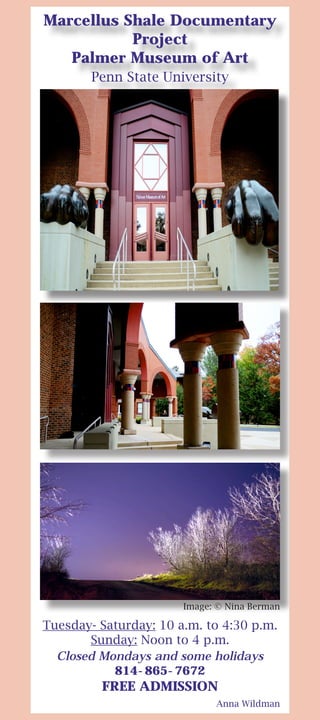
Marcellus Shale Documentary
Project
Palmer Museum of Art
Penn State University
Tuesday- Saturday: 10 a.m. to 4:30 p.m.
Sunday: Noon to 4 p.m.
Closed Mondays and some holidays
814-865-7672
FREE ADMISSION
Anna Wildman
Image: © Nina Berman
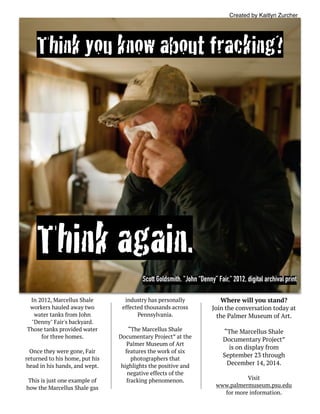
Think you know about fracking?
Think again.
In 2012, Marcellus Shale
workers hauled away two
water tanks from John
"Denny" Fair's backyard.
Those tanks provided water
for three homes.
Once they were gone, Fair
returned to his home, put his
head in his hands, and wept.
This is just one example of
how the Marcellus Shale gas
industry has personally
effected thousands across
Pennsylvania.
“The Marcellus Shale
Documentary Project” at the
Palmer Museum of Art
features the work of six
photographers that
highlights the positive and
negative effects of the
fracking phenomenon.
Where will you stand?
Join the conversation today at
the Palmer Museum of Art.
“The Marcellus Shale
Documentary Project”
is on display from 

September 23 through
December 14, 2014.
Visit
www.palmermuseum.psu.edu 

for more information.
Created by Kaitlyn Zurcher
Scott Goldsmith. "John “Denny” Fair," 2012, digital archival print

Mock Media Kit

  • 1.
    Media Kit Martha Rial."Well flaring in Jefferson Township.” 2012. Digital archival print. Prepared by: Anna Wildman and Kaitlyn Zurcher Marcellus Shale Documentary Project
  • 2.
    Table of Contents 1.Press Release for “Marcellus Shale Documentary Project” 2. Fact Sheet for “Marcellus Shale Documentary Project” 3. Biography for Dana Carlisle Kletchka, Curator of Education at the Palmer Museum of Art 4. Pitch Letter for the Pittsburgh Post Gazette 5. Feature Story for “Marcellus Shale Documentary Project” 6. Public Service Announcement for “Marcellus Shale Documentary Project” 7. Brochure for the Palmer Museum of Art’s Fall 2014 Exhibitions 8. Publicity Photo for the Palmer Museum of Art 9. Print Ad for “Marcellus Shale Documentary Project”
  • 3.
    Contact: Anna Wildman 301-828-8382 anw5231@psu.edu FORIMMEDIATE RELEASE ‘MARCELLUS SHALE DOCUMENTARY PROJECT’ TO OPEN SEPT. 23 AT PALMER MUSEUM UNIVERSITY PARK, Pa., Sept. 20 – The Pennsylvania State University’s Palmer Museum of Art will host a new exhibition, titled the “Marcellus Shale Documentary Project,” from Sept. 23 through Dec. 14. The project features images that tell the personal stories of the citizens of Pennsylvania who are affected by the Marcellus Shale gas industry. Students, university faculty and staff, and the community at large are encouraged to visit and learn about the environmental, social and economic impact of oil drilling. The exhibit aims to capture and engage communities in the current debate over oil drilling and provide historical images for the future of the industry. Photographers Noah Addis, Nina Berman, Brian Cohen, Scott Goldsmith, Lynn Johnson and Martha Rial survey the negative and positive results of the rise in the gas industry and how it affects the surrounding communities and environment. -more-
  • 4.
    MARCELLUS SHALE OPENING 2-2-2 Theproject includes photographs by Penn State faculty members who have invested a significant amount of energy into documenting the various effects of natural gas drilling in Pennsylvania. A supplementary exhibition titled “Storied Images: Marcellus Shale” features students’ work and will be displayed in various venues across campus and downtown State College. These additional works, supported in part by a Reinvention Fund grant through Penn State’s Sustainability Institute, widens the audience and expands the conversation while promoting the critical discourse on sustainability. The Pittsburgh Center for the Arts, a nonprofit corporation that works to encourage the creation and understanding of media and still photography for noncommercial artistic and literary purposes throughout Western Pennsylvania, organized the documentary project. The exhibition begins Sept. 23 and continues through Dec. 14. For more information on the exhibition, please contact the Curator of Education Dana Carlisle Kletchka, at dck10@psu.edu or 814-863-9188. For more information about the Palmer Museum of Art, please call 814-865-7672, or visit the web site at www.palmermuseum.psu.edu. -30-
  • 5.
    Palmer Museum 
 ofArt • The Palmer Museum of Art is located in University Park, Pa., on The Pennsylvania State University campus. • The museum serves as a free-admission arts resource for the Penn State community and the central Pennsylvanian community at large. • The museum is the largest public art museum between Philadelphia and Pittsburgh, with 11 galleries, an outdoor sculpture garden, and a permanent collection of nearly 7,000 artworks. • The museum’s permanent collection was primarily built with funding from graduating classes, the University, private donors and the Friends of the Palmer Museum of Art. • The Friends of the Palmer is a membership group founded in 1974 to help with the museum’s fundraising and outreach efforts. • The Palmer Museum presents a schedule of multiple exhibitions, events and educational programs per year. At least three special exhibitions are on display at any given time. Marcellus Shale Documentary project
 Sept. 23 - Dec. 14, 2014 • The “Marcellus Shale Documentary Project” features the work of six photographers: Noah Addis, Nina Berman, Brian Cohen, Scott Goldsmith, Lynn Johnson and Martha Rial. • The photographs in the exhibition explore the positive and negative impacts of fracking and the gas industry on Pennsylvania citizens and the environment. • The goal of the exhibition is to educate visitors on Marcellus Shale and start conversations about the debate it has sparked. • The exhibition at the Palmer Museum is supplemented by a selection of work from Penn State faculty and students, collectively titled “Storied Images: Marcellus Shale.” • The exhibition was organized by the Pittsburgh Center for the Arts, a nonprofit organization that offers arts education programs and contemporary art exhibitions throughout western Pennsylvania. • A series of gallery talks, tours and lecture events are scheduled throughout the duration of the exhibition. The schedule is available at www.palmermuseum.psu.edu. Fact Sheet Public Relations Contact: Kaitlyn Zurcher | 412-418-2926 | kiz5038@psu.edu Kaitlyn Zurcher. “Palmer Museum of Art.” 2014. Martha Rial. "Well flaring in Jefferson Township.” 2012. Digital archival print.
  • 6.
    Dana Carlisle Kletchka Dr.Dana Carlisle Kletchka is the curator of education at the Palmer Museum of Art in University Park, Pa., and the affiliate assistant professor of art education in the School of Visual Arts at The Pennsylvania State University, University Park, Pa. After receiving a bachelor’s degree in art history and English from The University of Kansas in 1995, she went on to receive a master’s degree in art education from The University of Kansas in 1998. In 2010, she received her doctorate in art education from Penn State. As curator of education, she creates the educational and interpretive programming at the Palmer Museum of Art and works with students, faculty and community members to create opportunities to learn about the museum’s permanent collections and exhibitions. She also teaches Art/Art History 409: Museum Studies for the art education department each spring. In addition, Kletchka is a frequent presenter on art museum education at national and international art education conferences. Prior to coming to Penn State in 2000, she was the coordinator of docent and interpretive programs at the Philbrook Museum of Art in Tulsa, Okla., and the curatorial intern in museum education at the Spencer Museum of Art at The University of Kansas in Lawrence, Kan. She has published several books, journal articles, essays, book reviews, and book chapters throughout her career. Her essays have appeared in books such as “Judy Chicago at Penn State”, and her articles have been published in the National Art Education Association journal “Art Education.” She received the Outstanding Staff Award in 2010 from Penn State’s Commission on Lesbian, Gay, Bisexual, and Transgender Equity, a presidential advisory commission, where she served as a chair. She is interested in researching postmodern art, contemporary parenting, and issues affecting the LGBTA community. She is also interested in using social media and other tools for curating museum experiences. By Anna Wildman
  • 7.
    Curtin Road
 University Park,PA 16802-2507
 814-865-7672
 814-863-8608 (FAX) September 15, 2014 Kevin Kirkland Arts and Entertainment Editor Pittsburgh Post-Gazette 34 Blvd. of the Allies Pittsburgh, Pa. 15222 Dear Mr. Kirkland, The Marcellus Shale Formation located in Pennsylvania and four surrounding states has been the source of much recent debate about the energy industry, the environment and public health. Some believe the hydraulic fracturing -- better known as “fracking” — of this shale is the answer to our region’s energy and job problems. Others believe it’s destroying our environment and contaminating our water supply, putting the health of thousands of people at risk. Yet many more Pennsylvanians know next to nothing about fracking and its effects. Penn State’s Palmer Museum of Art and the Pittsburgh Center for the Arts (PCA) want to change that. The Palmer Museum and PCA recognized the need to educate the public on this issue and to construct a safe place for conservation and debate. Together we have curated the “Marcellus Shale Documentary Project,” a photography exhibition that aims to present both the positive and negative impacts Marcellus Shale has had on the environment and the community. The “Marcellus Shale Documentary Project” will be on display at the Palmer Museum from Sept. 23 through Dec. 14, 2014. We plan to have multiple gallery talks, tours and lecture events scheduled throughout the semester, as well as a supplementary photography exhibit called “Storied Images: Marcellus Shale” produced by Penn State students and faculty displayed across the campus. The fracking issue directly affects the people of Western Pennsylvania; these are your readers, and they deserve to witness all sides of the story. We would love to have a reporter from the Pittsburgh Post-Gazette come out and cover this campus-wide show. I would be happy to arrange an interview and tour with our curator, Dana Carlisle Kletchka, at the reporter’s earliest convenience. If you have any questions about the exhibition or the Palmer Museum, feel free to call me today at 412-418-2926 or email kiz5038@psu.edu. Sincerely, Kaitlyn Zurcher Public Relations Manager Palmer Museum of Art
  • 8.
    Palmer Museum's MarcellusShale exhibition sparks debate by Kaitlyn Zurcher Jodie Simons’ hands, complete with chipped purple nail polish, clutched a coffee mug full of murky, undrinkable water from her kitchen faucet. As Nina Berman captured the moment with a photograph, Simons explained that the local gas-drilling operations have been responsible for contaminating her family's water supply since 2010. This photograph, on display at the Palmer Museum of Art, is the one that Dana Carlisle Kletchka finds the most striking in the “Marcellus Shale Documentary Project.” “It’s such a humanizing glimpse into this person’s life, which has been completely altered by Marcellus Shale,” Kletchka, curator of education at the Palmer Museum, said. The “Marcellus Shale Documentary Project” was constructed when the Pittsburgh Center for the Arts and the Palmer Museum recognized the need to give this issue more widespread exposure. The two organizations teamed up with the goal to educate the public on Marcellus Shale and present the various, often conflicting sides of the debate. The exhibition, on display at the Palmer Museum from Sept. 23 through Dec. 14, features the work of six photographers who have gone across the state of Pennsylvania to capture and document the human and environmental impacts of the fracking industry. They equally reached out to those who have A Nina Berman photograph featured in the Palmer Museum’s “Marcellus Shale Documentary Project.” Image: Kaitlyn Zurcher
  • 9.
    benefitted from gasdrilling and those who feel victimized by it, including homeowners, farmers, engineers, medical practitioners and activists. “There is no easy perspective on fracking. This exhibition was designed to be a catalyst for conversation,” Kletchka said. “We wanted to bring it here so people have a safe place to discuss it.” When it came time to display the photographs, the Palmer Museum faced the challenge of presenting unbiased facts and well-informed opinions in order to show a variety of views on the subject. They sought out the expertise of a variety of Penn State professors in diverse fields — engineering, healthcare, geology, sociology and more —to provide insight on the positive and negative effects of fracking. The Palmer Museum has also organized a schedule of gallery talks and lecture series in order to provide a more comprehensive overlook of Marcellus Shale to museum visitors. “We didn’t want to say outright that we were for or against [Marcellus Shale],” Kletchka said. “We just felt we needed to document what’s happening and provide a good introduction to a complicated discussion.”
  • 10.
    Media Contact: AnnaWildman 301-828-8382 9/20/2014 Start Date: NOW Kill Date: Dec. 13, 2014 PUBLIC SERVICE ANNOUNCEMENT (MARCELLUS SHALE DOCUMENTARY PROJECT) :05 DRILLING SOUNDS (FADE) : 45 ANNCR: CURIOUS ABOUT HOW THE NATURAL GAS INDUSTRY HAS AFFECTED LOCAL PENNSYLVANIANS? FIND OUT AT THE PALMER MUSEUM OF ART’S NEW EXHIBITION, THE ‘MARCELLUS SHALE DOCUMENTARY PROJECT.’ IT OPENS SEPTEMBER 23 AND CONTINUES THROUGH DECEMBER 14. EXPERIENCE PHOTOGRAPHS THAT TELL THE PERSONAL STORIES OF THOSE IMPACTED BY THE MARCELLUS SHALE GAS INDUSTRY. THE EXHIBITION ALSO FEATURES A SMALL SELECTION OF PHOTOGRAPHS BY TALENTED PENN STATE FACULTY MEMBERS. IN ADDITION, A SERIES OF EXHIBITIONS OF STUDENT WORKS WILL BE DISPLAYED IN SEVERAL VENUES ACROSS CAMPUS AND DOWNTOWN STATE COLLEGE, PROMOTING THE DISCUSSION OF SUSTAINABILITY. JOIN IN ON THE CONVERSATION AND COME OUT TO THE PALMER MUSEUM FOR THIS EXCITING NEW EXHIBITION STARTING SEPTEMBER 23. THIS HAS BEEN A PUBLIC SERVICE ANNOUNCEMENT FUNDED BY THE PENNSYLVANIA COUNCIL ON THE ARTS.
  • 11.
    :05 DRILLING SOUNDS TAG: :05 ANNCR:THIS HAS BEEN A PUBLIC SERVICE ANNOUNCEMENT FUNDED BY THE PENNSYLVANIA COUNCIL ON THE ARTS.
  • 12.
    Museum Information Museum Hours
 Tuesdaythrough Saturday: 10 a.m. to 4:30 p.m.
 Sunday: 12 to 4 p.m.
 The museum is closed on Mondays and some holidays. Free admission Location
 The Palmer Museum of Art is located on Curtin Road near the Pasquerilla Spiritual Center on Penn State’s University Park campus. Driving Directions
 The University Park campus is accessible from Routes 322, 220 and 26. Allow three hours from Pittsburgh, four hours from Philadelphia or Washington, D.C., and five hours from New York City. Palmer Museum of Art at The Pennsylvania State University Fall 2014 Exhibition Brochure Public Relations Contact:
 Kaitlyn Zurcher 412-418-2926 kiz5038@psu.edu What is the Palmer? The Palmer Museum of Art is a free-admission arts resource 
 for Penn State students, faculty and staff, as well as the central Pennsylvanian community at large. With a permanent collection of nearly 7,000 artworks, 11 galleries, an outdoor sculpture garden and three special exhibitions at any given time, the Palmer Museum is the largest public art museum between Philadelphia and Pittsburgh.
  • 13.
    “Marcellus Shale DocumentaryProject”
 September 23 through December 14, 2014 The “Marcellus Shale Documentary Project” creates a visual document of the environmental, social and economic impact of fracking and engages the community in the current Marcellus Shale debate while providing important historical images for the future. Photographers Noah Addis, Nina Berman, Brian Cohen, Scott Goldsmith, Lynn Johnson and Martha Rial produced work from across Pennsylvania to show the positive and negative results of the gas industry, and how the environment and involved communities are being re-shaped. The exhibition is supplemented by a selection of photographs produced by Penn State students and faculty collectively titled “Storied Images: Marcellus Shale.” These photographs are displayed across campus in the Borland Gallery, Earth and Mineral Sciences Museum, Betsy Rodgers Allen Gallery, and HUB-Robeson Galleries. The “Marcellus Shale Documentary Project” is organized by the Pittsburgh Center for the Arts, a nonprofit organization that offers arts education programs and contemporary art exhibitions throughout western Pennsylvania. Discover the masterpieces at the largest public art museum in central Pennsylvania. Fall 2014 Special Exhibitions “Lanny Sommese: Image Maker”
 August 26 through December 21, 2014 Lanny Sommese is a distinguished Penn State professor of graphic design who retired in Spring 2014 after 44 years of teaching in the College of Arts and Architecture. Sommese is best known locally for the design of his posters for the Central Pennsylvania Festival of the Arts, which he has designed annually since 1974. The exhibition features a selection of artworks Sommese produced during his tenure at Penn State. The title, “Image Maker,” reflects Sommese’s opinion that graphic design is not about personal expression, but about the creation of images that respond to the client and the audience.
 “Henry Varnum Poor: Studies for the Land Grant Frescoes”
 September 2 through December 21, 2014 In celebration of the University’s two-year effort to conserve the Land Grant Frescoes in Old Main, this exhibition features a number of Henry Varnum Poor’s preparatory studies selected from the Palmer Museum’s permanent collection. Permanent Collection The Palmer Museum preserves a collection of over 7,000 artworks, which was primarily built with funding from graduating classes, the University, private donors and the Friends of the Palmer Museum of Art.
  • 14.
    Marcellus Shale Documentary Project PalmerMuseum of Art Penn State University Tuesday- Saturday: 10 a.m. to 4:30 p.m. Sunday: Noon to 4 p.m. Closed Mondays and some holidays 814-865-7672 FREE ADMISSION Anna Wildman Image: © Nina Berman
  • 15.
    Think you knowabout fracking? Think again. In 2012, Marcellus Shale workers hauled away two water tanks from John "Denny" Fair's backyard. Those tanks provided water for three homes. Once they were gone, Fair returned to his home, put his head in his hands, and wept. This is just one example of how the Marcellus Shale gas industry has personally effected thousands across Pennsylvania. “The Marcellus Shale Documentary Project” at the Palmer Museum of Art features the work of six photographers that highlights the positive and negative effects of the fracking phenomenon. Where will you stand? Join the conversation today at the Palmer Museum of Art. “The Marcellus Shale Documentary Project” is on display from 
 September 23 through December 14, 2014. Visit www.palmermuseum.psu.edu 
 for more information. Created by Kaitlyn Zurcher Scott Goldsmith. "John “Denny” Fair," 2012, digital archival print