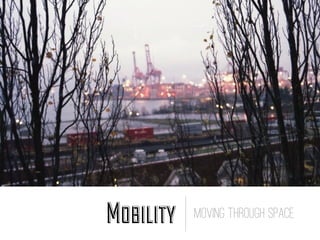
Mobility   moving through space
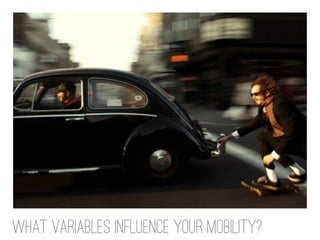
What variables influence your mobility?
Health & Wellness
Law

                                            Race

              Class


                                                     Gender
                                Economics                     Climate
Citizenship
              Urban structure
                                               Culture
Urban & Rural   infrastructure & access
Railroads are an important part of early Canadian mobility--connecting the nation, building trading posts,
hotels, and cities.
Our mobility in cities is dictated by the built environment (left), cars, busses, streets, and transportation
infrastructure (right). Of course, not all modes of mobility have the same low barriers to access.
Information
How does access to information promote or inhibit
mobility?

How does technologies of knowledge production
change the way we see space as open, available,
scalable?
Making home   How do cultural practices, discourses, geography, make a mobile space
              where we feel most comfortable, most ‘at home’?
Race and Identity


Do we all move through political spaces in a similar fashion?
                    How does race change the way we are seen, heard, and move?
                                    Do spaces take on exclusionary practices? How are spaces racialized?
Money   In what ways does money, and our access to it, change the way we move through space?
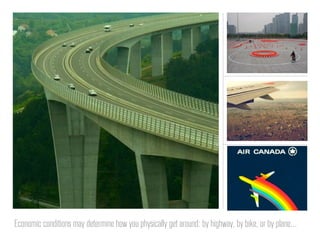
Economic conditions may determine how you physically get around: by highway, by bike, or by plane...
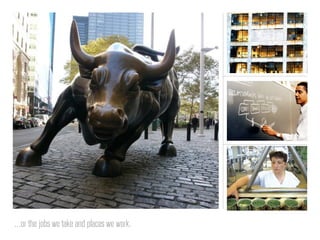
...or the jobs we take and places we work.
Gender & Sexuality   How are borders embodied or corporealized? How do we move
                     through space uniquely as gendered subjects?
4.2%   of Fortune 500 CEOs are female.
                                          Women hold
           of seats in the current House of Commons.   24.4%
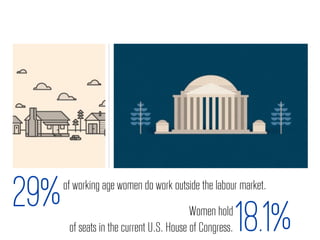
29%   of working age women do work outside the labour market.
                                          Women hold
       of seats in the current U.S. House of Congress.   18.1%
Gender & Parenting


Our movement in/through space is determined not simply by gender, but by our subject
position as parents--namely, mothers. Strollers that are clunky on transit, washrooms
without adequate spaces to change diapers, or stores set off highways amidst expansive
parking lots all have effects on how parents access space.
In what ways does accessing space presume or privilege those in
Health & Wellness   good health?
10%   of Canada’s GDP goes to public health services.
                                               Canadians lose
                                 working days a year to illness.   7
How does immigrant ‘illegality’ render spaces--hospitals,
Immigrant Exclusion   schools, daycare centres, police stations--as off limits?
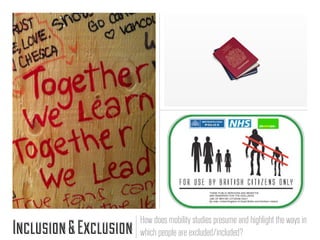
How does mobility studies presume and highlight the ways in
Inclusion & Exclusion   which people are excluded/included?
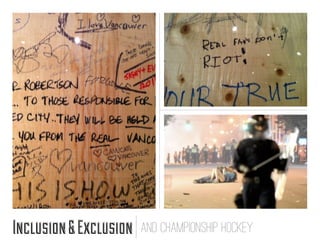
Inclusion & Exclusion   And championship HOCKEY
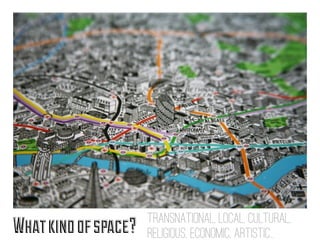
Transnational, local, cultural,
What kind of space?   religious, economic, artistic..

Mobility

  • 1.
    Mobility moving through space
  • 2.
  • 3.
    Health & Wellness Law Race Class Gender Economics Climate Citizenship Urban structure Culture
  • 4.
    Urban & Rural infrastructure & access
  • 5.
    Railroads are animportant part of early Canadian mobility--connecting the nation, building trading posts, hotels, and cities.
  • 6.
    Our mobility incities is dictated by the built environment (left), cars, busses, streets, and transportation infrastructure (right). Of course, not all modes of mobility have the same low barriers to access.
  • 7.
    Information How does accessto information promote or inhibit mobility? How does technologies of knowledge production change the way we see space as open, available, scalable?
  • 8.
    Making home How do cultural practices, discourses, geography, make a mobile space where we feel most comfortable, most ‘at home’?
  • 9.
    Race and Identity Dowe all move through political spaces in a similar fashion? How does race change the way we are seen, heard, and move? Do spaces take on exclusionary practices? How are spaces racialized?
  • 10.
    Money In what ways does money, and our access to it, change the way we move through space?
  • 11.
    Economic conditions maydetermine how you physically get around: by highway, by bike, or by plane...
  • 12.
    ...or the jobswe take and places we work.
  • 13.
    Gender & Sexuality How are borders embodied or corporealized? How do we move through space uniquely as gendered subjects?
  • 14.
    4.2% of Fortune 500 CEOs are female. Women hold of seats in the current House of Commons. 24.4%
  • 15.
    29% of working age women do work outside the labour market. Women hold of seats in the current U.S. House of Congress. 18.1%
  • 16.
    Gender & Parenting Ourmovement in/through space is determined not simply by gender, but by our subject position as parents--namely, mothers. Strollers that are clunky on transit, washrooms without adequate spaces to change diapers, or stores set off highways amidst expansive parking lots all have effects on how parents access space.
  • 17.
    In what waysdoes accessing space presume or privilege those in Health & Wellness good health?
  • 18.
    10% of Canada’s GDP goes to public health services. Canadians lose working days a year to illness. 7
  • 19.
    How does immigrant‘illegality’ render spaces--hospitals, Immigrant Exclusion schools, daycare centres, police stations--as off limits?
  • 20.
    How does mobilitystudies presume and highlight the ways in Inclusion & Exclusion which people are excluded/included?
  • 21.
    Inclusion & Exclusion And championship HOCKEY
  • 22.
    Transnational, local, cultural, Whatkind of space? religious, economic, artistic..