Evolution of MobileEdge Computing
● Cloud computing [2000]
● Cloudlets [CMU 2009]
● Fog computing [CISCO 2012]
● Mobile Edge Computing [ETSI 2014]
● Multi-access Edge Computing
3.
Mobile Edge Computing
●Edge computing is one of the key enabler of cloud computing by keeping services at
edge or at first hop
● MEC offers IT service and cloud-computing capabilities at the edge of the mobile network
in an environment that is characterized by proximity, ultra-low latency and high
bandwidth. Furthermore, it provides exposure to real-time radio network and context
information – ETSI (European Telecommunications Standards Institute)
● The primary goal of edge computing is to reduce network congestion and improve
application performance by executing related task processing closer to the end user,
improving the delivery of content and applications to those users
4.
Characteristics of MEC
●Proximity [1 or 2 hops]
● Location awareness
● High throughput [1-10 Gbps]
● Low latency [1 millisecond]
● High reliability [99.9999% availability]
● Energy efficiency [90% reduction in energy usage]
● Less backhaul network congestion
5.
MEC Use Cases
Sr.No. Applications and Use Cases Key Points
1 Dynamic Content Delivery Placing content close to users, exploiting user’s context information
2 AR/VR Real-time fast processing, context aware
3 Intensive Computation Assistance Low latency, low cost devices, collecting info. from multiple sources
4 Video Streaming and Analysis Avoiding redundant video streams transmission, more capable of analysis
5 Internet of Thing (IoT) Healthcare, wireless sensor systems, smart grid, smart home, smart city
6 Connected Vehicles V2X communication, automotive safety services, traffic control and smart
parking
7 Cognitive Assistance Augmenting human perception and cognition ability, processing latency
sensitive tasks
8 Wireless Big Data Analysis Reduce bandwidth consumption and network latency
6.
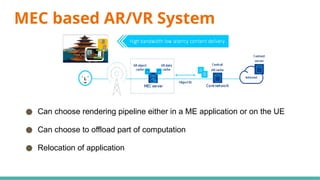
MEC based AR/VRSystem
● Can choose rendering pipeline either in a ME application or on the UE
● Can choose to offload part of computation
● Relocation of application
7.
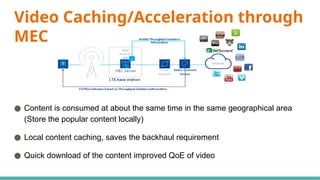
Video Caching/Acceleration through
MEC
●Content is consumed at about the same time in the same geographical area
(Store the popular content locally)
● Local content caching, saves the backhaul requirement
● Quick download of the content improved QoE of video
8.
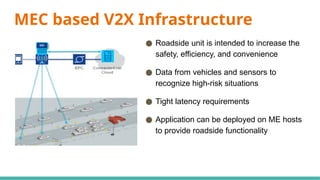
MEC based V2XInfrastructure
● Roadside unit is intended to increase the
safety, efficiency, and convenience
● Data from vehicles and sensors to
recognize high-risk situations
● Tight latency requirements
● Application can be deployed on ME hosts
to provide roadside functionality
9.
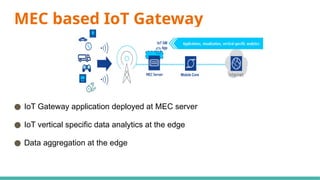
MEC based IoTGateway
● IoT Gateway application deployed at MEC server
● IoT vertical specific data analytics at the edge
● Data aggregation at the edge
10.
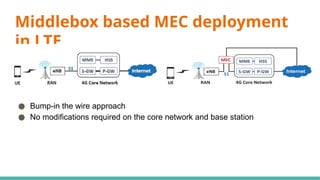
Middlebox based MECdeployment
in LTE
● Bump-in the wire approach
● No modifications required on the core network and base station
11.
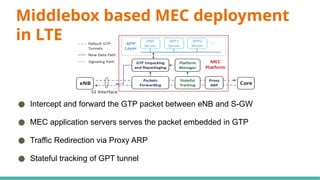
Middlebox based MECdeployment
in LTE
● Intercept and forward the GTP packet between eNB and S-GW
● MEC application servers serves the packet embedded in GTP
● Traffic Redirection via Proxy ARP
● Stateful tracking of GPT tunnel
12.
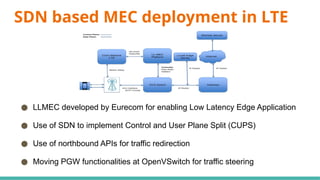
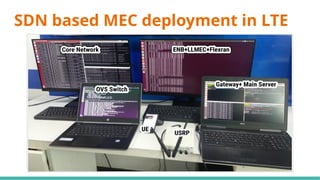
SDN based MECdeployment in LTE
● LLMEC developed by Eurecom for enabling Low Latency Edge Application
● Use of SDN to implement Control and User Plane Split (CUPS)
● Use of northbound APIs for traffic redirection
● Moving PGW functionalities at OpenVSwitch for traffic steering
Consolidated Caching andCache
Splitting
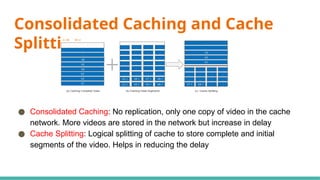
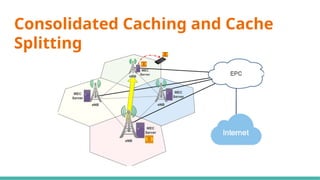
● Consolidated Caching: No replication, only one copy of video in the cache
network. More videos are stored in the network but increase in delay
● Cache Splitting: Logical splitting of cache to store complete and initial
segments of the video. Helps in reducing the delay
MEC in 5G
●5G provides higher data rate than 4G (1000x bandwidth per unit area)
more back haul traffic in the 5G core
● 5G RAN provides low RAN latency (1 ms) Backhaul is the bottleneck for
the low latency services
17.
MEC in 5G
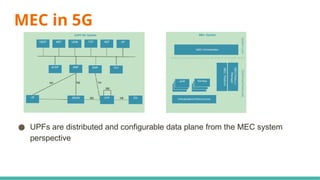
●UPFs are distributed and configurable data plane from the MEC system
perspective
18.
MEC support functionsin 5G
● UPF (Re)selection - The 5G Core Network (re)selects UPF to route the user
traffic to the Local Area Data Network (LADN)
● Traffic influence by application function - The AF can influence UPF
(re)selection either communicating with the PCF or NEF
● Local routing and traffic steering - Traffic steering through Uplink Classifiers at
UPF that operate on a set of traffic filters matching the steered traffic
● Session and service continuity - Different SSC modes [IP address
modifications] are specified to enable UE and application mobility
● Network Capability exposure - UE’s information like IP address, location, radio
quality will be exposed by 5G core network
● QoS and Charging using PCF policies - QoS Control and Charging policies
for the traffic routed through LADN while UPF tracks data usage
19.
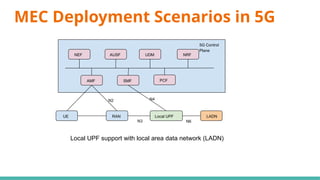
MEC Deployment Scenariosin 5G
NEF
RAN
NRF
PCF
SMF
AMF
UDM
AUSF
UE Local UPF LADN
N2
N3 N6
N4
5G Control
Plane
Local UPF support with local area data network (LADN)
20.
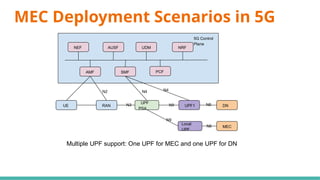
MEC Deployment Scenariosin 5G
Multiple UPF support: One UPF for MEC and one UPF for DN
NEF
RAN
NRF
PCF
SMF
AMF
UDM
AUSF
UE
UPF
PSA
DN
N2
N3
N4
5G Control
Plane
UPF1
Local
UPF
MEC
N6
N6
N9
N9
N4
21.
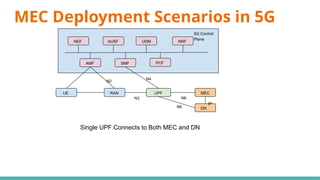
MEC Deployment Scenariosin 5G
Single UPF Connects to Both MEC and DN
NEF
RAN
NRF
PCF
SMF
AMF
UDM
AUSF
UE UPF MEC
N2
N3 N6
N4
5G Control
Plane
DN
N6
IP
22.
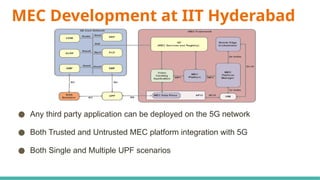
MEC Development atIIT Hyderabad
● Any third party application can be deployed on the 5G network
● Both Trusted and Untrusted MEC platform integration with 5G
● Both Single and Multiple UPF scenarios
23.
Conclusion
● Mobile EdgeComputing is the way to meet the requirement of 5G
applications
● Middle-box and SDN are the way to implement MEC in 4G
● 5G is designed with the notion of MEC in the mobile networks. Lot of support
functionalities defined in the standard
● Many 5G applications that require high bandwidth and/or low latency
requirement can be realized with MEC

![Evolution of Mobile Edge Computing
● Cloud computing [2000]
● Cloudlets [CMU 2009]
● Fog computing [CISCO 2012]
● Mobile Edge Computing [ETSI 2014]
● Multi-access Edge Computing](https://image.slidesharecdn.com/mecinmobilenetwork-antony-250320002216-a9bf343f/85/Mobile-Network-communications-presentation-2-320.jpg)
![Characteristics of MEC
● Proximity [1 or 2 hops]
● Location awareness
● High throughput [1-10 Gbps]
● Low latency [1 millisecond]
● High reliability [99.9999% availability]
● Energy efficiency [90% reduction in energy usage]
● Less backhaul network congestion](https://image.slidesharecdn.com/mecinmobilenetwork-antony-250320002216-a9bf343f/85/Mobile-Network-communications-presentation-4-320.jpg)
![MEC support functions in 5G
● UPF (Re)selection - The 5G Core Network (re)selects UPF to route the user
traffic to the Local Area Data Network (LADN)
● Traffic influence by application function - The AF can influence UPF
(re)selection either communicating with the PCF or NEF
● Local routing and traffic steering - Traffic steering through Uplink Classifiers at
UPF that operate on a set of traffic filters matching the steered traffic
● Session and service continuity - Different SSC modes [IP address
modifications] are specified to enable UE and application mobility
● Network Capability exposure - UE’s information like IP address, location, radio
quality will be exposed by 5G core network
● QoS and Charging using PCF policies - QoS Control and Charging policies
for the traffic routed through LADN while UPF tracks data usage](https://image.slidesharecdn.com/mecinmobilenetwork-antony-250320002216-a9bf343f/85/Mobile-Network-communications-presentation-18-320.jpg)