Mobile Cities

Prof. Stephen Graham
Newcastle University
Introduction:
Cities are Engines of Mobility and Circulation
•  Intensity of urban life sustained by
many simultaneous flows,
mobilities and circulations
operating at wide variety of scales:
from the body to the transnational
•  Such flows within and between cities
help to constitute processes of
urbanisation and neoliberal
globalisation at same time
Mobility, Modernity
& Urban ‘Progress’
•  Speeding-up and improving transport
and communications long been seen
by urban planning and urban
imaginaries as means of instilling
‘progress’ and ‘modernity’ to
benefit all and create a better or
utopian urban future
•  Modernity = sense of perpetual
transformation through new
technology, mobility, innovation etc
Modern Planning Utopias Stressed Progress Through
Emancipatory and Transformative Mobilities
(e.g.Le Corbusier's 1925 Plan Voisin for central Paris)

Implications for notions of order, security, scale
& politics of city?
•  New systems of
mobility, transport,
communication and
circulation allow
cities and urban life
to become
increasingly
interconnected and
globalised
•  “time-space
compression”
‘Time-Space Compression’
•  New transport and communications advantages
accelerate the flows between cities
•  Space and time barriers ‘compressed’
•  Economic globalisation (finance, capital,
investment, trade, labour)
•  Social globalisation: migration, tourism, people
trafficking
•  Also cultural globalisation (e.g. global media
events moving around between cities)
•  Cities at the heart of all these: Urban everyday life
involves constant links to far-off cities and places
•  Need to look at multiple scales at the same time:
From body to Globe
Parallel Growth of Physical
and Electronic Mobilities
Similar global geographies of both
(Internet flows top, BA’s air network bottom)
•  Seeing cities as
processes of mobility and
circulation helps in
‘grounding’ discussions
about globalization
•  A dynamic, material urban
process emerges based
on role of cities as hubs of
flows of people, capital,
finance, technology,
information, waste,
energy, water, and so on
•  Right: container port
‘Mobilities Turn” in Urban Studies
1990s Neoliberal Idea of
Globalization Centred on
the Myths of the
‘Friction Free
Capitalism,’ the ‘End of
Geography,’ or the
‘Death of Distance’
i.e. a ‘flat world’
becoming more
homogenous and
egalitarian
But this is a Myth!: Real Situation Marked by Extremes of
Uneven Development Within International Divisions of
Wealth and Labour
•  Far from overcoming geographical
unevenness, they help dominant
firms to exploit differences between
places
•  Connective infrastructures and the
flows they sustain vital in supporting
what is known as the new
international division of labour of
globalized capitalism within which
cities are key hubs
•  People and places are in starkly
different positions to burgeoning
mobility.
An ‘Archipeligo’ Economy with
Extended ‘Divisions of Labour’
In Control: Global
Socioeconomic Elites are also
‘Kinetic Elites’ who gain their
power from hypermobility

“Global
Capitalist
Classes”
Global Airports are Key Nodes
Explosion & Congestion in Transnational Mobilities
(Heathrow Tracks)
Transnational Lives
Benefit from new
‘premium’ urban
transport
emerging with
splintering
urbanism
Seamless,
Synchronised,
Coordination
‘Just-In-Time’
Flows
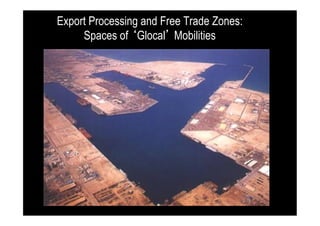
Export Processing and Free Trade Zones:
Spaces of ‘Glocal’ Mobilities
‘Global Cities’ are Key Mobility Hubs: Loughborough
University’s Inventory of World Cities
These also act as Cosmopolitan Hubs of
‘Diasporic’ Migration Networks
•  Dominant or ‘Alpha’ Global Cities
mostly in Global North: London, New
York, Tokyo
•  Status as economic power-houses
makes them extremely
‘cosmopolitan’ cities
•  Central hubs in hundreds of
international migration and cultural
networks sustaining countless
‘disporas’ of communities from all
over the world (Pakistani Diaspora
and London street; next: London)
Such Cities are also Central Hubs on Global
Airline Networks…(BA)
Airport the
Iconic Site
of
Globalizing
Urbanism

Key Nodes
Demarcated
Through
Signature
Architectures
..Such cities are also key hubs on
Transnational Optic Fibre Grids
New types
of automobile
culture
Local
Bypass
‘Smart’
Highways use
price to speed-up
and remove congestion
Decongestion Through Commodified Roadspace
Tourist Cities
•  Increasingly important:
cities constructed or
repackaged as fantasy
landscapes of escape
•  Primarily or exclusively
for visitors but rely on
massive cheap, local or
imported labour forces
•  Las Vegas, Cancun
(Mexico)
Good Example of How Internet Technology
Supports New Types of Physical Mobility
Those Not in Control: Also large ‘kinetic underclass’: Poverty
and powerlessness increasingly shaped by immobility, dangerous
mobility, or lack of control over one’s mobilities
(beggar, Indonesian public transport, African on Spanish beach, Mexican jumping US border)
Neoliberal Capitalism relies on labour being a lot less
mobile than capital: Many attempts to cross fortifying
borders or ‘Political equator’ Separating Global North
and South (right, San Diego/Tijuana)
e.g. Global People Trafficking Geographies
Sometimes Kinetic elites and kinetic underclasses operate
through colonial geographies e.g. Jewish-only highway
vs.. Palestinian checkpoint on West Bank
Also water pipes in
Mumbai: Proximity
and Access Very
Different Things
Forced immobility also used as punishment
and humiliation e.g. ASBO
Neoliberalisisng states all characterised by
rapid increases in incarcerated populations
e.g US
e.g. 4: Toxic Wastes
•  Global Flows away from richer
cities where waste is generated
to less resistant and poorer cities
and regions with no or lax
environmental protection
desperate for even very poor
quality work
•  Highly controversial when such
flows seen to be going ‘wrong’
way e.g. ‘ghost ships’,
Hartlepool, 2004 (right)
e.g. 5 Splintering Urbanism
At city level, as we saw last
week, a proliferation of
‘hard’ enclaves that come
with Splintering Urbanism
These undermine idea of the
city as an open and relatively
free space of mobility and
mixing
Bring in checkpoints so that
rights of access have to be
proven before entering
‘Camp’ like architectures and security zones e.g.
Finance districts in London and Manhattan
In urban streets and
malls shift towards
security-obsessed
‘Jittery Space’
Moral Panics
and Cultures
of Fear
Boundary
Transgressors
as Deviants
Conclusion
“The city is a gearbox full of speeds”
McKenzie Wark, 2001
Far from being the ‘death of distance’ for all, as in the myth
of neoliberal globalisation, the new geographies of mobility
are being used to slow down or prevent mobilities deemed
risky, unprofitable or malign to enhance or add power to
those deemed virtuous, risk-free or profitable

Mobile cities

  • 1.
    Mobile Cities Prof. StephenGraham Newcastle University
  • 2.
    Introduction: Cities are Enginesof Mobility and Circulation •  Intensity of urban life sustained by many simultaneous flows, mobilities and circulations operating at wide variety of scales: from the body to the transnational •  Such flows within and between cities help to constitute processes of urbanisation and neoliberal globalisation at same time
  • 3.
    Mobility, Modernity & Urban‘Progress’ •  Speeding-up and improving transport and communications long been seen by urban planning and urban imaginaries as means of instilling ‘progress’ and ‘modernity’ to benefit all and create a better or utopian urban future •  Modernity = sense of perpetual transformation through new technology, mobility, innovation etc
  • 4.
    Modern Planning UtopiasStressed Progress Through Emancipatory and Transformative Mobilities (e.g.Le Corbusier's 1925 Plan Voisin for central Paris) Implications for notions of order, security, scale & politics of city?
  • 5.
    •  New systemsof mobility, transport, communication and circulation allow cities and urban life to become increasingly interconnected and globalised •  “time-space compression”
  • 6.
    ‘Time-Space Compression’ •  Newtransport and communications advantages accelerate the flows between cities •  Space and time barriers ‘compressed’ •  Economic globalisation (finance, capital, investment, trade, labour) •  Social globalisation: migration, tourism, people trafficking •  Also cultural globalisation (e.g. global media events moving around between cities) •  Cities at the heart of all these: Urban everyday life involves constant links to far-off cities and places •  Need to look at multiple scales at the same time: From body to Globe
  • 7.
    Parallel Growth ofPhysical and Electronic Mobilities
  • 8.
    Similar global geographiesof both (Internet flows top, BA’s air network bottom)
  • 9.
    •  Seeing citiesas processes of mobility and circulation helps in ‘grounding’ discussions about globalization •  A dynamic, material urban process emerges based on role of cities as hubs of flows of people, capital, finance, technology, information, waste, energy, water, and so on •  Right: container port
  • 10.
  • 11.
    1990s Neoliberal Ideaof Globalization Centred on the Myths of the ‘Friction Free Capitalism,’ the ‘End of Geography,’ or the ‘Death of Distance’ i.e. a ‘flat world’ becoming more homogenous and egalitarian
  • 12.
    But this isa Myth!: Real Situation Marked by Extremes of Uneven Development Within International Divisions of Wealth and Labour •  Far from overcoming geographical unevenness, they help dominant firms to exploit differences between places •  Connective infrastructures and the flows they sustain vital in supporting what is known as the new international division of labour of globalized capitalism within which cities are key hubs •  People and places are in starkly different positions to burgeoning mobility.
  • 13.
    An ‘Archipeligo’ Economywith Extended ‘Divisions of Labour’
  • 14.
    In Control: Global SocioeconomicElites are also ‘Kinetic Elites’ who gain their power from hypermobility “Global Capitalist Classes”
  • 15.
  • 16.
    Explosion & Congestionin Transnational Mobilities (Heathrow Tracks)
  • 17.
  • 18.
    Benefit from new ‘premium’urban transport emerging with splintering urbanism
  • 19.
  • 20.
    Export Processing andFree Trade Zones: Spaces of ‘Glocal’ Mobilities
  • 21.
    ‘Global Cities’ areKey Mobility Hubs: Loughborough University’s Inventory of World Cities
  • 22.
    These also actas Cosmopolitan Hubs of ‘Diasporic’ Migration Networks •  Dominant or ‘Alpha’ Global Cities mostly in Global North: London, New York, Tokyo •  Status as economic power-houses makes them extremely ‘cosmopolitan’ cities •  Central hubs in hundreds of international migration and cultural networks sustaining countless ‘disporas’ of communities from all over the world (Pakistani Diaspora and London street; next: London)
  • 24.
    Such Cities arealso Central Hubs on Global Airline Networks…(BA)
  • 25.
    Airport the Iconic Site of Globalizing Urbanism KeyNodes Demarcated Through Signature Architectures
  • 26.
    ..Such cities arealso key hubs on Transnational Optic Fibre Grids
  • 27.
    New types of automobile culture Local Bypass ‘Smart’ Highwaysuse price to speed-up and remove congestion
  • 28.
  • 29.
    Tourist Cities •  Increasinglyimportant: cities constructed or repackaged as fantasy landscapes of escape •  Primarily or exclusively for visitors but rely on massive cheap, local or imported labour forces •  Las Vegas, Cancun (Mexico)
  • 30.
    Good Example ofHow Internet Technology Supports New Types of Physical Mobility
  • 31.
    Those Not inControl: Also large ‘kinetic underclass’: Poverty and powerlessness increasingly shaped by immobility, dangerous mobility, or lack of control over one’s mobilities (beggar, Indonesian public transport, African on Spanish beach, Mexican jumping US border)
  • 32.
    Neoliberal Capitalism relieson labour being a lot less mobile than capital: Many attempts to cross fortifying borders or ‘Political equator’ Separating Global North and South (right, San Diego/Tijuana)
  • 33.
    e.g. Global PeopleTrafficking Geographies
  • 34.
    Sometimes Kinetic elitesand kinetic underclasses operate through colonial geographies e.g. Jewish-only highway vs.. Palestinian checkpoint on West Bank
  • 35.
    Also water pipesin Mumbai: Proximity and Access Very Different Things
  • 36.
    Forced immobility alsoused as punishment and humiliation e.g. ASBO Neoliberalisisng states all characterised by rapid increases in incarcerated populations e.g US
  • 37.
    e.g. 4: ToxicWastes •  Global Flows away from richer cities where waste is generated to less resistant and poorer cities and regions with no or lax environmental protection desperate for even very poor quality work •  Highly controversial when such flows seen to be going ‘wrong’ way e.g. ‘ghost ships’, Hartlepool, 2004 (right)
  • 38.
    e.g. 5 SplinteringUrbanism At city level, as we saw last week, a proliferation of ‘hard’ enclaves that come with Splintering Urbanism These undermine idea of the city as an open and relatively free space of mobility and mixing Bring in checkpoints so that rights of access have to be proven before entering
  • 39.
    ‘Camp’ like architecturesand security zones e.g. Finance districts in London and Manhattan
  • 40.
    In urban streetsand malls shift towards security-obsessed ‘Jittery Space’ Moral Panics and Cultures of Fear Boundary Transgressors as Deviants
  • 41.
    Conclusion “The city isa gearbox full of speeds” McKenzie Wark, 2001 Far from being the ‘death of distance’ for all, as in the myth of neoliberal globalisation, the new geographies of mobility are being used to slow down or prevent mobilities deemed risky, unprofitable or malign to enhance or add power to those deemed virtuous, risk-free or profitable