“MLM Marketing Explained: What It Is, Why It’s Effective, and
When to Use It” Multi-level marketing (MLM), also appertained to as
direct selling or network marketing, is a deals approach where
products are sent directly to guests through independent deals
representatives. MLM enterprises frequently attract new members
by offering the prospect of fiscal success and autonomy. Although
not innately against the law, multitudinous MLMs have gained
notoriety for their contentious business tactics, and some have
been exposed as illegal aggregate schemes.
WHAT IS MULTI-LEVEL MARKETING?
Multi-Level Marketing, also known as network marketing, is a
business model where individuals earn income from dealing
products or services and retaining others to do the same. Multi-
level marketing companies depend on individuals rather than
traditional retail outlets to vend their products directly to guests.
This means that the task of selling is delegated to independent
distributor networks.
In the MLM system, distributors aren’t considered workers of the
company. They’re seen as independent business possessors who
make their own networks of distributors to help them in product
deals. The profit of multi-level marketing companies is generated
through the collaborative sweats of these independent distributor
networks.
KEY TAKEAWAYS
• Some direct-sales organizations use multilevel
marketing (MLM) as a legitimate business
strategy to sell their goods and services.
• It is encouraged by current members to bring in
new members and market and sell the
company’s products to others.
• Participants get a cut in the sales made by their
recruits.
Every level of person receives a commission of
some kind, therefore the more levels there are,
the greater the possible earnings.
• The Federal Trade Commission (FTC)
investigates multilevel marketing (MLM)
programs to ensure that they do not operate as
illegal pyramid schemes.
How Multi-Level Marketing Works
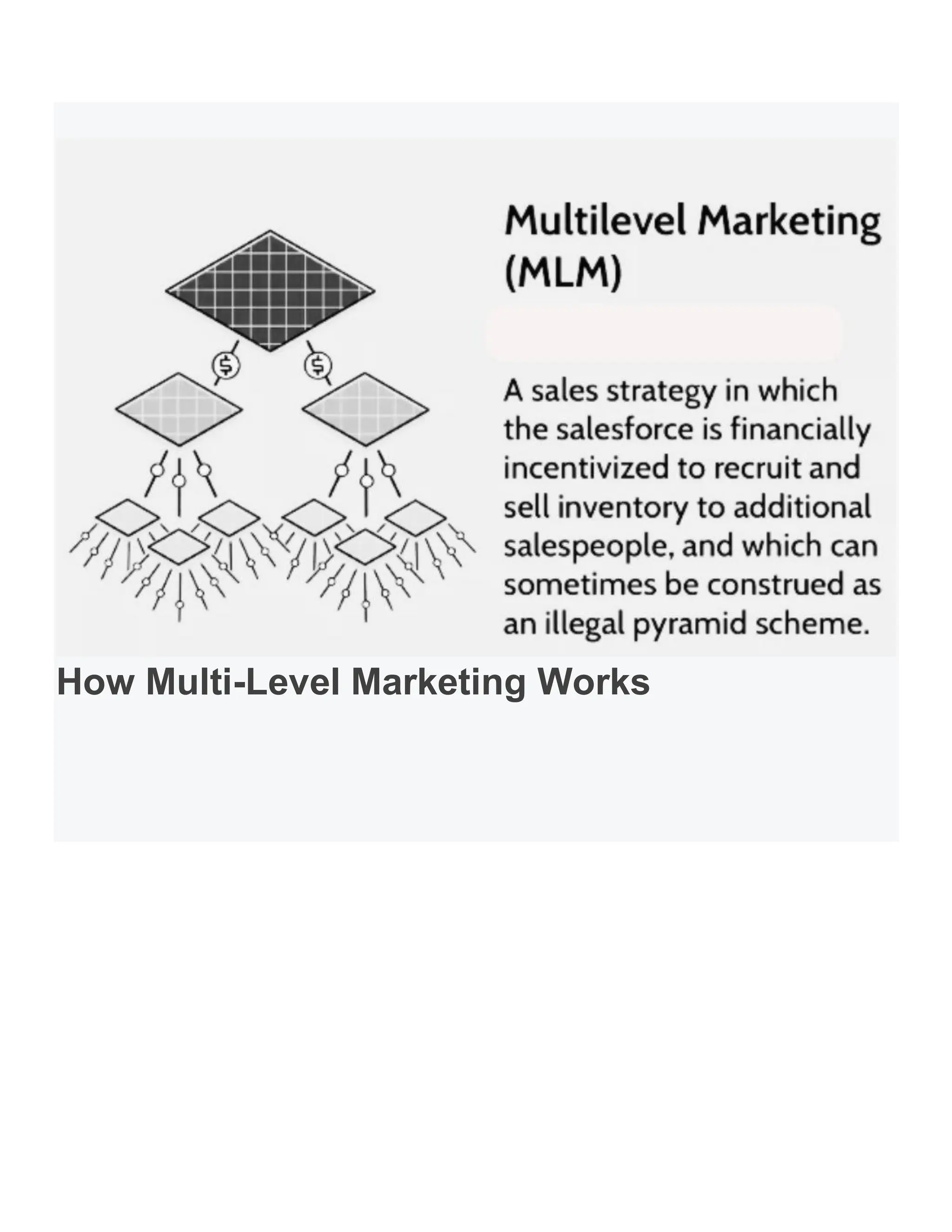
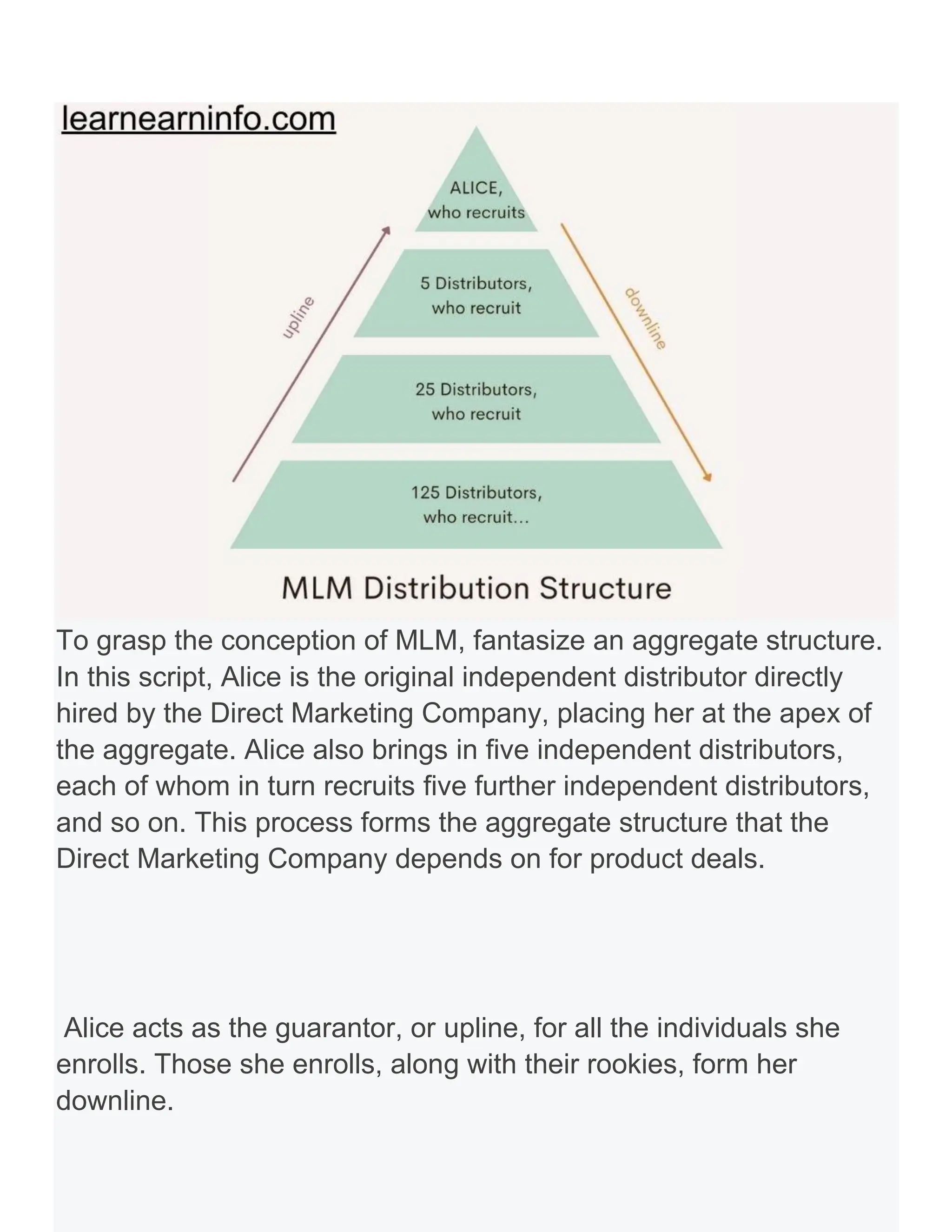
To grasp the conception of MLM, fantasize an aggregate structure.
In this script, Alice is the original independent distributor directly
hired by the Direct Marketing Company, placing her at the apex of
the aggregate. Alice also brings in five independent distributors,
each of whom in turn recruits five further independent distributors,
and so on. This process forms the aggregate structure that the
Direct Marketing Company depends on for product deals.
Alice acts as the guarantor, or upline, for all the individuals she
enrolls. Those she enrolls, along with their rookies, form her
downline.
Understanding the direction of these connections is pivotal as it
affects the earnings of everyone involved in the aggregate structure
of utmost multi-level marketing schemes. Each distributor pays a
portion of their earnings to the company and to those above them in
the scale.
MLM distributors make plutocrats through dealing goods to their
network, getting paid a commission for each new member they
bring into the company, and getting paid a commission for both
deals and recruiting. themselves.” downline, extending across
multiple situations,” explains Christine Aleman, CEO of TBGA, a
branding and marketing support agency.” A distributor needs to
constantly bring in as numerous downlines as they can to succeed.
Typical methods of product sales in multilevel marketing
include:
• online events for farmer’s markets and fairs
• social media networks
• social media advertising house calls
• oral communication
• Influencer marketing, social media marketing, in-
person or online events
MLMs generally give a comprehensive compensation plan that
details the workings of upline and downline connections and how
distributors are compensated. These plans specify aspects similar
to reclamation and deals commissions and outline the criteria that
members must meet to qualify for compensation, generally in terms
of minimal deals targets and number of new rookies.
Aggregate Scheme versus multi-Level
Marketing
MLM companies and aggregate schemes partake an analogous
aggregate- shaped structure, leading to accessible dubitation
about their legality. Still, the crucial difference lies in their focus on
deals versus reclamation in the compensation plan. The Federal
Trade Commission (FTC) states that a licit MLM will compensate
grounded on deals to retail guests, without taking constant
reclamation of new distributors. In discrepancy, aggregate schemes
calculate nonstop reclamation of members who must keep buying
products, anyhow of their capability to vend them, to sustain the
scheme.
MLMs and the 70 Rule Understanding the
Relationship
To misbehave with regulations and avoid being classified as an
aggregate scheme, an MLM must ensure that at least 70 of its
products are bought Beynon-distributors. This means that the
maturity of deals should come from consumers outside the
company, rather than from distributors within the network or from
distributors themselves grazing up on force. Still, it’s challenging to
corroborate compliance with this rule, as it’s delicate to track
whether distributors are hoarding unsold products. Also, if a
distributor manages to vend 70 of their force, the fiscal success
promised by numerous MLMs generally comes from reclamation
rather than direct deals, according to experimenter Cory Rosin.
When MLMs Fail
The failure of an aggregate scheme occurs when its reclamation
sweats are unprofitable because the model relies on nonstop
reclamation to maintain gains. MLM companies frequently collapse
when suppliers or distributors mutiny against unethical business
practices, as seen in the recent Lula Roe reproach. Still, individual
distributors may struggle within an MLM without it fully collapsing
for a period. To epitomize, Lula Roe has been sued by
merchandisers for not paying checks, and the company has been
involved in a class action from guests who entered defective
products. The state of Washington, which had sued the business
for running an illegal aggregate scheme, and the pot lately came to
an agreement.
Should You Join An MLM?
Multi-level marketing companies may feel like an charming way for
individualities to take control of their own business and induce
income from products they believe in. still, statistics show that 99 of
people involved in MLMs end up losing plutocrat, as they struggle
to vend products and novitiate members for companies that
frequently operate on the boundaries of legitimacy and hide the
factual costs of involvement. Also, some MLMs employ tactics that
can have a negative impact on distributors, both financially and
psychologically. rather than getting involved in an MLM, former
distributor Rosin suggests considering other openings that align
with your values, whether it’s fiscal independence, flexible work
arrangements, or a sense of community. Without taking on the
significant fiscal and cerebral pitfalls connected with multilevel
marketing (MLM) openings, you can launch your own business by
relating your capacities and figuring out how to help others.
CONCLUSION
MLM Marketing: What, why, and When? To sum up, network
marketing, also known as multi-level marketing, presents a
distinctive and alluring business opportunity for people looking to
establish a financially rewarding, home-based business.
Distributors can enjoy more flexibility, create passive revenue
streams, and grow personally by utilizing the power of relationship
marketing. Although there are certain difficulties in the field, such as
developing and sustaining a solid team and overcoming
unfavorable opinions, network marketing has the potential to be a
lucrative endeavor for those who are prepared to put in the required
effort and dedication. Network marketers can discover the keys to
long-term success and financial freedom by selecting the correct
organization, putting successful lead generation tactics into
practice, and putting a strong emphasis on their own personal and
professional growth. The network marketing sector is rife with
motivational success tales that offer potent illustrations of the
transformative potential of a flourishing multilevel marketing
enterprise. Ultimately, network marketing offers an alluring prospect
worth investigating for individuals looking for an entrepreneurial
route to financial freedom and success.
FAQ
What is network marketing?
A network of distributors is essential to the expansion of a business
using the network marketing business model. It entails approaching
customers directly and enlisting new members of the network.
What is mid-level marketing?
Mid-level marketing refers to marketing methods targeted at mid-
tier or mid-market enterprises, with an emphasis on intermediate
sales techniques and distribution channels. It is frequently mistaken
for multilevel marketing (MLM).
MLM Marketing: What, why, and When?
What: Multilevel marketing (MLM) is a method in which sales
representatives receive compensation for both their own and their
recruits’ sales.
Why: It’s employed to take advantage of personal networks for
rapid expansion.
When: It can be applied at any point in the company’s growth,
although it works best once a robust network has been built.
What is mlm network marketing.?
With MLM network marketing, members can make money both
directly from sales and by bringing in new members, who also get
paid a portion of the sales made by those members.
What is multilevel marketing?
Salespeople who use the multilevel marketing (MLM) method make
money from both their own sales and the sales of the individuals
they refer.
What Does Multi-Level Marketing Mean?
Multilevel marketing is a sales approach in which distributors
establish numerous levels of compensation by earning commission
from both their own sales and the sales of the distributors they
recruit.

“MLM Marketing Explained What It Is, Why It’s Effective..pdf

  • 1.
    “MLM Marketing Explained:What It Is, Why It’s Effective, and When to Use It” Multi-level marketing (MLM), also appertained to as direct selling or network marketing, is a deals approach where products are sent directly to guests through independent deals representatives. MLM enterprises frequently attract new members by offering the prospect of fiscal success and autonomy. Although not innately against the law, multitudinous MLMs have gained notoriety for their contentious business tactics, and some have been exposed as illegal aggregate schemes.
  • 2.
    WHAT IS MULTI-LEVELMARKETING? Multi-Level Marketing, also known as network marketing, is a business model where individuals earn income from dealing products or services and retaining others to do the same. Multi- level marketing companies depend on individuals rather than traditional retail outlets to vend their products directly to guests. This means that the task of selling is delegated to independent distributor networks. In the MLM system, distributors aren’t considered workers of the company. They’re seen as independent business possessors who make their own networks of distributors to help them in product deals. The profit of multi-level marketing companies is generated through the collaborative sweats of these independent distributor networks.
  • 3.
    KEY TAKEAWAYS • Somedirect-sales organizations use multilevel marketing (MLM) as a legitimate business strategy to sell their goods and services. • It is encouraged by current members to bring in new members and market and sell the company’s products to others. • Participants get a cut in the sales made by their recruits. Every level of person receives a commission of some kind, therefore the more levels there are, the greater the possible earnings. • The Federal Trade Commission (FTC) investigates multilevel marketing (MLM) programs to ensure that they do not operate as illegal pyramid schemes.
  • 4.
  • 5.
    To grasp theconception of MLM, fantasize an aggregate structure. In this script, Alice is the original independent distributor directly hired by the Direct Marketing Company, placing her at the apex of the aggregate. Alice also brings in five independent distributors, each of whom in turn recruits five further independent distributors, and so on. This process forms the aggregate structure that the Direct Marketing Company depends on for product deals. Alice acts as the guarantor, or upline, for all the individuals she enrolls. Those she enrolls, along with their rookies, form her downline.
  • 6.
    Understanding the directionof these connections is pivotal as it affects the earnings of everyone involved in the aggregate structure of utmost multi-level marketing schemes. Each distributor pays a portion of their earnings to the company and to those above them in the scale. MLM distributors make plutocrats through dealing goods to their network, getting paid a commission for each new member they bring into the company, and getting paid a commission for both deals and recruiting. themselves.” downline, extending across multiple situations,” explains Christine Aleman, CEO of TBGA, a branding and marketing support agency.” A distributor needs to constantly bring in as numerous downlines as they can to succeed. Typical methods of product sales in multilevel marketing include: • online events for farmer’s markets and fairs • social media networks • social media advertising house calls • oral communication • Influencer marketing, social media marketing, in- person or online events
  • 7.
    MLMs generally givea comprehensive compensation plan that details the workings of upline and downline connections and how distributors are compensated. These plans specify aspects similar to reclamation and deals commissions and outline the criteria that members must meet to qualify for compensation, generally in terms of minimal deals targets and number of new rookies. Aggregate Scheme versus multi-Level Marketing MLM companies and aggregate schemes partake an analogous aggregate- shaped structure, leading to accessible dubitation about their legality. Still, the crucial difference lies in their focus on deals versus reclamation in the compensation plan. The Federal Trade Commission (FTC) states that a licit MLM will compensate grounded on deals to retail guests, without taking constant reclamation of new distributors. In discrepancy, aggregate schemes calculate nonstop reclamation of members who must keep buying products, anyhow of their capability to vend them, to sustain the scheme.
  • 8.
    MLMs and the70 Rule Understanding the Relationship To misbehave with regulations and avoid being classified as an aggregate scheme, an MLM must ensure that at least 70 of its products are bought Beynon-distributors. This means that the maturity of deals should come from consumers outside the company, rather than from distributors within the network or from distributors themselves grazing up on force. Still, it’s challenging to corroborate compliance with this rule, as it’s delicate to track whether distributors are hoarding unsold products. Also, if a distributor manages to vend 70 of their force, the fiscal success promised by numerous MLMs generally comes from reclamation rather than direct deals, according to experimenter Cory Rosin. When MLMs Fail The failure of an aggregate scheme occurs when its reclamation sweats are unprofitable because the model relies on nonstop reclamation to maintain gains. MLM companies frequently collapse when suppliers or distributors mutiny against unethical business practices, as seen in the recent Lula Roe reproach. Still, individual distributors may struggle within an MLM without it fully collapsing for a period. To epitomize, Lula Roe has been sued by merchandisers for not paying checks, and the company has been involved in a class action from guests who entered defective
  • 9.
    products. The stateof Washington, which had sued the business for running an illegal aggregate scheme, and the pot lately came to an agreement. Should You Join An MLM? Multi-level marketing companies may feel like an charming way for individualities to take control of their own business and induce income from products they believe in. still, statistics show that 99 of people involved in MLMs end up losing plutocrat, as they struggle to vend products and novitiate members for companies that frequently operate on the boundaries of legitimacy and hide the factual costs of involvement. Also, some MLMs employ tactics that can have a negative impact on distributors, both financially and psychologically. rather than getting involved in an MLM, former distributor Rosin suggests considering other openings that align with your values, whether it’s fiscal independence, flexible work arrangements, or a sense of community. Without taking on the significant fiscal and cerebral pitfalls connected with multilevel marketing (MLM) openings, you can launch your own business by relating your capacities and figuring out how to help others. CONCLUSION
  • 10.
    MLM Marketing: What,why, and When? To sum up, network marketing, also known as multi-level marketing, presents a distinctive and alluring business opportunity for people looking to establish a financially rewarding, home-based business. Distributors can enjoy more flexibility, create passive revenue streams, and grow personally by utilizing the power of relationship marketing. Although there are certain difficulties in the field, such as developing and sustaining a solid team and overcoming unfavorable opinions, network marketing has the potential to be a lucrative endeavor for those who are prepared to put in the required effort and dedication. Network marketers can discover the keys to long-term success and financial freedom by selecting the correct organization, putting successful lead generation tactics into practice, and putting a strong emphasis on their own personal and professional growth. The network marketing sector is rife with motivational success tales that offer potent illustrations of the transformative potential of a flourishing multilevel marketing enterprise. Ultimately, network marketing offers an alluring prospect worth investigating for individuals looking for an entrepreneurial route to financial freedom and success.
  • 11.
    FAQ What is networkmarketing? A network of distributors is essential to the expansion of a business using the network marketing business model. It entails approaching customers directly and enlisting new members of the network. What is mid-level marketing? Mid-level marketing refers to marketing methods targeted at mid- tier or mid-market enterprises, with an emphasis on intermediate sales techniques and distribution channels. It is frequently mistaken for multilevel marketing (MLM). MLM Marketing: What, why, and When? What: Multilevel marketing (MLM) is a method in which sales representatives receive compensation for both their own and their recruits’ sales. Why: It’s employed to take advantage of personal networks for rapid expansion. When: It can be applied at any point in the company’s growth, although it works best once a robust network has been built.
  • 12.
    What is mlmnetwork marketing.? With MLM network marketing, members can make money both directly from sales and by bringing in new members, who also get paid a portion of the sales made by those members. What is multilevel marketing? Salespeople who use the multilevel marketing (MLM) method make money from both their own sales and the sales of the individuals they refer. What Does Multi-Level Marketing Mean? Multilevel marketing is a sales approach in which distributors establish numerous levels of compensation by earning commission from both their own sales and the sales of the distributors they recruit.