Mission Karmayogi
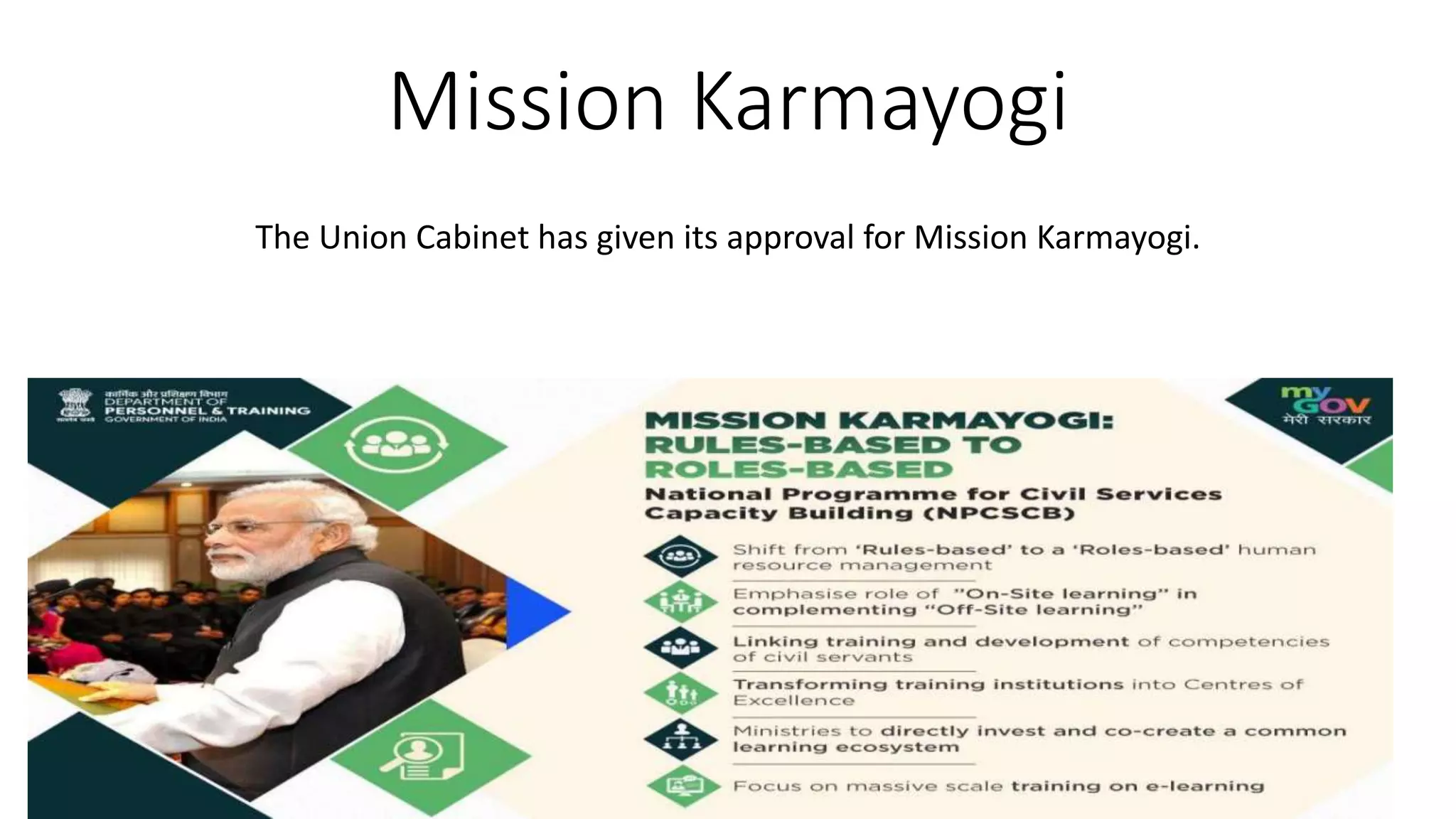
The Union Cabinet has given its approval for Mission Karmayogi.
Background
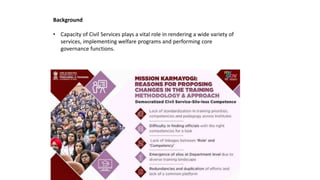
• Capacity of Civil Services plays a vital role in rendering a wide variety of
services, implementing welfare programs and performing core
governance functions.
Salient Features
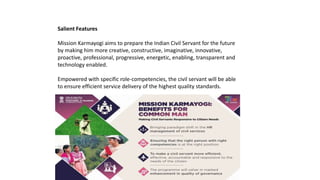
Mission Karmayogi aims to prepare the Indian Civil Servant for the future
by making him more creative, constructive, imaginative, innovative,
proactive, professional, progressive, energetic, enabling, transparent and
technology enabled.
Empowered with specific role-competencies, the civil servant will be able
to ensure efficient service delivery of the highest quality standards.
The core guiding principles of the Programme will be
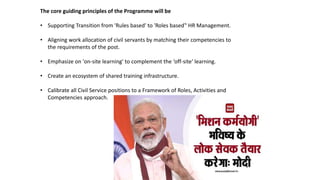
• Supporting Transition from 'Rules based' to 'Roles based‟ HR Management.
• Aligning work allocation of civil servants by matching their competencies to
the requirements of the post.
• Emphasize on 'on-site learning' to complement the ‘off-site‘ learning.
• Create an ecosystem of shared training infrastructure.
• Calibrate all Civil Service positions to a Framework of Roles, Activities and
Competencies approach.
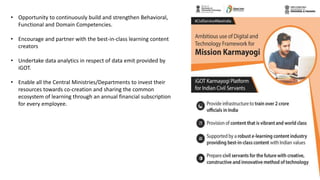
• Opportunity to continuously build and strengthen Behavioral,
Functional and Domain Competencies.
• Encourage and partner with the best-in-class learning content
creators
• Undertake data analytics in respect of data emit provided by
iGOT.
• Enable all the Central Ministries/Departments to invest their
resources towards co-creation and sharing the common
ecosystem of learning through an annual financial subscription
for every employee.
Agenda
• Prescribe Annual Capacity Building Plan for all departments and services.
• Monitor and implementation of Capacity Building Plan.
• Massive capacity building initiative to ensure efficient service delivery.
• To promote technology-driven learning pedagogy.
• To strengthen common foundations and remove the departmental silos.
• Setting benchmarks in learning for public servants.
• Democratization of learning to cover all categories.
About me: Sudesh Sharma
• MA in Mass Communication
• MA in Human Rights
• LL.B and pursuing LL.M
• Practiced in Supreme Court
• Have been teaching UPSC aspirants for more than 10 years
• Overall more than 20 years teaching experience including Mass
Comm. & Law
• Worked in Media – print journalism & Radio.
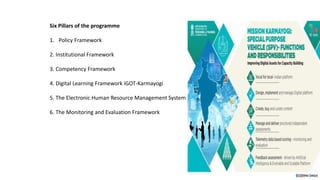
Six Pillars of the programme
1. Policy Framework
2. Institutional Framework
3. Competency Framework
4. Digital Learning Framework iGOT-Karmayogi
5. The Electronic Human Resource Management System
6. The Monitoring and Evaluation Framework
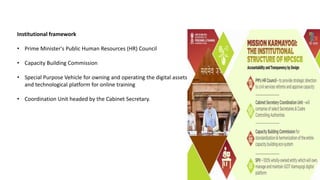
Institutional framework
• Prime Minister's Public Human Resources (HR) Council
• Capacity Building Commission
• Special Purpose Vehicle for owning and operating the digital assets
and technological platform for online training
• Coordination Unit headed by the Cabinet Secretary.
Financial implications
To cover around 46 lakh, Central employees, a sum of Rs.510.86 crore will be spent
over 5 years from 2020-21 to 2024-25.
The expenditure is partly funded by multilateral assistance to the tune of USD 50
million.
A wholly owned Special Purpose Vehicle (SPV) for NPCSCB will be set up under Section
8 of the Companies Act, 2013.
The SPV will be a "not-for-profit" company and will own and manage iGOT-Karmayogi
platform.

Mission karmayogi

  • 1.
    Mission Karmayogi The UnionCabinet has given its approval for Mission Karmayogi.
  • 2.
    Background • Capacity ofCivil Services plays a vital role in rendering a wide variety of services, implementing welfare programs and performing core governance functions.
  • 3.
    Salient Features Mission Karmayogiaims to prepare the Indian Civil Servant for the future by making him more creative, constructive, imaginative, innovative, proactive, professional, progressive, energetic, enabling, transparent and technology enabled. Empowered with specific role-competencies, the civil servant will be able to ensure efficient service delivery of the highest quality standards.
  • 4.
    The core guidingprinciples of the Programme will be • Supporting Transition from 'Rules based' to 'Roles based‟ HR Management. • Aligning work allocation of civil servants by matching their competencies to the requirements of the post. • Emphasize on 'on-site learning' to complement the ‘off-site‘ learning. • Create an ecosystem of shared training infrastructure. • Calibrate all Civil Service positions to a Framework of Roles, Activities and Competencies approach.
  • 5.
    • Opportunity tocontinuously build and strengthen Behavioral, Functional and Domain Competencies. • Encourage and partner with the best-in-class learning content creators • Undertake data analytics in respect of data emit provided by iGOT. • Enable all the Central Ministries/Departments to invest their resources towards co-creation and sharing the common ecosystem of learning through an annual financial subscription for every employee.
  • 6.
    Agenda • Prescribe AnnualCapacity Building Plan for all departments and services. • Monitor and implementation of Capacity Building Plan. • Massive capacity building initiative to ensure efficient service delivery. • To promote technology-driven learning pedagogy. • To strengthen common foundations and remove the departmental silos. • Setting benchmarks in learning for public servants. • Democratization of learning to cover all categories.
  • 7.
    About me: SudeshSharma • MA in Mass Communication • MA in Human Rights • LL.B and pursuing LL.M • Practiced in Supreme Court • Have been teaching UPSC aspirants for more than 10 years • Overall more than 20 years teaching experience including Mass Comm. & Law • Worked in Media – print journalism & Radio.
  • 8.
    Six Pillars ofthe programme 1. Policy Framework 2. Institutional Framework 3. Competency Framework 4. Digital Learning Framework iGOT-Karmayogi 5. The Electronic Human Resource Management System 6. The Monitoring and Evaluation Framework
  • 9.
    Institutional framework • PrimeMinister's Public Human Resources (HR) Council • Capacity Building Commission • Special Purpose Vehicle for owning and operating the digital assets and technological platform for online training • Coordination Unit headed by the Cabinet Secretary.
  • 10.
    Financial implications To coveraround 46 lakh, Central employees, a sum of Rs.510.86 crore will be spent over 5 years from 2020-21 to 2024-25. The expenditure is partly funded by multilateral assistance to the tune of USD 50 million. A wholly owned Special Purpose Vehicle (SPV) for NPCSCB will be set up under Section 8 of the Companies Act, 2013. The SPV will be a "not-for-profit" company and will own and manage iGOT-Karmayogi platform.