©2011 Azul Systems, Inc.	


The Java Evolution
Mismatch
Why you need a better JVM
Gil Tene, CTO & co-Founder, Azul Systems
©2011 Azul Systems, Inc.	


About Azul
We make scalable Virtual
Machines
Have built “whatever it takes
to get job done” since 2002
3 generations of custom SMP
Multi-core HW (Vega)
Now Pure software for
commodity x86 (Zing)
“Industry firsts” in Garbage
collection, elastic memory,
Java virtualization, memory
scale
Vega
C4
©2011 Azul Systems, Inc.	


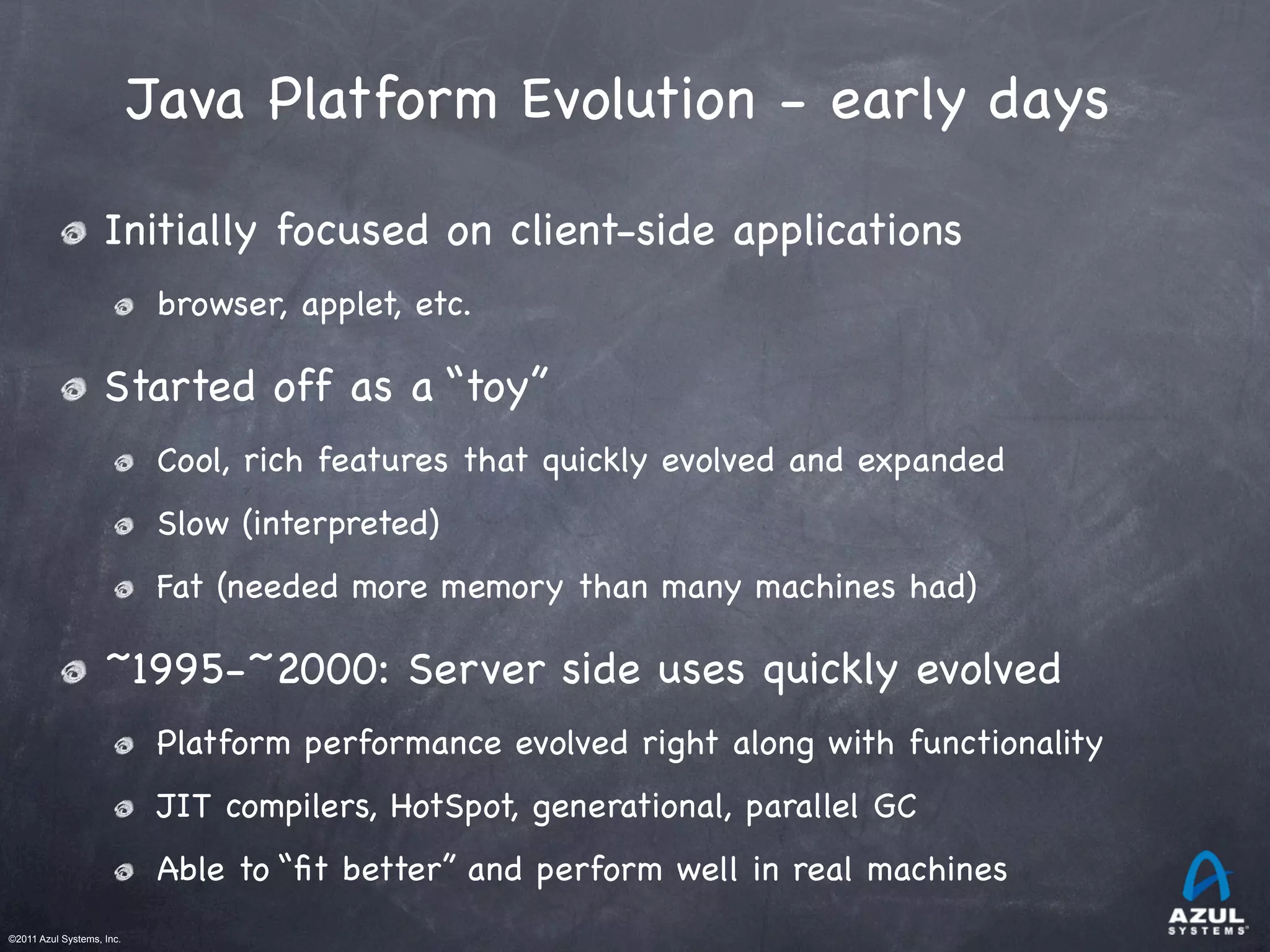
Java Platform Evolution - early days
Initially focused on client-side applications
browser, applet, etc.
Started off as a “toy”
Cool, rich features that quickly evolved and expanded
Slow (interpreted)
Fat (needed more memory than many machines had)
~1995-~2000: Server side uses quickly evolved
Platform performance evolved right along with functionality
JIT compilers, HotSpot, generational, parallel GC
Able to “fit better” and perform well in real machines
©2011 Azul Systems, Inc.	


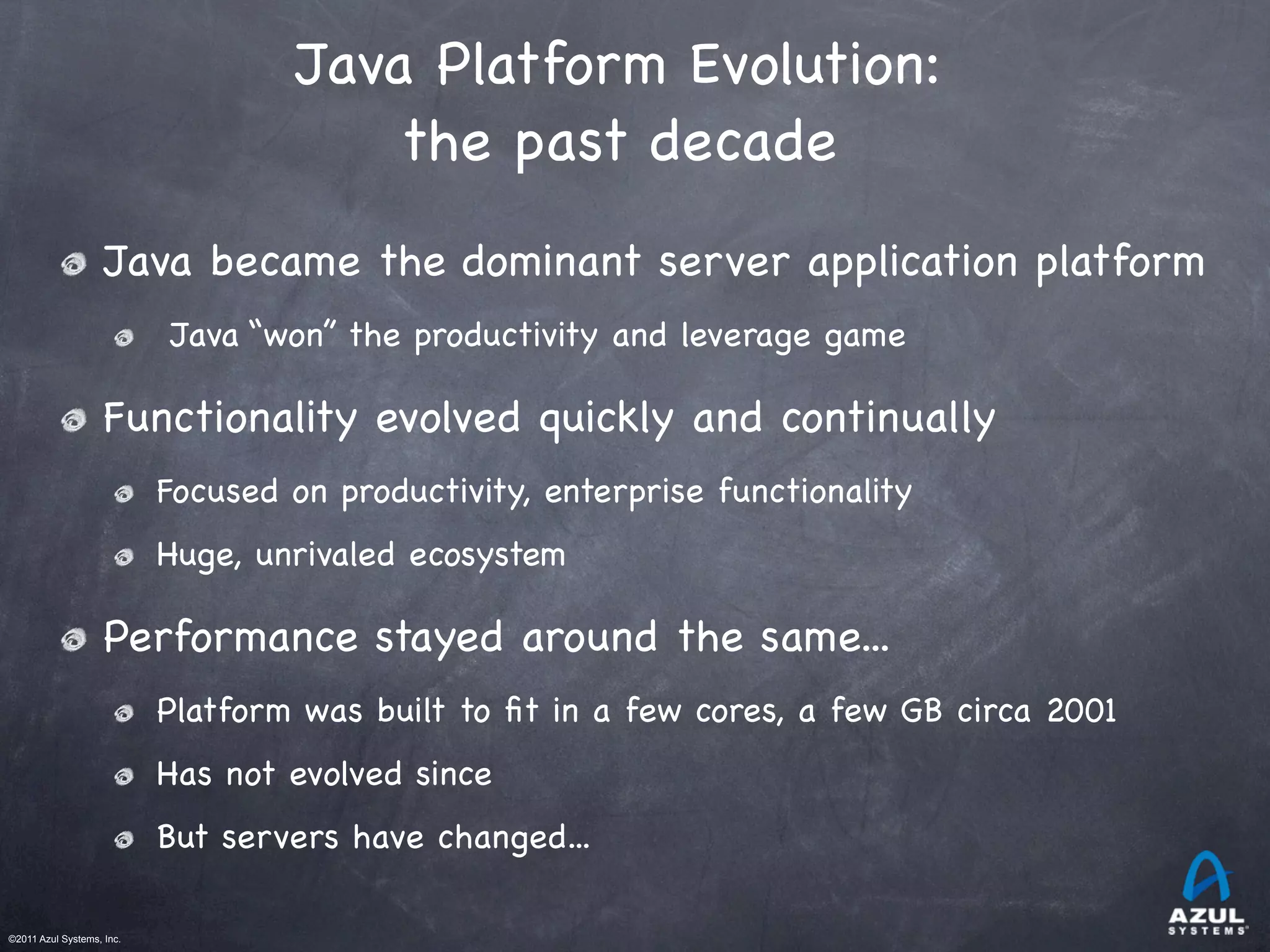
Java Platform Evolution:
the past decade
Java became the dominant server application platform
Java “won” the productivity and leverage game
Functionality evolved quickly and continually
Focused on productivity, enterprise functionality
Huge, unrivaled ecosystem
Performance stayed around the same...
Platform was built to fit in a few cores, a few GB circa 2001
Has not evolved since
But servers have changed...
©2011 Azul Systems, Inc.	


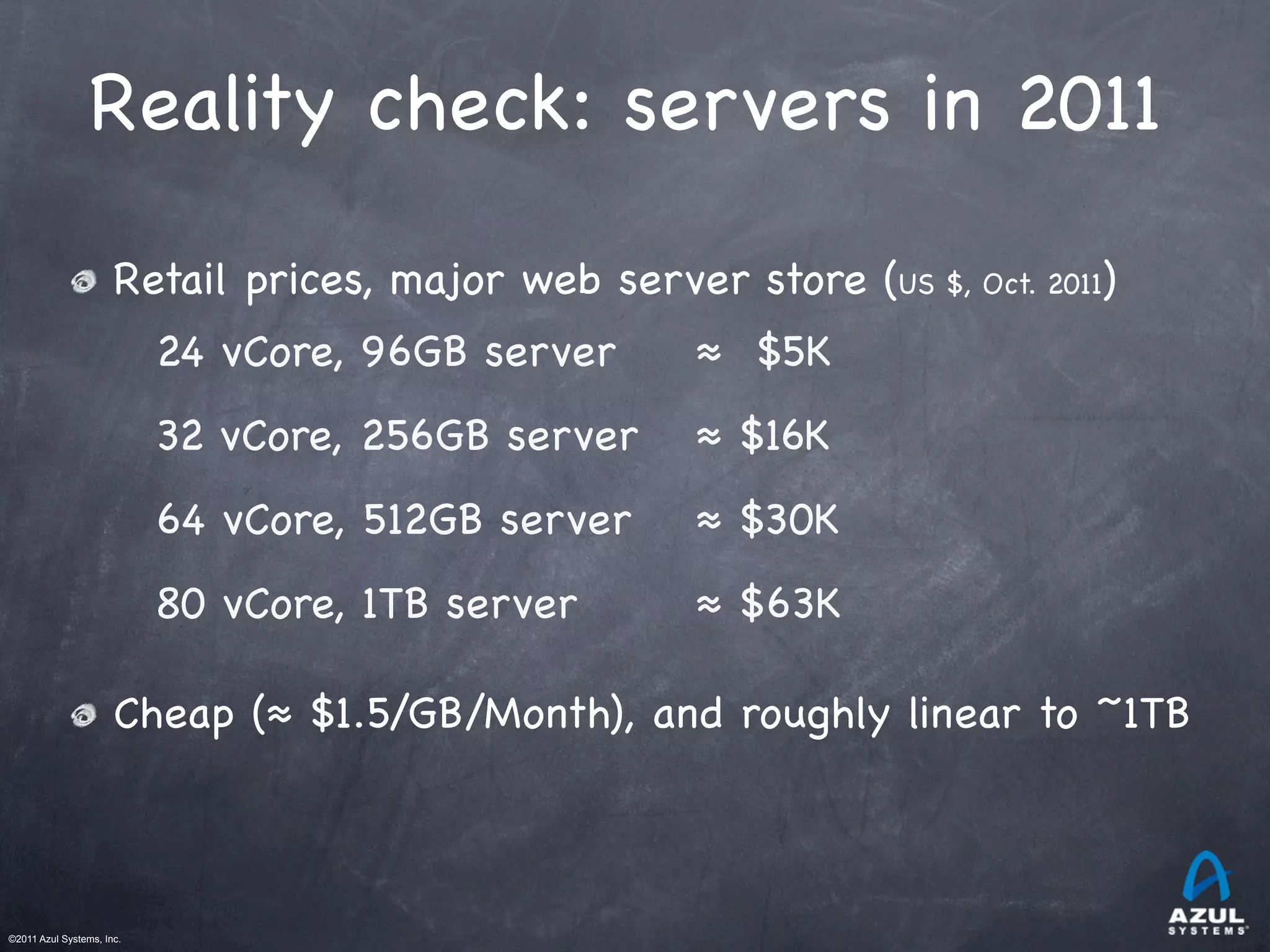
Reality check: servers in 2011
Retail prices, major web server store (US $, Oct. 2011)
Cheap (≈ $1.5/GB/Month), and roughly linear to ~1TB
24 vCore, 96GB server ≈ $5K
32 vCore, 256GB server ≈ $16K
64 vCore, 512GB server ≈ $30K
80 vCore, 1TB server ≈ $63K
©2011 Azul Systems, Inc.	


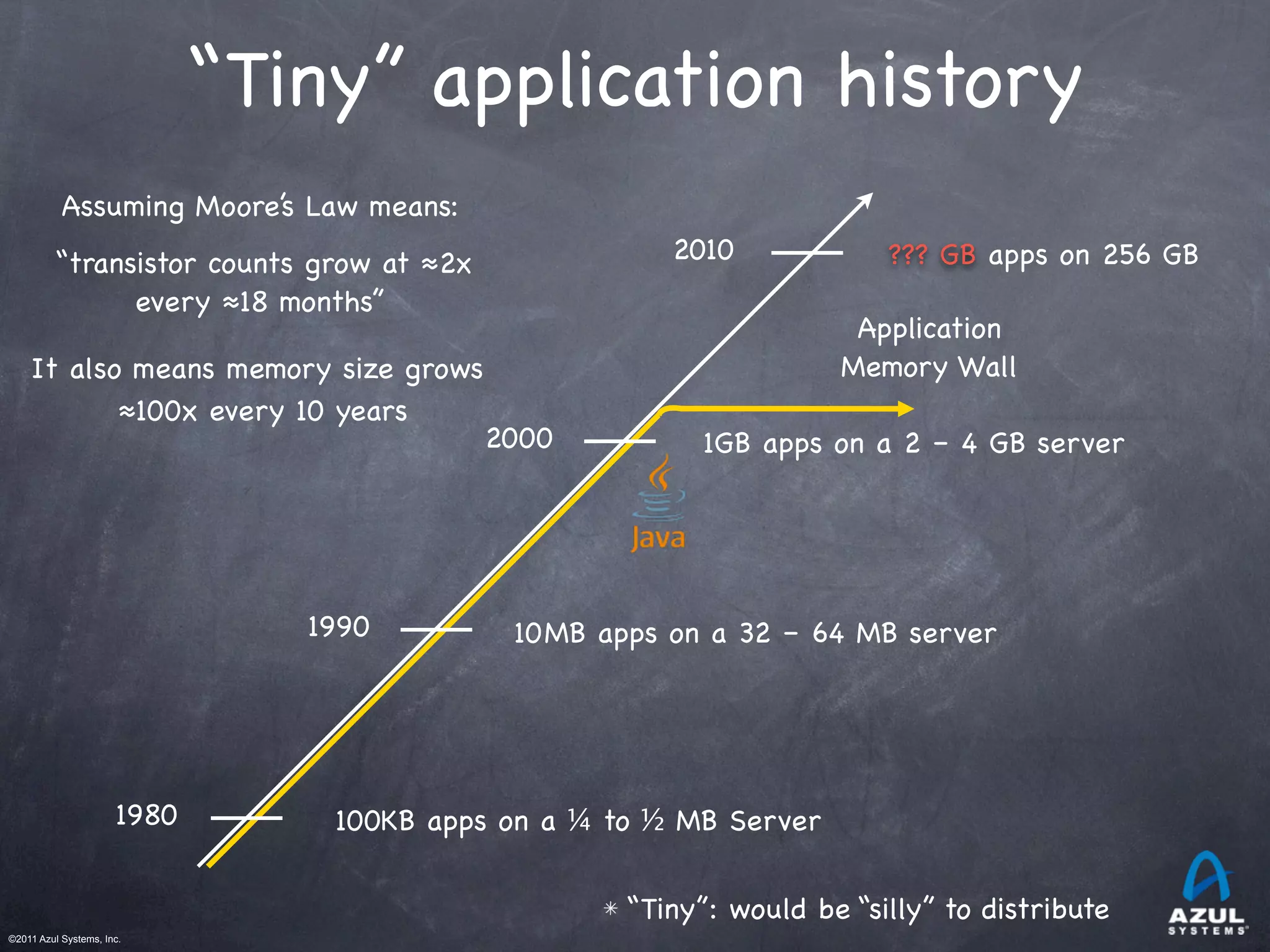
“Tiny” application history
100KB apps on a ¼ to ½ MB Server
10MB apps on a 32 – 64 MB server
1GB apps on a 2 – 4 GB server
??? GB apps on 256 GB
Assuming Moore’s Law means:
“transistor counts grow at ≈2x
every ≈18 months”
It also means memory size grows
≈100x every 10 years
2010
2000
1990
1980
“Tiny”: would be “silly” to distribute
Application
Memory Wall
©2011 Azul Systems, Inc.	


The Java “problem”
Then and Now
2000: Java platforms had a hard time fitting
well in one computer
2012: Java platforms can’t make use of more
than a tiny fraction of one computer
©2011 Azul Systems, Inc.	


Current day Java Limitations
Responsiveness
Sensitivity to load, Fragility
Rigid, non-elastic, inefficient
Scale and Complexity
Common cause: platform misbehaves above a few cores
and a few GB per instance
©2011 Azul Systems, Inc.	


What is keeping Java platforms from
making full use of current servers?
Garbage Collection is a clear and dominant cause
There seem to be practical heap size limits for
applications with responsiveness requirements
[Virtually] All current commercial JVMs will exhibit a
multi-second pause on a normally utilized 2-4GB heap.
It’s a question of “When” and “How often”, not “If”.
GC tuning only moves the “when” and the “how often” around
Root cause: The link between scale and responsiveness
©2011 Azul Systems, Inc.	


Zing: A JVM for today’s servers
Eliminates the core problems that keep Java
form making good/full/effective use of
current servers
Able to put current servers to work
©2011 Azul Systems, Inc.	


Desired Application Benefits
C Improve Response times
C Increase Transaction rates
C Increase Concurrent users
C Forget about GC pauses
C Eliminate daily restarts	
C Elastically grow during peaks
C Elastically shrink when idle
C Gain production visibility
©2011 Azul Systems, Inc.	


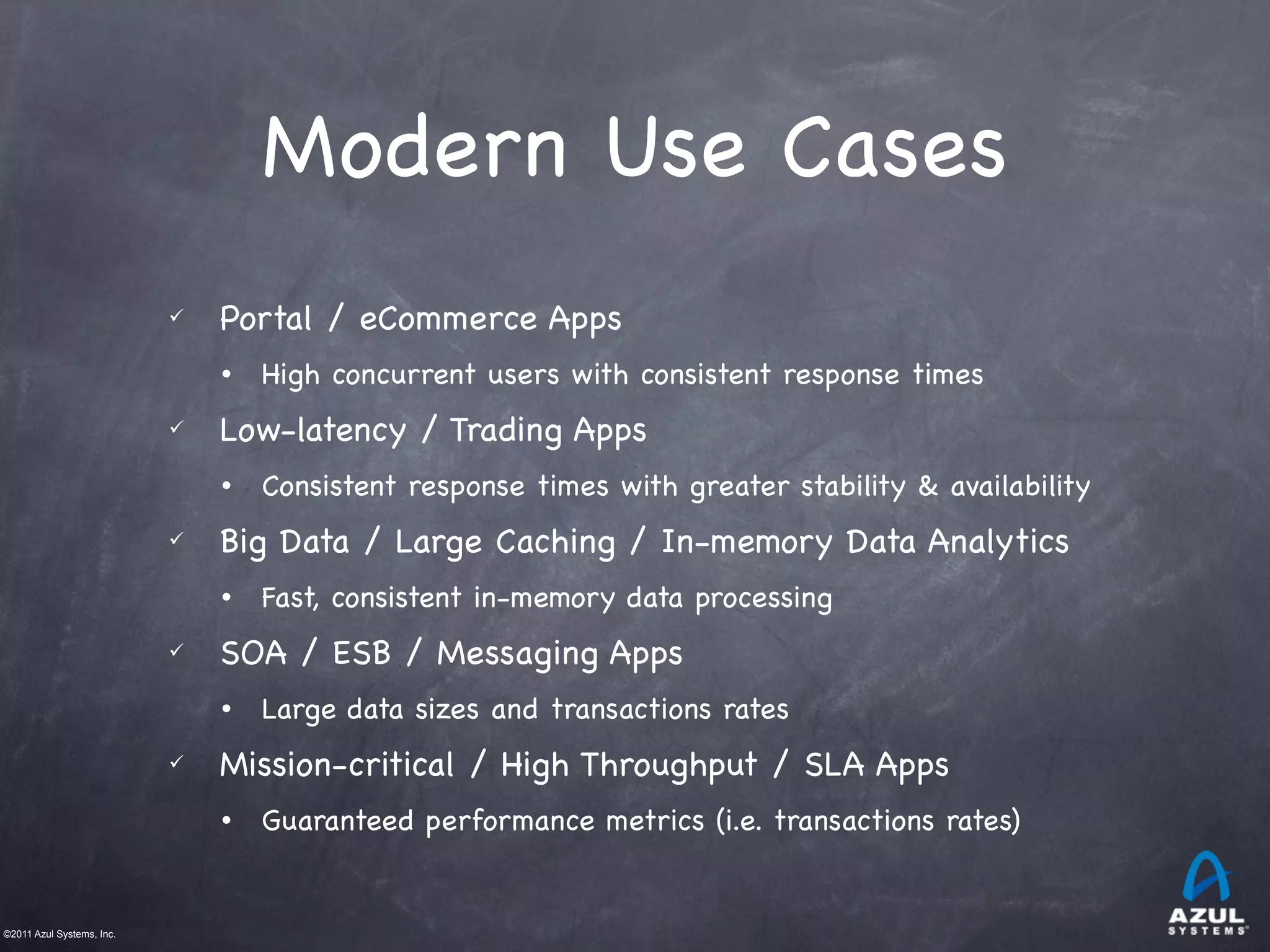
Modern Use Cases
ü Portal / eCommerce Apps
• High concurrent users with consistent response times
ü Low-latency / Trading Apps
• Consistent response times with greater stability & availability
ü Big Data / Large Caching / In-memory Data Analytics
• Fast, consistent in-memory data processing
ü SOA / ESB / Messaging Apps
• Large data sizes and transactions rates
ü Mission-critical / High Throughput / SLA Apps
• Guaranteed performance metrics (i.e. transactions rates)
©2011 Azul Systems, Inc.	


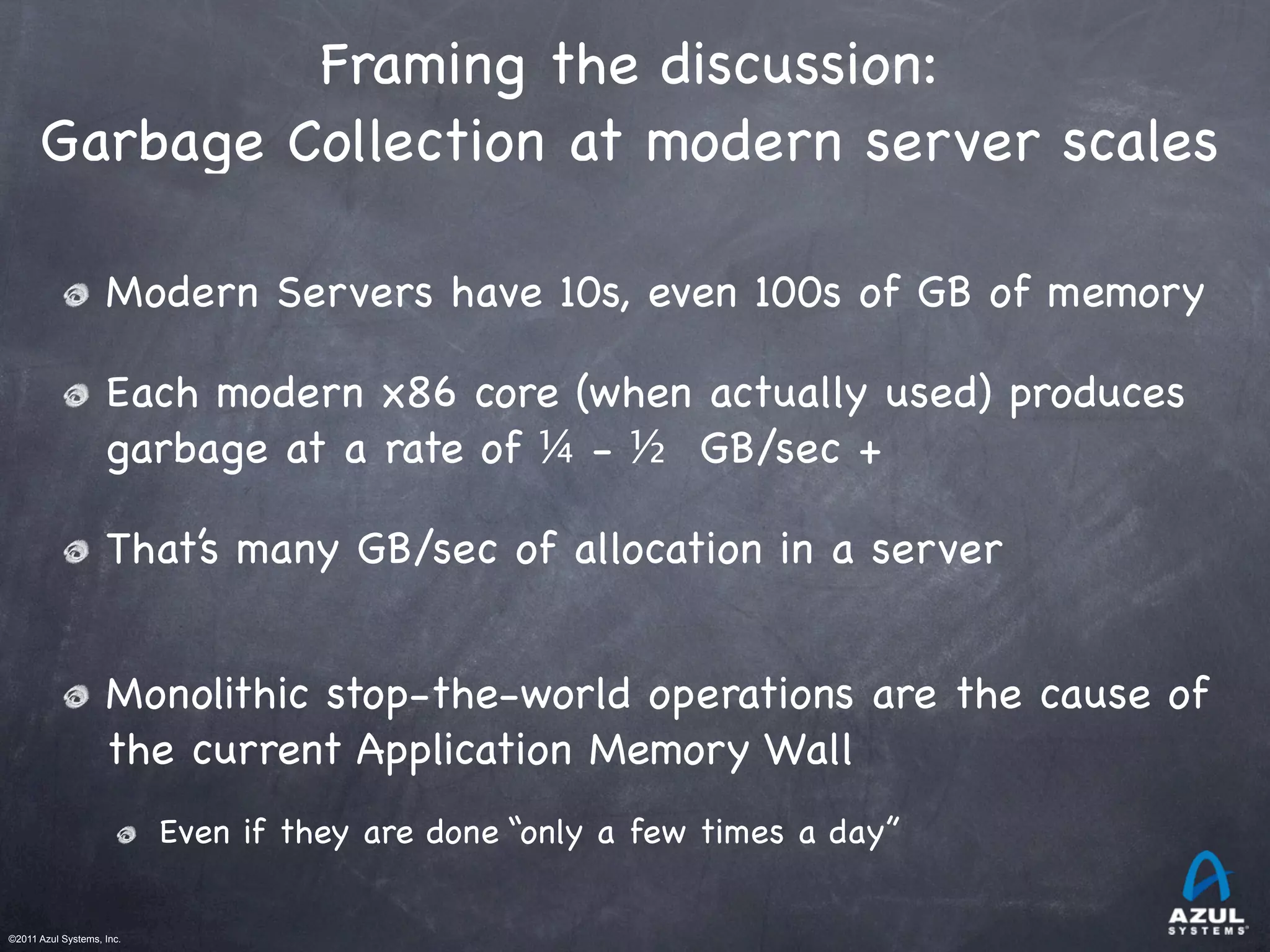
Framing the discussion:
Garbage Collection at modern server scales
Modern Servers have 10s, even 100s of GB of memory
Each modern x86 core (when actually used) produces
garbage at a rate of ¼ - ½ GB/sec +
That’s many GB/sec of allocation in a server
Monolithic stop-the-world operations are the cause of
the current Application Memory Wall
Even if they are done “only a few times a day”
©2011 Azul Systems, Inc.	


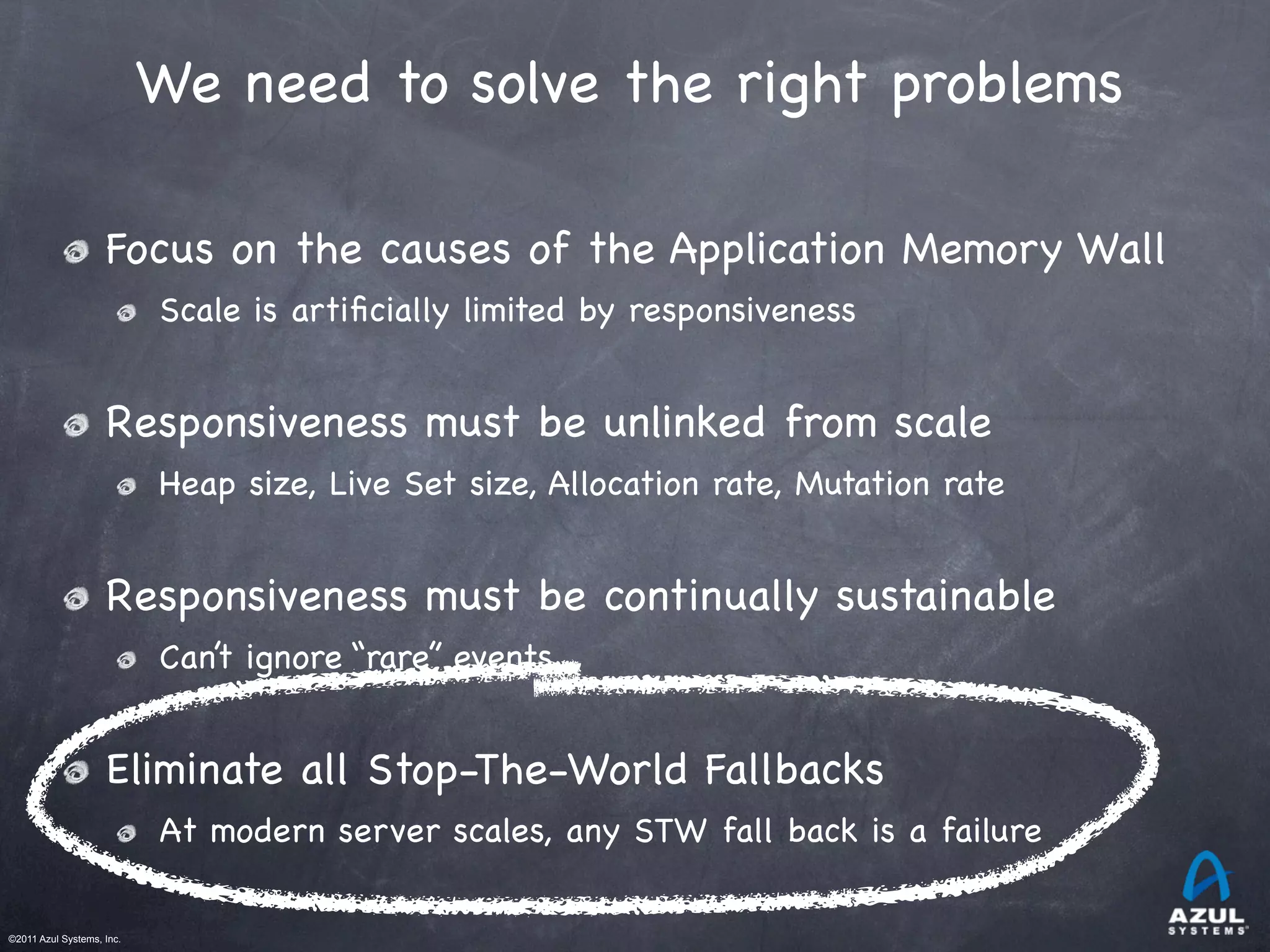
We need to solve the right problems
Focus on the causes of the Application Memory Wall
Scale is artificially limited by responsiveness
Responsiveness must be unlinked from scale
Heap size, Live Set size, Allocation rate, Mutation rate
Responsiveness must be continually sustainable
Can’t ignore “rare” events
Eliminate all Stop-The-World Fallbacks
At modern server scales, any STW fall back is a failure
©2011 Azul Systems, Inc.	


The problems that need solving
(areas where the state of the art needs improvement)
Robust Concurrent Marking
In the presence of high mutation and allocation rates
Cover modern runtime semantics (e.g. weak refs)
Compaction that is not monolithic-stop-the-world
Stay responsive while compacting many-GB heaps
Must be robust: not just a tactic to delay STW compaction
[current “incremental STW” attempts fall short on robustness]
Non-monolithic-stop-the-world Generational collection
Stay responsive while promoting multi-GB data spikes
Concurrent or “incremental STW” may be both be ok
Surprisingly little work done in this specific area
©2011 Azul Systems, Inc.	


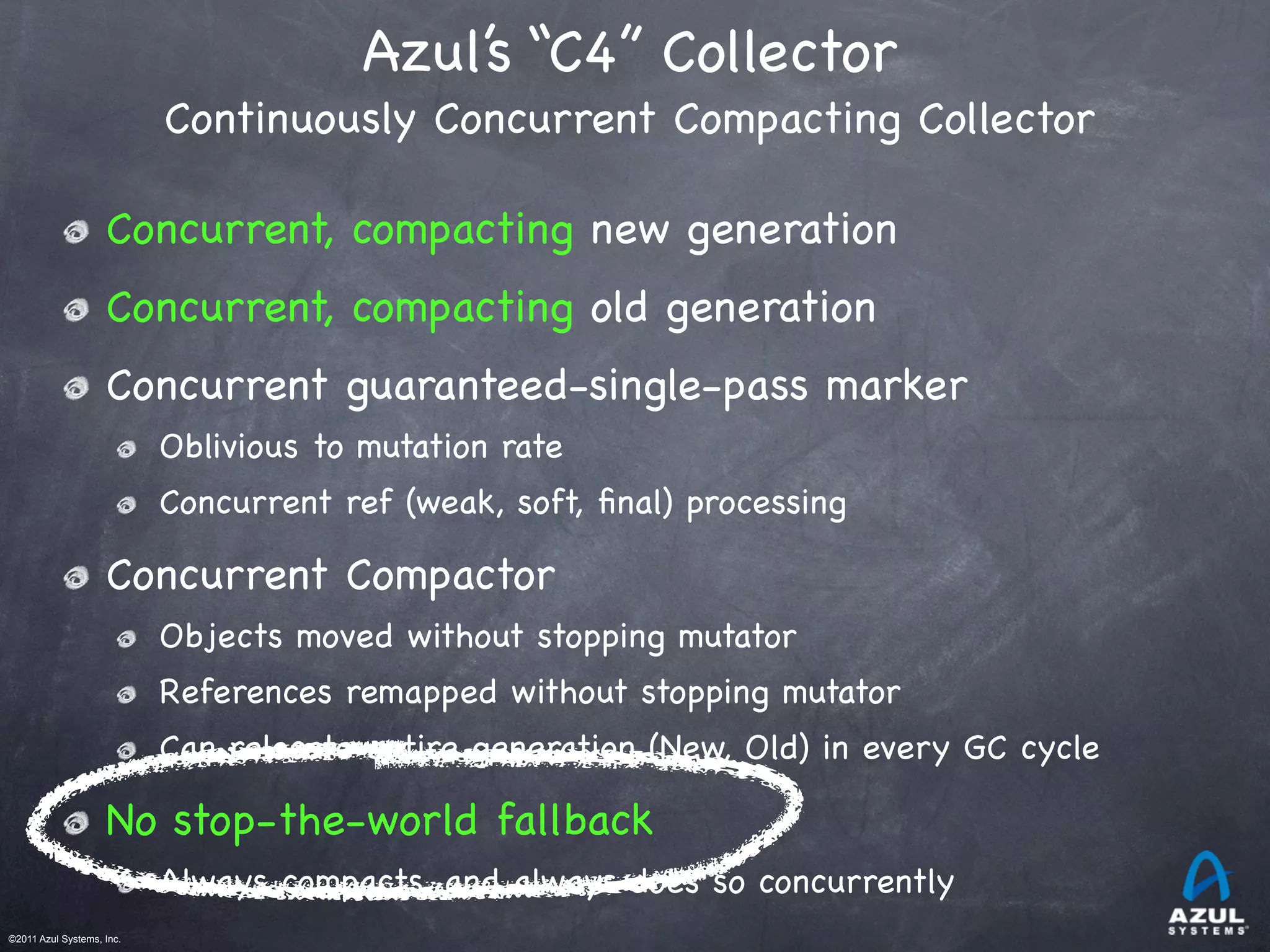
Azul’s “C4” Collector
Continuously Concurrent Compacting Collector
Concurrent, compacting new generation
Concurrent, compacting old generation
Concurrent guaranteed-single-pass marker
Oblivious to mutation rate
Concurrent ref (weak, soft, final) processing
Concurrent Compactor
Objects moved without stopping mutator
References remapped without stopping mutator
Can relocate entire generation (New, Old) in every GC cycle
No stop-the-world fallback
Always compacts, and always does so concurrently
©2011 Azul Systems, Inc.	


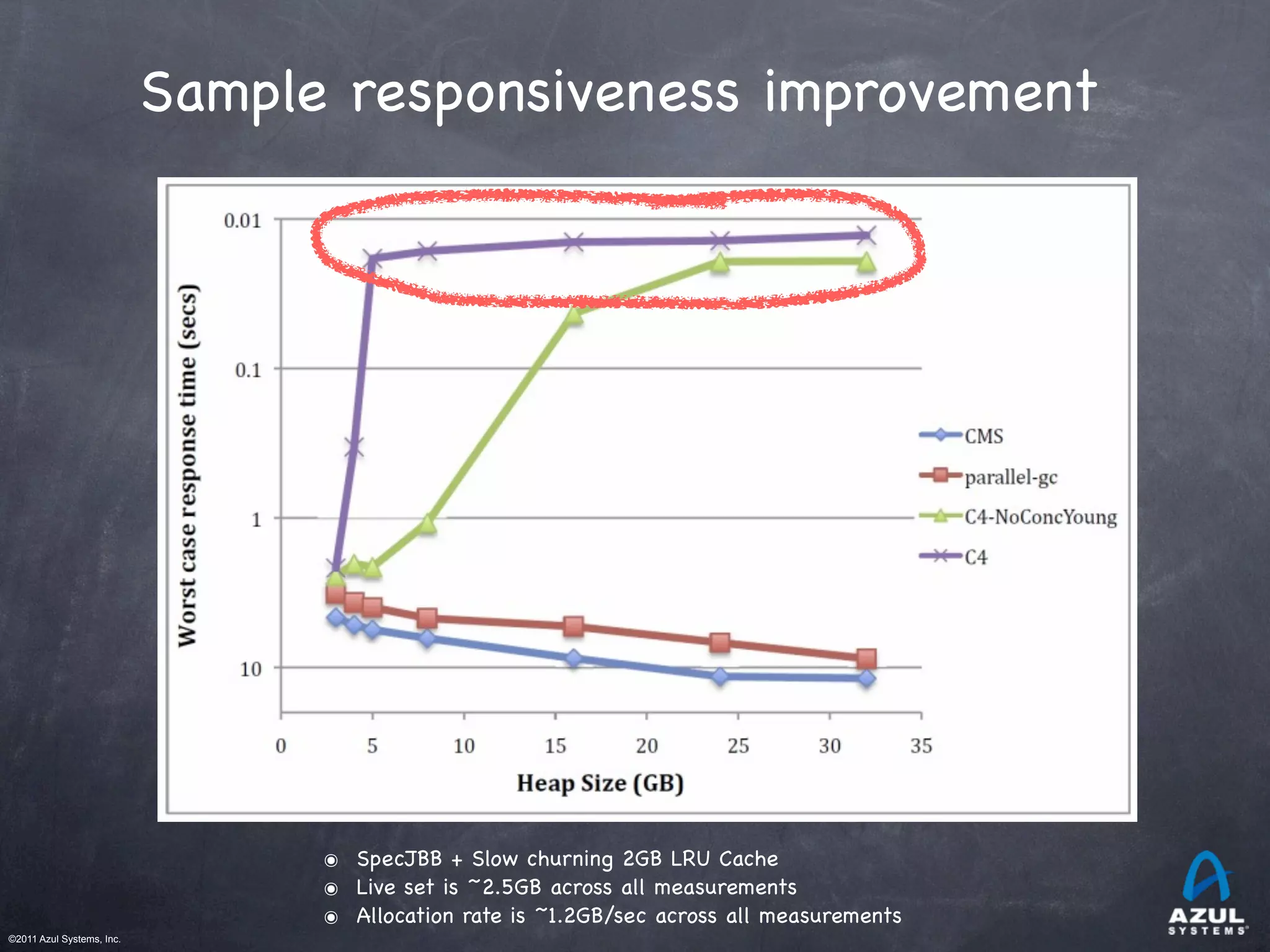
Sample responsiveness improvement
๏ SpecJBB + Slow churning 2GB LRU Cache
๏ Live set is ~2.5GB across all measurements
๏ Allocation rate is ~1.2GB/sec across all measurements
©2011 Azul Systems, Inc.	


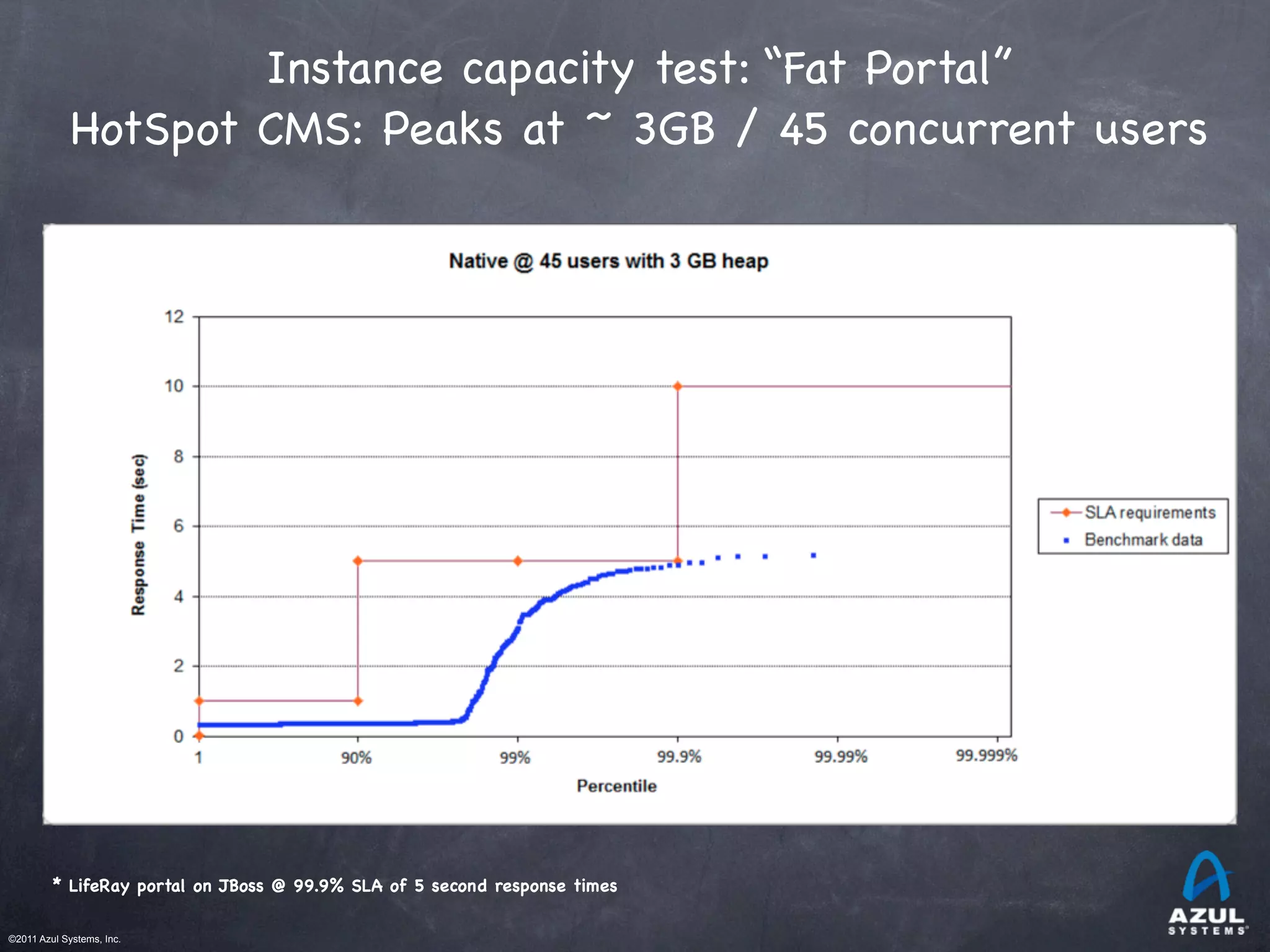
Instance capacity test: “Fat Portal”
HotSpot CMS: Peaks at ~ 3GB / 45 concurrent users
* LifeRay portal on JBoss @ 99.9% SLA of 5 second response times
©2011 Azul Systems, Inc.	


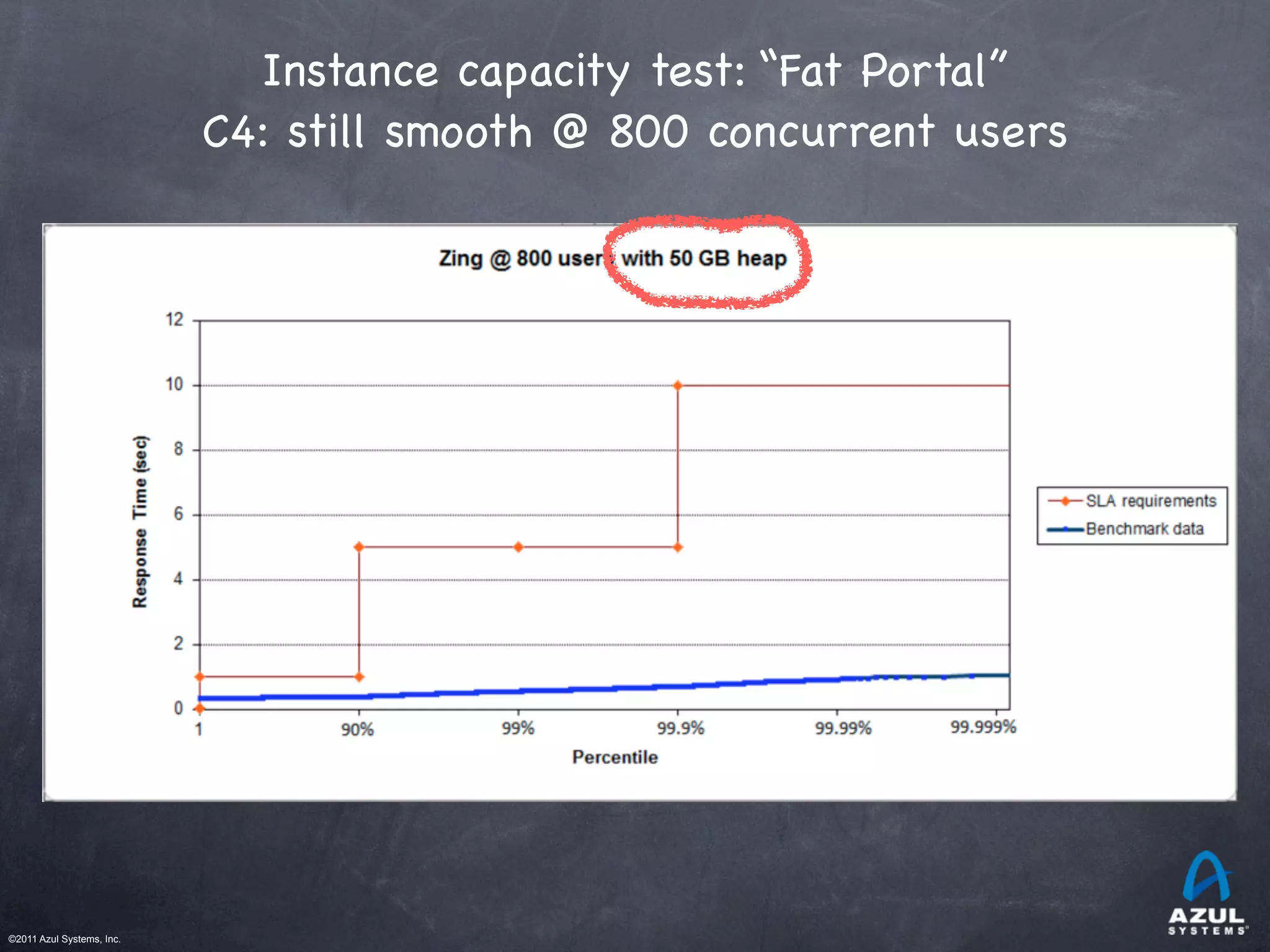
Instance capacity test: “Fat Portal”
C4: still smooth @ 800 concurrent users
©2011 Azul Systems, Inc.	


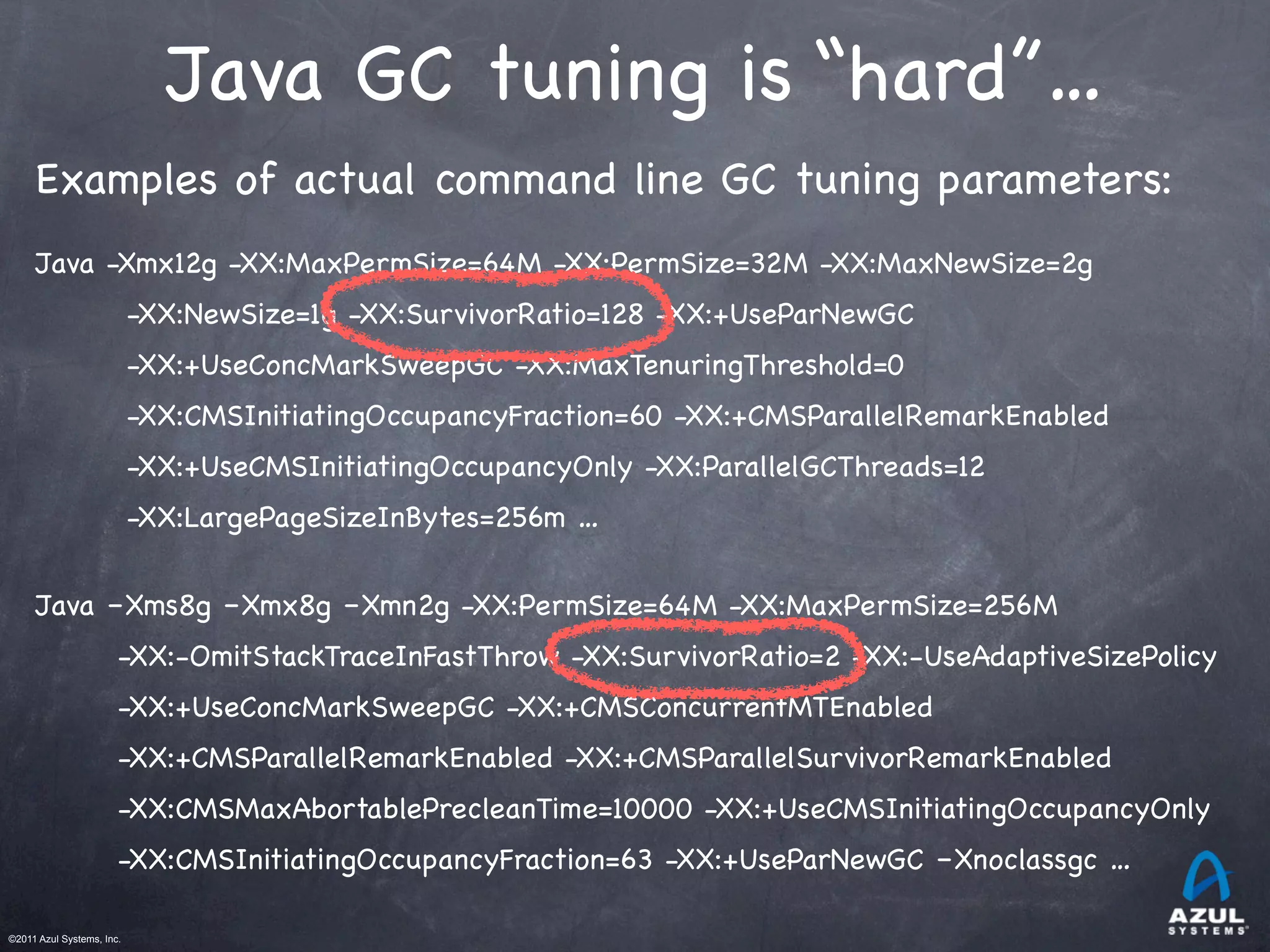
Java GC tuning is “hard”…
Examples of actual command line GC tuning parameters:
Java -Xmx12g -XX:MaxPermSize=64M -XX:PermSize=32M -XX:MaxNewSize=2g
-XX:NewSize=1g -XX:SurvivorRatio=128 -XX:+UseParNewGC
-XX:+UseConcMarkSweepGC -XX:MaxTenuringThreshold=0
-XX:CMSInitiatingOccupancyFraction=60 -XX:+CMSParallelRemarkEnabled
-XX:+UseCMSInitiatingOccupancyOnly -XX:ParallelGCThreads=12
-XX:LargePageSizeInBytes=256m …
Java –Xms8g –Xmx8g –Xmn2g -XX:PermSize=64M -XX:MaxPermSize=256M
-XX:-OmitStackTraceInFastThrow -XX:SurvivorRatio=2 -XX:-UseAdaptiveSizePolicy
-XX:+UseConcMarkSweepGC -XX:+CMSConcurrentMTEnabled
-XX:+CMSParallelRemarkEnabled -XX:+CMSParallelSurvivorRemarkEnabled
-XX:CMSMaxAbortablePrecleanTime=10000 -XX:+UseCMSInitiatingOccupancyOnly
-XX:CMSInitiatingOccupancyFraction=63 -XX:+UseParNewGC –Xnoclassgc …
©2011 Azul Systems, Inc.	


The complete guide to
Zing GC tuning
java -Xmx40g
©2011 Azul Systems, Inc.	


How can we make full, effective
of current server capabilities?
Simple: Deploy Zing 5.0 on Linux

The Java Evolution Mismatch by Gil Tene, CTO at Azul Systems

  • 1.
    ©2011 Azul Systems,Inc. The Java Evolution Mismatch Why you need a better JVM Gil Tene, CTO & co-Founder, Azul Systems
  • 2.
    ©2011 Azul Systems,Inc. About Azul We make scalable Virtual Machines Have built “whatever it takes to get job done” since 2002 3 generations of custom SMP Multi-core HW (Vega) Now Pure software for commodity x86 (Zing) “Industry firsts” in Garbage collection, elastic memory, Java virtualization, memory scale Vega C4
  • 3.
    ©2011 Azul Systems,Inc. Java Platform Evolution - early days Initially focused on client-side applications browser, applet, etc. Started off as a “toy” Cool, rich features that quickly evolved and expanded Slow (interpreted) Fat (needed more memory than many machines had) ~1995-~2000: Server side uses quickly evolved Platform performance evolved right along with functionality JIT compilers, HotSpot, generational, parallel GC Able to “fit better” and perform well in real machines
  • 4.
    ©2011 Azul Systems,Inc. Java Platform Evolution: the past decade Java became the dominant server application platform Java “won” the productivity and leverage game Functionality evolved quickly and continually Focused on productivity, enterprise functionality Huge, unrivaled ecosystem Performance stayed around the same... Platform was built to fit in a few cores, a few GB circa 2001 Has not evolved since But servers have changed...
  • 5.
    ©2011 Azul Systems,Inc. Reality check: servers in 2011 Retail prices, major web server store (US $, Oct. 2011) Cheap (≈ $1.5/GB/Month), and roughly linear to ~1TB 24 vCore, 96GB server ≈ $5K 32 vCore, 256GB server ≈ $16K 64 vCore, 512GB server ≈ $30K 80 vCore, 1TB server ≈ $63K
  • 6.
    ©2011 Azul Systems,Inc. “Tiny” application history 100KB apps on a ¼ to ½ MB Server 10MB apps on a 32 – 64 MB server 1GB apps on a 2 – 4 GB server ??? GB apps on 256 GB Assuming Moore’s Law means: “transistor counts grow at ≈2x every ≈18 months” It also means memory size grows ≈100x every 10 years 2010 2000 1990 1980 “Tiny”: would be “silly” to distribute Application Memory Wall
  • 7.
    ©2011 Azul Systems,Inc. The Java “problem” Then and Now 2000: Java platforms had a hard time fitting well in one computer 2012: Java platforms can’t make use of more than a tiny fraction of one computer
  • 8.
    ©2011 Azul Systems,Inc. Current day Java Limitations Responsiveness Sensitivity to load, Fragility Rigid, non-elastic, inefficient Scale and Complexity Common cause: platform misbehaves above a few cores and a few GB per instance
  • 9.
    ©2011 Azul Systems,Inc. What is keeping Java platforms from making full use of current servers? Garbage Collection is a clear and dominant cause There seem to be practical heap size limits for applications with responsiveness requirements [Virtually] All current commercial JVMs will exhibit a multi-second pause on a normally utilized 2-4GB heap. It’s a question of “When” and “How often”, not “If”. GC tuning only moves the “when” and the “how often” around Root cause: The link between scale and responsiveness
  • 10.
    ©2011 Azul Systems,Inc. Zing: A JVM for today’s servers Eliminates the core problems that keep Java form making good/full/effective use of current servers Able to put current servers to work
  • 11.
    ©2011 Azul Systems,Inc. Desired Application Benefits C Improve Response times C Increase Transaction rates C Increase Concurrent users C Forget about GC pauses C Eliminate daily restarts C Elastically grow during peaks C Elastically shrink when idle C Gain production visibility
  • 12.
    ©2011 Azul Systems,Inc. Modern Use Cases ü Portal / eCommerce Apps • High concurrent users with consistent response times ü Low-latency / Trading Apps • Consistent response times with greater stability & availability ü Big Data / Large Caching / In-memory Data Analytics • Fast, consistent in-memory data processing ü SOA / ESB / Messaging Apps • Large data sizes and transactions rates ü Mission-critical / High Throughput / SLA Apps • Guaranteed performance metrics (i.e. transactions rates)
  • 13.
    ©2011 Azul Systems,Inc. Framing the discussion: Garbage Collection at modern server scales Modern Servers have 10s, even 100s of GB of memory Each modern x86 core (when actually used) produces garbage at a rate of ¼ - ½ GB/sec + That’s many GB/sec of allocation in a server Monolithic stop-the-world operations are the cause of the current Application Memory Wall Even if they are done “only a few times a day”
  • 14.
    ©2011 Azul Systems,Inc. We need to solve the right problems Focus on the causes of the Application Memory Wall Scale is artificially limited by responsiveness Responsiveness must be unlinked from scale Heap size, Live Set size, Allocation rate, Mutation rate Responsiveness must be continually sustainable Can’t ignore “rare” events Eliminate all Stop-The-World Fallbacks At modern server scales, any STW fall back is a failure
  • 15.
    ©2011 Azul Systems,Inc. The problems that need solving (areas where the state of the art needs improvement) Robust Concurrent Marking In the presence of high mutation and allocation rates Cover modern runtime semantics (e.g. weak refs) Compaction that is not monolithic-stop-the-world Stay responsive while compacting many-GB heaps Must be robust: not just a tactic to delay STW compaction [current “incremental STW” attempts fall short on robustness] Non-monolithic-stop-the-world Generational collection Stay responsive while promoting multi-GB data spikes Concurrent or “incremental STW” may be both be ok Surprisingly little work done in this specific area
  • 16.
    ©2011 Azul Systems,Inc. Azul’s “C4” Collector Continuously Concurrent Compacting Collector Concurrent, compacting new generation Concurrent, compacting old generation Concurrent guaranteed-single-pass marker Oblivious to mutation rate Concurrent ref (weak, soft, final) processing Concurrent Compactor Objects moved without stopping mutator References remapped without stopping mutator Can relocate entire generation (New, Old) in every GC cycle No stop-the-world fallback Always compacts, and always does so concurrently
  • 17.
    ©2011 Azul Systems,Inc. Sample responsiveness improvement ๏ SpecJBB + Slow churning 2GB LRU Cache ๏ Live set is ~2.5GB across all measurements ๏ Allocation rate is ~1.2GB/sec across all measurements
  • 18.
    ©2011 Azul Systems,Inc. Instance capacity test: “Fat Portal” HotSpot CMS: Peaks at ~ 3GB / 45 concurrent users * LifeRay portal on JBoss @ 99.9% SLA of 5 second response times
  • 19.
    ©2011 Azul Systems,Inc. Instance capacity test: “Fat Portal” C4: still smooth @ 800 concurrent users
  • 20.
    ©2011 Azul Systems,Inc. Java GC tuning is “hard”… Examples of actual command line GC tuning parameters: Java -Xmx12g -XX:MaxPermSize=64M -XX:PermSize=32M -XX:MaxNewSize=2g -XX:NewSize=1g -XX:SurvivorRatio=128 -XX:+UseParNewGC -XX:+UseConcMarkSweepGC -XX:MaxTenuringThreshold=0 -XX:CMSInitiatingOccupancyFraction=60 -XX:+CMSParallelRemarkEnabled -XX:+UseCMSInitiatingOccupancyOnly -XX:ParallelGCThreads=12 -XX:LargePageSizeInBytes=256m … Java –Xms8g –Xmx8g –Xmn2g -XX:PermSize=64M -XX:MaxPermSize=256M -XX:-OmitStackTraceInFastThrow -XX:SurvivorRatio=2 -XX:-UseAdaptiveSizePolicy -XX:+UseConcMarkSweepGC -XX:+CMSConcurrentMTEnabled -XX:+CMSParallelRemarkEnabled -XX:+CMSParallelSurvivorRemarkEnabled -XX:CMSMaxAbortablePrecleanTime=10000 -XX:+UseCMSInitiatingOccupancyOnly -XX:CMSInitiatingOccupancyFraction=63 -XX:+UseParNewGC –Xnoclassgc …
  • 21.
    ©2011 Azul Systems,Inc. The complete guide to Zing GC tuning java -Xmx40g
  • 22.
    ©2011 Azul Systems,Inc. How can we make full, effective of current server capabilities? Simple: Deploy Zing 5.0 on Linux