SMART LIBRARY MANAGEMENT SYSTEM
TEAM MEMBERS
SELVAM.A(20EC078)
NITHISHKUMAR.T(20EC055)
SEENIVASAN.T(20EC075)
GUIDED BY
Mrs.VIMALA M.E
(ASSISTANT PROFESSOR/ECE)
OVERVIEW
OBJECTIVE(S)
LITERATURE REVIEW
PROPOSED SYSTEM
METHODOLOGY
MODULE DESCRIPTION
REFERENCE(S)
OBJECTIVE(S)
 To create a web application for managing library .
 To create a smart and simple solution for managing libraries through a QR code
system .
Objective of the project is ,
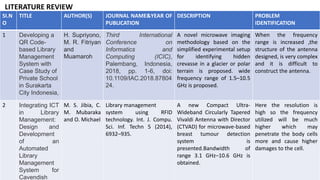
LITERATURE REVIEW
SI.N
O
TITLE AUTHOR(S) JOURNAL NAME&YEAR OF
PUBLICATION
DESCRIPTION PROBLEM
IDENTIFICATION
1 Developing a
QR Code-
based Library
Management
System with
Case Study of
Private School
in Surakarta
City Indonesia,
H. Supriyono,
M. R. Fitriyan
and
Muamaroh
Third International
Conference on
Informatics and
Computing (ICIC),
Palembang, Indonesia,
2018, pp. 1-6, doi:
10.1109/IAC.2018.87804
24.
A novel microwave imaging
methodology based on the
simplified experimental setup
for identifying hidden
crevasse in a glacier or polar
terrain is proposed. wide
frequency range of 1.5–10.5
GHz is proposed.
When the frequency
range is increased ,the
structure of the antenna
designed, is very complex
and it is difficult to
construct the antenna.
2 Integrating ICT
in Library
Management:
Design and
Development
of an
Automated
Library
Management
System for
Cavendish
M. S. Jibia, C.
M. Mubaraka
and O. Michael
Library management
system using RFID
technology. Int. J. Compu.
Sci. Inf. Techn 5 (2014),
6932–935.
A new Compact Ultra-
Wideband Circularly Tapered
Vivaldi Antenna with Director
(CTVAD) for microwave-based
breast tumour detection
system is
presented.Bandwidth of
range 3.1 GHz–10.6 GHz is
obtained.
Here the resolution is
high so the frequency
utilized will be much
higher which may
penetrate the body cells
more and cause higher
damages to the cell.
PROPOSED SYSTEM
 To eliminate the drawbacks of the traditional system, we have added new features
in our system like issuing the book using face recognition and automatic
generation of a report. Our proposed system consists of face recognition and book
barcode recognition system for automating the issuing and returning of the book.
We aimed to develop the system for an academic library, so it consists of the
following modules
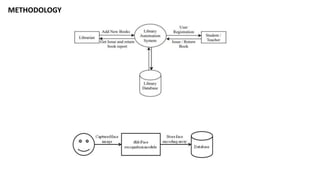
METHODOLOGY
MODULE DESCRIPTION
HARDWARE REQUIREMENT
 Dielectric substrate (2 layer PCB)
 SMA Connector
Vector Network Analyzer(VNA)
SOFTWARE REQUIREMENT
High Frequency Structure Simulator(HFSS)
REFERENCE(S)
[1]. Sree Lakshmi Addepalli and Sree Gowri Addepalli. 2014. Library management
system using RFID technology. Int. J. Compu. Sci. Inf. Techn 5 (2014), 6932–935.
[2] Robin Ashford. 2010. QR codes and academic libraries: Reaching mobile users.
(2010).
[3]. A Larsan Aro Brian, L Arockiam, and PDSK Malarchelvi. 2014. An IOT based
secured smart library system with NFC based book tracking. International Journal
of Emerging Technology in Computer Science & Electronics (IJETCSE) 11, 5 (2014).
[4]. Abderrahim El Mhouti and Mohamed Erradi. 2018. Towards a Smart Learning Management System
(smart-LMS) to Improve Collaborative Learning in
Higher Education. In Proceedings of the 3rd International Conference on Smart
City Applications. ACM, 7.
[5] Peter Kieseberg, Manuel Leithner, Martin Mulazzani, Lindsay Munroe, Sebastian
Schrittwieser, Mayank Sinha, and Edgar Weippl. 2010. QR code security. In
Proceedings of the 8th International Conference on Advances in Mobile Computing
and Multimedia. ACM, 430–435.
[6]. Febri Liantoni, Septiyawan Rosetya, and Weny M Rahmawati. 2019. The Implementation
of QR-Code Technology on Bulak Fish Center Information System.
Jurnal Online Informatika 3, 2 (2019), 123–127.
[7] Yu-Cheng Lin, Weng-Fong Cheung, and Fu-Cih Siao. 2014. Developing mobile 2D
barcode/RFID-based maintenance management system. Automation in
construction 37 (2014), 110–121.
[8] U Narmadhaa, P Pavithra, M Tharuneswari, and S Sowmiya. 2017. Enhanced
QR-Code based Application for Library. 3, 1 (2017), 4.
[9] Wasim Rahaman. 2016. Enhancing library services using barcode, Qr code and
rfid technology: a case study in Central library national institute of technology,
Rourkela. International Journal of Digital Library Services 6, 3 (2016), 39–50.
[10]. Ankit Singhal and RS Pavithr. 2015. Degree Certificate Authentication using QR
Code and Smartphone. International Journal of Computer Applications 120, 16
(2015)

Miniproject.pptx

  • 1.
    SMART LIBRARY MANAGEMENTSYSTEM TEAM MEMBERS SELVAM.A(20EC078) NITHISHKUMAR.T(20EC055) SEENIVASAN.T(20EC075) GUIDED BY Mrs.VIMALA M.E (ASSISTANT PROFESSOR/ECE)
  • 2.
  • 3.
    OBJECTIVE(S)  To createa web application for managing library .  To create a smart and simple solution for managing libraries through a QR code system . Objective of the project is ,
  • 4.
    LITERATURE REVIEW SI.N O TITLE AUTHOR(S)JOURNAL NAME&YEAR OF PUBLICATION DESCRIPTION PROBLEM IDENTIFICATION 1 Developing a QR Code- based Library Management System with Case Study of Private School in Surakarta City Indonesia, H. Supriyono, M. R. Fitriyan and Muamaroh Third International Conference on Informatics and Computing (ICIC), Palembang, Indonesia, 2018, pp. 1-6, doi: 10.1109/IAC.2018.87804 24. A novel microwave imaging methodology based on the simplified experimental setup for identifying hidden crevasse in a glacier or polar terrain is proposed. wide frequency range of 1.5–10.5 GHz is proposed. When the frequency range is increased ,the structure of the antenna designed, is very complex and it is difficult to construct the antenna. 2 Integrating ICT in Library Management: Design and Development of an Automated Library Management System for Cavendish M. S. Jibia, C. M. Mubaraka and O. Michael Library management system using RFID technology. Int. J. Compu. Sci. Inf. Techn 5 (2014), 6932–935. A new Compact Ultra- Wideband Circularly Tapered Vivaldi Antenna with Director (CTVAD) for microwave-based breast tumour detection system is presented.Bandwidth of range 3.1 GHz–10.6 GHz is obtained. Here the resolution is high so the frequency utilized will be much higher which may penetrate the body cells more and cause higher damages to the cell.
  • 5.
    PROPOSED SYSTEM  Toeliminate the drawbacks of the traditional system, we have added new features in our system like issuing the book using face recognition and automatic generation of a report. Our proposed system consists of face recognition and book barcode recognition system for automating the issuing and returning of the book. We aimed to develop the system for an academic library, so it consists of the following modules
  • 6.
  • 7.
    MODULE DESCRIPTION HARDWARE REQUIREMENT Dielectric substrate (2 layer PCB)  SMA Connector Vector Network Analyzer(VNA) SOFTWARE REQUIREMENT High Frequency Structure Simulator(HFSS)
  • 8.
    REFERENCE(S) [1]. Sree LakshmiAddepalli and Sree Gowri Addepalli. 2014. Library management system using RFID technology. Int. J. Compu. Sci. Inf. Techn 5 (2014), 6932–935. [2] Robin Ashford. 2010. QR codes and academic libraries: Reaching mobile users. (2010). [3]. A Larsan Aro Brian, L Arockiam, and PDSK Malarchelvi. 2014. An IOT based secured smart library system with NFC based book tracking. International Journal of Emerging Technology in Computer Science & Electronics (IJETCSE) 11, 5 (2014). [4]. Abderrahim El Mhouti and Mohamed Erradi. 2018. Towards a Smart Learning Management System (smart-LMS) to Improve Collaborative Learning in Higher Education. In Proceedings of the 3rd International Conference on Smart City Applications. ACM, 7. [5] Peter Kieseberg, Manuel Leithner, Martin Mulazzani, Lindsay Munroe, Sebastian Schrittwieser, Mayank Sinha, and Edgar Weippl. 2010. QR code security. In Proceedings of the 8th International Conference on Advances in Mobile Computing and Multimedia. ACM, 430–435.
  • 9.
    [6]. Febri Liantoni,Septiyawan Rosetya, and Weny M Rahmawati. 2019. The Implementation of QR-Code Technology on Bulak Fish Center Information System. Jurnal Online Informatika 3, 2 (2019), 123–127. [7] Yu-Cheng Lin, Weng-Fong Cheung, and Fu-Cih Siao. 2014. Developing mobile 2D barcode/RFID-based maintenance management system. Automation in construction 37 (2014), 110–121. [8] U Narmadhaa, P Pavithra, M Tharuneswari, and S Sowmiya. 2017. Enhanced QR-Code based Application for Library. 3, 1 (2017), 4. [9] Wasim Rahaman. 2016. Enhancing library services using barcode, Qr code and rfid technology: a case study in Central library national institute of technology, Rourkela. International Journal of Digital Library Services 6, 3 (2016), 39–50. [10]. Ankit Singhal and RS Pavithr. 2015. Degree Certificate Authentication using QR Code and Smartphone. International Journal of Computer Applications 120, 16 (2015)