The Case Study
     By
Michael Moursi
WHAT IS MINECRAFT?

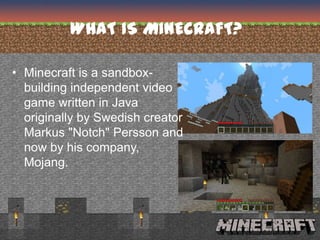
• Minecraft is a sandbox-
  building independent video
  game written in Java
  originally by Swedish creator
  Markus "Notch" Persson and
  now by his company,
  Mojang.
WHY MINECRAFT?
• I chose to do a case study on Minecraft because
  I play the game myself for almost a year.
  Moreover, I have a substantial amount of
  knowledge about this game.
ABOUT MINECRAFT
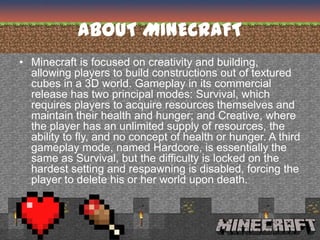
• Minecraft is focused on creativity and building,
  allowing players to build constructions out of textured
  cubes in a 3D world. Gameplay in its commercial
  release has two principal modes: Survival, which
  requires players to acquire resources themselves and
  maintain their health and hunger; and Creative, where
  the player has an unlimited supply of resources, the
  ability to fly, and no concept of health or hunger. A third
  gameplay mode, named Hardcore, is essentially the
  same as Survival, but the difficulty is locked on the
  hardest setting and respawning is disabled, forcing the
  player to delete his or her world upon death.
GAMEPLAY
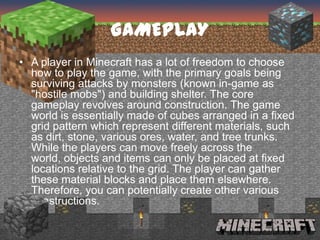
• A player in Minecraft has a lot of freedom to choose
  how to play the game, with the primary goals being
  surviving attacks by monsters (known in-game as
  "hostile mobs") and building shelter. The core
  gameplay revolves around construction. The game
  world is essentially made of cubes arranged in a fixed
  grid pattern which represent different materials, such
  as dirt, stone, various ores, water, and tree trunks.
  While the players can move freely across the
  world, objects and items can only be placed at fixed
  locations relative to the grid. The player can gather
  these material blocks and place them elsewhere.
  Therefore, you can potentially create other various
  constructions.
WHERE TO START?
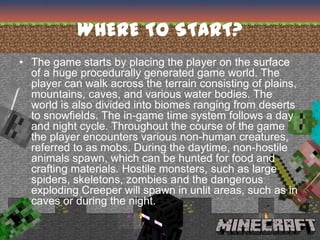
• The game starts by placing the player on the surface
  of a huge procedurally generated game world. The
  player can walk across the terrain consisting of plains,
  mountains, caves, and various water bodies. The
  world is also divided into biomes ranging from deserts
  to snowfields. The in-game time system follows a day
  and night cycle. Throughout the course of the game
  the player encounters various non-human creatures,
  referred to as mobs. During the daytime, non-hostile
  animals spawn, which can be hunted for food and
  crafting materials. Hostile monsters, such as large
  spiders, skeletons, zombies and the dangerous
  exploding Creeper will spawn in unlit areas, such as in
  caves or during the night.
THE WORLD
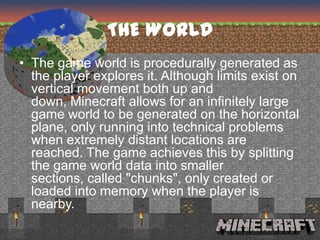
• The game world is procedurally generated as
  the player explores it. Although limits exist on
  vertical movement both up and
  down, Minecraft allows for an infinitely large
  game world to be generated on the horizontal
  plane, only running into technical problems
  when extremely distant locations are
  reached. The game achieves this by splitting
  the game world data into smaller
  sections, called "chunks", only created or
  loaded into memory when the player is
  nearby.
Dimensions
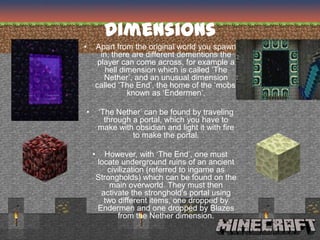
•   Apart from the original world you spawn
      in, there are different dementions the
     player can come across, for example a
       hell dimension which is called ‘The
       Nether’, and an unusual dimension
    called ‘The End’, the home of the ‘mobs’
              known as ‘Endermen’.

•       ‘The Nether’ can be found by traveling
          through a portal, which you have to
        make with obsidian and light it with fire
                  to make the portal.

    •     However, with ‘The End’, one must
        locate underground ruins of an ancient
           civilization (referred to ingame as
        Strongholds) which can be found on the
            main overworld. They must then
         activate the stronghold's portal using
          two different items, one dropped by
        Endermen and one dropped by Blazes
              from the Nether dimension.
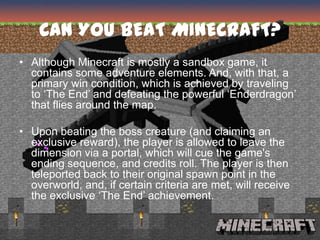
CAN YOU BEAT MINECRAFT?
• Although Minecraft is mostly a sandbox game, it
  contains some adventure elements. And, with that, a
  primary win condition, which is achieved by traveling
  to ‘The End’ and defeating the powerful ‘Enderdragon’
  that flies around the map.

• Upon beating the boss creature (and claiming an
  exclusive reward), the player is allowed to leave the
  dimension via a portal, which will cue the game's
  ending sequence, and credits roll. The player is then
  teleported back to their original spawn point in the
  overworld, and, if certain criteria are met, will receive
  the exclusive ‘The End’ achievement.
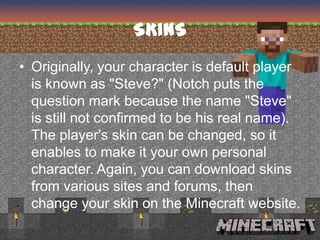
SKINS
• Originally, your character is default player
  is known as "Steve?" (Notch puts the
  question mark because the name "Steve"
  is still not confirmed to be his real name).
  The player's skin can be changed, so it
  enables to make it your own personal
  character. Again, you can download skins
  from various sites and forums, then
  change your skin on the Minecraft website.
MODS
• To make the game an even more immersive
  experience, various ‘modders’ have made mods so
  you can be able to add them onto the game. Popular
  mods, such as ‘Mo Creatures’ (a mod which includes
  more mobs/hostile mobs to the game) have made the
  whole Minecraft experience that more enjoyable.

• Other ‘modders’ have set up a compilation of mods.
  The most popular one to date is ‘The Yogbox’. It is a
  carefully chosen compilation of mods which the user
  can download straight from the program (run in Java).
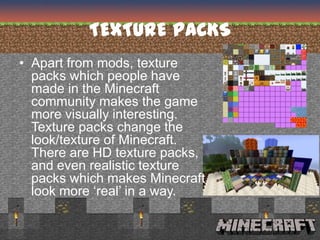
TEXTURE PACKS
• Apart from mods, texture
  packs which people have
  made in the Minecraft
  community makes the game
  more visually interesting.
  Texture packs change the
  look/texture of Minecraft.
  There are HD texture packs,
  and even realistic texture
  packs which makes Minecraft
  look more ‘real’ in a way.
CUSTOM MAPS


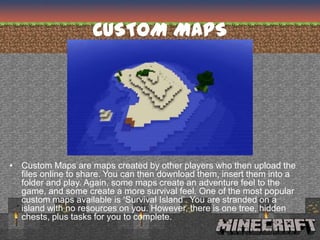
• Custom Maps are maps created by other players who then upload the
  files online to share. You can then download them, insert them into a
  folder and play. Again, some maps create an adventure feel to the
  game, and some create a more survival feel. One of the most popular
  custom maps available is ‘Survival Island’. You are stranded on a
  island with no resources on you. However, there is one tree, hidden
  chests, plus tasks for you to complete.
RELEASE
• Minecraft was released as an alpha on May 17, 2009, with a beta
  version on December 20, 2010. Official releases for iOS and Android
  have been released and the full version of the PC game was
  released on November 18, 2011 at MineCon 2011. The Android
  release was temporarily exclusive to the Xperia PLAY but is now
  available to the rest of the Android Market. A version of the game for
  the Xbox 360 with Kinect support is under development by 4J
  Studios, to be released as part of the Xbox Live Arcade Next
  promotion in May 2012. The game was officially released at
  MineCon on November 18, 2011. Minecraft was developed for about
  a week before its public release on May 17, 2009, on the TIGSource
  forums, where it gained a considerable level of popularity. It has
  been continually updated and patched since then, and while it was
  still in alpha release, it gained several hundred thousand sales and
  received critical notice and acclaim from many reviewers. It passed
  a million units sold on January 12, 2011, less than a month after
  reaching Beta. By February 18, 2012, the game had sold more than
  5 million units.
Development
•   The developer of Minecraft, Markus Persson aka Notch, had previously worked on games such as
    Wurm Online and as a game developer for King.com for over four years. Minecraft development began
    in May 10[not in citation given], 2009, soon after Persson had quit his job at King.com.

•   Minecraft was first released to the public on May 17, 2009, as a developmental "alpha" release.
    Although Persson maintained a day job with Jalbum.net at first, he later moved to working part time and
    has since quit in order to work on Minecraft full time as sales of the beta version of the game have
    expanded. Persson continues to update the game with releases distributed to users automatically.
                        Persson plans to continue these updates after the
           release of the full game as long as there is still                                     an active
    userbase. These updates have                                                      included features such as
    new items, new blocks,                                    an alternate "Hell" dimension (accessible through
                                    construction of a portal) that Persson terms
           "The Nether", tamable wolves that assist the                                           player, and
    changes to the game's behavior (e.g.,                                 how water flows). Persson plans to
    eventually                                                release the game as open-source after sales
                                    have dropped off and when he wants to
           move onto other projects.
• In September 2010 Persson announced that he and a friend were
  starting a video game company, Mojang, with the money earned
  from Minecraft. This company was intended to back the
  development of Minecraft and an unrelated game, Scrolls, which his
  friend would primarily work on. As part of creating the
  company, Persson has hired "an artist, a web site developer, and a
  business guy", additional programmers, and established an office in
  Stockholm. The four additional employees hired in 2010 were Jens
  Bergensten, a programmer; Daniel Kaplan, the "business guy";
  Jakob Porser, who will be working on the other game for Mojang;
  and Markus "Junkboy" Toivonen, a pixel artist.

• On December 11, 2010, Persson announced, via his personal
  blog, that Minecraft would be entering its beta testing phase on
  December 20, 2010, and that the price would increase to €14.95. He
  further stated that users who bought the game after this date would
  no longer be guaranteed to receive all future content free of charge
  as it "scared both the lawyers and the board." However, bug fixes
  and all updates leading up to and including the release would still be
  free. On April 7, 2011, Persson made a post on his blog that Mojang
  has decided to move the game out of Beta on November 11, 2011;
  however this would not be the "finished product", as the game would
  be continuously updated before and after the release.
Cost AND PRODUCTION
• To make Minecraft, it literally cost
  nothing, due to the fact that it is an indie
  game, and ‘Notch’ mainly made the
  game, just through code.

• Not many people worked on Minecraft. The
  main people behind this game are Markus
  "Notch" Persson and Jens Bergensten. The
  game was made in Sweden.

• Minecraft is written primarily in Java.
IS THERE A FREE VERSION OF
             MINECRAFT?
• There is a free version of Minecraft on the
  Minecraft website. Classic is a title given for
  this version as it is a released version of
  Minecraft when it was before in development.
  It was the first development phase in
  Minecraft.

• Moreover, in this free version, you do not get
  the latest updates and blocks. You get some
  blocks

Minecraft 120331102247-phpapp01

  • 1.
    The Case Study By Michael Moursi
  • 2.
    WHAT IS MINECRAFT? •Minecraft is a sandbox- building independent video game written in Java originally by Swedish creator Markus "Notch" Persson and now by his company, Mojang.
  • 3.
    WHY MINECRAFT? • Ichose to do a case study on Minecraft because I play the game myself for almost a year. Moreover, I have a substantial amount of knowledge about this game.
  • 4.
    ABOUT MINECRAFT • Minecraftis focused on creativity and building, allowing players to build constructions out of textured cubes in a 3D world. Gameplay in its commercial release has two principal modes: Survival, which requires players to acquire resources themselves and maintain their health and hunger; and Creative, where the player has an unlimited supply of resources, the ability to fly, and no concept of health or hunger. A third gameplay mode, named Hardcore, is essentially the same as Survival, but the difficulty is locked on the hardest setting and respawning is disabled, forcing the player to delete his or her world upon death.
  • 5.
    GAMEPLAY • A playerin Minecraft has a lot of freedom to choose how to play the game, with the primary goals being surviving attacks by monsters (known in-game as "hostile mobs") and building shelter. The core gameplay revolves around construction. The game world is essentially made of cubes arranged in a fixed grid pattern which represent different materials, such as dirt, stone, various ores, water, and tree trunks. While the players can move freely across the world, objects and items can only be placed at fixed locations relative to the grid. The player can gather these material blocks and place them elsewhere. Therefore, you can potentially create other various constructions.
  • 6.
    WHERE TO START? •The game starts by placing the player on the surface of a huge procedurally generated game world. The player can walk across the terrain consisting of plains, mountains, caves, and various water bodies. The world is also divided into biomes ranging from deserts to snowfields. The in-game time system follows a day and night cycle. Throughout the course of the game the player encounters various non-human creatures, referred to as mobs. During the daytime, non-hostile animals spawn, which can be hunted for food and crafting materials. Hostile monsters, such as large spiders, skeletons, zombies and the dangerous exploding Creeper will spawn in unlit areas, such as in caves or during the night.
  • 7.
    THE WORLD • Thegame world is procedurally generated as the player explores it. Although limits exist on vertical movement both up and down, Minecraft allows for an infinitely large game world to be generated on the horizontal plane, only running into technical problems when extremely distant locations are reached. The game achieves this by splitting the game world data into smaller sections, called "chunks", only created or loaded into memory when the player is nearby.
  • 8.
    Dimensions • Apart from the original world you spawn in, there are different dementions the player can come across, for example a hell dimension which is called ‘The Nether’, and an unusual dimension called ‘The End’, the home of the ‘mobs’ known as ‘Endermen’. • ‘The Nether’ can be found by traveling through a portal, which you have to make with obsidian and light it with fire to make the portal. • However, with ‘The End’, one must locate underground ruins of an ancient civilization (referred to ingame as Strongholds) which can be found on the main overworld. They must then activate the stronghold's portal using two different items, one dropped by Endermen and one dropped by Blazes from the Nether dimension.
  • 9.
    CAN YOU BEATMINECRAFT? • Although Minecraft is mostly a sandbox game, it contains some adventure elements. And, with that, a primary win condition, which is achieved by traveling to ‘The End’ and defeating the powerful ‘Enderdragon’ that flies around the map. • Upon beating the boss creature (and claiming an exclusive reward), the player is allowed to leave the dimension via a portal, which will cue the game's ending sequence, and credits roll. The player is then teleported back to their original spawn point in the overworld, and, if certain criteria are met, will receive the exclusive ‘The End’ achievement.
  • 10.
    SKINS • Originally, yourcharacter is default player is known as "Steve?" (Notch puts the question mark because the name "Steve" is still not confirmed to be his real name). The player's skin can be changed, so it enables to make it your own personal character. Again, you can download skins from various sites and forums, then change your skin on the Minecraft website.
  • 11.
    MODS • To makethe game an even more immersive experience, various ‘modders’ have made mods so you can be able to add them onto the game. Popular mods, such as ‘Mo Creatures’ (a mod which includes more mobs/hostile mobs to the game) have made the whole Minecraft experience that more enjoyable. • Other ‘modders’ have set up a compilation of mods. The most popular one to date is ‘The Yogbox’. It is a carefully chosen compilation of mods which the user can download straight from the program (run in Java).
  • 12.
    TEXTURE PACKS • Apartfrom mods, texture packs which people have made in the Minecraft community makes the game more visually interesting. Texture packs change the look/texture of Minecraft. There are HD texture packs, and even realistic texture packs which makes Minecraft look more ‘real’ in a way.
  • 13.
    CUSTOM MAPS • CustomMaps are maps created by other players who then upload the files online to share. You can then download them, insert them into a folder and play. Again, some maps create an adventure feel to the game, and some create a more survival feel. One of the most popular custom maps available is ‘Survival Island’. You are stranded on a island with no resources on you. However, there is one tree, hidden chests, plus tasks for you to complete.
  • 14.
    RELEASE • Minecraft wasreleased as an alpha on May 17, 2009, with a beta version on December 20, 2010. Official releases for iOS and Android have been released and the full version of the PC game was released on November 18, 2011 at MineCon 2011. The Android release was temporarily exclusive to the Xperia PLAY but is now available to the rest of the Android Market. A version of the game for the Xbox 360 with Kinect support is under development by 4J Studios, to be released as part of the Xbox Live Arcade Next promotion in May 2012. The game was officially released at MineCon on November 18, 2011. Minecraft was developed for about a week before its public release on May 17, 2009, on the TIGSource forums, where it gained a considerable level of popularity. It has been continually updated and patched since then, and while it was still in alpha release, it gained several hundred thousand sales and received critical notice and acclaim from many reviewers. It passed a million units sold on January 12, 2011, less than a month after reaching Beta. By February 18, 2012, the game had sold more than 5 million units.
  • 15.
    Development • The developer of Minecraft, Markus Persson aka Notch, had previously worked on games such as Wurm Online and as a game developer for King.com for over four years. Minecraft development began in May 10[not in citation given], 2009, soon after Persson had quit his job at King.com. • Minecraft was first released to the public on May 17, 2009, as a developmental "alpha" release. Although Persson maintained a day job with Jalbum.net at first, he later moved to working part time and has since quit in order to work on Minecraft full time as sales of the beta version of the game have expanded. Persson continues to update the game with releases distributed to users automatically. Persson plans to continue these updates after the release of the full game as long as there is still an active userbase. These updates have included features such as new items, new blocks, an alternate "Hell" dimension (accessible through construction of a portal) that Persson terms "The Nether", tamable wolves that assist the player, and changes to the game's behavior (e.g., how water flows). Persson plans to eventually release the game as open-source after sales have dropped off and when he wants to move onto other projects.
  • 16.
    • In September2010 Persson announced that he and a friend were starting a video game company, Mojang, with the money earned from Minecraft. This company was intended to back the development of Minecraft and an unrelated game, Scrolls, which his friend would primarily work on. As part of creating the company, Persson has hired "an artist, a web site developer, and a business guy", additional programmers, and established an office in Stockholm. The four additional employees hired in 2010 were Jens Bergensten, a programmer; Daniel Kaplan, the "business guy"; Jakob Porser, who will be working on the other game for Mojang; and Markus "Junkboy" Toivonen, a pixel artist. • On December 11, 2010, Persson announced, via his personal blog, that Minecraft would be entering its beta testing phase on December 20, 2010, and that the price would increase to €14.95. He further stated that users who bought the game after this date would no longer be guaranteed to receive all future content free of charge as it "scared both the lawyers and the board." However, bug fixes and all updates leading up to and including the release would still be free. On April 7, 2011, Persson made a post on his blog that Mojang has decided to move the game out of Beta on November 11, 2011; however this would not be the "finished product", as the game would be continuously updated before and after the release.
  • 17.
    Cost AND PRODUCTION •To make Minecraft, it literally cost nothing, due to the fact that it is an indie game, and ‘Notch’ mainly made the game, just through code. • Not many people worked on Minecraft. The main people behind this game are Markus "Notch" Persson and Jens Bergensten. The game was made in Sweden. • Minecraft is written primarily in Java.
  • 18.
    IS THERE AFREE VERSION OF MINECRAFT? • There is a free version of Minecraft on the Minecraft website. Classic is a title given for this version as it is a released version of Minecraft when it was before in development. It was the first development phase in Minecraft. • Moreover, in this free version, you do not get the latest updates and blocks. You get some blocks