ISBN: 978-1-4822-5031-2
9 781482 250312
90000
6000 Broken Sound Parkway, NW
Suite 300, Boca Raton, FL 33487
711 Third Avenue
New York, NY 10017
2 Park Square, Milton Park
Abingdon, Oxon OX14 4RN, UK
an informa business
w w w . c r c p r e s s . c o m
Mind Maps for
Medical Students
This brand new revision aid has been designed specifically
to help medical students memorise essential clinical facts,
invaluable throughout medical studies and particularly use-
ful in the pressured run-up to final exams. Over 100 maps
are organised by body system, with a concluding section of
miscellaneous examples.
Key features:
• Proven – content presented as mind maps, an established
tool in education and known to improve memory recall 		
among students
• Flexible – ideal when preparing to study a topic for the
first time, when reviewing it at the end of a module or
attachment, and for making project and revision plans
• Adaptable – use the maps in the book directly, or as a
guide to prepare your own
• Systems-based – in line with medical course structure
• Relevant – by a medical student for medical students
Olivia Smith is a fourth year medical student,The HullYork
Medical School, UK
Mind Maps
for Medical
Students
Olivia Smith
K23766
Mind
Maps
for
Medical
Students
Olivia
Smith
Mind Maps
for Medical
Students
FM.indd 1 08/12/14 11:27 PM
This page intentionally left blank
A
Mind Maps
for Medical
Students
Olivia Smith
The HullYork Medical School, UK
FM.indd 3 08/12/14 11:27 PM
CRC Press
Taylor & Francis Group
6000 Broken Sound Parkway NW, Suite 300
Boca Raton, FL 33487-2742
© 2015 by Taylor & Francis Group, LLC
CRC Press is an imprint of Taylor & Francis Group, an Informa business
No claim to original U.S. Government works
Version Date: 20141104
International Standard Book Number-13: 978-1-4822-5032-9 (eBook - PDF)
This book contains information obtained from authentic and highly regarded sources. While all reasonable efforts have
been made to publish reliable data and information, neither the author[s] nor the publisher can accept any legal responsibil-
ity or liability for any errors or omissions that may be made. The publishers wish to make clear that any views or opinions
expressed in this book by individual editors, authors or contributors are personal to them and do not necessarily reflect
the views/opinions of the publishers. The information or guidance contained in this book is intended for use by medical,
scientific or health-care professionals and is provided strictly as a supplement to the medical or other professional’s own
judgement, their knowledge of the patient’s medical history, relevant manufacturer’s instructions and the appropriate best
practice guidelines. Because of the rapid advances in medical science, any information or advice on dosages, procedures or
diagnoses should be independently verified. The reader is strongly urged to consult the relevant national drug formulary and
the drug companies’ printed instructions, and their websites, before administering any of the drugs recommended in this
book. This book does not indicate whether a particular treatment is appropriate or suitable for a particular individual. Ulti-
mately it is the sole responsibility of the medical professional to make his or her own professional judgements, so as to advise
and treat patients appropriately. The authors and publishers have also attempted to trace the copyright holders of all material
reproduced in this publication and apologize to copyright holders if permission to publish in this form has not been obtained.
If any copyright material has not been acknowledged please write and let us know so we may rectify in any future reprint.
Except as permitted under U.S. Copyright Law, no part of this book may be reprinted, reproduced, transmitted, or utilized in
any form by any electronic, mechanical, or other means, now known or hereafter invented, including photocopying, micro-
filming, and recording, or in any information storage or retrieval system, without written permission from the publishers.
For permission to photocopy or use material electronically from this work, please access www.copyright.com (http://www.
copyright.com/) or contact the Copyright Clearance Center, Inc. (CCC), 222 Rosewood Drive, Danvers, MA 01923, 978-750-
8400. CCC is a not-for-profit organization that provides licenses and registration for a variety of users. For organizations that
have been granted a photocopy license by the CCC, a separate system of payment has been arranged.
Trademark Notice: Product or corporate names may be trademarks or registered trademarks, and are used only for identi-
fication and explanation without intent to infringe.
Visit the Taylor & Francis Web site at
http://www.taylorandfrancis.com
and the CRC Press Web site at
http://www.crcpress.com
Dedication vi
Foreword						 vii
Acknowledgement				 viii
Preface							 ix
Abbreviations					 xi
Chapter 1 The Cardiovascular System			 1
Chapter 2 The Respiratory System			 19
Chapter 3 The Gastrointestinal System		 35
Chapter 4 The Renal System				 53
Chapter 5 The Endocrine System			 71
Chapter 6 Haematology				 93
Chapter 7 Infectious Disease			 105
Chapter 8 The Immune System			 123
Chapter 9 Neurology				 133
Chapter 10 Musculoskeletal System			 155
Chapter 11 The Reproductive System			 173
Chapter 12 Embryology				 187
Chapter 13 Genetic Disorders				 197
Chapter 14 Miscellaneous Conditions			 213
Appendix 1 List of Useful Disease Diagnostic Criteria 221
Appendix 2 Useful Websites				 223
Index 227
Contents
FM.indd 5 08/12/14 11:27 PM
In memory of Michael J.Webb
It would be wrong for me not to acknowledge the man to whom this book is
dedicated. I know that without Michael’s care and tireless patience I would never
have undertaken, nor believed that I could complete, a project such as this.
Dedication
vi
FM.indd 6 08/12/14 11:27 PM
vii
Mind Maps for Medical Students represents an industrious and valuable piece of work
from an undergraduate student. But perhaps I should start by saying what it is not. It
is neither a textbook nor a definitive information source for students encountering a
topic for the first time. It cannot give a comprehensive account of every topic listed and
some information will change as the world of medicine rapidly evolves.
So what does Mind Maps for Medical Students offer? The author has provided rapid
revision notes covering a broad range of medical topics, ideally suited to students and
early postgraduates revising for exams. This distillation of knowledge will save many
hours of note taking for other students.The format will appeal to those who construct
their knowledge in logical sequences and the layout will allow the reader to add notes
and annotations as information changes or to add a local context.
The author is to be congratulated on providing so much information in such a
concise format and I hope that many others will be rewarded by her endeavours.
Colin H. Jones
MBChB, MD, FRCP, Master of Education
Associate Dean of Assessment,The Hull York Medical School, UK
Foreword
FM.indd 7 08/12/14 11:27 PM
I am extremely grateful to Dr.A.G.W. Smith and Dr. D. Maleknasr for their
continued support, help and guidance with this project.
Acknowledgement
viii
FM.indd 8 08/12/14 11:27 PM
ix
The idea for this book began when I was in my second year of medical school. It was
only then that I truly realised the full enormity of knowledge that medical students
have to retain.
I envisaged a book presenting relevant material in a simplified way that would
only enhance and consolidate what I had already learned from textbooks, lectures and
the ward, particularly in the countdown to exams.Then, as chance would have it, I was
granted the opportunity to make this a reality.
This book is an attempt to cover the main topics faced by medical students from
day one, capturing and presenting the facts in a clear manner that is even sufficient
for final year level. Even its format has been designed with the student in mind – it is
pocket sized and has titles covering the definition of the disease, causes, investigations,
treatments and complications to aid recall. The intention of Mind Maps for Medical
Students is not to substitute for larger texts but to complement them and, with that in
mind, I hope that it assists your understanding.
Finally, I hope that readers enjoy this book and I wish you all the best of luck with
your medical and future studies.
Olivia Smith
Fourth year medical student,The Hull York Medical School, UK
Preface
FM.indd 9 08/12/14 11:27 PM
This page intentionally left blank
Xxx
xi
5-ASA 5-aminosalicylic acid
ABG arterial blood gas
ACE angiotensin converting
enzyme
ACE-III Addenbrooke’s Cognitive
Examination
ACTH adrenocorticotrophic hormone
ADH antidiuretic hormone
ADL activity of daily living
ADP adenosine diphosphate
ADPKD autosomal dominant
polycystic kidney disease
AF atrial fibrillation
Ag antigen
AIDS acquired immunodeficiency
syndrome
AKI acute kidney injury
ALL acute lymphoblastic
leukaemia
AML acute myeloid leukaemia
ANA antinuclear antibody
ANCA antineutrophil cytoplasmic
antibody
APML acute promyelocytic
leukaemia
Apo apolipoprotein
APP amyloid precursor protein
ARB angiotensin receptor blocker
ARDS acute respiratory distress
syndrome
ARPKD autosomal recessive polycystic
kidney disease
ASD atrial septal defect
ATP adenosine triphosphate
AV atrioventricular
BBB blood–brain barrier
BMI body mass index
BNP brain natriuretic peptide
BP blood pressure
BPH benign prostatic hypertrophy
CABG coronary artery bypass graft
CADASIL cerebral autosomal 		
dominant arteriopathy
with subcortical infarcts and
leucoencephalopathy
CCP cyclic citrullinated peptide
CEA carcinoembryonic antigen
CHF congestive heart failure
CJD Creutzfeldt–Jakob disease
CKI chronic kidney injury
CLL chronic lymphocytic 		
leukaemia
CML chronic myeloid leukaemia
CMV cytomegalovirus
CNS central nervous system
COPD chronic obstructive pulmonary
disease
CRC colorectal cancer
CRP C-reactive protein
CSF cerebrospinal fluid
CT computed tomography
CTS carpal tunnel syndrome
CXR chest X-ray
DaTSCAN ioflupane 123
I for injection
DCIS ductal carcinoma in situ
DEXA dual-energy X-ray scan
DFA direct fluorescent antibody
test
DHT dihydrotestosterone
DI diabetes insipidus
DIC disseminated intravascular
coagulation
DIP distal interphalangeal (joint)
DM diabetes mellitus
DMARD disease modifying 		
antirheumatic drug
DNA deoxyribonucleic acid
DPP dipeptidyl peptidase
Abbreviations
FM.indd 11 10/12/14 4:39 PM
xii
DVLA Driver and Vehicle Licensing
Agency
DVT deep vein thrombosis
DWI diffusion-weighted MRI
EBV Epstein–Barr virus
ECG electrocardiography
ECHO echocardiography
EEG electroencephalography
EIA enzyme immunoassay
ELISA enzyme linked
immunosorbent assay
EMB eosin methylene blue
EMG electromyography
EPEC enteropathogenic E. coli
EPO erythropoietin
ERCP endoscopic retrograde
cholangiopancreatography
ESKD end-stage kidney disease
ESR erythrocyte sedimentation
rate
ESWL extracorporeal shock wave
lithotripsy
FAP familial adenomatous
polyposis
FBC full blood count
FEV1 forced expiratory volume
FSH follicle stimulating hormone
FTA fluorescent treponemal
antibody absorption
FVC forced vital capacity
GABA gamma-amino butyric acid
GBM glomerular basement
membrane
(c)GFR (calculated) glomerular
filtration rate
GH growth hormone
GHRH growth hormone releasing
hormone
GI gastrointestinal
GIT gastrointestinal tract
GLP glucagon-like peptide
GnRH gonadotrophin releasing
hormone
GORD gastro-oesophageal reflux
disease
Gp glycoprotein
GTN glyceryl trinitrate
HAART highly active antiretroviral
therapy
HAV hepatitis A virus
Hb haemoglobin
HbAIc glycated haemoglobin
HBV hepatitis B virus
HCC hepatocellular carcinoma
HCV hepatitis C virus
HDV hepatitis D virus
HEV hepatitis E virus
HGPRT hypoxanthine–guanine
phosphoribosyltransferase
HHV human herpes virus
HIV human immunodeficiency
virus
HNPCC hereditary nonpolyposis
colorectal cancer
HPV human papilloma virus
HTLV-1 human T-lymphotrophic virus-1
HUS haemolytic uraemic syndrome
IBD inflammatory bowel disease
IBS irritable bowel syndrome
ICU intensive care unit
IFA immunofluorescence assay
Ig immunoglobulin
IGF insulin-like growth factor
IL interleukin
IOP intraocular pressure
IPSS International Prostate
Symptom Score
IV intravenous
IVU intravenous urogram
JVP jugular venous pressure
Abbreviations
FM.indd 12 10/12/14 4:39 PM
xiii
KUB kidney, ureter, bladder
LBBB left bundle branch block
LFTs liver function tests
LH luteinising hormone
LHRH luteinising hormone-releasing
hormone
LMN lower motor neuron
LMWH low molecular weight heparin
LP lumbar puncture
LTOT long-term oxygen therapy
LVF left ventricular failure
MALT mucosa-associated lymphoid
tissue (lymphoma)
MAO monoamine oxidase
MCH mean corpuscular 		
haemoglobin
MCPJ metacarpophalangeal joint
MCV mean corpuscular volume
MEN multiple endocrine neoplasia
(syndrome)
MI myocardial infarction
MLCK myosin light chain kinase
MMR mumps, measles, rubella
MND motor neuron disease
MOA mode of action
MRCP magnetic resonance 		
cholangiopancreatography
MRI magnetic resonance imaging
MS multiple sclerosis
MTPJ metatarsophalangeal joint
NAAT nucleic acid amplification test
NBM nil by mouth
NICE National Institute for Health
and Care Excellence
NIV noninvasive ventilation
NMDA N-methyl-D-aspartate
NNRTI non-nucleoside reverse
transcriptase inhibitor
NPI Nottingham Prognostic
Index
NRTI nucleoside reverse 		
transcriptase inhibitor
NSAID nonsteroidal anti-inflammatory
drug
NSCC non small cell carcinoma
NSTEMI non-ST elevation myocardial
infarction
OA osteoarthritis
PaCO2
arterial partial pressure of
carbon dioxide
PaO2
arterial partial pressure of
oxygen
PAH phenylalanine hydroxylase
PCI percutaneous coronary
intervention
PCR polymerase chain reaction
PE pulmonary embolus
PET positron emission tomography
PG prostaglandin
PI protease inhibitor
PIP proximal interphalangeal
PPAR peroxisome proliferator-
activated receptor
PPI proton pump inhibitor
PR per rectum
PSA prostate specific antigen
PT prothrombin time
PTH parathyroid hormone
PTT partial thromboplastin time
RA rheumatoid arthritis
RAAS renin angiotensin aldosterone
system
RCC renal cell carcinoma
RDS respiratory distress syndrome
RNA ribonucleic acid
RPR rapid plasma regain
RVF right ventricular failure
SCC small cell carcinoma
SERM selective oestrogen receptor
modulator
Abbreviations
FM.indd 13 08/12/14 11:27 PM
SLE systemic lupus erythematosus
SPECT single photon emission
computed tomography
SSRI selective serotonin reuptake
inhibitor
STEMI ST elevation myocardial
infarction
STI sexually transmitted infection
SUDEP sudden unexplained death in
epilepsy
T3 triiodothyronine
T4 thyroxine
TB tuberculosis
TCC transitional cell carcinoma
TFTs thyroid function tests
Th T helper (cell)
TIA transient ischaemic attack
TIBC total iron binding capacity
TNF tumour necrosis factor
TOF tetralogy of Fallot
TPHA Treponema pallidum 		
haemagglutination test
TPPA Treponema pallidum particle
agglutination test
TSH thyroid stimulating hormone
TURP transurethral resection of the
prostate
U&Es urine and electrolytes
UMN upper motor neuron
UPEC uropathogenic E. coli
UTI urinary tract infection
VDRL Venereal Disease Research
Laboratory
V/Q ventilation/perfusion
VSD ventricular septal defect
VWF von Willebrand factor
VZV varicella zoster virus
WCC white cell count
Abbreviations
xiv
FM.indd 14 08/12/14 11:27 PM
Chapter One The Cardiovascular System
MAP 1.1 Heart Failure 2
MAP 1.2 Pathophysiology of Congestive Heart Failure (CHF) 4
MAP 1.3 Myocardial Infarction (MI) 6
MAP 1.4 Angina Pectoris 8
MAP 1.5 Infective Endocarditis 10
FIGURE 1.1 Heart Valves 11
TABLE 1.1 Aortic Valve Disease12
TABLE 1.2 Mitral Valve Disease14
MAP 1.6 Hypertension 16
FIGURE 1.2 The Renin Angiotensin System 17
MAP 1.7 Atrial Fibrillation (AF) 18
1 The Cardiovascular System
Chapter_01.indd
1
08/12/14
5:41
PM
The Cardiovascular System
2 Map 1.1 Heart Failure
Causes
Anything that causes myocardial damage may
lead to heart failure.
Examples include:
• Coronary artery disease.
• Hypertension.
• Atrial fibrillation.
• Valve disease.
• Cardiomyopathies.
• Infective endocarditis.
• Anaemia.
• Endocrine disorders.
• Cor pulmonale: this is right ventricular
failure secondary to pulmonary disease.
Classification
Framingham Criteria for Congestive
Heart Failure: 2 major criteria or 1 major
criteria and 2 minor criteria:
• Major criteria: PAINS
○ Paroxysmal nocturnal dyspnoea.
○ Acute pulmonary oedema.
○ Increased heart size, Increased central
venous pressure.
○ Neck vein dilation.
○ S3 gallop.
• Minor criteria: PAIN
○ Pleural effusion.
○ Ankle oedema (bilateral).
○ Increased heart rate 120 beats/min.
○ Nocturnal cough.
New York Heart Association
Classification for Heart Failure
I: No limitation of physical activity.
II: Slight limitation of physical activity.
III: Marked limitation of physical activity.
IV: Inability to carry out physical activity.
What is heart failure?
This may be defined as the inability of cardiac
output to meet the physiological demands of
the body. It can be classified in several ways:
• Left ventricular failure (LVF): Symptoms of
LVF: paroxysmal nocturnal dyspnoea,
wheeze, nocturnal cough with pink sputum
caused by pulmonary oedema.
• Right ventricular failure (RVF): Symptoms
of RVF, which is usually caused by LVF or
lung disease, peripheral oedema and
ascites.
• Low output and high output heart
failure. This is due to excessive afterload,
excessive preload or pump failure.
Pathophysiology
See page 4.
MAP 1.1 Heart Failure
Chapter_01.indd
2
08/12/14
5:41
PM
3 The Cardiovascular System
Treatment
• Conservative: smoking cessation advice,
weight loss, promotion of healthy diet and
exercise.
• Medical:
○ Angiotensin converting enzyme (ACE)
inhibitors.
○ Beta-blockers: currently only two are
licensed in the UK, bisoprolol and
carvedilol
○ Candesartan: an angiotensin receptor
blocker (if intolerant to ACE inhibitors).
○ Digoxin: a cardiac glycoside.
○ Diuretics, e.g. furosemide.
○ Spironolactone: an aldosterone receptor
antagonist.
• Surgical: heart transplantation.
Complications
• Renal failure.
• Valve dysfunction.
• Stroke.
Investigations
• Bloods:
○ FBC, UEs, LFTs,TFTs, lipid profile.
○ BNP (brain natriuretic peptide).
It suggests how much the myocytes
are stretched. BNP is arguably
cardioprotective as it causes Na+
ion
and H2O excretion in addition to
vasodilation.A concentration
400 pg/mL (116 pmol/L) is
suggestive of heart failure.
• CXR: ABCDE
○ Alveolar oedema.
○ Kerley B lines.
○ Cardiomegaly.
○ Dilated upper lobe vessels.
○ pleural Effusion.
• ECHO: aims to identify cause and assess
function of the heart.
• ECG.
Map 1.1 Heart Failure
Chapter_01.indd
3
08/12/14
5:41
PM
The Cardiovascular System
4 Map 1.2 Pathophysiology of Congestive Heart Failure (CHF)
Causes of left-sided heart failure
• Coronary artery disease.
• Hypertension.
• Aortic valve disease.
• Mitral valve disease.
• Myocardial disease.
Ischaemic injury
• Reduced myocardial efficiency.
Causes of right-sided heart failure
• Left-sided heart failure.
• Tricuspid valve disease.
• Pulmonary valve disease.
• Pulmonary vascular disease.
MAP 1.2 Pathophysiology of Congestive
Heart Failure (CHF)
• Increased workload.
• Cardiac output.
• Contractility.
Chapter_01.indd
4
08/12/14
5:41
PM
5 The Cardiovascular System
Chronic activation of these compensatory mechanisms worsens heart failure and leads to increased
cardiac damage.
Activates compensatory mechanisms
• Activation of the renin angiotensin aldosterone system (RAAS) causes Na+ ion and H2O retention,
and peripheral vasoconstriction.This increases preload.
• Activation of the sympathetic nervous system increases heart rate and causes peripheral
vasoconstriction.This increases afterload.
• Myocyte size.
Remember that:
•The cause of cardiac dilation is increased end-diastolic volume.
•The raised jugular venous pressure (JVP) is related to right-sided heart failure and fluid overload.
• Hepatomegaly is caused by congestion of the hepatic portal circulation.
Map 1.2 Pathophysiology of Congestive Heart Failure (CHF)
Chapter_01.indd
5
08/12/14
5:41
PM
The Cardiovascular System
6 Map 1.3 Myocardial Infarction (MI)
What is MI?
Also known as a heart attack. It occurs when there is
myocardial necrosis following atherosclerotic plaque
rupture, which occludes one or more of the coronary
arteries. MI is part of the acute coronary syndromes.
The acute coronary syndromes comprise:
• ST elevation MI (STEMI).
• Non-ST elevation MI (NSTEMI).
• Unstable angina.
Causes
• Atherosclerosis.
Symptoms
• Nausea, sweating, palpitations.
• Crushing chest pain for more than 20 minutes.
• N.B. Can be silent in diabetics.
Signs
Remember these as RIP:
• Raised jugular venous pressure (JVP).
• Increased pulse, blood pressure changes.
• Pallor, anxiety.
Pathophysiology
See page 9 for the pathophysiology of atherosclerosis.
Type of infarct
• Transmural:
○ Affects all of the myocardial wall.
○ ST elevation and Q waves.
• Subendocardial:
○ Necrosis of 50% of the
myocardial wall.
○ ST depression.
Investigations
• ECG: this may show:
○ ST elevation, ST depression, inverted T waves.
○ New left bundle branch block (LBBB).
○ Pathological Q waves.
• CXR: this may show:
○ Cardiomegaly.
○ Pulmonary oedema.
○ Widening of the mediastinum.
• Bloods: look for cardiac biomarkers:
○ Troponin I.
○ Troponin T.
• Angiography with the view to perform
percutaneous coronary intervention (PCI).
MAP 1.3
Myocardial Infarction (MI)
Chapter_01.indd
6
08/12/14
5:41
PM
7 The Cardiovascular System
Complications
Remember this as C PEAR DROP:
• Cardiogenic shock, Cardiac arrhythmia.
N.B.Atrial fibrillation (AF) increases a patient’s risk
of stroke.AF presents with an irregularly irregular
pulse and an ECG with absent P waves, irregular
RR intervals, an undulating baseline and narrow
QRS complexes. Start anticoagulation therapy.
• Pericarditis.
• Emboli.
• Aneurysm formation.
• Rupture of ventricle.
• Dressler’s syndrome: an autoimmune pericarditis
that develops 2–10 weeks post MI.This is a triad
of: 1) fever; 2) pleuritic pain; 3) pericardial effusion.
• Rupture of free wall.
• O
• Papillary muscle rupture.
Treatment
• Conservative: lifestyle measures such
as smoking cessation and increased excercise.
• Medical – MONA B for immediate management:
○ Morphine.
○ Oxygen (if hypoxic).
○ Nitrates (glyceryl trinitrate [GTN]).
○ Anticoagulants, e.g. aspirin and an antiemetic.
○ Beta-blockers if no contraindication.
On discharge all patients should be prescribed:
aspirin, an angiotensin converting enzyme (ACE)
inhibitor, a beta-blocker (if no contraindication; calcium
channel blockers are good alternatives) and a statin.
• Surgical: reperfusion with PCI if STEMI. PCI may
also be used in NSTEMI but if NSTEMI patients
are not having immediate PCI, fondaparinux (a
factor Xa inhibitor) or a low molecular weight
heparin (LMWH) may be given subcutaneously.
Map 1.3 Myocardial Infarction (MI)
Chapter_01.indd
7
08/12/14
5:41
PM
The Cardiovascular System
8 Map 1.4 Angina Pectoris
MAP 1.4 Angina Pectoris
What is angina pectoris?
Angina pectoris may be defined as
substernal discomfort that is precipitated
by exercise but relieved by rest or GTN
spray.
Causes
• Atherosclerosis.
• Rarely anaemia and
tachyarrhythmia.
Precipitants
• Exercise.
• Cold weather.
• Heavy meals.
Types of angina
• Stable angina: precipitated by
exercise but relieved by rest.
ST DEPRESSION
• Unstable angina: pain at rest,
worsening symptoms.
ST DEPRESSION
• Decubitus angina: triggered by lying
flat.
ST DEPRESSION
• Prinzmetal angina: due to coronary
artery spasm.
ST ELEVATION
Investigations: ECG
• ECG for signs of ST depression or
ST elevation. Exercise ECG is no
longer recommended by NICE
guidelines.
• CT scan, Coronary Calcium Score
(this is measured on CT) and
Coronary angiography.
• Go for thallium scan.
Chapter_01.indd
8
08/12/14
5:41
PM
9 The Cardiovascular System
Pathophysiology of atherosclerosis
Atherosclerosis is a slowly progressive disease and is the
underlying cause of ischaemic heart disease when it
occurs in the coronary arteries.
There are 3 stages of atheroma formation:
1 Fatty streak formation
Lipids are deposited in the intimal layer of the artery.
This, coupled with vascular injury, causes
inflammation, increased permeability and white blood
cell recruitment. Macrophages phagocytose the lipid
and become foam cells. These form the fatty streak.
2 Fibrolipid plaque formation
Lipid within the intimal layer stimulates the formation
of fibrocollagenous tissue. This eventually causes
thinning of the muscular media.
3 Complicated atheroma
This occurs when the plaque is extensive and prone
to rupture. The plaque may be calcified due to lipid
acquisition of calcium. Rupture activates clot
formation and thrombosis. If the coronary artery is
partially occluded the result is myocardial ischaemia
and therefore angina. If the coronary artery is
completely occluded then the result is myocardial
necrosis and MI.
Complications
• MI.
• Stroke.
Treatment
• Conservative: modify risk factors, e.g. control
cholesterol, control diabetes, smoking cessation
advice, weight loss, increase exercise and control
hypertension.
• Medical:
○ Nitrates: glyceryl trinitrate (GTN) spray. Side-effects
include headache and hypotension.
○ A – Aspirin.
○ B – Beta-blockers but contraindicated in asthma and
chronic obstructive pulmonary disease (COPD).
○ C – Ca2+
antagonists especially if beta-blockers are
contraindicated.
○ K+
channel activator, e.g. nicorandil.
• Surgery: percutaneous transluminal coronary angioplasty
or coronary artery bypass graft (CABG).
Map 1.4 Angina Pectoris
Chapter_01.indd
9
08/12/14
5:41
PM
The Cardiovascular System
10 Map 1.5 Infective Endocarditis
Causative agents
• Streptococcus viridans.
• Staphylococcus aureus.
• Staphylococcus epidermidis.
• Diphtheroids.
• Microaerophilic streptococci.
• HACEK group: Haemophilus,Actinobacillus,
Cardiobacterium, Eikenella and Kingella.
Investigations
• Blood cultures: take 3 separate cultures from 3
peripheral sites.
• Bloods for anaemia.
• Urinalysis; microscopic haematuria.
• CXR.
• Transoesophageal/ transthoracic ECHO for
vegetations.
Pathophysiology
Infective endocarditis is a rare
infection that usually affects
patients who already have a
structural valve abnormality.
The reason why heart valves
are targeted is because the
valves of the heart have limited
blood supply and consequently
white blood cells cannot reach
the valves through the blood.
Circulating bacteria adhere to
the valve causing vegetations.
What is infective endocarditis?
It is an infection of the endocardium usually
involving the heart valves, with ‘vegetation’ of the
infectious agent.
The mitral valve is more commonly affected but
the tricuspid valve is implicated in IV drug users.
Risk factors
• IV drug abuse.
• Cardiac lesions.
• Rheumatic heart disease.
• Dental treatment: requires antibiotic prophylaxis.
Classification of infective endocarditis
Duke Criteria: 2 major criteria or 1 major and
3 minor criteria or 5 minor criteria.
• Major criteria:
○ 2 separate positive blood cultures.
○ Endocardial involvement.
• Minor criteria: FIVE
○ Fever 38°C.
○ IV drug user or predisposing heart condition,
and
○ Immunological phenomena, e.g. Osler’s nodes
or Roth’s spots.
○ Vascular phenomena, e.g. mycotic aneurysm
or Janeway lesions.
○ Echocardiograph findings.
MAP 1.5
Infective Endocarditis
Chapter_01.indd
10
08/12/14
5:41
PM
11 The Cardiovascular System
Complications
• Heart failure.
• Arrhythmias.
• Abscess formation in the cardiac muscle.
• Emboli formation: may cause stroke, vision loss or
spread the infection to other regions of the body.
Treatment
Depends on the causative agent. Check hospital
antibiotic guidelines.
• Conservative: maintain good oral hygiene.
• Medical: empirical therapy is benzylpenicillin
and gentamicin.
○ Streptococci: benzylpenicillin and
amoxicillin.
○ Staphylococci: flucloxacillin and
gentamicin.
○ Aspergillus: miconazole.
• Surgical: valve repair or valve replacement.
Signs and symptoms
Remember this as FROM JANE:
• Fever.
• Roth’s spots (seen on fundoscopy).
• Osler’s nodes (painful nodules seen on the
fingers and toes).
• new Murmur.
• Janeway lesions (painless papules seen on the
palms and plantars).
• Anaemia.
• Nails: splinter haemorrhages.
• Emboli.
Remember the heart valves as:
All Prostitutes Take Money
(Aortic, Pulmonary, Tricuspid, Mitral).
A P
T M
FIGURE 1.1 Heart Valves
Map 1.5 Infective Endocarditis
Chapter_01.indd
11
08/12/14
5:41
PM
The Cardiovascular System
12 Table 1.1 Aortic Valve Disease
TABLE 1.1 Aortic Valve Disease
Valve lesion Causes Symptoms Signs Murmur Investigations Treatment Complications
Aortic stenosis Atherosclerotic-
like calcific
degeneration
Congenital
bicuspid valve
Rheumatic heart
disease
Syncope
Dyspnoea
Angina
Narrow pulse
pressure
Slow rising pulse
Crescendo-
decrescendo
ejection systolic
murmur, which
radiates to the
carotids
ECG: left
ventricular
hypertrophy;
AV block
CXR: poststenotic
dilation of the
ascending aorta;
may see
calcification of
valve on lateral
view
ECHO: confirms
diagnosis; allows
severity and
valve area to be
assessed
Conservative:
manage
cardiovascular
risk factors, e.g.
smoking
cessation
Medical: manage
cardiovascular
risk factors, e.g.
control blood
pressure
Surgical: valve
replacement is
the treatment of
choice
Sudden death
Arrhythmia
Heart failure
Infective
endocarditis
Aortic
regurgitation
Acute
Cusp rupture
Connective
tissue disorders,
Dyspnoea
Angina
Heart failure
Waterhammer
pulse
Wide pulse
pressure
Decrescendo early
diastolic murmur
ECG: left
ventricular
hypertrophy
Heart failure
Arrhythmia
Infective
endocarditis
Conservative:
manage
cardiovascular
risk factors, e.g.
smoking
cessation
Chapter_01.indd
12
08/12/14
5:41
PM
13 The Cardiovascular System
e.g. Marfan’s
syndrome
Aortic dissection
Perforation
secondary to
infection
Chronic
Rheumatoid
arthritis
Ankylosing
spondylitis
Syphilis
Traube’s sign: a
‘pistol shot’
heard over the
femoral artery
De Musset’s sign:
head nodding in
time with heart
beat
Quincke’s sign:
pulse felt in the
nail
Signs of systemic
disease
CXR: may see
cardiomegaly
and pulmonary
oedema if
patient has
heart failure
ECHO: confirms
diagnosis; allows
severity and
aortic root to be
assessed
Medical: manage
heart failure by
following NICE
guidelines
Surgical: valve
replacement is
the treatment of
choice
Table 1.1 Aortic Valve Disease
Chapter_01.indd
13
08/12/14
5:41
PM
The Cardiovascular System
14 Table 1.2 Mitral Valve Disease
Valve lesion Causes
Mitral
stenosis
Rheumatic heart
disease
Calcification
of valve
Rheumatoid
arthritis
Ankylosing
spondylitis
Systemic lupus
erythematosus
(SLE)
Malignant
carcinoid
Dyspnoea
Palpitations if
in atrial
fibrillation (AF)
Heart failure
Haemoptysis
Malar flush
Tapping apex
beat
Hoarse voice
(Ortner’s
syndrome)
Irregularly
irregular pulse if
in AF
Low pitch mid-
diastolic
murmur with
opening snap
ECG: atrial fibrillation;
bifid P waves
CXR: pulmonary
oedema and enlarged
left atrium may be
seen
ECHO: confirms
diagnosis; allows
severity and valve
area to be assessed
Conservative:
manage
cardiovascular risk
factors, e.g. smoking
cessation
Medical: manage
AF and heart failure
by following NICE
guidelines
Surgical: valve
replacement is the
treatment of choice
AF
Heart failure
Infective
endocarditis
AF
Heart failure
Infective
endocarditis
Pulmonary
hypertension
Irregularly
irregular pulse
if in AF
Displaced apex
beat
Symptoms Signs Murmur Investigations Treatment Complications
Mitral
regurgi-
tation
Rheumatic
heart disease
Papillary
muscle
rupture
Infective
endocarditis
Prolapse
Dyspnoea
Palpitations if in
AF
Heart failure
Symptoms of
infective
endocarditis
A harsh
pansystolic
murmur
radiating to
the axilla
ECG: atrial fibrillation;
bifid P waves
CXR: may see
cardiomegaly and
pulmonary oedema if
patient has heart
failure
Conservative:
manage
cardiovascular risk
factors, e.g. smoking
cessation
TABLE 1.2 Mitral Valve Disease
Chapter_01.indd
14
08/12/14
5:41
PM
15 The Cardiovascular System
Medical: manage
heart failure and
AF by following
NICE guidelines
Surgical: valve
repair is preferred
since replacement
may interfere with
the function of the
papillary muscles
ECHO: confirms
diagnosis; allows
severity to be
assessed
Table 1.2 Mitral Valve Disease
Chapter_01.indd
15
08/12/14
5:41
PM
The Cardiovascular System
16 Map 1.6 Hypertension
Investigations
• Clinic blood pressure readings (with ambulatory blood
pressure monitoring to confirm). Stages of hypertension
are listed below:
Blood
pressure
(mmHg) Systolic Diastolic
120 80
Pre-
hypertension
120–139 80–89
Stage 1
160–179 100–109
Severe
hypertension

_180 
_110
• Bloods: FBC, LFTs, UEs, creatinine, serum urea, cGFR,
lipid levels and glucose.
• ECG: left ventricular hypertrophy.
• Urine dipstick: haematuria and proteinuria.
140–159 90–99
Stage 2
Normal
What is hypertension?
This is a clinic blood pressure that is 140/90 mmHg.
Pathophysiology
There is much uncertainty as to the cause of hypertension but it is likely
multifactorial. ~95% of cases have no known cause and, in these cases,
patients are said to have ‘essential hypertension’.
More rarely, patients will have secondary hypertension. This should be
considered in young patients with an acute onset of hypertension, any
history that is suggestive of a renal or endocrine cause and when the
patient fails to respond to medical therapy. Examples include renovascular
disease, Conn’s syndrome, Cushing’s disease and phaeochromocytoma.
Blood pressure is controlled by several mechanisms, e.g. the autonomic
nervous system, the capillary fluid shift mechanism, the renin angiotensin
aldosterone system and adrenaline. A problem with one of these mechanisms
may result in high blood pressure.
Lifestyle factors such as smoking, alcohol intake, obesity and stress also
play a role in increasing blood pressure.
MAP 1.6 Hypertension
Chapter_01.indd
16
08/12/14
5:41
PM
17 The Cardiovascular System
Complications
• MI.
• Heart failure.
• Renal impairment.
• Stroke.
• Hypertensive retinopathy.
Causes
• Unknown: ‘essential hypertension’.
• Secondary causes: renal and
endocrine disease.
• Contributory lifestyle factors such as
increased stress, smoking and obesity.
Treatment
• Conservative: lifestyle advice including smoking cessation,
encouraging weight loss, decreased alcohol consumption
and a salt restricted diet.
• Medical:this is split into 4 steps according to NICE
guidelines:
• Surgical: surgical excision (if related to cause).
55 years old 55 years old/black patients
Step 4 Refer for add-on therapy
Key:
A: angiotensin converting enzyme (ACE) inhibitor or angiotensin
receptor blocker (ARB) if ACE inhibitor is not tolerated by patient;
C: calcium channel blocker;
D: thiazide-type diuretic;
add-on therapy: spironolactone (side-effect: hyperkalaemia),
alpha-blocker or beta-blocker.
Step 1 A C D
or
Step 2 A A
C D
or +
+
Step 3 A C D
+ +
Angiotensin II stimulates:
• Aldosterone secretion from the zona
glomerulosa of the adrenal cortex.
• Vasoconstriction.
• Antidiuretic hormone (ADH) release from
the posterior pituitary gland.
• The sympathetic system.
Angiotensin
converting enzyme
(ACE)
Angiotensin I Angiotensin II
Renin
Angiotensinogen
FIGURE 1.2 The Renin Angiotensin System
Map 1.6 Hypertension
Chapter_01.indd
17
08/12/14
5:41
PM
The Cardiovascular System
18 Map 1.7 Atrial Fibrillation (AF)
What is AF?
This is the most common tachyarrhythmia,
characterised by an irregularly irregular pulse,
rapid heart rate and ECG changes.
Signs and symptoms
• None.
• Palpitations.
• Dyspnoea.
• Syncope.
• Exercise intolerance.
• Fatigue.
• Heart failure.
• Irregularly irregular pulse.
Complications
• Stroke.
• Heart failure.
• Sudden death.
Pathophysiology
Atrial ectopic beats, thought to originate in the
pulmonary veins, lead to dysfunction of the cardiac
electrical signalling pathway. As a result the atria no
longer contract in a coordinated manner. Instead they
fibrillate and contract irregularly. Due to the irregular
contractions, the atria fail to empty adequately.
This may result in stagnant blood accumulating
within the atrial appendage, increasing the risk of
clot formation and therefore embolic stroke.
Investigations
• ECG: absent P waves, irregular RR
intervals, an undulating baseline
and narrow QRS complexes.
• Holter monitoring:
ambulatory ECG device.
• ECHO.
• TFTs.
• CXR.
Causes
• Idiopathic.
• Ischaemic heart disease.
• Heart failure.
• Valve disease: mitral stenosis
and mitral regurgitation.
• Hypertension.
• Hyperthyroidism.
• Alcohol induced.
• Familial.
Treatment
• Conservative: patient education and management of
cardiovascular risk factors, e.g. smoking cessation and
decreasing alcohol intake.
• Medical: treat underlying cause and:
○ Restore rate: beta-blocker, calcium antagonist,
digoxin, amiodarone.
○ Restore rhythm: beta-blocker, cardioversion,
amiodarone.
○ Anticoagulant, e.g. warfarin, apixaban, dabigatran
and rivaroxaban (see Appendix 2).
MAP 1.7 Atrial Fibrillation (AF)
Chapter_01.indd
18
08/12/14
5:41
PM
Chapter Two The Respiratory System
MAP 2.1 Pneumonia 20
MAP 2.2 Bronchiectasis 22
MAP 2.3 Asthma 24
MAP 2.4 Chronic Obstructive Pulmonary Disease (COPD)	 26
TABLE 2.1 Type 1 vs. Type 2 Respiratory Failure 28
MAP 2.5 Pneumoconiosis 29
MAP 2.6 Lung Cancer 30
MAP 2.7 Deep Vein Thrombosis (DVT) 31
MAP 2.8 Pulmonary Embolism (PE) 32
MAP 2.9 Pneumothorax 34
19 The Respiratory System
Chapter_02.indd
19
06/12/14
2:52
AM
The Respiratory System
20
What is pneumonia?
Pneumonia is inflammation of the lung parenchyma
caused by a lower respiratory tract infection.
It often occurs after a viral infection in the upper
respiratory tract. It is uncertain how the bacteria reach
the lower respiratory tract after attaching to disaccharide
receptors on pharyngeal epithelial cells.
Pathophysiology
Debatable methods of invasion include:
• The inhibition of IgA.
• Pneumolysins, which inhibit ciliary beating.
• Damage of the epithelial cells by prior infection.
• Hijacking the platelet aggregating factor receptor
pathway to reach the alveoli.
Symptoms
• Fever.
• Cough with purulent sputum.
• Dyspnoea.
• Pleuritic pain.
Signs
• Percussion: dull.
• Auscultation: crackles, bronchial breathing.
• Respiratory failure: cyanosis, tachypnoea.
• Septicaemia: rigors.
Causative organisms
Children
Community
acquired
pneumonia
Hospital
acquired
pneumonia
HIV patients or
immunocompromised
patients
Viruses Streptococcus
pneumoniae
Gram-negative
bacteria
Pneumocystis
jirovecii
Pneumococcus Staphylococcus
aureus
Cytomegalovirus
Mycoplasma Moraxella
catarrhalis
Streptococcus
pneumoniae
Adenovirus
Anaerobes Herpes simplex virus
Fungi Mycobacterium
tuberculosis
Legionella
pneumophila
Bacterial infection, e.g.
Staphylococcus aureus
Viruses
A = Atypical
Haemophilus
influenzae
Chlamydia
pneumoniae (A)
Mycoplasma
pneumoniae (A)
Legionella
pneumophila (A)
Map 2.1 Pneumonia
Chapter_02.indd
20
06/12/14
2:52
AM
21 The Respiratory System
Treatment
Remember this as BAPP:
• Breathing: maintain oxygen saturation levels.
• Antibiotics: treat the underlying cause (check
hospital guidelines).
• Pain: give analgesics.
• Pneumococcal vaccines for those at risk, e.g.
diabetics, the immunosuppressed and those over
65 years old.
Investigations
• CXR: look for infiltrates.
• Identify the causative organism by assessing a
sputum sample.
• Monitor oxygen saturation.
• Bloods: look for raised WCC and raised
inflammatory markers.
• Urinary antigen test: for pneumococcal or
Legionella antigen.
• Arterial blood gas (ABG).
Assess severity using CURB-65
• Confusion.
• Urea 7 mmol/L.
• Respiratory rate 30/min.
• BP 90/60 mmHg.
• 65 years old.
Each section of the CURB-65 is worth 1 point:
1 = Outpatient care.
2 = Admission.
3 = Requires ICU admission.
Complications
• Respiratory failure: by causing
acute respiratory distress syndrome (ARDS).
• Septic shock: the causative agent enters the
patient’s bloodstream, releasing cytokines.
• Pleural effusion.
• Empyema.
• Lung abscess.
• Hypotension: sepsis or dehydration is usually
the underlying cause.
MAP 2.1 Pneumonia
Map 2.1 Pneumonia
Chapter_02.indd
21
06/12/14
2:52
AM
The Respiratory System
22
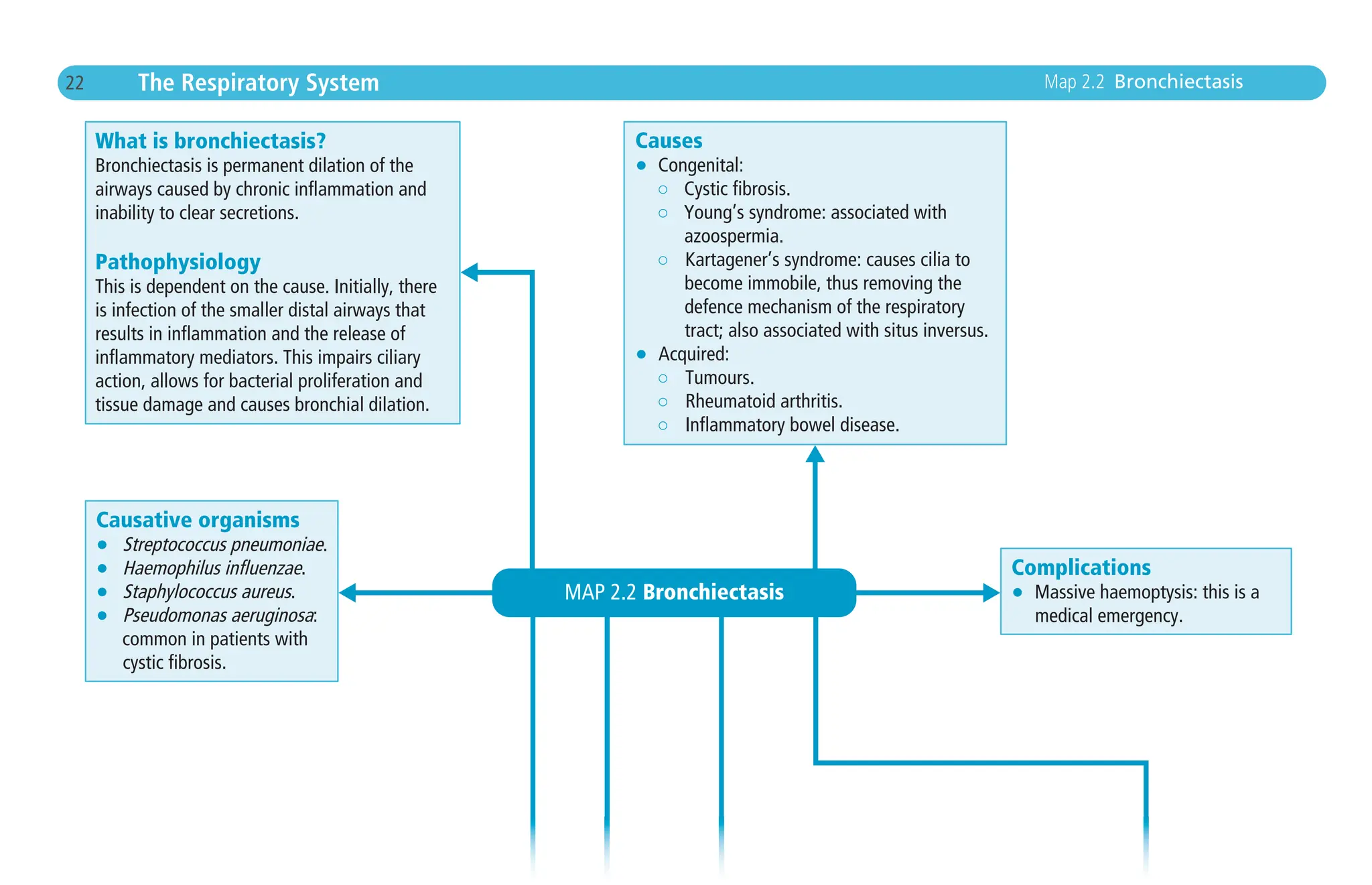
What is bronchiectasis?
Bronchiectasis is permanent dilation of the
airways caused by chronic inflammation and
inability to clear secretions.
Pathophysiology
This is dependent on the cause. Initially, there
is infection of the smaller distal airways that
results in inflammation and the release of
inflammatory mediators. This impairs ciliary
action, allows for bacterial proliferation and
tissue damage and causes bronchial dilation.
Causative organisms
• Streptococcus pneumoniae.
• Haemophilus influenzae.
• Staphylococcus aureus.
• Pseudomonas aeruginosa:
common in patients with
cystic fibrosis.
Causes
• Congenital:
○ Cystic fibrosis.
○ Young’s syndrome: associated with
azoospermia.
○ Kartagener’s syndrome: causes cilia to
become immobile, thus removing the
defence mechanism of the respiratory
tract; also associated with situs inversus.
• Acquired:
○ Tumours.
○ Rheumatoid arthritis.
○ Inflammatory bowel disease.
Complications
• Massive haemoptysis: this is a
medical emergency.
MAP 2.2 Bronchiectasis
Map 2.2 Bronchiectasis
Chapter_02.indd
22
06/12/14
2:52
AM
23 The Respiratory System
Symptoms
• Purulent sputum.
• Persistent cough.
• Fever.
Signs
• Clubbing.
• Crepitations.
• Coarse inspiratory
crackles.
Treatment
Remember this as ABCDS:
• Antibiotics.
• Bronchodilators.
• Corticosteroids.
• postural Drainage.
• Surgery (if indicated).
Investigations
• Bloods: FBC, WCC, UEs, LFTs,
TFTs, CRP, ESR.
• CXR: shows tram track opacities
of bronchi and bronchioles.
• Sputum culture and sensitivity.
• Aspergillus screen if cause
suspected.
CYSTIC FIBROSIS
What is cystic fibrosis?
This is an autosomal recessive condition that
occurs in approximately 1 in 2500 births.
Causes
• Mutation of the cystic fibrosis
transmembrane conductance regulator
gene (CFTR), located on chromosome 7.
Investigations
• Diagnosed by sweat test.
• In the neonatal period diagnosed by
Guthrie’s test, which detects raised serum
immunoreactive trypsinogen.
Associations
• Lung disease, pancreatic insufficiency,
diabetes and infertility in males.
Map 2.2 Bronchiectasis
Chapter_02.indd
23
06/12/14
2:52
AM
The Respiratory System
24
What is asthma?
Asthma is a chronic, inflammatory
disease that is characterised by
reversible airway obstruction.
Signs and symptoms
• Wheezing.
• Shortness of breath.
• Coughing.
Remember to ask if the patient has
a history of atopy, e.g. hay fever
and eczema.
Triggering factors include:
• Dust/pets/vapours.
• Emotion.
• Drugs, e.g. beta-blockers.
Investigations
• Peak expiratory flow rate:
note diurnal variation.
• Sputum sample.
• ABG: in emergency.
• Spirometry: for obstructive
defects.
• Bloods: increased IgE, FBC.
• CXR: pneumothorax,
consolidation.
Pathophysiology
• Copious mucus secretion.
• Inflammation.
• Contraction of bronchial muscle.
• Interleukin (IL)-4: stimulates eosinophils and stimulates B
lymphocytes. B lymphocytes produce IgE, which causes mast cells to
degranulate.When mast cells degranulate, they release histamine
and this histamine causes bronchoconstriction.
• IL-5: stimulates eosinophils.
• IL-13: stimulates mucus secretion.
Th2 cells
Allergen
Map 2.3 Asthma
Chapter_02.indd
24
06/12/14
2:52
AM
25 The Respiratory System
Treatment
• Conservative: patient education; advice on inhaler
technique and avoidance of triggering factors;
annual asthma review and influenza vaccine required.
• Medical: refer to British Thoracic Society Guidelines:
○ Step 1: salbutamol (a short-acting beta-2
receptor agonist).
○ Step 2: step 1 + beclometasone (inhaled steroid).
○ Step 3: steps 1, 2 + salmeterol (a long-acting
beta-2 receptor agonist) + increased total dose
of inhaled steroid.
○ Step 4: steps 1–3 + increased dose of inhaled
steroid + consider adding additional therapy, e.g.:
- Theophylline (a xanthine derived bronchodilator
that inhibits phosphodiesterase).
- Montelukast (a leukotriene receptor antagonist).
○ Step 5: oral prednisolone (steroid) + high-dose
inhaled steroid; refer to specialist.
Complications
• Death.
• Disturbed sleep.
• Persistent cough.
• Side-effects of steroids:
○ Weight gain.
○ Thinning of the skin.
○ Striae formation.
○ Cataracts.
○ Cushing’s syndrome.
Treatment of acute asthma
Remember as O SHIT:
• Oxygen.
• Salbutamol.
• Hydrocortisone.
• Ipratropium.
• Theophylline.
MAP 2.3 Asthma
Map 2.3 Asthma
Chapter_02.indd
25
06/12/14
2:52
AM
The Respiratory System
26
What is COPD?
This is a chronic obstructive airway disease
that is characterised by its irreversibility.
It is closely linked to smoking.
It is made up of:
• Chronic bronchitis: cough with sputum
production for at least 3 months in
2 consecutive years.
• Emphysema: this encompasses permanently
dilated airways distal to the terminal
bronchioles with alveolar destruction and
bullae formation. It is defined histologically
and is associated with alpha-1 antitrypsin
deficiency and increased elastase activity.
Causes
Remember this as GASES:
• Genetics: alpha-1 antitrypsin
deficiency results in the loss of
protection against proteases.
• Air pollution.
• Smoking.
• Exposure through occupation,
e.g. coal mining.
• Secondhand smoke exposure.
Pathophysiology
• Chronic bronchitis: chronic infection
results in the chronic infiltration of
the respiratory submucosa by
inflammatory cells.This results in
mucous gland hyperplasia and
smooth muscle hypertrophy,
causing bronchial lumen narrowing.
‘Blue bloaters’ are patients where
this pathology dominates.
• Emphysema: alveolar walls are
destroyed resulting in bullae
formation and the fusion of adjacent
alveoli.This ultimately results in a
decreased surface area for gas
exchange and decreased elastic
recoil with subsequent air trapping.
‘Pink puffers’ are patients where
this pathology dominates.
MAP 2.4 Chronic Obstructive
Pulmonary Disease (COPD)
Map 2.4 Chronic Obstructive Pulmonary Disease (COPD)
Chapter_02.indd
26
06/12/14
2:52
AM
27 The Respiratory System
Complications
Remember this as CLIPPeR:
• Cor pulmonale: right-sided
heart failure due to chronic
pulmonary hypertension.
• Lung cancer.
• Infections: usually treat with
macrolide antibiotics.
• Pneumothorax.
• Polycythaemia.
• e
• Respiratory failure.
Investigations
• Diagnosis is confirmed by spirometry, which
has a FEV1 value 80% predicted and
FEV1/FVC 0.7.
• CXR shows lung hyperinflation,
emphysematous change and diaphragmatic
flattening.
• Bloods: FBC, UEs,WCC, ESR, CRP, alpha-1
antitrypsin levels.
• ECG: for cor pulmonale.
• Sputum culture.
The GOLD scale assesses severity of COPD:
Stage I: mild COPD.
Stage II: moderate COPD.
Stage III: severe COPD.
Stage IV: very severe COPD.
Treatment
Remember this as ABCS, oxygen
therapy and pulmonary
rehabilitation:
• Anticholinergics, e.g. ipratropium.
• Bronchodilators, e.g. salmeterol.
• Corticosteroids.
• Smoking cessation is imperative.
• Oxygen therapy: long-term oxygen
therapy (LTOT) or noninvasive
ventilation (NIV).
Map 2.4 Chronic Obstructive Pulmonary Disease (COPD)
Chapter_02.indd
27
06/12/14
2:52
AM
The Respiratory System
28
Type 1: hypoventilation with V/Q mismatch
‘Pink puffer’ – thin and hyperinflated
Pneumonia
Pulmonary embolism
Pulmonary oedema
Fibrosing alveolitis
Remember this as ABCD:
Agitation
Breathlessness
Confusion
Drowsiness and fatigue
Remember this as ABCD:
Agitation
Breathlessness
Confusion
Drowsiness and fatigue
Central cyanosis
Type 2: hypoventilation with or without V/Q mismatch
‘Blue bloater’ – strong build and wheezy
Chronic obstructive pulmonary disease (COPD) and asthma
Cerebrovascular disease
Opiate overdose
Myasthenia gravis
Motor neuron disease
Remember this as ABC:
A flapping tremor
Bounding pulse
Cyanosis
Normal (~6.7 kPa)
Oxygen replacement therapy
Treatment of underlying cause
Nosocomial infections, e.g. pneumonia
Heart failure
Arrhythmia
Pericarditis
Nosocomial infections, e.g. pneumonia
Heart failure
Arrhythmia
Pericarditis
Noninvasive ventilation
Treatment of underlying cause
Complications
Treatment
PaCO2
PaO2
Signs
Symptoms
Cause
¯ (8.0 kPa)
¯ (8.0 kPa)
- (6.7 kPa)
TABLE 2.1 Type 1 vs. Type 2 Respiratory Failure
Table 2.1 Type 1 vs. Type 2 Respiratory Failure
Chapter_02.indd
28
06/12/14
2:52
AM
29 The Respiratory System
Coal workers pneumoconiosis
• Caused by inhaling coal dust.
• The dust particles accumulate
in the lung parenchyma and
are engulfed by macrophages.
These macrophages then die,
releasing enzymes resulting in
tissue fibrosis.
Bauxite fibrosis
• This is also known as
Shaver’s disease.
• Caused by inhaling
bauxite fumes.
Siderosis
• Caused by inhaling
iron particles.
• Benign with no
apparent respiratory
symptoms or altered
lung function.
Berylliosis
• Caused by inhaling beryllium.
• It causes granuloma formation,
made up of:
○ Giant cells.
○ Macrophages.
○ Epithelioid cells.
Other granulomatous conditions
include: tuberculosis, leprosy,
cat-scratch disease and sarcoidosis.
Asbestosis
• Caused by inhaling asbestosfibres.
The fusiform rods are found inside
macrophages.
• Associated with malignant
mesothelioma.
• Pleural plaques are apparent
on CXR.
• White asbestos has the lowest
fibrogenicity, whereas blue
asbestos has the highest.
Silicosis
• This is also known as Potter’s rot.
• Caused by inhaling silica particles, which cannot
be removed by respiratory defences.
• Macrophages engulf the silica particles releasing tumour
necrosis factor (TNF) and cytokines that induce fibroblasts,
resulting in fibrosis and collagen deposition.
• Associated with increased tuberculosis (TB) infection.
• Eggshell calcification of hilar lymph nodes is apparent on
CXR, along with nodular lesions in the upper lobes.
MAP 2.5 Pneumoconiosis
Map 2.5 Pneumoconiosis
Chapter_02.indd
29
06/12/14
2:52
AM
The Respiratory System
30
Squamous cell carcinoma
• Associated with smoking.
• Paraneoplastic parathyroid-like
actions.
• Keratin pearls are seen
histologically.
Pancoast’s tumour
Results in Horner’s syndrome,
a triad of:
1 Miosis.
2 Ptosis.
3 Anhidrosis.
Adenocarcinoma
• NOT associated with smoking.
• More common in women.
• Associated with hypertrophic
osteoarthropathy.
• Mucin-positive staining seen on
histology.
Small cell carcinoma
• Also know as oat cell carcinoma.
• Very aggressive, therefore treat solely
with chemotherapy regime.
• Adrenocorticotrophic hormone (ACTH) and antidiuretic
hormone (ADH) are generated ectopically.
• Associated with Lambert–Eaton syndrome.
• Kulchitsky cells are seen histologically.
• Non small cell carcinomas (NSCC) are any epithelial
derived lung cancers that are not small cell carcinoma
(SCC).They are relatively insensitive to chemotherapy.
Mesothelioma
• Associated with asbestosis.
• Psammoma bodies are seen
histologically.
Large cell carcinoma
• Patient is likely to have a
poor outcome.
• Lack light microscopic
features of other tumour
types.
• Larger sized anaplastic cells.
• High cytoplasmic-to-nuclear
size ratio.
• Treated by surgical excision
of tumour.
Central location
Apex
Pleura
Peripheral location
MAP 2.6 Lung Cancer
Map 2.6 Lung Cancer
Chapter_02.indd
30
06/12/14
2:52
AM
31 The Respiratory System Map 2.7 Deep Vein Thrombosis (DVT)
What is a DVT?
A DVT is a clot that usually develops in one of
the deep veins. It usually occurs in the leg.
Signs and symptoms
• Asymptomatic.
• Pain.
• Oedema.
• Erythema/discolouration.
• Increased temperature of symptomatic leg.
• Engorgement of surface veins.
Complications
• Pulmonary embolism.
• Post-thrombotic syndrome.
Pathophysiology
The pathophysiology of DVT may be summarised by
Virchow’s triad.This comprises 3 predisposing
factors for DVT formation (the causes of each
factor are listed):
Hypercoagulability
• Malignancy.
• Surgery.
• Trauma.
• Oral contraceptive pill.
• Clotting abnormalities.
Venous stasis
• Immobility, e.g. after surgery.
• Pregnancy.
• Heart failure.
Trauma
• Inflammation.
• Previous thrombosis.
Investigations
• D-dimer: this is sensitive but not
specific, i.e. if the result is negative
then the cause is unlikely to be DVT.
• B-mode venous compression
ultrasonography: for DVT above the
knee.
• Investigations to uncover cause of
DVT.
• The Modified Wells Score may be
used to calculate probability of DVT
(for a full description of the Wells
Score and NICE guidelines please
follow the website link provided at
the end of the book).
Treatment
Anticoagulation therapy with
unfractionated heparin or a
low molecular weight heparin,
e.g. dalteparin, and secondary
management with a vitamin K
antagonist, e.g. warfarin.
Differential diagnosis
Remember as ABC:
• A musculoskeletal injury.
• Baker’s cyst rupture.
• Cellulitis.
MAP 2.7 Deep Vein
Thrombosis (DVT)
Chapter_02.indd
31
06/12/14
2:52
AM
The Respiratory System
32
What is a PE?
This is occlusion of the pulmonary
vasculature by a clot. Often it
occurs from a deep vein thrombosis
(DVT) that has become dislodged
and forms an embolus that lodges
in the pulmonary arterial
vasculature, blocking the vessels.
Signs and symptoms
• Breathlessness: this may be of
sudden onset or progressive.
• Tachypnoea.
• Pleuritic chest pain.
• Cyanosis.
• Haemoptysis.
Causes
• DVT.
• Air embolus.
• Fat embolus.
• Amniotic fluid embolus.
• Foreign material introduced
via IV drug use.
Pathophysiology
The extent of thrombus may be classified
into small-medium, multiple and massive
PE. Symptom correlation depends on where
the pulmonary circulation is occluded.
There are 3 pathways involved in the
pathophysiology of PE:
1 Platelet factor release: serotonin
and thromboxane A2 cause
vasoconstriction.
2 Decreased alveolar perfusion: lung is
underperfused and this leads to
diminished gas exchange.
3 Decreased surfactant: this leads to
ventilation/perfusion mismatch,
hypoxaemia and dyspnoea.
MAP 2.8 Pulmonary Embolism (PE)
Map 2.8 Pulmonary Embolism (PE)
Chapter_02.indd
32
06/12/14
2:52
AM
33 The Respiratory System
Investigations
• D-dimer: sensitive but not
specific; negative result
used to rule out PE.
• Thrombophilia screening: in
patients 50 years with
recurrent PE.
• CXR: usually normal.
• ECG: sinus tachycardia,
S1Q3T3 pattern is classical
but rare; excludes MI.
• ABG: hypoxaemia.
• CT, pulmonary angiography.
• V/Q scan.
• The Wells Score may be used
to calculate risk of PE.
Treatment
• Acute:
○ Oxygen.
○ IV fluids.
○ Thrombolysis therapy if
indicated, e.g. alteplase if
massive PE or
haemodynamically unstable.
○ Low molecular weight heparin.
• Long-term management:
○ Anticoagulation.
○ Inferior vena cava filter.
Complications
• Sudden death.
• Arrhythmia.
• Pulmonary infarction.
• Pleural effusion.
• Paradoxical embolism.
• Pulmonary hypertension.
Map 2.8 Pulmonary Embolism (PE)
Chapter_02.indd
33
06/12/14
2:52
AM
The Respiratory System
34
What is a pneumothorax?
A pneumothorax is air within the
pleural space.
Signs and symptoms
• Ipsilateral chest pain.
• Shoulder tip pain.
• Dyspnoea.
• Tachypnoea.
• Hypoxia.
• Cyanosis.
• Auscultation: decreased on
affected side.
• Percussion: hyper-resonant
or normal.
Causes
• Ruptured pleural bleb.
• Chronic obstructive pulmonary
disease (COPD).
• Tuberculosis.
• Sarcoidosis.
• Idiopathic pulmonary fibrosis.
• Rheumatoid arthritis.
• Ankylosing spondylitis.
• Lung cancer.
• Trauma, e.g. stab wound.
Pathophysiology
The pathophysiology of pneumothorax is directly
linked to cause, outlined below.
• Primary spontaneous pneumothorax:
○ Idiopathic/rupture of pleural bleb.
○ Usually found in young, tall, slim men.
• Secondary spontaneous pneumothorax:
○ In patients with prior lung disease, e.g.
COPD, sarcoidosis or idiopathic pulmonary
fibrosis.
• Tension pneumothorax:
○ Due to blunt, traumatic injuries, e.g. a stab
wound.
○ Air cannot be removed on expiration due
to one-way valve mechanism.This leads to
mediastinal shift and lung collapse.
Investigations
• CXR: pleural line; may show
tracheal deviation away
from lesion.
• CT scan.
• ABG: hypoxia.
Treatment
• If pneumothorax on CXR 2 cm then
no treatment is required; advise
patients not to travel by air or to dive.
• If 2 cm then aspirate air +/–
intercostal drain.
• Tension pneumothorax requires
immediate decompression with a
large bore needle inserted into the
2nd intercostal space mid-clavicular line.
Complications
• Risk of future
pneumothorax.
• Respiratory failure.
• Cardiac arrest.
MAP 2.9 Pneumothorax
Map 2.9 Pneumothorax
Chapter_02.indd
34
06/12/14
2:52
AM
Chapter Three The Gastrointestinal System
MAP 3.1 Causes of Regional Abdominal Pain 36
MAP 3.2 Causes of Gastrointestinal (GI) Bleeding 37
MAP 3.3 Causes of Gastrointestinal (GI) Inflammation	 38
MAP 3.4 Causes of Gastrointestinal (GI) Malabsorption 41
MAP 3.5 Gastro-Oesophageal Reflux Disease (GORD) 42
MAP 3.6 Jaundice 44
MAP 3.7 Hepatitis Virus 46
MAP 3.8 Colorectal Cancer (CRC) 48
MAP 3.9 Pancreatitis 50
TABLE 3.1 Microbiology of the Gastrointestinal (GI) Tract 52
35 The Gastrointestinal System
Chapter_03.indd
35
08/12/14
2:30
PM
The Gastrointestinal System
36 Map 3.1 Causes of Regional Abdominal Pain
Right hypochondriac
region
• Pancreatitis.
• Ulcer (gastric).
• Gallstones.
• Biliary colic.
Right lumbar region
• Kidney stones.
• Urinary tract infection.
• Constipation.
Epigastric region
• Heartburn.
• Pancreatitis.
• Epigastric hernia.
• Gallstones.
• Ulcer (gastric).
Umbilical region
• Gastric ulcer.
• Early stages of appendicitis.
• Aortic aneurysm.
• Ruptured aortic aneurysm.
• Pancreatitis.
• IBD.
Left hypochondriac
region
• Pancreatitis.
• Ulcer (gastric or duodenal).
Left lumbar region
• Kidney stones.
• Urinary tract infection.
• Constipation.
• Inflammatory bowel disease
(IBD).
• Diverticular disease.
MAP 3.1 Causes of Regional Abdominal Pain
Hypogastric region
• Urinary tract infection.
• Appendicitis.
• IBD.
• Diverticular disease.
Right iliac region
• Appendicitis.
• Ectopic pregnancy.
• Ovarian torsion.
• Inguinal or femoral hernias.
Left iliac region
• Diverticular disease.
• IBD.
• Ectopic pregnancy.
• Ovarian torsion.
• Inguinal or femoral hernias.
Chapter_03.indd
36
08/12/14
2:30
PM
37 The Gastrointestinal System Map 3.2 Causes of Gastrointestinal (GI) Bleeding
Crohn’s disease Ulcerative colitis
Gastritis
Peptic ulcers
Oesophageal varices
Upper GI bleeds
Mallory–Weiss
tear
Malignancy
Polyps
Haemorrhoids
Diverticulitis
Inflammatory bowel disease (IBD)
Lower GI bleeds
Malignancy
Angiodysplasia
Infectious diarrhoea
MAP 3.2 Causes of
Gastrointestinal (GI) Bleeding
Chapter_03.indd
37
08/12/14
2:30
PM
The Gastrointestinal System
38 Map 3.3 Causes of Gastrointestinal (GI) Inflammation
IRRITABLE BOWEL SYNDROME (IBS)
What is IBS?
This is a common functional disorder of
the bowel.
Signs and symptoms
Recurrent abdominal pain, which
improves with defaecation; there is a
change in bowel habit, i.e. increased or
decreased frequency.
GASTRITIS
What is gastritis?
This is inflammation of the stomach lining. Gastritis may be acute or chronic.
• Acute gastritis, caused by:
○ Stress. ○ Uraemia. ○ Alcohol.
○ NSAIDs. ○ Burns: Curling’s ulcer.
• Chronic gastritis:
○ Type A:
- Autoimmune: autoantibodies are present to parietal cells.
- Presents with pernicious anaemia.
- Occurs in the fundus or body of the stomach.
○ Type B:
- Most common.
- Associated with Helicobacter pylori infection.
Investigate for H. pylori infection:
• Bloods: anaemia and H. pylori.
• Urinalysis.
• Blood test – measures antibodies to H. pylori.
• Carbon isotope–urea breath test.
• Endoscopy with biopsy of stomach lining.
• Stool microscopy and culture – may detect trace amounts of H. pylori.
Treatment
• Triple therapy to eradicate H. pylori: proton pump inhibitor (PPI), with amoxicillin 1g and
clarithromycin 500 mg or metronidazole 400 mg and clarithromycin 250 mg, taken twice daily.
• Step-wise approach to treating gastritis:
○ Mild – antacids or H2 receptor antagonists.
○ Moderate/severe – PPI.
Complications
• Peptic ulcers, anaemia (from bleeding ulcers), stricture formation, mucosa-associated lymphoid
tissue (MALT) lymphoma.
Investigations
This is a clinical diagnosis.
Treatment
• Conservative: education and avoidance
of triggering factors, e.g. decrease stress.
• Medical: depends on symptoms;
antimuscarinics, laxatives, stool
softeners, antispasmodics and
antidepressants may play a role.
Complications
• Depression and anxiety.
Chapter_03.indd
38
08/12/14
2:30
PM
39 The Gastrointestinal System Map 3.3 Causes of Gastrointestinal (GI) Inflammation
APPENDICITIS
What is appendicitis?
This is inflammation of the appendix that presents with pain that can
originate in the umbilical area before migrating to the right iliac fossa.
Investigations
Diagnosis is clinical:
• Bloods: FBC, UEs, CRP.
• Ultrasound.
• Pregnancy test in females of child bearing age to rule out ectopic
pregnancy.
Treatment
• Surgical excision.
Complications
• Peritonitis.
MAP 3.3 Causes of Gastrointestinal (GI) Inflammation
Continued overleaf
Inflammatory bowel disease (IBD) (Continued )
Chapter_03.indd
39
08/12/14
2:30
PM
The Gastrointestinal System
40 Map 3.3 Causes of Gastrointestinal (GI) Inflammation
ULCERATIVE COLITIS
What is ulcerative colitis?
This is a relapsing remitting autoimmune condition that is not
associated with granulomas. It affects the colon and rarely the
terminal ileum (backwash ileitis).
Signs and symptoms
Remember the 5Ps:
• Pyrexia.
• Pseudopolyps.
• lead Pipe radiological appearances.
• Poo (bloody diarrhoea).
• Proctitis.
Investigations
• These are the same as Crohn’s disease.
Treatment
• Conservative: patient education; smoking has been shown
to be protective but is not advised.
• Medical: corticosteroids, 5-aminosalicylic acid (5-ASA)
analogues (sulfasalazine), mesalazine, 6-mercaptopurine,
azathioprine.
• Surgical: colectomy.
Complications
• Toxic megacolon, increased incidence of colon cancer, primary
sclerosing cholangitis and osteoporosis (from steroid use).
CROHN’S DISEASE
What is Crohn’s disease?
This is a disordered response to intestinal bacteria with transmural inflammation.
It may affect any part of the gastrointestinal tract but often targets the terminal
ileum. It is associated with granuloma formation.
Signs and symptoms
• Weight loss, abdominal pain (with palpable mass), diarrhoea, fever,
skip lesions, clubbing, cobblestone mucosa, fistula formation, fissure
formation and linear ulceration.
Investigations
• Bloods: FBC and platelets, UEs, LFTs and albumin, ESR and CRP.
• Colonoscopy (with biopsy): diagnostic.
• Radiology: small bowel follow through (diagnostic) and abdominal X-ray
(for toxic megacolon and excluding perforation).
Treatment
• Conservative: smoking cessation, low residue diet may be encouraged
but usually diet is normal.
• Medical: corticosteroids, infliximab, 5-ASA analogues (sulfasalazine),
azathioprine, methotrexate.
• Surgical: remove strictured or obstructed region of bowel.
Complications
• Stricture formation, fistula formation, obstruction, pyoderma gangrenosum,
anaemia and osteoporosis.
Inflammatory bowel disease (IBD) (Continued )
Chapter_03.indd
40
08/12/14
2:30
PM
41 The Gastrointestinal System Map 3.4 Causes of Gastrointestinal (GI) Malabsorption
Tropical sprue
• Cause unknown.
• Can affect all of the small
intestine.
• Treatment: folic acid and
tetracycline.
Coeliac disease
• Cause: autoantibodies to
gliadin.
• Proximal small intestine
mainly affected.
• Treatment: gluten-free diet.
A-beta-lipoproteinaemia
• Cause: autosomal
recessive disorder.
• Results in the inability to
synthesise chylomicrons.
• Treatment: vitamin E.
Whipple’s disease
• Cause: Tropheryma
whipplei.
• This is a Gram-positive
bacterium.
• Treatment: antibiotics for
1–2 years.
Disaccharidase deficiency
• Cause: a deficiency in
enzymes required for
digestion and absorption,
e.g. beta-glycosidase complex.
• Treatment: restricted diet.
Pancreatic insufficiency
• Cause: diseases such as
cystic fibrosis, cancer and
pancreatitis.
• Results in deficiency of
vitamins A, D, E, K (these
are fat soluble vitamins).
• Treatment: pancrelipase
(CREON®).
Causes
Remember as These
Definitely Cause Absorption
Problems:
• Tropical sprue.
• Disaccharidase deficiency.
• Coeliac disease and Crohn’s disease.
• A-beta-lipoproteinaemia.
• Pancreatic insufficiency.
MAP 3.4 Causes of Gastrointestinal (GI)
Malabsorption
Chapter_03.indd
41
08/12/14
2:30
PM
The Gastrointestinal System
42 Map 3.5 Gastro-Oesophageal Reflux Disease (GORD)
Causes
• Genetic inheritance of
angle of lower
oesophageal sphincter.
• Oesophagitis.
• Sliding hiatus hernia.
• Rolling hiatus hernia.
Risk factors
• Smoking.
• Excessive alcohol.
• Excessive coffee.
• Obesity.
• Pregnancy.
• Drugs, e.g. calcium channel
blockers, antimuscarinics and
tricyclic antidepressants.
Investigations
Age dependent:
• If the patient is 55 years old:
○ Proceed to treatment unless
they have ALARM symptoms,
e.g. unintentional weight loss,
dysphagia, haematemesis,
melaena and anorexia.
• If 55 years old:
○ Send patient to endoscopy:
diagnostic and allows for biopsy.
○ 24-h pH monitoring.
What is GORD?
This is abnormal reflux where acid from the stomach
refluxes into the oesophagus subsequently damaging
the squamous oesophageal lining, causing discomfort.
Signs and symptoms
• Heartburn – pain is worse in certain positions, e.g. lying
down/stooping and is worse after heavy meals.
• Acid taste in mouth.
○ Regurgitation.
• Water brash (excess salivation).
• Dysphagia.
• Nocturnal asthma/chronic cough.
• Laryngitis.
MAP 3.5 Gastro-Oesophageal Reflux Disease (GORD)
Chapter_03.indd
42
08/12/14
2:30
PM
43 The Gastrointestinal System Map 3.5 Gastro-Oesophageal Reflux Disease (GORD)
Treatment
• Conservative: education, weight loss,
raising head of bed at night and
avoidance of precipitating factors, e.g. smoking,
large meals.
• Medical:
○ Antacids, e.g. aluminium hydroxide.
○ H2 receptor antagonists, e.g. ranitidine.
○ Proton pump inhibitors, e.g. omeprazole.
• Surgical: Nissen’s fundoplication.
Complications: Barrett’s oesophagus
What is Barrett’s oesophagus?
This is metaplasia of the normal squamous
epithelium of the lower oesophagus to
columnar epithelium. This occurs in patients
who suffer with GORD for several years.
It is a premalignant lesion.
Investigations
• Endoscopy with biopsy in all 4 quadrants.
Treatment
• HALO® system radiofrequency ablation or
mucosal resection for highly dysplastic lesions.
Complications
• Adenocarcinoma of the oesophagus.
Chapter_03.indd
43
08/12/14
2:30
PM
The Gastrointestinal System
44 Map 3.6 Jaundice
Investigations
You must determine underlying cause.
Use these tests to determine the type of jaundice:
• Appearance of urine and stool.
• LFTs.
• Bilirubin levels.
• Alkaline phosphatase levels.
The different blood results for different types of jaundice:
Posthepatic
jaundice
↑
↑ ↑
↑
↑
↑ ↑
Pale
Dark
Pale
Dark
Investigations
Prehepatic
jaundice
Intrahepatic
jaundice
Appearance of
urine
Normal
Normal
Normal
Normal
Normal or ↑
Normal or ↑
Normal
Appearance of
stool
Conjugated
bilirubin
Unconjugated
bilirubin
Total bilirubin
Alkaline
phosphatase
What is jaundice?
Jaundice, also known as icterus,
is the yellow discolouration of
mucous membranes, sclera and skin.
This happens due to the accumulation
of bilirubin. Jaundice may be seen at a
bilirubin concentration 2.5–3.0 mg/dL
(42.8–51.3 mmol/L).
Causes
The causes of jaundice
may be split into 3 categories
(see Table below):
1 Prehepatic jaundice.
2 Intrahepatic jaundice.
3 Posthepatic jaundice.
Treatment
Treat the underlying cause.
Complications
• Liver failure.
• Renal failure.
• Sepsis.
• Pancreatitis.
• Biliary cirrhosis
• Cholangitis
• Kernicterus (a serious
complication of
jaundice in neonates).
Chapter_03.indd
44
08/12/14
2:30
PM
45 The Gastrointestinal System Map 3.6 Jaundice
The causes of different types of jaundice
Prehepatic jaundice Intrahepatic jaundice Posthepatic jaundice
Crigler–Najjar syndrome
Gilbert’s syndrome
Haemolysis, e.g. thalassaemia,
sickle cell anaemia
Drugs, e.g. rifampicin
Malaria
Haemolytic uraemic syndrome
Alcoholic liver disease Pancreatic cancer
Hepatic cirrhosis
Primary biliary cirrhosis
Leptospirosis
Physiological neonatal jaundice
Gallstones in common bile duct
Schistosomiasis
Biliary atresia
Cholangiocarcinoma
Mirizzi’s syndrome
Viral and drug induced hepatitis
MAP 3.6 Jaundice
Chapter_03.indd
45
08/12/14
2:30
PM
The Gastrointestinal System
46 Map 3.7 Hepatitis Virus
HEPATITIS A (HAV)
What is HAV?
It is a RNA picornavirus.
Transmission
Faecal–oral transmission, associated with contaminated shellfish.The virus
passes into bile after replication within liver cells.The immune system is
activated by this process and leads to necrosis predominantly in zone 3
of the hepatic lobule.
Incubation period
• 2–3 weeks.
Investigations
• Anti-HAV IgM in serum.
Treatment
• Conservative: vaccine for travellers to endemic areas.
• Medical: supportive since HAV is often self-resolving.
Complications
• Rarely acute liver failure.
HEPATITIS B (HBV)
What is HBV?
A partially stranded, enveloped DNA virus. It has an e-antigen that
indicates increased infectivity.
Transmission
• Vertical transmission.
• Contaminated needles.
• Infected blood products.
• Sexual intercourse.
Incubation period
• 1–5 months.
Investigations
HBV DNA in serum, HBsAg, HBeAg, anti-HBc; HBsAg presents on histology
with a ‘ground glass’ appearance.
Treatment
• Conservative: education and prevention of disease; vaccine
for at-risk groups, e.g. health workers.
• Medical: antiviral medications, e.g. pegylated alpha-2a interferon,
adefovir, entecavir, lamivudine, tenofovir, telbivudine.
Complications
• Hepatic cirrhosis, hepatocellular carcinoma (HCC), fulminant hepatitis B.
MAP 3.7 Hepatitis Virus
Chapter_03.indd
46
08/12/14
2:30
PM
47 The Gastrointestinal System Map 3.7 Hepatitis Virus
HEPATITIS C (HCV)
What is HCV?
It is a single stranded, enveloped RNA virus and a member
of the flavivirus family.
Transmission
• Vertical transmission (occasionally).
• Contaminated needles.
• Infected blood products.
Incubation period
• Intermediate (6–9 weeks).
Investigations
• Antibody to HCV in the serum.
Treatment
• Conservative: education and prevention of disease.
• Medical: antiviral medications, e.g. pegylated alpha-2a
interferon, ribavirin, taribavirin, telaprevir.
Complications
• Hepatic cirrhosis, HCC, liver failure.
HEPATITIS D (HDV)
What is HDV?
It is a single stranded defective RNA virus
that co-infects with hepatitis B virus.
Co-infectivity with HDV leads to
an increased chance of liver failure.
Transmission
• Contaminated needles.
• Infected blood products.
• Sexual intercourse (rare).
Incubation period
• 1–5 months.
Investigations
• Serum IgM anti-D.
Treatment
• Pegylated alpha-2a interferon.
Complications
• Hepatic cirrhosis, HCC.
Hepatitis E (HEV)
What is HEV?
It is a single stranded RNA virus.
Transmission
• Faecal–oral transmission, associated with
contaminated water.
Incubation period
• 2–3 weeks.
Investigations
• IgG and IgM anti-HEV.
Treatment
• Usually self-limiting.
Complications
• High mortality of pregnant women (~20%).
Chapter_03.indd
47
08/12/14
2:30
PM
The Gastrointestinal System
48 Map 3.8 Colorectal Cancer (CRC)
What is CRC?
This is cancer of the colon and rectum and is the third most common malignancy.
Usually adenocarcinoma on histology.
Signs and symptoms
• Abdominal pain.
• Unintentional weight loss.
• Altered bowel habit.
• Faecal occult blood.
• Anaemia.
• Fatigue.
Causes
Multifactorial and often unknown.There are risk factors that may predispose an
individual to develop CRC (see risk factor box).
Investigations
• Bowel Cancer Screening Programme: faecal occult blood test in men and women
aged 60–69 years.
• Bloods: FBC for iron deficiency anaemia and carcinoembryonic antigen (CEA)
tumour marker.
• Endoscopy: colonoscopy/sigmoidoscopy.
• Imaging: double contrast barium enema study ‘apple core’ sign; virtual colonoscopy.
Treatment
Depends on the extent of disease.This is assessed using Dukes staging system or
TNM system.
• Conservative: patient education and referral to Macmillan nurses.
Risk factors
• Smoking.
• Increased age.
• Family history of CRC.
• Inflammatory bowel disease (IBD).
• Streptococcus bovis bacteraemia.
• Congenital polyposis syndromes:
○ Juvenile polyposis syndrome:
– Autosomal dominant but it may occur spontaneously.
– Not malignant.
○ Peutz–Jeghers syndrome:
– Autosomal dominant.
– Increases risk of CRC.
– Melanosis is present on the oral mucosa.
• Genetic predisposition:
○ Familial adenomatous polyposis (FAP):
– Autosomal dominant.
– Mutation of APC gene on chromosome 5.
– 100% lead to CRC.
○ Hereditary nonpolyposis colorectal cancer (HNPCC):
– Autosomal dominant.
– Mutation of DNA mismatch repair gene.
Chapter_03.indd
48
08/12/14
2:30
PM
49 The Gastrointestinal System Map 3.8 Colorectal Cancer (CRC)
• Medical: chemotherapy (oxaliplatin, folinic acid and 5-fluorouracil is the most
common regime); radiotherapy may also be used.
• Surgery: surgical resection is usually treatment of choice.
Complications
• Obstruction and metastasis.
Stage Description 5-year survival
A Confined to
muscularis mucosa
90%
Extends through
muscularis mucosa
65%
30%
10%
Lymph node
involvement
Distant metastases
B
C
D
Duke’s staging system TNM system
T – Carcinoma in situ
T1 – Submucosa invaded
T2 – Muscularis mucosa invaded
T3 – Tumour has invaded subserosa but other organs have not been penetrated
T4 – Adjacent organs invaded
N1 – Metastatic spread to 1–3 regional lymph nodes
N2 – Metastatic spread to ≥4 regional lymph nodes
M0 – No distant metastases present
M1 – Distant metastases present
MAP 3.8 Colorectal Cancer (CRC)
Chapter_03.indd
49
08/12/14
2:30
PM
The Gastrointestinal System
50 Map 3.9 Pancreatitis
ACUTE PANCREATITIS
What is acute pancreatitis?
This is inflammation of the pancreatic parenchyma, with
biochemical associations of increased amylase and raised lipase
enzymes on blood test.
Signs and symptoms
Remember these as PAN:
• Epigastric Pain that radiates to the back.
• Anorexia.
• Nausea and vomiting.
• Grey Turner’s sign: flank bruising.
• Cullen’s sign: periumbilical bruising.
Causes
Remember these as GET SMASHED:
• Gallstones.
• Ethanol.
• Trauma.
CHRONIC PANCREATITIS
What is chronic pancreatitis?
This is where the structural integrity of the pancreas is
permanently altered as a direct result of chronic inflammation.
Signs and symptoms
Pain! The pain is:
• Epigastric in origin.
• Recurrent.
• Radiates to the back.
• Relieved by sitting forward.
• Worse when eating/drinking heavily.
Causes
Remember these as CAMP:
• Cystic fibrosis.
• Alcohol.
• Malnourishment.
• Pancreatic duct obstruction.
MAP 3.9 Pancreatitis
Chapter_03.indd
50
08/12/14
2:30
PM
51 The Gastrointestinal System Map 3.9 Pancreatitis
• Scorpion sting (Tityus trinitatis).
• Mumps.
• Autoimmune disease.
• Steroids.
• Hyperlipidaemia/Hypercalcaemia.
• Endoscopic retrograde cholangiopancreatography (ERCP).
• Drugs, e.g. azathioprine.
Investigations
• Raised serum amylase and lipase.
• Detect cause, e.g. ultrasound scan to detect presence of
gallstones.
• CT scan to rule out complications (not within 72 h of acute
presentation unless clinically indicated).
Treatment
• This is usually symptomatic relief. Keep ‘nil by mouth’ (NBM),
IV fluids and analgesia, e.g. tramadol
• Treat underlying causes, e.g. ERCP to remove gallstones.
Complications
Remember these as HDAMN:
• Haemorrhage.
• Disseminated intravascular coagulation (DIC).
• Acute respiratory distress syndrome (ARDS).
• Multiorgan failure.
• Necrosis.
Investigations
• Decreased faecal elastase.
• CT scan: shows calcification (may also be seen on
abdominal X-ray).
• Magnetic resonance cholangiopancreatography (MRCP).
Treatment
• Conservative: alcohol cessation.
• Medical: analgesia, e.g. tramadol and pancreatic enzyme
replacement therapy; start insulin therapy if diabetes has
developed.
Complications
Remember these as PODS:
• Pseudocysts.
• Obstruction (pancreatic).
• Diabetes mellitus.
• Steatorrhoea.
Chapter_03.indd
51
08/12/14
2:30
PM
The Gastrointestinal System
52 Table 3.1 Microbiology of the Gastrointestinal (GI) Tract
TABLE 3.1 Microbiology of the Gastrointestinal (GI) Tract
Organism Illness caused Other
Vibrio vulnificus Food poisoning Found in seafood; Gram-negative bacterium
Food poisoning
Food poisoning
Food poisoning
Food poisoning and
diarrhoea
Bacillus cereus
Staphylococcus aureus Found in contaminated meat and mayonnaise; Gram-positive bacterium
Found in reheated rice; Gram-positive bacterium
Found in poorly canned foods; Gram-positive bacterium
Found in meat that is undercooked; enteropathogenic E.coli causes diarrhoea in children; also
causes haemolytic uraemic syndrome (HUS); Gram-negative bacterium
Found in animal faeces and poultry; it is associated with Guillain–Barré syndrome, which is an
ascending paralysis; Gram-negative bacterium
Found in contaminated food; Gram-negative bacterium
Produces shiga toxin; Gram-negative bacterium
Associated with outbreaks in nurseries; Gram-negative bacterium
Traveller’s diarrhoea is usually self-limiting; Gram-negative bacterium
Produces cholera toxin; Gram-negative bacterium
Associated with AIDS patients; protozoon
Most common viral cause of nausea and vomiting
Produces urease; treat with ‘triple therapy’, i.e. a proton pump inhibitor (PPI) with either
clarithromycin and amoxicillin or clarithromycin and metronidazole; Gram-negative bacterium
Cysts are found in meat or cat faeces; causes brain abscesses in AIDS patients; protozoon
Found in undercooked pork; cestode
Bloody diarrhoea
Bloody diarrhoea
Bloody diarrhoea
Bloody diarrhoea
Traveller’s diarrhoea
Rice water diarrhoea
Cryptosporidiosis
Gastroenteritis
Risk factors for peptic
ulcers, gastritis and
gastric adenocarcinoma
Toxoplasmosis
Intestinal tapeworms
Clostridium botulinum
Escherichia coli O157:H7
Campylobacter jejuni
Salmonella
Shigella
Yersinia enterocolitica
Enterotoxic Escherichia coli
Vibrio cholerae
Cryptosporidium
Norwalk virus
Helicobacter pylori
Toxoplasma gondii
Taenia solium
Chapter_03.indd
52
08/12/14
2:30
PM
Chapter Four The Renal System
FIGURE 4.1 Nephron Physiology  54
FIGURE 4.2 The Renin Angiotensin Aldosterone System (RAAS) 55
TABLE 4.1 Diuretics 56
MAP 4.1 Renal Calculi 57
MAP 4.2 Urinary Tract Infection (UTI)	 58
MAP 4.3 Renal Cancers 60
MAP 4.4 Kidney Injury 62
MAP 4.5 Nephritic vs. Nephrotic Syndrome 64
MAP 4.6 Cystic Disease  66
MAP 4.7 Congenital Kidney Abnormalities 68
53 The Renal System
Chapter_04.indd
53
08/12/14
5:56
PM
The Renal System
54 Figure 4.1 Nephron Physiology
Distal convoluted tubule
• Actively reabsorbs Na+
and Cl−
ions
• Simple cuboidal epithelium
Proximal convoluted tubule
• Reabsorbs glucose, amino acids, water,
bicarbonate ions, Na+
and Cl−
ions
• Contains a brush border
Collecting tubule
• Aldosterone: increases the number of
Na+
ion channel in the collecting tubules
• Antidiuretic hormone (ADH): binds to V2
receptors and consequently increases the
number of aquaporins
Thin descending loop of Henle
• Reabsorbs water by medullary
hypertonicity
• It is impermeable to Na+
ions Thick ascending loop of Henle
• Permeable to Na+
ions
• Impermeable to water
• Contains the Na+
/K+
/2Cl−
transporter
FIGURE 4.1 Nephron Physiology
Chapter_04.indd
54
08/12/14
5:56
PM
55 The Renal System Figure 4.2 The Renin Angiotensin Aldosterone System (RAAS)
↑ Blood pressure by:
• Vasoconstriction of smooth muscle
• Stimulating aldosterone – ↑ Na+
ion and H2O retention
• Stimulating antidiuretic hormone (ADH) (posterior pituitary gland)
– ↑ H2O reabsorption
• ↑ Thirst by stimulating the hypothalamus
Angiotensinogen (LIVER)
Angiotensin I
Angiotensin II
FIGURE 4.2 The Renin Angiotensin Aldosterone System (RAAS)
Renin secretion is stimulated by:
• ↓ Blood pressure
• ↓ Na+
ion and H2O delivery to
the macula densa
• ↑ Sympathetic activity
Renin (KIDNEY)
Angiotensin converting enzyme (ACE) (LUNGS)
Chapter_04.indd
55
08/12/14
5:56
PM
The Renal System
56 Table 4.1 Diuretics
Class of
diuretic Example
Mechanism
of action Uses Side-effects Contraindications Drug interactions
Thiazide
diuretic
Loop
diuretic
K+
sparing
diuretic
Osmotic
diuretic
Bendroflumethiazide
Furosemide
Spironolactone
Mannitol
Blocks
Na+
/Cl–
ion
symporter
in the distal
convoluted
tubule
Blocks
Na+
/K+
/2Cl–
co-
transporter
in the
ascending
loop of
Henle
Aldosterone
receptor
antagonist
Increases
plasma
osmolarity
Hypertension
Heart failure
Ascites
Heart failure (symptomatic
treatment of oedema)
Severe hypercalcaemia
Heart failure (in combination
with furosemide)
Oedema
Ascites
Refractory hypertension
Conn’s syndrome
Cerebral oedema
Rhabdomyolysis
Haemolysis
Hyponatraemia
Hypokalaemia
Hypercalcaemia
Hyperglycaemia
Hyperlipidaemia
Hyperuricaemia
Hyponatraemia
Hypokalaemia
Hypocalcaemia
Ototoxicity
Hyperkalaemia
Gynaecomastia
(alternatively,
eplerenone can be given
as a more selective
aldosterone antagonist)
Fever
Hyponatraemia
Gout
Liver failure
Renal failure
May worsen
diabetes
Renal failure
Addison’s disease
Hyperkalaemia
Heart failure
Hypokalaemia may
increase the risk of
digoxin toxicity
Decreased lithium
excretion
Hypokalaemia may
increase the risk of
digoxin toxicity
Decreased lithium
excretion
Decreased lithium
excretion
Increases levels of
tobramycin
TABLE 4.1 Diuretics
Chapter_04.indd
56
08/12/14
5:56
PM
57 The Renal System Map 4.1 Renal Calculi
What are renal calculi?
These are stones that form within the
renal tract. Most stones are made from
calcium (radiopaque), but others are
made from struvite (staghorn calculus)
and uric acid crystals (radiolucent).
Signs and symptoms
• Asymptomatic.
• Pain (suprapubic and loin pain that
may radiate to the genital region).
• Dysuria.
• Urinary tract infection (UTI).
• Haematuria.
Causes
• Idiopathic.
• Hypercalcaemia.
• Hyperuricaemia.
• Hyperoxaluria.
• Recurrent UTI.
• Drugs, e.g. loop diuretics.
• Hereditary conditions increase
risk, e.g. polycystic kidney
disease.
Investigations
• 24-h urine analysis: assess
levels of calcium, uric acid,
oxalate and citrate.
• CT kidney, ureter, bladder (KUB): for
radiopaque stones.
• Ultrasound and IVU can also be
utilised.
• Chemical analysis of stone
composition.
Complications
• Recurrent UTI.
• Recurrent calculi.
• Obstruction.
• Trauma to ureter/ureteric
stricture.
Symptom Treatment
Pain Analgesia and tamsulosin
Dehydration IV and oral fluids
Nausea/vomiting Antiemetics
- Calcium
- Oxalate
- Uric acid
Low calcium diet and stop thiazide
diuretics if possible
Low oxalate diet
Allopurinol
• Radiology:
○ Nephrostomy insertion.
○ Antegrade ureteric stent insertion.
• Surgical:
○ Antegrade or retrograde removal of large stones or
staghorn calculus.
○ Extracorporeal shock wave lithotripsy (ESWL) for the
treatment of larger stones (0.5 cm).
Treatment
• Conservative: prevent cause, e.g. low calcium diet.
Education about risk factors.
• Medical:
MAP 4.1 Renal Calculi
Chapter_04.indd
57
08/12/14
5:56
PM
The Renal System
58 Map 4.2 Urinary Tract Infection (UTI)
What is a UTI?
This is an infection of the urinary tract with
typical signs and symptoms. It may be
classified as either a lower or upper
(acute pyelonephritis) UTI.
Signs and symptoms of lower UTI
• Dysuria.
• Frequency.
• Urgency.
• Suprapubic pain.
Signs and symptoms of upper UTI
• Fever/chills.
• Flank pain.
• Haematuria.
Risk factors
• Female gender.
• Sexual intercourse.
• Catheterisation.
• Pregnancy.
• Menopause.
• Diabetes.
• Genitourinary malformation.
• Immunosuppression.
• Urinary tract obstruction, e.g. stones.
Pathophysiology
The urinary system has many defences to prevent UTI such as:
• Micturition.
• Urine: osmolarity, pH and organic acids are antibacterial.
• Secreted factors:
○ Tamm–Horsfall protein: binds bacteria nonspecifically;
produced by cells of the thick ascending loop of Henle;
mutations in the gene that codes for this protein are
associated with progressive renal failure and medullary cysts.
○ IgA: against specific bacteria.
○ Lactoferrin: hoovers up free iron.
• Mucosal defences: mucopolysaccharides coat the mucosal surfaces of
the bladder.
• If these defence mechanisms are overcome by bacterial virulence
factors then the patient is prone to developing a UTI. Some virulence
factors worth noting are:
• For uropathogenic E. coli (UPEC):
○ Type 1 fimbriae: binds to mannose residues; associated with cystitis.
○ Type P fimbriae: binds to glycolipid residues; associated with
pyelonephritis.
○ Bacterial capsule: aka antigen K, resists phagocytosis;
associated with pyelonephritis.
• For Proteus mirabilis:
○ Produces urease.
○ Increases pH of urine.
○ Proteus mirabilis is associated with staghorn calculi.
Chapter_04.indd
58
08/12/14
5:56
PM
59 The Renal System Map 4.2 Urinary Tract Infection (UTI)
Causative organisms
• Escherichia coli: leading cause of UTI in
the community and also nosocomial
infection. Metallic sheen on eosin
methylene blue (EMB).
• Staphylococcus saprophyticus: 2nd
leading cause in sexually active females.
• Klebsiella pneumoniae: 3rd leading cause.
Viscous colonies.
• Proteus mirabilis: produces urease. Gram-
negative bacterium.
• Pseudomonas aeruginosa: bile green
pigment and fruity odour. Usually
nosocomial and drug resistant.
• Adenovirus: haemorrhagic cystitis.
• BK and JC viruses: associated with graft
failure after transplant.
• Schistosoma haematobium: parasitic infection.
Investigations
• Urine dipstick: positive for leucocytes and nitrites.
• Urine culture: for diagnosis for causative organism (105 organisms
per mL of midstream urine).
• Radiology: consider ultrasound scan or cystoscopy if UTI occurs in
children, in men or if UTI is recurrent.
Treatment
• Conservative: education about the condition and avoidance of
predisposing risk factors.
• Medical: trimethoprim twice daily. Consider prophylactic antibiotics if
UTI is recurrent.
• If recurrent, i.e. 4 UTIs per year, seek to exclude anatomical variant or
abnormality of the renal tract.
Complications
• Pyelonephritis.
• Renal failure.
• Sepsis.
MAP 4.2 Urinary Tract Infection (UTI)
Chapter_04.indd
59
08/12/14
5:56
PM
The Renal System
60 Map 4.3 Renal Cancers
RENAL CELL CARCINOMA (RCC)
What is RCC?
This is an adenocarcinoma originating from the cells that line the
proximal convoluted tubule.
Risk factors
• Male.
• Age 50–70 years.
• Smoking.
• Obesity.
• Mutation of the Von Hippel–Lindau tumour suppressor gene on
chromosome 3.
Signs and symptoms
• Unintentional weight loss.
• Loin pain.
• Haematuria.
• Palpable mass.
• Fever.
• Hypertension.
TRANSITIONAL CELL CARCINOMA (TCC)
What is TCC?
This is a cancer that arises from transitional urothelium. It is more
common in men.
Risk factors
Remember these as CAPS:
• Cyclophosphamide.
• Aniline dyes.
• Phenacetin.
• Smoking.
Signs and symptoms
Depends on the location of the cancer but is usually associated
with painless haematuria and lower urinary tract symptoms,
e.g. frequency and urgency.
MAP 4.3 Renal Cancers
Chapter_04.indd
60
08/12/14
5:56
PM
61 The Renal System Map 4.3 Renal Cancers
Paraneoplastic syndromes involved
• Secretion of adrenocorticotrophic hormone (ACTH): may
produce symptoms of hypercalcaemia.
• Secretion of erythropoietin (EPO): may produce symptoms of
polycythaemia.
Investigations
• Radiology (ultrasound scan, CT scan, MRI scan).
Treatment
• Conservative: patient education. Supportive, counselling and
monitoring of psychological wellbeing (depression). Refer
patients to Macmillan nurses.
• Medical: interferon alpha, sunitinib, sorafenib, bevacizumab.
• Surgical: partial or total nephrectomy is the treatment of
choice; radiofrequency ablation may be considered.
Complications
• Metastasis: to brain, bone, lung, liver, adrenal glands and
lymph nodes.
• Hypercalcaemia.
• Hypertension.
• Polycythaemia.
Investigations
• Cystoscopy and ureteroscopy with biopsy.
• Retrograde pyelography.
• CT scan.
• MRI scan.
Treatment
• Conservative: supportive counselling and monitoring of
psychological wellbeing (depression). Refer patients to
Macmillan nurses.
• Medical: mitomycin, GC regimen (gemcitabine and cisplatin)
or MVAC regimen (methotrexate, vinblastine, adriamycin and
cisplatin).
• Surgical: nephroureterectomy, cystectomy; radiofrequency
ablation may be considered.
Complications
• Metastasis, usually to bone.
Chapter_04.indd
61
08/12/14
5:56
PM
The Renal System
62 Map 4.4 Kidney Injury
CHRONIC KIDNEY INJURY (CKI)
What is CKI?
This is well-established renal impairment and is irreversible.
Renal function progressively worsens with time.Without
treatment the patient will eventually develop end-stage kidney
disease (ESKD).
Causes
• Any renal disease may lead to CKI.
• Glomerulonephritis.
• Hypertension.
• Diabetes mellitus.
• Malignancy.
• Anatomical abnormality of the renal tract.
• Hereditary disease, e.g. polycystic kidney disease.
Signs and symptoms
Oliguria/anuria/polyuria, nausea and vomiting, confusion,
hypertension, oedema (peripheral and pulmonary), fatigue,
metallic taste in mouth, unintentional weight loss, itchy skin,
skin pigmentation, Kaussmaul breathing (metabolic acidosis),
anaemia.
Prerenal Intrinsic Postrenal
Hypovolaemia
• Haemorrhage
• Burns
• Diuretic use
Shock
• Sepsis
• Cardiogenic
Hypoperfusion
• Hepatorenal syndrome
• NSAID use
Glomerular disease
• Glomerulonephritis
• Vasculitis
• Immune complex
disease, e.g. systemic
lupus erythmatosus (SLE)
Vascular lesions
• Bilateral renal artery
stenosis
• Microangiopathy
• Malignant hypertension
Tubulointersitial disease
• Acute tubular necrosis
• Acute tubulointerstitial
nephritis
Obstruction of the ureter
• Stones
• Tumour
Obstruction of the bladder neck
• Stones
• Tumour
• Benign prostatic hypertrophy
• Prostate cancer
Obstruction of the urethra
• Tumour
• Stricture
ACUTE KIDNEY INJURY (AKI)
What is AKI?
This is when the kidney fails over a short time period (days to weeks) and is characterised by
a rapid fall in glomerular filtration rate (GFR) and an increase in creatinine and urea levels. It
may be reversible.AKI may be subdivided into prerenal, intrinsic renal and postrenal failure
and these have many different causes.
Causes
MAP 4.4 Kidney Injury
Chapter_04.indd
62
08/12/14
5:56
PM
63 The Renal System Map 4.4 Kidney Injury
Investigations
• GFR.
• Bloods: FBC, UEs, creatinine, calcium and phosphate
levels, ESR, CRP, immunology, virology.
• Urinalysis: blood, protein, glucose, leucocytes and nitrites;
Bence Jones proteinuria (multiple myeloma).
• Imaging: ultrasound scan.
• Renal biopsy.
Treatment
• Conservative: smoking cessation, low salt diet, maintain
psychological wellbeing.
• Medical:
○ Treat underlying cause and complications.
○ Control blood pressure.
○ Treat anaemia.
○ Treat acidosis (with sodium bicarbonate).
○ Treat hyperphosphataemia (with phosphate binders).
• Surgical: dialysis (haemodialysis or peritoneal dialysis),
renal transplantation.
Complications
• Anaemia.
• Hypertension.
• Renal bone disease.
• Metabolic acidosis.
• Stroke.
Oedematous conditions
• Heart failure
• Nephrotic syndrome
Signs and symptoms
Oliguria/anuria, nausea and vomiting, confusion, hypertension, abdominal/flank pain, signs
of fluid overload, e.g. - jugular venous pressure (JVP).
Investigations
• GFR.
• Bloods: FBC and platelets, UEs, creatinine, calcium and phosphate levels, ESR, CRP,
immunology, virology.
• Urinalysis: blood, protein, glucose, leucocytes and nitrites, Bence Jones protein.
• Imaging: ultrasound scan.
Treatment
• Maintain renal blood flow and fluid balance.
• Monitor electrolytes.
• Treat underlying cause; classify AKI with RIFLE criteria (Risk, Injury, Failure, Loss,
End-stage renal disease).
• Stop all nephrotoxic drugs.
Complications
• Metabolic acidosis.
• Hyperkalaemia.
• Angiotensin converting
enzyme (ACE)
inhibitor use
• Multiple myeloma
• Nephrotoxic drugs
• Peripheral nerve damage.
• Carpal tunnel syndrome.
• Oedematous states.
• Depression.
• Hyperphosphataemia.
• Pulmonary oedema.
Chapter_04.indd
63
08/12/14
5:56
PM
The Renal System
64 Map 4.5 Nephritic vs. Nephrotic Syndrome
Focal proliferative Diffuse proliferative
IgA nephropathy Rapidly progressive glomerulonephritis,
e.g. Goodpasture’s syndrome
Systemic lupus
erythematosus (SLE)
SLE
Henoch–Schönlein purpura Membranoproliferative glomerulonephritis
Alport’s syndrome Cryoglobulinaemia
NEPHRITIC SYNDROME
What is nephritic syndrome?
This is a group of signs of varying diseases.
Signs
Remember these as PHARAOH:
• Proteinuria.
• Haematuria.
• Azotaemia.
• Red blood cell casts.
• Antistreptolysin O titres.
• Oliguria.
• Hypertension.
Causes
These may be split broadly into 2 categories: focal proliferative and diffuse
proliferative causes.
NEPHROTIC SYNDROME
What is nephrotic syndrome?
This is a group of signs of varying diseases.
Signs
Remember these as PHHO:
• Proteinuria 3 g daily.
• Hypoalbuminaemia 30 g/L.
• Hyperlipidaemia, occurs because:
○ Hypoproteinaemia stimulates the production of more proteins from the
liver, which results in the synthesis of more lipoproteins.
○ Decreased levels of lipoprotein lipase means that lipid catabolism
decreases.
• Oedema.
Causes
• Minimal change disease.
• Focal segemental glomerulosclerosis.
• Membranous glomerulonephritis.
• Diabetic nephropathy.
• Amyloidosis.
MAP 4.5 Nephritic vs. Nephrotic Syndrome
Chapter_04.indd
64
08/12/14
5:56
PM
65 The Renal System
• Mesangial proliferative glomerulonephritis.
• SLE.
Investigations
• Bloods: FBC,WCC and platelets, UEs, LFTs, creatinine, urea, CRP, ESR,
glucose, lipid profile.
• Urinalysis: blood, protein, glucose, leucocytes, nitrites and Bence Jones protein.
• Nephritic screen: serum complement (C3 and C4),ANA, dsDNA,ANCA, anti-
GBM, HIV serology, HBV and HCV serology, blood cultures,VDRL for syphilis.
• Renal biopsy.
• Radiology: ultrasound scan.
Treatment
• Conservative: lifestyle advice, low salt diet.
• Medical: treatment depends on cause:
○ Treat hypertension.
○ Treat proteinuria.
○ Treat hypercholesterolaemia.
○ Give prophylactic anticoagulation therapy.
○ Immunotherapy regimen, e.g. prednisolone, cyclophosphamide and
azathioprine.
○ Dialysis if severe.
Complications
• Hypertension.
• Acute kidney injury.
• Chronic kidney injury.
• Infection.
Investigations
• Bloods: FBC,WCC and platelets, UEs, LFTs, creatinine, urea, CRP, ESR,
glucose, lipid profile.
• Urinalysis: blood, protein, glucose, leucocytes, nitrites and Bence Jones
protein.
• Nephritic screen: serum complement (C3 and C4), antinuclear antibody
(ANA), double stranded DNA, antineutrophil cytoplasmic antibody
(ANCA), antiglomerular basement membrane (GBM), HIV serology, HBV
and HCV serology, blood cultures,Venereal Disease Research Laboratory
Test (VDRL) for syphilis.
• Renal biopsy.
• Radiology: ultrasound scan.
Treatment
• Conservative: lifestyle advice, low salt diet.
• Medical: treatment depends on cause:
○ Treat hypertension.
○ Treat proteinuria.
○ Treat hypercholesterolaemia.
○ Give prophylactic anticoagulation therapy.
○ Immunotherapy regimen, e.g. prednisolone, cyclophosphamide and
azathioprine.
○ Dialysis if severe.
Complications
• Nephrotic syndrome.
• Chronic glomerulonephritis.
• Heart failure.
Map 4.5 Nephritic vs. Nephrotic Syndrome
Chapter_04.indd
65
08/12/14
5:56
PM
The Renal System
66 Map 4.6 Cystic Disease
Remember cystic disease as
CAAR
• Cystic renal dysplasia.
• Autosomal dominant polycystic
kidney disease (ADPKD).
• Autosomal recessive polycystic
kidney disease (ARPKD).
• Cystic diseases of the
Renal medulla.
ADPKD
What is ADPKD?
This is a dominantly inherited polycystic
disease found in adults.
Causes
Mutations in the genes encoding a membrane
protein called polycystin result in this condition.
Two genes code for this protein:
• PKD1 on chromosome 16 (encodes polycystin 1).
• PKD2 on chromosome 4 (encodes polycystin 2).
Signs and symptoms
• Pain (due to renal cyst haemorrhage).
• Hypertension.
• Haematuria.
• Palpable bilateral flank masses.
• Hepatomegaly.
Investigations
• Bloods: FBC, UEs, calcium and phosphate, PTH.
• Urinalysis and culture.
• Imaging: ultrasound scan is diagnostic.
• Genetic screening and monitoring of blood
pressure.
ARPKD
What is ARPKD?
This is a recessively inherited polycystic disease
found in children presenting with varying levels of
kidney and liver disease.
Causes
• PKHD1 on chromosome 6.
Signs and symptoms
• Hypertension.
• Those of chronic kidney injury.
• Chronic respiratory infections.
• Those of portal hypertension: ascites, caput
medusae and oesophageal varices.
• Failure to thrive.
• Recurrent UTI.
• Polyuria.
Investigations
• Antenatal screening is diagnostic.
• Bloods: FBC, UEs, LFTs.
• Urinalysis and culture.
• Imaging: ultrasound scan (shows enlarged
kidney with or without oligohydramnios),
CT scan, MRI scan.
MAP 4.6
Cystic Disease
Chapter_04.indd
66
08/12/14
5:56
PM
67 The Renal System
Cystic diseases of the renal
medulla
Remember NAMS:
• Nephronophthisis medullary cystic
disease.
• Acquired cystic disease: usually
from dialysis.
• Medullary sponge kidney.
• Simple cysts.
Treatment
• Conservative: patient support.
• Medical:
○ Treat hypertension.
○ Antibiotic therapy for urinary trait infection
(UTI).
• Surgical: cyst decompression.
Complications
• Development of chronic kidney injury.
• Remember LAMB:
○ Liver cysts.
○ Aneurysms.
○ Mitral valve prolapse.
○ Berry aneurysm rupture leading to
subarachnoid haemorrhage.
Treatment
• Conservative: parental and patient support.
• Medical:
○ Ventilation and long-term oxygen therapy.
○ Treat hypertension (angiotensin converting
enzyme [ACE] inhibitors).
○ Antibiotics for UTI.
○ Diuretics for fluid overload.
• Surgical:
○ Nephrectomy.
○ Combined renal and liver transplant.
Complications
• Hepatic cysts.
• Congenital hepatic fibrosis.
• Proliferative bile ducts.
Map 4.6 Cystic Disease
Chapter_04.indd
67
08/12/14
5:56
PM
The Renal System
68 Map 4.7 Congenital Kidney Abnormalities
HORSESHOE KIDNEY
What is a horseshoe kidney?
This occurs during development when the lower poles of both
kidneys fuse, resulting in the formation of one horseshoe-
shaped kidney.This cannot ascend to the normal anatomical
position due to the central fused portion catching the inferior
mesenteric artery.
Signs and symptoms
• Asymptomatic.
• Recurrent urinary tract infection (UTI).
• Renal calculi.
• Obstructive uropathy.
Causes
• Congenital abnormality.
Investigations
• Ultrasound scan is diagnostic.
Treatment
• Treatment of complications.
Complications
• Susceptible to trauma.
• Renal calculi formation.
• Increased risk of transitional cell carcinoma of the
renal pelvis.
Remember these
as HERD
• Horseshoe kidney.
• Ecotopic kidney.
• Renal agenesis.
• Duplex ureters.
ECTOPIC KIDNEY
What is an ectopic kidney?
This is a congenital abnormality in which the kidney lies above
the pelvic brim or within the pelvis.
Signs and symptoms
• Usually asymptomatic.
Causes
• Genetic abnormalities.
• Poor development of the metanephrogenic diverticulum.
• Teratogen exposure.
Investigations
• Ultrasound scan is diagnostic.
Treatment
• None; treat complications should they develop.
Complications
• UTI.
• Renal calculi.
MAP 4.7 Congenital Kidney Abnormalities
Chapter_04.indd
68
08/12/14
5:56
PM
69 The Renal System Map 4.7 Congenital Kidney Abnormalities
DUPLEX URETERS
What are duplex ureters?
This occurs when the ureteric bud splits during embryonic
development and results in the development of 2 ureters,
which drain 1 kidney.
Signs and symptoms
• Asymptomatic.
• Recurrent UTI.
Causes
• Splitting of the ureteric bud.
Investigations
• Ultrasound scan and excretory urography is diagnostic.
Treatment
• Treatment of complications.
Complications
• Vesicoureteral reflux.
• Ureterocele.
• UTI.
Signs and symptoms
Bilateral absence (Potter’s syndrome) Unilateral absence
Low set ears Hypertension
Increased risk of respiratory infections
Proteinuria
Haematuria
Limb defects
Receding chin
Flat, broad nose
Bilateral absence (Potter’s syndrome) Unilateral absence
Neonates usually die a few days after birth. If the
baby survives they require chronic peritoneal dialysis
Treatment of hypertension
RENAL AGENESIS
What is renal agenesis?
Bilateral or unilateral absence of the kidney.
Causes
• Failure of the ureteric bud development.
Complications
• Susceptible to trauma (unilateral). • Death.
Investigations
• Antenatal screening.
Treatment
This depends on whether there is bilateral or unilateral absence of the kidney.
Chapter_04.indd
69
08/12/14
5:56
PM
This page intentionally left blank
Chapter Five The Endocrine System
MAP 5.1 Hyperthyroidism 72
MAP 5.2 Hypothyroidism 74
MAP 5.3 Thyroid Carcinoma 76
MAP 5.4 Diabetes Mellitus (DM) 78
TABLE 5.1 Antidiabetic Agents 80
MAP 5.5 Diabetes Insipidus (DI) 83
FIGURE 5.1 Causes of Diabetes Insipidus 83
MAP 5.6 Hypoparathyroidism 85
MAP 5.7 Hyperparathyroidism 86
MAP 5.8 Cushing’s Syndrome 88
FIGURE 5.2 The Hypothalamic–Pituitary–Adrenal Axis 89
MAP 5.9 Adrenal Insufficiency 90
FIGURE 5.3 Anatomy of the Adrenal Cortex and Adrenal Medulla  91
MAP 5.10 Acromegaly 92
71 The Endocrine System
Chapter_05.indd
71
06/12/14
3:26
AM
The Endocrine System
72 Map 5.1 Hyperthyroidism
Causes
Cause Comment
Graves’ disease
• This is the second most common cause of
hyperthyroidism
• Risk increases with age
• More common in females
• A single nodule is suggestive of thyroid neoplasia
Toxic multinodular
goitre and toxic
solitary nodule goitre
• This is the most common cause of hyperthyroidism
• It is an autoimmune condition
• May be distinguished from other causes of
hyperthyroidism by ocular changes, e.g. exophthalmos,
and other signs, e.g. pretibial myxoedema
• It is associated with other autoimmune conditions
such as pernicious anaemia
De Quervain’s
thyroiditis
• This is transient hyperthyroidism that develops after a
viral infection
• Goitre is often painful
• A period of hypothyroidism may follow
What is hyperthyroidism?
This occurs when there is too much circulating thyroid hormone in the body.
There are many different causes of hyperthyroidism.
MAP 5.1
Hyperthyroidism
Signs and symptoms
• Weight loss.
• Warm skin/heat intolerance.
• Diarrhoea.
• Exophthalmos (Graves’ disease).
• Lid lag.
• Palpitations.
• Anxiety.
• Tremor.
• Goitre +/– bruit.
• Brisk reflexes.
Chapter_05.indd
72
06/12/14
3:26
AM
73 The Endocrine System Map 5.1 Hyperthyroidism
Treatment
• Conservative: patient education, smoking cessation.
• Medical:
Symptomatic control Palpitations and tremor: beta-blockers
Eye symptoms: eye drops for lubrication
Antithyroid medication Carbimazole
Propylthiouracil
Side-effects: agranulocytosis (monitor patient’s
bloods carefully)
Radioactive iodine
ablation
Definitive treatment; patients must be euthyroid
before commencing treatment
• Surgical: subtotal thyroidectomy; patients must be euthyroid before the
procedure. Give the patient potassium iodide before surgery since it decreases
thyroid gland vascularity.
Investigations
• TFTs (¯ TSH, - T3 and - T4).
• Ultrasound scan of nodules.
• Fine needle aspiration of
solitary nodules to exclude
malignancy.
• Isotope scan to assess hot and
cold thyroid nodules.
Complications
• Atrial fibrillation.
• High output heart failure.
• Cardiomyopathy.
• Osteoporosis.
Chapter_05.indd
73
06/12/14
3:26
AM
The Endocrine System
74 Map 5.2 Hypothyroidism
What is hypothyroidism?
This occurs when there is too little circulating thyroid hormone in the body.There are many
different causes of hypothyroidism.
Causes
Type of hypothyroidism Cause
Primary hypothyroidism
• Dysfunction of the hypothalamic–pituitary axis
• Pituitary adenoma
• Sheehan’s syndrome (ischaemic necrosis of the
pituitary gland after childbirth)
• Infiltrative disease, e.g. tuberculosis and
haemochromatosis
Secondary hypothyroidism
• Iodine deficiency
• Hashimoto’s autoimmune thyroiditis
• Post-thyroidectomy/radioactive iodine therapy
• Drug induced, e.g. lithium, overtreatment of
hyperthyroidism
Chapter_05.indd
74
06/12/14
3:26
AM
75 The Endocrine System Map 5.2 Hypothyroidism
Investigations
• TFTs (- TSH, ¯ T3 and ¯ T4).
• Thyroid antibodies.
• FBC (anaemia).
• UEs.
• LFTs.
• Creatinine.
• Cholesterol.
• Guthrie test for congenital
screening.
Signs and symptoms
• Weight gain.
• Cold skin/cold intolerance.
• Constipation.
• Dry skin.
• Thinning of hair.
• Bradycardia.
• Depression.
• Delayed reflexes.
Treatment
• Conservative: patient
education.
• Medical: lifelong
replacement of
thyroid hormone
with levothyroxine.
Complications
• Hypercholesterolaemia.
• Complications in pregnancy,
e.g. pre-eclampsia.
• Hyperthyroidism from
overtreatment of
hypothyroidism.
• Myxoedema coma.
MAP 5.2 Hypothyroidism
Chapter_05.indd
75
06/12/14
3:26
AM
The Endocrine System
76 Map 5.3 Thyroid Carcinoma
What is thyroid carcinoma?
This is cancer that originates from follicular or parafollicular cells.
Causes
Malignant neoplasm. Increased risk with childhood neck irradiation.
Thyroid carcinomas may be classified histopathologically.
Histological
appearance Comment
Papillary
Follicular
Medullary
% of
thyroid
cancer
70%
20%
5%
• Affects younger patients
• Spreads to cervical lymph nodes
• More common in low iodine areas
• Spreads to bone and lungs
• Arises from parafollicular cells
• Calcitonin is a biochemical marker
Anaplastic 5% • Affects older patients
• Aggressive
Other - • Lymphoma of the thyroid
• Sarcoma of the thyroid
• Good prognosis
• Good prognosis
• Associated with MEN syndrome
• Spreads to lymph nodes
• Poor prognosis
• Hürthle cell carcinoma (a variant of follicular
carcinoma)
Chapter_05.indd
76
06/12/14
3:26
AM
77 The Endocrine System Map 5.3 Thyroid Carcinoma
Signs and symptoms
• Thyroid nodules/solitary nodule.
• Signs and symptoms of hyperthyroidism (rarely).
• Signs and symptoms of hypothyroidism (rarely).
Investigations
• Bloods:TFTs to assess
thyroid status.
• Fine needle aspiration
cytology.
• Diagnostic lobectomy.
• Radiology:
○ Ultrasound scan
of thyroid.
○ Thyroid isotope scan
(hot nodules
are less likely to
indicate malignancy).
Complications
• Death: anaplastic
carcinoma.
• Metastasis.
• Recurrence.
• Complications of surgery:
○ Haemorrhage.
○ Infection.
○ Damage to the recurrent
laryngeal nerve.
○ Hypoparathyroidism.
• Hypothyroidism.
MAP 5.3 Thyroid Carcinoma
Treatment
This depends on histological classification.
Histological
appearance Treatment
• Lesion 1 cm: thyroid lobectomy, then lifelong
levothyroxine and annual thyroglobulin measurements
• Lesion 1 cm: total thyroidectomy, radio-iodine ablation then
lifelong levothyroxine and annual thyroglobulin measurements
• Lesion 1 cm: thyroid lobectomy, then lifelong levothyroxine
and annual thyroglobulin measurements
• Lesion 1 cm: total thyroidectomy, radio-iodine ablation then
lifelong levothyroxine and annual thyroglobulin measurements
Papillary
Follicular
Medullary Total thyroidectomy then lifelong levothyroxine; screen
family members for multiple endocrine neoplasia (MEN)
syndrome and thyroid cancer
Anaplastic Debulking surgery and palliative care
Chapter_05.indd
77
06/12/14
3:26
AM
The Endocrine System
78 Map 5.4 Diabetes Mellitus (DM)
What is DM?
This is a metabolic condition in which the patient has hyperglycaemia
due to insulin insensitivity or decreased insulin secretion.
• Type 1 DM: this is an autoimmune condition, which results in the
destruction of the pancreatic beta cells resulting in no insulin production.
This condition has a juvenile onset and is associated with HLA-DR3 and
HLA-DR4. Patients are at risk of ketoacidosis.
• Type 2 DM: this occurs when patients gradually become insulin resistant
or when the pancreatic beta cells fail to secrete enough insulin or both.
It usually has a later life onset; however, the incidence is increasing in
young populations due to environmental factors such as increasing
obesity and sedentary lifestyle. Patients are at risk of developing a
hyperosmolar state.
• Other cause of DM include: chronic pancreatitis, gestational DM and
cystic fibrosis.
Treatment
Treatment Type 1 DM
Conservative Dietary advice
BMI measurement
Smoking cessation
Decrease alcohol intake
Regular blood glucose and
HbA1c monitoring
Encourage exercise
See pages 80–82 for
antidiabetic agents
Type 2 DM
Dietary advice: high in
complex carbohydrates,
low in fat
BMI measurement
Smoking cessation
Decrease alcohol intake
Regular blood glucose and
HbA1c monitoring
Encourage exercise
See pages 80–82 for
antidiabetic agents
Medical
MAP 5.4 Diabetes Mellitus (DM)
Chapter_05.indd
78
06/12/14
3:26
AM
79 The Endocrine System Map 5.4 Diabetes Mellitus (DM)
Signs and symptoms
• General: polyuria, polyphagia,
polydipsia, blurred vision, glycosuria,
signs of macrovascular and
microvascular disease.
• More common in type 1 DM: acetone
breath, weight loss, Kussmaul
breathing, nausea and vomiting.
Investigations
Diagnostic investigations include:
• Fasting plasma glucose: 7 mmol/L (126 mg/dL).
• Random plasma glucose (plus DM symptoms):
11.1 mmol/L (200 mg/dL).
• HbA1c: 6.5% (48 mmol/mol).
Other tests include:
• Impaired glucose tolerance test (for borderline cases):
○ Fasting plasma glucose: 7 mmol/L (126 mg/dL) and
at 2 h, after a 75 g oral glucose load, a level of
7.8–11 mmol/L (140–200 mg/dL).
○ Plasma glucose at 2 h: 11.1 mmol/L (200 mg/dL).
• Impaired fasting glucose: plasma glucose: 5.6–6.9 mmol/L
(110–126 mg/dL).
Complications
• Macrovascular: hypertension, increased
risk of stroke, myocardial infarction,
diabetic foot.
• Microvascular: nephropathy, peripheral
neuropathy (glove and stocking
distribution), retinopathy, erectile
dysfunction.
• Psychological: depression.
Chapter_05.indd
79
06/12/14
3:26
AM
The Endocrine System
80 Table 5.1 Antidiabetic Agents
TABLE 5.1 Antidiabetic Agents
For a full description of diabetes mellitus (DM) management and which drugs to use first line, please follow the website link
provided for NICE guidelines in Appendix 2
Class of
antidiabetic
agent Example Mechanism of action
Biguanides Metformin - Peripheral insulin sensitivity
- Glucose uptake into and use
by skeletal muscle
¯ Hepatic gluconeogenesis
¯ Intestinal glucose absorption
Uses
Type 2 DM
(first
choice in
overweight
patients)
Polycystic
ovarian
syndrome
Side-effects
Gastrointestinal
tract (GIT)
disturbance,
e.g.diarrhoea
Nausea
Vomiting
Lactic acidosis
Contraindications
Renal failure
Cardiac failure
Respiratory failure
Hepatic failure
(The above increase
the risk of developing
lactic acidosis)
Drug interactions
Contrast agents
Angiotensin converting
enzyme (ACE)
inhibitors
Alcohol
Nonsteroidal anti-
inflammatory drugs
(NSAIDs)
Steroids
Sulphonylureas Glipizide Block potassium channels on the
pancreatic beta cells, thus
stimulating insulin release
Block potassium channels on
the pancreatic beta cells, thus
stimulating insulin release
Type 2 DM
Type 2 DM
GIT disturbance
Hypoglycaemia
Weight gain
Renal failure
Hepatic failure
Porphyria
Pregnancy
Breastfeeding
ACE inhibitors
Alcohol
NSAIDs
Steroids
Meglitinides
(glinides)
Repaglinide Weight gain
Hypoglycaemia
Hepatic failure
Pregnancy
Breastfeeding
Ciclosporin
Trimethoprim
Clarithromycin
Chapter_05.indd
80
06/12/14
3:26
AM
81 The Endocrine System Table 5.1 Antidiabetic Agents
Type 2 DM
Type 2 DM
Type 2 DM
Thiazolidinediones
(glitazones)
Pioglitazone Activates nuclear
peroxisome proliferator-
activated receptor (PPAR)
Weight gain
Hypoglycaemia
Hepatotoxicity
Fracture risk
Type 1 DM
Hepatic disease
Heart failure
Bladder cancer
Rifampicin
Paclitaxel
Type 2 DM
Alpha-glucosidase
inhibitors
Acarbose Inhibits alpha-glucosidase GIT disturbance,
e.g. diarrhoea
Inflammatory bowel
disease (IBD)
Intestinal obstruction
Hepatic cirrhosis
Orlistat
Pancreatin
Incretins Exenatide Analogue of glucagon-like
peptide (GLP)-1
GIT disturbance,
e.g. diarrhoea
Acute pancreatitis
Thyroid cancer
Multiple endocrine
neoplasia (MEN) 2
syndrome
Bexarotene
Saxagliptin Inhibits dipeptidyl peptidase
(DPP)-4
GIT disturbance,
e.g. diarrhoea
Infection of the
respiratory and
urinary tract
Hepatotoxicity
Peripheral oedema
History of serious
hypersensitivity
reaction
Thiazolidinedione
Amylin analogues Pramlintide Analogue of amylin Type 1 DM
Type 2 DM
Severe
hypoglycaemia
Gastroparesis
Hypersensitivity to
pramlintide
Acarbose
Continued overleaf
Chapter_05.indd
81
06/12/14
3:26
AM
The Endocrine System
82
Type 1 DM
Type 2 DM
Insulin therapy Rapid acting,
e.g. insulin lispro
Short acting,
e.g. soluble
insulin
Intermediate
acting,
e.g. isophane
insulin
Long acting,
e.g. insulin
glargine
Biphasic,
e.g. biphasic
isophane insulin
Replaces insulin
Mechanism of action of insulin:
Insulin binds to tyrosine kinase
receptors where it initiates 2
pathways by phosphorylation:
1 The MAP kinase signalling
pathway:
this is responsible for cell
growth and proliferation.
2 The PI-3K signalling pathway:
this is responsible for the
transport of GLUT-4 receptors
to the cell surface membrane;
GLUT-4 transports glucose into
the cell; this pathway is also
responsible for protein, lipid
and glycogen synthesis
Weight gain
Hypoglycaemia
Localised
lipoatrophy
Hypokalaemia
Hypersensitivity to any
of the therapy
ingredients
Hypoglycaemia
Repaglinide increases
risk of myocardial
infarction (MI) and
hypoglycaemia
Monoamine oxidase
inhibitors may increase
insulin secretion
Corticosteroids decrease
the effect of insulin
Levothyroxine decreases
the effect of insulin
Thiazide diuretics
decrease the effects of
insulin
TABLE 5.1 Antidiabetic Agents (Continued )
Class of
antidiabetic
agent Example Mechanism of action Uses Side-effects Contraindications Drug interactions
Table 5.1 Antidiabetic Agents
Chapter_05.indd
82
06/12/14
3:26
AM
83 The Endocrine System Map 5.5 Diabetes Insipidus (DI)
What is DI?
A disorder caused by low levels of or insensitivity to antidiuretic hormone (ADH)
leading to polyuria.This can be cranial or nephrogenic in origin.
Causes
• Cranial: decreased ADH is released by the posterior pituitary gland.
Remember this as CIVIT:
○ Congenital defect in ADH gene.
○ Idiopathic.
○ Vascular.
○ Infection: meningoencephalitis.
○ Tumour(e.g. pituitary adenoma), Tuberculosis and Trauma.
• Nephrogenic: the kidney does not respond to ADH. Remember this as DIMC:
○ Drugs, e.g. lithium.
○ Inherited.
○ Metabolic ¯ potassium, - calcium.
○ Chronic renal disease.
(See also Figure 5.1.)
Signs and symptoms
• Polydypsia.
• Polyuria.
• Dehydration.
FIGURE 5.1 Causes of Diabetes Insipidus
Posterior
pituitary gland
ADH Kidney H2O reabsorption
1 Cranial cause 2 Nephrogenic cause
Continued overleaf
MAP 5.5 Diabetes Insipidus (DI)
Chapter_05.indd
83
06/12/14
3:26
AM
The Endocrine System
84 Map 5.5 Diabetes Insipidus (DI)
Treatment
This depends on the cause:
• Conservative: patient education. Education on how to monitor fluid
levels and dietary salt levels.Advise patients to wear a MedicAlert®
bracelet.
• Medical:
Cranial cause
Nephrogenic
cause
Desmopressin – a
synthetic replacement for
vasopressin; it increases
the number of
aquaporin-2 channels in
the distal convoluted
tubules and the collecting
ducts.This increases water
reabsorption
High-dose desmopressin
Correction of electrolyte
imbalances
Thiazide diuretics
Prostaglandin synthase
inhibitors
• Surgical: excision of tumour if indicated.
Complications
• Electrolyte imbalance.
• Dehydration.
Investigations
Investigation Cranial cause
Plasma
osmolality
2 L 2 L
Urine
osmolality
Plasma Na+
24-h urine volume
Nephrogenic cause
After treatment
with desmopressin
MRI scan
Urine does not concentrate Urine does not concentrate
Urine does not concentrate
Urine becomes concentrated
Look for abnormality of the
pituitary gland, e.g. tumour
Water deprivation
test
-
-
-
-
¯
¯
MAP 5.5 Diabetes Insipidus (DI) (Continued )
Chapter_05.indd
84
06/12/14
3:26
AM
85 The Endocrine System Map 5.6 Hypoparathyroidism
Type Cause
Congenital DiGeorge syndrome (chromosome 22q11.2 deletion)
Complication of parathyroidectomy or thyroidectomy
Neonates born prematurely
Acquired
Transient
Inherited Pseudohypoparathyroidism
Pseudopseudohypoparathyroidism
Investigation
Hypopara-
thyroidism
PTH level
Pseudohypo-
parathyroidism
Pseudopseudo-
hypoparathyroidism
Normal
Normal
Normal
Serum calcium
Serum phosphate
HYPOPARATHYROIDISM
What is it?
This occurs when too little PTH is produced from the parathyroid
gland. It may be categorised into congenital, acquired, transient
and inherited causes.
Signs and symptoms
These depend on the cause: abdominal pain, myalgia, muscle spasm,
seizures, fatigue, headaches, carpopedal spasm, Chvostek’s sign,
Trousseau’s sign.
- -
-
¯
¯ ¯
Causes
Investigations
Other investigations include:
• Bloods: FBC, UEs, LFTs, creatinine, urea.
• ECG: arrhythmias.
• ECHO: cardiac structural defects (DiGeorge syndrome).
• Radiology: X-ray of hand (pseudohypoparathyroidism patients have shorter
4th and 5th metacarpals).
MAP 5.6
Hypoparathyroidism
Treatment
• Conservative: diet high in
calcium and low in
phosphate. Support for
parents.
• Medical: calcium and
vitamin D supplements.
Complications
• Renal calculi.
• Arrhythmias.
• Cataract formation.
• Dental problems.
Chapter_05.indd
85
06/12/14
3:26
AM
The Endocrine System
86 Map 5.7 Hyperparathyroidism
Type Cause
Primary Parathyroid adenoma
Parathyroid hyperplasia
Parathyroid carcinoma
Drug induced, e.g. lithium
Vitamin D deficiency
Chronic kidney injury
Prolonged secondary hyperparathyroidism
Secondary
Tertiary
Signs and symptoms
These depend on the cause.
Primary – ‘Bones, moans, groans and stones’ Secondary
Asymptomatic
Bones, e.g. pain, osteoporosis
Moans, e.g. depression, fatigue
Groans, e.g. myalgia
Stones, e.g. kidney stones
Osteomalacia
Rickets
Renal osteodystrophy
Investigations
Investigation Primary
PTH level
Secondary Tertiary
HYPERPARATHYROIDISM
What is it?
This occurs when too much parathyroid hormone (PTH) is produced from the
parathyroid gland. It may be categorised into primary, secondary and tertiary causes.
Causes
- - -
Serum calcium
Serum phosphate
Other investigations include:
• Bloods: FBC, UEs, LFTs, creatinine.
• Urine calcium level.
• Dual energy X-ray (DEXA) scan.
• Radiology:
○ Ultrasound scan of kidneys and neck.
○ Plain X-ray (for bone changes).
○ Parathyroid gland biopsy.
-
-
-
¯
¯
¯
Chapter_05.indd
86
06/12/14
3:26
AM
87 The Endocrine System Map 5.7 Hyperparathyroidism
Type of treatment Primary
Conservative
Secondary Tertiary
Medical
Surgical
Monitoring
Increase oral
fluid intake
Bisphosphonates
Parathyroidectomy
Diet low in
phosphate and high
in calcium
Calcimimetics, e.g.
cinacalcet
Parathyroidectomy if
unresponsive to
medical therapy
Para-
thyroidectomy
–
–
Complications
• Renal calculi.
• Acute pancreatitis.
• Peptic ulceration.
• Calcification of the cornea.
Treatment
MAP 5.7
Hyperparathyroidism
Chapter_05.indd
87
06/12/14
3:26
AM
The Endocrine System
88 Map 5.8 Cushing’s Syndrome
Signs and symptoms
• Moon face.
• Central obesity.
• Buffalo hump.
• Acne.
• Hypertension.
• Hyperglycaemia.
• Striae.
• Vertebral collapse.
• Proximal muscle wasting.
• Psychosis.
Investigations
• Diagnostic tests: urinary free cortisol,
low-dose and high-dose dexamethasone
suppression test.
• Bloods: FBC, UEs, LFTs, glucose, lipid
levels.
• Radiology: CXR (look for lung cancer
and vertebral collapse).
• Other: dual energy X-ray (DEXA) scan.
Complications
• Osteoporosis.
• Diabetes mellitus.
• Hypertension.
• Immunosuppression.
• Cataracts.
• Striae formation.
• Ulcers.
What is Cushing’s syndrome?
This is a collection of signs and symptoms that occur when a
patient has long-term exposure to cortisol.There are many causes
of Cushing’s syndrome and they may be classified as exogenous
or endogenous causes.
Type Cause
Iatrogenic, e.g. prescription
of glucocorticoids for asthma
Endogenous This may be split into adrenocorticotrophic
hormone (ACTH) dependent and ACTH
independent causes:
• ACTH dependent:
○ Cushing’s disease: this occurs when
ACTH is produced from a pituitary
adenoma. Use a low-dose
dexamethasone test to confirm.
○ Ectopic ACTH production
(usually from small cell lung cancer).
• ACTH independent: CARS:
○ Cancer: adrenal adenoma.
○ Adrenal nodular hyperplasia.
○ Rare causes: McCune–Albright syndrome.
○ Steroid use.
Exogenous
Causes
MAP 5.8 Cushing’s Syndrome
Treatment
• Conservative: education about the condition.
Advise patient to decrease alcohol consumption
since alcohol increases cortisol levels.
• Medical: ketoconazole, metyrapone, mitotane.
Treat complications such as hypertension and
diabetes mellitus.
• Surgical: trans-sphenoidal surgery to remove
pituitary adenoma or bilateral adrenalectomy to
remove adrenal adenoma, if indicated.
Chapter_05.indd
88
06/12/14
3:26
AM
89 The Endocrine System Figure 5.2 The Hypothalamic–Pituitary–Adrenal Axis
Treatment
• Conservative: patient
education. Patient must
carry a steroid alert card.
• Medical: replace glucocorticoids
and mineralocorticoids with
hydrocortisone and
fludrocortisone; treat
complications.
• Surgery: surgical excision of
tumour, if indicated.
Investigations
• Diagnostic tests:
○ Adrenocorticotrophic
hormone (ACTH) and cortisol
measurements.
○ Insulin tolerance test.
○ Short tetracosactide test aka
Short Synacthen test.
• Bloods: FBC, UEs (¯ Na+, - K+),
LFTs, glucose, lipid levels, serum
calcium.
• Radiology:
○ CXR (look for lung cancer).
○ CT and MRI scan of the
adrenal glands.
What is adrenal insufficiency?
This occurs when the adrenal glands fail to produce sufficient
steroid hormone.The causes of adrenal insufficiency may be
categorised into primary and secondary adrenal failure.
Type Cause
Primary
Causes
• Addison’s disease; causes: MAIL:
○ Metastases from breast, lung and renal cancers.
○ Autoimmune.
○ Infections, e.g. tuberculosis (commonest
cause) and opportunistic infections, such
as cytomegalovirus (CMV) in HIV patients.
○ Lymphomas.
• Idiopathic.
FIGURE 5.2 The Hypothalamic–Pituitary–Adrenal Axis
Pituitary gland ACTH Adrenal cortex Cortisol
Functions: 3As
1 A – mAke glucose in the liver
2 A – Antistress pathway
3 A – Anti-inflammatory pathway
Destruction of the adrenal cortex
leads to cortisol deficiency
Chapter_05.indd
89
06/12/14
3:26
AM
The Endocrine System
90 Map 5.9 Adrenal Insufficiency
Treatment
• Conservative: patient
education. Patient must
carry a steroid alert card.
• Medical: replace glucocorticoids
and mineralocorticoids with
hydrocortisone and
fludrocortisone; treat
complications.
• Surgery: surgical excision of
tumour, if indicated.
Investigations
• Diagnostic tests:
○ Adrenocorticotrophic
hormone (ACTH) and cortisol
measurements.
○ Insulin tolerance test.
○ Short tetracosactide test aka
Short Synacthen test.
• Bloods: FBC, UEs (¯ Na+, - K+),
LFTs, glucose, lipid levels, serum
calcium.
• Radiology:
○ CXR (look for lung cancer).
○ CT and MRI scan of the
adrenal glands.
Signs and symptoms
• Unintentional weight loss.
• Myalgia.
• Weakness.
• Fatigue.
• Postural hypotension.
• Abdominal pain.
What is adrenal insufficiency?
This occurs when the adrenal glands fail to produce sufficient
steroid hormone.The causes of adrenal insufficiency may be
categorised into primary and secondary adrenal failure.
Type Cause
Primary
Causes
• Addison’s disease; causes: MAIL:
○ Metastases from breast, lung and renal cancers.
○ Autoimmune.
○ Infections, e.g. tuberculosis (commonest
cause) and opportunistic infections, such
as cytomegalovirus (CMV) in HIV patients.
○ Lymphomas.
• Idiopathic.
• Postadrenalectomy.
Pituitary gland ACTH Adrenal cortex Cortisol
Functions: 3As
1 A – mAke glucose in the liver
2 A – Antistress pathway
3 A – Anti-inflammatory pathway
Destruction of the adrenal cortex
leads to cortisol deficiency
MAP 5.9 Adrenal Insufficiency
• Prolonged prednisolone use.
• Pituitary adenoma.
• Sheehan’s syndrome.
Secondary
• Skin pigmentation.
• Body hair loss.
• Diarrhoea.
• Nausea.
• Vomiting.
• Depression.
Chapter_05.indd
90
06/12/14
3:26
AM
91 The Endocrine System Map 5.9 Adrenal Insufficiency
Complications
• Adrenal crisis.
• Hyperkalaemia.
• Hypoglycaemia.
• Eosinophilia.
• Alopecia.
• Addison’s disease is associated with other conditions such as
3PGH:
○ Pernicious anaemia.
○ Primary ovarian failure.
○ Polyglandular syndrome.
○ Graves’ disease.
○ Hashimoto’s thyroiditis.
FIGURE 5.3 Anatomy of the Adrenal Cortex and
Adrenal Medulla
Mesoderm Capsule
Neural crest Medulla
Zona glomerulosa Aldosterone
Zona fascicularis Cortisol
Zona reticularis Androgens
Adrenaline
Noradrenaline
Chapter_05.indd
91
06/12/14
3:26
AM
The Endocrine System
92 Map 5.10 Acromegaly
Treatment
• Conservative: patient education. Inform the patient that bone changes will not
revert after treatment.
• Medical:
○ Somatostatin analogues, e.g. octreotide.
○ Dopamine agonists, e.g. cabergoline.
○ GH receptor antagonists, e.g. pegvisomant.
• Surgery: trans-sphenoidal surgical excision of the adenoma is the treatment of choice.
Complications
• Increased risk of cardiovascular disease.
• Hypertension.
• Diabetes mellitus.
• Increased risk of colon cancer.
• Erectile dysfunction.
• Postsurgical, e.g. infection, cerebrospinal fluid (CSF) leak.
What is acromegaly?
Acromegaly is a syndrome that results from excessive growth hormone (GH)
production after fusion of the epiphyseal plates. Excess GH produced before
epiphyseal plate fusion causes gigantism.
Causes
• Pituitary adenoma (most common).
• GH releasing hormone (GHRH) production from bronchial carcinoid.
Signs and symptoms
• Increased jaw size.
• Increased hand size.
• Macroglossia.
• Lower pitch of voice.
• Carpal tunnel syndrome.
• Ask to see old photographs of the patient and note changes in appearance.
Investigations
• Bloods: FBC, UEs, creatinine, LFTs, glucose, lipid levels,
GH levels, glucose tolerance test, insulin-like growth
factor (IGF)-1 levels(raised), prolactin levels.
• Radiology:
○ CXR.
○ CT and MRI scan.
• ECG and ECHO: assess for cardiac complications,
e.g. cardiomyopathy.
• Visual field testing: bilateral hemianopia.
MAP 5.10 Acromegaly
Chapter_05.indd
92
06/12/14
3:26
AM
Chapter Six Haematology
MAP 6.1 Anaemia94
TABLE 6.1 Anaemia94
MAP 6.2 Thalassaemia96
TABLE 6.2 Thalassaemia96
MAP 6.3 Bleeding Disorders 98
MAP 6.4 Leukaemia100
MAP 6.5 Hodgkin’s vs. Non-Hodgkin’s Lymphoma 102
MAP 6.6 Myeloma104
93 Haematology
Chapter_06.indd
93
08/12/14
6:16
PM
Haematology
94 Map 6.1 Anaemia
Type of
anaemia Causes Symptoms Signs Investigations Treatment Complications
Microcytic
Macrocytic
Iron deficiency of
varying cause, e.g.
• Menorrhagia
• Pregnancy
• Gastrointestinal tract
malignancy
• Oesophagitis
• Gastro-oesophageal
reflux disease
• Coeliac disease
• Hookworm
• Schistosomiasis
• Diet low in iron
Thalassaemia: see page 96
Fatigue
Palpitations
Headache
Dyspnoea
Fatigue
Palpitations
Headache
Dyspnoea
Irritability
Depression
Pallor
Nail changes,
e.g. koilonychia
Angular cheilitis
Atrophic glossitis
Pallor
Glossitis
Angular cheilitis
Paraesthesiae
Subacute
degeneration of the
spinal cord
FBC
• Microcytic, hypochromic
anaemia
• ¯ MCV (80 fL)
• ¯ MCH
• ¯ Ferritin
• ¯ Iron
• - Total iron binding
capacity (TIBC)
Blood film: anisocytosis and
poikilocytosis
Investigate causes, e.g.
endoscopy, stool
microscopy, barium enema
FBC
• ¯ Hb
• - MCV (96 fL)
• ¯ Vitamin B12
• ¯ Folate
• ¯ Reticulocytes
• ¯ Platelets (if severe)
Treat cause
Ferrous sulphate
Treat cause
If pernicious
anaemia then
treat with
hydroxocobalamin
injections
Fatigue
Increased risk
of infection
Heart failure
Fatigue
Heart failure
Splenomegaly
Neuropsychiatric
and neurological
complications
TABLE 6.1 Anaemia
Remember these as
FAT RBC:
Folate deficiency
Alcohol
Thyroid (hypothyroidism)
What is anaemia?
Anaemia occurs when the haemoglobin (Hb) concentration is low.
This condition may be classified as microcytic, macrocytic or normocytic.
MAP 6.1 Anaemia
p
p
p ¯
¯ (
( )
)
Chapter_06.indd
94
09/12/14
3:52
PM
Haematology
95
Normocytic Haemolytic anaemia of
varying cause, e.g.
• Glucose-6-phosphate
dehydrogenase
deficiency
• Hereditary
spherocytosis
• Erythroblastosis fetalis
• Sickle cell disease
• Warm antibody
autoimmune
haemolytic
anaemia and
cold agglutinin
disease
• Anaemia of chronic
disease, e.g. rheumatoid
arthritis Aplastic
anaemia
Fatigue
Palpitations
Headache
Dyspnoea
Symptoms
of underlying
disease
Pallor
Signs of underlying
disease
FBC
• ¯ Hb
• Normal MCV
• Normal or - ferritin
Treat cause Fatigue
Heart failure
• ¯ WCC (if severe)
Blood film: hypersegmented
polymorphs (folate and
vitamin B12 deficiency);
target cells observed in
liver disease
Reticulocytosis
B12 (vitamin B12
deficiency)/
pernicious anaemia
Cytotoxic drugs
Table 6.1 Anaemia
Chapter_06.indd
95
08/12/14
6:16
PM
Haematology
96 Map 6.2 Thalassaemia
Types of
thalassaemia
Populations
affected Causes Investigations Treatment Complications
a-thalassaemia More prominent in
African and Asian
populations
¯ a-globin synthesis due to
a-globin gene mutation on
chromosome 16; this
subsequently results in excess
b-globin production
In a-thalassaemia any number
between 1 and 4 genes may
be deleted:
• 1 gene deleted = no
significant anaemia
• 2 genes deleted = trait
disease
• 3 genes deleted = HbH
disease
Blood films: in a-thalassaemia
target cells (or Mexican hat
cells) may be seen
FBC:
• Microcytic, hypochromic
anaemia
• ¯ MCV
• ¯ MCH
• Ferritin normal
• Iron normal
Hb electrophoresis: - HbA2
and - HbF
High performance
liquid chromatography
Radiology: X-ray for
bone abnormalities,
e.g. frontal bossing
Conservative: patient
education, genetic
counselling
Medical:
• Management of
a-thalassaemia
and b-thalassaemia
is based on patient
symptoms and
overall state of
health
• Transfusions are
usually required
when Hb 7 g/dL or
when the patient is
highly symptomatic
Iron overload
Splenomegaly
Increased risk of
infection
Heart failure
Arrhythmias
Bone abnormalities,
e.g. cranial bossing
Gallstones
TABLE 6.2 Thalassaemia
What is thalassaemia?
Thalassaemias are genetic conditions, inherited in an autosomal recessive pattern,
that produce a picture of microcytic anaemia due to a problem in globin
chain production. This subsequently alters haemoglobin (Hb) synthesis.
Thalassaemia may be classified into a-thalassaemia and b-thalassaemia.
MAP 6.2 Thalassaemia
e.g.
g
g
g frontal bossing
g
g
g g
g
g
g y
y
y
y y p
y p
y p
y p
Chapter_06.indd
96
08/12/14
6:16
PM
Haematology
97
b-thalassaemia More prominent
in European
populations
Point mutatioin in b-globin
chain on chromosome 11;
this subsequently results in
excess a-globin production
b-thalassaemia may be
subdivided into 3 different
traits:
1 Minor: usually asymptomatic;
carrier state; mild anaemia
2 Intermediate:
moderate anaemia; no blood
transfusions required
3 Major: aka Cooley’s
anaemia; abnormalities in all
b-globin chains results in
severe anaemia;
characteristic cranial bossing
seen due to extramedullary
haematopoiesis
• Patients who have
repeated blood
transfusions are at
risk of haemochro-
matosis and,
therefore, require
iron chelation
therapy, e.g.
desferroxamine.
Surgical:
• Splenectomy
• Stem cell
transplant
• 4 genes deleted = death –
Bart’s hydrops fetalis
Table 6.2 Thalassaemia
Chapter_06.indd
97
08/12/14
6:16
PM
Haematology
98
BERNARD–SOULIER SYNDROME
What is Bernard–Soulier syndrome?
This is an autosomal recessive bleeding disorder.
Causes
This is a hereditary condition that leads to
deficiency of glycoprotein (Gp) Ib.
Investigations
• - Bleeding time, normal or ¯ platelet count.
Treatment
• Conservative: patient education.
• Medical:
○ Desmopressin may decrease bleeding time.
○ Recombinant activated factor VII.
CLOT FORMATION
This consists of 4 steps. Defects
in steps 2–4 may lead to a bleeding
disorder.
1 Vessel constriction.
2 Platelet adhesion and aggregation:
Glanzmann’s thrombasthenia, von
Willebrand disease, Bernard–Soulier
syndrome.
3 Blood coagulation: haemophilia.
4 Fibrinolysis: antiplasmin deficiency.
HAEMOPHILIA
What is haemophilia?
This is an inherited condition that impairs the
body’s ability to coagulate the blood.
Causes
This is a hereditary condition. There are two
forms of haemophilia:
• Type A: lack of factor VIII.
• Type B: lack of factor IX.
Investigations
• Normal prothrombin time, - partial
thromboplastin time.
Treatment
• Conservative: patient education. Avoid aspirin,
NSAIDs, heparin and warfarin.
• Medical: replace deficient clotting factor with
regular infusions.
MAP 6.3 Bleeding Disorders
Map 6.3 Bleeding Disorders
Chapter_06.indd
98
08/12/14
6:16
PM
Haematology
99
GLANZMANN’S THROMBASTHENIA
What is Glanzmann’s thrombasthenia?
This is a rare autosomal recessive or acquired
autoimmune condition in which platelets are
deficient of GpIIb/IIIa. GpIIb/IIIa binds fibrinogen.
Causes
Disease of hereditary or acquired
autoimmune cause.
Investigations
• - Bleeding time.
Treatment
• Conservative: patient education. Avoid
aspirin and nonsteroidal anti-inflammatory
drugs (NSAIDs).
• Medical:
○ Desmopressin.
○ Recombinant activated factor VII.
VON WILLEBRAND DISEASE
What is von Willebrand disease?
This is the most common hereditary coagulation
disorder, which involves a defect in von
Willebrand factor (VWF).The function of von
Willebrand factor is to bind GpIb receptor on
platelets to subendothelial collagen.
Causes
Hereditary condition.There are many different
types of von Willebrand disease, but the most
common are type 1, type 2, type 3 and type
Normandy.
Investigations
• - Activated partial thromboplastin time,
- Bleeding time, normal prothrombin time,
¯ VWF antigen, ¯ factor VIIIc.
Treatment
• Conservative: patient education.Avoid aspirin
and NSAIDs.
• Medical: desmopressin may be useful, but is
not helpful in type 3 von Willebrand disease.
VITAMIN K INSUFFICIENCY
What is vitamin K insuffiency?
This avitaminosis occurs when there is decreased
vitamin K1 or vitamin K2 or both.This results in:
• ¯ Synthesis of factors II,VII, IX and X.
• ¯ Synthesis of proteins C and S.
Causes
• Drugs, e.g. warfarin.
• Malnutrition.
• Malabsorption.
• Alcoholism.
• Cystic fibrosis.
• Chronic kidney injury.
• Cholestatic disease.
Investigations
• - Prothrombin time, normal or - partial
thromboplastin time.
Treatment
• Conservative – patient education. Dietary
advice about food rich in vitamin K
• Medical – treat cause.Vitamin K supplements.
Map 6.3 Bleeding Disorders
Chapter_06.indd
99
08/12/14
6:16
PM
Haematology
100 Map 6.4 Leukaemia
Causes
Neoplasm Cause
ALL Possibly a genetic susceptibility
coupled with an environmental
trigger
Exact cause unknown
Comment
Commonest cancer in children
Often spreads to central nervous system
Associations – DIP:
• Down’s syndrome
• Ionising radiation
• Pregnancy
Usually affects adults over 60 years old
Affects B lymphocytes
Positive ZAP-70 marker is associated with
a worse prognosis
CLL
AML Exact cause unknown
Risk factors include:
• Myeloproliferative disease
• Alkylating agents
• Ionising radiation exposure
• Down’s syndrome
Commonest leukaemia in adults
Rapidly progressing
Auer rods on microscopy are
diagnostic
CML Exact cause unknown
Risk factor: ionising radiation
exposure
Usually affects males 40–60 years old
80% associated with the Philadelphia
chromosome t[9;22], forming
bcr-abl fusion gene
Signs and symptoms
Neoplasm Clinical features
ALL Bone marrow failure
Bruising
Shortness of breath
Purpura
Malaise
Weight loss
Night sweats
Asymptomatic
Bone marrow failure
Nontender lymphadenopathy
Hepatosplenomegaly
Malaise
Weight loss
Night sweats
CLL
What is leukaemia?
This is a rare neoplasm of the blood or bone marrow.
It is classified into lymphoid and myeloid neoplasms
that may present chronically or acutely.These 4
classifications are:
1 Acute lymphoblastic leukaemia (ALL).
2 Chronic lymphocytic leukaemia (CLL).
3 Acute myeloid leukaemia (AML).
4 Chronic myeloid leukaemia (CML).
Chapter_06.indd
100
08/12/14
6:16
PM
Haematology
101 Map 6.4 Leukaemia
AML Bone marrow failure
Malaise
Weight loss
Night sweats
CML Bone marrow failure
Hepatosplenomegaly
Malaise
Weight loss
Night sweats
Treatment
Treatment ALL
Conservative
CLL
Chlorambucil
Fludarabine
Rituximab
Prednisolone
Cyclophosphamide
Patient education; refer to Macmillan nurses
Medical Induce remission and maintenance
To induce remission:
• Dexamethasone
• Vincristine
• Anthracycline antibiotics
• Cyclophosphamide
Maintenance:
• Methotrexate
• Mercaptopurine
• Cytarabine
• Hydrocortisone
AML
Patients 60 years:
chemotherapy with an anthracycline and
cytarabine or methotrexate
Patients 60 years:
palliative anthracycline, cytarabine or
mitoxantrone
If M3 type AML, i.e. acute promyelocytic
leukaemia (APML), then add all-trans
retinoic acid to the therapeutic regime
CML
Imatinib
Patients 60 years may be
considered for allogeneic stem
cell transplantation
Other treatments
include alpha-interferon,
vincristine, prednisolone,
cytarabine and
daunorubicin
Investigations
• Bloods: FBC,WCC, platelets, UEs, LFTs, ESR, CRP.
• Bone marrow biopsy, lymph node biopsy.
• Radiology: X-ray, ultrasound scan, CT scan, MRI.
• AML and ALL are classified using the
French–American–British (FAB) classification.
Complications
• Death.
• Increased risk
of infection.
• Haemorrhage:
pulmonary,
intracranial.
• Depression.
• Complication of
chemotherapy.
MAP 6.4 Leukaemia
Chapter_06.indd
101
08/12/14
6:16
PM
Haematology
102 Map 6.5 Hodgkin’s vs. Non-Hodgkin’s Lymphoma
HODGKIN’S LYMPHOMA
What is hodgkin’s lymphoma?
This is a group of uncommon malignancies; the 4 most common histological
subtypes are:
1 Lymphocyte-predominant.
2 Nodular sclerosing.
3 Mixed cellularity.
4 Lymphocyte-depleted.
Cause
Exact cause is unknown.
Risk factors include:
• Male sex.
• Infection with Epstein–Barr virus (EBV).
• Immunosuppression, e.g. HIV patients.
• Exotoxin exposure.
Signs and symptoms
• Painless lymphadenopathy.
• Unintentional weight loss.
• Fever (constitutional ‘B signs’: fever 38˚C, night sweats, weight loss).
B cell neoplasms T cell neoplasms
Burkitt’s lymphoma:
• Associated with EBV
• t[8;14]
Diffuse large B cell lymphoma
Mantle cell lymphoma: t[11;14]
Follicular lymphoma:
• t[14;18]
• bcl-2 expression
Adult T cell lymphoma; caused by human
T-lymphotrophic virus-1 (HTLV-1)
Sézary syndrome
NON-HODGKIN’S LYMPHOMA
What is non-Hodgkin’s lymphoma?
This is a group of malignancies that are either B cell or T cell in origin.
Cause
Exact cause is unknown.
Risk factors include:
• Male sex.
• Infection, e.g. EBV, Helicobacter pylori, human herpes virus (HHV)-8,
hepatitis C.
• Immunosuppression, e.g. HIV patients.
MAP 6.5
Hodgkin’s vs. Non-Hodgkin’s lymphoma
Chapter_06.indd
102
08/12/14
6:16
PM
Haematology
103
Signs and symptoms
• Painless lymphadenopathy.
• Unintentional weight loss.
• Fever.
• Dyspnoea.
• Splenomegaly.
• Hepatomegaly.
Investigations
• Bloods: FBC,WCC, UEs, CRP, ESR, lactate dehydrogenase, creatinine,
alkaline phosphatase, serum cytokine levels, soluble CD25 level.
• Radiology: X-ray, CT scan, PET scan.
• Other: lymph node biopsy (Ann Arbor classification).
Treatment
• Conservative: patient education and referral to Macmillan nurses.
• Medical: depends on causes and severity (Ann Arbor classification);
R-CHOP regimen: rituximab, cyclophosphamide, hydroxydaunomycin,
vincristine, prednisolone; other agents used are cisplatin, etoposide and
methotrexate.
Complications
• Increased risk of infection.
• Recurrence and metastasis.
• Increased risk of cardiovascular disease.
• Complications of chemotherapy.
• Neurological complications.
• Dyspnoea.
• Splenomegaly.
• Hepatomegaly.
Investigations
• Bloods: FBC,WCC, UEs, CRP, ESR, lactate dehydrogenase, creatinine,
alkaline phosphatase, serum cytokine levels.
• Histology: Reed–Sternberg cells are seen.
• Radiology: X-ray, CT scan, PET scan.
• Other: lymph node biopsy (Ann Arbor classification).
Treatment
• Conservative: patient education and referral to Macmillan nurses.
• Medical: depends on Ann Arbor classification;AVBD regimen:
doxorubicin, vinblastine, bleomycin, dacarbazine; BEACOPP regimen:
bleomycin, etoposide, doxorubicin, cyclophosphamide, vincristine,
procarbazine, prednisolone.
Complications
• Increased risk of infection.
• Recurrence and metastasis.
• Increased risk of cardiovascular disease.
• Complications of chemotherapy.
• Neurological complications.
Map 6.5 Hodgkin’s vs. Non-Hodgkin’s Lymphoma
Chapter_06.indd
103
08/12/14
6:16
PM
Haematology
104 Map 6.6 Myeloma
What is myeloma?
This is a malignant neoplasm
of the plasma cells.
Causes
Exact cause is unknown.
Risk factors include:
• Monoclonal gammopathy
of unknown significance.
• Pernicious anaemia.
• History of thyroid cancer.
• Exposure to certain exotoxins,
e.g. benzene,Agent Orange.
• Past history of radiation exposure.
Signs and symptoms
• Fatigue.
• Unintentional weight loss.
• Pathological fractures.
• Vertebral collapse (may lead to spinal cord compression).
• Hypercalcaemia.
• Anaemia.
• Infection.
• Renal impairment.
• Bruising.
Investigations
• Bloods: FBC (normocytic, normochromic anaemia),
UEs, creatinine, LFTs, ESR, CRP, calcium levels,
alkaline phosphatase, beta-2 microglobulin.
• Blood film: rouleaux formation.
• Serum and urine electrophoresis: paraprotein
(M protein), Bence Jones proteinuria.
• Bone marrow biopsy.
• Radiology:
○ X-ray for bone deformities, e.g. pepper pot
skull and generalised skeletal osteopaenia.
○ MRI scan may be useful.
Treatment
• Conservative: patient education. Refer to Macmillan nurses.
• Medical: medical therapy in multiple myeloma depends on the age of the patient and their state of health. If they are 70 years
and without significant co-morbidities then they are eligible for autologous bone marrow transplant, which is the most effective
treatment.This involves an induction phase using the VAD regimen: vincristine, adriamycin, dexamethasone.After transplant the
patient receives long-term therapy with melphalan.
○ Patients who are ineligible for autologous bone marrow transplant receive long-term treatment with melphalan and
prednisolone.
○ Other medical therapy is targeted to treating symptoms: analgesia, bisphosphonates, prednisolone, blood transfusion.
○ Radiotherapy may be required to treat bone pain and spinal cord compression.
• Surgical: kyphoplasty may be required.
Complications
• Spinal cord
compression.
• Pathological fracture.
• Hypercalcaemia.
• Acute kidney injury.
• Increased risk of
infection.
• Anaemia.
MAP 6.6 Myeloma
Chapter_06.indd
104
08/12/14
6:16
PM
Chapter Seven Infectious Disease
MAP 7.1 Malaria 106
FIGURE 7.1 Malaria Lifecycle 107
MAP 7.2 Tuberculosis (TB) 108
FIGURE 7.2 Mode of Infection of Pulmonary TB 109
MAP 7.3 Human Herpes Virus (HHV) 110
MAP 7.4 Human Immunodeficiency Virus (HIV) 112
MAP 7.5 Sexually Transmitted Infections (STIs) 114
MAP 7.6 Bacterial Infections 116
MAP 7.7 Viral Infections 118
MAP 7.8 Vaccines 120
105 Infectious Disease
Chapter_07.indd
105
06/12/14
3:35
AM
Infectious Disease
106 Map 7.1 Malaria
What is malaria?
This is an infectious disease caused by parasitic
Plasmodium, which is spread by the female
Anopheles mosquito.
Causes
• Plasmodium falciparum: most severe form.
Causes cerebral malaria.
• P. ovale: may lie dormant within the liver as
hypnozoites.
• P. vivax: may lie dormant within the liver as
hypnozoites.
• P. malariae.
• P. knowlesi : very rare.
Signs and symptoms
• Fatigue.
• Night sweats.
• Flu-like symptoms.
• Diarrhoea.
• Nausea.
• Vomiting.
• Anaemia.
• Splenomegaly.
• Seizures (cerebral malaria or
secondary to fever).
Investigations
• Bloods: FBC, UEs, creatinine,
LFTs, ESR, CRP.
• Blood film.
• Real-time PCR.
• Antigen detection kits.
Complications
• Cerebral malaria.
• Anaemia.
• Hepatic failure.
• Splenomegaly.
• Shock.
• Acute kidney injury.
• Dehydration.
• Acute respiratory distress syndrome (ARDS).
Treatment
• Conservative; patient education. Prevention of disease,
e.g. mosquito nets and repellent sprays.
• Medical: prophylactic and therapeutic.
Treatment is dependent on Plasmodium species:
1 Inhibit haem polymerase:
○ Chloroquine.
○ Quinine.
2 Blood schizonticide:
○ Mefloquine (Lariam).
○ Primaquine.
○ Malarone.
3 Inhibits plasmodial protein synthesis: doxycycline.
4 Inhibits dihydrofolate reductase: pyrimethamine.
5 Inhibits falciparum sarcoplasmic–endoplasmic
reticulum calcium ATPase: artemether
(always used with lumefantrine).
6 Inhibits haem metabolism: lumefantrine.
• Surgical: splenectomy, if indicated.
MAP 7.1 Malaria
Chapter_07.indd
106
06/12/14
3:35
AM
107 Infectious Disease Figure 7.1 Malaria Lifecycle
Within the mosquito the gametocytes
turn into sporozoites and the mosquito
is now a vector of disease
Some of these red blood cells become
gametocytes, which remain in the blood
for a few days. During this time the
gametocytes may be transferred to a
mosquito that feeds on this infected human
Within the red blood cells merozoites
continue to replicate until the red
blood cells rupture
Malaria lifecycle: transmitted
by female Anopheles mosquito
Infected mosquito bites
human host
These merozoites replicate until their vast numbers
eventually rupture the hepatocytes. In doing this the
merozoites enter the bloodstream and infect
red blood cells
Sporozoites enter the
circulatory system
The sporozoites travel in the blood to
the liver where they infect hepatocytes
Within the hepatocyte the sporozoites mature
into schizonts, which produce many merozoites.
P. vivax has an additional dormant stage where
the sporozoites become hypnozoites.
FIGURE 7.1 Malaria Lifecycle
Chapter_07.indd
107
06/12/14
3:35
AM
Infectious Disease
108 Map 7.2 Tuberculosis (TB)
What is TB?
TB is a granulomatous disease that may affect
any organ, but most commonly affects the
lungs since it is transmitted via aerosol droplets.
Causes
Mycobacterium tuberculosis (acid-fast bacillus).
Pathophysiology
• Primary pulmonary TB:
○ Initial TB infection.
○ Ghon focus formation in upper lobes.
○ Hilar lymphadenopathy.
• Secondary pulmonary TB:
○ Occurs after primary infection.
○ Dormant TB is reactivated.
○ Fibrocaseous lesions.
• Other forms of TB:
○ Miliary.
○ Genitourinary.
○ Bone, e.g. Pott’s disease of the spine.
○ Peritoneal.
○ Meningitis.
Signs and symptoms
• Cough.
• Haemoptysis.
• Weight loss.
• Night sweats.
• Fever.
Investigations
• Sputum culture:
Ogawa/Löwenstein–Jensen medium.
• Sputum stain: Ziehl–Neelsen stain.
• Transbronchial biopsy: granulomas are
diagnostic.
• Pleural fluid analysis and biopsy.
• Radiology: X-ray for infiltrates and
cavitations. Lesions described as millet
seeds in miliary TB.
Complications
• Dissemination to other organs.
• Death.
Treatment
• Conservative: patient education, especially the importance
of complying with medical therapy.
• Medical – remember RIPE:
○ Rifampicin.
○ Isoniazid.
○ Pyrazinamide.
○ Ethambutol.
Other drugs that may be used in therapy include: streptomycin,
quinolones, amikacin and capreomycin.
• Surgical: depends on location, e.g. for pulmonary
TB consider lobectomy.
MAP 7.2 Tuberculosis (TB)
Chapter_07.indd
108
06/12/14
3:35
AM
109 Infectious Disease Figure 7.2 Mode of Infection of Pulmonary TB
Nonimmunocompetent patients –
granuloma formation does not
contain bacteria
Liquefaction of necrotic tissue
Coughing of infectious droplets since
the liquified necrotic tissue drains into
the bronchus
Immunocompetent patients – caseous
necrosis produces conditions that
decrease the growth of bacteria, e.g.
lowered oxygen and pH levels
Latency
Mode of infection
Droplets inhaled
Bacteria colonise alveoli
Bacteria engulfed by macrophages
Multiplication of bacteria within
macrophages
Granulomas form around
M. tuberculosis (caseous necrosis)
FIGURE 7.2 Mode of Infection of Pulmonary TB
Chapter_07.indd
109
06/12/14
3:35
AM
Infectious Disease
110 Map 7.3 Human Herpes Virus (HHV)
HHV-6
• Roseola infantum.
HHV-8
• Kaposi’s sarcoma
(associated with HIV).
HHV-1
• Herpes labialis.
HHV-2
• Herpes genitalis.
Note
HHV-1 and HHV-2
may affect both the
mouth and the
genitals.
Investigations
A clinical diagnosis, which may be
confirmed by culturing the
virus and by immunofluorescence.
Treatment
• Conservative: patient education
and methods to reduce spread.
• Medical: antiviral medications,
e.g. aciclovir and famciclovir.
MAP 7.3 Human Herpes Virus (HHV)
HHV-7
• Belongs to the subfamily
betaherpesviridae.
• It is closely related to HHV-6.
Chapter_07.indd
110
06/12/14
3:35
AM
111 Infectious Disease Map 7.3 Human Herpes Virus (HHV)
Cytomegalovirus (HHV-5)
• Mononucleosis (negative Monospot test).
• Typically seen in immunocompromised patients.
• Transmitted via sexual contact, saliva, urine,
transplant, transfusion and congenitally.
Varicella zoster
virus (HHV-3)
• Chickenpox.
• Shingles.
Epstein–Barr virus (HHV-4)
• Infectious mononucleosis–‘kissing disease’
(positive Monospot test).
• Associated with Burkitt’s lymphoma.
• Associated with nasopharyngeal carcinoma.
• Transmitted via droplet infection and saliva.
Chapter_07.indd
111
06/12/14
3:35
AM
Infectious Disease
112 Map 7.4 Human Immunodeficiency Virus (HIV)
What is HIV?
HIV is an RNA retrovirus of the lentivirus genus.
This virus causes acquired immunodeficiency
syndrome (AIDS).
Causes
There are two types of HIV:
1 HIV-1:
• Type M: A-J prevalent in Europe, America,
Australia and sub-Saharan Africa.
• Type O: mainly in Cameroon.
2 HIV-2: predominantly confined to West Africa.
Transmission
• Unprotected sexual intercourse.
• Shared contaminated needles.
• Contaminated blood transfusions.
• Vertical transmission from mother to child.
The virus crosses the placenta and is
transmitted through breast milk.
Investigations
• Bloods: FBC, UEs, LFTs, lipids,
glucose, HLA-B*5701 status, lymphocyte
subsets.
• HIV specific:
○ Enzyme-linked immunosorbent
assay (ELISA).
○ Western blot test.
○ Immunofluorescence assay (IFA).
○ Nucleic acid testing.
• Virology screen: HIV antibody, HIV
viral load, HIV genotype, hepatitis
serology, cytomegalovirus (CMV) antibody,
syphilis screen.
• Other infection, e.g. tuberculosis if indicated.
Complications
• Increased risk of opportunistic infections:
○ Toxoplasmosis.
○ CMV, e.g. retinitis.
○ Pneumocystis jiroveci pneumonia.
○ Cryptococcal meningitis.
○ Mycobacterium avium complex.
○ Candida.
○ Aspergillosis.
• Increased risk of malignancies:
○ Kaposi’s sarcoma.
○ Non-Hodgkin’s lymphoma.
○ Cervical cancer.
○ Anal cancer.
MAP 7.4 Human Immunodeficiency Virus (HIV)
Chapter_07.indd
112
06/12/14
3:35
AM
113 Infectious Disease Map 7.4 Human Immunodeficiency Virus (HIV)
Treatment
• Conservative: patient education including
transmission reduction advice. Contact
tracing. Psychological support.
• Medical: highly active antiretroviral therapy
(HAART): either 2 × NRTIs combined with
1 × NNRTI or 2 × NRTIs combined with
1 × PIs or 1 × II:
○ Nucleoside reverse transcriptase inhibitor
(NRTI),e.g. zidovudine.
○ Non-nucleoside reverse transcriptase
inhibitor (NNRTI), e.g. nevirapine.
○ Protease inhibitor (PI), e.g. indinavir.
○ Integrase inhibitor (II), e.g. raltegravir.
Infection process
• gp120 antigen on HIV binds to CD4+
receptors on the T cell.
• This process produces a conformational
change and the need to bind to a
co-receptor: CCR5 or CXCR4.
• gp41 binds to the co-receptor.
• This binding causes ‘six-helix bundle formation’
and fusion of the viral and host membranes.
• Disintegration of the viral capsid occurs causing
viral RNA to be released into the human cell.
• Double-stranded RNA is produced and this
process is catalysed by viral reverse transcriptase.
• Double-stranded RNA is integrated into host
DNA using integrase enzyme.
• Host cell now manufactures new virions by long
terminal repeat sequences and genes tat
and rev.
Genes required for viral
replication
Remember PEG
• pol : encodes reverse transcriptase and
integrase.
• env : encodes envelope proteins,
e.g. gp120.
• gag : encodes viral structural proteins.
Chapter_07.indd
113
06/12/14
3:35
AM
Infectious Disease
114 Map 7.5 Sexually Transmitted Infections (STIs)
TRICHOMONAS VAGINALIS
What is Trichomonas vaginalis?
It is an anaerobic protozoon, which causes
trichomoniasis. Symptoms include a fishy
bubbly thin discharge and on speculum
examination ‘strawberry’ cervix is visible.
Investigations
• Cervical smear.
• Rapid antigen testing.
• PCR technique.
Treatment
• Metronidazole. Intravaginal
clotrimazole during pregnancy.
Complications
• Increased risk of HIV infection
• Increased risk of cervical cancer.
• Increased risk of preterm delivery.
GARDNERELLA VAGINALIS
What is Gardnerella vaginalis?
This is a facultative anaerobic
coccobacillus that causes bacterial
vaginosis (‘fishy odour’ and grey
discharge). N.B. This is NOT an STI
but does cause vaginal discharge
and, as such, is included in
differential diagnosis with chlamydia
and gonorrhoea.
Investigations
• Microscopy – clue cells observed.
Treatment
• Metronidazole or clindamycin.
Complications
• Rarely causes complications.
TREPONEMA PALLIDUM
What is Treponema pallidum?
This is a spirochaete that causes syphilis.
Infection occurs in 3 stages:
1 Chancre: painless superficial ulceration.
2 Disseminated disease: systemic involvement,
rash seen on palms and soles.
3 Cardiac and neurological involvement.
Investigations
• Venereal Disease Research Laboratory (VDRL) test.
• Rapid plasma regain (RPR) test.
• Treponema pallidum particle agglutination.
• Fluorescent treponemal antibody absorption (FTA) test.
• Treponema pallidum haemagglutination (TPHA) test.
• Treponema pallidum particle agglutination (TPPA) test.
• Treponemal enzyme immunoassay (EIA).
Treatment
• Procaine penicillin G, doxycycline, erythromycin, azithromycin.
• N.B. If the patient has neurosyphilis then give them
prophylactic prednisolone to avoid the
Jarisch–Herxheimer reaction. This reaction may occur
after antibacterial treatment, which causes the death
of the spirochaete and subsequent endotoxin release.
Endotoxins cause the Jarisch–Herxheimer reaction.
MAP 7.5 Sexually Transmitted Infections (STIs)
Chapter_07.indd
114
06/12/14
3:35
AM
115 Infectious Disease Map 7.5 Sexually Transmitted Infections (STIs)
CHLAMYDIA TRACHOMATIS
What is Chlamydia trachomatis?
This is an Gram-negative bacterium that
causes chlamydia.
Investigations
• Chlamydia cell culture.
• Nucleic acid amplification test (NAAT).
• Direct fluorescent antibody test (DFA).
Treatment
• Azithromycin (single dose) or doxycycline
(for 7 days).
Complications
• Pelvic inflammatory disease.
• Urethritis.
• Infertility.
• Postpartum endometritis.
NEISSERIA GONORRHOEAE
What is Neisseria gonorrhoeae?
This is a Gram-negative diplococcus that causes gonorrhoea.
It is sometimes asymptomatic or presents with discharge.
Investigations
• NAAT.
• Cultured on chocolate agar.
Treatment
• Azithromycin (single dose) and ceftriaxone (single dose).
Complications
• Pelvic inflammatory disease.
• Infertility.
• Dissemination of bacteria.
Complications
• Gumma formation.
• Meningitis.
• Stroke.
• Heart valve damage.
Remember 3Hs
• Hepatitis see page 46.
• Herpes see page 110.
• HIV see page 112.
Chapter_07.indd
115
06/12/14
3:35
AM
Infectious Disease
116
Staphylococcal infections
Staphylococcus aureus causes:
• Skin infections.
• Osteomyelitis.
• Pneumonia.
• Endocarditis.
• Toxic shock syndrome.
Virulence factors – remember SET:
• Surface proteins for adherence.
• Enzymes.
• Toxins.
Grow in clusters.
Neisserial infections
• Neisseria meningitidis: meningitis.
• N. gonorrhoeae: sexually transmitted
infection (STI), see page 114.
Whooping cough
Bordetella pertussis, a coccobacillus.
Anthrax
Spore forming bacillus.
Plague
Yersinia pestis.
Pseudomonas infection
Pseudomonas aeruginosa is an
opportunistic aerobic bacillus.
Diphtheria
• Corynebacterium diphtheriae.
• Rod shaped.
• Exotoxin causes damage to the
heart and nerves.
Gram-positive
Gram-positive bacteria stain blue and
pink with Gram stain. This is retained
when washed with ethanol and water.
Gram-negative bacteria do not retain
Gram stain when washed with ethanol
and acetone.
MAP 7.6 Bacterial Infections Gram-negative
Map 7.6 Bacterial Infections
Chapter_07.indd
116
06/12/14
3:35
AM
117 Infectious Disease Map 7.6 Bacterial Infections
Listeriosis
• Listeria monocytogenes.
• Facultative intracellular bacillus.
• Causes meningitis in the elderly
and immunosuppressed.
Streptococcal infections
• Facultative or obligate anaerobes.
• Streptococcus pneumoniae: acquired
pneumonia, see page 20 and meningitis.
• Enterococci: urinary tract infection and
endocarditis.
Virulence factors:
• Capsules, which resist phagocytosis.
• M protein, which inhibits the alternative
pathway of the complement system.
• Pneumolysin, which destroys the
membranes of host cells.
Grow in pairs or chains.
Granuloma inguinale
• Klebsiella granulomatis.
• An encapsulated coccobacillus.
• Causes ulcerative genital
infection.
Chancroid
• Haemophilus ducreyi.
• Causes ulcerative genital
infection.
Nocardia
• Nocardia asteroides.
• Aerobic.
• Grows in branched chains.
• Causes opportunistic respiratory
infections with central nervous
system involvement.
Chapter_07.indd
117
06/12/14
3:35
AM
Infectious Disease
118
TRANSIENT INFECTIONS
Rhinovirus
• Enterovirus.
• Causes the common cold.
Influenza
• RNA virus.
• Causes the flu.
• Classified into 3 types: A, B and C.
Polio virus
• Unencapsulated RNA enterovirus.
Measles
• RNA paramyxovirus.
• Host cells develop T cell-mediated immunity to control this viral infection.
• Rash is caused by hypersensitivity to the viral antigens within the skin.
Mumps
• Paramyxovirus.
• Causes inflammation of the parotid glands.
• Sometimes travels to central nervous system (CNS), pancreas and testes.
West Nile virus
• Arthropod virus of the flavivirus group.
• Invades the CNS causing meningitis and encephalitis.
• Seen in the elderly and immunosuppressed.
Chronic latent infections
• Human herpes virus (HHV):
see page 110.
• Cytomegalovirus (CMV):
see page 111.
• Varicella zoster virus (VZV):
see page 111.
MAP 7.7 Viral Infections
Map 7.7 Viral Infections
Chapter_07.indd
118
06/12/14
3:35
AM
119 Infectious Disease Map 7.7 Viral Infections
TRANSFORMING INFECTIONS
Human immunodeficiency virus (HIV)
See page 112.
Human papillomavirus (HPV)
This is associated with cervical cancer (this is because the HPV E6
and HPV E7 gene products dysregulate the cell cycle).
Epstein–Barr virus (EBV)
• Causes infectious mononucleosis.
• Usually self-limiting.
• Presents with fever and sore throat.
• Associated with Burkitt’s lymphoma (8;14 translocation of
c-myc oncogene), see page 102.
Chronic productive infections
• Hepatitis virus, see page 46.
Chapter_07.indd
119
06/12/14
3:35
AM
Infectious Disease
120 Map 7.8 Vaccines
Subunit
• E.g. hepatitis B, tetanus, diphtheria.
• This is a vaccine containing
purified components of the virus.
• Example components include the
surface antigen.
DNA vaccines
• Potentially in the future.
• Usually a harmless virus which has a gene for a protective
antigen spliced into it.
• This protective antigen is generated within the vaccine
recipient and elicits an immune response.
Advantages:
• Plasmids are easily manufactured and do not replicate.
• DNA is stable and sequencing may be changed.
• Temperature extremes are resisted; therefore, it is
easily transported and stored.
• Cheap.
Disadvantages:
• Plasmids could integrate into the host genome.
• Immunological tolerance.
MAP 7.8 Vaccines
Chapter_07.indd
120
06/12/14
3:35
AM
121 Infectious Disease Map 7.8 Vaccines
Attenuated
• E.g. polio (Sabin), mumps, measles, rubella (MMR), varicella,
rotavirus, yellow fever.
• Live virus particles grow in the vaccine recipient.
• However, these particles do not cause disease because the
virus has been mutated to a form that is nonpathogenic,
e.g. the virus tropism has been altered.
Advantages:
• Activates all phases of the immune system.
• It stimulates antibodies against multiple epitopes.
• Provides cheap and fast immunity.
• It has the potential to eliminate the wild type virus from the
community.
• Easily transported.
Disadvantages:
• If the mutation fails then the virus will revert to its
virulent form.
• Potential spread of the mutated viral form.
• Do NOT give to immunocompromised patients.
• Not good for those living in tropical areas.
Inactivated
• E.g. polio (Salk), rabies, hepatitis A, influenza.
• Preparations of the wild type virus.
• The virus is nonpathogenic because of chemical treatment
(e.g. with formalin).
• This chemical treatment cross-links viral proteins.
Advantages:
• Sufficient humoral immunity if boosters given.
• Good for immunosuppressed patients.
• No mutations of virus.
• Good for those living in tropical areas.
Disadvantages:
• Some do not increase immunity.
• Boosters are required.
• Expensive.
• Potential failure of viral inactivation process.
• Little local immunity.
Chapter_07.indd
121
06/12/14
3:35
AM
This page intentionally left blank
Chapter Eight The Immune System
MAP 8.1 Cells of the Immune System 124
MAP 8.2 Antibodies 126
MAP 8.3 The Complement System 127
MAP 8.4 Activation of the Complement System 128
MAP 8.5 Hypersensitivity Reactions and Disorders 129
MAP 8.6 Systemic Lupus Erythematosus (SLE)	 130
123 The Immune System
Chapter_08.indd
123
06/12/14
3:38
AM
The Immune System
124 Map 8.1 Cells of the Immune System
B lymphocytes
• Part of the humoral immune system.
• Arise from bone marrow and mature there.
Dendritic cells
• Antigen presenting cells.
• In skin they are referred to as
Langerhans cells.
Myeloid progenitor cells
Lymphocytes
Leucocytes
T lymphocytes
• Arise from bone marrow but mature in
thymus.
• Different types:
○ Cytotoxic CD8+ cells.
○ Helper CD4+ cells.
○ Suppressor cells.
Mast cells
• Involved in allergic reactions.
• Degranulate producing histamine,
heparin and chemotactic factors
(for eosinophils).
MAP 8.1 Cells of the Immune System
Chapter_08.indd
124
06/12/14
3:38
AM
125 The Immune System Map 8.1 Cells of the Immune System
Plasma cells
• B cells differentiate into plasma cells when
they come across an antigen.
• Plasma cells produce specific antibodies.
Myeloblasts Granulocytes Basophils
• Allergic reactions.
• Bilobate nucleus.
Eosinophils
• Bilobate nucleus.
• In allergic reactions and parasite infections.
Neutrophils
• Acute inflammatory response.
• Multilobed nucleus.
Monocytes
• Kidney shaped nucleus.
• Differentiate into macrophages.
Macrophages
• Phagocytic.
• Scavenger cells: they scavenge and destroy.
• γ-interferon activates macrophages.
Chapter_08.indd
125
06/12/14
3:38
AM
The Immune System
126 Map 8.2 Antibodies
IgG
• Monomer.
• Only immunoglobulin to cross the placenta.
• Involved in secondary immune response.
• Largest concentration of immunoglobulin in the
blood.
• Fixes complement system.
IgM
• Pentamer (when secreted).
• Fixes complement.
• Involved in primary immune response.
IgD
• Monomer.
• Activates basophils.
• Activates mast cells.
IgE
• Monomer.
• Binds to allergens and causes mast cells to
degranulate. This results in histamine release.
• Binds to basophils, also causing histamine
release.
• Activates eosinophils.
• IgE plays a role in protection against parasitic
worm infection.
IgA
• Dimer (when secreted).
• Prevents bacteria and viruses from
attaching to and colonising mucosal surfaces.
• Found in colostrum, breast milk, saliva,
mucosal surfaces and tears.
MAP 8.2 Antibodies
Chapter_08.indd
126
06/12/14
3:38
AM
127 The Immune System Map 8.3 The Complement System
Part of the innate immune system
Functions
Remember COCA:
• Chemotaxis.
• Opsonisation.
• Cell lysis.
• Antigen bearing agents are
clumped together.
Consists of 3 pathways
Remember CAL:
• Classical complement pathway.
• Alternative complement pathway.
• Lectin complement pathway.
MAP 8.3 The Complement System
Chapter_08.indd
127
06/12/14
3:38
AM
The Immune System
128 Map 8.4 Activation of the Complement System
Antibody–antigen complex Classical complement pathway
Response
C3a
• Chemotaxis
• Activates leucocytes
C3a and C5a
• Stimulates histamine release
C3b
• Opsonisation
C5b-9
• Opsonisation
C5a
• Chemotaxis
• Stimulates arachidonic acid
metabolism
Spontaneous reaction to
microbial surface
Lectin binds to mannose
residues on microbial surface
Alternative complement pathway
Lectin complement pathway
MAP 8.4 Activation of the
Complement System
Chapter_08.indd
128
06/12/14
3:38
AM
129 The Immune System Map 8.5 Hypersensitivity Reactions and Disorders
Type II (cytotoxic hypersensitivity)
• E.g. Graves’ disease, see page 72, myasthenia gravis,
rheumatic fever.
• Antibody-mediated reaction.
• IgM, IgG and complement (classical pathway)
involvement.
Type I (immediate hypersensitivity)
• E.g. Hay fever, allergic reaction to a wasp sting.
• Anaphylactic reaction.
• IgE involvement.
• Antigen presents to CD4+ cells, which stimulates
IgE production.
• IgE causes mast cells to degranulate, resulting in
histamine release.
Type III (immune-complex reactions)
• E.g. Systemic lupus erythematosus, see page 130,
rheumatoid arthritis, see page 157.
• Immune complex reaction.
• IgG and complement involvement.
Type IV (delayed hypersensitivity)
• E.g. Hashimoto’s thyroiditis, see page 74,
multiple sclerosis, see page 153.
• Cell-mediated reaction.
• T cell involvement.
MAP 8.5 Hypersensitivity Reactions and Disorders
Chapter_08.indd
129
06/12/14
3:38
AM
The Immune System
130
Signs and symptoms
• Fatigue.
• Myalgia.
• Rashes: malar (butterfly) rash, discoid rash.
• Raynaud’s phenomenon.
• Arthritis.
• Central nervous system disorders: epilepsy,
headache.
• Haematological disorders: haemolytic anaemia.
• Immunological disorders.
• Nephritis.
• Oral ulcers.
• Photosensitivity.
• Pericarditis.
• Pleuritis.
Investigations
• Antinuclear antibody (ANA).
• Anti-Smith antibodies and
antidouble-stranded DNA.
• Bloods: FBC, UEs, LFTs, TFTs, glucose.
• GFR: assessment of renal function.
• Pulmonary function tests.
What is SLE?
SLE is a multisystemic autoimmune disease
that usually affects females of childbearing age.
Causes
The exact cause of SLE is unknown. It is thought
to be an autoimmune reaction in genetically
susceptible individuals.
MAP 8.6 Systemic Lupus Erythematosus (SLE)
Map 8.6 Systemic Lupus Erythematosus (SLE)
Chapter_08.indd
130
06/12/14
3:38
AM
Complications
• Increased risk of atherosclerosis.
• Increased risk of stroke.
• Increased risk of myocardial infarction.
• Risk of lupus nephritis.
• Increased risk of other autoimmune conditions.
• Depression.
Treatment
• Conservative: patient education. Advise
patient about sun protection and
encourage smoking cessation. Assess
psychological impact of disease.
• Medical:
○ Analgesia (nonsteroidal anti-inflammatory
drugs).
○ Steroid therapy.
○ Immunosuppressive therapy,
e.g. azathioprine, cyclophosphamide.
○ Monoclonal antibodies, e.g. rituximab.
Revised criteria for diagnosing SLE
³4/11 is diagnostic. Remember this as
I AM PORN HSD:
• Immunological disorder.
• ANA positive.
• Malar rash.
• Photosensitivity.
• Oral ulcers.
• Renal disorder.
• Nonerosive arthritis, Neurological disorder.
• Haematological disorder.
• Serositis.
• Discoid rash.
131 The Immune System Map 8.6 Systemic Lupus Erythematosus (SLE)
Chapter_08.indd
131
06/12/14
3:38
AM
This page intentionally left blank
Chapter Nine Neurology
MAP 9.1 Regions of the Brain  134
FIGURE 9.1 The Blood Supply of the Brain 135
TABLE 9.1 The Cranial Nerves and their Lesions 136
FIGURE 9.2 Ascending and Descending Spinal Pathways 138
MAP 9.2 Stroke 140
TABLE 9.2 Dementia 142
MAP 9.3 Epilepsy 146
TABLE 9.3 Anticonvulsant Drugs 148
MAP 9.4 Parkinson’s Disease 152
MAP 9.5 Multiple Sclerosis (MS)153
133 Neurology
Chapter_09.indd
133
08/12/14
6:12
PM
Neurology
134 Map 9.1 Regions of the Brain
Frontal lobe
• Is responsible for motor control of the
opposite side of the body, e.g. the left
frontal lobe has motor control of the
right side of the body.
• Controls emotion and insight.
• The dominant hemisphere is responsible
for speech output (Broca’s area).
• Primary motor cortex: located in the
posterior portion of the frontal lobe.
This area plans and executes movement.
• Broca’s area: located in the frontal lobe,
just superior to the lateral fissure. It is
responsible for the formation of speech.
Basal ganglia
• Is an interconnection of deep nuclei:
○ Putamen and globus pallidus: together
they form the lentiform nucleus.
○ Caudate nucleus.
○ Substantia nigra.
○ Subthalamic nucleus.
• Integrates motor and sensory inputs.
Parietal lobe
• Is responsible for sensation of the
opposite side of the body.
• It is also responsible for spatial
awareness.
• Somatosensory cortex: located in the
anterior cortex of the parietal lobe. It
processes pain, pressure and touch.
Cerebellum
This is split into 3 lobes:
1 The paleocerebellum: maintains gait.
2 The neocerebellum: maintains postural
tone and is responsible for the
co-ordination of fine motor skills.
3 The archicerebellum: maintains balance.
Occipital lobe
• Is responsible for vision.
• Primary visual cortex is
located within this lobe.
Temporal lobe
• Is responsible for memory and emotion.
• In the dominant hemisphere it is
responsible for the comprehension of
speech (Wernicke’s area).
• Wernicke’s area: allows spoken and
written language to be comprehended.
It is located just posterior to the
superior temporal gyrus.
• Primary auditory complex: responsible
for hearing. It is located within the
temporal lobe bilaterally.
MAP 9.1 Regions of the Brain
Chapter_09.indd
134
08/12/14
6:12
PM
135 Neurology Figure 9.1 The Blood Supply of the Brain
FIGURE 9.1 The Blood Supply of the Brain
Circle of Willis
Anterior communicating artery
Internal carotid artery
Superior cerebellar artery
Vertebral artery
Posterior inferior cerebellar artery
Anterior cerebral artery
Middle cerebral artery
Posterior communicating artery
Posterior cerebral artery
Pontine branches
Basilar artery
Anterior inferior cerebellar artery
Anterior spinal artery
Chapter_09.indd
135
08/12/14
6:12
PM
Neurology
136 Table 9.1 The Cranial Nerves and their Lesions
TABLE 9.1 The Cranial Nerves and their Lesions
Nerve
Sensory or
motor
I: Olfactory Sensory
Location
Cribriform plate of the
ethmoid bone
Function
Sense of smell
Lesion
Loss of smell (anosmia)
II: Optic Sensory Optic canal
Superior orbital fissure
Sight Different visual field losses depending
on the location of the lesion
III: Oculomotor Motor Innervates the superior,
medial and inferior rectus
muscles as well as the
levator palpebrae
superioris, inferior oblique
and sphincter pupillae
Eye moves down and out due
to unopposed action of the
superior oblique and lateral
rectus muscles; ptosis
(drooping eyelid) and
mydriasis (dilated pupil)
are observed
Superior orbital fissure
IV: Trochlear Motor Innervates the superior
oblique muscle
Diplopia and eye moves down and in
Superior orbital fissure
VI: Abducens Motor Innervates the lateral
rectus muscle
Eye deviates medially
V1: ophthalmic nerve: superior orbital
fissure
V2: maxillary nerve: foramen
rotundum
V3: mandibular nerve: foramen ovale
V: Trigeminal Motor and
sensory
Sensation of the face and
innervates the muscles of
mastication; test corneal
reflex
Decreased facial sensation and
jaw weakness
Chapter_09.indd
136
08/12/14
6:12
PM
137 Neurology Table 9.1 The Cranial Nerves and their Lesions
Internal acoustic canal and
exits through the
stylomastoid foramen
VII: Facial Motor and
sensory
Innervates the muscles of
facial expression, stapedius,
posterior belly of the
digastric muscle, stylohyoid,
taste anterior 2/3 tongue,
the lacrimal gland and the
salivary glands (not parotids)
Upper motor neuron (UMN):
asymmetry of lower face with
forehead sparing
Lower motor neuron (LMN):
asymmetry of upper and lower face;
loss of taste, hyperacusis and eye
irritation due to ¯ lacrimation
VIII: Vestibulocochlear Sensory Internal acoustic canal Sense of sound and balance Deafness and vertigo
IX: Glossopharyngeal Motor and
sensory
Jugular foramen Supplies taste to posterior
1/3 tongue and innervates
the parotids as well as
the stylopharyngeus
Decreased gag reflex, uvular deviation
away from lesion
XI: spinal Accessory Motor Jugular foramen Innervates trapezius and
sternocleidomastoid
muscles
Patient cannot shrug and displays
weak head movement
XII: Hypoglossal Motor Hypoglossal canal Innervates the muscles of
the tongue (except for
the palatoglossal, which
is supplied by the
vagus nerve)
Tongue deviates towards the side of
weakness during protrusion
X: Vagus Motor and
sensory
Jugular foramen Innervates laryngeal and
pharyngeal muscles
(not stylopharyngeus)
and parasympathetic
supply to thoracic and
abdominal viscera
Dysphagia, recurrent laryngeal nerve
palsies and pseudobulbar palsies
Chapter_09.indd
137
08/12/14
6:12
PM
Neurology
138
FIGURE 9.2 Ascending and Descending Spinal Pathways
Fasciculus gracilis
(below T6)
Fasciculus cuneatus
(above T6)
Dorsal spinocerebellar tract
Ventral spinocerebellar tract
Fasciculus gracilis and fasciculus cuneatus
make up the dorsal columns
Responsible for:
• Proprioception
• Fine touch
• The pathways decussate in the medulla
• Ascend through the medial lemniscus
pathway
The dorsal and ventral spinocerebellar
tracts are responsible for:
• Posture
• Co-ordination of movement
Spinothalamic tract
Medial longitudinal
fasciculus
Ventral corticospinal
tract (20%)
Tectospinal tract
Pontine reticulospinal tract
Lateral vestibulospinal tract
Medullary reticulospinal tract
Rubrospinal tract
Lateral corticospinal tract (80%)
Descending tracts
Ascending tracts
( )
Figure 9.2 Ascending and Descending Spinal Pathways
Chapter_09.indd
138
08/12/14
6:12
PM
139 Neurology Figure 9.2 Ascending and Descending Spinal Pathways
Dorsal spinocerebellar tract
• Originates from Clarke’s column
• Location: inferior cerebellar
peduncle
• Ipsilateral
Lateral corticospinal tract
(80%)
• Voluntary skilled movements at
the DISTAL parts of limbs
Rubrospinal tract
• Location: red nucleus of the midbrain
• Afferent fibres are received from the
cerebellum and motor cortex
Responsible for:
• Control of limb flexor muscles
Ventral spinocerebellar tract
• Location: superior cerebellar
peduncle
• Contralateral
Spinothalamic tract
• Decussate at level of entry
• Anterior: crude touch
• Posterior: pain and temperature
Responsible for:
• Pain
• Pressure
• Nondiscriminative touch
Tectospinal tract
• Originates in the superior colliculus
Responsible for:
• Reflective movements of the head in
response to visual/auditory stimuli
Pontine reticulospinal
tract
• Ipsilateral
Lateral vestibulospinal tract
• From vestibular nucleus in pons
and medulla
Responsible for:
• EXTENSOR muscle tone
• Posture
Medullary reticulospinal tract
• Bilateral
Responsible for:
• Reflex activity
• Control of breathing
• Control of alpha and gamma neurons
Chapter_09.indd
139
08/12/14
6:12
PM
Neurology
140
What is a stroke?
A stroke is a vascular insult to the brain causing a focal
neurological deficit.This occurs due to ischaemic infarct or
haemorrhage, which disrupts the blood supply to the brain.
Signs and symptoms
These vary depending on the circulation affected by the
infarct or haemorrhage.
Acute signs and symptoms may be remembered as FAST:
• Face: unilateral drooping.
• Arms: these may feel weak and numb. Patient may not
be able to lift them.
• Speech: slurring of speech.
• Time: time for emergency medical attention, call 999
(UK) immediately.
Stroke may also be associated with transient ischaemic
attack (TIA).This is a focal neurological deficit where
symptoms last 24 h due to temporary occlusion of the
cerebral circulation. Patients may describe amaurosis
fugax – loss of sight described as ‘curtains descending’.
The phenomenon lasts 24 h and is usually followed
by stroke within 90 days.
Investigations
• Bloods: FBC, UEs, LFTs, PTT,
glucose, cholesterol levels.
• Other: ECG for AF and ECHO
for structural abnormalities.
Glascow Coma Scale to assess
level of consciousness.
• Radiology: CT head and diffusion-
weighted MRI (DWI) immediately
if any indication of stroke. It is
important to distinguish between
haemorrhagic and ischaemic stroke
since treatment options differ.
Complications
• Hydrocephalus.
• Increased risk of deep vein thrombosis (DVT).
• Aphasia.
• Dysphagia.
• Decreased muscle movement.
• Amnesia.
• Depression.
Risk factors
• ↑ Blood pressure.
• Atrial fibrillation (AF).
• Diabetes mellitus.
• Smoking.
• Alcohol.
• Previous stroke.
• The oral contraceptive pill.
• Disorder that increases clotting.
• Cocaine use.
• ↑ Cholesterol.
MAP 9.2 Stroke
Map 9.2 Stroke
Chapter_09.indd
140
08/12/14
6:12
PM
141 Neurology Map 9.2 Stroke
Causes
• Haemorrhagic causes:
○ Central nervous system
bleeds from trauma.
○ Ruptured aneurysm.
• Ishcaemic causes:
○ Small vessel occlusion.
○ Atherothromboembolism.
○ Cardiac emboli.
○ Emboli secondary to AF.
Treatment
• Conservative: patient and family education, initiate early mobilisation, commence stroke rehabilitation,
assess speech and swallowing.Assess impact of activities of daily living (ADLs) using Barthel index.
• Medical:
○ TIA patients:
– Assess risk of subsequent stroke using ABCD2 (high risk is a score 6, low risk is a score 4).
ABCD2: Age 60 years (1 point); Blood pressure 140/90 mmHg (1 point); Clinical features:
unilateral weakness (2 points), isolated speech disturbance (1 point); Duration of symptoms:
60 min (2 points), 10–59 min (1 point); Diabetes (1 point).
– Start aspirin 300 mg.
○ Ischaemic stroke patients without haemorrhage:
– Thrombolysis with alteplase within 3 h (patients 80 years) and within 4.5 h (patients 80 years).
– Start aspirin 300 mg (unless contraindications).
○ Haemorrhagic stroke patients:
– Prothrombin complex concentrate.
– Intravenous vitamin K.
• Surgical:
○ Referral for acute intracerebral haemorrhage.
○ Referral for decompressive hemicraniectomy.
Chapter_09.indd
141
08/12/14
6:12
PM
Neurology
142 Table 9.2 Dementia
TABLE 9.2 Dementia
This is a syndrome of a progressive global decline in cognitive function
Type of dementia Causes
Alzheimer’s disease Exact cause unknown
Risk factors include:
• Down’s syndrome due to
- APP gene load
• Familial gene associations:
○ Amyloid precursor protein
(APP): chromosome 21
○ Presenilin-1:
chromosome 14
○ Presenilin-2:
chromosome 1
○ Apolipoprotein E4 (ApoE4)
alleles: chromosome 19
• Hypothyroidism
• Previous head trauma
• Family history of Alzheimer’s
disease
Signs and symptoms
Amnesia
Disorientation
Changes in personality
Decreasing self care
Apraxia
Agnosia
Aphasia
Lexical anomia
Paranoid delusions
Depression
Wandering
Aggression
Sexual disinhibition
Investigations
Mental state examination
Addenbrooke’s Cognitive
Examination (ACE-III)
Bloods: FBC, UEs, LFTs,
TFTs, CRP, ESR, glucose,
calcium, magnesium,
phosphate,VDRL, HIV
serology, vitamin B12 and
folate levels, blood culture,
ECG, lumbar puncture,
CXR, CT scan,MRI scan,
SPECT
3 main findings on
histology –
BAT:
• Beta amyloid plaques
• ¯ Acetylcholine
• neurofibrillary Tangles
Treatment
Memantine: inhibits
glutamate by
blocking N-methyl-
D-aspartate (NMDA)
receptors
Donepezil:
acetylcholinesterase
inhibitor
Rivastigmine:
acetylcholinesterase
inhibitor
Complications
Amnesia
Increased risk of
infection
Dysphagia
Urinary
incontinence
Increased risk
of falls
Vascular dementia Is the second most common
cause of dementia
It is caused by infarcts of
small and medium sized
vessels in the brain
Genetic association with
It follows a deteriorating
stepwise progression.
There are 3 types:
1 Vascular dementia
following stroke
2 Multi-infarct dementia
Mental state examination
ACE-III
Bloods: FBC, UEs, LFTs,
TFTs CRP, ESR, glucose,
calcium,
magnesium, phosphate,
Dietary advice
Smoking cessation
Treat diabetes
mellitus
and hypertension
Aspirin
Significant
co-morbidity,
e.g.
cardiovascular
disease and
renal disease
Chapter_09.indd
142
08/12/14
6:12
PM
143 Neurology
following multiple
strokes
3 Binswanger disease
following microvascular
infarcts
Amnesia
Disorientation
Changes in personality
Decreasing self care
Depression
Signs of upper motor
neuron (UMN) lesions,
e.g. brisk
reflexes
Seizures
Is a triad of:
1 Parkinsonism:
bradykinesia, gait
disorder
2 Hallucinations:
predominantly visual
hallucinations, usually
of animals and people
3 Disease process follows
a fluctuating course
Dementia with
Lewy bodies
Associated with Parkinson’s
disease
Avoid antipsychotic drugs in
these patients
Mental state examination
ACE-III
CT scan, MRI scan, SPECT
scan
ApoE genotype Lewy
bodies, ubiquitin proteins
and alpha-synuclein
found on histology
AVOID
ANTIPSYCHOTICS:
causes
hypersensitivity
to neuroleptics
Levodopa may be
used to treat
Parkinson’s
symptoms but these
may worsen
psychotic symptoms
Neuroleptic
hypersensitivity
Autonomic
dysfunction
Fluctuating
blood pressure
Arrhythmias
Urinary
incontinence
Dysphagia
Increased risk
of falls
cerebral autosomal dominant
arteriopathy with subcortical
infarcts and
leucoencephalopathy
(CADASIL) on chromosome 19
VDRL, HIV serology,
vitamin B12 and folate
levels, cholesterol levels,
vasculitis screen, syphilis
serology ECG, lumbar
puncture, CXR, CT scan,
MRI scan, SPECT
Table 9.2 Dementia
Continued overleaf
Chapter_09.indd
143
08/12/14
6:12
PM
Neurology
144 Table 9.2 Dementia
Uncontrollable choreiform
movements
Depression
Irritability
Anxiety
Psychosis
Obsessive compulsive
behaviour
Huntington’s
dementia
A complication of Huntington’s
disease (see page 204), which
is an autosomal dominant
disorder where there is a
defective gene on
chromosome 4
Causes uncontrollable
choreiform movements and
dementia
Diagnostic genetic testing No cure.Treat
symptoms:
• Chorea: an atypical
antipsychotic agent
• Obsessive
compulsive
thoughts and
irritability: selective
serotonin reuptake
inhibitors (SSRIs)
Dysphagia
Increased risk of
falls
Increased risk
of infection
Frontotemporal
dementia (Pick’s
disease)
Genetic association with
chromosome
17q21 – 22 and tau 3 gene
mutations
Amnesia
Disorientation
Changes in personality
Decreasing self care
Mutism
Echolalia
Overeating
Parkinsonism
Disinhibition
Mental state examination
ACE-III
CT scan, MRI scan, SPECT
scan
Histology – depends on
subtype:
• Microvacuolar type:
microvacuolation
• Pick type: widespread
gliosis,
no microvacuolation
• Motor neuron disease
(MND)
type: histological changes
like MND
Currently none. Only
supportive
treatment
available
Increased risk
of falls
Increased risk
of infection
TABLE 9.2 Dementia (Continued )
This is a syndrome of a progressive global decline in cognitive function
Type of dementia Causes Signs and symptoms Investigations Treatment Complications
i
i
inhi
nhi
nhibit
bit
bitors
ors
ors (S
(S
(S
(
(
( SRI
SRI
SRIs)
s)
s)
)
)
)
Chapter_09.indd
144
08/12/14
6:12
PM
145 Neurology Table 9.2 Dementia
Other causes HIV
Vitamin B12 deficiency
Syphilis
Wilson’s disease: autosomal recessive condition where copper accumulates within the tissues
Dementia pugilistica: seen in boxers and patients who suffer multiple concussions; also known as ‘punch drunk’ syndrome
Creutzfeldt–Jakob
disease (CJD)
Caused by prions
Progressive and without cure
There is also variant CJD (vCJD),
which has an earlier onset of
death
Rapidly progressive
dementia (4–5 months)
Amnesia
Disorientation
Changes in personality
Depression
Psychosis
Ataxia
Seizures
EEG: triphasic spikes seen
Lumbar puncture (LP): for
14-3-3 protein
CT scan
MRI scan
No cure Increased risk of
infection
Coma
Heart failure
Respiratory
failure
Chapter_09.indd
145
08/12/14
6:12
PM
Neurology
146 Map 9.3 Epilepsy
Signs and symptoms
These depend on the region of the brain affected.
• Frontal lobe, remember JAM:
○ Jacksonian march.
○ pAlsy (postictal Todd’s palsy).
○ Motor features.
• Temporal lobe, remember
ADD FAT:
○ Aura that the epileptic attack will occur.
○ Déjà vu.
○ Delusional behaviour.
○ Fear/panic: hippocampal involvement.
○ Automatisms.
○ Taste/smell: uncal involvement.
• Parietal and occipital lobe: visual and sensory
disturbances.
• Others include: partial or generalised seizure
with or without convulsions, tongue biting,
migraines and depression.
What is epilepsy?
This is a condition in which the brain is affected
by recurrent seizures.These seizures may be
defined in many different ways:
• Partial seizures: this is a seizure that occurs
in one discrete part of the brain.These
seizures may be simple (without alteration in
consciousness) or complex (with alteration in
consciousness).
• Generalised seizures: these seizures affect
the brain globally. Consciousness is always
altered. Examples include:
○ Absence seizures: often picked up in
children who ‘stare into space’.The
seizure usually only lasts seconds.
○ Tonic–clonic seizures: involves
convulsions and muscle rigidity. Usually
last minutes.
○ Atonic seizures: involves a loss of muscle
tone.
○ Myotonic: involves jerky muscle
movements.
○ Secondary generalised: this is a
generalised seizure that originates from a
partial seizure.
Investigations
• Bloods: FBC, UEs, LFTs, CRP, ESR,
glucose, calcium levels.
• Radiology: CT scan, MRI scan.
• Other: ECG, LP, EEG.
MAP 9.3 Epilepsy
Chapter_09.indd
146
08/12/14
6:12
PM
147 Neurology Map 9.3 Epilepsy
Complications
• Injuries whilst having seizure.
• Depression.
• Anxiety.
• Brain damage.
• Sudden unexplained death in
epilepsy (SUDEP).
Causes
Seizures are caused by abnormal paroxysmal
neuronal discharges in the brain, which are
usually a result of some form of traumatic brain
injury.These discharges display
hypersynchronisation.The causes of epilepsy
may be broadly classified into 3 types:
1 Idiopathic: cause for epilepsy is unknown.
2 Cryptogenic: cause for epilepsy is unknown,
but there are signs suggesting it may be
linked to brain injury, e.g. patient has autism
or learning difficulties.
3 Symptomatic: cause known. Some causes of
symptomatic epilepsy include:
VINDICATE:
○ Vascular: history of stroke.
○ Infection: history of meningitis or malaria.
○ Neoplasms: brain tumour.
○ Drugs: alcohol and illicit drug use.
○ Iatrogenic: drug withdrawal.
○ Congenital: family history of epilepsy.
○ Autoimmune: vasculitis.
○ Trauma: history of brain injury.
○ Endocrine: ¯ Na+, ¯ Ca2+, ¯ or - glucose.
Treatment
• Conservative: patient and family
education. Inform DVLA (UK).
• Medical: anticonvulsant therapy,
see Table 9.3.
• Surgical: anterior temporal lobe
resection, corpus callosotomy,
tumour removal.
Chapter_09.indd
147
08/12/14
6:12
PM
Neurology
148 Table 9.3 Anticonvulsant Drugs
Anticonvulsant
agent
Mechanism of
action
Carbamazepine Blocks voltage
dependent
Na+ channels
Uses
All seizures except
absence seizures
Neuropathic
pain, e.g. trigeminal
neuralgia
Manic–depressive illness
Side-effects
Rash
Sedation
Drowsiness
Hyponatraemia
Dry mouth
Blurring of vision
Neutropenia
Hallucinations
Contraindications
Pregnancy
(it is teratogenic)
Past history of
bone marrow
depression
Acute porphyria
Drug interactions
Alters metabolism of oral contraceptive
pill
Alters metabolism of warfarin
Alters metabolism of corticosteroids
Phenytoin Blocks voltage
dependent
Na+ channels
All seizures except pure
absence seizures
Seizure prevention post
neurosurgery
Trigeminal neuralgia
Arrhythmia
Digoxin toxicity
Rash
Hypersensitivity
reactions
Ataxia
Megaloblastic
anaemia
Hirsutism
Gum hypertrophy
Purple glove
syndrome
Pregnancy
(it is teratogenic)
Sinus bradycardia
Stokes–Adams
syndrome
Sinoatrial block
Second degree
heart block
Third degree
heart block
Sodium valproate alters (increases or
decreases) phenytoin concentration
Phenytoin increases metabolism of
drugs like anticoagulants by
enzyme induction
Phenytoin reduces concentration of
mirtazapine
N.B.This drug has a narrow
therapeutic index
TABLE 9.3 Anticonvulsant Drugs
N.B. for a full description of epilepsy management and which drugs to use as first line, please follow the website link provided for
NICE guidelines (Appendix 2)
Chapter_09.indd
148
08/12/14
6:12
PM
149 Neurology
All seizures
Anxiety disorders
Anorexia nervosa
Manic–depressive
illness
Sodium
valproate
Blocks voltage
dependent
Na+ channels
Weakly inhibits
gamma-
amino butyric acid
(GABA)
transaminase
Nausea
Vomiting
Weight gain
Hair loss
Thinning of hair
Curling of hair
Hepatotoxicity
Tremor
Parkinsonism
Thrombocytopenia
Encephalopathy
Pregnancy
(it is teratogenic)
Hepatic failure
History of
mitochondrial
disease
Aspirin increases levels of sodium
valproate
Sodium valproate may enhance effects
of anticoagulant coumarins
Carbamazepine decreases levels of
sodium valproate
Ethosuximide Inhibits T-type Ca2+
channels
Absence seizures
(used more frequently
in children)
Nausea
Vomiting
Anorexia
Hypersensitivity
reactions
Blood dyscrasias
Ataxia
Pregnancy
(it is teratogenic)
Hepatic failure
Affective disorders
Systemic lupus
erythematosus
Metabolism is inhibited by isoniazid
Sodium valproate increases the level of
ethosuximide
Phenytoin and carbamazepine decrease
the level of ethosuximide
Phenobarbital Acts on GABAA
receptors, enhancing
synaptic inhibition
All seizures except
absence seizures
Status epilepticus
(third line)
Anaesthesia
Neonatal seizures
Cyclical vomiting syndrome
Crigler–Najjar syndrome
Gilbert syndrome
Rash
Sedation
Depression
Ataxia
Amelogenesis
imperfecta
Pregnancy
(it is teratogenic)
History of porphyria
Phenobarbital increases metabolism of
coumarins
Carbamazepine increases concentration
of phenobarbital
Phenobarbital decreases levels of
itraconazole
Table 9.3 Anticonvulsant Drugs
Continued overleaf
Chapter_09.indd
149
08/12/14
6:12
PM
Neurology
150 Table 9.3 Anticonvulsant Drugs
Vigabatrin Sedation
Headache
Peripheral
visual field defect
Depression
Psychosis
Hallucinations
Hypersensitivity Vigabatrin increases clearance of
carbamazepine
Vigabatrin decreases levels
of phenytoin
Benzodiazepines Sedation
Withdrawal
syndrome
Respiratory
depression
Chronic
obstructive
pulmonary disease
Sleep apnoea
Myasthenia gravis
Severe depression
(increased suicidal
tendencies)
Use cautiously with other
central nervous system
depressants, e.g. opioids and
barbiturates
Increasing sedative effect when used
with antihistamines
Increasing sedative effect when used
with antipsychotics
Anticonvulsant
agent
Inhibits GABA
transaminase
Allosterically modifies
GABAA receptor,
thereby increasing
Cl−
conductance
Mechanism of
action
All seizures
Seizures in patients who
are resistant to other
anticonvulsant medication
Lorazepam used to treat
status epilepticus
(first line)
Anxiety disorders
Insomnia
Seizures
Alcohol withdrawal
Uses Side-effects Contraindications Drug interactions
TABLE 9.3 Anticonvulsant Drugs (Continued )
N.B. for a full description of epilepsy management and which drugs to use as first line, please follow the website link provided for
NICE guidelines (Appendix 2)
Chapter_09.indd
150
08/12/14
6:12
PM
151 Neurology Table 9.3 Anticonvulsant Drugs
Lamotrigine Stevens–Johnson
syndrome
Toxic epidermal
necrolysis
(Lyell’s syndrome)
Rashes
Nausea
Ataxia
Hypersensitivity
Hepatic failure
The oral contraceptive pill decreases
levels of lamotrigine
Carbemazepine decreases lamotrigine
levels
Rifampicin decreases levels of
lamotrigine
Valproate increases levels of lamotrigine
Gabapentin and
pregabalin
Sedation
Ataxia
Hypersensitivity When used with propoxyphene patients
are more at risk of side-effects such as
dizziness and confusion
Bioavailability of gabapentin increased
by morphine
Blocks voltage
dependent
Na+ channels
Inhibits L-, N- and
P-type Ca2+
channels
Gapapentin is a
GABA analogue
Pregabalin is an
analogue of
gabapentin
All seizures
Manic–depressive illness
Severedepression
Neuropathic pain,
e.g. trigeminal neuralgia
All seizures
Neuropathic pain
Manic–depressive illness
Chapter_09.indd
151
08/12/14
6:12
PM
Neurology
152 Map 9.4 Parkinson’s Disease
Signs and symptoms
Remember Facial TRAPS:
• Facial: expressionless face.
• Tremor (pill rolling tremor).
• Rigidity (cog wheel rigidity).
• Akinesia.
• Posture (stooped).
• Shuffling gait.
Investigations
There is no specific test for Parkinson’s
disease. It is a clinical diagnosis.
• CT scan and MRI scan may be
arranged but these are usually normal.
• PET, SPECT and ioflupane (DaTSCAN) may
measure basal ganglia dopaminergic
function.
What is Parkinson’s disease?
This is a progressive disorder of the central nervous
system, which is due to dopamine depletion.
Causes
The exact cause of this degenerative disease is
unknown but some postulated risk factors include:
• Male gender.
• Genetic component.
• Environmental exposure to insecticides,
pesticides and herbicides.
Pathophysiology
• ¯ Dopamine producing cells in the pars
compacta region of the substantia nigra,
located in the midbrain.
• Dopamine produced is secreted to the
putamen and caudate nucleus.
• - Lewy bodies in the substantia nigra.
Treatment
• Conservative: patient education. Rehabilitation to improve gait and mobility.
Regular assessment of activities of daily living.
• Medical:
○ Levodopa: crosses the blood–brain barrier (BBB) where it is converted to
dopamine.
○ Carbidopa; always given with levodopa. It is a dopa decarboxylase
inhibitor and prevents levodopa from being metabolised to dopamine
in other regions of the body.Therefore, it acts to decrease peripheral side-effects.
○ Selegiline; inhibits monoamine oxidase B (MAO-B).This enzyme breaks down
dopamine.
○ Amantadine; dopamine agonist. Decreases Parkinsonian symptoms.
• Surgical: this option is unlikely since drug regimens have improved.
Complications
• Dysphagia.
• Dementia.
• Increased risk of falls.
• Erectile dysfunction.
MAP 9.4 Parkinson’s Disease
Chapter_09.indd
152
08/12/14
6:12
PM
153 Neurology MAP 9.5 Multiple Sclerosis (MS)
Investigations
• LP: some proteins are
altered in MS, e.g.
oligoclonal bands.
• MRI scan: shows regions
affected by inflammation
and scarring, e.g.
Dawson’s fingers.
Complications
• Urinary incontinence.
• Bowel incontinence.
• Depression.
• Epilepsy.
• Paralysis.
What is MS?
This is thought to be a progressive autoimmune
condition in which the neurons of the central
nervous system demyelinate. Its progression
may be classified into 4 subtypes:
1 Relapsing remitting.
2 Primary progressive.
3 Secondary progressive.
4 Benign.
Causes
The exact cause of MS is not known but there
are several factors that are thought to contribute:
• It is thought to be a type IV T cell-mediated
immune response.
• Location: those who live further from the
equator and Sardinians are at greater risk
than other populations.
• Viruses may play a role,
e.g. Epstein–Barr virus (EBV).
• Smoking is a risk factor.
Pathophysiology
• Plaques of demyelination, disseminated in
time and space, interfere with neuronal
transmission.
• Often patients enter remission but then
relapse.This is because the demyelinated
neurons do not heal fully.
Treatment
• Conservative: patient education. Use diagnostic McDonald
criteria and regularly assess ADLs as well as psychosocial
impact of disease.
• Medical:
○ Interferon.
○ Methylprednisolone, a corticosteroid.
○ Glatiramer acetate, an immunomodulator.
○ Natalizumab, a monoclonal antibody.
○ Alemtuzumab, a monoclonal antibody.
○ Azathioprine, a purine analogue (immunosuppressant).
○ Mitoxantrone, a doxorubicin analogue.
Signs and symptoms
• Usually monosymptomatic.
• Symptoms relate to the location where plaques of
demyelination occur. Remember these as DOTS:
○ Diplopia, Dysaesthesia.
○ Optic neuritis: this is often a presenting symptom
and patients complain of double vision (diplopia).
○ Trigeminal neuralgia, Trunk and limb ataxia.
○ ¯ Sense of vibration.
• Uhthoff's phenomenon: symptoms worsen in hot conditions.
MAP 9.5 Multiple Sclerosis (MS)
Chapter_09.indd
153
08/12/14
6:12
PM
This page intentionally left blank
Chapter Ten Musculoskeletal System
MAP 10.1 Muscle Contraction 156
MAP 10.2 Arthritis 157
MAP 10.3 Spondyloarthropathies 159
MAP 10.4 Gout 162
MAP 10.5 Bone Tumours 164
MAP 10.6 Metabolic Bone Disease 166
TABLE 10.1 Biochemical Profiling in Different Metabolic Bone Diseases 169
TABLE 10.2 Brachial Plexus Injury 170
155 Musculoskeletal System
Chapter_10.indd
155
08/12/14
7:02
PM
Musculoskeletal System
156 Map 10.1 Muscle Contraction
Mechanism of skeletal and cardiac muscle contraction
• Depolarisation:
○ Action potential causes voltage gated Ca2+ ion channels to open.
• Neurotransmitter released.
• Spread of depolarisation:
○ Down the T-tubules to dihydropyridine receptors in skeletal muscle.
○ In cardiac muscle, this process involves calcium-induced calcium
release from the sarcoplasmic reticulum.
• Conformational change:
○ - Ca2+ ions from calcium-induced calcium release.
○ Ca2+ ions bind to troponin C.
• Cross bridge formation:
○ Myosin head binds to actin when tropomyosin moves due to
conformational change.
• Power stroke:
○ ADP released.
○ Muscle contracts.
• Myosin head released and cycle repeats.
Mechanism of smooth muscle contraction
• Depolarisation:
○ Caused by action potential.
○ Voltage gated Ca2+ ion channels open.
• Calmodulin binding: Ca2+ ions bind to calmodulin.
• Myosin light chain kinase (MLCK) activated.
• The role of myosin: actin coupled with myosin P causes contraction.
Types of muscle
• Smooth.
• Skeletal.
• Cardiac.
MAP 10.1 Muscle Contraction
Chapter_10.indd
156
08/12/14
7:02
PM
157 Musculoskeletal System Map 10.2 Arthritis
OSTEOARTHRITIS (OA)
What is OA?
This is a degenerative arthritis affecting synovial joints and is
characterised by cartilage degeneration, the associated response of the
periarticular tissue and pain that is typically worse at the end of the day.
Causes
Damage to the joints and general wear and tear of the joint over time is
thought to be the primary cause of OA.There are certain factors that
increase the risk of OA such as:
• Increased age.
• Obesity.
• Trauma to the joint.
• Conditions such as haemochromatosis and Ehlers–Danlos syndrome.
Signs and symptoms
• Pain and stiffness.
• Swelling around the joints involved.
• Crepitus.
• Heberden’s nodes at distal interphalangeal (DIP) joints.
Remember they are the ‘outer Hebrides’.
• Bouchard’s nodes at proximal interphalangeal (PIP) joints.
RHEUMATOID ARTHRITIS (RA)
What is RA?
This is a chronic, autoimmune type III hypersensitivity reaction that
principally affects the joints but may also affect other organs.
Joint involvement is characterised by symmetrical deformation with
pain that is worse in the morning.
Cause
The exact cause of RA is unknown, but it is thought to involve a type III
hypersensitivity reaction.This condition is associated with HLA DR4
and HLA DR1.
Signs and symptoms
• Hands: Z deformity, boutonnière deformity, swan neck deformity,
ulnar deviation, subluxation of the fingers, Raynaud’s phenomenon.
• Wrist: carpal tunnel syndrome.
• Feet: subluxation of the toes, hammer toe deformity.
• Skin: rheumatoid nodule, vasculitis.
• Cardiovascular: atherosclerosis is increased in RA.
• Respiratory: pulmonary fibrosis.
• Bones: osteoporosis.
• Pain and stiffness.
RA (Continued ) OA (Continued )
Continued overleaf Continued overleaf
MAP 10.2 Arthritis
Chapter_10.indd
157
08/12/14
7:02
PM
Musculoskeletal System
158 Map 10.2 Arthritis
RA (Continued )
Investigations
• Bloods:
○ 80% test positive for rheumatoid factor.
○ ESR and CRP raised.
○ Cyclic citrullinated peptide (CCP) antibodies. If positive this is
suggestive of erosive disease.
• Radiology: radiological signs of RA are visualised on plain film:
○ Bony erosion.
○ Subluxation.
○ Carpal instability.
○ Joint involvement of metacarpophalangeal joint (MCPJ) and
metatarsophalangeal joint (MTPJ) .
○ Periarticular osteoporosis.
Treatment
• Conservative: patient education. Encourage exercise. Refer to
physiotherapy and assess activities of daily living (ADLs).
• Medical: glucocorticoids, disease modifying antirheumatic
drugs (DMARDs), e.g. gold salts, methotrexate, sulfasalazine.
Anticytokine therapies may be considered in patients
intolerant of methotrexate.
• Surgery: excision arthroplasty or replacement may be considered in
severely affected joints.
Complications
• Carpal tunnel syndrome.
• Pericarditis.
OA (Continued )
Investigations
• Bloods: usually are not diagnostic but may be relevant when OA
is related to another condition such as haemochromatosis.
• Radiology: radiological signs: LOSS
○ Loss of joint space.
○ Osteophytes.
○ Subchondral cysts.
○ Sclerosis.
Treatment
• Conservative: patient education. Encourage exercise and weight loss.
• Medical:
○ Analgesia, e.g. paracetamol or nonsteroidal anti-inflammatory
drugs.
○ Gels such as capsaicin may be useful.
○ Steroid injections.
• Surgical: arthroplasty.
Complications
• Increased risk of gout.
• Chondrocalcinosis.
• Cervical myopathy.
• Tendon rupture.
• Sjögren’s
syndrome.
Chapter_10.indd
158
08/12/14
7:02
PM
159 Musculoskeletal System Map 10.3 Spondyloarthropathies
REACTIVE ARTHRITIS
What is reactive arthritis?
This is an asymmetrical arthritis that occurs post gastrointestinal or
urogenital infection.
Causes
The exact cause and pathophysiology of this condition is not known.
However, it often occurs after an infection, typically, a sexually transmitted
infection or an infection of the gastrointestinal tract.
Signs and symptoms
• Urethritis.
• Arthritis: pain and stiffness.
• Uveitis/conjunctivitis.
Investigations
• Bloods: seronegative for rheumatoid factor. Blood cultures. Look for infectious cause.
• Radiology: X-ray of affected joint (assesses severity).
Treatment
• Conservative: patient education. Refer to physiotherapy.
• Medical: analgesia nonsteroidal anti-inflammatory drugs (NSAIDs) and
disease modifying antirheumatic drugs (DMARDs), e.g. sulphasalzine (first line).
Complications
• Arrhythmia.
• Uveitis.
Remember PEAR:
• Psoriatic arthritis.
• Enteropathic arthropathies.
• Ankylosing spondylitis.
• Reactive arthritis.
MAP 10.3 Spondyloarthropathies
Continued overleaf
• Aortic insufficiency.
Chapter_10.indd
159
08/12/14
7:02
PM
Musculoskeletal System
160 Map 10.3 Spondyloarthropathies
PSORIATIC ARTHRITIS
What is psoriatic arthritis?
This is an inflammatory arthritis that is associated with the skin condition
psoriasis. It is associated with HLA B27.The signs and symptoms also
depend on how and where the joints are affected.Accordingly,
psoriatic arthritis may be split into 5 subtypes:
1 Asymmetrical oligoarthritis (distal and proximal interphalangeal joints).
2 Symmetrical rheumatoid-like arthropathy.
3 Ankylosing spondylitis variant.
4 Polyarteritis with skin and nail changes.
5 Arthritis mutilans.
Causes
The exact cause is unknown. It is thought to be due to an inflammatory
process coupled with genetic involvement of the HLA B27 gene.
The greatest risk factor is a family history of psoriasis.
Signs and symptoms
• Psoriasis: well-demarcated salmon-pink plaques with evidence of
scaling.These plaques are usually present on the extensor surfaces
(chronic plaque psoriasis) but sometimes smaller plaques may occur
in a raindrop pattern over the torso.This is called guttate psoriasis and
is often preceded by an upper respiratory tract infection/sore throat that
is caused by Streptococcus.
• Joint pain and stiffness.
• Swelling of affected joints.
• Nail changes: there are 4 nail changes noted in psoriasis: yellowing
of the nail, onycholysis, pitting and subungual hyperkeratosis.
ENTEROPATHIC ARTHROPATHIES
What are enteropathic arthropathies?
This is an arthritis that develops in association with inflammatory bowel disease
(IBD). It is indistinguishable from reactive arthritis.
Causes
The exact cause and pathophysiology of this condition are not known. However,
it is thought to be associated with HLA B27.
Signs and symptoms
• Those of IBD, see page 40.
• Spondylitis.
• Sacroiliitis.
• Peripheral arthritis: usually of large joints.
Investigations
• Those for IBD, see page 40.
• Radiology: X-ray of affected joint.Assess severity.
Treatment
• Analgesia (NSAIDs).
• Treatment of IBD, see page 40.
Complications
• Severely decreased mobility with axial involvement.
MAP 10.3 Spondyloarthropathies (Continued )
Chapter_10.indd
160
08/12/14
7:02
PM
161 Musculoskeletal System Map 10.3 Spondyloarthropathies
Investigations
• Psoriasis is a clinical diagnosis.
• Bloods: seronegative for rheumatoid factor.
• Radiology: ‘Pencil-in-cup’ deformity on hand X-ray. X-ray of affected
joints to assess severity.
Treatment
• Conservative: patient education. Refer to physiotherapy. Explain to
patients that psoriasis does not have a cure and control of the disease
is more realistic.
• Medical: analgesia (nonsteroidal anti-inflammatory drugs [NSAIDs]) and
disease modifying antirheumatic drugs (DMARDs), e.g. methotrexate
(first line). Manage psoriasis.
• Surgery: rarely joint replacement.
Complications
• Neurological manifestations if atlanto–axial joint involvement.
• Joint destruction.
ANKYLOSING SPONDYLITIS
What is ankylosing spondylitis?
This is a chronic inflammatory disease of the spine and sacroiliac joints.There is
predominance in young males and the condition is associated with HLA B27
(positive in 95%).
Causes
The exact cause and pathophysiology of this condition are not known.
However, it is thought to be associated with HLA B27.
Signs and symptoms
• Question mark posture.
• Bamboo spine: due to calcification of ligaments.
• Pain and stiffness: symptoms improve with exercise.
Investigations
• Bloods: seronegative for rheumatoid factor.
• Radiology: CXR and MRI scan assess changes in the spine.
Treatment
• Conservative: patient education. Refer to physiotherapy.
• Medical: analgesia (NSAIDs) and DMARDs, e.g. sulphasalzine (first line).
• Surgery: corrective spinal surgery.
Complications
• Osteoprosis.
• Spinal fractures.
• Increased risk of cardiovascular disease, e.g. stroke and myocardial infarction.
Chapter_10.indd
161
08/12/14
7:02
PM
Musculoskeletal System
162 Map 10.4 Gout
What is gout?
Gout is an inflammatory crystal monoarthropathy
caused by the deposition of urate crystals.
These monosodium urate crystals often
precipitate in the metatarsophalangeal joint (MTPJ).
Gout involving the big toe is known as a podagra.
Causes
There are many causes of gout but essentially
anything that increases urate levels may be the
underlying cause. Some examples include,
Horrific DELAY:
• Hyperuricaemia, Hereditary.
• Diuretics (thiazides).
• Ethanol.
• Leukaemia.
• renAl impairment.
• associated with Lesch–NYhan syndrome.
Signs and symptoms
• Calor, dolor, rubor and tumour
(heat, pain, redness and swelling)
of the affected joint, which is usually
the MTPJ in 50% of patients.
• Tophi (urate deposits) may be
present on tendon surfaces, e.g. the
elbow, or visible on the ear.
• Patients may have symptoms
of renal calculi.
Investigations
• Bloods: serum urate levels, FBC,WCC, UEs,
creatinine, ESR, CRP.
• GFR: assess kidney function.
• Synovial fluid analysis: positive if birefringent
monosodium urate crystals seen.
MAP 10.4 Gout
Chapter_10.indd
162
08/12/14
7:02
PM
163 Musculoskeletal System Map 10.4 Gout
Characteristic Pseudogout Gout
Joints affected Larger proximal Classically 1st MTPJ
Crystal type Calcium
pyrophosphate
crystals
Sodium urate crystals
Crystal shape Rhomboid Needle
Light microscopy Negative
birefringence
Strongly positive
birefringence
Pseudogout vs. gout Complications
• Joint damage.
• Renal calculi.
• Tophi formation.
Treatment
• Conservative: patient education.
Lifestyle advice, e.g. encourage
alcohol reduction and a low purine diet.
Review medications that the patient
is taking and stop causative agents, e.g.
thiazide diuretics, if possible.
• Medical:
○ Analgesia.
○ Acute: colchicine and steroids.
○ Chronic: allopurinol. Febuxostat
may be used if allopurinol is not
tolerated by the patient.
Chapter_10.indd
163
08/12/14
7:02
PM
Musculoskeletal System
164
Osteoma
• Location: skull.
• Associated with Gardner’s syndrome
(this syndrome is associated with the APC
gene on chromosome 5).
Giant cell tumour
• Location: epiphysis (long bones).
• Soap bubble appearance.
Ewing’s sarcoma
• Location: diaphysis (long bones),
pelvis, scapula, ribs.
• Onion skin appearance.
• Very aggressive.
• Predominance in children.
Osteoblastoma
• Location: vertebrae.
• Similar to osteoid osteoma.
Benign Malignant
Chondrosarcoma
• Location: medullary cavity of femur,
humerus, tibia, pelvis, scapula, spine,
skull and craniofacial area.
Osteosarcoma
• Location: metaphysis (long bones).
• Risk factors: Paget’s disease, radiation,
familial retinoblastoma.
• Predominance in children.
• Bimodal: 75% 20 years;
increases 60 years.
MAP 10.5 Bone Tumours
Map 10.5 Bone Tumours
Chapter_10.indd
164
08/12/14
7:02
PM
Enchondroma
• Location: intramedullary bone.
• Cartilaginous neoplasm.
• Seen in phalanges.
Osteochondroma
• Location: metaphysis (long bones).
• Most common benign bone lesion.
Osteoid osteoma
• Location: femur and tibia, phalanges
and vertebrae.
• Intracortical lesion best differentiated
on CT.
• Nidus.
Musculoskeletal System
165 Map 10.5 Bone Tumours
Chapter_10.indd
165
08/12/14
7:02
PM
Musculoskeletal System
166 Map 10.6 Metabolic Bone Disease
OSTEOPOROSIS
What is osteoporosis?
This is a bone disorder that is characterised by loss of
trabecular bone and increased fracture risk. It is more common in
postmenopausal women due to ¯ oestrogen levels and
- bone resorption.
Causes
There is no single cause of osteoporosis but there are risk factors
that predispose patients to this condition.These include:
• Loss of protective oestrogen in postmenopausal women.
• Prolonged steroid use.
• Increasing age.
• Excessive alcohol intake.
• Smoking.
• Positive family history.
• Diet deficient in calcium.
• Endocrine disorders such as diabetes mellitus
and hyperthyroidism.
Signs and symptoms
This is often asymptomatic until the patient presents with
pathological fracture. Patients may report loss in height, back
pain and have a dowager’s hump (hyperkyphosis) on physical
examination.
OSTEOMALACIA
What is osteomalacia?
This is a metabolic bone disorder characterised by low
mineral bone content and deficient vitamin D.This leads to
soft bones; however, the amount of bone is normal. In
children this condition is called rickets.
Causes
Remember REVOLT:
• REsistance to vitamin D.
• Vitamin D deficiency.
• Osteodystrophy (renal).
• Liver disease.
• Tumour-induced osteomalacia.
Signs and symptoms
• Bone pain.
• Myalgia.
• Pathological fracture.
Investigations
• Bloods: FBC, UEs, LFTs,TFTs, glucose, serum calcium,
serum phosphate, alkaline phosphatase, PTH and
vitamin D levels.
• Radiology: X-ray to assess fractures.
MAP 10.6 Metabolic Bone Disease
gy
gy y
y
Chapter_10.indd
166
08/12/14
7:02
PM
167 Musculoskeletal System Map 10.6 Metabolic Bone Disease
Investigations
• Bloods: FBC, UEs, LFTs,TFTs, glucose, serum calcium,
serum phosphate,alkaline phosphatase levels and PTH.
• Dual-energy X-ray (DEXA) scan: a T-score –2.5 is diagnostic.
• Radiology: X-ray, CT and MRI scan to assess fractures.
Treatment
• Conservative: patient education. Modify risk factors,
e.g. smoking and alcohol cessation. Encourage
weight-bearing exercise.Assess activities
of daily living.
• Medical: selective oestrogen receptor modulators
(SERMs), calcitonin and bisphosphonates.
Treatment
• Conservative: patient education. Dietary advice
concerning calcium and vitamin D intake.
• Medical: vitamin D supplements, e.g. cholecalciferol
and calcitriol.
Complications
• Increased risk of fracture.
Map continues overleaf
Chapter_10.indd
167
08/12/14
7:02
PM
Musculoskeletal System
168 Map 10.6 Metabolic Bone Disease
OSTEOPETROSIS
What is osteopetrosis?
This condition, also known as marble bone disease, occurs when osteoclasts
do not function properly.As such bone is no longer resorbed.This means
that bones are thick and fracture easily.
Causes
• Osteoclast dysfunction.
Signs and symptoms
• Asymptomatic.
• Hepatomegaly.
• Splenomegaly.
• Anaemia.
Investigations
• Bloods: FBC, UEs, LFTs,TFTs, glucose, serum calcium, serum phosphate,
alkaline phosphatase and PTH.
• Radiology: X-ray to assess fractures.
Treatment
• Conservative: patient education. Refer to physiotherapy.
• Medical: vitamin D, calcitriol, erythropoietin, corticosteroids,
gamma interferon, bone marrow transplant.
Complications
• Increased fracture risk.
• Neurological involvement due to nerve impingement.
PAGET’S DISEASE
What is Paget’s disease?
This is a chronic remodelling disorder of bone that results in abnormal bone
architecture.
Causes
The exact cause is unknown but it this thought to have a viral and
genetic aetiology.
Signs and symptoms
• Asymptomatic.
• Bone pain.
• Pathological fracture.
• Hearing loss (if skull affected).
Investigations
• Bloods: FBC, UEs, LFTs,TFTs, glucose, serum calcium, serum phosphate,
alkaline phosphatase and PTH.
• Radiology: X-ray to assess fractures.
Treatment
• Conservative: patient education and management of complications.
• Medical: bisphosphonates such as zoledronate injections.
Complications
• Osteogenic sarcoma.
• Heart failure.
• Increased risk of renal calculi.
MAP 10.6 Metabolic Bone Disease (Continued )
Chapter_10.indd
168
08/12/14
7:02
PM
169 Musculoskeletal System
Investigation Osteoporosis Osteomalacia
Serum calcium
Serum phosphate
Alkaline phosphatase
PTH
Normal
Normal
Normal
Normal
Osteopetrosis
Normal
Normal
Paget’s disease
Normal
Normal
Varies with evolution of disease
Normal Normal
¯
¯
- -
-
TABLE 10.1 Biochemical Profiling in Different Metabolic Bone Diseases
Table 10.1 Biochemical Profiling in Different Metabolic Bone Diseases
Chapter_10.indd
169
08/12/14
7:02
PM
Musculoskeletal System
170 Table 10.2 Brachial Plexus Injury
TABLE 10.2 Brachial Plexus Injury
Nerve and
nerve origin Lesion
Axillary nerve
(C5–C6)
Deltoid muscle paralysis
Cause
Shoulder dislocation
Humeral neck fracture
Comment
Atrophy of the deltoid muscle seen
Musculocutaneous
nerve (C5–C7)
Paralysis of biceps,
brachialis and
coracobrachialis muscles
Rarely occurs
Complication of surgery
Dislocation
Supracondylar fractures
Neuropathy
¯ Sensation of lateral forearm
Median nerve
(C5–T1)
Above antecubital fossa Papal sign of benediction
Ape hand deformity (at rest)
Loss of sensation over thenar eminence
Injury to the anterior
interosseous branch of
the median nerve
Below antecubital fossa Anterior interosseous syndrome
Inability to pronate the forearm
Carpal tunnel syndrome (CTS)
Within the wrist Parasthesiae in median nerve distribution, i.e. lateral
2.5 fingers
Pain often worse at night
Wasting seen over the thenar eminence
Special tests may be used in the diagnosis of CTS:
Phalen’s test and Tinel’s test
CTS is associated with pregnancy, the oral contraceptive
pill, diabetes, heart failure, acromegaly, rheumatoid arthritis
and gout
Laceration of the wrist
At the wrist Papal sign of benediction
Ape hand deformity (at rest)
Loss of sensation over thenar eminence
Chapter_10.indd
170
08/12/14
7:02
PM
171 Musculoskeletal System Table 10.2 Brachial Plexus Injury
Cubital tunnel syndrome
Ganglion cyst in the Guyon
canal
Ulnar nerve (C8–T1) Ulnar clawing Ulnar clawing is more pronounced the more distal the
lesion.This is known as the ulnar paradox.
Trauma: fracture of the
humerus Lead poisoning
Radial nerve (C5–C8) Wrist drop If lesion is located at the axilla it is sometimes called Saturday
night palsy
Dystocia (difficult childbirth)
C5 and C6 roots Erb–Duchenne palsy, aka
waiter’s tip palsy
Paralysis of lateral rotators: infraspinatus, teres minor
Paralysis of abductors: supraspinatus, deltoid
Paralysis of supinators: biceps
Paralysis of flexors: brachialis
C8 and T1 Klumpke’s palsy Dystocia Atrophy of interosseous muscles
Atrophy of thenar muscles
Atrophy of hypothenar muscles
¯ Sensation of medial hand and medial forearm
Chapter_10.indd
171
08/12/14
7:02
PM
This page intentionally left blank
Chapter Eleven The Reproductive System
MAP 11.1 Reproductive Hormones 174
FIGURE 11.1 The Menstrual Cycle 176
FIGURE 11.2 The Lactation Pathway 177
MAP 11.2 Pregnancy and Lactation 178
TABLE 11.1 Breast Tumours 180
MAP 11.3 Benign Prostatic Hyperplasia (BPH) 184
FIGURE 11.3 Zones of the Prostate Gland 185
MAP 11.4 Prostate Cancer 186
173 The Reproductive System
Chapter_11.indd
173
08/12/14
3:17
PM
The Reproductive System
174 Map 11.1 Reproductive Hormones
PROGESTERONE
Secreted by
• Corpus luteum, placenta, adrenal cortex and
testes.
Function
• Maintains pregnancy.
• Produces cervical mucus.
• Increases body temperature.
• Inhibits LH and FSH.
• Relaxes uterine smooth muscle.
• Downregulates oestrogen receptors.
• Increases endometrial gland secretion.
• Increases spiral artery development.
• Softens ligaments during pregnancy.
OESTROGEN
Secreted by
• Ovaries and placenta.
Function
• Genital development.
• Breast development.
• Follicle growth.
• Endometrial growth.
• Upregulates oestrogen, LH and
progesterone receptors.
• Inhibits FSH and LH through feedback
mechanism.
• Stimulates prolactin secretion.
• Stimulates LH surge, which causes ovulation.
• Increases protein transport.
INHIBIN
Secreted by
• Sertoli cells.
Function
• Inhibits FSH.
MAP 11.1 Reproductive Hormones
Chapter_11.indd
174
08/12/14
3:17
PM
175 The Reproductive System Map 11.1 Reproductive Hormones
TESTOSTERONE
Secreted by
• Leydig cells of the testes and adrenal cortex.
Function
• Male secondary sexual characteristics.
• Penile and muscular development.
• Growth of seminal vesicles.
• Epiphyseal plate closure.
• Differentiation of vas deferens, seminal vesicles
and epididymis.
LUTEINISING HORMONE (LH)
Secreted by
• Anterior pituitary gland.
Function
• Stimulates Leydig cells to
produce testosterone.
• Surge causes ovulation.
FOLLICLE STIMULATING
HORMONE (FSH)
Secreted by
• Anterior pituitary gland.
Function
• Stimulates Sertoli cells to
produce androgen binding
protein.
• Stimulates Sertoli cells
to produce inhibin.
Chapter_11.indd
175
08/12/14
3:17
PM
The Reproductive System
176 Figure 11.1 The Menstrual Cycle
FIGURE 11.1 The Menstrual Cycle
Step 1: Increased oestrogen levels cause endometrial proliferation
whilst Graafian follicle matures
Step 2: An increase in oestrogen levels causes an increased expression
of gonadotrophin releasing hormone (GnRH) receptors on the anterior
pituitary gland
A further increase in oestrogen causes a luteinising hormone (LH) surge
Step 3: LH surge causes ovulation around day 14
Step 4: Corpus luteum secretes progesterone, which maintains the
endometrial lining for implantation
Step 5: When a fertilised egg does not implant, the corpus luteum
regresses meaning that progesterone levels decrease
Step 6: Progesterone levels no longer maintain the endometrium,
and so the endometrium is shed
Chapter_11.indd
176
09/12/14
5:17
PM
177 The Reproductive System Figure 11.2 The Lactation Pathway
FIGURE 11.2 The Lactation Pathway
CNS
Anterior pituitary
Prolactin
Milk production
Suckling
Posterior pituitary
Oxytocin
Milk ejection
Supraoptic and
paraventricular
nuclei of the
hypothalamus
4th–6th intercostal nerve
Chapter_11.indd
177
08/12/14
3:17
PM
The Reproductive System
178 Map 11.2 Pregnancy and Lactation
MATERNAL CHANGES DURING PREGNANCY
Respiratory system
• Elevated diaphragm by 4 cm.
• ¯ Expiratory reserve volume.
• - Tidal volume.
Cardiovascular system
• ¯ BP because progesterone decreases vascular resistance by increasing
spiral artery formation.
• - Cardiac output.
• - Blood volume since renin angiotensin aldosterone system (RAAS) is
stimulated by lowered BP.
• Constriction of peripheral circulation (this is why some pregnant women
experience Raynaud’s phenomenon).
Renal system
• - Kidney size.
• - Frequency of urination.
• - Glomerular filtration rate (GFR).
• - Urinary tract infection risk due to dilated, elongated ureters.
Musculoskeletal system
• Gait changes.
• Lower back pain.
• Ligaments soften.
• Symphysis pubis dysfunction.
MASTITIS
What is mastitis?
This is inflammation of the breast tissue.
Causes
Milk stasis or overproduction causes regional infection of the
breast parenchyma with Staphylococcus aureus, which enters the
breast via trauma to the nipple.This in turn causes mastitis.
Signs and symptoms
• Calor, dolor, rubor and tumour (heat, pain, redness and swelling)
of the breast tissue.
• Nipple discharge.
• Fever.
Investigations
• This is a clinical diagnosis.
Treatment
• Conservative: patient education. Encourage mother to continue
breastfeeding since this will help to overcome the obstruction.
• Medical: flucloxacillin.
Chapter_11.indd
178
08/12/14
3:17
PM
179 The Reproductive System
Dermatology
• Linea nigra.
• Palmar erythema.
• Spider angioma.
Gastrointestinal system
• Constipation.
• Gastro-oesophageal reflux disease.
• - Risk of gallstones.
• Gestational diabetes.
Reproductive system
• - Uterus size.
• Thickening of uterine ligaments.
• Softening of cervix.
• - Vaginal secretions.
Immune system
• Weakened.
MAP 11.2 Pregnancy and Lactation
Map 11.2 Pregnancy and Lactation
Chapter_11.indd
179
08/12/14
3:17
PM
The Reproductive System
180 Table 11.1 Breast Tumours
TABLE 11.1 Breast Tumours
Breast tumour
Benign or
malignant
Fibroadenoma Benign
Characteristics
Small
Also known as ‘breast mouse’
due to tumour not being
tethered
Sharp edges
Most common type of benign
breast tumour in young
women
Investigations Treatment Complications
Undergo triple assessment:
1 Examination
2 Imaging
3 Biopsy
Physical examination for
lumps and masses
Bloods: FBC,WCC, UEs,
LFTs,TFTs
Radiology: mammogram,
ultrasound scan, fine
needle biopsy under
ultrasound guidance
(core needle biopsy may
be required). Look for
metastasis with CXR,
CT scan and MRI scan
Risk factors for breast cancer:
• Female
• Increasing age
• Family history of breast
cancer
Treatment depends
on the cause of the breast
tumour and whether it is
benign or malignant;
treatment may be split
into 3 modalities:
1 Conservative: patient and
family education; refer to
Macmillan nurses; offer
genetic counselling; provide
psychological assessment
and support
2 Medical: prognosis of
disease is assessed using
the Nottingham Prognostic
Index (NPI):
NPI = (0.2 × invasive size) +
lymph node stage + grade
of tumour
Medical therapy may be
split into adjuvant hormone
therapy, chemotherapy or
Death
Metastasis
Complications of
chemotherapy regimen
Complications of
radiotherapy regimen
Depression
Intraductal
papilloma
Benign Small
Under areola
Bloody discharge from nipple
Large
Leaf-like projections
Rapid growing
Phyllodes
tumour
Benign
From ductal hyperplasia
Cheesy discharge, confined to
ducts
Ductal carcinoma
in situ (DCIS)
Malignant
High-grade DCIS
Characterised by central
necrosis
Cheesy discharge
Comedocarcinoma Malignant
Chapter_11.indd
180
08/12/14
3:17
PM
181 The Reproductive System
• Genetic
involvement, e.g.
BRCA 1 (chromosome 17)
and BRCA 2
(chromosome 13)
• Alcohol
• Obesity
• Increased oestrogen
exposure, e.g.:
○ Early menarche
○ Late menopause
○ Oral contraceptive
pill use
○ Hormone
replacement therapy
○ Decreased parity
○ Not breastfeeding
HER2 directed therapy,
depending on the type of
tumour
Hormone treatment:
premenopausal women are
treated with tamoxifen
(a selective oestrogen
receptor modulator);
postmenopausal women are
treated with anastrazole
(an aromatase inhibitor).
This is because trials such as
the ATAC trial have
suggested that aromatase
inhibitors are superior to
tamoxifen in postmenopausal
women. If a woman becomes
menopausal during
treatment she will benefit
from switching medications
Chemotherapy and
radiotherapy regimens: vary
depending on tumour type
HER2 directed therapy:
treatment with trastuzumab
(herceptin).This is a
monoclonal antibody against
Invades the dermis and
lymphatic system
Peau d’orange appearance
Retracted nipple
A hard mass
Sharp edges
Most common
Very aggressive
Invasive ductal Malignant
Bilateral presentation
Invasive lobular Malignant
Inflammatory Malignant
Well differentiated
Lacks desmoplastic reaction
Lymphatic infiltrate
Good prognosis
Medullary Malignant
Paget’s disease of
the breast
Malignant Epidermal infiltration of ductal
carcinoma
Eczematoid nipple changes
TABLE 11.1 Breast Tumours (Continued )
Breast tumour
Benign or
malignant Characteristics Investigations Treatment Complications
Table 11.1 Breast Tumours
Continued overleaf
Chapter_11.indd
181
08/12/14
3:17
PM
The Reproductive System
182 Table 11.1 Breast Tumours
Chemotherapy and
radiotherapy regimens: vary
depending on tumour type
HER2 directed therapy:
treatment with trastuzumab
(herceptin).This is a
monoclonal antibody against
the extracellular domain of
the HER2 receptor
3 Surgical: the primary aim
of surgery is to remove
the invasive and
noninvasive cancer with
clear margins. Lumpectomy
followed by a radiotherapy
regime has been shown to
be as effective as
mastectomy, but
mastectomy may be
recommended in certain
circumstances such as
multifocal breast disease.
The ipsilateral axilla should
also be assessed with
ultrasound, fine needle
aspiration or core biopsy.
TABLE 11.1 Breast Tumours (Continued )
Breast tumour
Benign or
malignant Characteristics Investigations Treatment Complications
Chapter_11.indd
182
08/12/14
3:17
PM
183 The Reproductive System Table 11.1 Breast Tumours
Clinical staging of the axilla
should also be assessed
by sentinel lymph node
biopsy.The reason for this is
to avoid unnecessary
axillary clearance in patients
Chapter_11.indd
183
08/12/14
3:17
PM
The Reproductive System
184 Map 11.3 Benign Prostatic Hyperplasia (BPH)
What is BPH?
This is a benign enlargement of the
prostate gland, particularly in the
transitional zone. It is common with
increasing age.
Causes
There is hypertrophy of the epithelial
and stromal cells of the prostate gland.
This classically occurs in the transitional
zone of the prostate gland and is thought
to be driven by the androgen
dihydrotestosterone.
Signs and symptoms
Remember FUN BOO:
• Frequency.
• Urgency.
• Nocturia.
• Those of bladder outflow
obstruction (BOO):
○ Hesitancy.
○ Intermittent flow/poor
urine stream/dribbling.
○ Incomplete bladder
emptying.
Investigations
• Per rectum (PR) examination:
an enlarged but smooth prostate gland
with a palpable midline sulcus.
• Urine dipstick, microscopy and culture.
• Bloods: FBCs, UEs and creatinine
(renal function), LFTs.
• Prostate specific antigen (PSA) – usually
raised.
• Radiology: ultrasound scan of the
urinary tract, transrectal ultrasound
scan.
Management
• Conservative: watchful waiting is
usually adopted in mild disease.
• Completion of the International Prostate
Symptom Score (IPSS). Completion of
a voiding diary to see if patient is
bothered by their symptoms.
• Medical:
○ α1-adrenoreceptor blockers,
e.g. tamsulosin.
○ 5α-reductase inhibitors,
e.g. finasteride.
• Surgical:
○ Transurethral resection of the
prostate (TURP).
Complications
• Urinary retention.
• Recurrent urinary tract
infections.
• Impaired renal function.
• Haematuria.
MAP 11.3 Benign Prostatic
Hyperplasia (BPH)
Chapter_11.indd
184
08/12/14
3:17
PM
185 The Reproductive System Figure 11.3 Zones of the Prostate Gland
FIGURE 11.3 Zones of the Prostate Gland
Transitional zone
• 10–20% of
prostate cancers
• Benign prostatic
hypertrophy (BPH)
Fibromuscular zone
Seminal vesicles
Peripheral zone
• 70–80% of
prostate cancers
Urethra
Central zone
• 2.5% of
prostate cancers
• Aggressive
• Spread to
seminal vesicles
Chapter_11.indd
185
08/12/14
3:17
PM
The Reproductive System
186 Map 11.4 Prostate Cancer
What is prostate cancer?
This is usually an adenocarcinoma that arises
from the peripheral zone of the prostate gland.
Risk factors
• Increasing age.
• Family history of prostate cancer.
• More common in African populations.
Signs and symptoms
• Those of benign prostatic hyperplasia –
FUN BOO (see page 184).
• Those of metastatic disease:
○ Weight loss.
○ Malaise and fatigue.
○ Usually spreads to bone, therefore
bone pain, pathological fracture.
Investigations
• Per rectum (PR) examination: an enlarged prostate gland that may be uninodular or
multinodular.The midline sulcus is usually no longer palpable.
• Urine dipstick, microscopy and culture.
• Bloods: FBCs, UEs and creatinine (renal function), LFTs.
• Prostate specific antigen (PSA) – usually raised.
• Radiology: transrectal ultrasound and biopsy. If this procedure diagnoses a malignancy
then the patient should be sent for a MRI and bone scan to look for distant metastases.
Prostate cancer is staged using the TMN system. Since there may also be symptoms of
BOO an ultrasound scan of the urinary tract may also be required.
Complications
• Metastasis.
• Death.
• Urinary incontinence.
• Erectile dysfunction.
Management
• Conservative: involvement of Macmillan
nurses and psychological support.
• Medical:
○ Radiotherapy.
○ Brachytherapy.
○ Goserelin (Zoladex) – a luteinising
hormone-releasing hormone (LHRH)
agonist.
○ Antiandrogens, e.g. cyproterone.
• Surgical:
○ Laparoscopic radical prostatectomy.
○ Transurethral resection of the prostate
(TURP).
MAP 11.4 Prostate Cancer
Chapter_11.indd
186
08/12/14
3:17
PM
Chapter Twelve Embryology
MAP 12.1 Fertilisation 188
FIGURE 12.1 Development of the Embryo 189
MAP 12.2 The Heart  190
MAP 12.3 The Lungs 191
MAP 12.4 The Gastrointestinal Tract (GIT) 192
MAP 12.5 The Kidneys 193
FIGURE 12.2 Molecular Regulation of Kidney Development 193
FIGURE 12.3 Kidney Development 193
FIGURE 12.4 Brain Development 194
MAP 12.6 Genital Development 195
FIGURE 12.5 Development of the Reproductive System 196
187 Embryology
Chapter_12.indd
187
08/12/14
11:08
AM
Embryology
188
Important dates to remember
• Day 6: implantation.
• Day 9:
○ Blastocyst embedded in the endometrium.
○ Lacunae formation.
• Day 15: gastrulation.
The germ layers and their derivatives
• Ectoderm ® epidermis, nervous system.
• Mesoderm ® muscles, bones connective tissue.
• Endoderm ® other organs, e.g. GIT, respiratory
tract.
MAP 12.1 Fertilisation
Map 12.1 Fertilisation
Chapter_12.indd
188
08/12/14
11:08
AM
189 Embryology
FIGURE 12.1 Development of the Embryo
Zygote 4 cells
64 cells
(morula)
Blastocyst
(day 5)
Enters uterine
cavity
Day 8: embryoblast
(forms embryo)
Day 8: trophoblast
(forms chorionic sac)
Hypoblast
• Exocoelomic membrane (Heuser’s membrane)
• The hypoblast and exocoelomic membrane form the
yolk sac
Epiblast
• The small cavity within the epiblast is the amniotic
cavity which fills with amniotic fluid
• Amniotic fluid acts as a shock absorber and serves to
regulate fetal temperature
Syncytiotrophoblast
• No distinct cell boundaries
• Creates enzymes during implantation
Cytotrophoblast
• Distinct cell boundaries
• Between embryoblast and syncytiotrophoblast
Figure 12.1 Development of the Embryo
Chapter_12.indd
189
08/12/14
11:08
AM
Embryology
190
Molecular regulation
• NKX-2.5: induces heart formation and
also plays a role in expression of HAND1
and HAND2, which are important
regulators of ventricle differentiation.
• WNT inhibitors.
• BMP2 and BMP4 along with WNT
inhibitors are responsible for NKX-2.5
expression.
• Laterality-inducing genes NODAL and
LEFTY2 cause PITX2 expression: plays a
role in cardiac loop formation.
Examples of defects
• Atrial septal defect (ASD): ostium
secundum defect.
• Ostium primum defect.
• Tricuspid atresia.
• Ebstein’s anomaly.
• Ventricular septal defect (VSD).
• Tetralogy of Fallot (TOF):
○ Pulmonary stenosis.
○ Overriding aorta.
○ VSD
○ Right ventricular hypertrophy.
• Transposition of the great vessels.
• Persistent truncus arteriosus.
Cardiovascular teratogens
Remember RAT:
• Retinoic acid, Rubella virus.
• Alcohol.
• Thalidomide.
Development of the heart
• Develops during week 3 from cardiac progenitor cells.
• The heart tube forms from 2 endocardial tubes at day
21 and the heart begins to beat on day 22. Note that
blood flows through the endocardial tube
caudocranially:
○ Truncus arteriosus ® aorta and pulmonary trunk.
○ Bulbus cordis ® smooth part of right ventricle
(conus arteriosus); smooth part of left ventricle
(aortic vestibule).
○ Primative ventricle ® Trabeculated part of right
and left ventricle.
○ Primative atirum ® Trabeculated part of right
and left atrium.
○ Sinus venosus ® Smooth part of right atrium;
coronary sinus; oblique vein of left atrium.
• The ventricle grows at a faster rate than the other
areas causing the cardiac loop to fold in a U shape.
• The cardiac septa form between the 27th and 37th day.
MAP 12.2 The Heart
Map 12.2 The Heart
Chapter_12.indd
190
08/12/14
11:08
AM
191 Embryology
Abnormalities
• Respiratory distress syndrome (RDS).
• Insufficient surfactant produced.
• Congenital lung cysts.
• Ectopic lobes.
• Tracheo–oesophageal fistula.
Molecular regulation
• Lung bud formation is caused by
an increase in retinoic acid, which
causes TBX4 expression.
• TBX4 is responsible for respiratory
development.
VACTERL association
If you find one of these on examination then
always assess if the others are present:
• Vertebral anomalies.
• Anal atresia.
• Cardiac defects.
• Tracheo–oesophageal fistula.
• oEsophageal atresia.
• Renal anomalies.
• Limb defects.
Development of the lungs
• During week 4 the lung bud or
respiratory diverticulum develops from
the foregut.
• Endoderm ® respiratory epithelium.
• Splanchnic mesoderm ® connective
tissue, cartilage and muscle.
Lung maturation
• 2 months before birth marks an increase
in terminal sac number.
• Type 1 alveolar epithelial cells ® form
blood–air barrier.
• Type 2 alveolar epithelial cells ®
produce pulmonary surfactant.
• Surfactant decreases surface tension.
• Alveoli are only fully mature after birth.
MAP 12.3 The Lungs
Map 12.3 The Lungs
Chapter_12.indd
191
08/12/14
11:08
AM
Embryology
192
Abnormalities
• Oesophageal atresia.
• Congenital hiatus hernia.
• Pyloric stenosis.
• Accessory hepatic ducts.
• Duplication of gallbladder.
• Extrahepatic biliary atresia.
• Annular pancreas.
• Omphalocoele.
• Gastroschisis.
• Rectourethral fistula.
• Rectovaginal fistula.
• Hirschsprung’s disease.
Development of the GIT
There are 4 parts to the primitive gut.These are the:
1 Pharyngeal gut.
2 Foregut.
3 Midgut.
4 Hindgut.
• Endoderm ® epithelial lining, pancreatic endocrine
glands, pancreatic exocrine glands and hepatocytes.
• Visceral mesoderm ® connective tissue and muscle.
Molecular regulation
Region of GIT Gene involved
Oesophagus
Stomach
Small
intestine
Caecum
Large
intestine
Cloaca
Rectum
Liver
SOX-2
SOX-2
HOX 9–11
CDXC
HOX 9, 10
CDXA
HOX 9–12
HOX 9–13
CDXA
HOX
Sonic hedgehog (SHH ) gene causes
epithelial–mesenchymal interaction
and HOX gene expression.
Duodenum PDX1
MAP 12.4
The Gastrointestinal Tract (GIT)
Map 12.4 The Gastrointestinal Tract (GIT)
Chapter_12.indd
192
08/12/14
11:08
AM
193 Embryology
Development of the kidneys
3 sets of kidneys form during development:
1 Pronephros: nonfunctional.
2 Mesonephros: semi-functional.
3 Metanephros: permanent kidneys.
The kidneys develop from intermediate
mesoderm.
Abnormalities
• Autosomal recessive
polycystic kidney
disease (ARPKD).
• Autosomal dominant
polycystic kidney
disease (ADPKD).
• Wilms’ tumour.
• Denys–Drash syndrome.
• Renal agenesis.
• Pelvic kidney.
• Horseshoe kidney.
FIGURE 12.2 Molecular Regulation of Kidney Development
WT1
Ureteric bud formation
Mesenchyme induction via:
• FGF2
• BMP7
Nephron formation via:
• WNT9B
• WNT6
• PAX2
• WNT4
FIGURE 12.3 Kidney Development
Mesonephric
bud
Ureteric
bud
Renal
pelvis
Cranial and
caudal
major calyces
2 ×
buds
12+
generations
Minor
calyces
MAP 12.5 The Kidneys
Map 12.5 The Kidneys
Chapter_12.indd
193
08/12/14
11:08
AM
Embryology
194
FIGURE 12.4 Brain Development
Cavities Walls
Lateral ventricles Cerebral hemispheres
Telencephalon
3rd ventricle Thalamus
Diencephalon
Cerebral aqueduct Midbrain
Mesencephalon
4th ventricle
Pons
Cerebellum
Metencephalon
4th ventricle Medulla
Myelencephalon
Figure 12.4 Brain Development
Chapter_12.indd
194
08/12/14
11:08
AM
195 Embryology
Development of the male and
female reproductive system
• From intermediate mesoderm.
• Male gender is determined by sex
determining region on Y choromosome (SRY gene).
• Without SRY gene expression the embryo
is female.
Abnormalities
• Androgen insensitivity syndrome.
• Congenital adrenal hyperplasia.
• Hermaphroditism.
• Vaginal agenesis.
• Ambiguous genitalia.
• Intersex syndromes.
• Cryptorchidism.
• Hypospadias.
Molecular development
• Male: SRY gene ® SOX9 ® SP1 ® testes.
• Female: WNT4 ® DAX1 ® ovaries.
MAP 12.6 Genital Development
Map 12.6 Genital Development
Chapter_12.indd
195
08/12/14
11:08
AM
Embryology
196
FIGURE 12.5 Development of the Reproductive System
Female development:
• Paramesonephric (Müllerian) ducts develop
• No tunica albuginea
• Uterus, vagina, clitoris and labia develop
Male development:
• Mesonephric (Wolffian) ducts develop
• Thick tunica albuginea
• Müllerian inhibiting substance secreted from Sertoli cells
• Dihydrotestosterone (DHT) – penile and scrotal development
Embryo
SRY gene No SRY gene
Figure 12.5 Development of the Reproductive System
Chapter_12.indd
196
08/12/14
11:08
AM
Chapter Thirteen Genetic Disorders
MAP 13.1 X-linked Recessive Disorders 198
MAP 13.2 X-linked Recessive Disorders (Continued)200
MAP 13.3 X-Linked Recessive Disorders (Continued)202
MAP 13.4 Autosomal Dominant Conditions 204
MAP 13.5 Autosomal Dominant Conditions (Continued)206
MAP 13.6 Autosomal Recessive Conditions 208
MAP 13.7 Trisomies 210
197 Genetic Disorders
Chapter_13.indd
197
08/12/14
6:43
PM
Genetic Disorders
198 Map 13.1 X-linked Recessive Disorders
Map 13.1 X-linked Recessive Disorders
HAEMOPHILIA A
What is haemophilia A?
This is an X-linked recessive bleeding and bruising disorder.
Causes
• Deficiency of factor VIII.
Signs and symptoms
These vary depending on disease severity. Bleeding is the main feature and this is prolonged, resulting in the need for
investigations to uncover the cause. Positive family history may tailor diagnosis.
Investigations
• Low factor VIII levels: the lower the level, the more severe the disease.
• Coagulation factor assay.
• Increased PTT but normal PT.
Treatment
• Conservative: patient and parent education. Genetic counselling and testing is now available.Avoid anticoagulant
medication, e.g. nonsteroidal anti-inflammatory drugs (NSAIDs), warfarin, aspirin.
• Medical:
○ Mild: desmopressin.
○ Severe: require IV replacement with plasma concentrate factor VIII.
Complications
• Patient’s immune system may start to reject the IV plasma concentrate factor VIII by making inhibitors.
• Joint destruction by recurrent bleeding.
Chapter_13.indd
198
08/12/14
6:43
PM
199 Genetic Disorders
HAEMOPHILIA B
What is haemophilia B?
Haemophilia B, also known as Christmas disease, is an X-linked recessive bleeding and bruising disorder.
Causes
• Deficiency of factor IX.
Signs and symptoms
These vary depending on disease severity. Bleeding is the main feature of this disease and this is
prolonged, resulting in the need for tests to uncover the cause. Positive family history may tailor diagnosis.
Investigations
• Low factor IX levels: the lower the level, the more severe the disease.
• Coagulation factor assay.
• Increased PTT but normal PT.
Treatment
• Conservative: patient and parent education. Genetic counselling and testing is now available.Avoid anticoagulant
medication, e.g. NSAIDs, warfarin, aspirin.
• Medical: IV infusion of factor IX.
Complications
• Joint destruction by recurrent bleeding.
MAP 13.1 X-linked Recessive Disorders
Map 13.1 X-linked Recessive Disorders
Chapter_13.indd
199
08/12/14
6:43
PM
Genetic Disorders
200 Map 13.2 X-linked Recessive Disorders
DUCHENNE MUSCULAR DYSTROPHY
What is Duchenne muscular dystrophy?
This is a form of muscular dystrophy.
Causes
• Mutated dystrophin gene at locus Xp21.
Signs and symptoms
• Patient falls frequently. • Muscle pseudohypertrophy.
• Fatigue. • Muscle fibrosis.
• Toe walking/difficulty walking. • Positive Gower’s test.
• Muscle weakness.
Investigations
• DNA testing: confirms mutation of dystrophin gene.
• Creatine phosphokinase test. Results show increased levels.
• Muscle biopsy: confirms mutation of dystrophin gene.
• Electromyography (EMG): analyses muscle destruction.
Treatment
There is no specific treatment for this disease. Prednisolone and creatinine replacement may be considered. Patient will be
wheelchair bound at ~12 years; refer to occupational therapy and physiotherapy. Patient and parent education and support
is essential since this condition is very debilitating and life expectancy is ~25–30 years.
Complications
• Scoliosis.
• Respiratory complications and increased risk of respiratory infections.
• Cardiomyopathy.
• Osteoporosis.
Chapter_13.indd
200
08/12/14
6:43
PM
201 Genetic Disorders Map 13.2 X-linked Recessive Disorders
LESCH–NYHAN SYNDROME
What is Lesch–Nyhan syndrome?
This is a rare X-linked recessive disorder that causes a build-up of uric acid in the body.
Causes
• Deficiency of hypoxanthine–guanine phosphoribosyltransferase (HGPRT).
Signs and symptoms
• Behavioural problems. • Poor muscle control.
• Intellectual impairment. • Symptoms of gout, see page 162.
• Self-harming behaviour.
Investigations
• Bloods: FBC, UEs, LFTs, creatinine, uric acid, HGPRT.
• Radiology: ultrasound scan of kidneys for radiolucent urate renal calculi.
Treatment
• Conservative: parent education.
• Medical: allopurinol (to decrease uric acid levels). For neurological and behavioural problems consider
benzodiazepines and baclofen.
Complications
• Gout. • Self harm.
• Renal calculi.
MAP 13.2 X-linked Recessive Disorders (Continued )
Chapter_13.indd
201
08/12/14
6:43
PM
Genetic Disorders
202 Map 13.3 X-linked Recessive Disorders
Map 13.2 X-linked Recessive Disorders
RETT’S SYNDROME
What is Rett’s syndrome?
This is a neurodevelopmental disorder of brain grey matter.
Causes
• Mutation of the methyl-CpG binding protein-2 (MECP2) gene.
Signs and symptoms
• Neurological dysfunction, e.g.:
○ Ataxia.
○ Hypotonia.
○ Inability to walk or altered gait.
○ Chorea.
• Autistic behaviour, e.g.:
○ Lack of eye contact.
○ Lack of theory of mind.
○ Decreased social interaction.
○ Speech deficit.
○ Screaming.
Investigations
• DNA sequencing of MECP2 gene is diagnostic.
Treatment
• Conservative: parent education.
• Medical: treatment of complications.
AICARDI SYNDROME
What is Aicardi syndrome?
This is an X-linked recessive condition in which there is partial or
a complete absence of the corpus callosum. Retinal abnormalities and
seizures are also present.
Causes
The exact cause remains unknown but it is thought to be due to new
mutations that are passed genetically to offspring via X-linked recessive
inheritance.
Signs and symptoms
• Infantile spasms.
Investigations
• Radiology: CT or MRI scan confirming corpus callosum agenesis.
Treatment
• Conservative: parent education. Referral to speech and language
therapy, neuropsychologist, neurology and physiotherapy.
• Medical: there is no specific treatment. Manage epilepsy, see pages 146–151.
Complications
• Hydrocephalus.
• Porencephalic cysts.
Chapter_13.indd
202
08/12/14
6:43
PM
203 Genetic Disorders
Complications
• Arrhythmias.
• Epilepsy.
• Gastro-oesophageal reflux disease.
• Osteoporosis.
KLINEFELTER’S SYNDROME
What is Klinefelter’s syndrome?
This is a syndrome in which males have an extra X chromosome.
Chromosomally, patients are XXY.
Causes
• An additional X chromosome.
Signs and symptoms
• Hypogonadism.
• Long limbs.
• Late onset of puberty.
• Gynaecomastia.
• Infertility.
MAP 13.3 X-linked Recessive Disorders (Continued )
Investigations
• Prenatal diagnosis.
• Follicle stimulating hormone (FSH) and luteinising hormone (LH) levels.
Treatment
• Conservative: patient and parent education. Genetic counselling.
• Medical: no specific medical therapy.Treat comorbidities such as depression,
which is common in this group.
Complications
• Infertility.
• Depression.
Map 13.3 X-linked Recessive Disorders
Chapter_13.indd
203
08/12/14
6:43
PM
204 Genetic Disorders Map 13.4 Autosomal Dominant Conditions
MAP 13.4 Autosomal
Dominant Conditions
HUNTINGTON’S DISEASE
What is Huntington’s disease?
This is an autosomal dominant inherited neurodegenerative disorder.
Causes
• Abnormal huntingtin gene on chromosome 4.
• Leads to (CAG)n repeats.
• The longer the (CAG)n repeats, the earlier the onset of disease.
Signs and symptoms
• Present at ~35 years of age.
• Progressive decline in motor coordination.
• Chorea.
• Cognitive decline.
• Personality change.
Investigations
• Genetic testing confirms diagnosis.
Treatment
• Conservative: patient education. Genetic counselling.
• Medical: there is no specific treatment. Manage complications.
Complications
• Chorea.
• Dementia.
• Dysphagia.
• Depression.
• Anxiety.
Chapter_13.indd
204
08/12/14
6:43
PM
205 Genetic Disorders Map 13.4 Autosomal Dominant Conditions
FAMILIAL ADENOMATOUS POLYPOSIS (FAP)
What is FAP?
This is an autosomal dominant condition that causes
thousands of polyps to develop in the large intestine.
It predisposes patients to colon cancer.
Causes
• Mutation in the APC gene on chromosome 5.
Signs and symptoms
• Blood in stool.
• Signs of malignancy, see page 48.
Investigations
See page 48.
• Genetic testing and colonoscopy are diagnostic.
Treatment
• Surgical resection of the affected bowel
is the treatment of choice.
Complications
• Colon cancer.
EHLERS–DANLOS SYNDROME
What is Ehlers–Danlos syndrome?
This is a type of connective tissue disorder that
results from defective collagen.
Causes
• Defect in type I and type III collagen synthesis.
Signs and symptoms
Remember these as HBO:
• Hyperextension.
• Bruise easily.
• Osteoarthritis (early onset).
Investigations
• Collagen gene mutation testing.
• Skin biopsy for collagen typing.
• ECHO for valvular heart disease and
aortic dilation.
Treatment
• Conservative: patient education.
• Medical: there is no specific treatment
for this condition. Manage complications.
Complications
• Valvular heart disease.
• Joint deformities, e.g. osteoarthritis
and scoliosis.
• Anal prolapse.
• Complications during pregnancy.
Chapter_13.indd
205
08/12/14
6:43
PM
Genetic Disorders
206 Map 13.5 Autosomal Dominant Conditions
TUBEROUS SCLEROSIS
What is tuberous sclerosis?
This condition causes nonmalignant tumours to grow in a variety of organs.
Causes
• Mutation of TSC1 and TSC2 genes. TSC1 gene codes for hamartin
protein. TCS2 gene codes for tuberin protein.
Signs and symptoms
These depend on where the tumours form. Some examples include:
• Renal angiomyolipomas: haematuria.
• Rhabdomyomas: cardiac arrhythmias.
• Facial angiofibromas: butterfly distribution on face.
• Ash leaf spots.
• Coloboma.
Investigations
• Fundoscopy.
• Examine skin with Wood’s lamp for ash leaf spots and angiofibromas.
• Radiology: CT scan, MRI scan, ECHO (rhabdomyoma), renal ultrasound
scan (angiomyolipoma).
MARFAN’S SYNDROME
What is Marfan’s syndrome?
This is a disorder of connective tissue due to abnormal fibrillin-1 formation.
Causes
• Mutated FBN1 gene.
Signs and symptoms
A – Arachnodactyly, Astigmatism, Angina, Aortic Aneurysm/dissection.
B – Bullae, Bronchiectasis.
C – Cyanosis, Cysts (spinal), Coarctation of the aorta.
D – Dolichostenomelia, Dislocation of lens.
P – Pectus carinatum/excavatum, high Palate, Palpitations.
Investigations
• This is a clinical diagnosis.
• ECG and ECHO to monitor cardiac complications.
• MRI scan of spinal cord to monitor neurological complications.
MAP 13.5 Autosomal
Dominant Conditions (Continued )
Chapter_13.indd
206
08/12/14
6:43
PM
207 Genetic Disorders Map 13.5 Autosomal Dominant Conditions
Treatment
• Conservative: patient education.
• Medical: there is no specific treatment. Manage complications.
Complications
• Renal failure.
• Status epilepticus.
• Sudden unexpected death in epilepsy (SUDEP).
Treatment
• Conservative: patient education. Genetic counselling.
• Medical: there is no specific treatment. Manage complications,
e.g. prescribe a beta-blocker (if not contraindicated) to reduce
blood pressure.
• Surgery: to manage complications.
Complications
• Aortic dissection/aneurysm.
• Valvular disease.
• Glaucoma.
• Scoliosis.
• Depression.
Chapter_13.indd
207
08/12/14
6:43
PM
Genetic Disorders
208 Map 13.6 Autosomal Recessive Conditions
FRIEDREICH’S ATAXIA
What is Friedreich’s ataxia?
This is an autosomal recessive condition that causes neural
degeneration.
Causes
• Mutation of FXN gene on chromosome 9 causes GAA
repeats and abnormal frataxin production.
Signs and symptoms
• Abnormal gait.
• Speech disturbance.
• Cardiomyopathy.
Investigations
• Genetic testing.
• Nerve conduction studies.
• ECG for cardiac complications.
• Vitamin E levels: rule out vitamin E deficiency as a
differential diagnosis.
Treatment
• Conservative: patient and parent education. Refer to
physiotherapy and speech and language therapy.
• Medical: there is no specific treatment for this condition.
Manage complications.
PHENYLKETONURIA
What is phenylketonuria?
This is an autosomal recessive disease in which levels of
phenylalanine increase due to the lack of phenylalanine
hydroxylase (PAH). Phenylalanine is subsequently converted
to phenylpyruvate instead of tyrosine.
Causes
• Mutation in the gene that codes for PAH.
Signs and symptoms
• Asymptomatic at birth.
• Severe learning difficulties.
• Seizures.
Investigations
• Guthrie heel prick test is diagnostic.
Treatment
• Conservative: parent education. Genetic counselling.
• Patients are on lifelong low phenylalanine diet.
Complications
• Neurobehavioural problems.
• Seizures.
MAP 13.6 Autosomal
Recessive Conditions
Chapter_13.indd
208
08/12/14
6:43
PM
209 Genetic Disorders
Complications
• Cardiomyopathy.
• Scoliosis.
• Pes cavus (high instep).
• Diabetes mellitus.
• Hearing loss.
Sickle cell anaemia
See page 94.
Thalassaemia
See page 96.
Cystic fibrosis
See page 22.
Map 13.6 Autosomal Recessive Conditions
Chapter_13.indd
209
08/12/14
6:43
PM
Genetic Disorders
210 Map 13.7 Trisomies
DOWN’S SYNDROME
What is Down’s syndrome?
Down’s syndrome is the most common trisomy abnormality,
which is characterised by specific signs and symptoms.
Causes
• Trisomy 21.
Signs and symptoms
• Learning difficulties.
• Short stature.
• Flattened nose.
• Slanted eyes.
• Simian crease.
• Gap between 1st and 2nd toe.
Investigations
• Antenatal testing: ultrasound for nuchal translucency.
• Radiology: pelvic X-ray shows dysplastic pelvis.
• ECG and ECHO for cardiac complications.
Treatment
• Conservative: parent education.
• Medical: management of complications.
• Surgical: management of complications.
Complications
• Atrial septal defects.
EDWARD’S SYNDROME
What is Edward’s syndrome?
Edward’s syndrome is the second most common trisomy
abnormality.
Causes
• Trisomy 18.
Signs and symptoms
• Rocker bottom feet.
• Learning difficulties.
• Clenched hands.
• Low set ears.
• Micrognathia.
• Cleft lip or cleft palate.
• Undescended testicles.
Investigations
• Chromosomal analysis confirms diagnosis.
• ECG and ECHO for cardiac complications.
Treatment
• Conservative: parent education and support particularly
since life expectancy is 4 months – 1 year.
Complications
• Coarctation of the aorta.
• Atrial septal defects.
MAP 13.7
Trisomies
Chapter_13.indd
210
08/12/14
6:43
PM
211 Genetic Disorders Map 13.7 Trisomies
• Ventricular septal defects.
• Duodenal atresia.
• Acute lymphoblastic leukaemia.
• Alzheimer’s diease.
• Hypothyroidism.
• Inguinal hernia.
• Omphalocoele.
• Renal agenesis.
PATAU’S SYNDROME
What is Patau’s syndrome?
This is a chromosomal abnormality.
Causes
• Trisomy 13.
Signs and symptoms
• Learning difficulties.
• Congenital heart disease.
• Cleft lip/palate.
• Microcephaly.
• Polydactyly.
• Rocker bottom feet.
Investigations
• Chromosomal analysis confirms diagnosis.
• ECG and ECHO for cardiac complications.
Treatment
• Conservative: parent education and support particularly
since life expectancy is 1 year.
Complications
• Omphalocoele.
• Polycystic kidneys.
• Ventricular septal defects.
• Inguinal hernia.
Chapter_13.indd
211
08/12/14
6:43
PM
This page intentionally left blank
Chapter Fourteen Miscellaneous Conditions
TABLE 14.1 Issues in Preterm Infants 214
TABLE 14.2 Issues in Term Infants 215
MAP 14.1 Hernias 216
MAP 14.2 Glaucoma 218
MAP 14.3 Hearing Loss 220
213 Miscellaneous Conditions
Chapter_14.indd
213
08/12/14
11:16
AM
Miscellaneous Conditions
214
TABLE 14.1 Issues in Preterm Infants
Disorder
Patent ductus arteriosus
Comment
Continuous machinery murmur
Bounding pulse
Treatment: Prostaglandin synthase inhibitor, indomethacin and ibuprofen
Vulnerable to heat loss Due to:
¯ Subcutaneous fat
Heat loss through thin skin
Large surface area to volume ratio
Increased infection risk
Necrotising enterocolitis
Retinopathy of prematurity
This is because most IgG is transferred in the last trimester
Bacterial invasion of ischaemic bowel
X-ray visualises distended bowel loops due to intramural gas and thickened walls
Treat with antibiotics and supportive treatment; may require surgical intervention
Bronchopulmonary dysplasia
Affects blood vessels of the retina and may lead to blindness
CXR shows opacification
Table 14.1 Issues in Preterm Infants
Chapter_14.indd
214
08/12/14
11:16
AM
215 Miscellaneous Conditions
TABLE 14.2 Issues in Term Infants
Disorder
Milk aspiration
Comment
- Risk with cleft palate
Transient tachypnoea of the
newborn
This condition is life threatening
Treat with nitric oxide inhalation and sildenafil
Meconium aspiration
Infection
Persistent pulmonary
hypertension of the newborn
CXR visualises overinflated lungs, areas of consolidation and evidence of collapse
CXR shows fluid in the horizontal fissure
Common examples:
• Group B Streptococcus
• Meningitis
• Conjunctivitis:
○ Group B Streptococcus
○ Listeria monocytogenes
○ Escherichia coli
• Hepatitis B
Table 14.2 Issues in Term Infants
Chapter_14.indd
215
08/12/14
11:16
AM
Miscellaneous Conditions
216
What is a hernia?
A hernia is the protrusion of a viscus
or part of a viscus through a weakening
in its containing cavity.
There are many different types
of hernia, e.g.:
• Inguinal hernia.
• Femoral hernia.
• Hiatus hernia.
• Umbilical hernia: this is a hernia that
is more common in males and is due
to weakness of the umbilicus. It is
usually self-resolving.
• Incisional hernia: weakness caused by
a surgical repair that has not fully healed.
INGUINAL
Types
There are two types of inguinal hernia:
• Direct:
○ Causes: due to weakness in the abdominal wall.
○ Located medial to the inferior epigastric vessels.
• Indirect:
○ Causes: due to a congenital weakness of the internal inguinal ring.
○ Located lateral to the inferior epigastric vessels.
○ More common than direct hernias.
Signs and symptoms
• Mass in the groin.
• Hernia accentuated by certain situations such as coughing or on standing.
• Reducible.
• Pain: hernia likely to be strangulated, i.e. the blood supply is compromised.
Investigations
• This is a clinical diagnosis.
• Radiology: ultrasound scan of hernia.
Treatment
• Surgical hernia repair is the treatment of choice.
Complications
• Strangulation.
• Incarceration.
MAP 14.1 Hernias
Map 14.1 Hernias
Chapter_14.indd
216
08/12/14
11:16
AM
217 Miscellaneous Conditions
FEMORAL
Causes
Due to a weakness in the femoral canal.
• Located inferior and lateral to the pubic tubercle.
• More common in females.
• High risk of strangulation.
Signs and symptoms
• Mass in the groin.
• Tends to be irreducible.
Investigations
• This is a clinical diagnosis.
• Radiology: ultrasound scan of hernia.
Treatment
• Surgical hernia repair is the treatment of choice.
Complications
• Strangulation.
• Fistula formation.
HIATUS
Types
There are two types of hiatus hernia: sliding and rolling.
Causes
Weakness in the diaphragm that allows the stomach and intestines to move
into the chest cavity.There are certain risk factors that make this more likely,
e.g. obesity and constipation.
Signs and symptoms
• Those of gastro-oesophageal reflux disease (GORD), see page 42.
Investigations
• Endoscopy.
• Barium study.
Treatment
• Those of GORD, see page 42.
Complications
• Strangulation.
• Gastric volvulus.
• Those of GORD, see page 42.
Map 14.1 Hernias
Chapter_14.indd
217
08/12/14
11:16
AM
Miscellaneous Conditions
218 Map 14.2 Glaucoma
What is glaucoma?
Glaucoma is a group of eye disorders that are characterised
by visual field loss, alterations to the optic disc and damage
to the optic nerve. Intraocular pressure (IOP) is usually increased
but it may, in some cases, be normal.
Open angle
• Causes: MYOC mutation.A secondary cause is
obstruction of the trabecular meshwork by trauma.
• Most common.
• - IOP.
• Painless.
Closed angle
• Causes: may be split into primary and secondary causes:
○ Primary causes: shallow anterior chambers.
○ Secondary causes: trauma and tumours of the ciliary body.
• This is a medical emergency.
• Peripheral zone of iris adheres to the trabecular meshwork.
• - IOP since aqueous outflow is impeded.
• Painful.
Treatment
• Conservative: patient education.Annual screening.
• Medical:
○ Prostaglandin analogues, e.g. latanoprost:
– mode of action (MOA): - uveoscleral outflow of aqueous humour.
○ Beta-receptor antagonists, e.g. betaxolol:
– MOA: ¯ aqueous humour production.
○ Alpha-2 agonists, e.g. brimonidine:
– MOA: ¯ aqueous humour production and - uveoscleral outflow of
aqueous humour.
○ Less selective alpha agonists, e.g. adrenaline:
– MOA: ¯ aqueous humour production.
– Do not use in closed angle glaucoma.
○ Miotic agents (parasympathomimetics), e.g. pilocarpine:
– MOA: - uveoscleral outflow of aqueous humour by causing the
ciliary muscles to contract and open the trabecular meshwork.
○ Carbonic anhydrase inhibitors, e.g. dorzolamide:
– MOA: ¯ aqueous humour secretion by inhibiting carbonic anhydrase
in the ciliary body.
○ Cholinesterase inhibitors, e.g. physostigmine.
MAP 14.2 Glaucoma
Chapter_14.indd
218
08/12/14
11:16
AM
219 Miscellaneous Conditions Map 14.2 Glaucoma
Complications
• Blindness.
Characteristics
Remember VIA:
• Visual field changes due to peripheral field loss.
• - IOP.
• Alterations to the optic nerve cup.
Investigations
• Tonometry: measures IOP.
• Fundoscopy.
• Visual field test: tunnel vision is a late feature.
• Gonioscopy: assesses the iridocorneal angle.
• Scanning laser ophthalmoscopy.
• Scanning laser polarimetry.
Chapter_14.indd
219
08/12/14
11:16
AM
Miscellaneous Conditions
220 Map 14.3 Hearing Loss
Continued
SENSORINEURAL
What is sensorineural hearing loss?
This is hearing loss that occurs due to a problem
within the inner ear or involving the
vestibulocochlear nerve.
Causes
• Congenital:
○ Rubella.
○ Genetic causes, e.g. Alport’s syndrome.
• Acquired:
○ Noise injury.
○ Head injury.
○ Infection, e.g. meningitis, measles,
mumps, syphilis.
○ Presbycusis.
○ Tumour, e.g. acoustic neuroma.
○ Ototoxic drugs, e.g. aminoglycosides,
furosemide.
○ Ménière’s disease.
Treatment
• Conservative: patient and parent education.
Advise about sign language programmes if
appropriate. Hearing aids (if these are not
suitable or do not work then consider middle
ear and cochlear implants).
• Medical: antivirals, antifungals or antibiotics
if indicated.
Investigations
• Bloods: look for underlying
cause if indicated.
• Audiometric hearing test.
• Weber test.
• Rinne test.
CONDUCTIVE
What is conductive hearing loss?
This is hearing loss that occurs due to
abnormalities/blockage of the middle ear or of
the auditory canal. It may be reversible.
Causes
• Congenital:
○ Abnormalities of the ossicles.
○ Ear atresia.
○ Complications of Down’s syndrome
and Pierre Robin sequence.
• Acquired:
○ Wax.
○ Otitis externa.
○ Glue ear.
○ Perforated drum.
○ Otosclerosis.
○ Eustachian tube dysfunction.
Treatment
• Treatment of underlying cause.
Complications
• Depression.
• Anxiety.
MAP 14.3 Hearing Loss
Chapter_14.indd
220
08/12/14
11:16
AM
221
Appendix One List of Useful Disease Diagnostic Criteria
Name of criteria Name of disease
Framingham Criteria Congestive cardiac failure
New York Heart Association Classification Heart failure
Duke Criteria Infective endocarditis
The Los Angeles Classification Gastro-oesophageal reflux disease
The Rome III Criteria Irritable bowel syndrome
The Rockall Risk Scoring Criteria Upper gastrointestinal bleeding
The Child–Pugh Grading System Cirrhosis and risk of variceal bleeding
The Truelove and Witts Criteria Ulcerative colitis
The Vienna Criteria Crohn’s disease
The Rifle Criteria Acute kidney injury
MRC Classification Grading for muscle power
The McDonald Criteria Multiple sclerosis
Duke’s Criteria Colorectal cancer
Ann Arbor Staging Hodgkin and non-Hodgkin lymphoma
Beighton Criteria Joint hypermobility
Psoriasis Area and Severity Index Psoriasis
Cardiac Failure, Hypertension,Age, Diabetes,
Stroke system (CHADS2) Score
Calculates risk of stroke in patients with AF
QRISK Score Calculates 10-year cardiovascular risk
Appendices.indd 221 08/12/14 10:28 PM
This page intentionally left blank
223
Disease Page
No.
Website
Heart failure 4 http://www.nice.org.uk/nicemedia/live/13099/50526/50526.pdf
Myocardial
infarction
6 MI with STEMI:
http://www.nice.org.uk/nicemedia/live/14208/64410/64410.pdf
Unstable angina and NSTEMI:
http://www.nice.org.uk/nicemedia/live/12949/47924/47924.pdf
Secondary prevention:
http://www.nice.org.uk/nicemedia/pdf/CG48NICEGuidance.pdf
Angina pectoris 8 http://guidance.nice.org.uk/nicemedia/live/13549/55663/55663.pdf
Infective
endocarditis
10 Prophylaxis against infective endocarditis:
http://www.nice.org.uk/nicemedia/pdf/CG64NICEguidance.pdf
Guidelines on the prevention, diagnosis, and treatment of
infective endocarditis:
http://eurheartj.oxfordjournals.org/content/30/19/2369.full.pdf
Hypertension 16 http://www.nice.org.uk/nicemedia/live/13561/56015/56015.pdf
http://www.nice.org.uk/nicemedia/live/13561/56008/56008.pdf
Atrial
fibrillation
18 http://www.nice.org.uk/nicemedia/live/10982/30054/30054.pdf
Full guideline:
http://www.nice.org.uk/nicemedia/live/10982/30055/30055.pdf
https://cardiology.ucsf.edu/care/clinical/electro/fib-management.html
Pneumonia 20 https://www.brit-thoracic.org.uk/Portals/0/Guidelines/
Pneumonia/CAPQuickRefGuide-web.pdf
Bronchiectasis 22 https://www.brit-thoracic.org.uk/document-library/clinical-
information/bronchiectasis/bts-guideline-for-non-cf-
bronchiectasis/
Asthma 24 https://www.brit-thoracic.org.uk/document-library/clinical-
information/asthma/btssign-asthma-guideline-quick-reference-
guide/
Full guideline:
https://www.brit-thoracic.org.uk/document-library/clinical-
information/asthma/btssign-guideline-on-the-management-of-
asthma/
Chronic
obstructive
pulmonary
disease
26 http://www.nice.org.uk/nicemedia/live/13029/49399/49399.pdf
Full guideline:
http://www.nice.org.uk/nicemedia/live/13029/49425/49425.pdf
Appendix Two Useful Websites
Continued on next page
Appendices.indd 223 08/12/14 10:28 PM
224
Disease Page
No.
Website
Lung cancer 30 http://www.nice.org.uk/nicemedia/live/13465/54202/54202.pdf
Deep vein
thrombosis
31 Including Wells score:
http://www.nice.org.uk/nicemedia/live/13767/59720/59720.pdf
Pulmonary
embolism
32 http://www.nice.org.uk/nicemedia/live/13767/59720/59720.pdf
http://www.ncbi.nlm.nih.gov/pmc/articles/PMC1746692/pdf/
v058p00470.pdf
Pneumothorax 34 https://www.brit-thoracic.org.uk/document-library/clinical-
information/pleural-disease/pleural-disease-guidelines-2010/
pleural-disease-guideline-quick-reference-guide/
Upper GI
bleeding
37 http://www.nice.org.uk/nicemedia/live/13762/59549/59549.pdf
Irritable bowel
syndrome
38 http://www.nice.org.uk/nicemedia/live/11927/39622/39622.pdf
Ulcerative
colitis
40 http://www.nice.org.uk/nicemedia/live/14189/64216/64216.pdf
Crohn’s disease 40 http://www.nice.org.uk/nicemedia/live/13936/61001/61001.pdf
Hepatitis B 46 http://www.nice.org.uk/nicemedia/live/14191/64234/64234.pdf
Colorectal
cancer
48 http://www.nice.org.uk/nicemedia/live/13597/56998/56998.pdf
Full guideline:
http://www.nice.org.uk/nicemedia/live/13597/56957/56957.pdf
Acute
pancreatitis
50 http://www.bsg.org.uk/images/stories/docs/clinical/guidelines/
pancreatic/pancreatic.pdf
Urinary tract
infection
58 http://www.sign.ac.uk/pdf/sign88.pdf
Acute kidney
injury
62 http://www.nice.org.uk/nicemedia/live/14258/65056/65056.pdf
Chronic kidney
injury
62 http://www.nice.org.uk/nicemedia/live/12069/42117/42117.pdf
Hypothyroidism
and
hyperthyroidism
72, 74 http://www.btf-thyroid.org/images/stories/pdf/tft_guideline_
final_version_july_2006.pdf
Thyroid cancer 76 http://www.btf-thyroid.org/images/stories/pdf/thyroid_cancer_
guidelines_2007.pdf
Diabetes
mellitus
78 Type 1:
http://www.nice.org.uk/nicemedia/live/10944/29393/29393.pdf
http://www.nice.org.uk/nicemedia/live/10944/29396/29396.pdf
Type 2:
http://www.nice.org.uk/nicemedia/live/12165/44320/44320.pdf
Useful Websites
Continued from previous page
Appendices.indd 224 08/12/14 10:28 PM
225
Disease Page
No.
Website
Cushing’s
syndrome
88 https://www.endocrine.org/~/media/endosociety/Files/
Publications/Clinical%20Practice%20Guidelines/Cushings_
Guideline.pdf
Anaemia 94 http://www.momentum.nhs.uk/pathology/Haematology/
Guidelines%20on%20anaemia.htm
Iron deficiency anaemia:
http://www.bsg.org.uk/pdf_word_docs/iron_def.pdf
Malaria 106 http://www.hpa.org.uk/webc/HPAwebFile/
HPAweb_C/1194947343507
Tuberculosis 108 http://www.nice.org.uk/nicemedia/live/13422/53642/53642.pdf
HIV 112 http://www.who.int/hiv/pub/guidelines/en/
Stroke 140 http://www.nice.org.uk/nicemedia/live/12018/41331/41331.pdf
Dementia 142 http://sign.ac.uk/pdf/sign86.pdf
Epilepsy 146 http://www.nice.org.uk/nicemedia/live/13635/57779/57779.pdf
Parkinson’s
disease
152 http://www.nice.org.uk/nicemedia/live/10984/30088/30088.pdf
Multiple
sclerosis
153 http://www.nice.org.uk/nicemedia/live/10930/29199/29199.pdf
Rheumatoid
arthritis
157 http://www.nice.org.uk/nicemedia/live/12131/43329/43329.pdf
Full guideline:
http://www.nice.org.uk/nicemedia/live/12131/43326/43326.pdf
Osteoarthritis 157 http://www.nice.org.uk/nicemedia/live/14383/66527/66527.pdf
http://www.webmd.com/osteoporosis/living-with-osteoporosis-7/
tests
Psoriasis 160 http://www.nice.org.uk/nicemedia/live/13938/61190/61190.pdf
http://www.sign.ac.uk/pdf/sign121.pdf
Psoriatic
arthritis
160 http://www.sign.ac.uk/pdf/sign121.pdf
http://www.nice.org.uk/nicemedia/live/13110/50422/50422.pdf
Osteoporosis 166 Primary prevention:
http://www.nice.org.uk/nicemedia/live/11746/47176/47176.pdf
Secondary prevention:
http://www.nice.org.uk/nicemedia/live/11748/42447/42447.pdf
Mastitis 178 http://www.nice.org.uk/nicemedia/pdf/CG37NICEguideline.pdf
Useful Websites
Continued on next page
Appendices.indd 225 08/12/14 10:28 PM
Disease Page
No.
Website
Breast cancer 180 Advanced:
http://www.nice.org.uk/nicemedia/live/11778/43308/43308.pdf
Early and locally advanced:
http://www.nice.org.uk/nicemedia/live/12132/43314/43314.pdf
Referral for suspected cancer:
http://www.nice.org.uk/nicemedia/live/10968/29814/29814.pdf
Glaucoma 218 http://www.nice.org.uk/nicemedia/live/12145/43839/43839.pdf
Useful Websites
226
Continued from previous page
Appendices.indd 226 08/12/14 10:28 PM
ISBN: 978-1-4822-5031-2
9 781482 250312
90000
6000 Broken Sound Parkway, NW
Suite 300, Boca Raton, FL 33487
711 Third Avenue
New York, NY 10017
2 Park Square, Milton Park
Abingdon, Oxon OX14 4RN, UK
an informa business
w w w . c r c p r e s s . c o m
Mind Maps for
Medical Students
This brand new revision aid has been designed specifically
to help medical students memorise essential clinical facts,
invaluable throughout medical studies and particularly use-
ful in the pressured run-up to final exams. Over 100 maps
are organised by body system, with a concluding section of
miscellaneous examples.
Key features:
• Proven – content presented as mind maps, an established
tool in education and known to improve memory recall 		
among students
• Flexible – ideal when preparing to study a topic for the
first time, when reviewing it at the end of a module or
attachment, and for making project and revision plans
• Adaptable – use the maps in the book directly, or as a
guide to prepare your own
• Systems-based – in line with medical course structure
• Relevant – by a medical student for medical students
Olivia Smith is a fourth year medical student,The HullYork
Medical School, UK
Mind Maps
for Medical
Students
Olivia Smith
K23766
Mind
Maps
for
Medical
Students
Olivia
Smith

Mind Map for medical students guide and theory

  • 1.
    ISBN: 978-1-4822-5031-2 9 781482250312 90000 6000 Broken Sound Parkway, NW Suite 300, Boca Raton, FL 33487 711 Third Avenue New York, NY 10017 2 Park Square, Milton Park Abingdon, Oxon OX14 4RN, UK an informa business w w w . c r c p r e s s . c o m Mind Maps for Medical Students This brand new revision aid has been designed specifically to help medical students memorise essential clinical facts, invaluable throughout medical studies and particularly use- ful in the pressured run-up to final exams. Over 100 maps are organised by body system, with a concluding section of miscellaneous examples. Key features: • Proven – content presented as mind maps, an established tool in education and known to improve memory recall among students • Flexible – ideal when preparing to study a topic for the first time, when reviewing it at the end of a module or attachment, and for making project and revision plans • Adaptable – use the maps in the book directly, or as a guide to prepare your own • Systems-based – in line with medical course structure • Relevant – by a medical student for medical students Olivia Smith is a fourth year medical student,The HullYork Medical School, UK Mind Maps for Medical Students Olivia Smith K23766 Mind Maps for Medical Students Olivia Smith
  • 2.
  • 3.
    This page intentionallyleft blank This page intentionally left blank
  • 4.
    A Mind Maps for Medical Students OliviaSmith The HullYork Medical School, UK FM.indd 3 08/12/14 11:27 PM
  • 5.
    CRC Press Taylor &Francis Group 6000 Broken Sound Parkway NW, Suite 300 Boca Raton, FL 33487-2742 © 2015 by Taylor & Francis Group, LLC CRC Press is an imprint of Taylor & Francis Group, an Informa business No claim to original U.S. Government works Version Date: 20141104 International Standard Book Number-13: 978-1-4822-5032-9 (eBook - PDF) This book contains information obtained from authentic and highly regarded sources. While all reasonable efforts have been made to publish reliable data and information, neither the author[s] nor the publisher can accept any legal responsibil- ity or liability for any errors or omissions that may be made. The publishers wish to make clear that any views or opinions expressed in this book by individual editors, authors or contributors are personal to them and do not necessarily reflect the views/opinions of the publishers. The information or guidance contained in this book is intended for use by medical, scientific or health-care professionals and is provided strictly as a supplement to the medical or other professional’s own judgement, their knowledge of the patient’s medical history, relevant manufacturer’s instructions and the appropriate best practice guidelines. Because of the rapid advances in medical science, any information or advice on dosages, procedures or diagnoses should be independently verified. The reader is strongly urged to consult the relevant national drug formulary and the drug companies’ printed instructions, and their websites, before administering any of the drugs recommended in this book. This book does not indicate whether a particular treatment is appropriate or suitable for a particular individual. Ulti- mately it is the sole responsibility of the medical professional to make his or her own professional judgements, so as to advise and treat patients appropriately. The authors and publishers have also attempted to trace the copyright holders of all material reproduced in this publication and apologize to copyright holders if permission to publish in this form has not been obtained. If any copyright material has not been acknowledged please write and let us know so we may rectify in any future reprint. Except as permitted under U.S. Copyright Law, no part of this book may be reprinted, reproduced, transmitted, or utilized in any form by any electronic, mechanical, or other means, now known or hereafter invented, including photocopying, micro- filming, and recording, or in any information storage or retrieval system, without written permission from the publishers. For permission to photocopy or use material electronically from this work, please access www.copyright.com (http://www. copyright.com/) or contact the Copyright Clearance Center, Inc. (CCC), 222 Rosewood Drive, Danvers, MA 01923, 978-750- 8400. CCC is a not-for-profit organization that provides licenses and registration for a variety of users. For organizations that have been granted a photocopy license by the CCC, a separate system of payment has been arranged. Trademark Notice: Product or corporate names may be trademarks or registered trademarks, and are used only for identi- fication and explanation without intent to infringe. Visit the Taylor & Francis Web site at http://www.taylorandfrancis.com and the CRC Press Web site at http://www.crcpress.com
  • 6.
    Dedication vi Foreword vii Acknowledgement viii Preface ix Abbreviations xi Chapter 1 The Cardiovascular System 1 Chapter 2 The Respiratory System 19 Chapter 3 The Gastrointestinal System 35 Chapter 4 The Renal System 53 Chapter 5 The Endocrine System 71 Chapter 6 Haematology 93 Chapter 7 Infectious Disease 105 Chapter 8 The Immune System 123 Chapter 9 Neurology 133 Chapter 10 Musculoskeletal System 155 Chapter 11 The Reproductive System 173 Chapter 12 Embryology 187 Chapter 13 Genetic Disorders 197 Chapter 14 Miscellaneous Conditions 213 Appendix 1 List of Useful Disease Diagnostic Criteria 221 Appendix 2 Useful Websites 223 Index 227 Contents FM.indd 5 08/12/14 11:27 PM
  • 7.
    In memory ofMichael J.Webb It would be wrong for me not to acknowledge the man to whom this book is dedicated. I know that without Michael’s care and tireless patience I would never have undertaken, nor believed that I could complete, a project such as this. Dedication vi FM.indd 6 08/12/14 11:27 PM
  • 8.
    vii Mind Maps forMedical Students represents an industrious and valuable piece of work from an undergraduate student. But perhaps I should start by saying what it is not. It is neither a textbook nor a definitive information source for students encountering a topic for the first time. It cannot give a comprehensive account of every topic listed and some information will change as the world of medicine rapidly evolves. So what does Mind Maps for Medical Students offer? The author has provided rapid revision notes covering a broad range of medical topics, ideally suited to students and early postgraduates revising for exams. This distillation of knowledge will save many hours of note taking for other students.The format will appeal to those who construct their knowledge in logical sequences and the layout will allow the reader to add notes and annotations as information changes or to add a local context. The author is to be congratulated on providing so much information in such a concise format and I hope that many others will be rewarded by her endeavours. Colin H. Jones MBChB, MD, FRCP, Master of Education Associate Dean of Assessment,The Hull York Medical School, UK Foreword FM.indd 7 08/12/14 11:27 PM
  • 9.
    I am extremelygrateful to Dr.A.G.W. Smith and Dr. D. Maleknasr for their continued support, help and guidance with this project. Acknowledgement viii FM.indd 8 08/12/14 11:27 PM
  • 10.
    ix The idea forthis book began when I was in my second year of medical school. It was only then that I truly realised the full enormity of knowledge that medical students have to retain. I envisaged a book presenting relevant material in a simplified way that would only enhance and consolidate what I had already learned from textbooks, lectures and the ward, particularly in the countdown to exams.Then, as chance would have it, I was granted the opportunity to make this a reality. This book is an attempt to cover the main topics faced by medical students from day one, capturing and presenting the facts in a clear manner that is even sufficient for final year level. Even its format has been designed with the student in mind – it is pocket sized and has titles covering the definition of the disease, causes, investigations, treatments and complications to aid recall. The intention of Mind Maps for Medical Students is not to substitute for larger texts but to complement them and, with that in mind, I hope that it assists your understanding. Finally, I hope that readers enjoy this book and I wish you all the best of luck with your medical and future studies. Olivia Smith Fourth year medical student,The Hull York Medical School, UK Preface FM.indd 9 08/12/14 11:27 PM
  • 11.
    This page intentionallyleft blank This page intentionally left blank
  • 12.
    Xxx xi 5-ASA 5-aminosalicylic acid ABGarterial blood gas ACE angiotensin converting enzyme ACE-III Addenbrooke’s Cognitive Examination ACTH adrenocorticotrophic hormone ADH antidiuretic hormone ADL activity of daily living ADP adenosine diphosphate ADPKD autosomal dominant polycystic kidney disease AF atrial fibrillation Ag antigen AIDS acquired immunodeficiency syndrome AKI acute kidney injury ALL acute lymphoblastic leukaemia AML acute myeloid leukaemia ANA antinuclear antibody ANCA antineutrophil cytoplasmic antibody APML acute promyelocytic leukaemia Apo apolipoprotein APP amyloid precursor protein ARB angiotensin receptor blocker ARDS acute respiratory distress syndrome ARPKD autosomal recessive polycystic kidney disease ASD atrial septal defect ATP adenosine triphosphate AV atrioventricular BBB blood–brain barrier BMI body mass index BNP brain natriuretic peptide BP blood pressure BPH benign prostatic hypertrophy CABG coronary artery bypass graft CADASIL cerebral autosomal dominant arteriopathy with subcortical infarcts and leucoencephalopathy CCP cyclic citrullinated peptide CEA carcinoembryonic antigen CHF congestive heart failure CJD Creutzfeldt–Jakob disease CKI chronic kidney injury CLL chronic lymphocytic leukaemia CML chronic myeloid leukaemia CMV cytomegalovirus CNS central nervous system COPD chronic obstructive pulmonary disease CRC colorectal cancer CRP C-reactive protein CSF cerebrospinal fluid CT computed tomography CTS carpal tunnel syndrome CXR chest X-ray DaTSCAN ioflupane 123 I for injection DCIS ductal carcinoma in situ DEXA dual-energy X-ray scan DFA direct fluorescent antibody test DHT dihydrotestosterone DI diabetes insipidus DIC disseminated intravascular coagulation DIP distal interphalangeal (joint) DM diabetes mellitus DMARD disease modifying antirheumatic drug DNA deoxyribonucleic acid DPP dipeptidyl peptidase Abbreviations FM.indd 11 10/12/14 4:39 PM
  • 13.
    xii DVLA Driver andVehicle Licensing Agency DVT deep vein thrombosis DWI diffusion-weighted MRI EBV Epstein–Barr virus ECG electrocardiography ECHO echocardiography EEG electroencephalography EIA enzyme immunoassay ELISA enzyme linked immunosorbent assay EMB eosin methylene blue EMG electromyography EPEC enteropathogenic E. coli EPO erythropoietin ERCP endoscopic retrograde cholangiopancreatography ESKD end-stage kidney disease ESR erythrocyte sedimentation rate ESWL extracorporeal shock wave lithotripsy FAP familial adenomatous polyposis FBC full blood count FEV1 forced expiratory volume FSH follicle stimulating hormone FTA fluorescent treponemal antibody absorption FVC forced vital capacity GABA gamma-amino butyric acid GBM glomerular basement membrane (c)GFR (calculated) glomerular filtration rate GH growth hormone GHRH growth hormone releasing hormone GI gastrointestinal GIT gastrointestinal tract GLP glucagon-like peptide GnRH gonadotrophin releasing hormone GORD gastro-oesophageal reflux disease Gp glycoprotein GTN glyceryl trinitrate HAART highly active antiretroviral therapy HAV hepatitis A virus Hb haemoglobin HbAIc glycated haemoglobin HBV hepatitis B virus HCC hepatocellular carcinoma HCV hepatitis C virus HDV hepatitis D virus HEV hepatitis E virus HGPRT hypoxanthine–guanine phosphoribosyltransferase HHV human herpes virus HIV human immunodeficiency virus HNPCC hereditary nonpolyposis colorectal cancer HPV human papilloma virus HTLV-1 human T-lymphotrophic virus-1 HUS haemolytic uraemic syndrome IBD inflammatory bowel disease IBS irritable bowel syndrome ICU intensive care unit IFA immunofluorescence assay Ig immunoglobulin IGF insulin-like growth factor IL interleukin IOP intraocular pressure IPSS International Prostate Symptom Score IV intravenous IVU intravenous urogram JVP jugular venous pressure Abbreviations FM.indd 12 10/12/14 4:39 PM
  • 14.
    xiii KUB kidney, ureter,bladder LBBB left bundle branch block LFTs liver function tests LH luteinising hormone LHRH luteinising hormone-releasing hormone LMN lower motor neuron LMWH low molecular weight heparin LP lumbar puncture LTOT long-term oxygen therapy LVF left ventricular failure MALT mucosa-associated lymphoid tissue (lymphoma) MAO monoamine oxidase MCH mean corpuscular haemoglobin MCPJ metacarpophalangeal joint MCV mean corpuscular volume MEN multiple endocrine neoplasia (syndrome) MI myocardial infarction MLCK myosin light chain kinase MMR mumps, measles, rubella MND motor neuron disease MOA mode of action MRCP magnetic resonance cholangiopancreatography MRI magnetic resonance imaging MS multiple sclerosis MTPJ metatarsophalangeal joint NAAT nucleic acid amplification test NBM nil by mouth NICE National Institute for Health and Care Excellence NIV noninvasive ventilation NMDA N-methyl-D-aspartate NNRTI non-nucleoside reverse transcriptase inhibitor NPI Nottingham Prognostic Index NRTI nucleoside reverse transcriptase inhibitor NSAID nonsteroidal anti-inflammatory drug NSCC non small cell carcinoma NSTEMI non-ST elevation myocardial infarction OA osteoarthritis PaCO2 arterial partial pressure of carbon dioxide PaO2 arterial partial pressure of oxygen PAH phenylalanine hydroxylase PCI percutaneous coronary intervention PCR polymerase chain reaction PE pulmonary embolus PET positron emission tomography PG prostaglandin PI protease inhibitor PIP proximal interphalangeal PPAR peroxisome proliferator- activated receptor PPI proton pump inhibitor PR per rectum PSA prostate specific antigen PT prothrombin time PTH parathyroid hormone PTT partial thromboplastin time RA rheumatoid arthritis RAAS renin angiotensin aldosterone system RCC renal cell carcinoma RDS respiratory distress syndrome RNA ribonucleic acid RPR rapid plasma regain RVF right ventricular failure SCC small cell carcinoma SERM selective oestrogen receptor modulator Abbreviations FM.indd 13 08/12/14 11:27 PM
  • 15.
    SLE systemic lupuserythematosus SPECT single photon emission computed tomography SSRI selective serotonin reuptake inhibitor STEMI ST elevation myocardial infarction STI sexually transmitted infection SUDEP sudden unexplained death in epilepsy T3 triiodothyronine T4 thyroxine TB tuberculosis TCC transitional cell carcinoma TFTs thyroid function tests Th T helper (cell) TIA transient ischaemic attack TIBC total iron binding capacity TNF tumour necrosis factor TOF tetralogy of Fallot TPHA Treponema pallidum haemagglutination test TPPA Treponema pallidum particle agglutination test TSH thyroid stimulating hormone TURP transurethral resection of the prostate U&Es urine and electrolytes UMN upper motor neuron UPEC uropathogenic E. coli UTI urinary tract infection VDRL Venereal Disease Research Laboratory V/Q ventilation/perfusion VSD ventricular septal defect VWF von Willebrand factor VZV varicella zoster virus WCC white cell count Abbreviations xiv FM.indd 14 08/12/14 11:27 PM
  • 16.
    Chapter One TheCardiovascular System MAP 1.1 Heart Failure 2 MAP 1.2 Pathophysiology of Congestive Heart Failure (CHF) 4 MAP 1.3 Myocardial Infarction (MI) 6 MAP 1.4 Angina Pectoris 8 MAP 1.5 Infective Endocarditis 10 FIGURE 1.1 Heart Valves 11 TABLE 1.1 Aortic Valve Disease12 TABLE 1.2 Mitral Valve Disease14 MAP 1.6 Hypertension 16 FIGURE 1.2 The Renin Angiotensin System 17 MAP 1.7 Atrial Fibrillation (AF) 18 1 The Cardiovascular System Chapter_01.indd 1 08/12/14 5:41 PM
  • 17.
    The Cardiovascular System 2Map 1.1 Heart Failure Causes Anything that causes myocardial damage may lead to heart failure. Examples include: • Coronary artery disease. • Hypertension. • Atrial fibrillation. • Valve disease. • Cardiomyopathies. • Infective endocarditis. • Anaemia. • Endocrine disorders. • Cor pulmonale: this is right ventricular failure secondary to pulmonary disease. Classification Framingham Criteria for Congestive Heart Failure: 2 major criteria or 1 major criteria and 2 minor criteria: • Major criteria: PAINS ○ Paroxysmal nocturnal dyspnoea. ○ Acute pulmonary oedema. ○ Increased heart size, Increased central venous pressure. ○ Neck vein dilation. ○ S3 gallop. • Minor criteria: PAIN ○ Pleural effusion. ○ Ankle oedema (bilateral). ○ Increased heart rate 120 beats/min. ○ Nocturnal cough. New York Heart Association Classification for Heart Failure I: No limitation of physical activity. II: Slight limitation of physical activity. III: Marked limitation of physical activity. IV: Inability to carry out physical activity. What is heart failure? This may be defined as the inability of cardiac output to meet the physiological demands of the body. It can be classified in several ways: • Left ventricular failure (LVF): Symptoms of LVF: paroxysmal nocturnal dyspnoea, wheeze, nocturnal cough with pink sputum caused by pulmonary oedema. • Right ventricular failure (RVF): Symptoms of RVF, which is usually caused by LVF or lung disease, peripheral oedema and ascites. • Low output and high output heart failure. This is due to excessive afterload, excessive preload or pump failure. Pathophysiology See page 4. MAP 1.1 Heart Failure Chapter_01.indd 2 08/12/14 5:41 PM
  • 18.
    3 The CardiovascularSystem Treatment • Conservative: smoking cessation advice, weight loss, promotion of healthy diet and exercise. • Medical: ○ Angiotensin converting enzyme (ACE) inhibitors. ○ Beta-blockers: currently only two are licensed in the UK, bisoprolol and carvedilol ○ Candesartan: an angiotensin receptor blocker (if intolerant to ACE inhibitors). ○ Digoxin: a cardiac glycoside. ○ Diuretics, e.g. furosemide. ○ Spironolactone: an aldosterone receptor antagonist. • Surgical: heart transplantation. Complications • Renal failure. • Valve dysfunction. • Stroke. Investigations • Bloods: ○ FBC, UEs, LFTs,TFTs, lipid profile. ○ BNP (brain natriuretic peptide). It suggests how much the myocytes are stretched. BNP is arguably cardioprotective as it causes Na+ ion and H2O excretion in addition to vasodilation.A concentration 400 pg/mL (116 pmol/L) is suggestive of heart failure. • CXR: ABCDE ○ Alveolar oedema. ○ Kerley B lines. ○ Cardiomegaly. ○ Dilated upper lobe vessels. ○ pleural Effusion. • ECHO: aims to identify cause and assess function of the heart. • ECG. Map 1.1 Heart Failure Chapter_01.indd 3 08/12/14 5:41 PM
  • 19.
    The Cardiovascular System 4Map 1.2 Pathophysiology of Congestive Heart Failure (CHF) Causes of left-sided heart failure • Coronary artery disease. • Hypertension. • Aortic valve disease. • Mitral valve disease. • Myocardial disease. Ischaemic injury • Reduced myocardial efficiency. Causes of right-sided heart failure • Left-sided heart failure. • Tricuspid valve disease. • Pulmonary valve disease. • Pulmonary vascular disease. MAP 1.2 Pathophysiology of Congestive Heart Failure (CHF) • Increased workload. • Cardiac output. • Contractility. Chapter_01.indd 4 08/12/14 5:41 PM
  • 20.
    5 The CardiovascularSystem Chronic activation of these compensatory mechanisms worsens heart failure and leads to increased cardiac damage. Activates compensatory mechanisms • Activation of the renin angiotensin aldosterone system (RAAS) causes Na+ ion and H2O retention, and peripheral vasoconstriction.This increases preload. • Activation of the sympathetic nervous system increases heart rate and causes peripheral vasoconstriction.This increases afterload. • Myocyte size. Remember that: •The cause of cardiac dilation is increased end-diastolic volume. •The raised jugular venous pressure (JVP) is related to right-sided heart failure and fluid overload. • Hepatomegaly is caused by congestion of the hepatic portal circulation. Map 1.2 Pathophysiology of Congestive Heart Failure (CHF) Chapter_01.indd 5 08/12/14 5:41 PM
  • 21.
    The Cardiovascular System 6Map 1.3 Myocardial Infarction (MI) What is MI? Also known as a heart attack. It occurs when there is myocardial necrosis following atherosclerotic plaque rupture, which occludes one or more of the coronary arteries. MI is part of the acute coronary syndromes. The acute coronary syndromes comprise: • ST elevation MI (STEMI). • Non-ST elevation MI (NSTEMI). • Unstable angina. Causes • Atherosclerosis. Symptoms • Nausea, sweating, palpitations. • Crushing chest pain for more than 20 minutes. • N.B. Can be silent in diabetics. Signs Remember these as RIP: • Raised jugular venous pressure (JVP). • Increased pulse, blood pressure changes. • Pallor, anxiety. Pathophysiology See page 9 for the pathophysiology of atherosclerosis. Type of infarct • Transmural: ○ Affects all of the myocardial wall. ○ ST elevation and Q waves. • Subendocardial: ○ Necrosis of 50% of the myocardial wall. ○ ST depression. Investigations • ECG: this may show: ○ ST elevation, ST depression, inverted T waves. ○ New left bundle branch block (LBBB). ○ Pathological Q waves. • CXR: this may show: ○ Cardiomegaly. ○ Pulmonary oedema. ○ Widening of the mediastinum. • Bloods: look for cardiac biomarkers: ○ Troponin I. ○ Troponin T. • Angiography with the view to perform percutaneous coronary intervention (PCI). MAP 1.3 Myocardial Infarction (MI) Chapter_01.indd 6 08/12/14 5:41 PM
  • 22.
    7 The CardiovascularSystem Complications Remember this as C PEAR DROP: • Cardiogenic shock, Cardiac arrhythmia. N.B.Atrial fibrillation (AF) increases a patient’s risk of stroke.AF presents with an irregularly irregular pulse and an ECG with absent P waves, irregular RR intervals, an undulating baseline and narrow QRS complexes. Start anticoagulation therapy. • Pericarditis. • Emboli. • Aneurysm formation. • Rupture of ventricle. • Dressler’s syndrome: an autoimmune pericarditis that develops 2–10 weeks post MI.This is a triad of: 1) fever; 2) pleuritic pain; 3) pericardial effusion. • Rupture of free wall. • O • Papillary muscle rupture. Treatment • Conservative: lifestyle measures such as smoking cessation and increased excercise. • Medical – MONA B for immediate management: ○ Morphine. ○ Oxygen (if hypoxic). ○ Nitrates (glyceryl trinitrate [GTN]). ○ Anticoagulants, e.g. aspirin and an antiemetic. ○ Beta-blockers if no contraindication. On discharge all patients should be prescribed: aspirin, an angiotensin converting enzyme (ACE) inhibitor, a beta-blocker (if no contraindication; calcium channel blockers are good alternatives) and a statin. • Surgical: reperfusion with PCI if STEMI. PCI may also be used in NSTEMI but if NSTEMI patients are not having immediate PCI, fondaparinux (a factor Xa inhibitor) or a low molecular weight heparin (LMWH) may be given subcutaneously. Map 1.3 Myocardial Infarction (MI) Chapter_01.indd 7 08/12/14 5:41 PM
  • 23.
    The Cardiovascular System 8Map 1.4 Angina Pectoris MAP 1.4 Angina Pectoris What is angina pectoris? Angina pectoris may be defined as substernal discomfort that is precipitated by exercise but relieved by rest or GTN spray. Causes • Atherosclerosis. • Rarely anaemia and tachyarrhythmia. Precipitants • Exercise. • Cold weather. • Heavy meals. Types of angina • Stable angina: precipitated by exercise but relieved by rest. ST DEPRESSION • Unstable angina: pain at rest, worsening symptoms. ST DEPRESSION • Decubitus angina: triggered by lying flat. ST DEPRESSION • Prinzmetal angina: due to coronary artery spasm. ST ELEVATION Investigations: ECG • ECG for signs of ST depression or ST elevation. Exercise ECG is no longer recommended by NICE guidelines. • CT scan, Coronary Calcium Score (this is measured on CT) and Coronary angiography. • Go for thallium scan. Chapter_01.indd 8 08/12/14 5:41 PM
  • 24.
    9 The CardiovascularSystem Pathophysiology of atherosclerosis Atherosclerosis is a slowly progressive disease and is the underlying cause of ischaemic heart disease when it occurs in the coronary arteries. There are 3 stages of atheroma formation: 1 Fatty streak formation Lipids are deposited in the intimal layer of the artery. This, coupled with vascular injury, causes inflammation, increased permeability and white blood cell recruitment. Macrophages phagocytose the lipid and become foam cells. These form the fatty streak. 2 Fibrolipid plaque formation Lipid within the intimal layer stimulates the formation of fibrocollagenous tissue. This eventually causes thinning of the muscular media. 3 Complicated atheroma This occurs when the plaque is extensive and prone to rupture. The plaque may be calcified due to lipid acquisition of calcium. Rupture activates clot formation and thrombosis. If the coronary artery is partially occluded the result is myocardial ischaemia and therefore angina. If the coronary artery is completely occluded then the result is myocardial necrosis and MI. Complications • MI. • Stroke. Treatment • Conservative: modify risk factors, e.g. control cholesterol, control diabetes, smoking cessation advice, weight loss, increase exercise and control hypertension. • Medical: ○ Nitrates: glyceryl trinitrate (GTN) spray. Side-effects include headache and hypotension. ○ A – Aspirin. ○ B – Beta-blockers but contraindicated in asthma and chronic obstructive pulmonary disease (COPD). ○ C – Ca2+ antagonists especially if beta-blockers are contraindicated. ○ K+ channel activator, e.g. nicorandil. • Surgery: percutaneous transluminal coronary angioplasty or coronary artery bypass graft (CABG). Map 1.4 Angina Pectoris Chapter_01.indd 9 08/12/14 5:41 PM
  • 25.
    The Cardiovascular System 10Map 1.5 Infective Endocarditis Causative agents • Streptococcus viridans. • Staphylococcus aureus. • Staphylococcus epidermidis. • Diphtheroids. • Microaerophilic streptococci. • HACEK group: Haemophilus,Actinobacillus, Cardiobacterium, Eikenella and Kingella. Investigations • Blood cultures: take 3 separate cultures from 3 peripheral sites. • Bloods for anaemia. • Urinalysis; microscopic haematuria. • CXR. • Transoesophageal/ transthoracic ECHO for vegetations. Pathophysiology Infective endocarditis is a rare infection that usually affects patients who already have a structural valve abnormality. The reason why heart valves are targeted is because the valves of the heart have limited blood supply and consequently white blood cells cannot reach the valves through the blood. Circulating bacteria adhere to the valve causing vegetations. What is infective endocarditis? It is an infection of the endocardium usually involving the heart valves, with ‘vegetation’ of the infectious agent. The mitral valve is more commonly affected but the tricuspid valve is implicated in IV drug users. Risk factors • IV drug abuse. • Cardiac lesions. • Rheumatic heart disease. • Dental treatment: requires antibiotic prophylaxis. Classification of infective endocarditis Duke Criteria: 2 major criteria or 1 major and 3 minor criteria or 5 minor criteria. • Major criteria: ○ 2 separate positive blood cultures. ○ Endocardial involvement. • Minor criteria: FIVE ○ Fever 38°C. ○ IV drug user or predisposing heart condition, and ○ Immunological phenomena, e.g. Osler’s nodes or Roth’s spots. ○ Vascular phenomena, e.g. mycotic aneurysm or Janeway lesions. ○ Echocardiograph findings. MAP 1.5 Infective Endocarditis Chapter_01.indd 10 08/12/14 5:41 PM
  • 26.
    11 The CardiovascularSystem Complications • Heart failure. • Arrhythmias. • Abscess formation in the cardiac muscle. • Emboli formation: may cause stroke, vision loss or spread the infection to other regions of the body. Treatment Depends on the causative agent. Check hospital antibiotic guidelines. • Conservative: maintain good oral hygiene. • Medical: empirical therapy is benzylpenicillin and gentamicin. ○ Streptococci: benzylpenicillin and amoxicillin. ○ Staphylococci: flucloxacillin and gentamicin. ○ Aspergillus: miconazole. • Surgical: valve repair or valve replacement. Signs and symptoms Remember this as FROM JANE: • Fever. • Roth’s spots (seen on fundoscopy). • Osler’s nodes (painful nodules seen on the fingers and toes). • new Murmur. • Janeway lesions (painless papules seen on the palms and plantars). • Anaemia. • Nails: splinter haemorrhages. • Emboli. Remember the heart valves as: All Prostitutes Take Money (Aortic, Pulmonary, Tricuspid, Mitral). A P T M FIGURE 1.1 Heart Valves Map 1.5 Infective Endocarditis Chapter_01.indd 11 08/12/14 5:41 PM
  • 27.
    The Cardiovascular System 12Table 1.1 Aortic Valve Disease TABLE 1.1 Aortic Valve Disease Valve lesion Causes Symptoms Signs Murmur Investigations Treatment Complications Aortic stenosis Atherosclerotic- like calcific degeneration Congenital bicuspid valve Rheumatic heart disease Syncope Dyspnoea Angina Narrow pulse pressure Slow rising pulse Crescendo- decrescendo ejection systolic murmur, which radiates to the carotids ECG: left ventricular hypertrophy; AV block CXR: poststenotic dilation of the ascending aorta; may see calcification of valve on lateral view ECHO: confirms diagnosis; allows severity and valve area to be assessed Conservative: manage cardiovascular risk factors, e.g. smoking cessation Medical: manage cardiovascular risk factors, e.g. control blood pressure Surgical: valve replacement is the treatment of choice Sudden death Arrhythmia Heart failure Infective endocarditis Aortic regurgitation Acute Cusp rupture Connective tissue disorders, Dyspnoea Angina Heart failure Waterhammer pulse Wide pulse pressure Decrescendo early diastolic murmur ECG: left ventricular hypertrophy Heart failure Arrhythmia Infective endocarditis Conservative: manage cardiovascular risk factors, e.g. smoking cessation Chapter_01.indd 12 08/12/14 5:41 PM
  • 28.
    13 The CardiovascularSystem e.g. Marfan’s syndrome Aortic dissection Perforation secondary to infection Chronic Rheumatoid arthritis Ankylosing spondylitis Syphilis Traube’s sign: a ‘pistol shot’ heard over the femoral artery De Musset’s sign: head nodding in time with heart beat Quincke’s sign: pulse felt in the nail Signs of systemic disease CXR: may see cardiomegaly and pulmonary oedema if patient has heart failure ECHO: confirms diagnosis; allows severity and aortic root to be assessed Medical: manage heart failure by following NICE guidelines Surgical: valve replacement is the treatment of choice Table 1.1 Aortic Valve Disease Chapter_01.indd 13 08/12/14 5:41 PM
  • 29.
    The Cardiovascular System 14Table 1.2 Mitral Valve Disease Valve lesion Causes Mitral stenosis Rheumatic heart disease Calcification of valve Rheumatoid arthritis Ankylosing spondylitis Systemic lupus erythematosus (SLE) Malignant carcinoid Dyspnoea Palpitations if in atrial fibrillation (AF) Heart failure Haemoptysis Malar flush Tapping apex beat Hoarse voice (Ortner’s syndrome) Irregularly irregular pulse if in AF Low pitch mid- diastolic murmur with opening snap ECG: atrial fibrillation; bifid P waves CXR: pulmonary oedema and enlarged left atrium may be seen ECHO: confirms diagnosis; allows severity and valve area to be assessed Conservative: manage cardiovascular risk factors, e.g. smoking cessation Medical: manage AF and heart failure by following NICE guidelines Surgical: valve replacement is the treatment of choice AF Heart failure Infective endocarditis AF Heart failure Infective endocarditis Pulmonary hypertension Irregularly irregular pulse if in AF Displaced apex beat Symptoms Signs Murmur Investigations Treatment Complications Mitral regurgi- tation Rheumatic heart disease Papillary muscle rupture Infective endocarditis Prolapse Dyspnoea Palpitations if in AF Heart failure Symptoms of infective endocarditis A harsh pansystolic murmur radiating to the axilla ECG: atrial fibrillation; bifid P waves CXR: may see cardiomegaly and pulmonary oedema if patient has heart failure Conservative: manage cardiovascular risk factors, e.g. smoking cessation TABLE 1.2 Mitral Valve Disease Chapter_01.indd 14 08/12/14 5:41 PM
  • 30.
    15 The CardiovascularSystem Medical: manage heart failure and AF by following NICE guidelines Surgical: valve repair is preferred since replacement may interfere with the function of the papillary muscles ECHO: confirms diagnosis; allows severity to be assessed Table 1.2 Mitral Valve Disease Chapter_01.indd 15 08/12/14 5:41 PM
  • 31.
    The Cardiovascular System 16Map 1.6 Hypertension Investigations • Clinic blood pressure readings (with ambulatory blood pressure monitoring to confirm). Stages of hypertension are listed below: Blood pressure (mmHg) Systolic Diastolic 120 80 Pre- hypertension 120–139 80–89 Stage 1 160–179 100–109 Severe hypertension _180 _110 • Bloods: FBC, LFTs, UEs, creatinine, serum urea, cGFR, lipid levels and glucose. • ECG: left ventricular hypertrophy. • Urine dipstick: haematuria and proteinuria. 140–159 90–99 Stage 2 Normal What is hypertension? This is a clinic blood pressure that is 140/90 mmHg. Pathophysiology There is much uncertainty as to the cause of hypertension but it is likely multifactorial. ~95% of cases have no known cause and, in these cases, patients are said to have ‘essential hypertension’. More rarely, patients will have secondary hypertension. This should be considered in young patients with an acute onset of hypertension, any history that is suggestive of a renal or endocrine cause and when the patient fails to respond to medical therapy. Examples include renovascular disease, Conn’s syndrome, Cushing’s disease and phaeochromocytoma. Blood pressure is controlled by several mechanisms, e.g. the autonomic nervous system, the capillary fluid shift mechanism, the renin angiotensin aldosterone system and adrenaline. A problem with one of these mechanisms may result in high blood pressure. Lifestyle factors such as smoking, alcohol intake, obesity and stress also play a role in increasing blood pressure. MAP 1.6 Hypertension Chapter_01.indd 16 08/12/14 5:41 PM
  • 32.
    17 The CardiovascularSystem Complications • MI. • Heart failure. • Renal impairment. • Stroke. • Hypertensive retinopathy. Causes • Unknown: ‘essential hypertension’. • Secondary causes: renal and endocrine disease. • Contributory lifestyle factors such as increased stress, smoking and obesity. Treatment • Conservative: lifestyle advice including smoking cessation, encouraging weight loss, decreased alcohol consumption and a salt restricted diet. • Medical:this is split into 4 steps according to NICE guidelines: • Surgical: surgical excision (if related to cause). 55 years old 55 years old/black patients Step 4 Refer for add-on therapy Key: A: angiotensin converting enzyme (ACE) inhibitor or angiotensin receptor blocker (ARB) if ACE inhibitor is not tolerated by patient; C: calcium channel blocker; D: thiazide-type diuretic; add-on therapy: spironolactone (side-effect: hyperkalaemia), alpha-blocker or beta-blocker. Step 1 A C D or Step 2 A A C D or + + Step 3 A C D + + Angiotensin II stimulates: • Aldosterone secretion from the zona glomerulosa of the adrenal cortex. • Vasoconstriction. • Antidiuretic hormone (ADH) release from the posterior pituitary gland. • The sympathetic system. Angiotensin converting enzyme (ACE) Angiotensin I Angiotensin II Renin Angiotensinogen FIGURE 1.2 The Renin Angiotensin System Map 1.6 Hypertension Chapter_01.indd 17 08/12/14 5:41 PM
  • 33.
    The Cardiovascular System 18Map 1.7 Atrial Fibrillation (AF) What is AF? This is the most common tachyarrhythmia, characterised by an irregularly irregular pulse, rapid heart rate and ECG changes. Signs and symptoms • None. • Palpitations. • Dyspnoea. • Syncope. • Exercise intolerance. • Fatigue. • Heart failure. • Irregularly irregular pulse. Complications • Stroke. • Heart failure. • Sudden death. Pathophysiology Atrial ectopic beats, thought to originate in the pulmonary veins, lead to dysfunction of the cardiac electrical signalling pathway. As a result the atria no longer contract in a coordinated manner. Instead they fibrillate and contract irregularly. Due to the irregular contractions, the atria fail to empty adequately. This may result in stagnant blood accumulating within the atrial appendage, increasing the risk of clot formation and therefore embolic stroke. Investigations • ECG: absent P waves, irregular RR intervals, an undulating baseline and narrow QRS complexes. • Holter monitoring: ambulatory ECG device. • ECHO. • TFTs. • CXR. Causes • Idiopathic. • Ischaemic heart disease. • Heart failure. • Valve disease: mitral stenosis and mitral regurgitation. • Hypertension. • Hyperthyroidism. • Alcohol induced. • Familial. Treatment • Conservative: patient education and management of cardiovascular risk factors, e.g. smoking cessation and decreasing alcohol intake. • Medical: treat underlying cause and: ○ Restore rate: beta-blocker, calcium antagonist, digoxin, amiodarone. ○ Restore rhythm: beta-blocker, cardioversion, amiodarone. ○ Anticoagulant, e.g. warfarin, apixaban, dabigatran and rivaroxaban (see Appendix 2). MAP 1.7 Atrial Fibrillation (AF) Chapter_01.indd 18 08/12/14 5:41 PM
  • 34.
    Chapter Two TheRespiratory System MAP 2.1 Pneumonia 20 MAP 2.2 Bronchiectasis 22 MAP 2.3 Asthma 24 MAP 2.4 Chronic Obstructive Pulmonary Disease (COPD) 26 TABLE 2.1 Type 1 vs. Type 2 Respiratory Failure 28 MAP 2.5 Pneumoconiosis 29 MAP 2.6 Lung Cancer 30 MAP 2.7 Deep Vein Thrombosis (DVT) 31 MAP 2.8 Pulmonary Embolism (PE) 32 MAP 2.9 Pneumothorax 34 19 The Respiratory System Chapter_02.indd 19 06/12/14 2:52 AM
  • 35.
    The Respiratory System 20 Whatis pneumonia? Pneumonia is inflammation of the lung parenchyma caused by a lower respiratory tract infection. It often occurs after a viral infection in the upper respiratory tract. It is uncertain how the bacteria reach the lower respiratory tract after attaching to disaccharide receptors on pharyngeal epithelial cells. Pathophysiology Debatable methods of invasion include: • The inhibition of IgA. • Pneumolysins, which inhibit ciliary beating. • Damage of the epithelial cells by prior infection. • Hijacking the platelet aggregating factor receptor pathway to reach the alveoli. Symptoms • Fever. • Cough with purulent sputum. • Dyspnoea. • Pleuritic pain. Signs • Percussion: dull. • Auscultation: crackles, bronchial breathing. • Respiratory failure: cyanosis, tachypnoea. • Septicaemia: rigors. Causative organisms Children Community acquired pneumonia Hospital acquired pneumonia HIV patients or immunocompromised patients Viruses Streptococcus pneumoniae Gram-negative bacteria Pneumocystis jirovecii Pneumococcus Staphylococcus aureus Cytomegalovirus Mycoplasma Moraxella catarrhalis Streptococcus pneumoniae Adenovirus Anaerobes Herpes simplex virus Fungi Mycobacterium tuberculosis Legionella pneumophila Bacterial infection, e.g. Staphylococcus aureus Viruses A = Atypical Haemophilus influenzae Chlamydia pneumoniae (A) Mycoplasma pneumoniae (A) Legionella pneumophila (A) Map 2.1 Pneumonia Chapter_02.indd 20 06/12/14 2:52 AM
  • 36.
    21 The RespiratorySystem Treatment Remember this as BAPP: • Breathing: maintain oxygen saturation levels. • Antibiotics: treat the underlying cause (check hospital guidelines). • Pain: give analgesics. • Pneumococcal vaccines for those at risk, e.g. diabetics, the immunosuppressed and those over 65 years old. Investigations • CXR: look for infiltrates. • Identify the causative organism by assessing a sputum sample. • Monitor oxygen saturation. • Bloods: look for raised WCC and raised inflammatory markers. • Urinary antigen test: for pneumococcal or Legionella antigen. • Arterial blood gas (ABG). Assess severity using CURB-65 • Confusion. • Urea 7 mmol/L. • Respiratory rate 30/min. • BP 90/60 mmHg. • 65 years old. Each section of the CURB-65 is worth 1 point: 1 = Outpatient care. 2 = Admission. 3 = Requires ICU admission. Complications • Respiratory failure: by causing acute respiratory distress syndrome (ARDS). • Septic shock: the causative agent enters the patient’s bloodstream, releasing cytokines. • Pleural effusion. • Empyema. • Lung abscess. • Hypotension: sepsis or dehydration is usually the underlying cause. MAP 2.1 Pneumonia Map 2.1 Pneumonia Chapter_02.indd 21 06/12/14 2:52 AM
  • 37.
    The Respiratory System 22 Whatis bronchiectasis? Bronchiectasis is permanent dilation of the airways caused by chronic inflammation and inability to clear secretions. Pathophysiology This is dependent on the cause. Initially, there is infection of the smaller distal airways that results in inflammation and the release of inflammatory mediators. This impairs ciliary action, allows for bacterial proliferation and tissue damage and causes bronchial dilation. Causative organisms • Streptococcus pneumoniae. • Haemophilus influenzae. • Staphylococcus aureus. • Pseudomonas aeruginosa: common in patients with cystic fibrosis. Causes • Congenital: ○ Cystic fibrosis. ○ Young’s syndrome: associated with azoospermia. ○ Kartagener’s syndrome: causes cilia to become immobile, thus removing the defence mechanism of the respiratory tract; also associated with situs inversus. • Acquired: ○ Tumours. ○ Rheumatoid arthritis. ○ Inflammatory bowel disease. Complications • Massive haemoptysis: this is a medical emergency. MAP 2.2 Bronchiectasis Map 2.2 Bronchiectasis Chapter_02.indd 22 06/12/14 2:52 AM
  • 38.
    23 The RespiratorySystem Symptoms • Purulent sputum. • Persistent cough. • Fever. Signs • Clubbing. • Crepitations. • Coarse inspiratory crackles. Treatment Remember this as ABCDS: • Antibiotics. • Bronchodilators. • Corticosteroids. • postural Drainage. • Surgery (if indicated). Investigations • Bloods: FBC, WCC, UEs, LFTs, TFTs, CRP, ESR. • CXR: shows tram track opacities of bronchi and bronchioles. • Sputum culture and sensitivity. • Aspergillus screen if cause suspected. CYSTIC FIBROSIS What is cystic fibrosis? This is an autosomal recessive condition that occurs in approximately 1 in 2500 births. Causes • Mutation of the cystic fibrosis transmembrane conductance regulator gene (CFTR), located on chromosome 7. Investigations • Diagnosed by sweat test. • In the neonatal period diagnosed by Guthrie’s test, which detects raised serum immunoreactive trypsinogen. Associations • Lung disease, pancreatic insufficiency, diabetes and infertility in males. Map 2.2 Bronchiectasis Chapter_02.indd 23 06/12/14 2:52 AM
  • 39.
    The Respiratory System 24 Whatis asthma? Asthma is a chronic, inflammatory disease that is characterised by reversible airway obstruction. Signs and symptoms • Wheezing. • Shortness of breath. • Coughing. Remember to ask if the patient has a history of atopy, e.g. hay fever and eczema. Triggering factors include: • Dust/pets/vapours. • Emotion. • Drugs, e.g. beta-blockers. Investigations • Peak expiratory flow rate: note diurnal variation. • Sputum sample. • ABG: in emergency. • Spirometry: for obstructive defects. • Bloods: increased IgE, FBC. • CXR: pneumothorax, consolidation. Pathophysiology • Copious mucus secretion. • Inflammation. • Contraction of bronchial muscle. • Interleukin (IL)-4: stimulates eosinophils and stimulates B lymphocytes. B lymphocytes produce IgE, which causes mast cells to degranulate.When mast cells degranulate, they release histamine and this histamine causes bronchoconstriction. • IL-5: stimulates eosinophils. • IL-13: stimulates mucus secretion. Th2 cells Allergen Map 2.3 Asthma Chapter_02.indd 24 06/12/14 2:52 AM
  • 40.
    25 The RespiratorySystem Treatment • Conservative: patient education; advice on inhaler technique and avoidance of triggering factors; annual asthma review and influenza vaccine required. • Medical: refer to British Thoracic Society Guidelines: ○ Step 1: salbutamol (a short-acting beta-2 receptor agonist). ○ Step 2: step 1 + beclometasone (inhaled steroid). ○ Step 3: steps 1, 2 + salmeterol (a long-acting beta-2 receptor agonist) + increased total dose of inhaled steroid. ○ Step 4: steps 1–3 + increased dose of inhaled steroid + consider adding additional therapy, e.g.: - Theophylline (a xanthine derived bronchodilator that inhibits phosphodiesterase). - Montelukast (a leukotriene receptor antagonist). ○ Step 5: oral prednisolone (steroid) + high-dose inhaled steroid; refer to specialist. Complications • Death. • Disturbed sleep. • Persistent cough. • Side-effects of steroids: ○ Weight gain. ○ Thinning of the skin. ○ Striae formation. ○ Cataracts. ○ Cushing’s syndrome. Treatment of acute asthma Remember as O SHIT: • Oxygen. • Salbutamol. • Hydrocortisone. • Ipratropium. • Theophylline. MAP 2.3 Asthma Map 2.3 Asthma Chapter_02.indd 25 06/12/14 2:52 AM
  • 41.
    The Respiratory System 26 Whatis COPD? This is a chronic obstructive airway disease that is characterised by its irreversibility. It is closely linked to smoking. It is made up of: • Chronic bronchitis: cough with sputum production for at least 3 months in 2 consecutive years. • Emphysema: this encompasses permanently dilated airways distal to the terminal bronchioles with alveolar destruction and bullae formation. It is defined histologically and is associated with alpha-1 antitrypsin deficiency and increased elastase activity. Causes Remember this as GASES: • Genetics: alpha-1 antitrypsin deficiency results in the loss of protection against proteases. • Air pollution. • Smoking. • Exposure through occupation, e.g. coal mining. • Secondhand smoke exposure. Pathophysiology • Chronic bronchitis: chronic infection results in the chronic infiltration of the respiratory submucosa by inflammatory cells.This results in mucous gland hyperplasia and smooth muscle hypertrophy, causing bronchial lumen narrowing. ‘Blue bloaters’ are patients where this pathology dominates. • Emphysema: alveolar walls are destroyed resulting in bullae formation and the fusion of adjacent alveoli.This ultimately results in a decreased surface area for gas exchange and decreased elastic recoil with subsequent air trapping. ‘Pink puffers’ are patients where this pathology dominates. MAP 2.4 Chronic Obstructive Pulmonary Disease (COPD) Map 2.4 Chronic Obstructive Pulmonary Disease (COPD) Chapter_02.indd 26 06/12/14 2:52 AM
  • 42.
    27 The RespiratorySystem Complications Remember this as CLIPPeR: • Cor pulmonale: right-sided heart failure due to chronic pulmonary hypertension. • Lung cancer. • Infections: usually treat with macrolide antibiotics. • Pneumothorax. • Polycythaemia. • e • Respiratory failure. Investigations • Diagnosis is confirmed by spirometry, which has a FEV1 value 80% predicted and FEV1/FVC 0.7. • CXR shows lung hyperinflation, emphysematous change and diaphragmatic flattening. • Bloods: FBC, UEs,WCC, ESR, CRP, alpha-1 antitrypsin levels. • ECG: for cor pulmonale. • Sputum culture. The GOLD scale assesses severity of COPD: Stage I: mild COPD. Stage II: moderate COPD. Stage III: severe COPD. Stage IV: very severe COPD. Treatment Remember this as ABCS, oxygen therapy and pulmonary rehabilitation: • Anticholinergics, e.g. ipratropium. • Bronchodilators, e.g. salmeterol. • Corticosteroids. • Smoking cessation is imperative. • Oxygen therapy: long-term oxygen therapy (LTOT) or noninvasive ventilation (NIV). Map 2.4 Chronic Obstructive Pulmonary Disease (COPD) Chapter_02.indd 27 06/12/14 2:52 AM
  • 43.
    The Respiratory System 28 Type1: hypoventilation with V/Q mismatch ‘Pink puffer’ – thin and hyperinflated Pneumonia Pulmonary embolism Pulmonary oedema Fibrosing alveolitis Remember this as ABCD: Agitation Breathlessness Confusion Drowsiness and fatigue Remember this as ABCD: Agitation Breathlessness Confusion Drowsiness and fatigue Central cyanosis Type 2: hypoventilation with or without V/Q mismatch ‘Blue bloater’ – strong build and wheezy Chronic obstructive pulmonary disease (COPD) and asthma Cerebrovascular disease Opiate overdose Myasthenia gravis Motor neuron disease Remember this as ABC: A flapping tremor Bounding pulse Cyanosis Normal (~6.7 kPa) Oxygen replacement therapy Treatment of underlying cause Nosocomial infections, e.g. pneumonia Heart failure Arrhythmia Pericarditis Nosocomial infections, e.g. pneumonia Heart failure Arrhythmia Pericarditis Noninvasive ventilation Treatment of underlying cause Complications Treatment PaCO2 PaO2 Signs Symptoms Cause ¯ (8.0 kPa) ¯ (8.0 kPa) - (6.7 kPa) TABLE 2.1 Type 1 vs. Type 2 Respiratory Failure Table 2.1 Type 1 vs. Type 2 Respiratory Failure Chapter_02.indd 28 06/12/14 2:52 AM
  • 44.
    29 The RespiratorySystem Coal workers pneumoconiosis • Caused by inhaling coal dust. • The dust particles accumulate in the lung parenchyma and are engulfed by macrophages. These macrophages then die, releasing enzymes resulting in tissue fibrosis. Bauxite fibrosis • This is also known as Shaver’s disease. • Caused by inhaling bauxite fumes. Siderosis • Caused by inhaling iron particles. • Benign with no apparent respiratory symptoms or altered lung function. Berylliosis • Caused by inhaling beryllium. • It causes granuloma formation, made up of: ○ Giant cells. ○ Macrophages. ○ Epithelioid cells. Other granulomatous conditions include: tuberculosis, leprosy, cat-scratch disease and sarcoidosis. Asbestosis • Caused by inhaling asbestosfibres. The fusiform rods are found inside macrophages. • Associated with malignant mesothelioma. • Pleural plaques are apparent on CXR. • White asbestos has the lowest fibrogenicity, whereas blue asbestos has the highest. Silicosis • This is also known as Potter’s rot. • Caused by inhaling silica particles, which cannot be removed by respiratory defences. • Macrophages engulf the silica particles releasing tumour necrosis factor (TNF) and cytokines that induce fibroblasts, resulting in fibrosis and collagen deposition. • Associated with increased tuberculosis (TB) infection. • Eggshell calcification of hilar lymph nodes is apparent on CXR, along with nodular lesions in the upper lobes. MAP 2.5 Pneumoconiosis Map 2.5 Pneumoconiosis Chapter_02.indd 29 06/12/14 2:52 AM
  • 45.
    The Respiratory System 30 Squamouscell carcinoma • Associated with smoking. • Paraneoplastic parathyroid-like actions. • Keratin pearls are seen histologically. Pancoast’s tumour Results in Horner’s syndrome, a triad of: 1 Miosis. 2 Ptosis. 3 Anhidrosis. Adenocarcinoma • NOT associated with smoking. • More common in women. • Associated with hypertrophic osteoarthropathy. • Mucin-positive staining seen on histology. Small cell carcinoma • Also know as oat cell carcinoma. • Very aggressive, therefore treat solely with chemotherapy regime. • Adrenocorticotrophic hormone (ACTH) and antidiuretic hormone (ADH) are generated ectopically. • Associated with Lambert–Eaton syndrome. • Kulchitsky cells are seen histologically. • Non small cell carcinomas (NSCC) are any epithelial derived lung cancers that are not small cell carcinoma (SCC).They are relatively insensitive to chemotherapy. Mesothelioma • Associated with asbestosis. • Psammoma bodies are seen histologically. Large cell carcinoma • Patient is likely to have a poor outcome. • Lack light microscopic features of other tumour types. • Larger sized anaplastic cells. • High cytoplasmic-to-nuclear size ratio. • Treated by surgical excision of tumour. Central location Apex Pleura Peripheral location MAP 2.6 Lung Cancer Map 2.6 Lung Cancer Chapter_02.indd 30 06/12/14 2:52 AM
  • 46.
    31 The RespiratorySystem Map 2.7 Deep Vein Thrombosis (DVT) What is a DVT? A DVT is a clot that usually develops in one of the deep veins. It usually occurs in the leg. Signs and symptoms • Asymptomatic. • Pain. • Oedema. • Erythema/discolouration. • Increased temperature of symptomatic leg. • Engorgement of surface veins. Complications • Pulmonary embolism. • Post-thrombotic syndrome. Pathophysiology The pathophysiology of DVT may be summarised by Virchow’s triad.This comprises 3 predisposing factors for DVT formation (the causes of each factor are listed): Hypercoagulability • Malignancy. • Surgery. • Trauma. • Oral contraceptive pill. • Clotting abnormalities. Venous stasis • Immobility, e.g. after surgery. • Pregnancy. • Heart failure. Trauma • Inflammation. • Previous thrombosis. Investigations • D-dimer: this is sensitive but not specific, i.e. if the result is negative then the cause is unlikely to be DVT. • B-mode venous compression ultrasonography: for DVT above the knee. • Investigations to uncover cause of DVT. • The Modified Wells Score may be used to calculate probability of DVT (for a full description of the Wells Score and NICE guidelines please follow the website link provided at the end of the book). Treatment Anticoagulation therapy with unfractionated heparin or a low molecular weight heparin, e.g. dalteparin, and secondary management with a vitamin K antagonist, e.g. warfarin. Differential diagnosis Remember as ABC: • A musculoskeletal injury. • Baker’s cyst rupture. • Cellulitis. MAP 2.7 Deep Vein Thrombosis (DVT) Chapter_02.indd 31 06/12/14 2:52 AM
  • 47.
    The Respiratory System 32 Whatis a PE? This is occlusion of the pulmonary vasculature by a clot. Often it occurs from a deep vein thrombosis (DVT) that has become dislodged and forms an embolus that lodges in the pulmonary arterial vasculature, blocking the vessels. Signs and symptoms • Breathlessness: this may be of sudden onset or progressive. • Tachypnoea. • Pleuritic chest pain. • Cyanosis. • Haemoptysis. Causes • DVT. • Air embolus. • Fat embolus. • Amniotic fluid embolus. • Foreign material introduced via IV drug use. Pathophysiology The extent of thrombus may be classified into small-medium, multiple and massive PE. Symptom correlation depends on where the pulmonary circulation is occluded. There are 3 pathways involved in the pathophysiology of PE: 1 Platelet factor release: serotonin and thromboxane A2 cause vasoconstriction. 2 Decreased alveolar perfusion: lung is underperfused and this leads to diminished gas exchange. 3 Decreased surfactant: this leads to ventilation/perfusion mismatch, hypoxaemia and dyspnoea. MAP 2.8 Pulmonary Embolism (PE) Map 2.8 Pulmonary Embolism (PE) Chapter_02.indd 32 06/12/14 2:52 AM
  • 48.
    33 The RespiratorySystem Investigations • D-dimer: sensitive but not specific; negative result used to rule out PE. • Thrombophilia screening: in patients 50 years with recurrent PE. • CXR: usually normal. • ECG: sinus tachycardia, S1Q3T3 pattern is classical but rare; excludes MI. • ABG: hypoxaemia. • CT, pulmonary angiography. • V/Q scan. • The Wells Score may be used to calculate risk of PE. Treatment • Acute: ○ Oxygen. ○ IV fluids. ○ Thrombolysis therapy if indicated, e.g. alteplase if massive PE or haemodynamically unstable. ○ Low molecular weight heparin. • Long-term management: ○ Anticoagulation. ○ Inferior vena cava filter. Complications • Sudden death. • Arrhythmia. • Pulmonary infarction. • Pleural effusion. • Paradoxical embolism. • Pulmonary hypertension. Map 2.8 Pulmonary Embolism (PE) Chapter_02.indd 33 06/12/14 2:52 AM
  • 49.
    The Respiratory System 34 Whatis a pneumothorax? A pneumothorax is air within the pleural space. Signs and symptoms • Ipsilateral chest pain. • Shoulder tip pain. • Dyspnoea. • Tachypnoea. • Hypoxia. • Cyanosis. • Auscultation: decreased on affected side. • Percussion: hyper-resonant or normal. Causes • Ruptured pleural bleb. • Chronic obstructive pulmonary disease (COPD). • Tuberculosis. • Sarcoidosis. • Idiopathic pulmonary fibrosis. • Rheumatoid arthritis. • Ankylosing spondylitis. • Lung cancer. • Trauma, e.g. stab wound. Pathophysiology The pathophysiology of pneumothorax is directly linked to cause, outlined below. • Primary spontaneous pneumothorax: ○ Idiopathic/rupture of pleural bleb. ○ Usually found in young, tall, slim men. • Secondary spontaneous pneumothorax: ○ In patients with prior lung disease, e.g. COPD, sarcoidosis or idiopathic pulmonary fibrosis. • Tension pneumothorax: ○ Due to blunt, traumatic injuries, e.g. a stab wound. ○ Air cannot be removed on expiration due to one-way valve mechanism.This leads to mediastinal shift and lung collapse. Investigations • CXR: pleural line; may show tracheal deviation away from lesion. • CT scan. • ABG: hypoxia. Treatment • If pneumothorax on CXR 2 cm then no treatment is required; advise patients not to travel by air or to dive. • If 2 cm then aspirate air +/– intercostal drain. • Tension pneumothorax requires immediate decompression with a large bore needle inserted into the 2nd intercostal space mid-clavicular line. Complications • Risk of future pneumothorax. • Respiratory failure. • Cardiac arrest. MAP 2.9 Pneumothorax Map 2.9 Pneumothorax Chapter_02.indd 34 06/12/14 2:52 AM
  • 50.
    Chapter Three TheGastrointestinal System MAP 3.1 Causes of Regional Abdominal Pain 36 MAP 3.2 Causes of Gastrointestinal (GI) Bleeding 37 MAP 3.3 Causes of Gastrointestinal (GI) Inflammation 38 MAP 3.4 Causes of Gastrointestinal (GI) Malabsorption 41 MAP 3.5 Gastro-Oesophageal Reflux Disease (GORD) 42 MAP 3.6 Jaundice 44 MAP 3.7 Hepatitis Virus 46 MAP 3.8 Colorectal Cancer (CRC) 48 MAP 3.9 Pancreatitis 50 TABLE 3.1 Microbiology of the Gastrointestinal (GI) Tract 52 35 The Gastrointestinal System Chapter_03.indd 35 08/12/14 2:30 PM
  • 51.
    The Gastrointestinal System 36Map 3.1 Causes of Regional Abdominal Pain Right hypochondriac region • Pancreatitis. • Ulcer (gastric). • Gallstones. • Biliary colic. Right lumbar region • Kidney stones. • Urinary tract infection. • Constipation. Epigastric region • Heartburn. • Pancreatitis. • Epigastric hernia. • Gallstones. • Ulcer (gastric). Umbilical region • Gastric ulcer. • Early stages of appendicitis. • Aortic aneurysm. • Ruptured aortic aneurysm. • Pancreatitis. • IBD. Left hypochondriac region • Pancreatitis. • Ulcer (gastric or duodenal). Left lumbar region • Kidney stones. • Urinary tract infection. • Constipation. • Inflammatory bowel disease (IBD). • Diverticular disease. MAP 3.1 Causes of Regional Abdominal Pain Hypogastric region • Urinary tract infection. • Appendicitis. • IBD. • Diverticular disease. Right iliac region • Appendicitis. • Ectopic pregnancy. • Ovarian torsion. • Inguinal or femoral hernias. Left iliac region • Diverticular disease. • IBD. • Ectopic pregnancy. • Ovarian torsion. • Inguinal or femoral hernias. Chapter_03.indd 36 08/12/14 2:30 PM
  • 52.
    37 The GastrointestinalSystem Map 3.2 Causes of Gastrointestinal (GI) Bleeding Crohn’s disease Ulcerative colitis Gastritis Peptic ulcers Oesophageal varices Upper GI bleeds Mallory–Weiss tear Malignancy Polyps Haemorrhoids Diverticulitis Inflammatory bowel disease (IBD) Lower GI bleeds Malignancy Angiodysplasia Infectious diarrhoea MAP 3.2 Causes of Gastrointestinal (GI) Bleeding Chapter_03.indd 37 08/12/14 2:30 PM
  • 53.
    The Gastrointestinal System 38Map 3.3 Causes of Gastrointestinal (GI) Inflammation IRRITABLE BOWEL SYNDROME (IBS) What is IBS? This is a common functional disorder of the bowel. Signs and symptoms Recurrent abdominal pain, which improves with defaecation; there is a change in bowel habit, i.e. increased or decreased frequency. GASTRITIS What is gastritis? This is inflammation of the stomach lining. Gastritis may be acute or chronic. • Acute gastritis, caused by: ○ Stress. ○ Uraemia. ○ Alcohol. ○ NSAIDs. ○ Burns: Curling’s ulcer. • Chronic gastritis: ○ Type A: - Autoimmune: autoantibodies are present to parietal cells. - Presents with pernicious anaemia. - Occurs in the fundus or body of the stomach. ○ Type B: - Most common. - Associated with Helicobacter pylori infection. Investigate for H. pylori infection: • Bloods: anaemia and H. pylori. • Urinalysis. • Blood test – measures antibodies to H. pylori. • Carbon isotope–urea breath test. • Endoscopy with biopsy of stomach lining. • Stool microscopy and culture – may detect trace amounts of H. pylori. Treatment • Triple therapy to eradicate H. pylori: proton pump inhibitor (PPI), with amoxicillin 1g and clarithromycin 500 mg or metronidazole 400 mg and clarithromycin 250 mg, taken twice daily. • Step-wise approach to treating gastritis: ○ Mild – antacids or H2 receptor antagonists. ○ Moderate/severe – PPI. Complications • Peptic ulcers, anaemia (from bleeding ulcers), stricture formation, mucosa-associated lymphoid tissue (MALT) lymphoma. Investigations This is a clinical diagnosis. Treatment • Conservative: education and avoidance of triggering factors, e.g. decrease stress. • Medical: depends on symptoms; antimuscarinics, laxatives, stool softeners, antispasmodics and antidepressants may play a role. Complications • Depression and anxiety. Chapter_03.indd 38 08/12/14 2:30 PM
  • 54.
    39 The GastrointestinalSystem Map 3.3 Causes of Gastrointestinal (GI) Inflammation APPENDICITIS What is appendicitis? This is inflammation of the appendix that presents with pain that can originate in the umbilical area before migrating to the right iliac fossa. Investigations Diagnosis is clinical: • Bloods: FBC, UEs, CRP. • Ultrasound. • Pregnancy test in females of child bearing age to rule out ectopic pregnancy. Treatment • Surgical excision. Complications • Peritonitis. MAP 3.3 Causes of Gastrointestinal (GI) Inflammation Continued overleaf Inflammatory bowel disease (IBD) (Continued ) Chapter_03.indd 39 08/12/14 2:30 PM
  • 55.
    The Gastrointestinal System 40Map 3.3 Causes of Gastrointestinal (GI) Inflammation ULCERATIVE COLITIS What is ulcerative colitis? This is a relapsing remitting autoimmune condition that is not associated with granulomas. It affects the colon and rarely the terminal ileum (backwash ileitis). Signs and symptoms Remember the 5Ps: • Pyrexia. • Pseudopolyps. • lead Pipe radiological appearances. • Poo (bloody diarrhoea). • Proctitis. Investigations • These are the same as Crohn’s disease. Treatment • Conservative: patient education; smoking has been shown to be protective but is not advised. • Medical: corticosteroids, 5-aminosalicylic acid (5-ASA) analogues (sulfasalazine), mesalazine, 6-mercaptopurine, azathioprine. • Surgical: colectomy. Complications • Toxic megacolon, increased incidence of colon cancer, primary sclerosing cholangitis and osteoporosis (from steroid use). CROHN’S DISEASE What is Crohn’s disease? This is a disordered response to intestinal bacteria with transmural inflammation. It may affect any part of the gastrointestinal tract but often targets the terminal ileum. It is associated with granuloma formation. Signs and symptoms • Weight loss, abdominal pain (with palpable mass), diarrhoea, fever, skip lesions, clubbing, cobblestone mucosa, fistula formation, fissure formation and linear ulceration. Investigations • Bloods: FBC and platelets, UEs, LFTs and albumin, ESR and CRP. • Colonoscopy (with biopsy): diagnostic. • Radiology: small bowel follow through (diagnostic) and abdominal X-ray (for toxic megacolon and excluding perforation). Treatment • Conservative: smoking cessation, low residue diet may be encouraged but usually diet is normal. • Medical: corticosteroids, infliximab, 5-ASA analogues (sulfasalazine), azathioprine, methotrexate. • Surgical: remove strictured or obstructed region of bowel. Complications • Stricture formation, fistula formation, obstruction, pyoderma gangrenosum, anaemia and osteoporosis. Inflammatory bowel disease (IBD) (Continued ) Chapter_03.indd 40 08/12/14 2:30 PM
  • 56.
    41 The GastrointestinalSystem Map 3.4 Causes of Gastrointestinal (GI) Malabsorption Tropical sprue • Cause unknown. • Can affect all of the small intestine. • Treatment: folic acid and tetracycline. Coeliac disease • Cause: autoantibodies to gliadin. • Proximal small intestine mainly affected. • Treatment: gluten-free diet. A-beta-lipoproteinaemia • Cause: autosomal recessive disorder. • Results in the inability to synthesise chylomicrons. • Treatment: vitamin E. Whipple’s disease • Cause: Tropheryma whipplei. • This is a Gram-positive bacterium. • Treatment: antibiotics for 1–2 years. Disaccharidase deficiency • Cause: a deficiency in enzymes required for digestion and absorption, e.g. beta-glycosidase complex. • Treatment: restricted diet. Pancreatic insufficiency • Cause: diseases such as cystic fibrosis, cancer and pancreatitis. • Results in deficiency of vitamins A, D, E, K (these are fat soluble vitamins). • Treatment: pancrelipase (CREON®). Causes Remember as These Definitely Cause Absorption Problems: • Tropical sprue. • Disaccharidase deficiency. • Coeliac disease and Crohn’s disease. • A-beta-lipoproteinaemia. • Pancreatic insufficiency. MAP 3.4 Causes of Gastrointestinal (GI) Malabsorption Chapter_03.indd 41 08/12/14 2:30 PM
  • 57.
    The Gastrointestinal System 42Map 3.5 Gastro-Oesophageal Reflux Disease (GORD) Causes • Genetic inheritance of angle of lower oesophageal sphincter. • Oesophagitis. • Sliding hiatus hernia. • Rolling hiatus hernia. Risk factors • Smoking. • Excessive alcohol. • Excessive coffee. • Obesity. • Pregnancy. • Drugs, e.g. calcium channel blockers, antimuscarinics and tricyclic antidepressants. Investigations Age dependent: • If the patient is 55 years old: ○ Proceed to treatment unless they have ALARM symptoms, e.g. unintentional weight loss, dysphagia, haematemesis, melaena and anorexia. • If 55 years old: ○ Send patient to endoscopy: diagnostic and allows for biopsy. ○ 24-h pH monitoring. What is GORD? This is abnormal reflux where acid from the stomach refluxes into the oesophagus subsequently damaging the squamous oesophageal lining, causing discomfort. Signs and symptoms • Heartburn – pain is worse in certain positions, e.g. lying down/stooping and is worse after heavy meals. • Acid taste in mouth. ○ Regurgitation. • Water brash (excess salivation). • Dysphagia. • Nocturnal asthma/chronic cough. • Laryngitis. MAP 3.5 Gastro-Oesophageal Reflux Disease (GORD) Chapter_03.indd 42 08/12/14 2:30 PM
  • 58.
    43 The GastrointestinalSystem Map 3.5 Gastro-Oesophageal Reflux Disease (GORD) Treatment • Conservative: education, weight loss, raising head of bed at night and avoidance of precipitating factors, e.g. smoking, large meals. • Medical: ○ Antacids, e.g. aluminium hydroxide. ○ H2 receptor antagonists, e.g. ranitidine. ○ Proton pump inhibitors, e.g. omeprazole. • Surgical: Nissen’s fundoplication. Complications: Barrett’s oesophagus What is Barrett’s oesophagus? This is metaplasia of the normal squamous epithelium of the lower oesophagus to columnar epithelium. This occurs in patients who suffer with GORD for several years. It is a premalignant lesion. Investigations • Endoscopy with biopsy in all 4 quadrants. Treatment • HALO® system radiofrequency ablation or mucosal resection for highly dysplastic lesions. Complications • Adenocarcinoma of the oesophagus. Chapter_03.indd 43 08/12/14 2:30 PM
  • 59.
    The Gastrointestinal System 44Map 3.6 Jaundice Investigations You must determine underlying cause. Use these tests to determine the type of jaundice: • Appearance of urine and stool. • LFTs. • Bilirubin levels. • Alkaline phosphatase levels. The different blood results for different types of jaundice: Posthepatic jaundice ↑ ↑ ↑ ↑ ↑ ↑ ↑ Pale Dark Pale Dark Investigations Prehepatic jaundice Intrahepatic jaundice Appearance of urine Normal Normal Normal Normal Normal or ↑ Normal or ↑ Normal Appearance of stool Conjugated bilirubin Unconjugated bilirubin Total bilirubin Alkaline phosphatase What is jaundice? Jaundice, also known as icterus, is the yellow discolouration of mucous membranes, sclera and skin. This happens due to the accumulation of bilirubin. Jaundice may be seen at a bilirubin concentration 2.5–3.0 mg/dL (42.8–51.3 mmol/L). Causes The causes of jaundice may be split into 3 categories (see Table below): 1 Prehepatic jaundice. 2 Intrahepatic jaundice. 3 Posthepatic jaundice. Treatment Treat the underlying cause. Complications • Liver failure. • Renal failure. • Sepsis. • Pancreatitis. • Biliary cirrhosis • Cholangitis • Kernicterus (a serious complication of jaundice in neonates). Chapter_03.indd 44 08/12/14 2:30 PM
  • 60.
    45 The GastrointestinalSystem Map 3.6 Jaundice The causes of different types of jaundice Prehepatic jaundice Intrahepatic jaundice Posthepatic jaundice Crigler–Najjar syndrome Gilbert’s syndrome Haemolysis, e.g. thalassaemia, sickle cell anaemia Drugs, e.g. rifampicin Malaria Haemolytic uraemic syndrome Alcoholic liver disease Pancreatic cancer Hepatic cirrhosis Primary biliary cirrhosis Leptospirosis Physiological neonatal jaundice Gallstones in common bile duct Schistosomiasis Biliary atresia Cholangiocarcinoma Mirizzi’s syndrome Viral and drug induced hepatitis MAP 3.6 Jaundice Chapter_03.indd 45 08/12/14 2:30 PM
  • 61.
    The Gastrointestinal System 46Map 3.7 Hepatitis Virus HEPATITIS A (HAV) What is HAV? It is a RNA picornavirus. Transmission Faecal–oral transmission, associated with contaminated shellfish.The virus passes into bile after replication within liver cells.The immune system is activated by this process and leads to necrosis predominantly in zone 3 of the hepatic lobule. Incubation period • 2–3 weeks. Investigations • Anti-HAV IgM in serum. Treatment • Conservative: vaccine for travellers to endemic areas. • Medical: supportive since HAV is often self-resolving. Complications • Rarely acute liver failure. HEPATITIS B (HBV) What is HBV? A partially stranded, enveloped DNA virus. It has an e-antigen that indicates increased infectivity. Transmission • Vertical transmission. • Contaminated needles. • Infected blood products. • Sexual intercourse. Incubation period • 1–5 months. Investigations HBV DNA in serum, HBsAg, HBeAg, anti-HBc; HBsAg presents on histology with a ‘ground glass’ appearance. Treatment • Conservative: education and prevention of disease; vaccine for at-risk groups, e.g. health workers. • Medical: antiviral medications, e.g. pegylated alpha-2a interferon, adefovir, entecavir, lamivudine, tenofovir, telbivudine. Complications • Hepatic cirrhosis, hepatocellular carcinoma (HCC), fulminant hepatitis B. MAP 3.7 Hepatitis Virus Chapter_03.indd 46 08/12/14 2:30 PM
  • 62.
    47 The GastrointestinalSystem Map 3.7 Hepatitis Virus HEPATITIS C (HCV) What is HCV? It is a single stranded, enveloped RNA virus and a member of the flavivirus family. Transmission • Vertical transmission (occasionally). • Contaminated needles. • Infected blood products. Incubation period • Intermediate (6–9 weeks). Investigations • Antibody to HCV in the serum. Treatment • Conservative: education and prevention of disease. • Medical: antiviral medications, e.g. pegylated alpha-2a interferon, ribavirin, taribavirin, telaprevir. Complications • Hepatic cirrhosis, HCC, liver failure. HEPATITIS D (HDV) What is HDV? It is a single stranded defective RNA virus that co-infects with hepatitis B virus. Co-infectivity with HDV leads to an increased chance of liver failure. Transmission • Contaminated needles. • Infected blood products. • Sexual intercourse (rare). Incubation period • 1–5 months. Investigations • Serum IgM anti-D. Treatment • Pegylated alpha-2a interferon. Complications • Hepatic cirrhosis, HCC. Hepatitis E (HEV) What is HEV? It is a single stranded RNA virus. Transmission • Faecal–oral transmission, associated with contaminated water. Incubation period • 2–3 weeks. Investigations • IgG and IgM anti-HEV. Treatment • Usually self-limiting. Complications • High mortality of pregnant women (~20%). Chapter_03.indd 47 08/12/14 2:30 PM
  • 63.
    The Gastrointestinal System 48Map 3.8 Colorectal Cancer (CRC) What is CRC? This is cancer of the colon and rectum and is the third most common malignancy. Usually adenocarcinoma on histology. Signs and symptoms • Abdominal pain. • Unintentional weight loss. • Altered bowel habit. • Faecal occult blood. • Anaemia. • Fatigue. Causes Multifactorial and often unknown.There are risk factors that may predispose an individual to develop CRC (see risk factor box). Investigations • Bowel Cancer Screening Programme: faecal occult blood test in men and women aged 60–69 years. • Bloods: FBC for iron deficiency anaemia and carcinoembryonic antigen (CEA) tumour marker. • Endoscopy: colonoscopy/sigmoidoscopy. • Imaging: double contrast barium enema study ‘apple core’ sign; virtual colonoscopy. Treatment Depends on the extent of disease.This is assessed using Dukes staging system or TNM system. • Conservative: patient education and referral to Macmillan nurses. Risk factors • Smoking. • Increased age. • Family history of CRC. • Inflammatory bowel disease (IBD). • Streptococcus bovis bacteraemia. • Congenital polyposis syndromes: ○ Juvenile polyposis syndrome: – Autosomal dominant but it may occur spontaneously. – Not malignant. ○ Peutz–Jeghers syndrome: – Autosomal dominant. – Increases risk of CRC. – Melanosis is present on the oral mucosa. • Genetic predisposition: ○ Familial adenomatous polyposis (FAP): – Autosomal dominant. – Mutation of APC gene on chromosome 5. – 100% lead to CRC. ○ Hereditary nonpolyposis colorectal cancer (HNPCC): – Autosomal dominant. – Mutation of DNA mismatch repair gene. Chapter_03.indd 48 08/12/14 2:30 PM
  • 64.
    49 The GastrointestinalSystem Map 3.8 Colorectal Cancer (CRC) • Medical: chemotherapy (oxaliplatin, folinic acid and 5-fluorouracil is the most common regime); radiotherapy may also be used. • Surgery: surgical resection is usually treatment of choice. Complications • Obstruction and metastasis. Stage Description 5-year survival A Confined to muscularis mucosa 90% Extends through muscularis mucosa 65% 30% 10% Lymph node involvement Distant metastases B C D Duke’s staging system TNM system T – Carcinoma in situ T1 – Submucosa invaded T2 – Muscularis mucosa invaded T3 – Tumour has invaded subserosa but other organs have not been penetrated T4 – Adjacent organs invaded N1 – Metastatic spread to 1–3 regional lymph nodes N2 – Metastatic spread to ≥4 regional lymph nodes M0 – No distant metastases present M1 – Distant metastases present MAP 3.8 Colorectal Cancer (CRC) Chapter_03.indd 49 08/12/14 2:30 PM
  • 65.
    The Gastrointestinal System 50Map 3.9 Pancreatitis ACUTE PANCREATITIS What is acute pancreatitis? This is inflammation of the pancreatic parenchyma, with biochemical associations of increased amylase and raised lipase enzymes on blood test. Signs and symptoms Remember these as PAN: • Epigastric Pain that radiates to the back. • Anorexia. • Nausea and vomiting. • Grey Turner’s sign: flank bruising. • Cullen’s sign: periumbilical bruising. Causes Remember these as GET SMASHED: • Gallstones. • Ethanol. • Trauma. CHRONIC PANCREATITIS What is chronic pancreatitis? This is where the structural integrity of the pancreas is permanently altered as a direct result of chronic inflammation. Signs and symptoms Pain! The pain is: • Epigastric in origin. • Recurrent. • Radiates to the back. • Relieved by sitting forward. • Worse when eating/drinking heavily. Causes Remember these as CAMP: • Cystic fibrosis. • Alcohol. • Malnourishment. • Pancreatic duct obstruction. MAP 3.9 Pancreatitis Chapter_03.indd 50 08/12/14 2:30 PM
  • 66.
    51 The GastrointestinalSystem Map 3.9 Pancreatitis • Scorpion sting (Tityus trinitatis). • Mumps. • Autoimmune disease. • Steroids. • Hyperlipidaemia/Hypercalcaemia. • Endoscopic retrograde cholangiopancreatography (ERCP). • Drugs, e.g. azathioprine. Investigations • Raised serum amylase and lipase. • Detect cause, e.g. ultrasound scan to detect presence of gallstones. • CT scan to rule out complications (not within 72 h of acute presentation unless clinically indicated). Treatment • This is usually symptomatic relief. Keep ‘nil by mouth’ (NBM), IV fluids and analgesia, e.g. tramadol • Treat underlying causes, e.g. ERCP to remove gallstones. Complications Remember these as HDAMN: • Haemorrhage. • Disseminated intravascular coagulation (DIC). • Acute respiratory distress syndrome (ARDS). • Multiorgan failure. • Necrosis. Investigations • Decreased faecal elastase. • CT scan: shows calcification (may also be seen on abdominal X-ray). • Magnetic resonance cholangiopancreatography (MRCP). Treatment • Conservative: alcohol cessation. • Medical: analgesia, e.g. tramadol and pancreatic enzyme replacement therapy; start insulin therapy if diabetes has developed. Complications Remember these as PODS: • Pseudocysts. • Obstruction (pancreatic). • Diabetes mellitus. • Steatorrhoea. Chapter_03.indd 51 08/12/14 2:30 PM
  • 67.
    The Gastrointestinal System 52Table 3.1 Microbiology of the Gastrointestinal (GI) Tract TABLE 3.1 Microbiology of the Gastrointestinal (GI) Tract Organism Illness caused Other Vibrio vulnificus Food poisoning Found in seafood; Gram-negative bacterium Food poisoning Food poisoning Food poisoning Food poisoning and diarrhoea Bacillus cereus Staphylococcus aureus Found in contaminated meat and mayonnaise; Gram-positive bacterium Found in reheated rice; Gram-positive bacterium Found in poorly canned foods; Gram-positive bacterium Found in meat that is undercooked; enteropathogenic E.coli causes diarrhoea in children; also causes haemolytic uraemic syndrome (HUS); Gram-negative bacterium Found in animal faeces and poultry; it is associated with Guillain–Barré syndrome, which is an ascending paralysis; Gram-negative bacterium Found in contaminated food; Gram-negative bacterium Produces shiga toxin; Gram-negative bacterium Associated with outbreaks in nurseries; Gram-negative bacterium Traveller’s diarrhoea is usually self-limiting; Gram-negative bacterium Produces cholera toxin; Gram-negative bacterium Associated with AIDS patients; protozoon Most common viral cause of nausea and vomiting Produces urease; treat with ‘triple therapy’, i.e. a proton pump inhibitor (PPI) with either clarithromycin and amoxicillin or clarithromycin and metronidazole; Gram-negative bacterium Cysts are found in meat or cat faeces; causes brain abscesses in AIDS patients; protozoon Found in undercooked pork; cestode Bloody diarrhoea Bloody diarrhoea Bloody diarrhoea Bloody diarrhoea Traveller’s diarrhoea Rice water diarrhoea Cryptosporidiosis Gastroenteritis Risk factors for peptic ulcers, gastritis and gastric adenocarcinoma Toxoplasmosis Intestinal tapeworms Clostridium botulinum Escherichia coli O157:H7 Campylobacter jejuni Salmonella Shigella Yersinia enterocolitica Enterotoxic Escherichia coli Vibrio cholerae Cryptosporidium Norwalk virus Helicobacter pylori Toxoplasma gondii Taenia solium Chapter_03.indd 52 08/12/14 2:30 PM
  • 68.
    Chapter Four TheRenal System FIGURE 4.1 Nephron Physiology 54 FIGURE 4.2 The Renin Angiotensin Aldosterone System (RAAS) 55 TABLE 4.1 Diuretics 56 MAP 4.1 Renal Calculi 57 MAP 4.2 Urinary Tract Infection (UTI) 58 MAP 4.3 Renal Cancers 60 MAP 4.4 Kidney Injury 62 MAP 4.5 Nephritic vs. Nephrotic Syndrome 64 MAP 4.6 Cystic Disease 66 MAP 4.7 Congenital Kidney Abnormalities 68 53 The Renal System Chapter_04.indd 53 08/12/14 5:56 PM
  • 69.
    The Renal System 54Figure 4.1 Nephron Physiology Distal convoluted tubule • Actively reabsorbs Na+ and Cl− ions • Simple cuboidal epithelium Proximal convoluted tubule • Reabsorbs glucose, amino acids, water, bicarbonate ions, Na+ and Cl− ions • Contains a brush border Collecting tubule • Aldosterone: increases the number of Na+ ion channel in the collecting tubules • Antidiuretic hormone (ADH): binds to V2 receptors and consequently increases the number of aquaporins Thin descending loop of Henle • Reabsorbs water by medullary hypertonicity • It is impermeable to Na+ ions Thick ascending loop of Henle • Permeable to Na+ ions • Impermeable to water • Contains the Na+ /K+ /2Cl− transporter FIGURE 4.1 Nephron Physiology Chapter_04.indd 54 08/12/14 5:56 PM
  • 70.
    55 The RenalSystem Figure 4.2 The Renin Angiotensin Aldosterone System (RAAS) ↑ Blood pressure by: • Vasoconstriction of smooth muscle • Stimulating aldosterone – ↑ Na+ ion and H2O retention • Stimulating antidiuretic hormone (ADH) (posterior pituitary gland) – ↑ H2O reabsorption • ↑ Thirst by stimulating the hypothalamus Angiotensinogen (LIVER) Angiotensin I Angiotensin II FIGURE 4.2 The Renin Angiotensin Aldosterone System (RAAS) Renin secretion is stimulated by: • ↓ Blood pressure • ↓ Na+ ion and H2O delivery to the macula densa • ↑ Sympathetic activity Renin (KIDNEY) Angiotensin converting enzyme (ACE) (LUNGS) Chapter_04.indd 55 08/12/14 5:56 PM
  • 71.
    The Renal System 56Table 4.1 Diuretics Class of diuretic Example Mechanism of action Uses Side-effects Contraindications Drug interactions Thiazide diuretic Loop diuretic K+ sparing diuretic Osmotic diuretic Bendroflumethiazide Furosemide Spironolactone Mannitol Blocks Na+ /Cl– ion symporter in the distal convoluted tubule Blocks Na+ /K+ /2Cl– co- transporter in the ascending loop of Henle Aldosterone receptor antagonist Increases plasma osmolarity Hypertension Heart failure Ascites Heart failure (symptomatic treatment of oedema) Severe hypercalcaemia Heart failure (in combination with furosemide) Oedema Ascites Refractory hypertension Conn’s syndrome Cerebral oedema Rhabdomyolysis Haemolysis Hyponatraemia Hypokalaemia Hypercalcaemia Hyperglycaemia Hyperlipidaemia Hyperuricaemia Hyponatraemia Hypokalaemia Hypocalcaemia Ototoxicity Hyperkalaemia Gynaecomastia (alternatively, eplerenone can be given as a more selective aldosterone antagonist) Fever Hyponatraemia Gout Liver failure Renal failure May worsen diabetes Renal failure Addison’s disease Hyperkalaemia Heart failure Hypokalaemia may increase the risk of digoxin toxicity Decreased lithium excretion Hypokalaemia may increase the risk of digoxin toxicity Decreased lithium excretion Decreased lithium excretion Increases levels of tobramycin TABLE 4.1 Diuretics Chapter_04.indd 56 08/12/14 5:56 PM
  • 72.
    57 The RenalSystem Map 4.1 Renal Calculi What are renal calculi? These are stones that form within the renal tract. Most stones are made from calcium (radiopaque), but others are made from struvite (staghorn calculus) and uric acid crystals (radiolucent). Signs and symptoms • Asymptomatic. • Pain (suprapubic and loin pain that may radiate to the genital region). • Dysuria. • Urinary tract infection (UTI). • Haematuria. Causes • Idiopathic. • Hypercalcaemia. • Hyperuricaemia. • Hyperoxaluria. • Recurrent UTI. • Drugs, e.g. loop diuretics. • Hereditary conditions increase risk, e.g. polycystic kidney disease. Investigations • 24-h urine analysis: assess levels of calcium, uric acid, oxalate and citrate. • CT kidney, ureter, bladder (KUB): for radiopaque stones. • Ultrasound and IVU can also be utilised. • Chemical analysis of stone composition. Complications • Recurrent UTI. • Recurrent calculi. • Obstruction. • Trauma to ureter/ureteric stricture. Symptom Treatment Pain Analgesia and tamsulosin Dehydration IV and oral fluids Nausea/vomiting Antiemetics - Calcium - Oxalate - Uric acid Low calcium diet and stop thiazide diuretics if possible Low oxalate diet Allopurinol • Radiology: ○ Nephrostomy insertion. ○ Antegrade ureteric stent insertion. • Surgical: ○ Antegrade or retrograde removal of large stones or staghorn calculus. ○ Extracorporeal shock wave lithotripsy (ESWL) for the treatment of larger stones (0.5 cm). Treatment • Conservative: prevent cause, e.g. low calcium diet. Education about risk factors. • Medical: MAP 4.1 Renal Calculi Chapter_04.indd 57 08/12/14 5:56 PM
  • 73.
    The Renal System 58Map 4.2 Urinary Tract Infection (UTI) What is a UTI? This is an infection of the urinary tract with typical signs and symptoms. It may be classified as either a lower or upper (acute pyelonephritis) UTI. Signs and symptoms of lower UTI • Dysuria. • Frequency. • Urgency. • Suprapubic pain. Signs and symptoms of upper UTI • Fever/chills. • Flank pain. • Haematuria. Risk factors • Female gender. • Sexual intercourse. • Catheterisation. • Pregnancy. • Menopause. • Diabetes. • Genitourinary malformation. • Immunosuppression. • Urinary tract obstruction, e.g. stones. Pathophysiology The urinary system has many defences to prevent UTI such as: • Micturition. • Urine: osmolarity, pH and organic acids are antibacterial. • Secreted factors: ○ Tamm–Horsfall protein: binds bacteria nonspecifically; produced by cells of the thick ascending loop of Henle; mutations in the gene that codes for this protein are associated with progressive renal failure and medullary cysts. ○ IgA: against specific bacteria. ○ Lactoferrin: hoovers up free iron. • Mucosal defences: mucopolysaccharides coat the mucosal surfaces of the bladder. • If these defence mechanisms are overcome by bacterial virulence factors then the patient is prone to developing a UTI. Some virulence factors worth noting are: • For uropathogenic E. coli (UPEC): ○ Type 1 fimbriae: binds to mannose residues; associated with cystitis. ○ Type P fimbriae: binds to glycolipid residues; associated with pyelonephritis. ○ Bacterial capsule: aka antigen K, resists phagocytosis; associated with pyelonephritis. • For Proteus mirabilis: ○ Produces urease. ○ Increases pH of urine. ○ Proteus mirabilis is associated with staghorn calculi. Chapter_04.indd 58 08/12/14 5:56 PM
  • 74.
    59 The RenalSystem Map 4.2 Urinary Tract Infection (UTI) Causative organisms • Escherichia coli: leading cause of UTI in the community and also nosocomial infection. Metallic sheen on eosin methylene blue (EMB). • Staphylococcus saprophyticus: 2nd leading cause in sexually active females. • Klebsiella pneumoniae: 3rd leading cause. Viscous colonies. • Proteus mirabilis: produces urease. Gram- negative bacterium. • Pseudomonas aeruginosa: bile green pigment and fruity odour. Usually nosocomial and drug resistant. • Adenovirus: haemorrhagic cystitis. • BK and JC viruses: associated with graft failure after transplant. • Schistosoma haematobium: parasitic infection. Investigations • Urine dipstick: positive for leucocytes and nitrites. • Urine culture: for diagnosis for causative organism (105 organisms per mL of midstream urine). • Radiology: consider ultrasound scan or cystoscopy if UTI occurs in children, in men or if UTI is recurrent. Treatment • Conservative: education about the condition and avoidance of predisposing risk factors. • Medical: trimethoprim twice daily. Consider prophylactic antibiotics if UTI is recurrent. • If recurrent, i.e. 4 UTIs per year, seek to exclude anatomical variant or abnormality of the renal tract. Complications • Pyelonephritis. • Renal failure. • Sepsis. MAP 4.2 Urinary Tract Infection (UTI) Chapter_04.indd 59 08/12/14 5:56 PM
  • 75.
    The Renal System 60Map 4.3 Renal Cancers RENAL CELL CARCINOMA (RCC) What is RCC? This is an adenocarcinoma originating from the cells that line the proximal convoluted tubule. Risk factors • Male. • Age 50–70 years. • Smoking. • Obesity. • Mutation of the Von Hippel–Lindau tumour suppressor gene on chromosome 3. Signs and symptoms • Unintentional weight loss. • Loin pain. • Haematuria. • Palpable mass. • Fever. • Hypertension. TRANSITIONAL CELL CARCINOMA (TCC) What is TCC? This is a cancer that arises from transitional urothelium. It is more common in men. Risk factors Remember these as CAPS: • Cyclophosphamide. • Aniline dyes. • Phenacetin. • Smoking. Signs and symptoms Depends on the location of the cancer but is usually associated with painless haematuria and lower urinary tract symptoms, e.g. frequency and urgency. MAP 4.3 Renal Cancers Chapter_04.indd 60 08/12/14 5:56 PM
  • 76.
    61 The RenalSystem Map 4.3 Renal Cancers Paraneoplastic syndromes involved • Secretion of adrenocorticotrophic hormone (ACTH): may produce symptoms of hypercalcaemia. • Secretion of erythropoietin (EPO): may produce symptoms of polycythaemia. Investigations • Radiology (ultrasound scan, CT scan, MRI scan). Treatment • Conservative: patient education. Supportive, counselling and monitoring of psychological wellbeing (depression). Refer patients to Macmillan nurses. • Medical: interferon alpha, sunitinib, sorafenib, bevacizumab. • Surgical: partial or total nephrectomy is the treatment of choice; radiofrequency ablation may be considered. Complications • Metastasis: to brain, bone, lung, liver, adrenal glands and lymph nodes. • Hypercalcaemia. • Hypertension. • Polycythaemia. Investigations • Cystoscopy and ureteroscopy with biopsy. • Retrograde pyelography. • CT scan. • MRI scan. Treatment • Conservative: supportive counselling and monitoring of psychological wellbeing (depression). Refer patients to Macmillan nurses. • Medical: mitomycin, GC regimen (gemcitabine and cisplatin) or MVAC regimen (methotrexate, vinblastine, adriamycin and cisplatin). • Surgical: nephroureterectomy, cystectomy; radiofrequency ablation may be considered. Complications • Metastasis, usually to bone. Chapter_04.indd 61 08/12/14 5:56 PM
  • 77.
    The Renal System 62Map 4.4 Kidney Injury CHRONIC KIDNEY INJURY (CKI) What is CKI? This is well-established renal impairment and is irreversible. Renal function progressively worsens with time.Without treatment the patient will eventually develop end-stage kidney disease (ESKD). Causes • Any renal disease may lead to CKI. • Glomerulonephritis. • Hypertension. • Diabetes mellitus. • Malignancy. • Anatomical abnormality of the renal tract. • Hereditary disease, e.g. polycystic kidney disease. Signs and symptoms Oliguria/anuria/polyuria, nausea and vomiting, confusion, hypertension, oedema (peripheral and pulmonary), fatigue, metallic taste in mouth, unintentional weight loss, itchy skin, skin pigmentation, Kaussmaul breathing (metabolic acidosis), anaemia. Prerenal Intrinsic Postrenal Hypovolaemia • Haemorrhage • Burns • Diuretic use Shock • Sepsis • Cardiogenic Hypoperfusion • Hepatorenal syndrome • NSAID use Glomerular disease • Glomerulonephritis • Vasculitis • Immune complex disease, e.g. systemic lupus erythmatosus (SLE) Vascular lesions • Bilateral renal artery stenosis • Microangiopathy • Malignant hypertension Tubulointersitial disease • Acute tubular necrosis • Acute tubulointerstitial nephritis Obstruction of the ureter • Stones • Tumour Obstruction of the bladder neck • Stones • Tumour • Benign prostatic hypertrophy • Prostate cancer Obstruction of the urethra • Tumour • Stricture ACUTE KIDNEY INJURY (AKI) What is AKI? This is when the kidney fails over a short time period (days to weeks) and is characterised by a rapid fall in glomerular filtration rate (GFR) and an increase in creatinine and urea levels. It may be reversible.AKI may be subdivided into prerenal, intrinsic renal and postrenal failure and these have many different causes. Causes MAP 4.4 Kidney Injury Chapter_04.indd 62 08/12/14 5:56 PM
  • 78.
    63 The RenalSystem Map 4.4 Kidney Injury Investigations • GFR. • Bloods: FBC, UEs, creatinine, calcium and phosphate levels, ESR, CRP, immunology, virology. • Urinalysis: blood, protein, glucose, leucocytes and nitrites; Bence Jones proteinuria (multiple myeloma). • Imaging: ultrasound scan. • Renal biopsy. Treatment • Conservative: smoking cessation, low salt diet, maintain psychological wellbeing. • Medical: ○ Treat underlying cause and complications. ○ Control blood pressure. ○ Treat anaemia. ○ Treat acidosis (with sodium bicarbonate). ○ Treat hyperphosphataemia (with phosphate binders). • Surgical: dialysis (haemodialysis or peritoneal dialysis), renal transplantation. Complications • Anaemia. • Hypertension. • Renal bone disease. • Metabolic acidosis. • Stroke. Oedematous conditions • Heart failure • Nephrotic syndrome Signs and symptoms Oliguria/anuria, nausea and vomiting, confusion, hypertension, abdominal/flank pain, signs of fluid overload, e.g. - jugular venous pressure (JVP). Investigations • GFR. • Bloods: FBC and platelets, UEs, creatinine, calcium and phosphate levels, ESR, CRP, immunology, virology. • Urinalysis: blood, protein, glucose, leucocytes and nitrites, Bence Jones protein. • Imaging: ultrasound scan. Treatment • Maintain renal blood flow and fluid balance. • Monitor electrolytes. • Treat underlying cause; classify AKI with RIFLE criteria (Risk, Injury, Failure, Loss, End-stage renal disease). • Stop all nephrotoxic drugs. Complications • Metabolic acidosis. • Hyperkalaemia. • Angiotensin converting enzyme (ACE) inhibitor use • Multiple myeloma • Nephrotoxic drugs • Peripheral nerve damage. • Carpal tunnel syndrome. • Oedematous states. • Depression. • Hyperphosphataemia. • Pulmonary oedema. Chapter_04.indd 63 08/12/14 5:56 PM
  • 79.
    The Renal System 64Map 4.5 Nephritic vs. Nephrotic Syndrome Focal proliferative Diffuse proliferative IgA nephropathy Rapidly progressive glomerulonephritis, e.g. Goodpasture’s syndrome Systemic lupus erythematosus (SLE) SLE Henoch–Schönlein purpura Membranoproliferative glomerulonephritis Alport’s syndrome Cryoglobulinaemia NEPHRITIC SYNDROME What is nephritic syndrome? This is a group of signs of varying diseases. Signs Remember these as PHARAOH: • Proteinuria. • Haematuria. • Azotaemia. • Red blood cell casts. • Antistreptolysin O titres. • Oliguria. • Hypertension. Causes These may be split broadly into 2 categories: focal proliferative and diffuse proliferative causes. NEPHROTIC SYNDROME What is nephrotic syndrome? This is a group of signs of varying diseases. Signs Remember these as PHHO: • Proteinuria 3 g daily. • Hypoalbuminaemia 30 g/L. • Hyperlipidaemia, occurs because: ○ Hypoproteinaemia stimulates the production of more proteins from the liver, which results in the synthesis of more lipoproteins. ○ Decreased levels of lipoprotein lipase means that lipid catabolism decreases. • Oedema. Causes • Minimal change disease. • Focal segemental glomerulosclerosis. • Membranous glomerulonephritis. • Diabetic nephropathy. • Amyloidosis. MAP 4.5 Nephritic vs. Nephrotic Syndrome Chapter_04.indd 64 08/12/14 5:56 PM
  • 80.
    65 The RenalSystem • Mesangial proliferative glomerulonephritis. • SLE. Investigations • Bloods: FBC,WCC and platelets, UEs, LFTs, creatinine, urea, CRP, ESR, glucose, lipid profile. • Urinalysis: blood, protein, glucose, leucocytes, nitrites and Bence Jones protein. • Nephritic screen: serum complement (C3 and C4),ANA, dsDNA,ANCA, anti- GBM, HIV serology, HBV and HCV serology, blood cultures,VDRL for syphilis. • Renal biopsy. • Radiology: ultrasound scan. Treatment • Conservative: lifestyle advice, low salt diet. • Medical: treatment depends on cause: ○ Treat hypertension. ○ Treat proteinuria. ○ Treat hypercholesterolaemia. ○ Give prophylactic anticoagulation therapy. ○ Immunotherapy regimen, e.g. prednisolone, cyclophosphamide and azathioprine. ○ Dialysis if severe. Complications • Hypertension. • Acute kidney injury. • Chronic kidney injury. • Infection. Investigations • Bloods: FBC,WCC and platelets, UEs, LFTs, creatinine, urea, CRP, ESR, glucose, lipid profile. • Urinalysis: blood, protein, glucose, leucocytes, nitrites and Bence Jones protein. • Nephritic screen: serum complement (C3 and C4), antinuclear antibody (ANA), double stranded DNA, antineutrophil cytoplasmic antibody (ANCA), antiglomerular basement membrane (GBM), HIV serology, HBV and HCV serology, blood cultures,Venereal Disease Research Laboratory Test (VDRL) for syphilis. • Renal biopsy. • Radiology: ultrasound scan. Treatment • Conservative: lifestyle advice, low salt diet. • Medical: treatment depends on cause: ○ Treat hypertension. ○ Treat proteinuria. ○ Treat hypercholesterolaemia. ○ Give prophylactic anticoagulation therapy. ○ Immunotherapy regimen, e.g. prednisolone, cyclophosphamide and azathioprine. ○ Dialysis if severe. Complications • Nephrotic syndrome. • Chronic glomerulonephritis. • Heart failure. Map 4.5 Nephritic vs. Nephrotic Syndrome Chapter_04.indd 65 08/12/14 5:56 PM
  • 81.
    The Renal System 66Map 4.6 Cystic Disease Remember cystic disease as CAAR • Cystic renal dysplasia. • Autosomal dominant polycystic kidney disease (ADPKD). • Autosomal recessive polycystic kidney disease (ARPKD). • Cystic diseases of the Renal medulla. ADPKD What is ADPKD? This is a dominantly inherited polycystic disease found in adults. Causes Mutations in the genes encoding a membrane protein called polycystin result in this condition. Two genes code for this protein: • PKD1 on chromosome 16 (encodes polycystin 1). • PKD2 on chromosome 4 (encodes polycystin 2). Signs and symptoms • Pain (due to renal cyst haemorrhage). • Hypertension. • Haematuria. • Palpable bilateral flank masses. • Hepatomegaly. Investigations • Bloods: FBC, UEs, calcium and phosphate, PTH. • Urinalysis and culture. • Imaging: ultrasound scan is diagnostic. • Genetic screening and monitoring of blood pressure. ARPKD What is ARPKD? This is a recessively inherited polycystic disease found in children presenting with varying levels of kidney and liver disease. Causes • PKHD1 on chromosome 6. Signs and symptoms • Hypertension. • Those of chronic kidney injury. • Chronic respiratory infections. • Those of portal hypertension: ascites, caput medusae and oesophageal varices. • Failure to thrive. • Recurrent UTI. • Polyuria. Investigations • Antenatal screening is diagnostic. • Bloods: FBC, UEs, LFTs. • Urinalysis and culture. • Imaging: ultrasound scan (shows enlarged kidney with or without oligohydramnios), CT scan, MRI scan. MAP 4.6 Cystic Disease Chapter_04.indd 66 08/12/14 5:56 PM
  • 82.
    67 The RenalSystem Cystic diseases of the renal medulla Remember NAMS: • Nephronophthisis medullary cystic disease. • Acquired cystic disease: usually from dialysis. • Medullary sponge kidney. • Simple cysts. Treatment • Conservative: patient support. • Medical: ○ Treat hypertension. ○ Antibiotic therapy for urinary trait infection (UTI). • Surgical: cyst decompression. Complications • Development of chronic kidney injury. • Remember LAMB: ○ Liver cysts. ○ Aneurysms. ○ Mitral valve prolapse. ○ Berry aneurysm rupture leading to subarachnoid haemorrhage. Treatment • Conservative: parental and patient support. • Medical: ○ Ventilation and long-term oxygen therapy. ○ Treat hypertension (angiotensin converting enzyme [ACE] inhibitors). ○ Antibiotics for UTI. ○ Diuretics for fluid overload. • Surgical: ○ Nephrectomy. ○ Combined renal and liver transplant. Complications • Hepatic cysts. • Congenital hepatic fibrosis. • Proliferative bile ducts. Map 4.6 Cystic Disease Chapter_04.indd 67 08/12/14 5:56 PM
  • 83.
    The Renal System 68Map 4.7 Congenital Kidney Abnormalities HORSESHOE KIDNEY What is a horseshoe kidney? This occurs during development when the lower poles of both kidneys fuse, resulting in the formation of one horseshoe- shaped kidney.This cannot ascend to the normal anatomical position due to the central fused portion catching the inferior mesenteric artery. Signs and symptoms • Asymptomatic. • Recurrent urinary tract infection (UTI). • Renal calculi. • Obstructive uropathy. Causes • Congenital abnormality. Investigations • Ultrasound scan is diagnostic. Treatment • Treatment of complications. Complications • Susceptible to trauma. • Renal calculi formation. • Increased risk of transitional cell carcinoma of the renal pelvis. Remember these as HERD • Horseshoe kidney. • Ecotopic kidney. • Renal agenesis. • Duplex ureters. ECTOPIC KIDNEY What is an ectopic kidney? This is a congenital abnormality in which the kidney lies above the pelvic brim or within the pelvis. Signs and symptoms • Usually asymptomatic. Causes • Genetic abnormalities. • Poor development of the metanephrogenic diverticulum. • Teratogen exposure. Investigations • Ultrasound scan is diagnostic. Treatment • None; treat complications should they develop. Complications • UTI. • Renal calculi. MAP 4.7 Congenital Kidney Abnormalities Chapter_04.indd 68 08/12/14 5:56 PM
  • 84.
    69 The RenalSystem Map 4.7 Congenital Kidney Abnormalities DUPLEX URETERS What are duplex ureters? This occurs when the ureteric bud splits during embryonic development and results in the development of 2 ureters, which drain 1 kidney. Signs and symptoms • Asymptomatic. • Recurrent UTI. Causes • Splitting of the ureteric bud. Investigations • Ultrasound scan and excretory urography is diagnostic. Treatment • Treatment of complications. Complications • Vesicoureteral reflux. • Ureterocele. • UTI. Signs and symptoms Bilateral absence (Potter’s syndrome) Unilateral absence Low set ears Hypertension Increased risk of respiratory infections Proteinuria Haematuria Limb defects Receding chin Flat, broad nose Bilateral absence (Potter’s syndrome) Unilateral absence Neonates usually die a few days after birth. If the baby survives they require chronic peritoneal dialysis Treatment of hypertension RENAL AGENESIS What is renal agenesis? Bilateral or unilateral absence of the kidney. Causes • Failure of the ureteric bud development. Complications • Susceptible to trauma (unilateral). • Death. Investigations • Antenatal screening. Treatment This depends on whether there is bilateral or unilateral absence of the kidney. Chapter_04.indd 69 08/12/14 5:56 PM
  • 85.
    This page intentionallyleft blank This page intentionally left blank
  • 86.
    Chapter Five TheEndocrine System MAP 5.1 Hyperthyroidism 72 MAP 5.2 Hypothyroidism 74 MAP 5.3 Thyroid Carcinoma 76 MAP 5.4 Diabetes Mellitus (DM) 78 TABLE 5.1 Antidiabetic Agents 80 MAP 5.5 Diabetes Insipidus (DI) 83 FIGURE 5.1 Causes of Diabetes Insipidus 83 MAP 5.6 Hypoparathyroidism 85 MAP 5.7 Hyperparathyroidism 86 MAP 5.8 Cushing’s Syndrome 88 FIGURE 5.2 The Hypothalamic–Pituitary–Adrenal Axis 89 MAP 5.9 Adrenal Insufficiency 90 FIGURE 5.3 Anatomy of the Adrenal Cortex and Adrenal Medulla 91 MAP 5.10 Acromegaly 92 71 The Endocrine System Chapter_05.indd 71 06/12/14 3:26 AM
  • 87.
    The Endocrine System 72Map 5.1 Hyperthyroidism Causes Cause Comment Graves’ disease • This is the second most common cause of hyperthyroidism • Risk increases with age • More common in females • A single nodule is suggestive of thyroid neoplasia Toxic multinodular goitre and toxic solitary nodule goitre • This is the most common cause of hyperthyroidism • It is an autoimmune condition • May be distinguished from other causes of hyperthyroidism by ocular changes, e.g. exophthalmos, and other signs, e.g. pretibial myxoedema • It is associated with other autoimmune conditions such as pernicious anaemia De Quervain’s thyroiditis • This is transient hyperthyroidism that develops after a viral infection • Goitre is often painful • A period of hypothyroidism may follow What is hyperthyroidism? This occurs when there is too much circulating thyroid hormone in the body. There are many different causes of hyperthyroidism. MAP 5.1 Hyperthyroidism Signs and symptoms • Weight loss. • Warm skin/heat intolerance. • Diarrhoea. • Exophthalmos (Graves’ disease). • Lid lag. • Palpitations. • Anxiety. • Tremor. • Goitre +/– bruit. • Brisk reflexes. Chapter_05.indd 72 06/12/14 3:26 AM
  • 88.
    73 The EndocrineSystem Map 5.1 Hyperthyroidism Treatment • Conservative: patient education, smoking cessation. • Medical: Symptomatic control Palpitations and tremor: beta-blockers Eye symptoms: eye drops for lubrication Antithyroid medication Carbimazole Propylthiouracil Side-effects: agranulocytosis (monitor patient’s bloods carefully) Radioactive iodine ablation Definitive treatment; patients must be euthyroid before commencing treatment • Surgical: subtotal thyroidectomy; patients must be euthyroid before the procedure. Give the patient potassium iodide before surgery since it decreases thyroid gland vascularity. Investigations • TFTs (¯ TSH, - T3 and - T4). • Ultrasound scan of nodules. • Fine needle aspiration of solitary nodules to exclude malignancy. • Isotope scan to assess hot and cold thyroid nodules. Complications • Atrial fibrillation. • High output heart failure. • Cardiomyopathy. • Osteoporosis. Chapter_05.indd 73 06/12/14 3:26 AM
  • 89.
    The Endocrine System 74Map 5.2 Hypothyroidism What is hypothyroidism? This occurs when there is too little circulating thyroid hormone in the body.There are many different causes of hypothyroidism. Causes Type of hypothyroidism Cause Primary hypothyroidism • Dysfunction of the hypothalamic–pituitary axis • Pituitary adenoma • Sheehan’s syndrome (ischaemic necrosis of the pituitary gland after childbirth) • Infiltrative disease, e.g. tuberculosis and haemochromatosis Secondary hypothyroidism • Iodine deficiency • Hashimoto’s autoimmune thyroiditis • Post-thyroidectomy/radioactive iodine therapy • Drug induced, e.g. lithium, overtreatment of hyperthyroidism Chapter_05.indd 74 06/12/14 3:26 AM
  • 90.
    75 The EndocrineSystem Map 5.2 Hypothyroidism Investigations • TFTs (- TSH, ¯ T3 and ¯ T4). • Thyroid antibodies. • FBC (anaemia). • UEs. • LFTs. • Creatinine. • Cholesterol. • Guthrie test for congenital screening. Signs and symptoms • Weight gain. • Cold skin/cold intolerance. • Constipation. • Dry skin. • Thinning of hair. • Bradycardia. • Depression. • Delayed reflexes. Treatment • Conservative: patient education. • Medical: lifelong replacement of thyroid hormone with levothyroxine. Complications • Hypercholesterolaemia. • Complications in pregnancy, e.g. pre-eclampsia. • Hyperthyroidism from overtreatment of hypothyroidism. • Myxoedema coma. MAP 5.2 Hypothyroidism Chapter_05.indd 75 06/12/14 3:26 AM
  • 91.
    The Endocrine System 76Map 5.3 Thyroid Carcinoma What is thyroid carcinoma? This is cancer that originates from follicular or parafollicular cells. Causes Malignant neoplasm. Increased risk with childhood neck irradiation. Thyroid carcinomas may be classified histopathologically. Histological appearance Comment Papillary Follicular Medullary % of thyroid cancer 70% 20% 5% • Affects younger patients • Spreads to cervical lymph nodes • More common in low iodine areas • Spreads to bone and lungs • Arises from parafollicular cells • Calcitonin is a biochemical marker Anaplastic 5% • Affects older patients • Aggressive Other - • Lymphoma of the thyroid • Sarcoma of the thyroid • Good prognosis • Good prognosis • Associated with MEN syndrome • Spreads to lymph nodes • Spreads to lymph nodes • Poor prognosis • Hürthle cell carcinoma (a variant of follicular carcinoma) Chapter_05.indd 76 06/12/14 3:26 AM
  • 92.
    77 The EndocrineSystem Map 5.3 Thyroid Carcinoma Signs and symptoms • Thyroid nodules/solitary nodule. • Signs and symptoms of hyperthyroidism (rarely). • Signs and symptoms of hypothyroidism (rarely). Investigations • Bloods:TFTs to assess thyroid status. • Fine needle aspiration cytology. • Diagnostic lobectomy. • Radiology: ○ Ultrasound scan of thyroid. ○ Thyroid isotope scan (hot nodules are less likely to indicate malignancy). Complications • Death: anaplastic carcinoma. • Metastasis. • Recurrence. • Complications of surgery: ○ Haemorrhage. ○ Infection. ○ Damage to the recurrent laryngeal nerve. ○ Hypoparathyroidism. • Hypothyroidism. MAP 5.3 Thyroid Carcinoma Treatment This depends on histological classification. Histological appearance Treatment • Lesion 1 cm: thyroid lobectomy, then lifelong levothyroxine and annual thyroglobulin measurements • Lesion 1 cm: total thyroidectomy, radio-iodine ablation then lifelong levothyroxine and annual thyroglobulin measurements • Lesion 1 cm: thyroid lobectomy, then lifelong levothyroxine and annual thyroglobulin measurements • Lesion 1 cm: total thyroidectomy, radio-iodine ablation then lifelong levothyroxine and annual thyroglobulin measurements Papillary Follicular Medullary Total thyroidectomy then lifelong levothyroxine; screen family members for multiple endocrine neoplasia (MEN) syndrome and thyroid cancer Anaplastic Debulking surgery and palliative care Chapter_05.indd 77 06/12/14 3:26 AM
  • 93.
    The Endocrine System 78Map 5.4 Diabetes Mellitus (DM) What is DM? This is a metabolic condition in which the patient has hyperglycaemia due to insulin insensitivity or decreased insulin secretion. • Type 1 DM: this is an autoimmune condition, which results in the destruction of the pancreatic beta cells resulting in no insulin production. This condition has a juvenile onset and is associated with HLA-DR3 and HLA-DR4. Patients are at risk of ketoacidosis. • Type 2 DM: this occurs when patients gradually become insulin resistant or when the pancreatic beta cells fail to secrete enough insulin or both. It usually has a later life onset; however, the incidence is increasing in young populations due to environmental factors such as increasing obesity and sedentary lifestyle. Patients are at risk of developing a hyperosmolar state. • Other cause of DM include: chronic pancreatitis, gestational DM and cystic fibrosis. Treatment Treatment Type 1 DM Conservative Dietary advice BMI measurement Smoking cessation Decrease alcohol intake Regular blood glucose and HbA1c monitoring Encourage exercise See pages 80–82 for antidiabetic agents Type 2 DM Dietary advice: high in complex carbohydrates, low in fat BMI measurement Smoking cessation Decrease alcohol intake Regular blood glucose and HbA1c monitoring Encourage exercise See pages 80–82 for antidiabetic agents Medical MAP 5.4 Diabetes Mellitus (DM) Chapter_05.indd 78 06/12/14 3:26 AM
  • 94.
    79 The EndocrineSystem Map 5.4 Diabetes Mellitus (DM) Signs and symptoms • General: polyuria, polyphagia, polydipsia, blurred vision, glycosuria, signs of macrovascular and microvascular disease. • More common in type 1 DM: acetone breath, weight loss, Kussmaul breathing, nausea and vomiting. Investigations Diagnostic investigations include: • Fasting plasma glucose: 7 mmol/L (126 mg/dL). • Random plasma glucose (plus DM symptoms): 11.1 mmol/L (200 mg/dL). • HbA1c: 6.5% (48 mmol/mol). Other tests include: • Impaired glucose tolerance test (for borderline cases): ○ Fasting plasma glucose: 7 mmol/L (126 mg/dL) and at 2 h, after a 75 g oral glucose load, a level of 7.8–11 mmol/L (140–200 mg/dL). ○ Plasma glucose at 2 h: 11.1 mmol/L (200 mg/dL). • Impaired fasting glucose: plasma glucose: 5.6–6.9 mmol/L (110–126 mg/dL). Complications • Macrovascular: hypertension, increased risk of stroke, myocardial infarction, diabetic foot. • Microvascular: nephropathy, peripheral neuropathy (glove and stocking distribution), retinopathy, erectile dysfunction. • Psychological: depression. Chapter_05.indd 79 06/12/14 3:26 AM
  • 95.
    The Endocrine System 80Table 5.1 Antidiabetic Agents TABLE 5.1 Antidiabetic Agents For a full description of diabetes mellitus (DM) management and which drugs to use first line, please follow the website link provided for NICE guidelines in Appendix 2 Class of antidiabetic agent Example Mechanism of action Biguanides Metformin - Peripheral insulin sensitivity - Glucose uptake into and use by skeletal muscle ¯ Hepatic gluconeogenesis ¯ Intestinal glucose absorption Uses Type 2 DM (first choice in overweight patients) Polycystic ovarian syndrome Side-effects Gastrointestinal tract (GIT) disturbance, e.g.diarrhoea Nausea Vomiting Lactic acidosis Contraindications Renal failure Cardiac failure Respiratory failure Hepatic failure (The above increase the risk of developing lactic acidosis) Drug interactions Contrast agents Angiotensin converting enzyme (ACE) inhibitors Alcohol Nonsteroidal anti- inflammatory drugs (NSAIDs) Steroids Sulphonylureas Glipizide Block potassium channels on the pancreatic beta cells, thus stimulating insulin release Block potassium channels on the pancreatic beta cells, thus stimulating insulin release Type 2 DM Type 2 DM GIT disturbance Hypoglycaemia Weight gain Renal failure Hepatic failure Porphyria Pregnancy Breastfeeding ACE inhibitors Alcohol NSAIDs Steroids Meglitinides (glinides) Repaglinide Weight gain Hypoglycaemia Hepatic failure Pregnancy Breastfeeding Ciclosporin Trimethoprim Clarithromycin Chapter_05.indd 80 06/12/14 3:26 AM
  • 96.
    81 The EndocrineSystem Table 5.1 Antidiabetic Agents Type 2 DM Type 2 DM Type 2 DM Thiazolidinediones (glitazones) Pioglitazone Activates nuclear peroxisome proliferator- activated receptor (PPAR) Weight gain Hypoglycaemia Hepatotoxicity Fracture risk Type 1 DM Hepatic disease Heart failure Bladder cancer Rifampicin Paclitaxel Type 2 DM Alpha-glucosidase inhibitors Acarbose Inhibits alpha-glucosidase GIT disturbance, e.g. diarrhoea Inflammatory bowel disease (IBD) Intestinal obstruction Hepatic cirrhosis Orlistat Pancreatin Incretins Exenatide Analogue of glucagon-like peptide (GLP)-1 GIT disturbance, e.g. diarrhoea Acute pancreatitis Thyroid cancer Multiple endocrine neoplasia (MEN) 2 syndrome Bexarotene Saxagliptin Inhibits dipeptidyl peptidase (DPP)-4 GIT disturbance, e.g. diarrhoea Infection of the respiratory and urinary tract Hepatotoxicity Peripheral oedema History of serious hypersensitivity reaction Thiazolidinedione Amylin analogues Pramlintide Analogue of amylin Type 1 DM Type 2 DM Severe hypoglycaemia Gastroparesis Hypersensitivity to pramlintide Acarbose Continued overleaf Chapter_05.indd 81 06/12/14 3:26 AM
  • 97.
    The Endocrine System 82 Type1 DM Type 2 DM Insulin therapy Rapid acting, e.g. insulin lispro Short acting, e.g. soluble insulin Intermediate acting, e.g. isophane insulin Long acting, e.g. insulin glargine Biphasic, e.g. biphasic isophane insulin Replaces insulin Mechanism of action of insulin: Insulin binds to tyrosine kinase receptors where it initiates 2 pathways by phosphorylation: 1 The MAP kinase signalling pathway: this is responsible for cell growth and proliferation. 2 The PI-3K signalling pathway: this is responsible for the transport of GLUT-4 receptors to the cell surface membrane; GLUT-4 transports glucose into the cell; this pathway is also responsible for protein, lipid and glycogen synthesis Weight gain Hypoglycaemia Localised lipoatrophy Hypokalaemia Hypersensitivity to any of the therapy ingredients Hypoglycaemia Repaglinide increases risk of myocardial infarction (MI) and hypoglycaemia Monoamine oxidase inhibitors may increase insulin secretion Corticosteroids decrease the effect of insulin Levothyroxine decreases the effect of insulin Thiazide diuretics decrease the effects of insulin TABLE 5.1 Antidiabetic Agents (Continued ) Class of antidiabetic agent Example Mechanism of action Uses Side-effects Contraindications Drug interactions Table 5.1 Antidiabetic Agents Chapter_05.indd 82 06/12/14 3:26 AM
  • 98.
    83 The EndocrineSystem Map 5.5 Diabetes Insipidus (DI) What is DI? A disorder caused by low levels of or insensitivity to antidiuretic hormone (ADH) leading to polyuria.This can be cranial or nephrogenic in origin. Causes • Cranial: decreased ADH is released by the posterior pituitary gland. Remember this as CIVIT: ○ Congenital defect in ADH gene. ○ Idiopathic. ○ Vascular. ○ Infection: meningoencephalitis. ○ Tumour(e.g. pituitary adenoma), Tuberculosis and Trauma. • Nephrogenic: the kidney does not respond to ADH. Remember this as DIMC: ○ Drugs, e.g. lithium. ○ Inherited. ○ Metabolic ¯ potassium, - calcium. ○ Chronic renal disease. (See also Figure 5.1.) Signs and symptoms • Polydypsia. • Polyuria. • Dehydration. FIGURE 5.1 Causes of Diabetes Insipidus Posterior pituitary gland ADH Kidney H2O reabsorption 1 Cranial cause 2 Nephrogenic cause Continued overleaf MAP 5.5 Diabetes Insipidus (DI) Chapter_05.indd 83 06/12/14 3:26 AM
  • 99.
    The Endocrine System 84Map 5.5 Diabetes Insipidus (DI) Treatment This depends on the cause: • Conservative: patient education. Education on how to monitor fluid levels and dietary salt levels.Advise patients to wear a MedicAlert® bracelet. • Medical: Cranial cause Nephrogenic cause Desmopressin – a synthetic replacement for vasopressin; it increases the number of aquaporin-2 channels in the distal convoluted tubules and the collecting ducts.This increases water reabsorption High-dose desmopressin Correction of electrolyte imbalances Thiazide diuretics Prostaglandin synthase inhibitors • Surgical: excision of tumour if indicated. Complications • Electrolyte imbalance. • Dehydration. Investigations Investigation Cranial cause Plasma osmolality 2 L 2 L Urine osmolality Plasma Na+ 24-h urine volume Nephrogenic cause After treatment with desmopressin MRI scan Urine does not concentrate Urine does not concentrate Urine does not concentrate Urine becomes concentrated Look for abnormality of the pituitary gland, e.g. tumour Water deprivation test - - - - ¯ ¯ MAP 5.5 Diabetes Insipidus (DI) (Continued ) Chapter_05.indd 84 06/12/14 3:26 AM
  • 100.
    85 The EndocrineSystem Map 5.6 Hypoparathyroidism Type Cause Congenital DiGeorge syndrome (chromosome 22q11.2 deletion) Complication of parathyroidectomy or thyroidectomy Neonates born prematurely Acquired Transient Inherited Pseudohypoparathyroidism Pseudopseudohypoparathyroidism Investigation Hypopara- thyroidism PTH level Pseudohypo- parathyroidism Pseudopseudo- hypoparathyroidism Normal Normal Normal Serum calcium Serum phosphate HYPOPARATHYROIDISM What is it? This occurs when too little PTH is produced from the parathyroid gland. It may be categorised into congenital, acquired, transient and inherited causes. Signs and symptoms These depend on the cause: abdominal pain, myalgia, muscle spasm, seizures, fatigue, headaches, carpopedal spasm, Chvostek’s sign, Trousseau’s sign. - - - ¯ ¯ ¯ Causes Investigations Other investigations include: • Bloods: FBC, UEs, LFTs, creatinine, urea. • ECG: arrhythmias. • ECHO: cardiac structural defects (DiGeorge syndrome). • Radiology: X-ray of hand (pseudohypoparathyroidism patients have shorter 4th and 5th metacarpals). MAP 5.6 Hypoparathyroidism Treatment • Conservative: diet high in calcium and low in phosphate. Support for parents. • Medical: calcium and vitamin D supplements. Complications • Renal calculi. • Arrhythmias. • Cataract formation. • Dental problems. Chapter_05.indd 85 06/12/14 3:26 AM
  • 101.
    The Endocrine System 86Map 5.7 Hyperparathyroidism Type Cause Primary Parathyroid adenoma Parathyroid hyperplasia Parathyroid carcinoma Drug induced, e.g. lithium Vitamin D deficiency Chronic kidney injury Prolonged secondary hyperparathyroidism Secondary Tertiary Signs and symptoms These depend on the cause. Primary – ‘Bones, moans, groans and stones’ Secondary Asymptomatic Bones, e.g. pain, osteoporosis Moans, e.g. depression, fatigue Groans, e.g. myalgia Stones, e.g. kidney stones Osteomalacia Rickets Renal osteodystrophy Investigations Investigation Primary PTH level Secondary Tertiary HYPERPARATHYROIDISM What is it? This occurs when too much parathyroid hormone (PTH) is produced from the parathyroid gland. It may be categorised into primary, secondary and tertiary causes. Causes - - - Serum calcium Serum phosphate Other investigations include: • Bloods: FBC, UEs, LFTs, creatinine. • Urine calcium level. • Dual energy X-ray (DEXA) scan. • Radiology: ○ Ultrasound scan of kidneys and neck. ○ Plain X-ray (for bone changes). ○ Parathyroid gland biopsy. - - - ¯ ¯ ¯ Chapter_05.indd 86 06/12/14 3:26 AM
  • 102.
    87 The EndocrineSystem Map 5.7 Hyperparathyroidism Type of treatment Primary Conservative Secondary Tertiary Medical Surgical Monitoring Increase oral fluid intake Bisphosphonates Parathyroidectomy Diet low in phosphate and high in calcium Calcimimetics, e.g. cinacalcet Parathyroidectomy if unresponsive to medical therapy Para- thyroidectomy – – Complications • Renal calculi. • Acute pancreatitis. • Peptic ulceration. • Calcification of the cornea. Treatment MAP 5.7 Hyperparathyroidism Chapter_05.indd 87 06/12/14 3:26 AM
  • 103.
    The Endocrine System 88Map 5.8 Cushing’s Syndrome Signs and symptoms • Moon face. • Central obesity. • Buffalo hump. • Acne. • Hypertension. • Hyperglycaemia. • Striae. • Vertebral collapse. • Proximal muscle wasting. • Psychosis. Investigations • Diagnostic tests: urinary free cortisol, low-dose and high-dose dexamethasone suppression test. • Bloods: FBC, UEs, LFTs, glucose, lipid levels. • Radiology: CXR (look for lung cancer and vertebral collapse). • Other: dual energy X-ray (DEXA) scan. Complications • Osteoporosis. • Diabetes mellitus. • Hypertension. • Immunosuppression. • Cataracts. • Striae formation. • Ulcers. What is Cushing’s syndrome? This is a collection of signs and symptoms that occur when a patient has long-term exposure to cortisol.There are many causes of Cushing’s syndrome and they may be classified as exogenous or endogenous causes. Type Cause Iatrogenic, e.g. prescription of glucocorticoids for asthma Endogenous This may be split into adrenocorticotrophic hormone (ACTH) dependent and ACTH independent causes: • ACTH dependent: ○ Cushing’s disease: this occurs when ACTH is produced from a pituitary adenoma. Use a low-dose dexamethasone test to confirm. ○ Ectopic ACTH production (usually from small cell lung cancer). • ACTH independent: CARS: ○ Cancer: adrenal adenoma. ○ Adrenal nodular hyperplasia. ○ Rare causes: McCune–Albright syndrome. ○ Steroid use. Exogenous Causes MAP 5.8 Cushing’s Syndrome Treatment • Conservative: education about the condition. Advise patient to decrease alcohol consumption since alcohol increases cortisol levels. • Medical: ketoconazole, metyrapone, mitotane. Treat complications such as hypertension and diabetes mellitus. • Surgical: trans-sphenoidal surgery to remove pituitary adenoma or bilateral adrenalectomy to remove adrenal adenoma, if indicated. Chapter_05.indd 88 06/12/14 3:26 AM
  • 104.
    89 The EndocrineSystem Figure 5.2 The Hypothalamic–Pituitary–Adrenal Axis Treatment • Conservative: patient education. Patient must carry a steroid alert card. • Medical: replace glucocorticoids and mineralocorticoids with hydrocortisone and fludrocortisone; treat complications. • Surgery: surgical excision of tumour, if indicated. Investigations • Diagnostic tests: ○ Adrenocorticotrophic hormone (ACTH) and cortisol measurements. ○ Insulin tolerance test. ○ Short tetracosactide test aka Short Synacthen test. • Bloods: FBC, UEs (¯ Na+, - K+), LFTs, glucose, lipid levels, serum calcium. • Radiology: ○ CXR (look for lung cancer). ○ CT and MRI scan of the adrenal glands. What is adrenal insufficiency? This occurs when the adrenal glands fail to produce sufficient steroid hormone.The causes of adrenal insufficiency may be categorised into primary and secondary adrenal failure. Type Cause Primary Causes • Addison’s disease; causes: MAIL: ○ Metastases from breast, lung and renal cancers. ○ Autoimmune. ○ Infections, e.g. tuberculosis (commonest cause) and opportunistic infections, such as cytomegalovirus (CMV) in HIV patients. ○ Lymphomas. • Idiopathic. FIGURE 5.2 The Hypothalamic–Pituitary–Adrenal Axis Pituitary gland ACTH Adrenal cortex Cortisol Functions: 3As 1 A – mAke glucose in the liver 2 A – Antistress pathway 3 A – Anti-inflammatory pathway Destruction of the adrenal cortex leads to cortisol deficiency Chapter_05.indd 89 06/12/14 3:26 AM
  • 105.
    The Endocrine System 90Map 5.9 Adrenal Insufficiency Treatment • Conservative: patient education. Patient must carry a steroid alert card. • Medical: replace glucocorticoids and mineralocorticoids with hydrocortisone and fludrocortisone; treat complications. • Surgery: surgical excision of tumour, if indicated. Investigations • Diagnostic tests: ○ Adrenocorticotrophic hormone (ACTH) and cortisol measurements. ○ Insulin tolerance test. ○ Short tetracosactide test aka Short Synacthen test. • Bloods: FBC, UEs (¯ Na+, - K+), LFTs, glucose, lipid levels, serum calcium. • Radiology: ○ CXR (look for lung cancer). ○ CT and MRI scan of the adrenal glands. Signs and symptoms • Unintentional weight loss. • Myalgia. • Weakness. • Fatigue. • Postural hypotension. • Abdominal pain. What is adrenal insufficiency? This occurs when the adrenal glands fail to produce sufficient steroid hormone.The causes of adrenal insufficiency may be categorised into primary and secondary adrenal failure. Type Cause Primary Causes • Addison’s disease; causes: MAIL: ○ Metastases from breast, lung and renal cancers. ○ Autoimmune. ○ Infections, e.g. tuberculosis (commonest cause) and opportunistic infections, such as cytomegalovirus (CMV) in HIV patients. ○ Lymphomas. • Idiopathic. • Postadrenalectomy. Pituitary gland ACTH Adrenal cortex Cortisol Functions: 3As 1 A – mAke glucose in the liver 2 A – Antistress pathway 3 A – Anti-inflammatory pathway Destruction of the adrenal cortex leads to cortisol deficiency MAP 5.9 Adrenal Insufficiency • Prolonged prednisolone use. • Pituitary adenoma. • Sheehan’s syndrome. Secondary • Skin pigmentation. • Body hair loss. • Diarrhoea. • Nausea. • Vomiting. • Depression. Chapter_05.indd 90 06/12/14 3:26 AM
  • 106.
    91 The EndocrineSystem Map 5.9 Adrenal Insufficiency Complications • Adrenal crisis. • Hyperkalaemia. • Hypoglycaemia. • Eosinophilia. • Alopecia. • Addison’s disease is associated with other conditions such as 3PGH: ○ Pernicious anaemia. ○ Primary ovarian failure. ○ Polyglandular syndrome. ○ Graves’ disease. ○ Hashimoto’s thyroiditis. FIGURE 5.3 Anatomy of the Adrenal Cortex and Adrenal Medulla Mesoderm Capsule Neural crest Medulla Zona glomerulosa Aldosterone Zona fascicularis Cortisol Zona reticularis Androgens Adrenaline Noradrenaline Chapter_05.indd 91 06/12/14 3:26 AM
  • 107.
    The Endocrine System 92Map 5.10 Acromegaly Treatment • Conservative: patient education. Inform the patient that bone changes will not revert after treatment. • Medical: ○ Somatostatin analogues, e.g. octreotide. ○ Dopamine agonists, e.g. cabergoline. ○ GH receptor antagonists, e.g. pegvisomant. • Surgery: trans-sphenoidal surgical excision of the adenoma is the treatment of choice. Complications • Increased risk of cardiovascular disease. • Hypertension. • Diabetes mellitus. • Increased risk of colon cancer. • Erectile dysfunction. • Postsurgical, e.g. infection, cerebrospinal fluid (CSF) leak. What is acromegaly? Acromegaly is a syndrome that results from excessive growth hormone (GH) production after fusion of the epiphyseal plates. Excess GH produced before epiphyseal plate fusion causes gigantism. Causes • Pituitary adenoma (most common). • GH releasing hormone (GHRH) production from bronchial carcinoid. Signs and symptoms • Increased jaw size. • Increased hand size. • Macroglossia. • Lower pitch of voice. • Carpal tunnel syndrome. • Ask to see old photographs of the patient and note changes in appearance. Investigations • Bloods: FBC, UEs, creatinine, LFTs, glucose, lipid levels, GH levels, glucose tolerance test, insulin-like growth factor (IGF)-1 levels(raised), prolactin levels. • Radiology: ○ CXR. ○ CT and MRI scan. • ECG and ECHO: assess for cardiac complications, e.g. cardiomyopathy. • Visual field testing: bilateral hemianopia. MAP 5.10 Acromegaly Chapter_05.indd 92 06/12/14 3:26 AM
  • 108.
    Chapter Six Haematology MAP6.1 Anaemia94 TABLE 6.1 Anaemia94 MAP 6.2 Thalassaemia96 TABLE 6.2 Thalassaemia96 MAP 6.3 Bleeding Disorders 98 MAP 6.4 Leukaemia100 MAP 6.5 Hodgkin’s vs. Non-Hodgkin’s Lymphoma 102 MAP 6.6 Myeloma104 93 Haematology Chapter_06.indd 93 08/12/14 6:16 PM
  • 109.
    Haematology 94 Map 6.1Anaemia Type of anaemia Causes Symptoms Signs Investigations Treatment Complications Microcytic Macrocytic Iron deficiency of varying cause, e.g. • Menorrhagia • Pregnancy • Gastrointestinal tract malignancy • Oesophagitis • Gastro-oesophageal reflux disease • Coeliac disease • Hookworm • Schistosomiasis • Diet low in iron Thalassaemia: see page 96 Fatigue Palpitations Headache Dyspnoea Fatigue Palpitations Headache Dyspnoea Irritability Depression Pallor Nail changes, e.g. koilonychia Angular cheilitis Atrophic glossitis Pallor Glossitis Angular cheilitis Paraesthesiae Subacute degeneration of the spinal cord FBC • Microcytic, hypochromic anaemia • ¯ MCV (80 fL) • ¯ MCH • ¯ Ferritin • ¯ Iron • - Total iron binding capacity (TIBC) Blood film: anisocytosis and poikilocytosis Investigate causes, e.g. endoscopy, stool microscopy, barium enema FBC • ¯ Hb • - MCV (96 fL) • ¯ Vitamin B12 • ¯ Folate • ¯ Reticulocytes • ¯ Platelets (if severe) Treat cause Ferrous sulphate Treat cause If pernicious anaemia then treat with hydroxocobalamin injections Fatigue Increased risk of infection Heart failure Fatigue Heart failure Splenomegaly Neuropsychiatric and neurological complications TABLE 6.1 Anaemia Remember these as FAT RBC: Folate deficiency Alcohol Thyroid (hypothyroidism) What is anaemia? Anaemia occurs when the haemoglobin (Hb) concentration is low. This condition may be classified as microcytic, macrocytic or normocytic. MAP 6.1 Anaemia p p p ¯ ¯ ( ( ) ) Chapter_06.indd 94 09/12/14 3:52 PM
  • 110.
    Haematology 95 Normocytic Haemolytic anaemiaof varying cause, e.g. • Glucose-6-phosphate dehydrogenase deficiency • Hereditary spherocytosis • Erythroblastosis fetalis • Sickle cell disease • Warm antibody autoimmune haemolytic anaemia and cold agglutinin disease • Anaemia of chronic disease, e.g. rheumatoid arthritis Aplastic anaemia Fatigue Palpitations Headache Dyspnoea Symptoms of underlying disease Pallor Signs of underlying disease FBC • ¯ Hb • Normal MCV • Normal or - ferritin Treat cause Fatigue Heart failure • ¯ WCC (if severe) Blood film: hypersegmented polymorphs (folate and vitamin B12 deficiency); target cells observed in liver disease Reticulocytosis B12 (vitamin B12 deficiency)/ pernicious anaemia Cytotoxic drugs Table 6.1 Anaemia Chapter_06.indd 95 08/12/14 6:16 PM
  • 111.
    Haematology 96 Map 6.2Thalassaemia Types of thalassaemia Populations affected Causes Investigations Treatment Complications a-thalassaemia More prominent in African and Asian populations ¯ a-globin synthesis due to a-globin gene mutation on chromosome 16; this subsequently results in excess b-globin production In a-thalassaemia any number between 1 and 4 genes may be deleted: • 1 gene deleted = no significant anaemia • 2 genes deleted = trait disease • 3 genes deleted = HbH disease Blood films: in a-thalassaemia target cells (or Mexican hat cells) may be seen FBC: • Microcytic, hypochromic anaemia • ¯ MCV • ¯ MCH • Ferritin normal • Iron normal Hb electrophoresis: - HbA2 and - HbF High performance liquid chromatography Radiology: X-ray for bone abnormalities, e.g. frontal bossing Conservative: patient education, genetic counselling Medical: • Management of a-thalassaemia and b-thalassaemia is based on patient symptoms and overall state of health • Transfusions are usually required when Hb 7 g/dL or when the patient is highly symptomatic Iron overload Splenomegaly Increased risk of infection Heart failure Arrhythmias Bone abnormalities, e.g. cranial bossing Gallstones TABLE 6.2 Thalassaemia What is thalassaemia? Thalassaemias are genetic conditions, inherited in an autosomal recessive pattern, that produce a picture of microcytic anaemia due to a problem in globin chain production. This subsequently alters haemoglobin (Hb) synthesis. Thalassaemia may be classified into a-thalassaemia and b-thalassaemia. MAP 6.2 Thalassaemia e.g. g g g frontal bossing g g g g g g g y y y y y p y p y p y p Chapter_06.indd 96 08/12/14 6:16 PM
  • 112.
    Haematology 97 b-thalassaemia More prominent inEuropean populations Point mutatioin in b-globin chain on chromosome 11; this subsequently results in excess a-globin production b-thalassaemia may be subdivided into 3 different traits: 1 Minor: usually asymptomatic; carrier state; mild anaemia 2 Intermediate: moderate anaemia; no blood transfusions required 3 Major: aka Cooley’s anaemia; abnormalities in all b-globin chains results in severe anaemia; characteristic cranial bossing seen due to extramedullary haematopoiesis • Patients who have repeated blood transfusions are at risk of haemochro- matosis and, therefore, require iron chelation therapy, e.g. desferroxamine. Surgical: • Splenectomy • Stem cell transplant • 4 genes deleted = death – Bart’s hydrops fetalis Table 6.2 Thalassaemia Chapter_06.indd 97 08/12/14 6:16 PM
  • 113.
    Haematology 98 BERNARD–SOULIER SYNDROME What isBernard–Soulier syndrome? This is an autosomal recessive bleeding disorder. Causes This is a hereditary condition that leads to deficiency of glycoprotein (Gp) Ib. Investigations • - Bleeding time, normal or ¯ platelet count. Treatment • Conservative: patient education. • Medical: ○ Desmopressin may decrease bleeding time. ○ Recombinant activated factor VII. CLOT FORMATION This consists of 4 steps. Defects in steps 2–4 may lead to a bleeding disorder. 1 Vessel constriction. 2 Platelet adhesion and aggregation: Glanzmann’s thrombasthenia, von Willebrand disease, Bernard–Soulier syndrome. 3 Blood coagulation: haemophilia. 4 Fibrinolysis: antiplasmin deficiency. HAEMOPHILIA What is haemophilia? This is an inherited condition that impairs the body’s ability to coagulate the blood. Causes This is a hereditary condition. There are two forms of haemophilia: • Type A: lack of factor VIII. • Type B: lack of factor IX. Investigations • Normal prothrombin time, - partial thromboplastin time. Treatment • Conservative: patient education. Avoid aspirin, NSAIDs, heparin and warfarin. • Medical: replace deficient clotting factor with regular infusions. MAP 6.3 Bleeding Disorders Map 6.3 Bleeding Disorders Chapter_06.indd 98 08/12/14 6:16 PM
  • 114.
    Haematology 99 GLANZMANN’S THROMBASTHENIA What isGlanzmann’s thrombasthenia? This is a rare autosomal recessive or acquired autoimmune condition in which platelets are deficient of GpIIb/IIIa. GpIIb/IIIa binds fibrinogen. Causes Disease of hereditary or acquired autoimmune cause. Investigations • - Bleeding time. Treatment • Conservative: patient education. Avoid aspirin and nonsteroidal anti-inflammatory drugs (NSAIDs). • Medical: ○ Desmopressin. ○ Recombinant activated factor VII. VON WILLEBRAND DISEASE What is von Willebrand disease? This is the most common hereditary coagulation disorder, which involves a defect in von Willebrand factor (VWF).The function of von Willebrand factor is to bind GpIb receptor on platelets to subendothelial collagen. Causes Hereditary condition.There are many different types of von Willebrand disease, but the most common are type 1, type 2, type 3 and type Normandy. Investigations • - Activated partial thromboplastin time, - Bleeding time, normal prothrombin time, ¯ VWF antigen, ¯ factor VIIIc. Treatment • Conservative: patient education.Avoid aspirin and NSAIDs. • Medical: desmopressin may be useful, but is not helpful in type 3 von Willebrand disease. VITAMIN K INSUFFICIENCY What is vitamin K insuffiency? This avitaminosis occurs when there is decreased vitamin K1 or vitamin K2 or both.This results in: • ¯ Synthesis of factors II,VII, IX and X. • ¯ Synthesis of proteins C and S. Causes • Drugs, e.g. warfarin. • Malnutrition. • Malabsorption. • Alcoholism. • Cystic fibrosis. • Chronic kidney injury. • Cholestatic disease. Investigations • - Prothrombin time, normal or - partial thromboplastin time. Treatment • Conservative – patient education. Dietary advice about food rich in vitamin K • Medical – treat cause.Vitamin K supplements. Map 6.3 Bleeding Disorders Chapter_06.indd 99 08/12/14 6:16 PM
  • 115.
    Haematology 100 Map 6.4Leukaemia Causes Neoplasm Cause ALL Possibly a genetic susceptibility coupled with an environmental trigger Exact cause unknown Comment Commonest cancer in children Often spreads to central nervous system Associations – DIP: • Down’s syndrome • Ionising radiation • Pregnancy Usually affects adults over 60 years old Affects B lymphocytes Positive ZAP-70 marker is associated with a worse prognosis CLL AML Exact cause unknown Risk factors include: • Myeloproliferative disease • Alkylating agents • Ionising radiation exposure • Down’s syndrome Commonest leukaemia in adults Rapidly progressing Auer rods on microscopy are diagnostic CML Exact cause unknown Risk factor: ionising radiation exposure Usually affects males 40–60 years old 80% associated with the Philadelphia chromosome t[9;22], forming bcr-abl fusion gene Signs and symptoms Neoplasm Clinical features ALL Bone marrow failure Bruising Shortness of breath Purpura Malaise Weight loss Night sweats Asymptomatic Bone marrow failure Nontender lymphadenopathy Hepatosplenomegaly Malaise Weight loss Night sweats CLL What is leukaemia? This is a rare neoplasm of the blood or bone marrow. It is classified into lymphoid and myeloid neoplasms that may present chronically or acutely.These 4 classifications are: 1 Acute lymphoblastic leukaemia (ALL). 2 Chronic lymphocytic leukaemia (CLL). 3 Acute myeloid leukaemia (AML). 4 Chronic myeloid leukaemia (CML). Chapter_06.indd 100 08/12/14 6:16 PM
  • 116.
    Haematology 101 Map 6.4Leukaemia AML Bone marrow failure Malaise Weight loss Night sweats CML Bone marrow failure Hepatosplenomegaly Malaise Weight loss Night sweats Treatment Treatment ALL Conservative CLL Chlorambucil Fludarabine Rituximab Prednisolone Cyclophosphamide Patient education; refer to Macmillan nurses Medical Induce remission and maintenance To induce remission: • Dexamethasone • Vincristine • Anthracycline antibiotics • Cyclophosphamide Maintenance: • Methotrexate • Mercaptopurine • Cytarabine • Hydrocortisone AML Patients 60 years: chemotherapy with an anthracycline and cytarabine or methotrexate Patients 60 years: palliative anthracycline, cytarabine or mitoxantrone If M3 type AML, i.e. acute promyelocytic leukaemia (APML), then add all-trans retinoic acid to the therapeutic regime CML Imatinib Patients 60 years may be considered for allogeneic stem cell transplantation Other treatments include alpha-interferon, vincristine, prednisolone, cytarabine and daunorubicin Investigations • Bloods: FBC,WCC, platelets, UEs, LFTs, ESR, CRP. • Bone marrow biopsy, lymph node biopsy. • Radiology: X-ray, ultrasound scan, CT scan, MRI. • AML and ALL are classified using the French–American–British (FAB) classification. Complications • Death. • Increased risk of infection. • Haemorrhage: pulmonary, intracranial. • Depression. • Complication of chemotherapy. MAP 6.4 Leukaemia Chapter_06.indd 101 08/12/14 6:16 PM
  • 117.
    Haematology 102 Map 6.5Hodgkin’s vs. Non-Hodgkin’s Lymphoma HODGKIN’S LYMPHOMA What is hodgkin’s lymphoma? This is a group of uncommon malignancies; the 4 most common histological subtypes are: 1 Lymphocyte-predominant. 2 Nodular sclerosing. 3 Mixed cellularity. 4 Lymphocyte-depleted. Cause Exact cause is unknown. Risk factors include: • Male sex. • Infection with Epstein–Barr virus (EBV). • Immunosuppression, e.g. HIV patients. • Exotoxin exposure. Signs and symptoms • Painless lymphadenopathy. • Unintentional weight loss. • Fever (constitutional ‘B signs’: fever 38˚C, night sweats, weight loss). B cell neoplasms T cell neoplasms Burkitt’s lymphoma: • Associated with EBV • t[8;14] Diffuse large B cell lymphoma Mantle cell lymphoma: t[11;14] Follicular lymphoma: • t[14;18] • bcl-2 expression Adult T cell lymphoma; caused by human T-lymphotrophic virus-1 (HTLV-1) Sézary syndrome NON-HODGKIN’S LYMPHOMA What is non-Hodgkin’s lymphoma? This is a group of malignancies that are either B cell or T cell in origin. Cause Exact cause is unknown. Risk factors include: • Male sex. • Infection, e.g. EBV, Helicobacter pylori, human herpes virus (HHV)-8, hepatitis C. • Immunosuppression, e.g. HIV patients. MAP 6.5 Hodgkin’s vs. Non-Hodgkin’s lymphoma Chapter_06.indd 102 08/12/14 6:16 PM
  • 118.
    Haematology 103 Signs and symptoms •Painless lymphadenopathy. • Unintentional weight loss. • Fever. • Dyspnoea. • Splenomegaly. • Hepatomegaly. Investigations • Bloods: FBC,WCC, UEs, CRP, ESR, lactate dehydrogenase, creatinine, alkaline phosphatase, serum cytokine levels, soluble CD25 level. • Radiology: X-ray, CT scan, PET scan. • Other: lymph node biopsy (Ann Arbor classification). Treatment • Conservative: patient education and referral to Macmillan nurses. • Medical: depends on causes and severity (Ann Arbor classification); R-CHOP regimen: rituximab, cyclophosphamide, hydroxydaunomycin, vincristine, prednisolone; other agents used are cisplatin, etoposide and methotrexate. Complications • Increased risk of infection. • Recurrence and metastasis. • Increased risk of cardiovascular disease. • Complications of chemotherapy. • Neurological complications. • Dyspnoea. • Splenomegaly. • Hepatomegaly. Investigations • Bloods: FBC,WCC, UEs, CRP, ESR, lactate dehydrogenase, creatinine, alkaline phosphatase, serum cytokine levels. • Histology: Reed–Sternberg cells are seen. • Radiology: X-ray, CT scan, PET scan. • Other: lymph node biopsy (Ann Arbor classification). Treatment • Conservative: patient education and referral to Macmillan nurses. • Medical: depends on Ann Arbor classification;AVBD regimen: doxorubicin, vinblastine, bleomycin, dacarbazine; BEACOPP regimen: bleomycin, etoposide, doxorubicin, cyclophosphamide, vincristine, procarbazine, prednisolone. Complications • Increased risk of infection. • Recurrence and metastasis. • Increased risk of cardiovascular disease. • Complications of chemotherapy. • Neurological complications. Map 6.5 Hodgkin’s vs. Non-Hodgkin’s Lymphoma Chapter_06.indd 103 08/12/14 6:16 PM
  • 119.
    Haematology 104 Map 6.6Myeloma What is myeloma? This is a malignant neoplasm of the plasma cells. Causes Exact cause is unknown. Risk factors include: • Monoclonal gammopathy of unknown significance. • Pernicious anaemia. • History of thyroid cancer. • Exposure to certain exotoxins, e.g. benzene,Agent Orange. • Past history of radiation exposure. Signs and symptoms • Fatigue. • Unintentional weight loss. • Pathological fractures. • Vertebral collapse (may lead to spinal cord compression). • Hypercalcaemia. • Anaemia. • Infection. • Renal impairment. • Bruising. Investigations • Bloods: FBC (normocytic, normochromic anaemia), UEs, creatinine, LFTs, ESR, CRP, calcium levels, alkaline phosphatase, beta-2 microglobulin. • Blood film: rouleaux formation. • Serum and urine electrophoresis: paraprotein (M protein), Bence Jones proteinuria. • Bone marrow biopsy. • Radiology: ○ X-ray for bone deformities, e.g. pepper pot skull and generalised skeletal osteopaenia. ○ MRI scan may be useful. Treatment • Conservative: patient education. Refer to Macmillan nurses. • Medical: medical therapy in multiple myeloma depends on the age of the patient and their state of health. If they are 70 years and without significant co-morbidities then they are eligible for autologous bone marrow transplant, which is the most effective treatment.This involves an induction phase using the VAD regimen: vincristine, adriamycin, dexamethasone.After transplant the patient receives long-term therapy with melphalan. ○ Patients who are ineligible for autologous bone marrow transplant receive long-term treatment with melphalan and prednisolone. ○ Other medical therapy is targeted to treating symptoms: analgesia, bisphosphonates, prednisolone, blood transfusion. ○ Radiotherapy may be required to treat bone pain and spinal cord compression. • Surgical: kyphoplasty may be required. Complications • Spinal cord compression. • Pathological fracture. • Hypercalcaemia. • Acute kidney injury. • Increased risk of infection. • Anaemia. MAP 6.6 Myeloma Chapter_06.indd 104 08/12/14 6:16 PM
  • 120.
    Chapter Seven InfectiousDisease MAP 7.1 Malaria 106 FIGURE 7.1 Malaria Lifecycle 107 MAP 7.2 Tuberculosis (TB) 108 FIGURE 7.2 Mode of Infection of Pulmonary TB 109 MAP 7.3 Human Herpes Virus (HHV) 110 MAP 7.4 Human Immunodeficiency Virus (HIV) 112 MAP 7.5 Sexually Transmitted Infections (STIs) 114 MAP 7.6 Bacterial Infections 116 MAP 7.7 Viral Infections 118 MAP 7.8 Vaccines 120 105 Infectious Disease Chapter_07.indd 105 06/12/14 3:35 AM
  • 121.
    Infectious Disease 106 Map7.1 Malaria What is malaria? This is an infectious disease caused by parasitic Plasmodium, which is spread by the female Anopheles mosquito. Causes • Plasmodium falciparum: most severe form. Causes cerebral malaria. • P. ovale: may lie dormant within the liver as hypnozoites. • P. vivax: may lie dormant within the liver as hypnozoites. • P. malariae. • P. knowlesi : very rare. Signs and symptoms • Fatigue. • Night sweats. • Flu-like symptoms. • Diarrhoea. • Nausea. • Vomiting. • Anaemia. • Splenomegaly. • Seizures (cerebral malaria or secondary to fever). Investigations • Bloods: FBC, UEs, creatinine, LFTs, ESR, CRP. • Blood film. • Real-time PCR. • Antigen detection kits. Complications • Cerebral malaria. • Anaemia. • Hepatic failure. • Splenomegaly. • Shock. • Acute kidney injury. • Dehydration. • Acute respiratory distress syndrome (ARDS). Treatment • Conservative; patient education. Prevention of disease, e.g. mosquito nets and repellent sprays. • Medical: prophylactic and therapeutic. Treatment is dependent on Plasmodium species: 1 Inhibit haem polymerase: ○ Chloroquine. ○ Quinine. 2 Blood schizonticide: ○ Mefloquine (Lariam). ○ Primaquine. ○ Malarone. 3 Inhibits plasmodial protein synthesis: doxycycline. 4 Inhibits dihydrofolate reductase: pyrimethamine. 5 Inhibits falciparum sarcoplasmic–endoplasmic reticulum calcium ATPase: artemether (always used with lumefantrine). 6 Inhibits haem metabolism: lumefantrine. • Surgical: splenectomy, if indicated. MAP 7.1 Malaria Chapter_07.indd 106 06/12/14 3:35 AM
  • 122.
    107 Infectious DiseaseFigure 7.1 Malaria Lifecycle Within the mosquito the gametocytes turn into sporozoites and the mosquito is now a vector of disease Some of these red blood cells become gametocytes, which remain in the blood for a few days. During this time the gametocytes may be transferred to a mosquito that feeds on this infected human Within the red blood cells merozoites continue to replicate until the red blood cells rupture Malaria lifecycle: transmitted by female Anopheles mosquito Infected mosquito bites human host These merozoites replicate until their vast numbers eventually rupture the hepatocytes. In doing this the merozoites enter the bloodstream and infect red blood cells Sporozoites enter the circulatory system The sporozoites travel in the blood to the liver where they infect hepatocytes Within the hepatocyte the sporozoites mature into schizonts, which produce many merozoites. P. vivax has an additional dormant stage where the sporozoites become hypnozoites. FIGURE 7.1 Malaria Lifecycle Chapter_07.indd 107 06/12/14 3:35 AM
  • 123.
    Infectious Disease 108 Map7.2 Tuberculosis (TB) What is TB? TB is a granulomatous disease that may affect any organ, but most commonly affects the lungs since it is transmitted via aerosol droplets. Causes Mycobacterium tuberculosis (acid-fast bacillus). Pathophysiology • Primary pulmonary TB: ○ Initial TB infection. ○ Ghon focus formation in upper lobes. ○ Hilar lymphadenopathy. • Secondary pulmonary TB: ○ Occurs after primary infection. ○ Dormant TB is reactivated. ○ Fibrocaseous lesions. • Other forms of TB: ○ Miliary. ○ Genitourinary. ○ Bone, e.g. Pott’s disease of the spine. ○ Peritoneal. ○ Meningitis. Signs and symptoms • Cough. • Haemoptysis. • Weight loss. • Night sweats. • Fever. Investigations • Sputum culture: Ogawa/Löwenstein–Jensen medium. • Sputum stain: Ziehl–Neelsen stain. • Transbronchial biopsy: granulomas are diagnostic. • Pleural fluid analysis and biopsy. • Radiology: X-ray for infiltrates and cavitations. Lesions described as millet seeds in miliary TB. Complications • Dissemination to other organs. • Death. Treatment • Conservative: patient education, especially the importance of complying with medical therapy. • Medical – remember RIPE: ○ Rifampicin. ○ Isoniazid. ○ Pyrazinamide. ○ Ethambutol. Other drugs that may be used in therapy include: streptomycin, quinolones, amikacin and capreomycin. • Surgical: depends on location, e.g. for pulmonary TB consider lobectomy. MAP 7.2 Tuberculosis (TB) Chapter_07.indd 108 06/12/14 3:35 AM
  • 124.
    109 Infectious DiseaseFigure 7.2 Mode of Infection of Pulmonary TB Nonimmunocompetent patients – granuloma formation does not contain bacteria Liquefaction of necrotic tissue Coughing of infectious droplets since the liquified necrotic tissue drains into the bronchus Immunocompetent patients – caseous necrosis produces conditions that decrease the growth of bacteria, e.g. lowered oxygen and pH levels Latency Mode of infection Droplets inhaled Bacteria colonise alveoli Bacteria engulfed by macrophages Multiplication of bacteria within macrophages Granulomas form around M. tuberculosis (caseous necrosis) FIGURE 7.2 Mode of Infection of Pulmonary TB Chapter_07.indd 109 06/12/14 3:35 AM
  • 125.
    Infectious Disease 110 Map7.3 Human Herpes Virus (HHV) HHV-6 • Roseola infantum. HHV-8 • Kaposi’s sarcoma (associated with HIV). HHV-1 • Herpes labialis. HHV-2 • Herpes genitalis. Note HHV-1 and HHV-2 may affect both the mouth and the genitals. Investigations A clinical diagnosis, which may be confirmed by culturing the virus and by immunofluorescence. Treatment • Conservative: patient education and methods to reduce spread. • Medical: antiviral medications, e.g. aciclovir and famciclovir. MAP 7.3 Human Herpes Virus (HHV) HHV-7 • Belongs to the subfamily betaherpesviridae. • It is closely related to HHV-6. Chapter_07.indd 110 06/12/14 3:35 AM
  • 126.
    111 Infectious DiseaseMap 7.3 Human Herpes Virus (HHV) Cytomegalovirus (HHV-5) • Mononucleosis (negative Monospot test). • Typically seen in immunocompromised patients. • Transmitted via sexual contact, saliva, urine, transplant, transfusion and congenitally. Varicella zoster virus (HHV-3) • Chickenpox. • Shingles. Epstein–Barr virus (HHV-4) • Infectious mononucleosis–‘kissing disease’ (positive Monospot test). • Associated with Burkitt’s lymphoma. • Associated with nasopharyngeal carcinoma. • Transmitted via droplet infection and saliva. Chapter_07.indd 111 06/12/14 3:35 AM
  • 127.
    Infectious Disease 112 Map7.4 Human Immunodeficiency Virus (HIV) What is HIV? HIV is an RNA retrovirus of the lentivirus genus. This virus causes acquired immunodeficiency syndrome (AIDS). Causes There are two types of HIV: 1 HIV-1: • Type M: A-J prevalent in Europe, America, Australia and sub-Saharan Africa. • Type O: mainly in Cameroon. 2 HIV-2: predominantly confined to West Africa. Transmission • Unprotected sexual intercourse. • Shared contaminated needles. • Contaminated blood transfusions. • Vertical transmission from mother to child. The virus crosses the placenta and is transmitted through breast milk. Investigations • Bloods: FBC, UEs, LFTs, lipids, glucose, HLA-B*5701 status, lymphocyte subsets. • HIV specific: ○ Enzyme-linked immunosorbent assay (ELISA). ○ Western blot test. ○ Immunofluorescence assay (IFA). ○ Nucleic acid testing. • Virology screen: HIV antibody, HIV viral load, HIV genotype, hepatitis serology, cytomegalovirus (CMV) antibody, syphilis screen. • Other infection, e.g. tuberculosis if indicated. Complications • Increased risk of opportunistic infections: ○ Toxoplasmosis. ○ CMV, e.g. retinitis. ○ Pneumocystis jiroveci pneumonia. ○ Cryptococcal meningitis. ○ Mycobacterium avium complex. ○ Candida. ○ Aspergillosis. • Increased risk of malignancies: ○ Kaposi’s sarcoma. ○ Non-Hodgkin’s lymphoma. ○ Cervical cancer. ○ Anal cancer. MAP 7.4 Human Immunodeficiency Virus (HIV) Chapter_07.indd 112 06/12/14 3:35 AM
  • 128.
    113 Infectious DiseaseMap 7.4 Human Immunodeficiency Virus (HIV) Treatment • Conservative: patient education including transmission reduction advice. Contact tracing. Psychological support. • Medical: highly active antiretroviral therapy (HAART): either 2 × NRTIs combined with 1 × NNRTI or 2 × NRTIs combined with 1 × PIs or 1 × II: ○ Nucleoside reverse transcriptase inhibitor (NRTI),e.g. zidovudine. ○ Non-nucleoside reverse transcriptase inhibitor (NNRTI), e.g. nevirapine. ○ Protease inhibitor (PI), e.g. indinavir. ○ Integrase inhibitor (II), e.g. raltegravir. Infection process • gp120 antigen on HIV binds to CD4+ receptors on the T cell. • This process produces a conformational change and the need to bind to a co-receptor: CCR5 or CXCR4. • gp41 binds to the co-receptor. • This binding causes ‘six-helix bundle formation’ and fusion of the viral and host membranes. • Disintegration of the viral capsid occurs causing viral RNA to be released into the human cell. • Double-stranded RNA is produced and this process is catalysed by viral reverse transcriptase. • Double-stranded RNA is integrated into host DNA using integrase enzyme. • Host cell now manufactures new virions by long terminal repeat sequences and genes tat and rev. Genes required for viral replication Remember PEG • pol : encodes reverse transcriptase and integrase. • env : encodes envelope proteins, e.g. gp120. • gag : encodes viral structural proteins. Chapter_07.indd 113 06/12/14 3:35 AM
  • 129.
    Infectious Disease 114 Map7.5 Sexually Transmitted Infections (STIs) TRICHOMONAS VAGINALIS What is Trichomonas vaginalis? It is an anaerobic protozoon, which causes trichomoniasis. Symptoms include a fishy bubbly thin discharge and on speculum examination ‘strawberry’ cervix is visible. Investigations • Cervical smear. • Rapid antigen testing. • PCR technique. Treatment • Metronidazole. Intravaginal clotrimazole during pregnancy. Complications • Increased risk of HIV infection • Increased risk of cervical cancer. • Increased risk of preterm delivery. GARDNERELLA VAGINALIS What is Gardnerella vaginalis? This is a facultative anaerobic coccobacillus that causes bacterial vaginosis (‘fishy odour’ and grey discharge). N.B. This is NOT an STI but does cause vaginal discharge and, as such, is included in differential diagnosis with chlamydia and gonorrhoea. Investigations • Microscopy – clue cells observed. Treatment • Metronidazole or clindamycin. Complications • Rarely causes complications. TREPONEMA PALLIDUM What is Treponema pallidum? This is a spirochaete that causes syphilis. Infection occurs in 3 stages: 1 Chancre: painless superficial ulceration. 2 Disseminated disease: systemic involvement, rash seen on palms and soles. 3 Cardiac and neurological involvement. Investigations • Venereal Disease Research Laboratory (VDRL) test. • Rapid plasma regain (RPR) test. • Treponema pallidum particle agglutination. • Fluorescent treponemal antibody absorption (FTA) test. • Treponema pallidum haemagglutination (TPHA) test. • Treponema pallidum particle agglutination (TPPA) test. • Treponemal enzyme immunoassay (EIA). Treatment • Procaine penicillin G, doxycycline, erythromycin, azithromycin. • N.B. If the patient has neurosyphilis then give them prophylactic prednisolone to avoid the Jarisch–Herxheimer reaction. This reaction may occur after antibacterial treatment, which causes the death of the spirochaete and subsequent endotoxin release. Endotoxins cause the Jarisch–Herxheimer reaction. MAP 7.5 Sexually Transmitted Infections (STIs) Chapter_07.indd 114 06/12/14 3:35 AM
  • 130.
    115 Infectious DiseaseMap 7.5 Sexually Transmitted Infections (STIs) CHLAMYDIA TRACHOMATIS What is Chlamydia trachomatis? This is an Gram-negative bacterium that causes chlamydia. Investigations • Chlamydia cell culture. • Nucleic acid amplification test (NAAT). • Direct fluorescent antibody test (DFA). Treatment • Azithromycin (single dose) or doxycycline (for 7 days). Complications • Pelvic inflammatory disease. • Urethritis. • Infertility. • Postpartum endometritis. NEISSERIA GONORRHOEAE What is Neisseria gonorrhoeae? This is a Gram-negative diplococcus that causes gonorrhoea. It is sometimes asymptomatic or presents with discharge. Investigations • NAAT. • Cultured on chocolate agar. Treatment • Azithromycin (single dose) and ceftriaxone (single dose). Complications • Pelvic inflammatory disease. • Infertility. • Dissemination of bacteria. Complications • Gumma formation. • Meningitis. • Stroke. • Heart valve damage. Remember 3Hs • Hepatitis see page 46. • Herpes see page 110. • HIV see page 112. Chapter_07.indd 115 06/12/14 3:35 AM
  • 131.
    Infectious Disease 116 Staphylococcal infections Staphylococcusaureus causes: • Skin infections. • Osteomyelitis. • Pneumonia. • Endocarditis. • Toxic shock syndrome. Virulence factors – remember SET: • Surface proteins for adherence. • Enzymes. • Toxins. Grow in clusters. Neisserial infections • Neisseria meningitidis: meningitis. • N. gonorrhoeae: sexually transmitted infection (STI), see page 114. Whooping cough Bordetella pertussis, a coccobacillus. Anthrax Spore forming bacillus. Plague Yersinia pestis. Pseudomonas infection Pseudomonas aeruginosa is an opportunistic aerobic bacillus. Diphtheria • Corynebacterium diphtheriae. • Rod shaped. • Exotoxin causes damage to the heart and nerves. Gram-positive Gram-positive bacteria stain blue and pink with Gram stain. This is retained when washed with ethanol and water. Gram-negative bacteria do not retain Gram stain when washed with ethanol and acetone. MAP 7.6 Bacterial Infections Gram-negative Map 7.6 Bacterial Infections Chapter_07.indd 116 06/12/14 3:35 AM
  • 132.
    117 Infectious DiseaseMap 7.6 Bacterial Infections Listeriosis • Listeria monocytogenes. • Facultative intracellular bacillus. • Causes meningitis in the elderly and immunosuppressed. Streptococcal infections • Facultative or obligate anaerobes. • Streptococcus pneumoniae: acquired pneumonia, see page 20 and meningitis. • Enterococci: urinary tract infection and endocarditis. Virulence factors: • Capsules, which resist phagocytosis. • M protein, which inhibits the alternative pathway of the complement system. • Pneumolysin, which destroys the membranes of host cells. Grow in pairs or chains. Granuloma inguinale • Klebsiella granulomatis. • An encapsulated coccobacillus. • Causes ulcerative genital infection. Chancroid • Haemophilus ducreyi. • Causes ulcerative genital infection. Nocardia • Nocardia asteroides. • Aerobic. • Grows in branched chains. • Causes opportunistic respiratory infections with central nervous system involvement. Chapter_07.indd 117 06/12/14 3:35 AM
  • 133.
    Infectious Disease 118 TRANSIENT INFECTIONS Rhinovirus •Enterovirus. • Causes the common cold. Influenza • RNA virus. • Causes the flu. • Classified into 3 types: A, B and C. Polio virus • Unencapsulated RNA enterovirus. Measles • RNA paramyxovirus. • Host cells develop T cell-mediated immunity to control this viral infection. • Rash is caused by hypersensitivity to the viral antigens within the skin. Mumps • Paramyxovirus. • Causes inflammation of the parotid glands. • Sometimes travels to central nervous system (CNS), pancreas and testes. West Nile virus • Arthropod virus of the flavivirus group. • Invades the CNS causing meningitis and encephalitis. • Seen in the elderly and immunosuppressed. Chronic latent infections • Human herpes virus (HHV): see page 110. • Cytomegalovirus (CMV): see page 111. • Varicella zoster virus (VZV): see page 111. MAP 7.7 Viral Infections Map 7.7 Viral Infections Chapter_07.indd 118 06/12/14 3:35 AM
  • 134.
    119 Infectious DiseaseMap 7.7 Viral Infections TRANSFORMING INFECTIONS Human immunodeficiency virus (HIV) See page 112. Human papillomavirus (HPV) This is associated with cervical cancer (this is because the HPV E6 and HPV E7 gene products dysregulate the cell cycle). Epstein–Barr virus (EBV) • Causes infectious mononucleosis. • Usually self-limiting. • Presents with fever and sore throat. • Associated with Burkitt’s lymphoma (8;14 translocation of c-myc oncogene), see page 102. Chronic productive infections • Hepatitis virus, see page 46. Chapter_07.indd 119 06/12/14 3:35 AM
  • 135.
    Infectious Disease 120 Map7.8 Vaccines Subunit • E.g. hepatitis B, tetanus, diphtheria. • This is a vaccine containing purified components of the virus. • Example components include the surface antigen. DNA vaccines • Potentially in the future. • Usually a harmless virus which has a gene for a protective antigen spliced into it. • This protective antigen is generated within the vaccine recipient and elicits an immune response. Advantages: • Plasmids are easily manufactured and do not replicate. • DNA is stable and sequencing may be changed. • Temperature extremes are resisted; therefore, it is easily transported and stored. • Cheap. Disadvantages: • Plasmids could integrate into the host genome. • Immunological tolerance. MAP 7.8 Vaccines Chapter_07.indd 120 06/12/14 3:35 AM
  • 136.
    121 Infectious DiseaseMap 7.8 Vaccines Attenuated • E.g. polio (Sabin), mumps, measles, rubella (MMR), varicella, rotavirus, yellow fever. • Live virus particles grow in the vaccine recipient. • However, these particles do not cause disease because the virus has been mutated to a form that is nonpathogenic, e.g. the virus tropism has been altered. Advantages: • Activates all phases of the immune system. • It stimulates antibodies against multiple epitopes. • Provides cheap and fast immunity. • It has the potential to eliminate the wild type virus from the community. • Easily transported. Disadvantages: • If the mutation fails then the virus will revert to its virulent form. • Potential spread of the mutated viral form. • Do NOT give to immunocompromised patients. • Not good for those living in tropical areas. Inactivated • E.g. polio (Salk), rabies, hepatitis A, influenza. • Preparations of the wild type virus. • The virus is nonpathogenic because of chemical treatment (e.g. with formalin). • This chemical treatment cross-links viral proteins. Advantages: • Sufficient humoral immunity if boosters given. • Good for immunosuppressed patients. • No mutations of virus. • Good for those living in tropical areas. Disadvantages: • Some do not increase immunity. • Boosters are required. • Expensive. • Potential failure of viral inactivation process. • Little local immunity. Chapter_07.indd 121 06/12/14 3:35 AM
  • 137.
    This page intentionallyleft blank This page intentionally left blank
  • 138.
    Chapter Eight TheImmune System MAP 8.1 Cells of the Immune System 124 MAP 8.2 Antibodies 126 MAP 8.3 The Complement System 127 MAP 8.4 Activation of the Complement System 128 MAP 8.5 Hypersensitivity Reactions and Disorders 129 MAP 8.6 Systemic Lupus Erythematosus (SLE) 130 123 The Immune System Chapter_08.indd 123 06/12/14 3:38 AM
  • 139.
    The Immune System 124Map 8.1 Cells of the Immune System B lymphocytes • Part of the humoral immune system. • Arise from bone marrow and mature there. Dendritic cells • Antigen presenting cells. • In skin they are referred to as Langerhans cells. Myeloid progenitor cells Lymphocytes Leucocytes T lymphocytes • Arise from bone marrow but mature in thymus. • Different types: ○ Cytotoxic CD8+ cells. ○ Helper CD4+ cells. ○ Suppressor cells. Mast cells • Involved in allergic reactions. • Degranulate producing histamine, heparin and chemotactic factors (for eosinophils). MAP 8.1 Cells of the Immune System Chapter_08.indd 124 06/12/14 3:38 AM
  • 140.
    125 The ImmuneSystem Map 8.1 Cells of the Immune System Plasma cells • B cells differentiate into plasma cells when they come across an antigen. • Plasma cells produce specific antibodies. Myeloblasts Granulocytes Basophils • Allergic reactions. • Bilobate nucleus. Eosinophils • Bilobate nucleus. • In allergic reactions and parasite infections. Neutrophils • Acute inflammatory response. • Multilobed nucleus. Monocytes • Kidney shaped nucleus. • Differentiate into macrophages. Macrophages • Phagocytic. • Scavenger cells: they scavenge and destroy. • γ-interferon activates macrophages. Chapter_08.indd 125 06/12/14 3:38 AM
  • 141.
    The Immune System 126Map 8.2 Antibodies IgG • Monomer. • Only immunoglobulin to cross the placenta. • Involved in secondary immune response. • Largest concentration of immunoglobulin in the blood. • Fixes complement system. IgM • Pentamer (when secreted). • Fixes complement. • Involved in primary immune response. IgD • Monomer. • Activates basophils. • Activates mast cells. IgE • Monomer. • Binds to allergens and causes mast cells to degranulate. This results in histamine release. • Binds to basophils, also causing histamine release. • Activates eosinophils. • IgE plays a role in protection against parasitic worm infection. IgA • Dimer (when secreted). • Prevents bacteria and viruses from attaching to and colonising mucosal surfaces. • Found in colostrum, breast milk, saliva, mucosal surfaces and tears. MAP 8.2 Antibodies Chapter_08.indd 126 06/12/14 3:38 AM
  • 142.
    127 The ImmuneSystem Map 8.3 The Complement System Part of the innate immune system Functions Remember COCA: • Chemotaxis. • Opsonisation. • Cell lysis. • Antigen bearing agents are clumped together. Consists of 3 pathways Remember CAL: • Classical complement pathway. • Alternative complement pathway. • Lectin complement pathway. MAP 8.3 The Complement System Chapter_08.indd 127 06/12/14 3:38 AM
  • 143.
    The Immune System 128Map 8.4 Activation of the Complement System Antibody–antigen complex Classical complement pathway Response C3a • Chemotaxis • Activates leucocytes C3a and C5a • Stimulates histamine release C3b • Opsonisation C5b-9 • Opsonisation C5a • Chemotaxis • Stimulates arachidonic acid metabolism Spontaneous reaction to microbial surface Lectin binds to mannose residues on microbial surface Alternative complement pathway Lectin complement pathway MAP 8.4 Activation of the Complement System Chapter_08.indd 128 06/12/14 3:38 AM
  • 144.
    129 The ImmuneSystem Map 8.5 Hypersensitivity Reactions and Disorders Type II (cytotoxic hypersensitivity) • E.g. Graves’ disease, see page 72, myasthenia gravis, rheumatic fever. • Antibody-mediated reaction. • IgM, IgG and complement (classical pathway) involvement. Type I (immediate hypersensitivity) • E.g. Hay fever, allergic reaction to a wasp sting. • Anaphylactic reaction. • IgE involvement. • Antigen presents to CD4+ cells, which stimulates IgE production. • IgE causes mast cells to degranulate, resulting in histamine release. Type III (immune-complex reactions) • E.g. Systemic lupus erythematosus, see page 130, rheumatoid arthritis, see page 157. • Immune complex reaction. • IgG and complement involvement. Type IV (delayed hypersensitivity) • E.g. Hashimoto’s thyroiditis, see page 74, multiple sclerosis, see page 153. • Cell-mediated reaction. • T cell involvement. MAP 8.5 Hypersensitivity Reactions and Disorders Chapter_08.indd 129 06/12/14 3:38 AM
  • 145.
    The Immune System 130 Signsand symptoms • Fatigue. • Myalgia. • Rashes: malar (butterfly) rash, discoid rash. • Raynaud’s phenomenon. • Arthritis. • Central nervous system disorders: epilepsy, headache. • Haematological disorders: haemolytic anaemia. • Immunological disorders. • Nephritis. • Oral ulcers. • Photosensitivity. • Pericarditis. • Pleuritis. Investigations • Antinuclear antibody (ANA). • Anti-Smith antibodies and antidouble-stranded DNA. • Bloods: FBC, UEs, LFTs, TFTs, glucose. • GFR: assessment of renal function. • Pulmonary function tests. What is SLE? SLE is a multisystemic autoimmune disease that usually affects females of childbearing age. Causes The exact cause of SLE is unknown. It is thought to be an autoimmune reaction in genetically susceptible individuals. MAP 8.6 Systemic Lupus Erythematosus (SLE) Map 8.6 Systemic Lupus Erythematosus (SLE) Chapter_08.indd 130 06/12/14 3:38 AM
  • 146.
    Complications • Increased riskof atherosclerosis. • Increased risk of stroke. • Increased risk of myocardial infarction. • Risk of lupus nephritis. • Increased risk of other autoimmune conditions. • Depression. Treatment • Conservative: patient education. Advise patient about sun protection and encourage smoking cessation. Assess psychological impact of disease. • Medical: ○ Analgesia (nonsteroidal anti-inflammatory drugs). ○ Steroid therapy. ○ Immunosuppressive therapy, e.g. azathioprine, cyclophosphamide. ○ Monoclonal antibodies, e.g. rituximab. Revised criteria for diagnosing SLE ³4/11 is diagnostic. Remember this as I AM PORN HSD: • Immunological disorder. • ANA positive. • Malar rash. • Photosensitivity. • Oral ulcers. • Renal disorder. • Nonerosive arthritis, Neurological disorder. • Haematological disorder. • Serositis. • Discoid rash. 131 The Immune System Map 8.6 Systemic Lupus Erythematosus (SLE) Chapter_08.indd 131 06/12/14 3:38 AM
  • 147.
    This page intentionallyleft blank This page intentionally left blank
  • 148.
    Chapter Nine Neurology MAP9.1 Regions of the Brain 134 FIGURE 9.1 The Blood Supply of the Brain 135 TABLE 9.1 The Cranial Nerves and their Lesions 136 FIGURE 9.2 Ascending and Descending Spinal Pathways 138 MAP 9.2 Stroke 140 TABLE 9.2 Dementia 142 MAP 9.3 Epilepsy 146 TABLE 9.3 Anticonvulsant Drugs 148 MAP 9.4 Parkinson’s Disease 152 MAP 9.5 Multiple Sclerosis (MS)153 133 Neurology Chapter_09.indd 133 08/12/14 6:12 PM
  • 149.
    Neurology 134 Map 9.1Regions of the Brain Frontal lobe • Is responsible for motor control of the opposite side of the body, e.g. the left frontal lobe has motor control of the right side of the body. • Controls emotion and insight. • The dominant hemisphere is responsible for speech output (Broca’s area). • Primary motor cortex: located in the posterior portion of the frontal lobe. This area plans and executes movement. • Broca’s area: located in the frontal lobe, just superior to the lateral fissure. It is responsible for the formation of speech. Basal ganglia • Is an interconnection of deep nuclei: ○ Putamen and globus pallidus: together they form the lentiform nucleus. ○ Caudate nucleus. ○ Substantia nigra. ○ Subthalamic nucleus. • Integrates motor and sensory inputs. Parietal lobe • Is responsible for sensation of the opposite side of the body. • It is also responsible for spatial awareness. • Somatosensory cortex: located in the anterior cortex of the parietal lobe. It processes pain, pressure and touch. Cerebellum This is split into 3 lobes: 1 The paleocerebellum: maintains gait. 2 The neocerebellum: maintains postural tone and is responsible for the co-ordination of fine motor skills. 3 The archicerebellum: maintains balance. Occipital lobe • Is responsible for vision. • Primary visual cortex is located within this lobe. Temporal lobe • Is responsible for memory and emotion. • In the dominant hemisphere it is responsible for the comprehension of speech (Wernicke’s area). • Wernicke’s area: allows spoken and written language to be comprehended. It is located just posterior to the superior temporal gyrus. • Primary auditory complex: responsible for hearing. It is located within the temporal lobe bilaterally. MAP 9.1 Regions of the Brain Chapter_09.indd 134 08/12/14 6:12 PM
  • 150.
    135 Neurology Figure9.1 The Blood Supply of the Brain FIGURE 9.1 The Blood Supply of the Brain Circle of Willis Anterior communicating artery Internal carotid artery Superior cerebellar artery Vertebral artery Posterior inferior cerebellar artery Anterior cerebral artery Middle cerebral artery Posterior communicating artery Posterior cerebral artery Pontine branches Basilar artery Anterior inferior cerebellar artery Anterior spinal artery Chapter_09.indd 135 08/12/14 6:12 PM
  • 151.
    Neurology 136 Table 9.1The Cranial Nerves and their Lesions TABLE 9.1 The Cranial Nerves and their Lesions Nerve Sensory or motor I: Olfactory Sensory Location Cribriform plate of the ethmoid bone Function Sense of smell Lesion Loss of smell (anosmia) II: Optic Sensory Optic canal Superior orbital fissure Sight Different visual field losses depending on the location of the lesion III: Oculomotor Motor Innervates the superior, medial and inferior rectus muscles as well as the levator palpebrae superioris, inferior oblique and sphincter pupillae Eye moves down and out due to unopposed action of the superior oblique and lateral rectus muscles; ptosis (drooping eyelid) and mydriasis (dilated pupil) are observed Superior orbital fissure IV: Trochlear Motor Innervates the superior oblique muscle Diplopia and eye moves down and in Superior orbital fissure VI: Abducens Motor Innervates the lateral rectus muscle Eye deviates medially V1: ophthalmic nerve: superior orbital fissure V2: maxillary nerve: foramen rotundum V3: mandibular nerve: foramen ovale V: Trigeminal Motor and sensory Sensation of the face and innervates the muscles of mastication; test corneal reflex Decreased facial sensation and jaw weakness Chapter_09.indd 136 08/12/14 6:12 PM
  • 152.
    137 Neurology Table9.1 The Cranial Nerves and their Lesions Internal acoustic canal and exits through the stylomastoid foramen VII: Facial Motor and sensory Innervates the muscles of facial expression, stapedius, posterior belly of the digastric muscle, stylohyoid, taste anterior 2/3 tongue, the lacrimal gland and the salivary glands (not parotids) Upper motor neuron (UMN): asymmetry of lower face with forehead sparing Lower motor neuron (LMN): asymmetry of upper and lower face; loss of taste, hyperacusis and eye irritation due to ¯ lacrimation VIII: Vestibulocochlear Sensory Internal acoustic canal Sense of sound and balance Deafness and vertigo IX: Glossopharyngeal Motor and sensory Jugular foramen Supplies taste to posterior 1/3 tongue and innervates the parotids as well as the stylopharyngeus Decreased gag reflex, uvular deviation away from lesion XI: spinal Accessory Motor Jugular foramen Innervates trapezius and sternocleidomastoid muscles Patient cannot shrug and displays weak head movement XII: Hypoglossal Motor Hypoglossal canal Innervates the muscles of the tongue (except for the palatoglossal, which is supplied by the vagus nerve) Tongue deviates towards the side of weakness during protrusion X: Vagus Motor and sensory Jugular foramen Innervates laryngeal and pharyngeal muscles (not stylopharyngeus) and parasympathetic supply to thoracic and abdominal viscera Dysphagia, recurrent laryngeal nerve palsies and pseudobulbar palsies Chapter_09.indd 137 08/12/14 6:12 PM
  • 153.
    Neurology 138 FIGURE 9.2 Ascendingand Descending Spinal Pathways Fasciculus gracilis (below T6) Fasciculus cuneatus (above T6) Dorsal spinocerebellar tract Ventral spinocerebellar tract Fasciculus gracilis and fasciculus cuneatus make up the dorsal columns Responsible for: • Proprioception • Fine touch • The pathways decussate in the medulla • Ascend through the medial lemniscus pathway The dorsal and ventral spinocerebellar tracts are responsible for: • Posture • Co-ordination of movement Spinothalamic tract Medial longitudinal fasciculus Ventral corticospinal tract (20%) Tectospinal tract Pontine reticulospinal tract Lateral vestibulospinal tract Medullary reticulospinal tract Rubrospinal tract Lateral corticospinal tract (80%) Descending tracts Ascending tracts ( ) Figure 9.2 Ascending and Descending Spinal Pathways Chapter_09.indd 138 08/12/14 6:12 PM
  • 154.
    139 Neurology Figure9.2 Ascending and Descending Spinal Pathways Dorsal spinocerebellar tract • Originates from Clarke’s column • Location: inferior cerebellar peduncle • Ipsilateral Lateral corticospinal tract (80%) • Voluntary skilled movements at the DISTAL parts of limbs Rubrospinal tract • Location: red nucleus of the midbrain • Afferent fibres are received from the cerebellum and motor cortex Responsible for: • Control of limb flexor muscles Ventral spinocerebellar tract • Location: superior cerebellar peduncle • Contralateral Spinothalamic tract • Decussate at level of entry • Anterior: crude touch • Posterior: pain and temperature Responsible for: • Pain • Pressure • Nondiscriminative touch Tectospinal tract • Originates in the superior colliculus Responsible for: • Reflective movements of the head in response to visual/auditory stimuli Pontine reticulospinal tract • Ipsilateral Lateral vestibulospinal tract • From vestibular nucleus in pons and medulla Responsible for: • EXTENSOR muscle tone • Posture Medullary reticulospinal tract • Bilateral Responsible for: • Reflex activity • Control of breathing • Control of alpha and gamma neurons Chapter_09.indd 139 08/12/14 6:12 PM
  • 155.
    Neurology 140 What is astroke? A stroke is a vascular insult to the brain causing a focal neurological deficit.This occurs due to ischaemic infarct or haemorrhage, which disrupts the blood supply to the brain. Signs and symptoms These vary depending on the circulation affected by the infarct or haemorrhage. Acute signs and symptoms may be remembered as FAST: • Face: unilateral drooping. • Arms: these may feel weak and numb. Patient may not be able to lift them. • Speech: slurring of speech. • Time: time for emergency medical attention, call 999 (UK) immediately. Stroke may also be associated with transient ischaemic attack (TIA).This is a focal neurological deficit where symptoms last 24 h due to temporary occlusion of the cerebral circulation. Patients may describe amaurosis fugax – loss of sight described as ‘curtains descending’. The phenomenon lasts 24 h and is usually followed by stroke within 90 days. Investigations • Bloods: FBC, UEs, LFTs, PTT, glucose, cholesterol levels. • Other: ECG for AF and ECHO for structural abnormalities. Glascow Coma Scale to assess level of consciousness. • Radiology: CT head and diffusion- weighted MRI (DWI) immediately if any indication of stroke. It is important to distinguish between haemorrhagic and ischaemic stroke since treatment options differ. Complications • Hydrocephalus. • Increased risk of deep vein thrombosis (DVT). • Aphasia. • Dysphagia. • Decreased muscle movement. • Amnesia. • Depression. Risk factors • ↑ Blood pressure. • Atrial fibrillation (AF). • Diabetes mellitus. • Smoking. • Alcohol. • Previous stroke. • The oral contraceptive pill. • Disorder that increases clotting. • Cocaine use. • ↑ Cholesterol. MAP 9.2 Stroke Map 9.2 Stroke Chapter_09.indd 140 08/12/14 6:12 PM
  • 156.
    141 Neurology Map9.2 Stroke Causes • Haemorrhagic causes: ○ Central nervous system bleeds from trauma. ○ Ruptured aneurysm. • Ishcaemic causes: ○ Small vessel occlusion. ○ Atherothromboembolism. ○ Cardiac emboli. ○ Emboli secondary to AF. Treatment • Conservative: patient and family education, initiate early mobilisation, commence stroke rehabilitation, assess speech and swallowing.Assess impact of activities of daily living (ADLs) using Barthel index. • Medical: ○ TIA patients: – Assess risk of subsequent stroke using ABCD2 (high risk is a score 6, low risk is a score 4). ABCD2: Age 60 years (1 point); Blood pressure 140/90 mmHg (1 point); Clinical features: unilateral weakness (2 points), isolated speech disturbance (1 point); Duration of symptoms: 60 min (2 points), 10–59 min (1 point); Diabetes (1 point). – Start aspirin 300 mg. ○ Ischaemic stroke patients without haemorrhage: – Thrombolysis with alteplase within 3 h (patients 80 years) and within 4.5 h (patients 80 years). – Start aspirin 300 mg (unless contraindications). ○ Haemorrhagic stroke patients: – Prothrombin complex concentrate. – Intravenous vitamin K. • Surgical: ○ Referral for acute intracerebral haemorrhage. ○ Referral for decompressive hemicraniectomy. Chapter_09.indd 141 08/12/14 6:12 PM
  • 157.
    Neurology 142 Table 9.2Dementia TABLE 9.2 Dementia This is a syndrome of a progressive global decline in cognitive function Type of dementia Causes Alzheimer’s disease Exact cause unknown Risk factors include: • Down’s syndrome due to - APP gene load • Familial gene associations: ○ Amyloid precursor protein (APP): chromosome 21 ○ Presenilin-1: chromosome 14 ○ Presenilin-2: chromosome 1 ○ Apolipoprotein E4 (ApoE4) alleles: chromosome 19 • Hypothyroidism • Previous head trauma • Family history of Alzheimer’s disease Signs and symptoms Amnesia Disorientation Changes in personality Decreasing self care Apraxia Agnosia Aphasia Lexical anomia Paranoid delusions Depression Wandering Aggression Sexual disinhibition Investigations Mental state examination Addenbrooke’s Cognitive Examination (ACE-III) Bloods: FBC, UEs, LFTs, TFTs, CRP, ESR, glucose, calcium, magnesium, phosphate,VDRL, HIV serology, vitamin B12 and folate levels, blood culture, ECG, lumbar puncture, CXR, CT scan,MRI scan, SPECT 3 main findings on histology – BAT: • Beta amyloid plaques • ¯ Acetylcholine • neurofibrillary Tangles Treatment Memantine: inhibits glutamate by blocking N-methyl- D-aspartate (NMDA) receptors Donepezil: acetylcholinesterase inhibitor Rivastigmine: acetylcholinesterase inhibitor Complications Amnesia Increased risk of infection Dysphagia Urinary incontinence Increased risk of falls Vascular dementia Is the second most common cause of dementia It is caused by infarcts of small and medium sized vessels in the brain Genetic association with It follows a deteriorating stepwise progression. There are 3 types: 1 Vascular dementia following stroke 2 Multi-infarct dementia Mental state examination ACE-III Bloods: FBC, UEs, LFTs, TFTs CRP, ESR, glucose, calcium, magnesium, phosphate, Dietary advice Smoking cessation Treat diabetes mellitus and hypertension Aspirin Significant co-morbidity, e.g. cardiovascular disease and renal disease Chapter_09.indd 142 08/12/14 6:12 PM
  • 158.
    143 Neurology following multiple strokes 3Binswanger disease following microvascular infarcts Amnesia Disorientation Changes in personality Decreasing self care Depression Signs of upper motor neuron (UMN) lesions, e.g. brisk reflexes Seizures Is a triad of: 1 Parkinsonism: bradykinesia, gait disorder 2 Hallucinations: predominantly visual hallucinations, usually of animals and people 3 Disease process follows a fluctuating course Dementia with Lewy bodies Associated with Parkinson’s disease Avoid antipsychotic drugs in these patients Mental state examination ACE-III CT scan, MRI scan, SPECT scan ApoE genotype Lewy bodies, ubiquitin proteins and alpha-synuclein found on histology AVOID ANTIPSYCHOTICS: causes hypersensitivity to neuroleptics Levodopa may be used to treat Parkinson’s symptoms but these may worsen psychotic symptoms Neuroleptic hypersensitivity Autonomic dysfunction Fluctuating blood pressure Arrhythmias Urinary incontinence Dysphagia Increased risk of falls cerebral autosomal dominant arteriopathy with subcortical infarcts and leucoencephalopathy (CADASIL) on chromosome 19 VDRL, HIV serology, vitamin B12 and folate levels, cholesterol levels, vasculitis screen, syphilis serology ECG, lumbar puncture, CXR, CT scan, MRI scan, SPECT Table 9.2 Dementia Continued overleaf Chapter_09.indd 143 08/12/14 6:12 PM
  • 159.
    Neurology 144 Table 9.2Dementia Uncontrollable choreiform movements Depression Irritability Anxiety Psychosis Obsessive compulsive behaviour Huntington’s dementia A complication of Huntington’s disease (see page 204), which is an autosomal dominant disorder where there is a defective gene on chromosome 4 Causes uncontrollable choreiform movements and dementia Diagnostic genetic testing No cure.Treat symptoms: • Chorea: an atypical antipsychotic agent • Obsessive compulsive thoughts and irritability: selective serotonin reuptake inhibitors (SSRIs) Dysphagia Increased risk of falls Increased risk of infection Frontotemporal dementia (Pick’s disease) Genetic association with chromosome 17q21 – 22 and tau 3 gene mutations Amnesia Disorientation Changes in personality Decreasing self care Mutism Echolalia Overeating Parkinsonism Disinhibition Mental state examination ACE-III CT scan, MRI scan, SPECT scan Histology – depends on subtype: • Microvacuolar type: microvacuolation • Pick type: widespread gliosis, no microvacuolation • Motor neuron disease (MND) type: histological changes like MND Currently none. Only supportive treatment available Increased risk of falls Increased risk of infection TABLE 9.2 Dementia (Continued ) This is a syndrome of a progressive global decline in cognitive function Type of dementia Causes Signs and symptoms Investigations Treatment Complications i i inhi nhi nhibit bit bitors ors ors (S (S (S ( ( ( SRI SRI SRIs) s) s) ) ) ) Chapter_09.indd 144 08/12/14 6:12 PM
  • 160.
    145 Neurology Table9.2 Dementia Other causes HIV Vitamin B12 deficiency Syphilis Wilson’s disease: autosomal recessive condition where copper accumulates within the tissues Dementia pugilistica: seen in boxers and patients who suffer multiple concussions; also known as ‘punch drunk’ syndrome Creutzfeldt–Jakob disease (CJD) Caused by prions Progressive and without cure There is also variant CJD (vCJD), which has an earlier onset of death Rapidly progressive dementia (4–5 months) Amnesia Disorientation Changes in personality Depression Psychosis Ataxia Seizures EEG: triphasic spikes seen Lumbar puncture (LP): for 14-3-3 protein CT scan MRI scan No cure Increased risk of infection Coma Heart failure Respiratory failure Chapter_09.indd 145 08/12/14 6:12 PM
  • 161.
    Neurology 146 Map 9.3Epilepsy Signs and symptoms These depend on the region of the brain affected. • Frontal lobe, remember JAM: ○ Jacksonian march. ○ pAlsy (postictal Todd’s palsy). ○ Motor features. • Temporal lobe, remember ADD FAT: ○ Aura that the epileptic attack will occur. ○ Déjà vu. ○ Delusional behaviour. ○ Fear/panic: hippocampal involvement. ○ Automatisms. ○ Taste/smell: uncal involvement. • Parietal and occipital lobe: visual and sensory disturbances. • Others include: partial or generalised seizure with or without convulsions, tongue biting, migraines and depression. What is epilepsy? This is a condition in which the brain is affected by recurrent seizures.These seizures may be defined in many different ways: • Partial seizures: this is a seizure that occurs in one discrete part of the brain.These seizures may be simple (without alteration in consciousness) or complex (with alteration in consciousness). • Generalised seizures: these seizures affect the brain globally. Consciousness is always altered. Examples include: ○ Absence seizures: often picked up in children who ‘stare into space’.The seizure usually only lasts seconds. ○ Tonic–clonic seizures: involves convulsions and muscle rigidity. Usually last minutes. ○ Atonic seizures: involves a loss of muscle tone. ○ Myotonic: involves jerky muscle movements. ○ Secondary generalised: this is a generalised seizure that originates from a partial seizure. Investigations • Bloods: FBC, UEs, LFTs, CRP, ESR, glucose, calcium levels. • Radiology: CT scan, MRI scan. • Other: ECG, LP, EEG. MAP 9.3 Epilepsy Chapter_09.indd 146 08/12/14 6:12 PM
  • 162.
    147 Neurology Map9.3 Epilepsy Complications • Injuries whilst having seizure. • Depression. • Anxiety. • Brain damage. • Sudden unexplained death in epilepsy (SUDEP). Causes Seizures are caused by abnormal paroxysmal neuronal discharges in the brain, which are usually a result of some form of traumatic brain injury.These discharges display hypersynchronisation.The causes of epilepsy may be broadly classified into 3 types: 1 Idiopathic: cause for epilepsy is unknown. 2 Cryptogenic: cause for epilepsy is unknown, but there are signs suggesting it may be linked to brain injury, e.g. patient has autism or learning difficulties. 3 Symptomatic: cause known. Some causes of symptomatic epilepsy include: VINDICATE: ○ Vascular: history of stroke. ○ Infection: history of meningitis or malaria. ○ Neoplasms: brain tumour. ○ Drugs: alcohol and illicit drug use. ○ Iatrogenic: drug withdrawal. ○ Congenital: family history of epilepsy. ○ Autoimmune: vasculitis. ○ Trauma: history of brain injury. ○ Endocrine: ¯ Na+, ¯ Ca2+, ¯ or - glucose. Treatment • Conservative: patient and family education. Inform DVLA (UK). • Medical: anticonvulsant therapy, see Table 9.3. • Surgical: anterior temporal lobe resection, corpus callosotomy, tumour removal. Chapter_09.indd 147 08/12/14 6:12 PM
  • 163.
    Neurology 148 Table 9.3Anticonvulsant Drugs Anticonvulsant agent Mechanism of action Carbamazepine Blocks voltage dependent Na+ channels Uses All seizures except absence seizures Neuropathic pain, e.g. trigeminal neuralgia Manic–depressive illness Side-effects Rash Sedation Drowsiness Hyponatraemia Dry mouth Blurring of vision Neutropenia Hallucinations Contraindications Pregnancy (it is teratogenic) Past history of bone marrow depression Acute porphyria Drug interactions Alters metabolism of oral contraceptive pill Alters metabolism of warfarin Alters metabolism of corticosteroids Phenytoin Blocks voltage dependent Na+ channels All seizures except pure absence seizures Seizure prevention post neurosurgery Trigeminal neuralgia Arrhythmia Digoxin toxicity Rash Hypersensitivity reactions Ataxia Megaloblastic anaemia Hirsutism Gum hypertrophy Purple glove syndrome Pregnancy (it is teratogenic) Sinus bradycardia Stokes–Adams syndrome Sinoatrial block Second degree heart block Third degree heart block Sodium valproate alters (increases or decreases) phenytoin concentration Phenytoin increases metabolism of drugs like anticoagulants by enzyme induction Phenytoin reduces concentration of mirtazapine N.B.This drug has a narrow therapeutic index TABLE 9.3 Anticonvulsant Drugs N.B. for a full description of epilepsy management and which drugs to use as first line, please follow the website link provided for NICE guidelines (Appendix 2) Chapter_09.indd 148 08/12/14 6:12 PM
  • 164.
    149 Neurology All seizures Anxietydisorders Anorexia nervosa Manic–depressive illness Sodium valproate Blocks voltage dependent Na+ channels Weakly inhibits gamma- amino butyric acid (GABA) transaminase Nausea Vomiting Weight gain Hair loss Thinning of hair Curling of hair Hepatotoxicity Tremor Parkinsonism Thrombocytopenia Encephalopathy Pregnancy (it is teratogenic) Hepatic failure History of mitochondrial disease Aspirin increases levels of sodium valproate Sodium valproate may enhance effects of anticoagulant coumarins Carbamazepine decreases levels of sodium valproate Ethosuximide Inhibits T-type Ca2+ channels Absence seizures (used more frequently in children) Nausea Vomiting Anorexia Hypersensitivity reactions Blood dyscrasias Ataxia Pregnancy (it is teratogenic) Hepatic failure Affective disorders Systemic lupus erythematosus Metabolism is inhibited by isoniazid Sodium valproate increases the level of ethosuximide Phenytoin and carbamazepine decrease the level of ethosuximide Phenobarbital Acts on GABAA receptors, enhancing synaptic inhibition All seizures except absence seizures Status epilepticus (third line) Anaesthesia Neonatal seizures Cyclical vomiting syndrome Crigler–Najjar syndrome Gilbert syndrome Rash Sedation Depression Ataxia Amelogenesis imperfecta Pregnancy (it is teratogenic) History of porphyria Phenobarbital increases metabolism of coumarins Carbamazepine increases concentration of phenobarbital Phenobarbital decreases levels of itraconazole Table 9.3 Anticonvulsant Drugs Continued overleaf Chapter_09.indd 149 08/12/14 6:12 PM
  • 165.
    Neurology 150 Table 9.3Anticonvulsant Drugs Vigabatrin Sedation Headache Peripheral visual field defect Depression Psychosis Hallucinations Hypersensitivity Vigabatrin increases clearance of carbamazepine Vigabatrin decreases levels of phenytoin Benzodiazepines Sedation Withdrawal syndrome Respiratory depression Chronic obstructive pulmonary disease Sleep apnoea Myasthenia gravis Severe depression (increased suicidal tendencies) Use cautiously with other central nervous system depressants, e.g. opioids and barbiturates Increasing sedative effect when used with antihistamines Increasing sedative effect when used with antipsychotics Anticonvulsant agent Inhibits GABA transaminase Allosterically modifies GABAA receptor, thereby increasing Cl− conductance Mechanism of action All seizures Seizures in patients who are resistant to other anticonvulsant medication Lorazepam used to treat status epilepticus (first line) Anxiety disorders Insomnia Seizures Alcohol withdrawal Uses Side-effects Contraindications Drug interactions TABLE 9.3 Anticonvulsant Drugs (Continued ) N.B. for a full description of epilepsy management and which drugs to use as first line, please follow the website link provided for NICE guidelines (Appendix 2) Chapter_09.indd 150 08/12/14 6:12 PM
  • 166.
    151 Neurology Table9.3 Anticonvulsant Drugs Lamotrigine Stevens–Johnson syndrome Toxic epidermal necrolysis (Lyell’s syndrome) Rashes Nausea Ataxia Hypersensitivity Hepatic failure The oral contraceptive pill decreases levels of lamotrigine Carbemazepine decreases lamotrigine levels Rifampicin decreases levels of lamotrigine Valproate increases levels of lamotrigine Gabapentin and pregabalin Sedation Ataxia Hypersensitivity When used with propoxyphene patients are more at risk of side-effects such as dizziness and confusion Bioavailability of gabapentin increased by morphine Blocks voltage dependent Na+ channels Inhibits L-, N- and P-type Ca2+ channels Gapapentin is a GABA analogue Pregabalin is an analogue of gabapentin All seizures Manic–depressive illness Severedepression Neuropathic pain, e.g. trigeminal neuralgia All seizures Neuropathic pain Manic–depressive illness Chapter_09.indd 151 08/12/14 6:12 PM
  • 167.
    Neurology 152 Map 9.4Parkinson’s Disease Signs and symptoms Remember Facial TRAPS: • Facial: expressionless face. • Tremor (pill rolling tremor). • Rigidity (cog wheel rigidity). • Akinesia. • Posture (stooped). • Shuffling gait. Investigations There is no specific test for Parkinson’s disease. It is a clinical diagnosis. • CT scan and MRI scan may be arranged but these are usually normal. • PET, SPECT and ioflupane (DaTSCAN) may measure basal ganglia dopaminergic function. What is Parkinson’s disease? This is a progressive disorder of the central nervous system, which is due to dopamine depletion. Causes The exact cause of this degenerative disease is unknown but some postulated risk factors include: • Male gender. • Genetic component. • Environmental exposure to insecticides, pesticides and herbicides. Pathophysiology • ¯ Dopamine producing cells in the pars compacta region of the substantia nigra, located in the midbrain. • Dopamine produced is secreted to the putamen and caudate nucleus. • - Lewy bodies in the substantia nigra. Treatment • Conservative: patient education. Rehabilitation to improve gait and mobility. Regular assessment of activities of daily living. • Medical: ○ Levodopa: crosses the blood–brain barrier (BBB) where it is converted to dopamine. ○ Carbidopa; always given with levodopa. It is a dopa decarboxylase inhibitor and prevents levodopa from being metabolised to dopamine in other regions of the body.Therefore, it acts to decrease peripheral side-effects. ○ Selegiline; inhibits monoamine oxidase B (MAO-B).This enzyme breaks down dopamine. ○ Amantadine; dopamine agonist. Decreases Parkinsonian symptoms. • Surgical: this option is unlikely since drug regimens have improved. Complications • Dysphagia. • Dementia. • Increased risk of falls. • Erectile dysfunction. MAP 9.4 Parkinson’s Disease Chapter_09.indd 152 08/12/14 6:12 PM
  • 168.
    153 Neurology MAP9.5 Multiple Sclerosis (MS) Investigations • LP: some proteins are altered in MS, e.g. oligoclonal bands. • MRI scan: shows regions affected by inflammation and scarring, e.g. Dawson’s fingers. Complications • Urinary incontinence. • Bowel incontinence. • Depression. • Epilepsy. • Paralysis. What is MS? This is thought to be a progressive autoimmune condition in which the neurons of the central nervous system demyelinate. Its progression may be classified into 4 subtypes: 1 Relapsing remitting. 2 Primary progressive. 3 Secondary progressive. 4 Benign. Causes The exact cause of MS is not known but there are several factors that are thought to contribute: • It is thought to be a type IV T cell-mediated immune response. • Location: those who live further from the equator and Sardinians are at greater risk than other populations. • Viruses may play a role, e.g. Epstein–Barr virus (EBV). • Smoking is a risk factor. Pathophysiology • Plaques of demyelination, disseminated in time and space, interfere with neuronal transmission. • Often patients enter remission but then relapse.This is because the demyelinated neurons do not heal fully. Treatment • Conservative: patient education. Use diagnostic McDonald criteria and regularly assess ADLs as well as psychosocial impact of disease. • Medical: ○ Interferon. ○ Methylprednisolone, a corticosteroid. ○ Glatiramer acetate, an immunomodulator. ○ Natalizumab, a monoclonal antibody. ○ Alemtuzumab, a monoclonal antibody. ○ Azathioprine, a purine analogue (immunosuppressant). ○ Mitoxantrone, a doxorubicin analogue. Signs and symptoms • Usually monosymptomatic. • Symptoms relate to the location where plaques of demyelination occur. Remember these as DOTS: ○ Diplopia, Dysaesthesia. ○ Optic neuritis: this is often a presenting symptom and patients complain of double vision (diplopia). ○ Trigeminal neuralgia, Trunk and limb ataxia. ○ ¯ Sense of vibration. • Uhthoff's phenomenon: symptoms worsen in hot conditions. MAP 9.5 Multiple Sclerosis (MS) Chapter_09.indd 153 08/12/14 6:12 PM
  • 169.
    This page intentionallyleft blank This page intentionally left blank
  • 170.
    Chapter Ten MusculoskeletalSystem MAP 10.1 Muscle Contraction 156 MAP 10.2 Arthritis 157 MAP 10.3 Spondyloarthropathies 159 MAP 10.4 Gout 162 MAP 10.5 Bone Tumours 164 MAP 10.6 Metabolic Bone Disease 166 TABLE 10.1 Biochemical Profiling in Different Metabolic Bone Diseases 169 TABLE 10.2 Brachial Plexus Injury 170 155 Musculoskeletal System Chapter_10.indd 155 08/12/14 7:02 PM
  • 171.
    Musculoskeletal System 156 Map10.1 Muscle Contraction Mechanism of skeletal and cardiac muscle contraction • Depolarisation: ○ Action potential causes voltage gated Ca2+ ion channels to open. • Neurotransmitter released. • Spread of depolarisation: ○ Down the T-tubules to dihydropyridine receptors in skeletal muscle. ○ In cardiac muscle, this process involves calcium-induced calcium release from the sarcoplasmic reticulum. • Conformational change: ○ - Ca2+ ions from calcium-induced calcium release. ○ Ca2+ ions bind to troponin C. • Cross bridge formation: ○ Myosin head binds to actin when tropomyosin moves due to conformational change. • Power stroke: ○ ADP released. ○ Muscle contracts. • Myosin head released and cycle repeats. Mechanism of smooth muscle contraction • Depolarisation: ○ Caused by action potential. ○ Voltage gated Ca2+ ion channels open. • Calmodulin binding: Ca2+ ions bind to calmodulin. • Myosin light chain kinase (MLCK) activated. • The role of myosin: actin coupled with myosin P causes contraction. Types of muscle • Smooth. • Skeletal. • Cardiac. MAP 10.1 Muscle Contraction Chapter_10.indd 156 08/12/14 7:02 PM
  • 172.
    157 Musculoskeletal SystemMap 10.2 Arthritis OSTEOARTHRITIS (OA) What is OA? This is a degenerative arthritis affecting synovial joints and is characterised by cartilage degeneration, the associated response of the periarticular tissue and pain that is typically worse at the end of the day. Causes Damage to the joints and general wear and tear of the joint over time is thought to be the primary cause of OA.There are certain factors that increase the risk of OA such as: • Increased age. • Obesity. • Trauma to the joint. • Conditions such as haemochromatosis and Ehlers–Danlos syndrome. Signs and symptoms • Pain and stiffness. • Swelling around the joints involved. • Crepitus. • Heberden’s nodes at distal interphalangeal (DIP) joints. Remember they are the ‘outer Hebrides’. • Bouchard’s nodes at proximal interphalangeal (PIP) joints. RHEUMATOID ARTHRITIS (RA) What is RA? This is a chronic, autoimmune type III hypersensitivity reaction that principally affects the joints but may also affect other organs. Joint involvement is characterised by symmetrical deformation with pain that is worse in the morning. Cause The exact cause of RA is unknown, but it is thought to involve a type III hypersensitivity reaction.This condition is associated with HLA DR4 and HLA DR1. Signs and symptoms • Hands: Z deformity, boutonnière deformity, swan neck deformity, ulnar deviation, subluxation of the fingers, Raynaud’s phenomenon. • Wrist: carpal tunnel syndrome. • Feet: subluxation of the toes, hammer toe deformity. • Skin: rheumatoid nodule, vasculitis. • Cardiovascular: atherosclerosis is increased in RA. • Respiratory: pulmonary fibrosis. • Bones: osteoporosis. • Pain and stiffness. RA (Continued ) OA (Continued ) Continued overleaf Continued overleaf MAP 10.2 Arthritis Chapter_10.indd 157 08/12/14 7:02 PM
  • 173.
    Musculoskeletal System 158 Map10.2 Arthritis RA (Continued ) Investigations • Bloods: ○ 80% test positive for rheumatoid factor. ○ ESR and CRP raised. ○ Cyclic citrullinated peptide (CCP) antibodies. If positive this is suggestive of erosive disease. • Radiology: radiological signs of RA are visualised on plain film: ○ Bony erosion. ○ Subluxation. ○ Carpal instability. ○ Joint involvement of metacarpophalangeal joint (MCPJ) and metatarsophalangeal joint (MTPJ) . ○ Periarticular osteoporosis. Treatment • Conservative: patient education. Encourage exercise. Refer to physiotherapy and assess activities of daily living (ADLs). • Medical: glucocorticoids, disease modifying antirheumatic drugs (DMARDs), e.g. gold salts, methotrexate, sulfasalazine. Anticytokine therapies may be considered in patients intolerant of methotrexate. • Surgery: excision arthroplasty or replacement may be considered in severely affected joints. Complications • Carpal tunnel syndrome. • Pericarditis. OA (Continued ) Investigations • Bloods: usually are not diagnostic but may be relevant when OA is related to another condition such as haemochromatosis. • Radiology: radiological signs: LOSS ○ Loss of joint space. ○ Osteophytes. ○ Subchondral cysts. ○ Sclerosis. Treatment • Conservative: patient education. Encourage exercise and weight loss. • Medical: ○ Analgesia, e.g. paracetamol or nonsteroidal anti-inflammatory drugs. ○ Gels such as capsaicin may be useful. ○ Steroid injections. • Surgical: arthroplasty. Complications • Increased risk of gout. • Chondrocalcinosis. • Cervical myopathy. • Tendon rupture. • Sjögren’s syndrome. Chapter_10.indd 158 08/12/14 7:02 PM
  • 174.
    159 Musculoskeletal SystemMap 10.3 Spondyloarthropathies REACTIVE ARTHRITIS What is reactive arthritis? This is an asymmetrical arthritis that occurs post gastrointestinal or urogenital infection. Causes The exact cause and pathophysiology of this condition is not known. However, it often occurs after an infection, typically, a sexually transmitted infection or an infection of the gastrointestinal tract. Signs and symptoms • Urethritis. • Arthritis: pain and stiffness. • Uveitis/conjunctivitis. Investigations • Bloods: seronegative for rheumatoid factor. Blood cultures. Look for infectious cause. • Radiology: X-ray of affected joint (assesses severity). Treatment • Conservative: patient education. Refer to physiotherapy. • Medical: analgesia nonsteroidal anti-inflammatory drugs (NSAIDs) and disease modifying antirheumatic drugs (DMARDs), e.g. sulphasalzine (first line). Complications • Arrhythmia. • Uveitis. Remember PEAR: • Psoriatic arthritis. • Enteropathic arthropathies. • Ankylosing spondylitis. • Reactive arthritis. MAP 10.3 Spondyloarthropathies Continued overleaf • Aortic insufficiency. Chapter_10.indd 159 08/12/14 7:02 PM
  • 175.
    Musculoskeletal System 160 Map10.3 Spondyloarthropathies PSORIATIC ARTHRITIS What is psoriatic arthritis? This is an inflammatory arthritis that is associated with the skin condition psoriasis. It is associated with HLA B27.The signs and symptoms also depend on how and where the joints are affected.Accordingly, psoriatic arthritis may be split into 5 subtypes: 1 Asymmetrical oligoarthritis (distal and proximal interphalangeal joints). 2 Symmetrical rheumatoid-like arthropathy. 3 Ankylosing spondylitis variant. 4 Polyarteritis with skin and nail changes. 5 Arthritis mutilans. Causes The exact cause is unknown. It is thought to be due to an inflammatory process coupled with genetic involvement of the HLA B27 gene. The greatest risk factor is a family history of psoriasis. Signs and symptoms • Psoriasis: well-demarcated salmon-pink plaques with evidence of scaling.These plaques are usually present on the extensor surfaces (chronic plaque psoriasis) but sometimes smaller plaques may occur in a raindrop pattern over the torso.This is called guttate psoriasis and is often preceded by an upper respiratory tract infection/sore throat that is caused by Streptococcus. • Joint pain and stiffness. • Swelling of affected joints. • Nail changes: there are 4 nail changes noted in psoriasis: yellowing of the nail, onycholysis, pitting and subungual hyperkeratosis. ENTEROPATHIC ARTHROPATHIES What are enteropathic arthropathies? This is an arthritis that develops in association with inflammatory bowel disease (IBD). It is indistinguishable from reactive arthritis. Causes The exact cause and pathophysiology of this condition are not known. However, it is thought to be associated with HLA B27. Signs and symptoms • Those of IBD, see page 40. • Spondylitis. • Sacroiliitis. • Peripheral arthritis: usually of large joints. Investigations • Those for IBD, see page 40. • Radiology: X-ray of affected joint.Assess severity. Treatment • Analgesia (NSAIDs). • Treatment of IBD, see page 40. Complications • Severely decreased mobility with axial involvement. MAP 10.3 Spondyloarthropathies (Continued ) Chapter_10.indd 160 08/12/14 7:02 PM
  • 176.
    161 Musculoskeletal SystemMap 10.3 Spondyloarthropathies Investigations • Psoriasis is a clinical diagnosis. • Bloods: seronegative for rheumatoid factor. • Radiology: ‘Pencil-in-cup’ deformity on hand X-ray. X-ray of affected joints to assess severity. Treatment • Conservative: patient education. Refer to physiotherapy. Explain to patients that psoriasis does not have a cure and control of the disease is more realistic. • Medical: analgesia (nonsteroidal anti-inflammatory drugs [NSAIDs]) and disease modifying antirheumatic drugs (DMARDs), e.g. methotrexate (first line). Manage psoriasis. • Surgery: rarely joint replacement. Complications • Neurological manifestations if atlanto–axial joint involvement. • Joint destruction. ANKYLOSING SPONDYLITIS What is ankylosing spondylitis? This is a chronic inflammatory disease of the spine and sacroiliac joints.There is predominance in young males and the condition is associated with HLA B27 (positive in 95%). Causes The exact cause and pathophysiology of this condition are not known. However, it is thought to be associated with HLA B27. Signs and symptoms • Question mark posture. • Bamboo spine: due to calcification of ligaments. • Pain and stiffness: symptoms improve with exercise. Investigations • Bloods: seronegative for rheumatoid factor. • Radiology: CXR and MRI scan assess changes in the spine. Treatment • Conservative: patient education. Refer to physiotherapy. • Medical: analgesia (NSAIDs) and DMARDs, e.g. sulphasalzine (first line). • Surgery: corrective spinal surgery. Complications • Osteoprosis. • Spinal fractures. • Increased risk of cardiovascular disease, e.g. stroke and myocardial infarction. Chapter_10.indd 161 08/12/14 7:02 PM
  • 177.
    Musculoskeletal System 162 Map10.4 Gout What is gout? Gout is an inflammatory crystal monoarthropathy caused by the deposition of urate crystals. These monosodium urate crystals often precipitate in the metatarsophalangeal joint (MTPJ). Gout involving the big toe is known as a podagra. Causes There are many causes of gout but essentially anything that increases urate levels may be the underlying cause. Some examples include, Horrific DELAY: • Hyperuricaemia, Hereditary. • Diuretics (thiazides). • Ethanol. • Leukaemia. • renAl impairment. • associated with Lesch–NYhan syndrome. Signs and symptoms • Calor, dolor, rubor and tumour (heat, pain, redness and swelling) of the affected joint, which is usually the MTPJ in 50% of patients. • Tophi (urate deposits) may be present on tendon surfaces, e.g. the elbow, or visible on the ear. • Patients may have symptoms of renal calculi. Investigations • Bloods: serum urate levels, FBC,WCC, UEs, creatinine, ESR, CRP. • GFR: assess kidney function. • Synovial fluid analysis: positive if birefringent monosodium urate crystals seen. MAP 10.4 Gout Chapter_10.indd 162 08/12/14 7:02 PM
  • 178.
    163 Musculoskeletal SystemMap 10.4 Gout Characteristic Pseudogout Gout Joints affected Larger proximal Classically 1st MTPJ Crystal type Calcium pyrophosphate crystals Sodium urate crystals Crystal shape Rhomboid Needle Light microscopy Negative birefringence Strongly positive birefringence Pseudogout vs. gout Complications • Joint damage. • Renal calculi. • Tophi formation. Treatment • Conservative: patient education. Lifestyle advice, e.g. encourage alcohol reduction and a low purine diet. Review medications that the patient is taking and stop causative agents, e.g. thiazide diuretics, if possible. • Medical: ○ Analgesia. ○ Acute: colchicine and steroids. ○ Chronic: allopurinol. Febuxostat may be used if allopurinol is not tolerated by the patient. Chapter_10.indd 163 08/12/14 7:02 PM
  • 179.
    Musculoskeletal System 164 Osteoma • Location:skull. • Associated with Gardner’s syndrome (this syndrome is associated with the APC gene on chromosome 5). Giant cell tumour • Location: epiphysis (long bones). • Soap bubble appearance. Ewing’s sarcoma • Location: diaphysis (long bones), pelvis, scapula, ribs. • Onion skin appearance. • Very aggressive. • Predominance in children. Osteoblastoma • Location: vertebrae. • Similar to osteoid osteoma. Benign Malignant Chondrosarcoma • Location: medullary cavity of femur, humerus, tibia, pelvis, scapula, spine, skull and craniofacial area. Osteosarcoma • Location: metaphysis (long bones). • Risk factors: Paget’s disease, radiation, familial retinoblastoma. • Predominance in children. • Bimodal: 75% 20 years; increases 60 years. MAP 10.5 Bone Tumours Map 10.5 Bone Tumours Chapter_10.indd 164 08/12/14 7:02 PM
  • 180.
    Enchondroma • Location: intramedullarybone. • Cartilaginous neoplasm. • Seen in phalanges. Osteochondroma • Location: metaphysis (long bones). • Most common benign bone lesion. Osteoid osteoma • Location: femur and tibia, phalanges and vertebrae. • Intracortical lesion best differentiated on CT. • Nidus. Musculoskeletal System 165 Map 10.5 Bone Tumours Chapter_10.indd 165 08/12/14 7:02 PM
  • 181.
    Musculoskeletal System 166 Map10.6 Metabolic Bone Disease OSTEOPOROSIS What is osteoporosis? This is a bone disorder that is characterised by loss of trabecular bone and increased fracture risk. It is more common in postmenopausal women due to ¯ oestrogen levels and - bone resorption. Causes There is no single cause of osteoporosis but there are risk factors that predispose patients to this condition.These include: • Loss of protective oestrogen in postmenopausal women. • Prolonged steroid use. • Increasing age. • Excessive alcohol intake. • Smoking. • Positive family history. • Diet deficient in calcium. • Endocrine disorders such as diabetes mellitus and hyperthyroidism. Signs and symptoms This is often asymptomatic until the patient presents with pathological fracture. Patients may report loss in height, back pain and have a dowager’s hump (hyperkyphosis) on physical examination. OSTEOMALACIA What is osteomalacia? This is a metabolic bone disorder characterised by low mineral bone content and deficient vitamin D.This leads to soft bones; however, the amount of bone is normal. In children this condition is called rickets. Causes Remember REVOLT: • REsistance to vitamin D. • Vitamin D deficiency. • Osteodystrophy (renal). • Liver disease. • Tumour-induced osteomalacia. Signs and symptoms • Bone pain. • Myalgia. • Pathological fracture. Investigations • Bloods: FBC, UEs, LFTs,TFTs, glucose, serum calcium, serum phosphate, alkaline phosphatase, PTH and vitamin D levels. • Radiology: X-ray to assess fractures. MAP 10.6 Metabolic Bone Disease gy gy y y Chapter_10.indd 166 08/12/14 7:02 PM
  • 182.
    167 Musculoskeletal SystemMap 10.6 Metabolic Bone Disease Investigations • Bloods: FBC, UEs, LFTs,TFTs, glucose, serum calcium, serum phosphate,alkaline phosphatase levels and PTH. • Dual-energy X-ray (DEXA) scan: a T-score –2.5 is diagnostic. • Radiology: X-ray, CT and MRI scan to assess fractures. Treatment • Conservative: patient education. Modify risk factors, e.g. smoking and alcohol cessation. Encourage weight-bearing exercise.Assess activities of daily living. • Medical: selective oestrogen receptor modulators (SERMs), calcitonin and bisphosphonates. Treatment • Conservative: patient education. Dietary advice concerning calcium and vitamin D intake. • Medical: vitamin D supplements, e.g. cholecalciferol and calcitriol. Complications • Increased risk of fracture. Map continues overleaf Chapter_10.indd 167 08/12/14 7:02 PM
  • 183.
    Musculoskeletal System 168 Map10.6 Metabolic Bone Disease OSTEOPETROSIS What is osteopetrosis? This condition, also known as marble bone disease, occurs when osteoclasts do not function properly.As such bone is no longer resorbed.This means that bones are thick and fracture easily. Causes • Osteoclast dysfunction. Signs and symptoms • Asymptomatic. • Hepatomegaly. • Splenomegaly. • Anaemia. Investigations • Bloods: FBC, UEs, LFTs,TFTs, glucose, serum calcium, serum phosphate, alkaline phosphatase and PTH. • Radiology: X-ray to assess fractures. Treatment • Conservative: patient education. Refer to physiotherapy. • Medical: vitamin D, calcitriol, erythropoietin, corticosteroids, gamma interferon, bone marrow transplant. Complications • Increased fracture risk. • Neurological involvement due to nerve impingement. PAGET’S DISEASE What is Paget’s disease? This is a chronic remodelling disorder of bone that results in abnormal bone architecture. Causes The exact cause is unknown but it this thought to have a viral and genetic aetiology. Signs and symptoms • Asymptomatic. • Bone pain. • Pathological fracture. • Hearing loss (if skull affected). Investigations • Bloods: FBC, UEs, LFTs,TFTs, glucose, serum calcium, serum phosphate, alkaline phosphatase and PTH. • Radiology: X-ray to assess fractures. Treatment • Conservative: patient education and management of complications. • Medical: bisphosphonates such as zoledronate injections. Complications • Osteogenic sarcoma. • Heart failure. • Increased risk of renal calculi. MAP 10.6 Metabolic Bone Disease (Continued ) Chapter_10.indd 168 08/12/14 7:02 PM
  • 184.
    169 Musculoskeletal System InvestigationOsteoporosis Osteomalacia Serum calcium Serum phosphate Alkaline phosphatase PTH Normal Normal Normal Normal Osteopetrosis Normal Normal Paget’s disease Normal Normal Varies with evolution of disease Normal Normal ¯ ¯ - - - TABLE 10.1 Biochemical Profiling in Different Metabolic Bone Diseases Table 10.1 Biochemical Profiling in Different Metabolic Bone Diseases Chapter_10.indd 169 08/12/14 7:02 PM
  • 185.
    Musculoskeletal System 170 Table10.2 Brachial Plexus Injury TABLE 10.2 Brachial Plexus Injury Nerve and nerve origin Lesion Axillary nerve (C5–C6) Deltoid muscle paralysis Cause Shoulder dislocation Humeral neck fracture Comment Atrophy of the deltoid muscle seen Musculocutaneous nerve (C5–C7) Paralysis of biceps, brachialis and coracobrachialis muscles Rarely occurs Complication of surgery Dislocation Supracondylar fractures Neuropathy ¯ Sensation of lateral forearm Median nerve (C5–T1) Above antecubital fossa Papal sign of benediction Ape hand deformity (at rest) Loss of sensation over thenar eminence Injury to the anterior interosseous branch of the median nerve Below antecubital fossa Anterior interosseous syndrome Inability to pronate the forearm Carpal tunnel syndrome (CTS) Within the wrist Parasthesiae in median nerve distribution, i.e. lateral 2.5 fingers Pain often worse at night Wasting seen over the thenar eminence Special tests may be used in the diagnosis of CTS: Phalen’s test and Tinel’s test CTS is associated with pregnancy, the oral contraceptive pill, diabetes, heart failure, acromegaly, rheumatoid arthritis and gout Laceration of the wrist At the wrist Papal sign of benediction Ape hand deformity (at rest) Loss of sensation over thenar eminence Chapter_10.indd 170 08/12/14 7:02 PM
  • 186.
    171 Musculoskeletal SystemTable 10.2 Brachial Plexus Injury Cubital tunnel syndrome Ganglion cyst in the Guyon canal Ulnar nerve (C8–T1) Ulnar clawing Ulnar clawing is more pronounced the more distal the lesion.This is known as the ulnar paradox. Trauma: fracture of the humerus Lead poisoning Radial nerve (C5–C8) Wrist drop If lesion is located at the axilla it is sometimes called Saturday night palsy Dystocia (difficult childbirth) C5 and C6 roots Erb–Duchenne palsy, aka waiter’s tip palsy Paralysis of lateral rotators: infraspinatus, teres minor Paralysis of abductors: supraspinatus, deltoid Paralysis of supinators: biceps Paralysis of flexors: brachialis C8 and T1 Klumpke’s palsy Dystocia Atrophy of interosseous muscles Atrophy of thenar muscles Atrophy of hypothenar muscles ¯ Sensation of medial hand and medial forearm Chapter_10.indd 171 08/12/14 7:02 PM
  • 187.
    This page intentionallyleft blank This page intentionally left blank
  • 188.
    Chapter Eleven TheReproductive System MAP 11.1 Reproductive Hormones 174 FIGURE 11.1 The Menstrual Cycle 176 FIGURE 11.2 The Lactation Pathway 177 MAP 11.2 Pregnancy and Lactation 178 TABLE 11.1 Breast Tumours 180 MAP 11.3 Benign Prostatic Hyperplasia (BPH) 184 FIGURE 11.3 Zones of the Prostate Gland 185 MAP 11.4 Prostate Cancer 186 173 The Reproductive System Chapter_11.indd 173 08/12/14 3:17 PM
  • 189.
    The Reproductive System 174Map 11.1 Reproductive Hormones PROGESTERONE Secreted by • Corpus luteum, placenta, adrenal cortex and testes. Function • Maintains pregnancy. • Produces cervical mucus. • Increases body temperature. • Inhibits LH and FSH. • Relaxes uterine smooth muscle. • Downregulates oestrogen receptors. • Increases endometrial gland secretion. • Increases spiral artery development. • Softens ligaments during pregnancy. OESTROGEN Secreted by • Ovaries and placenta. Function • Genital development. • Breast development. • Follicle growth. • Endometrial growth. • Upregulates oestrogen, LH and progesterone receptors. • Inhibits FSH and LH through feedback mechanism. • Stimulates prolactin secretion. • Stimulates LH surge, which causes ovulation. • Increases protein transport. INHIBIN Secreted by • Sertoli cells. Function • Inhibits FSH. MAP 11.1 Reproductive Hormones Chapter_11.indd 174 08/12/14 3:17 PM
  • 190.
    175 The ReproductiveSystem Map 11.1 Reproductive Hormones TESTOSTERONE Secreted by • Leydig cells of the testes and adrenal cortex. Function • Male secondary sexual characteristics. • Penile and muscular development. • Growth of seminal vesicles. • Epiphyseal plate closure. • Differentiation of vas deferens, seminal vesicles and epididymis. LUTEINISING HORMONE (LH) Secreted by • Anterior pituitary gland. Function • Stimulates Leydig cells to produce testosterone. • Surge causes ovulation. FOLLICLE STIMULATING HORMONE (FSH) Secreted by • Anterior pituitary gland. Function • Stimulates Sertoli cells to produce androgen binding protein. • Stimulates Sertoli cells to produce inhibin. Chapter_11.indd 175 08/12/14 3:17 PM
  • 191.
    The Reproductive System 176Figure 11.1 The Menstrual Cycle FIGURE 11.1 The Menstrual Cycle Step 1: Increased oestrogen levels cause endometrial proliferation whilst Graafian follicle matures Step 2: An increase in oestrogen levels causes an increased expression of gonadotrophin releasing hormone (GnRH) receptors on the anterior pituitary gland A further increase in oestrogen causes a luteinising hormone (LH) surge Step 3: LH surge causes ovulation around day 14 Step 4: Corpus luteum secretes progesterone, which maintains the endometrial lining for implantation Step 5: When a fertilised egg does not implant, the corpus luteum regresses meaning that progesterone levels decrease Step 6: Progesterone levels no longer maintain the endometrium, and so the endometrium is shed Chapter_11.indd 176 09/12/14 5:17 PM
  • 192.
    177 The ReproductiveSystem Figure 11.2 The Lactation Pathway FIGURE 11.2 The Lactation Pathway CNS Anterior pituitary Prolactin Milk production Suckling Posterior pituitary Oxytocin Milk ejection Supraoptic and paraventricular nuclei of the hypothalamus 4th–6th intercostal nerve Chapter_11.indd 177 08/12/14 3:17 PM
  • 193.
    The Reproductive System 178Map 11.2 Pregnancy and Lactation MATERNAL CHANGES DURING PREGNANCY Respiratory system • Elevated diaphragm by 4 cm. • ¯ Expiratory reserve volume. • - Tidal volume. Cardiovascular system • ¯ BP because progesterone decreases vascular resistance by increasing spiral artery formation. • - Cardiac output. • - Blood volume since renin angiotensin aldosterone system (RAAS) is stimulated by lowered BP. • Constriction of peripheral circulation (this is why some pregnant women experience Raynaud’s phenomenon). Renal system • - Kidney size. • - Frequency of urination. • - Glomerular filtration rate (GFR). • - Urinary tract infection risk due to dilated, elongated ureters. Musculoskeletal system • Gait changes. • Lower back pain. • Ligaments soften. • Symphysis pubis dysfunction. MASTITIS What is mastitis? This is inflammation of the breast tissue. Causes Milk stasis or overproduction causes regional infection of the breast parenchyma with Staphylococcus aureus, which enters the breast via trauma to the nipple.This in turn causes mastitis. Signs and symptoms • Calor, dolor, rubor and tumour (heat, pain, redness and swelling) of the breast tissue. • Nipple discharge. • Fever. Investigations • This is a clinical diagnosis. Treatment • Conservative: patient education. Encourage mother to continue breastfeeding since this will help to overcome the obstruction. • Medical: flucloxacillin. Chapter_11.indd 178 08/12/14 3:17 PM
  • 194.
    179 The ReproductiveSystem Dermatology • Linea nigra. • Palmar erythema. • Spider angioma. Gastrointestinal system • Constipation. • Gastro-oesophageal reflux disease. • - Risk of gallstones. • Gestational diabetes. Reproductive system • - Uterus size. • Thickening of uterine ligaments. • Softening of cervix. • - Vaginal secretions. Immune system • Weakened. MAP 11.2 Pregnancy and Lactation Map 11.2 Pregnancy and Lactation Chapter_11.indd 179 08/12/14 3:17 PM
  • 195.
    The Reproductive System 180Table 11.1 Breast Tumours TABLE 11.1 Breast Tumours Breast tumour Benign or malignant Fibroadenoma Benign Characteristics Small Also known as ‘breast mouse’ due to tumour not being tethered Sharp edges Most common type of benign breast tumour in young women Investigations Treatment Complications Undergo triple assessment: 1 Examination 2 Imaging 3 Biopsy Physical examination for lumps and masses Bloods: FBC,WCC, UEs, LFTs,TFTs Radiology: mammogram, ultrasound scan, fine needle biopsy under ultrasound guidance (core needle biopsy may be required). Look for metastasis with CXR, CT scan and MRI scan Risk factors for breast cancer: • Female • Increasing age • Family history of breast cancer Treatment depends on the cause of the breast tumour and whether it is benign or malignant; treatment may be split into 3 modalities: 1 Conservative: patient and family education; refer to Macmillan nurses; offer genetic counselling; provide psychological assessment and support 2 Medical: prognosis of disease is assessed using the Nottingham Prognostic Index (NPI): NPI = (0.2 × invasive size) + lymph node stage + grade of tumour Medical therapy may be split into adjuvant hormone therapy, chemotherapy or Death Metastasis Complications of chemotherapy regimen Complications of radiotherapy regimen Depression Intraductal papilloma Benign Small Under areola Bloody discharge from nipple Large Leaf-like projections Rapid growing Phyllodes tumour Benign From ductal hyperplasia Cheesy discharge, confined to ducts Ductal carcinoma in situ (DCIS) Malignant High-grade DCIS Characterised by central necrosis Cheesy discharge Comedocarcinoma Malignant Chapter_11.indd 180 08/12/14 3:17 PM
  • 196.
    181 The ReproductiveSystem • Genetic involvement, e.g. BRCA 1 (chromosome 17) and BRCA 2 (chromosome 13) • Alcohol • Obesity • Increased oestrogen exposure, e.g.: ○ Early menarche ○ Late menopause ○ Oral contraceptive pill use ○ Hormone replacement therapy ○ Decreased parity ○ Not breastfeeding HER2 directed therapy, depending on the type of tumour Hormone treatment: premenopausal women are treated with tamoxifen (a selective oestrogen receptor modulator); postmenopausal women are treated with anastrazole (an aromatase inhibitor). This is because trials such as the ATAC trial have suggested that aromatase inhibitors are superior to tamoxifen in postmenopausal women. If a woman becomes menopausal during treatment she will benefit from switching medications Chemotherapy and radiotherapy regimens: vary depending on tumour type HER2 directed therapy: treatment with trastuzumab (herceptin).This is a monoclonal antibody against Invades the dermis and lymphatic system Peau d’orange appearance Retracted nipple A hard mass Sharp edges Most common Very aggressive Invasive ductal Malignant Bilateral presentation Invasive lobular Malignant Inflammatory Malignant Well differentiated Lacks desmoplastic reaction Lymphatic infiltrate Good prognosis Medullary Malignant Paget’s disease of the breast Malignant Epidermal infiltration of ductal carcinoma Eczematoid nipple changes TABLE 11.1 Breast Tumours (Continued ) Breast tumour Benign or malignant Characteristics Investigations Treatment Complications Table 11.1 Breast Tumours Continued overleaf Chapter_11.indd 181 08/12/14 3:17 PM
  • 197.
    The Reproductive System 182Table 11.1 Breast Tumours Chemotherapy and radiotherapy regimens: vary depending on tumour type HER2 directed therapy: treatment with trastuzumab (herceptin).This is a monoclonal antibody against the extracellular domain of the HER2 receptor 3 Surgical: the primary aim of surgery is to remove the invasive and noninvasive cancer with clear margins. Lumpectomy followed by a radiotherapy regime has been shown to be as effective as mastectomy, but mastectomy may be recommended in certain circumstances such as multifocal breast disease. The ipsilateral axilla should also be assessed with ultrasound, fine needle aspiration or core biopsy. TABLE 11.1 Breast Tumours (Continued ) Breast tumour Benign or malignant Characteristics Investigations Treatment Complications Chapter_11.indd 182 08/12/14 3:17 PM
  • 198.
    183 The ReproductiveSystem Table 11.1 Breast Tumours Clinical staging of the axilla should also be assessed by sentinel lymph node biopsy.The reason for this is to avoid unnecessary axillary clearance in patients Chapter_11.indd 183 08/12/14 3:17 PM
  • 199.
    The Reproductive System 184Map 11.3 Benign Prostatic Hyperplasia (BPH) What is BPH? This is a benign enlargement of the prostate gland, particularly in the transitional zone. It is common with increasing age. Causes There is hypertrophy of the epithelial and stromal cells of the prostate gland. This classically occurs in the transitional zone of the prostate gland and is thought to be driven by the androgen dihydrotestosterone. Signs and symptoms Remember FUN BOO: • Frequency. • Urgency. • Nocturia. • Those of bladder outflow obstruction (BOO): ○ Hesitancy. ○ Intermittent flow/poor urine stream/dribbling. ○ Incomplete bladder emptying. Investigations • Per rectum (PR) examination: an enlarged but smooth prostate gland with a palpable midline sulcus. • Urine dipstick, microscopy and culture. • Bloods: FBCs, UEs and creatinine (renal function), LFTs. • Prostate specific antigen (PSA) – usually raised. • Radiology: ultrasound scan of the urinary tract, transrectal ultrasound scan. Management • Conservative: watchful waiting is usually adopted in mild disease. • Completion of the International Prostate Symptom Score (IPSS). Completion of a voiding diary to see if patient is bothered by their symptoms. • Medical: ○ α1-adrenoreceptor blockers, e.g. tamsulosin. ○ 5α-reductase inhibitors, e.g. finasteride. • Surgical: ○ Transurethral resection of the prostate (TURP). Complications • Urinary retention. • Recurrent urinary tract infections. • Impaired renal function. • Haematuria. MAP 11.3 Benign Prostatic Hyperplasia (BPH) Chapter_11.indd 184 08/12/14 3:17 PM
  • 200.
    185 The ReproductiveSystem Figure 11.3 Zones of the Prostate Gland FIGURE 11.3 Zones of the Prostate Gland Transitional zone • 10–20% of prostate cancers • Benign prostatic hypertrophy (BPH) Fibromuscular zone Seminal vesicles Peripheral zone • 70–80% of prostate cancers Urethra Central zone • 2.5% of prostate cancers • Aggressive • Spread to seminal vesicles Chapter_11.indd 185 08/12/14 3:17 PM
  • 201.
    The Reproductive System 186Map 11.4 Prostate Cancer What is prostate cancer? This is usually an adenocarcinoma that arises from the peripheral zone of the prostate gland. Risk factors • Increasing age. • Family history of prostate cancer. • More common in African populations. Signs and symptoms • Those of benign prostatic hyperplasia – FUN BOO (see page 184). • Those of metastatic disease: ○ Weight loss. ○ Malaise and fatigue. ○ Usually spreads to bone, therefore bone pain, pathological fracture. Investigations • Per rectum (PR) examination: an enlarged prostate gland that may be uninodular or multinodular.The midline sulcus is usually no longer palpable. • Urine dipstick, microscopy and culture. • Bloods: FBCs, UEs and creatinine (renal function), LFTs. • Prostate specific antigen (PSA) – usually raised. • Radiology: transrectal ultrasound and biopsy. If this procedure diagnoses a malignancy then the patient should be sent for a MRI and bone scan to look for distant metastases. Prostate cancer is staged using the TMN system. Since there may also be symptoms of BOO an ultrasound scan of the urinary tract may also be required. Complications • Metastasis. • Death. • Urinary incontinence. • Erectile dysfunction. Management • Conservative: involvement of Macmillan nurses and psychological support. • Medical: ○ Radiotherapy. ○ Brachytherapy. ○ Goserelin (Zoladex) – a luteinising hormone-releasing hormone (LHRH) agonist. ○ Antiandrogens, e.g. cyproterone. • Surgical: ○ Laparoscopic radical prostatectomy. ○ Transurethral resection of the prostate (TURP). MAP 11.4 Prostate Cancer Chapter_11.indd 186 08/12/14 3:17 PM
  • 202.
    Chapter Twelve Embryology MAP12.1 Fertilisation 188 FIGURE 12.1 Development of the Embryo 189 MAP 12.2 The Heart 190 MAP 12.3 The Lungs 191 MAP 12.4 The Gastrointestinal Tract (GIT) 192 MAP 12.5 The Kidneys 193 FIGURE 12.2 Molecular Regulation of Kidney Development 193 FIGURE 12.3 Kidney Development 193 FIGURE 12.4 Brain Development 194 MAP 12.6 Genital Development 195 FIGURE 12.5 Development of the Reproductive System 196 187 Embryology Chapter_12.indd 187 08/12/14 11:08 AM
  • 203.
    Embryology 188 Important dates toremember • Day 6: implantation. • Day 9: ○ Blastocyst embedded in the endometrium. ○ Lacunae formation. • Day 15: gastrulation. The germ layers and their derivatives • Ectoderm ® epidermis, nervous system. • Mesoderm ® muscles, bones connective tissue. • Endoderm ® other organs, e.g. GIT, respiratory tract. MAP 12.1 Fertilisation Map 12.1 Fertilisation Chapter_12.indd 188 08/12/14 11:08 AM
  • 204.
    189 Embryology FIGURE 12.1Development of the Embryo Zygote 4 cells 64 cells (morula) Blastocyst (day 5) Enters uterine cavity Day 8: embryoblast (forms embryo) Day 8: trophoblast (forms chorionic sac) Hypoblast • Exocoelomic membrane (Heuser’s membrane) • The hypoblast and exocoelomic membrane form the yolk sac Epiblast • The small cavity within the epiblast is the amniotic cavity which fills with amniotic fluid • Amniotic fluid acts as a shock absorber and serves to regulate fetal temperature Syncytiotrophoblast • No distinct cell boundaries • Creates enzymes during implantation Cytotrophoblast • Distinct cell boundaries • Between embryoblast and syncytiotrophoblast Figure 12.1 Development of the Embryo Chapter_12.indd 189 08/12/14 11:08 AM
  • 205.
    Embryology 190 Molecular regulation • NKX-2.5:induces heart formation and also plays a role in expression of HAND1 and HAND2, which are important regulators of ventricle differentiation. • WNT inhibitors. • BMP2 and BMP4 along with WNT inhibitors are responsible for NKX-2.5 expression. • Laterality-inducing genes NODAL and LEFTY2 cause PITX2 expression: plays a role in cardiac loop formation. Examples of defects • Atrial septal defect (ASD): ostium secundum defect. • Ostium primum defect. • Tricuspid atresia. • Ebstein’s anomaly. • Ventricular septal defect (VSD). • Tetralogy of Fallot (TOF): ○ Pulmonary stenosis. ○ Overriding aorta. ○ VSD ○ Right ventricular hypertrophy. • Transposition of the great vessels. • Persistent truncus arteriosus. Cardiovascular teratogens Remember RAT: • Retinoic acid, Rubella virus. • Alcohol. • Thalidomide. Development of the heart • Develops during week 3 from cardiac progenitor cells. • The heart tube forms from 2 endocardial tubes at day 21 and the heart begins to beat on day 22. Note that blood flows through the endocardial tube caudocranially: ○ Truncus arteriosus ® aorta and pulmonary trunk. ○ Bulbus cordis ® smooth part of right ventricle (conus arteriosus); smooth part of left ventricle (aortic vestibule). ○ Primative ventricle ® Trabeculated part of right and left ventricle. ○ Primative atirum ® Trabeculated part of right and left atrium. ○ Sinus venosus ® Smooth part of right atrium; coronary sinus; oblique vein of left atrium. • The ventricle grows at a faster rate than the other areas causing the cardiac loop to fold in a U shape. • The cardiac septa form between the 27th and 37th day. MAP 12.2 The Heart Map 12.2 The Heart Chapter_12.indd 190 08/12/14 11:08 AM
  • 206.
    191 Embryology Abnormalities • Respiratorydistress syndrome (RDS). • Insufficient surfactant produced. • Congenital lung cysts. • Ectopic lobes. • Tracheo–oesophageal fistula. Molecular regulation • Lung bud formation is caused by an increase in retinoic acid, which causes TBX4 expression. • TBX4 is responsible for respiratory development. VACTERL association If you find one of these on examination then always assess if the others are present: • Vertebral anomalies. • Anal atresia. • Cardiac defects. • Tracheo–oesophageal fistula. • oEsophageal atresia. • Renal anomalies. • Limb defects. Development of the lungs • During week 4 the lung bud or respiratory diverticulum develops from the foregut. • Endoderm ® respiratory epithelium. • Splanchnic mesoderm ® connective tissue, cartilage and muscle. Lung maturation • 2 months before birth marks an increase in terminal sac number. • Type 1 alveolar epithelial cells ® form blood–air barrier. • Type 2 alveolar epithelial cells ® produce pulmonary surfactant. • Surfactant decreases surface tension. • Alveoli are only fully mature after birth. MAP 12.3 The Lungs Map 12.3 The Lungs Chapter_12.indd 191 08/12/14 11:08 AM
  • 207.
    Embryology 192 Abnormalities • Oesophageal atresia. •Congenital hiatus hernia. • Pyloric stenosis. • Accessory hepatic ducts. • Duplication of gallbladder. • Extrahepatic biliary atresia. • Annular pancreas. • Omphalocoele. • Gastroschisis. • Rectourethral fistula. • Rectovaginal fistula. • Hirschsprung’s disease. Development of the GIT There are 4 parts to the primitive gut.These are the: 1 Pharyngeal gut. 2 Foregut. 3 Midgut. 4 Hindgut. • Endoderm ® epithelial lining, pancreatic endocrine glands, pancreatic exocrine glands and hepatocytes. • Visceral mesoderm ® connective tissue and muscle. Molecular regulation Region of GIT Gene involved Oesophagus Stomach Small intestine Caecum Large intestine Cloaca Rectum Liver SOX-2 SOX-2 HOX 9–11 CDXC HOX 9, 10 CDXA HOX 9–12 HOX 9–13 CDXA HOX Sonic hedgehog (SHH ) gene causes epithelial–mesenchymal interaction and HOX gene expression. Duodenum PDX1 MAP 12.4 The Gastrointestinal Tract (GIT) Map 12.4 The Gastrointestinal Tract (GIT) Chapter_12.indd 192 08/12/14 11:08 AM
  • 208.
    193 Embryology Development ofthe kidneys 3 sets of kidneys form during development: 1 Pronephros: nonfunctional. 2 Mesonephros: semi-functional. 3 Metanephros: permanent kidneys. The kidneys develop from intermediate mesoderm. Abnormalities • Autosomal recessive polycystic kidney disease (ARPKD). • Autosomal dominant polycystic kidney disease (ADPKD). • Wilms’ tumour. • Denys–Drash syndrome. • Renal agenesis. • Pelvic kidney. • Horseshoe kidney. FIGURE 12.2 Molecular Regulation of Kidney Development WT1 Ureteric bud formation Mesenchyme induction via: • FGF2 • BMP7 Nephron formation via: • WNT9B • WNT6 • PAX2 • WNT4 FIGURE 12.3 Kidney Development Mesonephric bud Ureteric bud Renal pelvis Cranial and caudal major calyces 2 × buds 12+ generations Minor calyces MAP 12.5 The Kidneys Map 12.5 The Kidneys Chapter_12.indd 193 08/12/14 11:08 AM
  • 209.
    Embryology 194 FIGURE 12.4 BrainDevelopment Cavities Walls Lateral ventricles Cerebral hemispheres Telencephalon 3rd ventricle Thalamus Diencephalon Cerebral aqueduct Midbrain Mesencephalon 4th ventricle Pons Cerebellum Metencephalon 4th ventricle Medulla Myelencephalon Figure 12.4 Brain Development Chapter_12.indd 194 08/12/14 11:08 AM
  • 210.
    195 Embryology Development ofthe male and female reproductive system • From intermediate mesoderm. • Male gender is determined by sex determining region on Y choromosome (SRY gene). • Without SRY gene expression the embryo is female. Abnormalities • Androgen insensitivity syndrome. • Congenital adrenal hyperplasia. • Hermaphroditism. • Vaginal agenesis. • Ambiguous genitalia. • Intersex syndromes. • Cryptorchidism. • Hypospadias. Molecular development • Male: SRY gene ® SOX9 ® SP1 ® testes. • Female: WNT4 ® DAX1 ® ovaries. MAP 12.6 Genital Development Map 12.6 Genital Development Chapter_12.indd 195 08/12/14 11:08 AM
  • 211.
    Embryology 196 FIGURE 12.5 Developmentof the Reproductive System Female development: • Paramesonephric (Müllerian) ducts develop • No tunica albuginea • Uterus, vagina, clitoris and labia develop Male development: • Mesonephric (Wolffian) ducts develop • Thick tunica albuginea • Müllerian inhibiting substance secreted from Sertoli cells • Dihydrotestosterone (DHT) – penile and scrotal development Embryo SRY gene No SRY gene Figure 12.5 Development of the Reproductive System Chapter_12.indd 196 08/12/14 11:08 AM
  • 212.
    Chapter Thirteen GeneticDisorders MAP 13.1 X-linked Recessive Disorders 198 MAP 13.2 X-linked Recessive Disorders (Continued)200 MAP 13.3 X-Linked Recessive Disorders (Continued)202 MAP 13.4 Autosomal Dominant Conditions 204 MAP 13.5 Autosomal Dominant Conditions (Continued)206 MAP 13.6 Autosomal Recessive Conditions 208 MAP 13.7 Trisomies 210 197 Genetic Disorders Chapter_13.indd 197 08/12/14 6:43 PM
  • 213.
    Genetic Disorders 198 Map13.1 X-linked Recessive Disorders Map 13.1 X-linked Recessive Disorders HAEMOPHILIA A What is haemophilia A? This is an X-linked recessive bleeding and bruising disorder. Causes • Deficiency of factor VIII. Signs and symptoms These vary depending on disease severity. Bleeding is the main feature and this is prolonged, resulting in the need for investigations to uncover the cause. Positive family history may tailor diagnosis. Investigations • Low factor VIII levels: the lower the level, the more severe the disease. • Coagulation factor assay. • Increased PTT but normal PT. Treatment • Conservative: patient and parent education. Genetic counselling and testing is now available.Avoid anticoagulant medication, e.g. nonsteroidal anti-inflammatory drugs (NSAIDs), warfarin, aspirin. • Medical: ○ Mild: desmopressin. ○ Severe: require IV replacement with plasma concentrate factor VIII. Complications • Patient’s immune system may start to reject the IV plasma concentrate factor VIII by making inhibitors. • Joint destruction by recurrent bleeding. Chapter_13.indd 198 08/12/14 6:43 PM
  • 214.
    199 Genetic Disorders HAEMOPHILIAB What is haemophilia B? Haemophilia B, also known as Christmas disease, is an X-linked recessive bleeding and bruising disorder. Causes • Deficiency of factor IX. Signs and symptoms These vary depending on disease severity. Bleeding is the main feature of this disease and this is prolonged, resulting in the need for tests to uncover the cause. Positive family history may tailor diagnosis. Investigations • Low factor IX levels: the lower the level, the more severe the disease. • Coagulation factor assay. • Increased PTT but normal PT. Treatment • Conservative: patient and parent education. Genetic counselling and testing is now available.Avoid anticoagulant medication, e.g. NSAIDs, warfarin, aspirin. • Medical: IV infusion of factor IX. Complications • Joint destruction by recurrent bleeding. MAP 13.1 X-linked Recessive Disorders Map 13.1 X-linked Recessive Disorders Chapter_13.indd 199 08/12/14 6:43 PM
  • 215.
    Genetic Disorders 200 Map13.2 X-linked Recessive Disorders DUCHENNE MUSCULAR DYSTROPHY What is Duchenne muscular dystrophy? This is a form of muscular dystrophy. Causes • Mutated dystrophin gene at locus Xp21. Signs and symptoms • Patient falls frequently. • Muscle pseudohypertrophy. • Fatigue. • Muscle fibrosis. • Toe walking/difficulty walking. • Positive Gower’s test. • Muscle weakness. Investigations • DNA testing: confirms mutation of dystrophin gene. • Creatine phosphokinase test. Results show increased levels. • Muscle biopsy: confirms mutation of dystrophin gene. • Electromyography (EMG): analyses muscle destruction. Treatment There is no specific treatment for this disease. Prednisolone and creatinine replacement may be considered. Patient will be wheelchair bound at ~12 years; refer to occupational therapy and physiotherapy. Patient and parent education and support is essential since this condition is very debilitating and life expectancy is ~25–30 years. Complications • Scoliosis. • Respiratory complications and increased risk of respiratory infections. • Cardiomyopathy. • Osteoporosis. Chapter_13.indd 200 08/12/14 6:43 PM
  • 216.
    201 Genetic DisordersMap 13.2 X-linked Recessive Disorders LESCH–NYHAN SYNDROME What is Lesch–Nyhan syndrome? This is a rare X-linked recessive disorder that causes a build-up of uric acid in the body. Causes • Deficiency of hypoxanthine–guanine phosphoribosyltransferase (HGPRT). Signs and symptoms • Behavioural problems. • Poor muscle control. • Intellectual impairment. • Symptoms of gout, see page 162. • Self-harming behaviour. Investigations • Bloods: FBC, UEs, LFTs, creatinine, uric acid, HGPRT. • Radiology: ultrasound scan of kidneys for radiolucent urate renal calculi. Treatment • Conservative: parent education. • Medical: allopurinol (to decrease uric acid levels). For neurological and behavioural problems consider benzodiazepines and baclofen. Complications • Gout. • Self harm. • Renal calculi. MAP 13.2 X-linked Recessive Disorders (Continued ) Chapter_13.indd 201 08/12/14 6:43 PM
  • 217.
    Genetic Disorders 202 Map13.3 X-linked Recessive Disorders Map 13.2 X-linked Recessive Disorders RETT’S SYNDROME What is Rett’s syndrome? This is a neurodevelopmental disorder of brain grey matter. Causes • Mutation of the methyl-CpG binding protein-2 (MECP2) gene. Signs and symptoms • Neurological dysfunction, e.g.: ○ Ataxia. ○ Hypotonia. ○ Inability to walk or altered gait. ○ Chorea. • Autistic behaviour, e.g.: ○ Lack of eye contact. ○ Lack of theory of mind. ○ Decreased social interaction. ○ Speech deficit. ○ Screaming. Investigations • DNA sequencing of MECP2 gene is diagnostic. Treatment • Conservative: parent education. • Medical: treatment of complications. AICARDI SYNDROME What is Aicardi syndrome? This is an X-linked recessive condition in which there is partial or a complete absence of the corpus callosum. Retinal abnormalities and seizures are also present. Causes The exact cause remains unknown but it is thought to be due to new mutations that are passed genetically to offspring via X-linked recessive inheritance. Signs and symptoms • Infantile spasms. Investigations • Radiology: CT or MRI scan confirming corpus callosum agenesis. Treatment • Conservative: parent education. Referral to speech and language therapy, neuropsychologist, neurology and physiotherapy. • Medical: there is no specific treatment. Manage epilepsy, see pages 146–151. Complications • Hydrocephalus. • Porencephalic cysts. Chapter_13.indd 202 08/12/14 6:43 PM
  • 218.
    203 Genetic Disorders Complications •Arrhythmias. • Epilepsy. • Gastro-oesophageal reflux disease. • Osteoporosis. KLINEFELTER’S SYNDROME What is Klinefelter’s syndrome? This is a syndrome in which males have an extra X chromosome. Chromosomally, patients are XXY. Causes • An additional X chromosome. Signs and symptoms • Hypogonadism. • Long limbs. • Late onset of puberty. • Gynaecomastia. • Infertility. MAP 13.3 X-linked Recessive Disorders (Continued ) Investigations • Prenatal diagnosis. • Follicle stimulating hormone (FSH) and luteinising hormone (LH) levels. Treatment • Conservative: patient and parent education. Genetic counselling. • Medical: no specific medical therapy.Treat comorbidities such as depression, which is common in this group. Complications • Infertility. • Depression. Map 13.3 X-linked Recessive Disorders Chapter_13.indd 203 08/12/14 6:43 PM
  • 219.
    204 Genetic DisordersMap 13.4 Autosomal Dominant Conditions MAP 13.4 Autosomal Dominant Conditions HUNTINGTON’S DISEASE What is Huntington’s disease? This is an autosomal dominant inherited neurodegenerative disorder. Causes • Abnormal huntingtin gene on chromosome 4. • Leads to (CAG)n repeats. • The longer the (CAG)n repeats, the earlier the onset of disease. Signs and symptoms • Present at ~35 years of age. • Progressive decline in motor coordination. • Chorea. • Cognitive decline. • Personality change. Investigations • Genetic testing confirms diagnosis. Treatment • Conservative: patient education. Genetic counselling. • Medical: there is no specific treatment. Manage complications. Complications • Chorea. • Dementia. • Dysphagia. • Depression. • Anxiety. Chapter_13.indd 204 08/12/14 6:43 PM
  • 220.
    205 Genetic DisordersMap 13.4 Autosomal Dominant Conditions FAMILIAL ADENOMATOUS POLYPOSIS (FAP) What is FAP? This is an autosomal dominant condition that causes thousands of polyps to develop in the large intestine. It predisposes patients to colon cancer. Causes • Mutation in the APC gene on chromosome 5. Signs and symptoms • Blood in stool. • Signs of malignancy, see page 48. Investigations See page 48. • Genetic testing and colonoscopy are diagnostic. Treatment • Surgical resection of the affected bowel is the treatment of choice. Complications • Colon cancer. EHLERS–DANLOS SYNDROME What is Ehlers–Danlos syndrome? This is a type of connective tissue disorder that results from defective collagen. Causes • Defect in type I and type III collagen synthesis. Signs and symptoms Remember these as HBO: • Hyperextension. • Bruise easily. • Osteoarthritis (early onset). Investigations • Collagen gene mutation testing. • Skin biopsy for collagen typing. • ECHO for valvular heart disease and aortic dilation. Treatment • Conservative: patient education. • Medical: there is no specific treatment for this condition. Manage complications. Complications • Valvular heart disease. • Joint deformities, e.g. osteoarthritis and scoliosis. • Anal prolapse. • Complications during pregnancy. Chapter_13.indd 205 08/12/14 6:43 PM
  • 221.
    Genetic Disorders 206 Map13.5 Autosomal Dominant Conditions TUBEROUS SCLEROSIS What is tuberous sclerosis? This condition causes nonmalignant tumours to grow in a variety of organs. Causes • Mutation of TSC1 and TSC2 genes. TSC1 gene codes for hamartin protein. TCS2 gene codes for tuberin protein. Signs and symptoms These depend on where the tumours form. Some examples include: • Renal angiomyolipomas: haematuria. • Rhabdomyomas: cardiac arrhythmias. • Facial angiofibromas: butterfly distribution on face. • Ash leaf spots. • Coloboma. Investigations • Fundoscopy. • Examine skin with Wood’s lamp for ash leaf spots and angiofibromas. • Radiology: CT scan, MRI scan, ECHO (rhabdomyoma), renal ultrasound scan (angiomyolipoma). MARFAN’S SYNDROME What is Marfan’s syndrome? This is a disorder of connective tissue due to abnormal fibrillin-1 formation. Causes • Mutated FBN1 gene. Signs and symptoms A – Arachnodactyly, Astigmatism, Angina, Aortic Aneurysm/dissection. B – Bullae, Bronchiectasis. C – Cyanosis, Cysts (spinal), Coarctation of the aorta. D – Dolichostenomelia, Dislocation of lens. P – Pectus carinatum/excavatum, high Palate, Palpitations. Investigations • This is a clinical diagnosis. • ECG and ECHO to monitor cardiac complications. • MRI scan of spinal cord to monitor neurological complications. MAP 13.5 Autosomal Dominant Conditions (Continued ) Chapter_13.indd 206 08/12/14 6:43 PM
  • 222.
    207 Genetic DisordersMap 13.5 Autosomal Dominant Conditions Treatment • Conservative: patient education. • Medical: there is no specific treatment. Manage complications. Complications • Renal failure. • Status epilepticus. • Sudden unexpected death in epilepsy (SUDEP). Treatment • Conservative: patient education. Genetic counselling. • Medical: there is no specific treatment. Manage complications, e.g. prescribe a beta-blocker (if not contraindicated) to reduce blood pressure. • Surgery: to manage complications. Complications • Aortic dissection/aneurysm. • Valvular disease. • Glaucoma. • Scoliosis. • Depression. Chapter_13.indd 207 08/12/14 6:43 PM
  • 223.
    Genetic Disorders 208 Map13.6 Autosomal Recessive Conditions FRIEDREICH’S ATAXIA What is Friedreich’s ataxia? This is an autosomal recessive condition that causes neural degeneration. Causes • Mutation of FXN gene on chromosome 9 causes GAA repeats and abnormal frataxin production. Signs and symptoms • Abnormal gait. • Speech disturbance. • Cardiomyopathy. Investigations • Genetic testing. • Nerve conduction studies. • ECG for cardiac complications. • Vitamin E levels: rule out vitamin E deficiency as a differential diagnosis. Treatment • Conservative: patient and parent education. Refer to physiotherapy and speech and language therapy. • Medical: there is no specific treatment for this condition. Manage complications. PHENYLKETONURIA What is phenylketonuria? This is an autosomal recessive disease in which levels of phenylalanine increase due to the lack of phenylalanine hydroxylase (PAH). Phenylalanine is subsequently converted to phenylpyruvate instead of tyrosine. Causes • Mutation in the gene that codes for PAH. Signs and symptoms • Asymptomatic at birth. • Severe learning difficulties. • Seizures. Investigations • Guthrie heel prick test is diagnostic. Treatment • Conservative: parent education. Genetic counselling. • Patients are on lifelong low phenylalanine diet. Complications • Neurobehavioural problems. • Seizures. MAP 13.6 Autosomal Recessive Conditions Chapter_13.indd 208 08/12/14 6:43 PM
  • 224.
    209 Genetic Disorders Complications •Cardiomyopathy. • Scoliosis. • Pes cavus (high instep). • Diabetes mellitus. • Hearing loss. Sickle cell anaemia See page 94. Thalassaemia See page 96. Cystic fibrosis See page 22. Map 13.6 Autosomal Recessive Conditions Chapter_13.indd 209 08/12/14 6:43 PM
  • 225.
    Genetic Disorders 210 Map13.7 Trisomies DOWN’S SYNDROME What is Down’s syndrome? Down’s syndrome is the most common trisomy abnormality, which is characterised by specific signs and symptoms. Causes • Trisomy 21. Signs and symptoms • Learning difficulties. • Short stature. • Flattened nose. • Slanted eyes. • Simian crease. • Gap between 1st and 2nd toe. Investigations • Antenatal testing: ultrasound for nuchal translucency. • Radiology: pelvic X-ray shows dysplastic pelvis. • ECG and ECHO for cardiac complications. Treatment • Conservative: parent education. • Medical: management of complications. • Surgical: management of complications. Complications • Atrial septal defects. EDWARD’S SYNDROME What is Edward’s syndrome? Edward’s syndrome is the second most common trisomy abnormality. Causes • Trisomy 18. Signs and symptoms • Rocker bottom feet. • Learning difficulties. • Clenched hands. • Low set ears. • Micrognathia. • Cleft lip or cleft palate. • Undescended testicles. Investigations • Chromosomal analysis confirms diagnosis. • ECG and ECHO for cardiac complications. Treatment • Conservative: parent education and support particularly since life expectancy is 4 months – 1 year. Complications • Coarctation of the aorta. • Atrial septal defects. MAP 13.7 Trisomies Chapter_13.indd 210 08/12/14 6:43 PM
  • 226.
    211 Genetic DisordersMap 13.7 Trisomies • Ventricular septal defects. • Duodenal atresia. • Acute lymphoblastic leukaemia. • Alzheimer’s diease. • Hypothyroidism. • Inguinal hernia. • Omphalocoele. • Renal agenesis. PATAU’S SYNDROME What is Patau’s syndrome? This is a chromosomal abnormality. Causes • Trisomy 13. Signs and symptoms • Learning difficulties. • Congenital heart disease. • Cleft lip/palate. • Microcephaly. • Polydactyly. • Rocker bottom feet. Investigations • Chromosomal analysis confirms diagnosis. • ECG and ECHO for cardiac complications. Treatment • Conservative: parent education and support particularly since life expectancy is 1 year. Complications • Omphalocoele. • Polycystic kidneys. • Ventricular septal defects. • Inguinal hernia. Chapter_13.indd 211 08/12/14 6:43 PM
  • 227.
    This page intentionallyleft blank This page intentionally left blank
  • 228.
    Chapter Fourteen MiscellaneousConditions TABLE 14.1 Issues in Preterm Infants 214 TABLE 14.2 Issues in Term Infants 215 MAP 14.1 Hernias 216 MAP 14.2 Glaucoma 218 MAP 14.3 Hearing Loss 220 213 Miscellaneous Conditions Chapter_14.indd 213 08/12/14 11:16 AM
  • 229.
    Miscellaneous Conditions 214 TABLE 14.1Issues in Preterm Infants Disorder Patent ductus arteriosus Comment Continuous machinery murmur Bounding pulse Treatment: Prostaglandin synthase inhibitor, indomethacin and ibuprofen Vulnerable to heat loss Due to: ¯ Subcutaneous fat Heat loss through thin skin Large surface area to volume ratio Increased infection risk Necrotising enterocolitis Retinopathy of prematurity This is because most IgG is transferred in the last trimester Bacterial invasion of ischaemic bowel X-ray visualises distended bowel loops due to intramural gas and thickened walls Treat with antibiotics and supportive treatment; may require surgical intervention Bronchopulmonary dysplasia Affects blood vessels of the retina and may lead to blindness CXR shows opacification Table 14.1 Issues in Preterm Infants Chapter_14.indd 214 08/12/14 11:16 AM
  • 230.
    215 Miscellaneous Conditions TABLE14.2 Issues in Term Infants Disorder Milk aspiration Comment - Risk with cleft palate Transient tachypnoea of the newborn This condition is life threatening Treat with nitric oxide inhalation and sildenafil Meconium aspiration Infection Persistent pulmonary hypertension of the newborn CXR visualises overinflated lungs, areas of consolidation and evidence of collapse CXR shows fluid in the horizontal fissure Common examples: • Group B Streptococcus • Meningitis • Conjunctivitis: ○ Group B Streptococcus ○ Listeria monocytogenes ○ Escherichia coli • Hepatitis B Table 14.2 Issues in Term Infants Chapter_14.indd 215 08/12/14 11:16 AM
  • 231.
    Miscellaneous Conditions 216 What isa hernia? A hernia is the protrusion of a viscus or part of a viscus through a weakening in its containing cavity. There are many different types of hernia, e.g.: • Inguinal hernia. • Femoral hernia. • Hiatus hernia. • Umbilical hernia: this is a hernia that is more common in males and is due to weakness of the umbilicus. It is usually self-resolving. • Incisional hernia: weakness caused by a surgical repair that has not fully healed. INGUINAL Types There are two types of inguinal hernia: • Direct: ○ Causes: due to weakness in the abdominal wall. ○ Located medial to the inferior epigastric vessels. • Indirect: ○ Causes: due to a congenital weakness of the internal inguinal ring. ○ Located lateral to the inferior epigastric vessels. ○ More common than direct hernias. Signs and symptoms • Mass in the groin. • Hernia accentuated by certain situations such as coughing or on standing. • Reducible. • Pain: hernia likely to be strangulated, i.e. the blood supply is compromised. Investigations • This is a clinical diagnosis. • Radiology: ultrasound scan of hernia. Treatment • Surgical hernia repair is the treatment of choice. Complications • Strangulation. • Incarceration. MAP 14.1 Hernias Map 14.1 Hernias Chapter_14.indd 216 08/12/14 11:16 AM
  • 232.
    217 Miscellaneous Conditions FEMORAL Causes Dueto a weakness in the femoral canal. • Located inferior and lateral to the pubic tubercle. • More common in females. • High risk of strangulation. Signs and symptoms • Mass in the groin. • Tends to be irreducible. Investigations • This is a clinical diagnosis. • Radiology: ultrasound scan of hernia. Treatment • Surgical hernia repair is the treatment of choice. Complications • Strangulation. • Fistula formation. HIATUS Types There are two types of hiatus hernia: sliding and rolling. Causes Weakness in the diaphragm that allows the stomach and intestines to move into the chest cavity.There are certain risk factors that make this more likely, e.g. obesity and constipation. Signs and symptoms • Those of gastro-oesophageal reflux disease (GORD), see page 42. Investigations • Endoscopy. • Barium study. Treatment • Those of GORD, see page 42. Complications • Strangulation. • Gastric volvulus. • Those of GORD, see page 42. Map 14.1 Hernias Chapter_14.indd 217 08/12/14 11:16 AM
  • 233.
    Miscellaneous Conditions 218 Map14.2 Glaucoma What is glaucoma? Glaucoma is a group of eye disorders that are characterised by visual field loss, alterations to the optic disc and damage to the optic nerve. Intraocular pressure (IOP) is usually increased but it may, in some cases, be normal. Open angle • Causes: MYOC mutation.A secondary cause is obstruction of the trabecular meshwork by trauma. • Most common. • - IOP. • Painless. Closed angle • Causes: may be split into primary and secondary causes: ○ Primary causes: shallow anterior chambers. ○ Secondary causes: trauma and tumours of the ciliary body. • This is a medical emergency. • Peripheral zone of iris adheres to the trabecular meshwork. • - IOP since aqueous outflow is impeded. • Painful. Treatment • Conservative: patient education.Annual screening. • Medical: ○ Prostaglandin analogues, e.g. latanoprost: – mode of action (MOA): - uveoscleral outflow of aqueous humour. ○ Beta-receptor antagonists, e.g. betaxolol: – MOA: ¯ aqueous humour production. ○ Alpha-2 agonists, e.g. brimonidine: – MOA: ¯ aqueous humour production and - uveoscleral outflow of aqueous humour. ○ Less selective alpha agonists, e.g. adrenaline: – MOA: ¯ aqueous humour production. – Do not use in closed angle glaucoma. ○ Miotic agents (parasympathomimetics), e.g. pilocarpine: – MOA: - uveoscleral outflow of aqueous humour by causing the ciliary muscles to contract and open the trabecular meshwork. ○ Carbonic anhydrase inhibitors, e.g. dorzolamide: – MOA: ¯ aqueous humour secretion by inhibiting carbonic anhydrase in the ciliary body. ○ Cholinesterase inhibitors, e.g. physostigmine. MAP 14.2 Glaucoma Chapter_14.indd 218 08/12/14 11:16 AM
  • 234.
    219 Miscellaneous ConditionsMap 14.2 Glaucoma Complications • Blindness. Characteristics Remember VIA: • Visual field changes due to peripheral field loss. • - IOP. • Alterations to the optic nerve cup. Investigations • Tonometry: measures IOP. • Fundoscopy. • Visual field test: tunnel vision is a late feature. • Gonioscopy: assesses the iridocorneal angle. • Scanning laser ophthalmoscopy. • Scanning laser polarimetry. Chapter_14.indd 219 08/12/14 11:16 AM
  • 235.
    Miscellaneous Conditions 220 Map14.3 Hearing Loss Continued SENSORINEURAL What is sensorineural hearing loss? This is hearing loss that occurs due to a problem within the inner ear or involving the vestibulocochlear nerve. Causes • Congenital: ○ Rubella. ○ Genetic causes, e.g. Alport’s syndrome. • Acquired: ○ Noise injury. ○ Head injury. ○ Infection, e.g. meningitis, measles, mumps, syphilis. ○ Presbycusis. ○ Tumour, e.g. acoustic neuroma. ○ Ototoxic drugs, e.g. aminoglycosides, furosemide. ○ Ménière’s disease. Treatment • Conservative: patient and parent education. Advise about sign language programmes if appropriate. Hearing aids (if these are not suitable or do not work then consider middle ear and cochlear implants). • Medical: antivirals, antifungals or antibiotics if indicated. Investigations • Bloods: look for underlying cause if indicated. • Audiometric hearing test. • Weber test. • Rinne test. CONDUCTIVE What is conductive hearing loss? This is hearing loss that occurs due to abnormalities/blockage of the middle ear or of the auditory canal. It may be reversible. Causes • Congenital: ○ Abnormalities of the ossicles. ○ Ear atresia. ○ Complications of Down’s syndrome and Pierre Robin sequence. • Acquired: ○ Wax. ○ Otitis externa. ○ Glue ear. ○ Perforated drum. ○ Otosclerosis. ○ Eustachian tube dysfunction. Treatment • Treatment of underlying cause. Complications • Depression. • Anxiety. MAP 14.3 Hearing Loss Chapter_14.indd 220 08/12/14 11:16 AM
  • 236.
    221 Appendix One Listof Useful Disease Diagnostic Criteria Name of criteria Name of disease Framingham Criteria Congestive cardiac failure New York Heart Association Classification Heart failure Duke Criteria Infective endocarditis The Los Angeles Classification Gastro-oesophageal reflux disease The Rome III Criteria Irritable bowel syndrome The Rockall Risk Scoring Criteria Upper gastrointestinal bleeding The Child–Pugh Grading System Cirrhosis and risk of variceal bleeding The Truelove and Witts Criteria Ulcerative colitis The Vienna Criteria Crohn’s disease The Rifle Criteria Acute kidney injury MRC Classification Grading for muscle power The McDonald Criteria Multiple sclerosis Duke’s Criteria Colorectal cancer Ann Arbor Staging Hodgkin and non-Hodgkin lymphoma Beighton Criteria Joint hypermobility Psoriasis Area and Severity Index Psoriasis Cardiac Failure, Hypertension,Age, Diabetes, Stroke system (CHADS2) Score Calculates risk of stroke in patients with AF QRISK Score Calculates 10-year cardiovascular risk Appendices.indd 221 08/12/14 10:28 PM
  • 237.
    This page intentionallyleft blank This page intentionally left blank
  • 238.
    223 Disease Page No. Website Heart failure4 http://www.nice.org.uk/nicemedia/live/13099/50526/50526.pdf Myocardial infarction 6 MI with STEMI: http://www.nice.org.uk/nicemedia/live/14208/64410/64410.pdf Unstable angina and NSTEMI: http://www.nice.org.uk/nicemedia/live/12949/47924/47924.pdf Secondary prevention: http://www.nice.org.uk/nicemedia/pdf/CG48NICEGuidance.pdf Angina pectoris 8 http://guidance.nice.org.uk/nicemedia/live/13549/55663/55663.pdf Infective endocarditis 10 Prophylaxis against infective endocarditis: http://www.nice.org.uk/nicemedia/pdf/CG64NICEguidance.pdf Guidelines on the prevention, diagnosis, and treatment of infective endocarditis: http://eurheartj.oxfordjournals.org/content/30/19/2369.full.pdf Hypertension 16 http://www.nice.org.uk/nicemedia/live/13561/56015/56015.pdf http://www.nice.org.uk/nicemedia/live/13561/56008/56008.pdf Atrial fibrillation 18 http://www.nice.org.uk/nicemedia/live/10982/30054/30054.pdf Full guideline: http://www.nice.org.uk/nicemedia/live/10982/30055/30055.pdf https://cardiology.ucsf.edu/care/clinical/electro/fib-management.html Pneumonia 20 https://www.brit-thoracic.org.uk/Portals/0/Guidelines/ Pneumonia/CAPQuickRefGuide-web.pdf Bronchiectasis 22 https://www.brit-thoracic.org.uk/document-library/clinical- information/bronchiectasis/bts-guideline-for-non-cf- bronchiectasis/ Asthma 24 https://www.brit-thoracic.org.uk/document-library/clinical- information/asthma/btssign-asthma-guideline-quick-reference- guide/ Full guideline: https://www.brit-thoracic.org.uk/document-library/clinical- information/asthma/btssign-guideline-on-the-management-of- asthma/ Chronic obstructive pulmonary disease 26 http://www.nice.org.uk/nicemedia/live/13029/49399/49399.pdf Full guideline: http://www.nice.org.uk/nicemedia/live/13029/49425/49425.pdf Appendix Two Useful Websites Continued on next page Appendices.indd 223 08/12/14 10:28 PM
  • 239.
    224 Disease Page No. Website Lung cancer30 http://www.nice.org.uk/nicemedia/live/13465/54202/54202.pdf Deep vein thrombosis 31 Including Wells score: http://www.nice.org.uk/nicemedia/live/13767/59720/59720.pdf Pulmonary embolism 32 http://www.nice.org.uk/nicemedia/live/13767/59720/59720.pdf http://www.ncbi.nlm.nih.gov/pmc/articles/PMC1746692/pdf/ v058p00470.pdf Pneumothorax 34 https://www.brit-thoracic.org.uk/document-library/clinical- information/pleural-disease/pleural-disease-guidelines-2010/ pleural-disease-guideline-quick-reference-guide/ Upper GI bleeding 37 http://www.nice.org.uk/nicemedia/live/13762/59549/59549.pdf Irritable bowel syndrome 38 http://www.nice.org.uk/nicemedia/live/11927/39622/39622.pdf Ulcerative colitis 40 http://www.nice.org.uk/nicemedia/live/14189/64216/64216.pdf Crohn’s disease 40 http://www.nice.org.uk/nicemedia/live/13936/61001/61001.pdf Hepatitis B 46 http://www.nice.org.uk/nicemedia/live/14191/64234/64234.pdf Colorectal cancer 48 http://www.nice.org.uk/nicemedia/live/13597/56998/56998.pdf Full guideline: http://www.nice.org.uk/nicemedia/live/13597/56957/56957.pdf Acute pancreatitis 50 http://www.bsg.org.uk/images/stories/docs/clinical/guidelines/ pancreatic/pancreatic.pdf Urinary tract infection 58 http://www.sign.ac.uk/pdf/sign88.pdf Acute kidney injury 62 http://www.nice.org.uk/nicemedia/live/14258/65056/65056.pdf Chronic kidney injury 62 http://www.nice.org.uk/nicemedia/live/12069/42117/42117.pdf Hypothyroidism and hyperthyroidism 72, 74 http://www.btf-thyroid.org/images/stories/pdf/tft_guideline_ final_version_july_2006.pdf Thyroid cancer 76 http://www.btf-thyroid.org/images/stories/pdf/thyroid_cancer_ guidelines_2007.pdf Diabetes mellitus 78 Type 1: http://www.nice.org.uk/nicemedia/live/10944/29393/29393.pdf http://www.nice.org.uk/nicemedia/live/10944/29396/29396.pdf Type 2: http://www.nice.org.uk/nicemedia/live/12165/44320/44320.pdf Useful Websites Continued from previous page Appendices.indd 224 08/12/14 10:28 PM
  • 240.
    225 Disease Page No. Website Cushing’s syndrome 88 https://www.endocrine.org/~/media/endosociety/Files/ Publications/Clinical%20Practice%20Guidelines/Cushings_ Guideline.pdf Anaemia94 http://www.momentum.nhs.uk/pathology/Haematology/ Guidelines%20on%20anaemia.htm Iron deficiency anaemia: http://www.bsg.org.uk/pdf_word_docs/iron_def.pdf Malaria 106 http://www.hpa.org.uk/webc/HPAwebFile/ HPAweb_C/1194947343507 Tuberculosis 108 http://www.nice.org.uk/nicemedia/live/13422/53642/53642.pdf HIV 112 http://www.who.int/hiv/pub/guidelines/en/ Stroke 140 http://www.nice.org.uk/nicemedia/live/12018/41331/41331.pdf Dementia 142 http://sign.ac.uk/pdf/sign86.pdf Epilepsy 146 http://www.nice.org.uk/nicemedia/live/13635/57779/57779.pdf Parkinson’s disease 152 http://www.nice.org.uk/nicemedia/live/10984/30088/30088.pdf Multiple sclerosis 153 http://www.nice.org.uk/nicemedia/live/10930/29199/29199.pdf Rheumatoid arthritis 157 http://www.nice.org.uk/nicemedia/live/12131/43329/43329.pdf Full guideline: http://www.nice.org.uk/nicemedia/live/12131/43326/43326.pdf Osteoarthritis 157 http://www.nice.org.uk/nicemedia/live/14383/66527/66527.pdf http://www.webmd.com/osteoporosis/living-with-osteoporosis-7/ tests Psoriasis 160 http://www.nice.org.uk/nicemedia/live/13938/61190/61190.pdf http://www.sign.ac.uk/pdf/sign121.pdf Psoriatic arthritis 160 http://www.sign.ac.uk/pdf/sign121.pdf http://www.nice.org.uk/nicemedia/live/13110/50422/50422.pdf Osteoporosis 166 Primary prevention: http://www.nice.org.uk/nicemedia/live/11746/47176/47176.pdf Secondary prevention: http://www.nice.org.uk/nicemedia/live/11748/42447/42447.pdf Mastitis 178 http://www.nice.org.uk/nicemedia/pdf/CG37NICEguideline.pdf Useful Websites Continued on next page Appendices.indd 225 08/12/14 10:28 PM
  • 241.
    Disease Page No. Website Breast cancer180 Advanced: http://www.nice.org.uk/nicemedia/live/11778/43308/43308.pdf Early and locally advanced: http://www.nice.org.uk/nicemedia/live/12132/43314/43314.pdf Referral for suspected cancer: http://www.nice.org.uk/nicemedia/live/10968/29814/29814.pdf Glaucoma 218 http://www.nice.org.uk/nicemedia/live/12145/43839/43839.pdf Useful Websites 226 Continued from previous page Appendices.indd 226 08/12/14 10:28 PM
  • 242.
    ISBN: 978-1-4822-5031-2 9 781482250312 90000 6000 Broken Sound Parkway, NW Suite 300, Boca Raton, FL 33487 711 Third Avenue New York, NY 10017 2 Park Square, Milton Park Abingdon, Oxon OX14 4RN, UK an informa business w w w . c r c p r e s s . c o m Mind Maps for Medical Students This brand new revision aid has been designed specifically to help medical students memorise essential clinical facts, invaluable throughout medical studies and particularly use- ful in the pressured run-up to final exams. Over 100 maps are organised by body system, with a concluding section of miscellaneous examples. Key features: • Proven – content presented as mind maps, an established tool in education and known to improve memory recall among students • Flexible – ideal when preparing to study a topic for the first time, when reviewing it at the end of a module or attachment, and for making project and revision plans • Adaptable – use the maps in the book directly, or as a guide to prepare your own • Systems-based – in line with medical course structure • Relevant – by a medical student for medical students Olivia Smith is a fourth year medical student,The HullYork Medical School, UK Mind Maps for Medical Students Olivia Smith K23766 Mind Maps for Medical Students Olivia Smith