MIL-PRF-121 (formerly MIL-B-121)
Performance Specification
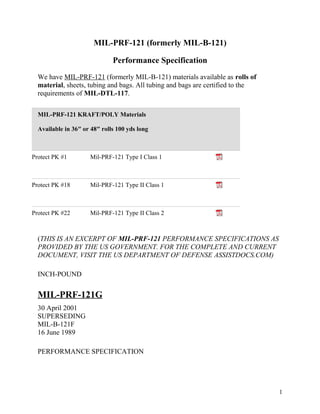
We have MIL-PRF-121 (formerly MIL-B-121) materials available as rolls of
material, sheets, tubing and bags. All tubing and bags are certified to the
requirements of MIL-DTL-117.
MIL-PRF-121 KRAFT/POLY Materials
Available in 36″ or 48″ rolls 100 yds long
Protect PK #1 Mil-PRF-121 Type I Class 1
Protect PK #18 Mil-PRF-121 Type II Class 1
Protect PK #22 Mil-PRF-121 Type II Class 2
(THIS IS AN EXCERPT OF MIL-PRF-121 PERFORMANCE SPECIFICATIONS AS
PROVIDED BY THE US GOVERNMENT. FOR THE COMPLETE AND CURRENT
DOCUMENT, VISIT THE US DEPARTMENT OF DEFENSE ASSISTDOCS.COM)
INCH-POUND
MIL-PRF-121G
30 April 2001
SUPERSEDING
MIL-B-121F
16 June 1989
PERFORMANCE SPECIFICATION
1
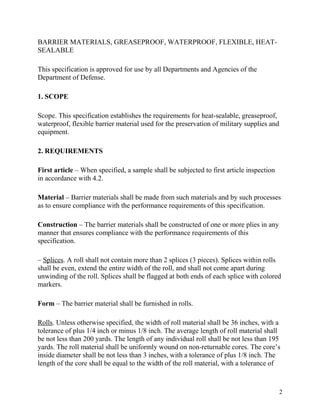
BARRIER MATERIALS, GREASEPROOF, WATERPROOF, FLEXIBLE, HEAT-
SEALABLE
This specification is approved for use by all Departments and Agencies of the
Department of Defense.
1. SCOPE
Scope. This specification establishes the requirements for heat-sealable, greaseproof,
waterproof, flexible barrier material used for the preservation of military supplies and
equipment.
2. REQUIREMENTS
First article – When specified, a sample shall be subjected to first article inspection
in accordance with 4.2.
Material – Barrier materials shall be made from such materials and by such processes
as to ensure compliance with the performance requirements of this specification.
Construction – The barrier materials shall be constructed of one or more plies in any
manner that ensures compliance with the performance requirements of this
specification.
– Splices. A roll shall not contain more than 2 splices (3 pieces). Splices within rolls
shall be even, extend the entire width of the roll, and shall not come apart during
unwinding of the roll. Splices shall be flagged at both ends of each splice with colored
markers.
Form – The barrier material shall be furnished in rolls.
Rolls. Unless otherwise specified, the width of roll material shall be 36 inches, with a
tolerance of plus 1/4 inch or minus 1/8 inch. The average length of roll material shall
be not less than 200 yards. The length of any individual roll shall be not less than 195
yards. The roll material shall be uniformly wound on non-returnable cores. The core’s
inside diameter shall be not less than 3 inches, with a tolerance of plus 1/8 inch. The
length of the core shall be equal to the width of the roll material, with a tolerance of
2
plus 1/8 inch. The core shall be rigid to prevent distortion of the roll during use and
shipment conditions. Each roll shall be restrained to prevent unwinding.
Sealing – The material shall exhibit no delamination of the heat-sealed area when
sealed according to the manufacturer’s recommended conditions. Each roll of barrier
material shall include a tag secured to the roll core with the sealing instructions for
heat-sealing on continuous and jaw-type sealing equipment. The tag shall be visible
upon opening the unit package.
Identification of material – The specification number, type, manufacturer’s name,
manufacturer’s designation, month and year of manufacture, and lot number shall be
clearly and legibly marked using water-resistant ink on the backing surface of the
material. The color of the markings shall be red. This complete group of markings
shall be continuous lengthwise and the distance between groups of markings shall be
not greater than 6 inches. A complete group of markings shall appear once in each 12
inches of width of the roll. The letters and figures shall be not less than 1/8 inch high.
Workmanship – Barrier material surfaces shall be free from any foreign matter. The
barrier material edges shall be cut and trimmed of any selvage. Barrier material shall
be free from holes, tears, cuts, sharp creases, wrinkles, or other imperfections.
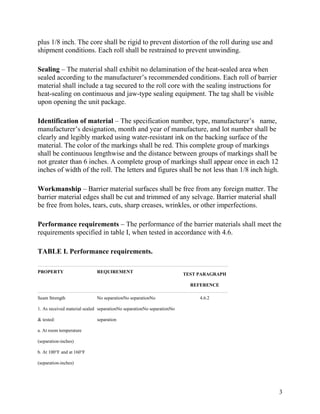
Performance requirements – The performance of the barrier materials shall meet the
requirements specified in table I, when tested in accordance with 4.6.
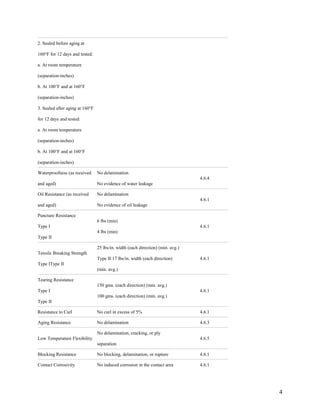
TABLE I. Performance requirements.
PROPERTY REQUIREMENT
TEST PARAGRAPH
REFERENCE
Seam Strength
1. As received material sealed
& tested:
a. At room temperature
(separation-inches)
b. At 100°F and at 160°F
(separation-inches)
No separationNo separationNo
separationNo separationNo separationNo
separation
4.6.2
3
2. Sealed before aging at
160°F for 12 days and tested:
a. At room temperature
(separation-inches)
b. At 100°F and at 160°F
(separation-inches)
3. Sealed after aging at 160°F
for 12 days and tested:
a. At room temperature
(separation-inches)
b. At 100°F and at 160°F
(separation-inches)
Waterproofness (as received
and aged)
No delamination
No evidence of water leakage
4.6.4
Oil Resistance (as received
and aged)
No delamination
No evidence of oil leakage
4.6.1
Puncture Resistance
Type I
Type II
6 lbs (min)
4 lbs (min)
4.6.1
Tensile Breaking Strength
Type IType II
25 lbs/in. width (each direction) (min. avg.)
Type II 17 lbs/in. width (each direction)
(min. avg.)
4.6.1
Tearing Resistance
Type I
Type II
150 gms. (each direction) (min. avg.)
100 gms. (each direction) (min. avg.)
4.6.1
Resistance to Curl No curl in excess of 5% 4.6.1
Aging Resistance No delamination 4.6.3
Low Temperature Flexibility
No delamination, cracking, or ply
separation
4.6.5
Blocking Resistance No blocking, delamination, or rupture 4.6.1
Contact Corrosivity No induced corrosion in the contact area 4.6.1
4
Water Resistance of Marking Markings shall remain clear and legible 4.6.1
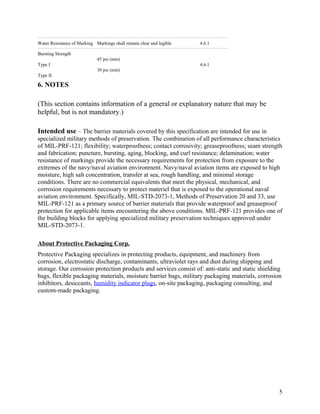
Bursting Strength
Type I
Type II
45 psi (min)
30 psi (min)
4.6.1
6. NOTES
(This section contains information of a general or explanatory nature that may be
helpful, but is not mandatory.)
Intended use – The barrier materials covered by this specification are intended for use in
specialized military methods of preservation. The combination of all performance characteristics
of MIL-PRF-121; flexibility; waterproofness; contact corrosivity; greaseproofness; seam strength
and fabrication; puncture, bursting, aging, blocking, and curl resistance; delamination; water
resistance of markings provide the necessary requirements for protection from exposure to the
extremes of the navy/naval aviation environment. Navy/naval aviation items are exposed to high
moisture, high salt concentration, transfer at sea, rough handling, and minimal storage
conditions. There are no commercial equivalents that meet the physical, mechanical, and
corrosion requirements necessary to protect materiel that is exposed to the operational naval
aviation environment. Specifically, MIL-STD-2073-1, Methods of Preservation 20 and 33, use
MIL-PRF-121 as a primary source of barrier materials that provide waterproof and greaseproof
protection for applicable items encountering the above conditions. MIL-PRF-121 provides one of
the building blocks for applying specialized military preservation techniques approved under
MIL-STD-2073-1.
About Protective Packaging Corp.
Protective Packaging specializes in protecting products, equipment, and machinery from
corrosion, electrostatic discharge, contaminants, ultraviolet rays and dust during shipping and
storage. Our corrosion protection products and services consist of: anti-static and static shielding
bags, flexible packaging materials, moisture barrier bags, military packaging materials, corrosion
inhibitors, desiccants, humidity indicator plugs, on-site packaging, packaging consulting, and
custom-made packaging.
5
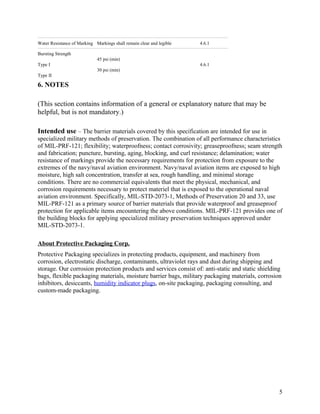
Water Resistance of Marking Markings shall remain clear and legible 4.6.1
Bursting Strength
Type I
Type II
45 psi (min)
30 psi (min)
4.6.1
6. NOTES
(This section contains information of a general or explanatory nature that may be
helpful, but is not mandatory.)
Intended use – The barrier materials covered by this specification are intended for use in
specialized military methods of preservation. The combination of all performance characteristics
of MIL-PRF-121; flexibility; waterproofness; contact corrosivity; greaseproofness; seam strength
and fabrication; puncture, bursting, aging, blocking, and curl resistance; delamination; water
resistance of markings provide the necessary requirements for protection from exposure to the
extremes of the navy/naval aviation environment. Navy/naval aviation items are exposed to high
moisture, high salt concentration, transfer at sea, rough handling, and minimal storage
conditions. There are no commercial equivalents that meet the physical, mechanical, and
corrosion requirements necessary to protect materiel that is exposed to the operational naval
aviation environment. Specifically, MIL-STD-2073-1, Methods of Preservation 20 and 33, use
MIL-PRF-121 as a primary source of barrier materials that provide waterproof and greaseproof
protection for applicable items encountering the above conditions. MIL-PRF-121 provides one of
the building blocks for applying specialized military preservation techniques approved under
MIL-STD-2073-1.
About Protective Packaging Corp.
Protective Packaging specializes in protecting products, equipment, and machinery from
corrosion, electrostatic discharge, contaminants, ultraviolet rays and dust during shipping and
storage. Our corrosion protection products and services consist of: anti-static and static shielding
bags, flexible packaging materials, moisture barrier bags, military packaging materials, corrosion
inhibitors, desiccants, humidity indicator plugs, on-site packaging, packaging consulting, and
custom-made packaging.
5

MIL-PRF-121 (formerly MIL-B-121)

  • 1.
    MIL-PRF-121 (formerly MIL-B-121) PerformanceSpecification We have MIL-PRF-121 (formerly MIL-B-121) materials available as rolls of material, sheets, tubing and bags. All tubing and bags are certified to the requirements of MIL-DTL-117. MIL-PRF-121 KRAFT/POLY Materials Available in 36″ or 48″ rolls 100 yds long Protect PK #1 Mil-PRF-121 Type I Class 1 Protect PK #18 Mil-PRF-121 Type II Class 1 Protect PK #22 Mil-PRF-121 Type II Class 2 (THIS IS AN EXCERPT OF MIL-PRF-121 PERFORMANCE SPECIFICATIONS AS PROVIDED BY THE US GOVERNMENT. FOR THE COMPLETE AND CURRENT DOCUMENT, VISIT THE US DEPARTMENT OF DEFENSE ASSISTDOCS.COM) INCH-POUND MIL-PRF-121G 30 April 2001 SUPERSEDING MIL-B-121F 16 June 1989 PERFORMANCE SPECIFICATION 1
  • 2.
    BARRIER MATERIALS, GREASEPROOF,WATERPROOF, FLEXIBLE, HEAT- SEALABLE This specification is approved for use by all Departments and Agencies of the Department of Defense. 1. SCOPE Scope. This specification establishes the requirements for heat-sealable, greaseproof, waterproof, flexible barrier material used for the preservation of military supplies and equipment. 2. REQUIREMENTS First article – When specified, a sample shall be subjected to first article inspection in accordance with 4.2. Material – Barrier materials shall be made from such materials and by such processes as to ensure compliance with the performance requirements of this specification. Construction – The barrier materials shall be constructed of one or more plies in any manner that ensures compliance with the performance requirements of this specification. – Splices. A roll shall not contain more than 2 splices (3 pieces). Splices within rolls shall be even, extend the entire width of the roll, and shall not come apart during unwinding of the roll. Splices shall be flagged at both ends of each splice with colored markers. Form – The barrier material shall be furnished in rolls. Rolls. Unless otherwise specified, the width of roll material shall be 36 inches, with a tolerance of plus 1/4 inch or minus 1/8 inch. The average length of roll material shall be not less than 200 yards. The length of any individual roll shall be not less than 195 yards. The roll material shall be uniformly wound on non-returnable cores. The core’s inside diameter shall be not less than 3 inches, with a tolerance of plus 1/8 inch. The length of the core shall be equal to the width of the roll material, with a tolerance of 2
  • 3.
    plus 1/8 inch.The core shall be rigid to prevent distortion of the roll during use and shipment conditions. Each roll shall be restrained to prevent unwinding. Sealing – The material shall exhibit no delamination of the heat-sealed area when sealed according to the manufacturer’s recommended conditions. Each roll of barrier material shall include a tag secured to the roll core with the sealing instructions for heat-sealing on continuous and jaw-type sealing equipment. The tag shall be visible upon opening the unit package. Identification of material – The specification number, type, manufacturer’s name, manufacturer’s designation, month and year of manufacture, and lot number shall be clearly and legibly marked using water-resistant ink on the backing surface of the material. The color of the markings shall be red. This complete group of markings shall be continuous lengthwise and the distance between groups of markings shall be not greater than 6 inches. A complete group of markings shall appear once in each 12 inches of width of the roll. The letters and figures shall be not less than 1/8 inch high. Workmanship – Barrier material surfaces shall be free from any foreign matter. The barrier material edges shall be cut and trimmed of any selvage. Barrier material shall be free from holes, tears, cuts, sharp creases, wrinkles, or other imperfections. Performance requirements – The performance of the barrier materials shall meet the requirements specified in table I, when tested in accordance with 4.6. TABLE I. Performance requirements. PROPERTY REQUIREMENT TEST PARAGRAPH REFERENCE Seam Strength 1. As received material sealed & tested: a. At room temperature (separation-inches) b. At 100°F and at 160°F (separation-inches) No separationNo separationNo separationNo separationNo separationNo separation 4.6.2 3
  • 4.
    2. Sealed beforeaging at 160°F for 12 days and tested: a. At room temperature (separation-inches) b. At 100°F and at 160°F (separation-inches) 3. Sealed after aging at 160°F for 12 days and tested: a. At room temperature (separation-inches) b. At 100°F and at 160°F (separation-inches) Waterproofness (as received and aged) No delamination No evidence of water leakage 4.6.4 Oil Resistance (as received and aged) No delamination No evidence of oil leakage 4.6.1 Puncture Resistance Type I Type II 6 lbs (min) 4 lbs (min) 4.6.1 Tensile Breaking Strength Type IType II 25 lbs/in. width (each direction) (min. avg.) Type II 17 lbs/in. width (each direction) (min. avg.) 4.6.1 Tearing Resistance Type I Type II 150 gms. (each direction) (min. avg.) 100 gms. (each direction) (min. avg.) 4.6.1 Resistance to Curl No curl in excess of 5% 4.6.1 Aging Resistance No delamination 4.6.3 Low Temperature Flexibility No delamination, cracking, or ply separation 4.6.5 Blocking Resistance No blocking, delamination, or rupture 4.6.1 Contact Corrosivity No induced corrosion in the contact area 4.6.1 4
  • 5.
    Water Resistance ofMarking Markings shall remain clear and legible 4.6.1 Bursting Strength Type I Type II 45 psi (min) 30 psi (min) 4.6.1 6. NOTES (This section contains information of a general or explanatory nature that may be helpful, but is not mandatory.) Intended use – The barrier materials covered by this specification are intended for use in specialized military methods of preservation. The combination of all performance characteristics of MIL-PRF-121; flexibility; waterproofness; contact corrosivity; greaseproofness; seam strength and fabrication; puncture, bursting, aging, blocking, and curl resistance; delamination; water resistance of markings provide the necessary requirements for protection from exposure to the extremes of the navy/naval aviation environment. Navy/naval aviation items are exposed to high moisture, high salt concentration, transfer at sea, rough handling, and minimal storage conditions. There are no commercial equivalents that meet the physical, mechanical, and corrosion requirements necessary to protect materiel that is exposed to the operational naval aviation environment. Specifically, MIL-STD-2073-1, Methods of Preservation 20 and 33, use MIL-PRF-121 as a primary source of barrier materials that provide waterproof and greaseproof protection for applicable items encountering the above conditions. MIL-PRF-121 provides one of the building blocks for applying specialized military preservation techniques approved under MIL-STD-2073-1. About Protective Packaging Corp. Protective Packaging specializes in protecting products, equipment, and machinery from corrosion, electrostatic discharge, contaminants, ultraviolet rays and dust during shipping and storage. Our corrosion protection products and services consist of: anti-static and static shielding bags, flexible packaging materials, moisture barrier bags, military packaging materials, corrosion inhibitors, desiccants, humidity indicator plugs, on-site packaging, packaging consulting, and custom-made packaging. 5
  • 6.
    Water Resistance ofMarking Markings shall remain clear and legible 4.6.1 Bursting Strength Type I Type II 45 psi (min) 30 psi (min) 4.6.1 6. NOTES (This section contains information of a general or explanatory nature that may be helpful, but is not mandatory.) Intended use – The barrier materials covered by this specification are intended for use in specialized military methods of preservation. The combination of all performance characteristics of MIL-PRF-121; flexibility; waterproofness; contact corrosivity; greaseproofness; seam strength and fabrication; puncture, bursting, aging, blocking, and curl resistance; delamination; water resistance of markings provide the necessary requirements for protection from exposure to the extremes of the navy/naval aviation environment. Navy/naval aviation items are exposed to high moisture, high salt concentration, transfer at sea, rough handling, and minimal storage conditions. There are no commercial equivalents that meet the physical, mechanical, and corrosion requirements necessary to protect materiel that is exposed to the operational naval aviation environment. Specifically, MIL-STD-2073-1, Methods of Preservation 20 and 33, use MIL-PRF-121 as a primary source of barrier materials that provide waterproof and greaseproof protection for applicable items encountering the above conditions. MIL-PRF-121 provides one of the building blocks for applying specialized military preservation techniques approved under MIL-STD-2073-1. About Protective Packaging Corp. Protective Packaging specializes in protecting products, equipment, and machinery from corrosion, electrostatic discharge, contaminants, ultraviolet rays and dust during shipping and storage. Our corrosion protection products and services consist of: anti-static and static shielding bags, flexible packaging materials, moisture barrier bags, military packaging materials, corrosion inhibitors, desiccants, humidity indicator plugs, on-site packaging, packaging consulting, and custom-made packaging. 5