MILLENNIUM DEVELOPMENT GOALS
AND
SUSTAINABLE DEVELOPMENT GOALS
BY ANTAREEP SARANIA
M.Sc. NURSING 1ST YEAR
COMMUNITY HEALTH NURSING
PRACTICE TEACHING ON
MILLENNIUM DEVLOPMENT GOALS (MDGs)
• In September 2000, the UN Assembly unanimously adopted the UN
Millennium declaration.
• On that occasion all the 189 members state of the UN committed
themselves to work agenda that would tackle the most evident
factors of poverty and injustice.
• They set 8 goals, 16 targets and 48 indicators.
• Target Year: 2015
MILLENNIUM DEVLOPMENT GOALS (MDGs)
• Millennium Development goals are 8 goals that UN member states
have agreed to be achieved by the year 2015 to combat poverty,
hunger, illiteracy, environmental degradation and discrimination
against women.
GOALS
Health related MDGs targets
• GOAL 1
Target 2: Halve, between 1990 and 2015, the proportion of people who
suffer from hunger
• GOAL 4:
Target 5:Reduce by two-thirds, between 1990 and 2015, the under-five
mortality rate
• GOAL 5:
Target 5: Reduce by three-quarters, between 1990 and 2015, the
maternal mortality ratio
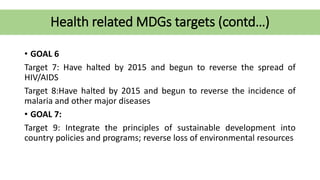
Health related MDGs targets (contd…)
• GOAL 6
Target 7: Have halted by 2015 and begun to reverse the spread of
HIV/AIDS
Target 8:Have halted by 2015 and begun to reverse the incidence of
malaria and other major diseases
• GOAL 7:
Target 9: Integrate the principles of sustainable development into
country policies and programs; reverse loss of environmental resources
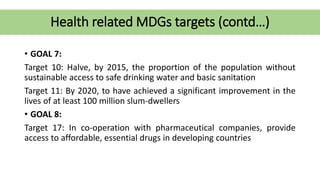
Health related MDGs targets (contd…)
• GOAL 7:
Target 10: Halve, by 2015, the proportion of the population without
sustainable access to safe drinking water and basic sanitation
Target 11: By 2020, to have achieved a significant improvement in the
lives of at least 100 million slum-dwellers
• GOAL 8:
Target 17: In co-operation with pharmaceutical companies, provide
access to affordable, essential drugs in developing countries
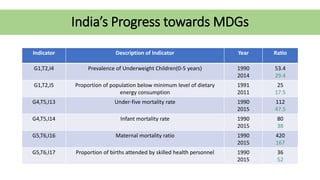
India’s Progress towards MDGs
Indicator Description of Indicator Year Ratio
G1,T2,I4 Prevalence of Underweight Children(0-5 years) 1990
2014
53.4
29.4
G1,T2,I5 Proportion of population below minimum level of dietary
energy consumption
1991
2011
25
17.5
G4,T5,I13 Under-five mortality rate 1990
2015
112
47.5
G4,T5,I14 Infant mortality rate 1990
2015
80
38
G5,T6,I16 Maternal mortality ratio 1990
2015
420
167
G5,T6,I17 Proportion of births attended by skilled health personnel 1990
2015
36
52
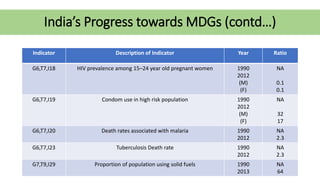
India’s Progress towards MDGs (contd…)
Indicator Description of Indicator Year Ratio
G6,T7,I18 HIV prevalence among 15–24 year old pregnant women 1990
2012
(M)
(F)
NA
0.1
0.1
G6,T7,I19 Condom use in high risk population 1990
2012
(M)
(F)
NA
32
17
G6,T7,I20 Death rates associated with malaria 1990
2012
NA
2.3
G6,T7,I23 Tuberculosis Death rate 1990
2012
NA
2.3
G7,T9,I29 Proportion of population using solid fuels 1990
2013
NA
64
India’s Progress towards MDGs (contd…)
Indicator Description of Indicator Year Ratio
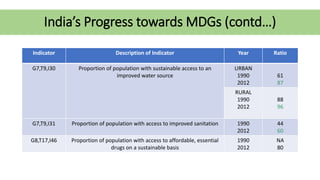
G7,T9,I30 Proportion of population with sustainable access to an
improved water source
URBAN
1990
2012
61
87
RURAL
1990
2012
88
96
G7,T9,I31 Proportion of population with access to improved sanitation 1990
2012
44
60
G8,T17,I46 Proportion of population with access to affordable, essential
drugs on a sustainable basis
1990
2012
NA
80
SUSTAINABLE DEVELOPMENT GOALS (SDGs)
SDG-3 BY ITS TARGETS
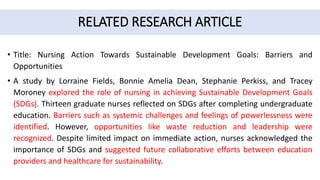
RELATED RESEARCH ARTICLE
• Title: Nursing Action Towards Sustainable Development Goals: Barriers and
Opportunities
• A study by Lorraine Fields, Bonnie Amelia Dean, Stephanie Perkiss, and Tracey
Moroney explored the role of nursing in achieving Sustainable Development Goals
(SDGs). Thirteen graduate nurses reflected on SDGs after completing undergraduate
education. Barriers such as systemic challenges and feelings of powerlessness were
identified. However, opportunities like waste reduction and leadership were
recognized. Despite limited impact on immediate action, nurses acknowledged the
importance of SDGs and suggested future collaborative efforts between education
providers and healthcare for sustainability.
SUMMARY
CONCLUSION
Millennium Development Goals & Sustainable Development Goals

Millennium Development Goals & Sustainable Development Goals

  • 1.
    MILLENNIUM DEVELOPMENT GOALS AND SUSTAINABLEDEVELOPMENT GOALS BY ANTAREEP SARANIA M.Sc. NURSING 1ST YEAR COMMUNITY HEALTH NURSING PRACTICE TEACHING ON
  • 2.
    MILLENNIUM DEVLOPMENT GOALS(MDGs) • In September 2000, the UN Assembly unanimously adopted the UN Millennium declaration. • On that occasion all the 189 members state of the UN committed themselves to work agenda that would tackle the most evident factors of poverty and injustice. • They set 8 goals, 16 targets and 48 indicators. • Target Year: 2015
  • 3.
    MILLENNIUM DEVLOPMENT GOALS(MDGs) • Millennium Development goals are 8 goals that UN member states have agreed to be achieved by the year 2015 to combat poverty, hunger, illiteracy, environmental degradation and discrimination against women.
  • 4.
  • 5.
    Health related MDGstargets • GOAL 1 Target 2: Halve, between 1990 and 2015, the proportion of people who suffer from hunger • GOAL 4: Target 5:Reduce by two-thirds, between 1990 and 2015, the under-five mortality rate • GOAL 5: Target 5: Reduce by three-quarters, between 1990 and 2015, the maternal mortality ratio
  • 6.
    Health related MDGstargets (contd…) • GOAL 6 Target 7: Have halted by 2015 and begun to reverse the spread of HIV/AIDS Target 8:Have halted by 2015 and begun to reverse the incidence of malaria and other major diseases • GOAL 7: Target 9: Integrate the principles of sustainable development into country policies and programs; reverse loss of environmental resources
  • 7.
    Health related MDGstargets (contd…) • GOAL 7: Target 10: Halve, by 2015, the proportion of the population without sustainable access to safe drinking water and basic sanitation Target 11: By 2020, to have achieved a significant improvement in the lives of at least 100 million slum-dwellers • GOAL 8: Target 17: In co-operation with pharmaceutical companies, provide access to affordable, essential drugs in developing countries
  • 8.
    India’s Progress towardsMDGs Indicator Description of Indicator Year Ratio G1,T2,I4 Prevalence of Underweight Children(0-5 years) 1990 2014 53.4 29.4 G1,T2,I5 Proportion of population below minimum level of dietary energy consumption 1991 2011 25 17.5 G4,T5,I13 Under-five mortality rate 1990 2015 112 47.5 G4,T5,I14 Infant mortality rate 1990 2015 80 38 G5,T6,I16 Maternal mortality ratio 1990 2015 420 167 G5,T6,I17 Proportion of births attended by skilled health personnel 1990 2015 36 52
  • 9.
    India’s Progress towardsMDGs (contd…) Indicator Description of Indicator Year Ratio G6,T7,I18 HIV prevalence among 15–24 year old pregnant women 1990 2012 (M) (F) NA 0.1 0.1 G6,T7,I19 Condom use in high risk population 1990 2012 (M) (F) NA 32 17 G6,T7,I20 Death rates associated with malaria 1990 2012 NA 2.3 G6,T7,I23 Tuberculosis Death rate 1990 2012 NA 2.3 G7,T9,I29 Proportion of population using solid fuels 1990 2013 NA 64
  • 10.
    India’s Progress towardsMDGs (contd…) Indicator Description of Indicator Year Ratio G7,T9,I30 Proportion of population with sustainable access to an improved water source URBAN 1990 2012 61 87 RURAL 1990 2012 88 96 G7,T9,I31 Proportion of population with access to improved sanitation 1990 2012 44 60 G8,T17,I46 Proportion of population with access to affordable, essential drugs on a sustainable basis 1990 2012 NA 80
  • 11.
  • 12.
    SDG-3 BY ITSTARGETS
  • 15.
    RELATED RESEARCH ARTICLE •Title: Nursing Action Towards Sustainable Development Goals: Barriers and Opportunities • A study by Lorraine Fields, Bonnie Amelia Dean, Stephanie Perkiss, and Tracey Moroney explored the role of nursing in achieving Sustainable Development Goals (SDGs). Thirteen graduate nurses reflected on SDGs after completing undergraduate education. Barriers such as systemic challenges and feelings of powerlessness were identified. However, opportunities like waste reduction and leadership were recognized. Despite limited impact on immediate action, nurses acknowledged the importance of SDGs and suggested future collaborative efforts between education providers and healthcare for sustainability.
  • 16.
  • 17.