camden.gov.uk
Michael Webb, Strategic Lead – Performance and Improvement
Open Data in Camden
camden.gov.uk
camden.gov.uk
camden.gov.uk
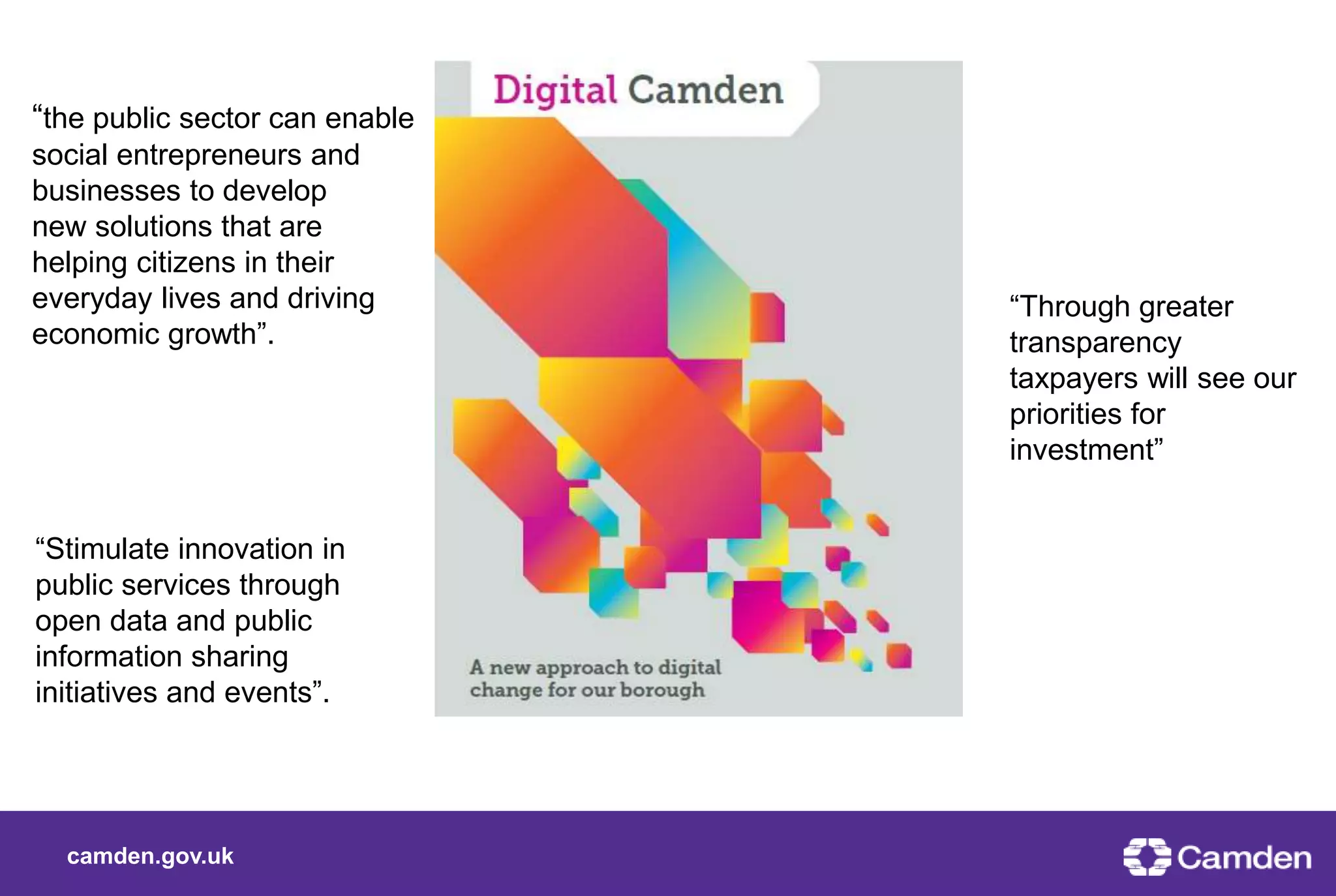
“the public sector can enable
social entrepreneurs and
businesses to develop
new solutions that are
helping citizens in their
everyday lives and driving
economic growth”.
“Stimulate innovation in
public services through
open data and public
information sharing
initiatives and events”.
“Through greater
transparency
taxpayers will see our
priorities for
investment”
camden.gov.uk
camden.gov.uk
1. Be demand-led
2. Be safe and fit to publish
3. Help to reduce the need for resources
Open Data should
camden.gov.uk

Open Data in Camden | Mike Webb | March 2015

Editor's Notes

  • #2 Not claiming to be a vanguard or a trailblazer and I’m by no means a technical expert in the field. We are at an early stage in our journey. I’d like to share where we are and my perspective on Open Data. But we are a local authority that’s interested in Open Data – I’ll say a bit more about why later. And we are investing a bit in it. We are due to launch an Open data portal in mid-May. Very live for us. Hopefully you can identify with some of our dilemmas.
  • #3 High land values – good and bad Incredible inequality – unusual population structure and tenure 1/3, 1/3, 1/3 5th largest local authority economy in the country HS2 coming £70m savings over the next 3 years.
  • #4 Where are we now? Similar position to most local authorities We have Camden Data – a “local information system” created in a different era both policy and technology wise. Most of what’s on it isn’t “our data” We’ve published our transparency code data in star format Also a lot of data is available on our website because we have to publish it or because it makes sense to (planning applications, licensing register, statement of accounts, assets of community value). But it’s not open – you can search it a bit but you can’t take it away or do much to it.
  • #5 Why Open Data? Leadership – a Cabinet member that strongly embraces it. Digital Strategy published last year. Corporate Management Team want us to work towards 5* data for the transparency code Potential benefits are threefold: Accountability – including and going beyond the transparency code. It’s not just about “uncovering waste”. Economic growth – lots of good examples where public sector data is re-used in ways it wouldn’t have thought of itself – transport an obvious one but Land Registry and Ordnance Survey Better public services – innovate, improve services, reduce costs, reduce demand – will come on to some possible areas. Customers of Open Data are often colleagues or partners.
  • #6 Why aren’t all local authorities embracing open data? Why isn’t Camden further ahead with our ambitions? LGA have done a survey but my personal take on it based on Camden experience is: We’re worried about publishing personal or otherwise sensitive data – we don’t know what people might be able to use to identify people. Just mentioning open data makes some of my colleagues nervous. There are practical issues – with data quality or extracting the data – e.g. spending data. Can take a lot of resource for little apparent gain. Something we don’t have Economic growth arguments can see a bit remote – and do they apply to local government? Would a data entrepreneur need to go round all 300-something LAs to get data. There doesn’t seem to be a lot of demand – not many people are beating down our door for data. The army of armchair auditors have not emerged other than a few enthusiasts. Transparency Code has seemed like a burden, something to comply with, central government bossing us around. Adds up to a culture of caution and scepticism. I’m certainly guilty of it at times. We still see the data as our data – not as an asset but as a risk. So maybe apart from a few exceptions e.g. Bath, Leeds, Open Data hasn’t really taken off in local government.
  • #7 Some criteria we came up with while we were deciding what to publish on our new open data portal. Of course, they overlap… Have some value for customers – knowing who are customers are and what they want. How do we know what they want? LGA did some work as part of their open data incentive scheme – planning applications, public toilets and licencing data. A lot of data is already on our website and we know it is popular – street works register, parking, community facilities etc. Developers want something different to residents. For developers, it needs to link up with ntl standards to have value. But we can’t always predict demand – people outside LAs don’t know what data we hold and don’t know if they want our data. Planning is a huge issue in Camden as elsewhere. And we spend a lot of money on telling people about planning applications – statutory notices etc. Our current planning notification e-mail system isn’t that user friendly – you have to choose an individual property or a ward. Should be like Rightmove. We want to make this data available to developers and more user friendly for residents. Open Data is part of the solution but we will 2. Although we have leadership that is bought in in principle, the reality is that it can be hard to make the case to persuade officers to publish without a statutory stick. We are going for things that are already out there on our website, things we have to publish or both. We’ll increase content incrementally once we’ve proved it’s not that scary. So we can just go ahead and publish lots of geographic/place-based data e.g. parking, community facilities, street works etc. The data is in the right format already. There’s other stuff which will be harder. We should publish information about schools to help parents make better informed choice about which schools to apply to. Currently the data is all over the place. But LAs have good reasons for being cagey about it… 3. Two dimensions. Reducing the work involved. We are working on automatic extraction of the spend data for launch including automatic redaction of personal data. It will still need to be reviewed before publication but takes a lot of the graft out of it. But also reducing demand for information. We are looking at publishing FOI responses in a searchable format. Some LAs do publish them all but not in a very user friendly way. Publish data about them but not the actual response. Also we want to try and pre-empt FOI requests by publishing commonly requested datasets. Don’t know if it will work in reducing demand. There is some evidence that proactive publishing in a useful format does reduce demand e.g. Newham School Locator app has reduced calls about school admissions by more than 50%. But we need to be able to publish data quickly and easily, not spend a long time developing something bespoke.
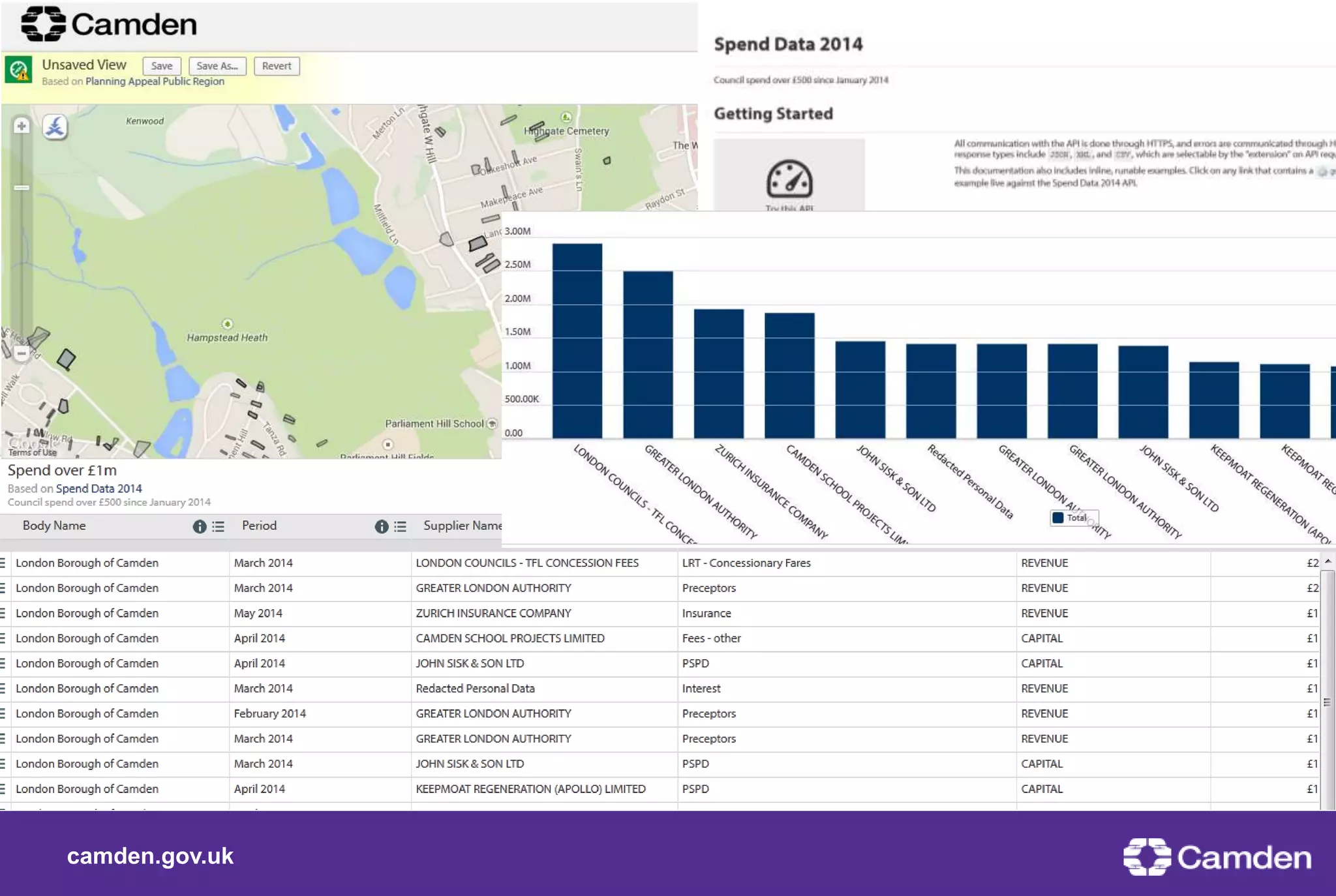
  • #8 Not just what you publish but how you publish it. Our solution – our emerging Open Data portal built by Socrata. APIs as standard – pull data automatically from source systems and produce 5 star data. Maybe we can get someone out there to build our planning app? Interface for end users (officers as well as residents) – they can do what they want with it – map it if it’s mappable, table, powerful search, graphs. Map of planning appeals shown was generated by the platform with data that was uploaded from the source system – took about 5 minutes.