MICRO-TEACHING WORKSHOP
14TH OF JUNE 2021 to 19TH OF JUNE 2021
Micro-skill: 2. Explanation
17TH OF JUNE 2021
COMPILED BY: DR. MRS PARALIKAR URMILA
GOVERNMENT COLLEGE OF EDUCATION, MUMBAI-1
DR HOMI BHABHA STATE UNIVERSITY, MUMBAI-32
2
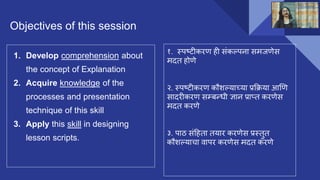
Objectives of this session
1. Develop comprehension about
the concept of Explanation
2. Acquire knowledge of the
processes and presentation
technique of this skill
3. Apply this skill in designing
lesson scripts.
१. स्पष्टीकरण ही संकल्पना समजणेस
मदत होणे
२. स्पष्टीकरण कौशल्याच्या प्रक्रिया आणण
सादरीकरण सम्बन्धी ज्ञान प्राप्त करणेस
मदत करणे
३. पाठ संहहता तयार करणेस प्रस्तुत
कौशल्याचा वापर करणेस मदत करणे
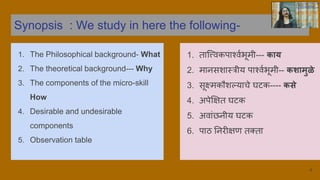
Synopsis : We study in here the following-
1. The Philosophical background- What
2. The theoretical background--- Why
3. The components of the micro-skill
How
4. Desirable and undesirable
components
5. Observation table
1. तात्त्ववकपार्शववभूमी--- काय
2. मानसशास्रीय पार्शववभूमी-- कशामुळे
3. सूक्ष्मकौशल्याचे घटक---- कसे
4. अपेक्षित घटक
5. अवांछनीय घटक
6. पाठ ननरीिण तक्ता
4
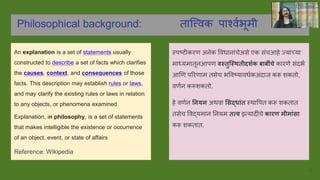
Philosophical background: तात्त्ववक पार्शववभूमी
An explanation is a set of statements usually
constructed to describe a set of facts which clarifies
the causes, context, and consequences of those
facts. This description may establish rules or laws,
and may clarify the existing rules or laws in relation
to any objects, or phenomena examined
Explanation, in philosophy, is a set of statements
that makes intelligible the existence or occurrence
of an object, event, or state of affairs
Reference: Wikipedia
स्पष्टीकरण अनेक ववधानांचेअसे एक संचआहे जयांच्या
माध्यमातूनआपण वस्तुस्स्ितीदशशक बाबीींचे कारणे संदभव
आणण पररणाम तसेच भववष्यावधवकअंदाज करू शकतो,
वणवन करूशकतो.
हे वणवन नियम अथवा ससद्ाींत स्थावपत करू शकतात
तसेच ववद्यमान ननयम तत्व इत्यादींचे कारण मीमाींसा
करू शकतात.
5
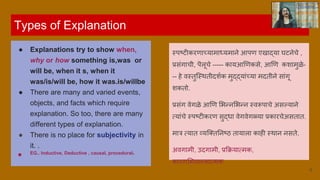
Types of Explanation
● Explanations try to show when,
why or how something is,was or
will be, when it s, when it
was/is/will be, how it was.is/willbe
● There are many and varied events,
objects, and facts which require
explanation. So too, there are many
different types of explanation.
● There is no place for subjectivity in
it. .
● EG.. Inductive, Deductive , causal, procedural,
स्पष्टीकरणाच्यामाध्यमाने आपण एखाद्या घटनेचे ,
प्रसंगाची, पॆलूचे ----- कायआणणकसे, आणण कशामुळे-
-- हे वस्तुत्त्स्थतीदशवक मुद्द्यांच्या मदतीने सांगू
शकतो.
प्रसंग वेगळे आणण भभन्नभभन्न स्वरूपाचे असल्याने
त्यांचे स्पष्टीकरण सुद्धा वेगवेगळ्या प्रकारचेअसतात.
मार त्यात व्यत्त्क्तननष्ठ तायाला काही स्थान नसते.
अवगामी, उदगामी, प्रक्रियात्मक,
कारणभममान्सात्मक
6
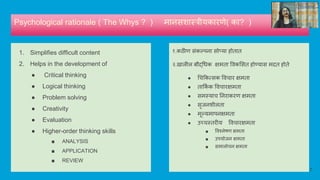
Psychological rationale ( The Whys ? ) मानसशास्रीयकारणे( का? )
1. Simplifies difficult content
2. Helps in the development of
● Critical thinking
● Logical thinking
● Problem solving
● Creativity
● Evaluation
● Higher-order thinking skills
■ ANALYSIS
■ APPLICATION
■ REVIEW
१.कठीण संकल्पना सोप्या होतात
२.खालील बौद्धधक िमता ववकभसत होण्यास मदत होते
● धचक्रकत्सक ववचार िमता
● ताक्रक
व क ववचारिमता
● समस्याच ननराकरण िमता
● सृजनशीलता
● मूल्यमापनिमता
● उच्चस्तरीय ववचारिमता
■ ववर्शलेषण िमता
■ उपयोजन िमता
■ समालोचन िमता
7
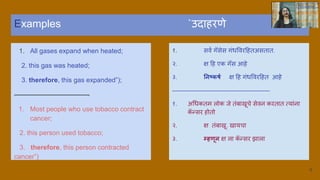
Examples `उदाहरणे
1. All gases expand when heated;
2. this gas was heated;
3. therefore, this gas expanded”);
———————————-
1. Most people who use tobacco contract
cancer;
2. this person used tobacco;
3. therefore, this person contracted
cancer”)
१. सवव गॅसेस गंधववरहहतअसतात.
२. ि हह एक गॅस आहे
३. निष्कर्श ि हह गंधववरहहत आहे
————————————————
१. अधधकतम लोक जे तंबाखूचे सेवन करतात त्यांना
क
ॅ न्सर होतो
२. ि तंबाखू. खायचा
३. म्हणूि ि ला क
ॅ न्सर झाला
8
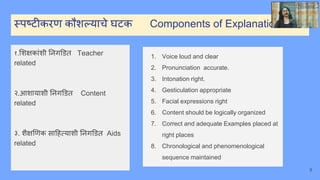
स्पष्टीकरण कौशल्याचे घटक Components of Explanation
१.भशिकांशी ननगडित Teacher
related
२.आशायाशी ननगडित Content
related
३. शैिणणक साहहत्याशी ननगडित Aids
related
1. Voice loud and clear
2. Pronunciation accurate.
3. Intonation right.
4. Gesticulation appropriate
5. Facial expressions right
6. Content should be logically organized
7. Correct and adequate Examples placed at
right places
8. Chronological and phenomenological
sequence maintained
9
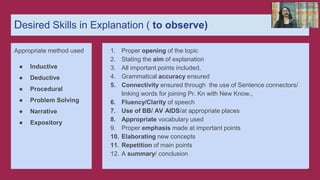
Desired Skills in Explanation ( to observe)
Appropriate method used
● Inductive
● Deductive
● Procedural
● Problem Solving
● Narrative
● Expository
1. Proper opening of the topic
2. Stating the aim of explanation
3. All important points included.
4. Grammatical accuracy ensured
5. Connectivity ensured through the use of Sentence connectors/
linking words for joining Pr. Kn with New Know.,
6. Fluency/Clarity of speech
7. Use of BB/ AV AIDS/at appropriate places
8. Appropriate vocabulary used
9. Proper emphasis made at important points
10. Elaborating new concepts
11. Repetition of main points
12. A summary/ conclusion
10
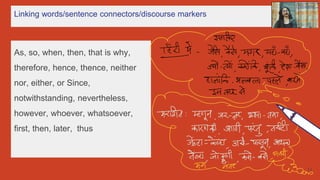
Linking words/sentence connectors/discourse markers
As, so, when, then, that is why,
therefore, hence, thence, neither
nor, either, or Since,
notwithstanding, nevertheless,
however, whoever, whatsoever,
first, then, later, thus
11
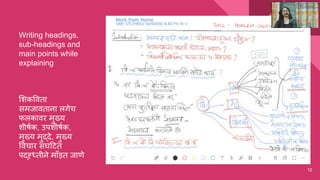
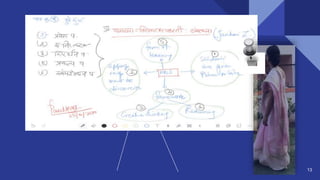
Writing headings,
sub-headings and
main points while
explaining
भशकववता
समजावताना लगेच
फलकावर मुख्य
शीषवक, उपशीषवक,
मुख्य मुद्दे, मुख्य
ववचार संघहटत
पद्धध्तीने मााँड़त जाणे
12
13
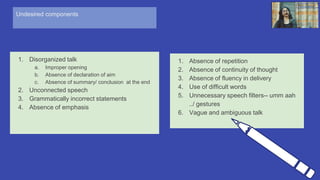
Undesired components
1. Disorganized talk
a. Improper opening
b. Absence of declaration of aim
c. Absence of summary/ conclusion at the end
2. Unconnected speech
3. Grammatically incorrect statements
4. Absence of emphasis
14
1. Absence of repetition
2. Absence of continuity of thought
3. Absence of fluency in delivery
4. Use of difficult words
5. Unnecessary speech filters-- umm aah
../ gestures
6. Vague and ambiguous talk
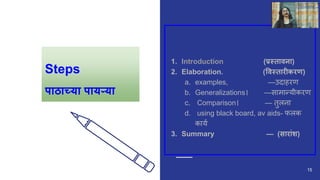
Steps
पाठाच्या पायऱ्या
1. Introduction (प्रस्ताविा)
2. Elaboration. (ववस्तारीकरण)
a. examples, —उदाहरण
b. Generalizations। —सामान्यीकरण
c. Comparison। — तुलना
d. using black board, av aids- फलक
कायव
3. Summary — (साराींश)
15
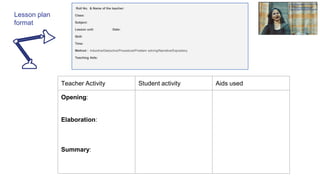
Lesson plan
format
Roll No. & Name of the teacher:
Class:
Subject:
Lesson unit: Date:
Skill:
Time:
Method : Inductive/Deductive/Procedural/Problem solving/Narrative/Expository
Teaching Aids:
Teacher Activity Student activity Aids used
Opening:
Elaboration:
Summary:
17
18

Microteaching Explanation skill

  • 1.
    MICRO-TEACHING WORKSHOP 14TH OFJUNE 2021 to 19TH OF JUNE 2021 Micro-skill: 2. Explanation 17TH OF JUNE 2021 COMPILED BY: DR. MRS PARALIKAR URMILA GOVERNMENT COLLEGE OF EDUCATION, MUMBAI-1 DR HOMI BHABHA STATE UNIVERSITY, MUMBAI-32
  • 2.
  • 3.
    Objectives of thissession 1. Develop comprehension about the concept of Explanation 2. Acquire knowledge of the processes and presentation technique of this skill 3. Apply this skill in designing lesson scripts. १. स्पष्टीकरण ही संकल्पना समजणेस मदत होणे २. स्पष्टीकरण कौशल्याच्या प्रक्रिया आणण सादरीकरण सम्बन्धी ज्ञान प्राप्त करणेस मदत करणे ३. पाठ संहहता तयार करणेस प्रस्तुत कौशल्याचा वापर करणेस मदत करणे
  • 4.
    Synopsis : Westudy in here the following- 1. The Philosophical background- What 2. The theoretical background--- Why 3. The components of the micro-skill How 4. Desirable and undesirable components 5. Observation table 1. तात्त्ववकपार्शववभूमी--- काय 2. मानसशास्रीय पार्शववभूमी-- कशामुळे 3. सूक्ष्मकौशल्याचे घटक---- कसे 4. अपेक्षित घटक 5. अवांछनीय घटक 6. पाठ ननरीिण तक्ता 4
  • 5.
    Philosophical background: तात्त्ववकपार्शववभूमी An explanation is a set of statements usually constructed to describe a set of facts which clarifies the causes, context, and consequences of those facts. This description may establish rules or laws, and may clarify the existing rules or laws in relation to any objects, or phenomena examined Explanation, in philosophy, is a set of statements that makes intelligible the existence or occurrence of an object, event, or state of affairs Reference: Wikipedia स्पष्टीकरण अनेक ववधानांचेअसे एक संचआहे जयांच्या माध्यमातूनआपण वस्तुस्स्ितीदशशक बाबीींचे कारणे संदभव आणण पररणाम तसेच भववष्यावधवकअंदाज करू शकतो, वणवन करूशकतो. हे वणवन नियम अथवा ससद्ाींत स्थावपत करू शकतात तसेच ववद्यमान ननयम तत्व इत्यादींचे कारण मीमाींसा करू शकतात. 5
  • 6.
    Types of Explanation ●Explanations try to show when, why or how something is,was or will be, when it s, when it was/is/will be, how it was.is/willbe ● There are many and varied events, objects, and facts which require explanation. So too, there are many different types of explanation. ● There is no place for subjectivity in it. . ● EG.. Inductive, Deductive , causal, procedural, स्पष्टीकरणाच्यामाध्यमाने आपण एखाद्या घटनेचे , प्रसंगाची, पॆलूचे ----- कायआणणकसे, आणण कशामुळे- -- हे वस्तुत्त्स्थतीदशवक मुद्द्यांच्या मदतीने सांगू शकतो. प्रसंग वेगळे आणण भभन्नभभन्न स्वरूपाचे असल्याने त्यांचे स्पष्टीकरण सुद्धा वेगवेगळ्या प्रकारचेअसतात. मार त्यात व्यत्त्क्तननष्ठ तायाला काही स्थान नसते. अवगामी, उदगामी, प्रक्रियात्मक, कारणभममान्सात्मक 6
  • 7.
    Psychological rationale (The Whys ? ) मानसशास्रीयकारणे( का? ) 1. Simplifies difficult content 2. Helps in the development of ● Critical thinking ● Logical thinking ● Problem solving ● Creativity ● Evaluation ● Higher-order thinking skills ■ ANALYSIS ■ APPLICATION ■ REVIEW १.कठीण संकल्पना सोप्या होतात २.खालील बौद्धधक िमता ववकभसत होण्यास मदत होते ● धचक्रकत्सक ववचार िमता ● ताक्रक व क ववचारिमता ● समस्याच ननराकरण िमता ● सृजनशीलता ● मूल्यमापनिमता ● उच्चस्तरीय ववचारिमता ■ ववर्शलेषण िमता ■ उपयोजन िमता ■ समालोचन िमता 7
  • 8.
    Examples `उदाहरणे 1. Allgases expand when heated; 2. this gas was heated; 3. therefore, this gas expanded”); ———————————- 1. Most people who use tobacco contract cancer; 2. this person used tobacco; 3. therefore, this person contracted cancer”) १. सवव गॅसेस गंधववरहहतअसतात. २. ि हह एक गॅस आहे ३. निष्कर्श ि हह गंधववरहहत आहे ———————————————— १. अधधकतम लोक जे तंबाखूचे सेवन करतात त्यांना क ॅ न्सर होतो २. ि तंबाखू. खायचा ३. म्हणूि ि ला क ॅ न्सर झाला 8
  • 9.
    स्पष्टीकरण कौशल्याचे घटकComponents of Explanation १.भशिकांशी ननगडित Teacher related २.आशायाशी ननगडित Content related ३. शैिणणक साहहत्याशी ननगडित Aids related 1. Voice loud and clear 2. Pronunciation accurate. 3. Intonation right. 4. Gesticulation appropriate 5. Facial expressions right 6. Content should be logically organized 7. Correct and adequate Examples placed at right places 8. Chronological and phenomenological sequence maintained 9
  • 10.
    Desired Skills inExplanation ( to observe) Appropriate method used ● Inductive ● Deductive ● Procedural ● Problem Solving ● Narrative ● Expository 1. Proper opening of the topic 2. Stating the aim of explanation 3. All important points included. 4. Grammatical accuracy ensured 5. Connectivity ensured through the use of Sentence connectors/ linking words for joining Pr. Kn with New Know., 6. Fluency/Clarity of speech 7. Use of BB/ AV AIDS/at appropriate places 8. Appropriate vocabulary used 9. Proper emphasis made at important points 10. Elaborating new concepts 11. Repetition of main points 12. A summary/ conclusion 10
  • 11.
    Linking words/sentence connectors/discoursemarkers As, so, when, then, that is why, therefore, hence, thence, neither nor, either, or Since, notwithstanding, nevertheless, however, whoever, whatsoever, first, then, later, thus 11
  • 12.
    Writing headings, sub-headings and mainpoints while explaining भशकववता समजावताना लगेच फलकावर मुख्य शीषवक, उपशीषवक, मुख्य मुद्दे, मुख्य ववचार संघहटत पद्धध्तीने मााँड़त जाणे 12
  • 13.
  • 14.
    Undesired components 1. Disorganizedtalk a. Improper opening b. Absence of declaration of aim c. Absence of summary/ conclusion at the end 2. Unconnected speech 3. Grammatically incorrect statements 4. Absence of emphasis 14 1. Absence of repetition 2. Absence of continuity of thought 3. Absence of fluency in delivery 4. Use of difficult words 5. Unnecessary speech filters-- umm aah ../ gestures 6. Vague and ambiguous talk
  • 15.
    Steps पाठाच्या पायऱ्या 1. Introduction(प्रस्ताविा) 2. Elaboration. (ववस्तारीकरण) a. examples, —उदाहरण b. Generalizations। —सामान्यीकरण c. Comparison। — तुलना d. using black board, av aids- फलक कायव 3. Summary — (साराींश) 15
  • 16.
    Lesson plan format Roll No.& Name of the teacher: Class: Subject: Lesson unit: Date: Skill: Time: Method : Inductive/Deductive/Procedural/Problem solving/Narrative/Expository Teaching Aids: Teacher Activity Student activity Aids used Opening: Elaboration: Summary:
  • 17.
  • 18.