Microsoft Exchange Server 2007 With Sp1 Tony
Redmonds Guide To Successful Implementation Tony
Redmond download
https://ebookbell.com/product/microsoft-exchange-
server-2007-with-sp1-tony-redmonds-guide-to-successful-
implementation-tony-redmond-2204706
Explore and download more ebooks at ebookbell.com
Here are some recommended products that we believe you will be
interested in. You can click the link to download.
Tony Redmonds Microsoft Exchange Server 2003 With Sp1 Tony Redmond
Auth
https://ebookbell.com/product/tony-redmonds-microsoft-exchange-
server-2003-with-sp1-tony-redmond-auth-4411656
Microsoft Exchange Server 2007 With Sp1 The Complete Reference 2nd
Edition Richard Luckett
https://ebookbell.com/product/microsoft-exchange-server-2007-with-
sp1-the-complete-reference-2nd-edition-richard-luckett-1268912
Microsoft Exchange Server 2003 Scalability With Sp1 And Sp2 Pierre
Bijaoui Auth
https://ebookbell.com/product/microsoft-exchange-
server-2003-scalability-with-sp1-and-sp2-pierre-bijaoui-auth-4342016
Integrating Isa Server 2006 With Microsoft Exchange 2007 Fergus
Strachan
https://ebookbell.com/product/integrating-isa-server-2006-with-
microsoft-exchange-2007-fergus-strachan-1266442
Secure Messaging With Microsoft Exchange Server 2000 Illustrated
Edition Paul Robichaux
https://ebookbell.com/product/secure-messaging-with-microsoft-
exchange-server-2000-illustrated-edition-paul-robichaux-981708
Secure Messaging With Microsoft Exchange Server 2003 Paul Robichaux
https://ebookbell.com/product/secure-messaging-with-microsoft-
exchange-server-2003-paul-robichaux-981710
Microsoft Exchange Server 2007 Infrastructure Design A Serviceoriented
Approach 1st Edition David W Tschanz
https://ebookbell.com/product/microsoft-exchange-
server-2007-infrastructure-design-a-serviceoriented-approach-1st-
edition-david-w-tschanz-51590916
Microsoft Exchange Server 2007 A Beginners Guide Network Professionals
Library 2nd Edition Nick Cavalancia
https://ebookbell.com/product/microsoft-exchange-
server-2007-a-beginners-guide-network-professionals-library-2nd-
edition-nick-cavalancia-2201802
Microsoft Exchange Server 2007 For Dummies John Paul Mueller
https://ebookbell.com/product/microsoft-exchange-server-2007-for-
dummies-john-paul-mueller-2422840
Microsoft®
Exchange
Server 2007 with SP1:
Tony Redmond’s Guide to
Successful Implementation
Tony Redmond
Amsterdam • Boston • Heidelberg • London New York • Oxford
Paris • San Diego San Francisco • Singapore • Sydney • Tokyo
Digital Press and Syngress are imprints of Elsevier
30 Corporate Drive, Suite 400, Burlington, MA 01803, USA
Linacre House, Jordan Hill, Oxford OX2 8DP, UK
Copyright © 2008, Hewlett-Packard Development Company, L.P. Published by Elsevier.
All rights reserved.
No part of this publication may be reproduced, stored in a retrieval system, or transmitted in any form
or by any means, electronic, mechanical, photocopying, recording, or otherwise, without the prior
written permission of the publisher.
Permissions may be sought directly from Elsevier’s Science & Technology Rights Department
in Oxford, UK: phone: (+44) 1865 843830, fax: (+44) 1865 853333, E-mail: permissions@elsevier.com.
You may also complete your request online via the Elsevier homepage (http://elsevier.com), by selecting
“Support & Contact” then “Copyright and Permission” and then “Obtaining Permissions.”
Recognizing the importance of preserving what has been written, Elsevier
prints its books on acid-free paper whenever possible.
Library of Congress Cataloging-in-Publication Data
Redmond, Tony, 1959-
Microsoft Exchange server 2007 with SP1: Tony Redmond’s guide to successful implementation /
Tony Redmond.
p. cm.
Includes index.
ISBN: 978-1-55558-355-2 (pbk. : alk. paper)
1. Microsoft Exchange server. 2. Client/server computing. 3. Electronic mail systems. I. Title.
QA76.9.C55R4173 2008
005.4'476—dc22
2008007670
British Library Cataloguing-in-Publication Data
A catalogue record for this book is available from the British Library.
ISBN: 978-1-55558-355-2
For information on all Digital Press publications
visit our Web site at www.books.elsevier.com
Printed in the United States of America
08 09 10 11 12 10 9 8 7 6 5 4 3 2 1
Working together to grow
libraries in developing countries
www.elsevier.com | www.bookaid.org | www.sabre.org
Note from the Author
At the tenth anniversary of the first version of Exchange Server in 2006, the HP-Microsoft sent
out a note to discover how many people at HP had worked with Exchange since Microsoft
first released the product. Over one hundred people responded. That is over one thousand
years of experience in the design, deployment, and support of Exchange. It is a great base to
build best practice upon, and the people at HP deserve recognition for the unique and ongoing
contribution that they have made to the success of Exchange.
This page intentionally left blank
v
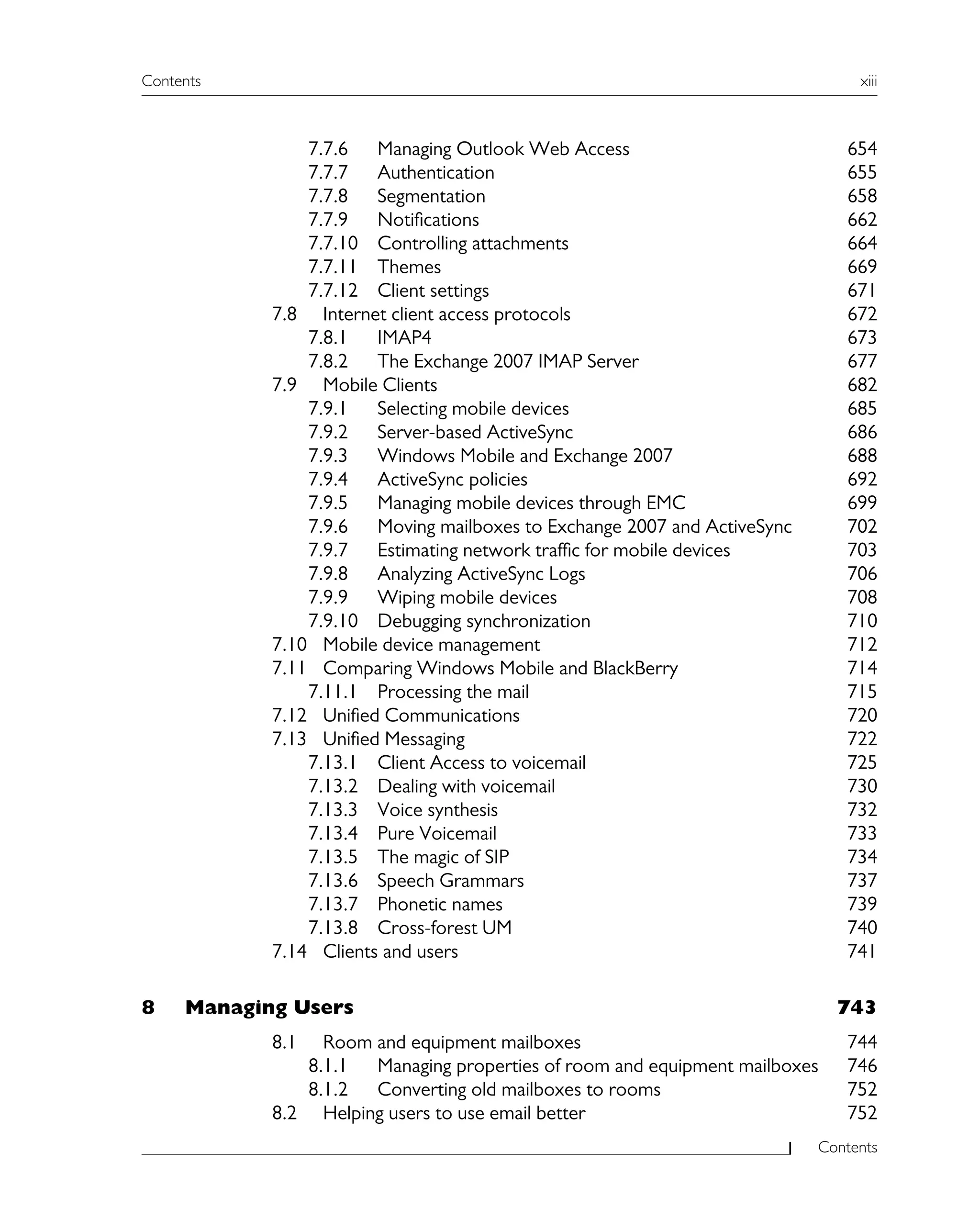
Contents
Preface xvii
Foreword xxi
1 Introduction 1
1.1 A decade and counting of Exchange deployments 1
1.1.1 The way we were 2
1.1.2 The protocol wars 2
1.1.3 Ever increasing mobility 4
1.1.4 Third party products and management 5
1.1.5 The not so good points 6
1.1.6 Exchange’s connection with the Active Directory 9
1.2 Microsoft’s themes for Exchange 2007 10
1.2.1 The happy prospect of a migration 16
1.3 Preparing for Exchange 2007 18
1.4 Installing Exchange 2007 20
1.4.1 Modifying and removing servers 25
1.4.2 Validating the installation 26
1.4.3 Third party software 27
1.5 Server Roles 28
1.5.1 Services 31
1.6 Licensing 34
1.6.1 Version Numbers 37
1.6.2 32-bit Exchange 2007? 39
1.7 Support 40
1.7.1 Service Pack 1 40
1.8 Challenges for Exchange 2007 41
1.9 Into the future 44
vi Contents
2 Exchange, Windows, and the Active Directory 47
2.1 Active Directory and Excthange 47
2.1.1 Domain Designs 49
2.2 Active Directory Replication 50
2.2.1 Replication Basics 51
2.2.2 When Active Directory Replication Happens 53
2.2.3 Active Directory Naming Contexts 55
2.3 Exchange’s Active Directory Topology Service 58
2.3.1 DSAccess (or ADAccess) 58
2.3.2 How many Global Catalog servers do I need? 61
2.3.3 Deploying Global Catalogs 62
2.4 Exchange and the Active Directory Schema 65
2.4.1 Updating the Schema with an Installation 65
2.4.2 Changing the Schema 67
2.4.3 Active Directory Custom Attributes for Exchange 69
2.4.4 Updating the Schema to allow Ambiguous
Name Resolution 70
2.4.5 Exchange-specific permissions 72
2.4.6 Exchange Property Sets 73
2.5 The very important LegacyExchangeDN attribute 75
2.6 Brain Surgery for the Active Directory: ADSIEDIT 76
2.7 The Active Directory and Exchange 80
3 The Basics of Managing Exchange 2007 81
3.1 Exchange Management Console 82
3.1.1 SP1 updates to EMC 86
3.1.2 The importance of filters 87
3.1.3 Managing mixed organizations 92
3.1.4 Running EMC remotely or on a workstation 95
3.1.5 No more AD Users and Computers 96
3.1.6 Changing columns 99
3.1.7 Visual effects 100
3.2 Why some options have disappeared from EMC 101
3.2.1 SP1 updates 104
3.2.2 Coping with change 106
3.3 Changes in the Exchange delegation model 108
3.4 Customized Recipient Management 112
3.4.1 Adieu RUS 114
3.4.2 Recipient types 116
Contents vii
Contents
3.5 Moving users 117
3.5.1 Moving Mailboxes 117
3.5.2 Logging mailbox moves 122
3.6 Using Distribution Groups 124
3.6.1 Forming groups 127
3.6.2 Group changes in Exchange 2007 129
3.6.3 Expanding Distribution Lists 130
3.6.4 How many objects can I have in a group? 132
3.6.5 Managing group membership 133
3.6.6 Protected Groups (and users) 136
3.7 Using Groups for Permissions 137
3.7.1 Managing distribution groups from Outlook 138
3.8 Dynamic Distribution Groups 140
3.8.1 Changing filters and conditions for dynamic
distribution groups 140
3.8.2 A note on OPATH 143
3.8.3 A new UI for dynamic groups 144
3.8.4 Creating New Dynamic Groups 146
3.8.5 Using Dynamic Distribution Groups 150
3.9 Mailbox quotas 152
3.9.1 Setting mailbox quotas 153
3.10 Email address policies 157
3.10.1 Mailbox moves and email address policies 162
3.10.2 Queries that drive email address policies 163
3.11 Address lists 167
3.11.1 Upgrading Address Lists to Exchange 2007 format 171
3.12 User naming conventions 172
3.13 Server naming conventions 176
3.14 Moving from the basics 178
4 The Exchange Management Shell 179
4.1 EMS: Exchange’s management shell 181
4.1.1 Working with PowerShell commands 183
4.1.2 Exchange shell commands 188
4.1.3 Command Editing 192
4.1.4 Getting at more information about something 194
4.1.5 Using common and user-defined variables 198
4.1.6 Identities 201
4.1.7 Working in a multi-domain forest 203
viii Contents
4.1.8 Profiles 205
4.1.9 PowerShell in batch 207
4.1.10 Execution policies 208
4.1.11 Sending email from the shell 209
4.2 Learning from EMC 213
4.3 Using EMS to work with mailboxes 216
4.3.1 Creating a new mailbox with a template 216
4.3.2 Setting and retrieving mailbox properties 218
4.3.3 Other ways of interacting with mailboxes 228
4.3.4 Get-Recipient 228
4.3.5 Moving mailboxes 229
4.3.6 Accessing another user’s mailbox 233
4.3.7 Different commands and different properties 235
4.3.8 Contacts 237
4.4 Working with distribution groups 238
4.4.1 Working with dynamic distribution groups 241
4.4.2 Advanced group properties 246
4.5 Delegation through the shell 249
4.6 Creating efficient filters 250
4.7 Bulk updates 254
4.7.1 Creating sets of mailboxes 257
4.8 Reporting mailbox data 259
4.8.1 Special properties 266
4.9 Using the shell for other management tasks 268
4.10 Command validation 270
4.11 Working with remote servers 273
4.12 Working with non-Exchange 2007 servers 274
4.13 Testing Exchange 2007 276
4.13.1 Client connections 278
4.13.2 Mail Flow 279
4.13.3 Miscellaneous test commands 281
4.14 PowerShell for Exchange administrators 281
5 The Store 285
5.1 Introducing the Store 285
5.2 Differences in the Exchange 2007 Store 290
5.2.1 Are sixty-four bits that important? 291
5.2.2 Trading memory for I/O 296
5.2.3 The decrease in storage costs 301
5.3 No more streaming database 302
5.4 Tables and items 304
Contents ix
Contents
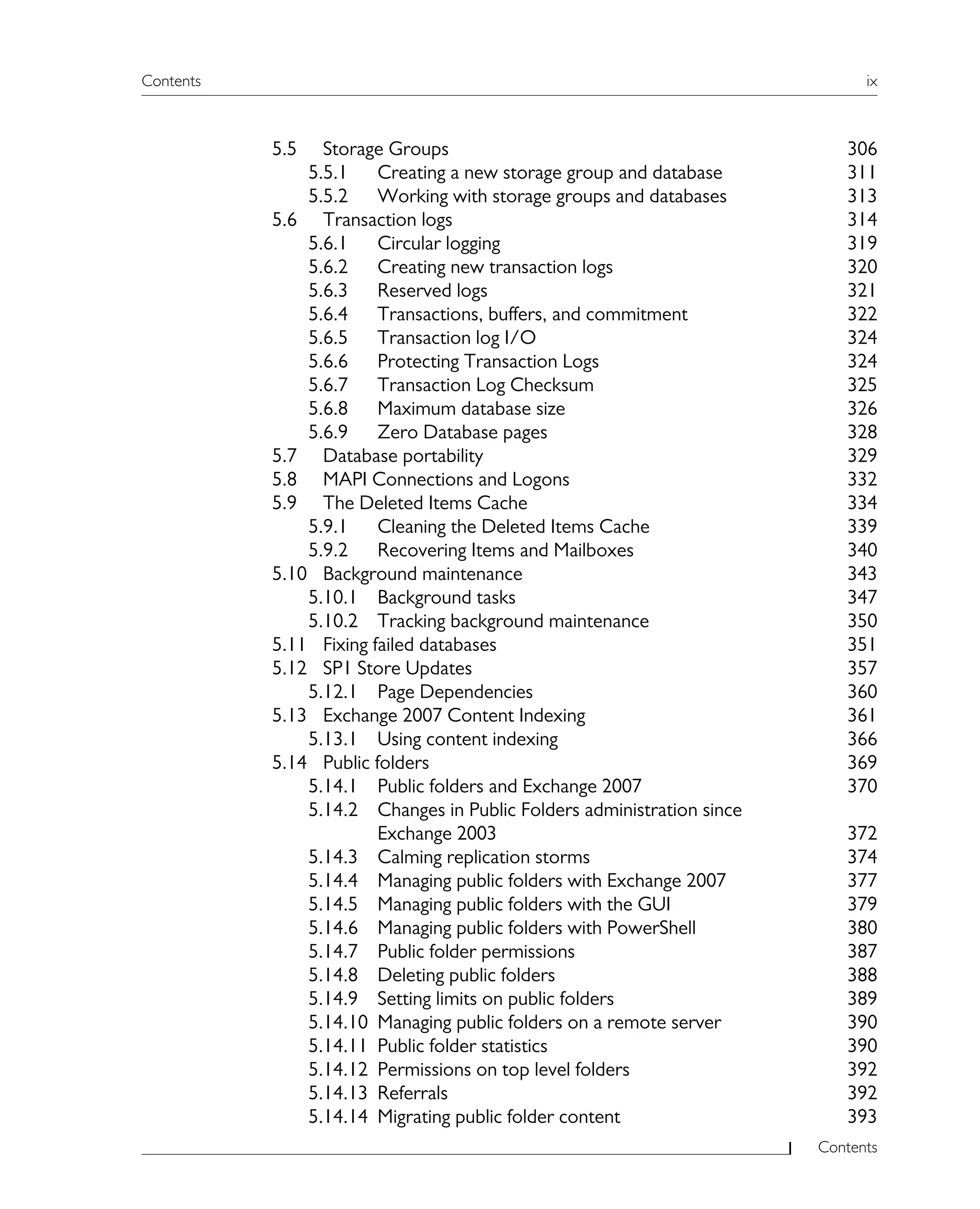
5.5 Storage Groups 306
5.5.1 Creating a new storage group and database 311
5.5.2 Working with storage groups and databases 313
5.6 Transaction logs 314
5.6.1 Circular logging 319
5.6.2 Creating new transaction logs 320
5.6.3 Reserved logs 321
5.6.4 Transactions, buffers, and commitment 322
5.6.5 Transaction log I/O 324
5.6.6 Protecting Transaction Logs 324
5.6.7 Transaction Log Checksum 325
5.6.8 Maximum database size 326
5.6.9 Zero Database pages 328
5.7 Database portability 329
5.8 MAPI Connections and Logons 332
5.9 The Deleted Items Cache 334
5.9.1 Cleaning the Deleted Items Cache 339
5.9.2 Recovering Items and Mailboxes 340
5.10 Background maintenance 343
5.10.1 Background tasks 347
5.10.2 Tracking background maintenance 350
5.11 Fixing failed databases 351
5.12 SP1 Store Updates 357
5.12.1 Page Dependencies 360
5.13 Exchange 2007 Content Indexing 361
5.13.1 Using content indexing 366
5.14 Public folders 369
5.14.1 Public folders and Exchange 2007 370
5.14.2 Changes in Public Folders administration since
Exchange 2003 372
5.14.3 Calming replication storms 374
5.14.4 Managing public folders with Exchange 2007 377
5.14.5 Managing public folders with the GUI 379
5.14.6 Managing public folders with PowerShell 380
5.14.7 Public folder permissions 387
5.14.8 Deleting public folders 388
5.14.9 Setting limits on public folders 389
5.14.10 Managing public folders on a remote server 390
5.14.11 Public folder statistics 390
5.14.12 Permissions on top level folders 392
5.14.13 Referrals 392
5.14.14 Migrating public folder content 393
x Contents
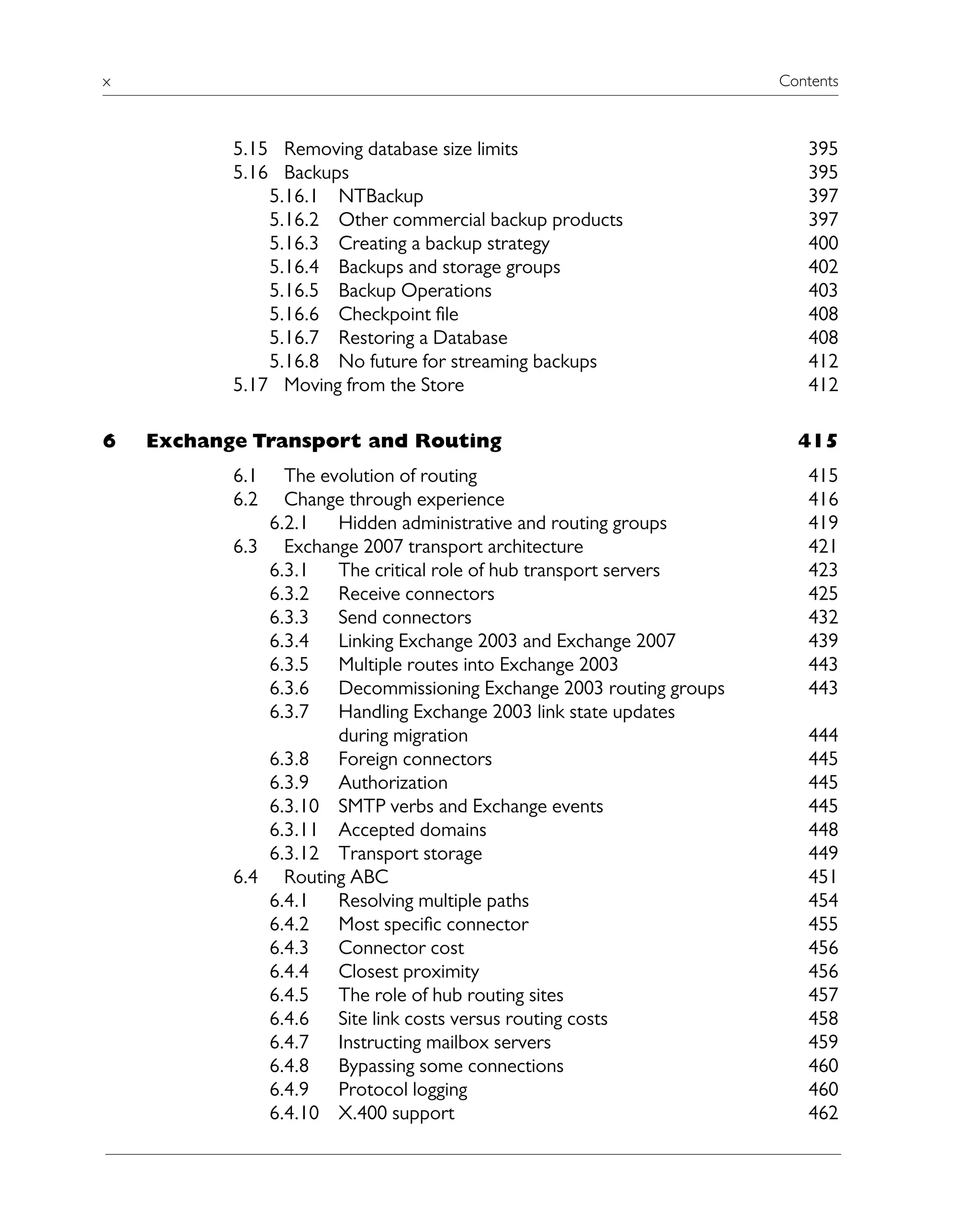
5.15 Removing database size limits 395
5.16 Backups 395
5.16.1 NTBackup 397
5.16.2 Other commercial backup products 397
5.16.3 Creating a backup strategy 400
5.16.4 Backups and storage groups 402
5.16.5 Backup Operations 403
5.16.6 Checkpoint file 408
5.16.7 Restoring a Database 408
5.16.8 No future for streaming backups 412
5.17 Moving from the Store 412
6 Exchange Transport and Routing 415
6.1 The evolution of routing 415
6.2 Change through experience 416
6.2.1 Hidden administrative and routing groups 419
6.3 Exchange 2007 transport architecture 421
6.3.1 The critical role of hub transport servers 423
6.3.2 Receive connectors 425
6.3.3 Send connectors 432
6.3.4 Linking Exchange 2003 and Exchange 2007 439
6.3.5 Multiple routes into Exchange 2003 443
6.3.6 Decommissioning Exchange 2003 routing groups 443
6.3.7 Handling Exchange 2003 link state updates
during migration 444
6.3.8 Foreign connectors 445
6.3.9 Authorization 445
6.3.10 SMTP verbs and Exchange events 445
6.3.11 Accepted domains 448
6.3.12 Transport storage 449
6.4 Routing ABC 451
6.4.1 Resolving multiple paths 454
6.4.2 Most specific connector 455
6.4.3 Connector cost 456
6.4.4 Closest proximity 456
6.4.5 The role of hub routing sites 457
6.4.6 Site link costs versus routing costs 458
6.4.7 Instructing mailbox servers 459
6.4.8 Bypassing some connections 460
6.4.9 Protocol logging 460
6.4.10 X.400 support 462
Contents xi
Contents
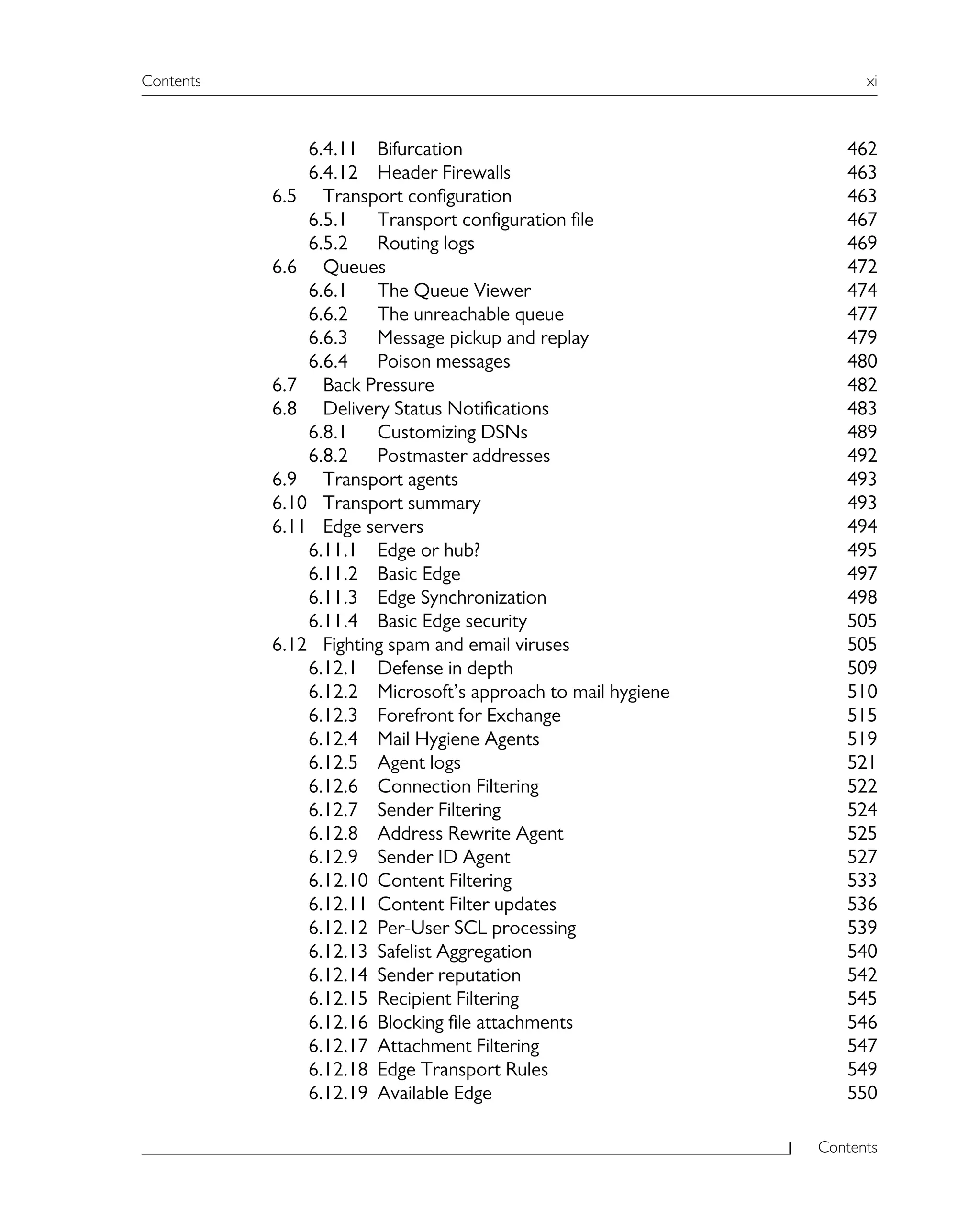
6.4.11 Bifurcation 462
6.4.12 Header Firewalls 463
6.5 Transport configuration 463
6.5.1 Transport configuration file 467
6.5.2 Routing logs 469
6.6 Queues 472
6.6.1 The Queue Viewer 474
6.6.2 The unreachable queue 477
6.6.3 Message pickup and replay 479
6.6.4 Poison messages 480
6.7 Back Pressure 482
6.8 Delivery Status Notifications 483
6.8.1 Customizing DSNs 489
6.8.2 Postmaster addresses 492
6.9 Transport agents 493
6.10 Transport summary 493
6.11 Edge servers 494
6.11.1 Edge or hub? 495
6.11.2 Basic Edge 497
6.11.3 Edge Synchronization 498
6.11.4 Basic Edge security 505
6.12 Fighting spam and email viruses 505
6.12.1 Defense in depth 509
6.12.2 Microsoft’s approach to mail hygiene 510
6.12.3 Forefront for Exchange 515
6.12.4 Mail Hygiene Agents 519
6.12.5 Agent logs 521
6.12.6 Connection Filtering 522
6.12.7 Sender Filtering 524
6.12.8 Address Rewrite Agent 525
6.12.9 Sender ID Agent 527
6.12.10 Content Filtering 533
6.12.11 Content Filter updates 536
6.12.12 Per-User SCL processing 539
6.12.13 Safelist Aggregation 540
6.12.14 Sender reputation 542
6.12.15 Recipient Filtering 545
6.12.16 Blocking file attachments 546
6.12.17 Attachment Filtering 547
6.12.18 Edge Transport Rules 549
6.12.19 Available Edge 550
xii Contents
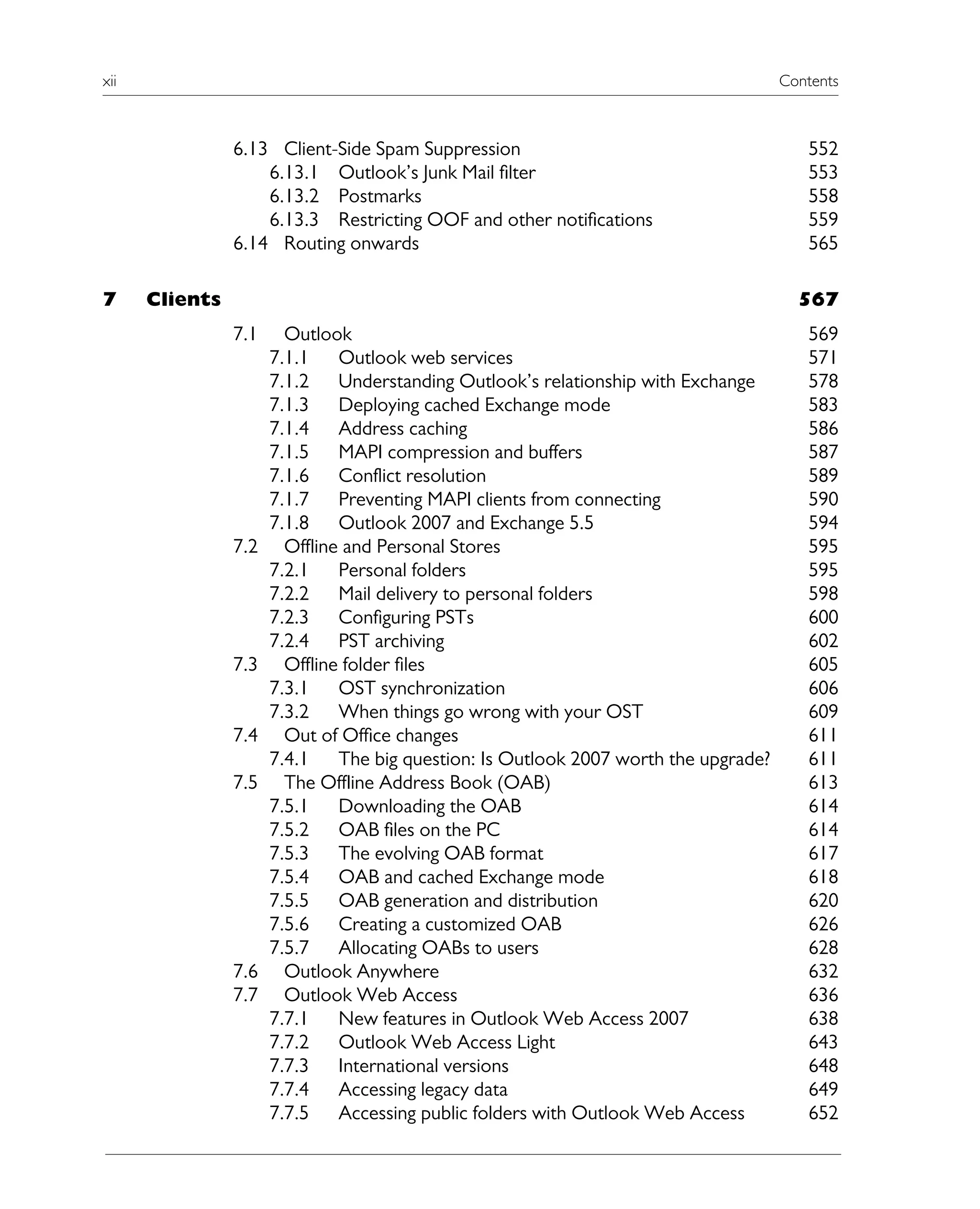
6.13 Client-Side Spam Suppression 552
6.13.1 Outlook’s Junk Mail filter 553
6.13.2 Postmarks 558
6.13.3 Restricting OOF and other notifications 559
6.14 Routing onwards 565
7 Clients 567
7.1 Outlook 569
7.1.1 Outlook web services 571
7.1.2 Understanding Outlook’s relationship with Exchange 578
7.1.3 Deploying cached Exchange mode 583
7.1.4 Address caching 586
7.1.5 MAPI compression and buffers 587
7.1.6 Conflict resolution 589
7.1.7 Preventing MAPI clients from connecting 590
7.1.8 Outlook 2007 and Exchange 5.5 594
7.2 Offline and Personal Stores 595
7.2.1 Personal folders 595
7.2.2 Mail delivery to personal folders 598
7.2.3 Configuring PSTs 600
7.2.4 PST archiving 602
7.3 Offline folder files 605
7.3.1 OST synchronization 606
7.3.2 When things go wrong with your OST 609
7.4 Out of Office changes 611
7.4.1 The big question: Is Outlook 2007 worth the upgrade? 611
7.5 The Offline Address Book (OAB) 613
7.5.1 Downloading the OAB 614
7.5.2 OAB files on the PC 614
7.5.3 The evolving OAB format 617
7.5.4 OAB and cached Exchange mode 618
7.5.5 OAB generation and distribution 620
7.5.6 Creating a customized OAB 626
7.5.7 Allocating OABs to users 628
7.6 Outlook Anywhere 632
7.7 Outlook Web Access 636
7.7.1 New features in Outlook Web Access 2007 638
7.7.2 Outlook Web Access Light 643
7.7.3 International versions 648
7.7.4 Accessing legacy data 649
7.7.5 Accessing public folders with Outlook Web Access 652
Contents xiii
Contents
7.7.6 Managing Outlook Web Access 654
7.7.7 Authentication 655
7.7.8 Segmentation 658
7.7.9 Notifications 662
7.7.10 Controlling attachments 664
7.7.11 Themes 669
7.7.12 Client settings 671
7.8 Internet client access protocols 672
7.8.1 IMAP4 673
7.8.2 The Exchange 2007 IMAP Server 677
7.9 Mobile Clients 682
7.9.1 Selecting mobile devices 685
7.9.2 Server-based ActiveSync 686
7.9.3 Windows Mobile and Exchange 2007 688
7.9.4 ActiveSync policies 692
7.9.5 Managing mobile devices through EMC 699
7.9.6 Moving mailboxes to Exchange 2007 and ActiveSync 702
7.9.7 Estimating network traffic for mobile devices 703
7.9.8 Analyzing ActiveSync Logs 706
7.9.9 Wiping mobile devices 708
7.9.10 Debugging synchronization 710
7.10 Mobile device management 712
7.11 Comparing Windows Mobile and BlackBerry 714
7.11.1 Processing the mail 715
7.12 Unified Communications 720
7.13 Unified Messaging 722
7.13.1 Client Access to voicemail 725
7.13.2 Dealing with voicemail 730
7.13.3 Voice synthesis 732
7.13.4 Pure Voicemail 733
7.13.5 The magic of SIP 734
7.13.6 Speech Grammars 737
7.13.7 Phonetic names 739
7.13.8 Cross-forest UM 740
7.14 Clients and users 741
8 Managing Users 743
8.1 Room and equipment mailboxes 744
8.1.1 Managing properties of room and equipment mailboxes 746
8.1.2 Converting old mailboxes to rooms 752
8.2 Helping users to use email better 752
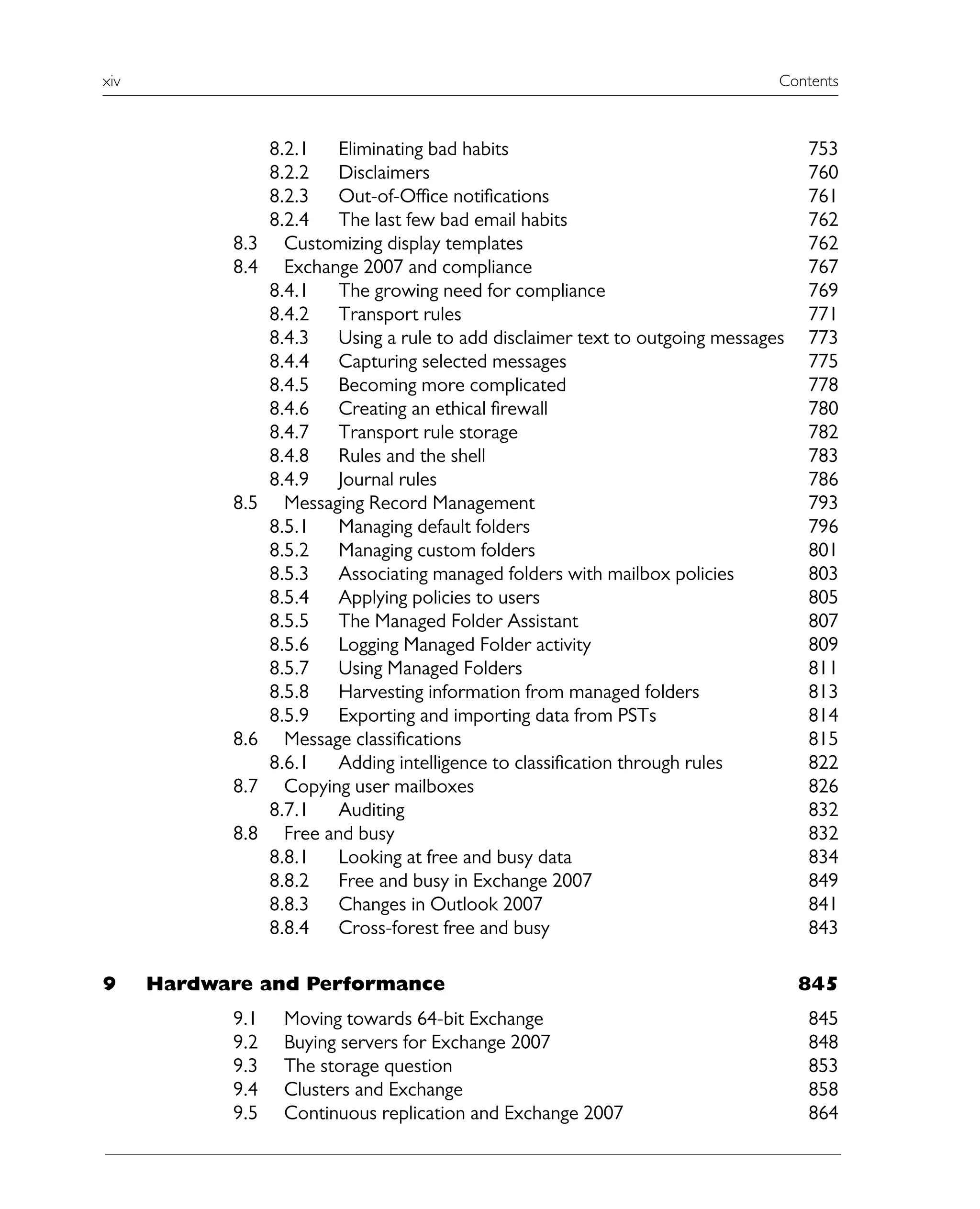
xiv Contents
8.2.1 Eliminating bad habits 753
8.2.2 Disclaimers 760
8.2.3 Out-of-Office notifications 761
8.2.4 The last few bad email habits 762
8.3 Customizing display templates 762
8.4 Exchange 2007 and compliance 767
8.4.1 The growing need for compliance 769
8.4.2 Transport rules 771
8.4.3 Using a rule to add disclaimer text to outgoing messages 773
8.4.4 Capturing selected messages 775
8.4.5 Becoming more complicated 778
8.4.6 Creating an ethical firewall 780
8.4.7 Transport rule storage 782
8.4.8 Rules and the shell 783
8.4.9 Journal rules 786
8.5 Messaging Record Management 793
8.5.1 Managing default folders 796
8.5.2 Managing custom folders 801
8.5.3 Associating managed folders with mailbox policies 803
8.5.4 Applying policies to users 805
8.5.5 The Managed Folder Assistant 807
8.5.6 Logging Managed Folder activity 809
8.5.7 Using Managed Folders 811
8.5.8 Harvesting information from managed folders 813
8.5.9 Exporting and importing data from PSTs 814
8.6 Message classifications 815
8.6.1 Adding intelligence to classification through rules 822
8.7 Copying user mailboxes 826
8.7.1 Auditing 832
8.8 Free and busy 832
8.8.1 Looking at free and busy data 834
8.8.2 Free and busy in Exchange 2007 849
8.8.3 Changes in Outlook 2007 841
8.8.4 Cross-forest free and busy 843
9 Hardware and Performance 845
9.1 Moving towards 64-bit Exchange 845
9.2 Buying servers for Exchange 2007 848
9.3 The storage question 853
9.4 Clusters and Exchange 858
9.5 Continuous replication and Exchange 2007 864
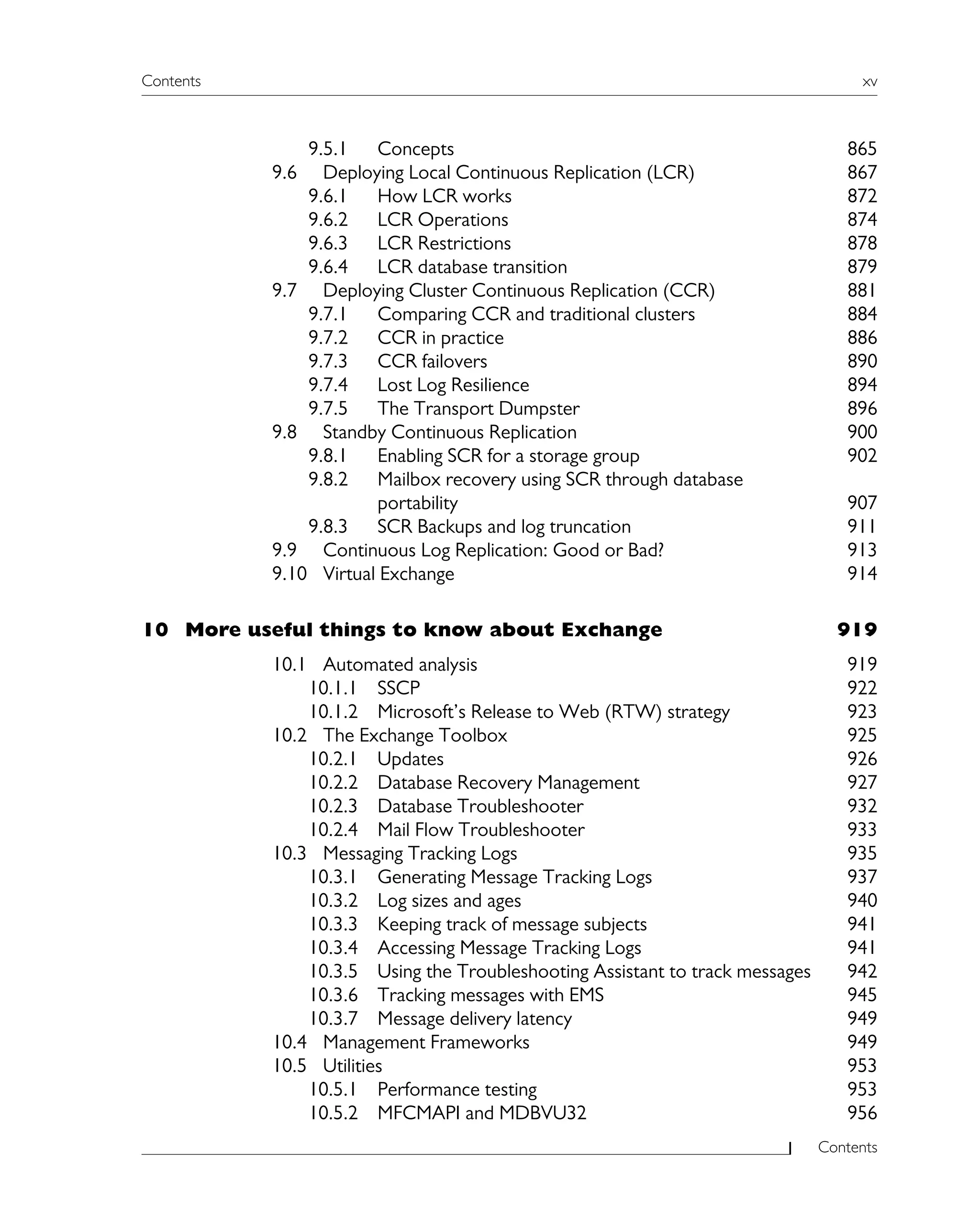
Contents xv
Contents
9.5.1 Concepts 865
9.6 Deploying Local Continuous Replication (LCR) 867
9.6.1 How LCR works 872
9.6.2 LCR Operations 874
9.6.3 LCR Restrictions 878
9.6.4 LCR database transition 879
9.7 Deploying Cluster Continuous Replication (CCR) 881
9.7.1 Comparing CCR and traditional clusters 884
9.7.2 CCR in practice 886
9.7.3 CCR failovers 890
9.7.4 Lost Log Resilience 894
9.7.5 The Transport Dumpster 896
9.8 Standby Continuous Replication 900
9.8.1 Enabling SCR for a storage group 902
9.8.2 Mailbox recovery using SCR through database
portability 907
9.8.3 SCR Backups and log truncation 911
9.9 Continuous Log Replication: Good or Bad? 913
9.10 Virtual Exchange 914
10 More useful things to know about Exchange 919
10.1 Automated analysis 919
10.1.1 SSCP 922
10.1.2 Microsoft’s Release to Web (RTW) strategy 923
10.2 The Exchange Toolbox 925
10.2.1 Updates 926
10.2.2 Database Recovery Management 927
10.2.3 Database Troubleshooter 932
10.2.4 Mail Flow Troubleshooter 933
10.3 Messaging Tracking Logs 935
10.3.1 Generating Message Tracking Logs 937
10.3.2 Log sizes and ages 940
10.3.3 Keeping track of message subjects 941
10.3.4 Accessing Message Tracking Logs 941
10.3.5 Using the Troubleshooting Assistant to track messages 942
10.3.6 Tracking messages with EMS 945
10.3.7 Message delivery latency 949
10.4 Management Frameworks 949
10.5 Utilities 953
10.5.1 Performance testing 953
10.5.2 MFCMAPI and MDBVU32 956
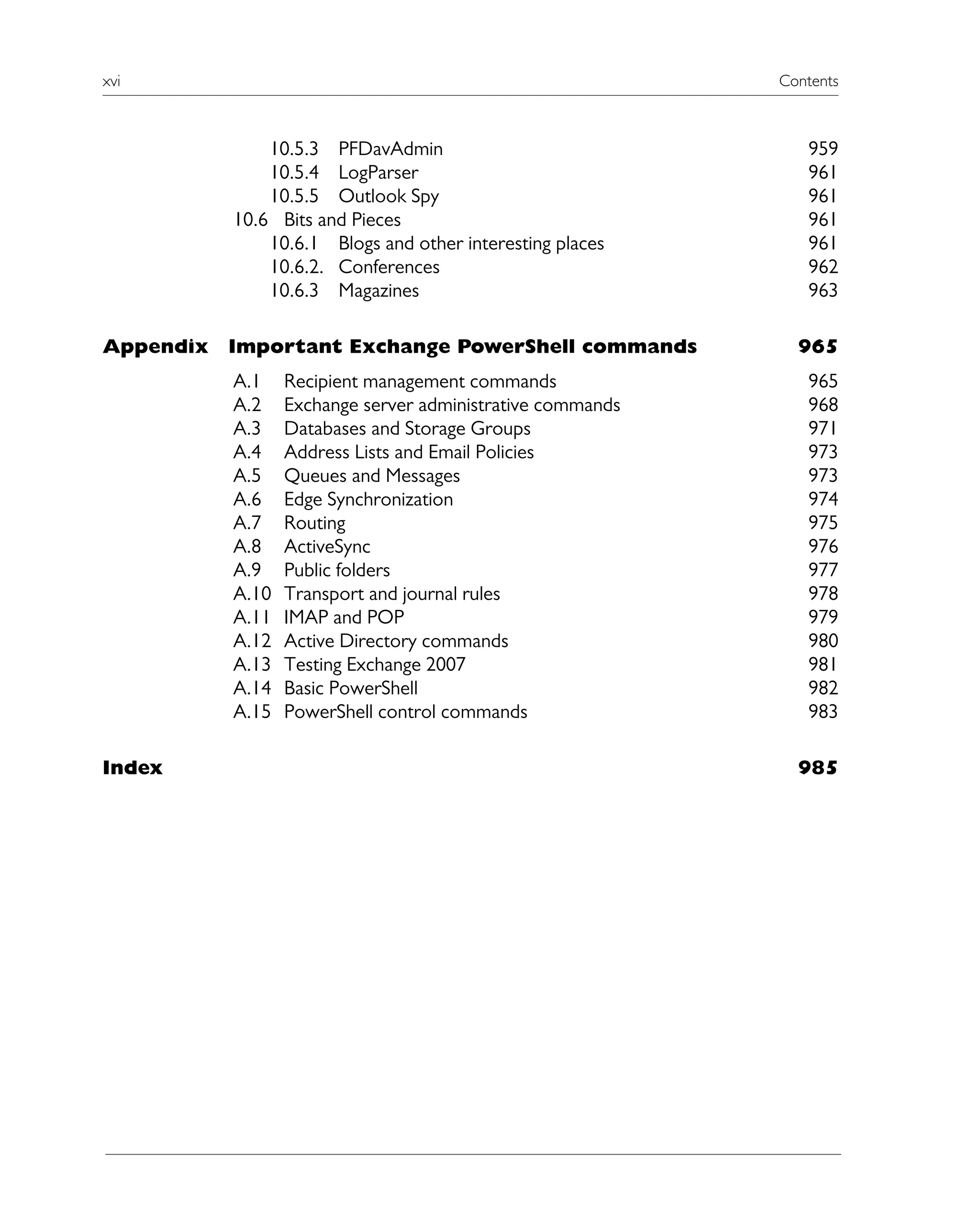
xvi Contents
10.5.3 PFDavAdmin 959
10.5.4 LogParser 961
10.5.5 Outlook Spy 961
10.6 Bits and Pieces 961
10.6.1 Blogs and other interesting places 961
10.6.2. Conferences 962
10.6.3 Magazines 963
Appendix Important Exchange PowerShell commands 965
A.1 Recipient management commands 965
A.2 Exchange server administrative commands 968
A.3 Databases and Storage Groups 971
A.4 Address Lists and Email Policies 973
A.5 Queues and Messages 973
A.6 Edge Synchronization 974
A.7 Routing 975
A.8 ActiveSync 976
A.9 Public folders 977
A.10 Transport and journal rules 978
A.11 IMAP and POP 979
A.12 Active Directory commands 980
A.13 Testing Exchange 2007 981
A.14 Basic PowerShell 982
A.15 PowerShell control commands 983
Index 985
xvii
Preface
By their very nature, every book that seeks to describe how technology works
face challenges during their creation. Dealing with beta software and attempt-
ing to resolve the difference between how the software works and how the
developers say it will work in the final version is a problem faced by any
author, which is one reason why it is often best to wait to finalize text after you
have a chance to work with released software. Looking back at this project,
in some ways, this has been the hardest book of the seven that I have written
about Exchange. I think that there are four reasons why this might be so.
First, Exchange 2007 marks the boundary for substantial architectural
change within the product, so it is similar to the degree of change that we
experienced when we moved from Exchange 5.5 to Exchange 2000. Second,
the nature of software is that it becomes more complex over time as the devel-
opers add new features and this is certainly true of Exchange 2007. The new
features have to be considered, probed, and documented, all of which takes
time. Third, the Exchange development team has done an excellent job since
2004 to document all aspects of Exchange in a more comprehensive manner
than ever before. The Exchange 2007 help file, TechNet, MSDN, and the
excellent Exchange team blog at http://msexchangeteam.com/default.aspx
are interesting and productive hoards of information for authors to mine.
Unfortunately, there is often too much material (a good complaint to have)
and the material needs to be interpreted and analyzed in the light of your
own experience with Exchange. Engineers write great blogs, but the scourge
of cognitive dissonance often means that they omit some detail that makes all
the difference to a newcomer in understanding why a component works the
way that it does.
Last but not least, you should not underestimate the degree of cultural
change that Microsoft has incorporated into Exchange 2007 in the transition
from a predominantly GUI-centric approach to server management to the use
of the PowerShell scripting language as the basis of many management opera-
tions. The need to understand and appreciate the change has to occur before
you can adequately document and describe the benefits and this increases the
effort required to write the book. I must admit that it took me time to realize
the full benefit of interacting with Exchange through the shell, but now I am
at the point where I wonder why Microsoft never provided such a powerful
interface in the past!
The degree of change that exists in Exchange 2007 means that it is diffi-
cult to cover everything in one book. I have therefore elected to cover the parts
of Exchange that I think are of most interest to the majority of administra-
tors and have left other components for you to discover through the material
that Microsoft publishes or perhaps another book, written by me or someone
else. Please accept my apology if I have not covered something that you think
is important and treat this as a challenge and opportunity for you to write
about the topic yourself. There are many magazines, blogs, and other ways of
spreading information about Exchange.
From time to time, I wander back down the path to consider some aspect
of Exchange 2003. While this book is firmly focused on Exchange 2007, the
vast majority of companies that will deploy Exchange 2007 will do so my
migrating from Exchange 2003 and will therefore run both products along-
side each other for some period. For large organizations, the period might
extend to a year or more as it is unlikely that few will complete their migration
to a pure Exchange 2007 environment quickly. With this in mind, it is fair
and reasonable to document how things work with Exchange 2003, especially
when these servers operate with Exchange 2007.
So what is in the book? To set the context, Chapter 1 starts with an over-
view of the development of Exchange from 4.0 to 2007 and then describes
the themes that Microsoft employed to focus the development priorities for
Exchange 2007 and some of the changes that occur in this release. All success-
ful deployments of Exchange since Exchange 2000 operate on a solid Active
Directory foundation, so Chapter 2 reviews some of the critical intersection
points between Exchange and the Active Directory including replication,
the schema, and Global Catalogs. Chapter 3 goes into the basics of manag-
ing Exchange 2007 through the Exchange Management Console. Chapter 4
takes the management topic further by exploring the ins and outs of the new
Exchange Management Shell, perhaps the most fundamental change to the
product that Microsoft has made in Exchange 2007. Chapter 5 goes to the
heart of Exchange and reviews how the Store works including topics such as
databases, storage groups, and transaction logs to content indexing and back-
ups. Chapter 6 looks at how the new transport system routes messages and
includes topics such as the Edge server and anti-spam protection. Chapter 7
explains how clients from Outlook to Outlook Web Access to mobile devices
allow users to work with their mailboxes. Chapter 8 then moves on to consider
some elements of user management, including the important topic of compli-
ance and records management. Chapter 9 addresses one of the more difficult
topics in hardware and performance. It is difficult because hardware capabili-
ties change so rapidly that it is hard to give any advice about performance
xviii Preface
in anything other than outline detail. Finally, Chapter 10 wraps things up
with some miscellaneous items that are important to Exchange—or at least
that I think are important for Exchange administrators to know. I hope that
the book hangs together as a coherent whole. The updates in this edition
cover the changes that Microsoft made to Exchange 2007 when they released
Service Pack 1 (SP1) in November 2007.
It is inevitable that I have omitted some topics that you might like me
to have covered. There is so much technology in and around Exchange 2007
that it would take a two thousand-page book to cover it in any detail.
My experience is mostly in the enterprise space, so it should not be a
surprise that many of the opinions expressed in the book reflect that bias.
One of my reviewers noticed this point, and complained that I did not think
that POP3 was an important protocol. Using Exchange 2007 as a hosting
platform is a pretty specialized business and I apologize in advance if I offend
anyone by my concentration on how to deploy Exchange 2007 most effec-
tively for medium to large enterprises.
All errors and omissions are mine, especially in the code samples selected
to illustrate the power of the Exchange Management Shell. PowerShell sam-
ples are indicated in the courier typeface like so:
Get-Mailbox –id Redmond | Select DisplayName
Any output from the commands is shown as follows:
DisplayName: Tony Redmond
While all the code worked on one or more test systems, experience tells
me that errors can creep in the process required to take code from a system
through editing and publishing to the final content in a book. This is espe-
cially so when the underlying code changes from build to build as the engi-
neers push to finish the product and generate a knock-on effect of changes
to commands and individual parameters. This book does not pretend to
be a comprehensive guide to PowerShell programming or to the Exchange
Management Shell and the examples are there to give you a taste of what you
can now do to automate management operations, so any errors that do creep
in should be pretty obvious and easily solved—I hope!
Books do not happen overnight and they represent a lot of work. I have
gained enormously from being able to work alongside some tremendous
experts in enterprise messaging, both inside and outside HP. I acknowledge
the contribution of HP groups such as my own team, who humoured me
when I was writing.The Exchange 2007 academy tutors (Kevin Laahs, Donald
Livengood, Michael Przytula, Shree Vishwanathan, and Wendy Ferguson)
allowed me to ask many questions as I probed the content that they generated
Preface xix
Preface
to train HP consultants and customers. I must also acknowledge the huge
contribution made by the enterprise messaging team at HP including Kathy
Pollert, Mike Ireland, and Stan Foster (an honorary member), who let me into
the details of how Exchange 2007 fitted into the huge Windows infrastructure
that HP operates. Juergen Hasslauer and Pierre Bijaoui provided some invalu-
able comments on Exchange clusters and hardware, while Dung Hoang Khac
and Guido Grillenmeier helped me get to grips with PowerShell and Active
Directory. I also acknowledge the members of the Dublin team, including
Daragh Morrissey and Veli-Matti Vanamo, who helped to create and man-
age the sandbox Exchange 2007 environment that we used to test the soft-
ware. There are many people at Microsoft who patiently answered questions
even if they didn’t realize that this was happening; the amount of informa-
tion that Microsoft now generates in help files, blogs, MSDN, TechNet, and
Knowledge Base articles is truly staggering and has become a big challenge for
people to understand and assimilate. It is great that the information is there,
but just sometimes… it can get too much! In particular, I should acknowl-
edge the work of David Espinoza and the Exchange Ship Team who run the
Technology Adoption Program for Exchange. They do an excellent job that
has contributed to the increase in quality that we have seen in the product.
I should also acknowledge and thank the mass of enthusiasts who attend con-
ferences such as Windows and Exchange Connections who asked about an
Exchange 2007 book and eventually prompted me to start writing.
Finally, I must thank the team of Tiffany Gasbarrini at Elsevier, Alan
Rose of Multiscience, and Tim Donar, who collectively put put with the vast
number of changes and updates that I insisted on making as the manuscript
proceeded from submission to publication. They all humoured my insistence
that every change was necessary and that every change would be the last one
that I would want to make.
Tony Redmond
December 2007
xx Preface
xxi
Foreword
On my first day with the Exchange team in 2001, I was handed a copy of
Tony Redmond’s Exchange 2000 book, “Here, read this!”. It did take me a
while to make my through that tome, but I still recall thinking that it was well
worth the time, as it laid the foundation for everything that was to come for
me in Exchange.
They were obviously there before me, but I can personally attest that
since that day, Tony’s team at HP have been outstanding partners with us in
designing Exchange 2003 and 2007, helping us test the software through-
out the development, and ultimately working with many customers on their
deployments, migrations, and operations.
We designed Exchange 2007 with three audiences in mind:
The IT Executive looking for cost reduction, security, and compliance.
The IT professional looking for operational efficiency.
The end-user looking for anywhere access to their email.
I hope you will find with your deployment of Exchange 2007 that we’ve
delighted all three. Since 2005, we’ve been testing Exchange 2007 with more
organizations and more end-users than any previous release of Exchange. The
end-result is a product that we are very proud of here in Redmond. We look for-
ward to receiving your feedback about Exchange 2007 over the coming years.
On behalf of the entire Exchange team, thank you for choosing Microsoft
Exchange!
Terry Myerson (terry.myerson@microsoft.com)
General Manager, Exchange Server
Microsoft Corporation
■
■
■
This page intentionally left blank
1
1
Introduction
1.1 A Decade and Counting of Exchange
Deployments
Microsoft shipped Exchange 4.0 in March 1996 after a gestation period of
some four years. The new messaging server went through many different
design phases. Microsoft grappled with the challenge of enterprises and small
companies, figured out what they had to do to be competitive, understood
how best to migrate users from other platforms (including their own), and
achieved the necessary performance and scalability levels—albeit limited by
the capabilities of Windows NT 3.51 and the available hardware.
Exchange replaced Microsoft Mail and went into immediate competi-
tion with other messaging systems such as those favored by large corporations
(IBM PROFS, Digital Equipment Corporation’s ALL-IN-1 and MailWorks,
and HP OpenMail) and the PC LAN-based systems such as Lotus cc:Mail,
Banyan Vines, Novell GroupWise, and Lotus Notes. Exchange 4.0 was the
first version that implemented the initial Exchange architecture and this gen-
eration subsequently spanned Exchange 5.0 and 5.5, released in March and
November 1997, respectively. The second generation arrived with Exchange
2000 in 2000 and Microsoft developed this version of the architecture further
with Exchange 2003. Exchange 2007 advances the state of the art by imple-
menting the third distinct architecture for Exchange.
It is hard to realize just how much progress messaging technology has
made since 1996. Exchange has improved its capabilities dramatically in
terms of functionality, robustness, security, and connectivity since 1996. We
have also seen other important advances in the standards that dictate how
systems connect together, the networks that we use, Windows and associated
technology such as IIS, the power and usefulness of the devices that we con-
nect to our mailboxes, and the other technology that has established the type
of world we work in. The web is the best and most pervasive example of a
technology that has influenced Exchange. The volume and depth of change
2 1.1 A Decade and Counting of Exchange Deployments
over the decade has posed a challenge for administrators to keep up to date
with new developments, and hopefully the articles published about Exchange
and associated technologies in that time have helped to bridge the gap.
1.1.1 The way we were
The messaging market was far more fragmented in 1996 than it is in 2007.
The administrator who set out to deploy Exchange 4.0 had to cope with a
plethora of competing standards, connections, and clients. Companies such
as SoftSwitch (later bought by Lotus), WorldTalk, and LinkAge (later bought
by Microsoft as part of their push to migrate companies from Notes) built
healthy businesses by producing software to connect different email systems
so that companies could communicate together. The war between the pro-
ponents of the international messaging standards (X.400 and X.500) and the
Internet standards hadn’t reached a satisfactory conclusion in 1996, so we
struggled to communicate in a world where you needed a great deal of magic
incantations to send even a plain text message addressed to a single recipient
to a foreign email system.
Government and telecommunications bodies led the charge toward a
common standard for directories that eventually resulted in the X.500 stan-
dard. While X.500 offered the potential to evolve into a global directory stan-
dard that everyone used to connect directories to, directory synchronization
was another black art in 1996. It was common to have weekly or monthly
synchronization runs to merge directory data to provide a common view of
users across multiple systems. Email addresses were more convoluted than
today where most organizations now use the standard SMTP convention of
first-name.last-name@domain. Of course, X.500 has long since faded into the
background and LDAP is now the most widely used standard for directory
access and interoperability. We can still see the influence of X.500 in some
enterprise directories and in the design principles that Microsoft followed to
build the original Exchange Directory Store and then the Active Directory,
but few Exchange administrators bother about X.500 now.
The ease of connectivity established by SMTP, its extensions (ESMTP),
and the easy access that we now enjoy to the Internet has revolutionized
email. This is true for corporate users and personal users. Ten years ago, it
would have been difficult to predict the success and ease of access that people
around the world enjoy to web-based email systems such as Hotmail, Gmail,
and Yahoo mail.
1.1.2 The protocol wars
MAPI is the great survivor of the protocol wars. MAPI is actually an API, but
many people refer to MAPI as a protocol, in the same way as they refer to
1.1 A Decade and Counting of Exchange Deployments 3
Chapter 1
IMAP4 or POP3; MAPI is also a message format as used in Exchange, so the
email community uses the term in different ways. Microsoft introduced the
first version of MAPI in Microsoft Mail, but this was a very simple version of
the API that Outlook clients use today as it only supported twelve functions.
“Capone,” the original Exchange client shipped with Exchange 4.0, was the
first client to exploit the full range of MAPI capabilities as made available in
the MAPI 1.0 release. Microsoft developed the Exchange RPC protocol to
wrap around MAPI and Exchange 2007 continues to use Exchange RPCs
(often called MAPI RPCs or often just MAPI) to connect Outlook clients to
servers. There’s also server-side MAPI, which is what Exchange servers use for
server applications that need to access the Store, such as the System Attendant
and the Exchange management console. Microsoft tuned the server variation
of MAPI in Exchange 2003 to better support the kind of multi-threaded
applications that servers run, but the difference between the MAPI library
distributed with Exchange 2003 and the version that came along with any
version of Outlook confused administrators in the past. For example, you
could not install Outlook on an Exchange server because the two versions of
the MAPI library would cause a conflict when they were loaded into the same
process space.
Exchange 2007 introduces MAPI.Net—a thoroughly modern version of
server-side MAPI. For instance, all of the traffic between mailbox and hub
transport servers is via MAPI.Net RPCs. A side effect of the new version of
MAPI is that you can now install Outlook quite happily on an Exchange 2007
server because the two versions do not clash any more. While it is still pos-
sible (but difficult and time-consuming) to write highly efficient and effective
MAPI code to run on the server, Microsoft’s strategy is to move programmers
away from MAPI to use Exchange web services. The promise is that code will
be easier to write and debug, will deliver better performance, and should be
more supportable over the long term. If Microsoft ever gets to discard MAPI
and replace it with a more flexible and powerful API, then they can do all the
work under the covers of Exchange web services and code should continue to
work magically. At least, that is the theory.
Back on the client side, Microsoft referred to the Capone client as a
“viewer.” This seemed to be an odd name to give to a client, but it reflected
a software engineering perspective that the client was an application that
allowed users to view Exchange data. Capone was elegant, simple, and pre-
cise, but the first release of Outlook in 1997 rapidly passed out the original
Exchange client in terms of functionality. Today Outlook boasts a range of
features that most users (except Sue Mosher, the guru of Outlook) find all the
features difficult to comprehend, let alone use. Despite rumblings over the
years (many from within Microsoft), that Exchange should drop MAPI and
use Internet protocols for its clients instead, no Internet client protocol has
emerged that could deliver the same functionality as MAPI, so it continues
to be the foundation for Exchange 2007 and Outlook 2007. MAPI remains
4 1.1 A Decade and Counting of Exchange Deployments
a mystery to many, so if you’re interested in finding out more, head over to
www.insidemapi.com, the web site dedicated to “Inside MAPI,” the definitive
book on the API (out of print for many years).
Of course, Outlook is not the only client that you can connect to
Exchange. Ever since Microsoft realized that they had to support the Internet
after the famous memo written by Bill Gates galvanized Microsoft’s engineer-
ing groups in 1996, Exchange has been able to support other client protocols.
Exchange 5.0 (released in early 1997) was the first version to support Internet
protocols. Today, Exchange 2007 supports a broad range of Internet protocols
from POP3 and IMAP4 on the client side to SMTP as the basis for messaging
connectivity and transport, to HTTP for web access—plus extensions that
provide better security and functionality, like ESMTP and HTTPS.
The Outlook Web Access (OWA) client is a real success story for
Microsoft. Like many other projects that come out of Redmond, the initial
version (shipped with Exchange 5.0 and then improved significantly in 5.5)
was slow. This was due to some aspects of its architecture, its interaction with
the Store, and various implementation details, all of which combined to limit
its scalability to be less than the number of MAPI clients that a server could
support. The version of Outlook Web Access that shipped with Exchange
2000 marked a dramatic step forward in the UI and performance and Outlook
Web Access became a client that you could actually use as a replacement for
Outlook. Microsoft made further improvements to Outlook Web Access in
Exchange 2003, not least to respond to the needs of the service providers
who wanted to deliver segmented functionality to their users, and further
improvements, not least in an upgraded and highly functional user interface,
are delivered by Exchange 2007. Some suggest that it is difficult to tell the
difference between Outlook Web Access 2007 and Outlook 2007. The test
works at a distance (of at least five feet), if not when you actually start to use
the two clients where Outlook is still the superior client. Nevertheless, the
bottom line with Outlook Web Access is that many users who work in offices
with reliable network connections find that they do not need to use Outlook
because all the functionality that they need is in Outlook Web Access.
1.1.3 Ever-increasing mobility
We were just getting used to having cell phones in 1996 (but cell phone bills
were dramatically more expensive than today), so Exchange 4.0 and the ver-
sions that followed really did not have to do much to accommodate mobility.
Alphanumeric pagers were the most common mobile device that people car-
ried if they needed to keep in touch with the office. RIM (www.rim.net) was
founded in 1984 and developed its BlackBerry device as a solution that was
initially targeted at executives. Today, BlackBerry has become a term that peo-
ple understand to mean constant connection to the office and many of those
1.1 A Decade and Counting of Exchange Deployments 5
Chapter 1
connections are to Exchange. Of course, BlackBerry is not the only mobile
device that Exchange supports. The GoodLink server (www.good.com—now
owned by Motorola) connects BlackBerry devices to Exchange along with its
own devices and those running Palm OS and Microsoft-powered PDAs. You
can choose from a wide range of SmartPhones as well, so there is a suitable
device for all from which to choose.
Microsoft continues to focus on mobile access to information as one
of its key development strategies for Exchange. They have poured in a huge
amount of effort to improve connectivity for mobile devices from Exchange
2003 onwards, especially for devices that run Windows Mobile 6.0 or later
releases. The good news is that the combination of new devices and Exchange
2007 deliver even better functionality and performance, if not quite yet to the
standard that BlackBerry delivers.
In Chapter 7, we explore how Exchange 2007 delivers even more func-
tionality for mobile users, as long as you are prepared to buy devices that
run the latest version of Windows Mobile. Exchange 2007 also includes
Microsoft’s first venture into the unified messaging market to deliver an inte-
grated inbox that accommodates voicemail as well as email, plus the ability
for users to access their mailbox and calendar data through Outlook Voice
Access. Microsoft’s favorite demo for unified messaging is to show how you
can ring Exchange while you are en route to the office and cancel all your
appointments for the day, perhaps because you are feeling ill. Having such a
wide range of connectivity options is very convenient for users, but the sheer
number of connections that an Exchange server now supports has put a huge
load on kernel mode resources that Windows finds hard to satisfy. Increasing
the server’s ability to support client connections is one of the primary reasons
why Microsoft made the decision to make Exchange 2007 available only on
the x86-641
Windows platform. It is also fair to say that the increase in the
number of options available to users to connect to Exchange made server and
network administration more complex because of the increased number of
places where things can go wrong and disrupt the messaging flow. Security
of data, especially data carried around on mobile devices, is also a concern,
largely because of the number of mobile devices that are lost annually. It is
a personal disaster to lose your contacts because you mislaid a phone; it is a
professional and business disaster if your SmartPhone contains the company’s
business plan and you have not protected the device.
1.1.4 Third party products and management
Exchange began with a sparse ecosystem surrounding the product. In 1996,
the threat horizon was not what it is today, so there was not the same need
1. Exchange 2007 runs only on the 64-bit Intel and AMD platforms. It does not run on the IA64 “Itanium” platform.
6 1.1 A Decade and Counting of Exchange Deployments
for anti-virus and spam suppression products. Management software was
limited to the basic Exchange administration program. Developers had not
even begun to think about the range of reporting and analysis software that
we enjoy today. In short, the only add-on software that was available for
Exchange was some messaging connectors and migration products to help
Microsoft migrate customers from other email systems.
The situation today is very different and we now enjoy a huge range
of add-on software that help administrators to deploy, operate, manage,
report, and debug their installations. Many software companies have come
and gone and a wave of recent mergers and acquisitions has reduced the
number of companies who create add-on products, amongst them HP (with
its OpenView suite) and Quest Software (www.quest.com), which sells many
useful products for an Exchange environment. Microsoft has been active in
this area too and despite some false starts when it comes to APIs, Microsoft has
created a lot of helpful software that it makes available to customers through
web downloads from www.microsoft.com/exchange (see Chapter 10). Taken
with the improvements in the base software, the upshot of all the third-party
activity is that it is easier to manage an Exchange server than ever before.
1.1.5 The not so good points
Not everything has gone well for Exchange since 1996. Public folders are
probably the biggest piece of functionality that has underperformed and
disappointed across a large number of deployments. When Microsoft was
stoking the market before they shipped Exchange 4.0, they made enormous
play about the capabilities of public folders, especially when you linked them
to the power of the 16-bit Visual Basic-like Electronic Forms Designer (EFD).
With EFD, you could quickly put together a form such as a travel request or
expense claim, link it to a public folder, and allow users to create and use
the form much more efficiently than paper equivalents. With replication, you
could move that information around your organization and collate it cen-
trally. It all looked promising, but in practice EFD was a disaster as it gener-
ated forms that performed well with a couple of users or with a small number
of items in a folder, but rapidly ran out of steam after that. EFD sank quickly
while public folders have lingered on. Microsoft has made a couple of runs at
improving public folders, most notably when they introduced multiple folder
hierarchies in Exchange 2000, but no one seemed to be interested because
public folders are difficult to manage and maintain and it did not seem like a
good idea to introduce more complexity with the extra folder hierarchies. The
net result is that many companies have large numbers of public folders, but
no good way to audit, clean up, report on, or effectively manage their con-
tents. We will not mourn the passing of public folders when Microsoft even-
tually puts a bullet through them, as long as migration utilities exist to allow
companies to move their data to a new platform. Exchange 2007 marks the
1.1 A Decade and Counting of Exchange Deployments 7
Chapter 1
start of the phase-out process for public folders, albeit one that may take several
more versions before Microsoft can finally pull the plug on this functionality.
Microsoft has promised to support public folders until at least 2016, so you
can take that as an indication of the work that Microsoft and customers have
to do to transition the contents of public folders and whatever applications
still depend on public folders to new platforms. Other technologies, such as
SharePoint Portal Server, did not exist in 1996 and do a much better job of
categorizing, searching, and managing data, so it will be a relief to move.
Clustering is a disappointment on the hardware side. I had great hopes for
Microsoft clustering when the original “Wolfpack” release appeared alongside
Exchange 5.5 in late 1997. Part of my optimism arose from my history at Digital
where OpenVMS clustering set a bar in the mid 1980s that Microsoft cluster-
ing has still approached today. My optimism went alongside a realization that
Exchange was vulnerable to hardware failure, especially in the disk subsystem
where the disks that were available in 1997 were not as reliable or intelligent
as they are today and few companies had started to use Storage Area Networks
(SANs) as the backbone of their Exchange deployment. Vulnerability increased
as we increased the user load on servers, which had reached a point where even
the basic 32-bit Pentium II-based servers could cheerfully accept the load of
several thousand concurrent users. Microsoft’s original implementation of clus-
tering was expensive because you could only run two servers in a cluster and
one of those was passive, waiting for its twin to fail. You had to license Exchange
on the passive server and equip it with a similar configuration to its partner, so
only deployments that absolutely needed the highest protection against failure
stumped up the necessary investment to implement clustering.
Microsoft revamped clustering in Windows 2000 and 2003 and upgraded
Exchange 2000 and 2003 to take advantage of active-active clusters. Active-
active means that every node in a cluster can support work and despite being
limited to four Exchange servers in a cluster, it seemed like an advance.
However, problems with virtual memory fragmentation led to the inability to
transfer storage groups from a failed node and Microsoft revisited its support
of Exchange on clusters to impose an active-passive model where you had to
keep at least one passive server in the cluster to accept the workload should
a failure occur. Obviously, this was a retrograde step because it increased the
cost of clustering again as you could not use all of the hardware in a cluster
as productively as before. Another problem was that not all third party soft-
ware was cluster aware, which caused problems for companies who wanted to
deploy clusters but also wanted to use a common set of software for purposes
such as monitoring, anti-virus, or backup. Finally, some of the Exchange com-
ponents did not run on clusters (like messaging gateways), so introducing a
cluster became an expensive business when you counted the extra servers that
were required to support the complete environment.
To their credit, Microsoft made a commitment to use clusters for
their internal deployment of Exchange and demonstrated that they could
8 1.1 A Decade and Counting of Exchange Deployments
support 16,000 mailboxes on a seven-node cluster (four active nodes running
Exchange, one passive node, two servers performing backup and other admin-
istrative work). Of course, the cynics pointed out that it would be easy to
deploy and manage such a cluster if you had the Windows and Exchange
development groups on site all the time. The net is that clustering began with
great hopes and has receded to a point where it is useful to those who can
afford to deploy the necessary hardware and understand the somewhat special
administrative environment that clusters represent. It would have been great
if clustering had become the de facto standard for Exchange deployments, but
the obvious deficiencies in the implementation and the cost premium meant
that this could never happen.
Exchange 2007 now offers a choice between “traditional” clusters where
the databases are located on shared storage, and cluster continuous replication
(CCR), a feature that allows you to deploy a cluster built from two physical
nodes and keep the database used by a virtual Exchange server up to date on
both nodes through asynchronous log shipping. CCR lays the foundation
for stretched clusters and allows for a new level of protection against physical
datacenter outages. Exchange 2007 also includes local continuous replication
(LCR) to provide an additional level of protection against a disk failure that
affects the Exchange Store to address the most obvious single point of failure
in all previous versions of Exchange. Exchange 2007 SP1 takes the model fur-
ther and provides Standby Continuous Replication (SCR), a variation on the
CCR theme. Chapter 9 covers these technologies in some detail.
Because of the very nature of the beast, disaster recovery is always dif-
ficult, but it is the role of software to automate recovery operations to guide
administrators and assist them in getting servers back online as quickly as pos-
sible while also avoiding mistakes like overwriting transaction logs. Until the
introduction of the Recovery Storage Group in Exchange 2003, you had to
maintain extra servers to use if a disaster occurred, and in the early days of
virtualization this required physical hardware. Better hardware and fewer soft-
ware bugs steadily reduced the number and impact of database corruptions,
but it is surprising that we have had to wait until Exchange 2007 for features
such as continuous log replication (as employed in CCR, SCR, and LCR) and
the database troubleshooting assistant. Even though we’ve had to wait, now
that we have the ability to deploy the different variants of log shipping, it will
be interesting to see how these technologies are used to build a new level of
resistance to database outages.
APIs are the other disaster area for Exchange. Microsoft needed Exchange
to have great programming capabilities to help wean companies off Lotus
Notes. Notes is not a great messaging engine, but it has extremely strong
collaborative and programming capabilities that companies exploit to put
together mail-enabled applications that take advantage of the Notes replication
engine (also better than the replication implemented in Exchange public fold-
ers). We have endured multiple attempts by Microsoft to deliver an equivalent
1.1 A Decade and Counting of Exchange Deployments 9
Chapter 1
development platform for Exchange.To give Microsoft credit, they are persistent,
and they have been very persistent, but also have an awful record with the APIs
that have shipped with Exchange. We have seen CDO,2
CDOEXM, Exchange
Routing Objects, the infamous EFD, WMI, client-side MAPI and server-side
MAPI, WebDAV, and so on. The highest figure I ever heard was that there have
been 32 different ways a programmer can write code to access Exchange data
over the years. I cannot verify the count, but it does not surprise me.
Microsoft knows that they have a mess on their hands and the advent of
PowerShell (see Chapter 4) support in Exchange 2007 means that we have a
solid and robust interface that we can use to build a new set of management
scripts and other tools. Exchange 2007 also delivers a new set of web services
that may mark the start of the process of breaking Exchange up into a series of
web services that other applications can consume. Decomposing a mammoth
application will take time, but Microsoft has made a good start in Exchange
2007. Outside of the limited set of web services that can only access a tiny
portion of the overall functionality of Exchange, there is still no good way to
develop mission critical client side applications that exploit the storage and
messaging power of Exchange and we await developments in this area.
1.1.6 Exchange’s connection with the Active Directory
When Microsoft moved Exchange away from its own directory store to sup-
port the Active Directory in Exchange 2000, some predicted that the transi-
tion would make Exchange harder to manage and deploy. To some extent, this
assertion is true as the need to deploy Active Directory first slowed down the
migration from Exchange 5.5 to Exchange 2000. Indeed, some companies
have not yet migrated away from Exchange 5.5!
I think that Active Directory has been good for Exchange. After the ini-
tial set of hiccups that slowed adoption, the body of knowledge around the
Active Directory grew and some solid deployments ensued. This is not to
say that the deployments were perfect and certainly some have corroded over
time in terms of their effectiveness. The transition to Exchange 2007 is a per-
fect opportunity to revisit Active Directory deployments to ask the question
whether they are as effective as they could be if they reflect current best prac-
tice, and to consider whether you can consolidate sites, domains, and servers
to reduce complexity and cost from the infrastructure. You realize the worth
of Active Directory to Exchange 2007 in the new dependency that exists on
the site topology and site links as the basis for message routing, replacing the
routing group structure used by Exchange 2000/2003.
The only big problem that I now have with the Active Directory is
the inflexible way that Exchange uses it. Exchange uses a container in the
2. CDO 1.2.1 remains supported for use with Exchange 2007, but only on 32-bit platforms.
Active Directory configuration naming context to store its configuration
data. Exchange gains great value from this implementation, not least because
the Active Directory replicates all of Exchange’s configuration data auto-
matically to domain controllers around the forest. However, no one has ever
been able to explain to me why the Active Directory can host only a single
Exchange organization, as it does not seem to be complex to store several
containers, one for each organization, in the directory. It would be nice to
see this restriction lifted in the future, if only to remove the requirement
to deploy multiple forests (and the hardware to support multiple forests) if
you need to support multiple Exchange organizations. Sometimes it is good
to have the separation between organizations that different Active Directory
forests afford, but it would be better to have the option to store everything in
one place.
1.2 Microsoft’s Themes for Exchange 2007
Over the last ten years, the environment surrounding Exchange has evolved
in many dimensions. Here are just a few of the most important technology
influences that have affected the evolution of Exchange.
The base operating system has moved from Windows NT 3.51 on a
32-bit platform to Windows 2003 R2 on a 64-bit platform.
Storage has moved from small and expensive direct attached storage
to a huge range of solutions spanning anything from JBOD (Just a
bunch of inexpensive disks) to very large SANs.
Systems that might have been lucky to operate with 128MB of mem-
ory have moved to a point where many email servers are equipped
with 8GB or more—and Microsoft’s recommendations for memory
for some Exchange 2007 servers will make 32GB or 64GB a common
configuration in the near future.
Microsoft has poured enormous engineering effort to bring Exchange
through three distinct generations of software from the original focus
on PC LAN-centric deployments and the need to migrate from
competing products such as Lotus cc:Mail to the ability to deal with
massive corporate deployments.
Exchange’s administrative model has moved from a purely graphical
interface that dealt well with the needs of a few hundred users but
struggled with large organizations to a point where Exchange 2007
complements an administrative GUI with a sophisticated shell
that administrators can program to automate many management
operations.
n
n
n
n
n
10 1.2 Microsoft’sThemes for Exchange 2007
Chapter 1
The protocols that are important to Exchange have moved from a
mishmash of messaging and directory protocols, both proprietary and
international, to a point where we deal with a consistent set of Internet
protocols such as SMTP, LDAP, HTTP, and IMAP.
The computing model forWindows has evolved from an approach that
usually focused on a one-server one-application model to something
that more closely resembles the kind of deployments seen on other
corporate computing platforms.
The range of clients that Exchange supports has expanded dramatically
from a single Microsoft client that could only run on Windows to a
variety of clients that accommodate the spectrum of user needs from
traditional PC workstations to many variations of handheld devices.
When Microsoft began to design the third generation of Exchange, they
decided to use three broad themes as the general thrust for the development
effort. These are:
Built-in Protection: While Exchange has long had good protection against
viruses and spam through third party products and Exchange 2003 offers
good filtering capabilities to block incoming messages from undesirable par-
ties, Microsoft knew that they had to offer out of the box protection for
Exchange to remain competitive and to protect customers. Some of this work
started with the release of the Internet Message Filter (IMF) for Exchange
2003 and the “SmartScreen” junk mail filtering technology that Outlook
2003 and 2007 incorporate into their code.
After they had released Exchange 2003, Microsoft’s original plan was to
deliver a server designed for deployment within the DMZ (the original “Edge”
project). Microsoft based the original Edge project on Exchange 2003 tech-
nology, but they cancelled the project in late 2005. Microsoft bought market-
leading anti-virus and anti-spam technology in house through the acquisition
of Sybari Software Inc. in 2006. They have since refined its capabilities since to
produce the ForeFront Security for Exchange product, which is bundled with the
Enterprise edition of Exchange 2007. In addition, Microsoft has dedicated con-
siderable engineering effort to research how best to defend against email threats
and contributed to projects such as the Sender ID initiative. While the result of
this work is spread throughout Exchange 2007, much of it is focused in the Edge
and hub transport server roles. The Edge server essentially completes the project
that Microsoft started out to build some years ago with the added advantage that
it is built on the Exchange 2007 code base. The bottom line is that Microsoft
intends Exchange 2007 to be the most secure email server available anywhere.
This is a laudable goal, but given the evolving nature of network threat, we will
not really know whether Microsoft has succeeded until companies have moved
to Exchange 2007 and moved away from the previous generation of servers.
n
n
n
1.2 Microsoft’sThemes for Exchange 2007 11
Anywhere Access: This theme reflects the mobile nature of the world
that we live in today rather than the tethered nature of traditional email
access. Exchange has offered web-based access since 1996 and support for
handheld devices since 1999, first with RIM BlackBerry devices and then
later Windows Mobile handhelds, but only through add-on products.
Exchange 2003 introduced server-based ActiveSync and Outlook Mobile
Access (support for WAP browsers). Neither offering was on par with the lead-
ers in the market. Outlook Web Access was a reasonable web-based interface,
but it needed to move away from protocols such as WebDAV that had seemed
the way forward when Microsoft introduced WebDAV support in Exchange
2000, but had now been bypassed, and create a new user interface based on
the latest web technologies such as ASP.NET. However, while increasing the
functionality and power of Outlook Web Access and ActiveSync reflected
some immediate technical imperatives of this theme, the more interesting
aspect was the desire to incorporate voice technology into the Exchange plat-
form for the first time. This was not a new technical challenge because third
parties such as Nortel and Avaya had created good voicemail integrations with
Exchange and Outlook as far back as 1998. The interesting challenge was to
create a different type of integration than merely playing back received voice-
mail through Outlook messages and PC speakers. As they set out to create
the Exchange 2007 Unified Messaging server, Microsoft wanted to deliver
an integrated server that used the Exchange Store as the repository for voice
and data and the Exchange messaging infrastructure to move voice messages
around. On the client side, Outlook Voice Access lets users access their mes-
saging, calendar, and directory data through a range of telephones from the
latest SmartPhone to a plain old touch-tone phone.
Operational Efficiency: Even its best friends would not hold Exchange
2003 up as the best example of an operationally efficient messaging system.
Exchange 2003 offers great functionality to end users at the expense of a lot
of hard work by administrators at the back end. Issues included:
Common administrative tasks such as moving mailboxes were hard
to automate;
The user interface presented by the administrative tools were some-
times confusing; there were too many black boxes in Exchange (think
of how the Recipient Update Service stamps email addresses on newly
created mailboxes);
There are far too many places where Exchange suddenly enabled
features suddenly if an administrator would only update the system
registry with a magic key;
Performance of some of the tools was acceptable for small to medium
businesses but not for large organizations.
n
n
n
n
12 1.2 Microsoft’sThemes for Exchange 2007
Chapter 1
Sometimes you felt that the developers had simply lost interest when the
time came to write the system management components of Exchange because
they all wanted to create cool new features that appreciated by users. This is
quite a litany of complaints. I have had practice in composing this list because
I have been quite vocal on the point both when speaking at conferences and
when talking with the Exchange developers. Exchange 2003 is not bad soft-
ware to have to manage, as long as you know its quirks and took the time to
learn all about how it works. The trouble was that many people did not make
the necessary effort to learn Exchange and the inevitable result was dissatisfac-
tion, product issues, and system outages.
Perhaps the biggest change in attitude and focus that Microsoft has
made since the release of Exchange 2003 is the effort that the development
group has poured into making Exchange more automated, more manage-
able, and easier to deploy. Microsoft has pumped out a huge increase in
wizards, automated management and analysis tools, and documentation
since 2005. A new attitude seems to have infused the development group
with the desire to improve the administrative characteristics of Exchange and
you can see the result in Exchange 2007. While the most obvious change is
in the Exchange Management Console, the real magic is in the introduction
of the Exchange Management Shell because this is the basis for a new era of
automation for common and not so common administrative tasks.
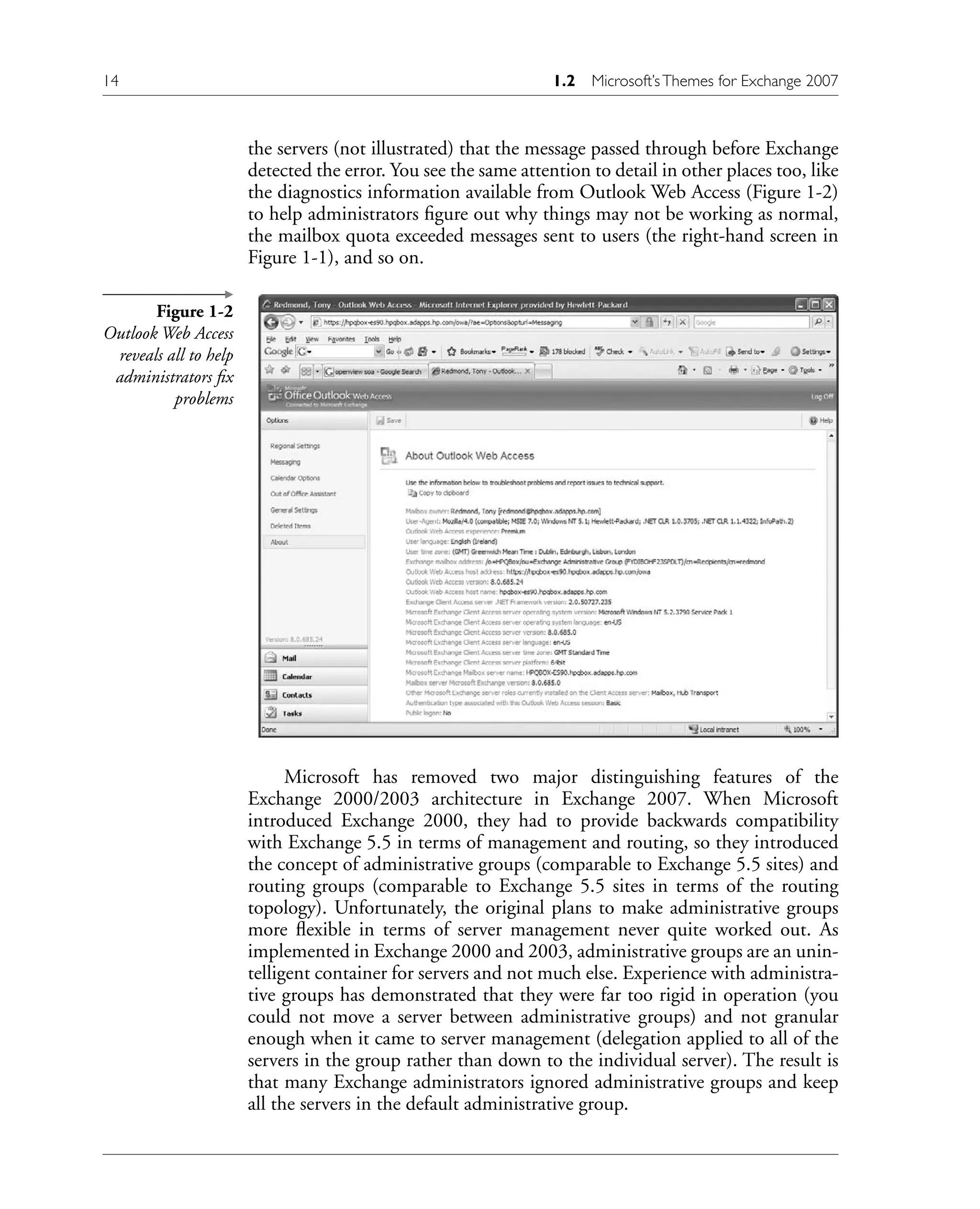
Figure 1-1
Some improved
system
messages from
Exchange 2007
Figure 1-1 illustrates an example of how Microsoft has made Exchange
2007 more manageable than any previous version. Users receive non-delivery
messages all the time, but the content of messages generated by older versions
is often not too helpful to the average user. Exchange 2007 generates messages
that are easy for users to understand what problem has occurred and include
some additional information for administrators to figure out why the problem
has occurred. For example, the bottom portion of the message shown in the
left-hand screen of Figure 1-1 includes the error text, and then a trace of all of
1.2 Microsoft’sThemes for Exchange 2007 13
the servers (not illustrated) that the message passed through before Exchange
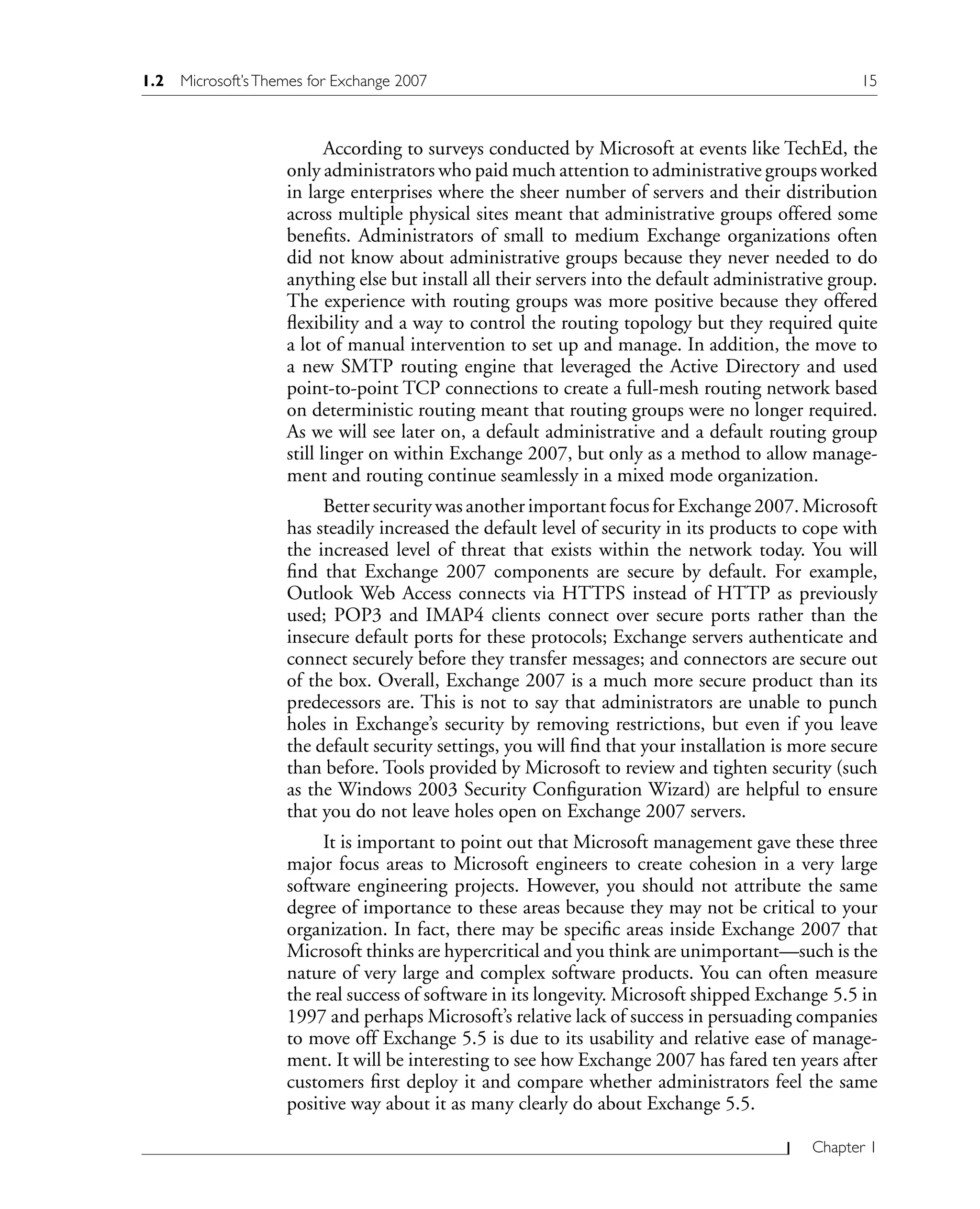
detected the error. You see the same attention to detail in other places too, like
the diagnostics information available from Outlook Web Access (Figure 1-2)
to help administrators figure out why things may not be working as normal,
the mailbox quota exceeded messages sent to users (the right-hand screen in
Figure 1-1), and so on.
Figure 1-2
Outlook Web Access
reveals all to help
administrators fix
problems
Microsoft has removed two major distinguishing features of the
Exchange 2000/2003 architecture in Exchange 2007. When Microsoft
introduced Exchange 2000, they had to provide backwards compatibility
with Exchange 5.5 in terms of management and routing, so they introduced
the concept of administrative groups (comparable to Exchange 5.5 sites) and
routing groups (comparable to Exchange 5.5 sites in terms of the routing
topology). Unfortunately, the original plans to make administrative groups
more flexible in terms of server management never quite worked out. As
implemented in Exchange 2000 and 2003, administrative groups are an unin-
telligent container for servers and not much else. Experience with administra-
tive groups has demonstrated that they were far too rigid in operation (you
could not move a server between administrative groups) and not granular
enough when it came to server management (delegation applied to all of the
servers in the group rather than down to the individual server). The result is
that many Exchange administrators ignored administrative groups and keep
all the servers in the default administrative group.
14 1.2 Microsoft’sThemes for Exchange 2007
Chapter 1
According to surveys conducted by Microsoft at events like TechEd, the
only administrators who paid much attention to administrative groups worked
in large enterprises where the sheer number of servers and their distribution
across multiple physical sites meant that administrative groups offered some
benefits. Administrators of small to medium Exchange organizations often
did not know about administrative groups because they never needed to do
anything else but install all their servers into the default administrative group.
The experience with routing groups was more positive because they offered
flexibility and a way to control the routing topology but they required quite
a lot of manual intervention to set up and manage. In addition, the move to
a new SMTP routing engine that leveraged the Active Directory and used
point-to-point TCP connections to create a full-mesh routing network based
on deterministic routing meant that routing groups were no longer required.
As we will see later on, a default administrative and a default routing group
still linger on within Exchange 2007, but only as a method to allow manage-
ment and routing continue seamlessly in a mixed mode organization.
Better security was another important focus for Exchange 2007. Microsoft
has steadily increased the default level of security in its products to cope with
the increased level of threat that exists within the network today. You will
find that Exchange 2007 components are secure by default. For example,
Outlook Web Access connects via HTTPS instead of HTTP as previously
used; POP3 and IMAP4 clients connect over secure ports rather than the
insecure default ports for these protocols; Exchange servers authenticate and
connect securely before they transfer messages; and connectors are secure out
of the box. Overall, Exchange 2007 is a much more secure product than its
predecessors are. This is not to say that administrators are unable to punch
holes in Exchange’s security by removing restrictions, but even if you leave
the default security settings, you will find that your installation is more secure
than before. Tools provided by Microsoft to review and tighten security (such
as the Windows 2003 Security Configuration Wizard) are helpful to ensure
that you do not leave holes open on Exchange 2007 servers.
It is important to point out that Microsoft management gave these three
major focus areas to Microsoft engineers to create cohesion in a very large
software engineering projects. However, you should not attribute the same
degree of importance to these areas because they may not be critical to your
organization. In fact, there may be specific areas inside Exchange 2007 that
Microsoft thinks are hypercritical and you think are unimportant—such is the
nature of very large and complex software products. You can often measure
the real success of software in its longevity. Microsoft shipped Exchange 5.5 in
1997 and perhaps Microsoft’s relative lack of success in persuading companies
to move off Exchange 5.5 is due to its usability and relative ease of manage-
ment. It will be interesting to see how Exchange 2007 has fared ten years after
customers first deploy it and compare whether administrators feel the same
positive way about it as many clearly do about Exchange 5.5.
1.2 Microsoft’sThemes for Exchange 2007 15
1.2.1 The happy prospect of a migration
I doubt that there is a single administrator of a messaging system in the
world who can honestly say that they enjoy the process of moving an email
system from one software version to another. Over the three generations of
Exchange, we have experienced relatively easy migrations, such as upgrading
servers from Exchange 5.0 to 5.5 or from Exchange 2000 to 2003. These
migrations required careful planning to ensure no disruption for users, but
the actual mechanics of the upgrade were simple and easy to perform because
there was no change to the fundamentals of Exchange—the operating sys-
tem, hardware, or internal architecture. On the other hand, some migrations
have caused massive upheaval because of the degree of change in those same
fundamentals. Upgrading an Exchange organization from 5.5 to 2000 was
not easy because of the requirement to install the Active Directory, which
required a change in the base platform from Windows NT to Windows 2000.
Administrators had enough of a steep learning curve to understand how Active
Directory worked, especially around security boundaries and replication,
and when you heaped the massive change in the Exchange architecture that
Microsoft introduced in Exchange 2000, you had a recipe for a many long
hours of work to plan, deploy, and support the migration. From Microsoft’s
perspective, their decision to use the Active Directory as the basic directory
service for Exchange 2000 and subsequent releases was a great move because
it forced many companies to introduce a corporate directory service long
before they might have wanted to do so. Any company that wanted to use
Exchange had to deploy the Active Directory first. The long-term effect is
that the Active Directory is an embedded part of the core IT for any company
who uses Exchange.
In the most part, we have mastered Active Directory now.While Exchange
2007 does not require disruption of the kind seen when you introduce a
new corporate directory that simply has to work before applications can func-
tion, it does include two huge changes. First, Exchange 2007 only runs on
64-bit Windows on x64 servers. Second, Microsoft has torn up the admin-
istrative model used in Exchange 2000 and 2003 in favor of a simplified
GUI for the management console and a whole new focus on a highly pro-
grammable scripting language implemented through a UNIX-like command
shell. Administrators therefore face the need to refresh their server hardware
inventory completely for both Exchange and Windows while at the same
time they need to learn a whole bag of new tricks to work with and manage
Exchange 2007.
The server refresh is not straightforward because you should not
simply replace 32-bit servers for 64-bit models on a one-for-one basis. Such
an approach could be an incredible waste of money and negate many of
the advantages of the new platform. Exchange 2007 is an opportunity to
completely revamp the original Active Directory and other base Windows
16 1.2 Microsoft’sThemes for Exchange 2007
Chapter 1
infrastructure components laid down to support Exchange 2000 and 2003
with the intention of simplifying the infrastructure through consolidation
of servers into a much smaller set of domain controllers, global catalog serv-
ers, DHCP servers, and the like. Consolidation is possible because a 64-bit
Windows server is able to handle much more work than its 32-bit counter-
parts are and additional cheap network capacity usually makes it possible to
bring the work to a smaller set of servers than to distribute it around the
network. For the same reason, the same kind of consolidation may be possible
with Exchange 2007. In one way, the introduction of server roles prompts you
to think about the number and function of servers to deploy for Exchange
2007. How many mailbox servers will you deploy? How many servers of the
other roles will you need and should you run multi-role servers or single-role
servers? For example, if you want to deploy CCR on MNS clusters, these
servers will be single-role mailbox servers whereas you can use LCR on multi-
role servers. How will you take advantage of the larger memory model to
support more mailboxes? How can you exploit SANs better to support the
data requirements for consolidated servers in a datacenter? Exchange 2007
requires more memory than ever before to compensate for a large reduction
in I/O operations. This leads to a dramatically different I/O profile in terms of
the demands that Exchange 2007 makes on storage subsystems. Large SANs
will be able to support more servers and you can build servers around newer
storage technologies that offer better performance and lower cost. There is
quite a bit of work to do to figure out the most appropriate configuration for
Exchange 2007 servers in any organization.
With so much upheaval caused by the transition to 64-bit servers, you
should take the opportunity to have a long hard look at the server and storage
infrastructure you use for Exchange 2003 and think about how you can con-
solidate to remove cost, complexity, and administrative overhead. You cannot
upgrade an Exchange 2003 server to Exchange 2007 server, so you have to use
the move mailbox function to get user data across to the new servers. With
this in mind, there is an obvious opportunity to plan for a smaller number of
mailbox servers that support larger user communities.
Another point that you should consider is whether the time is right for
you to virtualize some of your Windows infrastructure, including domain
controllers and Global Catalog servers. There is no doubt that virtual servers
will gradually replace physical servers over time in order to maximize the use
that we can get from increasingly powerful hardware. The capabilities of the
virtual server software that is available today are incredible, even if it is not all
from Microsoft. Virtual servers should definitely be on your agenda to sup-
port test servers at the very least, but it is now time to take a hard look at your
Windows servers to figure out what you can deploy on virtual servers and
what has to stay on physical servers.
Of course, server consolidation is not easy and you need to do a lot of
planning to make sure that you deploy and populate new servers with data
1.2 Microsoft’sThemes for Exchange 2007 17
without causing disruption to users. The end goal is worthwhile because fewer
servers are easier and cheaper to manage, so the lower operational costs may
pay for some or all of the overall migration effort.
The impact of the change in the administrative model is harder to pre-
dict. Some administrators will take to the Exchange Management Shell with
gusto and will become very comfortable with the 360+ new commands that
Microsoft has made available to manage Exchange 2007 through PowerShell.
Other administrators will be like lost lambs in a storm, wondering where
their familiar graphical management console has gone and struggling with
the syntax of the shell. To a large degree, the change is in terms of culture and
philosophy as well as technology, and it will take people time to adjust.
To return to the original point—migrations are not easy and we face
some big changes in Exchange 2007 that make the migration to this version
more difficult to plan for. However, the good thing is that careful planning,
attention to detail, and dedication to mastering the new technology will bring
success, albeit at the expense of a lot of time and effort.
1.3 Preparing for Exchange 2007
Because of its dependence on the Active Directory, just like Exchange 2000
and 2003, you have to prepare the forest and every domain that will host mail-
enabled objects before you can install Exchange 2007. Consult the Exchange
2007 documentation and the release notes to get the most up-to-date
information on what you need to do to install Exchange 2007. In general,
the major considerations that you need to incorporate into a deployment
plan are:
Ensure that the schema master, domain controllers, and Global
Catalogs in any domain that will support an Exchange 2007 server
runs Windows 2003 SP1, R2, or later. Exchange 2007 SP1 supports
Windows SP2, and R2 as well as Windows 2008.
If you want to run Exchange 2007 on Windows 2008 servers, you
have to deploy Exchange 2007 SP1. Windows 2008 supports IPv6,
but even if you want Exchange 2007 SP1 to use IPv6 on Windows
2008, you have to ensure that you install both the IPv4 and IPv6
network stacks because IPv4 is required for backwards compatibility.
The Unified Messaging server is the only Exchange 2007 component
that does not support IPv6, so you can only use IPv4 with this server.
Ensure that the Active Directory functional level for the forest
is Windows 2003. This is not a strict prerequisite. However,
I recommend that you move the forest to Windows 2003 functional
level before you deploy Exchange 2007.
n
n
n
18 1.3 Preparing for Exchange 2007
Chapter 1
Ensure that any legacy Exchange servers are running Exchange 2003
SP2 or Exchange 2000 SP3 with the post-SP3 update rollup (available
from Microsoft’s web site).3
No Exchange 5.5 servers can be in the
forest. Unless Microsoft supports you through a beta program, you
will have to remove and reinstall any servers that run beta versions of
Exchange 2007.
Ensure that you have a Global Catalog server in every Active Directory
site that you intend deploying an Exchange 2007 server. Note that
Exchange 2007 setup will fail if the Active Directory site contains a
Windows 2000 domain controller. You should upgrade these servers
to Windows 2003 SP1 (or later) before you deploy Exchange 2007.
The Exchange installation program checks every reachable domain
for the presence of the “Exchange Domain Servers” and “Exchange
Enterprise Servers” groups to determine if the domain needs to be
upgraded for SP1. If the groups are located, the domain must have a
Windows 2003 SP1 domain controller to proceed. There may be
cases when you have a domain that runs a legacy version of Windows
and does not need to support Exchange, yet these groups exist in the
domain. In this case, you can remove the groups to allow the Exchange
installation to proceed.
Run Setup /PrepareAD in the forest root to prepare the forest creating
forest-wide objects used by Exchange 2007.
Run Setup /PrepareSchema to extend the Active Directory schema to
support Exchange 2007. You need to take this step even if you have
extended the schema to support Exchange 2000 or 2003.
Run Setup /PrepareDomain for every domain in the forest that will
host mail-enabled objects.
Exchange 2007 SP1 does not amend the Active Directory schema but
you still have to do some preparatory work on Active Directory to
update ACLs to allow administrators to manage public folder objects.
It would be possible to apply the necessary permissions manually but
Microsoft believed that too much potential existed for error, so they
require you to run the /PrepareAD and /PrepareDomain steps even if
you have done this before for Exchange 2007.
If you are installing Exchange 2007 into an existing Exchange
2000/2003organization,youhavetorunSetupwiththe/PrepareLegacy
ExchangePermissions switch.
3. It is important that legacy Exchange servers run the latest service packs because this software includes the updates to
allow the Exchange System Manager console to deal with Exchange 2007 objects correctly.
n
n
n
n
n
n
n
1.3 Preparing for Exchange 2007 19
Install the first Exchange 2007 server into an Active Directory site
that is close (in network terms) to the site that supports the schema
master.
Exchange 2007 has its own SMTP stack, so you should remove the
standard Windows SMTP server or the SMTP server installed by IIS
before you install Exchange hub transport or Edge servers.
You can run ExBPA, the Exchange Best Practice Analyzer tool, to verify
that your organization is ready to deploy Exchange 2007. ExBPA performs
checks against the Active Directory, validates that you have the correct version
of software deployed on legacy servers, and generally checks that you will not
meet any surprises when you come to install your first Exchange 2007 server.
See Chapter 10 for more information on ExBPA.
It is important that servers run at least Windows 2003 SP1 because
Exchange 2007 depends on its notification mechanism to advise components
that an update has occurred in the Active Directory. In addition, Outlook
Web Access 2007 depends on improvements made in Windows 2003 SP1
to exploit a feature called VLV (Virtual List View) to perform more efficient
lookups against the GAL.
While you must install Exchange 2007 on new 64-bit servers, you do
not necessarily have to deploy 64-bit domain controllers and Global Catalog
servers, as Exchange is happy to use the Active Directory on 32-bit servers.
There is no doubt that 64-bit Windows servers are much more scalable than
their 32-bit equivalent, largely because they can cache even very large Active
Directory databases completely in memory and so improve performance for
applications that depend on the directory, like Exchange. It is a good idea to
plan for the introduction of 64-bit Windows servers to provide the essential
infrastructure to support Exchange 2007 and to deploy this infrastructure
well before you plan to install Exchange 2007, just to make sure that the sup-
porting infrastructure is fully bedded down.
1.4 Installing Exchange 2007
In some respects, the task of the engineers who created the Exchange 2007
setup program was simple. After all, because it is not possible to upgrade an
old 32-bit Exchange 2000 or 2003 server to Exchange 2007, they only had to
build a program to install Exchange on brand-new 64-bit servers, and concep-
tually, there is nothing easier than taking software off an installation kit and
arranging it across the available space on a disk. Of course, it is easy enough to
say, but difficult to do, especially when you want to create an installation pro-
cedure that is intelligent, robust, and difficult for administrators to make mis-
takes when they install Exchange. The latter point is important for Microsoft
n
n
20 1.4 Installing Exchange 2007
Chapter 1
because a good installation program reduces the number of support calls that
they receive, especially after the launch of a new version of a product. Support
costs are very expensive because they often require human intervention to
solve the reported problem.
The Exchange developers have done a good job with the Exchange 2007
installation program. A lot of intelligence is incorporated into the program
so that even before you begin to get near to installing Exchange, the program
does a comprehensive job of scanning the target server to ensure that you have
already installed all the pre-requisite software (such as PowerShell version 1.0,
version 2.0 of the .NET framework or later4
and MMC 3.0).
The Exchange setup program checks the Active Directory to ensure that
the schema is at the necessary version and that you have preformed the neces-
sary preparation work at the forest, domain, and organization level to be able
to install Exchange 2007. These checks are “hard” because you cannot pro-
ceed without addressing issues that the setup program flags. There is no way
to proceed with an installation and fix a notified problem afterwards. Unlike
other installations that tell you that something is wrong and then promptly
exit to leave the poor administrator to figure out how to fix the problem, a
strong point of Exchange 2007’s installation program is its integration with
Microsoft’s support network. When it detects a problem, the installation pro-
gram points you to the right web page to download the components that are
necessary to fix the problem. Of course, this will not do you much good if
you have to install Exchange 2007 in a secure location that is isolated from the
Internet, but it is great for the vast majority of installations.
4. Microsoft has some recommended patches for .NET 2.0 that you need to install on all Exchange 2007 servers. You don’t
need to install these patches if you install a subsequent version of .NET, but it is always worth checking to see if some
patches are available for any prerequisite software.
Figure 1-3
Installing
Exchange 2007
1.4 Installing Exchange 2007 21
The user interface that allows you to select the options for the installation
are well thought out and easy to follow. Figure 1-3 shows how you can select
a typical installation (install the hub transport, client access, and mailbox
roles, and the Exchange Management Console, Help files, and the Exchange
Management Shell extensions for PowerShell) or a customized installation.
If you select a customized installation, you can decide what roles to install on
a server and, if you want to create a mailbox server, whether you want to use
a cluster configuration. Custom installation is also the place to go when you
want to deploy an Edge server or Unified Messaging server.
Before beginning the actual installation, the program checks to see
whether any new best practice advice is available from Microsoft and down-
loads the advice if Microsoft has updated it since they built the installation
kit. This is a good example of how Microsoft is leveraging the investment that
they have made since 2003 in building intelligent analysis and reporting tools
for Exchange because the installation program can access the same knowledge
base as the Exchange Best Practice Analyzer to find out about non-software
items that have to be resolved before a successful installation can proceed. For
example, Figure 1-4 shows that an installation of an Edge server detected two
problems before proceeding. In both cases, the installation program can con-
nect you to a web page that contains the steps necessary to fix the problem.
In this case, because Microsoft designed the Edge server to operate within
the DMZ and because Exchange 2007 uses its own SMTP stack, it is neces-
sary to turn off the standard SMTP service that is part of IIS. If you install
a server that supports multiple roles, the installation program will determine
the order that it installs the roles. However, if you install a single-role server
and then decide to install other roles on that server, the suggested order to do
this is Client Access Server, Hub Transport, and Mailbox followed by Unified
Messaging if required.
Figure 1-4
An error
detected by the
Exchange 2007
setup program
22 1.4 Installing Exchange 2007
Chapter 1
Note that you must have at least one hub transport server in an Active
Directory site if the site supports a mailbox server. A mailbox server cannot
communicate on its own and needs the hub transport server to act as its
point of contact with the rest of the organization. A hub transport server is
also required if you deploy a Unified Messaging server. Exchange 2007 uses
server-side RPCs to connect servers together within the same site. Microsoft
has never optimized RPCs to work over extended WAN connections that you
might expect between Active Directory sites. For this reason, if you have an
Active Directory site that supports a small number of users, you will deploy
either a single multi-role server (mailbox, hub, and client access) or route
client connections to servers in another site.
Exchange 2007 supports command line installations if you do not like
the GUI. Command line installations are very useful if you want to use unat-
tended installations. You have to log onto the target server and then execute
Setup, passing the options that you want to use for the installation. For
example:
Setup.com /Mode:install /Roles:C, H, M /On:XYZ /dc:GC-
Dublin.xyz.com /EnableLegacyOutlook
/LegacyRoutingServer:Exch2003BHS /DisableErrorReporting
This command line tells the installation procedure to:
Install the Client Access, Hub Transport, and Mailbox roles in the
XYZ organization.
Use GC-Dublin.xyz.com as the domain controller.
Enable support for legacy Outlook clients (Outlook 2003 and previ-
ous). Essentially, this means that Exchange 2007 will install public
folders, as legacy clients are heavily dependent on public folders.
Create a routing group connector to link back to legacy Exchange
servers; the Exch2003BHS server is the bridgehead on the legacy side
of the connector.
Disable the option to report errors back to Microsoft for inclusion in
their quality improvement program (some companies have internal
rules that stop them reporting error data in this way).
Exchange 2007 also has the ability for an administrator to assign the
responsibility for completing the installation of a server to another user with
the /NewProvisionedServer command switch. In this scenario, an enterprise
administrator executes the heavily permissioned parts of the installation
n
n
n
n
n
1.4 Installing Exchange 2007 23
procedure to create the server object and add the delegated account to the
local administrators group on the target server. The delegated user account
is also added to the Exchange View Only administrators group. Effectively,
the enterprise administrator delegates enough authority to allow the des-
ignated user to run Setup to complete the actual creation of the physical
server (such as moving files to the right location on the disk, etc.). The other
user only has the necessary permission to be able to complete the installa-
tion of the designated server and can take no other action. See the section
on “Changes in the Exchange Delegation Model” in Chapter 3 for more
information.
Behind the scenes, the Exchange 2007 installation program writes
a vast amount of information into a set of log files that it creates in the
ExchangeSetupLogs directory on the drive that you use to install Exchange.
Amongst the files that you’ll find there are some PowerShell scripts (the exact
number depends on the kind of installation that you perform on the server)
that Exchange generates to install itself. Figure 1-5 shows an extract of a script
generated during the installation of the mailbox role on a server. You can see
commands to stop services that must not be running when Exchange is being
installed followed by commands to pre-compile the software components
used by Exchange.
Overall, Microsoft has done an excellent job to create a nice tool for
administrators in the Exchange 2007 installation program. Running the instal-
lation program should not cause many concerns for your deployment and may
be the easiest part of the process. Following the installation, you normally have
some work to do that is more complicated. For example, if you do not want to
Figure 1-5
Extract of a
PowerShell script
used to install
Exchange 2007
24 1.4 Installing Exchange 2007
Chapter 1
configure a routing group connector to link your first Exchange 2007 server
with a legacy organization during the installation, you could do it after you
have checked out the newly installed server and made sure that everything is
working as expected. Another task to support legacy clients is to configure the
Offline Address Book for legacy Outlook clients. Other tasks include making
sure that the Availability service is running smoothly, installing some anti-
virus software, setting up an Edge server, or even plunging into the new world
of Unified Messaging to allow Exchange users to access their mailbox through
the phone. We will get to all of these tasks later on in the book.
After you complete a server installation, you should consider running
the Microsoft Security Configuration Wizard (SCW) to harden the server.
Exchange 2007 includes support for SCW, so you can follow the directions
in the installation guide to run SCW and configure security for the differ-
ent server roles. Before you begin using SCW, you need to register the SCW
extensions for the server roles. You can do this with these commands. The
first command registers the extensions for any role except the Edge server; the
second registers the extension for the Edge server.
Scwcmd register /kbname:"Ex2007KB" /kbfile:"%programfiles%
MicrosoftExchange ServerscriptsExchange2007.xml"
Scwcmd register /kbname:"Ex2007EdgeKB"
/kbfile:"%programfiles%MicrosoftExchange Serverscripts
Exchange2007Edge.xml"
1.4.1 Modifying and removing servers
To modify or remove an existing Exchange 2007 server, you can use either the
Windows Control Panel (to add/remove software) or the ExSetup program,
which you will find in the Program FilesMicrosoftExchange ServerBin
directory. This program has several modes:
/Install: Add a new role to an existing Exchange 2007 server.
/Uninstall: Remove a role or a complete Exchange 2007 server. For
example, to remove the client access role from a server, use ExSetup
/Mode:Uninstall /Roles:CA
/Upgrade: Upgrade to a new release.
/Recover Server: Recover a server using the information about it stored
in the Active Directory.
/Clustered: Designate an active role in a cluster.
n
n
n
n
n
1.4 Installing Exchange 2007 25
1.4.2 Validating the installation
After the installation process checks, you may want to validate the installation
by testing that the installation procedure has generated a functioning Exchange
server. The installation procedure logs all of the operations that it performs
in the Exchange setup log file at C:ExchangeSetupLogsExchangeSetup.log.
It is certainly possible to review the setup log, but it is verbose in the level
of detail that it captures. You can filter the application event log for events
written by MSExchangeSetup and check for events 1000 (starting to install
a server role) and 1001 (successfully installed a server role). Alternately, you
can use a PowerShell script called Get-SetupLog.ps15
to parse the contents
of the setup log and report the entries found there. Figure 1-6 shows what
you can expect to see from both the Get-SetupLog script and the application
event log.
Of course, another way of looking at things is to say that you have not
installed a server until it works and that the only good test validates that the
server works in all its various roles. You can use some simple tests for this
purpose. First, use the Get-ExchangeServer PowerShell command to see
whether the output of the command includes the new server in the list of
Exchange servers in the organization. Second, log onto the server and use the
special test commands supported by the Exchange Management Shell work as
expected. You can find details of how to use these commands in Chapter 4.
5. Located in Program FilesMicrosoftExchange ServerScripts. You can find details of how to use the script inTechNet or
in the header of the script.
Figure 1-6
Checking the
installation log
26 1.4 Installing Exchange 2007
Chapter 1
1.4.3 Third party software
Migrations can only proceed at the pace of the slowest component and often
that slowest component is some essential piece of third party software that’s
used with Exchange in your production environment. Table 1-1 lists a repre-
sentative sample of third parties that engineer software that supports Exchange
2007 in some way. This list is likely to grow over time, so you should con-
sult the online list that Microsoft maintains at http://www.microsoft.com/
exchange/partners/default.mspx for the latest information. In addition, you
need to check with the vendor to ensure that they do not have any special
prerequisites for deployment alongside Exchange 2007, such as an inability
to support clusters, a requirement to deploy on a single role server, or
anything else.
Software Category Products
Anti-virus Microsoft ForeFront Security for Exchange,
TrendMicro, McAfee, Symantec, GFI,
Kasperski, Sophos, F-Secure
Archiving (compliance) HP, Commvault, Symantec,
Hummingbird, Mobius, Overtone,
Atempo, AXS-One, Zantaz
Content Filtering IXOS, Meridio
FAX gateways Fenestrae, GFI, Captaris, BNS Group
IP/PBX gateway Audiocodes, Dialogics
Line of Business Applications Newsgator (RSS), nCipher, K2 (workflow)
Management Quest Software, NetIQ, Computer
Associates, HP, Zenprise
Migration from legacy Exchange to
Exchange 2007
Quest Software
Mobile Clients and Management RIM (BlackBerry), Good (GoodLink)
Public folder migration Quest Software, Tzunami
Secure Messaging nCipher, RSA, CheckPoint
Storage (Backup, Disaster Recovery, High
Availability)
HP, NetApp, Hitachi, CommVault,
Symantec, Doubletake, Computer
Associates, UltraBack, F5, Teneros, Azaleos,
Cemaphore, Xiotech, Mimosa
Table 1-1 Representative sample of third party product support for Exchange 2007
1.4 Installing Exchange 2007 27
Exploring the Variety of Random
Documents with Different Content
But this was not enough. At the very time that these flourishing
churches were falling to the ground, the Reform witnessed the
extinction of its brightest lights. A blow from a stone had slain the
energetic Zwingle on the field of battle, and the rebound reached
the pacific Œcolampadius at Basle, in the midst of a life that was
wholly evangelical. The death of his friend, the severe judgments
with which they pursued his memory, the terror that had suddenly
taken the place of the hopes he had entertained of the future—all
these sorrows rent the heart of Œcolampadius, and soon his head
and his life inclined sadly to the tomb. "Alas!" cried he, "that
Zwingle, whom I have so long regarded as my right arm, has fallen
under the blows of cruel enemies!"[1250] He recovered, however,
sufficient energy to defend the memory of his brother. "It was not,"
said he, "on the heads of the most guilty that the wrath of Pilate and
the tower of Siloam fell. The judgment began in the house of God;
our presumption has been punished; let our trust be placed now on
the Lord alone, and this will be an inestimable gain." Œcolampadius
declined the call of Zurich to take the place of Zwingle. "My post is
here," said he, as he looked at Basle.
He was not destined to hold it long. Illness fell upon him in addition
to so many afflictions; the plague was in the city; a violent
inflammation attacked him,[1251] and erelong a tranquil scene
succeeded the tumult of Cappel. A peaceful death calmed the
agitated hearts of the faithful, and replaced by sweet, tranquil, and
heavenly emotions, the terror and distress with which a terrible
disaster had filled them.
On hearing of the danger of Œcolampadius, all the city was plunged
into mourning; a crowd of men of every age and of every rank
rushed to his house. "Rejoice," said the reformer with a meek look,
"I am going to a place of everlasting joy." He then commemorated
the death of our Lord with his wife, his relations, and domestics,
who shed floods of tears. "This supper," said the dying man, "is a
sign of my real faith in Jesus Christ my Redeemer."
DEATH OF
ŒCOLAMPADIUS.
On the morrow he sent for his colleagues: "My brethren," said he,
"the Lord is there; he calls me away. Oh! my brethren, what a black
cloud is appearing on the horizon—what a tempest is approaching!
Be steadfast: the Lord will preserve his own." He then held out his
hand, and all these faithful ministers, clasped it with veneration.
On the 23d November, he called his children
around him, the eldest of whom was barely three
years old. "Eusebius, Irene, Alethea," said he to
them, as he took their little hands, "love God who is your Father."
Their mother having promised for them, the children retired with the
blessing of the dying servant of God. The night that followed this
scene was his last. All the pastors were around his bed: "What is the
news?" asked Œcolampadius of a friend who came in. "Nothing,"
was the reply. "Well," said the faithful disciple of Jesus, "I will tell
you something new." His friends awaited in astonishment. "In a
short time I shall be with the Lord Jesus." One of his friends now
asking him if he was incommoded by the light, he replied, putting
his hand on his heart: "There is light enough here." The day began
to break; he repeated in a feeble voice the 51st Psalm: Have mercy
upon me, O Lord, according to thy loving kindness. Then remaining
silent, as if he wished to recover strength, he said, "Lord Jesus, help
me!" The ten pastors fell on their knees around his bed with uplifted
hands; at this moment the sun rose, and darted his earliest rays on
a scene of sorrow so great and so afflicting with which the Church of
God was again stricken.[1252]
The death of this servant of the Lord was like his life, full of light and
peace. Œcolampadius was in an especial degree the Christian
spiritualist and biblical divine. The importance he attached to the
study of the books of the Old Testament imprinted one of its most
essential characters on the reformed theology.[1253] Considered as a
man of action, his moderation and meekness placed him in the
second rank. Had he been able to exert more of this peaceful spirit
over Zwingle, great misfortunes perhaps might have been avoided.
But like all men of meek disposition, his peaceful character yielded
HENRY
BULLINGER.
CONTRITION OF
ZURICH.
too much to the energetic will of the minister of Zurich; and he thus
renounced, in part at least, the legitimate influence that he might
have exercised over the reformer of Switzerland and of the Church.
Zwingle and Œcolampadius had fallen. There was a
great void and great sorrow in the Church of Christ.
Dissensions disappeared before these two tombs,
and nothing could be seen but tears. Luther himself was moved. On
receiving the news of these two deaths, he called to mind the days
he had passed with Zwingle and Œcolampadius at Marburg; and the
blow inflicted on him by their sudden decease was such, that many
years after he said to Bullinger: "Their death filled me with such
intense sorrow, that I was near dying myself."[1254]
The youthful Henry Bullinger, threatened with the scaffold, had been
compelled to flee from Bremgarten, his native town, with his aged
father, his colleagues, and sixty of the principal inhabitants, who
abandoned their houses to the pillage of the Waldstettes.[1255]
Three days after this, he was preaching in the cathedral of Zurich:
"No! Zwingle is not dead!" exclaimed Myconius; "or, like the phœnix,
he has risen again from his ashes." Bullinger was unanimously
chosen to succeed the great reformer. He adopted Zwingle's orphan
children, Wilhelm, Regula, and Ulric, and endeavoured to supply the
place of their father. This young man, scarcely twenty-eight years of
age, and who presided forty years with wisdom and blessing over
this church, was everywhere greeted as the apostle of Switzerland.
[1256]
Yet as the sea roars long after the violent tempest
has subsided, so the people of Zurich were still in
commotion. Many were agitated from on high.
They came to themselves; they acknowledged their error; the
weapons of their warfare had been carnal; they were now of a
contrite and humble spirit; they arose and went to their Father and
confessed their sin. In those days there was a great mourning in
Zurich. Some, however, stood up with pride, protested by the mouth
CONCLUSION.
of their ministers against the work of the diplomatists, and boldly
stigmatized the shameful compact. "If the shepherds sleep, the dogs
must bark," exclaimed Leo Juda in the cathedral of Zurich. "My duty
is to give warning of the evil they are about to do to my Master's
house."[1257]
Nothing could equal the sorrow of this city, except the exultation of
the Waldstettes. The noise of drums and fifes, the firing of guns, the
ringing of bells, had long resounded on the banks of their lakes, and
even to their highest valleys. Now the noise was less, but the effect
greater. The Five Cantons, in close alliance with Friburg and Soleure,
formed a perpetual league for the defence of the ancient christian
faith with the Bishop of Sion and the tithings of the Valais; and
henceforward carried their measures in the federal affairs with
boldness. But a deep conviction was formed at that period in the
hearts of the Swiss Reformed. "Faith comes from God," said they;
"its fortune does not depend on the life or death of a man. Let our
adversaries boast of our ruin, we will boast only in the Cross."[1258]
"God reigns," wrote Berne to Zurich, "and he will not permit the bark
to founder." This conviction was of more avail than the victory of
Cappel.
Thus the Reformation, that had deviated from the
right path, was driven back by the very violence of
the blow into its primitive course, having no other
power than the Word of God. An inconceivable infatuation had taken
possession of the friends of the Bible. They had forgotten that our
warfare is not carnal; and they had appealed to arms and to battle.
But God reigns: he punishes the churches and the people who turn
aside from his ways. We have thus taken a few stones, and piled
them as a monument on the battle-field of Cappel, in order to
remind the Church of the great lesson which this terrible catastrophe
teaches. As we bid farewell to this sad scene, we inscribe on these
monumental stones, on the one side, these words from God's Book:
"Some trust in chariots, and some in horses: but we will remember
the name of the Lord our God. They are brought down and fallen:
but we are risen and stand upright." And on the other, this
declaration of the Head of the Church: "My kingdom is not of this
world." If, from the ashes of the martyrs at Cappel, a voice could be
heard, it would be these very words of the Bible that these noble
confessors would address, after three centuries, to the Christians of
our days. That the Church has no other king than Jesus Christ; that
she ought not to meddle with the policy of the world, derive from it
her inspiration, and call for its swords, its prisons, its treasures; that
she will conquer by the spiritual powers which God has deposited in
her bosom, and, above all, by the reign of her adorable Head; that
she must not expect upon earth thrones and mortal triumphs; but
that her march is like that of her King, from the manger to the cross,
and from the cross to the crown:—such is the lesson to be read on
the blood-stained page that has crept into our simple and
evangelical narrative.
But if God teaches his people great lessons, he also gives them great
deliverances. The bolt had fallen from heaven. The Reformation
seemed to be no more than a lifeless body cumbering the ground,
and whose dissevered limbs were about to be reduced to ashes. But
God raises up the dead. New and more glorious destinies were
awaiting the Gospel of Jesus Christ at the foot of the Alps. At the
south-western extremity of Switzerland, in a great valley which the
white giant of the mountains points out from afar; on the banks of
the Leman lake, at the spot where the Rhone, clear and blue as the
sky above it, rolls its majestic waters; on a small hill that the foot of
Cæsar had once trod, and on which the steps of another conqueror,
of a Gaul, of a Picardine[1260] were destined ere long to leave their
ineffaceable and glorious traces, stood an ancient city, as yet
covered with the dense shadows of Popery; but which God was
about to raise to be a beacon to the Church, and a bulwark to
Christendom.
END OF THE FOURTH VOLUME.
VALUABLE BOOKS
PUBLISHED BY
R. CARTER, 58 CANAL STREET, N.Y.,
AND
56 MARKET STREET, PITTSBURG.
HORNE'S INTRODUCTION.
An Introduction to the Critical Study and Knowledge of the Holy
Scriptures. By Thomas Hartwell Horne, B.D. New Edition,
corrected and enlarged. Illustrated with numerous Maps and
Fac-similes of Biblical Manuscripts. 2 vols. imperial 8vo. Price
only $3 50.
"Mr. Carter has issued an edition of Horne's Introduction, which
he offers at the astonishingly low price of $3 50—for the two
volumes! Truly the scholar's millenium has well nigh come.
Those who have paid twenty dollars for it, in four volumes, will
hardly understand by what process such a massive work can be
so cheaply furnished. It is a reprint from the last London edition,
with Dr. Horne's latest additions and corrections, containing all
the maps and illustrative engravings.
"To commend Horne's Introduction to the clergy or other
students of the sacred oracles, would be 'carrying coals to
Newcastle.' It has long been regarded as an indispensable work
for a theological library, and has acquired among Biblical
scholars—at least English scholars—a deservedly high repute. It
is a work of gigantic labour. The results of the research and
erudition of Biblical scholars of all countries, and in all time, are
faithfully garnered, and, on the whole, well digested."—N.Y.
Evangelist.
D'AUBIGNE'S REFORMATION.
Authorized edition.
THE ISRAEL OF GOD.
A Series of Practical Sermons. By Stephen H. Tyng, D.D., Rector of
St. George's Church, New-York. 1 vol. 8vo. Price $1 00.
"The fair sheet on which they are printed, with its wide margin
and handsome type, attracts and pleases the eye; while the
Scripture truth and holy sentiment which glow through their
transparent style, delight and improve the heart. The subjects
are all of an eminently spiritual character, relating to the new
birth, and the sanctification of the soul. They are treated with
no effort for the display of talent, but with a manifest and most
earnest desire to do good. The diction is polished and slightly
embellished, ranging between the neat and elegant; the method
is always clear, and the argument cogent."—Recorder.
ANCIENT HISTORY.
Containing the History of Egyptians, Assyrians, Chaldeans, Medes,
Lydians, Carthagenians, Persians, Macedonians, the Selucidæ in
Syria, and Parthians, from Rollin and other authentic sources,
both ancient and modern. Republished from the work of the
London Religious Tract Society. 4 vols. 12mo. Price only $2 00.
"This history is not a servile copy from any other, but has a
delightful freshness about it, the borrowed parts being re-
written, and cast into a new form, on such principles of
selection and arrangement, as favour perspicuity, and assist the
memory. Instead of being lost in a chaos of materials, the
reader is carried along in a plain path through well assorted and
happily adjusted facts, cheered by a vivacity which keeps him
interested. God is not excluded from the world which he
created, nor is his interposition in the affairs of men overlooked.
For common use we think it deserves to supersede all that have
gone before it."—Portland Christ. Mirror.
CHALMERS' ROMANS.
Lectures on the Epistle of Paul to the Romans. By Thomas Chalmers,
D.D. and LL.D. 1 vol. 8vo. Fourth Thousand. Price $1 50.
"Of the Theological writers, who have written in our language,
and belong to this generation, Dr. Chalmers is unquestionably
the strongest. It will gratify many that so able a writer, and so
just a Theologian, has given the world an analysis of this
Epistle. It is written in the terse and manly style of the author,
but with no inflation of words or fancy. It is written also with
great candour, and with no display of controversial argument."—
Daily Chronicle.
CHALMERS' SERMONS.—COMPLETE.
The entire Sermons and Discourses of Thomas Chalmers, D.D., &c.
in 2 vols. 8vo.—uniform with his "Lectures on the Romans."
Nearly one-half of this work has never before been published in
this country. Price $2 50.
CHALMERS' NATURAL THEOLOGY.
2 vols. 12mo. Price only $1 00.
☞ This Work has been introduced as a Text Book into the University
of New-York, and several other institutions of a similar kind.
"The reputation of Dr. Chalmers stands high—too high to be
affected by the opinions of ordinary men. As a literary man and
a man of science—as a Christian and a Theologian—as a
profound thinker and powerful writer—as an expositor of
fundamental truth in Divinity and philosophy, and a practical
man in the various departments of Christian labour—he has no
superior."—Boston Recorder.
CHALMERS'
EVIDENCES OF CHRISTIANITY.
The miraculous and internal evidences of the Christian Revelation,
and the authority of its records. By Thomas Chalmers, D.D. and
LL.D. 2 vols. 12mo. Price $1 00.
HORNE'S
COMMENTARY ON THE PSALMS.
With an Introductory Essay by the Rev. Edward Irving. Price $1 50.
DAVIES' SERMONS.
Sermons on Important Subjects. By the Rev. Samuel Davies, A.M.,
President of the College of New Jersey. With an Essay on the
Life and Times of the Author. By Albert Barnes. Stereotype
edition, containing all the Author's Sermons ever published. 3
vols. Price $1 50.
BROWN'S LARGE CATECHISM.
An Easy, plain, practical and extensive explication of the Assembly's
Shorter Catechism. By John Brown, late Minister of the Gospel
at Haddington. 1 vol. 12mo. Price 63 cents.
THE HISTORY OF THE CHURCH OF SCOTLAND.
From the earliest date down to the present time, containing a full
and graphic description of the Disruption in 1843. By the Rev.
W. M. Hetherington, author of "The Minister's Family," "History
of the Westminster Assembly of Divines," &c. 1 vol. 8vo. Price
$1 50.
OWEN ON SPIRITUAL MINDEDNESS.
The Grace and Duty of being Spiritually Minded. By John Owen, D.D.
1 vol. 12mo. Price only 38 cents.
WORKS OF THE REV. JOHN NEWTON.
Containing an Authentic Narrative, &c.; Letters on Religious
Subjects, Cardiphonia, Discourses intended for the Pulpit,
Sermons preached in the Parish of Olney, A Review of
Ecclesiastical History, Olney Hymns, Poems, Messiah, Occasional
Sermons, and Tracts. To which are prefixed Memoirs of his Life,
by the Rev. Richard Cecil, A.M. 2 vols. 8vo. Price $2 50.
WORKS OF THE REV. RICHARD CECIL.
3 vols. 12mo. Price $2 00 Contents: Vol. I. Sermons—Vol. II.
Miscellanies—Vol. III. Remains.
"It is not easy to say whether these works discover the finer
mind or heart; but certain it is that they unite both in a very
uncommon degree. Cecil was one of the most gifted and
heavenly-minded men of which the Church of England, or any
other church, can boast; and though his mind was peculiarly
constituted, the highest and the lowest are alike sensible of the
charm that belongs to his productions, and of the power that
dwells in them. His writings possess the attribute of being
remarkably suggestive—a single half page will often supply
materials for long-continued meditation."—Citizen.
CHRISTIAN RETIREMENT;
On the Spiritual Exercises of the Heart. By the author of "Christian
Experience." 12mo.
THE LIFE AND POWER OF TRUE
GODLINESS.
By the Rev. Alexander McLeod, D.D. With an Introductory Essay by
his son, John Neil McLeod, D.D. 12mo. 75 cts.
THE LORD OUR SHEPHERD:
An Exposition of the Twenty-Second Psalm. By the Rev. John
Stevenson, author of "Christ on the Cross." 12mo. 75 cts.
THE POOR MAN'S MORNING PORTION.
Being a selection of a Verse of Scripture, with Short Observations,
for every Day in the Year. By Robert Hawkes, D.D. 12mo. 75 cts.
SCRIPTURE NARRATIVES.
Illustrated and Improved. By the Rev. Joseph Belcher, D.D. 1 vol.
12mo. Price 37½ cts.
ESSAYS ON EPISCOPACY,
And the Apology for Apostolic Order Reviewed. By the late John M.
Mason, D.D. Edited by the Rev. Ebenezer Mason. 1 vol. 12mo.
Price 50 cts.
ESSAYS ON THE CHURCH OF GOD.
By the late John M. Mason, D.D. Edited by the Rev. Ebenezer Mason.
1 vol. 12 mo. Price 50 cts.
LUTHER ON GALATIANS.
A Commentary on the Galatians. By Martin Luther. A New Edition, On
fine paper and beautiful large type. 1 vol. 8vo. Price only $1 50.
THE CHRISTIAN YOUTH'S BOOK,
A Manual for Young Communicants. By Rev. Dr. Brownlee. 1 vol.
12mo. Price 50 cts.
MOFFATT'S SOUTHERN AFRICA.
Missionary Labours and Scenes in Southern Africa. By Robert
Moffatt; twenty-three years an Agent of the London Missionary
Society in that continent. 1 vol. 12mo. Price 50 cents.
"We have read the whole of this large volume with undiminished
interest, and have found it replete with missionary information,
given in an unpretending, but strong and clear style. The
narrative is enriched with descriptions of African scenery; with
the employments, habits, and pursuits of the native tribes; their
dangers from lions and other beasts of prey, and the wars and
massacres of the roving bands of marauders, in their desolating
excursions, from place to place."—For. Miss.
ORIGIN AND HISTORY OF MISSIONS.
A Record of the Voyages, Travels, Labours, and Successes of the
various Missionaries, who have been sent forth by Protestant
Societies to Evangelize the Heathen; compiled from authentic
Documents, forming a Complete Missionary Repository.
Illustrated by twenty-five Engravings on steel. By the Rev. J. O.
Choules and the Rev. Thomas Smith. Seventh Edition. 2 vols.
4to., beautifully bound in full cloth. Price only $4 50.
"A new edition of this great work has just been issued by Mr.
Carter, in two quarto volumes, in handsome style, with a large
number of very fine engravings, illustrating scenes, manners
and customs, in the heathen world; and we desire to call the
attention of those interested in missions to this publication. It is
the most extensive and complete history of missions which has
been prepared, and contains a mass of important and
interesting information, which would not be readily found
elsewhere. For a family book, one to which the children will
resort to find striking facts and interesting narratives, and for
the clergyman, who wishes to have a store-house, to which he
may always refer for valuable materials, these volumes will be
found most happily adapted."—Advocate.
THE BRITISH PULPIT.
Consisting of Discourses by the most eminent living divines, in
England, Scotland, and Ireland; accompanied with Pulpit
Sketches. By the Rev. W. Suddards, rector of Grace Church,
Philadelphia. 2 vols. 8vo. Price $2 50.
"The sermons may be regarded as among the very best
specimens of the modern British pulpit; and indeed the work
includes almost every distinguished name to be found in any of
the Evangelical denominations in Great Britain. It is of course,
pervaded by a great variety of taste and talent, and is for this
very reason the better adapted to gain extensive circulation and
to be eminently useful."—Argus.
CONNECTION OF
SACRED AND PROFANE HISTORY.
Being a Review of the principal Events in the World, as they bear
upon the state of Religion, from the close of the Old Testament
History, till the establishment of Christianity. By D. Davidson. 3
vols. 12mo. Price $1 50.
"This work is well executed, and is, we think, calculated to
become popular. The historical plan is clear and unique, and the
style is singularly attractive, on account of its purity and
strength. It is constructed upon a Christian basis, recognizing
the fact, that although the superintending power of God over
the progress of nations, may be as untraceable as his paths in
the ocean, yet the effects are everywhere visible, and manifest
the progressive fulfilment of the prophetic denunciations and
promises set forth in the Holy Oracles."—Protestant Churchman.
MEMOIR OF REV. HENRY MARTIN,
Late Chaplain to the East India Company. By the Rev. John Sargent,
M.A. Fifth American, from the tenth London Edition. 12mo. Price
50 cents.
CHRISTIAN CABINET LIBRARY.
These volumes are printed on white paper and good type, and are
neatly bound in cloth, gilt backs, 18mo.
OLD HUMPHREY'S ADDRESSES.
Fourth Edition.
OLD HUMPHREY'S OBSERVATIONS.
Fifth Edition.
THOUGHTS FOR THE THOUGHTFUL.
By Old Humphrey. Fourth Edition.
"Here good sense and good humour are most wonderfully and
most happily blended. The lessons, too, are eminently
experimental and practical."—Christ. Reflector.
WALKS IN LONDON,
And its Neighbourhood. By Old Humphrey. Third Edition.
HOMELY HINTS
To Sabbath School Teachers. By Old Humphrey. Second Edition.
MY GRANDPARENTS:
My Grandmother Gilbert, and my Grandfather Gregory. By Old
Humphrey.
STROLLS IN THE COUNTRY.
By Old Humphrey.
THE OLD SEA CAPTAIN.
By Old Humphrey.
MEDITATIONS AND ADDRESSES
On the Subject of Prayer. By the Rev. Hugh White, A.M. Fourth
American, from the tenth Dublin Edition.
THE BELIEVER:
A Series of Discourses. By the Rev. Hugh White, A.M. Second
American, from the seventh Dublin Edition.
LUCILLA;
Or, the Reading of the Bible. By Adolphe Monod. Second Edition.
TALES OF THE SCOTTISH
COVENANTERS.
By Robert Pollok, A.M., author of the "Course of Time."
A BOOK FOR THE SABBATH.
In Three Parts.—I. The Origin, Design, and Obligation of the
Sabbath. II. Practical Improvement of the Sabbath. III.
Devotional Exercises for the Sabbath. By the Rev. J. B.
Waterbury, author of the "Advice to a Young Christian," &c.
THE FAMILY OF BETHANY.
By L. Bonnet. With an Introductory Essay, by Rev. Hugh White.
Fourth American, from the eighth London Edition.
"This book leads us, as with an angel's hand, through some of
the most interesting scenes in the life of the Saviour of the
world. It is full of evangelical truth, of glowing imagery, of living,
breathing devotion. We recommend it for its intellectual as well
as its moral and spiritual qualities."—Albany Argus.
THE RETROSPECT;
Or, Review of Providencial Mercies. With Anecdotes of Various
Characters. By Aliquis, formerly a Lieutenant in the Royal Navy,
and now a Minister of the English Church. Third American from
the eighteenth London edition.
"The great popularity of this volume appears from the large
number of editions through which it has passed in Great Britain
in a short number of years, having now reached the 17th
edition, and proofs of its usefulness have not been wanting. We
can assure our readers that there are few works of the kind so
deeply interesting, or so well adapted to religious edification.
We cordially recommend it."—Chris. Int.
THE MARTYR LAMB;
Or, Christ the Representative of his People in all Ages. By F. W.
Krummacher, D.D., author of "Elijah the Tishbite," &c. Fourth
Edition.
ELIJAH THE TISHBITE.
By F. W. Krummacher.
"Our author is characterized by a glowing and imaginative style,
which seems to be the expression of a heart warmed by piety,
and susceptible of the tenderest emotions. He displays a happy
tact, in developing, in the most pleasing manner, the
circumstances of a scriptural incident or character, and of
deriving from it practical lessons."—Presbyterian.
McCRIE ON ESTHER.
Lectures on the Book of Esther. By the Rev. Thomas McCrie, D.D.,
author of "Life of John Knox," &c.
A TREATISE ON PRAYER;
>Designed to assist in the devout discharge of that duty. By the Rev.
Edward Bickersteth.
MICHAEL KEMP,
The Happy Farmer's Lad. A Tale of Rustic Life, illustrative of the
Scriptural Blessings and Temporal Advantages of Early Piety. By
Anne Woodrooffe. Second Edition.
"Thoroughly and intensely have we read this book, 'because,' as
Talbot said of Boswell's Life of Johnson, 'we couldn't help it.' We
were struck with the ingenuous disposition and firm principles of
Michael, and we wished to see how they would bear him
through trying scenes. So much for the interest which the story
excites; the other merits of the book are not inferior."—Baptist
Advocate.
COMFORT IN AFFLICTION.
A Series of Meditations. By the Rev. James Buchanan, one of the
Ministers of the High Church, Edinburgh. From the ninth Edinb.
Edition.
LIGHTS & SHADOWS OF SCOTTISH LIFE.
By Professor Wilson. 18mo.
MEMOIR OF MARY LUNDIE DUNCAN.
Second American Edition. 18mo.
PRACTICAL REFLECTIONS.
On the Second Advent. By the Rev. Hugh White, A.M. 18mo.
PERSUASIVES TO EARLY PIETY.
By the Rev. J. G. Pike.
DODDRIDGE'S RISE AND PROGRESS.
Rise and Progress of Religion in the Soul. Illustrated in a Course of
Serious and Practical Addresses, suited to persons of every
character and circumstance, with a Devout Meditation or Prayer
subjoined to each chapter. By Philip Doddridge, D.D.
THE COTTAGE FIRESIDE;
Or, the Parish Schoolmaster. By the Rev. Henry Duncan, D.D.
"This is a reprint of a Scotch work, by a clergyman of high
standing, who does not now for the first time appear as an
author. The narrative is constructed with great beauty, and is
designed at once to illustrate and remedy some of the principal
evils connected with domestic education. The work may very
properly occupy the attention both of parents and children; and
it will be read with pleasure by all who can relish the simple and
beautiful in thought and expression."—Argus.
THE CHRISTIAN CONTEMPLATED,
In a Course of Lectures delivered in the Argyle Chapel, Bath. By Rev.
William Jay. New Edition.
"It has all the peculiar marks of Jay's mind; perspicuity of
arrangement, simplicity and occasional elegance of diction,
deep-toned piety and copiousness of sentiment. In
recommending such a book we are conscious of doing a service
to the cause of piety, by promoting the spiritual-mindedness,
and consistent, symmetrical conduct of every Christian who
prayerfully peruses it."—Baptist Advocate.
WORKS OF REV. HENRY SCOUGAL.
Containing the Life of God in the Soul, &c.
DEW OF ISRAEL,
And the Lily of God; or, a Glimpse of the Kingdom of Grace. By F. W.
Krummacher, D.D. Second American, from the second London
Edition.
CHRISTIAN FRAGMENTS;
Or, Remarks on the Nature, Precepts, and Comforts of Religion. By
John Burns, M.D., F.R.S., Regius Professor of Surgery in the
University of Glasgow, &c. &c.
"The different pieces constitute so many distinct, though
sometimes brief, disquisitions upon scriptural topics, and are
designed to promote the spiritual-mindedness of the reader.
They were written under the pressure of deep affliction, and in
view of an approaching judgment. They display sound thought,
evangelical sentiment, correct doctrine, and an elevated tone of
Christian feeling."—Advocate.
CHRISTIAN FATHER AT HOME;
Or, a Manual of Parental Instruction. By W. C. Brownlee, D.D.
A GLIMPSE INTO
THE WORLD TO COME,
In a Waking Dream. By the late George B. Phillips. With Extracts,
illustrative of his Spiritual Progress; and a Brief Memoir, by Mrs.
Duncan, author of "Memoir of Mrs. Mary Lundie Duncan," &c.
"This is altogether an extraordinary production. The small
portion of it which gives it its title, is a strain of fervent pious
imaginings, based however upon the oracles of God. One
cannot easily read it without gaining a more deep and solid
impression of the other world."
INFANT PIETY.
A Book for Little Children. By Baptist W. Noel, M.A.
"In this volume one of the finest spirits in the established church
of England gives us a simple record of the pious lives and happy
deaths of several little children on both sides of the Atlantic. The
work is well adapted to accomplish the benevolent design of its
author, by leading little children to remember their Creator."—
Albany Evening Journal.
A MEMOIR OF JOHN HUSS.
Translated from the German.
"To many who are familiar with the life of Martin Luther, that of
John Huss, who preceded him, and prepared the German mind
for his more extended labours, is comparatively little known.
The true character of Romanism is displayed in the treatment of
each, but some of the darkest shades are seen in the case of
Huss."—Baptist Advocate.
HELEN OF THE GLEN.
A Tale of the Scottish Covenanters. By Robert Pollok, A.M.
THE PERSECUTED FAMILY.
By Pollok.
RALPH GEMMELL.
By Pollok.
JESSY ALLAN,
The Lame Girl. By Grace Kennedy, author of "Anna Ross," &c.
"It is an affecting tale, and strikingly illustrates the power of
religion, and its full adequacy to human wants in every
emergency."—Christian Mirror.
SINNER'S FRIEND.
From the eighty-seventh London Edition, completing upwards of half
a million.
☞ This little Work has been translated into sixteen different
languages.
"It is designed by its direct appeals, to arrest the attention of
the most careless reader, and to pour into his ear some word of
truth before he can become fatigued with reading."—
Presbyterian.
"It is fitted to be an admirable auxiliary to ministers in the
discharge of their duty."—Albany Daily Advertiser.
DECAPOLIS;
Or, the Individual Obligations of Christians to save Souls from Death.
An Essay. By David Everard Ford. Fifth American, from the sixth
London Edition.
"This book is an exhortation to Christians, and Christian
ministers, to exercise greater faithfulness in saving souls from
eternal death. We have read it with much pleasure, and we
hope with some profit. The book is most beautifully got up; and
we could wish that it might be read and pondered by every one
who indulges a hope that he is a Christian."—N. Y. Evangelist.
SHORTER CATECHISM.
Anecdotes Illustrative of the Shorter Catechism. By John Whitecross.
New Edition.
"This will relieve the catechism of a difficulty which many have
felt in respect to it—that it is too abstract to be comprehended
by the mind of a child; here every truth is seen in its practical
relations, and becomes associated in the mind with some
interesting fact which is fitted at once to make it plain to the
understanding, to lodge it in the memory, and to impress it
upon the heart."—Daily Advertiser.
MEMOIR OF JOHN D. LOCKWOOD.
Being Reminiscences of a Son by his Father.
"A gifted mind and cultivated powers, hallowed and controlled
by a sweet and trustful piety; the simplicity of childhood
mingled with the seriousness and discretion of mature age,—we
are sure no one could watch his brief career, terminating in a
death, though sudden, not unprepared for, without deep
interest. We have read it with unmingled pleasure and profit."—
N. Y. Evangelist.
PERFECT PEACE.
Letters Memorial of John Warren Howell, Esq., of Bath, M. R. C. S.
By the Rev. David Pitcairn. With an Introduction by the Rev.
John Stevenson, author of "Christ on the Cross," "The Lord our
Shepherd", &c.
PROFESSION IS NOT PRINCIPLE;
Or the Name of Christian is not Christianity. By Grace Kennedy,
author of "Jessy Allan," "Anna Ross," &c.
GOSPEL PROMISES.
Being a Short View of the Great and Precious Promises of the
Gospel. By the Rev. Joseph Alleine, author of "An Alarm to the
Unconverted," &c.
LIFE IN EARNEST.
Six Lectures on Christian Activity and Ardour. By the Rev. James
Hamilton, author of "Harp on the Willows," &c.
MY GRANDMAMMA GILBERT.
By Old Humphrey.
MY GRANDFATHER GREGORY.
By Old Humphrey.
MEMOIR OF HANNAH SINCLAIR.
By the late Rev. Legh Richmond. From the nineteenth London
Edition.
TRUE HAPPINESS;
Or, the Excellence and Power of Early Religion. By J. G. Pike, author
of "Persuasives to Early Piety," &c. Second Edition.
CHARLIE SEYMOUR;
Or, the Good Aunt and the Bad Aunt. By Miss Catharine Sinclair,
author of "Modern Accomplishments," &c. Third Edition.
LIVE WHILE YOU LIVE.
By the Rev. Thomas Griffith, A.M., Minister of Ram's Episcopal
Church, Homerton.
CROOK IN THE LOT;
Or, a Display of the Sovereignty and Wisdom of God in the Afflictions
of Men, and the Christian's Deportment under them. By the Rev.
Thomas Boston.
A TRIBUTE OF PARENTAL AFFECTION.
To the Memory of my beloved and only Daughter, Hannah Jerram,
with a Short Account of the last Illness and Death of her elder
Brother, Charles Stranger Jerram. By the Rev. Charles Jerram,
A.M., Vicar of Cobham, Surrey. From the fifth London Edition.
THE LORD'S SUPPER.
Bickersteth's Treatise on the Lord's Supper. With an Introduction,
Notes, and an Essay. By G. T. Bedell, D.D. Fifth Edition.
COMMUNICANT'S COMPANION.
By the Rev. Matthew Henry. With an Introductory Essay, by the Rev.
John Brown of Edinburgh.
BAXTER'S CALL.
Now or Never, &c. With an Introductory Essay, by Dr. Chalmers.
RELIGION AND ETERNAL LIFE;
Or, Irreligion and Eternal Death. By J. G. Pike.
THE FARMER'S DAUGHTER.
A Tale. By Mrs. Cameron.
LIFE OF REV. JOHN NEWTON.
Written by himself, and continued to his Death. By the Rev. Rich.
Cecil.
THE HARP ON THE WILLOWS.
Remembering Zion, Farewell to Egypt, The Church in the House, The
Dew of Hermon, and the Destination of the Jews. By the Rev.
Jas. Hamilton, of London. From the forty-fifth London Edition.
SABBATH MUSINGS.
By Caroline Fry.
Welcome to our website – the perfect destination for book lovers and
knowledge seekers. We believe that every book holds a new world,
offering opportunities for learning, discovery, and personal growth.
That’s why we are dedicated to bringing you a diverse collection of
books, ranging from classic literature and specialized publications to
self-development guides and children's books.
More than just a book-buying platform, we strive to be a bridge
connecting you with timeless cultural and intellectual values. With an
elegant, user-friendly interface and a smart search system, you can
quickly find the books that best suit your interests. Additionally,
our special promotions and home delivery services help you save time
and fully enjoy the joy of reading.
Join us on a journey of knowledge exploration, passion nurturing, and
personal growth every day!
ebookbell.com

Microsoft Exchange Server 2007 With Sp1 Tony Redmonds Guide To Successful Implementation Tony Redmond

  • 1.
    Microsoft Exchange Server2007 With Sp1 Tony Redmonds Guide To Successful Implementation Tony Redmond download https://ebookbell.com/product/microsoft-exchange- server-2007-with-sp1-tony-redmonds-guide-to-successful- implementation-tony-redmond-2204706 Explore and download more ebooks at ebookbell.com

  • 2.
    Here are somerecommended products that we believe you will be interested in. You can click the link to download. Tony Redmonds Microsoft Exchange Server 2003 With Sp1 Tony Redmond Auth https://ebookbell.com/product/tony-redmonds-microsoft-exchange- server-2003-with-sp1-tony-redmond-auth-4411656 Microsoft Exchange Server 2007 With Sp1 The Complete Reference 2nd Edition Richard Luckett https://ebookbell.com/product/microsoft-exchange-server-2007-with- sp1-the-complete-reference-2nd-edition-richard-luckett-1268912 Microsoft Exchange Server 2003 Scalability With Sp1 And Sp2 Pierre Bijaoui Auth https://ebookbell.com/product/microsoft-exchange- server-2003-scalability-with-sp1-and-sp2-pierre-bijaoui-auth-4342016 Integrating Isa Server 2006 With Microsoft Exchange 2007 Fergus Strachan https://ebookbell.com/product/integrating-isa-server-2006-with- microsoft-exchange-2007-fergus-strachan-1266442
  • 3.
    Secure Messaging WithMicrosoft Exchange Server 2000 Illustrated Edition Paul Robichaux https://ebookbell.com/product/secure-messaging-with-microsoft- exchange-server-2000-illustrated-edition-paul-robichaux-981708 Secure Messaging With Microsoft Exchange Server 2003 Paul Robichaux https://ebookbell.com/product/secure-messaging-with-microsoft- exchange-server-2003-paul-robichaux-981710 Microsoft Exchange Server 2007 Infrastructure Design A Serviceoriented Approach 1st Edition David W Tschanz https://ebookbell.com/product/microsoft-exchange- server-2007-infrastructure-design-a-serviceoriented-approach-1st- edition-david-w-tschanz-51590916 Microsoft Exchange Server 2007 A Beginners Guide Network Professionals Library 2nd Edition Nick Cavalancia https://ebookbell.com/product/microsoft-exchange- server-2007-a-beginners-guide-network-professionals-library-2nd- edition-nick-cavalancia-2201802 Microsoft Exchange Server 2007 For Dummies John Paul Mueller https://ebookbell.com/product/microsoft-exchange-server-2007-for- dummies-john-paul-mueller-2422840
  • 6.
    Microsoft® Exchange Server 2007 withSP1: Tony Redmond’s Guide to Successful Implementation Tony Redmond Amsterdam • Boston • Heidelberg • London New York • Oxford Paris • San Diego San Francisco • Singapore • Sydney • Tokyo Digital Press and Syngress are imprints of Elsevier

  • 7.
    Digital Press andSyngress are imprints of Elsevier 30 Corporate Drive, Suite 400, Burlington, MA 01803, USA Linacre House, Jordan Hill, Oxford OX2 8DP, UK Copyright © 2008, Hewlett-Packard Development Company, L.P. Published by Elsevier. All rights reserved. No part of this publication may be reproduced, stored in a retrieval system, or transmitted in any form or by any means, electronic, mechanical, photocopying, recording, or otherwise, without the prior written permission of the publisher. Permissions may be sought directly from Elsevier’s Science & Technology Rights Department in Oxford, UK: phone: (+44) 1865 843830, fax: (+44) 1865 853333, E-mail: permissions@elsevier.com. You may also complete your request online via the Elsevier homepage (http://elsevier.com), by selecting “Support & Contact” then “Copyright and Permission” and then “Obtaining Permissions.” Recognizing the importance of preserving what has been written, Elsevier prints its books on acid-free paper whenever possible. Library of Congress Cataloging-in-Publication Data Redmond, Tony, 1959- Microsoft Exchange server 2007 with SP1: Tony Redmond’s guide to successful implementation / Tony Redmond. p. cm. Includes index. ISBN: 978-1-55558-355-2 (pbk. : alk. paper) 1. Microsoft Exchange server. 2. Client/server computing. 3. Electronic mail systems. I. Title. QA76.9.C55R4173 2008 005.4'476—dc22 2008007670 British Library Cataloguing-in-Publication Data A catalogue record for this book is available from the British Library. ISBN: 978-1-55558-355-2 For information on all Digital Press publications visit our Web site at www.books.elsevier.com Printed in the United States of America 08 09 10 11 12 10 9 8 7 6 5 4 3 2 1 Working together to grow libraries in developing countries www.elsevier.com | www.bookaid.org | www.sabre.org
  • 8.
    Note from theAuthor At the tenth anniversary of the first version of Exchange Server in 2006, the HP-Microsoft sent out a note to discover how many people at HP had worked with Exchange since Microsoft first released the product. Over one hundred people responded. That is over one thousand years of experience in the design, deployment, and support of Exchange. It is a great base to build best practice upon, and the people at HP deserve recognition for the unique and ongoing contribution that they have made to the success of Exchange.
  • 9.
  • 10.
    v Contents Preface xvii Foreword xxi 1Introduction 1 1.1 A decade and counting of Exchange deployments 1 1.1.1 The way we were 2 1.1.2 The protocol wars 2 1.1.3 Ever increasing mobility 4 1.1.4 Third party products and management 5 1.1.5 The not so good points 6 1.1.6 Exchange’s connection with the Active Directory 9 1.2 Microsoft’s themes for Exchange 2007 10 1.2.1 The happy prospect of a migration 16 1.3 Preparing for Exchange 2007 18 1.4 Installing Exchange 2007 20 1.4.1 Modifying and removing servers 25 1.4.2 Validating the installation 26 1.4.3 Third party software 27 1.5 Server Roles 28 1.5.1 Services 31 1.6 Licensing 34 1.6.1 Version Numbers 37 1.6.2 32-bit Exchange 2007? 39 1.7 Support 40 1.7.1 Service Pack 1 40 1.8 Challenges for Exchange 2007 41 1.9 Into the future 44
  • 11.
    vi Contents 2 Exchange,Windows, and the Active Directory 47 2.1 Active Directory and Excthange 47 2.1.1 Domain Designs 49 2.2 Active Directory Replication 50 2.2.1 Replication Basics 51 2.2.2 When Active Directory Replication Happens 53 2.2.3 Active Directory Naming Contexts 55 2.3 Exchange’s Active Directory Topology Service 58 2.3.1 DSAccess (or ADAccess) 58 2.3.2 How many Global Catalog servers do I need? 61 2.3.3 Deploying Global Catalogs 62 2.4 Exchange and the Active Directory Schema 65 2.4.1 Updating the Schema with an Installation 65 2.4.2 Changing the Schema 67 2.4.3 Active Directory Custom Attributes for Exchange 69 2.4.4 Updating the Schema to allow Ambiguous Name Resolution 70 2.4.5 Exchange-specific permissions 72 2.4.6 Exchange Property Sets 73 2.5 The very important LegacyExchangeDN attribute 75 2.6 Brain Surgery for the Active Directory: ADSIEDIT 76 2.7 The Active Directory and Exchange 80 3 The Basics of Managing Exchange 2007 81 3.1 Exchange Management Console 82 3.1.1 SP1 updates to EMC 86 3.1.2 The importance of filters 87 3.1.3 Managing mixed organizations 92 3.1.4 Running EMC remotely or on a workstation 95 3.1.5 No more AD Users and Computers 96 3.1.6 Changing columns 99 3.1.7 Visual effects 100 3.2 Why some options have disappeared from EMC 101 3.2.1 SP1 updates 104 3.2.2 Coping with change 106 3.3 Changes in the Exchange delegation model 108 3.4 Customized Recipient Management 112 3.4.1 Adieu RUS 114 3.4.2 Recipient types 116
  • 12.
    Contents vii Contents 3.5 Movingusers 117 3.5.1 Moving Mailboxes 117 3.5.2 Logging mailbox moves 122 3.6 Using Distribution Groups 124 3.6.1 Forming groups 127 3.6.2 Group changes in Exchange 2007 129 3.6.3 Expanding Distribution Lists 130 3.6.4 How many objects can I have in a group? 132 3.6.5 Managing group membership 133 3.6.6 Protected Groups (and users) 136 3.7 Using Groups for Permissions 137 3.7.1 Managing distribution groups from Outlook 138 3.8 Dynamic Distribution Groups 140 3.8.1 Changing filters and conditions for dynamic distribution groups 140 3.8.2 A note on OPATH 143 3.8.3 A new UI for dynamic groups 144 3.8.4 Creating New Dynamic Groups 146 3.8.5 Using Dynamic Distribution Groups 150 3.9 Mailbox quotas 152 3.9.1 Setting mailbox quotas 153 3.10 Email address policies 157 3.10.1 Mailbox moves and email address policies 162 3.10.2 Queries that drive email address policies 163 3.11 Address lists 167 3.11.1 Upgrading Address Lists to Exchange 2007 format 171 3.12 User naming conventions 172 3.13 Server naming conventions 176 3.14 Moving from the basics 178 4 The Exchange Management Shell 179 4.1 EMS: Exchange’s management shell 181 4.1.1 Working with PowerShell commands 183 4.1.2 Exchange shell commands 188 4.1.3 Command Editing 192 4.1.4 Getting at more information about something 194 4.1.5 Using common and user-defined variables 198 4.1.6 Identities 201 4.1.7 Working in a multi-domain forest 203
  • 13.
    viii Contents 4.1.8 Profiles205 4.1.9 PowerShell in batch 207 4.1.10 Execution policies 208 4.1.11 Sending email from the shell 209 4.2 Learning from EMC 213 4.3 Using EMS to work with mailboxes 216 4.3.1 Creating a new mailbox with a template 216 4.3.2 Setting and retrieving mailbox properties 218 4.3.3 Other ways of interacting with mailboxes 228 4.3.4 Get-Recipient 228 4.3.5 Moving mailboxes 229 4.3.6 Accessing another user’s mailbox 233 4.3.7 Different commands and different properties 235 4.3.8 Contacts 237 4.4 Working with distribution groups 238 4.4.1 Working with dynamic distribution groups 241 4.4.2 Advanced group properties 246 4.5 Delegation through the shell 249 4.6 Creating efficient filters 250 4.7 Bulk updates 254 4.7.1 Creating sets of mailboxes 257 4.8 Reporting mailbox data 259 4.8.1 Special properties 266 4.9 Using the shell for other management tasks 268 4.10 Command validation 270 4.11 Working with remote servers 273 4.12 Working with non-Exchange 2007 servers 274 4.13 Testing Exchange 2007 276 4.13.1 Client connections 278 4.13.2 Mail Flow 279 4.13.3 Miscellaneous test commands 281 4.14 PowerShell for Exchange administrators 281 5 The Store 285 5.1 Introducing the Store 285 5.2 Differences in the Exchange 2007 Store 290 5.2.1 Are sixty-four bits that important? 291 5.2.2 Trading memory for I/O 296 5.2.3 The decrease in storage costs 301 5.3 No more streaming database 302 5.4 Tables and items 304
  • 14.
    Contents ix Contents 5.5 StorageGroups 306 5.5.1 Creating a new storage group and database 311 5.5.2 Working with storage groups and databases 313 5.6 Transaction logs 314 5.6.1 Circular logging 319 5.6.2 Creating new transaction logs 320 5.6.3 Reserved logs 321 5.6.4 Transactions, buffers, and commitment 322 5.6.5 Transaction log I/O 324 5.6.6 Protecting Transaction Logs 324 5.6.7 Transaction Log Checksum 325 5.6.8 Maximum database size 326 5.6.9 Zero Database pages 328 5.7 Database portability 329 5.8 MAPI Connections and Logons 332 5.9 The Deleted Items Cache 334 5.9.1 Cleaning the Deleted Items Cache 339 5.9.2 Recovering Items and Mailboxes 340 5.10 Background maintenance 343 5.10.1 Background tasks 347 5.10.2 Tracking background maintenance 350 5.11 Fixing failed databases 351 5.12 SP1 Store Updates 357 5.12.1 Page Dependencies 360 5.13 Exchange 2007 Content Indexing 361 5.13.1 Using content indexing 366 5.14 Public folders 369 5.14.1 Public folders and Exchange 2007 370 5.14.2 Changes in Public Folders administration since Exchange 2003 372 5.14.3 Calming replication storms 374 5.14.4 Managing public folders with Exchange 2007 377 5.14.5 Managing public folders with the GUI 379 5.14.6 Managing public folders with PowerShell 380 5.14.7 Public folder permissions 387 5.14.8 Deleting public folders 388 5.14.9 Setting limits on public folders 389 5.14.10 Managing public folders on a remote server 390 5.14.11 Public folder statistics 390 5.14.12 Permissions on top level folders 392 5.14.13 Referrals 392 5.14.14 Migrating public folder content 393
  • 15.
    x Contents 5.15 Removingdatabase size limits 395 5.16 Backups 395 5.16.1 NTBackup 397 5.16.2 Other commercial backup products 397 5.16.3 Creating a backup strategy 400 5.16.4 Backups and storage groups 402 5.16.5 Backup Operations 403 5.16.6 Checkpoint file 408 5.16.7 Restoring a Database 408 5.16.8 No future for streaming backups 412 5.17 Moving from the Store 412 6 Exchange Transport and Routing 415 6.1 The evolution of routing 415 6.2 Change through experience 416 6.2.1 Hidden administrative and routing groups 419 6.3 Exchange 2007 transport architecture 421 6.3.1 The critical role of hub transport servers 423 6.3.2 Receive connectors 425 6.3.3 Send connectors 432 6.3.4 Linking Exchange 2003 and Exchange 2007 439 6.3.5 Multiple routes into Exchange 2003 443 6.3.6 Decommissioning Exchange 2003 routing groups 443 6.3.7 Handling Exchange 2003 link state updates during migration 444 6.3.8 Foreign connectors 445 6.3.9 Authorization 445 6.3.10 SMTP verbs and Exchange events 445 6.3.11 Accepted domains 448 6.3.12 Transport storage 449 6.4 Routing ABC 451 6.4.1 Resolving multiple paths 454 6.4.2 Most specific connector 455 6.4.3 Connector cost 456 6.4.4 Closest proximity 456 6.4.5 The role of hub routing sites 457 6.4.6 Site link costs versus routing costs 458 6.4.7 Instructing mailbox servers 459 6.4.8 Bypassing some connections 460 6.4.9 Protocol logging 460 6.4.10 X.400 support 462
  • 16.
    Contents xi Contents 6.4.11 Bifurcation462 6.4.12 Header Firewalls 463 6.5 Transport configuration 463 6.5.1 Transport configuration file 467 6.5.2 Routing logs 469 6.6 Queues 472 6.6.1 The Queue Viewer 474 6.6.2 The unreachable queue 477 6.6.3 Message pickup and replay 479 6.6.4 Poison messages 480 6.7 Back Pressure 482 6.8 Delivery Status Notifications 483 6.8.1 Customizing DSNs 489 6.8.2 Postmaster addresses 492 6.9 Transport agents 493 6.10 Transport summary 493 6.11 Edge servers 494 6.11.1 Edge or hub? 495 6.11.2 Basic Edge 497 6.11.3 Edge Synchronization 498 6.11.4 Basic Edge security 505 6.12 Fighting spam and email viruses 505 6.12.1 Defense in depth 509 6.12.2 Microsoft’s approach to mail hygiene 510 6.12.3 Forefront for Exchange 515 6.12.4 Mail Hygiene Agents 519 6.12.5 Agent logs 521 6.12.6 Connection Filtering 522 6.12.7 Sender Filtering 524 6.12.8 Address Rewrite Agent 525 6.12.9 Sender ID Agent 527 6.12.10 Content Filtering 533 6.12.11 Content Filter updates 536 6.12.12 Per-User SCL processing 539 6.12.13 Safelist Aggregation 540 6.12.14 Sender reputation 542 6.12.15 Recipient Filtering 545 6.12.16 Blocking file attachments 546 6.12.17 Attachment Filtering 547 6.12.18 Edge Transport Rules 549 6.12.19 Available Edge 550
  • 17.
    xii Contents 6.13 Client-SideSpam Suppression 552 6.13.1 Outlook’s Junk Mail filter 553 6.13.2 Postmarks 558 6.13.3 Restricting OOF and other notifications 559 6.14 Routing onwards 565 7 Clients 567 7.1 Outlook 569 7.1.1 Outlook web services 571 7.1.2 Understanding Outlook’s relationship with Exchange 578 7.1.3 Deploying cached Exchange mode 583 7.1.4 Address caching 586 7.1.5 MAPI compression and buffers 587 7.1.6 Conflict resolution 589 7.1.7 Preventing MAPI clients from connecting 590 7.1.8 Outlook 2007 and Exchange 5.5 594 7.2 Offline and Personal Stores 595 7.2.1 Personal folders 595 7.2.2 Mail delivery to personal folders 598 7.2.3 Configuring PSTs 600 7.2.4 PST archiving 602 7.3 Offline folder files 605 7.3.1 OST synchronization 606 7.3.2 When things go wrong with your OST 609 7.4 Out of Office changes 611 7.4.1 The big question: Is Outlook 2007 worth the upgrade? 611 7.5 The Offline Address Book (OAB) 613 7.5.1 Downloading the OAB 614 7.5.2 OAB files on the PC 614 7.5.3 The evolving OAB format 617 7.5.4 OAB and cached Exchange mode 618 7.5.5 OAB generation and distribution 620 7.5.6 Creating a customized OAB 626 7.5.7 Allocating OABs to users 628 7.6 Outlook Anywhere 632 7.7 Outlook Web Access 636 7.7.1 New features in Outlook Web Access 2007 638 7.7.2 Outlook Web Access Light 643 7.7.3 International versions 648 7.7.4 Accessing legacy data 649 7.7.5 Accessing public folders with Outlook Web Access 652
  • 18.
    Contents xiii Contents 7.7.6 ManagingOutlook Web Access 654 7.7.7 Authentication 655 7.7.8 Segmentation 658 7.7.9 Notifications 662 7.7.10 Controlling attachments 664 7.7.11 Themes 669 7.7.12 Client settings 671 7.8 Internet client access protocols 672 7.8.1 IMAP4 673 7.8.2 The Exchange 2007 IMAP Server 677 7.9 Mobile Clients 682 7.9.1 Selecting mobile devices 685 7.9.2 Server-based ActiveSync 686 7.9.3 Windows Mobile and Exchange 2007 688 7.9.4 ActiveSync policies 692 7.9.5 Managing mobile devices through EMC 699 7.9.6 Moving mailboxes to Exchange 2007 and ActiveSync 702 7.9.7 Estimating network traffic for mobile devices 703 7.9.8 Analyzing ActiveSync Logs 706 7.9.9 Wiping mobile devices 708 7.9.10 Debugging synchronization 710 7.10 Mobile device management 712 7.11 Comparing Windows Mobile and BlackBerry 714 7.11.1 Processing the mail 715 7.12 Unified Communications 720 7.13 Unified Messaging 722 7.13.1 Client Access to voicemail 725 7.13.2 Dealing with voicemail 730 7.13.3 Voice synthesis 732 7.13.4 Pure Voicemail 733 7.13.5 The magic of SIP 734 7.13.6 Speech Grammars 737 7.13.7 Phonetic names 739 7.13.8 Cross-forest UM 740 7.14 Clients and users 741 8 Managing Users 743 8.1 Room and equipment mailboxes 744 8.1.1 Managing properties of room and equipment mailboxes 746 8.1.2 Converting old mailboxes to rooms 752 8.2 Helping users to use email better 752
  • 19.
    xiv Contents 8.2.1 Eliminatingbad habits 753 8.2.2 Disclaimers 760 8.2.3 Out-of-Office notifications 761 8.2.4 The last few bad email habits 762 8.3 Customizing display templates 762 8.4 Exchange 2007 and compliance 767 8.4.1 The growing need for compliance 769 8.4.2 Transport rules 771 8.4.3 Using a rule to add disclaimer text to outgoing messages 773 8.4.4 Capturing selected messages 775 8.4.5 Becoming more complicated 778 8.4.6 Creating an ethical firewall 780 8.4.7 Transport rule storage 782 8.4.8 Rules and the shell 783 8.4.9 Journal rules 786 8.5 Messaging Record Management 793 8.5.1 Managing default folders 796 8.5.2 Managing custom folders 801 8.5.3 Associating managed folders with mailbox policies 803 8.5.4 Applying policies to users 805 8.5.5 The Managed Folder Assistant 807 8.5.6 Logging Managed Folder activity 809 8.5.7 Using Managed Folders 811 8.5.8 Harvesting information from managed folders 813 8.5.9 Exporting and importing data from PSTs 814 8.6 Message classifications 815 8.6.1 Adding intelligence to classification through rules 822 8.7 Copying user mailboxes 826 8.7.1 Auditing 832 8.8 Free and busy 832 8.8.1 Looking at free and busy data 834 8.8.2 Free and busy in Exchange 2007 849 8.8.3 Changes in Outlook 2007 841 8.8.4 Cross-forest free and busy 843 9 Hardware and Performance 845 9.1 Moving towards 64-bit Exchange 845 9.2 Buying servers for Exchange 2007 848 9.3 The storage question 853 9.4 Clusters and Exchange 858 9.5 Continuous replication and Exchange 2007 864
  • 20.
    Contents xv Contents 9.5.1 Concepts865 9.6 Deploying Local Continuous Replication (LCR) 867 9.6.1 How LCR works 872 9.6.2 LCR Operations 874 9.6.3 LCR Restrictions 878 9.6.4 LCR database transition 879 9.7 Deploying Cluster Continuous Replication (CCR) 881 9.7.1 Comparing CCR and traditional clusters 884 9.7.2 CCR in practice 886 9.7.3 CCR failovers 890 9.7.4 Lost Log Resilience 894 9.7.5 The Transport Dumpster 896 9.8 Standby Continuous Replication 900 9.8.1 Enabling SCR for a storage group 902 9.8.2 Mailbox recovery using SCR through database portability 907 9.8.3 SCR Backups and log truncation 911 9.9 Continuous Log Replication: Good or Bad? 913 9.10 Virtual Exchange 914 10 More useful things to know about Exchange 919 10.1 Automated analysis 919 10.1.1 SSCP 922 10.1.2 Microsoft’s Release to Web (RTW) strategy 923 10.2 The Exchange Toolbox 925 10.2.1 Updates 926 10.2.2 Database Recovery Management 927 10.2.3 Database Troubleshooter 932 10.2.4 Mail Flow Troubleshooter 933 10.3 Messaging Tracking Logs 935 10.3.1 Generating Message Tracking Logs 937 10.3.2 Log sizes and ages 940 10.3.3 Keeping track of message subjects 941 10.3.4 Accessing Message Tracking Logs 941 10.3.5 Using the Troubleshooting Assistant to track messages 942 10.3.6 Tracking messages with EMS 945 10.3.7 Message delivery latency 949 10.4 Management Frameworks 949 10.5 Utilities 953 10.5.1 Performance testing 953 10.5.2 MFCMAPI and MDBVU32 956
  • 21.
    xvi Contents 10.5.3 PFDavAdmin959 10.5.4 LogParser 961 10.5.5 Outlook Spy 961 10.6 Bits and Pieces 961 10.6.1 Blogs and other interesting places 961 10.6.2. Conferences 962 10.6.3 Magazines 963 Appendix Important Exchange PowerShell commands 965 A.1 Recipient management commands 965 A.2 Exchange server administrative commands 968 A.3 Databases and Storage Groups 971 A.4 Address Lists and Email Policies 973 A.5 Queues and Messages 973 A.6 Edge Synchronization 974 A.7 Routing 975 A.8 ActiveSync 976 A.9 Public folders 977 A.10 Transport and journal rules 978 A.11 IMAP and POP 979 A.12 Active Directory commands 980 A.13 Testing Exchange 2007 981 A.14 Basic PowerShell 982 A.15 PowerShell control commands 983 Index 985
  • 22.
    xvii Preface By their verynature, every book that seeks to describe how technology works face challenges during their creation. Dealing with beta software and attempt- ing to resolve the difference between how the software works and how the developers say it will work in the final version is a problem faced by any author, which is one reason why it is often best to wait to finalize text after you have a chance to work with released software. Looking back at this project, in some ways, this has been the hardest book of the seven that I have written about Exchange. I think that there are four reasons why this might be so. First, Exchange 2007 marks the boundary for substantial architectural change within the product, so it is similar to the degree of change that we experienced when we moved from Exchange 5.5 to Exchange 2000. Second, the nature of software is that it becomes more complex over time as the devel- opers add new features and this is certainly true of Exchange 2007. The new features have to be considered, probed, and documented, all of which takes time. Third, the Exchange development team has done an excellent job since 2004 to document all aspects of Exchange in a more comprehensive manner than ever before. The Exchange 2007 help file, TechNet, MSDN, and the excellent Exchange team blog at http://msexchangeteam.com/default.aspx are interesting and productive hoards of information for authors to mine. Unfortunately, there is often too much material (a good complaint to have) and the material needs to be interpreted and analyzed in the light of your own experience with Exchange. Engineers write great blogs, but the scourge of cognitive dissonance often means that they omit some detail that makes all the difference to a newcomer in understanding why a component works the way that it does. Last but not least, you should not underestimate the degree of cultural change that Microsoft has incorporated into Exchange 2007 in the transition from a predominantly GUI-centric approach to server management to the use of the PowerShell scripting language as the basis of many management opera- tions. The need to understand and appreciate the change has to occur before you can adequately document and describe the benefits and this increases the
  • 23.
    effort required towrite the book. I must admit that it took me time to realize the full benefit of interacting with Exchange through the shell, but now I am at the point where I wonder why Microsoft never provided such a powerful interface in the past! The degree of change that exists in Exchange 2007 means that it is diffi- cult to cover everything in one book. I have therefore elected to cover the parts of Exchange that I think are of most interest to the majority of administra- tors and have left other components for you to discover through the material that Microsoft publishes or perhaps another book, written by me or someone else. Please accept my apology if I have not covered something that you think is important and treat this as a challenge and opportunity for you to write about the topic yourself. There are many magazines, blogs, and other ways of spreading information about Exchange. From time to time, I wander back down the path to consider some aspect of Exchange 2003. While this book is firmly focused on Exchange 2007, the vast majority of companies that will deploy Exchange 2007 will do so my migrating from Exchange 2003 and will therefore run both products along- side each other for some period. For large organizations, the period might extend to a year or more as it is unlikely that few will complete their migration to a pure Exchange 2007 environment quickly. With this in mind, it is fair and reasonable to document how things work with Exchange 2003, especially when these servers operate with Exchange 2007. So what is in the book? To set the context, Chapter 1 starts with an over- view of the development of Exchange from 4.0 to 2007 and then describes the themes that Microsoft employed to focus the development priorities for Exchange 2007 and some of the changes that occur in this release. All success- ful deployments of Exchange since Exchange 2000 operate on a solid Active Directory foundation, so Chapter 2 reviews some of the critical intersection points between Exchange and the Active Directory including replication, the schema, and Global Catalogs. Chapter 3 goes into the basics of manag- ing Exchange 2007 through the Exchange Management Console. Chapter 4 takes the management topic further by exploring the ins and outs of the new Exchange Management Shell, perhaps the most fundamental change to the product that Microsoft has made in Exchange 2007. Chapter 5 goes to the heart of Exchange and reviews how the Store works including topics such as databases, storage groups, and transaction logs to content indexing and back- ups. Chapter 6 looks at how the new transport system routes messages and includes topics such as the Edge server and anti-spam protection. Chapter 7 explains how clients from Outlook to Outlook Web Access to mobile devices allow users to work with their mailboxes. Chapter 8 then moves on to consider some elements of user management, including the important topic of compli- ance and records management. Chapter 9 addresses one of the more difficult topics in hardware and performance. It is difficult because hardware capabili- ties change so rapidly that it is hard to give any advice about performance xviii Preface
  • 24.
    in anything otherthan outline detail. Finally, Chapter 10 wraps things up with some miscellaneous items that are important to Exchange—or at least that I think are important for Exchange administrators to know. I hope that the book hangs together as a coherent whole. The updates in this edition cover the changes that Microsoft made to Exchange 2007 when they released Service Pack 1 (SP1) in November 2007. It is inevitable that I have omitted some topics that you might like me to have covered. There is so much technology in and around Exchange 2007 that it would take a two thousand-page book to cover it in any detail. My experience is mostly in the enterprise space, so it should not be a surprise that many of the opinions expressed in the book reflect that bias. One of my reviewers noticed this point, and complained that I did not think that POP3 was an important protocol. Using Exchange 2007 as a hosting platform is a pretty specialized business and I apologize in advance if I offend anyone by my concentration on how to deploy Exchange 2007 most effec- tively for medium to large enterprises. All errors and omissions are mine, especially in the code samples selected to illustrate the power of the Exchange Management Shell. PowerShell sam- ples are indicated in the courier typeface like so: Get-Mailbox –id Redmond | Select DisplayName Any output from the commands is shown as follows: DisplayName: Tony Redmond While all the code worked on one or more test systems, experience tells me that errors can creep in the process required to take code from a system through editing and publishing to the final content in a book. This is espe- cially so when the underlying code changes from build to build as the engi- neers push to finish the product and generate a knock-on effect of changes to commands and individual parameters. This book does not pretend to be a comprehensive guide to PowerShell programming or to the Exchange Management Shell and the examples are there to give you a taste of what you can now do to automate management operations, so any errors that do creep in should be pretty obvious and easily solved—I hope! Books do not happen overnight and they represent a lot of work. I have gained enormously from being able to work alongside some tremendous experts in enterprise messaging, both inside and outside HP. I acknowledge the contribution of HP groups such as my own team, who humoured me when I was writing.The Exchange 2007 academy tutors (Kevin Laahs, Donald Livengood, Michael Przytula, Shree Vishwanathan, and Wendy Ferguson) allowed me to ask many questions as I probed the content that they generated Preface xix Preface

  • 25.
    to train HPconsultants and customers. I must also acknowledge the huge contribution made by the enterprise messaging team at HP including Kathy Pollert, Mike Ireland, and Stan Foster (an honorary member), who let me into the details of how Exchange 2007 fitted into the huge Windows infrastructure that HP operates. Juergen Hasslauer and Pierre Bijaoui provided some invalu- able comments on Exchange clusters and hardware, while Dung Hoang Khac and Guido Grillenmeier helped me get to grips with PowerShell and Active Directory. I also acknowledge the members of the Dublin team, including Daragh Morrissey and Veli-Matti Vanamo, who helped to create and man- age the sandbox Exchange 2007 environment that we used to test the soft- ware. There are many people at Microsoft who patiently answered questions even if they didn’t realize that this was happening; the amount of informa- tion that Microsoft now generates in help files, blogs, MSDN, TechNet, and Knowledge Base articles is truly staggering and has become a big challenge for people to understand and assimilate. It is great that the information is there, but just sometimes… it can get too much! In particular, I should acknowl- edge the work of David Espinoza and the Exchange Ship Team who run the Technology Adoption Program for Exchange. They do an excellent job that has contributed to the increase in quality that we have seen in the product. I should also acknowledge and thank the mass of enthusiasts who attend con- ferences such as Windows and Exchange Connections who asked about an Exchange 2007 book and eventually prompted me to start writing. Finally, I must thank the team of Tiffany Gasbarrini at Elsevier, Alan Rose of Multiscience, and Tim Donar, who collectively put put with the vast number of changes and updates that I insisted on making as the manuscript proceeded from submission to publication. They all humoured my insistence that every change was necessary and that every change would be the last one that I would want to make. Tony Redmond December 2007 xx Preface
  • 26.
    xxi Foreword On my firstday with the Exchange team in 2001, I was handed a copy of Tony Redmond’s Exchange 2000 book, “Here, read this!”. It did take me a while to make my through that tome, but I still recall thinking that it was well worth the time, as it laid the foundation for everything that was to come for me in Exchange. They were obviously there before me, but I can personally attest that since that day, Tony’s team at HP have been outstanding partners with us in designing Exchange 2003 and 2007, helping us test the software through- out the development, and ultimately working with many customers on their deployments, migrations, and operations. We designed Exchange 2007 with three audiences in mind: The IT Executive looking for cost reduction, security, and compliance. The IT professional looking for operational efficiency. The end-user looking for anywhere access to their email. I hope you will find with your deployment of Exchange 2007 that we’ve delighted all three. Since 2005, we’ve been testing Exchange 2007 with more organizations and more end-users than any previous release of Exchange. The end-result is a product that we are very proud of here in Redmond. We look for- ward to receiving your feedback about Exchange 2007 over the coming years. On behalf of the entire Exchange team, thank you for choosing Microsoft Exchange! Terry Myerson (terry.myerson@microsoft.com) General Manager, Exchange Server Microsoft Corporation ■ ■ ■
  • 27.
  • 28.
    1 1 Introduction 1.1 A Decadeand Counting of Exchange Deployments Microsoft shipped Exchange 4.0 in March 1996 after a gestation period of some four years. The new messaging server went through many different design phases. Microsoft grappled with the challenge of enterprises and small companies, figured out what they had to do to be competitive, understood how best to migrate users from other platforms (including their own), and achieved the necessary performance and scalability levels—albeit limited by the capabilities of Windows NT 3.51 and the available hardware. Exchange replaced Microsoft Mail and went into immediate competi- tion with other messaging systems such as those favored by large corporations (IBM PROFS, Digital Equipment Corporation’s ALL-IN-1 and MailWorks, and HP OpenMail) and the PC LAN-based systems such as Lotus cc:Mail, Banyan Vines, Novell GroupWise, and Lotus Notes. Exchange 4.0 was the first version that implemented the initial Exchange architecture and this gen- eration subsequently spanned Exchange 5.0 and 5.5, released in March and November 1997, respectively. The second generation arrived with Exchange 2000 in 2000 and Microsoft developed this version of the architecture further with Exchange 2003. Exchange 2007 advances the state of the art by imple- menting the third distinct architecture for Exchange. It is hard to realize just how much progress messaging technology has made since 1996. Exchange has improved its capabilities dramatically in terms of functionality, robustness, security, and connectivity since 1996. We have also seen other important advances in the standards that dictate how systems connect together, the networks that we use, Windows and associated technology such as IIS, the power and usefulness of the devices that we con- nect to our mailboxes, and the other technology that has established the type of world we work in. The web is the best and most pervasive example of a technology that has influenced Exchange. The volume and depth of change
  • 29.
    2 1.1 ADecade and Counting of Exchange Deployments over the decade has posed a challenge for administrators to keep up to date with new developments, and hopefully the articles published about Exchange and associated technologies in that time have helped to bridge the gap. 1.1.1 The way we were The messaging market was far more fragmented in 1996 than it is in 2007. The administrator who set out to deploy Exchange 4.0 had to cope with a plethora of competing standards, connections, and clients. Companies such as SoftSwitch (later bought by Lotus), WorldTalk, and LinkAge (later bought by Microsoft as part of their push to migrate companies from Notes) built healthy businesses by producing software to connect different email systems so that companies could communicate together. The war between the pro- ponents of the international messaging standards (X.400 and X.500) and the Internet standards hadn’t reached a satisfactory conclusion in 1996, so we struggled to communicate in a world where you needed a great deal of magic incantations to send even a plain text message addressed to a single recipient to a foreign email system. Government and telecommunications bodies led the charge toward a common standard for directories that eventually resulted in the X.500 stan- dard. While X.500 offered the potential to evolve into a global directory stan- dard that everyone used to connect directories to, directory synchronization was another black art in 1996. It was common to have weekly or monthly synchronization runs to merge directory data to provide a common view of users across multiple systems. Email addresses were more convoluted than today where most organizations now use the standard SMTP convention of first-name.last-name@domain. Of course, X.500 has long since faded into the background and LDAP is now the most widely used standard for directory access and interoperability. We can still see the influence of X.500 in some enterprise directories and in the design principles that Microsoft followed to build the original Exchange Directory Store and then the Active Directory, but few Exchange administrators bother about X.500 now. The ease of connectivity established by SMTP, its extensions (ESMTP), and the easy access that we now enjoy to the Internet has revolutionized email. This is true for corporate users and personal users. Ten years ago, it would have been difficult to predict the success and ease of access that people around the world enjoy to web-based email systems such as Hotmail, Gmail, and Yahoo mail. 1.1.2 The protocol wars MAPI is the great survivor of the protocol wars. MAPI is actually an API, but many people refer to MAPI as a protocol, in the same way as they refer to
  • 30.
    1.1 A Decadeand Counting of Exchange Deployments 3 Chapter 1 IMAP4 or POP3; MAPI is also a message format as used in Exchange, so the email community uses the term in different ways. Microsoft introduced the first version of MAPI in Microsoft Mail, but this was a very simple version of the API that Outlook clients use today as it only supported twelve functions. “Capone,” the original Exchange client shipped with Exchange 4.0, was the first client to exploit the full range of MAPI capabilities as made available in the MAPI 1.0 release. Microsoft developed the Exchange RPC protocol to wrap around MAPI and Exchange 2007 continues to use Exchange RPCs (often called MAPI RPCs or often just MAPI) to connect Outlook clients to servers. There’s also server-side MAPI, which is what Exchange servers use for server applications that need to access the Store, such as the System Attendant and the Exchange management console. Microsoft tuned the server variation of MAPI in Exchange 2003 to better support the kind of multi-threaded applications that servers run, but the difference between the MAPI library distributed with Exchange 2003 and the version that came along with any version of Outlook confused administrators in the past. For example, you could not install Outlook on an Exchange server because the two versions of the MAPI library would cause a conflict when they were loaded into the same process space. Exchange 2007 introduces MAPI.Net—a thoroughly modern version of server-side MAPI. For instance, all of the traffic between mailbox and hub transport servers is via MAPI.Net RPCs. A side effect of the new version of MAPI is that you can now install Outlook quite happily on an Exchange 2007 server because the two versions do not clash any more. While it is still pos- sible (but difficult and time-consuming) to write highly efficient and effective MAPI code to run on the server, Microsoft’s strategy is to move programmers away from MAPI to use Exchange web services. The promise is that code will be easier to write and debug, will deliver better performance, and should be more supportable over the long term. If Microsoft ever gets to discard MAPI and replace it with a more flexible and powerful API, then they can do all the work under the covers of Exchange web services and code should continue to work magically. At least, that is the theory. Back on the client side, Microsoft referred to the Capone client as a “viewer.” This seemed to be an odd name to give to a client, but it reflected a software engineering perspective that the client was an application that allowed users to view Exchange data. Capone was elegant, simple, and pre- cise, but the first release of Outlook in 1997 rapidly passed out the original Exchange client in terms of functionality. Today Outlook boasts a range of features that most users (except Sue Mosher, the guru of Outlook) find all the features difficult to comprehend, let alone use. Despite rumblings over the years (many from within Microsoft), that Exchange should drop MAPI and use Internet protocols for its clients instead, no Internet client protocol has emerged that could deliver the same functionality as MAPI, so it continues to be the foundation for Exchange 2007 and Outlook 2007. MAPI remains
  • 31.
    4 1.1 ADecade and Counting of Exchange Deployments a mystery to many, so if you’re interested in finding out more, head over to www.insidemapi.com, the web site dedicated to “Inside MAPI,” the definitive book on the API (out of print for many years). Of course, Outlook is not the only client that you can connect to Exchange. Ever since Microsoft realized that they had to support the Internet after the famous memo written by Bill Gates galvanized Microsoft’s engineer- ing groups in 1996, Exchange has been able to support other client protocols. Exchange 5.0 (released in early 1997) was the first version to support Internet protocols. Today, Exchange 2007 supports a broad range of Internet protocols from POP3 and IMAP4 on the client side to SMTP as the basis for messaging connectivity and transport, to HTTP for web access—plus extensions that provide better security and functionality, like ESMTP and HTTPS. The Outlook Web Access (OWA) client is a real success story for Microsoft. Like many other projects that come out of Redmond, the initial version (shipped with Exchange 5.0 and then improved significantly in 5.5) was slow. This was due to some aspects of its architecture, its interaction with the Store, and various implementation details, all of which combined to limit its scalability to be less than the number of MAPI clients that a server could support. The version of Outlook Web Access that shipped with Exchange 2000 marked a dramatic step forward in the UI and performance and Outlook Web Access became a client that you could actually use as a replacement for Outlook. Microsoft made further improvements to Outlook Web Access in Exchange 2003, not least to respond to the needs of the service providers who wanted to deliver segmented functionality to their users, and further improvements, not least in an upgraded and highly functional user interface, are delivered by Exchange 2007. Some suggest that it is difficult to tell the difference between Outlook Web Access 2007 and Outlook 2007. The test works at a distance (of at least five feet), if not when you actually start to use the two clients where Outlook is still the superior client. Nevertheless, the bottom line with Outlook Web Access is that many users who work in offices with reliable network connections find that they do not need to use Outlook because all the functionality that they need is in Outlook Web Access. 1.1.3 Ever-increasing mobility We were just getting used to having cell phones in 1996 (but cell phone bills were dramatically more expensive than today), so Exchange 4.0 and the ver- sions that followed really did not have to do much to accommodate mobility. Alphanumeric pagers were the most common mobile device that people car- ried if they needed to keep in touch with the office. RIM (www.rim.net) was founded in 1984 and developed its BlackBerry device as a solution that was initially targeted at executives. Today, BlackBerry has become a term that peo- ple understand to mean constant connection to the office and many of those
  • 32.
    1.1 A Decadeand Counting of Exchange Deployments 5 Chapter 1 connections are to Exchange. Of course, BlackBerry is not the only mobile device that Exchange supports. The GoodLink server (www.good.com—now owned by Motorola) connects BlackBerry devices to Exchange along with its own devices and those running Palm OS and Microsoft-powered PDAs. You can choose from a wide range of SmartPhones as well, so there is a suitable device for all from which to choose. Microsoft continues to focus on mobile access to information as one of its key development strategies for Exchange. They have poured in a huge amount of effort to improve connectivity for mobile devices from Exchange 2003 onwards, especially for devices that run Windows Mobile 6.0 or later releases. The good news is that the combination of new devices and Exchange 2007 deliver even better functionality and performance, if not quite yet to the standard that BlackBerry delivers. In Chapter 7, we explore how Exchange 2007 delivers even more func- tionality for mobile users, as long as you are prepared to buy devices that run the latest version of Windows Mobile. Exchange 2007 also includes Microsoft’s first venture into the unified messaging market to deliver an inte- grated inbox that accommodates voicemail as well as email, plus the ability for users to access their mailbox and calendar data through Outlook Voice Access. Microsoft’s favorite demo for unified messaging is to show how you can ring Exchange while you are en route to the office and cancel all your appointments for the day, perhaps because you are feeling ill. Having such a wide range of connectivity options is very convenient for users, but the sheer number of connections that an Exchange server now supports has put a huge load on kernel mode resources that Windows finds hard to satisfy. Increasing the server’s ability to support client connections is one of the primary reasons why Microsoft made the decision to make Exchange 2007 available only on the x86-641 Windows platform. It is also fair to say that the increase in the number of options available to users to connect to Exchange made server and network administration more complex because of the increased number of places where things can go wrong and disrupt the messaging flow. Security of data, especially data carried around on mobile devices, is also a concern, largely because of the number of mobile devices that are lost annually. It is a personal disaster to lose your contacts because you mislaid a phone; it is a professional and business disaster if your SmartPhone contains the company’s business plan and you have not protected the device. 1.1.4 Third party products and management Exchange began with a sparse ecosystem surrounding the product. In 1996, the threat horizon was not what it is today, so there was not the same need 1. Exchange 2007 runs only on the 64-bit Intel and AMD platforms. It does not run on the IA64 “Itanium” platform.
  • 33.
    6 1.1 ADecade and Counting of Exchange Deployments for anti-virus and spam suppression products. Management software was limited to the basic Exchange administration program. Developers had not even begun to think about the range of reporting and analysis software that we enjoy today. In short, the only add-on software that was available for Exchange was some messaging connectors and migration products to help Microsoft migrate customers from other email systems. The situation today is very different and we now enjoy a huge range of add-on software that help administrators to deploy, operate, manage, report, and debug their installations. Many software companies have come and gone and a wave of recent mergers and acquisitions has reduced the number of companies who create add-on products, amongst them HP (with its OpenView suite) and Quest Software (www.quest.com), which sells many useful products for an Exchange environment. Microsoft has been active in this area too and despite some false starts when it comes to APIs, Microsoft has created a lot of helpful software that it makes available to customers through web downloads from www.microsoft.com/exchange (see Chapter 10). Taken with the improvements in the base software, the upshot of all the third-party activity is that it is easier to manage an Exchange server than ever before. 1.1.5 The not so good points Not everything has gone well for Exchange since 1996. Public folders are probably the biggest piece of functionality that has underperformed and disappointed across a large number of deployments. When Microsoft was stoking the market before they shipped Exchange 4.0, they made enormous play about the capabilities of public folders, especially when you linked them to the power of the 16-bit Visual Basic-like Electronic Forms Designer (EFD). With EFD, you could quickly put together a form such as a travel request or expense claim, link it to a public folder, and allow users to create and use the form much more efficiently than paper equivalents. With replication, you could move that information around your organization and collate it cen- trally. It all looked promising, but in practice EFD was a disaster as it gener- ated forms that performed well with a couple of users or with a small number of items in a folder, but rapidly ran out of steam after that. EFD sank quickly while public folders have lingered on. Microsoft has made a couple of runs at improving public folders, most notably when they introduced multiple folder hierarchies in Exchange 2000, but no one seemed to be interested because public folders are difficult to manage and maintain and it did not seem like a good idea to introduce more complexity with the extra folder hierarchies. The net result is that many companies have large numbers of public folders, but no good way to audit, clean up, report on, or effectively manage their con- tents. We will not mourn the passing of public folders when Microsoft even- tually puts a bullet through them, as long as migration utilities exist to allow companies to move their data to a new platform. Exchange 2007 marks the
  • 34.
    1.1 A Decadeand Counting of Exchange Deployments 7 Chapter 1 start of the phase-out process for public folders, albeit one that may take several more versions before Microsoft can finally pull the plug on this functionality. Microsoft has promised to support public folders until at least 2016, so you can take that as an indication of the work that Microsoft and customers have to do to transition the contents of public folders and whatever applications still depend on public folders to new platforms. Other technologies, such as SharePoint Portal Server, did not exist in 1996 and do a much better job of categorizing, searching, and managing data, so it will be a relief to move. Clustering is a disappointment on the hardware side. I had great hopes for Microsoft clustering when the original “Wolfpack” release appeared alongside Exchange 5.5 in late 1997. Part of my optimism arose from my history at Digital where OpenVMS clustering set a bar in the mid 1980s that Microsoft cluster- ing has still approached today. My optimism went alongside a realization that Exchange was vulnerable to hardware failure, especially in the disk subsystem where the disks that were available in 1997 were not as reliable or intelligent as they are today and few companies had started to use Storage Area Networks (SANs) as the backbone of their Exchange deployment. Vulnerability increased as we increased the user load on servers, which had reached a point where even the basic 32-bit Pentium II-based servers could cheerfully accept the load of several thousand concurrent users. Microsoft’s original implementation of clus- tering was expensive because you could only run two servers in a cluster and one of those was passive, waiting for its twin to fail. You had to license Exchange on the passive server and equip it with a similar configuration to its partner, so only deployments that absolutely needed the highest protection against failure stumped up the necessary investment to implement clustering. Microsoft revamped clustering in Windows 2000 and 2003 and upgraded Exchange 2000 and 2003 to take advantage of active-active clusters. Active- active means that every node in a cluster can support work and despite being limited to four Exchange servers in a cluster, it seemed like an advance. However, problems with virtual memory fragmentation led to the inability to transfer storage groups from a failed node and Microsoft revisited its support of Exchange on clusters to impose an active-passive model where you had to keep at least one passive server in the cluster to accept the workload should a failure occur. Obviously, this was a retrograde step because it increased the cost of clustering again as you could not use all of the hardware in a cluster as productively as before. Another problem was that not all third party soft- ware was cluster aware, which caused problems for companies who wanted to deploy clusters but also wanted to use a common set of software for purposes such as monitoring, anti-virus, or backup. Finally, some of the Exchange com- ponents did not run on clusters (like messaging gateways), so introducing a cluster became an expensive business when you counted the extra servers that were required to support the complete environment. To their credit, Microsoft made a commitment to use clusters for their internal deployment of Exchange and demonstrated that they could
  • 35.
    8 1.1 ADecade and Counting of Exchange Deployments support 16,000 mailboxes on a seven-node cluster (four active nodes running Exchange, one passive node, two servers performing backup and other admin- istrative work). Of course, the cynics pointed out that it would be easy to deploy and manage such a cluster if you had the Windows and Exchange development groups on site all the time. The net is that clustering began with great hopes and has receded to a point where it is useful to those who can afford to deploy the necessary hardware and understand the somewhat special administrative environment that clusters represent. It would have been great if clustering had become the de facto standard for Exchange deployments, but the obvious deficiencies in the implementation and the cost premium meant that this could never happen. Exchange 2007 now offers a choice between “traditional” clusters where the databases are located on shared storage, and cluster continuous replication (CCR), a feature that allows you to deploy a cluster built from two physical nodes and keep the database used by a virtual Exchange server up to date on both nodes through asynchronous log shipping. CCR lays the foundation for stretched clusters and allows for a new level of protection against physical datacenter outages. Exchange 2007 also includes local continuous replication (LCR) to provide an additional level of protection against a disk failure that affects the Exchange Store to address the most obvious single point of failure in all previous versions of Exchange. Exchange 2007 SP1 takes the model fur- ther and provides Standby Continuous Replication (SCR), a variation on the CCR theme. Chapter 9 covers these technologies in some detail. Because of the very nature of the beast, disaster recovery is always dif- ficult, but it is the role of software to automate recovery operations to guide administrators and assist them in getting servers back online as quickly as pos- sible while also avoiding mistakes like overwriting transaction logs. Until the introduction of the Recovery Storage Group in Exchange 2003, you had to maintain extra servers to use if a disaster occurred, and in the early days of virtualization this required physical hardware. Better hardware and fewer soft- ware bugs steadily reduced the number and impact of database corruptions, but it is surprising that we have had to wait until Exchange 2007 for features such as continuous log replication (as employed in CCR, SCR, and LCR) and the database troubleshooting assistant. Even though we’ve had to wait, now that we have the ability to deploy the different variants of log shipping, it will be interesting to see how these technologies are used to build a new level of resistance to database outages. APIs are the other disaster area for Exchange. Microsoft needed Exchange to have great programming capabilities to help wean companies off Lotus Notes. Notes is not a great messaging engine, but it has extremely strong collaborative and programming capabilities that companies exploit to put together mail-enabled applications that take advantage of the Notes replication engine (also better than the replication implemented in Exchange public fold- ers). We have endured multiple attempts by Microsoft to deliver an equivalent
  • 36.
    1.1 A Decadeand Counting of Exchange Deployments 9 Chapter 1 development platform for Exchange.To give Microsoft credit, they are persistent, and they have been very persistent, but also have an awful record with the APIs that have shipped with Exchange. We have seen CDO,2 CDOEXM, Exchange Routing Objects, the infamous EFD, WMI, client-side MAPI and server-side MAPI, WebDAV, and so on. The highest figure I ever heard was that there have been 32 different ways a programmer can write code to access Exchange data over the years. I cannot verify the count, but it does not surprise me. Microsoft knows that they have a mess on their hands and the advent of PowerShell (see Chapter 4) support in Exchange 2007 means that we have a solid and robust interface that we can use to build a new set of management scripts and other tools. Exchange 2007 also delivers a new set of web services that may mark the start of the process of breaking Exchange up into a series of web services that other applications can consume. Decomposing a mammoth application will take time, but Microsoft has made a good start in Exchange 2007. Outside of the limited set of web services that can only access a tiny portion of the overall functionality of Exchange, there is still no good way to develop mission critical client side applications that exploit the storage and messaging power of Exchange and we await developments in this area. 1.1.6 Exchange’s connection with the Active Directory When Microsoft moved Exchange away from its own directory store to sup- port the Active Directory in Exchange 2000, some predicted that the transi- tion would make Exchange harder to manage and deploy. To some extent, this assertion is true as the need to deploy Active Directory first slowed down the migration from Exchange 5.5 to Exchange 2000. Indeed, some companies have not yet migrated away from Exchange 5.5! I think that Active Directory has been good for Exchange. After the ini- tial set of hiccups that slowed adoption, the body of knowledge around the Active Directory grew and some solid deployments ensued. This is not to say that the deployments were perfect and certainly some have corroded over time in terms of their effectiveness. The transition to Exchange 2007 is a per- fect opportunity to revisit Active Directory deployments to ask the question whether they are as effective as they could be if they reflect current best prac- tice, and to consider whether you can consolidate sites, domains, and servers to reduce complexity and cost from the infrastructure. You realize the worth of Active Directory to Exchange 2007 in the new dependency that exists on the site topology and site links as the basis for message routing, replacing the routing group structure used by Exchange 2000/2003. The only big problem that I now have with the Active Directory is the inflexible way that Exchange uses it. Exchange uses a container in the 2. CDO 1.2.1 remains supported for use with Exchange 2007, but only on 32-bit platforms.
  • 37.
    Active Directory configurationnaming context to store its configuration data. Exchange gains great value from this implementation, not least because the Active Directory replicates all of Exchange’s configuration data auto- matically to domain controllers around the forest. However, no one has ever been able to explain to me why the Active Directory can host only a single Exchange organization, as it does not seem to be complex to store several containers, one for each organization, in the directory. It would be nice to see this restriction lifted in the future, if only to remove the requirement to deploy multiple forests (and the hardware to support multiple forests) if you need to support multiple Exchange organizations. Sometimes it is good to have the separation between organizations that different Active Directory forests afford, but it would be better to have the option to store everything in one place. 1.2 Microsoft’s Themes for Exchange 2007 Over the last ten years, the environment surrounding Exchange has evolved in many dimensions. Here are just a few of the most important technology influences that have affected the evolution of Exchange. The base operating system has moved from Windows NT 3.51 on a 32-bit platform to Windows 2003 R2 on a 64-bit platform. Storage has moved from small and expensive direct attached storage to a huge range of solutions spanning anything from JBOD (Just a bunch of inexpensive disks) to very large SANs. Systems that might have been lucky to operate with 128MB of mem- ory have moved to a point where many email servers are equipped with 8GB or more—and Microsoft’s recommendations for memory for some Exchange 2007 servers will make 32GB or 64GB a common configuration in the near future. Microsoft has poured enormous engineering effort to bring Exchange through three distinct generations of software from the original focus on PC LAN-centric deployments and the need to migrate from competing products such as Lotus cc:Mail to the ability to deal with massive corporate deployments. Exchange’s administrative model has moved from a purely graphical interface that dealt well with the needs of a few hundred users but struggled with large organizations to a point where Exchange 2007 complements an administrative GUI with a sophisticated shell that administrators can program to automate many management operations. n n n n n 10 1.2 Microsoft’sThemes for Exchange 2007
  • 38.
    Chapter 1 The protocolsthat are important to Exchange have moved from a mishmash of messaging and directory protocols, both proprietary and international, to a point where we deal with a consistent set of Internet protocols such as SMTP, LDAP, HTTP, and IMAP. The computing model forWindows has evolved from an approach that usually focused on a one-server one-application model to something that more closely resembles the kind of deployments seen on other corporate computing platforms. The range of clients that Exchange supports has expanded dramatically from a single Microsoft client that could only run on Windows to a variety of clients that accommodate the spectrum of user needs from traditional PC workstations to many variations of handheld devices. When Microsoft began to design the third generation of Exchange, they decided to use three broad themes as the general thrust for the development effort. These are: Built-in Protection: While Exchange has long had good protection against viruses and spam through third party products and Exchange 2003 offers good filtering capabilities to block incoming messages from undesirable par- ties, Microsoft knew that they had to offer out of the box protection for Exchange to remain competitive and to protect customers. Some of this work started with the release of the Internet Message Filter (IMF) for Exchange 2003 and the “SmartScreen” junk mail filtering technology that Outlook 2003 and 2007 incorporate into their code. After they had released Exchange 2003, Microsoft’s original plan was to deliver a server designed for deployment within the DMZ (the original “Edge” project). Microsoft based the original Edge project on Exchange 2003 tech- nology, but they cancelled the project in late 2005. Microsoft bought market- leading anti-virus and anti-spam technology in house through the acquisition of Sybari Software Inc. in 2006. They have since refined its capabilities since to produce the ForeFront Security for Exchange product, which is bundled with the Enterprise edition of Exchange 2007. In addition, Microsoft has dedicated con- siderable engineering effort to research how best to defend against email threats and contributed to projects such as the Sender ID initiative. While the result of this work is spread throughout Exchange 2007, much of it is focused in the Edge and hub transport server roles. The Edge server essentially completes the project that Microsoft started out to build some years ago with the added advantage that it is built on the Exchange 2007 code base. The bottom line is that Microsoft intends Exchange 2007 to be the most secure email server available anywhere. This is a laudable goal, but given the evolving nature of network threat, we will not really know whether Microsoft has succeeded until companies have moved to Exchange 2007 and moved away from the previous generation of servers. n n n 1.2 Microsoft’sThemes for Exchange 2007 11
  • 39.
    Anywhere Access: Thistheme reflects the mobile nature of the world that we live in today rather than the tethered nature of traditional email access. Exchange has offered web-based access since 1996 and support for handheld devices since 1999, first with RIM BlackBerry devices and then later Windows Mobile handhelds, but only through add-on products. Exchange 2003 introduced server-based ActiveSync and Outlook Mobile Access (support for WAP browsers). Neither offering was on par with the lead- ers in the market. Outlook Web Access was a reasonable web-based interface, but it needed to move away from protocols such as WebDAV that had seemed the way forward when Microsoft introduced WebDAV support in Exchange 2000, but had now been bypassed, and create a new user interface based on the latest web technologies such as ASP.NET. However, while increasing the functionality and power of Outlook Web Access and ActiveSync reflected some immediate technical imperatives of this theme, the more interesting aspect was the desire to incorporate voice technology into the Exchange plat- form for the first time. This was not a new technical challenge because third parties such as Nortel and Avaya had created good voicemail integrations with Exchange and Outlook as far back as 1998. The interesting challenge was to create a different type of integration than merely playing back received voice- mail through Outlook messages and PC speakers. As they set out to create the Exchange 2007 Unified Messaging server, Microsoft wanted to deliver an integrated server that used the Exchange Store as the repository for voice and data and the Exchange messaging infrastructure to move voice messages around. On the client side, Outlook Voice Access lets users access their mes- saging, calendar, and directory data through a range of telephones from the latest SmartPhone to a plain old touch-tone phone. Operational Efficiency: Even its best friends would not hold Exchange 2003 up as the best example of an operationally efficient messaging system. Exchange 2003 offers great functionality to end users at the expense of a lot of hard work by administrators at the back end. Issues included: Common administrative tasks such as moving mailboxes were hard to automate; The user interface presented by the administrative tools were some- times confusing; there were too many black boxes in Exchange (think of how the Recipient Update Service stamps email addresses on newly created mailboxes); There are far too many places where Exchange suddenly enabled features suddenly if an administrator would only update the system registry with a magic key; Performance of some of the tools was acceptable for small to medium businesses but not for large organizations. n n n n 12 1.2 Microsoft’sThemes for Exchange 2007
  • 40.
    Chapter 1 Sometimes youfelt that the developers had simply lost interest when the time came to write the system management components of Exchange because they all wanted to create cool new features that appreciated by users. This is quite a litany of complaints. I have had practice in composing this list because I have been quite vocal on the point both when speaking at conferences and when talking with the Exchange developers. Exchange 2003 is not bad soft- ware to have to manage, as long as you know its quirks and took the time to learn all about how it works. The trouble was that many people did not make the necessary effort to learn Exchange and the inevitable result was dissatisfac- tion, product issues, and system outages. Perhaps the biggest change in attitude and focus that Microsoft has made since the release of Exchange 2003 is the effort that the development group has poured into making Exchange more automated, more manage- able, and easier to deploy. Microsoft has pumped out a huge increase in wizards, automated management and analysis tools, and documentation since 2005. A new attitude seems to have infused the development group with the desire to improve the administrative characteristics of Exchange and you can see the result in Exchange 2007. While the most obvious change is in the Exchange Management Console, the real magic is in the introduction of the Exchange Management Shell because this is the basis for a new era of automation for common and not so common administrative tasks. Figure 1-1 Some improved system messages from Exchange 2007 Figure 1-1 illustrates an example of how Microsoft has made Exchange 2007 more manageable than any previous version. Users receive non-delivery messages all the time, but the content of messages generated by older versions is often not too helpful to the average user. Exchange 2007 generates messages that are easy for users to understand what problem has occurred and include some additional information for administrators to figure out why the problem has occurred. For example, the bottom portion of the message shown in the left-hand screen of Figure 1-1 includes the error text, and then a trace of all of 1.2 Microsoft’sThemes for Exchange 2007 13
  • 41.
    the servers (notillustrated) that the message passed through before Exchange detected the error. You see the same attention to detail in other places too, like the diagnostics information available from Outlook Web Access (Figure 1-2) to help administrators figure out why things may not be working as normal, the mailbox quota exceeded messages sent to users (the right-hand screen in Figure 1-1), and so on. Figure 1-2 Outlook Web Access reveals all to help administrators fix problems Microsoft has removed two major distinguishing features of the Exchange 2000/2003 architecture in Exchange 2007. When Microsoft introduced Exchange 2000, they had to provide backwards compatibility with Exchange 5.5 in terms of management and routing, so they introduced the concept of administrative groups (comparable to Exchange 5.5 sites) and routing groups (comparable to Exchange 5.5 sites in terms of the routing topology). Unfortunately, the original plans to make administrative groups more flexible in terms of server management never quite worked out. As implemented in Exchange 2000 and 2003, administrative groups are an unin- telligent container for servers and not much else. Experience with administra- tive groups has demonstrated that they were far too rigid in operation (you could not move a server between administrative groups) and not granular enough when it came to server management (delegation applied to all of the servers in the group rather than down to the individual server). The result is that many Exchange administrators ignored administrative groups and keep all the servers in the default administrative group. 14 1.2 Microsoft’sThemes for Exchange 2007
  • 42.
    Chapter 1 According tosurveys conducted by Microsoft at events like TechEd, the only administrators who paid much attention to administrative groups worked in large enterprises where the sheer number of servers and their distribution across multiple physical sites meant that administrative groups offered some benefits. Administrators of small to medium Exchange organizations often did not know about administrative groups because they never needed to do anything else but install all their servers into the default administrative group. The experience with routing groups was more positive because they offered flexibility and a way to control the routing topology but they required quite a lot of manual intervention to set up and manage. In addition, the move to a new SMTP routing engine that leveraged the Active Directory and used point-to-point TCP connections to create a full-mesh routing network based on deterministic routing meant that routing groups were no longer required. As we will see later on, a default administrative and a default routing group still linger on within Exchange 2007, but only as a method to allow manage- ment and routing continue seamlessly in a mixed mode organization. Better security was another important focus for Exchange 2007. Microsoft has steadily increased the default level of security in its products to cope with the increased level of threat that exists within the network today. You will find that Exchange 2007 components are secure by default. For example, Outlook Web Access connects via HTTPS instead of HTTP as previously used; POP3 and IMAP4 clients connect over secure ports rather than the insecure default ports for these protocols; Exchange servers authenticate and connect securely before they transfer messages; and connectors are secure out of the box. Overall, Exchange 2007 is a much more secure product than its predecessors are. This is not to say that administrators are unable to punch holes in Exchange’s security by removing restrictions, but even if you leave the default security settings, you will find that your installation is more secure than before. Tools provided by Microsoft to review and tighten security (such as the Windows 2003 Security Configuration Wizard) are helpful to ensure that you do not leave holes open on Exchange 2007 servers. It is important to point out that Microsoft management gave these three major focus areas to Microsoft engineers to create cohesion in a very large software engineering projects. However, you should not attribute the same degree of importance to these areas because they may not be critical to your organization. In fact, there may be specific areas inside Exchange 2007 that Microsoft thinks are hypercritical and you think are unimportant—such is the nature of very large and complex software products. You can often measure the real success of software in its longevity. Microsoft shipped Exchange 5.5 in 1997 and perhaps Microsoft’s relative lack of success in persuading companies to move off Exchange 5.5 is due to its usability and relative ease of manage- ment. It will be interesting to see how Exchange 2007 has fared ten years after customers first deploy it and compare whether administrators feel the same positive way about it as many clearly do about Exchange 5.5. 1.2 Microsoft’sThemes for Exchange 2007 15
  • 43.
    1.2.1 The happyprospect of a migration I doubt that there is a single administrator of a messaging system in the world who can honestly say that they enjoy the process of moving an email system from one software version to another. Over the three generations of Exchange, we have experienced relatively easy migrations, such as upgrading servers from Exchange 5.0 to 5.5 or from Exchange 2000 to 2003. These migrations required careful planning to ensure no disruption for users, but the actual mechanics of the upgrade were simple and easy to perform because there was no change to the fundamentals of Exchange—the operating sys- tem, hardware, or internal architecture. On the other hand, some migrations have caused massive upheaval because of the degree of change in those same fundamentals. Upgrading an Exchange organization from 5.5 to 2000 was not easy because of the requirement to install the Active Directory, which required a change in the base platform from Windows NT to Windows 2000. Administrators had enough of a steep learning curve to understand how Active Directory worked, especially around security boundaries and replication, and when you heaped the massive change in the Exchange architecture that Microsoft introduced in Exchange 2000, you had a recipe for a many long hours of work to plan, deploy, and support the migration. From Microsoft’s perspective, their decision to use the Active Directory as the basic directory service for Exchange 2000 and subsequent releases was a great move because it forced many companies to introduce a corporate directory service long before they might have wanted to do so. Any company that wanted to use Exchange had to deploy the Active Directory first. The long-term effect is that the Active Directory is an embedded part of the core IT for any company who uses Exchange. In the most part, we have mastered Active Directory now.While Exchange 2007 does not require disruption of the kind seen when you introduce a new corporate directory that simply has to work before applications can func- tion, it does include two huge changes. First, Exchange 2007 only runs on 64-bit Windows on x64 servers. Second, Microsoft has torn up the admin- istrative model used in Exchange 2000 and 2003 in favor of a simplified GUI for the management console and a whole new focus on a highly pro- grammable scripting language implemented through a UNIX-like command shell. Administrators therefore face the need to refresh their server hardware inventory completely for both Exchange and Windows while at the same time they need to learn a whole bag of new tricks to work with and manage Exchange 2007. The server refresh is not straightforward because you should not simply replace 32-bit servers for 64-bit models on a one-for-one basis. Such an approach could be an incredible waste of money and negate many of the advantages of the new platform. Exchange 2007 is an opportunity to completely revamp the original Active Directory and other base Windows 16 1.2 Microsoft’sThemes for Exchange 2007
  • 44.
    Chapter 1 infrastructure componentslaid down to support Exchange 2000 and 2003 with the intention of simplifying the infrastructure through consolidation of servers into a much smaller set of domain controllers, global catalog serv- ers, DHCP servers, and the like. Consolidation is possible because a 64-bit Windows server is able to handle much more work than its 32-bit counter- parts are and additional cheap network capacity usually makes it possible to bring the work to a smaller set of servers than to distribute it around the network. For the same reason, the same kind of consolidation may be possible with Exchange 2007. In one way, the introduction of server roles prompts you to think about the number and function of servers to deploy for Exchange 2007. How many mailbox servers will you deploy? How many servers of the other roles will you need and should you run multi-role servers or single-role servers? For example, if you want to deploy CCR on MNS clusters, these servers will be single-role mailbox servers whereas you can use LCR on multi- role servers. How will you take advantage of the larger memory model to support more mailboxes? How can you exploit SANs better to support the data requirements for consolidated servers in a datacenter? Exchange 2007 requires more memory than ever before to compensate for a large reduction in I/O operations. This leads to a dramatically different I/O profile in terms of the demands that Exchange 2007 makes on storage subsystems. Large SANs will be able to support more servers and you can build servers around newer storage technologies that offer better performance and lower cost. There is quite a bit of work to do to figure out the most appropriate configuration for Exchange 2007 servers in any organization. With so much upheaval caused by the transition to 64-bit servers, you should take the opportunity to have a long hard look at the server and storage infrastructure you use for Exchange 2003 and think about how you can con- solidate to remove cost, complexity, and administrative overhead. You cannot upgrade an Exchange 2003 server to Exchange 2007 server, so you have to use the move mailbox function to get user data across to the new servers. With this in mind, there is an obvious opportunity to plan for a smaller number of mailbox servers that support larger user communities. Another point that you should consider is whether the time is right for you to virtualize some of your Windows infrastructure, including domain controllers and Global Catalog servers. There is no doubt that virtual servers will gradually replace physical servers over time in order to maximize the use that we can get from increasingly powerful hardware. The capabilities of the virtual server software that is available today are incredible, even if it is not all from Microsoft. Virtual servers should definitely be on your agenda to sup- port test servers at the very least, but it is now time to take a hard look at your Windows servers to figure out what you can deploy on virtual servers and what has to stay on physical servers. Of course, server consolidation is not easy and you need to do a lot of planning to make sure that you deploy and populate new servers with data 1.2 Microsoft’sThemes for Exchange 2007 17
  • 45.
    without causing disruptionto users. The end goal is worthwhile because fewer servers are easier and cheaper to manage, so the lower operational costs may pay for some or all of the overall migration effort. The impact of the change in the administrative model is harder to pre- dict. Some administrators will take to the Exchange Management Shell with gusto and will become very comfortable with the 360+ new commands that Microsoft has made available to manage Exchange 2007 through PowerShell. Other administrators will be like lost lambs in a storm, wondering where their familiar graphical management console has gone and struggling with the syntax of the shell. To a large degree, the change is in terms of culture and philosophy as well as technology, and it will take people time to adjust. To return to the original point—migrations are not easy and we face some big changes in Exchange 2007 that make the migration to this version more difficult to plan for. However, the good thing is that careful planning, attention to detail, and dedication to mastering the new technology will bring success, albeit at the expense of a lot of time and effort. 1.3 Preparing for Exchange 2007 Because of its dependence on the Active Directory, just like Exchange 2000 and 2003, you have to prepare the forest and every domain that will host mail- enabled objects before you can install Exchange 2007. Consult the Exchange 2007 documentation and the release notes to get the most up-to-date information on what you need to do to install Exchange 2007. In general, the major considerations that you need to incorporate into a deployment plan are: Ensure that the schema master, domain controllers, and Global Catalogs in any domain that will support an Exchange 2007 server runs Windows 2003 SP1, R2, or later. Exchange 2007 SP1 supports Windows SP2, and R2 as well as Windows 2008. If you want to run Exchange 2007 on Windows 2008 servers, you have to deploy Exchange 2007 SP1. Windows 2008 supports IPv6, but even if you want Exchange 2007 SP1 to use IPv6 on Windows 2008, you have to ensure that you install both the IPv4 and IPv6 network stacks because IPv4 is required for backwards compatibility. The Unified Messaging server is the only Exchange 2007 component that does not support IPv6, so you can only use IPv4 with this server. Ensure that the Active Directory functional level for the forest is Windows 2003. This is not a strict prerequisite. However, I recommend that you move the forest to Windows 2003 functional level before you deploy Exchange 2007. n n n 18 1.3 Preparing for Exchange 2007
  • 46.
    Chapter 1 Ensure thatany legacy Exchange servers are running Exchange 2003 SP2 or Exchange 2000 SP3 with the post-SP3 update rollup (available from Microsoft’s web site).3 No Exchange 5.5 servers can be in the forest. Unless Microsoft supports you through a beta program, you will have to remove and reinstall any servers that run beta versions of Exchange 2007. Ensure that you have a Global Catalog server in every Active Directory site that you intend deploying an Exchange 2007 server. Note that Exchange 2007 setup will fail if the Active Directory site contains a Windows 2000 domain controller. You should upgrade these servers to Windows 2003 SP1 (or later) before you deploy Exchange 2007. The Exchange installation program checks every reachable domain for the presence of the “Exchange Domain Servers” and “Exchange Enterprise Servers” groups to determine if the domain needs to be upgraded for SP1. If the groups are located, the domain must have a Windows 2003 SP1 domain controller to proceed. There may be cases when you have a domain that runs a legacy version of Windows and does not need to support Exchange, yet these groups exist in the domain. In this case, you can remove the groups to allow the Exchange installation to proceed. Run Setup /PrepareAD in the forest root to prepare the forest creating forest-wide objects used by Exchange 2007. Run Setup /PrepareSchema to extend the Active Directory schema to support Exchange 2007. You need to take this step even if you have extended the schema to support Exchange 2000 or 2003. Run Setup /PrepareDomain for every domain in the forest that will host mail-enabled objects. Exchange 2007 SP1 does not amend the Active Directory schema but you still have to do some preparatory work on Active Directory to update ACLs to allow administrators to manage public folder objects. It would be possible to apply the necessary permissions manually but Microsoft believed that too much potential existed for error, so they require you to run the /PrepareAD and /PrepareDomain steps even if you have done this before for Exchange 2007. If you are installing Exchange 2007 into an existing Exchange 2000/2003organization,youhavetorunSetupwiththe/PrepareLegacy ExchangePermissions switch. 3. It is important that legacy Exchange servers run the latest service packs because this software includes the updates to allow the Exchange System Manager console to deal with Exchange 2007 objects correctly. n n n n n n n 1.3 Preparing for Exchange 2007 19
  • 47.
    Install the firstExchange 2007 server into an Active Directory site that is close (in network terms) to the site that supports the schema master. Exchange 2007 has its own SMTP stack, so you should remove the standard Windows SMTP server or the SMTP server installed by IIS before you install Exchange hub transport or Edge servers. You can run ExBPA, the Exchange Best Practice Analyzer tool, to verify that your organization is ready to deploy Exchange 2007. ExBPA performs checks against the Active Directory, validates that you have the correct version of software deployed on legacy servers, and generally checks that you will not meet any surprises when you come to install your first Exchange 2007 server. See Chapter 10 for more information on ExBPA. It is important that servers run at least Windows 2003 SP1 because Exchange 2007 depends on its notification mechanism to advise components that an update has occurred in the Active Directory. In addition, Outlook Web Access 2007 depends on improvements made in Windows 2003 SP1 to exploit a feature called VLV (Virtual List View) to perform more efficient lookups against the GAL. While you must install Exchange 2007 on new 64-bit servers, you do not necessarily have to deploy 64-bit domain controllers and Global Catalog servers, as Exchange is happy to use the Active Directory on 32-bit servers. There is no doubt that 64-bit Windows servers are much more scalable than their 32-bit equivalent, largely because they can cache even very large Active Directory databases completely in memory and so improve performance for applications that depend on the directory, like Exchange. It is a good idea to plan for the introduction of 64-bit Windows servers to provide the essential infrastructure to support Exchange 2007 and to deploy this infrastructure well before you plan to install Exchange 2007, just to make sure that the sup- porting infrastructure is fully bedded down. 1.4 Installing Exchange 2007 In some respects, the task of the engineers who created the Exchange 2007 setup program was simple. After all, because it is not possible to upgrade an old 32-bit Exchange 2000 or 2003 server to Exchange 2007, they only had to build a program to install Exchange on brand-new 64-bit servers, and concep- tually, there is nothing easier than taking software off an installation kit and arranging it across the available space on a disk. Of course, it is easy enough to say, but difficult to do, especially when you want to create an installation pro- cedure that is intelligent, robust, and difficult for administrators to make mis- takes when they install Exchange. The latter point is important for Microsoft n n 20 1.4 Installing Exchange 2007
  • 48.
    Chapter 1 because agood installation program reduces the number of support calls that they receive, especially after the launch of a new version of a product. Support costs are very expensive because they often require human intervention to solve the reported problem. The Exchange developers have done a good job with the Exchange 2007 installation program. A lot of intelligence is incorporated into the program so that even before you begin to get near to installing Exchange, the program does a comprehensive job of scanning the target server to ensure that you have already installed all the pre-requisite software (such as PowerShell version 1.0, version 2.0 of the .NET framework or later4 and MMC 3.0). The Exchange setup program checks the Active Directory to ensure that the schema is at the necessary version and that you have preformed the neces- sary preparation work at the forest, domain, and organization level to be able to install Exchange 2007. These checks are “hard” because you cannot pro- ceed without addressing issues that the setup program flags. There is no way to proceed with an installation and fix a notified problem afterwards. Unlike other installations that tell you that something is wrong and then promptly exit to leave the poor administrator to figure out how to fix the problem, a strong point of Exchange 2007’s installation program is its integration with Microsoft’s support network. When it detects a problem, the installation pro- gram points you to the right web page to download the components that are necessary to fix the problem. Of course, this will not do you much good if you have to install Exchange 2007 in a secure location that is isolated from the Internet, but it is great for the vast majority of installations. 4. Microsoft has some recommended patches for .NET 2.0 that you need to install on all Exchange 2007 servers. You don’t need to install these patches if you install a subsequent version of .NET, but it is always worth checking to see if some patches are available for any prerequisite software. Figure 1-3 Installing Exchange 2007 1.4 Installing Exchange 2007 21
  • 49.
    The user interfacethat allows you to select the options for the installation are well thought out and easy to follow. Figure 1-3 shows how you can select a typical installation (install the hub transport, client access, and mailbox roles, and the Exchange Management Console, Help files, and the Exchange Management Shell extensions for PowerShell) or a customized installation. If you select a customized installation, you can decide what roles to install on a server and, if you want to create a mailbox server, whether you want to use a cluster configuration. Custom installation is also the place to go when you want to deploy an Edge server or Unified Messaging server. Before beginning the actual installation, the program checks to see whether any new best practice advice is available from Microsoft and down- loads the advice if Microsoft has updated it since they built the installation kit. This is a good example of how Microsoft is leveraging the investment that they have made since 2003 in building intelligent analysis and reporting tools for Exchange because the installation program can access the same knowledge base as the Exchange Best Practice Analyzer to find out about non-software items that have to be resolved before a successful installation can proceed. For example, Figure 1-4 shows that an installation of an Edge server detected two problems before proceeding. In both cases, the installation program can con- nect you to a web page that contains the steps necessary to fix the problem. In this case, because Microsoft designed the Edge server to operate within the DMZ and because Exchange 2007 uses its own SMTP stack, it is neces- sary to turn off the standard SMTP service that is part of IIS. If you install a server that supports multiple roles, the installation program will determine the order that it installs the roles. However, if you install a single-role server and then decide to install other roles on that server, the suggested order to do this is Client Access Server, Hub Transport, and Mailbox followed by Unified Messaging if required. Figure 1-4 An error detected by the Exchange 2007 setup program 22 1.4 Installing Exchange 2007
  • 50.
    Chapter 1 Note thatyou must have at least one hub transport server in an Active Directory site if the site supports a mailbox server. A mailbox server cannot communicate on its own and needs the hub transport server to act as its point of contact with the rest of the organization. A hub transport server is also required if you deploy a Unified Messaging server. Exchange 2007 uses server-side RPCs to connect servers together within the same site. Microsoft has never optimized RPCs to work over extended WAN connections that you might expect between Active Directory sites. For this reason, if you have an Active Directory site that supports a small number of users, you will deploy either a single multi-role server (mailbox, hub, and client access) or route client connections to servers in another site. Exchange 2007 supports command line installations if you do not like the GUI. Command line installations are very useful if you want to use unat- tended installations. You have to log onto the target server and then execute Setup, passing the options that you want to use for the installation. For example: Setup.com /Mode:install /Roles:C, H, M /On:XYZ /dc:GC- Dublin.xyz.com /EnableLegacyOutlook /LegacyRoutingServer:Exch2003BHS /DisableErrorReporting This command line tells the installation procedure to: Install the Client Access, Hub Transport, and Mailbox roles in the XYZ organization. Use GC-Dublin.xyz.com as the domain controller. Enable support for legacy Outlook clients (Outlook 2003 and previ- ous). Essentially, this means that Exchange 2007 will install public folders, as legacy clients are heavily dependent on public folders. Create a routing group connector to link back to legacy Exchange servers; the Exch2003BHS server is the bridgehead on the legacy side of the connector. Disable the option to report errors back to Microsoft for inclusion in their quality improvement program (some companies have internal rules that stop them reporting error data in this way). Exchange 2007 also has the ability for an administrator to assign the responsibility for completing the installation of a server to another user with the /NewProvisionedServer command switch. In this scenario, an enterprise administrator executes the heavily permissioned parts of the installation n n n n n 1.4 Installing Exchange 2007 23
  • 51.
    procedure to createthe server object and add the delegated account to the local administrators group on the target server. The delegated user account is also added to the Exchange View Only administrators group. Effectively, the enterprise administrator delegates enough authority to allow the des- ignated user to run Setup to complete the actual creation of the physical server (such as moving files to the right location on the disk, etc.). The other user only has the necessary permission to be able to complete the installa- tion of the designated server and can take no other action. See the section on “Changes in the Exchange Delegation Model” in Chapter 3 for more information. Behind the scenes, the Exchange 2007 installation program writes a vast amount of information into a set of log files that it creates in the ExchangeSetupLogs directory on the drive that you use to install Exchange. Amongst the files that you’ll find there are some PowerShell scripts (the exact number depends on the kind of installation that you perform on the server) that Exchange generates to install itself. Figure 1-5 shows an extract of a script generated during the installation of the mailbox role on a server. You can see commands to stop services that must not be running when Exchange is being installed followed by commands to pre-compile the software components used by Exchange. Overall, Microsoft has done an excellent job to create a nice tool for administrators in the Exchange 2007 installation program. Running the instal- lation program should not cause many concerns for your deployment and may be the easiest part of the process. Following the installation, you normally have some work to do that is more complicated. For example, if you do not want to Figure 1-5 Extract of a PowerShell script used to install Exchange 2007 24 1.4 Installing Exchange 2007
  • 52.
    Chapter 1 configure arouting group connector to link your first Exchange 2007 server with a legacy organization during the installation, you could do it after you have checked out the newly installed server and made sure that everything is working as expected. Another task to support legacy clients is to configure the Offline Address Book for legacy Outlook clients. Other tasks include making sure that the Availability service is running smoothly, installing some anti- virus software, setting up an Edge server, or even plunging into the new world of Unified Messaging to allow Exchange users to access their mailbox through the phone. We will get to all of these tasks later on in the book. After you complete a server installation, you should consider running the Microsoft Security Configuration Wizard (SCW) to harden the server. Exchange 2007 includes support for SCW, so you can follow the directions in the installation guide to run SCW and configure security for the differ- ent server roles. Before you begin using SCW, you need to register the SCW extensions for the server roles. You can do this with these commands. The first command registers the extensions for any role except the Edge server; the second registers the extension for the Edge server. Scwcmd register /kbname:"Ex2007KB" /kbfile:"%programfiles% MicrosoftExchange ServerscriptsExchange2007.xml" Scwcmd register /kbname:"Ex2007EdgeKB" /kbfile:"%programfiles%MicrosoftExchange Serverscripts Exchange2007Edge.xml" 1.4.1 Modifying and removing servers To modify or remove an existing Exchange 2007 server, you can use either the Windows Control Panel (to add/remove software) or the ExSetup program, which you will find in the Program FilesMicrosoftExchange ServerBin directory. This program has several modes: /Install: Add a new role to an existing Exchange 2007 server. /Uninstall: Remove a role or a complete Exchange 2007 server. For example, to remove the client access role from a server, use ExSetup /Mode:Uninstall /Roles:CA /Upgrade: Upgrade to a new release. /Recover Server: Recover a server using the information about it stored in the Active Directory. /Clustered: Designate an active role in a cluster. n n n n n 1.4 Installing Exchange 2007 25
  • 53.
    1.4.2 Validating theinstallation After the installation process checks, you may want to validate the installation by testing that the installation procedure has generated a functioning Exchange server. The installation procedure logs all of the operations that it performs in the Exchange setup log file at C:ExchangeSetupLogsExchangeSetup.log. It is certainly possible to review the setup log, but it is verbose in the level of detail that it captures. You can filter the application event log for events written by MSExchangeSetup and check for events 1000 (starting to install a server role) and 1001 (successfully installed a server role). Alternately, you can use a PowerShell script called Get-SetupLog.ps15 to parse the contents of the setup log and report the entries found there. Figure 1-6 shows what you can expect to see from both the Get-SetupLog script and the application event log. Of course, another way of looking at things is to say that you have not installed a server until it works and that the only good test validates that the server works in all its various roles. You can use some simple tests for this purpose. First, use the Get-ExchangeServer PowerShell command to see whether the output of the command includes the new server in the list of Exchange servers in the organization. Second, log onto the server and use the special test commands supported by the Exchange Management Shell work as expected. You can find details of how to use these commands in Chapter 4. 5. Located in Program FilesMicrosoftExchange ServerScripts. You can find details of how to use the script inTechNet or in the header of the script. Figure 1-6 Checking the installation log 26 1.4 Installing Exchange 2007
  • 54.
    Chapter 1 1.4.3 Thirdparty software Migrations can only proceed at the pace of the slowest component and often that slowest component is some essential piece of third party software that’s used with Exchange in your production environment. Table 1-1 lists a repre- sentative sample of third parties that engineer software that supports Exchange 2007 in some way. This list is likely to grow over time, so you should con- sult the online list that Microsoft maintains at http://www.microsoft.com/ exchange/partners/default.mspx for the latest information. In addition, you need to check with the vendor to ensure that they do not have any special prerequisites for deployment alongside Exchange 2007, such as an inability to support clusters, a requirement to deploy on a single role server, or anything else. Software Category Products Anti-virus Microsoft ForeFront Security for Exchange, TrendMicro, McAfee, Symantec, GFI, Kasperski, Sophos, F-Secure Archiving (compliance) HP, Commvault, Symantec, Hummingbird, Mobius, Overtone, Atempo, AXS-One, Zantaz Content Filtering IXOS, Meridio FAX gateways Fenestrae, GFI, Captaris, BNS Group IP/PBX gateway Audiocodes, Dialogics Line of Business Applications Newsgator (RSS), nCipher, K2 (workflow) Management Quest Software, NetIQ, Computer Associates, HP, Zenprise Migration from legacy Exchange to Exchange 2007 Quest Software Mobile Clients and Management RIM (BlackBerry), Good (GoodLink) Public folder migration Quest Software, Tzunami Secure Messaging nCipher, RSA, CheckPoint Storage (Backup, Disaster Recovery, High Availability) HP, NetApp, Hitachi, CommVault, Symantec, Doubletake, Computer Associates, UltraBack, F5, Teneros, Azaleos, Cemaphore, Xiotech, Mimosa Table 1-1 Representative sample of third party product support for Exchange 2007 1.4 Installing Exchange 2007 27
  • 55.
    Exploring the Varietyof Random Documents with Different Content
  • 56.
    But this wasnot enough. At the very time that these flourishing churches were falling to the ground, the Reform witnessed the extinction of its brightest lights. A blow from a stone had slain the energetic Zwingle on the field of battle, and the rebound reached the pacific Œcolampadius at Basle, in the midst of a life that was wholly evangelical. The death of his friend, the severe judgments with which they pursued his memory, the terror that had suddenly taken the place of the hopes he had entertained of the future—all these sorrows rent the heart of Œcolampadius, and soon his head and his life inclined sadly to the tomb. "Alas!" cried he, "that Zwingle, whom I have so long regarded as my right arm, has fallen under the blows of cruel enemies!"[1250] He recovered, however, sufficient energy to defend the memory of his brother. "It was not," said he, "on the heads of the most guilty that the wrath of Pilate and the tower of Siloam fell. The judgment began in the house of God; our presumption has been punished; let our trust be placed now on the Lord alone, and this will be an inestimable gain." Œcolampadius declined the call of Zurich to take the place of Zwingle. "My post is here," said he, as he looked at Basle. He was not destined to hold it long. Illness fell upon him in addition to so many afflictions; the plague was in the city; a violent inflammation attacked him,[1251] and erelong a tranquil scene succeeded the tumult of Cappel. A peaceful death calmed the agitated hearts of the faithful, and replaced by sweet, tranquil, and heavenly emotions, the terror and distress with which a terrible disaster had filled them. On hearing of the danger of Œcolampadius, all the city was plunged into mourning; a crowd of men of every age and of every rank rushed to his house. "Rejoice," said the reformer with a meek look, "I am going to a place of everlasting joy." He then commemorated the death of our Lord with his wife, his relations, and domestics, who shed floods of tears. "This supper," said the dying man, "is a sign of my real faith in Jesus Christ my Redeemer."
  • 57.
    DEATH OF ŒCOLAMPADIUS. On themorrow he sent for his colleagues: "My brethren," said he, "the Lord is there; he calls me away. Oh! my brethren, what a black cloud is appearing on the horizon—what a tempest is approaching! Be steadfast: the Lord will preserve his own." He then held out his hand, and all these faithful ministers, clasped it with veneration. On the 23d November, he called his children around him, the eldest of whom was barely three years old. "Eusebius, Irene, Alethea," said he to them, as he took their little hands, "love God who is your Father." Their mother having promised for them, the children retired with the blessing of the dying servant of God. The night that followed this scene was his last. All the pastors were around his bed: "What is the news?" asked Œcolampadius of a friend who came in. "Nothing," was the reply. "Well," said the faithful disciple of Jesus, "I will tell you something new." His friends awaited in astonishment. "In a short time I shall be with the Lord Jesus." One of his friends now asking him if he was incommoded by the light, he replied, putting his hand on his heart: "There is light enough here." The day began to break; he repeated in a feeble voice the 51st Psalm: Have mercy upon me, O Lord, according to thy loving kindness. Then remaining silent, as if he wished to recover strength, he said, "Lord Jesus, help me!" The ten pastors fell on their knees around his bed with uplifted hands; at this moment the sun rose, and darted his earliest rays on a scene of sorrow so great and so afflicting with which the Church of God was again stricken.[1252] The death of this servant of the Lord was like his life, full of light and peace. Œcolampadius was in an especial degree the Christian spiritualist and biblical divine. The importance he attached to the study of the books of the Old Testament imprinted one of its most essential characters on the reformed theology.[1253] Considered as a man of action, his moderation and meekness placed him in the second rank. Had he been able to exert more of this peaceful spirit over Zwingle, great misfortunes perhaps might have been avoided. But like all men of meek disposition, his peaceful character yielded
  • 58.
    HENRY BULLINGER. CONTRITION OF ZURICH. too muchto the energetic will of the minister of Zurich; and he thus renounced, in part at least, the legitimate influence that he might have exercised over the reformer of Switzerland and of the Church. Zwingle and Œcolampadius had fallen. There was a great void and great sorrow in the Church of Christ. Dissensions disappeared before these two tombs, and nothing could be seen but tears. Luther himself was moved. On receiving the news of these two deaths, he called to mind the days he had passed with Zwingle and Œcolampadius at Marburg; and the blow inflicted on him by their sudden decease was such, that many years after he said to Bullinger: "Their death filled me with such intense sorrow, that I was near dying myself."[1254] The youthful Henry Bullinger, threatened with the scaffold, had been compelled to flee from Bremgarten, his native town, with his aged father, his colleagues, and sixty of the principal inhabitants, who abandoned their houses to the pillage of the Waldstettes.[1255] Three days after this, he was preaching in the cathedral of Zurich: "No! Zwingle is not dead!" exclaimed Myconius; "or, like the phœnix, he has risen again from his ashes." Bullinger was unanimously chosen to succeed the great reformer. He adopted Zwingle's orphan children, Wilhelm, Regula, and Ulric, and endeavoured to supply the place of their father. This young man, scarcely twenty-eight years of age, and who presided forty years with wisdom and blessing over this church, was everywhere greeted as the apostle of Switzerland. [1256] Yet as the sea roars long after the violent tempest has subsided, so the people of Zurich were still in commotion. Many were agitated from on high. They came to themselves; they acknowledged their error; the weapons of their warfare had been carnal; they were now of a contrite and humble spirit; they arose and went to their Father and confessed their sin. In those days there was a great mourning in Zurich. Some, however, stood up with pride, protested by the mouth
  • 59.
    CONCLUSION. of their ministersagainst the work of the diplomatists, and boldly stigmatized the shameful compact. "If the shepherds sleep, the dogs must bark," exclaimed Leo Juda in the cathedral of Zurich. "My duty is to give warning of the evil they are about to do to my Master's house."[1257] Nothing could equal the sorrow of this city, except the exultation of the Waldstettes. The noise of drums and fifes, the firing of guns, the ringing of bells, had long resounded on the banks of their lakes, and even to their highest valleys. Now the noise was less, but the effect greater. The Five Cantons, in close alliance with Friburg and Soleure, formed a perpetual league for the defence of the ancient christian faith with the Bishop of Sion and the tithings of the Valais; and henceforward carried their measures in the federal affairs with boldness. But a deep conviction was formed at that period in the hearts of the Swiss Reformed. "Faith comes from God," said they; "its fortune does not depend on the life or death of a man. Let our adversaries boast of our ruin, we will boast only in the Cross."[1258] "God reigns," wrote Berne to Zurich, "and he will not permit the bark to founder." This conviction was of more avail than the victory of Cappel. Thus the Reformation, that had deviated from the right path, was driven back by the very violence of the blow into its primitive course, having no other power than the Word of God. An inconceivable infatuation had taken possession of the friends of the Bible. They had forgotten that our warfare is not carnal; and they had appealed to arms and to battle. But God reigns: he punishes the churches and the people who turn aside from his ways. We have thus taken a few stones, and piled them as a monument on the battle-field of Cappel, in order to remind the Church of the great lesson which this terrible catastrophe teaches. As we bid farewell to this sad scene, we inscribe on these monumental stones, on the one side, these words from God's Book: "Some trust in chariots, and some in horses: but we will remember the name of the Lord our God. They are brought down and fallen:
  • 60.
    but we arerisen and stand upright." And on the other, this declaration of the Head of the Church: "My kingdom is not of this world." If, from the ashes of the martyrs at Cappel, a voice could be heard, it would be these very words of the Bible that these noble confessors would address, after three centuries, to the Christians of our days. That the Church has no other king than Jesus Christ; that she ought not to meddle with the policy of the world, derive from it her inspiration, and call for its swords, its prisons, its treasures; that she will conquer by the spiritual powers which God has deposited in her bosom, and, above all, by the reign of her adorable Head; that she must not expect upon earth thrones and mortal triumphs; but that her march is like that of her King, from the manger to the cross, and from the cross to the crown:—such is the lesson to be read on the blood-stained page that has crept into our simple and evangelical narrative. But if God teaches his people great lessons, he also gives them great deliverances. The bolt had fallen from heaven. The Reformation seemed to be no more than a lifeless body cumbering the ground, and whose dissevered limbs were about to be reduced to ashes. But God raises up the dead. New and more glorious destinies were awaiting the Gospel of Jesus Christ at the foot of the Alps. At the south-western extremity of Switzerland, in a great valley which the white giant of the mountains points out from afar; on the banks of the Leman lake, at the spot where the Rhone, clear and blue as the sky above it, rolls its majestic waters; on a small hill that the foot of Cæsar had once trod, and on which the steps of another conqueror, of a Gaul, of a Picardine[1260] were destined ere long to leave their ineffaceable and glorious traces, stood an ancient city, as yet covered with the dense shadows of Popery; but which God was about to raise to be a beacon to the Church, and a bulwark to Christendom. END OF THE FOURTH VOLUME.
  • 61.
    VALUABLE BOOKS PUBLISHED BY R.CARTER, 58 CANAL STREET, N.Y., AND 56 MARKET STREET, PITTSBURG. HORNE'S INTRODUCTION. An Introduction to the Critical Study and Knowledge of the Holy Scriptures. By Thomas Hartwell Horne, B.D. New Edition, corrected and enlarged. Illustrated with numerous Maps and Fac-similes of Biblical Manuscripts. 2 vols. imperial 8vo. Price only $3 50. "Mr. Carter has issued an edition of Horne's Introduction, which he offers at the astonishingly low price of $3 50—for the two volumes! Truly the scholar's millenium has well nigh come. Those who have paid twenty dollars for it, in four volumes, will hardly understand by what process such a massive work can be so cheaply furnished. It is a reprint from the last London edition, with Dr. Horne's latest additions and corrections, containing all the maps and illustrative engravings.
  • 62.
    "To commend Horne'sIntroduction to the clergy or other students of the sacred oracles, would be 'carrying coals to Newcastle.' It has long been regarded as an indispensable work for a theological library, and has acquired among Biblical scholars—at least English scholars—a deservedly high repute. It is a work of gigantic labour. The results of the research and erudition of Biblical scholars of all countries, and in all time, are faithfully garnered, and, on the whole, well digested."—N.Y. Evangelist. D'AUBIGNE'S REFORMATION. Authorized edition. THE ISRAEL OF GOD. A Series of Practical Sermons. By Stephen H. Tyng, D.D., Rector of St. George's Church, New-York. 1 vol. 8vo. Price $1 00. "The fair sheet on which they are printed, with its wide margin and handsome type, attracts and pleases the eye; while the Scripture truth and holy sentiment which glow through their transparent style, delight and improve the heart. The subjects are all of an eminently spiritual character, relating to the new birth, and the sanctification of the soul. They are treated with no effort for the display of talent, but with a manifest and most earnest desire to do good. The diction is polished and slightly embellished, ranging between the neat and elegant; the method is always clear, and the argument cogent."—Recorder. ANCIENT HISTORY. Containing the History of Egyptians, Assyrians, Chaldeans, Medes, Lydians, Carthagenians, Persians, Macedonians, the Selucidæ in Syria, and Parthians, from Rollin and other authentic sources,
  • 63.
    both ancient andmodern. Republished from the work of the London Religious Tract Society. 4 vols. 12mo. Price only $2 00. "This history is not a servile copy from any other, but has a delightful freshness about it, the borrowed parts being re- written, and cast into a new form, on such principles of selection and arrangement, as favour perspicuity, and assist the memory. Instead of being lost in a chaos of materials, the reader is carried along in a plain path through well assorted and happily adjusted facts, cheered by a vivacity which keeps him interested. God is not excluded from the world which he created, nor is his interposition in the affairs of men overlooked. For common use we think it deserves to supersede all that have gone before it."—Portland Christ. Mirror. CHALMERS' ROMANS. Lectures on the Epistle of Paul to the Romans. By Thomas Chalmers, D.D. and LL.D. 1 vol. 8vo. Fourth Thousand. Price $1 50. "Of the Theological writers, who have written in our language, and belong to this generation, Dr. Chalmers is unquestionably the strongest. It will gratify many that so able a writer, and so just a Theologian, has given the world an analysis of this Epistle. It is written in the terse and manly style of the author, but with no inflation of words or fancy. It is written also with great candour, and with no display of controversial argument."— Daily Chronicle. CHALMERS' SERMONS.—COMPLETE. The entire Sermons and Discourses of Thomas Chalmers, D.D., &c. in 2 vols. 8vo.—uniform with his "Lectures on the Romans." Nearly one-half of this work has never before been published in this country. Price $2 50.
  • 64.
    CHALMERS' NATURAL THEOLOGY. 2vols. 12mo. Price only $1 00. ☞ This Work has been introduced as a Text Book into the University of New-York, and several other institutions of a similar kind. "The reputation of Dr. Chalmers stands high—too high to be affected by the opinions of ordinary men. As a literary man and a man of science—as a Christian and a Theologian—as a profound thinker and powerful writer—as an expositor of fundamental truth in Divinity and philosophy, and a practical man in the various departments of Christian labour—he has no superior."—Boston Recorder. CHALMERS' EVIDENCES OF CHRISTIANITY. The miraculous and internal evidences of the Christian Revelation, and the authority of its records. By Thomas Chalmers, D.D. and LL.D. 2 vols. 12mo. Price $1 00. HORNE'S COMMENTARY ON THE PSALMS. With an Introductory Essay by the Rev. Edward Irving. Price $1 50. DAVIES' SERMONS. Sermons on Important Subjects. By the Rev. Samuel Davies, A.M., President of the College of New Jersey. With an Essay on the Life and Times of the Author. By Albert Barnes. Stereotype edition, containing all the Author's Sermons ever published. 3 vols. Price $1 50.
  • 65.
    BROWN'S LARGE CATECHISM. AnEasy, plain, practical and extensive explication of the Assembly's Shorter Catechism. By John Brown, late Minister of the Gospel at Haddington. 1 vol. 12mo. Price 63 cents. THE HISTORY OF THE CHURCH OF SCOTLAND. From the earliest date down to the present time, containing a full and graphic description of the Disruption in 1843. By the Rev. W. M. Hetherington, author of "The Minister's Family," "History of the Westminster Assembly of Divines," &c. 1 vol. 8vo. Price $1 50. OWEN ON SPIRITUAL MINDEDNESS. The Grace and Duty of being Spiritually Minded. By John Owen, D.D. 1 vol. 12mo. Price only 38 cents. WORKS OF THE REV. JOHN NEWTON. Containing an Authentic Narrative, &c.; Letters on Religious Subjects, Cardiphonia, Discourses intended for the Pulpit, Sermons preached in the Parish of Olney, A Review of Ecclesiastical History, Olney Hymns, Poems, Messiah, Occasional Sermons, and Tracts. To which are prefixed Memoirs of his Life, by the Rev. Richard Cecil, A.M. 2 vols. 8vo. Price $2 50. WORKS OF THE REV. RICHARD CECIL. 3 vols. 12mo. Price $2 00 Contents: Vol. I. Sermons—Vol. II. Miscellanies—Vol. III. Remains. "It is not easy to say whether these works discover the finer mind or heart; but certain it is that they unite both in a very
  • 66.
    uncommon degree. Cecilwas one of the most gifted and heavenly-minded men of which the Church of England, or any other church, can boast; and though his mind was peculiarly constituted, the highest and the lowest are alike sensible of the charm that belongs to his productions, and of the power that dwells in them. His writings possess the attribute of being remarkably suggestive—a single half page will often supply materials for long-continued meditation."—Citizen. CHRISTIAN RETIREMENT; On the Spiritual Exercises of the Heart. By the author of "Christian Experience." 12mo. THE LIFE AND POWER OF TRUE GODLINESS. By the Rev. Alexander McLeod, D.D. With an Introductory Essay by his son, John Neil McLeod, D.D. 12mo. 75 cts. THE LORD OUR SHEPHERD: An Exposition of the Twenty-Second Psalm. By the Rev. John Stevenson, author of "Christ on the Cross." 12mo. 75 cts. THE POOR MAN'S MORNING PORTION. Being a selection of a Verse of Scripture, with Short Observations, for every Day in the Year. By Robert Hawkes, D.D. 12mo. 75 cts. SCRIPTURE NARRATIVES. Illustrated and Improved. By the Rev. Joseph Belcher, D.D. 1 vol. 12mo. Price 37½ cts.
  • 67.
    ESSAYS ON EPISCOPACY, Andthe Apology for Apostolic Order Reviewed. By the late John M. Mason, D.D. Edited by the Rev. Ebenezer Mason. 1 vol. 12mo. Price 50 cts. ESSAYS ON THE CHURCH OF GOD. By the late John M. Mason, D.D. Edited by the Rev. Ebenezer Mason. 1 vol. 12 mo. Price 50 cts. LUTHER ON GALATIANS. A Commentary on the Galatians. By Martin Luther. A New Edition, On fine paper and beautiful large type. 1 vol. 8vo. Price only $1 50. THE CHRISTIAN YOUTH'S BOOK, A Manual for Young Communicants. By Rev. Dr. Brownlee. 1 vol. 12mo. Price 50 cts. MOFFATT'S SOUTHERN AFRICA. Missionary Labours and Scenes in Southern Africa. By Robert Moffatt; twenty-three years an Agent of the London Missionary Society in that continent. 1 vol. 12mo. Price 50 cents. "We have read the whole of this large volume with undiminished interest, and have found it replete with missionary information, given in an unpretending, but strong and clear style. The narrative is enriched with descriptions of African scenery; with the employments, habits, and pursuits of the native tribes; their dangers from lions and other beasts of prey, and the wars and massacres of the roving bands of marauders, in their desolating excursions, from place to place."—For. Miss.
  • 68.
    ORIGIN AND HISTORYOF MISSIONS. A Record of the Voyages, Travels, Labours, and Successes of the various Missionaries, who have been sent forth by Protestant Societies to Evangelize the Heathen; compiled from authentic Documents, forming a Complete Missionary Repository. Illustrated by twenty-five Engravings on steel. By the Rev. J. O. Choules and the Rev. Thomas Smith. Seventh Edition. 2 vols. 4to., beautifully bound in full cloth. Price only $4 50. "A new edition of this great work has just been issued by Mr. Carter, in two quarto volumes, in handsome style, with a large number of very fine engravings, illustrating scenes, manners and customs, in the heathen world; and we desire to call the attention of those interested in missions to this publication. It is the most extensive and complete history of missions which has been prepared, and contains a mass of important and interesting information, which would not be readily found elsewhere. For a family book, one to which the children will resort to find striking facts and interesting narratives, and for the clergyman, who wishes to have a store-house, to which he may always refer for valuable materials, these volumes will be found most happily adapted."—Advocate. THE BRITISH PULPIT. Consisting of Discourses by the most eminent living divines, in England, Scotland, and Ireland; accompanied with Pulpit Sketches. By the Rev. W. Suddards, rector of Grace Church, Philadelphia. 2 vols. 8vo. Price $2 50. "The sermons may be regarded as among the very best specimens of the modern British pulpit; and indeed the work includes almost every distinguished name to be found in any of the Evangelical denominations in Great Britain. It is of course, pervaded by a great variety of taste and talent, and is for this
  • 69.
    very reason thebetter adapted to gain extensive circulation and to be eminently useful."—Argus. CONNECTION OF SACRED AND PROFANE HISTORY. Being a Review of the principal Events in the World, as they bear upon the state of Religion, from the close of the Old Testament History, till the establishment of Christianity. By D. Davidson. 3 vols. 12mo. Price $1 50. "This work is well executed, and is, we think, calculated to become popular. The historical plan is clear and unique, and the style is singularly attractive, on account of its purity and strength. It is constructed upon a Christian basis, recognizing the fact, that although the superintending power of God over the progress of nations, may be as untraceable as his paths in the ocean, yet the effects are everywhere visible, and manifest the progressive fulfilment of the prophetic denunciations and promises set forth in the Holy Oracles."—Protestant Churchman. MEMOIR OF REV. HENRY MARTIN, Late Chaplain to the East India Company. By the Rev. John Sargent, M.A. Fifth American, from the tenth London Edition. 12mo. Price 50 cents. CHRISTIAN CABINET LIBRARY. These volumes are printed on white paper and good type, and are neatly bound in cloth, gilt backs, 18mo. OLD HUMPHREY'S ADDRESSES. Fourth Edition.
  • 70.
    OLD HUMPHREY'S OBSERVATIONS. FifthEdition. THOUGHTS FOR THE THOUGHTFUL. By Old Humphrey. Fourth Edition. "Here good sense and good humour are most wonderfully and most happily blended. The lessons, too, are eminently experimental and practical."—Christ. Reflector. WALKS IN LONDON, And its Neighbourhood. By Old Humphrey. Third Edition. HOMELY HINTS To Sabbath School Teachers. By Old Humphrey. Second Edition. MY GRANDPARENTS: My Grandmother Gilbert, and my Grandfather Gregory. By Old Humphrey. STROLLS IN THE COUNTRY. By Old Humphrey. THE OLD SEA CAPTAIN. By Old Humphrey. MEDITATIONS AND ADDRESSES
  • 71.
    On the Subjectof Prayer. By the Rev. Hugh White, A.M. Fourth American, from the tenth Dublin Edition. THE BELIEVER: A Series of Discourses. By the Rev. Hugh White, A.M. Second American, from the seventh Dublin Edition. LUCILLA; Or, the Reading of the Bible. By Adolphe Monod. Second Edition. TALES OF THE SCOTTISH COVENANTERS. By Robert Pollok, A.M., author of the "Course of Time." A BOOK FOR THE SABBATH. In Three Parts.—I. The Origin, Design, and Obligation of the Sabbath. II. Practical Improvement of the Sabbath. III. Devotional Exercises for the Sabbath. By the Rev. J. B. Waterbury, author of the "Advice to a Young Christian," &c. THE FAMILY OF BETHANY. By L. Bonnet. With an Introductory Essay, by Rev. Hugh White. Fourth American, from the eighth London Edition. "This book leads us, as with an angel's hand, through some of the most interesting scenes in the life of the Saviour of the world. It is full of evangelical truth, of glowing imagery, of living, breathing devotion. We recommend it for its intellectual as well as its moral and spiritual qualities."—Albany Argus.
  • 72.
    THE RETROSPECT; Or, Reviewof Providencial Mercies. With Anecdotes of Various Characters. By Aliquis, formerly a Lieutenant in the Royal Navy, and now a Minister of the English Church. Third American from the eighteenth London edition. "The great popularity of this volume appears from the large number of editions through which it has passed in Great Britain in a short number of years, having now reached the 17th edition, and proofs of its usefulness have not been wanting. We can assure our readers that there are few works of the kind so deeply interesting, or so well adapted to religious edification. We cordially recommend it."—Chris. Int. THE MARTYR LAMB; Or, Christ the Representative of his People in all Ages. By F. W. Krummacher, D.D., author of "Elijah the Tishbite," &c. Fourth Edition. ELIJAH THE TISHBITE. By F. W. Krummacher. "Our author is characterized by a glowing and imaginative style, which seems to be the expression of a heart warmed by piety, and susceptible of the tenderest emotions. He displays a happy tact, in developing, in the most pleasing manner, the circumstances of a scriptural incident or character, and of deriving from it practical lessons."—Presbyterian. McCRIE ON ESTHER.
  • 73.
    Lectures on theBook of Esther. By the Rev. Thomas McCrie, D.D., author of "Life of John Knox," &c. A TREATISE ON PRAYER; >Designed to assist in the devout discharge of that duty. By the Rev. Edward Bickersteth. MICHAEL KEMP, The Happy Farmer's Lad. A Tale of Rustic Life, illustrative of the Scriptural Blessings and Temporal Advantages of Early Piety. By Anne Woodrooffe. Second Edition. "Thoroughly and intensely have we read this book, 'because,' as Talbot said of Boswell's Life of Johnson, 'we couldn't help it.' We were struck with the ingenuous disposition and firm principles of Michael, and we wished to see how they would bear him through trying scenes. So much for the interest which the story excites; the other merits of the book are not inferior."—Baptist Advocate. COMFORT IN AFFLICTION. A Series of Meditations. By the Rev. James Buchanan, one of the Ministers of the High Church, Edinburgh. From the ninth Edinb. Edition. LIGHTS & SHADOWS OF SCOTTISH LIFE. By Professor Wilson. 18mo. MEMOIR OF MARY LUNDIE DUNCAN. Second American Edition. 18mo.
  • 74.
    PRACTICAL REFLECTIONS. On theSecond Advent. By the Rev. Hugh White, A.M. 18mo. PERSUASIVES TO EARLY PIETY. By the Rev. J. G. Pike. DODDRIDGE'S RISE AND PROGRESS. Rise and Progress of Religion in the Soul. Illustrated in a Course of Serious and Practical Addresses, suited to persons of every character and circumstance, with a Devout Meditation or Prayer subjoined to each chapter. By Philip Doddridge, D.D. THE COTTAGE FIRESIDE; Or, the Parish Schoolmaster. By the Rev. Henry Duncan, D.D. "This is a reprint of a Scotch work, by a clergyman of high standing, who does not now for the first time appear as an author. The narrative is constructed with great beauty, and is designed at once to illustrate and remedy some of the principal evils connected with domestic education. The work may very properly occupy the attention both of parents and children; and it will be read with pleasure by all who can relish the simple and beautiful in thought and expression."—Argus. THE CHRISTIAN CONTEMPLATED, In a Course of Lectures delivered in the Argyle Chapel, Bath. By Rev. William Jay. New Edition. "It has all the peculiar marks of Jay's mind; perspicuity of arrangement, simplicity and occasional elegance of diction,
  • 75.
    deep-toned piety andcopiousness of sentiment. In recommending such a book we are conscious of doing a service to the cause of piety, by promoting the spiritual-mindedness, and consistent, symmetrical conduct of every Christian who prayerfully peruses it."—Baptist Advocate. WORKS OF REV. HENRY SCOUGAL. Containing the Life of God in the Soul, &c. DEW OF ISRAEL, And the Lily of God; or, a Glimpse of the Kingdom of Grace. By F. W. Krummacher, D.D. Second American, from the second London Edition. CHRISTIAN FRAGMENTS; Or, Remarks on the Nature, Precepts, and Comforts of Religion. By John Burns, M.D., F.R.S., Regius Professor of Surgery in the University of Glasgow, &c. &c. "The different pieces constitute so many distinct, though sometimes brief, disquisitions upon scriptural topics, and are designed to promote the spiritual-mindedness of the reader. They were written under the pressure of deep affliction, and in view of an approaching judgment. They display sound thought, evangelical sentiment, correct doctrine, and an elevated tone of Christian feeling."—Advocate. CHRISTIAN FATHER AT HOME; Or, a Manual of Parental Instruction. By W. C. Brownlee, D.D.
  • 76.
    A GLIMPSE INTO THEWORLD TO COME, In a Waking Dream. By the late George B. Phillips. With Extracts, illustrative of his Spiritual Progress; and a Brief Memoir, by Mrs. Duncan, author of "Memoir of Mrs. Mary Lundie Duncan," &c. "This is altogether an extraordinary production. The small portion of it which gives it its title, is a strain of fervent pious imaginings, based however upon the oracles of God. One cannot easily read it without gaining a more deep and solid impression of the other world." INFANT PIETY. A Book for Little Children. By Baptist W. Noel, M.A. "In this volume one of the finest spirits in the established church of England gives us a simple record of the pious lives and happy deaths of several little children on both sides of the Atlantic. The work is well adapted to accomplish the benevolent design of its author, by leading little children to remember their Creator."— Albany Evening Journal. A MEMOIR OF JOHN HUSS. Translated from the German. "To many who are familiar with the life of Martin Luther, that of John Huss, who preceded him, and prepared the German mind for his more extended labours, is comparatively little known. The true character of Romanism is displayed in the treatment of each, but some of the darkest shades are seen in the case of Huss."—Baptist Advocate.
  • 77.
    HELEN OF THEGLEN. A Tale of the Scottish Covenanters. By Robert Pollok, A.M. THE PERSECUTED FAMILY. By Pollok. RALPH GEMMELL. By Pollok. JESSY ALLAN, The Lame Girl. By Grace Kennedy, author of "Anna Ross," &c. "It is an affecting tale, and strikingly illustrates the power of religion, and its full adequacy to human wants in every emergency."—Christian Mirror. SINNER'S FRIEND. From the eighty-seventh London Edition, completing upwards of half a million. ☞ This little Work has been translated into sixteen different languages. "It is designed by its direct appeals, to arrest the attention of the most careless reader, and to pour into his ear some word of truth before he can become fatigued with reading."— Presbyterian. "It is fitted to be an admirable auxiliary to ministers in the discharge of their duty."—Albany Daily Advertiser.
  • 78.
    DECAPOLIS; Or, the IndividualObligations of Christians to save Souls from Death. An Essay. By David Everard Ford. Fifth American, from the sixth London Edition. "This book is an exhortation to Christians, and Christian ministers, to exercise greater faithfulness in saving souls from eternal death. We have read it with much pleasure, and we hope with some profit. The book is most beautifully got up; and we could wish that it might be read and pondered by every one who indulges a hope that he is a Christian."—N. Y. Evangelist. SHORTER CATECHISM. Anecdotes Illustrative of the Shorter Catechism. By John Whitecross. New Edition. "This will relieve the catechism of a difficulty which many have felt in respect to it—that it is too abstract to be comprehended by the mind of a child; here every truth is seen in its practical relations, and becomes associated in the mind with some interesting fact which is fitted at once to make it plain to the understanding, to lodge it in the memory, and to impress it upon the heart."—Daily Advertiser. MEMOIR OF JOHN D. LOCKWOOD. Being Reminiscences of a Son by his Father. "A gifted mind and cultivated powers, hallowed and controlled by a sweet and trustful piety; the simplicity of childhood mingled with the seriousness and discretion of mature age,—we are sure no one could watch his brief career, terminating in a death, though sudden, not unprepared for, without deep
  • 79.
    interest. We haveread it with unmingled pleasure and profit."— N. Y. Evangelist. PERFECT PEACE. Letters Memorial of John Warren Howell, Esq., of Bath, M. R. C. S. By the Rev. David Pitcairn. With an Introduction by the Rev. John Stevenson, author of "Christ on the Cross," "The Lord our Shepherd", &c. PROFESSION IS NOT PRINCIPLE; Or the Name of Christian is not Christianity. By Grace Kennedy, author of "Jessy Allan," "Anna Ross," &c. GOSPEL PROMISES. Being a Short View of the Great and Precious Promises of the Gospel. By the Rev. Joseph Alleine, author of "An Alarm to the Unconverted," &c. LIFE IN EARNEST. Six Lectures on Christian Activity and Ardour. By the Rev. James Hamilton, author of "Harp on the Willows," &c. MY GRANDMAMMA GILBERT. By Old Humphrey. MY GRANDFATHER GREGORY. By Old Humphrey.
  • 80.
    MEMOIR OF HANNAHSINCLAIR. By the late Rev. Legh Richmond. From the nineteenth London Edition. TRUE HAPPINESS; Or, the Excellence and Power of Early Religion. By J. G. Pike, author of "Persuasives to Early Piety," &c. Second Edition. CHARLIE SEYMOUR; Or, the Good Aunt and the Bad Aunt. By Miss Catharine Sinclair, author of "Modern Accomplishments," &c. Third Edition. LIVE WHILE YOU LIVE. By the Rev. Thomas Griffith, A.M., Minister of Ram's Episcopal Church, Homerton. CROOK IN THE LOT; Or, a Display of the Sovereignty and Wisdom of God in the Afflictions of Men, and the Christian's Deportment under them. By the Rev. Thomas Boston. A TRIBUTE OF PARENTAL AFFECTION. To the Memory of my beloved and only Daughter, Hannah Jerram, with a Short Account of the last Illness and Death of her elder Brother, Charles Stranger Jerram. By the Rev. Charles Jerram, A.M., Vicar of Cobham, Surrey. From the fifth London Edition. THE LORD'S SUPPER.
  • 81.
    Bickersteth's Treatise onthe Lord's Supper. With an Introduction, Notes, and an Essay. By G. T. Bedell, D.D. Fifth Edition. COMMUNICANT'S COMPANION. By the Rev. Matthew Henry. With an Introductory Essay, by the Rev. John Brown of Edinburgh. BAXTER'S CALL. Now or Never, &c. With an Introductory Essay, by Dr. Chalmers. RELIGION AND ETERNAL LIFE; Or, Irreligion and Eternal Death. By J. G. Pike. THE FARMER'S DAUGHTER. A Tale. By Mrs. Cameron. LIFE OF REV. JOHN NEWTON. Written by himself, and continued to his Death. By the Rev. Rich. Cecil. THE HARP ON THE WILLOWS. Remembering Zion, Farewell to Egypt, The Church in the House, The Dew of Hermon, and the Destination of the Jews. By the Rev. Jas. Hamilton, of London. From the forty-fifth London Edition. SABBATH MUSINGS. By Caroline Fry.
  • 82.
    Welcome to ourwebsite – the perfect destination for book lovers and knowledge seekers. We believe that every book holds a new world, offering opportunities for learning, discovery, and personal growth. That’s why we are dedicated to bringing you a diverse collection of books, ranging from classic literature and specialized publications to self-development guides and children's books. More than just a book-buying platform, we strive to be a bridge connecting you with timeless cultural and intellectual values. With an elegant, user-friendly interface and a smart search system, you can quickly find the books that best suit your interests. Additionally, our special promotions and home delivery services help you save time and fully enjoy the joy of reading. Join us on a journey of knowledge exploration, passion nurturing, and personal growth every day! ebookbell.com