Microservices, the lean way
Bruno Bossola
(JUG Torino)
AMSTERDAM
11-12 MAY 2016
`
Microservices, the lean way
...now with 100% more llamas!
AMSTERDAM
11-12 MAY 2016
l
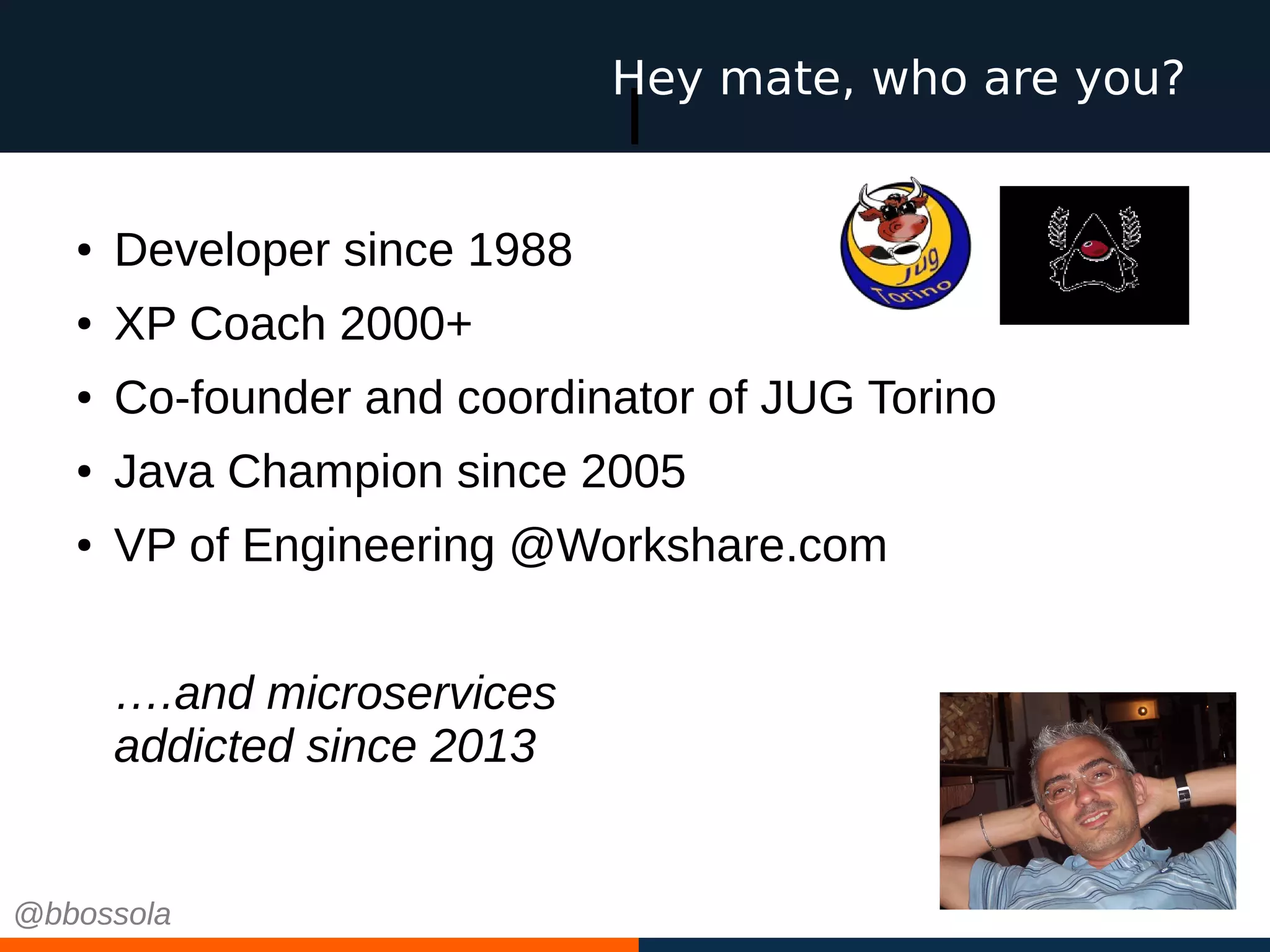
● Developer since 1988
● XP Coach 2000+
● Co-founder and coordinator of JUG Torino
● Java Champion since 2005
● VP of Engineering @Workshare.com
….and microservices
addicted since 2013
Hey mate, who are you?
@bbossola
● Why microservices?
● What are microservices?
● Demo
● Common antipatterns
● Demo
● How do we work with microservices?
● Conclusions?
Agenda
@bbossola
● Why microservices?
● What are microservices?
● Common antipatterns
● How do we work with
microservices?
Agenda
@bbossola
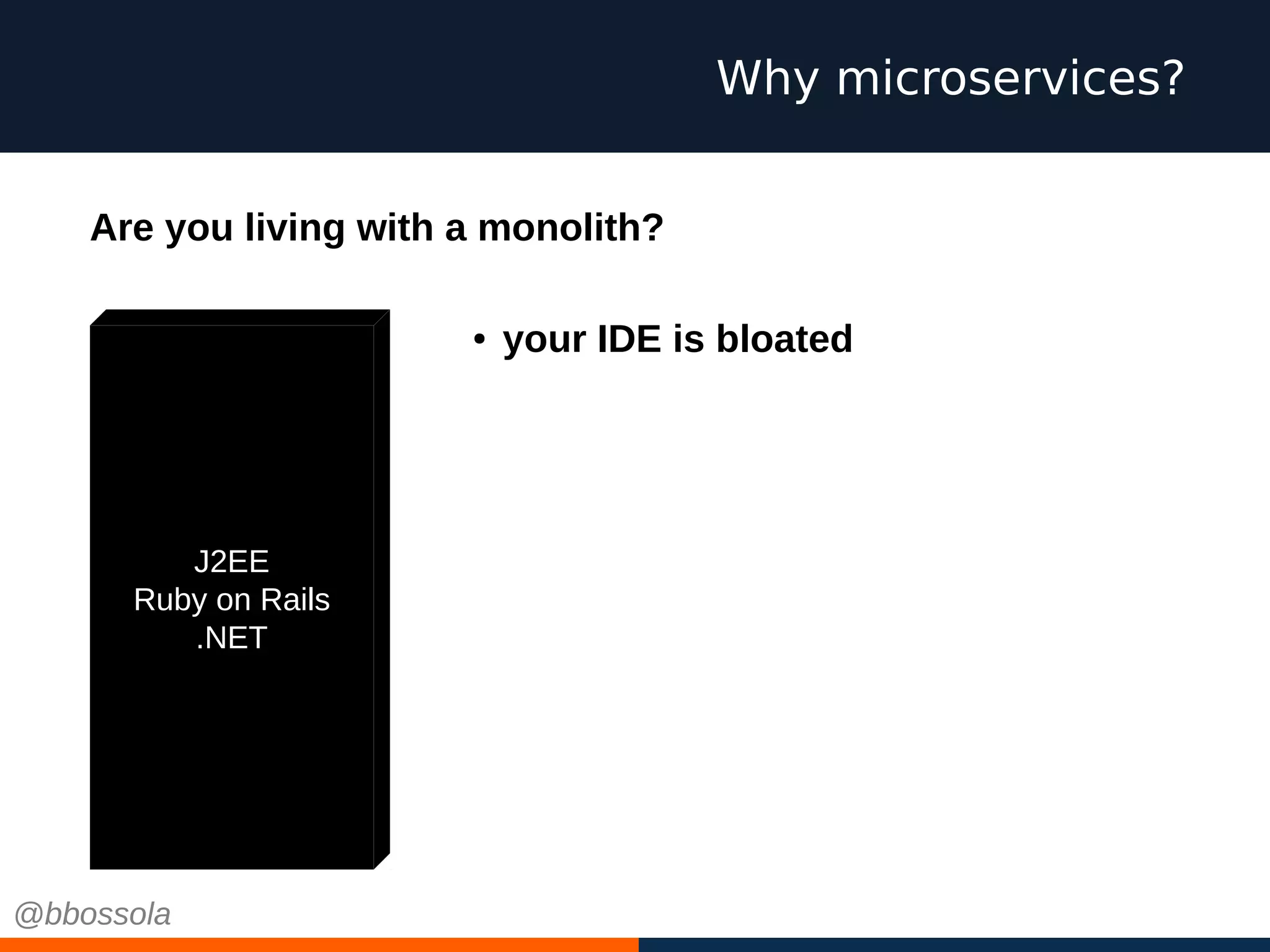
Why microservices?
J2EE
Ruby on Rails
.NET
Are you living with a monolith?
@bbossola
Why microservices?
J2EE
Ruby on Rails
.NET
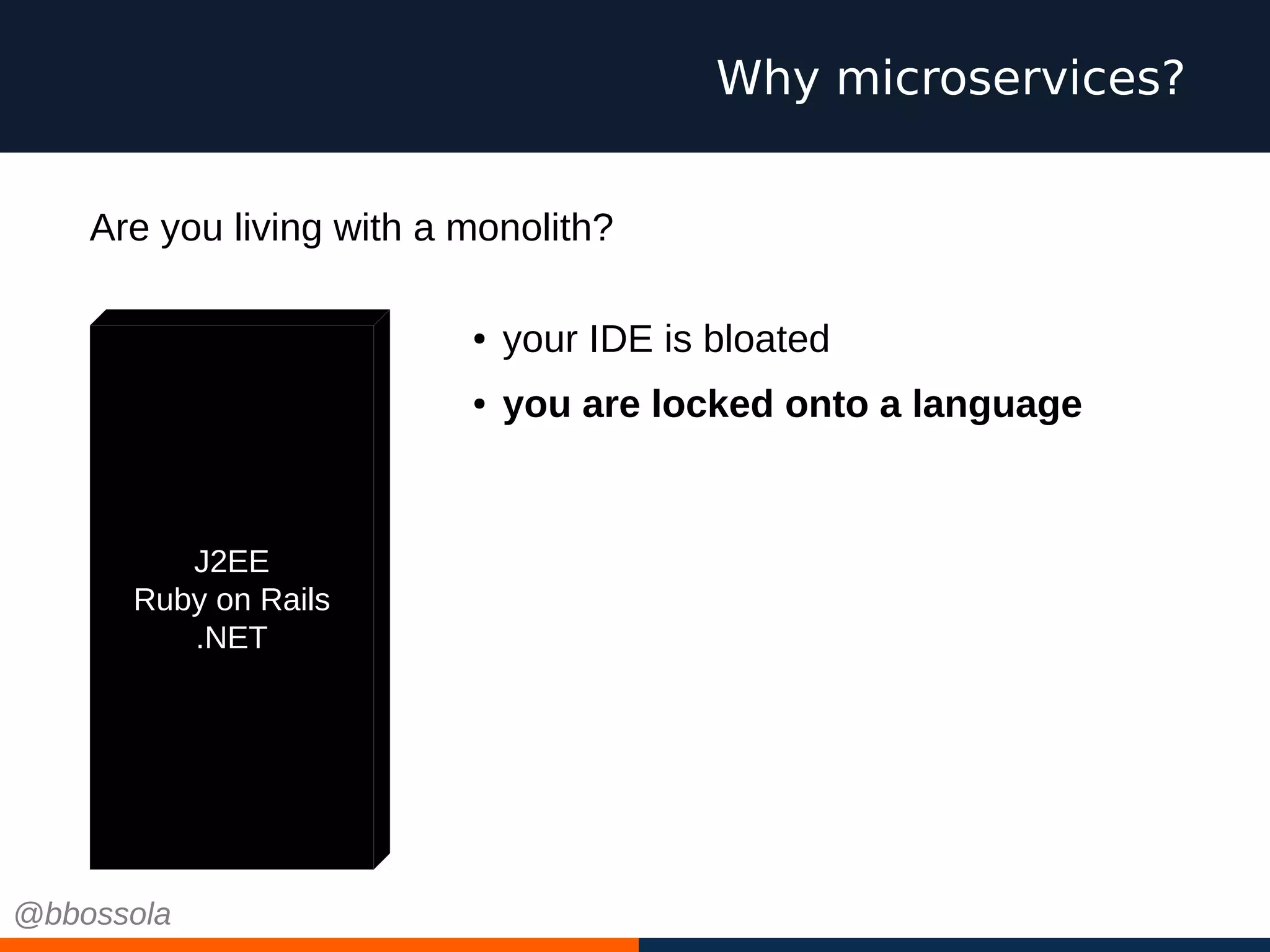
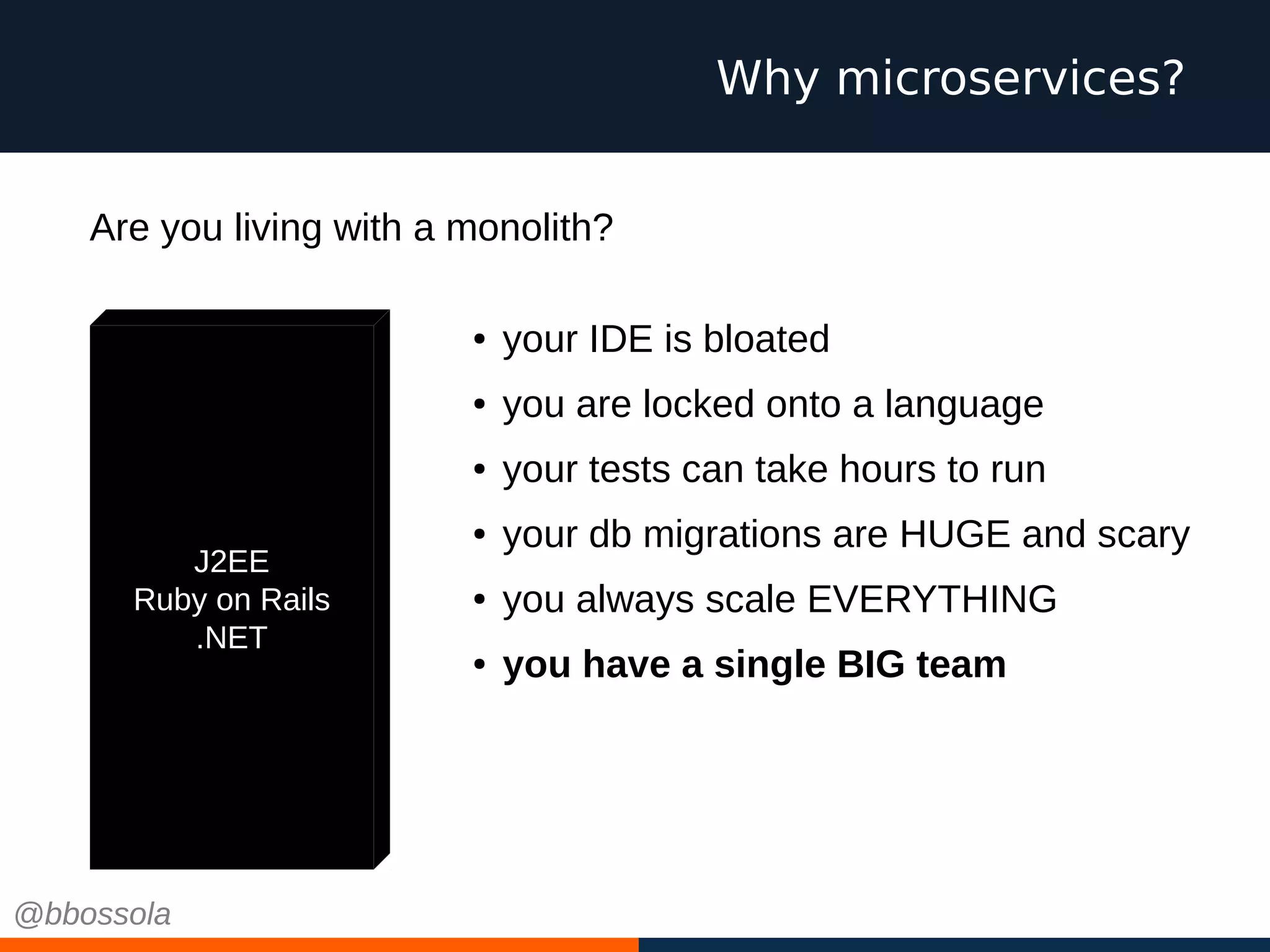
● your IDE is bloated
Are you living with a monolith?
@bbossola
Why microservices?
J2EE
Ruby on Rails
.NET
● your IDE is bloated
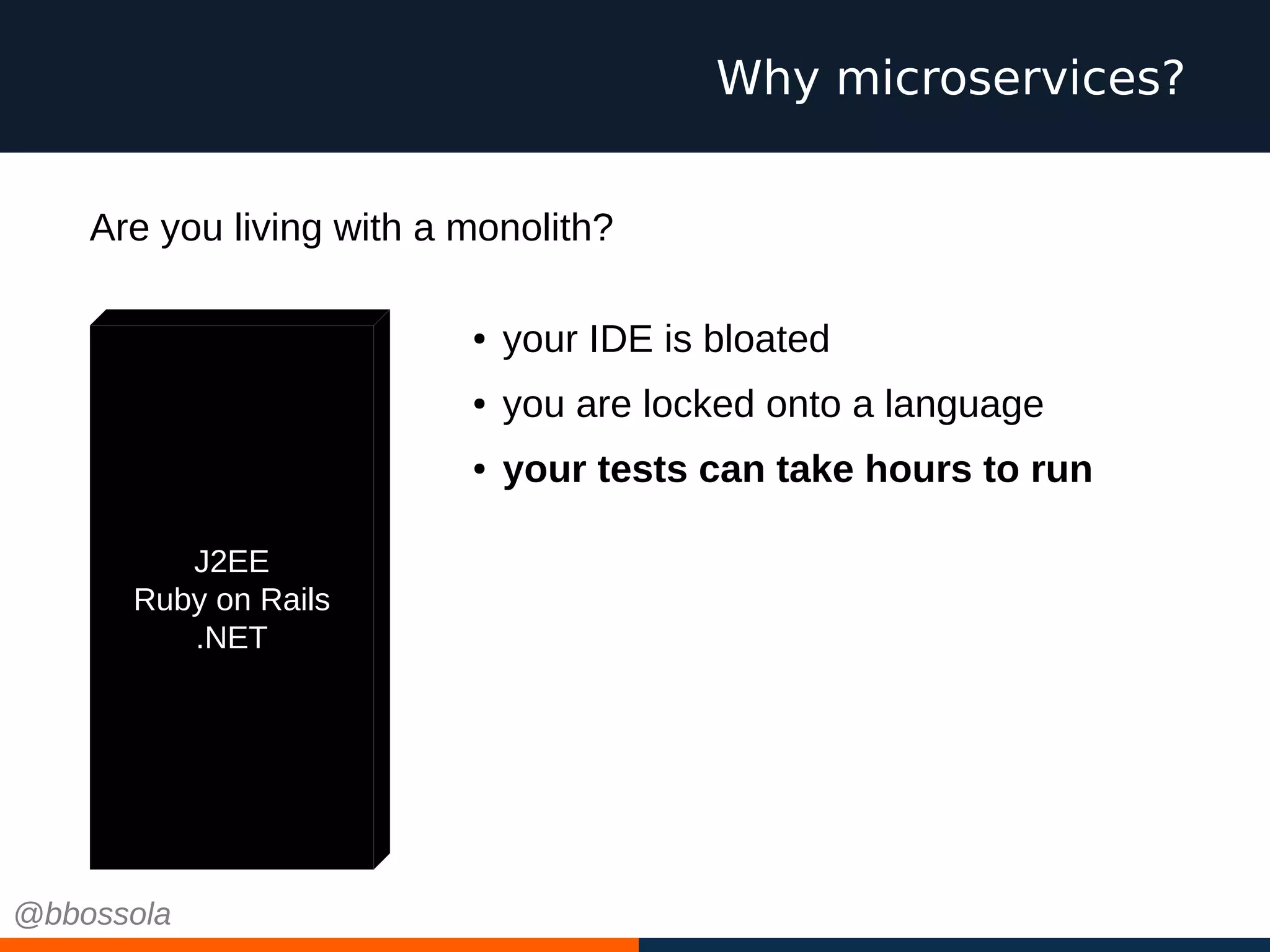
● you are locked onto a language
Are you living with a monolith?
@bbossola
Why microservices?
J2EE
Ruby on Rails
.NET
● your IDE is bloated
● you are locked onto a language
● your tests can take hours to run
Are you living with a monolith?
@bbossola
Why microservices?
J2EE
Ruby on Rails
.NET
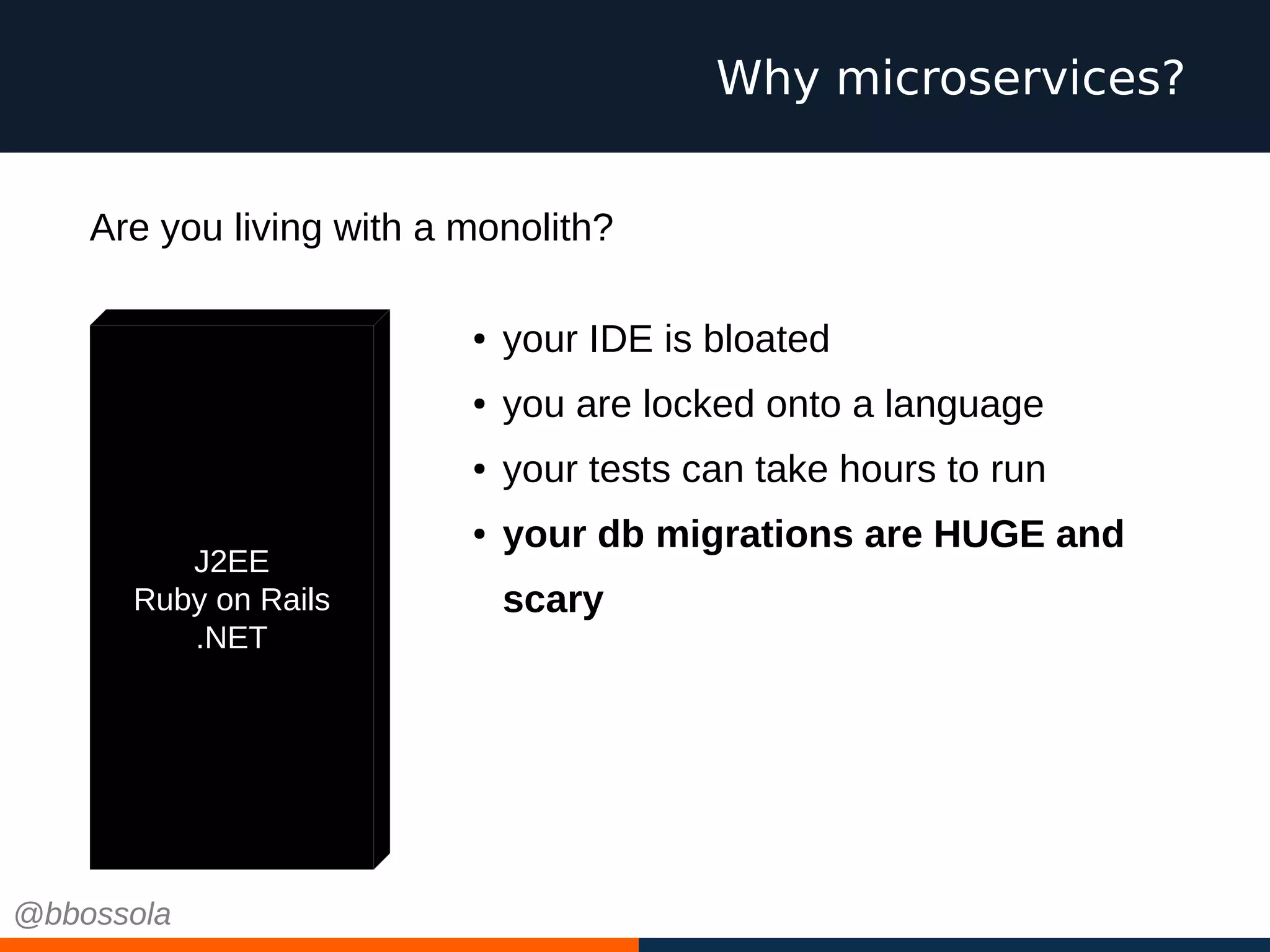
● your IDE is bloated
● you are locked onto a language
● your tests can take hours to run
● your db migrations are HUGE and
scary
Are you living with a monolith?
@bbossola
Why microservices?
J2EE
Ruby on Rails
.NET
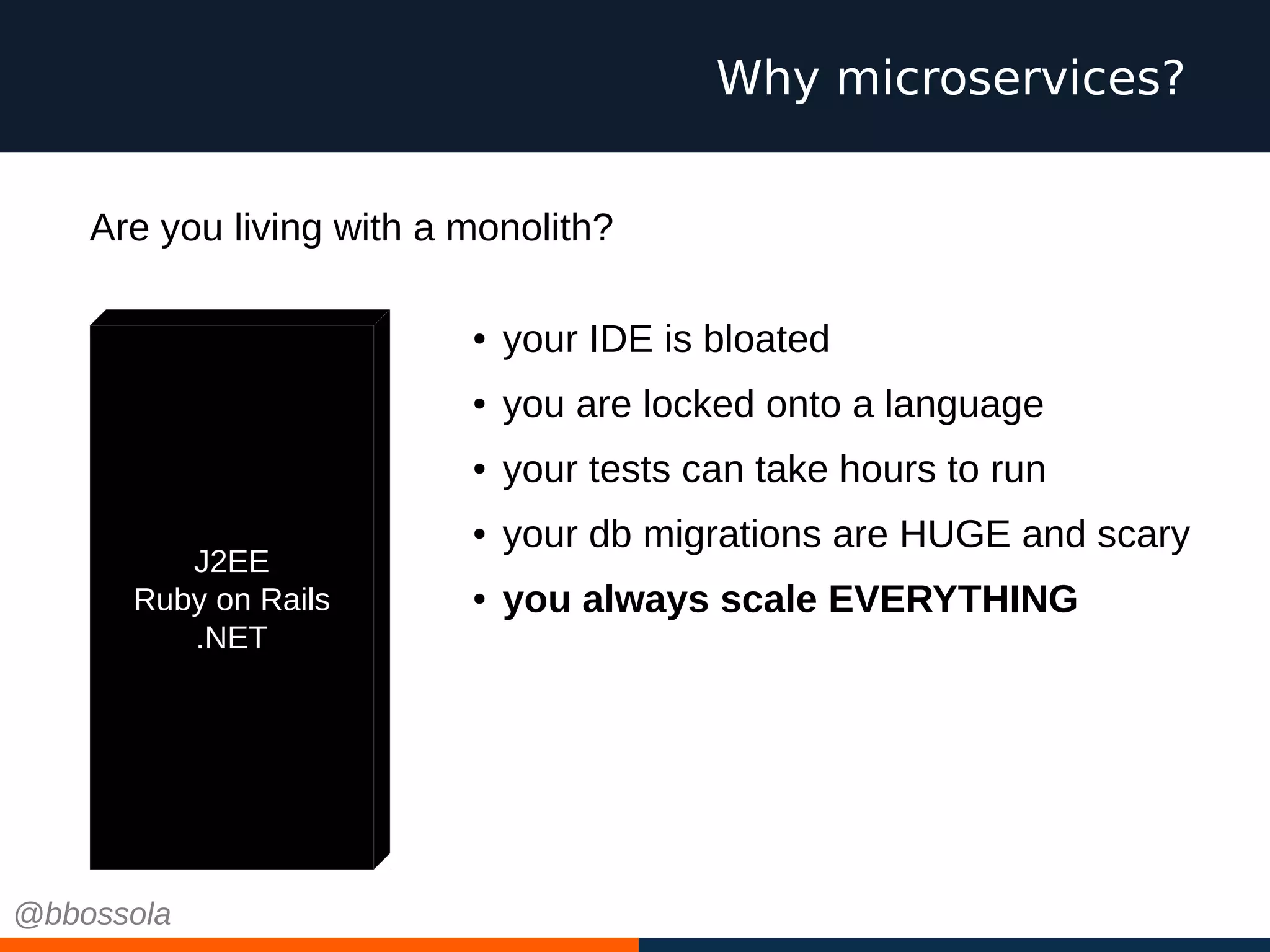
● your IDE is bloated
● you are locked onto a language
● your tests can take hours to run
● your db migrations are HUGE and scary
● you always scale EVERYTHING
Are you living with a monolith?
@bbossola
Why microservices?
J2EE
Ruby on Rails
.NET
● your IDE is bloated
● you are locked onto a language
● your tests can take hours to run
● your db migrations are HUGE and scary
● you always scale EVERYTHING
● you have a single BIG team
Are you living with a monolith?
@bbossola
Why microservices?
J2EE
Ruby on Rails
.NET
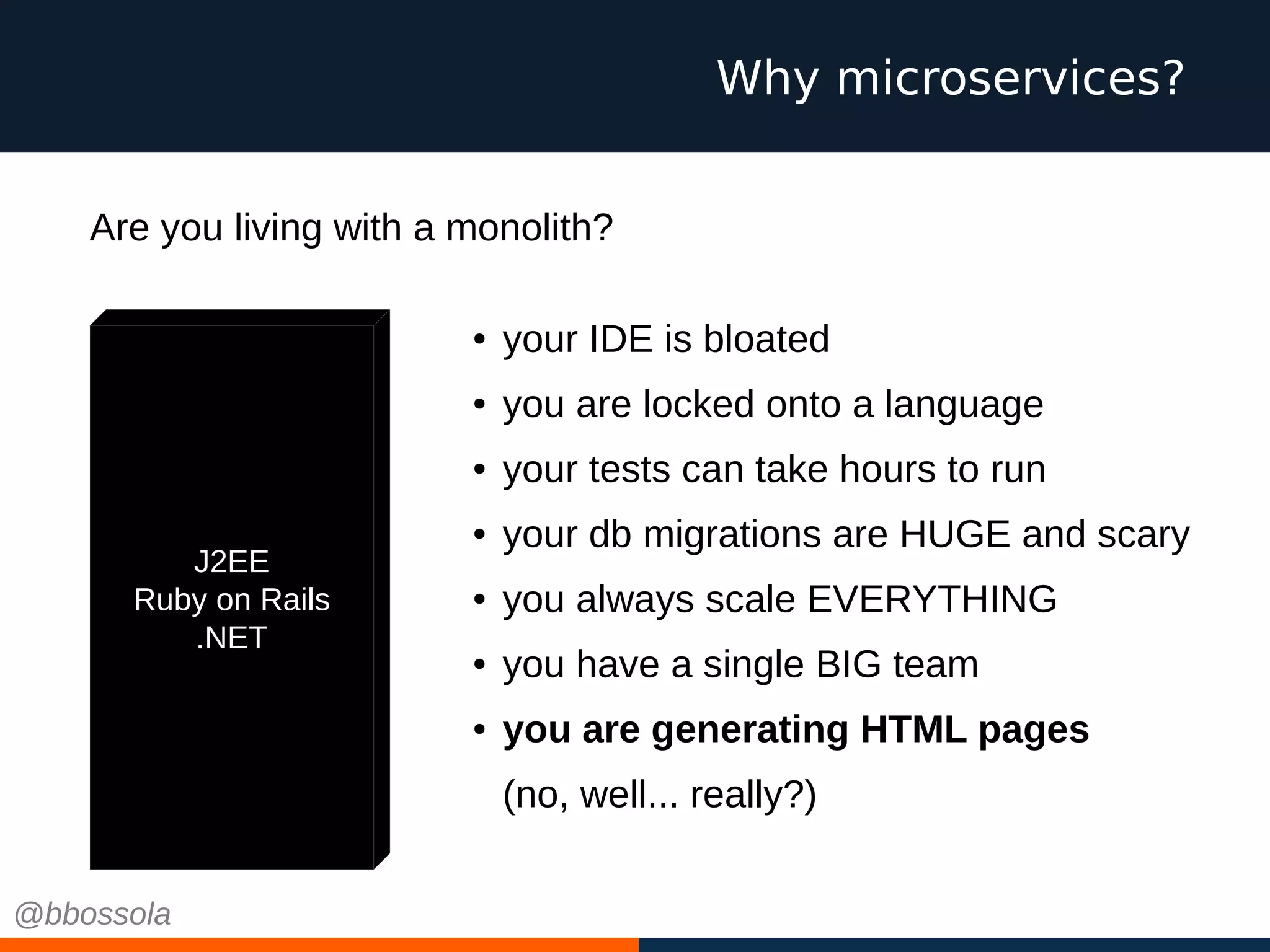
● your IDE is bloated
● you are locked onto a language
● your tests can take hours to run
● your db migrations are HUGE and scary
● you always scale EVERYTHING
● you have a single BIG team
● you are generating HTML pages
(no, well... really?)
Are you living with a monolith?
@bbossola
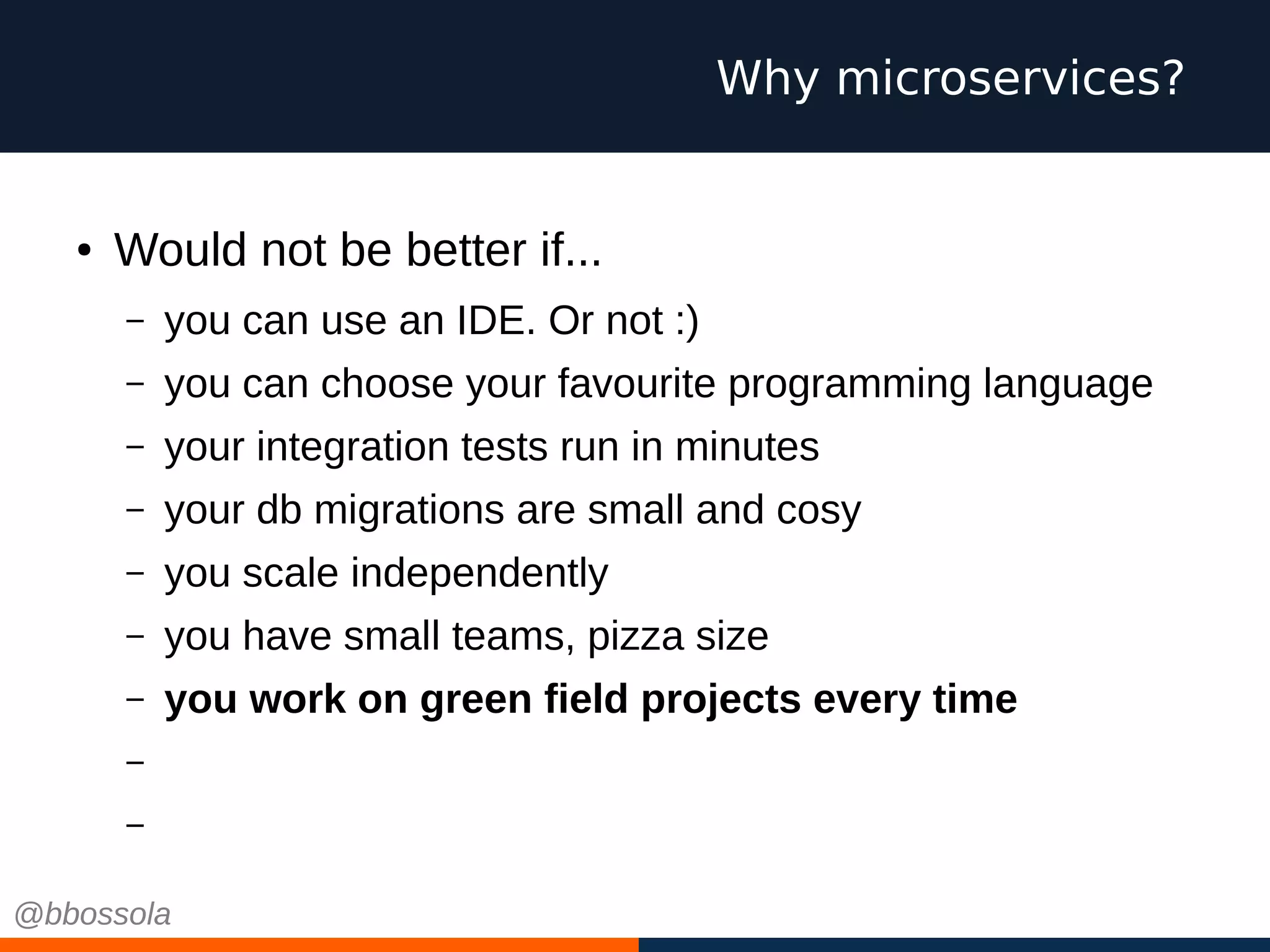
● Would not be better if...
Why microservices?
@bbossola
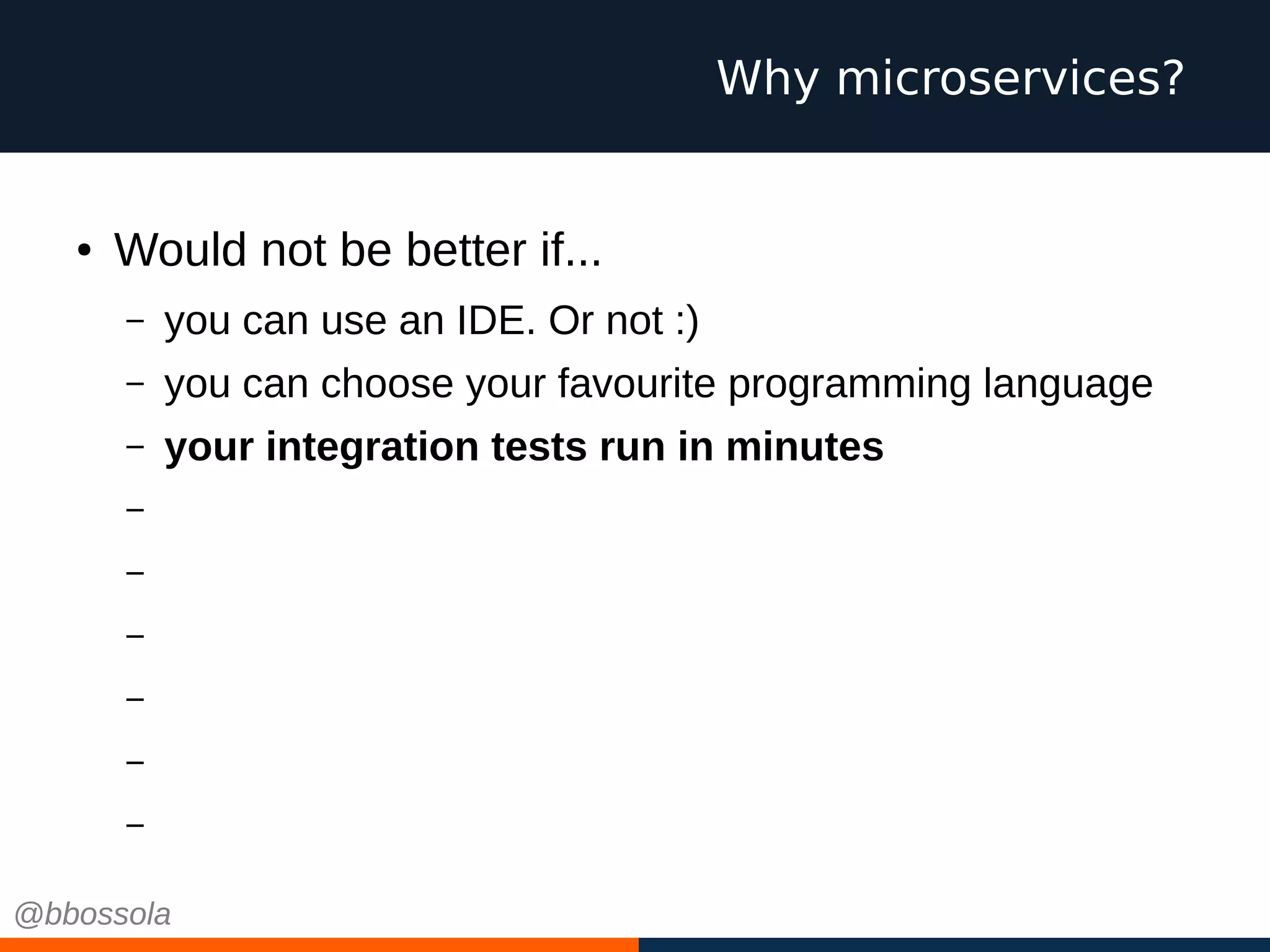
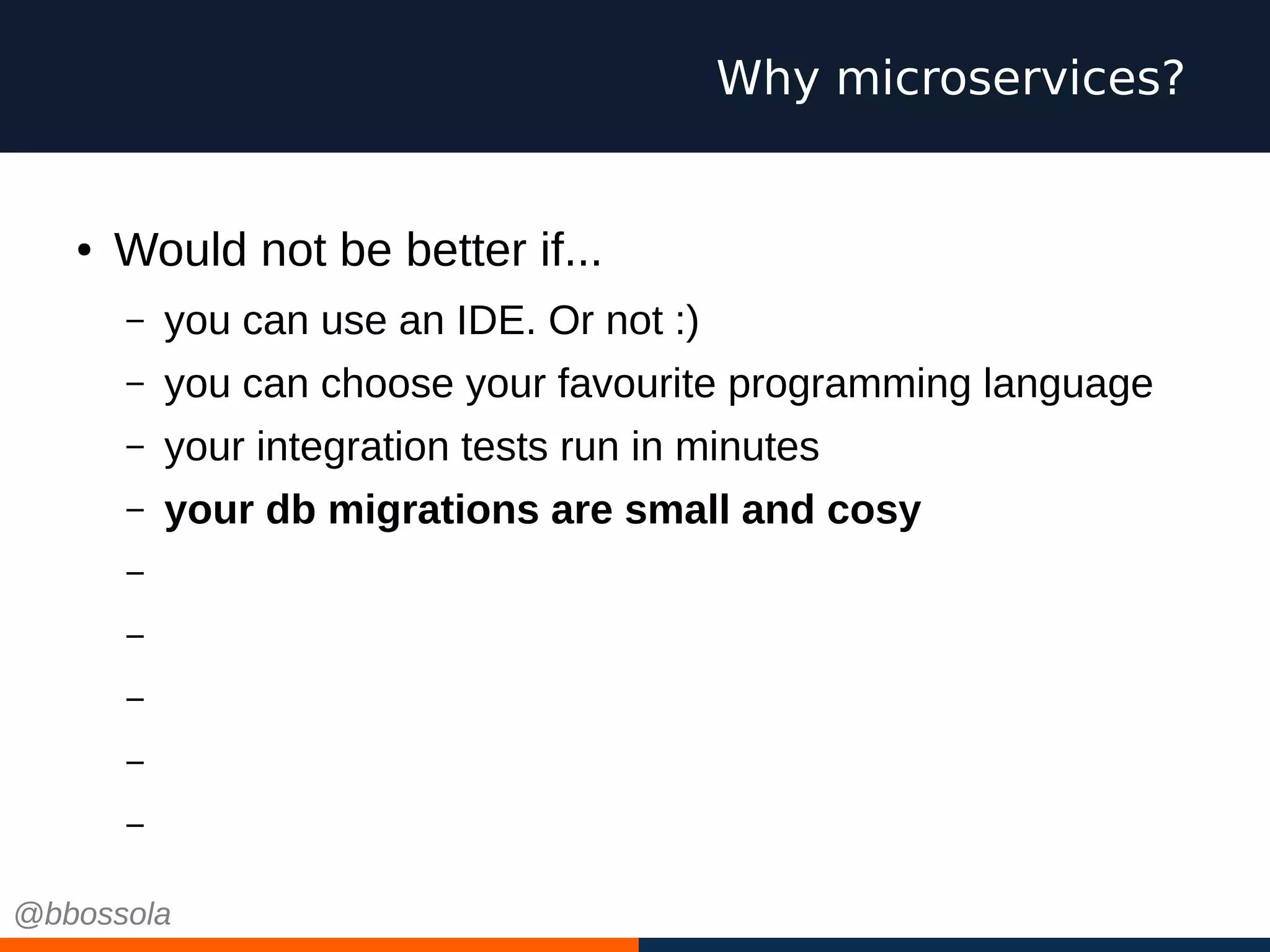
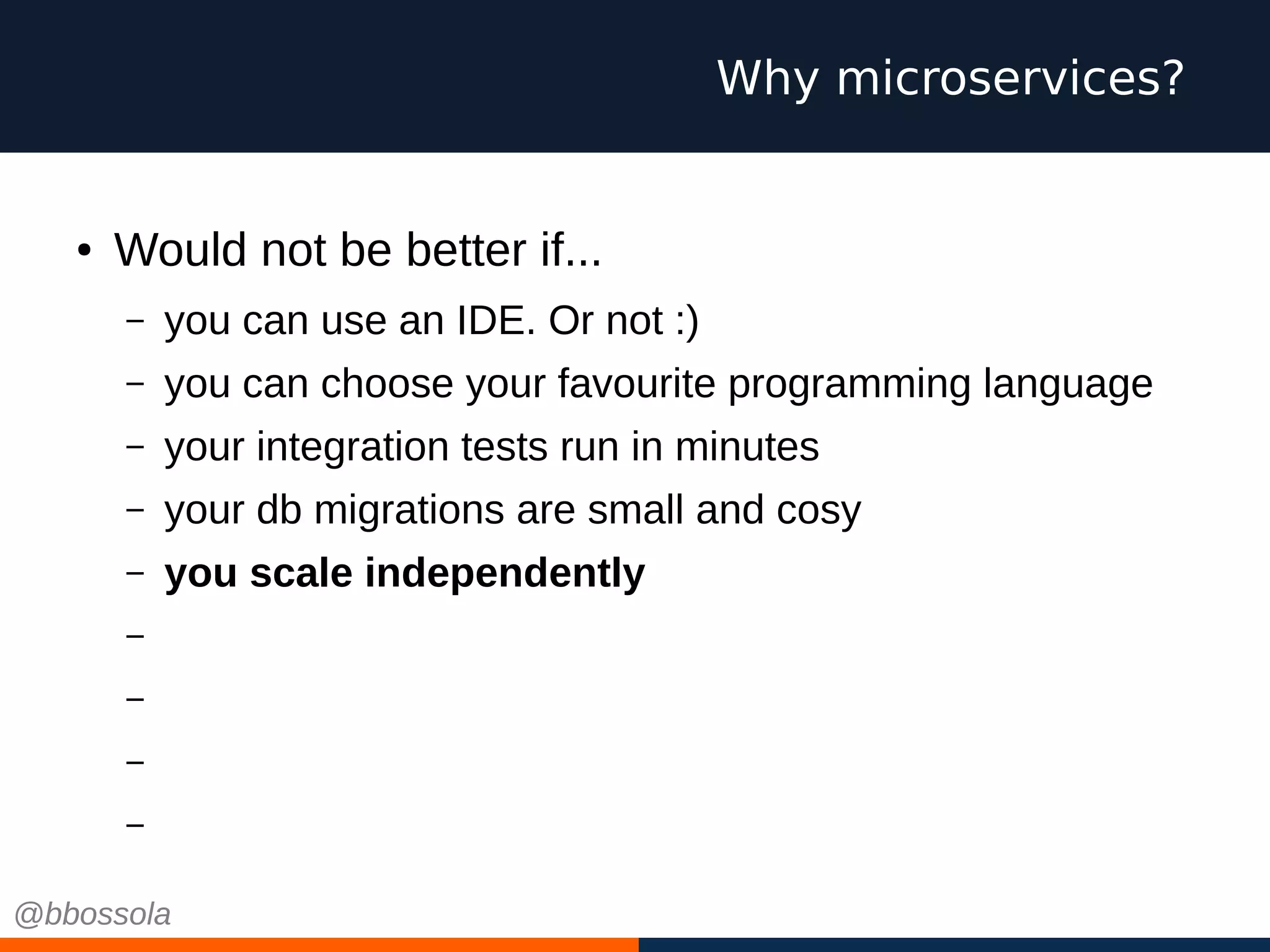
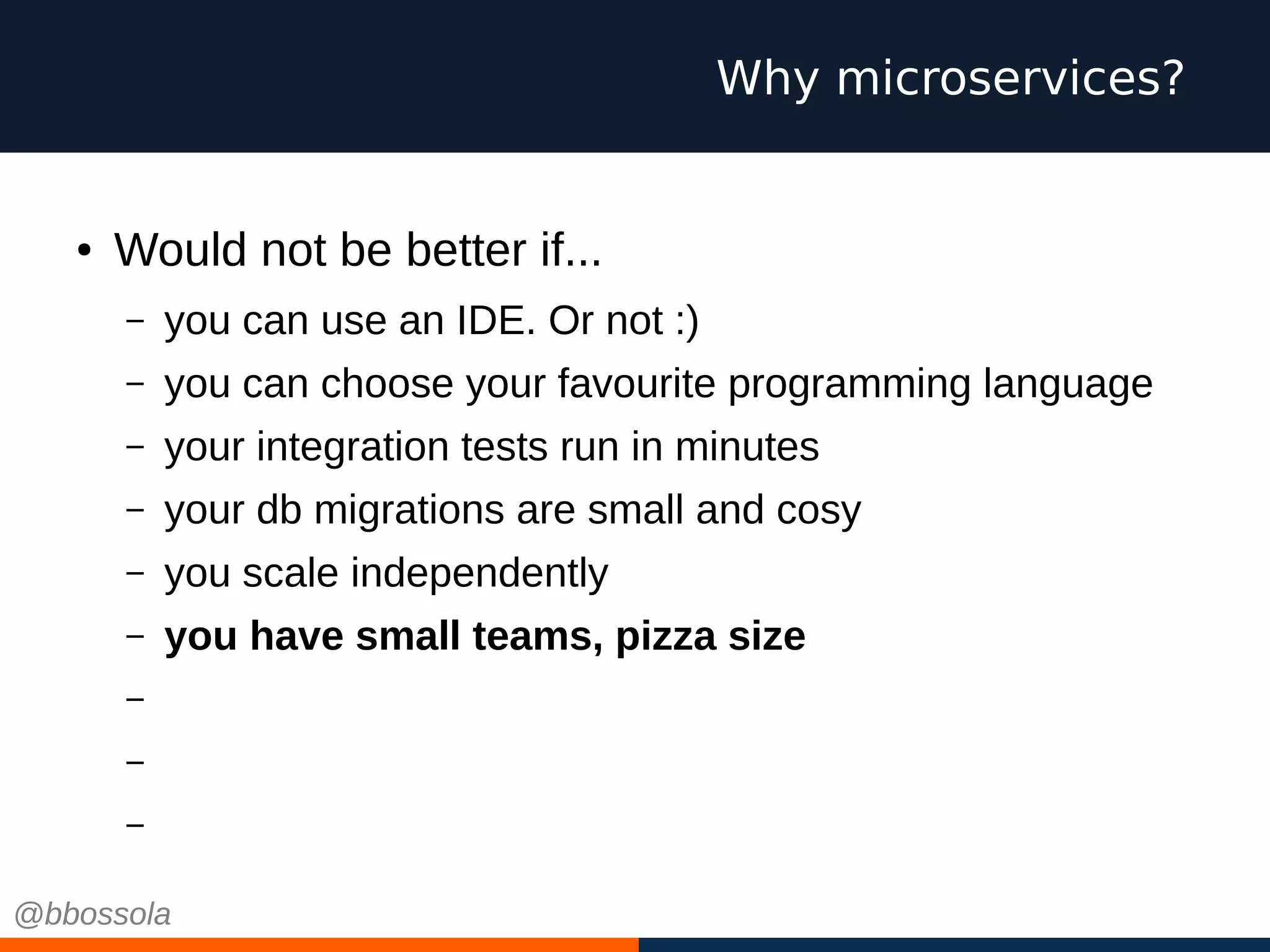
● Would not be better if...
– you can use an IDE. Or not :)
– you can choose your favourite programming language
– your integration tests run in minutes
– your db migrations are small and cosy
– you scale independently
– you have small teams, pizza size
– you work on green field projects every time
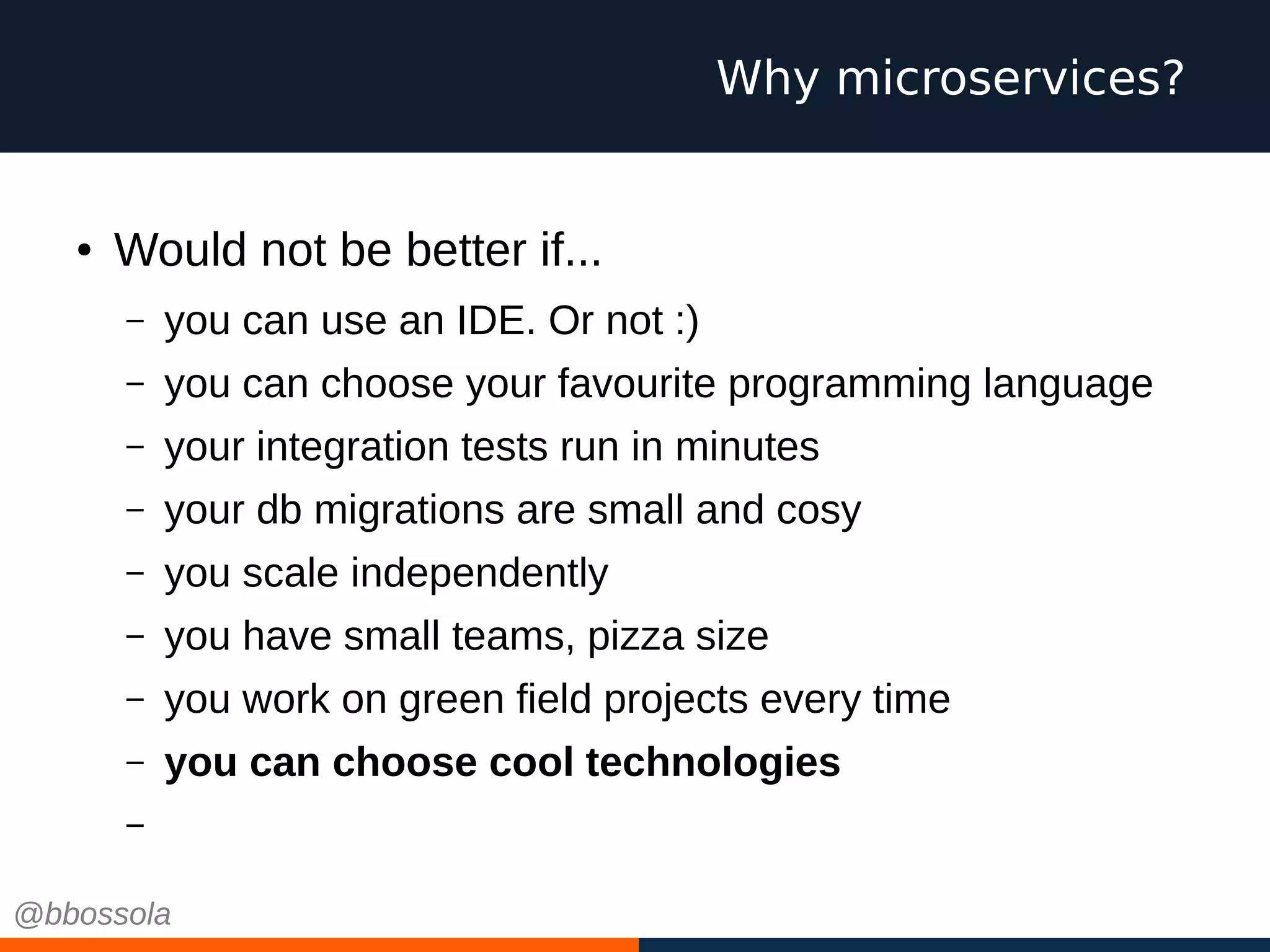
– you can choose cool technologies
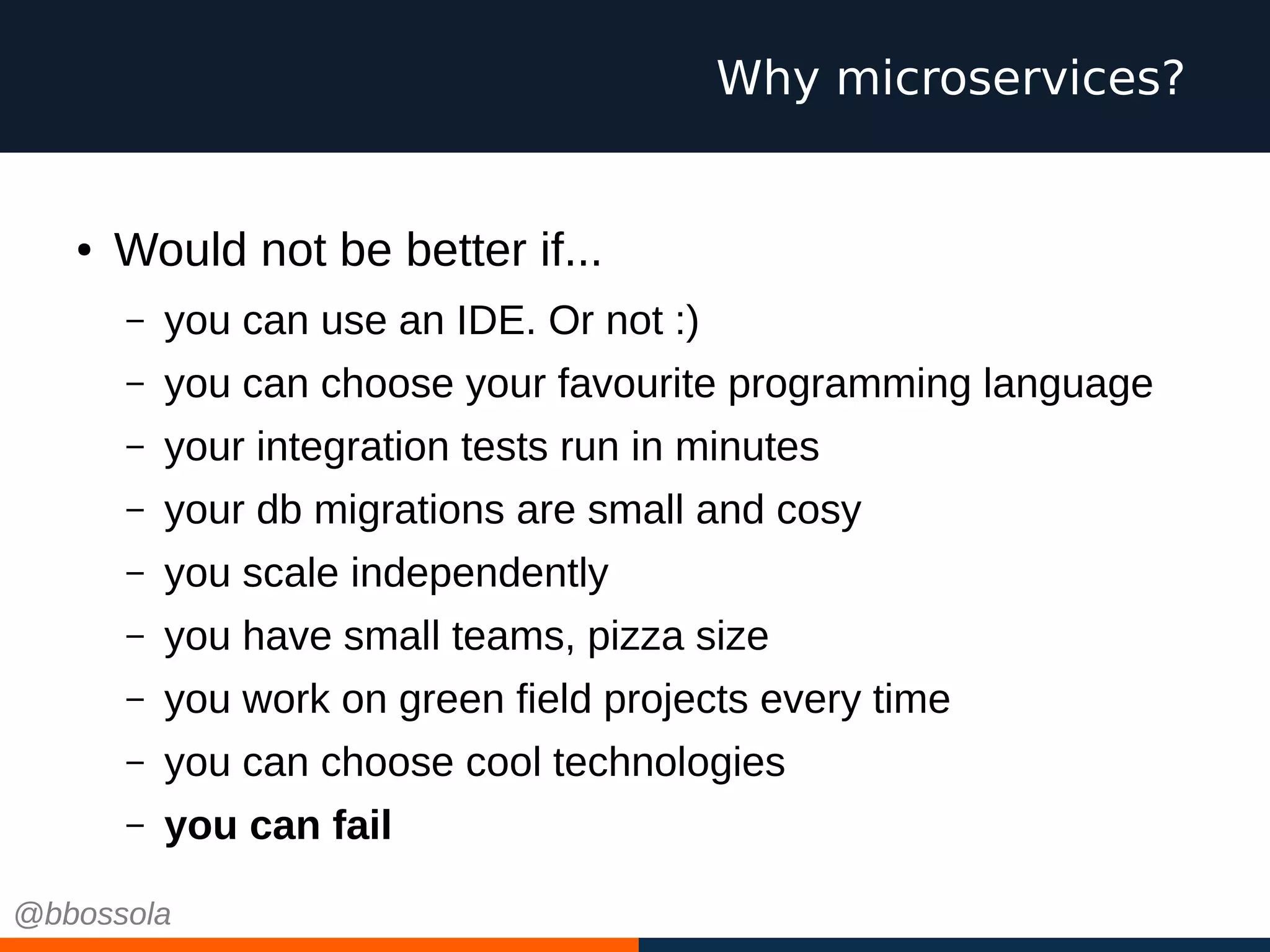
– you can fail
Why microservices?
@bbossola
● Would not be better if...
– you can use an IDE. Or not :)
– you can choose your favourite programming language
– your integration tests run in minutes
– your db migrations are small and cosy
– you scale independently
– you have small teams, pizza size
– you work on green field projects every time
– you can choose cool technologies
– you can fail
Why microservices?
@bbossola
● Would not be better if...
– you can use an IDE. Or not :)
– you can choose your favourite programming language
– your integration tests run in minutes
– your db migrations are small and cosy
– you scale independently
– you have small teams, pizza size
– you work on green field projects every time
– you can choose cool technologies
– you can fail
Why microservices?
@bbossola
● Would not be better if...
– you can use an IDE. Or not :)
– you can choose your favourite programming language
– your integration tests run in minutes
– your db migrations are small and cosy
– you scale independently
– you have small teams, pizza size
– you work on green field projects every time
– you can choose cool technologies
– you can fail
Why microservices?
@bbossola
● Would not be better if...
– you can use an IDE. Or not :)
– you can choose your favourite programming language
– your integration tests run in minutes
– your db migrations are small and cosy
– you scale independently
– you have small teams, pizza size
– you work on green field projects every time
– you can choose cool technologies
– you can fail
Why microservices?
@bbossola
● Would not be better if...
– you can use an IDE. Or not :)
– you can choose your favourite programming language
– your integration tests run in minutes
– your db migrations are small and cosy
– you scale independently
– you have small teams, pizza size
– you work on green field projects every time
– you can choose cool technologies
– you can fail
Why microservices?
@bbossola
● Would not be better if...
– you can use an IDE. Or not :)
– you can choose your favourite programming language
– your integration tests run in minutes
– your db migrations are small and cosy
– you scale independently
– you have small teams, pizza size
– you work on green field projects every time
– you can choose cool technologies
– you can fail
Why microservices?
@bbossola
● Would not be better if...
– you can use an IDE. Or not :)
– you can choose your favourite programming language
– your integration tests run in minutes
– your db migrations are small and cosy
– you scale independently
– you have small teams, pizza size
– you work on green field projects every time
– you can choose cool technologies
– you can fail
Why microservices?
@bbossola
● Would not be better if...
– you can use an IDE. Or not :)
– you can choose your favourite programming language
– your integration tests run in minutes
– your db migrations are small and cosy
– you scale independently
– you have small teams, pizza size
– you work on green field projects every time
– you can choose cool technologies
– you can fail
Why microservices?
@bbossola
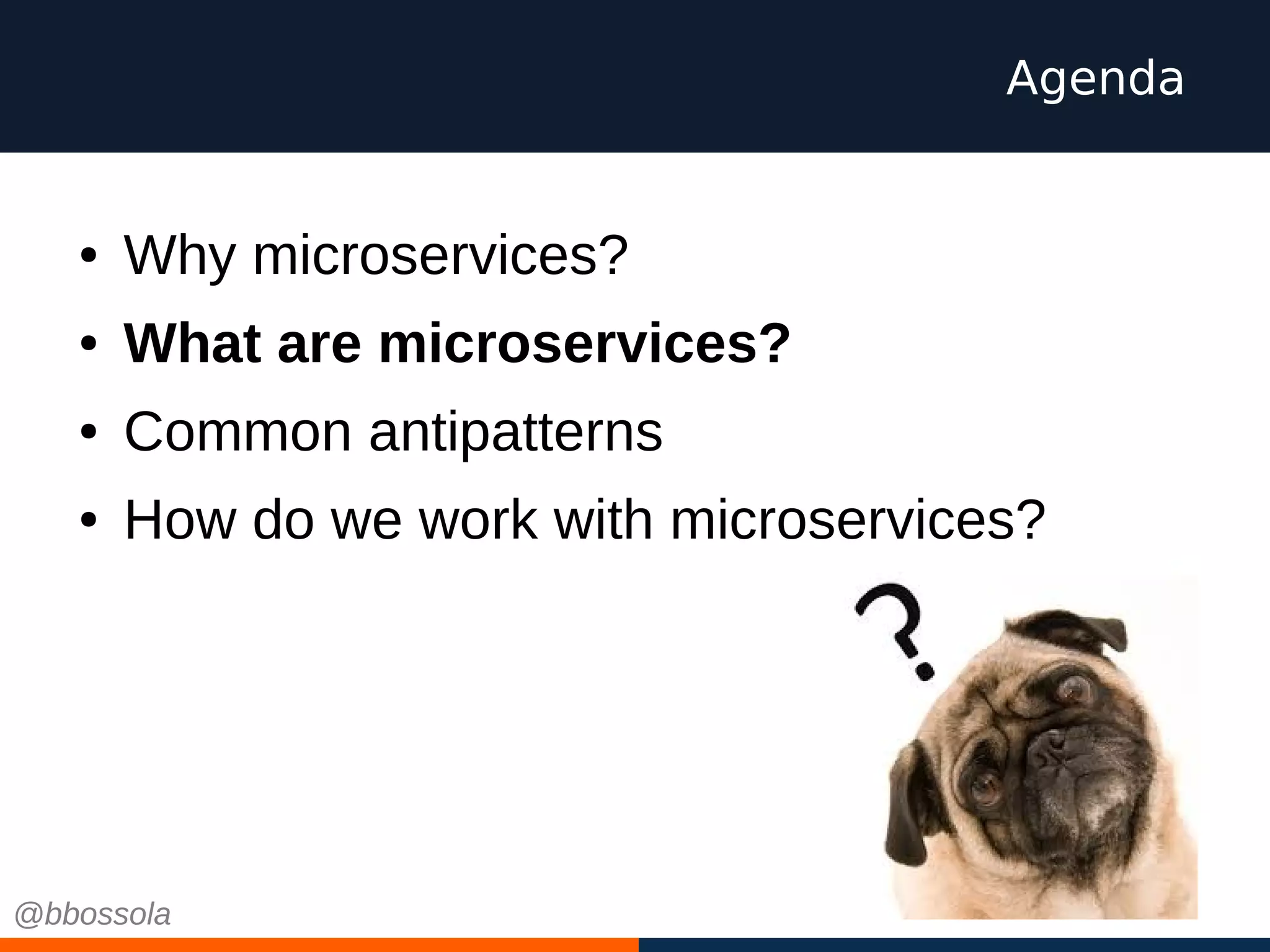
● Why microservices?
● What are microservices?
● Common antipatterns
● How do we work with microservices?
Agenda
@bbossola
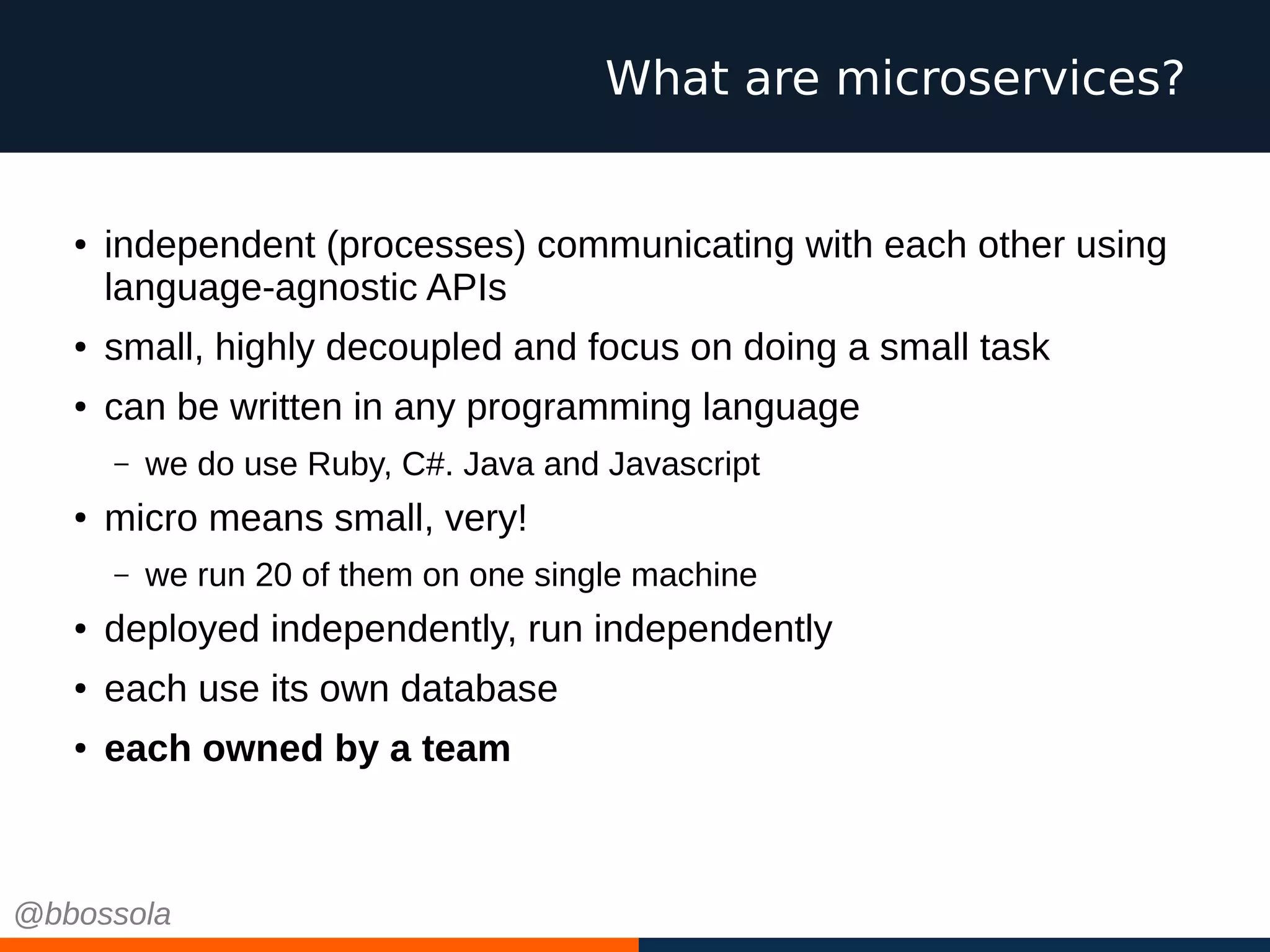
● independent (processes) communicating with each other using
language-agnostic APIs
● small, highly decoupled and focus on doing a small task
● can be written in any programming language
– we do use Ruby, C#. Java and Javascript
●
micro means small, very!
– we run 20 of them on one single machine
● deployed independently, run independently
● each use its own database
● each owned by a team
What are microservices?
@bbossola
● Pros!
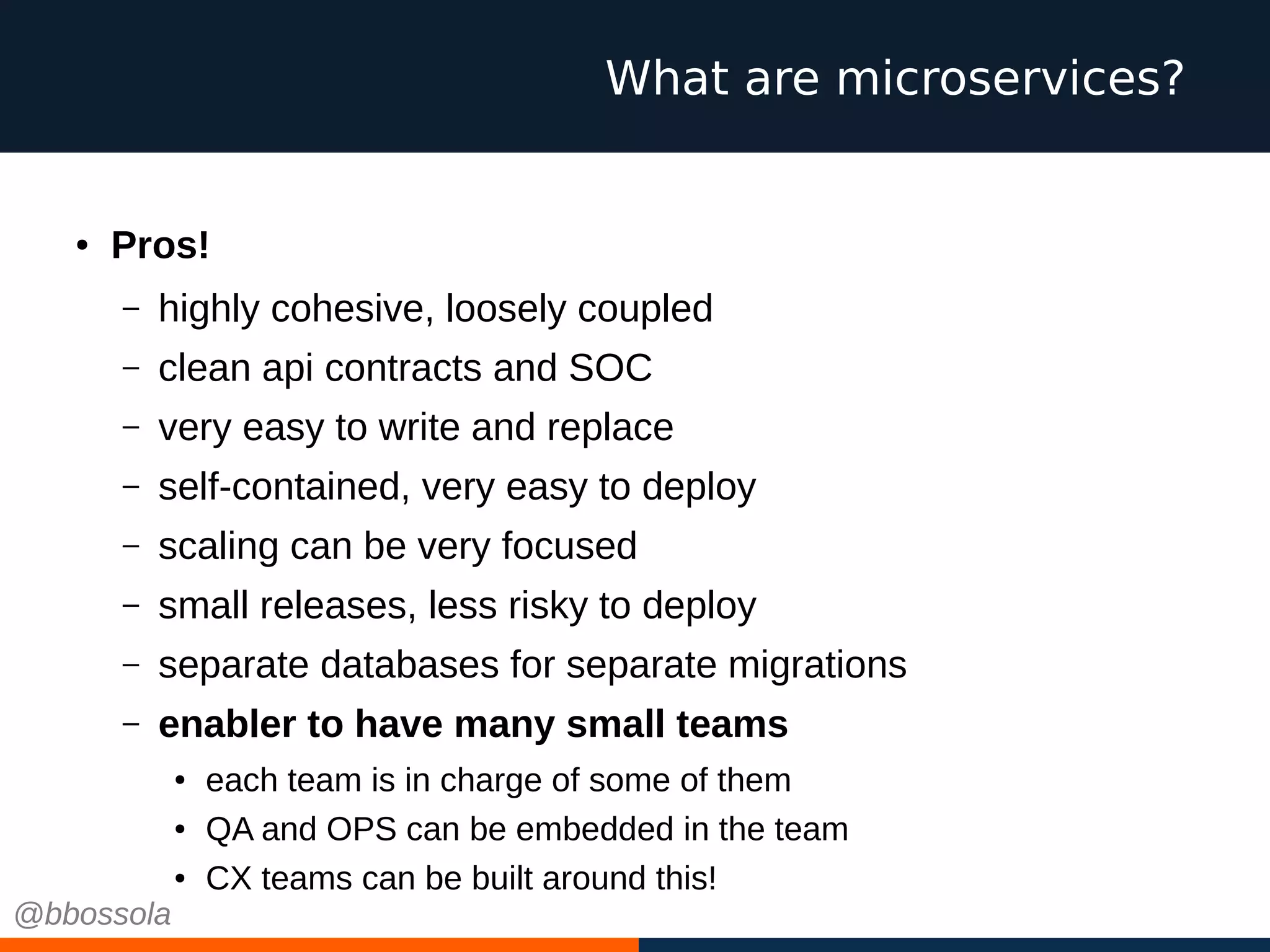
– highly cohesive, loosely coupled
– clean api contracts and SOC
– very easy to write and replace
– self-contained, very easy to deploy
– scaling can be very focused
– small releases, less risky to deploy
– separate databases for separate migrations
– enabler to have many small teams
● each team is in charge of some of them
● QA and OPS can be embedded in the team
● CX teams can be built around this!
What are microservices?
@bbossola
● Cons!
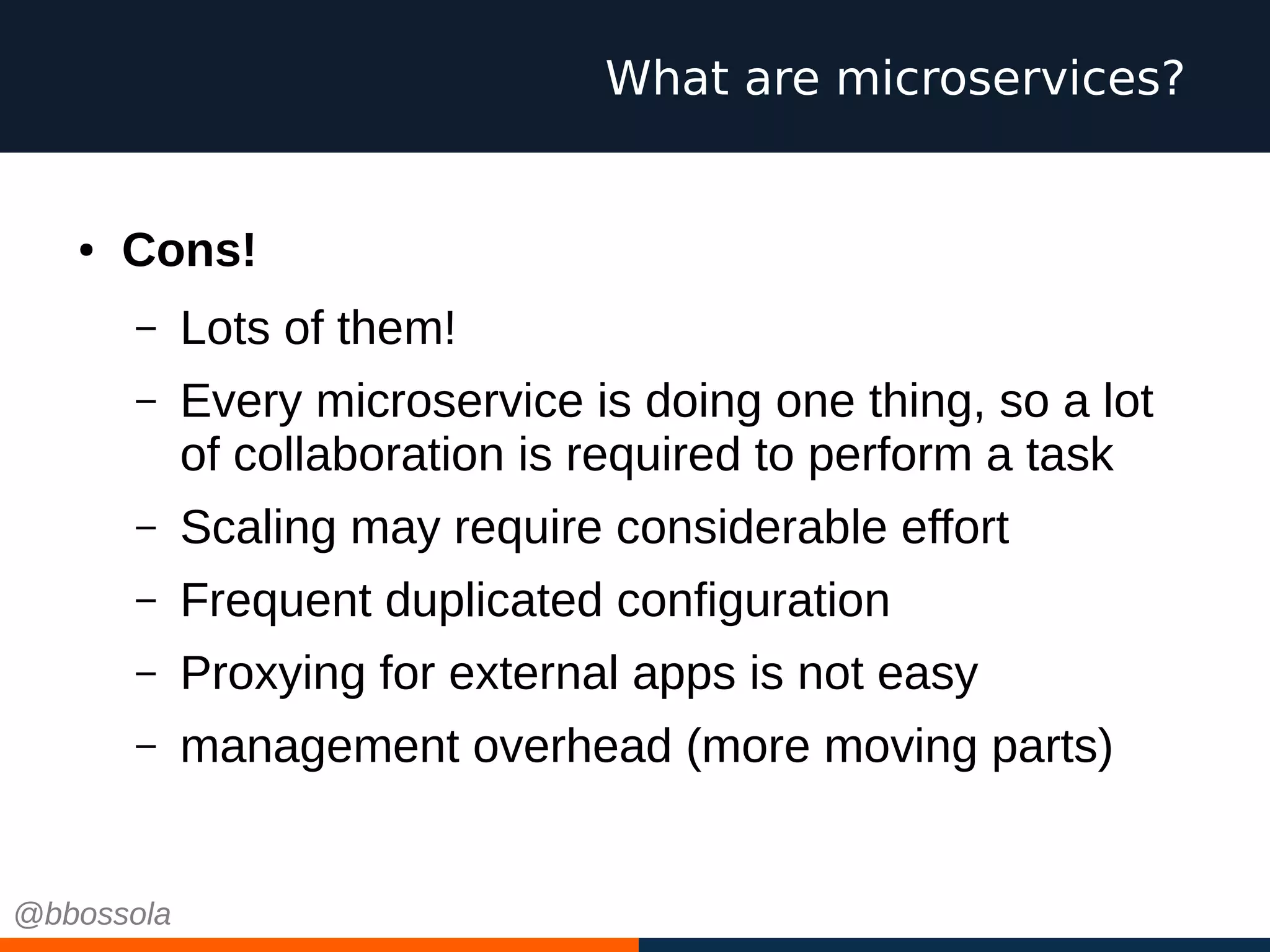
– Lots of them!
– Every microservice is doing one thing, so a lot
of collaboration is required to perform a task
– Scaling may require considerable effort
– Frequent duplicated configuration
– Proxying for external apps is not easy
– management overhead (more moving parts)
What are microservices?
@bbossola
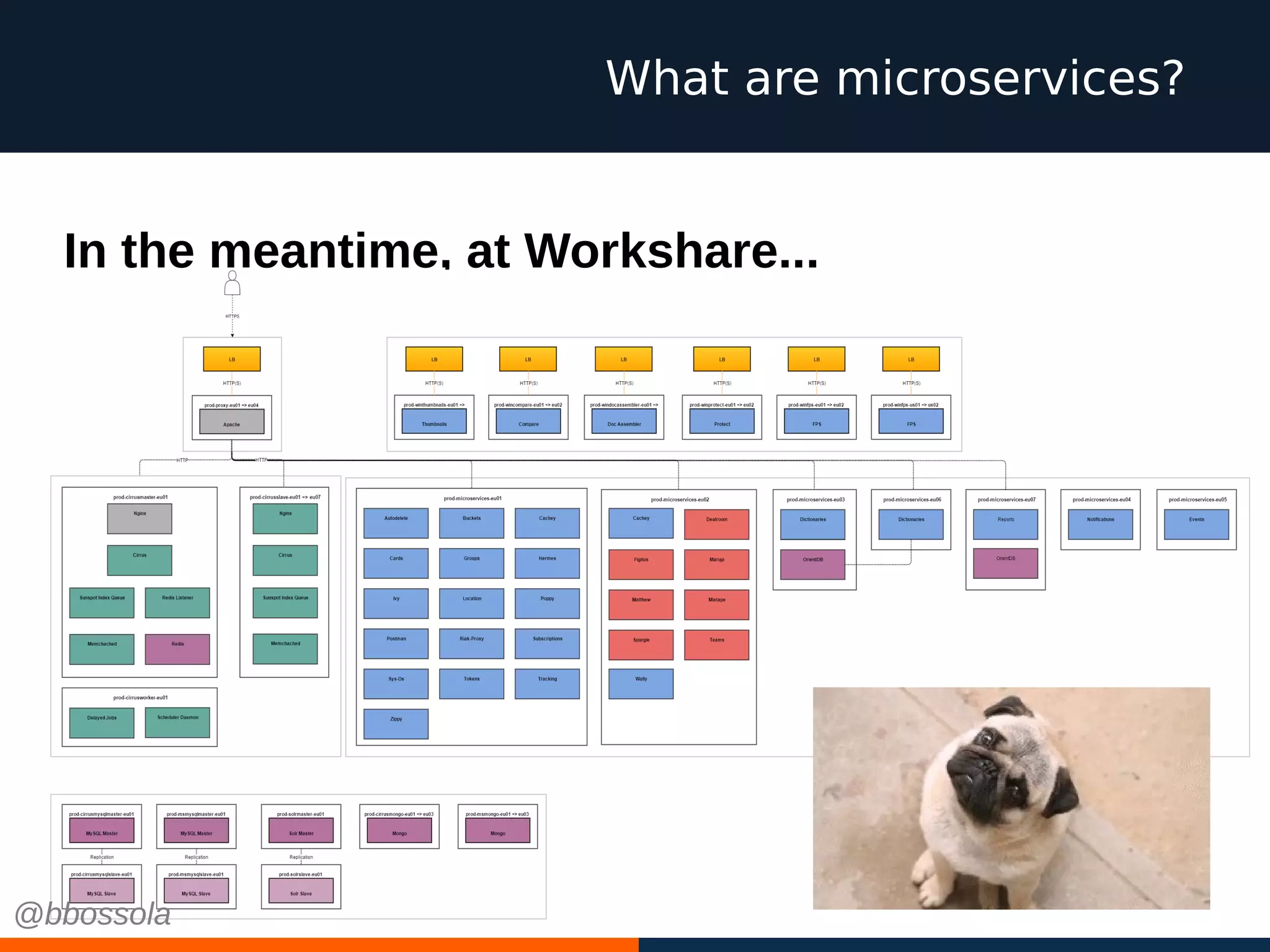
In the meantime, at Workshare...
What are microservices?
@bbossola
Demo!
ROME 18-19 MARCH
2016
All pictures belong
to their respective authors
➢ simple WS services (time and location)
➢ complex WS services (groups and folders)
➢ a nodejs live sample that shows some
simple microservices speaking to each
other, part one (code available at
https://github.com/bbossola/microjs )
@bbossola
● Why microservices?
● What are microservices?
● Common antipatterns
● How do we work with microservices?
@bbossola
● Disneyworld
● Monolith Database
● Unknown Caller
● Hardcoded Hell
● Synchronous World
● Babel Tower
● Monolith Frontend
● Early Mornings
● Crapper
Common antipatterns
Stay tuned go get more!
bbossola.wordpress.com
@bbossola
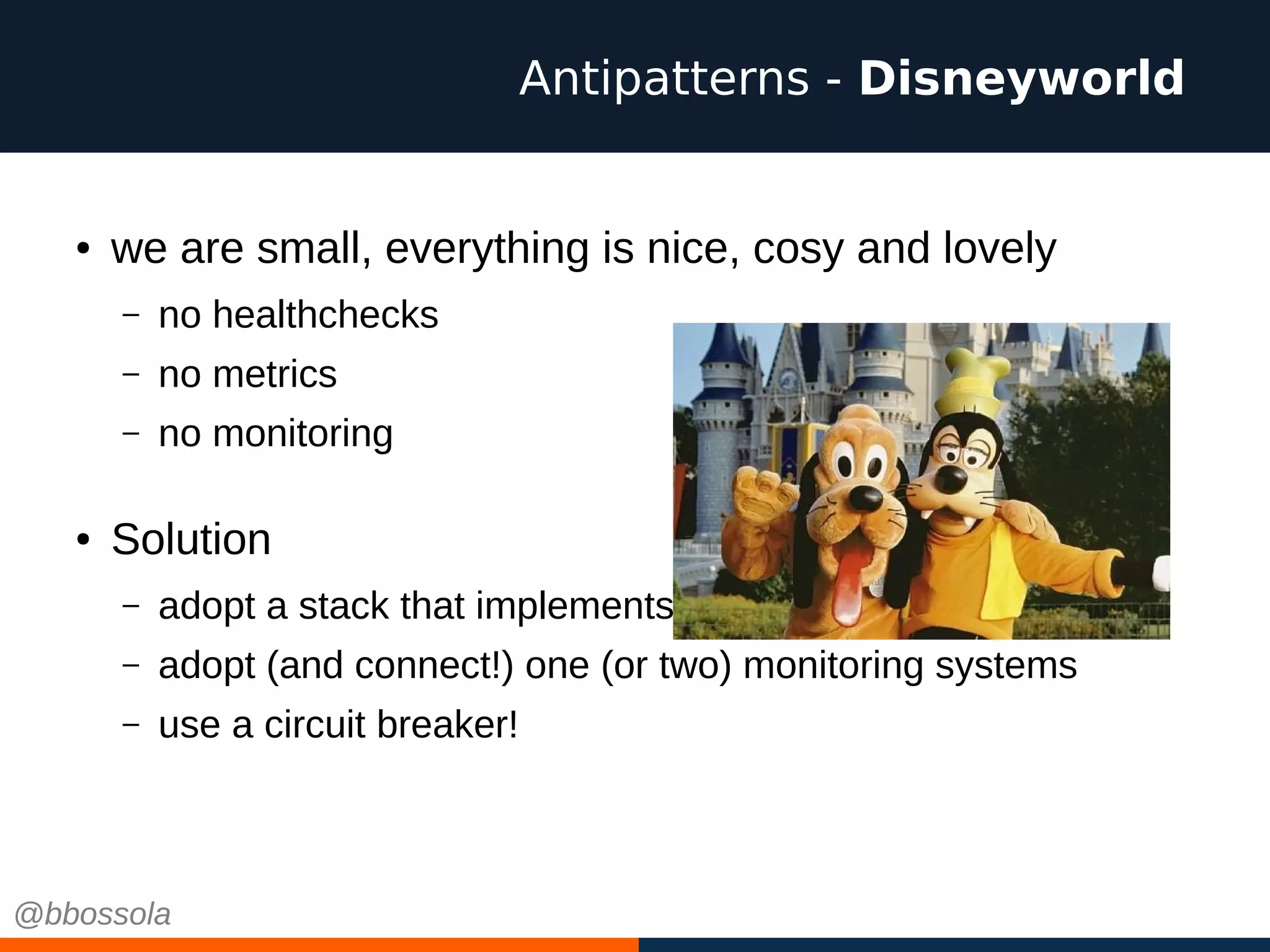
● we are small, everything is nice, cosy and lovely
– no healthchecks
– no metrics
– no monitoring
● Solution
– adopt a stack that implements these basic functionalities
– adopt (and connect!) one (or two) monitoring systems
– use a circuit breaker!
Antipatterns - Disneyworld
@bbossola
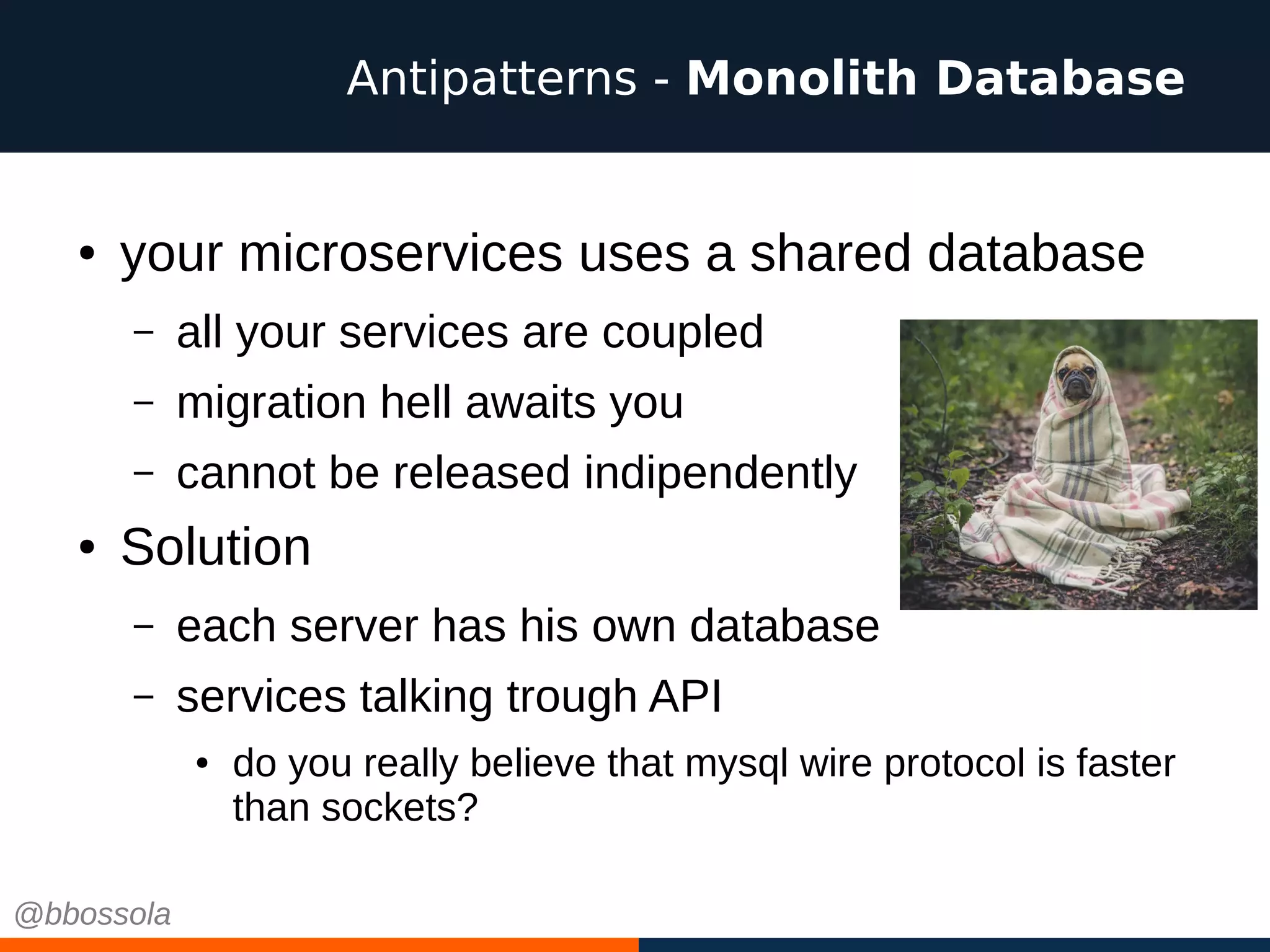
● your microservices uses a shared database
– all your services are coupled
– migration hell awaits you
– cannot be released indipendently
● Solution
– each server has his own database
– services talking trough API
● do you really believe that mysql wire protocol is faster
than sockets?
Antipatterns - Monolith Database
@bbossola
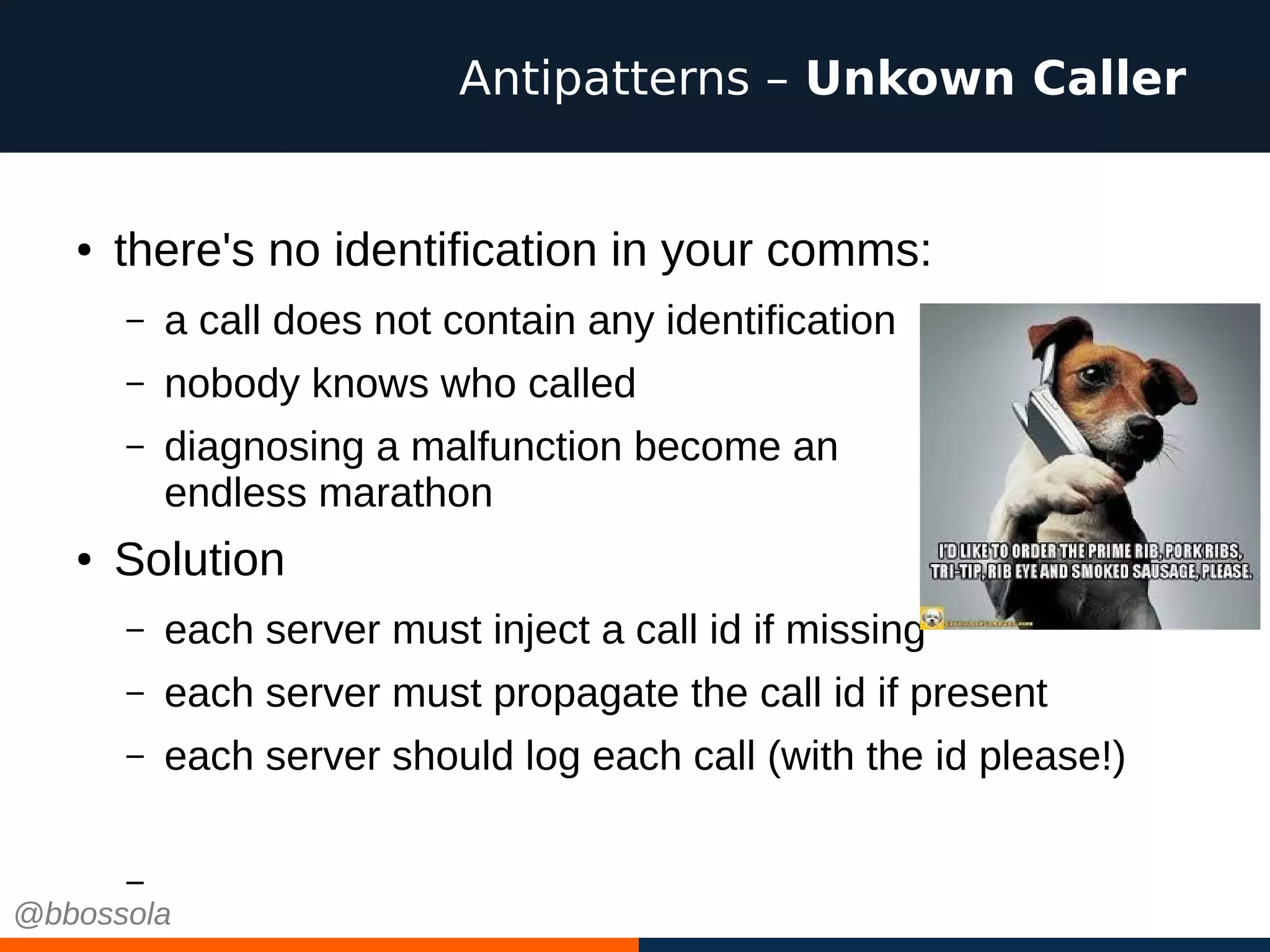
● there's no identification in your comms:
– a call does not contain any identification
– nobody knows who called
– diagnosing a malfunction become an
endless marathon
● Solution
– each server must inject a call id if missing
– each server must propagate the call id if present
– each server should log each call (with the id please!)
–
Antipatterns – Unkown Caller
@bbossola
● address of services are hardcoded
– microservices directly know about each other
– only light indirection mechanisms are supported
● configuration
● DNS or naming trickery
● Solution
– build your own simple discovery
mechanism
– introduce a discovery mechanism
● eureka, zookeper, consul, and why not, msnos
Antipatterns - Harcoded Hell
@bbossola
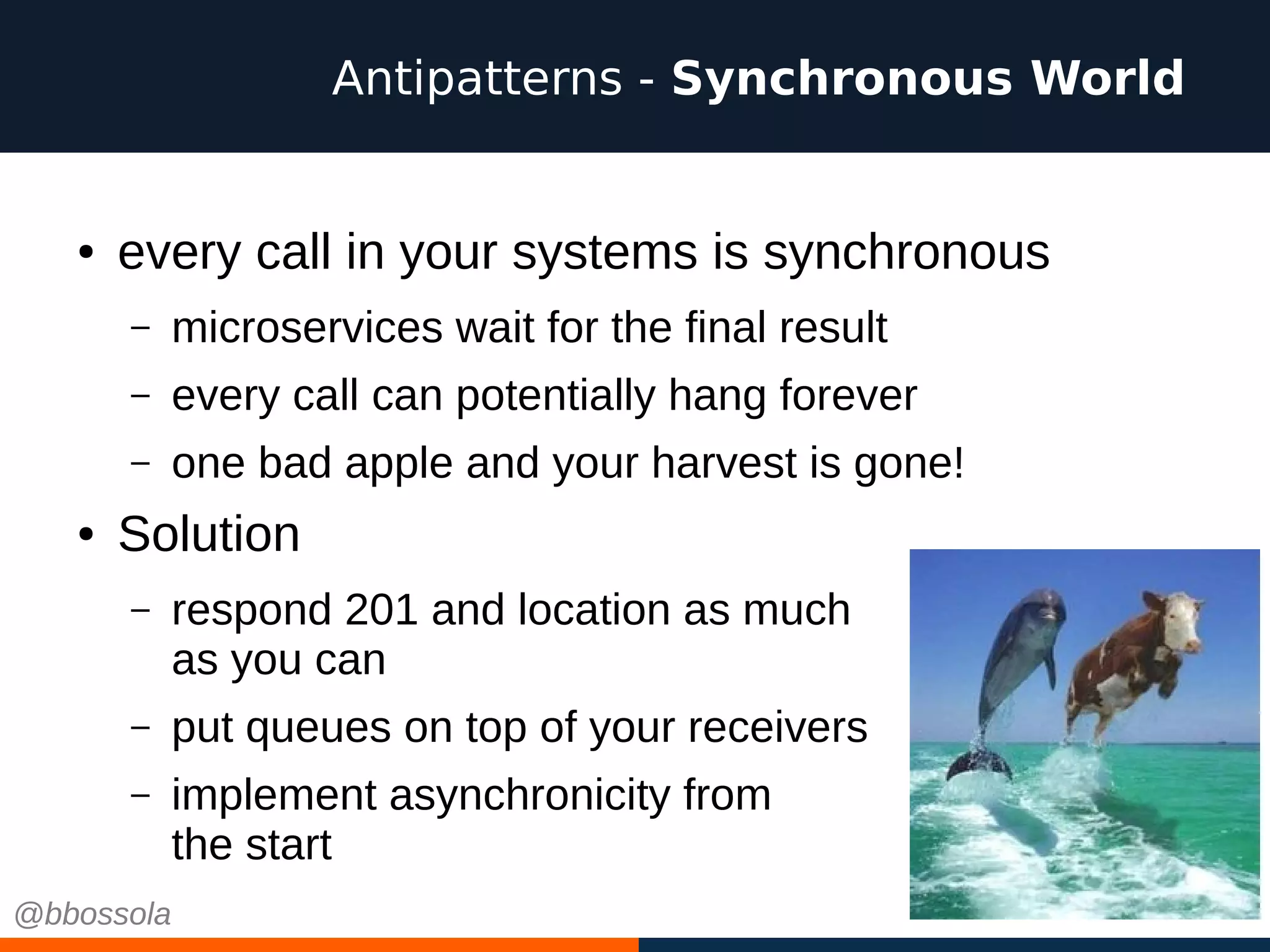
● every call in your systems is synchronous
– microservices wait for the final result
– every call can potentially hang forever
– one bad apple and your harvest is gone!
● Solution
– respond 201 and location as much
as you can
– put queues on top of your receivers
– implement asynchronicity from
the start
Antipatterns - Synchronous World
@bbossola
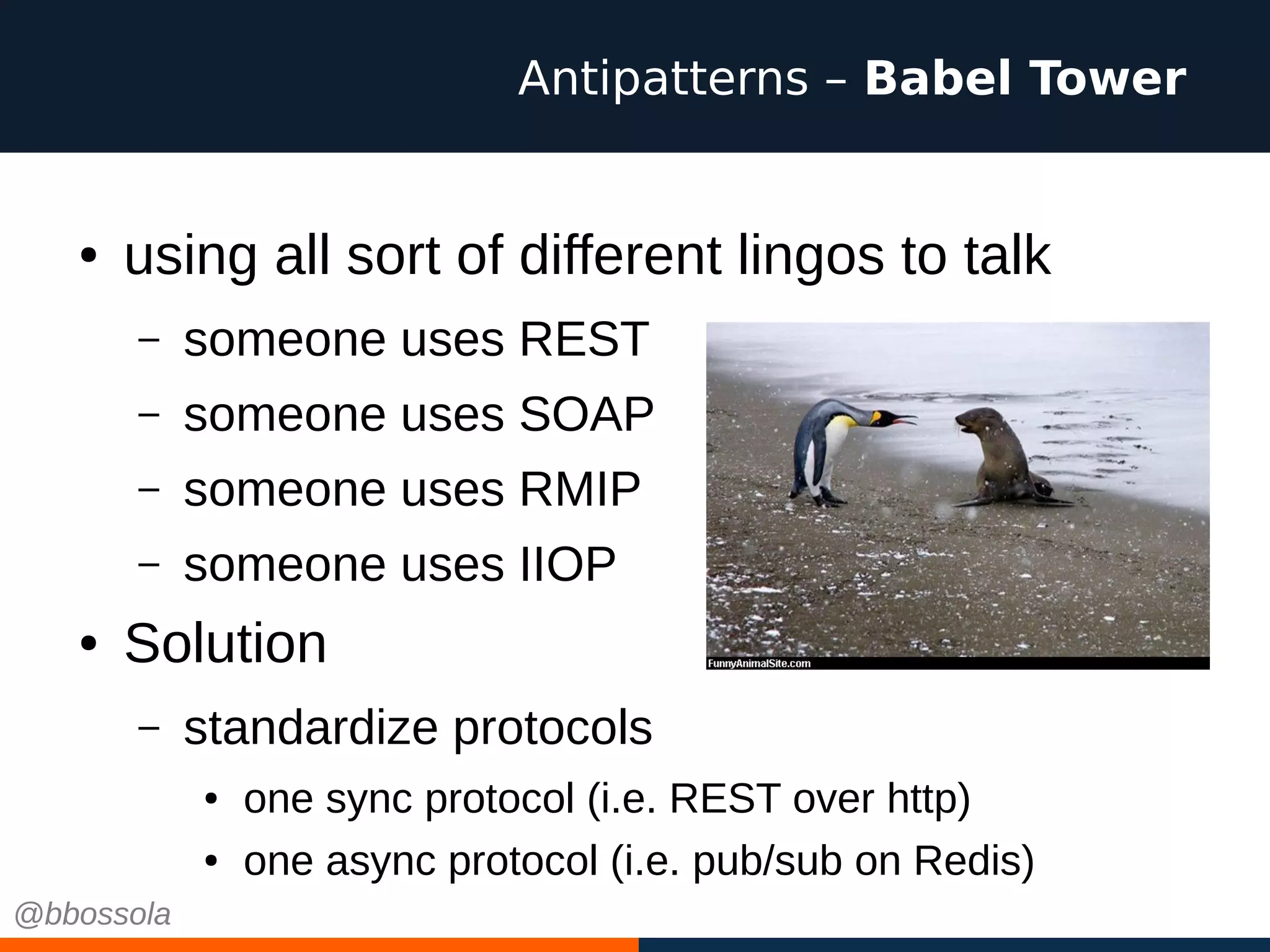
● using all sort of different lingos to talk
– someone uses REST
– someone uses SOAP
– someone uses RMIP
– someone uses IIOP
● Solution
– standardize protocols
● one sync protocol (i.e. REST over http)
● one async protocol (i.e. pub/sub on Redis)
Antipatterns – Babel Tower
@bbossola
● you have a big fat frontend:
– you have a single page application
– you have to deploy it in full for any upgrade
– you are using vertical "feature" teams
● Solution
– split the app in small independent pieces
– make sure those are deployable independently
– assign the entire frontend to a
separate team
–
Antipatterns – Monolith Frontend
@bbossola
● You have a scheduled deploy rhythm and...
– you deploy services in the early morning (6am?)
– you wan to to avoid any disturbance to the world
– you have a wiki page that lists all the new services
● Solution
– implement continuous deployment
– introduce necessary scaling in your
microservices
– onboard devops help to normalize
everything
Antipatterns – Early Mornings
@bbossola@bbossola
● “Our monolith code is crap, let's write microservices!”
– your decided to move to microservices
– your code is still crap
– your microservices are difficult to change
● Solution
– DO NOT discount proper design in
your code
– LOD, S.O.L.I.D., SOC, DRY, YAGNI
must have a central place in your
code
Antipatterns – Crapper
@bbossola
Demo!
ROME 18-19 MARCH
2016
All pictures belong
to their respective authors
➢ let's kick some antipatterns!
➢ a nodejs live sample that shows some
simple microservices speaking to each
other (code available at
https://github.com/bbossola/microjs)
@bbossola@bbossola
● Why microservices?
● What are microservices?
● Common antipatterns
● How do we work with microservices?
@bbossola
How do we work with microservices?
●
How did we get there?
– Replacing the monolith!
●
by executive decision
●
legacy code progressively replaced
with microservices
●
each new feature can now drive
a new microservice
– Moving to continuous delivery!
●
the business need to experiment, quickly!
●
we moved in small steps: from month, to weeks, to
days, to anytime!
@bbossola
How do we work with microservices?
●
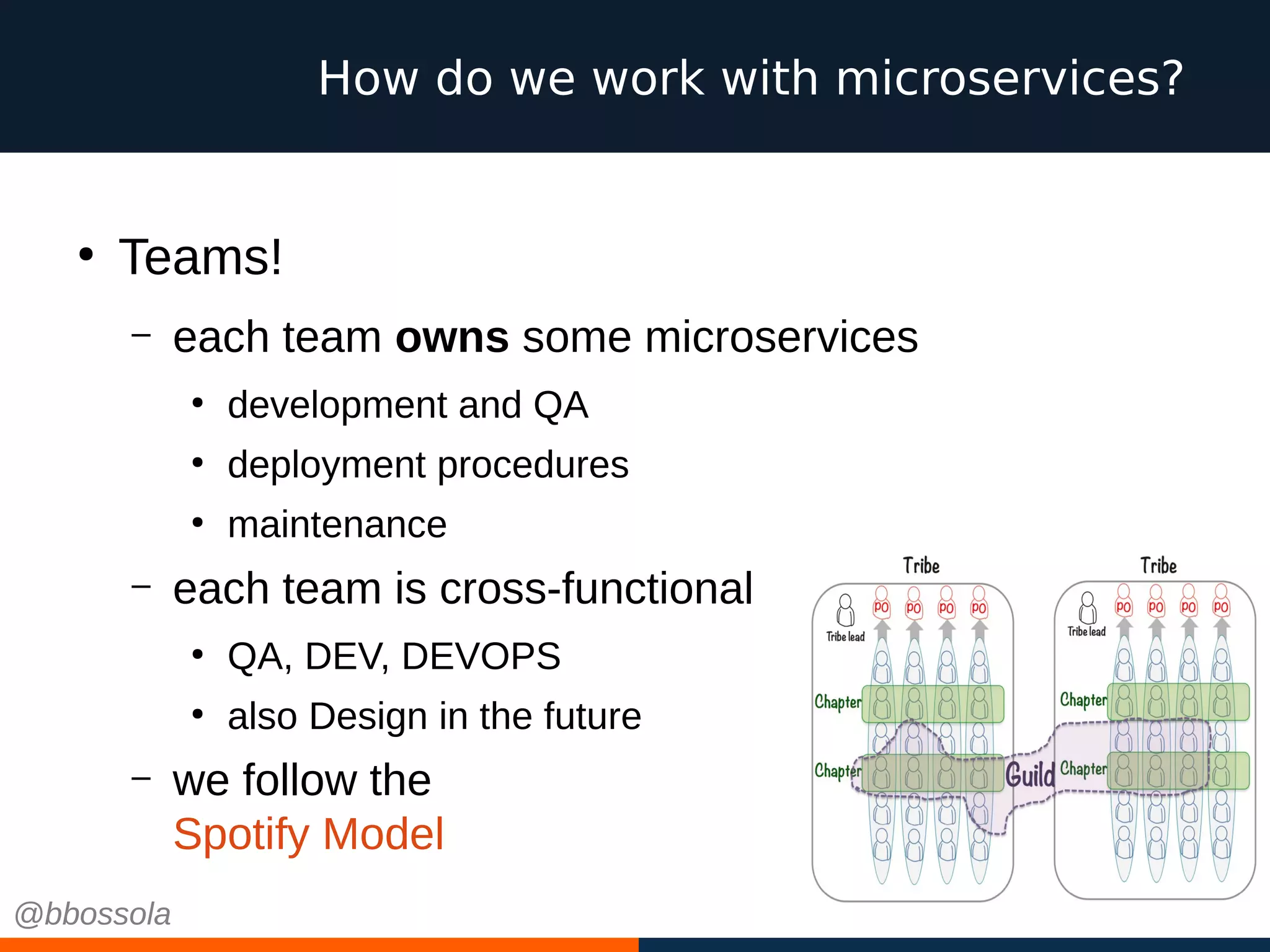
Teams!
– each team owns some microservices
●
development and QA
●
deployment procedures
●
maintenance
– each team is cross-functional
●
QA, DEV, DEVOPS
●
also Design in the future
– we follow the
Spotify Model
@bbossola
How do we work with microservices?
●
What about client applications?
– the frontends must be modular
●
each team controls a vertical “slice” of the system
●
allows independent deployments :)
– edge microservices are useful!
●
they aggregate calls
●
they minimize roundtrips
●
they optimize content
– a proxy layer is always needed!
●
not all APIs are public
●
signing may be used internally
@bbossola
How do we work with microservices?
●
Some numbers!
– 9 different products (web, mobile, desktop, server)
– 40+ microservices
– 28k unit tests (run in minutes)
– 3k end-to-end integration tests (run in 3 hours)
– up to 200 RPS on the busiest microservice
– up to 0.000001 RPS on the least used :)
– fastest response in 2 ms
– slowest response in 12 seconds (!)
@bbossola
Conclusions?
●
Have it your way!
@bbossola
Thanks!
ROME 18-19 MARCH
2016
bbossola@gmail.com
@bbossola
https://bbossola.wordpress.com
https://github.com/bbossola
All pictures belong
to their respective authors
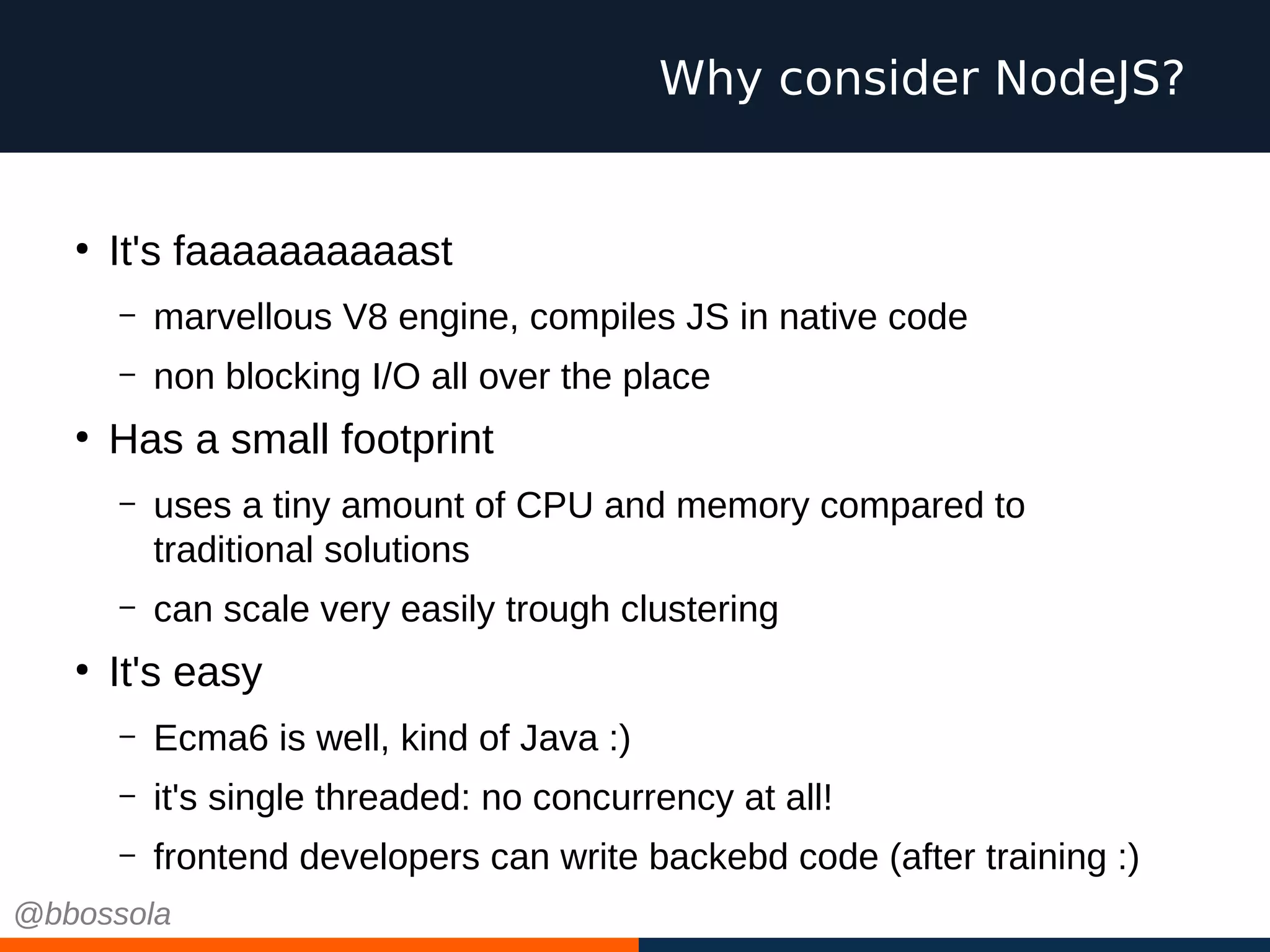
Why consider NodeJS?
●
It's faaaaaaaaaast
– marvellous V8 engine, compiles JS in native code
– non blocking I/O all over the place
●
Has a small footprint
– uses a tiny amount of CPU and memory compared to
traditional solutions
– can scale very easily trough clustering
●
It's easy
– Ecma6 is well, kind of Java :)
– it's single threaded: no concurrency at all!
– frontend developers can write backebd code (after training :)
@bbossola
Why consider NodeJS?
@bbossola
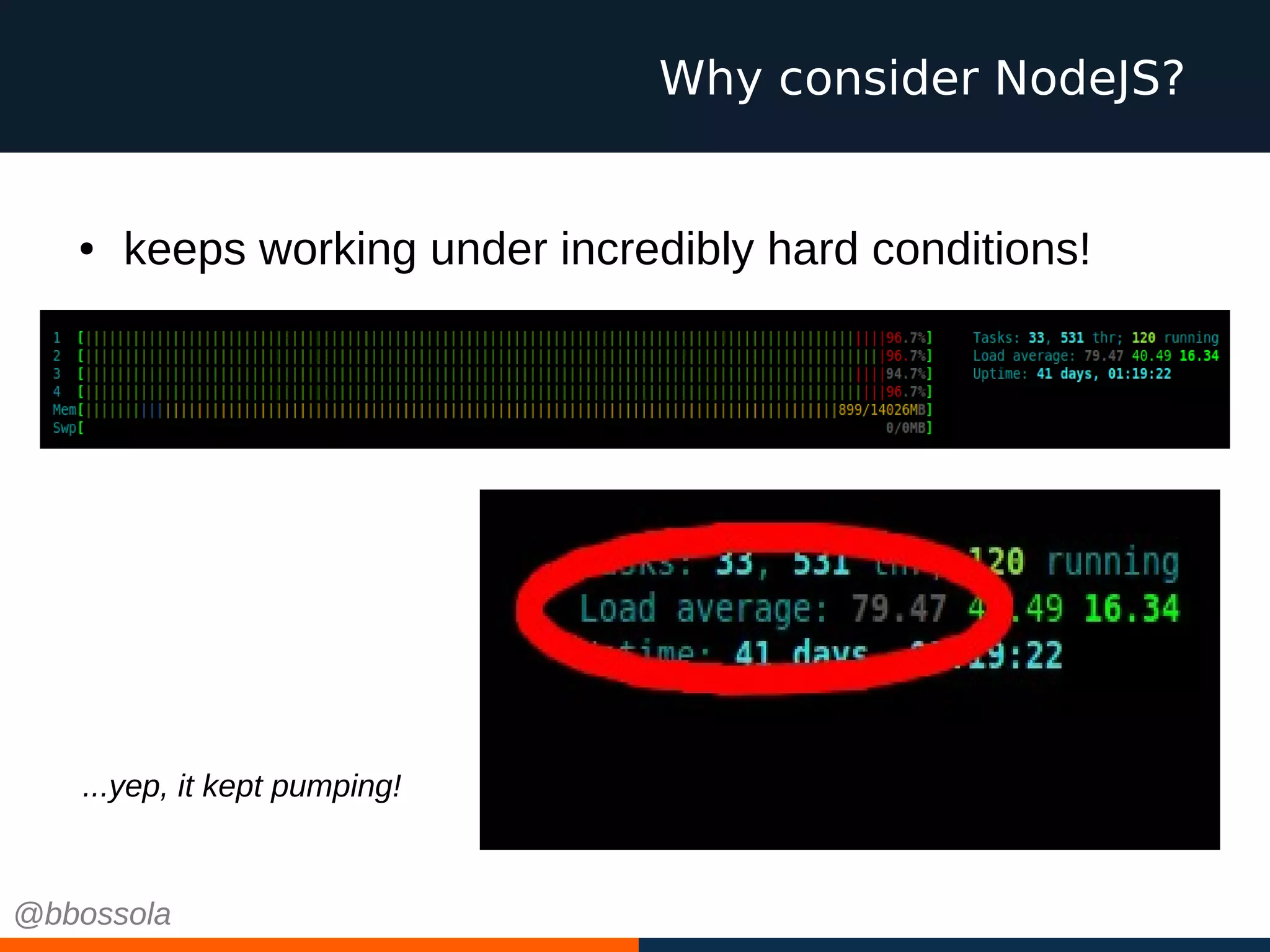
● keeps working under incredibly hard conditions!
...yep, it kept pumping!

Microservices, the lean way

  • 1.
    Microservices, the leanway Bruno Bossola (JUG Torino) AMSTERDAM 11-12 MAY 2016
  • 2.
    ` Microservices, the leanway ...now with 100% more llamas! AMSTERDAM 11-12 MAY 2016
  • 3.
    l ● Developer since1988 ● XP Coach 2000+ ● Co-founder and coordinator of JUG Torino ● Java Champion since 2005 ● VP of Engineering @Workshare.com ….and microservices addicted since 2013 Hey mate, who are you? @bbossola
  • 4.
    ● Why microservices? ●What are microservices? ● Demo ● Common antipatterns ● Demo ● How do we work with microservices? ● Conclusions? Agenda @bbossola
  • 5.
    ● Why microservices? ●What are microservices? ● Common antipatterns ● How do we work with microservices? Agenda @bbossola
  • 6.
    Why microservices? J2EE Ruby onRails .NET Are you living with a monolith? @bbossola
  • 7.
    Why microservices? J2EE Ruby onRails .NET ● your IDE is bloated Are you living with a monolith? @bbossola
  • 8.
    Why microservices? J2EE Ruby onRails .NET ● your IDE is bloated ● you are locked onto a language Are you living with a monolith? @bbossola
  • 9.
    Why microservices? J2EE Ruby onRails .NET ● your IDE is bloated ● you are locked onto a language ● your tests can take hours to run Are you living with a monolith? @bbossola
  • 10.
    Why microservices? J2EE Ruby onRails .NET ● your IDE is bloated ● you are locked onto a language ● your tests can take hours to run ● your db migrations are HUGE and scary Are you living with a monolith? @bbossola
  • 11.
    Why microservices? J2EE Ruby onRails .NET ● your IDE is bloated ● you are locked onto a language ● your tests can take hours to run ● your db migrations are HUGE and scary ● you always scale EVERYTHING Are you living with a monolith? @bbossola
  • 12.
    Why microservices? J2EE Ruby onRails .NET ● your IDE is bloated ● you are locked onto a language ● your tests can take hours to run ● your db migrations are HUGE and scary ● you always scale EVERYTHING ● you have a single BIG team Are you living with a monolith? @bbossola
  • 13.
    Why microservices? J2EE Ruby onRails .NET ● your IDE is bloated ● you are locked onto a language ● your tests can take hours to run ● your db migrations are HUGE and scary ● you always scale EVERYTHING ● you have a single BIG team ● you are generating HTML pages (no, well... really?) Are you living with a monolith? @bbossola
  • 14.
    ● Would notbe better if... Why microservices? @bbossola
  • 15.
    ● Would notbe better if... – you can use an IDE. Or not :) – you can choose your favourite programming language – your integration tests run in minutes – your db migrations are small and cosy – you scale independently – you have small teams, pizza size – you work on green field projects every time – you can choose cool technologies – you can fail Why microservices? @bbossola
  • 16.
    ● Would notbe better if... – you can use an IDE. Or not :) – you can choose your favourite programming language – your integration tests run in minutes – your db migrations are small and cosy – you scale independently – you have small teams, pizza size – you work on green field projects every time – you can choose cool technologies – you can fail Why microservices? @bbossola
  • 17.
    ● Would notbe better if... – you can use an IDE. Or not :) – you can choose your favourite programming language – your integration tests run in minutes – your db migrations are small and cosy – you scale independently – you have small teams, pizza size – you work on green field projects every time – you can choose cool technologies – you can fail Why microservices? @bbossola
  • 18.
    ● Would notbe better if... – you can use an IDE. Or not :) – you can choose your favourite programming language – your integration tests run in minutes – your db migrations are small and cosy – you scale independently – you have small teams, pizza size – you work on green field projects every time – you can choose cool technologies – you can fail Why microservices? @bbossola
  • 19.
    ● Would notbe better if... – you can use an IDE. Or not :) – you can choose your favourite programming language – your integration tests run in minutes – your db migrations are small and cosy – you scale independently – you have small teams, pizza size – you work on green field projects every time – you can choose cool technologies – you can fail Why microservices? @bbossola
  • 20.
    ● Would notbe better if... – you can use an IDE. Or not :) – you can choose your favourite programming language – your integration tests run in minutes – your db migrations are small and cosy – you scale independently – you have small teams, pizza size – you work on green field projects every time – you can choose cool technologies – you can fail Why microservices? @bbossola
  • 21.
    ● Would notbe better if... – you can use an IDE. Or not :) – you can choose your favourite programming language – your integration tests run in minutes – your db migrations are small and cosy – you scale independently – you have small teams, pizza size – you work on green field projects every time – you can choose cool technologies – you can fail Why microservices? @bbossola
  • 22.
    ● Would notbe better if... – you can use an IDE. Or not :) – you can choose your favourite programming language – your integration tests run in minutes – your db migrations are small and cosy – you scale independently – you have small teams, pizza size – you work on green field projects every time – you can choose cool technologies – you can fail Why microservices? @bbossola
  • 23.
    ● Would notbe better if... – you can use an IDE. Or not :) – you can choose your favourite programming language – your integration tests run in minutes – your db migrations are small and cosy – you scale independently – you have small teams, pizza size – you work on green field projects every time – you can choose cool technologies – you can fail Why microservices? @bbossola
  • 24.
    ● Why microservices? ●What are microservices? ● Common antipatterns ● How do we work with microservices? Agenda @bbossola
  • 25.
    ● independent (processes)communicating with each other using language-agnostic APIs ● small, highly decoupled and focus on doing a small task ● can be written in any programming language – we do use Ruby, C#. Java and Javascript ● micro means small, very! – we run 20 of them on one single machine ● deployed independently, run independently ● each use its own database ● each owned by a team What are microservices? @bbossola
  • 26.
    ● Pros! – highlycohesive, loosely coupled – clean api contracts and SOC – very easy to write and replace – self-contained, very easy to deploy – scaling can be very focused – small releases, less risky to deploy – separate databases for separate migrations – enabler to have many small teams ● each team is in charge of some of them ● QA and OPS can be embedded in the team ● CX teams can be built around this! What are microservices? @bbossola
  • 27.
    ● Cons! – Lotsof them! – Every microservice is doing one thing, so a lot of collaboration is required to perform a task – Scaling may require considerable effort – Frequent duplicated configuration – Proxying for external apps is not easy – management overhead (more moving parts) What are microservices? @bbossola
  • 28.
    In the meantime,at Workshare... What are microservices? @bbossola
  • 29.
    Demo! ROME 18-19 MARCH 2016 Allpictures belong to their respective authors ➢ simple WS services (time and location) ➢ complex WS services (groups and folders) ➢ a nodejs live sample that shows some simple microservices speaking to each other, part one (code available at https://github.com/bbossola/microjs ) @bbossola
  • 30.
    ● Why microservices? ●What are microservices? ● Common antipatterns ● How do we work with microservices? @bbossola
  • 31.
    ● Disneyworld ● MonolithDatabase ● Unknown Caller ● Hardcoded Hell ● Synchronous World ● Babel Tower ● Monolith Frontend ● Early Mornings ● Crapper Common antipatterns Stay tuned go get more! bbossola.wordpress.com @bbossola
  • 32.
    ● we aresmall, everything is nice, cosy and lovely – no healthchecks – no metrics – no monitoring ● Solution – adopt a stack that implements these basic functionalities – adopt (and connect!) one (or two) monitoring systems – use a circuit breaker! Antipatterns - Disneyworld @bbossola
  • 33.
    ● your microservicesuses a shared database – all your services are coupled – migration hell awaits you – cannot be released indipendently ● Solution – each server has his own database – services talking trough API ● do you really believe that mysql wire protocol is faster than sockets? Antipatterns - Monolith Database @bbossola
  • 34.
    ● there's noidentification in your comms: – a call does not contain any identification – nobody knows who called – diagnosing a malfunction become an endless marathon ● Solution – each server must inject a call id if missing – each server must propagate the call id if present – each server should log each call (with the id please!) – Antipatterns – Unkown Caller @bbossola
  • 35.
    ● address ofservices are hardcoded – microservices directly know about each other – only light indirection mechanisms are supported ● configuration ● DNS or naming trickery ● Solution – build your own simple discovery mechanism – introduce a discovery mechanism ● eureka, zookeper, consul, and why not, msnos Antipatterns - Harcoded Hell @bbossola
  • 36.
    ● every callin your systems is synchronous – microservices wait for the final result – every call can potentially hang forever – one bad apple and your harvest is gone! ● Solution – respond 201 and location as much as you can – put queues on top of your receivers – implement asynchronicity from the start Antipatterns - Synchronous World @bbossola
  • 37.
    ● using allsort of different lingos to talk – someone uses REST – someone uses SOAP – someone uses RMIP – someone uses IIOP ● Solution – standardize protocols ● one sync protocol (i.e. REST over http) ● one async protocol (i.e. pub/sub on Redis) Antipatterns – Babel Tower @bbossola
  • 38.
    ● you havea big fat frontend: – you have a single page application – you have to deploy it in full for any upgrade – you are using vertical "feature" teams ● Solution – split the app in small independent pieces – make sure those are deployable independently – assign the entire frontend to a separate team – Antipatterns – Monolith Frontend @bbossola
  • 39.
    ● You havea scheduled deploy rhythm and... – you deploy services in the early morning (6am?) – you wan to to avoid any disturbance to the world – you have a wiki page that lists all the new services ● Solution – implement continuous deployment – introduce necessary scaling in your microservices – onboard devops help to normalize everything Antipatterns – Early Mornings @bbossola@bbossola
  • 40.
    ● “Our monolithcode is crap, let's write microservices!” – your decided to move to microservices – your code is still crap – your microservices are difficult to change ● Solution – DO NOT discount proper design in your code – LOD, S.O.L.I.D., SOC, DRY, YAGNI must have a central place in your code Antipatterns – Crapper @bbossola
  • 41.
    Demo! ROME 18-19 MARCH 2016 Allpictures belong to their respective authors ➢ let's kick some antipatterns! ➢ a nodejs live sample that shows some simple microservices speaking to each other (code available at https://github.com/bbossola/microjs) @bbossola@bbossola
  • 42.
    ● Why microservices? ●What are microservices? ● Common antipatterns ● How do we work with microservices? @bbossola
  • 43.
    How do wework with microservices? ● How did we get there? – Replacing the monolith! ● by executive decision ● legacy code progressively replaced with microservices ● each new feature can now drive a new microservice – Moving to continuous delivery! ● the business need to experiment, quickly! ● we moved in small steps: from month, to weeks, to days, to anytime! @bbossola
  • 44.
    How do wework with microservices? ● Teams! – each team owns some microservices ● development and QA ● deployment procedures ● maintenance – each team is cross-functional ● QA, DEV, DEVOPS ● also Design in the future – we follow the Spotify Model @bbossola
  • 45.
    How do wework with microservices? ● What about client applications? – the frontends must be modular ● each team controls a vertical “slice” of the system ● allows independent deployments :) – edge microservices are useful! ● they aggregate calls ● they minimize roundtrips ● they optimize content – a proxy layer is always needed! ● not all APIs are public ● signing may be used internally @bbossola
  • 46.
    How do wework with microservices? ● Some numbers! – 9 different products (web, mobile, desktop, server) – 40+ microservices – 28k unit tests (run in minutes) – 3k end-to-end integration tests (run in 3 hours) – up to 200 RPS on the busiest microservice – up to 0.000001 RPS on the least used :) – fastest response in 2 ms – slowest response in 12 seconds (!) @bbossola
  • 47.
  • 48.
  • 49.
    Why consider NodeJS? ● It'sfaaaaaaaaaast – marvellous V8 engine, compiles JS in native code – non blocking I/O all over the place ● Has a small footprint – uses a tiny amount of CPU and memory compared to traditional solutions – can scale very easily trough clustering ● It's easy – Ecma6 is well, kind of Java :) – it's single threaded: no concurrency at all! – frontend developers can write backebd code (after training :) @bbossola
  • 50.
    Why consider NodeJS? @bbossola ●keeps working under incredibly hard conditions! ...yep, it kept pumping!