Microfinance and
PovertyReduction
SusanJohnson and Ben Rogaly
Oxfam
(UK and Ireland)
First published by Oxfam (UK and Ireland) and ACTIONAID in 1997
Reprinted by Oxfam GB 1997, 1999
© Oxfam (UK and Ireland) and ACTIONAID 1997
Oxfam GB, 274 Banbury Road, Oxford OX2 7DZ
ACTIONAID, Hamlyn House, Macdonald Road, Archway, London N19 5PG
ISBN 0 85598 369 8
A catalogue record for this publication is available from the British Library.
All rights reserved. Reproduction, copy, transmission, or translation of any part of this publication
may be made only under the following conditions:
• With the prior written permission of the publisher; or
• With a licence from the Copyright Licensing Agency Ltd., 90 Tottenham Court Road,
London W1P 9HE, UK, or from another national licensing agency; or
• For quotation in a review of the work; or
• Under the terms set out below.
This publication is copyright, but may be reproduced by any method without fee for teaching
purposes, but not for resale. Formal permission is required for all such uses, but normally will be
granted immediately. For copying in any other circumstances, or for re-use in other publications,
or for translation or adaptation, prior written permission must be obtained from the publisher,
and a fee may be payable.
Available from the following agents:
USA: Stylus Publishing LLC, PO Box 605, Herndon, VA 20172-0605, USA
tel: +1 (0)703 661 1581; fax: + 1(0)703 661 1547; email: styluspub@aol.com
Canada. Fernwood Books Ltd, PO Box 9409, Stn. 'A', Halifax, N.S. B3K 5S3, Canada
tel: +1 (0)902 422 3302; fax: +1 (0)902 422 3179; e-mail: fernwood@istar.ca
India: Maya Publishers Pvt Ltd, 113-B, Shapur Jat, New Delhi-110049, India
tel: +91 (0)11 649 4850; fax: +91 (0)11 649 1039; email: surit@del2.vsnl.net.in
K Krishnamurthy, 23 Thanikachalan Road, Madras 600017, India
tel: +91 (0)44 434 4519; fax: +91 (0)44 434 2009; email: ksm@md2.vsnl.net.in
South Africa, Zimbabwe, Botswana, Lesotho, Namibia, Swaziland: David Philip Publishers,
PO Box 23408, Claremont 7735, South Africa
tel: +27 (0)21 64 4136; fax: +27(0)21 64 3358; email: dppsales@iafrica.com
Tanzania: Mkuki na Nyota Publishers, PO Box 4246, Dar es Salaam, Tanzania
tel/fax: +255 (0)51 180479, email: mkuki@ud.co.tz
Australia: Bush Books, PO Box 1958, Gosford, NSW 2250, Australia
tel: +61 (0)2 043 233 274; fax: +61 (0)2 092 122 468, email: bushbook@ozemail.com.au
Rest of the world: contact Oxfam Publishing, 274 Banbury Road, Oxford OX2 7DZ, UK.
tel. +44 (0)1865 311 311: fax +44 (0)1865 313 925; email publish@oxfam.org.uk
Designed and printed by Oxfam GB, 274 Banbury Road, Oxford OX2 7DZ, UK
Printed by Litho and Digital Impressions Ltd. OX410/RB/96
Oxfam GB is a registered charity, no. 202 918, and is a member of Oxfam International.
This book converted to digital file in 2010
Contents
Acknowledgements vii
Introduction 1
1 Current debates in microfinance 5
1.1 Subsidised credit provision 5
1.2 The move to market-based solutions 5
1.3 Making use of social collateral 7
1.4 Savings 8
1.5 Can microfinance interventions reduce poverty? 10
1.51 Poverty aspowerlessness 10
1.5-2 Creditfor micro-enterprises 11
1.53 Reaching thepoorest 12
1.6 Financial interventions and social change 13
1.7 Treading carefully in microfinance interventions 14
2 Informal financial services 16
2.1 Introduction 16
2.2 User-owned informal financial services 17
2.2.1 Some examples of user-ownedfinancial services 18
2.3 Informal financial services for profit 19
2.31 Some examples of informalfinancial servicesprovidedfor profit 20
2.4 Turning the informal into the formal 22
2.5 What can be learned from informal finance? 23
2.6 Deciding when and how to intervene 25
2.6.1 Research questions on existing informal financial services 27
2.7 Filling the gaps 29
2.7.1 Some examples of innovative services 29
in
2.8 Promotion: an alternative strategy for NGOs 30
2.8.1 Formation of savings groups
and development of internal creditfacilities 30
2.8.2 Promotion of small-scaleformalised approaches 31
2.8.3 Linking groups to theformal system 32
2.8.4 Linking with specialisedfinancial service NGOs 33
2.8.5 Advocacy 33
2.9 Summary and conclusions 34
3 The design of savings and credit schemes for poor people 35
3.1 Introduction 35
3.2 Targeting savings and credit to poor people 35
3.3 Women as users of financial services 38
3.4 Lending through groups 38
3-4.1 Functions of the group in microfinance schemes 39
3.4.2 Including thepoorest 41
3-4.3 Other examples ofgroup-based schemes 42
3.5 Savings 43
331 The value of a savingsfacility 44
3-5.2 Compulsory or voluntary savings? 45
3-5-3 Linking savings to credit 46
3.6 Forms of loan 47
3.6.1 Credit in cash or kind? 47
3-6.2 Directed or undirected credit? 48
3.7 Loan disbursement and repayment schedules 50
3.8 Interest rates 51
3.9 Integrating financial services with other activities 52
3-9.1 Savings and creditfor group
formation and institution-building 53
3-9.2 Social development programmes 54
3-9.3 Economic development activities 54
3.10 Summary and conclusions 56
4 Financial performance and sustainability 58
4.1 Introduction 58
4.2 Managing and assessing financial performance 58
4.2.1 The repayment rate 59
4.2.2 Arrears and default 59
IV
4.3 Financial sustainability 60
4.3-1 Thepros and cons of 'scaling up 6l
4.3-2 Issues in sustainability: the experience of 'village banking' 62
4.3-3 Sustainability through extending coverage 63
4.3-4 Measuring financial sustainability 64
4.4 Managerial and organisational sustainability 68
4.4.1 The role of staff in microfinance interventions 68
4.4.2 Organisational sustainability and change 69
4.5 Summary and conclusions 71
5 Assessing impact 72
5.1 Introduction 72
5.2 The difficulties of assessing impact 72
5-2.1 Establishing loan use 14
5-2.2 Measuring change-, controls and baselines 74
5-2.3 Proving causality 75
5.3 Innovations in impact assessment 76
5-3-1 Researching usefulness.- a case study 11
5-3-2 Assessing impact on social relationships 78
5-3-3 Impact assessment as a dynamic process 79
5-3-4 Validating qualitative data 80
5-3-5 Using quantitative data in impact assessment 81
5.4 Learning and adaptability 82
5.5 Summary and conclusions 84
6 Case studies 85
6.1 Introducing the case studies 85
6.2 Union Regional de Apoyo Campesino (URAC), Mexico 89
6.2.1 Background 89
6.2.2 Design 90
6.2.3 Financial performance and sustainability 92
6.2.4 Impact assessment 93
6.2.5 Conclusions 96
6.3 SUNGI Development Foundation, Pakistan 96
63-1 Background %
6.3.2 Design 97
6.3-3 Financial performance and sustainability 98
6.3-4 Impact assessment 98
6.3-5 Conclusions 101
6.4 Ladywood Credit Union, UK 101
6.4.1 Background 101
6.4.2 Design 102
6.4.3 Financial performance and sustainability 104
6.4.4 Impact assessment 104
6.4.5 Conclusions 107
6.5 ACTIONAID in The Gambia 107
6.5.1 Background 107
6.5.2 Design 108
6.5-3 Financial performance and sustainability 109
6.5.4 Impact assessment 110
6.5-5 Conclusions 113
6.6 Casa Campesina Cayambe, Ecuador 113
6.6.1 Background 113
6.6.2 Design 114
d.6.3 Financial performance and sustainability 115
6.6.4 Impact assessment 116
6.6.5 Conclusions 117
7 Conclusions 118
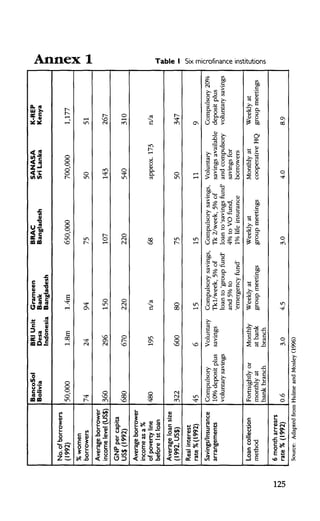
Annex 1 Table 1 Six microfinance institutions 125
Annex 2 Repayment rate and arrears rate 126
References 128
VI
Acknowledgements
The authors wish to acknowledge the major inputs of Farah Batool (Pakistan
case study), Martha Romero, Stephen Fogarty and Ofelia Guttierez (Mexico
case study),Helen Derbyshire and Aggie Kent (UK case study), Ousman
Cham and the staff of ACTIONAID The Gambia (The Gambia case study),
Juan Serrano, Emilia Ferraro and Javier Herran (Ecuador case study). Stuart
Rutherford provided a major and much appreciated contribution in the form
of a background paper, A Critical Typology ofFinancial Servicesfor thePoor,
as well as making comments on the text.
Thanks are also due to the following: Shahin Yaqub, for a background
paper, Macroeconomic Conditionsfor SuccessfulFinancial Servicesfor Poor
People, Alfonso Castillo, and Md. Mumtaz Tanoli for additional assistance in
planning and undertaking the case studies as well as commenting on the text;
David Norman, Barbara Thomas and Helen Yanacopulos for research
assistance. The following read and made valuable comments on the full text:
Audrey Bronstein, James Copestake, Ros David, Helen Derbyshire, Heather
Grady, Dot McCall, Amitava Mukherjee, Ravi Narayanan, Chris Roche,
William Smith, Ines Smyth, and Ton van Zutphen. The authors are also
grateful for the help and encouragement of Kirat Randhawa, Simran Rogaly,
Deborah Eade, Pat Conaty, Carlos Ling, Michael Semple, Ceci Lopez, Pauline
Wilson, and Nigel Twose. Any errors or omissions remain the responsibility
of the authors.
SusanJohnson and Ben Rogaly
vu
Introduction
During the 1990s, the provision of financial services dealing with very small
deposits and loans — microfinance — and particularly the provision of
microcredit, have been increasingly acclaimed as effective means of poverty
reduction. There is continuing and quite rapid improvement in under-
standing how financial services for poor people can best be provided. This
book sets out to draw together some of the most important lessons learned to
date, as a useful resource for those considering financial interventions as well
as those already involved. However, rather than setting out a single model of
'good practice', the book recommends an overall approach. In doing this,
and in order to counteract the idea that credit alone can be a panacea for
eradicating poverty, it reports on continuing debates about and different
approaches to the provision of financial services to poor people.
Private sector non-profit organisations (referred to in this book as non-
governmental organisations — NGOs) aiming to bring about reductions in
poverty have become increasingly involved in providing financial services.
Of those NGOs, most have experience of savings and credit, often linked to
programmes of income generation. Very small deposits and loans are
referred to together as 'microfinance'. This book focuses on microfinance
and only briefly discusses its relationship to other development activities.
The book does not cover financial service provision during complex
emergencies or natural disasters, or for particular marginal or vulnerable
groups, such as pastoralists or people with AIDS/HIV.
Before going further, the term 'financial services' needs explanation.
Financial services are about enabling people to amass usefully large sums of
cash (Rutherford, 1996). They can be divided into two main types: first, those
that build up cash reserves through forgoing income. Saving does this by
making deposits out of income now and so forgoing its current use in order to
draw a sum from these savings in the future. Insurance performs a similar
Microfinance and Poverty Reduction
function: it allows the client to buy access to a future lump sum. Loans work in
a similar way, but in reverse: they are lump sums which are given now in
return for income forgone in the future.
The second main type of financial service allows assets to be converted into
and out of lump sums of cash. Mortgages and pawns are the main examples of
such services. A further type of service which poor people may need, but
which is rarely discussed, is cash-handling, especially to allow the trans-
mission of cash from one place to another. This is essential for long-term
migrants, for example, wishing to send cash back to their relatives.
The elements of an effective approach to
microfinance
The approach to microfinance proposed here has five main points. First, that
NGOs should investigate existing financial services; who uses them and to
what effect. Second, that before intervening directly, NGOs should assess
whether they have the specialist knowledge and skills required to provide
financial services themselves. Third, in order to design services which are
relevant and useful to poor people, NGOs should understand local social and
economic structures, and also macro-level trends. Fourth, NGOs should
consider how the provision of services can be sustained in the long term.
Lastly, the impact on poverty reduction should be continually assessed rather
than taken for granted, which tends to happen if a microfinance intervention
is covering its costs and has many low-income users.
The structure of this book
The book begins by setting out the main debates surrounding interventions
to provide financial services, to provide a background to the rest of the book.
Much of the discussion in this initial chapter is based on Rogaly (1996a).
In any situation there is likely to be an array of informal financial services
which people are making use of. An overview of these is given in Chapter 2.
There is now much greater understanding of the characteristics of such
services and how they operate. The first task for an NGO proposing to
intervene is to find out which services are already available to people and
which additional ones they would find most useful. To do this the NGO must
understand for whom, under what circumstances, and to what degree these
services support or undermine livelihood strategies. This background in-
formation allows the design of financial services to be connected to an
analysis of poverty and well-being, and at the same time establishes which
existing services poor people may wish to retain, and which should therefore
Introduction
not be undermined by any new intervention. This chapter draws heavily on a
background paper commissioned for the book: A Critical Typology of
Financial Services/or thePoor, by Stuart Rutherford, November 1996.
The next step suggested for an NGO is to critically and honestly assess
whether it is best placed to become a provider of financial services. In the past
NGOs have not always achieved success in this area, and have failed to
appreciate that specific skills are required. Alternative approaches which
enable the NGO to utilise its skills in mobilising, training, and working with
poor people to promote rather than to provide services should be seriously
considered. Another possible role for NGOs is in advocacy with govern-
ments, to persuade them to make the necessary legislative changes, and with
national banking systems to encourage bankers to work with poor people.
Recent microfinance interventions have made use of a range of design
features, which are discussed in Chapter 3- They have focused on reaching
the poor by keeping loan sizes small, targeting women, adopting group-
based lending systems, and mobilising small and frequent savings deposits,
and have tended to set interest rates at higher levels than in the past. Such
interventions have demonstrated that poor people can and do repay loans,
that they have the ability to save, and that they can pay higher interest rates.
The discussion in Chapter 3 explores the assumptions behind these design
elements of microfinance schemes, and the ways that they operate in
practice. It emphasises the fact that different combinations of design features
suit particular macro-economic, socio-economic, and political circumstances.
This suggests that interveners must continuously and critically assess the
effects that elements of the design of their programme are having in practice.
To do this, it is advisable to start slowly in order that growing understanding
of people's uses for microfinance can lead to adaptations in design.
The fourth element of the approach set out in this book is a focus on
sustainability, and this is discussed in Chapter 4. Microfinance initiatives have
increasingly reported high repayment rates and the ability to cover part of the
costs of providing the service. This has raised the possibility that organisa-
tions providing these services may be able to become self-sustaining, and so
ensure the long-term provision of financial services to their users. NGOs
involved in (or seeking to start) the provision of financial services need to
take the issue of financial sustainability seriously, and ways of measuring
financial self-sustainability are discussed in the chapter. However, financial
sustainability is only one necessary condition for NGOs to be able to continue
to provide services in the long term. The organisational structure, manage-
ment, and staffing of the NGO are equally vital components. In discussing the
forms of organisation that might be sustainable, some have argued that NGOs
should turn themselves into banks. There is unlikely to be a single answer:
Microfinance and Poverty Reduction
some NGOs may prefer instead to put groups in touch with existing banks so
that they are no longer needed.
The final element — the assessment of impact — is explored in Chapter 5.
This is an area in which there are many methodological difficulties. However,
for those interested in poverty reduction, changes in users' livelihoods as a
result of microfinance provision are of central importance. The approach
proposed is one in which organisations continuously investigate and assess
the usefulness and relevance of their services, and adapt their ways of
working in response to the results they find. It is suggested that NGOs
involved in microfinance should be modest and honest about their aims.
Qualitative data gathering which involves users as well as the staff of the
microfinance institution can help to clarify how different groups of people —
poor, poorest, men, women — are able to make use of the services and with
what effect. This information is a vital adjunct to quantitative information on
performance, such as numbers of users reached and number and amount of
deposits, or volume and size of loans dispersed.
The book makes use of five case studies of financial service schemes
connected to or funded by ACTIONAID or Oxfam. In Chapter 6 these
schemes are described and used to illustrate issues discussed in earlier
chapters in a practical context. Chapter 7 then draws overall conclusions.
1
Current debates in microfinance
1.1 Subsidised credit provision
From the 1950s, governments and international aid donors subsidised credit
delivery to small farmers in rural areas of many developing countries. It was
assumed that poor people found great difficulty in obtaining adequate
volumes of credit and were charged high rates of interest by monopolistic
money-lenders. Development finance institutions, such as Agricultural
Development Banks, were responsible for the delivery of cheap credit to
poor farmers.
These institutions attempted to supervise the uses to which loans were put,
and repayment schedules were based on the expected income flow from the
investment. Returns were often overestimated. For example, calculations
would be based on agricultural yields for good years (Adams and Von
Pischke, 1992). As a result, loans were often not repaid. The credibility and
financial viability of these subsidised credit schemes were further weakened
by the use of public money to waive outstanding and overdue loans at
election time (Adams and Von Pischke, 1992; Lipton, 1996; Wiggins and Rogaly,
1989)- A dependence on the fluctuating whims of governments and donors,
together with poor investment decisions and low repayment rates made
many of these development finance institutions unable to sustain their lend-
ing programmes. Credit provision for poor people was transitory and limited.
1.2 The move to market-based solutions
This model of subsidised credit was subjected to steady criticism from the
mid-1970s as donors and other resource allocators switched attention from
state intervention to market-based solutions. Policy-makers were reminded
Microfinance and Poverty Reduction
that credit could also be described as debt and that the over-supply of
subsidised credit without realistic assessment of people's ability to repay
could result in impoverishment for borrowers.
At the same time the concept of 'transaction costs', and the notion that full
information about borrowers was not available to lenders, were used by the
opponents of subsidised credit to justify the high interest-rates charged by
money-lenders. Lending money carries with it the risk of non-repayment. In
order to know who is creditworthy and who is not, and so reduce this risk, the
lender screens potential borrowers. This involves gathering information on
the circumstances of individuals, which may not be easy to obtain. Then
enforcement costs are incurred to ensure repayment. Through this process
risks are reduced, though not eliminated. Where a loan is disbursed on
condition that it is used for a particular purpose, supervision costs also arise.
Using these tools of analysis it was argued that private money-lenders
charged interest rates which were higher than formal bank-rates because of
the high costs they faced in terms of risk, particularly when lending without
physical collateral. At the same time, it was argued that money-lenders were
an efficient source of credit because their greater knowledge of the people to
whom they were lending lowered screening costs.
Moreover, potential borrowers faced high transaction costs when they
sought loans from formal-sector finance institutions. These costs included the
time, travel, and paperwork involved in obtaining credit, and were often pro-
hibitive for poor clients, especially those most geographically isolated. On
the basis of this analysis, a group of economists based at Ohio State University
(USA), notably Dale Adams and J D Von Pischke, put forward the view that
the provision of credit should be left almost entirely to the private sector.
In concentrating on the problems of publicly subsidised credit, these
economists ignored the social ties, power relations, and coercion associated
with the activities of money-lenders. However, detailed micro-level research
has demonstrated the widespread use of 'interlocked' contracts to force
exchange to the disadvantage of poor people (Bhaduri, 1981). Powerful local
people, including landlords, employers, and traders, are able to influence the
terms of loans made to tenants, workers, and small producers via conditions
set in transactions involving land, labour, or crops. For example, traders
frequently lend working capital to small farmers on condition that their crops
are sold to that trader at a pre-determined price. Similarly, loans are made to
workers against the promise of labour to be provided at below the going rate
at a set future date (Rogaly, 1996b).
Against the background of these debates, recent developments in the
design of microfinance schemes have generated an understandably high
degree of excitement. This is because innovative features in design have
Current debates in microfinance
reduced the costs and risks of making loans to poor and isolated people, and
made financial services available to people who were previously excluded.
1.3 Making use of social collateral
There was little knowledge among formal-sector financial intermediaries of
alternatives to physical collateral, until the 1970s, when the Grameen Bank in
Bangladesh began using 'peer-group monitoring' to reduce lending risk.
The modelfor credit delivery in the Grameen Bank is asfollows:
• Groups offive self-select themselves; men's and women's group are
kept separate but the members of a single group should have a similar
economic background.
• Membership is restricted to those with assets worth less than half an acre
of land.
• Activities begin with savings ofTaka 1 per weekper person and these
savings remain compulsory throughout membership.
• Loans are made to two members at a time and must be repaid in equal
instalments over 50 weeks.
• Each time a loan is taken the borrower must pay 5 per cent of the loan
amount into a group fund.
• The group is ultimately responsiblefor repayment if the individual
defaults.
• Betweenfive and eightgroupsform a 'development centre' led bya chair-
person and secretary and assisted by a. Grameen Bank staff member.
• Attendance at weekly group and centre meetings is compulsory.
• All transactions are openly conducted at centre meetings.
• Each member may purchase a share in the Bank worth Taka 100
Through this system the Grameen Bank hasprovided credit to over
2 million people in Bangladesh (94 per cent women) with a very low
default rate. (Source: Khandker, Khalily and Khan, 1995.)
However, peer-group monitoring has not proved necessary to other instit-
utions seeking to do away with physical collateral. In Indonesia, government-
sponsored banks have successfully used character references and locally-
recruited lending agents (Chaves and Gonzales Vega, 1996). The peer-group
Microfinance and Poverty Reduction
method of Grameen and the individual-user approach of the Bank Rakyat
Indonesia (see 1.4) can both be seen as attempts to lower screening costs by
using local 'insider' information about the creditworthiness of borrowers.
The degree to which Grameen Bank employees themselves implement
peer-group monitoring has recently been questioned. It is argued that the
reason for the Grameen Bank's high repayment rates is the practice of weekly
public meetings at which attendance is compulsory, for the payment of loan
instalments and the collection of savings. The meetings reinforce a culture of
discipline, routine payments, and staff accountability (Jain, 1996).
Another means of improving loan recovery is to insist on regularity of
repayment. This is likely to reflect the actual income-flow of the borrower
much better than a lump-sum demand at the end of the loan period.
Borrowers can make repayments out of their normal income rather than
relying on the returns from a new—often untested —mini-business. Neverthe-
less, where seasonal agriculture is the main source of income, and borrowers
face seasonal hardship, regular repayment scheduling may cause problems.
Microfinance specialists have argued that the prospects for scheme's
stability are improved by innovations such as social collateral and regular
repayments instalments. Indeed, financial sustainability has become an
important goal in itself. To achieve sustainability, microfinance institutions,
be they NGOs, government agencies, or commercial banks, need to ensure
that the costs of providing the service are kept low and are covered by income
earned through interest and fees on loans (see Havers, 1996). As
microfinance deals, by definition, with small loans, the income generated
through interest payments is also small in comparison with administration
costs. To generate profits, therefore, it is necessary to increase scale — in
other words, to lend to a large number of people (Otero and Rhyne, 1994).
1.4 Savings
The regular repayments on loans required by large non-governmental micro-
finance institutions in Bangladesh (including BRAC, ASA and Grameen)
provide evidence that poor people can save in cash (Rutherford, 1995a).
These intensive repayment regimes are very similar to those of rotating
savings and credit associations: steady weekly payments, enforced by social
collateral, in return for a lump sum. Loans made are, in reality, advances
against this stream of savings.
By insisting on regular savings, microfinance institutions can screen out
some potential defaulters, build up the financial security of individuals,
increase funds available for lending, and develop among members a degree
of identification with the financial health of the institution. People involved in
Current debates in microfinance
such schemes may previously have been unable to reach formal-sector
banks, complete their procedures, qualify for loans or open savings accounts.
'A savings facility is an extremely valuable service in its own right, which
often attracts many more clients than a credit programme, particularly from
among the poorest' (Hulme and Mosley, 1996, pl47).
This evidence that poor people can save in cash has opened up further
debate. A distinction is made between schemes in which borrowers must
save small and regular amounts in order to obtain loans (termed 'compulsory'
saving) and those which offer flexible savings facilities. In the latter case
people can deposit and withdraw cash in whatever amounts, and as often, as
they wish. This distinction is made especially strongly by Robinson (1995) in
her account of the Bank Rakyat Indonesia.
The BRI local banking system has about six times as many
deposit accounts as loans. On 31 December 1993, BRI's local
banking system had $2.1 billion in deposits. These were all voluntary
savings. By 31 December 1995, there were 14.5 million savings
accounts. Savers with BRI have access to savings whenever they want.
BRI deals with individuals rather than groups. Its savings
programme was designed specifically to meet local demand for
security, convenience of location, and choice of savings instruments
offering different mixtures of liquidity and returns.
BRI's local banking system has a loan limit of about $11,000. The
idea is that good borrowers should not beforced to leave until they
can qualify for the loansprovided by ordinary commercial banks.
In addition, BRI has a system which gives its borrowers an
incentive to repay on time. An additional 25 per cent of the interest
rate is added to the monthly payment. This amount ispaid back
to borrowers at the end of the loan period if they have made every
payment infull and on time. There is a corresponding in-built
penalty for those who have not. (Source: Robinson, 1994.)
Robinson argues that there is an enormous unmet demand for flexible
savings services. However, she also warns that managing a savings system of
this type is much more complex than running a simple credit programme.
Schemes which operate under these 'new' savings and credit technologies
are an improvement on the old model of subsidised agricultural and micro-
enterprise finance. The story of how they have succeeded in reaching poor
people is now the subject of a large literaaire (for example, Rutherford, 1995b;
Hulme and Mosley, 1996; Mansell-Carstens, 1995). That many more poor
people can now obtain financial services is a major achievement of these
Microfinance and Poverty Reduction
schemes. However, the questions of which poor people have been reached,
and of whether poverty has been reduced, still remain.
1.5 Can microfinance interventions reduce poverty?
If poverty is understood as low levels of annual income per household,
reducing poverty is about raising average income levels. If a particular level
of annual income per head is used as a poverty line, poverty reduction could
be measured by counting the number or proportion of people who cross that
line — who are promoted out of poverty. Providers of financial services who
aim to enable people to cross such a poverty line have focused on credit, in
particular credit for small enterprises, including agricultural production.
However, attention to annual income can obscure fluctuations in that
income during any given year. Poverty can also be understood as vulner-
ability to downward fluctuations in income. Such fluctuations can be relat-
ively predictable, such as the seasonal decline in employment for agricultural
workers, or a shortage of income and trading opportunities in the dry season
or before harvest. Alternatively, fluctuations in income may result from
unexpected shocks such as crop failure, illness, funeral expenses or loss of an
asset such as livestock through theft or death, or a natural disaster such as a
cyclone (Montgomery, 1996). Vulnerability can be heightened by the lack of
saleable or pawnable assets and by debt obligations. Interventions which
reduce such vulnerability and protect livelihoods also reduce poverty.
1.5.1 Poverty as powerlessness
A further dimension of poverty which is often the focus of NGO interventions
is powerlessness, whether in an absolute sense or in relation to others.
Economic inequality between and within households is likely to be
associated with concentrations of political and social power. Inequality can
increase whenever better-off people are able to improve their incomes faster
than others. Even if the absolute level of material well-being of the worst-off
people does not change, relative poverty (Beck, 1994) may increase, and
with it a sense of powerlessness among very poor people.
Power relations are partly determined by norms of expected behaviour.
Neither the relations nor the norms are static; they are contested and change
over time. Powerlessness can be experienced in a variety of situations: within
the household, as a result of differences in gender and age; and within the
community, between socio-economic groups, as a result of caste, ethnicity,
and wealth. Defining poverty in terms of power relations implies that
assessment of the impact of microfinance interventions should focus on their
10
Current debates in microfinance
influence on social relations and the circumstances which reproduce them.
Even in a similar geographical and historical context, it is important to disting-
uish between the ways in which specific groups of poor people (women and
men, landed and landless, particular ethnic groups) are able to benefit from
financial services or are excluded from doing so.
1.5.2 Credit for micro-enterprises
While there are methodological difficulties involved in measuring increases
in incomes brought about by the provision of credit (see further discussion in
Chapter 5), studies have demonstrated that the availability of credit for micro-
enterprises can have positive effects. A recent survey collected data from
government, NGOs, and banks involved in providing financial services for
poor people. Twelve programmes were selected from seven countries (six of
these are included in Table 1, Annex 1). Households which had received
credit were compared with households which had not. The results demon-
strated that credit provision can enable household incomes to rise.
However, taking the analysis further, Hulme and Mosley demonstrated that
the better-off the borrower, the greater the increase in income from a micro-
enterprise loan. Borrowers who already have assets and skills are able to
make better use of credit. The poorest are less able to take risks or use credit
to increase their income. Indeed, some of the poorest borrowers interviewed
became worse off as a result of micro-enterprise credit, which exposed these
vulnerable people to high risks. For them, business failure was more likely to
provoke a livelihood crisis than it was for borrowers with a more secure asset
base. Specific crises included bankruptcy, forced seizure of assets, and
unofficial pledging of assets to other members of a borrowing group. There
have even been reports of suicide following peer-group pressure to repay
failed loans (Hulme and Mosley, 1996, ppl20-122).
A much smaller survey comparing micro-enterprise programmes in El
Salvador and Vanuatu found that the development of successful enterprises
and the improvement of the incomes of very poor people were conflicting
rather than complementary objectives. By selecting those most likely to be
successful for credit and training, the programmes inevitably moved away
from working with the poorest people (Tomlinson, 1995). Reviews of
Oxfam's experiences with income-generating projects for women raised
serious questions about the profitability of such activities. Full input costings,
which would have revealed many income-generating projects as loss-
making, were not carried out. Omissions included depreciation on capital,
the opportunity cost of labour (the earnings participants could have had
through spending the time on other activities), and subsidisation of income-
11
Microfinance and Poverty Reduction
generating projects with income from other sources. Market research and
training in other business skills had often been inadequate (Piza Lopez and
March, 1990; Mukhopadhyay and March, 1992).
1.5.3 Reaching the poorest
Whether income promotion is based on loans for individual micro-enterprises
or on group-based income generation projects, its appropriateness as a
strategy for poverty reduction in the case of the poorest people is questionable.
Other evidence suggests that self-selected groups for peer-monitoring have
not been inclusive of the poorest people (Montgomery, 1995). People select
those with whom they want to form a group on the basis of their own know-
ledge of the likelihood that these people will make timely payment of loan
and savings instalments: X will only have Y in her group if she believes Y is
capable of making regular repayments and has much to lose from the social
ostracism associated with default. This system might well be expected to lead
to the exclusion of the poorest (Montgomery, op.cit.). Even the low asset and
land-holding ceiling which the big microfinance institutions in Bangladesh
have successfully used to target loans away from better-off people has not
necessarily meant that the poorest, who are often landless, are included
(Osmani, 1989).
So while the innovations referred to earlier appear to have made loans
more available to poor people, there is still debate over the design of appro-
priate financial services for the poorest. Hulme and Mosley's study strongly
suggests that providing credit for micro-enterprises is unlikely to help the
poorest people to increase their incomes. However, detailed research with
users has found that some design features of savings and credit schemes are
able to meet the needs of very poor people. For example, it was found that
easy access to savings and the provision of emergency loans by SANASA (see
3.4.2) enabled poor people to cope better with seasonal income fluctuations
(Montgomery, 1996).
Microfinance specialists increasingly, therefore, view improvements in
economic security — income protection rather than promotion (Dreze and
Sen, 1989) — as the first step in poverty reduction, '...from the perspective of
poverty reduction, access to reliable, monetized savings facilities can help the
poor smooth consumption over periods of cyclical or unexpected crises, thus
greatly improving their economic security.' It is only when people have some
economic security that 'access to credit can help them move out of poverty by
improving the productivity of their enterprises or creating new sources of
livelihood' (Bennet and Cuevas, 1996, authors' emphasis).
12
Current debates in microfinance
1.6 Financial interventions and social change
Interventions have an impact on social relations partly through their econ-
omic effects. In many instances implementors of credit schemes have claimed
that the work will lead to progressive social change, for example by empow-
ering women and changing gender relations in the household and in the
community (Ackerly, 1995). In five out of the six schemes summarised in
Table 1 (Annex 1), over half of the borrowers were women.
Much of the work that has been done in assessing the impact of credit
programmes on women has been in Bangladesh. One approach was to look
at the control women retained over loans extended to them by four different
credit programmes: the Grameen Bank, BRAC, a large government scheme
(the Rural Poor Programme RD-12), and a small NGO (Thangemara Mahila
Senbuj Sengstha) (Goetz and Sen Gupta, 1996). Results suggested that
women retained significant control over the use to which the loan was put in
37 per cent of cases; 63 per cent fell into the categories of partial, limited or no
control over loan use. Goetz and Sen Gupta found single, divorced, and
widowed women more likely to retain control than others. Control was also
retained more often when loan sizes were small and when loan use was
based on activities which did not challenge notions of appropriate work for
women and men. The question of whether women were empowered is not
answered: even when they did not control loans, they may have used the fact
that the loan had been disbursed to them as women to increase their status
and strengthen their position in the household. However, in some cases
women reported an increase in domestic violence because of disputes over
cash for repayment instalments.
A second major piece of research has assessed the effect of Grameen and
BRAC programmes on eight indicators of women's empowerment: mobility,
economic security, ability to make small purchases, ability to make larger
purchases, involvement in major household decisions, relative freedom from
domination by the family, political and legal awareness, and participation in
public protests and political campaigning (Hashemi et al, 1996). The study
concludes that, on balance, access to credit has enabled women to negotiate
within the household to improve their position. However, unlike the Goetz
and Sen Gupta study, which is based on 275 detailed loan-use histories,
Hashemi et al attempted to compare villages where Grameen or BRAC were
present with villages where they were not. Because of difficulties inherent in
finding perfect control villages (which the authors acknowledge), the
conclusions of the study do not signify the end of the debate.
It has also been argued that focusing on women is much more to do with
financial objectives than with the aim of empowerment. According to
13
Microfinance and Poverty Reduction
Rutherford (1995b) the real reasons for targeting women in Bangladesh are
that they are seen as accessible (being at home during working hours); more
likely to repay on time; more pliable and patient than men; and cheaper to
service (as mainly female staff can be hired).
Thus the process of loan supervision and recovery may be deliberately
internalised inside the household (Goetz and Sen Gupta, op. cit.). Goetz and
Sen Gupta do not use this as an argument against the provision of finance for
women in Bangladesh, but rather suggest that to avoid aggravating gender-
based conflict, loans should be given to men directly as well as to women
and, at the same time, that efforts should be made to change men's attitudes to
women's worth.
1.7 Treading carefully in microfinance interventions
This brief summary of evidence and argument suggests that microfinance
interventions may increase incomes, contribute to individual and household
livelihood security, and change social relations for the better. But that they
can not always be assumed to be doing so. Financial services are not always
the most appropriate intervention. The poorest, in particular, often face
pressing needs in terms of primary health care, education, and employment
opportunities. Lipton has recently argued for anti-poverty resources to be
allocated across sectors on the basis that a concentration on a single interven-
tion mechanism, say credit, is much less effective in poverty reduction than
simultaneous credit, primary health, and education work, even if this entails
narrowing geographical focus (op. cit.). The particular combinations which
will be most effective will depend on the nature of poverty in a specific
context. Although microfinance provision appears to be evolving towards
greater sustainability, relevance, and usefulness, there are few certainties and
the search for better practice continues.
Decisions on whether and how to intervene in local financial markets
should not be taken without prior knowledge of the working of those
markets. If the intervention is intended to reduce poverty, it is especially
important to know the degree to which poor people use existing services and
on what terms. Only then can an intervening agency or bank make an
informed decision on whether their work is likely to augment or displace
existing 'pro-poor' financial services. If the terms of informal financial trans-
actions are likely to work against the interests of poor people (cases in which
the stereotype of 'the wicked money-lender' corresponds to reality) the inter-
vention may attempt to compete with and possibly replace part of the
informal system. However, making such an informed assessment is not straight-
forward, as one study of the power relations between informal financial
14
Current debates in microfinance
service providers and agricultural producers in Tamil Nadu demonstrated.
Grain merchants based in the market town of Dindigul were found to dictate
the terms of product sale when lending working capital to very small-scale
farmers, but to be much the weaker party when lending to larger-scale
farmers (Rogaly, 1985).
The structure of a credit market can change, partly under the influence of
outside intervention. Rutherford has studied the changing market in financial
services for poor people in Bangladesh. Competition between NGOs is
leading to users being less subservient to NGO staff and protesting about
unpopular financial obligations, such as the 5 per cent deducted from loans
by Grameen for a 'group fund'. Private individuals have set up offices
imitating the Grameen style but charging higher interest rates on loans than
the big NGOs, and also offering higher rates on savings deposits. Private
urban finance companies have expanded. Despite the tendency for NGOs to
become more like banks, other formal-sector lenders are still reluctant to lend
to poor people (see also McGregor, 1994).
The expansion of NGO credit in Bangladesh has been made possible by
the flood of donor money to that country. One study of BRAC showed that
loan disbursal and recovery had become more important than group forma-
tion (Montgomery, 1996). In 1992, Grameen Bank and BRAC employees
were found to be offering 'immediate loans' to women in villages where
smaller NGOs had been attempting longer-term group-based finance
(Ebdon, 1995). Ebdon attributed this behaviour to fairly strict targets for loan
disbursal in the case of BRAC, and in both cases to an imperative for job
security for staff and a desire on the part of the organisations to expand their
influence and strengthen their reputations (p52).
This anxiety to increase the number of users can undercut the very basis of
the new model: the creation of sustainable financial institutions. Studies of
credit schemes have consistently demonstrated that unless borrowers and
savers believed they would benefit from the long-term survival of the
institution, and have a sense of ownership, repayment rates would decline
(Rogaly, 1991; Copestake, 1996a). The sense of ownership is weakened by
attempts by large microfinance institutions in Bangladesh to claim territory by
encroachment. In India, in the absence of equivalent flows of external
finance, thrift and credit co-operatives based much more on borrowers'
requirements have emerged (Rutherford, 1995b, pl36). An understanding of
the way in which the institutions themselves change and respond to
incentives is therefore necessary for the design of relevant anti-poverty
interventions, including financial services.
15
2
Informal financial services
2.1 Introduction
In recent years research into informal financial services and systems has
significantly deepened understanding of the way they operate and their
strengths and weaknesses. A simplistic belief that local money-lenders
charged extortionate interest rates lay behind the provision of subsidised
finance in the past. More thorough investigation has highlighted a range of
savings, credit, and insurance facilities accessible to poor people. The appar-
ently usurious interest charges reportedly made by private money-lenders
may be explainable in terms of transaction costs, lack of information, and
high risk. Informal financial services may be well-equipped, because of local
'insider' knowledge, and lower overheads, to respond to the requirements of
poor people; they may also be exploitative.
This chapter starts with a brief overview of the types of informal services
that have been found to exist in a wide variety of countries and social
contexts.1
Some of the broad characteristics of these services are identified,
and lessons drawn for the design of NGO or semi-formal systems. In describ-
ing informal financial services it is useful to distinguish between those which
are owned by their users and those which are offered by an individual,
usually on a profit-making basis. The distinction can be a helpful one in
analysing the ways in which financial services enable or exploit poor people.
NGOs considering microfinance interventions need first to find out what
informal financial services are available, and how they operate. Such services
are capable of supporting poor people's livelihoods as well as perpetuating
l This chapter draws heavily on a background paper commissioned for the purposes
of this book: A Critical Typology ofFinancial Servicesfor the Poor, Stuart Rutherford,
November 1996. Examples are drawn from Rutherford's own experience unless
otherwise stated.
16
Informalfinancial services
structures which undermine them. It is necessary, therefore, to understand
under what circumstances and to what degree these services are enabling or
exploitative for poor people. On the whole, user-owned services are likely to
be more enabling than services provided for profit.
Investigating the scope and nature of existing services is an essential pre-
liminary before considering whether an intervention is necessary. However,
NGOs themselves may not have the right skills to become direct providers of
financial services. Furthermore, financial services are needed by poor people
on a permanent basis to enable them to plan and manage their finances; NGO
programmes which might be here today and gone tomorrow may be an inap-
propriate means through which to provide them. Therefore NGOs should
seriously consider whether direct intervention is in fact the best response for
them to make. The chapter closes by discussing alternative strategies NGOs
might employ.
2.2 User-owned informal financial services
Systems which facilitate financial transactions and are owned by their users
are many and varied, and range from simple reciprocal arrangements
between neighbours, savings clubs and rotating savings and credit associa-
tions (ROSCAs), to forms of insurance, building societies, and systems of co-
operative business finance. An example of each of these types is described
below. All of these systems can be found in a variety of country settings.
Rotating savings and credit associations (ROSCAs) in particular, are an
extremely common phenomenon. They exist in almost every country (for
example, 'partners' in Jamaica and Britain, hui in Vietnam, and njangi in
Cameroon). (See Bouman, 1995; Ardener and Burman, 1995 for detailed and
extensive surveys of ROSCA operations in a range of settings.) The principle
is very simple: a number of people agree to save a fixed amount of money at
regular intervals; at each meeting, for example weekly, each member contri-
butes an agreed amount, resulting in a single lump sum becoming available,
which is then allocated to one of the members. There are three basic varia-
tions in the way in which this lump sum or 'prize' is allocated. First, it can be
allocated on the basis of strict rotation between members of the group; second,
on the basis of a lottery of members; third, it may be auctioned to the member
who is willing to accept the biggest discount. The group will usually meet
(but does not always need to) and undertake this transaction on as many
occasions as there are members of the group, thus ensuring that each member
gets the 'prize' once. The ROSCA demonstrates the basic principle of financial
intermediation: collecting many small savings from many people, turning this
into a lump sum for one person, and repeating this procedure over time.
17
Microfinance and Poverty Reduction
ROSCA finance is used for many purposes. Some ROSCAs operate to
enable an asset to be purchased, such as a rickshaw or fishing equipment for
each member, and may have been set up specifically for the purpose. 'Merry-
go-rounds', as ROSCAs are called among Kikuyu women in Kenya, are
sometimes used by women as a means of accumulating enough money to
buy new household utensils or clothes. The technology of the ROSCA is not
unique to poor communities but is also used by salaried professionals to
purchase major consumption items or assets such as refrigerators or cars.
A further example of a user-owned device is the insurance fund which
makes pay-outs conditional on certain circumstances occurring.These are int-
ended to cover large expenses such as those connected with marriage or death.
2.2.1 Some examples of user-owned financial services
Neighbourhood reciprocity in Southern India
Reciprocal lending may be extended to involve several or even all
the members of a community. Among Moslems in Kerala State in
southern India kuri kalyanam are invitations to afeast to which
the guest is expected to bring a cash gift. When the host in his turn
is invited to afeast by one of the guests he is expected to return
double the amount (less if he isperceived aspoor). In Vietnam one
kind o/hui (a generic name for variousfinancial devices) involves
a similar pooling of resourcesfor oneperson on one occasion to be
reciprocated later by others, at different times.
Rickshaw ROSCAs in Bangladesh
Verypoor men driven bypovertyfrom their home villages to the
Bangladesh capital, Dhaka, often earn a living there by driving
hired rickshaws. In the last ten years they have begun to run
ROSCAs. A group of driversforms, and each driver saves a set
amount from his daily takings. When thefund is large enough (this
usually takes about 15 days) a rickshaw is bought and distributed
by lottery to one of the members. In between prizes' the cash is held
by a trustworthy outsider, usually a local shopkeeperfrom whom the
members buy their tea or cigarettes. In afurther adaptation, those
who have already received their rickshaw double their daily
contribution. Thisprogressively reduces the time-gap between
prizes, and is seen as afair way of rewarding those members who
win the lottery late in the cycle, because their gross contribution is
smaller than earlier winners. The extra payment made by the
winners is roughly equivalent to what they save by no longer
having to hire a rickshaw.
18
Informalfinancial services
An accumulating savings club in Mexico
In towns and villages in Mexico neighbours place frequent but
irregular savings with trusted shopkeepers, fust before Christmas, the
cash is returned to the saver. No interest ispaid, but the saver has a
lump sum to spend, and the shopkeeper has had the use of 'themoney
over theyear and can now lookforward to a good sales season.
Building societies for the middle classes in Bangladesh
In a lower-middle-class area of Dhaka, 165 employees in the Public
Works Department belong to their own 'building society' which was
started over 16years ago. Each saves 200 taka ($5) a month out of his
wages. As the cash accumulates it is lent out to members, who buy land
and building materials. Interest rates are high and interest on the out-
standing balance has to bepaid each month, to encourage modest
loans and rapid repayment. But loan sizes are generous and such
workers would havefew or no alternative sourcesfor loans of this kind.
Popular insurance:funeral funds (id&ir) in Ethiopia
Originally burial societies, iddir have extended toprovide a wide
range of insurance services in urban Ethiopia. Aredo (1993), study-
ing these in Addis Ababa, estimated that 50per cent of urban house-
holds were members of some kind q/"iddir. Groups ofpeople come
together on the basis of location, occupation, friendship or family
ties. Each iddir sets its own rules and regulations but usually pays
outfor funeral expenses orfinancial assistance tofamilies of the
deceased, and sometimes to cover other costs, such as medical
expenses and losses due tofire or theft.
2.3 Informal financial services for profit
Those offering informal financial services for profit fall into two groups:
deposit takers (often also called money-guards) and lenders.
What is most interesting about the situation of deposit takers is that, as in
the Nigerian example below, savers usually pay for the service by obtaining a
negative interest rate on their funds. This demonstrates the pressing need that
people have for places to put their savings which are safe and secure not only
from physical risks such as theft, fire or flood, but also from the demands of
their family. For women, in particular, the ability to save small amounts in
places to which their husbands and families cannot gain access (although
they might know about them) has been shown to be particularly important. It
may enable them to meet obligations in the family or household, such as the
payment ofchildren's school fees, for which they have particular responsibility.
19
Microfinance and Poverty Reduction
Forms of lending also operate in a variety of ways, such as money-lenders;
pawnbrokers, who take collateral in the form of physical assets; and forms of
trade credit and hire purchase. The term 'money-lender' can cause confusion
because it conjures up the image of a class of people whose main source of
income is usury. In reality, many small farmers, for example, obtain credit
from employers, landlords, traders, relatives, and other people who combine
a number of economic activities. In some places money-lenders may be a
more professionalised class, such as the 'Tamilians' in Cochin described
below, but even in this case it is not necessarily their main source of income.
Lending money can be exploitativeoft, as well as enablingfor, poor people.
People facing seasonal shortages may have only one source of credit, for
example, an employer. The employer may agree to provide a loan, but only if
the borrower promises to work when required at below the going wage-rate.
As described below for Indonesia, crop traders may provide producers with
seasonal credit on the understanding that the crop is sold through the same
trader at low post-harvest prices. Tied credit of this type, whether in cash or
kind, may be the only means of survival for poor people. But arrangements
such as these can maintain and even exacerbate inequalities in power and
position. In contrast, user-owned devices are likely to be more supportive
and enabling, because the profits made are pooled, and shared or fed back
into the system, and ownership and control of the funds are in the hands of
the users. Such devices are unlikely to be exploitative of those involved,
although they may widen inequalities between users and non-users. The
comparison with services for profit is clear.
However, loans from private lenders after harvest may enable small traders
to make the most of the increased liquidity in the local economy. This
emphasises the need for interveners to understand the workings of real
markets and to question untested assumptions. It is essential to find out for
which groups of poor people — women, men, landless labourers, subsistence
farmers, migrant workers — and under what circumstances these arrange-
ments may be no more than a means of survival, while supporting wealth
creation for others.
2.3-1 Some examples of informal financial services provided for
profit
Deposit takers: a mobile alajo in Nigeria
One consequence of Nigeria's current political difficulties is a drop
in public confidence informal banks, according to Gemini News.
This has allowed an old tradition toflourish again — alajos, or
peripatetic deposit takers. Idowu Alakpere uses a bicycle to go
20
Informalfinancial services
door-to-door round the outer suburb of Lagos where he lives. He has
500 customers who each save about 10 or 15 naira with him (about
50 to 75 cents US) at each daily visit. Customers withdraw money
whenever they like, and Idowu charges them one day's savings per
month, which he deducts from the withdrawal. Since deposits are
made evenly over the month, the negative interest ratefor one-month
deposits is 1/15, or 6.6per cent a month, an Annual Percentage Rate
(APR) of 80per cent. Some alajos, including Idowu, store the cash
in a reliable bank, others use it to make loans. The Gemini News
reporter was told by many localpeople that they trusted these alajos
more than banks. When it waspointed out that some alajos are
dishonest, they retorted that so are many banks.
Professional money-lenders in Cochin, India
'Tamilians'provide a money-lending service topoor slum dwellers
on a daily basis. They have set terms, which are well-known all over
Cochin. For each 100 rupees lent, 3 rupees are deducted at source as
afee. Thereafter, 12.50 rupeesper week must be repaidfor ten weeks.
This works out at an APR of 300per cent (28 rupeespaid on an
average size loan of 48.50 rupees [97/2]for 10/52 of a year). Most
non-poor observers regard this rate as outrageously exploitative.
However, poor users of the service tend to take afavourable view of
it. The 'Tamilians' do not needlessly harass their clients over repay-
ment but take an 'understanding' view which includes a willingness
to accept loan losses. These money-lenders know their clients well
and (out of self-interest) will not lend more than they think the
client can repay out of normal income over the next ten weeks.
Lending against collateral-pawnbrokers in Western India
Residents of the slums of Vijayawada use their local pawnbroker
when they need money quickly. He is reliably available at his gold-
smithing shop and he charges 3 per cent a month for loans pledged
against gold, 5 per centfor silver and 9 per centfor brass. The inclu-
sion of brass means that even the verypoor can get a small advance
bypawning kitchen pots and pans. He lends up to two-thirds the
value of thepawn. He gives a receipt, and because the borrower can
be sure ofgetting herpawn back when she repays the loan, she can
riskpawning objects of sentimental value. Unlike those who lend
without collateral the broker does not need to know his clients well:
the unambiguous collateralprovided by thepawn means that the
broker can lend to more or less anyone at any time.
21
Microfinance and Poverty Reduction
Advance crop sales in Indonesia
A practice common in many countries is known as ijon in some
areas of Indonesia. Farmers often need cash to get them through the
'hungry' season when their main crop is in the ground and there is
not much else to do except sit and wait. They areforced to make an
advance sale of the crop, usually to a grain buyer or his agent. Ijon
transactions of this sort, if seen as loans, show an interest rate of
anything from 10 to 40per cent a month.
(Source: Bouman and Moll in Adams and Fitchett, 1992.)
Two examples of trade credit
In many markets it is common to seepoor people squatting on the
ground with a small amount offertiliser spread out on a mat. The
fertiliser doesn't necessarily belong to the man or woman (or, often,
child). Lacking capital themselves to buy stock, such people obtain
thefertiliser on creditfrom a nearby shop. At the close of the market
they return the money from sales and any balance of the stock to the
shopkeeper, retaining a small proportion of the money. The system
allowspeople to trade (safely if notprofitably) without capital, and
gives the shopkeeper a cheap extra outlet.
Tfredadon credit system used tofinance prawn cultivation in
Bangladesh is an example of a trading system in which credit is
passed on through a chain of intermediaries between the prawn
farmer and exporters to Europe. Theprawn market is a highly com-
petitive business in which everyone in the chain is short of capital.
The 'commission agent' at theport buysprawns on behalf of the
exporters in the capital. To ensure their share of the market they
provide credit early in the season whichfinds its way through a
number of intermediaries before reaching the hands of the farmer.
The intermediaries are 'depot' owners, then farias', or merchants,
and finally local traders, who in turn lend to the farmers.
In accepting the credit thefarmer commits himself to selling
exclusively to thisparticular trader.
2.4 Turning the informal into the formal
In some countries such informal systems have evolved into formal systems
which have had a major impact on their users. In the UK, for example,
'mutual' or friendly societies which began as small thrift groups in the
nineteenth century turned into building societies in the first half of the
twentieth, and have been the main source of housing finance for 50 years.
22
Informalfinancial services
There are further examples of such informal systems becoming increas-
ingly formalised. Aredo (1993) reports that the iddir'm Addis Ababa run by
the Ethiopia Teachers' Association is of the scale of a medium-size insurance
business. In Cameroon some of the traditional ROSCAs known as njangi
have evolved into small banks offering finance for small businesses which
have difficulty using formal banks (Haggblade, 1978). ROSCAs may thus be a
transitional phenomenon.
Chit funds in India are a formalised version of a ROSCA, for which govern-
ment legislation exists. In contrast to the ROSCA, members of the chit fund do
not normally know each other and are merely customers of the chit
companies. The company advertises for and selects members, makes arrange-
ments for collection of subscriptions, and holds auctions for the prizes. However,
such funds are of limited use to poor people, who lack both the income to pay
subscriptions and the social position to gain the confidence of the company.
The transition to formalised services is not inevitable. Informal and formal
arrangements continue to exist side-by-side even in industrialised countries. In
Oxford, UK,ROSCAs have enabled people with very limited capital of their own
to increase their chances of obtaining a small business loan (Srinivasan, 1995).
A detailed comparative study of credit use among low-income Pakistani,
Bangladeshi, and Carribean immigrants in the UK revealed enormous differ-
ences in their use of financial services. In all cases sources of credit were class-
ified into high-street credit, local commercial credit, mail order, social fund,
community-based credit, and 'miscellaneous' (including friends, family, and
employer). Unlike the Bangladeshis, the Pakistani and Carribean respond-
ents reported community-based, ROSCA-like arrangements. Bangladeshi
respondents made much more use of formal bank credit than the others,
although they had at least as high a proportion of applications rejected,
apparently on racial grounds (Herbert and Kempson, 1996).
Abugre (1994) points out that transition and change can be rapid, discon-
tinuous, and turbulent rather than smooth and linear. There is therefore likely
to be a multiplicity of arrangements, some of which become formalised,
while others die out, and yet others are initiated. The implication for those
interested in providing financial services is that such a role must be carefully
thought through, and beflexibleand responsiveto changing circumstances.
2.5 What can be learned from informal finance?
Having briefly explored the range of financial services which may exist, it is
clear that informal finance is a regular feature of poor people's lives. What can
be learned from this? The continuation of a large number of different forms
suggest the following points (partly adapted from Adams, 1992).
23
Microfinance and Poverty Reduction
There is clearly a demand for financial services
The range of informal financial services available partly reflects
the varied requirements which people, both rich and poor, have for
financial services. They may also be explained in terms of the actions
of people with excess cash seeking to earn income from lending. In
some cases, especially where there is a monopoly, or collusion among
providers, this can be exploitative for the borrower. Informal services
available include savings facilities, provision of credit for consumption,
and funding for predictable but expensive events such as marriages
and funerals. This is in significant contrast to the services that NGOs
have generally offered, which have usually been limited to the
provision of credit for production.
Transaction costs are low.
Transaction costs are the costs, other than interest payments, which
are incurred in making a deposit or taking a loan. They include travel,
time away from other activities, related 'gifts' which might have to be
offered to bank or government officials, costs in obtaining documenta-
tion required, such as land certificates, and so on. Compared to formal
services, local informal services generally require very little form-filling
or travel. However, the advantage to the borrower of low transaction
costs may be more than counterbalanced by their lack of power in
setting the terms of a loan, which may be exploitative.
Informal services impose their own discipline
The flow of information locally and the small number of providers
of informal finance often act as powerful incentives to users to repay
loans or save in a disciplined way. A ROSCA member failing to pay
their instalment risks social ostracism from neighbours, friends, and
relatives; they may be less likely to receive help from these people
in times of severe difficulty in future.
Poor people are capable of saving
The evidence of informal systems disproves the assumption that
poor people cannot save. Saving 'in kind' has long been a recognised
part of people's livelihood management: saving in cash is a necessity of
interaction with the cash economy. Indeed it is often the poorest, who
are landless or for other reasons dependent on casual, poorly-paid jobs,
who gain a large proportion of their incomes in cash and therefore have
most need of savings facilities. The evidence shows that poor people
are not only willing to save but at present often pay highly
for savings facilities.
24
Informalfinancial services
Informal systems are adaptable.
The variety of forms and functions of informal finance demonstrates
the adaptability of these systems to different economic conditions and
changing circumstances. This contrasts with formal systems which often
have to be based on a uniform delivery model.
There is thus much to be learned from informal financial systems.
Indeed aspects of these systems have found their way into the design of
NGO and semi-formal financial services programmes. In particular, both
group-based and individual-based schemes have made use of the
'insider knowledge' of other local people: individual-based schemes, such
as BRI, through personal references from local representatives, and group-
based schemes, such as Grameen, through self-selecting groups of
borrowers (see Chapter 1).
This brief overview has not identified for whom these services exist —
women and men, poor or poorest. The poorest people may find it difficult to
save the amount that a ROSCA requires and hence find participation a burden
or are excluded. Even if there are a number of people in similar situations,
they are often marginalised or isolated and lack the social networks to create
their own ROSCA with a lower fee. Indebtedness may also make it difficult for
the poorest to save and build up a small asset base — a situation that will be
illustrated in the case of low-income and unemployed members of the
Ladywood Credit Union in the UK, a case-study scheme described in Chapter
6. There are therefore limitations to the extent to which savings-based user-
owned facilities can be of use to very poor people. However, systems that
allow flexible amounts to be deposited are more likely to be appropriate.
2.6 Deciding when and how to intervene
Before going on to discuss ways of intervening which are useful and relevant
to poor people (see Chapter 3), it is necessary to issue some warnings. Several
commentators, among them NGO practitioners, have questioned the appropri-
ateness of NGOs acting as providers of financial services. Abugre (1992)
identifies a range of dangers, and points to the dire consequences of the job
being done badly:
• NGOs remain averse to charging positive real interest rates and may,
consciously or otherwise, undermine traditional financial systems.
• NGOs do not submit themselves to the discipline required for the
provision of sustainable financial services.
25
Microfinance and Poverty Reduction
• Schemes are managed by entirely unprofessional and untrained staff and
are often carelessly conceived, designed, and implemented.
• There are cases where NGOs have flooded the market with credit,
resulting in indebtedness on the part of borrowers, and potentially
regressive effects on income and wealth distribution. By extending loans
which poor people are unable to pay due to factors beyond their control,
or which may have simply been inappropriate in the first place, NGOs can
cause a level of indebtedness which may result in the borrower having to
liquidate assets in order to repay.
Abugre therefore warns against the hasty introduction of new financial
services by NGOs and concludes that they should concentrate on what they
do well, such as providing social services and acting as confidence brokers in
communities.
Direct provision may be a risky and problematic strategy for an NGO,
particularly as the NGO may not have the range of skills required to develop
microfinance interventions, nor experience of the financial skills and respon-
sibility required to ensure funds are properly safeguarded and accounted for.
A further range of managerial skills are also necessary in managing a portfolio
of financial assets such as loans and deposits. NGOs with experience of
welfare and relief have more experience of channelling funds than managing
them (Bouman, 1995). An NGO must ask itself whether it has the skills to
become a banker.
An organisation lacking the relevant skills may consider acquiring
them either through recruitment or staff development. Such a strategy itself
has important consequences. These skills may be in short supply and recruit-
ment prove difficult; they take time to develop and are acquired through
experience as well as training. There is often a strong impetus to
start work even if the skills of staff are still weak. This can endanger
the intervention itself since it is at this early stage that users gain an
impression of the nature of the operation, and inexperienced staff are likely
to make mistakes.
Embarking on direct intervention also raises questions about the
long-term sustainability of the service on offer. Financial services should
not be provided on a transient or temporary basis. There needs to be a
degree of permanence to enable people to plan for their future finan-
cial needs. Consideration of the long-term future for a system of finan-
cial service provision is therefore important at the outset. Direct
provision by an NGO which expects to move away from the area would
seldom be appropriate.
26
Informalfinancial services
There is a further range of issues at the level of the macro-economy which
should also be considered when deciding whether to intervene. Macro-
economic stability is an important pre-requisite for getting a scheme off the
ground.2
Hyper-inflation and economic instability do not encourage
individuals to save, and loans under such circumstances are difficult to
manage. (However, in Mexico, while formal-sector banks were reeling from
massive default caused by the high interest rates and high inflation of 1995,
URAC, one of the case-study institutions discussed in Chapter 6, continued to
thrive.) Political stability is also needed, since without it there is unlikely to be
much confidence in the long-term future of new financial institutions. Before
considering scheme design an NGO must also investigate the formal legal
regulatory requirements for organisations involved in financial service
provision, especially for savings (see Chapter 3).
2.6.1 Research questions on existing informal financial services
In carrying out research into the services available, and how they are used, an
intervener should try to find answers to a wide range of questions, such as:
How do people manage their savings deposits?
Are there savings banks, or deposit takers, insurance salesmen, or
savings clubs? Do poor people have access to them? If not, how do
they save (for example, gold, livestock). Who among the poor uses
them (men, women, landless labourers, subsistence farmers etc)?
(Extensive use of expensive deposit takers might indicate that the NGO
should look first at the reasons why alternatives are not in place: and
second at whether there is any possibility for the NGO to get involved,
either as promoter or as provider, in savings collection.)
How do people temporarily realise the value of assets they hold?
Are there pawnbrokers or are there schemes that allow them to pawn
land or other major assets (eg jewellery) safely? Who uses these services?
(If such devices exist, are they exploitative or enabling? If they are
clearly exploitative, there might be a case for an NGO to try to provide
or promote an alternative.)
How do people get access to the current value of future savings?
Are there money-lenders willing to advance small loans against future
savings? Are there ROSCAs or managed or commercial chits, or co-operative
2 In a background paper commissioned for the purposes of this book, Shahin Yaqub
examined the 'Macroeconomic Conditions for Successful Microfinance for Poor
People'. The paper is available from the Policy Department, Oxfam (UK and Ireland).
27
Microfinance and Poverty Reduction
banks? Do poor people have access? Which poor people use them?
(If money-lenders appear to be exploiting users, for example by
imposing very high interest rates or linking loans to disadvantageous
deals over land, labour or commodities, then there might be a case for the
NGO to introduce ROSCAs or annual savings clubs, or work as a promoter
of self-help groups or credit unions.)
How do people make provision for known life-cycle expenses?
Do they provide for daughters' marriages, their own old age and
funeral, for their heirs? Are there clubs that satisfy these needs, or
general savings services or insurance companies that will do as well?
Are there government or employer-run schemes? Are there particular
expenses for which women have responsibility?
How do people cope with emergencies?
What happens when a breadwinner is ill, or when a flood or drought
occurs? Does the government have schemes that reach poor people in
these circumstances? If not, what local provision do people make?
How do small-scale entrepreneurs get access to business finance?
If so, in what amounts and at what cost? Do women entrepreneurs
have access?
During the exploratory work done to answer these questions another
set of information will come to light — the absolute quantities of cash
involved in local financial intermediation. This can be of immense value
to scheme designers in cases where a decision is made to intervene. For
example, information about amounts repaid regularly to money-lenders
will be useful in setting loan sizes and repayment schedules for loan
schemes. (Source: Rutherford, 1996.)
Much can be learned from the way in which people are already managing
their finances. A further aspect is the social relations involved — the groups of
people who get together to form ROSCAs, those from whom loans are taken,
and those with whom deposits are lodged. Tierney's work on the Oxfam-
funded Youth Employment Groups in Tabora Region of Tanzania demon-
strates that the design of the intervention, which was based around groups of
people with the same occupational background, did not correspond to the
pattern of existing financial intermediation, which was organised around
small kin-based groups, each including diverse enterprises. Tierney argues that
'the formation of development groups can, ironically, divert people's energy
away from improving their lives, because forming the kind of groups which
are eligible for financial assistance is a time-consuming activity involving skill
28
Informalfinancial services
in manipulating and maintaining public relations' (Tierneyforthcoming).This
illustrates the value of understanding how indigenous financial systems
operate, before designing a new microfinance initiative.
2.7 Filling the gaps
As well as alerting people to the potential pitfalls of intervention, research to
answer the kind of questions suggested above is likely to identify gaps in
existing services. There are many ways in which such gaps can be filled and
below are some examples of financial service interventions in insurance and
hire purchase which can be of use to poor people. For those agencies whose
motivation is poverty reduction it is important to link the identification of
gaps with a poverty analysis to determine who is excluded from existing
services and how such exclusion perpetuates poverty.
2.7.1 Some examples of innovative services
Hire-then-purchasefor the poor in Bangladesh
ACTIONAIDfound, through the experience of running a group-
based lending programme similar to that of the Grameen Bank,
that many verypoor people were nervous of taking a large loan —
the 5,000 taka ($125) needed to buy a rickshaw, for example— in
case they were not able to repay it. AA therefore devised a hire-then-
purchase schemefor such people. AA bought its own rickshaws and
hired them out to group members. A rickshaw driver could hire a
rickshawfrom AA instead of hiring onefrom a local 'mohajan'.
If he then decided to convert his contract with AAfrom hiring to
buying, a proportion of the total hiring fees he had already paid
was denoted as his down-payment, and he took a regular (smaller)
AA loan topay off the rest.
Door-step insurance agents, Cuttack, Orissa
In Cuttack, insurance agentsfrom the Peerless company visit house-
holds in low-income areas. They offer simple endowment schemes,
whichfrom thepoint of view of the customers are like accumulating
fixed deposit schemes: the customer puts in afixed amount regularly
and then on maturity gets it backplus profits. Life insurance cover is
included in the contract.
'Bankassurance': group-based insurancefor the rural poor
In Bangladesh, one insurance company ispioneering an attempt to
match, in thefield of insurance, Grameen Bank's success in lending.
29
Microfinance and Poverty Reduction
Delta Life Insurance has been experimenting since 1988 with cut-
price basic life-insurance for rural people. Customers are arranged
in groups, there is no medical examination and no age-bar, and
premiums are tiny and collected weekly. Agents are also involved in
Grameen-Bank-style lending and earn an extra commission for the
insurance work. Infact the insurance premiums are invested directly
in lending (on which healthy interest may be earned). In 1996
Delta was lookingfor a big NGOpartner which could offer the two
services — lending and insurance — side by side. Experience so far
has shown that demand for such a service is high. Delta is exploring
how it can extend this initiative beyond life insurance.
2.8 Promotion: an alternative strategy for NGOs
Having identified the gaps in existing financial service provision, an NGO
might involve itself inpromotion rather than provision. The main alternatives
to direct provision of financial services are ones which involve the NGO in a
transitional or support role whereby activities such as mobilisation, training,
and making links to other organisations are provided. A range of possible
approaches are outlined.
2.8.1 Formation of savings groups and development of internal
credit facilities
Where ROSCAs do not exist or have limited coverage, the NGO might act as a
facilitator of their formation or enable them to develop slightly more sophisti-
cated systems of internal on-lending which allows savings and loans to take
on more flexible formats. This approach has been used by Friends of
Women's World Banking in India. In this case the NGO is mainly involved in
training and organising the groups.
Self-help groups (SHGs) are NGO-led attempts topromote savings
clubs, or simpleforms of credit union. Those initiated by Friends of
Women's World Banking in India are aimed atpoor rural women.
FWWB (or itspartner NGOs) persuades women from the same neigh-
bourhood and from similar backgrounds toform small groups of 12
to 15 members. NGO workers encourage the women to meet regularly
and frequently and during these meetings the women discuss their
financial problems and ways of solving them.
The solution they are steered towards involves regular small savings
and the immediate conversion of those savings into small loans
taken by one or two members at each meeting. Care is taken to
30
Informalfinancial services
involve allgroup members in the discussion and formulation of rules
(how often to meet, the interest to be charged on loans, and repayment
arrangements) and then to ensure that every member experiences
for herself the activities of saving and of taking and repaying a loan.
The group is asked to choose leaders who are trained to manage the
group's affairs: if illiteracy or verypoor educational levels are a
problem then rules are kept deliberately simple (fixed equal savings,
and annual dividends rather than monthly interest on savings, for
example). Thesepreparations are intended to equip the group for
independent survival after the NGO stops sending workers regularly
to the meetings. Groups which perform well over several months are
able to obtain small bulk loans made by FWWB to the group as a
collective. Where there are a number ofgroups in an area, FWWB
may help themform a federation' ('apex body') to help with liquidity
problems: groups with excess savings deposit them with the federa-
tion which on-lends to groups with a strong demand for loans.
(Source: WWB, 1993.)
However, although this type of intervention can succeed with agency help,
it has yet to be proved whether savings and credit groups which are promoted
by outsiders can achieve long-term independence (Rutherford, 1996). A
range of questions remain: can they save sufficient funds among themselves
to satisfy their own demand for loans? Can external funds be introduced into
these groups without destroying their independence?
2.8.2 Promotion of small-scale formalised approaches
National legislation may allow for credit unions (the World Council of Credit
Unions has national and regional affiliates all over the world) or thrift and
credit co-operatives (as in Sri Lanka, see 3.4.2). Another approach an NGO
might adopt could be the linking up of people interested in establishing such
services for themselves with other credit unions or umbrella and apex bodies
that are able to promote and advise on particular financial services.
Oxfam Hyderabad worked with the Federation of Thrift and
Credit Associations in Andhra Pradesh, encouraging exposure visits
toflourishing thrift and credit societies bypotential members from
other areas. The members now have a source of consumption credit
based on their own savings. Oxfam Hyderabad saw its support for
linking potential groups with an existing thrift and credit structure
as a move away from directfunding q/NGOs toprovide credit.
(Source: Oxfam (India) Trust, 1993-)
31
Microfinance and Poverty Reduction
2.8.3 Linking groups to the formal system
Existing savings groups or ROSCAs may already have bank savings accounts
but are unable to take loans because the bank does not understand their
operations or believe them to be creditworthy. The NGO might work with
groups to encourage them to build up savings and deposit them in formal
institutions. The NGO may then be able to work with a local bank to encour-
age it to extend its services to groups.
In Ghana, rural banking legislation was designed to create semi-
autonomous local banks which would serve people cut off from financial
services. However, the banks have experienced a range of problems which
led to only 23 out of a total of 123 being classified as operating satisfactorily in
1992 (Onumah, 1995).
In 1991 the Garu Bank, a small rural bank set up in 1983 in Ghana,
was near to collapse as a result of embezzlement and bad loans. The
people of Garupersuaded a member of their own community who
was working in Accra to come back to the area and become theman-
ager. The Bank is a unit bank and operates relatively autonomously.
Share capital of the Bank is owned by the local community, the Catholic
Mission, the local Agricultural Station and a Disabled Rehabilitation
Centre. Helped by an additional capital injection of $30,000 received
from overseas donors via the Catholic Mission the manager trans-
formed the situation, and expected to report a profit for thefirst time.
The bank has a range of clients, including local salaried workers
such as teachers and government employees. Thesepeople are good
customers because they take loans which are easily recoverable in
theform of deductions made from their salaries at source.
Alongside these customers, the Bank provides services to some 300
farmers' groups. Some of these groups were originallyformed by the
local Agricultural Station and the Catholic Mission and bought shares
in the Bank when it wasfirst set up. The manager went to meet the
groups to discuss their needs with them. He has developed his own
approach to the groups, and stresses that they should be concerned
with working together rather than just obtaining credit. He has set up
his own criteriafor lending to the groups-, savings balances of at least
10per cent of the loan amount; regularity of savings as an indicator
ofgroup cohesion; and that the group should have been operating for
at least six months. Repayment of the loan on time results in almost
automatic qualification for a new loan thefollowing year (although
he had refused loans to a number ofgroups theprevious year due to
poor performance). (Source: Abugre, Johnson et al, 1995)
32
Informalfinancial services
This bank manager may be exceptional. However, NGOs could provide an
important bridge between these banks and savings groups and help to
negotiate facilities and services for the groups by, for example, helping to
gain access to funds which are used as a line of credit by the bank itself to such
groups. In some cases as in the example below, such business turns out to be
more profitable than the bank's existing portfolio!
In Northern Bangladesh, the International Fund for Agricultural
Development has since 1989 beenfinancing the German Technical
Assistance Agency, GTZ, to bring an NGO (RDRS: Rangpur Dinajpur
Rural Services) into partnership withfour banks including a govern-
ment owned one (RAKUB). The NGOpromotes and trains groups to
thepoint where the groups go to the banksfor loans. The banks bear
all the lending risk. Sofar some 1,800 groups, of 10 to 20 members,
have been trained. Repayment is good, and hasprobably been
influenced by the ethos of the Grameen Bank and its imitators, so
numerous in rural Bangladesh. The banks claim they are making a
profit (of something like six per cent on each taka loaned) whereas
they make a loss on most of their normal business. About US$1.8
million had been lent up to mid-1995- (Source: Chauduri, 1994.)
A further example is a formal-sector bank in Sri Lanka, which has devel-
oped a concept of 'barefoot banking'. Its staff take their services to people in
their homes, and the bank works with NGOs to make links to groups of micro-
entrepreneurs, relying on NGOs to address the social needs of the
entrepreneurs (Wijesundera, 1996).
2.8.4 Linking with specialised financial service NGOs
If an NGO decides that direct provision of financial services is the best way
forward, it may still not be necessary for that NGO to provide the services. A
number of NGOs, local and international, have developed skills and
experience in financial service provision and may be interested in starting
work in a new area. It may prove more effective for these specialised NGOs to
manage such an intervention separately from the existing NGO's activities.
2.8.5 Advocacy
Another strategy for NGOs experienced in advocacy may be to persuade
banks to extend financial services to hitherto unserved areas and to poor
people in general (WWB, 1994).
33
Microfinance and Poverty Reduction
2.9 Summary and conclusions
While the overview of informal financial services given here has been brief,
there is ample evidence to demonstrate that there is usually a range of such ser-
vices in existence which poor people are already using. This is the background
against whichany plan to provide financial servicesshould be considered.
Exploring the array of existing informal services available to different
groups in an area can provide a wealth of information. Talking to users and
assessing how existing financial intermediation interacts with other local
markets and social and economic structures can help to establish the degree
to which it is enabling or exploitative, and for whom. Where an NGO is
considering intervention, an understanding of existing informal services may
provide useful indicators for design, in terms of size, timing, and volume of
savings and loans.
However it cannot be assumed that NGOs should intervene directly.
Indeed, experience suggests that NGOs may lack the ability to manage funds
(rather than simply channel them). NGOs may inadvertently damage existing
satisfactory financial services by charging interest rates that are too low (and
therefore artificially divert demand) or may create indebtedness.
There are alternatives to direct provision by NGOs which might involve
promotion of services rather than provision. For example, an NGO might make
use of its strengths in community mobilisation and training to link up with
existing or potential suppliers of financial services in more sustainable ways.
• The NGO should investigate the nature and characteristics of financial
services already available in order to establish how, for whom, and under
what circumstances these services enable or exploit the livelihoods of
poor people; understand the services which people value and how they
use them, in order to avoid undermining those aspects they find beneficial
and would wish to retain; collect information on loan and deposit sizes,
types, terms and conditions, which can contribute to the design of new
services; and, where poverty reduction is the aim, relate proposals to
an analysis of how poverty would be reduced by the intervention.
• The NGO should carefully consider whether its staff have the appropriate
skills and experience to provide financial services before embarking on a
path of direct provision.
• The NGO should consider alternatives to direct provision of financial
services and explore the range of options that might exist, such as building
relations with banks, developing internal credit facilities within groups, or
linking groups to the formal sector.
34
3
The design of savings and credit
schemes for poor people
3.1 Introduction
In the preceding chapter, the role of informal financial services, and how this
can be taken into account when deciding whether and how to intervene, has
been discussed. This chapter and the two subsequent ones discuss the
design, performance, sustainability, and impact of interventions to provide
financial services.
In the recent past, the best-known microfinance institutions (such as
Grameen Bank, Bangladesh, Bank Rakyat Indonesia, and Banco Sol, Bolivia)
have achieved high repayment rates, yet most of the people who use them
would not have been able to make use of the financial services provided by
the formal sector. The design of such schemes has increasingly involved the
use of innovative forms of loan collateral, and higher interest rates on loans.
Little attention has been given to monitoring the uses to which loans are put,
and much more attention has been paid to savings, including their use as a
form of collateral. Table 31 summarises the rationale behind some of these
design features, which are discussed in more detail below. However, a
particular combination of design features will have different outcomes under
different circumstances. As a result implementors need to look critically at
this combination in understanding the results they see in practice.
3.2 Targeting savings and credit to poor people
A major concern of NGOs involved in credit provision has always been how to
reach poor people, and in the late 1980s and 1990s the rhetoric that NGOs are
able 'to reach the poorest' has remained powerful. Some organisations target
the poor by defining the criteria which users have to meet in order to be eligible
for loans; but 'self-targeting' is increasingly becoming a feature of the design
35
Microfinance and Poverty Reduction
Table 3.1 Design features for ensuring high repayment rates on loans and
enabling poor people to access credit
Design
Feature
Intended
Effect
Access (Means of ensuring that relatively well-off people do not
methods crowd out others' access to loans)
Maximum Direct exclusion of better-off through eg land-holding ceiling
income/assets
Small loan size Loans are small enough that better-off are not interested in them
Regular Indirect exclusion of better-off through eg compulsory attendance
meetings at weekly meetings or contributions of physical labour to which
the wealthy will not agree
Screening (Mechanisms for screening out bad borrowers and projects)
techniques
Market Encourages loan taking on basis of prospective returns not to
interest rates capture subsidies
Self-selected Prospective members are asked to form groups themselves and hence
screen in favour of those they believe will repay, they also screen
proposed loan use
Character Alternatively local officials or power structures may be used to
reference approve loan applications
B
Incentives
to repay
Intensive
supervision
Peer group
monitoring
Borrower
incentives
Agency staff
incentives
Progressive
lending
Compulsory
Savings
(Mechanisms for giving borrowers who have no collateral incentives
to repay, or failing this, forcing them to repay)
Regular meetings with extension staff in or near the homes
of borrowers
Repayment is made in public in front of the group with consequent
loss of face if payment is not made
For example, rebates of interest on loans repaid early
Agency staff may receive financial bonuses directly related to the
repayment performance of their clients
Borrowers are able to gain repeated access to loans if they repay
and these may also increase in size
A small amount contributed regularly into a group savings fund
provides insurance or collateral for the loans of all group members
(Source: Adapted from Hulme and Mosley, 1996.)
36
The design ofsavings and credit schemesfor poorpeople
of interventions, with members choosing to join the scheme as a result of the
services on offer rather than the implementors of the scheme choosing them.
NGOs have often implemented a first stage of targeting when they decide
the geographical area in which to work, since they may have selected this on
the basis of a range of poverty indicators. But geographical targeting alone
may be imprecise. There are degrees of poverty in all communities. The next
step may be to exclude those with whom the NGO does not wish to work.
This can be done in various ways, for example, by defining an asset or land-
holding ceiling for members; many of the well-known schemes in
Bangladesh impose a land-holding ceiling of half an acre. However, while it
may act as a guide when field staff are recruiting new members, Rutherford
(1995b) points out that NGO workers do not usually seek proof of the size of
land-holding, and it is easy to disguise or conceal the amount held; as a result
the rule is not strictly enforced.
In a number of ACTIONAID programmes, direct exclusion is practised
through the use of wealth-ranking exercises (see Pretty etal, 1995). On the basis
of the results, project staff identify those in the lower part of the ranking whom it
wishes to target; staff may approach these individuals directly to form groups
as a basis for a range of development activities, including savings and credit.
An alternative to directly targeting a particular group is to use design
features which result in the better-off excluding themselves. Two such design
features have been used by many schemes: small loan sizes and the holding
of compulsory regular meetings to qualify for loans and to make repayments.
Richer people are less likely to be interested in very small loans or in
attending regular meetings, whereas repayment at weekly or fortnightly
meetings may be attractive to poorer people who feel able to manage small,
regular cash repayments out of their normal income.
In practice, schemes often combine several methods of targeting. For
example, having initially selected a relatively poor area to work in, the design
of the scheme may include maximum loan sizes and regular meetings with a
group who may have been selected using wealth-ranking techniques.
Some organisations have assessed the proportion of 'non-target'
households in their membership. Figures from BRAC's 1995 impact study
(Mustafa et al, 1996) indicate that 10 per cent of members were from 'non-
target' households. Targeting is rarely an exact science and can be a time-
consuming, and therefore costly, activity. Indirect mechanisms which
promote 'self-selection' are able to lower these costs. However, as the scale of
operations increases, so these mechanisms are less easy to monitor and there
is likely to be an increase in the proportion of non-target households
involved. Some organisations regard this as an inevitable but acceptable
trade-off.
37
Microfinance and Poverty Reduction
33 Women as users of financial services
Making women the beneficiaries of NGO credit schemes is also a targeting
technique. Women — whether poor or not — suffer discrimination in the
market (Kabeer, 1996). It is thus important to ensure that women can obtain
loans provided by intervention agencies.
It was pointed out in Chapter 1 that women can be targeted for reasons of
efficiency in implementation rather than because of a concern for women's
empowerment. This emphasises the need for clarity as to the reason for
targeting women, the means of doing it, and the likely outcome in terms of
gender relations. Microfinance interventions may lead to empowerment for
women by increasing their incomes and their control over that income,
enhancing their knowledge and skills in production and trade, and increasing
their participation in household decision-making. As a result, social attitudes
and perceptions may change, and women's status in the household and
community may be enhanced.
A useful distinction to be made is between receiving a loan and using it.
The investigation carried out in Bangladesh by Goetz and Sen Gupta, demon-
strated that, even when it was women who received the loans, gender relations
within the household affected how loans were used, and the degree of control
the woman borrower retained over their use. It is therefore important to under-
stand what happens to a loan beyond its disbursement to a female borrower.
In addition, attendance at regular meetings can involve a heavy cost in
terms of time for women, especially for poorer women, who in many socio-
economic environments have heavier workloads than better-off women or
men. There may, on the other hand, be circumstances in which the group
approach and regular meetings have empowering outcomes for women
(Hashemi etal, 1996; Osmani, 1996). One rationale for using groups is that
where programmes are intended to reach women, group-based activities
mean that women are able to defend their attendance as a social role and
obligation. In addition, where women are socially isolated, for example as a
result of purdah restrictions on their mobility, meeting other women at the
home of a friend or neighbour may be of intrinsic value. The role of the group
meeting is thus likely to vary in different social contexts; women borrowers
themselves should be involved in determining the role and organisation of
group meetings.
3.4 Lending through groups
The well-known microfinance schemes in Bangladesh, such as those of
BRAC and the Grameen Bank, tend to work through groups. Indeed, such
38
The design ofsavings and credit schemesfor poorpeople
schemes are often referred to as 'group-based finance' or 'solidarity-group
lending' schemes. Because group members are jointly liable for each
individual's loans, this represents a form of'social collateral'. This contrasts to
the physical collateral of land or assets which formal-sector services usually
require and which poor people are unable to offer. The rationale of group-
based lending is that if a member is having difficulty with repayments, others
in the group will put pressure on that member to repay. Further, that if this
pressure fails and the member defaults on the loan, the whole group will
repay the loan on behalf of the member.
Despite the popularity of group-based lending as a design feature, the
function which groups play in the scheme can vary: as we have seen, women
may find meetings time-wasting, or an important social event, depending on
their circumstances. Recent research into the way in which group solidarity
operates in practice is illuminating in this respect. First, it is worth clarifying
what is meant by 'groups'. Some microfinance schemes have small groups of
five or six members, called 'solidarity groups'. A number of these small groups
may then come together as 'development centres' or village organisations.
Alternatively, a group of some 20 or so people may operate without sub-
groups. Weekly meetings for saving and loan repayment are usually organ-
ised at the level of the larger group. Staff of the scheme are thus able to meet
more clients at one time and hence reduce the costs of providing the service.
The ratio of costs to loan size is very high when loans are for small amounts.
Of course, NGOs often have other motives for working with groups: they
use them to implement other activities, such as literacy classes and health
education; they may also see them as a means for further organisation-
building in the area.
3.4.1 Functions of the group in microfinance schemes
The role which groups play in the operation of microfinance schemes can be
analysed as follows:
Targeting: regular compulsory group meetings may serve to discourage
better-off people from taking part, increasing the funds available for
lending to poor people.
Transparency: the openness and accountability which meetings can
bring to the process of taking and repaying credit can also prevent
certain members of the group colluding with field workers or bank
staff over the allocation of credit.
Screening of potential borrowers: where groups are formed through
self-selection, the individual members effectively screen each other,
39
Microfinance and Poverty Reduction
initially selecting those of their neighbours and friends whom they believe
to be capable of repaying the loans. This is especially true in the case of
small 'solidarity groups'.
Incentives to repay: if repayments are made at group meetings it is
immediately obvious to everyone involved if someone is falling behind
with their repayments. Social pressure may then be exerted on these
members to repay by other members and by staff of the scheme. Viewed
negatively this is a form of public humiliation for those who start to fall
behind with repayments. The social pressure is then expected to act as an
incentive to them to either work harder or obtain the repayments from
another source.
Enforcing repayment: the group as a whole may be penalised by being
refused further loans if a member defaults or falls behind with repayments.
The policy may then be that the group's savings balances will be used to
repay the loan if necessary.
Two recent studies have looked at what happens in practice when
members fall behind with repayments. Jain (1996) reports that, in the case of
Grameen Bank, the concept of joint responsibility was much discussed, but
when members fell behind with repayments they were in fact followed up on
an individual basis by bank staff in household visits. Moreover, other group
members were not penalised by having to make payments on behalf of
defaulting members or through forfeiting further loans. Jain goes on to point
out that the functioning of the Grameen Bank's development centres as
autonomous groups is relatively limited. The leaders of the group have a
minor role in credit management and it tends to be Bank staff who actually
develop relationships with group members. Jain judges the importance of
group meetings to lie in the fact that all transactions are open and staff are thus
accountable to group members. This has the important effect of limiting the
ability of staff to undermine the system by favouring particular individuals or
using their position to further their own objectives. The routine of regular
meetings also serves to enforce repayment discipline.
In the case of BRAC, it was found that in the early stages of a borrower
finding difficulty with repayment, she would first approach relatives and
close friends for assistance (Montgomery, 1996). If the situation continued, it
was the village-level group that was approached by the BRAC fieldworker
rather than the five or six-member solidarity group. The most forceful
sanction was the withdrawal of further loans from the larger village group
as a whole, and it appears that the effect of this sanction was for the de-
faulting member to drop out of the scheme. The evidence from BRAC also
40
The design ofsavings and credit schemesfor poorpeople
demonstrates that, while groups can be a source of social pressure on
borrowing members to repay, it does not appear to be the case that group
members always pay for an individual borrower's loans in the event of
default.
3-4.2 Including the poorest
A major concern in connection with the use of self-selecting solidarity groups
for financial service provision is that, given the way in which members screen
each other, it is the poorest who are least likely to be able to join the scheme.
This concern appears to be supported by Montgomery's research on BRAC
which showed that those who dropped out after repayment difficulties
tended to be the poorer members. However, by contrast SANASA in Sri Lanka
demonstrates how people with different levels of relative wealth can be
included by operating a range of financial services which respond to the
circumstances which poorer households face:
SANASA has a three-tier structure ofprimary societies, district
unions, and a national federation which accommodates 8,000
village-level thrift and credit co-operatives with 800,000 members.
Village-level groups are highly heterogeneous and vary in size from
20 to 700 members, with the larger ones having turned themselves
into small-scale banks. The second and third tiers of this pyramidal
structure provide financial and technical support to the village-level
co-operatives. SANASA has a strong ideology of self-reliance, savings
mobilisation, and theprofitable provision offinancial services to its
members. In practice the upper levels of the structure are strongly
dependent on donor funds.
Village-level co-operatives have an open and participatory structure
with monthly meetings of the general membership, and are run by a
small elected management committee. Thefinancial statements of
the co-operative and member's business are discussed at the monthly
meetings. Financial information is in some cases also written on the
wall of the book-keeping room. Such transparency at meetings reduces
the likelihood of malpractice and take-over by elites, which has
causedfailure of co-operatives in Sri Lanka in the past.
Thefinancial services offered by the co-operatives are varied and
flexible. A village group is autonomous and decides its own range of
loan types and savingsfacilities, which evolve in relation to
members' needs and local economic circumstances. A society of 60
members may have as many as ten different types of credit facility.
SANASA has attempted to convinceprimary societies of the viability
41
Microfinance and Poverty Reduction
of bringing poorer members into the co-operatives, and providing
services which will meet their needs. One way of making itpossible
for poor people tojoin is to allow the member's share to be purchased
in monthly instalments rather than as a single payment.
Ofparticular interest topoorer members are 'instant loans', and
facilities with interest rates varying according to type of access and
length of deposit. Instant loans, even at high interest-rates but with
overnight access, enable thosefacing a crisis to respond to it without
further endangering their livelihoods. Suchfacilities act asprotection
mechanisms reducing the vulnerability of households to shocks and
enhancing their coping strategies.
Datafrom SANASA shows thatpoorerpeople tend to take smaller
loans, because they do not wish to expose themselves to the additional
risks that a debt burden represents.
SANASA has come to understand the importance of 'hot' money.
This is money generated from savings and member's shares, and
default on loansfrom thesefunds constitutes 'stealing 'from other
members. This is afurther factor for enhancing peer pressure, and
shows the importance of limiting the amount of 'cold' money
(i.e. funds supplied by banks and external donors) in the system,
which may encourage members not to repay.
(Sources: Montgomery, 1996; Hulme and Montgomery, 1994.)
3.4.3 Other examples of group-based schemes
The dynamics of groups, once in place, need to be carefully observed to
ensure that the results are as intended. The case studies examined in Chapter
6 further demonstrate the different ways in which the group concept can be
employed in practice. In three cases the groups involve more or less everyone
in the locality and are therefore very large, upwards of 30-40 people and
sometimes as many as 100. The sanction of refusing new loans if there is non-
payment is the main mechanism used to enforce repayment. In two of the
schemes studied, Casa Campesina Cayambe (CCC) and ACTIONAID in the
Gambia, groups are closely related to local institutional structures, which can
present dilemmas for implementors. Groups of this nature tend to cut across
socio-economic divisions and there is the potential for relatively better-off
members to abuse the scheme by ensuring that they themselves get loans.
They might also justify not allocating loans to poorer members by arguing
that they are not creditworthy and will not repay.
The use of joint liability and social collateral mechanisms can improve
repayment performance. There are other ways of building a sense of identity
42
The design ofsavings and credit schemesfor poorpeople
with the scheme and encouraging reliable repayment. Participation in the
operation and decision-making structures of the scheme is likely to promote
a sense of ownership on the part of users. In three of the case studies in
Chapter 6, URAC, Ladywood Credit Union, and CCC, members are involved
in committees which review performance, allocate new credit, and advise on
policies and practice.
Repayment is likely to be enhanced by the use of 'hot' rather than 'cold'
money, as explained in the account of SANASA above. There is supporting
evidence for this from India in the case of MYRADA, Community
Development Fund, and ASSEFA (Bennett, Goldberg and Hunte, 1996,
Copestake, 1996a). Members' sense of ownership of the scheme is less when
loan funds are from external sources than when they are from members'
savings. This has been compounded by the prevalence of cheap externally-
provided credit in the past, coupled with a lack of concern about repayment.
While many schemes use groups, Hulme and Mosley concluded from their
study of 12 microfinance institutions (1996) that groups are not always a
crucial feature of scheme design. There are examples of institutions success-
fully providing financial services to poor people by dealing directly with
individuals. Bank Rakyat Indonesia (BRI) (see Chapter 1) and BAAC in
Thailand are two such examples. BRI makes use of the local knowledge of
village-based agents in deciding whether to approve loans to new borrowers.
The case study of Ladywood Credit Union in Chapter 6 provides another
example of lending on an individual basis; in fact, credit union legislation in
the UK stipulates that the privacy of the individual must be preserved.
3.5 Savings
Poor people hold savings in many forms, including assets such as animals,
grain or jewellery. The account of informal services presented in Chapter 2
demonstrates that, given the opportunity, people will save in cash. In
discussing the design of a savings component, the purposes for which people
save, and the characteristics that savings services need to have in order to
meet their requirements, must first be clarified.
Saving in the form of assets has limitations. Grain can deteriorate in storage
or be lost to pests; animals require looking after and can die; moreover, when
they are held as insurance against crises such as drought, they are often sold at
a loss if the crisis occurs, because of deteriorating terms of trade or the need
for a quick sale. Holding a visible and available form of savings, such as grain
or assets, can make it hard to resist demands and claims from other relatives.
Jewellery is relatively illiquid as an asset unless it can easily be pawned at
times of need. When people save in cash, they often keep it in their homes,
43
Microfinance and Poverty Reduction
where it is at risk of theft and loss in case of fire. Small amounts of accessible
cash are always needed for emergencies, ranging in scope from unexpected
guests to death or illness in the family.
The purposes of saving can be summarised as follows:
• daily financial management: the need to keep cash safely in order to
manage and deal with day-to-day expenses and occurrences, including
emergencies;
• consumption smoothing: dealing with seasonality or unemployment
by holding over income from one time period to another;
• accumulation: building up savings balances in order to undertake
future large expenditures, such as the purchase of housing materials or
agricultural implements, or payment of school fees;
• insurance: building up savings balances to deal with irregular events
such as illness, marriages, and funerals.
3.5.1 The value of a savings facility
People are well aware of the risks involved in saving and as a result value safe
places to keep their cash. They may look for a range of attributes in a savings
facility, including:
• safety: will their savings be held safely by the bank or other depositor?
• ease of withdrawal: can they get quick access to their money when they
need it?
• proximity to home or workplace: ease of access in terms of distance and
time;
• prizes orbonuses for good saving;
• high interest rates: worthwhile monetary return on saving;
• informality of procedures and polite treatment when making deposits
or withdrawals.
The above list is the result of a ranking exercise undertaken with BRI
customers (BRI, no date). It is notable that safety and ease of access come
very near the top of this list and that monetary returns in the form of interest
rates and prizes are lower priorities. It is also likely that women and men
will rank these attributes differently, since they may have different purposes
in saving.
44
The design ofsavings and credit schemesfor poorpeople
Until recently, savings services have been a relatively neglected compon-
ent of microfinance debate and practice. Definitions of poverty based on the
inadequacy of income focus on the shortage of capital available for invest-
ment, and many financial interventions attempt to alleviate this constraint by
using external funds to make capital available. However, studies of informal
financial services (see Chapter 2) show that poor people value a savings
facility as a contribution to economic security. For NGOs and other donors,
part of the emphasis on credit may have resulted from the fact that delivery of
credit utilises donor funds whereas mobilising savings does not.
3.5.2 Compulsory or voluntary savings?
A distinction is often made between 'compulsory' and 'voluntary' savings. In
a compulsory system, saving is either required as a condition of membership
or in order to receive loans. In contrast, voluntary savings schemes allow
members to make deposits whenever they wish.
Compulsory and voluntary savings are characteristic of two fundamentally
different philosophies (Robinson, 1995). Compulsory savings schemes
'assume that the poor must be taught to save, and that they need to learn
financial discipline. [Voluntary savings schemes] assume that the working
poor already save, and that what is needed are institutions and services
appropriate for their needs.'(p.6) It appears that people always need savings
accounts but that loans are needed only occasionally. The fact that BRI has
14.5 million deposit accounts and only 2.3 million loan accounts supports
such an argument.
When compulsory savings schemes are tied to borrowing, very poor
people may decide not to participate, because they are reluctant to take on
debts; or they may be excluded by existing members who fear such people
will be unable to repay the loans out of regular income. Rutherford (1995a)
argues that savings facilities that are flexible and voluntary, and which allow
people to build savings balances independently of debt, are an unmet demand
of poor people in many of these schemes. It is this kind of service which can
effectively reduce poverty by enabling people to protect their incomes.
There is now, therefore, growing appreciation of the demand for flexible
savings facilities for poor people. Saving small amounts regularly, and feeling
a sense of obligation to do this, are positive features for many people, for
whom the discipline involved is important. This realisation is resulting in new
designs for savings accounts. Buro Tangail, for example, a financial services
NGO in Bangladesh, is introducing a range ofaccounts allowing users to choose
one which meets their needs. These include a fully flexible savings account,
and accounts which involve a fixed weekly deposit over a number of years.
45
Microfinance and Poverty Reduction
Drawing on the successful experience of BRI in mobilising savings,
Robinson has suggested some of the conditions which need to be in place in
orderto launch voluntary savings services. Thefirstofthese is an enabling macro-
economic environment, with relatively low and stable levels of inflation, and
an appropriate legal and regulatory environment, together with political
stability and suitable demographic conditions. As she points out 'Beginning
savings mobilization in the midst of hyperinflation, civil war or in a sparsely
populated desert are not recommended!' (1995, p.2). However, few
economic environments are as 'enabling' as Robinson would like. Indeed, in
this context the meaning of the word is unclear (Yaqub, 1996). Moreover, the
work of URAC in Mexico (one of the case studies) shows that voluntary
savings schemes can work well even in the presence of high inflation.
The second condition concerns government supervision arrangements for
institutions taking deposits. In order to protect users, deposit-taking institu-
tions must be regulated. Existing legislation in many countries is a constraint
on NGOs' mobilising savings and taking deposits themselves. Organisations
which are not formally registered as banks may face restrictions on their
ability to take deposits. If the NGO facilitates the opening of savings accounts
in local banks on behalf of its depositors, it cannot use funds from this source
for on-lending to other members. There are good reasons for such regula-
tions; NGOs are not necessarily suitable institutions to hold deposits.
Third, Robinson stresses the history, capability, and performance of the
institution. She emphasises the responsibility that taking savings entails (it is
easier to learn to manage your own funds through credit first) and the
complexity of operating a savings scheme properly.
3.5-3 Linking savings to credit
Whether savings are compulsory or voluntary, there is often a link between
the savings component and access to credit. The link can be formed in a
variety of ways:
• The amount of the loan may be a fixed multiple of the amount
deposited (savings flow) over a given period. By making savings deposits
of a certain level, the client demonstrates his or her ability to repay a loan
with similar repayments out of regular income.
• The amount of the loan may be a fixed multiple of the amount saved
(savings stock).
• Once a loan has been taken, the savings in the account may be retained as
collateral for the loan, and withdrawals taking the balance below a certain
level not permitted.
46
The design ofsavings and credit schemesfor poorpeople
In these ways savings can act as part of the lender's screening process. By
observing the savings behaviour of borrowers, the lender can judge whether
borrowers are good risks, and their capacity to manage debt. This also helps
to prevent the lender indebting a borrower by being over-optimistic about
the borrower's ability to repay.
The case studies in Chapter 6 illustrate the way in which these mechanisms
have been applied in practice. In the case of SUNGI in Pakistan, compulsory
minimum monthly savings are a criterion for receiving a loan, although the
loan amount is assessed in relation to the purpose proposed. In Mexico,
URAC operates a system by which an applicant for a loan must be making
regular savings with the scheme, and the maximum loan amount is five times
the savings balance. In the case of Ladywood Credit Union in the UK, loan
size is a maximum of twice the savings balance, and the repayment plan is
drawn up in discussion with the borrower and in relation to their savings
record. In this way the scheme attempts to set instalment levels just below the
amounts previously deposited in order to ensure that the savings balance
continues to rise so that the borrower's financial security is not being eroded
by taking the loan.
3.6 Forms of loan
Some microfinance institutions make loans in kind as well as in cash; many
require applicants to specify what they are going to use the loan for, with cash
credit being 'directed' to particular uses, because lenders often prefer loans to
be used for production rather than consumption. This sub-section considers
the advantages and disadvantages of loans 'in kind' and directed credit.
(Loans which are both given in kind and repaid in kind are not discussed
here; see Fall (1991), Strachan and Peters (forthcoming) for accounts of cereal
banks and similar schemes.)
3.6.1 Credit in cash or kind?
Credit is sometimes provided 'in kind' by schemes, in the form of seeds, tools,
fertilisers, larger agricultural tools such as ploughs and weeders, or as inputs
for construction and home improvement. The main arguments given for such
provision usually relate to the local unavailability of the goods supplied. The
NGO may supply the goods directly or provide vouchers for redemption
against specified items in particular retail outlets. Of our case studies, URAC
provides vouchers for the purchase of building material through local
suppliers under the terms of its construction loans.
47
Microfinance and Poverty Reduction
Direct supply by an NGO lender can lead to a range of problems:
• It makes the borrower dependent on the NGO for inputs and the NGO
will tend to be blamed if the tool or other input is in some way faulty or
does not arrive on time.
• It can prevent the development of a local market for the inputs if they are
supplied from outside the area, making it unviable for suppliers to set up
locally. An alternative is for the NGO to ensure that inputs are obtained
from local suppliers.
• The NGO is likely to incur large costs which are not usually included in
the amount of the loan. In effect borrowers receive an additional grant in
the form of transport costs, and they may not be able to afford to pay these
costs when the NGO stops supplying.
Most NGOs prefer to issue loans in cash rather than kind. The borrower is
then able to use the credit as he or she sees fit and to purchase any materials
required. The borrower then takes full responsibility for the result so cannot
allege sub-standard and inappropriate inputs as an excuse for not repaying
the loan. Furthermore, the costs of transporting cash tend to be lower than
those of transporting seed, fertiliser or machinery, thus reducing the
operating costs of the NGO. Local suppliers are likely to respond to the local
demand generated and this in the longer run will reduce transport costs for
everyone. Nevertheless, if the lending institution has proven integrity in
supplying goods of high quality, it may work to the advantage of the
borrower. An example in the case of URAC is the vet who provides animals
instead of cash loans and with them a short-term guarantee of the animal's
health.
3.6.2 Directed or undirected credit?
In schemes where cash loans are given, credit may be 'directed' to certain
purposes. It is often specified that loans should be for productive purposes,
because lenders fear that if the loan were used for other purposes it would be
less likely to be repaid. It is assumed that repayments need to come out of
additional'income, accruing from productive investment.
An alternative view is that the household economy has a range of
production and consumption activities which are related in complex ways, so
that a distinction between them is artificial. The borrower should be allowed
to make use of the cash credit as she or he sees fit. Attempting to direct the
credit to a particular purpose is inefficient, because it is very difficult for the
lender to monitor the exact use to which loans are put. If loans are specified as
48
The design ofsavings and credit schemesfor poorpeople
being for productive purposes only, the household may state such a purpose
in the loan application but may not use the money in this way in practice.
Evidence suggests that loans are likely to be split up and used to cover a range
of household needs and expenditure. Therefore the lender should not be
concerned with what the loan is used for as long as it is repaid.
Demonstration of the interconnectedness of consumption and production
activities can be illustrated using the case of pre-harvest loans in seasonal
agriculture. In land-abundant areas, loans to make food for consumption
available at this time can also be viewed as production loans, as they might
enable farmers to continue to work on their fields and hence represent an
investment in productive capacity. Farmers may no longer need to spend
time undertaking casual labour on other people's farms to earn money to buy
food; or loans may simply ensure that nutritional requirements are met so that
farmers are able to carry out work on their own farm.
Clearly these arguments do not necessarily apply where a scheme is
lending to micro- or small-scale enterprises. Loans for such purposes tend to
be larger in size and usually involve a more direct relationship between the
lender and borrower. In the course of this relationship it is likely that the
lender will undertake an appraisal of the investment with the borrower
before approving the loan. (This is not an area examined in detail in this
book; see Barrow and Barrow, 1992.)
However, once undirected cash loans are in place, loan facilities directed
to specific purposes have a role. In two of the case studies, URAC and Casa
Campesina Cayambe (CCC), there are a range of loan facilities available. The
'normal' cash loans can be used for any purpose and carry no restrictions. But
larger loans are available for specific purposes, such as house-building,
constructing bathrooms, or for productive enterprises. The advantage of such
directed loans are that the repayment schedules can be tailored to suit the
type of investment being made. Housing loans, for example, tend to have
longer repayment terms than other loans.
Schemes which offer emergency loans are usually concerned to protect
their members from the potentially impoverishing effects of events such as
illness or death in the family. A loan which is easily available at short notice in
response to such events might prevent the borrower having to sell valued
assets such as livestock or jewellery. Of the case studies, CCC has this kind of
loan facility, which provides special credit in the case of illness or domestic
emergency. Loan approval in such cases by-passes the usual process but
requires a doctor's certificate in the case of illness or endorsement by a
member of the Community Committee in the case of other domestic emergen-
cies. Similar procedures to enable quick disbursement of loans in emer-
gencies are also available to members of URAC and Ladywood Credit Union.
49
Microfinance and Poverty Reduction
3.7 Loan disbursement and repayment schedules
The model of loan scheme that has become dominant in Bangladesh involves
members holding loans on a more or less continuous basis. For example, in
the Association for Social Advancement, disbursement follows a very strict
schedule: once the member has saved for a certain number of weeks, usually
12, she or he is eligible for a loan which is repaid in fixed amounts over the
following 50 weeks. As soon as this loan is repaid the borrower becomes
eligible for another one. While this system can be seen as helpful in terms of
its simple and mechanical rules, it has been criticised for its lack of flexibility;
members take on loans when they are available rather than when the
borrowers want them. It is a system which requires people to go into debt in
order to make use of their capacity to save: the loan is a lump sum to be
received now and repaid by saving over the next 50 weeks.
Such a system can force people to adopt complicated strategies to manage
the funds until they actually need them, ifthey do not wish to miss their turn to
obtain a loan. This helps to explain the myriad of on-lending arrangements
that usually exist between group members (Rutherford, 1995a).
This problem is not encountered in systems where members can take loans
at times appropriate to them. The case study scheme in Pakistan, run by
SUNGI, which is most closely modelled on the Bangladesh schemes, also
operates a system of loan applications to be made via the village
organisations' credit committees, but there is no pressure to take a loan once
a member is eligible. Flexibility in amounts and timing of disbursement seem
to be significant factors in providing a credit mechanism which poor people
can manage in relation to their livelihood strategies.
An approach based on small cash-loans with simple and easily verifiable
criteria, such as attendance at meetings, and appropriate savings deposits or
balances, enables greater decentralisation in decision-making over loan
applications. This, inturn, means thatthe leadtime between application anddis-
bursement is likely to be reduced, which is more convenient to the borrower.
The timeliness of loan disbursement is crucial when loans are being used
for seasonal activities such as agriculture. If a programme of seasonal loans is
in place which farmers utilise to buy inputs or prepare land then complicated
appraisal and approval procedures which might delay disbursement are
unhelpful. Fanners will not be able to undertake farming activities when they
would wish to, and the usefulness of the credit to them is much reduced. This
can in turn worsen the prospects of repayment if they are highly dependent
on agriculture for income.
Repayment schedules involving small and frequent instalments are one of
the principal features of the 'new' design of credit. As mentioned above, it has
50
The design ofsavings and credit schemesfor poorpeople
been demonstrated that in a variety of circumstances, borrowers are able to
repay loans out of regular income and need not rely on the income generated
from a specific and identifiable investment. In the past, repayment schedules
linked to income streams on investments have often been over-optimistic in
their expectations and hence borrowers have not been able to keep up
repayments. Loans for micro-enterprises are rather different in nature, but
'little and often' may also be a good rule of thumb for loan repayment
instalments in these cases.
However, in some areas where seasonality is a highly significant factor and
cash is virtually unavailable at certain times of year, there is also a need for
flexibility in repayment schedules. In these circumstances, lower levels of
repayment could be arranged during particularly difficult months and higher
ones at times when market activity and incomes revive. Even here, the
principle of repayment of loans out of regular income can be retained.
3.8 Interest rates
Interest rates are an issue over which there has been much debate among
microfinance practitioners (see Chapter 1). Along with the diagnosis of the
problem as a shortage of investment capital available to poor households
goes the assumption that credit obtainable from local informal sources carries
too high an interest rate. Before continuing this discussion it is important to
understand what an interest rate is.
Put simply, the interest rate is the price of money. As a price it is made up of
a number of components as far as the lender is concerned. It is the means
through which the lender:
• pays for the cost of the funds that are being lent (cost of capital); if these
are from savers then the savers are likely to expect a return which will at
least cover inflation and so maintain the value of their savings;
• recovers the costs of providing the service (costs of administration): the
costs of the staff employed to give and recover loans, and the costs of the
offices, vehicles and stationery that are necessary to provide that service;
• covers losses as a result of those who default on their loans (costs of default).
The interest rate which is charged to borrowers is usually called the
'nominal' interest rate. This may be different from the 'real' interest rate,
which is roughly calculated as the nominal interest rate minus the rate of
inflation in the country (this approximation works best at low rates of
inflation). The rate of inflation indicates the degree to which money is
51
Microfinance and Poverty Reduction
declining in value over time. Ifthe nominal interest rate is higher than the rate
of inflation, then the real interest rate is positive. For borrowers, a positive real
interest rate means that they have actually paid something for the benefit of
using the money that they have borrowed; and for savers, that the money they
receive back will buy more than their original deposit would have done.
In recent years many NGOs have accepted the need to charge interest rates
which cover inflation and make a contribution to costs. This means interest
rates which are positive in real terms and comparable to those charged by
formal-sector banks (sometimes termed 'market' interest rates). As discussed
in Chapter 1, this differs from earlier practice when the provision of credit by
NGOs and state banks was usually at subsidised rates. This 'cheap' credit was
attractive to borrowers outside the target group, and was diverted away from
its intended purposes; and loans were often not repaid. This combination of
'cheap' credit and widespread default resulted in the rapid erosion of loan funds.
The importance of charging a rate of interest which covers the costs of
inflation, administration, and default is that the loan fund is able to revolve
and maintain its value. In the past, revolving funds have often dwindled as a
result of these costs. Where the loan fund is generated out of members'
savings rather than given as a grant by donors, it is even more essential to
ensure that its value is maintained.
However, the ability to cover all of the administrative costs through the
interest charged to borrowers is only likely to develop over a period of time,
as the system of lending becomes more efficient and a greater number of
borrowers are receiving loans. Attempting to recover costs in the early stages
of a scheme is likely to result in interest rates which are excessively high.
When comparing interest rates with those of formal-sector banks it is also
important to recognise the hidden costs that poor borrowers face when they
approach banks. They may be charged loan fees, have to organise 'gifts' for
bank staff, and incur transport costs to get there. Worse, they may be treated
with disdain and even contempt — not a monetary cost, but a cost all the
same. The actual price that the borrower is paying for loans from these
sources is therefore higher than the interest rate alone; and the attitude of
bank staff can make the transaction even more burdensome. This is why
loans which carry interest rates comparable to the formal sector are still likely
to be positively regarded by clients.
3.9 Integrating financial services with other activities
Few NGOs provide savings and credit services without getting involved in
related development activities. For ACTIONAID and Oxfam an integrated
approach is usually seen as essential in addressing the causes of poverty
52
The design ofsavings and credit schemesfor poorpeople
identified in a particular area or by a particular group of people; it is rarely the
case that savings and credit activities alone will reduce poverty. A range of
other constraints are likely to exist, especially in making use of credit for
production purposes. Forexample, numeracy may be a need for women who
want to embark on petty trading and keep records to find out if they are
actually making money; preventive health programmes may be the best way
to reduce the need for credit to meet health-care expenses.
NGOs may have a number of objectives in integrating savings and credit
into their other activities, and a range of ways of doing so. Here we will
distinguish between three approaches: first, where the NGO's objective is to
form groups which will function as social organisations in their own right
rather than being solely for the purposes of providing credit; second, where
groups are an effective means of delivering related development activities,
such as literacy and health education; third, where savings and credit
activities overlap with other services, such as business and skills training, to
promote economic activities.
An integrated approach does not necessarily mean that staff are involved in
delivering all aspects of the programme and are therefore generalists.
Interventions may be operationally distinct, involving several specialist staff.
We have argued for the need for strong staff skills in Chapter 2, and will suggest
in Chapter 4 the benefits of keeping programme accounts entirely separate.
3.9-1 Savings and credit for group formation and institution-
building
In some cases, forming groups is not simply a means ofdelivering savings and
credit services but of building up group skills as part of a wider strategy of
'empowerment'. An analysis of poverty which holds that powerlessness
rather than low income is the main problem may lead to the view that
collective action has an important role in bringing about change. The NGO is
likely to work with the group to enable it to develop its own analysis of the
situation, and plan and implement solutions to problems, which might range
from building a water supply to campaigning for land rights.
In this context, savings and credit is sometimes used as an early
intervention to create a sense of identity and shared interest among group
members. The analysis of poverty may result in a design for savings and credit
provision which concentrates on developing the group's own resources, in
terms both of capital, through savings and management, and of group control
of the rules and regulations governing the savings and credit systems.
As in the case of SANASA (see 3.4.2), the internal services provided by the
group to its members can be quite extensive. This approach promotes
53
Microfinance and Poverty Reduction
internal control over savings and loan funds and is likely to bring about
stronger identification with the scheme.
Among the case studies discussed in Chapter 6, URAC in Mexico and
ACTIONAID in The Gambia have made institution-building a core compo-
nent of their approach. URAC is a peasant union whose agenda is economic
self-sufficiency in order to reduce the dependency and exploitation which
members have experienced in economic relationships. In the course of
achieving this the involvement of members in the decision-making structures
of the union is vital.
ACTIONAID in the Gambia, on the other hand, sees its credit activities as a
means of building up financial resources which village development groups
(VDGs) can use to further their own development agenda. Alongside the
credit programme there is a programme of training for groups to develop
their management and organisation skills.
3.9.2 Social development programmes
Even where the focus is not on enabling groups to manage their own
development projects, savings and credit schemes often run alongside pro-
grammes of health and literacy. The need for transparency and accountability
in financial transactions in such schemes is crucial, but not possible unless
members can ensure that records are being properly kept. Sometimes train-
ing in literacy and numeracy are a necessary adjunct for a savings and credit
programme if there are not enough group members who can fill in their own
pass books or keep records. But many literacy programmes in the past have
only added numeracy as an afterthought, and failed to provide adequate
skills to enable participants to maintain records and ensure accountability.
This is part of a wider failure of literacy programmes in general terms. Some
new approaches to literacy have succeeded in shifting the balance to more
relevant and practical numeracy and literacy skills (Archer and Cottingham,
1996).
3.93 Economic development activities
In the past, NGOs have often used savings and credit as part of income-
generation programmes. Such interventions have seldom been particularly
successful (Mukhopadhyay and March, 1992; Piza Lopez and March, 1990;
Riddell and Robinson, 1995). Like savings and credit programmes, this aspect
of development work has also been undergoing some re-examination.
Income-generation activities promoted by NGOs have usually concent-
rated on activities carried out by groups. Problems often resulted from
difficulties of organisation and management within the group, as well as from
54
The design ofsavings and credit schemesfor poorpeople
over-optimistic expectations of the income to be generated from the
enterprise. This is not to say that there are no successful examples: rather, that
these serve to underline the need for internal group cohesion and strong
leadership and management, which not all groups possess. People coming
together with a common interest of securing a service, such as savings and
credit, or working on a common agenda of collective action, can still
encounter problems but these are significantly different from the demands of
time and energy, often with low returns, arising from a group economic
project. The provision of savings and credit to individuals rather than groups
has been one of the consequences of this past experience.
The support given to micro-enterprises in terms of business and skills
training is often referred to as 'non-financial services'. An argument is now
being put forward that such services should be demand-led and self-
sustaining (Tanburn, 1996). The rationale behind this contention is that
services provided in the past by NGOs (and other providers) have not been
particularly useful or appropriate to those trying to set up in business.
Therefore if users are not willing to pay for the service, this indicates it is of
little real benefit to them.
We argued above that financial management is not necessarily a strong
point of NGOs. Likewise, business management is not in general an area in
which NGO staff have much direct experience. Therefore it may be more
effective for an NGO to encourage entrepreneurs to choose their own
training programmes, which the NGO then pays for (with loans if necessary),
than to supply a service that is sub-standard.
This strategy would appear to make sensewhere small businesses are well-
developed and have fairly specific needs, and where training opportunities
are available, for example, in urban environments. The strategy may
encounter greater difficulties where people want to exploit skills or start
businesses which do not exist in the area, and they may need additional
support to make contacts and visit places where such businesses operate. In
such circumstances the role of promoter rather than provider of support
services may be more appropriate for the NGO.
Further considerations for income-generation schemes relate to the
economic opportunities already existing in the area. Credit supplied in
quantity, where knowledge of what to produce and trading opportunities are
limited, can quickly result in market saturation. Supporting moves to experi-
ment and invest in new productive activities may therefore be important.
There may also be good arguments for sharing risks with people as they go
about experimenting with new activities. In one of our case studies, CCC in
Ecuador, this has been done in the case of a trout-rearing project, an
enterprise not known in the area and one which would be far too risky for
55
Microfinance and Poverty Reduction
individuals to take on. However, there is obviously a need to distinguish
between supporting experimentation and wasting money, particularly if
enterprises are clearly not thriving and individuals have lost interest.
Business skills and experience are of great value in making such judgements
and NGOs often have a lot to learn from others.
3.10 Summary and conclusions
This chapter has explained and discussed a number of central features in the
design of microfinance for poverty reduction. The discussion has sought to
illuminate the principles which underlie these features and point out that
they need to be combined in different ways in different schemes.
Poverty targeting: many schemes now practise 'self-selection' through
keeping loan sizes small, and demanding regular attendance at meetings
which better-off people would find time- consuming or socially difficult to
attend. However, some schemes still use measures to directly target poor
people, such as wealth ranking. 'Self-selection' lowers costs but cannot be
assumed to exclude the better-off entirely, especially if loan sizes start to
rise as the scheme progresses. Loan size as a feature of targeting can create
a dilemma if it prevents poor people ever taking on larger loans.
Women as scheme users: many schemes are designed to provide women
with credit. However, it cannot be assumed that disbursing loans to
women means either that they use them or that they are empowered.
Scheme implementors need to be clear about the gender-related
objectives of their intervention and to understand the implications that
delivering financial services have for relations between men and women.
They should also find ways of supporting women's own strategies for
enhancing their position.
Lending through groups: groups have been a common component of
methodologies for lending to the poor but repayment does not solely
depend on peer pressure; groups take different forms in different contexts
and it is important to analyse the mix of circumstances which ensure
repayment. This mix goes beyond peer pressure to include supervision,
management, transparency, and accountability of the systems.
Savings: voluntary and flexible savings facilities have so far been a largely
unmet need of poor people. Interveners should consider developing flexible
56
The design ofsavings and credit schemesfor poorpeople
savings mechanisms. However, to operate a savings facility is to take respon-
sibility for other people's money, and should not be undertaken lightly.
Interest rates: there is now widespread acceptance of the need to charge
interest rates which cover inflation and make a contribution to the cost of
providing the service. This reassessment has recognised that it is often the
availability rather than the cost of credit to poor people which is the
constraining factor. Long-term availability requires that the loan fund does
not become eroded through inflation, and that a degree of cost-recovery
ensures sustainability (see Chapter 4 for further discussion).
• NGOs should understand the design features they incorporate in a scheme
in the light of local social and economic circumstances and the objectives
of the scheme; there is now a continuously evolving set of design features
that can be used in microfinance schemes but no single blueprint for use
in all circumstances.
• NGOs should continuously and critically assess design features in the light
of the results they produce in practice. This is an important part of impact
assessment, as will be discussed in Chapter 5.
57
4
Financialperformance and
sustainability
4.1 Introduction
As with any programme intervention, performance monitoring of micro-
finance schemes is essential. In the context of managing money the need for
timely and accurate information about what is happening cannot be stressed
too highly. This chapter does not provide guidelines for financial analysis but
emphasises the importance of financial management — an area in which
NGOs have tended to be weak. Financial sustainability, which will also be
discussed in this chapter, is unlikely to be a feasible objective if financial
management is poor.
The ability of some of the best-known institutions which have been
operating in this area to gain consistently high repayment rates of 90 per cent
and above, and to extend their coverage to relatively large numbers of
individuals (see Table 1, Annex 1) has raised expectations that such micro-
finance institutions may be able to become sustainable in the long term.
4.2 Managing and assessing financial performance
Managers of a microfinance intervention need to know how well it is perform-
ing in financial terms. The first essential is to produce financial statements at
the right time. Information that is produced late cannot give an accurate
picture of the organisation's financial position. Next, the financial statements
must be analysed to produce information about the performance of the
scheme which can be used to improve that performance.
The crucial question here is whether the portfolio of loans and savings that
the scheme is holding is being effectively managed. We briefly discuss the
repayment rate in order to highlight the importance of a proper under-
standing and appreciation of the intricacies involved in financial management.
58
Financialperformance and sustainability
(For more comprehensive guidance on financial management and analysis
reference should be made to SEEP, 1995; IADB, 1994; Christen, 1990; and
Stearns, 1991.)
4.2.1 The repayment rate
The repayment rate is the indicator most often used as a measure of the
performance of a credit scheme (see Annex 2 for an explanation of how it canbe
calculated). Despite its universality, the way in which the repayment rate is cal-
culated and monitored is not entirely standardised as it must relate to the design
of a particular scheme. This means that comparisons across schemes must be
undertaken with an awareness of how repayment rates have been calculated.
One of the mistakes that is often made in calculating the repayment rate on
loans is that the rate is not clearly defined in relation to a given time period.
The figure may therefore include loans which have been made and fully
repaid, or it may include repayments which were made after they were due.
The amount repaid might include early repayment of their loans made by
some borrowers (called 'prepayments'), and these should be excluded from
the calculation. Since the repayment rate should precisely measure the ratio
of payments made to payments scheduled as due at a particular time, it can
also be referred to as the 'on-time' repayment rate.
The different methods used in calculation are well illustrated by the case
study schemes set out in Table 6.2, page 88. ACTIONAID in The Gambia
calculates its repayment rate as a historical figure reflecting the total amount
that has been repaid out of the total ever disbursed. This is a relatively
common method but is not standard banking practice and does not indicate
the current status of outstanding loans.
4.2.2 Arrears and default
Other indicators, such as default and arrears rates, are also useful financial
management information. These indicators monitor the lending portfolio at
different points. The arrears rate can capture loans that are past their
scheduled time for repayment, i.e. are overdue, and need to be followed up.
The default rate includes only those loans which require special action if they
are to be recovered. An age analysis of loans outstanding is a standard
technique of banking practice. This involves classifying loans in terms of the
length of time they are overdue.
Default is a subject that tends to make fieldworkers nervous. They feel that
once a borrower knows that a loan is regarded as in default, then he or she
will not bother to repay. This reflects the 'soft' approach to repayment in
which there are few consequences for non-payment. The classification of a
59
Microfinance and Poverty Reduction
loan as in default should precipitate action on the part of staff of the scheme.
At the same time it is vital that the financial health of the scheme is monitored
and the intervener knows what proportion of the capital is at risk.
Action to recover loans can also be looked at in the context of other local
financial systems. Borrowers who are falling behind with repayments may be
indebted to other lenders as well, hence they may set about a rational
calculation of which loan it is best for them to default on, based on their own
view of the relative merits of different lenders and with which it is most
important to retain a good credit record. This is when external schemes, such
as those run by NGOs, are likely to encounter problems. The borrower may
decide that the NGO is likely to leave the area at some future date, and hence
is not likely to be a reliable long-term source of loans. Default on an NGO
loan is likely to have less effect on the borrower's local creditworthiness
(except in group-based lending systems, where non-payment is public
knowledge). The borrower may also think that the NGO has welfare-related
objectives and therefore is likely to be more 'understanding'.
It is the syndrome of the 'understanding' NGO, with 'soft' repayment
enforcement, which is most likely to lead to the failure of any credit scheme.
While the group system of social collateral can provide an added incentive for
individual borrowers to repay, there is evidence to suggest that much
repayment enforcement is actually carried out by scheme staff. The problem
is different if the whole group decides that repayment is not in their interests.
This is most likely to occur at the outset of a scheme, when the NGO (if an
external one) and the borrowers may not know much about each other. It is
because NGOs and other institutions, including governments, have not
enforced repayment in the past that the community may collectively decide
not to repay. In such cases, if the NGO is serious about the scheme being
credit rather than grants, then it must demonstrate this either by taking action
to recover loans (for example, asset seizure) or suspending all further loans
until existing loans are repaid.
4.3 Financial sustainability
High repayment rates have been reported in schemes where interest rates are
high enough to partly cover the costs of providing the services. The circum-
stances in which long-term financial sustainability might be possible have
become a subject for research. A recent study of 11 large established
microfinance institutions (Christen, Rhyne and Vogel, 1994) identifies three
levels of financial sustainability:
60
Financialperformance and sustainability
Level 1 Subsidy dependent: the costs of the organisation are funded through
grants and subsidies from donors.
Level 2 Operational efficiency: the non-financial costs of operation (salaries
and other administrative costs) are covered out of programme revenues
(interest on loans and fees).
Level 3 Fullyself-sufficient orprofitable: the institution is generating positive
(inflation adjusted) returns on assets. The financial costs of operation are
also covered: capital for on-lending is raised through commercial loans
and income is enough to cover the costs of these loans.
Ten of the eleven organisations studied had reached level 2, operational
efficiency, and five had reached level 3- The study therefore concluded that
'it is consistently possible for competent microfinance programs to achieve
operational efficiency within a reasonable timeframe' (p.5). However,
they are a little more cautious about the potential for full financial self-
sustainability, suggesting that 'it remains an open question whether full self-
sufficiency is consistently possible in a variety of settings' (p.5; authors'
emphasis). It is with studies of this type in mind that Otero and Rhyne
(1994) propose that 'it is incumbent upon governments and donors that
currently support micro-enterprise programmes to demand movement
toward viability' (p21).
Discussions of the potential for sustainability sometimes suggest that a
microfinance institution can become financially sustainable between seven
and ten years after starting operations. Branches of the Grameen Bank can
become operationally self-sustaining in the space of five years (Khandker,
Khalily and Khan, 1995). Branches of the ASA network in Bangladesh appear
to be able to reach this level within eight months of commencing their
operations (Rutherford, 1995b). This is achieved by the rapid mobilisation of
group ('samity') members and their savings; and the issuing of the first wave
of loans within three months of mobilisation. As the ASA branch receives the
groups' weekly savings and interest payments it is able to utilise the savings
and interest to make more loans, and the interest rates charged allow the
salaries of workers to be covered.
4.3-1 The pros and cons of 'scaling up'
Ways of achieving financial sustainability are currently the subject of debate
among practitioners. Much emphasis has been put on microfinance opera-
tions reaching a sufficiently large number of users so that economies of scale
can be made, and the cost of servicing numerous small transactions starts to
61
Microfinance and Poverty Reduction
fall. This emphasis is a cause for concern, as increasing the scale of the
operation may become an objective in itself. There are major organisational
and management problems to be faced as operations scale up. For many
organisations, scaling up may not be appropriate. Two of the schemes
described in Chapter 6, URAC in Mexico and Ladywood Credit Union, partly
derive their strength from their relatively small scale. For URAC it is the
objective of building a peasant union that is important, and the financial
services component is one aspect of its work which is contributing to this end;
extending its financial services more widely might undermine the core
objective. In the case of Ladywood Credit Union, it is the closeness of the
service to members, and the time which can be given to helping them address
their financial difficulties, which are significant features of the service, and
these benefits would be compromised if scaling up was an objective.
A further problem that can arise in the pursuit of financial self-sustainability
is that of retaining a focus on the poor. Some organisations find that their
users who do well need larger loans over time. This is termed 'graduation', as
the users can be seen to be 'graduating' out of the target group which the
scheme initially defined. The organisation is then under pressure to increase
the size of its loans and continue to work with these people. Although costs
per loan fall when loan sizes increase, the disadvantage is that better-off users
are likely to be attracted to the services.
The potential for fully self-sufficient microfinance institutions in all settings
is questioned in a study of nine interventions in West Africa (Webster and
Fidler, 1995). Their findings lead them to believe that while every attempt to
move to full cost-recovery should be made, 'the costs of reaching very poor
people in remote, rural areas of this region will always exceed possible
revenues and [that] subsidies will always be needed to fill the shortfall if the
institution is to remain in operation.' A similar conclusion is reached for
remote and mountainous areas of Nepal and Pakistan in comparison to more
densely populated areas of Bangladesh, Sri Lanka, and India (Bennett,
Goldberg and Hunte, 1996). However, Bennett etalsuggest that it is not only
geographical inaccessibility that raises costs but also female seclusion,
illiteracy, and poverty.
4.3.2 Issues in sustainability: the experience of 'village banking'
The 'village banking' model illustrates some of the issues in sustainability
outlined above. It is a model of financial service delivery set up by the
Foundation for International Community Assistance (FINCA), and is
employed by a range of NGOs, including Catholic Relief Services, Freedom
From Hunger, and Care, in a number of countries.
62
Financialperformance and sustainability
The original model is one in which a sponsoring agency lends 'seed
capital' to a village bank. Village banks ideally consist of between 20
and 50 members. The loan agreement is signed by all members and
first loans arefor approximately US$50. They arepayed back on a
weekly basis and the member is also expected to save approximately
20per cent of the loan during each loan cycle. Loan amounts for
clients increase after each one is repaid. Through thisprocess, the
village bank is expected to build up its internal capital, pay back
the seed capital to the organisation, including interest, and reach
internal sustainability within three years.
Experience has been varied but there have beenfew cases where
individual members have been able to 'graduate' to become clients
of theformal financial system; nor are there many examples of the
village bank itselfbeing able to graduate away from the support of
the sponsoring agency to reliance onformal banks alonefor loan
capital. One of theproblems encountered is that members all tend
to participate in similar productive activities and hence the demand
for loanspeaks at a particular time. The needfor an external source
of capital is therefore crucial and without this the scheme is likely to
revert to a rotating savings and credit association. While financial
sustainability has been an objective it has not been vigorouslypursued.
Interest rates have not always been set to cover costs and the detailed
accounts which might enable this to happen have not been kept.
The experience suggests there is needfor a certain degree of scale
and dispersion of loans and savingsfor financial intermediation to
function effectively, and this is unlikely to befound within one village.
The theory and thepractice have therefore diverged quite significantly,
and adjustments and adaptations have been made in implementing
the system. While the methodology has demonstrated an ability to
reach poor people, and especially women, on whom the programmes
have oftenfocused, the vision offinancial sustainability isyet to
become reality. (Source: Holt, 1994.)
4.3.3 Sustainability through extending coverage
One of the issues raised by this example is the need to operate on a scale
larger than village level, since the demand for loans may be simultaneous
among a group of people with similar livelihood strategies. Extension of
coverage could include wider geographical regions and diverse social
groups, which could spread the demand for loans more evenly throughout
the year. Ladywood Credit Union is an example of a scheme where better-off
63
Microfinance and Poverty Reduction
members, through taking and repaying loans, support the sustainability of
the scheme. The same is true of Casa Campesina Cayambe, where the taking
and repaying of loans by relatively wealthier members has enabled the
scheme to survive. The difference between LCU and CCC is that the former
has made loans only for consumption. Providing bigger loans for productive
investment to the relatively wealthier can increase inequality, further skew
power relations, and increase relative poverty. Moreover, research for the
CCC case-study showed that wealthy households were often the worst
repayers. The example of Garu Rural Bank (see 2.8.3) also demonstrates how
offering services to local salaried workers such as teachers and civil servants
provides the bank with a secure source of income.
It is interesting to consider the sustainability of the informal financial
systems described in Chapter 2. Mechanisms such as ROSCAs are financially
sustainable since their managerial inputs are voluntary. However, in the
course of making procedures more formal, additional costs may arise, such as
a salary for a paid manager. Informal schemes also differ in the ways they
make use of existing informal structures which may in some cases involve
voluntary inputs. A scheme for financial service provision that works with
pre-existing ROSCAs may find its costs much lower than one which sets out to
establish new groups.
Whether or not financial sustainability is an achievable objective is still the
cause of much debate and enquiry, as these experiences illustrate. However,
one of the emerging points of consensus is that, even in cases where the
scheme is not able to operate in a way that will make it financially sustainable,
any subsidy provided by an NGO should be to the operational costs of the
scheme rather than in the form of low interest-rates and lax repayment
policies. Providing public or donor money to maintain the institution can be
viewed as building financial infrastructure. There are some dangers even
with this approach, in that access to donor money can lead to a lack of
financial discipline on the part of the institution, which may undermine the
objective of building up such institutions to survive in the longer term.
4.3.4 Measuring financial sustainability
While the debates described in the previous section continue, NGOs are
increasingly being challenged by donors to examine the financial sustain-
ability of their programmes. Exercises of this type can be important in
stimulating critical thinking about a programme's direction. Calculating sustain-
ability can be a complex matter but here we will consider two relatively
simple measures that can be used to assess where a programme stands
financially: the sustainability index and the break-even interest rate.
64
Financialperformance and sustainability
Sustainability index
A straightforward way to look at the financial sustainability of the savings and
credit operation is to look at its income compared to its costs (Havers, 1996).
Sustainability Index (SI) = Percentage oftotal costs covered by income
_ total income earned from credit programme duringthe period
total credit programme costs during period
xlOO
The income received includes interest and fees on loans. Programme costs
include all staff, office, and other costs necessary to run the programme. It is
suggested that even costs which are not directly incurred should be included
for the purposes of this calculation. For example, if office space is free
because of a special arrangement, a figure for notional rent should be
included, so that the programme can be evaluated as if it had to cover all its
costs out of income.
However, in schemes where inputs are voluntary and likely to continue
into the future, there is a case to be made for not including these costs in the
calculation of financial sustainability. In Chapter 6 we discuss the example of
the Ladywood Credit Union in the UK in which volunteers provide much of
the labour. This is a characteristic of the project and it would therefore be
inappropriate to suggest that the project was not financially sustainable as a
credit union because of this free labour.
It must be stressed that the loan fund and savings deposits are not part of
this calculation. However, ifthe loan fund has been received from donors as a
grant, the calculation should include an imputed cost for this (i.e. the interest
that it would be necessary to pay if the funds were to be raised from another
source). The interest rate charged by banks in the formal sector is often used
to calculate this cost. The purpose of including such a cost is to make clear the
dependence of the scheme on donors or other sources of subsidised capital.
Attempting such a calculation demonstrates the benefits of keeping
savings and credit scheme accounts separate from those of other activities. In
cases where staff are shared between programme activities it is necessary to
make an estimate of staff time and resources spent on the savings and credit
component. Overleaf is an example of the calculation for one of the case-
study schemes, URAC in Mexico.
65
Microfinance and Poverty Reduction
The calculation is presented for URAC on the basis of
1995 figures. It is an illustration only and is not intended
actually to portray the sustainability of URAC.
Costs
75% of salary costs of 4 development workers'
Operational costs2
Computers — estimated depreciation
Main office utilities
Main office maintenance
Vehicle — petrol
Vehicle — maintenance
Vehicle — depreciation
Interest paid on savings
Total costs
Income
Interest received on loans and bank
interest on deposits
Total income
Calculation ofSI:
Income
x 100-47%
N$
248,850
96,060
6,500
1,756
4,000
18,000
14,000
15,400
163,996
568,562
268,395
268,395
Costs
Notes:
1 These figures are based on estimates of the proportion of
vehicle use and development workers' time devoted to the
savings and credit part of URAC's work. It is estimated that the
development workers spend 75 per cent of their time on the
savings and credit programme and the remainder on their
other activities.
2 Operational costs include: clerical salaries, stationery and
other consumables, bank commission, free gifts, transport to
committee meetings (for cashiers) and the costs of the mobile
office.
66
Financialperformance and sustainability
In the case of URAC it has not been necessary to estimate a cost for the loan
fund because it is generated from savings and hence is being paid for by
paying interest on savings. This calculation of the sustainability index
demonstrates that URAC is covering 47 per cent of the costs incurred in
running the scheme out of income generated through its own operations.
This means that in order to continue its operations if donor funds were
withdrawn it would have to either double its income or halve its costs or both.
The strategies for raising income would include raising the interest rate on
loans and charging fees for certain services or transactions. The major
element of cost is clearly salaries of the development workers and currently
these staff are essential to the integrity of the programme.
The break-even interest rate
An alternative approach to looking at financial sustainability is to calculate
the interest rate that the scheme would have to charge its borrowers if it had
no source of income other than interest income and fees. This is referred to as
the break-even interest rate. If the rate turns out to be extremely high
compared to the formal sector and local informal rates, it is likely that the
demand for the scheme's loans would collapse and it would have to adjust its
operations to survive. Below is an example of the calculation for URAC.
Total costs incurred in 1995 were N$568,562. The loan volume in 1995
was N$749,000. For the purposes of this calculation we will assume
that this figure represents an average volume of loans outstanding at
any point during the year. The interest paid by URAC on savings is
included in the costs (see previous calculation).
On the basis of these figures, URAC would have to charge an interest
rate of 76 per cent on the N$749,000 of loans it has outstanding in order
to bring in income of N$568,562; 76 per cent is therefore the break-
even interest rate. This compares with the current interest rate charged
of 30 per cent. In the economic situation in Mexico in 1995 formal bank
interest rates ranged from 50 to 70 per cent. The break-even rate for
URAC would appear to compare quite well with such rates. However,
those rates in the commercial sector caused massive rates of default on
the part of middle-class households; and whether URAC's clients could
cope with such levels is open to question.
However, separating the costs of fieldworkers and management time
between savings and credit activities and other programmes as in this
calculation does not necessarily mean that the organisational form which this
implies would be viable. Since at present programme activities are integrated
67
Microfinance and Poverty Reduction
and costs shared, the removal of funded components might mean that the
way in which groups and service delivery are organised would not be
sustainable.
4.4 Managerial and organisational sustainability
Even if it was clear that the organisation was able to cover its operating costs,
this would be only one factor in moving a savings and credit scheme towards
an independent future. The structure and management of the organisation
are equally important considerations.
NGOs do not necessarily possess the most appropriate skills for managing
financial services. As well as carrying out regular and efficient financial mon-
itoring, the management of the scheme must demonstrate integrity and
accountability in dealing with other people's money. (It is only necessary to
consider what type of organisation you, the reader, would trust with your
own money to understand some of the qualities needed.)
4.4.1 The role of staff in microfinance interventions
One of the critical issues is staffing. Not only is it important that staff feel
motivated to undertake the intensive supervision that most financial services
programmes entail, but the honesty and integrity of the institution and its staff
in dealing with the funds must be apparent. Without this, the credibility of the
organisation in the eyes of its users will soon suffer and demand for services
will decline.
Jain (1996) describes how, in the case of Grameen, group meetings
promote the transparency and accountability of staff as well as members.
Members can see that funds are not being mishandled and claims from
individuals to their entitlements under the scheme are not being denied.
Experience in Casa Campesina Cayambe revealed that when procedures for
loan application only required the approval of the Credit Delegate, a very
small number of cases occurred in which he would require 'fees' for non-
existent administration or a percentage of the loan. As a result the policy was
changed to involve three members of the community in supporting loan
applications. The transparency which village meetings can promote benefits
the users by helping to control the behaviour of scheme staff or volunteers. It
is also necessary to prevent staff colluding with scheme users to abuse the
scheme. In the case of Ladywood Credit Union, interlocking committees
made up of staff and members check on each other.
One of the most important debates in this context is how to structure staff
remuneration and incentives. Some schemes offer incentives for loan
68
Financialperformance and sustainability
collection related to the performance of the groups with which a staff
member works. There is a danger that quantitative performance targets of this
kind may lead to a neglect of institution-building among members
(Montgomery, 1995), which is fundamental to sustainability. In the case of
URAC, group cashiers at first worked on an entirely voluntary basis. They
were offered an incentive in the form of a points system related to the supply
of basic goods, which was another element of the programme. This has
resulted in co-operation among them to improve the quality of the record-
keeping on behalf of the group. As such it is an example of an incentive that
has been structured in a way which improves the capacity of the cashiers and
hence the institution-building objectives of the project as a whole, as well as
contributing to the efficient running of the scheme.
For NGO workers who interact daily with users, often on a wide range of
issues, becoming debt-collectors on behalf of a savings and credit scheme
can put them in a difficult position, and it is this tension that has so often in the
past led to a 'soft' approach by NGOs interested in poverty alleviation. Staff
may find themselves in an ambiguous relationship with users which impairs
performance.
4.4.2 Organisational sustainability and change
Effective management also requires continuous adaptation and change on
the part of those in control. Circumstances are continually changing:
macroeconomic conditions, legal requirements, the needs of users, and the
availability of other financial services in the area. All of these changes mean
that the scheme must continually adapt its operations as new information
comes to light and experience is built up. Flexibility is essential. (See Chapter
5 for a discussion of adaptability as an indicator of impact.)
In Chapter 2 we argued that financial services are not something which
should be here today and gone tomorrow. If providing them is to make a
significant contribution to the alleviation of poverty, a long-term approach is
needed. The organisational framework which will enable this future
sustainability must be considered.
Throughout this book we have discussed a range of different organisa-
tional forms: ROSCAs, village banks, credit unions (SANASA and Ladywood),
schemes run and managed by NGOs itself (AATG, URAC, SUNGI and CCC), and
organisations which have the status of banks (BRI and Grameen Bank). These
projects offer a rich and diverse range of experience from which to draw in con-
sidering what forms of organisation might be most appropriate and enduring.
The most obvious organisational form for sustained financial service
provision is a bank, and we have given two examples of organisations that
69
Microfinance and Poverty Reduction
started out as banks: BRI (a state-owned bank) on a very large scale in
Indonesia and Gam Rural Bank on a much smaller scale in Northern Ghana.
Two organisations, BancoSol in Bolivia and Grameen in Bangladesh, started
out as NGOs and have been able to convert themselves into banks, which
might suggest that this is a course of action many more schemes should
follow. However, the feasibility of this approach for other organisations in
other circumstances is in question. Grameen had to gain unique govern-
mental dispensation to convert itself into a bank, whereas BRAC has so far
been unsuccessful in obtaining a similar concession.
Apart from legal difficulties of this type, some commentators do not agree
that such a process should be an objective of NGOs, believing 'that the
competitive advantage of NGOs is in their capacity to reach the poorest and
engage in activities which help people change, but which cannot necessarily
be financially supported by the recipient of the assistance' (Dichter, 1996).
Dichter concluded that NGOs should concentrate on what they do best rather
than trying to become banks. Such debates are unlikely to be easily resolved.
Meanwhile, NGOs with microfinance interventions are considering how they
might establish organisations that are able to survive. Legal status is clearly
one of the main concerns, and we have argued above the need for govern-
ment regulation of organisations taking deposits (see Chapter 3). The major
legally-recognised alternative to banks is the credit union.
Credit unions, in being owned by their members and savings-based,
present two characteristics for survival that the above discussions have shown
to be particularly important,and which NGOs may feel to be strongly conver-
gent with their own values. However, there is still much to be learned in this
area, and many countries have no legislation or regulations to deal with credit
unions.
An alternative strategy for NGOs is to persuade national banks and private
financial institutions to extend their services to poor people. Groups with
whom the NGO has developed a relationship can then be encouraged to
transfer their custom to a sympathetic bank, so removing the need for the
NGO to provide long-term support. Another role for NGOs is to engage with
governments in discussing how the financial needs of the poor can best be
addressed. Organisations such as Women's World Banking, for example,
have worked to raise the issue with governments and policy makers
(WWB,1994).
70
Financialperformance and sustainability
4.5 Summary and conclusions
This chapter has emphasised the critical importance of continuous monitor-
ing of financial performance. Financial sustainability should be explored,
using some relatively simple calculations which, even if not entirely accurate,
can give an impetus to debate about the future of the programme. However,
financial sustainabilityshould notbeseensolelywithinthecontextofthis narrow
financial calculation, in which, for example, voluntary inputs such as labour
are costed. Some organisations are fully capable of sustaining the flow of such
voluntary inputs, which can be integral to the achievement oftheir objectives.
Even within the context of debates about financial self- sustainability there
are questions about whether it is achievable, especially where there is low popu-
lation density, or where physical constraints, such as poor infrastructure and
communication, and social constraints, such as illiteracy and female seclusion,
increase the costs of delivering services. These factors reduce the likelihood
of being able to recover costs through charging appropriate interest rates.
Financial sustainability is only one component of ensuring that schemes are
able to provide services in the long term; aspects of management and organisa-
tional structure are equally critical. The organisational form may be the most
significant design element in relation to long-term sustainability. Some NGOs
have turned themselves into banks, but this is not likely to be an option for
most NGOs.
Pressures for financial self-sustainability are likely to produce dilemmas for
the organisation. An institution which increases loan size may lose its focus
on poor people; the strategy of deliberately including better-off people in
order to subsidise lending to the very poor requires a clear organisational
vision if it is to succeed.
• The monitoring and management of financial information is a specialist
area and should be recognised as such by building the necessary skills
among NGO staff or using outside specialists.
• Considerations of sustainability in both organisational and financial terms
need to be made from the outset; but even when a project is already underway
prospects for financial and organisational sustainability should be addressed.
• In order to develop a sustainable organisation within the national
regulatory framework it may be necessary to undertake advocacy work
to change existing government policies.
• The progress of the institution towards financial and organisational
sustainability is not the sole indicator of achievement. For organisations
with an agenda for poverty reduction, assessing the impact of the services
on users is crucial. This is the subject of the next chapter.
71
5
Assessing impact
5.1 Introduction
As we have seen in the last two chapters, microfinance technology can take
many forms, and interventions with microfinance components have been
designed in varied ways. This chapter is concerned with understanding how
the consequences of microfinance interventions can be measured and
attributed. Iffinancial service provision has had poverty reduction as a goal, it
is particularly important to know whether, by how much, and for whom
poverty has reduced (or increased) and the extent to which these changes
have occurred as a result of the intervention.
The chapter begins by discussing conventional approaches to measuring
impact and explores some of their methodological and practical problems.
NGOs have made substantial progress in promoting alternative methods of
collecting information. The third section draws on this new body of work in
examining ways of overcoming some of the problems associated with con-
ventional impact assessment. A crucial source of information is users' own
accounts of the usefulness and relevance of the services in supporting their
livelihoods. In the fourth section, it is suggested that rather than addressing
impact as a question to be answered only once, usually after an intervention
has been made, the relevance and usefulness of services should be contin-
ually assessed. Through this learning process, the organisation can adapt its
services to better meet the needs of users.
5-2 The difficulties of assessing impact
Development project managers and their funders have long engaged in linear
thinking about the consequences of their actions. Inputs, in terms of people,
resources and activities, lead to outputs which themselves have outcomes.
These outcomes have an impacton people, often a targeted group. In order to
72
Assessing impact
demonstrate to themselves, their donors, and supporters that their work is
proceeding as planned, organisations endeavour to assess the impact of their
activities.
It is particularly important for organisations like Oxfam and ACTIONAID to
understand the impact of their work. They each rely on support from large
numbers of voluntary donors, who give money on the basis that it will be
used to further the organisation's mission. Oxfam's Mission Statement refers
to 'working with poor people....in their struggle against hunger, disease,
exploitation and poverty'. Such a commitment to poor people implies that
Oxfam should also be accountable to them for its actions. Indeed, for NGOs
in general, it has been argued that impact assessment is important in enabling
them to remain true to their mission; and that poor quality impact assessment
is likely to leave them more vulnerable to co-option by others (Edwards and
Hulme, 1995).
Yet poor people 'are not static "targets" waiting to be "impacted" upon by
credit programs' (Abdullah, Rutherford and Hossain, 1995). People's actions,
ducking and weaving through staictural constraints and opportunities, have
their own consequences. These actions, whether freely chosen or not, can
combine with the processes and outcomes of planned intervention to
enhance or diminish well-being. Interventions, generally less nimble,
continue, and outcomes and impact over time are very difficult to predict.
How, then, should NGOs measure the impact of their work?
In Chapter 1 we outlined three ways of defining poverty: lack of income,
vulnerability to income fluctuations, and powerlessness. Interventions could
attempt to reduce poverty by raising incomes (income promotion); increas-
ing income and livelihood security (protection); or empowering people who
lack control and choice in their lives. Impact assessment of NGO-funded
financial services has usually focused on the first of these: income promotion.
Emphasis has been placed on measuring changes in income levels following
credit programmes, especially those where loans have been directed to
specific uses. This approach raises a number of methodological problems
especially where the impact of directedcredit is being assessed:
• respondents may give false information if loans have been used for a
purpose other than the stipulated one;
• establishing a causal relationship to the actual loan in question involves
knowledge of all the beneficiary's sources and uses of funds;
• it is difficult to establish what would have happened if the loan had not
been made (Mansell-Carstens, 1995).
73
Microfinance and Poverty Reduction
5.2.1 Establishing loan use
The first of these dilemmas has at its heart the 'fungibility' of cash, that is, the
potential for funds to be used for purposes other than those stated. Micro-
finance interveners may or may not insist that loans be used in certain ways. If
they do impose conditions for loan use, they may find themselves wasting
resources trying to discover if these have been fulfilled. As ACTIONAID
Vietnam (AAV) lament in the proposal for an impact evaluation methodology
for their Son La Programme, 'in practice it is very difficult to determine the use
to which fungible loans are put. It would be interesting to know whether the
microfinance activities have enabled households to improve food security or
to invest in a profitable activity, but AAV does not consider that a loan use
survey is likely to generate conclusive information on this' (1996). For these
reasons, the village-level research for the case study of SUNGI in Pakistan
(see Chapter 6), focused much more on asking respondents to compare
streams of income with the size of repayment instalments than on attempting
to determine whether loan use was as stated on the application form.
However, similar problems arise when poverty is defined in broader terms,
and when credit is not directed to specific uses. Investigators carrying out
. one-off impact assessments rarely have the time to talk to people for long
enough to find out the complexity of their livelihood strategies and the details
of how they manage their finances. (This was also true of the assessments
attempted for this book which could not by their very nature involve long-
term engagement.) In addition, respondents themselves have little incentive
to discuss their personal finances openly. People may disguise the real
purpose to which loans were put for fear of offending project staff; or because
they believe that action may be taken against them; or because they calculate
a possible advantage in doing so; or simply because to do so can be quite
amusing in the course of a boring interview.
5.2.2 Measuring change: controls and baselines
A related and more general difficulty is that of establishing from respondent
recall the changes that have occurred over time as the result of an
intervention. One of the major problems here is the relationship of both
researcher and respondent to the microfinance institution itself. Both have
interests in the outcome of the impact assessment. For example, a respondent
might want a further loan and think that a positive story about the way a
previous loan had improved her or his life might help to get that loan.
Similarly, an investigator hoping for re-employment might not wish to offend
the agency hiring her. It is very difficult to establish what would have
happened in the absence of a loan. For quantitative analysis a control is
74
Assessing impact
required: a sample of people, similar in every other way, who have not
received a loan, compared with a sample who have. As well as being costly
and time-consuming, to establish a perfect control is virtually impossible
(Copestake, 1996b).
An alternative to using a control group is to use a baseline against which to
assess change. Unfortunately, good baseline data rarely exist. Experience
with quantitative baseline surveys of household income and assets has
shown that it is costly and difficult to collect adequate data. Such surveys
often raise as many questions as they answer, and staff who originally
collected the data may no longer be available to explain the intricacies of the
data when it comes to using them to answer questions about impact.
Moreover, if project objectives have changed in the course of time, the
original baseline data will give an inappropriate or irrelevant picture of the
pre-project situation; for this reason, some information can only be collected
at the end of a project (Newens and Roche, 1996).
Capturing the unintended impacts of interventions is also problematic. We
have argued in Chapter 2 for the importance of looking at an intervention in
the context of other locally available services. If 'enabling' aspects of these
existing services have actually been undermined by an intervention, then this
information also needs to be part of the assessment of impact. A further
unplanned impact may occur if the provision of credit to one group allows
them to invest in a particular market opportunity, with the result that
established producers or traders are displaced.
The concepts of 'controls' and 'baselines' also raise moral questions for
interveners. What do people gain from spending time monitoring or being
monitored for the impact on them of notbeing beneficiaries of a project? One
possible solution to this problem is to include new users as the 'control'
group, and to use recall to make comparisons with how things were before
the intervention.
5-2.3 Proving causality
A final and major obstacle is the difficulty in being able to attribute any change
that is found to the intervention. Other events and changes occur while the
intervention is taking place, and this may make it virtually impossible to
separate out the impact of a savings and credit programme. Further, even if
apparently successful in terms of raising incomes, reducing vulnerability or
challenging unequal power relations, an intervention may make very little
difference to people's overall well-being. The positive changes may be
dwarfed or negated by other factors in the local context or by macro-
economic or political changes, and therefore be marginal. This points to the
75
Microfinance and Poverty Reduction
need to frame objectives of what can be achieved by providing financial
services, in more modest terms.
5.3 Innovations in impact assessment
The response of many microfinance specialists to the methodological and
practical difficulties of impact assessment has been to argue that it should not
be attempted at all. Rather, the financial health of the microfinance institution
should be taken as a proxy indicator of positive change. They argue that the
very popularity of the services among poor people is enough to demonstrate
that they find the services of benefit.
It has been suggested, therefore, that impact studies should be replaced by
indicators of scale and institutional sustainability (Rhyne, 1994). If the instit-
ution is increasing the outreach of its services to a growing number of people,
and indicators of financial sustainability are improving, the impact of the
institution is viewed as positive. However, while the fact that increasing
numbers of people are using the services is in itself a positive indication, it
does not tell enough of the story. Aside from the fact that increasing scale
brings its own problems, and can even undermine the sustainability of the
institution itself, as discussed earlier in this book, it is necessary to investigate
further to find out who is using the services. Users should be differentiated by
wealth, gender, and location; and information should be gathered on how
various groups are using the services to support their livelihood activities.
Understanding how people use the services in practice makes it possible to
analyse what makes them relevantand usefuho poor people.
Answers to the question of whether relatively better-off or poorer people
are using the services can be found by undertaking wealth-ranking exercises
with members and non-members (Pretty etal, 1996). Discussions with them
in 'focus groups' can reveal their views on why others do not join the scheme
or why they may have dropped out. Following up users who may have
dropped out or become inactive is particularly helpful in understanding why
the scheme may not be able to meet these users' needs, as are interviews with
non-members. It may be that a member has dropped out because her
income-earning husband has died, or her son has stopped sending back
remittances from outside the area. This would raise the question of how
financial services can support her in dealing with this situation. Or perhaps
discussions with non-users might uncover difficulties for in-migrants to an
area in being accepted in groups which rely on social collateral.
We have earlier emphasised the distinction between access to and use of
scheme services. When considering who is using services, it again becomes
important to understand women's roles, particularly in relation to loans.
76
Assessing impact
Female members may be able to describe the process of decision making
before and after taking the loan, their role in it, and how they felt about it.
How repayments are made, and how women who may not have direct access
to income develop strategies for ensuring repayment, are essential aspects of
appreciating the relevance of the services to them. For example, women in
Bangladesh often find the money to make weekly compulsory savings
deposits required for group membership by taking a handful of rice from the
daily household allocation and saving this up to sell (White, 1991).
To assess how services are relevant and useful to users and to what extent
requires answers to a range of questions: how users see them in the context of
other locally available services; how the amounts and timing of loans and
ease of withdrawals from savings accounts relate to their priorities in meeting
consumption needs and production opportunities (across seasons); how
repayment schedules and any compulsory savings deposits relate to flows of
income available to individuals and the household as a whole.
The views of a range of users can be elicited via semi-structured interviews
(Pretty etal, 1995). However, questions need to be carefully framed, so that
respondents are encouraged to share their experience of using the services,
and how the services relate to their circumstances. For example, asking 'Why
did you withdraw savings at this time?' or 'Why did you take a loan at this
time?' might result in more useful responses than questions such as 'What did
you use your savings for?' or 'How did you use this loan?' (ACTIONAID
Vietnam, 1996).
5.3.1 Researching usefulness: a case study
The following account of research into the usefulness of locally available
financial services in The Gambia can illustrate many of the points raised:
During case study field work in The Gambia, preference ranking
was used to understand better how AATG's creditprogramme related
to other sources of credit available to the villagers. AsAATG knew
little about how villagers saved, a discussion of the advantages
and disadvantages of various types of savingsproved illuminating.
Research was carried out sometimes with women only, but usually
with both women and men. As the researchers movedfrom village to
village, they became more adept at ensuring the women's participa-
tion in a mixed group discussion. The discussions took about two
hours and werefacilitated by twofield workers, who began by
asking about the different sources of credit available topeople.
Since villagers often emphasisedformal sources and failed to men-
tion their own group systems it was usually necessary to ask probing
77
Microfinance and Poverty Reduction
questions tofind out about the latter. Then advantages and
disadvantages of these sources were discussed.
For example, in the village ofjiffarong, sources of credit included
The Gambia Co-operative Union Ltd, Village Savings and Credit
Association (VJSACA), Freedom From Hunger Campaign (FFHC),
Co-operative consumer shop, and the Department of Community
Development (DCD), as well as the AATG Group Revolving Fund.
The Co-operative had provided three carts to its members to carry
farm produce, people, and goods to and from the village. The Co-
operative Society used toprovide cash creditfor subsistence purposes
but no longer did so. Only registered members who sell their produce
(usually groundnuts) to the Society could obtain credit and the
majority of members are men. The Co-op applied strict measures
in their credit-recoveryprogrammes, and this discouraged farmers
from applyingfor credit.
Some time ago FFHC also supplied three carts on credit to some
community members and provided someproduction inputs on a
small scale. The VISACA has been newly introduced and provides
cash credit, but also with stringent loan-recovery measures. A village
bank has been built through VISACA where registered members and
the VDG are able to deposit savings and gain interest. The DCD also
provided one cart to the village some years ago but no longer pro-
vides credit in kind.
Fundsfrom the Group Revolving Fund had been usedfor the
purchase of basic commodities such as rice, sugar, and oil which
were supplied to members during the time offood shortage. The
group members also borrowed cashfrom the GRF to buy seeds for
planting, to be repaid during the course of the trading season.
Part of the GRF was also used to set up a village bakery to generate
income. The consumer shop set up by the group also provides some
savings and creditfacilities to its members. The group has saved the
sum ofD2300 ($230)which yielded an interest ofD232 ($23) over
a one-year period.
5.3.2 Assessing impact on social relationships
There are other questions which might be asked about the dynamics that the
intervention itself can catalyse:
• Is social differentiation (inequality) and thus relativepoverty increasing as
a direct or indirect result of the intervention?
78
Assessing impact
• Do gains in financial security and material well-being by relatively better-
off people among the poor increase practices of exploitation and
exclusion of even poorer people?
• Can the impact of an intervention inside poor households be identified?
• If services are not used by the poorest people are there other resources
and services which should be made available for them?
Who is using the service and what happens as a result is a function of social
relations which can themselves change as a result of financial services inter-
ventions. Yaqub (1995) has shown convincingly how attempting to use peer-
group pressure to screen borrowers and enforce repayment can have unintended
consequences if the lending organisation is unaware of changes within social
institutions. Referring to the experience of BRAC in Bangladesh, Yaqub
argues that the very empowerment which repeated borrowing can bring to
an individual may turn a good repayer into a defaulter. Over time, wealth
differences emerge within the group and the social sanctions imposed on a
defaulting group member may become less threatening: the member has less
to lose by letting down the group if she has built up her own resource base.
Yaqub uses this to support the case for a permanent subsidy for institution-
building at the group level. Ifthe intervention is enabling empowerment of its
members, it will become more difficult for the groups on which its success is
based to function, and work will be needed to maintain group solidarity.
5.3.3 Impact assessment as a dynamic process
It is clear that the usefulness of financial services varies over time, as well as
between different groups of people, as can be seen in the varying use made of
those services. The example given in Chapter 2 of a study of low-income
people from diverse ethnic backgrounds in the UK illustrates this point. Each
group mixed formal and informal financial services in different ways. The
financial institutions to which people already had access seemed to affect the
demand for new financial services.
The implications of this are that it is necessary to engage in continuing
dialogue with a representative cross-section of scheme members, who are
likely to have different needs and uses for the services (women and men,
landed and landless, different ethnic groups, and so on). Such a process
should be designed to ensure that all relevant views are gathered. It should
allow the 'facts' to be cross-checked and thus overcome the problem of
respondents giving false information. Also, by collecting multiple views of
performance the chances of establishing causality are increased. The way in
79
Microfinance and Poverty Reduction
which this monitoring process is designed should enable conflicts of interest
between different users to emerge and less powerful as well as more power-
ful people to speak freely. Then rather than looking in a linear way at inten-
tions versus outcomes, performance standards can be set according to 'the
criteria or factors which relevant people are likely to use when making a
judgement' (Fowler, 1995).
5.3.4 Validating qualitative data
A process approach such as this, which relies heavily on qualitative inform-
ation collected through methods such as semi-structured interviews and focus
group discussions with users, can appear arbitrary and is often criticised for
this reason. However, it can be made more rigorous by paying attention to the
process involved and being able to evaluate the validity of the information.
Pretty (1994) has suggested criteria and characteristics for judging the
trustworthiness of data generated through qualitative enquiry, which include:
• prolonged engagement: with users so that trust can build up over time;
• observation: both of users' behaviour in relation to the services and of the
context in which this happens;
• cross-checking: (triangulation) of information by using multiple sources
of information, multiple ways of finding out that information, and a
number of investigators;
• analysis of difference: allowing a wide range of perspectives to be
brought into the analysis and not necessarily seeking consensus;
• making use of negative findings: allowing findings which do not meet
with expectations to revise the results and reformulate the expectations,
rather than dismissing such findings as exceptions;
• peer checking: exposing analysis to colleagues not involved in the
enquiry at an early stage and continuing to do so in order to expose biases
or assumptions which might remain implicit;
• checking the datawith users: after collecting information using
participatory approaches, checking the interpretation with those from
whom the information was collected and so establishing its credibility as
representing users' actual views;
• giving reports: explaining hypotheses about impact and the context in
which they have been developed, and using direct quotations of people's
personal experiences and detailed descriptions of context to substantiate
these reports;
80
Assessing impact
• keeping reflexive journals: recognising the central role played by
investigators themselves, they use these journals to record information
about themselves, their feelings, and decisions; journals need not be
shared with others but can be used at a later stage to remember the
immediate reasons for methodological decisions and interpretation of data;
• conducting an inquiry audit: this should be carried out by someone
unconnected to the inquiry who looks at the process followed and the
results to confirm that the findings are supported by the data and are
internally coherent.
Our suggested approach to impact assessment focuses on understanding
who uses the services on offer, and in what ways those services are relevant
and useful to poor people in supporting their livelihoods. 'Relevance' and
'usefulness' are highly subjective, so criteria such as those proposed by Pretty
can be important in adding credibility and legitimacy to findings.
Nevertheless, as White has argued 'sharing through participation does not
necessarily mean sharing in power' (1996, p6). The relationship between the
interests of the donor agency or implementing organisation in establishing
whether it is reaching its overall goals, and the interests of its users in
addressing the same question, is an unequal one. Information from impact
assessment exercises can be ignored if inconvenient, or can be used for
political purposes inside an organisation. On the other hand, for an organisa-
tion which is based on attracting savings, users have ownership rights in a
very real sense, and the organisation should pay great attention to users'
assessments.
5.3.5 Using quantitative data in impact assessment
The ways in which members use services can be explored and cross-checked
using quantitative as well as qualitative data. Computerised management-
information systems are important for the efficient and timely generation of
quantitative data. It should be possible to analyse the following information:
• savingsbehaviour: size, frequency and timing of deposits and withdrawals;
• savings balances: size of balance held by different categories of people:
women, men, better-off, poorer, etc;
• loan sizes and types taken, when and by whom;
• repayment performance of different categories of people.
81
Microfinance and Poverty Reduction
This information can be analysed in relation to aspects of the local
economy and livelihood systems to further establish how useful and relevant
the services are to particular groups of people. For example, the timing of
savings and loan activities could be analysed in relation to local events such
as agricultural seasonality, festivals, and so on. A good database should en-
able creative use of the data to be made in answering a range of questions. If
records are kept at the level of the individual borrower then it is possible to
examine the number of loans that have been taken by each borrower. This
allows the extent to which people are making repeated use of the service to
be analysed. For example, finding out whether loan sizes are rising or falling
with second or third loans can provide insight into borrowers' confidence, or
lack of it, in taking larger or smaller loans. Analysing the timing of savings
withdrawals in relation to loan disbursement may indicate whether savings
are only being made in order to obtain loans.
5.4 Learning and adaptability
To develop a package of services which responds to a specific context
requires a willingness to learn and to change. It requires a good information
flow between all those 'stakeholders' involved: users, staff, management, and
funders. Assessment must be continuous because people, their circum-
stances, and their aspirations change. The extent to which an organisation
learns from experience and adapts accordingly can itself be used as a measure
of success. Indicators could be, for example, how well an organisation listens
both to users and funders; how efficiently it learns and adapts as a result; and
the degree to which it rewards learning and innovation (Roche, 1995).
Changing organisational practice to encourage learning and adaptation
has obvious advantages in that it increases the likelihood that mistakes will
be admitted and corrective action taken. However, any process approach
of this nature can be used to support changes which are more to do with
satisfying the interests of particular, already powerful, people — whether
management, staff orparticulargroups ofusers—than witha focus on successful
poverty reduction.
Moreover, learning, adaptability, and understanding must take into
account the wider environment in which the institution operates and not be
confined to the organisation's own services. Microfinance institutions, user-
owned or otherwise, need good sources of information on the nature of and
changes in other financial services institutions locally. As Howes has
concluded for membership organisations in general;
... successful outcomes nearly always seem to rest, in the first
instance, on a sound understanding of existing institutions.
82
Assessing impact
A capacity to identify and utilisepresent sources of social capital1
can often give new initiatives a head start. Conversely, where the
institutions which are in place constitute part of theproblem to be
addressed, a thorough knowledge of how they operate is indispens-
able as a means of anticipating and managing the conflicts which
will inevitably arise (Howes, 1996).
Perhaps because of the inherent difficulties of gathering so much inform-
ation and keeping in touch with changes;
... NGOs should start slowly, pilot-testing new ideas carefully with
small groups ofpeople ... Institutional development is a long-term
undertaking, and strategy must be harnessed to a process approach
to ensureflexibility in the light of evolving external circumstances
(Howes, op. cit.).
1 'Social capital' refers to the networks, relationships and mutual obligations which
lie behind collective action and exchange.
83
Microfinance and Poverty Reduction
5.5 Summary and conclusions
We have discussed the failings of conventional approaches to impact
assessment which have taken a linear view of the relationship between an
intervention and its consequences. These approaches encounter methodol-
ogical and practical problems when put into practice. Problems include the
difficulties of getting accurate data, and whether the consequences observed
can in fact be attributed to the intervention in question.
In recent years substantial progress has been made in developing
methodologies which involve users more deeply, in order to capture the
diversity of experience which exists among them. Such approaches to impact
assessment do not necessarily assume that services will have a measurable
impact, but instead seek to increase understanding of the ways in which the
services are relevant and useful in supporting users' livelihood strategies.
Approaches which involve continuing engagement with users in a more
dynamic dialogue make it possible to meet their needs more effectively. At
the same time, if done well, they have the potential to enhance users'
identification with the institution, and are therefore in the interests of that
institution and its funders. Impact assessment becomes a process of contin-
uous feedback rather than a one-off exercise.
• NGOs interested in poverty reduction should be concerned with the
impact of financial services, and especially loans, on poor people's
livelihoods.
• In addressing the question of impact, NGOs need to go beyond
quantitative information detailing the numbers of users, and volumes and
sizes of loans disbursed, to an understanding of how and for whom these
services support livelihoods.
• In using qualitative methods to understand the usefulness and relevance
of services to poor people, NGOs should develop ways of increasing the
trustworthiness of data, by involving a wide range of both users and staff
in the process.
• An NGO which is modest and honest in setting its initial objectives, and
which is prepared to admit its mistakes and learn from them, is more likely
to provide services which are useful and relevant to a wide range of users
and so have a more significant impact in supporting their livelihoods.
84
6
Case studies
6.1 Introducing the case studies
The purpose of this chapter is to explore further the concepts and approaches
already laid out in earlier chapters through discussion of five case studies of
microfinance interventions. Each case study is presented thematically in
terms of its background, design, performance and sustainability, and impact
assessment to correspond to the four preceding chapters. Tables 6.1 and 6.2
present information in summary form on the background, design and
performance of all five microfinance interventions. Each case study is then
discussed in detail. Information on impact was gathered using brief one-off
studies. While an attempt was made in each case to assess the usefulness and
relevance of the financial services, it was not possible to use all the
methodologies for impact assessment advocated in Chapter 5. This was
because the approach to learning and adaptation set out in that chapter
requires long-term processes involving users, staff, and volunteers.
The five examples discussed are connected with ACTIONAID and Oxfam
(UK and Ireland). The Union Regional de Apoyo Campesino in Mexico has
received modest financial support from the Mexico programme of Oxfam
(UK and Ireland) for a number of years. SUNGI in Pakistan has worked with
Oxfam Pakistan, although not in microfinance activities. The study of
Ladywood Credit Union in Birmingham UK has been done jointly for the
purposes of this book and as a preliminary study for Oxfam's recently
established UK programme. ACTIONAID has been working in The Gambia
since 1979, and this provides an example of a long-term project where an
international NGO has been directly operational. Casa Campesina Cayambe
in Ecuador has been a partner project of ACTIONAID and Ayuda en Accion
since 1988.
85
Microfinance and Poverty Reduction
Table 6.1 Summary of Information about Case Study Schemes
National GDP per
capita (US$1993)
Location
Definition of
intended
users/size
Scheme
membership
Savings facilities
Loan facilities
Interest rates (%):
Savings: nominal
real
Loans: nominal
real
Way ofworking
(through individuals
or groups)
Mexico
Union Regional de
Apoyo Campesino(URAC)
3,610
Rural
Rural households in
26 communities
4591 active members
(1995)
Voluntary savings:
savings balance must
be 20% of loan size
General purpose 'normal'
loan max N$700 (US$100)
over 7 months; also loans
for housing, family purposes
and small-scale agricultural
production
18
(note 1)
30
(note 1)
20-70 members organised
for savings purposes with
one cashier; loans signed by
5-10 other members
Pakistan
SUNGI Development
(SUNGI)
430
Rural
47 villages
1260 saving;
137 borrowing
Compulsory:
Rs30 per month
minimum
Max Rs 5000
(US$150) for
productive purposes
for 6-24 months
profit-loss share
18 (service charge)
8
Village Organisations,
men and women
separately, size
variable. Has credit
management committee
1 Inflation rates in Mexico have fluctuated significantly in the last two years resulting
in both positive and negative rates in real terms, currently rates have become signifi-
cantly positive again but were not at the time which the study was undertaken
86
Case studies
UK
Ladywood
Credit Union (LCU)
18,060
Urban
Unemployed / low-
income and other
families on inner-
city housing estates
270 adults
400 junior savers
Voluntary: loan size
2 x savings balance
Max 2 x savings
balance+£300;
max loan size £5,000
(US$7,500) over
2 years
1% dividend in 1995
-2%
12%
9
Credit Union as a
whole defined by
'common bond'of
residence: financial
services provided to
individuals
Gambia
ACTIONAID
The Gambia(AATG)
350
Rural
Small farmers / airal
households in
523 villages
Approx. 11,000 households
have received credit
to date
None
Inputs for agricultural
production in kind: range
from seed to carts, ploughs
etc. Max term 5 years
n/a
0
approx-10
Village level groups
administer credit; AATG
provides training. Group
level responsibility
for repayment
Ecuador
Casa Campesina
Cayambe (CCC)
1,200
Rural
Small farmers / rural
householdsof 2cantons
with a population of
3,150 families
Individual coverage
figures not available
None
'Ordinary' loan max.
lm.sucres (US$400)
over 15 months. Other
types of loan available
n/a
52 (note 2)
approx. 27
Indigenous community
committee structures
and credit delegate
represent community-
interests with CCC.
2 52% calculated as an annual percentage rate; 43% calculated on the declining
balance basis
87
Microfinance and Poverty Reduction
Table 6.2 Performance indicators of all Case Study Schemes in 1995
(All figures in US$)
0
ccc
Ecuad
(4
!5
i
AATG
TheG
•a
0
0
I
3s
i
z'-S
M
<AC
exico
5Z
0
Indicat
!
i
270
•8
ON
WN
-<f
vings
Noofsa
i -
<u
i/i
account
S
2
0)
2
941
bor
o
8
Appro;
«
iwe
g
.2
00
0
CO
85
loans
Li
rrent
1
No.
ofo
V
>
x:
"5
househ
<
/
>
B
rs/loan
1
borrowi
ans
0
itol
x:
n/a
n/a
0
0
IA
CN"
ir
5,000
m
Si
ofsavinj
Volume
375,741
107,10(
0
0
in
in
>n
i n
5;
l-H
3,485
of
loans
Volume
Approx
60%
(1;
CTS
vail
not
a
•3
it
available
u
c
ers
XI
a
*w
t_
%
ofuse
female
|
who
are
n/a
n/a
194
(N
ON
savings
Average
balance
350
177(2)
668
r-»
m
3
<
u
•
loan
siz
Average
m
M l
»n
NO
ro
CN
loan
siz
iDPper
993)
Average
as%ofC
capita
(1
i/i
ent
rate
Repaym
CN
X
O
O
in
ON
V
it
on
tim
•
curren
;nt
rate
1
r
>
c
0
v^
0
•
-a
pai
C
D
en
and
r
evertaki
00
10%
1
rate
Arrears
1 indicates number of women members of village development groups having access
to credit in one area with 140 villages rather than number of women actually taking
loans. However, coverage within the group for seasonal loans was 70% upwards.
2 estimate
Case studies
6.2 Union Regional de Apoyo Campesino
(URAC), Meaco
6.2.1 Background
The Union Regional de Apoyo Campesino (URAC) is based in Tequisquiapan
in the Mexican state of Queretaro. It was started in 1989 by Union de
Esfuerzos para el Campo, (UDEC), a four-person NGO which began working
around Tequisquiapan in 1984. URAC has a broad vision of building an
alternative peasant economy in the region by encouraging the production of
goods which campesinos (peasants) consume and the consumption of what
the peasant union produces. Much of the work involves training village-
based volunteer workers, and encouraging the organisational capacity of
campesinos in the region. It is clear about its identity as a peasant organisa-
tion, rather than a savings and credit scheme, although the backbone of the
work is currently the provision of financial services.
Mexico underwent radical economic reforms following the 1982 debt
crisis. Low inflation, high capital in-flows from outside the country, and
moderate economic growth masked a growing divide between rich and
poor. This divide was expressed through a peasant uprising in the Southern
state of Chiapas in January 1994. A series of events, including the
assassination of the ruling party's presidential candidate, caused investor
confidence to decline. This resulted in a new economic crisis in late 1994
when investors began to withdraw funds from short-term bonds and
precipitated a run on the government's reserves of foreign exchange. Since
then rescue packages have been organised by the IMF and World Bank to
maintain Mexico's debt repayment obligations and secure the banking
system. These efforts have not prevented inflation rates in the region of 50 per
cent and similarly high interest rates. These in turn have resulted in defaults
by middle-class borrowers on mortgages, car loans, and credit cards.
The four municipalities around Tequisquiapan in which URAC works have
seen significant social and economic change in recent years. Rapid
industrialisation in nearby towns had improved employment opportunities
in the area although wages were poor, but these industries have suffered in
the recent economic crisis. Agricultural employment is still provided on local
estates and large farms, while some households have land-use rights under
the terms of the land reforms of the 1930s, and others cultivate their own
small plots. Male out-migration is high, both on a short-term basis to nearby
towns and for longer-term work in the US. Remittances are therefore a major
source of income.
89
Microfinance and Poverty Reduction
6.2.2 Design
URAC is active in three main areas: financial services, agricultural and
livestock production, and a programme to supply basic goods. The
programme puts strong emphasis on organisation building and encouraging
the involvement of members in monthly meetings at village level. The
programme had some 5,000 members in 27 villages in 1995- There has been
constant and steady growth, with a 60 per cent increase in membership
between 1993 and 1996, reflecting the popularity of the programme in the
villages in which it operates.
With its philosophy of self-sufficiency, URAC started with a savings-based
approach. Members pay a membership fee and can save as much or as little as
they wish. Members are organised into groups of between 20 and 70 people,
and there may be two or three groups within a village. There is a monthly
village meeting to give an update on the position of each group, including
overdue loan instalments; information about the basic goods supply; news
about URAC and about events in the region; followed by discussion of a
broader issue, often a national or international theme, as well as technical
discussions about agricultural production.
The function of the smaller groups is for saving. There is one cashier per
group whose task it is to collect the savings and take them to the URAC office
on a weekly basis. The savings facility is subject to a minimum deposit of 1
peso (US$0.15 in March 1996). The cashier decides when during the week
she is willing to accept deposits, and the fact that this facility is available
within the village makes it very convenient: members have been known to
move between groups on the basis of the efficiency of the group's cashier.
Withdrawals can be made on demand, but require more effort as they can
only be made at the URAC office or mobile unit. However, the facility is well-
used, and there is constant activity at the URAC office. Although this is not
encouraged by staff, members sometimes ask the cashier to make with-
drawals for them.
The savings facilities have also been adapted to suit local needs over time.
URAC's 'optional' savings accounts are an interesting example of this.
Members faced particularly high expenditures around periods of childbirth
and school leaving. (It is customary for parties to take place in school and at
home to celebrate school leaving. In almost every household there is a
celebratory lunch involving the extended family.) The optional savings
accounts were designed to meet these needs. Savings are regular but with-
drawals can only be made three times a year when school semesters end, or at
the time a baby is due. URAC has also established children's savings schemes.
Children's groups are subsidiary to the adult ones and use the same cashiers.
Loan sizes are linked to savings balances. There is a requirement that 20 per
90
Case studies
cent of the loan is on deposit, which allows loans of five times the savings
balance to be taken, up to a maximum for normal loans of N$700 (US$100;
exchange rate N$6.6 = US$1 in March 1996). There is no restriction on
what these loans can be used for. Quick-access loans in emergencies are
also available under certain circumstances. Additional criteria for loan elig-
ibility are attendance at meetings (a member must have attended the last three
monthly meetings) and savings record (members must save at least
N$l per week).
A range of loan facilities are available, the main one being 'normal' loans
described above; these are repayable over seven months. Loans for housing
up to N$900 and 'responsible' loans of N$1000 are also available, on
condition that members have demonstrated their ability to repay a normal
loan and have 25 per cent of the loan amount in their savings account. A
'family' loan of up to N$4,000 for investment in a micro-enterprise requires
applications to be made directly to URAC's Board. This loan also requires
physical collateral or guarantees for half the value of the loan from other
members. A further range of small-scale loans has recently been introduced
for homestead production of small livestock and vegetables. These loans are
administered through the savings and credit programme, partly because
URAC finds them easier to monitor than loans issued through the agricultural
production programme.
The group-based mechanism operates fairly loosely in terms of peer
monitoring. Loan applications have to be endorsed by other members of the
group (a group can in practice have up to 70 members) but this endorsement
does not require that they take responsibility for repaying the loan in the
event of default. However, ifa member defaults, the group is denied access to
further loans; individual defaulters lose access to their savings, which are
used as collateral. Repayments are not made in public at group meetings but
are taken by the individual borrower to URAC's office or to the mobile unit.
The groups are not the only way in which members participate in the
Union. For example, group cashiers are involved in monthly decision-
making meetings with URAC. They were involved in the recent decisions to
tighten up the repayment policy and to allow loan instalments to be made in
the villages as well as at head office.
Interest rates on savings and loans facilities differ depending on the
service. In March 1996 the rate on 'normal' savings was 18 percent per annum
and on 'normal' loans was 30 per cent p.a. With inflation at rates of 50 per cent
and above in Mexico since the peso crisis at the end of 1994, both savings and
loan rates have been negative in real terms (see section 3-7 for an explanation
of nominal and real interest rates). However, these interest rates were set by
URAC before inflation rose so sharply and were initially highly positive in real
91
Microfinance and Poverty Reduction
terms. Now that inflation has again declined, URAC's real saving and
borrowing rates are positive once more.
The project employs four full-time development workers (promotores)
who undertake the main work of mobilisation at community level. They are
assisted in this by two technicians — one agronomist and one vet (volunteer).
Additionally, the URAC office has two clerical staff dedicated to the
savings and credit programme and is open five days a week for members to
transact their business. A mobile unit staffed by the development workers is
open twice a week in Cadayreta, the part of the region furthest from
Tequisquiapan. But the scheme depends heavily on the work of the group
cashiers. Their role is to collect weekly savings and take them to the URAC
office at least once a week, as well as to represent their groups in URAC
meetings. In 1995 an incentive system was introduced to motivate the
cashiers. It consisted of a points system for accurate record-keeping, with the
points redeemable through the basic goods supply programme or as savings
instalments or loan repayments. Performance has improved dramatically.
Loan disbursement is carried out from the URAC office and until recently
repayments could only be made at the office or mobile unit. Now, the
development workers also collect loan instalments at the monthly village
meeting, which reduces transport costs for borrowers.
Interlinked with the savings and credit scheme is the basic goods supply
scheme which members qualify to use if they attend meetings and save
regularly. Through a volunteer from the village, orders are placed fortnightly
from a printed list of about 300 items and delivered to the village. Payment is
made after two weeks at the time of making the next order. If an individual
fails to pay on time the whole group is disqualified from using the facility.
6.2.3 Financial performance and sustainability
URAC collects a wide range of financial information which can be used to
calculate either arrears, default rates or both, and reported a healthy repay-
ment rate of 95 per cent in March 1996. Arrears are defined as loans for which
full repayment has not been received seven days after the final due date. The
number of loans in arrears has fallen consistently over the three years to 1995,
as has the total volume outstanding. Arrears in 1995 represented some 14 per
cent of the level of 1995 loan disbursement. The relationship between the
arrears and defaults is especially interesting. The proportion of loans in
arrears which eventually became defaults (defined as loans due for repay-
ment in a particular year which are still not paid) rose from 8 per cent in 1994
to 27 per cent in 1995. This suggests that recent macro-economic con-
traction beginning in late 1994 has had a knock-on effect on URAC's loan
92
Case studies
performance by making repayment more difficult for members. Loan
numbers declined in 1995, especially loans for housing construction; savings
deposits remained steady in nominal terms, but this represented a fall in real
terms.
From the start, URAC's philosophy has been one of self-sufficiency. This
led to initial emphasis on savings mobilisation, and the core loan fund has
never been dependent on donor capital, although loans in the separate agri-
cultural production fund (not part of URAC's savings and credit component)
have utilised donor money. As the calculations shown in Chapter 4 demons-
trated, URAC reported a financial sustainability index of 47 per cent and a
break-even interest rate of 76 per cent. This suggests that URAC is half-way
towards achieving financial self-sustainability in its microfinance operations.
The questions arising for URAC is how it might move towards full financial
sustainability, and what the implications of this might be for the form and
sustainability of the organisation.
As was pointed out in Chapter 4, one of the main elements of URAC's
operating costs is the salaries of the four development workers. At present
these workers are essential to the integrity of URAC's operations. In organisa-
tional terms, the challenge for URAC is therefore to find a strategy which
enables costs to be covered without undermining this integrity.
6.2.4 Impact assessment
To understand the relevance and usefulness of the work of URAC, one of the
27 communities where the Union works was selected. The criteria for its
selection included the programme having been in operation for at least three
years, its being a village of average size, and one where URAC felt confident
about the work it had done there. The focus of the research carried out was
the savings programme.
The village of La Laja is adjacent to a deer-hunting ground, and includes a
large working commercial dairy farm {hacienda). Campesinoscultivate land
in privately owned smallholdings and use communal lands for grazing.
However, there is extensive migration out of the area to find work. La Laja lies
on the main road between Tequisquiapan and Queretaro. According to
URAC, the village is not ethnically differentiated. All the inhabitants are
mestizo by race and most are Roman Catholics. Most of the residents support
the ruling Partido Revolutionario Institutional (PRI).
There are four URAC groups in the village, two each for adults and children
with each of the two cashiers working for one adult and one children's group.
Given the large size of the groups, up to 70 members, it was decided that the
study would select a sample of households from just one group. Group
93
Microfinance and Poverty Reduction
membership involved more than one member of the same household, with
39 members covering a total of 26 households.
A wealth ranking exercise1
offered insights into perceptions of what it
meant to be relatively wealthy or relatively poor in La Laja. Respondents
placed households into three categories: the wealthiest were referred to as
those who 'tienen el modd (translated as 'those who have got it'); the middle
group 'losamoladotf (the ground-down) and the poorest group'losfregados"
(literally, the buggered). Indicators they used included:
• size of house, its condition, kitchen equipment (most importantly whether
gas or wood was used for cooking) and bathroom;
• regularity of income and whether this is in the form of remittances from
the USA;
• family size and ratio of workers to dependents.
Of the 19 respondents only one was male, a boy of 13; and in this case,
most of the answers were provided by his mother. The main sources of
income were remittances from male family members temporarily working in
the USA; male workers in the construction industry (skilled and unskilled);
and agricultural production (male and female), whether as paid workers on
the local hacienda or as crop producers in their own right. Women were
involved in petty trade, including the buying and selling of snacks and cheap
jewellery in the village, small-scale food preparation, and domestic employ-
ment. One other woman traded on behalf of a company as an abonero,
collecting payment instalments towards purchase of consumer durables
selected from a catalogue.
The incomes of people in La Laja have been squeezed drastically by
reduced opportunities for industrial employment (an estimated drop of 35-40
per cent between 1994 and 1996: Alfonso Castillo, personal communication)
and escalating prices, especially for health care and education. In early 1996
the national inflation rate was running at approximately 50 per cent.
The URAC services have helped members to survive in times of difficulty
and cope with unemployment following the 1994 crisis. Members used URAC
to maintain economic security, despite savings deposits losing purchasing
power through the operation of a negative real rate of interest. Its savings and
loans components offer ways of saving that work out cheaper than alternatives
such as abonero and less embarrassing than borrowing from relatives.
Most of the households operate more than one savings account. Often
l The wealth-ranking and semi-staictured interviewing in La Laja was carried out by
Martha Romero.
94
Case studies
women have accounts for themselves and for each of their children to which
they contribute regularly. Most save weekly, although the amount may vary.
Savings have been withdrawn for medical expenditure (including urgent
treatment), survival in hard times (including sporadic unemployment), utility
bills, raw materials for making household adornments, consumer durables
(fridge, cupboard), clothes, shoes, school fees, and registration of a truck. Of
those currently saving, half have taken loans for purposes such as house building
and repair, school fees and uniforms, consumer durables (refrigerators),
organisation of festivals (each year two villagers have to take this role), on-
lending to non-members (including relatives outside the village), truck
repairs, and credit instalments. Because the biggest category of loans are
those for which no purpose needs to be specified, this data on loan use is
likely to be reasonably reliable.
The advantages of the URAC services referred to by members included not
having to save a fixed amount weekly (unlike ROSCAs); easy access to loans
,with minimal regulations and red tape; easy access to savings (including for
urgent requirements); and the fact that individuals can safeguard cash
without informing other household members.
Members adapt their use of the services to their preferences. Thus some
people like to save and withdraw but would never consider borrowing;
others take loans because they like the additional incentive to keep up
payments. People who are very indebted cannot normally save and are thus
unable to join the scheme; heavily indebted people who are already
members become inactive. One respondent, a non-member, had previously
saved in a co-operative bank (caja). However, faced with a serious illness in
the family, she has had to live on withdrawn savings and has been unable to
make new deposits.
It is important to understand how individuals make use of several financial
services simultaneously; in particular how they borrow orwithdraw from one
source in order to meet commitments to another. One household reported
paying school fees under a credit arrangement with monthly instalments. If
these instalments are paid late, they increase by 10 per cent. A loan from
URAC was used to ensure payments did not fall behind. Credit taken from
local shops for groceries (a regular weekly practice for many members) was
repaid from URAC savings. Half of the members interviewed had been
actively involved in tandas (ROSCAs). In La Laja, one tanda was run by the
hacienda owners; workers could opt to have 50 pesos per week deducted
from their salary to be put into the group fund. Savings were also used for
tanda instalments. In more than one case, members had also used co-
operative banks based in Tequisquiapan for savings and loans. But this was
common only among those who had relatively large amounts to save.
95
Microfinance and Poverty Reduction
Members also used formal bank services on a one-off fee basis to receive
remittances transferred from the USA.
6.2.5 Conclusions
URAC's savings and credit programme demonstrates the feasibility of operating
a savings-based scheme from the outset. This savings base has limited the
dependence of the programme on external funds to running costs alone.
URAC's flexible savings facilities are clearly appreciated by its members
and used by them to support a wide range of livelihood needs, including food
purchases, emergency health care, and insurance for periods of unemploy-
ment. In this way the services have demonstrated their usefulness and
relevance to members and enabled them both to protect and improve their
livelihoods.
The development of URAC's savings accounts to meet special needs, and
those developed for children, demonstrates URAC's practice of continuously
learning and adapting. URAC has achieved a high level of internally gener-
ated funds. Much of this success has been due to the hard work and commitment
of the staff, whose salaries, in effect, have been funded from external sources.
6.3 SUNGI Development Foundation, Pakistan
6.3.1 Background
SUNGI Development Foundation (SUNGI) is an NGO formed in 1989 and
operating in Hazara Division of the North-West Frontier Province (NWFP) of
Pakistan. The Hazara Community Support Programme (HCSP), which SUNGI
runs, grew out of a response to floods which hit the area in 1992. The HCSP
began in 1994 and by December 1995 was working in 120 villages spread
over four Districts. Apart from the small enterprise development component
of the programme it includes work in health and sanitation, small-scale
infrastructure, and forest management.
Compared to Pakistan as a whole, NWFP has fewer people below the
income poverty line. While approximately half of all agricultural households
in Pakistan rely on income from wage labour, in NWFP the proportion is less
than one-third. Moreover, although agriculture is an important part of the
regional economy, there is a relatively high reliance on non-agricultural
income (Gazdar etal, 1996, p29).
The position of women in the society and economy of NWFP is particularly
constrained in relation to enterprise development. Cultural norms limit their
mobility outside of the homestead to engage in economic activities such as
production and trade.
96
Case studies
6.3.2 Design
SUNGI works with village organisations (VOs). These are set up for men and
women separately. SUNGI will not work in a village unless there is both a
men's and a women's organisation. The small enterprise development com-
ponent is a savings and credit scheme. The VO elects a Credit Management
Committee of at least four members. SUNGI works with this group to develop
the credit policy of the village organisation, so detailed rules of operation vary
from village to village. A membership fee is levied as a contribution to the VO.
Of the five case studies, SUNGFs way of working most closely resembles the
Grameen model, in which members are organised into 'solidarity groups' of
five and offer guarantees in case of non-repayment by group members.
However, while this is organisational policy, the operation of this mechanism
varies significantly in practice between villages, as will be seen below.
Savings are compulsory for all members at 30 Rupees (about 90 US cents)
per month. Members' savings are deposited by the village organisation into a
bank account, in which they earn a 'profit and loss share'. (Islamic law prohibits
interest being charged on loans or paid on deposits.) In theory savings are
retrievable from this account, but policies guiding the terms and conditions of
access had not been worked out with the VOs by the time of the case-study
research.
Loans are available to individuals up to a limit of Rs5,000 (about US$150).
All loans are subject to an annual service charge of 18 per cent in the context
of an annual inflation rate of 10 per cent. The interest rate income is divided as
follows: 14 per cent to SUNGFs loan fund, 2 per cent for SUNGI's operational
costs, and 2 per cent for the Village Organisation.
All loans are intended for productive income-generating purposes and
vary in term from six to 24 months. Repayment schedules are designed to reflect
the income stream of the investment. Physical collateral is not required, but
guarantees must be sought from other members of the five-member groups
into which people are organised. The co-guarantors of the loan must keep a
minimum of 15 per cent of the loan value in their savings accounts.
SUNGI's village-level workers are called Field Coordinators. It is the
Coordinator's job to undertake a feasibility study to investigate whether the
economic activity proposed is viable. The application for credit is submitted
by the Credit Management Committee through the Field Coordinator to the
SUNGI monthly management meeting, where a decision is made.
In one village, it was found that, due to the dynamic leadership of the
village organisation by a local teacher, the operation of the scheme was
largely conducted by him on a house-to-house basis, and those taking loans
were not necessarily even aware of who the other four members who had
signed their loan applications were.
97
Microfinance and Poverty Reduction
6.3.3 Financial performance and sustainability
SUNGI started disbursing loans in 1995 and to date has not had any problems
with repayment. It is difficult to discuss its performance so far given the small
number of loans that have been made.
In particular it is too early to judge financial sustainability. Organisational
sustainability for NGOs working in this area may require a more enabling
legal framework, especially with regard to the collection of savings deposits.
6.3.4 Impact assessment
It is also too early to attempt detailed investigations of the role loans have
played in relation to members' livelihoods. The case study therefore concen-
trated on understanding the way in which SUNGI's model was working out in
practice: the relationship of the scheme to other informal financial services;
and the way in which different groups within the community were partici-
pating in it. The experiences of women in obtaining and using loans were of
particular interest given the system of purdah (female seclusion) predomin-
ant in the area.
The case study was confined to two villages selected by SUNGI. Livelihood
activities in this part of NWFP include manual work (male) on the railways;
livestock-rearing and dairying (female and male); and wheat cultivation
(male). Casual work for men is available in the enormous Jepsum quarry
adjacent to one of the villages.
In Barilla, a large village consisting of a number of separate hamlets, with a
total population of 10,000, the male VO had existed prior to involvement with
SUNGI. It started in 1991 in one hamlet to carry out infrastructural work and
repairs, and by 1995 had 119 members across the village as a whole. The
driving force behind this organisation is a local teacher. The executive
council of 15 members is selected rather than elected, with some based
outside the area; two members of the Credit Management Committee were
based in Islamabad for most of the week. The Women's Organisation is also
led by a local teacher. Its formation is more recent but its success in mobilising
savings has already drawn the attention of other (larger) financial services
providers. One of these is the First Women's Bank of Pakistan, which has
visited Barilla to study SUNGI's methods. In the other village, Karach, the
male VO had been formed in 1994 as a result of SUNGI's work and its parallel
women's organisation started soon afterwards.
A total of 17 semi-structured interviews were carried out, with male and
female members, some of whom had already taken loans, and with two non-
members. A relatively high proportion of those interviewed had access to
regular salaries or were relatively well-remunerated from self-employment.
98
Case studies
Only one household relied on income from agriculture, and the majority had
multiple income sources. The researchers were immediately conscious of
obvious wealth differences on entering the villages; and the sensitivity about
wealth and poverty made a wealth-ranking exercise inappropriate. As a
result, respondents could not be selected to represent all social ranks and
wealth groups. However, because of the small number of loans, it was
possible to meet a large proportion of borrowers.
On the savings side all members were making the minimum compulsory
contribution of Rs30 per month. However, understanding of the profit share
and withdrawal options was confused. The SUNGI system operates savings
as a relatively inflexible component. It is one thing to have to save but quite
another to have to save a fixed amount and not to have automatic withdrawal
rights. The fact that none of the respondents saved more than the required
Rs30 per month suggests that for most of them at least the compulsory savings
are part of the price they have to pay for their loans.
Sources of informal finance in Barilla and Karach included loans from
neighbours and ROSCAs known locally as kamitis. Loans from neighbours
were considered very pressurising because of the degree of shame involved if
the loans were not repaid on time. There was very little evidence of high-
interest private informal lending, and only one woman was reported to be an
interest-charging money lender in Barilla. (VO leaders attached importance
to not charging interest as it was forbidden in Islam.)
Kamitis were used in general by better-off respondents and were more
common in the wealthiest part of Barilla. The kamitis in Barilla involved
groups of between 9 and 25 people and equal monthly instalments ranging
from Rs30 to Rs2000 per month and pay-offs of Rs300 to Rs32,000. Some
households were involved simultaneously in more than one kamiti.
The uses to which kamiti pay-outs were put included house building,
deposit into a formal-bank savings account, payment for sons in higher
education, and marriage of daughters. None of these purposes would have
qualified for a loan under the SUNGI scheme as none of them fell into the five
possible categories of productive loan. This indicates that for households
involved in kamitis the SUNGI intervention is to an extent complementary.
The stated purpose for loans taken by interviewees included livestock
rearing and small businesses such as shops, sewing, and rope making.
However, without fairly expensive monitoring and follow-up systems on
SUNGI's part, which do not currently exist because responsibility is taken by
the VO's credit management committee, there can be no assurance that loans
are being used for the purposes stated. While it did appear that loans were
being used for income augmentation rather than 'protection' alone, it was
also clear that those on the lowest incomes tended not to take part. The
99
Microfinance and Poverty Reduction
situation of two non-members reinforces this view. They were unable to
make the necessary savings to join the scheme, and were dependent on
private loans to cover their needs or were paying-off earlier loans.
Almost all of those interviewed were paying their instalments on time. This
is probably due, in Barilla at least, to the personal involvement of the
organisation's office-holders in repayment enforcement. Thus the operation
of the model in practice differs significantly between the villages.
Within the household, loans are managed in different ways. Intra-
household loan management and control was discussed with six borrowers
— five women and one man. Below, the experiences of three women
borrowers are given, to illustrate terms of control of the asset purchased and
associated tensions within the households.
Thefirst woman, who is 22 years old, and lives in Barilla village
with her husband and three small children, described their main
sources of cash income as the clerical salary her husband earns
(Rs2000per month) and her own occasional embroidery (Rs20-40
per month). Her husband went to market topurchase the two goats
she bought with her loan ofRs4500. She carries out most of the tasks
associated with the goats' upkeep and her husband provides loan
repayment instalments from his salary. Sometimes there are argu-
ments with her husband when she needs cash. The goats themselves
do notprovide an income stream; infact, one of them died. However,
the remaining one is a source of milkfor the children, and she hopes
to earn some cash when she sells the animal. Although she very
much values the savings component of the women's organisation's
work, she has had to oppose her brothers who advised her to deposit
money in the bank to gain more interest.
Another woman borrower, much better-offand living with her hus-
band and three salaried sons, was the mother of one of the leading
members of the Barilla village organisation. Her monthly income is
over Rs4000. She received Rs5000for rope-making (for string cots)
and travelled to Faisalabad herself topurchase the raw material. The
income she makes, which was not revealed, is controlled by her
alone. She attends monthly meetings regularly and plans to apply
for a loanfor a bigger business.
A third woman, 35 years old and an office-holder in the Karach
women's organisation, took a two-year loan ofRsSOOO to start a
shop. She lives with herfive children. Her husband is employed as
100
Case studies
a daily labourer in Islamabad. He brings back Rs1300-1500per
month and she earns Rs320per month for stitching clothes. Once
her brothers-in-law came to know about her loan, they took over the
management of the shop, and gave her Rsl50-200per month
income (her loan instalments are Rs250per month). She has been
subjected to violence by her husband who used to beat her during
arguments about money, even before she took out the loan. Recently,
although pregnant, she says she was badly beaten as her husband
wrongly thought she had received a high per diemfor taking part in
a SUNGI training exercise. Once this loan is repaid sheplans to take
another loanfor livestock rearing. She is more confident that she will
be allowed to manage the work involved herself.
6.3.5 Conclusions
SUNGI's small enterprise development programme started in 1994. Using a
model based on micro-enterprise loans, compulsory savings, and small
lending groups, with guarantees on loans provided by other members within
the group, SUNGI's approach resembles that of the Grameen Bank.
Short visits of a few days to each of two villages revealed differences in the
ways VOs disbursed loans and collected savings. Early indications suggested
that in those villages repayments were being made on time. In one case actual
repayment enforcement was carried out by VO office-holders rather than the
members of the small borrowing groups.
The few women borrowers interviewed reported diverse experiences.
While in one case, the borrower retained control over the whole small
enterprise (including purchasing inputs from Faisalabad), in another, the
enterprise was taken over by male relatives.
6.4 Ladywood Credit Union, UK
6.4.1 Background
Ladywood is an inner-city area of Birmingham, UK. The Ladywood Project
has set up a range of initiatives, including a drop-in centre for parents and
small children, a women's group, a domestic violence forum, and a furniture
exchange, where poor families can obtain second-hand donated furniture.
The Project operates from a Community and Health Centre. It was workers on
the Ladywood Project who began the Ladywood Credit Union (LCU) in 1987
with the support of the Birmingham Credit Union Development Agency.
Registered unemployment in the area is 29 per cent for men and 20 per cent
for women, compared with 10 and 5 per cent respectively in the UK as a
101
Microfinance and Poverty Reduction
whole (1991, Census of Population). The result is a high dependence on state
welfare benefits. Earlier experience of the Ladywood Project had revealed the
high extent of indebtedness and personal financial difficulties in the area.
LCU is not a commercial organisation and its activities are closely defined
by the restrictive framework of the 1979 UK Credit Union Act. This requires
that members must have a 'common bond' defined by either workplace,
location or faith. Workplace or employee credit unions are quite distinct from
community credit unions, as members of the former have regular incomes
and assets can therefore be built up rapidly. However, the maximum savings
that an individual can hold in a credit union is ±5000. Savings are held in the
form of shares and the maximum dividend payment allowed on them, by law,
is 8 per cent p.a.
As part of the Ladywood Project, the role of LCU goes beyond financial
service provision, although many members use it solely for that purpose.
Activist members, including the former and current development workers,
and the staff of the Ladywood Project, see its role as more broadly supportive
of members in financial difficulties.
The informal and flexible way of working which has been developed at
LCU, together with a friendly and open attitude towards new members,
makes it more than just a service provider. Also the history of the LCU, which
has relied on voluntary labour, sharing office space with the Ladywood
Project, and calling on members to share skills which would have been pro-
hibitively expensive on the market (such as book-keeping and accountancy),
distinguishes it from commercial providers of financial services. Its core
members also explicitly set out to provide (through both voluntary work and
financial security) a means of building self-esteem, of being in control of
one's own life, of being valued and able to contribute and develop personal
skills2
.
6.4.2 Design
The LCU is staffed by one full-time development worker who has been
funded by Birmingham City Council since 1991, and a number of volunteers
who are either from the community or are associated with the Ladywood
Project in some way. Volunteers are vital to the project and LCU could not
survive if it had to pay them salaries. LCU operates through a series of
committees which are part of the structure prescribed by law. These com-
mittees involve community members as well as staff of the project. Their role
is to monitor each other. There is a Board of Directors, a Loans Committee, a
2 Much of this analysis ofthe impact of LCU's work was written by (and almost all the
semi-structured interviewing was carried out by) Helen Derbyshire.
102
Case studies
Credit Control Committee, and a Supervisory Committee which carries out
regular checks on the operation of the other committees.
LCU offers a voluntary savings facility. Members can deposit as little as they
like. Withdrawals of up to £10 (about US$17) can be made at the main office
(open four afternoons a week) or at one of the various satellite collection
points which operate on a part-time basis. Larger amounts may take longer,
but for those who suffer mobility problems, these rules are implemented very
flexibly. LCU has only been able to pay a dividend on savings for the first time
in 1995 at a rate of 1 per cent. Up to this point, it had used its income from loan
interest to build reserves against bad debt.
Members of LCU conduct their activities entirely independently. Security
for loans is provided by savings balances and the 'common bond' of local
residence, rather than group collateral. While loan size can be a maximum of
twice the savings balance plus £300, (US$500), subject to a legally prescribed
ceiling, a crucial component of judging applications is examining past
savings deposits and attempting to set the loan instalments to levels just
below the amount, and at the intervals at which, the borrower usually saves.
This is done in order to try and ensure that savings balances continue to rise.
Quick-access loans in emergencies are also available.
Interest rates on loans stand at 12 per cent p.a, resulting in a real rate of
around 9 per cent. However, credit of the type LCU offers to its members
(much of which is used for consumption) would only be available at rates of
interest of at least 20 per cent from the formal sector in the UK. LCU members
would also face many other barriers in trying to obtain such loans.
Members automatically qualify for life insurance cover, which LCU
purchases in bulk via the Association of British Credit Unions. This would pay
off any outstanding loans and provide twice the value of savings to a
previously named beneficiary in the event of death.
LCU is involved in two important innovations. The first is theJunior Savers
Scheme. Three of the four satellite collection points are in schools, and there
are now 400 child members, some of whom get involved in keeping
computerised records for the scheme.
LCU has also been involved in a scheme run by Birmingham Credit Union
Development Agency to connect up three inner-city credit unions by using
modem links between computers, enabling members to use the offices of any
of the three to undertake transactions. In addition, LCU took part in research
to establish the business potential for a bill-paying service. Bills for utilities
(gas, electricity, water) are major expenses for poor people. Not only do they
often find it difficult to organise their payments on a regular basis but they
also incur high transport costs and fees in paying bills. The business plan
suggests that a service could be provided more cheaply than the one the Post
103
Microfinance and Poverty Reduction
Office currently provides, and that it would be commercially viable in the
long run. The capital funding for the project has not yet been raised.
6.4.3 Financial performance and sustainability
Ladywood Credit Union has experienced some difficulties with the timing of
repayments. In about one-third to one-half of all loans there are gaps of three
weeks or more in repayment instalments, which are usually weekly.
However, part of Ladywood's service is that it investigates non-payers and is
flexible in repayment schedules. Such a situation is only possible because of
the small number of members, and the close supervision available. Some 58
per cent of borrowers can be in arrears at any one time but at present serious
default cases run at approximately 10 per cent of the loan fund and involve
some 25 per cent of those with loans outstanding. This suggests that it is those
with small loans who find it difficult to repay, and this is likely to be explained
by the earlier observation that the scheme also has members who have
salaries and take out loans for relatively large consumer items such as cars.
This profile of membership and lending, in which better-off members are
able to take larger loans which involve lower risks for LCU, suggests that to
some extent these users are helping to ensure the availability of LCU's
services to its poorer members.
LCU's accounts show a healthy situation in which profits were made in the
second half of 1995- However, this calculation does not include staff costs. At
present the work is carried out by volunteers and a full-time development
worker whose salary is paid by Birmingham City Council. Office space is free
as part of the wider Ladywood Project. A sustainability index calculated on
the basis of costing all inputs would probably indicate that Ladywood was not
financially sustainable.
However, LCU has demonstrated an ability to mobilise the voluntary work
and other inputs required to sustain the union, and UK credit union law does
not allow it to operate at a financial loss. Indeed, the voluntary work of the
staff and their commitment are integral to the project in supporting an
element of social interaction which is central to the project's way of working.
This demonstrates the limitations of evaluating financial sustainability on the
basis of a narrow financial calculation, especially in cases where it is possible
to sustain voluntary inputs in the long term.
6.4.4 Impact assessment
In order to understand the role LCU plays for its members, semi-structured
interviews were carried out with 19 individuals. The respondents were
selected by the current and former LCU development workers to reflect the
104
Case studies
range of members' socioeconomic backgrounds in terms of income, race,
gender, age, and location. It was emphasised that interviews with poorer
members and ex-members were of particular interest.
Overall, members could be divided into two groups:
• Those living on government benefits and/or very low employment
income, often single parents, who used the Credit Union to control
domestic finances. If they took loans, these members would tend to use
them to pay domestic bills, cover the costs associated with Christmas or
other festivals, and the purchase and repair of items of household
equipment such as cookers and washing machines.
• People with more regular incomes, including professionals employed in
the Ladywood Project, for whom the main attraction was low-cost loans
for larger items such as holidays, weddings, and cars.
However, the credit union membership did not generally include the very
poorest Ladywood residents, i.e. people living in debt. Kempson, in a wider
study of those excluded from the banking system in the UK (HMSO report,
1994), classifies credit unions as 'mid-market'. As Kempson explains, credit-
union members need to save in order to access loans. Most people without
current accounts in high-street banks are not in a position to build up savings.
In a separate study among poor people of Bangladeshi, Pakistani and
Carribean origin in the UK, Herbert and Kempson (1996) found that, despite
differences in credit use between these groups, all of them relied either on
informal rotating savings and credit associations or friends, relatives, and the
private informal sector (including pawn-brokers and foreign exchange
agents) rather than credit unions.
The interviews demonstrated that some members see LCU as a preventive
measure to keep themselves out of a downward spiral of indebtedness to
private credit-companies. The savings facilities of LCU, like those of URAC,
are extremely useful to such people. It is those who are already heavily
indebted who find it hard to manage a regular savings commitment as any
income is already committed to existing creditors.
In Ladywood indebtedness to private loan companies is common and
mostly affects those people whose income is derived from benefits and
various forms of casual labour. They borrow to meet consumption needs,
such as clothes and household items, by obtaining them through mail-order
catalogues or with high-interest loans taken from private credit-companies. A
government-run Social Fund provides loans for items of essential domestic
expenditure, such as cookers and beds, with repayments being deducted at
source in fixed amounts from benefits. Private credit-company loans are
105
Microfinance and Poverty Reduction
provided in the form of vouchers for particular shops, or immediate
unsecured cash loans to be repaid at very high rates of interest.
There are increasing numbers of private credit-companies offering cash
loans and shopping vouchers to people living in Ladywood. Their services
are advertised in local shops and through leafleting door-to-door. Credit-
company agents, who are paid on a commission basis, visit people at home to
provide loans and to collect repayments. Interest rates on loans are high: in
most cases more than 50 per cent per annum. The credit-companies are
providing a service which is extremely widely known and widely used, and
to which, for those not in a position to save, there is often no alternative.
Respondents described how the private credit-companies often tried to
persuade people to take on more loans, even when they knew they were
already heavily indebted. They therefore saw the purpose of the credit union
as useful for the thrifty, preventing indebtedness through savings, and
providing a means of building security against uneven cash needs. One of the
clear advantages of the private credit-companies was the immediate nature of
their loans, given without collateral. There is thus a philosophical difference
between the credit union and the private loan-companies. While the former
promote an ethic of thrift, providing people with a means of being in control
of their own finances, and living within their income, the latter tempt people
to spend, live beyond their means, and count the cost tomorrow.
LCU users who live on benefits or very low incomes tend to save in
irregular small amounts. They reported using loans to help to pay for items
such as TV licences, utility bills, and life insurance. Such members felt they
could not use banks due to embarrassment at the small amounts they
deposited. They also make extensive use of the other sources of credit
described above. Some who had tried to save in the credit union, found
themselves unable to keep up with their initial expectations of their own
savings capacity. Those people on benefits who use the credit union are very
positive about it, stressing in particular the understanding approach of staff,
the flexibility, the chance it provides to save in small amounts, the low rate of
interest on loans, and the greater sense of control it offers them in difficult
circumstances.
The majority of LCU members fall into the second category: they are
people who have a regular income, including some professionals. All of these
people have bank or building-society accounts into which their salaries are
paid, and make contributions to LCU by means of automatic transfers. A
minority of people in this category save with a building society as well as with
LCU, as a way of diversifying assets. Some people in African-Caribbean
communities combine LCU savings with revolving savings and loans
('partner' arrangements). One of the advantages of such arrangements is the
106
Case studies
discipline in savings required which is enforced through strong social
sanctions. But for those who find it impossible to meet the fixed weekly
commitment, LCU offers a flexible alternative.
6.4.5 Conclusions
The case of LCU illustrates a number of points of relevance to the themes of
this book. First, the difficulties of reaching those who are already highly
indebted and unable to make even small but regular savings which might
eventually qualify them for a loan. Second, the combination of a financial
service with a strong social support structure which encourages people to
take control of their finances. Third, the role that other members of the local
community can and do make in providing the service. These better-off
people contribute by investing their capital and hence providing the funds for
on-lending, taking and repaying loans so providing LCU an income. Some
can also be counted among the volunteers from all income groups who give
their time to assist in the running of the credit union.
6.5 ACTIONAID in The Gambia
6.5.1 Background
ACTIONAID has been working in the small West African state of The Gambia
since 1981. With a population of approximately 1 million, The Gambia has a
GDP per capita of US$350 (1993). The bulk of the population is rural and
dependent on agriculture. There is a single rainy season and only limited
irrigation facilities along the Gambia river, and food security is a major
concern. Agricultural development activities have always been central to the
ACTIONAID The Gambia (AATG) programme. AATG works in over one-
sixth of the villages of The Gambia (591 villages in all). It is largely funded
through child sponsorship in the UK, and in the early 1980s operated by
giving grants to individuals and organisations. Many grants were given in
kind in the form of seasonal inputs of seed and fertiliser as well as agricultural
implements, such as ploughs, sinehoes, and weeders. By 1987, this was
changed to a 'half grant: half credit' approach in which the credit repayments
were used to finance further input supply. This approach moved to a 'full
credit' system in which the full value of the credit was repaid; and since 1992
the strategy has been to locate this credit system within the village organis-
ations and groups with which AATG works.
These Village Development Groups (VDGs) have in many cases grown out
of existing village institutions, including local savings and credit groups
(kafosand osusus). AATG disburses interest-free loans to the VDG. The VDG
107
Microfinance and Poverty Reduction
allocates loans among members and may charge interest to members if it
wishes. Repaid credit is kept in a Trust Account for each particular village.
Since 1992, if the original loan capital has been repaid in full, AATG has made
it available once more to the VDG to use for its own purposes ('recycling').
This can include on-lending to individuals. Thus AATG is attempting to use
financial capital to build the resource bases of existing village institutions.
6.5.2 Design
AATG has done little to stimulate saving by groups. However, groups are
helped to open bank accounts in up-country branches of commercial banks
into which they deposit membership fees. When AATG returns their Trust
Account funds to them, this is done by a transfer to their bank account.
Loans available from AATG have generally been provided in kind. They
have covered seasonal inputs, such as seeds and fertiliser, which are repay-
able within a year; medium-term loans for agricultural implements, such as
seeders and sinehoes, for between one and three years; and long-term loans
of animal carts and oxen. Repayments are usually scheduled annually on the
anniversary of the loan.
The AATG fieldworker receives applications from the group for loans, and
these are passed on to the project's credit committees for vetting against a
range of criteria, including whether the community has overdue loans. If it
has, it should receive no further loans. This rule was introduced in 1992 after
loans had been issued to many communities and not repaid. However,
repayment is often related to the strength and attitude of the village group,
some groups being better organised and more interested in development
activities than others. The 'recycling' of money to communities has acted as an
incentive for some groups to pay-off outstanding loans in order to gain access
to their Trust Funds. Others believe that what they have received should be
treated as a grant, a clear hangover from AATG's past programming approach.
AATG undertakes a range of activities including work in education and
health. It has also worked with the groups and village organisations to
expand their organisational and management skills. Training is provided to
group executive committees, which are encouraged to extend their member-
ship to all households in the village. Many of the organisations are almost
entirely composed of women. In its early days, AATG worked mainly with
group enterprises and farms and, since women's groups were common,
tended to work with them. However, the degree of women's representation
currently varies from village to village. Some of the groups have only a very
small number of male members.
108
Case studies
AATG has never charged interest on loans. It takes the view that the loans
are made to the village groups who can on-lend them with interest if they
want to. However, in practice there is no evidence that this occurs for loans
given directly by AATG. Where AATG has returned repaid loan funds to the
group to utilise in their own way, evidence suggests that they are being lent
out by the group at interest. These rates are difficult to calculate because the
groups undertake a range of activities, such as purchase of food or seed
which is stocked locally (very similar to the basic goods supply scheme in
URAC), which may be offered in kind and repaid in cash. Groups tend to offer
a range of terms on the type and nature of the loans.
6.5.3 Financial performance and sustainability
In AATG, the repayment rate of 75 per cent is calculated as a historical figure
taking account of the whole period of the scheme; the 'on-time' repayment
rate is likely to be lower. The method of calculation is related to the
programme's policy of 'recycling' funds to the VDGs once they have repaid
their loans. This shift of policy has improved recovery rates in a number of
villages since villagers have realised that they can receive more resources if
they put pressure on those who have not repaid. There is evidence that
groups have seized assets from non-payers as a result.
AATG takes a very different approach to the issue of organisational and
financial sustainability. It argues that it has never been and does not intend to
be a microfinance institution. Rather its objective is to develop the institu-
tional mechanisms that exist in the villages in which it works. Its change of
strategy in 1992 from service delivery to institutional development underlines
this approach. While it continues to offer credit to villagers, the way in which
repayments are paid into Trust Funds for those villages means that the village
is building its own capital fund through repaying. Against certain criteria of
organisational development, the village is then allowed to apply for the
return of those funds to be operated under its own management. This is an
example of how this is now operating in one village:
The VDG in Demfaye Njaga has 58 women and five men,
representing a total of 29 households. It is well-organised and
operates by dividing into small cells within which D5per month is
collected. This money is deposited in the village safe and is used for
emergencies. The village safe is not allowed to 'go dry'. If loans are
neededfor an emergency, a small number of members of the loans
committee are able to decide and report to the next executive meeting.
Emergency loans are interest-free if repaid quickly (within a month).
109
Microfinance and Poverty Reduction
The group has received D28,253 backfrom AATG ($2,500) via its
group bank deposit account. It withdrew D8,000, of which D7,000
was given out to members as cash credit at 15per cent interest over
four months, to be repaid at the end of the dry season. D1000 wasgiven
out as loansfor small business operations, which made D1280 profit.
Afurther Dl 1,000 was then withdrawn and distributed as cash
loans, some of which were used to buyfood, othersfor trading. There
have been noproblems with repayment sofar. None of the loans are
given directly to men because the women feel that they have no
authority over them to ensure repayment.
This group has also taken a loanfrom the Gambia Village
Development Trust which was offered at a rate of interest of 18
per cent over one year. It was usedfor buying carts which were
given as loans to men and for ram-fattening activities. Theprofit
made on this loan was D570.
AATG is now building on the experience of recycling funds by looking at
how it can support the continued development of financial services through
training and support. Not all village groups are as well-organised as the group
in Demfaye Njaga, and some have had problems with repayment. AATG's
approach is still being refined. Among the 591 villages in which AATG works,
not all will want to run, or be capable of running, their own financial institu-
tion. Some VDGs may invest in development projects and not revolve the
capital fund. Some are likely to be development organisations with financial
resources at their disposal, rather than village banks.
6.5-4 Impact assessment
For the AATG case study semi-structured interviews were carried out with a
sample of 42 individuals in eight villages. This was one part of a research
initiative which included establishing information on coverage and other
sources of credit. The individuals selected included men and women, those
with short- and long-term loans, and non-borrowers.
Seasonal loans had been received by upwards of 70 per cent of VDG
members. However, this had sometimes meant very small amounts of seed or
fertiliser (such as a quarter of a bag of fertiliser) as the VDG would decide to
distribute the inputs it received equally to all members. The extent of
coverage of long-term loans for agricultural implements was much more
varied, ranging from 5 to 67 per cent of VDG members. The differences in
coverage between villages often reflected the fact that villages which had not
repaid had not been given further loans.
110
Case studies
Five individuals interviewed reported non-repayment of more than one
loan. This can be related to AATG's relatively 'soft' policy on loan repayment,
especially prior to 1991. In three of these cases the village had received no new
loans since 1991 as a result of this non-payment. In the remaining two cases
further new loans had been received by the village in spite of the policy change.
Of the 30 respondents who summarised what a loan had meant to them,
only one mentioned a negative impact. (The loan was for a donkey which
had had to be sold following non-repayment due to a bad harvest.) The
remaining 29 reported increased production, improved yield, more food, less
need to borrow from elsewhere, and reduced length of the 'hungry season'.
One respondent, the President of one of the VDGs, had taken three long-
term, fixed-capital loans for a sinehoe, seeder, and cart, and claimed he was
unable to repay any of them due to poor harvests. In this case, the use of
social position to obtain a relatively high number of long-term loans was
combined with non-repayment. (It is interesting to contrast this with the
example of one village in the Casa Campesina Cayambe project (Ecuador), in
which relatively wealthy office-holders took more loans than others, but
repaid them; and with the Ladywood Credit Union in Birmingham which
relies on larger loans taken out by relatively well-off people to generate
income for the organisation from interest payments.)
The evidence suggested that seasonal working-capital loans had expand-
ed the supply of relatively scarce inputs. Although yields have improved as a
result of fertiliser use, it appeared the increases had not reduced the length of
the hungry season and there was no evidence that they had enabled pro-
cesses of accumulation and expansion of agricultural production to take
place over subsequent seasons either.
The impression of researchers was that women borrowers and poorer
borrowers were more likely to repay, but also that the poorest exclude
themselves from larger loans, not wanting to jeopardise their access to future
credit through gaining a reputation for being uncreditworthy. Indebtedness
has increased in some of the AATG villages, however, partly because of the
inter-annual variation in rainfall: most loans are agriculture-related and agri-
cultural production is rainfall dependent. However, non-payment is also due
to the 'soft' line on repayment taken by AATG. A tougher stance might have
led to higher repayment but also to more self-exclusion by potential users.
Of the eight villages where the study took place, six had received recycled
funds. The main use of these funds, which are allocated entirely by the VDG,
has been to provide hungry season consumption loans, often through setting
up small retail shops within the village. (This indicates a similar need to that
addressed by URAC, for the convenient supply of basic consumer items.)
There had been a limited supply of loans for consumption purposes
111
Microfinance and Poverty Reduction
previously, with capital available to groups only from pre-existing group
savings. Because most kafo groups already have experience of providing
small cash loans out of their own savings, the recycling of funds was taking
advantage of an indigenous system, which was already working well. Loans
made out of recycled funds carry relatively high interest rates, but also
achieve high repayment rates. Recycled funds have also been used to provide
agricultural implements, such as sinehoes and seeders, on credit to members.
The seasonal loans made by AATG and the consumption loans made out of
group revolving funds have enabled many women to cope with immediate
needs. However, assets received in women's names as long-term loans are
owned and controlled by the male household head. In one group, women
reported that men were habitual non-repayers and that they did not have the
means to enforce repayment from menTherefore they did notgive loans to men.
AATG's main objective since 1992 has been the establishment of village
institutions and it now sees credit as a means through which group org-
anisation and management can be strengthened as well as provided with
financial resources. The need for 100 per cent repayment before further loans
are sanctioned, and the system of recycled funds, has introduced incentives
for group cohesion and management which did not exist prior to 1992.
While earlier policies had resulted in poor loan repayment in many
villages, there was no evidence that this had resulted in non-payment of kafo
loans. This contrasts with the findings of research which suggests that 'soft'
policies might 'contaminate' indigenous lending practices (Nagarajan, Meyer
and Graham, 1995). In one village, Sinchu Tamsir, where the AATG scheme is
not performing well in terms of loan repayments, indigenous group activities
continue to be effective. Non-payment in the AATG system in this case had
been a result of the abuse of the system by the village head, an option that was
clearly not open to him in the indigenous system.
The apparent success of recycling funds raises questions about the
necessity of the continued existence of the AATG credit work. An alternative
approach would be to make capital grants into pre-existing group revolving
funds (where such funds can be seen to be working well) to expand their
capital base.
However, with declining profitability on marketed groundnuts, reduced
remittances from urban migrants due to increasing unemployment, and the
shrinkage in the tourist trade, rural livelihoods are under pressure. AATG's
credit-cum-grants and the recycled funds make a small contribution to the
capitalisation of village institutions and to the coping mechanisms of poor
households. Seasonal loans in particular have enabled poor households to
protect their livelihoods, through the use of otherwise inaccessible agricult-
ural inputs which result in greater yields.
112
Case studies
In some cases better-off households are able to use the capital to accum-
ulate wealth without respecting the repayment requirements. There is
insufficient evidence to judge whether this increases socio-economic differ-
entiation. The recycling of repaid loans to village groups has meshed well
with existing systems for group investment and allocation of loans. There is
also no evidence to suggest that the soft line on repayment enforcement in
the AATG credit scheme negatively influences the working of indigenous
kafos. However, it is possible that this experience will complicate the efforts
of other external agencies aiming at sustainable microfinance initiatives.
6.5.5 Conclusions
AATG is the largest operational NGO in The Gambia where it has been
working since the early 1980s. Its size and history influence current per-
formance both in terms of users' attitudes to the project as well as the
organisational constraints in deciding and implementing major changes in
policy and approach. Changes are often piloted with smaller numbers of
villages before being extended as general policy. Such constraints mean that
change takes time to agree, experiment with, and then implement through-
out the agency. The understanding of fieldworkers and community members
is key and it is often more difficult to communicate changes in policy during a
programme than when starting up in new areas.
AATG has decided that its main aim is to build strong rural institutions
rather than to become a sustainable financial intermediary itself. The shift to
community-based management systems which was introduced in 1992 was
brought about as a result of lessons learned from its own work and a desire to
move its own practice forward. This major shift in policy has taken time to
implement, but interesting results are beginning to show, with groups
demonstrating their ability to manage recycled funds. The strength of local
communities' existing skills in management of osusus and kafos have
contributed to the success of this policy. In turn this indicates what can be
learned from an exploration of indigenous systems of financial services.
6.6 Casa Campesina Cayambe, Ecuador
6.6.1 Background
Casa Campesina Cayambe (CCC) was set up by a Salesian priest in 1987 as an
extension of work that Salesian fathers had been undertaking for several
decades. It works with indigenous Quichua Indians in four parishes, 80km
north of Quito, at an altitude of some 2,800 metres in the Andes.
113
Microfinance and Poverty Reduction
The villages depend on agriculture and livestock. They farm land regained
after the collapse of a co-operative system, which had taken over land from
large estates after land reform legislation. The land-holdings of poorer
households are typically as small as two hectares and necessitate seasonal
migration of family members for agricultural labour or to the cities. Annual
family incomes are approximately US$300 compared with a national per
capita average of US$1200 (1993 figures). While literacy is high, at 87 percent,
child malnutrition is also high, at 50 per cent.
CCC's financial services are an example of NGO credit-provision in a
closely defined geographical area. Loans were initially allocated through the
Centros Infantiles Campesinos, the creches for children aged three to six.
Loans were available to the children's parents, funds coming directly from
Ayuda en Accion. At the same time, Foderuma (the government programme
for which the charismatic CCC leader had worked as promoter) was allo-
cating loans through village-level organisations. Foderuma loans were given
in kind in the form of agricultural inputs. Foderuma was dissolved in 1994.
6.6.2 Design
The project operates in the three sectors of production, education, and
health. The credit programme exists as part of the production programme but
is not exclusively credit for production. There is no savings component. CCC
does not operate a group mechanism of its own, rather it operates through the
Quichua's indigenous system of Community Committees, which exist
independently of CCC. The loan application must be approved by the
Community Committee and be signed by the Credit Delegate and Community
Directorate before being passed to the Inter-Community Credit Committee
(CIC). This committee, which consists of a delegate from each of the villages,
meets monthly. It approves applications for loans and decides on the
allocation of credit between communities. The sanction of no further loans to
the community is applied when an individual defaults. Continued non-
payment results in legal proceedings being brought against the borrower by
the CIC.
Credit is provided in a number of categories. 'Ordinary' credit is the main
type of loan with a maximum amount of 1 million sucres (Approx. US$400 in
1995) which can be used for any purpose. This amount has been raised over
the years as inflation has been high, but the project has attempted to retain
this limit at a level which would ensure a degree of coverage for poorer
members, and to correspond to the debt-carrying capacities of households.
Other loans available are: 'special' loans in cases of illness or domestic
emergency; loans for the installation of bathrooms — a total of 600 have been
114
Case studies
installed to date; credit for housing construction, involving a group of about
ten people who apply together, and the provision of building materials in
kind through a supplier; and credit for new productive activities — these are
micro-enterprise ventures usually in fish production or cheese making in
which the project also carries some of the risk of failure and provides a large
degree of training and technical support. Further categories of credit
available are for grassland and seed improvement.
CCC charges 52 per cent (APR) on ordinary loans or 43 per cent if calcu-
lated on the basis of declining balance. (APR is Annual Percentage Rate. For
example, CCC charges 325,000 sucres for a loan of 1,000,000 which is repaid
in five equal three-monthly instalments; 325,000 interest is therefore paid on
an average loan balance of 500,000, representing 65 per cent over 15 months
or 52 per cent over 12 months.) This is in the context of an inflation rate that
varied between 45 and 55 per cent p.a. in the period 1990-1993. Since mid-
1995 the inflation rate has virtually halved, to 24 per cent, so CCC interest rates
have become strongly positive in real terms. Other types of loan carry interest
rates of 32.5 per cent, also presenting a positive but lower real interest rate.
There is no rule against applying for more than one loan: for example a
borrower of an ordinary loan can access another loan for a different purpose.
However, as CCC became more aware of the need to try to avoid the concen-
tration of loans in a particular family, it instituted a new rule whereby any new
applicants had priority over those who were applying for further loans.
6.6.3 Financial performance and sustainability
CCC measures the numbers of loans (rather than loan volumes) for which
payments are on time and records non-payment after the loan term is
complete. Out of 1,333 loans issued since 1990 and on which loan terms have
been completed, 13 per cent have been paid late and only in 2 per cent of
cases has legal action been taken.
In cases of default the CIC has initiated legal action to seize the possessions
of the borrower. Any community with four unpaid repayment instalments
forfeits the right to further loans. The system is then intended to involve
pressure both from within the household and within the community for
timely loan repayment. The number of overdue instalments needed to invoke
the bar on further loans was increased after borrowers were found to be
unable rather than unwilling to repay.
In the case of CCC, movement towards financial sustainability has been
strong. At the end of 1994 interest rates were raised in the context of high
inflation which then fell in 1995 leaving real interest rates positive, at
approximately 27 per cent on ordinary loans and 10 per cent on other types of
115
Microfinance and Poverty Reduction
loan. In 1995, the costs of operating the scheme were 4 per cent of the loan
fund implying that interest rates a little above this level were needed to break
even. (In fact, interest rates would need to be slightly higher, since a
proportion of the capital is inactive, having been repaid and awaiting further
applications.) Expansion of staff and new capital equipment in 1996 will
result in increased costs but these still stand at only 10 per cent of the loan
fund. However, the loan fund is partly sourced from a Canadian-Ecuadorian
fund on which 32 per cent annual interest is paid. Even when this fund has
been repaid and removed from the current loan fund the costs of operation in
1996 would represent approximately 10 per cent of the loan fund and hence
suggests that CCC is very near full financial sustainability.
However, in terms of organisational sustainability, the fund may not be
sustainable without the supporting framework of CCC. The scenario
presented here allows the scheme to cover costs of administration and
follow-up and suggests a situation in which the credit fund can continue to
operate as a cost-covering arm of the project. It is less clear what framework
the credit scheme could operate within if the whole structure of CCC did not
exist. Proposals for the CIC to take over the loan fund encountered resistance.
This was related to the recent history of co-operatives in the project area,
when management groups had used their position to take advantage of the
co-operative's benefits, which has made people wary of management by
such organisations, fearing that conflicts of interest might arise.
6.6.4 Impact assessment
A study was carried out in the community of Turucucho. Most of the land in
the community is irrigated, with average holdings per family of nine hectares,
making it a community of moderate wealth by local standards. Main crops are
barley, beans, potatoes, and grass (for dairy herds). Through loans spec-
ifically for grassland management many members have improved milk
output and raised incomes. Turucucho has benefited from several externally
funded projects, including the opening of a bridle path, the construction of a
community building, and provision of CCC credit.
The programme has encountered particular difficulties in this community.
Its directorate has recently disbanded and been replaced. There has been a
repayment problem, which has meant that access to new loans has been
delayed until all past loans have been paid; and some members have only
repaid under the threat of legal action.
The distribution of loans to families in this community has produced
substantial coverage but has at the same time been highly skewed. While the
majority of families had received at least one loan, investigation revealed that
116
Case studies
three families had received 46 loans out of a total of 104. These three
extended families are headed respectively by the President, Vice-President,
and Credit Representative, who are the wealthiest individuals in the
community. Of the nine families who had not applied for a loan, five were
those least involved in agricultural production, and included single mothers,
and young families from which adult male members migrate to the city in
search of employment.
Since loans in Cayambe were often used for economic investment, in
particular to purchase cows, there is a danger that economic differentiation
within the community could increase, as the better-off are able to increase
their incomes by much more than poorer people. This widening gap could
increase relative poverty.
6.6.5 Conclusions
The case of CCC presents an example in which there has been good move-
ment towards financial sustainability. In this context the institutional
arrangement preferred by the project (making the Inter Community Credit
Committee the managing body) was rejected by the members themselves and
left CCC in search of a new organisational form.
CCC has developed a variety of credit services catering to a range of local
needs including the specific need to protect a family's asset base in the face of
medical emergencies. This case study again illustrates the difficulty of de-
signing credit for very poor people, who prefer not to take on the risks of
indebtedness.
As in CCC, working with existing community structures may be a deliber-
ate choice to respect the local social context, and take advantage of their
inherent strengths. At the same time, agencies have to be aware of the intra-
group and intra-communal struggles which inevitably occur, and find ways of
counterbalancing these, as CCC has done by instituting rules to avoid loan
concentration.
117
7
Conclusions
In focusing on microfinance, emphasis has been laid on the need that poor
people have for a wide range of financial services. These needs are evi-
denced by the uses made of financial services that already exist but which are
usually informal in nature. This shift in emphasis away from the provision of
credit solely for income generation towards a range of financial services is
consistent with an understanding of poverty which looks beyond low
incomes to vulnerability and powerlessness. Providing microfinance can give
poor people the means to protect their livelihoods against shocks as well as to
build up and diversify — also a means of protecting — their livelihood
activities by investing loan capital.
The role of credit in promoting incomes has been the rationale for NGO
programmes in this sector in the past. However, obtaining one or two loans
has rarely resulted in sustained improvements in income for poor people.
Moreover, even if very poor people are able to invest successfully, unexpec-
ted shocks can undo any gains very quickly. Thus, the poorest are likelyto need
to build up a degree of security before investment and growth become possible.
In any place at any time, the needs of poor people for financial services are
many and varied depending on individual circumstances: some will be saving
for the future, while others will be facing a crisis, and still others wish to obtain a
loan to invest. A programme of flexible services which can be adapted to meet
these different needs is more likely to be relevant and useful to poor people.
Many informal financial services are a response to the saving requirements
of poor people, and we have described how developments in the technology
of lending to poor people have been based on the demonstrated ability and
willingness of poor people to save. However, the further establishment of
flexible savings facilities requires appropriate regulatory environments.
There is still relatively limited experience on the part of NGOs in insurance,
hire purchase, and related financial services. Thinking in terms of
microfinance rather than credit therefore encourages NGOs to develop and
try out a wider range of services to support poor people's livelihoods.
118
Conclusions
We have proposed an overall approach that NGOs should adopt to
microfinance for poverty reduction. The first point is the need to consider any
proposal for intervention within the context of existing informal financial
services. Extensive study and documentation of informal financial services
has taken place all over the world. This work has demonstrated that diverse
facilities already exist; some are highly exploitative but others provide for
needs ranging from buying household items and clothes to trade credit.
Research has demonstrated that these informal facilities are enduring features
of the local economy. We have categorised them into those which are owned
by their users and those which are provided 'for profit'.
While demonstrating the flexibility and diversity of the myriad of informal
ways in which people's financial needs are dealt with, we have argued that
these services can harm as well as enable poor people. Financial relation-
ships, especially those of debt, are one way in which the powerlessness of
groups of poor people is entrenched. The analysis suggests therefore that
intervention in local financial markets is an area that should be approached
with great care. It is necessary to understand for whom, in what ways, and
under what circumstances the array of local services adds to the options they
have for maintaining and developing their livelihoods, or contributes to their
further impoverishment. To assist in making this assessment we have
suggested that services which are owned by their users are less likely to
contain an exploitative dimension for those users than those which are
offered on a 'for profit' basis.
This approach to understanding pre-existing services should be followed
by a consideration of whether or not the NGO in question should intervene.
There is evidence that NGOs do not necessarily possess the right range of
skills and experience to effectively implement and manage the provision of
financial services. When NGOs do this they in effect set themselves up as
bankers: a role few would be likely to contemplate if expressed in this way.
Consequently we have suggested that the NGO should carefully and
honestly assess whether it has the appropriate skills and resources before
beginning work. Acquiring or developing the specialist skills is a long-term
commitment which itself requires substantial investment of funds. Poor
people's needs for financial services are enduring and long-term. An NGO
considering whether to provide services must understand the need for a
commitment to do so for a considerable length of time: the 30 years or more of
a bank's existence, rather than the three to five years of donor funding
arrangements.
There are alternatives to becoming a direct provider of services. An NGO
can play a useful role in promoting financial services. This can make use of an
NGO's skills in mobilisation, training, and management in establishing
119
Microfinance and Poverty Reduction
groups who undertake internal savings and credit; promoting user-owned
small-scale initiatives such as thrift co-operatives and credit unions; linking
groups to banks; bringing in an NGO which has special expertise in financial
services (of whom there are a growing number); or undertaking advocacy
within the country to involve the formal banking system in microfinance.
If a decision to intervene is made, we have argued that it is necessary to
understand the rationales for different combinations of recently developed
design features including small loan sizes, regular repayment, group lending,
higher interest rates, and savings.
Cutting out the need for physical collateral (whether through peer-group
lending or locally based loan-officers providing character references for
individuals) is based on a process of screening borrowers which uses local
'inside' information. The local loan-officer or the other members of the loan
group will probably know better than a bank does who is likely to repay a
loan, and the appropriate size of that loan. This understanding can enable
designers of microfinance schemes to more effectively adapt their technol-
ogy to local circumstances.
Features such as small loan sizes, regular repayment, and regular meetings
have been used as low-cost means of discouraging better-off people from
joining schemes. Small loan sizes and regular repayment may also be useful
in preventing indebtedness among poorer borrowers. Meetings can be a
means of bringing together women in contexts where they are otherwise
unable to leave their homesteads. The effectiveness of these design features
will also depend on the particular situation: the appropriateness of the loan
size in relation to local circumstances, the cost of time lost to users attending
regular meetings, and the regularity of their income streams in relation to loan
repayments.
A focus on lending to women has become common for microfinance
schemes. Some commentators suggest that this is the result of practical
considerations about the efficiency of operation. Evidence has shown that it
cannot be assumed that loans received by women are necessarily empower-
ing. Gender-related objectives need therefore to be made clear when em-
barking on scheme design, and steps taken to ensure that women are
supported in developing their own uses for financial services.
In discussing financial services we have emphasised the role of savings.
Schemes involving a 'compulsory' savings component have demonstrated
the ability of users to save on a regular basis from regular income. However,
in these schemes savings are not usually accessible and therefore the need
remains for voluntary savings facilities — safe places to store money to meet
planned as well as unexpected, immediate as well as long-term expenditures.
However, while highlighting the advantages of voluntary savings facilities,
120
Conclusions
we have also emphasised the heavy responsibility that operating any savings
programme entails.
The provision of credit at interest rates below those in the formal private
sector has in the past resulted in the failure of many development finance
institutions to reach their target groups and provide an effective service.
Subsidising interest rates tended to attract unsuccessful projects and at the
same time prevented the institution from covering its costs. More recent
experience has suggested that poor people can take and repay loans at
interest rates which contribute to costs, especially if repayments are
organised in ways that relate to their flow of income. It has therefore become
more acceptable for interest rates to be set at levels which cover inflation and
make a contribution to the costs of administration and default.
In the initial stages of a microfinance programme, however, costs will
inevitably be high, and setting interest rates to cover them is likely to price the
organisation out of the market. Interest rates will remain a sensitive political
issue in many countries and environments, and NGOs surely would not wish
to become the 'new exploiters' (Rutherford, 1995b, pl51). Setting realistic
interest rates should not be a license for high costs and inefficiency.
Poor people need financial services on a long-term basis and sustainability
is thus important. In the past NGOs which have provided credit as part of a
short-term package of inputs have not been able to meet the repeated
demand for credit and savings facilities. In this context, there are two main
aspects of sustainability: financial sustainability and organisational
sustainability. The financial sustainability of microfinance schemes can be
enhanced by charging interest rates which make a contribution to costs, and
by reducing default rates. An emphasis on measuring financial sustainability
for an operational programme can enable important debates about the
direction of the programme to have a financial basis. However, financial
sustainability does not guarantee organisational sustainability.
Organisational sustainability will depend on a range of factors such as
management, staffing, and organisational structure. The incentives used to
motivate staff to avoid collusion with scheme users is critical, as is their
integrity in handling money. Organisational structure is an area of some
controversy. Some have argued that the role of NGOs is not to convert
themselves into banks but to retain anN
emphasis on innovative work with the
poorest which others will not undertake^eg Dichter, 1996). While there are
notable examples of NGOs turning themselves into banks, this course of
action is only one of many in the provision of financial services to poor
people in the long term. We have already discussed the alternatives to direct
provision which involve NGOs in a more promotional role — examples such
as village banks, credit unions, and thrift co-operatives are models which are
121
Microfinance and Poverty Reduction
being tried out. Credit unions have a good record of success in a number of
countries. It is in considering the potential for these long-term structures at
the outset that an NGO might be convinced that a promotional role rather
than one of direct provision is more appropriate.
While we have argued that the potential for sustainability is important,
NGOs aiming for poverty reduction will need to assess the impact of their
services on users' livelihoods. Conventional approaches to impact assess-
ment have focused on a set of causal linkages from the intervention to
reduced poverty. This type of impact assessment has proved extremely
difficult, and costly, since there are many methodological pitfalls.
In the past ten years 'participatory' approaches to research have become
widely used. These methodologies applied to microfinance can enable
institutions to capture more of the diversity of their impact. However, even
from among those most closely associated with development of 'parti-
cipatory' approaches, warnings about their limitations have emerged (Guijt
and Cornwall, 1995). Involving a representative cross-section of users in
impact assessment is essential in order to explore the ways in which financial
services are able to support livelihoods; protect them through savings, and
consumption or emergency loans; and promote them through savings
accumulation and loans for investing in livelihood activities. Approaching
impact in this way leads to a concern with the usefulness of services to poor
people in securing livelihoods rather than in meeting NGO's expectations of
what financial services can achieve.
The diversity of users' socio-economic circumstances even within what
might appear to outsiders to be an homogeneous environment will affect
demand for financial services. Even poor women will differ significantly in
their socio-economic status, life-cycle effects being a particular feature: the
needs of young unmarried women will differ from those of young married
women with growing families; and from the needs of older women with
grown-up sons or those who are widows.
Putting this into practice means understanding the diversity of users'
situations through, for example, wealth ranking and focus group discussions.
A process of dialogue with users can be structured in ways which increase the
weight that can be given to the findings. Thus obtaining multiple accounts
and cross-checking them, and exposing findings to critical review by users
themselves as well as other staff and peers are means of ensuring that
qualitative information is not misinterpreted. Channelling this information
into a structured and continuous process of feedback enables the organis-
ation, ifit is willing, to learn useful lessons and to adapt its services to meet the
needs of users more effectively.
122
Conclusions
In the course of this book, we have demonstrated the ways in which poor
people use financial services to support their livelihoods. Developing a
microfinance intervention which can respond to these demands, and which
is able to meet the varied needs of people within the same location at the
same time, is a challenge for NGOs. This challenge involves understanding
what exists, deciding on an appropriate role, designing in relation to local
circumstances, focusing on sustainability, and being willing to learn from
experience. Responding to this challenge offers the prospect that micro-
finance interventions will play an important role in reducing poverty.
123
No.
of
borrowers
(1992)
%
women
borrowers
Average
borrower
income
level
(US$)
GNP
per
capita
US$(I992)
Average
borrower
income
as
a
%
of
poverty
line
before
1
st
loan
Average
loan
size
(1992,
US$)
Real
interest
rate
%
(1992)
Savings/Insurance
arrangements
Loan
collection
method
6
month
arrears
rate
%
(1992)
BancoSol
Bolivia
50,000
74
360
680
480
322
45
Compulsory
10%
deposit
plus
voluntary
savings
Fortnightly
or
monthly
at
bank
branch
0.6
BRI
Unit
Desa
Indonesia
1.8m
24
296
670
195
600
6
Voluntary
savings
Monthly
at
bank
branch
3.0
Grameen
Bank
Bangladesh
1.4m
94
150
220
n/a
80
15
Compulsory
savings,
Tkl/week,
5%
of
loan
to
'group
fund'
and
5%
to
'emergency
fund'
Weekly
at
group
meetings
4.5
BRAC
Bangladesh
650,000
75
107
220
68
75
15
Compulsory
savings,
Tk
2/week,
5%
of
loan
to
'savings
fund'
4%
to
VO
fund,
1%
life
insurance
Weekly
at
group
meetings
3.0
SANASA
Sri
Lanka
700,000
50
143
540
approx.
173
50
11
Voluntary
savings
available
and
compulsory
savings
for
borrowers
Monthly
at
cooperative
HQ
4.0
K-REP
Kenya
1,177
51
267
310
n/a
347
9
Compulsory
20%
deposit
plus
voluntary
savings
Weekly
at
group
meetings
8.9
i
X'
n"
3
1
Source:
Adapted
from
Hulme
and
Mosley
(1996)
Annex 2
Repayment rates
The repayment rate can be defined as:
repayments made
repayment rate =
repayments due
Since the repayment rate should precisely measure those payments which
have been made among those which are scheduled as due at a particular
time, it can be referred to as the 'on-time' repayment rate.
The on-time repayment rate needs to be calculated regularly in relation to a
time period of relevance to the programme. If the majority of loan
repayments are made on a monthly basis then the repayment rate should be
calculated on a monthly basis. This figure will be independent of the rate for
the previous month and the month before that. When monitoring the
performance of a scheme it will be important also to look at the trend in
repayment rates. Rates of repayment might fluctuate over the year, if
borrowers have difficulty in making instalments at certain times, such as
during the dry season before harvests are due.
Arrears rate
Loans which are not being repaid can be shown by the arrears rate, which
also needs to be defined in a manner appropriate to programme policies. If,
for example, experience showed that loans tended to be repaid within three
months of their due date then a figure of particular interest might be loans
outstanding after three months:
value of loans outstanding on which
repayments are more than 3 months overdue
arrears rate =
total value of loans outstanding
This shows the proportion of the total loan portfolio which is at risk of
turning into default at any given time. The classification of a loan as in arrears
may prompt certain types of action on the part of the project, such as intensive
follow-up of the individual lender, or the withdrawal of further loans from a
group of co-guarantors. These actions would be designed to prevent the loan
moving from being in arrears to being in default.
126
Default rate
The default rate needs to be defined in relation to the programme's default
policy. The point at which a loan is defined as being in default will vary. For
example, some schemes may classify loans as being in default if repayments
are overdue one month after the loan term is complete; others define default
as two loan instalments not being received according to the repayment
schedule. When a loan is regarded as in default it should be monitored. For
financial purposes it must be entered into a loan loss provision.
In definition a default rate is virtually the same as an arrears rate:
value of loans which are defined as in default
default rate =
total value of loans outstanding
While the arrears rate indicates the proportion of the loan portfolio which
might be at risk, the default rate shows the proportion of the loan fund which
has gone a stage further towards being lost. However, this does not
necessarily mean that the loan will never be recovered. It might be at this
stage that any savings balances or loan guarantees from other members of the
community are called in.
127
References
Abdullah, T, Rutherford, S and Hossain, I (1995) 'Mid Term Review of BURO
Tangail's Rural Savings and Credit Program', Mimeo.
Abugre, C, Johnson, S, Abimbilla B and Dunn, M (1995) 'A Review of Credit
Activities in Bawku Development Area', ACTIONAID Ghana. Mimeo.
ACTIONAID Vietnam, (1996) 'The Son La RDA: Using Quantitative Data and
Qualitative Research in Impact Evaluation 1992-2000', (Draft).
Ackerly, B (1995) 'Testing the tools of development: credit programmes,
loan involvement and women's empowerment', IDSBulletin, 26 (3): 56-68.
Abugre, C (1994) 'When credit is not due' in Bouman and Hospes (eds)
Financial LandscapesReconstructed: TheFineArt ofMapping
Development, Boulder, Colorado: Westview Press.
Adams, D (1992) 'Taking a fresh look at informal finance', in Adams and
Fitchett, Informal Finance in Low-Income Countries: 5-25
Adams, D and Fitchett, D A (eds) (1992) Informal Finance in Low-Income
Countries, Boulder, Colorado: Westview Press.
Adams, D and Von Pischke, J D (1992) 'Microenterprise credit programs:
dejavu, WorldDevelopment, 20(10): 1463-1470.
Archer, D and Cottingham, S (1996) Action Research Report on REFLECT:
Experiences of ThreeREFLECTPilotProjects in Uganda, Bangladesh, and
ElSalvador, Overseas Development Administration Education Paper 17.
Ardener, S and Burman, S (eds) (1995) Money-Go-Rounds: The Importance
ofRotating Savings and CreditAssociationsfor Women, Oxford: Berg.
Aredo, D (1993) 'The iddir. a study of an indigenous informal financial
institution in Ethiopia', Savings and Development 1:17
128
References
Barrow P and Barrow C (1992) BusinessPlan Workbook, Kogan Page
Beck, T (1994) TheExperience ofPoverty: Fightingfor Respectand Resources
in VillageIndia, London: Intermediate Technology Publications.
Bennett, L (1995) 'Donor Approaches to Finance Against Poverty: Hydrology
or Intermediation?', Paper to the Conference on Finance Against Poverty,
University of Reading, March.
Bennett, L and Cuevas, C E (1996) 'Sustainable banking with the poor',
foumal ofInternational Development, SpecialIssue: Sustainable Banking
with thePoor, 8 (2): 145-153.
Bennett, L, Goldberg, M and Hunte, P (1996) 'Ownership and sustainability:
lessons on group-based financial services from South Asia',Journal of
International Development, SpecialIssue, Sustainable Banking with the
Poor, 8 (2) pp 271-289.
Bhaduri, A (1981) 'Class relations and the pattern of accumulation in an
agrarian economy', CambridgeJournal ofEconomics: 33-46.
Bouman, F (1995) 'Rotating and accumulating savings and credit associations:
a development perspective', WorldDevelopment, 23 (3): 371-384.
Bouman, F and Moll, H (1992) 'Informal finance in Indonesia' in Adams and
Fitchett (eds) op. cit.
BRI (no date), 'BRI Village Units: The Rural Financial Intermediary', BRI
Indonesia.
Chauduri, S A (1994) 'A case for Bankassurance in Rural Bangladesh', Daily
Star, Dhaka,January.
Chaves, R and Gonzalez-Vega, C (1996) The design of successful financial
intermediaries: evidence from Indonesia', WorldDevelopment, 24 (1): 65-78.
Christen, R (1990) Financial Management ofMicro-CreditPrograms: A
Guidebookfor NGOs, ACCION Publications, 733 15th Street NW, Suite 700,
Washington DC 20005, USA.
Christen, R, Rhyne, E and Vogel, R (1994) 'Maximizing The Outreach of
Microenterprise Finance: The Emerging Lessons of Successful Programs.A
Summary of Findings and Recommendations', paper presented to the
Conference on Finance Against Poverty, Reading University, March 1995.
Copestake,J G (1996a) 'Gandhian and neoclassical insights into group
lending: a case study from the Tamilnadu countryside',Journal of Rural
Development, 15 (1).
129
Microfinance and Poverty Reduction
Copestake,J G (1996b) 'Poverty-oriented financial servicee programmes:
room for improvement?', Savings and Development, 19 (4).
Dichter, T W(1996) 'Questioning the future of NGOs in microfinance,
Journal ofInternational Development, SpecialIssue-. Sustainable Banking
with thePoor, March 1996, 5 (3) : 259-271.
Dreze,J and Sen. A (1989) Hunger and PublicAction, Oxford Clarendon Press.
Ebdon, R (1995) 'NGO experience and the fight to reach the poor: gender
implications of NGO scaling-up in Bangladesh', IDSBulletin, 26 (3): 49-53-
Edwards, M, and Hulme, D (eds) (1995) Non-Governmental Organisations -
Performance and Accountability: Beyond theMagicBullet, Earthscan.
Fall, A (1991) CerealBanks at YourService, Oxfam.
Fowler, A (1995) 'Assessing NGO performance: difficulties, dilemmas and a
way ahead' in Edwards and Hulme (eds) op. cit.
Gazdar, H, Howes, S and Zaidi, S (1996) 'A Profile of Poverty in Pakistan:
Some Insights from Pakistan Integrated Household Survey 1991',
STICERD, LSE, mimeo.
Goetz, A and Sen Gupta, R (1996) 'Who takes the credit? Gender, power and
control over loan use in rural credit programmes in Bangladesh, World
Development, 24 (1): 45-63.
Guijt, I and Cornwall, A (1995) CriticalReflections on thePractice ofPRA,
PLA Notes 24, London: International Institute for Environment and
Development.
Haggblade, S, (1978) 'Africanization from below: the evolution of
Cameroonian savings societies into Western-style banks', RuralAfricana,
Vol2.
Hashemi, S M, Schuler, S R and Riley, A (1996) 'Rural credit programs and
women's empowerment in Bangladesh', WorldDevelopment, 24 (4).
Havers, M (1996) 'Financial sustainability in savings and credit programmes',
Development in Practice6(2).
Herbert, A and Kempson, E (19960 Credit UseAmong EthnicMinorities,
London: Policy Studies Institute.
Holt, S L (1994) 'The Village Bank methodology: performance and prospects'
in Otero and Rhyne (eds), TheNew World ofMicroenterpriseFinance,
London: Intermediate Technology Publications.
130
References
Howes, M (1996) NGOs and theDevelopment ofMembership Organisations,
Development Insights, IDS Sussex, 18 March.
Hulme, D (1995) 'Solving Agrarian Questions Through Finance? Financial
Innovations, Rural Poverty and Vulnerability', Paper presented at the
Agrarian Questions Congress, Wageningen, May
Hulme, D and Montgomery, R (1994) 'Cooperatives, credit and the poor:
private interest, public choice and collective action in Sri Lanka', Savings
and Development, 18(3)
Hulme, D and Mosley, P (1996) Finance Against Poverty, 2 Volumes,
London: Routledge.
IADB (1994) Technical Guideforthe Analysis ofMicroenterprise Finance
Institutions, Inter-American Development Bank, Microenterprise
Division, June 1994
Jain, P (1996) 'Managing credit for the rural poor: lessons from the Grameen
Bank', WorldDevelopment, 24(1): 79-89-
Kabeer, N (1996) 'Agency, well-being and inequality: reflections on the
gender dimensions of poverty', IDSBulletin, 27 (1), ppll-21.
Kempson, E (1994) Outside theBanking System: A Review ofHouseholds
Without a CurrentAccount, Social Security Advisory Committee Research
Paper 6, London: HMSO.
Khandker, S R, Khalily, B and Khan, Z (1995) Grameen Bank: Performance
andSustainability, World Bank Discussion Paper 306.
Lipton, M (1996) Successes inAntipoverty, Geneva: International Institute of
Labour Studies
Mansell-Carstens, C (1995) LasFinanzas PopularesEnMexico, Mexico City:
Centra de Estudios Monetarios Latino Americanos; Editorial Milenio;
ITAM.
McGregor, A (1994) The Growing GapBetween theBanking System and the
Poorin Rural Bangladesh: Problems ofFinancial Liberalisation and the
RiseofNGOs, University of Bath, Centre for Development Studies,
Occasional Paper 3-
131
Microfinance and Poverty Reduction
Montgomery, R (1996) 'Disciplining or protecting the poor? Avoiding the
social costs of peer pressure in micro-credit schemes',Journal of
International Development, Speciallssue, Sustainable Banking with the
Poor, March 1996,8 (2).
Mukhopadhyay, M, and March, C (1992) 'Income Generating Projects: A
View from the Grassroots', Oxfam Gender and Development Unit.
Mustafa, S et al (1996) Beacon ofHope: An Impact Assessment ofBRAC's
Rural Development Programme, Dhaka: BRAC Evaluation Division.
Nagarajan, G, Meyer, R L and Graham, D H (1995) 'Effects of NGO financial
intermediation on indigenous self-help village groups in The Gambia',
Development PolicyReview 13.
Newens, M and Roche, C (1996) 'Evaluating Social Development: Initiatives
and Experience in Oxfam', Paper presented at International Workshop on
Evaluation of Social Development, November, Netherlands.
Onumah, G E (1995) 'Challenges of Rural Financial Intermediation: The
Experience of Rural Banks in Ghana', paper presented to the Conference
on Finance Against Poverty, Reading University, March.
Osmani, L N K (1996) 'The Grameen Bank Experiment: Empowerment of
Women Through Credit', paper to the DSA Women and Development
Study Group, May.
Osmani, S (1989) 'Limits to the alleviation of poverty through non-farm
credits',Journal oftheBangladesh Institute ofDevelopment Studies, 18 (4).
Otero, M and Rhyne, E (eds) (1994) TheNew WorldofMicroenterprise
Finance, London: Intermediate Technology Publications.
Oxfam (India) Trust (1993) Paper to the India Policy Forum.
Piza Lopez, E, and March, C (1990) Gender Considerations in Economic
Enterprises, Oxfam Working Paper, Oxford: Oxfam.
Pretty,J (1994) 'Alternative systems of inquiry for a sustainable agriculture',
IDSBulletin, 25(2).
Pretty,J, Guijt, I, Thompson,J and Scoones, I (1995) Participatory Learning
and Action -A Trainer's Guide, London: International Institute for
Environment and Development, 3 Endsleigh Street, London WC1H ODD..
Remenyi, J (199D Where Credit isDue: Income-Generating Programmes for
thePoorin Developing Countries, London: Intermediate Technology.
132
References
Riddell, R, and Robinson, M (1995) Non Governmental Organisations and
Rural PovertyAlleviation, Oxford University Press.
Rhyne, E (1995) 'A new view of finance program evaluation', in Otero and
Rhyne (eds) op. cit.
Robinson, M (1994) 'Savings mobilisation and microenterprise finance: the
Indonesian experience' in Otero and Rhyne (eds) op. cit.
Robinson, M (1995) 'Introducing Savings Mobilisation in Microfinance
Programs: When and How?' Paper to the Microfinance Network,
Phillipines, November.
Roche, C (1995) 'Impact Assesment Workshop Report', Oxfam Southern
Africa Regional Forum, July.
Rogaly, B (1985) A Study ofCommissionAgents in Dindigul With Special
Reference toProducer Credit, Reading University and Tamil Nadu
Agricultural University, Credit for Rural Development in Southern Tamil
Nadu Research Project, Research Report 5.
Rogaly, B (1991) 'Lathur Rural Development Project Evaluation Report',
London: Friends of Assefa, mimeo.
Rogaly, B (1996a) 'Microfinance evangelism, 'destitute women' and the hard
selling of a new anti-poverty formula', Development in Practice, 6 (2).
Rogaly, B (1996b) 'Agricultural growth and the structure of 'casual' labour-
hiring in rural West Bengal1
Journaloj"Peasant Studies, 23 (4).
Rutherford, S (1995a) TheSavings ofthePoor: Improving Financial Services
in Bangladesh, Dhaka, Binimoy.
Rutherford, S (1995b) ASA: TheBiography ofan NGO, Empowerment
and Credit in Rural Bangladesh, Dhaka: Association for Social
Advancement.
Rutherford, S (1996) A Critical Typology ofFinancial Servicesfor thePoor,
ACTIONAID Working Paper.
SEEP (1995) Financial RatioAnalysis ofMicro-Finance Institutions, SEEP
Network, CALMEADOW.Pact Publications, 777 United Nations Plaza, New
York, NY 10017, USA.
Srinivasan, S (1995) 'ROSCAs among South Asians in Oxford', in Ardener and
Burman (eds) op. cit.
133
Microfinance and Poverty Reduction
Stearns, K (199D The Hidden Beast: Delinquency inMicroenterprise Credit
Programs, ACCION Publications, 733 15th Street NW, Suite 700,
Washington DC 20005, USA.
Strachan, P, and Peters, C (forthcoming) 'Empowering Communities: A
Casebookfrom Western Sudan, Development Casebook Series, Oxford:
Oxfam.
Tanburn, J (1996) 'Towards success: impact and sustainability in the FIT
provramme',Journal ofSmall EnterpriseDevelopmentl (1).
Tierney, A (forthcoming) 'Local Concepts of Development in Western
Tanzania', PhD thesis, London School of Economics.
Tomlinson, P (1995) 'The Role of Small-scale Enterprise Promotion in
Economic and Social Development', Unpublished MSc thesis, University
of Bristol (UK).
Webster, L and Fidler, P (1995) TheInformal Sectorand Micro-Finance
Institutions in WesternAfrica, Private Sector Development Department,
World Bank.
White, S (1991) Evaluating theImpact ofNGOs in Rural PovertyAlleviation:
Bangladesh Country Study, London: Overseas Development Institute.
White, S (1996) 'Depoliticising development: the uses and abuses of
participation', Development in Practice 6 (1).
Wiggins, S and Rogaly, B (1989) 'Providing rural credit in Southern India',
PublicAdministration and Development, 9: 215-232.
Wijesundera, D (1996) 'Small and micro enterprise in Sri Lanka: bring the
bankers to the people', Development in Practice 6 (2).
WWB (1993) Organising Savingsand Creditfor Poor Women: A Field
Manual, Ahmedabad: Friends of Women's World Banking.
WWB (1994) 'Achieving policy impact', Women's WorldBanking Newsletter
4 (5) December. WWB, 8 West 40th Street, New York, NY 10018, USA.
Yaron,J (1992) AssessingDevelopment Finance Institutions: A Public
InterestAnalysis, World Bank Discussion Paper 174.
Yaqub, S (1995) 'Empowered to default? Evidence from BRAC's micro-credit
programmes',Journal ofSmall EnterpriseDevelopment, 6 (4).
Yaqub, S (1996) 'Macroeconomic Conditions for Successful Microfinance for
Poor People'. Paper commissioned by Policy Department, Oxfam, April.
134
Microfinance-Poverty Reduction

Microfinance-Poverty Reduction

  • 2.
    Microfinance and PovertyReduction SusanJohnson andBen Rogaly Oxfam (UK and Ireland)
  • 3.
    First published byOxfam (UK and Ireland) and ACTIONAID in 1997 Reprinted by Oxfam GB 1997, 1999 © Oxfam (UK and Ireland) and ACTIONAID 1997 Oxfam GB, 274 Banbury Road, Oxford OX2 7DZ ACTIONAID, Hamlyn House, Macdonald Road, Archway, London N19 5PG ISBN 0 85598 369 8 A catalogue record for this publication is available from the British Library. All rights reserved. Reproduction, copy, transmission, or translation of any part of this publication may be made only under the following conditions: • With the prior written permission of the publisher; or • With a licence from the Copyright Licensing Agency Ltd., 90 Tottenham Court Road, London W1P 9HE, UK, or from another national licensing agency; or • For quotation in a review of the work; or • Under the terms set out below. This publication is copyright, but may be reproduced by any method without fee for teaching purposes, but not for resale. Formal permission is required for all such uses, but normally will be granted immediately. For copying in any other circumstances, or for re-use in other publications, or for translation or adaptation, prior written permission must be obtained from the publisher, and a fee may be payable. Available from the following agents: USA: Stylus Publishing LLC, PO Box 605, Herndon, VA 20172-0605, USA tel: +1 (0)703 661 1581; fax: + 1(0)703 661 1547; email: styluspub@aol.com Canada. Fernwood Books Ltd, PO Box 9409, Stn. 'A', Halifax, N.S. B3K 5S3, Canada tel: +1 (0)902 422 3302; fax: +1 (0)902 422 3179; e-mail: fernwood@istar.ca India: Maya Publishers Pvt Ltd, 113-B, Shapur Jat, New Delhi-110049, India tel: +91 (0)11 649 4850; fax: +91 (0)11 649 1039; email: surit@del2.vsnl.net.in K Krishnamurthy, 23 Thanikachalan Road, Madras 600017, India tel: +91 (0)44 434 4519; fax: +91 (0)44 434 2009; email: ksm@md2.vsnl.net.in South Africa, Zimbabwe, Botswana, Lesotho, Namibia, Swaziland: David Philip Publishers, PO Box 23408, Claremont 7735, South Africa tel: +27 (0)21 64 4136; fax: +27(0)21 64 3358; email: dppsales@iafrica.com Tanzania: Mkuki na Nyota Publishers, PO Box 4246, Dar es Salaam, Tanzania tel/fax: +255 (0)51 180479, email: mkuki@ud.co.tz Australia: Bush Books, PO Box 1958, Gosford, NSW 2250, Australia tel: +61 (0)2 043 233 274; fax: +61 (0)2 092 122 468, email: bushbook@ozemail.com.au Rest of the world: contact Oxfam Publishing, 274 Banbury Road, Oxford OX2 7DZ, UK. tel. +44 (0)1865 311 311: fax +44 (0)1865 313 925; email publish@oxfam.org.uk Designed and printed by Oxfam GB, 274 Banbury Road, Oxford OX2 7DZ, UK Printed by Litho and Digital Impressions Ltd. OX410/RB/96 Oxfam GB is a registered charity, no. 202 918, and is a member of Oxfam International. This book converted to digital file in 2010
  • 4.
    Contents Acknowledgements vii Introduction 1 1Current debates in microfinance 5 1.1 Subsidised credit provision 5 1.2 The move to market-based solutions 5 1.3 Making use of social collateral 7 1.4 Savings 8 1.5 Can microfinance interventions reduce poverty? 10 1.51 Poverty aspowerlessness 10 1.5-2 Creditfor micro-enterprises 11 1.53 Reaching thepoorest 12 1.6 Financial interventions and social change 13 1.7 Treading carefully in microfinance interventions 14 2 Informal financial services 16 2.1 Introduction 16 2.2 User-owned informal financial services 17 2.2.1 Some examples of user-ownedfinancial services 18 2.3 Informal financial services for profit 19 2.31 Some examples of informalfinancial servicesprovidedfor profit 20 2.4 Turning the informal into the formal 22 2.5 What can be learned from informal finance? 23 2.6 Deciding when and how to intervene 25 2.6.1 Research questions on existing informal financial services 27 2.7 Filling the gaps 29 2.7.1 Some examples of innovative services 29 in
  • 5.
    2.8 Promotion: analternative strategy for NGOs 30 2.8.1 Formation of savings groups and development of internal creditfacilities 30 2.8.2 Promotion of small-scaleformalised approaches 31 2.8.3 Linking groups to theformal system 32 2.8.4 Linking with specialisedfinancial service NGOs 33 2.8.5 Advocacy 33 2.9 Summary and conclusions 34 3 The design of savings and credit schemes for poor people 35 3.1 Introduction 35 3.2 Targeting savings and credit to poor people 35 3.3 Women as users of financial services 38 3.4 Lending through groups 38 3-4.1 Functions of the group in microfinance schemes 39 3.4.2 Including thepoorest 41 3-4.3 Other examples ofgroup-based schemes 42 3.5 Savings 43 331 The value of a savingsfacility 44 3-5.2 Compulsory or voluntary savings? 45 3-5-3 Linking savings to credit 46 3.6 Forms of loan 47 3.6.1 Credit in cash or kind? 47 3-6.2 Directed or undirected credit? 48 3.7 Loan disbursement and repayment schedules 50 3.8 Interest rates 51 3.9 Integrating financial services with other activities 52 3-9.1 Savings and creditfor group formation and institution-building 53 3-9.2 Social development programmes 54 3-9.3 Economic development activities 54 3.10 Summary and conclusions 56 4 Financial performance and sustainability 58 4.1 Introduction 58 4.2 Managing and assessing financial performance 58 4.2.1 The repayment rate 59 4.2.2 Arrears and default 59 IV
  • 6.
    4.3 Financial sustainability60 4.3-1 Thepros and cons of 'scaling up 6l 4.3-2 Issues in sustainability: the experience of 'village banking' 62 4.3-3 Sustainability through extending coverage 63 4.3-4 Measuring financial sustainability 64 4.4 Managerial and organisational sustainability 68 4.4.1 The role of staff in microfinance interventions 68 4.4.2 Organisational sustainability and change 69 4.5 Summary and conclusions 71 5 Assessing impact 72 5.1 Introduction 72 5.2 The difficulties of assessing impact 72 5-2.1 Establishing loan use 14 5-2.2 Measuring change-, controls and baselines 74 5-2.3 Proving causality 75 5.3 Innovations in impact assessment 76 5-3-1 Researching usefulness.- a case study 11 5-3-2 Assessing impact on social relationships 78 5-3-3 Impact assessment as a dynamic process 79 5-3-4 Validating qualitative data 80 5-3-5 Using quantitative data in impact assessment 81 5.4 Learning and adaptability 82 5.5 Summary and conclusions 84 6 Case studies 85 6.1 Introducing the case studies 85 6.2 Union Regional de Apoyo Campesino (URAC), Mexico 89 6.2.1 Background 89 6.2.2 Design 90 6.2.3 Financial performance and sustainability 92 6.2.4 Impact assessment 93 6.2.5 Conclusions 96 6.3 SUNGI Development Foundation, Pakistan 96 63-1 Background % 6.3.2 Design 97 6.3-3 Financial performance and sustainability 98 6.3-4 Impact assessment 98 6.3-5 Conclusions 101
  • 7.
    6.4 Ladywood CreditUnion, UK 101 6.4.1 Background 101 6.4.2 Design 102 6.4.3 Financial performance and sustainability 104 6.4.4 Impact assessment 104 6.4.5 Conclusions 107 6.5 ACTIONAID in The Gambia 107 6.5.1 Background 107 6.5.2 Design 108 6.5-3 Financial performance and sustainability 109 6.5.4 Impact assessment 110 6.5-5 Conclusions 113 6.6 Casa Campesina Cayambe, Ecuador 113 6.6.1 Background 113 6.6.2 Design 114 d.6.3 Financial performance and sustainability 115 6.6.4 Impact assessment 116 6.6.5 Conclusions 117 7 Conclusions 118 Annex 1 Table 1 Six microfinance institutions 125 Annex 2 Repayment rate and arrears rate 126 References 128 VI
  • 8.
    Acknowledgements The authors wishto acknowledge the major inputs of Farah Batool (Pakistan case study), Martha Romero, Stephen Fogarty and Ofelia Guttierez (Mexico case study),Helen Derbyshire and Aggie Kent (UK case study), Ousman Cham and the staff of ACTIONAID The Gambia (The Gambia case study), Juan Serrano, Emilia Ferraro and Javier Herran (Ecuador case study). Stuart Rutherford provided a major and much appreciated contribution in the form of a background paper, A Critical Typology ofFinancial Servicesfor thePoor, as well as making comments on the text. Thanks are also due to the following: Shahin Yaqub, for a background paper, Macroeconomic Conditionsfor SuccessfulFinancial Servicesfor Poor People, Alfonso Castillo, and Md. Mumtaz Tanoli for additional assistance in planning and undertaking the case studies as well as commenting on the text; David Norman, Barbara Thomas and Helen Yanacopulos for research assistance. The following read and made valuable comments on the full text: Audrey Bronstein, James Copestake, Ros David, Helen Derbyshire, Heather Grady, Dot McCall, Amitava Mukherjee, Ravi Narayanan, Chris Roche, William Smith, Ines Smyth, and Ton van Zutphen. The authors are also grateful for the help and encouragement of Kirat Randhawa, Simran Rogaly, Deborah Eade, Pat Conaty, Carlos Ling, Michael Semple, Ceci Lopez, Pauline Wilson, and Nigel Twose. Any errors or omissions remain the responsibility of the authors. SusanJohnson and Ben Rogaly vu
  • 10.
    Introduction During the 1990s,the provision of financial services dealing with very small deposits and loans — microfinance — and particularly the provision of microcredit, have been increasingly acclaimed as effective means of poverty reduction. There is continuing and quite rapid improvement in under- standing how financial services for poor people can best be provided. This book sets out to draw together some of the most important lessons learned to date, as a useful resource for those considering financial interventions as well as those already involved. However, rather than setting out a single model of 'good practice', the book recommends an overall approach. In doing this, and in order to counteract the idea that credit alone can be a panacea for eradicating poverty, it reports on continuing debates about and different approaches to the provision of financial services to poor people. Private sector non-profit organisations (referred to in this book as non- governmental organisations — NGOs) aiming to bring about reductions in poverty have become increasingly involved in providing financial services. Of those NGOs, most have experience of savings and credit, often linked to programmes of income generation. Very small deposits and loans are referred to together as 'microfinance'. This book focuses on microfinance and only briefly discusses its relationship to other development activities. The book does not cover financial service provision during complex emergencies or natural disasters, or for particular marginal or vulnerable groups, such as pastoralists or people with AIDS/HIV. Before going further, the term 'financial services' needs explanation. Financial services are about enabling people to amass usefully large sums of cash (Rutherford, 1996). They can be divided into two main types: first, those that build up cash reserves through forgoing income. Saving does this by making deposits out of income now and so forgoing its current use in order to draw a sum from these savings in the future. Insurance performs a similar
  • 11.
    Microfinance and PovertyReduction function: it allows the client to buy access to a future lump sum. Loans work in a similar way, but in reverse: they are lump sums which are given now in return for income forgone in the future. The second main type of financial service allows assets to be converted into and out of lump sums of cash. Mortgages and pawns are the main examples of such services. A further type of service which poor people may need, but which is rarely discussed, is cash-handling, especially to allow the trans- mission of cash from one place to another. This is essential for long-term migrants, for example, wishing to send cash back to their relatives. The elements of an effective approach to microfinance The approach to microfinance proposed here has five main points. First, that NGOs should investigate existing financial services; who uses them and to what effect. Second, that before intervening directly, NGOs should assess whether they have the specialist knowledge and skills required to provide financial services themselves. Third, in order to design services which are relevant and useful to poor people, NGOs should understand local social and economic structures, and also macro-level trends. Fourth, NGOs should consider how the provision of services can be sustained in the long term. Lastly, the impact on poverty reduction should be continually assessed rather than taken for granted, which tends to happen if a microfinance intervention is covering its costs and has many low-income users. The structure of this book The book begins by setting out the main debates surrounding interventions to provide financial services, to provide a background to the rest of the book. Much of the discussion in this initial chapter is based on Rogaly (1996a). In any situation there is likely to be an array of informal financial services which people are making use of. An overview of these is given in Chapter 2. There is now much greater understanding of the characteristics of such services and how they operate. The first task for an NGO proposing to intervene is to find out which services are already available to people and which additional ones they would find most useful. To do this the NGO must understand for whom, under what circumstances, and to what degree these services support or undermine livelihood strategies. This background in- formation allows the design of financial services to be connected to an analysis of poverty and well-being, and at the same time establishes which existing services poor people may wish to retain, and which should therefore
  • 12.
    Introduction not be underminedby any new intervention. This chapter draws heavily on a background paper commissioned for the book: A Critical Typology of Financial Services/or thePoor, by Stuart Rutherford, November 1996. The next step suggested for an NGO is to critically and honestly assess whether it is best placed to become a provider of financial services. In the past NGOs have not always achieved success in this area, and have failed to appreciate that specific skills are required. Alternative approaches which enable the NGO to utilise its skills in mobilising, training, and working with poor people to promote rather than to provide services should be seriously considered. Another possible role for NGOs is in advocacy with govern- ments, to persuade them to make the necessary legislative changes, and with national banking systems to encourage bankers to work with poor people. Recent microfinance interventions have made use of a range of design features, which are discussed in Chapter 3- They have focused on reaching the poor by keeping loan sizes small, targeting women, adopting group- based lending systems, and mobilising small and frequent savings deposits, and have tended to set interest rates at higher levels than in the past. Such interventions have demonstrated that poor people can and do repay loans, that they have the ability to save, and that they can pay higher interest rates. The discussion in Chapter 3 explores the assumptions behind these design elements of microfinance schemes, and the ways that they operate in practice. It emphasises the fact that different combinations of design features suit particular macro-economic, socio-economic, and political circumstances. This suggests that interveners must continuously and critically assess the effects that elements of the design of their programme are having in practice. To do this, it is advisable to start slowly in order that growing understanding of people's uses for microfinance can lead to adaptations in design. The fourth element of the approach set out in this book is a focus on sustainability, and this is discussed in Chapter 4. Microfinance initiatives have increasingly reported high repayment rates and the ability to cover part of the costs of providing the service. This has raised the possibility that organisa- tions providing these services may be able to become self-sustaining, and so ensure the long-term provision of financial services to their users. NGOs involved in (or seeking to start) the provision of financial services need to take the issue of financial sustainability seriously, and ways of measuring financial self-sustainability are discussed in the chapter. However, financial sustainability is only one necessary condition for NGOs to be able to continue to provide services in the long term. The organisational structure, manage- ment, and staffing of the NGO are equally vital components. In discussing the forms of organisation that might be sustainable, some have argued that NGOs should turn themselves into banks. There is unlikely to be a single answer:
  • 13.
    Microfinance and PovertyReduction some NGOs may prefer instead to put groups in touch with existing banks so that they are no longer needed. The final element — the assessment of impact — is explored in Chapter 5. This is an area in which there are many methodological difficulties. However, for those interested in poverty reduction, changes in users' livelihoods as a result of microfinance provision are of central importance. The approach proposed is one in which organisations continuously investigate and assess the usefulness and relevance of their services, and adapt their ways of working in response to the results they find. It is suggested that NGOs involved in microfinance should be modest and honest about their aims. Qualitative data gathering which involves users as well as the staff of the microfinance institution can help to clarify how different groups of people — poor, poorest, men, women — are able to make use of the services and with what effect. This information is a vital adjunct to quantitative information on performance, such as numbers of users reached and number and amount of deposits, or volume and size of loans dispersed. The book makes use of five case studies of financial service schemes connected to or funded by ACTIONAID or Oxfam. In Chapter 6 these schemes are described and used to illustrate issues discussed in earlier chapters in a practical context. Chapter 7 then draws overall conclusions.
  • 14.
    1 Current debates inmicrofinance 1.1 Subsidised credit provision From the 1950s, governments and international aid donors subsidised credit delivery to small farmers in rural areas of many developing countries. It was assumed that poor people found great difficulty in obtaining adequate volumes of credit and were charged high rates of interest by monopolistic money-lenders. Development finance institutions, such as Agricultural Development Banks, were responsible for the delivery of cheap credit to poor farmers. These institutions attempted to supervise the uses to which loans were put, and repayment schedules were based on the expected income flow from the investment. Returns were often overestimated. For example, calculations would be based on agricultural yields for good years (Adams and Von Pischke, 1992). As a result, loans were often not repaid. The credibility and financial viability of these subsidised credit schemes were further weakened by the use of public money to waive outstanding and overdue loans at election time (Adams and Von Pischke, 1992; Lipton, 1996; Wiggins and Rogaly, 1989)- A dependence on the fluctuating whims of governments and donors, together with poor investment decisions and low repayment rates made many of these development finance institutions unable to sustain their lend- ing programmes. Credit provision for poor people was transitory and limited. 1.2 The move to market-based solutions This model of subsidised credit was subjected to steady criticism from the mid-1970s as donors and other resource allocators switched attention from state intervention to market-based solutions. Policy-makers were reminded
  • 15.
    Microfinance and PovertyReduction that credit could also be described as debt and that the over-supply of subsidised credit without realistic assessment of people's ability to repay could result in impoverishment for borrowers. At the same time the concept of 'transaction costs', and the notion that full information about borrowers was not available to lenders, were used by the opponents of subsidised credit to justify the high interest-rates charged by money-lenders. Lending money carries with it the risk of non-repayment. In order to know who is creditworthy and who is not, and so reduce this risk, the lender screens potential borrowers. This involves gathering information on the circumstances of individuals, which may not be easy to obtain. Then enforcement costs are incurred to ensure repayment. Through this process risks are reduced, though not eliminated. Where a loan is disbursed on condition that it is used for a particular purpose, supervision costs also arise. Using these tools of analysis it was argued that private money-lenders charged interest rates which were higher than formal bank-rates because of the high costs they faced in terms of risk, particularly when lending without physical collateral. At the same time, it was argued that money-lenders were an efficient source of credit because their greater knowledge of the people to whom they were lending lowered screening costs. Moreover, potential borrowers faced high transaction costs when they sought loans from formal-sector finance institutions. These costs included the time, travel, and paperwork involved in obtaining credit, and were often pro- hibitive for poor clients, especially those most geographically isolated. On the basis of this analysis, a group of economists based at Ohio State University (USA), notably Dale Adams and J D Von Pischke, put forward the view that the provision of credit should be left almost entirely to the private sector. In concentrating on the problems of publicly subsidised credit, these economists ignored the social ties, power relations, and coercion associated with the activities of money-lenders. However, detailed micro-level research has demonstrated the widespread use of 'interlocked' contracts to force exchange to the disadvantage of poor people (Bhaduri, 1981). Powerful local people, including landlords, employers, and traders, are able to influence the terms of loans made to tenants, workers, and small producers via conditions set in transactions involving land, labour, or crops. For example, traders frequently lend working capital to small farmers on condition that their crops are sold to that trader at a pre-determined price. Similarly, loans are made to workers against the promise of labour to be provided at below the going rate at a set future date (Rogaly, 1996b). Against the background of these debates, recent developments in the design of microfinance schemes have generated an understandably high degree of excitement. This is because innovative features in design have
  • 16.
    Current debates inmicrofinance reduced the costs and risks of making loans to poor and isolated people, and made financial services available to people who were previously excluded. 1.3 Making use of social collateral There was little knowledge among formal-sector financial intermediaries of alternatives to physical collateral, until the 1970s, when the Grameen Bank in Bangladesh began using 'peer-group monitoring' to reduce lending risk. The modelfor credit delivery in the Grameen Bank is asfollows: • Groups offive self-select themselves; men's and women's group are kept separate but the members of a single group should have a similar economic background. • Membership is restricted to those with assets worth less than half an acre of land. • Activities begin with savings ofTaka 1 per weekper person and these savings remain compulsory throughout membership. • Loans are made to two members at a time and must be repaid in equal instalments over 50 weeks. • Each time a loan is taken the borrower must pay 5 per cent of the loan amount into a group fund. • The group is ultimately responsiblefor repayment if the individual defaults. • Betweenfive and eightgroupsform a 'development centre' led bya chair- person and secretary and assisted by a. Grameen Bank staff member. • Attendance at weekly group and centre meetings is compulsory. • All transactions are openly conducted at centre meetings. • Each member may purchase a share in the Bank worth Taka 100 Through this system the Grameen Bank hasprovided credit to over 2 million people in Bangladesh (94 per cent women) with a very low default rate. (Source: Khandker, Khalily and Khan, 1995.) However, peer-group monitoring has not proved necessary to other instit- utions seeking to do away with physical collateral. In Indonesia, government- sponsored banks have successfully used character references and locally- recruited lending agents (Chaves and Gonzales Vega, 1996). The peer-group
  • 17.
    Microfinance and PovertyReduction method of Grameen and the individual-user approach of the Bank Rakyat Indonesia (see 1.4) can both be seen as attempts to lower screening costs by using local 'insider' information about the creditworthiness of borrowers. The degree to which Grameen Bank employees themselves implement peer-group monitoring has recently been questioned. It is argued that the reason for the Grameen Bank's high repayment rates is the practice of weekly public meetings at which attendance is compulsory, for the payment of loan instalments and the collection of savings. The meetings reinforce a culture of discipline, routine payments, and staff accountability (Jain, 1996). Another means of improving loan recovery is to insist on regularity of repayment. This is likely to reflect the actual income-flow of the borrower much better than a lump-sum demand at the end of the loan period. Borrowers can make repayments out of their normal income rather than relying on the returns from a new—often untested —mini-business. Neverthe- less, where seasonal agriculture is the main source of income, and borrowers face seasonal hardship, regular repayment scheduling may cause problems. Microfinance specialists have argued that the prospects for scheme's stability are improved by innovations such as social collateral and regular repayments instalments. Indeed, financial sustainability has become an important goal in itself. To achieve sustainability, microfinance institutions, be they NGOs, government agencies, or commercial banks, need to ensure that the costs of providing the service are kept low and are covered by income earned through interest and fees on loans (see Havers, 1996). As microfinance deals, by definition, with small loans, the income generated through interest payments is also small in comparison with administration costs. To generate profits, therefore, it is necessary to increase scale — in other words, to lend to a large number of people (Otero and Rhyne, 1994). 1.4 Savings The regular repayments on loans required by large non-governmental micro- finance institutions in Bangladesh (including BRAC, ASA and Grameen) provide evidence that poor people can save in cash (Rutherford, 1995a). These intensive repayment regimes are very similar to those of rotating savings and credit associations: steady weekly payments, enforced by social collateral, in return for a lump sum. Loans made are, in reality, advances against this stream of savings. By insisting on regular savings, microfinance institutions can screen out some potential defaulters, build up the financial security of individuals, increase funds available for lending, and develop among members a degree of identification with the financial health of the institution. People involved in
  • 18.
    Current debates inmicrofinance such schemes may previously have been unable to reach formal-sector banks, complete their procedures, qualify for loans or open savings accounts. 'A savings facility is an extremely valuable service in its own right, which often attracts many more clients than a credit programme, particularly from among the poorest' (Hulme and Mosley, 1996, pl47). This evidence that poor people can save in cash has opened up further debate. A distinction is made between schemes in which borrowers must save small and regular amounts in order to obtain loans (termed 'compulsory' saving) and those which offer flexible savings facilities. In the latter case people can deposit and withdraw cash in whatever amounts, and as often, as they wish. This distinction is made especially strongly by Robinson (1995) in her account of the Bank Rakyat Indonesia. The BRI local banking system has about six times as many deposit accounts as loans. On 31 December 1993, BRI's local banking system had $2.1 billion in deposits. These were all voluntary savings. By 31 December 1995, there were 14.5 million savings accounts. Savers with BRI have access to savings whenever they want. BRI deals with individuals rather than groups. Its savings programme was designed specifically to meet local demand for security, convenience of location, and choice of savings instruments offering different mixtures of liquidity and returns. BRI's local banking system has a loan limit of about $11,000. The idea is that good borrowers should not beforced to leave until they can qualify for the loansprovided by ordinary commercial banks. In addition, BRI has a system which gives its borrowers an incentive to repay on time. An additional 25 per cent of the interest rate is added to the monthly payment. This amount ispaid back to borrowers at the end of the loan period if they have made every payment infull and on time. There is a corresponding in-built penalty for those who have not. (Source: Robinson, 1994.) Robinson argues that there is an enormous unmet demand for flexible savings services. However, she also warns that managing a savings system of this type is much more complex than running a simple credit programme. Schemes which operate under these 'new' savings and credit technologies are an improvement on the old model of subsidised agricultural and micro- enterprise finance. The story of how they have succeeded in reaching poor people is now the subject of a large literaaire (for example, Rutherford, 1995b; Hulme and Mosley, 1996; Mansell-Carstens, 1995). That many more poor people can now obtain financial services is a major achievement of these
  • 19.
    Microfinance and PovertyReduction schemes. However, the questions of which poor people have been reached, and of whether poverty has been reduced, still remain. 1.5 Can microfinance interventions reduce poverty? If poverty is understood as low levels of annual income per household, reducing poverty is about raising average income levels. If a particular level of annual income per head is used as a poverty line, poverty reduction could be measured by counting the number or proportion of people who cross that line — who are promoted out of poverty. Providers of financial services who aim to enable people to cross such a poverty line have focused on credit, in particular credit for small enterprises, including agricultural production. However, attention to annual income can obscure fluctuations in that income during any given year. Poverty can also be understood as vulner- ability to downward fluctuations in income. Such fluctuations can be relat- ively predictable, such as the seasonal decline in employment for agricultural workers, or a shortage of income and trading opportunities in the dry season or before harvest. Alternatively, fluctuations in income may result from unexpected shocks such as crop failure, illness, funeral expenses or loss of an asset such as livestock through theft or death, or a natural disaster such as a cyclone (Montgomery, 1996). Vulnerability can be heightened by the lack of saleable or pawnable assets and by debt obligations. Interventions which reduce such vulnerability and protect livelihoods also reduce poverty. 1.5.1 Poverty as powerlessness A further dimension of poverty which is often the focus of NGO interventions is powerlessness, whether in an absolute sense or in relation to others. Economic inequality between and within households is likely to be associated with concentrations of political and social power. Inequality can increase whenever better-off people are able to improve their incomes faster than others. Even if the absolute level of material well-being of the worst-off people does not change, relative poverty (Beck, 1994) may increase, and with it a sense of powerlessness among very poor people. Power relations are partly determined by norms of expected behaviour. Neither the relations nor the norms are static; they are contested and change over time. Powerlessness can be experienced in a variety of situations: within the household, as a result of differences in gender and age; and within the community, between socio-economic groups, as a result of caste, ethnicity, and wealth. Defining poverty in terms of power relations implies that assessment of the impact of microfinance interventions should focus on their 10
  • 20.
    Current debates inmicrofinance influence on social relations and the circumstances which reproduce them. Even in a similar geographical and historical context, it is important to disting- uish between the ways in which specific groups of poor people (women and men, landed and landless, particular ethnic groups) are able to benefit from financial services or are excluded from doing so. 1.5.2 Credit for micro-enterprises While there are methodological difficulties involved in measuring increases in incomes brought about by the provision of credit (see further discussion in Chapter 5), studies have demonstrated that the availability of credit for micro- enterprises can have positive effects. A recent survey collected data from government, NGOs, and banks involved in providing financial services for poor people. Twelve programmes were selected from seven countries (six of these are included in Table 1, Annex 1). Households which had received credit were compared with households which had not. The results demon- strated that credit provision can enable household incomes to rise. However, taking the analysis further, Hulme and Mosley demonstrated that the better-off the borrower, the greater the increase in income from a micro- enterprise loan. Borrowers who already have assets and skills are able to make better use of credit. The poorest are less able to take risks or use credit to increase their income. Indeed, some of the poorest borrowers interviewed became worse off as a result of micro-enterprise credit, which exposed these vulnerable people to high risks. For them, business failure was more likely to provoke a livelihood crisis than it was for borrowers with a more secure asset base. Specific crises included bankruptcy, forced seizure of assets, and unofficial pledging of assets to other members of a borrowing group. There have even been reports of suicide following peer-group pressure to repay failed loans (Hulme and Mosley, 1996, ppl20-122). A much smaller survey comparing micro-enterprise programmes in El Salvador and Vanuatu found that the development of successful enterprises and the improvement of the incomes of very poor people were conflicting rather than complementary objectives. By selecting those most likely to be successful for credit and training, the programmes inevitably moved away from working with the poorest people (Tomlinson, 1995). Reviews of Oxfam's experiences with income-generating projects for women raised serious questions about the profitability of such activities. Full input costings, which would have revealed many income-generating projects as loss- making, were not carried out. Omissions included depreciation on capital, the opportunity cost of labour (the earnings participants could have had through spending the time on other activities), and subsidisation of income- 11
  • 21.
    Microfinance and PovertyReduction generating projects with income from other sources. Market research and training in other business skills had often been inadequate (Piza Lopez and March, 1990; Mukhopadhyay and March, 1992). 1.5.3 Reaching the poorest Whether income promotion is based on loans for individual micro-enterprises or on group-based income generation projects, its appropriateness as a strategy for poverty reduction in the case of the poorest people is questionable. Other evidence suggests that self-selected groups for peer-monitoring have not been inclusive of the poorest people (Montgomery, 1995). People select those with whom they want to form a group on the basis of their own know- ledge of the likelihood that these people will make timely payment of loan and savings instalments: X will only have Y in her group if she believes Y is capable of making regular repayments and has much to lose from the social ostracism associated with default. This system might well be expected to lead to the exclusion of the poorest (Montgomery, op.cit.). Even the low asset and land-holding ceiling which the big microfinance institutions in Bangladesh have successfully used to target loans away from better-off people has not necessarily meant that the poorest, who are often landless, are included (Osmani, 1989). So while the innovations referred to earlier appear to have made loans more available to poor people, there is still debate over the design of appro- priate financial services for the poorest. Hulme and Mosley's study strongly suggests that providing credit for micro-enterprises is unlikely to help the poorest people to increase their incomes. However, detailed research with users has found that some design features of savings and credit schemes are able to meet the needs of very poor people. For example, it was found that easy access to savings and the provision of emergency loans by SANASA (see 3.4.2) enabled poor people to cope better with seasonal income fluctuations (Montgomery, 1996). Microfinance specialists increasingly, therefore, view improvements in economic security — income protection rather than promotion (Dreze and Sen, 1989) — as the first step in poverty reduction, '...from the perspective of poverty reduction, access to reliable, monetized savings facilities can help the poor smooth consumption over periods of cyclical or unexpected crises, thus greatly improving their economic security.' It is only when people have some economic security that 'access to credit can help them move out of poverty by improving the productivity of their enterprises or creating new sources of livelihood' (Bennet and Cuevas, 1996, authors' emphasis). 12
  • 22.
    Current debates inmicrofinance 1.6 Financial interventions and social change Interventions have an impact on social relations partly through their econ- omic effects. In many instances implementors of credit schemes have claimed that the work will lead to progressive social change, for example by empow- ering women and changing gender relations in the household and in the community (Ackerly, 1995). In five out of the six schemes summarised in Table 1 (Annex 1), over half of the borrowers were women. Much of the work that has been done in assessing the impact of credit programmes on women has been in Bangladesh. One approach was to look at the control women retained over loans extended to them by four different credit programmes: the Grameen Bank, BRAC, a large government scheme (the Rural Poor Programme RD-12), and a small NGO (Thangemara Mahila Senbuj Sengstha) (Goetz and Sen Gupta, 1996). Results suggested that women retained significant control over the use to which the loan was put in 37 per cent of cases; 63 per cent fell into the categories of partial, limited or no control over loan use. Goetz and Sen Gupta found single, divorced, and widowed women more likely to retain control than others. Control was also retained more often when loan sizes were small and when loan use was based on activities which did not challenge notions of appropriate work for women and men. The question of whether women were empowered is not answered: even when they did not control loans, they may have used the fact that the loan had been disbursed to them as women to increase their status and strengthen their position in the household. However, in some cases women reported an increase in domestic violence because of disputes over cash for repayment instalments. A second major piece of research has assessed the effect of Grameen and BRAC programmes on eight indicators of women's empowerment: mobility, economic security, ability to make small purchases, ability to make larger purchases, involvement in major household decisions, relative freedom from domination by the family, political and legal awareness, and participation in public protests and political campaigning (Hashemi et al, 1996). The study concludes that, on balance, access to credit has enabled women to negotiate within the household to improve their position. However, unlike the Goetz and Sen Gupta study, which is based on 275 detailed loan-use histories, Hashemi et al attempted to compare villages where Grameen or BRAC were present with villages where they were not. Because of difficulties inherent in finding perfect control villages (which the authors acknowledge), the conclusions of the study do not signify the end of the debate. It has also been argued that focusing on women is much more to do with financial objectives than with the aim of empowerment. According to 13
  • 23.
    Microfinance and PovertyReduction Rutherford (1995b) the real reasons for targeting women in Bangladesh are that they are seen as accessible (being at home during working hours); more likely to repay on time; more pliable and patient than men; and cheaper to service (as mainly female staff can be hired). Thus the process of loan supervision and recovery may be deliberately internalised inside the household (Goetz and Sen Gupta, op. cit.). Goetz and Sen Gupta do not use this as an argument against the provision of finance for women in Bangladesh, but rather suggest that to avoid aggravating gender- based conflict, loans should be given to men directly as well as to women and, at the same time, that efforts should be made to change men's attitudes to women's worth. 1.7 Treading carefully in microfinance interventions This brief summary of evidence and argument suggests that microfinance interventions may increase incomes, contribute to individual and household livelihood security, and change social relations for the better. But that they can not always be assumed to be doing so. Financial services are not always the most appropriate intervention. The poorest, in particular, often face pressing needs in terms of primary health care, education, and employment opportunities. Lipton has recently argued for anti-poverty resources to be allocated across sectors on the basis that a concentration on a single interven- tion mechanism, say credit, is much less effective in poverty reduction than simultaneous credit, primary health, and education work, even if this entails narrowing geographical focus (op. cit.). The particular combinations which will be most effective will depend on the nature of poverty in a specific context. Although microfinance provision appears to be evolving towards greater sustainability, relevance, and usefulness, there are few certainties and the search for better practice continues. Decisions on whether and how to intervene in local financial markets should not be taken without prior knowledge of the working of those markets. If the intervention is intended to reduce poverty, it is especially important to know the degree to which poor people use existing services and on what terms. Only then can an intervening agency or bank make an informed decision on whether their work is likely to augment or displace existing 'pro-poor' financial services. If the terms of informal financial trans- actions are likely to work against the interests of poor people (cases in which the stereotype of 'the wicked money-lender' corresponds to reality) the inter- vention may attempt to compete with and possibly replace part of the informal system. However, making such an informed assessment is not straight- forward, as one study of the power relations between informal financial 14
  • 24.
    Current debates inmicrofinance service providers and agricultural producers in Tamil Nadu demonstrated. Grain merchants based in the market town of Dindigul were found to dictate the terms of product sale when lending working capital to very small-scale farmers, but to be much the weaker party when lending to larger-scale farmers (Rogaly, 1985). The structure of a credit market can change, partly under the influence of outside intervention. Rutherford has studied the changing market in financial services for poor people in Bangladesh. Competition between NGOs is leading to users being less subservient to NGO staff and protesting about unpopular financial obligations, such as the 5 per cent deducted from loans by Grameen for a 'group fund'. Private individuals have set up offices imitating the Grameen style but charging higher interest rates on loans than the big NGOs, and also offering higher rates on savings deposits. Private urban finance companies have expanded. Despite the tendency for NGOs to become more like banks, other formal-sector lenders are still reluctant to lend to poor people (see also McGregor, 1994). The expansion of NGO credit in Bangladesh has been made possible by the flood of donor money to that country. One study of BRAC showed that loan disbursal and recovery had become more important than group forma- tion (Montgomery, 1996). In 1992, Grameen Bank and BRAC employees were found to be offering 'immediate loans' to women in villages where smaller NGOs had been attempting longer-term group-based finance (Ebdon, 1995). Ebdon attributed this behaviour to fairly strict targets for loan disbursal in the case of BRAC, and in both cases to an imperative for job security for staff and a desire on the part of the organisations to expand their influence and strengthen their reputations (p52). This anxiety to increase the number of users can undercut the very basis of the new model: the creation of sustainable financial institutions. Studies of credit schemes have consistently demonstrated that unless borrowers and savers believed they would benefit from the long-term survival of the institution, and have a sense of ownership, repayment rates would decline (Rogaly, 1991; Copestake, 1996a). The sense of ownership is weakened by attempts by large microfinance institutions in Bangladesh to claim territory by encroachment. In India, in the absence of equivalent flows of external finance, thrift and credit co-operatives based much more on borrowers' requirements have emerged (Rutherford, 1995b, pl36). An understanding of the way in which the institutions themselves change and respond to incentives is therefore necessary for the design of relevant anti-poverty interventions, including financial services. 15
  • 25.
    2 Informal financial services 2.1Introduction In recent years research into informal financial services and systems has significantly deepened understanding of the way they operate and their strengths and weaknesses. A simplistic belief that local money-lenders charged extortionate interest rates lay behind the provision of subsidised finance in the past. More thorough investigation has highlighted a range of savings, credit, and insurance facilities accessible to poor people. The appar- ently usurious interest charges reportedly made by private money-lenders may be explainable in terms of transaction costs, lack of information, and high risk. Informal financial services may be well-equipped, because of local 'insider' knowledge, and lower overheads, to respond to the requirements of poor people; they may also be exploitative. This chapter starts with a brief overview of the types of informal services that have been found to exist in a wide variety of countries and social contexts.1 Some of the broad characteristics of these services are identified, and lessons drawn for the design of NGO or semi-formal systems. In describ- ing informal financial services it is useful to distinguish between those which are owned by their users and those which are offered by an individual, usually on a profit-making basis. The distinction can be a helpful one in analysing the ways in which financial services enable or exploit poor people. NGOs considering microfinance interventions need first to find out what informal financial services are available, and how they operate. Such services are capable of supporting poor people's livelihoods as well as perpetuating l This chapter draws heavily on a background paper commissioned for the purposes of this book: A Critical Typology ofFinancial Servicesfor the Poor, Stuart Rutherford, November 1996. Examples are drawn from Rutherford's own experience unless otherwise stated. 16
  • 26.
    Informalfinancial services structures whichundermine them. It is necessary, therefore, to understand under what circumstances and to what degree these services are enabling or exploitative for poor people. On the whole, user-owned services are likely to be more enabling than services provided for profit. Investigating the scope and nature of existing services is an essential pre- liminary before considering whether an intervention is necessary. However, NGOs themselves may not have the right skills to become direct providers of financial services. Furthermore, financial services are needed by poor people on a permanent basis to enable them to plan and manage their finances; NGO programmes which might be here today and gone tomorrow may be an inap- propriate means through which to provide them. Therefore NGOs should seriously consider whether direct intervention is in fact the best response for them to make. The chapter closes by discussing alternative strategies NGOs might employ. 2.2 User-owned informal financial services Systems which facilitate financial transactions and are owned by their users are many and varied, and range from simple reciprocal arrangements between neighbours, savings clubs and rotating savings and credit associa- tions (ROSCAs), to forms of insurance, building societies, and systems of co- operative business finance. An example of each of these types is described below. All of these systems can be found in a variety of country settings. Rotating savings and credit associations (ROSCAs) in particular, are an extremely common phenomenon. They exist in almost every country (for example, 'partners' in Jamaica and Britain, hui in Vietnam, and njangi in Cameroon). (See Bouman, 1995; Ardener and Burman, 1995 for detailed and extensive surveys of ROSCA operations in a range of settings.) The principle is very simple: a number of people agree to save a fixed amount of money at regular intervals; at each meeting, for example weekly, each member contri- butes an agreed amount, resulting in a single lump sum becoming available, which is then allocated to one of the members. There are three basic varia- tions in the way in which this lump sum or 'prize' is allocated. First, it can be allocated on the basis of strict rotation between members of the group; second, on the basis of a lottery of members; third, it may be auctioned to the member who is willing to accept the biggest discount. The group will usually meet (but does not always need to) and undertake this transaction on as many occasions as there are members of the group, thus ensuring that each member gets the 'prize' once. The ROSCA demonstrates the basic principle of financial intermediation: collecting many small savings from many people, turning this into a lump sum for one person, and repeating this procedure over time. 17
  • 27.
    Microfinance and PovertyReduction ROSCA finance is used for many purposes. Some ROSCAs operate to enable an asset to be purchased, such as a rickshaw or fishing equipment for each member, and may have been set up specifically for the purpose. 'Merry- go-rounds', as ROSCAs are called among Kikuyu women in Kenya, are sometimes used by women as a means of accumulating enough money to buy new household utensils or clothes. The technology of the ROSCA is not unique to poor communities but is also used by salaried professionals to purchase major consumption items or assets such as refrigerators or cars. A further example of a user-owned device is the insurance fund which makes pay-outs conditional on certain circumstances occurring.These are int- ended to cover large expenses such as those connected with marriage or death. 2.2.1 Some examples of user-owned financial services Neighbourhood reciprocity in Southern India Reciprocal lending may be extended to involve several or even all the members of a community. Among Moslems in Kerala State in southern India kuri kalyanam are invitations to afeast to which the guest is expected to bring a cash gift. When the host in his turn is invited to afeast by one of the guests he is expected to return double the amount (less if he isperceived aspoor). In Vietnam one kind o/hui (a generic name for variousfinancial devices) involves a similar pooling of resourcesfor oneperson on one occasion to be reciprocated later by others, at different times. Rickshaw ROSCAs in Bangladesh Verypoor men driven bypovertyfrom their home villages to the Bangladesh capital, Dhaka, often earn a living there by driving hired rickshaws. In the last ten years they have begun to run ROSCAs. A group of driversforms, and each driver saves a set amount from his daily takings. When thefund is large enough (this usually takes about 15 days) a rickshaw is bought and distributed by lottery to one of the members. In between prizes' the cash is held by a trustworthy outsider, usually a local shopkeeperfrom whom the members buy their tea or cigarettes. In afurther adaptation, those who have already received their rickshaw double their daily contribution. Thisprogressively reduces the time-gap between prizes, and is seen as afair way of rewarding those members who win the lottery late in the cycle, because their gross contribution is smaller than earlier winners. The extra payment made by the winners is roughly equivalent to what they save by no longer having to hire a rickshaw. 18
  • 28.
    Informalfinancial services An accumulatingsavings club in Mexico In towns and villages in Mexico neighbours place frequent but irregular savings with trusted shopkeepers, fust before Christmas, the cash is returned to the saver. No interest ispaid, but the saver has a lump sum to spend, and the shopkeeper has had the use of 'themoney over theyear and can now lookforward to a good sales season. Building societies for the middle classes in Bangladesh In a lower-middle-class area of Dhaka, 165 employees in the Public Works Department belong to their own 'building society' which was started over 16years ago. Each saves 200 taka ($5) a month out of his wages. As the cash accumulates it is lent out to members, who buy land and building materials. Interest rates are high and interest on the out- standing balance has to bepaid each month, to encourage modest loans and rapid repayment. But loan sizes are generous and such workers would havefew or no alternative sourcesfor loans of this kind. Popular insurance:funeral funds (id&ir) in Ethiopia Originally burial societies, iddir have extended toprovide a wide range of insurance services in urban Ethiopia. Aredo (1993), study- ing these in Addis Ababa, estimated that 50per cent of urban house- holds were members of some kind q/"iddir. Groups ofpeople come together on the basis of location, occupation, friendship or family ties. Each iddir sets its own rules and regulations but usually pays outfor funeral expenses orfinancial assistance tofamilies of the deceased, and sometimes to cover other costs, such as medical expenses and losses due tofire or theft. 2.3 Informal financial services for profit Those offering informal financial services for profit fall into two groups: deposit takers (often also called money-guards) and lenders. What is most interesting about the situation of deposit takers is that, as in the Nigerian example below, savers usually pay for the service by obtaining a negative interest rate on their funds. This demonstrates the pressing need that people have for places to put their savings which are safe and secure not only from physical risks such as theft, fire or flood, but also from the demands of their family. For women, in particular, the ability to save small amounts in places to which their husbands and families cannot gain access (although they might know about them) has been shown to be particularly important. It may enable them to meet obligations in the family or household, such as the payment ofchildren's school fees, for which they have particular responsibility. 19
  • 29.
    Microfinance and PovertyReduction Forms of lending also operate in a variety of ways, such as money-lenders; pawnbrokers, who take collateral in the form of physical assets; and forms of trade credit and hire purchase. The term 'money-lender' can cause confusion because it conjures up the image of a class of people whose main source of income is usury. In reality, many small farmers, for example, obtain credit from employers, landlords, traders, relatives, and other people who combine a number of economic activities. In some places money-lenders may be a more professionalised class, such as the 'Tamilians' in Cochin described below, but even in this case it is not necessarily their main source of income. Lending money can be exploitativeoft, as well as enablingfor, poor people. People facing seasonal shortages may have only one source of credit, for example, an employer. The employer may agree to provide a loan, but only if the borrower promises to work when required at below the going wage-rate. As described below for Indonesia, crop traders may provide producers with seasonal credit on the understanding that the crop is sold through the same trader at low post-harvest prices. Tied credit of this type, whether in cash or kind, may be the only means of survival for poor people. But arrangements such as these can maintain and even exacerbate inequalities in power and position. In contrast, user-owned devices are likely to be more supportive and enabling, because the profits made are pooled, and shared or fed back into the system, and ownership and control of the funds are in the hands of the users. Such devices are unlikely to be exploitative of those involved, although they may widen inequalities between users and non-users. The comparison with services for profit is clear. However, loans from private lenders after harvest may enable small traders to make the most of the increased liquidity in the local economy. This emphasises the need for interveners to understand the workings of real markets and to question untested assumptions. It is essential to find out for which groups of poor people — women, men, landless labourers, subsistence farmers, migrant workers — and under what circumstances these arrange- ments may be no more than a means of survival, while supporting wealth creation for others. 2.3-1 Some examples of informal financial services provided for profit Deposit takers: a mobile alajo in Nigeria One consequence of Nigeria's current political difficulties is a drop in public confidence informal banks, according to Gemini News. This has allowed an old tradition toflourish again — alajos, or peripatetic deposit takers. Idowu Alakpere uses a bicycle to go 20
  • 30.
    Informalfinancial services door-to-door roundthe outer suburb of Lagos where he lives. He has 500 customers who each save about 10 or 15 naira with him (about 50 to 75 cents US) at each daily visit. Customers withdraw money whenever they like, and Idowu charges them one day's savings per month, which he deducts from the withdrawal. Since deposits are made evenly over the month, the negative interest ratefor one-month deposits is 1/15, or 6.6per cent a month, an Annual Percentage Rate (APR) of 80per cent. Some alajos, including Idowu, store the cash in a reliable bank, others use it to make loans. The Gemini News reporter was told by many localpeople that they trusted these alajos more than banks. When it waspointed out that some alajos are dishonest, they retorted that so are many banks. Professional money-lenders in Cochin, India 'Tamilians'provide a money-lending service topoor slum dwellers on a daily basis. They have set terms, which are well-known all over Cochin. For each 100 rupees lent, 3 rupees are deducted at source as afee. Thereafter, 12.50 rupeesper week must be repaidfor ten weeks. This works out at an APR of 300per cent (28 rupeespaid on an average size loan of 48.50 rupees [97/2]for 10/52 of a year). Most non-poor observers regard this rate as outrageously exploitative. However, poor users of the service tend to take afavourable view of it. The 'Tamilians' do not needlessly harass their clients over repay- ment but take an 'understanding' view which includes a willingness to accept loan losses. These money-lenders know their clients well and (out of self-interest) will not lend more than they think the client can repay out of normal income over the next ten weeks. Lending against collateral-pawnbrokers in Western India Residents of the slums of Vijayawada use their local pawnbroker when they need money quickly. He is reliably available at his gold- smithing shop and he charges 3 per cent a month for loans pledged against gold, 5 per centfor silver and 9 per centfor brass. The inclu- sion of brass means that even the verypoor can get a small advance bypawning kitchen pots and pans. He lends up to two-thirds the value of thepawn. He gives a receipt, and because the borrower can be sure ofgetting herpawn back when she repays the loan, she can riskpawning objects of sentimental value. Unlike those who lend without collateral the broker does not need to know his clients well: the unambiguous collateralprovided by thepawn means that the broker can lend to more or less anyone at any time. 21
  • 31.
    Microfinance and PovertyReduction Advance crop sales in Indonesia A practice common in many countries is known as ijon in some areas of Indonesia. Farmers often need cash to get them through the 'hungry' season when their main crop is in the ground and there is not much else to do except sit and wait. They areforced to make an advance sale of the crop, usually to a grain buyer or his agent. Ijon transactions of this sort, if seen as loans, show an interest rate of anything from 10 to 40per cent a month. (Source: Bouman and Moll in Adams and Fitchett, 1992.) Two examples of trade credit In many markets it is common to seepoor people squatting on the ground with a small amount offertiliser spread out on a mat. The fertiliser doesn't necessarily belong to the man or woman (or, often, child). Lacking capital themselves to buy stock, such people obtain thefertiliser on creditfrom a nearby shop. At the close of the market they return the money from sales and any balance of the stock to the shopkeeper, retaining a small proportion of the money. The system allowspeople to trade (safely if notprofitably) without capital, and gives the shopkeeper a cheap extra outlet. Tfredadon credit system used tofinance prawn cultivation in Bangladesh is an example of a trading system in which credit is passed on through a chain of intermediaries between the prawn farmer and exporters to Europe. Theprawn market is a highly com- petitive business in which everyone in the chain is short of capital. The 'commission agent' at theport buysprawns on behalf of the exporters in the capital. To ensure their share of the market they provide credit early in the season whichfinds its way through a number of intermediaries before reaching the hands of the farmer. The intermediaries are 'depot' owners, then farias', or merchants, and finally local traders, who in turn lend to the farmers. In accepting the credit thefarmer commits himself to selling exclusively to thisparticular trader. 2.4 Turning the informal into the formal In some countries such informal systems have evolved into formal systems which have had a major impact on their users. In the UK, for example, 'mutual' or friendly societies which began as small thrift groups in the nineteenth century turned into building societies in the first half of the twentieth, and have been the main source of housing finance for 50 years. 22
  • 32.
    Informalfinancial services There arefurther examples of such informal systems becoming increas- ingly formalised. Aredo (1993) reports that the iddir'm Addis Ababa run by the Ethiopia Teachers' Association is of the scale of a medium-size insurance business. In Cameroon some of the traditional ROSCAs known as njangi have evolved into small banks offering finance for small businesses which have difficulty using formal banks (Haggblade, 1978). ROSCAs may thus be a transitional phenomenon. Chit funds in India are a formalised version of a ROSCA, for which govern- ment legislation exists. In contrast to the ROSCA, members of the chit fund do not normally know each other and are merely customers of the chit companies. The company advertises for and selects members, makes arrange- ments for collection of subscriptions, and holds auctions for the prizes. However, such funds are of limited use to poor people, who lack both the income to pay subscriptions and the social position to gain the confidence of the company. The transition to formalised services is not inevitable. Informal and formal arrangements continue to exist side-by-side even in industrialised countries. In Oxford, UK,ROSCAs have enabled people with very limited capital of their own to increase their chances of obtaining a small business loan (Srinivasan, 1995). A detailed comparative study of credit use among low-income Pakistani, Bangladeshi, and Carribean immigrants in the UK revealed enormous differ- ences in their use of financial services. In all cases sources of credit were class- ified into high-street credit, local commercial credit, mail order, social fund, community-based credit, and 'miscellaneous' (including friends, family, and employer). Unlike the Bangladeshis, the Pakistani and Carribean respond- ents reported community-based, ROSCA-like arrangements. Bangladeshi respondents made much more use of formal bank credit than the others, although they had at least as high a proportion of applications rejected, apparently on racial grounds (Herbert and Kempson, 1996). Abugre (1994) points out that transition and change can be rapid, discon- tinuous, and turbulent rather than smooth and linear. There is therefore likely to be a multiplicity of arrangements, some of which become formalised, while others die out, and yet others are initiated. The implication for those interested in providing financial services is that such a role must be carefully thought through, and beflexibleand responsiveto changing circumstances. 2.5 What can be learned from informal finance? Having briefly explored the range of financial services which may exist, it is clear that informal finance is a regular feature of poor people's lives. What can be learned from this? The continuation of a large number of different forms suggest the following points (partly adapted from Adams, 1992). 23
  • 33.
    Microfinance and PovertyReduction There is clearly a demand for financial services The range of informal financial services available partly reflects the varied requirements which people, both rich and poor, have for financial services. They may also be explained in terms of the actions of people with excess cash seeking to earn income from lending. In some cases, especially where there is a monopoly, or collusion among providers, this can be exploitative for the borrower. Informal services available include savings facilities, provision of credit for consumption, and funding for predictable but expensive events such as marriages and funerals. This is in significant contrast to the services that NGOs have generally offered, which have usually been limited to the provision of credit for production. Transaction costs are low. Transaction costs are the costs, other than interest payments, which are incurred in making a deposit or taking a loan. They include travel, time away from other activities, related 'gifts' which might have to be offered to bank or government officials, costs in obtaining documenta- tion required, such as land certificates, and so on. Compared to formal services, local informal services generally require very little form-filling or travel. However, the advantage to the borrower of low transaction costs may be more than counterbalanced by their lack of power in setting the terms of a loan, which may be exploitative. Informal services impose their own discipline The flow of information locally and the small number of providers of informal finance often act as powerful incentives to users to repay loans or save in a disciplined way. A ROSCA member failing to pay their instalment risks social ostracism from neighbours, friends, and relatives; they may be less likely to receive help from these people in times of severe difficulty in future. Poor people are capable of saving The evidence of informal systems disproves the assumption that poor people cannot save. Saving 'in kind' has long been a recognised part of people's livelihood management: saving in cash is a necessity of interaction with the cash economy. Indeed it is often the poorest, who are landless or for other reasons dependent on casual, poorly-paid jobs, who gain a large proportion of their incomes in cash and therefore have most need of savings facilities. The evidence shows that poor people are not only willing to save but at present often pay highly for savings facilities. 24
  • 34.
    Informalfinancial services Informal systemsare adaptable. The variety of forms and functions of informal finance demonstrates the adaptability of these systems to different economic conditions and changing circumstances. This contrasts with formal systems which often have to be based on a uniform delivery model. There is thus much to be learned from informal financial systems. Indeed aspects of these systems have found their way into the design of NGO and semi-formal financial services programmes. In particular, both group-based and individual-based schemes have made use of the 'insider knowledge' of other local people: individual-based schemes, such as BRI, through personal references from local representatives, and group- based schemes, such as Grameen, through self-selecting groups of borrowers (see Chapter 1). This brief overview has not identified for whom these services exist — women and men, poor or poorest. The poorest people may find it difficult to save the amount that a ROSCA requires and hence find participation a burden or are excluded. Even if there are a number of people in similar situations, they are often marginalised or isolated and lack the social networks to create their own ROSCA with a lower fee. Indebtedness may also make it difficult for the poorest to save and build up a small asset base — a situation that will be illustrated in the case of low-income and unemployed members of the Ladywood Credit Union in the UK, a case-study scheme described in Chapter 6. There are therefore limitations to the extent to which savings-based user- owned facilities can be of use to very poor people. However, systems that allow flexible amounts to be deposited are more likely to be appropriate. 2.6 Deciding when and how to intervene Before going on to discuss ways of intervening which are useful and relevant to poor people (see Chapter 3), it is necessary to issue some warnings. Several commentators, among them NGO practitioners, have questioned the appropri- ateness of NGOs acting as providers of financial services. Abugre (1992) identifies a range of dangers, and points to the dire consequences of the job being done badly: • NGOs remain averse to charging positive real interest rates and may, consciously or otherwise, undermine traditional financial systems. • NGOs do not submit themselves to the discipline required for the provision of sustainable financial services. 25
  • 35.
    Microfinance and PovertyReduction • Schemes are managed by entirely unprofessional and untrained staff and are often carelessly conceived, designed, and implemented. • There are cases where NGOs have flooded the market with credit, resulting in indebtedness on the part of borrowers, and potentially regressive effects on income and wealth distribution. By extending loans which poor people are unable to pay due to factors beyond their control, or which may have simply been inappropriate in the first place, NGOs can cause a level of indebtedness which may result in the borrower having to liquidate assets in order to repay. Abugre therefore warns against the hasty introduction of new financial services by NGOs and concludes that they should concentrate on what they do well, such as providing social services and acting as confidence brokers in communities. Direct provision may be a risky and problematic strategy for an NGO, particularly as the NGO may not have the range of skills required to develop microfinance interventions, nor experience of the financial skills and respon- sibility required to ensure funds are properly safeguarded and accounted for. A further range of managerial skills are also necessary in managing a portfolio of financial assets such as loans and deposits. NGOs with experience of welfare and relief have more experience of channelling funds than managing them (Bouman, 1995). An NGO must ask itself whether it has the skills to become a banker. An organisation lacking the relevant skills may consider acquiring them either through recruitment or staff development. Such a strategy itself has important consequences. These skills may be in short supply and recruit- ment prove difficult; they take time to develop and are acquired through experience as well as training. There is often a strong impetus to start work even if the skills of staff are still weak. This can endanger the intervention itself since it is at this early stage that users gain an impression of the nature of the operation, and inexperienced staff are likely to make mistakes. Embarking on direct intervention also raises questions about the long-term sustainability of the service on offer. Financial services should not be provided on a transient or temporary basis. There needs to be a degree of permanence to enable people to plan for their future finan- cial needs. Consideration of the long-term future for a system of finan- cial service provision is therefore important at the outset. Direct provision by an NGO which expects to move away from the area would seldom be appropriate. 26
  • 36.
    Informalfinancial services There isa further range of issues at the level of the macro-economy which should also be considered when deciding whether to intervene. Macro- economic stability is an important pre-requisite for getting a scheme off the ground.2 Hyper-inflation and economic instability do not encourage individuals to save, and loans under such circumstances are difficult to manage. (However, in Mexico, while formal-sector banks were reeling from massive default caused by the high interest rates and high inflation of 1995, URAC, one of the case-study institutions discussed in Chapter 6, continued to thrive.) Political stability is also needed, since without it there is unlikely to be much confidence in the long-term future of new financial institutions. Before considering scheme design an NGO must also investigate the formal legal regulatory requirements for organisations involved in financial service provision, especially for savings (see Chapter 3). 2.6.1 Research questions on existing informal financial services In carrying out research into the services available, and how they are used, an intervener should try to find answers to a wide range of questions, such as: How do people manage their savings deposits? Are there savings banks, or deposit takers, insurance salesmen, or savings clubs? Do poor people have access to them? If not, how do they save (for example, gold, livestock). Who among the poor uses them (men, women, landless labourers, subsistence farmers etc)? (Extensive use of expensive deposit takers might indicate that the NGO should look first at the reasons why alternatives are not in place: and second at whether there is any possibility for the NGO to get involved, either as promoter or as provider, in savings collection.) How do people temporarily realise the value of assets they hold? Are there pawnbrokers or are there schemes that allow them to pawn land or other major assets (eg jewellery) safely? Who uses these services? (If such devices exist, are they exploitative or enabling? If they are clearly exploitative, there might be a case for an NGO to try to provide or promote an alternative.) How do people get access to the current value of future savings? Are there money-lenders willing to advance small loans against future savings? Are there ROSCAs or managed or commercial chits, or co-operative 2 In a background paper commissioned for the purposes of this book, Shahin Yaqub examined the 'Macroeconomic Conditions for Successful Microfinance for Poor People'. The paper is available from the Policy Department, Oxfam (UK and Ireland). 27
  • 37.
    Microfinance and PovertyReduction banks? Do poor people have access? Which poor people use them? (If money-lenders appear to be exploiting users, for example by imposing very high interest rates or linking loans to disadvantageous deals over land, labour or commodities, then there might be a case for the NGO to introduce ROSCAs or annual savings clubs, or work as a promoter of self-help groups or credit unions.) How do people make provision for known life-cycle expenses? Do they provide for daughters' marriages, their own old age and funeral, for their heirs? Are there clubs that satisfy these needs, or general savings services or insurance companies that will do as well? Are there government or employer-run schemes? Are there particular expenses for which women have responsibility? How do people cope with emergencies? What happens when a breadwinner is ill, or when a flood or drought occurs? Does the government have schemes that reach poor people in these circumstances? If not, what local provision do people make? How do small-scale entrepreneurs get access to business finance? If so, in what amounts and at what cost? Do women entrepreneurs have access? During the exploratory work done to answer these questions another set of information will come to light — the absolute quantities of cash involved in local financial intermediation. This can be of immense value to scheme designers in cases where a decision is made to intervene. For example, information about amounts repaid regularly to money-lenders will be useful in setting loan sizes and repayment schedules for loan schemes. (Source: Rutherford, 1996.) Much can be learned from the way in which people are already managing their finances. A further aspect is the social relations involved — the groups of people who get together to form ROSCAs, those from whom loans are taken, and those with whom deposits are lodged. Tierney's work on the Oxfam- funded Youth Employment Groups in Tabora Region of Tanzania demon- strates that the design of the intervention, which was based around groups of people with the same occupational background, did not correspond to the pattern of existing financial intermediation, which was organised around small kin-based groups, each including diverse enterprises. Tierney argues that 'the formation of development groups can, ironically, divert people's energy away from improving their lives, because forming the kind of groups which are eligible for financial assistance is a time-consuming activity involving skill 28
  • 38.
    Informalfinancial services in manipulatingand maintaining public relations' (Tierneyforthcoming).This illustrates the value of understanding how indigenous financial systems operate, before designing a new microfinance initiative. 2.7 Filling the gaps As well as alerting people to the potential pitfalls of intervention, research to answer the kind of questions suggested above is likely to identify gaps in existing services. There are many ways in which such gaps can be filled and below are some examples of financial service interventions in insurance and hire purchase which can be of use to poor people. For those agencies whose motivation is poverty reduction it is important to link the identification of gaps with a poverty analysis to determine who is excluded from existing services and how such exclusion perpetuates poverty. 2.7.1 Some examples of innovative services Hire-then-purchasefor the poor in Bangladesh ACTIONAIDfound, through the experience of running a group- based lending programme similar to that of the Grameen Bank, that many verypoor people were nervous of taking a large loan — the 5,000 taka ($125) needed to buy a rickshaw, for example— in case they were not able to repay it. AA therefore devised a hire-then- purchase schemefor such people. AA bought its own rickshaws and hired them out to group members. A rickshaw driver could hire a rickshawfrom AA instead of hiring onefrom a local 'mohajan'. If he then decided to convert his contract with AAfrom hiring to buying, a proportion of the total hiring fees he had already paid was denoted as his down-payment, and he took a regular (smaller) AA loan topay off the rest. Door-step insurance agents, Cuttack, Orissa In Cuttack, insurance agentsfrom the Peerless company visit house- holds in low-income areas. They offer simple endowment schemes, whichfrom thepoint of view of the customers are like accumulating fixed deposit schemes: the customer puts in afixed amount regularly and then on maturity gets it backplus profits. Life insurance cover is included in the contract. 'Bankassurance': group-based insurancefor the rural poor In Bangladesh, one insurance company ispioneering an attempt to match, in thefield of insurance, Grameen Bank's success in lending. 29
  • 39.
    Microfinance and PovertyReduction Delta Life Insurance has been experimenting since 1988 with cut- price basic life-insurance for rural people. Customers are arranged in groups, there is no medical examination and no age-bar, and premiums are tiny and collected weekly. Agents are also involved in Grameen-Bank-style lending and earn an extra commission for the insurance work. Infact the insurance premiums are invested directly in lending (on which healthy interest may be earned). In 1996 Delta was lookingfor a big NGOpartner which could offer the two services — lending and insurance — side by side. Experience so far has shown that demand for such a service is high. Delta is exploring how it can extend this initiative beyond life insurance. 2.8 Promotion: an alternative strategy for NGOs Having identified the gaps in existing financial service provision, an NGO might involve itself inpromotion rather than provision. The main alternatives to direct provision of financial services are ones which involve the NGO in a transitional or support role whereby activities such as mobilisation, training, and making links to other organisations are provided. A range of possible approaches are outlined. 2.8.1 Formation of savings groups and development of internal credit facilities Where ROSCAs do not exist or have limited coverage, the NGO might act as a facilitator of their formation or enable them to develop slightly more sophisti- cated systems of internal on-lending which allows savings and loans to take on more flexible formats. This approach has been used by Friends of Women's World Banking in India. In this case the NGO is mainly involved in training and organising the groups. Self-help groups (SHGs) are NGO-led attempts topromote savings clubs, or simpleforms of credit union. Those initiated by Friends of Women's World Banking in India are aimed atpoor rural women. FWWB (or itspartner NGOs) persuades women from the same neigh- bourhood and from similar backgrounds toform small groups of 12 to 15 members. NGO workers encourage the women to meet regularly and frequently and during these meetings the women discuss their financial problems and ways of solving them. The solution they are steered towards involves regular small savings and the immediate conversion of those savings into small loans taken by one or two members at each meeting. Care is taken to 30
  • 40.
    Informalfinancial services involve allgroupmembers in the discussion and formulation of rules (how often to meet, the interest to be charged on loans, and repayment arrangements) and then to ensure that every member experiences for herself the activities of saving and of taking and repaying a loan. The group is asked to choose leaders who are trained to manage the group's affairs: if illiteracy or verypoor educational levels are a problem then rules are kept deliberately simple (fixed equal savings, and annual dividends rather than monthly interest on savings, for example). Thesepreparations are intended to equip the group for independent survival after the NGO stops sending workers regularly to the meetings. Groups which perform well over several months are able to obtain small bulk loans made by FWWB to the group as a collective. Where there are a number ofgroups in an area, FWWB may help themform a federation' ('apex body') to help with liquidity problems: groups with excess savings deposit them with the federa- tion which on-lends to groups with a strong demand for loans. (Source: WWB, 1993.) However, although this type of intervention can succeed with agency help, it has yet to be proved whether savings and credit groups which are promoted by outsiders can achieve long-term independence (Rutherford, 1996). A range of questions remain: can they save sufficient funds among themselves to satisfy their own demand for loans? Can external funds be introduced into these groups without destroying their independence? 2.8.2 Promotion of small-scale formalised approaches National legislation may allow for credit unions (the World Council of Credit Unions has national and regional affiliates all over the world) or thrift and credit co-operatives (as in Sri Lanka, see 3.4.2). Another approach an NGO might adopt could be the linking up of people interested in establishing such services for themselves with other credit unions or umbrella and apex bodies that are able to promote and advise on particular financial services. Oxfam Hyderabad worked with the Federation of Thrift and Credit Associations in Andhra Pradesh, encouraging exposure visits toflourishing thrift and credit societies bypotential members from other areas. The members now have a source of consumption credit based on their own savings. Oxfam Hyderabad saw its support for linking potential groups with an existing thrift and credit structure as a move away from directfunding q/NGOs toprovide credit. (Source: Oxfam (India) Trust, 1993-) 31
  • 41.
    Microfinance and PovertyReduction 2.8.3 Linking groups to the formal system Existing savings groups or ROSCAs may already have bank savings accounts but are unable to take loans because the bank does not understand their operations or believe them to be creditworthy. The NGO might work with groups to encourage them to build up savings and deposit them in formal institutions. The NGO may then be able to work with a local bank to encour- age it to extend its services to groups. In Ghana, rural banking legislation was designed to create semi- autonomous local banks which would serve people cut off from financial services. However, the banks have experienced a range of problems which led to only 23 out of a total of 123 being classified as operating satisfactorily in 1992 (Onumah, 1995). In 1991 the Garu Bank, a small rural bank set up in 1983 in Ghana, was near to collapse as a result of embezzlement and bad loans. The people of Garupersuaded a member of their own community who was working in Accra to come back to the area and become theman- ager. The Bank is a unit bank and operates relatively autonomously. Share capital of the Bank is owned by the local community, the Catholic Mission, the local Agricultural Station and a Disabled Rehabilitation Centre. Helped by an additional capital injection of $30,000 received from overseas donors via the Catholic Mission the manager trans- formed the situation, and expected to report a profit for thefirst time. The bank has a range of clients, including local salaried workers such as teachers and government employees. Thesepeople are good customers because they take loans which are easily recoverable in theform of deductions made from their salaries at source. Alongside these customers, the Bank provides services to some 300 farmers' groups. Some of these groups were originallyformed by the local Agricultural Station and the Catholic Mission and bought shares in the Bank when it wasfirst set up. The manager went to meet the groups to discuss their needs with them. He has developed his own approach to the groups, and stresses that they should be concerned with working together rather than just obtaining credit. He has set up his own criteriafor lending to the groups-, savings balances of at least 10per cent of the loan amount; regularity of savings as an indicator ofgroup cohesion; and that the group should have been operating for at least six months. Repayment of the loan on time results in almost automatic qualification for a new loan thefollowing year (although he had refused loans to a number ofgroups theprevious year due to poor performance). (Source: Abugre, Johnson et al, 1995) 32
  • 42.
    Informalfinancial services This bankmanager may be exceptional. However, NGOs could provide an important bridge between these banks and savings groups and help to negotiate facilities and services for the groups by, for example, helping to gain access to funds which are used as a line of credit by the bank itself to such groups. In some cases as in the example below, such business turns out to be more profitable than the bank's existing portfolio! In Northern Bangladesh, the International Fund for Agricultural Development has since 1989 beenfinancing the German Technical Assistance Agency, GTZ, to bring an NGO (RDRS: Rangpur Dinajpur Rural Services) into partnership withfour banks including a govern- ment owned one (RAKUB). The NGOpromotes and trains groups to thepoint where the groups go to the banksfor loans. The banks bear all the lending risk. Sofar some 1,800 groups, of 10 to 20 members, have been trained. Repayment is good, and hasprobably been influenced by the ethos of the Grameen Bank and its imitators, so numerous in rural Bangladesh. The banks claim they are making a profit (of something like six per cent on each taka loaned) whereas they make a loss on most of their normal business. About US$1.8 million had been lent up to mid-1995- (Source: Chauduri, 1994.) A further example is a formal-sector bank in Sri Lanka, which has devel- oped a concept of 'barefoot banking'. Its staff take their services to people in their homes, and the bank works with NGOs to make links to groups of micro- entrepreneurs, relying on NGOs to address the social needs of the entrepreneurs (Wijesundera, 1996). 2.8.4 Linking with specialised financial service NGOs If an NGO decides that direct provision of financial services is the best way forward, it may still not be necessary for that NGO to provide the services. A number of NGOs, local and international, have developed skills and experience in financial service provision and may be interested in starting work in a new area. It may prove more effective for these specialised NGOs to manage such an intervention separately from the existing NGO's activities. 2.8.5 Advocacy Another strategy for NGOs experienced in advocacy may be to persuade banks to extend financial services to hitherto unserved areas and to poor people in general (WWB, 1994). 33
  • 43.
    Microfinance and PovertyReduction 2.9 Summary and conclusions While the overview of informal financial services given here has been brief, there is ample evidence to demonstrate that there is usually a range of such ser- vices in existence which poor people are already using. This is the background against whichany plan to provide financial servicesshould be considered. Exploring the array of existing informal services available to different groups in an area can provide a wealth of information. Talking to users and assessing how existing financial intermediation interacts with other local markets and social and economic structures can help to establish the degree to which it is enabling or exploitative, and for whom. Where an NGO is considering intervention, an understanding of existing informal services may provide useful indicators for design, in terms of size, timing, and volume of savings and loans. However it cannot be assumed that NGOs should intervene directly. Indeed, experience suggests that NGOs may lack the ability to manage funds (rather than simply channel them). NGOs may inadvertently damage existing satisfactory financial services by charging interest rates that are too low (and therefore artificially divert demand) or may create indebtedness. There are alternatives to direct provision by NGOs which might involve promotion of services rather than provision. For example, an NGO might make use of its strengths in community mobilisation and training to link up with existing or potential suppliers of financial services in more sustainable ways. • The NGO should investigate the nature and characteristics of financial services already available in order to establish how, for whom, and under what circumstances these services enable or exploit the livelihoods of poor people; understand the services which people value and how they use them, in order to avoid undermining those aspects they find beneficial and would wish to retain; collect information on loan and deposit sizes, types, terms and conditions, which can contribute to the design of new services; and, where poverty reduction is the aim, relate proposals to an analysis of how poverty would be reduced by the intervention. • The NGO should carefully consider whether its staff have the appropriate skills and experience to provide financial services before embarking on a path of direct provision. • The NGO should consider alternatives to direct provision of financial services and explore the range of options that might exist, such as building relations with banks, developing internal credit facilities within groups, or linking groups to the formal sector. 34
  • 44.
    3 The design ofsavings and credit schemes for poor people 3.1 Introduction In the preceding chapter, the role of informal financial services, and how this can be taken into account when deciding whether and how to intervene, has been discussed. This chapter and the two subsequent ones discuss the design, performance, sustainability, and impact of interventions to provide financial services. In the recent past, the best-known microfinance institutions (such as Grameen Bank, Bangladesh, Bank Rakyat Indonesia, and Banco Sol, Bolivia) have achieved high repayment rates, yet most of the people who use them would not have been able to make use of the financial services provided by the formal sector. The design of such schemes has increasingly involved the use of innovative forms of loan collateral, and higher interest rates on loans. Little attention has been given to monitoring the uses to which loans are put, and much more attention has been paid to savings, including their use as a form of collateral. Table 31 summarises the rationale behind some of these design features, which are discussed in more detail below. However, a particular combination of design features will have different outcomes under different circumstances. As a result implementors need to look critically at this combination in understanding the results they see in practice. 3.2 Targeting savings and credit to poor people A major concern of NGOs involved in credit provision has always been how to reach poor people, and in the late 1980s and 1990s the rhetoric that NGOs are able 'to reach the poorest' has remained powerful. Some organisations target the poor by defining the criteria which users have to meet in order to be eligible for loans; but 'self-targeting' is increasingly becoming a feature of the design 35
  • 45.
    Microfinance and PovertyReduction Table 3.1 Design features for ensuring high repayment rates on loans and enabling poor people to access credit Design Feature Intended Effect Access (Means of ensuring that relatively well-off people do not methods crowd out others' access to loans) Maximum Direct exclusion of better-off through eg land-holding ceiling income/assets Small loan size Loans are small enough that better-off are not interested in them Regular Indirect exclusion of better-off through eg compulsory attendance meetings at weekly meetings or contributions of physical labour to which the wealthy will not agree Screening (Mechanisms for screening out bad borrowers and projects) techniques Market Encourages loan taking on basis of prospective returns not to interest rates capture subsidies Self-selected Prospective members are asked to form groups themselves and hence screen in favour of those they believe will repay, they also screen proposed loan use Character Alternatively local officials or power structures may be used to reference approve loan applications B Incentives to repay Intensive supervision Peer group monitoring Borrower incentives Agency staff incentives Progressive lending Compulsory Savings (Mechanisms for giving borrowers who have no collateral incentives to repay, or failing this, forcing them to repay) Regular meetings with extension staff in or near the homes of borrowers Repayment is made in public in front of the group with consequent loss of face if payment is not made For example, rebates of interest on loans repaid early Agency staff may receive financial bonuses directly related to the repayment performance of their clients Borrowers are able to gain repeated access to loans if they repay and these may also increase in size A small amount contributed regularly into a group savings fund provides insurance or collateral for the loans of all group members (Source: Adapted from Hulme and Mosley, 1996.) 36
  • 46.
    The design ofsavingsand credit schemesfor poorpeople of interventions, with members choosing to join the scheme as a result of the services on offer rather than the implementors of the scheme choosing them. NGOs have often implemented a first stage of targeting when they decide the geographical area in which to work, since they may have selected this on the basis of a range of poverty indicators. But geographical targeting alone may be imprecise. There are degrees of poverty in all communities. The next step may be to exclude those with whom the NGO does not wish to work. This can be done in various ways, for example, by defining an asset or land- holding ceiling for members; many of the well-known schemes in Bangladesh impose a land-holding ceiling of half an acre. However, while it may act as a guide when field staff are recruiting new members, Rutherford (1995b) points out that NGO workers do not usually seek proof of the size of land-holding, and it is easy to disguise or conceal the amount held; as a result the rule is not strictly enforced. In a number of ACTIONAID programmes, direct exclusion is practised through the use of wealth-ranking exercises (see Pretty etal, 1995). On the basis of the results, project staff identify those in the lower part of the ranking whom it wishes to target; staff may approach these individuals directly to form groups as a basis for a range of development activities, including savings and credit. An alternative to directly targeting a particular group is to use design features which result in the better-off excluding themselves. Two such design features have been used by many schemes: small loan sizes and the holding of compulsory regular meetings to qualify for loans and to make repayments. Richer people are less likely to be interested in very small loans or in attending regular meetings, whereas repayment at weekly or fortnightly meetings may be attractive to poorer people who feel able to manage small, regular cash repayments out of their normal income. In practice, schemes often combine several methods of targeting. For example, having initially selected a relatively poor area to work in, the design of the scheme may include maximum loan sizes and regular meetings with a group who may have been selected using wealth-ranking techniques. Some organisations have assessed the proportion of 'non-target' households in their membership. Figures from BRAC's 1995 impact study (Mustafa et al, 1996) indicate that 10 per cent of members were from 'non- target' households. Targeting is rarely an exact science and can be a time- consuming, and therefore costly, activity. Indirect mechanisms which promote 'self-selection' are able to lower these costs. However, as the scale of operations increases, so these mechanisms are less easy to monitor and there is likely to be an increase in the proportion of non-target households involved. Some organisations regard this as an inevitable but acceptable trade-off. 37
  • 47.
    Microfinance and PovertyReduction 33 Women as users of financial services Making women the beneficiaries of NGO credit schemes is also a targeting technique. Women — whether poor or not — suffer discrimination in the market (Kabeer, 1996). It is thus important to ensure that women can obtain loans provided by intervention agencies. It was pointed out in Chapter 1 that women can be targeted for reasons of efficiency in implementation rather than because of a concern for women's empowerment. This emphasises the need for clarity as to the reason for targeting women, the means of doing it, and the likely outcome in terms of gender relations. Microfinance interventions may lead to empowerment for women by increasing their incomes and their control over that income, enhancing their knowledge and skills in production and trade, and increasing their participation in household decision-making. As a result, social attitudes and perceptions may change, and women's status in the household and community may be enhanced. A useful distinction to be made is between receiving a loan and using it. The investigation carried out in Bangladesh by Goetz and Sen Gupta, demon- strated that, even when it was women who received the loans, gender relations within the household affected how loans were used, and the degree of control the woman borrower retained over their use. It is therefore important to under- stand what happens to a loan beyond its disbursement to a female borrower. In addition, attendance at regular meetings can involve a heavy cost in terms of time for women, especially for poorer women, who in many socio- economic environments have heavier workloads than better-off women or men. There may, on the other hand, be circumstances in which the group approach and regular meetings have empowering outcomes for women (Hashemi etal, 1996; Osmani, 1996). One rationale for using groups is that where programmes are intended to reach women, group-based activities mean that women are able to defend their attendance as a social role and obligation. In addition, where women are socially isolated, for example as a result of purdah restrictions on their mobility, meeting other women at the home of a friend or neighbour may be of intrinsic value. The role of the group meeting is thus likely to vary in different social contexts; women borrowers themselves should be involved in determining the role and organisation of group meetings. 3.4 Lending through groups The well-known microfinance schemes in Bangladesh, such as those of BRAC and the Grameen Bank, tend to work through groups. Indeed, such 38
  • 48.
    The design ofsavingsand credit schemesfor poorpeople schemes are often referred to as 'group-based finance' or 'solidarity-group lending' schemes. Because group members are jointly liable for each individual's loans, this represents a form of'social collateral'. This contrasts to the physical collateral of land or assets which formal-sector services usually require and which poor people are unable to offer. The rationale of group- based lending is that if a member is having difficulty with repayments, others in the group will put pressure on that member to repay. Further, that if this pressure fails and the member defaults on the loan, the whole group will repay the loan on behalf of the member. Despite the popularity of group-based lending as a design feature, the function which groups play in the scheme can vary: as we have seen, women may find meetings time-wasting, or an important social event, depending on their circumstances. Recent research into the way in which group solidarity operates in practice is illuminating in this respect. First, it is worth clarifying what is meant by 'groups'. Some microfinance schemes have small groups of five or six members, called 'solidarity groups'. A number of these small groups may then come together as 'development centres' or village organisations. Alternatively, a group of some 20 or so people may operate without sub- groups. Weekly meetings for saving and loan repayment are usually organ- ised at the level of the larger group. Staff of the scheme are thus able to meet more clients at one time and hence reduce the costs of providing the service. The ratio of costs to loan size is very high when loans are for small amounts. Of course, NGOs often have other motives for working with groups: they use them to implement other activities, such as literacy classes and health education; they may also see them as a means for further organisation- building in the area. 3.4.1 Functions of the group in microfinance schemes The role which groups play in the operation of microfinance schemes can be analysed as follows: Targeting: regular compulsory group meetings may serve to discourage better-off people from taking part, increasing the funds available for lending to poor people. Transparency: the openness and accountability which meetings can bring to the process of taking and repaying credit can also prevent certain members of the group colluding with field workers or bank staff over the allocation of credit. Screening of potential borrowers: where groups are formed through self-selection, the individual members effectively screen each other, 39
  • 49.
    Microfinance and PovertyReduction initially selecting those of their neighbours and friends whom they believe to be capable of repaying the loans. This is especially true in the case of small 'solidarity groups'. Incentives to repay: if repayments are made at group meetings it is immediately obvious to everyone involved if someone is falling behind with their repayments. Social pressure may then be exerted on these members to repay by other members and by staff of the scheme. Viewed negatively this is a form of public humiliation for those who start to fall behind with repayments. The social pressure is then expected to act as an incentive to them to either work harder or obtain the repayments from another source. Enforcing repayment: the group as a whole may be penalised by being refused further loans if a member defaults or falls behind with repayments. The policy may then be that the group's savings balances will be used to repay the loan if necessary. Two recent studies have looked at what happens in practice when members fall behind with repayments. Jain (1996) reports that, in the case of Grameen Bank, the concept of joint responsibility was much discussed, but when members fell behind with repayments they were in fact followed up on an individual basis by bank staff in household visits. Moreover, other group members were not penalised by having to make payments on behalf of defaulting members or through forfeiting further loans. Jain goes on to point out that the functioning of the Grameen Bank's development centres as autonomous groups is relatively limited. The leaders of the group have a minor role in credit management and it tends to be Bank staff who actually develop relationships with group members. Jain judges the importance of group meetings to lie in the fact that all transactions are open and staff are thus accountable to group members. This has the important effect of limiting the ability of staff to undermine the system by favouring particular individuals or using their position to further their own objectives. The routine of regular meetings also serves to enforce repayment discipline. In the case of BRAC, it was found that in the early stages of a borrower finding difficulty with repayment, she would first approach relatives and close friends for assistance (Montgomery, 1996). If the situation continued, it was the village-level group that was approached by the BRAC fieldworker rather than the five or six-member solidarity group. The most forceful sanction was the withdrawal of further loans from the larger village group as a whole, and it appears that the effect of this sanction was for the de- faulting member to drop out of the scheme. The evidence from BRAC also 40
  • 50.
    The design ofsavingsand credit schemesfor poorpeople demonstrates that, while groups can be a source of social pressure on borrowing members to repay, it does not appear to be the case that group members always pay for an individual borrower's loans in the event of default. 3-4.2 Including the poorest A major concern in connection with the use of self-selecting solidarity groups for financial service provision is that, given the way in which members screen each other, it is the poorest who are least likely to be able to join the scheme. This concern appears to be supported by Montgomery's research on BRAC which showed that those who dropped out after repayment difficulties tended to be the poorer members. However, by contrast SANASA in Sri Lanka demonstrates how people with different levels of relative wealth can be included by operating a range of financial services which respond to the circumstances which poorer households face: SANASA has a three-tier structure ofprimary societies, district unions, and a national federation which accommodates 8,000 village-level thrift and credit co-operatives with 800,000 members. Village-level groups are highly heterogeneous and vary in size from 20 to 700 members, with the larger ones having turned themselves into small-scale banks. The second and third tiers of this pyramidal structure provide financial and technical support to the village-level co-operatives. SANASA has a strong ideology of self-reliance, savings mobilisation, and theprofitable provision offinancial services to its members. In practice the upper levels of the structure are strongly dependent on donor funds. Village-level co-operatives have an open and participatory structure with monthly meetings of the general membership, and are run by a small elected management committee. Thefinancial statements of the co-operative and member's business are discussed at the monthly meetings. Financial information is in some cases also written on the wall of the book-keeping room. Such transparency at meetings reduces the likelihood of malpractice and take-over by elites, which has causedfailure of co-operatives in Sri Lanka in the past. Thefinancial services offered by the co-operatives are varied and flexible. A village group is autonomous and decides its own range of loan types and savingsfacilities, which evolve in relation to members' needs and local economic circumstances. A society of 60 members may have as many as ten different types of credit facility. SANASA has attempted to convinceprimary societies of the viability 41
  • 51.
    Microfinance and PovertyReduction of bringing poorer members into the co-operatives, and providing services which will meet their needs. One way of making itpossible for poor people tojoin is to allow the member's share to be purchased in monthly instalments rather than as a single payment. Ofparticular interest topoorer members are 'instant loans', and facilities with interest rates varying according to type of access and length of deposit. Instant loans, even at high interest-rates but with overnight access, enable thosefacing a crisis to respond to it without further endangering their livelihoods. Suchfacilities act asprotection mechanisms reducing the vulnerability of households to shocks and enhancing their coping strategies. Datafrom SANASA shows thatpoorerpeople tend to take smaller loans, because they do not wish to expose themselves to the additional risks that a debt burden represents. SANASA has come to understand the importance of 'hot' money. This is money generated from savings and member's shares, and default on loansfrom thesefunds constitutes 'stealing 'from other members. This is afurther factor for enhancing peer pressure, and shows the importance of limiting the amount of 'cold' money (i.e. funds supplied by banks and external donors) in the system, which may encourage members not to repay. (Sources: Montgomery, 1996; Hulme and Montgomery, 1994.) 3.4.3 Other examples of group-based schemes The dynamics of groups, once in place, need to be carefully observed to ensure that the results are as intended. The case studies examined in Chapter 6 further demonstrate the different ways in which the group concept can be employed in practice. In three cases the groups involve more or less everyone in the locality and are therefore very large, upwards of 30-40 people and sometimes as many as 100. The sanction of refusing new loans if there is non- payment is the main mechanism used to enforce repayment. In two of the schemes studied, Casa Campesina Cayambe (CCC) and ACTIONAID in the Gambia, groups are closely related to local institutional structures, which can present dilemmas for implementors. Groups of this nature tend to cut across socio-economic divisions and there is the potential for relatively better-off members to abuse the scheme by ensuring that they themselves get loans. They might also justify not allocating loans to poorer members by arguing that they are not creditworthy and will not repay. The use of joint liability and social collateral mechanisms can improve repayment performance. There are other ways of building a sense of identity 42
  • 52.
    The design ofsavingsand credit schemesfor poorpeople with the scheme and encouraging reliable repayment. Participation in the operation and decision-making structures of the scheme is likely to promote a sense of ownership on the part of users. In three of the case studies in Chapter 6, URAC, Ladywood Credit Union, and CCC, members are involved in committees which review performance, allocate new credit, and advise on policies and practice. Repayment is likely to be enhanced by the use of 'hot' rather than 'cold' money, as explained in the account of SANASA above. There is supporting evidence for this from India in the case of MYRADA, Community Development Fund, and ASSEFA (Bennett, Goldberg and Hunte, 1996, Copestake, 1996a). Members' sense of ownership of the scheme is less when loan funds are from external sources than when they are from members' savings. This has been compounded by the prevalence of cheap externally- provided credit in the past, coupled with a lack of concern about repayment. While many schemes use groups, Hulme and Mosley concluded from their study of 12 microfinance institutions (1996) that groups are not always a crucial feature of scheme design. There are examples of institutions success- fully providing financial services to poor people by dealing directly with individuals. Bank Rakyat Indonesia (BRI) (see Chapter 1) and BAAC in Thailand are two such examples. BRI makes use of the local knowledge of village-based agents in deciding whether to approve loans to new borrowers. The case study of Ladywood Credit Union in Chapter 6 provides another example of lending on an individual basis; in fact, credit union legislation in the UK stipulates that the privacy of the individual must be preserved. 3.5 Savings Poor people hold savings in many forms, including assets such as animals, grain or jewellery. The account of informal services presented in Chapter 2 demonstrates that, given the opportunity, people will save in cash. In discussing the design of a savings component, the purposes for which people save, and the characteristics that savings services need to have in order to meet their requirements, must first be clarified. Saving in the form of assets has limitations. Grain can deteriorate in storage or be lost to pests; animals require looking after and can die; moreover, when they are held as insurance against crises such as drought, they are often sold at a loss if the crisis occurs, because of deteriorating terms of trade or the need for a quick sale. Holding a visible and available form of savings, such as grain or assets, can make it hard to resist demands and claims from other relatives. Jewellery is relatively illiquid as an asset unless it can easily be pawned at times of need. When people save in cash, they often keep it in their homes, 43
  • 53.
    Microfinance and PovertyReduction where it is at risk of theft and loss in case of fire. Small amounts of accessible cash are always needed for emergencies, ranging in scope from unexpected guests to death or illness in the family. The purposes of saving can be summarised as follows: • daily financial management: the need to keep cash safely in order to manage and deal with day-to-day expenses and occurrences, including emergencies; • consumption smoothing: dealing with seasonality or unemployment by holding over income from one time period to another; • accumulation: building up savings balances in order to undertake future large expenditures, such as the purchase of housing materials or agricultural implements, or payment of school fees; • insurance: building up savings balances to deal with irregular events such as illness, marriages, and funerals. 3.5.1 The value of a savings facility People are well aware of the risks involved in saving and as a result value safe places to keep their cash. They may look for a range of attributes in a savings facility, including: • safety: will their savings be held safely by the bank or other depositor? • ease of withdrawal: can they get quick access to their money when they need it? • proximity to home or workplace: ease of access in terms of distance and time; • prizes orbonuses for good saving; • high interest rates: worthwhile monetary return on saving; • informality of procedures and polite treatment when making deposits or withdrawals. The above list is the result of a ranking exercise undertaken with BRI customers (BRI, no date). It is notable that safety and ease of access come very near the top of this list and that monetary returns in the form of interest rates and prizes are lower priorities. It is also likely that women and men will rank these attributes differently, since they may have different purposes in saving. 44
  • 54.
    The design ofsavingsand credit schemesfor poorpeople Until recently, savings services have been a relatively neglected compon- ent of microfinance debate and practice. Definitions of poverty based on the inadequacy of income focus on the shortage of capital available for invest- ment, and many financial interventions attempt to alleviate this constraint by using external funds to make capital available. However, studies of informal financial services (see Chapter 2) show that poor people value a savings facility as a contribution to economic security. For NGOs and other donors, part of the emphasis on credit may have resulted from the fact that delivery of credit utilises donor funds whereas mobilising savings does not. 3.5.2 Compulsory or voluntary savings? A distinction is often made between 'compulsory' and 'voluntary' savings. In a compulsory system, saving is either required as a condition of membership or in order to receive loans. In contrast, voluntary savings schemes allow members to make deposits whenever they wish. Compulsory and voluntary savings are characteristic of two fundamentally different philosophies (Robinson, 1995). Compulsory savings schemes 'assume that the poor must be taught to save, and that they need to learn financial discipline. [Voluntary savings schemes] assume that the working poor already save, and that what is needed are institutions and services appropriate for their needs.'(p.6) It appears that people always need savings accounts but that loans are needed only occasionally. The fact that BRI has 14.5 million deposit accounts and only 2.3 million loan accounts supports such an argument. When compulsory savings schemes are tied to borrowing, very poor people may decide not to participate, because they are reluctant to take on debts; or they may be excluded by existing members who fear such people will be unable to repay the loans out of regular income. Rutherford (1995a) argues that savings facilities that are flexible and voluntary, and which allow people to build savings balances independently of debt, are an unmet demand of poor people in many of these schemes. It is this kind of service which can effectively reduce poverty by enabling people to protect their incomes. There is now, therefore, growing appreciation of the demand for flexible savings facilities for poor people. Saving small amounts regularly, and feeling a sense of obligation to do this, are positive features for many people, for whom the discipline involved is important. This realisation is resulting in new designs for savings accounts. Buro Tangail, for example, a financial services NGO in Bangladesh, is introducing a range ofaccounts allowing users to choose one which meets their needs. These include a fully flexible savings account, and accounts which involve a fixed weekly deposit over a number of years. 45
  • 55.
    Microfinance and PovertyReduction Drawing on the successful experience of BRI in mobilising savings, Robinson has suggested some of the conditions which need to be in place in orderto launch voluntary savings services. Thefirstofthese is an enabling macro- economic environment, with relatively low and stable levels of inflation, and an appropriate legal and regulatory environment, together with political stability and suitable demographic conditions. As she points out 'Beginning savings mobilization in the midst of hyperinflation, civil war or in a sparsely populated desert are not recommended!' (1995, p.2). However, few economic environments are as 'enabling' as Robinson would like. Indeed, in this context the meaning of the word is unclear (Yaqub, 1996). Moreover, the work of URAC in Mexico (one of the case studies) shows that voluntary savings schemes can work well even in the presence of high inflation. The second condition concerns government supervision arrangements for institutions taking deposits. In order to protect users, deposit-taking institu- tions must be regulated. Existing legislation in many countries is a constraint on NGOs' mobilising savings and taking deposits themselves. Organisations which are not formally registered as banks may face restrictions on their ability to take deposits. If the NGO facilitates the opening of savings accounts in local banks on behalf of its depositors, it cannot use funds from this source for on-lending to other members. There are good reasons for such regula- tions; NGOs are not necessarily suitable institutions to hold deposits. Third, Robinson stresses the history, capability, and performance of the institution. She emphasises the responsibility that taking savings entails (it is easier to learn to manage your own funds through credit first) and the complexity of operating a savings scheme properly. 3.5-3 Linking savings to credit Whether savings are compulsory or voluntary, there is often a link between the savings component and access to credit. The link can be formed in a variety of ways: • The amount of the loan may be a fixed multiple of the amount deposited (savings flow) over a given period. By making savings deposits of a certain level, the client demonstrates his or her ability to repay a loan with similar repayments out of regular income. • The amount of the loan may be a fixed multiple of the amount saved (savings stock). • Once a loan has been taken, the savings in the account may be retained as collateral for the loan, and withdrawals taking the balance below a certain level not permitted. 46
  • 56.
    The design ofsavingsand credit schemesfor poorpeople In these ways savings can act as part of the lender's screening process. By observing the savings behaviour of borrowers, the lender can judge whether borrowers are good risks, and their capacity to manage debt. This also helps to prevent the lender indebting a borrower by being over-optimistic about the borrower's ability to repay. The case studies in Chapter 6 illustrate the way in which these mechanisms have been applied in practice. In the case of SUNGI in Pakistan, compulsory minimum monthly savings are a criterion for receiving a loan, although the loan amount is assessed in relation to the purpose proposed. In Mexico, URAC operates a system by which an applicant for a loan must be making regular savings with the scheme, and the maximum loan amount is five times the savings balance. In the case of Ladywood Credit Union in the UK, loan size is a maximum of twice the savings balance, and the repayment plan is drawn up in discussion with the borrower and in relation to their savings record. In this way the scheme attempts to set instalment levels just below the amounts previously deposited in order to ensure that the savings balance continues to rise so that the borrower's financial security is not being eroded by taking the loan. 3.6 Forms of loan Some microfinance institutions make loans in kind as well as in cash; many require applicants to specify what they are going to use the loan for, with cash credit being 'directed' to particular uses, because lenders often prefer loans to be used for production rather than consumption. This sub-section considers the advantages and disadvantages of loans 'in kind' and directed credit. (Loans which are both given in kind and repaid in kind are not discussed here; see Fall (1991), Strachan and Peters (forthcoming) for accounts of cereal banks and similar schemes.) 3.6.1 Credit in cash or kind? Credit is sometimes provided 'in kind' by schemes, in the form of seeds, tools, fertilisers, larger agricultural tools such as ploughs and weeders, or as inputs for construction and home improvement. The main arguments given for such provision usually relate to the local unavailability of the goods supplied. The NGO may supply the goods directly or provide vouchers for redemption against specified items in particular retail outlets. Of our case studies, URAC provides vouchers for the purchase of building material through local suppliers under the terms of its construction loans. 47
  • 57.
    Microfinance and PovertyReduction Direct supply by an NGO lender can lead to a range of problems: • It makes the borrower dependent on the NGO for inputs and the NGO will tend to be blamed if the tool or other input is in some way faulty or does not arrive on time. • It can prevent the development of a local market for the inputs if they are supplied from outside the area, making it unviable for suppliers to set up locally. An alternative is for the NGO to ensure that inputs are obtained from local suppliers. • The NGO is likely to incur large costs which are not usually included in the amount of the loan. In effect borrowers receive an additional grant in the form of transport costs, and they may not be able to afford to pay these costs when the NGO stops supplying. Most NGOs prefer to issue loans in cash rather than kind. The borrower is then able to use the credit as he or she sees fit and to purchase any materials required. The borrower then takes full responsibility for the result so cannot allege sub-standard and inappropriate inputs as an excuse for not repaying the loan. Furthermore, the costs of transporting cash tend to be lower than those of transporting seed, fertiliser or machinery, thus reducing the operating costs of the NGO. Local suppliers are likely to respond to the local demand generated and this in the longer run will reduce transport costs for everyone. Nevertheless, if the lending institution has proven integrity in supplying goods of high quality, it may work to the advantage of the borrower. An example in the case of URAC is the vet who provides animals instead of cash loans and with them a short-term guarantee of the animal's health. 3.6.2 Directed or undirected credit? In schemes where cash loans are given, credit may be 'directed' to certain purposes. It is often specified that loans should be for productive purposes, because lenders fear that if the loan were used for other purposes it would be less likely to be repaid. It is assumed that repayments need to come out of additional'income, accruing from productive investment. An alternative view is that the household economy has a range of production and consumption activities which are related in complex ways, so that a distinction between them is artificial. The borrower should be allowed to make use of the cash credit as she or he sees fit. Attempting to direct the credit to a particular purpose is inefficient, because it is very difficult for the lender to monitor the exact use to which loans are put. If loans are specified as 48
  • 58.
    The design ofsavingsand credit schemesfor poorpeople being for productive purposes only, the household may state such a purpose in the loan application but may not use the money in this way in practice. Evidence suggests that loans are likely to be split up and used to cover a range of household needs and expenditure. Therefore the lender should not be concerned with what the loan is used for as long as it is repaid. Demonstration of the interconnectedness of consumption and production activities can be illustrated using the case of pre-harvest loans in seasonal agriculture. In land-abundant areas, loans to make food for consumption available at this time can also be viewed as production loans, as they might enable farmers to continue to work on their fields and hence represent an investment in productive capacity. Farmers may no longer need to spend time undertaking casual labour on other people's farms to earn money to buy food; or loans may simply ensure that nutritional requirements are met so that farmers are able to carry out work on their own farm. Clearly these arguments do not necessarily apply where a scheme is lending to micro- or small-scale enterprises. Loans for such purposes tend to be larger in size and usually involve a more direct relationship between the lender and borrower. In the course of this relationship it is likely that the lender will undertake an appraisal of the investment with the borrower before approving the loan. (This is not an area examined in detail in this book; see Barrow and Barrow, 1992.) However, once undirected cash loans are in place, loan facilities directed to specific purposes have a role. In two of the case studies, URAC and Casa Campesina Cayambe (CCC), there are a range of loan facilities available. The 'normal' cash loans can be used for any purpose and carry no restrictions. But larger loans are available for specific purposes, such as house-building, constructing bathrooms, or for productive enterprises. The advantage of such directed loans are that the repayment schedules can be tailored to suit the type of investment being made. Housing loans, for example, tend to have longer repayment terms than other loans. Schemes which offer emergency loans are usually concerned to protect their members from the potentially impoverishing effects of events such as illness or death in the family. A loan which is easily available at short notice in response to such events might prevent the borrower having to sell valued assets such as livestock or jewellery. Of the case studies, CCC has this kind of loan facility, which provides special credit in the case of illness or domestic emergency. Loan approval in such cases by-passes the usual process but requires a doctor's certificate in the case of illness or endorsement by a member of the Community Committee in the case of other domestic emergen- cies. Similar procedures to enable quick disbursement of loans in emer- gencies are also available to members of URAC and Ladywood Credit Union. 49
  • 59.
    Microfinance and PovertyReduction 3.7 Loan disbursement and repayment schedules The model of loan scheme that has become dominant in Bangladesh involves members holding loans on a more or less continuous basis. For example, in the Association for Social Advancement, disbursement follows a very strict schedule: once the member has saved for a certain number of weeks, usually 12, she or he is eligible for a loan which is repaid in fixed amounts over the following 50 weeks. As soon as this loan is repaid the borrower becomes eligible for another one. While this system can be seen as helpful in terms of its simple and mechanical rules, it has been criticised for its lack of flexibility; members take on loans when they are available rather than when the borrowers want them. It is a system which requires people to go into debt in order to make use of their capacity to save: the loan is a lump sum to be received now and repaid by saving over the next 50 weeks. Such a system can force people to adopt complicated strategies to manage the funds until they actually need them, ifthey do not wish to miss their turn to obtain a loan. This helps to explain the myriad of on-lending arrangements that usually exist between group members (Rutherford, 1995a). This problem is not encountered in systems where members can take loans at times appropriate to them. The case study scheme in Pakistan, run by SUNGI, which is most closely modelled on the Bangladesh schemes, also operates a system of loan applications to be made via the village organisations' credit committees, but there is no pressure to take a loan once a member is eligible. Flexibility in amounts and timing of disbursement seem to be significant factors in providing a credit mechanism which poor people can manage in relation to their livelihood strategies. An approach based on small cash-loans with simple and easily verifiable criteria, such as attendance at meetings, and appropriate savings deposits or balances, enables greater decentralisation in decision-making over loan applications. This, inturn, means thatthe leadtime between application anddis- bursement is likely to be reduced, which is more convenient to the borrower. The timeliness of loan disbursement is crucial when loans are being used for seasonal activities such as agriculture. If a programme of seasonal loans is in place which farmers utilise to buy inputs or prepare land then complicated appraisal and approval procedures which might delay disbursement are unhelpful. Fanners will not be able to undertake farming activities when they would wish to, and the usefulness of the credit to them is much reduced. This can in turn worsen the prospects of repayment if they are highly dependent on agriculture for income. Repayment schedules involving small and frequent instalments are one of the principal features of the 'new' design of credit. As mentioned above, it has 50
  • 60.
    The design ofsavingsand credit schemesfor poorpeople been demonstrated that in a variety of circumstances, borrowers are able to repay loans out of regular income and need not rely on the income generated from a specific and identifiable investment. In the past, repayment schedules linked to income streams on investments have often been over-optimistic in their expectations and hence borrowers have not been able to keep up repayments. Loans for micro-enterprises are rather different in nature, but 'little and often' may also be a good rule of thumb for loan repayment instalments in these cases. However, in some areas where seasonality is a highly significant factor and cash is virtually unavailable at certain times of year, there is also a need for flexibility in repayment schedules. In these circumstances, lower levels of repayment could be arranged during particularly difficult months and higher ones at times when market activity and incomes revive. Even here, the principle of repayment of loans out of regular income can be retained. 3.8 Interest rates Interest rates are an issue over which there has been much debate among microfinance practitioners (see Chapter 1). Along with the diagnosis of the problem as a shortage of investment capital available to poor households goes the assumption that credit obtainable from local informal sources carries too high an interest rate. Before continuing this discussion it is important to understand what an interest rate is. Put simply, the interest rate is the price of money. As a price it is made up of a number of components as far as the lender is concerned. It is the means through which the lender: • pays for the cost of the funds that are being lent (cost of capital); if these are from savers then the savers are likely to expect a return which will at least cover inflation and so maintain the value of their savings; • recovers the costs of providing the service (costs of administration): the costs of the staff employed to give and recover loans, and the costs of the offices, vehicles and stationery that are necessary to provide that service; • covers losses as a result of those who default on their loans (costs of default). The interest rate which is charged to borrowers is usually called the 'nominal' interest rate. This may be different from the 'real' interest rate, which is roughly calculated as the nominal interest rate minus the rate of inflation in the country (this approximation works best at low rates of inflation). The rate of inflation indicates the degree to which money is 51
  • 61.
    Microfinance and PovertyReduction declining in value over time. Ifthe nominal interest rate is higher than the rate of inflation, then the real interest rate is positive. For borrowers, a positive real interest rate means that they have actually paid something for the benefit of using the money that they have borrowed; and for savers, that the money they receive back will buy more than their original deposit would have done. In recent years many NGOs have accepted the need to charge interest rates which cover inflation and make a contribution to costs. This means interest rates which are positive in real terms and comparable to those charged by formal-sector banks (sometimes termed 'market' interest rates). As discussed in Chapter 1, this differs from earlier practice when the provision of credit by NGOs and state banks was usually at subsidised rates. This 'cheap' credit was attractive to borrowers outside the target group, and was diverted away from its intended purposes; and loans were often not repaid. This combination of 'cheap' credit and widespread default resulted in the rapid erosion of loan funds. The importance of charging a rate of interest which covers the costs of inflation, administration, and default is that the loan fund is able to revolve and maintain its value. In the past, revolving funds have often dwindled as a result of these costs. Where the loan fund is generated out of members' savings rather than given as a grant by donors, it is even more essential to ensure that its value is maintained. However, the ability to cover all of the administrative costs through the interest charged to borrowers is only likely to develop over a period of time, as the system of lending becomes more efficient and a greater number of borrowers are receiving loans. Attempting to recover costs in the early stages of a scheme is likely to result in interest rates which are excessively high. When comparing interest rates with those of formal-sector banks it is also important to recognise the hidden costs that poor borrowers face when they approach banks. They may be charged loan fees, have to organise 'gifts' for bank staff, and incur transport costs to get there. Worse, they may be treated with disdain and even contempt — not a monetary cost, but a cost all the same. The actual price that the borrower is paying for loans from these sources is therefore higher than the interest rate alone; and the attitude of bank staff can make the transaction even more burdensome. This is why loans which carry interest rates comparable to the formal sector are still likely to be positively regarded by clients. 3.9 Integrating financial services with other activities Few NGOs provide savings and credit services without getting involved in related development activities. For ACTIONAID and Oxfam an integrated approach is usually seen as essential in addressing the causes of poverty 52
  • 62.
    The design ofsavingsand credit schemesfor poorpeople identified in a particular area or by a particular group of people; it is rarely the case that savings and credit activities alone will reduce poverty. A range of other constraints are likely to exist, especially in making use of credit for production purposes. Forexample, numeracy may be a need for women who want to embark on petty trading and keep records to find out if they are actually making money; preventive health programmes may be the best way to reduce the need for credit to meet health-care expenses. NGOs may have a number of objectives in integrating savings and credit into their other activities, and a range of ways of doing so. Here we will distinguish between three approaches: first, where the NGO's objective is to form groups which will function as social organisations in their own right rather than being solely for the purposes of providing credit; second, where groups are an effective means of delivering related development activities, such as literacy and health education; third, where savings and credit activities overlap with other services, such as business and skills training, to promote economic activities. An integrated approach does not necessarily mean that staff are involved in delivering all aspects of the programme and are therefore generalists. Interventions may be operationally distinct, involving several specialist staff. We have argued for the need for strong staff skills in Chapter 2, and will suggest in Chapter 4 the benefits of keeping programme accounts entirely separate. 3.9-1 Savings and credit for group formation and institution- building In some cases, forming groups is not simply a means ofdelivering savings and credit services but of building up group skills as part of a wider strategy of 'empowerment'. An analysis of poverty which holds that powerlessness rather than low income is the main problem may lead to the view that collective action has an important role in bringing about change. The NGO is likely to work with the group to enable it to develop its own analysis of the situation, and plan and implement solutions to problems, which might range from building a water supply to campaigning for land rights. In this context, savings and credit is sometimes used as an early intervention to create a sense of identity and shared interest among group members. The analysis of poverty may result in a design for savings and credit provision which concentrates on developing the group's own resources, in terms both of capital, through savings and management, and of group control of the rules and regulations governing the savings and credit systems. As in the case of SANASA (see 3.4.2), the internal services provided by the group to its members can be quite extensive. This approach promotes 53
  • 63.
    Microfinance and PovertyReduction internal control over savings and loan funds and is likely to bring about stronger identification with the scheme. Among the case studies discussed in Chapter 6, URAC in Mexico and ACTIONAID in The Gambia have made institution-building a core compo- nent of their approach. URAC is a peasant union whose agenda is economic self-sufficiency in order to reduce the dependency and exploitation which members have experienced in economic relationships. In the course of achieving this the involvement of members in the decision-making structures of the union is vital. ACTIONAID in the Gambia, on the other hand, sees its credit activities as a means of building up financial resources which village development groups (VDGs) can use to further their own development agenda. Alongside the credit programme there is a programme of training for groups to develop their management and organisation skills. 3.9.2 Social development programmes Even where the focus is not on enabling groups to manage their own development projects, savings and credit schemes often run alongside pro- grammes of health and literacy. The need for transparency and accountability in financial transactions in such schemes is crucial, but not possible unless members can ensure that records are being properly kept. Sometimes train- ing in literacy and numeracy are a necessary adjunct for a savings and credit programme if there are not enough group members who can fill in their own pass books or keep records. But many literacy programmes in the past have only added numeracy as an afterthought, and failed to provide adequate skills to enable participants to maintain records and ensure accountability. This is part of a wider failure of literacy programmes in general terms. Some new approaches to literacy have succeeded in shifting the balance to more relevant and practical numeracy and literacy skills (Archer and Cottingham, 1996). 3.93 Economic development activities In the past, NGOs have often used savings and credit as part of income- generation programmes. Such interventions have seldom been particularly successful (Mukhopadhyay and March, 1992; Piza Lopez and March, 1990; Riddell and Robinson, 1995). Like savings and credit programmes, this aspect of development work has also been undergoing some re-examination. Income-generation activities promoted by NGOs have usually concent- rated on activities carried out by groups. Problems often resulted from difficulties of organisation and management within the group, as well as from 54
  • 64.
    The design ofsavingsand credit schemesfor poorpeople over-optimistic expectations of the income to be generated from the enterprise. This is not to say that there are no successful examples: rather, that these serve to underline the need for internal group cohesion and strong leadership and management, which not all groups possess. People coming together with a common interest of securing a service, such as savings and credit, or working on a common agenda of collective action, can still encounter problems but these are significantly different from the demands of time and energy, often with low returns, arising from a group economic project. The provision of savings and credit to individuals rather than groups has been one of the consequences of this past experience. The support given to micro-enterprises in terms of business and skills training is often referred to as 'non-financial services'. An argument is now being put forward that such services should be demand-led and self- sustaining (Tanburn, 1996). The rationale behind this contention is that services provided in the past by NGOs (and other providers) have not been particularly useful or appropriate to those trying to set up in business. Therefore if users are not willing to pay for the service, this indicates it is of little real benefit to them. We argued above that financial management is not necessarily a strong point of NGOs. Likewise, business management is not in general an area in which NGO staff have much direct experience. Therefore it may be more effective for an NGO to encourage entrepreneurs to choose their own training programmes, which the NGO then pays for (with loans if necessary), than to supply a service that is sub-standard. This strategy would appear to make sensewhere small businesses are well- developed and have fairly specific needs, and where training opportunities are available, for example, in urban environments. The strategy may encounter greater difficulties where people want to exploit skills or start businesses which do not exist in the area, and they may need additional support to make contacts and visit places where such businesses operate. In such circumstances the role of promoter rather than provider of support services may be more appropriate for the NGO. Further considerations for income-generation schemes relate to the economic opportunities already existing in the area. Credit supplied in quantity, where knowledge of what to produce and trading opportunities are limited, can quickly result in market saturation. Supporting moves to experi- ment and invest in new productive activities may therefore be important. There may also be good arguments for sharing risks with people as they go about experimenting with new activities. In one of our case studies, CCC in Ecuador, this has been done in the case of a trout-rearing project, an enterprise not known in the area and one which would be far too risky for 55
  • 65.
    Microfinance and PovertyReduction individuals to take on. However, there is obviously a need to distinguish between supporting experimentation and wasting money, particularly if enterprises are clearly not thriving and individuals have lost interest. Business skills and experience are of great value in making such judgements and NGOs often have a lot to learn from others. 3.10 Summary and conclusions This chapter has explained and discussed a number of central features in the design of microfinance for poverty reduction. The discussion has sought to illuminate the principles which underlie these features and point out that they need to be combined in different ways in different schemes. Poverty targeting: many schemes now practise 'self-selection' through keeping loan sizes small, and demanding regular attendance at meetings which better-off people would find time- consuming or socially difficult to attend. However, some schemes still use measures to directly target poor people, such as wealth ranking. 'Self-selection' lowers costs but cannot be assumed to exclude the better-off entirely, especially if loan sizes start to rise as the scheme progresses. Loan size as a feature of targeting can create a dilemma if it prevents poor people ever taking on larger loans. Women as scheme users: many schemes are designed to provide women with credit. However, it cannot be assumed that disbursing loans to women means either that they use them or that they are empowered. Scheme implementors need to be clear about the gender-related objectives of their intervention and to understand the implications that delivering financial services have for relations between men and women. They should also find ways of supporting women's own strategies for enhancing their position. Lending through groups: groups have been a common component of methodologies for lending to the poor but repayment does not solely depend on peer pressure; groups take different forms in different contexts and it is important to analyse the mix of circumstances which ensure repayment. This mix goes beyond peer pressure to include supervision, management, transparency, and accountability of the systems. Savings: voluntary and flexible savings facilities have so far been a largely unmet need of poor people. Interveners should consider developing flexible 56
  • 66.
    The design ofsavingsand credit schemesfor poorpeople savings mechanisms. However, to operate a savings facility is to take respon- sibility for other people's money, and should not be undertaken lightly. Interest rates: there is now widespread acceptance of the need to charge interest rates which cover inflation and make a contribution to the cost of providing the service. This reassessment has recognised that it is often the availability rather than the cost of credit to poor people which is the constraining factor. Long-term availability requires that the loan fund does not become eroded through inflation, and that a degree of cost-recovery ensures sustainability (see Chapter 4 for further discussion). • NGOs should understand the design features they incorporate in a scheme in the light of local social and economic circumstances and the objectives of the scheme; there is now a continuously evolving set of design features that can be used in microfinance schemes but no single blueprint for use in all circumstances. • NGOs should continuously and critically assess design features in the light of the results they produce in practice. This is an important part of impact assessment, as will be discussed in Chapter 5. 57
  • 67.
    4 Financialperformance and sustainability 4.1 Introduction Aswith any programme intervention, performance monitoring of micro- finance schemes is essential. In the context of managing money the need for timely and accurate information about what is happening cannot be stressed too highly. This chapter does not provide guidelines for financial analysis but emphasises the importance of financial management — an area in which NGOs have tended to be weak. Financial sustainability, which will also be discussed in this chapter, is unlikely to be a feasible objective if financial management is poor. The ability of some of the best-known institutions which have been operating in this area to gain consistently high repayment rates of 90 per cent and above, and to extend their coverage to relatively large numbers of individuals (see Table 1, Annex 1) has raised expectations that such micro- finance institutions may be able to become sustainable in the long term. 4.2 Managing and assessing financial performance Managers of a microfinance intervention need to know how well it is perform- ing in financial terms. The first essential is to produce financial statements at the right time. Information that is produced late cannot give an accurate picture of the organisation's financial position. Next, the financial statements must be analysed to produce information about the performance of the scheme which can be used to improve that performance. The crucial question here is whether the portfolio of loans and savings that the scheme is holding is being effectively managed. We briefly discuss the repayment rate in order to highlight the importance of a proper under- standing and appreciation of the intricacies involved in financial management. 58
  • 68.
    Financialperformance and sustainability (Formore comprehensive guidance on financial management and analysis reference should be made to SEEP, 1995; IADB, 1994; Christen, 1990; and Stearns, 1991.) 4.2.1 The repayment rate The repayment rate is the indicator most often used as a measure of the performance of a credit scheme (see Annex 2 for an explanation of how it canbe calculated). Despite its universality, the way in which the repayment rate is cal- culated and monitored is not entirely standardised as it must relate to the design of a particular scheme. This means that comparisons across schemes must be undertaken with an awareness of how repayment rates have been calculated. One of the mistakes that is often made in calculating the repayment rate on loans is that the rate is not clearly defined in relation to a given time period. The figure may therefore include loans which have been made and fully repaid, or it may include repayments which were made after they were due. The amount repaid might include early repayment of their loans made by some borrowers (called 'prepayments'), and these should be excluded from the calculation. Since the repayment rate should precisely measure the ratio of payments made to payments scheduled as due at a particular time, it can also be referred to as the 'on-time' repayment rate. The different methods used in calculation are well illustrated by the case study schemes set out in Table 6.2, page 88. ACTIONAID in The Gambia calculates its repayment rate as a historical figure reflecting the total amount that has been repaid out of the total ever disbursed. This is a relatively common method but is not standard banking practice and does not indicate the current status of outstanding loans. 4.2.2 Arrears and default Other indicators, such as default and arrears rates, are also useful financial management information. These indicators monitor the lending portfolio at different points. The arrears rate can capture loans that are past their scheduled time for repayment, i.e. are overdue, and need to be followed up. The default rate includes only those loans which require special action if they are to be recovered. An age analysis of loans outstanding is a standard technique of banking practice. This involves classifying loans in terms of the length of time they are overdue. Default is a subject that tends to make fieldworkers nervous. They feel that once a borrower knows that a loan is regarded as in default, then he or she will not bother to repay. This reflects the 'soft' approach to repayment in which there are few consequences for non-payment. The classification of a 59
  • 69.
    Microfinance and PovertyReduction loan as in default should precipitate action on the part of staff of the scheme. At the same time it is vital that the financial health of the scheme is monitored and the intervener knows what proportion of the capital is at risk. Action to recover loans can also be looked at in the context of other local financial systems. Borrowers who are falling behind with repayments may be indebted to other lenders as well, hence they may set about a rational calculation of which loan it is best for them to default on, based on their own view of the relative merits of different lenders and with which it is most important to retain a good credit record. This is when external schemes, such as those run by NGOs, are likely to encounter problems. The borrower may decide that the NGO is likely to leave the area at some future date, and hence is not likely to be a reliable long-term source of loans. Default on an NGO loan is likely to have less effect on the borrower's local creditworthiness (except in group-based lending systems, where non-payment is public knowledge). The borrower may also think that the NGO has welfare-related objectives and therefore is likely to be more 'understanding'. It is the syndrome of the 'understanding' NGO, with 'soft' repayment enforcement, which is most likely to lead to the failure of any credit scheme. While the group system of social collateral can provide an added incentive for individual borrowers to repay, there is evidence to suggest that much repayment enforcement is actually carried out by scheme staff. The problem is different if the whole group decides that repayment is not in their interests. This is most likely to occur at the outset of a scheme, when the NGO (if an external one) and the borrowers may not know much about each other. It is because NGOs and other institutions, including governments, have not enforced repayment in the past that the community may collectively decide not to repay. In such cases, if the NGO is serious about the scheme being credit rather than grants, then it must demonstrate this either by taking action to recover loans (for example, asset seizure) or suspending all further loans until existing loans are repaid. 4.3 Financial sustainability High repayment rates have been reported in schemes where interest rates are high enough to partly cover the costs of providing the services. The circum- stances in which long-term financial sustainability might be possible have become a subject for research. A recent study of 11 large established microfinance institutions (Christen, Rhyne and Vogel, 1994) identifies three levels of financial sustainability: 60
  • 70.
    Financialperformance and sustainability Level1 Subsidy dependent: the costs of the organisation are funded through grants and subsidies from donors. Level 2 Operational efficiency: the non-financial costs of operation (salaries and other administrative costs) are covered out of programme revenues (interest on loans and fees). Level 3 Fullyself-sufficient orprofitable: the institution is generating positive (inflation adjusted) returns on assets. The financial costs of operation are also covered: capital for on-lending is raised through commercial loans and income is enough to cover the costs of these loans. Ten of the eleven organisations studied had reached level 2, operational efficiency, and five had reached level 3- The study therefore concluded that 'it is consistently possible for competent microfinance programs to achieve operational efficiency within a reasonable timeframe' (p.5). However, they are a little more cautious about the potential for full financial self- sustainability, suggesting that 'it remains an open question whether full self- sufficiency is consistently possible in a variety of settings' (p.5; authors' emphasis). It is with studies of this type in mind that Otero and Rhyne (1994) propose that 'it is incumbent upon governments and donors that currently support micro-enterprise programmes to demand movement toward viability' (p21). Discussions of the potential for sustainability sometimes suggest that a microfinance institution can become financially sustainable between seven and ten years after starting operations. Branches of the Grameen Bank can become operationally self-sustaining in the space of five years (Khandker, Khalily and Khan, 1995). Branches of the ASA network in Bangladesh appear to be able to reach this level within eight months of commencing their operations (Rutherford, 1995b). This is achieved by the rapid mobilisation of group ('samity') members and their savings; and the issuing of the first wave of loans within three months of mobilisation. As the ASA branch receives the groups' weekly savings and interest payments it is able to utilise the savings and interest to make more loans, and the interest rates charged allow the salaries of workers to be covered. 4.3-1 The pros and cons of 'scaling up' Ways of achieving financial sustainability are currently the subject of debate among practitioners. Much emphasis has been put on microfinance opera- tions reaching a sufficiently large number of users so that economies of scale can be made, and the cost of servicing numerous small transactions starts to 61
  • 71.
    Microfinance and PovertyReduction fall. This emphasis is a cause for concern, as increasing the scale of the operation may become an objective in itself. There are major organisational and management problems to be faced as operations scale up. For many organisations, scaling up may not be appropriate. Two of the schemes described in Chapter 6, URAC in Mexico and Ladywood Credit Union, partly derive their strength from their relatively small scale. For URAC it is the objective of building a peasant union that is important, and the financial services component is one aspect of its work which is contributing to this end; extending its financial services more widely might undermine the core objective. In the case of Ladywood Credit Union, it is the closeness of the service to members, and the time which can be given to helping them address their financial difficulties, which are significant features of the service, and these benefits would be compromised if scaling up was an objective. A further problem that can arise in the pursuit of financial self-sustainability is that of retaining a focus on the poor. Some organisations find that their users who do well need larger loans over time. This is termed 'graduation', as the users can be seen to be 'graduating' out of the target group which the scheme initially defined. The organisation is then under pressure to increase the size of its loans and continue to work with these people. Although costs per loan fall when loan sizes increase, the disadvantage is that better-off users are likely to be attracted to the services. The potential for fully self-sufficient microfinance institutions in all settings is questioned in a study of nine interventions in West Africa (Webster and Fidler, 1995). Their findings lead them to believe that while every attempt to move to full cost-recovery should be made, 'the costs of reaching very poor people in remote, rural areas of this region will always exceed possible revenues and [that] subsidies will always be needed to fill the shortfall if the institution is to remain in operation.' A similar conclusion is reached for remote and mountainous areas of Nepal and Pakistan in comparison to more densely populated areas of Bangladesh, Sri Lanka, and India (Bennett, Goldberg and Hunte, 1996). However, Bennett etalsuggest that it is not only geographical inaccessibility that raises costs but also female seclusion, illiteracy, and poverty. 4.3.2 Issues in sustainability: the experience of 'village banking' The 'village banking' model illustrates some of the issues in sustainability outlined above. It is a model of financial service delivery set up by the Foundation for International Community Assistance (FINCA), and is employed by a range of NGOs, including Catholic Relief Services, Freedom From Hunger, and Care, in a number of countries. 62
  • 72.
    Financialperformance and sustainability Theoriginal model is one in which a sponsoring agency lends 'seed capital' to a village bank. Village banks ideally consist of between 20 and 50 members. The loan agreement is signed by all members and first loans arefor approximately US$50. They arepayed back on a weekly basis and the member is also expected to save approximately 20per cent of the loan during each loan cycle. Loan amounts for clients increase after each one is repaid. Through thisprocess, the village bank is expected to build up its internal capital, pay back the seed capital to the organisation, including interest, and reach internal sustainability within three years. Experience has been varied but there have beenfew cases where individual members have been able to 'graduate' to become clients of theformal financial system; nor are there many examples of the village bank itselfbeing able to graduate away from the support of the sponsoring agency to reliance onformal banks alonefor loan capital. One of theproblems encountered is that members all tend to participate in similar productive activities and hence the demand for loanspeaks at a particular time. The needfor an external source of capital is therefore crucial and without this the scheme is likely to revert to a rotating savings and credit association. While financial sustainability has been an objective it has not been vigorouslypursued. Interest rates have not always been set to cover costs and the detailed accounts which might enable this to happen have not been kept. The experience suggests there is needfor a certain degree of scale and dispersion of loans and savingsfor financial intermediation to function effectively, and this is unlikely to befound within one village. The theory and thepractice have therefore diverged quite significantly, and adjustments and adaptations have been made in implementing the system. While the methodology has demonstrated an ability to reach poor people, and especially women, on whom the programmes have oftenfocused, the vision offinancial sustainability isyet to become reality. (Source: Holt, 1994.) 4.3.3 Sustainability through extending coverage One of the issues raised by this example is the need to operate on a scale larger than village level, since the demand for loans may be simultaneous among a group of people with similar livelihood strategies. Extension of coverage could include wider geographical regions and diverse social groups, which could spread the demand for loans more evenly throughout the year. Ladywood Credit Union is an example of a scheme where better-off 63
  • 73.
    Microfinance and PovertyReduction members, through taking and repaying loans, support the sustainability of the scheme. The same is true of Casa Campesina Cayambe, where the taking and repaying of loans by relatively wealthier members has enabled the scheme to survive. The difference between LCU and CCC is that the former has made loans only for consumption. Providing bigger loans for productive investment to the relatively wealthier can increase inequality, further skew power relations, and increase relative poverty. Moreover, research for the CCC case-study showed that wealthy households were often the worst repayers. The example of Garu Rural Bank (see 2.8.3) also demonstrates how offering services to local salaried workers such as teachers and civil servants provides the bank with a secure source of income. It is interesting to consider the sustainability of the informal financial systems described in Chapter 2. Mechanisms such as ROSCAs are financially sustainable since their managerial inputs are voluntary. However, in the course of making procedures more formal, additional costs may arise, such as a salary for a paid manager. Informal schemes also differ in the ways they make use of existing informal structures which may in some cases involve voluntary inputs. A scheme for financial service provision that works with pre-existing ROSCAs may find its costs much lower than one which sets out to establish new groups. Whether or not financial sustainability is an achievable objective is still the cause of much debate and enquiry, as these experiences illustrate. However, one of the emerging points of consensus is that, even in cases where the scheme is not able to operate in a way that will make it financially sustainable, any subsidy provided by an NGO should be to the operational costs of the scheme rather than in the form of low interest-rates and lax repayment policies. Providing public or donor money to maintain the institution can be viewed as building financial infrastructure. There are some dangers even with this approach, in that access to donor money can lead to a lack of financial discipline on the part of the institution, which may undermine the objective of building up such institutions to survive in the longer term. 4.3.4 Measuring financial sustainability While the debates described in the previous section continue, NGOs are increasingly being challenged by donors to examine the financial sustain- ability of their programmes. Exercises of this type can be important in stimulating critical thinking about a programme's direction. Calculating sustain- ability can be a complex matter but here we will consider two relatively simple measures that can be used to assess where a programme stands financially: the sustainability index and the break-even interest rate. 64
  • 74.
    Financialperformance and sustainability Sustainabilityindex A straightforward way to look at the financial sustainability of the savings and credit operation is to look at its income compared to its costs (Havers, 1996). Sustainability Index (SI) = Percentage oftotal costs covered by income _ total income earned from credit programme duringthe period total credit programme costs during period xlOO The income received includes interest and fees on loans. Programme costs include all staff, office, and other costs necessary to run the programme. It is suggested that even costs which are not directly incurred should be included for the purposes of this calculation. For example, if office space is free because of a special arrangement, a figure for notional rent should be included, so that the programme can be evaluated as if it had to cover all its costs out of income. However, in schemes where inputs are voluntary and likely to continue into the future, there is a case to be made for not including these costs in the calculation of financial sustainability. In Chapter 6 we discuss the example of the Ladywood Credit Union in the UK in which volunteers provide much of the labour. This is a characteristic of the project and it would therefore be inappropriate to suggest that the project was not financially sustainable as a credit union because of this free labour. It must be stressed that the loan fund and savings deposits are not part of this calculation. However, ifthe loan fund has been received from donors as a grant, the calculation should include an imputed cost for this (i.e. the interest that it would be necessary to pay if the funds were to be raised from another source). The interest rate charged by banks in the formal sector is often used to calculate this cost. The purpose of including such a cost is to make clear the dependence of the scheme on donors or other sources of subsidised capital. Attempting such a calculation demonstrates the benefits of keeping savings and credit scheme accounts separate from those of other activities. In cases where staff are shared between programme activities it is necessary to make an estimate of staff time and resources spent on the savings and credit component. Overleaf is an example of the calculation for one of the case- study schemes, URAC in Mexico. 65
  • 75.
    Microfinance and PovertyReduction The calculation is presented for URAC on the basis of 1995 figures. It is an illustration only and is not intended actually to portray the sustainability of URAC. Costs 75% of salary costs of 4 development workers' Operational costs2 Computers — estimated depreciation Main office utilities Main office maintenance Vehicle — petrol Vehicle — maintenance Vehicle — depreciation Interest paid on savings Total costs Income Interest received on loans and bank interest on deposits Total income Calculation ofSI: Income x 100-47% N$ 248,850 96,060 6,500 1,756 4,000 18,000 14,000 15,400 163,996 568,562 268,395 268,395 Costs Notes: 1 These figures are based on estimates of the proportion of vehicle use and development workers' time devoted to the savings and credit part of URAC's work. It is estimated that the development workers spend 75 per cent of their time on the savings and credit programme and the remainder on their other activities. 2 Operational costs include: clerical salaries, stationery and other consumables, bank commission, free gifts, transport to committee meetings (for cashiers) and the costs of the mobile office. 66
  • 76.
    Financialperformance and sustainability Inthe case of URAC it has not been necessary to estimate a cost for the loan fund because it is generated from savings and hence is being paid for by paying interest on savings. This calculation of the sustainability index demonstrates that URAC is covering 47 per cent of the costs incurred in running the scheme out of income generated through its own operations. This means that in order to continue its operations if donor funds were withdrawn it would have to either double its income or halve its costs or both. The strategies for raising income would include raising the interest rate on loans and charging fees for certain services or transactions. The major element of cost is clearly salaries of the development workers and currently these staff are essential to the integrity of the programme. The break-even interest rate An alternative approach to looking at financial sustainability is to calculate the interest rate that the scheme would have to charge its borrowers if it had no source of income other than interest income and fees. This is referred to as the break-even interest rate. If the rate turns out to be extremely high compared to the formal sector and local informal rates, it is likely that the demand for the scheme's loans would collapse and it would have to adjust its operations to survive. Below is an example of the calculation for URAC. Total costs incurred in 1995 were N$568,562. The loan volume in 1995 was N$749,000. For the purposes of this calculation we will assume that this figure represents an average volume of loans outstanding at any point during the year. The interest paid by URAC on savings is included in the costs (see previous calculation). On the basis of these figures, URAC would have to charge an interest rate of 76 per cent on the N$749,000 of loans it has outstanding in order to bring in income of N$568,562; 76 per cent is therefore the break- even interest rate. This compares with the current interest rate charged of 30 per cent. In the economic situation in Mexico in 1995 formal bank interest rates ranged from 50 to 70 per cent. The break-even rate for URAC would appear to compare quite well with such rates. However, those rates in the commercial sector caused massive rates of default on the part of middle-class households; and whether URAC's clients could cope with such levels is open to question. However, separating the costs of fieldworkers and management time between savings and credit activities and other programmes as in this calculation does not necessarily mean that the organisational form which this implies would be viable. Since at present programme activities are integrated 67
  • 77.
    Microfinance and PovertyReduction and costs shared, the removal of funded components might mean that the way in which groups and service delivery are organised would not be sustainable. 4.4 Managerial and organisational sustainability Even if it was clear that the organisation was able to cover its operating costs, this would be only one factor in moving a savings and credit scheme towards an independent future. The structure and management of the organisation are equally important considerations. NGOs do not necessarily possess the most appropriate skills for managing financial services. As well as carrying out regular and efficient financial mon- itoring, the management of the scheme must demonstrate integrity and accountability in dealing with other people's money. (It is only necessary to consider what type of organisation you, the reader, would trust with your own money to understand some of the qualities needed.) 4.4.1 The role of staff in microfinance interventions One of the critical issues is staffing. Not only is it important that staff feel motivated to undertake the intensive supervision that most financial services programmes entail, but the honesty and integrity of the institution and its staff in dealing with the funds must be apparent. Without this, the credibility of the organisation in the eyes of its users will soon suffer and demand for services will decline. Jain (1996) describes how, in the case of Grameen, group meetings promote the transparency and accountability of staff as well as members. Members can see that funds are not being mishandled and claims from individuals to their entitlements under the scheme are not being denied. Experience in Casa Campesina Cayambe revealed that when procedures for loan application only required the approval of the Credit Delegate, a very small number of cases occurred in which he would require 'fees' for non- existent administration or a percentage of the loan. As a result the policy was changed to involve three members of the community in supporting loan applications. The transparency which village meetings can promote benefits the users by helping to control the behaviour of scheme staff or volunteers. It is also necessary to prevent staff colluding with scheme users to abuse the scheme. In the case of Ladywood Credit Union, interlocking committees made up of staff and members check on each other. One of the most important debates in this context is how to structure staff remuneration and incentives. Some schemes offer incentives for loan 68
  • 78.
    Financialperformance and sustainability collectionrelated to the performance of the groups with which a staff member works. There is a danger that quantitative performance targets of this kind may lead to a neglect of institution-building among members (Montgomery, 1995), which is fundamental to sustainability. In the case of URAC, group cashiers at first worked on an entirely voluntary basis. They were offered an incentive in the form of a points system related to the supply of basic goods, which was another element of the programme. This has resulted in co-operation among them to improve the quality of the record- keeping on behalf of the group. As such it is an example of an incentive that has been structured in a way which improves the capacity of the cashiers and hence the institution-building objectives of the project as a whole, as well as contributing to the efficient running of the scheme. For NGO workers who interact daily with users, often on a wide range of issues, becoming debt-collectors on behalf of a savings and credit scheme can put them in a difficult position, and it is this tension that has so often in the past led to a 'soft' approach by NGOs interested in poverty alleviation. Staff may find themselves in an ambiguous relationship with users which impairs performance. 4.4.2 Organisational sustainability and change Effective management also requires continuous adaptation and change on the part of those in control. Circumstances are continually changing: macroeconomic conditions, legal requirements, the needs of users, and the availability of other financial services in the area. All of these changes mean that the scheme must continually adapt its operations as new information comes to light and experience is built up. Flexibility is essential. (See Chapter 5 for a discussion of adaptability as an indicator of impact.) In Chapter 2 we argued that financial services are not something which should be here today and gone tomorrow. If providing them is to make a significant contribution to the alleviation of poverty, a long-term approach is needed. The organisational framework which will enable this future sustainability must be considered. Throughout this book we have discussed a range of different organisa- tional forms: ROSCAs, village banks, credit unions (SANASA and Ladywood), schemes run and managed by NGOs itself (AATG, URAC, SUNGI and CCC), and organisations which have the status of banks (BRI and Grameen Bank). These projects offer a rich and diverse range of experience from which to draw in con- sidering what forms of organisation might be most appropriate and enduring. The most obvious organisational form for sustained financial service provision is a bank, and we have given two examples of organisations that 69
  • 79.
    Microfinance and PovertyReduction started out as banks: BRI (a state-owned bank) on a very large scale in Indonesia and Gam Rural Bank on a much smaller scale in Northern Ghana. Two organisations, BancoSol in Bolivia and Grameen in Bangladesh, started out as NGOs and have been able to convert themselves into banks, which might suggest that this is a course of action many more schemes should follow. However, the feasibility of this approach for other organisations in other circumstances is in question. Grameen had to gain unique govern- mental dispensation to convert itself into a bank, whereas BRAC has so far been unsuccessful in obtaining a similar concession. Apart from legal difficulties of this type, some commentators do not agree that such a process should be an objective of NGOs, believing 'that the competitive advantage of NGOs is in their capacity to reach the poorest and engage in activities which help people change, but which cannot necessarily be financially supported by the recipient of the assistance' (Dichter, 1996). Dichter concluded that NGOs should concentrate on what they do best rather than trying to become banks. Such debates are unlikely to be easily resolved. Meanwhile, NGOs with microfinance interventions are considering how they might establish organisations that are able to survive. Legal status is clearly one of the main concerns, and we have argued above the need for govern- ment regulation of organisations taking deposits (see Chapter 3). The major legally-recognised alternative to banks is the credit union. Credit unions, in being owned by their members and savings-based, present two characteristics for survival that the above discussions have shown to be particularly important,and which NGOs may feel to be strongly conver- gent with their own values. However, there is still much to be learned in this area, and many countries have no legislation or regulations to deal with credit unions. An alternative strategy for NGOs is to persuade national banks and private financial institutions to extend their services to poor people. Groups with whom the NGO has developed a relationship can then be encouraged to transfer their custom to a sympathetic bank, so removing the need for the NGO to provide long-term support. Another role for NGOs is to engage with governments in discussing how the financial needs of the poor can best be addressed. Organisations such as Women's World Banking, for example, have worked to raise the issue with governments and policy makers (WWB,1994). 70
  • 80.
    Financialperformance and sustainability 4.5Summary and conclusions This chapter has emphasised the critical importance of continuous monitor- ing of financial performance. Financial sustainability should be explored, using some relatively simple calculations which, even if not entirely accurate, can give an impetus to debate about the future of the programme. However, financial sustainabilityshould notbeseensolelywithinthecontextofthis narrow financial calculation, in which, for example, voluntary inputs such as labour are costed. Some organisations are fully capable of sustaining the flow of such voluntary inputs, which can be integral to the achievement oftheir objectives. Even within the context of debates about financial self- sustainability there are questions about whether it is achievable, especially where there is low popu- lation density, or where physical constraints, such as poor infrastructure and communication, and social constraints, such as illiteracy and female seclusion, increase the costs of delivering services. These factors reduce the likelihood of being able to recover costs through charging appropriate interest rates. Financial sustainability is only one component of ensuring that schemes are able to provide services in the long term; aspects of management and organisa- tional structure are equally critical. The organisational form may be the most significant design element in relation to long-term sustainability. Some NGOs have turned themselves into banks, but this is not likely to be an option for most NGOs. Pressures for financial self-sustainability are likely to produce dilemmas for the organisation. An institution which increases loan size may lose its focus on poor people; the strategy of deliberately including better-off people in order to subsidise lending to the very poor requires a clear organisational vision if it is to succeed. • The monitoring and management of financial information is a specialist area and should be recognised as such by building the necessary skills among NGO staff or using outside specialists. • Considerations of sustainability in both organisational and financial terms need to be made from the outset; but even when a project is already underway prospects for financial and organisational sustainability should be addressed. • In order to develop a sustainable organisation within the national regulatory framework it may be necessary to undertake advocacy work to change existing government policies. • The progress of the institution towards financial and organisational sustainability is not the sole indicator of achievement. For organisations with an agenda for poverty reduction, assessing the impact of the services on users is crucial. This is the subject of the next chapter. 71
  • 81.
    5 Assessing impact 5.1 Introduction Aswe have seen in the last two chapters, microfinance technology can take many forms, and interventions with microfinance components have been designed in varied ways. This chapter is concerned with understanding how the consequences of microfinance interventions can be measured and attributed. Iffinancial service provision has had poverty reduction as a goal, it is particularly important to know whether, by how much, and for whom poverty has reduced (or increased) and the extent to which these changes have occurred as a result of the intervention. The chapter begins by discussing conventional approaches to measuring impact and explores some of their methodological and practical problems. NGOs have made substantial progress in promoting alternative methods of collecting information. The third section draws on this new body of work in examining ways of overcoming some of the problems associated with con- ventional impact assessment. A crucial source of information is users' own accounts of the usefulness and relevance of the services in supporting their livelihoods. In the fourth section, it is suggested that rather than addressing impact as a question to be answered only once, usually after an intervention has been made, the relevance and usefulness of services should be contin- ually assessed. Through this learning process, the organisation can adapt its services to better meet the needs of users. 5-2 The difficulties of assessing impact Development project managers and their funders have long engaged in linear thinking about the consequences of their actions. Inputs, in terms of people, resources and activities, lead to outputs which themselves have outcomes. These outcomes have an impacton people, often a targeted group. In order to 72
  • 82.
    Assessing impact demonstrate tothemselves, their donors, and supporters that their work is proceeding as planned, organisations endeavour to assess the impact of their activities. It is particularly important for organisations like Oxfam and ACTIONAID to understand the impact of their work. They each rely on support from large numbers of voluntary donors, who give money on the basis that it will be used to further the organisation's mission. Oxfam's Mission Statement refers to 'working with poor people....in their struggle against hunger, disease, exploitation and poverty'. Such a commitment to poor people implies that Oxfam should also be accountable to them for its actions. Indeed, for NGOs in general, it has been argued that impact assessment is important in enabling them to remain true to their mission; and that poor quality impact assessment is likely to leave them more vulnerable to co-option by others (Edwards and Hulme, 1995). Yet poor people 'are not static "targets" waiting to be "impacted" upon by credit programs' (Abdullah, Rutherford and Hossain, 1995). People's actions, ducking and weaving through staictural constraints and opportunities, have their own consequences. These actions, whether freely chosen or not, can combine with the processes and outcomes of planned intervention to enhance or diminish well-being. Interventions, generally less nimble, continue, and outcomes and impact over time are very difficult to predict. How, then, should NGOs measure the impact of their work? In Chapter 1 we outlined three ways of defining poverty: lack of income, vulnerability to income fluctuations, and powerlessness. Interventions could attempt to reduce poverty by raising incomes (income promotion); increas- ing income and livelihood security (protection); or empowering people who lack control and choice in their lives. Impact assessment of NGO-funded financial services has usually focused on the first of these: income promotion. Emphasis has been placed on measuring changes in income levels following credit programmes, especially those where loans have been directed to specific uses. This approach raises a number of methodological problems especially where the impact of directedcredit is being assessed: • respondents may give false information if loans have been used for a purpose other than the stipulated one; • establishing a causal relationship to the actual loan in question involves knowledge of all the beneficiary's sources and uses of funds; • it is difficult to establish what would have happened if the loan had not been made (Mansell-Carstens, 1995). 73
  • 83.
    Microfinance and PovertyReduction 5.2.1 Establishing loan use The first of these dilemmas has at its heart the 'fungibility' of cash, that is, the potential for funds to be used for purposes other than those stated. Micro- finance interveners may or may not insist that loans be used in certain ways. If they do impose conditions for loan use, they may find themselves wasting resources trying to discover if these have been fulfilled. As ACTIONAID Vietnam (AAV) lament in the proposal for an impact evaluation methodology for their Son La Programme, 'in practice it is very difficult to determine the use to which fungible loans are put. It would be interesting to know whether the microfinance activities have enabled households to improve food security or to invest in a profitable activity, but AAV does not consider that a loan use survey is likely to generate conclusive information on this' (1996). For these reasons, the village-level research for the case study of SUNGI in Pakistan (see Chapter 6), focused much more on asking respondents to compare streams of income with the size of repayment instalments than on attempting to determine whether loan use was as stated on the application form. However, similar problems arise when poverty is defined in broader terms, and when credit is not directed to specific uses. Investigators carrying out . one-off impact assessments rarely have the time to talk to people for long enough to find out the complexity of their livelihood strategies and the details of how they manage their finances. (This was also true of the assessments attempted for this book which could not by their very nature involve long- term engagement.) In addition, respondents themselves have little incentive to discuss their personal finances openly. People may disguise the real purpose to which loans were put for fear of offending project staff; or because they believe that action may be taken against them; or because they calculate a possible advantage in doing so; or simply because to do so can be quite amusing in the course of a boring interview. 5.2.2 Measuring change: controls and baselines A related and more general difficulty is that of establishing from respondent recall the changes that have occurred over time as the result of an intervention. One of the major problems here is the relationship of both researcher and respondent to the microfinance institution itself. Both have interests in the outcome of the impact assessment. For example, a respondent might want a further loan and think that a positive story about the way a previous loan had improved her or his life might help to get that loan. Similarly, an investigator hoping for re-employment might not wish to offend the agency hiring her. It is very difficult to establish what would have happened in the absence of a loan. For quantitative analysis a control is 74
  • 84.
    Assessing impact required: asample of people, similar in every other way, who have not received a loan, compared with a sample who have. As well as being costly and time-consuming, to establish a perfect control is virtually impossible (Copestake, 1996b). An alternative to using a control group is to use a baseline against which to assess change. Unfortunately, good baseline data rarely exist. Experience with quantitative baseline surveys of household income and assets has shown that it is costly and difficult to collect adequate data. Such surveys often raise as many questions as they answer, and staff who originally collected the data may no longer be available to explain the intricacies of the data when it comes to using them to answer questions about impact. Moreover, if project objectives have changed in the course of time, the original baseline data will give an inappropriate or irrelevant picture of the pre-project situation; for this reason, some information can only be collected at the end of a project (Newens and Roche, 1996). Capturing the unintended impacts of interventions is also problematic. We have argued in Chapter 2 for the importance of looking at an intervention in the context of other locally available services. If 'enabling' aspects of these existing services have actually been undermined by an intervention, then this information also needs to be part of the assessment of impact. A further unplanned impact may occur if the provision of credit to one group allows them to invest in a particular market opportunity, with the result that established producers or traders are displaced. The concepts of 'controls' and 'baselines' also raise moral questions for interveners. What do people gain from spending time monitoring or being monitored for the impact on them of notbeing beneficiaries of a project? One possible solution to this problem is to include new users as the 'control' group, and to use recall to make comparisons with how things were before the intervention. 5-2.3 Proving causality A final and major obstacle is the difficulty in being able to attribute any change that is found to the intervention. Other events and changes occur while the intervention is taking place, and this may make it virtually impossible to separate out the impact of a savings and credit programme. Further, even if apparently successful in terms of raising incomes, reducing vulnerability or challenging unequal power relations, an intervention may make very little difference to people's overall well-being. The positive changes may be dwarfed or negated by other factors in the local context or by macro- economic or political changes, and therefore be marginal. This points to the 75
  • 85.
    Microfinance and PovertyReduction need to frame objectives of what can be achieved by providing financial services, in more modest terms. 5.3 Innovations in impact assessment The response of many microfinance specialists to the methodological and practical difficulties of impact assessment has been to argue that it should not be attempted at all. Rather, the financial health of the microfinance institution should be taken as a proxy indicator of positive change. They argue that the very popularity of the services among poor people is enough to demonstrate that they find the services of benefit. It has been suggested, therefore, that impact studies should be replaced by indicators of scale and institutional sustainability (Rhyne, 1994). If the instit- ution is increasing the outreach of its services to a growing number of people, and indicators of financial sustainability are improving, the impact of the institution is viewed as positive. However, while the fact that increasing numbers of people are using the services is in itself a positive indication, it does not tell enough of the story. Aside from the fact that increasing scale brings its own problems, and can even undermine the sustainability of the institution itself, as discussed earlier in this book, it is necessary to investigate further to find out who is using the services. Users should be differentiated by wealth, gender, and location; and information should be gathered on how various groups are using the services to support their livelihood activities. Understanding how people use the services in practice makes it possible to analyse what makes them relevantand usefuho poor people. Answers to the question of whether relatively better-off or poorer people are using the services can be found by undertaking wealth-ranking exercises with members and non-members (Pretty etal, 1996). Discussions with them in 'focus groups' can reveal their views on why others do not join the scheme or why they may have dropped out. Following up users who may have dropped out or become inactive is particularly helpful in understanding why the scheme may not be able to meet these users' needs, as are interviews with non-members. It may be that a member has dropped out because her income-earning husband has died, or her son has stopped sending back remittances from outside the area. This would raise the question of how financial services can support her in dealing with this situation. Or perhaps discussions with non-users might uncover difficulties for in-migrants to an area in being accepted in groups which rely on social collateral. We have earlier emphasised the distinction between access to and use of scheme services. When considering who is using services, it again becomes important to understand women's roles, particularly in relation to loans. 76
  • 86.
    Assessing impact Female membersmay be able to describe the process of decision making before and after taking the loan, their role in it, and how they felt about it. How repayments are made, and how women who may not have direct access to income develop strategies for ensuring repayment, are essential aspects of appreciating the relevance of the services to them. For example, women in Bangladesh often find the money to make weekly compulsory savings deposits required for group membership by taking a handful of rice from the daily household allocation and saving this up to sell (White, 1991). To assess how services are relevant and useful to users and to what extent requires answers to a range of questions: how users see them in the context of other locally available services; how the amounts and timing of loans and ease of withdrawals from savings accounts relate to their priorities in meeting consumption needs and production opportunities (across seasons); how repayment schedules and any compulsory savings deposits relate to flows of income available to individuals and the household as a whole. The views of a range of users can be elicited via semi-structured interviews (Pretty etal, 1995). However, questions need to be carefully framed, so that respondents are encouraged to share their experience of using the services, and how the services relate to their circumstances. For example, asking 'Why did you withdraw savings at this time?' or 'Why did you take a loan at this time?' might result in more useful responses than questions such as 'What did you use your savings for?' or 'How did you use this loan?' (ACTIONAID Vietnam, 1996). 5.3.1 Researching usefulness: a case study The following account of research into the usefulness of locally available financial services in The Gambia can illustrate many of the points raised: During case study field work in The Gambia, preference ranking was used to understand better how AATG's creditprogramme related to other sources of credit available to the villagers. AsAATG knew little about how villagers saved, a discussion of the advantages and disadvantages of various types of savingsproved illuminating. Research was carried out sometimes with women only, but usually with both women and men. As the researchers movedfrom village to village, they became more adept at ensuring the women's participa- tion in a mixed group discussion. The discussions took about two hours and werefacilitated by twofield workers, who began by asking about the different sources of credit available topeople. Since villagers often emphasisedformal sources and failed to men- tion their own group systems it was usually necessary to ask probing 77
  • 87.
    Microfinance and PovertyReduction questions tofind out about the latter. Then advantages and disadvantages of these sources were discussed. For example, in the village ofjiffarong, sources of credit included The Gambia Co-operative Union Ltd, Village Savings and Credit Association (VJSACA), Freedom From Hunger Campaign (FFHC), Co-operative consumer shop, and the Department of Community Development (DCD), as well as the AATG Group Revolving Fund. The Co-operative had provided three carts to its members to carry farm produce, people, and goods to and from the village. The Co- operative Society used toprovide cash creditfor subsistence purposes but no longer did so. Only registered members who sell their produce (usually groundnuts) to the Society could obtain credit and the majority of members are men. The Co-op applied strict measures in their credit-recoveryprogrammes, and this discouraged farmers from applyingfor credit. Some time ago FFHC also supplied three carts on credit to some community members and provided someproduction inputs on a small scale. The VISACA has been newly introduced and provides cash credit, but also with stringent loan-recovery measures. A village bank has been built through VISACA where registered members and the VDG are able to deposit savings and gain interest. The DCD also provided one cart to the village some years ago but no longer pro- vides credit in kind. Fundsfrom the Group Revolving Fund had been usedfor the purchase of basic commodities such as rice, sugar, and oil which were supplied to members during the time offood shortage. The group members also borrowed cashfrom the GRF to buy seeds for planting, to be repaid during the course of the trading season. Part of the GRF was also used to set up a village bakery to generate income. The consumer shop set up by the group also provides some savings and creditfacilities to its members. The group has saved the sum ofD2300 ($230)which yielded an interest ofD232 ($23) over a one-year period. 5.3.2 Assessing impact on social relationships There are other questions which might be asked about the dynamics that the intervention itself can catalyse: • Is social differentiation (inequality) and thus relativepoverty increasing as a direct or indirect result of the intervention? 78
  • 88.
    Assessing impact • Dogains in financial security and material well-being by relatively better- off people among the poor increase practices of exploitation and exclusion of even poorer people? • Can the impact of an intervention inside poor households be identified? • If services are not used by the poorest people are there other resources and services which should be made available for them? Who is using the service and what happens as a result is a function of social relations which can themselves change as a result of financial services inter- ventions. Yaqub (1995) has shown convincingly how attempting to use peer- group pressure to screen borrowers and enforce repayment can have unintended consequences if the lending organisation is unaware of changes within social institutions. Referring to the experience of BRAC in Bangladesh, Yaqub argues that the very empowerment which repeated borrowing can bring to an individual may turn a good repayer into a defaulter. Over time, wealth differences emerge within the group and the social sanctions imposed on a defaulting group member may become less threatening: the member has less to lose by letting down the group if she has built up her own resource base. Yaqub uses this to support the case for a permanent subsidy for institution- building at the group level. Ifthe intervention is enabling empowerment of its members, it will become more difficult for the groups on which its success is based to function, and work will be needed to maintain group solidarity. 5.3.3 Impact assessment as a dynamic process It is clear that the usefulness of financial services varies over time, as well as between different groups of people, as can be seen in the varying use made of those services. The example given in Chapter 2 of a study of low-income people from diverse ethnic backgrounds in the UK illustrates this point. Each group mixed formal and informal financial services in different ways. The financial institutions to which people already had access seemed to affect the demand for new financial services. The implications of this are that it is necessary to engage in continuing dialogue with a representative cross-section of scheme members, who are likely to have different needs and uses for the services (women and men, landed and landless, different ethnic groups, and so on). Such a process should be designed to ensure that all relevant views are gathered. It should allow the 'facts' to be cross-checked and thus overcome the problem of respondents giving false information. Also, by collecting multiple views of performance the chances of establishing causality are increased. The way in 79
  • 89.
    Microfinance and PovertyReduction which this monitoring process is designed should enable conflicts of interest between different users to emerge and less powerful as well as more power- ful people to speak freely. Then rather than looking in a linear way at inten- tions versus outcomes, performance standards can be set according to 'the criteria or factors which relevant people are likely to use when making a judgement' (Fowler, 1995). 5.3.4 Validating qualitative data A process approach such as this, which relies heavily on qualitative inform- ation collected through methods such as semi-structured interviews and focus group discussions with users, can appear arbitrary and is often criticised for this reason. However, it can be made more rigorous by paying attention to the process involved and being able to evaluate the validity of the information. Pretty (1994) has suggested criteria and characteristics for judging the trustworthiness of data generated through qualitative enquiry, which include: • prolonged engagement: with users so that trust can build up over time; • observation: both of users' behaviour in relation to the services and of the context in which this happens; • cross-checking: (triangulation) of information by using multiple sources of information, multiple ways of finding out that information, and a number of investigators; • analysis of difference: allowing a wide range of perspectives to be brought into the analysis and not necessarily seeking consensus; • making use of negative findings: allowing findings which do not meet with expectations to revise the results and reformulate the expectations, rather than dismissing such findings as exceptions; • peer checking: exposing analysis to colleagues not involved in the enquiry at an early stage and continuing to do so in order to expose biases or assumptions which might remain implicit; • checking the datawith users: after collecting information using participatory approaches, checking the interpretation with those from whom the information was collected and so establishing its credibility as representing users' actual views; • giving reports: explaining hypotheses about impact and the context in which they have been developed, and using direct quotations of people's personal experiences and detailed descriptions of context to substantiate these reports; 80
  • 90.
    Assessing impact • keepingreflexive journals: recognising the central role played by investigators themselves, they use these journals to record information about themselves, their feelings, and decisions; journals need not be shared with others but can be used at a later stage to remember the immediate reasons for methodological decisions and interpretation of data; • conducting an inquiry audit: this should be carried out by someone unconnected to the inquiry who looks at the process followed and the results to confirm that the findings are supported by the data and are internally coherent. Our suggested approach to impact assessment focuses on understanding who uses the services on offer, and in what ways those services are relevant and useful to poor people in supporting their livelihoods. 'Relevance' and 'usefulness' are highly subjective, so criteria such as those proposed by Pretty can be important in adding credibility and legitimacy to findings. Nevertheless, as White has argued 'sharing through participation does not necessarily mean sharing in power' (1996, p6). The relationship between the interests of the donor agency or implementing organisation in establishing whether it is reaching its overall goals, and the interests of its users in addressing the same question, is an unequal one. Information from impact assessment exercises can be ignored if inconvenient, or can be used for political purposes inside an organisation. On the other hand, for an organisa- tion which is based on attracting savings, users have ownership rights in a very real sense, and the organisation should pay great attention to users' assessments. 5.3.5 Using quantitative data in impact assessment The ways in which members use services can be explored and cross-checked using quantitative as well as qualitative data. Computerised management- information systems are important for the efficient and timely generation of quantitative data. It should be possible to analyse the following information: • savingsbehaviour: size, frequency and timing of deposits and withdrawals; • savings balances: size of balance held by different categories of people: women, men, better-off, poorer, etc; • loan sizes and types taken, when and by whom; • repayment performance of different categories of people. 81
  • 91.
    Microfinance and PovertyReduction This information can be analysed in relation to aspects of the local economy and livelihood systems to further establish how useful and relevant the services are to particular groups of people. For example, the timing of savings and loan activities could be analysed in relation to local events such as agricultural seasonality, festivals, and so on. A good database should en- able creative use of the data to be made in answering a range of questions. If records are kept at the level of the individual borrower then it is possible to examine the number of loans that have been taken by each borrower. This allows the extent to which people are making repeated use of the service to be analysed. For example, finding out whether loan sizes are rising or falling with second or third loans can provide insight into borrowers' confidence, or lack of it, in taking larger or smaller loans. Analysing the timing of savings withdrawals in relation to loan disbursement may indicate whether savings are only being made in order to obtain loans. 5.4 Learning and adaptability To develop a package of services which responds to a specific context requires a willingness to learn and to change. It requires a good information flow between all those 'stakeholders' involved: users, staff, management, and funders. Assessment must be continuous because people, their circum- stances, and their aspirations change. The extent to which an organisation learns from experience and adapts accordingly can itself be used as a measure of success. Indicators could be, for example, how well an organisation listens both to users and funders; how efficiently it learns and adapts as a result; and the degree to which it rewards learning and innovation (Roche, 1995). Changing organisational practice to encourage learning and adaptation has obvious advantages in that it increases the likelihood that mistakes will be admitted and corrective action taken. However, any process approach of this nature can be used to support changes which are more to do with satisfying the interests of particular, already powerful, people — whether management, staff orparticulargroups ofusers—than witha focus on successful poverty reduction. Moreover, learning, adaptability, and understanding must take into account the wider environment in which the institution operates and not be confined to the organisation's own services. Microfinance institutions, user- owned or otherwise, need good sources of information on the nature of and changes in other financial services institutions locally. As Howes has concluded for membership organisations in general; ... successful outcomes nearly always seem to rest, in the first instance, on a sound understanding of existing institutions. 82
  • 92.
    Assessing impact A capacityto identify and utilisepresent sources of social capital1 can often give new initiatives a head start. Conversely, where the institutions which are in place constitute part of theproblem to be addressed, a thorough knowledge of how they operate is indispens- able as a means of anticipating and managing the conflicts which will inevitably arise (Howes, 1996). Perhaps because of the inherent difficulties of gathering so much inform- ation and keeping in touch with changes; ... NGOs should start slowly, pilot-testing new ideas carefully with small groups ofpeople ... Institutional development is a long-term undertaking, and strategy must be harnessed to a process approach to ensureflexibility in the light of evolving external circumstances (Howes, op. cit.). 1 'Social capital' refers to the networks, relationships and mutual obligations which lie behind collective action and exchange. 83
  • 93.
    Microfinance and PovertyReduction 5.5 Summary and conclusions We have discussed the failings of conventional approaches to impact assessment which have taken a linear view of the relationship between an intervention and its consequences. These approaches encounter methodol- ogical and practical problems when put into practice. Problems include the difficulties of getting accurate data, and whether the consequences observed can in fact be attributed to the intervention in question. In recent years substantial progress has been made in developing methodologies which involve users more deeply, in order to capture the diversity of experience which exists among them. Such approaches to impact assessment do not necessarily assume that services will have a measurable impact, but instead seek to increase understanding of the ways in which the services are relevant and useful in supporting users' livelihood strategies. Approaches which involve continuing engagement with users in a more dynamic dialogue make it possible to meet their needs more effectively. At the same time, if done well, they have the potential to enhance users' identification with the institution, and are therefore in the interests of that institution and its funders. Impact assessment becomes a process of contin- uous feedback rather than a one-off exercise. • NGOs interested in poverty reduction should be concerned with the impact of financial services, and especially loans, on poor people's livelihoods. • In addressing the question of impact, NGOs need to go beyond quantitative information detailing the numbers of users, and volumes and sizes of loans disbursed, to an understanding of how and for whom these services support livelihoods. • In using qualitative methods to understand the usefulness and relevance of services to poor people, NGOs should develop ways of increasing the trustworthiness of data, by involving a wide range of both users and staff in the process. • An NGO which is modest and honest in setting its initial objectives, and which is prepared to admit its mistakes and learn from them, is more likely to provide services which are useful and relevant to a wide range of users and so have a more significant impact in supporting their livelihoods. 84
  • 94.
    6 Case studies 6.1 Introducingthe case studies The purpose of this chapter is to explore further the concepts and approaches already laid out in earlier chapters through discussion of five case studies of microfinance interventions. Each case study is presented thematically in terms of its background, design, performance and sustainability, and impact assessment to correspond to the four preceding chapters. Tables 6.1 and 6.2 present information in summary form on the background, design and performance of all five microfinance interventions. Each case study is then discussed in detail. Information on impact was gathered using brief one-off studies. While an attempt was made in each case to assess the usefulness and relevance of the financial services, it was not possible to use all the methodologies for impact assessment advocated in Chapter 5. This was because the approach to learning and adaptation set out in that chapter requires long-term processes involving users, staff, and volunteers. The five examples discussed are connected with ACTIONAID and Oxfam (UK and Ireland). The Union Regional de Apoyo Campesino in Mexico has received modest financial support from the Mexico programme of Oxfam (UK and Ireland) for a number of years. SUNGI in Pakistan has worked with Oxfam Pakistan, although not in microfinance activities. The study of Ladywood Credit Union in Birmingham UK has been done jointly for the purposes of this book and as a preliminary study for Oxfam's recently established UK programme. ACTIONAID has been working in The Gambia since 1979, and this provides an example of a long-term project where an international NGO has been directly operational. Casa Campesina Cayambe in Ecuador has been a partner project of ACTIONAID and Ayuda en Accion since 1988. 85
  • 95.
    Microfinance and PovertyReduction Table 6.1 Summary of Information about Case Study Schemes National GDP per capita (US$1993) Location Definition of intended users/size Scheme membership Savings facilities Loan facilities Interest rates (%): Savings: nominal real Loans: nominal real Way ofworking (through individuals or groups) Mexico Union Regional de Apoyo Campesino(URAC) 3,610 Rural Rural households in 26 communities 4591 active members (1995) Voluntary savings: savings balance must be 20% of loan size General purpose 'normal' loan max N$700 (US$100) over 7 months; also loans for housing, family purposes and small-scale agricultural production 18 (note 1) 30 (note 1) 20-70 members organised for savings purposes with one cashier; loans signed by 5-10 other members Pakistan SUNGI Development (SUNGI) 430 Rural 47 villages 1260 saving; 137 borrowing Compulsory: Rs30 per month minimum Max Rs 5000 (US$150) for productive purposes for 6-24 months profit-loss share 18 (service charge) 8 Village Organisations, men and women separately, size variable. Has credit management committee 1 Inflation rates in Mexico have fluctuated significantly in the last two years resulting in both positive and negative rates in real terms, currently rates have become signifi- cantly positive again but were not at the time which the study was undertaken 86
  • 96.
    Case studies UK Ladywood Credit Union(LCU) 18,060 Urban Unemployed / low- income and other families on inner- city housing estates 270 adults 400 junior savers Voluntary: loan size 2 x savings balance Max 2 x savings balance+£300; max loan size £5,000 (US$7,500) over 2 years 1% dividend in 1995 -2% 12% 9 Credit Union as a whole defined by 'common bond'of residence: financial services provided to individuals Gambia ACTIONAID The Gambia(AATG) 350 Rural Small farmers / airal households in 523 villages Approx. 11,000 households have received credit to date None Inputs for agricultural production in kind: range from seed to carts, ploughs etc. Max term 5 years n/a 0 approx-10 Village level groups administer credit; AATG provides training. Group level responsibility for repayment Ecuador Casa Campesina Cayambe (CCC) 1,200 Rural Small farmers / rural householdsof 2cantons with a population of 3,150 families Individual coverage figures not available None 'Ordinary' loan max. lm.sucres (US$400) over 15 months. Other types of loan available n/a 52 (note 2) approx. 27 Indigenous community committee structures and credit delegate represent community- interests with CCC. 2 52% calculated as an annual percentage rate; 43% calculated on the declining balance basis 87
  • 97.
    Microfinance and PovertyReduction Table 6.2 Performance indicators of all Case Study Schemes in 1995 (All figures in US$) 0 ccc Ecuad (4 !5 i AATG TheG •a 0 0 I 3s i z'-S M <AC exico 5Z 0 Indicat ! i 270 •8 ON WN -<f vings Noofsa i - <u i/i account S 2 0) 2 941 bor o 8 Appro; « iwe g .2 00 0 CO 85 loans Li rrent 1 No. ofo V > x: "5 househ < / > B rs/loan 1 borrowi ans 0 itol x: n/a n/a 0 0 IA CN" ir 5,000 m Si ofsavinj Volume 375,741 107,10( 0 0 in in >n i n 5; l-H 3,485 of loans Volume Approx 60% (1; CTS vail not a •3 it available u c ers XI a *w t_ % ofuse female | who are n/a n/a 194 (N ON savings Average balance 350 177(2) 668 r-» m 3 < u • loan siz Average m M l »n NO ro CN loan siz iDPper 993) Average as%ofC capita (1 i/i ent rate Repaym CN X O O in ON V it on tim • curren ;nt rate 1 r > c 0 v^ 0 • -a pai C D en and r evertaki 00 10% 1 rate Arrears 1 indicates number of women members of village development groups having access to credit in one area with 140 villages rather than number of women actually taking loans. However, coverage within the group for seasonal loans was 70% upwards. 2 estimate
  • 98.
    Case studies 6.2 UnionRegional de Apoyo Campesino (URAC), Meaco 6.2.1 Background The Union Regional de Apoyo Campesino (URAC) is based in Tequisquiapan in the Mexican state of Queretaro. It was started in 1989 by Union de Esfuerzos para el Campo, (UDEC), a four-person NGO which began working around Tequisquiapan in 1984. URAC has a broad vision of building an alternative peasant economy in the region by encouraging the production of goods which campesinos (peasants) consume and the consumption of what the peasant union produces. Much of the work involves training village- based volunteer workers, and encouraging the organisational capacity of campesinos in the region. It is clear about its identity as a peasant organisa- tion, rather than a savings and credit scheme, although the backbone of the work is currently the provision of financial services. Mexico underwent radical economic reforms following the 1982 debt crisis. Low inflation, high capital in-flows from outside the country, and moderate economic growth masked a growing divide between rich and poor. This divide was expressed through a peasant uprising in the Southern state of Chiapas in January 1994. A series of events, including the assassination of the ruling party's presidential candidate, caused investor confidence to decline. This resulted in a new economic crisis in late 1994 when investors began to withdraw funds from short-term bonds and precipitated a run on the government's reserves of foreign exchange. Since then rescue packages have been organised by the IMF and World Bank to maintain Mexico's debt repayment obligations and secure the banking system. These efforts have not prevented inflation rates in the region of 50 per cent and similarly high interest rates. These in turn have resulted in defaults by middle-class borrowers on mortgages, car loans, and credit cards. The four municipalities around Tequisquiapan in which URAC works have seen significant social and economic change in recent years. Rapid industrialisation in nearby towns had improved employment opportunities in the area although wages were poor, but these industries have suffered in the recent economic crisis. Agricultural employment is still provided on local estates and large farms, while some households have land-use rights under the terms of the land reforms of the 1930s, and others cultivate their own small plots. Male out-migration is high, both on a short-term basis to nearby towns and for longer-term work in the US. Remittances are therefore a major source of income. 89
  • 99.
    Microfinance and PovertyReduction 6.2.2 Design URAC is active in three main areas: financial services, agricultural and livestock production, and a programme to supply basic goods. The programme puts strong emphasis on organisation building and encouraging the involvement of members in monthly meetings at village level. The programme had some 5,000 members in 27 villages in 1995- There has been constant and steady growth, with a 60 per cent increase in membership between 1993 and 1996, reflecting the popularity of the programme in the villages in which it operates. With its philosophy of self-sufficiency, URAC started with a savings-based approach. Members pay a membership fee and can save as much or as little as they wish. Members are organised into groups of between 20 and 70 people, and there may be two or three groups within a village. There is a monthly village meeting to give an update on the position of each group, including overdue loan instalments; information about the basic goods supply; news about URAC and about events in the region; followed by discussion of a broader issue, often a national or international theme, as well as technical discussions about agricultural production. The function of the smaller groups is for saving. There is one cashier per group whose task it is to collect the savings and take them to the URAC office on a weekly basis. The savings facility is subject to a minimum deposit of 1 peso (US$0.15 in March 1996). The cashier decides when during the week she is willing to accept deposits, and the fact that this facility is available within the village makes it very convenient: members have been known to move between groups on the basis of the efficiency of the group's cashier. Withdrawals can be made on demand, but require more effort as they can only be made at the URAC office or mobile unit. However, the facility is well- used, and there is constant activity at the URAC office. Although this is not encouraged by staff, members sometimes ask the cashier to make with- drawals for them. The savings facilities have also been adapted to suit local needs over time. URAC's 'optional' savings accounts are an interesting example of this. Members faced particularly high expenditures around periods of childbirth and school leaving. (It is customary for parties to take place in school and at home to celebrate school leaving. In almost every household there is a celebratory lunch involving the extended family.) The optional savings accounts were designed to meet these needs. Savings are regular but with- drawals can only be made three times a year when school semesters end, or at the time a baby is due. URAC has also established children's savings schemes. Children's groups are subsidiary to the adult ones and use the same cashiers. Loan sizes are linked to savings balances. There is a requirement that 20 per 90
  • 100.
    Case studies cent ofthe loan is on deposit, which allows loans of five times the savings balance to be taken, up to a maximum for normal loans of N$700 (US$100; exchange rate N$6.6 = US$1 in March 1996). There is no restriction on what these loans can be used for. Quick-access loans in emergencies are also available under certain circumstances. Additional criteria for loan elig- ibility are attendance at meetings (a member must have attended the last three monthly meetings) and savings record (members must save at least N$l per week). A range of loan facilities are available, the main one being 'normal' loans described above; these are repayable over seven months. Loans for housing up to N$900 and 'responsible' loans of N$1000 are also available, on condition that members have demonstrated their ability to repay a normal loan and have 25 per cent of the loan amount in their savings account. A 'family' loan of up to N$4,000 for investment in a micro-enterprise requires applications to be made directly to URAC's Board. This loan also requires physical collateral or guarantees for half the value of the loan from other members. A further range of small-scale loans has recently been introduced for homestead production of small livestock and vegetables. These loans are administered through the savings and credit programme, partly because URAC finds them easier to monitor than loans issued through the agricultural production programme. The group-based mechanism operates fairly loosely in terms of peer monitoring. Loan applications have to be endorsed by other members of the group (a group can in practice have up to 70 members) but this endorsement does not require that they take responsibility for repaying the loan in the event of default. However, ifa member defaults, the group is denied access to further loans; individual defaulters lose access to their savings, which are used as collateral. Repayments are not made in public at group meetings but are taken by the individual borrower to URAC's office or to the mobile unit. The groups are not the only way in which members participate in the Union. For example, group cashiers are involved in monthly decision- making meetings with URAC. They were involved in the recent decisions to tighten up the repayment policy and to allow loan instalments to be made in the villages as well as at head office. Interest rates on savings and loans facilities differ depending on the service. In March 1996 the rate on 'normal' savings was 18 percent per annum and on 'normal' loans was 30 per cent p.a. With inflation at rates of 50 per cent and above in Mexico since the peso crisis at the end of 1994, both savings and loan rates have been negative in real terms (see section 3-7 for an explanation of nominal and real interest rates). However, these interest rates were set by URAC before inflation rose so sharply and were initially highly positive in real 91
  • 101.
    Microfinance and PovertyReduction terms. Now that inflation has again declined, URAC's real saving and borrowing rates are positive once more. The project employs four full-time development workers (promotores) who undertake the main work of mobilisation at community level. They are assisted in this by two technicians — one agronomist and one vet (volunteer). Additionally, the URAC office has two clerical staff dedicated to the savings and credit programme and is open five days a week for members to transact their business. A mobile unit staffed by the development workers is open twice a week in Cadayreta, the part of the region furthest from Tequisquiapan. But the scheme depends heavily on the work of the group cashiers. Their role is to collect weekly savings and take them to the URAC office at least once a week, as well as to represent their groups in URAC meetings. In 1995 an incentive system was introduced to motivate the cashiers. It consisted of a points system for accurate record-keeping, with the points redeemable through the basic goods supply programme or as savings instalments or loan repayments. Performance has improved dramatically. Loan disbursement is carried out from the URAC office and until recently repayments could only be made at the office or mobile unit. Now, the development workers also collect loan instalments at the monthly village meeting, which reduces transport costs for borrowers. Interlinked with the savings and credit scheme is the basic goods supply scheme which members qualify to use if they attend meetings and save regularly. Through a volunteer from the village, orders are placed fortnightly from a printed list of about 300 items and delivered to the village. Payment is made after two weeks at the time of making the next order. If an individual fails to pay on time the whole group is disqualified from using the facility. 6.2.3 Financial performance and sustainability URAC collects a wide range of financial information which can be used to calculate either arrears, default rates or both, and reported a healthy repay- ment rate of 95 per cent in March 1996. Arrears are defined as loans for which full repayment has not been received seven days after the final due date. The number of loans in arrears has fallen consistently over the three years to 1995, as has the total volume outstanding. Arrears in 1995 represented some 14 per cent of the level of 1995 loan disbursement. The relationship between the arrears and defaults is especially interesting. The proportion of loans in arrears which eventually became defaults (defined as loans due for repay- ment in a particular year which are still not paid) rose from 8 per cent in 1994 to 27 per cent in 1995. This suggests that recent macro-economic con- traction beginning in late 1994 has had a knock-on effect on URAC's loan 92
  • 102.
    Case studies performance bymaking repayment more difficult for members. Loan numbers declined in 1995, especially loans for housing construction; savings deposits remained steady in nominal terms, but this represented a fall in real terms. From the start, URAC's philosophy has been one of self-sufficiency. This led to initial emphasis on savings mobilisation, and the core loan fund has never been dependent on donor capital, although loans in the separate agri- cultural production fund (not part of URAC's savings and credit component) have utilised donor money. As the calculations shown in Chapter 4 demons- trated, URAC reported a financial sustainability index of 47 per cent and a break-even interest rate of 76 per cent. This suggests that URAC is half-way towards achieving financial self-sustainability in its microfinance operations. The questions arising for URAC is how it might move towards full financial sustainability, and what the implications of this might be for the form and sustainability of the organisation. As was pointed out in Chapter 4, one of the main elements of URAC's operating costs is the salaries of the four development workers. At present these workers are essential to the integrity of URAC's operations. In organisa- tional terms, the challenge for URAC is therefore to find a strategy which enables costs to be covered without undermining this integrity. 6.2.4 Impact assessment To understand the relevance and usefulness of the work of URAC, one of the 27 communities where the Union works was selected. The criteria for its selection included the programme having been in operation for at least three years, its being a village of average size, and one where URAC felt confident about the work it had done there. The focus of the research carried out was the savings programme. The village of La Laja is adjacent to a deer-hunting ground, and includes a large working commercial dairy farm {hacienda). Campesinoscultivate land in privately owned smallholdings and use communal lands for grazing. However, there is extensive migration out of the area to find work. La Laja lies on the main road between Tequisquiapan and Queretaro. According to URAC, the village is not ethnically differentiated. All the inhabitants are mestizo by race and most are Roman Catholics. Most of the residents support the ruling Partido Revolutionario Institutional (PRI). There are four URAC groups in the village, two each for adults and children with each of the two cashiers working for one adult and one children's group. Given the large size of the groups, up to 70 members, it was decided that the study would select a sample of households from just one group. Group 93
  • 103.
    Microfinance and PovertyReduction membership involved more than one member of the same household, with 39 members covering a total of 26 households. A wealth ranking exercise1 offered insights into perceptions of what it meant to be relatively wealthy or relatively poor in La Laja. Respondents placed households into three categories: the wealthiest were referred to as those who 'tienen el modd (translated as 'those who have got it'); the middle group 'losamoladotf (the ground-down) and the poorest group'losfregados" (literally, the buggered). Indicators they used included: • size of house, its condition, kitchen equipment (most importantly whether gas or wood was used for cooking) and bathroom; • regularity of income and whether this is in the form of remittances from the USA; • family size and ratio of workers to dependents. Of the 19 respondents only one was male, a boy of 13; and in this case, most of the answers were provided by his mother. The main sources of income were remittances from male family members temporarily working in the USA; male workers in the construction industry (skilled and unskilled); and agricultural production (male and female), whether as paid workers on the local hacienda or as crop producers in their own right. Women were involved in petty trade, including the buying and selling of snacks and cheap jewellery in the village, small-scale food preparation, and domestic employ- ment. One other woman traded on behalf of a company as an abonero, collecting payment instalments towards purchase of consumer durables selected from a catalogue. The incomes of people in La Laja have been squeezed drastically by reduced opportunities for industrial employment (an estimated drop of 35-40 per cent between 1994 and 1996: Alfonso Castillo, personal communication) and escalating prices, especially for health care and education. In early 1996 the national inflation rate was running at approximately 50 per cent. The URAC services have helped members to survive in times of difficulty and cope with unemployment following the 1994 crisis. Members used URAC to maintain economic security, despite savings deposits losing purchasing power through the operation of a negative real rate of interest. Its savings and loans components offer ways of saving that work out cheaper than alternatives such as abonero and less embarrassing than borrowing from relatives. Most of the households operate more than one savings account. Often l The wealth-ranking and semi-staictured interviewing in La Laja was carried out by Martha Romero. 94
  • 104.
    Case studies women haveaccounts for themselves and for each of their children to which they contribute regularly. Most save weekly, although the amount may vary. Savings have been withdrawn for medical expenditure (including urgent treatment), survival in hard times (including sporadic unemployment), utility bills, raw materials for making household adornments, consumer durables (fridge, cupboard), clothes, shoes, school fees, and registration of a truck. Of those currently saving, half have taken loans for purposes such as house building and repair, school fees and uniforms, consumer durables (refrigerators), organisation of festivals (each year two villagers have to take this role), on- lending to non-members (including relatives outside the village), truck repairs, and credit instalments. Because the biggest category of loans are those for which no purpose needs to be specified, this data on loan use is likely to be reasonably reliable. The advantages of the URAC services referred to by members included not having to save a fixed amount weekly (unlike ROSCAs); easy access to loans ,with minimal regulations and red tape; easy access to savings (including for urgent requirements); and the fact that individuals can safeguard cash without informing other household members. Members adapt their use of the services to their preferences. Thus some people like to save and withdraw but would never consider borrowing; others take loans because they like the additional incentive to keep up payments. People who are very indebted cannot normally save and are thus unable to join the scheme; heavily indebted people who are already members become inactive. One respondent, a non-member, had previously saved in a co-operative bank (caja). However, faced with a serious illness in the family, she has had to live on withdrawn savings and has been unable to make new deposits. It is important to understand how individuals make use of several financial services simultaneously; in particular how they borrow orwithdraw from one source in order to meet commitments to another. One household reported paying school fees under a credit arrangement with monthly instalments. If these instalments are paid late, they increase by 10 per cent. A loan from URAC was used to ensure payments did not fall behind. Credit taken from local shops for groceries (a regular weekly practice for many members) was repaid from URAC savings. Half of the members interviewed had been actively involved in tandas (ROSCAs). In La Laja, one tanda was run by the hacienda owners; workers could opt to have 50 pesos per week deducted from their salary to be put into the group fund. Savings were also used for tanda instalments. In more than one case, members had also used co- operative banks based in Tequisquiapan for savings and loans. But this was common only among those who had relatively large amounts to save. 95
  • 105.
    Microfinance and PovertyReduction Members also used formal bank services on a one-off fee basis to receive remittances transferred from the USA. 6.2.5 Conclusions URAC's savings and credit programme demonstrates the feasibility of operating a savings-based scheme from the outset. This savings base has limited the dependence of the programme on external funds to running costs alone. URAC's flexible savings facilities are clearly appreciated by its members and used by them to support a wide range of livelihood needs, including food purchases, emergency health care, and insurance for periods of unemploy- ment. In this way the services have demonstrated their usefulness and relevance to members and enabled them both to protect and improve their livelihoods. The development of URAC's savings accounts to meet special needs, and those developed for children, demonstrates URAC's practice of continuously learning and adapting. URAC has achieved a high level of internally gener- ated funds. Much of this success has been due to the hard work and commitment of the staff, whose salaries, in effect, have been funded from external sources. 6.3 SUNGI Development Foundation, Pakistan 6.3.1 Background SUNGI Development Foundation (SUNGI) is an NGO formed in 1989 and operating in Hazara Division of the North-West Frontier Province (NWFP) of Pakistan. The Hazara Community Support Programme (HCSP), which SUNGI runs, grew out of a response to floods which hit the area in 1992. The HCSP began in 1994 and by December 1995 was working in 120 villages spread over four Districts. Apart from the small enterprise development component of the programme it includes work in health and sanitation, small-scale infrastructure, and forest management. Compared to Pakistan as a whole, NWFP has fewer people below the income poverty line. While approximately half of all agricultural households in Pakistan rely on income from wage labour, in NWFP the proportion is less than one-third. Moreover, although agriculture is an important part of the regional economy, there is a relatively high reliance on non-agricultural income (Gazdar etal, 1996, p29). The position of women in the society and economy of NWFP is particularly constrained in relation to enterprise development. Cultural norms limit their mobility outside of the homestead to engage in economic activities such as production and trade. 96
  • 106.
    Case studies 6.3.2 Design SUNGIworks with village organisations (VOs). These are set up for men and women separately. SUNGI will not work in a village unless there is both a men's and a women's organisation. The small enterprise development com- ponent is a savings and credit scheme. The VO elects a Credit Management Committee of at least four members. SUNGI works with this group to develop the credit policy of the village organisation, so detailed rules of operation vary from village to village. A membership fee is levied as a contribution to the VO. Of the five case studies, SUNGFs way of working most closely resembles the Grameen model, in which members are organised into 'solidarity groups' of five and offer guarantees in case of non-repayment by group members. However, while this is organisational policy, the operation of this mechanism varies significantly in practice between villages, as will be seen below. Savings are compulsory for all members at 30 Rupees (about 90 US cents) per month. Members' savings are deposited by the village organisation into a bank account, in which they earn a 'profit and loss share'. (Islamic law prohibits interest being charged on loans or paid on deposits.) In theory savings are retrievable from this account, but policies guiding the terms and conditions of access had not been worked out with the VOs by the time of the case-study research. Loans are available to individuals up to a limit of Rs5,000 (about US$150). All loans are subject to an annual service charge of 18 per cent in the context of an annual inflation rate of 10 per cent. The interest rate income is divided as follows: 14 per cent to SUNGFs loan fund, 2 per cent for SUNGI's operational costs, and 2 per cent for the Village Organisation. All loans are intended for productive income-generating purposes and vary in term from six to 24 months. Repayment schedules are designed to reflect the income stream of the investment. Physical collateral is not required, but guarantees must be sought from other members of the five-member groups into which people are organised. The co-guarantors of the loan must keep a minimum of 15 per cent of the loan value in their savings accounts. SUNGI's village-level workers are called Field Coordinators. It is the Coordinator's job to undertake a feasibility study to investigate whether the economic activity proposed is viable. The application for credit is submitted by the Credit Management Committee through the Field Coordinator to the SUNGI monthly management meeting, where a decision is made. In one village, it was found that, due to the dynamic leadership of the village organisation by a local teacher, the operation of the scheme was largely conducted by him on a house-to-house basis, and those taking loans were not necessarily even aware of who the other four members who had signed their loan applications were. 97
  • 107.
    Microfinance and PovertyReduction 6.3.3 Financial performance and sustainability SUNGI started disbursing loans in 1995 and to date has not had any problems with repayment. It is difficult to discuss its performance so far given the small number of loans that have been made. In particular it is too early to judge financial sustainability. Organisational sustainability for NGOs working in this area may require a more enabling legal framework, especially with regard to the collection of savings deposits. 6.3.4 Impact assessment It is also too early to attempt detailed investigations of the role loans have played in relation to members' livelihoods. The case study therefore concen- trated on understanding the way in which SUNGI's model was working out in practice: the relationship of the scheme to other informal financial services; and the way in which different groups within the community were partici- pating in it. The experiences of women in obtaining and using loans were of particular interest given the system of purdah (female seclusion) predomin- ant in the area. The case study was confined to two villages selected by SUNGI. Livelihood activities in this part of NWFP include manual work (male) on the railways; livestock-rearing and dairying (female and male); and wheat cultivation (male). Casual work for men is available in the enormous Jepsum quarry adjacent to one of the villages. In Barilla, a large village consisting of a number of separate hamlets, with a total population of 10,000, the male VO had existed prior to involvement with SUNGI. It started in 1991 in one hamlet to carry out infrastructural work and repairs, and by 1995 had 119 members across the village as a whole. The driving force behind this organisation is a local teacher. The executive council of 15 members is selected rather than elected, with some based outside the area; two members of the Credit Management Committee were based in Islamabad for most of the week. The Women's Organisation is also led by a local teacher. Its formation is more recent but its success in mobilising savings has already drawn the attention of other (larger) financial services providers. One of these is the First Women's Bank of Pakistan, which has visited Barilla to study SUNGI's methods. In the other village, Karach, the male VO had been formed in 1994 as a result of SUNGI's work and its parallel women's organisation started soon afterwards. A total of 17 semi-structured interviews were carried out, with male and female members, some of whom had already taken loans, and with two non- members. A relatively high proportion of those interviewed had access to regular salaries or were relatively well-remunerated from self-employment. 98
  • 108.
    Case studies Only onehousehold relied on income from agriculture, and the majority had multiple income sources. The researchers were immediately conscious of obvious wealth differences on entering the villages; and the sensitivity about wealth and poverty made a wealth-ranking exercise inappropriate. As a result, respondents could not be selected to represent all social ranks and wealth groups. However, because of the small number of loans, it was possible to meet a large proportion of borrowers. On the savings side all members were making the minimum compulsory contribution of Rs30 per month. However, understanding of the profit share and withdrawal options was confused. The SUNGI system operates savings as a relatively inflexible component. It is one thing to have to save but quite another to have to save a fixed amount and not to have automatic withdrawal rights. The fact that none of the respondents saved more than the required Rs30 per month suggests that for most of them at least the compulsory savings are part of the price they have to pay for their loans. Sources of informal finance in Barilla and Karach included loans from neighbours and ROSCAs known locally as kamitis. Loans from neighbours were considered very pressurising because of the degree of shame involved if the loans were not repaid on time. There was very little evidence of high- interest private informal lending, and only one woman was reported to be an interest-charging money lender in Barilla. (VO leaders attached importance to not charging interest as it was forbidden in Islam.) Kamitis were used in general by better-off respondents and were more common in the wealthiest part of Barilla. The kamitis in Barilla involved groups of between 9 and 25 people and equal monthly instalments ranging from Rs30 to Rs2000 per month and pay-offs of Rs300 to Rs32,000. Some households were involved simultaneously in more than one kamiti. The uses to which kamiti pay-outs were put included house building, deposit into a formal-bank savings account, payment for sons in higher education, and marriage of daughters. None of these purposes would have qualified for a loan under the SUNGI scheme as none of them fell into the five possible categories of productive loan. This indicates that for households involved in kamitis the SUNGI intervention is to an extent complementary. The stated purpose for loans taken by interviewees included livestock rearing and small businesses such as shops, sewing, and rope making. However, without fairly expensive monitoring and follow-up systems on SUNGI's part, which do not currently exist because responsibility is taken by the VO's credit management committee, there can be no assurance that loans are being used for the purposes stated. While it did appear that loans were being used for income augmentation rather than 'protection' alone, it was also clear that those on the lowest incomes tended not to take part. The 99
  • 109.
    Microfinance and PovertyReduction situation of two non-members reinforces this view. They were unable to make the necessary savings to join the scheme, and were dependent on private loans to cover their needs or were paying-off earlier loans. Almost all of those interviewed were paying their instalments on time. This is probably due, in Barilla at least, to the personal involvement of the organisation's office-holders in repayment enforcement. Thus the operation of the model in practice differs significantly between the villages. Within the household, loans are managed in different ways. Intra- household loan management and control was discussed with six borrowers — five women and one man. Below, the experiences of three women borrowers are given, to illustrate terms of control of the asset purchased and associated tensions within the households. Thefirst woman, who is 22 years old, and lives in Barilla village with her husband and three small children, described their main sources of cash income as the clerical salary her husband earns (Rs2000per month) and her own occasional embroidery (Rs20-40 per month). Her husband went to market topurchase the two goats she bought with her loan ofRs4500. She carries out most of the tasks associated with the goats' upkeep and her husband provides loan repayment instalments from his salary. Sometimes there are argu- ments with her husband when she needs cash. The goats themselves do notprovide an income stream; infact, one of them died. However, the remaining one is a source of milkfor the children, and she hopes to earn some cash when she sells the animal. Although she very much values the savings component of the women's organisation's work, she has had to oppose her brothers who advised her to deposit money in the bank to gain more interest. Another woman borrower, much better-offand living with her hus- band and three salaried sons, was the mother of one of the leading members of the Barilla village organisation. Her monthly income is over Rs4000. She received Rs5000for rope-making (for string cots) and travelled to Faisalabad herself topurchase the raw material. The income she makes, which was not revealed, is controlled by her alone. She attends monthly meetings regularly and plans to apply for a loanfor a bigger business. A third woman, 35 years old and an office-holder in the Karach women's organisation, took a two-year loan ofRsSOOO to start a shop. She lives with herfive children. Her husband is employed as 100
  • 110.
    Case studies a dailylabourer in Islamabad. He brings back Rs1300-1500per month and she earns Rs320per month for stitching clothes. Once her brothers-in-law came to know about her loan, they took over the management of the shop, and gave her Rsl50-200per month income (her loan instalments are Rs250per month). She has been subjected to violence by her husband who used to beat her during arguments about money, even before she took out the loan. Recently, although pregnant, she says she was badly beaten as her husband wrongly thought she had received a high per diemfor taking part in a SUNGI training exercise. Once this loan is repaid sheplans to take another loanfor livestock rearing. She is more confident that she will be allowed to manage the work involved herself. 6.3.5 Conclusions SUNGI's small enterprise development programme started in 1994. Using a model based on micro-enterprise loans, compulsory savings, and small lending groups, with guarantees on loans provided by other members within the group, SUNGI's approach resembles that of the Grameen Bank. Short visits of a few days to each of two villages revealed differences in the ways VOs disbursed loans and collected savings. Early indications suggested that in those villages repayments were being made on time. In one case actual repayment enforcement was carried out by VO office-holders rather than the members of the small borrowing groups. The few women borrowers interviewed reported diverse experiences. While in one case, the borrower retained control over the whole small enterprise (including purchasing inputs from Faisalabad), in another, the enterprise was taken over by male relatives. 6.4 Ladywood Credit Union, UK 6.4.1 Background Ladywood is an inner-city area of Birmingham, UK. The Ladywood Project has set up a range of initiatives, including a drop-in centre for parents and small children, a women's group, a domestic violence forum, and a furniture exchange, where poor families can obtain second-hand donated furniture. The Project operates from a Community and Health Centre. It was workers on the Ladywood Project who began the Ladywood Credit Union (LCU) in 1987 with the support of the Birmingham Credit Union Development Agency. Registered unemployment in the area is 29 per cent for men and 20 per cent for women, compared with 10 and 5 per cent respectively in the UK as a 101
  • 111.
    Microfinance and PovertyReduction whole (1991, Census of Population). The result is a high dependence on state welfare benefits. Earlier experience of the Ladywood Project had revealed the high extent of indebtedness and personal financial difficulties in the area. LCU is not a commercial organisation and its activities are closely defined by the restrictive framework of the 1979 UK Credit Union Act. This requires that members must have a 'common bond' defined by either workplace, location or faith. Workplace or employee credit unions are quite distinct from community credit unions, as members of the former have regular incomes and assets can therefore be built up rapidly. However, the maximum savings that an individual can hold in a credit union is ±5000. Savings are held in the form of shares and the maximum dividend payment allowed on them, by law, is 8 per cent p.a. As part of the Ladywood Project, the role of LCU goes beyond financial service provision, although many members use it solely for that purpose. Activist members, including the former and current development workers, and the staff of the Ladywood Project, see its role as more broadly supportive of members in financial difficulties. The informal and flexible way of working which has been developed at LCU, together with a friendly and open attitude towards new members, makes it more than just a service provider. Also the history of the LCU, which has relied on voluntary labour, sharing office space with the Ladywood Project, and calling on members to share skills which would have been pro- hibitively expensive on the market (such as book-keeping and accountancy), distinguishes it from commercial providers of financial services. Its core members also explicitly set out to provide (through both voluntary work and financial security) a means of building self-esteem, of being in control of one's own life, of being valued and able to contribute and develop personal skills2 . 6.4.2 Design The LCU is staffed by one full-time development worker who has been funded by Birmingham City Council since 1991, and a number of volunteers who are either from the community or are associated with the Ladywood Project in some way. Volunteers are vital to the project and LCU could not survive if it had to pay them salaries. LCU operates through a series of committees which are part of the structure prescribed by law. These com- mittees involve community members as well as staff of the project. Their role is to monitor each other. There is a Board of Directors, a Loans Committee, a 2 Much of this analysis ofthe impact of LCU's work was written by (and almost all the semi-structured interviewing was carried out by) Helen Derbyshire. 102
  • 112.
    Case studies Credit ControlCommittee, and a Supervisory Committee which carries out regular checks on the operation of the other committees. LCU offers a voluntary savings facility. Members can deposit as little as they like. Withdrawals of up to £10 (about US$17) can be made at the main office (open four afternoons a week) or at one of the various satellite collection points which operate on a part-time basis. Larger amounts may take longer, but for those who suffer mobility problems, these rules are implemented very flexibly. LCU has only been able to pay a dividend on savings for the first time in 1995 at a rate of 1 per cent. Up to this point, it had used its income from loan interest to build reserves against bad debt. Members of LCU conduct their activities entirely independently. Security for loans is provided by savings balances and the 'common bond' of local residence, rather than group collateral. While loan size can be a maximum of twice the savings balance plus £300, (US$500), subject to a legally prescribed ceiling, a crucial component of judging applications is examining past savings deposits and attempting to set the loan instalments to levels just below the amount, and at the intervals at which, the borrower usually saves. This is done in order to try and ensure that savings balances continue to rise. Quick-access loans in emergencies are also available. Interest rates on loans stand at 12 per cent p.a, resulting in a real rate of around 9 per cent. However, credit of the type LCU offers to its members (much of which is used for consumption) would only be available at rates of interest of at least 20 per cent from the formal sector in the UK. LCU members would also face many other barriers in trying to obtain such loans. Members automatically qualify for life insurance cover, which LCU purchases in bulk via the Association of British Credit Unions. This would pay off any outstanding loans and provide twice the value of savings to a previously named beneficiary in the event of death. LCU is involved in two important innovations. The first is theJunior Savers Scheme. Three of the four satellite collection points are in schools, and there are now 400 child members, some of whom get involved in keeping computerised records for the scheme. LCU has also been involved in a scheme run by Birmingham Credit Union Development Agency to connect up three inner-city credit unions by using modem links between computers, enabling members to use the offices of any of the three to undertake transactions. In addition, LCU took part in research to establish the business potential for a bill-paying service. Bills for utilities (gas, electricity, water) are major expenses for poor people. Not only do they often find it difficult to organise their payments on a regular basis but they also incur high transport costs and fees in paying bills. The business plan suggests that a service could be provided more cheaply than the one the Post 103
  • 113.
    Microfinance and PovertyReduction Office currently provides, and that it would be commercially viable in the long run. The capital funding for the project has not yet been raised. 6.4.3 Financial performance and sustainability Ladywood Credit Union has experienced some difficulties with the timing of repayments. In about one-third to one-half of all loans there are gaps of three weeks or more in repayment instalments, which are usually weekly. However, part of Ladywood's service is that it investigates non-payers and is flexible in repayment schedules. Such a situation is only possible because of the small number of members, and the close supervision available. Some 58 per cent of borrowers can be in arrears at any one time but at present serious default cases run at approximately 10 per cent of the loan fund and involve some 25 per cent of those with loans outstanding. This suggests that it is those with small loans who find it difficult to repay, and this is likely to be explained by the earlier observation that the scheme also has members who have salaries and take out loans for relatively large consumer items such as cars. This profile of membership and lending, in which better-off members are able to take larger loans which involve lower risks for LCU, suggests that to some extent these users are helping to ensure the availability of LCU's services to its poorer members. LCU's accounts show a healthy situation in which profits were made in the second half of 1995- However, this calculation does not include staff costs. At present the work is carried out by volunteers and a full-time development worker whose salary is paid by Birmingham City Council. Office space is free as part of the wider Ladywood Project. A sustainability index calculated on the basis of costing all inputs would probably indicate that Ladywood was not financially sustainable. However, LCU has demonstrated an ability to mobilise the voluntary work and other inputs required to sustain the union, and UK credit union law does not allow it to operate at a financial loss. Indeed, the voluntary work of the staff and their commitment are integral to the project in supporting an element of social interaction which is central to the project's way of working. This demonstrates the limitations of evaluating financial sustainability on the basis of a narrow financial calculation, especially in cases where it is possible to sustain voluntary inputs in the long term. 6.4.4 Impact assessment In order to understand the role LCU plays for its members, semi-structured interviews were carried out with 19 individuals. The respondents were selected by the current and former LCU development workers to reflect the 104
  • 114.
    Case studies range ofmembers' socioeconomic backgrounds in terms of income, race, gender, age, and location. It was emphasised that interviews with poorer members and ex-members were of particular interest. Overall, members could be divided into two groups: • Those living on government benefits and/or very low employment income, often single parents, who used the Credit Union to control domestic finances. If they took loans, these members would tend to use them to pay domestic bills, cover the costs associated with Christmas or other festivals, and the purchase and repair of items of household equipment such as cookers and washing machines. • People with more regular incomes, including professionals employed in the Ladywood Project, for whom the main attraction was low-cost loans for larger items such as holidays, weddings, and cars. However, the credit union membership did not generally include the very poorest Ladywood residents, i.e. people living in debt. Kempson, in a wider study of those excluded from the banking system in the UK (HMSO report, 1994), classifies credit unions as 'mid-market'. As Kempson explains, credit- union members need to save in order to access loans. Most people without current accounts in high-street banks are not in a position to build up savings. In a separate study among poor people of Bangladeshi, Pakistani and Carribean origin in the UK, Herbert and Kempson (1996) found that, despite differences in credit use between these groups, all of them relied either on informal rotating savings and credit associations or friends, relatives, and the private informal sector (including pawn-brokers and foreign exchange agents) rather than credit unions. The interviews demonstrated that some members see LCU as a preventive measure to keep themselves out of a downward spiral of indebtedness to private credit-companies. The savings facilities of LCU, like those of URAC, are extremely useful to such people. It is those who are already heavily indebted who find it hard to manage a regular savings commitment as any income is already committed to existing creditors. In Ladywood indebtedness to private loan companies is common and mostly affects those people whose income is derived from benefits and various forms of casual labour. They borrow to meet consumption needs, such as clothes and household items, by obtaining them through mail-order catalogues or with high-interest loans taken from private credit-companies. A government-run Social Fund provides loans for items of essential domestic expenditure, such as cookers and beds, with repayments being deducted at source in fixed amounts from benefits. Private credit-company loans are 105
  • 115.
    Microfinance and PovertyReduction provided in the form of vouchers for particular shops, or immediate unsecured cash loans to be repaid at very high rates of interest. There are increasing numbers of private credit-companies offering cash loans and shopping vouchers to people living in Ladywood. Their services are advertised in local shops and through leafleting door-to-door. Credit- company agents, who are paid on a commission basis, visit people at home to provide loans and to collect repayments. Interest rates on loans are high: in most cases more than 50 per cent per annum. The credit-companies are providing a service which is extremely widely known and widely used, and to which, for those not in a position to save, there is often no alternative. Respondents described how the private credit-companies often tried to persuade people to take on more loans, even when they knew they were already heavily indebted. They therefore saw the purpose of the credit union as useful for the thrifty, preventing indebtedness through savings, and providing a means of building security against uneven cash needs. One of the clear advantages of the private credit-companies was the immediate nature of their loans, given without collateral. There is thus a philosophical difference between the credit union and the private loan-companies. While the former promote an ethic of thrift, providing people with a means of being in control of their own finances, and living within their income, the latter tempt people to spend, live beyond their means, and count the cost tomorrow. LCU users who live on benefits or very low incomes tend to save in irregular small amounts. They reported using loans to help to pay for items such as TV licences, utility bills, and life insurance. Such members felt they could not use banks due to embarrassment at the small amounts they deposited. They also make extensive use of the other sources of credit described above. Some who had tried to save in the credit union, found themselves unable to keep up with their initial expectations of their own savings capacity. Those people on benefits who use the credit union are very positive about it, stressing in particular the understanding approach of staff, the flexibility, the chance it provides to save in small amounts, the low rate of interest on loans, and the greater sense of control it offers them in difficult circumstances. The majority of LCU members fall into the second category: they are people who have a regular income, including some professionals. All of these people have bank or building-society accounts into which their salaries are paid, and make contributions to LCU by means of automatic transfers. A minority of people in this category save with a building society as well as with LCU, as a way of diversifying assets. Some people in African-Caribbean communities combine LCU savings with revolving savings and loans ('partner' arrangements). One of the advantages of such arrangements is the 106
  • 116.
    Case studies discipline insavings required which is enforced through strong social sanctions. But for those who find it impossible to meet the fixed weekly commitment, LCU offers a flexible alternative. 6.4.5 Conclusions The case of LCU illustrates a number of points of relevance to the themes of this book. First, the difficulties of reaching those who are already highly indebted and unable to make even small but regular savings which might eventually qualify them for a loan. Second, the combination of a financial service with a strong social support structure which encourages people to take control of their finances. Third, the role that other members of the local community can and do make in providing the service. These better-off people contribute by investing their capital and hence providing the funds for on-lending, taking and repaying loans so providing LCU an income. Some can also be counted among the volunteers from all income groups who give their time to assist in the running of the credit union. 6.5 ACTIONAID in The Gambia 6.5.1 Background ACTIONAID has been working in the small West African state of The Gambia since 1981. With a population of approximately 1 million, The Gambia has a GDP per capita of US$350 (1993). The bulk of the population is rural and dependent on agriculture. There is a single rainy season and only limited irrigation facilities along the Gambia river, and food security is a major concern. Agricultural development activities have always been central to the ACTIONAID The Gambia (AATG) programme. AATG works in over one- sixth of the villages of The Gambia (591 villages in all). It is largely funded through child sponsorship in the UK, and in the early 1980s operated by giving grants to individuals and organisations. Many grants were given in kind in the form of seasonal inputs of seed and fertiliser as well as agricultural implements, such as ploughs, sinehoes, and weeders. By 1987, this was changed to a 'half grant: half credit' approach in which the credit repayments were used to finance further input supply. This approach moved to a 'full credit' system in which the full value of the credit was repaid; and since 1992 the strategy has been to locate this credit system within the village organis- ations and groups with which AATG works. These Village Development Groups (VDGs) have in many cases grown out of existing village institutions, including local savings and credit groups (kafosand osusus). AATG disburses interest-free loans to the VDG. The VDG 107
  • 117.
    Microfinance and PovertyReduction allocates loans among members and may charge interest to members if it wishes. Repaid credit is kept in a Trust Account for each particular village. Since 1992, if the original loan capital has been repaid in full, AATG has made it available once more to the VDG to use for its own purposes ('recycling'). This can include on-lending to individuals. Thus AATG is attempting to use financial capital to build the resource bases of existing village institutions. 6.5.2 Design AATG has done little to stimulate saving by groups. However, groups are helped to open bank accounts in up-country branches of commercial banks into which they deposit membership fees. When AATG returns their Trust Account funds to them, this is done by a transfer to their bank account. Loans available from AATG have generally been provided in kind. They have covered seasonal inputs, such as seeds and fertiliser, which are repay- able within a year; medium-term loans for agricultural implements, such as seeders and sinehoes, for between one and three years; and long-term loans of animal carts and oxen. Repayments are usually scheduled annually on the anniversary of the loan. The AATG fieldworker receives applications from the group for loans, and these are passed on to the project's credit committees for vetting against a range of criteria, including whether the community has overdue loans. If it has, it should receive no further loans. This rule was introduced in 1992 after loans had been issued to many communities and not repaid. However, repayment is often related to the strength and attitude of the village group, some groups being better organised and more interested in development activities than others. The 'recycling' of money to communities has acted as an incentive for some groups to pay-off outstanding loans in order to gain access to their Trust Funds. Others believe that what they have received should be treated as a grant, a clear hangover from AATG's past programming approach. AATG undertakes a range of activities including work in education and health. It has also worked with the groups and village organisations to expand their organisational and management skills. Training is provided to group executive committees, which are encouraged to extend their member- ship to all households in the village. Many of the organisations are almost entirely composed of women. In its early days, AATG worked mainly with group enterprises and farms and, since women's groups were common, tended to work with them. However, the degree of women's representation currently varies from village to village. Some of the groups have only a very small number of male members. 108
  • 118.
    Case studies AATG hasnever charged interest on loans. It takes the view that the loans are made to the village groups who can on-lend them with interest if they want to. However, in practice there is no evidence that this occurs for loans given directly by AATG. Where AATG has returned repaid loan funds to the group to utilise in their own way, evidence suggests that they are being lent out by the group at interest. These rates are difficult to calculate because the groups undertake a range of activities, such as purchase of food or seed which is stocked locally (very similar to the basic goods supply scheme in URAC), which may be offered in kind and repaid in cash. Groups tend to offer a range of terms on the type and nature of the loans. 6.5.3 Financial performance and sustainability In AATG, the repayment rate of 75 per cent is calculated as a historical figure taking account of the whole period of the scheme; the 'on-time' repayment rate is likely to be lower. The method of calculation is related to the programme's policy of 'recycling' funds to the VDGs once they have repaid their loans. This shift of policy has improved recovery rates in a number of villages since villagers have realised that they can receive more resources if they put pressure on those who have not repaid. There is evidence that groups have seized assets from non-payers as a result. AATG takes a very different approach to the issue of organisational and financial sustainability. It argues that it has never been and does not intend to be a microfinance institution. Rather its objective is to develop the institu- tional mechanisms that exist in the villages in which it works. Its change of strategy in 1992 from service delivery to institutional development underlines this approach. While it continues to offer credit to villagers, the way in which repayments are paid into Trust Funds for those villages means that the village is building its own capital fund through repaying. Against certain criteria of organisational development, the village is then allowed to apply for the return of those funds to be operated under its own management. This is an example of how this is now operating in one village: The VDG in Demfaye Njaga has 58 women and five men, representing a total of 29 households. It is well-organised and operates by dividing into small cells within which D5per month is collected. This money is deposited in the village safe and is used for emergencies. The village safe is not allowed to 'go dry'. If loans are neededfor an emergency, a small number of members of the loans committee are able to decide and report to the next executive meeting. Emergency loans are interest-free if repaid quickly (within a month). 109
  • 119.
    Microfinance and PovertyReduction The group has received D28,253 backfrom AATG ($2,500) via its group bank deposit account. It withdrew D8,000, of which D7,000 was given out to members as cash credit at 15per cent interest over four months, to be repaid at the end of the dry season. D1000 wasgiven out as loansfor small business operations, which made D1280 profit. Afurther Dl 1,000 was then withdrawn and distributed as cash loans, some of which were used to buyfood, othersfor trading. There have been noproblems with repayment sofar. None of the loans are given directly to men because the women feel that they have no authority over them to ensure repayment. This group has also taken a loanfrom the Gambia Village Development Trust which was offered at a rate of interest of 18 per cent over one year. It was usedfor buying carts which were given as loans to men and for ram-fattening activities. Theprofit made on this loan was D570. AATG is now building on the experience of recycling funds by looking at how it can support the continued development of financial services through training and support. Not all village groups are as well-organised as the group in Demfaye Njaga, and some have had problems with repayment. AATG's approach is still being refined. Among the 591 villages in which AATG works, not all will want to run, or be capable of running, their own financial institu- tion. Some VDGs may invest in development projects and not revolve the capital fund. Some are likely to be development organisations with financial resources at their disposal, rather than village banks. 6.5-4 Impact assessment For the AATG case study semi-structured interviews were carried out with a sample of 42 individuals in eight villages. This was one part of a research initiative which included establishing information on coverage and other sources of credit. The individuals selected included men and women, those with short- and long-term loans, and non-borrowers. Seasonal loans had been received by upwards of 70 per cent of VDG members. However, this had sometimes meant very small amounts of seed or fertiliser (such as a quarter of a bag of fertiliser) as the VDG would decide to distribute the inputs it received equally to all members. The extent of coverage of long-term loans for agricultural implements was much more varied, ranging from 5 to 67 per cent of VDG members. The differences in coverage between villages often reflected the fact that villages which had not repaid had not been given further loans. 110
  • 120.
    Case studies Five individualsinterviewed reported non-repayment of more than one loan. This can be related to AATG's relatively 'soft' policy on loan repayment, especially prior to 1991. In three of these cases the village had received no new loans since 1991 as a result of this non-payment. In the remaining two cases further new loans had been received by the village in spite of the policy change. Of the 30 respondents who summarised what a loan had meant to them, only one mentioned a negative impact. (The loan was for a donkey which had had to be sold following non-repayment due to a bad harvest.) The remaining 29 reported increased production, improved yield, more food, less need to borrow from elsewhere, and reduced length of the 'hungry season'. One respondent, the President of one of the VDGs, had taken three long- term, fixed-capital loans for a sinehoe, seeder, and cart, and claimed he was unable to repay any of them due to poor harvests. In this case, the use of social position to obtain a relatively high number of long-term loans was combined with non-repayment. (It is interesting to contrast this with the example of one village in the Casa Campesina Cayambe project (Ecuador), in which relatively wealthy office-holders took more loans than others, but repaid them; and with the Ladywood Credit Union in Birmingham which relies on larger loans taken out by relatively well-off people to generate income for the organisation from interest payments.) The evidence suggested that seasonal working-capital loans had expand- ed the supply of relatively scarce inputs. Although yields have improved as a result of fertiliser use, it appeared the increases had not reduced the length of the hungry season and there was no evidence that they had enabled pro- cesses of accumulation and expansion of agricultural production to take place over subsequent seasons either. The impression of researchers was that women borrowers and poorer borrowers were more likely to repay, but also that the poorest exclude themselves from larger loans, not wanting to jeopardise their access to future credit through gaining a reputation for being uncreditworthy. Indebtedness has increased in some of the AATG villages, however, partly because of the inter-annual variation in rainfall: most loans are agriculture-related and agri- cultural production is rainfall dependent. However, non-payment is also due to the 'soft' line on repayment taken by AATG. A tougher stance might have led to higher repayment but also to more self-exclusion by potential users. Of the eight villages where the study took place, six had received recycled funds. The main use of these funds, which are allocated entirely by the VDG, has been to provide hungry season consumption loans, often through setting up small retail shops within the village. (This indicates a similar need to that addressed by URAC, for the convenient supply of basic consumer items.) There had been a limited supply of loans for consumption purposes 111
  • 121.
    Microfinance and PovertyReduction previously, with capital available to groups only from pre-existing group savings. Because most kafo groups already have experience of providing small cash loans out of their own savings, the recycling of funds was taking advantage of an indigenous system, which was already working well. Loans made out of recycled funds carry relatively high interest rates, but also achieve high repayment rates. Recycled funds have also been used to provide agricultural implements, such as sinehoes and seeders, on credit to members. The seasonal loans made by AATG and the consumption loans made out of group revolving funds have enabled many women to cope with immediate needs. However, assets received in women's names as long-term loans are owned and controlled by the male household head. In one group, women reported that men were habitual non-repayers and that they did not have the means to enforce repayment from menTherefore they did notgive loans to men. AATG's main objective since 1992 has been the establishment of village institutions and it now sees credit as a means through which group org- anisation and management can be strengthened as well as provided with financial resources. The need for 100 per cent repayment before further loans are sanctioned, and the system of recycled funds, has introduced incentives for group cohesion and management which did not exist prior to 1992. While earlier policies had resulted in poor loan repayment in many villages, there was no evidence that this had resulted in non-payment of kafo loans. This contrasts with the findings of research which suggests that 'soft' policies might 'contaminate' indigenous lending practices (Nagarajan, Meyer and Graham, 1995). In one village, Sinchu Tamsir, where the AATG scheme is not performing well in terms of loan repayments, indigenous group activities continue to be effective. Non-payment in the AATG system in this case had been a result of the abuse of the system by the village head, an option that was clearly not open to him in the indigenous system. The apparent success of recycling funds raises questions about the necessity of the continued existence of the AATG credit work. An alternative approach would be to make capital grants into pre-existing group revolving funds (where such funds can be seen to be working well) to expand their capital base. However, with declining profitability on marketed groundnuts, reduced remittances from urban migrants due to increasing unemployment, and the shrinkage in the tourist trade, rural livelihoods are under pressure. AATG's credit-cum-grants and the recycled funds make a small contribution to the capitalisation of village institutions and to the coping mechanisms of poor households. Seasonal loans in particular have enabled poor households to protect their livelihoods, through the use of otherwise inaccessible agricult- ural inputs which result in greater yields. 112
  • 122.
    Case studies In somecases better-off households are able to use the capital to accum- ulate wealth without respecting the repayment requirements. There is insufficient evidence to judge whether this increases socio-economic differ- entiation. The recycling of repaid loans to village groups has meshed well with existing systems for group investment and allocation of loans. There is also no evidence to suggest that the soft line on repayment enforcement in the AATG credit scheme negatively influences the working of indigenous kafos. However, it is possible that this experience will complicate the efforts of other external agencies aiming at sustainable microfinance initiatives. 6.5.5 Conclusions AATG is the largest operational NGO in The Gambia where it has been working since the early 1980s. Its size and history influence current per- formance both in terms of users' attitudes to the project as well as the organisational constraints in deciding and implementing major changes in policy and approach. Changes are often piloted with smaller numbers of villages before being extended as general policy. Such constraints mean that change takes time to agree, experiment with, and then implement through- out the agency. The understanding of fieldworkers and community members is key and it is often more difficult to communicate changes in policy during a programme than when starting up in new areas. AATG has decided that its main aim is to build strong rural institutions rather than to become a sustainable financial intermediary itself. The shift to community-based management systems which was introduced in 1992 was brought about as a result of lessons learned from its own work and a desire to move its own practice forward. This major shift in policy has taken time to implement, but interesting results are beginning to show, with groups demonstrating their ability to manage recycled funds. The strength of local communities' existing skills in management of osusus and kafos have contributed to the success of this policy. In turn this indicates what can be learned from an exploration of indigenous systems of financial services. 6.6 Casa Campesina Cayambe, Ecuador 6.6.1 Background Casa Campesina Cayambe (CCC) was set up by a Salesian priest in 1987 as an extension of work that Salesian fathers had been undertaking for several decades. It works with indigenous Quichua Indians in four parishes, 80km north of Quito, at an altitude of some 2,800 metres in the Andes. 113
  • 123.
    Microfinance and PovertyReduction The villages depend on agriculture and livestock. They farm land regained after the collapse of a co-operative system, which had taken over land from large estates after land reform legislation. The land-holdings of poorer households are typically as small as two hectares and necessitate seasonal migration of family members for agricultural labour or to the cities. Annual family incomes are approximately US$300 compared with a national per capita average of US$1200 (1993 figures). While literacy is high, at 87 percent, child malnutrition is also high, at 50 per cent. CCC's financial services are an example of NGO credit-provision in a closely defined geographical area. Loans were initially allocated through the Centros Infantiles Campesinos, the creches for children aged three to six. Loans were available to the children's parents, funds coming directly from Ayuda en Accion. At the same time, Foderuma (the government programme for which the charismatic CCC leader had worked as promoter) was allo- cating loans through village-level organisations. Foderuma loans were given in kind in the form of agricultural inputs. Foderuma was dissolved in 1994. 6.6.2 Design The project operates in the three sectors of production, education, and health. The credit programme exists as part of the production programme but is not exclusively credit for production. There is no savings component. CCC does not operate a group mechanism of its own, rather it operates through the Quichua's indigenous system of Community Committees, which exist independently of CCC. The loan application must be approved by the Community Committee and be signed by the Credit Delegate and Community Directorate before being passed to the Inter-Community Credit Committee (CIC). This committee, which consists of a delegate from each of the villages, meets monthly. It approves applications for loans and decides on the allocation of credit between communities. The sanction of no further loans to the community is applied when an individual defaults. Continued non- payment results in legal proceedings being brought against the borrower by the CIC. Credit is provided in a number of categories. 'Ordinary' credit is the main type of loan with a maximum amount of 1 million sucres (Approx. US$400 in 1995) which can be used for any purpose. This amount has been raised over the years as inflation has been high, but the project has attempted to retain this limit at a level which would ensure a degree of coverage for poorer members, and to correspond to the debt-carrying capacities of households. Other loans available are: 'special' loans in cases of illness or domestic emergency; loans for the installation of bathrooms — a total of 600 have been 114
  • 124.
    Case studies installed todate; credit for housing construction, involving a group of about ten people who apply together, and the provision of building materials in kind through a supplier; and credit for new productive activities — these are micro-enterprise ventures usually in fish production or cheese making in which the project also carries some of the risk of failure and provides a large degree of training and technical support. Further categories of credit available are for grassland and seed improvement. CCC charges 52 per cent (APR) on ordinary loans or 43 per cent if calcu- lated on the basis of declining balance. (APR is Annual Percentage Rate. For example, CCC charges 325,000 sucres for a loan of 1,000,000 which is repaid in five equal three-monthly instalments; 325,000 interest is therefore paid on an average loan balance of 500,000, representing 65 per cent over 15 months or 52 per cent over 12 months.) This is in the context of an inflation rate that varied between 45 and 55 per cent p.a. in the period 1990-1993. Since mid- 1995 the inflation rate has virtually halved, to 24 per cent, so CCC interest rates have become strongly positive in real terms. Other types of loan carry interest rates of 32.5 per cent, also presenting a positive but lower real interest rate. There is no rule against applying for more than one loan: for example a borrower of an ordinary loan can access another loan for a different purpose. However, as CCC became more aware of the need to try to avoid the concen- tration of loans in a particular family, it instituted a new rule whereby any new applicants had priority over those who were applying for further loans. 6.6.3 Financial performance and sustainability CCC measures the numbers of loans (rather than loan volumes) for which payments are on time and records non-payment after the loan term is complete. Out of 1,333 loans issued since 1990 and on which loan terms have been completed, 13 per cent have been paid late and only in 2 per cent of cases has legal action been taken. In cases of default the CIC has initiated legal action to seize the possessions of the borrower. Any community with four unpaid repayment instalments forfeits the right to further loans. The system is then intended to involve pressure both from within the household and within the community for timely loan repayment. The number of overdue instalments needed to invoke the bar on further loans was increased after borrowers were found to be unable rather than unwilling to repay. In the case of CCC, movement towards financial sustainability has been strong. At the end of 1994 interest rates were raised in the context of high inflation which then fell in 1995 leaving real interest rates positive, at approximately 27 per cent on ordinary loans and 10 per cent on other types of 115
  • 125.
    Microfinance and PovertyReduction loan. In 1995, the costs of operating the scheme were 4 per cent of the loan fund implying that interest rates a little above this level were needed to break even. (In fact, interest rates would need to be slightly higher, since a proportion of the capital is inactive, having been repaid and awaiting further applications.) Expansion of staff and new capital equipment in 1996 will result in increased costs but these still stand at only 10 per cent of the loan fund. However, the loan fund is partly sourced from a Canadian-Ecuadorian fund on which 32 per cent annual interest is paid. Even when this fund has been repaid and removed from the current loan fund the costs of operation in 1996 would represent approximately 10 per cent of the loan fund and hence suggests that CCC is very near full financial sustainability. However, in terms of organisational sustainability, the fund may not be sustainable without the supporting framework of CCC. The scenario presented here allows the scheme to cover costs of administration and follow-up and suggests a situation in which the credit fund can continue to operate as a cost-covering arm of the project. It is less clear what framework the credit scheme could operate within if the whole structure of CCC did not exist. Proposals for the CIC to take over the loan fund encountered resistance. This was related to the recent history of co-operatives in the project area, when management groups had used their position to take advantage of the co-operative's benefits, which has made people wary of management by such organisations, fearing that conflicts of interest might arise. 6.6.4 Impact assessment A study was carried out in the community of Turucucho. Most of the land in the community is irrigated, with average holdings per family of nine hectares, making it a community of moderate wealth by local standards. Main crops are barley, beans, potatoes, and grass (for dairy herds). Through loans spec- ifically for grassland management many members have improved milk output and raised incomes. Turucucho has benefited from several externally funded projects, including the opening of a bridle path, the construction of a community building, and provision of CCC credit. The programme has encountered particular difficulties in this community. Its directorate has recently disbanded and been replaced. There has been a repayment problem, which has meant that access to new loans has been delayed until all past loans have been paid; and some members have only repaid under the threat of legal action. The distribution of loans to families in this community has produced substantial coverage but has at the same time been highly skewed. While the majority of families had received at least one loan, investigation revealed that 116
  • 126.
    Case studies three familieshad received 46 loans out of a total of 104. These three extended families are headed respectively by the President, Vice-President, and Credit Representative, who are the wealthiest individuals in the community. Of the nine families who had not applied for a loan, five were those least involved in agricultural production, and included single mothers, and young families from which adult male members migrate to the city in search of employment. Since loans in Cayambe were often used for economic investment, in particular to purchase cows, there is a danger that economic differentiation within the community could increase, as the better-off are able to increase their incomes by much more than poorer people. This widening gap could increase relative poverty. 6.6.5 Conclusions The case of CCC presents an example in which there has been good move- ment towards financial sustainability. In this context the institutional arrangement preferred by the project (making the Inter Community Credit Committee the managing body) was rejected by the members themselves and left CCC in search of a new organisational form. CCC has developed a variety of credit services catering to a range of local needs including the specific need to protect a family's asset base in the face of medical emergencies. This case study again illustrates the difficulty of de- signing credit for very poor people, who prefer not to take on the risks of indebtedness. As in CCC, working with existing community structures may be a deliber- ate choice to respect the local social context, and take advantage of their inherent strengths. At the same time, agencies have to be aware of the intra- group and intra-communal struggles which inevitably occur, and find ways of counterbalancing these, as CCC has done by instituting rules to avoid loan concentration. 117
  • 127.
    7 Conclusions In focusing onmicrofinance, emphasis has been laid on the need that poor people have for a wide range of financial services. These needs are evi- denced by the uses made of financial services that already exist but which are usually informal in nature. This shift in emphasis away from the provision of credit solely for income generation towards a range of financial services is consistent with an understanding of poverty which looks beyond low incomes to vulnerability and powerlessness. Providing microfinance can give poor people the means to protect their livelihoods against shocks as well as to build up and diversify — also a means of protecting — their livelihood activities by investing loan capital. The role of credit in promoting incomes has been the rationale for NGO programmes in this sector in the past. However, obtaining one or two loans has rarely resulted in sustained improvements in income for poor people. Moreover, even if very poor people are able to invest successfully, unexpec- ted shocks can undo any gains very quickly. Thus, the poorest are likelyto need to build up a degree of security before investment and growth become possible. In any place at any time, the needs of poor people for financial services are many and varied depending on individual circumstances: some will be saving for the future, while others will be facing a crisis, and still others wish to obtain a loan to invest. A programme of flexible services which can be adapted to meet these different needs is more likely to be relevant and useful to poor people. Many informal financial services are a response to the saving requirements of poor people, and we have described how developments in the technology of lending to poor people have been based on the demonstrated ability and willingness of poor people to save. However, the further establishment of flexible savings facilities requires appropriate regulatory environments. There is still relatively limited experience on the part of NGOs in insurance, hire purchase, and related financial services. Thinking in terms of microfinance rather than credit therefore encourages NGOs to develop and try out a wider range of services to support poor people's livelihoods. 118
  • 128.
    Conclusions We have proposedan overall approach that NGOs should adopt to microfinance for poverty reduction. The first point is the need to consider any proposal for intervention within the context of existing informal financial services. Extensive study and documentation of informal financial services has taken place all over the world. This work has demonstrated that diverse facilities already exist; some are highly exploitative but others provide for needs ranging from buying household items and clothes to trade credit. Research has demonstrated that these informal facilities are enduring features of the local economy. We have categorised them into those which are owned by their users and those which are provided 'for profit'. While demonstrating the flexibility and diversity of the myriad of informal ways in which people's financial needs are dealt with, we have argued that these services can harm as well as enable poor people. Financial relation- ships, especially those of debt, are one way in which the powerlessness of groups of poor people is entrenched. The analysis suggests therefore that intervention in local financial markets is an area that should be approached with great care. It is necessary to understand for whom, in what ways, and under what circumstances the array of local services adds to the options they have for maintaining and developing their livelihoods, or contributes to their further impoverishment. To assist in making this assessment we have suggested that services which are owned by their users are less likely to contain an exploitative dimension for those users than those which are offered on a 'for profit' basis. This approach to understanding pre-existing services should be followed by a consideration of whether or not the NGO in question should intervene. There is evidence that NGOs do not necessarily possess the right range of skills and experience to effectively implement and manage the provision of financial services. When NGOs do this they in effect set themselves up as bankers: a role few would be likely to contemplate if expressed in this way. Consequently we have suggested that the NGO should carefully and honestly assess whether it has the appropriate skills and resources before beginning work. Acquiring or developing the specialist skills is a long-term commitment which itself requires substantial investment of funds. Poor people's needs for financial services are enduring and long-term. An NGO considering whether to provide services must understand the need for a commitment to do so for a considerable length of time: the 30 years or more of a bank's existence, rather than the three to five years of donor funding arrangements. There are alternatives to becoming a direct provider of services. An NGO can play a useful role in promoting financial services. This can make use of an NGO's skills in mobilisation, training, and management in establishing 119
  • 129.
    Microfinance and PovertyReduction groups who undertake internal savings and credit; promoting user-owned small-scale initiatives such as thrift co-operatives and credit unions; linking groups to banks; bringing in an NGO which has special expertise in financial services (of whom there are a growing number); or undertaking advocacy within the country to involve the formal banking system in microfinance. If a decision to intervene is made, we have argued that it is necessary to understand the rationales for different combinations of recently developed design features including small loan sizes, regular repayment, group lending, higher interest rates, and savings. Cutting out the need for physical collateral (whether through peer-group lending or locally based loan-officers providing character references for individuals) is based on a process of screening borrowers which uses local 'inside' information. The local loan-officer or the other members of the loan group will probably know better than a bank does who is likely to repay a loan, and the appropriate size of that loan. This understanding can enable designers of microfinance schemes to more effectively adapt their technol- ogy to local circumstances. Features such as small loan sizes, regular repayment, and regular meetings have been used as low-cost means of discouraging better-off people from joining schemes. Small loan sizes and regular repayment may also be useful in preventing indebtedness among poorer borrowers. Meetings can be a means of bringing together women in contexts where they are otherwise unable to leave their homesteads. The effectiveness of these design features will also depend on the particular situation: the appropriateness of the loan size in relation to local circumstances, the cost of time lost to users attending regular meetings, and the regularity of their income streams in relation to loan repayments. A focus on lending to women has become common for microfinance schemes. Some commentators suggest that this is the result of practical considerations about the efficiency of operation. Evidence has shown that it cannot be assumed that loans received by women are necessarily empower- ing. Gender-related objectives need therefore to be made clear when em- barking on scheme design, and steps taken to ensure that women are supported in developing their own uses for financial services. In discussing financial services we have emphasised the role of savings. Schemes involving a 'compulsory' savings component have demonstrated the ability of users to save on a regular basis from regular income. However, in these schemes savings are not usually accessible and therefore the need remains for voluntary savings facilities — safe places to store money to meet planned as well as unexpected, immediate as well as long-term expenditures. However, while highlighting the advantages of voluntary savings facilities, 120
  • 130.
    Conclusions we have alsoemphasised the heavy responsibility that operating any savings programme entails. The provision of credit at interest rates below those in the formal private sector has in the past resulted in the failure of many development finance institutions to reach their target groups and provide an effective service. Subsidising interest rates tended to attract unsuccessful projects and at the same time prevented the institution from covering its costs. More recent experience has suggested that poor people can take and repay loans at interest rates which contribute to costs, especially if repayments are organised in ways that relate to their flow of income. It has therefore become more acceptable for interest rates to be set at levels which cover inflation and make a contribution to the costs of administration and default. In the initial stages of a microfinance programme, however, costs will inevitably be high, and setting interest rates to cover them is likely to price the organisation out of the market. Interest rates will remain a sensitive political issue in many countries and environments, and NGOs surely would not wish to become the 'new exploiters' (Rutherford, 1995b, pl51). Setting realistic interest rates should not be a license for high costs and inefficiency. Poor people need financial services on a long-term basis and sustainability is thus important. In the past NGOs which have provided credit as part of a short-term package of inputs have not been able to meet the repeated demand for credit and savings facilities. In this context, there are two main aspects of sustainability: financial sustainability and organisational sustainability. The financial sustainability of microfinance schemes can be enhanced by charging interest rates which make a contribution to costs, and by reducing default rates. An emphasis on measuring financial sustainability for an operational programme can enable important debates about the direction of the programme to have a financial basis. However, financial sustainability does not guarantee organisational sustainability. Organisational sustainability will depend on a range of factors such as management, staffing, and organisational structure. The incentives used to motivate staff to avoid collusion with scheme users is critical, as is their integrity in handling money. Organisational structure is an area of some controversy. Some have argued that the role of NGOs is not to convert themselves into banks but to retain anN emphasis on innovative work with the poorest which others will not undertake^eg Dichter, 1996). While there are notable examples of NGOs turning themselves into banks, this course of action is only one of many in the provision of financial services to poor people in the long term. We have already discussed the alternatives to direct provision which involve NGOs in a more promotional role — examples such as village banks, credit unions, and thrift co-operatives are models which are 121
  • 131.
    Microfinance and PovertyReduction being tried out. Credit unions have a good record of success in a number of countries. It is in considering the potential for these long-term structures at the outset that an NGO might be convinced that a promotional role rather than one of direct provision is more appropriate. While we have argued that the potential for sustainability is important, NGOs aiming for poverty reduction will need to assess the impact of their services on users' livelihoods. Conventional approaches to impact assess- ment have focused on a set of causal linkages from the intervention to reduced poverty. This type of impact assessment has proved extremely difficult, and costly, since there are many methodological pitfalls. In the past ten years 'participatory' approaches to research have become widely used. These methodologies applied to microfinance can enable institutions to capture more of the diversity of their impact. However, even from among those most closely associated with development of 'parti- cipatory' approaches, warnings about their limitations have emerged (Guijt and Cornwall, 1995). Involving a representative cross-section of users in impact assessment is essential in order to explore the ways in which financial services are able to support livelihoods; protect them through savings, and consumption or emergency loans; and promote them through savings accumulation and loans for investing in livelihood activities. Approaching impact in this way leads to a concern with the usefulness of services to poor people in securing livelihoods rather than in meeting NGO's expectations of what financial services can achieve. The diversity of users' socio-economic circumstances even within what might appear to outsiders to be an homogeneous environment will affect demand for financial services. Even poor women will differ significantly in their socio-economic status, life-cycle effects being a particular feature: the needs of young unmarried women will differ from those of young married women with growing families; and from the needs of older women with grown-up sons or those who are widows. Putting this into practice means understanding the diversity of users' situations through, for example, wealth ranking and focus group discussions. A process of dialogue with users can be structured in ways which increase the weight that can be given to the findings. Thus obtaining multiple accounts and cross-checking them, and exposing findings to critical review by users themselves as well as other staff and peers are means of ensuring that qualitative information is not misinterpreted. Channelling this information into a structured and continuous process of feedback enables the organis- ation, ifit is willing, to learn useful lessons and to adapt its services to meet the needs of users more effectively. 122
  • 132.
    Conclusions In the courseof this book, we have demonstrated the ways in which poor people use financial services to support their livelihoods. Developing a microfinance intervention which can respond to these demands, and which is able to meet the varied needs of people within the same location at the same time, is a challenge for NGOs. This challenge involves understanding what exists, deciding on an appropriate role, designing in relation to local circumstances, focusing on sustainability, and being willing to learn from experience. Responding to this challenge offers the prospect that micro- finance interventions will play an important role in reducing poverty. 123
  • 134.
    No. of borrowers (1992) % women borrowers Average borrower income level (US$) GNP per capita US$(I992) Average borrower income as a % of poverty line before 1 st loan Average loan size (1992, US$) Real interest rate % (1992) Savings/Insurance arrangements Loan collection method 6 month arrears rate % (1992) BancoSol Bolivia 50,000 74 360 680 480 322 45 Compulsory 10% deposit plus voluntary savings Fortnightly or monthly at bank branch 0.6 BRI Unit Desa Indonesia 1.8m 24 296 670 195 600 6 Voluntary savings Monthly at bank branch 3.0 Grameen Bank Bangladesh 1.4m 94 150 220 n/a 80 15 Compulsory savings, Tkl/week, 5% of loan to 'group fund' and 5% to 'emergency fund' Weekly at group meetings 4.5 BRAC Bangladesh 650,000 75 107 220 68 75 15 Compulsory savings, Tk 2/week, 5% of loan to 'savings fund' 4% to VO fund, 1% life insurance Weekly at group meetings 3.0 SANASA Sri Lanka 700,000 50 143 540 approx. 173 50 11 Voluntary savings available and compulsory savings for borrowers Monthly at cooperative HQ 4.0 K-REP Kenya 1,177 51 267 310 n/a 347 9 Compulsory 20% deposit plus voluntary savings Weekly at group meetings 8.9 i X' n" 3 1 Source: Adapted from Hulme and Mosley (1996)
  • 135.
    Annex 2 Repayment rates Therepayment rate can be defined as: repayments made repayment rate = repayments due Since the repayment rate should precisely measure those payments which have been made among those which are scheduled as due at a particular time, it can be referred to as the 'on-time' repayment rate. The on-time repayment rate needs to be calculated regularly in relation to a time period of relevance to the programme. If the majority of loan repayments are made on a monthly basis then the repayment rate should be calculated on a monthly basis. This figure will be independent of the rate for the previous month and the month before that. When monitoring the performance of a scheme it will be important also to look at the trend in repayment rates. Rates of repayment might fluctuate over the year, if borrowers have difficulty in making instalments at certain times, such as during the dry season before harvests are due. Arrears rate Loans which are not being repaid can be shown by the arrears rate, which also needs to be defined in a manner appropriate to programme policies. If, for example, experience showed that loans tended to be repaid within three months of their due date then a figure of particular interest might be loans outstanding after three months: value of loans outstanding on which repayments are more than 3 months overdue arrears rate = total value of loans outstanding This shows the proportion of the total loan portfolio which is at risk of turning into default at any given time. The classification of a loan as in arrears may prompt certain types of action on the part of the project, such as intensive follow-up of the individual lender, or the withdrawal of further loans from a group of co-guarantors. These actions would be designed to prevent the loan moving from being in arrears to being in default. 126
  • 136.
    Default rate The defaultrate needs to be defined in relation to the programme's default policy. The point at which a loan is defined as being in default will vary. For example, some schemes may classify loans as being in default if repayments are overdue one month after the loan term is complete; others define default as two loan instalments not being received according to the repayment schedule. When a loan is regarded as in default it should be monitored. For financial purposes it must be entered into a loan loss provision. In definition a default rate is virtually the same as an arrears rate: value of loans which are defined as in default default rate = total value of loans outstanding While the arrears rate indicates the proportion of the loan portfolio which might be at risk, the default rate shows the proportion of the loan fund which has gone a stage further towards being lost. However, this does not necessarily mean that the loan will never be recovered. It might be at this stage that any savings balances or loan guarantees from other members of the community are called in. 127
  • 137.
    References Abdullah, T, Rutherford,S and Hossain, I (1995) 'Mid Term Review of BURO Tangail's Rural Savings and Credit Program', Mimeo. Abugre, C, Johnson, S, Abimbilla B and Dunn, M (1995) 'A Review of Credit Activities in Bawku Development Area', ACTIONAID Ghana. Mimeo. ACTIONAID Vietnam, (1996) 'The Son La RDA: Using Quantitative Data and Qualitative Research in Impact Evaluation 1992-2000', (Draft). Ackerly, B (1995) 'Testing the tools of development: credit programmes, loan involvement and women's empowerment', IDSBulletin, 26 (3): 56-68. Abugre, C (1994) 'When credit is not due' in Bouman and Hospes (eds) Financial LandscapesReconstructed: TheFineArt ofMapping Development, Boulder, Colorado: Westview Press. Adams, D (1992) 'Taking a fresh look at informal finance', in Adams and Fitchett, Informal Finance in Low-Income Countries: 5-25 Adams, D and Fitchett, D A (eds) (1992) Informal Finance in Low-Income Countries, Boulder, Colorado: Westview Press. Adams, D and Von Pischke, J D (1992) 'Microenterprise credit programs: dejavu, WorldDevelopment, 20(10): 1463-1470. Archer, D and Cottingham, S (1996) Action Research Report on REFLECT: Experiences of ThreeREFLECTPilotProjects in Uganda, Bangladesh, and ElSalvador, Overseas Development Administration Education Paper 17. Ardener, S and Burman, S (eds) (1995) Money-Go-Rounds: The Importance ofRotating Savings and CreditAssociationsfor Women, Oxford: Berg. Aredo, D (1993) 'The iddir. a study of an indigenous informal financial institution in Ethiopia', Savings and Development 1:17 128
  • 138.
    References Barrow P andBarrow C (1992) BusinessPlan Workbook, Kogan Page Beck, T (1994) TheExperience ofPoverty: Fightingfor Respectand Resources in VillageIndia, London: Intermediate Technology Publications. Bennett, L (1995) 'Donor Approaches to Finance Against Poverty: Hydrology or Intermediation?', Paper to the Conference on Finance Against Poverty, University of Reading, March. Bennett, L and Cuevas, C E (1996) 'Sustainable banking with the poor', foumal ofInternational Development, SpecialIssue: Sustainable Banking with thePoor, 8 (2): 145-153. Bennett, L, Goldberg, M and Hunte, P (1996) 'Ownership and sustainability: lessons on group-based financial services from South Asia',Journal of International Development, SpecialIssue, Sustainable Banking with the Poor, 8 (2) pp 271-289. Bhaduri, A (1981) 'Class relations and the pattern of accumulation in an agrarian economy', CambridgeJournal ofEconomics: 33-46. Bouman, F (1995) 'Rotating and accumulating savings and credit associations: a development perspective', WorldDevelopment, 23 (3): 371-384. Bouman, F and Moll, H (1992) 'Informal finance in Indonesia' in Adams and Fitchett (eds) op. cit. BRI (no date), 'BRI Village Units: The Rural Financial Intermediary', BRI Indonesia. Chauduri, S A (1994) 'A case for Bankassurance in Rural Bangladesh', Daily Star, Dhaka,January. Chaves, R and Gonzalez-Vega, C (1996) The design of successful financial intermediaries: evidence from Indonesia', WorldDevelopment, 24 (1): 65-78. Christen, R (1990) Financial Management ofMicro-CreditPrograms: A Guidebookfor NGOs, ACCION Publications, 733 15th Street NW, Suite 700, Washington DC 20005, USA. Christen, R, Rhyne, E and Vogel, R (1994) 'Maximizing The Outreach of Microenterprise Finance: The Emerging Lessons of Successful Programs.A Summary of Findings and Recommendations', paper presented to the Conference on Finance Against Poverty, Reading University, March 1995. Copestake,J G (1996a) 'Gandhian and neoclassical insights into group lending: a case study from the Tamilnadu countryside',Journal of Rural Development, 15 (1). 129
  • 139.
    Microfinance and PovertyReduction Copestake,J G (1996b) 'Poverty-oriented financial servicee programmes: room for improvement?', Savings and Development, 19 (4). Dichter, T W(1996) 'Questioning the future of NGOs in microfinance, Journal ofInternational Development, SpecialIssue-. Sustainable Banking with thePoor, March 1996, 5 (3) : 259-271. Dreze,J and Sen. A (1989) Hunger and PublicAction, Oxford Clarendon Press. Ebdon, R (1995) 'NGO experience and the fight to reach the poor: gender implications of NGO scaling-up in Bangladesh', IDSBulletin, 26 (3): 49-53- Edwards, M, and Hulme, D (eds) (1995) Non-Governmental Organisations - Performance and Accountability: Beyond theMagicBullet, Earthscan. Fall, A (1991) CerealBanks at YourService, Oxfam. Fowler, A (1995) 'Assessing NGO performance: difficulties, dilemmas and a way ahead' in Edwards and Hulme (eds) op. cit. Gazdar, H, Howes, S and Zaidi, S (1996) 'A Profile of Poverty in Pakistan: Some Insights from Pakistan Integrated Household Survey 1991', STICERD, LSE, mimeo. Goetz, A and Sen Gupta, R (1996) 'Who takes the credit? Gender, power and control over loan use in rural credit programmes in Bangladesh, World Development, 24 (1): 45-63. Guijt, I and Cornwall, A (1995) CriticalReflections on thePractice ofPRA, PLA Notes 24, London: International Institute for Environment and Development. Haggblade, S, (1978) 'Africanization from below: the evolution of Cameroonian savings societies into Western-style banks', RuralAfricana, Vol2. Hashemi, S M, Schuler, S R and Riley, A (1996) 'Rural credit programs and women's empowerment in Bangladesh', WorldDevelopment, 24 (4). Havers, M (1996) 'Financial sustainability in savings and credit programmes', Development in Practice6(2). Herbert, A and Kempson, E (19960 Credit UseAmong EthnicMinorities, London: Policy Studies Institute. Holt, S L (1994) 'The Village Bank methodology: performance and prospects' in Otero and Rhyne (eds), TheNew World ofMicroenterpriseFinance, London: Intermediate Technology Publications. 130
  • 140.
    References Howes, M (1996)NGOs and theDevelopment ofMembership Organisations, Development Insights, IDS Sussex, 18 March. Hulme, D (1995) 'Solving Agrarian Questions Through Finance? Financial Innovations, Rural Poverty and Vulnerability', Paper presented at the Agrarian Questions Congress, Wageningen, May Hulme, D and Montgomery, R (1994) 'Cooperatives, credit and the poor: private interest, public choice and collective action in Sri Lanka', Savings and Development, 18(3) Hulme, D and Mosley, P (1996) Finance Against Poverty, 2 Volumes, London: Routledge. IADB (1994) Technical Guideforthe Analysis ofMicroenterprise Finance Institutions, Inter-American Development Bank, Microenterprise Division, June 1994 Jain, P (1996) 'Managing credit for the rural poor: lessons from the Grameen Bank', WorldDevelopment, 24(1): 79-89- Kabeer, N (1996) 'Agency, well-being and inequality: reflections on the gender dimensions of poverty', IDSBulletin, 27 (1), ppll-21. Kempson, E (1994) Outside theBanking System: A Review ofHouseholds Without a CurrentAccount, Social Security Advisory Committee Research Paper 6, London: HMSO. Khandker, S R, Khalily, B and Khan, Z (1995) Grameen Bank: Performance andSustainability, World Bank Discussion Paper 306. Lipton, M (1996) Successes inAntipoverty, Geneva: International Institute of Labour Studies Mansell-Carstens, C (1995) LasFinanzas PopularesEnMexico, Mexico City: Centra de Estudios Monetarios Latino Americanos; Editorial Milenio; ITAM. McGregor, A (1994) The Growing GapBetween theBanking System and the Poorin Rural Bangladesh: Problems ofFinancial Liberalisation and the RiseofNGOs, University of Bath, Centre for Development Studies, Occasional Paper 3- 131
  • 141.
    Microfinance and PovertyReduction Montgomery, R (1996) 'Disciplining or protecting the poor? Avoiding the social costs of peer pressure in micro-credit schemes',Journal of International Development, Speciallssue, Sustainable Banking with the Poor, March 1996,8 (2). Mukhopadhyay, M, and March, C (1992) 'Income Generating Projects: A View from the Grassroots', Oxfam Gender and Development Unit. Mustafa, S et al (1996) Beacon ofHope: An Impact Assessment ofBRAC's Rural Development Programme, Dhaka: BRAC Evaluation Division. Nagarajan, G, Meyer, R L and Graham, D H (1995) 'Effects of NGO financial intermediation on indigenous self-help village groups in The Gambia', Development PolicyReview 13. Newens, M and Roche, C (1996) 'Evaluating Social Development: Initiatives and Experience in Oxfam', Paper presented at International Workshop on Evaluation of Social Development, November, Netherlands. Onumah, G E (1995) 'Challenges of Rural Financial Intermediation: The Experience of Rural Banks in Ghana', paper presented to the Conference on Finance Against Poverty, Reading University, March. Osmani, L N K (1996) 'The Grameen Bank Experiment: Empowerment of Women Through Credit', paper to the DSA Women and Development Study Group, May. Osmani, S (1989) 'Limits to the alleviation of poverty through non-farm credits',Journal oftheBangladesh Institute ofDevelopment Studies, 18 (4). Otero, M and Rhyne, E (eds) (1994) TheNew WorldofMicroenterprise Finance, London: Intermediate Technology Publications. Oxfam (India) Trust (1993) Paper to the India Policy Forum. Piza Lopez, E, and March, C (1990) Gender Considerations in Economic Enterprises, Oxfam Working Paper, Oxford: Oxfam. Pretty,J (1994) 'Alternative systems of inquiry for a sustainable agriculture', IDSBulletin, 25(2). Pretty,J, Guijt, I, Thompson,J and Scoones, I (1995) Participatory Learning and Action -A Trainer's Guide, London: International Institute for Environment and Development, 3 Endsleigh Street, London WC1H ODD.. Remenyi, J (199D Where Credit isDue: Income-Generating Programmes for thePoorin Developing Countries, London: Intermediate Technology. 132
  • 142.
    References Riddell, R, andRobinson, M (1995) Non Governmental Organisations and Rural PovertyAlleviation, Oxford University Press. Rhyne, E (1995) 'A new view of finance program evaluation', in Otero and Rhyne (eds) op. cit. Robinson, M (1994) 'Savings mobilisation and microenterprise finance: the Indonesian experience' in Otero and Rhyne (eds) op. cit. Robinson, M (1995) 'Introducing Savings Mobilisation in Microfinance Programs: When and How?' Paper to the Microfinance Network, Phillipines, November. Roche, C (1995) 'Impact Assesment Workshop Report', Oxfam Southern Africa Regional Forum, July. Rogaly, B (1985) A Study ofCommissionAgents in Dindigul With Special Reference toProducer Credit, Reading University and Tamil Nadu Agricultural University, Credit for Rural Development in Southern Tamil Nadu Research Project, Research Report 5. Rogaly, B (1991) 'Lathur Rural Development Project Evaluation Report', London: Friends of Assefa, mimeo. Rogaly, B (1996a) 'Microfinance evangelism, 'destitute women' and the hard selling of a new anti-poverty formula', Development in Practice, 6 (2). Rogaly, B (1996b) 'Agricultural growth and the structure of 'casual' labour- hiring in rural West Bengal1 Journaloj"Peasant Studies, 23 (4). Rutherford, S (1995a) TheSavings ofthePoor: Improving Financial Services in Bangladesh, Dhaka, Binimoy. Rutherford, S (1995b) ASA: TheBiography ofan NGO, Empowerment and Credit in Rural Bangladesh, Dhaka: Association for Social Advancement. Rutherford, S (1996) A Critical Typology ofFinancial Servicesfor thePoor, ACTIONAID Working Paper. SEEP (1995) Financial RatioAnalysis ofMicro-Finance Institutions, SEEP Network, CALMEADOW.Pact Publications, 777 United Nations Plaza, New York, NY 10017, USA. Srinivasan, S (1995) 'ROSCAs among South Asians in Oxford', in Ardener and Burman (eds) op. cit. 133
  • 143.
    Microfinance and PovertyReduction Stearns, K (199D The Hidden Beast: Delinquency inMicroenterprise Credit Programs, ACCION Publications, 733 15th Street NW, Suite 700, Washington DC 20005, USA. Strachan, P, and Peters, C (forthcoming) 'Empowering Communities: A Casebookfrom Western Sudan, Development Casebook Series, Oxford: Oxfam. Tanburn, J (1996) 'Towards success: impact and sustainability in the FIT provramme',Journal ofSmall EnterpriseDevelopmentl (1). Tierney, A (forthcoming) 'Local Concepts of Development in Western Tanzania', PhD thesis, London School of Economics. Tomlinson, P (1995) 'The Role of Small-scale Enterprise Promotion in Economic and Social Development', Unpublished MSc thesis, University of Bristol (UK). Webster, L and Fidler, P (1995) TheInformal Sectorand Micro-Finance Institutions in WesternAfrica, Private Sector Development Department, World Bank. White, S (1991) Evaluating theImpact ofNGOs in Rural PovertyAlleviation: Bangladesh Country Study, London: Overseas Development Institute. White, S (1996) 'Depoliticising development: the uses and abuses of participation', Development in Practice 6 (1). Wiggins, S and Rogaly, B (1989) 'Providing rural credit in Southern India', PublicAdministration and Development, 9: 215-232. Wijesundera, D (1996) 'Small and micro enterprise in Sri Lanka: bring the bankers to the people', Development in Practice 6 (2). WWB (1993) Organising Savingsand Creditfor Poor Women: A Field Manual, Ahmedabad: Friends of Women's World Banking. WWB (1994) 'Achieving policy impact', Women's WorldBanking Newsletter 4 (5) December. WWB, 8 West 40th Street, New York, NY 10018, USA. Yaron,J (1992) AssessingDevelopment Finance Institutions: A Public InterestAnalysis, World Bank Discussion Paper 174. Yaqub, S (1995) 'Empowered to default? Evidence from BRAC's micro-credit programmes',Journal ofSmall EnterpriseDevelopment, 6 (4). Yaqub, S (1996) 'Macroeconomic Conditions for Successful Microfinance for Poor People'. Paper commissioned by Policy Department, Oxfam, April. 134