MICROFINANCE
MODELS
Websoftex Software Solutions
MICROFINANCE MODELS
• A wide range of microfinance
models are working in India.
Experts opinion is that India host
the maximum number of
microfinance models.
• Each model has succeeded in their
MICROFINANCE MODELS
• The main reason behind the existence of
these models in India may be due to
geographical size of the country, a wide
range of social and cultural groups, the
existence of different economic classes
and a strong NGO movement.
• Micro Finance Institutions in India have
adopted various traditional as well as
innovative approaches for increasing the
credit flow to the organized sector.
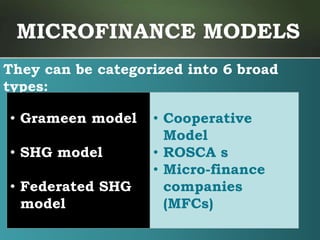
MICROFINANCE MODELS
They can be categorized into 6 broad
types:
• Grameen model
• SHG model
• Federated SHG
model
• Cooperative
Model
• ROSCA s
• Micro-finance
companies
(MFCs)
1. GRAAMEEN MODEL
• The Grameen model has been a case of
exceptional success in Bangladesh.
• It turns out that many organizations in India
have adopted the Grameen Bank model with
little variations.
• Some of the notable examples are SHARE
Microfinance 107 Limited, Activists for Social
Alternatives (ASA) and CASHPOR Financial and
Technical Services Limited.
2. SELF HELP GROUPS
• An SHG is a group of five to 20 people
from same income category formed on
principle of lending their own savings.
• They also seek external funding to
augment these resources.
2. SELF HELP GROUPS
• This group is a voluntary one, formed
on the areas of common interest so that
they can think, organize and operate for
their own development.
• The SHGs function based on co-
operative principles and provide a
forum for members to extent support to
each other.
3. FEDERAL SELF HELP
GROUPS
• In federated SHG model, there is a three-tier
structure–the basic unit is the SHG, the
middle tier is a cluster and the topmost unit
is an apex body, which represents the
entirety.
• At the cluster level, two of its members
represents each SHG.
• The representatives of each SHG meet regularly.
4. CREDIT CO-
OPERATIVE UNIONS
• Cooperative credit unions are another
important microfinance model
developed in the country.
• The leading organization that has been
successful in using the cooperative form
in rural microfinance in India has been
the Cooperative Development Forum
(CDF), Hyderabad.
5. ROTATING SAVINGS
AND CREDIT ASSOCIATION
• ROSCAs are alternative means of
providing credit to groups of
individuals.
• Individuals join groups centered around
shared features such as community,
ethnicity, or professions and make
periodic donations in order to receive
loans in the future.
5. ROTATING SAVINGS
AND CREDIT ASSOCIATION
• Each member systematically received a
loan and repaid it in time for the next
member to begin the loan process.
• Each member is dependent on the
others to repay the loans or else the
cycle will stop. Group members provide
both support and sanctioning devices
for each other
6. MICROFINANCE
COMPANIES
• Microfinance companies are registered
in two regulatory set up
• Non-Banking financial Companies
(NBFC) under reserve bank of India or
companies act.
• Many microfinance companies are
registered in our country as NBFC.
6. MICROFINANCE
COMPANIES
• NBFCs are collecting savings and
utilizing their funds for loans and other
activities.
• The micro finance institutions
including BASIX, Asmitha, SKS and
Janasree microfinance Kerala is
registered as NBFC.
6. MICROFINANCE
COMPANIES
• Melegam committee appointed by RBI
to study about regulatory measures of
microfinance recommended separate
structure for microfinance NBFCs.
• Other form of microfinance is registered
as companies act.
• NBFC is working by forming SHGs and
direct lending model exists.
Microfinance demo, microfinance features, microfinance modules

Microfinance demo, microfinance features, microfinance modules

  • 1.
  • 2.
    MICROFINANCE MODELS • Awide range of microfinance models are working in India. Experts opinion is that India host the maximum number of microfinance models. • Each model has succeeded in their
  • 3.
    MICROFINANCE MODELS • Themain reason behind the existence of these models in India may be due to geographical size of the country, a wide range of social and cultural groups, the existence of different economic classes and a strong NGO movement. • Micro Finance Institutions in India have adopted various traditional as well as innovative approaches for increasing the credit flow to the organized sector.
  • 4.
    MICROFINANCE MODELS They canbe categorized into 6 broad types: • Grameen model • SHG model • Federated SHG model • Cooperative Model • ROSCA s • Micro-finance companies (MFCs)
  • 5.
    1. GRAAMEEN MODEL •The Grameen model has been a case of exceptional success in Bangladesh. • It turns out that many organizations in India have adopted the Grameen Bank model with little variations. • Some of the notable examples are SHARE Microfinance 107 Limited, Activists for Social Alternatives (ASA) and CASHPOR Financial and Technical Services Limited.
  • 7.
    2. SELF HELPGROUPS • An SHG is a group of five to 20 people from same income category formed on principle of lending their own savings. • They also seek external funding to augment these resources.
  • 8.
    2. SELF HELPGROUPS • This group is a voluntary one, formed on the areas of common interest so that they can think, organize and operate for their own development. • The SHGs function based on co- operative principles and provide a forum for members to extent support to each other.
  • 9.
    3. FEDERAL SELFHELP GROUPS • In federated SHG model, there is a three-tier structure–the basic unit is the SHG, the middle tier is a cluster and the topmost unit is an apex body, which represents the entirety. • At the cluster level, two of its members represents each SHG. • The representatives of each SHG meet regularly.
  • 10.
    4. CREDIT CO- OPERATIVEUNIONS • Cooperative credit unions are another important microfinance model developed in the country. • The leading organization that has been successful in using the cooperative form in rural microfinance in India has been the Cooperative Development Forum (CDF), Hyderabad.
  • 11.
    5. ROTATING SAVINGS ANDCREDIT ASSOCIATION • ROSCAs are alternative means of providing credit to groups of individuals. • Individuals join groups centered around shared features such as community, ethnicity, or professions and make periodic donations in order to receive loans in the future.
  • 12.
    5. ROTATING SAVINGS ANDCREDIT ASSOCIATION • Each member systematically received a loan and repaid it in time for the next member to begin the loan process. • Each member is dependent on the others to repay the loans or else the cycle will stop. Group members provide both support and sanctioning devices for each other
  • 13.
    6. MICROFINANCE COMPANIES • Microfinancecompanies are registered in two regulatory set up • Non-Banking financial Companies (NBFC) under reserve bank of India or companies act. • Many microfinance companies are registered in our country as NBFC.
  • 14.
    6. MICROFINANCE COMPANIES • NBFCsare collecting savings and utilizing their funds for loans and other activities. • The micro finance institutions including BASIX, Asmitha, SKS and Janasree microfinance Kerala is registered as NBFC.
  • 15.
    6. MICROFINANCE COMPANIES • Melegamcommittee appointed by RBI to study about regulatory measures of microfinance recommended separate structure for microfinance NBFCs. • Other form of microfinance is registered as companies act. • NBFC is working by forming SHGs and direct lending model exists.