• Abrasion : is a wound caused by superficial damage to the skin, no deeper than the epidermis.
• Abscess : Collection of pus enclosed by damaged or inflamed tissue.
• Acute : any process that is having rapid & sudden onset, severe symptoms & brief duration.
• Aerobic: microorganisms that live in presence of oxygen.
• Anaerobic : microorganisma that live in absence of oxygen
• Anorexia: loss of appetite
• Antibiotic: substance produced or derived from microorganisms that inhibit growth of other
microorganism
• Antibody : is a type of protein produced by the immune system in response to foreign substances
( such as chemicals, virus, bacteria) called antigen than may pose threat to the body
• Antigen: an antigen is any substance that stimulates our immune system to produce antibodies
against it, an antigen may be a foreign substance from the environment such as chemicals,
bacteria, virus or pollen
• Antiseptic: chemical agent that inhibit the growth of microorganism
• Antitoxin : an antibody produced by body against particular antigen
• Anuria: impaired production / no production of urine
• Ascites : Accumulation of serous fluid in peritoneal cavity
• Asepsis: A condition in which living pathogens are absent, a state of sterility
• Asymptomatic: without any symptoms
• Atrophy: is the partial or complete wasting away of a part of the body due to mutation, poor nourishment,
poor circulation, loss of hormonal support, loss of nerve supply to the target organ, disuse or lack of exercise
• Autolysis: destruction of cells/tissue by action of body’s own enzyme
• Autopsy: dissection & examination of body after death to know the cause of death or presence of disease
• Bacteraemia: presence of bacteria in blood stream
• Bactericidal : any agent that kills the bacteria
• Bacteriostatic: any agent that inhibit the growth & multiplication of bacteria
• Bacteriuria: presence of bacteria in urine
• Biopsy: small piece of living tissue removed from an organ or part of body to determine any abnormality or dysfunction or disease
• Blanching: a temporary whitening of the skin due to transient ischemia
• Blister: a small swelling in the skin filled with serum
• Bloating : abnormal feeling of fullness, tightness or distension in abdomen
• Bradycardia: slowing of heart rate to less than 60 beats/minute
• calculus : a stone or a hard mass formed within the body specially in gall bladder or anywhere in urinary tract
• calcification : deposition of calcium salts in tissue, a normal process in bone formation
• cellulitis : an acute inflammation of the connective tissue of the skin caused by infection with staphylococcus, streptococcus or
other bacteria
• carcinoma: a malignant tumor that arises from epithelial cells, which line the internal & external surfaces of the body
• chemotherapy: treating any infection/disease by chemicals called chemotherapeutic agents.
• Congenital: presence/present since birth
• Cross infection: infection transmitted between clients infected with different pathogenic micro organism.
• Cutaneous : related to skin
• Cyanosis: a bluish discoloration of skin & mucous membrane due to inadequate amount of oxygen in blood & is
associated with heart/lung disease
• Cytotoxic: an agent which is toxic to cells
• Dermatitis: an inflammatory condition of skin
• Diaphoresis : excessive sweating
• Disinfection: the process of destructing or killing microorganism by physically or by chemical agents called
disinfectants.
• Droplet infection : infection due to inhalation of respiratory pathogens suspended on liquid particles exhaled by an
person that is already infected
• Dysphagia: difficulty in swallowing
• Dyspnoea: difficulty in breathing
• Dysuria: difficulty in urination
• Edema: is an abnormal accumulation of fluid beneath the skin or one or more cavities of the body
• Embolism : a condition in which an embolus (such as blood clot, fat, air, foreign
body) becomes lodged in artery & obstruct its blood flow
• Empyema : (pyothorax) – pus in pleural cavity
• Endemic : a disease that is always present in a particular locality/population
• Epidemic : a sudden outbreak of infectious disease spreading rapidly through
population affecting large proportion of people
• Endocarditis: an inflammation of endocardium of heart
• Endogenous : derived from body or arising within body
• Enteritis: an inflammation of the small intestine caused by a bacterial or viral
infection. The inflammation frequently also involves the stomach ( gastritis) &
large intestine ( colitis)
• Epistaxis: (haemoptysis or nose bleed) – an acute haemorrhage from the nostril,
nasal cavity or nasopharynx
• Erythema: redness or flushing of skin due to dilation of blood capillaries
• Exudate : a fluid often formed from elements of blood, discharged from tissue to
a surface cavity
• Fomites : contaminated objects ( towel, utensils, syringes etc.) that can transmit
disease from client to normal individual
• Fumigation : The process applying smoke or fumes in order to disinfect
• Gangrene : is the death of tissue in part of the body & happens when a
body part looses its blood supply due to injury, infection or other causes
• Gingiva: gums
• Gingivitis:
• Hematuria: passage of blood in urine
• Hemolysis: the destruction of red blood cells
• Hemorrhage: escape of blood from ruptured blood vessels externally or
internally
• Hemoptysis: is the expectoration ( coughing up) of blood or of blood
stained sputum from larynx trachea, bronchi, lungs
• Hepatocytes: liver cells
• Hepatomegally: liver enlargement
• Hydrophobia: hear of water, an alternative name of Rabies
• Hyperplasia: enlargement of an organ or tissue because of an
increase in the number of cells in that organ or tissue
• Hypertrophy: increase in size of tissue or organ due to enlargement of
cells but not due to their multiplication
• Hypervolemia: an increase in volume of circulating blood
• Hypovolemia: decrease in volume of circulating blood
• Hypotension: decrease in blood pressure
• Immunity: resistance of an organism to infection or disease
• Immunization: process by which a person is made immune or
resistant to infectious diseases by administration of a vaccine
• Infection: invasion & multiplication of pathogenic microorganisms
which may produce subsequent tissue injury & progress to disease
• Invitro: in laboratory apparatus
• In vivo: in living animal or human being
• Lacrimation: excessive secretion of tears
• Lethargy: mental & physical sluggishness
• Malaena: abnormal dark or black stool that has a distinctive odor &
contains digested blood. It usually results from bleeding in the upper
GI tract & is often a sign of peptic ulcer or small bowel disease
• Morbidity: disease
• Mortality: incidence of death
• Nausea: feeling of vomiting
• Necrosis: death of cells
• Neuralgia: pain in nerves
• Numbness: partial or total lack of sensation in a part of the body, a
symptom of nerve damage or dysfunction
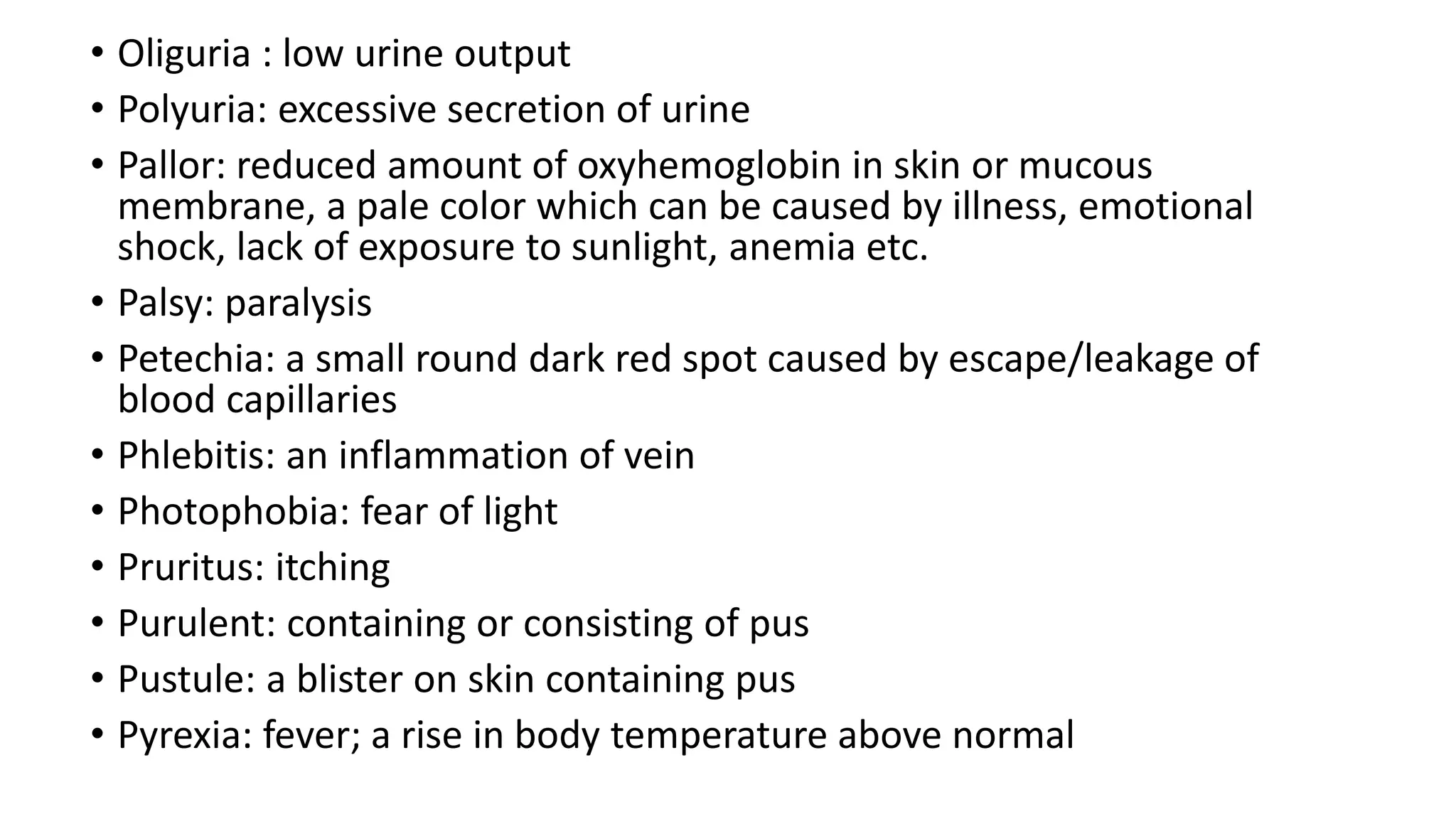
• Oliguria : low urine output
• Polyuria: excessive secretion of urine
• Pallor: reduced amount of oxyhemoglobin in skin or mucous
membrane, a pale color which can be caused by illness, emotional
shock, lack of exposure to sunlight, anemia etc.
• Palsy: paralysis
• Petechia: a small round dark red spot caused by escape/leakage of
blood capillaries
• Phlebitis: an inflammation of vein
• Photophobia: fear of light
• Pruritus: itching
• Purulent: containing or consisting of pus
• Pustule: a blister on skin containing pus
• Pyrexia: fever; a rise in body temperature above normal
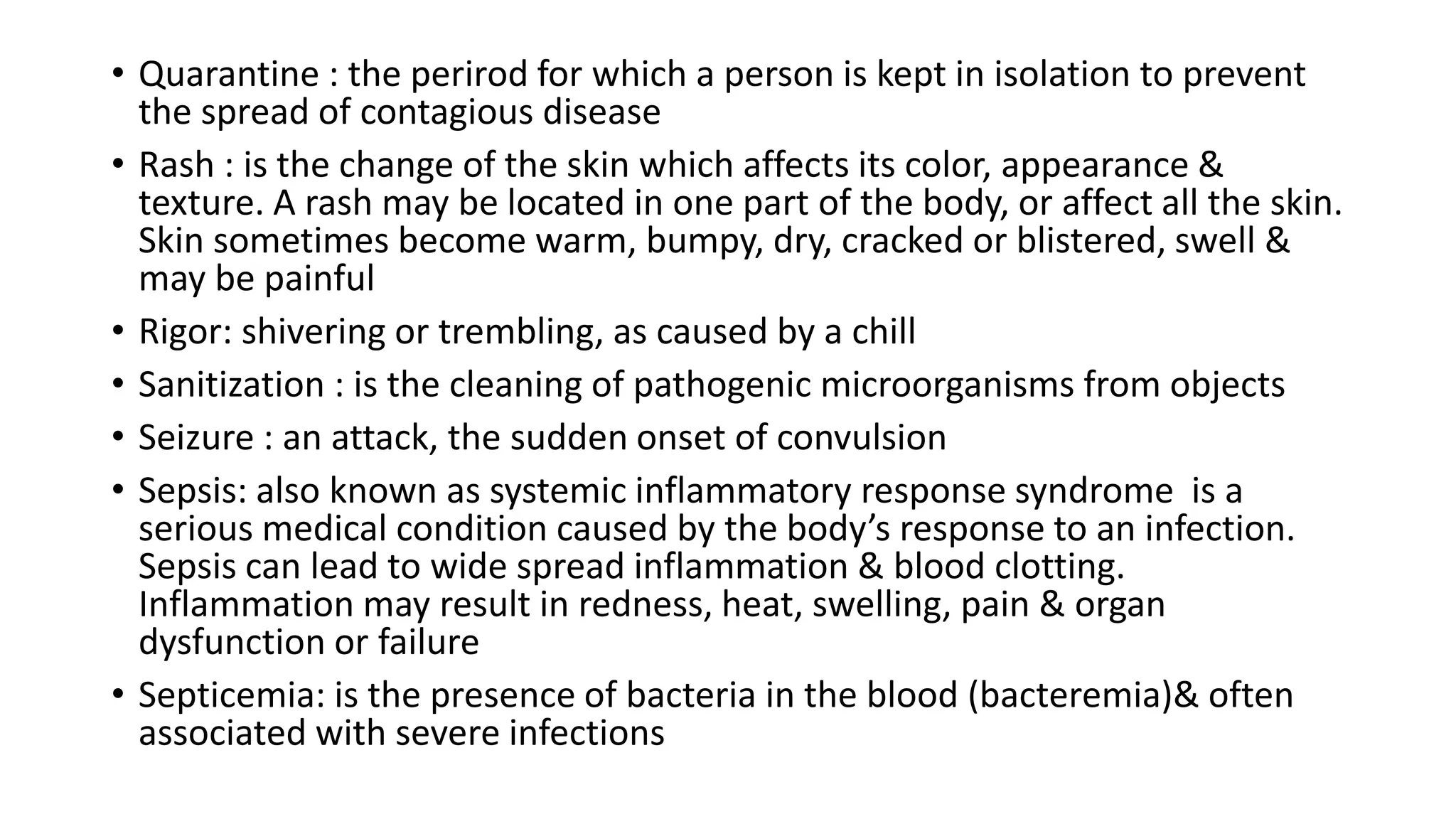
• Quarantine : the perirod for which a person is kept in isolation to prevent
the spread of contagious disease
• Rash : is the change of the skin which affects its color, appearance &
texture. A rash may be located in one part of the body, or affect all the skin.
Skin sometimes become warm, bumpy, dry, cracked or blistered, swell &
may be painful
• Rigor: shivering or trembling, as caused by a chill
• Sanitization : is the cleaning of pathogenic microorganisms from objects
• Seizure : an attack, the sudden onset of convulsion
• Sepsis: also known as systemic inflammatory response syndrome is a
serious medical condition caused by the body’s response to an infection.
Sepsis can lead to wide spread inflammation & blood clotting.
Inflammation may result in redness, heat, swelling, pain & organ
dysfunction or failure
• Septicemia: is the presence of bacteria in the blood (bacteremia)& often
associated with severe infections
• Sterilization : a process that eliminates or kills all forms of life,
including transmissible agents ( such as fungi, bacteria, virus, spores
etc.)present on a surface, contained in a fluid, in medication etc.
• Tachycardia: rapid heart/pulse beat or rate
• Toxin : a poisonous substance produced by living organisms specially
bacteria
• Trauma: a physical wound or injury
• Vaccine: is a biological preparation that improves immunity to a
particular disease. A vaccine typically contains an agent that
resembles a disease-causing microorganism, & is often made from
weakened or killed forms of the microbe or its toxins
• Vector: an organism, specially an insect that carries a disease
producing microorganism from one host to another, either within or
on the surface of its body
• Viremia: presence of virus particle in blood stream
• Virucidal: any agent that kills viruses
• Virulence: disease producing ability of an organism
• Zoonosis : also called zoonotic disease refers to diseases that can be
passed from animals, whether wild or domesticated, to humans
Microbiology terms.pptx

Microbiology terms.pptx

  • 2.
    • Abrasion :is a wound caused by superficial damage to the skin, no deeper than the epidermis. • Abscess : Collection of pus enclosed by damaged or inflamed tissue. • Acute : any process that is having rapid & sudden onset, severe symptoms & brief duration. • Aerobic: microorganisms that live in presence of oxygen. • Anaerobic : microorganisma that live in absence of oxygen • Anorexia: loss of appetite • Antibiotic: substance produced or derived from microorganisms that inhibit growth of other microorganism • Antibody : is a type of protein produced by the immune system in response to foreign substances ( such as chemicals, virus, bacteria) called antigen than may pose threat to the body • Antigen: an antigen is any substance that stimulates our immune system to produce antibodies against it, an antigen may be a foreign substance from the environment such as chemicals, bacteria, virus or pollen
  • 3.
    • Antiseptic: chemicalagent that inhibit the growth of microorganism • Antitoxin : an antibody produced by body against particular antigen • Anuria: impaired production / no production of urine • Ascites : Accumulation of serous fluid in peritoneal cavity • Asepsis: A condition in which living pathogens are absent, a state of sterility • Asymptomatic: without any symptoms • Atrophy: is the partial or complete wasting away of a part of the body due to mutation, poor nourishment, poor circulation, loss of hormonal support, loss of nerve supply to the target organ, disuse or lack of exercise • Autolysis: destruction of cells/tissue by action of body’s own enzyme • Autopsy: dissection & examination of body after death to know the cause of death or presence of disease • Bacteraemia: presence of bacteria in blood stream • Bactericidal : any agent that kills the bacteria • Bacteriostatic: any agent that inhibit the growth & multiplication of bacteria
  • 4.
    • Bacteriuria: presenceof bacteria in urine • Biopsy: small piece of living tissue removed from an organ or part of body to determine any abnormality or dysfunction or disease • Blanching: a temporary whitening of the skin due to transient ischemia • Blister: a small swelling in the skin filled with serum • Bloating : abnormal feeling of fullness, tightness or distension in abdomen • Bradycardia: slowing of heart rate to less than 60 beats/minute • calculus : a stone or a hard mass formed within the body specially in gall bladder or anywhere in urinary tract • calcification : deposition of calcium salts in tissue, a normal process in bone formation • cellulitis : an acute inflammation of the connective tissue of the skin caused by infection with staphylococcus, streptococcus or other bacteria • carcinoma: a malignant tumor that arises from epithelial cells, which line the internal & external surfaces of the body • chemotherapy: treating any infection/disease by chemicals called chemotherapeutic agents. • Congenital: presence/present since birth • Cross infection: infection transmitted between clients infected with different pathogenic micro organism.
  • 5.
    • Cutaneous :related to skin • Cyanosis: a bluish discoloration of skin & mucous membrane due to inadequate amount of oxygen in blood & is associated with heart/lung disease • Cytotoxic: an agent which is toxic to cells • Dermatitis: an inflammatory condition of skin • Diaphoresis : excessive sweating • Disinfection: the process of destructing or killing microorganism by physically or by chemical agents called disinfectants. • Droplet infection : infection due to inhalation of respiratory pathogens suspended on liquid particles exhaled by an person that is already infected • Dysphagia: difficulty in swallowing • Dyspnoea: difficulty in breathing • Dysuria: difficulty in urination • Edema: is an abnormal accumulation of fluid beneath the skin or one or more cavities of the body
  • 6.
    • Embolism :a condition in which an embolus (such as blood clot, fat, air, foreign body) becomes lodged in artery & obstruct its blood flow • Empyema : (pyothorax) – pus in pleural cavity • Endemic : a disease that is always present in a particular locality/population • Epidemic : a sudden outbreak of infectious disease spreading rapidly through population affecting large proportion of people • Endocarditis: an inflammation of endocardium of heart • Endogenous : derived from body or arising within body • Enteritis: an inflammation of the small intestine caused by a bacterial or viral infection. The inflammation frequently also involves the stomach ( gastritis) & large intestine ( colitis) • Epistaxis: (haemoptysis or nose bleed) – an acute haemorrhage from the nostril, nasal cavity or nasopharynx • Erythema: redness or flushing of skin due to dilation of blood capillaries • Exudate : a fluid often formed from elements of blood, discharged from tissue to a surface cavity • Fomites : contaminated objects ( towel, utensils, syringes etc.) that can transmit disease from client to normal individual
  • 7.
    • Fumigation :The process applying smoke or fumes in order to disinfect • Gangrene : is the death of tissue in part of the body & happens when a body part looses its blood supply due to injury, infection or other causes • Gingiva: gums • Gingivitis: • Hematuria: passage of blood in urine • Hemolysis: the destruction of red blood cells • Hemorrhage: escape of blood from ruptured blood vessels externally or internally • Hemoptysis: is the expectoration ( coughing up) of blood or of blood stained sputum from larynx trachea, bronchi, lungs • Hepatocytes: liver cells • Hepatomegally: liver enlargement
  • 8.
    • Hydrophobia: hearof water, an alternative name of Rabies • Hyperplasia: enlargement of an organ or tissue because of an increase in the number of cells in that organ or tissue • Hypertrophy: increase in size of tissue or organ due to enlargement of cells but not due to their multiplication • Hypervolemia: an increase in volume of circulating blood • Hypovolemia: decrease in volume of circulating blood • Hypotension: decrease in blood pressure • Immunity: resistance of an organism to infection or disease • Immunization: process by which a person is made immune or resistant to infectious diseases by administration of a vaccine • Infection: invasion & multiplication of pathogenic microorganisms which may produce subsequent tissue injury & progress to disease
  • 9.
    • Invitro: inlaboratory apparatus • In vivo: in living animal or human being • Lacrimation: excessive secretion of tears • Lethargy: mental & physical sluggishness • Malaena: abnormal dark or black stool that has a distinctive odor & contains digested blood. It usually results from bleeding in the upper GI tract & is often a sign of peptic ulcer or small bowel disease • Morbidity: disease • Mortality: incidence of death • Nausea: feeling of vomiting • Necrosis: death of cells • Neuralgia: pain in nerves • Numbness: partial or total lack of sensation in a part of the body, a symptom of nerve damage or dysfunction
  • 10.
    • Oliguria :low urine output • Polyuria: excessive secretion of urine • Pallor: reduced amount of oxyhemoglobin in skin or mucous membrane, a pale color which can be caused by illness, emotional shock, lack of exposure to sunlight, anemia etc. • Palsy: paralysis • Petechia: a small round dark red spot caused by escape/leakage of blood capillaries • Phlebitis: an inflammation of vein • Photophobia: fear of light • Pruritus: itching • Purulent: containing or consisting of pus • Pustule: a blister on skin containing pus • Pyrexia: fever; a rise in body temperature above normal
  • 11.
    • Quarantine :the perirod for which a person is kept in isolation to prevent the spread of contagious disease • Rash : is the change of the skin which affects its color, appearance & texture. A rash may be located in one part of the body, or affect all the skin. Skin sometimes become warm, bumpy, dry, cracked or blistered, swell & may be painful • Rigor: shivering or trembling, as caused by a chill • Sanitization : is the cleaning of pathogenic microorganisms from objects • Seizure : an attack, the sudden onset of convulsion • Sepsis: also known as systemic inflammatory response syndrome is a serious medical condition caused by the body’s response to an infection. Sepsis can lead to wide spread inflammation & blood clotting. Inflammation may result in redness, heat, swelling, pain & organ dysfunction or failure • Septicemia: is the presence of bacteria in the blood (bacteremia)& often associated with severe infections
  • 12.
    • Sterilization :a process that eliminates or kills all forms of life, including transmissible agents ( such as fungi, bacteria, virus, spores etc.)present on a surface, contained in a fluid, in medication etc. • Tachycardia: rapid heart/pulse beat or rate • Toxin : a poisonous substance produced by living organisms specially bacteria • Trauma: a physical wound or injury • Vaccine: is a biological preparation that improves immunity to a particular disease. A vaccine typically contains an agent that resembles a disease-causing microorganism, & is often made from weakened or killed forms of the microbe or its toxins • Vector: an organism, specially an insect that carries a disease producing microorganism from one host to another, either within or on the surface of its body
  • 13.
    • Viremia: presenceof virus particle in blood stream • Virucidal: any agent that kills viruses • Virulence: disease producing ability of an organism • Zoonosis : also called zoonotic disease refers to diseases that can be passed from animals, whether wild or domesticated, to humans