Presented by: Rudra Patel
HUMAN GUT MICROBIOTA
IN HEALTH AND DISEASE:
BACKGROUND &
IMPORTANCE
BACKGROUND &
IMPORTANCE
The human gut hosts trillions of microorganisms forming the gut
microbiota, which is increasingly considered like an “organ” with
systemic impacts.
• This microbial community influences digestion, metabolism,
immunity, neural and endocrine pathways.
• Imbalance (dysbiosis) in gut microbiota is linked to many diseases.
• Motivation: to summarise current understanding and mechanisms
of how gut microbiota contributes to health vs disease.
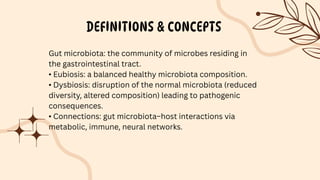
DEFINITIONS & CONCEPTS
Gut microbiota: the community of microbes residing in
the gastrointestinal tract.
• Eubiosis: a balanced healthy microbiota composition.
• Dysbiosis: disruption of the normal microbiota (reduced
diversity, altered composition) leading to pathogenic
consequences.
• Connections: gut microbiota–host interactions via
metabolic, immune, neural networks.
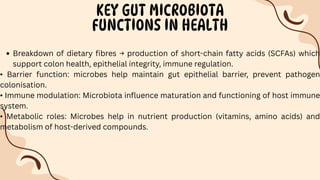
KEY GUT MICROBIOTA
FUNCTIONS IN HEALTH
Breakdown of dietary fibres → production of short-chain fatty acids (SCFAs) which
support colon health, epithelial integrity, immune regulation.
• Barrier function: microbes help maintain gut epithelial barrier, prevent pathogen
colonisation.
• Immune modulation: Microbiota influence maturation and functioning of host immune
system.
• Metabolic roles: Microbes help in nutrient production (vitamins, amino acids) and
metabolism of host-derived compounds.
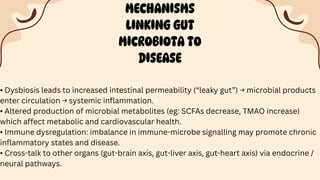
MECHANISMS
LINKING GUT
MICROBIOTA TO
DISEASE
• Dysbiosis leads to increased intestinal permeability (“leaky gut”) → microbial products
enter circulation → systemic inflammation.
• Altered production of microbial metabolites (eg: SCFAs decrease, TMAO increase)
which affect metabolic and cardiovascular health.
• Immune dysregulation: imbalance in immune-microbe signalling may promote chronic
inflammatory states and disease.
• Cross-talk to other organs (gut-brain axis, gut-liver axis, gut-heart axis) via endocrine /
neural pathways.
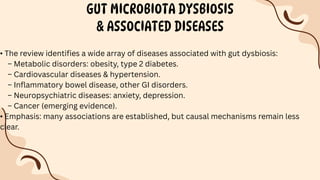
GUT MICROBIOTA DYSBIOSIS
& ASSOCIATED DISEASES
• The review identifies a wide array of diseases associated with gut dysbiosis:
– Metabolic disorders: obesity, type 2 diabetes.
– Cardiovascular diseases & hypertension.
– Inflammatory bowel disease, other GI disorders.
– Neuropsychiatric diseases: anxiety, depression.
– Cancer (emerging evidence).
• Emphasis: many associations are established, but causal mechanisms remain less
clear.
MICROBIAL METABOLITES AS
MEDIATORS
• Specific metabolites produced by gut microbiota play key roles:
– Short‐chain fatty acids (SCFAs: acetate, propionate, butyrate) beneficial in health.
– Trimethylamine N-oxide (TMAO) linked to adverse cardiovascular outcomes.
– Other metabolites: tryptophan and tyrosine derivatives, bile acids modifications.
• These metabolites serve as signalling molecules connecting gut microbes to host
physiology.
THERAPEUTIC & MODULATION
STRATEGIES
• The review highlights opportunities to modulate gut microbiota for health:
– Dietary interventions (prebiotics, fibers, fermented foods) to promote beneficial
microbes. Frontiers
– Probiotics and synbiotics to restore eubiosis.
– Fecal microbiota transplantation (FMT) in selected situations. PMC
– Precision microbiome‐based therapies: personalisation by microbiota profiling.
Frontiers
• Challenges: safety, mechanistic understanding, individual variability.
RESEARCH GAPS &
FUTURE DIRECTIONS
• More work needed to establish causal links (not just associations) between microbiota
changes and disease outcomes.
• Better understanding of “microbial dark matter” (uncharted microbial
species/functions).
• Integration of multi‐omics (metagenomics, metabolomics, transcriptomics) to map
mechanisms.
• Longitudinal human studies, standardisation of sampling/analysis methods.
• Translation into clinical practice – biomarker development, personalised interventions.
SUMMARY
• Gut microbiota is integral to human health: digestion, immunity, metabolism, neural
signalling.
• Dysbiosis is linked to a wide spectrum of diseases via altered microbial composition
and metabolites.
• Microbial metabolites (SCFAs, TMAO, etc) are key mediators of host-microbe
interactions.
• Therapeutic modulation of gut microbiota presents promise, but challenges remain.
• Future research must focus on mechanism, causality, personalised interventions and
clinical translation.
THANK
YOU

microbio ppt on human gut microbiota.pdf

  • 1.
    Presented by: RudraPatel HUMAN GUT MICROBIOTA IN HEALTH AND DISEASE:
  • 2.
    BACKGROUND & IMPORTANCE BACKGROUND & IMPORTANCE Thehuman gut hosts trillions of microorganisms forming the gut microbiota, which is increasingly considered like an “organ” with systemic impacts. • This microbial community influences digestion, metabolism, immunity, neural and endocrine pathways. • Imbalance (dysbiosis) in gut microbiota is linked to many diseases. • Motivation: to summarise current understanding and mechanisms of how gut microbiota contributes to health vs disease.
  • 3.
    DEFINITIONS & CONCEPTS Gutmicrobiota: the community of microbes residing in the gastrointestinal tract. • Eubiosis: a balanced healthy microbiota composition. • Dysbiosis: disruption of the normal microbiota (reduced diversity, altered composition) leading to pathogenic consequences. • Connections: gut microbiota–host interactions via metabolic, immune, neural networks.
  • 4.
    KEY GUT MICROBIOTA FUNCTIONSIN HEALTH Breakdown of dietary fibres → production of short-chain fatty acids (SCFAs) which support colon health, epithelial integrity, immune regulation. • Barrier function: microbes help maintain gut epithelial barrier, prevent pathogen colonisation. • Immune modulation: Microbiota influence maturation and functioning of host immune system. • Metabolic roles: Microbes help in nutrient production (vitamins, amino acids) and metabolism of host-derived compounds.
  • 5.
    MECHANISMS LINKING GUT MICROBIOTA TO DISEASE •Dysbiosis leads to increased intestinal permeability (“leaky gut”) → microbial products enter circulation → systemic inflammation. • Altered production of microbial metabolites (eg: SCFAs decrease, TMAO increase) which affect metabolic and cardiovascular health. • Immune dysregulation: imbalance in immune-microbe signalling may promote chronic inflammatory states and disease. • Cross-talk to other organs (gut-brain axis, gut-liver axis, gut-heart axis) via endocrine / neural pathways.
  • 6.
    GUT MICROBIOTA DYSBIOSIS &ASSOCIATED DISEASES • The review identifies a wide array of diseases associated with gut dysbiosis: – Metabolic disorders: obesity, type 2 diabetes. – Cardiovascular diseases & hypertension. – Inflammatory bowel disease, other GI disorders. – Neuropsychiatric diseases: anxiety, depression. – Cancer (emerging evidence). • Emphasis: many associations are established, but causal mechanisms remain less clear.
  • 7.
    MICROBIAL METABOLITES AS MEDIATORS •Specific metabolites produced by gut microbiota play key roles: – Short‐chain fatty acids (SCFAs: acetate, propionate, butyrate) beneficial in health. – Trimethylamine N-oxide (TMAO) linked to adverse cardiovascular outcomes. – Other metabolites: tryptophan and tyrosine derivatives, bile acids modifications. • These metabolites serve as signalling molecules connecting gut microbes to host physiology.
  • 8.
    THERAPEUTIC & MODULATION STRATEGIES •The review highlights opportunities to modulate gut microbiota for health: – Dietary interventions (prebiotics, fibers, fermented foods) to promote beneficial microbes. Frontiers – Probiotics and synbiotics to restore eubiosis. – Fecal microbiota transplantation (FMT) in selected situations. PMC – Precision microbiome‐based therapies: personalisation by microbiota profiling. Frontiers • Challenges: safety, mechanistic understanding, individual variability.
  • 9.
    RESEARCH GAPS & FUTUREDIRECTIONS • More work needed to establish causal links (not just associations) between microbiota changes and disease outcomes. • Better understanding of “microbial dark matter” (uncharted microbial species/functions). • Integration of multi‐omics (metagenomics, metabolomics, transcriptomics) to map mechanisms. • Longitudinal human studies, standardisation of sampling/analysis methods. • Translation into clinical practice – biomarker development, personalised interventions.
  • 10.
    SUMMARY • Gut microbiotais integral to human health: digestion, immunity, metabolism, neural signalling. • Dysbiosis is linked to a wide spectrum of diseases via altered microbial composition and metabolites. • Microbial metabolites (SCFAs, TMAO, etc) are key mediators of host-microbe interactions. • Therapeutic modulation of gut microbiota presents promise, but challenges remain. • Future research must focus on mechanism, causality, personalised interventions and clinical translation.
  • 11.