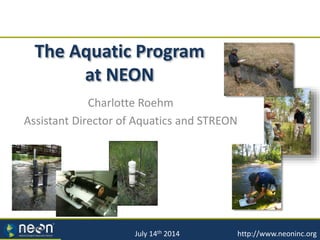
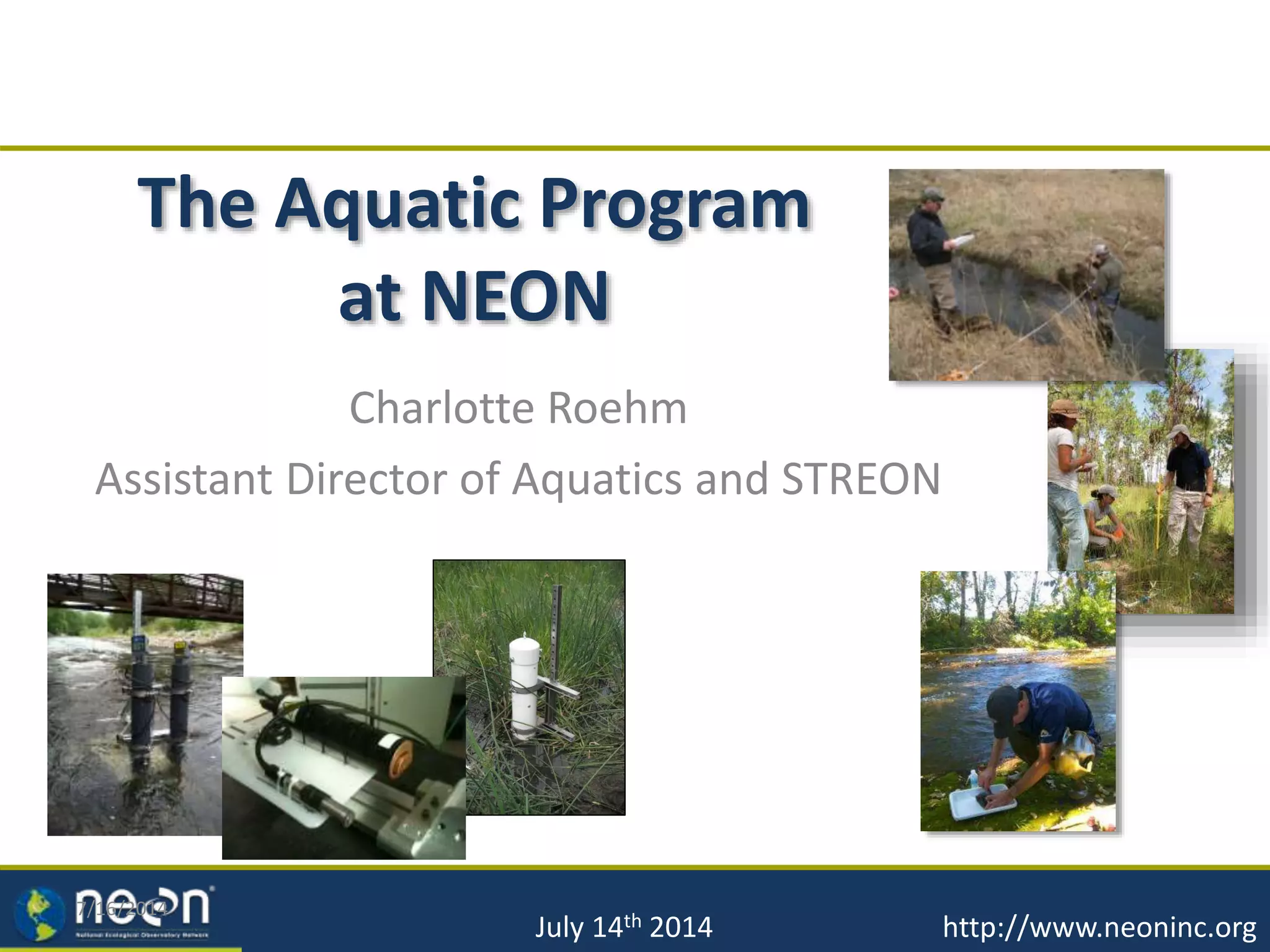
The Aquatic Program
at NEON
Charlotte Roehm
Assistant Director of Aquatics and STREON
7/16/2014
July 14th 2014 http://www.neoninc.org
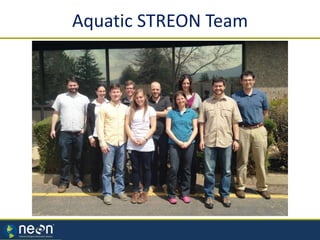
Aquatic STREON Team
 Brandon McLaughlin – Aquatic Design Technician
 Jenna Stewart – Science Technician – Training and Databases
 Brandon Jensen – Associate Scientist - Permitting - Aquatic Ecologist
 Charles Bohall – Instrumentation Engineer - Hydrologist
 Jesse Vance – Instrumentation Engineer - Oceanographer
 Michael Fitzgerald – Groundwater Hydrologist - Engineer
 Keli Goodman - Aquatic Biogeochemist
 Stephanie Parker – Aquatic Ecologist
 Charlotte Roehm – Limnologist/Assistant Director
 Ryan Utz – STREON Aquatic Ecologist
Aquatic STREON Team
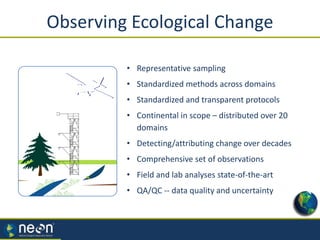
Observing Ecological Change
• Representative sampling
• Standardized methods across domains
• Standardized and transparent protocols
• Continental in scope – distributed over 20
domains
• Detecting/attributing change over decades
• Comprehensive set of observations
• Field and lab analyses state-of-the-art
• QA/QC -- data quality and uncertainty
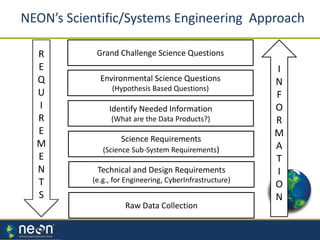
NEON’s Scientific/Systems Engineering Approach
Environmental Science Questions
(Hypothesis Based Questions)
Identify Needed Information
(What are the Data Products?)
Science Requirements
(Science Sub-System Requirements)
Technical and Design Requirements
(e.g., for Engineering, CyberInfrastructure)
R
E
Q
U
I
R
E
M
E
N
T
S
I
N
F
O
R
M
A
T
I
O
N
Grand Challenge Science Questions
Raw Data Collection
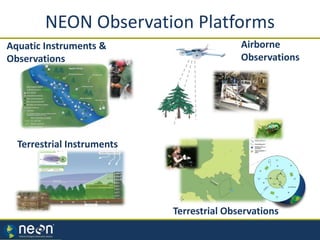
NEON Observation Platforms
Airborne
Observations
Terrestrial Instruments
Terrestrial Observations
Aquatic Instruments &
Observations
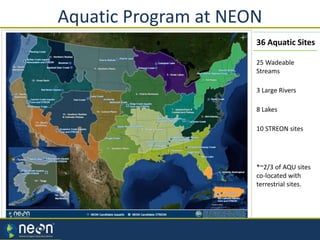
Aquatic Program at NEON
36 Aquatic Sites
25 Wadeable
Streams
3 Large Rivers
8 Lakes
10 STREON sites
*~2/3 of AQU sites
co-located with
terrestrial sites.
Aquatic Program at NEON
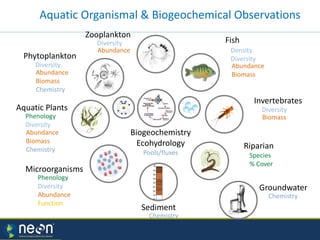
Aquatic Organismal & Biogeochemical Observations
Biomass
Species
% Cover
Abundance
Biomass
Chemistry
Abundance
Biomass
Chemistry
Biogeochemistry
Ecohydrology
Pools/fluxes
Invertebrates
Phytoplankton
Aquatic Plants Diversity
Phenology
Diversity
Diversity
Riparian
Microorganisms
Zooplankton
Abundance
Biomass
Fish
Density
Diversity
Abundance
Diversity
Phenology
Diversity
Abundance
Function
Sediment
Chemistry
Groundwater
Chemistry
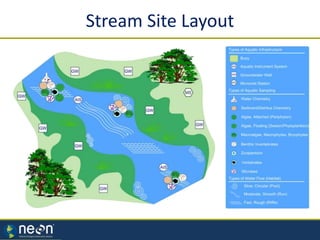
Stream Site Layout
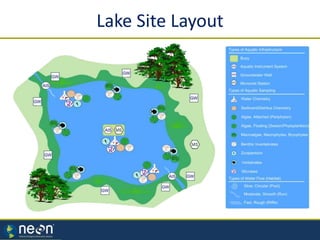
Lake Site Layout
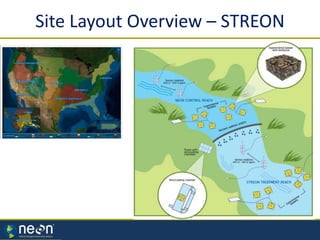
Site Layout Overview – STREON
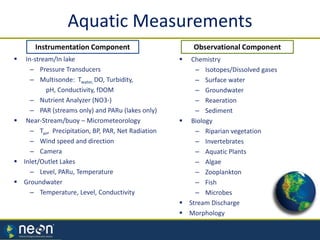
 Chemistry
– Isotopes/Dissolved gases
– Surface water
– Groundwater
– Reaeration
– Sediment
 Biology
– Riparian vegetation
– Invertebrates
– Aquatic Plants
– Algae
– Zooplankton
– Fish
– Microbes
 Stream Discharge
 Morphology
 In-stream/In lake
– Pressure Transducers
– Multisonde: Twater, DO, Turbidity,
pH, Conductivity, fDOM
– Nutrient Analyzer (NO3-)
– PAR (streams only) and PARu (lakes only)
 Near-Stream/buoy – Micrometeorology
– Tair, Precipitation, BP, PAR, Net Radiation
– Wind speed and direction
– Camera
 Inlet/Outlet Lakes
– Level, PARu, Temperature
 Groundwater
– Temperature, Level, Conductivity
Aquatic Measurements
Observational ComponentInstrumentation Component
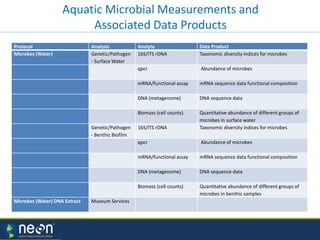
Aquatic Microbial Measurements and
Associated Data Products
Protocol Analysis Analyte Data Product
Microbes (Water) Genetic/Pathogen
- Surface Water
16S/ITS rDNA Taxonomic diversity indices for microbes
qpcr Abundance of microbes
mRNA/functional assay mRNA sequence data functional composition
DNA (metagenome) DNA sequence data
Biomass (cell counts) Quantitative abundance of different groups of
microbes in surface water
Genetic/Pathogen
- Benthic Biofilm
16S/ITS rDNA Taxonomic diversity indices for microbes
qpcr Abundance of microbes
mRNA/functional assay mRNA sequence data functional composition
DNA (metagenome) DNA sequence data
Biomass (cell counts) Quantitative abundance of different groups of
microbes in benthic samples
Microbes (Water) DNA Extract Museum Services
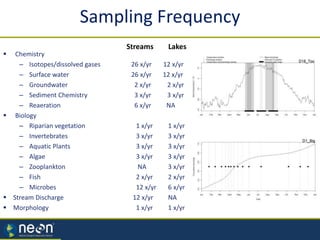
 Chemistry
– Isotopes/dissolved gases 26 x/yr 12 x/yr
– Surface water 26 x/yr 12 x/yr
– Groundwater 2 x/yr 2 x/yr
– Sediment Chemistry 3 x/yr 3 x/yr
– Reaeration 6 x/yr NA
 Biology
– Riparian vegetation 1 x/yr 1 x/yr
– Invertebrates 3 x/yr 3 x/yr
– Aquatic Plants 3 x/yr 3 x/yr
– Algae 3 x/yr 3 x/yr
– Zooplankton NA 3 x/yr
– Fish 2 x/yr 2 x/yr
– Microbes 12 x/yr 6 x/yr
 Stream Discharge 12 x/yr NA
 Morphology 1 x/yr 1 x/yr
Sampling Frequency
Streams Lakes
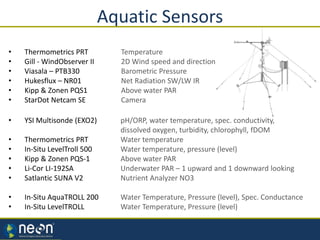
Aquatic Sensors
• Thermometrics PRT Temperature
• Gill - WindObserver II 2D Wind speed and direction
• Viasala – PTB330 Barometric Pressure
• Hukesflux – NR01 Net Radiation SW/LW IR
• Kipp & Zonen PQS1 Above water PAR
• StarDot Netcam SE Camera
• YSI Multisonde (EXO2) pH/ORP, water temperature, spec. conductivity,
dissolved oxygen, turbidity, chlorophyll, fDOM
• Thermometrics PRT Water temperature
• In-Situ LevelTroll 500 Water temperature, pressure (level)
• Kipp & Zonen PQS-1 Above water PAR
• Li-Cor LI-192SA Underwater PAR – 1 upward and 1 downward looking
• Satlantic SUNA V2 Nutrient Analyzer NO3
• In-Situ AquaTROLL 200 Water Temperature, Pressure (level), Spec. Conductance
• In-Situ LevelTROLL Water Temperature, Pressure (level)
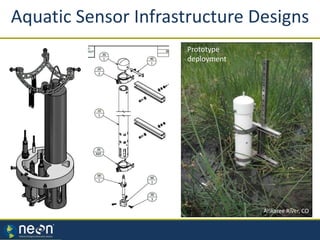
Arikaree River, CO
Prototype
deployment
Aquatic Sensor Infrastructure Designs
18ASLO Feb 20th 2013
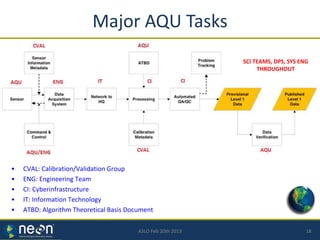
Major AQU Tasks
SCI TEAMS, DPS, SYS ENG
THROUGHOUT
• CVAL: Calibration/Validation Group
• ENG: Engineering Team
• CI: Cyberinfrastructure
• IT: Information Technology
• ATBD: Algorithm Theoretical Basis Document
19ASLO Feb 20th 2013
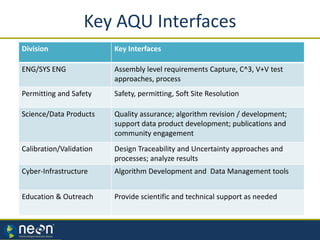
Key AQU Interfaces
Division Key Interfaces
ENG/SYS ENG Assembly level requirements Capture, C^3, V+V test
approaches, process
Permitting and Safety Safety, permitting, Soft Site Resolution
Science/Data Products Quality assurance; algorithm revision / development;
support data product development; publications and
community engagement
Calibration/Validation Design Traceability and Uncertainty approaches and
processes; analyze results
Cyber-Infrastructure Algorithm Development and Data Management tools
Education & Outreach Provide scientific and technical support as needed
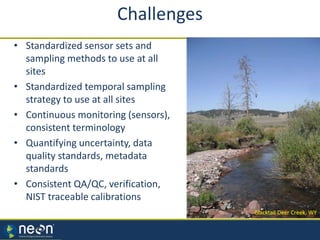
• Standardized sensor sets and
sampling methods to use at all
sites
• Standardized temporal sampling
strategy to use at all sites
• Continuous monitoring (sensors),
consistent terminology
• Quantifying uncertainty, data
quality standards, metadata
standards
• Consistent QA/QC, verification,
NIST traceable calibrations
Blacktail Deer Creek, WY
Challenges
Science
Validation
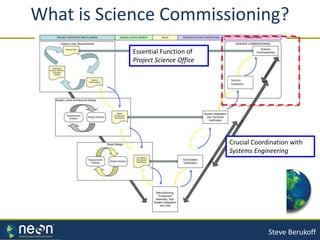
What is Science Commissioning?
Essential Function of
Project Science Office
Crucial Coordination with
Systems Engineering
Steve Berukoff
22ASLO Feb 20th 2013
Thank You
QUESTIONS?
What is Science Commissioning?
• Science Commissioning & Validation (SCV)
– Ensure that a system that functions at an engineering level (SYE-accepted) moves to
a system that meets the scientific requirements for
• Robustness
• Sensitivity
• Uncertainty
as quantitatively traceable to higher-level science questions.
– Answers the question: “Does NEON’s as-built implementation satisfy its scientific
goals?”
– Test
• every measurement & data product against scientific design
• within systems engineering framework
• under schedule/budget/external deadlines
Steve Berukoff
PARTNERSHIP CLIMATE
CZ.1.07/2.4.00/31.0056
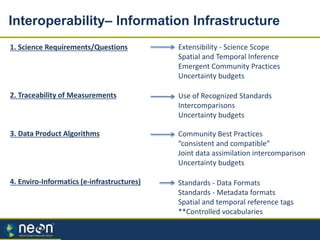
1. Science Requirements/Questions
2. Traceability of Measurements
3. Data Product Algorithms
4. Enviro-Informatics (e-infrastructures)
Extensibility - Science Scope
Spatial and Temporal Inference
Emergent Community Practices
Uncertainty budgets
Community Best Practices
“consistent and compatible”
Joint data assimilation intercomparison
Uncertainty budgets
Use of Recognized Standards
Intercomparisons
Uncertainty budgets
Standards - Data Formats
Standards - Metadata formats
Spatial and temporal reference tags
**Controlled vocabularies
Interoperability– Information Infrastructure
PARTNERSHIP CLIMATE
CZ.1.07/2.4.00/31.0056

NEON Aquatic program

  • 1.
    The Aquatic Program atNEON Charlotte Roehm Assistant Director of Aquatics and STREON 7/16/2014 July 14th 2014 http://www.neoninc.org
  • 2.
  • 3.
     Brandon McLaughlin– Aquatic Design Technician  Jenna Stewart – Science Technician – Training and Databases  Brandon Jensen – Associate Scientist - Permitting - Aquatic Ecologist  Charles Bohall – Instrumentation Engineer - Hydrologist  Jesse Vance – Instrumentation Engineer - Oceanographer  Michael Fitzgerald – Groundwater Hydrologist - Engineer  Keli Goodman - Aquatic Biogeochemist  Stephanie Parker – Aquatic Ecologist  Charlotte Roehm – Limnologist/Assistant Director  Ryan Utz – STREON Aquatic Ecologist Aquatic STREON Team
  • 4.
    Observing Ecological Change •Representative sampling • Standardized methods across domains • Standardized and transparent protocols • Continental in scope – distributed over 20 domains • Detecting/attributing change over decades • Comprehensive set of observations • Field and lab analyses state-of-the-art • QA/QC -- data quality and uncertainty
  • 5.
    NEON’s Scientific/Systems EngineeringApproach Environmental Science Questions (Hypothesis Based Questions) Identify Needed Information (What are the Data Products?) Science Requirements (Science Sub-System Requirements) Technical and Design Requirements (e.g., for Engineering, CyberInfrastructure) R E Q U I R E M E N T S I N F O R M A T I O N Grand Challenge Science Questions Raw Data Collection
  • 6.
    NEON Observation Platforms Airborne Observations TerrestrialInstruments Terrestrial Observations Aquatic Instruments & Observations
  • 7.
    Aquatic Program atNEON 36 Aquatic Sites 25 Wadeable Streams 3 Large Rivers 8 Lakes 10 STREON sites *~2/3 of AQU sites co-located with terrestrial sites. Aquatic Program at NEON
  • 9.
    Aquatic Organismal &Biogeochemical Observations Biomass Species % Cover Abundance Biomass Chemistry Abundance Biomass Chemistry Biogeochemistry Ecohydrology Pools/fluxes Invertebrates Phytoplankton Aquatic Plants Diversity Phenology Diversity Diversity Riparian Microorganisms Zooplankton Abundance Biomass Fish Density Diversity Abundance Diversity Phenology Diversity Abundance Function Sediment Chemistry Groundwater Chemistry
  • 10.
  • 11.
  • 12.
  • 13.
     Chemistry – Isotopes/Dissolvedgases – Surface water – Groundwater – Reaeration – Sediment  Biology – Riparian vegetation – Invertebrates – Aquatic Plants – Algae – Zooplankton – Fish – Microbes  Stream Discharge  Morphology  In-stream/In lake – Pressure Transducers – Multisonde: Twater, DO, Turbidity, pH, Conductivity, fDOM – Nutrient Analyzer (NO3-) – PAR (streams only) and PARu (lakes only)  Near-Stream/buoy – Micrometeorology – Tair, Precipitation, BP, PAR, Net Radiation – Wind speed and direction – Camera  Inlet/Outlet Lakes – Level, PARu, Temperature  Groundwater – Temperature, Level, Conductivity Aquatic Measurements Observational ComponentInstrumentation Component
  • 14.
    Aquatic Microbial Measurementsand Associated Data Products Protocol Analysis Analyte Data Product Microbes (Water) Genetic/Pathogen - Surface Water 16S/ITS rDNA Taxonomic diversity indices for microbes qpcr Abundance of microbes mRNA/functional assay mRNA sequence data functional composition DNA (metagenome) DNA sequence data Biomass (cell counts) Quantitative abundance of different groups of microbes in surface water Genetic/Pathogen - Benthic Biofilm 16S/ITS rDNA Taxonomic diversity indices for microbes qpcr Abundance of microbes mRNA/functional assay mRNA sequence data functional composition DNA (metagenome) DNA sequence data Biomass (cell counts) Quantitative abundance of different groups of microbes in benthic samples Microbes (Water) DNA Extract Museum Services
  • 15.
     Chemistry – Isotopes/dissolvedgases 26 x/yr 12 x/yr – Surface water 26 x/yr 12 x/yr – Groundwater 2 x/yr 2 x/yr – Sediment Chemistry 3 x/yr 3 x/yr – Reaeration 6 x/yr NA  Biology – Riparian vegetation 1 x/yr 1 x/yr – Invertebrates 3 x/yr 3 x/yr – Aquatic Plants 3 x/yr 3 x/yr – Algae 3 x/yr 3 x/yr – Zooplankton NA 3 x/yr – Fish 2 x/yr 2 x/yr – Microbes 12 x/yr 6 x/yr  Stream Discharge 12 x/yr NA  Morphology 1 x/yr 1 x/yr Sampling Frequency Streams Lakes
  • 16.
    Aquatic Sensors • ThermometricsPRT Temperature • Gill - WindObserver II 2D Wind speed and direction • Viasala – PTB330 Barometric Pressure • Hukesflux – NR01 Net Radiation SW/LW IR • Kipp & Zonen PQS1 Above water PAR • StarDot Netcam SE Camera • YSI Multisonde (EXO2) pH/ORP, water temperature, spec. conductivity, dissolved oxygen, turbidity, chlorophyll, fDOM • Thermometrics PRT Water temperature • In-Situ LevelTroll 500 Water temperature, pressure (level) • Kipp & Zonen PQS-1 Above water PAR • Li-Cor LI-192SA Underwater PAR – 1 upward and 1 downward looking • Satlantic SUNA V2 Nutrient Analyzer NO3 • In-Situ AquaTROLL 200 Water Temperature, Pressure (level), Spec. Conductance • In-Situ LevelTROLL Water Temperature, Pressure (level)
  • 17.
  • 18.
    18ASLO Feb 20th2013 Major AQU Tasks SCI TEAMS, DPS, SYS ENG THROUGHOUT • CVAL: Calibration/Validation Group • ENG: Engineering Team • CI: Cyberinfrastructure • IT: Information Technology • ATBD: Algorithm Theoretical Basis Document
  • 19.
    19ASLO Feb 20th2013 Key AQU Interfaces Division Key Interfaces ENG/SYS ENG Assembly level requirements Capture, C^3, V+V test approaches, process Permitting and Safety Safety, permitting, Soft Site Resolution Science/Data Products Quality assurance; algorithm revision / development; support data product development; publications and community engagement Calibration/Validation Design Traceability and Uncertainty approaches and processes; analyze results Cyber-Infrastructure Algorithm Development and Data Management tools Education & Outreach Provide scientific and technical support as needed
  • 20.
    • Standardized sensorsets and sampling methods to use at all sites • Standardized temporal sampling strategy to use at all sites • Continuous monitoring (sensors), consistent terminology • Quantifying uncertainty, data quality standards, metadata standards • Consistent QA/QC, verification, NIST traceable calibrations Blacktail Deer Creek, WY Challenges
  • 21.
    Science Validation What is ScienceCommissioning? Essential Function of Project Science Office Crucial Coordination with Systems Engineering Steve Berukoff
  • 22.
    22ASLO Feb 20th2013 Thank You QUESTIONS?
  • 23.
    What is ScienceCommissioning? • Science Commissioning & Validation (SCV) – Ensure that a system that functions at an engineering level (SYE-accepted) moves to a system that meets the scientific requirements for • Robustness • Sensitivity • Uncertainty as quantitatively traceable to higher-level science questions. – Answers the question: “Does NEON’s as-built implementation satisfy its scientific goals?” – Test • every measurement & data product against scientific design • within systems engineering framework • under schedule/budget/external deadlines Steve Berukoff
  • 25.
    PARTNERSHIP CLIMATE CZ.1.07/2.4.00/31.0056 1. ScienceRequirements/Questions 2. Traceability of Measurements 3. Data Product Algorithms 4. Enviro-Informatics (e-infrastructures) Extensibility - Science Scope Spatial and Temporal Inference Emergent Community Practices Uncertainty budgets Community Best Practices “consistent and compatible” Joint data assimilation intercomparison Uncertainty budgets Use of Recognized Standards Intercomparisons Uncertainty budgets Standards - Data Formats Standards - Metadata formats Spatial and temporal reference tags **Controlled vocabularies Interoperability– Information Infrastructure PARTNERSHIP CLIMATE CZ.1.07/2.4.00/31.0056

Editor's Notes

  • #5 How can NEON observe ecological change while keeping in mind the continental scope? What are some important goals for NEON?
  • #9 Similar to #4 but for aquatics