Extreme close up
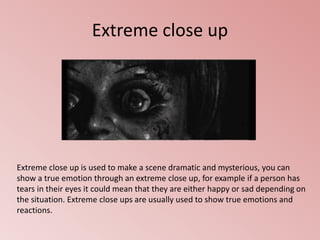
Extreme close up is used to make a scene dramatic and mysterious, you can
show a true emotion through an extreme close up, for example if a person has
tears in their eyes it could mean that they are either happy or sad depending on
the situation. Extreme close ups are usually used to show true emotions and
reactions.
Close up
A close up shot is used to focus on a specific person or object, to emphasis emotion or
detail. This shows the audience the characters reactions and also focuses on any detail
that you may be able to see around the person. In the shot above the woman looks
behind her as she is afraid and when she looks back around at the mirror she sees a
face, this means that the audience will be able to see her fear and her reaction.
Medium shot
The medium shot shows some part of the character or object in more detail,
this lets the audience know how the character is feeling without having to see
the full body shot or all of the surroundings. The medium shot also allows the
audience to see any hand movements or body movements.
Long shot
Long shot is used to show a scene from a distance and to show to setting and
environment, a long shot also shows the audience the characters full body so
you are able to see posture which will tell you what the character is feeling.
Long shot shows a general impression rather than specific details like a close
up shot.
Extreme long shot
An extreme long shot can be used to show the distance from an object or
character, when using an extreme long shot the audience is able to see all of the
surrounding and the other characters if there are any. An extreme long shot can
be from the bad characters view which will show the audience how far away it is
from the people it is trying to catch.
Zoom
Zooming gives the audience the feeling that they are moving closer or further away
from the object or character. Whenever you zoom in on an object you are usually
focusing on a specific thing.
Zoom in
Track
A tracking shot Is when the camera is on a track and it follows the characters or an
object when they are moving, this is used to let the audience explore a place such as a
bedroom, restaurant, shop etc. the movement of the camera is horizontally left and
right.
Pan
Panning is when the camera is in a fixed spot for example a tripod but it
follows and object for person by spinning left and right. This will let the
audience feel as though they are in the movie because they are stood in
one place but following something with their eyes or just moving their
head.
Tilt
Tilt is the opposite to panning because with tilt you move the camera vertically up
and down but a panning movement means you move the camera left and right. For
example if you stand on the ground next to a building and start from the bottom and
keep tilting the camera up until you can see the top. This shows the audience the
that something is tall compared to the cameras point of view.
Cut
The normal, sudden transition from one shot or audio sequence to the next. Also the
name given to the action of separating scenes or sequences and joining them up in the
required order and duration. A cut shot takes the audience to another part of the film, a
cut shot can also be used to make the audience jump for example the images above
show a woman looking in her basement with a small light then you switch and look
from her point of view and you see a scary character or object.
Diegetic and Non diegetic
Diegetic - A narrator tells the story instead of the characters having to act it out, the
narrator summarizes the events in the plot and comments on the conversations and
thoughts of the characters.
Non Diegetic - Non-diegetic sound is represented as coming from the a source
outside story space. Voice overs are non-diegetic because the narration does not
appear in the film.
Mise en scene
Mise en scene is used to describe the design of a film or theatre, mise en
scene applies to everything that is in the camera shot fir example lighting,
costumes, props, sets, hair, makeup, facial expressions, body language etc.
Each part of mise en scene is to make the audience feel how the character
feels at a certain point of the film or theatre production.
Facial
expression:
frightened
Costume:
pyjamas Body
language:
holding
back

Micro elements

  • 1.
    Extreme close up Extremeclose up is used to make a scene dramatic and mysterious, you can show a true emotion through an extreme close up, for example if a person has tears in their eyes it could mean that they are either happy or sad depending on the situation. Extreme close ups are usually used to show true emotions and reactions.
  • 2.
    Close up A closeup shot is used to focus on a specific person or object, to emphasis emotion or detail. This shows the audience the characters reactions and also focuses on any detail that you may be able to see around the person. In the shot above the woman looks behind her as she is afraid and when she looks back around at the mirror she sees a face, this means that the audience will be able to see her fear and her reaction.
  • 3.
    Medium shot The mediumshot shows some part of the character or object in more detail, this lets the audience know how the character is feeling without having to see the full body shot or all of the surroundings. The medium shot also allows the audience to see any hand movements or body movements.
  • 4.
    Long shot Long shotis used to show a scene from a distance and to show to setting and environment, a long shot also shows the audience the characters full body so you are able to see posture which will tell you what the character is feeling. Long shot shows a general impression rather than specific details like a close up shot.
  • 5.
    Extreme long shot Anextreme long shot can be used to show the distance from an object or character, when using an extreme long shot the audience is able to see all of the surrounding and the other characters if there are any. An extreme long shot can be from the bad characters view which will show the audience how far away it is from the people it is trying to catch.
  • 6.
    Zoom Zooming gives theaudience the feeling that they are moving closer or further away from the object or character. Whenever you zoom in on an object you are usually focusing on a specific thing. Zoom in
  • 7.
    Track A tracking shotIs when the camera is on a track and it follows the characters or an object when they are moving, this is used to let the audience explore a place such as a bedroom, restaurant, shop etc. the movement of the camera is horizontally left and right.
  • 8.
    Pan Panning is whenthe camera is in a fixed spot for example a tripod but it follows and object for person by spinning left and right. This will let the audience feel as though they are in the movie because they are stood in one place but following something with their eyes or just moving their head.
  • 9.
    Tilt Tilt is theopposite to panning because with tilt you move the camera vertically up and down but a panning movement means you move the camera left and right. For example if you stand on the ground next to a building and start from the bottom and keep tilting the camera up until you can see the top. This shows the audience the that something is tall compared to the cameras point of view.
  • 10.
    Cut The normal, suddentransition from one shot or audio sequence to the next. Also the name given to the action of separating scenes or sequences and joining them up in the required order and duration. A cut shot takes the audience to another part of the film, a cut shot can also be used to make the audience jump for example the images above show a woman looking in her basement with a small light then you switch and look from her point of view and you see a scary character or object.
  • 11.
    Diegetic and Nondiegetic Diegetic - A narrator tells the story instead of the characters having to act it out, the narrator summarizes the events in the plot and comments on the conversations and thoughts of the characters. Non Diegetic - Non-diegetic sound is represented as coming from the a source outside story space. Voice overs are non-diegetic because the narration does not appear in the film.
  • 12.
    Mise en scene Miseen scene is used to describe the design of a film or theatre, mise en scene applies to everything that is in the camera shot fir example lighting, costumes, props, sets, hair, makeup, facial expressions, body language etc. Each part of mise en scene is to make the audience feel how the character feels at a certain point of the film or theatre production. Facial expression: frightened Costume: pyjamas Body language: holding back