April 18th, 2011


Flow equations for AdS₄ black holes
    in N=2 gauged supergravity
                                 G. DallʼAgata, A.G. - arXiv:1012.3756
                                                  JHEP 1103:037,2011


                                         Alessandra Gnecchi
          “G. Galilei” Physics Dept. - Padua University (Italy)
                      & Dept. of Physics - Harvard University
Outline

  Black holes in Supergravity
      Duality invariance of extremal solutions
      BPS flow of scalar fields

  Black holes in gauged Supergravity
      The FI gauging
      One modulus and stu model examples

  Future directions


                                                 2
Motivations
1. Gauged Supergravity

The low energy effective theories obtained from String Theory
compactifications in the presence of fluxes are gauged supergravities.

2. AdS space

The gauging appears as a scalar potential in the four dimensional action,
which plays the role of a coordinate dependent cosmological constant.


     We seek a systematic approach to address the problem of
     the destabilization of such backgrounds by the presence of
     a stable black hole, thus yielding new insights into the
     interpretation of string landscape.


                                                                            3
Motivations
Other applications

1. Gauge/gravity duality
              Not only the near horizon region develops an AdS geometry,
              but also the asymptotic space!


2. AdS/CMT correspondence

Black holes solutions with scalars are associated to physical quantities in the
condensed matter system.

              Building a solution with nontrivial scalar profiles, or
              demonstrating the non existence in a specific models reflects
              is a statement on the properties of the condensed matter
              system


                                                                                  4
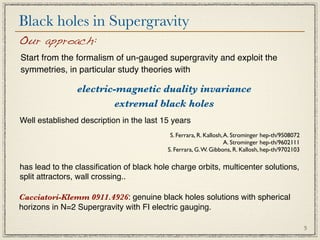
Black holes in Supergravity
Our approach:
Start from the formalism of un-gauged supergravity and exploit the
symmetries, in particular study theories with

                electric-magnetic duality invariance
                         extremal black holes
Well established description in the last 15 years
                                           S. Ferrara, R. Kallosh, A. Strominger hep-th/9508072
                                                                   A. Strominger hep-th/9602111
                                          S. Ferrara, G. W. Gibbons, R. Kallosh, hep-th/9702103

has lead to the classification of black hole charge orbits, multicenter solutions,
split attractors, wall crossing..

Cacciatori-Klemm 0911.4926: genuine black holes solutions with spherical
horizons in N=2 Supergravity with FI electric gauging.

                                                                                                  5
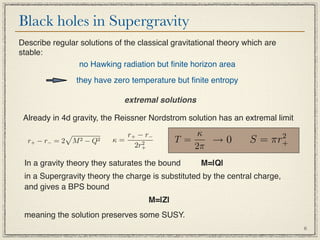
Black holes in Supergravity
Describe regular solutions of the classical gravitational theory which are
stable:
                no Hawking radiation but finite horizon area
                they have zero temperature but finite entropy

                              extremal solutions

 Already in 4d gravity, the Reissner Nordstrom solution has an extremal limit
                            r+ − r −             κ                       2
  r+ − r− = 2 M 2 − Q2    κ=     2
                               2r+
                                             T =    →0            S=    πr+
                                                 2π
 In a gravity theory they saturates the bound       M=|Q|
 in a Supergravity theory the charge is substituted by the central charge,
 and gives a BPS bound
                                     M=|Z|
 meaning the solution preserves some SUSY.
                                                                                6
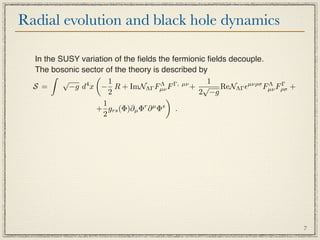
Radial evolution and black hole dynamics

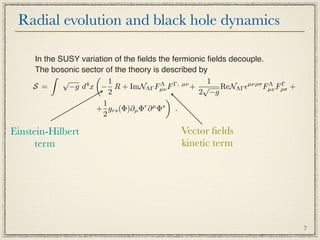
  In the SUSY variation of the fields the fermionic fields decouple.
  The bosonic sector of the theory is described by
                 
          √            1                           1
  S =       −g d x − R + ImNΛΓ Fµν F
                4                     Λ   Γ, µν
                                                + √ ReNΛΓ µνρσ Fµν Fρσ +
                                                                   Λ Γ
                       2                         2 −g
                                        
                     1
                  + grs (Φ)∂µ Φr ∂ µ Φs .
                     2


                                                                            7
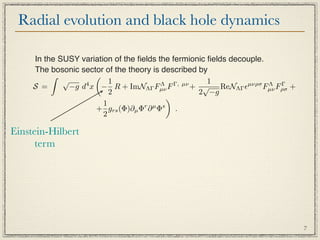
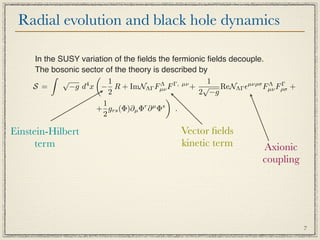
Radial evolution and black hole dynamics

     In the SUSY variation of the fields the fermionic fields decouple.
     The bosonic sector of the theory is described by
                    
             √            1                           1
     S =       −g d x − R + ImNΛΓ Fµν F
                   4                     Λ   Γ, µν
                                                   + √ ReNΛΓ µνρσ Fµν Fρσ +
                                                                      Λ Γ
                          2                         2 −g
                                           
                        1
                     + grs (Φ)∂µ Φr ∂ µ Φs .
                        2

Einstein-Hilbert
      term


                                                                               7
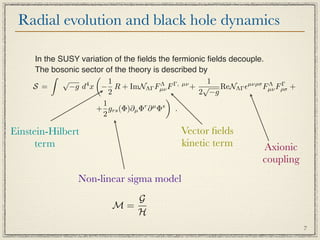
Radial evolution and black hole dynamics

     In the SUSY variation of the fields the fermionic fields decouple.
     The bosonic sector of the theory is described by
                    
             √            1                           1
     S =       −g d x − R + ImNΛΓ Fµν F
                   4                     Λ   Γ, µν
                                                   + √ ReNΛΓ µνρσ Fµν Fρσ +
                                                                      Λ Γ
                          2                         2 −g
                                           
                        1
                     + grs (Φ)∂µ Φr ∂ µ Φs .
                        2

Einstein-Hilbert                             Vector fields
      term                                   kinetic term


                                                                               7
Radial evolution and black hole dynamics

     In the SUSY variation of the fields the fermionic fields decouple.
     The bosonic sector of the theory is described by
                    
             √            1                           1
     S =       −g d x − R + ImNΛΓ Fµν F
                   4                     Λ   Γ, µν
                                                   + √ ReNΛΓ µνρσ Fµν Fρσ +
                                                                      Λ Γ
                          2                         2 −g
                                           
                        1
                     + grs (Φ)∂µ Φr ∂ µ Φs .
                        2

Einstein-Hilbert                             Vector fields
      term                                   kinetic term          Axionic
                                                                   coupling


                                                                               7
Radial evolution and black hole dynamics

     In the SUSY variation of the fields the fermionic fields decouple.
     The bosonic sector of the theory is described by
                    
             √            1                           1
     S =       −g d x − R + ImNΛΓ Fµν F
                   4                     Λ   Γ, µν
                                                   + √ ReNΛΓ µνρσ Fµν Fρσ +
                                                                      Λ Γ
                          2                         2 −g
                                           
                        1
                     + grs (Φ)∂µ Φr ∂ µ Φs .
                        2

Einstein-Hilbert                             Vector fields
      term                                   kinetic term          Axionic
                                                                   coupling
                 Non-linear sigma model
                             G
                          M=
                             H
                                                                               7
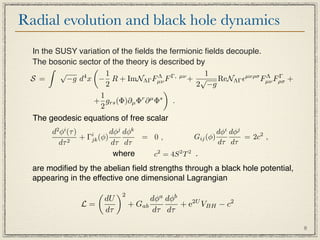
Radial evolution and black hole dynamics
 In the SUSY variation of the fields the fermionic fields decouple.
 The bosonic sector of the theory is described by
                
         √            1                           1
 S =       −g d x − R + ImNΛΓ Fµν F
               4                     Λ   Γ, µν
                                               + √ ReNΛΓ µνρσ Fµν Fρσ +
                                                                  Λ Γ
                      2                         2 −g
                                       
                    1
                 + grs (Φ)∂µ Φr ∂ µ Φs .
                    2
 The geodesic equations of free scalar
       d2 φi (τ )           dφj dφk                         dφi dφj
                     i
                  + Γjk (φ)         = 0,            Gij (φ)         = 2c2 ,
         dτ 2               dτ dτ                           dτ dτ
                             where    c2 = 4S 2 T 2 .
  are modified by the abelian field strengths through a black hole potential,
  appearing in the effective one dimensional Lagrangian
                             2
                         dU              dφa dφb
                L=                 + Gab         + e2U VBH − c2
                         dτ               dτ dτ

                                                                              8
Radial evolution and black hole dynamics
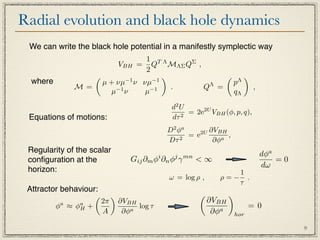
 We can write the black hole potential in a manifestly symplectic way
                                1 TΛ
                          VBH = Q MΛΣ QΣ ,
                                2
                                              Λ
  where               µ + νµ ν νµ
                            −1    −1
                                                p
                M =                    .   Q =
                                            Λ
                                                    ,
                        µ−1 ν  µ−1              qΛ

                                                     d2 U
                                                          = 2e2U VBH (φ, p, q),
 Equations of motions:                               dτ 2
                                                   D2 φa     2U ∂VBH
                                                       2
                                                         = e       a
                                                                     ,
                                                   Dτ            ∂φ
 Regularity of the scalar                                                           dφa
 configuration at the                     Gij ∂m φi ∂n φj γ mn  ∞                       =0
                                                                                    dω
 horizon:                                                              1
                                                    ω = log ρ ,     ρ=− ,
                                                                       τ
 Attractor behaviour:
                                                                      
                             2π       ∂VBH                        ∂VBH
          a
          φ ≈   φa
                 H   +                     log τ                                   =0
                             A         ∂φa                         ∂φa       hor

                                                                                             9
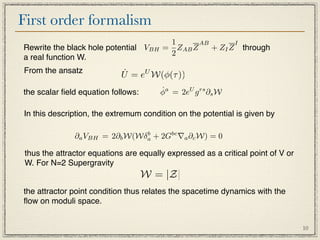
First order formalism
                                         1      AB       I
Rewrite the black hole potential VBH    = ZAB Z    + ZI Z through
                                         2
a real function W.
From the ansatz              ˙
                             U = eU W(φ(τ ))
the scalar field equation follows:       ˙
                                        φa = 2eU g rs ∂s W

In this description, the extremum condition on the potential is given by

               ∂a VBH = 2∂b W(Wδa + 2Gbc ∇a ∂c W) = 0
                                b


 thus the attractor equations are equally expressed as a critical point of V or
 W. For N=2 Supergravity
                                    W = |Z|
the attractor point condition thus relates the spacetime dynamics with the
flow on moduli space.


                                                                                  10
BPS flow, rotating and non SUSY solutions
    Extension to rotating solution                            [Denef, hep-th/0005049]
    Exemples of multicenter configurations
                                                           N
                                                           
                   ¯        ω ¯
   F, V = −e2iα [ζ + i  (˜ ∧ ζ)]                   ζ=          Z(Qi )dτi
                                                            i=1

 Attractor equations describe also extremal, non supersymmetric black holes,
 that can be built as intersecting branes systems from type IIA string theory
                                      [Kallosh-Sivanandam-Soroush, hep-th/0602005]
                                                   [Gimon-Larsen-Simon, 0710.4967]
 The first order description generalizes to the non-BPS case by introducing a
 fake superpotential , built out of invariants of symplectic geometry
                                                 [Ceresole-DallʼAgata hep-th/0702088]
 Extremal non-BPS solutions can be decomposed as threshold states of BPS
 constituents, thus revealing the existence of multicenter extremal non
 supersymmetric configurations, that one has to take into account when
 counting the degeneracy of the black holes states.
                                                    [Gimon-Larsen-Simon, 0903.0719]
                                     [Bena-DallʼAgata-Giusto-Ruef-Warner, 0902.4526]
                                                                                        11
The gauging
Momentum map procedure               [Ceresole-DʼAuria-Ferrara, hep-th/9509160]

     Let gi¯ be the Kähler metric of a Kähler manifold M. If it has a
           
        a non trivial group of continuous isometries G generated by
        Killing vectors, then the kinetic Lagrangian admits G as a
        group of global space-time symmetries.
        The holomorphic Killing vectors, which are defined by the
        variation of the fields δz i = Λ kΛ (z) are defined by the
                                          i

        equations
                       ∇i kj + ∇j ki = 0 ;   ∇¯kj + ∇j k¯ = 0
                                              ı         ı

        This are identically satisfied once we can write
                          kΛ = ig i¯∂¯PΛ ,
                           i       
                                            PΛ = PΛ
                                              ∗


        thus defining a momentum map, which also preserves the
        Kähler structure of the scalar manifold.
        The momentum map construction applies to all manifolds with
        a symplectic structure, in particular to Kähler, HyperKähler
        and Quaternionic manifolds.
                                                                                  12
The gauging
                                                 [Ceresole-DʼAuria-Ferrara ʻ95]

    Gauging involving hypermultiplets:
    Triholomorphic momentum map that leaves invariant the
    hyperkahler structure up to SU(2) rotations.
    In N=2 theories the same group of isometries G acts both on
    the SpecialKähler and HyperKähler manifolds:
                     ˆ
                      Λ = k i ∂i + k¯ ∂¯ + k u ∂u
                                    ı         
                     k      Λ        Λ  ı    Λ
    Fayet-Iliopoulos gauging = constant prepotential
                              PΛ = ξΛ
                               x    x


                                                                                  13
The gauging
                                                 [Ceresole-DʼAuria-Ferrara ʻ95]

    Gauging involving hypermultiplets:
    Triholomorphic momentum map that leaves invariant the
    hyperkahler structure up to SU(2) rotations.
    In N=2 theories the same group of isometries G acts both on
    the SpecialKähler and HyperKähler manifolds:
                     ˆ
                      Λ = k i ∂i + k¯ ∂¯ + k u ∂u
                                    ı         
                     k      Λ        Λ  ı    Λ
    Fayet-Iliopoulos gauging = constant prepotential
                              PΛ = ξΛ
                               x    x


                                                                                  13
The gauging
                                                 [Ceresole-DʼAuria-Ferrara ʻ95]

    Gauging involving hypermultiplets:
    Triholomorphic momentum map that leaves invariant the
    hyperkahler structure up to SU(2) rotations.
    In N=2 theories the same group of isometries G acts both on
    the SpecialKähler and HyperKähler manifolds:
                     ˆ
                      Λ = k i ∂i + k¯ ∂¯ + k u ∂u
                                    ı         
                     k      Λ        Λ  ı    Λ
    Fayet-Iliopoulos gauging = constant prepotential
                              PΛ = ξΛ
                               x    x


                 Non-trivial gauging!
                                                                                  13
N=2 Supergravity with FI gauging
                                              [Ceresole-DʼAuria-Ferrara ʻ95]


   Consider the scalar potential for an N=2 theory.
   Due to the fact that all the relevant quantities are derived from
   the Kähler vectors and prepotential, this can be written in a
   geometrical way as
                   ¯                ¯
     V = (kΛ , kΣ )LΛ LΣ + (U ΛΣ − 3LΛ LΣ )(PΛ PΣ − PΛ PΣ )
                                             x x


   Thus, one easily sees that for an abelian theory this potential
   can still be nonzero, as long as the prepotentials are taken as
   constants, PΛ = ξΛ leading to the form of V on which we will
                 x    x

   focus:
                 VF I = (U   ΛΣ      ¯ Λ LΣ )ξΛ ξΣ
                                  − 3L        x x


                                                                               14
N=2 Supergravity with FI gauging
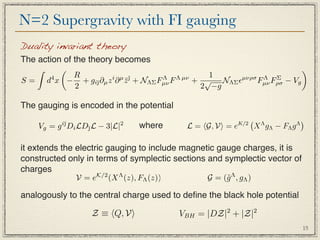
Duality invariant theory
The action of the theory becomes
                                                                                         
              R                                  1
S=       d x − + gi¯∂µ z ∂ z + NΛΣ Fµν F
          4
                          ¯
                        i µ ¯
                                   Λ    Λ µν
                                              + √ NΛΣ µνρσ Fµν Fρσ − Vg
                                                             Λ   Σ
              2                                2 −g

The gauging is encoded in the potential
                                                                                          
     Vg = g Di LD¯L − 3|L|
              i¯
               
                 
                                2
                                      where      L = G, V = eK/2        Λ
                                                                         X gΛ − FΛ g   Λ


it extends the electric gauging to include magnetic gauge charges, it is
constructed only in terms of symplectic sections and symplectic vector of
charges
                   V = eK/2 (X Λ (z), FΛ (z))         G = (˜Λ , gΛ )
                                                           g

analogously to the central charge used to define the black hole potential

                       Z ≡ Q, V               VBH = |DZ|2 + |Z|2
                                                                                           15
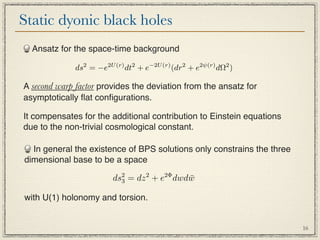
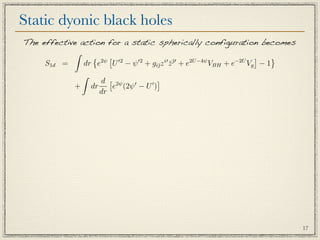
Static dyonic black holes
  Ansatz for the space-time background

             ds2 = −e2U (r) dt2 + e−2U (r) (dr2 + e2ψ(r) dΩ2 )

A second warp factor provides the deviation from the ansatz for
asymptotically flat configurations.

It compensates for the additional contribution to Einstein equations
due to the non-trivial cosmological constant.

  In general the existence of BPS solutions only constrains the three
dimensional base to be a space

                        ds2 = dz 2 + e2Φ dwdw
                          3                 ¯

with U(1) holonomy and torsion.


                                                                        16
Static dyonic black holes
The effective action for a static spherically configuration becomes
            
                  2ψ  2    2     i  
                                        ¯   2U −4ψ        −2U
                                                                
     S1d =     dr e U − ψ + gi¯z z + e
                                      ¯           VBH + e Vg − 1
              
                   d  2ψ       
                                   
            + dr       e (2ψ − U )
                   dr


                                                                      17
Static dyonic black holes
The effective action for a static spherically configuration becomes
            
                  2ψ  2    2     i  
                                        ¯   2U −4ψ        −2U
                                                                
     S1d =     dr e U − ψ + gi¯z z + e
                                      ¯           VBH + e Vg − 1
              
                   d  2ψ       
                                   
            + dr       e (2ψ − U )
                   dr
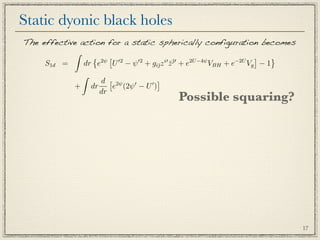
                                      Possible squaring?


                                                                      17
Static dyonic black holes
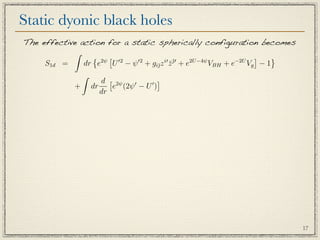
The effective action for a static spherically configuration becomes
            
                  2ψ  2    2     i  
                                        ¯   2U −4ψ        −2U
                                                                
     S1d =     dr e U − ψ + gi¯z z + e
                                      ¯           VBH + e Vg − 1
              
                   d  2ψ       
                                   
            + dr       e (2ψ − U )
                   dr


                                                                      17
Static dyonic black holes
The effective action for a static spherically configuration becomes
            
                  2ψ  2    2     i  
                                        ¯   2U −4ψ        −2U
                                                                
     S1d =     dr e U − ψ + gi¯z z + e
                                      ¯           VBH + e Vg − 1
              
                   d  2ψ       
                                   
            + dr       e (2ψ − U )
                   dr

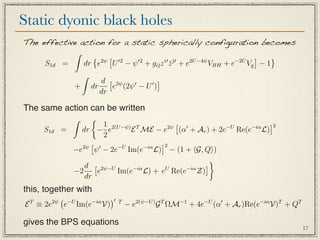
The same action can be written
                   
                       1 2(U −ψ) T        2ψ
                                                     −U   −iα
                                                                2
     S1d    =   dr − e          E ME − e (α + Ar ) + 2e Re(e L)
                       2
                2ψ
                         −U       −iα
                                        2
              −e ψ − 2e Im(e L) − (1 + G, Q)
                                                    
                 d  2ψ−U       −iα      U     −iα
                                                   
              −2     e     Im(e L) + e Re(e Z)
                 dr
this, together with
               −U      −iα
                                
 T
E ≡ 2e 2ψ
                e    Im(e     V)     T
                                         − e2(ψ−U ) G T ΩM−1 + 4e−U (α + Ar )Re(e−iα V)T + QT

gives the BPS equations
                                                                                                 17
Static dyonic black holes
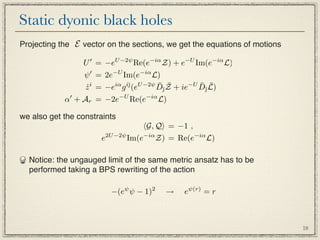
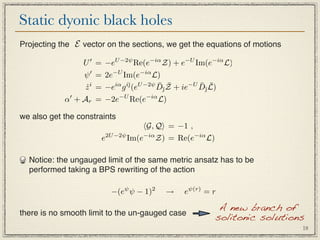
Projecting the E vector on the sections, we get the equations of motions

                 U  = −eU −2ψ Re(e−iα Z) + e−U Im(e−iα L)
                  ψ  = 2e−U Im(e−iα L)
                                         ¯ ¯       ¯ ¯
                  z i = −eiα g i¯(eU −2ψ D¯Z + ie−U D¯L)
                  ˙             

            α + Ar = −2e−U Re(e−iα L)

we also get the constraints
                                  G, Q = −1 ,
                      e2U −2ψ Im(e−iα Z) = Re(e−iα L)

  Notice: the ungauged limit of the same metric ansatz has to be
  performed taking a BPS rewriting of the action

                         −(eψ ψ − 1)2    →    eψ(r) = r


                                                                           18
Static dyonic black holes
Projecting the E vector on the sections, we get the equations of motions

                 U  = −eU −2ψ Re(e−iα Z) + e−U Im(e−iα L)
                  ψ  = 2e−U Im(e−iα L)
                                         ¯ ¯       ¯ ¯
                  z i = −eiα g i¯(eU −2ψ D¯Z + ie−U D¯L)
                  ˙             

            α + Ar = −2e−U Re(e−iα L)

we also get the constraints
                                  G, Q = −1 ,
                      e2U −2ψ Im(e−iα Z) = Re(e−iα L)

  Notice: the ungauged limit of the same metric ansatz has to be
  performed taking a BPS rewriting of the action

                         −(eψ ψ − 1)2    →    eψ(r) = r

                                                         A new branch of
there is no smooth limit to the un-gauged case
                                                        solitonic solutions
                                                                           18
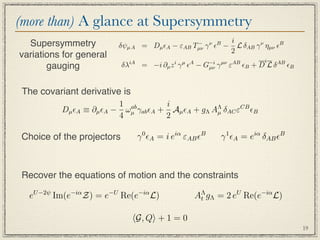
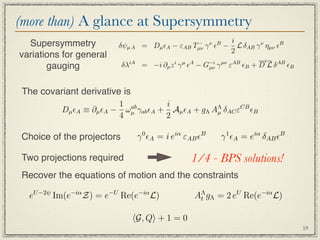
(more than) A glance at Supersymmetry
  Supersymmetry                                   −         i
                         δψµ A = Dµ A −     εAB Tµν   γ  − L δAB γ ν ηµν B
                                                        ν B
                                                            2
variations for general
                                                                           i
       gauging             δλiA = −i ∂µ z i γ µ A − G−i γ µν εAB B + D L δ AB B
                                                      µν


 The covariant derivative is
                         1 ab        i
          Dµ A ≡ ∂µ A − ωµ γab A + Aµ A + gΛ AΛ δAC εCB B
                                                  µ
                         4           2

Choice of the projectors        γ 0 A = i eiα εAB B         γ 1 A = eiα δAB B


Recover the equations of motion and the constraints

  eU −2ψ Im(e−iα Z) = e−U Re(e−iα L)              AΛ gΛ = 2 eU Re(e−iα L)
                                                   t


                               G, Q + 1 = 0
                                                                                     19
(more than) A glance at Supersymmetry
  Supersymmetry                                   −         i
                         δψµ A = Dµ A −     εAB Tµν   γ  − L δAB γ ν ηµν B
                                                        ν B
                                                            2
variations for general
                                                                           i
       gauging             δλiA = −i ∂µ z i γ µ A − G−i γ µν εAB B + D L δ AB B
                                                      µν


 The covariant derivative is
                         1 ab        i
          Dµ A ≡ ∂µ A − ωµ γab A + Aµ A + gΛ AΛ δAC εCB B
                                                  µ
                         4           2

Choice of the projectors        γ 0 A = i eiα εAB B         γ 1 A = eiα δAB B

Two projections required                         1/4 - BPS solutions!
Recover the equations of motion and the constraints

  eU −2ψ Im(e−iα Z) = e−U Re(e−iα L)              AΛ gΛ = 2 eU Re(e−iα L)
                                                   t


                               G, Q + 1 = 0
                                                                                     19
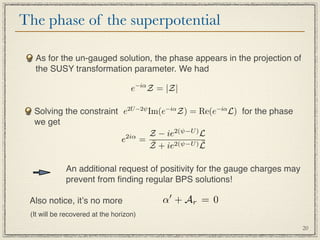
The phase of the superpotential

  As for the un-gauged solution, the phase appears in the projection of
  the SUSY transformation parameter. We had

                                    e−iα Z = |Z|

  Solving the constraint e2U −2ψ Im(e−iα Z) = Re(e−iα L) for the phase
  we get
                                 Z − ie2(ψ−U ) L
                         e2iα = ¯              ¯
                                 Z + ie2(ψ−U ) L

             An additional request of positivity for the gauge charges may
             prevent from finding regular BPS solutions!

 Also notice, itʼs no more                  α + Ar = 0
                                             

 (It will be recovered at the horizon)
                                                                             20
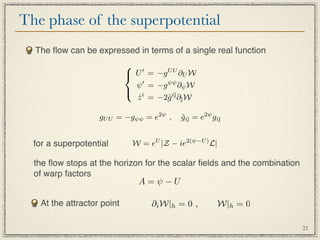
The phase of the superpotential
  The flow can be expressed in terms of a single real function
                             
                             U = −g U U ∂U W
                                ψ  = −g ψψ ∂ψ W
                            
                                z i = −2˜i¯∂¯W
                                ˙       g 

                   gU U = −gψψ = e2ψ ,      gi¯ = e2ψ gi¯
                                            ˜          


  for a superpotential       W = eU |Z − ie2(ψ−U ) L|

  the flow stops at the horizon for the scalar fields and the combination
  of warp factors
                                A=ψ−U

   At the attractor point           ∂i W|h = 0 ,        W|h = 0

                                                                          21
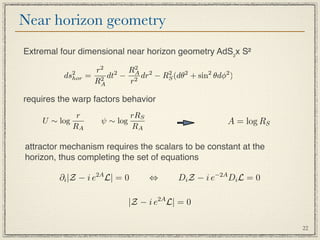
Near horizon geometry
Extremal four dimensional near horizon geometry AdS₂x S²

                    r 2 2 RA 2
                             2
          ds2
            hor   = 2 dt − 2 dr − RS (dθ2 + sin2 θdφ2 )
                                   2
                   RA      r

requires the warp factors behavior
             r                rRS
    U ∼ log           ψ ∼ log                         A = log RS
            RA                RA

attractor mechanism requires the scalars to be constant at the
horizon, thus completing the set of equations

         ∂i |Z − i e2A L| = 0       ⇔    Di Z − i e−2A Di L = 0

                            |Z − i e2A L| = 0

                                                                   22
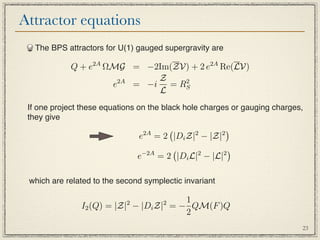
Attractor equations
   The BPS attractors for U(1) gauged supergravity are

            Q + e2A ΩMG = −2Im(ZV) + 2 e2A Re(LV)
                      2A     Z   2
                     e   = −i = RS
                             L
 If one project these equations on the black hole charges or gauging charges,
 they give
                                 2A
                                              2        2
                                                            
                                e   = 2 |Di Z| − |Z|
                                 −2A
                                              2     2
                                                       
                                e    = 2 |Di L| − |L|

 which are related to the second symplectic invariant

                            2         2 1
               I2 (Q) = |Z| − |Di Z| = − QM(F )Q
                                        2
                                                                            23
Solutions with constant scalars
  Asymptotic AdS background :                  Di L = 0
  Equal radii would imply vanishing potential at the horizon
    R S = RA        →       Vg = 0           [Bellucci-Ferrara-Marrani-Yeranyan ʻ08]


  The form of the gauge potential:     Vg = −3|L|2 + |DL|2


   A configuration with constant scalars along the flow has         |L| = 0
  In general, for constant scalars, the attractor equations imply


           2A      Im(ZL)                                  2A     1 G, Q
          e     =−                                     e        =
                     |L|2                                         2 |L|2

  which is inconsistent for spherical horizons for which        G, Q = −1  0


                                                                                       24
Exemple of dyonic solutions
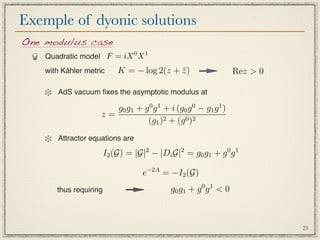
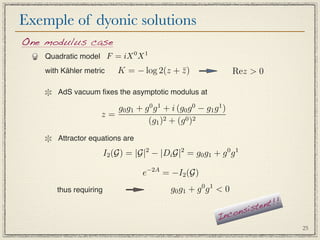
One modulus case
    Quadratic model F = iX 0 X 1
    with Kähler metric      K = − log 2(z + z )
                                            ¯                     Rez  0

       AdS vacuum fixes the asymptotic modulus at

                       g0 g1 + g 0 g 1 + i (g0 g 0 − g1 g 1 )
                    z=
                                (g1 )2 + (g 0 )2
       Attractor equations are

                        I2 (G) = |G|2 − |Di G|2 = g0 g1 + g 0 g 1

                                    e−2A = −I2 (G)
       thus requiring                       g0 g1 + g 0 g 1  0


                                                                            25
Exemple of dyonic solutions
One modulus case
    Quadratic model F = iX 0 X 1
    with Kähler metric      K = − log 2(z + z )
                                            ¯                     Rez  0

       AdS vacuum fixes the asymptotic modulus at

                       g0 g1 + g 0 g 1 + i (g0 g 0 − g1 g 1 )
                    z=
                                (g1 )2 + (g 0 )2
       Attractor equations are

                        I2 (G) = |G|2 − |Di G|2 = g0 g1 + g 0 g 1

                                    e−2A = −I2 (G)
       thus requiring                       g0 g1 + g 0 g 1  0
                                                                            !!
                                                                    sis tent
                                                           I ncon
                                                                                 25
Exemple of dyonic solutions
The stu model
                                          X 1X 2X 3
    STU model with prepotential      F =−           : the potential of the
                                             X0
    gauging has no critical point             no asymptotic AdS configurations.
                                      √
    STU model with prepotential F = −i X 0 X 1 X 2 X 3 admits regular
    solutions with spherical horizon for magnetic charges
                                                          [Cacciatori-Klemm 0911.4926]

       the duality invariant setup allow us to build a genuine dyonic
       solution by rotation of both electromagnetic and gauging charges

 VCK = eK/2 (1, −tu, −su, −st, −stu, s, t, u)T                                               
                                                                1
       K/2                                T                                        −1         
 V=e         (1, s, t, u, −stu, tu, su, st)                
                                                                                        −1
                                                                                               
                                                                                               
                                                                                              
                                                                                           −1 
                                                         S=
                                                           
                                                                                               
                                                                                               
                                                                               1              
                                                                                              
  VCK = SV                 G = S −1 GCK                    
                                                           
                                                                    1
                                                                        1
                                                                                               
                                                                                               
                                   −1                                       1
                           Q = S QCK
                                                                                               26
Exemple of dyonic solutions
The stu model                                                    Charges

Kahler potential                                                 Q = (p0 , 0, 0, 0, 0, q1 , q2 , q3 )T
                 ¯      ¯
K = − log[−i(s − s)(t − t)(u − u)]
                               ¯                                 G = (0, g 1 , g 2 , g 3 , g0 , 0, 0, 0)T
Superpotential

W = eK/2 |q1 s + q2 t + q3 u + p0 stu − ie2A (g0 − g 1 tu − g 2 su − g 3 st)|
No axion solution                 Re s = Re t = Re u = 0
  The case where all the scalars are identified can be solved analitically;
  the attractor values of the fields are
                                                       
                              
                                  g0       −1 + 6gq +     1 − 16gq + 48g 2 q 2
                     y=                                                        0
                                  2g                    1 − 3gq
                                          
              2A     1       1 + 2(1 − 4gq) 1 − 16gq + 48g 2 q 2 − 3(1 − 4gq)2
             e     =
                     4                           g0 g 3
                                                                                                            27
Exemple of dyonic solutions
The stu model
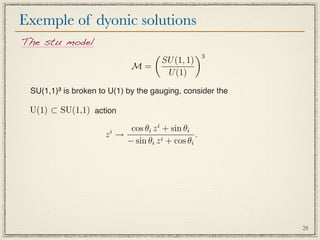
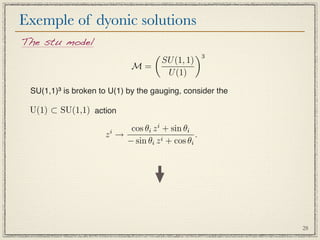
                                                   3
                                        SU (1, 1)
                             M=
                                         U (1)

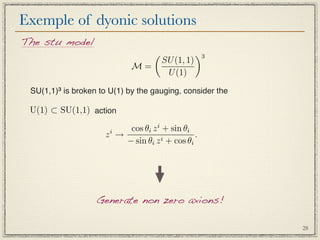
 SU(1,1)³ is broken to U(1) by the gauging, consider the

 U(1) ⊂ SU(1,1) action

                           cos θi z i + sin θi
                     zi →            i + cos θ
                                                 .
                          − sin θi z           i


                                                           28
Exemple of dyonic solutions
The stu model
                                                   3
                                        SU (1, 1)
                             M=
                                         U (1)

 SU(1,1)³ is broken to U(1) by the gauging, consider the

 U(1) ⊂ SU(1,1) action

                           cos θi z i + sin θi
                     zi →            i + cos θ
                                                 .
                          − sin θi z           i


                                                           28
Exemple of dyonic solutions
The stu model
                                                   3
                                        SU (1, 1)
                             M=
                                         U (1)

 SU(1,1)³ is broken to U(1) by the gauging, consider the

 U(1) ⊂ SU(1,1) action

                           cos θi z i + sin θi
                     zi →            i + cos θ
                                                 .
                          − sin θi z           i


                   Generate non zero axions!

                                                           28
The entropy
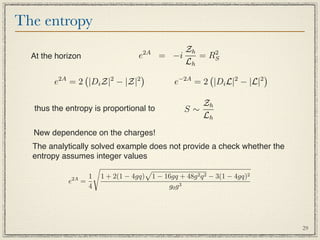
                                             2A        Zh     2
  At the horizon                         e        = −i    = RS
                                                       Lh
         2A
                               2        2
                                                    −2A
                                                                  2     2
                                                                           
        e     = 2 |Di Z| − |Z|                      e    = 2 |Di L| − |L|

                                                           Zh
  thus the entropy is proportional to                   S∼
                                                           Lh
  New dependence on the charges!
  The analytically solved example does not provide a check whether the
  entropy assumes integer values
                                          
              2A     1       1 + 2(1 − 4gq) 1 − 16gq + 48g 2 q 2 − 3(1 − 4gq)2
              e    =
                     4                           g0 g 3


                                                                                 29
The entropy
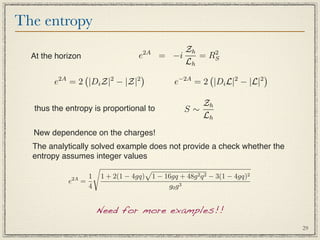
                                             2A        Zh     2
  At the horizon                         e        = −i    = RS
                                                       Lh
         2A
                               2        2
                                                    −2A
                                                                  2     2
                                                                           
        e     = 2 |Di Z| − |Z|                      e    = 2 |Di L| − |L|

                                                           Zh
  thus the entropy is proportional to                   S∼
                                                           Lh
  New dependence on the charges!
  The analytically solved example does not provide a check whether the
  entropy assumes integer values
                                          
              2A     1       1 + 2(1 − 4gq) 1 − 16gq + 48g 2 q 2 − 3(1 − 4gq)2
              e    =
                     4                           g0 g 3


                         Need for more examples!!
                                                                                 29
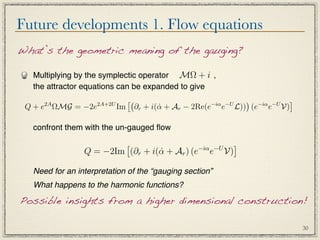
Future developments 1. Flow equations
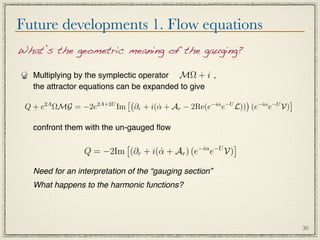
What’s the geometric meaning of the gauging?

   Multiplying by the symplectic operator MΩ + i ,
   the attractor equations can be expanded to give
                                                                      −iα −U 
      2A
 Q + e ΩMG = −2e     2A+2U
                             Im                            −iα −U
                                       ∂r + i(α + Ar − 2Re(e
                                              ˙                e    L)) (e e V)

   confront them with the un-gauged flow

                                            −iα −U
                                                    
                 Q = −2Im (∂r + i(α + Ar ) (e e V)
                                  ˙

   Need for an interpretation of the “gauging section”
   What happens to the harmonic functions?


                                                                                    30
Future developments 1. Flow equations
What’s the geometric meaning of the gauging?

   Multiplying by the symplectic operator MΩ + i ,
   the attractor equations can be expanded to give
                                                                      −iα −U 
      2A
 Q + e ΩMG = −2e     2A+2U
                             Im                            −iα −U
                                       ∂r + i(α + Ar − 2Re(e
                                              ˙                e    L)) (e e V)

   confront them with the un-gauged flow

                                            −iα −U
                                                    
                 Q = −2Im (∂r + i(α + Ar ) (e e V)
                                  ˙

   Need for an interpretation of the “gauging section”
   What happens to the harmonic functions?

Possible insights from a higher dimensional construction!

                                                                                    30
Future developments 2. M-theory embedding
  Reductions from 10 or 11 dimensions on spheres preserve to many
  supersymmetries.

   Additional truncations are possible, leading to N=2 U(1) gauged
   supergravity
                                          [Cvetič-Duff-Hoxha-Liu-Lü-Lu-Martinez Acosta-Pope-
                                                       Sati-Tran, hep-th/9903214]


   M-theory reductions give in this cases only magnetic charges

   The magnetic field mixes internal angles and 4dim angular variables.
   This would require the presence of topological charges in the low
   energy configuration, but such monopoles might break all the
   supersymmetries                              [Vandoren-Hristov, 1012.4314]


                                                                                           31
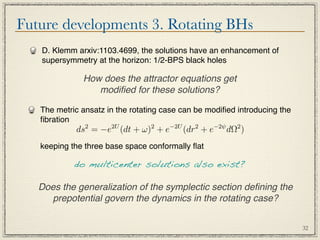
Future developments 3. Rotating BHs
   D. Klemm arxiv:1103.4699, the solutions have an enhancement of
   supersymmetry at the horizon: 1/2-BPS black holes

              How does the attractor equations get
                 modified for these solutions?

   The metric ansatz in the rotating case can be modified introducing the
   fibration
            ds2 = −e2U (dt + ω)2 + e−2U (dr2 + e−2ψ dΩ2 )
   keeping the three base space conformally flat

            do multicenter solutions also exist?

   Does the generalization of the symplectic section defining the
     prepotential govern the dynamics in the rotating case?


                                                                           32
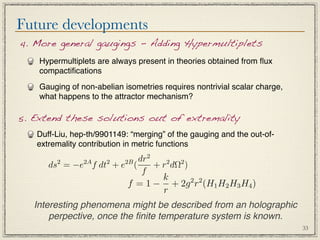
Future developments
4. More general gaugings - Adding Hypermultiplets
    Hypermultiplets are always present in theories obtained from flux
    compactifications
    Gauging of non-abelian isometries requires nontrivial scalar charge,
    what happens to the attractor mechanism?

5. Extend these solutions out of extremality
   Duff-Liu, hep-th/9901149: “merging” of the gauging and the out-of-
   extremality contribution in metric functions
                               dr2
      ds2 = −e2A f dt2 + e2B (     + r2 dΩ2 )
                                f
                                   k    2 2
                            f = 1 − + 2g r (H1 H2 H3 H4 )
                                   r
   Interesting phenomena might be described from an holographic
       perpective, once the finite temperature system is known.
                                                                           33
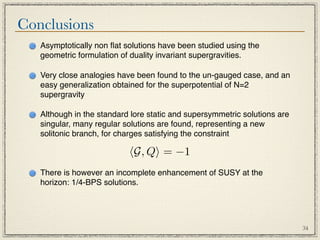
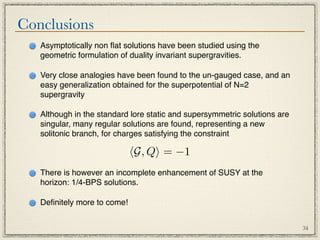
Conclusions
   Asymptotically non flat solutions have been studied using the
   geometric formulation of duality invariant supergravities.

   Very close analogies have been found to the un-gauged case, and an
   easy generalization obtained for the superpotential of N=2
   supergravity

   Although in the standard lore static and supersymmetric solutions are
   singular, many regular solutions are found, representing a new
   solitonic branch, for charges satisfying the constraint

                           G, Q = −1
   There is however an incomplete enhancement of SUSY at the
   horizon: 1/4-BPS solutions.


                                                                           34
Conclusions
   Asymptotically non flat solutions have been studied using the
   geometric formulation of duality invariant supergravities.

   Very close analogies have been found to the un-gauged case, and an
   easy generalization obtained for the superpotential of N=2
   supergravity

   Although in the standard lore static and supersymmetric solutions are
   singular, many regular solutions are found, representing a new
   solitonic branch, for charges satisfying the constraint

                             G, Q = −1
   There is however an incomplete enhancement of SUSY at the
   horizon: 1/4-BPS solutions.

   Definitely more to come!


                                                                           34

Michigan U.

  • 1.
    April 18th, 2011 Flowequations for AdS₄ black holes in N=2 gauged supergravity G. DallʼAgata, A.G. - arXiv:1012.3756 JHEP 1103:037,2011 Alessandra Gnecchi “G. Galilei” Physics Dept. - Padua University (Italy) & Dept. of Physics - Harvard University
  • 2.
    Outline Blackholes in Supergravity Duality invariance of extremal solutions BPS flow of scalar fields Black holes in gauged Supergravity The FI gauging One modulus and stu model examples Future directions 2
  • 3.
    Motivations 1. Gauged Supergravity Thelow energy effective theories obtained from String Theory compactifications in the presence of fluxes are gauged supergravities. 2. AdS space The gauging appears as a scalar potential in the four dimensional action, which plays the role of a coordinate dependent cosmological constant. We seek a systematic approach to address the problem of the destabilization of such backgrounds by the presence of a stable black hole, thus yielding new insights into the interpretation of string landscape. 3
  • 4.
    Motivations Other applications 1. Gauge/gravityduality Not only the near horizon region develops an AdS geometry, but also the asymptotic space! 2. AdS/CMT correspondence Black holes solutions with scalars are associated to physical quantities in the condensed matter system. Building a solution with nontrivial scalar profiles, or demonstrating the non existence in a specific models reflects is a statement on the properties of the condensed matter system 4
  • 5.
    Black holes inSupergravity Our approach: Start from the formalism of un-gauged supergravity and exploit the symmetries, in particular study theories with electric-magnetic duality invariance extremal black holes Well established description in the last 15 years S. Ferrara, R. Kallosh, A. Strominger hep-th/9508072 A. Strominger hep-th/9602111 S. Ferrara, G. W. Gibbons, R. Kallosh, hep-th/9702103 has lead to the classification of black hole charge orbits, multicenter solutions, split attractors, wall crossing.. Cacciatori-Klemm 0911.4926: genuine black holes solutions with spherical horizons in N=2 Supergravity with FI electric gauging. 5
  • 6.
    Black holes inSupergravity Describe regular solutions of the classical gravitational theory which are stable: no Hawking radiation but finite horizon area they have zero temperature but finite entropy extremal solutions Already in 4d gravity, the Reissner Nordstrom solution has an extremal limit r+ − r − κ 2 r+ − r− = 2 M 2 − Q2 κ= 2 2r+ T = →0 S= πr+ 2π In a gravity theory they saturates the bound M=|Q| in a Supergravity theory the charge is substituted by the central charge, and gives a BPS bound M=|Z| meaning the solution preserves some SUSY. 6
  • 7.
    Radial evolution andblack hole dynamics In the SUSY variation of the fields the fermionic fields decouple. The bosonic sector of the theory is described by √ 1 1 S = −g d x − R + ImNΛΓ Fµν F 4 Λ Γ, µν + √ ReNΛΓ µνρσ Fµν Fρσ + Λ Γ 2 2 −g 1 + grs (Φ)∂µ Φr ∂ µ Φs . 2 7
  • 8.
    Radial evolution andblack hole dynamics In the SUSY variation of the fields the fermionic fields decouple. The bosonic sector of the theory is described by √ 1 1 S = −g d x − R + ImNΛΓ Fµν F 4 Λ Γ, µν + √ ReNΛΓ µνρσ Fµν Fρσ + Λ Γ 2 2 −g 1 + grs (Φ)∂µ Φr ∂ µ Φs . 2 Einstein-Hilbert term 7
  • 9.
    Radial evolution andblack hole dynamics In the SUSY variation of the fields the fermionic fields decouple. The bosonic sector of the theory is described by √ 1 1 S = −g d x − R + ImNΛΓ Fµν F 4 Λ Γ, µν + √ ReNΛΓ µνρσ Fµν Fρσ + Λ Γ 2 2 −g 1 + grs (Φ)∂µ Φr ∂ µ Φs . 2 Einstein-Hilbert Vector fields term kinetic term 7
  • 10.
    Radial evolution andblack hole dynamics In the SUSY variation of the fields the fermionic fields decouple. The bosonic sector of the theory is described by √ 1 1 S = −g d x − R + ImNΛΓ Fµν F 4 Λ Γ, µν + √ ReNΛΓ µνρσ Fµν Fρσ + Λ Γ 2 2 −g 1 + grs (Φ)∂µ Φr ∂ µ Φs . 2 Einstein-Hilbert Vector fields term kinetic term Axionic coupling 7
  • 11.
    Radial evolution andblack hole dynamics In the SUSY variation of the fields the fermionic fields decouple. The bosonic sector of the theory is described by √ 1 1 S = −g d x − R + ImNΛΓ Fµν F 4 Λ Γ, µν + √ ReNΛΓ µνρσ Fµν Fρσ + Λ Γ 2 2 −g 1 + grs (Φ)∂µ Φr ∂ µ Φs . 2 Einstein-Hilbert Vector fields term kinetic term Axionic coupling Non-linear sigma model G M= H 7
  • 12.
    Radial evolution andblack hole dynamics In the SUSY variation of the fields the fermionic fields decouple. The bosonic sector of the theory is described by √ 1 1 S = −g d x − R + ImNΛΓ Fµν F 4 Λ Γ, µν + √ ReNΛΓ µνρσ Fµν Fρσ + Λ Γ 2 2 −g 1 + grs (Φ)∂µ Φr ∂ µ Φs . 2 The geodesic equations of free scalar d2 φi (τ ) dφj dφk dφi dφj i + Γjk (φ) = 0, Gij (φ) = 2c2 , dτ 2 dτ dτ dτ dτ where c2 = 4S 2 T 2 . are modified by the abelian field strengths through a black hole potential, appearing in the effective one dimensional Lagrangian 2 dU dφa dφb L= + Gab + e2U VBH − c2 dτ dτ dτ 8
  • 13.
    Radial evolution andblack hole dynamics We can write the black hole potential in a manifestly symplectic way 1 TΛ VBH = Q MΛΣ QΣ , 2 Λ where µ + νµ ν νµ −1 −1 p M = . Q = Λ , µ−1 ν µ−1 qΛ d2 U = 2e2U VBH (φ, p, q), Equations of motions: dτ 2 D2 φa 2U ∂VBH 2 = e a , Dτ ∂φ Regularity of the scalar dφa configuration at the Gij ∂m φi ∂n φj γ mn ∞ =0 dω horizon: 1 ω = log ρ , ρ=− , τ Attractor behaviour: 2π ∂VBH ∂VBH a φ ≈ φa H + log τ =0 A ∂φa ∂φa hor 9
  • 14.
    First order formalism 1 AB I Rewrite the black hole potential VBH = ZAB Z + ZI Z through 2 a real function W. From the ansatz ˙ U = eU W(φ(τ )) the scalar field equation follows: ˙ φa = 2eU g rs ∂s W In this description, the extremum condition on the potential is given by ∂a VBH = 2∂b W(Wδa + 2Gbc ∇a ∂c W) = 0 b thus the attractor equations are equally expressed as a critical point of V or W. For N=2 Supergravity W = |Z| the attractor point condition thus relates the spacetime dynamics with the flow on moduli space. 10
  • 15.
    BPS flow, rotatingand non SUSY solutions Extension to rotating solution [Denef, hep-th/0005049] Exemples of multicenter configurations N ¯ ω ¯ F, V = −e2iα [ζ + i (˜ ∧ ζ)] ζ= Z(Qi )dτi i=1 Attractor equations describe also extremal, non supersymmetric black holes, that can be built as intersecting branes systems from type IIA string theory [Kallosh-Sivanandam-Soroush, hep-th/0602005] [Gimon-Larsen-Simon, 0710.4967] The first order description generalizes to the non-BPS case by introducing a fake superpotential , built out of invariants of symplectic geometry [Ceresole-DallʼAgata hep-th/0702088] Extremal non-BPS solutions can be decomposed as threshold states of BPS constituents, thus revealing the existence of multicenter extremal non supersymmetric configurations, that one has to take into account when counting the degeneracy of the black holes states. [Gimon-Larsen-Simon, 0903.0719] [Bena-DallʼAgata-Giusto-Ruef-Warner, 0902.4526] 11
  • 16.
    The gauging Momentum mapprocedure [Ceresole-DʼAuria-Ferrara, hep-th/9509160] Let gi¯ be the Kähler metric of a Kähler manifold M. If it has a  a non trivial group of continuous isometries G generated by Killing vectors, then the kinetic Lagrangian admits G as a group of global space-time symmetries. The holomorphic Killing vectors, which are defined by the variation of the fields δz i = Λ kΛ (z) are defined by the i equations ∇i kj + ∇j ki = 0 ; ∇¯kj + ∇j k¯ = 0 ı ı This are identically satisfied once we can write kΛ = ig i¯∂¯PΛ , i   PΛ = PΛ ∗ thus defining a momentum map, which also preserves the Kähler structure of the scalar manifold. The momentum map construction applies to all manifolds with a symplectic structure, in particular to Kähler, HyperKähler and Quaternionic manifolds. 12
  • 17.
    The gauging [Ceresole-DʼAuria-Ferrara ʻ95] Gauging involving hypermultiplets: Triholomorphic momentum map that leaves invariant the hyperkahler structure up to SU(2) rotations. In N=2 theories the same group of isometries G acts both on the SpecialKähler and HyperKähler manifolds: ˆ Λ = k i ∂i + k¯ ∂¯ + k u ∂u ı k Λ Λ ı Λ Fayet-Iliopoulos gauging = constant prepotential PΛ = ξΛ x x 13
  • 18.
    The gauging [Ceresole-DʼAuria-Ferrara ʻ95] Gauging involving hypermultiplets: Triholomorphic momentum map that leaves invariant the hyperkahler structure up to SU(2) rotations. In N=2 theories the same group of isometries G acts both on the SpecialKähler and HyperKähler manifolds: ˆ Λ = k i ∂i + k¯ ∂¯ + k u ∂u ı k Λ Λ ı Λ Fayet-Iliopoulos gauging = constant prepotential PΛ = ξΛ x x 13
  • 19.
    The gauging [Ceresole-DʼAuria-Ferrara ʻ95] Gauging involving hypermultiplets: Triholomorphic momentum map that leaves invariant the hyperkahler structure up to SU(2) rotations. In N=2 theories the same group of isometries G acts both on the SpecialKähler and HyperKähler manifolds: ˆ Λ = k i ∂i + k¯ ∂¯ + k u ∂u ı k Λ Λ ı Λ Fayet-Iliopoulos gauging = constant prepotential PΛ = ξΛ x x Non-trivial gauging! 13
  • 20.
    N=2 Supergravity withFI gauging [Ceresole-DʼAuria-Ferrara ʻ95] Consider the scalar potential for an N=2 theory. Due to the fact that all the relevant quantities are derived from the Kähler vectors and prepotential, this can be written in a geometrical way as ¯ ¯ V = (kΛ , kΣ )LΛ LΣ + (U ΛΣ − 3LΛ LΣ )(PΛ PΣ − PΛ PΣ ) x x Thus, one easily sees that for an abelian theory this potential can still be nonzero, as long as the prepotentials are taken as constants, PΛ = ξΛ leading to the form of V on which we will x x focus: VF I = (U ΛΣ ¯ Λ LΣ )ξΛ ξΣ − 3L x x 14
  • 21.
    N=2 Supergravity withFI gauging Duality invariant theory The action of the theory becomes R 1 S= d x − + gi¯∂µ z ∂ z + NΛΣ Fµν F 4  ¯ i µ ¯  Λ Λ µν + √ NΛΣ µνρσ Fµν Fρσ − Vg Λ Σ 2 2 −g The gauging is encoded in the potential Vg = g Di LD¯L − 3|L| i¯   2 where L = G, V = eK/2 Λ X gΛ − FΛ g Λ it extends the electric gauging to include magnetic gauge charges, it is constructed only in terms of symplectic sections and symplectic vector of charges V = eK/2 (X Λ (z), FΛ (z)) G = (˜Λ , gΛ ) g analogously to the central charge used to define the black hole potential Z ≡ Q, V VBH = |DZ|2 + |Z|2 15
  • 22.
    Static dyonic blackholes Ansatz for the space-time background ds2 = −e2U (r) dt2 + e−2U (r) (dr2 + e2ψ(r) dΩ2 ) A second warp factor provides the deviation from the ansatz for asymptotically flat configurations. It compensates for the additional contribution to Einstein equations due to the non-trivial cosmological constant. In general the existence of BPS solutions only constrains the three dimensional base to be a space ds2 = dz 2 + e2Φ dwdw 3 ¯ with U(1) holonomy and torsion. 16
  • 23.
    Static dyonic blackholes The effective action for a static spherically configuration becomes 2ψ 2 2 i  ¯ 2U −4ψ −2U S1d = dr e U − ψ + gi¯z z + e  ¯ VBH + e Vg − 1 d 2ψ + dr e (2ψ − U ) dr 17
  • 24.
    Static dyonic blackholes The effective action for a static spherically configuration becomes 2ψ 2 2 i  ¯ 2U −4ψ −2U S1d = dr e U − ψ + gi¯z z + e  ¯ VBH + e Vg − 1 d 2ψ + dr e (2ψ − U ) dr Possible squaring? 17
  • 25.
    Static dyonic blackholes The effective action for a static spherically configuration becomes 2ψ 2 2 i  ¯ 2U −4ψ −2U S1d = dr e U − ψ + gi¯z z + e  ¯ VBH + e Vg − 1 d 2ψ + dr e (2ψ − U ) dr 17
  • 26.
    Static dyonic blackholes The effective action for a static spherically configuration becomes 2ψ 2 2 i  ¯ 2U −4ψ −2U S1d = dr e U − ψ + gi¯z z + e  ¯ VBH + e Vg − 1 d 2ψ + dr e (2ψ − U ) dr The same action can be written 1 2(U −ψ) T 2ψ −U −iα 2 S1d = dr − e E ME − e (α + Ar ) + 2e Re(e L) 2 2ψ −U −iα 2 −e ψ − 2e Im(e L) − (1 + G, Q) d 2ψ−U −iα U −iα −2 e Im(e L) + e Re(e Z) dr this, together with −U −iα T E ≡ 2e 2ψ e Im(e V) T − e2(ψ−U ) G T ΩM−1 + 4e−U (α + Ar )Re(e−iα V)T + QT gives the BPS equations 17
  • 27.
    Static dyonic blackholes Projecting the E vector on the sections, we get the equations of motions U = −eU −2ψ Re(e−iα Z) + e−U Im(e−iα L) ψ = 2e−U Im(e−iα L) ¯ ¯ ¯ ¯ z i = −eiα g i¯(eU −2ψ D¯Z + ie−U D¯L) ˙  α + Ar = −2e−U Re(e−iα L) we also get the constraints G, Q = −1 , e2U −2ψ Im(e−iα Z) = Re(e−iα L) Notice: the ungauged limit of the same metric ansatz has to be performed taking a BPS rewriting of the action −(eψ ψ − 1)2 → eψ(r) = r 18
  • 28.
    Static dyonic blackholes Projecting the E vector on the sections, we get the equations of motions U = −eU −2ψ Re(e−iα Z) + e−U Im(e−iα L) ψ = 2e−U Im(e−iα L) ¯ ¯ ¯ ¯ z i = −eiα g i¯(eU −2ψ D¯Z + ie−U D¯L) ˙  α + Ar = −2e−U Re(e−iα L) we also get the constraints G, Q = −1 , e2U −2ψ Im(e−iα Z) = Re(e−iα L) Notice: the ungauged limit of the same metric ansatz has to be performed taking a BPS rewriting of the action −(eψ ψ − 1)2 → eψ(r) = r A new branch of there is no smooth limit to the un-gauged case solitonic solutions 18
  • 29.
    (more than) Aglance at Supersymmetry Supersymmetry − i δψµ A = Dµ A − εAB Tµν γ − L δAB γ ν ηµν B ν B 2 variations for general i gauging δλiA = −i ∂µ z i γ µ A − G−i γ µν εAB B + D L δ AB B µν The covariant derivative is 1 ab i Dµ A ≡ ∂µ A − ωµ γab A + Aµ A + gΛ AΛ δAC εCB B µ 4 2 Choice of the projectors γ 0 A = i eiα εAB B γ 1 A = eiα δAB B Recover the equations of motion and the constraints eU −2ψ Im(e−iα Z) = e−U Re(e−iα L) AΛ gΛ = 2 eU Re(e−iα L) t G, Q + 1 = 0 19
  • 30.
    (more than) Aglance at Supersymmetry Supersymmetry − i δψµ A = Dµ A − εAB Tµν γ − L δAB γ ν ηµν B ν B 2 variations for general i gauging δλiA = −i ∂µ z i γ µ A − G−i γ µν εAB B + D L δ AB B µν The covariant derivative is 1 ab i Dµ A ≡ ∂µ A − ωµ γab A + Aµ A + gΛ AΛ δAC εCB B µ 4 2 Choice of the projectors γ 0 A = i eiα εAB B γ 1 A = eiα δAB B Two projections required 1/4 - BPS solutions! Recover the equations of motion and the constraints eU −2ψ Im(e−iα Z) = e−U Re(e−iα L) AΛ gΛ = 2 eU Re(e−iα L) t G, Q + 1 = 0 19
  • 31.
    The phase ofthe superpotential As for the un-gauged solution, the phase appears in the projection of the SUSY transformation parameter. We had e−iα Z = |Z| Solving the constraint e2U −2ψ Im(e−iα Z) = Re(e−iα L) for the phase we get Z − ie2(ψ−U ) L e2iα = ¯ ¯ Z + ie2(ψ−U ) L An additional request of positivity for the gauge charges may prevent from finding regular BPS solutions! Also notice, itʼs no more α + Ar = 0 (It will be recovered at the horizon) 20
  • 32.
    The phase ofthe superpotential The flow can be expressed in terms of a single real function   U = −g U U ∂U W ψ = −g ψψ ∂ψ W  z i = −2˜i¯∂¯W ˙ g  gU U = −gψψ = e2ψ , gi¯ = e2ψ gi¯ ˜  for a superpotential W = eU |Z − ie2(ψ−U ) L| the flow stops at the horizon for the scalar fields and the combination of warp factors A=ψ−U At the attractor point ∂i W|h = 0 , W|h = 0 21
  • 33.
    Near horizon geometry Extremalfour dimensional near horizon geometry AdS₂x S² r 2 2 RA 2 2 ds2 hor = 2 dt − 2 dr − RS (dθ2 + sin2 θdφ2 ) 2 RA r requires the warp factors behavior r rRS U ∼ log ψ ∼ log A = log RS RA RA attractor mechanism requires the scalars to be constant at the horizon, thus completing the set of equations ∂i |Z − i e2A L| = 0 ⇔ Di Z − i e−2A Di L = 0 |Z − i e2A L| = 0 22
  • 34.
    Attractor equations The BPS attractors for U(1) gauged supergravity are Q + e2A ΩMG = −2Im(ZV) + 2 e2A Re(LV) 2A Z 2 e = −i = RS L If one project these equations on the black hole charges or gauging charges, they give 2A 2 2 e = 2 |Di Z| − |Z| −2A 2 2 e = 2 |Di L| − |L| which are related to the second symplectic invariant 2 2 1 I2 (Q) = |Z| − |Di Z| = − QM(F )Q 2 23
  • 35.
    Solutions with constantscalars Asymptotic AdS background : Di L = 0 Equal radii would imply vanishing potential at the horizon R S = RA → Vg = 0 [Bellucci-Ferrara-Marrani-Yeranyan ʻ08] The form of the gauge potential: Vg = −3|L|2 + |DL|2 A configuration with constant scalars along the flow has |L| = 0 In general, for constant scalars, the attractor equations imply 2A Im(ZL) 2A 1 G, Q e =− e = |L|2 2 |L|2 which is inconsistent for spherical horizons for which G, Q = −1 0 24
  • 36.
    Exemple of dyonicsolutions One modulus case Quadratic model F = iX 0 X 1 with Kähler metric K = − log 2(z + z ) ¯ Rez 0 AdS vacuum fixes the asymptotic modulus at g0 g1 + g 0 g 1 + i (g0 g 0 − g1 g 1 ) z= (g1 )2 + (g 0 )2 Attractor equations are I2 (G) = |G|2 − |Di G|2 = g0 g1 + g 0 g 1 e−2A = −I2 (G) thus requiring g0 g1 + g 0 g 1 0 25
  • 37.
    Exemple of dyonicsolutions One modulus case Quadratic model F = iX 0 X 1 with Kähler metric K = − log 2(z + z ) ¯ Rez 0 AdS vacuum fixes the asymptotic modulus at g0 g1 + g 0 g 1 + i (g0 g 0 − g1 g 1 ) z= (g1 )2 + (g 0 )2 Attractor equations are I2 (G) = |G|2 − |Di G|2 = g0 g1 + g 0 g 1 e−2A = −I2 (G) thus requiring g0 g1 + g 0 g 1 0 !! sis tent I ncon 25
  • 38.
    Exemple of dyonicsolutions The stu model X 1X 2X 3 STU model with prepotential F =− : the potential of the X0 gauging has no critical point no asymptotic AdS configurations. √ STU model with prepotential F = −i X 0 X 1 X 2 X 3 admits regular solutions with spherical horizon for magnetic charges [Cacciatori-Klemm 0911.4926] the duality invariant setup allow us to build a genuine dyonic solution by rotation of both electromagnetic and gauging charges VCK = eK/2 (1, −tu, −su, −st, −stu, s, t, u)T   1 K/2 T  −1  V=e (1, s, t, u, −stu, tu, su, st)   −1      −1  S=     1    VCK = SV G = S −1 GCK   1 1   −1 1 Q = S QCK 26
  • 39.
    Exemple of dyonicsolutions The stu model Charges Kahler potential Q = (p0 , 0, 0, 0, 0, q1 , q2 , q3 )T ¯ ¯ K = − log[−i(s − s)(t − t)(u − u)] ¯ G = (0, g 1 , g 2 , g 3 , g0 , 0, 0, 0)T Superpotential W = eK/2 |q1 s + q2 t + q3 u + p0 stu − ie2A (g0 − g 1 tu − g 2 su − g 3 st)| No axion solution Re s = Re t = Re u = 0 The case where all the scalars are identified can be solved analitically; the attractor values of the fields are g0 −1 + 6gq + 1 − 16gq + 48g 2 q 2 y= 0 2g 1 − 3gq 2A 1 1 + 2(1 − 4gq) 1 − 16gq + 48g 2 q 2 − 3(1 − 4gq)2 e = 4 g0 g 3 27
  • 40.
    Exemple of dyonicsolutions The stu model 3 SU (1, 1) M= U (1) SU(1,1)³ is broken to U(1) by the gauging, consider the U(1) ⊂ SU(1,1) action cos θi z i + sin θi zi → i + cos θ . − sin θi z i 28
  • 41.
    Exemple of dyonicsolutions The stu model 3 SU (1, 1) M= U (1) SU(1,1)³ is broken to U(1) by the gauging, consider the U(1) ⊂ SU(1,1) action cos θi z i + sin θi zi → i + cos θ . − sin θi z i 28
  • 42.
    Exemple of dyonicsolutions The stu model 3 SU (1, 1) M= U (1) SU(1,1)³ is broken to U(1) by the gauging, consider the U(1) ⊂ SU(1,1) action cos θi z i + sin θi zi → i + cos θ . − sin θi z i Generate non zero axions! 28
  • 43.
    The entropy 2A Zh 2 At the horizon e = −i = RS Lh 2A 2 2 −2A 2 2 e = 2 |Di Z| − |Z| e = 2 |Di L| − |L| Zh thus the entropy is proportional to S∼ Lh New dependence on the charges! The analytically solved example does not provide a check whether the entropy assumes integer values 2A 1 1 + 2(1 − 4gq) 1 − 16gq + 48g 2 q 2 − 3(1 − 4gq)2 e = 4 g0 g 3 29
  • 44.
    The entropy 2A Zh 2 At the horizon e = −i = RS Lh 2A 2 2 −2A 2 2 e = 2 |Di Z| − |Z| e = 2 |Di L| − |L| Zh thus the entropy is proportional to S∼ Lh New dependence on the charges! The analytically solved example does not provide a check whether the entropy assumes integer values 2A 1 1 + 2(1 − 4gq) 1 − 16gq + 48g 2 q 2 − 3(1 − 4gq)2 e = 4 g0 g 3 Need for more examples!! 29
  • 45.
    Future developments 1.Flow equations What’s the geometric meaning of the gauging? Multiplying by the symplectic operator MΩ + i , the attractor equations can be expanded to give −iα −U 2A Q + e ΩMG = −2e 2A+2U Im −iα −U ∂r + i(α + Ar − 2Re(e ˙ e L)) (e e V) confront them with the un-gauged flow −iα −U Q = −2Im (∂r + i(α + Ar ) (e e V) ˙ Need for an interpretation of the “gauging section” What happens to the harmonic functions? 30
  • 46.
    Future developments 1.Flow equations What’s the geometric meaning of the gauging? Multiplying by the symplectic operator MΩ + i , the attractor equations can be expanded to give −iα −U 2A Q + e ΩMG = −2e 2A+2U Im −iα −U ∂r + i(α + Ar − 2Re(e ˙ e L)) (e e V) confront them with the un-gauged flow −iα −U Q = −2Im (∂r + i(α + Ar ) (e e V) ˙ Need for an interpretation of the “gauging section” What happens to the harmonic functions? Possible insights from a higher dimensional construction! 30
  • 47.
    Future developments 2.M-theory embedding Reductions from 10 or 11 dimensions on spheres preserve to many supersymmetries. Additional truncations are possible, leading to N=2 U(1) gauged supergravity [Cvetič-Duff-Hoxha-Liu-Lü-Lu-Martinez Acosta-Pope- Sati-Tran, hep-th/9903214] M-theory reductions give in this cases only magnetic charges The magnetic field mixes internal angles and 4dim angular variables. This would require the presence of topological charges in the low energy configuration, but such monopoles might break all the supersymmetries [Vandoren-Hristov, 1012.4314] 31
  • 48.
    Future developments 3.Rotating BHs D. Klemm arxiv:1103.4699, the solutions have an enhancement of supersymmetry at the horizon: 1/2-BPS black holes How does the attractor equations get modified for these solutions? The metric ansatz in the rotating case can be modified introducing the fibration ds2 = −e2U (dt + ω)2 + e−2U (dr2 + e−2ψ dΩ2 ) keeping the three base space conformally flat do multicenter solutions also exist? Does the generalization of the symplectic section defining the prepotential govern the dynamics in the rotating case? 32
  • 49.
    Future developments 4. Moregeneral gaugings - Adding Hypermultiplets Hypermultiplets are always present in theories obtained from flux compactifications Gauging of non-abelian isometries requires nontrivial scalar charge, what happens to the attractor mechanism? 5. Extend these solutions out of extremality Duff-Liu, hep-th/9901149: “merging” of the gauging and the out-of- extremality contribution in metric functions dr2 ds2 = −e2A f dt2 + e2B ( + r2 dΩ2 ) f k 2 2 f = 1 − + 2g r (H1 H2 H3 H4 ) r Interesting phenomena might be described from an holographic perpective, once the finite temperature system is known. 33
  • 50.
    Conclusions Asymptotically non flat solutions have been studied using the geometric formulation of duality invariant supergravities. Very close analogies have been found to the un-gauged case, and an easy generalization obtained for the superpotential of N=2 supergravity Although in the standard lore static and supersymmetric solutions are singular, many regular solutions are found, representing a new solitonic branch, for charges satisfying the constraint G, Q = −1 There is however an incomplete enhancement of SUSY at the horizon: 1/4-BPS solutions. 34
  • 51.
    Conclusions Asymptotically non flat solutions have been studied using the geometric formulation of duality invariant supergravities. Very close analogies have been found to the un-gauged case, and an easy generalization obtained for the superpotential of N=2 supergravity Although in the standard lore static and supersymmetric solutions are singular, many regular solutions are found, representing a new solitonic branch, for charges satisfying the constraint G, Q = −1 There is however an incomplete enhancement of SUSY at the horizon: 1/4-BPS solutions. Definitely more to come! 34