MICAH 5 COMME TARY
EDITED BY GLE PEASE
A Promised Ruler From Bethlehem
1 [a]Marshal your troops now, city of troops,
for a siege is laid against us.
They will strike Israel’s ruler
on the cheek with a rod.
BAR ES. "Now gather thyself in troops, O daughter of troops - The
“daughter of troops” is still the same who was before addressed, Judah. The word is
almost always . used of “bands of men employed in irregular, marauding, in-roads.”
Judah is entitled “daughter of troops,” on account of her violence, the robbery and
bloodshed within her (Mic_2:8; Mic_3:2; etc. Hos_5:10), as Jeremiah says, “Is this
house which is called by My Name become a den of robbers in your eyes?” (Jer_7:11,
compare Mat_21:13). She then who had spoiled Isa_33:1 should now be spoiled; she
who had formed herself in bands to lay waste, shall now be gathered thick together, in
small bands, unable to resist in the open field; yet in vain should she so gather herself;
for the enemy was upon her, in her last retreat.
This description has obviously no fulfillment, except in the infliction by the Romans.
For there was no event, before the invasion by Sennacherib and accordingly in the
prophet’s own time, in which there is any seeming fulfillment of it. But then, the second
deliverance must be that by the Maccabees; and this siege, which lies, in order of time,
beyond it, must be a siege by the Romans. With this it agrees, that whereas, in the two
former visitations, God promised, in the first, deliverance, in the second, victory, here
the prophet dwells on the Person of the Redeemer, and foretells that the strength of the
Church should not lie in any human means Mic_5:8-15. Here too Israel had no king, but
a judge only. Then the “gathering in robber-bands” strikingly describes their internal
state in the siege of Jerusalem; and although this was subsequent to and consequent
upon the rejection of our Lord, yet there is no reason why the end should be separated
from the beginning since the capture by Titus was but the sequel of the capture by
Pompey, the result of that same temper, in which they crucified Jesus, because He would
not be their earthly king. It was the close of the organic existence of the former people;
after which the remnant from among them with the Gentiles, not Israel after the flesh,
were the true people of God.
He hath laid siege against us - The prophet, being born of them, and for the great
love he bore them, counts himself among them, as Paul mourns over his brethren after
the flesh. “They shall smite the judge of Israel with a rod upon the cheek.” So Paul said to
him who had made himself high priest, “God shall smite thee, thou whited wall; for
sittest thou to judge me after the law, and commandest me to be smitten contrary to the
law” Act_23:3. It is no longer “the king” (for they had said, “We have no King but Caesar
Joh_19:15) but the “judge of Israel,” they who against Christ and His Apostles gave
wrong judgment. As they had smitten contrary to the law, so were the chief men smitten
by Titus, when the city was taken. As they had done it, was done unto them. To be
smitten on the thee, betokens shame; to smite with the red, betokens destruction. Now
both shall meet in one; as, in the Great Day, the wicked “shall awake to shame and
everlasting contempt, and shall perish forever” Dan_12:2.
CLARKE, "O daughter of troops - The Chaldeans, whose armies were composed
of troops from various nations.
He (Nebuchadnezzar) hath laid siege against us; (Jerusalem ); they shall
smite the judge of Israel (Zedekiah) with a rod upon the cheek - They shall
offer him the greatest indignity. They slew his sons before his face; and then put out his
eyes, loaded him with chains, and carried him captive to Babylon.
GILL, "Now gather thyself in troops, O daughter of troops,.... Not Jerusalem,
full of people, called to draw out their forces, and fall upon the enemy besieging them,
whether Chaldeans or Romans; but rather the Babylonians, whose armies were large,
and their troops numerous; who are called upon by the people of God, encouraged by the
foregoing prophecies, as well as by what follows, to come forth with all their forces, and
muster up all their armies, and exert all the power and strength they had, thus suiting
them; being assured, by the above promises, that in the issue they should prevail over all
their enemies: unless the Romans should be intended, to whom this character of
"daughter of troops" well agrees, of whose legions all have heard; and since the
Babylonish attempt on Jerusalem, and the carrying the Jews captive into Babylon, are
before predicted, with their deliverance from it, and what they should do in the times of
the Maccabees; a prophecy of the Romans, or a representation of them, a gathering their
troops and legions together to besiege Jerusalem, very naturally comes in here;
he hath laid siege against us; either Nebuchadnezzar, and the Chaldean army; or
Vespasian with the Romans: this, according to the prophetic style, is spoken of as if
actually done, because of the certainty of it;
they shall smite the judge of Israel with a rod upon the cheek; that is, either
they, the besiegers, the king of Babylon and his army, when they shall have taken
Jerusalem, besieged by them, shall use Zedekiah the king of Judah, and judge of Israel,
and his princes and nobles, very ill, signified by this phrase; yea, in a very cruel and
barbarous manner; first slaying his sons and his princes before his eyes, then putting his
eyes out, binding him in chains, and carrying him to Babylon, and there laying him in a
prison, Jer_52:10; or else they, the besieged, would use the Messiah, the King, Judge,
and Ruler in Israel, in such a spiteful and scandalous manner; and so the Messiah was to
be used by them, who according to prophecy gave his cheek to them that plucked off the
hair, and hid not his face from shame and spitting; and so Jesus, the true Messiah, was
smitten, both with rods, and with the palms of men's hands, and buffeted and spit upon,
Isa_50:6; and this is mentioned as a reason why Jerusalem would be encompassed with
the Roman armies, and besieged by their troops and legions, and become desolate, even
for their rejection and ill usage of the Messiah. Aben Ezra says, it is right in my eyes that
the judge of Israel is the Messiah, or Zerubbabel; not the latter, who never was so used,
but the former.
HE RY, "Here, as before, we have,
I. The abasement and distress of Zion, Mic_5:1. The Jewish nation, for many years
before the captivity, dwindled, and fell into disgrace: Now gather thyself in troops, O
daughter of troops! It is either a summons to Zion's enemies, that had troops at their
service, to come and do their worst against her (God will suffer them to do it), or a
challenge to Zion's friends, that had troops too at command, to come and do their best
for her; Let them gather in troops, yet it shall be to no purpose; for, says the prophet, in
the name of the inhabitants of Jerusalem, He has laid siege against us; the king of
Assyria has, the king of Babylon has, and we know not which way to defend ourselves; so
that the enemies shall gain their point, and prevail so far as to smite the judge of Israel -
the king, the chief justice, and the other inferior judges - with a rod upon the cheek, in
contempt of them and their dignity; having made them prisoners, they shall use them as
shamefully as any of the common captives. Complaint had been made of the judges of
Israel (Mic_3:11) that they were corrupt and took bribes, and this disgrace came justly
upon them for abusing their power; yet it was a great calamity to Israel to have their
judges treated thus ignominiously. Some make this the reason why the troops (that is,
the Roman army) shall lay siege to Jerusalem, because the Jews shall smite the judge of
Israel upon the cheek, because of the indignities they shall do to the Messiah, the Judge
of Israel, whom they smote on the cheek, saying, Prophesy, who smote thee. But the
former sense seems more probable, and that it is meant of the besieging of Jerusalem,
not by the Romans, but the Chaldeans, and was fulfilled in the indignities done to king
Zedekiah and the princes of the house of David.
II. The advancement of Zion's King. Having shown how low the house of David should
be brought, and how vilely the shield of that mighty family should be cast away, as
though it had not been anointed with oil, to encourage the faith of God's people, who
might be tempted now to think that his covenant with David and his house was
abrogated (according to the psalmist's complaint, Psa_89:38, Psa_89:39), he adds an
illustrious prediction of the Messiah and his kingdom, in whom that covenant should be
established, and the honours of that house should be revived, advanced, and
perpetuated. Now let us see,
1. How the Messiah is here described. It is he that is to be ruler in Israel, whose
goings forth have been from of old, from everlasting, from the days of eternity, as the
word is. Here we have, (1.) His existence from eternity, as God: his goings forth, or
emanations, as the going forth of the beams from the sun, were, or have been, of old,
from everlasting, which (says Dr. Pocock) is so signal a description of Christ's eternal
generation, or his going forth as the Son of God, begotten of his Father before all worlds,
that this prophecy must belong only to him, and could never be verified of any other. It
certainly speaks of a going forth that was now past, when the prophet spoke, and cannot
but be read, as we read it, his outgoings have been; and the putting of both these words
together, which severally are used to denote eternity, plainly shows that they must here
be taken in the strictest sense (the same with Psa_90:2, From everlasting to everlasting
thou are God), and can be applied to no other than to him who was able to say, Before
Abraham was, I am, Joh_8:58. Dr. Pocock observes that the going forth is used (Deu_
8:3) for a word which proceeds out of the mouth, and is therefore very fitly used to
signify the eternal generation of him who is called the Word of God, that was in the
beginning with God, Joh_1:1, Joh_1:2. (2.) His office as Mediator; he was to be ruler in
Israel, king of his church; he was to reign over the house of Jacob for ever, Luk_1:32,
Luk_1:33. The Jews object that our Lord Jesus could not be the Messiah, for he was so
far from being ruler in Israel that Israel ruled over him, and put him to death, and would
not have him to reign over them; but he answered that himself when he said, My
kingdom is not of this world, Joh_18:36. And it is a spiritual Israel that he reigns over,
the children of promise, all the followers of believing Abraham and praying Jacob. In the
hearts of these he reigns by his Spirit and grace, and in the society of these by his word
and ordinances. And was not he ruler in Israel whom winds and seas obeyed, to whom
legions of devils were forced to submit, and who commanded away diseases from the
sick and called the dead out of their graves? None but he whose goings forth were from
of old, from everlasting, was fit to be ruler in Israel, to be head of the church, and head
over all things to the church.
JAMISO , "Mic_5:1-15. The calamities which precede Messiah’s advent. His
kingdom, conquest of Jacob’s foes, and blessing upon his people.
gather thyself in troops — that is, thou shalt do so, to resist the enemy. Lest the
faithful should fall into carnal security because of the previous promises, he reminds
them of the calamities which are to precede the prosperity.
daughter of troops — Jerusalem is so called on account of her numerous troops.
he hath laid siege — the enemy hath.
they shall smite the judge of Israel with a rod upon the cheek — the greatest
of insults to an Oriental. Zedekiah, the judge (or king, Amo_2:3) of Israel, was loaded
with insults by the Chaldeans; so also the other princes and judges (Lam_3:30).
Hengstenberg thinks the expression, “the judge,” marks a time when no king of the
house of David reigned. The smiting on the cheek of other judges of Israel was a type of
the same indignity offered to Him who nevertheless is the Judge, not only of Israel, but
also of the world, and who is “from everlasting” (Mic_5:2; Isa_50:6; Mat_26:67; Mat_
27:30).
K&D, "Heb. Bib. 4:14). “Now wilt thou gather in troops, thou daughter of troops;
they lay siege against us; with the staff they smite the judge of Israel upon the cheek.”
With ‛attâh (now) the prophet's address turns once more to the object introduced with
‛attâh in Mic_4:9. For we may see clearly enough from the omission of the cop. Vav,
which could not be left out if it were intended to link on Mic_5:1 to Mic_4:11-13, that
this ‛attâh points back to Mic_4:9, and is not attached to the ve
‛attâh in Mic_4:11, for the
purpose of introducing a fresh occurrence to follow the event mentioned in Mic_4:11-13.
“The prophecy in Mic_4:11-13 explains the ground of that in Mic_4:9, Mic_4:10, and the
one in Mic_5:1 sounds like a conclusion drawn from this explanation. The explanation in
Mic_4:11-13 is enclosed on both sides by that which it explains. By returning in Mic_5:1
to the thoughts expressed in Mic_4:9, the prophet rounds off the strophe in 4:9-5:1”
(Caspari). The words are addressed to the daughter Zion, who alone is addressed with
every ‛attâh, and generally throughout the entire section. Bath-gegūd, daughter of the
troop, might mean: thou nation accustomed or trained to form troops, thou warlike
Zion. But this does not apply to what follows, in which a siege alone is mentioned. This
turn is given to the expression, rather “for the purpose of suggesting the thought of a
crowd of people pressing anxiously together, as distinguished from ge
dūd, an invading
troop.” The verb hithgōdēd does not mean here to scratch one's self or make incisions
(Deu_14:1, etc.), but, as in Jer_5:7, to press or crowd together; and the thought is this:
Now crowd together with fear in a troop, for he (sc., the enemy) sets, or prepares, a siege
against us. In ‫ינוּ‬ ֵ‫ל‬ ָ‫ע‬ the prophet includes himself in the nation as being a member of it. He
finds himself in spirit along with the people besieged Zion. The siege leads to conquest;
for it is only in consequence of this that the judge of Israel can be smitten with the rod
upon the cheek, i.e., be shamefully ill treated (compare 1Ki_22:24; Psa_3:8; Job_16:10).
The judge of Israel, whether the king or the Israelitish judges comprehended in one,
cannot be thought of as outside the city at the time when the city is besieged. Of all the
different effects of the siege of the city the prophet singles out only this one, viz., the ill-
treatment of the judge, because “nothing shows more clearly how much misery and
shame Israel will have to endure for its present sins” (Caspari). “The judge of Israel” is
the person holding the highest office in Israel. This might be the king, as in Amo_2:3 (cf.
1Sa_8:5-6, 1Sa_8:20), since the Israelitish king was the supreme judge in Israel, or the
true possessor of the judicial authority and dignity. But the expression is hardly to be
restricted to the king, still less is it meant in distinction from the king, as pointing back
to the time when Israel had no king, and was only governed by judges; but the judge
stands for the king here, on the one hand with reference to the threat in Mic_3:1, Mic_
3:9, Mic_3:11, where the heads and princes of Israel are described as unjust and ungodly
judges, and on the other hand as an antithesis to mōshēl in Mic_5:2. As the Messiah is
not called king there, but mōshēl, ruler, as the possessor of supreme authority; so here
the possessor of judicial authority is called shōphēt, to indicate the reproach which would
fall upon the king and the leaders of the nation on account of their unrighteousness. The
threat in this verse does not refer, however, to the Roman invasion. Such an idea can
only be connected with the assumption already refuted, that Mic_4:11-13 point to the
times of the Maccabees, and no valid argument can be adduced to support it. In the
verse before us the prophet reverts to the oppression predicted in Mic_4:9 and Mic_
4:10, so that the remarks already made in Mic_4:10 apply to the fulfilment of what is
predicted here. The principal fulfilment occurred in the Chaldaean period; but the
fulfilment was repeated in every succeeding siege of Jerusalem until the destruction of
the city by the Romans. For, according to Mic_5:3, Israel will be given up to the power of
the empire of the world until the coming of the Messiah; that is to say, not merely till His
birth or public appearance, but till the nation shall accept the Messiah, who has
appeared as its own Redeemer.
CALVI , "To encourage the faithful to patience, the Prophet again reminds them
that hard and severe time was nigh; for it was needful to put them in mind often of
the approaching calamity, lest terror should wholly discourage them. As then there
was danger from despair, the Prophet often repeats what he has already said of
God’s judgment, which was then suspending over the people of Israel. And this
mode and order of teaching ought to be observed. When the Prophets threaten us,
or denounce the punishment we have deserved, we either become torpid, or grow
angry with God, and murmur: but when they set forth any thing of comfort, we
then indulge ourselves and become too secure. It is therefore necessary to connect
threatening with promises, so that we may be always ready to endure temporal evils,
and that our minds, sustained by hope, may, at the same time, depend on the Lord,
and recomb on him. It was for this reason that the Prophet again mentions what he
had already several times stated, — that the Jews would be surrounded by a siege.
How do these two things agree, — that the enemies, assembled together, would be
like sheaves which are taken to the floor to be trodden by the feet of animals, — and
that the Jews would be besieged? I answer, that these things harmonize, because the
temporary punishment, which God would inflict on his Church, would not prevent
him to restore it again whenever it pleased him. Lest, therefore, security should
creep over the minds of the godly, the Prophet designed often to remind them of that
dreadful calamity which might have entirely upset them, had no support been
afforded them, that is, had not God sustained them by his word.
ow then thou shalt assemble thyself, he says, O daughter of a troop The verb
‫,התגדדי‬ etgaddi, and the noun ‫,גדוד‬ gadud, sound alike; as though he said, Thou shalt
he collected, O daughter of collection. The Prophet addresses Jerusalem: but we
must see why he calls her the daughter of collection. Some think that by this word is
designated the splendid and wealthy state of Jerusalem; as though the Prophet said,
— “This city has been hitherto populous, but now it shall be reduced to such straits
that none shall dare to go forth beyond its gates, for they shall on every side be
surrounded.” But the Prophet calls Jerusalem the daughter of a troop in another
sense, — because they were wont to occasion great troubles: as thieves agree
together, and meet in troops for the purpose of committing plunder; so also the
Prophet calls Jerusalem the daughter of a troop, for its citizens were wont willfully
to do great evils, and like robbers to use violence. Thou then, he says, shalt now be
collected; that is, thou shalt not send forth thy troops, but enemies shall assemble
thee together by a severe siege, so that thou shalt contract thyself like a bundle.
There are, then, two clauses in this verse, — that though the Lord resolved to help
his Church, he would yet straiten her for a time, — and then the Prophet shows the
reason, lest they complained that they were too severely treated: “You have been
hitherto,” he says, “without a cause oppressive to others: the time then is come when
the Lord will return to you your recompense.” As Isaiah says
‘Woe to thee, plunderer!
Shalt thou not also be exposed to plunder?’
Isaiah 33:1;
so also in this place, — “Ye have assembled in troops, that ye might pillage innocent
men; therefore other troops shall now encircle you; nay, ye shall be beset by your
own fear.” The verb is in Hithpael: he says not, “Thou daughter of a troop shalt be
now encircled;” but he says “Thou shalt gather thyself.”
He then adds, A siege has he set against thee. This may refer to God; but it must be
understood only of enemies: for the Prophet immediately adds, They shall strive
with the rod, etc. in the pleural number, — They shall then strike with the rod the
cheek of the judge of Israel. He means that the Jews would be subdued by their
enemies that their judges and governors would be exposed to every kind of
contumely and dishonor, for to strike on the cheek is to offer the greatest indignity;
as indeed it is the greatest contempt, as Demosthenes says, and is so mentioned by
the lawyers. We now then perceive, that the Prophet’s object was to show, — that
the Jews in vain boasted of their kingdom and civil constitution, for the Lord would
expose the governors of that kingdom to extreme contempt. The enemies then shall
strike their judges even on the cheek. (141)
But there follows immediately a consolation: we hence see that the Prophet, at one
time, humbles the children of God: and prepares them for enduring the cross; and
then he mitigates all sorrow; yea, and makes them to rejoice in the midst of their
evils. For this purpose he adds what follows —
d thyself together, thou daughter of a band,
Laying against us a siege: —
With the rod shall they strike on the cheek
The judge of Israel.
The daughter of a band or a troop means a military power, which collects bands or
troops for warlike purposes. It is certainly more obvious to apply this to the
Babylonian power than to Jerusalem, especially as the next line, “Laying against us
a siege,” necessarily refers to the latter.
“The judge” is, as Calvin seems to take it, a poetical singular for the plural. o
particular person is meant, as ewcome and others seem to think, but judges in
general. — Ed.
COFFMA , "Verse 1
This chapter concludes the middle division of the prophecy (Micah 4-6), having as
its principal feature the glorious prophecy of the birth of the Christ in Bethlehem
(Micah 5:2) and the triumph of the kingdom of heaven over all enemies, concluding
with another reference to the vengeance and wrath of God executed upon "the
nations that hearkened not."
Micah 5:1
" ow shalt thou gather thyself in troops, O daughter of troops: he hath laid siege
against us; they shall smite the judge of Israel with a rod upon the cheek."
"He hath laid siege against us ..." indicates that Micah identified himself with the
besieged city, hence the conclusion that it must be Jerusalem. The popular
interpretation of this applies it to one of the many sieges of Jerusalem by Assyrians,
Babylon, or others, supposing that the "they" who smite the cheek of the Judge of
Israel were the invaders and besiegers. Despite the wide acceptance of that
explanation, we cannot believe that it fills the requirement for understanding what
is meant here. There is no mention here of the city being captured, unless it is
inferred from the insult perpetrated against the city's Judge. But Jerusalem at that
time had a king;, and the reference of this insult to the action of ebuchadnezzar
against Zedekiah is hardly indicated, nor any of the other instances of similar things
that are cited. The problem lies in the word Judge (not capitalized in the ASV).
"This particular title is unparalleled in the singular."[1] Christ alone is properly
titled as the Judge of Israel; and we cannot resist the conviction that it refers to
Christ here. The appearance of smiting of the judge in a context where the
connection is not clear does not discourage this view; because there have been many
different renditions of this verse, due to uncertainties in the text. The Catholic Bible
renders it thus:
" ow shalt thou be laid waste, O daughter of the robber. They have laid siege
against us: with a rod shall they strike the cheek of the judge of Israel."[2]
There are a number of things which support the Messianic view of this verse. (1) It
is very similar to a Messianic passage in Isaiah 50:6, "I gave my back to the smiters,
and my cheeks to them that plucked off the hair; I hid not my face from shame and
spitting." (2) The sacred evangelists of the ew Testament did not fail to record
instances of this very type of humiliation inflicted upon our Lord. "Then did they
spit in his face and buffet him: and some smote him with the palms of their hands,
saying, Prophesy unto us, thou Christ: who is he that struck thee?" (Matthew
26:67,68, etc.). (3) The ancient commentators, and some recent ones, did not fail to
see this:
The ew Testament makes it plain here that the smitten One is none other than the
Christ.[3]
It is pointed out that Micah probably thought that this word regarding the smiting
of Israel's Judge applied only to some affront to one of Israel's rulers; and with that
we can agree perfectly; however, they are certain to fail to understand the
prophecies in the word of God who interpret them only in the light of what they
suppose to have been in the mind of the prophet. There are too many examples in
the Bible of inspired men uttering things which they not only did not understand at
all, but which it was impossible for them to understand until the meaning was later
revealed to them. Peter's inclusion of the Gentiles in the gospel (Acts 2:39) had
information in it that Peter would not learn until he stood in the house of Cornelius
(Acts 10). We may be sure that Amos saw nothing in his prophecy of the sky's being
darkened in a clear day (Amos 8:9) except the perpetual continuation of the
sabbath; but how wrong he was! It must always be remembered that God gave "the
words" to his inspired spokesmen. In the light of what is repeatedly revealed in the
Bible, there can be no appeal from this fact of inspiration. Peter himself stated this
principle very effectively in 1 Peter 1:10-12.
COKE, "Micah 5:1. ow gather thyself in troops, &c.— But thou shalt be made
desolate, O desolating daughter: thou shalt be surrounded by a siege; because they
have smitten the judge of Israel with a rod upon the cheek. This verse should be the
last of the preceding chapter, and not the first of this; for the last fate of the Jews is
here terminated; who, in the re-establishment of their kingdom, having taken much
spoil from the neighbouring people, shall at length perish, when they have struck
Jesus Christ, the judge of Israel, on the cheek. See Houbigant.
CO STABLE, "Verse 1
This verse is the last one in chapter4in the Hebrew Bible. It continues the theme of
Zion"s might.
Micah called the Israelites to prepare for war and reminded them that they had
often engaged in war by referring to them as a "daughter of troops." This
expression means that Jerusalem was a city marked by warfare. Jerusalem"s rich
had been at war with the poor ( Micah 2:8; Micah 3:2-3; Micah 3:9-10; Micah 7:2-
6), but now their external enemies would wage war against them. These enemies had
laid siege against them ( 2 Kings 24:10; 2 Kings 25:1-2; Jeremiah 52:5; Ezekiel 4:3;
Ezekiel 4:7; Ezekiel 5:2) and would even smite Israel"s judge on the cheek ( Micah
4:2-3), a figure for humiliating him (cf. 1 Kings 22:24; Job 16:10; Lamentations
3:30).
The judge in view appears to be King Zedekiah for the following reasons (cf. 2
Kings 25:1-7). First, according to this verse the time of this smiting is when Israel
was under siege. Second, Micah 5:2-6 jump to a time in the distant future whereas
Micah 5:1 describes a time in the near future (cf. "But," Micah 5:2). Third, "judge"
(Heb. shopet) is different from "ruler" (Heb. moshel) in Micah 5:2 and probably
describes a different individual. Micah may have chosen shopet because of its
similarity to shebet, "rod." As noted earlier, Micah is famous for his wordplays.
Waltke, however, believed the judge to be Messiah. [ ote: Ibid, p181.]
EXPOSITOR'S BIBLE COMME TARY
Verses 1-15
THE KI G TO COME
Micah 4:8 - Micah 5:1-15
WHE a people has to be purged of long injustice, when some high aim of liberty or
of order has to be won, it is remarkable how often the drama of revolution passes
through three acts. There is first the period of criticism and of vision, in which men
feel discontent, dream of new things, and put their hopes into systems: it seems then
as if-the future were to come of itself. But often a catastrophe, relevant or irrelevant,
ensues: the visions pale before a vast conflagration, and poet, philosopher, and
prophet disappear under the feet of a mad mob of wreckers. Yet this is often the
greatest period of all, for somewhere in the midst of it a strong character is forming,
and men, by the very anarchy, are being taught, in preparation for him, the
indispensableness of obedience and loyalty. With their chastened minds he achieves
the third act, and fulfills all of the early vision that God’s ordeal by fire has proved
worthy to survive. Thus history, when distraught, rallies again upon the Man.
To this law the prophets of Israel only gradually gave expression. We find no trace
of it among the earliest of them; and in the essential faith of all there was much
which predisposed them against the conviction of its necessity. For, on the one hand,
the seers were so filled with the inherent truth and inevitableness of their visions,
that they described these as if already realised; there was no room for a great figure
to rise before the future, for with a rush the future was upon them. On the other
hand, it was ever a principle of prophecy that God is able to dispense with human
aid. "In presence of the Divine omnipotence all secondary causes, all interposition
on the part of the creature, fall away." The more striking is it that before long the
prophets should have begun, not only to look for a Man, but to paint him as the
central figure of their hopes. In Hosea, who has no such promise, we already see the
instinct at work. The age of revolution which he describes is cursed by its want of
men: there is no great leader of the people sent from God; those who come to the
front are the creatures of faction and party; there is no king from God. How
different it had been in the great days of old, when God had ever worked for Israel
through some man-a Moses, a Gideon, a Samuel, but especially a David. Thus
memory, equally with the present dearth of personalities, prompted to a great
desire, and with passion Israel waited for a Man. The hope of the mother for her
firstborn, the pride of the father in his son, the eagerness of the woman for her
lover, the devotion of the slave to his liberator, the enthusiasm of soldiers for their
captain-unite these noblest affections of the human heart, and you shall yet fail to
reach the passion and the glory with which prophecy looked for the King to Come.
Each age, of course, expected him in the qualities of power and character needed for
its own troubles, and the ideal changed from glory unto glory. From valor and
victory in war, it became peace and good government, care for the poor and the
oppressed, sympathy with the sufferings of the whole people, but especially of the
righteous among them, with fidelity to the truth delivered unto the fathers, and,
finally, a conscience for the people’s sin, a bearing of their punishment and a travail,
for their spiritual redemption. But all these qualities and functions were gathered
upon an individual-a Victor, a King, a Prophet, a Martyr, a Servant of the Lord.
Micah stands among the first, if he is not the very first, who thus focused the hopes
of Israel upon a great Redeemer; and his promise of Him shares all the
characteristics just described. In his book it lies next a number of brief oracles with
which we are unable to trace its immediate connection. They differ from it in style
and rhythm: they are in verse, while it seems to be in prose. They do not appear to
have been uttered along with it. But they reflect the troubles out of which the Hero
is expected to emerge, and the deliverance which He shall accomplish, though at
first they picture the latter without any hint of Himself. They apparently describe
an invasion which is actually in course, rather than one which is near and
inevitable; and if so they can only date from Sennacherib’s campaign against Judah
in 701 B.C. Jerusalem is in siege, standing alone in the land, like one of those
solitary towers with folds round them which were built here and there upon the
border pastures of Israel for defense of the flock against the raiders of the desert.
The prophet sees the possibility of Zion’s capitulation, but the people shall leave her
only for their deliverance elsewhere. Many are gathered against her, but he sees
them as sheaves upon the floor for Zion to thresh. This oracle (Micah 4:11-13)
cannot, of course, have been uttered at the same time as the previous one, but there
is no reason why the same prophet should not have uttered both at different periods.
Isaiah had prospects of the fate of Jerusalem which differ quite as much. Once more
(Micah 5:1) the blockade is established. Israel’s ruler is helpless, "smitten on the
cheek by the foe." It is to this last picture that the promise of the Deliverer is
attached.
The prophet speaks:-
"But thou, O Tower of the Flock, Hill of the daughter of Zion, To thee shall arrive
the former rule, And the kingdom shall come to the daughter of Zion. ow
wherefore criest thou so loud? Is there no king in thee, or is thy counselor perished,
That throes have seized thee like a woman in childbirth? Quiver and writhe,
daughter of Zion, like one in childbirth: For now must thou forth from the city, And
encamp on the field (and come unto Babel); There shalt thou be rescued, There shall
Jehovah redeem thee from the hand of thy foes"!
"And now gather against thee many nations, that say, ‘Let her be violate, that our
eyes may fasten on Zion! But they know not the plans of Jehovah, or understand
they His counsel, For He hath gathered them in like sheaves to the floor. Up and
thresh, O daughter of Zion For thy horns will I turn into iron, And thy hoofs will I
turn into brass; And thou will beat down many nations, And devote to Jehovah
their spoil, And their wealth to the Lord of all earth".
" ow press thyself together, thou daughter of pressure: The foe hath set a wall
around us, With a rod they smite on the cheek Israel’s regent! But thou, Beth-
Ephrath, smallest among the thousands of Judah, From thee unto Me shall come
forth the Ruler to be in Israel! Yea, of old are His goings forth, from the days of
long ago! Therefore shall He suffer them till the time that one bearing shall have
born. (Then the rest of His brethren shall return with the children of Israel.) And
He shall stand and shepherd His flock in the strength of Jehovah, In the pride of the
name of His God. And they shall abide! For now is He great to the ends of the earth.
And Such a One shall be our Peace."
Bethlehem was the birthplace of David, but when Micah says that the Deliverer
shall emerge from her he does not only mean what Isaiah affirms by his promise of a
rod from the stock of Jesse, that the King to Come shall spring from the one great
dynasty in Judah. Micah means rather to emphasize the rustic and popular origin of
the Messiah, "too small to be among the thousands of Judah." David, the son of
Jesse the Bethlehemite, was a dearer figure than Solomon son of David the King. He
impressed the people’s imagination, because he had sprung from themselves, and in
his lifetime had been the popular rival of an unlovable despot. Micah himself was
the prophet of the country as distinct from the capital, of the peasants as against the
rich who oppressed them. When, therefore, he fixed upon Bethlehem as the
Messiah’s birthplace, he doubtless desired, without departing from the orthodox
hope in the Davidic dynasty, to throw round its new representative those
associations which had so endeared to the people their father-monarch. The
shepherds of Judah, that strong source of undefiled life from which the fortunes of
the state and prophecy itself had ever been recuperated, should again send forth
salvation. Had not Micah already declared that, after the overthrow of the capital
and the rulers, the glory of Israel should come to Adullam, where of old David had
gathered its soiled and scattered fragments?
We may conceive how such a promise would affect the crushed peasants for whom
Micah wrote. A Savior, who was one of themselves, not born up there in the capital,
foster-brother of the very nobles who oppressed them, but born among the people,
sharer of their toils and of their wrongs!-it would bring hope to every broken heart
among the disinherited poor of Israel. Yet meantime, be it observed, this was a
promise, not for the peasants only, but for the whole people. In the present danger
of the nation the class disputes are forgotten, and the hopes of Israel gather upon
their Hero for a common deliverance from the foreign foe. "Such a One shall be our
peace." But in the peace He is "to stand and shepherd His flock," conspicuous and
watchful. The country folk knew what such a figure meant to themselves for
security and weal on the land of their fathers. Heretofore their rulers had not been
shepherds, but thieves and robbers.
We can imagine the contrast which such a vision must have offered to the fancies of
the false prophets. What were they beside this? Deity descending in fire and
thunder, with all the other features of the ancient Theophanies that had now
become much cant in the mouths of mercenary traditionalists. Besides those, how
sane was this how footed upon the earth, how practical, how popular in the best
sense!
We see, then, the value of Micah’s prophecy for his own day. Has it also any value
for ours-especially in that aspect of it which must have appealed to the hearts of
those for whom chiefly Micah arose? Is it wise to paint the Messiah, to paint Christ,
so much a workingman? Is it not much more to our purpose to remember the
general fact of His humanity, by which He is able to be Priest and Brother to all
classes, high and low, rich and poor, the noble and the peasant alike? Is not the Man
of Sorrows a much wider name than the Man of Labor? Let us answer these
questions.
The value of such a prophecy of Christ lies in the correctives which it supplies to the
Christian apocalypse and theology. Both of these have raised Christ to a throne too
far above the actual circumstance of His earthly ministry and the theatre of His
eternal sympathies. Whether enthroned in the praises of Heaven, or by scholasticism
relegated to an ideal and abstract humanity, Christ is lifted away from touch with
the common people. But His lowly origin was a fact. He sprang from the most
democratic of peoples. His ancestor was a shepherd, and His mother a peasant girl.
He Himself was a carpenter: at home, as His parables show, in the fields and the
folds and the barns of His country; with the servants of the great houses, with the
unemployed in the market; with the woman in the hovel seeking one piece of silver,
with the shepherd on the moors seeking the lost sheep. "The poor had the gospel
preached to them; and the common people heard Him gladly." As the peasants of
Judea must have listened to Micah’s promise of His origin among themselves with
new hope and patience, so in the Roman empire the religion of Jesus Christ was
welcomed chiefly, as the Apostles and the Fathers bear witness, by the lowly and the
laboring of every nation. In the great persecution which bears His name, the
Emperor Domitian heard that there were two relatives alive of this Jesus whom so
many acknowledged as their King, and he sent for them that he might put them to
death. But when they came, he asked them to hold up their hands, and seeing these
brown and chapped with toil, he dismissed the men, saying, "From such slaves we
have nothing to fear." Ah but, Emperor! it is just the horny hands of this religion
that thou and thy gods have to fear! Any cynic or satirist of thy literature, from
Celsus onwards, could have told thee that it was by men who worked with their
hands for their daily bread, by domestics, artisans, and all manner of slaves, that
the power of this King should spread, which meant destruction to [flee and thine
empire] "From little Bethlehem came forth the Ruler," and "now He is great to the
ends of the earth."
There follows upon this prophecy of the Shepherd a curious fragment which divides
His office among a number of His order, though the grammar returns towards the
end to One. The mention of Assyria stamps this oracle also as of the eighth century.
Mark the refrain which opens and closes it.
"When Asshur cometh into our land, And when he marcheth on our borders, Then
shall we raise against him seven shepherds And eight princes of men. And they shall
shepherd Asshur with a sword, And imrod’s land with her own bare blades. And
He shall deliver from Asshur, When he cometh into our land, And marcheth upon
our borders."
There follows an oracle in which there is no evidence of Micah’s hand or of his
times; but if it carries any proof of a date, it seems a late one.
"And the remnant of Jacob shall be among many peoples Like the dew from
Jehovah, Like showers upon grass, Which wait not for a man. or tarry for the
children of men. And the remnant of Jacob (among nations,) among many peoples,
Shall be like the lion among the beasts of the jungle, Like a young lion among the
sheepfolds, Who, when he cometh by, treadeth and teareth, And none may deliver.
Let thine hand be high on thine adversaries, And all thine enemies be cut off!"
Finally in this section we have an oracle full of the notes we had from Micah in The
first two chapters. It explains itself. Compare Micah 2:1-13 and Isaiah 2:1-22.
"And it shall be in that day-‘tis the oracle of Jehovah-That I will cut off thy horses
from the midst of thee, And I will destroy thy chariots; That I will cut off the cities
of thy land, And tear down all thy fortresses, And I will cut off thine enchantments
from thy hand, And thou shalt have no more soothsayers; And I will cut off thine
images and thy pillars from the midst of thee, And thou shalt not bow down any
more to the work of thy hands; And I will uproot thine Asheras from the midst of
thee, And will destroy thine idols. So shall I do, in My wrath and Mine anger,
Vengeance to the nations, who have not known Me."
BE SO , "Micah 5:1. ow gather thyself, &c. — It seems this verse ought to be
joined to the foregoing chapter, as it evidently belongs to it, and not to this, which is
upon a quite different subject. Thus considered, after the promises given of a
restoration from the captivity into which they should be carried, and of victory over
their surrounding enemies, the prophecy concludes with bidding them first expect
an enemy to come against them, who should lay siege to their chief city, and carry
their insolence so far as to treat the judge of Israel in the most indignant and
despiteful manner, such as striking him on the cheek, or face, with a rod, or stick.
This, it is likely, was fulfilled on Zedekiah, who was treated in a contumelious
manner by the Chaldeans, as if he had been a common captive, 2 Kings 25:6-7. And
as the singular number is often used for the plural, by the judge of Israel may be
meant the judges of Israel, including their principal men, as well as the king, for
they doubtless were treated no better than he was; nay, probably, still more
indignantly.
PETT, "Verse 1
God’s Enemies Are Determined To Demonstrate Their Power And To Smite
YHWH’s Anointed (Micah 5:1).
The warning of the previous verse having been ignored the nations gather their
forces for the attack on God’s people.
Micah 5:1
‘ ow will you gather yourself in troops,
O daughter of troops.
He has laid siege against us;
They will smite the judge of Israel,
With a rod upon the cheek.
The nations are still determined to attack Judah in spite of Micah’s warning
concerning the future. They gather themselves in troops, because they are
‘daughters of troops’, in other words that is the kind of people that they are. And
thus their leader has laid siege against Jerusalem.
Their aim is to humiliate the one who is the judge of Israel. This may indicate
Hezekiah. There was certainly nothing that Sennacherib wanted more to do than
humiliate Hezekiah. He gloated over the fact that he had shut him up like a caged
bird in Jerusalem. But the unusual term Judge may signify that the Judge of Israel
is in mind, YHWH Himself. Either way they want to smite him with a rod on his
cheek. The idea is of a symbol of authority being used to smite him across the cheek
as a sign of his defeat, humiliation and submission.
As we know, because YHWH intervened in response to Hezekiah’s prayer it did not
happen immediately. Indeed His enemies were then decimated by the angel of
YHWH (2 Kings 19:35). But it did occur in the days of Hezekiah’s son, Manasseh
(compare Micah 4:10).
But whenever it happened it would not be the end, for YHWH would eventually
raise up a champion Who would accomplish His purposes.
PULPIT, "Micah 5:1
This verse is joined to the preceding chapter in the Hebrew. Jerusalem is addressed,
as in Micah 4:9, Micah 4:11, not the invading army. The prophet returns to the view
of the misery and humiliation expressed in that passage. Gather thyself in troops;
or, thou shalt gather thyself, etc. Jerusalem must collect its armies to defend itself
from the enemy. O daughter of troops. Jerusalem is thus named from the number of
soldiers collected within her walls, from whence marauding expeditions were wont
to set forth. Pusey considers that she is so called from the acts of violence, robbery,
and bloodshed which are done within her (Micah 2:8; Micah 3:2, etc.; Jeremiah
7:11). Keil thinks the prophet represents the people crowding together in fear. It is
more natural to refer the expression to the abnormal assemblage of soldiers and
fugitives within the walls of a besieged city. Septuagint, ἐµφραχθήσεσαι θυγάτηρ
ἐµφραγµᾷ, "The daughter shall be wholly hemmed in;" Vulgate, Vastaberis, filia
latronis. He hath laid siege. The enemy is spoken of by an abrupt change of person
(comp. Isaiah 1:29). Against us. The prophet identifies himself with the besieged
people. They shall smite the judge of Israel, etc. "The judge" represents the
supreme authority, whether king or other governor (Amos 2:3); but he is called here
"judge," that the sacred name of king may not be spoken of as dishonoured. To
smite upon the cheek is the grossest insult When Zion is thus besieged, and its rulers
suffer the utmost contumely, its condition must look hopeless, Such a state of things
was realized in the treatment of Zedekiah (2 Kings 25:1-30.), and in many
subsequent sieges of Jerusalem. But the underlying idea is that Israel shall suffer
dire distress at the hands of her enemies until Messiah comes, and she herself turns
to the Lord. The LXX. translates shophet, "judge," by φυλάς, "tribes," but the
other Greek translators give κριτήν.
BI, "Now gather thyself in troops, O daughter of troops
The Church of God
I. As militant in its character. Jerusalem is addressed as “daughter of troops.” As
Jerusalem was a military city containing a great body of soldiers within her walls, so is
the Church on earth, it is military. The life of all true men here is that of a battle; all are
soldiers, bound to be valiant for the truth. They are commanded to fight the good fight,
to war the good warfare. The warfare is spiritual, righteous, indispensable, personal. No
one can fight the battle by proxy. Look at the Church—
II. As perilous in its position. “He hath laid siege against us.” The dangerous condition
of Jerusalem when the Chaldean army surrounded its walls in order to force an entrance,
is only a faint shadow of the perilous position of the Church of God. It is besieged by
mighty hosts of errors and evil passions, and mighty lusts that “war against the soul.”
The siege is planned with strategic skill, and with malignant determination.
III. As resulted by its enemies. “They shall smite the Judge of Israel with a rod upon the
cheek.” Were the enemies of Christianity ever more insolent than in this age?
IV. As summoned to action. “Now gather thyself in troops.” The men of Jerusalem are
here commanded by heaven to marshal their troops and to prepare for battle, since the
enemies are outside their walls. Far more urgent is the duty of the Church to collect,
arrange, and concentrate all its forces against the mighty hosts that encompass it.
(Homilist.)
2 “But you, Bethlehem Ephrathah,
though you are small among the clans[b] of
Judah,
out of you will come for me
one who will be ruler over Israel,
whose origins are from of old,
from ancient times.”
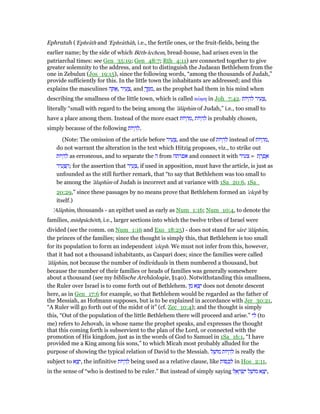
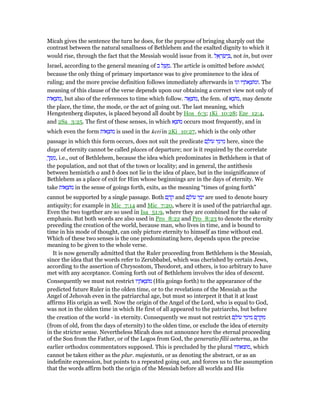
BAR ES. "But - (And) thou, Bethlehem Ephratah With us, the chequered events of
time stand in strong contrast, painful or gladdening. Good seems to efface evil, or evil
blots out the memory of the good. God orders all in the continuous course of His
Wisdom. All lies in perfect harmony in the Divine Mind. Each event is the sequel of what
went before. So here the prophet joins on, what to us stands in such contrast, with that
simple, And. Yet he describes the two conditions bearing on one another. He had just
spoken of the “judge of Israel” smitten on the cheek, and, before Mic_4:9, that Israel had
neither king nor “counsellor;” he now speaks of the Ruler in Israel, the Everlasting. He
had said, how Judah was to become mere bands of men; he now says, how the “little
Bethlehem” was to be exalted. He had said before, that the rule of old was to come to
“the tower of the flock, the daughter of Jerusalem;” now, retaining the word, he speaks
of the Ruler, in whom it was to be established.
Before he had addressed “the tower of the flock;” now, Bethlehem. But he has greater
things to say now, so he pauses , And thou! People have admired the brief appeal of the
murdered Caesar, “Thou too, Brutus.” The like energetic conciseness lies in the words,
“And thou! Bethlehem Ephratah.” The name Ephratah is not seemingly added, in order
to distinguish Bethlehem from the Bethlehem of Zabulon, since that is only named once
Jos_19:15, and Bethlehem here is marked to be “the Bethlehem Judah” , by the addition,
“too little to be among the thousands of Judah.” He joins apparently the usual name,
“Bethlehem,” with the old Patriarchal, and perhaps poetic Psa_132:6 name “Ephratah,”
either in reference and contrast to that former birth of sorrow near Ephratah Gen_
35:19; Gen_48:7, or, (as is Micah’s custom) regarding the meaning of both names.
Both its names were derived from “fruitfulness;” “House of Bread” and “fruitfulness;”
and, despite of centuries of Mohammedan oppression, it is fertile still. .
It had been rich in the fruitfulness of this world; rich, thrice rich, should it be in
spiritual fruitfulness. : “Truly is Bethlehem, ‘house of bread,’ where was born “the Bread
of life, which came down from heaven” Joh_6:48, Joh_6:51. : “who with inward
sweetness refreshes the minds of the elect,” “Angel’s Bread” Psa_78:25, and “Ephratah,
fruitfulness, whose fruitfulness is God,” the Seed-corn, stored wherein, died and brought
forth much fruit, all which ever was brought forth to God in the whole world.
Though thou be little among the thousands of Judah - Literally, “small to be,”
that is, “too small to be among” etc. Each tribe was divided into its thousands, probably
of fighting men, each thousand having its own separate head Num_1:16; Num_10:4. But
the thousand continued to be a division of the tribe, after Israel was settled in Canaan
Jos_22:21, Jos_22:30; 1Sa_10:19; 1Sa_23:23. The “thousand” of Gideon was the
meanest in Manasseh. Jdg_6:15. Places too small to form a thousand by themselves were
united with others, to make up the number . So lowly was Bethlehem that it was not
counted among the possessions of Judah. In the division under Joshua, it was wholly
omitted . From its situation, Bethlehem can never have been a considerable place.
It lay and lies, East of the road from Jerusalem to Hebron, at six miles from the
capital. “6 miles,” Arculf, (Early Travels in Palestine, p. 6) Bernard (Ibid. 29) Sae, wulf,
(Ibid. 44) “2 hours.” Maundrell, (Ibid. 455) Robinson (i. 470)). It was “seated on the
summit-level of the hill country of Judaea with deep gorges descending East to the Dead
Sea and West to the plains of Philistia,” “2704 feet above the sea” . It lay “on a narrow
ridge” , whose whole length was not above a mile , swelling at each extremity into a
somewhat higher eminence, with a slight depression between . : “The ridge projects
Eastward from the central mountain range, and breaks down in abrupt terraced slopes
to deep valleys on the N. E. and S.” The West end too “shelves gradually down to the
valley” . It was then rather calculated to be an outlying fortress, guarding the approach
to Jerusalem, than for a considerable city.
As a garrison, it was fortified and held by the Philistines 2Sa_23:14 in the time of Saul,
recovered from them by David, and was one of the 15 cities fortified by Rehoboam. Yet it
remained an unimportant place. Its inhabitants are counted with those of the
neighboring Netophah, both before 1Ch_2:54 and after Neh_7:26 the captivity, but both
together amounted after the captivity to 179 Ezr_2:21, Ezr_2:2, or 188 Neh_7:26 only. It
still does not appear among the possessions of Judah Neh_11:25-30. It was called a city
(Rth_1:19; Ezr_2:1, with 21; Neh_7:6, with 26), but the name included even places
which had only 100 fighting men Amo_5:3. In our Lord’s time it is called a village Joh_
7:42, a city, Luk_2:4, or a strong . The royal city would become a den of thieves. Christ
should be born in a lowly village. : “He who had taken the form of a servant, chose
Bethlehem for His Birth, Jerusalem for His Passion.”
Matthew relates how the Chief Priest and Scribes in their answer to Herod’s enquiries,
where Christ should be born, Mat_2:4-6, alleged this prophecy. They gave the substance
rather than the exact words, and with one remarkable variation, art not the least among
the princes of Judah. Matthew did not correct their paraphrase, because it does not
affect the object for which they alleged the prophecy, the birth of the Redeemer in
Bethlehem. The sacred writers often do not correct the translations, existing in their
time, when the variations do not affect the truth .
Both words are true here. Micah speaks of Bethlehem, as it was in the sight of men;
the chief priests, whose words Matthew approves, speak of it as it was in the sight of
God, and as, by the Birth of Christ, it should become. : “Nothing hindered that
Bethlehem should be at once a small village and the Mother-city of the whole earth, as
being the mother and nurse of Christ who made the world and conquered it.” : “That is
not the least, which is the house of blessing, and the receptacle of divine grace.” : “He
saith that the spot, although mean and small, shall be glorious. And in truth,” adds
Chrysostom, “the whole world came together to see Bethlehem, where, being born, He
was laid, on no other ground than this only.” : “O Bethlehem, little, but now made great
by the Lord, He hath made thee great, who, being great, was in thee made little. What
city, if it heard thereof, would not envy thee that most precious Stable and the glory of
that Crib? Thy name is great in all the earth, and all generations call thee blessed.
“Glorious things are everywhere spoken of thee, thou city of God” Psa_87:3. Everywhere
it is sung, that this Man is born in her, and the Most High Himself shall establish her.
Out of thee shall He come forth to Me that is to be Ruler in Israel -
(Literally, shall (one) come forth to Me “to be Ruler.”) Bethlehem was too small to be
any part of the polity of Judah; out of her was to come forth One, who, in God’s Will, was
to be its Ruler. The words to Me include both of Me and to Me. Of Me, that is, , by My
Power and Spirit,” as Gabriel said, “The Holy Spirit shall come upon thee, and the power
of the Highest shall overshadow thee, therefore also that Holy Thing which shall be born
of thee, shall be called the Son of God” Luk_1:35. To Me, as God said to Samuel, “I will
send thee to Jesse the Bethlehemite; for I have provided Me a king among his sons” 1Sa_
16:1. So now, “one shall go forth thence to Me,” to do My Will, to My praise and glory, to
reconcile the world unto Me, to rule and be Head over the true Israel, the Church. He
was to “go forth out of Bethlehem,” as his native-place; as Jeremiah says, “His noble
shall be from him, and his ruler shall go forth out of the midst of him” Jer_30:21; and
Zechariah, “Out of him shall come forth the cornerstone; out of him the nail, out of him
the battle-bow, out of him every ruler together” Zec_10:4. Before, Micah had said “to the
tower of Edar, Ophel of the daughter of Zion, the first rule shall come to thee;” now,
retaining the word, he says to Bethlehem, “out of thee shall come one to be a ruler.” “The
judge of Israel had been smitten;” now there should “go forth out of” the little
Bethlehem, One, not to be a judge only, but a Ruler.
Whose goings forth have been from of old, from everlasting - Literally, “from
the days of eternity.” “Going forth” is opposed to “going forth;” a “going forth” out of
Bethlehem, to a “going forth from eternity;” a “going forth,” which then was still to
come, (the prophet says, “shall go forth,”) to a “going forth” which had been long ago
(Rup.), “not from the world but from the beginning, not in the days of time, but “from
the days of eternity.” For “in the beginning was the Word, and the Word was with God,
and the Word was God. The Same was in the beginning with God.” Joh_1:1-2. In the end
of the days, He was to go forth from Bethlehem; but, lest he should be thought then to
have had His Being, the prophet adds, His ‘goings forth are from everlasting.’” Here
words, denoting eternity and used of the eternity of God, are united together to impress
the belief of the Eternity of God the Son. We have neither thought nor words to conceive
eternity; we can only conceive of time lengthened out without end. : “True eternity is
boundless life, all existing at once,” or , “to duration without beginning and without end
and without change.”
The Hebrew names, here used, express as much as our thoughts can conceive or our
words utter. They mean literally, from afore, (that is, look back as far as we can, that
from which we begin is still “before,”) “from the days of that which is hidden.” True, that
in eternity there are no divisions, no succession, but one everlasting “now;” one, as God,
in whom it is, is One. But man can only conceive of Infinity of space as space without
bounds, although God contains space, and is not contained by it; nor can we conceive of
Eternity, save as filled out by time. And so God speaks after the manner of men, and calls
Himself “the Ancient of Days” Dan_7:9, , “being Himself the age and time of all things;
before days and age and time,” “the Beginning and measure of ages and of time.” The
word, translated “from of old,” is used elsewhere of the eternity of God Hab_1:12. “The
God of before” is a title chosen to express, that He is before all things which He made.
“Dweller of afore” Psa_55:20 is a title, formed to shadow out His ever-present existence.
Conceive any existence afore all which else you can conceive, go back afore and afore
that; stretch out backward yet before and before all which you have conceived, ages afore
ages, and yet afore, without end, - then and there God was. That afore was the property
of God. Eternity belongs to God, not God to eternity. Any words must be inadequate to
convey the idea of the Infinite to our finite minds. Probably the sight of God, as He is,
will give us the only possible conception of eternity. Still the idea of time prolonged
infinitely, although we cannot follow it to infinity, shadows our eternal being. And as we
look along that long vista, our sight is prolonged and stretched out by those millions
upon millions of years, along which we can look, although even if each grain of sand or
dust on this earth, which are countless, represented countless millions, we should be, at
the end, as far from reaching to eternity as at the beginning. “The days of eternity” are
only an inadequate expression, because every conception of the human mind must be so.
Equally so is every other, “From everlasting to everlasting” Psa_90:2; Psa_103:17;
“from everlasting” (Psa_93:2, and of Divine Wisdom, or God the Son, Pro_8:23); “to
everlasting” Psa_9:8; Psa_29:10; “from the day” Isa_43:13, that is, since the day was.
For the word, from, to our minds implies time, and time is no measure of eternity. Only
it expresses pre-existence, an eternal Existence backward as well as forward, the
incommunicable attribute of God. But words of Holy Scripture have their full meaning,
unless it appear from the passage itself that they have not. In the passages where the
words, forever, from afore, do not mean eternity, the subject itself restrains them. Thus
forever, looking onward, is used of time, equal in duration with the being of whom it is
written, as, “he shall be thy servant forever” Exo_21:6, that is, so long as he lives in the
body. So when it is said to the Son, “Thy throne, O God, is forever and ever” Psa_45:6, it
speaks of a kingdom which shall have no end. In like way, looking backward, “I will
remember Thy wonders from old” Psa_77:12, must needs relate to time, because they
are marvelous dealings of God in time. So again, “the heavens of old, stand simply
contrasted with the changes of man” Psa_68:34. But “God of old is the Eternal God”
Deu_33:27. “He that abideth of old” Psa_55:20 is God enthroned from everlasting In
like manner the “goings forth” here, opposed to a “going forth” in time, (emphatic words
being moreover united together,) are a going forth in eternity.
The word, “from of old,” as used of being, is only used as to the Being of God. Here too
then there is no ground to stop short of that meaning; and so it declares the eternal
“going-forth,” or Generation of the Son. The plural, “goings forth,” may here be used,
either as words of great majesty, “God,” “Lord,” “Wisdom,” (that is, divine Pro_1:20;
Pro_9:1) are plural; or because the Generation of the Son from the Father is an Eternal
Generation, before all time, and now, though not in time, yet in eternity still. As then the
prophet saith, “from the days of eternity,” although eternity has no parts, nor beginning,
nor “from,” so he may say “goings forth,” to convey, as we can receive it, a continual
going-forth. We think of Eternity as unending, continual, time; and so he may have set
forth to us the Eternal Act of the “Going Forth” of the Son, as continual acts.
The Jews understood, as we do now, that Micah foretold that the Christ was to be born
at Bethlehem, until they rejected Him, and were pressed by the argument. Not only did
the chief priests formally give the answer, but, supposing our Lord to be of Nazareth,
some who rejected Him, employed the argument against Him. “Some said, Shall Christ
come out of Galilee? Hath not the Scripture said, that Christ cometh of the seed of
David, and out of the town of Bethlehem, where David was?” Joh_7:41-42. They knew of
two distinct things: that Christ was:
(1) to be of the seed of David; and
(2) out of the town of Bethlehem.
Christians urged them with the fact, that the prophecy could be fulfilled in no other
than in Christ. : “If He is not yet born, who is to go forth as a Ruler out of the tribe of
Judah, from Bethlehem, (for He must needs come forth out of the tribe of Judah, and
from Bethlehem, but we see that now no one of the race of Israel has remained in the city
of of Bethlehem, and thenceforth it has been interdicted that any Jew should remain in
the confines of that country) - how then shall a Ruler be born from Judaea, and how
shall he come forth out of Bethlehem, as the divine volumes of the prophets announce,
when to this day there is no one whatever left there of Israel, from whose race Christ
could be born?”
The Jews at first met the argument, by affirming that the Messiah was born at
Bethlehem on the day of the destruction of the temple ; but was hidden for the sins of
the people. This being a transparent fable, the Jews had either to receive Christ, or to
give up the belief that He was to be born at Bethlehem. So they explained it, “The
Messiah shall go forth thence, because he shall be of the seed of David who was out of
Bethlehem.” But this would have been misleading language. Never did man so speak,
that one should be born in a place, when only a remote ancestor had been born there.
Micah does not say merely, that His family came out of Bethlehem, but that He Himself
should thereafter come forth thence. No one could have said of Solomon or of any of the
subsequent kings of Judah, that they should thereafter come forth from Bethlehem, any
more than they could now say, ‘one shall come forth from Corsic,’ of any future
sovereign of the line of Napoleon III., because the first Napoleon was a Corsican; or to
us, ‘one shall come out of Hanover,’ of a successor to the present dynasty, born in
England, because George I. came from Hanover in 1714.
CLARKE, "But thou, Beth-lehem Ephratah - I have considered this subject in
great detail in the notes on Mat_2:6, to which the reader will be pleased to refer. This
verse should begin this chapter; the first verse belongs to the preceding chapter.
Bethlehem Ephratah, to distinguish it from another Beth-lehem, which was in the
tribe of Zebulun, Jos_19:15.
Thousands of Judah - The tribes were divided into small portions called
thousands; as in our country certain divisions of counties are called hundreds.
Whose goings forth have been from of old - In every age, from the foundation of
the world, there has been some manifestation of the Messiah. He was the hope, as he
was the salvation, of the world, from the promise to Adam in paradise, to his
manifestation in the flesh four thousand years after.
From everlasting - ‫עולם‬ ‫מימי‬ miyemey olam, “From the days of all time;” from time as
it came out of eternity. That is, there was no time in which he has not been going forth-
coming in various ways to save men. And he that came forth the moment that time had
its birth, was before that time in which he began to come forth to save the souls that he
had created. He was before all things. As he is the Creator of all things, so he is the
Eternal, and no part of what was created. All being but God has been created. Whatever
has not been created is God. But Jesus is the Creator of all things; therefore he is God;
for he cannot be a part of his own work.
GILL, "But thou, Bethlehem Ephratah,.... But though Jerusalem should be
besieged and taken, and the land of Judea laid waste, yet, before all this should be, the
Messiah should be born in Bethlehem, of which this is a prophecy, as is evident from
Mat_2:4; the place is called by both the names it went by, to point it out the more
distinctly, and with the greater certainty, Gen_35:19; the former signifies "the house of
bread", and a proper place for Christ to be born in, who is the bread of life; and it has the
name of the latter from its fruitfulness, being a place of pasture, and as we find it was at
the time of our Lord's birth; for near it shepherds were then watching over their flocks;
and it is here added, to distinguish it from another Bethlehem in the tribe of Zebulun,
Jos_19:15; from which tribe the Messiah was not to come, but from the tribe of Judah;
and in which this Bethlehem was, and therefore called, by Matthew, Bethlehem in the
land of Judah; as it appears this was, from Rth_1:1; and from the Septuagint version of
Jos_15:60, where, as Jerom observes, it was added by the Greek interpreters, or erased
out of the Hebrew text by the wickedness of the Jews: the former seems most correct;
though thou be little among the thousands of Judah; this supplement of ours is
according to Kimchi's reading and sense of the words; which, in some measure, accounts
for the difference between the prophet and the Evangelist Matthew, by whom this place
is said to be "not the least", Mat_2:6, as it might, and yet be little; besides, it might be
little at one time, in Micah's time, yet not little at another time; in Matthew's; it might be
little with respect to some circumstances, as to pompous buildings, and number of
inhabitants, and yet not little on account of its being the birth place of great men, as
Jesse, David, and especially the Messiah: or the words may be rendered with an
interrogation, "art thou little?" &c. (d); thou art not: or thus, it is a "little thing to be
among the thousands of Judah" (e); a greater honour shall be put upon thee, by being
the place of the Messiah's birth. Moreover, Mr, Pocock has shown out of R. Tanchum,
both in his commentary on this place, and elsewhere (f), that the word ‫צעיר‬ signifies both
"little" and "great", or of great note and esteem. The tribes of Israel were divided into
tens, hundreds, and thousands, over which there was a head or prince; hence, in
Matthew, these are called "the princes of Judah", Mat_2:6;
yet out of thee shall he come forth unto me that is to be ruler in Israel; not
Hezekiah, who very probably was now born at the time of this prophecy; nor was he
born at Bethlehem, nor a ruler in Israel, only king of Judah: nor Zerubbabel, who was
born in Babylon, as his name shows, was governor of Judah, but not of Israel; nor can it
be said of him, or any mere man, what is said in the next clause: but the Messiah is
intended, as the Targum, Jarchi, and Kimchi confess, and other Jewish writers. The
Targum is,
"out of thee shall come forth before me the Messiah, that he may exercise dominion over
Israel.''
Jarchi's note is,
"out of thee shall come forth unto me Messiah, the son of David;''
and so he says, "the stone which the builders refused", &c. Psa_118:22; plainly
suggesting that that passage also belongs to the Messiah, as it certainly does. Kimchi's
paraphrase is,
"although thou art little among the thousands of Judah, of thee shall come forth unto me
a Judge, to be ruler in Israel, and this is the King Messiah.''
And Abarbinel (g), mentioning those words in Mic_4:13; "arise, and thresh, O daughter
of Zion", observes,
"this speaks concerning the business of the King Messiah, who shall reign over them,
and shall be the Prince of their army; and it is plain that he shall be of the house of
David: and it is said, "O thou, Bethlehem Ephratah", which was a small city, in the midst
of the cities of Judah; and "although thou art little in the thousands of Judah, out of thee
shall come forth unto me" a man, a ruler in Israel, "whose goings forth are from the days
of old"; the meaning is, the goings forth of the family of that ruler are from the days of
old; that is, from the seed of David, and a rod from the stem of Jesse, who was of
Bethlehem Judah.''
So Abendana (h), a more modern Jew, paraphrases the words thus,
"out of thee shall come forth unto me a Judge, that is to be ruler in Israel, and this is the
King Messiah; for because he is to be of the seed of David, from Bethlehem he will be.''
To which may be added R. Isaac (i), who, having cited this passage, observes, and, he,
the ruler in Israel, is the King Messiah, who shall come forth from the seed of David the
king; who was of Bethlehem Judah, as in 1Sa_17:12. Wherefore Lyra, having quoted
Jarchi, and given his sense of the passage, remarks, hence it is plain that some Catholics,
explaining this Scripture of King Hezekiah, "judaize" more than the Hebrews. Though
some of them object the application of it to Jesus, who they say ruled not over Israel, but
Israel over him, and put him to death; which it is true they did; but God exalted him to
be a Prince, as well as a Saviour, unto Israel, notwithstanding that, and declared him to
be Lord and Christ; besides, previous to his death, and in the land of Israel, he gave
abundant proof of his power and rule over universal nature, earth, air, and sea; over
angels, good and bad; and over men and beasts: all creatures obeyed him; though indeed
his kingdom is not of this world, but of a spiritual nature, and is over the spiritual Israel
of God; and there is a time coming when he will be King over all the earth. Now out of
Bethlehem was the King Messiah, the ruler in Israel, to come forth; that is, here he was
to be born, as the phrase signifies; see Gen_10:14; and here our Jesus, the true Messiah,
was born, as appears from Mat_2:8; and this is not only certain from the evangelic
history, but the Jews themselves acknowledge it. One of their chronologers (k) affirms
that Jesus the Nazarene was born at Bethlehem Judah, a parsa and a half from
Jerusalem; that is, about six miles from it, which was the distance between them: and
even the author of a blasphemous book (l), pretending to give the life of Jesus, owns that
Bethlehem Judah was the place of his nativity: and it is clear not only that the Jews in
the times of Jesus expected the Messiah to come from hence, even both the chief priests
and scribes of the people, who, in answer to Herod's question about the place of the
Messiah's birth, direct him to this, according to Micah's prophecy, Mat_2:4; and the
common people, who thought to have confronted the Messiahship of Jesus with it, Joh_
7:41; but others also, at other times. The tower of Edar being a place near to Bethlehem
Ephratah, Gen_35:19; Jonathan ben Uzziel, in his Targum of Gen_35:19, says of the
tower of Edar, this is the place from whence the King Messiah shall be revealed in the
end of days; nay, some of them say he is born already, and was born at Bethlehem. An
Arabian, they say (m), told a Jew,
"the King Messiah is born; he replied to him, what is his name? he answered, Menachem
(the Comforter) is his name; he asked him, what is his father's name? he replied,
Hezekiah; he said to him, from whence is he? he answered, from the palace of the king of
Bethlehem Judah.''
This same story is told elsewhere (n), with some little variation, thus, that the Arabian
should say to the Jew,
"the Redeemer of the Jews is both; he said to him, what is his name? he replied,
Menachem is his name; and what is his father's name? he answered, Hezekiah; and
where do they dwell? (he and his father;) he replied, in Birath Arba, in Bethlehem
Judah.''
These things show their sense of this prophecy, and the convictions of their minds as to
the births of the Messiah, and the place of it. The words "unto me" are thought by some
to be redundant and superfluous; but contain in them the glory and Gospel of the text,
whether considered as the words of God the Father; and then the sense is, that Christ
was to come forth in this place in human nature, or become incarnate, agreeably to the
purpose which God purposed in himself; to the covenant made with him, before the
world was; to an order he had given him as Mediator, and to his promise concerning
him; and he came forth to him, and answered to all these; as well as this was in order to
do his will and work, by fulfilling the law; preaching the Gospel; doing miracles;
performing the work of redemption and salvation; by becoming a sacrifice for sin, and
suffering death; and likewise it was for the glorifying of all the divine perfections: or
whether as the words of the prophet, in the name of the church and people of God, to
and for whom he was born, or became incarnate; he came forth unto them, to be their
Mediator in general; to be the Redeemer and Saviour of them in particular; to execute
each of his offices of Prophet, Priest, and King; and to answer and fill up all relations he
stands in to them, of Father, Brother, Head, and Husband;
whose goings forth have been of old, from everlasting; which is said of him, not
because his extraction was from David, who lived many ages before him; for admitting
he was "in him, in his loins", as to his human nature, so long ago, yet his "goings forth"
were not from thence: nor because he was prophesied of and promised very early, as he
was from the beginning of the world; but neither a prophecy nor promise of him can be
called his "going forth"; which was only foretold and spoken of, but not in actual being;
nor because it was decreed from eternity that he should come forth from Bethlehem, or
be born there in time; for this is saying no more than what might be said of everyone
that was to be born in Bethlehem, and was born there: nor is this to be understood of his
manifestations or appearances in a human form to the patriarchs, in the several ages of
time; since to these, as to other of the above things, the phrase "from everlasting" cannot
be ascribed: but either of his going forth in a way of grace towards his people, in acts of
love to them, delighting in those sons of men before the world was; in applying to his
Father on their account, asking them of him, and betrothing them to himself; in
becoming their surety, entering into a covenant with his Father for them, and being the
head of election to them, receiving all blessings and promises of grace for them: or else
of his eternal generation and sonship, as commonly interpreted; who the only begotten
of the Father, of the same nature with him, and a distinct person from him; the eternal
Word that went forth from him, and was with him from eternity, and is truly God. The
phrases are expressive of the eternity of his divine nature and person; Jarchi compares
them with Psa_72:17; "before the sun was, his name was Jinnon"; that is, the Son, the
Son of God; so as the former part of the text sets forth his human birth, this his divine
generation; which, cause of the excellency and ineffableness of it, is expressed in the
plural number, "goings forth". So Eliezer (o), along with the above mentioned passage in
the Psalms, produces this to prove the name of the Messiah before the world was, whose
"goings forth were from everlasting", when as yet the world was not created.
HE RY, " What is here foretold concerning him.
(1.) That Bethlehem should be the place of his nativity, Mic_5:2. This was the
scripture which the scribes went upon when with the greatest assurance they told Herod
where Christ should be born (Mat_2:6), and hence it was universally known among the
Jews that Christ should come out of the town of Bethlehem where David was, Joh_7:42.
Beth-lehem signifies the house of bread, the fittest place for him to be born in who is the
bread of life. And, because it was the city of David, by a special providence it was
ordered that he should be born there who was to be the Son of David, and his heir and
successor for ever. It is called Bethlehem-Ephratah, both names of the same city, as
appears Gen_35:19. It was little among the thousands of Judah, not considerable either
for the number of the inhabitants or the figure they made; it had nothing in it worthy to
have this honour put upon it; but God in that, as in other instances, chose to exalt those
of low degree, Luk_1:52. Christ would give honour to the place of his birth, and not
derive honour from it: Though thou be little, yet this shall make thee great, and, as St.
Matthew reads it, Thou art not the least among the princes of Judah, but upon this
account art really honourable above any of them. A relation to Christ will magnify those
that are little in the world.
JAMISO , "Beth-lehem Ephratah — (Gen_48:7), or, Beth-lehem Judah; so
called to distinguish it from Beth-lehem in Zebulun. It is a few miles southwest of
Jerusalem. Beth-lehem means “the house of bread”; Ephratah means “fruitful”: both
names referring to the fertility of the region.
though thou be little among — though thou be scarcely large enough to be
reckoned among, etc. It was insignificant in size and population; so that in Jos_15:21,
etc., it is not enumerated among the cities of Judah; nor in the list in Neh_11:25, etc.
Under Rehoboam it became a city: 2Ch_11:6, “He built Beth-lehem.” Mat_2:6 seems to
contradict Micah, “thou art not the least,” But really he, by an independent testimony of
the Spirit, confirms the prophet, Little in worldly importance, thou art not least (that is,
far from least, yea, the very greatest) among the thousands, of princes of Judah, in the
spiritual significance of being the birthplace of Messiah (Joh_7:42). God chooses the
little things of the world to eclipse in glory its greatest things (Jdg_6:15; Joh_1:46; 1Co_
1:27, 1Co_1:28). The low state of David’s line when Messiah was born is also implied
here.
thousands — Each tribe was divided into clans or “thousands” (each thousand
containing a thousand families: like our old English division of counties into hundreds),
which had their several heads or “princes”; hence in Mat_2:6 it is quoted “princes,”
substantially the same as in Micah, and authoritatively explained in Matthew. It is not so
much this thousand that is preferred to the other thousands of Judah, but the Governor
or Chief Prince out of it, who is preferred to the governors of all the other thousands. It
is called a “town” (rather in the Greek, “village”), Joh_7:42; though scarcely containing a
thousand inhabitants, it is ranked among the “thousands” or larger divisions of the tribe,
because of its being the cradle of David’s line, and of the Divine Son of David. Moses
divided the people into thousands, hundreds, fifties, and tens, with their respective
“rulers” (Exo_18:25; compare 1Sa_10:19).
unto me — unto God the Father (Luk_1:32): to fulfil all the Father’s will and purpose
from eternity. So the Son declares (Psa_2:7; Psa_40:7, Psa_40:8; Joh_4:34); and the
Father confirms it (Mat_3:17; Mat_12:18, compare with Isa_42:1). God’s glory is hereby
made the ultimate end of redemption.
ruler — the “Shiloh,” “Prince of peace,” “on whose shoulders the government is laid”
(Gen_49:10; Isa_9:6). In 2Sa_23:3, “He that ruleth over men must be just,” the same
Hebrew word is employed; Messiah alone realizes David’s ideal of a ruler. Also in Jer_
30:21, “their governor shall proceed from the midst of them”; answering closely to “out
of thee shall come forth the ruler,” here (compare Isa_11:1-4).
goings forth ... from everlasting — The plain antithesis of this clause, to “come
forth out of thee” (from Beth-lehem), shows that the eternal generation of the Son is
meant. The terms convey the strongest assertion of infinite duration of which the
Hebrew language is capable (compare Psa_90:2; Pro_8:22, Pro_8:23; Joh_1:1).
Messiah’s generation as man coming forth unto God to do His will on earth is from Beth-
lehem; but as Son of God, His goings forth are from everlasting. The promise of the
Redeemer at first was vaguely general (Gen_3:15). Then the Shemitic division of
mankind is declared as the quarter in which He was to be looked for (Gen_9:26, Gen_
9:27); then it grows clearer, defining the race and nation whence the Deliverer should
come, namely, the seed of Abraham, the Jews (Gen_12:3); then the particular tribe,
Judah (Gen_49:10); then the family, that of David (Psa_89:19, Psa_89:20); then the
very town of His birth, here. And as His coming drew nigh, the very parentage (Mat_1:1-
17; Luk_1:26-35; Luk_2:1-7); and then all the scattered rays of prophecy concentrate in
Jesus, as their focus (Heb_1:1, Heb_1:2).
K&D, "The previous announcement of the glory to which Zion is eventually to attain,
is now completed by the announcement of the birth of the great Ruler, who through His
government will lead Israel to this, the goal of its divine calling. Mic_5:2. “And thou,
Bethlehem Ephratah, too small to be among the thousands of Judah, out of thee will He
come forth to me who will be Ruler over Israel; and His goings forth are from the olden
time, from the days of eternity.” The ‫ה‬ ָ ፍְ‫,ו‬ with which this new section of the
proclamation of salvation opens, corresponds to the ‫ה‬ ָ ፍְ‫ו‬ in Mic_4:8. Its former
government is to return to Zion (Mic_4:8), and out of little Bethlehem is the possessor
of this government to proceed, viz., the Ruler of Israel, who has sprung from eternity.
This thought is so attached to Mic_5:1, that the divine exaltation of the future Ruler of
Israel is contrasted with the deepest degradation of the judge. The names Bethlehem
Ephratah ('Ephrâth and 'Ephrâthâh, i.e., the fertile ones, or the fruit-fields, being the
earlier name; by the side of which Bēth-lechem, bread-house, had arisen even in the
patriarchal times: see Gen_35:19; Gen_48:7; Rth_4:11) are connected together to give
greater solemnity to the address, and not to distinguish the Judaean Bethlehem from the
one in Zebulun (Jos_19:15), since the following words, “among the thousands of Judah,”
provide sufficiently for this. In the little town the inhabitants are addressed; and this
explains the masculines ‫ה‬ ָ ፍ, ‫יר‬ ִ‫ע‬ ָ‫,צ‬ and ָ‫ך‬ ְ ִ‫,מ‬ as the prophet had them in his mind when
describing the smallness of the little town, which is called κώµη in Joh_7:42. ‫יוֹת‬ ְ‫ה‬ ִ‫ל‬ ‫יר‬ ִ‫ע‬ ָ‫,צ‬
literally “small with regard to the being among the 'ălâphım of Judah,” i.e., too small to
have a place among them. Instead of the more exact ‫יוֹת‬ ְ‫ה‬ ִ‫,מ‬ ‫יוֹת‬ ְ‫ה‬ ִ‫ל‬ is probably chosen,
simply because of the following ‫יוֹת‬ ְ‫ה‬ ִ‫.ל‬
(Note: The omission of the article before ‫יר‬ ִ‫ע‬ ָ‫,צ‬ and the use of ‫יוֹת‬ ְ‫ה‬ ִ‫ל‬ instead of ‫יוֹת‬ ְ‫ה‬ ִ‫,מ‬
do not warrant the alteration in the text which Hitzig proposes, viz., to strike out
‫יוֹת‬ ְ‫ה‬ ִ‫ל‬ as erroneous, and to separate the ‫ה‬ from ‫אפרתה‬ and connect it with ‫צעיר‬ = ‫ת‬ ָ‫ר‬ ְ‫פ‬ ֶ‫א‬
‫יר‬ ִ‫ע‬ ָ ַ‫;ה‬ for the assertion that ‫יר‬ ִ‫ע‬ ָ‫,צ‬ if used in apposition, must have the article, is just as
unfounded as the still further remark, that “to say that Bethlehem was too small to
be among the 'ălaphım of Judah is incorrect and at variance with 1Sa_20:6, 1Sa_
20:29,” since these passages by no means prove that Bethlehem formed an 'eleph by
itself.)
'Alâphım, thousands - an epithet used as early as Num_1:16; Num_10:4, to denote the
families, mishpâchōth, i.e., larger sections into which the twelve tribes of Israel were
divided (see the comm. on Num_1:16 and Exo_18:25) - does not stand for sârē 'ălâphım,
the princes of the families; since the thought is simply this, that Bethlehem is too small
for its population to form an independent 'eleph. We must not infer from this, however,
that it had not a thousand inhabitants, as Caspari does; since the families were called
'ălâphım, not because the number of individuals in them numbered a thousand, but
because the number of their families or heads of families was generally somewhere
about a thousand (see my biblische Archäologie, §140). Notwithstanding this smallness,
the Ruler over Israel is to come forth out of Bethlehem. ‫ן‬ ִ‫מ‬ ‫א‬ ֵ‫צ‬ֵ‫י‬ does not denote descent
here, as in Gen_17:6 for example, so that Bethlehem would be regarded as the father of
the Messiah, as Hofmann supposes, but is to be explained in accordance with Jer_30:21,
“A Ruler will go forth out of the midst of it” (cf. Zec_10:4); and the thought is simply
this, “Out of the population of the little Bethlehem there will proceed and arise.” ‫י‬ ִ‫ל‬ (to
me) refers to Jehovah, in whose name the prophet speaks, and expresses the thought
that this coming forth is subservient to the plan of the Lord, or connected with the
promotion of His kingdom, just as in the words of God to Samuel in 1Sa_16:1, “I have
provided me a King among his sons,” to which Micah most probably alluded for the
purpose of showing the typical relation of David to the Messiah. ‫ל‬ ֵ‫מוֹשׁ‬ ‫יוֹת‬ ְ‫ה‬ ִ‫ל‬ is really the
subject to ‫א‬ ֵ‫צ‬ֵ‫,י‬ the infinitive ‫יוֹת‬ ְ‫ה‬ ִ‫ל‬ being used as a relative clause, like ‫וֹת‬ ַ‫כ‬ ְ‫ל‬ in Hos_2:11,
in the sense of “who is destined to be ruler.” But instead of simply saying ‫ל‬ ֵ‫א‬ ָ‫ר‬ ְ‫שׂ‬ִ‫י‬ ‫ל‬ ֵ‫מוֹשׁ‬ ‫א‬ ֵ‫צ‬ַ‫,י‬
Micah gives the sentence the turn he does, for the purpose of bringing sharply out the
contrast between the natural smallness of Bethlehem and the exalted dignity to which it
would rise, through the fact that the Messiah would issue from it. ‫ל‬ ֵ‫א‬ ָ‫ר‬ ְ‫שׂ‬ִ‫י‬ ְ , not in, but over
Israel, according to the general meaning of ‫ב‬ ‫ל‬ ַ‫שׁ‬ ָ‫.מ‬ The article is omitted before mōshēl,
because the only thing of primary importance was to give prominence to the idea of
ruling; and the more precise definition follows immediately afterwards in ‫וגו‬ ‫יו‬ ָ‫ּת‬‫א‬ ָ‫.וּמוֹצ‬ The
meaning of this clause of the verse depends upon our obtaining a correct view not only of
‫אוֹת‬ ָ‫,מוֹצ‬ but also of the references to time which follow. ‫ה‬ፎ ָ‫,מוֹצ‬ the fem. of ‫א‬ ָ‫,מוֹצ‬ may denote
the place, the time, the mode, or the act of going out. The last meaning, which
Hengstenberg disputes, is placed beyond all doubt by Hos_6:3; 1Ki_10:28; Eze_12:4,
and 2Sa_3:25. The first of these senses, in which ‫א‬ ָ‫מוֹצ‬ occurs most frequently, and in
which even the form ‫אוֹת‬ ָ‫מוֹצ‬ is used in the keri in 2Ki_10:27, which is the only other
passage in which this form occurs, does not suit the predicate ‫ם‬ ָ‫עוֹל‬ ‫י‬ ֵ‫ימ‬ ִ‫מ‬ here, since the
days of eternity cannot be called places of departure; nor is it required by the correlate
ָ‫ך‬ ְ ִ‫,מ‬ i.e., out of Bethlehem, because the idea which predominates in Bethlehem is that of
the population, and not that of the town or locality; and in general, the antithesis
between hemistich a and b does not lie in the idea of place, but in the insignificance of
Bethlehem as a place of exit for Him whose beginnings are in the days of eternity. We
take ‫אוֹת‬ ָ‫מוֹצ‬ in the sense of goings forth, exits, as the meaning “times of going forth”
cannot be supported by a single passage. Both ‫ם‬ ֶ‫ד‬ ֶ‫ק‬ and ‫ם‬ ָ‫עוֹל‬ ‫י‬ ֵ‫מ‬ְ‫י‬ are used to denote hoary
antiquity; for example in Mic_7:14 and Mic_7:20, where it is used of the patriarchal age.
Even the two together are so used in Isa_51:9, where they are combined for the sake of
emphasis. But both words are also used in Pro_8:22 and Pro_8:23 to denote the eternity
preceding the creation of the world, because man, who lives in time, and is bound to
time in his mode of thought, can only picture eternity to himself as time without end.
Which of these two senses is the one predominating here, depends upon the precise
meaning to be given to the whole verse.
It is now generally admitted that the Ruler proceeding from Bethlehem is the Messiah,
since the idea that the words refer to Zerubbabel, which was cherished by certain Jews,
according to the assertion of Chrysostom, Theodoret, and others, is too arbitrary to have
met with any acceptance. Coming forth out of Bethlehem involves the idea of descent.
Consequently we must not restrict ‫יו‬ ָ‫ּת‬‫א‬ ָ‫מוֹצ‬ (His goings forth) to the appearance of the
predicted future Ruler in the olden time, or to the revelations of the Messiah as the
Angel of Jehovah even in the patriarchal age, but must so interpret it that it at least
affirms His origin as well. Now the origin of the Angel of the Lord, who is equal to God,
was not in the olden time in which He first of all appeared to the patriarchs, but before
the creation of the world - in eternity. Consequently we must not restrict ‫ם‬ ָ‫עוֹל‬ ‫י‬ ֵ‫ימ‬ ִ‫מ‬ ‫ם‬ ֶ‫ד‬ ֶ ִ‫מ‬
(from of old, from the days of eternity) to the olden time, or exclude the idea of eternity
in the stricter sense. Nevertheless Micah does not announce here the eternal proceeding
of the Son from the Father, or of the Logos from God, the generatio filii aeterna, as the
earlier orthodox commentators supposed. This is precluded by the plural ‫,מוצאתיו‬ which
cannot be taken either as the plur. majestatis, or as denoting the abstract, or as an
indefinite expression, but points to a repeated going out, and forces us to the assumption
that the words affirm both the origin of the Messiah before all worlds and His
appearances in the olden time, and do not merely express the thought, that “from an
inconceivably remote and lengthened period the Ruler has gone forth, and has been
engaged in coming, who will eventually issue from Bethlehem” (Hofmann,
Schriftbeweis, ii. 1, p. 9).
(Note: We must reject in the most unqualified manner the attempts that have been
made by the Rabbins in a polemical interest, and by rationalistic commentators from
a dread of miracles, to deprive the words of their deeper meaning, so as to avoid
admitting that we have any supernatural prediction here, whether by paraphrasing
“His goings forth” into “the going forth of His name” (we have this even in the
Chaldee), or the eternal origin into an eternal predestination (Calv.), or by
understanding the going forth out of Bethlehem as referring to His springing out of
the family of David, which belonged to Bethlehem (Kimchi, Abarb., and all the later
Rabbins and more modern Rationalists). According to this view, the olden time and
the days of eternity would stand for the primeval family; and even if such a quid pro
quo were generally admissible, the words would contain a very unmeaning thought,
since David's family was not older than any of the other families of Israel and Judah,
whose origin also dated as far back as the patriarchal times, since the whole nation
was descended from the twelve sons of Jacob, and thought them from Abraham. (See
the more elaborate refutation of these views in Hengstenberg's Christology, i. p.
486ff. translation, and Caspari's Micha, p. 216ff.))
The announcement of the origin of this Ruler as being before all worlds unquestionably
presupposes His divine nature; but this thought was not strange to the prophetic mind
in Micah's time, but is expressed without ambiguity by Isaiah, when he gives the
Messiah the name of “the Mighty God” (Isa_9:5; see Delitzsch's comm. in loc.). We must
not seek, however, in this affirmation of the divine nature of the Messiah for the full
knowledge of the Deity, as first revealed in the New Testament by the fact of the
incarnation of God in Christ, and developed, for example, in the prologue to the Gospel
of John. Nor can we refer the “goings forth” to the eternal proceeding of the Logos from
God, as showing the inward relation of the Trinity within itself, because this word
corresponds to the ‫א‬ ֵ‫צ‬ֵ‫י‬ of the first hemistich. As this expresses primarily and directly
nothing more than His issuing from Bethlehem, and leaves His descent indefinite,
‫מוצאתיו‬ can only affirm the going forth from God at the creation of the world, and in the
revelations of the olden and primeval times.
The future Ruler of Israel, whose goings forth reach back into eternity, is to spring
from the insignificant Bethlehem, like His ancestor, king David. The descent of David
from Bethlehem forms the substratum not only for the prophetic announcement of the
fact that the Messiah would come forth out of this small town, but also for the divine
appointment that Christ was born in Bethlehem, the city of David. He was thereby to be
made known to the people from His very birth as the great promised descendant of
David, who would take possession of the throne of His father David for ever. As the
coming forth from Bethlehem implies birth in Bethlehem, so do we see from Mat_2:5-6,
and Joh_7:42, that the old Jewish synagogue unanimously regarded this passage as
containing a prophecy of the birth of the Messiah in Bethlehem. The correctness of this
view is also confirmed by the account in Mat_2:1-11; for Matthew simply relates the
arrival of the Magi from the East to worship the new-born King in accordance with the
whole arrangement of his Gospel, because he saw in this even a fulfilment of Old
Testament prophecies.
(Note: In the quotation of this verse in Mat_2:6, the substance is given freely from
memory: Καᆳ σᆷ Βεθλεέµ, γᇿ ᅾούδα, οᆒδαµራς ᅚλαχίστη εᅼ ᅚν τοሏς ᅧγεµόσιν ᅾούδα· ᅚκ σοሞ
γᆭρ ᅚξελεύσεται ᅧγούµενος, ᆋστις ποιµανεሏ τᆵν λαόν µου, τᆵν ᅾσραήλ The deviations from
the original text may be accounted for from the endeavour to give the sense clearly,
and bring out into more distinct prominence the allusion in the words to David. The
γᇿ ᅾούδα, in the place of the Ephrata of the original, has sprung from 1Sa_17:12,
where Bethlehem is distinguished from the town of the same name in Zebulun in the
account of the anointing of David as king, as it frequently is in the Old Testament, by
the addition of the word Judah; and γᇿ ᅾούδα, “land of Judah,” is attached loosely in
apposition to the name Bethlehem, in the place of the more precise definition, “in the
land of Judah.” The alteration of the expression, “too small to be among the
thousands of Judah,” into οᆒδαµራς ᅚλαχίστη, κ.τ.λ., does not constitute a discrepancy,
but simply alters the thought with an allusion to the glorification which Bethlehem
would receive through the fact of the Messiah's springing from it. “Micah, looking at
its outward condition, calls it little; but Matthew, looking at the nativity of Christ, by
which this town had been most wondrously honoured and rendered illustrious, calls
it very little indeed” (C. B. Mich.). The interpretation of ‫באלפי‬ (among the thousands)
by ᅚν τοሏς ᅧγεµόσιν (among the princes) was very naturally suggested by the
personification of Bethlehem, and still more by the thought of the ᅧγούµενος about to
follow; and it does not alter the idea, since the families ('ălâphım) had their heads,
who represented and led them. The last clause, ᆋστις ποιµανεሏ, κ.τ.λ., is simply a
paraphrase of ‫ל‬ ֵ‫א‬ ָ‫ר‬ ְ‫שׂ‬ִ‫י‬ ְ , probably taken from v. 3, and resting upon 2Sa_5:2, and
pointing to the typical relation existing between the David born in Bethlehem and
the second David, viz., the Messiah. The second hemistich of the verse is omitted,
because it appeared superfluous so far as the immediate object of the quotation was
concerned.)
CALVI , "Thou Bethlehem Ephratah, art small, that thou shouldest be among the
thousands of Judah As Matthew quotes this passage differently, some think that it
ought to be read as a question, And thou, Bethlehem Ephratah, art thou the least
among the provinces of Judah? Matthew says “Thou art by no means the least, thou
excellest. (142) ” But what need there is of distorting the words of the Prophet, as it
was not the design of the Evangelist to relate the expressions of the Prophet, but
only to point out the passage. As to the words, Matthew had regards to the condition
of the town Bethlehem, such as it was at the coming of Christ. It then indeed began
to be eminent: but the Prophet represents here how ignoble and mean a place
Bethlehem then was, Thou, he says, art the least among the thousands of Judah.
Some, not very wisely, give this explanation, “Thou art the least among the
thousands of Judah”; that is, “Though there might be a thousand towns in the tribe
of Judah, yet thou couldest hardly have a place among so great a number.” But this
has been said through ignorance of a prevailing custom: for the Jews, we know,
were wont to divide their districts into thousands or chiliads. As in the army there
are centurions, so also in the divisions of every nation there are hundreds; there are
also in an army tribunes, who preside over a thousand men. Thus the Prophet calls
them thousands, that is, tribunes; for the districts are so arranged, that the town,
which, with its villages, could bring forth three thousand men, had three
prefectures; and it had three tribunes, or four or five, if it was larger. The Prophet
then, in order to show that this town was small and hardly of any account, says,
Thou, Bethlehem, art hardly sufficient to be one province. And it was a proof of its
smallness that hardly a thousand men could be made up from Bethlehem and its
neighboring villages. There were not, we know, many towns in the tribe of Judah;
and yet a large army could be there collected. Since then the town of Bethlehem was
so small, that it could hardly attain the rank of a province, it is hence no doubt
evident that it was but a mean town. We now perceive what the Prophet had in
view.
Thou, Bethlehem, he says, art small among the cities of Judah; yet arise, or go forth,
for me shall one from thee, who is to be a Ruler in Israel. He calls it Bethlehem
Ephratah; for they say that there was another Bethlehem in the tribe of Zebulon,
and we know that Ephratah in meaning is nearly the same with Bethlehem; for both
designate an abundance of fruit or provisions: and there David was born.
I will now proceed to the second clause, From thee shall go forth for me one who is
to be a Ruler Here the Prophet introduces God as the speaker, go forth, he says,
shall one for me. God declares in this passage that it was not his purpose so to
destroy his people, but that he intended, after a season, to restore them again. He
therefore recalls the attention of the faithful to himself and to his eternal counsel; as
though he said, — “I have thus for a time cast you away, that I may yet manifest my
care for you.” For me then shall go forth one who is to be a Ruler in Israel. ow
there is no doubt but that the Prophet at the sable time recalls the attention of the
faithful to the promise which had been given to David. For whence arises the hope
of salvation to the chosen people, except from the perpetuity of that kingdom? The
Prophet now says, — “There is indeed a reason, according to the perception of the
flesh, why the faithful should despond; for whence does their confidence arise,
except from the kingdom of David? and from what place is David to arise? Even
from Bethlehem; for Bethlehem has been called the city of David; and yet it is an
obscure and a small town, and can hardly be considered a common province. Since
it is so, the minds of the faithful may be depressed; but this smallness shall be no
hindrance to the Lord, that he should not bring forth from thence a new king.”
Even before the time of David Bethlehem was a small town, and one of the most
common provinces. Who could have expected that a king would have been chosen
from such a hamlet, and then, that he should come from a hut? for David belonged
to a pastoral family; his father was a shepherd, and he was the least among his
brethren. Who then could have thought that light would have arisen from such a
corner, yea, from so mean a cottage? This was done contrary to the expectations of
men. Hence the Prophet sets here before the faithful a similar expectation for their
comfort; as though he said, — “Has not God once formed a most perfect state of
things by making David a king, so that the people became in every respect happy
and blessed? And whence did David come? It was from Bethlehem. There is then no
reason why your present miseries should over-much distress you; for God can again
from the same place bring forth a king to you, and he will do so.”
Thou then Bethlehem, small art thou, etc. The prophet doubtless intended here that
the faithful should consider of what kind was the beginning of that most perfect
state, when David was chosen king. David was a shepherd, a man in humble life,
without reputation, without influence, and even the humblest among his brethren.
Since then God had drawn light out of darkness there was no cause for the faithful
to despair of a future restoration, considering what had been the beginning of the
previous happy condition of the people. We now understand the Prophet’s meaning.
But the rest I cannot finish today; I must therefore defer it till tomorrow.
The attempt by a question to produce similarity of expressions in the second line,
according to what is done by Marckius and ewcome, is by no means to be
approved. The literal rendering is the following: —
And thou, Bethlehem Ephratah!
Small to be among the thousands of Judah, —
From thee shall oneto me come forth,
To be a Ruler in Israel:
And his going forth has been
From of old, from the days of ages.
The word for “going forth” is plural, which, as Calvin says, is sometimes used for
the singular; but two MSS. Have it in the singular number, ‫.מצאתו‬ The last line in
the Septuagint is as follows, — απ αρχης, εξ ηµερων αιωνος
“In every age, from the foundation of the world, there has been some manifestation
of the Messiah. He was the hope, as he was the salvation, of the world, from the
promise to Adam in paradise, to his manifestation in the flesh four thousand years
after.” — Adam Clarke. — Ed.
COFFMA , "Verse 2
"But thou, Bethlehem Ephrathah, which art little to be among the thousands of
Judah, out of thee shall one come forth unto me one that is to be ruler in Israel;
whose goings forth are from of old, from everlasting."
This clear predictive prophecy of the birth of the Christ in Bethlehem occurred in
the eighth century B.C.; and the critical scholars have never dared to attribute the
passage to some redactor after the event of Jesus' birth. However, they will still not
believe it, affirming that Micah was here prophesying the birth of Israel's king
David who succeeded Saul centuries earlier! "It refers to the time when David was
being called to the kingship."[4] It would be difficult indeed to cite a clearer
example of the stubborn and determined blindness of men determined not to believe
in any prophecy. They make no appeal here to what they suppose Micah "thought,"
for it is a foregone certainty that Micah did not believe that he was prophesying the
advent of a king who had already lived and died centuries earlier.
The true meaning of this passage was perfectly clear to the entire world for
centuries before the Advent of the Son of God. When the wise men came from the
east inquiring, "Where is he that is born king of the Jews"? and took the question
up with Herod the Great, that monarch demanded of the Pharisees, "Where the
Christ should be born."
"And they said unto him, In Bethlehem of Judea: for thus it is written through the
prophet, And thou Bethlehem, land of Judah, art in no wise least among the princes
of Judah:
For out of thee shall come forth a governor Who shall be the shepherd of my people
Israel" (Matthew 2:5,6).SIZE>
The entire religious hierarchy of ancient Israel understood perfectly the Messianic
character of this prophecy and answered Herod accordingly, Testimony of such a
nature is irrefutable as regards the true import of this verse.
"Which art little to be among the thousands of Judah ..." Matthew's account of this
prophecy, as repeated by the Pharisees, has a significant variation, the origin of
which is not known. It says, "Thou are OT least ... etc." Jamieson understood the
change to have been made by the inspired Matthew "by an independent testimony
of the Spirit."[5] The prophecy is true both ways. As regarded its earthly
importance, Bethlehem was "the least"; but as regarded its eternal importance as
the birthplace of the Messiah, it was " OT the least," being indeed the greatest of
all.
"Bethlehem Ephrathah ..." Like many another prophecy, the words here guard
against error. There was another Bethelehem in Zebulun (Joshua 19:15); and so the
word Ephrathah "was included to designate just which Bethlehem was
intended."[6] "Isaiah had foretold Jesus' virgin birth (7:14); Micah predicted his
village birth."[7]
"Whose goings forth are from of old ..." This means far more than the fact that,
"the new king will come from a good old family!" As Keil said:
"We must reject in the most unqualified manner the attempts (by commentators
with a dread of miracles) to deprive the words of their deeper meaning...we must not
exclude the idea of eternity in the stricter sense.[8] He who is to be born in time at
Bethlehem hath an eternal existence.[9]
"From everlasting ..." The pre-existence of the Son of God prior to his earthly
ministry is inherent in this. "The terms here used are such as to transcend the
nature or achievements of any merely human leader, and could be completely
fulfilled only in the Messiah."[10]
PREDICTIVE PROPHECIES OF THE BIBLE
We have frequently observed in this study the devious, illogical, and even ridiculous
limits to which commentators will go to avoid finding any such thing as a predictive
prophecy in the Bible; and it is a good time to note the utter and perpetual
impossibility of their removing predictive prophecy from the Bible. There are 333
prophecies of Jesus Christ in the Old Testament, some of which are in Micah, for
example, that he would be born in Bethlehem. Some of the other Biblical prophecies
of Christ are:
That he would be of the family of Shem.
That he would be of the seed of Abraham.
That he would come forth from Judah.
That he would descend from David.
That he would be crucified (long before crucifixion was known).
That they would pierce his hands and his feet.
That he would welcome the Gentiles.
That he would be despised and rejected of men.
That he would be betrayed by a friend.
That the price of his betrayal would be 30 pieces of silver.
That he would rise from the dead.
That they would make his grave with the wicked
and with a rich man in his death.
That he would heal the blind, the deaf, and the lame.
That he would raise the dead.
That he would speak in parables.
That he would be called a azarene.
That the iniquity of us all would be laid upon him.
That he would come in triumph on an ass.
That he would be for the rise and fall of many in Israel.
That he would sit upon the throne of David.
That of the increase of his kingdom there would be no end.
That he would be both the son of David and the Lord of David.
That he would be a man of sorrows and acquainted with grief.
That he would proclaim release to the captives (in sin).
That they would cast lots for his vesture.
That they would divide his garments among them.
That they would look upon him whom they pierced.
Etc.
Our purpose here is not to list all 333 of the glorious prophecies of Christ, but
merely to call attention to their exceedingly great number and to point out that the
Old Testament Scriptures were translated into the Greek language (LXX) a quarter
of a millennium before Christ was born, and that all of the ingenuity of the Devil
himself cannot possibly get Jesus Christ out of Old Testament prophecy.
Over and beyond all of the verbal prophecies, there is a vast corpus of historical
events which are inherently prophetic of the Messiah, apart from any verbal
promise. Jonah, the type of Christ, who was a sign to the inevites, exhibited in his
personal history dozens of prophecies of Christ, including the prophecy of his
delivery from death after three days and three nights in the grave.
Isaac who carried the wood up the very hill where Jesus, in the fullness of time
would be crucified, is a type of Jesus' carrying his cross up that very hill.
Judah giving his life for his brethren (offering it) shows the prophecy of the Lion of
the tribe of Judah in the conduct of that patriarch.
Moses was the great type of Jesus Christ, there being a full hundred similarities in
their lives, even some of their miracles exhibiting the most startling likeness. Moses'
first miracle changed the water into blood; Christ's first miracle changed the water
into wine.
David the king was a type of Christ, whose brethren rejected them both, and his
contest with Goliath of Gath resembled the contest of Jesus with Satan, in each case,
the enemy having his head cut off with his own sword!
To complete such a summary would be to draw upon practically every page of the
Bible.
ot merely the verbal prophecies and the great patriarchal types alone, however,
bore the message of the coming Holy One. All of the religious regalia of ancient
Judaism were devoted to the same end. The veil in the tabernacle was a type of
Christ. The golden candlestick typified His word. The table of showbread foretold
the Lord's Supper; and the mercy seat sprinkled with blood foretold his death and
suffering.
And even over and beyond all of these things, there were the mighty festivals of the
Jewish religion, notably the Passover, designed exactly to identify the Lamb of God
when he should come into the world, in that not a bone of him would be broken, and
that through his vicarious suffering men might be redeemed.
Therefore, to those who have made it their mission in life to destroy the ageless
conviction that the Old Testament accurately and circumstantially prophesied in the
most amazing detail the Holy Christ coming into our world of sorrow to redeem it,
to them let it be suggested that their task is absolutely hopeless. "The light shineth
in the darkness; and the darkness apprehended it not!" (John 1:5).
COKE, "Verse 2
Micah 5:2. But thou, Beth-lehem Ephratah— Ephratah was another name for Beth-
lehem in the tribe of Judah, and both names are joined together to distinguish it
from another Beth-lehem in the tribe of Zebulun. In the gospel by St. Matthew it is
said, Thou, Beth-lehem, in the land of Judah, art not the least. In the Hebrew it is,
though thou art the least, or, literally, little to be; ‫צעיר‬ ‫להיות‬ zair leheioth. The sense
in both is clear and consistent, says Dr. Sharpe; for this city, though far from being
the most considerable in extent of all those belonging to the princes of Judah, is
nevertheless, on account of the governor or ruler who was to come out of it, not the
least among the thousands of Judah. The learned Pococke, on this passage, has
shewn, that the original word may signify either great or little. But this is a mode of
interpretation not very admissible. If the passage be read, as in the translation from
the Syriac in the English Polyglot, with an interrogation, it will have the force of a
negative, and then may well be rendered, as in the Arabic and Persic versions, and
in the Gospel by St. Matthew; but, if without any interrogation, it will be as it is in
the other versions from the Hebrew. Hence it is evident, that the Gospel may be
reconciled with the present copies of the Hebrew Bible, without any alteration of the
text, which, in matter of evidence, is not to be admitted. It may be proper, however,
to observe, that in the original there is neither an affirmative nor a negative particle:
literally, the words are, as we before remarked, a little one to be. ow if there be any
necessity for adding any thing to clear up the sense, surely an inspired apostle,
quoting the decision of the whole Jewish Sanhedrin, should, above all others, be
followed; and after him we might well render the passage, Thou, Beth-lehem,—art
not a very little one, to be in the thousands of Judah; for, or since out of thee shall
come forth, &c. And the context seems to require this, assigning the birth of this
ruler in Beth-lehem as a reason why it was not a little one in reality, though such in
esteem. It is added, among the thousands; which St. Matthew reads, among the
princes of Judah; and for this reason, every tribe was divided into so many
thousand men, as shires in England are into hundreds; over which presided an ‫ףּאל‬
alup,—leader, or prince, to command them in battle. Hence the same word came to
signify at once a thousand and the leader of a thousand. Beth-lehem was too small in
people to be reckoned as one of these thousands, or to be numbered singly in the
army against the enemy; but is promised the advantage over them, in giving birth to
that ruler in Israel, who is superior to all the princes of the thousands. The Hebrew
word ‫יצא‬ ietse, rendered come forth, signifies also to be born; and so this prophesy,
as the Scribes and Pharisees understood it, plainly points to Beth-lehem as the place
where the ruler or king of Israel was to be born, after the Babylonish captivity was
over; and thus it is impossible to accommodate it to any other ruler than the
Messiah. But if this circumstance can be accommodated to no other than him, much
less can that which follows: Whose goings-forth have been of old, from everlasting;
to signify the perfection and excellency of the generation of the person here foretold.
The prophet here describes him who, he says, should come out of Beth-lehem, and
be ruler in Israel, by another more eminent coming or going forth than that from
Beth-lehem, even before Beth-lehem had an existence,—from all eternity; which is
so signal a description of the divine generation before all time, or of that going-forth
from everlasting of Christ the eternal Son of God, God of the substance of the
Father, begotten before all worlds, and afterwards in time (according to what is
said, that he should come forth out of Beth-lehem) made man of the substance of his
mother, and born in the world,—that this prophesy belongs only to him, and could
never be verified of any other. The word ‫ומוצאתיו‬ amotsoothaiv, for goings-forth,
that is to say, birth, is plural. It is a common Hebraism to denote the eminency or
continuation of a thing or action by the plural number. From these circumstances in
the text, the Chaldee paraphrast of the Jews inserts the name of the Messiah before
ruler in Israel, to shew of whom the prophet is to be understood; and to signify that
what follows relates also to the Messiah. He then who is the subject of this prophesy
is that divine Person, who so often went forth in the name of the Lord; who
conversed with Abraham and Moses, manifesting by miracles and wonders his
Godhead and supreme power: who was from everlasting; and who, at last, was
made manifest in the flesh, and came forth from Beth-lehem, the king of the Jews.
Of no other person whatever can it be said, that he appeared, or came forth from
the beginning; from the days of eternity, as it is well rendered by the LXX: he who
was afterwards, in some period of time subsequent to this oracle by Micah, to come
forth out of Beth-lehem, as a prince or governor,—unto me; or, before God the
Father. See Bishop Chandler's Defence, p. 124. Sharpe's Second Argument, p. 150
and Houbigant.
CO STABLE, "Verse 2
In contrast to the humiliation of Israel"s judge (king) Zedekiah, a greater ruler
would emerge later in Israel"s history (cf. Micah 4:7). He would be Yahweh"s
representative (cf. John 17:4; Hebrews 10:7) and would arise from the
comparatively insignificant town of Bethlehem (House of Bread) Ephrathah
(Fruitful). Ephrathah (Ephrath) was an old name for the district in which
Bethlehem of Judah lay, in contrast to other Bethlehems in the Promised Land (cf.
Genesis 35:16-19; Genesis 48:7; Joshua 19:15; Ruth 4:11). Bethlehem was, of course,
the hometown of David ( 1 Samuel 16:1; 1 Samuel 16:18-19; 1 Samuel 17:12), so the
reference to it allows for the possibility of a familial connection with King David. As
David had been the least notable of his brothers, so Bethlehem was the least
honorable among the towns in Judah. The most insignificant place would bring
forth the most significant person. This ruler must be divine since He had been
conducting activities on Yahweh"s behalf from long ago, even eternity past (lit. days
of immeasurable time; cf. Isaiah 9:6; John 1:1; Philippians 2:6; Colossians 1:17;
Revelation 1:8). The ew Testament identifies this Ruler as the Messiah, Jesus
Christ ( Matthew 2:1; Matthew 2:3-6), though some of the Jews in Jesus" day did
not know that Bethlehem was His birthplace ( John 7:42).
This messianic prophecy not only gives the birthplace of Messiah, and thus assures
His humanity, but it also asserts His deity. o mere human could be said to have
been carrying out the will of Yahweh eternally.
Verses 2-5
3. The King of Zion5:2-5a
"In chapter5 the prophet repeated and expanded the major themes of Micah 4:6-10,
only in reverse order. This creates a chiastic structure for the central portion of the
speech, which can be outlined as follows:
A The Lord strengthens a remnant ( Micah 4:6-7 a)
B Dominion restored ( Micah 4:7-8)
C Zion and her king are humiliated ( Micah 4:9-10)
D Zion saved from the present crisis ( Micah 4:11-13)
C" Zion and her king are humiliated ( Micah 5:1)
B" Dominion restored ( Micah 5:2-6)
A" The Lord strengthens a remnant ( Micah 5:7-9)" [ ote: Robert B. Chisholm
Jeremiah , Handbook on the Prophets, p422.]
This section introduces another ruler of Israel who, in contrast to Zedekiah, his foil,
would effectively lead God"s people.
"This royal oracle is obviously intended to be the central peak of the range of
oracles in chs4,5. It presents a longer hope section than any other unit, and points to
the fulfilment of royal promise as the key to the greatness of Jerusalem and Israel
heralded in the surrounding pieces." [ ote: Allen, pp340-41.]
ELLICOTT, "(2) But thou, Beth-lehem Ephratah.—This is a passage of immense
significance, through the interpretation given to it by the chief priests and scribes in
the Gospel of St. Matthew. Beth-lehem Ephratah: the two names, modern and
ancient, are united, each of them having reference to the fertility of the country. In
the Gospel the scribes quote, evidently from memory, the passage from Micah, in
reply to Herod’s question; and their first variation is in the title of the town—
“Thou, Beth-lehem (not Ephratah, but), land of Judah.” So also the people
protested against Jesus on the ground of His being from Galilee, for, “Hath not the
Scripture said that Christ cometh of the seed of David, and out of the town of
Bethlehem, where David was?” (John 7:42.)
Though thou be little.—Strictly, art little among the thousands, or chiliads: a word
analogous to our “hundreds;” a division of the tribes. In St. Matthew the word is
paraphrased by princes, as representing the chiliads.
Yet out of thee.—St. Matthew—“for out of thee,” the illative conjunction—helps to
show that the quotation is really a paraphrase, conveying the ultimate intention of
the prophet’s words, which contrasts the smallness of the chiliad with the greatness
of its destiny.
Whose goings forth have been from of old.—The nativity of the governor of Israel is
evidently contrasted with an eternal nativity, the depth of which mystery passes the
comprehension of human intellect: it must be spiritually discerned. The Creed of the
Church expresses the article of faith as “Begotten of His Father before all worlds.”
He came forth unto Me to be Ruler in Israel, whose goings forth have been of old,
from everlasting, from the days of antiquity.
PARKER, " ow comes the great evangelical prophecy. Hear it, and remember who
spake it:—
"But thou, Bethlehem Ephratah, though thou be little among the thousands of
Judah, yet out of thee shall he come forth unto me that is to be ruler in Israel; whose
goings forth have been from of old, from everlasting" ( Micah 5:2).
If we were not familiar with these words they would be amongst the grandest
utterances of the ages; we know them so well that we miss their meaning. We are too
frivolous. We have seen the sun so often that we now never look at him; we have
been so many mornings in the world, that morning comes to us with no Song of
Solomon , no poetry, no new testament just written with the blood of the heart of
God. "But" should be "And." or is the word "and" a simple conjunctive in
grammar; it is a conjunctive in history, in genius, in spiritual intent,—"And thou,
Bethlehem Ephratah." Thus the events are run into one another. We slip up history
by our disjunctives. "But" we assign as dividing a sentence; Micah says "and."
Many a chapter begins with "and." The little pedantic grammarian says "and"
ought not to begin a sentence; but the great grammarians, the spiritual interpreters
of ages and eternities, make all grammar bend itself to their uses. Chapter iii. begins
"And." Thus we get the unity of history, the solidarity of events. One thing belongs
to another: Bethlehem, thou art very little, but out of thee shall come the greatest
Man that ever lived; Bethlehem, thou art not worthy to be counted among the
Gileads of Judah, but out of thy little thousand there shall stand a man who shall
rule all men. There is a wonderful spirit of compensation in providence. God is
saying to each of us, Though thou art poor, thou mayest be wise; though thou art
slow, thou mayest be painstaking and persevering; thou art—though misunderstood
by men—thou art fully comprehended by thy Father. Look for the "though" in
every history; look for the compensation in every life. "... From of old, from
everlasting"—here is pre-existence; the whole mystery of the Gospel is here; for
here we have eternity, personality, a historical point; we have the divine before the
human. In the Old Testament language God is called by a very simple term—the
God of Before. You cannot amend that phrase; do not paint that lily, bring no tinsel
to that gold. If we cannot understand the term "Eternity" because of its vastness
and its sublimity, we have some inkling of the meaning of the word "before." Of the
Saviour, the azarene, the Man of Sorrows, of him who was acquainted with grief,
whose face was marred more than any man"s, it is said he was "before all things."
Here is the altar at which we worship, nor are we ashamed to render homage here.
BE SO , "Micah 5:2. But thou, Beth-lehem Ephratah — Here we have evidently
the beginning of another subject, quite different from any thing that the first verse
can relate to, and with which it seems to have no connection. The word Ephrah, or
Ephratah, is here added, to distinguish Beth-lehem in the tribe of Judah, from
another Beth-lehem in the tribe of Zebulun. It is called Ephratah, from the
fruitfulness of the land where it stood: the word whence that term is derived
importing fruitfulness. Though thou be little —
The word though is not in the Hebrew, but supplied by our translators. And the
sense of the sentence, it seems, is unnecessarily altered by its introduction. Many
interpreters render the clauses interrogatively, thus; Art thou little among the
thousands of Judah? The expression, the thousands of Judah, seems to have been
used in allusion to the first division of the people, into thousands, hundreds, and
other subordinate divisions. The rendering of the clause thus, Art thou little, &c.,
which implies the contrary, thou art not little, is certainly the right way of rendering
it, because St. Matthew understood it, and quotes it, in this sense, chap. Micah 2:6,
And thou Beth-lehem, in the land of Judah, art not the least among the princes of
Judah. Bishop ewcome’s translation of the clause accords still more exactly with
St. Matthew’s, “Thou, Bethlehem Ephratah, art thou too little to be among the
leaders of Judah? Out of thee shall come, &c.,” the word ‫,אלפו‬ rendered thousands,
often signifying heads of thousands. Yet out of thee, &c. — The word yet also is not
in the Hebrew; and if the preceding clause be rendered, as is here proposed,
interrogatively, it is not necessary to complete the sense of the verse; indeed, it
would only obscure it. Out of thee shall come forth, &c., that is to be ruler in Israel
— This prophecy can be applied, with no propriety, to any other but the Messiah.
The words must be very much wrested and changed from their natural meaning, or
deprived of their full force or signification, before they can be applied to any other
person. The Jews, even the most learned ones, before and at our Saviour’s time,
understood this to be spoken of the Messiah; for St. Matthew informs us, Matthew
2:5-6, that when Herod inquired of the chief priests and scribes, assembled together,
to give him information where Christ should be born, they agreed unanimously that
it was in Beth- lehem of Judea, alleging these very words as a certain and
undeniable proof of it. And so did the generality of the Jews of that age, who speak
of it as an undoubted truth, that Christ was to come of the seed of David, and of the
town of Beth-lehem, where David was, John 7:42 . The Chaldee agrees with their
sentiments, and expressly applies the prophecy to the Messiah; and our Lord was
born at Beth-lehem by an especial act of Providence, that this prophecy might
plainly be fulfilled in him: see Luke 2:4. The expression, come forth, is the same as
to be born. Whose goings forth have been of old from everlasting — Hebrew, ‫מימי‬
‫מקדם‬ ‫,עולם‬ rendered by the LXX., απ αχης, εξ ηµεων αιωνος ; and exactly in the
same sense by the Vulgate, ab initio, a diebus æternitatis, from the beginning, from
the days of eternity. So these Hebrew expressions must of necessity signify in divers
places of Scripture, being used to signify the eternity of God: see Psalms 55:19;
Psalms 90:2; Proverbs 8:23; Habakkuk 1:12. The words naturally import an
original, distinct from the birth of Christ mentioned in the foregoing sentence,
which original is here declared to be from all eternity.
ISBET, "‘LOVED WITH EVERLASTI G LOVE!’
‘Whose goings forth have been from of old, from everlasting.’
Micah 5:2
This is the passage which the doctors of the law quoted when Herod asked of them
where the Christ should be born. Insignificant though Bethlehem might be, it would
shine like a star on the page of history, because Emmanuel, God with us, there
assumed our human nature. He went forth to be the Ruler of Israel, but the goings
forth had been from of old, from everlasting.
I. There were goings forth of love.—God so loved the world that He gave His Son.
He loved us with an everlasting love. Before the mountains were brought forth, or
ever He had formed the earth and the world, He had purposes of love towards our
race, which were to take effect in the fullness of time. The older we get, the more
comfort we derive from knowing that God’s love originated ours, that we love
because He first loved, and that He began knowing well what we should be, so He
will not be diverted or surprised by anything that He may discover.
II. There were goings forth of wisdom.—The Lord by wisdom hath founded the
earth, by understanding hath He established the heavens. By His knowledge were
the depths broken up, and the skies dropped down the dew. In the beginning was
the Word, by Whom the plans of all things were laid down, wrapped up by His
foresight in the original act of creation.
III. There were goings forth of power.—Christ is the Wisdom and Power of God.
Through Him went forth the creative fiat from everlasting. The Power of God
flowed through the ature of the Son, who was the Organ of Creation. Through
Him were all things created, which are in heaven and on earth. Stars and glow-
worms, cherubim and grasshoppers, mountains and molecules of dust. And though
He was crucified in weakness, He now lives to communicate to each of us power
unto salvation.
Illustrations
(1) ‘Bethlehem might be little, but so is earth among the thousands of the stars, and
littleness in size is nothing to God, to Whom all is great, where He deigns to work.
The Lord Jesus came forth from Bethlehem, but His goings forth had been from
everlasting. Born in a stable though He was, He was Ruler and Prince. Though He
lay in His mother’s arms, He was to stand in the strength of the Lord. Though He
was so poor and humble that the great of this world knew Him not, yet He has been
tending His flock through the ages, in the majesty of the ame of the Lord His God.
Though He came forth from so lowly an origin, He is great to the ends of the earth.
He is our peace, Who hath made peace between God and man by the blood of His
Cross, and is now intent on making peace between man and man the world over.’
(2) ‘God had not forsaken His people. A great Deliverer—the Messiah-King—would
yet arise to retrieve the fallen fortunes of the Chosen Race. He is born of Bethlehem,
but is of no merely human origin, for His goings forth were from the remote eternity
of the past. His origin is lowly, but He shall be Ruler. The people might be given up
to their adversity until Bethlehem had travailed in birth and brought forth her long-
expected child, but when He came to His own, there would be a great returning.’
PETT, "Verses 2-4
The Announcement Is Made Of One Who Will Rise From A Humble Small Town
Who Will Deliver His People And Will Become Great To The Ends Of The Earth
(Micah 5:2-4).
The promise is now made that from the small town of Bethlehem Ephrathah, which
is comparatively insignificant, will come one is to be ruler in Israel Whose activities
have been eternally destined, or possibly have been destined from the beginning as
evidenced for example in Genesis 3:15.
Micah 5:2
But you, Bethlehem Ephrathah,
Which is little to be among the thousands of Judah,
Out of you will one come forth to me who is to be ruler in Israel,
Whose goings forth are from of old, from everlasting.
A ruler is to arise out of little Bethlehem whose activities have been ‘from of old,
from everlasting’. The double emphasis indicates that it means from as far back as it
could possibly be. Strictly speaking it signifies that he will actually have been active
for that long, but was probably seen by most as meaning that His activities were in
YHWH’s mind from the beginning.
The word for ‘little’ is a rarely used one and indicates ‘comparatively small’
(compare Psalms 68:27). The ‘thousands’ of Judah may refer to the large numbers
of cities, towns and villages in Judah, or to the fact that Bethlehem’s contribution to
the military units (‘thousands’) of Judah is very small. Or it could be the equivalent
of ‘families, tribes’. Whichever way it is the unimportance of Bethlehem that is
being brought out. evertheless it will produce this great King.
But why should he be described as coming from this obscure background in
Bethlehem? The answer would seem to lie in the fact that it will not happen until the
royal house of David has ceased to rule in Jerusalem. Judah will have sunk into a
state of helplessness and hopelessness, and then suddenly from this small,
insignificant town will arise this great leader of the Davidic house..
Bethlehem Ephrathah (compare Genesis 35:19) was called this in order to
distinguish it from the other Bethlehem (house of bread) in Zebulun. It was situated
a few kilometres south of Jerusalem.
‘Whose goings forth are from of old, from everlasting.’ The dual repetition of words
representing ancient times introduces the conception of everlastingness. For the
conception compare Proverbs 8:22-23. Here is one Whose activities (‘going forth’)
have been eternal. He is the King of the ages. For the significance of the verb ‘goings
forth’ as indicating activity see Hosea 6:3; Ezekiel 12:4; 1 Kings 10:28; 2 Samuel
3:25.
It will be noted that these words parallel the ideas of Isaiah in Isaiah 9:6, ‘His ame
will be called wonderful, counsellor, Mighty God, Everlasting Father, Prince of
Peace.’ Both prophets were looking for someone with divine connections
Thus the whole idea is of the ‘coming King’ Who has been destined by God from the
beginning, Whose goings forth have been from eternity, Who will come forth from
Bethlehem to fulfil God’s purposes. This ‘Messianic’ expectation is found in a
number of passages. See Genesis 49:10; umbers 24:17; 2 Samuel 7:13; 2 Samuel
7:16; Psalms 2; Psalms 89:27-29). Its final fulfilment through the birth of Jesus
Christ in Bethlehem is emphasised in Matthew 2:6.
PULPIT, "Micah 5:2
At the time of Zion's deepest distress, and when her earthly king is suffering the
grossest degradation, reduced as it were to the shepherd house at Bethlehem, a
Deliverer shall arise thence who shall do wonderful things. This passage was quoted
by the Sanhedrin to answer Herod's question where the Christ was to be born
(Matthew 2:5, Matthew 2:6; comp. John 7:42). But thou, Bethlehem Ephratah.
Ephratah (Ephrathah, or Ephrath), "fruitfulness," is another name for Bethlehem,
"House of bread" (Genesis 35:19; Genesis 1:1-31 Saul Genesis 17:12; Ruth 1:2);
from its position it is also called Bethlehem Judah ( 17:7), being situated in the tribal
lot of Judah, about five miles south of Jerusalem, and thus distinguished from a
town of the same name in Zebulun(Joshua 19:15). Septuagint, κιὰ σὺ βηθλεὲµ οἷκος
ἐφραθά τοῦ ἐφραθά Alex.]. "And thou, Bethlehem, house of Ephrathah." The rest of
the clause is best translated, too little to be among the thousands of Judah. Each
tribe was divided into "thousands," which would be equivalent to clans, with its
own head. Probably the reckoning was made of fighting men (see note on Zechariah
9:7; and comp. umbers 1:16; umbers 10:4; Joshua 22:21, Joshua 22:30; 1 Samuel
10:19). Bethlehem, called in the text Bethlehem Ephratah for solemnity's sake, was a
small place ( κάµη, John 7:42), of such slight importance as not to be named among
the possessions of Judah in Joshua 15:1-63; or in the catalogue of ehemiah 11:25,
etc. Yet out of thee shall he (one) come forth unto me that is to be Ruler in Israel. In
spite of its insignificance, this birthplace of David shall be the birthplace of Messiah.
"Shall some forth" is spoken sometimes of birth and descent, as in Genesis 17:6 and
Genesis 35:11; at other times it contains merely the notion of proceeding from, as in
Jeremiah 30:21. In the present ease both ideas are suitable. Unto me (Jehovah is
speaking). To my praise and glory, to do my will. Micah by these words would recall
the announcement concerning David made to Samuel, "I have provided me a king"
(1 Samuel 16:1), and thus show the typical relation of David to the Messiah (Keil).
Whose goings forth have been from of old, from everlasting. The meaning of the
word rendered "goings forth" (motsaoth) is somewhat doubtful. Septuagint, ἔξοδοι:
Vulgate, egressus. The Fathers see in it a declaration of the eternal generation of the
Son: he who was born in time at Bethlehem hath an eternal existence. In this case
the plural form of the word is a plural of majesty, or an abstract expression (comp.
Psalms 114:2, "dominions;" Isaiah 54:2. "habitations"). To Christians, who believe
in the mystery of the Holy Trinity, the plural would express the continual
generation or the Son from the Father from everlasting and to everlasting, never
beginning and never ending; as the Council of Lateran says, "Without beginning
ever and without end, the Father begetting, the Son being born (nascens), and the
Holy Ghost proceeding." Many commentators take the "goings forth" to be the
ancient promises, the revelations of the Angel of the covenant to the patriarchs, the
various preparations made in type and history for the appearance of the great Son
of David in due time; but this is a forced interpretation of the word. Granted that
Micah's contemporaries understood the prophecy to state merely that a Saviour
should arise from the lineage of David who traced his descent from hoar antiquity,
and might be said to have lived in the days of old, this fact (if it be a fact) does not
preclude us, with our more perfect knowledge, from seeing a deeper meaning in the
inspired utterance, an adumbration of the nature of that Prince whom Isaiah calls
"Everlasting" (Isaiah 9:6), the Word who "was in the beginning with God" (John
1:1, John 1:2). We may note certain contrasts in these two first verses. Zion, "the
daughter of troops," is contrasted with the mean and insignificant Bethlehem; yet
the former shall be shamefully handled, the latter highly honoured; that one's king
shall be dethroned and disgraced, this one's Ruler is from everlasting and to
everlasting.
BI, "But thou, Bethlehem Ephratah, though thou be little among the thousands of
Judah
Bethlehem and its Babe
The Jews regarded this text as a prophecy of Messiah’s birthplace.
Micah, though a prophet of Divine wrath, is also a prophet of Divine promise. Next to
Isaiah, he is richest in Messianic prediction.
I. Concerning Bethlehem. Micah is noted for his “rapid transitions” from one topic to
another—from threats to promises. The prophet addresses the village by both its names,
Bethlehem Ephratah. The patriarchal name Ephratah means “fruitfulness.” It was one of
the most fertile parts of Palestine, and its natural fruitfulness was a prophecy of its
spiritual fruitfulness. Bethlehem means the “house of bread,” and points to its specific
form of fertility, its rich corn land. The prophet marks with wonder its insignificance. It
was too remote ever to become a place of importance.
II. Concerning christ. We cannot select our birthplace and circumstances, but Christ
could. The Saviour came to teach humility, and to reverse the maxims of the world.
Bethlehem was the city of David, and Christ was to be of the seed of David. We have also
the description of Christ’s office. “Ruler in Israel.” He came to found a kingdom. The
description of Christ’s person, the eternity of God the Son, is also contained in the text.
III. Lessons.
1. We are taught the grace of lowliness.
2. The name “house of bread” reminds us of the great Sacrament.
3. The prophetic description helps us to realise the two natures in one Divine
Person.
4. Obedience to our King is the way to reach up to the higher mystery of His timeless
generation (Joh_7:17). (The Thinker.)
The littleness of Bethlehem, and the greatness of Christ
Bethlehem cannot account for Jesus. Do mangers bring forth Messiahs? Things bring
forth after their kind. It is true that genius often arises from lowliest station, and the
great human powers seem to make way for themselves through narrowest surroundings.
1. Consider the meaning of this fact, that from the lowliest of peasants sprang the
soul that has swayed the mightiest intellects of the world. The moving powers of the
eighteen centuries have been themselves moved by Jesus Christ.
2. That out of the most materialistic of religions came the most spiritual of teachers.
Judaism clung with almost ferocious tenacity to external signs and symbols.
3. That out of the narrowest of races came the most universal of teachers. The
characteristic of Judaism, ancient and modern, is its refusal to recognise the
universal element in religion or in humanity.
4. That out of an age which exalted power as supreme, came One who exalted love as
supreme in God and in man. The symbol of Rome was the rapacious, unwearied
eagle. Military virtues were supreme. The Jews wanted a conquering general as
Messiah. Out of such environment and atmosphere came One who exalted the
feminine virtues, and proclaimed that the meek should inherit the earth. And as
Bethlehem could not produce Christ, it could not confine Christ. (W. H. P. Faunce.)
Prophecy of the Nativity
One great use of prophecy is to give authority and weight to the doctrines delivered by
the prophet. In order that the evidence arising from prophecy may be perfectly
convincing, it seems necessary that the meaning of the prediction should be somewhat
obscure at first; otherwise the friends and followers of the prophet might perhaps find
means to bring about a fulfilment of it; or his opposers might, in some cases, prevent its
accomplishment. It must, however, be sufficiently precise to verify the event when it
comes to pass. However obscure and mysterious, a prophet’s words could not fail to be
striking and interesting. The text pro vides an excellent specimen of prophetic methods.
Suppose you had never heard of any event which could be regarded as a fulfilment of
Micah’s prediction, in what light would it appear to you? However perplexing, there is
one thing you would understand. A town is distinctly referred to. There the Person
foretold by Micah was born seven hundred years later.
I. The human birth of Jesus. It is a human birth that is foretold. The place where David
was born was to be the birthplace of a second David, the Saviour of the world. Observe
how singularly the prediction was fulfilled, without the least suspicion of human
contrivance, merely by God’s secret overruling providence.
II. The eternal Godhead of Christ. “Whose goings forth have been from everlasting.” To
those who first heard this language, how strange it would appear! Something more than
human is here described. Words like these are never applied to any creature; but to God
the Creator they are frequently applied. The language of Micah gives the twofold
character of the Messiah.
III. His mediatorial dignity. He is—
1. Our Ruler.
2. Our Restorer.
3. Our Shepherd.
His administration of all these offices shall one day be universal. (J. Jowett.)
Christ
I. His birth as the Son of Man.
1. He was born in obscurity. As a protest to the ages against the popular and
influential opinion that human dignity consists in birth and ancestral distinctions.
2. He was born according to Divine plan. “Out of thee shall He come forth unto Me.”
Who? Jehovah. The fact of His birth, the scene of His birth, the object of His birth,
were all according to a Divine plan. “He shall come forth unto Me.”
(1) According to My will.
(2) To do My will.
3. He was born to an empire. “To be Ruler in Israel.” He is the Prince of Peace on
whose shoulder the government is laid. He is a Ruler. Not a temporal ruler, temporal
rule is but a shadow. He is to rule thought, intelligence, soul. He is the greatest king
who governs mind; and no one has obtained such a government over mind as He
who, eighteen centuries ago, “came forth out of Bethlehem Ephratah.” His kingdom
is increasing every day.
II. His history as the Son of God. “Whose goings forth have been from of old, from
everlasting,” or, as Delitzsch says, “Whose goings forth are from olden time, from the
days of eternity.” (Homilist.)
Of the Nativity
There is no applying this verse to any but to Christ.
I. The place of His birth. Bethlehem; spoken of as little, and Ephrata fruitful.” There
were two Bethlehems. One in the tribe of Zebulon. It was a sorry poor village.
II. The Person that cometh from this place.
III. Of both His natures. “As Man from Bethlehem; as God from everlasting.
IV. His office. Go before us, and be our Guide. He not only leads, He feeds. (Launcelot
Andrewes, D. D.)
The King of Zion
I. The promised Messiah in His true nature. A Man. Come out of Bethlehem. He was
born there. More than man. The prophet speaks of a twofold going forth, of Bethlehem,
and “from everlasting.” True God as well as true Man.
II. Jesus in His character as Ruler. What are regal acts? The exercise of legislative and
judicial authority. The legislative consists in making and repealing laws. The judicial in
executing or applying laws.
III. Jesus in His character as Shepherd. Who are His sheep? First the Jews, then the
Gentiles. As a shepherd His care is constant—He changes not. It is tender and
discriminating care. It is effectual. He gives us life. (J. Summerfield, A. M.)
Christ’s birthplace
This passage has always been regarded as one of the clearest and most striking of the
ancient prophecies of the Messiah. The gradations in the revelations of Christ have
always awakened the attention of Bible readers. First, we have the old word in Eden
from the lips of the Lord God to the serpent about his seed and the seed of Eve: “It shall
bruise thy head, and thou shalt bruise his heel.” Out of which dim Messianic germ grows
the whole wonderful mediatorial history, its conflicts, its alterations, its reversals, and its
eternal triumph in the endless overthrow of its great adversary. Then, about 1600 years
later, the Shemitic division of the human race is indicated as the favoured one, rather
than Japhet or Ham. By and by Abraham was selected from the sons of Shem to be the
head of the Hebrew race, from whom the Redeemer should come. Two hundred years
later Jacob, on his dying bed, points out the particular tribe of Israel from whom the
Shiloh or Prince of Peace shall be born. No further revelation was then made for about
seven hundred years, when the house of David, of the tribe of Judah, was declared to be
the favoured family, and about three hundred years after that, in the days of Hezekiah,
the prophet Micah reveals the place where Messiah shall be born. This was all that was
known for the next seven hundred years, but every intelligent Jew knew that the coming
Messiah was to be the Son of David, and was to be born in Bethlehem of Judah. “Thou
Bethlehem Ephratah, though thou be little among the thousands of Judah.” So
unimportant was Bethlehem in the old times, that Joshua in his enumeration of the
cities and villages of Judah gives it no mention: Rehoboam made it a sort of outlying
fortress to Jerusalem, and the Philistines at one time had a garrison there, the place
being a strong natural position. But it never grew to size, or became of any national
importance, except for its associations. Although the birthplace of David, the great king,
yet it never rose above the grade of an obscure Jewish village. In the list of Judean
villages which Nehemiah gives after the Captivity it is not named, and in the New
Testament, after the birth of Jesus and in that connection, its name never once occurs.
So little was Bethlehem Ephratah. And it did not seem destined to any more
commanding place in history when, in later times, a plain-looking couple drew near the
village, a young wife and her husband, travelling on foot, because very poor, although
both of the lineage of David. For not only was Bethlehem little, but the exceeding low
condition to which the family of the great king had sunk appears from the fact that
Joseph and Mary, who could trace their pedigree up to David through a long line of
kings, were thus poor, and received no sort of recognition in the crowded village. But
Bethlehem Ephratah was now to be immortalised indeed. Athens, Ephesus, Alexandria,
Rome, all were extant, some of them at the very pinnacle of their glory, but the glory of
Bethlehem was henceforth to surpass them all. You will mark here the words “unto Me.”
The birth of Christ was an event whose relations were chiefly Godward. Christ’s coming
to the earth is inconceivably the greatest of all events to us; but, after all, God the Father,
and the eternal glory of the Godhead, are concerned in it in a way we cannot now fully
understand, but of which the Scriptures give us distinct intimations. It would be quite in
accordance with the choice of little Bethlehem as the birth place of the Divine Lord, and
the passing by of the great places of the world, if God should have chosen our small
earth, this little globe, to be the scene of the wondrous Incarnation, passing by those far
mightier worlds in space whose magnitude dwarfs into insignificance this minute planet;
here, in a world whose absence would hardly be missed from the vast system, to enact
scenes of unparalleled importance to all worlds, illustrating all the principles of the
Divine government and the most precious attributes of the Divine Nature. The word
“Ruler” is suggestive. The usual Old Testament idea of Christ is that of the head of a
kingdom or dynasty. The representations of Isaiah, chapter 53, and of the prophet
Zechariah, are exceptions to the general Old Testament thought of the Messiah.
Elsewhere it, is the Shiloh or Prince, the King in Zion, the son of David enthroned—He
upon whose shoulders has been laid the government, who is to reign over the house of
Jacob forever, and to whose kingdom there is to be no end. The connection of these last
words with the former words of the prophecy are wonderfully instructive; “He shall
come forth out of thee, little Bethlehem,” and the words, “He whose goings forth have
been from of old, from everlasting.” Have they not great suggestions of the nature of the
coming Messiah? Does the Old Testament know nothing of the mystery and the miracle
of the Saviour’s birth, of the human and the divine, of the advent in time and the glory
with the Father before the makest the outgoings of the morning and evening to rejoice.”
It is used to denote that which proceeds out from any one, as speech or language. Deu_
8:3, “By every word that proceedeth out of the mouth of God doth man live.” Thus it
comes to have the meaning of origin, descent, an outgoing of existence, which is its
import in our text The old divines declare it to be a proof text of the doctrine of the
eternal generation of the Second Person of the Trinity. Without feeling called on to adopt
that phrase, yet I fully agree with one of them who says, “We have here Christ’s existence
from eternity; the phrase, ‘His goings forth have been from of old, from everlasting,’ is so
signal a description of Christ’s eternal generation, or His going forth as the Son of God
begotten of the Father before all worlds, that this prophecy must belong only to Him,
and could never, be verified of any other.” We embrace the mysterious truth of Christ’s
humanity and divinity as herein declared; one of the clearest prophecies of this sublime
foundation doctrine of the Scriptures which they anywhere contain. With what greatness
does this invest the birth of the Babe of Bethlehem! If He had indeed come to little
Bethlehem, whose goings forth were from everlasting, then all the miracles He
performed were the simplest outstretching of His hand; the obedience to Him of
demons, of nature, of death, were mere matters of course; the attendant angels, the
awaiting legions ready at His call, were but the renewed services of cherubim and
seraphim who had of old listened to His commands standing round His heavenly throne.
There is not time even to glance at the triumphs which this birth in Bethlehem has
already won. How it has given the era to all human history, guided the life of nations,
subjected the intellects of the greatest of men, moulded the sentiments of civilised
society, yea, made true society a possibility; rescued women and the family from
degradation, uplifted the poor, guarded the rights of the weak; won the deep,
unquenchable love of millions upon millions of true human hearts; stood by the martyr’s
rack, walked with him in the furnace; put the arms of support beneath dying pillows, and
uplifted to the eternal hills the successive generations of the believing children of God.
All these things have been done through that birth in Bethlehem Ephratah. There can be
no greater things in kind, but there are yet to be greater in the extent of the victory. (R.
Aikman, D. D.)
Advent
The thought of the prophet is, that God is about to restore the monarchy in Israel by a
return to its original starting point, the ancestral house and home of David, and to
restore it in surpassing greatness and power. As in the days of Saul’s apostasy and the
kingdom’s peril, He had taken from thence a man to sit upon the throne, so again when
wickedness with its long train of miseries had brought the nation low, a Deliverer was to
come forth from the place that had given David to Israel. The prophet had asked (Mic_
4:9) as he beheld the desolation of his country, “Is there no king in thee?” And here the
answer is given. Isaiah and Micah were contemporaries. The former was the prophet of
the city, the latter of the country. The power and wealth of the kingdoms had become
centralised in the two cities, Samaria and Jerusalem. The condition of the country was
like France in the years before the Revolution, when Paris was France, and the provinces
were despised and oppressed; pillaged to feed the luxuries and vices of the metropolis; It
was joy to the rural prophet to know that God would pass by the pomp and pride of the
city, and bring forth the king from a place that was little among the thousands of Judah.”
A parallel is plainly instituted between what God had once done in Israel’s history and
what He is about to do. Bethlehem, that had already furnished one king, the typical king,
should furnish yet another. The scene of Christ’s advent, its significance concerning
Himself.
1. It declared His advent to be the advent of a King. Bethlehem was identified in
every mind With the throne of Israel, with the royal house of David. Insignificant in
itself, it was famous through its association with Israel’s great king. The kingly idea
was enshrined in Bethlehem. It is a prediction of His royalty.
2. It declared His advent to be not according to human ideas and expectations. It
was a surprise to Samuel when he was sent to Bethlehem to anoint the son of Jesse,
and his surprise deepened as the stalwart elder brethren were rejected. The wise men
from the East came to Jerusalem, naturally expecting to find the new king in the
great city. But they found him not at Jerusalem, but at Bethlehem. He is to be a King
after God’s mind, and not according to human thought. His royalty is to be the
royalty of His own nature, and not of earthly circumstance and rank.
3. It declared the character of His kingly rule. “He chose David also His servant, and
took him from the sheepfolds. He brought him to feed Jacob His people, and Israel
His inheritance.” It intimated that his shepherd life was the preparation and the
pattern of his kingly life, that as a shepherd with his flock so was the king over his
people; ruling them for their good, defending them from their enemies, risking his
life for them, carrying into the affairs of his kingdom the spirit of a shepherd with his
sheep. In like manner when we hear that another King is to rise from Bethlehem we
conclude that His rule will be of the same kind. He too will be a Shepherd King,
ruling not by force but by gentleness, seeking not His own gain but the good of His
people, caring for the weak, recovering the lost.
4. It declared that His advent was demanded by the condition of others, by the need,
the misery of those to whom He came. Men have sought sovereignty at the bidding of
their own ambition. The Bethlehem King was called to it by God Himself, called to it
by the national crisis, by the misery of the people, the degradation of the land. The
prophet sees everywhere anarchy and confusion, oppression and wrong, weakness
and suffering. The advent of Christ is the advent of a King whose presence is
demanded by the need and misery of men. He does not come to set up a kingdom for
Himself, that is, for personal ends. He comes into the world because the world
cannot do without Him.
5. The unprecedented greatness of the future King, “whose goings forth have been
from of old, from everlasting.” Coming into the world centuries after David had
fallen on sleep, He is yet before David. He is David’s Lord as well as David’s Son. His
advent is the manifestation of One whose nature knows neither youth nor age, whose
sovereignty has no beginning and no end. “From of old, from everlasting.” The scene
of His advent teaches chiefly the greatness of His condescension and humiliation. He
“whose goings forth have been from of old, from everlasting,” links Himself with
time, enters into human history, associates Himself with earthly places. (W.
Perkins.)
3 Therefore Israel will be abandoned
until the time when she who is in labor bears a
son,
and the rest of his brothers return
to join the Israelites.
BAR ES. "Therefore - Since God has so appointed both to punish and to redeem,
He, God, or the Ruler “whose goings forth have been from of old from everlasting,” who
is God with God, “shall give them up, that is, withdraw His protection and the nearness
of His Presence, “giving them up:”
(1) into the hands of their enemies. And indeed the far greater part never returned
from the captivity, but remained, although willingly, in the enemy’s land, outwardly shut
out from the land of the promise and the hope of their fathers (as in 2Ch_36:17).
(2) But also, all were, more than before, “given up” Act_7:42; Rom_1:24, Rom_1:26,
Rom_1:28, to follow their own ways.
God was less visibly present among them. Prophecy ceased soon after the return from
the captivity, and many tokens of the nearness of God and means of His communications
with them, the Ark and the Urim and Thummim were gone. It was a time of pause and
waiting, wherein the fullness of God’s gifts was withdrawn, that they might look on to
Him who was to come. “Until the time that she which travaileth hath brought forth,”
that is, until the Virgin who should conceive and bear a Son and call His Name
Emmanuel, God with us, shall give birth to Him who shall save them. And then shall be
redemption and joy and assured peace. God provides against the fainting of hearts in the
long time before our Lord should come.
Then - (And). There is no precise mark of time such as our word then expresses. He
speaks generally of what should be after the Birth of the Redeemer. “The remnant of His
brethren shall return unto the children of Israel.” “The children of Israel” are the true
Israel, “Israelites indeed” Joh_1:47; they who are such, not in name (Rom_9:6, etc.)
only, but indeed and in truth. His brethren are plainly the brethren of the Christ; either
because Jesus vouchsafed to be born “of the seed of David according to the flesh” Rom_
1:3, and of them “as concerning the flesh Christ came, who is over all, God blessed
forever” Rom_9:5; or as such as He makes and accounts and “is not ashamed to call,
brethren” Heb_2:11, being sons of God by grace, as He is the Son of God by nature. As
He says, “Whosoever shall do the will of My Father which is in Heaven, the same is My
brother and sister and mother” Mat_12:50; and, “My brethren are these who hear the
word of God and do it” Luk_8:21.
The residue of these, the prophet says, shall return to, so as to be joined with , the
children of Israel; as Malachi prophesies, “He shall bring back the heart of the fathers to
the children, and the heart of the children to the fathers” (Mal. 3:24, Hebrew). In the
first sense, Micah foretells the continual inflow of the Jews to that true Israel who should
first be called. All in each generation, who are the true Israel, shall be converted, made
one in Christ, saved. So, whereas, since Solomon, all had been discord, and, at last, the
Jews were scattered abroad everywhere, all, in the true Prince of Peace, shall be one (see
Hos_1:11; Isa_11:10, etc.). This has been fulfilled in each generation since our Lord
came, and shall be yet further in the end, when they shall haste and pour into the
Church, and so “all Israel shall be saved” Rom_11:26.
But “the promise of God was not only to Israel after the flesh, but to all” also that were
afar off, even as many as the Lord our God should call Act_2:39. All these may be called
the remnant of His brethren, even those that were, before, aliens from the
commonwealth of Israel and afar off Eph_2:12-14, but now, in Christ Jesus, made one
with them; all, brethren among themselves and to Christ their ruler. : “Having taken on
Him their nature in the flesh, He is not ashamed to call them so, as the Apostle speaketh,
confirming it out of the Psalm, where in the Person of Christ he saith, “I will declare Thy
name unto My brethren” Psa_22:22. There is no reason to take the name, brethren, here
in a narrower sense than so to comprehend all “the remnant whom the Lord shall call”
Joe_2:32, whether Jews or Gentiles. The word “brethren” in its literal sense includes
both, and, as to both, the words were fulfilled.
CLARKE, "Therefore wilt he give them up - Jesus Christ shall give up the
disobedient and rebellious Jews into the hands of all the nations of the earth, till she
who travaileth hath brought forth; that is, till the Christian Church, represented Rev_
12:1, under the notion of a woman in travail, shall have had the fullness of the Gentiles
brought in. Then the remnant of his brethren shall return; the Jews also shall be
converted unto the Lord; and thus all Israel shall be saved according to Rom_11:26.
Unto the children of Israel - Taking in both families, that of Judah and that of
Israel. The remnant of the ten tribes, wherever they are, shall be brought in under
Christ; and though now lost among the nations of the earth, they will then not only be
brought in among the fullness of the Gentiles, but most probably be distinguished as
Jews.
On this verse Abp. Newcome says, “The sense is, God will not fully vindicate and exalt
his people, till the virgin mother shall have brought forth her Son; and till Judah and
Israel, and all the true sons of Abraham among their brethren the Gentiles, be converted
to Christianity.
GILL, "Therefore will he give them up,.... Or "notwithstanding", as this particle
signifies; see Hos_2:14; though all this shall be, yet, previous to the birth of this person,
the Lord would give up the Jews to trouble and distress, and into the hands of their
enemies; and the time from this prophet to the birth of Christ was a time for the most
part of great trouble to, the Jews; not only was their country invaded and their city
besieged by Sennacherib in Hezekiah's time, but, some years after that, they were wholly
carried captive into Babylon: and when they returned it was troublesome times with
them; they met with many enemies that disturbed them while they were rebuilding the
city and temple; and after that they endured much tribulation, in the times of Antiochus
Epiphanes, or of the Maccabees; nor were they long in any quiet, nor in any settled state,
unto the coming of the Messiah. Or else this is to be understood of what should be after
his coming; for though Jesus was born at Bethlehem, according to this plain prophecy,
and had all the characters of the Messiah in him, yet the Jews rejected him, and would
not have him to reign over them: wherefore he, the Messiah, as Japhet interprets it, gave
them up to judicial blindness and hardness of heart, and into the hands of their enemies
the Romans; by whom they were destroyed or carried captive, and dispersed among the
nations; in which condition they still remain, and will, until the times of the Gentiles be
fulfilled; so long will Jerusalem be trodden under foot, or the Jews be given up to their
will, according to Luk_21:24; or, as here expressed,
until the time that she which travaileth hath brought forth: that is, according
to the first sense until the Virgin Mary travailed in birth with the Messiah, and brought
forth him her firstborn, Mat_1:25; or according to the latter, until Zion, or, the church of
God, travailed in prayer, in the ministry of the word, and brought forth many children to
Christ, both among Jews and Gentiles; and the sense is, that the Jews shall be given up
to distress and trouble, till the time of their conversion, see Isa_66:7; The Jews have a
tradition in their Talmud, that
"the son of David would not come until the kingdom spreads itself over the whole world
for nine months; as it is said, "therefore will he give them up until the time that she that
travaileth hath brought" forth; which is the time of a woman's going with child.''
This both Jarchi and Kimchi take notice of. In one place (p) it is called the kingdom of
Aram or Syria; and in another (q) a blank is left for Edom, that is, Rome; for by the
kingdom is meant the Roman empire, and which did extend all over the world before the
coming of the Messiah Jesus, as appears from Luk_2:1; as well as from all profane
history;
then the remnant of his brethren shall return to the children of Israel; that
is, the brethren of the Messiah, as Kimchi and Abendana interpret it; who should return
with the children of Israel, as both they and Jarchi explain it; to which the Targum
agrees. Kimchi's note is,
""the remnant of his brethren"; they are the tribes of Judah and Benjamin, which
remained when the ten tribes were carried captive; and the surnames, his brethren,
relate to the Messiah.''
So Abendana (r),
"and "the remnant his brethren"; they are the tribes of Judah and Benjamin, they shall
return with the children of Israel, who are the ten tribes; as if he should say, these and
these shall return to their land, and King Messiah shall reign over them; and the
surnames, his brethren, respect the Messiah.''
And to the same purpose R. Isaac (s),
"the remnant of the brethren of the Messiah, who are the children of Judah and
Benjamin, that are left and remain of the calamities and persecutions of the captivities,
shall return to their own land, together with the children of Israel, who are the ten
tribes.''
Meaning either the remnant, according to the election of grace, among the Gentiles; who
with those among the Jews should be converted to Christ in the first times of the Gospel,
those immediately following the birth of Christ; the Gospel being preached both to the
Jews and Gentiles, and some of both were called and converted, and whom Christ owned
as his brethren, and were not ashamed of; see Mat_12:49 Heb_2:11; or the Lord's
chosen people, and brethren of Christ, those of, he two tribes of Judah and Benjamin,
and those of the ten tribes of Israel; who shall join and coalesce together in seeking the
Messiah, embracing and professing him, and appointing him the one Head over them,
when they will turn to the Lord, and all Israel shall be saved; see Jer_50:4.
HE RY, "That in the fulness of time he should be born of a woman (Mic_5:3):
Therefore will he give them up; he will give up his people Israel to distress and trouble,
and will defer their salvation, which has been so long promised and expected, until the
time, the set time, that she who travails has brought forth, or (as it should be read) that
she who shall bring forth shall have brought forth, that the blessed virgin, who was to
be the mother of the Messiah, shall have brought him forth at Bethlehem, the place
appointed. This Dr. Pocock thinks to be the most genuine sense of the words. Though
the out-goings of the Messiah were from everlasting, yet the redemption in Jerusalem,
the consolation of Israel, must be waited for (Luk_2:25-38) until the time that she who
should bring forth (so the virgin Mary is called, as Christ is himself called, He that shall
come) shall bring forth; and in the mean time he will give them up. Divine salvations
must be waited for until the time fixed for the bringing of them forth.
(3.) That the remnant of his brethren shall then return to the children of Israel. The
remnant of the Jewish nation shall return to the spirit of the true genuine children of
Israel, a people in covenant with God; the hearts of the children shall be turned to the
fathers, Mal_4:6. Some understand it of all believers, Gentiles as well as Jews; they shall
all be incorporated into the commonwealth of Israel; and, as they are all brethren to one
another, so he is not ashamed to call them brethren, Heb_2:11.
JAMISO , "“Therefore (because of His settled plan) will God give up to their foes
His people Israel, until,” etc.
she which travaileth hath brought forth — namely, “the virgin” mother,
mentioned by Micah’s contemporary, Isa_7:14. Zion “in travail” (Mic_4:9, Mic_4:10)
answers to the virgin in travail of Messiah. Israel’s deliverance from her long travail-
pains of sorrow will synchronize with the appearance of the Messiah as her Redeemer
(Rom_11:26) in the last days, as the Church’s spiritual deliverance synchronized with
the virgin’s giving birth to Him at His first advent. The ancient Church’s travail-like
waiting for Messiah is represented by the virgin’s travail. Hence, both may be meant. It
cannot be restricted to the Virgin Mary: for Israel is still “given up,” though Messiah has
been “brought forth” eighteen and a half centuries ago. But the Church’s throes are
included, which are only to be ended when Christ, having been preached for a witness to
all nations, shall at last appear as the Deliverer of Jacob, and when the times of the
Gentiles shall be fulfilled, and Israel as a nation shall be born in a day (Isa_66:7-11; Luk_
21:24; Rev_12:1, Rev_12:2, Rev_12:4; compare Rom_8:22).
the remnant of his brethren shall return unto the children of Israel —
(Compare Mic_4:7). The remainder of the Israelites dispersed in foreign lands shall
return to join their countrymen in Canaan. The Hebrew for “unto” is, literally, “upon,”
implying superaddition to those already gathered.
K&D 3-4, "“Therefore will He give them up until the time when a travailing woman
hath brought forth, and the remnant of His brethren will return, together with the sons
of Israel. Mic_5:4. And He will stand and feed in the strength of Jehovah, in the
majesty of the name of Jehovah His God, and they will dwell, for now will He be great
to the ends of the earth.” “Therefore” (lâkhēn): i.e., “because the great divine Ruler of
Israel, from whom alone its redemption can proceed, will spring from the little
Bethlehem, and therefore from the degraded family of David” (Caspari). This is the
correct explanation; for the reason why Israel is to be given up to the power of the
nations of the world, and not to be rescued earlier, does not lie in the appearance of the
Messiah as such, but in His springing from little Bethlehem. The birth of the Messiah in
Bethlehem, and not in Jerusalem the city of David, presupposes that the family of David,
out of which it is to spring, will have lost the throne, and have fallen into poverty. This
could only arise from the giving up of Israel into the power of its enemies. Micah had
already stated clearly enough in what precedes, that this fate would fall upon the nation
and the royal house of David, on account of its apostasy from the Lord; so that he could
overlook this here, and give prominence to the other side alone, namely to the fact that,
according to the counsel of God, the future Deliverer and Ruler of Israel would also
resemble His royal ancestor David in the fact that He was not to spring from Zion the
royal city built on high, but from the insignificant country town of Bethlehem, and that
for this very reason Israel was to remain so long under the power of the nations of the
world. The suffix attached to ‫ם‬ֵ‫נ‬ ְ ִ‫י‬ points to ‫ל‬ ֵ‫א‬ ָ‫ר‬ ְ‫שׂ‬ִ‫י‬ in Mic_5:1; and ‫ן‬ ַ‫ת‬ָ‫נ‬ is applied, as in 1Ki_
14:16, to the surrender of Israel into the power of its enemies as a punishment for its
sins. This surrender is not the last of many oppressions, which are to take place in the
period before the birth of the Messiah (the Roman oppression), but a calamity lasting
from the present time, or the coming of the judgment threatened in ch. 3, until the time
of the Messiah's coming; and ‫ם‬ֵ‫נ‬ ְ ִ‫י‬ points back not merely to Mic_5:1, but also to Mic_
4:9-10. The travailing woman (yōlēdâh) is not the community of Israel (Theodoret,
Calvin, Vitringa, and others), but the mother of the Messiah (Cyril, and most of the
Christian expositors, including even Ewald and Hitzig). The supposition that the
congregation is personified here, is precluded not only by the fact that in the very same
sentence the sons of Israel are spoken of in the plural, but still more by the circumstance
that in that case the bringing forth would be only a figurative representation of the joy
following the pain, in which the obvious allusion in the words to the Messiah, which is
required by the context, and especially by the suffix to ‫יו‬ ָ‫ח‬ ֶ‫,א‬ which refers to the Messiah,
and presupposes that His birth is referred to in ‫ה‬ ָ‫ד‬ ָ‫ל‬ָ‫י‬ ‫ה‬ ָ‫ד‬ ֵ‫,יוֹל‬ would entirely fall away. But
Micah had all the more ground for speaking of this, inasmuch as Isaiah had already
predicted the birth of the Messiah (Isa_7:14). ‫ה‬ ָ‫ד‬ ֵ‫יוֹל‬ has no article, and the travailing
woman is thereby left indefinite, because the thought, “till He is born,” or “till a mother
shall bring Him forth,” upon which alone the whole turns, did not require any more
precise definition.
In the second clause of the verse there commences the description of the blessing,
which the birth of the Messiah will bring to Israel. The first blessing will be the return of
those that remain of Israel to the Lord their God. ‫יו‬ ָ‫ח‬ ֶ‫,א‬ the brethren of the Ruler born at
Bethlehem, are the Judaeans as the members of the Messiah's own tribe; just as, in 2Sa_
19:13, David calls the Judaeans his brethren, his flesh and bone, in contrast with the rest
of the Israelites. ‫יו‬ ָ‫ח‬ ֶ‫א‬ ‫ר‬ ֶ‫ת‬ֶ‫,י‬ the remnant of his brethren, are those who are rescued from the
judgment that has fallen upon Judah; yether, as in Zep_2:9 and Zec_14:2, denoting the
remnant, in distinction from those who have perished (= ‫ית‬ ִ‫ר‬ ֵ‫א‬ ְ‫,שׁ‬ Mic_2:12; Mic_4:7,
etc.). ‫שׁוּבוּן‬ְ‫,י‬ to return, not from exile to Canaan, but to Jehovah, i.e., to be concerted.
‫ישׂ‬ ‫י‬ֵ‫ג‬ ְ ‫ל־‬ ַ‫,ע‬ not “to the sons of Israel;” for although ‫,שׁוּב‬ construed with ‫ל‬ ַ‫,ע‬ is met with in the
sense of outward return (e.g., Pro_26:11) as well as in that of spiritual return to the Lord
(2Ch_30:9), the former explanation would not give any suitable meaning here, not only
because “the sons of Israel,” as distinguished from the brethren of the Messiah, could
not possibly denote the true members of the nation of God, but also because the thought
that the Judaeans are to return, or be converted, to the Israelites of the ten tribes, is
altogether unheard of, and quite at variance with the idea which runs through all the
prophetic Scriptures of the Old Testament, - namely, that after the division of the
kingdom, Judah formed the kernel of the covenant nation, with which the rebellious
Israelites were to be united once more. ‫ל‬ ַ‫ע‬ signifies here together with, at the same time
as (Hofmann, Caspari), as in Jer_3:18 with the verb ‫כוּ‬ ְ‫ל‬ֵ‫,י‬ and in Exo_35:22 with ‫וֹא‬ ; and
“the sons of Israel” are the Israelites of the ten tribes, and, in this connection, those that
are left of the ten tribes. There is no ground for the objection offered by Hengstenberg to
this explanation, namely, that “it is absurd that the ten tribes should appear to be the
principal persons redeemed;” for this is not implied in the words. The meaning “together
with,” for ‫ל‬ ַ‫,ע‬ is not derived from the primary meaning, thereupon, in addition to,
insuper, as Ewald supposes (§217, i), nor from the idea of accompanying, as Ges. and
Dietrich maintain. The persons introduced with ‫ל‬ ַ‫ע‬ are never the principal objects, as the
two passages quoted sufficiently prove. The women in Exo_35:22 (‫ים‬ ִ‫שׁ‬ָ ַ‫ה‬ ‫ל‬ ַ‫)ע‬ are not the
principal persons, taking precedence of the men; nor is the house of Israel placed above
the house of Judah in Jer_3:18. The use of ‫ל‬ ַ‫ע‬ in the sense of together with has been
developed rather from the idea of protecting, shielding, as in Gen_32:12, slaying the
mothers upon, i.e., together with, the children, the mothers being thought of as
screening the children, as Hos_10:14 and other passages clearly show. Consequently the
person screening the other is the principal person, and not the one covered or screened.
And so here, the brethren of the Messiah, like the sons of Judah in Jer_3:18, which
passages is generally so like the one before us that it might be regarded as an exposition
of it, are those who first receive the blessing coming from the Messiah; and the sons of
Israel are associated with them as those to whom this blessing only comes in fellowship
with them. In Mic_5:3 there follows what the Messiah will do for Israel when it has
returned to God. He will feed it (‫ר‬ ַ‫מ‬ ָ‫ע‬ simply belongs to the pictorial description, as in
Isa_61:5) in the strength of Jehovah. The feeding, as a frequent figure for governing,
reminds of David, whom the Lord had called from the flock to be the shepherd of His
people (2Sa_5:2). This is done in the strength of Jehovah, with which He is invested, to
defend His flock against wolves and robbers (see Joh_10:11-12).
(Note: The word “feed” expresses what Christ is towards His people, the flock
committed to His care. He does not rule over the church like a formidable tyrant,
who oppresses his people by fear; but He is a shepherd, and leads His sheep with all
the gentleness to be desired. And inasmuch as we are surrounded on all sides by
enemies, the prophet adds, “He will feed in the strength,” etc.; i.e., as much power as
there is in God, so much protection will there be in Christ, whenever it shall be
necessary to defend the church, and guard it against its foes (Calvin).)
This strength is not merely the divine authority with which earthly rulers are usually
endowed (1Sa_2:10), but ּ‫ן‬‫או‬ְ, i.e., the exaltation or majesty of the name of Jehovah, the
majesty in which Jehovah manifests His deity on earth. The Messiah is El gibbōr (the
Mighty God, Isa_9:5), and equipped with the spirit of might (rūăch ge
bhūrâh, Isa_11:2).
“Of His God;” for Jehovah is the God of this Shepherd or Ruler, i.e., He manifests
Himself as God to Him more than to any other; so that the majesty of Jehovah is
revealed in what He does. In consequence of this feeding, they (the sons of Israel) sit
(yâshâbhū), without being disturbed (cf. Mic_4:4; Lev_26:5-6; 2Sa_7:10), i.e., will live in
perfect undisturbed peace under His pastoral care. For He (the Messiah) will now (‫ה‬ ָ ַ‫,ע‬
now, referring to the time when He feeds Israel, in contrast with the former oppression)
be great (auctoritate et potentia valebit: Maurer) to the ends of the earth, i.e., His
authority will extend over the whole earth. Compare the expression in Luk_1:32, οᆘτος
ᅞσται µέγας, which has sprung from the passage before us, and the parallel in Mal_1:14.
CALVI , "The Prophet here again so moderates his words, that the Jews might
understand, that they were to endure many evils before God relieved their miseries.
He wished then here to prepare the minds of the godly to bear evils, that they might
not despair in great troubles, nor be depressed by extreme fear. He then states these
two things, — that the people, as they deserved, would be heavily afflicted, — and
then that God, notwithstanding such severe punishment, would be mindful of his
covenant, so as to gather at length some remnants and not to suffer his people to be
wholly destroyed. He therefore promises a middle course between a prosperous state
and destruction. The people, says the Prophet, shall not continue entire. — How so?
For God will cut off the kingdom and the city; and yet he will afford relief to the
miserable: When they shall think that they are given up to entire ruin, he will
stretch forth his hand to them. This is the sum of the whole.
He then says that they shall be delivered up, that is, forsaken by God, until she who
is in travail bringeth forth (144) There are those who apply this to the blessed
virgin; as though Micah had said that the Jews were to look forward to the time
when the Virgin would bring forth Christ: but all may easily see that this is a forced
interpretation. The Prophet, I have no doubt, in using this similitude, compares the
body of the people to a woman with child. The similitude of a woman in travail is
variously applied. The wicked, when they promise to themselves impunity, are
suddenly and violently laid hold on: thus their destruction is like the travail of a
woman with child. But the meaning of this passage is different; for the Prophet says
that the Jews would be like pregnant women, for this reason, — that though they
would have to endure the greatest sorrows, there yet would follow a joyful and
happy issue. And Christ himself employs this example for the same purpose,
‘A woman,’ he says, ‘has sorrow when she brings forth, but immediately rejoices
when she sees a man born into the world,’ (John 16:21.)
So Micah says in this place, that the chosen people would have a happy deliverance
from their miseries, for they would bring forth. There shall indeed be the most
grievous sorrows, but their issue will be joy, that is, when they shall know that they
and their salvation had been the objects of God’s care, when they shall understand
that their chastisements had been useful to them. Until then she who is in travail
bringeth forth, God, he says, will forsake them
There are then two clauses in this verse; — the first is, that the Jews were for a time
to be forsaken, as though they were no longer under the power and protection of
God; — the other is that God would be always their guardian, for a bringing forth
would follow their sorrows. The following passage in Isaiah is of an opposite
character;
‘We have been in sorrow, we have been in travail,
and we brought forth wind,’ (Isaiah 26:18.)
The faithful complain there that they had been oppressed with the severest troubles,
and had come to the birth, but that they brought forth nothing but wind, that is,
that they had been deceived by vain expectation, for the issue did not prove to be
what they had hoped. But the Lord promises here by Micah something better, and
that is, that the end of all their evils would be the happy restoration of the people, as
when a woman receives a compensation for all her sorrows when she sees that a
child is born.
And he confirms this sentence by another, when he says, To the children of Israel
shall return, or be converted, the residue of his brethren (145) The Prophet then
intimates that it could not be otherwise but that God would not only scatter, but
tread under foot his people, so that their calamity would threaten an unavoidable
destruction. This is one thing; but in the meantime he promises that there would be
some saved. But he speaks of a remnant, as we have observed elsewhere, lest
hypocrites should think that they could escape unpunished, while they trifled with
God. The Prophet then shows that there would come such a calamity as would
nearly extinguish the people, but that some would be preserved through God’s
mercy and that beyond ordinary expectation. (146) We now perceive the intention of
the Prophet. It now follows —
And the remnant of his brethren shall be converted
Together with the children of Israel.
ewcome gives this explanation of the verse, — “The sense is: God will not fully
vindicate and exalt his people, till the Virgin-mother shall have brought forth her
Son; and till Judah and Israel, and all the true sons of Abraham among their
brethren, the Gentiles, be converted to Christianity.” — Ed.
ewcome and Adam Clarke propose to divide the chapter after the first line in verse
5, thinking that a new subject is there introduced: but evidently the same subject,
the Gospel dispensation, is continued to the end of the chapter. The Assyrian, the
especial enemy of the ancient Church, designates the enemies of the Christian
Church in all ages.
“As Sennacherib’s invasion,” says Scott, “was not repelled by the ruler or chieftains
of Israel: nor did the Jews ever invade or waste the Assyrian dominions; it seems
evident, that these expressions must be understood as mystically intending other
enemies and persecutors of the Church, who should be of the same spirit with
Sennacherib and the Assyrians.” Henry, who is much more learned critic and much
profounder divine than what is commonly thought, agrees with Scott, and many
others, in the interpretation of this chapter. — Ed.
COFFMA , "Verse 3
"Therefore will he give them up, until the time that she who travaileth hath brought
forth: then the residue of his brethren shall return unto the children of Israel."
The woman in travail was mentioned in Micah 4:9 and here again, with the birth of
the Messiah in Bethlehem included in the middle verses between these references,
thus binding the whole passage together as a unity and identifying the subject as
unequivocally that of the coming of the Messiah into the world.
"Therefore will be give them up ..." Israel will be given up to tribulation, yet
preserved in all of her sorrows, until her mission of delivering the Messiah to
mankind has been accomplished.
"Then ..." After the Messiah has been delivered, then the residue of rebellious and
scattered Israel shall find their way into the bosom of the true Israel "in Christ."
Homer Hailey's discerning comment on this passage is very helpful:
"The prophet was looking to the birth of Messiah and the kingdom that began on
Pentecost. The "great sign" seen by John on Patmos, a woman arrayed with the sun,
having the moon under her feet and a crown of stars upon her brow, who gave birth
to the man-child, is this same woman (Revelation 12:1-6)."[11]
(For a full discussion of this, see in my commentary on Revelation, pp. 264-272.)
COKE, "Micah 5:3. Therefore will he give them up— otwithstanding, he will give
them up, until the time that she that beareth, &c. The Hebrew word ‫יתנם‬ itneim,
rendered give up, signifies properly, says Dr. Sharpe, so to give, as to continue or
accomplish; and the pronoun them is to be referred to the goings-forth. These
proceedings, or goings-forth as of old, he was not to give up, or surrender, but to
give, and continue, or accomplish, until he should be born of the virgin; until she
which travaileth hath brought forth. Houbigant understands it in nearly the same
sense. The Hebrew word ‫יתר‬ ieter, rendered remnant, in the next clause of the verse,
is used to signify excellency, Genesis 49:3-4 and to excel, Job 4:21. Proverbs 12:26;
Proverbs 17:7. And that this is the sense of the word here seems evident, because
another word is used for remnant in the 7th and 8th verses. The word ‫ישׁובון‬
ieshubun, rendered to return, may without the vau, when different!y pointed,
signify to dwell; Psalms 23:6 and is translated in that sense by the LXX. Isai. xxl. 12.
According to these observations, the prophet may be understood as implying, "After
his birth, then shall his excellent brethren,—and not the remnant of his brethren,—
dwell among the children of Israel." These brethren are the disciples and
companions of the Lord, who are spoken of, Psalms 110 as eminent for worth and
excellence.
CO STABLE, "Verse 3
Yahweh would give the Israelites over to chastening until Israel had ended her
painful period of suffering (like a woman in labor, Micah 4:9) and she had brought
forth a child. In view of previous revelation about Israel"s continuing discipline by
God until her Redeemer appeared ( Micah 4:10), this seems to be a reference to the
second coming of Messiah, not His first coming. This interpretation gains support
from the promise in the last half of this verse. Then the remainder of the
Redeemer"s brethren, the Jews, will experience a regathering (cf. Micah 2:12;
Micah 4:6-7). They will return to the land and rejoin other Israelites.
BE SO , "Micah 5:3. Therefore will he give them up — The particle ‫לכן‬ rendered
therefore, should rather be here rendered, nevertheless. The meaning is,
otwithstanding the promise of so great a blessing, God would give up his people
into the hands of their enemies, or leave them to be exercised with troubles and
afflictions, till the appointed time of their deliverance should come. Until the time
that she which travaileth hath brought forth — Until the daughter of Zion,
compared here to a woman in travail, shall be delivered out of captivity. Or rather,
till the church of God, of which the daughter of Zion was a type, shall bring forth
spiritual children of Jew and Gentile extraction unto God, by the preaching of the
gospel: see Galatians 4:27. This prophecy will be more fully completed in the
general conversion and restoration of the Jewish nation in the latter days: see Isaiah
66:7-11. Then the remnant of his brethren — The brethren of the Messiah, those of
Judah and Benjamin especially, who were carried captive; shall return unto the
children of Israel — Or, be converted with the children of Israel. Then the remnant
of the dispersed Jews, upon their conversion, shall join themselves to the true
Israelites, and make one church with them. Both the LXX. and Chaldee read, the
remnant of their brethren: but if we follow the present Hebrew, we may understand
it of the believers that were to be added to the church; for Christ vouchsafes to call
all believers his brethren: see Hebrews 2:11; Matthew 12:50.
PETT, "Micah 5:3-4
Therefore will he give them up,
Until the time that she who travails has brought forth,
Then the residue of his brethren,
Will return to the children of Israel.
‘And he will stand, and will feed his flock in the strength of YHWH,
In the majesty of the name of YHWH his God,
And they will abide,
For now will he be great to the ends of the earth.’
But the coming of this King will not be immediate. For God will first give up His
people to travail and suffering like that of a woman in labour (compare Micah 4:9-
10). However, once that is accomplished all who are apart will be gathered back to
their people, and the King will stand among them, and will feed them in the strength
of YHWH, and in the majesty of YHWH His God, and their continuance is
guaranteed, and He Himself will be great to the ends of the earth (compare Psalms
2:7-9; Psalms 89:27-29). For YHWH is the Lord of the whole earth (Micah 4:13).
That the people did suffer greatly, and did then gather back from exile, and that
they supremely came into a remarkable oneness in Jesus Christ, and that the King
came among them in Jesus Christ, and fed them with the strength of YHWH and
made known to them the majesty of God, both in His life and especially in the
Transfiguration, is now well known. And from them He called a new people whose
growth through the ages has been phenomenal, and is found in His church
worldwide, while His ame is known wherever man is found.
Some, however, see the woman in travail as referring to the Messiah’s earthly
mother, and thus see this as a direct indication that Israel will be ‘given up’ until
that time.
PULPIT, "Micah 5:3
Therefore; i.e. because God hath designed to punish before delivering, and this
deliverance is to arise from the little Bethlehem, not from Jerusalem. This
presupposes that the house of David will have lost the throne and have been reduced
to a low condition. Will he give them up. Jehovah will give up the people to its
enemies; this is the way in which the house of David shall come to low estate. She
which travaileth hath brought forth. Many commentators have taken the travailing
woman to be the afflicted community of Israel, or Zion; but we may not altogether
reject the old interpretation which regards this as a prophecy of the birth of Christ
from the Virgin, in accordance with the received Messianic exposition of Isaiah's
great prediction, "Behold, the virgin shall conceive" (Isaiah 7:14). Such an
announcement comes in naturally after the announcement of the Ruler coming forth
from Bethlehem. Israel shall be oppressed until the time ordained when "she who is
to bear" shall bring forth. Then (rather, and, i.e. until) the remnant of his brethren
shall return unto (with) the children of Israel. The remnant of his brethren are the
rescued of the Judaeans, who are the brethren of Messiah according to the flesh;
these in a literal sense shall return from exile together with the others, and in a
spiritual sense shall be converted and be joined with the true Israelites, the true
seeder Abraham.
4 He will stand and shepherd his flock
in the strength of the Lord,
in the majesty of the name of the Lord his God.
And they will live securely, for then his greatness
will reach to the ends of the earth.
BAR ES. "And He shall stand - The prophet continues to speak of personal acts
of this Ruler who was to be born. He was not to pass away, not to rule only by others, but
by Himself. To stand is the attitude of a servant, as Jesus, although God and Lord of all,
said of Himself, “He shall come forth and serve them” Luk_12:37; “The Son of Man came
not to be ministered unto, but to minister” Mat_20:28. “He shall stand” as a Shepherd
Isa_61:5, to watch, feed, guard them, day and night; “He shall stand,” as Stephen saw
Christ “standing on the Right Hand of God” Act_7:55, “to succor all those who suffer for
Him.” : “For to sit belongs to one judging; to stand, to one fighting or helping.” “He shall
stand,” as abiding, not to pass from them, as Himself saith, “Lo, I am with you alway,
even unto the end of the world” Mat_28:20 : and He shall feed His flock by His Spirit,
His Word, His Wisdom and doctrine, His example and life; yea, by His own Body and
Blood John 6. They whom He feedeth “lack nothing” Psa_23:1.
In the strength of the Lord - He, who feedeth them with divine tenderness, shall
also have divine might, His Father’s and His own, to protect them; as He saith, “My
sheep hear My Voice, and I know them and they follow Me, neither shall any man pluck
them out of My Hand. My Father Which gave them Me is greater than all, and no man is
able to pluck them out of My Father’s Hand. I and My Father are One” Joh_10:27-30.
With authority, it is said, “He commandeth even the unclean spirits and they come out”
Luk_4:36. His feeding or teaching also was “with authority, and not as the scribes” Mat_
7:29.
In the majesty of the name of the Lord His God - As John says, “We beheld His
glory, the glory as of the Only-Begotten of His Father” Joh_1:14; and He saith, “All
power is given unto Me in heaven and in earth” Mat_28:18; so that the divine glory
should shine through the majesty of His teaching, the power of His Grace, upholding His
own, and the splendor of the miracles wrought by Him and in His Name. “Of the Name
of the Lord;” as He saith again, “Holy Father, keep through Thine own Name those
whom Thou hast given Me, that they may be one as We are. While I was with them in the
world, I kept them in Thy Name” Joh_17:11-12. : “Whoever then is sent to feed His flock
must stand, that is, be firm and unshaken; feed, not sell, nor slay; and feed in might, that
is, in Christ.” His God, as our Lord Himself, as Man, saith, “Unto My Father, and your
Father, and to My God and your God” .
But that Majesty He Himself wields, as no mere man can; He Himself is invested with
it. : “To ordinary kings God is strength Psa_28:7; Psa_140:7, or gives strength 1Sa_2:10;
men have strength in God; this Ruler is clad in the strength of the Lord, that same
strength, which the Lord hath, whose is strength. Of Him, as Israel’s King, the same is
said as of the Lord, as King of the whole earth Psa_93:1; only that the strength of the
Messiah is not His own, but the Lord’s. He is invested with the strength of the Lord,
because He is Man; as Man, He can be invested with the whole strength of the Lord, only
because He is also God.”
And they shall abide - (Literally, sit, dwell) in rest and security and unbroken peace
under Christ their Shepherd and their King; they shall not wander to and fro as
heretofore “He, their Shepherd, shall stand; they shall sit.” “The word is the more
emphatic, because it stands so absolutely. This will be a sitting or dwelling, which will
indeed deserve the name. The original promise, so often forfeited by their disobedience
should be perfectly fulfilled; “and ye shall dwell in your land safely, and I will give peace
in the land, and ye shall lie down, and none shall make you afraid” . So Amos and Micah
had before promised . And this is the result of the greatness of the promised Ruler, as
the like promise of the Psalm is rested on the immutability of God; “Thou art the Same,
and Thy years shall have no end. The children of Thy servants shall dwell, and their seed
shall be established before Thee.” Psa_102:27-28. For it follows,”
For now - (In the time which Micah saw as did Abraham with the eye of faith,)
“now,” in contrast to that former time of lowliness. His life shall be divided between a
life of obscurity, and a life of never-ending greatness.
Shall He be great unto the (very) ends of the earth - embracing them in His
rule, (as David and Solomon had foretold ,) and so none shall harm those whom He, the
King of all the earth, shall protect. The universality of protection is derived from an
universality of power. To David God says, “I have made thee a great name, like the name
of the great that are in the earth” 2Sa_7:9. Of Uzziah it is said, “His name went forth far;
for he was marvelously helped, until he was strong” (2Ch_26:15, add 2Ch_26:8); but of
the Messiah alone it is said, that His power should reach to the ends of the earth; as God
prophesies of Himself, that His “Name should be great among the pagan” Mal_1:11,
Mal_1:14. So Gabriel said to His Mother, “This,” whom she should bear, “shall be great” .
CLARKE, "He shall stand and feed - The Messiah shall remain with his
followers, supporting and governing them in the strength and majesty of the Lord, with
all the miraculous interferences of his power, and all the glories of his grace.
And they shall abide - After this the Jews shall no more go astray, but shall remain
one people with the Gentiles, under the one Shepherd and Bishop of all souls.
Newcome translates, “They shall be converted” for instead of ‫וישבו‬ veyashebu, he reads
‫וישובו‬ veyashubu, which gives him the translation above. This is the reading of three MSS.
of Kennicott’s and De Rossi’s, with the Syriac, Chaldee, and Vulgate.
For now shall he be great - The Messiah shall be great, as bringing salvation to the
ends of the earth. All nations shall receive his religion, and he shall be universal King.
GILL, "And he shall stand and feed in the strength of the Lord,.... The ruler in
Israel, before described and prophesied of; the Messiah, as Kimchi himself interprets it,
and other Jewish writers. Kimchi's note is,
"after the affliction, the King Messiah shall stand and feed Israel in the strength of the
Lord;''
and so R. Isaac (t) paraphrases the words exactly in the same way: wherefore, as another
learned Jew (u) observes, these expressions evince that the ruler here spoken of can be
no other than the Messiah; not Zerubbabel, who never attained to this height and
happiness. He is both King and Shepherd, and to each of these the act of feeding is
ascribed. The same word, in the Greek language, signifies both to rule and to feed and is
used by Matthew, Mat_2:6; and kings are often compared to shepherds. Christ feeds his
people, his brethren, his flock, his sheep, and lambs all truly converted ones; and this
takes in the whole office of a shepherd, and the care he has of his flock; he takes an exact
account of them, goes before them, and leads them out into good pastures; sets under
shepherds over them; protects them from, all their enemies; looks after what is lost or
driven away; heals the sick, strengthens the weak, binds up the broken, and watches over
his flock continually: he feeds them with, himself, the bread of life, with his flesh and
blood, which are meat and drink indeed; with the doctrines and ordinances of the
Gospel; and which are found to be spiritual, savoury, strengthening, satisfying, and soul
nourishing food: and he "stands" and does this, being raised from the dead, and
possessed of all power in heaven and in earth; which designs not the position of his
body, but the ministration of his office, and his alacrity and readiness to perform it, and
his constancy in it: and all this "in the strength of the Lord"; in his own strength, as a
divine Person, which is the same with the strength of Jehovah; and in the power and
strength that is dispensed to him as Mediator; and with his Gospel, the rod of his
strength, and in such manner as to defend his flock from all that would devour them:
in the majesty of the name of the Lord his God; Jehovah the Father is the God of
Christ, as is Mediator; and his name is in him, even the majesty of it; for, as a divine
Person, he has the same nature and perfections with him; and as man, exalted at his
right hand, has a name above every name in this world, or that to come; and it is by
authority from him, in his office capacity, that he rules and feeds his people, having all
judgment committed to him:
and they shall abide; that is, his people, his flock, his sheep fed and ruled by him;
these shall continue and persevere under his care and keeping; in him, in whom they are
chosen and preserved; in his love, from which they can never be separated; in his hands,
out of which none can pluck them; in his church, where they shall ever remain; and so
may be considered as a promise of the perseverance of the saints in faith and holiness to
the end: or, "they shall sit" (w); quietly and securely, being freed from persecution, with
which the Christians were at, ended in the first three centuries: this began to be
accomplished in the times of Constantius Chlorus, who helped the Christians in the
times of Dioclesian, and with whom the persecutions ended, and peace and prosperity
followed:
for now shall he be great unto the ends of the earth; as, he was in the times of
Constantine, and will be again. Christ is great in himself, in, his person and offices; and
will appear to be so unto all men, even unto the ends of the earth, when his Gospel shall
be preached and spread, everywhere; when his kingdom shall be enlarged, and be from
sea to sea, and from the river to the ends of the earth; even then shall he appear to be a
great King over all the earth, and, the great Shepherd of the sheep, the man, Jehovah's
fellow; and to have such a flock, and so large, as never any had; when there will be one
fold, and one shepherd; for this prophecy respects the latter day glory. Kimchi's gloss is,
"the name of the Messiah shall be magnified, after the judgment of the wicked.''
HE RY, " That he shall be a glorious prince, and his subjects shall be happy under
his government (Mic_5:4): He shall stand and feed, that is, he shall both teach and rule,
and continue to do so, as a good shepherd, with wisdom, and care, and love. So it was
foretold. He shall feed his flock like a shepherd, shall provide green pastures for them,
and under-shepherds to lead them into these pastures. He is the good shepherd that
goes before the sheep, and presides among them. He shall do this, not as an ordinary
man, but in the strength of the Lord, as one clothed with a divine power to go through
his work, and break through the difficulties in his way, so as not to fail, or be
discouraged; he shall do it in the majesty of the name of the Lord his God, so as plainly
to evidence that God's name was in him (Exo_23:21) the majesty of his name, for he
taught as one having authority and not as the scribes. The prophets prefaced their
messages with, Thus saith the Lord; but Christ spoke, not as a servant, but as a Son -
Verily, verily, I say unto you. This was feeding in the majesty of the name of the Lord
his God. All power was given him in heaven and in earth, a power over all flesh, by
virtue of which he still rules in the majesty of the name of the Lord his God, a name
above every name. Christ's government shall be, [1.] Very happy for his subjects, for they
shall abide; they shall be safe and easy, and continue so for ever. Because he lives, they
shall live also. They shall lie down in the green pastures to which he shall lead them,
shall abide in God's tabernacle for ever, Psa_61:4. His church shall abide, and he in it,
and with it, always, even to the end of the world. [2.] It shall be very glorious to himself:
Now shall he be great to the ends of the earth. Now that he stands and feeds his flock,
now shall he be great. For Christ reckons it his greatness to do good. Now he shall be
great to the ends of the earth, for the uttermost parts of the earth shall be given him for
his possession, and the ends of the world shall see his salvation.
JAMISO , "he shall stand — that is, persevere: implying the endurance of His
kingdom [Calvin]. Rather, His sedulous care and pastoral circumspection, as a shepherd
stands erect to survey and guard His flock on every side (Isa_61:5) [Maurer].
feed — that is, rule: as the Greek word similarly in Mat_2:6, Margin, means both
“feed” and “rule” (Isa_40:11; Isa_49:10; Eze_34:23; compare 2Sa_5:2; 2Sa_7:8).
in the majesty of the name of the Lord — possessing the majesty of all Jehovah’s
revealed attributes (“name”) (Isa_11:2; Phi_2:6, Phi_2:9; Heb_2:7-9).
his God — God is “His God” in a oneness of relation distinct from the sense in which
God is our God (Joh_20:17).
they shall abide — the Israelites (“they,” namely, the returning remnant and the
“children of Israel previously in Canaan) shall dwell in permanent security and
prosperity (Mic_4:4; Isa_14:30).
unto the ends of the earth — (Mic_4:1; Psa_72:8; Zec_9:10).
CALVI , "There is no doubt but that the Prophet continues here to speak of
Christ; and though the Jews shamelessly pervert the whole Scripture, they yet
cannot deny that Micah calls here the attention of all the godly to the coming of
Christ, yea, of all who hope or desire to obtain salvation. This is certain. Let us now
see what the Prophet ascribes to Christ.
He shall stand, he says, and feed in the power of Jehovah The word, stand,
designates perseverance, as though he had said, that it would not be for a short time
that God would gather by Christ the remnant of the people; that it would not be, as
it often happens, when some rays of joy shine, and then immediately vanish. The
Prophet shows here that the kingdom of Christ would be durable and permanent. It
will then proceed; for Christ will not only rule his Church for a few days, but his
kingdom will continue to stand through unbroken series of years and of ages. We
nor then understand the Prophet’s object.
He adds in the second place, He shall feed in the strength of Jehovah, in the
greatness of the name of Jehovah his God; by which words he means, that there
would be sufficient power in Christ to defend his Church. The Church, we know, is
in this world subject to various troubles, for it is never without enemies; for Satan
always finds those whom he induces, and whose fury he employs to harass the
children of God. As then the Church of God is tossed by many tempests, it has need
of a strong and invincible defender. Hence this distinction is now ascribed by our
Prophet to Christ, — that he shall feed in the strength of Jehovah, and in the
majesty of his God. As to the word feed, it no doubt expresses what Christ is to his
people, to the flock committed to him and to his care. Christ then rules not in his
Church as a dreaded tyrant, who distresses his subjects with fear; but he is a
Shepherd who gently deals with his flock. othing therefore can exceed the kindness
and gentleness of Christ towards the faithful, as he performs the office of a
Shepherd: and he prefers to be adorned with this, title, rather than to be called and
deemed a kings, or to assume authority to himself. But the Prophet, on the other
hand, shows, that the power of Christ would be dreadful to the ungodly and wicked.
He shall feed, he says, — with regard to his flock, Christ will put on a character full
of gentleness; for nothing, as I have said can imply more kindness than the word
shepherd: but as we are on every side surrounded by enemies, the Prophet adds, —
He shall feed in the power of Jehovah and in the majesty of the name of Jehovah;
that is as much power as there is in God, so much protection will there be in Christ,
whenever it will be necessary to defend and protect the Church against her enemies.
Let us hence learn that no less safety is to be expected from Christ, than there is of
power in God. ow, since the power of God, as we confess, is immeasurable, and
since his omnipotence far surpasses and swallows up all our conceptions, let us
hence learn to extend both high and low all our hopes. — Why so? Because we have
a King sufficiently powerful, who has undertaken to defend us, and to whose
protection the Father has committed us. Since then we have been delivered up to
Christ’s care and defense, there is no cause why we should doubt respecting our
safety. He is indeed a Shepherd, and for our sake he thus condescended and refused
not so mean a name; for in a shepherd there is no pomp nor grandeur. But though
Christ, for our sake, put on the character of a Shepherd, and disowns not the office,
he is yet endued with infinite power. — How so? Because he governs not the Church
after a human manner, but in the majesty of the name of his God (147)
ow, that he subjects Christ to God, he refers to his human nature. Though Christ
is God manifested in the flesh, he is yet made subject to God the Father, as our
Mediator and the Head of the Church in human nature: he is indeed the middle
Person between God and us. This then is the reason why the Prophet now says, that
Christ has power, as it were, at the will of another; not that Christ is only man, but
as he appears to us in the person of man, he is said to receive power from his Father;
and this, as it has been said, with respect to his human nature. There is yet another
reason why the Prophet has expressly added this, — that we may know that Christ,
as the protector of the Church, cannot be separated from his Father: as then God is
God, so Christ is his minister to preserve the Church. In a word, the Prophet means
that God is not to be viewed by the faithful, except through the intervening
Mediator; and he means also that the Mediator is not to be viewed, except as one
who receives supreme power from God himself and who is armed with omnipotence
to preserve his people.
He afterwards adds, They shall dwell; for he shall now be magnified to the
extremities of the earth He promises a secure habitation to the faithful; for Christ
shall be extolled to the utmost regions of the world. We here see that he is promised
to foreign nations: for it would have been enough for Christ to exercise his supreme
power within the borders of Judea, had only one nation been committed to his safe
keeping. But as God the Father intended that he should be the author of salvation to
all nations, we hence learn that it was necessary that he should be extolled to the
utmost borders of the earth. But with regard to the word dwell, it is explained more
fully in the next verse, when the Prophet says—
COFFMA , "Verse 4
"And he shall stand, and shall feed his flock in the strength of Jehovah, in the
majesty of the name of Jehovah his God: and they shall abide; for now shall he be
great unto the ends of the earth."
This describes the success and glory of that kingdom founded by the man-child
brought forth by the woman (Israel).
"And he shall stand ..." The strength of these words is phenomenal, reminding one
of that priceless aria in The Messiah, "I know that my Redeemer liveth, and at the
latter day, HE SHALL STA D ..." Yea, the Lord and his kingdom shall stand while
the generations of men rise before him and fade away. Of the increase of his
government and of peace, "There shall be no end, upon the throne of David, and
upon his kingdom, to establish it, and to uphold it with justice and with
righteousness from henceforth, even for ever. The zeal of Jehovah of hosts will
perform this" (Isaiah 9:7). Yes, that also is a prophecy of Christ; and it, like all the
others, can never fail.
COKE, "Verse 4
Micah 5:4. He shall stand and feed— Houbigant observes, that the Messiah is said
to stand, or continue on earth, in contradistinction to his goings-forth from eternity.
This great shepherd is said to feed or rule; (in the LXX is added, his flock) in the
majesty of his name, or, in the glorious name of Jehovah his God. This is certainly
that great Personage of whom God says, My name is in him. He is to feed his sheep
in the majesty of the name of God; or, the glory of God is to be manifested by the
great miracles that he is to perform, and the high office that he is to discharge, as
the Shepherd, the Mediator, the Lord. It is added, And they shall abide; that is to
say, his disciples and followers shall be established, in consequence of his mission
and miracles; and now by their ministry shall be great unto the ends of the earth.
This was accomplished by the swift and amazing progress which Christianity made
in the world. Houbigant very judiciously joins the first clause of the next verse to the
end of this; because, says he, those words conclude the prophesy concerning the
coming of the Messiah, and the light of the Gospel brought by him, who is the prince
of peace. See Isaiah 9:6.
CO STABLE, "Verse 4
This Redeemer will arise and shepherd Yahweh"s flock (Israel) in Yahweh"s
strength and majesty in harmony with His character (cf. Micah 2:12; Micah 7:14;
Zechariah 10:3). Contrast the failure of Israel"s leaders in Micah"s day ( Micah
3:1-11). The Redeemer will worship Yahweh as His God, another indication of His
humanity. In the ancient ear East, kings frequently referred to themselves as the
shepherds of their people. [ ote: The ew Bible Dictionary, 1962ed, s.v.
"Shepherd," by R. A. Stewart.] It is the pastoral role of Israel"s messianic King,
leading and caring for His people, that is in view here. The Israelites will remain in
their secure and glorious position because He will be so great; His greatness will
guarantee His people"s security (cf. Zechariah 14:11). People throughout the world
will acknowledge His greatness (cf. Malachi 1:11).
ELLICOTT, "(4) He shall stand and feed—i.e., He shall stand with the majesty of
an assured sovereignty, uniting the dignity of king with the tenderness of a
shepherd’s care—a thought which, underlying the notion of a Jewish monarch (see
Psalms 78:70-72), becomes a distinguishing attribute of the King Messiah (Isaiah
40:2; see also ote on Ezekiel 34:2).
His God.—The Messiah was to be subordinate to the Father in heaven—“My Father
is greater than I”—and they—i.e., His subjects—shall abide. It is impossible to
conceive this prophecy as satisfied by any event short of that which is the foundation
of the Christian faith.
BE SO , "Micah 5:4. And he shall stand and feed — Or rule as the word ‫,רעה‬ here
rendered feed, often signifies: that is, he shall go on, he shall continue to rule, or
feed, his people. Christ shall diligently perform the office of a shepherd, or
governor, over his church. In the strength of the Lord, in the majesty of the name of
the Lord — God, or the indwelling Deity, strengthening and exalting his human
nature. The expression, the name of the Lord his God, might be intended to signify
the Messiah’s acting by commission from the Father, in whose name he came,
preached, wrought miracles, and instituted his gospel church. And they shall abide
— His church, made up of converted Jews and Gentiles, shall continue; the gates of
hell shall not prevail against it. For now shall he be great unto the ends of the earth
— Some interpret this as signifying the making the true God known over all the
earth: but it seems rather to be intended of the Messiah; for the angel, who foretold
his conception to his virgin mother, as is related Luke 1:32-33, seems plainly to
allude to this prophecy, saying, He shall be great, and shall be called the Son of the
Highest, &c. And he is dignified with such titles as were never given to any creature,
as the apostle proves at large, Hebrews 1:4-14 .
PULPIT, "Micah 5:4
He shall stand. The Ruler, Messiah, shall stand as a good shepherd, guiding and
ordering his flock, watchful and ready to aid and defend (comp. Ezekiel 34:23; John
10:11). Septuagint, στήσεται καὶ ὄψεται, "shall stand and see." Feed; i.e. his flock.
Septuagint, ποιµανεῖ τὸ ποίµνιον αὐτοῦ. In the strength of the Lord, with which he
is invested and which he displays in the care of his people. In the majesty of the
ame of the Lord his God. Messiah shall rule in all the power and glory with which
God hath revealed himself on earth (comp. Isaiah 9:6; Matthew 28:18; John 1:14).
They shall abide; Septuagint, ὑπάρξουσι "they shall be." The children of Israel shall
sit, dwell, in rest and peace in their own land (Micah 4:4; Le 26:5, 6; Joel 3:20;
Amos 9:14, Amos 9:15). The Vulgate, from a different pointing of the Hebrew,
renders, convertentur. With this the Chaldee and Syriac agree. But this idea is
already expressed in Micah 5:3. ow shall he be great. When the prophecy is
fulfilled and Messiah is feeding his flock, his dominion shall extend unto the ends of
the earth (comp, Malachi 1:11, Malachi 1:14; Psalms 2:8; Psalms 72:8; Luke 1:32).
5 And he will be our peace
when the Assyrians invade our land
and march through our fortresses.
We will raise against them seven shepherds,
even eight commanders,
BAR ES. "And this Man shall be the Peace - This, emphatically, that is, “This
Same,” as is said of Noah, “This same shall comfort us” Gen_5:29, or, in the song of
Moses, of the Lord, “This Same is my God” Exo_15:2. Of Him he saith, not only that He
brings peace, but that He Himself is that Peace; as Paul saith, “He is our Peace” Eph_
2:14, and Isaiah calls Him “the Prince of peace” Isa_9:6, and at His Birth the heavenly
host proclaimed “peace on earth” Luk_2:14; and He “preached peace to you which were
afar off, and to them that were nigh” Eph_2:17; and on leaving the world He saith,
“Peace I leave with you, My Peace I give unto you” Joh_14:27. “He shall be our Peace,”
within by His Grace, without by His Protection. Lap.: “Wouldest thou have peace with
God, thine own soul, thy neighbor? Go to Christ who is our Peace,” and follow the
footsteps of Christ. “Ask peace of Him who is Peace. Place Christ in thy heart and thou
hast placed Peace there.”
When the Assyrian shall come into our land, and when he shall tread in
our palaces - Assur stands for the most powerful and deadliest foe, “ghostly and
bodily,” as the Assyrian then was of the people of God. For since this plainly relates to
the time after Christ’s coming, and, (to say the least,) after the captivity in Babylon and
deliverance Mic_4:10 from it, which itself followed the dissolution of the Assyrian
Empire, the Assyrians cannot be the literal people, who had long since ceased to be In
Isaiah too the Assyrian is the type of antichrist and of Satan .
As Christ is our Peace, so one enemy is chosen to represent all enemies who Act_12:1
vex the Church, whether the human agents or Satan who stirs them up and uses them.
“By the Assyrian,” says Cyril, “he here means no longer a man out of Babylon, but rather
marks out the inventor of sin, Satan. Or rather, to speak fully, the implacable multitude
of devils, which spiritually ariseth against all which is holy, and fights against the holy
city, the spiritual Zion, whereof the divine Psalmist saith, “Glorious things are spoken of
thee, thou city of God.” For Christ dwelleth in the Church, and maketh it, as it were, His
own city, although by His Godhead filling all things. This city of God then is a sort of
land and country of the sanctified and of those enriched in spirit, in unity with God.
When then the Assyrian shall come against our city, that is, when barbarous and hostile
powers fight against the saints, they shall not find it unguarded.”
The enemy may tread on the land and on its palaces, that is, lay low outward glory, vex
the body which is of earth and the visible temple of the Holy Spirit, as he did Paul by the
thorn in the flesh, the minister of Satan to buffet him, or Job in mind body or estate, but
Luk_12:4 after that he has no more than he can do; he cannot hurt the soul, because
nothing can separate us from the love of Christ, and (Rup.) Christ who is our Peace is in
us; and of the saint too it may be said, “The enemy cannot hurt him” Psa_89:22. Rib.:
Much as the Church has been vexed at all times by persecutions of devils and of tyrants,
Christ has ever consoled her and given her peace in the persecutions themselves: “Who
comforteth us in all our tribulation, that we may be able to comfort them which are in
any trouble, by the comfort wherewith we are comforted of God. For as the sufferings of
Christ abound in us, so our consolation also aboundeth by Christ” 2Co_1:4-5. The
Apostles Act_5:41 departed from the presence of the council, rejoicing that they were
counted worthy to suffer shame for His Name. And Paul writeth to the Hebrews, “ye had
compassion of me in my bonds, and took joyfully the spoiling of your goods, knowing
that ye have in heaven a better and more enduring substance” Heb_10:34.
Then shall we raise against him seven shepherds and eight principal men -
(Literally, anointed, although elsewhere used of pagan princes.)
The “shepherds” are manifestly inferior, spiritual, shepherds, acting under the One
Shepherd, by His authority, and He in them. The princes of men are most naturally a
civil power, according to its usage elsewhere Jos_13:21; Psa_83:12; Eze_32:30. The
“seven” is throughout the Old Testament a symbol of a sacred whole, probably of the
union of God with the world , reconciled with it; eight, when united with it, is something
beyond it . Since then “seven” denotes a great, complete, and sacred multitude, by the
eight he would designate “an incredible and almost countless multitude.” Rib.: “So in
defense of the Church, there shall be raised up very many shepherds and teachers (for at
no time will it be forsaken by Christ;) yea by more and more, countlessly, so that,
however persecutions may increase, there shall never be lacking more to teach, and
exhort to, the faith.”
CLARKE, "And this man shall be the peace - This clause should be joined to the
preceding verse, as it finishes the prophecy concerning our blessed Lord, who is the
Author and Prince of Israel; and shall finally give peace to all nations, by bringing them
under his yoke.
When the Assyrian shall come - This is a new prophecy, and relates to the
subversion of the Assyrian empire.
Then shall we raise against him seven shepherds - Supposed to mean the
seven Maccabees, Mattathias, and his five sons, and Hyrcanus, the son of Simon.
Eight principal men - Eight princes, the Asmonean race; beginning with
Aristobulus, and ending with Herod, who was married to Mariamne. - Sharpe. Perhaps
seven and eight are a definite for an indefinite number, as Ecc_11:2; Job_5:19. The
prophet means the chiefs of the Medes and Babylonians, the prefects of different
provinces who took Nineveh, whose number may have been what is here specified. -
Newcome.
Calmet considers this as referring to the invasion of Judea by Cambyses, when the
Lord raised up against him the seven magi. He of them who passed for king of the
Persians was the Smerdis of Herodotus, the Oropastes of Trogus, and the Artaxerxes of
Ezra. These magi were put to death by seven Persian chiefs; who, having delivered the
empire from them, set one of themselves, Darius, the son of Hystaspes, upon the throne.
GILL, "And this man shall be the peace,.... The word man is not in the text, only
this; and refers to the person before spoken of, who was to be born in Bethlehem, to be
the ruler in Israel, that should stand and feed his people, and should be great to the ends
of the earth; and is no other than the Messiah, as Kimchi, and other Jewish writers, own,
Kimchi's note is,
"this peace respects the Messiah; for he shall be the cause or author of peace; as it is
said, "he shall speak peace unto the Heathen", Zec_9:10;''
and R. Isaac (x) expresses his sense of the words in much the same language; and it is an
observation the Jews sometimes make, and which they give as a sign of the Messiah's
coming,
"when you see a Persian horse bound in the land of Israel, look for the feet of the
Messiah;''
which is the sense of Mic_5:5; "this shall be the peace, when the Assyrian comes into our
land" (y), &c. so Jesus the true Messiah is called "our peace", Eph_2:14; and is the cause
and author of peace, not only between Jew and Gentile, but between God and men;
which he has made by the blood of his cross, and speaks and gives peace to men; and he
is the author of peace in his churches, whose kingdom is a kingdom of peace, of which
there will be an abundance in the latter day; for all which he would not be sufficient was
he a mere man; though it was proper he should be a man, that he might have blood to
shed, a body to offer up, and in it die to procure peace; and yet be more than a man, God
also, to put virtue and efficacy into what he did and suffered to obtain it, as well as to
secure and continue the peace of his people, and preserve them from all their enemies:
when the Assyrian shall come into our land; not Sennacherib king of Assyria;
though by the invasion of Judea, and siege of Jerusalem, he might have lately been
concerned in, and by reason of the terror which that had raised in the people; the
Assyrian may be here put for any powerful enemy of the people of God in later times; or
Satan, and his principalities and powers, even all the powers of darkness Christ our
peacemaker engaged with, at the time he made peace by his sufferings and death; and
perhaps may chiefly design the Turk, the Gog and Magog of Ezekiel, as Mr. Mede (z)
thinks, that will enter into the land of Judea, in order to take it out of the hands of the
Jews, who will be possessed of it upon their conversion to Christ; but he by his
instruments will secure to them the possession of it, and their peace and prosperity in it:
and when he shall tread in our palaces; the palaces of our princes, and nobles, and
great men, at least attempt to do it:
then shall we raise against him; the Assyrian, or whatsoever enemy is meant by
him: or, "with him", that is, the Messiah, as Kimchi and others (a) interpret it. The
Targum is,
"then will we appoint over us;''
which sense the above writer wonders at, as being contrary to the Hebrew text:
seven shepherds, and eight principal men; that is, many, as the phrase is used in
Ecc_11:2; to which passage Aben Ezra and Kimchi refer us; these are, as the last
mentioned writer and others say (b), the princes of the Messiah; and, according to the
ancient (c) Jewish Rabbins, the seven shepherds are particularly these, David in the
midst, Adam, Seth, Methuselah, on his right hand (Kimchi has it, Seth, Enoch, and
Methuselah), and Abraham, Jacob, and Moses, on his left hand; and the eight principal
men are, Jesse, Saul, Samuel, Amos, Zephaniah, Zedekiah (in Kimchi and Rabbot it is
Hezekiah), Elijah, and the Messiah; but, as Aben Ezra, not fifteen persons are designed,
at most but eight, according to this form of speech in Pro_30:15; &c. Calmet (d) takes
those seven or eight shepherds to he the seven princes confederate with Darius the son
of Hystaspes, who killed Smerdis the Magian, who had possessed himself of the empire
of the Persians, after the death of Cambyses; but Smerdis was not an Assyrian, nor is the
kingdom of Persia here meant, but the land of Judea; and the prophecy respects the
times of the Messiah, who should appear there, and where would be raised up men to
support his interest: and if conjecture may be allowed, as this may be understood of the
apostles and first preachers of the Gospel, the princes of the Messiah, who were raised
up, at the prayer and request of the church, to oppose Satan and his emissaries, in the
first times of the Gospel; by these may be meant the writers of the New Testament, the
four evangelists, Matthew, Mark, Luke, and John, and the Apostles Peter, James, and
Jude, which make the seven shepherds; and if you add to these the Apostle Paul, they
will make eight principal men; or rather I should think the seven angels are pointed at,
that shall pour out the last plagues on the antichristian states; to which, if another angel
is added, that will proclaim the fall of Babylon, the same number will be made up; see
Rev_16:1; and who will assist the Jews against the Turks, when they shall attempt to
dispossess them of their land, they shall again inherit.
HE RY 5-6, "That he shall secure the peace and welfare of his church and people
against all the attempts of his and their enemies (Mic_5:5, Mic_5:6): This man, as king
and ruler, shall be the peace when the Assyrians shall come into our land. This refers to
the deliverance of Hezekiah and his kingdom from the power of Sennacherib, who
invaded them, in the type; but, under the shadow of that, it is a promise of the safety of
the gospel-church and of all believers from the designs and attempts of the powers of
darkness, Satan and all his instruments, the dragon and his angels, that seek to devour
the church of the first-born and all that belong to it. Observe, [1.] The peril and danger
which Christ's subjects are supposed to be in. The Assyrian, a potent enemy, comes into
their land (Mic_5:5, Mic_5:6), treads within their borders, nay, prevails so far as to
tread in their palaces; it was a time of treading down and of perplexity when
Sennacherib made a descent upon Judah, took all the defenced cities, and laid siege to
Jerusalem, Isa_36:1; Isa_37:3. This represented the gates of hell fighting against the
kingdom of Christ, encompassing the camp of the saints and of the holy city, and
threatening to bear down all before them. When the terrors of the law set themselves in
array against a convinced soul, when the temptations of Satan assault the people of God,
and the troubles of the world threaten to rob them of all their comforts, then the
Assyrian comes into their land and treads in their palaces. Without are fightings, within
are fears. [2.] The protection and defence which his subjects are then sure to be under.
First, Christ will himself be their peace. When the Assyrian comes with such a force into
a land, can there be any other peace than a tame submission and an unresisted
desolation? Yes, even then the church's King will be the conservator of the church's
peace, will be for a hiding-place, Isa_32:1, Isa_32:2. Christ is our peace as a priest,
making atonement for sin, and reconciling us to God; and he is our peace as a king,
conquering our enemies and commanding down disquieting fears and passions; he
creates the fruit of the lips, peace. Even when the Assyrian comes into the land, when we
are in the greatest distress and danger and have received a sentence of death within
ourselves, yet this man may be the peace. In me, says Christ, you shall have peace, when
in the world you have tribulation; at such a time our souls may dwell at ease in him.
Secondly, He will find out proper instruments to be employed for their protection and
deliverance, and the defeat of their enemies: Then shall we raise against him seven
shepherds and eight principal men, that is, a competent number of persons, proper to
oppose the enemy, and make head against him, and protect the church of God in peace,
men that shall have the care and tenderness of shepherds and the courage and authority
of principal men, or princes of men. Seven and eight are a certain number for an
uncertain. Note, When God has work to do he will not want fitting instruments to do it
with; and when he pleases he can do it by a few; he needs not raise thousands, but seven
or eight principal men may serve the turn if God be with them. Magistrates and
ministers are shepherds and principal men, raised in defence of religion's righteous
cause against the powers of sin and Satan in the world. Thirdly, The opposition given to
the church shall be got over, and the opposers brought down. This is represented by the
laying of Assyria and Chaldea waste, which two nations were the most formidable
enemies to the Israel of God of any, and the destruction of them signified the making of
Christ's enemies his footstool: They shall waste the land of Assyria with the sword, and
the land of Nimrod in the entrances thereof; they shall make inroads upon the land, and
put to the sword all that they find in arms. Note, Those that threaten ruin to the church
of God hasten ruin to themselves; and their destruction is the church's salvation: Thus
shall he deliver us from the Assyrian. When Satan fell as lightning from heaven before
the preaching of the gospel, and Christ's enemies, that would not have him to reign over
them, were slain before him, then this was fulfilled.
JAMISO , "this man — in Hebrew simply “This.” The One just mentioned; He and
He alone. Emphatical for Messiah (compare Gen_5:29).
the peace — the fountainhead of peace between God and man, between Israel and
Israel’s justly offended God (Gen_49:10; Isa_9:6; Eph_2:14, Eph_2:17; Col_1:20), and,
as the consequence, the fountain of “peace on earth,” where heretofore all is strife (Mic_
4:3; Hos_2:18; Zec_9:10; Luk_2:14).
the Assyrian — Being Israel’s most powerful foe at that time, Assyria is made the
representative of all the foes of Israel in all ages, who shall receive their final destruction
at Messiah’s appearing (Eze_38:1-23).
seven shepherds, and eight — “Seven” expresses perfection; “seven and eight” is
an idiom for a full and sufficient number (Job_5:19; Pro_6:16; Ecc_11:2).
principal men — literally, “anointed (humble) men” (Psa_62:9), such as the
apostles were. Their anointing, or consecration and qualification to office, was by the
Holy Spirit [Calvin] (1Jo_2:20, 1Jo_2:27). “Princes” also were anointed, and they are
mentioned as under Messiah (Isa_32:1). English Version therefore gives the probable
sense.
K&D 5-6, "Under His rule Israel will attain to perfect peace. Mic_5:5. “And He will
be peace. When Asshur shall come into our land, and when he shall tread in our
palaces, we set up against him seven shepherds and eight princes of men. Mic_5:6. And
they feed the land of Asshur with the sword, and the land of Nimrod in his gates; and
He rescues from Asshur when he comes into our land and enters into our border.” ‫ה‬ֶ‫ז‬
(this man), viz., He who feeds His people in the majesty of God, will be peace, i.e., not
merely pacis auctor, but He who carries peace within Himself, and gives it to His people.
Compare Eph_2:14, “He is our peace,” which points back to this passage. In this relation
the Messiah is called the Prince of peace in Isa_9:5, as securing peace for Israel in a
higher and more perfect sense than Solomon. But in what manner? This is explained
more fully in what follows: viz., (1) by defending Israel against the attacks of the imperial
power (Isa_9:5, Isa_9:6); (2) by exalting it into a power able to overcome the nations
(Isa_9:7-9); and (3) by exterminating all the materials of war, and everything of an
idolatrous nature, and so preventing the possibility of war (Isa_9:10-15). Asshur is a
type of the nations of the world by which the people of the Lord are attacked, because in
the time of the prophet this power was the imperial power by which Israel was
endangered. Against this enemy Israel will set up seven, yea eight princes, who, under
the chief command of the Messiah, i.e., as His subordinates, will drive it back, and press
victoriously into its land. (On the combination of the numbers seven and eight, see the
discussions at Amo_1:3.) Seven is mentioned as the number of the works proceeding
from God, so that seven shepherds, i.e., princes, would be quite sufficient; and this
number is surpassed by the eight, to express the thought that there might be even more
than were required. ‫ם‬ ָ‫ד‬ፎ ‫י‬ ֵ‫יכ‬ ִ‫ס‬ְ‫,נ‬ not anointed of men, but installed and invested, from
nâsakh, to pour out, to form, to appoint; hence Jos_13:21, vassals, here the under-
shepherds appointed by the Messiah as the upper-shepherd. The meaning “anointed,”
which is derived from sūkh, neither suits Jos_13:21 nor Pro_8:23 (see Delitzsch on Psa_
2:6). On the figurative expression “feed with the sword,” for rule, see Psa_2:9 and Rev_
2:27; ‫עוּ‬ ָ‫ר‬ from ‫ה‬ ָ‫ע‬ ָ‫,ר‬ not from ‫ע‬ ַ‫ע‬ ָ‫.ר‬ The land of Asshur is called the land of Nimrod, after
the founder of the first empire (Gen_10:9.), to indicate the character of the imperial
power with its hostility to the kingdom of God. ָ‫יה‬ ֶ‫ח‬ ָ‫ת‬ ְ‫פ‬ ִ , in his gates, i.e., cities and
fortresses; gates for cities, as in Isa_3:26; Isa_13:2, etc.: not at his gates = on his
borders, where the Assyrians stream together for defence (Hitzig, Caspari, etc.). The
borders of a land are never called gates; nor could a land be devastated or governed from
the border, to say nothing of the fact that ‫ב‬]‫תחיה‬ corresponds to “in thy palaces” in Mic_
5:4, and leads to the thought that Asshur is to be fully repaid for what it has done to the
kingdom of God. The thought is rounded off with ‫וגו‬ ‫וּר‬ ፍ ֵ‫מ‬ ‫יל‬ ִ ִ‫ה‬ְ‫,ו‬ and so He saves from
Asshur, etc., not merely by the fact that Asshur is driven back to his own border, and
watched there, but by the fact that he is fed in his own territory with the sword. This
victorious conflict with the imperial power must not be restricted to the spiritual victory
of the kingdom of God over the kingdoms of the world, as Hengstenberg supposes,
appealing to Mic_5:10., according to which the Lord will make His people outwardly
defenceless before it becomes fully victorious in Christ (Hengstenberg). For the
extermination of the instruments of war announced in Mic_5:10 refers not to the period
of the exaltation of the people of God into the world-conquering power, but to the time
of consummation, when the hostile powers shall be overcome. Before the people of God
reach this goal, they have not only to carry on spiritual conflicts, but to fight for
existence and recognition even with the force of arms. The prediction of this conflict and
victory is not at variance with the announcement in Mic_4:2-3, that in the Messianic
times all nations will go on pilgrimage to Zion, and seek for adoption into the kingdom
of God. Both of these will proceed side by side. Many nations, i.e., great crowds out of all
nations, will seek the Lord and His gospel, and enter into His kingdom; but a great
multitude out of all nations will also persist in their enmity to the Lord and His kingdom
and people, and summon all their power to attack and crush it. The more the gospel
spreads among the nations, the more will the enmity of unbelief and ungodliness grow,
and a conflict be kindled, which will increase till the Lord shall come to the last
judgment, and scatter all His foes.
CALVI , "Micah, as I have said, confirms his former statement. By the word dwell,
he no doubt meant a quiet and peaceable inhabitation; as though he had said, that
the children of God would, under Christ, be safe and secure. ow he adds, And he
shall be our peace. It might have been asked, “Whence will come this secure
dwelling? For the land has been very often wasted, and the people have been at
length driven to exile. How then can we now venture to hope for what thou
promises, that we shall be quiet and secure?” Because, he says, He shall be our
peace; and we ought to be satisfied with the protection of the King whom God the
Father has given us. Let his shadow, then, suffice us, and we shall be safe enough
from all troubles. We now see in what sense the Prophet calls Christ the Peace of his
people or of his Church; he so calls him because he will drive far away all hurtful
things, and will be armed with strength and invincible power to check all the
ungodly, that they may not make war on the children of God, or to prevent them in
their course, should they excite any disturbances.
We further know, that Christ is in another way our peace; for he has reconciled us
to the Father. And what would it avail us to be safe from earthly annoyances, if we
were not certain that God is reconciled to us? Except then our minds acquiesce in
the paternal benevolence of God, we must necessarily tremble at all times, though no
one were to cause us any trouble: nay, were all men our friends, and were all to
applaud us, miserable still would be our condition, and we should toil with
disquietude, except our consciences were pacified with the sure confidence that God
is our Father. Christ then can be our peace in no other way than by reconciling God
to us. But at the same time the Prophet speaks generally, — that we shall lie safely
under the shadow of Christ, and that no evil ought to be feared, — that though
Satan should furiously assail us, and the whole worth become mad against us, we
ought yet to fear nothing, if Christ keeps and protects us under his wings. This then
is the meaning, when it is said here that Christ is our peace.
He afterwards subjoins, When the Assyrian shall come into our land, and when he
shall tread in our palaces then we shall raise up against him or on him, seven
shepherds and eighty princes of the people (148) The Prophet intimates that the
Church of God would not be free from troubles, even after the coming of Christ: for
I am disposed to refer this to the intervening time, though interpreters put another
construction on the words of the Prophet. But this meaning, is far more suitable, —
that while the help which God promised was expected and yet suspended, the
Assyrians would come, who would pass far and wide through the land of Israel.
Hence he says, that though Assur should come to our land, and break through, with
such force and violence that we could not drive him out, we shall yet set up for
ourselves shepherds and princes against him. It must at the same time be observed,
that this prophecy is not to be confined to that short time; for the Prophet speaks
generally of the preservation of the Church before as well as after the coming of
Christ; as though he said, — “I have said that the king, who shall be born to you,
and shall go forth from Bethlehem, shall be your peace; but before he shall be
revealed to the world, God will gather his Church, and there shall emerge as from a
dead body Princes as well as Shepherds, who will repel unjust violence, nay, who
will subdue the Assyrians.”
We now see what the prophet had in view: After having honored Christ with this
remarkable commendation — that he alone is sufficient to give us a quiet life, he
adds that God would be the preserver of his Church, so as to deliver it from its
enemies. But there is a circumstance here expressed which ought to be noticed:
Micah says, that when the Assyrians shall pass through the land and tread down all
the palaces, God would then become the deliverer of his people. It might have been
objected, and said, “Why not sooner? Would it have been better to prevent this?
Why! God now looks as it were indifferently on the force of the enemies, and loosens
the reins to them, that they plunder the whole land, and break through to the very
middle of it. Why then does not God give earlier relief?” But we see the manner in
which God intends to preserve his Church: for as the faithful often need some
chastisement, God humbles them when it is expedient, and then delivers them. This
is the reason why God allowed such liberty to the Assyrians before he supplied
assistance. And we also see that this discourse is so moderated by the Prophet, that
he shows, on the one hand, that the Church would not always be free from evils, —
the Assyrians shall come, they shall tread down our palaces, — this must be endured
by God’s children, and ought in time to prepare their minds to bear troubles; but,
on the other hand, a consolation follows; for when the Assyrians shall thus penetrate
into our land, and nothing shall be concealed or hidden from them, then the Lord
will cause new shepherds to arise.
The Prophet means that the body of the people would be for some time mutilated
and, as it were, mangled; and so it was, until they returned from Exile. For he would
have said this to no purpose, We shall set up for ourselves, if there had been an
unbroken succession of regular government; he could not have said in that case,
After Assur shall come into our land, we shall set up princes; but, There shall be
princes when Assur shall come. The word set up denotes then what I have stated, —
that the Church would be for a time without any visible head. Christ indeed has
always been the Head of the Church; but as he designed himself to be then seen in
the family of David as in an image or picture, so the Prophet shows here, that
though the faithful would have to see the head cut off and the Church dead, and like
a dead body cast aside, when torn from its head; yea, that though the Church would
be in this state dreadfully desolated, there is yet a promise of a new resurrection. We
shall then set up, or choose for ourselves shepherds.
If any one raises an objection and says that it was God’s office to make shepherds
for his people, — this indeed I allow to be true: but this point has not been unwisely
mentioned by the Prophet; for he extols here the favor of God, in granting again
their liberty to his people. In this especially consists the best condition of the people,
when they can choose, by common consent, their own shepherds: for when any one
by force usurps the supreme power, it is tyranny; and when men become kings by
hereditary right, it seems not consistent with liberty. (149) We shall then set up for
ourselves princes, says the Prophet; that is, the Lord will not only give breathing
time to his Church, and will also cause that she may set up a fixed and a well-
ordered government, and that by the common consent of all.
By seven and eight, the Prophet no doubt meant a great number. When he speaks of
the calamities of the Church, it is aid, ‘There shall not be found any to govern, but
children shall rule over you.’ But the Prophet says here that there would be many
leaders to undertake the care of ruling and defending the people. The governors of
the people shall therefore be seven shepherds and eight princes; that is, the Lord
will endure many by his Spirit, that they shall be suddenly wise men: though before
they were in no repute, though they possessed nothing worthy of great men, yet the
Lord will enrich them with the spirit of power, that they shall become fit to rule.
The Prophet now adds —
And he shall be ourpeace:
The Assyrian —when he shall come into our land,
And when he shall tread in our palaces,
The raise shall we against him
Seven shepherds and eight anointed men.
‫אדם‬ ‫,נסיכי‬ literally anointed of men; but it is a phrase signifying men in authority,
princes or sovereigns. ‫נסיכים‬ is rendered dukes in Joshua 13:21, and princes in
Psalms 83:11, and Ezekiel 32:30. It is not necessary to say “eight princes of men,”
but, “eight princes,” or “eight anointed men.” — Ed.
COFFMA , "Verse 5
"And this man shall be our peace. When the Assyrians shall come into our land, and
when he shall tread in our palaces, then shall we raise against him seven shepherds,
and eight principal men."
"When the Assyrians shall come into our land ..."
The Assyrians being Israel's most powerful foe at that time, they are made the
representative of all of Israel's foes of all ages, who shall receive their final
destruction in Messiah's coming (Ezekiel 38).[12]
"Seven ... and eight ..." Seven is the perfect number, indicating that whatever
emergency arises, the Messiah would meet it with perfect sufficiency, yea, even with
more than enough, "eight principal men," indicating an over-abundance of
resources.
COKE, "Verse 5-6
Micah 5:5-6. When the Assyrian shall come, &c.— Instead of, Shall we raise against
him, &c. in Micah 5:5. Houbigant reads, Seven shepherds and eight princes of the
people shall be raised against them; Micah 5:6 who shall feed upon the land of, &c.
And the land of imrod with the edge thereof; and shall deliver us from the
Assyrian, when, &c. Micah now returns, says he, to the last times of the Jewish
republic, which were spoken of at the end of the preceding chapter; and, after the
ruin of the Assyrians, foretels the kingdom of the seven Magi in Persia, afterwards
of the eight leaders, whereof Darius the son of Hystaspes was one; by whom the
Jewish republic returned to its ancient splendour. If we admit our interpretation,
this deliverance must be referred to the goings-forth of the Word, which he was to
accomplish before he was made flesh, and dwelt among us. Dr. Sharpe observes,
"Since no person whatever was raised up to deliver the Jews when the armies of
ebuchadnezzar laid waste Jerusalem, and made the inhabitants thereof captives, in
which state they continued seventy years, and as what follows manifestly relates to
some future period, I cannot help thinking that the seven shepherds are the seven
Maccabees; namely, Mattathias and his five sons, with Hyrcanus the son of Simon;
and the eight princes, the Asmonean race; beginning with Aristobulus, and ending
with Mariamne, who was married to Herod. This interpretation connects the several
oracles in this and the foregoing chapter, and leads us naturally, and in due order of
time, from the destruction of Jerusalem under ebuchadnezzar, to the birth of
Christ; for, when she who travailed had brought forth in Beth-lehem, then the
goings-forth of him, who in the fulness of the dispensations of God's providence was
to be ruler in Israel, or king of the Jews, were perfected. Let it be observed here,
that a chain of prophesy, extending from the days of Micah to those of Herod, or
much longer, from Balaam to Titus, confirmed in every part by events absolutely
out of all human power to have foreseen, is such an evidence of these ancient
records, as ought not to be rejected." See much more on the subject, in Sharpe's
Second Argument, p. 172.
CO STABLE, "Verse 5
Assyria was the main threat to the Israelites in Micah"s day, but this prophecy
predicts Israel"s victory over the Assyrians. This did not happen in the history of
Israel; Assyria defeated the orthern Kingdom and most of the Southern Kingdom.
Thus this prophecy must continue the vision of the distant future that God gave
Micah ( Micah 4:1 to Micah 5:5 a). When future Assyrians, representative of
Israel"s enemies (cf. Micah 7:12; Isaiah 11:11; Zechariah 10:10), again invade the
Promised Land and break down its mansions (cf. Zechariah 12:9; Zechariah 14:2-
3), the Israelites will rise up against them. The expression "seven ... and eight"
means the same as "three ... and four," a phrase that occurs often in Amos (cf. Amos
1:3; et al.). It implies completeness and then some. The Israelites will have more
than enough leaders to defeat their enemy then.
ELLICOTT, "(5) And this man shall be the peace—i.e., He shall Himself be Peace
(after the same idiomatic expression David speaks of himself, “For my love they are
my adversaries, but I am Prayer”—Psalms 109:4). This sentence is connected with
the former instead of the following passage, with which the Authorised Version
joins it.
When the Assyrian shall come into our land.—This may refer to the imminent
apprehension of the invasion of Sennacherib, but the actual event does not
correspond to it. It may look forward to the time when the enemies of Israel
attacked the Jews in the Maccabean period, and the shepherds, seven or eight—i.e.,
an indefinite number—successfully resisted the attacks upon the flock. The
intention of the passage may be spiritually interpreted as pointing to the eight
principal, strictly anointed men, who, as Christian pastors, receive their commission
from the Messiah.
BE SO , "Micah 5:5. This man shall be the peace — Christ is our peace as a
priest, making atonement for sin, and reconciling us to God: he is our peace as a
king, conquering our enemies, protecting us against their attacks, and preserving
our minds in peace and tranquillity. In this latter sense the expression seems to be
taken here: as if he had said, The Messiah, in all ages, whether before or after his
incarnation, secures the peace and welfare of his church and people, against all the
attempts of his and their enemies. When the Assyrian, &c. — After the illustrious
prophecy relating to the Messiah, in the foregoing verses, the prophet passes on to
the subversion of the Assyrian empire, and, under the type of that ancient enemy of
God’s people, foretels the overthrow of all their enemies, especially of the
antichristian powers which should attack his church in the latter days. Shall come
into our land — As Sennacherib did with an overwhelming army, within a few years
after this prophecy was delivered, when, by the power and authority of the Messiah,
the Son of God, in his pre-existent state, (see Micah 5:2,) the Assyrian army was
defeated, and Judea’s peace secured. When he shall tread in our palaces — Which
Sennacherib did in all the cities or Judah, except Jerusalem, against which he could
not prevail, because Immanuel was with Hezekiah and that city, as foretold Isaiah
8:8-10; Isaiah 37:32-35, where see the notes. Then shall we raise against him —
amely, Hezekiah, and with him the prophets and people, by prayer shall prevail
with God to send deliverance. This seems primarily to refer to the deliverance of
Hezekiah and his kingdom from the Assyrian army who invaded them. Seven
shepherds and eight principal men — Or, seven rulers and eight princes of men, as
Archbishop ewcome renders it, who thinks the prophet means the chiefs of the
Medes and Babylonians, the prefects of different provinces, who, some time after
the fall of Sennacherib, took ineveh, overthrew the Assyrian empire, and thereby
delivered the Jews from that oppressive power. Their number, he thinks, may have
been what is here specified. Or, seven and eight may stand for an indefinite number,
as similar expressions often do.
PETT, "Verses 5-8
Prior To His Coming YHWH Will Bring About The Wasting Of The Assyrians By
Means Of Seven Shepherds and Eight Principal Men But His People Will
evertheless End Up In Exile Among The ations. (Micah 5:5-8).
The total change of subject, and the lack of any mention of the Ruler previously
described, combined with the fact that at this stage the people will not yet have
returned from exile (Micah 5:7-8), indicates that what follows comes prior to the
coming of the expected King.
God will bring about deliverance from the hands of the Assyrians, but nevertheless
His people will have been carried off into exile in order that their sins might be
rooted out (Micah 5:10-15).
Micah 5:5
‘And this shall be peace. When the Assyrian shall come into our land, and when he
shall tread in our palaces, then shall we raise against him seven shepherds, and eight
principal men.’
However, peace will be accomplished, and Assyria defeated, prior to this coming of
the King, by means of treaties with other nations against the Assyrians. Such
attempts were constantly made as we know from Isaiah 39. And it is probable that
Josiah joined in with such a confederacy and that his death later came about
because as a member of such a confederacy he was seeking to prevent the Egyptian
army from bringing aid to the Assyrians, who were under attack from the
confederacy (2 Kings 23 29, where ‘against’ (‘al) the king of Assyria could be
translated ‘with regard to’. Josiah would have had no reason for preventing Egypt
from attacking Assyria, but every reason for preventing them from helping them).
His action and death may well have sealed the fate of Assyria.
Thus Micah is making clear that while Assyrian depredations will continue into the
future, it will be combated by an alliance of kings and chieftains.
ote on the position of Assyria in Josiah’s time.
early two hundred years after Micah began prophesying, during the reign of
Josiah (640-609 BC), Assyria was still the predominant force in Mesopotamia and
after bitter struggles was continuing to maintain its hold on its empire and exact
tribute. But its empire had become too large to control and although there was no
single rival empire, its own empire was creaking at the seams. The Egyptians had
become strong and had exerted their independence, and the Medes, Elamites and
Babylonians were constantly causing trouble to the east, while the Lydians were
doing the same to the north. Palestine just sat and waited, no doubt being
‘reminded’ every now and again by the Assyrians that it was necessary to remain
loyal.
The death of Asshurbanapal in around 633 BC was the beginning of the end.
Herodotus mentions a Medan attack on ineveh and depredations by hordes of
Scythians, and around that time Babylon struck for independence. In 626 BC the
Babylonians defeated an Assyrian army, and asserted their independence, and all
attempts by Assyria to reverse the situation proved in vain. Babylon then prepared
to invade Assyria, with the Medes looming in the background, and the danger was
so great that the Egyptians, fearing a new emerging power, went to the assistance of
Assyria and together in 616 BC they drove back the invading Babylonians. But this
was then followed by an attack on Asshur, the Assyrian capital by the Medes in 614
BC, at which point Babylon and the Medes entered into an official alliance. In 612
BC ineveh was taken by siege and destroyed.
It seems probable that Josiah entered into an official alliance with them, for he
would have been seen as a valuable ally who was in a position to keep an eye on the
Egyptians and prevent further interference from them. And he certainly played his
part, at the cost of his life, in ensuring that the Egyptians did not arrive in time to
bolster up the failing Assyrian forces. (The alternative possibility is that as a
tributary of Assyria he loyally tried on Assyria’s behalf to prevent Egypt from
combining with the confederacy forces. But that seems unlikely).
The final attempts of the severely weakened Assyrian army to retake lost ground
failed, and without the prompt assistance of the Egyptians, delayed by Josiah, the
Assyrian centuries of dominance were over. The future lay with the confederacy.
But from then on Babylon would become the new empire builder, for loyalties were
temporary and soon forgotten. Had Josiah not intervened it might well have been
better for Israel/Judah.
End of note.
So the constant depredations of the Assyrians against Judah will eventually be met
by partaking in a confederacy of ‘seven kings and eight principal men’. The phrase
need not be taken literally. It indicates a sufficiency of kings, and an even greater
sufficiency of tribal leaders and chieftains. We can be sure that in view of the way in
which the once invincible Assyrians were seen, the confederacy would gain as much
support as possible, for their scattered forces once brought together were still
strong. We have no certain knowledge of the make up of the confederacy, although
it may well have included among others Lydia, Babylon, the Medes, the Elamites
and Israel/Judah.
PULPIT, "Micah 5:5, Micah 5:6
§ 9. Under Messiah's rule shall be peace. Cheyne considers these verses to have been
inserted by an afterthought, either to explain the "many nations" and "many
peoples" of Micah 4:11, Micah 4:13, or to rectify the omission of the period of
foreign rule. This may be reasonably allowed; but it is not necessary to the
explanation of the paragraph, which is merely a further description of Messiah's
kingdom.
Micah 5:5
And this Man shall be the Peace; and he shall be Peace; Vulgate, et erit iste Pax.
This same Ruler will not only bring peace, and be the Author of peace, but be
himself Peace; as Isaiah (Isaiah 9:5) calls him "Prince of Peace," and St. Paul
(Ephesians 2:14) "our Peace." Peace personified (comp. Zechariah 9:9). It is best to
put a full stop here, and remove the colon at "land" in the next clause. There may
be an allusion to Solomon, the peaceful king, who erected the temple and whose
reign exhibited the ideal of happy times. .Septuagint, καὶ ἔσται αὐτῇ εἰρήνη, "and to
her shall be peace." When the Assyrian shall come. The prophet, in this and the
following verses, shows what is that peace which Messiah shall bring. Asshur is
named as the type of Israel's deadliest foe, and as that which even then was
threatening the kingdom: witness Sennaeherib's invasion in Hezekiah's time, when
the angel of the Lord smote the alien army with sudden destruction (2 Kings 19:1-
37.). The prophecy looks forward to a far distant future, when the world power is
strayed against God's people; the details (as often in such prophecies) do not exactly
suit the actual facts in contemporary history. Then shall we raise against him seven
shepherds. We, the Israel of God, shall be enabled to repel the enemy. "Shepherds,"
i.e. princes, and those in abundance. "Seven" is the perfect number, representing
completeness and rest. And eight principal men; or, princes among men, appointed
by the Ruler as his subordinates and representatives. These are said to be "eight,"
to imply their great number: there should be a superabundance of able leaders. (On
a similar use of numbers, see note on Amos 1:3.) The LXX. renders, ὀκτὼ δήγµατα
ἀνθρώπων, "eight attacks of men," reading differently.
6 who will rule[c] the land of Assyria with the
sword,
the land of imrod with drawn sword.[d]
He will deliver us from the Assyrians
when they invade our land
and march across our borders.
BAR ES. "And they shall waste - Literally, feed on, and so eat up. They who were
shepherds of their own people, should consume their enemies. Jeremiah uses the same
image. “The shepherds with their flocks shall come unto her; they shall pitch tents
against her round about; they shall feed, each his space” Jer_6:3. So Joshua and Caleb
say, “They, (the inhabitants of Canaan,) are bread for us” Num_14:9. So it was said to
Peter, “arise, Peter, kill and eat” Act_10:13; and what once was common, defiled and
unclean, shall turn to the nourishment and growth of the Church, and be incorporated
into Christ, being made part of His Body.
And the land of Nimrod - Babylon, which should displace Assyria, but should carry
on its work of chastising God’s people, is joined by Micah, as by Isaiah Isa. 10:5-34; 13–
14:27, as an object of His judgment. In Isaiah, they are the actual Assyria Isa_10:12-15
and Babylon Isa_14:13-15 whose destruction is foretold, yet so as to shadow out
rebellion against God in its intensest form, making itself independent of, or measuring
itself against, God. Hence, probably, here alone in holy Scripture, Babylon is called “the
land of Nimrod,” as indeed he founded it Gen_10:10, but therewith was the author of the
tower of Babel also, which was built in rebellion against God, whence his own name was
derived . Assyria then, and the world-empire which should succeed it, stand as
representing the God-opposed world.
In the entrances thereof - (Literally, in the gates thereof.) The shepherds of Israel
shall not act on the defensive only, but shall have victory over the world and Satan,
carrying back the battle into his own dominions, and overthrowing him there. Satan’s
malice, so far from hurting the Church, shall turn to its good. Wherein he hoped to waste
it, he shall be wasted; wherein he seemed to triumph, he shall be foiled. So it has been
ever seen, how, under every persecution, the Church grew. : “The more it was pressed
down, the more it rose up and flourished;” , “Shivering the assault of the Pagans, and
strengthened more and more, not by resisting, but by enduring.” Yet all, by whomsoever
done, shall be the work of Christ alone, enduring in martyrs, teaching in pastors,
converting through the Apostles of pagan nations. Wherefore he adds:
Thus (And) He shall deliver us from the Assyrian - Not they, the subordinate
shepherds, but He, the Chief Shepherd until the last enemy shall be destroyed and death
shall be swallowed up in victory, shall deliver, whether by them or by Himself as He
often so doth, - not us only (the saying is the larger because unlimited) but - He shall
deliver, absolutely. Whosoever shall be delivered, He shall be their deliverer; all, whom
He alone knoweth, who alone “knoweth them that are His” 2Ti_2:19. “Neither is there
salvation in any other” Act_4:12. “Whoso glorieth, let him glory in the Lord” 2Co_10:17.
Every member of Christ has part in this, who, through the grace of God, “has power and
strength to have victory and to triumph against the devil, the world, and the flesh” - not
he, but the grace of God which is with him; and much more, all, whether Apostles or
Apostolic men, or Pastors, or Bishops and Overseers, who, by preaching or teaching or
prayer, bring those to the knowledge of the truth, who “sat in darkness and the shadow
of death” Psa_107:10, and by whom “God translates us into the kingdom of His dear
Son” Col_1:13.
CLARKE, "The land of Nimrod - Assyria, and Nineveh its capital; and Babylon,
which was also built by Nimrod, who was its first king, Gen_10:11, Gen_10:12, in the
margin.
In the entrances thereof - At its posts or watergates; for it was by rendering
themselves masters of the Euphrates that the Medes and Persians took the city,
according to the prediction of Jeremiah, Jer_51:32, Jer_51:36. Calmet thinks that this
refers to the deliverance of the land from Cambyses by his death, and the insurrection of
the eight princes mentioned above, who made themselves masters of the whole
Babylonian empire, etc. Perhaps it is best to refer it to the invasion of Judea by
Nebuchadnezzar; and the final destruction of the Babylonish empire by Cyrus, who took
Babylon, slew Belshazzar, and possessed himself of the kingdom.
GILL, "And they shall waste the land of Assyria with the sword,.... Or "feed (e)
upon it" with the sword, destroy the inhabitants of it; either spiritually subdue the
nations of the world to the obedience of Christ, the sword of the Spirit, which is the word
of God; the preaching of the Gospel, the ministry of the apostles, and others, in the
Gentile world; see 2Co_10:3; or literally, meaning that the angels of the vials, the
Christian princes, shall destroy the Ottoman empire with the sword:
and the land of Nimrod in the entrances thereof; the same with Babylon, the
empire of which was first set up by Nimrod, the beginning of whose kingdom was Babel,
Gen_10:11; the same with Nebrodas, a name of Bacchus, which is no other than Barchus
the son of Chus, as Nimrod was the son of Cush, and Bacchus was a mighty hunter, as he
was; all which Bochart (f) has observed: now his country was Babel, Erech, Accad, and
Calneh, in the land of Shinar, that is, the land of Babylon, as the Targum of Onkelos and
Jerusalem in Gen_10:10, render it; though some think Nimrod extended his dominions
into Assyria; and translate (g) Mic_5:11 "out of that land, he" (that is, Nimrod) "went
forth into Assyria, and builded Nineveh, and the city Rehoboth, and Calah"; and the
Targum of Jonathan is very express for it, which paraphrases the words thus,
"out of that land went forth Nimrod, and he reigned in Assyria, because he would not be
in the counsel of the generation of the division, and he left these four cities; and the Lord
gave him a place (or Assyria), and he built four other cities, Nineveh, &c.''
hence some (h) have thought that the land of Assyria and the land of Nimrod here design
one and the same country; but Ashur, in the text in Genesis, seems rather to be the name
of a man than of a place, even of the son of Shem so called, from whom the country of
Assyria had its name; whereas, if had been so soon in the hands of Nimrod, and so many
cities had been built by him in it, it would rather have been called by his name than
Ashur's; and it seems most reasonable to conclude that the cities of Nineveh, &c. were
built by the latter, and not the former; and the two countries of Assyria and Nimrod, or
Babylon, are very plainly in this text distinguished from one another; though they might
at the time of this prophecy be united under Esarhaddon, who was both king of Assyria
and Babylon; and at this present time they are both in the hands of the Turks, and in all
probability will be until this prophecy is fulfilled in the destruction of them by the
Christian princes: the same thing is meant as before; and the word rendered "in the
entrances thereof" may as well be translated "with its sword" (i); or, as the margin of our
Bibles, "with her own naked swords"; so Kimchi and Aben Ezra interpret it:
thus shall he deliver us from the Assyrian, when he cometh into our land,
and when he treadeth within our borders; that is, the King Messiah shall work
this deliverance, as Kimchi and others (k) explain it; Christ delivered his people from all
their spiritual enemies when he made peace for them; and he will deliver them in the
latter day from both Pope and Turk, when he will destroy the man of sin by the breath of
his mouth, and dry up the river Euphrates, and cast both beast and false prophet into
the lake that burns with fire and brimstone; though all that is said in this verse and Mic_
5:5 may have had its accomplishment already, at least in part, in the Saracens and their
empire, which begun in the year 623, and who prevailed very much in Arabia, Palestine,
Syria, Persia, Egypt, and Africa, and even penetrated into Spain and France, in all which
places were Christian churches; and so may be called "our land", as the churches therein
"our palaces", which these people entered into, trod upon, profaned, or destroyed; and
the seven or eight principal men raised against them may be the Christian princes that
fought with them, and drove them back, and destroyed their land; such as Hugh the
great, brother to Philip king of France; Robert earl of Flanders; Robert earl of
Normandy, brother to William the Conqueror, king of England; Stephen earl of Blois;
Raymund earl of Tholouse; Godfrey duke of Lorrain, and his brothers Baldwin and
Eustachius, and others. These beginning at Nice, where once a famous Christian council
was held, and driving the army of Solyman from thence, in the space off our years
subdued many provinces of Asia, Lycaonia, Cilicia, Syria, Mesopotamia, and Comagena;
and at length having put to flight the Turks, and ejected the Saracens, took Jerusalem,
and made Godfrey of Bullein king of it (l). Some (m) have interpreted it of the emperor
of Germany, and the seven electors in the empire (for formerly they were no more),
happily and with success carrying on a war against the Turks, Tartars, and Saracens,
when they broke into Europe; but the former sense seems better; and it is best of all to
understand the prophecy of the destruction of the Turk or Ottoman empire in the latter
day by the Christian princes.
JAMISO , "waste — literally, “eat up”: following up the metaphor of “shepherds”
(compare Num_22:4; Jer_6:3).
land of Nimrod — Babylon (Mic_4:10; Gen_10:10); or, including Assyria also, to
which he extended his borders (Gen_10:11).
in the entrances — the passes into Assyria (2Ki_3:21). The Margin and Jerome,
misled by a needless attention to the parallelism, “with the sword,” translate, “with her
own naked swords”; as in Psa_55:21 the Hebrew is translated. But “in the entrances” of
Assyria, answers to, “within our borders.” As the Assyrians invade our borders, so shall
their own borders or “entrances” be invaded.
he ... he — Messiah shall deliver us, when the Assyrian shall come.
CALVI , "In this verse the Prophet says, that the shepherds, chosen by the Church,
after it had been miserably oppressed by the tyranny of its enemies, would have a
twofold office. They shall first feed; that is, nourish the Church of God; — and,
secondly, they shall feed; that is, destroy the land of Asshur, so that nothing may
remain there whole and entire. God will then arm these shepherds with warlike
courage; for they must fight boldly and courageously against their enemies: he says,
They shall feed on the land of imrod with their swords imrod, we know, reigned
in Chaldea; and we know also that the ten tribes were led away by Shalmanezer,
and that the kingdom of Israel was thus demolished: when the Chaldeans obtained
the empire, the kingdom of Judah was also laid waste by them. ow the import of
the words is, that these shepherds would be sufficiently strong to oppose all the
enemies of the Church, whether they were the Babylonians or the Assyrians. And he
names the Assyrians and Babylonians, because they had then a contest with the
people of God; and this continued to the coming of Christ, though it is certain that
they suffered more troubles from Antiochus than from others: but as he was one of
the successors of Alexander, the Prophet here, taking a part for the whole, means,
by the Assyrians and Chaldeans, all the enemies of the Church, whoever they might
be. Waste, he says, shall these shepherds the land of Asshur by the sword, and the
land of imrod, and that by their swords (150)
But this shall not be until the Chaldeans and the Assyrians shall penetrate into our
land, and tread in our borders The Prophet again reminds the faithful, that they
stood in need of patience, and that they were to know that God had not made a vain
promise. The import of the whole is, that no deliverance was to be expected from
God’s hand until the faithful yielded their necks to his yoke, and patiently sustained
the evils which were then approaching. The Prophet then mentions the intervening
time between that state in which the Jews gloried and their deliverance. Why so?
Because they were soon after to be smitten heavily by God’s hand; but this, as we
have seen, they did not think would take place. Hence he says, — “Since you cannot
yet be made to believe that merited punishment is nigh you, experience shall be your
teacher. In the meantime, let the faithful provide themselves with courage and, with
a meek heart, patiently to submit to God, the righteous Judge: but, at the same time,
let them expect a sure deliverance, when they shall have gone through all their evils;
for when the ripened time shall come, the Lord will look on his Church; but she
must be first afflicted.”
This verse is connected with the preceding, and ought to be separated from it only
be a semicolon, and may be thus rendered: —
And they shall waste the land of the Assyrian by the sword,
And the land of imrod at its entrances:
Thus shall he cause a deliverance from the Assyrian,
When he shall come into our land,
And when he shall tread on our borders.
— Ed.
COFFMA , "Verse 6
"And they shall waste the land of Assyria with the sword, and the land of imrod in
the entrances thereof: and he shall deliver us from the Assyrian, when he cometh
into our land, and when he treadeth within our border."
Although it would have been perfectly natural for Micah to have applied these
words merely to the immediate danger in Israel, the whole tenor of the passage
requires it to be understood as the ultimate judgment upon all wickedness, stated
climactically in Micah 5:15. o matter how far wickedness may progress and no
matter what advantages it might appear to have in any given situation, the scales of
eternal justice are weighted in favor of the truth and righteousness of God.
CO STABLE, "Verse 6
Israel"s leaders will then lead and care for the land of Assyria with the sword; they
will bring it under Israelite control. The "land of imrod" is a synonym for Assyria
(cf. Genesis 10:8-9; 1 Chronicles 1:10), and its entrances imply the strategic areas of
its territory. The Redeemer, and Yahweh behind Him, would deliver the Israelites
from the Assyrian-like enemy that they would face in that day (cf. Zechariah 14:3).
"Only the most hyperliteral interpreter would suggest that a revived Assyrian
Empire will reappear during the messianic era. Assyria is an archetype here. In
terms that would have been very inspiring and meaningful to an eighth-century
B.C. Israelite audience, Micah assured God"s people that a time was coming, unlike
their own day, when they would no longer be threatened by powerful, hostile
nations. In other words, Micah"s vision of Israel"s future is contextualized so that
his contemporaries might fully appreciate it. The essential point is that the new era
will be one of peace and security for God"s people where God"s ideal king prevents
the lionlike "Assyrians" of the world from terrorizing helpless sheep." [ ote:
Chisholm, Handbook on . . ., p424.]
BE SO , "Micah 5:6. And they — The seven shepherds and eight principal men;
or, the rulers and princes of men, mentioned in the preceding clause; those great
and successful instruments of God’s revenge, and his church’s deliverance, shall
waste the land of Assyria with the sword — Which the Medes and Babylonians did,
under the conduct of Merodach-baladan, king of Babylon, who, taking advantage of
the weakness of the Assyrian kingdom, humbled partly by the great destruction of
Sennacherib’s army, and the murder of that mighty monarch, and partly by the
civil wars which ensued between the regicides and Esar-haddon, took arms, and
succeeded in the attempt of subduing the Assyrian kingdom, with much slaughter
and bloodshed. This Merodach-baladan was the person who sent the congratulatory
letter and embassy to Hezekiah, lately cured by a miracle of his otherwise mortal
disease, and delivered from the Assyrian power, Isaiah 39:1-2. And the land of
imrod — The same with the land of Assyria. In the entrances thereof — The
fortified frontiers, the garrisons, which kept all the entrances of the kingdom. Or, by
the land of imrod, the Babylonish empire may be understood, which afterward by
ebuchadnezzar’s hand destroyed the Jews, Jerusalem, and the temple, and was
overthrown by the Medes and Persians, whom God raised up to punish Babylon,
and release the Jews. Thus shall he deliver us from the Assyrian — Whether
considered literally as the present enemies of God’s people, or as types of all their
other and future enemies.
PETT, "Micah 5:6
‘And they will waste the land of Assyria with the sword, and the land of imrod in
its entrances, and he will deliver us from the Assyrian, when he comes into our land,
and when he treads within our border.’
The confederacy will attack Assyria and waste its land, and will reach its borders
and even beyond. The land of the mighty imrod (Genesis 10:9; Genesis 10:11),
which had for so long been invincible, will itself be invaded, and in this way will
YHWH deliver His people from the Assyrians with their continual depredations on
Israel/Judah.
PULPIT, "Micah 5:6
They shall waste. The word rendered "waste" (raah) is capable of two
interpretations according as it is derived. It may mean "to break" or "to feed;" and
in the latter sense may signify either "to eat up" or "to be shepherd over," as the
Septuagint, ποιµανοῦσι, The addition, with the sword, however, limits the
explanation, whichever verb we refer it to. These leaders shall not only defend their
own land against the enemy, but shall carry the war into the hostile territory,
conquer it, and rule with rigour (for the phrase, comp. Psalms 2:9; Revelation 2:27;
Revelation 12:5). True religion has always a war to wage with error and worldliness,
but shall conquer in the power of Christ. The land of imrod. This is taken by some
commentators to mean Babylon, the other great enemy of the Church of God. But
Babylon is nowhere in Scripture called "the land of imrod," though imrod is
connected with Babel in Genesis 10:10; and the term is better explained here as a
synonym of Assyria, used to recall the "rebel" (so imrod is interpreted) who
founded the first empire (Genesis 10:8-12), and gives the character to the kingdom
of this world. In the entrances thereof; literally, in the gates thereof; i.e. in the cities
and fortresses, corresponding to the "palaces" of Genesis 10:5 (comp. Isaiah 3:26;
Isaiah 13:2; ahum 3:13). Septuagint, ἐν τῇ τάφρῳ αὐτῆς, with her trench;"
Vulgate, in lanceis ejus, which, if the Hebrew he taken as Jerome reads it, will he in
close parallelism with the words in the preceding clause, "with the sword." Thus
(and) he shall deliver us. Israel has to undergo much tribulation and many
struggles, but Messiah shall save her.
7 The remnant of Jacob will be
in the midst of many peoples
like dew from the Lord,
like showers on the grass,
which do not wait for anyone
or depend on man.
BAR ES. "And the remnant of Jacob - Micah (Mic_4:7), as well as Isaiah (Isa_
10:21), had prophesied, that a remnant only should return unto the Mighty God. These,
though very many in themselves, are yet but a remnant only of the unconverted mass;
yet this, “the remnant, who shall be saved” Rom_9:27, who believe in Christ, “the little
flock” Luk_12:32, of whom were the Apostles and their disciples, “shall be, in the midst
of many people,” whom they won to the faith, as John in Asia, Thomas in India, Peter in
Babylon and Rome, Paul well-nigh in the whole world, what? something to be readily
swallowed up by their multitude? No, but “as a dew from the Lord, as the showers from
the grass, which tarrieth not for man, nor waiteth for the sons of men,” quickening to life
that, which, like soon-withered (see Psa_102:5, Psa_102:12; 2Ki_19:26; Isa_37:27)
grass, no human cultivation, no human help, could reach.
In the Gospel and the grace of Christ there are both, gentleness and might; softness, as
the dew, might as of a lion. For “Wisdom reacheth from one end to another mightily;
and sweetly doth she order all things” . The dew is, in Holy Scripture, a symbol of divine
doctrine. “My doctrine shall drop as the rain, my speech shall distill as the dew, as the
small rain upon the tender herb, and as the showers upon the grass” Deu_32:2. The dew
comes down from heaven, is of heavenly not of earthly birth, transparent, glistening with
light, reflecting the hues of heaven, gentle, slight, weak in itself, refreshing, cooling the
strong heats of the day (Ecclesiasticus 18:16; 43:22), consumed itself, yet thereby
preserving life, falling on the dry and withered grass wherein all nature droops, and
recalling it to freshness of life. And still more in those lands, where from the beginning of
April to the end of October, the close of the latter and the beginning of the early rain,
during all the hot months of summer, the life of all herbage depends upon the dew alone
. “Showers” are so called from the “multitude” of drops, slight and of no account in
themselves, descending noiselessly yet penetrating the more deeply.
So did the Apostles “bedew the souls of believers with the word of godliness and
enrich them abundantly with the words of the Gospel,” themselves dying, and the
Church living the more through their death 2Co_4:12, quenching the fiery heat of
passions, and watering the dry and barren soil, that it might bring forth fruits unto
Christ. Yet, they say, “the excellency of the power was of God and not of us” 2Co_4:7.
and “God gave the increase” 1Co_3:6-7. For neither was their doctrine “of man nor by
man” Gal_1:12; but it came from heaven, the Holy Spirit teaching them invisibly and
making unlearned and ignorant men mighty inward and deed. Rup.: “Whence these and
these alone the Church of Christ looks up to, as furnishing the rule of truth.” Rib.: “The
herb, upon which this dew falleth, groweth to God without any aid of man, and
flourisheth, and needeth neither doctrines of philosophers, nor the rewards or praises of
men.”
CLARKE, "The remnant of Jacob - From the reign of Darius Hystaspes
(Ahasuerus, husband of Esther) the Jews were greatly favored. Those who continued in
Persia and Chaldea were greatly honored under the protection of Mordecai and Esther. -
Calmet. But others consider this as applying to the Maccabees.
As a dew from the Lord - Even during their captivity many of the Jews were the
means of spreading the knowledge of the one true God; see Dan_2:47; Dan_3:29; Dan_
4:34; Dan_6:26. This may be the dew from the Lord mentioned here. When the Messiah
appeared, the Gospel was preached by them; and it shall again be propagated by their
future glorious restoration, Rom_11:12, Rom_11:25.
The grass, that tarrieth not for man - Which grass springs up without the
attention and culture of man; ‫לאיש‬ leish, even the best and most skillful of men.
Nor waiteth for the sons of men - ‫אדם‬ ‫לבני‬ libney adam, for the sons of Adam, the
first transgressor. The dew and the showers descend on the earth and water it, in order
to render it fruitful; and the grass springs up independently either of the worth or
wickedness of man. All comes through God’s bounty, who causes his sun to shine on the
just and the unjust, and his rain to descend on the evil and the good.
GILL, "And the remnant of Jacob shall be in the midst of many people,.... The
Jews, who will be converted in the latter day, the remnant of them according to the
election of grace, as well as all true Israelites, whether Jews or Gentiles, the Lord's
chosen and peculiar people; who, though but a small number in comparison of others,
and mean and contemptible in the eyes of men, are such as God has made a reserve of
for himself; and these, though not of the world, yet are in the world, and will be in the
several parts of it, but a distinct people from it, and of no account in it; nevertheless will
be visible in it, and wonderfully preserved in the midst of it: and will be
as a dew from the Lord; both with respect to themselves, being like to dew for the
generation of it, which is from above, from heaven, and of God, as their regeneration is;
and which secretly and silently falls as the grace of God in regeneration does; and for the
number of the drops of it, which are not to be reckoned; and so numerous are the people
of God, at least they will be in the latter day, when Christ shall again have the dew of his
youth; or such a number of converts, as will be like the drops of the morning dew; as also
for the favour, grace, and blessings of God upon them, which are as the dew; and which
he himself is as that unto them, so that they themselves are as dew from him, being
indulged with his favour; which, as the dew is entirely free, very softening, cooling, and
refreshing, as well as fructifying; and having the dews of his grace, or the blessings of it,
falling upon them in plenty; see Hos_14:5; and with respect to others, among whom they
are, and to whom they are as the dew, by their speech, their doctrine, the word
ministered by then), which distils like the dew, Deu_32:26; and by their good works,
which are profitable unto men; and by their soft and gentle behaviour towards them;
and by reason of the many outward blessings they enjoy through them, as Laban did for
the sake of Jacob, and Potiphar on the account of Josiah:
as the showers upon the grass; which revive, refresh it, and cause it to grow and
flourish; or they are like grass, on which the showers fall, and grow up as such in great
numbers, and with great verdure and fruitfulness, Psa_72:16;
that tarrieth not for man, nor waiteth for the sons of men; which seems to be
connected with the dew, though it agrees with both dew and rain, which stay not for
men's desires or deserts, but descend according to the will of God: and as this regards
the people of God, either with respect to themselves; it shows that as they are, as the
dew, or as showers and clouds full of rain, either of grace or doctrine compared
thereunto; they are not of themselves so, or of men, but of God; and that their
dependence is not upon the creature, but upon the Lord for support and supply:, and
with respect to others, to whom they are beneficial by their doctrine and works; that it is
all from the Lord, and owing to his goodness, which makes them a blessing round about
unasked and undeserved; see Eze_34:26. It may have respect to plenty of Gospel
ministers, whose doctrine is as the dew; and which, being attended with the power and
Spirit of God, waits not for anything in man, but operates at once secretly and
powerfully.
HE RY, "Glorious things are here spoken of the remnant of Jacob, that remnant
which was raised of her that halted (Mic_4:7), and it seems to be that remnant which
the Lord our God shall call (Joe_2:32), on whom the Spirit shall be poured out, the
remnant that shall be saved, Rom_9:27. Note, God's people are but a remnant, a small
number in comparison with the many that are left to perish, a little flock; but they are
the remnant of Jacob, a people in covenant with God, and in his favour. Now concerning
this remnant it is here promised,
I. That they shall be as a dew in the midst of the nations, Mic_5:7. God's church is
dispersed all the world over; it is in the midst of many people, as gold in the ore, wheat
in the heap. Israel according to the flesh dwelt alone, and was not numbered among the
nations; but the spiritual Israel lies scattered in the midst of many people, as the salt of
the earth, or as seed sown in the ground, here a grain and there a grain, Hos_2:23. Now
this remnant shall be as dew from the Lord. 1. They shall be of a heavenly extraction; as
dew from the Lord, who is the Father of the rain, and has begotten the drops of the dew,
Job_38:28. They are born from above, and are not of the earth, savouring the things of
the earth. 2. They shall be numerous as the drops of dew in a summer's morning. Psa_
110:3, Thou hast the dew of thy youth. 3. They shall be pure and clear, not muddy and
corrupt, but crystal drops, as the water of life. 4. They shall be produced silently and
without noise, as the dew that distils insensibly, we know not how; such is the way of the
Spirit. 5. They shall live in a continual dependence upon God, and be still deriving from
him, as the dew, which tarries not for man, not waits for the sons of men; they shall not
rely upon human aids and powers, but on divine grace, for they are, and own that they
are, no more than what the free grace of God makes them every day. 6. They shall be
great blessings to those among whom they live, as the dew and the showers are to the
grass, to make it grow without the help of man, or the sons of men. Their doctrine,
example, and prayers, shall make them as dew, to soften and moisten others, and make
them fruitful. Their speech shall distil as the dew (Deu_32:2), and all about them shall
wait for them as for the rain, Job_29:23. The people among whom they live shall be as
the grass, which flourishes only by the blessing of God, and not by the art and care of
man; they shall be beneficial to those about them by drawing down God's blessings on
them, as Jacob on Laban's house, and by cooling and mitigating God's wrath, which
otherwise would burn them up, as the dew preserves the grass from being scorched by
the sun; so Dr. Pocock; they shall be mild and gentle in their behaviour, like their
Master, who comes down like rain upon the new-mown grass, Psa_72:6.
JAMISO , "remnant of Jacob — already mentioned in Mic_5:3. It in comparative
smallness stands in antithesis to the “many people.” Though Israel be but a remnant
amidst many nations after her restoration, yet she shall exercise the same blessed
influence in quickening them spiritually that the small imperceptible dew exercises in
refreshing the grass (Deu_32:2; Psa_72:6; Psa_110:3). The influence of the Jews
restored from Babylon in making many Gentile proselytes is an earnest of a larger
similar effect hereafter (Isa_66:19; Zec_8:13).
from the Lord — Israel’s restoration and the consequent conversion of the Gentiles
are solely of grace.
tarrieth not for man — entirely God’s work, as independent of human contrivance
as the dew and rains that fertilize the soil.
K&D 7-9, "But the Messiah will prove Himself to be peace to His people, not only by
the fact that He protects and saves it from the attacks of the imperial power represented
by Asshur, but also by the fact that He endows His rescuing people with the power to
overcome their enemies, both spiritually and bodily also. Mic_5:7. “And the remnant of
Jacob will be in the midst of many nations like dew from Jehovah, like drops of rain
upon grass, which tarrieth not for man, nor waiteth for children of men. Mic_5:8. And
the remnant of Jacob will be among the nations, in the midst of many nations, like the
lion among the beasts of the forest, like the young lion among the flocks of sheep;
which, when it goes through, treads down, and tears in pieces, without deliverer. Mic_
5:9. High be thy hand above thine oppressors, and may all thine enemies be rooted
out.” Two things are predicted here. In the first place (Mic_5:7), Israel will come upon
many nations, like a refreshing dew from Jehovah, which falls plentifully in drops upon
the grass, and will produce and promote new and vigorous life among them. Dew is here,
as indeed everywhere else, a figurative expression for refreshing, stimulating, enlivening
(cf. Psa_110:3; Psa_133:3, and Psa_72:6; Hos_14:6; Deu_33:2). The spiritual dew,
which Jacob will bring to the nations, comes from Jehovah, and falls in rich abundance
without the cooperation of men. Without the spiritual dew from above, the nations are
grass (cf. Isa_40:6-8). ‫ר‬ ֶ‫שׁ‬ ֲ‫א‬ before ‫ה‬ֶ‫וּ‬ ַ‫ק‬ְ‫י‬ ‫ּא‬‫ל‬ does not refer to ‫ב‬ ֶ‫שׂ‬ ֵ‫,ע‬ but to the principal idea
of the preceding clause, viz., to ‫ל‬ ַ‫,ט‬ to which the explanatory ‫וגו‬ ‫ים‬ ִ‫יב‬ ִ‫ב‬ ְ‫ר‬ ִⅴ is subordinate. As
the falling of the dew in rain-drops upon the grass does not depend upon the waiting of
men, but proceeds from Jehovah; so will the spiritual blessing, which will flow over from
Israel upon the nations, not depend upon the waiting of the nations, but will flow to
them against and beyond their expectation. This does not deny the fact that the heathen
wait for the salvation of Jehovah, but simply expresses the thought that the blessings
will not be measured by their expectation. Secondly (Mic_5:8, Mic_5:9), the rescued
Israel will prove itself a terrible power among the nations, and one to which they will be
obliged to succumb. No proof is needed that Mic_5:8, Mic_5:9 do not state in what way
Israel will refresh the heathen, as Hitzig supposes. The refreshing dew and the rending
lion cannot possibly be synonymous figures. The similarity of the introduction to Mic_
5:7 and Mic_5:8 points of itself to something new. To the nations Christ is set for the
rising and falling of many (compare Luk_2:34; Rom_9:33, with Isa_8:14 and Isa_
28:16). The people of God shows itself like a lion, trampling and rending the sheep
among the nations of the world which oppose its beneficent work. And over these may it
triumph. This wish (târōm is optative) closes the promise of the attitude which Israel will
assume among the nations of the world. For târōm yâd (high be the hand), compare Isa_
26:11. High is the hand which accomplishes mighty deeds, which smites and destroys the
foe.
CALVI , "Micah promises here two things as to the future state of the Church, —
that God shall defend it without the help and aid of men, — and that he will supply
it with strength, so that it will become superior to all enemies. In the first place, to
show that the preservation of the Church depends on the mere favor of God, and
that there is no need of any earthly aids, he makes use of a most suitable similitude;
he says, that the people of God are like a dewy meadow. The Prophet speaks not
what is strictly correct; for what he says of the rain and dew is to be applied to the
grass or the meadow. (151) The residue of Jacob, he says, shall be as dew from
Jehovah, and drops of rain on the grass. This cannot be applied according to the
design of the Prophet, except you take the dew, as I have already said, for the dewy
meadows or for the grass, which draws moisture and vigor from the rains. The sense
indeed is by no means obscure, which is, — that God will make his people to grow
like the grass, which is fed only by celestial dew, without any culture or labor on the
part of men: and this is also what the Prophet expressly mentions; for he says, that
the grass of which he speaks waits not for men, nor grows through men’s care, but
grows through the dew of heaven.
But that we may better understand the Prophet’s intention, I shall briefly notice the
words. There shall be, he says, the residue of Jacob He shows here that the whole
people would not he preserved; for he had before spoken of their destruction. We
hence see that this promise is to be confined to the seed, which God had wonderfully
preserved in the calamitous state of the Church, yea, even in its almost total
destruction. Then this promise belongs not to the whole body of the people, but to a
small number; and hence he uses as before, the word ‫,שארית‬ sharit, a remnant or
residue. There shall then be the residue of Jacob; (152) that is, though the people
shall nearly all perish, yet there shall be some residue.
He then adds, Among great or many nations There is here a contrast between the
remnants and great nations: and the Prophet has not unnecessarily added the
expression ‫,בקרב‬ bekoreb, in the midst. There are then three things to be observed
here, — that God does not promise deliverance to the whole people, but to a residue
only, — and then, that he promises this deliverance among powerful or many
nations, as though he said, — “Though the Church of God shall not excel in
number, nay, so great may be the number of its enemies, as to be sufficient to
overwhelm it, yet God will cause it to grow and to propagate: in a word, its enemies,
though many in number, and strong in force and power, shall not yet hinder the
Lord, that he should not increase his Church more and more;” — and the third
particular is what the expression, in the midst, intimates, and that is, that the people
of God shall be besieged on every side. When enemies come upon us only from one
part, it is not so very distressing, but when they surround us, being in front, and
behind, and on both sides, then our condition seems miserable indeed; for when they
thus press on us on all sides, they hardly allow us time to draw our breath. But the
Prophet declares, that though surrounded on all sides by enemies, yet the Church
would be safe.
He now adds, ‫יהוה‬ ‫מאת‬ ‫,כטל‬ cathel meat Ieve, As a dew from Jehovah; that is, it shall
be, as I have said, as the grass, which is nourished and grows by means of dew from
heaven, and as grass, which flourishes, not through the culture or labor of men, but
which God himself makes to grow. He might have merely said, as the dew, but he
adds, from Jehovah, that he might make a distinction between God and man, and
show that the power of God is alone sufficient to support and sustain the Church,
though men brought no assistance. And this is expressed more clearly in the next
clause, when he says, As drops of rain on the grass, which waits not for man, nor
tarries for the sons of men. We now then see that the faithful have their attention
called to God alone, that they may understand that they are to be safe through his
favor, that if all helps on earth failed, they ought not to fear, since they can be
effectually sustained by the power of God alone: for God makes grass to grow on
mountains and in meadows without the help and labor of man; and thus he can
defend his Church without any foreign aid, but by his own hidden, and, so to speak,
his own intrinsic power.
COFFMA , "Verse 7
"And the remnant of Jacob shall be in the midst of many peoples as dew from
Jehovah, as showers upon the grass, that tarry not for man, nor wait for the sons of
men."
"The remnant of the house of Jacob ..." The scattered estate of the once chosen
people appears in this. God's purpose in the scattering of Israel was benign, as it
regarded all men; because, through the scattered children, the world would have a
better opportunity to know the true God of heaven and earth. One must also believe
that the scattering of the Christians that arose upon the martyrdom of Stephen had
a similar purpose. The scattering, both for the old secular Israel and for the ew
Israel, has been continued throughout the history of the Christian era.
"Dew ... and showers ..." The beneficial and refreshing aspect of the metaphor is
inherent in the welcome always afforded for dew and rain in that semiarid part of
the world.
COKE, "Verse 7
Micah 5:7. And the remnant of Jacob shall be—as a dew, &c.— The dews were of
the greatest service in this land, which was watered by rain only in two seasons of
the year. The word dew, therefore, is used figuratively, to express any thing
fructifying and exhilarating; and is well applied to the Maccabees, who, relying on
the divine help, and without any foreign aid, with a small band overthrew mighty
armies of the enemy, and were in their walls like lions; and young lions; bringing
the greatest comfort and the highest honour to their afflicted country. See
Houbigant.
CO STABLE, "Verse 7
In that day the remnant of Jacob will live all over the world scattered among the
other nations. "The remnant of Jacob" is one of Micah"s favorite terms for the
believing Jews living in the "last days" (cf. Micah 2:12; Micah 4:7; Micah 5:8;
Micah 7:18), and here it refers to them after God judges the nations ( Micah 5:5-6).
The presence of the Jews will be a divine gift to the other people of the world, as
dew and rain are to the earth (cf. Genesis 12:3). God will have sent them among the
nations as He sends the dew and rain; their presence there will be due to His
working, not the result of human choices or national policies ultimately.
ELLICOTT, "(7) As a dew from the Lord.—The Jews should, on their return from
captivity, pour down their influence upon the nations, as God-sent showers upon the
grass. So, through the dispersion of Jewish Christians, on the death of St. Stephen,
the Lord caused the knowledge of the truth with which the Jews were cloud-charged
to descend upon many people: “He shall come down like rain upon the mown grass;
as showers that water the earth” (Psalms 72:6).
MACLARE , "‘A DEW FROM THE LORD’
Micah 5:7.
The simple natural science of the Hebrews saw a mystery in the production of the
dew on a clear night, and their poetic imagination found in it a fit symbol for all
silent and gentle influences from heaven that refreshed and quickened parched and
dusty souls. Created by an inscrutable process in silence and darkness, the
dewdrops lay innumerable on the dry plains and hung from every leaf and thorn,
each little globule a perfect sphere that reflected the sun, and twinkled back the
beams in its own little rainbow. Where they fell the scorched vegetation lifted its
drooping head. That is what Israel is to be in the world, says Micah. He saw very
deep into God’s mind and into the function of the nation.
It may be a question as to whether the text refers more especially to the place and
office of Israel when planted in its own land, or when dispersed among the nations.
For, as you see, he speaks of ‘the remnant of Jacob’ as if he was thinking of the
survivors of some great calamity which had swept away the greater portion of the
nation. Both things are true. When settled in its own land, Israel’s office was to
teach the nations God; when dispersed among the Gentiles, its office ought to have
been the same. But be that as it may, the conception here set forth is as true to-day
as ever it was. For the prophetic teachings, rooted though they may be in the
transitory circumstances of a tiny nation, are ‘not for an age, but for all time,’ and
we get a great deal nearer the heart of them when we grasp the permanent truths
that underlie them, than when we learnedly exhume the dead history which was
their occasion.
Micah’s message comes to all Christians, and very eminently to English Christians.
The subject of Christian missions is before us to-day, and some thoughts in the line
of this great text may not be inappropriate.
We have here, then,
I. The function of each Christian in his place.
‘The remnant of Jacob shall be as a dew from the Lord in the midst of many
nations.’ What made Israel ‘as a dew’? One thing only; its religion, its knowledge of
God, and its consequent purer morality. It could teach Greece no philosophy, no art,
no refinement, no sensitiveness to the beautiful. It could teach Rome no lessons of
policy or government. It could bring no wisdom to Egypt, no power or wealth to
Assyria. But God lit His candle and set it on a candlestick, that it ‘might give light to
all that were in the house.’ The same thing is true about Christian people. We
cannot teach the world science, we cannot teach it philosophy or art, but we can
teach it God. ow the possibility brings with it the obligation. The personal
experience of Jesus Christ in our hearts, as the dew that brings to us life and
fertility, carries with it a commission as distinct and imperative as if it had been
pealed into each single ear by a voice from heaven. That which made Israel the ‘dew
amidst many nations,’ parched for want of it, makes Christian men and women fit
to fill the analogous office, and calls upon them to discharge the same functions.
For-in regard to all our possessions, and therefore most eminently and imperatively
in regard to the best-that which we have, we have as stewards, and the Gospel, as
the Apostle found, was not only given to him for his own individual enjoyment,
elevation, ennobling, emancipation, salvation, but was ‘committed to his charge,’
and he was ‘entrusted’ with it, as he says, as a sacred deposit.
Remember, too, that, strange as it may seem, the only way by which that knowledge
of God which was bestowed upon Israel could become the possession of the world
was by its first of all being made the possession of a few. People talk about the
unfairness, the harshness, of the providential arrangement by which the whole
world was not made participant of the revelation which was granted to Israel. The
fire is gathered on to a hearth. Does that mean that the corners of the room are left
uncared for? o! the brazier is in the middle-as Palestine was, even geographically
in the centre of the then civilised world-that from the centre the beneficent warmth
might radiate and give heat as well as light to ‘all them that are in the house.’
So it is in regard to all the great possessions of the race. Art, literature, science,
political wisdom, they are all intrusted to a few who are made their apostles; and the
purpose is their universal diffusion from these human centres. It is in the line of the
analogy of all the other gifts of God to humanity, that chosen men should be raised
up in whom the life is lodged, that it may be diffused.
So to us the message comes: ‘The Lord hath need of thee.’ Christ has died; the Cross
is the world’s redemption. Christ lives that He may apply the power and the benefits
of His death and of His risen life to all humanity. But the missing link between the
all sufficient redemption that is in Christ Jesus, and the actual redemption of the
world, is ‘the remnant of Jacob,’ the Christian Church which is to be ‘in the midst
of many people, as a dew from the Lord.’
ow, that diffusion from individual centres of the life that is in Jesus Christ is the
chiefest reason-or at all events, is one chief reason-for the strange and inextricable
intertwining in modern society, of saint and sinner, of Christian and non-Christian.
The seed is sown among the thorns; the wheat springs up amongst the tares. Their
roots are so matted together that no hand can separate them. In families, in
professions, in business relations, in civil life, in national life, both grow together.
God sows His seed thin that all the field may smile in harvest. The salt is broken up
into many minute particles and rubbed into that which it is to preserve from
corruption. The remnant of Jacob is in the midst of many peoples; and you and I
are encompassed by those who need our Christ, and who do not know Him or love
Him; and one great reason for the close intertwining is that, scattered, we may
diffuse, and that at all points the world may be in contact with those who ought to
be working to preserve it from putrefaction and decay.
ow there are two ways by which this function may be discharged, and in which it
is incumbent upon every Christian man to make his contribution, be it greater or
smaller, to the discharge of it. The one is by direct efforts to impart to others the
knowledge of God in Jesus Christ which we have, and which we profess to be the
very root of our lives. We can all do that if we will, and we are here to do it. Every
one of us has somebody or other close to us, bound to us, perhaps, by the tie of
kindred and love, who will listen to us more readily than to anybody else. Christian
men and women, have you utilised these channels which God Himself, by the
arrangements of society, has dug for you, that through them you may pour upon
some thirsty ground the water of life? We could also help, and help far more than
any of us do, in associated efforts for the same purpose. The direct obligation to
direct efforts to impart the Gospel cannot be shirked, though, alas! it is far too often
ignored by us professing Christians.
But there is another way by which ‘the remnant of Jacob’ is to be ‘a dew from the
Lord,’ and that is by trying to bring to bear Christian thoughts and Christian
principles upon all the relations of life in which we stand, and upon all the societies,
be they greater or smaller-the family, the city, or the nation-of which we form parts.
We have heard a great deal lately about what people that know very little about it,
are pleased to call ‘the onconformist conscience,’ I take the compliment, which is
not intended, but is conveyed by the word. But I venture to say that what is meant,
is not the ‘ onconformist’ conscience, it is the Christian conscience. We
onconformists have no monopoly, thank God, of that. ay, rather, in some
respects, our friends in the Anglican churches are teaching some of us a lesson as to
the application of Christian principles to civic duty and to national life. I beseech
you, although I do not mean to dwell upon that point at all at this time, to ask
yourselves whether, as citizens, the vices, the godlessness, the miseries-the removable
miseries-of our great town populations, lie upon your hearts. Have you ever lifted a
finger to abate drunkenness? Have you ever done anything to help to make it
possible that the masses of our town communities should live in places better than
the pigsties in which many of them have to wallow? Have you any care for the
dignity, the purity, the Christianity of our civic rulers; and do you, to the extent of
your ability, try to ensure that Christ’s teaching shall govern the life of our cities?
And the same question may be put yet more emphatically with regard to wider
subjects, namely, the national life and the national action, whether in regard to war
or in regard to other pressing subjects for national consideration. I do not touch
upon these; I only ask you to remember the grand ideal of my text, which applies to
the narrowest circle-the family; and to the wider circles-the city and the nation, as
well as to the world. Time was when a bastard piety shrank back from
intermeddling with these affairs and gathered up its skirts about it in an ecstasy of
unwholesome unworldliness. There is not much danger of that now, when Christian
men are in the full swim of the currents of civic, professional, literary, national life.
But I will tell you of what there is a danger-Christian men and women moving in
their families, going into town councils, going into Parliament, going to the polling
booths, and leaving their Christianity behind them. ‘The remnant of Jacob shall be
as a dew from the Lord.’
ow let me turn for a moment to a second point, and that is
II. The function of English Christians in the world.
I have suggested in an earlier part of this sermon that possibly the application of
this text originally was to the scattered remnant. Be that as it may, wherever you go,
you find the Jew and the Englishman. I need not dwell upon the ubiquity of our
race. I need not point you to the fact that, in all probability, our language is destined
to be the world’s language some day. I need do nothing more than recall the fact
that a man may go on board ship, in Liverpool or London, and go round the world;
everywhere he sees the Union Jack, and everywhere he lands upon British soil. The
ubiquity of the scattered Englishman needs no illustration.
But I do wish to remind you that that ubiquity has its obligation. We hear a great
deal to-day about Imperialism, about ‘the Greater Britain,’ about ‘the expansion of
England.’ And on one side all that new atmosphere of feeling is good, for it speaks of
a vivid consciousness which is all to the good in the pulsations of the national life.
But there is another side to it that is not so good. What is the expansion sought for?
Trade? Yes! necessarily; and no man who lives in Lancashire will speak lightly of
that necessity. Vulgar greed, and earth-hunger? that is evil. Glory? that is cruel,
blood-stained, empty. My text tells us why expansion should be sought, and what
are the obligations it brings with it. ‘The remnant of Jacob shall be in the midst of
many people as a dew from the Lord’ There are two kinds of Imperialism: one
which regards the Empire as a thing for the advantage of us here, in this little land,
and another which regards it as a burden that God has laid on the shoulders of the
men whom John Milton, two centuries ago, was not afraid to call ‘His Englishmen.’
Let me remind you of two contrasted pictures which will give far more forcibly than
anything I can say, the two points of view from which our world-wide dominion
may be regarded. Here is one of them: ‘By the strength of my hand I have done it,
and by my wisdom, for I am prudent. And I have removed the bounds of the people,
and have robbed their treasures, and my hand hath found as a nest the riches of the
people; and as one gathereth eggs that are left, have I gathered all the earth; and
there was none that moved a wing, or opened a mouth, or peeped.’ That is the voice
of the lust for Empire for selfish advantages. And here is the other one: ‘The kings
of Tarshish and of the isles shall bring presents; yea, all kings shall fall down before
Him; all nations shall serve Him, for He shall deliver the needy when he crieth, the
poor also, and him that hath no helper. He shall redeem their soul from deceit and
violence, and precious shall their blood be in His sight.’ That is the voice that has
learned: ‘He that is greatest among you, let him be your servant’; and that the
dominion founded on unselfish surrender for others is the only dominion that will
last. Brethren! that is the spirit in which alone England will keep its Empire over
the world.
I need not remind you that the gift which we have to carry to the heathen nations,
the subject peoples who are under the æ§©s of our laws, is not merely our literature,
our science, our Western civilisation, still less the products of our commerce, for all
of which some of them are asking; but it is the gift that they do not ask for. The dew
‘waiteth not for man, nor tarrieth for the sons of men.’ We have to create the
demand by bringing the supply. We have to carry Christ’s Gospel as the greatest
gift that we have in our hands.
And now, I was going to have said a word, lastly, but I see it can only be a word,
about-
III. The failure to fulfil the function.
Israel failed. Pharisaism was the end of it-a hugging itself in the possession of the
gift which it did not appreciate, and a bitter contempt of the nations, and so
destruction came, and the fire on the hearth was scattered and died out, and the
vineyard was taken from them and ‘given to a nation bringing forth the fruits
thereof.’ Change the name, as the Latin poet says, and the story is told about us.
England largely fails in this function; as witness in India godless civilians; as witness
on every palm-shaded coral beach in the South Seas, profligate beach-combers,
drunken sailors, unscrupulous traders; as witness the dying out of races by diseases
imported with profligacy and gin from this land. ‘A dew from the Lord!’; say rather
a malaria from the devil! ‘By you,’ said the Prophet, ‘is the name of God
blasphemed among the Gentiles.’ By Englishmen the missionary’s efforts are, in a
hundred cases, neutralised, or hampered if not neutralised.
We have failed because, as Christian people, we have not been adequately in
earnest. o man can say with truth that the churches of England are awake to the
imperative obligation of this missionary enterprise. ‘If God spared not the natural
branches, take heed lest He spare not thee.’ Israel’s religion was not diffusive,
therefore it corrupted; Israel’s religion did not reach out a hand to the nations,
therefore its heart was paralysed and stricken. They who bring the Gospel to others
increase their own hold upon it. There is a joy of activity, there is a firmer faith, as
new evidences of its power are presented before them. There is the blessing that
comes down upon all faithful discharge of duty; ‘If the house be not worthy, your
peace shall return to you.’ After all, our Empire rests on moral foundations, and if it
is administered by us-and we each have part of the responsibility for all that is done-
on the selfish ground of only seeking the advantage of ‘the predominant partner,’
then our hold will be loosened. There is no such cement of empire as a common
religion. If we desire to make these subject peoples loyal fellow-subjects, we must
make them true fellow-worshippers. The missionary holds India for England far
more strongly than the soldier does. If we apply Christian principles to our
administration of our Empire, then instead of its being knit together by iron bands,
it will be laced together by the intertwining tendrils of the hearts of those who are
possessors of ‘like precious faith.’ Brethren, there is another saying in the Old
Testament, about the dew. ‘I will be as the dew unto Israel,’ says God through the
Prophet. We must have Him as the dew for our own souls first. Then only shall we
be able to discharge the office laid upon us, to be in the midst of many peoples as
‘dew from the Lord.’ If our fleece is wet and we leave the ground dry, our fleece will
soon be dry, though the ground may be bedewed.
BE SO , "Micah 5:7. And the remnant of Jacob — Those who remained after the
Assyrian invasion in the days of Hezekiah and Josiah, in whose reigns a
considerable reformation was effected; and the remnant that should be carried
captive into Babylon, who during their captivity should contribute to spread the
knowledge of the one true God among the Chaldeans; (see Daniel 2:47; Daniel 3:29;
Daniel 4:34; Daniel 6:26;) and more especially those that should return from
captivity under Zerubbabel; shall be in the midst of many people as the dew, &c. —
Shall multiply, and become numerous as the drops of dew. Or rather, as the dew
refreshes and fertilizes the earth, so shall they be a blessing to all around them that
use them friendly. The remnant, however, here principally meant, is that spoken of
by Joel 2:32, the remnant which the Lord should call, on which the Spirit should be
poured out, and which should be saved, (Romans 9:27,) namely, the Jewish converts
to Christianity, among whom were the apostles, evangelists, and other first ministers
of the word. These, dispersed through divers countries, like the drops of dew, or
showers of rain scattered over the face of the earth, and refreshing and fertilizing
the vegetable creation, shall, by their doctrine, example, exhortations, and prayers,
refresh and render fruitful, in piety and virtue, the formerly barren nations, and
make them grow in grace and goodness, like the grass that tarrieth not for man, but
flourishes in places on which man bestows no culture, only by the divine blessing.
Thus shall God, by the gospel of his grace, and the influence of his Spirit, unaided
by human wisdom or power, render the barren deserts of the Gentile world fruitful
to his praise, in a large increase of spiritual worshippers, and holy faithful servants
to him.
PETT, "Verse 7-8
Meanwhile Israel/Judah Will Have Been Scattered Among Many ations, Where
They Will Be Like Showers Of Rain, And YHWH Will Be With Them And Watch
Over Them (Micah 5:7-8).
The defeat of Assyria will not solve the problem of the large numbers of people from
Israel/Judah who have been deported. There were first those from northern Galilee
when that part was annexed as an Assyrian province, then those resulting from the
campaigns in and final capture of Samaria, then those resulting from Sennacherib’s
protracted campaign in Judah, and there would be others in the future (see Isaiah
11:11). But unknown to the world YHWH has a purpose for them.
Micah 5:7
‘And the remnant of Jacob will be in the midst of many peoples as dew from
YHWH, as showers upon the grass, that tarry not for man, nor wait for the sons of
men.’
The remnant of the exiles of Jacob (Israel/Judah) will be among the peoples as dew
from YHWH. They will be like showers on the vegetation. The picture is one of
fruitfulness and blessing. Their different way of life, their upholding of distinctive
covenant laws (which would become more precious in heathen lands), and their
belief in one God, will have their effects on the peoples among whom they live. They
will be like a light in a dark place. And this would be even more so when the Gospel
began to reach out to the synagogues and the converted remnant would begin to
proclaim the Gospel to the world.
‘That tarry not for man, nor wait for the sons of men.’ We can here compare John
3:7, ‘the wind blows where it will’. God’s activity is not restricted by men nor
dependent on men. He will in His own way use the exiles to prepare for the coming
of the Messiah.
PULPIT, "Micah 5:7
First, Israel in God's hands shall be an instrument of life and health to the nations.
The remnant of Jacob. The faithful, Messianic Israel, as Micah 4:7; Isaiah 10:21.
Many people; rather; many peoples (Micah 4:11,Micah 4:13); so in Isaiah 10:8. The
LXX. inserts ἐν τοῖς ἔθνεσιν, "among the nations," as in Isaiah 10:8. As a dew from
the Lord. Converted Israel shall act as Messiah himself in refreshing and
stimulating the nations. Receiving grace from him, she shall diffuse it to others. (For
the metaphor of dew thus used, comp. Deuteronomy 32:2; Hosea 14:6.) It is
especially appropriate in a country where from May to October the life of herbage
depends chiefly on the copious dews (comp. Genesis 27:28; Deuteronomy 33:13,
Deuteronomy 33:28; Haggai 1:10). As the showers upon the grass. The dew is called
"showers" as appearing to descend in a multitude of drops. That tarrieth not for
man, nor waiteth for the sons of men. This refers to the dew, which is wholly the gift
of God, and is not artificially supplied by man's labour, as Egypt is "watered by the
foot" (Deuteronomy 11:10). So grace is God's free, unmerited gift, and will come
upon the nation! in his good time and way. The LXX. has here a curious rendering,
καὶ ὡς ἄρνες ἐπὶ ἄγρωστιν ὅπως µὴ συναχθῇ µηδεὶς µηδὲ ὑποστῇ ἐν υἱοῖς
ἀνθρώπων, which Jerome explains of the obdurate Gentiles who continue in
unbelief, "as lambs upon the grass, that none may assemble nor withstand among
the sons of men."
BI, "And the remnant of Jacob shall be in the midst of many people as a dew from the
Lord
Christian influence
This text may suggest the beneficial influence which God’s people are intended and
calculated to exert upon surrounding society, wherever their lot may be cast, and
whatever may be the circumstances in which they are placed.
God has never failed to preserve for Himself a people in the world. The principles of
spiritual religion, embodied in living character, and manifested in suitable conduct, have
had the effect of spreading an illumination which has operated beneficially upon the
spiritual interests of mankind, and led many an ignorant wanderer to salvation and
heaven. It is hardly possible to estimate too highly the beneficial influence of Christian
character, when consistently and properly exemplified. It operates in a manner most
beautiful and efficient. This character is composed of such elements that it cannot be
successfully imitated. It is what no worldly system or agency is capable of producing.
The influence which belongs legitimately to the character of God’s people does not
depend for its successful exertion upon associated numbers, or outward circumstances
of wealth, respectability, and prosperity. More importance has been attached to these
things than properly belongs to them. The potency of religious influence depends not
upon mere accumulated numbers, but upon character. It will prove a fatal mistake,
wherever the outward accessories of religion are allowed to supplant its spiritualities.
The machinery of Christianity cannot be successfully worked, except by the hands of
those who are under its sanctifying influence. This Christian influence is not something
natural to a certain class of individuals, distinguished from the rest of their species by
mysterious endowments. And the influence of Christian character must not be
understood as superseding and disparaging the influence of those other agencies by
which Christianity is to be spread and propagated in the world. We need not disparage
the Christian ministry; or the doctrines of Christianity. The truth and grace in the Gospel
are destined to issue in the formation of a holy character, and to display themselves in
corresponding practical results. It is in vain to pretend to the possession of Christian
character, where those appropriate practical results are not witnessed. On the
exemplification of religion in its excellence and beauty, the usefulness of professing
Christians very materially and essentially depends. Worldly observers will justly come to
the conclusion that the religion is worthless, the offspring of hypocritical ostentation, of
infatuated superstition, which does not ameliorate and elevate the character. These are
just expectations, and ought to be realised. How great then ought to be the
circumspection of those who bear the Christian name, that they may not dishonour it by
any unbecoming conduct. It is a matter of great importance, that religious character
should develop itself, free from all those blemishes which would have the effect of
tarnishing its Divine lustre and impairing its reputation. Those who would exemplify the
legitimate influence of Christian character in its fullest efficiency, must live in close
fellowship with the Divine throne. Nothing else can render us beneficially influential.
The influence of genuine Christian character is always mild, and beneficent, and
diffusive. Individual Christians should reflect much upon their responsibility. (William
Hurt.)
The paucity, position, and power of the true
The truth in this verse may be said to have met with its partial fulfilment in the unique
and marvellous experience of the Jews; for
(1) They are but a “remnant” of the human family, being but a fragment, a
fraction of the whole human race.
(2) They dwell in “remnants,” in detached, broken, and fragmentary portions,
“here a little and there a little.”
(3) They dwell “in the midst of many people,” so that there is hardly a single
nation or people in which there is not at present some small remnant of the
Abrahamic seed.
(4) They exist, and are preserved as a witness on the behalf of heaven and its
truth.
(5) All this has been continued irrespective of, and, in many cases, in opposition
to the most earnest human effort, “tarrying not for man,” etc.
I. The paucity of the true. God has ever had a people peculiarly His own; and who will
dare dispute His right to have a more special regard to some, than He may have to
others? Calvinian or Arminian, we all agree that “the Lord hath set apart him that is
godly for Himself”; the true from among the false, and the pure from amongst the vile.
From the dawn of human history these have been but a “remnant” of the human family.
Look at the flood, and at Egypt. Thus the holy and the true are but a “remnant” in
nations, in towns, and in families.
II. The position of the true. “In the midst,” etc. It might be more in harmony with our
own natural tastes and preferences to be a separate people in one land swarming
together, without any of the false about us, but such is not God’s arrangement. Shiploads
of Christians may leave our shores for some Canterbury or other settlement, where they
may hope to live and not see the face of an unbeliever, but sadly do such men err in
expecting this. Should the whole Church but settle down in one land, it would be a most
grievous curse and woe to the world. We are to settle down only in heaven. The
distribution of the Church “in the midst,” etc., is necessary in order to promote the
Divine purpose; for it exists not for itself alone, but as leaven in meal, as salt, as Divine
seed, here a grain and there a grain. Learn this, that God hath placed you “in the midst”
of your enemies, by contact to bless them, for each has his sphere.
III. The purpose of the true. The design of their dispersion has a vital relation to the
people amongst whom they are placed, as the dew and showers to the grass. As the
showers are of heavenly origin, so is Israel “born from above.” As the dew is a pure and
crystal liquid, so the true Israel is composed of the choicest natures and sweetest spirits
in the world. Dew is silently produced, and so the mightiest work may be accomplished
in the human soul, “without observation.” As the dew and showers are entirely
independent of the human, so the Church, like the truth, lives not upon human
sufferance. This purpose will be fulfilled. Many weak and unbelieving minds have
thought that the true, being but a “remnant,” their influence would waste and die, but
thank God this cannot be, for the source is unfailing and Divine. (E. D. Green.)
God’s people, their tender and terrible aspect in the world
Two things are predicted concerning the Jews after their restoration from Babylon.
1. Their influence upon the nations would be as refreshing dew.
2. Their power on the nations would be as terrible as the lion’s on the herds, and on
the flocks.
It will not, I think, be unfair to use the passage to illustrate the twofold aspect of the
people of God in this world—the tender and terrible, the restorative and the destructive.
Like Israel of old, godly men in every age have only been a remnant, a very small
minority of the generation in which they lived. It will not always be so.
I. The tender aspect of God’s people in the world. They are spoken of here as “dew.”
Silent in its fall, beautiful in its appearance, refreshing in its influence. Three things are
suggested concerning this “dew.”
1. It is Divine. It is “from the Lord.” All that is quickening and refreshing in the
thoughts, spirits, character of good men on this earth descends from heaven. “Every
good and perfect gift cometh down from the Father of lights,” etc.
2. It is copious. “As the showers upon the grass.” There have been seasons when
those spiritual influences have descended on men with plenitude and power, such as
on the day of Pentecost. Would it were so now!
3. It is undeserved of men. “That tarrieth not for man, nor waiteth for the sons of
men.” Good men on this earth are to their generation what the gentle dew and the
fertilising shower are to the thirsty earth. Their speech distils as dew, and their
influence descends on the souls of men like rain upon the new mown grass.
II. The terrible aspect of God’s people in the world. The same men as are represented
under the metaphor of dew are here spoken of as a “lion.” Bold, terrible, and destructive.
Elijah was a lion in his age, so was John the Baptist, so was Luther, so was Latimer, etc.
This subject suggests—
1. A picture of the unregenerate world. There are some germs of goodness in its soil
that require the fertilising influence of heaven to quicken and develop, and there are
some things in it so pernicious and baneful that it requires all the courage, force, and
passion of moral lions to destroy.
2. A picture of the completeness of moral character, Not all “dew,” nor all “lion,” but
both combined. (Homilist.)
God’s purposes of mercy
We are imperfect judges of moral power, both as to what really constitutes moral power
and as to its extent and influence. We are very prone to transfer the idea of largeness,
mass, weight from the physical to the moral world; to place our trust in numbers, in
wealth, in outward visible power, and are disposed to despond even of the very best
cause when it has not these upon its side. In the management of public affairs men come
to have implicit faith in majorities, rather than in truth and in righteousness. We are apt
to think the Church strong and prosperous when it is popular with the crowd; when its
coffers are filled with wealth; when it is surrounded with the bulwarks and appliances of
secular power and favour. There is forgetfulness of that which constitutes the real
strength and power of a moral system; which is the goodness of the cause; and the faith,
earnestness, and zeal of those who are its advocates and its professors. One man, with
God’s truth in him, which he thoroughly believes and which he has the courage to speak
out, has more real weight in him than a whole community that are ignorant of that truth,
or opposed to it. The strength of God’s Church lies in the truth of her doctrines, in the
purity of her morality, in the piety and zeal of her members. By means of these she is
leaven in the mass. Thus she becomes a great blessing to the nation. The higher meaning
of our text has reference to the Church as such, to the spiritual Church of God in all
times and ages.
1. We need not be surprised to find the Church of God existing as a small remnant. It
has, indeed, never yet been otherwise. At no period has the Church ever been in a
majority. At times the spiritual body has seemed to be almost lost to the eye of sense.
Seen ever at her best estate, she is but a remnant in the midst of many people.
2. The proper place of this remnant is in the midst of the community. God has so
placed His Church. Sometimes the Church, or individual members of the Church,
would have it otherwise. Secluding themselves in coteries or cloisters. Whilst
Christians keep themselves sedulously pure from the contamination of evil example
or corrupt conversation, they are not to go out of the world. They are to abide in the
calling in which they were when God called them. They are to be friendly, social,
courteous, benevolent towards all men.
3. The Church possesses a mighty power tint benefiting a community. It is amongst
them “as a dew from the Lord, and as showers that water the grass.” Dew and rain
came to be regarded as special gifts of God. And so they were taken in Scripture as
symbols of what is directly and immediately God produced. They are thus a fitting
emblem of the Church, in its position and its working in the world. God has formed
the Church as an instrument in His hands for the accomplishment of His immediate
purpose of grace and mercy to the world.
4. This working does not depend upon man’s will or permission. It is not by our
favour that the Church of God is in the midst of the nations as a dew from the Lord,
exerting a conservative, vivifying, renovating, ameliorating power upon the world.
God has ever been with His own cause. Neither from fear nor favour must the
Church wait upon man, nor lean upon an arm of flesh. It is when God is with His
Church that she is strong and powerful and good. Learn, then—
(1) The importance and the responsibility of the Church’s position in the midst
of the nations.
(2) The condition on which the Church’s usefulness depends. It is that it be as a
dew from the Lord. He must be in the midst of His Church, and His Church must
be prayerfully dependent on Him. (W. L. Alexander, D. D.)
The Church in the world
I. The influence which the Church may exert in the world.
1. Their influence is great. Dew and rain rank among the most powerful natural
agencies. In the energy of these we have a fit image of the influence of the Church.
The resources which the members of the Church may command, and the
instrumentality which they can employ, are “mighty through God.” This is evident
from the purposes they are called to fulfil; the field upon which they are to operate;
the promises and provisions on which they may rely; the responsibility under which
they are laid; the influence, limited indeed, but vast, which they have already exerted,
and the prophecies which they must yet fulfil. What might not the Church
accomplish did she put forth her strength? but at what a low standard have
Christians commonly estimated their power.
2. This influence is beneficial. Who can adequately calculate the consequence of
being deprived, but for a single season, of the rain and the dew from heaven! It is our
peculiar prerogative and privilege to possess a power which can convert the sources
of man’s present evil into means and channels of permanent good; to render every
society and institution and mind under heaven an unmixed blessing.
3. This influence is diffusive. It is delightful to consider it within a narrow circle and
on a limited scale—in the family, neighbourhood, Sabbath school. But it is adapted
and designed for all the nations and tribes and families of men, and for all the classes
and individuals that compose them. This universal adaptation of the influence of the
Church arises not merely from the nature of that influence, but also from the
diversified gifts and circumstances of those who possess it. These are marked by an
almost boundless variety.
4. This influence is Divine. It is not inherent in the Church nor independent of God.
If the Church has power, it is endued from on high. She is mighty through God.
II. The position which the Church should occupy. “In the midst of many people.” Rain
and dew are but images of the far more genial influences which the Church is able and
destined to diffuse through the world. In what position, and by what process, can we
best employ this power? “Teach all nations.” How far has our Saviour’s design been met?
Much has been done; but the labours of the Church are but begun. Much remains to be
done at home and abroad. Why is progress so slow It cannot be traced to deficient
power; to inadequate means, to want of opportunity, or to any inability in the Church to
furnish the requisite agency. It is due to imperfectness of consecration, and the partial
employment of the Church’s resources.
III. The independence which the Church may claim. “That tarrieth not for man, nor
waiteth for the sons of men.” The principal source of independence is the power and
presence of Him from whom she has received her commission. Enjoying this, she need
not, she dare not “wait for man.” Shall we wait till civilisation and law have smoothed
and opened our way? But while the Church must not tarry for man, God waits for His
Church. Then listen not to the dictates of the selfish; follow not the course of the
indolent; look not to others; let each in his sphere, and according to his ability, arise and
be doing, and the Lord will be with thee. (E. Prout.)
The world’s silent benefactor
It must be evident to every thoughtful man that we are all apt to judge unfairly of moral
force. We are so much more familiar with the sphere of sense than with the sphere of
spirit that we constantly transfer ideas gained from the former into the latter, although
its nature is quite different. We judge of matter by its bulk, we judge of machinery by its
clever adaptations, and we carry these criteria from the physical into the spiritual
sphere. Because we see great effects produced by the movement of mighty bodies, we
argue that it must be so everywhere, and that what the world requires is a Niagara-like
Church, which will make itself felt by noise and impetus and quantity. Hence we get very
depressed if, in connection with a religious society, we see small numbers and hear of
diminished funds, while we congratulate ourselves all round if, in regard to these, we
hear a good report. This false method of judgment asserts itself in various directions.
Many of us trust to majorities, instead of to conscience. We are very respectable to public
opinion, and wait cautiously to see which way the wind blows before we commit
ourselves to a policy. Power and victory were our Lord’s, not because He won the
majority over to His way of thinking, not because He devised complex ecclesiastical
machinery cleverly adapted to the times, not because He had on His side the weight of
money bags and the prestige of social respectability, but because His followers, though
few and unlearned, were inspired by Him with an enthusiasm of faith which proved
resistless. I say, then, that the real strength of a moral system does not lie in its mass;
but in its truth and goodness, and in the faith and zeal of its advocates. Even in the
physical world there are not wanting examples of quality overmatching quantity. The
heaviest sword made of poor material cannot do what even a light rapier would do, in
attack and defence, if the rapier be of well-tempered steel. A handful of men, trained and
brave, have often held out victoriously against the impact of a vast horde of
undisciplined savages. And this is equally true of a Church. Its fellowship may not be
numerous, its members may not be individually influential, but if it be distinguished for
piety and prayerfulness, it does more for the cause of Christ than far larger Churches not
so rich in them. The influence which the world’s wiseacres contemn is mighty through
God, to the pulling down of strongholds. Now, it is in the light of these truths you can
most clearly see the meaning of our text. It compares God’s people not to a mighty storm
or to a resistless sea, but to the silent dew and the gentle showers, which are mighty, not
because of the stir they make, but because of what they themselves are. And this analogy
is accordant with all the parables of our Lord, on the nature of His kingdom, in which He
likened it to the mustard seed, and to the leaven hidden in three measures of meal. Every
one knows that dew is absolutely essential to the continued life of nature in the lands to
which this prophet referred. From the beginning of April to the end of October—in other
words, from the close of the “latter” to the beginning of the “former rains”—during all
the hot summer months, the life of herbage depends there on dew alone. That dew is
transparent, beautiful, glistening with light, gentle and silent, weak in itself, yet mighty
in its aggregate effect, refreshing and cooling beyond power of description, and
preserving the life it touches, while it is itself consumed in giving the blessing. Then as
for the “showers.” Often, after a long period of drought, and of dry, searching winds, the
face of the sky has been covered with clouds, and showers have fallen on every field and
garden throughout the land, descending without effort, yet penetrating deeply to nourish
forgotten seeds and parched roots, and though no one drop of rain was of any great
value in itself yet the aggregate of drops which we call a “shower” has proved of Divine
and incalculable worth. It is to these two means—showers and dew—which God employs
to bless the natural world, that Micah likens “the remnant of Jacob,” the handful of
people which alone would represent God among the heathen; and the Christian
Churches, who represent the same God, may fairly regard the description as applicable
to themselves.
1. Our attention is called here first to the Church’s insignificance. It is referred to as a
“remnant.” It has seldom been otherwise. Insignificance, in the scale of the world’s
judgment, is its normal condition. Earnest, religious men have never been a majority
at any time in the world’s history. Once the Church consisted of a single family called
from idolatry in Ur of the Chaldees. Indeed, even now, what is the Christian Church
but a “remnant”? Compare the number even of professing Christians—with the
teeming millions of those who follow Mahomet, Confucius, or Buddha—and your
heart will sink in hopelessness, if you do not believe that on your side is the living
God—the Eternal Truth—the Almighty Saviour! God does His work by despised
agencies, and this He does also in the moral enlightenment of the world and in its
regeneration, choosing the weak things” and the things which are despised, that the
excellency of the power may be of God “and not of us.” Do not suppose, then, that
you are on the losing side because you hold a religious faith which as yet only the
minority of the race accepts.
2. But we are also reminded by our text of the Church’s association. It is in contact
with the world. The remnant of Jacob is “in the midst of the people.” The dew and
the showers are blessings, because they actually touch the earth. There have been
times when Christian people have sought to have it otherwise. They have retired to
cells in the desert, and to monasteries and convents. We are followers of Jesus
Christ, brethren, and He went to eat with publicans and sinners, and talked to folk
the Pharisees would have had nothing to do with. Now, you perhaps are thrown by
God’s providence, as a Christian man, into business. You cannot help yourself. There
you see people of all sorts—men sensual and men spiritual; men avaricious and men
open handed; men saint-like and men worldly; men who believe in Christ and men
who scorn Him. Do not, I beseech you, resent that position; do not go about your
daily work as if you were ashamed of it. Do not give the cold shoulder to everybody
who differs from you. You are put there as God’s representative to the worldly, as
well as to the pious.
3. The Church’s beneficence, i.e., its capacity for doing good, is suggested in the
figures of the dew and the showers. These powers in nature are the gifts of God. We
cannot create them by any of our scientific appliances, nor can we foretell them with
any approach to accuracy. Has not the apostle said, “We are His workmanship,
created in Christ Jesus unto good works, which God hath ordained before that we
should walk in them”? And Jehovah Himself declared, “This people have I formed
for Myself; they shall show forth My praise.” In other words, God has given you such
religious life as you have. You are a Christian because He has made you a new
creature in Christ. And He has done this, not that you may complacently
congratulate yourself on your own salvation, and contentedly but selfishly enjoy your
religious privileges, but that you may bless others, and that you may serve Him. Do
your own part faithfully and prayerfully, and you will do much more than you think,
and perhaps the results you did not aim at will prove greater than those you did.
4. The fourth and final suggestion which this verse aroused in my mind was one
respecting the Church’s independence of mere human planning. Of the dew and of
the showers, to which Micah likens the Church, he says, “They tarry not for man, nor
wait for the sons of men.” The Church of Jesus Christ did not depend for its existence
on man’s permission. It originated in God’s free gift of His only Son. If you have
some God-given indication of your work, do not hesitate for a moment to follow it
up. Just throw yourself right into it at once, for you are amongst those who are not to
tarry for man nor to wait for the sons of men. Do not give up the idea of it because
your friends would dissuade you. Depend upon it, if we go out in God’s strength and
at His call; if, in the name of our God, we set up our banners, success is certain. If
you would be a blessing to others you need yourself to receive a fuller blessing. The
morning dew only appears when there is a certain relation between heaven and
earth, and if there be not that, no power we know of can create the dew. The earth
must give off its own heat, under an open heaven, when the air is still, and then the
dew will be deposited abundantly. There is something you have to give forth—
namely, your own love and longing; and if these rise heavenward in the stillness of
thought and prayer, and there be no cloud of doubt between you and heaven, you,
too, may become as the dew, pure in itself and as a means of blessing to others.
Therefore, let us pray for the transforming power of the Holy Spirit. (A. Rowland, D.
D.)
A dew from the Lord
The simple natural science of the Hebrews saw a mystery in the production of the dew
on a clear night, and the poetic imagination found in it a fit symbol for all silent and
gentle influences from Heaven that refreshed and quickened parched and dusty souls.
Where the dew fell the scorched vegetation lifted its drooping head. That is what Israel is
to be in the world, says Micah. He saw very deep into God’s mind, and into the function
of the nation. It may be a question as to whether the text refers more especially to the
place and office of Israel when planted in its own land, or when dispersed among the
nations. For, as you see, he speaks of “the remnant of Jacob” as if he was thinking of the
survivors of some great calamity which had swept away the greater portion of the nation.
Both things are true.
I. The function of each Christian in his place. “The remnant of Jacob shall be as a dew
from the Lord in the midst of many nations.” What made Israel “as a dew”? One thing
only: its religion, its knowledge of God, and its consequent purer morality. It could teach
Greece no philosophy, no art, no refinement, no sensitiveness to the beautiful. It could
teach Rome no lessons of policy or government. It could bring no wisdom to Egypt, no
power or wealth to Assyria. The same thing is true about Christian people. We cannot
teach the world science, we cannot teach it philosophy or art, but we can teach it God.
Now, the possibility brings with it the obligation. The personal experience of Jesus
Christ in our hearts, as the dew that brings to us life and fertility, carries with it a
commission as distinct and imperative as if it had been pealed into each single ear by a
voice from heaven. Remember, too, that, strange as it may seem, the only way by which
that knowledge of God which was bestowed upon Israel could become the possession of
the world was by its, first of all, being made the possession of a few. Art, literature,
science, political wisdom, they are all entrusted to a few who are made their apostles;
and the purpose is their universal diffusion from these human centres. So to us the
message comes: “The Lord hath need of thee.” Now, that diffusion from individual
centres of the life that is in Jesus Christ is the chiefest reason—or, at all events, is one
chief reason—for the strange and inextricable intertwining in modern society of saint
and sinner, of Christian and non-Christian. The seed is sown among the thorns; the
wheat springs up amongst the tares. The renmant of Jacob is in the midst of many
peoples; and you and I are all encompassed by those who need our Christ, and who do
not know Him or love Him; and one great reason for the close inter twining is that,
scattered we may diffuse, and that at all points the world may be in contact with those
who ought to be working to preserve it from putrefaction and decay. Now, there are two
ways by which this function may be discharged. The one is by direct efforts to impart to
others the knowledge of God in Jesus Christ which we have, and which we profess to be
the very root of our lives. We can do all that if we will, and we are here to do it. Every one
of us has somebody or other close to us, bound to us, perhaps, by the tie of kindred and
love, who will listen to us more than they will to anybody else. Christian men and
women, have you utilised these channels which God Himself, by the arrangements of
society, has dug for you, that through them you may pour upon some thirsty ground the
water of life? But there is another way by which “the remnant of Jacob” is to be “a dew
from the Lord,” and that is by trying to bring to bear Christian thoughts and Christian
principles upon all the relations of life in which we stand, and all the societies, be they
greater or smaller—the family, the city, or the nation—of which we form parts. Have you
ever lifted a finger to abate drunkenness? Have you ever done anything to help to make
it possible that the masses of our town communities should live in places better than the
pigstyes in which many of them have to wallow? Time was when a bastard piety shrank
back from intermeddling with these affairs and gathered up its skirts about it in an
ecstasy of unwholesome unworldliness. There is not much danger of that now, when
Christian men are in the full swim of the currents of civic, professional, literary, national
life.
II. The function of English Christians in the world. I have suggested in an earlier part of
this sermon that possibly the application of this text originally was to the scattered
remnant. Be that as it may, wherever you go you find the Jew and the Englishman. I
need not dwell upon the ubiquity of our race. But I do wish to remind you that that
ubiquity has its obligation. We hear a great deal today about Imperialism, about “the
Greater Britain,” about “the expansion of England.” And on one side all that new
atmosphere of feeling is good, for it speaks of a vivid consciousness which is all to the
good in the pulsations of the national life. But there is another side to it that is not so
good. What is the expansion sought for? Trade? Yes! necessarily; and no man who lives
in Lancashire will speak lightly of that necessity. My text tells us why expansion should
be sought, and what are the obligations it brings with it. “The remnant of Jacob shall be
in the midst of many people aa a dew from the Lord.” “He that is greatest among you, let
him be your servant”; and the dominion founded on unselfish surrender for others is the
only dominion that will last. That is the spirit in which alone England will keep its
empire over the world. I need not remind you that the gift which we have to carry to the
heathen nations, the subject peoples who are under the aegis of our laws, is not merely
our literature, our science, our Western civilisation, still less the products of our
commerce, for all of which some of them are asking; but it is the gift that they do not ask
for.
III. The failure to fulfil the function. Israel failed. Pharisaism was the end of it. And so
destruction came, and the fire on the hearth was scattered and died out, and the
vineyard was taken from them and “given to a nation bringing forth the fruits thereof.”
“A dew from the Lord!” Say rather a malaria from the devil! “By you,” said the prophet,
“is the name of God blasphemed among the Gentiles.” And by Englishmen the
missionary’s efforts are, in a hundred cases, neutralised, or hampered if not neutralised.
We have failed because, as Christian people, we have not been adequately in earnest. No
man can say with truth that the churches of England are awake to the imperative
obligation of this missionary enterprise. Israel’s religion was not diffusive, therefore it
corrupted; Israel’s religion did not reach out a hand to the nations, therefore its heart
was paralysed and stricken. They who bring the Gospel to others increase their own hold
upon it. There is a joy of activity, there is a firmer faith, as new evidences of its power are
presented before them. There is the blessing that comes down upon all faithful discharge
of duty. If our fleece is wet and we leave the ground dry, our fleece will soon be dry,
though the ground may be bedewed. (A. Maclaren, D. D.)
8 The remnant of Jacob will be among the
nations,
in the midst of many peoples,
like a lion among the beasts of the forest,
like a young lion among flocks of sheep,
which mauls and mangles as it goes,
and no one can rescue.
BAR ES. "And the remnant of Jacob shall be as a young lion - o: “What more
unlike than the sweetness of the dew and the fierceness of the lion? What so different as
the gentle shower distilling on the herb, and the savageness or vehemence of a lion
roaring among “the flocks of sheeps?” Yet both are ascribed to “the remnant of Jacob.”
Why? Because the Apostles of Christ are both tender and severe, tender in teaching and
exhorting, severe in rebuking and avenging. How does Paul teach, “God was in Christ
reconciling the world unto Himself, and hath committed unto us the word of
reconciliation; now then we are ambassadors for Christ, as though God did beseech you
by us: we pray you in Christ’s stead, be ye reconciled to God!” 2 Cor. 5:19–6:11. What
sweeter than the dew of love, the shower of true affection? And so, on to that, “our heart
is enlarged.” They are such drops of dew as no one could doubt came from “the Lord, the
Father of our Lord Jesus Christ, the Father of mercies and the God of all comfort” 2Co_
1:3.
Yet the same Apostle after a little writes, “This is the third time I am coming to you. I
told you before and foretell you, and being absent now I write to them which heretofore
have sinned and to all others, that if I come again, I will not spare, since ye seek a proof
of Christ speaking in me” 2Co_13:1-3. See the severity of a master, like the roaring of “a
lion among the beasts of the forest.” For such surely are they whom he rebukes for the
2Co_12:21 uncleanness and fornication and lasciviousness which they had committed.
Was he not to such as a lion? 1Co_5:2-5? Was not Peter such, when he rebuked Ananias
first and then Sapphira his wife, and they fell down and gave up the ghost? They tread
down or “cast down imaginations and every high thing that exalteth itself against the
knowledge of God” 2Co_10:5; as Christ Himself, who spake in them, is both a lamb and
the “Lion of the tribe of Judah” Rev_5:5, and nothing is so terrible as “the wrath of the
Lamb” Rev_6:16.
And none can deliver - Dionysius: “For as the Apostles past from nation to nation,
and trod down paganism, subduing it to Christ, and taking within their net the many
converted nations, none could withdraw from the Apostles’ doctrine those whom they
had converted.” The pagan world “cried out that the state is beset, that the Christians
are in their fields, their forts, their islands.” : “We are a people of yesterday, and yet we
have filled every place belonging to you, cities, islands, castles, towns, assemblies, your
very camp, your tribes, companies, palace, senate, forum! We leave you your temples
only. We can count your armies, our numbers in a single province will be greater.”
CLARKE, "As a lion - In this and the following verse the victories of the Maccabees
are supposed to be foretold.
GILL, "And the remnant of Jacob shall be among the Gentiles in the midst
of many people,.... The same persons are meant here as before; who are compared to
dew and showers of rain, because numerous; and full of blessings in themselves, and
useful and beneficial to others: and here are said to be
as a lion among the beasts of the forest; strong, mighty, powerful, and courageous,
and superior to their enemies, as the lion is strongest among beasts, and keeps all others
in awe of him. Some refer this to the times of the Maccabees; when Judas and his
brethren behaved with great fortitude and courage, and were victorious, and prevailed
over the armies of Antiochus, and others; but it seems rather to belong to the latter day,
when the Jews shall be superior to their enemies the Turks, who would disturb them in
the possession of their land: and shall be a terror to them,
as a young lion among the flocks of sheep; signifying that their enemies shall be
no more to them, and no more able to oppose them, than a flock of sheep are to a young
lion, or they to resist him The design of the metaphor is; not to signify the harmlessness
and innocence of their enemies, but their weakness, and the strength and courage of
them;
who, if he go through; the flock: on whatsoever he seizes,
both treadeth down, and teareth in pieces, and none can deliver; brings it to
the ground at once, tramples upon it, and tears it in pieces as its prey; and none in the
flock, or to whom it belongs, can deliver out of his hand. This will be the case when the
Jews shall turn to the Lord, and the Lion of the tribe of Judah shall be at the head of
them; though some interpret this of the first times of the Gospel, and take it to be
fulfilled in the apostles and first ministers of the word, who were Jews; and who were
valiant defenders of truth, and conquerors over the devil and the world, and were the
instruments of bringing many into subjection to Christ; but it seems best to apply it to
the last times, and not to the converted Jews only, though in the first place; but to all
the, spiritual Israel of God, the whole Christian church, which will then be in such happy
circumstances.
HE RY 8-9, " That they shall be as a lion among the beasts of the forest, that treads
down and tears in pieces, Mic_5:8. As they shall be silent, and gentle, and
communicative of all good, to those that receive the truth in the love of it, so they shall
be bold as a lion in witnessing against the corruptions of the times and places they live
in, and strong as a lion, in the strength of God, to resist and overcome their spiritual
enemies. The weapons of their warfare are mighty, through God, to the pulling down
of strongholds, 2Co_10:4, 2Co_10:5. They shall have courage which all their
adversaries shall not be able to resist (Luk_21:15), as when the lion tears none can
deliver. When infidelity is silenced, and all iniquity made to stop her mouth, when
sinners are convinced and converted by the power of the gospel, in the doctrine of its
ministers and the conversation of its professors, then the remnant of Jacob is like a lion.
This is explained, Mic_5:9, Thy hand shall be lifted up upon thy adversaries; the church
shall have the upper hand at last of all that oppose her. Her enemies shall be cut off; they
shall cease to be enemies; their enmity shall be cut off. Christ's arrows of conviction shall
be sharp in their hearts, so that they shall fall under him; they shall yield themselves
subjects to him (Psa_45:5) and be happily conquered and subdued, Psa_110:2.
JAMISO , "as a lion — In Mic_5:7 Israel’s benignant influence on the nations is
described; but here her vengeance on the godless hosts who assail her (Isa_66:15, Isa_
66:16, Isa_66:19, Isa_66:24; Zec_12:3, Zec_12:6, Zec_12:8, Zec_12:9; Zec_14:17, Zec_
14:18). Judah will be “as a lion,” not in respect to its cruelty, but in its power of striking
terror into all opponents. Under the Maccabees, the Jews acquired Idumea, Samaria,
and parts of the territory of Ammon and Moab [Grotius]. But this was only the earnest of
their future glory on their coming restoration.
CALVI , "Then follows this promise, — that God will arm his people with
invincible and irresistible power, that they may be superior to all their enemies.
Hence he says, that the residue of Israel shall be like a lion among the beasts of the
forests and like a young lion among a flock of sheep As a strong lion then is superior
to other beasts, and as a young lion dares ferociously to attack a flock of sheep; so
he says, the people of Israel shall be; they shall be like lions, filling their enemies
with terror, yea, and plundering and scattering them, so that no one will dare to
resist them. The Prophet, by speaking thus, does not mean, that the people of God
would be cruel and sanguinary: for we know that when the Prophets use similes of
this kind, they express something not strictly suitable; for who would be so foolish
as to select every thing that belongs to a lion, and apply it to the Church of God.
Then the reason for this similitude must be observed; it was to show, that the
faithful shall be endued with a power so superior to that of their enemies, that they
shall be a terror to them. It does not hence follow that they shall be cruel.
But we must, at the same time, see what the Lord promises to his Church. Though
God then recommends to his children the spirit of meekness, yet the faithful may
still be a thread to their enemies; they ought, however, to observe what is just
towards them, and to keep themselves within proper bounds. And yet Micah says,
that they shall be endued with such power that they shall drive their enemies afar
off; yea, that they shall plunder and tear them in pieces, while no one will be able to
resist them. (153) But these two things are necessary as to the preservation of the
Church, that God may make it grow; for except it be miraculously increased, it can
never grow; and then it has need of a strong and powerful defense against her
enemies; for we know that there are always wicked men who oppose the Church,
yea, who apply all their powers to destroy it: it is therefore necessary that it should
be supplied by the Lord with invincible strength, as our Prophet declares here. Let
us proceed —
COFFMA , "Verse 8
"And the renmant of Jacob shall be in the midst of many peoples, as a lion among
the beasts of the forest, as a young lion among the flocks of sheep; who, if he go
through, treadeth down and teareth in pieces, and there is none to deliver."
There, at first, appears to be here a denial of the peaceful character and benevolent
behavior of God's people when scattered throughout the world; but the prophet was
not speaking of that. He had reference to the consequence of the knowledge of God
on the part of rebellious and sinful men refusing to obey it. The terrible metaphor of
destruction "as a lion ... a young lion" would indeed come to pass, as executed by
God Himself, not by his humble and faithful children. Again, the whole passage
points to Micah 5:15. The sons of earth who have the opportunity to know and obey
the gospel are laying up for themselves a terrible harvest when they neglect or
refuse to be corrected by it. Some see this verse as a prophecy of the earthly
kingdom of Israel, after the captivity, and in the times of the Maccabees,
"conquering Idumea, Samaria, and parts of Ammon and Moab";[13] but we believe
that if such is in it, it still is typical of the ultimate significance which we have
attributed to it.
BE SO , "Micah 5:8. And the remnant of Jacob shall be among the Gentiles as a
lion — For strength and courage, which the beasts of the forest dare not oppose, and
cannot resist. This seems to be a prediction of what was to be effected in the times of
the Maccabees, and those following them, when the Jewish people gained great
advantages over the Idumeans, Moabites, Ammonites, Samaritans, &c. Or, as the
former verse describes the benefits which the converted Jews should bring to those
Gentiles that were disposed to embrace the gospel; this shows us what the enemies
and opposers of the truth had to expect: see notes on Psalms 2:5; Psalms 2:9; Isaiah
60:12.
PETT, "Micah 5:8
‘And the remnant of Jacob will be among the nations, in the midst of many peoples,
as a lion among the beasts of the forest, as a young lion among the flocks of sheep,
who, if he go through, treads down and tears in pieces, and there is none to deliver.’
And YHWH will not only use His people like showers, but He will also make them
strong and able to cope with their adversaries. For His people will be like lions in
contrast with other wild beasts, and like young lions among a flock of sheep. The
latter especially can act without restraint, and do what he wishes with no one to
restrain him. For He will be present to protect them.
We can think in this context of how YHWH watched over His people in different
parts of the world, Daniel and his friends in Babylon and Persia, giving them
positions of great power through which they could watch over God’s people;
ehemiah and others in places of high authority in the Persian empire; Mordecai
and Esther, and the way in which God enabled the Jews to be victorious over their
enemies in Persia; and they way in which historically the Jews became well
established in Alexandria and well able to take care of themselves. We have no
reason to doubt that in smaller ways also God acted to protect His people to make
them strong.
PULPIT, "Micah 5:8
Secondly, Israel shall be a terrible power among the nations, and invincible in
strength. (" ova theocratica agit suaviter et fortiter" (Knabenbauer). As a lion. The
Lamb of God is also the Lion of the tribe of Judah (Revelation 5:5; umbers 23:24),
and he "is set for the fall and rising again of many" (Luke 2:34). In his irresistible
strength Israel shall overcome all enemies. So Judas Maccabaeus is compared to a
lion (1Mal Micah 3:4).
9 Your hand will be lifted up in triumph over
your enemies,
and all your foes will be destroyed.
BAR ES. "Their hand shall be lifted up upon their adversaries - The might
of the Church is the Might of Christ in her, and the glory of the Church is His from
whom it comes and to whom it returns. It is all one, whether this be said to Christ or to
the “remnant of Jacob, that is, His Church. Her “enemies” are His, and her’s only
because they are His, and hate her as belonging to Him. They “shall be cut off,” either
ceasing to be His enemies, or ceasing to be, as Julian or Arius or antichrist, “whom the
Lord shall consume with the spirit of His Mouth and shall destroy with the brightness of
His Coming” 2Th_2:8. And in the end, Satan also, over whom Christ gave the Apostles
“power to tread on all the power of the Enemy” Luk_10:19, shall be “bruised under our
feet” Rom_16:20.
CLARKE, "All thine enemies shall be cut off - The Assyrians, who had
destroyed Israel; and the Babylonians, who had ruined Judah.
GILL, "Thine hand shall be lifted up upon thine adversaries,.... O remnant of
Jacob or Israel, as the Targum; the church of God; now will be the time that it shall
prevail over all the antichristian states; now will the Christian princes pour out the vials
of God's wrath upon them; and they shall feel the strength and weight of their hand;
which will fall heavy upon them, even to their utter destruction: or thine hand, O
Messiah, the ruler in Israel, the man the peace that shall deliver from the Assyrian; and
who will be at the head of his church and people, the remnant of Jacob, and destroy their
enemies with the sword that proceeds out of his mouth:
and all thine enemies shall be cut off; all the enemies of Christ and his church; all
the kings of the earth that shall gather against them, the beast and false prophet, with all
their followers; see Rev_19:19.
JAMISO , "Thine hand shall be lifted up — In Isa_26:11 it is Jehovah’s hand
that is lifted up; here Israel’s as Mic_5:8 implies, just as “Zion” is addressed and
directed to “beat in pieces many people” (Mic_4:13; compare Isa_54:15, Isa_54:17). For
Israel’s foes are Jehovah’s foes. When her hand is said to be lifted up, it is Jehovah’s
hand that strikes the foe by her (compare Exo_13:9, with Exo_14:8).
CALVI , "He confirms what is said in the last verse, and expresses in other words
what he meant, and what we have explained, — that though the Church must
contend with many strong and violent enemies, it will not yet fail, for the Lord will
supply it with strength from heaven. Exalted, he says, shall be thy hand, that all
thine enemies may be cut off He promises not that the Church shall be in a quiet
state, but victorious, and declares also that there will never be wanting enemies.
This promise, then, ought to arm us for enduring patiently, as we cannot conquer
except by fighting. As then there will be always enemies to oppose the Church of
God; yea, to attempt its ruin, the Prophet says here, Exalted shall be thy hand above
thine enemies.
But it may be asked, When has this promise been fulfilled? For we know that since
the people had been led away into the Babylonian exile, they had always been either
tributaries, or kept under cruel tyranny, or at least had been unequal to their
enemies. But this principle ought ever to be remembered, — that the faithful ought
to be satisfied with victory, — that however hard they may be pressed, and however
constant may be the contests which they have to carry on, and however wearisome,
this one thing ought still to be sufficient for them — that they shall not wholly
perish. And it appears evident, that God’s people have always been preserved by his
invincible hand, however numerous have been their opposing enemies. We must also
keep in mind what we have just heard, — that the promise here is not made to the
whole people, but to a residue only. And it surpasses the expectation of the whole
world, that even a small member could have survived so many slaughters, by which
they might have been swallowed up a hundred times. ow then we see that it had
not been without reason promised to the faithful, that they should be made
conquerors over all their enemies. But this has not been really fulfilled, except under
the conflict of the cross. It now follows —
COFFMA , "Verse 9
"Let thy hand be lifted up above thine adversaries, and let all thine enemies be cut
off."
This continues the same vein of thought as that in the preceding verse. That the
Jewish nation returned from the Babylonian captivity did indeed find their nation
exalted, for a time, is true; but the theme here is the triumph of righteousness, not
the elevation of an earthly kingdom, especially that of Israel. God's purpose, as
regarded that, was "the destruction of the sinful kingdom."
Behold the eyes of the Lord Jehovah are upon the sinful kingdom, and I will utterly
destroy it from off the face of the earth (Amos 9:8). Any idea, therefore, that Micah
was here prophesying a reincarnation and expansion of the secular Israel as an all-
powerful world-monarchy is absolutely incorrect.
Micah's style is such that certain, ambiguities necessarily attach themselves to what
he wrote. (See more on the Sinful Kingdom, in our Commentary on Joel, Amos and
Jonah, pp. 231-233.)
PETT, "Micah 5:9
‘Let your hand be lifted up above your adversaries, and let all your enemies be cut
off.’
As a result of God’s protection their hands will be lifted up above their adversaries.
That is they will triumph and be successful. And in the end all their enemies will be
cut off. For He will bring them through their trials and tribulations right through to
the end. For His purpose for them, unknown to any but Him, was that they would
be the firstfruits of the new congregation of the Messiah.
PULPIT, "Micah 5:9
The prophet's exulting prayer for the success of his people. Thine band shall be,
etc.; rather, let thine hand be lifted up; and so in the next clause, "let thine enemies
be out off." The phrase, "high be thy hand upon, or over," recalls the expression in
Exodus 14:8, "The children of Israel went out with an high hand" (comp. umbers
33:3; Isaiah 26:11; and our idiom, "to get the upper hand"). (For the promise
contained in the prayer, see Isaiah 60:12.)
10 “In that day,” declares the Lord,
“I will destroy your horses from among you
and demolish your chariots.
BAR ES. "And it shall come to pass in that day - Of grace in the kingdom of
Christ and of His Presence in the Apostles and with the Church; “I will cut off thy horses
out of the midst of thee.” The greater the glory and purity of the church, the less it needs
or hangs upon human aid. The more it is reft of human aid, the more it hangs upon God.
So God promises, as a blessing, that He will remove from her all mere human resources,
both what was in itself evil, and what, although good, had been abused. Most of these
things, whose removal is here promised, are spoken of at the same time by Isaiah, as sin,
or the occasion of sin, and of God’s judgments to Judah. “Soothsayers,” (the same word)
“horses, chariots, idols the work of their hands; high towers, fenced walls” Isa_2:6-8,
Isa_2:15. Rib. Lap.: “I will take, from thee all arms wherewith, while unconverted, thou
opposedst the faith,” all which thou settest up as idols in place of God. (Such are
witchcrafts, soothsayers, graven images, images of Ashtaroth.) “I will take from thee all
outward means and instruments of defense which aforetime were turned into pride and
sin;” as horses and chariots. Not such shall be the arms of the Church, not such her
strongholds. A horse is a vain thing to save a man. Her arms shall be the despised Cross
of shame; her warriors, they who bear it; their courage, to endure in holy patience and
meekness; their might, the Holy Spirit within them; their victories, through death, not of
others, but their Master’s and, in His, their own. They shall overcome the world, as He
overcame it, and through Him alone and His Merits who overcame it by suffering.
CLARKE, "I will cut off thy horses - Thou shalt have no need of cavalry in thine
armies; God will fight for you.
GILL, "And it shall come to pass in that day, saith the Lord,.... When the above
things shall be accomplished, even in the Gospel day, made so by the rising of the sun of
righteousness; the Gospel dispensation, the latter part of it:
that I will cut off thy horses out of the midst of thee, and I will destroy thy
chariots; which some take to be an apostrophe to literal Babylon, and to be fulfilled
when Cyrus took possession of it; but rather it respects mystical Babylon, and the
destruction of that by Christ; but it is best of all to interpret it of the church of Christ, all
whose carnal confidences and dependences shall be cut off, and shall trust alone in
Christ for salvation; particularly the Jews now converted, who have been used to put
their trust in the flesh, and in such things as are here mentioned; but now shall be made
to see the folly and vanity of such things, and shall renounce and disclaim them; see
Hos_14:3; or the sense is, there shall be no more war; horses and chariots shall be no
more used in a hostile way; but there shall be perfect peace, all enemies being destroyed,
which agrees with Mic_2:3 Zec_9:10. The Targum is,
"I will cut off the horses of the people from the midst of thee, and destroy their
chariots?''
JAMISO , "cut off thy horses ... chariots — namely, those used for the purposes
of war. Israel had been forbidden the use of cavalry, or to go to Egypt for horses (Deu_
17:16), lest they should trust in worldly forces, rather than in God (Psa_20:7). Solomon
had disregarded this command (1Ki_10:26, 1Ki_10:28). Hereafter, saith God, I will
remove these impediments to the free course of My grace: horses, chariots, etc., on
which ye trust. The Church will never be safe, till she is stripped of all creature trusts,
and rests on Jehovah alone [Calvin]. The universal peace given by God shall cause
warlike instruments to be needless. He will cut them off from Israel (Zec_9:10); as she
will cut them off from Babylon, the representative of the nations (Jer_50:37; Jer_51:21).
K&D 10-13, "
But if Israel conquer the nations in such a way as this, then will Jehovah fulfil the
peace of His people by the destruction of all the instruments of war, and the
extermination of everything of an idolatrous nature, as well as by the judgment of wrath
upon all resisting nations. Mic_5:10. “And it comes to pass in that day, is the saying of
Jehovah, that I will destroy thy horses out of the midst of thee, and annihilate thy
chariots. Mic_5:11. And I shall destroy the cities of thy land, and throw down all thy
fortresses. Mic_5:12. And I shall destroy the witchcrafts out of thy hand; and cloud-
interpreters shall not be left to thee. Mic_5:13. And I shall destroy thy graven images
and thy statutes out of the midst of thee; and thou wilt no more worship the work of thy
hands. Mic_5:14. And I shall root out thine idol-groves out of the midst of thee, and
destroy thy cities. Mic_5:15. And I shall execute vengeance in wrath and fury upon the
nations which have not heard.” These verses do not explain Mic_5:8, or state how the
extermination of the enemy is to take place, or how Israel is made into a lion destroying
the nations that are hostile to it, namely, by the fact that the Lord eradicates from its
heart all confidence in horses, chariots, and fortifications, in witchcraft and idolatry
(Caspari). This assumption is at variance with the words themselves, and with the
strophic arrangement of the chapter. There is nothing about trust in horses, etc., but
simply about the extermination of the horses, and everything else in which the
idolatrous nation had sought its strength. Moreover, the expression ‫הוּא‬ ַ‫ה‬ ‫וֹם‬ ַ‫ב‬ ‫ה‬ָ‫י‬ ָ‫ה‬ְ‫,ו‬ when
compared with ‫ה‬ָ‫י‬ ָ‫ה‬ְ‫ו‬ in Mic_5:4 and Mic_5:6, shows at once that these verses are
intended to depict the last and greatest effect produced by the coming of the Prince of
peace in Israel, and overthrows Hengstenberg's assumption, that the prophet here
foretels the destructive work of the Lord in Israel, which will precede the destruction of
the enemy predicted in Mic_5:10. In that case ‫הוּא‬ ַ‫ה‬ ‫וֹם‬ ַ would mean “before that day,” a
meaning which it can never have. The prophet passes rather from the attitude of Israel
among the nations, to the description of the internal perfection of the kingdom of God,
which does indeed stand in a reciprocal relation to the former and proceed
simultaneously with it, but which will not be completed till after the victorious
suppression of the foe. Only when the people of God shall have gained the supremacy
over all their enemies, will the time have arrived for all the instruments of war to be
destroyed. When the world shall be overcome, then will all war cease. The ancient Israel
did indeed put its trust in war-horses, and war-chariots, and fortifications (cf. Isa_2:7);
but the Messianic Israel, or the true people of the Lord, will only put its trust in such
things so far as it is not yet pervaded by the power of the peace brought by the Messiah.
And the more it appropriates the spiritual power of the Prince of peace, the more will the
trust in horses and chariots disappear; so that they will be destroyed, because all war
comes to an end (compare Isa_9:4-6). And the extermination of everything of an
idolatrous nature will go hand in hand with this. Two kinds are mentioned in Mic_5:12
and Mic_5:13, viz., witchcraft and the worship of idols of their own making. As objects of
witchcraft there are mentioned ke
shâphım, lit., witchcrafts of different kinds, but the
expression ָ‫ך‬ ֶ‫ד‬ָ ִ‫מ‬ limits them to such as are performed with the hand, and me
‛ōne
nım (=
‛ōne
nım in Isa_2:6), lit., cloud-interpreters, or cloud, i.e., storm makers, from ‛ânan, a
kind of witchcraft which cannot be more precisely defined (see Delitzsch on Isaiah, l.c.).
Of the objects of the idolatrous worship there are mentioned (after Lev_26:1) pe
sılım,
idols made of wood or metal; and ‫בוֹת‬ ֵ ַ‫,מ‬ stone-images, or stones dedicated to idols (see
at 1Ki_14:23). For Mic_5:12, compare Isa_2:8.
CALVI , "There is introduced here a most necessary admonition, in order that the
faithful may know, how they are to be preserved by the hand and favor of God, even
when they shall be stripped of all their helps, yea, even when God shall take away all
those impediments, which would otherwise close up the way against his favor. The
sum of the whole then is, — that the Church shall not otherwise be saved by God’s
kindness than by being deprived of all her strength and defenses, and also by having
her obstacles removed by God, even those which in a manner prevented his hand
from being put forth to save his people. For the Prophet mentions here cities, then
fortified places, he mentions horses and chariots. These, we know, are not in
themselves to be condemned: but he means, that as the people foolishly placed
confidence in earthly things, the salvation of God could not otherwise come to them
than by stripping them of all vain and false confidence. This is one thing. Then, on
the other hand, he mentions groves, he mentions carved images and statues, he
mentions augurs and diviners: these were corruptions, which closed the door
against the favor of God; for a people, given to idolatry, could not call upon God nor
hope in him as the author of salvation. We now then perceive the Prophet’s design.
It now remains for me to run over the words.
He says first, It shall be in that day, saith Jehovah, that I will cut off thine horses
(154) Here the Prophet enumerates those things which could not in themselves be
ascribed to any thing wrong: for as God has created horses for the use of men, so
also he allows them to be for our service. Why then does the Prophet say, that the
Church could not be delivered, except horses were taken away? It was owing to an
accidental fault; for when men abound in forces, they instantly fix their hope on
them. As then such an abuse of God’s gifts had prevailed among the people of Israel,
it was necessary that horses should be taken away. God indeed could have humbled
their minds or withdrawn their confidence from their horses and chariots: but it
hence appears how deep are the roots of presumption in the hearts of men, that they
cannot be otherwise torn up, than by having the things themselves cut off. To have
horses and to have chariots is the bounty of God: for how can we have chariots and
horses and other things, except through God’s kindness? And yet God cannot find a
way by which he can do us good, except by taking away his former gifts. Here then
Micah touches the hearts of the people much more sharply than before, when he
says, that salvation cannot proceed from the Lord, except their horses were
destroyed; as though he said, — “Ye see how great is your wickedness; God has
hitherto dealt bountifully with you, since he has enriched you, and has also given
you horses. ow as he sees that you abuse these gifts, he complains that all ways of
access to you are closed up, as ye do not receive his kindness. Inasmuch as your
horses and your chariots engross your attention, ye in a manner drive God far away
from you. That he may therefore come to you, he will open a way for himself by
removing all the obstacles and hindrances.”
We hence learn, that though all God’s benefits ought to raise us up to heaven,
serving as kinds of vehicles, they are yet turned, through our wickedness, to another
purpose, and are made intervening obstacles between us and God. Hereby then is
our ingratitude proved; and hence it comes, that God, when he intends to make his
salvation known to us is in a manner constrained to take away and remove from us
his benefits. We now then understand what the Prophet had in view when he
mentioned horses and chariots. For he does not threaten here, as some think, that
the people would be merely deprived of all God’s gifts that they might see in their
destitution and want only signs of a curse; by no means, but it is rather a promise,
that is, that God will turn aside all impediments by which he was for a time
prevented from bringing help to his people. This doctrine ought at the same time to
avail for bringing no ordinary comfort. It is hard and bitter to the flesh to be
brought down. Hence the people of Israel were little able at first to bear their lot
with submission, when they saw themselves stripped of God’s benefits: but the
Prophet sets before them a compensations which was capable of soothing all their
grief, — “This,” he says, “shall be for your chief good — that God will deprive you
of horses and chariots; for the way which your horses and chariots now occupy shall
be cleared. While ye are replenished with abundant forces, ye drive away God far
from you, and there is no way open for him. He will therefore prepare a way for
himself; and this will be the case when your land shall be made naked, when
nothing will intervene to prevent him from coming to you.”
COFFMA , "Verse 10
"And it shall come to pass in that day, saith Jehovah, that I will cut off thy horses
out of the midst of thee, and will destroy thy chariots."
"I will cut off thy horses ... chariots ..." In the terminology of that day, this meant,
"I will destroy thy military ability." Thus, this proves what was noted above, that
the destruction of Israel's enemies (the enemies of righteousness) would not come
about through military prowess on the part of Israel, but would be accomplished by
the Lord himself.
This verse, and through Micah 5:15, carry the message that, "The Messiah shall
destroy all instruments of war, and put down all idolatry, having taught his people
to rely upon him alone."[14] Hailey's summary of these same verses was similar:
The instruments of carnal warfare, all classes of wizards, and the idols of the land
will be cut off. God's vengeance will be on those who hearken not.[15]
As pertaining to the true Israel, God's holy Church, this prophecy has been fulfilled.
The true people of God are not a war-making society upon earth, possessing no
military weapons, and not relying upon them for the achievement of their mission
upon earth. As Jamieson put it, "The Church will never be safe, till she is stripped
of all creature-trusts, and rests on Jehovah alone."[16]
ELLICOTT, "(10) It shall come to pass in that day.—The prophet now passes on to
the purification of the Church from the defilements mentioned by Isaiah (Isaiah 2:3-
10), with reference to the ultimate holiness which shall be established “in that day.”
I will cut off thy horses.—The possession of horses was imperatively forbidden to
the Jewish king (Deuteronomy 17:16), and Isaiah describes the land as at this time
“full of horses, neither is there any end of their chariots.” As symbolising the power
of man, these horses shall be cut off, and the reliance of the Church shall be on God
alone. “Some trust in chariots, and some in horses, but we will remember the name
of the Lord our God” (Psalms 20:7).
BE SO , "Micah 5:10-11. And in that day — amely, in that time when the
threatenings against the enemies, and the promises to the people of God shall be
made good; I will cut off thy horses, &c. — ot in judgment, but in mercy, for there
shall be no need of them, nor shall the church of God any more rely on them. And
will destroy thy chariots — Chariots prepared for war. And I will cut off the cities,
&c. — Cut off the occasion of fortifying thy cities: thou shalt need no other defence
than what I will be to thee. And throw down all thy strong holds — Demolish thy
forts, watch- towers, and garrisons. In the preceding verse, offensive preparations
for annoying the enemy are intended; here, means of defence against the assaults of
the enemy; in both which Israel had too much trusted. But in that time of peace and
safety here spoken of, as there would be no enemy to invade the Israel of God, or
put them on their defence; so neither should they have any need to make an attack
upon any enemies.
PETT, "Verses 10-15
The Reason Why God Allows The Exile Of His People And Will Yet Cause More
Exiles Until The Land Is Empty (Micah 5:10-15).
In another oracle (‘says YHWH’) Micah now explains why all Israel’s troubles must
come upon her. It is in order to purify her and rid her of all the trappings of
idolatry.
Micah 5:10-11
‘And it will come about in that day, says YHWH, that I will cut off your horses out
of the midst of you, and will destroy your chariots, and I will cut off the cities of
your land, and will throw down all your strongholds.’
In spite of the promises given above of the defeat of their arch enemy Assyria, they
must not assume that all will be well with them. For God has the purpose in the
future of rendering them totally defenceless. He will remove their horses, He will
destroy their chariots, He will bring their cities to ruin, and He will throw down all
their strongholds.
The warnings against depending on horses and chariots come regularly in the
prophets, and in the Psalms (Psalms 20:7; Isaiah 2:7; Isaiah 30:15-17; Hosea 10:13).
The whole point is that they should take heed to the warning and start looking to
YHWH alone.
The picture is one of massive invasion and total annihilation. And the reason for it is
now given, it is because in spite of all His warnings, and all His chastening, they
continue to cling to their witchcraft, and their mediums and fortune-tellers, and
their idols. They just will not let them go. And thus the only way in which He can rid
them of them is to remove them from the land where they practise such things.
PULPIT, "Micah 5:10
In that day. When Messiah's kingdom is established. Micah depicts the interior
perfection of the Church, as he had before explained its relation to external nations.
Horses … chariots. The things most used in attack and defence, and forbidden by
God as betraying distrust in his providence (comp. Deuteronomy 17:16; Isaiah 2:7;
Zechariah 9:10). In the reign of the Prince of Peace all war shall cease (Isaiah 9:4-6).
BI 10-14, "I will cut off thy horses out of the midst of thee
God’s depriving dispensation towards men
Here the Almighty is represented as taking away from Israel many things they greatly
valued.
God’s providence deprives as well as bestows. Depriving dispensations are—
I. Very painful. The things He takes away are—
1. The temporally valuable. Whatever is dearest to the heart—property, friends,
health, fame—is the most painful to lose. The other class of things He takes away
are—
2. The morally vile. Here are “witchcrafts, soothsayers, graven images,” etc.
Whatever man indulges in that is wrong—false worship, all the sorceries of
intellectual or physical pleasure—must go, the sooner the better.
II. They are very useful. God takes away temporal property from a man in order that he
may get spiritual wealth; and often does a man’s secular fall lead to his spiritual rise. He
takes away physical health from a man in order that he may get spiritual; and often do
the diseases of the body lead to the care of the soul. (Homilist.).
11 I will destroy the cities of your land
and tear down all your strongholds.
BAR ES. "I will cut off the cities of thy land - So God promised by Zechariah,
“Jerusalem shall be inhabited as towns without walls; for I will be unto her a wall of fire
round about” Zec_2:4-5. The Church shall not need the temptation of human defense;
for God shall fence her in on every side. Great cities too, as the abode of luxury and sin,
of power and pride, and, mostly, of cruelty, are chiefly denounced as the objects of God’s
anger. Babylon stands as the emblem of the whole city of the world or of the devil, as
opposed to God. Rup.: “The first city was built by Cain; Abel and the other saints heed
no continuing city” Heb_13:14 here. Cities then will include (Rup.) “all the tumults and
evil passions and ambition and strife and bloodshed, which Cain brought in among men.
Cities are collectively called and are Babylon, with whom, (as in the Revelations we hear
a voice from heaven saying), “the kings of the earth committed fornication and the
merchants of the earth are waxed rich through the abundance of her delicacies” Rev_
18:3; and of which it is written, “And a mighty Angel took up a stone like a great
millstone, and cast it into the sea, saying, Thus with violence shall that great city,
Babylon, be thrown down, and shall be found no more at all.” Rev_18:21. “Great rest
then is promised to holy Zion that is, the Church, when the cities or strongholds of the
land (strongholds, as they are, of earthliness) shall be destroyed. For together with them
are included all objects of desire in them, with the sight whereof the citizens of the
kingdom of God, while pilgrims here, are tempted; whereof the wise man saith, Vanity of
vanities, all is vanity.”
The fulfillment reaches on to the Day of Judgment, when the Church shall finally
receive glory from the Lord, and be “without spot and wrinkle” Eph_5:27. All looks on to
that Day. The very largeness of the promise, which speaks, in its fullest sense, of the
destruction of things, without which we can hardly do in this life, (as cities or things
very useful to the needs of man, (as horses,) carries us on yet more to that Day when
there will be no more need of any outward things; Rup.: “when the heavy body shall be
changed, and shall have the swiftness of angels, and shall be transported whither it
willeth, without chariots and horses; and all things which tempt the eye shall cease; and
no evil shall enter; and there shall be no need of divining, amid the presence and full
knowledge of God, and where the ever-present Face of God, who is Truth, shall shine on
all, and nothing be uncertain or unknown; nor shall they need to form in their souls
images of Him whom His own shall see as He Is; nor shall they esteem anything of self,
or the work of their own hands; but God shall be All in all.” In like way, the woe on those
who obey not the truth, also looks on to the end. It too is final. There is nothing to soften
it. Punishments in the course of life are medicinal. Here no mention is made of Mercy,
but only of executing vengeance; and that, with wrath and fury; and that, such as they
have not heard. For as eye hath not seen, nor heart conceived the good things laid up in
store for those who love God, so neither the evil things prepared for those who, in act,
shew that they hate Him.
CLARKE, "I will - throw down all thy strongholds - Thou shalt have no need of
fortified cities; I will be thy defense.
GILL, "And I will cut off the cities of thy land, and throw down all thy strong
holds. The meaning is, they should not dwell in fortified cities and walled towns; they
should have none of these to trust to, nor should they stand in any need of them to
defend them, their enemies being subdued; and besides, the Lord would be their strong
hold and place of defence, a wall of fire round about them, but the glory in the midst of
them, The phrases are expressive of the greatest tranquillity and safety, and of living in
an open air, free and undisturbed; see Zec_2:4. The Targum is,
"I will cut off the cities of the people out of thy land, and destroy all their strong
fortresses;''
these shall dwell no more there, and be no more offensive and troublesome.
JAMISO , "cut off ... cities ... strongholds — such as are fortified for war. In
that time of peace, men shall live in unwalled villages (Eze_38:11; compare Jer_23:6;
Jer_49:31; Zec_2:8).
CALVI , "He afterwards subjoins, I will cut off the cities of thy land, and I will
destroy all thy fortresses This verse is to be taken in the same sense. That the people
dwelt in fortified cities, and had defenses and fortified places, was not of itself
displeasing to God. But as the people habituated themselves to a false confidence,
and as it were hardened themselves in it, so that this evil could not be remedied
without taking away those things to which it is attached, the Prophet says here,I will
cut off the cities of your land, and then, I will cut off your defenses and fortified
places. Is it that they may be plundered with impunity by their enemies? By no
means, but that the favor of God may be made glorious in their deliverance. For
they could not ascribe it to their cities that they kept off enemies, but were
constrained to acknowledge the hand of God, and to confess him to have been their
only deliverer; for they were exposed to enemies, and there was no aid for them in
the land. God then will thus render more evident his favor, when their cities and
fortified places shall be cut off. We hence learn that the faithful at this day have no
cause to murmur if they are without great riches, and if they are not formidable for
the multitude of their horses, nor for the number and strength of their men. Why
so? Because it is the Lord’s will that we should be like sheep, that we might depend
wholly on his power, and know that we cannot be otherwise safe than under his
protection. This reason then ought to comfort us, that it may not be grievous to us,
when we find that we are in the midst of wolves, and that we have no equal strength
to contend with them; for even this destitution hardly extorts from us a real
confession that our safety is in the hand of God. We are always proud. How would it
be, were the Church at this day in a flourishing state and all enemies subdued, were
there no danger, no fear? Surely earth and heaven could not bear the foolish self-
confidence of men. There is therefore no wonder that God thus holds us in, and that
while he supports us by his grace, he deprives us of all earthly helps and aids, that
we may learn that he alone is the author of our salvation.
This truth ought to be carefully contemplated by us. Whenever we see that the
Church of God, though not possessing any great power, is yet diminished daily, yea,
and becomes, so to speak, like a naked land, without any defenses, it so happens, in
order that the protection of God may be alone sufficient for us, and that he may
wholly tear away from our hearts all haughtiness and pride, and dissipate all those
vain confidences by which we not only obscure the glory of God, but, as far as we
can, entirely cover it over. In short, as there is nothing better for us than to be
preserved by the hand of God, we ought to bear patiently the removal of all those
impediments which close up the way against God, and, in a manner, keep off his
hand from us, when he is ready to extend it for the purpose of delivering us. For
when our minds are inflated with foolish self-confidence, we neglect God; and thus a
wall intervenes, which prevents him to help us. Who would not wish, seeing himself
in extreme danger and help not far distant, that an intercepting wall should
immediately fall down? Thus God is near at hand, as he has promised; but there are
many walls and many obstacles, from the ruin of which, if we would be safe, we
must desire and seek, that God may find an open and free way, in order that he may
be able to afford us aid.
The Prophet comes now to the second kind of impediments. We have already said
that some things become impediments, as it were, accidentally, when, through our
wickedness and misapplication, we turn God’s benefits to an end contrary to what
he has designed. If, for instance, horses and chariots are given us, to possess them is
not in itself an evil, but becomes so through our blindness, that is, when we, blinded
by earthly possessions, think ourselves safe, and thus neglect God. But there are
other impediments, which are, in their nature, and in themselves, vicious. To these
the Prophet now leads us.
COFFMA , "Verse 11
"And I will cut off the cities of thy land, and will throw down thy strongholds."
The "cities" here is a reference to fortified strongholds, walled cities, as the
following parallel reveals. The church, in this also, as a people in all ages have
consented to dwell in the open country and unfortified places, relying upon and
trusting in the might of the Lord. With Christianity, walled cities tended to
disappear.
COKE, "Verse 11
Micah 5:11. And I will cut off the cities, &c.— See Hosea 1; Hosea 7. Bishop
Sherlock is of opinion, that the present passage is to the same import with that in
Hosea; and that the meaning is, their salvation should be so perfect and complete,
that they should want neither forces nor strong holds; for God would be to them
instead of armies and fortified towns. See Sherlock on Prophesy, Dissert. 4: p. 382.
REFLECTIO S.—1st, We have here,
1. Troublous times prophesied against the Jews. See the Annotations.
2. The Messiah is promised, the grand support of his true spiritual Israel in every
time of their distress: the hopes of his appearing may well keep them from sinking
into despair, and engage them to wait patiently for him. But thou, Beth-lehem
Ephratah, though thou be little among the thousands of Judah, yet out of thee shall
he come forth unto me that is to be ruler in Israel; whose goings-forth have been
from of old, from everlasting. St. Matthew has left us no doubt concerning whom
these words are spoken: they relate to Christ, and of him the ancient Jewish
interpreters understood them. [1.] They fix the place of his nativity at Beth-lehem.
[2.] They describe the office of the Messiah to be a ruler in Israel; not indeed over
Israel after the flesh, but over his spiritual subjects, the children of Abraham by
faith. [3.] They assert his eternal Godhead: from everlasting are his goings-forth.
Though, as man, he came forth from the lineage of David, and out of the city of
Beth-lehem, as God he is from everlasting to everlasting, without beginning of days
or end of life.
3. Before his appearing in the flesh the Jews shall go through much tribulation.
Therefore, or notwithstanding, will he give them up, for a while, to be harassed by
their enemies, until the time that she which travaileth hath brought forth; which
may be referred to the blessed virgin the mother of Christ, of whom the long-
expected Saviour, in the fulness of time, should be born for the consolation of Israel.
But others refer these words to Christ's rejection of the Jewish nation for a while,
for their unbelief, until the church, the spiritual Zion, has brought forth the fulness
of the Gentiles: then the remnant of his brethren, the Jewish people, shall return
unto the children of Israel, and be admitted into the gospel church. Or this may
comprehend the Gentiles also, whom Christ is not ashamed to call his brethren,
Hebrews 2:11 who with the Jews will become at last one fold under one shepherd.
But see the critical notes for other interpretations.
4. The people of Christ shall then be safe and happy under his blessed government.
He shall stand and feed in the strength of the Lord, clothed with divine power, able
to protect the sheep of his pasture, and watching over them with kind solicitude,
providing for their wants, and ministering to them out of his fulness; in the majesty
of the name of the Lord his God, being himself, in his nature and perfections, very
God; and also, as Mediator, invested with a delegated power over all in heaven and
earth; and therefore they shall abide, or they shall sit under his shadow, quiet and
safe from fear of evil: for now shall he be great unto the ends of the earth, when, his
Gospel being spread abroad, all flesh shall see his glory, and the nations be gathered
unto him. And this man shall be the peace: man is not in the original: this shall be
the peace; this Messiah, who by the blood of his cross shall make peace with God on
the behalf of perishing sinners, and by his grace shall preserve his faithful people
from all the enemies of his souls; when the Assyrian shall come into our land; as he
delivered them from Sennacherib's invasion, so will he still protect those who cast
all their confidence on him from the power of the wicked: and when he shall tread
in our palaces, and seems ready to swallow up the people of God, then shall we raise
against him seven shepherds, and eight principal men: the Lord, their protector, has
instruments ready to employ in the service of his believing people, and for the
destruction of their enemies: and they shall waste the land of Assyria with the
sword, and the land of imrod in the entrances therof: thus shall he deliver us from
the Assyrian, when he cometh into our land, and when he treadeth within our
borders. And this destruction of these inveterate enemies of the church of old seems
to prefigure the conquests of the Gospel, before which Satan and the powers of
darkness fell as lightning from heaven; and may be considered as having respect
also to the final destruction of Christ's enemies, when the Pagan, Papal, and
Mahometan powers, which last now possesses these countries, shall be entirely
destroyed. ote; (1.) Christ's believing people need not fear, though surrounded
with enemies, or assaulted by temptations; he will be their peace when the Assyrian
cometh into the land. (2.) All the church's foes shall shortly be made her footstool; a
little faith and patience will issue in eternal triumphs for the faithful saints of God.
2nd, A glorious remnant of Jacob, penitently returning to the true Messiah, and
embracing him by faith and constant love, shall be saved; blessed themselves, and a
blessing unto others. And this remnant may be understood, either of those who were
the first preachers of the Gospel, whose word distilled as the dew, and who
vanquished the superstition and idolatry of the Gentile world; or of the faithful
people of God in general, who are at present but a remnant, compared with the
unregenerate throughout the world.
1. They shall be as the dew in the midst of many people, numerous as dew-drops, of
heavenly extraction, fruitful in good works, and blessings to all around them; as the
showers upon the grass, that tarrieth not for man, nor waiteth for the sons of men;
and so free and bounteous are the gifts of God's grace, preventing our desires, and
above all our deserts.
2. They shall be as a lion among the beasts of the forest, so courageous and strong;
and before them their enemies shall be as a flock of helpless sheep, unable to make
the least resistance, and shall fall an easy prey. Thus shall it be at the last with all
who persist in their enmity against Christ and his church: they shall perish together.
3. They shall cease from all human confidences, nor any longer need them, when all
their foes are fallen. Their horses and chariots for war shall be destroyed, as useless,
and the fortifications of their cities, and their strongholds be demolished: and a
mercy it is when these vain confidences are taken from us, which were a temptation
to us to trust on them more than in God. Their witchcrafts and unlawful arts of
divination shall be cut off, and never more regarded. Every monument of idolatry
shall be utterly abolished, their images and groves cast down; and the cities where
idolatry prevailed, or the temples large as cities, dedicated to their idols, destroyed;
or, as in the margin of our English bibles, thy enemies, both within and without.
4. Vengeance shall then light on every disobedient sinner, such as they have not
heard, so terrible; or which have not heard, refused to receive the Lord Christ, and
disregarded his salvation; for which judgment shall come upon them to the
uttermost.
12 I will destroy your witchcraft
and you will no longer cast spells.
CLARKE, "I will cut off witchcrafts - Thou shalt seek help only in Jehovah thy
God. They have had neither soothsayers, images, groves, nor high places, from the
captivity to the present day.
GILL, "And I will cut off witchcrafts out of thine hand,.... Such as were formerly
practised among the Jews, though forbidden them, and in mystical Babylon, or the
antichristian church, whose sorceries are mentioned, Rev_9:21; but nothing of this kind
will be found in the Christian church, consisting of Jews and Gentiles, in the latter day;
all unlawful arts, cheating and juggling in religious matters, will cease, and be no more:
and thou shalt have no more soothsayers; or diviners, that cast a mist over
people's eyes, and deceived them with false appearances of things; that pretended to
know times and seasons, when it was or was not a good day to go abroad, or to make
merchandise; that judged by the clouds, and by the position of the heavens, what would
come to pass hereafter; and though such sort of men were formerly indulged, connived
at, and caressed among the Jews, they should be so no more; nor should they apply to
such persons for advice and counsel; nor would they need it, nor should they use it;
JAMISO , "witchcrafts out of thine hand — that is, which thou now usest.
CALVI , "I will cut off, he says, the sorcerers, ‫כשפים‬ , cashephim (155) Some
render the word jugglers, and others, augurs or diviners. We cannot know of a
certainty what kind of superstition it was, nor the other which immediately follows:
(156) for the Prophet mentions here two words which mean nearly the same thing.
There is no doubt but that some, in that age, were called augurs or diviners, and
others called jugglers or astrologers who are now called fortune-tellers. But on this
subject there is no necessity of much labor; for the Prophet simply shows here that
the people could not be preserved by Gods unless they were cleansed from these
defilements. These superstitions, we know, were forbidden and condemned by God’s
Law: but the Law was not able to restrain the wickedness of that people; for they
continually turned aside to these evils. God then here shows, that until they had
purged the Church, it could not continue safe. ow, in these words, the Prophet
reminds the Jews, and also the Israelites, for their benefit, that it was, and had been,
through their own fault, that they labored under constant miseries and were not
helped by the hand of God. — How so? Because there was no room, as God shows
here, for the exercise of his favor; for they were full of auguries and divinations, and
of other diabolical arts. “How,” he says, “can I help you, for I have no agreement
with Satan? As you are wholly given to wicked superstitions, my favor is rejected by
you.” (157)
One thing is, that the Prophet intended to humble the people, so that every one
might know that it had been through their fault, that God had not brought them
help as they wished: but there is another thing, — God promises a cleansing, which
would open a way for his favor, — I will take away, he says, all the diviners Let us
then know, that it ought to be deemed the greatest benefit when God takes away
from us our superstitions and other vices. For since a diminution, however hard and
grievous it may be at first, is useful to us, as we see, when we willfully and openly
drive away God from us; is it not a singular favor in God when he suffers us not to
be thus separated from him, but prepares a way for himself to be connected with us,
and has ever his hand extended to bring us help? Thus much as to these two kinds
of impediments.
COFFMA , "Verse 12
"And I will cut off witchcrafts out of thy hand; and thou shalt have no more
soothsayers."
For an excellent example of the hostility of God's church toward the class of black
arts mentioned here, see Acts 19:18-20. The magical arts, by definition are works of
Satan; but in this we no not include the entertainment "magicians."
"Soothsayers ..." Such persons were diviners, using all kinds of devices for tricking
and deceiving their adherents. "The old Scandinavian witches were charlatans who
assumed the power of causing and directing storms."[17] Rhabdomancy was a
practice mentioned in Hosea 4:12. The ew Israel will have absolutely no part of the
witchcraft industry.
CO STABLE, "Verses 12-14
He would also remove the accouterments of pagan worship that had plagued His
people. Sorceries involved seeking information from demonic sources (cf. 2 Kings
9:22; Isaiah 47:9; Isaiah 47:12; ahum 3:4). Fortunetellers cast spells by calling
demonic spirits to influence other people (cf. Leviticus 19:26; Deuteronomy 18:10).
Carved images were pagan idols (cf. Exodus 20:4). Sacred pillars and Asherim were
stone and wooden symbols of the male and female Canaanite deities (cf.
Deuteronomy 16:21-22; 1 Kings 14:23; 2 Kings 17:10; 2 Kings 18:4; 2 Kings 23:14).
Yahweh would free His people from these human inventions that had always
oppressed them. Cities were infamous as places where spiritual impurity flourished
(cf. Micah 1:5), and God would destroy them too. These were Israel"s internal
enemies whereas other nations were her external enemies.
"Secular man more effectively manipulates life by his use of science than his
ancestors did by magic, but no more than they can he secure eternal life for himself.
By continuing to substitute the creation for the Creator, he individually deprives
himself of eternal life and collectively hastens his eternal death." [ ote: Waltke, in
Obadiah , . . ., p190.]
Occultism will continue into the Tribulation ( Revelation 9:21), but the Lord will
finally root it out in the Millennium.
BE SO , "Micah 5:12-15. And I will cut off witchcrafts, &c. — Here is foretold the
downfall of all unlawful arts and devices, which had been used by the Jews in
former ages, to obtain the knowledge of future events: that God would, in mercy to
his people, take away these occasions of sinning. Thy graven images also will I cut
off — I will abolish every species of idolatry. This was effected, even among the
Jews, by that severe judgment the Babylonish captivity, from which time they have
abhorred the use of images in divine worship, and indeed have been kept from
worshipping any false god. And I will pluck up thy groves — The usual scenes of
idolatrous worship. It is justly observed by Mr. Scott here, that though the
reformation of the Jews, after their return from Babylon, might be alluded to in this
passage, yet the purification of the Christian Church from all antichristian
corruptions of faith and worship, and all idolatry and superstition, seems more
immediately to be predicted. “The reliance on human merits for justification, the
external pomp used in worship, and the oppressive exercise of human authority in
mere matters of conscience, will be entirely destroyed by the clear light of divine
truth, and the power of divine grace; and simplicity and purity in doctrine, worship,
and practice, will prevail, when the enemies of the church shall be destroyed.” And I
will execute vengeance in anger, &c. — When I have purged my people from their
corruptions, I will severely vindicate their cause, to the utter destruction of all their
unbelieving enemies. Such as they have not heard — In an unprecedented manner.
God will give his Son either the hearts or necks of his enemies, and make them
either his friends or his footstool.
PETT, "Micah 5:12-14
‘And I will cut off witchcrafts out of your hand, and you will have no more
soothsayers, and I will cut off your graven images and your pillars out of the midst
of you; and you will no more worship the work of your hands, and I will pluck up
your Asherim out of the midst of you, and I will destroy your cities.’
Here YHWH lists the things that cause such offence and make this people only evil
continually. Witchcraft is connected with the use of the occult to affect things in the
world, soothsaying has to do with contact with the dead and with familiar spirits,
graven images were carved figures of the forbidden gods, including the Baals, stone
pillars were representations of deities regularly found in high places, and even in the
Temple, the Asherim were either wooden poles or Asherah images carved out of
wood representing the female consorts of the Baals. All these things were to be
removed from them and out of their hands. And because of the prevalence in their
cities, their cities too will be destroyed. Only thus can the land be rid of such thing.
PULPIT, "Witchcrafts. Magic and sorcery, which were much practised in Syria and
Palestine, as in Chaldea, the literature of which country consists in great part of
spells and charms. It is to the belief in the efficacy of such incantations that we owe
the episode of Balak and Balaam ( umbers 22-24.), and the enactments in the Law;
e.g. Deuteronomy 18:10, etc. (comp. Isaiah 2:6; Isaiah 47:12). Septuagint, τὰ
φάρµακά σου, "thy poisons;" Vulgate, maleficia. Soothsayers; properly, cloud
diviners, or storm makers; either persons who professed to divine by means of the
shape and colour of clouds, or, as the old Scandinavian witches, charlatans who
assumed the power of musing and directing storms. Cheyne compares the common
name of sorcerers among savages, "rain makers."
13 I will destroy your idols
and your sacred stones from among you;
you will no longer bow down
to the work of your hands.
CLARKE, "Thy graven images also will I cut off - Thou shalt be no more an
idolatrous people.
GILL, "Thy graven images also will I cut off, and thy standing images out of
the midst of thee,.... The former were such as were made of wood or stone; the latter
statues, such as were molten or cast, and made of gold, silver, or brass; Such as the Jews
sometimes worshipped, and are now found in the apostate church of Rome; but will
have no place in the Christian churches, or those so called, in the latter day. The Jews
indeed have had no idols or idolatrous worship among them since the Babylonish
captivity; and the prophet here speaks, not of what would be found among them, and
removed at their conversion; but of what was in his time, or had been, or would be again,
but should not be in future time, when they should turn to the Lord, and be like dew
among the people; and so we are to understand some following passages. The Targum is,
"I will cut off the images of the people, and their statues:''
and thou shalt no more worship the work of thine hands; as not to fall down to
idols and worship them, so neither to trust in carnal privileges, ceremonial rites,
observances of the traditions of the elders, or any works of righteousness done by them,
which they had been prone unto.
JAMISO , "graven images ... cut off — (Compare Isa_2:8, Isa_2:18-21; Isa_
30:22; Zec_13:2).
standing images — statues.
CALVI , "He now adds, I will cut off thy graven images and thy statues from the
midst of thee; and thou shalt not hereafter bend down before the works of thine
hands This verse is plain and contains nothing new: for the Prophet teaches that
God cannot become propitious to his Church, to keep and make her safe, until he
purges her from her filth, even from idolatry and other vices, by which the worship
of God was corrupted, or even entirely subverted.I will, therefore, cut off thy graven
images and statues (158) from the midst of thee We see that God anticipates us by
his gratuitous goodness, not only by forgiving us, but also by calling us back, when
wandering, into the right way. Since then we have deviated from the right way, and
God thus withdraws his hand that it might appear that he has cast us away it is
certain that we ought not only to pray him to have mercy on us, but also to ascribe
to him a higher favor, inasmuch as he takes away the very impediments which
separate us from him, and suffer him not to come nigh us. We hence see that God is
not only inclined to pardon when men repent, but that it is his peculiar office to
remove the obstacles.
This ought to be carefully noticed, that we may know that our salvation, from the
first beginning, proceeds from the mere favor of God, — and that we may also
learn, that all those things, of which the Papists vainly talk respecting preparations,
are mere figments.
He then adds, thou shalt not bend hereafter before the work of thine hands. God
expresses here the cause why he so much abominates idols, even because he sees that
his honor is transferred to them: this is one thing. He further arraigns the Jews as
guilty, while he makes evident their defection: for surely nothing could have been
more shameful, than to take away from God his honor and worship, and to transfer
them to dead things; and he says here by way of reproach, that they were the work
of their hands. What can be more insane, than for men to ascribe divinity to their
own inventions, or to believe that it is in the power of men to make a god from wood
or stone? This is surely monstrous in the extreme. Then the Prophet by this form of
speaking aggravates the sin of the people of Israel, that is, when he says that they
bowed the head before the work of their oven hands.
COFFMA , "Verse 13
"And I will cut off thy graven images and thy pillars; and thou shalt no more
worship the work of thy hands."
This was particularly and immediately fulfilled upon the return of Israel from
Babylonian captivity. ever again did Israel fall into the shameless idolatry of
Samaria as in the days before their deportation. The passage also has a wider
application in that it is descriptive of the general attitude among Christians of all
ages.
"Thy graven images and thy pillars ..." The pillars were usually ornamental
pedestals suitable for the erection of an idol upon them; but, in time, the pillar itself
was venerated, becoming something of a phallic symbol in the fertility rites of
Canaanite paganism, into which gross abuses the Israelites were drawn. Deane
pointed out that, "A pillar to make a place consecrated to the Lord was allowed
(Genesis 28:18); it was when this custom degenerated into idolatry that it was
sternly denounced."[18]
PULPIT, "Graven images, of stone or metal (Le 26:1). Standing images; Septuagint,
τὰς στηλάς σου, "thy columns;" Vulgate, statuas tuas These are stone images or
pillars dedicated to false gods (1 Kings 14:23). A pillar to mark a place consecrated
to the worship of the Lord was allowed (see Genesis 28:18; Genesis 31:13, Genesis
31:45; Isaiah 19:17). It was when this custom degenerated into idolatry that it was
sternly denounced (Deuteronomy 16:22; Deuteronomy 27:15, etc.).
14 I will uproot from among you your Asherah
poles[e]
when I demolish your cities.
GILL, "And I will pluck up thy groves out of the midst of thee,.... Planted for
idolatrous worship, and which the Jews in the reigns of some of their kings raised, and
made use of for such purposes; see 1Ki_15:13; though contrary to the law of God, Deu_
16:21; but now there should be nothing of this kind, all idolatry being rooted out of the
world. The Targum is,
"I will root out the plantations of the people out of the midst of thee:''
so will I destroy thy cities; which some understand of cities given to idolatry; or
rather it is to be understood in the same sense as in Mic_5:11; though by reason of that,
and as something distinct from it, it is better to render the words with the Targum,
"I will destroy thine enemies (n).''
JAMISO , "groves ... cities — The “groves” are the idolatrous symbol of Astarte
(Deu_16:21; 2Ki_21:7). “Cities” being parallel to “groves,” must mean cities in or near
which such idolatrous groves existed. Compare “city of the house of Baal” (2Ki_10:25),
that is, a portion of the city sacred to Baal.
K&D, "Mic_5:14 sums up the objects enumerated in Mic_5:10-13, which are to be
exterminated, for the purpose of rounding off the description; the only objects of
idolatrous worship mentioned being the 'ăshērim, and the only materials of war, the cities
as means of defence. ‫ים‬ ִ‫יר‬ ֵ‫שׁ‬ ֲ‫,א‬ written with scriptio plena, as in Deu_7:5 and 2Ki_17:16,
lit., stems of trees or posts standing upright or set up as idols, which were dedicated to
the Canaanitish goddess of nature (see at Exo_34:13). ‫ים‬ ִ‫ר‬ ָ‫,ע‬ cities with walls, gates, and
bolts. These two rather subordinate objects are mentioned instar omnium, to express
the entire abolition of war and idolatry. We must not infer from this, however, that the
nation of God will still have images made by human hands and worship them, during the
stage of its development described in Mic_5:10-14; but must distinguish between the
thought and its formal dress. The gross heathen idolatry, to which Israel was addicted
under the Old Testament, is a figure denoting that more refined idolatry which will exist
even in the church of Christ so long as sin and unbelief endure. The extermination of
every kind of heathen idolatry is simply the Old Testament expression for the
purification of the church of the Lord from everything of an idolatrous and ungodly
nature. To this there is appended in Mic_5:15 a promise that the Lord will take
vengeance, and wrath, and fury upon the nations which have not heard or have not
observed the words and acts of the Lord, i.e., have not yielded themselves up to
conversion. In other words, He will exterminate every ungodly power by a fierce
judgment, so that nothing will ever be able to disturb the peace of His people and
kingdom again.
CALVI , "He afterwards subjoins, I will take away thy groves. The groves, we
know, formed a part of their idolatry: they are therefore mentioned here as an
addition by the Prophet. For he speaks not simply of trees, but refers to the wicked
practices of the people: for wherever there were high and lofty trees, they thought
that something divine was hid under their shade; hence their superstition. When
therefore the Prophet mentions groves, it must be understood of vicious and false
modes of worship; for they thought that those places acquired a sort of sanctity
from the trees; as they also thought that they were nearer to God when they were on
a hill. We hence see that this verse is to be connected with the last; as though the
Prophet had said, that the Church could not be in safety and recover her pristine
vigor, without being well cleansed from all the filth of idolatry. For we indeed know
that some pious kings when they took away idols did not cut down the groves; and
this exception to their praise is added, that they worshipped God, but that the high
places were suffered to stand. We see that the Holy Spirit does not fully commend
those kings who did not destroy the groves. — Why? Because they were the
materials of corruption. And further, had the Jews been really penitent, they would
have exterminated those groves by which they had so shamefully abused and
profaned the worship of God. The sum of the whole then is, that when God shall
have well cleansed his Church and wiped away all its stains, he will then become the
unfailing preserver of its safety. (159)
He afterwards subjoins, And I will destroy thy enemies ‫,עריך‬ orik, may be rendered,
enemies, and many so render it: but others translate it, cities; and the word, cities,
would be the most suitable, were it not that the Prophet had previously mentioned
cities. I do not therefore see that it would be proper to render it here by this term.
The word ‫,עריך‬ orik, then, ought doubtless to be rendered, thy enemies. Let us
inquire why the prophet says, that the enemies of the Church were to be destroyed.
This sentence ought to be thus explained, (I leave the former ones, and take only this
the last,) And I will demolish thy groves from the midst of thee, that I may destroy
thine enemies: (160) the copulative is then to be considered as a final particle; and
this meaning is the most suitable; as though the Prophet had said, as I have already
often stated, that the door was closed against God, so that he could bring no aid to
his Church, and deliver it from enemies, as long as it held to false confidence, and
was attached to the filth of idolatry, which was still worse. “That I may then destroy
thine enemies, it is necessary first that every thing in thee that prevents or hinders
my favor should be taken away and removed.”
I will also destroy thine enemies:
ill execute vengeance, in anger and in fury,
Upon the nations which have not hearkened unto me.
COFFMA , "Verse 14
"And I will pluck up thine Asherim out of the midst of thee; and I will destroy thy
cities."
This echoes earlier prophecies both by Micah and others of God's destroying the
sinful kingdoms of Israel for their idolatry. The reason cited here for their
destruction was their worship of the sex-goddesses of the pagans. "Asherah was a
Canaanite goddess, the worship of which was celebrated with licentious rites, the
same as Ashteroth of the Phoenicians, and Ishtar of the Assyrians."[19]
ELLICOTT, "(14) I will pluck up thy groves—i.e., either the statues, pillars, or
trees connected with the worship of Baal and Astarte. Some such statue was placed
by Manasseh even in the house of the Lord, from which it was brought out and
burnt by Josiah (2 Kings 23:6).
Thy cities—i.e., the pollutions, tumults, &c., of which the cities were the
strongholds.
PULPIT, "Thy groves (Asherim); Exodus 34:13; Deuteronomy 7:5, etc. Ashersh was
a Canaanitish goddess, whose worship was celebrated with licentious rites. She
corresponds to the Ashtoreth of the Phoenicians and Ishtar of the Assyrians, and
seems to have been adored as the goddess of the productive power of nature. Her
symbol was a tree or a wooden post. So (and) will I destroy thy cities; i.e. those cities
which have been the centres of idolatry, or are especially connected with such
worship (comp. Amos 5:5). The word rendered "cities" has by some been translated,
and by others has been so altered as to be translated, "adversaries;" but there is no
variety in the reading, or in the rendering of the ancient versions (except the
Targum); and, explained as above, it is no mere repetition of the thought in
Deuteronomy 7:11.
15 I will take vengeance in anger and wrath
on the nations that have not obeyed me.”
CLARKE, "I will execute vengeance - upon the heathen - And he did so; for
the empires of the Assyrians, Chaldeans, and others, the sworn enemies of the Jews,
have long since been utterly destroyed.
GILL, "And I will execute vengeance in anger, and fury upon the Heathen,....
Or "nations" (o); not the Pagan nations only, but the Papal and Mahometan ones, even
all that are enemies to Christ, and his church and people:
such as they have not heard; such terrible judgments, and dreadful expressions of
divine wrath and fury, by earthquakes, hailstones, &c. as were never known or heard of
in the world before; see Rev_16:18; or, "which have not heard" (p); the people that have
not heard and hearkened to the word of God, to the voice of Christ in the Gospel, but
have turned a deaf ear to it, and despised it. So the Targum,
"who have not received the doctrine of the law;''
but it is much more agreeable to understand it of the doctrine of the Gospel disobeyed by
men, and therefore justly punished; see 2Th_1:8.
HE RY, " That those who stand it out against the gospel of Christ, and continue in
league with their idolatries and witchcrafts, shall fall under the wrath of God, and be
consumed by it (Mic_5:15): I will execute vengeance in anger and fury upon the
heathen (that is, upon heathenism), such as they have not heard; idolatries shall be
done away, and idolaters put to shame. I will execute vengeance upon the heathen who
have not heard (so some read it), or who would not hear and receive the doctrine of
Christ. God will give his Son either the hearts or the necks of his enemies, and make
them either his friends or his footstool.
JAMISO , "vengeance ... such as they have not heard — or, as the Hebrew
order favors, “the nations that have not hearkened to My warnings.” So the Septuagint
(Psa_149:7).
K&D, "
CALVI , "At last he adds, And I will execute vengeance in wrath and in fury He
goes on with what I have just said of enemies; “I will then execute vengeance in
wrath and in fury on the nations”. Here God mentions his wrath and his fury, that
the faithful might feel greater confidence, that though now their enemies poured
forth grievous threatening, yet this could not prevent God from aiding his people. —
How so? Because if we compare the wrath and fury of God with all the terrors of
men, doubtless the threats of men would appear as nothing but smoke. We now
perceive the Prophet’s meaning in these words. And he says in the last place, I will
execute vengeance on the nations who have not heard. Almost all interpreters join
the relative, ‫,אשר‬ asher with the preceding word, ‫,גוים‬ guim, — I will then take
vengeance on the nations who have not heard, that is, who have been rebellious
against God: not to hear, as they explain, is obstinately to despise the power of God,
and not to be moved by his promises or by his threatenings. But a fitter sense may
perhaps be elicited, if we refer ‫,אשר‬ asher, to vengeance, — I will then execute
vengeance on the nations which they have not heard, that is, I will take vengeance
on all the nations in a manner unheard of and incredible: and by nations, he
understands indiscriminately all the enemies of the Church, as we have elsewhere
seen.
COFFMA , "Verse 15
"And I will execute vengeance in anger and wrath upon the nations which
hearkened not."
The ultimate judgment of all humanity is in this. The toleration of the Almighty
might indeed continue for an age; but sooner or later, rebellious and sinful
humanity, intent upon serving their lusts and unmindful of the claims of a just and
merciful God upon their lives, must endure the wrath of the Creator. As Paul
expressed it:
For the wrath of God is revealed from heaven against all ungodliness and
unrighteousness of men, who hinder the truth in unrighteousness (Romans 1:18).
The times of the Messiah "in the last days" will be the time when the judgment of
God shall fall upon all the world; and the forbearance of God for almost two
thousand years since Messiah came does not annul the promise. God is not willing
that any should perish, but that all should come to the knowledge of the truth. The
mention in this verse of, "the nations that hearkened not" indicates that there would
be some among the heathen who would hear and obey God.
CO STABLE, "Verse 15
Finally the Lord promised to take vengeance angrily on the nations that had not
obeyed His will (cf. Psalm 2:9; Revelation 12:5; Revelation 19:15). They are not
responsible to keep the Mosaic Law, as Israel was, but they fail to acknowledge and
worship Him as the only true God. "Vengeance" is "a legal term for the action of a
royal suzerain against rebels who will not acknowledge his sovereignty." [ ote:
Allen, p360.]
"God is not a machine but a person, and some things need to be said and done with
passion." [ ote: Waltke, in The Minor . . ., p723.]
IV. THE THIRD ORACLE: GOD"S CASE AGAI ST ISRAEL A D THE
ULTIMATE TRIUMPH OF HIS KI GDOM CHS6-7
The writer recorded a third round of messages that first announce judgment on the
Israelites for their sins (ch6) and then promise future restoration (ch7).
PETT, "Micah 5:15
‘And I will execute vengeance in anger and wrath upon the nations which did not
listen.’
This may well be referring to Israel and Judah. But it may also indicate that
YHWH’s wrath will also be visited on the nations who have ill-treated His people
because they too have not listened to Him. Certainly elsewhere the nations are
blamed for going further than YHWH intended them to go (compare Isaiah 10:7-
15).
PULPIT, "The time of Messiah is the era when judgment shall fall on the obdurate
heathen. Such as they have not heard; rather, which have not hearkened, which are
disobedient. Septuagint, "Because they hearkened not" (comp. Isaiah 66:15-18; Joel
3:9, etc.; Zephaniah 3:8; Haggai 2:22; 2 Thessalonians 1:7-10). It is implied that
some of the heathen will hearken to the revelation of Jehovah by the Messiah.

Micah 5 commentary

  • 1.
    MICAH 5 COMMETARY EDITED BY GLE PEASE A Promised Ruler From Bethlehem 1 [a]Marshal your troops now, city of troops, for a siege is laid against us. They will strike Israel’s ruler on the cheek with a rod. BAR ES. "Now gather thyself in troops, O daughter of troops - The “daughter of troops” is still the same who was before addressed, Judah. The word is almost always . used of “bands of men employed in irregular, marauding, in-roads.” Judah is entitled “daughter of troops,” on account of her violence, the robbery and bloodshed within her (Mic_2:8; Mic_3:2; etc. Hos_5:10), as Jeremiah says, “Is this house which is called by My Name become a den of robbers in your eyes?” (Jer_7:11, compare Mat_21:13). She then who had spoiled Isa_33:1 should now be spoiled; she who had formed herself in bands to lay waste, shall now be gathered thick together, in small bands, unable to resist in the open field; yet in vain should she so gather herself; for the enemy was upon her, in her last retreat. This description has obviously no fulfillment, except in the infliction by the Romans. For there was no event, before the invasion by Sennacherib and accordingly in the prophet’s own time, in which there is any seeming fulfillment of it. But then, the second deliverance must be that by the Maccabees; and this siege, which lies, in order of time, beyond it, must be a siege by the Romans. With this it agrees, that whereas, in the two former visitations, God promised, in the first, deliverance, in the second, victory, here the prophet dwells on the Person of the Redeemer, and foretells that the strength of the Church should not lie in any human means Mic_5:8-15. Here too Israel had no king, but a judge only. Then the “gathering in robber-bands” strikingly describes their internal state in the siege of Jerusalem; and although this was subsequent to and consequent upon the rejection of our Lord, yet there is no reason why the end should be separated from the beginning since the capture by Titus was but the sequel of the capture by Pompey, the result of that same temper, in which they crucified Jesus, because He would not be their earthly king. It was the close of the organic existence of the former people; after which the remnant from among them with the Gentiles, not Israel after the flesh, were the true people of God. He hath laid siege against us - The prophet, being born of them, and for the great love he bore them, counts himself among them, as Paul mourns over his brethren after
  • 2.
    the flesh. “Theyshall smite the judge of Israel with a rod upon the cheek.” So Paul said to him who had made himself high priest, “God shall smite thee, thou whited wall; for sittest thou to judge me after the law, and commandest me to be smitten contrary to the law” Act_23:3. It is no longer “the king” (for they had said, “We have no King but Caesar Joh_19:15) but the “judge of Israel,” they who against Christ and His Apostles gave wrong judgment. As they had smitten contrary to the law, so were the chief men smitten by Titus, when the city was taken. As they had done it, was done unto them. To be smitten on the thee, betokens shame; to smite with the red, betokens destruction. Now both shall meet in one; as, in the Great Day, the wicked “shall awake to shame and everlasting contempt, and shall perish forever” Dan_12:2. CLARKE, "O daughter of troops - The Chaldeans, whose armies were composed of troops from various nations. He (Nebuchadnezzar) hath laid siege against us; (Jerusalem ); they shall smite the judge of Israel (Zedekiah) with a rod upon the cheek - They shall offer him the greatest indignity. They slew his sons before his face; and then put out his eyes, loaded him with chains, and carried him captive to Babylon. GILL, "Now gather thyself in troops, O daughter of troops,.... Not Jerusalem, full of people, called to draw out their forces, and fall upon the enemy besieging them, whether Chaldeans or Romans; but rather the Babylonians, whose armies were large, and their troops numerous; who are called upon by the people of God, encouraged by the foregoing prophecies, as well as by what follows, to come forth with all their forces, and muster up all their armies, and exert all the power and strength they had, thus suiting them; being assured, by the above promises, that in the issue they should prevail over all their enemies: unless the Romans should be intended, to whom this character of "daughter of troops" well agrees, of whose legions all have heard; and since the Babylonish attempt on Jerusalem, and the carrying the Jews captive into Babylon, are before predicted, with their deliverance from it, and what they should do in the times of the Maccabees; a prophecy of the Romans, or a representation of them, a gathering their troops and legions together to besiege Jerusalem, very naturally comes in here; he hath laid siege against us; either Nebuchadnezzar, and the Chaldean army; or Vespasian with the Romans: this, according to the prophetic style, is spoken of as if actually done, because of the certainty of it; they shall smite the judge of Israel with a rod upon the cheek; that is, either they, the besiegers, the king of Babylon and his army, when they shall have taken Jerusalem, besieged by them, shall use Zedekiah the king of Judah, and judge of Israel, and his princes and nobles, very ill, signified by this phrase; yea, in a very cruel and barbarous manner; first slaying his sons and his princes before his eyes, then putting his eyes out, binding him in chains, and carrying him to Babylon, and there laying him in a prison, Jer_52:10; or else they, the besieged, would use the Messiah, the King, Judge, and Ruler in Israel, in such a spiteful and scandalous manner; and so the Messiah was to be used by them, who according to prophecy gave his cheek to them that plucked off the hair, and hid not his face from shame and spitting; and so Jesus, the true Messiah, was smitten, both with rods, and with the palms of men's hands, and buffeted and spit upon,
  • 3.
    Isa_50:6; and thisis mentioned as a reason why Jerusalem would be encompassed with the Roman armies, and besieged by their troops and legions, and become desolate, even for their rejection and ill usage of the Messiah. Aben Ezra says, it is right in my eyes that the judge of Israel is the Messiah, or Zerubbabel; not the latter, who never was so used, but the former. HE RY, "Here, as before, we have, I. The abasement and distress of Zion, Mic_5:1. The Jewish nation, for many years before the captivity, dwindled, and fell into disgrace: Now gather thyself in troops, O daughter of troops! It is either a summons to Zion's enemies, that had troops at their service, to come and do their worst against her (God will suffer them to do it), or a challenge to Zion's friends, that had troops too at command, to come and do their best for her; Let them gather in troops, yet it shall be to no purpose; for, says the prophet, in the name of the inhabitants of Jerusalem, He has laid siege against us; the king of Assyria has, the king of Babylon has, and we know not which way to defend ourselves; so that the enemies shall gain their point, and prevail so far as to smite the judge of Israel - the king, the chief justice, and the other inferior judges - with a rod upon the cheek, in contempt of them and their dignity; having made them prisoners, they shall use them as shamefully as any of the common captives. Complaint had been made of the judges of Israel (Mic_3:11) that they were corrupt and took bribes, and this disgrace came justly upon them for abusing their power; yet it was a great calamity to Israel to have their judges treated thus ignominiously. Some make this the reason why the troops (that is, the Roman army) shall lay siege to Jerusalem, because the Jews shall smite the judge of Israel upon the cheek, because of the indignities they shall do to the Messiah, the Judge of Israel, whom they smote on the cheek, saying, Prophesy, who smote thee. But the former sense seems more probable, and that it is meant of the besieging of Jerusalem, not by the Romans, but the Chaldeans, and was fulfilled in the indignities done to king Zedekiah and the princes of the house of David. II. The advancement of Zion's King. Having shown how low the house of David should be brought, and how vilely the shield of that mighty family should be cast away, as though it had not been anointed with oil, to encourage the faith of God's people, who might be tempted now to think that his covenant with David and his house was abrogated (according to the psalmist's complaint, Psa_89:38, Psa_89:39), he adds an illustrious prediction of the Messiah and his kingdom, in whom that covenant should be established, and the honours of that house should be revived, advanced, and perpetuated. Now let us see, 1. How the Messiah is here described. It is he that is to be ruler in Israel, whose goings forth have been from of old, from everlasting, from the days of eternity, as the word is. Here we have, (1.) His existence from eternity, as God: his goings forth, or emanations, as the going forth of the beams from the sun, were, or have been, of old, from everlasting, which (says Dr. Pocock) is so signal a description of Christ's eternal generation, or his going forth as the Son of God, begotten of his Father before all worlds, that this prophecy must belong only to him, and could never be verified of any other. It certainly speaks of a going forth that was now past, when the prophet spoke, and cannot but be read, as we read it, his outgoings have been; and the putting of both these words together, which severally are used to denote eternity, plainly shows that they must here be taken in the strictest sense (the same with Psa_90:2, From everlasting to everlasting thou are God), and can be applied to no other than to him who was able to say, Before Abraham was, I am, Joh_8:58. Dr. Pocock observes that the going forth is used (Deu_ 8:3) for a word which proceeds out of the mouth, and is therefore very fitly used to
  • 4.
    signify the eternalgeneration of him who is called the Word of God, that was in the beginning with God, Joh_1:1, Joh_1:2. (2.) His office as Mediator; he was to be ruler in Israel, king of his church; he was to reign over the house of Jacob for ever, Luk_1:32, Luk_1:33. The Jews object that our Lord Jesus could not be the Messiah, for he was so far from being ruler in Israel that Israel ruled over him, and put him to death, and would not have him to reign over them; but he answered that himself when he said, My kingdom is not of this world, Joh_18:36. And it is a spiritual Israel that he reigns over, the children of promise, all the followers of believing Abraham and praying Jacob. In the hearts of these he reigns by his Spirit and grace, and in the society of these by his word and ordinances. And was not he ruler in Israel whom winds and seas obeyed, to whom legions of devils were forced to submit, and who commanded away diseases from the sick and called the dead out of their graves? None but he whose goings forth were from of old, from everlasting, was fit to be ruler in Israel, to be head of the church, and head over all things to the church. JAMISO , "Mic_5:1-15. The calamities which precede Messiah’s advent. His kingdom, conquest of Jacob’s foes, and blessing upon his people. gather thyself in troops — that is, thou shalt do so, to resist the enemy. Lest the faithful should fall into carnal security because of the previous promises, he reminds them of the calamities which are to precede the prosperity. daughter of troops — Jerusalem is so called on account of her numerous troops. he hath laid siege — the enemy hath. they shall smite the judge of Israel with a rod upon the cheek — the greatest of insults to an Oriental. Zedekiah, the judge (or king, Amo_2:3) of Israel, was loaded with insults by the Chaldeans; so also the other princes and judges (Lam_3:30). Hengstenberg thinks the expression, “the judge,” marks a time when no king of the house of David reigned. The smiting on the cheek of other judges of Israel was a type of the same indignity offered to Him who nevertheless is the Judge, not only of Israel, but also of the world, and who is “from everlasting” (Mic_5:2; Isa_50:6; Mat_26:67; Mat_ 27:30). K&D, "Heb. Bib. 4:14). “Now wilt thou gather in troops, thou daughter of troops; they lay siege against us; with the staff they smite the judge of Israel upon the cheek.” With ‛attâh (now) the prophet's address turns once more to the object introduced with ‛attâh in Mic_4:9. For we may see clearly enough from the omission of the cop. Vav, which could not be left out if it were intended to link on Mic_5:1 to Mic_4:11-13, that this ‛attâh points back to Mic_4:9, and is not attached to the ve ‛attâh in Mic_4:11, for the purpose of introducing a fresh occurrence to follow the event mentioned in Mic_4:11-13. “The prophecy in Mic_4:11-13 explains the ground of that in Mic_4:9, Mic_4:10, and the one in Mic_5:1 sounds like a conclusion drawn from this explanation. The explanation in Mic_4:11-13 is enclosed on both sides by that which it explains. By returning in Mic_5:1 to the thoughts expressed in Mic_4:9, the prophet rounds off the strophe in 4:9-5:1” (Caspari). The words are addressed to the daughter Zion, who alone is addressed with every ‛attâh, and generally throughout the entire section. Bath-gegūd, daughter of the troop, might mean: thou nation accustomed or trained to form troops, thou warlike Zion. But this does not apply to what follows, in which a siege alone is mentioned. This
  • 5.
    turn is givento the expression, rather “for the purpose of suggesting the thought of a crowd of people pressing anxiously together, as distinguished from ge dūd, an invading troop.” The verb hithgōdēd does not mean here to scratch one's self or make incisions (Deu_14:1, etc.), but, as in Jer_5:7, to press or crowd together; and the thought is this: Now crowd together with fear in a troop, for he (sc., the enemy) sets, or prepares, a siege against us. In ‫ינוּ‬ ֵ‫ל‬ ָ‫ע‬ the prophet includes himself in the nation as being a member of it. He finds himself in spirit along with the people besieged Zion. The siege leads to conquest; for it is only in consequence of this that the judge of Israel can be smitten with the rod upon the cheek, i.e., be shamefully ill treated (compare 1Ki_22:24; Psa_3:8; Job_16:10). The judge of Israel, whether the king or the Israelitish judges comprehended in one, cannot be thought of as outside the city at the time when the city is besieged. Of all the different effects of the siege of the city the prophet singles out only this one, viz., the ill- treatment of the judge, because “nothing shows more clearly how much misery and shame Israel will have to endure for its present sins” (Caspari). “The judge of Israel” is the person holding the highest office in Israel. This might be the king, as in Amo_2:3 (cf. 1Sa_8:5-6, 1Sa_8:20), since the Israelitish king was the supreme judge in Israel, or the true possessor of the judicial authority and dignity. But the expression is hardly to be restricted to the king, still less is it meant in distinction from the king, as pointing back to the time when Israel had no king, and was only governed by judges; but the judge stands for the king here, on the one hand with reference to the threat in Mic_3:1, Mic_ 3:9, Mic_3:11, where the heads and princes of Israel are described as unjust and ungodly judges, and on the other hand as an antithesis to mōshēl in Mic_5:2. As the Messiah is not called king there, but mōshēl, ruler, as the possessor of supreme authority; so here the possessor of judicial authority is called shōphēt, to indicate the reproach which would fall upon the king and the leaders of the nation on account of their unrighteousness. The threat in this verse does not refer, however, to the Roman invasion. Such an idea can only be connected with the assumption already refuted, that Mic_4:11-13 point to the times of the Maccabees, and no valid argument can be adduced to support it. In the verse before us the prophet reverts to the oppression predicted in Mic_4:9 and Mic_ 4:10, so that the remarks already made in Mic_4:10 apply to the fulfilment of what is predicted here. The principal fulfilment occurred in the Chaldaean period; but the fulfilment was repeated in every succeeding siege of Jerusalem until the destruction of the city by the Romans. For, according to Mic_5:3, Israel will be given up to the power of the empire of the world until the coming of the Messiah; that is to say, not merely till His birth or public appearance, but till the nation shall accept the Messiah, who has appeared as its own Redeemer. CALVI , "To encourage the faithful to patience, the Prophet again reminds them that hard and severe time was nigh; for it was needful to put them in mind often of the approaching calamity, lest terror should wholly discourage them. As then there was danger from despair, the Prophet often repeats what he has already said of God’s judgment, which was then suspending over the people of Israel. And this mode and order of teaching ought to be observed. When the Prophets threaten us, or denounce the punishment we have deserved, we either become torpid, or grow angry with God, and murmur: but when they set forth any thing of comfort, we then indulge ourselves and become too secure. It is therefore necessary to connect
  • 6.
    threatening with promises,so that we may be always ready to endure temporal evils, and that our minds, sustained by hope, may, at the same time, depend on the Lord, and recomb on him. It was for this reason that the Prophet again mentions what he had already several times stated, — that the Jews would be surrounded by a siege. How do these two things agree, — that the enemies, assembled together, would be like sheaves which are taken to the floor to be trodden by the feet of animals, — and that the Jews would be besieged? I answer, that these things harmonize, because the temporary punishment, which God would inflict on his Church, would not prevent him to restore it again whenever it pleased him. Lest, therefore, security should creep over the minds of the godly, the Prophet designed often to remind them of that dreadful calamity which might have entirely upset them, had no support been afforded them, that is, had not God sustained them by his word. ow then thou shalt assemble thyself, he says, O daughter of a troop The verb ‫,התגדדי‬ etgaddi, and the noun ‫,גדוד‬ gadud, sound alike; as though he said, Thou shalt he collected, O daughter of collection. The Prophet addresses Jerusalem: but we must see why he calls her the daughter of collection. Some think that by this word is designated the splendid and wealthy state of Jerusalem; as though the Prophet said, — “This city has been hitherto populous, but now it shall be reduced to such straits that none shall dare to go forth beyond its gates, for they shall on every side be surrounded.” But the Prophet calls Jerusalem the daughter of a troop in another sense, — because they were wont to occasion great troubles: as thieves agree together, and meet in troops for the purpose of committing plunder; so also the Prophet calls Jerusalem the daughter of a troop, for its citizens were wont willfully to do great evils, and like robbers to use violence. Thou then, he says, shalt now be collected; that is, thou shalt not send forth thy troops, but enemies shall assemble thee together by a severe siege, so that thou shalt contract thyself like a bundle. There are, then, two clauses in this verse, — that though the Lord resolved to help his Church, he would yet straiten her for a time, — and then the Prophet shows the reason, lest they complained that they were too severely treated: “You have been hitherto,” he says, “without a cause oppressive to others: the time then is come when the Lord will return to you your recompense.” As Isaiah says ‘Woe to thee, plunderer! Shalt thou not also be exposed to plunder?’ Isaiah 33:1; so also in this place, — “Ye have assembled in troops, that ye might pillage innocent men; therefore other troops shall now encircle you; nay, ye shall be beset by your own fear.” The verb is in Hithpael: he says not, “Thou daughter of a troop shalt be now encircled;” but he says “Thou shalt gather thyself.” He then adds, A siege has he set against thee. This may refer to God; but it must be understood only of enemies: for the Prophet immediately adds, They shall strive with the rod, etc. in the pleural number, — They shall then strike with the rod the cheek of the judge of Israel. He means that the Jews would be subdued by their
  • 7.
    enemies that theirjudges and governors would be exposed to every kind of contumely and dishonor, for to strike on the cheek is to offer the greatest indignity; as indeed it is the greatest contempt, as Demosthenes says, and is so mentioned by the lawyers. We now then perceive, that the Prophet’s object was to show, — that the Jews in vain boasted of their kingdom and civil constitution, for the Lord would expose the governors of that kingdom to extreme contempt. The enemies then shall strike their judges even on the cheek. (141) But there follows immediately a consolation: we hence see that the Prophet, at one time, humbles the children of God: and prepares them for enduring the cross; and then he mitigates all sorrow; yea, and makes them to rejoice in the midst of their evils. For this purpose he adds what follows — d thyself together, thou daughter of a band, Laying against us a siege: — With the rod shall they strike on the cheek The judge of Israel. The daughter of a band or a troop means a military power, which collects bands or troops for warlike purposes. It is certainly more obvious to apply this to the Babylonian power than to Jerusalem, especially as the next line, “Laying against us a siege,” necessarily refers to the latter. “The judge” is, as Calvin seems to take it, a poetical singular for the plural. o particular person is meant, as ewcome and others seem to think, but judges in general. — Ed. COFFMA , "Verse 1 This chapter concludes the middle division of the prophecy (Micah 4-6), having as its principal feature the glorious prophecy of the birth of the Christ in Bethlehem (Micah 5:2) and the triumph of the kingdom of heaven over all enemies, concluding with another reference to the vengeance and wrath of God executed upon "the nations that hearkened not." Micah 5:1 " ow shalt thou gather thyself in troops, O daughter of troops: he hath laid siege against us; they shall smite the judge of Israel with a rod upon the cheek." "He hath laid siege against us ..." indicates that Micah identified himself with the besieged city, hence the conclusion that it must be Jerusalem. The popular interpretation of this applies it to one of the many sieges of Jerusalem by Assyrians, Babylon, or others, supposing that the "they" who smite the cheek of the Judge of Israel were the invaders and besiegers. Despite the wide acceptance of that explanation, we cannot believe that it fills the requirement for understanding what is meant here. There is no mention here of the city being captured, unless it is inferred from the insult perpetrated against the city's Judge. But Jerusalem at that
  • 8.
    time had aking;, and the reference of this insult to the action of ebuchadnezzar against Zedekiah is hardly indicated, nor any of the other instances of similar things that are cited. The problem lies in the word Judge (not capitalized in the ASV). "This particular title is unparalleled in the singular."[1] Christ alone is properly titled as the Judge of Israel; and we cannot resist the conviction that it refers to Christ here. The appearance of smiting of the judge in a context where the connection is not clear does not discourage this view; because there have been many different renditions of this verse, due to uncertainties in the text. The Catholic Bible renders it thus: " ow shalt thou be laid waste, O daughter of the robber. They have laid siege against us: with a rod shall they strike the cheek of the judge of Israel."[2] There are a number of things which support the Messianic view of this verse. (1) It is very similar to a Messianic passage in Isaiah 50:6, "I gave my back to the smiters, and my cheeks to them that plucked off the hair; I hid not my face from shame and spitting." (2) The sacred evangelists of the ew Testament did not fail to record instances of this very type of humiliation inflicted upon our Lord. "Then did they spit in his face and buffet him: and some smote him with the palms of their hands, saying, Prophesy unto us, thou Christ: who is he that struck thee?" (Matthew 26:67,68, etc.). (3) The ancient commentators, and some recent ones, did not fail to see this: The ew Testament makes it plain here that the smitten One is none other than the Christ.[3] It is pointed out that Micah probably thought that this word regarding the smiting of Israel's Judge applied only to some affront to one of Israel's rulers; and with that we can agree perfectly; however, they are certain to fail to understand the prophecies in the word of God who interpret them only in the light of what they suppose to have been in the mind of the prophet. There are too many examples in the Bible of inspired men uttering things which they not only did not understand at all, but which it was impossible for them to understand until the meaning was later revealed to them. Peter's inclusion of the Gentiles in the gospel (Acts 2:39) had information in it that Peter would not learn until he stood in the house of Cornelius (Acts 10). We may be sure that Amos saw nothing in his prophecy of the sky's being darkened in a clear day (Amos 8:9) except the perpetual continuation of the sabbath; but how wrong he was! It must always be remembered that God gave "the words" to his inspired spokesmen. In the light of what is repeatedly revealed in the Bible, there can be no appeal from this fact of inspiration. Peter himself stated this principle very effectively in 1 Peter 1:10-12. COKE, "Micah 5:1. ow gather thyself in troops, &c.— But thou shalt be made desolate, O desolating daughter: thou shalt be surrounded by a siege; because they have smitten the judge of Israel with a rod upon the cheek. This verse should be the last of the preceding chapter, and not the first of this; for the last fate of the Jews is here terminated; who, in the re-establishment of their kingdom, having taken much spoil from the neighbouring people, shall at length perish, when they have struck
  • 9.
    Jesus Christ, thejudge of Israel, on the cheek. See Houbigant. CO STABLE, "Verse 1 This verse is the last one in chapter4in the Hebrew Bible. It continues the theme of Zion"s might. Micah called the Israelites to prepare for war and reminded them that they had often engaged in war by referring to them as a "daughter of troops." This expression means that Jerusalem was a city marked by warfare. Jerusalem"s rich had been at war with the poor ( Micah 2:8; Micah 3:2-3; Micah 3:9-10; Micah 7:2- 6), but now their external enemies would wage war against them. These enemies had laid siege against them ( 2 Kings 24:10; 2 Kings 25:1-2; Jeremiah 52:5; Ezekiel 4:3; Ezekiel 4:7; Ezekiel 5:2) and would even smite Israel"s judge on the cheek ( Micah 4:2-3), a figure for humiliating him (cf. 1 Kings 22:24; Job 16:10; Lamentations 3:30). The judge in view appears to be King Zedekiah for the following reasons (cf. 2 Kings 25:1-7). First, according to this verse the time of this smiting is when Israel was under siege. Second, Micah 5:2-6 jump to a time in the distant future whereas Micah 5:1 describes a time in the near future (cf. "But," Micah 5:2). Third, "judge" (Heb. shopet) is different from "ruler" (Heb. moshel) in Micah 5:2 and probably describes a different individual. Micah may have chosen shopet because of its similarity to shebet, "rod." As noted earlier, Micah is famous for his wordplays. Waltke, however, believed the judge to be Messiah. [ ote: Ibid, p181.] EXPOSITOR'S BIBLE COMME TARY Verses 1-15 THE KI G TO COME Micah 4:8 - Micah 5:1-15 WHE a people has to be purged of long injustice, when some high aim of liberty or of order has to be won, it is remarkable how often the drama of revolution passes through three acts. There is first the period of criticism and of vision, in which men feel discontent, dream of new things, and put their hopes into systems: it seems then as if-the future were to come of itself. But often a catastrophe, relevant or irrelevant, ensues: the visions pale before a vast conflagration, and poet, philosopher, and prophet disappear under the feet of a mad mob of wreckers. Yet this is often the greatest period of all, for somewhere in the midst of it a strong character is forming, and men, by the very anarchy, are being taught, in preparation for him, the indispensableness of obedience and loyalty. With their chastened minds he achieves the third act, and fulfills all of the early vision that God’s ordeal by fire has proved worthy to survive. Thus history, when distraught, rallies again upon the Man. To this law the prophets of Israel only gradually gave expression. We find no trace of it among the earliest of them; and in the essential faith of all there was much
  • 10.
    which predisposed themagainst the conviction of its necessity. For, on the one hand, the seers were so filled with the inherent truth and inevitableness of their visions, that they described these as if already realised; there was no room for a great figure to rise before the future, for with a rush the future was upon them. On the other hand, it was ever a principle of prophecy that God is able to dispense with human aid. "In presence of the Divine omnipotence all secondary causes, all interposition on the part of the creature, fall away." The more striking is it that before long the prophets should have begun, not only to look for a Man, but to paint him as the central figure of their hopes. In Hosea, who has no such promise, we already see the instinct at work. The age of revolution which he describes is cursed by its want of men: there is no great leader of the people sent from God; those who come to the front are the creatures of faction and party; there is no king from God. How different it had been in the great days of old, when God had ever worked for Israel through some man-a Moses, a Gideon, a Samuel, but especially a David. Thus memory, equally with the present dearth of personalities, prompted to a great desire, and with passion Israel waited for a Man. The hope of the mother for her firstborn, the pride of the father in his son, the eagerness of the woman for her lover, the devotion of the slave to his liberator, the enthusiasm of soldiers for their captain-unite these noblest affections of the human heart, and you shall yet fail to reach the passion and the glory with which prophecy looked for the King to Come. Each age, of course, expected him in the qualities of power and character needed for its own troubles, and the ideal changed from glory unto glory. From valor and victory in war, it became peace and good government, care for the poor and the oppressed, sympathy with the sufferings of the whole people, but especially of the righteous among them, with fidelity to the truth delivered unto the fathers, and, finally, a conscience for the people’s sin, a bearing of their punishment and a travail, for their spiritual redemption. But all these qualities and functions were gathered upon an individual-a Victor, a King, a Prophet, a Martyr, a Servant of the Lord. Micah stands among the first, if he is not the very first, who thus focused the hopes of Israel upon a great Redeemer; and his promise of Him shares all the characteristics just described. In his book it lies next a number of brief oracles with which we are unable to trace its immediate connection. They differ from it in style and rhythm: they are in verse, while it seems to be in prose. They do not appear to have been uttered along with it. But they reflect the troubles out of which the Hero is expected to emerge, and the deliverance which He shall accomplish, though at first they picture the latter without any hint of Himself. They apparently describe an invasion which is actually in course, rather than one which is near and inevitable; and if so they can only date from Sennacherib’s campaign against Judah in 701 B.C. Jerusalem is in siege, standing alone in the land, like one of those solitary towers with folds round them which were built here and there upon the border pastures of Israel for defense of the flock against the raiders of the desert. The prophet sees the possibility of Zion’s capitulation, but the people shall leave her only for their deliverance elsewhere. Many are gathered against her, but he sees them as sheaves upon the floor for Zion to thresh. This oracle (Micah 4:11-13) cannot, of course, have been uttered at the same time as the previous one, but there is no reason why the same prophet should not have uttered both at different periods.
  • 11.
    Isaiah had prospectsof the fate of Jerusalem which differ quite as much. Once more (Micah 5:1) the blockade is established. Israel’s ruler is helpless, "smitten on the cheek by the foe." It is to this last picture that the promise of the Deliverer is attached. The prophet speaks:- "But thou, O Tower of the Flock, Hill of the daughter of Zion, To thee shall arrive the former rule, And the kingdom shall come to the daughter of Zion. ow wherefore criest thou so loud? Is there no king in thee, or is thy counselor perished, That throes have seized thee like a woman in childbirth? Quiver and writhe, daughter of Zion, like one in childbirth: For now must thou forth from the city, And encamp on the field (and come unto Babel); There shalt thou be rescued, There shall Jehovah redeem thee from the hand of thy foes"! "And now gather against thee many nations, that say, ‘Let her be violate, that our eyes may fasten on Zion! But they know not the plans of Jehovah, or understand they His counsel, For He hath gathered them in like sheaves to the floor. Up and thresh, O daughter of Zion For thy horns will I turn into iron, And thy hoofs will I turn into brass; And thou will beat down many nations, And devote to Jehovah their spoil, And their wealth to the Lord of all earth". " ow press thyself together, thou daughter of pressure: The foe hath set a wall around us, With a rod they smite on the cheek Israel’s regent! But thou, Beth- Ephrath, smallest among the thousands of Judah, From thee unto Me shall come forth the Ruler to be in Israel! Yea, of old are His goings forth, from the days of long ago! Therefore shall He suffer them till the time that one bearing shall have born. (Then the rest of His brethren shall return with the children of Israel.) And He shall stand and shepherd His flock in the strength of Jehovah, In the pride of the name of His God. And they shall abide! For now is He great to the ends of the earth. And Such a One shall be our Peace." Bethlehem was the birthplace of David, but when Micah says that the Deliverer shall emerge from her he does not only mean what Isaiah affirms by his promise of a rod from the stock of Jesse, that the King to Come shall spring from the one great dynasty in Judah. Micah means rather to emphasize the rustic and popular origin of the Messiah, "too small to be among the thousands of Judah." David, the son of Jesse the Bethlehemite, was a dearer figure than Solomon son of David the King. He impressed the people’s imagination, because he had sprung from themselves, and in his lifetime had been the popular rival of an unlovable despot. Micah himself was the prophet of the country as distinct from the capital, of the peasants as against the rich who oppressed them. When, therefore, he fixed upon Bethlehem as the Messiah’s birthplace, he doubtless desired, without departing from the orthodox hope in the Davidic dynasty, to throw round its new representative those associations which had so endeared to the people their father-monarch. The shepherds of Judah, that strong source of undefiled life from which the fortunes of the state and prophecy itself had ever been recuperated, should again send forth
  • 12.
    salvation. Had notMicah already declared that, after the overthrow of the capital and the rulers, the glory of Israel should come to Adullam, where of old David had gathered its soiled and scattered fragments? We may conceive how such a promise would affect the crushed peasants for whom Micah wrote. A Savior, who was one of themselves, not born up there in the capital, foster-brother of the very nobles who oppressed them, but born among the people, sharer of their toils and of their wrongs!-it would bring hope to every broken heart among the disinherited poor of Israel. Yet meantime, be it observed, this was a promise, not for the peasants only, but for the whole people. In the present danger of the nation the class disputes are forgotten, and the hopes of Israel gather upon their Hero for a common deliverance from the foreign foe. "Such a One shall be our peace." But in the peace He is "to stand and shepherd His flock," conspicuous and watchful. The country folk knew what such a figure meant to themselves for security and weal on the land of their fathers. Heretofore their rulers had not been shepherds, but thieves and robbers. We can imagine the contrast which such a vision must have offered to the fancies of the false prophets. What were they beside this? Deity descending in fire and thunder, with all the other features of the ancient Theophanies that had now become much cant in the mouths of mercenary traditionalists. Besides those, how sane was this how footed upon the earth, how practical, how popular in the best sense! We see, then, the value of Micah’s prophecy for his own day. Has it also any value for ours-especially in that aspect of it which must have appealed to the hearts of those for whom chiefly Micah arose? Is it wise to paint the Messiah, to paint Christ, so much a workingman? Is it not much more to our purpose to remember the general fact of His humanity, by which He is able to be Priest and Brother to all classes, high and low, rich and poor, the noble and the peasant alike? Is not the Man of Sorrows a much wider name than the Man of Labor? Let us answer these questions. The value of such a prophecy of Christ lies in the correctives which it supplies to the Christian apocalypse and theology. Both of these have raised Christ to a throne too far above the actual circumstance of His earthly ministry and the theatre of His eternal sympathies. Whether enthroned in the praises of Heaven, or by scholasticism relegated to an ideal and abstract humanity, Christ is lifted away from touch with the common people. But His lowly origin was a fact. He sprang from the most democratic of peoples. His ancestor was a shepherd, and His mother a peasant girl. He Himself was a carpenter: at home, as His parables show, in the fields and the folds and the barns of His country; with the servants of the great houses, with the unemployed in the market; with the woman in the hovel seeking one piece of silver, with the shepherd on the moors seeking the lost sheep. "The poor had the gospel preached to them; and the common people heard Him gladly." As the peasants of Judea must have listened to Micah’s promise of His origin among themselves with new hope and patience, so in the Roman empire the religion of Jesus Christ was
  • 13.
    welcomed chiefly, asthe Apostles and the Fathers bear witness, by the lowly and the laboring of every nation. In the great persecution which bears His name, the Emperor Domitian heard that there were two relatives alive of this Jesus whom so many acknowledged as their King, and he sent for them that he might put them to death. But when they came, he asked them to hold up their hands, and seeing these brown and chapped with toil, he dismissed the men, saying, "From such slaves we have nothing to fear." Ah but, Emperor! it is just the horny hands of this religion that thou and thy gods have to fear! Any cynic or satirist of thy literature, from Celsus onwards, could have told thee that it was by men who worked with their hands for their daily bread, by domestics, artisans, and all manner of slaves, that the power of this King should spread, which meant destruction to [flee and thine empire] "From little Bethlehem came forth the Ruler," and "now He is great to the ends of the earth." There follows upon this prophecy of the Shepherd a curious fragment which divides His office among a number of His order, though the grammar returns towards the end to One. The mention of Assyria stamps this oracle also as of the eighth century. Mark the refrain which opens and closes it. "When Asshur cometh into our land, And when he marcheth on our borders, Then shall we raise against him seven shepherds And eight princes of men. And they shall shepherd Asshur with a sword, And imrod’s land with her own bare blades. And He shall deliver from Asshur, When he cometh into our land, And marcheth upon our borders." There follows an oracle in which there is no evidence of Micah’s hand or of his times; but if it carries any proof of a date, it seems a late one. "And the remnant of Jacob shall be among many peoples Like the dew from Jehovah, Like showers upon grass, Which wait not for a man. or tarry for the children of men. And the remnant of Jacob (among nations,) among many peoples, Shall be like the lion among the beasts of the jungle, Like a young lion among the sheepfolds, Who, when he cometh by, treadeth and teareth, And none may deliver. Let thine hand be high on thine adversaries, And all thine enemies be cut off!" Finally in this section we have an oracle full of the notes we had from Micah in The first two chapters. It explains itself. Compare Micah 2:1-13 and Isaiah 2:1-22. "And it shall be in that day-‘tis the oracle of Jehovah-That I will cut off thy horses from the midst of thee, And I will destroy thy chariots; That I will cut off the cities of thy land, And tear down all thy fortresses, And I will cut off thine enchantments from thy hand, And thou shalt have no more soothsayers; And I will cut off thine images and thy pillars from the midst of thee, And thou shalt not bow down any more to the work of thy hands; And I will uproot thine Asheras from the midst of thee, And will destroy thine idols. So shall I do, in My wrath and Mine anger, Vengeance to the nations, who have not known Me."
  • 14.
    BE SO ,"Micah 5:1. ow gather thyself, &c. — It seems this verse ought to be joined to the foregoing chapter, as it evidently belongs to it, and not to this, which is upon a quite different subject. Thus considered, after the promises given of a restoration from the captivity into which they should be carried, and of victory over their surrounding enemies, the prophecy concludes with bidding them first expect an enemy to come against them, who should lay siege to their chief city, and carry their insolence so far as to treat the judge of Israel in the most indignant and despiteful manner, such as striking him on the cheek, or face, with a rod, or stick. This, it is likely, was fulfilled on Zedekiah, who was treated in a contumelious manner by the Chaldeans, as if he had been a common captive, 2 Kings 25:6-7. And as the singular number is often used for the plural, by the judge of Israel may be meant the judges of Israel, including their principal men, as well as the king, for they doubtless were treated no better than he was; nay, probably, still more indignantly. PETT, "Verse 1 God’s Enemies Are Determined To Demonstrate Their Power And To Smite YHWH’s Anointed (Micah 5:1). The warning of the previous verse having been ignored the nations gather their forces for the attack on God’s people. Micah 5:1 ‘ ow will you gather yourself in troops, O daughter of troops. He has laid siege against us; They will smite the judge of Israel, With a rod upon the cheek. The nations are still determined to attack Judah in spite of Micah’s warning concerning the future. They gather themselves in troops, because they are ‘daughters of troops’, in other words that is the kind of people that they are. And thus their leader has laid siege against Jerusalem. Their aim is to humiliate the one who is the judge of Israel. This may indicate Hezekiah. There was certainly nothing that Sennacherib wanted more to do than humiliate Hezekiah. He gloated over the fact that he had shut him up like a caged bird in Jerusalem. But the unusual term Judge may signify that the Judge of Israel is in mind, YHWH Himself. Either way they want to smite him with a rod on his cheek. The idea is of a symbol of authority being used to smite him across the cheek as a sign of his defeat, humiliation and submission.
  • 15.
    As we know,because YHWH intervened in response to Hezekiah’s prayer it did not happen immediately. Indeed His enemies were then decimated by the angel of YHWH (2 Kings 19:35). But it did occur in the days of Hezekiah’s son, Manasseh (compare Micah 4:10). But whenever it happened it would not be the end, for YHWH would eventually raise up a champion Who would accomplish His purposes. PULPIT, "Micah 5:1 This verse is joined to the preceding chapter in the Hebrew. Jerusalem is addressed, as in Micah 4:9, Micah 4:11, not the invading army. The prophet returns to the view of the misery and humiliation expressed in that passage. Gather thyself in troops; or, thou shalt gather thyself, etc. Jerusalem must collect its armies to defend itself from the enemy. O daughter of troops. Jerusalem is thus named from the number of soldiers collected within her walls, from whence marauding expeditions were wont to set forth. Pusey considers that she is so called from the acts of violence, robbery, and bloodshed which are done within her (Micah 2:8; Micah 3:2, etc.; Jeremiah 7:11). Keil thinks the prophet represents the people crowding together in fear. It is more natural to refer the expression to the abnormal assemblage of soldiers and fugitives within the walls of a besieged city. Septuagint, ἐµφραχθήσεσαι θυγάτηρ ἐµφραγµᾷ, "The daughter shall be wholly hemmed in;" Vulgate, Vastaberis, filia latronis. He hath laid siege. The enemy is spoken of by an abrupt change of person (comp. Isaiah 1:29). Against us. The prophet identifies himself with the besieged people. They shall smite the judge of Israel, etc. "The judge" represents the supreme authority, whether king or other governor (Amos 2:3); but he is called here "judge," that the sacred name of king may not be spoken of as dishonoured. To smite upon the cheek is the grossest insult When Zion is thus besieged, and its rulers suffer the utmost contumely, its condition must look hopeless, Such a state of things was realized in the treatment of Zedekiah (2 Kings 25:1-30.), and in many subsequent sieges of Jerusalem. But the underlying idea is that Israel shall suffer dire distress at the hands of her enemies until Messiah comes, and she herself turns to the Lord. The LXX. translates shophet, "judge," by φυλάς, "tribes," but the other Greek translators give κριτήν. BI, "Now gather thyself in troops, O daughter of troops The Church of God I. As militant in its character. Jerusalem is addressed as “daughter of troops.” As Jerusalem was a military city containing a great body of soldiers within her walls, so is the Church on earth, it is military. The life of all true men here is that of a battle; all are soldiers, bound to be valiant for the truth. They are commanded to fight the good fight, to war the good warfare. The warfare is spiritual, righteous, indispensable, personal. No one can fight the battle by proxy. Look at the Church— II. As perilous in its position. “He hath laid siege against us.” The dangerous condition of Jerusalem when the Chaldean army surrounded its walls in order to force an entrance, is only a faint shadow of the perilous position of the Church of God. It is besieged by
  • 16.
    mighty hosts oferrors and evil passions, and mighty lusts that “war against the soul.” The siege is planned with strategic skill, and with malignant determination. III. As resulted by its enemies. “They shall smite the Judge of Israel with a rod upon the cheek.” Were the enemies of Christianity ever more insolent than in this age? IV. As summoned to action. “Now gather thyself in troops.” The men of Jerusalem are here commanded by heaven to marshal their troops and to prepare for battle, since the enemies are outside their walls. Far more urgent is the duty of the Church to collect, arrange, and concentrate all its forces against the mighty hosts that encompass it. (Homilist.) 2 “But you, Bethlehem Ephrathah, though you are small among the clans[b] of Judah, out of you will come for me one who will be ruler over Israel, whose origins are from of old, from ancient times.” BAR ES. "But - (And) thou, Bethlehem Ephratah With us, the chequered events of time stand in strong contrast, painful or gladdening. Good seems to efface evil, or evil blots out the memory of the good. God orders all in the continuous course of His Wisdom. All lies in perfect harmony in the Divine Mind. Each event is the sequel of what went before. So here the prophet joins on, what to us stands in such contrast, with that simple, And. Yet he describes the two conditions bearing on one another. He had just spoken of the “judge of Israel” smitten on the cheek, and, before Mic_4:9, that Israel had neither king nor “counsellor;” he now speaks of the Ruler in Israel, the Everlasting. He had said, how Judah was to become mere bands of men; he now says, how the “little Bethlehem” was to be exalted. He had said before, that the rule of old was to come to “the tower of the flock, the daughter of Jerusalem;” now, retaining the word, he speaks of the Ruler, in whom it was to be established.
  • 17.
    Before he hadaddressed “the tower of the flock;” now, Bethlehem. But he has greater things to say now, so he pauses , And thou! People have admired the brief appeal of the murdered Caesar, “Thou too, Brutus.” The like energetic conciseness lies in the words, “And thou! Bethlehem Ephratah.” The name Ephratah is not seemingly added, in order to distinguish Bethlehem from the Bethlehem of Zabulon, since that is only named once Jos_19:15, and Bethlehem here is marked to be “the Bethlehem Judah” , by the addition, “too little to be among the thousands of Judah.” He joins apparently the usual name, “Bethlehem,” with the old Patriarchal, and perhaps poetic Psa_132:6 name “Ephratah,” either in reference and contrast to that former birth of sorrow near Ephratah Gen_ 35:19; Gen_48:7, or, (as is Micah’s custom) regarding the meaning of both names. Both its names were derived from “fruitfulness;” “House of Bread” and “fruitfulness;” and, despite of centuries of Mohammedan oppression, it is fertile still. . It had been rich in the fruitfulness of this world; rich, thrice rich, should it be in spiritual fruitfulness. : “Truly is Bethlehem, ‘house of bread,’ where was born “the Bread of life, which came down from heaven” Joh_6:48, Joh_6:51. : “who with inward sweetness refreshes the minds of the elect,” “Angel’s Bread” Psa_78:25, and “Ephratah, fruitfulness, whose fruitfulness is God,” the Seed-corn, stored wherein, died and brought forth much fruit, all which ever was brought forth to God in the whole world. Though thou be little among the thousands of Judah - Literally, “small to be,” that is, “too small to be among” etc. Each tribe was divided into its thousands, probably of fighting men, each thousand having its own separate head Num_1:16; Num_10:4. But the thousand continued to be a division of the tribe, after Israel was settled in Canaan Jos_22:21, Jos_22:30; 1Sa_10:19; 1Sa_23:23. The “thousand” of Gideon was the meanest in Manasseh. Jdg_6:15. Places too small to form a thousand by themselves were united with others, to make up the number . So lowly was Bethlehem that it was not counted among the possessions of Judah. In the division under Joshua, it was wholly omitted . From its situation, Bethlehem can never have been a considerable place. It lay and lies, East of the road from Jerusalem to Hebron, at six miles from the capital. “6 miles,” Arculf, (Early Travels in Palestine, p. 6) Bernard (Ibid. 29) Sae, wulf, (Ibid. 44) “2 hours.” Maundrell, (Ibid. 455) Robinson (i. 470)). It was “seated on the summit-level of the hill country of Judaea with deep gorges descending East to the Dead Sea and West to the plains of Philistia,” “2704 feet above the sea” . It lay “on a narrow ridge” , whose whole length was not above a mile , swelling at each extremity into a somewhat higher eminence, with a slight depression between . : “The ridge projects Eastward from the central mountain range, and breaks down in abrupt terraced slopes to deep valleys on the N. E. and S.” The West end too “shelves gradually down to the valley” . It was then rather calculated to be an outlying fortress, guarding the approach to Jerusalem, than for a considerable city. As a garrison, it was fortified and held by the Philistines 2Sa_23:14 in the time of Saul, recovered from them by David, and was one of the 15 cities fortified by Rehoboam. Yet it remained an unimportant place. Its inhabitants are counted with those of the neighboring Netophah, both before 1Ch_2:54 and after Neh_7:26 the captivity, but both together amounted after the captivity to 179 Ezr_2:21, Ezr_2:2, or 188 Neh_7:26 only. It still does not appear among the possessions of Judah Neh_11:25-30. It was called a city (Rth_1:19; Ezr_2:1, with 21; Neh_7:6, with 26), but the name included even places which had only 100 fighting men Amo_5:3. In our Lord’s time it is called a village Joh_ 7:42, a city, Luk_2:4, or a strong . The royal city would become a den of thieves. Christ should be born in a lowly village. : “He who had taken the form of a servant, chose Bethlehem for His Birth, Jerusalem for His Passion.” Matthew relates how the Chief Priest and Scribes in their answer to Herod’s enquiries,
  • 18.
    where Christ shouldbe born, Mat_2:4-6, alleged this prophecy. They gave the substance rather than the exact words, and with one remarkable variation, art not the least among the princes of Judah. Matthew did not correct their paraphrase, because it does not affect the object for which they alleged the prophecy, the birth of the Redeemer in Bethlehem. The sacred writers often do not correct the translations, existing in their time, when the variations do not affect the truth . Both words are true here. Micah speaks of Bethlehem, as it was in the sight of men; the chief priests, whose words Matthew approves, speak of it as it was in the sight of God, and as, by the Birth of Christ, it should become. : “Nothing hindered that Bethlehem should be at once a small village and the Mother-city of the whole earth, as being the mother and nurse of Christ who made the world and conquered it.” : “That is not the least, which is the house of blessing, and the receptacle of divine grace.” : “He saith that the spot, although mean and small, shall be glorious. And in truth,” adds Chrysostom, “the whole world came together to see Bethlehem, where, being born, He was laid, on no other ground than this only.” : “O Bethlehem, little, but now made great by the Lord, He hath made thee great, who, being great, was in thee made little. What city, if it heard thereof, would not envy thee that most precious Stable and the glory of that Crib? Thy name is great in all the earth, and all generations call thee blessed. “Glorious things are everywhere spoken of thee, thou city of God” Psa_87:3. Everywhere it is sung, that this Man is born in her, and the Most High Himself shall establish her. Out of thee shall He come forth to Me that is to be Ruler in Israel - (Literally, shall (one) come forth to Me “to be Ruler.”) Bethlehem was too small to be any part of the polity of Judah; out of her was to come forth One, who, in God’s Will, was to be its Ruler. The words to Me include both of Me and to Me. Of Me, that is, , by My Power and Spirit,” as Gabriel said, “The Holy Spirit shall come upon thee, and the power of the Highest shall overshadow thee, therefore also that Holy Thing which shall be born of thee, shall be called the Son of God” Luk_1:35. To Me, as God said to Samuel, “I will send thee to Jesse the Bethlehemite; for I have provided Me a king among his sons” 1Sa_ 16:1. So now, “one shall go forth thence to Me,” to do My Will, to My praise and glory, to reconcile the world unto Me, to rule and be Head over the true Israel, the Church. He was to “go forth out of Bethlehem,” as his native-place; as Jeremiah says, “His noble shall be from him, and his ruler shall go forth out of the midst of him” Jer_30:21; and Zechariah, “Out of him shall come forth the cornerstone; out of him the nail, out of him the battle-bow, out of him every ruler together” Zec_10:4. Before, Micah had said “to the tower of Edar, Ophel of the daughter of Zion, the first rule shall come to thee;” now, retaining the word, he says to Bethlehem, “out of thee shall come one to be a ruler.” “The judge of Israel had been smitten;” now there should “go forth out of” the little Bethlehem, One, not to be a judge only, but a Ruler. Whose goings forth have been from of old, from everlasting - Literally, “from the days of eternity.” “Going forth” is opposed to “going forth;” a “going forth” out of Bethlehem, to a “going forth from eternity;” a “going forth,” which then was still to come, (the prophet says, “shall go forth,”) to a “going forth” which had been long ago (Rup.), “not from the world but from the beginning, not in the days of time, but “from the days of eternity.” For “in the beginning was the Word, and the Word was with God, and the Word was God. The Same was in the beginning with God.” Joh_1:1-2. In the end of the days, He was to go forth from Bethlehem; but, lest he should be thought then to have had His Being, the prophet adds, His ‘goings forth are from everlasting.’” Here words, denoting eternity and used of the eternity of God, are united together to impress the belief of the Eternity of God the Son. We have neither thought nor words to conceive eternity; we can only conceive of time lengthened out without end. : “True eternity is
  • 19.
    boundless life, allexisting at once,” or , “to duration without beginning and without end and without change.” The Hebrew names, here used, express as much as our thoughts can conceive or our words utter. They mean literally, from afore, (that is, look back as far as we can, that from which we begin is still “before,”) “from the days of that which is hidden.” True, that in eternity there are no divisions, no succession, but one everlasting “now;” one, as God, in whom it is, is One. But man can only conceive of Infinity of space as space without bounds, although God contains space, and is not contained by it; nor can we conceive of Eternity, save as filled out by time. And so God speaks after the manner of men, and calls Himself “the Ancient of Days” Dan_7:9, , “being Himself the age and time of all things; before days and age and time,” “the Beginning and measure of ages and of time.” The word, translated “from of old,” is used elsewhere of the eternity of God Hab_1:12. “The God of before” is a title chosen to express, that He is before all things which He made. “Dweller of afore” Psa_55:20 is a title, formed to shadow out His ever-present existence. Conceive any existence afore all which else you can conceive, go back afore and afore that; stretch out backward yet before and before all which you have conceived, ages afore ages, and yet afore, without end, - then and there God was. That afore was the property of God. Eternity belongs to God, not God to eternity. Any words must be inadequate to convey the idea of the Infinite to our finite minds. Probably the sight of God, as He is, will give us the only possible conception of eternity. Still the idea of time prolonged infinitely, although we cannot follow it to infinity, shadows our eternal being. And as we look along that long vista, our sight is prolonged and stretched out by those millions upon millions of years, along which we can look, although even if each grain of sand or dust on this earth, which are countless, represented countless millions, we should be, at the end, as far from reaching to eternity as at the beginning. “The days of eternity” are only an inadequate expression, because every conception of the human mind must be so. Equally so is every other, “From everlasting to everlasting” Psa_90:2; Psa_103:17; “from everlasting” (Psa_93:2, and of Divine Wisdom, or God the Son, Pro_8:23); “to everlasting” Psa_9:8; Psa_29:10; “from the day” Isa_43:13, that is, since the day was. For the word, from, to our minds implies time, and time is no measure of eternity. Only it expresses pre-existence, an eternal Existence backward as well as forward, the incommunicable attribute of God. But words of Holy Scripture have their full meaning, unless it appear from the passage itself that they have not. In the passages where the words, forever, from afore, do not mean eternity, the subject itself restrains them. Thus forever, looking onward, is used of time, equal in duration with the being of whom it is written, as, “he shall be thy servant forever” Exo_21:6, that is, so long as he lives in the body. So when it is said to the Son, “Thy throne, O God, is forever and ever” Psa_45:6, it speaks of a kingdom which shall have no end. In like way, looking backward, “I will remember Thy wonders from old” Psa_77:12, must needs relate to time, because they are marvelous dealings of God in time. So again, “the heavens of old, stand simply contrasted with the changes of man” Psa_68:34. But “God of old is the Eternal God” Deu_33:27. “He that abideth of old” Psa_55:20 is God enthroned from everlasting In like manner the “goings forth” here, opposed to a “going forth” in time, (emphatic words being moreover united together,) are a going forth in eternity. The word, “from of old,” as used of being, is only used as to the Being of God. Here too then there is no ground to stop short of that meaning; and so it declares the eternal “going-forth,” or Generation of the Son. The plural, “goings forth,” may here be used, either as words of great majesty, “God,” “Lord,” “Wisdom,” (that is, divine Pro_1:20; Pro_9:1) are plural; or because the Generation of the Son from the Father is an Eternal Generation, before all time, and now, though not in time, yet in eternity still. As then the
  • 20.
    prophet saith, “fromthe days of eternity,” although eternity has no parts, nor beginning, nor “from,” so he may say “goings forth,” to convey, as we can receive it, a continual going-forth. We think of Eternity as unending, continual, time; and so he may have set forth to us the Eternal Act of the “Going Forth” of the Son, as continual acts. The Jews understood, as we do now, that Micah foretold that the Christ was to be born at Bethlehem, until they rejected Him, and were pressed by the argument. Not only did the chief priests formally give the answer, but, supposing our Lord to be of Nazareth, some who rejected Him, employed the argument against Him. “Some said, Shall Christ come out of Galilee? Hath not the Scripture said, that Christ cometh of the seed of David, and out of the town of Bethlehem, where David was?” Joh_7:41-42. They knew of two distinct things: that Christ was: (1) to be of the seed of David; and (2) out of the town of Bethlehem. Christians urged them with the fact, that the prophecy could be fulfilled in no other than in Christ. : “If He is not yet born, who is to go forth as a Ruler out of the tribe of Judah, from Bethlehem, (for He must needs come forth out of the tribe of Judah, and from Bethlehem, but we see that now no one of the race of Israel has remained in the city of of Bethlehem, and thenceforth it has been interdicted that any Jew should remain in the confines of that country) - how then shall a Ruler be born from Judaea, and how shall he come forth out of Bethlehem, as the divine volumes of the prophets announce, when to this day there is no one whatever left there of Israel, from whose race Christ could be born?” The Jews at first met the argument, by affirming that the Messiah was born at Bethlehem on the day of the destruction of the temple ; but was hidden for the sins of the people. This being a transparent fable, the Jews had either to receive Christ, or to give up the belief that He was to be born at Bethlehem. So they explained it, “The Messiah shall go forth thence, because he shall be of the seed of David who was out of Bethlehem.” But this would have been misleading language. Never did man so speak, that one should be born in a place, when only a remote ancestor had been born there. Micah does not say merely, that His family came out of Bethlehem, but that He Himself should thereafter come forth thence. No one could have said of Solomon or of any of the subsequent kings of Judah, that they should thereafter come forth from Bethlehem, any more than they could now say, ‘one shall come forth from Corsic,’ of any future sovereign of the line of Napoleon III., because the first Napoleon was a Corsican; or to us, ‘one shall come out of Hanover,’ of a successor to the present dynasty, born in England, because George I. came from Hanover in 1714. CLARKE, "But thou, Beth-lehem Ephratah - I have considered this subject in great detail in the notes on Mat_2:6, to which the reader will be pleased to refer. This verse should begin this chapter; the first verse belongs to the preceding chapter. Bethlehem Ephratah, to distinguish it from another Beth-lehem, which was in the tribe of Zebulun, Jos_19:15. Thousands of Judah - The tribes were divided into small portions called thousands; as in our country certain divisions of counties are called hundreds. Whose goings forth have been from of old - In every age, from the foundation of the world, there has been some manifestation of the Messiah. He was the hope, as he was the salvation, of the world, from the promise to Adam in paradise, to his
  • 21.
    manifestation in theflesh four thousand years after. From everlasting - ‫עולם‬ ‫מימי‬ miyemey olam, “From the days of all time;” from time as it came out of eternity. That is, there was no time in which he has not been going forth- coming in various ways to save men. And he that came forth the moment that time had its birth, was before that time in which he began to come forth to save the souls that he had created. He was before all things. As he is the Creator of all things, so he is the Eternal, and no part of what was created. All being but God has been created. Whatever has not been created is God. But Jesus is the Creator of all things; therefore he is God; for he cannot be a part of his own work. GILL, "But thou, Bethlehem Ephratah,.... But though Jerusalem should be besieged and taken, and the land of Judea laid waste, yet, before all this should be, the Messiah should be born in Bethlehem, of which this is a prophecy, as is evident from Mat_2:4; the place is called by both the names it went by, to point it out the more distinctly, and with the greater certainty, Gen_35:19; the former signifies "the house of bread", and a proper place for Christ to be born in, who is the bread of life; and it has the name of the latter from its fruitfulness, being a place of pasture, and as we find it was at the time of our Lord's birth; for near it shepherds were then watching over their flocks; and it is here added, to distinguish it from another Bethlehem in the tribe of Zebulun, Jos_19:15; from which tribe the Messiah was not to come, but from the tribe of Judah; and in which this Bethlehem was, and therefore called, by Matthew, Bethlehem in the land of Judah; as it appears this was, from Rth_1:1; and from the Septuagint version of Jos_15:60, where, as Jerom observes, it was added by the Greek interpreters, or erased out of the Hebrew text by the wickedness of the Jews: the former seems most correct; though thou be little among the thousands of Judah; this supplement of ours is according to Kimchi's reading and sense of the words; which, in some measure, accounts for the difference between the prophet and the Evangelist Matthew, by whom this place is said to be "not the least", Mat_2:6, as it might, and yet be little; besides, it might be little at one time, in Micah's time, yet not little at another time; in Matthew's; it might be little with respect to some circumstances, as to pompous buildings, and number of inhabitants, and yet not little on account of its being the birth place of great men, as Jesse, David, and especially the Messiah: or the words may be rendered with an interrogation, "art thou little?" &c. (d); thou art not: or thus, it is a "little thing to be among the thousands of Judah" (e); a greater honour shall be put upon thee, by being the place of the Messiah's birth. Moreover, Mr, Pocock has shown out of R. Tanchum, both in his commentary on this place, and elsewhere (f), that the word ‫צעיר‬ signifies both "little" and "great", or of great note and esteem. The tribes of Israel were divided into tens, hundreds, and thousands, over which there was a head or prince; hence, in Matthew, these are called "the princes of Judah", Mat_2:6; yet out of thee shall he come forth unto me that is to be ruler in Israel; not Hezekiah, who very probably was now born at the time of this prophecy; nor was he born at Bethlehem, nor a ruler in Israel, only king of Judah: nor Zerubbabel, who was born in Babylon, as his name shows, was governor of Judah, but not of Israel; nor can it be said of him, or any mere man, what is said in the next clause: but the Messiah is intended, as the Targum, Jarchi, and Kimchi confess, and other Jewish writers. The Targum is,
  • 22.
    "out of theeshall come forth before me the Messiah, that he may exercise dominion over Israel.'' Jarchi's note is, "out of thee shall come forth unto me Messiah, the son of David;'' and so he says, "the stone which the builders refused", &c. Psa_118:22; plainly suggesting that that passage also belongs to the Messiah, as it certainly does. Kimchi's paraphrase is, "although thou art little among the thousands of Judah, of thee shall come forth unto me a Judge, to be ruler in Israel, and this is the King Messiah.'' And Abarbinel (g), mentioning those words in Mic_4:13; "arise, and thresh, O daughter of Zion", observes, "this speaks concerning the business of the King Messiah, who shall reign over them, and shall be the Prince of their army; and it is plain that he shall be of the house of David: and it is said, "O thou, Bethlehem Ephratah", which was a small city, in the midst of the cities of Judah; and "although thou art little in the thousands of Judah, out of thee shall come forth unto me" a man, a ruler in Israel, "whose goings forth are from the days of old"; the meaning is, the goings forth of the family of that ruler are from the days of old; that is, from the seed of David, and a rod from the stem of Jesse, who was of Bethlehem Judah.'' So Abendana (h), a more modern Jew, paraphrases the words thus, "out of thee shall come forth unto me a Judge, that is to be ruler in Israel, and this is the King Messiah; for because he is to be of the seed of David, from Bethlehem he will be.'' To which may be added R. Isaac (i), who, having cited this passage, observes, and, he, the ruler in Israel, is the King Messiah, who shall come forth from the seed of David the king; who was of Bethlehem Judah, as in 1Sa_17:12. Wherefore Lyra, having quoted Jarchi, and given his sense of the passage, remarks, hence it is plain that some Catholics, explaining this Scripture of King Hezekiah, "judaize" more than the Hebrews. Though some of them object the application of it to Jesus, who they say ruled not over Israel, but Israel over him, and put him to death; which it is true they did; but God exalted him to be a Prince, as well as a Saviour, unto Israel, notwithstanding that, and declared him to be Lord and Christ; besides, previous to his death, and in the land of Israel, he gave abundant proof of his power and rule over universal nature, earth, air, and sea; over angels, good and bad; and over men and beasts: all creatures obeyed him; though indeed his kingdom is not of this world, but of a spiritual nature, and is over the spiritual Israel of God; and there is a time coming when he will be King over all the earth. Now out of Bethlehem was the King Messiah, the ruler in Israel, to come forth; that is, here he was to be born, as the phrase signifies; see Gen_10:14; and here our Jesus, the true Messiah, was born, as appears from Mat_2:8; and this is not only certain from the evangelic history, but the Jews themselves acknowledge it. One of their chronologers (k) affirms that Jesus the Nazarene was born at Bethlehem Judah, a parsa and a half from Jerusalem; that is, about six miles from it, which was the distance between them: and
  • 23.
    even the authorof a blasphemous book (l), pretending to give the life of Jesus, owns that Bethlehem Judah was the place of his nativity: and it is clear not only that the Jews in the times of Jesus expected the Messiah to come from hence, even both the chief priests and scribes of the people, who, in answer to Herod's question about the place of the Messiah's birth, direct him to this, according to Micah's prophecy, Mat_2:4; and the common people, who thought to have confronted the Messiahship of Jesus with it, Joh_ 7:41; but others also, at other times. The tower of Edar being a place near to Bethlehem Ephratah, Gen_35:19; Jonathan ben Uzziel, in his Targum of Gen_35:19, says of the tower of Edar, this is the place from whence the King Messiah shall be revealed in the end of days; nay, some of them say he is born already, and was born at Bethlehem. An Arabian, they say (m), told a Jew, "the King Messiah is born; he replied to him, what is his name? he answered, Menachem (the Comforter) is his name; he asked him, what is his father's name? he replied, Hezekiah; he said to him, from whence is he? he answered, from the palace of the king of Bethlehem Judah.'' This same story is told elsewhere (n), with some little variation, thus, that the Arabian should say to the Jew, "the Redeemer of the Jews is both; he said to him, what is his name? he replied, Menachem is his name; and what is his father's name? he answered, Hezekiah; and where do they dwell? (he and his father;) he replied, in Birath Arba, in Bethlehem Judah.'' These things show their sense of this prophecy, and the convictions of their minds as to the births of the Messiah, and the place of it. The words "unto me" are thought by some to be redundant and superfluous; but contain in them the glory and Gospel of the text, whether considered as the words of God the Father; and then the sense is, that Christ was to come forth in this place in human nature, or become incarnate, agreeably to the purpose which God purposed in himself; to the covenant made with him, before the world was; to an order he had given him as Mediator, and to his promise concerning him; and he came forth to him, and answered to all these; as well as this was in order to do his will and work, by fulfilling the law; preaching the Gospel; doing miracles; performing the work of redemption and salvation; by becoming a sacrifice for sin, and suffering death; and likewise it was for the glorifying of all the divine perfections: or whether as the words of the prophet, in the name of the church and people of God, to and for whom he was born, or became incarnate; he came forth unto them, to be their Mediator in general; to be the Redeemer and Saviour of them in particular; to execute each of his offices of Prophet, Priest, and King; and to answer and fill up all relations he stands in to them, of Father, Brother, Head, and Husband; whose goings forth have been of old, from everlasting; which is said of him, not because his extraction was from David, who lived many ages before him; for admitting he was "in him, in his loins", as to his human nature, so long ago, yet his "goings forth" were not from thence: nor because he was prophesied of and promised very early, as he was from the beginning of the world; but neither a prophecy nor promise of him can be called his "going forth"; which was only foretold and spoken of, but not in actual being; nor because it was decreed from eternity that he should come forth from Bethlehem, or be born there in time; for this is saying no more than what might be said of everyone that was to be born in Bethlehem, and was born there: nor is this to be understood of his
  • 24.
    manifestations or appearancesin a human form to the patriarchs, in the several ages of time; since to these, as to other of the above things, the phrase "from everlasting" cannot be ascribed: but either of his going forth in a way of grace towards his people, in acts of love to them, delighting in those sons of men before the world was; in applying to his Father on their account, asking them of him, and betrothing them to himself; in becoming their surety, entering into a covenant with his Father for them, and being the head of election to them, receiving all blessings and promises of grace for them: or else of his eternal generation and sonship, as commonly interpreted; who the only begotten of the Father, of the same nature with him, and a distinct person from him; the eternal Word that went forth from him, and was with him from eternity, and is truly God. The phrases are expressive of the eternity of his divine nature and person; Jarchi compares them with Psa_72:17; "before the sun was, his name was Jinnon"; that is, the Son, the Son of God; so as the former part of the text sets forth his human birth, this his divine generation; which, cause of the excellency and ineffableness of it, is expressed in the plural number, "goings forth". So Eliezer (o), along with the above mentioned passage in the Psalms, produces this to prove the name of the Messiah before the world was, whose "goings forth were from everlasting", when as yet the world was not created. HE RY, " What is here foretold concerning him. (1.) That Bethlehem should be the place of his nativity, Mic_5:2. This was the scripture which the scribes went upon when with the greatest assurance they told Herod where Christ should be born (Mat_2:6), and hence it was universally known among the Jews that Christ should come out of the town of Bethlehem where David was, Joh_7:42. Beth-lehem signifies the house of bread, the fittest place for him to be born in who is the bread of life. And, because it was the city of David, by a special providence it was ordered that he should be born there who was to be the Son of David, and his heir and successor for ever. It is called Bethlehem-Ephratah, both names of the same city, as appears Gen_35:19. It was little among the thousands of Judah, not considerable either for the number of the inhabitants or the figure they made; it had nothing in it worthy to have this honour put upon it; but God in that, as in other instances, chose to exalt those of low degree, Luk_1:52. Christ would give honour to the place of his birth, and not derive honour from it: Though thou be little, yet this shall make thee great, and, as St. Matthew reads it, Thou art not the least among the princes of Judah, but upon this account art really honourable above any of them. A relation to Christ will magnify those that are little in the world. JAMISO , "Beth-lehem Ephratah — (Gen_48:7), or, Beth-lehem Judah; so called to distinguish it from Beth-lehem in Zebulun. It is a few miles southwest of Jerusalem. Beth-lehem means “the house of bread”; Ephratah means “fruitful”: both names referring to the fertility of the region. though thou be little among — though thou be scarcely large enough to be reckoned among, etc. It was insignificant in size and population; so that in Jos_15:21, etc., it is not enumerated among the cities of Judah; nor in the list in Neh_11:25, etc. Under Rehoboam it became a city: 2Ch_11:6, “He built Beth-lehem.” Mat_2:6 seems to contradict Micah, “thou art not the least,” But really he, by an independent testimony of the Spirit, confirms the prophet, Little in worldly importance, thou art not least (that is, far from least, yea, the very greatest) among the thousands, of princes of Judah, in the spiritual significance of being the birthplace of Messiah (Joh_7:42). God chooses the little things of the world to eclipse in glory its greatest things (Jdg_6:15; Joh_1:46; 1Co_ 1:27, 1Co_1:28). The low state of David’s line when Messiah was born is also implied
  • 25.
    here. thousands — Eachtribe was divided into clans or “thousands” (each thousand containing a thousand families: like our old English division of counties into hundreds), which had their several heads or “princes”; hence in Mat_2:6 it is quoted “princes,” substantially the same as in Micah, and authoritatively explained in Matthew. It is not so much this thousand that is preferred to the other thousands of Judah, but the Governor or Chief Prince out of it, who is preferred to the governors of all the other thousands. It is called a “town” (rather in the Greek, “village”), Joh_7:42; though scarcely containing a thousand inhabitants, it is ranked among the “thousands” or larger divisions of the tribe, because of its being the cradle of David’s line, and of the Divine Son of David. Moses divided the people into thousands, hundreds, fifties, and tens, with their respective “rulers” (Exo_18:25; compare 1Sa_10:19). unto me — unto God the Father (Luk_1:32): to fulfil all the Father’s will and purpose from eternity. So the Son declares (Psa_2:7; Psa_40:7, Psa_40:8; Joh_4:34); and the Father confirms it (Mat_3:17; Mat_12:18, compare with Isa_42:1). God’s glory is hereby made the ultimate end of redemption. ruler — the “Shiloh,” “Prince of peace,” “on whose shoulders the government is laid” (Gen_49:10; Isa_9:6). In 2Sa_23:3, “He that ruleth over men must be just,” the same Hebrew word is employed; Messiah alone realizes David’s ideal of a ruler. Also in Jer_ 30:21, “their governor shall proceed from the midst of them”; answering closely to “out of thee shall come forth the ruler,” here (compare Isa_11:1-4). goings forth ... from everlasting — The plain antithesis of this clause, to “come forth out of thee” (from Beth-lehem), shows that the eternal generation of the Son is meant. The terms convey the strongest assertion of infinite duration of which the Hebrew language is capable (compare Psa_90:2; Pro_8:22, Pro_8:23; Joh_1:1). Messiah’s generation as man coming forth unto God to do His will on earth is from Beth- lehem; but as Son of God, His goings forth are from everlasting. The promise of the Redeemer at first was vaguely general (Gen_3:15). Then the Shemitic division of mankind is declared as the quarter in which He was to be looked for (Gen_9:26, Gen_ 9:27); then it grows clearer, defining the race and nation whence the Deliverer should come, namely, the seed of Abraham, the Jews (Gen_12:3); then the particular tribe, Judah (Gen_49:10); then the family, that of David (Psa_89:19, Psa_89:20); then the very town of His birth, here. And as His coming drew nigh, the very parentage (Mat_1:1- 17; Luk_1:26-35; Luk_2:1-7); and then all the scattered rays of prophecy concentrate in Jesus, as their focus (Heb_1:1, Heb_1:2). K&D, "The previous announcement of the glory to which Zion is eventually to attain, is now completed by the announcement of the birth of the great Ruler, who through His government will lead Israel to this, the goal of its divine calling. Mic_5:2. “And thou, Bethlehem Ephratah, too small to be among the thousands of Judah, out of thee will He come forth to me who will be Ruler over Israel; and His goings forth are from the olden time, from the days of eternity.” The ‫ה‬ ָ ፍְ‫,ו‬ with which this new section of the proclamation of salvation opens, corresponds to the ‫ה‬ ָ ፍְ‫ו‬ in Mic_4:8. Its former government is to return to Zion (Mic_4:8), and out of little Bethlehem is the possessor of this government to proceed, viz., the Ruler of Israel, who has sprung from eternity. This thought is so attached to Mic_5:1, that the divine exaltation of the future Ruler of Israel is contrasted with the deepest degradation of the judge. The names Bethlehem
  • 26.
    Ephratah ('Ephrâth and'Ephrâthâh, i.e., the fertile ones, or the fruit-fields, being the earlier name; by the side of which Bēth-lechem, bread-house, had arisen even in the patriarchal times: see Gen_35:19; Gen_48:7; Rth_4:11) are connected together to give greater solemnity to the address, and not to distinguish the Judaean Bethlehem from the one in Zebulun (Jos_19:15), since the following words, “among the thousands of Judah,” provide sufficiently for this. In the little town the inhabitants are addressed; and this explains the masculines ‫ה‬ ָ ፍ, ‫יר‬ ִ‫ע‬ ָ‫,צ‬ and ָ‫ך‬ ְ ִ‫,מ‬ as the prophet had them in his mind when describing the smallness of the little town, which is called κώµη in Joh_7:42. ‫יוֹת‬ ְ‫ה‬ ִ‫ל‬ ‫יר‬ ִ‫ע‬ ָ‫,צ‬ literally “small with regard to the being among the 'ălâphım of Judah,” i.e., too small to have a place among them. Instead of the more exact ‫יוֹת‬ ְ‫ה‬ ִ‫,מ‬ ‫יוֹת‬ ְ‫ה‬ ִ‫ל‬ is probably chosen, simply because of the following ‫יוֹת‬ ְ‫ה‬ ִ‫.ל‬ (Note: The omission of the article before ‫יר‬ ִ‫ע‬ ָ‫,צ‬ and the use of ‫יוֹת‬ ְ‫ה‬ ִ‫ל‬ instead of ‫יוֹת‬ ְ‫ה‬ ִ‫,מ‬ do not warrant the alteration in the text which Hitzig proposes, viz., to strike out ‫יוֹת‬ ְ‫ה‬ ִ‫ל‬ as erroneous, and to separate the ‫ה‬ from ‫אפרתה‬ and connect it with ‫צעיר‬ = ‫ת‬ ָ‫ר‬ ְ‫פ‬ ֶ‫א‬ ‫יר‬ ִ‫ע‬ ָ ַ‫;ה‬ for the assertion that ‫יר‬ ִ‫ע‬ ָ‫,צ‬ if used in apposition, must have the article, is just as unfounded as the still further remark, that “to say that Bethlehem was too small to be among the 'ălaphım of Judah is incorrect and at variance with 1Sa_20:6, 1Sa_ 20:29,” since these passages by no means prove that Bethlehem formed an 'eleph by itself.) 'Alâphım, thousands - an epithet used as early as Num_1:16; Num_10:4, to denote the families, mishpâchōth, i.e., larger sections into which the twelve tribes of Israel were divided (see the comm. on Num_1:16 and Exo_18:25) - does not stand for sârē 'ălâphım, the princes of the families; since the thought is simply this, that Bethlehem is too small for its population to form an independent 'eleph. We must not infer from this, however, that it had not a thousand inhabitants, as Caspari does; since the families were called 'ălâphım, not because the number of individuals in them numbered a thousand, but because the number of their families or heads of families was generally somewhere about a thousand (see my biblische Archäologie, §140). Notwithstanding this smallness, the Ruler over Israel is to come forth out of Bethlehem. ‫ן‬ ִ‫מ‬ ‫א‬ ֵ‫צ‬ֵ‫י‬ does not denote descent here, as in Gen_17:6 for example, so that Bethlehem would be regarded as the father of the Messiah, as Hofmann supposes, but is to be explained in accordance with Jer_30:21, “A Ruler will go forth out of the midst of it” (cf. Zec_10:4); and the thought is simply this, “Out of the population of the little Bethlehem there will proceed and arise.” ‫י‬ ִ‫ל‬ (to me) refers to Jehovah, in whose name the prophet speaks, and expresses the thought that this coming forth is subservient to the plan of the Lord, or connected with the promotion of His kingdom, just as in the words of God to Samuel in 1Sa_16:1, “I have provided me a King among his sons,” to which Micah most probably alluded for the purpose of showing the typical relation of David to the Messiah. ‫ל‬ ֵ‫מוֹשׁ‬ ‫יוֹת‬ ְ‫ה‬ ִ‫ל‬ is really the subject to ‫א‬ ֵ‫צ‬ֵ‫,י‬ the infinitive ‫יוֹת‬ ְ‫ה‬ ִ‫ל‬ being used as a relative clause, like ‫וֹת‬ ַ‫כ‬ ְ‫ל‬ in Hos_2:11, in the sense of “who is destined to be ruler.” But instead of simply saying ‫ל‬ ֵ‫א‬ ָ‫ר‬ ְ‫שׂ‬ִ‫י‬ ‫ל‬ ֵ‫מוֹשׁ‬ ‫א‬ ֵ‫צ‬ַ‫,י‬
  • 27.
    Micah gives thesentence the turn he does, for the purpose of bringing sharply out the contrast between the natural smallness of Bethlehem and the exalted dignity to which it would rise, through the fact that the Messiah would issue from it. ‫ל‬ ֵ‫א‬ ָ‫ר‬ ְ‫שׂ‬ִ‫י‬ ְ , not in, but over Israel, according to the general meaning of ‫ב‬ ‫ל‬ ַ‫שׁ‬ ָ‫.מ‬ The article is omitted before mōshēl, because the only thing of primary importance was to give prominence to the idea of ruling; and the more precise definition follows immediately afterwards in ‫וגו‬ ‫יו‬ ָ‫ּת‬‫א‬ ָ‫.וּמוֹצ‬ The meaning of this clause of the verse depends upon our obtaining a correct view not only of ‫אוֹת‬ ָ‫,מוֹצ‬ but also of the references to time which follow. ‫ה‬ፎ ָ‫,מוֹצ‬ the fem. of ‫א‬ ָ‫,מוֹצ‬ may denote the place, the time, the mode, or the act of going out. The last meaning, which Hengstenberg disputes, is placed beyond all doubt by Hos_6:3; 1Ki_10:28; Eze_12:4, and 2Sa_3:25. The first of these senses, in which ‫א‬ ָ‫מוֹצ‬ occurs most frequently, and in which even the form ‫אוֹת‬ ָ‫מוֹצ‬ is used in the keri in 2Ki_10:27, which is the only other passage in which this form occurs, does not suit the predicate ‫ם‬ ָ‫עוֹל‬ ‫י‬ ֵ‫ימ‬ ִ‫מ‬ here, since the days of eternity cannot be called places of departure; nor is it required by the correlate ָ‫ך‬ ְ ִ‫,מ‬ i.e., out of Bethlehem, because the idea which predominates in Bethlehem is that of the population, and not that of the town or locality; and in general, the antithesis between hemistich a and b does not lie in the idea of place, but in the insignificance of Bethlehem as a place of exit for Him whose beginnings are in the days of eternity. We take ‫אוֹת‬ ָ‫מוֹצ‬ in the sense of goings forth, exits, as the meaning “times of going forth” cannot be supported by a single passage. Both ‫ם‬ ֶ‫ד‬ ֶ‫ק‬ and ‫ם‬ ָ‫עוֹל‬ ‫י‬ ֵ‫מ‬ְ‫י‬ are used to denote hoary antiquity; for example in Mic_7:14 and Mic_7:20, where it is used of the patriarchal age. Even the two together are so used in Isa_51:9, where they are combined for the sake of emphasis. But both words are also used in Pro_8:22 and Pro_8:23 to denote the eternity preceding the creation of the world, because man, who lives in time, and is bound to time in his mode of thought, can only picture eternity to himself as time without end. Which of these two senses is the one predominating here, depends upon the precise meaning to be given to the whole verse. It is now generally admitted that the Ruler proceeding from Bethlehem is the Messiah, since the idea that the words refer to Zerubbabel, which was cherished by certain Jews, according to the assertion of Chrysostom, Theodoret, and others, is too arbitrary to have met with any acceptance. Coming forth out of Bethlehem involves the idea of descent. Consequently we must not restrict ‫יו‬ ָ‫ּת‬‫א‬ ָ‫מוֹצ‬ (His goings forth) to the appearance of the predicted future Ruler in the olden time, or to the revelations of the Messiah as the Angel of Jehovah even in the patriarchal age, but must so interpret it that it at least affirms His origin as well. Now the origin of the Angel of the Lord, who is equal to God, was not in the olden time in which He first of all appeared to the patriarchs, but before the creation of the world - in eternity. Consequently we must not restrict ‫ם‬ ָ‫עוֹל‬ ‫י‬ ֵ‫ימ‬ ִ‫מ‬ ‫ם‬ ֶ‫ד‬ ֶ ִ‫מ‬ (from of old, from the days of eternity) to the olden time, or exclude the idea of eternity in the stricter sense. Nevertheless Micah does not announce here the eternal proceeding of the Son from the Father, or of the Logos from God, the generatio filii aeterna, as the earlier orthodox commentators supposed. This is precluded by the plural ‫,מוצאתיו‬ which cannot be taken either as the plur. majestatis, or as denoting the abstract, or as an indefinite expression, but points to a repeated going out, and forces us to the assumption that the words affirm both the origin of the Messiah before all worlds and His
  • 28.
    appearances in theolden time, and do not merely express the thought, that “from an inconceivably remote and lengthened period the Ruler has gone forth, and has been engaged in coming, who will eventually issue from Bethlehem” (Hofmann, Schriftbeweis, ii. 1, p. 9). (Note: We must reject in the most unqualified manner the attempts that have been made by the Rabbins in a polemical interest, and by rationalistic commentators from a dread of miracles, to deprive the words of their deeper meaning, so as to avoid admitting that we have any supernatural prediction here, whether by paraphrasing “His goings forth” into “the going forth of His name” (we have this even in the Chaldee), or the eternal origin into an eternal predestination (Calv.), or by understanding the going forth out of Bethlehem as referring to His springing out of the family of David, which belonged to Bethlehem (Kimchi, Abarb., and all the later Rabbins and more modern Rationalists). According to this view, the olden time and the days of eternity would stand for the primeval family; and even if such a quid pro quo were generally admissible, the words would contain a very unmeaning thought, since David's family was not older than any of the other families of Israel and Judah, whose origin also dated as far back as the patriarchal times, since the whole nation was descended from the twelve sons of Jacob, and thought them from Abraham. (See the more elaborate refutation of these views in Hengstenberg's Christology, i. p. 486ff. translation, and Caspari's Micha, p. 216ff.)) The announcement of the origin of this Ruler as being before all worlds unquestionably presupposes His divine nature; but this thought was not strange to the prophetic mind in Micah's time, but is expressed without ambiguity by Isaiah, when he gives the Messiah the name of “the Mighty God” (Isa_9:5; see Delitzsch's comm. in loc.). We must not seek, however, in this affirmation of the divine nature of the Messiah for the full knowledge of the Deity, as first revealed in the New Testament by the fact of the incarnation of God in Christ, and developed, for example, in the prologue to the Gospel of John. Nor can we refer the “goings forth” to the eternal proceeding of the Logos from God, as showing the inward relation of the Trinity within itself, because this word corresponds to the ‫א‬ ֵ‫צ‬ֵ‫י‬ of the first hemistich. As this expresses primarily and directly nothing more than His issuing from Bethlehem, and leaves His descent indefinite, ‫מוצאתיו‬ can only affirm the going forth from God at the creation of the world, and in the revelations of the olden and primeval times. The future Ruler of Israel, whose goings forth reach back into eternity, is to spring from the insignificant Bethlehem, like His ancestor, king David. The descent of David from Bethlehem forms the substratum not only for the prophetic announcement of the fact that the Messiah would come forth out of this small town, but also for the divine appointment that Christ was born in Bethlehem, the city of David. He was thereby to be made known to the people from His very birth as the great promised descendant of David, who would take possession of the throne of His father David for ever. As the coming forth from Bethlehem implies birth in Bethlehem, so do we see from Mat_2:5-6, and Joh_7:42, that the old Jewish synagogue unanimously regarded this passage as containing a prophecy of the birth of the Messiah in Bethlehem. The correctness of this view is also confirmed by the account in Mat_2:1-11; for Matthew simply relates the arrival of the Magi from the East to worship the new-born King in accordance with the whole arrangement of his Gospel, because he saw in this even a fulfilment of Old Testament prophecies. (Note: In the quotation of this verse in Mat_2:6, the substance is given freely from
  • 29.
    memory: Καᆳ σᆷΒεθλεέµ, γᇿ ᅾούδα, οᆒδαµራς ᅚλαχίστη εᅼ ᅚν τοሏς ᅧγεµόσιν ᅾούδα· ᅚκ σοሞ γᆭρ ᅚξελεύσεται ᅧγούµενος, ᆋστις ποιµανεሏ τᆵν λαόν µου, τᆵν ᅾσραήλ The deviations from the original text may be accounted for from the endeavour to give the sense clearly, and bring out into more distinct prominence the allusion in the words to David. The γᇿ ᅾούδα, in the place of the Ephrata of the original, has sprung from 1Sa_17:12, where Bethlehem is distinguished from the town of the same name in Zebulun in the account of the anointing of David as king, as it frequently is in the Old Testament, by the addition of the word Judah; and γᇿ ᅾούδα, “land of Judah,” is attached loosely in apposition to the name Bethlehem, in the place of the more precise definition, “in the land of Judah.” The alteration of the expression, “too small to be among the thousands of Judah,” into οᆒδαµራς ᅚλαχίστη, κ.τ.λ., does not constitute a discrepancy, but simply alters the thought with an allusion to the glorification which Bethlehem would receive through the fact of the Messiah's springing from it. “Micah, looking at its outward condition, calls it little; but Matthew, looking at the nativity of Christ, by which this town had been most wondrously honoured and rendered illustrious, calls it very little indeed” (C. B. Mich.). The interpretation of ‫באלפי‬ (among the thousands) by ᅚν τοሏς ᅧγεµόσιν (among the princes) was very naturally suggested by the personification of Bethlehem, and still more by the thought of the ᅧγούµενος about to follow; and it does not alter the idea, since the families ('ălâphım) had their heads, who represented and led them. The last clause, ᆋστις ποιµανεሏ, κ.τ.λ., is simply a paraphrase of ‫ל‬ ֵ‫א‬ ָ‫ר‬ ְ‫שׂ‬ִ‫י‬ ְ , probably taken from v. 3, and resting upon 2Sa_5:2, and pointing to the typical relation existing between the David born in Bethlehem and the second David, viz., the Messiah. The second hemistich of the verse is omitted, because it appeared superfluous so far as the immediate object of the quotation was concerned.) CALVI , "Thou Bethlehem Ephratah, art small, that thou shouldest be among the thousands of Judah As Matthew quotes this passage differently, some think that it ought to be read as a question, And thou, Bethlehem Ephratah, art thou the least among the provinces of Judah? Matthew says “Thou art by no means the least, thou excellest. (142) ” But what need there is of distorting the words of the Prophet, as it was not the design of the Evangelist to relate the expressions of the Prophet, but only to point out the passage. As to the words, Matthew had regards to the condition of the town Bethlehem, such as it was at the coming of Christ. It then indeed began to be eminent: but the Prophet represents here how ignoble and mean a place Bethlehem then was, Thou, he says, art the least among the thousands of Judah. Some, not very wisely, give this explanation, “Thou art the least among the thousands of Judah”; that is, “Though there might be a thousand towns in the tribe of Judah, yet thou couldest hardly have a place among so great a number.” But this has been said through ignorance of a prevailing custom: for the Jews, we know, were wont to divide their districts into thousands or chiliads. As in the army there are centurions, so also in the divisions of every nation there are hundreds; there are
  • 30.
    also in anarmy tribunes, who preside over a thousand men. Thus the Prophet calls them thousands, that is, tribunes; for the districts are so arranged, that the town, which, with its villages, could bring forth three thousand men, had three prefectures; and it had three tribunes, or four or five, if it was larger. The Prophet then, in order to show that this town was small and hardly of any account, says, Thou, Bethlehem, art hardly sufficient to be one province. And it was a proof of its smallness that hardly a thousand men could be made up from Bethlehem and its neighboring villages. There were not, we know, many towns in the tribe of Judah; and yet a large army could be there collected. Since then the town of Bethlehem was so small, that it could hardly attain the rank of a province, it is hence no doubt evident that it was but a mean town. We now perceive what the Prophet had in view. Thou, Bethlehem, he says, art small among the cities of Judah; yet arise, or go forth, for me shall one from thee, who is to be a Ruler in Israel. He calls it Bethlehem Ephratah; for they say that there was another Bethlehem in the tribe of Zebulon, and we know that Ephratah in meaning is nearly the same with Bethlehem; for both designate an abundance of fruit or provisions: and there David was born. I will now proceed to the second clause, From thee shall go forth for me one who is to be a Ruler Here the Prophet introduces God as the speaker, go forth, he says, shall one for me. God declares in this passage that it was not his purpose so to destroy his people, but that he intended, after a season, to restore them again. He therefore recalls the attention of the faithful to himself and to his eternal counsel; as though he said, — “I have thus for a time cast you away, that I may yet manifest my care for you.” For me then shall go forth one who is to be a Ruler in Israel. ow there is no doubt but that the Prophet at the sable time recalls the attention of the faithful to the promise which had been given to David. For whence arises the hope of salvation to the chosen people, except from the perpetuity of that kingdom? The Prophet now says, — “There is indeed a reason, according to the perception of the flesh, why the faithful should despond; for whence does their confidence arise, except from the kingdom of David? and from what place is David to arise? Even from Bethlehem; for Bethlehem has been called the city of David; and yet it is an obscure and a small town, and can hardly be considered a common province. Since it is so, the minds of the faithful may be depressed; but this smallness shall be no hindrance to the Lord, that he should not bring forth from thence a new king.” Even before the time of David Bethlehem was a small town, and one of the most common provinces. Who could have expected that a king would have been chosen from such a hamlet, and then, that he should come from a hut? for David belonged to a pastoral family; his father was a shepherd, and he was the least among his brethren. Who then could have thought that light would have arisen from such a corner, yea, from so mean a cottage? This was done contrary to the expectations of men. Hence the Prophet sets here before the faithful a similar expectation for their comfort; as though he said, — “Has not God once formed a most perfect state of things by making David a king, so that the people became in every respect happy and blessed? And whence did David come? It was from Bethlehem. There is then no
  • 31.
    reason why yourpresent miseries should over-much distress you; for God can again from the same place bring forth a king to you, and he will do so.” Thou then Bethlehem, small art thou, etc. The prophet doubtless intended here that the faithful should consider of what kind was the beginning of that most perfect state, when David was chosen king. David was a shepherd, a man in humble life, without reputation, without influence, and even the humblest among his brethren. Since then God had drawn light out of darkness there was no cause for the faithful to despair of a future restoration, considering what had been the beginning of the previous happy condition of the people. We now understand the Prophet’s meaning. But the rest I cannot finish today; I must therefore defer it till tomorrow. The attempt by a question to produce similarity of expressions in the second line, according to what is done by Marckius and ewcome, is by no means to be approved. The literal rendering is the following: — And thou, Bethlehem Ephratah! Small to be among the thousands of Judah, — From thee shall oneto me come forth, To be a Ruler in Israel: And his going forth has been From of old, from the days of ages. The word for “going forth” is plural, which, as Calvin says, is sometimes used for the singular; but two MSS. Have it in the singular number, ‫.מצאתו‬ The last line in the Septuagint is as follows, — απ αρχης, εξ ηµερων αιωνος “In every age, from the foundation of the world, there has been some manifestation of the Messiah. He was the hope, as he was the salvation, of the world, from the promise to Adam in paradise, to his manifestation in the flesh four thousand years after.” — Adam Clarke. — Ed. COFFMA , "Verse 2 "But thou, Bethlehem Ephrathah, which art little to be among the thousands of Judah, out of thee shall one come forth unto me one that is to be ruler in Israel; whose goings forth are from of old, from everlasting." This clear predictive prophecy of the birth of the Christ in Bethlehem occurred in the eighth century B.C.; and the critical scholars have never dared to attribute the passage to some redactor after the event of Jesus' birth. However, they will still not believe it, affirming that Micah was here prophesying the birth of Israel's king David who succeeded Saul centuries earlier! "It refers to the time when David was being called to the kingship."[4] It would be difficult indeed to cite a clearer example of the stubborn and determined blindness of men determined not to believe in any prophecy. They make no appeal here to what they suppose Micah "thought," for it is a foregone certainty that Micah did not believe that he was prophesying the advent of a king who had already lived and died centuries earlier.
  • 32.
    The true meaningof this passage was perfectly clear to the entire world for centuries before the Advent of the Son of God. When the wise men came from the east inquiring, "Where is he that is born king of the Jews"? and took the question up with Herod the Great, that monarch demanded of the Pharisees, "Where the Christ should be born." "And they said unto him, In Bethlehem of Judea: for thus it is written through the prophet, And thou Bethlehem, land of Judah, art in no wise least among the princes of Judah: For out of thee shall come forth a governor Who shall be the shepherd of my people Israel" (Matthew 2:5,6).SIZE> The entire religious hierarchy of ancient Israel understood perfectly the Messianic character of this prophecy and answered Herod accordingly, Testimony of such a nature is irrefutable as regards the true import of this verse. "Which art little to be among the thousands of Judah ..." Matthew's account of this prophecy, as repeated by the Pharisees, has a significant variation, the origin of which is not known. It says, "Thou are OT least ... etc." Jamieson understood the change to have been made by the inspired Matthew "by an independent testimony of the Spirit."[5] The prophecy is true both ways. As regarded its earthly importance, Bethlehem was "the least"; but as regarded its eternal importance as the birthplace of the Messiah, it was " OT the least," being indeed the greatest of all. "Bethlehem Ephrathah ..." Like many another prophecy, the words here guard against error. There was another Bethelehem in Zebulun (Joshua 19:15); and so the word Ephrathah "was included to designate just which Bethlehem was intended."[6] "Isaiah had foretold Jesus' virgin birth (7:14); Micah predicted his village birth."[7] "Whose goings forth are from of old ..." This means far more than the fact that, "the new king will come from a good old family!" As Keil said: "We must reject in the most unqualified manner the attempts (by commentators with a dread of miracles) to deprive the words of their deeper meaning...we must not exclude the idea of eternity in the stricter sense.[8] He who is to be born in time at Bethlehem hath an eternal existence.[9] "From everlasting ..." The pre-existence of the Son of God prior to his earthly ministry is inherent in this. "The terms here used are such as to transcend the nature or achievements of any merely human leader, and could be completely fulfilled only in the Messiah."[10] PREDICTIVE PROPHECIES OF THE BIBLE We have frequently observed in this study the devious, illogical, and even ridiculous
  • 33.
    limits to whichcommentators will go to avoid finding any such thing as a predictive prophecy in the Bible; and it is a good time to note the utter and perpetual impossibility of their removing predictive prophecy from the Bible. There are 333 prophecies of Jesus Christ in the Old Testament, some of which are in Micah, for example, that he would be born in Bethlehem. Some of the other Biblical prophecies of Christ are: That he would be of the family of Shem. That he would be of the seed of Abraham. That he would come forth from Judah. That he would descend from David. That he would be crucified (long before crucifixion was known). That they would pierce his hands and his feet. That he would welcome the Gentiles. That he would be despised and rejected of men. That he would be betrayed by a friend. That the price of his betrayal would be 30 pieces of silver. That he would rise from the dead. That they would make his grave with the wicked and with a rich man in his death. That he would heal the blind, the deaf, and the lame. That he would raise the dead. That he would speak in parables. That he would be called a azarene. That the iniquity of us all would be laid upon him. That he would come in triumph on an ass. That he would be for the rise and fall of many in Israel.
  • 34.
    That he wouldsit upon the throne of David. That of the increase of his kingdom there would be no end. That he would be both the son of David and the Lord of David. That he would be a man of sorrows and acquainted with grief. That he would proclaim release to the captives (in sin). That they would cast lots for his vesture. That they would divide his garments among them. That they would look upon him whom they pierced. Etc. Our purpose here is not to list all 333 of the glorious prophecies of Christ, but merely to call attention to their exceedingly great number and to point out that the Old Testament Scriptures were translated into the Greek language (LXX) a quarter of a millennium before Christ was born, and that all of the ingenuity of the Devil himself cannot possibly get Jesus Christ out of Old Testament prophecy. Over and beyond all of the verbal prophecies, there is a vast corpus of historical events which are inherently prophetic of the Messiah, apart from any verbal promise. Jonah, the type of Christ, who was a sign to the inevites, exhibited in his personal history dozens of prophecies of Christ, including the prophecy of his delivery from death after three days and three nights in the grave. Isaac who carried the wood up the very hill where Jesus, in the fullness of time would be crucified, is a type of Jesus' carrying his cross up that very hill. Judah giving his life for his brethren (offering it) shows the prophecy of the Lion of the tribe of Judah in the conduct of that patriarch. Moses was the great type of Jesus Christ, there being a full hundred similarities in their lives, even some of their miracles exhibiting the most startling likeness. Moses' first miracle changed the water into blood; Christ's first miracle changed the water into wine. David the king was a type of Christ, whose brethren rejected them both, and his contest with Goliath of Gath resembled the contest of Jesus with Satan, in each case, the enemy having his head cut off with his own sword! To complete such a summary would be to draw upon practically every page of the Bible.
  • 35.
    ot merely theverbal prophecies and the great patriarchal types alone, however, bore the message of the coming Holy One. All of the religious regalia of ancient Judaism were devoted to the same end. The veil in the tabernacle was a type of Christ. The golden candlestick typified His word. The table of showbread foretold the Lord's Supper; and the mercy seat sprinkled with blood foretold his death and suffering. And even over and beyond all of these things, there were the mighty festivals of the Jewish religion, notably the Passover, designed exactly to identify the Lamb of God when he should come into the world, in that not a bone of him would be broken, and that through his vicarious suffering men might be redeemed. Therefore, to those who have made it their mission in life to destroy the ageless conviction that the Old Testament accurately and circumstantially prophesied in the most amazing detail the Holy Christ coming into our world of sorrow to redeem it, to them let it be suggested that their task is absolutely hopeless. "The light shineth in the darkness; and the darkness apprehended it not!" (John 1:5). COKE, "Verse 2 Micah 5:2. But thou, Beth-lehem Ephratah— Ephratah was another name for Beth- lehem in the tribe of Judah, and both names are joined together to distinguish it from another Beth-lehem in the tribe of Zebulun. In the gospel by St. Matthew it is said, Thou, Beth-lehem, in the land of Judah, art not the least. In the Hebrew it is, though thou art the least, or, literally, little to be; ‫צעיר‬ ‫להיות‬ zair leheioth. The sense in both is clear and consistent, says Dr. Sharpe; for this city, though far from being the most considerable in extent of all those belonging to the princes of Judah, is nevertheless, on account of the governor or ruler who was to come out of it, not the least among the thousands of Judah. The learned Pococke, on this passage, has shewn, that the original word may signify either great or little. But this is a mode of interpretation not very admissible. If the passage be read, as in the translation from the Syriac in the English Polyglot, with an interrogation, it will have the force of a negative, and then may well be rendered, as in the Arabic and Persic versions, and in the Gospel by St. Matthew; but, if without any interrogation, it will be as it is in the other versions from the Hebrew. Hence it is evident, that the Gospel may be reconciled with the present copies of the Hebrew Bible, without any alteration of the text, which, in matter of evidence, is not to be admitted. It may be proper, however, to observe, that in the original there is neither an affirmative nor a negative particle: literally, the words are, as we before remarked, a little one to be. ow if there be any necessity for adding any thing to clear up the sense, surely an inspired apostle, quoting the decision of the whole Jewish Sanhedrin, should, above all others, be followed; and after him we might well render the passage, Thou, Beth-lehem,—art not a very little one, to be in the thousands of Judah; for, or since out of thee shall come forth, &c. And the context seems to require this, assigning the birth of this ruler in Beth-lehem as a reason why it was not a little one in reality, though such in esteem. It is added, among the thousands; which St. Matthew reads, among the princes of Judah; and for this reason, every tribe was divided into so many
  • 36.
    thousand men, asshires in England are into hundreds; over which presided an ‫ףּאל‬ alup,—leader, or prince, to command them in battle. Hence the same word came to signify at once a thousand and the leader of a thousand. Beth-lehem was too small in people to be reckoned as one of these thousands, or to be numbered singly in the army against the enemy; but is promised the advantage over them, in giving birth to that ruler in Israel, who is superior to all the princes of the thousands. The Hebrew word ‫יצא‬ ietse, rendered come forth, signifies also to be born; and so this prophesy, as the Scribes and Pharisees understood it, plainly points to Beth-lehem as the place where the ruler or king of Israel was to be born, after the Babylonish captivity was over; and thus it is impossible to accommodate it to any other ruler than the Messiah. But if this circumstance can be accommodated to no other than him, much less can that which follows: Whose goings-forth have been of old, from everlasting; to signify the perfection and excellency of the generation of the person here foretold. The prophet here describes him who, he says, should come out of Beth-lehem, and be ruler in Israel, by another more eminent coming or going forth than that from Beth-lehem, even before Beth-lehem had an existence,—from all eternity; which is so signal a description of the divine generation before all time, or of that going-forth from everlasting of Christ the eternal Son of God, God of the substance of the Father, begotten before all worlds, and afterwards in time (according to what is said, that he should come forth out of Beth-lehem) made man of the substance of his mother, and born in the world,—that this prophesy belongs only to him, and could never be verified of any other. The word ‫ומוצאתיו‬ amotsoothaiv, for goings-forth, that is to say, birth, is plural. It is a common Hebraism to denote the eminency or continuation of a thing or action by the plural number. From these circumstances in the text, the Chaldee paraphrast of the Jews inserts the name of the Messiah before ruler in Israel, to shew of whom the prophet is to be understood; and to signify that what follows relates also to the Messiah. He then who is the subject of this prophesy is that divine Person, who so often went forth in the name of the Lord; who conversed with Abraham and Moses, manifesting by miracles and wonders his Godhead and supreme power: who was from everlasting; and who, at last, was made manifest in the flesh, and came forth from Beth-lehem, the king of the Jews. Of no other person whatever can it be said, that he appeared, or came forth from the beginning; from the days of eternity, as it is well rendered by the LXX: he who was afterwards, in some period of time subsequent to this oracle by Micah, to come forth out of Beth-lehem, as a prince or governor,—unto me; or, before God the Father. See Bishop Chandler's Defence, p. 124. Sharpe's Second Argument, p. 150 and Houbigant. CO STABLE, "Verse 2 In contrast to the humiliation of Israel"s judge (king) Zedekiah, a greater ruler would emerge later in Israel"s history (cf. Micah 4:7). He would be Yahweh"s representative (cf. John 17:4; Hebrews 10:7) and would arise from the comparatively insignificant town of Bethlehem (House of Bread) Ephrathah (Fruitful). Ephrathah (Ephrath) was an old name for the district in which Bethlehem of Judah lay, in contrast to other Bethlehems in the Promised Land (cf. Genesis 35:16-19; Genesis 48:7; Joshua 19:15; Ruth 4:11). Bethlehem was, of course, the hometown of David ( 1 Samuel 16:1; 1 Samuel 16:18-19; 1 Samuel 17:12), so the
  • 37.
    reference to itallows for the possibility of a familial connection with King David. As David had been the least notable of his brothers, so Bethlehem was the least honorable among the towns in Judah. The most insignificant place would bring forth the most significant person. This ruler must be divine since He had been conducting activities on Yahweh"s behalf from long ago, even eternity past (lit. days of immeasurable time; cf. Isaiah 9:6; John 1:1; Philippians 2:6; Colossians 1:17; Revelation 1:8). The ew Testament identifies this Ruler as the Messiah, Jesus Christ ( Matthew 2:1; Matthew 2:3-6), though some of the Jews in Jesus" day did not know that Bethlehem was His birthplace ( John 7:42). This messianic prophecy not only gives the birthplace of Messiah, and thus assures His humanity, but it also asserts His deity. o mere human could be said to have been carrying out the will of Yahweh eternally. Verses 2-5 3. The King of Zion5:2-5a "In chapter5 the prophet repeated and expanded the major themes of Micah 4:6-10, only in reverse order. This creates a chiastic structure for the central portion of the speech, which can be outlined as follows: A The Lord strengthens a remnant ( Micah 4:6-7 a) B Dominion restored ( Micah 4:7-8) C Zion and her king are humiliated ( Micah 4:9-10) D Zion saved from the present crisis ( Micah 4:11-13) C" Zion and her king are humiliated ( Micah 5:1) B" Dominion restored ( Micah 5:2-6) A" The Lord strengthens a remnant ( Micah 5:7-9)" [ ote: Robert B. Chisholm Jeremiah , Handbook on the Prophets, p422.] This section introduces another ruler of Israel who, in contrast to Zedekiah, his foil, would effectively lead God"s people. "This royal oracle is obviously intended to be the central peak of the range of oracles in chs4,5. It presents a longer hope section than any other unit, and points to the fulfilment of royal promise as the key to the greatness of Jerusalem and Israel heralded in the surrounding pieces." [ ote: Allen, pp340-41.] ELLICOTT, "(2) But thou, Beth-lehem Ephratah.—This is a passage of immense significance, through the interpretation given to it by the chief priests and scribes in the Gospel of St. Matthew. Beth-lehem Ephratah: the two names, modern and
  • 38.
    ancient, are united,each of them having reference to the fertility of the country. In the Gospel the scribes quote, evidently from memory, the passage from Micah, in reply to Herod’s question; and their first variation is in the title of the town— “Thou, Beth-lehem (not Ephratah, but), land of Judah.” So also the people protested against Jesus on the ground of His being from Galilee, for, “Hath not the Scripture said that Christ cometh of the seed of David, and out of the town of Bethlehem, where David was?” (John 7:42.) Though thou be little.—Strictly, art little among the thousands, or chiliads: a word analogous to our “hundreds;” a division of the tribes. In St. Matthew the word is paraphrased by princes, as representing the chiliads. Yet out of thee.—St. Matthew—“for out of thee,” the illative conjunction—helps to show that the quotation is really a paraphrase, conveying the ultimate intention of the prophet’s words, which contrasts the smallness of the chiliad with the greatness of its destiny. Whose goings forth have been from of old.—The nativity of the governor of Israel is evidently contrasted with an eternal nativity, the depth of which mystery passes the comprehension of human intellect: it must be spiritually discerned. The Creed of the Church expresses the article of faith as “Begotten of His Father before all worlds.” He came forth unto Me to be Ruler in Israel, whose goings forth have been of old, from everlasting, from the days of antiquity. PARKER, " ow comes the great evangelical prophecy. Hear it, and remember who spake it:— "But thou, Bethlehem Ephratah, though thou be little among the thousands of Judah, yet out of thee shall he come forth unto me that is to be ruler in Israel; whose goings forth have been from of old, from everlasting" ( Micah 5:2). If we were not familiar with these words they would be amongst the grandest utterances of the ages; we know them so well that we miss their meaning. We are too frivolous. We have seen the sun so often that we now never look at him; we have been so many mornings in the world, that morning comes to us with no Song of Solomon , no poetry, no new testament just written with the blood of the heart of God. "But" should be "And." or is the word "and" a simple conjunctive in grammar; it is a conjunctive in history, in genius, in spiritual intent,—"And thou, Bethlehem Ephratah." Thus the events are run into one another. We slip up history by our disjunctives. "But" we assign as dividing a sentence; Micah says "and." Many a chapter begins with "and." The little pedantic grammarian says "and" ought not to begin a sentence; but the great grammarians, the spiritual interpreters of ages and eternities, make all grammar bend itself to their uses. Chapter iii. begins "And." Thus we get the unity of history, the solidarity of events. One thing belongs to another: Bethlehem, thou art very little, but out of thee shall come the greatest Man that ever lived; Bethlehem, thou art not worthy to be counted among the Gileads of Judah, but out of thy little thousand there shall stand a man who shall
  • 39.
    rule all men.There is a wonderful spirit of compensation in providence. God is saying to each of us, Though thou art poor, thou mayest be wise; though thou art slow, thou mayest be painstaking and persevering; thou art—though misunderstood by men—thou art fully comprehended by thy Father. Look for the "though" in every history; look for the compensation in every life. "... From of old, from everlasting"—here is pre-existence; the whole mystery of the Gospel is here; for here we have eternity, personality, a historical point; we have the divine before the human. In the Old Testament language God is called by a very simple term—the God of Before. You cannot amend that phrase; do not paint that lily, bring no tinsel to that gold. If we cannot understand the term "Eternity" because of its vastness and its sublimity, we have some inkling of the meaning of the word "before." Of the Saviour, the azarene, the Man of Sorrows, of him who was acquainted with grief, whose face was marred more than any man"s, it is said he was "before all things." Here is the altar at which we worship, nor are we ashamed to render homage here. BE SO , "Micah 5:2. But thou, Beth-lehem Ephratah — Here we have evidently the beginning of another subject, quite different from any thing that the first verse can relate to, and with which it seems to have no connection. The word Ephrah, or Ephratah, is here added, to distinguish Beth-lehem in the tribe of Judah, from another Beth-lehem in the tribe of Zebulun. It is called Ephratah, from the fruitfulness of the land where it stood: the word whence that term is derived importing fruitfulness. Though thou be little — The word though is not in the Hebrew, but supplied by our translators. And the sense of the sentence, it seems, is unnecessarily altered by its introduction. Many interpreters render the clauses interrogatively, thus; Art thou little among the thousands of Judah? The expression, the thousands of Judah, seems to have been used in allusion to the first division of the people, into thousands, hundreds, and other subordinate divisions. The rendering of the clause thus, Art thou little, &c., which implies the contrary, thou art not little, is certainly the right way of rendering it, because St. Matthew understood it, and quotes it, in this sense, chap. Micah 2:6, And thou Beth-lehem, in the land of Judah, art not the least among the princes of Judah. Bishop ewcome’s translation of the clause accords still more exactly with St. Matthew’s, “Thou, Bethlehem Ephratah, art thou too little to be among the leaders of Judah? Out of thee shall come, &c.,” the word ‫,אלפו‬ rendered thousands, often signifying heads of thousands. Yet out of thee, &c. — The word yet also is not in the Hebrew; and if the preceding clause be rendered, as is here proposed, interrogatively, it is not necessary to complete the sense of the verse; indeed, it would only obscure it. Out of thee shall come forth, &c., that is to be ruler in Israel — This prophecy can be applied, with no propriety, to any other but the Messiah. The words must be very much wrested and changed from their natural meaning, or deprived of their full force or signification, before they can be applied to any other person. The Jews, even the most learned ones, before and at our Saviour’s time, understood this to be spoken of the Messiah; for St. Matthew informs us, Matthew 2:5-6, that when Herod inquired of the chief priests and scribes, assembled together, to give him information where Christ should be born, they agreed unanimously that it was in Beth- lehem of Judea, alleging these very words as a certain and
  • 40.
    undeniable proof ofit. And so did the generality of the Jews of that age, who speak of it as an undoubted truth, that Christ was to come of the seed of David, and of the town of Beth-lehem, where David was, John 7:42 . The Chaldee agrees with their sentiments, and expressly applies the prophecy to the Messiah; and our Lord was born at Beth-lehem by an especial act of Providence, that this prophecy might plainly be fulfilled in him: see Luke 2:4. The expression, come forth, is the same as to be born. Whose goings forth have been of old from everlasting — Hebrew, ‫מימי‬ ‫מקדם‬ ‫,עולם‬ rendered by the LXX., απ αχης, εξ ηµεων αιωνος ; and exactly in the same sense by the Vulgate, ab initio, a diebus æternitatis, from the beginning, from the days of eternity. So these Hebrew expressions must of necessity signify in divers places of Scripture, being used to signify the eternity of God: see Psalms 55:19; Psalms 90:2; Proverbs 8:23; Habakkuk 1:12. The words naturally import an original, distinct from the birth of Christ mentioned in the foregoing sentence, which original is here declared to be from all eternity. ISBET, "‘LOVED WITH EVERLASTI G LOVE!’ ‘Whose goings forth have been from of old, from everlasting.’ Micah 5:2 This is the passage which the doctors of the law quoted when Herod asked of them where the Christ should be born. Insignificant though Bethlehem might be, it would shine like a star on the page of history, because Emmanuel, God with us, there assumed our human nature. He went forth to be the Ruler of Israel, but the goings forth had been from of old, from everlasting. I. There were goings forth of love.—God so loved the world that He gave His Son. He loved us with an everlasting love. Before the mountains were brought forth, or ever He had formed the earth and the world, He had purposes of love towards our race, which were to take effect in the fullness of time. The older we get, the more comfort we derive from knowing that God’s love originated ours, that we love because He first loved, and that He began knowing well what we should be, so He will not be diverted or surprised by anything that He may discover. II. There were goings forth of wisdom.—The Lord by wisdom hath founded the earth, by understanding hath He established the heavens. By His knowledge were the depths broken up, and the skies dropped down the dew. In the beginning was the Word, by Whom the plans of all things were laid down, wrapped up by His foresight in the original act of creation. III. There were goings forth of power.—Christ is the Wisdom and Power of God. Through Him went forth the creative fiat from everlasting. The Power of God flowed through the ature of the Son, who was the Organ of Creation. Through Him were all things created, which are in heaven and on earth. Stars and glow- worms, cherubim and grasshoppers, mountains and molecules of dust. And though He was crucified in weakness, He now lives to communicate to each of us power unto salvation. Illustrations
  • 41.
    (1) ‘Bethlehem mightbe little, but so is earth among the thousands of the stars, and littleness in size is nothing to God, to Whom all is great, where He deigns to work. The Lord Jesus came forth from Bethlehem, but His goings forth had been from everlasting. Born in a stable though He was, He was Ruler and Prince. Though He lay in His mother’s arms, He was to stand in the strength of the Lord. Though He was so poor and humble that the great of this world knew Him not, yet He has been tending His flock through the ages, in the majesty of the ame of the Lord His God. Though He came forth from so lowly an origin, He is great to the ends of the earth. He is our peace, Who hath made peace between God and man by the blood of His Cross, and is now intent on making peace between man and man the world over.’ (2) ‘God had not forsaken His people. A great Deliverer—the Messiah-King—would yet arise to retrieve the fallen fortunes of the Chosen Race. He is born of Bethlehem, but is of no merely human origin, for His goings forth were from the remote eternity of the past. His origin is lowly, but He shall be Ruler. The people might be given up to their adversity until Bethlehem had travailed in birth and brought forth her long- expected child, but when He came to His own, there would be a great returning.’ PETT, "Verses 2-4 The Announcement Is Made Of One Who Will Rise From A Humble Small Town Who Will Deliver His People And Will Become Great To The Ends Of The Earth (Micah 5:2-4). The promise is now made that from the small town of Bethlehem Ephrathah, which is comparatively insignificant, will come one is to be ruler in Israel Whose activities have been eternally destined, or possibly have been destined from the beginning as evidenced for example in Genesis 3:15. Micah 5:2 But you, Bethlehem Ephrathah, Which is little to be among the thousands of Judah, Out of you will one come forth to me who is to be ruler in Israel, Whose goings forth are from of old, from everlasting. A ruler is to arise out of little Bethlehem whose activities have been ‘from of old, from everlasting’. The double emphasis indicates that it means from as far back as it could possibly be. Strictly speaking it signifies that he will actually have been active for that long, but was probably seen by most as meaning that His activities were in YHWH’s mind from the beginning. The word for ‘little’ is a rarely used one and indicates ‘comparatively small’ (compare Psalms 68:27). The ‘thousands’ of Judah may refer to the large numbers
  • 42.
    of cities, townsand villages in Judah, or to the fact that Bethlehem’s contribution to the military units (‘thousands’) of Judah is very small. Or it could be the equivalent of ‘families, tribes’. Whichever way it is the unimportance of Bethlehem that is being brought out. evertheless it will produce this great King. But why should he be described as coming from this obscure background in Bethlehem? The answer would seem to lie in the fact that it will not happen until the royal house of David has ceased to rule in Jerusalem. Judah will have sunk into a state of helplessness and hopelessness, and then suddenly from this small, insignificant town will arise this great leader of the Davidic house.. Bethlehem Ephrathah (compare Genesis 35:19) was called this in order to distinguish it from the other Bethlehem (house of bread) in Zebulun. It was situated a few kilometres south of Jerusalem. ‘Whose goings forth are from of old, from everlasting.’ The dual repetition of words representing ancient times introduces the conception of everlastingness. For the conception compare Proverbs 8:22-23. Here is one Whose activities (‘going forth’) have been eternal. He is the King of the ages. For the significance of the verb ‘goings forth’ as indicating activity see Hosea 6:3; Ezekiel 12:4; 1 Kings 10:28; 2 Samuel 3:25. It will be noted that these words parallel the ideas of Isaiah in Isaiah 9:6, ‘His ame will be called wonderful, counsellor, Mighty God, Everlasting Father, Prince of Peace.’ Both prophets were looking for someone with divine connections Thus the whole idea is of the ‘coming King’ Who has been destined by God from the beginning, Whose goings forth have been from eternity, Who will come forth from Bethlehem to fulfil God’s purposes. This ‘Messianic’ expectation is found in a number of passages. See Genesis 49:10; umbers 24:17; 2 Samuel 7:13; 2 Samuel 7:16; Psalms 2; Psalms 89:27-29). Its final fulfilment through the birth of Jesus Christ in Bethlehem is emphasised in Matthew 2:6. PULPIT, "Micah 5:2 At the time of Zion's deepest distress, and when her earthly king is suffering the grossest degradation, reduced as it were to the shepherd house at Bethlehem, a Deliverer shall arise thence who shall do wonderful things. This passage was quoted by the Sanhedrin to answer Herod's question where the Christ was to be born (Matthew 2:5, Matthew 2:6; comp. John 7:42). But thou, Bethlehem Ephratah. Ephratah (Ephrathah, or Ephrath), "fruitfulness," is another name for Bethlehem, "House of bread" (Genesis 35:19; Genesis 1:1-31 Saul Genesis 17:12; Ruth 1:2); from its position it is also called Bethlehem Judah ( 17:7), being situated in the tribal lot of Judah, about five miles south of Jerusalem, and thus distinguished from a town of the same name in Zebulun(Joshua 19:15). Septuagint, κιὰ σὺ βηθλεὲµ οἷκος ἐφραθά τοῦ ἐφραθά Alex.]. "And thou, Bethlehem, house of Ephrathah." The rest of the clause is best translated, too little to be among the thousands of Judah. Each
  • 43.
    tribe was dividedinto "thousands," which would be equivalent to clans, with its own head. Probably the reckoning was made of fighting men (see note on Zechariah 9:7; and comp. umbers 1:16; umbers 10:4; Joshua 22:21, Joshua 22:30; 1 Samuel 10:19). Bethlehem, called in the text Bethlehem Ephratah for solemnity's sake, was a small place ( κάµη, John 7:42), of such slight importance as not to be named among the possessions of Judah in Joshua 15:1-63; or in the catalogue of ehemiah 11:25, etc. Yet out of thee shall he (one) come forth unto me that is to be Ruler in Israel. In spite of its insignificance, this birthplace of David shall be the birthplace of Messiah. "Shall some forth" is spoken sometimes of birth and descent, as in Genesis 17:6 and Genesis 35:11; at other times it contains merely the notion of proceeding from, as in Jeremiah 30:21. In the present ease both ideas are suitable. Unto me (Jehovah is speaking). To my praise and glory, to do my will. Micah by these words would recall the announcement concerning David made to Samuel, "I have provided me a king" (1 Samuel 16:1), and thus show the typical relation of David to the Messiah (Keil). Whose goings forth have been from of old, from everlasting. The meaning of the word rendered "goings forth" (motsaoth) is somewhat doubtful. Septuagint, ἔξοδοι: Vulgate, egressus. The Fathers see in it a declaration of the eternal generation of the Son: he who was born in time at Bethlehem hath an eternal existence. In this case the plural form of the word is a plural of majesty, or an abstract expression (comp. Psalms 114:2, "dominions;" Isaiah 54:2. "habitations"). To Christians, who believe in the mystery of the Holy Trinity, the plural would express the continual generation or the Son from the Father from everlasting and to everlasting, never beginning and never ending; as the Council of Lateran says, "Without beginning ever and without end, the Father begetting, the Son being born (nascens), and the Holy Ghost proceeding." Many commentators take the "goings forth" to be the ancient promises, the revelations of the Angel of the covenant to the patriarchs, the various preparations made in type and history for the appearance of the great Son of David in due time; but this is a forced interpretation of the word. Granted that Micah's contemporaries understood the prophecy to state merely that a Saviour should arise from the lineage of David who traced his descent from hoar antiquity, and might be said to have lived in the days of old, this fact (if it be a fact) does not preclude us, with our more perfect knowledge, from seeing a deeper meaning in the inspired utterance, an adumbration of the nature of that Prince whom Isaiah calls "Everlasting" (Isaiah 9:6), the Word who "was in the beginning with God" (John 1:1, John 1:2). We may note certain contrasts in these two first verses. Zion, "the daughter of troops," is contrasted with the mean and insignificant Bethlehem; yet the former shall be shamefully handled, the latter highly honoured; that one's king shall be dethroned and disgraced, this one's Ruler is from everlasting and to everlasting. BI, "But thou, Bethlehem Ephratah, though thou be little among the thousands of Judah Bethlehem and its Babe The Jews regarded this text as a prophecy of Messiah’s birthplace. Micah, though a prophet of Divine wrath, is also a prophet of Divine promise. Next to Isaiah, he is richest in Messianic prediction.
  • 44.
    I. Concerning Bethlehem.Micah is noted for his “rapid transitions” from one topic to another—from threats to promises. The prophet addresses the village by both its names, Bethlehem Ephratah. The patriarchal name Ephratah means “fruitfulness.” It was one of the most fertile parts of Palestine, and its natural fruitfulness was a prophecy of its spiritual fruitfulness. Bethlehem means the “house of bread,” and points to its specific form of fertility, its rich corn land. The prophet marks with wonder its insignificance. It was too remote ever to become a place of importance. II. Concerning christ. We cannot select our birthplace and circumstances, but Christ could. The Saviour came to teach humility, and to reverse the maxims of the world. Bethlehem was the city of David, and Christ was to be of the seed of David. We have also the description of Christ’s office. “Ruler in Israel.” He came to found a kingdom. The description of Christ’s person, the eternity of God the Son, is also contained in the text. III. Lessons. 1. We are taught the grace of lowliness. 2. The name “house of bread” reminds us of the great Sacrament. 3. The prophetic description helps us to realise the two natures in one Divine Person. 4. Obedience to our King is the way to reach up to the higher mystery of His timeless generation (Joh_7:17). (The Thinker.) The littleness of Bethlehem, and the greatness of Christ Bethlehem cannot account for Jesus. Do mangers bring forth Messiahs? Things bring forth after their kind. It is true that genius often arises from lowliest station, and the great human powers seem to make way for themselves through narrowest surroundings. 1. Consider the meaning of this fact, that from the lowliest of peasants sprang the soul that has swayed the mightiest intellects of the world. The moving powers of the eighteen centuries have been themselves moved by Jesus Christ. 2. That out of the most materialistic of religions came the most spiritual of teachers. Judaism clung with almost ferocious tenacity to external signs and symbols. 3. That out of the narrowest of races came the most universal of teachers. The characteristic of Judaism, ancient and modern, is its refusal to recognise the universal element in religion or in humanity. 4. That out of an age which exalted power as supreme, came One who exalted love as supreme in God and in man. The symbol of Rome was the rapacious, unwearied eagle. Military virtues were supreme. The Jews wanted a conquering general as Messiah. Out of such environment and atmosphere came One who exalted the feminine virtues, and proclaimed that the meek should inherit the earth. And as Bethlehem could not produce Christ, it could not confine Christ. (W. H. P. Faunce.) Prophecy of the Nativity One great use of prophecy is to give authority and weight to the doctrines delivered by the prophet. In order that the evidence arising from prophecy may be perfectly
  • 45.
    convincing, it seemsnecessary that the meaning of the prediction should be somewhat obscure at first; otherwise the friends and followers of the prophet might perhaps find means to bring about a fulfilment of it; or his opposers might, in some cases, prevent its accomplishment. It must, however, be sufficiently precise to verify the event when it comes to pass. However obscure and mysterious, a prophet’s words could not fail to be striking and interesting. The text pro vides an excellent specimen of prophetic methods. Suppose you had never heard of any event which could be regarded as a fulfilment of Micah’s prediction, in what light would it appear to you? However perplexing, there is one thing you would understand. A town is distinctly referred to. There the Person foretold by Micah was born seven hundred years later. I. The human birth of Jesus. It is a human birth that is foretold. The place where David was born was to be the birthplace of a second David, the Saviour of the world. Observe how singularly the prediction was fulfilled, without the least suspicion of human contrivance, merely by God’s secret overruling providence. II. The eternal Godhead of Christ. “Whose goings forth have been from everlasting.” To those who first heard this language, how strange it would appear! Something more than human is here described. Words like these are never applied to any creature; but to God the Creator they are frequently applied. The language of Micah gives the twofold character of the Messiah. III. His mediatorial dignity. He is— 1. Our Ruler. 2. Our Restorer. 3. Our Shepherd. His administration of all these offices shall one day be universal. (J. Jowett.) Christ I. His birth as the Son of Man. 1. He was born in obscurity. As a protest to the ages against the popular and influential opinion that human dignity consists in birth and ancestral distinctions. 2. He was born according to Divine plan. “Out of thee shall He come forth unto Me.” Who? Jehovah. The fact of His birth, the scene of His birth, the object of His birth, were all according to a Divine plan. “He shall come forth unto Me.” (1) According to My will. (2) To do My will. 3. He was born to an empire. “To be Ruler in Israel.” He is the Prince of Peace on whose shoulder the government is laid. He is a Ruler. Not a temporal ruler, temporal rule is but a shadow. He is to rule thought, intelligence, soul. He is the greatest king who governs mind; and no one has obtained such a government over mind as He who, eighteen centuries ago, “came forth out of Bethlehem Ephratah.” His kingdom is increasing every day. II. His history as the Son of God. “Whose goings forth have been from of old, from everlasting,” or, as Delitzsch says, “Whose goings forth are from olden time, from the days of eternity.” (Homilist.)
  • 46.
    Of the Nativity Thereis no applying this verse to any but to Christ. I. The place of His birth. Bethlehem; spoken of as little, and Ephrata fruitful.” There were two Bethlehems. One in the tribe of Zebulon. It was a sorry poor village. II. The Person that cometh from this place. III. Of both His natures. “As Man from Bethlehem; as God from everlasting. IV. His office. Go before us, and be our Guide. He not only leads, He feeds. (Launcelot Andrewes, D. D.) The King of Zion I. The promised Messiah in His true nature. A Man. Come out of Bethlehem. He was born there. More than man. The prophet speaks of a twofold going forth, of Bethlehem, and “from everlasting.” True God as well as true Man. II. Jesus in His character as Ruler. What are regal acts? The exercise of legislative and judicial authority. The legislative consists in making and repealing laws. The judicial in executing or applying laws. III. Jesus in His character as Shepherd. Who are His sheep? First the Jews, then the Gentiles. As a shepherd His care is constant—He changes not. It is tender and discriminating care. It is effectual. He gives us life. (J. Summerfield, A. M.) Christ’s birthplace This passage has always been regarded as one of the clearest and most striking of the ancient prophecies of the Messiah. The gradations in the revelations of Christ have always awakened the attention of Bible readers. First, we have the old word in Eden from the lips of the Lord God to the serpent about his seed and the seed of Eve: “It shall bruise thy head, and thou shalt bruise his heel.” Out of which dim Messianic germ grows the whole wonderful mediatorial history, its conflicts, its alterations, its reversals, and its eternal triumph in the endless overthrow of its great adversary. Then, about 1600 years later, the Shemitic division of the human race is indicated as the favoured one, rather than Japhet or Ham. By and by Abraham was selected from the sons of Shem to be the head of the Hebrew race, from whom the Redeemer should come. Two hundred years later Jacob, on his dying bed, points out the particular tribe of Israel from whom the Shiloh or Prince of Peace shall be born. No further revelation was then made for about seven hundred years, when the house of David, of the tribe of Judah, was declared to be the favoured family, and about three hundred years after that, in the days of Hezekiah, the prophet Micah reveals the place where Messiah shall be born. This was all that was known for the next seven hundred years, but every intelligent Jew knew that the coming Messiah was to be the Son of David, and was to be born in Bethlehem of Judah. “Thou Bethlehem Ephratah, though thou be little among the thousands of Judah.” So unimportant was Bethlehem in the old times, that Joshua in his enumeration of the cities and villages of Judah gives it no mention: Rehoboam made it a sort of outlying
  • 47.
    fortress to Jerusalem,and the Philistines at one time had a garrison there, the place being a strong natural position. But it never grew to size, or became of any national importance, except for its associations. Although the birthplace of David, the great king, yet it never rose above the grade of an obscure Jewish village. In the list of Judean villages which Nehemiah gives after the Captivity it is not named, and in the New Testament, after the birth of Jesus and in that connection, its name never once occurs. So little was Bethlehem Ephratah. And it did not seem destined to any more commanding place in history when, in later times, a plain-looking couple drew near the village, a young wife and her husband, travelling on foot, because very poor, although both of the lineage of David. For not only was Bethlehem little, but the exceeding low condition to which the family of the great king had sunk appears from the fact that Joseph and Mary, who could trace their pedigree up to David through a long line of kings, were thus poor, and received no sort of recognition in the crowded village. But Bethlehem Ephratah was now to be immortalised indeed. Athens, Ephesus, Alexandria, Rome, all were extant, some of them at the very pinnacle of their glory, but the glory of Bethlehem was henceforth to surpass them all. You will mark here the words “unto Me.” The birth of Christ was an event whose relations were chiefly Godward. Christ’s coming to the earth is inconceivably the greatest of all events to us; but, after all, God the Father, and the eternal glory of the Godhead, are concerned in it in a way we cannot now fully understand, but of which the Scriptures give us distinct intimations. It would be quite in accordance with the choice of little Bethlehem as the birth place of the Divine Lord, and the passing by of the great places of the world, if God should have chosen our small earth, this little globe, to be the scene of the wondrous Incarnation, passing by those far mightier worlds in space whose magnitude dwarfs into insignificance this minute planet; here, in a world whose absence would hardly be missed from the vast system, to enact scenes of unparalleled importance to all worlds, illustrating all the principles of the Divine government and the most precious attributes of the Divine Nature. The word “Ruler” is suggestive. The usual Old Testament idea of Christ is that of the head of a kingdom or dynasty. The representations of Isaiah, chapter 53, and of the prophet Zechariah, are exceptions to the general Old Testament thought of the Messiah. Elsewhere it, is the Shiloh or Prince, the King in Zion, the son of David enthroned—He upon whose shoulders has been laid the government, who is to reign over the house of Jacob forever, and to whose kingdom there is to be no end. The connection of these last words with the former words of the prophecy are wonderfully instructive; “He shall come forth out of thee, little Bethlehem,” and the words, “He whose goings forth have been from of old, from everlasting.” Have they not great suggestions of the nature of the coming Messiah? Does the Old Testament know nothing of the mystery and the miracle of the Saviour’s birth, of the human and the divine, of the advent in time and the glory with the Father before the makest the outgoings of the morning and evening to rejoice.” It is used to denote that which proceeds out from any one, as speech or language. Deu_ 8:3, “By every word that proceedeth out of the mouth of God doth man live.” Thus it comes to have the meaning of origin, descent, an outgoing of existence, which is its import in our text The old divines declare it to be a proof text of the doctrine of the eternal generation of the Second Person of the Trinity. Without feeling called on to adopt that phrase, yet I fully agree with one of them who says, “We have here Christ’s existence from eternity; the phrase, ‘His goings forth have been from of old, from everlasting,’ is so signal a description of Christ’s eternal generation, or His going forth as the Son of God begotten of the Father before all worlds, that this prophecy must belong only to Him, and could never, be verified of any other.” We embrace the mysterious truth of Christ’s humanity and divinity as herein declared; one of the clearest prophecies of this sublime foundation doctrine of the Scriptures which they anywhere contain. With what greatness
  • 48.
    does this investthe birth of the Babe of Bethlehem! If He had indeed come to little Bethlehem, whose goings forth were from everlasting, then all the miracles He performed were the simplest outstretching of His hand; the obedience to Him of demons, of nature, of death, were mere matters of course; the attendant angels, the awaiting legions ready at His call, were but the renewed services of cherubim and seraphim who had of old listened to His commands standing round His heavenly throne. There is not time even to glance at the triumphs which this birth in Bethlehem has already won. How it has given the era to all human history, guided the life of nations, subjected the intellects of the greatest of men, moulded the sentiments of civilised society, yea, made true society a possibility; rescued women and the family from degradation, uplifted the poor, guarded the rights of the weak; won the deep, unquenchable love of millions upon millions of true human hearts; stood by the martyr’s rack, walked with him in the furnace; put the arms of support beneath dying pillows, and uplifted to the eternal hills the successive generations of the believing children of God. All these things have been done through that birth in Bethlehem Ephratah. There can be no greater things in kind, but there are yet to be greater in the extent of the victory. (R. Aikman, D. D.) Advent The thought of the prophet is, that God is about to restore the monarchy in Israel by a return to its original starting point, the ancestral house and home of David, and to restore it in surpassing greatness and power. As in the days of Saul’s apostasy and the kingdom’s peril, He had taken from thence a man to sit upon the throne, so again when wickedness with its long train of miseries had brought the nation low, a Deliverer was to come forth from the place that had given David to Israel. The prophet had asked (Mic_ 4:9) as he beheld the desolation of his country, “Is there no king in thee?” And here the answer is given. Isaiah and Micah were contemporaries. The former was the prophet of the city, the latter of the country. The power and wealth of the kingdoms had become centralised in the two cities, Samaria and Jerusalem. The condition of the country was like France in the years before the Revolution, when Paris was France, and the provinces were despised and oppressed; pillaged to feed the luxuries and vices of the metropolis; It was joy to the rural prophet to know that God would pass by the pomp and pride of the city, and bring forth the king from a place that was little among the thousands of Judah.” A parallel is plainly instituted between what God had once done in Israel’s history and what He is about to do. Bethlehem, that had already furnished one king, the typical king, should furnish yet another. The scene of Christ’s advent, its significance concerning Himself. 1. It declared His advent to be the advent of a King. Bethlehem was identified in every mind With the throne of Israel, with the royal house of David. Insignificant in itself, it was famous through its association with Israel’s great king. The kingly idea was enshrined in Bethlehem. It is a prediction of His royalty. 2. It declared His advent to be not according to human ideas and expectations. It was a surprise to Samuel when he was sent to Bethlehem to anoint the son of Jesse, and his surprise deepened as the stalwart elder brethren were rejected. The wise men from the East came to Jerusalem, naturally expecting to find the new king in the great city. But they found him not at Jerusalem, but at Bethlehem. He is to be a King after God’s mind, and not according to human thought. His royalty is to be the royalty of His own nature, and not of earthly circumstance and rank.
  • 49.
    3. It declaredthe character of His kingly rule. “He chose David also His servant, and took him from the sheepfolds. He brought him to feed Jacob His people, and Israel His inheritance.” It intimated that his shepherd life was the preparation and the pattern of his kingly life, that as a shepherd with his flock so was the king over his people; ruling them for their good, defending them from their enemies, risking his life for them, carrying into the affairs of his kingdom the spirit of a shepherd with his sheep. In like manner when we hear that another King is to rise from Bethlehem we conclude that His rule will be of the same kind. He too will be a Shepherd King, ruling not by force but by gentleness, seeking not His own gain but the good of His people, caring for the weak, recovering the lost. 4. It declared that His advent was demanded by the condition of others, by the need, the misery of those to whom He came. Men have sought sovereignty at the bidding of their own ambition. The Bethlehem King was called to it by God Himself, called to it by the national crisis, by the misery of the people, the degradation of the land. The prophet sees everywhere anarchy and confusion, oppression and wrong, weakness and suffering. The advent of Christ is the advent of a King whose presence is demanded by the need and misery of men. He does not come to set up a kingdom for Himself, that is, for personal ends. He comes into the world because the world cannot do without Him. 5. The unprecedented greatness of the future King, “whose goings forth have been from of old, from everlasting.” Coming into the world centuries after David had fallen on sleep, He is yet before David. He is David’s Lord as well as David’s Son. His advent is the manifestation of One whose nature knows neither youth nor age, whose sovereignty has no beginning and no end. “From of old, from everlasting.” The scene of His advent teaches chiefly the greatness of His condescension and humiliation. He “whose goings forth have been from of old, from everlasting,” links Himself with time, enters into human history, associates Himself with earthly places. (W. Perkins.) 3 Therefore Israel will be abandoned until the time when she who is in labor bears a son, and the rest of his brothers return to join the Israelites.
  • 50.
    BAR ES. "Therefore- Since God has so appointed both to punish and to redeem, He, God, or the Ruler “whose goings forth have been from of old from everlasting,” who is God with God, “shall give them up, that is, withdraw His protection and the nearness of His Presence, “giving them up:” (1) into the hands of their enemies. And indeed the far greater part never returned from the captivity, but remained, although willingly, in the enemy’s land, outwardly shut out from the land of the promise and the hope of their fathers (as in 2Ch_36:17). (2) But also, all were, more than before, “given up” Act_7:42; Rom_1:24, Rom_1:26, Rom_1:28, to follow their own ways. God was less visibly present among them. Prophecy ceased soon after the return from the captivity, and many tokens of the nearness of God and means of His communications with them, the Ark and the Urim and Thummim were gone. It was a time of pause and waiting, wherein the fullness of God’s gifts was withdrawn, that they might look on to Him who was to come. “Until the time that she which travaileth hath brought forth,” that is, until the Virgin who should conceive and bear a Son and call His Name Emmanuel, God with us, shall give birth to Him who shall save them. And then shall be redemption and joy and assured peace. God provides against the fainting of hearts in the long time before our Lord should come. Then - (And). There is no precise mark of time such as our word then expresses. He speaks generally of what should be after the Birth of the Redeemer. “The remnant of His brethren shall return unto the children of Israel.” “The children of Israel” are the true Israel, “Israelites indeed” Joh_1:47; they who are such, not in name (Rom_9:6, etc.) only, but indeed and in truth. His brethren are plainly the brethren of the Christ; either because Jesus vouchsafed to be born “of the seed of David according to the flesh” Rom_ 1:3, and of them “as concerning the flesh Christ came, who is over all, God blessed forever” Rom_9:5; or as such as He makes and accounts and “is not ashamed to call, brethren” Heb_2:11, being sons of God by grace, as He is the Son of God by nature. As He says, “Whosoever shall do the will of My Father which is in Heaven, the same is My brother and sister and mother” Mat_12:50; and, “My brethren are these who hear the word of God and do it” Luk_8:21. The residue of these, the prophet says, shall return to, so as to be joined with , the children of Israel; as Malachi prophesies, “He shall bring back the heart of the fathers to the children, and the heart of the children to the fathers” (Mal. 3:24, Hebrew). In the first sense, Micah foretells the continual inflow of the Jews to that true Israel who should first be called. All in each generation, who are the true Israel, shall be converted, made one in Christ, saved. So, whereas, since Solomon, all had been discord, and, at last, the Jews were scattered abroad everywhere, all, in the true Prince of Peace, shall be one (see Hos_1:11; Isa_11:10, etc.). This has been fulfilled in each generation since our Lord came, and shall be yet further in the end, when they shall haste and pour into the Church, and so “all Israel shall be saved” Rom_11:26. But “the promise of God was not only to Israel after the flesh, but to all” also that were afar off, even as many as the Lord our God should call Act_2:39. All these may be called the remnant of His brethren, even those that were, before, aliens from the commonwealth of Israel and afar off Eph_2:12-14, but now, in Christ Jesus, made one with them; all, brethren among themselves and to Christ their ruler. : “Having taken on Him their nature in the flesh, He is not ashamed to call them so, as the Apostle speaketh, confirming it out of the Psalm, where in the Person of Christ he saith, “I will declare Thy name unto My brethren” Psa_22:22. There is no reason to take the name, brethren, here
  • 51.
    in a narrowersense than so to comprehend all “the remnant whom the Lord shall call” Joe_2:32, whether Jews or Gentiles. The word “brethren” in its literal sense includes both, and, as to both, the words were fulfilled. CLARKE, "Therefore wilt he give them up - Jesus Christ shall give up the disobedient and rebellious Jews into the hands of all the nations of the earth, till she who travaileth hath brought forth; that is, till the Christian Church, represented Rev_ 12:1, under the notion of a woman in travail, shall have had the fullness of the Gentiles brought in. Then the remnant of his brethren shall return; the Jews also shall be converted unto the Lord; and thus all Israel shall be saved according to Rom_11:26. Unto the children of Israel - Taking in both families, that of Judah and that of Israel. The remnant of the ten tribes, wherever they are, shall be brought in under Christ; and though now lost among the nations of the earth, they will then not only be brought in among the fullness of the Gentiles, but most probably be distinguished as Jews. On this verse Abp. Newcome says, “The sense is, God will not fully vindicate and exalt his people, till the virgin mother shall have brought forth her Son; and till Judah and Israel, and all the true sons of Abraham among their brethren the Gentiles, be converted to Christianity. GILL, "Therefore will he give them up,.... Or "notwithstanding", as this particle signifies; see Hos_2:14; though all this shall be, yet, previous to the birth of this person, the Lord would give up the Jews to trouble and distress, and into the hands of their enemies; and the time from this prophet to the birth of Christ was a time for the most part of great trouble to, the Jews; not only was their country invaded and their city besieged by Sennacherib in Hezekiah's time, but, some years after that, they were wholly carried captive into Babylon: and when they returned it was troublesome times with them; they met with many enemies that disturbed them while they were rebuilding the city and temple; and after that they endured much tribulation, in the times of Antiochus Epiphanes, or of the Maccabees; nor were they long in any quiet, nor in any settled state, unto the coming of the Messiah. Or else this is to be understood of what should be after his coming; for though Jesus was born at Bethlehem, according to this plain prophecy, and had all the characters of the Messiah in him, yet the Jews rejected him, and would not have him to reign over them: wherefore he, the Messiah, as Japhet interprets it, gave them up to judicial blindness and hardness of heart, and into the hands of their enemies the Romans; by whom they were destroyed or carried captive, and dispersed among the nations; in which condition they still remain, and will, until the times of the Gentiles be fulfilled; so long will Jerusalem be trodden under foot, or the Jews be given up to their will, according to Luk_21:24; or, as here expressed, until the time that she which travaileth hath brought forth: that is, according to the first sense until the Virgin Mary travailed in birth with the Messiah, and brought forth him her firstborn, Mat_1:25; or according to the latter, until Zion, or, the church of God, travailed in prayer, in the ministry of the word, and brought forth many children to Christ, both among Jews and Gentiles; and the sense is, that the Jews shall be given up to distress and trouble, till the time of their conversion, see Isa_66:7; The Jews have a tradition in their Talmud, that
  • 52.
    "the son ofDavid would not come until the kingdom spreads itself over the whole world for nine months; as it is said, "therefore will he give them up until the time that she that travaileth hath brought" forth; which is the time of a woman's going with child.'' This both Jarchi and Kimchi take notice of. In one place (p) it is called the kingdom of Aram or Syria; and in another (q) a blank is left for Edom, that is, Rome; for by the kingdom is meant the Roman empire, and which did extend all over the world before the coming of the Messiah Jesus, as appears from Luk_2:1; as well as from all profane history; then the remnant of his brethren shall return to the children of Israel; that is, the brethren of the Messiah, as Kimchi and Abendana interpret it; who should return with the children of Israel, as both they and Jarchi explain it; to which the Targum agrees. Kimchi's note is, ""the remnant of his brethren"; they are the tribes of Judah and Benjamin, which remained when the ten tribes were carried captive; and the surnames, his brethren, relate to the Messiah.'' So Abendana (r), "and "the remnant his brethren"; they are the tribes of Judah and Benjamin, they shall return with the children of Israel, who are the ten tribes; as if he should say, these and these shall return to their land, and King Messiah shall reign over them; and the surnames, his brethren, respect the Messiah.'' And to the same purpose R. Isaac (s), "the remnant of the brethren of the Messiah, who are the children of Judah and Benjamin, that are left and remain of the calamities and persecutions of the captivities, shall return to their own land, together with the children of Israel, who are the ten tribes.'' Meaning either the remnant, according to the election of grace, among the Gentiles; who with those among the Jews should be converted to Christ in the first times of the Gospel, those immediately following the birth of Christ; the Gospel being preached both to the Jews and Gentiles, and some of both were called and converted, and whom Christ owned as his brethren, and were not ashamed of; see Mat_12:49 Heb_2:11; or the Lord's chosen people, and brethren of Christ, those of, he two tribes of Judah and Benjamin, and those of the ten tribes of Israel; who shall join and coalesce together in seeking the Messiah, embracing and professing him, and appointing him the one Head over them, when they will turn to the Lord, and all Israel shall be saved; see Jer_50:4. HE RY, "That in the fulness of time he should be born of a woman (Mic_5:3): Therefore will he give them up; he will give up his people Israel to distress and trouble, and will defer their salvation, which has been so long promised and expected, until the time, the set time, that she who travails has brought forth, or (as it should be read) that she who shall bring forth shall have brought forth, that the blessed virgin, who was to be the mother of the Messiah, shall have brought him forth at Bethlehem, the place appointed. This Dr. Pocock thinks to be the most genuine sense of the words. Though
  • 53.
    the out-goings ofthe Messiah were from everlasting, yet the redemption in Jerusalem, the consolation of Israel, must be waited for (Luk_2:25-38) until the time that she who should bring forth (so the virgin Mary is called, as Christ is himself called, He that shall come) shall bring forth; and in the mean time he will give them up. Divine salvations must be waited for until the time fixed for the bringing of them forth. (3.) That the remnant of his brethren shall then return to the children of Israel. The remnant of the Jewish nation shall return to the spirit of the true genuine children of Israel, a people in covenant with God; the hearts of the children shall be turned to the fathers, Mal_4:6. Some understand it of all believers, Gentiles as well as Jews; they shall all be incorporated into the commonwealth of Israel; and, as they are all brethren to one another, so he is not ashamed to call them brethren, Heb_2:11. JAMISO , "“Therefore (because of His settled plan) will God give up to their foes His people Israel, until,” etc. she which travaileth hath brought forth — namely, “the virgin” mother, mentioned by Micah’s contemporary, Isa_7:14. Zion “in travail” (Mic_4:9, Mic_4:10) answers to the virgin in travail of Messiah. Israel’s deliverance from her long travail- pains of sorrow will synchronize with the appearance of the Messiah as her Redeemer (Rom_11:26) in the last days, as the Church’s spiritual deliverance synchronized with the virgin’s giving birth to Him at His first advent. The ancient Church’s travail-like waiting for Messiah is represented by the virgin’s travail. Hence, both may be meant. It cannot be restricted to the Virgin Mary: for Israel is still “given up,” though Messiah has been “brought forth” eighteen and a half centuries ago. But the Church’s throes are included, which are only to be ended when Christ, having been preached for a witness to all nations, shall at last appear as the Deliverer of Jacob, and when the times of the Gentiles shall be fulfilled, and Israel as a nation shall be born in a day (Isa_66:7-11; Luk_ 21:24; Rev_12:1, Rev_12:2, Rev_12:4; compare Rom_8:22). the remnant of his brethren shall return unto the children of Israel — (Compare Mic_4:7). The remainder of the Israelites dispersed in foreign lands shall return to join their countrymen in Canaan. The Hebrew for “unto” is, literally, “upon,” implying superaddition to those already gathered. K&D 3-4, "“Therefore will He give them up until the time when a travailing woman hath brought forth, and the remnant of His brethren will return, together with the sons of Israel. Mic_5:4. And He will stand and feed in the strength of Jehovah, in the majesty of the name of Jehovah His God, and they will dwell, for now will He be great to the ends of the earth.” “Therefore” (lâkhēn): i.e., “because the great divine Ruler of Israel, from whom alone its redemption can proceed, will spring from the little Bethlehem, and therefore from the degraded family of David” (Caspari). This is the correct explanation; for the reason why Israel is to be given up to the power of the nations of the world, and not to be rescued earlier, does not lie in the appearance of the Messiah as such, but in His springing from little Bethlehem. The birth of the Messiah in Bethlehem, and not in Jerusalem the city of David, presupposes that the family of David, out of which it is to spring, will have lost the throne, and have fallen into poverty. This could only arise from the giving up of Israel into the power of its enemies. Micah had already stated clearly enough in what precedes, that this fate would fall upon the nation and the royal house of David, on account of its apostasy from the Lord; so that he could overlook this here, and give prominence to the other side alone, namely to the fact that,
  • 54.
    according to thecounsel of God, the future Deliverer and Ruler of Israel would also resemble His royal ancestor David in the fact that He was not to spring from Zion the royal city built on high, but from the insignificant country town of Bethlehem, and that for this very reason Israel was to remain so long under the power of the nations of the world. The suffix attached to ‫ם‬ֵ‫נ‬ ְ ִ‫י‬ points to ‫ל‬ ֵ‫א‬ ָ‫ר‬ ְ‫שׂ‬ִ‫י‬ in Mic_5:1; and ‫ן‬ ַ‫ת‬ָ‫נ‬ is applied, as in 1Ki_ 14:16, to the surrender of Israel into the power of its enemies as a punishment for its sins. This surrender is not the last of many oppressions, which are to take place in the period before the birth of the Messiah (the Roman oppression), but a calamity lasting from the present time, or the coming of the judgment threatened in ch. 3, until the time of the Messiah's coming; and ‫ם‬ֵ‫נ‬ ְ ִ‫י‬ points back not merely to Mic_5:1, but also to Mic_ 4:9-10. The travailing woman (yōlēdâh) is not the community of Israel (Theodoret, Calvin, Vitringa, and others), but the mother of the Messiah (Cyril, and most of the Christian expositors, including even Ewald and Hitzig). The supposition that the congregation is personified here, is precluded not only by the fact that in the very same sentence the sons of Israel are spoken of in the plural, but still more by the circumstance that in that case the bringing forth would be only a figurative representation of the joy following the pain, in which the obvious allusion in the words to the Messiah, which is required by the context, and especially by the suffix to ‫יו‬ ָ‫ח‬ ֶ‫,א‬ which refers to the Messiah, and presupposes that His birth is referred to in ‫ה‬ ָ‫ד‬ ָ‫ל‬ָ‫י‬ ‫ה‬ ָ‫ד‬ ֵ‫,יוֹל‬ would entirely fall away. But Micah had all the more ground for speaking of this, inasmuch as Isaiah had already predicted the birth of the Messiah (Isa_7:14). ‫ה‬ ָ‫ד‬ ֵ‫יוֹל‬ has no article, and the travailing woman is thereby left indefinite, because the thought, “till He is born,” or “till a mother shall bring Him forth,” upon which alone the whole turns, did not require any more precise definition. In the second clause of the verse there commences the description of the blessing, which the birth of the Messiah will bring to Israel. The first blessing will be the return of those that remain of Israel to the Lord their God. ‫יו‬ ָ‫ח‬ ֶ‫,א‬ the brethren of the Ruler born at Bethlehem, are the Judaeans as the members of the Messiah's own tribe; just as, in 2Sa_ 19:13, David calls the Judaeans his brethren, his flesh and bone, in contrast with the rest of the Israelites. ‫יו‬ ָ‫ח‬ ֶ‫א‬ ‫ר‬ ֶ‫ת‬ֶ‫,י‬ the remnant of his brethren, are those who are rescued from the judgment that has fallen upon Judah; yether, as in Zep_2:9 and Zec_14:2, denoting the remnant, in distinction from those who have perished (= ‫ית‬ ִ‫ר‬ ֵ‫א‬ ְ‫,שׁ‬ Mic_2:12; Mic_4:7, etc.). ‫שׁוּבוּן‬ְ‫,י‬ to return, not from exile to Canaan, but to Jehovah, i.e., to be concerted. ‫ישׂ‬ ‫י‬ֵ‫ג‬ ְ ‫ל־‬ ַ‫,ע‬ not “to the sons of Israel;” for although ‫,שׁוּב‬ construed with ‫ל‬ ַ‫,ע‬ is met with in the sense of outward return (e.g., Pro_26:11) as well as in that of spiritual return to the Lord (2Ch_30:9), the former explanation would not give any suitable meaning here, not only because “the sons of Israel,” as distinguished from the brethren of the Messiah, could not possibly denote the true members of the nation of God, but also because the thought that the Judaeans are to return, or be converted, to the Israelites of the ten tribes, is altogether unheard of, and quite at variance with the idea which runs through all the prophetic Scriptures of the Old Testament, - namely, that after the division of the kingdom, Judah formed the kernel of the covenant nation, with which the rebellious Israelites were to be united once more. ‫ל‬ ַ‫ע‬ signifies here together with, at the same time as (Hofmann, Caspari), as in Jer_3:18 with the verb ‫כוּ‬ ְ‫ל‬ֵ‫,י‬ and in Exo_35:22 with ‫וֹא‬ ; and
  • 55.
    “the sons ofIsrael” are the Israelites of the ten tribes, and, in this connection, those that are left of the ten tribes. There is no ground for the objection offered by Hengstenberg to this explanation, namely, that “it is absurd that the ten tribes should appear to be the principal persons redeemed;” for this is not implied in the words. The meaning “together with,” for ‫ל‬ ַ‫,ע‬ is not derived from the primary meaning, thereupon, in addition to, insuper, as Ewald supposes (§217, i), nor from the idea of accompanying, as Ges. and Dietrich maintain. The persons introduced with ‫ל‬ ַ‫ע‬ are never the principal objects, as the two passages quoted sufficiently prove. The women in Exo_35:22 (‫ים‬ ִ‫שׁ‬ָ ַ‫ה‬ ‫ל‬ ַ‫)ע‬ are not the principal persons, taking precedence of the men; nor is the house of Israel placed above the house of Judah in Jer_3:18. The use of ‫ל‬ ַ‫ע‬ in the sense of together with has been developed rather from the idea of protecting, shielding, as in Gen_32:12, slaying the mothers upon, i.e., together with, the children, the mothers being thought of as screening the children, as Hos_10:14 and other passages clearly show. Consequently the person screening the other is the principal person, and not the one covered or screened. And so here, the brethren of the Messiah, like the sons of Judah in Jer_3:18, which passages is generally so like the one before us that it might be regarded as an exposition of it, are those who first receive the blessing coming from the Messiah; and the sons of Israel are associated with them as those to whom this blessing only comes in fellowship with them. In Mic_5:3 there follows what the Messiah will do for Israel when it has returned to God. He will feed it (‫ר‬ ַ‫מ‬ ָ‫ע‬ simply belongs to the pictorial description, as in Isa_61:5) in the strength of Jehovah. The feeding, as a frequent figure for governing, reminds of David, whom the Lord had called from the flock to be the shepherd of His people (2Sa_5:2). This is done in the strength of Jehovah, with which He is invested, to defend His flock against wolves and robbers (see Joh_10:11-12). (Note: The word “feed” expresses what Christ is towards His people, the flock committed to His care. He does not rule over the church like a formidable tyrant, who oppresses his people by fear; but He is a shepherd, and leads His sheep with all the gentleness to be desired. And inasmuch as we are surrounded on all sides by enemies, the prophet adds, “He will feed in the strength,” etc.; i.e., as much power as there is in God, so much protection will there be in Christ, whenever it shall be necessary to defend the church, and guard it against its foes (Calvin).) This strength is not merely the divine authority with which earthly rulers are usually endowed (1Sa_2:10), but ּ‫ן‬‫או‬ְ, i.e., the exaltation or majesty of the name of Jehovah, the majesty in which Jehovah manifests His deity on earth. The Messiah is El gibbōr (the Mighty God, Isa_9:5), and equipped with the spirit of might (rūăch ge bhūrâh, Isa_11:2). “Of His God;” for Jehovah is the God of this Shepherd or Ruler, i.e., He manifests Himself as God to Him more than to any other; so that the majesty of Jehovah is revealed in what He does. In consequence of this feeding, they (the sons of Israel) sit (yâshâbhū), without being disturbed (cf. Mic_4:4; Lev_26:5-6; 2Sa_7:10), i.e., will live in perfect undisturbed peace under His pastoral care. For He (the Messiah) will now (‫ה‬ ָ ַ‫,ע‬ now, referring to the time when He feeds Israel, in contrast with the former oppression) be great (auctoritate et potentia valebit: Maurer) to the ends of the earth, i.e., His authority will extend over the whole earth. Compare the expression in Luk_1:32, οᆘτος ᅞσται µέγας, which has sprung from the passage before us, and the parallel in Mal_1:14.
  • 56.
    CALVI , "TheProphet here again so moderates his words, that the Jews might understand, that they were to endure many evils before God relieved their miseries. He wished then here to prepare the minds of the godly to bear evils, that they might not despair in great troubles, nor be depressed by extreme fear. He then states these two things, — that the people, as they deserved, would be heavily afflicted, — and then that God, notwithstanding such severe punishment, would be mindful of his covenant, so as to gather at length some remnants and not to suffer his people to be wholly destroyed. He therefore promises a middle course between a prosperous state and destruction. The people, says the Prophet, shall not continue entire. — How so? For God will cut off the kingdom and the city; and yet he will afford relief to the miserable: When they shall think that they are given up to entire ruin, he will stretch forth his hand to them. This is the sum of the whole. He then says that they shall be delivered up, that is, forsaken by God, until she who is in travail bringeth forth (144) There are those who apply this to the blessed virgin; as though Micah had said that the Jews were to look forward to the time when the Virgin would bring forth Christ: but all may easily see that this is a forced interpretation. The Prophet, I have no doubt, in using this similitude, compares the body of the people to a woman with child. The similitude of a woman in travail is variously applied. The wicked, when they promise to themselves impunity, are suddenly and violently laid hold on: thus their destruction is like the travail of a woman with child. But the meaning of this passage is different; for the Prophet says that the Jews would be like pregnant women, for this reason, — that though they would have to endure the greatest sorrows, there yet would follow a joyful and happy issue. And Christ himself employs this example for the same purpose, ‘A woman,’ he says, ‘has sorrow when she brings forth, but immediately rejoices when she sees a man born into the world,’ (John 16:21.) So Micah says in this place, that the chosen people would have a happy deliverance from their miseries, for they would bring forth. There shall indeed be the most grievous sorrows, but their issue will be joy, that is, when they shall know that they and their salvation had been the objects of God’s care, when they shall understand that their chastisements had been useful to them. Until then she who is in travail bringeth forth, God, he says, will forsake them There are then two clauses in this verse; — the first is, that the Jews were for a time to be forsaken, as though they were no longer under the power and protection of God; — the other is that God would be always their guardian, for a bringing forth would follow their sorrows. The following passage in Isaiah is of an opposite character; ‘We have been in sorrow, we have been in travail, and we brought forth wind,’ (Isaiah 26:18.)
  • 57.
    The faithful complainthere that they had been oppressed with the severest troubles, and had come to the birth, but that they brought forth nothing but wind, that is, that they had been deceived by vain expectation, for the issue did not prove to be what they had hoped. But the Lord promises here by Micah something better, and that is, that the end of all their evils would be the happy restoration of the people, as when a woman receives a compensation for all her sorrows when she sees that a child is born. And he confirms this sentence by another, when he says, To the children of Israel shall return, or be converted, the residue of his brethren (145) The Prophet then intimates that it could not be otherwise but that God would not only scatter, but tread under foot his people, so that their calamity would threaten an unavoidable destruction. This is one thing; but in the meantime he promises that there would be some saved. But he speaks of a remnant, as we have observed elsewhere, lest hypocrites should think that they could escape unpunished, while they trifled with God. The Prophet then shows that there would come such a calamity as would nearly extinguish the people, but that some would be preserved through God’s mercy and that beyond ordinary expectation. (146) We now perceive the intention of the Prophet. It now follows — And the remnant of his brethren shall be converted Together with the children of Israel. ewcome gives this explanation of the verse, — “The sense is: God will not fully vindicate and exalt his people, till the Virgin-mother shall have brought forth her Son; and till Judah and Israel, and all the true sons of Abraham among their brethren, the Gentiles, be converted to Christianity.” — Ed. ewcome and Adam Clarke propose to divide the chapter after the first line in verse 5, thinking that a new subject is there introduced: but evidently the same subject, the Gospel dispensation, is continued to the end of the chapter. The Assyrian, the especial enemy of the ancient Church, designates the enemies of the Christian Church in all ages. “As Sennacherib’s invasion,” says Scott, “was not repelled by the ruler or chieftains of Israel: nor did the Jews ever invade or waste the Assyrian dominions; it seems evident, that these expressions must be understood as mystically intending other enemies and persecutors of the Church, who should be of the same spirit with Sennacherib and the Assyrians.” Henry, who is much more learned critic and much profounder divine than what is commonly thought, agrees with Scott, and many others, in the interpretation of this chapter. — Ed. COFFMA , "Verse 3 "Therefore will he give them up, until the time that she who travaileth hath brought forth: then the residue of his brethren shall return unto the children of Israel." The woman in travail was mentioned in Micah 4:9 and here again, with the birth of
  • 58.
    the Messiah inBethlehem included in the middle verses between these references, thus binding the whole passage together as a unity and identifying the subject as unequivocally that of the coming of the Messiah into the world. "Therefore will be give them up ..." Israel will be given up to tribulation, yet preserved in all of her sorrows, until her mission of delivering the Messiah to mankind has been accomplished. "Then ..." After the Messiah has been delivered, then the residue of rebellious and scattered Israel shall find their way into the bosom of the true Israel "in Christ." Homer Hailey's discerning comment on this passage is very helpful: "The prophet was looking to the birth of Messiah and the kingdom that began on Pentecost. The "great sign" seen by John on Patmos, a woman arrayed with the sun, having the moon under her feet and a crown of stars upon her brow, who gave birth to the man-child, is this same woman (Revelation 12:1-6)."[11] (For a full discussion of this, see in my commentary on Revelation, pp. 264-272.) COKE, "Micah 5:3. Therefore will he give them up— otwithstanding, he will give them up, until the time that she that beareth, &c. The Hebrew word ‫יתנם‬ itneim, rendered give up, signifies properly, says Dr. Sharpe, so to give, as to continue or accomplish; and the pronoun them is to be referred to the goings-forth. These proceedings, or goings-forth as of old, he was not to give up, or surrender, but to give, and continue, or accomplish, until he should be born of the virgin; until she which travaileth hath brought forth. Houbigant understands it in nearly the same sense. The Hebrew word ‫יתר‬ ieter, rendered remnant, in the next clause of the verse, is used to signify excellency, Genesis 49:3-4 and to excel, Job 4:21. Proverbs 12:26; Proverbs 17:7. And that this is the sense of the word here seems evident, because another word is used for remnant in the 7th and 8th verses. The word ‫ישׁובון‬ ieshubun, rendered to return, may without the vau, when different!y pointed, signify to dwell; Psalms 23:6 and is translated in that sense by the LXX. Isai. xxl. 12. According to these observations, the prophet may be understood as implying, "After his birth, then shall his excellent brethren,—and not the remnant of his brethren,— dwell among the children of Israel." These brethren are the disciples and companions of the Lord, who are spoken of, Psalms 110 as eminent for worth and excellence. CO STABLE, "Verse 3 Yahweh would give the Israelites over to chastening until Israel had ended her painful period of suffering (like a woman in labor, Micah 4:9) and she had brought forth a child. In view of previous revelation about Israel"s continuing discipline by God until her Redeemer appeared ( Micah 4:10), this seems to be a reference to the second coming of Messiah, not His first coming. This interpretation gains support from the promise in the last half of this verse. Then the remainder of the Redeemer"s brethren, the Jews, will experience a regathering (cf. Micah 2:12; Micah 4:6-7). They will return to the land and rejoin other Israelites.
  • 59.
    BE SO ,"Micah 5:3. Therefore will he give them up — The particle ‫לכן‬ rendered therefore, should rather be here rendered, nevertheless. The meaning is, otwithstanding the promise of so great a blessing, God would give up his people into the hands of their enemies, or leave them to be exercised with troubles and afflictions, till the appointed time of their deliverance should come. Until the time that she which travaileth hath brought forth — Until the daughter of Zion, compared here to a woman in travail, shall be delivered out of captivity. Or rather, till the church of God, of which the daughter of Zion was a type, shall bring forth spiritual children of Jew and Gentile extraction unto God, by the preaching of the gospel: see Galatians 4:27. This prophecy will be more fully completed in the general conversion and restoration of the Jewish nation in the latter days: see Isaiah 66:7-11. Then the remnant of his brethren — The brethren of the Messiah, those of Judah and Benjamin especially, who were carried captive; shall return unto the children of Israel — Or, be converted with the children of Israel. Then the remnant of the dispersed Jews, upon their conversion, shall join themselves to the true Israelites, and make one church with them. Both the LXX. and Chaldee read, the remnant of their brethren: but if we follow the present Hebrew, we may understand it of the believers that were to be added to the church; for Christ vouchsafes to call all believers his brethren: see Hebrews 2:11; Matthew 12:50. PETT, "Micah 5:3-4 Therefore will he give them up, Until the time that she who travails has brought forth, Then the residue of his brethren, Will return to the children of Israel. ‘And he will stand, and will feed his flock in the strength of YHWH, In the majesty of the name of YHWH his God, And they will abide, For now will he be great to the ends of the earth.’ But the coming of this King will not be immediate. For God will first give up His people to travail and suffering like that of a woman in labour (compare Micah 4:9- 10). However, once that is accomplished all who are apart will be gathered back to their people, and the King will stand among them, and will feed them in the strength of YHWH, and in the majesty of YHWH His God, and their continuance is guaranteed, and He Himself will be great to the ends of the earth (compare Psalms 2:7-9; Psalms 89:27-29). For YHWH is the Lord of the whole earth (Micah 4:13).
  • 60.
    That the peopledid suffer greatly, and did then gather back from exile, and that they supremely came into a remarkable oneness in Jesus Christ, and that the King came among them in Jesus Christ, and fed them with the strength of YHWH and made known to them the majesty of God, both in His life and especially in the Transfiguration, is now well known. And from them He called a new people whose growth through the ages has been phenomenal, and is found in His church worldwide, while His ame is known wherever man is found. Some, however, see the woman in travail as referring to the Messiah’s earthly mother, and thus see this as a direct indication that Israel will be ‘given up’ until that time. PULPIT, "Micah 5:3 Therefore; i.e. because God hath designed to punish before delivering, and this deliverance is to arise from the little Bethlehem, not from Jerusalem. This presupposes that the house of David will have lost the throne and have been reduced to a low condition. Will he give them up. Jehovah will give up the people to its enemies; this is the way in which the house of David shall come to low estate. She which travaileth hath brought forth. Many commentators have taken the travailing woman to be the afflicted community of Israel, or Zion; but we may not altogether reject the old interpretation which regards this as a prophecy of the birth of Christ from the Virgin, in accordance with the received Messianic exposition of Isaiah's great prediction, "Behold, the virgin shall conceive" (Isaiah 7:14). Such an announcement comes in naturally after the announcement of the Ruler coming forth from Bethlehem. Israel shall be oppressed until the time ordained when "she who is to bear" shall bring forth. Then (rather, and, i.e. until) the remnant of his brethren shall return unto (with) the children of Israel. The remnant of his brethren are the rescued of the Judaeans, who are the brethren of Messiah according to the flesh; these in a literal sense shall return from exile together with the others, and in a spiritual sense shall be converted and be joined with the true Israelites, the true seeder Abraham. 4 He will stand and shepherd his flock in the strength of the Lord, in the majesty of the name of the Lord his God. And they will live securely, for then his greatness will reach to the ends of the earth.
  • 61.
    BAR ES. "AndHe shall stand - The prophet continues to speak of personal acts of this Ruler who was to be born. He was not to pass away, not to rule only by others, but by Himself. To stand is the attitude of a servant, as Jesus, although God and Lord of all, said of Himself, “He shall come forth and serve them” Luk_12:37; “The Son of Man came not to be ministered unto, but to minister” Mat_20:28. “He shall stand” as a Shepherd Isa_61:5, to watch, feed, guard them, day and night; “He shall stand,” as Stephen saw Christ “standing on the Right Hand of God” Act_7:55, “to succor all those who suffer for Him.” : “For to sit belongs to one judging; to stand, to one fighting or helping.” “He shall stand,” as abiding, not to pass from them, as Himself saith, “Lo, I am with you alway, even unto the end of the world” Mat_28:20 : and He shall feed His flock by His Spirit, His Word, His Wisdom and doctrine, His example and life; yea, by His own Body and Blood John 6. They whom He feedeth “lack nothing” Psa_23:1. In the strength of the Lord - He, who feedeth them with divine tenderness, shall also have divine might, His Father’s and His own, to protect them; as He saith, “My sheep hear My Voice, and I know them and they follow Me, neither shall any man pluck them out of My Hand. My Father Which gave them Me is greater than all, and no man is able to pluck them out of My Father’s Hand. I and My Father are One” Joh_10:27-30. With authority, it is said, “He commandeth even the unclean spirits and they come out” Luk_4:36. His feeding or teaching also was “with authority, and not as the scribes” Mat_ 7:29. In the majesty of the name of the Lord His God - As John says, “We beheld His glory, the glory as of the Only-Begotten of His Father” Joh_1:14; and He saith, “All power is given unto Me in heaven and in earth” Mat_28:18; so that the divine glory should shine through the majesty of His teaching, the power of His Grace, upholding His own, and the splendor of the miracles wrought by Him and in His Name. “Of the Name of the Lord;” as He saith again, “Holy Father, keep through Thine own Name those whom Thou hast given Me, that they may be one as We are. While I was with them in the world, I kept them in Thy Name” Joh_17:11-12. : “Whoever then is sent to feed His flock must stand, that is, be firm and unshaken; feed, not sell, nor slay; and feed in might, that is, in Christ.” His God, as our Lord Himself, as Man, saith, “Unto My Father, and your Father, and to My God and your God” . But that Majesty He Himself wields, as no mere man can; He Himself is invested with it. : “To ordinary kings God is strength Psa_28:7; Psa_140:7, or gives strength 1Sa_2:10; men have strength in God; this Ruler is clad in the strength of the Lord, that same strength, which the Lord hath, whose is strength. Of Him, as Israel’s King, the same is said as of the Lord, as King of the whole earth Psa_93:1; only that the strength of the Messiah is not His own, but the Lord’s. He is invested with the strength of the Lord, because He is Man; as Man, He can be invested with the whole strength of the Lord, only because He is also God.” And they shall abide - (Literally, sit, dwell) in rest and security and unbroken peace under Christ their Shepherd and their King; they shall not wander to and fro as heretofore “He, their Shepherd, shall stand; they shall sit.” “The word is the more emphatic, because it stands so absolutely. This will be a sitting or dwelling, which will indeed deserve the name. The original promise, so often forfeited by their disobedience
  • 62.
    should be perfectlyfulfilled; “and ye shall dwell in your land safely, and I will give peace in the land, and ye shall lie down, and none shall make you afraid” . So Amos and Micah had before promised . And this is the result of the greatness of the promised Ruler, as the like promise of the Psalm is rested on the immutability of God; “Thou art the Same, and Thy years shall have no end. The children of Thy servants shall dwell, and their seed shall be established before Thee.” Psa_102:27-28. For it follows,” For now - (In the time which Micah saw as did Abraham with the eye of faith,) “now,” in contrast to that former time of lowliness. His life shall be divided between a life of obscurity, and a life of never-ending greatness. Shall He be great unto the (very) ends of the earth - embracing them in His rule, (as David and Solomon had foretold ,) and so none shall harm those whom He, the King of all the earth, shall protect. The universality of protection is derived from an universality of power. To David God says, “I have made thee a great name, like the name of the great that are in the earth” 2Sa_7:9. Of Uzziah it is said, “His name went forth far; for he was marvelously helped, until he was strong” (2Ch_26:15, add 2Ch_26:8); but of the Messiah alone it is said, that His power should reach to the ends of the earth; as God prophesies of Himself, that His “Name should be great among the pagan” Mal_1:11, Mal_1:14. So Gabriel said to His Mother, “This,” whom she should bear, “shall be great” . CLARKE, "He shall stand and feed - The Messiah shall remain with his followers, supporting and governing them in the strength and majesty of the Lord, with all the miraculous interferences of his power, and all the glories of his grace. And they shall abide - After this the Jews shall no more go astray, but shall remain one people with the Gentiles, under the one Shepherd and Bishop of all souls. Newcome translates, “They shall be converted” for instead of ‫וישבו‬ veyashebu, he reads ‫וישובו‬ veyashubu, which gives him the translation above. This is the reading of three MSS. of Kennicott’s and De Rossi’s, with the Syriac, Chaldee, and Vulgate. For now shall he be great - The Messiah shall be great, as bringing salvation to the ends of the earth. All nations shall receive his religion, and he shall be universal King. GILL, "And he shall stand and feed in the strength of the Lord,.... The ruler in Israel, before described and prophesied of; the Messiah, as Kimchi himself interprets it, and other Jewish writers. Kimchi's note is, "after the affliction, the King Messiah shall stand and feed Israel in the strength of the Lord;'' and so R. Isaac (t) paraphrases the words exactly in the same way: wherefore, as another learned Jew (u) observes, these expressions evince that the ruler here spoken of can be no other than the Messiah; not Zerubbabel, who never attained to this height and happiness. He is both King and Shepherd, and to each of these the act of feeding is ascribed. The same word, in the Greek language, signifies both to rule and to feed and is used by Matthew, Mat_2:6; and kings are often compared to shepherds. Christ feeds his people, his brethren, his flock, his sheep, and lambs all truly converted ones; and this takes in the whole office of a shepherd, and the care he has of his flock; he takes an exact
  • 63.
    account of them,goes before them, and leads them out into good pastures; sets under shepherds over them; protects them from, all their enemies; looks after what is lost or driven away; heals the sick, strengthens the weak, binds up the broken, and watches over his flock continually: he feeds them with, himself, the bread of life, with his flesh and blood, which are meat and drink indeed; with the doctrines and ordinances of the Gospel; and which are found to be spiritual, savoury, strengthening, satisfying, and soul nourishing food: and he "stands" and does this, being raised from the dead, and possessed of all power in heaven and in earth; which designs not the position of his body, but the ministration of his office, and his alacrity and readiness to perform it, and his constancy in it: and all this "in the strength of the Lord"; in his own strength, as a divine Person, which is the same with the strength of Jehovah; and in the power and strength that is dispensed to him as Mediator; and with his Gospel, the rod of his strength, and in such manner as to defend his flock from all that would devour them: in the majesty of the name of the Lord his God; Jehovah the Father is the God of Christ, as is Mediator; and his name is in him, even the majesty of it; for, as a divine Person, he has the same nature and perfections with him; and as man, exalted at his right hand, has a name above every name in this world, or that to come; and it is by authority from him, in his office capacity, that he rules and feeds his people, having all judgment committed to him: and they shall abide; that is, his people, his flock, his sheep fed and ruled by him; these shall continue and persevere under his care and keeping; in him, in whom they are chosen and preserved; in his love, from which they can never be separated; in his hands, out of which none can pluck them; in his church, where they shall ever remain; and so may be considered as a promise of the perseverance of the saints in faith and holiness to the end: or, "they shall sit" (w); quietly and securely, being freed from persecution, with which the Christians were at, ended in the first three centuries: this began to be accomplished in the times of Constantius Chlorus, who helped the Christians in the times of Dioclesian, and with whom the persecutions ended, and peace and prosperity followed: for now shall he be great unto the ends of the earth; as, he was in the times of Constantine, and will be again. Christ is great in himself, in, his person and offices; and will appear to be so unto all men, even unto the ends of the earth, when his Gospel shall be preached and spread, everywhere; when his kingdom shall be enlarged, and be from sea to sea, and from the river to the ends of the earth; even then shall he appear to be a great King over all the earth, and, the great Shepherd of the sheep, the man, Jehovah's fellow; and to have such a flock, and so large, as never any had; when there will be one fold, and one shepherd; for this prophecy respects the latter day glory. Kimchi's gloss is, "the name of the Messiah shall be magnified, after the judgment of the wicked.'' HE RY, " That he shall be a glorious prince, and his subjects shall be happy under his government (Mic_5:4): He shall stand and feed, that is, he shall both teach and rule, and continue to do so, as a good shepherd, with wisdom, and care, and love. So it was foretold. He shall feed his flock like a shepherd, shall provide green pastures for them, and under-shepherds to lead them into these pastures. He is the good shepherd that goes before the sheep, and presides among them. He shall do this, not as an ordinary man, but in the strength of the Lord, as one clothed with a divine power to go through his work, and break through the difficulties in his way, so as not to fail, or be
  • 64.
    discouraged; he shalldo it in the majesty of the name of the Lord his God, so as plainly to evidence that God's name was in him (Exo_23:21) the majesty of his name, for he taught as one having authority and not as the scribes. The prophets prefaced their messages with, Thus saith the Lord; but Christ spoke, not as a servant, but as a Son - Verily, verily, I say unto you. This was feeding in the majesty of the name of the Lord his God. All power was given him in heaven and in earth, a power over all flesh, by virtue of which he still rules in the majesty of the name of the Lord his God, a name above every name. Christ's government shall be, [1.] Very happy for his subjects, for they shall abide; they shall be safe and easy, and continue so for ever. Because he lives, they shall live also. They shall lie down in the green pastures to which he shall lead them, shall abide in God's tabernacle for ever, Psa_61:4. His church shall abide, and he in it, and with it, always, even to the end of the world. [2.] It shall be very glorious to himself: Now shall he be great to the ends of the earth. Now that he stands and feeds his flock, now shall he be great. For Christ reckons it his greatness to do good. Now he shall be great to the ends of the earth, for the uttermost parts of the earth shall be given him for his possession, and the ends of the world shall see his salvation. JAMISO , "he shall stand — that is, persevere: implying the endurance of His kingdom [Calvin]. Rather, His sedulous care and pastoral circumspection, as a shepherd stands erect to survey and guard His flock on every side (Isa_61:5) [Maurer]. feed — that is, rule: as the Greek word similarly in Mat_2:6, Margin, means both “feed” and “rule” (Isa_40:11; Isa_49:10; Eze_34:23; compare 2Sa_5:2; 2Sa_7:8). in the majesty of the name of the Lord — possessing the majesty of all Jehovah’s revealed attributes (“name”) (Isa_11:2; Phi_2:6, Phi_2:9; Heb_2:7-9). his God — God is “His God” in a oneness of relation distinct from the sense in which God is our God (Joh_20:17). they shall abide — the Israelites (“they,” namely, the returning remnant and the “children of Israel previously in Canaan) shall dwell in permanent security and prosperity (Mic_4:4; Isa_14:30). unto the ends of the earth — (Mic_4:1; Psa_72:8; Zec_9:10). CALVI , "There is no doubt but that the Prophet continues here to speak of Christ; and though the Jews shamelessly pervert the whole Scripture, they yet cannot deny that Micah calls here the attention of all the godly to the coming of Christ, yea, of all who hope or desire to obtain salvation. This is certain. Let us now see what the Prophet ascribes to Christ. He shall stand, he says, and feed in the power of Jehovah The word, stand, designates perseverance, as though he had said, that it would not be for a short time that God would gather by Christ the remnant of the people; that it would not be, as it often happens, when some rays of joy shine, and then immediately vanish. The Prophet shows here that the kingdom of Christ would be durable and permanent. It will then proceed; for Christ will not only rule his Church for a few days, but his kingdom will continue to stand through unbroken series of years and of ages. We nor then understand the Prophet’s object.
  • 65.
    He adds inthe second place, He shall feed in the strength of Jehovah, in the greatness of the name of Jehovah his God; by which words he means, that there would be sufficient power in Christ to defend his Church. The Church, we know, is in this world subject to various troubles, for it is never without enemies; for Satan always finds those whom he induces, and whose fury he employs to harass the children of God. As then the Church of God is tossed by many tempests, it has need of a strong and invincible defender. Hence this distinction is now ascribed by our Prophet to Christ, — that he shall feed in the strength of Jehovah, and in the majesty of his God. As to the word feed, it no doubt expresses what Christ is to his people, to the flock committed to him and to his care. Christ then rules not in his Church as a dreaded tyrant, who distresses his subjects with fear; but he is a Shepherd who gently deals with his flock. othing therefore can exceed the kindness and gentleness of Christ towards the faithful, as he performs the office of a Shepherd: and he prefers to be adorned with this, title, rather than to be called and deemed a kings, or to assume authority to himself. But the Prophet, on the other hand, shows, that the power of Christ would be dreadful to the ungodly and wicked. He shall feed, he says, — with regard to his flock, Christ will put on a character full of gentleness; for nothing, as I have said can imply more kindness than the word shepherd: but as we are on every side surrounded by enemies, the Prophet adds, — He shall feed in the power of Jehovah and in the majesty of the name of Jehovah; that is as much power as there is in God, so much protection will there be in Christ, whenever it will be necessary to defend and protect the Church against her enemies. Let us hence learn that no less safety is to be expected from Christ, than there is of power in God. ow, since the power of God, as we confess, is immeasurable, and since his omnipotence far surpasses and swallows up all our conceptions, let us hence learn to extend both high and low all our hopes. — Why so? Because we have a King sufficiently powerful, who has undertaken to defend us, and to whose protection the Father has committed us. Since then we have been delivered up to Christ’s care and defense, there is no cause why we should doubt respecting our safety. He is indeed a Shepherd, and for our sake he thus condescended and refused not so mean a name; for in a shepherd there is no pomp nor grandeur. But though Christ, for our sake, put on the character of a Shepherd, and disowns not the office, he is yet endued with infinite power. — How so? Because he governs not the Church after a human manner, but in the majesty of the name of his God (147) ow, that he subjects Christ to God, he refers to his human nature. Though Christ is God manifested in the flesh, he is yet made subject to God the Father, as our Mediator and the Head of the Church in human nature: he is indeed the middle Person between God and us. This then is the reason why the Prophet now says, that Christ has power, as it were, at the will of another; not that Christ is only man, but as he appears to us in the person of man, he is said to receive power from his Father; and this, as it has been said, with respect to his human nature. There is yet another reason why the Prophet has expressly added this, — that we may know that Christ, as the protector of the Church, cannot be separated from his Father: as then God is God, so Christ is his minister to preserve the Church. In a word, the Prophet means that God is not to be viewed by the faithful, except through the intervening
  • 66.
    Mediator; and hemeans also that the Mediator is not to be viewed, except as one who receives supreme power from God himself and who is armed with omnipotence to preserve his people. He afterwards adds, They shall dwell; for he shall now be magnified to the extremities of the earth He promises a secure habitation to the faithful; for Christ shall be extolled to the utmost regions of the world. We here see that he is promised to foreign nations: for it would have been enough for Christ to exercise his supreme power within the borders of Judea, had only one nation been committed to his safe keeping. But as God the Father intended that he should be the author of salvation to all nations, we hence learn that it was necessary that he should be extolled to the utmost borders of the earth. But with regard to the word dwell, it is explained more fully in the next verse, when the Prophet says— COFFMA , "Verse 4 "And he shall stand, and shall feed his flock in the strength of Jehovah, in the majesty of the name of Jehovah his God: and they shall abide; for now shall he be great unto the ends of the earth." This describes the success and glory of that kingdom founded by the man-child brought forth by the woman (Israel). "And he shall stand ..." The strength of these words is phenomenal, reminding one of that priceless aria in The Messiah, "I know that my Redeemer liveth, and at the latter day, HE SHALL STA D ..." Yea, the Lord and his kingdom shall stand while the generations of men rise before him and fade away. Of the increase of his government and of peace, "There shall be no end, upon the throne of David, and upon his kingdom, to establish it, and to uphold it with justice and with righteousness from henceforth, even for ever. The zeal of Jehovah of hosts will perform this" (Isaiah 9:7). Yes, that also is a prophecy of Christ; and it, like all the others, can never fail. COKE, "Verse 4 Micah 5:4. He shall stand and feed— Houbigant observes, that the Messiah is said to stand, or continue on earth, in contradistinction to his goings-forth from eternity. This great shepherd is said to feed or rule; (in the LXX is added, his flock) in the majesty of his name, or, in the glorious name of Jehovah his God. This is certainly that great Personage of whom God says, My name is in him. He is to feed his sheep in the majesty of the name of God; or, the glory of God is to be manifested by the great miracles that he is to perform, and the high office that he is to discharge, as the Shepherd, the Mediator, the Lord. It is added, And they shall abide; that is to say, his disciples and followers shall be established, in consequence of his mission and miracles; and now by their ministry shall be great unto the ends of the earth. This was accomplished by the swift and amazing progress which Christianity made in the world. Houbigant very judiciously joins the first clause of the next verse to the end of this; because, says he, those words conclude the prophesy concerning the
  • 67.
    coming of theMessiah, and the light of the Gospel brought by him, who is the prince of peace. See Isaiah 9:6. CO STABLE, "Verse 4 This Redeemer will arise and shepherd Yahweh"s flock (Israel) in Yahweh"s strength and majesty in harmony with His character (cf. Micah 2:12; Micah 7:14; Zechariah 10:3). Contrast the failure of Israel"s leaders in Micah"s day ( Micah 3:1-11). The Redeemer will worship Yahweh as His God, another indication of His humanity. In the ancient ear East, kings frequently referred to themselves as the shepherds of their people. [ ote: The ew Bible Dictionary, 1962ed, s.v. "Shepherd," by R. A. Stewart.] It is the pastoral role of Israel"s messianic King, leading and caring for His people, that is in view here. The Israelites will remain in their secure and glorious position because He will be so great; His greatness will guarantee His people"s security (cf. Zechariah 14:11). People throughout the world will acknowledge His greatness (cf. Malachi 1:11). ELLICOTT, "(4) He shall stand and feed—i.e., He shall stand with the majesty of an assured sovereignty, uniting the dignity of king with the tenderness of a shepherd’s care—a thought which, underlying the notion of a Jewish monarch (see Psalms 78:70-72), becomes a distinguishing attribute of the King Messiah (Isaiah 40:2; see also ote on Ezekiel 34:2). His God.—The Messiah was to be subordinate to the Father in heaven—“My Father is greater than I”—and they—i.e., His subjects—shall abide. It is impossible to conceive this prophecy as satisfied by any event short of that which is the foundation of the Christian faith. BE SO , "Micah 5:4. And he shall stand and feed — Or rule as the word ‫,רעה‬ here rendered feed, often signifies: that is, he shall go on, he shall continue to rule, or feed, his people. Christ shall diligently perform the office of a shepherd, or governor, over his church. In the strength of the Lord, in the majesty of the name of the Lord — God, or the indwelling Deity, strengthening and exalting his human nature. The expression, the name of the Lord his God, might be intended to signify the Messiah’s acting by commission from the Father, in whose name he came, preached, wrought miracles, and instituted his gospel church. And they shall abide — His church, made up of converted Jews and Gentiles, shall continue; the gates of hell shall not prevail against it. For now shall he be great unto the ends of the earth — Some interpret this as signifying the making the true God known over all the earth: but it seems rather to be intended of the Messiah; for the angel, who foretold his conception to his virgin mother, as is related Luke 1:32-33, seems plainly to allude to this prophecy, saying, He shall be great, and shall be called the Son of the Highest, &c. And he is dignified with such titles as were never given to any creature, as the apostle proves at large, Hebrews 1:4-14 . PULPIT, "Micah 5:4
  • 68.
    He shall stand.The Ruler, Messiah, shall stand as a good shepherd, guiding and ordering his flock, watchful and ready to aid and defend (comp. Ezekiel 34:23; John 10:11). Septuagint, στήσεται καὶ ὄψεται, "shall stand and see." Feed; i.e. his flock. Septuagint, ποιµανεῖ τὸ ποίµνιον αὐτοῦ. In the strength of the Lord, with which he is invested and which he displays in the care of his people. In the majesty of the ame of the Lord his God. Messiah shall rule in all the power and glory with which God hath revealed himself on earth (comp. Isaiah 9:6; Matthew 28:18; John 1:14). They shall abide; Septuagint, ὑπάρξουσι "they shall be." The children of Israel shall sit, dwell, in rest and peace in their own land (Micah 4:4; Le 26:5, 6; Joel 3:20; Amos 9:14, Amos 9:15). The Vulgate, from a different pointing of the Hebrew, renders, convertentur. With this the Chaldee and Syriac agree. But this idea is already expressed in Micah 5:3. ow shall he be great. When the prophecy is fulfilled and Messiah is feeding his flock, his dominion shall extend unto the ends of the earth (comp, Malachi 1:11, Malachi 1:14; Psalms 2:8; Psalms 72:8; Luke 1:32). 5 And he will be our peace when the Assyrians invade our land and march through our fortresses. We will raise against them seven shepherds, even eight commanders, BAR ES. "And this Man shall be the Peace - This, emphatically, that is, “This Same,” as is said of Noah, “This same shall comfort us” Gen_5:29, or, in the song of Moses, of the Lord, “This Same is my God” Exo_15:2. Of Him he saith, not only that He brings peace, but that He Himself is that Peace; as Paul saith, “He is our Peace” Eph_ 2:14, and Isaiah calls Him “the Prince of peace” Isa_9:6, and at His Birth the heavenly host proclaimed “peace on earth” Luk_2:14; and He “preached peace to you which were afar off, and to them that were nigh” Eph_2:17; and on leaving the world He saith, “Peace I leave with you, My Peace I give unto you” Joh_14:27. “He shall be our Peace,” within by His Grace, without by His Protection. Lap.: “Wouldest thou have peace with God, thine own soul, thy neighbor? Go to Christ who is our Peace,” and follow the footsteps of Christ. “Ask peace of Him who is Peace. Place Christ in thy heart and thou hast placed Peace there.”
  • 69.
    When the Assyrianshall come into our land, and when he shall tread in our palaces - Assur stands for the most powerful and deadliest foe, “ghostly and bodily,” as the Assyrian then was of the people of God. For since this plainly relates to the time after Christ’s coming, and, (to say the least,) after the captivity in Babylon and deliverance Mic_4:10 from it, which itself followed the dissolution of the Assyrian Empire, the Assyrians cannot be the literal people, who had long since ceased to be In Isaiah too the Assyrian is the type of antichrist and of Satan . As Christ is our Peace, so one enemy is chosen to represent all enemies who Act_12:1 vex the Church, whether the human agents or Satan who stirs them up and uses them. “By the Assyrian,” says Cyril, “he here means no longer a man out of Babylon, but rather marks out the inventor of sin, Satan. Or rather, to speak fully, the implacable multitude of devils, which spiritually ariseth against all which is holy, and fights against the holy city, the spiritual Zion, whereof the divine Psalmist saith, “Glorious things are spoken of thee, thou city of God.” For Christ dwelleth in the Church, and maketh it, as it were, His own city, although by His Godhead filling all things. This city of God then is a sort of land and country of the sanctified and of those enriched in spirit, in unity with God. When then the Assyrian shall come against our city, that is, when barbarous and hostile powers fight against the saints, they shall not find it unguarded.” The enemy may tread on the land and on its palaces, that is, lay low outward glory, vex the body which is of earth and the visible temple of the Holy Spirit, as he did Paul by the thorn in the flesh, the minister of Satan to buffet him, or Job in mind body or estate, but Luk_12:4 after that he has no more than he can do; he cannot hurt the soul, because nothing can separate us from the love of Christ, and (Rup.) Christ who is our Peace is in us; and of the saint too it may be said, “The enemy cannot hurt him” Psa_89:22. Rib.: Much as the Church has been vexed at all times by persecutions of devils and of tyrants, Christ has ever consoled her and given her peace in the persecutions themselves: “Who comforteth us in all our tribulation, that we may be able to comfort them which are in any trouble, by the comfort wherewith we are comforted of God. For as the sufferings of Christ abound in us, so our consolation also aboundeth by Christ” 2Co_1:4-5. The Apostles Act_5:41 departed from the presence of the council, rejoicing that they were counted worthy to suffer shame for His Name. And Paul writeth to the Hebrews, “ye had compassion of me in my bonds, and took joyfully the spoiling of your goods, knowing that ye have in heaven a better and more enduring substance” Heb_10:34. Then shall we raise against him seven shepherds and eight principal men - (Literally, anointed, although elsewhere used of pagan princes.) The “shepherds” are manifestly inferior, spiritual, shepherds, acting under the One Shepherd, by His authority, and He in them. The princes of men are most naturally a civil power, according to its usage elsewhere Jos_13:21; Psa_83:12; Eze_32:30. The “seven” is throughout the Old Testament a symbol of a sacred whole, probably of the union of God with the world , reconciled with it; eight, when united with it, is something beyond it . Since then “seven” denotes a great, complete, and sacred multitude, by the eight he would designate “an incredible and almost countless multitude.” Rib.: “So in defense of the Church, there shall be raised up very many shepherds and teachers (for at no time will it be forsaken by Christ;) yea by more and more, countlessly, so that, however persecutions may increase, there shall never be lacking more to teach, and exhort to, the faith.” CLARKE, "And this man shall be the peace - This clause should be joined to the
  • 70.
    preceding verse, asit finishes the prophecy concerning our blessed Lord, who is the Author and Prince of Israel; and shall finally give peace to all nations, by bringing them under his yoke. When the Assyrian shall come - This is a new prophecy, and relates to the subversion of the Assyrian empire. Then shall we raise against him seven shepherds - Supposed to mean the seven Maccabees, Mattathias, and his five sons, and Hyrcanus, the son of Simon. Eight principal men - Eight princes, the Asmonean race; beginning with Aristobulus, and ending with Herod, who was married to Mariamne. - Sharpe. Perhaps seven and eight are a definite for an indefinite number, as Ecc_11:2; Job_5:19. The prophet means the chiefs of the Medes and Babylonians, the prefects of different provinces who took Nineveh, whose number may have been what is here specified. - Newcome. Calmet considers this as referring to the invasion of Judea by Cambyses, when the Lord raised up against him the seven magi. He of them who passed for king of the Persians was the Smerdis of Herodotus, the Oropastes of Trogus, and the Artaxerxes of Ezra. These magi were put to death by seven Persian chiefs; who, having delivered the empire from them, set one of themselves, Darius, the son of Hystaspes, upon the throne. GILL, "And this man shall be the peace,.... The word man is not in the text, only this; and refers to the person before spoken of, who was to be born in Bethlehem, to be the ruler in Israel, that should stand and feed his people, and should be great to the ends of the earth; and is no other than the Messiah, as Kimchi, and other Jewish writers, own, Kimchi's note is, "this peace respects the Messiah; for he shall be the cause or author of peace; as it is said, "he shall speak peace unto the Heathen", Zec_9:10;'' and R. Isaac (x) expresses his sense of the words in much the same language; and it is an observation the Jews sometimes make, and which they give as a sign of the Messiah's coming, "when you see a Persian horse bound in the land of Israel, look for the feet of the Messiah;'' which is the sense of Mic_5:5; "this shall be the peace, when the Assyrian comes into our land" (y), &c. so Jesus the true Messiah is called "our peace", Eph_2:14; and is the cause and author of peace, not only between Jew and Gentile, but between God and men; which he has made by the blood of his cross, and speaks and gives peace to men; and he is the author of peace in his churches, whose kingdom is a kingdom of peace, of which there will be an abundance in the latter day; for all which he would not be sufficient was he a mere man; though it was proper he should be a man, that he might have blood to shed, a body to offer up, and in it die to procure peace; and yet be more than a man, God also, to put virtue and efficacy into what he did and suffered to obtain it, as well as to secure and continue the peace of his people, and preserve them from all their enemies: when the Assyrian shall come into our land; not Sennacherib king of Assyria; though by the invasion of Judea, and siege of Jerusalem, he might have lately been
  • 71.
    concerned in, andby reason of the terror which that had raised in the people; the Assyrian may be here put for any powerful enemy of the people of God in later times; or Satan, and his principalities and powers, even all the powers of darkness Christ our peacemaker engaged with, at the time he made peace by his sufferings and death; and perhaps may chiefly design the Turk, the Gog and Magog of Ezekiel, as Mr. Mede (z) thinks, that will enter into the land of Judea, in order to take it out of the hands of the Jews, who will be possessed of it upon their conversion to Christ; but he by his instruments will secure to them the possession of it, and their peace and prosperity in it: and when he shall tread in our palaces; the palaces of our princes, and nobles, and great men, at least attempt to do it: then shall we raise against him; the Assyrian, or whatsoever enemy is meant by him: or, "with him", that is, the Messiah, as Kimchi and others (a) interpret it. The Targum is, "then will we appoint over us;'' which sense the above writer wonders at, as being contrary to the Hebrew text: seven shepherds, and eight principal men; that is, many, as the phrase is used in Ecc_11:2; to which passage Aben Ezra and Kimchi refer us; these are, as the last mentioned writer and others say (b), the princes of the Messiah; and, according to the ancient (c) Jewish Rabbins, the seven shepherds are particularly these, David in the midst, Adam, Seth, Methuselah, on his right hand (Kimchi has it, Seth, Enoch, and Methuselah), and Abraham, Jacob, and Moses, on his left hand; and the eight principal men are, Jesse, Saul, Samuel, Amos, Zephaniah, Zedekiah (in Kimchi and Rabbot it is Hezekiah), Elijah, and the Messiah; but, as Aben Ezra, not fifteen persons are designed, at most but eight, according to this form of speech in Pro_30:15; &c. Calmet (d) takes those seven or eight shepherds to he the seven princes confederate with Darius the son of Hystaspes, who killed Smerdis the Magian, who had possessed himself of the empire of the Persians, after the death of Cambyses; but Smerdis was not an Assyrian, nor is the kingdom of Persia here meant, but the land of Judea; and the prophecy respects the times of the Messiah, who should appear there, and where would be raised up men to support his interest: and if conjecture may be allowed, as this may be understood of the apostles and first preachers of the Gospel, the princes of the Messiah, who were raised up, at the prayer and request of the church, to oppose Satan and his emissaries, in the first times of the Gospel; by these may be meant the writers of the New Testament, the four evangelists, Matthew, Mark, Luke, and John, and the Apostles Peter, James, and Jude, which make the seven shepherds; and if you add to these the Apostle Paul, they will make eight principal men; or rather I should think the seven angels are pointed at, that shall pour out the last plagues on the antichristian states; to which, if another angel is added, that will proclaim the fall of Babylon, the same number will be made up; see Rev_16:1; and who will assist the Jews against the Turks, when they shall attempt to dispossess them of their land, they shall again inherit. HE RY 5-6, "That he shall secure the peace and welfare of his church and people against all the attempts of his and their enemies (Mic_5:5, Mic_5:6): This man, as king and ruler, shall be the peace when the Assyrians shall come into our land. This refers to the deliverance of Hezekiah and his kingdom from the power of Sennacherib, who invaded them, in the type; but, under the shadow of that, it is a promise of the safety of
  • 72.
    the gospel-church andof all believers from the designs and attempts of the powers of darkness, Satan and all his instruments, the dragon and his angels, that seek to devour the church of the first-born and all that belong to it. Observe, [1.] The peril and danger which Christ's subjects are supposed to be in. The Assyrian, a potent enemy, comes into their land (Mic_5:5, Mic_5:6), treads within their borders, nay, prevails so far as to tread in their palaces; it was a time of treading down and of perplexity when Sennacherib made a descent upon Judah, took all the defenced cities, and laid siege to Jerusalem, Isa_36:1; Isa_37:3. This represented the gates of hell fighting against the kingdom of Christ, encompassing the camp of the saints and of the holy city, and threatening to bear down all before them. When the terrors of the law set themselves in array against a convinced soul, when the temptations of Satan assault the people of God, and the troubles of the world threaten to rob them of all their comforts, then the Assyrian comes into their land and treads in their palaces. Without are fightings, within are fears. [2.] The protection and defence which his subjects are then sure to be under. First, Christ will himself be their peace. When the Assyrian comes with such a force into a land, can there be any other peace than a tame submission and an unresisted desolation? Yes, even then the church's King will be the conservator of the church's peace, will be for a hiding-place, Isa_32:1, Isa_32:2. Christ is our peace as a priest, making atonement for sin, and reconciling us to God; and he is our peace as a king, conquering our enemies and commanding down disquieting fears and passions; he creates the fruit of the lips, peace. Even when the Assyrian comes into the land, when we are in the greatest distress and danger and have received a sentence of death within ourselves, yet this man may be the peace. In me, says Christ, you shall have peace, when in the world you have tribulation; at such a time our souls may dwell at ease in him. Secondly, He will find out proper instruments to be employed for their protection and deliverance, and the defeat of their enemies: Then shall we raise against him seven shepherds and eight principal men, that is, a competent number of persons, proper to oppose the enemy, and make head against him, and protect the church of God in peace, men that shall have the care and tenderness of shepherds and the courage and authority of principal men, or princes of men. Seven and eight are a certain number for an uncertain. Note, When God has work to do he will not want fitting instruments to do it with; and when he pleases he can do it by a few; he needs not raise thousands, but seven or eight principal men may serve the turn if God be with them. Magistrates and ministers are shepherds and principal men, raised in defence of religion's righteous cause against the powers of sin and Satan in the world. Thirdly, The opposition given to the church shall be got over, and the opposers brought down. This is represented by the laying of Assyria and Chaldea waste, which two nations were the most formidable enemies to the Israel of God of any, and the destruction of them signified the making of Christ's enemies his footstool: They shall waste the land of Assyria with the sword, and the land of Nimrod in the entrances thereof; they shall make inroads upon the land, and put to the sword all that they find in arms. Note, Those that threaten ruin to the church of God hasten ruin to themselves; and their destruction is the church's salvation: Thus shall he deliver us from the Assyrian. When Satan fell as lightning from heaven before the preaching of the gospel, and Christ's enemies, that would not have him to reign over them, were slain before him, then this was fulfilled. JAMISO , "this man — in Hebrew simply “This.” The One just mentioned; He and He alone. Emphatical for Messiah (compare Gen_5:29). the peace — the fountainhead of peace between God and man, between Israel and
  • 73.
    Israel’s justly offendedGod (Gen_49:10; Isa_9:6; Eph_2:14, Eph_2:17; Col_1:20), and, as the consequence, the fountain of “peace on earth,” where heretofore all is strife (Mic_ 4:3; Hos_2:18; Zec_9:10; Luk_2:14). the Assyrian — Being Israel’s most powerful foe at that time, Assyria is made the representative of all the foes of Israel in all ages, who shall receive their final destruction at Messiah’s appearing (Eze_38:1-23). seven shepherds, and eight — “Seven” expresses perfection; “seven and eight” is an idiom for a full and sufficient number (Job_5:19; Pro_6:16; Ecc_11:2). principal men — literally, “anointed (humble) men” (Psa_62:9), such as the apostles were. Their anointing, or consecration and qualification to office, was by the Holy Spirit [Calvin] (1Jo_2:20, 1Jo_2:27). “Princes” also were anointed, and they are mentioned as under Messiah (Isa_32:1). English Version therefore gives the probable sense. K&D 5-6, "Under His rule Israel will attain to perfect peace. Mic_5:5. “And He will be peace. When Asshur shall come into our land, and when he shall tread in our palaces, we set up against him seven shepherds and eight princes of men. Mic_5:6. And they feed the land of Asshur with the sword, and the land of Nimrod in his gates; and He rescues from Asshur when he comes into our land and enters into our border.” ‫ה‬ֶ‫ז‬ (this man), viz., He who feeds His people in the majesty of God, will be peace, i.e., not merely pacis auctor, but He who carries peace within Himself, and gives it to His people. Compare Eph_2:14, “He is our peace,” which points back to this passage. In this relation the Messiah is called the Prince of peace in Isa_9:5, as securing peace for Israel in a higher and more perfect sense than Solomon. But in what manner? This is explained more fully in what follows: viz., (1) by defending Israel against the attacks of the imperial power (Isa_9:5, Isa_9:6); (2) by exalting it into a power able to overcome the nations (Isa_9:7-9); and (3) by exterminating all the materials of war, and everything of an idolatrous nature, and so preventing the possibility of war (Isa_9:10-15). Asshur is a type of the nations of the world by which the people of the Lord are attacked, because in the time of the prophet this power was the imperial power by which Israel was endangered. Against this enemy Israel will set up seven, yea eight princes, who, under the chief command of the Messiah, i.e., as His subordinates, will drive it back, and press victoriously into its land. (On the combination of the numbers seven and eight, see the discussions at Amo_1:3.) Seven is mentioned as the number of the works proceeding from God, so that seven shepherds, i.e., princes, would be quite sufficient; and this number is surpassed by the eight, to express the thought that there might be even more than were required. ‫ם‬ ָ‫ד‬ፎ ‫י‬ ֵ‫יכ‬ ִ‫ס‬ְ‫,נ‬ not anointed of men, but installed and invested, from nâsakh, to pour out, to form, to appoint; hence Jos_13:21, vassals, here the under- shepherds appointed by the Messiah as the upper-shepherd. The meaning “anointed,” which is derived from sūkh, neither suits Jos_13:21 nor Pro_8:23 (see Delitzsch on Psa_ 2:6). On the figurative expression “feed with the sword,” for rule, see Psa_2:9 and Rev_ 2:27; ‫עוּ‬ ָ‫ר‬ from ‫ה‬ ָ‫ע‬ ָ‫,ר‬ not from ‫ע‬ ַ‫ע‬ ָ‫.ר‬ The land of Asshur is called the land of Nimrod, after the founder of the first empire (Gen_10:9.), to indicate the character of the imperial power with its hostility to the kingdom of God. ָ‫יה‬ ֶ‫ח‬ ָ‫ת‬ ְ‫פ‬ ִ , in his gates, i.e., cities and fortresses; gates for cities, as in Isa_3:26; Isa_13:2, etc.: not at his gates = on his borders, where the Assyrians stream together for defence (Hitzig, Caspari, etc.). The
  • 74.
    borders of aland are never called gates; nor could a land be devastated or governed from the border, to say nothing of the fact that ‫ב‬]‫תחיה‬ corresponds to “in thy palaces” in Mic_ 5:4, and leads to the thought that Asshur is to be fully repaid for what it has done to the kingdom of God. The thought is rounded off with ‫וגו‬ ‫וּר‬ ፍ ֵ‫מ‬ ‫יל‬ ִ ִ‫ה‬ְ‫,ו‬ and so He saves from Asshur, etc., not merely by the fact that Asshur is driven back to his own border, and watched there, but by the fact that he is fed in his own territory with the sword. This victorious conflict with the imperial power must not be restricted to the spiritual victory of the kingdom of God over the kingdoms of the world, as Hengstenberg supposes, appealing to Mic_5:10., according to which the Lord will make His people outwardly defenceless before it becomes fully victorious in Christ (Hengstenberg). For the extermination of the instruments of war announced in Mic_5:10 refers not to the period of the exaltation of the people of God into the world-conquering power, but to the time of consummation, when the hostile powers shall be overcome. Before the people of God reach this goal, they have not only to carry on spiritual conflicts, but to fight for existence and recognition even with the force of arms. The prediction of this conflict and victory is not at variance with the announcement in Mic_4:2-3, that in the Messianic times all nations will go on pilgrimage to Zion, and seek for adoption into the kingdom of God. Both of these will proceed side by side. Many nations, i.e., great crowds out of all nations, will seek the Lord and His gospel, and enter into His kingdom; but a great multitude out of all nations will also persist in their enmity to the Lord and His kingdom and people, and summon all their power to attack and crush it. The more the gospel spreads among the nations, the more will the enmity of unbelief and ungodliness grow, and a conflict be kindled, which will increase till the Lord shall come to the last judgment, and scatter all His foes. CALVI , "Micah, as I have said, confirms his former statement. By the word dwell, he no doubt meant a quiet and peaceable inhabitation; as though he had said, that the children of God would, under Christ, be safe and secure. ow he adds, And he shall be our peace. It might have been asked, “Whence will come this secure dwelling? For the land has been very often wasted, and the people have been at length driven to exile. How then can we now venture to hope for what thou promises, that we shall be quiet and secure?” Because, he says, He shall be our peace; and we ought to be satisfied with the protection of the King whom God the Father has given us. Let his shadow, then, suffice us, and we shall be safe enough from all troubles. We now see in what sense the Prophet calls Christ the Peace of his people or of his Church; he so calls him because he will drive far away all hurtful things, and will be armed with strength and invincible power to check all the ungodly, that they may not make war on the children of God, or to prevent them in their course, should they excite any disturbances. We further know, that Christ is in another way our peace; for he has reconciled us to the Father. And what would it avail us to be safe from earthly annoyances, if we were not certain that God is reconciled to us? Except then our minds acquiesce in the paternal benevolence of God, we must necessarily tremble at all times, though no one were to cause us any trouble: nay, were all men our friends, and were all to applaud us, miserable still would be our condition, and we should toil with
  • 75.
    disquietude, except ourconsciences were pacified with the sure confidence that God is our Father. Christ then can be our peace in no other way than by reconciling God to us. But at the same time the Prophet speaks generally, — that we shall lie safely under the shadow of Christ, and that no evil ought to be feared, — that though Satan should furiously assail us, and the whole worth become mad against us, we ought yet to fear nothing, if Christ keeps and protects us under his wings. This then is the meaning, when it is said here that Christ is our peace. He afterwards subjoins, When the Assyrian shall come into our land, and when he shall tread in our palaces then we shall raise up against him or on him, seven shepherds and eighty princes of the people (148) The Prophet intimates that the Church of God would not be free from troubles, even after the coming of Christ: for I am disposed to refer this to the intervening time, though interpreters put another construction on the words of the Prophet. But this meaning, is far more suitable, — that while the help which God promised was expected and yet suspended, the Assyrians would come, who would pass far and wide through the land of Israel. Hence he says, that though Assur should come to our land, and break through, with such force and violence that we could not drive him out, we shall yet set up for ourselves shepherds and princes against him. It must at the same time be observed, that this prophecy is not to be confined to that short time; for the Prophet speaks generally of the preservation of the Church before as well as after the coming of Christ; as though he said, — “I have said that the king, who shall be born to you, and shall go forth from Bethlehem, shall be your peace; but before he shall be revealed to the world, God will gather his Church, and there shall emerge as from a dead body Princes as well as Shepherds, who will repel unjust violence, nay, who will subdue the Assyrians.” We now see what the prophet had in view: After having honored Christ with this remarkable commendation — that he alone is sufficient to give us a quiet life, he adds that God would be the preserver of his Church, so as to deliver it from its enemies. But there is a circumstance here expressed which ought to be noticed: Micah says, that when the Assyrians shall pass through the land and tread down all the palaces, God would then become the deliverer of his people. It might have been objected, and said, “Why not sooner? Would it have been better to prevent this? Why! God now looks as it were indifferently on the force of the enemies, and loosens the reins to them, that they plunder the whole land, and break through to the very middle of it. Why then does not God give earlier relief?” But we see the manner in which God intends to preserve his Church: for as the faithful often need some chastisement, God humbles them when it is expedient, and then delivers them. This is the reason why God allowed such liberty to the Assyrians before he supplied assistance. And we also see that this discourse is so moderated by the Prophet, that he shows, on the one hand, that the Church would not always be free from evils, — the Assyrians shall come, they shall tread down our palaces, — this must be endured by God’s children, and ought in time to prepare their minds to bear troubles; but, on the other hand, a consolation follows; for when the Assyrians shall thus penetrate into our land, and nothing shall be concealed or hidden from them, then the Lord will cause new shepherds to arise.
  • 76.
    The Prophet meansthat the body of the people would be for some time mutilated and, as it were, mangled; and so it was, until they returned from Exile. For he would have said this to no purpose, We shall set up for ourselves, if there had been an unbroken succession of regular government; he could not have said in that case, After Assur shall come into our land, we shall set up princes; but, There shall be princes when Assur shall come. The word set up denotes then what I have stated, — that the Church would be for a time without any visible head. Christ indeed has always been the Head of the Church; but as he designed himself to be then seen in the family of David as in an image or picture, so the Prophet shows here, that though the faithful would have to see the head cut off and the Church dead, and like a dead body cast aside, when torn from its head; yea, that though the Church would be in this state dreadfully desolated, there is yet a promise of a new resurrection. We shall then set up, or choose for ourselves shepherds. If any one raises an objection and says that it was God’s office to make shepherds for his people, — this indeed I allow to be true: but this point has not been unwisely mentioned by the Prophet; for he extols here the favor of God, in granting again their liberty to his people. In this especially consists the best condition of the people, when they can choose, by common consent, their own shepherds: for when any one by force usurps the supreme power, it is tyranny; and when men become kings by hereditary right, it seems not consistent with liberty. (149) We shall then set up for ourselves princes, says the Prophet; that is, the Lord will not only give breathing time to his Church, and will also cause that she may set up a fixed and a well- ordered government, and that by the common consent of all. By seven and eight, the Prophet no doubt meant a great number. When he speaks of the calamities of the Church, it is aid, ‘There shall not be found any to govern, but children shall rule over you.’ But the Prophet says here that there would be many leaders to undertake the care of ruling and defending the people. The governors of the people shall therefore be seven shepherds and eight princes; that is, the Lord will endure many by his Spirit, that they shall be suddenly wise men: though before they were in no repute, though they possessed nothing worthy of great men, yet the Lord will enrich them with the spirit of power, that they shall become fit to rule. The Prophet now adds — And he shall be ourpeace: The Assyrian —when he shall come into our land, And when he shall tread in our palaces, The raise shall we against him Seven shepherds and eight anointed men. ‫אדם‬ ‫,נסיכי‬ literally anointed of men; but it is a phrase signifying men in authority, princes or sovereigns. ‫נסיכים‬ is rendered dukes in Joshua 13:21, and princes in Psalms 83:11, and Ezekiel 32:30. It is not necessary to say “eight princes of men,” but, “eight princes,” or “eight anointed men.” — Ed.
  • 77.
    COFFMA , "Verse5 "And this man shall be our peace. When the Assyrians shall come into our land, and when he shall tread in our palaces, then shall we raise against him seven shepherds, and eight principal men." "When the Assyrians shall come into our land ..." The Assyrians being Israel's most powerful foe at that time, they are made the representative of all of Israel's foes of all ages, who shall receive their final destruction in Messiah's coming (Ezekiel 38).[12] "Seven ... and eight ..." Seven is the perfect number, indicating that whatever emergency arises, the Messiah would meet it with perfect sufficiency, yea, even with more than enough, "eight principal men," indicating an over-abundance of resources. COKE, "Verse 5-6 Micah 5:5-6. When the Assyrian shall come, &c.— Instead of, Shall we raise against him, &c. in Micah 5:5. Houbigant reads, Seven shepherds and eight princes of the people shall be raised against them; Micah 5:6 who shall feed upon the land of, &c. And the land of imrod with the edge thereof; and shall deliver us from the Assyrian, when, &c. Micah now returns, says he, to the last times of the Jewish republic, which were spoken of at the end of the preceding chapter; and, after the ruin of the Assyrians, foretels the kingdom of the seven Magi in Persia, afterwards of the eight leaders, whereof Darius the son of Hystaspes was one; by whom the Jewish republic returned to its ancient splendour. If we admit our interpretation, this deliverance must be referred to the goings-forth of the Word, which he was to accomplish before he was made flesh, and dwelt among us. Dr. Sharpe observes, "Since no person whatever was raised up to deliver the Jews when the armies of ebuchadnezzar laid waste Jerusalem, and made the inhabitants thereof captives, in which state they continued seventy years, and as what follows manifestly relates to some future period, I cannot help thinking that the seven shepherds are the seven Maccabees; namely, Mattathias and his five sons, with Hyrcanus the son of Simon; and the eight princes, the Asmonean race; beginning with Aristobulus, and ending with Mariamne, who was married to Herod. This interpretation connects the several oracles in this and the foregoing chapter, and leads us naturally, and in due order of time, from the destruction of Jerusalem under ebuchadnezzar, to the birth of Christ; for, when she who travailed had brought forth in Beth-lehem, then the goings-forth of him, who in the fulness of the dispensations of God's providence was to be ruler in Israel, or king of the Jews, were perfected. Let it be observed here, that a chain of prophesy, extending from the days of Micah to those of Herod, or much longer, from Balaam to Titus, confirmed in every part by events absolutely out of all human power to have foreseen, is such an evidence of these ancient records, as ought not to be rejected." See much more on the subject, in Sharpe's Second Argument, p. 172.
  • 78.
    CO STABLE, "Verse5 Assyria was the main threat to the Israelites in Micah"s day, but this prophecy predicts Israel"s victory over the Assyrians. This did not happen in the history of Israel; Assyria defeated the orthern Kingdom and most of the Southern Kingdom. Thus this prophecy must continue the vision of the distant future that God gave Micah ( Micah 4:1 to Micah 5:5 a). When future Assyrians, representative of Israel"s enemies (cf. Micah 7:12; Isaiah 11:11; Zechariah 10:10), again invade the Promised Land and break down its mansions (cf. Zechariah 12:9; Zechariah 14:2- 3), the Israelites will rise up against them. The expression "seven ... and eight" means the same as "three ... and four," a phrase that occurs often in Amos (cf. Amos 1:3; et al.). It implies completeness and then some. The Israelites will have more than enough leaders to defeat their enemy then. ELLICOTT, "(5) And this man shall be the peace—i.e., He shall Himself be Peace (after the same idiomatic expression David speaks of himself, “For my love they are my adversaries, but I am Prayer”—Psalms 109:4). This sentence is connected with the former instead of the following passage, with which the Authorised Version joins it. When the Assyrian shall come into our land.—This may refer to the imminent apprehension of the invasion of Sennacherib, but the actual event does not correspond to it. It may look forward to the time when the enemies of Israel attacked the Jews in the Maccabean period, and the shepherds, seven or eight—i.e., an indefinite number—successfully resisted the attacks upon the flock. The intention of the passage may be spiritually interpreted as pointing to the eight principal, strictly anointed men, who, as Christian pastors, receive their commission from the Messiah. BE SO , "Micah 5:5. This man shall be the peace — Christ is our peace as a priest, making atonement for sin, and reconciling us to God: he is our peace as a king, conquering our enemies, protecting us against their attacks, and preserving our minds in peace and tranquillity. In this latter sense the expression seems to be taken here: as if he had said, The Messiah, in all ages, whether before or after his incarnation, secures the peace and welfare of his church and people, against all the attempts of his and their enemies. When the Assyrian, &c. — After the illustrious prophecy relating to the Messiah, in the foregoing verses, the prophet passes on to the subversion of the Assyrian empire, and, under the type of that ancient enemy of God’s people, foretels the overthrow of all their enemies, especially of the antichristian powers which should attack his church in the latter days. Shall come into our land — As Sennacherib did with an overwhelming army, within a few years after this prophecy was delivered, when, by the power and authority of the Messiah, the Son of God, in his pre-existent state, (see Micah 5:2,) the Assyrian army was defeated, and Judea’s peace secured. When he shall tread in our palaces — Which Sennacherib did in all the cities or Judah, except Jerusalem, against which he could not prevail, because Immanuel was with Hezekiah and that city, as foretold Isaiah
  • 79.
    8:8-10; Isaiah 37:32-35,where see the notes. Then shall we raise against him — amely, Hezekiah, and with him the prophets and people, by prayer shall prevail with God to send deliverance. This seems primarily to refer to the deliverance of Hezekiah and his kingdom from the Assyrian army who invaded them. Seven shepherds and eight principal men — Or, seven rulers and eight princes of men, as Archbishop ewcome renders it, who thinks the prophet means the chiefs of the Medes and Babylonians, the prefects of different provinces, who, some time after the fall of Sennacherib, took ineveh, overthrew the Assyrian empire, and thereby delivered the Jews from that oppressive power. Their number, he thinks, may have been what is here specified. Or, seven and eight may stand for an indefinite number, as similar expressions often do. PETT, "Verses 5-8 Prior To His Coming YHWH Will Bring About The Wasting Of The Assyrians By Means Of Seven Shepherds and Eight Principal Men But His People Will evertheless End Up In Exile Among The ations. (Micah 5:5-8). The total change of subject, and the lack of any mention of the Ruler previously described, combined with the fact that at this stage the people will not yet have returned from exile (Micah 5:7-8), indicates that what follows comes prior to the coming of the expected King. God will bring about deliverance from the hands of the Assyrians, but nevertheless His people will have been carried off into exile in order that their sins might be rooted out (Micah 5:10-15). Micah 5:5 ‘And this shall be peace. When the Assyrian shall come into our land, and when he shall tread in our palaces, then shall we raise against him seven shepherds, and eight principal men.’ However, peace will be accomplished, and Assyria defeated, prior to this coming of the King, by means of treaties with other nations against the Assyrians. Such attempts were constantly made as we know from Isaiah 39. And it is probable that Josiah joined in with such a confederacy and that his death later came about because as a member of such a confederacy he was seeking to prevent the Egyptian army from bringing aid to the Assyrians, who were under attack from the confederacy (2 Kings 23 29, where ‘against’ (‘al) the king of Assyria could be translated ‘with regard to’. Josiah would have had no reason for preventing Egypt from attacking Assyria, but every reason for preventing them from helping them). His action and death may well have sealed the fate of Assyria. Thus Micah is making clear that while Assyrian depredations will continue into the future, it will be combated by an alliance of kings and chieftains. ote on the position of Assyria in Josiah’s time.
  • 80.
    early two hundredyears after Micah began prophesying, during the reign of Josiah (640-609 BC), Assyria was still the predominant force in Mesopotamia and after bitter struggles was continuing to maintain its hold on its empire and exact tribute. But its empire had become too large to control and although there was no single rival empire, its own empire was creaking at the seams. The Egyptians had become strong and had exerted their independence, and the Medes, Elamites and Babylonians were constantly causing trouble to the east, while the Lydians were doing the same to the north. Palestine just sat and waited, no doubt being ‘reminded’ every now and again by the Assyrians that it was necessary to remain loyal. The death of Asshurbanapal in around 633 BC was the beginning of the end. Herodotus mentions a Medan attack on ineveh and depredations by hordes of Scythians, and around that time Babylon struck for independence. In 626 BC the Babylonians defeated an Assyrian army, and asserted their independence, and all attempts by Assyria to reverse the situation proved in vain. Babylon then prepared to invade Assyria, with the Medes looming in the background, and the danger was so great that the Egyptians, fearing a new emerging power, went to the assistance of Assyria and together in 616 BC they drove back the invading Babylonians. But this was then followed by an attack on Asshur, the Assyrian capital by the Medes in 614 BC, at which point Babylon and the Medes entered into an official alliance. In 612 BC ineveh was taken by siege and destroyed. It seems probable that Josiah entered into an official alliance with them, for he would have been seen as a valuable ally who was in a position to keep an eye on the Egyptians and prevent further interference from them. And he certainly played his part, at the cost of his life, in ensuring that the Egyptians did not arrive in time to bolster up the failing Assyrian forces. (The alternative possibility is that as a tributary of Assyria he loyally tried on Assyria’s behalf to prevent Egypt from combining with the confederacy forces. But that seems unlikely). The final attempts of the severely weakened Assyrian army to retake lost ground failed, and without the prompt assistance of the Egyptians, delayed by Josiah, the Assyrian centuries of dominance were over. The future lay with the confederacy. But from then on Babylon would become the new empire builder, for loyalties were temporary and soon forgotten. Had Josiah not intervened it might well have been better for Israel/Judah. End of note. So the constant depredations of the Assyrians against Judah will eventually be met by partaking in a confederacy of ‘seven kings and eight principal men’. The phrase need not be taken literally. It indicates a sufficiency of kings, and an even greater sufficiency of tribal leaders and chieftains. We can be sure that in view of the way in which the once invincible Assyrians were seen, the confederacy would gain as much support as possible, for their scattered forces once brought together were still strong. We have no certain knowledge of the make up of the confederacy, although
  • 81.
    it may wellhave included among others Lydia, Babylon, the Medes, the Elamites and Israel/Judah. PULPIT, "Micah 5:5, Micah 5:6 § 9. Under Messiah's rule shall be peace. Cheyne considers these verses to have been inserted by an afterthought, either to explain the "many nations" and "many peoples" of Micah 4:11, Micah 4:13, or to rectify the omission of the period of foreign rule. This may be reasonably allowed; but it is not necessary to the explanation of the paragraph, which is merely a further description of Messiah's kingdom. Micah 5:5 And this Man shall be the Peace; and he shall be Peace; Vulgate, et erit iste Pax. This same Ruler will not only bring peace, and be the Author of peace, but be himself Peace; as Isaiah (Isaiah 9:5) calls him "Prince of Peace," and St. Paul (Ephesians 2:14) "our Peace." Peace personified (comp. Zechariah 9:9). It is best to put a full stop here, and remove the colon at "land" in the next clause. There may be an allusion to Solomon, the peaceful king, who erected the temple and whose reign exhibited the ideal of happy times. .Septuagint, καὶ ἔσται αὐτῇ εἰρήνη, "and to her shall be peace." When the Assyrian shall come. The prophet, in this and the following verses, shows what is that peace which Messiah shall bring. Asshur is named as the type of Israel's deadliest foe, and as that which even then was threatening the kingdom: witness Sennaeherib's invasion in Hezekiah's time, when the angel of the Lord smote the alien army with sudden destruction (2 Kings 19:1- 37.). The prophecy looks forward to a far distant future, when the world power is strayed against God's people; the details (as often in such prophecies) do not exactly suit the actual facts in contemporary history. Then shall we raise against him seven shepherds. We, the Israel of God, shall be enabled to repel the enemy. "Shepherds," i.e. princes, and those in abundance. "Seven" is the perfect number, representing completeness and rest. And eight principal men; or, princes among men, appointed by the Ruler as his subordinates and representatives. These are said to be "eight," to imply their great number: there should be a superabundance of able leaders. (On a similar use of numbers, see note on Amos 1:3.) The LXX. renders, ὀκτὼ δήγµατα ἀνθρώπων, "eight attacks of men," reading differently. 6 who will rule[c] the land of Assyria with the sword,
  • 82.
    the land ofimrod with drawn sword.[d] He will deliver us from the Assyrians when they invade our land and march across our borders. BAR ES. "And they shall waste - Literally, feed on, and so eat up. They who were shepherds of their own people, should consume their enemies. Jeremiah uses the same image. “The shepherds with their flocks shall come unto her; they shall pitch tents against her round about; they shall feed, each his space” Jer_6:3. So Joshua and Caleb say, “They, (the inhabitants of Canaan,) are bread for us” Num_14:9. So it was said to Peter, “arise, Peter, kill and eat” Act_10:13; and what once was common, defiled and unclean, shall turn to the nourishment and growth of the Church, and be incorporated into Christ, being made part of His Body. And the land of Nimrod - Babylon, which should displace Assyria, but should carry on its work of chastising God’s people, is joined by Micah, as by Isaiah Isa. 10:5-34; 13– 14:27, as an object of His judgment. In Isaiah, they are the actual Assyria Isa_10:12-15 and Babylon Isa_14:13-15 whose destruction is foretold, yet so as to shadow out rebellion against God in its intensest form, making itself independent of, or measuring itself against, God. Hence, probably, here alone in holy Scripture, Babylon is called “the land of Nimrod,” as indeed he founded it Gen_10:10, but therewith was the author of the tower of Babel also, which was built in rebellion against God, whence his own name was derived . Assyria then, and the world-empire which should succeed it, stand as representing the God-opposed world. In the entrances thereof - (Literally, in the gates thereof.) The shepherds of Israel shall not act on the defensive only, but shall have victory over the world and Satan, carrying back the battle into his own dominions, and overthrowing him there. Satan’s malice, so far from hurting the Church, shall turn to its good. Wherein he hoped to waste it, he shall be wasted; wherein he seemed to triumph, he shall be foiled. So it has been ever seen, how, under every persecution, the Church grew. : “The more it was pressed down, the more it rose up and flourished;” , “Shivering the assault of the Pagans, and strengthened more and more, not by resisting, but by enduring.” Yet all, by whomsoever done, shall be the work of Christ alone, enduring in martyrs, teaching in pastors, converting through the Apostles of pagan nations. Wherefore he adds: Thus (And) He shall deliver us from the Assyrian - Not they, the subordinate shepherds, but He, the Chief Shepherd until the last enemy shall be destroyed and death shall be swallowed up in victory, shall deliver, whether by them or by Himself as He often so doth, - not us only (the saying is the larger because unlimited) but - He shall deliver, absolutely. Whosoever shall be delivered, He shall be their deliverer; all, whom He alone knoweth, who alone “knoweth them that are His” 2Ti_2:19. “Neither is there salvation in any other” Act_4:12. “Whoso glorieth, let him glory in the Lord” 2Co_10:17. Every member of Christ has part in this, who, through the grace of God, “has power and
  • 83.
    strength to havevictory and to triumph against the devil, the world, and the flesh” - not he, but the grace of God which is with him; and much more, all, whether Apostles or Apostolic men, or Pastors, or Bishops and Overseers, who, by preaching or teaching or prayer, bring those to the knowledge of the truth, who “sat in darkness and the shadow of death” Psa_107:10, and by whom “God translates us into the kingdom of His dear Son” Col_1:13. CLARKE, "The land of Nimrod - Assyria, and Nineveh its capital; and Babylon, which was also built by Nimrod, who was its first king, Gen_10:11, Gen_10:12, in the margin. In the entrances thereof - At its posts or watergates; for it was by rendering themselves masters of the Euphrates that the Medes and Persians took the city, according to the prediction of Jeremiah, Jer_51:32, Jer_51:36. Calmet thinks that this refers to the deliverance of the land from Cambyses by his death, and the insurrection of the eight princes mentioned above, who made themselves masters of the whole Babylonian empire, etc. Perhaps it is best to refer it to the invasion of Judea by Nebuchadnezzar; and the final destruction of the Babylonish empire by Cyrus, who took Babylon, slew Belshazzar, and possessed himself of the kingdom. GILL, "And they shall waste the land of Assyria with the sword,.... Or "feed (e) upon it" with the sword, destroy the inhabitants of it; either spiritually subdue the nations of the world to the obedience of Christ, the sword of the Spirit, which is the word of God; the preaching of the Gospel, the ministry of the apostles, and others, in the Gentile world; see 2Co_10:3; or literally, meaning that the angels of the vials, the Christian princes, shall destroy the Ottoman empire with the sword: and the land of Nimrod in the entrances thereof; the same with Babylon, the empire of which was first set up by Nimrod, the beginning of whose kingdom was Babel, Gen_10:11; the same with Nebrodas, a name of Bacchus, which is no other than Barchus the son of Chus, as Nimrod was the son of Cush, and Bacchus was a mighty hunter, as he was; all which Bochart (f) has observed: now his country was Babel, Erech, Accad, and Calneh, in the land of Shinar, that is, the land of Babylon, as the Targum of Onkelos and Jerusalem in Gen_10:10, render it; though some think Nimrod extended his dominions into Assyria; and translate (g) Mic_5:11 "out of that land, he" (that is, Nimrod) "went forth into Assyria, and builded Nineveh, and the city Rehoboth, and Calah"; and the Targum of Jonathan is very express for it, which paraphrases the words thus, "out of that land went forth Nimrod, and he reigned in Assyria, because he would not be in the counsel of the generation of the division, and he left these four cities; and the Lord gave him a place (or Assyria), and he built four other cities, Nineveh, &c.'' hence some (h) have thought that the land of Assyria and the land of Nimrod here design one and the same country; but Ashur, in the text in Genesis, seems rather to be the name of a man than of a place, even of the son of Shem so called, from whom the country of Assyria had its name; whereas, if had been so soon in the hands of Nimrod, and so many cities had been built by him in it, it would rather have been called by his name than Ashur's; and it seems most reasonable to conclude that the cities of Nineveh, &c. were
  • 84.
    built by thelatter, and not the former; and the two countries of Assyria and Nimrod, or Babylon, are very plainly in this text distinguished from one another; though they might at the time of this prophecy be united under Esarhaddon, who was both king of Assyria and Babylon; and at this present time they are both in the hands of the Turks, and in all probability will be until this prophecy is fulfilled in the destruction of them by the Christian princes: the same thing is meant as before; and the word rendered "in the entrances thereof" may as well be translated "with its sword" (i); or, as the margin of our Bibles, "with her own naked swords"; so Kimchi and Aben Ezra interpret it: thus shall he deliver us from the Assyrian, when he cometh into our land, and when he treadeth within our borders; that is, the King Messiah shall work this deliverance, as Kimchi and others (k) explain it; Christ delivered his people from all their spiritual enemies when he made peace for them; and he will deliver them in the latter day from both Pope and Turk, when he will destroy the man of sin by the breath of his mouth, and dry up the river Euphrates, and cast both beast and false prophet into the lake that burns with fire and brimstone; though all that is said in this verse and Mic_ 5:5 may have had its accomplishment already, at least in part, in the Saracens and their empire, which begun in the year 623, and who prevailed very much in Arabia, Palestine, Syria, Persia, Egypt, and Africa, and even penetrated into Spain and France, in all which places were Christian churches; and so may be called "our land", as the churches therein "our palaces", which these people entered into, trod upon, profaned, or destroyed; and the seven or eight principal men raised against them may be the Christian princes that fought with them, and drove them back, and destroyed their land; such as Hugh the great, brother to Philip king of France; Robert earl of Flanders; Robert earl of Normandy, brother to William the Conqueror, king of England; Stephen earl of Blois; Raymund earl of Tholouse; Godfrey duke of Lorrain, and his brothers Baldwin and Eustachius, and others. These beginning at Nice, where once a famous Christian council was held, and driving the army of Solyman from thence, in the space off our years subdued many provinces of Asia, Lycaonia, Cilicia, Syria, Mesopotamia, and Comagena; and at length having put to flight the Turks, and ejected the Saracens, took Jerusalem, and made Godfrey of Bullein king of it (l). Some (m) have interpreted it of the emperor of Germany, and the seven electors in the empire (for formerly they were no more), happily and with success carrying on a war against the Turks, Tartars, and Saracens, when they broke into Europe; but the former sense seems better; and it is best of all to understand the prophecy of the destruction of the Turk or Ottoman empire in the latter day by the Christian princes. JAMISO , "waste — literally, “eat up”: following up the metaphor of “shepherds” (compare Num_22:4; Jer_6:3). land of Nimrod — Babylon (Mic_4:10; Gen_10:10); or, including Assyria also, to which he extended his borders (Gen_10:11). in the entrances — the passes into Assyria (2Ki_3:21). The Margin and Jerome, misled by a needless attention to the parallelism, “with the sword,” translate, “with her own naked swords”; as in Psa_55:21 the Hebrew is translated. But “in the entrances” of Assyria, answers to, “within our borders.” As the Assyrians invade our borders, so shall their own borders or “entrances” be invaded. he ... he — Messiah shall deliver us, when the Assyrian shall come. CALVI , "In this verse the Prophet says, that the shepherds, chosen by the Church,
  • 85.
    after it hadbeen miserably oppressed by the tyranny of its enemies, would have a twofold office. They shall first feed; that is, nourish the Church of God; — and, secondly, they shall feed; that is, destroy the land of Asshur, so that nothing may remain there whole and entire. God will then arm these shepherds with warlike courage; for they must fight boldly and courageously against their enemies: he says, They shall feed on the land of imrod with their swords imrod, we know, reigned in Chaldea; and we know also that the ten tribes were led away by Shalmanezer, and that the kingdom of Israel was thus demolished: when the Chaldeans obtained the empire, the kingdom of Judah was also laid waste by them. ow the import of the words is, that these shepherds would be sufficiently strong to oppose all the enemies of the Church, whether they were the Babylonians or the Assyrians. And he names the Assyrians and Babylonians, because they had then a contest with the people of God; and this continued to the coming of Christ, though it is certain that they suffered more troubles from Antiochus than from others: but as he was one of the successors of Alexander, the Prophet here, taking a part for the whole, means, by the Assyrians and Chaldeans, all the enemies of the Church, whoever they might be. Waste, he says, shall these shepherds the land of Asshur by the sword, and the land of imrod, and that by their swords (150) But this shall not be until the Chaldeans and the Assyrians shall penetrate into our land, and tread in our borders The Prophet again reminds the faithful, that they stood in need of patience, and that they were to know that God had not made a vain promise. The import of the whole is, that no deliverance was to be expected from God’s hand until the faithful yielded their necks to his yoke, and patiently sustained the evils which were then approaching. The Prophet then mentions the intervening time between that state in which the Jews gloried and their deliverance. Why so? Because they were soon after to be smitten heavily by God’s hand; but this, as we have seen, they did not think would take place. Hence he says, — “Since you cannot yet be made to believe that merited punishment is nigh you, experience shall be your teacher. In the meantime, let the faithful provide themselves with courage and, with a meek heart, patiently to submit to God, the righteous Judge: but, at the same time, let them expect a sure deliverance, when they shall have gone through all their evils; for when the ripened time shall come, the Lord will look on his Church; but she must be first afflicted.” This verse is connected with the preceding, and ought to be separated from it only be a semicolon, and may be thus rendered: — And they shall waste the land of the Assyrian by the sword, And the land of imrod at its entrances: Thus shall he cause a deliverance from the Assyrian, When he shall come into our land, And when he shall tread on our borders. — Ed. COFFMA , "Verse 6
  • 86.
    "And they shallwaste the land of Assyria with the sword, and the land of imrod in the entrances thereof: and he shall deliver us from the Assyrian, when he cometh into our land, and when he treadeth within our border." Although it would have been perfectly natural for Micah to have applied these words merely to the immediate danger in Israel, the whole tenor of the passage requires it to be understood as the ultimate judgment upon all wickedness, stated climactically in Micah 5:15. o matter how far wickedness may progress and no matter what advantages it might appear to have in any given situation, the scales of eternal justice are weighted in favor of the truth and righteousness of God. CO STABLE, "Verse 6 Israel"s leaders will then lead and care for the land of Assyria with the sword; they will bring it under Israelite control. The "land of imrod" is a synonym for Assyria (cf. Genesis 10:8-9; 1 Chronicles 1:10), and its entrances imply the strategic areas of its territory. The Redeemer, and Yahweh behind Him, would deliver the Israelites from the Assyrian-like enemy that they would face in that day (cf. Zechariah 14:3). "Only the most hyperliteral interpreter would suggest that a revived Assyrian Empire will reappear during the messianic era. Assyria is an archetype here. In terms that would have been very inspiring and meaningful to an eighth-century B.C. Israelite audience, Micah assured God"s people that a time was coming, unlike their own day, when they would no longer be threatened by powerful, hostile nations. In other words, Micah"s vision of Israel"s future is contextualized so that his contemporaries might fully appreciate it. The essential point is that the new era will be one of peace and security for God"s people where God"s ideal king prevents the lionlike "Assyrians" of the world from terrorizing helpless sheep." [ ote: Chisholm, Handbook on . . ., p424.] BE SO , "Micah 5:6. And they — The seven shepherds and eight principal men; or, the rulers and princes of men, mentioned in the preceding clause; those great and successful instruments of God’s revenge, and his church’s deliverance, shall waste the land of Assyria with the sword — Which the Medes and Babylonians did, under the conduct of Merodach-baladan, king of Babylon, who, taking advantage of the weakness of the Assyrian kingdom, humbled partly by the great destruction of Sennacherib’s army, and the murder of that mighty monarch, and partly by the civil wars which ensued between the regicides and Esar-haddon, took arms, and succeeded in the attempt of subduing the Assyrian kingdom, with much slaughter and bloodshed. This Merodach-baladan was the person who sent the congratulatory letter and embassy to Hezekiah, lately cured by a miracle of his otherwise mortal disease, and delivered from the Assyrian power, Isaiah 39:1-2. And the land of imrod — The same with the land of Assyria. In the entrances thereof — The fortified frontiers, the garrisons, which kept all the entrances of the kingdom. Or, by the land of imrod, the Babylonish empire may be understood, which afterward by ebuchadnezzar’s hand destroyed the Jews, Jerusalem, and the temple, and was overthrown by the Medes and Persians, whom God raised up to punish Babylon, and release the Jews. Thus shall he deliver us from the Assyrian — Whether
  • 87.
    considered literally asthe present enemies of God’s people, or as types of all their other and future enemies. PETT, "Micah 5:6 ‘And they will waste the land of Assyria with the sword, and the land of imrod in its entrances, and he will deliver us from the Assyrian, when he comes into our land, and when he treads within our border.’ The confederacy will attack Assyria and waste its land, and will reach its borders and even beyond. The land of the mighty imrod (Genesis 10:9; Genesis 10:11), which had for so long been invincible, will itself be invaded, and in this way will YHWH deliver His people from the Assyrians with their continual depredations on Israel/Judah. PULPIT, "Micah 5:6 They shall waste. The word rendered "waste" (raah) is capable of two interpretations according as it is derived. It may mean "to break" or "to feed;" and in the latter sense may signify either "to eat up" or "to be shepherd over," as the Septuagint, ποιµανοῦσι, The addition, with the sword, however, limits the explanation, whichever verb we refer it to. These leaders shall not only defend their own land against the enemy, but shall carry the war into the hostile territory, conquer it, and rule with rigour (for the phrase, comp. Psalms 2:9; Revelation 2:27; Revelation 12:5). True religion has always a war to wage with error and worldliness, but shall conquer in the power of Christ. The land of imrod. This is taken by some commentators to mean Babylon, the other great enemy of the Church of God. But Babylon is nowhere in Scripture called "the land of imrod," though imrod is connected with Babel in Genesis 10:10; and the term is better explained here as a synonym of Assyria, used to recall the "rebel" (so imrod is interpreted) who founded the first empire (Genesis 10:8-12), and gives the character to the kingdom of this world. In the entrances thereof; literally, in the gates thereof; i.e. in the cities and fortresses, corresponding to the "palaces" of Genesis 10:5 (comp. Isaiah 3:26; Isaiah 13:2; ahum 3:13). Septuagint, ἐν τῇ τάφρῳ αὐτῆς, with her trench;" Vulgate, in lanceis ejus, which, if the Hebrew he taken as Jerome reads it, will he in close parallelism with the words in the preceding clause, "with the sword." Thus (and) he shall deliver us. Israel has to undergo much tribulation and many struggles, but Messiah shall save her. 7 The remnant of Jacob will be in the midst of many peoples
  • 88.
    like dew fromthe Lord, like showers on the grass, which do not wait for anyone or depend on man. BAR ES. "And the remnant of Jacob - Micah (Mic_4:7), as well as Isaiah (Isa_ 10:21), had prophesied, that a remnant only should return unto the Mighty God. These, though very many in themselves, are yet but a remnant only of the unconverted mass; yet this, “the remnant, who shall be saved” Rom_9:27, who believe in Christ, “the little flock” Luk_12:32, of whom were the Apostles and their disciples, “shall be, in the midst of many people,” whom they won to the faith, as John in Asia, Thomas in India, Peter in Babylon and Rome, Paul well-nigh in the whole world, what? something to be readily swallowed up by their multitude? No, but “as a dew from the Lord, as the showers from the grass, which tarrieth not for man, nor waiteth for the sons of men,” quickening to life that, which, like soon-withered (see Psa_102:5, Psa_102:12; 2Ki_19:26; Isa_37:27) grass, no human cultivation, no human help, could reach. In the Gospel and the grace of Christ there are both, gentleness and might; softness, as the dew, might as of a lion. For “Wisdom reacheth from one end to another mightily; and sweetly doth she order all things” . The dew is, in Holy Scripture, a symbol of divine doctrine. “My doctrine shall drop as the rain, my speech shall distill as the dew, as the small rain upon the tender herb, and as the showers upon the grass” Deu_32:2. The dew comes down from heaven, is of heavenly not of earthly birth, transparent, glistening with light, reflecting the hues of heaven, gentle, slight, weak in itself, refreshing, cooling the strong heats of the day (Ecclesiasticus 18:16; 43:22), consumed itself, yet thereby preserving life, falling on the dry and withered grass wherein all nature droops, and recalling it to freshness of life. And still more in those lands, where from the beginning of April to the end of October, the close of the latter and the beginning of the early rain, during all the hot months of summer, the life of all herbage depends upon the dew alone . “Showers” are so called from the “multitude” of drops, slight and of no account in themselves, descending noiselessly yet penetrating the more deeply. So did the Apostles “bedew the souls of believers with the word of godliness and enrich them abundantly with the words of the Gospel,” themselves dying, and the Church living the more through their death 2Co_4:12, quenching the fiery heat of passions, and watering the dry and barren soil, that it might bring forth fruits unto Christ. Yet, they say, “the excellency of the power was of God and not of us” 2Co_4:7. and “God gave the increase” 1Co_3:6-7. For neither was their doctrine “of man nor by man” Gal_1:12; but it came from heaven, the Holy Spirit teaching them invisibly and making unlearned and ignorant men mighty inward and deed. Rup.: “Whence these and these alone the Church of Christ looks up to, as furnishing the rule of truth.” Rib.: “The herb, upon which this dew falleth, groweth to God without any aid of man, and flourisheth, and needeth neither doctrines of philosophers, nor the rewards or praises of
  • 89.
    men.” CLARKE, "The remnantof Jacob - From the reign of Darius Hystaspes (Ahasuerus, husband of Esther) the Jews were greatly favored. Those who continued in Persia and Chaldea were greatly honored under the protection of Mordecai and Esther. - Calmet. But others consider this as applying to the Maccabees. As a dew from the Lord - Even during their captivity many of the Jews were the means of spreading the knowledge of the one true God; see Dan_2:47; Dan_3:29; Dan_ 4:34; Dan_6:26. This may be the dew from the Lord mentioned here. When the Messiah appeared, the Gospel was preached by them; and it shall again be propagated by their future glorious restoration, Rom_11:12, Rom_11:25. The grass, that tarrieth not for man - Which grass springs up without the attention and culture of man; ‫לאיש‬ leish, even the best and most skillful of men. Nor waiteth for the sons of men - ‫אדם‬ ‫לבני‬ libney adam, for the sons of Adam, the first transgressor. The dew and the showers descend on the earth and water it, in order to render it fruitful; and the grass springs up independently either of the worth or wickedness of man. All comes through God’s bounty, who causes his sun to shine on the just and the unjust, and his rain to descend on the evil and the good. GILL, "And the remnant of Jacob shall be in the midst of many people,.... The Jews, who will be converted in the latter day, the remnant of them according to the election of grace, as well as all true Israelites, whether Jews or Gentiles, the Lord's chosen and peculiar people; who, though but a small number in comparison of others, and mean and contemptible in the eyes of men, are such as God has made a reserve of for himself; and these, though not of the world, yet are in the world, and will be in the several parts of it, but a distinct people from it, and of no account in it; nevertheless will be visible in it, and wonderfully preserved in the midst of it: and will be as a dew from the Lord; both with respect to themselves, being like to dew for the generation of it, which is from above, from heaven, and of God, as their regeneration is; and which secretly and silently falls as the grace of God in regeneration does; and for the number of the drops of it, which are not to be reckoned; and so numerous are the people of God, at least they will be in the latter day, when Christ shall again have the dew of his youth; or such a number of converts, as will be like the drops of the morning dew; as also for the favour, grace, and blessings of God upon them, which are as the dew; and which he himself is as that unto them, so that they themselves are as dew from him, being indulged with his favour; which, as the dew is entirely free, very softening, cooling, and refreshing, as well as fructifying; and having the dews of his grace, or the blessings of it, falling upon them in plenty; see Hos_14:5; and with respect to others, among whom they are, and to whom they are as the dew, by their speech, their doctrine, the word ministered by then), which distils like the dew, Deu_32:26; and by their good works, which are profitable unto men; and by their soft and gentle behaviour towards them; and by reason of the many outward blessings they enjoy through them, as Laban did for the sake of Jacob, and Potiphar on the account of Josiah: as the showers upon the grass; which revive, refresh it, and cause it to grow and flourish; or they are like grass, on which the showers fall, and grow up as such in great
  • 90.
    numbers, and withgreat verdure and fruitfulness, Psa_72:16; that tarrieth not for man, nor waiteth for the sons of men; which seems to be connected with the dew, though it agrees with both dew and rain, which stay not for men's desires or deserts, but descend according to the will of God: and as this regards the people of God, either with respect to themselves; it shows that as they are, as the dew, or as showers and clouds full of rain, either of grace or doctrine compared thereunto; they are not of themselves so, or of men, but of God; and that their dependence is not upon the creature, but upon the Lord for support and supply:, and with respect to others, to whom they are beneficial by their doctrine and works; that it is all from the Lord, and owing to his goodness, which makes them a blessing round about unasked and undeserved; see Eze_34:26. It may have respect to plenty of Gospel ministers, whose doctrine is as the dew; and which, being attended with the power and Spirit of God, waits not for anything in man, but operates at once secretly and powerfully. HE RY, "Glorious things are here spoken of the remnant of Jacob, that remnant which was raised of her that halted (Mic_4:7), and it seems to be that remnant which the Lord our God shall call (Joe_2:32), on whom the Spirit shall be poured out, the remnant that shall be saved, Rom_9:27. Note, God's people are but a remnant, a small number in comparison with the many that are left to perish, a little flock; but they are the remnant of Jacob, a people in covenant with God, and in his favour. Now concerning this remnant it is here promised, I. That they shall be as a dew in the midst of the nations, Mic_5:7. God's church is dispersed all the world over; it is in the midst of many people, as gold in the ore, wheat in the heap. Israel according to the flesh dwelt alone, and was not numbered among the nations; but the spiritual Israel lies scattered in the midst of many people, as the salt of the earth, or as seed sown in the ground, here a grain and there a grain, Hos_2:23. Now this remnant shall be as dew from the Lord. 1. They shall be of a heavenly extraction; as dew from the Lord, who is the Father of the rain, and has begotten the drops of the dew, Job_38:28. They are born from above, and are not of the earth, savouring the things of the earth. 2. They shall be numerous as the drops of dew in a summer's morning. Psa_ 110:3, Thou hast the dew of thy youth. 3. They shall be pure and clear, not muddy and corrupt, but crystal drops, as the water of life. 4. They shall be produced silently and without noise, as the dew that distils insensibly, we know not how; such is the way of the Spirit. 5. They shall live in a continual dependence upon God, and be still deriving from him, as the dew, which tarries not for man, not waits for the sons of men; they shall not rely upon human aids and powers, but on divine grace, for they are, and own that they are, no more than what the free grace of God makes them every day. 6. They shall be great blessings to those among whom they live, as the dew and the showers are to the grass, to make it grow without the help of man, or the sons of men. Their doctrine, example, and prayers, shall make them as dew, to soften and moisten others, and make them fruitful. Their speech shall distil as the dew (Deu_32:2), and all about them shall wait for them as for the rain, Job_29:23. The people among whom they live shall be as the grass, which flourishes only by the blessing of God, and not by the art and care of man; they shall be beneficial to those about them by drawing down God's blessings on them, as Jacob on Laban's house, and by cooling and mitigating God's wrath, which otherwise would burn them up, as the dew preserves the grass from being scorched by the sun; so Dr. Pocock; they shall be mild and gentle in their behaviour, like their Master, who comes down like rain upon the new-mown grass, Psa_72:6.
  • 91.
    JAMISO , "remnantof Jacob — already mentioned in Mic_5:3. It in comparative smallness stands in antithesis to the “many people.” Though Israel be but a remnant amidst many nations after her restoration, yet she shall exercise the same blessed influence in quickening them spiritually that the small imperceptible dew exercises in refreshing the grass (Deu_32:2; Psa_72:6; Psa_110:3). The influence of the Jews restored from Babylon in making many Gentile proselytes is an earnest of a larger similar effect hereafter (Isa_66:19; Zec_8:13). from the Lord — Israel’s restoration and the consequent conversion of the Gentiles are solely of grace. tarrieth not for man — entirely God’s work, as independent of human contrivance as the dew and rains that fertilize the soil. K&D 7-9, "But the Messiah will prove Himself to be peace to His people, not only by the fact that He protects and saves it from the attacks of the imperial power represented by Asshur, but also by the fact that He endows His rescuing people with the power to overcome their enemies, both spiritually and bodily also. Mic_5:7. “And the remnant of Jacob will be in the midst of many nations like dew from Jehovah, like drops of rain upon grass, which tarrieth not for man, nor waiteth for children of men. Mic_5:8. And the remnant of Jacob will be among the nations, in the midst of many nations, like the lion among the beasts of the forest, like the young lion among the flocks of sheep; which, when it goes through, treads down, and tears in pieces, without deliverer. Mic_ 5:9. High be thy hand above thine oppressors, and may all thine enemies be rooted out.” Two things are predicted here. In the first place (Mic_5:7), Israel will come upon many nations, like a refreshing dew from Jehovah, which falls plentifully in drops upon the grass, and will produce and promote new and vigorous life among them. Dew is here, as indeed everywhere else, a figurative expression for refreshing, stimulating, enlivening (cf. Psa_110:3; Psa_133:3, and Psa_72:6; Hos_14:6; Deu_33:2). The spiritual dew, which Jacob will bring to the nations, comes from Jehovah, and falls in rich abundance without the cooperation of men. Without the spiritual dew from above, the nations are grass (cf. Isa_40:6-8). ‫ר‬ ֶ‫שׁ‬ ֲ‫א‬ before ‫ה‬ֶ‫וּ‬ ַ‫ק‬ְ‫י‬ ‫ּא‬‫ל‬ does not refer to ‫ב‬ ֶ‫שׂ‬ ֵ‫,ע‬ but to the principal idea of the preceding clause, viz., to ‫ל‬ ַ‫,ט‬ to which the explanatory ‫וגו‬ ‫ים‬ ִ‫יב‬ ִ‫ב‬ ְ‫ר‬ ִⅴ is subordinate. As the falling of the dew in rain-drops upon the grass does not depend upon the waiting of men, but proceeds from Jehovah; so will the spiritual blessing, which will flow over from Israel upon the nations, not depend upon the waiting of the nations, but will flow to them against and beyond their expectation. This does not deny the fact that the heathen wait for the salvation of Jehovah, but simply expresses the thought that the blessings will not be measured by their expectation. Secondly (Mic_5:8, Mic_5:9), the rescued Israel will prove itself a terrible power among the nations, and one to which they will be obliged to succumb. No proof is needed that Mic_5:8, Mic_5:9 do not state in what way Israel will refresh the heathen, as Hitzig supposes. The refreshing dew and the rending lion cannot possibly be synonymous figures. The similarity of the introduction to Mic_ 5:7 and Mic_5:8 points of itself to something new. To the nations Christ is set for the rising and falling of many (compare Luk_2:34; Rom_9:33, with Isa_8:14 and Isa_ 28:16). The people of God shows itself like a lion, trampling and rending the sheep among the nations of the world which oppose its beneficent work. And over these may it triumph. This wish (târōm is optative) closes the promise of the attitude which Israel will
  • 92.
    assume among thenations of the world. For târōm yâd (high be the hand), compare Isa_ 26:11. High is the hand which accomplishes mighty deeds, which smites and destroys the foe. CALVI , "Micah promises here two things as to the future state of the Church, — that God shall defend it without the help and aid of men, — and that he will supply it with strength, so that it will become superior to all enemies. In the first place, to show that the preservation of the Church depends on the mere favor of God, and that there is no need of any earthly aids, he makes use of a most suitable similitude; he says, that the people of God are like a dewy meadow. The Prophet speaks not what is strictly correct; for what he says of the rain and dew is to be applied to the grass or the meadow. (151) The residue of Jacob, he says, shall be as dew from Jehovah, and drops of rain on the grass. This cannot be applied according to the design of the Prophet, except you take the dew, as I have already said, for the dewy meadows or for the grass, which draws moisture and vigor from the rains. The sense indeed is by no means obscure, which is, — that God will make his people to grow like the grass, which is fed only by celestial dew, without any culture or labor on the part of men: and this is also what the Prophet expressly mentions; for he says, that the grass of which he speaks waits not for men, nor grows through men’s care, but grows through the dew of heaven. But that we may better understand the Prophet’s intention, I shall briefly notice the words. There shall be, he says, the residue of Jacob He shows here that the whole people would not he preserved; for he had before spoken of their destruction. We hence see that this promise is to be confined to the seed, which God had wonderfully preserved in the calamitous state of the Church, yea, even in its almost total destruction. Then this promise belongs not to the whole body of the people, but to a small number; and hence he uses as before, the word ‫,שארית‬ sharit, a remnant or residue. There shall then be the residue of Jacob; (152) that is, though the people shall nearly all perish, yet there shall be some residue. He then adds, Among great or many nations There is here a contrast between the remnants and great nations: and the Prophet has not unnecessarily added the expression ‫,בקרב‬ bekoreb, in the midst. There are then three things to be observed here, — that God does not promise deliverance to the whole people, but to a residue only, — and then, that he promises this deliverance among powerful or many nations, as though he said, — “Though the Church of God shall not excel in number, nay, so great may be the number of its enemies, as to be sufficient to overwhelm it, yet God will cause it to grow and to propagate: in a word, its enemies, though many in number, and strong in force and power, shall not yet hinder the Lord, that he should not increase his Church more and more;” — and the third particular is what the expression, in the midst, intimates, and that is, that the people of God shall be besieged on every side. When enemies come upon us only from one part, it is not so very distressing, but when they surround us, being in front, and behind, and on both sides, then our condition seems miserable indeed; for when they
  • 93.
    thus press onus on all sides, they hardly allow us time to draw our breath. But the Prophet declares, that though surrounded on all sides by enemies, yet the Church would be safe. He now adds, ‫יהוה‬ ‫מאת‬ ‫,כטל‬ cathel meat Ieve, As a dew from Jehovah; that is, it shall be, as I have said, as the grass, which is nourished and grows by means of dew from heaven, and as grass, which flourishes, not through the culture or labor of men, but which God himself makes to grow. He might have merely said, as the dew, but he adds, from Jehovah, that he might make a distinction between God and man, and show that the power of God is alone sufficient to support and sustain the Church, though men brought no assistance. And this is expressed more clearly in the next clause, when he says, As drops of rain on the grass, which waits not for man, nor tarries for the sons of men. We now then see that the faithful have their attention called to God alone, that they may understand that they are to be safe through his favor, that if all helps on earth failed, they ought not to fear, since they can be effectually sustained by the power of God alone: for God makes grass to grow on mountains and in meadows without the help and labor of man; and thus he can defend his Church without any foreign aid, but by his own hidden, and, so to speak, his own intrinsic power. COFFMA , "Verse 7 "And the remnant of Jacob shall be in the midst of many peoples as dew from Jehovah, as showers upon the grass, that tarry not for man, nor wait for the sons of men." "The remnant of the house of Jacob ..." The scattered estate of the once chosen people appears in this. God's purpose in the scattering of Israel was benign, as it regarded all men; because, through the scattered children, the world would have a better opportunity to know the true God of heaven and earth. One must also believe that the scattering of the Christians that arose upon the martyrdom of Stephen had a similar purpose. The scattering, both for the old secular Israel and for the ew Israel, has been continued throughout the history of the Christian era. "Dew ... and showers ..." The beneficial and refreshing aspect of the metaphor is inherent in the welcome always afforded for dew and rain in that semiarid part of the world. COKE, "Verse 7 Micah 5:7. And the remnant of Jacob shall be—as a dew, &c.— The dews were of the greatest service in this land, which was watered by rain only in two seasons of the year. The word dew, therefore, is used figuratively, to express any thing fructifying and exhilarating; and is well applied to the Maccabees, who, relying on the divine help, and without any foreign aid, with a small band overthrew mighty armies of the enemy, and were in their walls like lions; and young lions; bringing the greatest comfort and the highest honour to their afflicted country. See Houbigant.
  • 94.
    CO STABLE, "Verse7 In that day the remnant of Jacob will live all over the world scattered among the other nations. "The remnant of Jacob" is one of Micah"s favorite terms for the believing Jews living in the "last days" (cf. Micah 2:12; Micah 4:7; Micah 5:8; Micah 7:18), and here it refers to them after God judges the nations ( Micah 5:5-6). The presence of the Jews will be a divine gift to the other people of the world, as dew and rain are to the earth (cf. Genesis 12:3). God will have sent them among the nations as He sends the dew and rain; their presence there will be due to His working, not the result of human choices or national policies ultimately. ELLICOTT, "(7) As a dew from the Lord.—The Jews should, on their return from captivity, pour down their influence upon the nations, as God-sent showers upon the grass. So, through the dispersion of Jewish Christians, on the death of St. Stephen, the Lord caused the knowledge of the truth with which the Jews were cloud-charged to descend upon many people: “He shall come down like rain upon the mown grass; as showers that water the earth” (Psalms 72:6). MACLARE , "‘A DEW FROM THE LORD’ Micah 5:7. The simple natural science of the Hebrews saw a mystery in the production of the dew on a clear night, and their poetic imagination found in it a fit symbol for all silent and gentle influences from heaven that refreshed and quickened parched and dusty souls. Created by an inscrutable process in silence and darkness, the dewdrops lay innumerable on the dry plains and hung from every leaf and thorn, each little globule a perfect sphere that reflected the sun, and twinkled back the beams in its own little rainbow. Where they fell the scorched vegetation lifted its drooping head. That is what Israel is to be in the world, says Micah. He saw very deep into God’s mind and into the function of the nation. It may be a question as to whether the text refers more especially to the place and office of Israel when planted in its own land, or when dispersed among the nations. For, as you see, he speaks of ‘the remnant of Jacob’ as if he was thinking of the survivors of some great calamity which had swept away the greater portion of the nation. Both things are true. When settled in its own land, Israel’s office was to teach the nations God; when dispersed among the Gentiles, its office ought to have been the same. But be that as it may, the conception here set forth is as true to-day as ever it was. For the prophetic teachings, rooted though they may be in the transitory circumstances of a tiny nation, are ‘not for an age, but for all time,’ and we get a great deal nearer the heart of them when we grasp the permanent truths that underlie them, than when we learnedly exhume the dead history which was their occasion. Micah’s message comes to all Christians, and very eminently to English Christians. The subject of Christian missions is before us to-day, and some thoughts in the line of this great text may not be inappropriate. We have here, then, I. The function of each Christian in his place.
  • 95.
    ‘The remnant ofJacob shall be as a dew from the Lord in the midst of many nations.’ What made Israel ‘as a dew’? One thing only; its religion, its knowledge of God, and its consequent purer morality. It could teach Greece no philosophy, no art, no refinement, no sensitiveness to the beautiful. It could teach Rome no lessons of policy or government. It could bring no wisdom to Egypt, no power or wealth to Assyria. But God lit His candle and set it on a candlestick, that it ‘might give light to all that were in the house.’ The same thing is true about Christian people. We cannot teach the world science, we cannot teach it philosophy or art, but we can teach it God. ow the possibility brings with it the obligation. The personal experience of Jesus Christ in our hearts, as the dew that brings to us life and fertility, carries with it a commission as distinct and imperative as if it had been pealed into each single ear by a voice from heaven. That which made Israel the ‘dew amidst many nations,’ parched for want of it, makes Christian men and women fit to fill the analogous office, and calls upon them to discharge the same functions. For-in regard to all our possessions, and therefore most eminently and imperatively in regard to the best-that which we have, we have as stewards, and the Gospel, as the Apostle found, was not only given to him for his own individual enjoyment, elevation, ennobling, emancipation, salvation, but was ‘committed to his charge,’ and he was ‘entrusted’ with it, as he says, as a sacred deposit. Remember, too, that, strange as it may seem, the only way by which that knowledge of God which was bestowed upon Israel could become the possession of the world was by its first of all being made the possession of a few. People talk about the unfairness, the harshness, of the providential arrangement by which the whole world was not made participant of the revelation which was granted to Israel. The fire is gathered on to a hearth. Does that mean that the corners of the room are left uncared for? o! the brazier is in the middle-as Palestine was, even geographically in the centre of the then civilised world-that from the centre the beneficent warmth might radiate and give heat as well as light to ‘all them that are in the house.’ So it is in regard to all the great possessions of the race. Art, literature, science, political wisdom, they are all intrusted to a few who are made their apostles; and the purpose is their universal diffusion from these human centres. It is in the line of the analogy of all the other gifts of God to humanity, that chosen men should be raised up in whom the life is lodged, that it may be diffused. So to us the message comes: ‘The Lord hath need of thee.’ Christ has died; the Cross is the world’s redemption. Christ lives that He may apply the power and the benefits of His death and of His risen life to all humanity. But the missing link between the all sufficient redemption that is in Christ Jesus, and the actual redemption of the world, is ‘the remnant of Jacob,’ the Christian Church which is to be ‘in the midst of many people, as a dew from the Lord.’ ow, that diffusion from individual centres of the life that is in Jesus Christ is the chiefest reason-or at all events, is one chief reason-for the strange and inextricable intertwining in modern society, of saint and sinner, of Christian and non-Christian. The seed is sown among the thorns; the wheat springs up amongst the tares. Their roots are so matted together that no hand can separate them. In families, in professions, in business relations, in civil life, in national life, both grow together. God sows His seed thin that all the field may smile in harvest. The salt is broken up into many minute particles and rubbed into that which it is to preserve from
  • 96.
    corruption. The remnantof Jacob is in the midst of many peoples; and you and I are encompassed by those who need our Christ, and who do not know Him or love Him; and one great reason for the close intertwining is that, scattered, we may diffuse, and that at all points the world may be in contact with those who ought to be working to preserve it from putrefaction and decay. ow there are two ways by which this function may be discharged, and in which it is incumbent upon every Christian man to make his contribution, be it greater or smaller, to the discharge of it. The one is by direct efforts to impart to others the knowledge of God in Jesus Christ which we have, and which we profess to be the very root of our lives. We can all do that if we will, and we are here to do it. Every one of us has somebody or other close to us, bound to us, perhaps, by the tie of kindred and love, who will listen to us more readily than to anybody else. Christian men and women, have you utilised these channels which God Himself, by the arrangements of society, has dug for you, that through them you may pour upon some thirsty ground the water of life? We could also help, and help far more than any of us do, in associated efforts for the same purpose. The direct obligation to direct efforts to impart the Gospel cannot be shirked, though, alas! it is far too often ignored by us professing Christians. But there is another way by which ‘the remnant of Jacob’ is to be ‘a dew from the Lord,’ and that is by trying to bring to bear Christian thoughts and Christian principles upon all the relations of life in which we stand, and upon all the societies, be they greater or smaller-the family, the city, or the nation-of which we form parts. We have heard a great deal lately about what people that know very little about it, are pleased to call ‘the onconformist conscience,’ I take the compliment, which is not intended, but is conveyed by the word. But I venture to say that what is meant, is not the ‘ onconformist’ conscience, it is the Christian conscience. We onconformists have no monopoly, thank God, of that. ay, rather, in some respects, our friends in the Anglican churches are teaching some of us a lesson as to the application of Christian principles to civic duty and to national life. I beseech you, although I do not mean to dwell upon that point at all at this time, to ask yourselves whether, as citizens, the vices, the godlessness, the miseries-the removable miseries-of our great town populations, lie upon your hearts. Have you ever lifted a finger to abate drunkenness? Have you ever done anything to help to make it possible that the masses of our town communities should live in places better than the pigsties in which many of them have to wallow? Have you any care for the dignity, the purity, the Christianity of our civic rulers; and do you, to the extent of your ability, try to ensure that Christ’s teaching shall govern the life of our cities? And the same question may be put yet more emphatically with regard to wider subjects, namely, the national life and the national action, whether in regard to war or in regard to other pressing subjects for national consideration. I do not touch upon these; I only ask you to remember the grand ideal of my text, which applies to the narrowest circle-the family; and to the wider circles-the city and the nation, as well as to the world. Time was when a bastard piety shrank back from intermeddling with these affairs and gathered up its skirts about it in an ecstasy of unwholesome unworldliness. There is not much danger of that now, when Christian men are in the full swim of the currents of civic, professional, literary, national life. But I will tell you of what there is a danger-Christian men and women moving in
  • 97.
    their families, goinginto town councils, going into Parliament, going to the polling booths, and leaving their Christianity behind them. ‘The remnant of Jacob shall be as a dew from the Lord.’ ow let me turn for a moment to a second point, and that is II. The function of English Christians in the world. I have suggested in an earlier part of this sermon that possibly the application of this text originally was to the scattered remnant. Be that as it may, wherever you go, you find the Jew and the Englishman. I need not dwell upon the ubiquity of our race. I need not point you to the fact that, in all probability, our language is destined to be the world’s language some day. I need do nothing more than recall the fact that a man may go on board ship, in Liverpool or London, and go round the world; everywhere he sees the Union Jack, and everywhere he lands upon British soil. The ubiquity of the scattered Englishman needs no illustration. But I do wish to remind you that that ubiquity has its obligation. We hear a great deal to-day about Imperialism, about ‘the Greater Britain,’ about ‘the expansion of England.’ And on one side all that new atmosphere of feeling is good, for it speaks of a vivid consciousness which is all to the good in the pulsations of the national life. But there is another side to it that is not so good. What is the expansion sought for? Trade? Yes! necessarily; and no man who lives in Lancashire will speak lightly of that necessity. Vulgar greed, and earth-hunger? that is evil. Glory? that is cruel, blood-stained, empty. My text tells us why expansion should be sought, and what are the obligations it brings with it. ‘The remnant of Jacob shall be in the midst of many people as a dew from the Lord’ There are two kinds of Imperialism: one which regards the Empire as a thing for the advantage of us here, in this little land, and another which regards it as a burden that God has laid on the shoulders of the men whom John Milton, two centuries ago, was not afraid to call ‘His Englishmen.’ Let me remind you of two contrasted pictures which will give far more forcibly than anything I can say, the two points of view from which our world-wide dominion may be regarded. Here is one of them: ‘By the strength of my hand I have done it, and by my wisdom, for I am prudent. And I have removed the bounds of the people, and have robbed their treasures, and my hand hath found as a nest the riches of the people; and as one gathereth eggs that are left, have I gathered all the earth; and there was none that moved a wing, or opened a mouth, or peeped.’ That is the voice of the lust for Empire for selfish advantages. And here is the other one: ‘The kings of Tarshish and of the isles shall bring presents; yea, all kings shall fall down before Him; all nations shall serve Him, for He shall deliver the needy when he crieth, the poor also, and him that hath no helper. He shall redeem their soul from deceit and violence, and precious shall their blood be in His sight.’ That is the voice that has learned: ‘He that is greatest among you, let him be your servant’; and that the dominion founded on unselfish surrender for others is the only dominion that will last. Brethren! that is the spirit in which alone England will keep its Empire over the world. I need not remind you that the gift which we have to carry to the heathen nations, the subject peoples who are under the æ§©s of our laws, is not merely our literature, our science, our Western civilisation, still less the products of our commerce, for all of which some of them are asking; but it is the gift that they do not ask for. The dew ‘waiteth not for man, nor tarrieth for the sons of men.’ We have to create the
  • 98.
    demand by bringingthe supply. We have to carry Christ’s Gospel as the greatest gift that we have in our hands. And now, I was going to have said a word, lastly, but I see it can only be a word, about- III. The failure to fulfil the function. Israel failed. Pharisaism was the end of it-a hugging itself in the possession of the gift which it did not appreciate, and a bitter contempt of the nations, and so destruction came, and the fire on the hearth was scattered and died out, and the vineyard was taken from them and ‘given to a nation bringing forth the fruits thereof.’ Change the name, as the Latin poet says, and the story is told about us. England largely fails in this function; as witness in India godless civilians; as witness on every palm-shaded coral beach in the South Seas, profligate beach-combers, drunken sailors, unscrupulous traders; as witness the dying out of races by diseases imported with profligacy and gin from this land. ‘A dew from the Lord!’; say rather a malaria from the devil! ‘By you,’ said the Prophet, ‘is the name of God blasphemed among the Gentiles.’ By Englishmen the missionary’s efforts are, in a hundred cases, neutralised, or hampered if not neutralised. We have failed because, as Christian people, we have not been adequately in earnest. o man can say with truth that the churches of England are awake to the imperative obligation of this missionary enterprise. ‘If God spared not the natural branches, take heed lest He spare not thee.’ Israel’s religion was not diffusive, therefore it corrupted; Israel’s religion did not reach out a hand to the nations, therefore its heart was paralysed and stricken. They who bring the Gospel to others increase their own hold upon it. There is a joy of activity, there is a firmer faith, as new evidences of its power are presented before them. There is the blessing that comes down upon all faithful discharge of duty; ‘If the house be not worthy, your peace shall return to you.’ After all, our Empire rests on moral foundations, and if it is administered by us-and we each have part of the responsibility for all that is done- on the selfish ground of only seeking the advantage of ‘the predominant partner,’ then our hold will be loosened. There is no such cement of empire as a common religion. If we desire to make these subject peoples loyal fellow-subjects, we must make them true fellow-worshippers. The missionary holds India for England far more strongly than the soldier does. If we apply Christian principles to our administration of our Empire, then instead of its being knit together by iron bands, it will be laced together by the intertwining tendrils of the hearts of those who are possessors of ‘like precious faith.’ Brethren, there is another saying in the Old Testament, about the dew. ‘I will be as the dew unto Israel,’ says God through the Prophet. We must have Him as the dew for our own souls first. Then only shall we be able to discharge the office laid upon us, to be in the midst of many peoples as ‘dew from the Lord.’ If our fleece is wet and we leave the ground dry, our fleece will soon be dry, though the ground may be bedewed. BE SO , "Micah 5:7. And the remnant of Jacob — Those who remained after the Assyrian invasion in the days of Hezekiah and Josiah, in whose reigns a considerable reformation was effected; and the remnant that should be carried captive into Babylon, who during their captivity should contribute to spread the knowledge of the one true God among the Chaldeans; (see Daniel 2:47; Daniel 3:29;
  • 99.
    Daniel 4:34; Daniel6:26;) and more especially those that should return from captivity under Zerubbabel; shall be in the midst of many people as the dew, &c. — Shall multiply, and become numerous as the drops of dew. Or rather, as the dew refreshes and fertilizes the earth, so shall they be a blessing to all around them that use them friendly. The remnant, however, here principally meant, is that spoken of by Joel 2:32, the remnant which the Lord should call, on which the Spirit should be poured out, and which should be saved, (Romans 9:27,) namely, the Jewish converts to Christianity, among whom were the apostles, evangelists, and other first ministers of the word. These, dispersed through divers countries, like the drops of dew, or showers of rain scattered over the face of the earth, and refreshing and fertilizing the vegetable creation, shall, by their doctrine, example, exhortations, and prayers, refresh and render fruitful, in piety and virtue, the formerly barren nations, and make them grow in grace and goodness, like the grass that tarrieth not for man, but flourishes in places on which man bestows no culture, only by the divine blessing. Thus shall God, by the gospel of his grace, and the influence of his Spirit, unaided by human wisdom or power, render the barren deserts of the Gentile world fruitful to his praise, in a large increase of spiritual worshippers, and holy faithful servants to him. PETT, "Verse 7-8 Meanwhile Israel/Judah Will Have Been Scattered Among Many ations, Where They Will Be Like Showers Of Rain, And YHWH Will Be With Them And Watch Over Them (Micah 5:7-8). The defeat of Assyria will not solve the problem of the large numbers of people from Israel/Judah who have been deported. There were first those from northern Galilee when that part was annexed as an Assyrian province, then those resulting from the campaigns in and final capture of Samaria, then those resulting from Sennacherib’s protracted campaign in Judah, and there would be others in the future (see Isaiah 11:11). But unknown to the world YHWH has a purpose for them. Micah 5:7 ‘And the remnant of Jacob will be in the midst of many peoples as dew from YHWH, as showers upon the grass, that tarry not for man, nor wait for the sons of men.’ The remnant of the exiles of Jacob (Israel/Judah) will be among the peoples as dew from YHWH. They will be like showers on the vegetation. The picture is one of fruitfulness and blessing. Their different way of life, their upholding of distinctive covenant laws (which would become more precious in heathen lands), and their belief in one God, will have their effects on the peoples among whom they live. They will be like a light in a dark place. And this would be even more so when the Gospel began to reach out to the synagogues and the converted remnant would begin to proclaim the Gospel to the world. ‘That tarry not for man, nor wait for the sons of men.’ We can here compare John 3:7, ‘the wind blows where it will’. God’s activity is not restricted by men nor
  • 100.
    dependent on men.He will in His own way use the exiles to prepare for the coming of the Messiah. PULPIT, "Micah 5:7 First, Israel in God's hands shall be an instrument of life and health to the nations. The remnant of Jacob. The faithful, Messianic Israel, as Micah 4:7; Isaiah 10:21. Many people; rather; many peoples (Micah 4:11,Micah 4:13); so in Isaiah 10:8. The LXX. inserts ἐν τοῖς ἔθνεσιν, "among the nations," as in Isaiah 10:8. As a dew from the Lord. Converted Israel shall act as Messiah himself in refreshing and stimulating the nations. Receiving grace from him, she shall diffuse it to others. (For the metaphor of dew thus used, comp. Deuteronomy 32:2; Hosea 14:6.) It is especially appropriate in a country where from May to October the life of herbage depends chiefly on the copious dews (comp. Genesis 27:28; Deuteronomy 33:13, Deuteronomy 33:28; Haggai 1:10). As the showers upon the grass. The dew is called "showers" as appearing to descend in a multitude of drops. That tarrieth not for man, nor waiteth for the sons of men. This refers to the dew, which is wholly the gift of God, and is not artificially supplied by man's labour, as Egypt is "watered by the foot" (Deuteronomy 11:10). So grace is God's free, unmerited gift, and will come upon the nation! in his good time and way. The LXX. has here a curious rendering, καὶ ὡς ἄρνες ἐπὶ ἄγρωστιν ὅπως µὴ συναχθῇ µηδεὶς µηδὲ ὑποστῇ ἐν υἱοῖς ἀνθρώπων, which Jerome explains of the obdurate Gentiles who continue in unbelief, "as lambs upon the grass, that none may assemble nor withstand among the sons of men." BI, "And the remnant of Jacob shall be in the midst of many people as a dew from the Lord Christian influence This text may suggest the beneficial influence which God’s people are intended and calculated to exert upon surrounding society, wherever their lot may be cast, and whatever may be the circumstances in which they are placed. God has never failed to preserve for Himself a people in the world. The principles of spiritual religion, embodied in living character, and manifested in suitable conduct, have had the effect of spreading an illumination which has operated beneficially upon the spiritual interests of mankind, and led many an ignorant wanderer to salvation and heaven. It is hardly possible to estimate too highly the beneficial influence of Christian character, when consistently and properly exemplified. It operates in a manner most beautiful and efficient. This character is composed of such elements that it cannot be successfully imitated. It is what no worldly system or agency is capable of producing. The influence which belongs legitimately to the character of God’s people does not depend for its successful exertion upon associated numbers, or outward circumstances of wealth, respectability, and prosperity. More importance has been attached to these things than properly belongs to them. The potency of religious influence depends not upon mere accumulated numbers, but upon character. It will prove a fatal mistake, wherever the outward accessories of religion are allowed to supplant its spiritualities. The machinery of Christianity cannot be successfully worked, except by the hands of those who are under its sanctifying influence. This Christian influence is not something natural to a certain class of individuals, distinguished from the rest of their species by
  • 101.
    mysterious endowments. Andthe influence of Christian character must not be understood as superseding and disparaging the influence of those other agencies by which Christianity is to be spread and propagated in the world. We need not disparage the Christian ministry; or the doctrines of Christianity. The truth and grace in the Gospel are destined to issue in the formation of a holy character, and to display themselves in corresponding practical results. It is in vain to pretend to the possession of Christian character, where those appropriate practical results are not witnessed. On the exemplification of religion in its excellence and beauty, the usefulness of professing Christians very materially and essentially depends. Worldly observers will justly come to the conclusion that the religion is worthless, the offspring of hypocritical ostentation, of infatuated superstition, which does not ameliorate and elevate the character. These are just expectations, and ought to be realised. How great then ought to be the circumspection of those who bear the Christian name, that they may not dishonour it by any unbecoming conduct. It is a matter of great importance, that religious character should develop itself, free from all those blemishes which would have the effect of tarnishing its Divine lustre and impairing its reputation. Those who would exemplify the legitimate influence of Christian character in its fullest efficiency, must live in close fellowship with the Divine throne. Nothing else can render us beneficially influential. The influence of genuine Christian character is always mild, and beneficent, and diffusive. Individual Christians should reflect much upon their responsibility. (William Hurt.) The paucity, position, and power of the true The truth in this verse may be said to have met with its partial fulfilment in the unique and marvellous experience of the Jews; for (1) They are but a “remnant” of the human family, being but a fragment, a fraction of the whole human race. (2) They dwell in “remnants,” in detached, broken, and fragmentary portions, “here a little and there a little.” (3) They dwell “in the midst of many people,” so that there is hardly a single nation or people in which there is not at present some small remnant of the Abrahamic seed. (4) They exist, and are preserved as a witness on the behalf of heaven and its truth. (5) All this has been continued irrespective of, and, in many cases, in opposition to the most earnest human effort, “tarrying not for man,” etc. I. The paucity of the true. God has ever had a people peculiarly His own; and who will dare dispute His right to have a more special regard to some, than He may have to others? Calvinian or Arminian, we all agree that “the Lord hath set apart him that is godly for Himself”; the true from among the false, and the pure from amongst the vile. From the dawn of human history these have been but a “remnant” of the human family. Look at the flood, and at Egypt. Thus the holy and the true are but a “remnant” in nations, in towns, and in families. II. The position of the true. “In the midst,” etc. It might be more in harmony with our own natural tastes and preferences to be a separate people in one land swarming together, without any of the false about us, but such is not God’s arrangement. Shiploads
  • 102.
    of Christians mayleave our shores for some Canterbury or other settlement, where they may hope to live and not see the face of an unbeliever, but sadly do such men err in expecting this. Should the whole Church but settle down in one land, it would be a most grievous curse and woe to the world. We are to settle down only in heaven. The distribution of the Church “in the midst,” etc., is necessary in order to promote the Divine purpose; for it exists not for itself alone, but as leaven in meal, as salt, as Divine seed, here a grain and there a grain. Learn this, that God hath placed you “in the midst” of your enemies, by contact to bless them, for each has his sphere. III. The purpose of the true. The design of their dispersion has a vital relation to the people amongst whom they are placed, as the dew and showers to the grass. As the showers are of heavenly origin, so is Israel “born from above.” As the dew is a pure and crystal liquid, so the true Israel is composed of the choicest natures and sweetest spirits in the world. Dew is silently produced, and so the mightiest work may be accomplished in the human soul, “without observation.” As the dew and showers are entirely independent of the human, so the Church, like the truth, lives not upon human sufferance. This purpose will be fulfilled. Many weak and unbelieving minds have thought that the true, being but a “remnant,” their influence would waste and die, but thank God this cannot be, for the source is unfailing and Divine. (E. D. Green.) God’s people, their tender and terrible aspect in the world Two things are predicted concerning the Jews after their restoration from Babylon. 1. Their influence upon the nations would be as refreshing dew. 2. Their power on the nations would be as terrible as the lion’s on the herds, and on the flocks. It will not, I think, be unfair to use the passage to illustrate the twofold aspect of the people of God in this world—the tender and terrible, the restorative and the destructive. Like Israel of old, godly men in every age have only been a remnant, a very small minority of the generation in which they lived. It will not always be so. I. The tender aspect of God’s people in the world. They are spoken of here as “dew.” Silent in its fall, beautiful in its appearance, refreshing in its influence. Three things are suggested concerning this “dew.” 1. It is Divine. It is “from the Lord.” All that is quickening and refreshing in the thoughts, spirits, character of good men on this earth descends from heaven. “Every good and perfect gift cometh down from the Father of lights,” etc. 2. It is copious. “As the showers upon the grass.” There have been seasons when those spiritual influences have descended on men with plenitude and power, such as on the day of Pentecost. Would it were so now! 3. It is undeserved of men. “That tarrieth not for man, nor waiteth for the sons of men.” Good men on this earth are to their generation what the gentle dew and the fertilising shower are to the thirsty earth. Their speech distils as dew, and their influence descends on the souls of men like rain upon the new mown grass. II. The terrible aspect of God’s people in the world. The same men as are represented under the metaphor of dew are here spoken of as a “lion.” Bold, terrible, and destructive. Elijah was a lion in his age, so was John the Baptist, so was Luther, so was Latimer, etc.
  • 103.
    This subject suggests— 1.A picture of the unregenerate world. There are some germs of goodness in its soil that require the fertilising influence of heaven to quicken and develop, and there are some things in it so pernicious and baneful that it requires all the courage, force, and passion of moral lions to destroy. 2. A picture of the completeness of moral character, Not all “dew,” nor all “lion,” but both combined. (Homilist.) God’s purposes of mercy We are imperfect judges of moral power, both as to what really constitutes moral power and as to its extent and influence. We are very prone to transfer the idea of largeness, mass, weight from the physical to the moral world; to place our trust in numbers, in wealth, in outward visible power, and are disposed to despond even of the very best cause when it has not these upon its side. In the management of public affairs men come to have implicit faith in majorities, rather than in truth and in righteousness. We are apt to think the Church strong and prosperous when it is popular with the crowd; when its coffers are filled with wealth; when it is surrounded with the bulwarks and appliances of secular power and favour. There is forgetfulness of that which constitutes the real strength and power of a moral system; which is the goodness of the cause; and the faith, earnestness, and zeal of those who are its advocates and its professors. One man, with God’s truth in him, which he thoroughly believes and which he has the courage to speak out, has more real weight in him than a whole community that are ignorant of that truth, or opposed to it. The strength of God’s Church lies in the truth of her doctrines, in the purity of her morality, in the piety and zeal of her members. By means of these she is leaven in the mass. Thus she becomes a great blessing to the nation. The higher meaning of our text has reference to the Church as such, to the spiritual Church of God in all times and ages. 1. We need not be surprised to find the Church of God existing as a small remnant. It has, indeed, never yet been otherwise. At no period has the Church ever been in a majority. At times the spiritual body has seemed to be almost lost to the eye of sense. Seen ever at her best estate, she is but a remnant in the midst of many people. 2. The proper place of this remnant is in the midst of the community. God has so placed His Church. Sometimes the Church, or individual members of the Church, would have it otherwise. Secluding themselves in coteries or cloisters. Whilst Christians keep themselves sedulously pure from the contamination of evil example or corrupt conversation, they are not to go out of the world. They are to abide in the calling in which they were when God called them. They are to be friendly, social, courteous, benevolent towards all men. 3. The Church possesses a mighty power tint benefiting a community. It is amongst them “as a dew from the Lord, and as showers that water the grass.” Dew and rain came to be regarded as special gifts of God. And so they were taken in Scripture as symbols of what is directly and immediately God produced. They are thus a fitting emblem of the Church, in its position and its working in the world. God has formed the Church as an instrument in His hands for the accomplishment of His immediate purpose of grace and mercy to the world. 4. This working does not depend upon man’s will or permission. It is not by our
  • 104.
    favour that theChurch of God is in the midst of the nations as a dew from the Lord, exerting a conservative, vivifying, renovating, ameliorating power upon the world. God has ever been with His own cause. Neither from fear nor favour must the Church wait upon man, nor lean upon an arm of flesh. It is when God is with His Church that she is strong and powerful and good. Learn, then— (1) The importance and the responsibility of the Church’s position in the midst of the nations. (2) The condition on which the Church’s usefulness depends. It is that it be as a dew from the Lord. He must be in the midst of His Church, and His Church must be prayerfully dependent on Him. (W. L. Alexander, D. D.) The Church in the world I. The influence which the Church may exert in the world. 1. Their influence is great. Dew and rain rank among the most powerful natural agencies. In the energy of these we have a fit image of the influence of the Church. The resources which the members of the Church may command, and the instrumentality which they can employ, are “mighty through God.” This is evident from the purposes they are called to fulfil; the field upon which they are to operate; the promises and provisions on which they may rely; the responsibility under which they are laid; the influence, limited indeed, but vast, which they have already exerted, and the prophecies which they must yet fulfil. What might not the Church accomplish did she put forth her strength? but at what a low standard have Christians commonly estimated their power. 2. This influence is beneficial. Who can adequately calculate the consequence of being deprived, but for a single season, of the rain and the dew from heaven! It is our peculiar prerogative and privilege to possess a power which can convert the sources of man’s present evil into means and channels of permanent good; to render every society and institution and mind under heaven an unmixed blessing. 3. This influence is diffusive. It is delightful to consider it within a narrow circle and on a limited scale—in the family, neighbourhood, Sabbath school. But it is adapted and designed for all the nations and tribes and families of men, and for all the classes and individuals that compose them. This universal adaptation of the influence of the Church arises not merely from the nature of that influence, but also from the diversified gifts and circumstances of those who possess it. These are marked by an almost boundless variety. 4. This influence is Divine. It is not inherent in the Church nor independent of God. If the Church has power, it is endued from on high. She is mighty through God. II. The position which the Church should occupy. “In the midst of many people.” Rain and dew are but images of the far more genial influences which the Church is able and destined to diffuse through the world. In what position, and by what process, can we best employ this power? “Teach all nations.” How far has our Saviour’s design been met? Much has been done; but the labours of the Church are but begun. Much remains to be done at home and abroad. Why is progress so slow It cannot be traced to deficient power; to inadequate means, to want of opportunity, or to any inability in the Church to furnish the requisite agency. It is due to imperfectness of consecration, and the partial
  • 105.
    employment of theChurch’s resources. III. The independence which the Church may claim. “That tarrieth not for man, nor waiteth for the sons of men.” The principal source of independence is the power and presence of Him from whom she has received her commission. Enjoying this, she need not, she dare not “wait for man.” Shall we wait till civilisation and law have smoothed and opened our way? But while the Church must not tarry for man, God waits for His Church. Then listen not to the dictates of the selfish; follow not the course of the indolent; look not to others; let each in his sphere, and according to his ability, arise and be doing, and the Lord will be with thee. (E. Prout.) The world’s silent benefactor It must be evident to every thoughtful man that we are all apt to judge unfairly of moral force. We are so much more familiar with the sphere of sense than with the sphere of spirit that we constantly transfer ideas gained from the former into the latter, although its nature is quite different. We judge of matter by its bulk, we judge of machinery by its clever adaptations, and we carry these criteria from the physical into the spiritual sphere. Because we see great effects produced by the movement of mighty bodies, we argue that it must be so everywhere, and that what the world requires is a Niagara-like Church, which will make itself felt by noise and impetus and quantity. Hence we get very depressed if, in connection with a religious society, we see small numbers and hear of diminished funds, while we congratulate ourselves all round if, in regard to these, we hear a good report. This false method of judgment asserts itself in various directions. Many of us trust to majorities, instead of to conscience. We are very respectable to public opinion, and wait cautiously to see which way the wind blows before we commit ourselves to a policy. Power and victory were our Lord’s, not because He won the majority over to His way of thinking, not because He devised complex ecclesiastical machinery cleverly adapted to the times, not because He had on His side the weight of money bags and the prestige of social respectability, but because His followers, though few and unlearned, were inspired by Him with an enthusiasm of faith which proved resistless. I say, then, that the real strength of a moral system does not lie in its mass; but in its truth and goodness, and in the faith and zeal of its advocates. Even in the physical world there are not wanting examples of quality overmatching quantity. The heaviest sword made of poor material cannot do what even a light rapier would do, in attack and defence, if the rapier be of well-tempered steel. A handful of men, trained and brave, have often held out victoriously against the impact of a vast horde of undisciplined savages. And this is equally true of a Church. Its fellowship may not be numerous, its members may not be individually influential, but if it be distinguished for piety and prayerfulness, it does more for the cause of Christ than far larger Churches not so rich in them. The influence which the world’s wiseacres contemn is mighty through God, to the pulling down of strongholds. Now, it is in the light of these truths you can most clearly see the meaning of our text. It compares God’s people not to a mighty storm or to a resistless sea, but to the silent dew and the gentle showers, which are mighty, not because of the stir they make, but because of what they themselves are. And this analogy is accordant with all the parables of our Lord, on the nature of His kingdom, in which He likened it to the mustard seed, and to the leaven hidden in three measures of meal. Every one knows that dew is absolutely essential to the continued life of nature in the lands to which this prophet referred. From the beginning of April to the end of October—in other words, from the close of the “latter” to the beginning of the “former rains”—during all the hot summer months, the life of herbage depends there on dew alone. That dew is
  • 106.
    transparent, beautiful, glisteningwith light, gentle and silent, weak in itself, yet mighty in its aggregate effect, refreshing and cooling beyond power of description, and preserving the life it touches, while it is itself consumed in giving the blessing. Then as for the “showers.” Often, after a long period of drought, and of dry, searching winds, the face of the sky has been covered with clouds, and showers have fallen on every field and garden throughout the land, descending without effort, yet penetrating deeply to nourish forgotten seeds and parched roots, and though no one drop of rain was of any great value in itself yet the aggregate of drops which we call a “shower” has proved of Divine and incalculable worth. It is to these two means—showers and dew—which God employs to bless the natural world, that Micah likens “the remnant of Jacob,” the handful of people which alone would represent God among the heathen; and the Christian Churches, who represent the same God, may fairly regard the description as applicable to themselves. 1. Our attention is called here first to the Church’s insignificance. It is referred to as a “remnant.” It has seldom been otherwise. Insignificance, in the scale of the world’s judgment, is its normal condition. Earnest, religious men have never been a majority at any time in the world’s history. Once the Church consisted of a single family called from idolatry in Ur of the Chaldees. Indeed, even now, what is the Christian Church but a “remnant”? Compare the number even of professing Christians—with the teeming millions of those who follow Mahomet, Confucius, or Buddha—and your heart will sink in hopelessness, if you do not believe that on your side is the living God—the Eternal Truth—the Almighty Saviour! God does His work by despised agencies, and this He does also in the moral enlightenment of the world and in its regeneration, choosing the weak things” and the things which are despised, that the excellency of the power may be of God “and not of us.” Do not suppose, then, that you are on the losing side because you hold a religious faith which as yet only the minority of the race accepts. 2. But we are also reminded by our text of the Church’s association. It is in contact with the world. The remnant of Jacob is “in the midst of the people.” The dew and the showers are blessings, because they actually touch the earth. There have been times when Christian people have sought to have it otherwise. They have retired to cells in the desert, and to monasteries and convents. We are followers of Jesus Christ, brethren, and He went to eat with publicans and sinners, and talked to folk the Pharisees would have had nothing to do with. Now, you perhaps are thrown by God’s providence, as a Christian man, into business. You cannot help yourself. There you see people of all sorts—men sensual and men spiritual; men avaricious and men open handed; men saint-like and men worldly; men who believe in Christ and men who scorn Him. Do not, I beseech you, resent that position; do not go about your daily work as if you were ashamed of it. Do not give the cold shoulder to everybody who differs from you. You are put there as God’s representative to the worldly, as well as to the pious. 3. The Church’s beneficence, i.e., its capacity for doing good, is suggested in the figures of the dew and the showers. These powers in nature are the gifts of God. We cannot create them by any of our scientific appliances, nor can we foretell them with any approach to accuracy. Has not the apostle said, “We are His workmanship, created in Christ Jesus unto good works, which God hath ordained before that we should walk in them”? And Jehovah Himself declared, “This people have I formed for Myself; they shall show forth My praise.” In other words, God has given you such religious life as you have. You are a Christian because He has made you a new creature in Christ. And He has done this, not that you may complacently
  • 107.
    congratulate yourself onyour own salvation, and contentedly but selfishly enjoy your religious privileges, but that you may bless others, and that you may serve Him. Do your own part faithfully and prayerfully, and you will do much more than you think, and perhaps the results you did not aim at will prove greater than those you did. 4. The fourth and final suggestion which this verse aroused in my mind was one respecting the Church’s independence of mere human planning. Of the dew and of the showers, to which Micah likens the Church, he says, “They tarry not for man, nor wait for the sons of men.” The Church of Jesus Christ did not depend for its existence on man’s permission. It originated in God’s free gift of His only Son. If you have some God-given indication of your work, do not hesitate for a moment to follow it up. Just throw yourself right into it at once, for you are amongst those who are not to tarry for man nor to wait for the sons of men. Do not give up the idea of it because your friends would dissuade you. Depend upon it, if we go out in God’s strength and at His call; if, in the name of our God, we set up our banners, success is certain. If you would be a blessing to others you need yourself to receive a fuller blessing. The morning dew only appears when there is a certain relation between heaven and earth, and if there be not that, no power we know of can create the dew. The earth must give off its own heat, under an open heaven, when the air is still, and then the dew will be deposited abundantly. There is something you have to give forth— namely, your own love and longing; and if these rise heavenward in the stillness of thought and prayer, and there be no cloud of doubt between you and heaven, you, too, may become as the dew, pure in itself and as a means of blessing to others. Therefore, let us pray for the transforming power of the Holy Spirit. (A. Rowland, D. D.) A dew from the Lord The simple natural science of the Hebrews saw a mystery in the production of the dew on a clear night, and the poetic imagination found in it a fit symbol for all silent and gentle influences from Heaven that refreshed and quickened parched and dusty souls. Where the dew fell the scorched vegetation lifted its drooping head. That is what Israel is to be in the world, says Micah. He saw very deep into God’s mind, and into the function of the nation. It may be a question as to whether the text refers more especially to the place and office of Israel when planted in its own land, or when dispersed among the nations. For, as you see, he speaks of “the remnant of Jacob” as if he was thinking of the survivors of some great calamity which had swept away the greater portion of the nation. Both things are true. I. The function of each Christian in his place. “The remnant of Jacob shall be as a dew from the Lord in the midst of many nations.” What made Israel “as a dew”? One thing only: its religion, its knowledge of God, and its consequent purer morality. It could teach Greece no philosophy, no art, no refinement, no sensitiveness to the beautiful. It could teach Rome no lessons of policy or government. It could bring no wisdom to Egypt, no power or wealth to Assyria. The same thing is true about Christian people. We cannot teach the world science, we cannot teach it philosophy or art, but we can teach it God. Now, the possibility brings with it the obligation. The personal experience of Jesus Christ in our hearts, as the dew that brings to us life and fertility, carries with it a commission as distinct and imperative as if it had been pealed into each single ear by a voice from heaven. Remember, too, that, strange as it may seem, the only way by which that knowledge of God which was bestowed upon Israel could become the possession of
  • 108.
    the world wasby its, first of all, being made the possession of a few. Art, literature, science, political wisdom, they are all entrusted to a few who are made their apostles; and the purpose is their universal diffusion from these human centres. So to us the message comes: “The Lord hath need of thee.” Now, that diffusion from individual centres of the life that is in Jesus Christ is the chiefest reason—or, at all events, is one chief reason—for the strange and inextricable intertwining in modern society of saint and sinner, of Christian and non-Christian. The seed is sown among the thorns; the wheat springs up amongst the tares. The renmant of Jacob is in the midst of many peoples; and you and I are all encompassed by those who need our Christ, and who do not know Him or love Him; and one great reason for the close inter twining is that, scattered we may diffuse, and that at all points the world may be in contact with those who ought to be working to preserve it from putrefaction and decay. Now, there are two ways by which this function may be discharged. The one is by direct efforts to impart to others the knowledge of God in Jesus Christ which we have, and which we profess to be the very root of our lives. We can do all that if we will, and we are here to do it. Every one of us has somebody or other close to us, bound to us, perhaps, by the tie of kindred and love, who will listen to us more than they will to anybody else. Christian men and women, have you utilised these channels which God Himself, by the arrangements of society, has dug for you, that through them you may pour upon some thirsty ground the water of life? But there is another way by which “the remnant of Jacob” is to be “a dew from the Lord,” and that is by trying to bring to bear Christian thoughts and Christian principles upon all the relations of life in which we stand, and all the societies, be they greater or smaller—the family, the city, or the nation—of which we form parts. Have you ever lifted a finger to abate drunkenness? Have you ever done anything to help to make it possible that the masses of our town communities should live in places better than the pigstyes in which many of them have to wallow? Time was when a bastard piety shrank back from intermeddling with these affairs and gathered up its skirts about it in an ecstasy of unwholesome unworldliness. There is not much danger of that now, when Christian men are in the full swim of the currents of civic, professional, literary, national life. II. The function of English Christians in the world. I have suggested in an earlier part of this sermon that possibly the application of this text originally was to the scattered remnant. Be that as it may, wherever you go you find the Jew and the Englishman. I need not dwell upon the ubiquity of our race. But I do wish to remind you that that ubiquity has its obligation. We hear a great deal today about Imperialism, about “the Greater Britain,” about “the expansion of England.” And on one side all that new atmosphere of feeling is good, for it speaks of a vivid consciousness which is all to the good in the pulsations of the national life. But there is another side to it that is not so good. What is the expansion sought for? Trade? Yes! necessarily; and no man who lives in Lancashire will speak lightly of that necessity. My text tells us why expansion should be sought, and what are the obligations it brings with it. “The remnant of Jacob shall be in the midst of many people aa a dew from the Lord.” “He that is greatest among you, let him be your servant”; and the dominion founded on unselfish surrender for others is the only dominion that will last. That is the spirit in which alone England will keep its empire over the world. I need not remind you that the gift which we have to carry to the heathen nations, the subject peoples who are under the aegis of our laws, is not merely our literature, our science, our Western civilisation, still less the products of our commerce, for all of which some of them are asking; but it is the gift that they do not ask for. III. The failure to fulfil the function. Israel failed. Pharisaism was the end of it. And so
  • 109.
    destruction came, andthe fire on the hearth was scattered and died out, and the vineyard was taken from them and “given to a nation bringing forth the fruits thereof.” “A dew from the Lord!” Say rather a malaria from the devil! “By you,” said the prophet, “is the name of God blasphemed among the Gentiles.” And by Englishmen the missionary’s efforts are, in a hundred cases, neutralised, or hampered if not neutralised. We have failed because, as Christian people, we have not been adequately in earnest. No man can say with truth that the churches of England are awake to the imperative obligation of this missionary enterprise. Israel’s religion was not diffusive, therefore it corrupted; Israel’s religion did not reach out a hand to the nations, therefore its heart was paralysed and stricken. They who bring the Gospel to others increase their own hold upon it. There is a joy of activity, there is a firmer faith, as new evidences of its power are presented before them. There is the blessing that comes down upon all faithful discharge of duty. If our fleece is wet and we leave the ground dry, our fleece will soon be dry, though the ground may be bedewed. (A. Maclaren, D. D.) 8 The remnant of Jacob will be among the nations, in the midst of many peoples, like a lion among the beasts of the forest, like a young lion among flocks of sheep, which mauls and mangles as it goes, and no one can rescue. BAR ES. "And the remnant of Jacob shall be as a young lion - o: “What more unlike than the sweetness of the dew and the fierceness of the lion? What so different as the gentle shower distilling on the herb, and the savageness or vehemence of a lion roaring among “the flocks of sheeps?” Yet both are ascribed to “the remnant of Jacob.” Why? Because the Apostles of Christ are both tender and severe, tender in teaching and exhorting, severe in rebuking and avenging. How does Paul teach, “God was in Christ reconciling the world unto Himself, and hath committed unto us the word of reconciliation; now then we are ambassadors for Christ, as though God did beseech you by us: we pray you in Christ’s stead, be ye reconciled to God!” 2 Cor. 5:19–6:11. What sweeter than the dew of love, the shower of true affection? And so, on to that, “our heart
  • 110.
    is enlarged.” Theyare such drops of dew as no one could doubt came from “the Lord, the Father of our Lord Jesus Christ, the Father of mercies and the God of all comfort” 2Co_ 1:3. Yet the same Apostle after a little writes, “This is the third time I am coming to you. I told you before and foretell you, and being absent now I write to them which heretofore have sinned and to all others, that if I come again, I will not spare, since ye seek a proof of Christ speaking in me” 2Co_13:1-3. See the severity of a master, like the roaring of “a lion among the beasts of the forest.” For such surely are they whom he rebukes for the 2Co_12:21 uncleanness and fornication and lasciviousness which they had committed. Was he not to such as a lion? 1Co_5:2-5? Was not Peter such, when he rebuked Ananias first and then Sapphira his wife, and they fell down and gave up the ghost? They tread down or “cast down imaginations and every high thing that exalteth itself against the knowledge of God” 2Co_10:5; as Christ Himself, who spake in them, is both a lamb and the “Lion of the tribe of Judah” Rev_5:5, and nothing is so terrible as “the wrath of the Lamb” Rev_6:16. And none can deliver - Dionysius: “For as the Apostles past from nation to nation, and trod down paganism, subduing it to Christ, and taking within their net the many converted nations, none could withdraw from the Apostles’ doctrine those whom they had converted.” The pagan world “cried out that the state is beset, that the Christians are in their fields, their forts, their islands.” : “We are a people of yesterday, and yet we have filled every place belonging to you, cities, islands, castles, towns, assemblies, your very camp, your tribes, companies, palace, senate, forum! We leave you your temples only. We can count your armies, our numbers in a single province will be greater.” CLARKE, "As a lion - In this and the following verse the victories of the Maccabees are supposed to be foretold. GILL, "And the remnant of Jacob shall be among the Gentiles in the midst of many people,.... The same persons are meant here as before; who are compared to dew and showers of rain, because numerous; and full of blessings in themselves, and useful and beneficial to others: and here are said to be as a lion among the beasts of the forest; strong, mighty, powerful, and courageous, and superior to their enemies, as the lion is strongest among beasts, and keeps all others in awe of him. Some refer this to the times of the Maccabees; when Judas and his brethren behaved with great fortitude and courage, and were victorious, and prevailed over the armies of Antiochus, and others; but it seems rather to belong to the latter day, when the Jews shall be superior to their enemies the Turks, who would disturb them in the possession of their land: and shall be a terror to them, as a young lion among the flocks of sheep; signifying that their enemies shall be no more to them, and no more able to oppose them, than a flock of sheep are to a young lion, or they to resist him The design of the metaphor is; not to signify the harmlessness and innocence of their enemies, but their weakness, and the strength and courage of them; who, if he go through; the flock: on whatsoever he seizes,
  • 111.
    both treadeth down,and teareth in pieces, and none can deliver; brings it to the ground at once, tramples upon it, and tears it in pieces as its prey; and none in the flock, or to whom it belongs, can deliver out of his hand. This will be the case when the Jews shall turn to the Lord, and the Lion of the tribe of Judah shall be at the head of them; though some interpret this of the first times of the Gospel, and take it to be fulfilled in the apostles and first ministers of the word, who were Jews; and who were valiant defenders of truth, and conquerors over the devil and the world, and were the instruments of bringing many into subjection to Christ; but it seems best to apply it to the last times, and not to the converted Jews only, though in the first place; but to all the, spiritual Israel of God, the whole Christian church, which will then be in such happy circumstances. HE RY 8-9, " That they shall be as a lion among the beasts of the forest, that treads down and tears in pieces, Mic_5:8. As they shall be silent, and gentle, and communicative of all good, to those that receive the truth in the love of it, so they shall be bold as a lion in witnessing against the corruptions of the times and places they live in, and strong as a lion, in the strength of God, to resist and overcome their spiritual enemies. The weapons of their warfare are mighty, through God, to the pulling down of strongholds, 2Co_10:4, 2Co_10:5. They shall have courage which all their adversaries shall not be able to resist (Luk_21:15), as when the lion tears none can deliver. When infidelity is silenced, and all iniquity made to stop her mouth, when sinners are convinced and converted by the power of the gospel, in the doctrine of its ministers and the conversation of its professors, then the remnant of Jacob is like a lion. This is explained, Mic_5:9, Thy hand shall be lifted up upon thy adversaries; the church shall have the upper hand at last of all that oppose her. Her enemies shall be cut off; they shall cease to be enemies; their enmity shall be cut off. Christ's arrows of conviction shall be sharp in their hearts, so that they shall fall under him; they shall yield themselves subjects to him (Psa_45:5) and be happily conquered and subdued, Psa_110:2. JAMISO , "as a lion — In Mic_5:7 Israel’s benignant influence on the nations is described; but here her vengeance on the godless hosts who assail her (Isa_66:15, Isa_ 66:16, Isa_66:19, Isa_66:24; Zec_12:3, Zec_12:6, Zec_12:8, Zec_12:9; Zec_14:17, Zec_ 14:18). Judah will be “as a lion,” not in respect to its cruelty, but in its power of striking terror into all opponents. Under the Maccabees, the Jews acquired Idumea, Samaria, and parts of the territory of Ammon and Moab [Grotius]. But this was only the earnest of their future glory on their coming restoration. CALVI , "Then follows this promise, — that God will arm his people with invincible and irresistible power, that they may be superior to all their enemies. Hence he says, that the residue of Israel shall be like a lion among the beasts of the forests and like a young lion among a flock of sheep As a strong lion then is superior to other beasts, and as a young lion dares ferociously to attack a flock of sheep; so he says, the people of Israel shall be; they shall be like lions, filling their enemies with terror, yea, and plundering and scattering them, so that no one will dare to resist them. The Prophet, by speaking thus, does not mean, that the people of God would be cruel and sanguinary: for we know that when the Prophets use similes of this kind, they express something not strictly suitable; for who would be so foolish as to select every thing that belongs to a lion, and apply it to the Church of God.
  • 112.
    Then the reasonfor this similitude must be observed; it was to show, that the faithful shall be endued with a power so superior to that of their enemies, that they shall be a terror to them. It does not hence follow that they shall be cruel. But we must, at the same time, see what the Lord promises to his Church. Though God then recommends to his children the spirit of meekness, yet the faithful may still be a thread to their enemies; they ought, however, to observe what is just towards them, and to keep themselves within proper bounds. And yet Micah says, that they shall be endued with such power that they shall drive their enemies afar off; yea, that they shall plunder and tear them in pieces, while no one will be able to resist them. (153) But these two things are necessary as to the preservation of the Church, that God may make it grow; for except it be miraculously increased, it can never grow; and then it has need of a strong and powerful defense against her enemies; for we know that there are always wicked men who oppose the Church, yea, who apply all their powers to destroy it: it is therefore necessary that it should be supplied by the Lord with invincible strength, as our Prophet declares here. Let us proceed — COFFMA , "Verse 8 "And the renmant of Jacob shall be in the midst of many peoples, as a lion among the beasts of the forest, as a young lion among the flocks of sheep; who, if he go through, treadeth down and teareth in pieces, and there is none to deliver." There, at first, appears to be here a denial of the peaceful character and benevolent behavior of God's people when scattered throughout the world; but the prophet was not speaking of that. He had reference to the consequence of the knowledge of God on the part of rebellious and sinful men refusing to obey it. The terrible metaphor of destruction "as a lion ... a young lion" would indeed come to pass, as executed by God Himself, not by his humble and faithful children. Again, the whole passage points to Micah 5:15. The sons of earth who have the opportunity to know and obey the gospel are laying up for themselves a terrible harvest when they neglect or refuse to be corrected by it. Some see this verse as a prophecy of the earthly kingdom of Israel, after the captivity, and in the times of the Maccabees, "conquering Idumea, Samaria, and parts of Ammon and Moab";[13] but we believe that if such is in it, it still is typical of the ultimate significance which we have attributed to it. BE SO , "Micah 5:8. And the remnant of Jacob shall be among the Gentiles as a lion — For strength and courage, which the beasts of the forest dare not oppose, and cannot resist. This seems to be a prediction of what was to be effected in the times of the Maccabees, and those following them, when the Jewish people gained great advantages over the Idumeans, Moabites, Ammonites, Samaritans, &c. Or, as the former verse describes the benefits which the converted Jews should bring to those Gentiles that were disposed to embrace the gospel; this shows us what the enemies and opposers of the truth had to expect: see notes on Psalms 2:5; Psalms 2:9; Isaiah 60:12.
  • 113.
    PETT, "Micah 5:8 ‘Andthe remnant of Jacob will be among the nations, in the midst of many peoples, as a lion among the beasts of the forest, as a young lion among the flocks of sheep, who, if he go through, treads down and tears in pieces, and there is none to deliver.’ And YHWH will not only use His people like showers, but He will also make them strong and able to cope with their adversaries. For His people will be like lions in contrast with other wild beasts, and like young lions among a flock of sheep. The latter especially can act without restraint, and do what he wishes with no one to restrain him. For He will be present to protect them. We can think in this context of how YHWH watched over His people in different parts of the world, Daniel and his friends in Babylon and Persia, giving them positions of great power through which they could watch over God’s people; ehemiah and others in places of high authority in the Persian empire; Mordecai and Esther, and the way in which God enabled the Jews to be victorious over their enemies in Persia; and they way in which historically the Jews became well established in Alexandria and well able to take care of themselves. We have no reason to doubt that in smaller ways also God acted to protect His people to make them strong. PULPIT, "Micah 5:8 Secondly, Israel shall be a terrible power among the nations, and invincible in strength. (" ova theocratica agit suaviter et fortiter" (Knabenbauer). As a lion. The Lamb of God is also the Lion of the tribe of Judah (Revelation 5:5; umbers 23:24), and he "is set for the fall and rising again of many" (Luke 2:34). In his irresistible strength Israel shall overcome all enemies. So Judas Maccabaeus is compared to a lion (1Mal Micah 3:4). 9 Your hand will be lifted up in triumph over your enemies, and all your foes will be destroyed. BAR ES. "Their hand shall be lifted up upon their adversaries - The might of the Church is the Might of Christ in her, and the glory of the Church is His from
  • 114.
    whom it comesand to whom it returns. It is all one, whether this be said to Christ or to the “remnant of Jacob, that is, His Church. Her “enemies” are His, and her’s only because they are His, and hate her as belonging to Him. They “shall be cut off,” either ceasing to be His enemies, or ceasing to be, as Julian or Arius or antichrist, “whom the Lord shall consume with the spirit of His Mouth and shall destroy with the brightness of His Coming” 2Th_2:8. And in the end, Satan also, over whom Christ gave the Apostles “power to tread on all the power of the Enemy” Luk_10:19, shall be “bruised under our feet” Rom_16:20. CLARKE, "All thine enemies shall be cut off - The Assyrians, who had destroyed Israel; and the Babylonians, who had ruined Judah. GILL, "Thine hand shall be lifted up upon thine adversaries,.... O remnant of Jacob or Israel, as the Targum; the church of God; now will be the time that it shall prevail over all the antichristian states; now will the Christian princes pour out the vials of God's wrath upon them; and they shall feel the strength and weight of their hand; which will fall heavy upon them, even to their utter destruction: or thine hand, O Messiah, the ruler in Israel, the man the peace that shall deliver from the Assyrian; and who will be at the head of his church and people, the remnant of Jacob, and destroy their enemies with the sword that proceeds out of his mouth: and all thine enemies shall be cut off; all the enemies of Christ and his church; all the kings of the earth that shall gather against them, the beast and false prophet, with all their followers; see Rev_19:19. JAMISO , "Thine hand shall be lifted up — In Isa_26:11 it is Jehovah’s hand that is lifted up; here Israel’s as Mic_5:8 implies, just as “Zion” is addressed and directed to “beat in pieces many people” (Mic_4:13; compare Isa_54:15, Isa_54:17). For Israel’s foes are Jehovah’s foes. When her hand is said to be lifted up, it is Jehovah’s hand that strikes the foe by her (compare Exo_13:9, with Exo_14:8). CALVI , "He confirms what is said in the last verse, and expresses in other words what he meant, and what we have explained, — that though the Church must contend with many strong and violent enemies, it will not yet fail, for the Lord will supply it with strength from heaven. Exalted, he says, shall be thy hand, that all thine enemies may be cut off He promises not that the Church shall be in a quiet state, but victorious, and declares also that there will never be wanting enemies. This promise, then, ought to arm us for enduring patiently, as we cannot conquer except by fighting. As then there will be always enemies to oppose the Church of God; yea, to attempt its ruin, the Prophet says here, Exalted shall be thy hand above thine enemies. But it may be asked, When has this promise been fulfilled? For we know that since the people had been led away into the Babylonian exile, they had always been either tributaries, or kept under cruel tyranny, or at least had been unequal to their enemies. But this principle ought ever to be remembered, — that the faithful ought
  • 115.
    to be satisfiedwith victory, — that however hard they may be pressed, and however constant may be the contests which they have to carry on, and however wearisome, this one thing ought still to be sufficient for them — that they shall not wholly perish. And it appears evident, that God’s people have always been preserved by his invincible hand, however numerous have been their opposing enemies. We must also keep in mind what we have just heard, — that the promise here is not made to the whole people, but to a residue only. And it surpasses the expectation of the whole world, that even a small member could have survived so many slaughters, by which they might have been swallowed up a hundred times. ow then we see that it had not been without reason promised to the faithful, that they should be made conquerors over all their enemies. But this has not been really fulfilled, except under the conflict of the cross. It now follows — COFFMA , "Verse 9 "Let thy hand be lifted up above thine adversaries, and let all thine enemies be cut off." This continues the same vein of thought as that in the preceding verse. That the Jewish nation returned from the Babylonian captivity did indeed find their nation exalted, for a time, is true; but the theme here is the triumph of righteousness, not the elevation of an earthly kingdom, especially that of Israel. God's purpose, as regarded that, was "the destruction of the sinful kingdom." Behold the eyes of the Lord Jehovah are upon the sinful kingdom, and I will utterly destroy it from off the face of the earth (Amos 9:8). Any idea, therefore, that Micah was here prophesying a reincarnation and expansion of the secular Israel as an all- powerful world-monarchy is absolutely incorrect. Micah's style is such that certain, ambiguities necessarily attach themselves to what he wrote. (See more on the Sinful Kingdom, in our Commentary on Joel, Amos and Jonah, pp. 231-233.) PETT, "Micah 5:9 ‘Let your hand be lifted up above your adversaries, and let all your enemies be cut off.’ As a result of God’s protection their hands will be lifted up above their adversaries. That is they will triumph and be successful. And in the end all their enemies will be cut off. For He will bring them through their trials and tribulations right through to the end. For His purpose for them, unknown to any but Him, was that they would be the firstfruits of the new congregation of the Messiah. PULPIT, "Micah 5:9 The prophet's exulting prayer for the success of his people. Thine band shall be, etc.; rather, let thine hand be lifted up; and so in the next clause, "let thine enemies be out off." The phrase, "high be thy hand upon, or over," recalls the expression in
  • 116.
    Exodus 14:8, "Thechildren of Israel went out with an high hand" (comp. umbers 33:3; Isaiah 26:11; and our idiom, "to get the upper hand"). (For the promise contained in the prayer, see Isaiah 60:12.) 10 “In that day,” declares the Lord, “I will destroy your horses from among you and demolish your chariots. BAR ES. "And it shall come to pass in that day - Of grace in the kingdom of Christ and of His Presence in the Apostles and with the Church; “I will cut off thy horses out of the midst of thee.” The greater the glory and purity of the church, the less it needs or hangs upon human aid. The more it is reft of human aid, the more it hangs upon God. So God promises, as a blessing, that He will remove from her all mere human resources, both what was in itself evil, and what, although good, had been abused. Most of these things, whose removal is here promised, are spoken of at the same time by Isaiah, as sin, or the occasion of sin, and of God’s judgments to Judah. “Soothsayers,” (the same word) “horses, chariots, idols the work of their hands; high towers, fenced walls” Isa_2:6-8, Isa_2:15. Rib. Lap.: “I will take, from thee all arms wherewith, while unconverted, thou opposedst the faith,” all which thou settest up as idols in place of God. (Such are witchcrafts, soothsayers, graven images, images of Ashtaroth.) “I will take from thee all outward means and instruments of defense which aforetime were turned into pride and sin;” as horses and chariots. Not such shall be the arms of the Church, not such her strongholds. A horse is a vain thing to save a man. Her arms shall be the despised Cross of shame; her warriors, they who bear it; their courage, to endure in holy patience and meekness; their might, the Holy Spirit within them; their victories, through death, not of others, but their Master’s and, in His, their own. They shall overcome the world, as He overcame it, and through Him alone and His Merits who overcame it by suffering. CLARKE, "I will cut off thy horses - Thou shalt have no need of cavalry in thine armies; God will fight for you.
  • 117.
    GILL, "And itshall come to pass in that day, saith the Lord,.... When the above things shall be accomplished, even in the Gospel day, made so by the rising of the sun of righteousness; the Gospel dispensation, the latter part of it: that I will cut off thy horses out of the midst of thee, and I will destroy thy chariots; which some take to be an apostrophe to literal Babylon, and to be fulfilled when Cyrus took possession of it; but rather it respects mystical Babylon, and the destruction of that by Christ; but it is best of all to interpret it of the church of Christ, all whose carnal confidences and dependences shall be cut off, and shall trust alone in Christ for salvation; particularly the Jews now converted, who have been used to put their trust in the flesh, and in such things as are here mentioned; but now shall be made to see the folly and vanity of such things, and shall renounce and disclaim them; see Hos_14:3; or the sense is, there shall be no more war; horses and chariots shall be no more used in a hostile way; but there shall be perfect peace, all enemies being destroyed, which agrees with Mic_2:3 Zec_9:10. The Targum is, "I will cut off the horses of the people from the midst of thee, and destroy their chariots?'' JAMISO , "cut off thy horses ... chariots — namely, those used for the purposes of war. Israel had been forbidden the use of cavalry, or to go to Egypt for horses (Deu_ 17:16), lest they should trust in worldly forces, rather than in God (Psa_20:7). Solomon had disregarded this command (1Ki_10:26, 1Ki_10:28). Hereafter, saith God, I will remove these impediments to the free course of My grace: horses, chariots, etc., on which ye trust. The Church will never be safe, till she is stripped of all creature trusts, and rests on Jehovah alone [Calvin]. The universal peace given by God shall cause warlike instruments to be needless. He will cut them off from Israel (Zec_9:10); as she will cut them off from Babylon, the representative of the nations (Jer_50:37; Jer_51:21). K&D 10-13, " But if Israel conquer the nations in such a way as this, then will Jehovah fulfil the peace of His people by the destruction of all the instruments of war, and the extermination of everything of an idolatrous nature, as well as by the judgment of wrath upon all resisting nations. Mic_5:10. “And it comes to pass in that day, is the saying of Jehovah, that I will destroy thy horses out of the midst of thee, and annihilate thy chariots. Mic_5:11. And I shall destroy the cities of thy land, and throw down all thy fortresses. Mic_5:12. And I shall destroy the witchcrafts out of thy hand; and cloud- interpreters shall not be left to thee. Mic_5:13. And I shall destroy thy graven images and thy statutes out of the midst of thee; and thou wilt no more worship the work of thy hands. Mic_5:14. And I shall root out thine idol-groves out of the midst of thee, and destroy thy cities. Mic_5:15. And I shall execute vengeance in wrath and fury upon the nations which have not heard.” These verses do not explain Mic_5:8, or state how the extermination of the enemy is to take place, or how Israel is made into a lion destroying the nations that are hostile to it, namely, by the fact that the Lord eradicates from its heart all confidence in horses, chariots, and fortifications, in witchcraft and idolatry (Caspari). This assumption is at variance with the words themselves, and with the strophic arrangement of the chapter. There is nothing about trust in horses, etc., but simply about the extermination of the horses, and everything else in which the
  • 118.
    idolatrous nation hadsought its strength. Moreover, the expression ‫הוּא‬ ַ‫ה‬ ‫וֹם‬ ַ‫ב‬ ‫ה‬ָ‫י‬ ָ‫ה‬ְ‫,ו‬ when compared with ‫ה‬ָ‫י‬ ָ‫ה‬ְ‫ו‬ in Mic_5:4 and Mic_5:6, shows at once that these verses are intended to depict the last and greatest effect produced by the coming of the Prince of peace in Israel, and overthrows Hengstenberg's assumption, that the prophet here foretels the destructive work of the Lord in Israel, which will precede the destruction of the enemy predicted in Mic_5:10. In that case ‫הוּא‬ ַ‫ה‬ ‫וֹם‬ ַ would mean “before that day,” a meaning which it can never have. The prophet passes rather from the attitude of Israel among the nations, to the description of the internal perfection of the kingdom of God, which does indeed stand in a reciprocal relation to the former and proceed simultaneously with it, but which will not be completed till after the victorious suppression of the foe. Only when the people of God shall have gained the supremacy over all their enemies, will the time have arrived for all the instruments of war to be destroyed. When the world shall be overcome, then will all war cease. The ancient Israel did indeed put its trust in war-horses, and war-chariots, and fortifications (cf. Isa_2:7); but the Messianic Israel, or the true people of the Lord, will only put its trust in such things so far as it is not yet pervaded by the power of the peace brought by the Messiah. And the more it appropriates the spiritual power of the Prince of peace, the more will the trust in horses and chariots disappear; so that they will be destroyed, because all war comes to an end (compare Isa_9:4-6). And the extermination of everything of an idolatrous nature will go hand in hand with this. Two kinds are mentioned in Mic_5:12 and Mic_5:13, viz., witchcraft and the worship of idols of their own making. As objects of witchcraft there are mentioned ke shâphım, lit., witchcrafts of different kinds, but the expression ָ‫ך‬ ֶ‫ד‬ָ ִ‫מ‬ limits them to such as are performed with the hand, and me ‛ōne nım (= ‛ōne nım in Isa_2:6), lit., cloud-interpreters, or cloud, i.e., storm makers, from ‛ânan, a kind of witchcraft which cannot be more precisely defined (see Delitzsch on Isaiah, l.c.). Of the objects of the idolatrous worship there are mentioned (after Lev_26:1) pe sılım, idols made of wood or metal; and ‫בוֹת‬ ֵ ַ‫,מ‬ stone-images, or stones dedicated to idols (see at 1Ki_14:23). For Mic_5:12, compare Isa_2:8. CALVI , "There is introduced here a most necessary admonition, in order that the faithful may know, how they are to be preserved by the hand and favor of God, even when they shall be stripped of all their helps, yea, even when God shall take away all those impediments, which would otherwise close up the way against his favor. The sum of the whole then is, — that the Church shall not otherwise be saved by God’s kindness than by being deprived of all her strength and defenses, and also by having her obstacles removed by God, even those which in a manner prevented his hand from being put forth to save his people. For the Prophet mentions here cities, then fortified places, he mentions horses and chariots. These, we know, are not in themselves to be condemned: but he means, that as the people foolishly placed confidence in earthly things, the salvation of God could not otherwise come to them than by stripping them of all vain and false confidence. This is one thing. Then, on the other hand, he mentions groves, he mentions carved images and statues, he mentions augurs and diviners: these were corruptions, which closed the door against the favor of God; for a people, given to idolatry, could not call upon God nor
  • 119.
    hope in himas the author of salvation. We now then perceive the Prophet’s design. It now remains for me to run over the words. He says first, It shall be in that day, saith Jehovah, that I will cut off thine horses (154) Here the Prophet enumerates those things which could not in themselves be ascribed to any thing wrong: for as God has created horses for the use of men, so also he allows them to be for our service. Why then does the Prophet say, that the Church could not be delivered, except horses were taken away? It was owing to an accidental fault; for when men abound in forces, they instantly fix their hope on them. As then such an abuse of God’s gifts had prevailed among the people of Israel, it was necessary that horses should be taken away. God indeed could have humbled their minds or withdrawn their confidence from their horses and chariots: but it hence appears how deep are the roots of presumption in the hearts of men, that they cannot be otherwise torn up, than by having the things themselves cut off. To have horses and to have chariots is the bounty of God: for how can we have chariots and horses and other things, except through God’s kindness? And yet God cannot find a way by which he can do us good, except by taking away his former gifts. Here then Micah touches the hearts of the people much more sharply than before, when he says, that salvation cannot proceed from the Lord, except their horses were destroyed; as though he said, — “Ye see how great is your wickedness; God has hitherto dealt bountifully with you, since he has enriched you, and has also given you horses. ow as he sees that you abuse these gifts, he complains that all ways of access to you are closed up, as ye do not receive his kindness. Inasmuch as your horses and your chariots engross your attention, ye in a manner drive God far away from you. That he may therefore come to you, he will open a way for himself by removing all the obstacles and hindrances.” We hence learn, that though all God’s benefits ought to raise us up to heaven, serving as kinds of vehicles, they are yet turned, through our wickedness, to another purpose, and are made intervening obstacles between us and God. Hereby then is our ingratitude proved; and hence it comes, that God, when he intends to make his salvation known to us is in a manner constrained to take away and remove from us his benefits. We now then understand what the Prophet had in view when he mentioned horses and chariots. For he does not threaten here, as some think, that the people would be merely deprived of all God’s gifts that they might see in their destitution and want only signs of a curse; by no means, but it is rather a promise, that is, that God will turn aside all impediments by which he was for a time prevented from bringing help to his people. This doctrine ought at the same time to avail for bringing no ordinary comfort. It is hard and bitter to the flesh to be brought down. Hence the people of Israel were little able at first to bear their lot with submission, when they saw themselves stripped of God’s benefits: but the Prophet sets before them a compensations which was capable of soothing all their grief, — “This,” he says, “shall be for your chief good — that God will deprive you of horses and chariots; for the way which your horses and chariots now occupy shall be cleared. While ye are replenished with abundant forces, ye drive away God far from you, and there is no way open for him. He will therefore prepare a way for himself; and this will be the case when your land shall be made naked, when
  • 120.
    nothing will interveneto prevent him from coming to you.” COFFMA , "Verse 10 "And it shall come to pass in that day, saith Jehovah, that I will cut off thy horses out of the midst of thee, and will destroy thy chariots." "I will cut off thy horses ... chariots ..." In the terminology of that day, this meant, "I will destroy thy military ability." Thus, this proves what was noted above, that the destruction of Israel's enemies (the enemies of righteousness) would not come about through military prowess on the part of Israel, but would be accomplished by the Lord himself. This verse, and through Micah 5:15, carry the message that, "The Messiah shall destroy all instruments of war, and put down all idolatry, having taught his people to rely upon him alone."[14] Hailey's summary of these same verses was similar: The instruments of carnal warfare, all classes of wizards, and the idols of the land will be cut off. God's vengeance will be on those who hearken not.[15] As pertaining to the true Israel, God's holy Church, this prophecy has been fulfilled. The true people of God are not a war-making society upon earth, possessing no military weapons, and not relying upon them for the achievement of their mission upon earth. As Jamieson put it, "The Church will never be safe, till she is stripped of all creature-trusts, and rests on Jehovah alone."[16] ELLICOTT, "(10) It shall come to pass in that day.—The prophet now passes on to the purification of the Church from the defilements mentioned by Isaiah (Isaiah 2:3- 10), with reference to the ultimate holiness which shall be established “in that day.” I will cut off thy horses.—The possession of horses was imperatively forbidden to the Jewish king (Deuteronomy 17:16), and Isaiah describes the land as at this time “full of horses, neither is there any end of their chariots.” As symbolising the power of man, these horses shall be cut off, and the reliance of the Church shall be on God alone. “Some trust in chariots, and some in horses, but we will remember the name of the Lord our God” (Psalms 20:7). BE SO , "Micah 5:10-11. And in that day — amely, in that time when the threatenings against the enemies, and the promises to the people of God shall be made good; I will cut off thy horses, &c. — ot in judgment, but in mercy, for there shall be no need of them, nor shall the church of God any more rely on them. And will destroy thy chariots — Chariots prepared for war. And I will cut off the cities, &c. — Cut off the occasion of fortifying thy cities: thou shalt need no other defence than what I will be to thee. And throw down all thy strong holds — Demolish thy forts, watch- towers, and garrisons. In the preceding verse, offensive preparations for annoying the enemy are intended; here, means of defence against the assaults of the enemy; in both which Israel had too much trusted. But in that time of peace and safety here spoken of, as there would be no enemy to invade the Israel of God, or
  • 121.
    put them ontheir defence; so neither should they have any need to make an attack upon any enemies. PETT, "Verses 10-15 The Reason Why God Allows The Exile Of His People And Will Yet Cause More Exiles Until The Land Is Empty (Micah 5:10-15). In another oracle (‘says YHWH’) Micah now explains why all Israel’s troubles must come upon her. It is in order to purify her and rid her of all the trappings of idolatry. Micah 5:10-11 ‘And it will come about in that day, says YHWH, that I will cut off your horses out of the midst of you, and will destroy your chariots, and I will cut off the cities of your land, and will throw down all your strongholds.’ In spite of the promises given above of the defeat of their arch enemy Assyria, they must not assume that all will be well with them. For God has the purpose in the future of rendering them totally defenceless. He will remove their horses, He will destroy their chariots, He will bring their cities to ruin, and He will throw down all their strongholds. The warnings against depending on horses and chariots come regularly in the prophets, and in the Psalms (Psalms 20:7; Isaiah 2:7; Isaiah 30:15-17; Hosea 10:13). The whole point is that they should take heed to the warning and start looking to YHWH alone. The picture is one of massive invasion and total annihilation. And the reason for it is now given, it is because in spite of all His warnings, and all His chastening, they continue to cling to their witchcraft, and their mediums and fortune-tellers, and their idols. They just will not let them go. And thus the only way in which He can rid them of them is to remove them from the land where they practise such things. PULPIT, "Micah 5:10 In that day. When Messiah's kingdom is established. Micah depicts the interior perfection of the Church, as he had before explained its relation to external nations. Horses … chariots. The things most used in attack and defence, and forbidden by God as betraying distrust in his providence (comp. Deuteronomy 17:16; Isaiah 2:7; Zechariah 9:10). In the reign of the Prince of Peace all war shall cease (Isaiah 9:4-6). BI 10-14, "I will cut off thy horses out of the midst of thee God’s depriving dispensation towards men Here the Almighty is represented as taking away from Israel many things they greatly valued. God’s providence deprives as well as bestows. Depriving dispensations are—
  • 122.
    I. Very painful.The things He takes away are— 1. The temporally valuable. Whatever is dearest to the heart—property, friends, health, fame—is the most painful to lose. The other class of things He takes away are— 2. The morally vile. Here are “witchcrafts, soothsayers, graven images,” etc. Whatever man indulges in that is wrong—false worship, all the sorceries of intellectual or physical pleasure—must go, the sooner the better. II. They are very useful. God takes away temporal property from a man in order that he may get spiritual wealth; and often does a man’s secular fall lead to his spiritual rise. He takes away physical health from a man in order that he may get spiritual; and often do the diseases of the body lead to the care of the soul. (Homilist.). 11 I will destroy the cities of your land and tear down all your strongholds. BAR ES. "I will cut off the cities of thy land - So God promised by Zechariah, “Jerusalem shall be inhabited as towns without walls; for I will be unto her a wall of fire round about” Zec_2:4-5. The Church shall not need the temptation of human defense; for God shall fence her in on every side. Great cities too, as the abode of luxury and sin, of power and pride, and, mostly, of cruelty, are chiefly denounced as the objects of God’s anger. Babylon stands as the emblem of the whole city of the world or of the devil, as opposed to God. Rup.: “The first city was built by Cain; Abel and the other saints heed no continuing city” Heb_13:14 here. Cities then will include (Rup.) “all the tumults and evil passions and ambition and strife and bloodshed, which Cain brought in among men. Cities are collectively called and are Babylon, with whom, (as in the Revelations we hear a voice from heaven saying), “the kings of the earth committed fornication and the merchants of the earth are waxed rich through the abundance of her delicacies” Rev_ 18:3; and of which it is written, “And a mighty Angel took up a stone like a great millstone, and cast it into the sea, saying, Thus with violence shall that great city, Babylon, be thrown down, and shall be found no more at all.” Rev_18:21. “Great rest then is promised to holy Zion that is, the Church, when the cities or strongholds of the land (strongholds, as they are, of earthliness) shall be destroyed. For together with them are included all objects of desire in them, with the sight whereof the citizens of the kingdom of God, while pilgrims here, are tempted; whereof the wise man saith, Vanity of vanities, all is vanity.” The fulfillment reaches on to the Day of Judgment, when the Church shall finally
  • 123.
    receive glory fromthe Lord, and be “without spot and wrinkle” Eph_5:27. All looks on to that Day. The very largeness of the promise, which speaks, in its fullest sense, of the destruction of things, without which we can hardly do in this life, (as cities or things very useful to the needs of man, (as horses,) carries us on yet more to that Day when there will be no more need of any outward things; Rup.: “when the heavy body shall be changed, and shall have the swiftness of angels, and shall be transported whither it willeth, without chariots and horses; and all things which tempt the eye shall cease; and no evil shall enter; and there shall be no need of divining, amid the presence and full knowledge of God, and where the ever-present Face of God, who is Truth, shall shine on all, and nothing be uncertain or unknown; nor shall they need to form in their souls images of Him whom His own shall see as He Is; nor shall they esteem anything of self, or the work of their own hands; but God shall be All in all.” In like way, the woe on those who obey not the truth, also looks on to the end. It too is final. There is nothing to soften it. Punishments in the course of life are medicinal. Here no mention is made of Mercy, but only of executing vengeance; and that, with wrath and fury; and that, such as they have not heard. For as eye hath not seen, nor heart conceived the good things laid up in store for those who love God, so neither the evil things prepared for those who, in act, shew that they hate Him. CLARKE, "I will - throw down all thy strongholds - Thou shalt have no need of fortified cities; I will be thy defense. GILL, "And I will cut off the cities of thy land, and throw down all thy strong holds. The meaning is, they should not dwell in fortified cities and walled towns; they should have none of these to trust to, nor should they stand in any need of them to defend them, their enemies being subdued; and besides, the Lord would be their strong hold and place of defence, a wall of fire round about them, but the glory in the midst of them, The phrases are expressive of the greatest tranquillity and safety, and of living in an open air, free and undisturbed; see Zec_2:4. The Targum is, "I will cut off the cities of the people out of thy land, and destroy all their strong fortresses;'' these shall dwell no more there, and be no more offensive and troublesome. JAMISO , "cut off ... cities ... strongholds — such as are fortified for war. In that time of peace, men shall live in unwalled villages (Eze_38:11; compare Jer_23:6; Jer_49:31; Zec_2:8). CALVI , "He afterwards subjoins, I will cut off the cities of thy land, and I will destroy all thy fortresses This verse is to be taken in the same sense. That the people dwelt in fortified cities, and had defenses and fortified places, was not of itself displeasing to God. But as the people habituated themselves to a false confidence, and as it were hardened themselves in it, so that this evil could not be remedied without taking away those things to which it is attached, the Prophet says here,I will cut off the cities of your land, and then, I will cut off your defenses and fortified
  • 124.
    places. Is itthat they may be plundered with impunity by their enemies? By no means, but that the favor of God may be made glorious in their deliverance. For they could not ascribe it to their cities that they kept off enemies, but were constrained to acknowledge the hand of God, and to confess him to have been their only deliverer; for they were exposed to enemies, and there was no aid for them in the land. God then will thus render more evident his favor, when their cities and fortified places shall be cut off. We hence learn that the faithful at this day have no cause to murmur if they are without great riches, and if they are not formidable for the multitude of their horses, nor for the number and strength of their men. Why so? Because it is the Lord’s will that we should be like sheep, that we might depend wholly on his power, and know that we cannot be otherwise safe than under his protection. This reason then ought to comfort us, that it may not be grievous to us, when we find that we are in the midst of wolves, and that we have no equal strength to contend with them; for even this destitution hardly extorts from us a real confession that our safety is in the hand of God. We are always proud. How would it be, were the Church at this day in a flourishing state and all enemies subdued, were there no danger, no fear? Surely earth and heaven could not bear the foolish self- confidence of men. There is therefore no wonder that God thus holds us in, and that while he supports us by his grace, he deprives us of all earthly helps and aids, that we may learn that he alone is the author of our salvation. This truth ought to be carefully contemplated by us. Whenever we see that the Church of God, though not possessing any great power, is yet diminished daily, yea, and becomes, so to speak, like a naked land, without any defenses, it so happens, in order that the protection of God may be alone sufficient for us, and that he may wholly tear away from our hearts all haughtiness and pride, and dissipate all those vain confidences by which we not only obscure the glory of God, but, as far as we can, entirely cover it over. In short, as there is nothing better for us than to be preserved by the hand of God, we ought to bear patiently the removal of all those impediments which close up the way against God, and, in a manner, keep off his hand from us, when he is ready to extend it for the purpose of delivering us. For when our minds are inflated with foolish self-confidence, we neglect God; and thus a wall intervenes, which prevents him to help us. Who would not wish, seeing himself in extreme danger and help not far distant, that an intercepting wall should immediately fall down? Thus God is near at hand, as he has promised; but there are many walls and many obstacles, from the ruin of which, if we would be safe, we must desire and seek, that God may find an open and free way, in order that he may be able to afford us aid. The Prophet comes now to the second kind of impediments. We have already said that some things become impediments, as it were, accidentally, when, through our wickedness and misapplication, we turn God’s benefits to an end contrary to what he has designed. If, for instance, horses and chariots are given us, to possess them is not in itself an evil, but becomes so through our blindness, that is, when we, blinded by earthly possessions, think ourselves safe, and thus neglect God. But there are other impediments, which are, in their nature, and in themselves, vicious. To these the Prophet now leads us.
  • 125.
    COFFMA , "Verse11 "And I will cut off the cities of thy land, and will throw down thy strongholds." The "cities" here is a reference to fortified strongholds, walled cities, as the following parallel reveals. The church, in this also, as a people in all ages have consented to dwell in the open country and unfortified places, relying upon and trusting in the might of the Lord. With Christianity, walled cities tended to disappear. COKE, "Verse 11 Micah 5:11. And I will cut off the cities, &c.— See Hosea 1; Hosea 7. Bishop Sherlock is of opinion, that the present passage is to the same import with that in Hosea; and that the meaning is, their salvation should be so perfect and complete, that they should want neither forces nor strong holds; for God would be to them instead of armies and fortified towns. See Sherlock on Prophesy, Dissert. 4: p. 382. REFLECTIO S.—1st, We have here, 1. Troublous times prophesied against the Jews. See the Annotations. 2. The Messiah is promised, the grand support of his true spiritual Israel in every time of their distress: the hopes of his appearing may well keep them from sinking into despair, and engage them to wait patiently for him. But thou, Beth-lehem Ephratah, though thou be little among the thousands of Judah, yet out of thee shall he come forth unto me that is to be ruler in Israel; whose goings-forth have been from of old, from everlasting. St. Matthew has left us no doubt concerning whom these words are spoken: they relate to Christ, and of him the ancient Jewish interpreters understood them. [1.] They fix the place of his nativity at Beth-lehem. [2.] They describe the office of the Messiah to be a ruler in Israel; not indeed over Israel after the flesh, but over his spiritual subjects, the children of Abraham by faith. [3.] They assert his eternal Godhead: from everlasting are his goings-forth. Though, as man, he came forth from the lineage of David, and out of the city of Beth-lehem, as God he is from everlasting to everlasting, without beginning of days or end of life. 3. Before his appearing in the flesh the Jews shall go through much tribulation. Therefore, or notwithstanding, will he give them up, for a while, to be harassed by their enemies, until the time that she which travaileth hath brought forth; which may be referred to the blessed virgin the mother of Christ, of whom the long- expected Saviour, in the fulness of time, should be born for the consolation of Israel. But others refer these words to Christ's rejection of the Jewish nation for a while, for their unbelief, until the church, the spiritual Zion, has brought forth the fulness of the Gentiles: then the remnant of his brethren, the Jewish people, shall return unto the children of Israel, and be admitted into the gospel church. Or this may comprehend the Gentiles also, whom Christ is not ashamed to call his brethren,
  • 126.
    Hebrews 2:11 whowith the Jews will become at last one fold under one shepherd. But see the critical notes for other interpretations. 4. The people of Christ shall then be safe and happy under his blessed government. He shall stand and feed in the strength of the Lord, clothed with divine power, able to protect the sheep of his pasture, and watching over them with kind solicitude, providing for their wants, and ministering to them out of his fulness; in the majesty of the name of the Lord his God, being himself, in his nature and perfections, very God; and also, as Mediator, invested with a delegated power over all in heaven and earth; and therefore they shall abide, or they shall sit under his shadow, quiet and safe from fear of evil: for now shall he be great unto the ends of the earth, when, his Gospel being spread abroad, all flesh shall see his glory, and the nations be gathered unto him. And this man shall be the peace: man is not in the original: this shall be the peace; this Messiah, who by the blood of his cross shall make peace with God on the behalf of perishing sinners, and by his grace shall preserve his faithful people from all the enemies of his souls; when the Assyrian shall come into our land; as he delivered them from Sennacherib's invasion, so will he still protect those who cast all their confidence on him from the power of the wicked: and when he shall tread in our palaces, and seems ready to swallow up the people of God, then shall we raise against him seven shepherds, and eight principal men: the Lord, their protector, has instruments ready to employ in the service of his believing people, and for the destruction of their enemies: and they shall waste the land of Assyria with the sword, and the land of imrod in the entrances therof: thus shall he deliver us from the Assyrian, when he cometh into our land, and when he treadeth within our borders. And this destruction of these inveterate enemies of the church of old seems to prefigure the conquests of the Gospel, before which Satan and the powers of darkness fell as lightning from heaven; and may be considered as having respect also to the final destruction of Christ's enemies, when the Pagan, Papal, and Mahometan powers, which last now possesses these countries, shall be entirely destroyed. ote; (1.) Christ's believing people need not fear, though surrounded with enemies, or assaulted by temptations; he will be their peace when the Assyrian cometh into the land. (2.) All the church's foes shall shortly be made her footstool; a little faith and patience will issue in eternal triumphs for the faithful saints of God. 2nd, A glorious remnant of Jacob, penitently returning to the true Messiah, and embracing him by faith and constant love, shall be saved; blessed themselves, and a blessing unto others. And this remnant may be understood, either of those who were the first preachers of the Gospel, whose word distilled as the dew, and who vanquished the superstition and idolatry of the Gentile world; or of the faithful people of God in general, who are at present but a remnant, compared with the unregenerate throughout the world. 1. They shall be as the dew in the midst of many people, numerous as dew-drops, of heavenly extraction, fruitful in good works, and blessings to all around them; as the showers upon the grass, that tarrieth not for man, nor waiteth for the sons of men; and so free and bounteous are the gifts of God's grace, preventing our desires, and above all our deserts.
  • 127.
    2. They shallbe as a lion among the beasts of the forest, so courageous and strong; and before them their enemies shall be as a flock of helpless sheep, unable to make the least resistance, and shall fall an easy prey. Thus shall it be at the last with all who persist in their enmity against Christ and his church: they shall perish together. 3. They shall cease from all human confidences, nor any longer need them, when all their foes are fallen. Their horses and chariots for war shall be destroyed, as useless, and the fortifications of their cities, and their strongholds be demolished: and a mercy it is when these vain confidences are taken from us, which were a temptation to us to trust on them more than in God. Their witchcrafts and unlawful arts of divination shall be cut off, and never more regarded. Every monument of idolatry shall be utterly abolished, their images and groves cast down; and the cities where idolatry prevailed, or the temples large as cities, dedicated to their idols, destroyed; or, as in the margin of our English bibles, thy enemies, both within and without. 4. Vengeance shall then light on every disobedient sinner, such as they have not heard, so terrible; or which have not heard, refused to receive the Lord Christ, and disregarded his salvation; for which judgment shall come upon them to the uttermost. 12 I will destroy your witchcraft and you will no longer cast spells. CLARKE, "I will cut off witchcrafts - Thou shalt seek help only in Jehovah thy God. They have had neither soothsayers, images, groves, nor high places, from the captivity to the present day. GILL, "And I will cut off witchcrafts out of thine hand,.... Such as were formerly practised among the Jews, though forbidden them, and in mystical Babylon, or the antichristian church, whose sorceries are mentioned, Rev_9:21; but nothing of this kind will be found in the Christian church, consisting of Jews and Gentiles, in the latter day; all unlawful arts, cheating and juggling in religious matters, will cease, and be no more: and thou shalt have no more soothsayers; or diviners, that cast a mist over people's eyes, and deceived them with false appearances of things; that pretended to know times and seasons, when it was or was not a good day to go abroad, or to make
  • 128.
    merchandise; that judgedby the clouds, and by the position of the heavens, what would come to pass hereafter; and though such sort of men were formerly indulged, connived at, and caressed among the Jews, they should be so no more; nor should they apply to such persons for advice and counsel; nor would they need it, nor should they use it; JAMISO , "witchcrafts out of thine hand — that is, which thou now usest. CALVI , "I will cut off, he says, the sorcerers, ‫כשפים‬ , cashephim (155) Some render the word jugglers, and others, augurs or diviners. We cannot know of a certainty what kind of superstition it was, nor the other which immediately follows: (156) for the Prophet mentions here two words which mean nearly the same thing. There is no doubt but that some, in that age, were called augurs or diviners, and others called jugglers or astrologers who are now called fortune-tellers. But on this subject there is no necessity of much labor; for the Prophet simply shows here that the people could not be preserved by Gods unless they were cleansed from these defilements. These superstitions, we know, were forbidden and condemned by God’s Law: but the Law was not able to restrain the wickedness of that people; for they continually turned aside to these evils. God then here shows, that until they had purged the Church, it could not continue safe. ow, in these words, the Prophet reminds the Jews, and also the Israelites, for their benefit, that it was, and had been, through their own fault, that they labored under constant miseries and were not helped by the hand of God. — How so? Because there was no room, as God shows here, for the exercise of his favor; for they were full of auguries and divinations, and of other diabolical arts. “How,” he says, “can I help you, for I have no agreement with Satan? As you are wholly given to wicked superstitions, my favor is rejected by you.” (157) One thing is, that the Prophet intended to humble the people, so that every one might know that it had been through their fault, that God had not brought them help as they wished: but there is another thing, — God promises a cleansing, which would open a way for his favor, — I will take away, he says, all the diviners Let us then know, that it ought to be deemed the greatest benefit when God takes away from us our superstitions and other vices. For since a diminution, however hard and grievous it may be at first, is useful to us, as we see, when we willfully and openly drive away God from us; is it not a singular favor in God when he suffers us not to be thus separated from him, but prepares a way for himself to be connected with us, and has ever his hand extended to bring us help? Thus much as to these two kinds of impediments. COFFMA , "Verse 12 "And I will cut off witchcrafts out of thy hand; and thou shalt have no more soothsayers." For an excellent example of the hostility of God's church toward the class of black arts mentioned here, see Acts 19:18-20. The magical arts, by definition are works of Satan; but in this we no not include the entertainment "magicians."
  • 129.
    "Soothsayers ..." Suchpersons were diviners, using all kinds of devices for tricking and deceiving their adherents. "The old Scandinavian witches were charlatans who assumed the power of causing and directing storms."[17] Rhabdomancy was a practice mentioned in Hosea 4:12. The ew Israel will have absolutely no part of the witchcraft industry. CO STABLE, "Verses 12-14 He would also remove the accouterments of pagan worship that had plagued His people. Sorceries involved seeking information from demonic sources (cf. 2 Kings 9:22; Isaiah 47:9; Isaiah 47:12; ahum 3:4). Fortunetellers cast spells by calling demonic spirits to influence other people (cf. Leviticus 19:26; Deuteronomy 18:10). Carved images were pagan idols (cf. Exodus 20:4). Sacred pillars and Asherim were stone and wooden symbols of the male and female Canaanite deities (cf. Deuteronomy 16:21-22; 1 Kings 14:23; 2 Kings 17:10; 2 Kings 18:4; 2 Kings 23:14). Yahweh would free His people from these human inventions that had always oppressed them. Cities were infamous as places where spiritual impurity flourished (cf. Micah 1:5), and God would destroy them too. These were Israel"s internal enemies whereas other nations were her external enemies. "Secular man more effectively manipulates life by his use of science than his ancestors did by magic, but no more than they can he secure eternal life for himself. By continuing to substitute the creation for the Creator, he individually deprives himself of eternal life and collectively hastens his eternal death." [ ote: Waltke, in Obadiah , . . ., p190.] Occultism will continue into the Tribulation ( Revelation 9:21), but the Lord will finally root it out in the Millennium. BE SO , "Micah 5:12-15. And I will cut off witchcrafts, &c. — Here is foretold the downfall of all unlawful arts and devices, which had been used by the Jews in former ages, to obtain the knowledge of future events: that God would, in mercy to his people, take away these occasions of sinning. Thy graven images also will I cut off — I will abolish every species of idolatry. This was effected, even among the Jews, by that severe judgment the Babylonish captivity, from which time they have abhorred the use of images in divine worship, and indeed have been kept from worshipping any false god. And I will pluck up thy groves — The usual scenes of idolatrous worship. It is justly observed by Mr. Scott here, that though the reformation of the Jews, after their return from Babylon, might be alluded to in this passage, yet the purification of the Christian Church from all antichristian corruptions of faith and worship, and all idolatry and superstition, seems more immediately to be predicted. “The reliance on human merits for justification, the external pomp used in worship, and the oppressive exercise of human authority in mere matters of conscience, will be entirely destroyed by the clear light of divine truth, and the power of divine grace; and simplicity and purity in doctrine, worship, and practice, will prevail, when the enemies of the church shall be destroyed.” And I will execute vengeance in anger, &c. — When I have purged my people from their corruptions, I will severely vindicate their cause, to the utter destruction of all their
  • 130.
    unbelieving enemies. Suchas they have not heard — In an unprecedented manner. God will give his Son either the hearts or necks of his enemies, and make them either his friends or his footstool. PETT, "Micah 5:12-14 ‘And I will cut off witchcrafts out of your hand, and you will have no more soothsayers, and I will cut off your graven images and your pillars out of the midst of you; and you will no more worship the work of your hands, and I will pluck up your Asherim out of the midst of you, and I will destroy your cities.’ Here YHWH lists the things that cause such offence and make this people only evil continually. Witchcraft is connected with the use of the occult to affect things in the world, soothsaying has to do with contact with the dead and with familiar spirits, graven images were carved figures of the forbidden gods, including the Baals, stone pillars were representations of deities regularly found in high places, and even in the Temple, the Asherim were either wooden poles or Asherah images carved out of wood representing the female consorts of the Baals. All these things were to be removed from them and out of their hands. And because of the prevalence in their cities, their cities too will be destroyed. Only thus can the land be rid of such thing. PULPIT, "Witchcrafts. Magic and sorcery, which were much practised in Syria and Palestine, as in Chaldea, the literature of which country consists in great part of spells and charms. It is to the belief in the efficacy of such incantations that we owe the episode of Balak and Balaam ( umbers 22-24.), and the enactments in the Law; e.g. Deuteronomy 18:10, etc. (comp. Isaiah 2:6; Isaiah 47:12). Septuagint, τὰ φάρµακά σου, "thy poisons;" Vulgate, maleficia. Soothsayers; properly, cloud diviners, or storm makers; either persons who professed to divine by means of the shape and colour of clouds, or, as the old Scandinavian witches, charlatans who assumed the power of musing and directing storms. Cheyne compares the common name of sorcerers among savages, "rain makers." 13 I will destroy your idols and your sacred stones from among you; you will no longer bow down to the work of your hands.
  • 131.
    CLARKE, "Thy gravenimages also will I cut off - Thou shalt be no more an idolatrous people. GILL, "Thy graven images also will I cut off, and thy standing images out of the midst of thee,.... The former were such as were made of wood or stone; the latter statues, such as were molten or cast, and made of gold, silver, or brass; Such as the Jews sometimes worshipped, and are now found in the apostate church of Rome; but will have no place in the Christian churches, or those so called, in the latter day. The Jews indeed have had no idols or idolatrous worship among them since the Babylonish captivity; and the prophet here speaks, not of what would be found among them, and removed at their conversion; but of what was in his time, or had been, or would be again, but should not be in future time, when they should turn to the Lord, and be like dew among the people; and so we are to understand some following passages. The Targum is, "I will cut off the images of the people, and their statues:'' and thou shalt no more worship the work of thine hands; as not to fall down to idols and worship them, so neither to trust in carnal privileges, ceremonial rites, observances of the traditions of the elders, or any works of righteousness done by them, which they had been prone unto. JAMISO , "graven images ... cut off — (Compare Isa_2:8, Isa_2:18-21; Isa_ 30:22; Zec_13:2). standing images — statues. CALVI , "He now adds, I will cut off thy graven images and thy statues from the midst of thee; and thou shalt not hereafter bend down before the works of thine hands This verse is plain and contains nothing new: for the Prophet teaches that God cannot become propitious to his Church, to keep and make her safe, until he purges her from her filth, even from idolatry and other vices, by which the worship of God was corrupted, or even entirely subverted.I will, therefore, cut off thy graven images and statues (158) from the midst of thee We see that God anticipates us by his gratuitous goodness, not only by forgiving us, but also by calling us back, when wandering, into the right way. Since then we have deviated from the right way, and God thus withdraws his hand that it might appear that he has cast us away it is certain that we ought not only to pray him to have mercy on us, but also to ascribe to him a higher favor, inasmuch as he takes away the very impediments which separate us from him, and suffer him not to come nigh us. We hence see that God is not only inclined to pardon when men repent, but that it is his peculiar office to remove the obstacles. This ought to be carefully noticed, that we may know that our salvation, from the first beginning, proceeds from the mere favor of God, — and that we may also learn, that all those things, of which the Papists vainly talk respecting preparations, are mere figments.
  • 132.
    He then adds,thou shalt not bend hereafter before the work of thine hands. God expresses here the cause why he so much abominates idols, even because he sees that his honor is transferred to them: this is one thing. He further arraigns the Jews as guilty, while he makes evident their defection: for surely nothing could have been more shameful, than to take away from God his honor and worship, and to transfer them to dead things; and he says here by way of reproach, that they were the work of their hands. What can be more insane, than for men to ascribe divinity to their own inventions, or to believe that it is in the power of men to make a god from wood or stone? This is surely monstrous in the extreme. Then the Prophet by this form of speaking aggravates the sin of the people of Israel, that is, when he says that they bowed the head before the work of their oven hands. COFFMA , "Verse 13 "And I will cut off thy graven images and thy pillars; and thou shalt no more worship the work of thy hands." This was particularly and immediately fulfilled upon the return of Israel from Babylonian captivity. ever again did Israel fall into the shameless idolatry of Samaria as in the days before their deportation. The passage also has a wider application in that it is descriptive of the general attitude among Christians of all ages. "Thy graven images and thy pillars ..." The pillars were usually ornamental pedestals suitable for the erection of an idol upon them; but, in time, the pillar itself was venerated, becoming something of a phallic symbol in the fertility rites of Canaanite paganism, into which gross abuses the Israelites were drawn. Deane pointed out that, "A pillar to make a place consecrated to the Lord was allowed (Genesis 28:18); it was when this custom degenerated into idolatry that it was sternly denounced."[18] PULPIT, "Graven images, of stone or metal (Le 26:1). Standing images; Septuagint, τὰς στηλάς σου, "thy columns;" Vulgate, statuas tuas These are stone images or pillars dedicated to false gods (1 Kings 14:23). A pillar to mark a place consecrated to the worship of the Lord was allowed (see Genesis 28:18; Genesis 31:13, Genesis 31:45; Isaiah 19:17). It was when this custom degenerated into idolatry that it was sternly denounced (Deuteronomy 16:22; Deuteronomy 27:15, etc.). 14 I will uproot from among you your Asherah poles[e] when I demolish your cities.
  • 133.
    GILL, "And Iwill pluck up thy groves out of the midst of thee,.... Planted for idolatrous worship, and which the Jews in the reigns of some of their kings raised, and made use of for such purposes; see 1Ki_15:13; though contrary to the law of God, Deu_ 16:21; but now there should be nothing of this kind, all idolatry being rooted out of the world. The Targum is, "I will root out the plantations of the people out of the midst of thee:'' so will I destroy thy cities; which some understand of cities given to idolatry; or rather it is to be understood in the same sense as in Mic_5:11; though by reason of that, and as something distinct from it, it is better to render the words with the Targum, "I will destroy thine enemies (n).'' JAMISO , "groves ... cities — The “groves” are the idolatrous symbol of Astarte (Deu_16:21; 2Ki_21:7). “Cities” being parallel to “groves,” must mean cities in or near which such idolatrous groves existed. Compare “city of the house of Baal” (2Ki_10:25), that is, a portion of the city sacred to Baal. K&D, "Mic_5:14 sums up the objects enumerated in Mic_5:10-13, which are to be exterminated, for the purpose of rounding off the description; the only objects of idolatrous worship mentioned being the 'ăshērim, and the only materials of war, the cities as means of defence. ‫ים‬ ִ‫יר‬ ֵ‫שׁ‬ ֲ‫,א‬ written with scriptio plena, as in Deu_7:5 and 2Ki_17:16, lit., stems of trees or posts standing upright or set up as idols, which were dedicated to the Canaanitish goddess of nature (see at Exo_34:13). ‫ים‬ ִ‫ר‬ ָ‫,ע‬ cities with walls, gates, and bolts. These two rather subordinate objects are mentioned instar omnium, to express the entire abolition of war and idolatry. We must not infer from this, however, that the nation of God will still have images made by human hands and worship them, during the stage of its development described in Mic_5:10-14; but must distinguish between the thought and its formal dress. The gross heathen idolatry, to which Israel was addicted under the Old Testament, is a figure denoting that more refined idolatry which will exist even in the church of Christ so long as sin and unbelief endure. The extermination of every kind of heathen idolatry is simply the Old Testament expression for the purification of the church of the Lord from everything of an idolatrous and ungodly nature. To this there is appended in Mic_5:15 a promise that the Lord will take vengeance, and wrath, and fury upon the nations which have not heard or have not observed the words and acts of the Lord, i.e., have not yielded themselves up to conversion. In other words, He will exterminate every ungodly power by a fierce judgment, so that nothing will ever be able to disturb the peace of His people and kingdom again.
  • 134.
    CALVI , "Heafterwards subjoins, I will take away thy groves. The groves, we know, formed a part of their idolatry: they are therefore mentioned here as an addition by the Prophet. For he speaks not simply of trees, but refers to the wicked practices of the people: for wherever there were high and lofty trees, they thought that something divine was hid under their shade; hence their superstition. When therefore the Prophet mentions groves, it must be understood of vicious and false modes of worship; for they thought that those places acquired a sort of sanctity from the trees; as they also thought that they were nearer to God when they were on a hill. We hence see that this verse is to be connected with the last; as though the Prophet had said, that the Church could not be in safety and recover her pristine vigor, without being well cleansed from all the filth of idolatry. For we indeed know that some pious kings when they took away idols did not cut down the groves; and this exception to their praise is added, that they worshipped God, but that the high places were suffered to stand. We see that the Holy Spirit does not fully commend those kings who did not destroy the groves. — Why? Because they were the materials of corruption. And further, had the Jews been really penitent, they would have exterminated those groves by which they had so shamefully abused and profaned the worship of God. The sum of the whole then is, that when God shall have well cleansed his Church and wiped away all its stains, he will then become the unfailing preserver of its safety. (159) He afterwards subjoins, And I will destroy thy enemies ‫,עריך‬ orik, may be rendered, enemies, and many so render it: but others translate it, cities; and the word, cities, would be the most suitable, were it not that the Prophet had previously mentioned cities. I do not therefore see that it would be proper to render it here by this term. The word ‫,עריך‬ orik, then, ought doubtless to be rendered, thy enemies. Let us inquire why the prophet says, that the enemies of the Church were to be destroyed. This sentence ought to be thus explained, (I leave the former ones, and take only this the last,) And I will demolish thy groves from the midst of thee, that I may destroy thine enemies: (160) the copulative is then to be considered as a final particle; and this meaning is the most suitable; as though the Prophet had said, as I have already often stated, that the door was closed against God, so that he could bring no aid to his Church, and deliver it from enemies, as long as it held to false confidence, and was attached to the filth of idolatry, which was still worse. “That I may then destroy thine enemies, it is necessary first that every thing in thee that prevents or hinders my favor should be taken away and removed.” I will also destroy thine enemies: ill execute vengeance, in anger and in fury, Upon the nations which have not hearkened unto me. COFFMA , "Verse 14 "And I will pluck up thine Asherim out of the midst of thee; and I will destroy thy cities."
  • 135.
    This echoes earlierprophecies both by Micah and others of God's destroying the sinful kingdoms of Israel for their idolatry. The reason cited here for their destruction was their worship of the sex-goddesses of the pagans. "Asherah was a Canaanite goddess, the worship of which was celebrated with licentious rites, the same as Ashteroth of the Phoenicians, and Ishtar of the Assyrians."[19] ELLICOTT, "(14) I will pluck up thy groves—i.e., either the statues, pillars, or trees connected with the worship of Baal and Astarte. Some such statue was placed by Manasseh even in the house of the Lord, from which it was brought out and burnt by Josiah (2 Kings 23:6). Thy cities—i.e., the pollutions, tumults, &c., of which the cities were the strongholds. PULPIT, "Thy groves (Asherim); Exodus 34:13; Deuteronomy 7:5, etc. Ashersh was a Canaanitish goddess, whose worship was celebrated with licentious rites. She corresponds to the Ashtoreth of the Phoenicians and Ishtar of the Assyrians, and seems to have been adored as the goddess of the productive power of nature. Her symbol was a tree or a wooden post. So (and) will I destroy thy cities; i.e. those cities which have been the centres of idolatry, or are especially connected with such worship (comp. Amos 5:5). The word rendered "cities" has by some been translated, and by others has been so altered as to be translated, "adversaries;" but there is no variety in the reading, or in the rendering of the ancient versions (except the Targum); and, explained as above, it is no mere repetition of the thought in Deuteronomy 7:11. 15 I will take vengeance in anger and wrath on the nations that have not obeyed me.” CLARKE, "I will execute vengeance - upon the heathen - And he did so; for the empires of the Assyrians, Chaldeans, and others, the sworn enemies of the Jews, have long since been utterly destroyed. GILL, "And I will execute vengeance in anger, and fury upon the Heathen,.... Or "nations" (o); not the Pagan nations only, but the Papal and Mahometan ones, even all that are enemies to Christ, and his church and people:
  • 136.
    such as theyhave not heard; such terrible judgments, and dreadful expressions of divine wrath and fury, by earthquakes, hailstones, &c. as were never known or heard of in the world before; see Rev_16:18; or, "which have not heard" (p); the people that have not heard and hearkened to the word of God, to the voice of Christ in the Gospel, but have turned a deaf ear to it, and despised it. So the Targum, "who have not received the doctrine of the law;'' but it is much more agreeable to understand it of the doctrine of the Gospel disobeyed by men, and therefore justly punished; see 2Th_1:8. HE RY, " That those who stand it out against the gospel of Christ, and continue in league with their idolatries and witchcrafts, shall fall under the wrath of God, and be consumed by it (Mic_5:15): I will execute vengeance in anger and fury upon the heathen (that is, upon heathenism), such as they have not heard; idolatries shall be done away, and idolaters put to shame. I will execute vengeance upon the heathen who have not heard (so some read it), or who would not hear and receive the doctrine of Christ. God will give his Son either the hearts or the necks of his enemies, and make them either his friends or his footstool. JAMISO , "vengeance ... such as they have not heard — or, as the Hebrew order favors, “the nations that have not hearkened to My warnings.” So the Septuagint (Psa_149:7). K&D, " CALVI , "At last he adds, And I will execute vengeance in wrath and in fury He goes on with what I have just said of enemies; “I will then execute vengeance in wrath and in fury on the nations”. Here God mentions his wrath and his fury, that the faithful might feel greater confidence, that though now their enemies poured forth grievous threatening, yet this could not prevent God from aiding his people. — How so? Because if we compare the wrath and fury of God with all the terrors of men, doubtless the threats of men would appear as nothing but smoke. We now perceive the Prophet’s meaning in these words. And he says in the last place, I will execute vengeance on the nations who have not heard. Almost all interpreters join the relative, ‫,אשר‬ asher with the preceding word, ‫,גוים‬ guim, — I will then take vengeance on the nations who have not heard, that is, who have been rebellious against God: not to hear, as they explain, is obstinately to despise the power of God, and not to be moved by his promises or by his threatenings. But a fitter sense may perhaps be elicited, if we refer ‫,אשר‬ asher, to vengeance, — I will then execute vengeance on the nations which they have not heard, that is, I will take vengeance on all the nations in a manner unheard of and incredible: and by nations, he understands indiscriminately all the enemies of the Church, as we have elsewhere seen. COFFMA , "Verse 15
  • 137.
    "And I willexecute vengeance in anger and wrath upon the nations which hearkened not." The ultimate judgment of all humanity is in this. The toleration of the Almighty might indeed continue for an age; but sooner or later, rebellious and sinful humanity, intent upon serving their lusts and unmindful of the claims of a just and merciful God upon their lives, must endure the wrath of the Creator. As Paul expressed it: For the wrath of God is revealed from heaven against all ungodliness and unrighteousness of men, who hinder the truth in unrighteousness (Romans 1:18). The times of the Messiah "in the last days" will be the time when the judgment of God shall fall upon all the world; and the forbearance of God for almost two thousand years since Messiah came does not annul the promise. God is not willing that any should perish, but that all should come to the knowledge of the truth. The mention in this verse of, "the nations that hearkened not" indicates that there would be some among the heathen who would hear and obey God. CO STABLE, "Verse 15 Finally the Lord promised to take vengeance angrily on the nations that had not obeyed His will (cf. Psalm 2:9; Revelation 12:5; Revelation 19:15). They are not responsible to keep the Mosaic Law, as Israel was, but they fail to acknowledge and worship Him as the only true God. "Vengeance" is "a legal term for the action of a royal suzerain against rebels who will not acknowledge his sovereignty." [ ote: Allen, p360.] "God is not a machine but a person, and some things need to be said and done with passion." [ ote: Waltke, in The Minor . . ., p723.] IV. THE THIRD ORACLE: GOD"S CASE AGAI ST ISRAEL A D THE ULTIMATE TRIUMPH OF HIS KI GDOM CHS6-7 The writer recorded a third round of messages that first announce judgment on the Israelites for their sins (ch6) and then promise future restoration (ch7). PETT, "Micah 5:15 ‘And I will execute vengeance in anger and wrath upon the nations which did not listen.’ This may well be referring to Israel and Judah. But it may also indicate that YHWH’s wrath will also be visited on the nations who have ill-treated His people because they too have not listened to Him. Certainly elsewhere the nations are blamed for going further than YHWH intended them to go (compare Isaiah 10:7- 15). PULPIT, "The time of Messiah is the era when judgment shall fall on the obdurate
  • 138.
    heathen. Such asthey have not heard; rather, which have not hearkened, which are disobedient. Septuagint, "Because they hearkened not" (comp. Isaiah 66:15-18; Joel 3:9, etc.; Zephaniah 3:8; Haggai 2:22; 2 Thessalonians 1:7-10). It is implied that some of the heathen will hearken to the revelation of Jehovah by the Messiah.