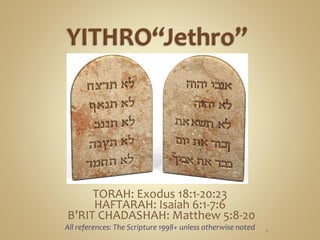
TORAH: Exodus 18:1-20:23
HAFTARAH: Isaiah 6:1-7:6
B’RIT CHADASHAH: Matthew 5:8-20
All references: The Scripture 1998+ unless otherwise noted 1
 And Yithro, the priest of Miḏyan, Mosheh’s father-in-law, heard
of all that Elohim had done for Mosheh and for Yisra’ĕl His people,
that ‫יהוה‬ had brought Yisra’ĕl out of Mitsrayim. (Exo 18:1)
 Yitro ("Jethro") visits Moses at Mount Sinai.
 Jethro means "excellence" or "eminence".
 He was also called Reuel, meaning "friend of God", which may
have been a personal name.
 He was Zipporah's father, and hence Moses' father-in-law who
cared for Moses’ family and kept them safe while Moses led the
Israelites out of Egypt.
 Scripture emphasizes the fact that Jethro was Moses’ father-
in-law twelve times in this chapter alone.
 Does “in-law” mean “in-covenant” and that he put His faith in
the God of Abraham, Isaac and Jacob, meaning he followed and
obeyed ‫’יהוה‬s commandments?
 This would have been a huge transformation for the former
Midianite priest.
 The father of the Midianites was Midian, a son of Avraham by
Keturah, his wife, after Sarah died.
 So, as a Midianite, Yithro was seed of Abraham; but, not
“according to the promise” as from Isaac.
 Yithro was just four generations from Abraham.
 Abraham would have taught his children the ways of ‫;יהוה‬
 Yah chose and ordained Yithro for his relationship with
Moses and enabled the wise and righteous counsel he gave
Moses.
 And, in this choosing, ‫יהוה‬ provided for Yithro’ s redemption,
and that of his house.
 As a “Priest of Midian”, Yithro would have led and
administered worship there.
 Midianites worshipped many mighty ones, including their
most powerful mighty one, “ba‟al pe‟or” (lord of light – a sun
deity).
 The rabbis teach that Yithro had understanding regarding
many pagan gods. So, why was he given ‫יהוה‬righteous
wisdom?
 Jethro was the family priest and a leader of the Midianites, a
people who had originated from Midian, a son of Abraham.
This made Moses and Jethro distant cousins.
 “Kohen”, references to “priest”; also refers to “king” or
“ruler”.
 The ancient Arabic rulers were often referred to as “priests”.
 Yithro was the “Ruler of Midyan”.
 while he lived amidst wealth and comfort, Yithro was
prepared to journey into the desert to hear the words of the
Torah.
 The name Yitro (Jethro), comes from the Hebrew root yeter,
meaning abundant or exceedingly abundant. God is able to do
exceedingly abundantly (yeter) more than we could ever ask or
think or imagine! (Ephesians 3:20)
 Yithro had recognized all the false deities in the world,
 He was aware of all the different media through which G-d
channels energy to the world.
 Despite his knowledge of these spiritual powers, he rejected
their worship, declaring:
Exo 18:11 “Now I know that the Lord is greater than all gods: for
in the thing wherein they dealt proudly he was above them.”
And Mosheh sent off his father-in-law, and he went away to his
own land. (Exodus 18:27)
And Mosheh said to Ḥoḇaḇ, the son of Reʽuw’ĕl the Miḏyanite,
Mosheh’s father-in-law, “We are setting out for the place of which
‫יהוה‬ said, ‘I give it to you.’ Come with us, and we shall do good to
you ..“And it shall be, when you go with us, then it shall be that
whatever good ‫יהוה‬ does to us, the same we shall do to you.”
(Numbers 10:29-32)
And Ḥeḇer the Qĕynite, of the children of Ḥoḇaḇ the father-in-law
of Mosheh, had separated himself from the Qĕynites and pitched
his tent near the terebinth tree at Tsaʽanayim, which is beside
Qeḏesh. (Judges 4:11)
 We see that Yithro becomes a convert, along with his son
Hobab. And, even though Yithro (Re‟uwel) returns to the land of
his birth, his son goes on to sojourn with Israel and inherit the
Land of Promise.
 The name “Hobab” (Chet-bet-bet) means “cherished” or
literally “whom I have loved”.
 The numeric value of the letters in Hobab is 12 which equals
“abadah” or “he who was lost”,
 Elohim indeed “loves he who was lost”.
 Also 12 is the numeric value of the word “dagah” which is
“fish”. Fish in Scripture refers to the Kingdom of Israel.
 Torah teaches there is one Torah for all Israel and the
“stranger” who sojourns with Israel, Exodus 12:49, Leviticus 18:26 &
19:33-34 and Number’s 15:15-16 , other verses.
 Torah speaks of the “stranger” who sojourns with Israel 70
times and how HaShem loves him and how all Israel is to love
him also.
Exodus 12:43-49 And ‫יהוה‬ said to Mosheh and Aharon, “This is
the law of the Passover: No son of a stranger is to eat of it, but
any servant a man has bought for silver, when you have
circumcised him, then let him eat of it. ..“All the congregation of
Yisra’ĕl are to perform it. “And when a stranger sojourns with
you and shall perform the Passover to ‫,יהוה‬ let all his males be
circumcised, and then let him come near and perform it, and he
shall be as a native of the land. But let no uncircumcised eat of it.
“There is one Torah for the native-born and for the stranger who
sojourns among you.”
 We are all “converts” before Him.
 The term “ger toshav” for “stranger who sojourns”.
 “Toshav” comes from the same root as “teshuva” or “to
repent” or “turn back” to Elohim.
 through Genesis we wee the words “stranger” and
“sojourner” with regard to Abraham, Isaac and Jacob. They
appear 14 times in Genesis alone in reference to our
forefathers and their seed.
 We are all “ger” or “sojourners” in a land that isn’t ours; but
HaShem‟s. We have all come to be “ger toshav”, or “converts”
by His “chesed” (“loving kindness” or “mercy”) and “chen”
(“favor” or “grace”).
 No one can claim that the Torah belongs to them by
birthright or through ancestral merit. As Elohim chose the
Children of Israel to receive the revelation of Torah and to
bring the Torah and Elohim’s wisdom to the rest of the world,
He made sure to include those sojourning with Israel, including
Yithro and his family.
 In Elohim, there is no room for pride or arrogance.
And Mosheh told his father-in-law all that ‫יהוה‬ had done to Pharaoh
and to the Mitsrites for Yisra’ĕl’s sake, all the hardship that had come
upon them on the way, and how ‫יהוה‬ had delivered them. And Yithro
rejoiced for all the good which ‫יהוה‬ had done for Yisra’ĕl, ..And Yithro
said, “Blessed be ‫,יהוה‬ who has delivered you out of the hand of the
Mitsrites and out of the hand of Pharaoh, and who has delivered the
people from under the hand of the Mitsrites. “Now I know that ‫יהוה‬ is
greater than all the mighty ones, indeed in the matter in which they
acted proudly, above them.” Then Yithro, the father-in-law of Mosheh,
brought a burnt offering and other slaughterings unto Elohim. And
Aharon came with all the elders of Yisra’ĕl to eat bread with the father-
in-law of Mosheh before Elohim. (Exodus 18:8-12)
 After the sacrifice for his past innocent sins, Aaron and the
elders of Israel came and broke bread with Jethro in the
presence of ‫,יהוה‬ sealing and confirming that Jethro had
indeed come into a covenant relationship with ‫.יהוה‬
 And it came to be, on the next day, that Mosheh sat to rightly rule
the people. And the people stood before Mosheh from morning until
evening. And when the father-in-law of Mosheh saw all that he did for
the people, he said...Stand before Elohim for the people, and you shall
bring the matters to Elohim. “And you shall enlighten them concerning
the laws and the Torot, and show them the way in which they should
walk and the work which they do. “But you yourself, seek out from all
the people able men, who fear Elohim, men of truth, hating unfair gain.
And place these over them to be rulers of thousands, rulers of
hundreds, rulers of fifties, and rulers of tens. .. the hard matters they
brought to Mosheh, but they rightly ruled every small matter
themselves. (Exodus 18:13-26)
 Jethro began to teach Moses how to administer good
leadership allowing Moses the freedom he needed.
 This also facilitated a way to educate ‫’יהוה‬s people on how
to walk in the living principles themselves and learn how to
discern the way of holiness through obeying ‫’יהוה‬s Word.
“And you shall enlighten them concerning the laws and the
Torot, and show them the way in which they should walk and the
work which they do. “But you yourself, seek out from all the
people able men, who fear Elohim, men of truth, hating unfair
gain. And place these over them to be rulers of thousands, rulers
of hundreds, rulers of fifties, and rulers of tens. (Exodus 18:20-21)
1. First, they must be "able men", men of accomplishment. These
people would most likely to be wise, have a knowledge of the law,
and be able to recognize truth over error in conflict.
2. Secondly, they must "fear God", the Holy One of Israel. Those who
reverence ‫,יהוה‬ will not be afraid of man, or be persuaded by
syrupy flattery or angry threats.
3. Thirdly, they must be contented "men of truth" who despise the
temptations that the love of recognition and money bears. The
leaders and judges must be those "hating covetousness”
4. Fourthly, these men would be "rulers of thousands, and rulers of
hundreds, rulers of fifties, and rulers of tens
And it came to be, on the third day in the morning, that there
were thunders and lightnings, and a thick cloud on the mountain.
And the sound of the ram’s horn was very loud, and all the
people who were in the camp trembled. And Mosheh brought
the people out of the camp to meet with Elohim, and they stood
at the foot of the mountain. And Mount Sinai was in smoke, all of
it, because ‫יהוה‬ descended upon it in fire. And its smoke went up
like the smoke of a furnace, and all the mountain trembled
exceedingly. And when the blast of the ram’s horn sounded long
and became louder and louder, Mosheh spoke, and Elohim
answered him by voice. And ‫יהוה‬ came down upon Mount Sinai,
on the top of the mountain. And ‫יהוה‬ called Mosheh to the top of
the mountain, and Mosheh went up. And ‫יהוה‬ said to Mosheh,
“Go down, and warn the people, lest they break through unto
‫יהוה‬ to see, and many of them fall. “And let the priests who come
near ‫יהוה‬ set themselves apart too, lest ‫יהוה‬ break out against
them.” ..(Exodus 19:16-25)
16
 ‫יהוה‬ stipulated a three-day consecration time for the Bride
before she came to meet her Betrothed at the Mountain of ‫יהוה‬ .
 As in a wedding, the bride makes herself ready. She changes
her clothes and washes herself before putting on clean clothes.
 This is called a mikvah (a bath) and is for a change of status.
 On the third day a very long blast was heard and a cloud
covered the mountain. The cloud covering became
the chuppah or covering under which ‫יהוה‬ came out to meet His
bride.
And when the Day of the Festival of Weeks had come, they were all
with one mind in one place. And suddenly there came a sound from
the heaven, as of a rushing mighty wind, and it filled all the house
where they were sitting. And there appeared to them divided
tongues, as of fire, and settled on each one of them. And they were
all filled with the Set-apart Spirit and began to speak with other
tongues, as the Spirit gave them to speak. (Acts 2:1-4)
“I am ‫יהוה‬ your Elohim, who brought you out of the land of
Mitsrayim, out of the house of slavery. (Exodus 20:1-2)
 The Ten Commandments, begins with an unusual four-letter
word: “Anochi”. Verse 2 begins in the Hebrew with; “Anochi
‫יהוה‬ Elohecha…” or literally, “I ‫יהוה‬ your Elohim brought you out
of the land of Mitsrayim, out of the house of slavery”.
 There is no “who” in the Hebrew. The word “Anochi” means
“I”. But, “ani” is the common Hebrew pronoun for “I.” So, why
did HaShem use “Anochi”?
 The letters, Aleph-nun-kaf-yud, are an acronym for “Ana
Nafshi Ketovit Yehovit”.
 This literally means, “My Soul Wrote Gave” in other words,
“My Soul I wrote and Gave to You”. 18
“I am ‫יהוה‬ your Elohim, who brought you out of the land of
Mitsrayim, out of the house of slavery. (Exodus 20:1-2)
 In what we‟re about to read, the Ten Commandments, is the
very soul (Nafshi – the personal form of Nefesh) of our Creator
King. In fact, by inscribing His very “Soul” into His Words, we
can see how these Words of His, renew our minds and
transform us.
19
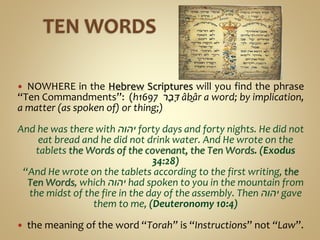
 NOWHERE in the Hebrew Scriptures will you find the phrase
“Ten Commandments”: (h1697 ‫ר‬ָ‫ב‬ָ‫דּ‬ âḇâr a word; by implication,
a matter (as spoken of) or thing;)
And he was there with ‫יהוה‬ forty days and forty nights. He did not
eat bread and he did not drink water. And He wrote on the
tablets the Words of the covenant, the Ten Words. (Exodus
34:28)
“And He wrote on the tablets according to the first writing, the
Ten Words, which ‫יהוה‬ had spoken to you in the mountain from
the midst of the fire in the day of the assembly. Then ‫יהוה‬ gave
them to me, (Deuteronomy 10:4)
 the meaning of the word “Torah” is “Instructions” not “Law”.
21
 The first five commandments deal with our relationship with
God. The second five deal with our relations with our neighbour.
 The rabbis say that all 613 principles can be found in the Ten
prophetic statements given at Mount Sinai.
 Understanding ‫’יהוה‬s teaching and instruction for marriage
and obeying them consecrates the Bride as she enters her walk
of redemption, bringing her toward holiness, ready, without
spot or wrinkle, to her Bridegroom on His wedding day.
 Note: If you find this hard to keep 613 commandments of the
Torah, please be advised of the fact that there are about 1050
commandments in the Apostolic Scriptures (New Testament)!
22
 The Ten Words were revealed simultaneously, in a manner
that would have been impossible to articulate.
 If the Almighty spoke all the Ten Words at once, no one
could possibly have even understood one word!!
 The sages note that perhaps the people did not “hear” at all!!
The verse immediately following the Ten Words states:
And all the people saw the thunders, the lightning flashes, the
sound of the ram’s horn, and the mountain smoking. And the
people saw it, and they trembled and stood at a distance, and
said to Mosheh, “You speak with us and we hear, but let not
Elohim speak with us, lest we die.” (Exodus 20:18-19)
23
24
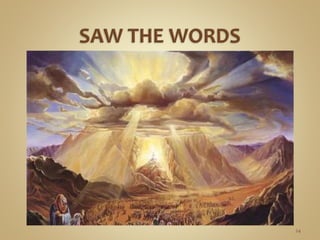
 A more literal translation says that the people were “seeing
the voices.”
 It does not say that the people “heard” the words of Elohim.
The text says that they “saw” the voices, the flames, the sound
of the shofar and the Mount smoking.
 These things frightened them, and they asked Moshe to
speak that they might instead “hear” from him.
25
And ‫יהוה‬ said to Mosheh, “Say this to the children of Yisra’ĕl:
‘You yourselves have seen that I have spoken to you from the
heavens. (Exodus 20:22)
 Torah says that the people “saw the sounds”, they actually
“saw” that which is usually “heard”.
 To “see” the glory of the Word of Elohim with our own
eyes…does this sound familiar?!!
And the Word became flesh and pitched His tent1 among us, and
we saw His esteem, esteem as of an only brought-forth of a
father, complete in favour and truth. (John 1:14)
 On the Mountain, we have ‫יהוה‬ speaking in a miraculous way
in which the people could “see” what is normally “heard”. It
was a completely supernatural experience. No one could
possibly doubt that its source was ‫.יהוה‬ 26
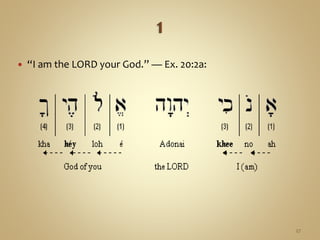
 “I am the LORD your God.” — Ex. 20:2a:
27
“I am ‫יהוה‬ your Elohim, who brought you out of the land of
Mitsrayim, out of the house of slavery. (Exodus 20:2)
 Know that there is an Elohim. Don't just believe in Him; seek
to know intellectually as well as emotionally, through the
design of His creation and genius of Torah.
 The First Word impresses on us that “we must know” this
Elohim before we can even go on to the rest of the
Words/Commandments.
28
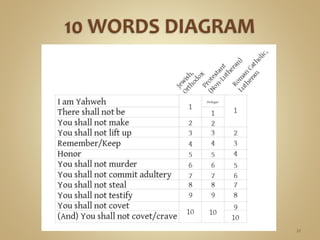
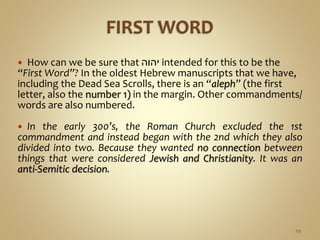
 How can we be sure that ‫יהוה‬ intended for this to be the
“First Word”? In the oldest Hebrew manuscripts that we have,
including the Dead Sea Scrolls, there is an “aleph” (the first
letter, also the number 1) in the margin. Other commandments/
words are also numbered.
 In the early 300’s, the Roman Church excluded the 1st
commandment and instead began with the 2nd which they also
divided into two. Because they wanted no connection between
things that were considered Jewish and Christianity. It was an
anti-Semitic decision.
29
 This First Word is the way ‫יהוה‬ has chosen to define who He
is. ...“your Elohim who brought you out of the land of Egypt,
out of the house of bondage”
 Why didn’t He say, “I am the Elohim who created the heavens
and the earth?” Or, “I am the Elohim who has ultimate power on
the earth?”... What else could He have been saying?
• By referring to their bondage in Egypt, He was referencing that
He was their covenant Elohim. The experiences they had had
leaving Egypt pointed them back to the fulfilment of the
covenant promise made to Abram. (Genesis 15:12)
• ‫יהוה‬ had delivered them from serving Pharaoh and now it was
Him they were to be serving (Exodus 9:13)
• He says, “I am YOUR Elohim”….your Master. He had redeemed
them from slavery in order that they might become His bride.30
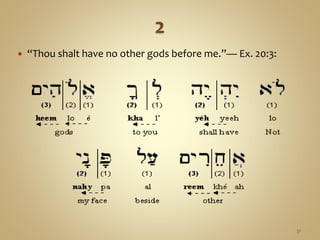
 “Thou shalt have no other gods before me.”— Ex. 20:3:
31
 The Hebrew words in Torah here are “phasal” (fey-samech-
lamed) for “carved (or graven) image”, which means “carved”,
“molded”, “fashioned” or “made”. And, “te‟moonah” (tav-
mem-yud-nun-hey) for “likeness” which is “appearance” or
“image”.
“Therefore, diligently guard yourselves, for you saw no form
when ‫יהוה‬ spoke to you at Ḥorĕḇ out of the midst of the fire, lest
you should do corruptly and shall make for yourselves a carved
image in the form of any figure – the likeness of male or female,
(Deuteronomy 4:15-16)
32
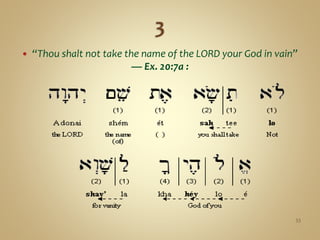
 “Thou shalt not take the name of the LORD your God in vain”
— Ex. 20:7a :
33
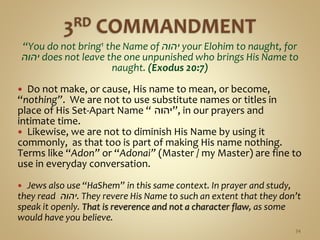
“You do not bring1 the Name of ‫יהוה‬ your Elohim to naught, for
‫יהוה‬ does not leave the one unpunished who brings His Name to
naught. (Exodus 20:7)
 Do not make, or cause, His name to mean, or become,
“nothing”. We are not to use substitute names or titles in
place of His Set-Apart Name “ ‫,”יהוה‬ in our prayers and
intimate time.
 Likewise, we are not to diminish His Name by using it
commonly, as that too is part of making His name nothing.
Terms like “Adon” or “Adonai” (Master / my Master) are fine to
use in everyday conversation.
 Jews also use “HaShem” in this same context. In prayer and study,
they read ‫.יהוה‬ They revere His Name to such an extent that they don’t
speak it openly. That is reverence and not a character flaw, as some
would have you believe.
34
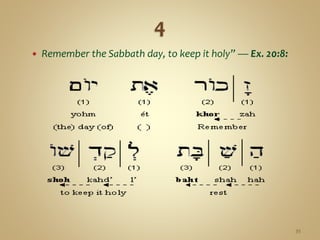
 Remember the Sabbath day, to keep it holy” — Ex. 20:8:
35
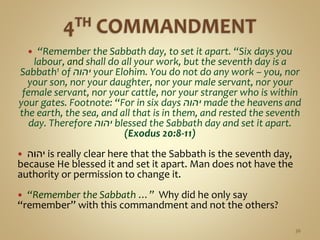
 “Remember the Sabbath day, to set it apart. “Six days you
labour, and shall do all your work, but the seventh day is a
Sabbath1 of ‫יהוה‬ your Elohim. You do not do any work – you, nor
your son, nor your daughter, nor your male servant, nor your
female servant, nor your cattle, nor your stranger who is within
your gates. Footnote: “For in six days ‫יהוה‬ made the heavens and
the earth, the sea, and all that is in them, and rested the seventh
day. Therefore ‫יהוה‬ blessed the Sabbath day and set it apart.
(Exodus 20:8-11)
 ‫יהוה‬ is really clear here that the Sabbath is the seventh day,
because He blessed it and set it apart. Man does not have the
authority or permission to change it.
 “Remember the Sabbath …” Why did he only say
“remember” with this commandment and not the others?
36
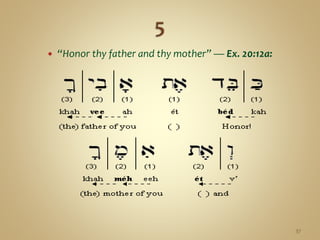
 “Honor thy father and thy mother” — Ex. 20:12a:
37
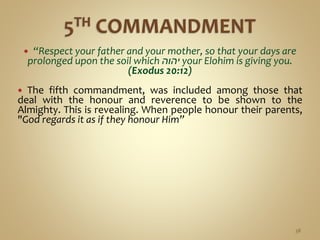
 “Respect your father and your mother, so that your days are
prolonged upon the soil which ‫יהוה‬ your Elohim is giving you.
(Exodus 20:12)
 The fifth commandment, was included among those that
deal with the honour and reverence to be shown to the
Almighty. This is revealing. When people honour their parents,
"God regards it as if they honour Him”
38
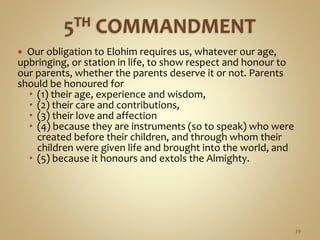
 Our obligation to Elohim requires us, whatever our age,
upbringing, or station in life, to show respect and honour to
our parents, whether the parents deserve it or not. Parents
should be honoured for
 (1) their age, experience and wisdom,
 (2) their care and contributions,
 (3) their love and affection
 (4) because they are instruments (so to speak) who were
created before their children, and through whom their
children were given life and brought into the world, and
 (5) because it honours and extols the Almighty.
39
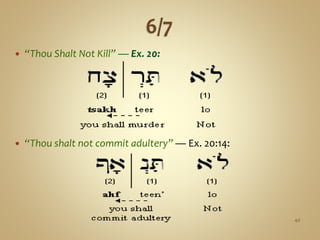
 “Thou Shalt Not Kill” — Ex. 20:
 “Thou shalt not commit adultery” — Ex. 20:14:
40
“You do not murder. (Exodus 20:13)
 The Hebrew word here is “ratsach” (reish-tzadee-chet),
which means to “break in pieces” and has the connotation of
pre-meditated murder or assassination. In all of Jewish
literature, it has always been taught to include hatred and
desiring to see someone harmed.
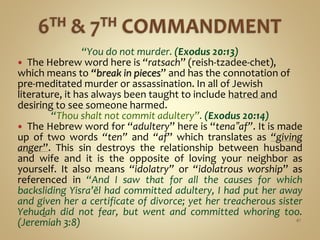
“Thou shalt not commit adultery”. (Exodus 20:14)
 The Hebrew word for “adultery” here is “tena‟af”. It is made
up of two words “ten” and “af” which translates as “giving
anger”. This sin destroys the relationship between husband
and wife and it is the opposite of loving your neighbor as
yourself. It also means “idolatry” or “idolatrous worship” as
referenced in “And I saw that for all the causes for which
backsliding Yisra’ĕl had committed adultery, I had put her away
and given her a certificate of divorce; yet her treacherous sister
Yehuḏah did not fear, but went and committed whoring too.
(Jeremiah 3:8) 41
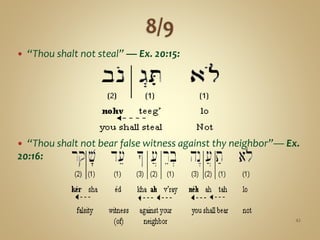
 “Thou shalt not steal” — Ex. 20:15:
 “Thou shalt not bear false witness against thy neighbor”— Ex.
20:16:
42
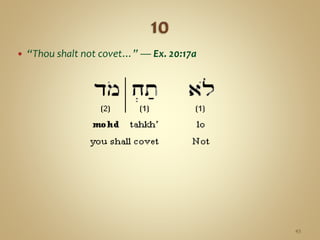
 “Thou shalt not covet…” — Ex. 20:17a
43
“You do not steal. (Exodus 20:15)
 This refers to more than money or property. It refers to
deceiving someone, kidnapping or taking that which pertains
to someone's livelihood.
“You do not bear false witness against your neighbour. (Exo
20:16)
“You do not covet your neighbour’s house, you do not covet your
neighbour’s wife, nor his male servant, nor his female servant,
nor his ox, nor his donkey, or whatever belongs to your
neighbour.” (Exodus 20:17)
 The Hebrew word here is “chamad” which means to “desire”
or “delight in” ; to “fantasize about” having that which is your
neighbour's; thereby, causing you to dislike or, according to
Scripture, “hate” or “loathe” that which is yours. It creates or
sets up idolatry / adultery in your heart for whatever is
someone else's.
44
45
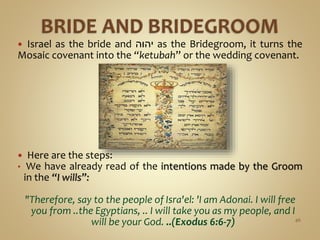
 Israel as the bride and ‫יהוה‬ as the Bridegroom, it turns the
Mosaic covenant into the “ketubah” or the wedding covenant.
 Here are the steps:
• We have already read of the intentions made by the Groom
in the “I wills”:
"Therefore, say to the people of Isra'el: 'I am Adonai. I will free
you from ..the Egyptians, .. I will take you as my people, and I
will be your God. ..(Exodus 6:6-7) 46
• The bride is set apart in order to
prepare for the wedding.
• Israel was set apart as she was
brought into the wilderness where
her character was transformed. This
is also called sanctification, or the
process of being made holy.
• For Israel, this was to happen during
the period we know as the
“Counting of the Omer”
47
• The formal proposal:
‘And now, if you diligently obey My voice, and shall guard My
covenant, then you shall be My treasured possession above all
the peoples – for all the earth is Mine – (Exodus 19:5)
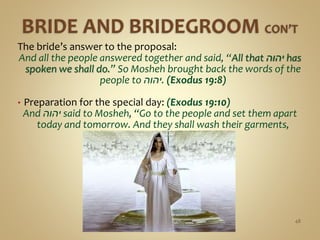
The bride’s answer to the proposal:
And all the people answered together and said, “All that ‫יהוה‬ has
spoken we shall do.” So Mosheh brought back the words of the
people to ‫.יהוה‬ (Exodus 19:8)
• Preparation for the special day: (Exodus 19:10)
And ‫יהוה‬ said to Mosheh, “Go to the people and set them apart
today and tomorrow. And they shall wash their garments,
48
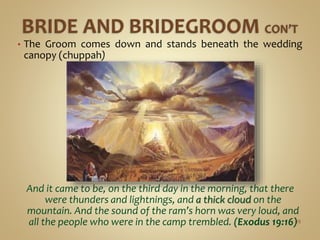
• The Groom comes down and stands beneath the wedding
canopy (chuppah)
And it came to be, on the third day in the morning, that there
were thunders and lightnings, and a thick cloud on the
mountain. And the sound of the ram’s horn was very loud, and
all the people who were in the camp trembled. (Exodus 19:16)49
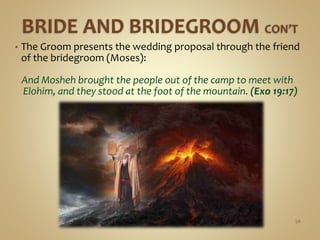
• The Groom presents the wedding proposal through the friend
of the bridegroom (Moses):
And Mosheh brought the people out of the camp to meet with
Elohim, and they stood at the foot of the mountain. (Exo 19:17)
50
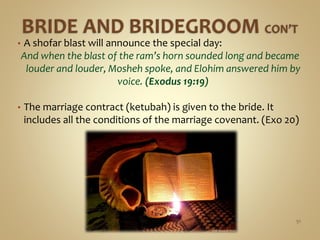
• A shofar blast will announce the special day:
And when the blast of the ram’s horn sounded long and became
louder and louder, Mosheh spoke, and Elohim answered him by
voice. (Exodus 19:19)
• The marriage contract (ketubah) is given to the bride. It
includes all the conditions of the marriage covenant. (Exo 20)
51
• The token of the covenant symbolizing its permanence:
‘And the children of Yisra’ĕl shall guard the Sabbath, to observe
the Sabbath throughout their generations as an everlasting
covenant. (Exodus 31:16)
52
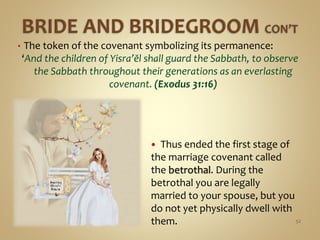
 Thus ended the first stage of
the marriage covenant called
the betrothal. During the
betrothal you are legally
married to your spouse, but you
do not yet physically dwell with
them.
 Jeremiah provides us with more insights into the betrothal of
Israel in the wilderness:
And the word of ‫יהוה‬ came to me, saying, “Go, and you shall cry
in the hearing of Yerushalayim, saying, ‘Thus said ‫,יהוה‬ “I
remember you, the kindness of your youth, the love of your
bridehood, when you went after Me in the wilderness, in a land
that was not sown. “Yisra’ĕl was set-apart to ‫,יהוה‬ the first-fruits
of His increase. All who ate of it became guilty – evil came upon
them,” declares ‫’.יהוה‬ ” (Jeremiah 2:1-3)
 We are also in the stage of betrothal with our Bridegroom if
we are in a personal relationship with our Messiah ‫.יהושע‬
 We are legally married, yet we do not yet physically dwell
with Him.
 We have the same marriage contract as that given to the
Israelites and the same token of the covenant (Shabbat). 53
 The Jews say it is them. The church insists that they are the
bride.
 Is ‫/הוה‬Yehushua a polygamist?
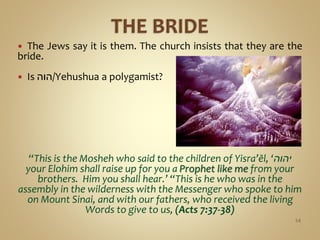
“This is the Mosheh who said to the children of Yisra’ĕl, ‘‫יהוה‬
your Elohim shall raise up for you a Prophet like me from your
brothers. Him you shall hear.’ “This is he who was in the
assembly in the wilderness with the Messenger who spoke to him
on Mount Sinai, and with our fathers, who received the living
Words to give to us, (Acts 7:37-38)
54
 “Assembly” is the Greek ecclesia which is translated as
“church”.
 The assembly, Israel, the church…it’s the same entity in Acts
as it was in Exodus.
 The “church” was not a separate entity that was “born” on
Shavuot/Pentecost as pictured in the book of Acts.
 This same assembly was present at Shavuot/Pentecost on
Mt. Sinai.
 And the “Prophet like me” becomes identified in Acts 7:38 as
Yehushua. He was the One who spoke to the children of Israel
on the Mountain.
 So the answer as to who is the bride…it is all who “hear” the
“prophet like Moshe” and who “receive the living oracles” which
was the living Word of Elohim spoken on Mt. Sinai. 55
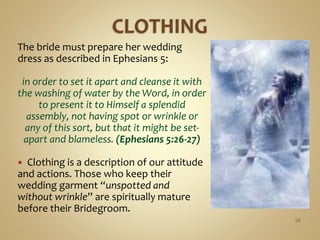
The bride must prepare her wedding
dress as described in Ephesians 5:
in order to set it apart and cleanse it with
the washing of water by the Word, in order
to present it to Himself a splendid
assembly, not having spot or wrinkle or
any of this sort, but that it might be set-
apart and blameless. (Ephesians 5:26-27)
 Clothing is a description of our attitude
and actions. Those who keep their
wedding garment “unspotted and
without wrinkle” are spiritually mature
before their Bridegroom.
56
 Consider these verses:
And the armies in the heaven, dressed in fine linen, white and
clean, followed Him on white horses. (Revelation 19:14)
“See, I am coming as a thief. Blessed is he who is staying awake
and guarding his garments, lest he walk naked and they see his
shame.” (Revelation 16:15)
57
 Much of what was written in the Brit Chadasha was to
exhort believers to strive to overcome the desires of the flesh,
be obedient, and to seek to grow in the maturity that would
clothe them in the proper wedding attire. It is not unlike the
transformation process that we’ve seen happening in Exodus.
Now consider Paul’s words:
 For I am jealous for you with a jealousy according to Elohim.
For I gave you in marriage to one husband, to present you as an
innocent maiden to Messiah. (2 Corinthians 11:2)
 For this is the goal:
“Let us be glad and rejoice and give Him praise, for the marriage
of the Lamb has come, and His wife prepared herself.” And to her
it was given to be dressed in fine linen, clean and bright, for the
fine linen is the righteousnesses of the set-apart ones.
(Revelation 19:7-8)
58
59

Yitro 2015 2

  • 1.
    TORAH: Exodus 18:1-20:23 HAFTARAH:Isaiah 6:1-7:6 B’RIT CHADASHAH: Matthew 5:8-20 All references: The Scripture 1998+ unless otherwise noted 1
  • 4.
     And Yithro,the priest of Miḏyan, Mosheh’s father-in-law, heard of all that Elohim had done for Mosheh and for Yisra’ĕl His people, that ‫יהוה‬ had brought Yisra’ĕl out of Mitsrayim. (Exo 18:1)  Yitro ("Jethro") visits Moses at Mount Sinai.  Jethro means "excellence" or "eminence".  He was also called Reuel, meaning "friend of God", which may have been a personal name.  He was Zipporah's father, and hence Moses' father-in-law who cared for Moses’ family and kept them safe while Moses led the Israelites out of Egypt.  Scripture emphasizes the fact that Jethro was Moses’ father- in-law twelve times in this chapter alone.  Does “in-law” mean “in-covenant” and that he put His faith in the God of Abraham, Isaac and Jacob, meaning he followed and obeyed ‫’יהוה‬s commandments?  This would have been a huge transformation for the former Midianite priest.
  • 5.
     The fatherof the Midianites was Midian, a son of Avraham by Keturah, his wife, after Sarah died.  So, as a Midianite, Yithro was seed of Abraham; but, not “according to the promise” as from Isaac.  Yithro was just four generations from Abraham.  Abraham would have taught his children the ways of ‫;יהוה‬  Yah chose and ordained Yithro for his relationship with Moses and enabled the wise and righteous counsel he gave Moses.  And, in this choosing, ‫יהוה‬ provided for Yithro’ s redemption, and that of his house.  As a “Priest of Midian”, Yithro would have led and administered worship there.  Midianites worshipped many mighty ones, including their most powerful mighty one, “ba‟al pe‟or” (lord of light – a sun deity).  The rabbis teach that Yithro had understanding regarding many pagan gods. So, why was he given ‫יהוה‬righteous wisdom?
  • 6.
     Jethro wasthe family priest and a leader of the Midianites, a people who had originated from Midian, a son of Abraham. This made Moses and Jethro distant cousins.  “Kohen”, references to “priest”; also refers to “king” or “ruler”.  The ancient Arabic rulers were often referred to as “priests”.  Yithro was the “Ruler of Midyan”.  while he lived amidst wealth and comfort, Yithro was prepared to journey into the desert to hear the words of the Torah.  The name Yitro (Jethro), comes from the Hebrew root yeter, meaning abundant or exceedingly abundant. God is able to do exceedingly abundantly (yeter) more than we could ever ask or think or imagine! (Ephesians 3:20)
  • 7.
     Yithro hadrecognized all the false deities in the world,  He was aware of all the different media through which G-d channels energy to the world.  Despite his knowledge of these spiritual powers, he rejected their worship, declaring: Exo 18:11 “Now I know that the Lord is greater than all gods: for in the thing wherein they dealt proudly he was above them.”
  • 8.
    And Mosheh sentoff his father-in-law, and he went away to his own land. (Exodus 18:27) And Mosheh said to Ḥoḇaḇ, the son of Reʽuw’ĕl the Miḏyanite, Mosheh’s father-in-law, “We are setting out for the place of which ‫יהוה‬ said, ‘I give it to you.’ Come with us, and we shall do good to you ..“And it shall be, when you go with us, then it shall be that whatever good ‫יהוה‬ does to us, the same we shall do to you.” (Numbers 10:29-32)
  • 9.
    And Ḥeḇer theQĕynite, of the children of Ḥoḇaḇ the father-in-law of Mosheh, had separated himself from the Qĕynites and pitched his tent near the terebinth tree at Tsaʽanayim, which is beside Qeḏesh. (Judges 4:11)  We see that Yithro becomes a convert, along with his son Hobab. And, even though Yithro (Re‟uwel) returns to the land of his birth, his son goes on to sojourn with Israel and inherit the Land of Promise.  The name “Hobab” (Chet-bet-bet) means “cherished” or literally “whom I have loved”.  The numeric value of the letters in Hobab is 12 which equals “abadah” or “he who was lost”,  Elohim indeed “loves he who was lost”.  Also 12 is the numeric value of the word “dagah” which is “fish”. Fish in Scripture refers to the Kingdom of Israel.
  • 10.
     Torah teachesthere is one Torah for all Israel and the “stranger” who sojourns with Israel, Exodus 12:49, Leviticus 18:26 & 19:33-34 and Number’s 15:15-16 , other verses.  Torah speaks of the “stranger” who sojourns with Israel 70 times and how HaShem loves him and how all Israel is to love him also. Exodus 12:43-49 And ‫יהוה‬ said to Mosheh and Aharon, “This is the law of the Passover: No son of a stranger is to eat of it, but any servant a man has bought for silver, when you have circumcised him, then let him eat of it. ..“All the congregation of Yisra’ĕl are to perform it. “And when a stranger sojourns with you and shall perform the Passover to ‫,יהוה‬ let all his males be circumcised, and then let him come near and perform it, and he shall be as a native of the land. But let no uncircumcised eat of it. “There is one Torah for the native-born and for the stranger who sojourns among you.”
  • 11.
     We areall “converts” before Him.  The term “ger toshav” for “stranger who sojourns”.  “Toshav” comes from the same root as “teshuva” or “to repent” or “turn back” to Elohim.  through Genesis we wee the words “stranger” and “sojourner” with regard to Abraham, Isaac and Jacob. They appear 14 times in Genesis alone in reference to our forefathers and their seed.  We are all “ger” or “sojourners” in a land that isn’t ours; but HaShem‟s. We have all come to be “ger toshav”, or “converts” by His “chesed” (“loving kindness” or “mercy”) and “chen” (“favor” or “grace”).
  • 12.
     No onecan claim that the Torah belongs to them by birthright or through ancestral merit. As Elohim chose the Children of Israel to receive the revelation of Torah and to bring the Torah and Elohim’s wisdom to the rest of the world, He made sure to include those sojourning with Israel, including Yithro and his family.  In Elohim, there is no room for pride or arrogance.
  • 13.
    And Mosheh toldhis father-in-law all that ‫יהוה‬ had done to Pharaoh and to the Mitsrites for Yisra’ĕl’s sake, all the hardship that had come upon them on the way, and how ‫יהוה‬ had delivered them. And Yithro rejoiced for all the good which ‫יהוה‬ had done for Yisra’ĕl, ..And Yithro said, “Blessed be ‫,יהוה‬ who has delivered you out of the hand of the Mitsrites and out of the hand of Pharaoh, and who has delivered the people from under the hand of the Mitsrites. “Now I know that ‫יהוה‬ is greater than all the mighty ones, indeed in the matter in which they acted proudly, above them.” Then Yithro, the father-in-law of Mosheh, brought a burnt offering and other slaughterings unto Elohim. And Aharon came with all the elders of Yisra’ĕl to eat bread with the father- in-law of Mosheh before Elohim. (Exodus 18:8-12)  After the sacrifice for his past innocent sins, Aaron and the elders of Israel came and broke bread with Jethro in the presence of ‫,יהוה‬ sealing and confirming that Jethro had indeed come into a covenant relationship with ‫.יהוה‬
  • 14.
     And itcame to be, on the next day, that Mosheh sat to rightly rule the people. And the people stood before Mosheh from morning until evening. And when the father-in-law of Mosheh saw all that he did for the people, he said...Stand before Elohim for the people, and you shall bring the matters to Elohim. “And you shall enlighten them concerning the laws and the Torot, and show them the way in which they should walk and the work which they do. “But you yourself, seek out from all the people able men, who fear Elohim, men of truth, hating unfair gain. And place these over them to be rulers of thousands, rulers of hundreds, rulers of fifties, and rulers of tens. .. the hard matters they brought to Mosheh, but they rightly ruled every small matter themselves. (Exodus 18:13-26)  Jethro began to teach Moses how to administer good leadership allowing Moses the freedom he needed.  This also facilitated a way to educate ‫’יהוה‬s people on how to walk in the living principles themselves and learn how to discern the way of holiness through obeying ‫’יהוה‬s Word.
  • 15.
    “And you shallenlighten them concerning the laws and the Torot, and show them the way in which they should walk and the work which they do. “But you yourself, seek out from all the people able men, who fear Elohim, men of truth, hating unfair gain. And place these over them to be rulers of thousands, rulers of hundreds, rulers of fifties, and rulers of tens. (Exodus 18:20-21) 1. First, they must be "able men", men of accomplishment. These people would most likely to be wise, have a knowledge of the law, and be able to recognize truth over error in conflict. 2. Secondly, they must "fear God", the Holy One of Israel. Those who reverence ‫,יהוה‬ will not be afraid of man, or be persuaded by syrupy flattery or angry threats. 3. Thirdly, they must be contented "men of truth" who despise the temptations that the love of recognition and money bears. The leaders and judges must be those "hating covetousness” 4. Fourthly, these men would be "rulers of thousands, and rulers of hundreds, rulers of fifties, and rulers of tens
  • 16.
    And it cameto be, on the third day in the morning, that there were thunders and lightnings, and a thick cloud on the mountain. And the sound of the ram’s horn was very loud, and all the people who were in the camp trembled. And Mosheh brought the people out of the camp to meet with Elohim, and they stood at the foot of the mountain. And Mount Sinai was in smoke, all of it, because ‫יהוה‬ descended upon it in fire. And its smoke went up like the smoke of a furnace, and all the mountain trembled exceedingly. And when the blast of the ram’s horn sounded long and became louder and louder, Mosheh spoke, and Elohim answered him by voice. And ‫יהוה‬ came down upon Mount Sinai, on the top of the mountain. And ‫יהוה‬ called Mosheh to the top of the mountain, and Mosheh went up. And ‫יהוה‬ said to Mosheh, “Go down, and warn the people, lest they break through unto ‫יהוה‬ to see, and many of them fall. “And let the priests who come near ‫יהוה‬ set themselves apart too, lest ‫יהוה‬ break out against them.” ..(Exodus 19:16-25) 16
  • 17.
     ‫יהוה‬ stipulateda three-day consecration time for the Bride before she came to meet her Betrothed at the Mountain of ‫יהוה‬ .  As in a wedding, the bride makes herself ready. She changes her clothes and washes herself before putting on clean clothes.  This is called a mikvah (a bath) and is for a change of status.  On the third day a very long blast was heard and a cloud covered the mountain. The cloud covering became the chuppah or covering under which ‫יהוה‬ came out to meet His bride. And when the Day of the Festival of Weeks had come, they were all with one mind in one place. And suddenly there came a sound from the heaven, as of a rushing mighty wind, and it filled all the house where they were sitting. And there appeared to them divided tongues, as of fire, and settled on each one of them. And they were all filled with the Set-apart Spirit and began to speak with other tongues, as the Spirit gave them to speak. (Acts 2:1-4)
  • 18.
    “I am ‫יהוה‬your Elohim, who brought you out of the land of Mitsrayim, out of the house of slavery. (Exodus 20:1-2)  The Ten Commandments, begins with an unusual four-letter word: “Anochi”. Verse 2 begins in the Hebrew with; “Anochi ‫יהוה‬ Elohecha…” or literally, “I ‫יהוה‬ your Elohim brought you out of the land of Mitsrayim, out of the house of slavery”.  There is no “who” in the Hebrew. The word “Anochi” means “I”. But, “ani” is the common Hebrew pronoun for “I.” So, why did HaShem use “Anochi”?  The letters, Aleph-nun-kaf-yud, are an acronym for “Ana Nafshi Ketovit Yehovit”.  This literally means, “My Soul Wrote Gave” in other words, “My Soul I wrote and Gave to You”. 18
  • 19.
    “I am ‫יהוה‬your Elohim, who brought you out of the land of Mitsrayim, out of the house of slavery. (Exodus 20:1-2)  In what we‟re about to read, the Ten Commandments, is the very soul (Nafshi – the personal form of Nefesh) of our Creator King. In fact, by inscribing His very “Soul” into His Words, we can see how these Words of His, renew our minds and transform us. 19
  • 20.
     NOWHERE inthe Hebrew Scriptures will you find the phrase “Ten Commandments”: (h1697 ‫ר‬ָ‫ב‬ָ‫דּ‬ âḇâr a word; by implication, a matter (as spoken of) or thing;) And he was there with ‫יהוה‬ forty days and forty nights. He did not eat bread and he did not drink water. And He wrote on the tablets the Words of the covenant, the Ten Words. (Exodus 34:28) “And He wrote on the tablets according to the first writing, the Ten Words, which ‫יהוה‬ had spoken to you in the mountain from the midst of the fire in the day of the assembly. Then ‫יהוה‬ gave them to me, (Deuteronomy 10:4)  the meaning of the word “Torah” is “Instructions” not “Law”.
  • 21.
  • 22.
     The firstfive commandments deal with our relationship with God. The second five deal with our relations with our neighbour.  The rabbis say that all 613 principles can be found in the Ten prophetic statements given at Mount Sinai.  Understanding ‫’יהוה‬s teaching and instruction for marriage and obeying them consecrates the Bride as she enters her walk of redemption, bringing her toward holiness, ready, without spot or wrinkle, to her Bridegroom on His wedding day.  Note: If you find this hard to keep 613 commandments of the Torah, please be advised of the fact that there are about 1050 commandments in the Apostolic Scriptures (New Testament)! 22
  • 23.
     The TenWords were revealed simultaneously, in a manner that would have been impossible to articulate.  If the Almighty spoke all the Ten Words at once, no one could possibly have even understood one word!!  The sages note that perhaps the people did not “hear” at all!! The verse immediately following the Ten Words states: And all the people saw the thunders, the lightning flashes, the sound of the ram’s horn, and the mountain smoking. And the people saw it, and they trembled and stood at a distance, and said to Mosheh, “You speak with us and we hear, but let not Elohim speak with us, lest we die.” (Exodus 20:18-19) 23
  • 24.
  • 25.
     A moreliteral translation says that the people were “seeing the voices.”  It does not say that the people “heard” the words of Elohim. The text says that they “saw” the voices, the flames, the sound of the shofar and the Mount smoking.  These things frightened them, and they asked Moshe to speak that they might instead “hear” from him. 25
  • 26.
    And ‫יהוה‬ saidto Mosheh, “Say this to the children of Yisra’ĕl: ‘You yourselves have seen that I have spoken to you from the heavens. (Exodus 20:22)  Torah says that the people “saw the sounds”, they actually “saw” that which is usually “heard”.  To “see” the glory of the Word of Elohim with our own eyes…does this sound familiar?!! And the Word became flesh and pitched His tent1 among us, and we saw His esteem, esteem as of an only brought-forth of a father, complete in favour and truth. (John 1:14)  On the Mountain, we have ‫יהוה‬ speaking in a miraculous way in which the people could “see” what is normally “heard”. It was a completely supernatural experience. No one could possibly doubt that its source was ‫.יהוה‬ 26
  • 27.
     “I amthe LORD your God.” — Ex. 20:2a: 27
  • 28.
    “I am ‫יהוה‬your Elohim, who brought you out of the land of Mitsrayim, out of the house of slavery. (Exodus 20:2)  Know that there is an Elohim. Don't just believe in Him; seek to know intellectually as well as emotionally, through the design of His creation and genius of Torah.  The First Word impresses on us that “we must know” this Elohim before we can even go on to the rest of the Words/Commandments. 28
  • 29.
     How canwe be sure that ‫יהוה‬ intended for this to be the “First Word”? In the oldest Hebrew manuscripts that we have, including the Dead Sea Scrolls, there is an “aleph” (the first letter, also the number 1) in the margin. Other commandments/ words are also numbered.  In the early 300’s, the Roman Church excluded the 1st commandment and instead began with the 2nd which they also divided into two. Because they wanted no connection between things that were considered Jewish and Christianity. It was an anti-Semitic decision. 29
  • 30.
     This FirstWord is the way ‫יהוה‬ has chosen to define who He is. ...“your Elohim who brought you out of the land of Egypt, out of the house of bondage”  Why didn’t He say, “I am the Elohim who created the heavens and the earth?” Or, “I am the Elohim who has ultimate power on the earth?”... What else could He have been saying? • By referring to their bondage in Egypt, He was referencing that He was their covenant Elohim. The experiences they had had leaving Egypt pointed them back to the fulfilment of the covenant promise made to Abram. (Genesis 15:12) • ‫יהוה‬ had delivered them from serving Pharaoh and now it was Him they were to be serving (Exodus 9:13) • He says, “I am YOUR Elohim”….your Master. He had redeemed them from slavery in order that they might become His bride.30
  • 31.
     “Thou shalthave no other gods before me.”— Ex. 20:3: 31
  • 32.
     The Hebrewwords in Torah here are “phasal” (fey-samech- lamed) for “carved (or graven) image”, which means “carved”, “molded”, “fashioned” or “made”. And, “te‟moonah” (tav- mem-yud-nun-hey) for “likeness” which is “appearance” or “image”. “Therefore, diligently guard yourselves, for you saw no form when ‫יהוה‬ spoke to you at Ḥorĕḇ out of the midst of the fire, lest you should do corruptly and shall make for yourselves a carved image in the form of any figure – the likeness of male or female, (Deuteronomy 4:15-16) 32
  • 33.
     “Thou shaltnot take the name of the LORD your God in vain” — Ex. 20:7a : 33
  • 34.
    “You do notbring1 the Name of ‫יהוה‬ your Elohim to naught, for ‫יהוה‬ does not leave the one unpunished who brings His Name to naught. (Exodus 20:7)  Do not make, or cause, His name to mean, or become, “nothing”. We are not to use substitute names or titles in place of His Set-Apart Name “ ‫,”יהוה‬ in our prayers and intimate time.  Likewise, we are not to diminish His Name by using it commonly, as that too is part of making His name nothing. Terms like “Adon” or “Adonai” (Master / my Master) are fine to use in everyday conversation.  Jews also use “HaShem” in this same context. In prayer and study, they read ‫.יהוה‬ They revere His Name to such an extent that they don’t speak it openly. That is reverence and not a character flaw, as some would have you believe. 34
  • 35.
     Remember theSabbath day, to keep it holy” — Ex. 20:8: 35
  • 36.
     “Remember theSabbath day, to set it apart. “Six days you labour, and shall do all your work, but the seventh day is a Sabbath1 of ‫יהוה‬ your Elohim. You do not do any work – you, nor your son, nor your daughter, nor your male servant, nor your female servant, nor your cattle, nor your stranger who is within your gates. Footnote: “For in six days ‫יהוה‬ made the heavens and the earth, the sea, and all that is in them, and rested the seventh day. Therefore ‫יהוה‬ blessed the Sabbath day and set it apart. (Exodus 20:8-11)  ‫יהוה‬ is really clear here that the Sabbath is the seventh day, because He blessed it and set it apart. Man does not have the authority or permission to change it.  “Remember the Sabbath …” Why did he only say “remember” with this commandment and not the others? 36
  • 37.
     “Honor thyfather and thy mother” — Ex. 20:12a: 37
  • 38.
     “Respect yourfather and your mother, so that your days are prolonged upon the soil which ‫יהוה‬ your Elohim is giving you. (Exodus 20:12)  The fifth commandment, was included among those that deal with the honour and reverence to be shown to the Almighty. This is revealing. When people honour their parents, "God regards it as if they honour Him” 38
  • 39.
     Our obligationto Elohim requires us, whatever our age, upbringing, or station in life, to show respect and honour to our parents, whether the parents deserve it or not. Parents should be honoured for  (1) their age, experience and wisdom,  (2) their care and contributions,  (3) their love and affection  (4) because they are instruments (so to speak) who were created before their children, and through whom their children were given life and brought into the world, and  (5) because it honours and extols the Almighty. 39
  • 40.
     “Thou ShaltNot Kill” — Ex. 20:  “Thou shalt not commit adultery” — Ex. 20:14: 40
  • 41.
    “You do notmurder. (Exodus 20:13)  The Hebrew word here is “ratsach” (reish-tzadee-chet), which means to “break in pieces” and has the connotation of pre-meditated murder or assassination. In all of Jewish literature, it has always been taught to include hatred and desiring to see someone harmed. “Thou shalt not commit adultery”. (Exodus 20:14)  The Hebrew word for “adultery” here is “tena‟af”. It is made up of two words “ten” and “af” which translates as “giving anger”. This sin destroys the relationship between husband and wife and it is the opposite of loving your neighbor as yourself. It also means “idolatry” or “idolatrous worship” as referenced in “And I saw that for all the causes for which backsliding Yisra’ĕl had committed adultery, I had put her away and given her a certificate of divorce; yet her treacherous sister Yehuḏah did not fear, but went and committed whoring too. (Jeremiah 3:8) 41
  • 42.
     “Thou shaltnot steal” — Ex. 20:15:  “Thou shalt not bear false witness against thy neighbor”— Ex. 20:16: 42
  • 43.
     “Thou shaltnot covet…” — Ex. 20:17a 43
  • 44.
    “You do notsteal. (Exodus 20:15)  This refers to more than money or property. It refers to deceiving someone, kidnapping or taking that which pertains to someone's livelihood. “You do not bear false witness against your neighbour. (Exo 20:16) “You do not covet your neighbour’s house, you do not covet your neighbour’s wife, nor his male servant, nor his female servant, nor his ox, nor his donkey, or whatever belongs to your neighbour.” (Exodus 20:17)  The Hebrew word here is “chamad” which means to “desire” or “delight in” ; to “fantasize about” having that which is your neighbour's; thereby, causing you to dislike or, according to Scripture, “hate” or “loathe” that which is yours. It creates or sets up idolatry / adultery in your heart for whatever is someone else's. 44
  • 45.
  • 46.
     Israel asthe bride and ‫יהוה‬ as the Bridegroom, it turns the Mosaic covenant into the “ketubah” or the wedding covenant.  Here are the steps: • We have already read of the intentions made by the Groom in the “I wills”: "Therefore, say to the people of Isra'el: 'I am Adonai. I will free you from ..the Egyptians, .. I will take you as my people, and I will be your God. ..(Exodus 6:6-7) 46
  • 47.
    • The brideis set apart in order to prepare for the wedding. • Israel was set apart as she was brought into the wilderness where her character was transformed. This is also called sanctification, or the process of being made holy. • For Israel, this was to happen during the period we know as the “Counting of the Omer” 47 • The formal proposal: ‘And now, if you diligently obey My voice, and shall guard My covenant, then you shall be My treasured possession above all the peoples – for all the earth is Mine – (Exodus 19:5)
  • 48.
    The bride’s answerto the proposal: And all the people answered together and said, “All that ‫יהוה‬ has spoken we shall do.” So Mosheh brought back the words of the people to ‫.יהוה‬ (Exodus 19:8) • Preparation for the special day: (Exodus 19:10) And ‫יהוה‬ said to Mosheh, “Go to the people and set them apart today and tomorrow. And they shall wash their garments, 48
  • 49.
    • The Groomcomes down and stands beneath the wedding canopy (chuppah) And it came to be, on the third day in the morning, that there were thunders and lightnings, and a thick cloud on the mountain. And the sound of the ram’s horn was very loud, and all the people who were in the camp trembled. (Exodus 19:16)49
  • 50.
    • The Groompresents the wedding proposal through the friend of the bridegroom (Moses): And Mosheh brought the people out of the camp to meet with Elohim, and they stood at the foot of the mountain. (Exo 19:17) 50
  • 51.
    • A shofarblast will announce the special day: And when the blast of the ram’s horn sounded long and became louder and louder, Mosheh spoke, and Elohim answered him by voice. (Exodus 19:19) • The marriage contract (ketubah) is given to the bride. It includes all the conditions of the marriage covenant. (Exo 20) 51
  • 52.
    • The tokenof the covenant symbolizing its permanence: ‘And the children of Yisra’ĕl shall guard the Sabbath, to observe the Sabbath throughout their generations as an everlasting covenant. (Exodus 31:16) 52  Thus ended the first stage of the marriage covenant called the betrothal. During the betrothal you are legally married to your spouse, but you do not yet physically dwell with them.
  • 53.
     Jeremiah providesus with more insights into the betrothal of Israel in the wilderness: And the word of ‫יהוה‬ came to me, saying, “Go, and you shall cry in the hearing of Yerushalayim, saying, ‘Thus said ‫,יהוה‬ “I remember you, the kindness of your youth, the love of your bridehood, when you went after Me in the wilderness, in a land that was not sown. “Yisra’ĕl was set-apart to ‫,יהוה‬ the first-fruits of His increase. All who ate of it became guilty – evil came upon them,” declares ‫’.יהוה‬ ” (Jeremiah 2:1-3)  We are also in the stage of betrothal with our Bridegroom if we are in a personal relationship with our Messiah ‫.יהושע‬  We are legally married, yet we do not yet physically dwell with Him.  We have the same marriage contract as that given to the Israelites and the same token of the covenant (Shabbat). 53
  • 54.
     The Jewssay it is them. The church insists that they are the bride.  Is ‫/הוה‬Yehushua a polygamist? “This is the Mosheh who said to the children of Yisra’ĕl, ‘‫יהוה‬ your Elohim shall raise up for you a Prophet like me from your brothers. Him you shall hear.’ “This is he who was in the assembly in the wilderness with the Messenger who spoke to him on Mount Sinai, and with our fathers, who received the living Words to give to us, (Acts 7:37-38) 54
  • 55.
     “Assembly” isthe Greek ecclesia which is translated as “church”.  The assembly, Israel, the church…it’s the same entity in Acts as it was in Exodus.  The “church” was not a separate entity that was “born” on Shavuot/Pentecost as pictured in the book of Acts.  This same assembly was present at Shavuot/Pentecost on Mt. Sinai.  And the “Prophet like me” becomes identified in Acts 7:38 as Yehushua. He was the One who spoke to the children of Israel on the Mountain.  So the answer as to who is the bride…it is all who “hear” the “prophet like Moshe” and who “receive the living oracles” which was the living Word of Elohim spoken on Mt. Sinai. 55
  • 56.
    The bride mustprepare her wedding dress as described in Ephesians 5: in order to set it apart and cleanse it with the washing of water by the Word, in order to present it to Himself a splendid assembly, not having spot or wrinkle or any of this sort, but that it might be set- apart and blameless. (Ephesians 5:26-27)  Clothing is a description of our attitude and actions. Those who keep their wedding garment “unspotted and without wrinkle” are spiritually mature before their Bridegroom. 56
  • 57.
     Consider theseverses: And the armies in the heaven, dressed in fine linen, white and clean, followed Him on white horses. (Revelation 19:14) “See, I am coming as a thief. Blessed is he who is staying awake and guarding his garments, lest he walk naked and they see his shame.” (Revelation 16:15) 57
  • 58.
     Much ofwhat was written in the Brit Chadasha was to exhort believers to strive to overcome the desires of the flesh, be obedient, and to seek to grow in the maturity that would clothe them in the proper wedding attire. It is not unlike the transformation process that we’ve seen happening in Exodus. Now consider Paul’s words:  For I am jealous for you with a jealousy according to Elohim. For I gave you in marriage to one husband, to present you as an innocent maiden to Messiah. (2 Corinthians 11:2)  For this is the goal: “Let us be glad and rejoice and give Him praise, for the marriage of the Lamb has come, and His wife prepared herself.” And to her it was given to be dressed in fine linen, clean and bright, for the fine linen is the righteousnesses of the set-apart ones. (Revelation 19:7-8) 58
  • 59.

Editor's Notes

  • #8 Taken from “Ripples of Inner Movement”. “During the time of Enosh, mankind made a great error. They said that G-d created stars and spheres with which to control the world. He placed them on high and treated them with honor. Accordingly, it is fit [for man] to praise and glorify [these entities], and to treat them with honor. Thus the worship of false divinities is rooted in a misunderstanding of the fact that G-d influences this world through intermediaries. Our Sages comment: „There is not a blade of grass on this [material] plane that does not have a spiritual force compelling it to grow.‟ Idol worshippers, however, attach independent authority to these intermediaries, thinking they have control over the influence they disperse. In truth, these „gods‟ are merely „an ax in the hand of a chopper,‟ with no importance or will of their own, and therefore it is wrong and forbidden to worship them.” Further he concludes, “By saying Yithro had recognized all the false deities in the world, our Sages implied that he was aware of all the different media through which G-d channels energy to the world. Despite his knowledge of these spiritual powers, he rejected their worship, declaring: „Blessed be G-d. Now I know that G-d is greater than all the deities.‟”
  • #9 Moses sends his father in-law away in verse 27. Rabbis and Hebrew scholars teach that Yithro was in fact present for the revelation of the Torah. Time does not exist in Torah. All the events that happened and commands that were given from Exodus 18 through Numbers 10:32, including the whole book of Leviticus were part of that one year at Sinai as one event. So when we read:
  • #18 Thundering’s, fire and tongues of various languages occurred at both Shavuot at Sinai and Pentecost at Jerusalem.