Chapter 4: Methods
Asserting Java
©Rick Mercer
Methods
Methods
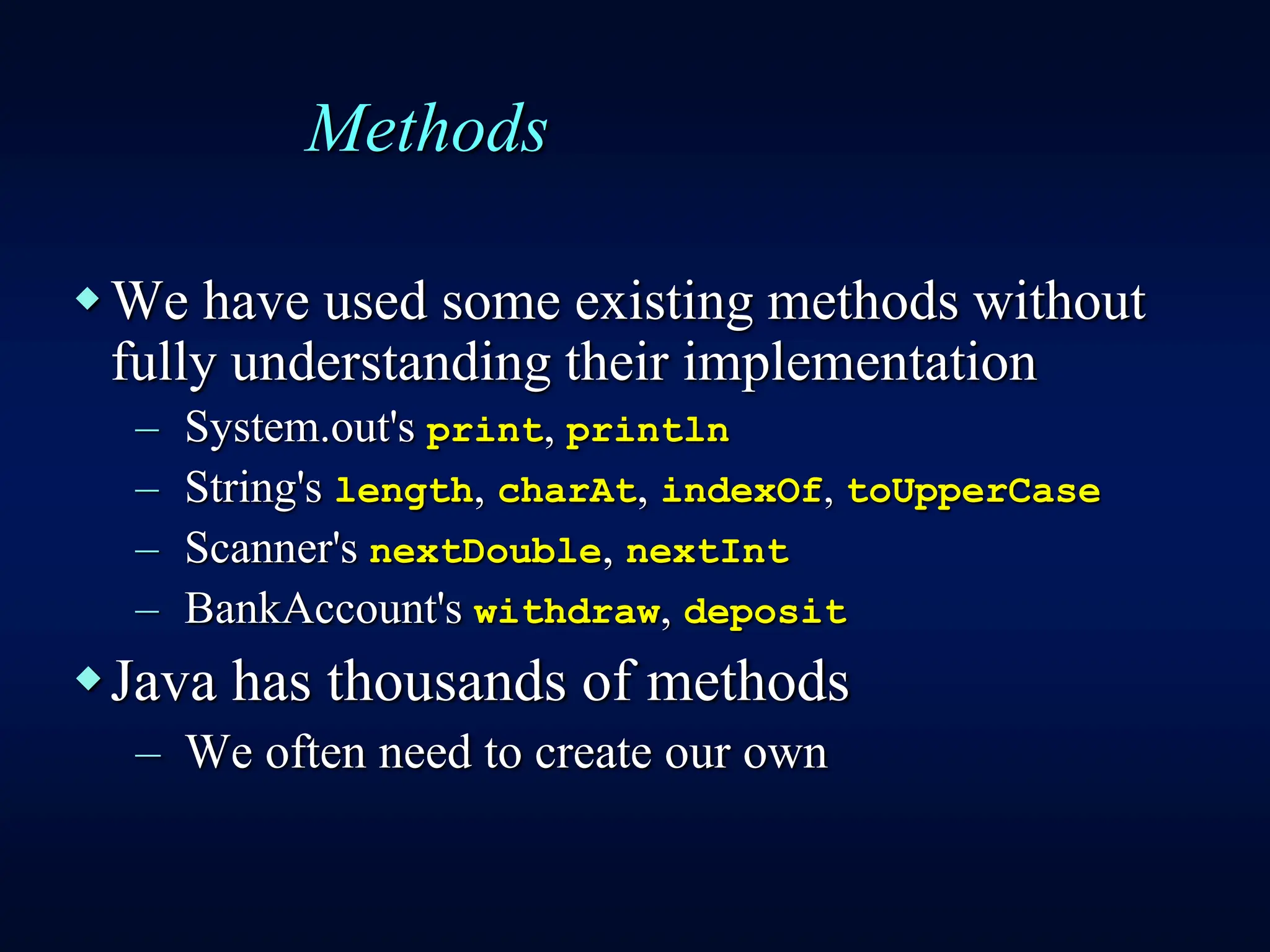
We have used some existing methods without
fully understanding their implementation
– System.out's print, println
– String's length, charAt, indexOf, toUpperCase
– Scanner's nextDouble, nextInt
– BankAccount's withdraw, deposit
Java has thousands of methods
– We often need to create our own
Methods
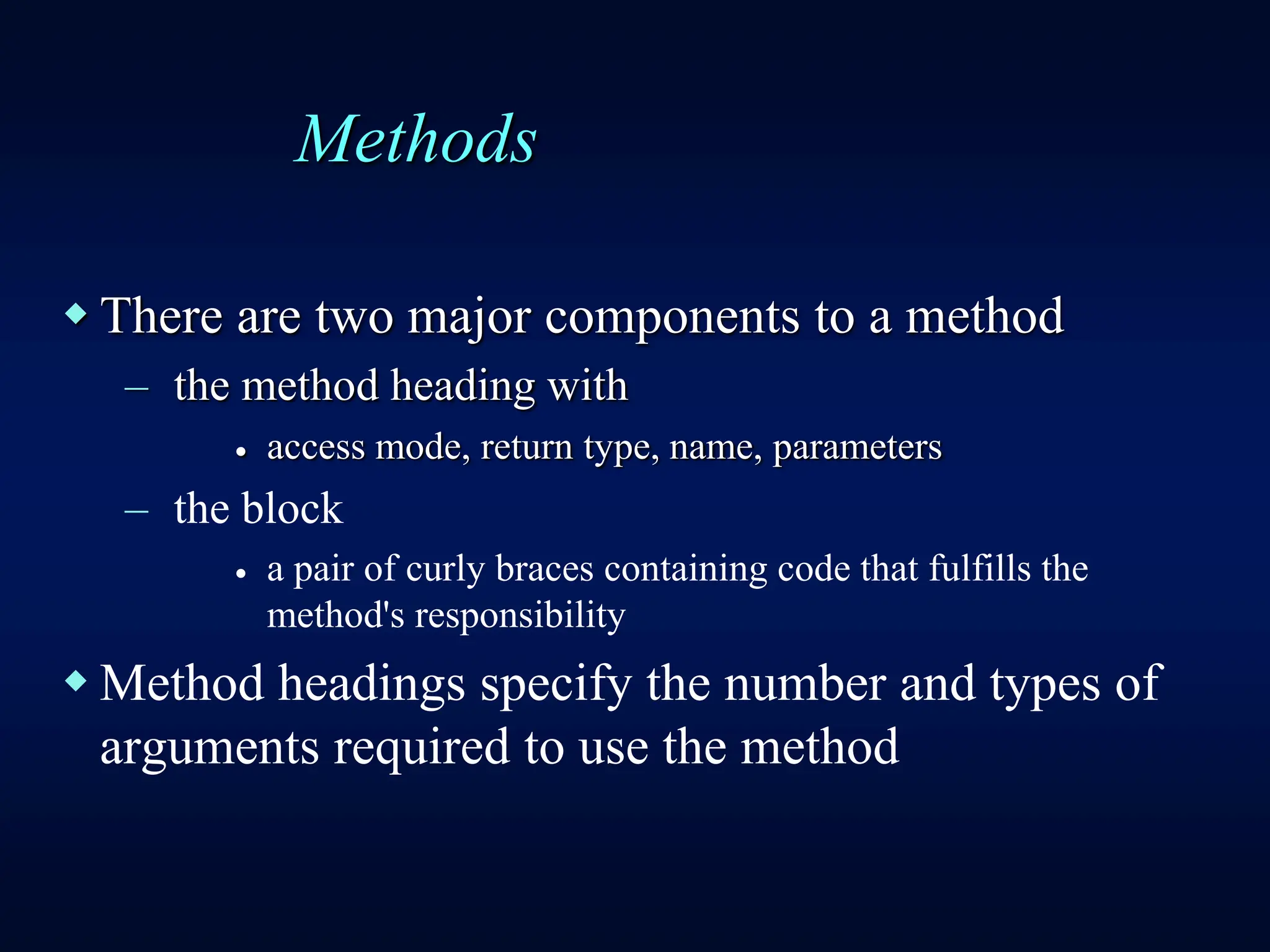
 There are two major components to a method
– the method heading with
 access mode, return type, name, parameters
– the block
 a pair of curly braces containing code that fulfills the
method's responsibility
 Method headings specify the number and types of
arguments required to use the method
Method Heading
with documentation
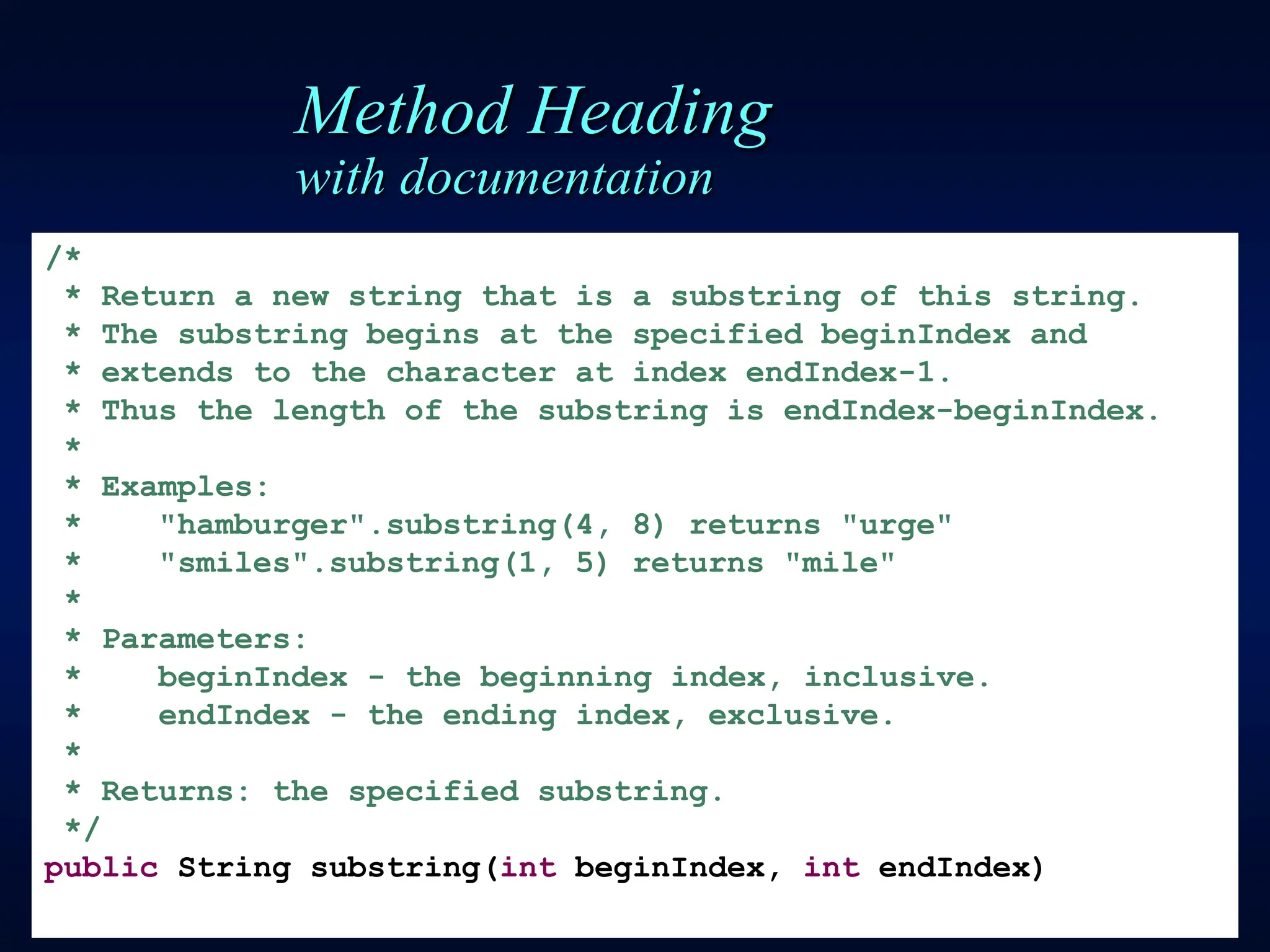
/*
* Return a new string that is a substring of this string.
* The substring begins at the specified beginIndex and
* extends to the character at index endIndex-1.
* Thus the length of the substring is endIndex-beginIndex.
*
* Examples:
* "hamburger".substring(4, 8) returns "urge"
* "smiles".substring(1, 5) returns "mile"
*
* Parameters:
* beginIndex - the beginning index, inclusive.
* endIndex - the ending index, exclusive.
*
* Returns: the specified substring.
*/
public String substring(int beginIndex, int endIndex)
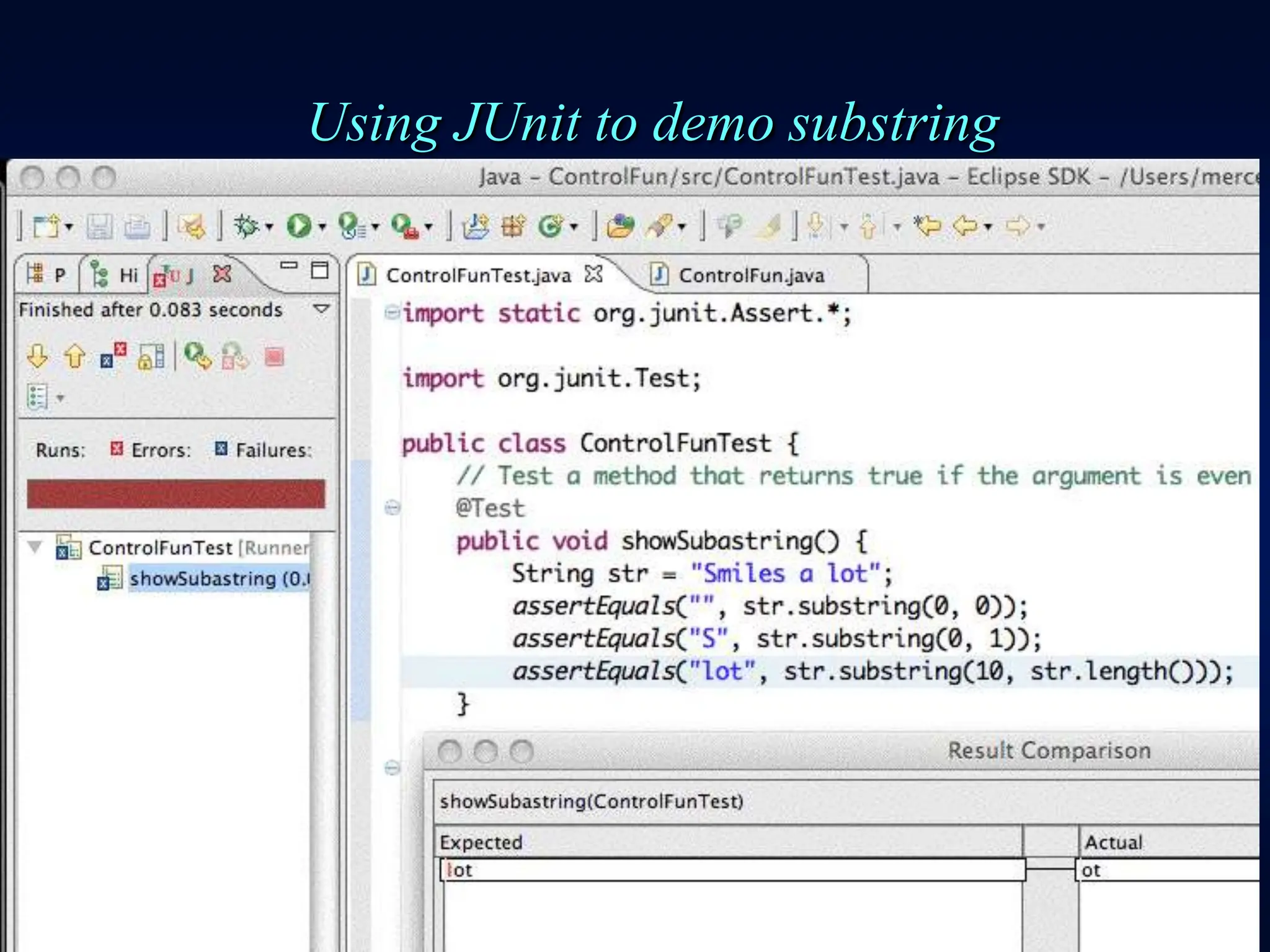
Using JUnit to demo substring
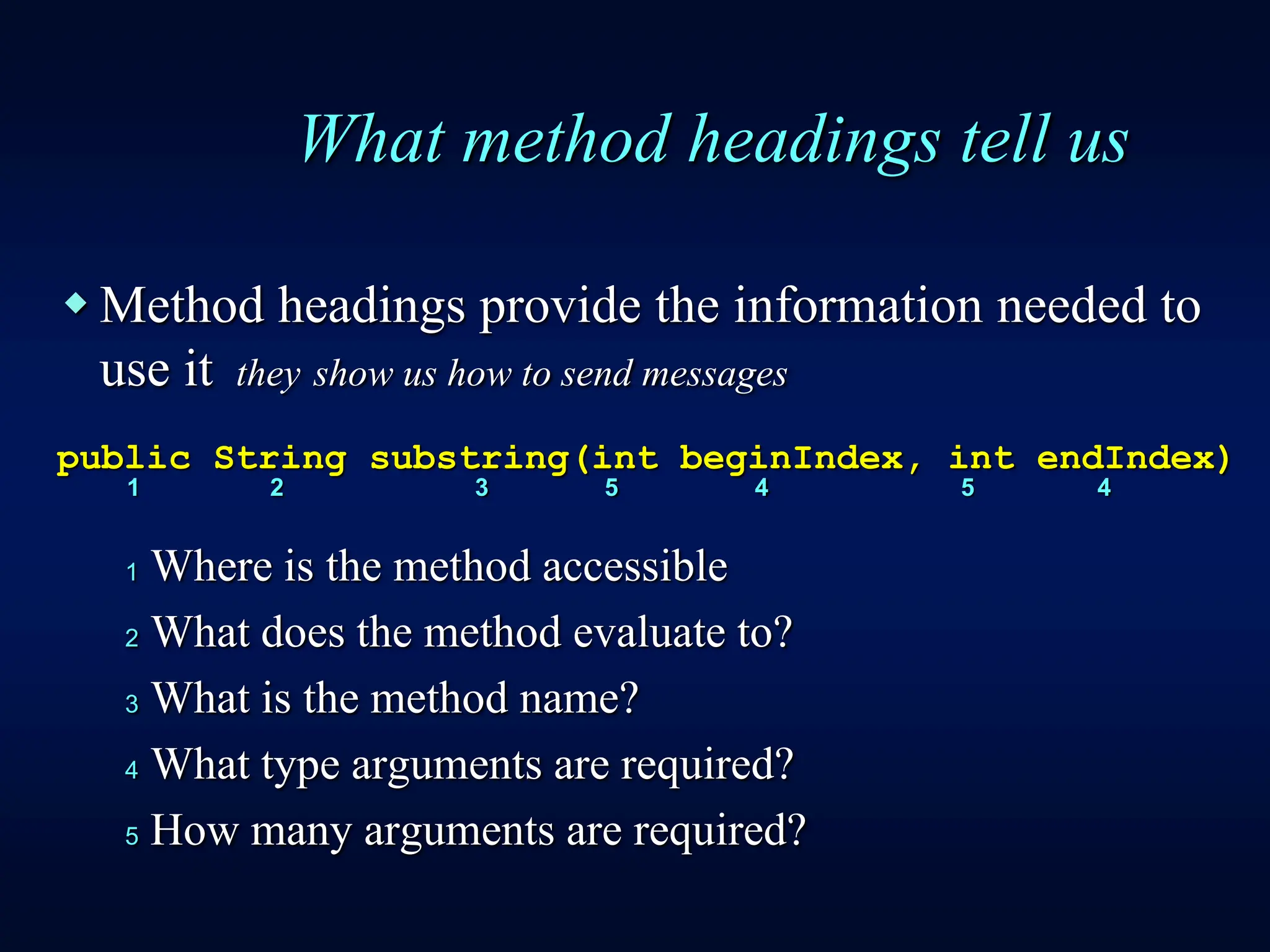
What method headings tell us
 Method headings provide the information needed to
use it they show us how to send messages
public String substring(int beginIndex, int endIndex)
1 2 3 5 4 5 4
1 Where is the method accessible
2 What does the method evaluate to?
3 What is the method name?
4 What type arguments are required?
5 How many arguments are required?
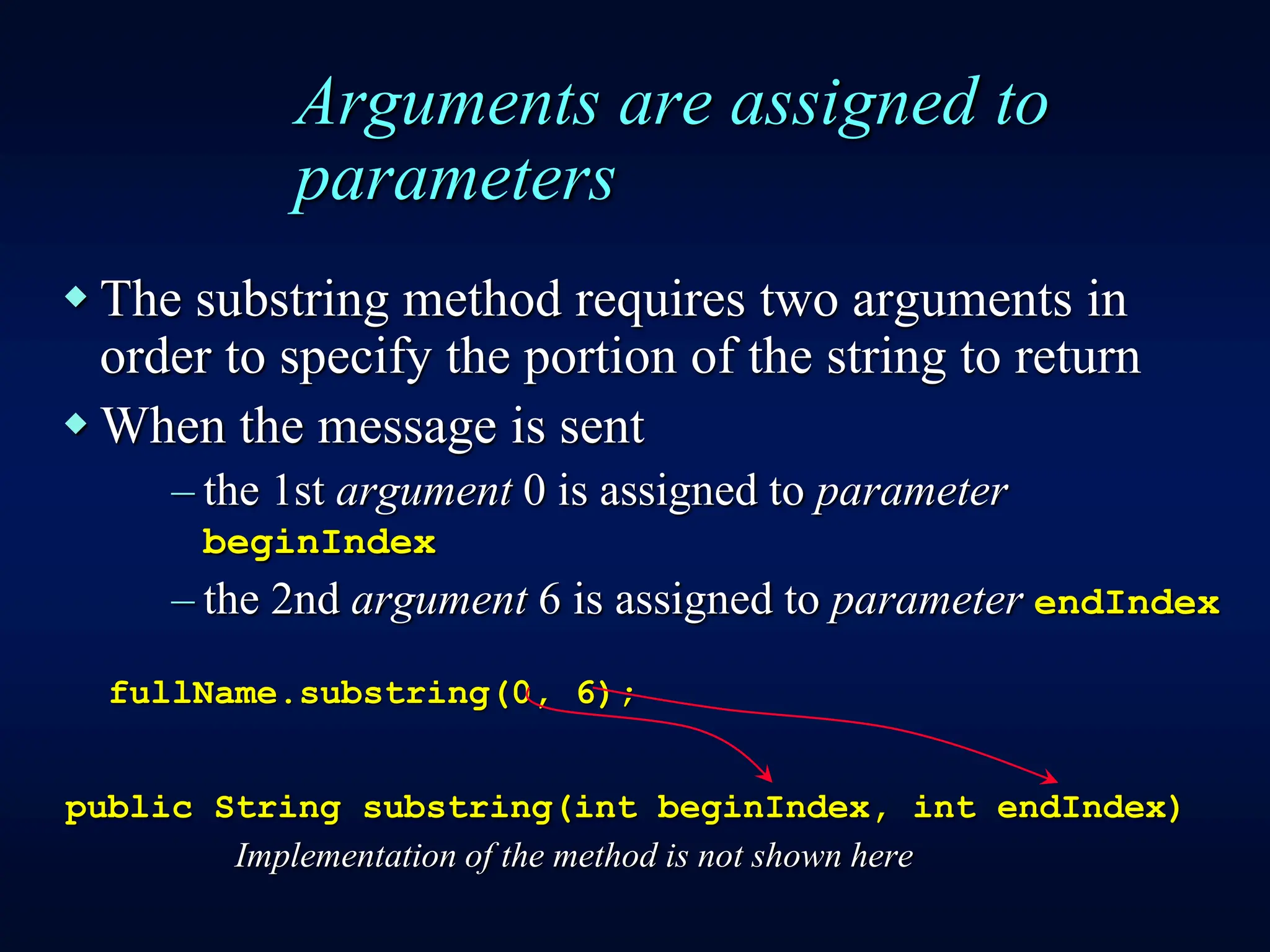
Arguments are assigned to
parameters
 The substring method requires two arguments in
order to specify the portion of the string to return
 When the message is sent
– the 1st argument 0 is assigned to parameter
beginIndex
– the 2nd argument 6 is assigned to parameter endIndex
fullName.substring(0, 6);
public String substring(int beginIndex, int endIndex)
Implementation of the method is not shown here
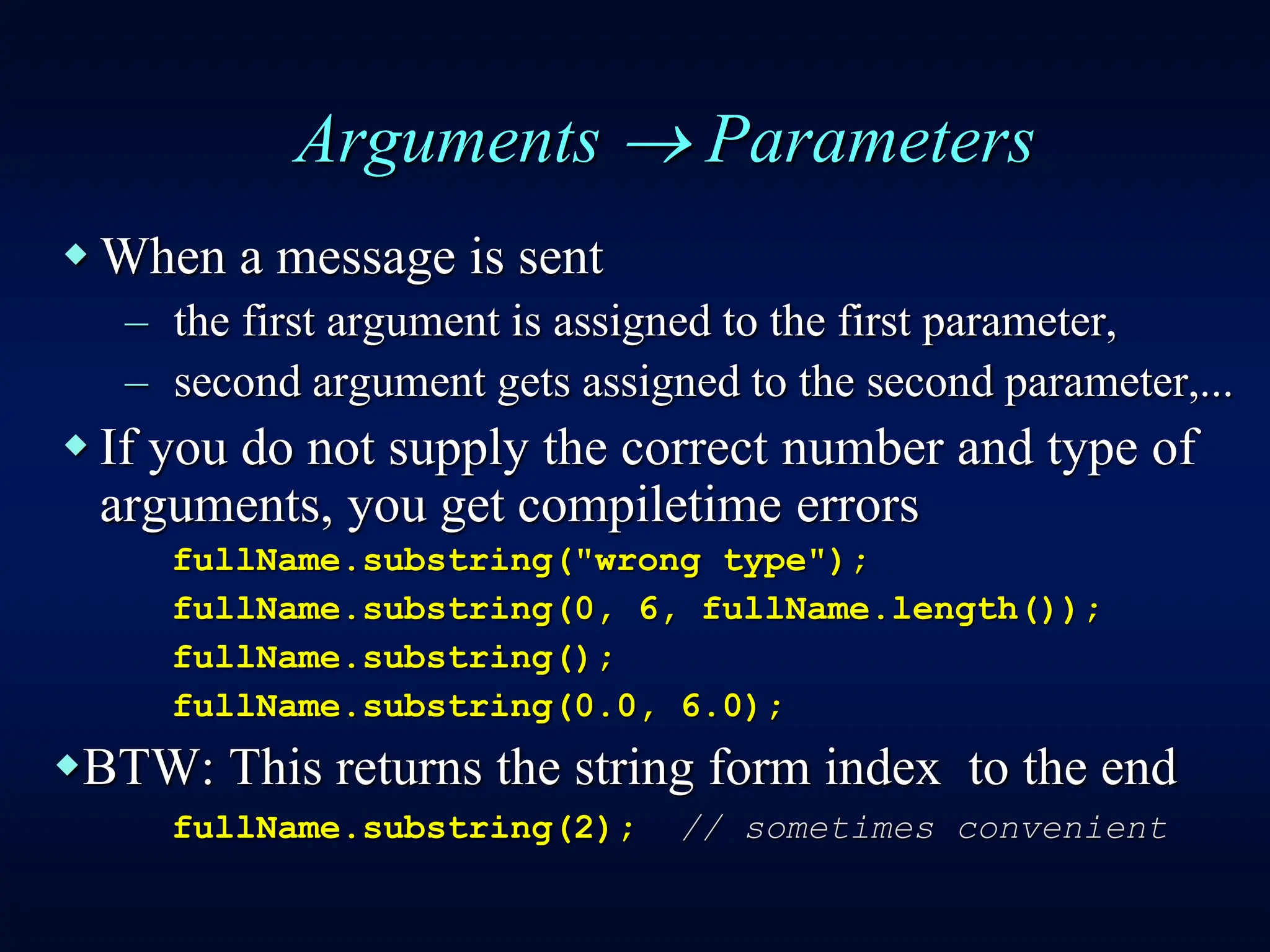
Arguments  Parameters
 When a message is sent
– the first argument is assigned to the first parameter,
– second argument gets assigned to the second parameter,...
 If you do not supply the correct number and type of
arguments, you get compiletime errors
fullName.substring("wrong type");
fullName.substring(0, 6, fullName.length());
fullName.substring();
fullName.substring(0.0, 6.0);
BTW: This returns the string form index to the end
fullName.substring(2); // sometimes convenient
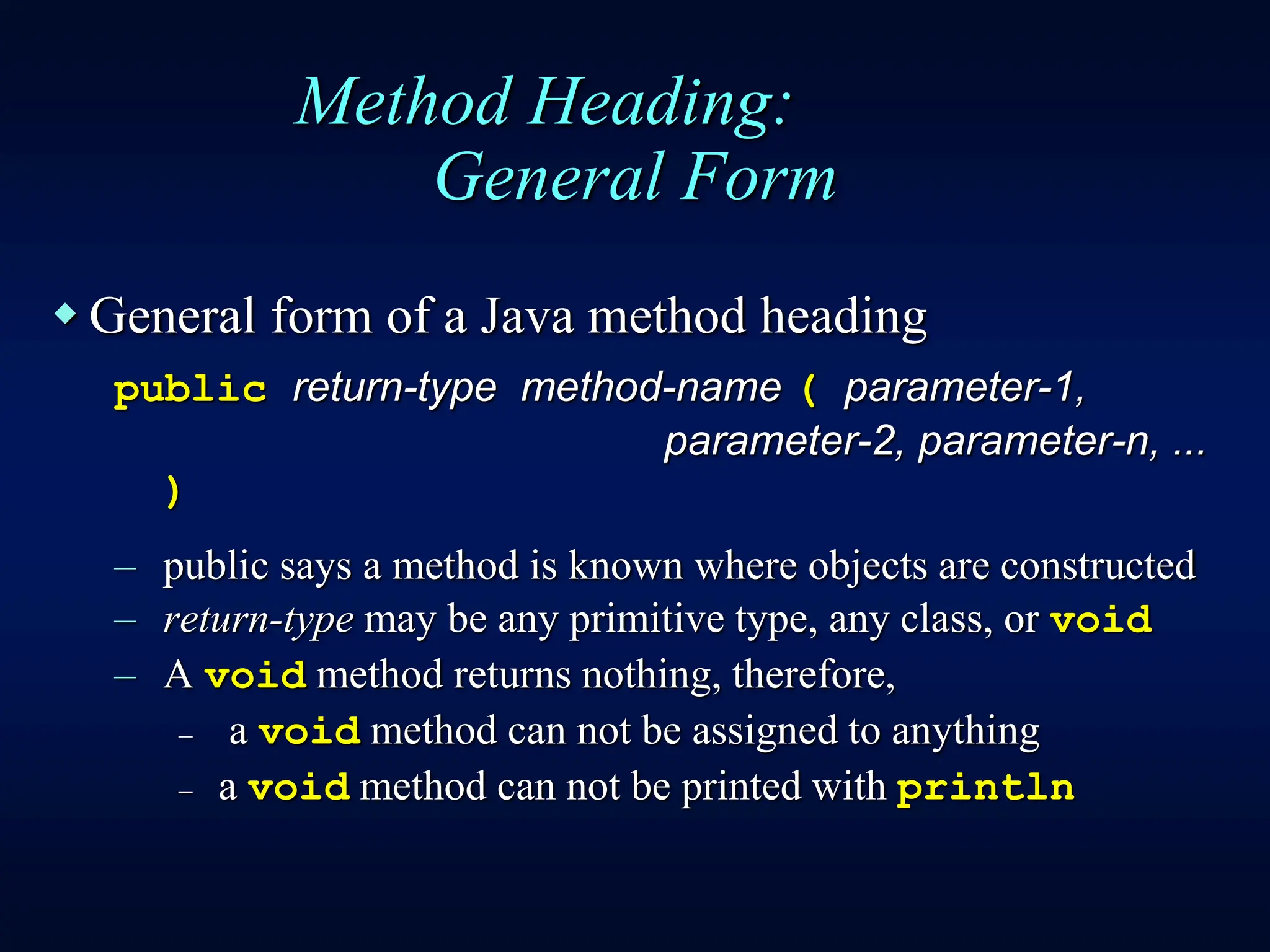
Method Heading:
General Form
 General form of a Java method heading
public return-type method-name ( parameter-1,
parameter-2, parameter-n, ...
)
– public says a method is known where objects are constructed
– return-type may be any primitive type, any class, or void
– A void method returns nothing, therefore,
– a void method can not be assigned to anything
– a void method can not be printed with println
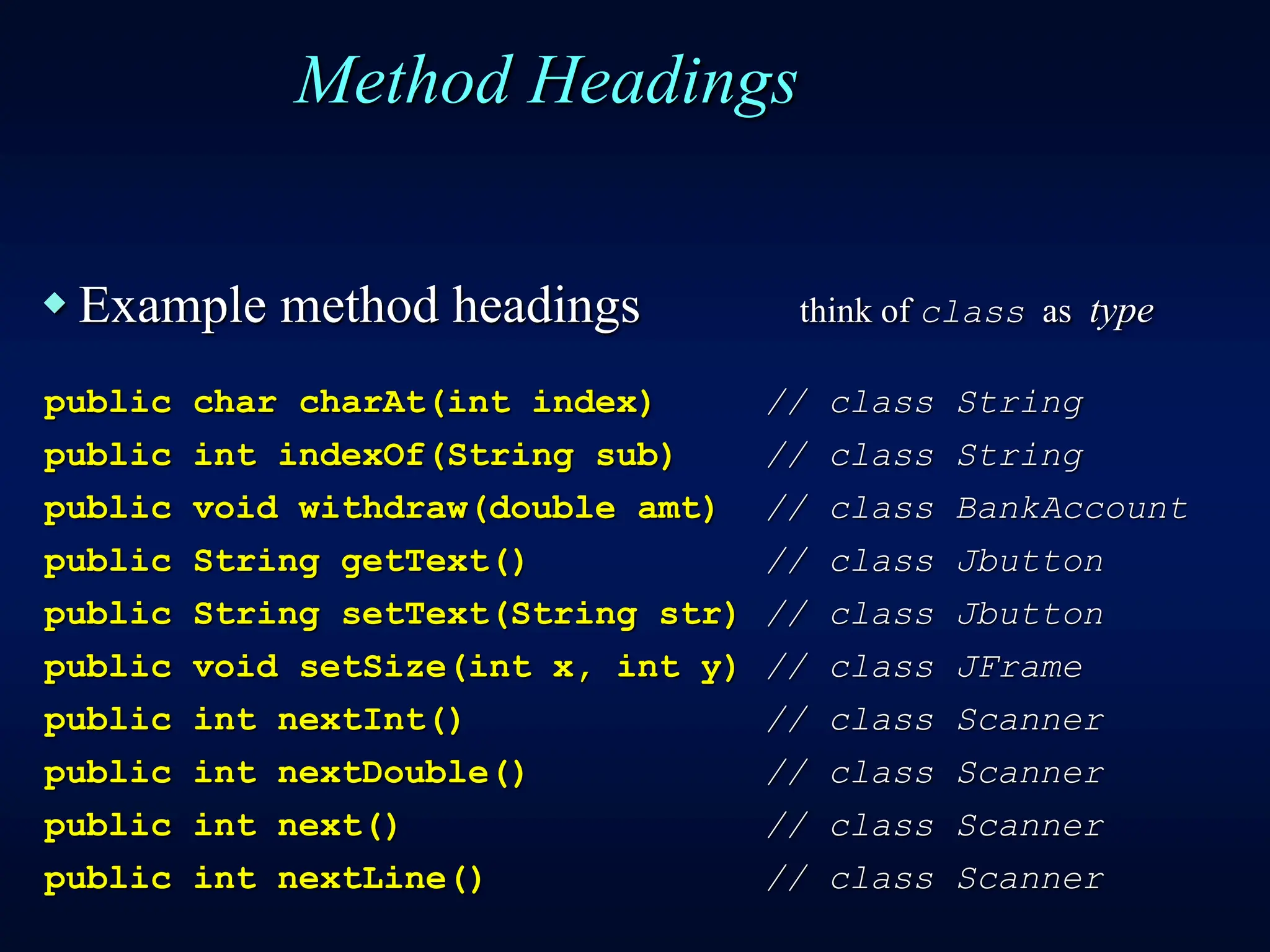
Method Headings
 Example method headings think of class as type
public char charAt(int index) // class String
public int indexOf(String sub) // class String
public void withdraw(double amt) // class BankAccount
public String getText() // class Jbutton
public String setText(String str) // class Jbutton
public void setSize(int x, int y) // class JFrame
public int nextInt() // class Scanner
public int nextDouble() // class Scanner
public int next() // class Scanner
public int nextLine() // class Scanner
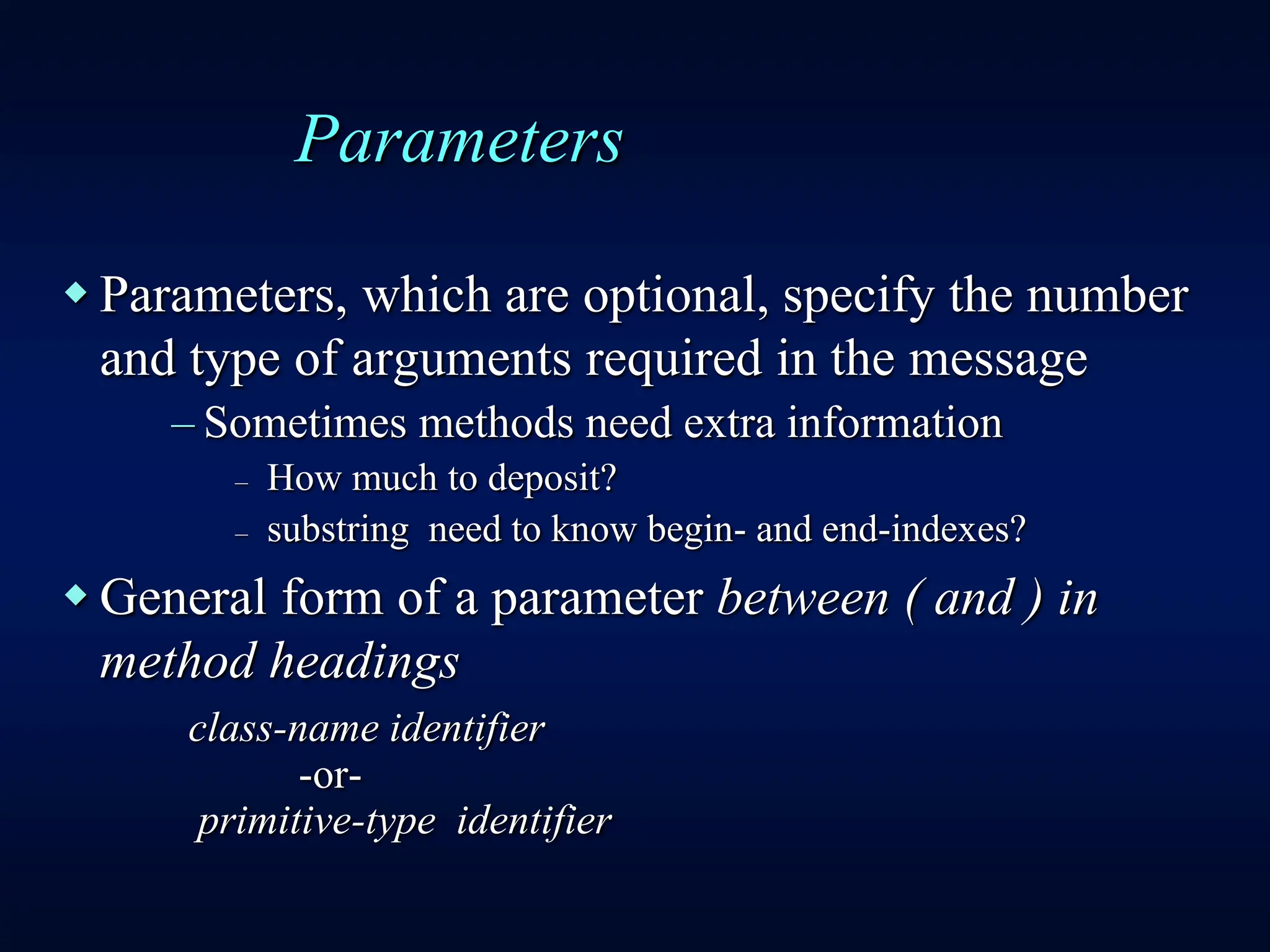
Parameters
 Parameters, which are optional, specify the number
and type of arguments required in the message
– Sometimes methods need extra information
– How much to deposit?
– substring need to know begin- and end-indexes?
 General form of a parameter between ( and ) in
method headings
class-name identifier
-or-
primitive-type identifier
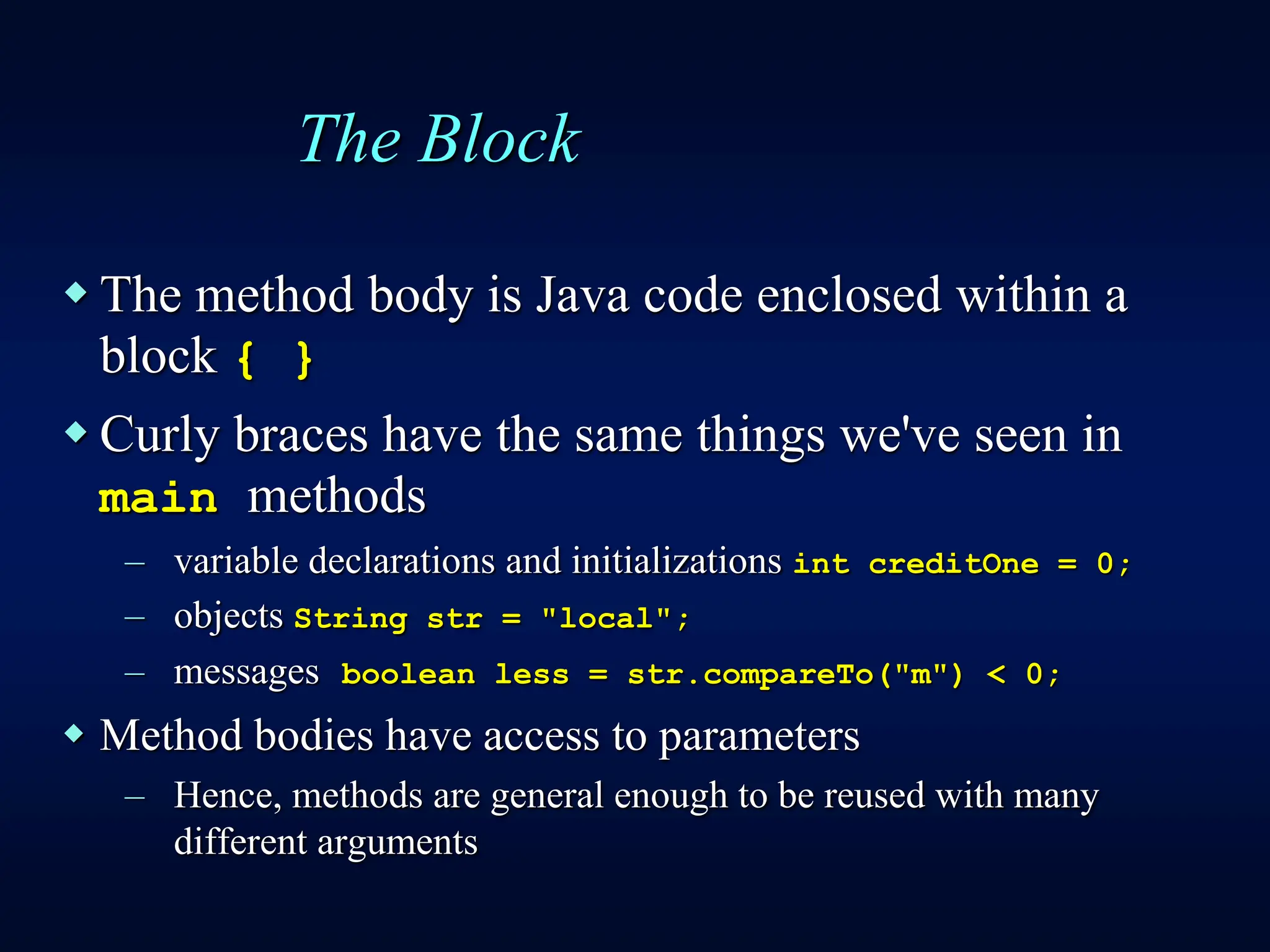
The Block
 The method body is Java code enclosed within a
block { }
 Curly braces have the same things we've seen in
main methods
– variable declarations and initializations int creditOne = 0;
– objects String str = "local";
– messages boolean less = str.compareTo("m") < 0;
 Method bodies have access to parameters
– Hence, methods are general enough to be reused with many
different arguments
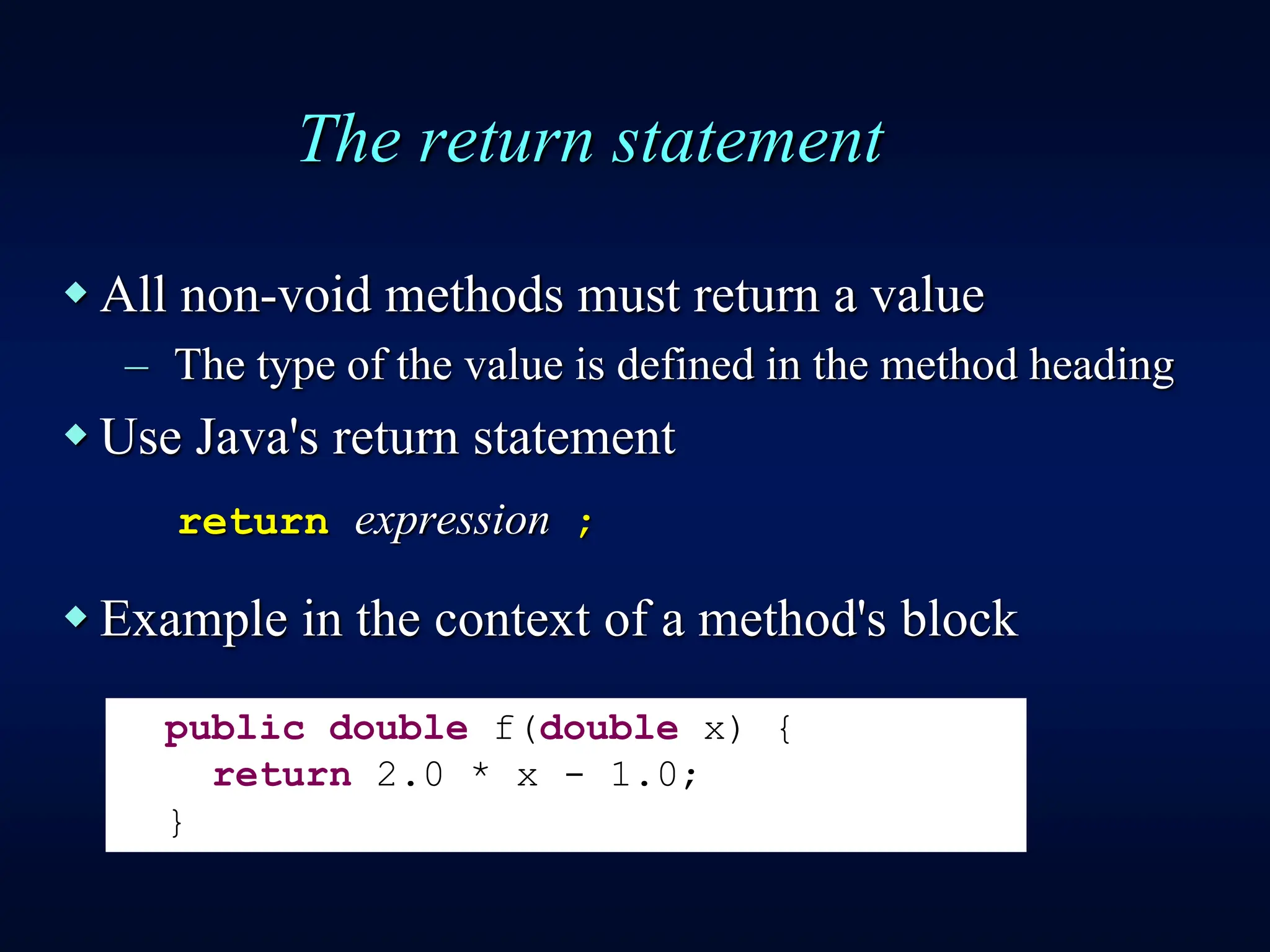
The return statement
 All non-void methods must return a value
– The type of the value is defined in the method heading
 Use Java's return statement
return expression ;
 Example in the context of a method's block
public double f(double x) {
return 2.0 * x - 1.0;
}
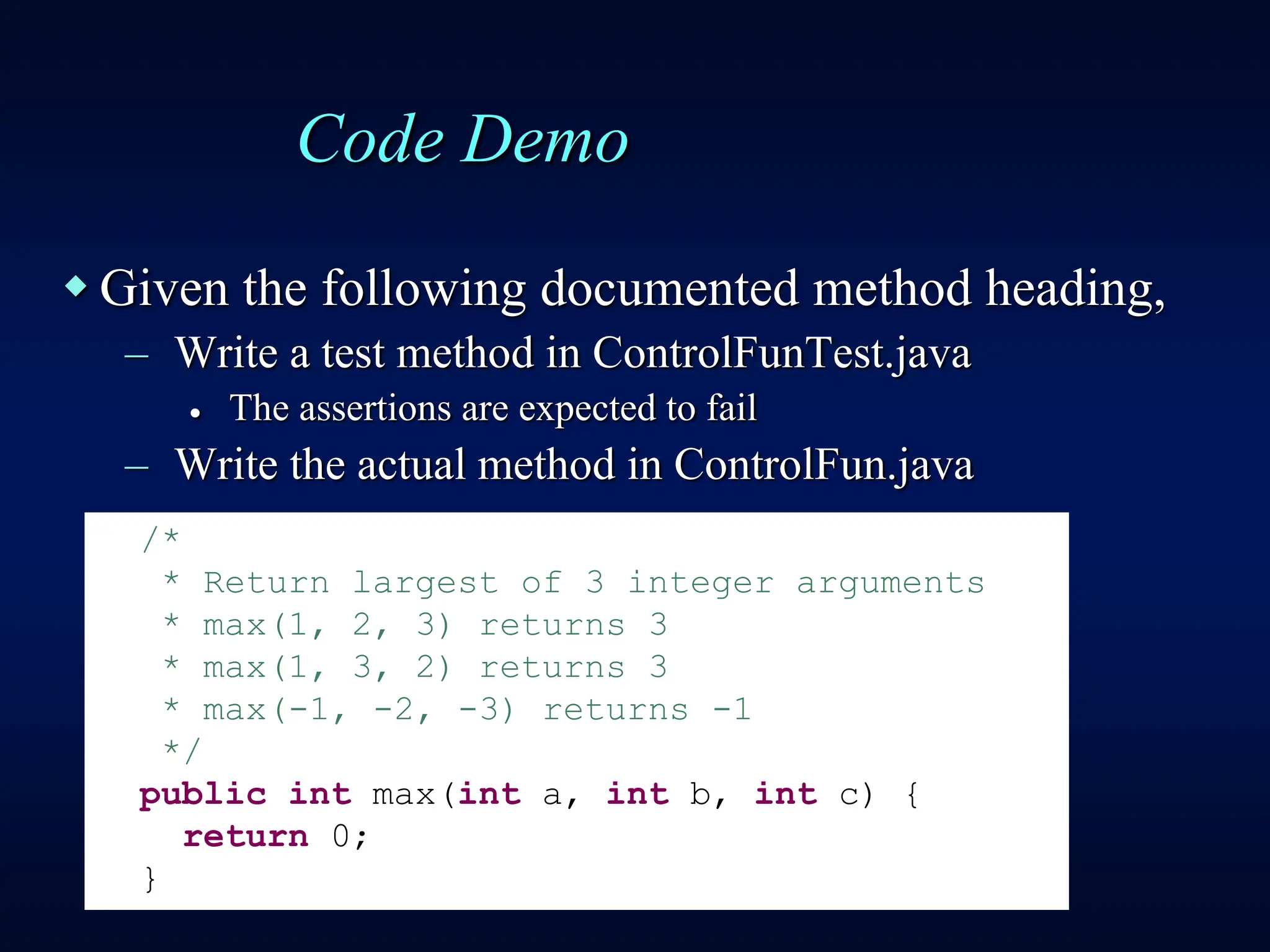
Code Demo
 Given the following documented method heading,
– Write a test method in ControlFunTest.java
 The assertions are expected to fail
– Write the actual method in ControlFun.java
/*
* Return largest of 3 integer arguments
* max(1, 2, 3) returns 3
* max(1, 3, 2) returns 3
* max(-1, -2, -3) returns -1
*/
public int max(int a, int b, int c) {
return 0;
}
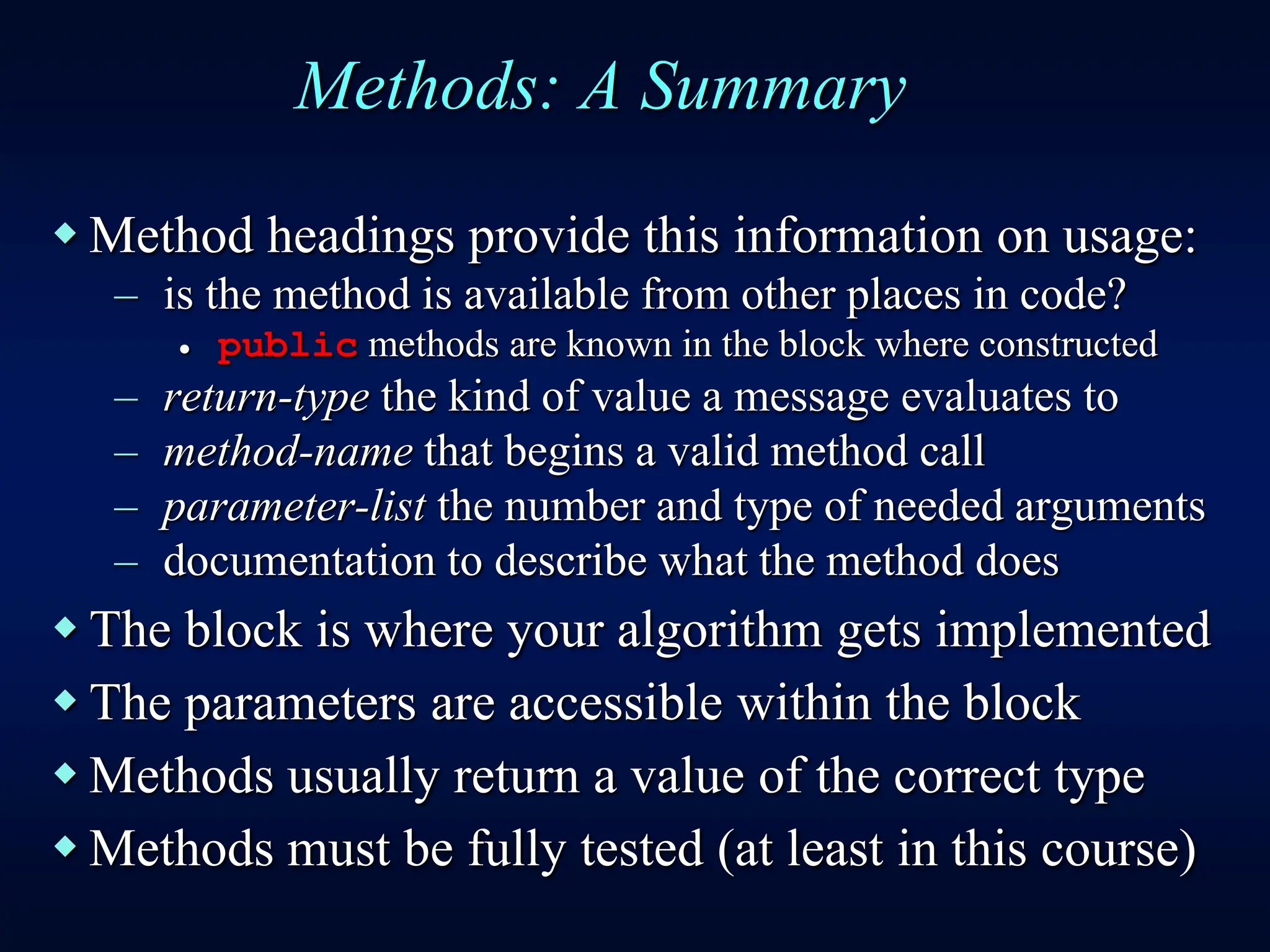
Methods: A Summary
 Method headings provide this information on usage:
– is the method is available from other places in code?
 public methods are known in the block where constructed
– return-type the kind of value a message evaluates to
– method-name that begins a valid method call
– parameter-list the number and type of needed arguments
– documentation to describe what the method does
 The block is where your algorithm gets implemented
 The parameters are accessible within the block
 Methods usually return a value of the correct type
 Methods must be fully tested (at least in this course)

Methods.ppt

  • 1.
    Chapter 4: Methods AssertingJava ©Rick Mercer Methods
  • 2.
    Methods We have usedsome existing methods without fully understanding their implementation – System.out's print, println – String's length, charAt, indexOf, toUpperCase – Scanner's nextDouble, nextInt – BankAccount's withdraw, deposit Java has thousands of methods – We often need to create our own
  • 3.
    Methods  There aretwo major components to a method – the method heading with  access mode, return type, name, parameters – the block  a pair of curly braces containing code that fulfills the method's responsibility  Method headings specify the number and types of arguments required to use the method
  • 4.
    Method Heading with documentation /* *Return a new string that is a substring of this string. * The substring begins at the specified beginIndex and * extends to the character at index endIndex-1. * Thus the length of the substring is endIndex-beginIndex. * * Examples: * "hamburger".substring(4, 8) returns "urge" * "smiles".substring(1, 5) returns "mile" * * Parameters: * beginIndex - the beginning index, inclusive. * endIndex - the ending index, exclusive. * * Returns: the specified substring. */ public String substring(int beginIndex, int endIndex)
  • 5.
    Using JUnit todemo substring
  • 6.
    What method headingstell us  Method headings provide the information needed to use it they show us how to send messages public String substring(int beginIndex, int endIndex) 1 2 3 5 4 5 4 1 Where is the method accessible 2 What does the method evaluate to? 3 What is the method name? 4 What type arguments are required? 5 How many arguments are required?
  • 7.
    Arguments are assignedto parameters  The substring method requires two arguments in order to specify the portion of the string to return  When the message is sent – the 1st argument 0 is assigned to parameter beginIndex – the 2nd argument 6 is assigned to parameter endIndex fullName.substring(0, 6); public String substring(int beginIndex, int endIndex) Implementation of the method is not shown here
  • 8.
    Arguments  Parameters When a message is sent – the first argument is assigned to the first parameter, – second argument gets assigned to the second parameter,...  If you do not supply the correct number and type of arguments, you get compiletime errors fullName.substring("wrong type"); fullName.substring(0, 6, fullName.length()); fullName.substring(); fullName.substring(0.0, 6.0); BTW: This returns the string form index to the end fullName.substring(2); // sometimes convenient
  • 9.
    Method Heading: General Form General form of a Java method heading public return-type method-name ( parameter-1, parameter-2, parameter-n, ... ) – public says a method is known where objects are constructed – return-type may be any primitive type, any class, or void – A void method returns nothing, therefore, – a void method can not be assigned to anything – a void method can not be printed with println
  • 10.
    Method Headings  Examplemethod headings think of class as type public char charAt(int index) // class String public int indexOf(String sub) // class String public void withdraw(double amt) // class BankAccount public String getText() // class Jbutton public String setText(String str) // class Jbutton public void setSize(int x, int y) // class JFrame public int nextInt() // class Scanner public int nextDouble() // class Scanner public int next() // class Scanner public int nextLine() // class Scanner
  • 11.
    Parameters  Parameters, whichare optional, specify the number and type of arguments required in the message – Sometimes methods need extra information – How much to deposit? – substring need to know begin- and end-indexes?  General form of a parameter between ( and ) in method headings class-name identifier -or- primitive-type identifier
  • 12.
    The Block  Themethod body is Java code enclosed within a block { }  Curly braces have the same things we've seen in main methods – variable declarations and initializations int creditOne = 0; – objects String str = "local"; – messages boolean less = str.compareTo("m") < 0;  Method bodies have access to parameters – Hence, methods are general enough to be reused with many different arguments
  • 13.
    The return statement All non-void methods must return a value – The type of the value is defined in the method heading  Use Java's return statement return expression ;  Example in the context of a method's block public double f(double x) { return 2.0 * x - 1.0; }
  • 14.
    Code Demo  Giventhe following documented method heading, – Write a test method in ControlFunTest.java  The assertions are expected to fail – Write the actual method in ControlFun.java /* * Return largest of 3 integer arguments * max(1, 2, 3) returns 3 * max(1, 3, 2) returns 3 * max(-1, -2, -3) returns -1 */ public int max(int a, int b, int c) { return 0; }
  • 15.
    Methods: A Summary Method headings provide this information on usage: – is the method is available from other places in code?  public methods are known in the block where constructed – return-type the kind of value a message evaluates to – method-name that begins a valid method call – parameter-list the number and type of needed arguments – documentation to describe what the method does  The block is where your algorithm gets implemented  The parameters are accessible within the block  Methods usually return a value of the correct type  Methods must be fully tested (at least in this course)