1
10/02/2012 Slide 1
Meter Safety
Prepared by John Kretzschmar, SAMSCO
The Spartan Armstrong Metering Supply Company
For North Carolina Electric Meter School
Single Phase
Thursday, June 16, 2022 at 8:00 a.m.
2
Meter Safety
YOU are responsible for your own safety on the job!
3
Hazards in the Workplace
Hazard #1: Falls and Falling Objects
• Approximately 19,565 people die in
the U.S. annually due to injuries
caused by unintentional falls.
• Slips, trip and fall injuries cost
employers approximately $40,000 per
incident.
• About 9.2 million people were treated
in emergency rooms for fall-related
injuries last year.
4
Hazards in the Workplace
Hazard #2: Chemical Exposure
• Breathing of contaminated air is
the most common way that
workplace chemicals enter the
body.
• The CDC estimates more than 32
million workers in the US are
potentially exposed to chemicals
that can be absorbed through the
skin.
• Roughly 860,000 illnesses
resulting from chemical exposure
occur in the workplace every
year.
5
Hazards in the Workplace
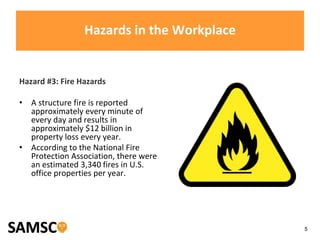
Hazard #3: Fire Hazards
• A structure fire is reported
approximately every minute of
every day and results in
approximately $12 billion in
property loss every year.
• According to the National Fire
Protection Association, there were
an estimated 3,340 fires in U.S.
office properties per year.
6
Hazards in the Workplace
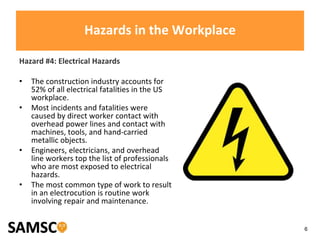
Hazard #4: Electrical Hazards
• The construction industry accounts for
52% of all electrical fatalities in the US
workplace.
• Most incidents and fatalities were
caused by direct worker contact with
overhead power lines and contact with
machines, tools, and hand-carried
metallic objects.
• Engineers, electricians, and overhead
line workers top the list of professionals
who are most exposed to electrical
hazards.
• The most common type of work to result
in an electrocution is routine work
involving repair and maintenance.
7
Hazards in the Workplace
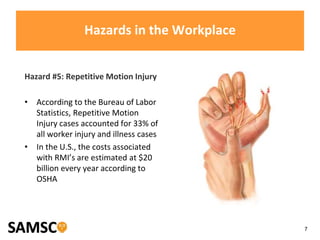
Hazard #5: Repetitive Motion Injury
• According to the Bureau of Labor
Statistics, Repetitive Motion
Injury cases accounted for 33% of
all worker injury and illness cases
• In the U.S., the costs associated
with RMI’s are estimated at $20
billion every year according to
OSHA
8
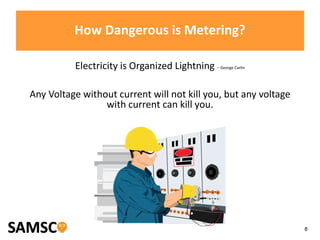
How Dangerous is Metering?
Electricity is Organized Lightning – George Carlin
Any Voltage without current will not kill you, but any voltage
with current can kill you.
9
Electric Shock
What is Electric Shock?
Electric shock is a flow of electrical current
through a person's body.
Damage to the skin or internal organs as a
result of contact with electrical current is an
electric injury.
Electric shock can cause a minor twinge, mild
to serious injuries, or death, depending on the
circumstances and voltage.
10
Electric Shock
What is Electric Shock?
The human body conducts electricity well, so it
travels through the body with ease.
People can incur organ damage even if there is
only a minor burn on the skin.
The most common areas injured by electric
shock are the heart, muscles, and brain.
11
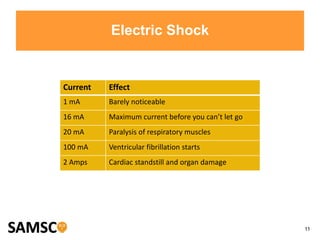
Electric Shock
Current Effect
1 mA Barely noticeable
16 mA Maximum current before you can’t let go
20 mA Paralysis of respiratory muscles
100 mA Ventricular fibrillation starts
2 Amps Cardiac standstill and organ damage
12
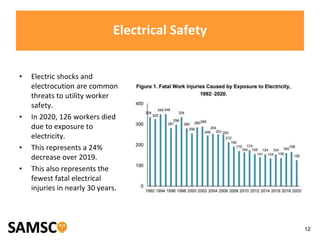
Electrical Safety
• Electric shocks and
electrocution are common
threats to utility worker
safety.
• In 2020, 126 workers died
due to exposure to
electricity.
• This represents a 24%
decrease over 2019.
• This also represents the
fewest fatal electrical
injuries in nearly 30 years.
13
Electrical Safety
0
1000
2000
3000
4000
5000
6000
7000
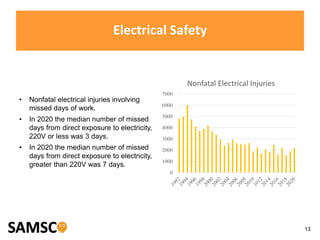
Nonfatal Electrical Injuries
• Nonfatal electrical injuries involving
missed days of work.
• In 2020 the median number of missed
days from direct exposure to electricity,
220V or less was 3 days.
• In 2020 the median number of missed
days from direct exposure to electricity,
greater than 220V was 7 days.
14
Electrical Safety
0
5
10
15
20
25
30
35
40
45
50
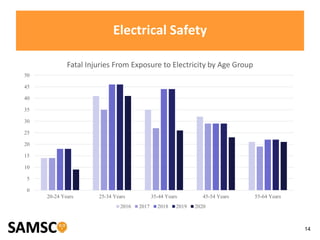
20-24 Years 25-34 Years 35-44 Years 45-54 Years 55-64 Years
Fatal Injuries From Exposure to Electricity by Age Group
2016 2017 2018 2019 2020
15
Arc Fault
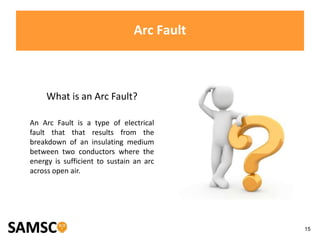
What is an Arc Fault?
An Arc Fault is a type of electrical
fault that that results from the
breakdown of an insulating medium
between two conductors where the
energy is sufficient to sustain an arc
across open air.
16
Arc Flash
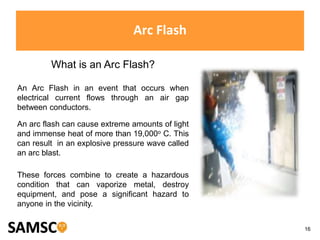
What is an Arc Flash?
An Arc Flash in an event that occurs when
electrical current flows through an air gap
between conductors.
An arc flash can cause extreme amounts of light
and immense heat of more than 19,000o C. This
can result in an explosive pressure wave called
an arc blast.
These forces combine to create a hazardous
condition that can vaporize metal, destroy
equipment, and pose a significant hazard to
anyone in the vicinity.
17
Arc Flash
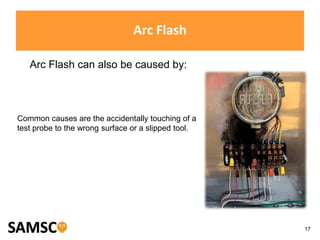
Arc Flash can also be caused by:
Common causes are the accidentally touching of a
test probe to the wrong surface or a slipped tool.
18
Arc Flash
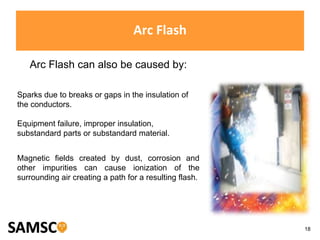
Arc Flash can also be caused by:
Sparks due to breaks or gaps in the insulation of
the conductors.
Equipment failure, improper insulation,
substandard parts or substandard material.
Magnetic fields created by dust, corrosion and
other impurities can cause ionization of the
surrounding air creating a path for a resulting flash.
19
Personal Protection Equipment (PPE)
This is why we wear our PPE.
20
Personal Protection Equipment (PPE)
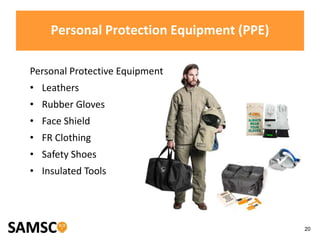
Personal Protective Equipment
• Leathers
• Rubber Gloves
• Face Shield
• FR Clothing
• Safety Shoes
• Insulated Tools
21
Personal Protection Equipment (PPE)
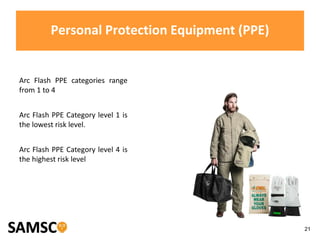
Arc Flash PPE categories range
from 1 to 4
Arc Flash PPE Category level 1 is
the lowest risk level.
Arc Flash PPE Category level 4 is
the highest risk level
22
A Common Scenario?
A crew arrives at a worksite, exits the
vehicle and prepares to begin the assigned
task. Everything needed appears to be on
hand. But then someone realizes they
forgot a piece of PPE on the truck. Thinking
that the task will only take a minute, the
worker proceeds with the task without the
PPE.
The next thing you know, you’ve got a face
full of something that, at the very least
could inconvenience you, if not create a
lifelong issue.
23
OSHA
As with any industry, adhering to and complying with OSHA standards and company
safety policies is a vital step in preventing injuries. OSHA standards that apply to the
utilities industry include:
• Electrical – General Requirements (1910.303)
• Electrical – Wiring Methods (1910.305)
• Electric Power Generation, Transmission, and Distribution (1910.269)
• Personal Protective Equipment, Subpart I (1910)
• Fall Protection (1926.501)
• Hazard Communication (1910.1200)
• Respiratory Protection (1910.134)
• Lockout/Tagout (1910.147)
24
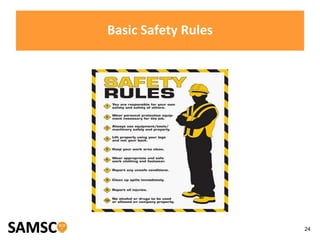
Basic Safety Rules
25
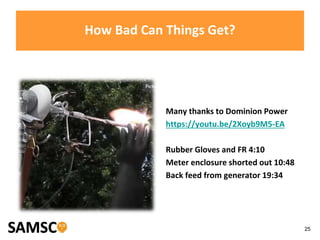
How Bad Can Things Get?
Many thanks to Dominion Power
https://youtu.be/2Xoyb9M5-EA
Rubber Gloves and FR 4:10
Meter enclosure shorted out 10:48
Back feed from generator 19:34
26
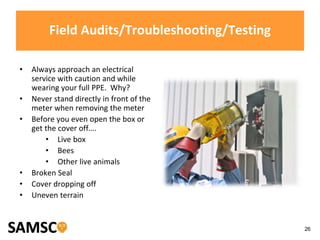
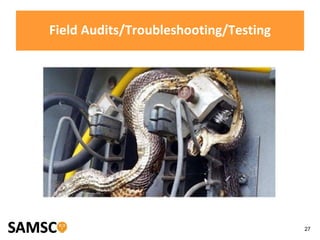
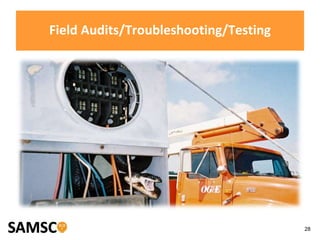
Field Audits/Troubleshooting/Testing
• Always approach an electrical
service with caution and while
wearing your full PPE. Why?
• Never stand directly in front of the
meter when removing the meter
• Before you even open the box or
get the cover off….
• Live box
• Bees
• Other live animals
• Broken Seal
• Cover dropping off
• Uneven terrain
27
Field Audits/Troubleshooting/Testing
28
Field Audits/Troubleshooting/Testing
29
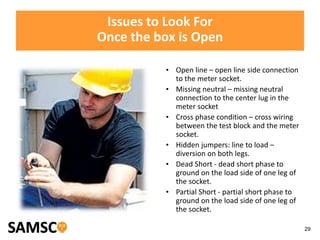
Issues to Look For
Once the box is Open
• Open line – open line side connection
to the meter socket.
• Missing neutral – missing neutral
connection to the center lug in the
meter socket
• Cross phase condition – cross wiring
between the test block and the meter
socket.
• Hidden jumpers: line to load –
diversion on both legs.
• Dead Short - dead short phase to
ground on the load side of one leg of
the socket.
• Partial Short - partial short phase to
ground on the load side of one leg of
the socket.
30
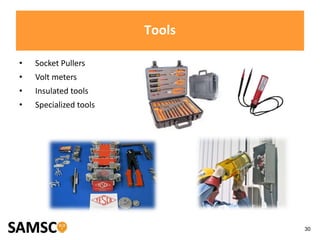
Tools
• Socket Pullers
• Volt meters
• Insulated tools
• Specialized tools
31
Summary
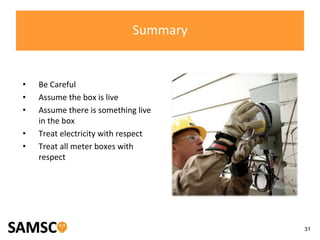
• Be Careful
• Assume the box is live
• Assume there is something live
in the box
• Treat electricity with respect
• Treat all meter boxes with
respect
32
Personal Protection Equipment
• Issues that you may have seen
in your service territory?
• Do you have issues with non-
metering personnel performing
metering operations?
• Unique issues in your service
territory?
• Safety Issues not discussed?
• Are your meter techs typically
putting safety first?
33
Questions?
John Kretzschmar
SAMSCO
Spartan Armstrong Metering Supply Company
Boiling Springs, SC 29316
john@samscometering.com
864.590.2883
This presentation can also be found under Meter
Conferences and Schools on the TESCO web site:
www.tescometering.com

Meter Safety

  • 1.
    1 10/02/2012 Slide 1 MeterSafety Prepared by John Kretzschmar, SAMSCO The Spartan Armstrong Metering Supply Company For North Carolina Electric Meter School Single Phase Thursday, June 16, 2022 at 8:00 a.m.
  • 2.
    2 Meter Safety YOU areresponsible for your own safety on the job!
  • 3.
    3 Hazards in theWorkplace Hazard #1: Falls and Falling Objects • Approximately 19,565 people die in the U.S. annually due to injuries caused by unintentional falls. • Slips, trip and fall injuries cost employers approximately $40,000 per incident. • About 9.2 million people were treated in emergency rooms for fall-related injuries last year.
  • 4.
    4 Hazards in theWorkplace Hazard #2: Chemical Exposure • Breathing of contaminated air is the most common way that workplace chemicals enter the body. • The CDC estimates more than 32 million workers in the US are potentially exposed to chemicals that can be absorbed through the skin. • Roughly 860,000 illnesses resulting from chemical exposure occur in the workplace every year.
  • 5.
    5 Hazards in theWorkplace Hazard #3: Fire Hazards • A structure fire is reported approximately every minute of every day and results in approximately $12 billion in property loss every year. • According to the National Fire Protection Association, there were an estimated 3,340 fires in U.S. office properties per year.
  • 6.
    6 Hazards in theWorkplace Hazard #4: Electrical Hazards • The construction industry accounts for 52% of all electrical fatalities in the US workplace. • Most incidents and fatalities were caused by direct worker contact with overhead power lines and contact with machines, tools, and hand-carried metallic objects. • Engineers, electricians, and overhead line workers top the list of professionals who are most exposed to electrical hazards. • The most common type of work to result in an electrocution is routine work involving repair and maintenance.
  • 7.
    7 Hazards in theWorkplace Hazard #5: Repetitive Motion Injury • According to the Bureau of Labor Statistics, Repetitive Motion Injury cases accounted for 33% of all worker injury and illness cases • In the U.S., the costs associated with RMI’s are estimated at $20 billion every year according to OSHA
  • 8.
    8 How Dangerous isMetering? Electricity is Organized Lightning – George Carlin Any Voltage without current will not kill you, but any voltage with current can kill you.
  • 9.
    9 Electric Shock What isElectric Shock? Electric shock is a flow of electrical current through a person's body. Damage to the skin or internal organs as a result of contact with electrical current is an electric injury. Electric shock can cause a minor twinge, mild to serious injuries, or death, depending on the circumstances and voltage.
  • 10.
    10 Electric Shock What isElectric Shock? The human body conducts electricity well, so it travels through the body with ease. People can incur organ damage even if there is only a minor burn on the skin. The most common areas injured by electric shock are the heart, muscles, and brain.
  • 11.
    11 Electric Shock Current Effect 1mA Barely noticeable 16 mA Maximum current before you can’t let go 20 mA Paralysis of respiratory muscles 100 mA Ventricular fibrillation starts 2 Amps Cardiac standstill and organ damage
  • 12.
    12 Electrical Safety • Electricshocks and electrocution are common threats to utility worker safety. • In 2020, 126 workers died due to exposure to electricity. • This represents a 24% decrease over 2019. • This also represents the fewest fatal electrical injuries in nearly 30 years.
  • 13.
    13 Electrical Safety 0 1000 2000 3000 4000 5000 6000 7000 Nonfatal ElectricalInjuries • Nonfatal electrical injuries involving missed days of work. • In 2020 the median number of missed days from direct exposure to electricity, 220V or less was 3 days. • In 2020 the median number of missed days from direct exposure to electricity, greater than 220V was 7 days.
  • 14.
    14 Electrical Safety 0 5 10 15 20 25 30 35 40 45 50 20-24 Years25-34 Years 35-44 Years 45-54 Years 55-64 Years Fatal Injuries From Exposure to Electricity by Age Group 2016 2017 2018 2019 2020
  • 15.
    15 Arc Fault What isan Arc Fault? An Arc Fault is a type of electrical fault that that results from the breakdown of an insulating medium between two conductors where the energy is sufficient to sustain an arc across open air.
  • 16.
    16 Arc Flash What isan Arc Flash? An Arc Flash in an event that occurs when electrical current flows through an air gap between conductors. An arc flash can cause extreme amounts of light and immense heat of more than 19,000o C. This can result in an explosive pressure wave called an arc blast. These forces combine to create a hazardous condition that can vaporize metal, destroy equipment, and pose a significant hazard to anyone in the vicinity.
  • 17.
    17 Arc Flash Arc Flashcan also be caused by: Common causes are the accidentally touching of a test probe to the wrong surface or a slipped tool.
  • 18.
    18 Arc Flash Arc Flashcan also be caused by: Sparks due to breaks or gaps in the insulation of the conductors. Equipment failure, improper insulation, substandard parts or substandard material. Magnetic fields created by dust, corrosion and other impurities can cause ionization of the surrounding air creating a path for a resulting flash.
  • 19.
    19 Personal Protection Equipment(PPE) This is why we wear our PPE.
  • 20.
    20 Personal Protection Equipment(PPE) Personal Protective Equipment • Leathers • Rubber Gloves • Face Shield • FR Clothing • Safety Shoes • Insulated Tools
  • 21.
    21 Personal Protection Equipment(PPE) Arc Flash PPE categories range from 1 to 4 Arc Flash PPE Category level 1 is the lowest risk level. Arc Flash PPE Category level 4 is the highest risk level
  • 22.
    22 A Common Scenario? Acrew arrives at a worksite, exits the vehicle and prepares to begin the assigned task. Everything needed appears to be on hand. But then someone realizes they forgot a piece of PPE on the truck. Thinking that the task will only take a minute, the worker proceeds with the task without the PPE. The next thing you know, you’ve got a face full of something that, at the very least could inconvenience you, if not create a lifelong issue.
  • 23.
    23 OSHA As with anyindustry, adhering to and complying with OSHA standards and company safety policies is a vital step in preventing injuries. OSHA standards that apply to the utilities industry include: • Electrical – General Requirements (1910.303) • Electrical – Wiring Methods (1910.305) • Electric Power Generation, Transmission, and Distribution (1910.269) • Personal Protective Equipment, Subpart I (1910) • Fall Protection (1926.501) • Hazard Communication (1910.1200) • Respiratory Protection (1910.134) • Lockout/Tagout (1910.147)
  • 24.
  • 25.
    25 How Bad CanThings Get? Many thanks to Dominion Power https://youtu.be/2Xoyb9M5-EA Rubber Gloves and FR 4:10 Meter enclosure shorted out 10:48 Back feed from generator 19:34
  • 26.
    26 Field Audits/Troubleshooting/Testing • Alwaysapproach an electrical service with caution and while wearing your full PPE. Why? • Never stand directly in front of the meter when removing the meter • Before you even open the box or get the cover off…. • Live box • Bees • Other live animals • Broken Seal • Cover dropping off • Uneven terrain
  • 27.
  • 28.
  • 29.
    29 Issues to LookFor Once the box is Open • Open line – open line side connection to the meter socket. • Missing neutral – missing neutral connection to the center lug in the meter socket • Cross phase condition – cross wiring between the test block and the meter socket. • Hidden jumpers: line to load – diversion on both legs. • Dead Short - dead short phase to ground on the load side of one leg of the socket. • Partial Short - partial short phase to ground on the load side of one leg of the socket.
  • 30.
    30 Tools • Socket Pullers •Volt meters • Insulated tools • Specialized tools
  • 31.
    31 Summary • Be Careful •Assume the box is live • Assume there is something live in the box • Treat electricity with respect • Treat all meter boxes with respect
  • 32.
    32 Personal Protection Equipment •Issues that you may have seen in your service territory? • Do you have issues with non- metering personnel performing metering operations? • Unique issues in your service territory? • Safety Issues not discussed? • Are your meter techs typically putting safety first?
  • 33.
    33 Questions? John Kretzschmar SAMSCO Spartan ArmstrongMetering Supply Company Boiling Springs, SC 29316 john@samscometering.com 864.590.2883 This presentation can also be found under Meter Conferences and Schools on the TESCO web site: www.tescometering.com