EENG223 Mesh Analysıs
1
Mesh Analysis
Dr. M. K. Uyguroglu
EENG223 Mesh Analysıs
2
Mesh Analysis
z Nodal analysis was developed by applying
KCL at each non-reference node.
z Mesh analysis is developed by applying KVL
around meshes/loops in the circuit.
z Mesh analysis results in a system of linear
equations which must be solved for unknown
currents.
EENG223 Mesh Analysıs
3
Mesh Analysis
z quantity of interest is current
z a mesh is a loop that does not contain
another loop within it
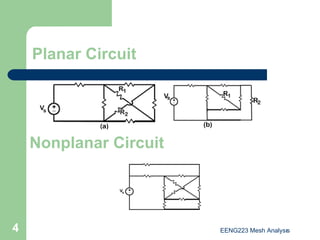
z work for planar circuit only
planar circuit -> no branch passes over or
under other branch
z M-meshes -> assign clockwise current for
each mesh
z apply KVL around each mesh
EENG223 Mesh Analysıs
4
Planar Circuit
Nonplanar Circuit
EENG223 Mesh Analysıs
5
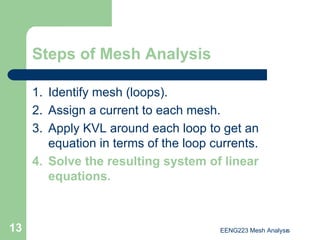
Steps of Mesh Analysis
1. Identify meshes.
2. Assign a current to each mesh.
3. Apply KVL around each loop to get an
equation in terms of the loop currents.
4. Solve the resulting system of linear
equations.
EENG223 Mesh Analysıs
6
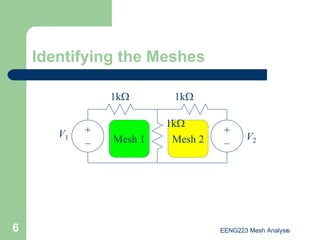
Identifying the Meshes
Mesh 2
1kΩ
1kΩ
1kΩ
V1 V2
Mesh 1
+
–
+
–
EENG223 Mesh Analysıs
7
Steps of Mesh Analysis
1. Identify mesh (loops).
2. Assign a current to each mesh.
3. Apply KVL around each loop to get an
equation in terms of the loop currents.
4. Solve the resulting system of linear
equations.
EENG223 Mesh Analysıs
8
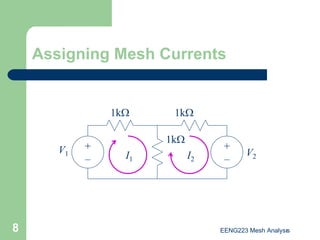
Assigning Mesh Currents
1kΩ
1kΩ
1kΩ
V1 V2
I1 I2
+
–
+
–
EENG223 Mesh Analysıs
9
Steps of Mesh Analysis
1. Identify mesh (loops).
2. Assign a current to each mesh.
3. Apply KVL around each loop to get an
equation in terms of the loop currents.
4. Solve the resulting system of linear
equations.
EENG223 Mesh Analysıs
10
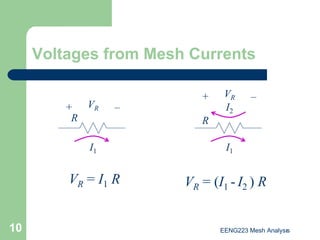
Voltages from Mesh Currents
R
I1
+ –
VR
VR = I1 R
R
I1
+ –
VR
I2
VR = (I1 - I2 ) R
EENG223 Mesh Analysıs
11
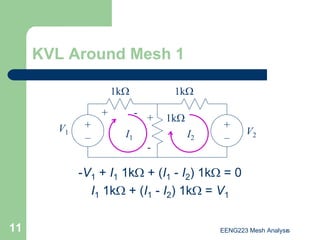
KVL Around Mesh 1
1kΩ
1kΩ
1kΩ
V1 V2
I1 I2
+
–
+
–
+ -
+
-
-V1 + I1 1kΩ + (I1 - I2) 1kΩ = 0
I1 1kΩ + (I1 - I2) 1kΩ = V1
EENG223 Mesh Analysıs
12
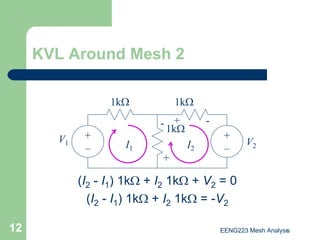
KVL Around Mesh 2
1kΩ
1kΩ
1kΩ
V1 V2
I1 I2
+
–
+
–
-
-
+
+
(I2 - I1) 1kΩ + I2 1kΩ + V2 = 0
(I2 - I1) 1kΩ + I2 1kΩ = -V2
EENG223 Mesh Analysıs
13
Steps of Mesh Analysis
1. Identify mesh (loops).
2. Assign a current to each mesh.
3. Apply KVL around each loop to get an
equation in terms of the loop currents.
4. Solve the resulting system of linear
equations.
EENG223 Mesh Analysıs
14
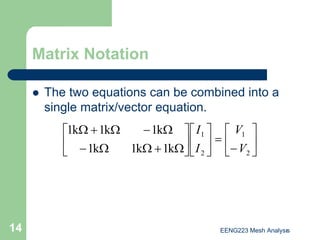
Matrix Notation
z The two equations can be combined into a
single matrix/vector equation.






−
=












Ω
+
Ω
Ω
−
Ω
−
Ω
+
Ω
2
1
2
1
k
1
k
1
k
1
k
1
k
1
k
1
V
V
I
I
EENG223 Mesh Analysıs
15
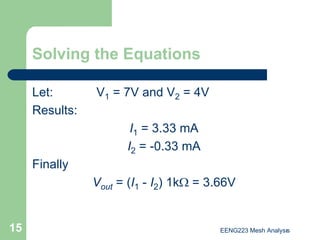
Solving the Equations
Let: V1 = 7V and V2 = 4V
Results:
I1 = 3.33 mA
I2 = -0.33 mA
Finally
Vout = (I1 - I2) 1kΩ = 3.66V
EENG223 Mesh Analysıs
16
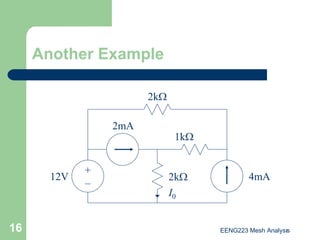
Another Example
1kΩ
2kΩ
2kΩ
12V 4mA
2mA
I0
+
–
EENG223 Mesh Analysıs
17
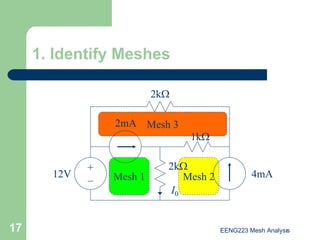
1. Identify Meshes
Mesh 2
Mesh 3
Mesh 1
1kΩ
2kΩ
2kΩ
12V 4mA
2mA
I0
+
–
EENG223 Mesh Analysıs
18
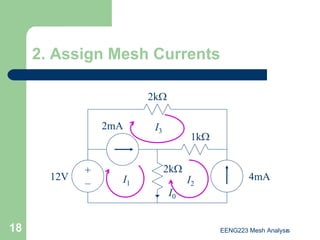
2. Assign Mesh Currents
I1 I2
I3
1kΩ
2kΩ
2kΩ
12V 4mA
2mA
I0
+
–
EENG223 Mesh Analysıs
19
Current Sources
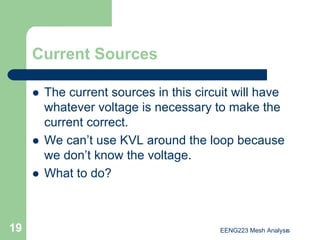
z The current sources in this circuit will have
whatever voltage is necessary to make the
current correct.
z We can’t use KVL around the loop because
we don’t know the voltage.
z What to do?
EEE 223 Mesh Analysıs
20
Current Sources
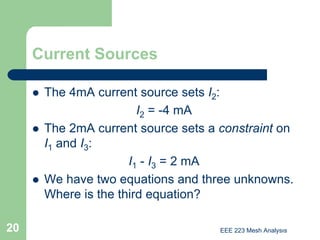
z The 4mA current source sets I2:
I2 = -4 mA
z The 2mA current source sets a constraint on
I1 and I3:
I1 - I3 = 2 mA
z We have two equations and three unknowns.
Where is the third equation?
EENG223 Mesh Analysıs
21
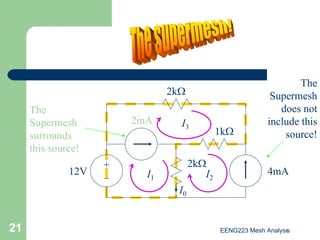
1kΩ
2kΩ
2kΩ
12V 4mA
2mA
I0
I1 I2
I3
The
Supermesh
surrounds
this source!
The
Supermesh
does not
include this
source!
+
–
EENG223 Mesh Analysıs
22
KVL Around the Supermesh
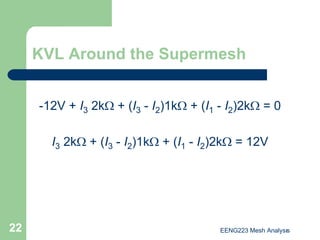
-12V + I3 2kΩ + (I3 - I2)1kΩ + (I1 - I2)2kΩ = 0
I3 2kΩ + (I3 - I2)1kΩ + (I1 - I2)2kΩ = 12V
EENG223 Mesh Analysı s
23
Matrix Notation
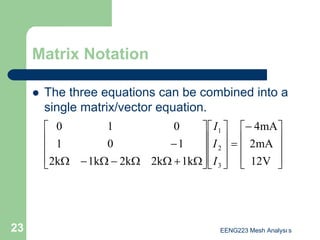
z The three equations can be combined into a
single matrix/vector equation.









−
=




















Ω
+
Ω
Ω
−
Ω
−
Ω
−
V
12
mA
2
mA
4
1k
2k
2k
1k
2k
1
0
1
0
1
0
3
2
1
I
I
I
EENG223 Mesh Analysıs
24
Solve Using MATLAB
>> A = [0 1 0; 1 0 -1;
2e3 -1e3-2e3 2e3+1e3];
>> v = [-4e-3; 2e-3; 12];
>> i = inv(A)*v
i = 0.0012
-0.0040
-0.0008
EENG223 Mesh Analysıs
25
Solution
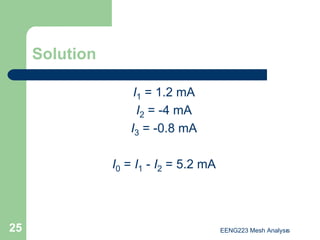
I1 = 1.2 mA
I2 = -4 mA
I3 = -0.8 mA
I0 = I1 - I2 = 5.2 mA
EENG223 Mesh Analysıs
26
Class Example

Mesh Analysis.pdf

  • 1.
    EENG223 Mesh Analysıs 1 MeshAnalysis Dr. M. K. Uyguroglu
  • 2.
    EENG223 Mesh Analysıs 2 MeshAnalysis z Nodal analysis was developed by applying KCL at each non-reference node. z Mesh analysis is developed by applying KVL around meshes/loops in the circuit. z Mesh analysis results in a system of linear equations which must be solved for unknown currents.
  • 3.
    EENG223 Mesh Analysıs 3 MeshAnalysis z quantity of interest is current z a mesh is a loop that does not contain another loop within it z work for planar circuit only planar circuit -> no branch passes over or under other branch z M-meshes -> assign clockwise current for each mesh z apply KVL around each mesh
  • 4.
    EENG223 Mesh Analysıs 4 PlanarCircuit Nonplanar Circuit
  • 5.
    EENG223 Mesh Analysıs 5 Stepsof Mesh Analysis 1. Identify meshes. 2. Assign a current to each mesh. 3. Apply KVL around each loop to get an equation in terms of the loop currents. 4. Solve the resulting system of linear equations.
  • 6.
    EENG223 Mesh Analysıs 6 Identifyingthe Meshes Mesh 2 1kΩ 1kΩ 1kΩ V1 V2 Mesh 1 + – + –
  • 7.
    EENG223 Mesh Analysıs 7 Stepsof Mesh Analysis 1. Identify mesh (loops). 2. Assign a current to each mesh. 3. Apply KVL around each loop to get an equation in terms of the loop currents. 4. Solve the resulting system of linear equations.
  • 8.
    EENG223 Mesh Analysıs 8 AssigningMesh Currents 1kΩ 1kΩ 1kΩ V1 V2 I1 I2 + – + –
  • 9.
    EENG223 Mesh Analysıs 9 Stepsof Mesh Analysis 1. Identify mesh (loops). 2. Assign a current to each mesh. 3. Apply KVL around each loop to get an equation in terms of the loop currents. 4. Solve the resulting system of linear equations.
  • 10.
    EENG223 Mesh Analysıs 10 Voltagesfrom Mesh Currents R I1 + – VR VR = I1 R R I1 + – VR I2 VR = (I1 - I2 ) R
  • 11.
    EENG223 Mesh Analysıs 11 KVLAround Mesh 1 1kΩ 1kΩ 1kΩ V1 V2 I1 I2 + – + – + - + - -V1 + I1 1kΩ + (I1 - I2) 1kΩ = 0 I1 1kΩ + (I1 - I2) 1kΩ = V1
  • 12.
    EENG223 Mesh Analysıs 12 KVLAround Mesh 2 1kΩ 1kΩ 1kΩ V1 V2 I1 I2 + – + – - - + + (I2 - I1) 1kΩ + I2 1kΩ + V2 = 0 (I2 - I1) 1kΩ + I2 1kΩ = -V2
  • 13.
    EENG223 Mesh Analysıs 13 Stepsof Mesh Analysis 1. Identify mesh (loops). 2. Assign a current to each mesh. 3. Apply KVL around each loop to get an equation in terms of the loop currents. 4. Solve the resulting system of linear equations.
  • 14.
    EENG223 Mesh Analysıs 14 MatrixNotation z The two equations can be combined into a single matrix/vector equation.       − =             Ω + Ω Ω − Ω − Ω + Ω 2 1 2 1 k 1 k 1 k 1 k 1 k 1 k 1 V V I I
  • 15.
    EENG223 Mesh Analysıs 15 Solvingthe Equations Let: V1 = 7V and V2 = 4V Results: I1 = 3.33 mA I2 = -0.33 mA Finally Vout = (I1 - I2) 1kΩ = 3.66V
  • 16.
    EENG223 Mesh Analysıs 16 AnotherExample 1kΩ 2kΩ 2kΩ 12V 4mA 2mA I0 + –
  • 17.
    EENG223 Mesh Analysıs 17 1.Identify Meshes Mesh 2 Mesh 3 Mesh 1 1kΩ 2kΩ 2kΩ 12V 4mA 2mA I0 + –
  • 18.
    EENG223 Mesh Analysıs 18 2.Assign Mesh Currents I1 I2 I3 1kΩ 2kΩ 2kΩ 12V 4mA 2mA I0 + –
  • 19.
    EENG223 Mesh Analysıs 19 CurrentSources z The current sources in this circuit will have whatever voltage is necessary to make the current correct. z We can’t use KVL around the loop because we don’t know the voltage. z What to do?
  • 20.
    EEE 223 MeshAnalysıs 20 Current Sources z The 4mA current source sets I2: I2 = -4 mA z The 2mA current source sets a constraint on I1 and I3: I1 - I3 = 2 mA z We have two equations and three unknowns. Where is the third equation?
  • 21.
    EENG223 Mesh Analysıs 21 1kΩ 2kΩ 2kΩ 12V4mA 2mA I0 I1 I2 I3 The Supermesh surrounds this source! The Supermesh does not include this source! + –
  • 22.
    EENG223 Mesh Analysıs 22 KVLAround the Supermesh -12V + I3 2kΩ + (I3 - I2)1kΩ + (I1 - I2)2kΩ = 0 I3 2kΩ + (I3 - I2)1kΩ + (I1 - I2)2kΩ = 12V
  • 23.
    EENG223 Mesh Analysıs 23 Matrix Notation z The three equations can be combined into a single matrix/vector equation.          − =                     Ω + Ω Ω − Ω − Ω − V 12 mA 2 mA 4 1k 2k 2k 1k 2k 1 0 1 0 1 0 3 2 1 I I I
  • 24.
    EENG223 Mesh Analysıs 24 SolveUsing MATLAB >> A = [0 1 0; 1 0 -1; 2e3 -1e3-2e3 2e3+1e3]; >> v = [-4e-3; 2e-3; 12]; >> i = inv(A)*v i = 0.0012 -0.0040 -0.0008
  • 25.
    EENG223 Mesh Analysıs 25 Solution I1= 1.2 mA I2 = -4 mA I3 = -0.8 mA I0 = I1 - I2 = 5.2 mA
  • 26.