Market Failures
Merit and demerit goods
Definition
When the free market
mechanism leads to a
misallocation of resources in
the economy, either
completely failing to provide a
good or service or providing
the wrong quantity.
Market failure
1. Negative externalities
2. Positive externalities
3. Merit & demerit goods
4. Public goods
5. Monopoly
6. Immobility of the factors of production
7. Unequal distribution of income and
wealth
Information failure
Imperfect
information
meaning merit
goods are under-
produced while
demerit goods
are over-
produced or over
consumed.
Merit Goods
Definition
A good that would be
under-consumed in a
free market, as
individuals do not fully
understand the benefits
that derived from the
consumption of that
goods
Examples
 The NHS
 State Education
 Public leisure centres
 Vaccinations
 Public Libraries
 Screening for cancer
 Eye tests
 Dental care
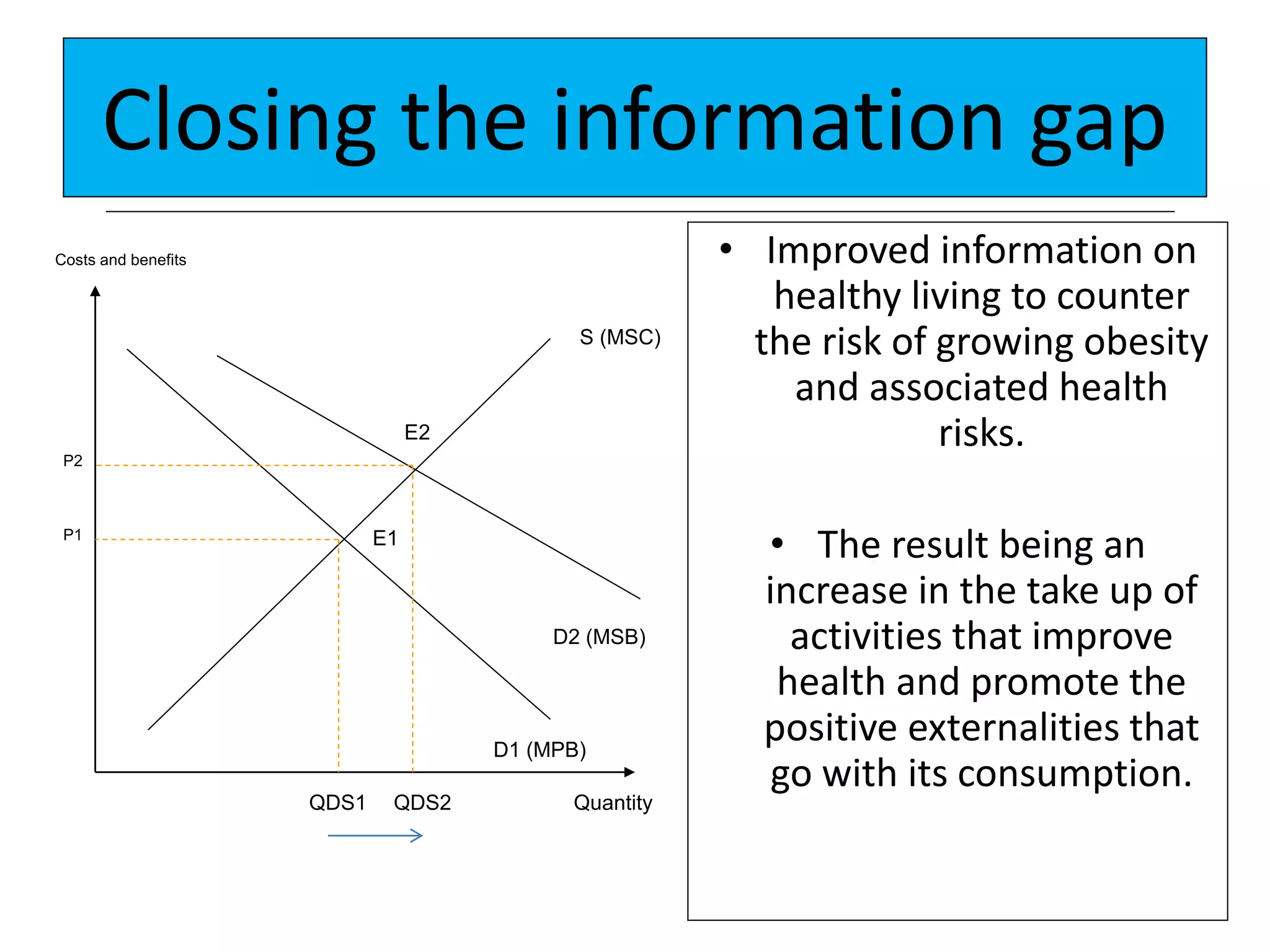
• Improved information on
healthy living to counter
the risk of growing obesity
and associated health
risks.
• The result being an
increase in the take up of
activities that improve
health and promote the
positive externalities that
go with its consumption.
QDS1
S (MSC)
QDS2 Quantity
Costs and benefits
P2
P1 E1
E2
D1 (MPB)
D2 (MSB)
Closing the information gap
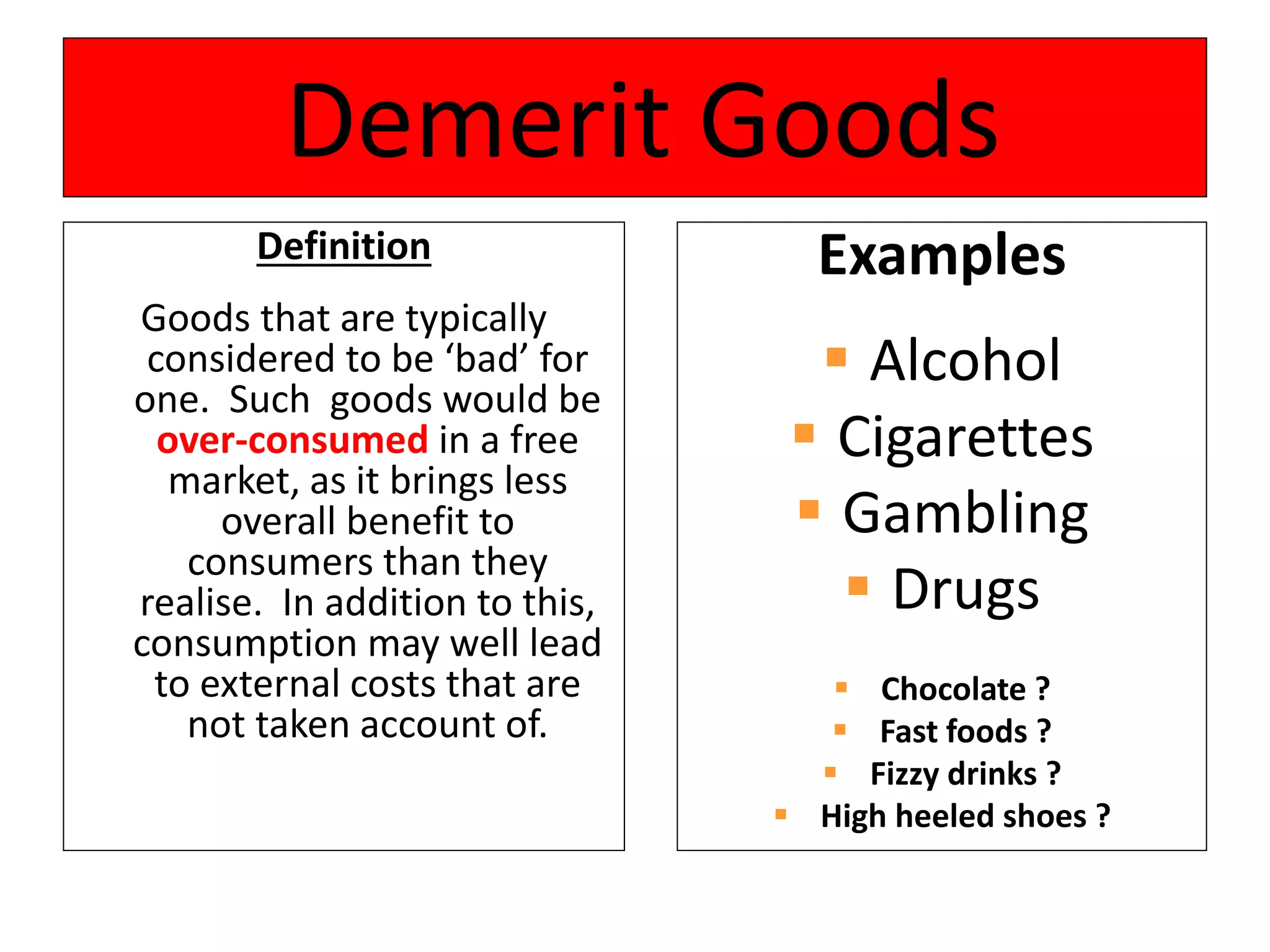
Demerit Goods
Definition
Goods that are typically
considered to be ‘bad’ for
one. Such goods would be
over-consumed in a free
market, as it brings less
overall benefit to
consumers than they
realise. In addition to this,
consumption may well lead
to external costs that are
not taken account of.
Examples
 Alcohol
 Cigarettes
 Gambling
 Drugs
 Chocolate ?
 Fast foods ?
 Fizzy drinks ?
 High heeled shoes ?
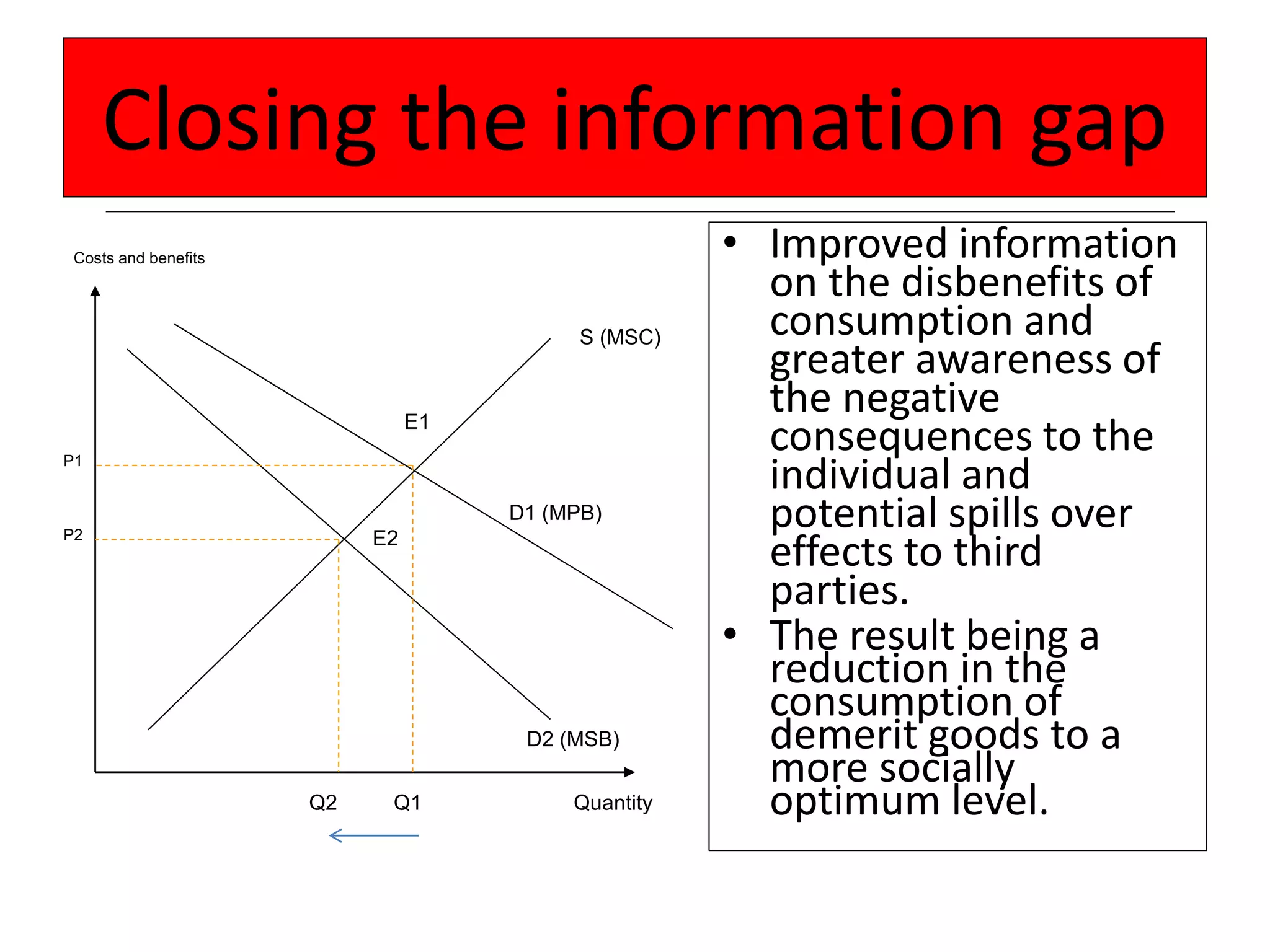
• Improved information
on the disbenefits of
consumption and
greater awareness of
the negative
consequences to the
individual and
potential spills over
effects to third
parties.
• The result being a
reduction in the
consumption of
demerit goods to a
more socially
optimum level.
Q2
D2 (MSB)
S (MSC)
D1 (MPB)
Q1 Quantity
Costs and benefits
P1
P2 E2
E1
Closing the information gap

Merit and demerit goods.ppt

  • 1.
  • 2.
    Definition When the freemarket mechanism leads to a misallocation of resources in the economy, either completely failing to provide a good or service or providing the wrong quantity.
  • 3.
    Market failure 1. Negativeexternalities 2. Positive externalities 3. Merit & demerit goods 4. Public goods 5. Monopoly 6. Immobility of the factors of production 7. Unequal distribution of income and wealth
  • 4.
    Information failure Imperfect information meaning merit goodsare under- produced while demerit goods are over- produced or over consumed.
  • 5.
    Merit Goods Definition A goodthat would be under-consumed in a free market, as individuals do not fully understand the benefits that derived from the consumption of that goods Examples  The NHS  State Education  Public leisure centres  Vaccinations  Public Libraries  Screening for cancer  Eye tests  Dental care
  • 6.
    • Improved informationon healthy living to counter the risk of growing obesity and associated health risks. • The result being an increase in the take up of activities that improve health and promote the positive externalities that go with its consumption. QDS1 S (MSC) QDS2 Quantity Costs and benefits P2 P1 E1 E2 D1 (MPB) D2 (MSB) Closing the information gap
  • 7.
    Demerit Goods Definition Goods thatare typically considered to be ‘bad’ for one. Such goods would be over-consumed in a free market, as it brings less overall benefit to consumers than they realise. In addition to this, consumption may well lead to external costs that are not taken account of. Examples  Alcohol  Cigarettes  Gambling  Drugs  Chocolate ?  Fast foods ?  Fizzy drinks ?  High heeled shoes ?
  • 8.
    • Improved information onthe disbenefits of consumption and greater awareness of the negative consequences to the individual and potential spills over effects to third parties. • The result being a reduction in the consumption of demerit goods to a more socially optimum level. Q2 D2 (MSB) S (MSC) D1 (MPB) Q1 Quantity Costs and benefits P1 P2 E2 E1 Closing the information gap