INTRODUCTION
Not allgreat inventions were planned
Not every mistake is a failure, some turn into inventions
Many inventions we use every day like microwave ovens, Super Glue,
and Post-it Notes were discovered by mistake.
Some inventions happened because someone paid attention to
accidents instead of ignoring them.
3.
TOPICS TO BEDISCUSSED:
Medical and Life-Saving Accidental Inventions
1. Penicillin (Alexander Fleming)
2. X-rays (Wilhem Röntgen)
3. Pacemaker(Wilson Greatbatch)
Microwave Oven (Percy Spencer)
4.
Food and EverydayItems We Use
1. Potato chips (George Crum)
2. Corn Flakes (Dr. John Harvey Kellogg and Will Keith
Kellogg)
3. Saccharin(Constantin Fahlberg )
Sticky Failures That Became Successes
1. Post-it Notes (Spencer Silver and Art Fry)
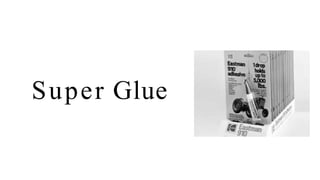
2. Super Glue (Dr. Harry Coover)
3. Teflon(Dr. Roy Plunkett)
5.
THE POWER OFSERENDIPITY
Aptitude for making desirable discoveries by accident.
being open to accidents and surprises can turn failures into inventions
Smart +lucky discovery=serendipity
“Faculty of making happy and unexpected discoveries by accident”-
Horace Walpole
6.
WHY THIS TOPICMATTERS TO ENGINEERS:
Great engineers stay curious
Observe failures
Communicate findings
Mistakes Can Be Valuable
Innovation Isn’t Always Planned, some breakthroughs happen
when engineers are flexible and open-minded.
Encourages Experimentation
7.
CONCLUSION:
Mistakes are notalways failures; they can lead to innovations
that change the world.
The key is curiosity, observation, and openness to
unexpected results, which is the power of serendipity.
Sometimes, a happy accident is all it takes to change the
world
8.
REFERENCES:
Wikipedia, Serendipity,2025. [Online]. [Accessed: 04-Jan-2026]
R. M. Roberts, Serendipity:Accidental Discoveries in Science,
John Wiley & Sons, Inc., 1989. [Accessed: 04-Jan-2026]
J. Hutchinson,“Accidental scientific discoveries,” EBSCO
Research Starters, 2022. [Accessed: 04-Jan-2026]
A Book reference:
R. M. Roberts, Serendipity:Accidental Discoveries in Science.
New York, NY, USA: John Wiley & Sons, Inc., 1989.
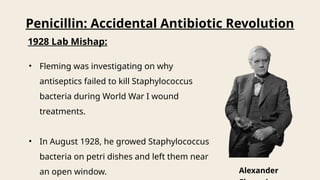
Penicillin: Accidental AntibioticRevolution
1928 Lab Mishap:
• Fleming was investigating on why
antiseptics failed to kill Staphylococcus
bacteria during World War I wound
treatments.
• In August 1928, he growed Staphylococcus
bacteria on petri dishes and left them near
an open window. Alexander
11.
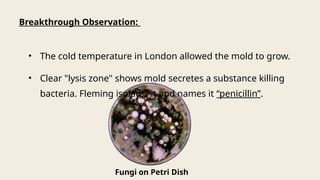
• The coldtemperature in London allowed the mold to grow.
• Clear "lysis zone" shows mold secretes a substance killing
bacteria. Fleming isolates it and names it “penicillin”.
Breakthrough Observation:
Fungi on Petri Dish
12.
Challenges:
• Published in1929 but hard to isolate, saved a few lives in 1930s
trials.
• Revival came in 1939 when Oxford's Howard Florey and Ernst
Chain creating ways to extract penciliin.
Global Impact:
• In the 1940s, Howard Florey and Ernst Chain scaled up
production, slashing sepsis deaths.
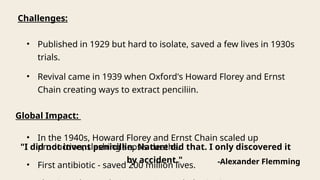
• First antibiotic - saved 200 million lives.
"I did not invent penicillin. Nature did that. I only discovered it
by accident." -Alexander Flemming
13.
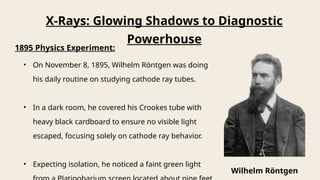
X-Rays: Glowing Shadowsto Diagnostic
Powerhouse
1895 Physics Experiment:
• On November 8, 1895, Wilhelm Röntgen was doing
his daily routine on studying cathode ray tubes.
• In a dark room, he covered his Crookes tube with
heavy black cardboard to ensure no visible light
escaped, focusing solely on cathode ray behavior.
• Expecting isolation, he noticed a faint green light
Wilhelm Röntgen
14.
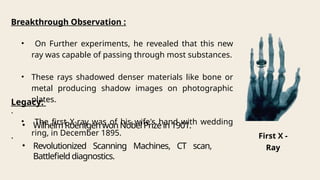
Breakthrough Observation :
•On Further experiments, he revealed that this new
ray was capable of passing through most substances.
• These rays shadowed denser materials like bone or
metal producing shadow images on photographic
plates.
.
• The first X-ray was of his wife's hand with wedding
ring, in December 1895.
Legacy:
• WilhelmRoentgenwonNobelPrizein1901.
.
• Revolutionized Scanning Machines, CT scan,
Battlefielddiagnostics.
First X -
Ray
15.
BIBLIOGRAPH
Y
• Columbia Surgery,“History of Medicine: Dr. Roentgen’s Accidental X-Rays | Columbia University
Department of Surgery,” Columbiasurgery.org, Sep. 17, 2015.
https://columbiasurgery.org/news/2015/09/17/history-medicine-dr-roentgen-s-accidental-x-rays
• American Chemical Society, “Alexander Fleming Discovery and Development of Penicillin - Landmark,”
American Chemical Society, Nov. 19, 1999.
https://www.acs.org/education/whatischemistry/landmarks/flemingpenicillin.html
• H. Markel, “The Real Story behind Penicillin,” PBS NewsHour, Sep. 27, 2013.
https://www.pbs.org/newshour/health/the-real-story-behind-the-worlds-first-antibiotic
• R. Gaynes, “The Discovery of Penicillin—New Insights After More Than 75 Years of Clinical Use,”
Emerging Infectious Diseases, vol. 23, no. 5, pp. 849–853, May 2017, Available:
https://www.ncbi.nlm.nih.gov/pmc/articles/PMC5403050/
• “November 8, 1895: Roentgen’s Discovery of X-Rays,” Aps.org, 2025.
https://www.aps.org/apsnews/2001/11/1895-roentgens-discovery-xrays?
• A. Press, “The Penicillin Myth,” Asimov.press, Nov. 24, 2025. https://www.asimov.press/p/penicillin-myth
(accessed Dec. 30, 2025).
16.
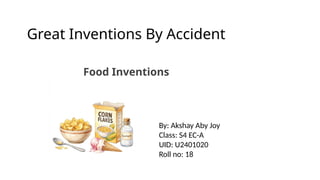
Great Inventions ByAccident
Food Inventions
By: Akshay Aby Joy
Class: S4 EC-A
UID: U2401020
Roll no: 18
17.
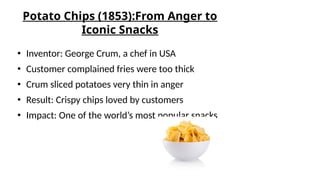
Potato Chips (1853):FromAnger to
Iconic Snacks
● Inventor: George Crum, a chef in USA
● Customer complained fries were too thick
● Crum sliced potatoes very thin in anger
● Result: Crispy chips loved by customers
● Impact: One of the world’s most popular snacks
18.
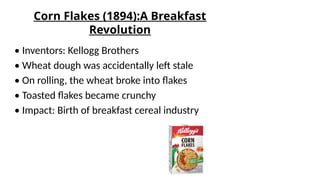
Corn Flakes (1894):ABreakfast
Revolution
• Inventors: Kellogg Brothers
• Wheat dough was accidentally left stale
• On rolling, the wheat broke into flakes
• Toasted flakes became crunchy
• Impact: Birth of breakfast cereal industry
19.
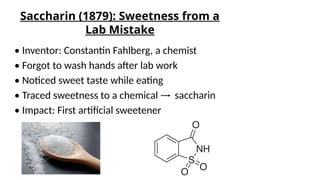
Saccharin (1879): Sweetnessfrom a
Lab Mistake
• Inventor: Constantin Fahlberg, a chemist
• Forgot to wash hands after lab work
• Noticed sweet taste while eating
• Traced sweetness to a chemical saccharin
• Impact: First artificial sweetener
20.
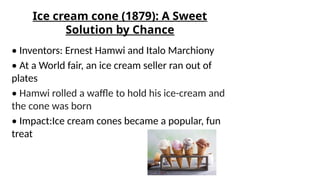
Ice cream cone(1879): A Sweet
Solution by Chance
• Inventors: Ernest Hamwi and Italo Marchiony
• At a World fair, an ice cream seller ran out of
plates
• Hamwi rolled a waffle to hold his ice-cream and
the cone was born
• Impact:Ice cream cones became a popular, fun
treat
21.
Bibliography
● admin, “10Foods That Were Invented by Accident - Youth in Food Systems,” Youth in
Food Systems - Engaging Youth in Food Exploration., Oct. 20, 2025.
https://seeds.ca/schoolfoodgardens/10-foods-that-were-invented-by-accident/
(accessed Dec. 30, 2025).
● M. and Co, “Accidental Invention: Corn Flakes,” Custom Powder Systems, Mar. 01,
2022. https://custom-powder.com/accidental-invention-corn-flakes/
● “Accidental Invention: Saccharin | Custom Powder Systems,” Custom Powder
Systems, Apr. 11, 2024. https://custom-powder.com/accidental-invention-saccharin/
● “Welcome To Zscaler Directory Authentication,” Indiatimes.com, 2025.
https://timesofindia.indiatimes.com/life-style/food-news/9-delicious-foods-that-
were-invented-by-accident/articleshow/123455032.cms (accessed Dec. 30, 2025).
● K. Guite, 51 Accidental Inventions that Changed the World. 2019.
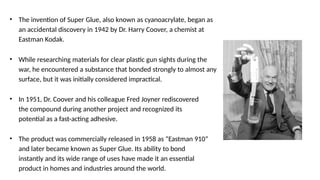
• The inventionof Super Glue, also known as cyanoacrylate, began as
an accidental discovery in 1942 by Dr. Harry Coover, a chemist at
Eastman Kodak.
• While researching materials for clear plastic gun sights during the
war, he encountered a substance that bonded strongly to almost any
surface, but it was initially considered impractical.
• In 1951, Dr. Coover and his colleague Fred Joyner rediscovered
the compound during another project and recognized its
potential as a fast-acting adhesive.
• The product was commercially released in 1958 as “Eastman 910”
and later became known as Super Glue. Its ability to bond
instantly and its wide range of uses have made it an essential
product in homes and industries around the world.
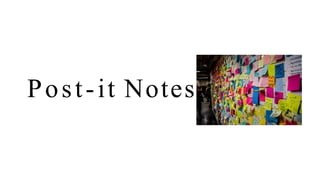
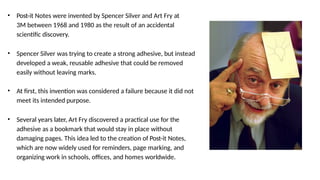
• Post-it Noteswere invented by Spencer Silver and Art Fry at
3M between 1968 and 1980 as the result of an accidental
scientific discovery.
• Spencer Silver was trying to create a strong adhesive, but instead
developed a weak, reusable adhesive that could be removed
easily without leaving marks.
• At first, this invention was considered a failure because it did not
meet its intended purpose.
• Several years later, Art Fry discovered a practical use for the
adhesive as a bookmark that would stay in place without
damaging pages. This idea led to the creation of Post-it Notes,
which are now widely used for reminders, page marking, and
organizing work in schools, offices, and homes worldwide.
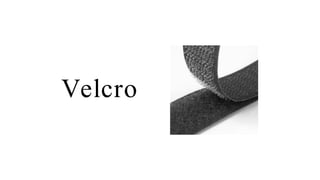
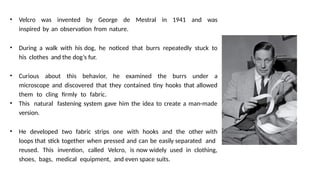
• Velcro wasinvented by George de Mestral in 1941 and was
inspired by an observation from nature.
• During a walk with his dog, he noticed that burrs repeatedly stuck to
his clothes and the dog’s fur.
• Curious about this behavior, he examined the burrs under a
microscope and discovered that they contained tiny hooks that allowed
them to cling firmly to fabric.
• This natural fastening system gave him the idea to create a man-made
version.
• He developed two fabric strips one with hooks and the other with
loops that stick together when pressed and can be easily separated and
reused. This invention, called Velcro, is now widely used in clothing,
shoes, bags, medical equipment, and even space suits.
29.
Bibliography
“Harry Coover |Lemelson-MIT Program,” Mit.edu, 2011. https://lemelson.mit.edu/resources/harry-coover
History of Simple Things, “The Story Behind Super Glue: Its Surprising Origins,” YouTube, Aug. 15,
2024. https://www.youtube.com/watch?v=mgpeNiS6xqE
“An Idea That Stuck: How George de Mestral Invented the Velcro Fastener,” USA, Nov. 11, 2016. https://
www.velcro.com/news-and-blog/2016/11/an-idea-that-stuck-how-george-de-mestral-invented-the- velcro-
fastener/
C. Skonord, “Post-it Notes: An Innovative Employee Idea That Was Originally a Mistake,” Ideawake, Feb. 19,
2021. https://ideawake.com/post-it-notes-employee-idea-that-was-originally-mistake/
3M, “History Timeline: Post-it® Notes,” Post-it®, 2024. https://www.post-it.com/3M/en_US/post-it/contact-
us/about-us/
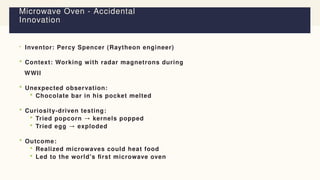
Microwave Oven -Accidental
Innovation
Inventor: Percy Spencer (Raytheon engineer)
Context: Working with radar magnetrons during
WWII
Unexpected observation:
Chocolate bar in his pocket melted
Curiosity-driven testing:
Tried popcorn → kernels popped
Tried egg → exploded
Outcome:
Realized microwaves could heat food
Led to the world's first microwave oven
32.
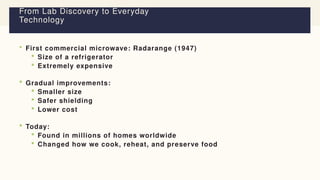
First commercialmicrowave: Radarange (1947)
Size of a refrigerator
Extremely expensive
Gradual improvements:
Smaller size
Safer shielding
Lower cost
Today:
Found in millions of homes worldwide
Changed how we cook, reheat, and preserve food
From Lab Discovery to Everyday
Technology
33.
Conclusion
Many ofthe world's most important inventions were not planned, but
discovered by paying attention to the unexpected.
The microwave oven shows how curiosity, careful observation, and
communication can turn a small accident into a life-changing technology.
Engineering is not just about solving problems - it's about noticing
surprises, learning from mistakes, and improving ideas over time.
By staying curious, documenting our work, and sharing results, we give
serendipity a chance to become innovation.


![REFERENCES:
Wikipedia, Serendipity, 2025. [Online]. [Accessed: 04-Jan-2026]
R. M. Roberts, Serendipity:Accidental Discoveries in Science,
John Wiley & Sons, Inc., 1989. [Accessed: 04-Jan-2026]
J. Hutchinson,“Accidental scientific discoveries,” EBSCO
Research Starters, 2022. [Accessed: 04-Jan-2026]
A Book reference:
R. M. Roberts, Serendipity:Accidental Discoveries in Science.
New York, NY, USA: John Wiley & Sons, Inc., 1989.](https://image.slidesharecdn.com/mergedpresentationcholadeck-260127161927-51cd3f5f/85/merged_presentation_choladeck-pptxdgggggg-8-320.jpg)