Leonardo da Vinci Partnerships Project
GUI USABILITY AND ACCESSIBILITY:
EXCHANGING KNOWLEDGE AND EXPERIENCES
Mental Models
Cristina Cachero
This project has been funded with support from the European
Commission under the Lifelong Learning Programme
Leonardo da Vinci Partnerships Project
GUI USABILITY AND ACCESSIBILITY:
EXCHANGING KNOWLEDGE AND EXPERIENCES
 80% of the overall usability comes from a match between
the CONCEPTUAL MODEL of the application and the
User’s MENTAL MODEL.
 Conceptual model of the application:
 Navigational structure (task structure)
 Content
 Language and labelling
 Mental Model of the user:
 How the user THINKS navigation should be structured, what content she is
expecting to find and what’s the language and labelling she understands.
This project has been funded with support from the European
Commission under the Lifelong Learning Programme
2
Introduction
Leonardo da Vinci Partnerships Project
GUI USABILITY AND ACCESSIBILITY:
EXCHANGING KNOWLEDGE AND EXPERIENCES
 Characteristics of the mental model
 Everyone comes with a mental model
 This model is usually made up of past experiences
 Mental models are not always attuned to reality
 Mental models establish expectations, which drive and make up
the behaviour
 Mental models are not always easy to explain
 How does a musician play an instrument?
 How does a doctor operate?
This project has been funded with support from the European
Commission under the Lifelong Learning Programme
3
Mental Models
Leonardo da Vinci Partnerships Project
GUI USABILITY AND ACCESSIBILITY:
EXCHANGING KNOWLEDGE AND EXPERIENCES
 Mental models are there even if you are not aware of
them
 What happens if you see a door with a handle? You pull.
And if it has none? You push.
 What happens if you are the co-driver in a car and you
sense that the driver is going too fast? You try to brake.
 In most european countries people drive on the right.
However in some countries they drive on the left. Have
you tried to drive in a country in which the sense of
circulation is different?
This project has been funded with support from the European
Commission under the Lifelong Learning Programme
4
Mental Models
Leonardo da Vinci Partnerships Project
GUI USABILITY AND ACCESSIBILITY:
EXCHANGING KNOWLEDGE AND EXPERIENCES
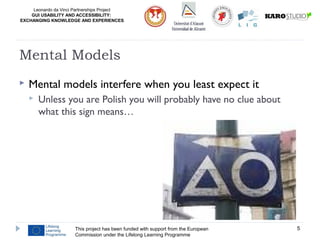
 Mental models interfere when you least expect it
 Unless you are Polish you will probably have no clue about
what this sign means…
This project has been funded with support from the European
Commission under the Lifelong Learning Programme
5
Mental Models
Leonardo da Vinci Partnerships Project
GUI USABILITY AND ACCESSIBILITY:
EXCHANGING KNOWLEDGE AND EXPERIENCES
 Mental Models are being consistently dismissed despite
the evidence
 Please, watch: http://connect.humanfactors.com/video/online-
checkout-in-real-life
 Instead, how should we design a checkout process?
 Please, read: http://www.asktog.com/columns/081Registration.html
This project has been funded with support from the European
Commission under the Lifelong Learning Programme
6
Mental Models
Leonardo da Vinci Partnerships Project
GUI USABILITY AND ACCESSIBILITY:
EXCHANGING KNOWLEDGE AND EXPERIENCES
These slides are made available under the license Creative Commons
Attribution-NonCommercial-NoDerivs CC BY-NC-ND. More
information about license: http://creativecommons.org/licenses/by-nc-
nd/3.0/.
These slides were created under Leonardo daVinci Partnerships
Project 2012-1-PL1-LEO04-28181 GUI USABILITY AND
ACCESSIBILITY: EXCHANGING KNOWLEDGE AND EXPERIENCES
(http://usability-accessibility.org/).
This project has been funded with support from the European
Commission under the Lifelong Learning Programme
7
Attributions

Mental models

  • 1.
    Leonardo da VinciPartnerships Project GUI USABILITY AND ACCESSIBILITY: EXCHANGING KNOWLEDGE AND EXPERIENCES Mental Models Cristina Cachero This project has been funded with support from the European Commission under the Lifelong Learning Programme
  • 2.
    Leonardo da VinciPartnerships Project GUI USABILITY AND ACCESSIBILITY: EXCHANGING KNOWLEDGE AND EXPERIENCES  80% of the overall usability comes from a match between the CONCEPTUAL MODEL of the application and the User’s MENTAL MODEL.  Conceptual model of the application:  Navigational structure (task structure)  Content  Language and labelling  Mental Model of the user:  How the user THINKS navigation should be structured, what content she is expecting to find and what’s the language and labelling she understands. This project has been funded with support from the European Commission under the Lifelong Learning Programme 2 Introduction
  • 3.
    Leonardo da VinciPartnerships Project GUI USABILITY AND ACCESSIBILITY: EXCHANGING KNOWLEDGE AND EXPERIENCES  Characteristics of the mental model  Everyone comes with a mental model  This model is usually made up of past experiences  Mental models are not always attuned to reality  Mental models establish expectations, which drive and make up the behaviour  Mental models are not always easy to explain  How does a musician play an instrument?  How does a doctor operate? This project has been funded with support from the European Commission under the Lifelong Learning Programme 3 Mental Models
  • 4.
    Leonardo da VinciPartnerships Project GUI USABILITY AND ACCESSIBILITY: EXCHANGING KNOWLEDGE AND EXPERIENCES  Mental models are there even if you are not aware of them  What happens if you see a door with a handle? You pull. And if it has none? You push.  What happens if you are the co-driver in a car and you sense that the driver is going too fast? You try to brake.  In most european countries people drive on the right. However in some countries they drive on the left. Have you tried to drive in a country in which the sense of circulation is different? This project has been funded with support from the European Commission under the Lifelong Learning Programme 4 Mental Models
  • 5.
    Leonardo da VinciPartnerships Project GUI USABILITY AND ACCESSIBILITY: EXCHANGING KNOWLEDGE AND EXPERIENCES  Mental models interfere when you least expect it  Unless you are Polish you will probably have no clue about what this sign means… This project has been funded with support from the European Commission under the Lifelong Learning Programme 5 Mental Models
  • 6.
    Leonardo da VinciPartnerships Project GUI USABILITY AND ACCESSIBILITY: EXCHANGING KNOWLEDGE AND EXPERIENCES  Mental Models are being consistently dismissed despite the evidence  Please, watch: http://connect.humanfactors.com/video/online- checkout-in-real-life  Instead, how should we design a checkout process?  Please, read: http://www.asktog.com/columns/081Registration.html This project has been funded with support from the European Commission under the Lifelong Learning Programme 6 Mental Models
  • 7.
    Leonardo da VinciPartnerships Project GUI USABILITY AND ACCESSIBILITY: EXCHANGING KNOWLEDGE AND EXPERIENCES These slides are made available under the license Creative Commons Attribution-NonCommercial-NoDerivs CC BY-NC-ND. More information about license: http://creativecommons.org/licenses/by-nc- nd/3.0/. These slides were created under Leonardo daVinci Partnerships Project 2012-1-PL1-LEO04-28181 GUI USABILITY AND ACCESSIBILITY: EXCHANGING KNOWLEDGE AND EXPERIENCES (http://usability-accessibility.org/). This project has been funded with support from the European Commission under the Lifelong Learning Programme 7 Attributions

Editor's Notes

  • #3 Experimental design is a very time consuming process. The more you take time to make a very precise and complete experimental design, the more you test will be robust and pertinent.
  • #4 Experimental design is a very time consuming process. The more you take time to make a very precise and complete experimental design, the more you test will be robust and pertinent.
  • #5 Experimental design is a very time consuming process. The more you take time to make a very precise and complete experimental design, the more you test will be robust and pertinent.
  • #6 Circle for girls, triangle for boys
  • #7 Experimental design is a very time consuming process. The more you take time to make a very precise and complete experimental design, the more you test will be robust and pertinent.
  • #8 Experimental design is a very time consuming process. The more you take time to make a very precise and complete experimental design, the more you test will be robust and pertinent.