Memory Span
Test
Amanda Recker
Noah Feaster
Paulo Davila
Introduction
 Amanda
    Problem:Does perceived stress impact
     memory span?
 Noah
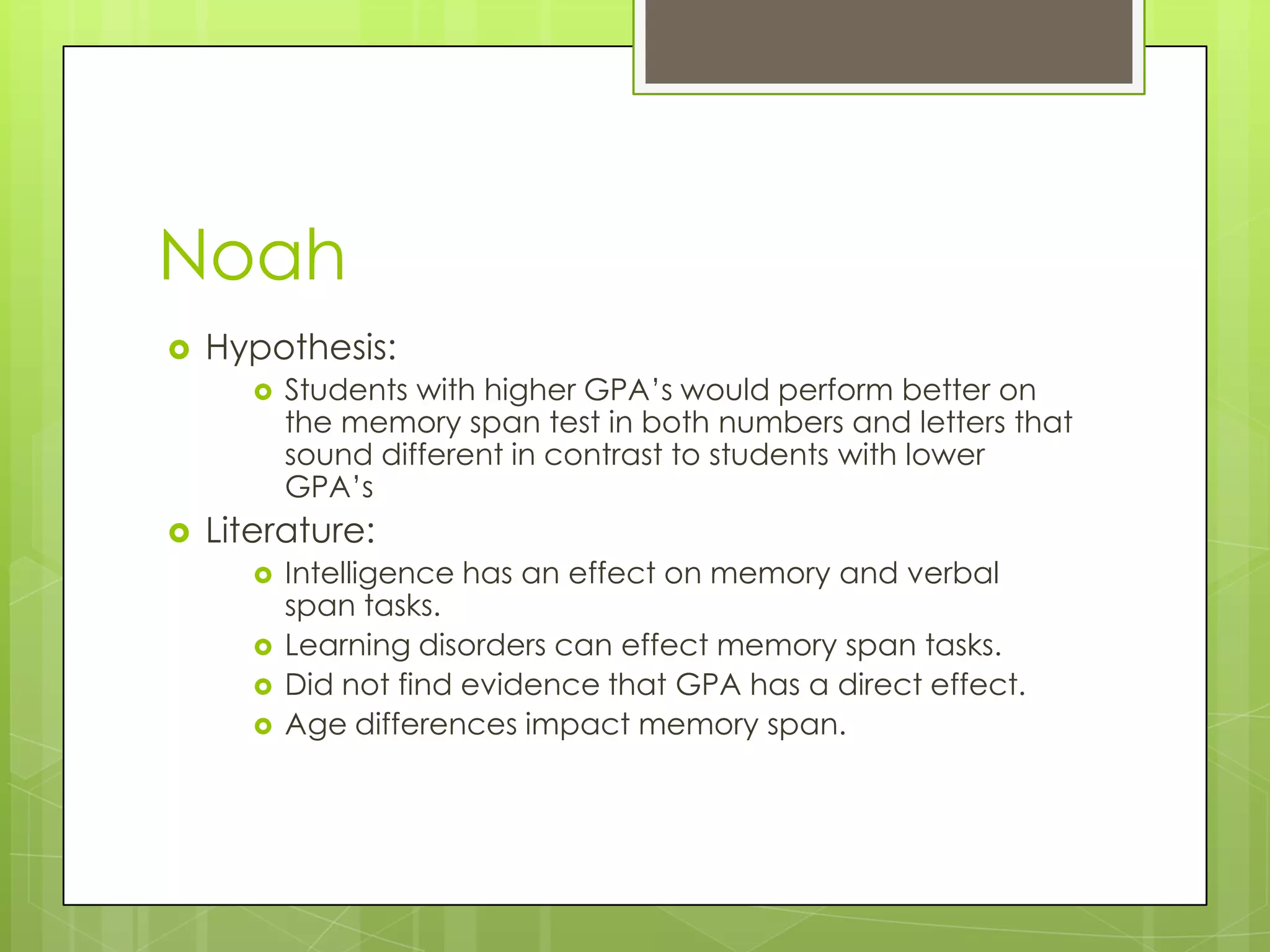
    Problem:  Does memory span correlate with
     intelligence levels measured through GPA?
 Paulo
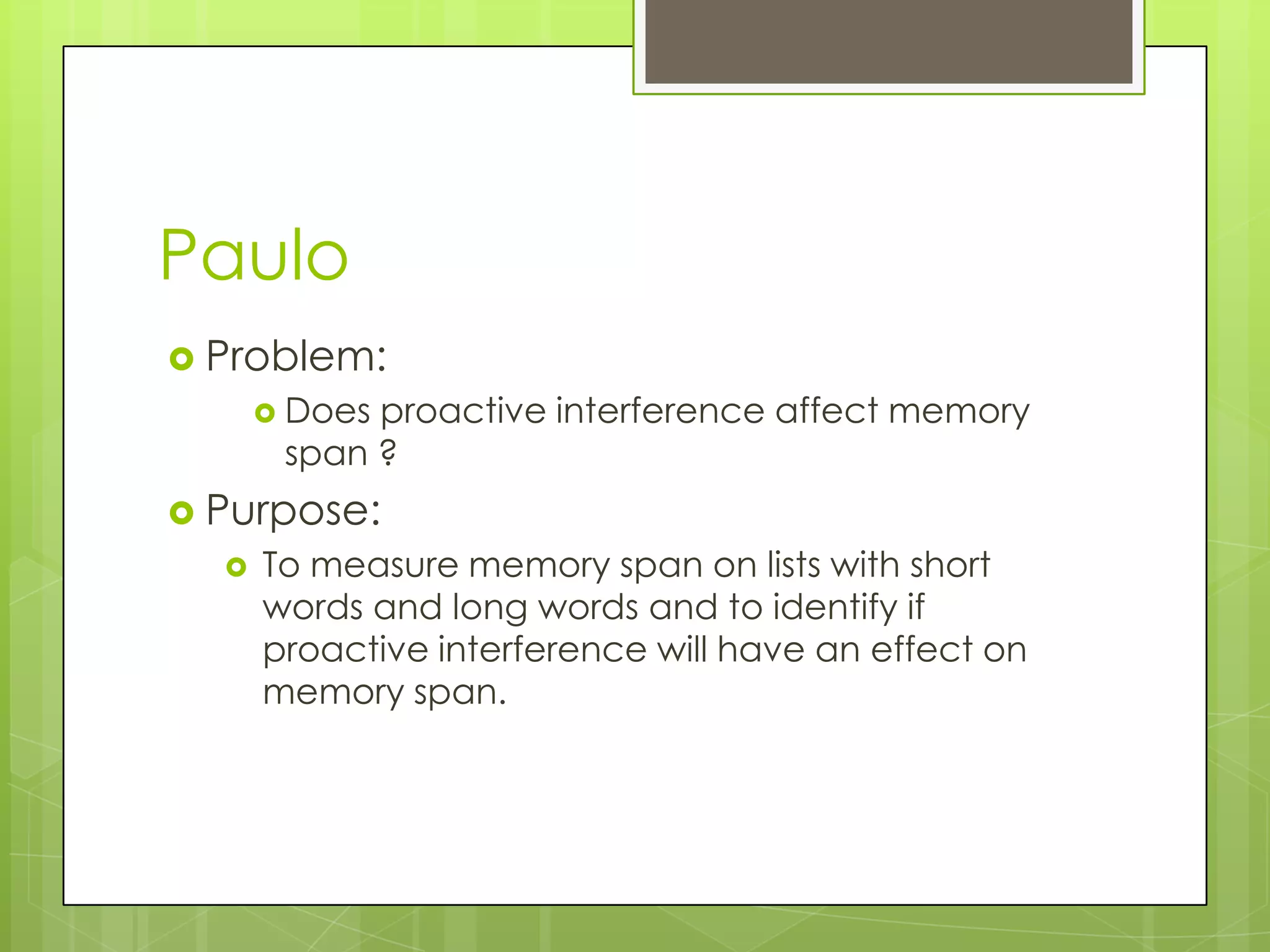
    Problem:
            Does proactive interference impact
     memory pan?
Amanda
   Problem:
         Does perceived stress impact memory span?
   Purpose:
         To measure memory span and perceived stress
          and identify if perceived stress assessment scores
          are related to memory span performance.
   Hypothesis:
         It was hypothesized that individuals with high
          stress levels, as defined by the Perceived Stress
          Assessment, will demonstrate less memory span
          ability as opposed to individuals with low stress
          levels.
Noah
 Problem:
     Does memory span correlate with intelligence
     levels measured through GPA?
 Purpose:
     Tomeasure memory span on lists with
     numbers and letters that sound different and
     to identify if GPA levels have an effect on
     memory span.
Noah
   Hypothesis:
          Students with higher GPA’s would perform better on
           the memory span test in both numbers and letters that
           sound different in contrast to students with lower
           GPA’s
   Literature:
          Intelligence has an effect on memory and verbal
           span tasks.
          Learning disorders can effect memory span tasks.
          Did not find evidence that GPA has a direct effect.
          Age differences impact memory span.
Paulo
 Problem:
       Doesproactive interference affect memory
       span ?
 Purpose:
     To measure memory span on lists with short
      words and long words and to identify if
      proactive interference will have an effect on
      memory span.
Paulo
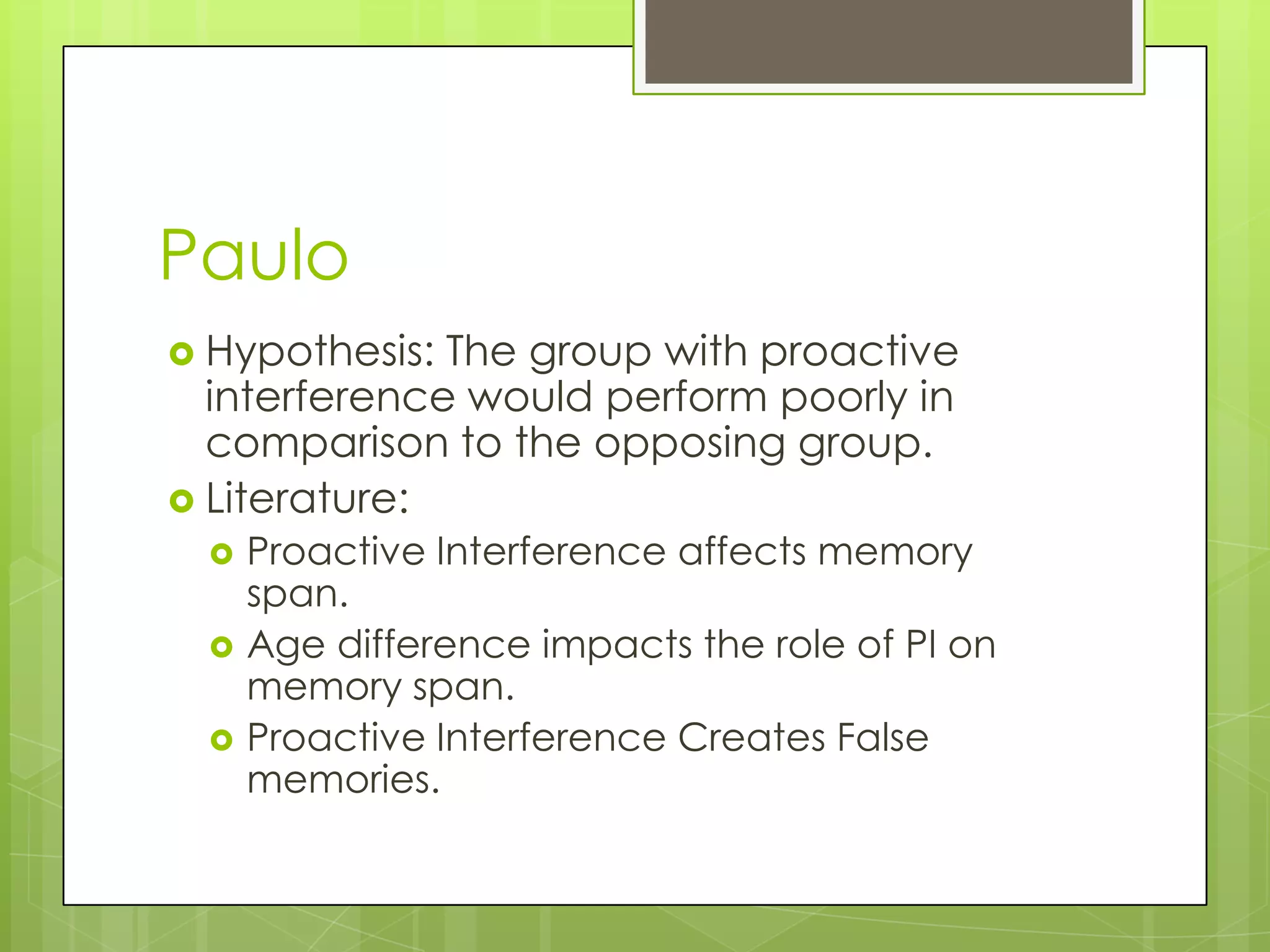
 Hypothesis: The group with proactive
  interference would perform poorly in
  comparison to the opposing group.
 Literature:
     Proactive Interference affects memory
      span.
     Age difference impacts the role of PI on
      memory span.
     Proactive Interference Creates False
      memories.
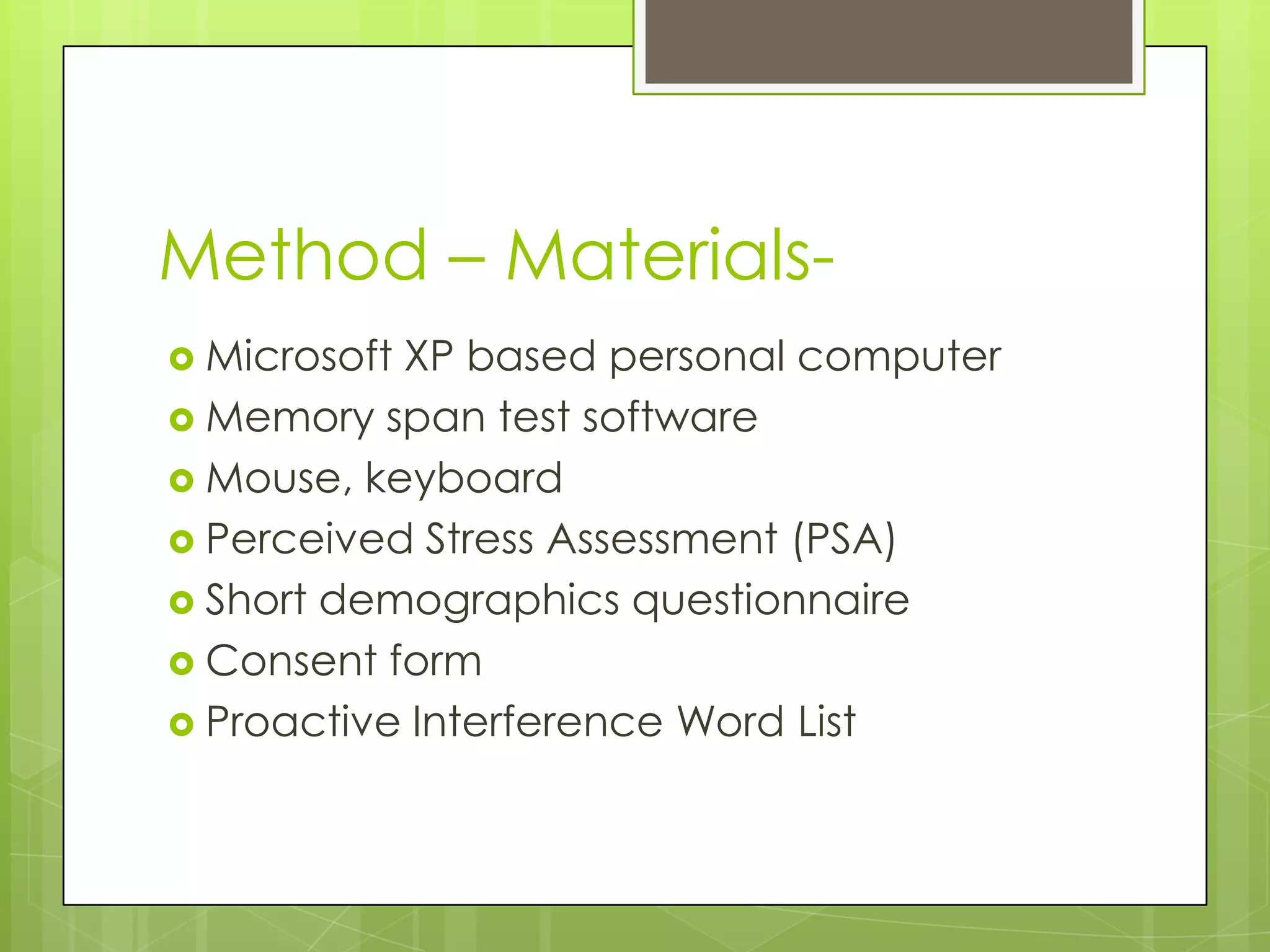
Method – Materials-
 MicrosoftXP based personal computer
 Memory span test software
 Mouse, keyboard
 Perceived Stress Assessment (PSA)
 Short demographics questionnaire
 Consent form
 Proactive Interference Word List
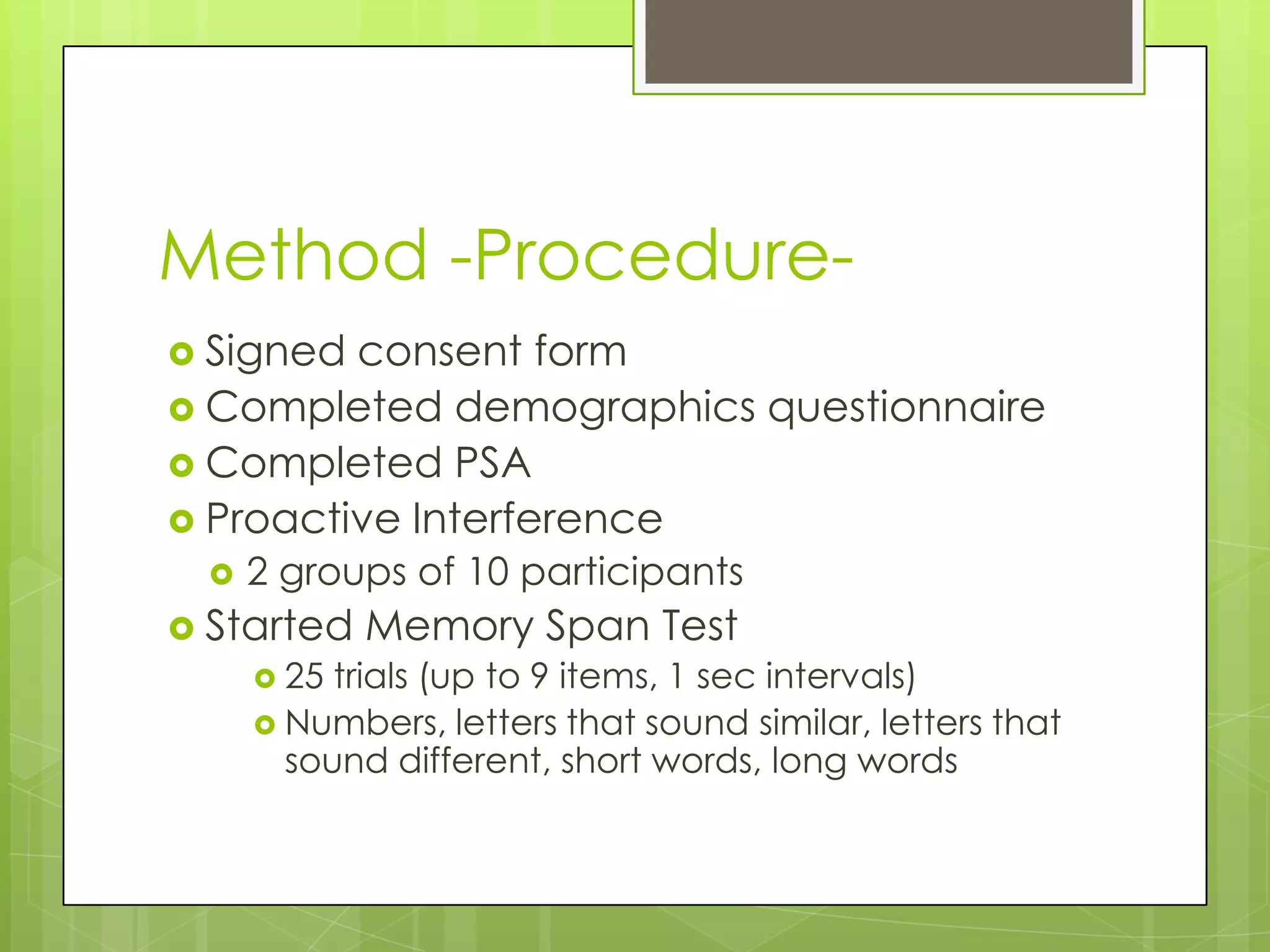
Method -Procedure-
 Signed consent form
 Completed demographics questionnaire
 Completed PSA
 Proactive Interference
    2 groups of 10 participants
 Started   Memory Span Test
      25 trials (up to 9 items, 1 sec intervals)
      Numbers, letters that sound similar, letters that
       sound different, short words, long words
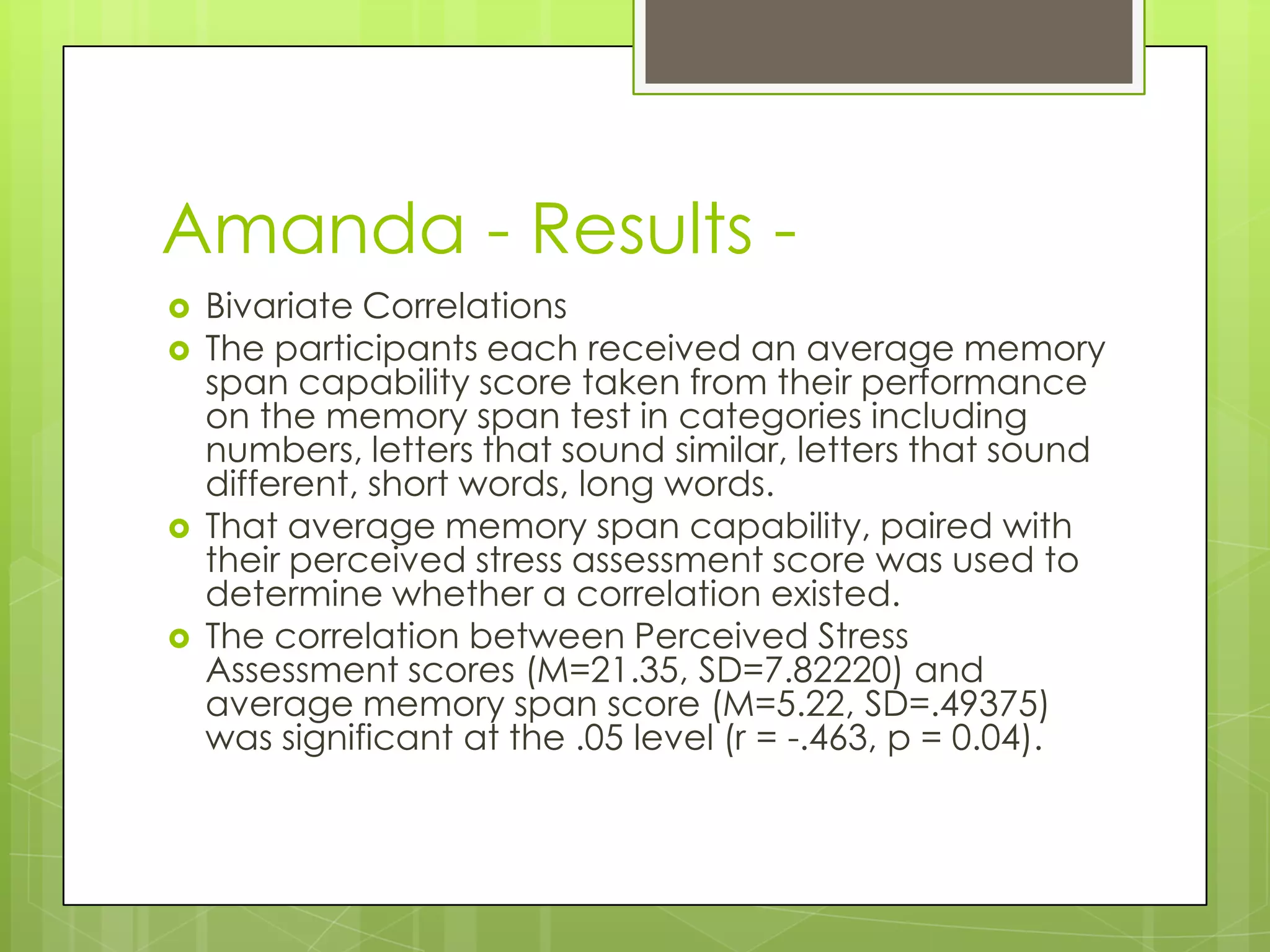
Amanda - Results -
   Bivariate Correlations
   The participants each received an average memory
    span capability score taken from their performance
    on the memory span test in categories including
    numbers, letters that sound similar, letters that sound
    different, short words, long words.
   That average memory span capability, paired with
    their perceived stress assessment score was used to
    determine whether a correlation existed.
   The correlation between Perceived Stress
    Assessment scores (M=21.35, SD=7.82220) and
    average memory span score (M=5.22, SD=.49375)
    was significant at the .05 level (r = -.463, p = 0.04).
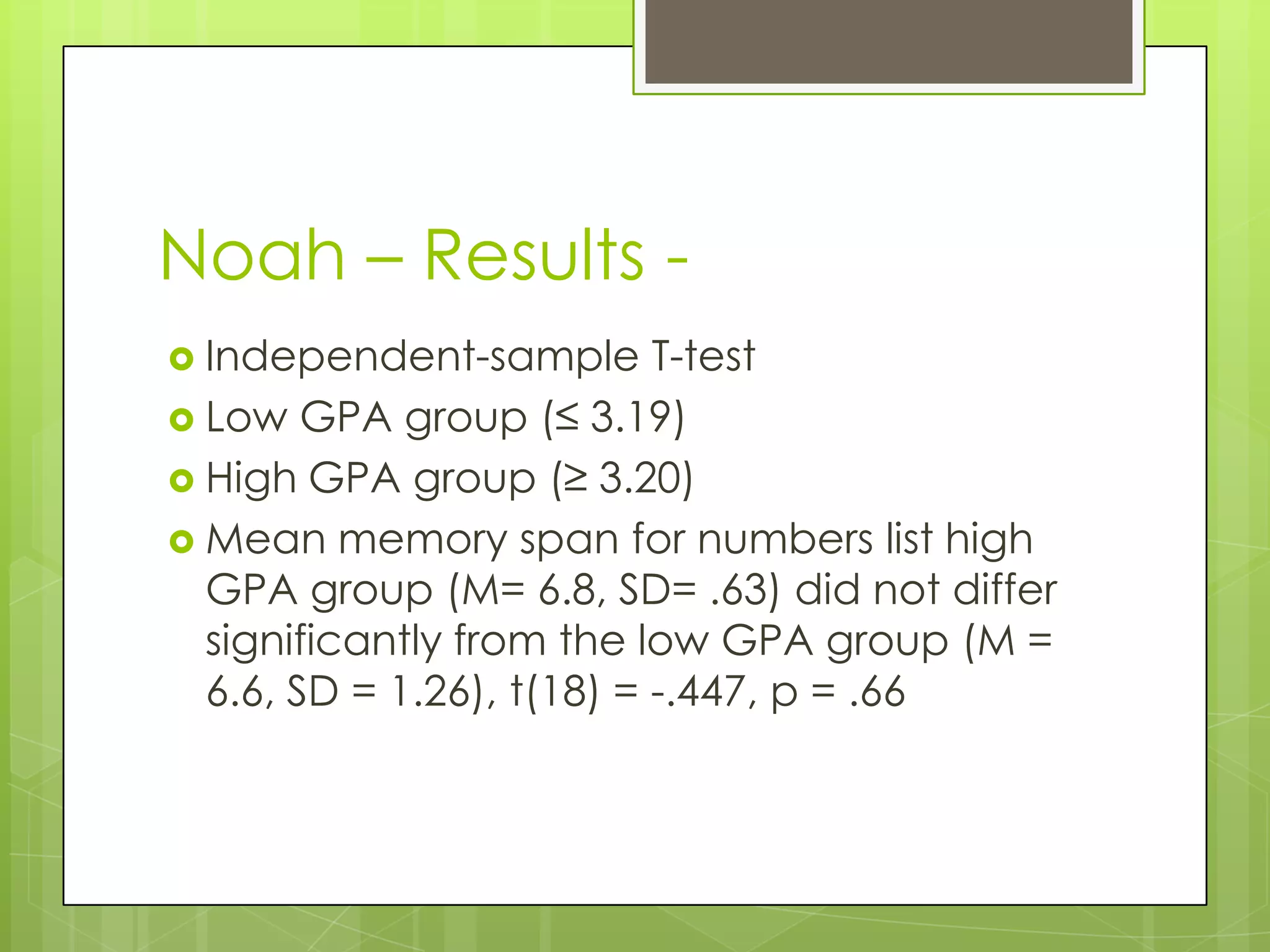
Noah – Results -
 Independent-sample       T-test
 Low GPA group (≤ 3.19)
 High GPA group (≥ 3.20)
 Mean memory span for numbers list high
  GPA group (M= 6.8, SD= .63) did not differ
  significantly from the low GPA group (M =
  6.6, SD = 1.26), t(18) = -.447, p = .66
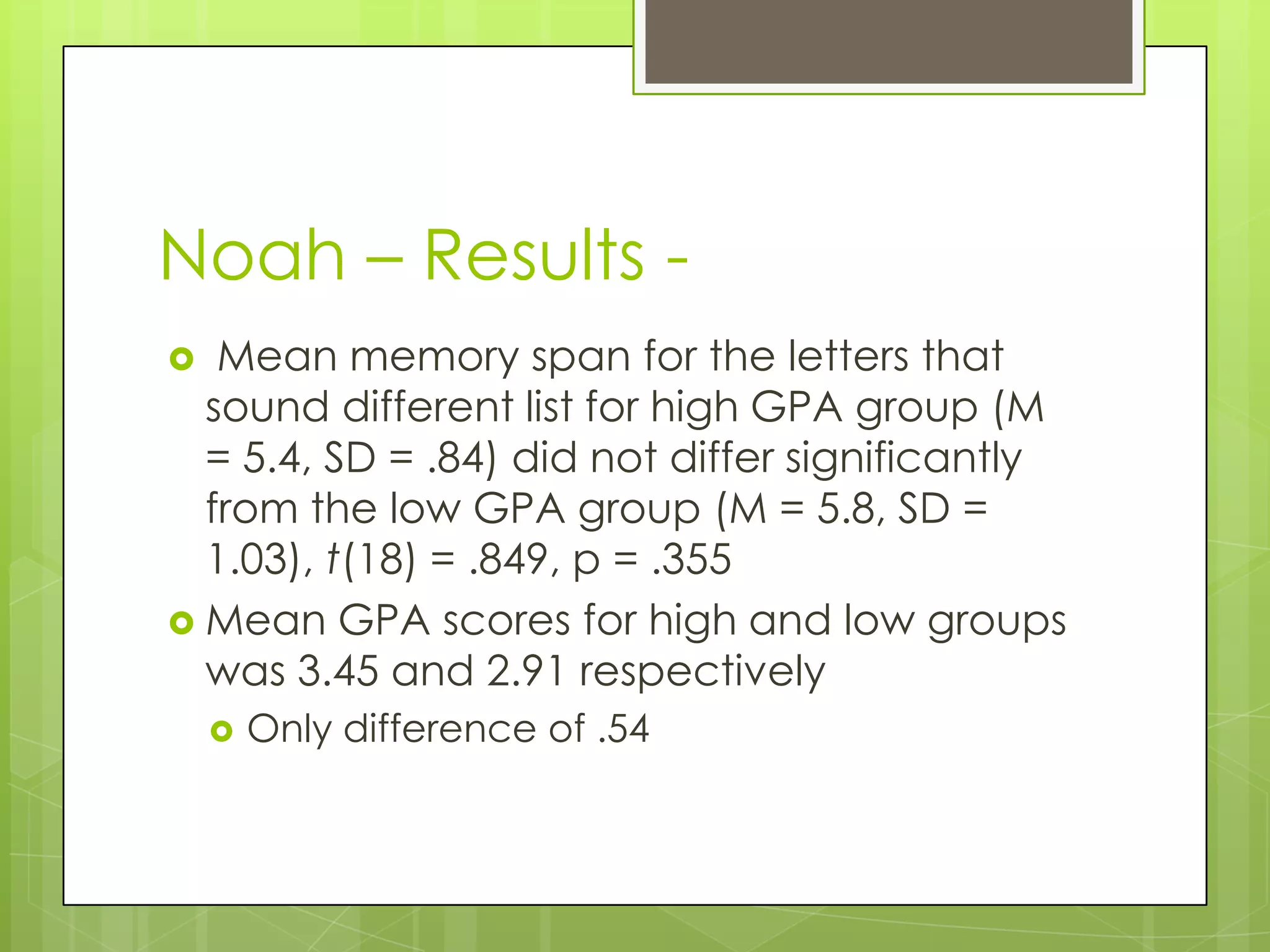
Noah – Results -
  Mean memory span for the letters that
  sound different list for high GPA group (M
  = 5.4, SD = .84) did not differ significantly
  from the low GPA group (M = 5.8, SD =
  1.03), t(18) = .849, p = .355
 Mean GPA scores for high and low groups
  was 3.45 and 2.91 respectively
       Only difference of .54
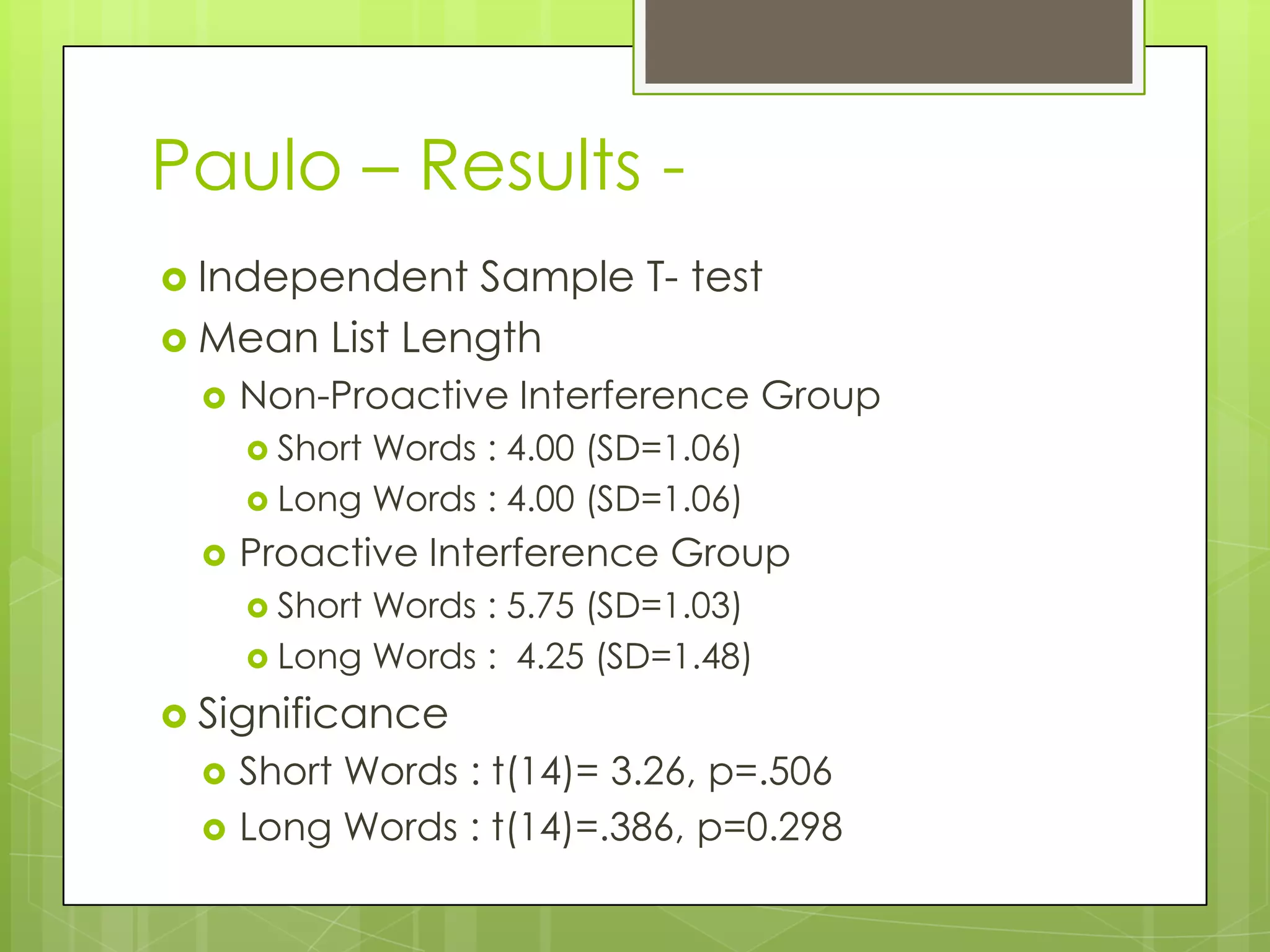
Paulo – Results -
 Independent  Sample T- test
 Mean List Length
    Non-Proactive Interference Group
      ShortWords : 4.00 (SD=1.06)
      Long Words : 4.00 (SD=1.06)

    Proactive Interference Group
      ShortWords : 5.75 (SD=1.03)
      Long Words : 4.25 (SD=1.48)

 Significance
    Short Words : t(14)= 3.26, p=.506
    Long Words : t(14)=.386, p=0.298
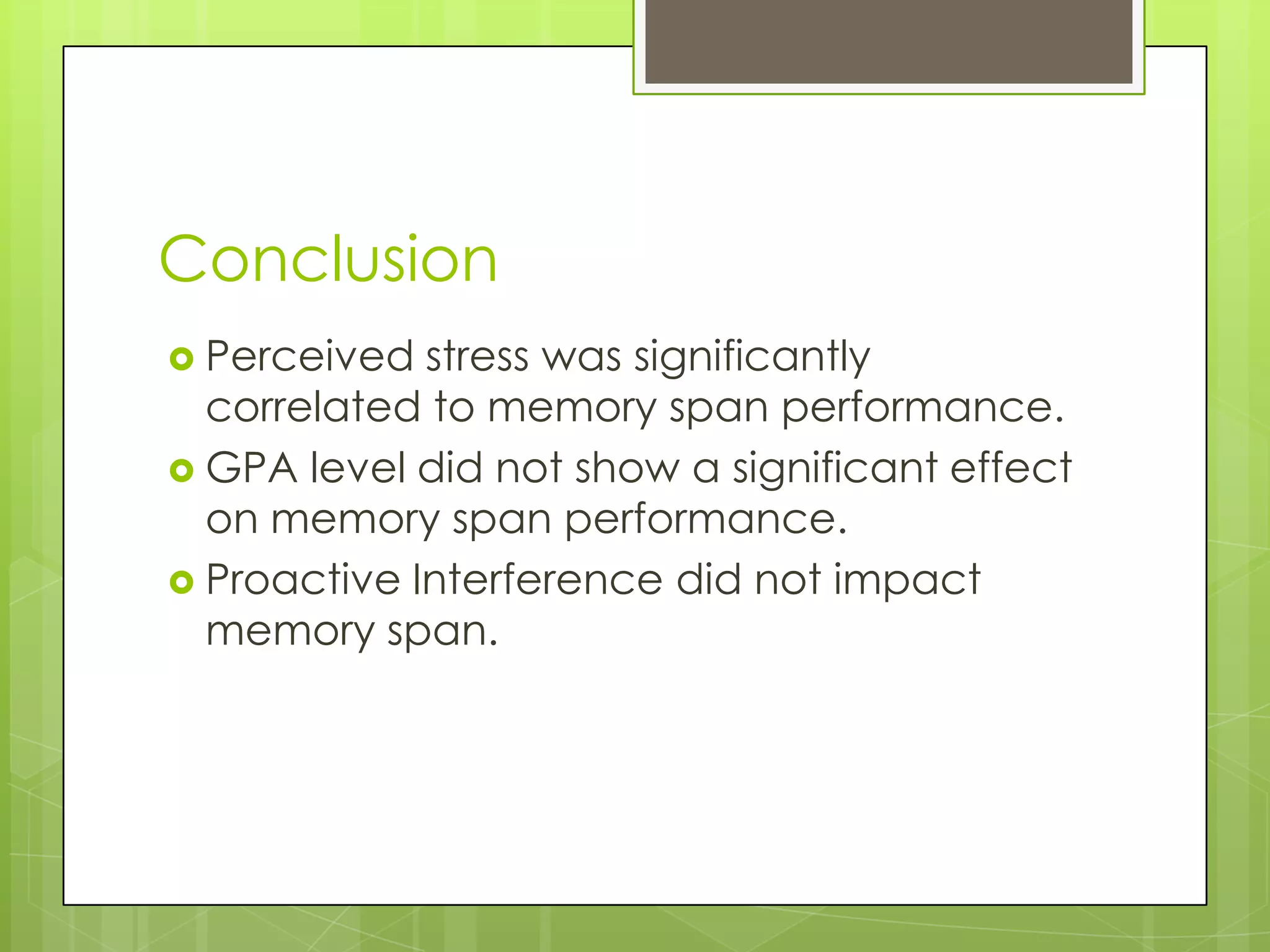
Conclusion
 Perceived  stress was significantly
  correlated to memory span performance.
 GPA level did not show a significant effect
  on memory span performance.
 Proactive Interference did not impact
  memory span.
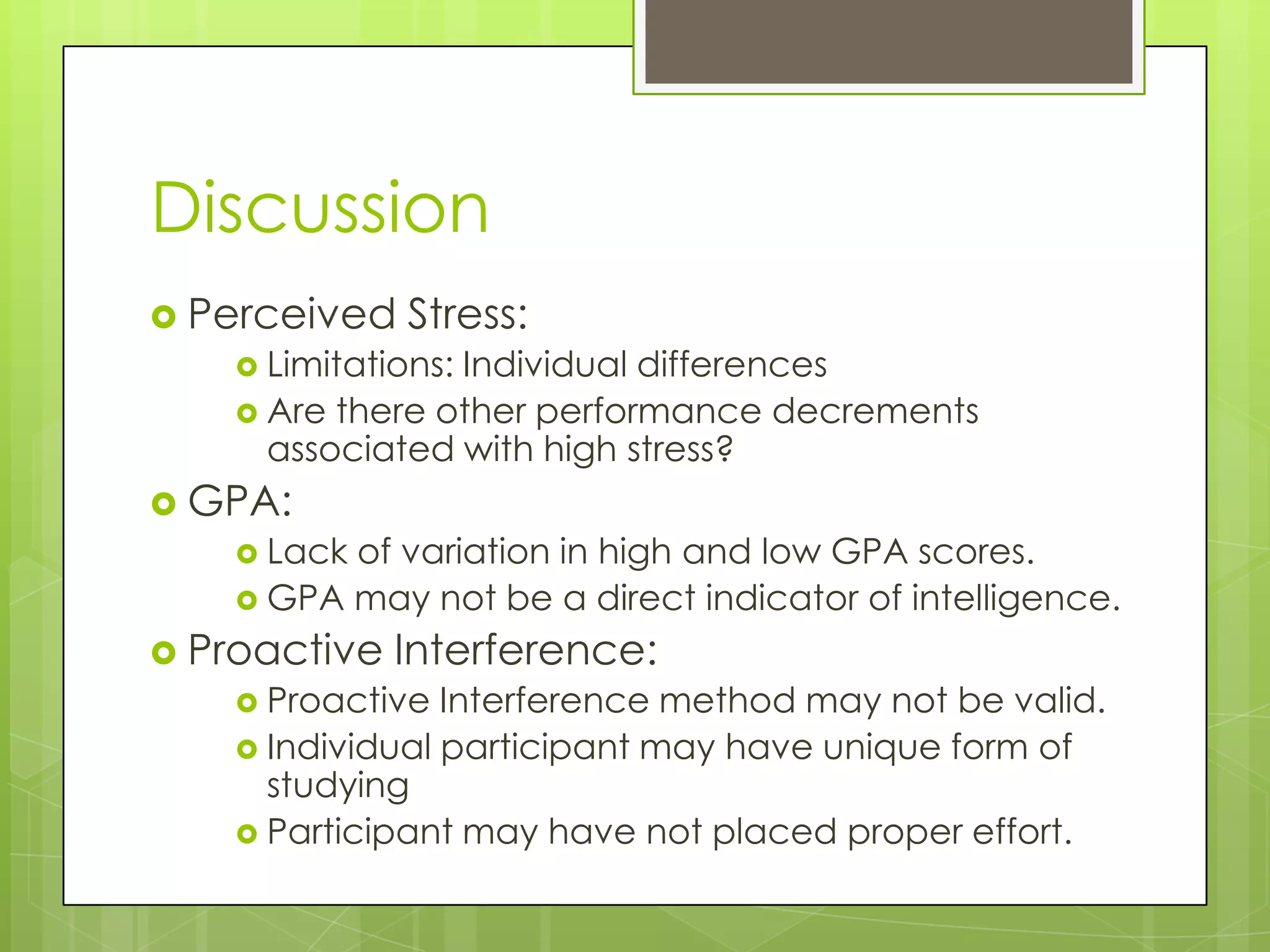
Discussion
 Perceived    Stress:
     Limitations:
                 Individual differences
     Are there other performance decrements
      associated with high stress?
 GPA:
     Lackof variation in high and low GPA scores.
     GPA may not be a direct indicator of intelligence.

 Proactive   Interference:
     Proactive  Interference method may not be valid.
     Individual participant may have unique form of
      studying
     Participant may have not placed proper effort.
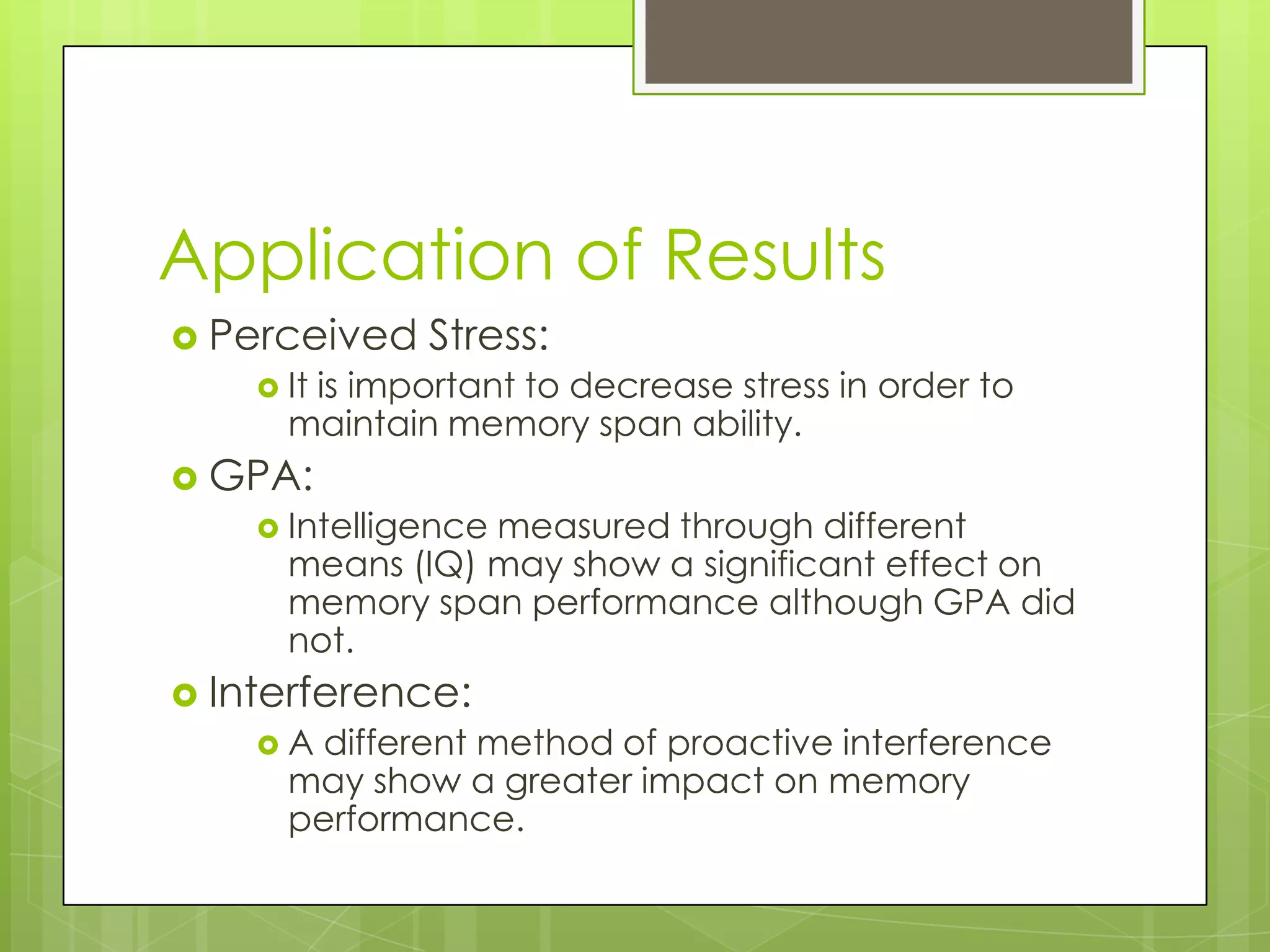
Application of Results
 Perceived   Stress:
     It
       is important to decrease stress in order to
      maintain memory span ability.
 GPA:
     Intelligence
                 measured through different
      means (IQ) may show a significant effect on
      memory span performance although GPA did
      not.
 Interference:
    A different method of proactive interference
      may show a greater impact on memory
      performance.

Memory Span Presentation

  • 1.
  • 2.
    Introduction  Amanda  Problem:Does perceived stress impact memory span?  Noah  Problem: Does memory span correlate with intelligence levels measured through GPA?  Paulo  Problem: Does proactive interference impact memory pan?
  • 3.
    Amanda  Problem:  Does perceived stress impact memory span?  Purpose:  To measure memory span and perceived stress and identify if perceived stress assessment scores are related to memory span performance.  Hypothesis:  It was hypothesized that individuals with high stress levels, as defined by the Perceived Stress Assessment, will demonstrate less memory span ability as opposed to individuals with low stress levels.
  • 4.
    Noah  Problem:  Does memory span correlate with intelligence levels measured through GPA?  Purpose:  Tomeasure memory span on lists with numbers and letters that sound different and to identify if GPA levels have an effect on memory span.
  • 5.
    Noah  Hypothesis:  Students with higher GPA’s would perform better on the memory span test in both numbers and letters that sound different in contrast to students with lower GPA’s  Literature:  Intelligence has an effect on memory and verbal span tasks.  Learning disorders can effect memory span tasks.  Did not find evidence that GPA has a direct effect.  Age differences impact memory span.
  • 6.
    Paulo  Problem:  Doesproactive interference affect memory span ?  Purpose:  To measure memory span on lists with short words and long words and to identify if proactive interference will have an effect on memory span.
  • 7.
    Paulo  Hypothesis: Thegroup with proactive interference would perform poorly in comparison to the opposing group.  Literature:  Proactive Interference affects memory span.  Age difference impacts the role of PI on memory span.  Proactive Interference Creates False memories.
  • 8.
    Method – Materials- MicrosoftXP based personal computer  Memory span test software  Mouse, keyboard  Perceived Stress Assessment (PSA)  Short demographics questionnaire  Consent form  Proactive Interference Word List
  • 9.
    Method -Procedure-  Signedconsent form  Completed demographics questionnaire  Completed PSA  Proactive Interference  2 groups of 10 participants  Started Memory Span Test  25 trials (up to 9 items, 1 sec intervals)  Numbers, letters that sound similar, letters that sound different, short words, long words
  • 10.
    Amanda - Results-  Bivariate Correlations  The participants each received an average memory span capability score taken from their performance on the memory span test in categories including numbers, letters that sound similar, letters that sound different, short words, long words.  That average memory span capability, paired with their perceived stress assessment score was used to determine whether a correlation existed.  The correlation between Perceived Stress Assessment scores (M=21.35, SD=7.82220) and average memory span score (M=5.22, SD=.49375) was significant at the .05 level (r = -.463, p = 0.04).
  • 11.
    Noah – Results-  Independent-sample T-test  Low GPA group (≤ 3.19)  High GPA group (≥ 3.20)  Mean memory span for numbers list high GPA group (M= 6.8, SD= .63) did not differ significantly from the low GPA group (M = 6.6, SD = 1.26), t(18) = -.447, p = .66
  • 12.
    Noah – Results-  Mean memory span for the letters that sound different list for high GPA group (M = 5.4, SD = .84) did not differ significantly from the low GPA group (M = 5.8, SD = 1.03), t(18) = .849, p = .355  Mean GPA scores for high and low groups was 3.45 and 2.91 respectively  Only difference of .54
  • 13.
    Paulo – Results-  Independent Sample T- test  Mean List Length  Non-Proactive Interference Group  ShortWords : 4.00 (SD=1.06)  Long Words : 4.00 (SD=1.06)  Proactive Interference Group  ShortWords : 5.75 (SD=1.03)  Long Words : 4.25 (SD=1.48)  Significance  Short Words : t(14)= 3.26, p=.506  Long Words : t(14)=.386, p=0.298
  • 14.
    Conclusion  Perceived stress was significantly correlated to memory span performance.  GPA level did not show a significant effect on memory span performance.  Proactive Interference did not impact memory span.
  • 15.
    Discussion  Perceived Stress:  Limitations: Individual differences  Are there other performance decrements associated with high stress?  GPA:  Lackof variation in high and low GPA scores.  GPA may not be a direct indicator of intelligence.  Proactive Interference:  Proactive Interference method may not be valid.  Individual participant may have unique form of studying  Participant may have not placed proper effort.
  • 16.
    Application of Results Perceived Stress:  It is important to decrease stress in order to maintain memory span ability.  GPA:  Intelligence measured through different means (IQ) may show a significant effect on memory span performance although GPA did not.  Interference: A different method of proactive interference may show a greater impact on memory performance.