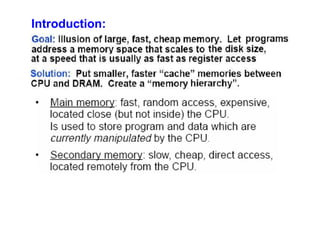
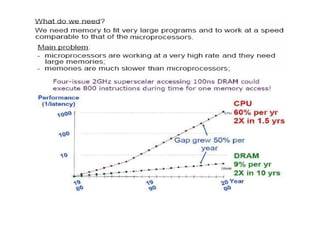
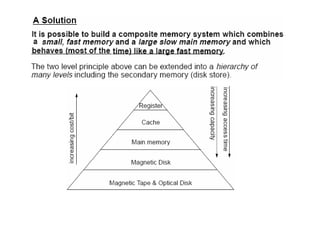
Introduction:
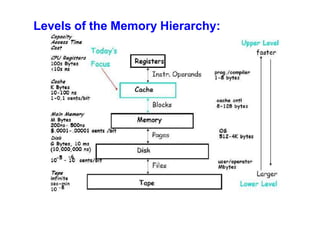
Levels of the Memory Hierarchy:
Memory Hierarchy Properties:
• Information stored in a memory hierarchy (M1, M2,..Mn)
satisfies three important properties:
• Inclusion Property: it implies that all information items are
originally stored in level Mn. During the processing, subsets
of Mn are copied into Mn-1. similarity, subsets of Mn-1 are
copied into Mn-2, and so on.
• Coherence Property: it requires that copies of the same
information item at successive memory levels be consistent.
If a word is modified in the cache, copies of that word must
be updated immediately or eventually at all higher levels..
• Locality of References: the memory hierarchy was
developed based on a program behavior known as locality of
references. Memory references are generated by the CPU
for either instruction or data access. Frequently used
information is found in the lower levels in order to minimize
the effective access time of the memory hierarchy.
Memory Capacity Planning:
• The performance of a memory hierarchy is determined by
the effective access time (Teff) to any level in the hierarchy. It
depends on the hit ratio and access frequencies at
successive levels.
• Hit Ratio (h): is a concept defined for any two adjacent
levels of a memory hierarchy. When an information item
found in Mi, it is a hit, otherwise, a miss. The hit ratio (hi) at
Mi is the probability that an information item will be found in
Mi. the miss ratio at Mi is defined as 1-hi.
• The access frequency to Mi is defined as
fi= (1-h1)(1-h2)….(1-hi)
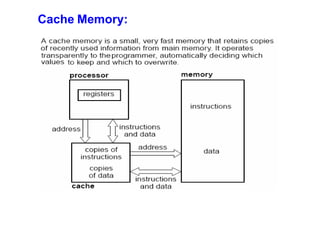
Cache Memory:
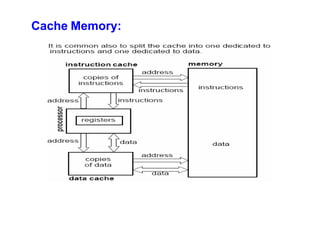
Cache Memory:

memory hierarchy.pptx

  • 1.
  • 4.
    Levels of theMemory Hierarchy:
  • 5.
    Memory Hierarchy Properties: •Information stored in a memory hierarchy (M1, M2,..Mn) satisfies three important properties: • Inclusion Property: it implies that all information items are originally stored in level Mn. During the processing, subsets of Mn are copied into Mn-1. similarity, subsets of Mn-1 are copied into Mn-2, and so on. • Coherence Property: it requires that copies of the same information item at successive memory levels be consistent. If a word is modified in the cache, copies of that word must be updated immediately or eventually at all higher levels.. • Locality of References: the memory hierarchy was developed based on a program behavior known as locality of references. Memory references are generated by the CPU for either instruction or data access. Frequently used information is found in the lower levels in order to minimize the effective access time of the memory hierarchy.
  • 7.
    Memory Capacity Planning: •The performance of a memory hierarchy is determined by the effective access time (Teff) to any level in the hierarchy. It depends on the hit ratio and access frequencies at successive levels. • Hit Ratio (h): is a concept defined for any two adjacent levels of a memory hierarchy. When an information item found in Mi, it is a hit, otherwise, a miss. The hit ratio (hi) at Mi is the probability that an information item will be found in Mi. the miss ratio at Mi is defined as 1-hi. • The access frequency to Mi is defined as fi= (1-h1)(1-h2)….(1-hi)
  • 8.
  • 9.