History
And
Evolution
of Memes
What is a
Meme?
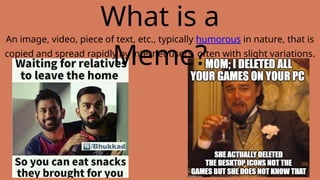
An image, video, piece of text, etc., typically humorous in nature, that is
copied and spread rapidly by internet users, often with slight variations.
Origin Of
Memes
• Humans have used memes to communicate for as long as they
have used any symbolic system.
• Difficult to identify the first meme ever, the British evolutionary
biologist Richard Dawkins is credited with introducing the term
in his 1976 book, “The Selfish Gene.”
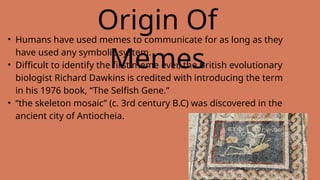
• “the skeleton mosaic” (c. 3rd century B.C) was discovered in the
ancient city of Antiocheia.
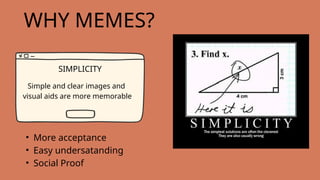
SIMPLICITY
Simple and clear images and
visual aids are more memorable
• More acceptance
• Easy undersatanding
• Social Proof
WHY MEMES?
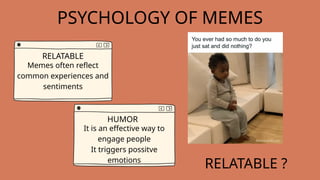
PSYCHOLOGY OF MEMES
RELATABLE
Memes often reflect
common experiences and
sentiments
HUMOR
It is an effective way to
engage people
It triggers possitve
emotions
RELATABLE ?
The sharing of memes shows
the human tendency to follow
the behavior of others, it creates
a sense belonging among those
who get the joke and the
emotions are expressed in an
attractive way
“It can’t change the situation but it can change the emotion”
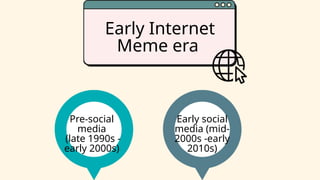
Early Internet
Meme era
Pre-social
media
(late 1990s -
early 2000s)
Early social
media (mid-
2000s -early
2010s)
Pre-social media
(late 1990s - early 2000s)
• Simple images and text based jokes
• Shared on emails and forums
Early Social media (mid-2000s- Early
2010s)
• Rise of platforms like Reddit, 4Chan and 9GAG fostered meme
creation
• Youtube launched in 2005
• Launch of Vine led to short form meme content
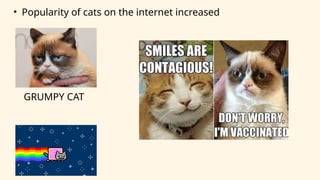
• Popularity of cats on the internet increased
GRUMPY CAT
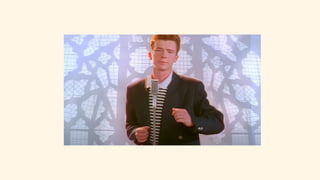
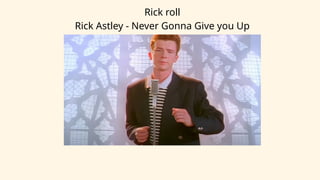
Rick roll
Rick Astley - Never Gonna Give you Up
• Memes started getting popular, entering pop culture
1 more episode
sleep
Completing
assignment
s on time
Starting 2
hrs. before
EOD
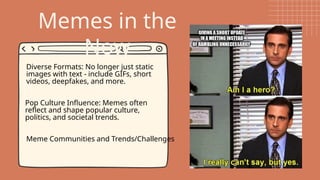
Memes in the
Now
Diverse Formats: No longer just static
images with text - include GIFs, short
videos, deepfakes, and more.
Pop Culture Influence: Memes often
reflect and shape popular culture,
politics, and societal trends.
Meme Communities and Trends/Challenges
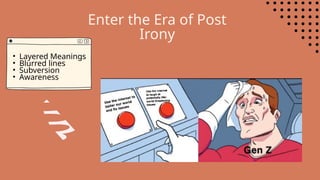
• Layered Meanings
• Blurred lines
• Subversion
• Awareness
Enter the Era of Post
Irony
Usage of memes
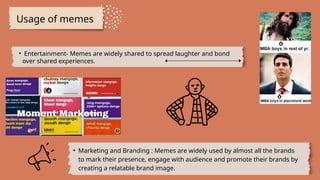
• Entertainment- Memes are widely shared to spread laughter and bond
over shared experiences.
• Marketing and Branding : Memes are widely used by almost all the brands
to mark their presence, engage with audience and promote their brands by
creating a relatable brand image.
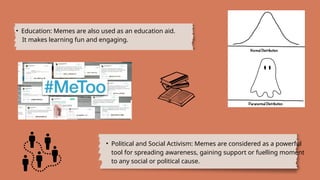
• Education: Memes are also used as an education aid.
It makes learning fun and engaging.
• Political and Social Activism: Memes are considered as a powerful
tool for spreading awareness, gaining support or fuelling moment
to any social or political cause.
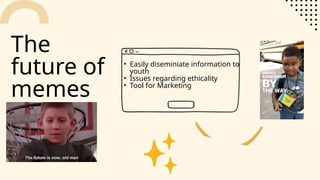
• Easily diseminiate information to
youth
• Issues regarding ethicality
• Tool for Marketing
The
future of
memes
memes and their evolution and future.pptx

memes and their evolution and future.pptx

  • 1.
  • 2.
    What is a Meme? Animage, video, piece of text, etc., typically humorous in nature, that is copied and spread rapidly by internet users, often with slight variations.
  • 3.
    Origin Of Memes • Humanshave used memes to communicate for as long as they have used any symbolic system. • Difficult to identify the first meme ever, the British evolutionary biologist Richard Dawkins is credited with introducing the term in his 1976 book, “The Selfish Gene.” • “the skeleton mosaic” (c. 3rd century B.C) was discovered in the ancient city of Antiocheia.
  • 4.
    SIMPLICITY Simple and clearimages and visual aids are more memorable • More acceptance • Easy undersatanding • Social Proof WHY MEMES?
  • 5.
    PSYCHOLOGY OF MEMES RELATABLE Memesoften reflect common experiences and sentiments HUMOR It is an effective way to engage people It triggers possitve emotions RELATABLE ?
  • 6.
    The sharing ofmemes shows the human tendency to follow the behavior of others, it creates a sense belonging among those who get the joke and the emotions are expressed in an attractive way “It can’t change the situation but it can change the emotion”
  • 7.
    Early Internet Meme era Pre-social media (late1990s - early 2000s) Early social media (mid- 2000s -early 2010s)
  • 8.
    Pre-social media (late 1990s- early 2000s) • Simple images and text based jokes • Shared on emails and forums
  • 9.
    Early Social media(mid-2000s- Early 2010s) • Rise of platforms like Reddit, 4Chan and 9GAG fostered meme creation • Youtube launched in 2005 • Launch of Vine led to short form meme content
  • 10.
    • Popularity ofcats on the internet increased GRUMPY CAT
  • 12.
    Rick roll Rick Astley- Never Gonna Give you Up
  • 13.
    • Memes startedgetting popular, entering pop culture 1 more episode sleep Completing assignment s on time Starting 2 hrs. before EOD
  • 14.
    Memes in the Now DiverseFormats: No longer just static images with text - include GIFs, short videos, deepfakes, and more. Pop Culture Influence: Memes often reflect and shape popular culture, politics, and societal trends. Meme Communities and Trends/Challenges
  • 15.
    • Layered Meanings •Blurred lines • Subversion • Awareness Enter the Era of Post Irony
  • 16.
    Usage of memes •Entertainment- Memes are widely shared to spread laughter and bond over shared experiences. • Marketing and Branding : Memes are widely used by almost all the brands to mark their presence, engage with audience and promote their brands by creating a relatable brand image.
  • 17.
    • Education: Memesare also used as an education aid. It makes learning fun and engaging. • Political and Social Activism: Memes are considered as a powerful tool for spreading awareness, gaining support or fuelling moment to any social or political cause.
  • 18.
    • Easily diseminiateinformation to youth • Issues regarding ethicality • Tool for Marketing The future of memes