TM 5-2815-233-14 
TECHNICAL MANUAL 
OPERATOR' S, UNIT, INTERMEDIATE 
(DS) AND INTERMEDIATE (GS) 
MAINTENANCE MANUAL 
FOR 
ENGINE, DIESEL, 
CUMMINS MODEL NTA - 855 -L4 
NSN 2815-01-216-0939 
(Circle C) Copyright 1983 
Cummins Engine Company, Inc. 
Used by Permission 
HEADQUARTERS, DEPARTMENT OF THE ARMY 
25 JULY 1986
TM 5-2815-233-14 
TECHNICAL MANUAL HEADQUARTERS 
DEPARTMENT OF THE ARMY 
NO 5-2815-233-14 WASHINGTON, D. C., 25 July 1986 
OPERATOR'S UNIT, INTERMEDIATE 
(DS) AND INTERMEDIATE (GS) 
MAINTENANCE MANUAL 
ENGINE, DIESEL, 
CUMMINS MODEL NTA-855-L4 
NSN 2815-01-216-0939 
NOTE: 
This manual is printed in two parts as follows: 
Part 1 consisting of Table of Contents, Operation and Maintenance instructions. 
Part 2 consisting of a separate Table of Contents and Repair instructions. 
REPORTING ERRORS AND RECOMMENDING IMPROVEMENTS 
You can help improve this manual. If you find any mistake or if you know of a way to 
improve the procedures, please let us know. Mail your letter, DA Form 2028 
(Recommended Changes to Publications and Blank Forms), or DA Form 2028-2 located 
in the back of this manual direct to: Commander, U.S. Army Troop Support Command, 
ATTN: AMSTR-MCTS, 4300 Goodfellow Boulevard, St. Louis, MO 63120-1798. 
A reply will be furnished directly to you. 
TABLE OF CONTECTS 
Operating Instructions 
Prestarting Instructions........................................ 1-1 
Starting the Engine.............................................. 1-3 
Engine Warm-Up ................................................ 1-6 
Engine Speeds.................................................... 1-6 
Engine Exhaust................................................... 1-7 
High Altitude Operation....................................... 1-7 
Engine Shutdown................................................ 1-7 
Cold Weather Protection..................................... 1-8 
Industrial Fire Pump Engines .............................. 1-11 
Maintenance Operations 
Schedule............................................................. 2-2 
Check Sheet ....................................................... 2-3 
A Checks - Daily ................................................. 2-7 
A Checks - Weekly.............................................. 2-11 
B Checks ............................................................ 2-15 
C Checks ............................................................ 2-34 
D Checks ............................................................ 2-50 
Seasonal Maintenance Checks ........................... 2-54 
Specifications and Torque 
Lubricating Oil..................................................... 3-1 
Grease................................................................ 3-5 
Fuel 011.............................................................. 3-6 
Coolant ............................................................... 3-7 
Torque Speclflcatlons.......................................... 3-8 
Trouble-Shooting 
Description.......................................................... 4-1 
Chart................................................................... 4-2 
Index 
Intro pg
TM 5-2815-233-14 
Part I 
OPERATION AND MAINTENANCE 
a
TM 5-2815-233-14 
Operation and Maintenance Manual Cummins Diesel 
Engines 
Agricultural 
Construction 
Industrial 
Industiral Fire Pump 
Logging 
Mining 
Railway 
Generator 
Copyright © 1980 
Cummins Engine Company, Inc. Bulletin 3379052-09 Printed 10/80 
b
TM 5-2815-233-14 
Foreword 
This is an engine operation and maintenance manual, not a 
repair manual. The design of Cummins Engines makes it 
possible to replace worn or damaged parts with new or rebuilt 
parts with a minimum of down time. Contact the nearest 
Cummins Distributor for parts replacement as they are equipped 
and have well informed, trained personnel to perform this 
service. If your shop is properly equipped to perform either 
maintenance, unit replacement and/or complete engine rebuild, 
contact the nearest Cummins Distributors to obtain available 
repair manuals and arrange for training of personnel. 
For model identification of an engine, check the dataplate. The 
letter and number code indicates breathing (naturally aspirated 
except when letter "T" for turbocharged is present), cubic inch 
displacement, application and maximum rated horsepower. 
Examples: 
NTA-855-370 V-903-320 
N=4 valve head V=Type engine 
T=Turbocharger 903=Cubic Inch 
A=Aftercooled Displacement 
370=Maximum rated 320=Maximum Rated 
horsepower horsepower 
Cummins Engine Company, Inc. 
Columbus, Indiana, U.S.A. 
c/(d Blank)
Operating Instructions 
Operating 
Instructions The engine operator must assume the responsibility of 
engine care while the engine is being operated. There 
are comparatively few rules which the operator must 
observe to get the best service from a Cummins Diesel. 
General-All Applications 
New and Rebuilt Engines Break-In 
Cummins engines are run-in on dynamometers before 
being shipped from the factory and are ready to be put 
to work in applications such as emergency fire trucks, 
rail car applications and generator sets. In other 
applications, the engine can be put to work, but the 
operator has an opportunity to establish conditions for 
optimum service life during initial 100 hours of service 
by: 
1. Operating as much as possible at three-quarter 
throttle of load range. 
2. Avoiding operation for long periods at engine 
idle speeds, or at the maximum horsepower 
levels in excess of five minutes. 
3. Developing the habit of watching the engine 
instruments closely during operation and letting 
up on the throttle if the oil temperature reaches 
200° F [121° C] or the coolant temperature 
exceeds 200° F [93° F]. 
4. Operating with a power requirement that allows 
acceleration to governed speed when conditions 
require more power. 
5. Checking the oil level every 8 to 10 hours during the 
break-in period. 
New or Rebuilt Engines 
Pre-Starting Instructions - First Time 
Priming The Fuel System 
1. Fill the fuel filter with clean No. 2 diesel fuel oil 
meeting the specifications outlined in Section 3. 
2. Remove the fuel pump suction line and wet the 
gear pump gears with clean lubricating oil. 
3. Check and fill the fuel tanks. 
4. If the injector and valve or other adjustments 
have been disturbed by any maintenance work, 
check to be sure they have been properly 
adjusted before starting the engine. 
Priming the Lubricating System 
Note: On turbocharged engines, remove the oil inlet 
line from the turbocharger and prelubricate the bearing 
by adding 2 to 3 oz. [50 to 60 cc] of clean lubricating oil. 
Reconnect the oil supply line. 
1. Fill the crankcase to the "L" (low) mark on the 
dipstick. See Lubricating Oil Specifications, 
Section 3. 
2. Remove the plug from the lubricating oil 
crossover passage on NH/NT-855 Engines, Fig. 
1-1. Remove the plug from the head of the 
lubricating oil filter housing on V Engines, Fig's. 
1-2, 1-3, 1-4, 1-5 and 1-6. On KT/KTA-1150 
Engines, remove the plug from the front of the 
oil cooler housing, Fig. 1-7. 
Fig. 1-1 (OM1001L). Lubricating system priming point- 
NT-855 C.I.D. Engine 
1-1
Operation and Maintenance 
Construction and Industrial 
Fig. 1-2 (OM1002L). Lubricating system priming point- 
VT-903 C.I.D. Engine 
Fig. 1-3 (OM1003L). Lubricating system priming point-- 
V/VT-555 C.I.D. Engine 
Caution: Do not prime the engine lubricating 
system from the by-pass filter. 
3. Connect a hand- or motor-driven priming pump 
line from a source of clean lubricating oil to the 
plug boss in the housing. 
4. Prime until a 30 psi [207 kPa] minimum 
pressure is obtained. 
5. Crank the engine at least 15 seconds (with fuel 
shut-off valve closed or disconnected to prevent 
starting), while maintaining the external oil pres-sure 
at a minimum of 15 psi [103 kPa]. 
6. Remove the external oil supply and replace the 
plug. 
Fig. 1-4 (K21902). Lubricating system priming point 
KT(A)-2300 Engine 
Fig. 1-5 (OM202). Lubricating system priming point - 
KTA-3067 Engine 
Warning: Clean the area of any lubricating oil 
spilled while priming or filling the crankcase. 
7. Fill the crankcase to the "H" (high) mark on the 
dipstick with oil meeting specifications, listed in 
Section 3. No change in oil viscosity or type is 
needed for new or newly rebuilt engines. 
A dipstick oil gauge is located on the side of the engine, 
Fig. 1-8. The dipstick has an "H" (high) (1) and "L" (low) 
(2) level mark to indicate lubricating oil supply. The 
dipstick must be kept with the oil pan, or engine, with 
which it was originally supplied. Cummins oil pans differ 
in capacity with different type installations and oil pan 
part numbers. Check the dipstick calibration. If in 
doubt, your Cummins Distributor 
1-2
OPERATING INSTRUCTIONS 
Fig. 1-6 (V41816). Lubricating system priming point - V- 
1710 Engine 
Fig. 1-8 (OM1005L). Checking engine oil level 
Operating Instructions 
can verify that you have the proper oil pan and dip-stick 
calibration. 
Check Hydraulic Governor 
Many engines used in stationary power applications are 
equipped with hydraulic-governed fuel pumps which use 
lubricating oil as an energy medium, same weight as 
used in the engine. Oil level in the governor sump must 
be at the full mark on the dipstick. 
Note: Engine applications in a cold environment should 
use a lighter weight oil in the governor sump. 
Check Air Connections 
Check the air connections to the compressor and the air 
equipment, as used, and to the air cleaners and air 
crossovers to assure that they all are secure and have 
no damage. 
Check Engine Coolant Supply 
1. Remove the radiator or heat exchanger cap and 
check the engine coolant supply. Add coolant 
as needed. 
2. Make a visual check for leaks and open the 
water filter shut-off valves. 
Starting the Engine 
Starting requires that clean air and fuel be supplied to 
the combustion chambers in the proper quantities at the 
correct time. 
Normal Starting Procedure 
Warning: Before starting be sure that everyone is 
clear of the engine and equipment. 
If the fuel system is equipped with an overspeed stop, 
push the "Reset" button before attempting to start the 
engine. 
1. On units equipped with an air activated prelube 
device, open the air valve to activate the piston 
in the prelube device which will lubricate all 
moving parts in the engine. 
Note: On engines equipped with an oil pressure safety 
switch, hold the fuel by-pass switch in the "start" posi-tion 
until the engine oil pressure reaches 7 to 10 psi [48 
to 69 kPa]; then, move it to the "run" position. 
2. Set the throttle for idle speed and disengage the 
driven unit. 
Caution: Protect the turbocharger during start-up 
by not opening the throttle or accelerating above 
1000 
Fig. 1-7 (OM1004L). Lubricating system priming point- 
KT/KTA C.I.D. Engine 
1-3
Operation and Maintenance 
Construction and Industrial 
rpm until the idle speed oil pressure registers on 
the gauge. 
3. Open the manual fuel shut-down valve, if so 
equipped. Fig. 1-9. Electric shut-down valves operate 
as the switch is turned on. A manual override knob 
provided on the forward end of the electric shut-down 
valve allows the valve to be opened in case of an 
electric power failure. To use, turn fully clockwise; 
return it to the run position after an electric repair. 
Fig. 1-9 (V21970). Using manual override knob 
4. Pull the compression release (if so equipped) 
and press the starter button or turn the switch-key 
to the "start" position. After three or four 
seconds of cranking, close the compression 
release (if so equipped) and continue to crank 
until the engine fires. 
Caution: To prevent permanent cranking motor 
damage, do not crank the engine for more than 30 
seconds continuously. If the engine does not fire 
within the first 30 seconds, wait one to two minutes 
before recranking. 
5. At the initial start or after oil or filter changes 
and after the engine has run for a few minutes, 
shut it down and wait 15 minutes for the oil to 
drain back into the pan. Check the engine oil 
level again; add oil as necessary to bring the oil 
level to the "H" mark on the dipstick. The drop 
in oil level is due to absorption by the oil filters. 
Never operate the engine with the oil level 
below the low level mark or above the high level 
mark. 
Cold-Weather Starting 
Note: A water jacket heater is recommended for stand-by 
generator set applications installed in a cold climate 
Preheater 
The glow plug system supplies heat to the cylinders so 
that compression temperatures are sufficient to ignite 
the fuel. 
To aid in starting the engine when the temperature is 
50°F [10.0°C] or below, an intake air preheater is 
available. 
Preheater equipment consists of a hand-priming pump 
to pump fuel into the intake manifold, and a switch to 
turn on the glow plug which is electrically heated by the 
battery. Fuel burns in the intake mani-fold and heats 
the intake air. 
Warning: Do not use vapor in conjunction with the 
preheater. To do so could result in a fire. To use 
the preheater for cold starting: 
1. Set the throttle in idle position. Turn the glow 
plug toggle switch to the "ON" position. The red 
indicator light must be on. 
2. After the red light has been on for 20 seconds, 
start cranking the engine. As soon as the 
engine begins rotating, operate the preheater 
priming pump to maintain 80 to 100 psi [552 to 
689 kPa] fuel pressure. Use of the primer 
before the 20-second interval will wet the glow 
plug and prevent heating. 
3. If the engine does not start within 30 seconds, 
stop cranking. Wait one or two minutes and 
repeat the cranking operation. 
4. After the engine starts, pump the primer slowly 
to keep the engine idling smoothly. In cold 
weather this may require 4 to 5 minutes or 
longer. Do not accelerate the engine. 
5. When the engine has warmed up so it does not 
falter between primer strokes, stop pumping. 
Close and lock the primer. Turn off the glow 
plug toggle switch. (The red indicator light will 
go out.) 
6. If the engine gives no indication of starting 
during the first three full strokes of the preheater 
pump, touch-check the intake manifold for heat. 
If there is no heat, check the electrical wiring. If 
the wiring is all right, remove the 1/8 inch pipe 
plug (1, Fig.1-10) from the manifold near the 
glow plug and 
1-4
TM 5-2815-233-14 
Fig 1-10 (OM1006L). Glow plug inspection hole NT-855 
C.I.D. Engine 
close the glow plug manual switch for 15 
seconds and observe the glow plug through the 
1/8 inch plug hole. The glow plug should be 
white hot; if not, connect the wiring to a 6- to 12- 
volt (as used) source and check the amperage; 
it should be 30 to 32 (minimum). If the glow 
plug is all right, check the manual switch and 
resistor (if used) and replace if necessary. 
Note: The preheater priming pump, switches and 
resistor are located at the instrument panel and are to 
be checked during engine starting. 
The cold starting aid, approved for use in Cummins 
Engines, has been based upon starting aid capabilities 
to -25° F [-32° C]. 
Caution: Do not attempt to use vapor compound 
type starting aids near heat, open flame or on 
engines equipped with a glow plug system. 
Fig. 1-11 (OM1007L). Manually operated valve 
Manually Operated Valve 
The manually operated valve, illustrated in Fig. 1-11 
includes the valve body assembly (6), clamp (2) and 
nylon tube (3). The fuel cylinder (1), atomizer fitting (5) 
and pull control (7) must be ordered separately. 
Standard pull or throttle control cables may be used, to 
actuate the manual valve, if desired. 
Electrically Operated Valve 
The electrically operated valve, Fig. 1-12, includes the 
valve body (7), 90 degree elbow (5), clamp (2), push 
button switch (6), and nylon tube (3). The thermostat is 
mounted on the engine exhaust manifold and cuts out 
the valve by sensing manifold heat when the engine is 
running. See parts catalog for fuel cylinder (1) and fuel 
atomizer fittings (4). These fittings must be ordered 
separately, as required. 
Fig. 1-12(OM1008L). Electrically operated valve 
Installation Recommendations 
The atomizer fittings must be mounted in the engine air 
intake manifold or inlet connection to provide an equal 
distribution of starting fuel to each cylinder. The 
atomizer holes are 180 degrees apart and must be 
mounted so the spray is injected the "long way" of the 
manifold. If incorrectly installed, the spray goes 
crosswise of the manifold. 
Recommended Starting Technique Using 
Fleetguard Starting Aid 
1. Set the throttle for idle. 
2. Disengage the driven unit or make sure gears 
are in neutral. 
3. Open the manual fuel shut-down valve, or 
electric 
1-5
Operation and Maintenance 
Construction and Industrial 
shut-down valve, whichever is used. 
4. Engage the starter and while cranking, apply 
metered amounts of starting fluid until the 
engine idles smoothly. 
Use of Starting Fluid Without Metering Equipment 
1. Spray starting fluid into the air cleaner intake, 
while a second man cranks the engine. 
Warning: Never handle starting fluid near an open 
flame. Never use it with a preheater or flame 
thrower equipment. Do not breathe the fumes. Use 
of too much will cause excessively high pressures 
and detonation, or over speed the engine. 
2. Starting aid fumes will be drawn into the air 
intake manifold and the cold engine should start 
without difficulty. 
Waming: Fuel oil or volatile fuel cold starting aids 
are not to be used in underground mine or tunnel 
operations. If the engine is so equipped check with 
the local U.S. Bureau of Mines Inspector for use of 
the starting aid. 
Engine Warm-Up 
When the engine is started, it takes a while to get the 
lubricating oil film re-established between shafts and 
bearings and between pistons and liners. The most 
favorable clearances between moving parts are 
obtained only after all engine parts reach normal 
operating temperature. Avoid seizing pistons in liners 
and running dry shafts in dry bearings by bringing the 
engine up to operating speed gradually as it warms up. 
On some emergency equipment (such as fire pump 
engines) warm-up may not be necessary due to the 
equipment being housed inside a heated building. For 
an engine starting with a parasitic load, such as a fire 
pump, the coolant temperatures must be a mini-mum of 
120°F [49°C]. 
Engine Speeds 
All Cummins engines are equipped with governors to 
prevent speeds in excess of the minimum or pre-determined 
lower speed rating. 
The governor has two functions: First, it provides the 
fuel needed for idling when the throttle is in the idle 
position. Second, it overrides the throttle and shuts off 
the fuel if the engine rpm exceeds the maximum rated 
speed. 
Speeds listed in Table 1-1 are for engines rated at 
maximum rpm and fuel rate. 
Note: Engines in many applications are applied at a 
lower than maximum rated speed; check the serial 
dataplate. 
Power generator units are pre-set to operate at a 
specific governed rpm. 
Table 1-1: Engine Speeds (RPM) 
Engine Maximum 
Model Rated 
All NH, NT, 855-R, 855-L 2100 
All NH, NT 2300 
V-903 2600 
VT-903 2400 
V-378, V-504, V-555 3000 
V-378, V-504, V-555 3300 
V-1710, V-1710-L 2100 
KT-1150 2100 
KTA-1150 2100 
KT-2300 2100 
KTA-2300 2100 
KTA3067 2100 
Oil Temperature 
The oil temperature gauge normally should read 
between 180° F [82° C] and 225° F [107° C]. Under full 
load conditions, an oil temperature of 240°F [116°C] for 
a short period is not cause for alarm. 
Caution: Any sudden increase in oil temperature 
which is not caused by a load increase is a warning 
of possible mechanical failure and should be 
investigated at once. 
During the warm-up period, apply the load gradually 
until the oil temperature reaches 140° F [60° C]. While 
the oil is cold it does not do a good job of lubricating. 
Continuous operation or long periods of idle with oil 
temperatures below 140 F [60C] may cause crank-case 
dilution and acids in the lubricating oil which quickly 
accelerate engine wear. 
Water Temperature 
A water temperature of 160° to 200° F [710 to 93° C] is 
the best assurance that the working parts of the engine 
have expanded evenly to the most favorable oil 
clearances. Maximum engine coolant temperatures 
should not exceed 200°F [93°C]. 
Keep the thermostats in the engine during summer and 
winter, avoid long periods of idling, and take the 
necessary steps to keep the water temperature up to a 
1-6
TM 5-2815-233-14 
Table 1-2: Oil Pressure PSI [kPa] @ 225°F [1070C] 
Engine Series Minimum @ Idle Speed Rated Speed 
NH/NT 8 [55] 40/70 [276/483] 
Big Cam 11 8 [55] 25/45 [172/310] 
VT-350, V-903, VT-903 5 [34] 40/65 [276/448] 
V/VT-378, V/VT-504, VNT-555 10 [69] 50/90 [345/620] 
VNT/VTA-1710 15 [103] 50/90 [345/620] 
KT/KTA-1150 15 [103] 45/70 [310/483] 
KT/KTA-2300 @ 2100 RPM 15 [103] 45/70 [310/483] 
KT/KTA-2300 @ 1500, 1800 or 1950 RPM 15 [103] 40/70 [276/483] 
KT/KTA-3067 @ 2100 RPM 20 [138] 45/70 [310/483] 
KT/KTA-3067 @ 1500 or 1800 RPM 15 [103] 40/70 [276/483] 
minimum of 160°F [71°C]. If necessary in cold 
weather, use radiator shutters or cover a part of the 
radiator to prevent overcooling. 
Oil Pressure 
Normal engine oil pressures at 225°F [107°C] oil 
temperature are listed in Table 1-2. 
Note: Individual engines may vary from the above 
normal pressures. Observe and record the pressure 
when the engine is new to serve as a guide for an 
indication of progressive engine condition. (High oil 
pressure during start-up is not cause for alarm.) For 
record purposes these readings are more accurate and 
reliable when taken immediately after an oil change. 
High Altitude Operation 
Some engines, particularly naturally aspirated, lose 
horsepower when they are operated at high altitude 
because the air is too thin to burn as much fuel as at sea 
level. This loss is about 3 percent for each 1000 ft 
[304.8 m] of altitude above sea level for a naturally 
aspirated engine. Operate the engine using a lower 
power requirement at high altitude to prevent smoke and 
over-fueling. 
Power Take-Off Application With PT (type G) 
VS Fuel Pump 
The VS fuel pump governor lever is used to change the 
standard governed speed of the engine from rated 
speed to an intermediate power take-off speed. When 
changing from the standard speed range to the power 
take-off speed with the engine idling on stand-ard 
throttle, operate as follows: 
1. Place the VS speed control lever in the 
operating position. 
2. Lock the standard throttle in the full-open 
position. 
3. Engage the power take-off. 
To return to standard throttle: 
1. Disengage the power take-off. 
2. Return the standard throttle to the idle position. 
3. Lock the VS speed control lever in the 
maximum speed position. 
Engine Shut-Down 
Idle Engine A Few Minutes Before Shut-Down 
It is important to idle an engine 3 to 5 minutes before 
shutting it down to allow the lubricating oil and water to 
carry heat away from the combustion chamber, 
bearings, shafts, etc. This is especially important with 
turbocharged engines. 
The turbocharger contains bearings and seals that are 
subject to the high heat of combustion exhaust gases. 
While the engine is running, this heat is carried away by 
oil circulation, but if the engine is stopped sudden-ly, the 
turbocharger temperature may rise as much as 100° F 
[380 C]. The results of the extreme heat may be seized 
bearings or loose oil seals. 
Do Not Idle Engine for Excessively Long Periods 
Long periods of idling are not good for an engine 
because the combustion chamber temperatures drop so 
low the fuel may not burn completely. This will cause 
carbon to clog the injector spray holes and piston rings 
and may result in stuck valves. 
If the engine coolant temperature becomes too low, 
1-7
Operation and Maintenance 
Construction and Industrial 
raw fuel will wash the lubricating oil off the cylinder walls 
and dilute the crankcase oil so all moving parts of the 
engine will suffer from poor lubrication. If the engine is 
not being used, shut it down. 
Turn Switch to "Off" Position to Shut Down the 
Engine 
The engine can be shut down completely by turning off 
the switch on installations equipped with an electric 
shut-down valve, or by turning the manual shut-down 
valve knob. Turning off the switch which controls the 
electric shut-down valve stops the engine unless the 
override button on the shut-down valve has been locked 
in the open position. If the manual override on the 
electric shut-down valve is being used, turn the button 
fully counterclockwise to stop the engine. Refer to 
"Normal Starting Procedure". The valve cannot be 
reopened by the switch until after the engine comes to a 
complete stop, unless a rapid re-start valve is installed. 
Caution: Never leave the switch key or the override 
button in the valve open or in the run position when 
the engine is not running. With overhead tanks this 
would allow fuel to drain into the cylinders, causing 
a hydraulic lock. 
Stop Engine Immediately If Any Parts Fail 
Practically all failures give some warning to the operator 
before the parts fail and ruin the engine. Many engines 
are saved because alert operators heed warning signs 
(sudden drop in oil pressure, unusual noises, etc.) and 
immediately shut down the engine. 
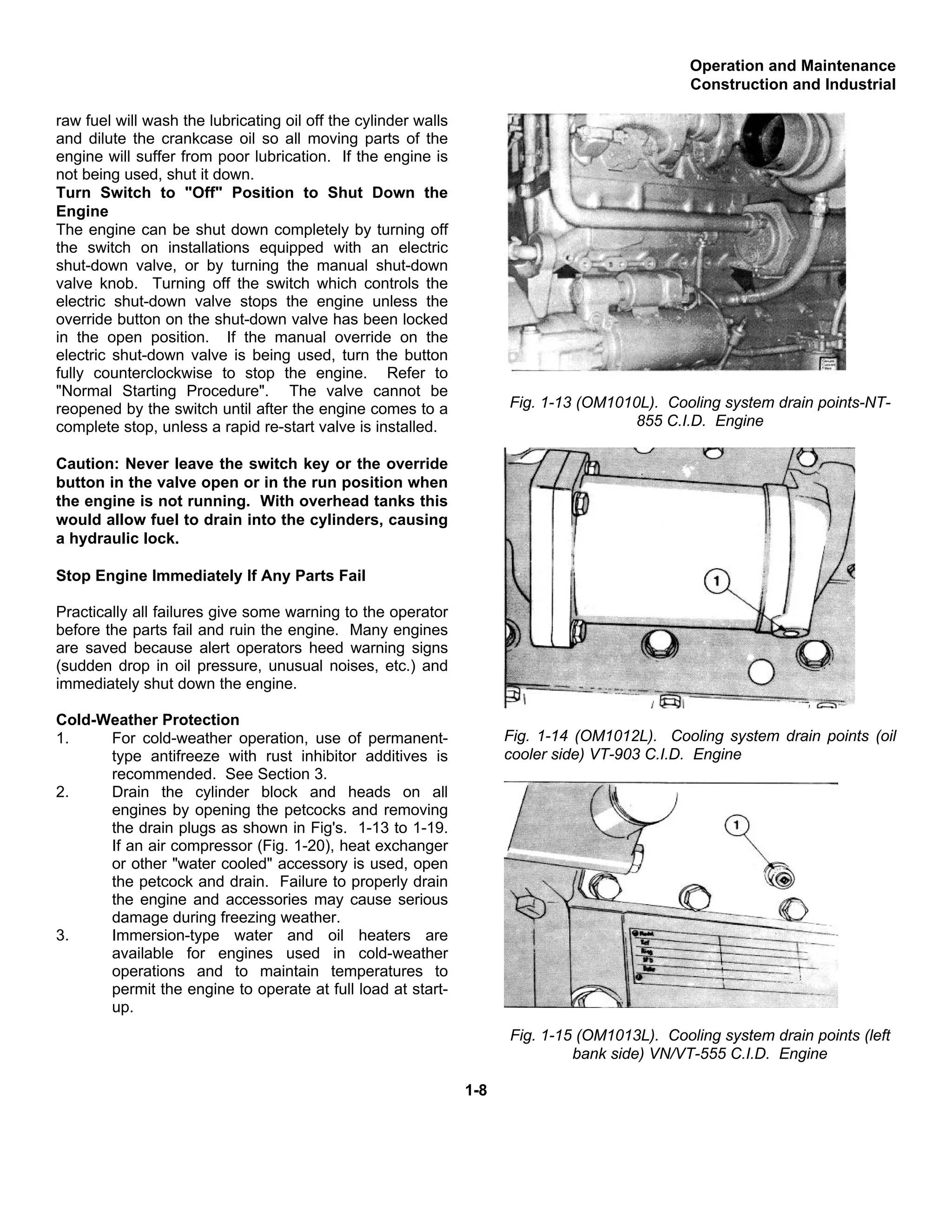
Cold-Weather Protection 
1. For cold-weather operation, use of permanent-type 
antifreeze with rust inhibitor additives is 
recommended. See Section 3. 
2. Drain the cylinder block and heads on all 
engines by opening the petcocks and removing 
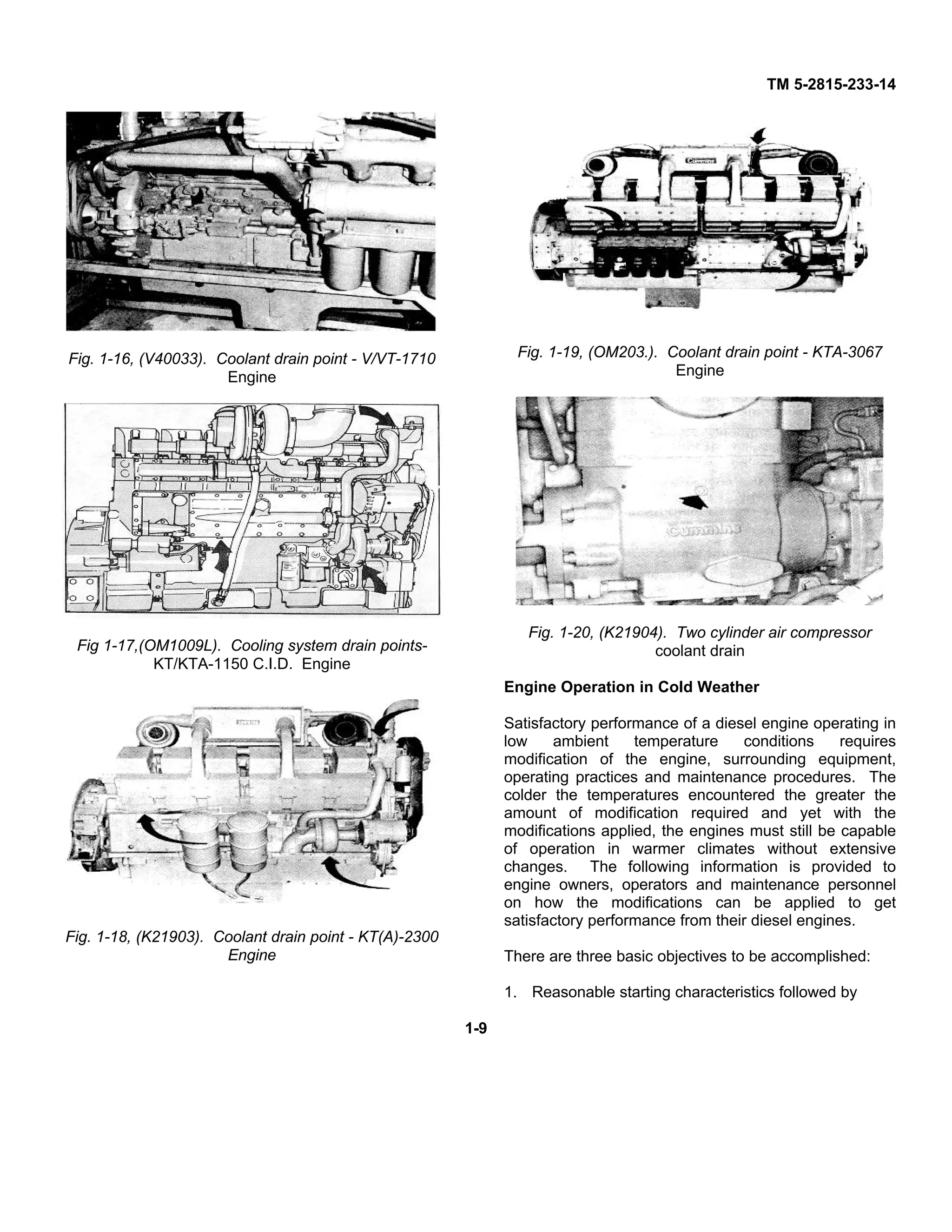
the drain plugs as shown in Fig's. 1-13 to 1-19. 
If an air compressor (Fig. 1-20), heat exchanger 
or other "water cooled" accessory is used, open 
the petcock and drain. Failure to properly drain 
the engine and accessories may cause serious 
damage during freezing weather. 
3. Immersion-type water and oil heaters are 
available for engines used in cold-weather 
operations and to maintain temperatures to 
permit the engine to operate at full load at start-up. 
Fig. 1-13 (OM1010L). Cooling system drain points-NT- 
855 C.I.D. Engine 
Fig. 1-14 (OM1012L). Cooling system drain points (oil 
cooler side) VT-903 C.I.D. Engine 
Fig. 1-15 (OM1013L). Cooling system drain points (left 
bank side) VN/VT-555 C.I.D. Engine 
1-8
TM 5-2815-233-14 
Fig. 1-16, (V40033). Coolant drain point - V/VT-1710 
Engine 
Fig 1-17,(OM1009L). Cooling system drain points- 
KT/KTA-1150 C.I.D. Engine 
Fig. 1-18, (K21903). Coolant drain point - KT(A)-2300 
Engine 
Fig. 1-19, (OM203.). Coolant drain point - KTA-3067 
Engine 
Fig. 1-20, (K21904). Two cylinder air compressor 
coolant drain 
Engine Operation in Cold Weather 
Satisfactory performance of a diesel engine operating in 
low ambient temperature conditions requires 
modification of the engine, surrounding equipment, 
operating practices and maintenance procedures. The 
colder the temperatures encountered the greater the 
amount of modification required and yet with the 
modifications applied, the engines must still be capable 
of operation in warmer climates without extensive 
changes. The following information is provided to 
engine owners, operators and maintenance personnel 
on how the modifications can be applied to get 
satisfactory performance from their diesel engines. 
There are three basic objectives to be accomplished: 
1. Reasonable starting characteristics followed by 
1-9
Operation and Maintenance 
Construction and Industrial 
practical and dependable warm-up of the engine and 
equipment. 
2. A unit or installation which is as independent as 
possible from external influences. 
3. Modifications which maintain satisfactory operating 
temperatures with a minimum increase in maintenance 
of the equipment and accessories. 
If satisfactory engine temperature is not maintained, 
higher maintenance cost will result due to the increased 
engine wear, poor performance and formation of 
excessive carbon, varnish and other deposits. Special 
provisions to overcome low temperatures are definitely 
necessary, Whereas a change to warmer climate 
normally requires only a minimum of revision. Most of 
the accessories should be designed in such a way that 
they can be disconnected so there is little effect on the 
engine when they are not in use. 
The two most commonly used terms associated with 
preparation of equipment for low temperature operation 
are "Winterization" and "Arctic Specifications" 
Winterization of the engine and/or components so 
starting and operation are possible in the lowest 
temperature to 'be encountered requires: 
1. Use of correct materials. 
2. Proper lubrication, 'low temperature lubricating oils. 
3. Protection from the low temperature air. The metal 
temperature does not change, but the rate of heat 
dissipation is affected. 
4. Fuel of the proper grade for the lowest temperature. 
5. Heating to be provided to increase the engine block 
and component temperature to a minimum of -25° F 
[-32° C] for starting in lower temperatures. 
6. Proper external heating source available. 
7. Electrical equipment capable of operating in the 
lowest expected temperature. 
Arctic specifications refer to the design material and 
specifications of the components necessary for 
satisfactory engine operation in extreme low 
temperatures to -65° F [-54° C]. Contact Cummins 
Engine Company, Inc., or the equipment manufacturer 
to obtain the special items required. 
Caution: "Anti-leak" antifreezes are not 
recommended for use in Cummins Engines. 
Although these antifreezes are chemically 
compatible with DCA water treatment, the "anti-leak" 
agents may clog the coolant filters and render 
them ineffective. 
1-10
Maintenance Instructions 
Industrial Fire Pump Engines 
Fire pump engines are built and applied under 
conditions set down by agencies such as Underwriters 
Laboratory; therefore, parts originally supplied must not 
be deviated from without qualifying agency approval. 
The following instructions are those special items 
necessary to this application, and should be used in 
conjunction with those previously stated. 
Initial Start-Up Note: Contact operating personnel 
responsible for fire protection system before starting. 
Obtain approval to service or repair. After repair obtain 
authorized signature of acceptance. 
1. Remove the heat exchanger cap, check or fill the 
engine coolant supply; open the water filter inlet and 
outlet valves. 
2. Prelubricate the engine with oil meeting 
specifications MIL-L-46152 (API-CC/SC) viscosity 
10W30. This includes removal of the turbocharger 
oil inlet line on turbocharged engines to prelubricate 
the housing by adding 2 to 3 oz [60 cc] of clean 
engine lubricating oil. 
3. Check the crankcase oil level and fill to the high 
mark on the dipstick. 
4. Remove the fuel pump solenoid lead and crank the 
engine through both cranking cycles. 
5. If the engine is equipped with a "Vernier throttle", 
place it in the idle position; if not, place the MVS 
throttle in the idle position. On turbocharged models 
the delay cylinder line may be disconnected at the 
block and the block opening plugged. 
6. Reconnect the fuel solenoid lead and start the 
engine; run it at idle speed. 
7. Verify the lubricating oil pressure has been 
established, normally in 6 to 8 seconds. 
Note: Some automatic controllers require lubricating oil 
pressure higher than the normal pressure at 600 rpm 
idle. Increase the idle to 800 to 900 rpm if this condition 
is encountered. All turbocharged engines should be set 
to 800 to 900 rpm idle. 
8. Continue to operate the engine for 3 to 5 minutes 
and review all systems for leaks or unusual 
conditions; correct as required. 
9. Stop the engine and install ST-1224 Adapter. 
10. Check the crankcase oil level and fill it to the high 
mark. 
11. Start the engine and adjust overspeed. 
12. Remove ST-1224 and replace the original adapter. 
13. Clean the raw water strainer. 
14. Start the engine and adjust operating speed. 
15. Adjust the raw water pressure regulator. 
16. Engine is now ready for normal operation. 
Normal Operation 
1. Daily or normal operation would include the 
checking of fuel, lubrication oil, coolant and 
correcting any leaks or unusual conditions as 
required. 
2. Check the coolant and oil heaters to assure at least 
120° F [49° C] water temperature has been 
maintained. 
3. Manually start the engine using the prescribed 
starting procedure. 
4. Operate the engine the prescribed period of time or 
5 minutes after stabilization of the coolant 
temperature. 
5. Shut the engine down using the normal test 
shutdown procedures. 
Fire Pump Engines -Overspeed 
Switch Adjustment 
(IF Engine Models) 
The speed switches required for overspeed protection 
on fire pump engines require high speed for the 
overspeed adjustment. All engines are now being 
shipped adjusted at the maximum overspeed. The 
following overspeed adjustments are 20 percent above 
the rated engine speed. 
An adapter, ST-1224 with 2:1 ratio, in speed switch 
drive only, (1, Fig. 1-21) is available to drive the speed 
switch at twice the engine speed. This tool when 
1-11
Operation and Maintenance 
Construction and Industrial 
installed in place of the existing adapter permits 
adjustment to be made to the speed switch at slightly 
over 1/2 engine and pump speed. This maintains a 
pump speed well within its safe speed range while the 
adjustments are being made. 
Table 1-3: Engine Overspeeds 
Engine Rated 
Model Speed Overspeed 
V-378F1 1750-2200 2100-2640 
V-378F2 2400-3300 2880-3960 
V-504-F1 1750-2200 2100-2640 
V-504-F2 2400-3300 2880-3960 
N-855 1460-2100 1750-2520 
NT-855-F1 1750-2100 2100-2520 
NT-855-F2 1750-2300 2100-2760 
VT-1710-F 1750-2100 2100-2520 
Adjustment Procedure 
1. Remove the present tachometer drive adapter. 
2. Install the service tool, ST-1224, in position of the 
standard drive adapter. Connect the tachometer 
and overspeed stop switch to the ST-1224 Tool. 
Note: The overspeed stop switch cable must be 
connected to the short adapter connection. (1, Fig. 1- 
21). 
3. Start the engine and warm to operating temperature. 
4. Set the engine speed to one-half (1/2) the desired 
engine shut-down speed as indicated by the 
tachometer. 
Fig. 1-21, (ST-1224). ST-1224 adapter 
a. On inline engine models, this. can be 
accomplished by adjusting the Vernier throttle 
control. 
b. On Medium Duty V engines, the speed 
adjustment must be made by adjusting the 
governor idle and maximum speed screws. The 
idle screw is housed in the front of the MVS 
governor. The maximum speed screw is 
mounted to the MVS governor by a bracket and 
is on the left hand side of the fuel pump. 
Engine slow down is accomplished by turning 
the idle speed screw counterclockwise and' 
turning the maximum speed screw in a 
clockwise direction. To increase the engine 
speed reverse the procedure. 
5. Set the single element speed switch. 
a. Remove the lockwire from setscrews on the side 
of the switch. Loosen the three (3) setscrews. 
b. Rotate the cover clockwise (this decreases trip 
speed) until the switch actuates and stops the 
engine. 
c. Secure the setscrews and replace the locking 
wire. 
d. On manual reset models, re-activate the switch 
by pushing the reset button on top of the switch. 
6. Set the dual element speed switches. 
Caution: Do not break or remove the lockwire. 
a. Remove the round head dust cover screw 
marked 2 from the top of the switch. Fig. 1-22. 
b. Insert a 1/16 inch Hex Allen wrench into the 
adjusting screw located just below the surface of 
the cover. 
Fig. 1-22, (CGS27). Double speed switch 
1-12
TM 5-2815-233-14 
c. Turn counterclockwise to lower the engine shut-down 
speed. Turn clockwise to raise the engine 
shut-down speed. 
Caution: Do not turn the adjusting screw more than 
three (3) revolutions in either direction from the 
factory setting. Do not attempt to set the duel 
element switch in the same manner as the single 
element switch. 
d. Replace the dust cover screw removed in "Step 
a" above. 
e. All overspeed switches must be manually reset, 
reactivate the switch by pushing the reset button 
on top of the switch. 
7. Replace the service tool, ST-1224, with the original 
drive adapter and reconnect the cables. 
Note: If the stop crank adjustment is required do not 
use the ST-1224 Adapter. Replace with a standard 
adapter to effect the adjustment. 
Fire Pump Engine Operating Speed Adjustment 
All Cummins fire pump engines will be shipped adjusted 
at the speeds in Table 1-4, unless prior approval has 
been established for a specific speed. 
Final operating speed adjustment should be made at the 
time of the in-service inspection to obtain the required 
fire pump operating speed. 
This speed adjustment must be made with the Vernier 
throttle in the full fuel position and the systems fire 
pump operating at its rated condition. All speed ranges 
of N-NT and V-12 models are available by adjusting the 
VS high speed adjusting screw. Fig's. 1-23 and 1-24. 
Table 1-4: Fire Pump Engine Operating Speed 
Fuel Factory Maximum 
Engine Pump Adjusted Operating 
Model Code Speed Speed 
V-378-F1 C-653 1750 2200 
V-378-F2 C-651 2400 3300 
V-504 F1 C-652 1750 2200 
V-504 F2 C-650 2400 3300 
N-855 8761 1750 2100 
NT-855 Fl 8770 1750 2100 
NT-855 F2 8771 1750 2300 
VT-1710 F 8784 1750 2100 
This screw requires a 1/8 inch Allen wrench and adjust- 
Fig. 1-23, (N11979). Adjusting engine speed 
Fig. 1-24, (N11980). Governor adjusting screw 
ment is made by loosening the 7/16 inch locking nut and 
backing the screw out to increase the engine speed 
through the full speed range. 
The V-378 and V-504 F1 and F2 models require two 
differently calibrated fuel pumps. One pump code 
provides speeds between 1750 and 2300 rpm. A 
different pump code is required for speeds between 
2400 and 3300 rpm. The required speeds on these 
models are similarly obtained by MVS adjustment within 
the calibrated range as indicated above. It normally is 
prohibited by UL and FM to change engine ratings by 
changing fuel pumps on any models of fire pump 
engines. In the event of fuel pump rebuild, the pump 
must be calibrated to the original code and any 
deviation would be a violation to the insurance 
agencies approval. 
1-13
1-14
Maintenance Instructions 
Maintenance is the key to lower operating costs. A 
Maintenance diesel engine requires regularly scheduled maintenance 
to keep it running efficiently. 
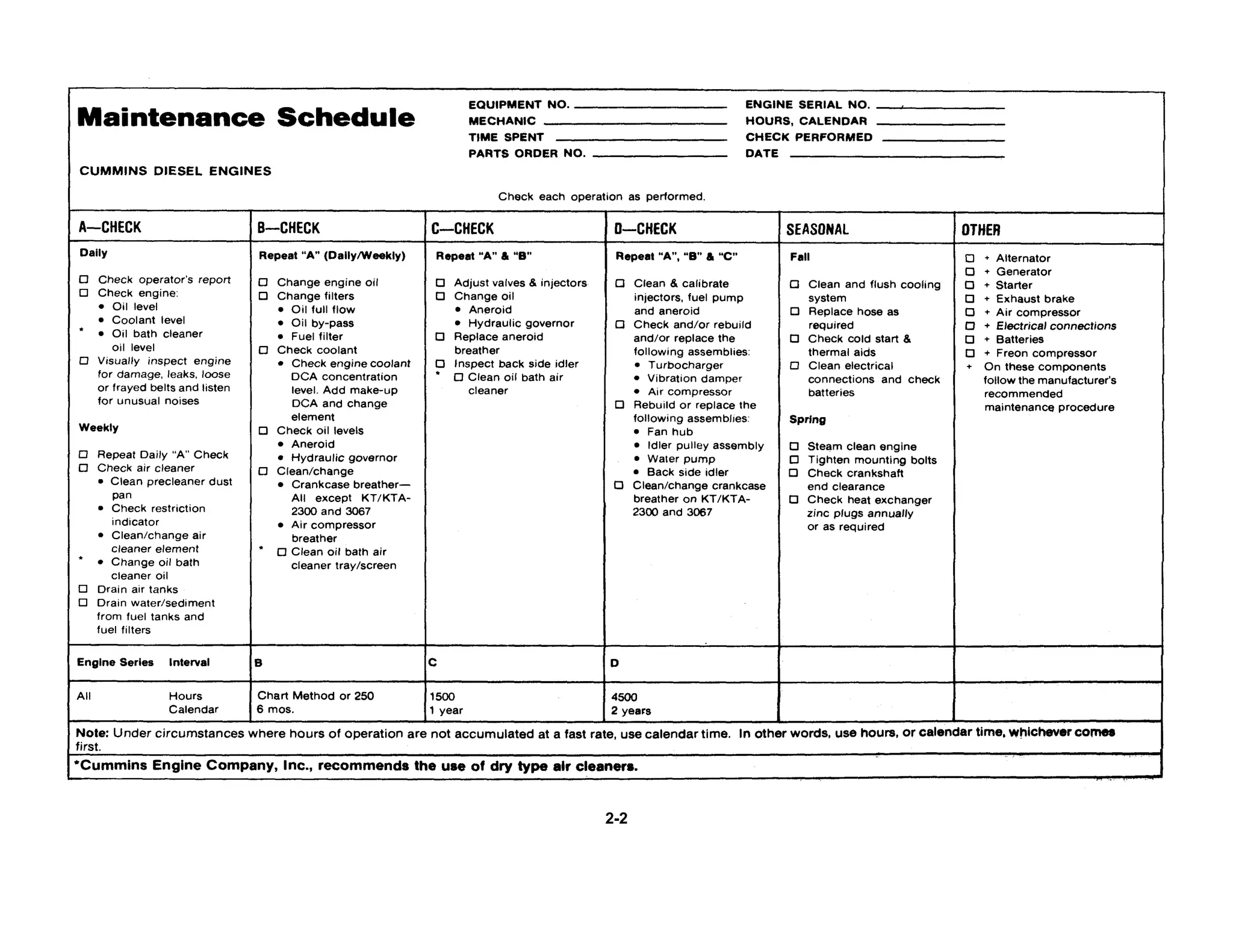
Maintenance Schedule 
Preventive maintenance is the easiest and least 
expensive type of maintenance. It permits the 
Maintenance Department to do the work at a convenient 
time. 
A Good Maintenance Schedule Depends On Engine 
Application 
Actual operating environment of the engine governs the 
maintenance schedule. The suggested check sheet on 
the following page indicates some checks have to be 
performed more often under heavy dust or other special 
conditions. 
Using the Suggested Schedule Check Sheet 
The maintenance schedule check sheet is designed as a 
guide until adequate experience is obtained to establish 
a schedule to meet a specific operation. 
A detailed list of component checks is provided through 
several check periods; also a suggested schedule basis 
is given for hours of operation, or calendar of time. 
A maintenance schedule should be established using 
the check sheet as a guide; the result will be a 
maintenance program to fit a specific operation. 
The check sheet shown can be reproduced by any 
printer. The person making each check can then 
indicate directly on the sheet that the operation has 
been completed. When a complete column (Under A, 
B, C, etc.) of checks is indicated, the engine will be 
ready for additional service until the next check is due. 
Storage for Engines Out of Service 
If an engine-remains out of service and its use is not 
immediately forthcoming, special precautions should be 
taken to prevent rust. Contact the nearest Cummins 
Distributor or consult applicable Shop Manual for 
information concerning engine storage procedure. 
2-1
2-2
To prove that the Engine has been properly maintained retain records, such as work orders and receipts, showing that scheduled maintenance has 
been performed. The maintenance record form on this page is for that purpose. 
2-3
Operation and Maintenance 
Construction and Industrial 
Scheduled Maintenance 
Schedule I, Schedule II 
The following maintenance schedules should be used to 
establish maintenance practices for Cummins standby 
(GS) or continuous duty (GC) generator sets. 
Schedule I is used with standby applications. Many of 
these installations are regulated by NFPA and/or local 
codes (reference NFPA No. 76A). 
Standby rated generator sets are for supplying electric 
power in the event of normal utility power failure. No 
overload capability is available for this rating. This 
rating may be used for continuous service for as long as 
the emergency may last. This rating conforms with the 
BS 649:1958 overload rating and DIN "B" 6270. 
Schedule II is used with continuous duty applications. 
Continuous duty rated generator sets are for supplying 
electric power in lieu of commercially purchased power. 
Intermittent overloads up to the standby rating are 
allowable. This rating may be used for continuous 
service in commercial applications and it conforms with 
BS 649:1958 and DIN "A" 6270 for generator set 
applications. 
Using The Suggested Schedule Check Sheet 
Actual operating environment of the engine governs the 
maintenance schedule. The-suggested check sheet on 
the following page indicates some checks have to be 
performed more often under heavy dust or other special 
conditions. 
The maintenance schedule check sheet is designed as a 
guide until adequate experience is obtained to establish 
a schedule to meet a specific operation. 
A detailed list of component checks is provided through 
several check periods; also a suggested schedule basis 
is given for hours of operation, or calendar of time. 
A maintenance schedule should be established using 
the check sheet as a guide; the result will be a 
maintenance program to fit a specific operation. 
Cummins Standby Generator Sets 
Cummins standby generator sets may be required to 
start and come on line in 10 seconds or less. 
These engines must be equipped with engine coolant 
heaters capable of maintaining coolant temperature at a 
minimum of 100°F [38° C]. 
Engines subject to ambient temperatures less than 2-4 
70° F [21° C] must also be equipped with a lubricating 
oil heater. When using a lubricating oil heater 
immersed in oil, the maximum surface of heater in 
contact with oil, should be less than 300° F [149° C] to 
minimize formation of hard carbon on the heating 
element. 
Recommended wattage for the heaters when the unit is 
in a protected area or in an enclosure are shown in 
Bulletin No. 3379009, in Section 7 Miscellaneous. 
Standby units should be operated once a week under a 
minimum of 25% of rated KW load for at least thirty 
minutes. During this test, the engine must reach normal 
operating temperature. 
Cummins Continuous Duty Generator Sets 
Continuous duty generator sets may be equipped with a 
cold starting aid. Maintenance procedures for these 
devices can be found in the seasonal maintenance 
section. 
2-4
2-5
2-6
Maintenance Instructions 
"A" Maintenance Checks-Daily 
Make a Daily Report of Engine Operation to the 
Maintenance Department 
The engine must be maintained in top mechanical 
condition if the operator is to get optimum satisfaction 
from its use. The maintenance department needs daily 
running reports from the operator to make necessary 
adjustments in the time allotted and to make provisions 
for more extensive maintenance work as the reports 
indicate the necessity. 
Comparison and intelligent interpretation of the daily 
report along with a practical follow-up action will 
eliminate most failures and emergency repairs. 
Report to the Maintenance Department any of the 
following conditions: 
1. Low lubricating oil pressure. 
2. Low power. 
3. Abnormal water or oil temperature. 
4. Unusual engine noise. 
5. Excessive smoke. 
6. Excessive use of coolant, fuel or lubricating oil. 
7. Any fuel, coolant or lubricating oil leaks. 
Check Engine 
Check Engine Oil Level 
Note: Some dipsticks have dual markings, with high 
and low-level marks: static oil marks on one side, 
engine running at low idle speed marks on opposite 
side. Be sure to use the proper scale. 
1. Check the oil level with the dipstick oil gauge 
located on the engine. Fig. 2-1. For accurate readings, 
the oil level should not be checked for approximately 15 
minutes after the engine is shut-down. 
Keep the dipstick with the oil pan with which it was 
originally shipped. Keep the oil level as near the "H" 
(high) mark as possible. 
Caution: Never operate the engine with the oil level 
below the "L" (low) mark or above the "H" (high) mark. 
2. If necessary, add oil of the same quality and brand 
as already in the engine. See Section 3. 
Fig. 2-1, (K21901). Checking engine oil level 
Check Engine Coolant Level 
Keep the cooling system filled to the operating level. 
Check the coolant level daily or at each fuel fill point. 
Investigate for causes of coolant loss. Check the 
coolant level only when the system is cool. 
Check Belts 
Visually check belts for looseness. If there is evidence 
of belt slippage adjust as follows: Using the appropriate 
gauge, Fig's. 2-2 and 2-3, check. 
Fig. 2-2, (OM1014L). Checking belt tension with a Krikit 
gauge 
2-7
Operation and Maintenance 
Construction and Industrial 
Table 2-1: Belt Tension (Lbs.) 
Belt New Belt* Minimum • Used Belt Installation Tension 
Width Belt Tension Tension • If Below Min. Tension, Retention to 
Inches Gauge (lb.) + 10 (lb.) (lb.) + 10 
.380 ST-12748 140-150 60 100 
.440 CAN-292 140-150 60 100 
1/2 140-150 60 100 
11/16 160-170 60 100 
3/4 ST-1138 160-170 60 100 
7/8 160-170 60 100 
K-Sect. 
5 Rib ST-1293 125-135 60 100 
V-Ribbed 
K-Sect 
6, Rib- ST-1293 150-160 70 120 
V-Ribbed 
K;Sect 
10 Rib NUA 250-260 140 200 
V-Ribbed 
* Used belts should be retensioned to values listed in this column. 
Note: A belt is considered as used. if it has been in operation for a period of time of at least 5 minutes. 
and/or adjust belts to the tension as indicated in Table 2- 
1. 
Fig. 2-3, (OM1015L). Adjusting belt tension with ST- 
1293 
Note: When using the "Krikit" gauge the correct belt 
tension reading for the belt tested must be read at the 
point where the top of the black indicator arm crosses 
the bottom numbered scale. Position the gauge in the 
center of the belt between two pulleys. The flange at 
the side of the gauge should be flat against the edge of 
the belt. 
Inline Engine Water Pump Belts (No Idler) 
1. Eccentric water pump adjustment. 
a. Loosen the water pump clamp ring to allow the 
pump body to turn. 
b. Loosen the pump body by pulling up on the 
belts. A sharp jerk may be required. 
c. Insert a bar in the water pump body slots and 
rotate the pump body counterclockwise to 
tighten the belts. 
Note: Do not adjust to final tension at this time. 
d. Snug the clamp ring capscrew farthest from the 
belts, on the exhaust side to 5 ft-lbs [7 N m]. 
e. Snug the two capscrews above and below the 
first one to 5 ft-lbs [7 N m]. 
f. Finish tightening by alternating from side to side 
in 5 ft-lbs [7 N.m] increments to a final torque of 
12 to 15 ft-lbs [16 to 20 N m]. 
2-8
Maintenance Instructions 
g. Check the belt tension. 
Final belt tension was not obtained by adjustment alone. 
The water pump body was pulled straight by snugging 
the capscrews in the order described, thus increasing 
the belt tension to the final value. 
2. Adjustable (split) pulley water pumps, V-903 
Engines only. 
a. Remove the capscrews joining the sheave(s) of 
the pulley. 
Note: Clean the capscrew threads and holes in the 
sheaves thoroughly to avoid capscrew breakage during 
reassembly. 
b. The outer half of the pulley is screwed onto the 
hub extension of the inner half. Some pulleys 
are provided with flats, and some with lugs for 
barring. 
c. Bar the engine over to roll the belt outward on 
the pulley as the outer half is turned in. 
d. Adjust the belt(s) to the tension indicated in 
Table 2-1. 
e. Turn the outer sheave(s) in enough to align the 
capscrew holes. 
f. Start the capscrews and tighten alternately and 
evenly. Final tension is: 5/16-18 capscrew, 10 
to 12 ft-lbs [14 to 16 N•m] 3/8-16 capscrew, 17 
to 19 ft-lbs [23 to 26 N om] g. Bar the engine 
over one or two revolutions to seat the belt. 
h. Recheck the belt tension. 
Fig. 2-4, (N11974). Water pump with idler 
Inline Engine Water Pump Belts (With Idler) 
1. Loosen the capscrews and lockwashers or locknut 
securing the idler pulley to the bracket or water 
pump. Fig. 2-4. 
2. Using a pry bar (NTA) or adjusting screw (FFC) 
adjust the idler pulley until the proper belt tension is 
indicated on the gauge. See Table 2-1. 
3. Secure the idler pulley or bracket in position by 
tightening the locknut or capscrews and lockwashers 
to 45 to 55 ft-lbs [61 to 75 N m] torque. 
Note: The self tensioning idler on V-1710 belt driven 
water pumps requires no adjustment or belt tension 
check. 
Fan Drive Belts 
1. Loosen the large locking nut on the fan hub shaft or 
the capscrews securing the fan hub shaft to the 
mounting bracket. The fan hub will fall out of line 
when this is done. 
2. Turn the adjusting screw to increase the belt 
tension. 
3. Tighten the locknut or capscrews until the fan hub is 
straight. Snug the nut to maintain the hub in proper 
alignment with the fan hub bracket. 
Caution: Do not adjust to full tension with the 
adjusting screw, as this would result in 
overtightening. 
4. Belt tension should read as indicated in Table 2-1 on 
applicable gauge. 
5. Tighten NH/NT Engines locknut to 400 to 450 ft-lbs 
[542 to 610 N m]; then back off 1/2 turn. Tighten 
the four 1/2 inch capscrews, Fig. 2-5, on NTC-350 
FFC Engines to 75 to 85 ft-lbs [101 to 115 N.m]. 
On V-903 Engines tighten capscrews to 75 ft-lbs [102 
N.m] or single nut to 450 ft-lbs [610 N.m]. 
6. Recheck the belt tension. 
7. Back out the adjusting screw one-half turn to 
prevent breakage. 
Note: The self tensioning backside idler on KT/KTA2300 
and KTA-3067 belt driven fan requires no belt tension 
check. 
Generator/Alternator Belts 
Belt tension should be as indicated in Table 2-1 when 
measured with the applicable gauge. 
2-9
Operation and Maintenance 
Construction and Industrial 
Fig. 2-5, (OM10161). Fan hub installation, NT-350 FFC 
Belt Installation. 
If the belts show wear or fraying, replace as follows: 
1. Always shorten the distance between the pulley 
centers so the belt can be installed without force. 
Never roll a belt over the pulley and never pry it on with 
a tool such as a screwdriver. Either of these methods 
will damage the belts and cause early failure. 
2. Always replace the belts in complete sets. Belts 
riding depth should not vary over 1/16 in [1.6 mm] 
on matched belt sets. 
3. Pulley misalignment must not exceed 1/16 in 11. 
6 mm] for each ft 10.3 m] of distance between 
the pulley centers. 
4. Belts should not bottom on the pulley grooves nor 
should they protrude over 3/32 in [2.4 mm] above 
the top edge of the groove. 
5. Do not allow belts to rub any adjacent parts 6. 
Adjust belts to the proper tension. 
Readjusting New Belts. 
All new belts will loosen after running for 5 minutes and 
must be readjusted to "belt tension after run-in" Ref. 
Table 2-1. 
Check Oil Bath Cleaner Oil Level. 
Daily check oil level, Fig. 2-6, in the oil bath air cleaner 
to be sure the oil level in the cup is at the indicated 
mark. Refill as required. 
*Cummins Engine Company, Inc. recommends the use 
of dry type air cleaners. 
Check for Damage. 
Visually check the fuel system, etc., for misadjustment 
or tampering; check all connections for leaks or 
damage. Check the engine for damage; correct as 
necessary. 
Fig. 2-6, (Nl1001). Checking oil level in air cleaner 
2-10
Maintenance Instructions 
30 
"A" Maintenance Checks-Weekly 
Repeat Daily Checks 
Check Air Cleaner 
Clean Pre-Cleaner and Dust Pan 
Under extremely dirty conditions an air pre-cleaner may 
be used. Clean the pre-cleaner jar and dry-type air 
cleaner dust pans daily or more often, as necessary, 
depending on operating conditions. 
Check Inlet Air Restriction 
Mechanical Indicator 
A mechanical restriction indicator is available to indicate 
excessive air restriction through a dry-type air cleaner. 
This instrument can be mounted in the air cleaner outlet 
or on the vehicle instrument panel. The red flag (1, Fig. 
2-7) in the window gradually rises as the cartridge loads 
with dirt. After changing or replacing the cartridge, reset 
the indicator by pushing the reset button (2). 
Fig 2-7, (CGS-20). Air inlet restriction indicator 
Note: Never remove the felt washer from the indicator. 
It is necessary to absorb moisture. 
Vacuum Indicator 
Vacuum switches, Fig. 2-8, are available which actuate 
a warning light on the instrument panel when the air 
restriction becomes excessive. 
Fig. 2-8, (N21905). Vacuum switch to check air inlet 
1. Air restriction on turbocharged engines must not 
exceed 25 inches [635 mm] of water or 1.8 inches [46 
mm] of mercury under full power conditions. 
2. Naturally aspirated engine air restriction must not 
exceed 20 inches [508 mm] of water or 1.5 inches [38 
mm] of mercury at air intake manifold at rated speed. 
Clean or Replace Air Cleaner Elements 
The paper element in a dry-type air cleaner, Fig's. 2-9, 
2-10, 2-11 and 2-12, may be cleaned several times by 
using air to blow off dirt or by washing with nonsudsing 
household detergent and water at 120 to 1400F [49 to 
600C], then drying with compressed air, approximately 
30 psi [306 kPa]. Do not hold the air jet too close to the 
paper element. 
Elements that have been cleaned several times will 
finally clog and air flow to the engine will be restricted. 
After cleaning, check the restriction as previously 
described and replace the element if necessary. 
Caution: Holes, loose end seals, dented sealing 
surfaces and other forms of damage render the 
cleaner inoperative and require immediate element 
replacement. 
To change the element: 
1. Loosen the wing nut (1, Fig. 2-9) securing the 
2-11
31 
Operation and Maintenance 
Construction and Industrial 
Fig. 2-10, (OM1031L). Changing air cleaner element Fig. 2-11. (OM1029L). Air cleaner-heavy duty 
Figure 2-10. (OM1030L). Air cleaner-heavy duty element 
bottom cover (2) to the cleaner housing (3). 
Remove the cover. 
2. Pull the element (6) down from the center bolt (4). 
Caution: Pull the cover and the element straight out 
when removing them from the housing, Fig. 2-10, to 
avoid damage to the element. 
Fig. 2-12, (OM1030L). Air cleaner-heavy duty dual 
element 
2-12
Maintenance Instructions 
32 
3. Remove the gasket (5) from the outlet end (7) of 
he housing. 
When installing the element, make sure it seats on the 
gasket at the air cleaner outlet end. 
Heavy Duty Dry-Type Air Cleaners 
Heavy duty air cleaners (single and dual types) combine 
centrifugal cleaning with element filtering, Fig's. 2-11 
and 2-12, before air enters the engines. 
Before disassembly, wipe dirt from the cover and the 
upper portion of the air cleaner. To clean single or dual 
types: 
1. Loosen the wing bolt, remove the band securing 
the dust pan (1, Fig. 2-11), (2, Fig. 2-12). 
2. Loosen the wing nut (2, Fig. 2-11 and 3, Fig. 2- 
12), remove the dust shield (3, Fig. 2-11), (4, 
Fig. 2-12), from the dust pan (1, Fig. 2-11), (2, 
Fig. 2-12), clean the dust pan and shield. 
3. Remove the wing nut (2, Fig. 2-11), (5, Fig. 2- 
12) securing the air cleaner primary element (6, 
Fig. 2-12) in the air cleaner housing, inspect the 
rubber sealing washer on the wing nut (4, Fig. 
2-11), (5, Fig. 2-12). 
4. Blow out the element from the clean air side 
with compessed air not exceeding 30 psi [207 
kPa]. 
5. Wash the element with nonsudsing household 
detergent and water, 120 to 140° F [49 to 60° 
C]. Dry with compressed air, 30 psi [207 kPa]. 
6. Inspect the element after cleaning. 
7. Install a new or the cleaned primary element. 
8. Be sure the gasket washer is in place under the 
wing nut before tightening. 
9. Reassemble the dust shield and dust pan, 
position them to the air cleaner housing and 
secure with the band. 
10. On the dual element type Cyclopac cleaner: 
a. Check the air restriction indicator. If the air 
restriction is excessive, disassemble the 
air cleaner, remove the wing nut (8, Fig. 
2-12), and replace the safety element 
(9). 
b. Reassemble the air cleaner as described in 
"Steps 8 and 9" above. Cartridge Type 
Air Cleaner Element 
1. Loosen the wing nuts (4, Fig. 2-13or2-14) on 
the air cleaner housing (5) to remove the pre-cleaner 
Fig 2-13. (N21026). Air cleaner - cartridge type (two 
stage) 
Fig. 2-14, (V11009). Air cleaner- cartridge type (single 
stage) 
panel with the dust bin (1). To remove the pre-cleaner 
panel (2) equipped with an exhaust 
aspirator loosen the "U" bolt clamp securing 
the pre-cleaner to the aspirator tubing. 
2. Remove the dirty Pamic cartridge (3), by 
inserting your fingers in the cartridge opening 
(loosen all four corners of the cartridge, one at 
a time) and pulling it straight out. 
With the larger cartridge, it may be necessary to break 
the seal along the edges of the cartridge. After the seal 
has been broken, pull the cartridge straight out and 
slightly up so the cartridge will clear the sealing frame 
and edges of the air cleaner housing. 
Cleaning and Inspection 
1. Clean the pre-cleaner openings (2) of all soot, 
oil film and any other objects that may have 
become lodged in the openings. Remove any 
dust or dirt in 
2-13
33 
Operation and Maintenance 
Construction and Industrial 
the lower portion of the pre-cleaner and aspirator 
tubing. Inspect the inside of the air cleaner 
housing for foreign material. 
2. Inspect the dirty cartridge for soot or oil. If there is 
soot inside the Pamic tubes, check for leaks in the 
engine exhaust system, exhaust "blow-back" into 
the air intake and exhaust from other equipment. If 
the cartridge appears "oily", check for fumes 
escaping from the crankcase breather. Excessive 
oil mist shortens the life of any dry-type cartridge. 
Troubleshooting at this point can appreciably 
lengthen new cartridge life. 
3. It is not recommended to clean and reuse the 
cartridge. When returned to service, life 
expectancy of a paper cartridge will be only a 
fraction of the original service life. 
4. Inspect clamps and flexible hose or tubing to be 
sure all fittings are air tight on cleaners with 
exhaust aspirators. 
5. The pre-cleaner dust bin is self-cleaning. 
Assembly 
1. Inspect the new filter cartridge for shipping damage 
before installing. 
2. To install a new cartridge, hold the cartridge (3, 
Fig. 2-13 and 2-14) in the same manner as when 
removing it from the housing. Insert the clean 
cartridge into the housing; avoid hitting the 
cartridge tubes against the sealing flange on the 
edges of the air cleaner housing. 
3. The cleaner requires no separate gaskets for seals; 
therefore, care must be taken inserting cartridge to 
insure a proper seat within the cleaner housing. 
Firmly press all edges and corners of the cartridge 
with your fingers to effect a positive air seal against 
the sealing flange of the housing. Under no 
circumstances should the cartridge be pounded or 
pressed in the center to effect a seal. 
4. Replace the pre-cleaner panel (2) and tighten the 
wing nuts (4) by hand, for final tighteness turn 1-1/2 
to 2 turns with a small adjustable wrench. Do not 
overtighten. On a pre-cleaner with an exhaust 
aspirator, assemble the aspirator tube to the pre-cleaner 
panel and tighten the "U" bolt. 
5. Care should be taken to keep the cleaner face 
unobstructed. 
Change Oil Bath Air Cleaner Oil 
Before dirt build-up reaches 1/2 inch [12.7 mm], remove 
the oil cup from the cleaner. Discard the oil 
and wash the cup in cleaning solvent or fuel oil. 
Note: During wet weather and in winter months, 
changing of the oil is equally as important as during 
dusty weather since the air cleaner inlet may be located 
in an air stream which carries moisture into the cleaner. 
Fill the oil cup to the level indicated by the bead on the 
side with clean, fresh oil of the same grade as that in the 
crankcase and assemble it to the cleaner. In extremely 
cold weather a lighter grade may be necessary. A 
straight mineral, non-foaming detergent, or non-foaming 
additive oil may be used in oil bath air cleaners. 
Caution: Never use dirty oil or used oil. 
Drain Air Tanks 
In cold weather, condensed moisture in the air tanks and 
lines may freeze and make controls useless. Drain the 
air tanks to keep all water out of the compressed air 
system. 
Drain Sediment from Fuel Tanks 
Loosen the fuel tank drain cock or plug, if used, and 
drain approximately 1 cup of fuel to remove water and 
sediment. Close the drain cock or plug. 
Fuel/Water Filter Separator 
If more moisture than usual is present when checking 
the fuel tanks, it may be advisable to install a water 
separator. 
Contact the nearest Cummins Dealer for a Fleetguard 
water separator that meets requirements. 
Drain plugs are located in the bottom of some fuel filter 
cases and in the sump of some fuel supply tanks. More 
condensation of water vapor occurs in a partially filled 
fuel tank than in a full one. Therefore, fuel supply tanks 
should be kept as nearly full as possible. Warm 
returning fuel from the injectors heats the fuel in the 
supply tank. If the fuel level is low in cold weather, the 
fact that the upper portion of the tank is not being 
heated by returning fuel tends to increase condensation. 
In warm weather both the supply tank and the fuel are 
warm. In the night, however, cool air lowers the 
temperature of the tank much more rapidly than the 
temperature of the fuel. Again this tends to increase 
condensation. 
Engine Front Trunnion 
If used, the engine front trunnion mount should be 
lubricated with grease meeting specifications as outlined 
in Section 3. 
2-14
Maintenance Instructions 
34 
"B" Maintenance Checks 
B-Check 
At each "B" Maintenance Check, perform all the "A" 
Checks in addition to the following. 
Lubricating Oil Change Intervals 
Note: If the lubricating oil is drained from the oil pan to 
make an engine repair, new oil must be used. Do not 
use oil after it has been drained from the oil pan. 
Maintaining a proper "B" maintenance check interval is 
a very important factor in preserving the integrity of an 
engine. Lubricating oil contamination is the direct result 
of engine operation and the load factor involved. The 
amount of contamination generated depends on the 
amount of fuel the engine consumes. Laboratory and 
field tests have determined that, when using the 
recommended quality oils and filters, a turbo-charged 
engine in good condition and equipped with a bypass oil 
filter can consume 255 gallons of fuel for each gallon of 
oil in the oil system before the maximum level of oil 
contamination is reached. Based on these findings, 
Cummins Engine Company, Inc., recommends that the 
"B" check interval be determined by the use of the 
"Chart Method". At each "B" check interval it is 
recommended to change the full-flow filter and the 
bypass filter. 
The total lubricating system capacity in gallons can be 
determined by adding the high level of the lubricating oil 
in the oil pan and the capacities of the full-flow and 
bypass filters. All lubricating oil systems must be 
rounded to the nearest gallon when applied to the chart. 
Table 2-2 lists the capacities of the full-flow and bypass 
filter elements. 
Chart Method 
From laboratory and field tests we know that the 
maximum contamination level for a gallon of oil is 
reached when 255 gallons of fuel is consumed in a 
turbocharged engine or 280 gallons of fuel in a naturally 
aspirated engine. The 255 or 280 figure is the constant 
used in the equation for the oil change period. 
The following illustration is how to use the chart method 
to determine the recommended oil change interval: 
Table 2-2: Lubricating Oil Filter Elements 
Description 
of Filter Capacity Engine 
(Element P/N) (Gals.) Family 
Full-flow 0.93 All Engines (except 
(LF516) V-378 and V-504) 
Full-flow 0.83 V-378 & V-504 Only 
(LF613) 
Full-flow 0.80 All Engines 
spin-on (LF670) (Optional on V-555) 
Full-flow 0.65 Standard on All 
(spin-on short) Small Vee 
(LF670-SC) 
Bypass, 750 in3 2.91 All Engines 
(LF750-A) (Except Small Vee) 
Bypass, 750 in3 2.91 All Engines 
(LF750-C) (Except Small Vee) 
Bypass, 750 in3 2.91 All Engines 
(LF750) (Except Small Vee) 
Bypass, 500 in3 2.25 Small Vee Only 
(LF500) 
Bypass, spin-on 0.70 C & I Engines and 
(LF777) Small Vee 
Full-flow 0.50 Standard on All 
Small 
spin-on Vee (Will replace 
(LF734) LF670-SC) 
Assume a VT-1710 engine which has the following 
capacities: 
Lubricating Oil Pan Capacity = 18 gallons 
Full-Flow Filter (3) = 2.79 gallons 
Bypass Filter 750 in3 (2) = 5.82 gallons 
Total Lubricating Oil = 26.61-27 gallons 
System Capacity 
Round this capacity to the nearest whole gallon and 
select the chart entitled "Off Highway Turbocharged with 
By-Pass Filter" "Lube System Capacity-27 gallons." 
Also assume the average fuel consumption = 17.5 
gallons per hour and the average oil consumption = 8 
hours per quart. 
To read the chart. 
2-15
35 
Operation and Maintenance 
Construction and Industrial 
Change Period = Constant x fuel consumed x the oil available. 
Oil Available = Oil system capacity + one-half the make-up oil added in a given period. 
Oil Added = Change Interval 
Oil Consumption Rate 
Change Period = The Constant x the fuel consumed x [the system capacity + one-half (the Change Period) 
(Oil Consumption Rate) 
Solving this equation for the oil change period gives 
the equation which is used in developing the Chart 
Method. 
Change Period = Constant x fuel consumed x oil consumption x system capacity 
Oil consumption - one-half (constant x fuel consumed) 
1. The numbers along the left side of the chart 
represent fuel consumption in gallons per hour. 
Divide the grid between "10" and "20" in 10 equal 
parts to find the point for fuel consumption. 
2. Beginning at "17.5" (fuel consumption), draw a line 
from left to right to the curve "8". This curve 
represents oil consumption at the rate of 8 hours 
per quart. 
3. From the point on the curve "8", draw a line 
perpendicular to the bottom of the chart. The 
numbers across the bottom of the chart represent 
the oil change interval in hours. 
4. The perpendicular line from the curve "8" intersects 
the bottom line of the chart between "500" and 
"600". Divide the grid in 5 equal parts to find the 
point for the recommended oil change interval. In 
this example the recommended oil change interval 
is 505 hours. 
Since it is not practical with a group of engines to use a 
different oil change interval for each engine based on 
the chart method, Cummins recommends that you use 
the chart method in the following manner: 
1. Divide the engines into groups by engine model 
(engines with the same lube system capacity). 
2a. Determine the average fuel consumption for all the 
engines in each group. 
b. Select a group fuel consumption, for entering the 
chart, that is halfway between the average fuel 
consumption and the highest fuel consumption in 
the group. 
3a. Determine the average lube oil consumption for all 
the engines in the group. 
b. Select a group lube oil consumption for entering 
the chart that is halfway between the average lube oil 
consumption and the lowest oil consumption in the 
group. 
4. Read the appropriate chart for each group using 
the fuel consumption determined in 2b and the lube oil 
consumption determined in 3b. The oil change interval 
determined in this manner should be applied to the 
entire group. 
5. Since some will have more than one group of 
engine models, a change interval should be determined 
for each group. In some cases it may be wise to divide 
some groups into sub-groups (such as older NTC-290's 
and newer Formula 290's) for which a change interval is 
determined. 
6. Practically, now, a manager must review the oil 
change intervals determined for each group or 
OIL CHANGE INTERVALS 
2-16
Maintenance Instructions 
36 
subgroup; consider the other items in his 
preventative maintenance schedule; consider his 
own past practice; and select an oil change interval 
which he feels is the best compromise. 
Note: Cummins Engine Co., Inc., does not recommend 
exceeding 25,000 miles and/or 600 hours on oil change 
intervals. Therefore, the charts or limited to 25,000 
miles or 600 hours and must not be extended. 
The charts for determining the recommended oil change 
intervals are included in the following pages. 
Chart Method Alternative 
As an alternative to the Chart Method for determining 
the "B" maintenance check interval, Cummins Engine 
Co., Inc., recommends that the "B" check be performed 
every 10,000 miles, 250 hours or 6 months. 
Note: Perform the "B" check in 6 month intervals for 
engines in emergency or standby operations and any 
other operation where less than the recommended miles 
or hours have been accumulated in a 6 month interval. 
2-17
37 
Operation and Maintenance 
Construction and Industrial 
OFF HIGHWAY - NATURALLY ASPIRATED WITH BY-PASS FILTER 
2-18
38 
Maintenance Instructions 
OFF HIGHWAY - NATURALLY ASPIRATED WITH BY-PASS FILTER 
2-19
39 
Operation and Maintenance 
Construction and Industrial 
OFF HIGHWAY - TURBOCHARGED WITH BY-PASS FILTER 
2-20
40 
Maintenance Instructions 
OFF HIGHWAY - TURBOCHARGED WITH BY-PASS FILTER 
2-21
41 
Operation and Maintenance 
Construction and Industrial 
OFF HIGHWAY - TURBOCHARGED WITH BY-PASS FILTER' 
2-22
42 
Maintenance Instructions 
OFF HIGHWAY - TURBOCHARGED WITH BY-PASS FILTER 
2-23
43 
Operation and Maintenance 
Construction and Industrial 
OFF HIGHWAY - TURBOCHARGED WITH BY-PASS FILTER Construction and Industrial 
2-24
44 
Maintenance Instructions 
OFF HIGHWAY - TURBOCHARGED WITH BYPASS FILTER 
2-25
45 
Operation and Maintenance 
Construction and Industrial 
Lubricating Oil Analysis 
An alternate method for determining when to change 
lubricating oil and filters is by used oil analysis using 
laboratory tests. The analyses used are for the purpose 
of determining the amount of contamination in the oil; 
not for predicting potential engine failures. It is 
recommended that new engines be operated through at 
least one oil change interval determined by the chart 
method prior to initiating a used oil analysis program. 
In order to initiate a used oil analysis program for a large 
number of engines they should be grouped by basic 
model, rated horsepower and type of service. The 
horsepower range of a group should not exceed 25; in 
other words NTC-270 and NTC-290 engines could be 
placed in the same group, however, NTC-290 and NTC- 
350 engines should be in separate groups. Small vee, 
medium vee, NH and K models should be in separate 
groups. After the engines have been grouped, a sub-group 
consisting of 10 percent of the total engines in 
each group should be selected for the used oil analysis 
program. If a group consists of less than 50 engines but 
more than 25 engines the sub-group size should be 5 
engines. For groups of less than 25 engines the sub-group 
size should be 8 engines. The selecting of the 
engines for each subgroup should be completely 
random. 
Each group of engines should be set up on oil change 
intervals as described under the "Chart Method". When 
the engines reach the end of the second chart method 
oil change interval, an oil change should be performed 
on all units in the group except those engines selected 
for the sub-group. The engines in the sub-groups should 
only have an oil sample taken. Additional oil samples 
should be taken from each of the engines in the sub-groups 
at every 48-operating- hour interval after the first 
sample. This sampling frequency may be varied 
somewhat as dictated by the operation. The sampling 
frequency should not be extended beyond 60 hours for 
equipment safety reason or reduced below 40 hours 
because of the added analytical costs. 
This sampling process should continue until the results 
of the analyses of the samples indicate that any one of 
the condemnation limits listed in Table 2-3 has been 
reached or exceeded until the desired oil change 
interval extension is reached. This process should be 
continued cautiously since the engines in the subgroups 
are subject to permanent damage because of the over-extended 
oil change interval. The analytical work on the 
samples and the examination of the 
analytical results should be done as quickly and 
carefully as possible to prevent serious engine damage. 
Table 2-3: Lubricating Oil Condemnation Limits 
Property (ASTM Method*) Condemnation Limit 
Viscosity @ 100° C + 1 SAE Viscosity grade** 
(D445) from the new oil 
Insolubles, pentane, 1.0% maximum 
noncoagulated 
(D-893) 
Insolubles, toluene, 1.0% maximum 
noncoagulated 
(D-893) 
Total acid number 3.5 number increase from 
(D-664) the new oil value, maximum 
Total base number 2.0, minimum 
(D-664) 
Water content 0.2% maximum 
(D-95) 
Additive metal content 75% of new oil level, 
(AES or AAS'*) minimum 
*ASTM (The American Society for Testing and 
Materials) publishes these methods in their Annual Book 
of Standards, Part 23. Other methods should not be 
used without consulting Cummins. 
**SAE Viscosity grades are published by the Society of 
Automotive Engineers in their annual SAE Handbook as 
SAE Recommended Practice J300d, and are shown in 
Table 1 of this bulletin. 
***AES (Atomic Emission Spectroscopy) and AAS 
(Atomic Absorption Spectroscopy) are not standard 
ASTM methods, however most used oil analysis 
laboratories are capable of determining additive metal 
concentration by one of these methods and sample 
results determined by the same laboratory using the 
same method can be safely compared. 
To determine whether the maximum oil change interval 
has been reached the properties in Table 2-3 should be 
determined by the laboratory methods specified. This 
table also specifies condemnation limits to be used for 
determining the lubricating oils' useful life. This group of 
analyses and the methods are not generally part of the 
oil analyses offered by most 
2-26
Maintenance Instructions 
46 
commercial used oil analysis laboratories. These 
analyses are not low cost, generally costing between 
$50 and $135 per sample. 
When any one of the condemnation limits is exceeded 
on any one sample an oil change should be performed 
on all engines in the sub-group. The hours at which the 
sample for which a condemnation limit was exceeded is 
the oil change interval at which 10% or more (depending 
on sub-group size) of the group are using lubricating oil 
which has exceeded its useful life. This sampling and 
analysis process should be repeated once to confirm the 
oil change interval. When this process is complete the 
entire group of engines can be placed on the new oil 
change interval. 
This method of establishing an oil change interval will 
determine a different interval for each group of engines. 
It is not possible to provide maintenance on several 
different schedules or if one desires to schedule the oil 
change to coincide with other maintenance, the more 
conservative (or shorter) maintenance schedule should 
be used. 
Please contact your Cummins Service Representative if 
you need assistance or have any questions about 
utilizing this method of determining an oil change 
interval. 
Change Engine Oil 
Factors to be checked and limits for oil analysis are 
listed below. Oil change at "B" Check, as shown in the 
maintenance chart on Page 2-2, is for average 
conditions. 
1. Bring engine to operating temperature, shut down 
engine, remove drain plug from bottom of oil pan, 
and drain oil. 
2. Install drain plug in oil pan. On 855, V-903, KT(A)- 
1150, KT(A)-2300 and KT(A)-3067 engines torque to 
60 to 70 ft-lbs [81 to 95 N•m]. On V-378, V-504 and 
V-555 engines torque to 35 to 40 ft-lbs [47 to 54 
N•m]. On V-1710 engines torque to 45 to 55 ft-lbs 
[61 to 75 N•m]. 
3. Fill the crankcase to "H" (high level) mark on the 
dipstick. 
4. Start engine and visually check for oil leaks. 
5. Shut down the engine; allow 15 minutes for oil to 
drain back into the pan; recheck the oil level with 
the dipstick. Add oil, as required. 
Note: Use lubricating oil meeting specifications listed in 
Section 3, and genuine Cummins filters on equipment. 
Change Spin-On Lubricating Oil Filter Elements 
1. Unscrew combination case and elements, Fig. 2-15, 
discard elements. 
Fig. 2-15, (OM1018L). Installing lubricating oil filter 
cartridge 
Note: At each filter change check torque of adapter 
mounting capscrew; it should be 25 to 35 ft-lbs [34 to 47 
N•m]. If the capscrew is not within torque range, the 
adapter may rotate when the spin-on filter is removed. 
Replace the adapter to the filter head gaskets at each 
"C" maintenance check. 
2. Fill the filter with lubricating oil. Apply a light even 
coat of lubricating oil to the gasket sealing surface prior 
to installing the filter. 
Fig. 2-16, (K21907). Installing "spin-on" lubricating 
oil filter - KT(A)-2300 Engine 
2-27
Operation and Maintenance 
Construction and Industrial 
47 
3. Position element to the filter head, Fig. 2-16. 
Tighten by hand until the seal touches the filter 
head, tighten an additional one-half to three-fourths 
turn. 
4. Run the engine, check for leaks, recheck engine oil 
level; add oil as necessary to bring the oil level to 
"H" mark on the dipstick. 
Note: Always allow oil to drain back to the oil pan 
before checking the level. This may require 15 minutes. 
Change the LF--777 Lubricating Oil Spin-On 
By-pass Filter. 
1. Unscrew the spin-on filter from the filter head; 
discard the filter. 
2. Apply a light even coat of lubricating oil to the 
gasket sealing surface, prior to installing the filter. 
3. Position the filter to the filter head. Tighten by hand 
until the seal touches the-filter head; tighten an 
additional one turn. 
4. Run the engine, check for leaks, shut-down the 
engine. Add oil as necessary to bring the oil level to 
the "H" mark on the dipstick. 
Fig. 2-17, (V41908). By-pass filter cross section 
Change Lubricating Oil By-Pass Filter Element 
Note: By-pass filters may be mounted either vertically, 
horizontally or inverted; all are serviced in like manner. 
1. Remove the drain plug (5, Fig. 2-17) and drain oil. 
2. Remove the clamping ring capscrew (1) and lift off 
the cover. 
3. Unscrew the support hold-down assembly (3); lift out 
the element (4) and the hold-down assembly. 
Discard the element. 
4. Clean the housing and hold-down assembly in 
solvent. 
5. Inspect the hold-down assembly spring and seal. 
Replace if damaged. 
6. Inspect the drain plug and connections. Replace if 
damaged. 
7. Check the orifice plug (6) inside the oil outlet 
connection or standpipe; blow out with air to open 
and clean. 
8. Check the filter cover O-ring (7). Replace if 
necessary. 
9. Install the new element in the housing, Fig. 2-18. 
10. Replace the support hold-down assembly in the filter 
and tighten down to stop. 
11. Position the O-ring seal on the housing flange. 
12. Install the cover and clamping ring; tighten the 
capscrews until the clamping lugs are indexed. 
13. Run the engine, check for leaks; add enough extra 
oil to the crankcase to fill to the "H" (high) mark on 
the dipstick. 
Fig. 2-18, (K21908). Installing by-pass filter element 
2-28
Maintenance Instructions 
48 
Caution: Never use a by-pass filter in place of a full-flow 
filter. 
Change Fuel Filter Element 
Spin-On Type Filter 
1. Unscrew the combination case and element, Fig. 2- 
19, discard the element. 
2. Fill the new filter with clean fuel and apply a light 
even coat of lubricating oil to the gasket sealing 
surface prior to installing the filter. 
3. Install the filter; tighten by hand until the seal 
touches the filter head. Tighten an additional one-half 
to three-fourths turn. 
Fig. 2-19, (Vl1909). Changing "spin-on" type fuel filter 
Caution: Mechanical tightening will distort or crack 
the filter head. 
Fig. 2-20, (OM1021L). Installing replaceable 
fuel filter element 
Replaceable Element 
1. Open the drain cock(s) and drain the contents. 
2. Loosen the nut(s) at the top of the fuel filter(s). 
Take out the dirty element, clean the filter case(s) 
and install new element(s). Fig. 2-20. 
3. Install new gasket(s) in the filter(s) and assemble 
the case(s) and element(s). Tighten center bolt(s) to 
20 to 25 ft-lbs [27 to 34 N•m] with a torque wrench. 
Fill the filter case(s) with clean fuel to aid in faster 
pick-up of fuel. 
4. Check the fittings in the filter head(s) for leaks. 
Fittings should be tightened to 30 to 40 ft-lbs [41 to 
54 N•m]. 
Check Engine Coolant 
Periodic tests of the engine coolant should be made to 
ensure that the frequency of water filter servicing or 
concentration of DCA inhibitor is adequate to control 
corrosion for any specific condition of operation. In 
cases where "make-up" water must be added frequently, 
we suggest that a supply of water be treated and added 
as necessary. 
The concentration of effective inhibitor dissolved in 
Fig. 2-21, (N12021). DCA coolant test kit 
2-29
Operation and Maintenance 
Construction and Industrial 
49 
the coolant can be measured by a Fleetguard DCA 
Coolant Checking Kit Part No. 3300846-S or Cummins 
3375208 which is available from Cummins Distributors 
for this check. Fig. 2-21. 
The test kit indicates DCA concentration by measuring 
the total nitrite of a coolant sample, which provides 
cylinder liner cavitation protection. 
When antifreeze is present, it may contribute to the total 
nitrite, but most of the nitrite protection is obtained from 
the DCA inhibitor. In general, a good nitrite reading 
indicates that the combined inhibitor packages 
contained in the antifreeze (if used) and in DCA are 
sufficient to ensure complete cooling system protection. 
Concentration Test Procedure 
1. Rinse the plastic dropper pipette several times with 
the engine coolant. Fill the dropper exactly to the 
1.0 ml. mark. Discharge into the empty vial. 
2. Fill the vial to the 10 ml. scribe mark with tap water 
and mix well. (This dilution step is necessary to 
minimize the differing colors of antifreeze.) 
3. Add two or three drops of Solution B and swirl to 
form a uniform red color. 
4. Add one drop of Solution A to the vial, being careful 
to hold the dispenser in a vertical position. Swirl. 
Fig. 2-22, (V12022). Mixing bottle 
5. Continue adding drops of solution A, keeping count 
of the number of drops and swirl between each drop 
until the color changes from red to a pale grey, 
green, or blue. 
6. Record the number of drops required for the color 
change and consult Table 2-4 for coolant condition 
and recommended maintenance. 
Adding Make-Up Coolant and DCA 
to Cooling System 
1. Test the coolant for DCA according to the nitrite test 
procedure 'With or Without Antifreeze" 
Table 2-4. Number of Drops of Test Solution "A" 
Coolant With Coolant Without 
Antifreeze Antifreeze Coolant Condition Maintenance Required 
0-12 0-6 Dangerous (0 to 0.6 oz. Precharge system or add 
per gallon DCA) make-up DCA to top tank 
12-17 7-12 Borderline (0.7 to 1.2 oz. Replace service filter and/or 
per gallon DCA) add make-up DCA to top tank. 
18-25 13-20 Acceptable (1.3 to 2.0 oz. None. 
per gallon DCA) 
25-30 20-30 Tolerable (2.0 to 3.0 oz. None. 
per gallon DCA) 
Over 30 Over 30 Overrated (over 3.0 per Drain part of coolant and 
gallon DCA) make-up with plain antifreeze 
and water. 
Note: Ethylene glycol/water solutions should not contain more than 3.0 oz. per gallon DCA or Dowtherm 209/water 
solutions should not contain more than 2.0 oz. per gallon DCA. Concentrations in excess of the above can cause sludge to 
form in the water filter. 
2-30
Maintenance Instructions 
50 
depending on the presence or absence of antifreeze 
in the cooling system. 
2. Estimate the make-up DCA. For example, if a 
fifteen gallon cooling system contains only 0.5 
oz/gal. [4 ml per I] DCA, and 1.5 oz/gal. [12 ml per 
I] is required, 15 ounces [426 g] of DCA should be 
added to the make-up coolant. 
Note: A one pint bottle of DCA-4L liquid (P/N 3300858) 
contains six dry ounces of DCA chemical in Step 2, 
concentrations are in dry ounces of chemical per gallon 
of coolant. 
3. Estimate the total amount of make-up coolant 
required (gallons), and calculate the proportions of 
water and antifreeze, if used, required. For 
example, one gallon of 50-50 antifreeze/water 
solution will require two quarts of antifreeze and two 
quarts of water. 
4. Add the required amount of water to a mixing 
container and dissolve the number of ounces of 
DCA obtained in Step 2 in the water. If negative or 
zero results were obtained in Step 2, do not add 
DCA. (For DCA to dissolve, water should be above 
50°F [10°C].) 
5. Add the required amount of antifreeze, if used, to 
the water solution and mix thoroughly. 
6. Add the make-up coolant to the cooling system. 
Note: If the DCA concentration is low, and the coolant 
level high, DCA may be added directly to the radiator in 
the amount indicated in Step 2. The engine should be 
running and warm enough to permit coolant circulation 
throughout the entire system. 
Bulk Storage of Make-Up Coolant 
If make-up coolant is stored in bulk, the following 
recommendations are provided for mixing and storing 
the coolant. 
1. Drain and clean the bulk storage tank to remove any 
possible contaminants. 
2. Knowing the total capacity of the holding tank, 
calculate the proportions of water and antifreeze, if 
used, required. For example, a 500 gallon [1892 l] 
tank will hold 250 gallons [946 I] of water and 250 
gallons [946 l] of antifreeze for a 50-50 mixture. 
3. Multiply the desired DCA concentration by the total 
capacity of the holding tank in gallons. In the 
example above, 1.5 oz. DCA per gallon [12 ml per I] 
of coolant can be used in the 50-50 mixture. 
Multiplying 1.5 oz. DCA per gallon [12 ml per I] 
times 500 gallons [1892 l] yields a total DCA 
requirement of 750 oz. [46 lb. 14 oz.] [21.3 kg]. 
4. Add the water to the holding tank. Agitating 
continuously, add the DCA to the water in small 
amounts until all of the chemical has dissolved. The 
water should be above 50°F [10°C]. 
5. Add the antifreeze last, if used, maintaining 
agitation to bring and keep the finished coolant in 
solution. Both antifreeze and DCA will settle to the 
bottom of the tank unless constant mixing or 
recirculation is provided. An example of 
recirculation is the use of a small pump operating 
continuously to draw DCA and antifreeze off the 
bottom of the tank and discharging the solution at 
the top. Samples of coolant can be drawn off the 
top, middle and bottom of the storage tank and 
tested for antifreeze and/or DCA concentration if 
inadequate mixing is suspected. 
Change DCA Water Filter 
Change the filter or element at each "B" Check; 
selection of element to be used should be based upon 
the size of the system. See "Coolant Specifications", 
Section 3. 
Note: Whenever the coolant supply is changed the 
system must be drained, flushed, and precharged. See 
"Coolant Specifications", Section 3 for DCA 
compatibility with different brands of antifreeze. 
Spin-On Element 
1. Close the shut-off valves on inlet and drain lines. 
2. Unscrew the element and discard. 
3. Apply a light even coat of lubricating oil to the 
Fig. 2-23, (OM1023L). Installing DCA water filter 
cartridge 
2-31
Operation and Maintenance 
Construction and Industrial 
51 
gasket sealing surface prior to installing the filter. 
4. Install a new element, tighten until the seal touches 
the filter head. Tighten an additional one-half to 
three-fourths turn. Fig. 2-23. Open shut-off valves. 
Caution: Mechanical tightening will distort or crack 
the filter head. 
Check Oil Levels 
Check Aneroid Oil 
1. Remove the pipe plug from hole marked "Lub Oil". 
2. Fill with engine lubricating oil to the level of the pipe 
plug hole. Reinstall the pipe plug. 
Check Hydraulic Governor Oil Level 
Keep the level half-way up on the inspection glass or to 
the high-level mark on the dipstick. Use the same grade 
oil as used in the engine. 
Clean/Change Crankcase Breather 
Mesh Element Breather 
1. Remove the wing nut (6, Fig. 2-24), flatwasher and 
rubber washer securing the cover (1), to the 
breather body (5). 
2. Lift off the cover and life out the breather element 
(2), vapor element (3), and gasket (4). 
3. Clean all metal and rubber parts in an approved 
cleaning solvent. Dry thoroughly w/compressed air. 
4. Inspect the rubber gasket; replace it if necessary. 
Inspect the body and cover for cracks, dents or 
breaks; discard all unserviceable parts. 
5. Install cleaned or new breather element (2, Fig 2-24) 
and cleaned vapor element (3) to breather body (5). 
6. Install the rubber gasket (4) in the cover (1); position 
the cover assembly to the body (5). 
7. Install the rubber washer, flatwasher and wing nut 
(6); tighten securely. 
Screen Element Breather - Cleaning and Inspection 
1. Remove the vent tube if not previously removed. 
2. Remove capscrews, washers, cover, screens and 
baffle if used, from the breather body. Fig. 2-25. 
Fig. 2-24, (V51909). Crankcase breather mesh element 
with vapor barrier 
Fig 2-25, (N11934). Crankcase breather - screen type 
3. Clean the vent tube, screens and baffle in an 
approved cleaning solvent. Dry with compressed 
air. Wipe out the breather housing. 
4. Assemble the baffle and screens, if used, and a new 
gasket in the body. 
5. Replace the cover with the cover boss resting 
2-32
Maintenance Instructions 
52 
securely on the point of the screen, if used; secure 
with washers and capscrews. 
6. Replace the vent tube. 
Clean Air Compressor Breather 
When used, service breathers regularly as follows: 
Bendix-Westinghouse Paper Element 
Remove the breather cover and element. Fig. 2-26. 
Clean by reverse flushing with compressed air; 
reassemble on the compressor. Discard the element if it 
is damaged or unsuitable for cleaning. 
Fig. 2-26, (V41420). Bendix-Westinghouse air 
compressor breather 
Bendix-Westinghouse Sponge 
Remove the breather from the air compressor. 
Disassemble the breather, wash all metal parts in 
solvent and blow dry with compressed air. Wash the 
element in solvent; remove all solvent from the element; 
dip it in clean engine oil and squeeze excess oil from 
the element. 
Cummins Paper 
Clean the element at each "D" maintenance check. 
Remove the wing nut securing the front cover to the 
body. Lift off the front cover and element. Inspect the 
paper element before cleaning by reverse flow of 
compressed air; discard the element if it is damaged or 
unsuitable for cleaning. Fig. 2-27. 
Caution: Do not rupture the filter element. 
Clean the body and front cover with a clean cloth. With 
the rubber gasket on center bolt, place the element in 
the front cover and assemble over the center bolt; 
secure with the wing nut. 
Fig. 2-27, (V414209). Cummins air compressor breather 
paper element 
Note: At any time the three-prong unloader hat is used, 
it will set up air pulsations across the compressor intake 
which can destroy the paper element. Pipe intake air for 
Cummins compressors from the engine air manifold 
when the three-prong unloader hat is applied; current 
factory-installed compressors are so equipped. This 
same procedure may be used for any Cummins 
Compressor in the Field. 
Clean Tray Screen 
Clean the tray screen in kerosene or cleaning solvent. 
Dry with compressed air, reassemble to the cleaner. 
Note: If the tray screen is extremely dirty, it may be 
necessary to singe the screen with a flame. Do not melt 
the tin plate on the screen. 
2-33
Operation and Maintenance 
Construction and Industrial 
53 
"C" Maintenance Checks 
At each "C" Maintenance Check, first perform all "A" 
and "B" Checks in addition to those following: 
Adjust Injectors and Valves 
It is essential that the injectors and valves be in correct 
adjustment at all times for the engine to operate 
properly. One controls engine breathing; the other 
controls fuel delivery to the cylinders. 
Final operating adjustments must be made using correct 
values as stated. 
Caution: Be sure the injector and valve set 
markings, wherever located, are in proper alignment 
with the indicator mark. 
Engine Temperatures 
The following temperature conditions provide the 
necessary stabilization of engine components to allow 
for an accurate valve and injector adjustment. 
Cummins Engine Company, Inc. recommends that 
valve and injector plunger adjustments be made when 
the engine is cold. The engine must be at any stabilized 
temperature of 140°F [60°C] or below. 
A second setting or resetting after the engine is warm is 
not recommended. 
Injector Plunger Adjustment Using Torque Method, 
V/VT-378, V/VT-504, V/VT-555 Engines 
The injectors and valves must be in correct adjustment 
at all times for the engine to operate properly. This 
controls engine breathing and fuel delivery to the 
cylinders. Final adjustment must be made when the 
engine is at operating temperature. The injectors must 
always be adjusted before the valves. The procedure is 
as follows: 
Valve Set Mark Alignment 
1. Turn the crankshaft in direction of rotation until No. 
1 "VS" mark appears on the vibration damper or 
crankshaft pulley. See Fig. 2-28 for the location of 
the valve set marks. In this position, both intake 
and exhaust valves must be closed for cylinder No. 
1; if not, advance the crankshaft one revolution. 
See Fig. 2-29, Fig. 2-30 and Table 2-5 for firing 
order. 
Fig. 2-28, (OM1035L). Valve set marks - 
V/VT-555 C.I.D. Engine 
Fig. 2-29, (V11461). V6 firing order 
2-34
Maintenance Instructions 
54 
Fig 2-30, (V11462). V8 firing order 
Note: Do not use the fan to rotate the engine. 
2. Adjust the injector plunger, then the crossheads and 
valves of the first cylinder as explained in 
succeeding paragraphs. Turn the crankshaft in the 
direction of rotation to the next "VS" mark 
corresponding to the firing order of the engine and 
the corresponding cylinder will be ready for 
adjustment. See Table 2-5. 
3. Continue turning the crankshaft in the direction of 
rotation and making adjustments until all injectors 
and valves have been correctly adjusted. 
Table 2-5. Engine Firing Order V Engines 
Right Hand V8 1-5-4-8-6-3-7-2 
Right Hand V6 1-4-2-5-3-6 
Note: Two complete revolutions of the crankshaft are 
needed to set all injector plungers and valves. The 
injector and valves can be adjusted for only one cylinder 
at any one "VS" setting. 
Injector Plunger Adjustment 
Before adjusting the injector, tighten the injector 
holddown capscrew to 30 to 35 ft-lbs [41 to 47 N•m]. 
The injector plungers of all engines must be adjusted 
with an in-lb torque wrench to a definite torque setting. 
Snap-On Model TQ12B or equivalent torque wrench and 
a screwdriver adapter can be used for this adjustment. 
Fig. 2-31. 
1. Turn the adjusting screw down until the plunger 
contacts the cup and advance an additional 15 
degrees to squeeze the oil from the cup. 
Fig. 2-31, (OM1037L). Adjusting injector plunger 
2. Loosen the adjusting screw one turn. Using a torque 
wrench calibrated in in-lbs and a screwdriver adapter, 
tighten the adjusting screw to the values shown in Table 
2-6 for cold setting and tighten the locknut. 
Table 2-6. Injector Plunger Adjustment Torque 
V/VT-378, V/VT-504, V/VT-555 Engines 
Oil Temperature Oil Temperature 
Cold Hot 
60 in-lbs [6.8 N•m] 60 in-lbs [6.8 N•m] 
Fig 2-32 (OM1038L). Tighten injector adjusting screw 
locknut 
3-35
Operation and Maintenance 
Construction and Industrial 
55 
Note: After all the injectors and valves are adjusted 
and the engine has been started and warmed up to 
140°F [69°C] oil temperature, reset the injectors to the 
warm setting. This is only necessary if the injectors, 
lever assemblies, or push rods have been changed. 
3. Hold the injector adjusting screw and tighten the 
injector adjusting screw locknut to the values 
indicated in Table 2-7. 
When an ST-669 Adapter is used, nut torque is reduced 
to compensate for additional torque arm length. Fig. 2- 
32. 
Table 2-7. Injector and Valve Locknut Torque 
V/VT-378, V/VT-504, V/VT-555 Engines 
Without ST-669 With ST-669 
40 to 45 ft-lbs. 30 to 35 ft-lbs. 
[54 to 61 N•m] [41 to 47 N•m] 
Crosshead Adjustment 
Crossheads are used to operate two valves with one 
rocker lever. The crosshead adjustment is provided to 
assure equal operation of each pair of valves and 
prevent strain from misalignment. 
1. Loosen the valve crosshead adjusting screw locknut 
and back off the screw one turn. 
2. Use light finger pressure at the rocker lever contact 
surface to hold the crosshead in contact with the 
valve stem (without the adjusting screw). 
Fig. 2-33, (UM1039L). Adjusting crossheads 
3. Turn down the crosshead adjusting screw until tit 
touches the valve stem. Fig. 2-33. 
4. Hold the adjusting screw in this position and torque 
the locknut to the values listed in Table 2-8. 
5. Check the clearance between the crosshead and the 
valve spring retainer with a wire gauge. There must 
be a minimum of 0.025 inch [0.64 mm] clearance at 
this point. 
Valve Adjustment 
The same crankshaft position used in adjusting the 
injectors is used for setting the intake and exhaust 
valves. 
Table 2-8. Crosshead Locknut Torque 
Without ST-669 With ST-669 
25 to 30 ft-lbs. 22 to 26 ft-lbs. 
[34 to 41 N•m] [30 to 35 N•m] 
1. Loosen the locknut and back off the adjusting screw. 
Insert a feeler gauge between the rocker lever and 
the top of the crosshead. Valve clearances are 
shown in Table 2-9. Turn the screw down until the 
lever just touches the gauge and lock the adjusting 
screw in this position with the locknut. Fig. 2-34. 
Torque the locknut to the values indicated in Table 
2-7; note Step 2 under "Injector Plunger 
Adjustment". 
Table 2-9: Valve Clearances - Inch [mm] 
V/VT-378, V/VT-504, V/VT-555 Engines 
Intake Valve Exhaust Valve 
Oil Temperature Oil Temperature 
Cold Cold 
0.012 0.022 
[0.30] [0.56] 
V-903 Engines Injector Adjustment, 
Using Dial Indicator Method 
This method involves adjusting the injector plunger 
2-36
Maintenance Instructions 
56 
Fig. 2-34, (OM1040L). Adjusting valves 
travel with an accurate dial indicator rather than 
tightening the adjusting screw to a specified torque. 
The "indicator method" eliminates errors in adjustment 
caused by friction in the screw threads and distortion 
from overtightening the adjusting screw locknut. A 
check can be made of the adjustment without disturbing 
the locknut or screw setting. The valves can also be 
checked or set while adjusting the injectors by this 
method. See Table 2-10 for specifications. 
Table 2-10. Adjustment Limits Using Dial 
Indicator Method Inch [mm] V-903 Engines 
Injector Plunger Valve Clearance 
Travel Intake Exhaust 
1 to 1 Rocker Lever Ratio - Injector Lever P/N 211319 
0.187 ± 0.001 0.012 0.025 
[4.75 ± 0.03] [0.30] [0.64] 
Before adjustment, tighten the injector hold-down 
capscrew to 30 to 35 ft-lbs [41 to 47 N•m] torque. 
Note: Remove the key, and using either a 3/8 inch hex 
drive for female type barring device or a 5/8 inch six-point 
socket for the male type barring device, press 
inward until the barring gear engages the drive gear; 
then advance. Fig. 2-35. After completion of 
adjustment, be sure the drive retracts and install the key 
into the safety lock groove. 
Using the regular engine barring device, Fig. 2-35, 
rotate the engine in the direction of rotation with the 
"VS" mark for cylinder 2-8 is aligned with the pointer. In 
this position both the intake and exhaust valve rocker 
levers for No. 2 cylinder should be free and can be 
moved up and down. If not, bar the engine another 360 
degrees in the direction of rotation and realign the 2-8 
"VS" mark. 
Fig. 2-35, (OM1041L). Barring V-903 Engine 
The timing mark locations (Figs. 2-36 and 2-37) are 
used with the dial indicator method of setting the 
injectors and valves. Alignment, in either location, 
should be held to within one-half inch [12.7 mm] of the 
pointer. 
Fig 2-36, (OM1042L). Location of timing marks on front 
cover and vibration damper 
Note: No. 2 cylinder is selected for the purpose of 
illustration only. Any other cylinder could be used, if so 
desired. 
2-37
Operation and Maintenance 
Construction and Industrial 
57 
Fig. 2-37, (V514127). Valve set mark on 
accessory drive - V-903 
1. Set up the ST-1270 Indicator Support with the 
indicator extension atop the injector plunger flange 
at No. 2 cylinder, Fig. 2-38. 
Fig. 2-38, (V514114). Dial indicator in place - V-903 
2. Screw the injector lever adjusting screw down until 
the plunger is bottomed in the cup, back off 
approximately 1/2 turn then bottom again, set the 
dial indicator at zero (0). 
Note: Care must be taken to assure the injector plunger 
is correctly bottomed in the cup, without overtightening 
the adjusting screw, before setting the dial indicator. 
3. Back the adjusting screw out until a reading of 0.187 
inch [4.75 mm], reference Table 2-10, is obtained on 
the dial indicator. Snug tighten the locknut. 
4. Using ST-1251 Rocker Lever Actuator, bottom the 
injector plunger, check the zero (0) setting. Fig. 2- 
39. Allow the plunger to rise slowly, the indicator 
must show the plunger travel to be within the range 
specified in Table 2-10. 
Fig 2-39, (V514128). Bottoming injector plunger 
in cup - V-903 
5. Using ST-669 Torque Wrench Adapter to hold the 
adjusting screw in position, torque the locknut 30 to 
35 ft-lbs [41 to 47 N•m]. If the torque wrench 
adapter is not used, hold the adjusting screw with a 
screwdriver, torque the locknuts 40 to 45 ft-lbs [54 to 
61 N•m]. 
6. Actuate the injector plunger several times as a 
check of the adjustment. Remove the dial indicator 
assembly. 
7. Adjust the valves on the appropriate cylinder as 
determined in Step 1 and Table 2-10. Tighten the 
locknuts the same as the injector locknut. 
Crosshead Adjustment 
Crossheads are used to operate two valves with one 
rocker lever. The crosshead adjustment is provided to 
assure equal operation of each pair of valves and 
prevent strain from misalignment. 
1. Loosen the valve crosshead adjusting screw locknut 
and back off the screw one turn. 
2. Use light finger pressure at the rocker lever contact 
surface to hold the crosshead in contact with the 
valve stem (without adjusting screw). Fig. 2-40. 
3. Turn down the crosshead adjusting screw until it 
touches the valve stem. 
2-38
Maintenance Instructions 
58 
Fig. 2-40, (V51490). Adjusting crossheads - V-903 
4. Hold the adjusting screw in position and torque the 
locknut to the values listed in Table 2-8. 
Note: Be sure that the crosshead retainer on the 
exhaust valves, if used, is positioned equally on both 
sides of the spring over the crossheads and valve 
springs properly. 
5. Check the clearance between the crosshead and the 
valve spring retainer with a wire gauge. There must 
be a minimum of 0.025 inch [0.64 mm] clearance at 
this point. 
Valve Adjustment 
The same engine position used in adjusting injectors is 
used for setting intake and exhaust valves. 
1. Loosen the locknut and back off the adjusting screw. 
Insert a feeler gauge between the rocker 
Fig. 2-41, (V51492). Adjusting valves - V-903 
lever and the top of the crosshead. Fig. 2-41. 
Valve clearances are shown in Table 2-10. Turn the 
screw down until the lever just touches the gauge, 
and lock the adjusting screw in position with the 
locknut. Torque the adjusting screw locknuts to 40 
to 45 ft-lb [54 to 61 N•m] or 30 to 35 ft-lb [41 to 47 
N•m] when using an ST-669 Adapter. 
2. Always make the final valve adjustment after the 
injectors are adjusted. 
NH-743, N-855, C.I.D. Engines, Injector and 
Valve Adjustment (Dial Indicator Method) 
Note: Before adjusting the injectors and valves be sure 
to determine if the rocker housings are cast iron or 
aluminum and use the appropriate setting. 
Before adjusting the injectors, torque the cylindrical 
injector, hold-down capscrews in alternate steps to 10 to 
12 ft-lbs [14 to 16 N•m]. With flange injectors torque the 
hold-down capscrews in alternate steps to 12 to 14 ft-lbs 
[14.6 to 18 N•m]. Tighten the fuel inlet and drain 
connections to 20 to 25 ft-lbs [27 to 34 N•m] in the 
flange injectors. 
Maintenance Adjustment 
1. Bar the engine until "A" or 1-6 "VS" mark on the 
pulley, Fig. 2-42, is aligned with the pointer on the 
gear case cover. In this position, both valve rocker 
levers for cylinder No. 5 must be free (valves 
closed). The injector plunger for cylinder No. 3 must 
be at top of its travel; if not, bar the engine 360 
degrees, realign the mark with the pointer. 
2. Set up ST-1170 Indicator Support with the indicator 
extension on the injector plunger top at No. 3 
Fig. 2-42, (N114230). Accessory drive pulley marking - 
N-855 
2-39
59 
Fig. 2-43, (OM1051L). Extension in contact with plunger Fig. 2-44, (OM1052L). Actuating rocker lever 
cylinder, Fig. 2-43. Make sure the indicator 
extension is secure in the indicator stem and not 
against the rocker lever. 
Note: Cylinder No. 3 for injector setting and cylinder 
No. 5 for valve setting are selected for illustration 
purposes only. Any cylinder combination may be used 
as a starting point. See Table 2-11. 
Table 2-11: Injector and Valve Set Position 
N-855 Engines 
Bar in Pulley Set Cylinder 
Direction Position Injector Valve 
Start A or 1-6VS 3 
5 
Adv. To B or 2-5VS 6 3 
Adv. To C or 3-4VS 2 6 
Adv. To A or 1-6VS 4 2 
Adv. To B or 2-5VS 1 4 
Adv. To C or 3-4VS 5 1 
3. Using ST-1193 Rocker Lever Actuator, Fig. 2-44, or 
equivalent, bar the lever toward the injector until the 
plunger is bottomed to squeeze the oil film from the 
cup. Allow the injector plunger to rise, then bottom 
again. Set the indicator at zero (0). Check the 
extension contact with the plunger top. 
4. Bottom the plunger again, release the lever; the 
indicator must show travel as indicated in Table 2- 
12. Adjust as necessary. 
5. If loosened, tighten the locknut to 40 to 45 ft-lbs [54 
to 61 N•m] and actuate the injector plunger several 
times as a check of the adjustment. Tighten to 30 to 
35 ft-lbs [41 to 47 N•m] when using ST-669 Adapter. 
Table 2-12. Adjustment Limits Using Dial Indicator 
Method Inch [mm] N-855 Engines 
Injector Plunger 
Oil Travel Valve Clearance 
Temp. Inch [mm] Inch [mm] 
Adj. Value Intake Exhaust 
Aluminum Rocker Housing 
Cold 0.170 0.011 0.023 
[4.32] [0.28] [0.58] 
Hot 0.170 0.011 0.023 
[4.32] [0.28] [0.58] 
Cast Iron Rocker Housing 
Cold 0.175 0.013 0.025 
[4.45] [0.32] [0.63] 
Hot 0.170 0.011 0.023 
[4.32] [0.28] [0.58] 
NT-855 (Big Cam only - Non Top-Stop) 
0.228 0.011 0.023 
[5.79] [0.28] [0.58] 
Note: Check engine dataplate for injector and valve 
setting. 
Adjust Injectors and Valves (Torque Method) 
V-1710, NH-743, N-855 C.I.D. Engines 
Timing Mark Alignment 
1. If used, pull the compression release lever back and 
2-40
Maintenance Instructions 
60 
block in the open position only while barring the 
engine. 
2. Loosen the injector rocker lever adjusting nut on all 
cylinders. This will aid in distinguishing between 
cylinders adjusted and not adjusted. 
Note: Before adjusting the injectors and valves be sure 
to determine if the rocker housings are cast iron or 
aluminum and use the appropriate setting. 
3. Bar the engine in the direction of rotation until a 
valve set mark (Figs. 2-45, 2-46 and 2-47) aligns 
with the mark or pointer on the gear case cover. 
Example: A or 1-6 "VS" on Inline Engines or 1-6R 
"VS" on V-1710 Engines. 
4. Check the valve rocker levers on the two cylinders 
aligned as indicated on the pulley. On one cylinder 
of the pair, both rocker levers will be free and the 
Fig 2-45, (V41484). Valve set mark - V-1710 
Fig. 2-46, (N114220-A). Valve set mark - N-855 
valves closed; this is the cylinder to be adjusted. 
5. Adjust the injector plunger first, then the crossheads 
and valves to the clearances indicated in the 
following paragraphs. 
6. For the firing order see Table 2-13 for Inline Engines 
and Table 2-14 and Fig. 2-47 for V-1710 Engines. 
Fig. 2-47, (V414231). V-1710 piston position 
Table 2-13. Engine Firing Order N-855 Engines 
Right Hand Left Hand 
Rotation Rotation 
1-5-3-6-2-4 1-4-2-6-3-5 
Table 2-14. Firing Order V-1710 Engines 
Right Hand 
1L-6R-2L-5R-4L-3R-6L-1 R-5L-2R-3L-4R 
Left Hand 
1 L-4R-3L-2R-5L-1 R-6L-3R-4L-5R-2L-6R 
7. Continue to bar the engine to the next "VS" mark 
and adjust each cylinder in the firing order. 
Note: Only one cylinder is aligned at each mark. Two 
complete revolutions of the crankshaft are required to 
adjust all cylinders. 
Injector Plunger Adjustment 
The injector plungers must be adjusted with an inch-pound 
torque wrench to a definite torque setting. 
2-41
Operation and Maintenance 
Construction and Industrial 
61 
Fig. 2-48, (V414190). Adjusting injector plunger V-1710 
Fig. 2-49, (OM1037L). Adjusting injector plunger 
Snap-On Model TE-12 or equivalent torque wrench and 
a screwdriver adapter can be used for this adjustment. 
See Figs. 2-48 and 2-49. 
1. Turn the adjusting screw down until the plunger 
contacts the cup and advance an additional 15 
degrees to squeeze the oil from the cup. 
Note: Number one L and one R cylinders on V-1710 
Engines are at the gear case of the engine. 
2. Loosen the adjusting screw one turn; then using a 
torque wrench calibrated in inch-pounds and a 
screwdriver adapter tighten the adjusting screw to 
the value shown in Table 2-15 and tighten the 
locknut to 40 to 45 ft-lbs [54 to 61 N•m] torque. If 
ST-669 Torque Wrench Adapter is used, torque to 
30 to 35 ft-lbs [41 to 47 N•m]. 
Crosshead Adjustment 
Crossheads are used to operate two valves with one 
rocker lever. The crosshead adjustment is provided to 
assure equal operation of each pair of valves and 
prevent strain from misalignment. 
1. Loosen the valve crosshead adjusting screw locknut 
and back off the screw (4, Fig. 2-50) one turn. 
Table 2-15. Injector Plunger Adjustment - 
Inch-lbs [N•m] 
Cold Set Hot Set 
V-1710 Engines 
50 [0.6] 
NH-NT-743 and 855 Engines 
Cast Iron Rocker Housing 
48 [5.4] 72 [8.1] 
Aluminum Rocker Housing 
71 [8.1] 72 [8.1] 
Fig. 2-50, (N21461). Valve crosshead 
2. Use light finger pressure at the rocker lever contact 
surface (1) to hold the crosshead in contact with the 
valve stem (2). 
3. Turn down the crosshead adjusting screw until it 
touches the valve stem (3). 
4. Using ST-669 Torque Wrench Adapter, tighten the 
locknut to 22 to 26 ft-lbs [30 to 35 N•m]. If ST-669 
is not available, hold the screws with a 
2-42
62 
Maintenance Instructions 
screwdriver and tighten the locknuts to 25 to 30 
ft-lbs [34 to 41 N.m]. 
5. Check the clearance between the crosshead 
and the valve spring retainer with a wire gauge. 
There must be a minimum of 0.020 inch [0.51 
mm] clearance at this point. 
Valve Adjustment 
The same engine position used in adjusting the injectors 
is used for setting the intake and exhaust valves. 
1. While adjusting the valves, make sure that the 
compression release, on those engines so 
equipped, is in the running position. 
2. Loosen the locknut and back off the adjusting 
screw. Insert a feeler gauge between the rocker 
lever and crosshead. Turn the screw down until 
the lever just touches the gauge and lock the 
adjusting screw in this position with the locknut. 
Tighten the locknut to 40 to 45 ft-lbs [54 to 61 
N.m] torque. When using ST-669 torque to 30 
to 35 ft-lbs [41 to 47 N.m]. 
3. Always make final valve adjustment at 
stabilized engine lubricating oil temperature. 
See Table 2-16 for the appropriate valve 
clearances. 
Table 2-16: Valve Clearances - Inch [mm] 
Intake Valves Exhaust 
Valves 
Cold Set Cold Set 
V-1710 Engines 
0 014 [0.36] 0.027 [0.69] 
NH-NT-743 and 855 Engines 
Cast Iron Rocker Housing 
0.016 [0.41] 0.029 [0.74] 
Aluminum Rocker Housing 
0.014 [0.36] 0.027 [0.69] 
Injector and Valve Adjustment Using 3375004 Dial 
Indicator Kit KT(A)-1150 Engines 
This method involves adjusting the injector plunger 
travel with an accurate dial indicator. A check can be 
made of the adjustment without disturbing the locknut or 
screw setting. The valves can also be checked or set 
while adjusting the injectors by this method. See Table 
2-17. 
3375004 Injector Adjustment Kit is used to adjust the 
injectors with or without Jacobs Brake units installed. 
It is essential that the injectors and valves be in correct 
adjustment at all times for the engine to operate 
properly. 
Table 2-17: Injector and Valve Set Position KT(A)-1150 
Bar in Pulley Set Cylinder 
Direction Position Injector Valve 
Start A 3 5 
Adv. To B 6 3 
Adv. To C 2 6 
Adv. To A 4 2 
Adv. To B 1 4 
Adv. To C 5 1 
Firing Order 1-5-3-6-2-4 
One controls engine breathing; the other controls fuel 
delivery to the cylinders. 
Operating adjustments must be made using the correct 
values as stated. 
Injector and Valve Adjustment 
Note: Do not use the fan to rotate the engine. Remove 
the shaft retainer key. Fig. 2-51, and press the shaft 
inward until the barring gear engages the drive gear; 
then advance. After the adjustments are complete 
retract the shaft and install the retainer key into the 
safety lock groove. 
Fig. 2-51, (Kl1919) Engine barring arrangement- KT(A)- 
1150 
2-43
Operation and Maintenance 
Construction and Industrial 
63 
Caution: The barring mechanism gear must be 
completely engaged when barring the engine to 
avoid damage to the teeth of the gear. 
1. Bar the engine in the direction of rotation until 
"B" mark on the pulley, Fig. 2-52, is aligned with 
pointer on the gear case cover. In this position, 
both valve rocker levers for cylinder No. 3 must 
be free (valves closed). The injector plunger for 
cylinder No. 6 must be at top of travel; if not, 
bar the engine 360 degrees, realign the marks 
with the pointer. 
Fig. 2-52, (K11920). Accessory drive pulley marking - 
KT(A)-1150 
Note: The injector and valves on any one (1) cylinder 
can' not be set at the same valve set position. Example: 
If the rocker levers on No. 3 cylinder are free (valves 
closed) the injector plunger travel on No. 6 cylinder is to 
be adjusted. Any valve set position may be used as a 
starting point. See Table 2-17. 
2. Install 3375004 Dial Indicator Assembly to the 
rocker housing, extension (3375005) must go 
through the opening in the Jacobs Brake 
housing and contact the injector plunger top, 
Fig. 2-53. 
3. Screw the injector lever adjusting screw down 
until the plunger is bottomed in the cup, back off 
approximately 1/2 turn then bottom again, set 
the dial indicator at zero (0). 
Note: Care must be taken to assure the injector 
plunger is correctly bottomed in the cup, without 
overtightening the adjusting screw, before setting 
the dial indicator. 
4. Back the adjusting screw out until a reading of 
0.304 inch [7.72 mm], reference Table 2-18, is 
obtained on the dial indicator. Snug tighten the 
locknut. 
Fig 2-53, (om1061l) Dial indicator in place-extension 
contact with plunger. 
5. Using 3375009 Rocker Lever Actuator Assembly and 
Support Plate, bottom the injector plunger, check the 
zero (0) setting. Fig. 2-54. Allow the plunger to rise 
slowly; the indicator must show the plunger travel to be 
within the range specified in Table 2-18. 
Table 2-18: Adjustment Limits Using Dial Indicator 
Method Inch [mm] KT(A)-1150 Engines 
Injector Plunger Valve Clearance 
Travel Intake Exhaust 
0.304 + 0.001 0.014 0.027 
[7.72 + 0.03] [0.36] [0.69] 
Fig. 2-54, (K114104). Actuating rocker lever 
2-44
Maintenance Instructions 
64 
6. Using ST-669 Torque Wrench Adapter to hold 
the adjusting screw in position, torque the 
locknut to 30 to 35 ft-lbs [41 to 47 N . m]. If the 
torque wrench adapter is not used, hold the 
adjusting screw with a screwdriver, torque the 
locknuts to 40 to 45 ft-lbs [54 to 61 N.m]. 
7. Actuate the injector plunger several times as a 
check of the adjustment. Remove the dial 
indicator assembly. 
Caution: If Jacobs Brake is not used, be sure the 
crossheads are adjusted before setting the valves. 
See Crosshead Adjustment following. 
8. Adjust the valves on the appropriate cylinder as 
determined in Step 1 and Table 2-18. Tighten 
the locknuts the same as the injector locknut. 
9. If Jacobs Brake is used, use 3375012 (0.018 
inch [0.46 mm] thick) Feeler Gauge and 
3375008 Torque Wrench Adapter, set the 
exhaust valve crosshead to Jacobs Brake slave 
piston clearance. Fig. 2-55. 
Fig 2-55, (OM1063L). Adjusting crosshead to slave 
piston clearance 
Note: Turn both adjusting screws alternately and evenly 
until the crosshead and feeler gauge contact the slave 
piston and the adjusting screws are bottomed on the 
valve stem. Back the adjusting screws out one fourth 
(1/4) to one-half (1/2) turn. Starting with the outer 
adjusting screw (next to water manifold), then moving to 
the screw under the rocker lever, retighten gradually 
until the crosshead and feeler gauge contact the slave 
piston. Snug tighten the locknuts. 
10. Hold the crosshead adjusting screws with a 
screwdriver, torque the locknuts 22 to 26 ft-lbs 
[20 to 35 N . m] using 3375008 Adapter and 
torque wrench. 
11. See Table 2-18 for valve clearance values. 
12. Repeat the adjustment procedure for each 
cylinder. See Table 2-17 for firing order and 
injector and valve set positions. 
Crosshead Adjustment 
Crossheads are used to operate two valves with one 
rocker lever. The crosshead adjustment is provided to 
assure equal operation of each pair of valves and 
prevent strain from misalignment. 
1. Loosen the valve crosshead adjusting screw locknut 
and back off the screw (4, Fig. 2-56) one turn. 
Fig. 2-56, (K21924). Valve crosshead 
2. Use light finger pressure at the rocker lever 
contact surface (1) to hold the crosshead in 
contact with the valve stem (2) (without 
adjusting screw). 
3. Turn down the crosshead adjusting screw until it 
touches the valve stem (3). 
4. Using ST-669 Torque Wrench Adapter, tighten 
the locknuts to 22 to 26 ft-lbs [30 to 35 N.m]. If 
ST-669 is not available, hold the screws with a 
screwdriver and tighten the locknuts to 25 to 30 
ft-lbs [34 to 41 N. m]. 
5. Check the clearance (6) between the crosshead 
and valve spring retainer with a wire gauge. 
There must be a minimum of 0.025 inch [0.64 
mm] clearance at this point. 
Injector and Valve Adjustment Using 3375004 Dial 
Indicator Kit (KT(A)-2300 and KTA-3067 Engines 
Valve Set Mark Alignment 2-45 
2-45
Operation and Maintenance 
Construction and Industrial 
65 
Note: KT(A)-2300 and KTA-3067 injectors, crossheads 
and valves are adjusted to the same values. Refer to 
Fig's. 2-57 and 2-58 for specific cylinder arrangement 
and engine firing order. 
Fig. 2-57, (K21916). Cylinder arrangement and firing 
order KT(A)-2300 
Fig. 2-58, (OM204). Cylinder arrangement and firing 
order KTA-3067 
Three locations are provided where valve and injector 
alignment marks may be viewed. Injector plunger travel 
and valves both may be set on one cylinder at the same 
valve set location. The crankshaft must be turned 
through two (2) complete revolutions to properly set all 
injector plunger travel and valves. 
Note: The barring mechanism may be located on either 
the left bank or right bank at the flywheel housing. The 
cover plate on opening "A" or "C" directly above the 
barring mechanism must be removed when viewing the 
timing marks at the flywheel housing. 
1. When viewing the engine at the vibration 
damper, Fig. 2-59, align the timing marks on the 
damper with the pointer on the gear case cover. 
Fig. 2-59, (K21917). Valve set marks on vibration 
damper -KT(A)-2300 
2. When barring the engine from the right bank at 
the flywheel housing "A" VS timing marks on the 
flywheel ,(1, Fig. 2-60) must align with the scribe 
mark (2) when viewed through the opening 
marked "A" on the flywheel housing. 
Fig. 2-60, (K21918). Valve set marks on right bank 
flywheel and 
housing - KT(A)-2300 
3. When barring the engine from the left bank at 
the flywheel housing "C" VS timing marks on the 
flywheel (1, Fig. 2-16) must align with the scribe 
mark 
2-46
Maintenance Instructions 
66 
(2) when viewed through the opening marked 
"C" on the flywheel housing. 
Caution: When aligning valve set marks at either 
flywheel housing location, care must be taken to 
assure that "A" or "C" valve set marks on the 
flywheel match "A" or "C" marks on the flywheel 
housing opening. 
Fig. 2-61, (K21919) Engine barring device 
on of rotation until the appropriate valve set mark is 
aligned with the scribe mark on the flywheel 
housing or until a valve set mark on the 
vibration damper is aligned with the pointer on 
the gear case cover. 
Note: Any valve set position may be used as a starting 
point when adjusting the injectors, crossheads and 
valves. Determine which of the two (2) cylinder 
indicated have both valves closed (rocker levers free). 
This cylinder is in position for injector plunger travel, 
crosshead and valve adjustment. 
2. Set up 3375007 Indicator Support on the rocker 
lever housing, of the cylinder selected, with the 
indicator extension 3375005 on the injector 
plunger top. Fig. 2-62. 
Note: Make sure the indicator extension is secure in the 
indicator stem and is not touching the rocker lever. 
3. Using the rocker lever actuator, Fig. 2-63, 
depress the lever toward the injector until the 
plunger is bottomed in the cup to squeeze the 
oil film from the cup. Allow the injector plunger 
to rise, bottom again, hold in the bottom position 
and set the indicator at zero (0). Check the 
extension contact with the plunger top. 
Fig. 2-62, (K21920). Dial indicator in place - extension in 
contact 
with plunger 
Fig 2-63, (K21921). Bottoming Injector plunger in cup 
4. Allow the plunger to rise then bottom the 
plunger again, release the lever, the indicator 
must show travel as indicated in Table 2-19. 
Adjust as necessary. 
5. If the adjusting screw locknuts were loosened 
for adjustment, tighten to 40 to 45 ft-lbs [54 to 
61 N . m] torque and actuate the. plunger 
several times as a 
Table 2-19: Adjustment Limits Using Dial Indicator 
Method Inch [mm] KT(A)-2300 and KTA-3067 Engines 
Injector Plunger Valve Clearance 
Travel Intake Exhaust 
0.308 + 0.001 0.014 0.027 
[7.82 + 0.03] [0.36] [0.69] 
2-47
Operation and Maintenance 
Construction and Industrial 
67 
check of the adjustment. Tighten the locknuts to 30 
to 35 ft-lbs [41 to 47 N.m] torque when using ST-669 
Torque Wrench Adapter. 
6. Remove 3375004 Kit. 
Crosshead Adjustment 
Crossheads are used to operate two valves with one rocker 
lever, an adjusting screw is provided to assure equal 
operation of each pair of valves and prevent strain from 
misalignment. Crosshead adjustment changes as a result of 
valve and seat wear during engine operation. 
1. Loosen the adjusting screw locknut, back off the 
screw (4, Fig. 2-56) one turn. 
2. Use light finger pressure at the rocker lever contact 
surface (1) to hold the crosshead in contact with the 
valve stem (2). The adjusting screw should not touch 
the valve stem (3) at this point. 
3. Turn down the adjusting screw until it touches the 
valve stem (3). 
4. Using 3375008 Torque Wrench Adapter to hold the 
adjusting screw in position, tighten the locknut to 22 
to 26 ft-lb [30 to 35 N m] torque. If the torque wrench 
adapter is not used, hold the adjusting screw with a 
screwdriver, tighten the locknut to 25 to 30 ft-lb [34 to 
41 N. m] torque. 
5. Check the clearance (6) between the crosshead and 
the valve spring retainer with a gauge. There must be 
a minimum of 0.025 inch [0.64 mm] clearance at this 
point. 
Valve Adjustment 
1. Insert the correct thickness feeler gauge between the rocker 
lever and the crosshead for the valves being adjusted. See 
Table 2-19 for valve clearance. 
Note: Exhaust valves ace toward the front of the engine in 
each cylinder head on the LB side and are toward the rear of 
the engine in each cylinder head on the RB side. 
2. If adjustment is required, loosen the locknut and turn 
the adjusting screw down until the rocker lever just 
touches the feeler gauge; lock the adjusting screw in 
this position with the locknut. 
3. Tighten the locknut to 40 to 45 ft-lb [54 to 61 N . m] 
torque. When using ST-669 Torque Wrench Adapter 
tighten the locknuts to 30 to 35 ft-lb [41 to 47 N.m] 
torque. 
After completing the injector plunger travel, crosshead 2-48 
and valve adjustment on this cylinder bar the engine in the 
direction of rotation until the next valve set mark is aligned 
with the scribe mark at the flywheel housing or the pointer on 
the gear case cover; repeat the procedure. See Fig's. 2-57 
and 2-58 for cylinder arrangement and engine firing order. 
Change Oil 
Change Aneroid Oil 
1. Remove fill plug (1, Fig. 2-64) from the hole marked "Lub 
oil". 
Fig. 2-64, (N10503). Aneroid 
2. Remove the drain plug (2) from the bottom of the 
aneroid. 
rain plug (2), fill the aneroid with clean engine lubricating oil. 
Replace the fill plug (1). 
Replace Aneroid Breather 
Remove and replace the aneroid breather (3, Fig. 2-64). 
Change Hydraulic Governor Oil 
Change oil in the hydraulic governor sump at each "C" Check. 
Use the same grade of oil as used in the engine. See 
"Lubricating Oil Specifications". 
Note: When temperature is extremely low, it may be 
necessary to dilute the lubricating oil with enough fuel oil or 
other special fluid to ensure free flow for satisfactory governor 
action. 
Backside Idler Fan Drive Inspect the idler assembly to be sure 
the pivot arm is 
2-48
Maintenance Instructions 
68 
not binding. Use the following procedure. 
1. Check the idler arm for freedom of movement. 
a. Grasp the pulley and move the pulley and 
arm away from the fan belt until the arm is nearly 
vertical. 
b. Release the arm and pulley and allow 
them to move back to their original position against the 
belts. 
c. The motion of the arm and pulley 
assembly should be free with no binding. 
2. If the arm appears to be binding or tight, release 
the spring tension by placing a box end wrench over the 
square knob on the end of the pivot arm cap and while 
holding up on the box end wrench, remove the capscrew 
which holds the cap in place and allow the spring to 
unwind by allowing the box end wrench to rotate 
counterclockwise. 
a. With the spring unloaded, rotate the cap 
until the slots inside the cap align with the 
roll pins in the pivot arm, and remove the 
cap by pulling away from the engine. 
b. With the torsion spring unloaded, the 
pivot arm should rotate freely. If it does 
not appear free, then the bushings require 
replacement or re-packing with lubricant. 
3. To inspect the bushings, loosen and remove the 
large hex head capscrew in the center of the pivot arm 
and remove the pivot arm from the pivot arm support. 
a. Inspect the shaft for corrosion and clean it 
as necessary with fine grade emery cloth. 
b. Inspect the bushings and thrust washers, 
clean and repack them with a good grade 
of lubricant such as: 
- lubriplate 
- moly-disulfide grease 
c. Inspect the O-ring on the pivot arm and 
replace it as necessary. Lubricate the O-ring 
prior to installation. 
d. Reassemble the pivot arm assembly cap 
using a new spring. 
e. Retension the new spring and lock the cap 
in place. Install a new fan belt and test the 
unit. 
Clean Complete Oil Bath Air Cleaner 
Steam 
Steam clean the oil bath cleaner main body screens. 
Direct the stream jet from the air outlet side of the 
cleaner to wash dirt out in the opposite direction of air 
flow. 
Solvent-Air Cleaning 
1. Steam clean the exterior of the cleaner. 
2. Remove the air cleaner oil cup. 
3. Clamp the hose with the air line adapter to the 
air cleaner outlet. 
4. Submerge the air cleaner in solvent. 
5. Introduce air into the unit at 3 to 5 psi [21 to 34 
kpa] and leave it in the washer 10 to 20 
minutes. 
6. Remove the cleaner from solvent and steam 
clean thoroughly to remove all traces of solvent. 
Dry with compressed air. 
Caution: Failure to remove solvent may cause 
engine to overspeed until all solvent is sucked from 
the cleaner. 
7. If the air cleaner is to be stored, dip it in 
lubricating oil to prevent rusting of the screens. 
Note: If screens cannot be thoroughly cleaned by either 
method, or if the body is pierced or otherwise damaged, 
replace with a new air cleaner. 
2-49
Operation and Maintenance 
Construction and Industrial 
69 
"D" Maintenance Checks 
At each "D" Maintenance Check, perform all "A", "B" 
and "C" checks in addition to those following. Most of 
these checks should be performed by a Cummins 
Distributor or Dealer and where Cummins Shop Manuals 
are available for complete instructions. 
Clean and Calibrate Injectors Clean and calibrate the 
injectors regularly to prevent restriction of fuel delivery 
to the combustion chambers: Because of the special 
tools required for calibration, most owners and fleets 
find it more economical to let a Cummins Distributor do 
the cleaning and calibration operations. 
To clean and calibrate the injectors, refer to Bulletin No. 
3379071 and revisions thereto. After removing the 
injectors from KT(A)-1150, KT(A)-2300 or KTA-3067 
Engines for cleaning the seal seat should be removed 
from the injector (1, Fig. 2-65) or injector "well" for 
cleaning, examination and/or replacement as necessary. 
Fig. 2-65, (K11918). Injector seal seat - all KT Engines 
Caution: There must be only one (1) seal seat used 
in each injector "well". Use of more than one seal 
seat per injector will change the injector protrusion 
and cause combustion inefficiency. 
Clean and Calibrate Fuel Pump 
Check the fuel pump calibration on the engine if 
required. See the nearest Cummins Distributor or Dealer 
for values. 
Clean and Calibrate Aneroid 
1. Remove the flexible hose or tube from the 
aneroid cover to the intake manifold. 
2. Remove the lead seal (if used), screws and 
aneroid cover. 
3. Remove the bellows, piston, upper portion of 
the two piece shaft and the spring from the 
aneroid body. 
Note: Count and record the amount of thread turns 
required to remove the upper shaft, piston and bellows 
from the lower shaft. 
4. Place the hex portion of the shaft in a vise, snug 
tighten the vise, remove the self-locking nut, 
retain-ing washer and bellows. 
5. Clean the parts in an approved cleaning solvent. 
6. Position the new bellows over the shaft to the 
piston, secure with retaining washer and self-locking 
nut. Tighten the self-locking nut to 20 to 
25 ft-lb [2.3 to 2.8 N.m] t6rque. 
7. Install the spring, shaft, piston and bellows assembly 
into the aneroid body. As the two piece shaft is 
re-assembled, turn the upper portion of the shaft 
the same amount of thread turns as recorded 
during disassembly. 
Caution: The amount of thread turns during 
installation must correspond with turns during 
removal to avoid changing the aneroid setting. 
8. Align the holes in the bellows with the 
correspond-ing capscrew holes in the aneroid 
body. 
9. Position the cover to the body; secure with flat-washers, 
lockwashers and fillister head screws. 
10. Install a new seal. Refer to Bulletin No. 3379084 
for sealing instructions and calibration 
procedure. Calibration, if required, must be 
performed by a Cummins Distributor on a fuel 
pump test stand. 
2-50
Maintenance Instructions 
70 
11. Reinstall the flexible hose or tube from the 
aneroid cover to the intake manifold. 
Inspect/Install Rebuilt Unit as Necessary 
The following assemblies should be inspected at this 
time. The options are: inspect and reuse, rebuild per 
shop manual instructions, replace with a new or 
Distributor/Dealer exchange unit or Cummins Diesel 
ReCon Inc. unit. 
Inspect Water Pump and Fan Hub 
Inspect the water pump and fan hub for wobble and 
evidence of grease leakage. Replace with rebuilt 
prelubricated units as necessary. 
Idler Pulley 
Inspect, rebuild and repack the idler pulley with correct 
grease. Refer to the Engine Shop Manual for the rebuild 
and lubricating procedure for the idler pulley. 
Inspect Turbocharger 
r Bearing Clearance 
Check bearing clearances. This can be done without 
removing the turbocharger from the engine, by using a 
dial indicator to indicate the end-play of the rotor shaft 
and a feeler gauge to indicate the radial clearance. Fig. 
2-66. 
Fig. 2-66, (OM1065L). 
Checking Procedure 
1. Remove the exhaust and intake piping from the 
turbocharger to expose the ends of the rotor 
assembly. 
2. Remove one capscrew from the front plate 
(compressor wheel end) and replace it with a 
long capscrew. Attach an indicator to the long 
capscrew and register the indicator point on the 
end of the rotor shaft. Push the shaft from end-to- 
end making note of the total indicator 
reading. Fig. 2-66. On T-50, ST-50 and VT-50 
the end clearance should be 0.006 to 0.018 inch 
[0.15 to 0.46 mm]. 
a. Push the wheel toward the side of the 
bore. 
b. Using a feeler gauge, check the distance 
between the tip of the wheel vanes and 
the bore. On T-50, ST-50 and VT-50 the 
clearance should be 0.003 to 0.033 inch 
[0.08 to 0.84 mm]. 
3. Check the radial clearance on the compressor 
wheel only. 
4. If end clearances exceed the limits, remove the 
turbocharger from the engine and replace it with 
a new or rebuilt unit. 
5. Check T-18A turbochargers as follows: 
a. For checking procedures refer to Service 
Manual Bulletin No. 3379055. 
b. End clearance should be 0.004 to 0.009 
inch [0.10 to 0.23 mm], radial clearance 
should be 0.003 to 0.007 inch [0.08 to 
0.18 mm]. If the clearances exceed these 
limits, remove the turbocharger(s) from 
the engine and replace them with new or 
rebuilt units. 
6. Intel the exhaust and intake piping to the 
turbocharger(s). 
Inspect Vibration Damper 
Rubber Damper 
The damper hub (1, Fig. 2-67) and the inertia member 
(2) are stamped with an index mark (3) to permit the 
detection of movement between the two components. 
There should be no relative rotation between the hub 
and the inertia member resulting from engine operation. 
Check for extrusion or rubber particles between the hub 
and the inertia member. 
If there is evidence of inertia member movement and 
rubber extrusion, replace the damper. 
Viscous Dampers 
Check the damper for evidence of fluid loss, dents and 
wobble. Visually inspect the vibration damper's thick 
2-51
Operation and Maintenance 
Construction and Industrial 
71 
Fig. 2-67, (OM1066L). Vibration damper alignment 
marks 
ness for any deformation or raising of the damper's 
front cover plate. 
1. If a lack of space around the damper will not 
permit a visual inspection, run a finger around 
the inside and the outside of the front cover 
plate. If any variations or deformations are 
detected, remove the vibration damper and 
check as follows. 
2. Remove paint, dirt and grime from the front and 
rear surface of the damper in four (4) equal 
spaced areas. Clean the surface with paint 
solvent and fine emery cloth. 
3. Using a micrometer measure and record the 
thickness of the dampers at the four (4) areas 
cleaned in Step 3. Take the reading 
approximately 0.125 inch [3.18 mm] from the 
outside edge of the front cover plate. 
4. Replace the damper if the variation of the four 
(4) readings exceed 0.010 inch [0.25 mm]. 
Viscous vibration dampers should be checked under 
the following conditions: 
1. At any time the damper is removed from the 
engine. 
2. At any time the engine experiences the 
following problems: 
a. Gear train failure 
b. Accessory drive shaft failure 
c. Crankshaft failure 
d. Damper mounting capscrew failure 
e. Flywheel mounting capscrew failure 
Viscous vibration dampers should be replaced at our 
recommended change interval** regardless of condition. 
Gellation of the damper's silicon fluid occurs after 
extended service because of the high shear rates and 
resulting high temperatures imposed on the fluid during 
normal damper operation and, if the damper has not 
failed at this time, its failure is imminent. 
Table 2-20: Viscous Vibration Damper Thickness 
Specifications - Inch [mm] 
Maximum 
Damper Allowable 
**Recommended 
Part Number Thickness Change Interval 
20633-1 1.981 [50.32] 9000 
20634-1 1.644 [41.76] 9000 
20835-1 1.142 [29.01] 9000 
145789 1.663 [42.24] 6000 
190213 1.663 [42._4] 6000 
207531 2.574 io5.38] 18000 
210758 1.550 [39.37] 6000 
211268 1.663 [42.24] 6000 
211914 1.981 [50.32] 9000 
211915* 
211916 1.663 [42.24] 6000 
217321 1.663 [42.24] 15000 
217322 1.663 [42.24] 15000 
217323 1.663 [42.24] 15000 
218755 1.663 [42.24] 15000 
3005973 2.574 [65.38] 18000 
3015464 2.574 [65.38] 18000 
*Due to vendor manufacturing differences 211915 
Vibration Damper maximum allowable thickness 
depends upon the style of damper installed on the 
engine. Fabricated type 211915 Vibration Dampers, 
identified by a weld bead on the inside of the damper 
where the mounting flange joins the housing and 
vendor Part Number 709555, have a maximum allow 
able thickness of 1.570 inch [39.88 mm]. The 
recommended change interval for this damper is 12,000 
hours. Cast and machined type 211915 Vibration 
Dampers (vendor Part Number 707843) have a maxi 
mum allowable thickness of 1.550 inch [39.37 mm]. 
The recommended change interval for this damper is 
6,000 hours. 
Air Compressor Inspect the air compressor, check for 
evidence of oil or coolant leakage. Drain the air tank 
and check for air compressor lubricating oil carry over. 
Replace with a rebuilt unit as necessary. 
2-52
Maintenance Instructions 
72 
Backside Idler Fan Drive 
Remove the pivot arm assembly, disassemble and 
clean. Replace the Teflon bushings. Inspect the 
thrust washers and replace as necessary. Pack 
Teflon bushings with Aero-shell No. 5 Lubriplate 
(type 130AA) or Moly-disulfide grease, reassemble 
and install the idler assembly. 
Clean Crankcase Breathers 
(KT(A)-2300 and KTA-3067 Engines 
Remove the crankcase breathers from the right 
bank front and left bank rear of the cylinder block. 
Clean in an approved cleaning solvent, dry with 
compressed air, install the breather. 
2-53
Operation and Maintenance 
Construction and Industrial 
73 
Seasonal Maintenance Checks 
There are some maintenance checks which may or 
may not fall exactly into suggested maintenance 
schedule due to miles or hours operation but are per 
formed once or twice each year. 
Clean Cooling System (Fall) 
The cooling system must be clean to do its work 
properly. Scale in the system slows down heat 
absorption from water jackets and heat rejection from 
the radiator. Use clean water that will not clog any of 
the hundreds of small passages in the radiator or water 
passages in the block. Clean the radiator cores, heater 
cores, oil cooler and block passages that have become 
clogged with scale and sediment by chemical cleaning, 
neutralizing and flushing. 
Chemical Cleaning 
If rust and scale have collected, the system must be 
chemically cleaned. Use a good cooling system cleaner 
such as sodium bisulphate or oxalic acid followed by 
neutralizer and flushing. 
Pressure Flushing 
Flush the radiator and the block before filling with 
antifreeze, or installing a water filter on a used or rebuilt 
engine. 
When pressure flushing the radiator, open the upper 
and lower hose connections and screw the radiator cap 
on tight. Use the hose connection on both the upper 
and lower connections to make the operation easier. 
Attach a flushing gun nozzle to the lower hose 
connection and let water run until the radiator is full. 
When full, apply air pressure gradually to avoid 
damage to the core. Shut off the air and allow the 
radiator to refill; then apply air pressure. Repeat until 
the water coming from the radiator is clean. 
Caution: Do not use excessive air pressure while 
starting the water flow. This could split or damage 
the radiator core. 
Sediment and dirt settle into pockets in the block as 
well as the radiator core. Remove the thermostats from 
the housing and flush the block with water. Partially 
restrict the lower opening until the block fills. 
Apply air pressure and force water from the lower 
opening. Repeat the process until the stream of water 
coming from the block is clean. 
Replace Hose (As Required) 
Inspect the oil filter and cooling system hose and hose 
connections for leaks and/or deterioration. Particles of 
deteriorated hose can be carried through the cooling 
system or lubricating system and restrict or clog small 
passages, especially radiator core, and lubricating oil 
cooler, and partially stop circulation. Replace as 
necessary. 
Check Preheater Cold-Starting Aid (Fall) 
Remove the 1/8 inch pipe plug from the manifold, near 
the glow plug, and check the operation of the Preheater 
as described in Section 1. 
Check Shutterstats and Thematic Fans (Fall) 
Shutterstats and thematic fans must be set to operate 
in the same range as the thermostat with which they are 
used. Table 2-21 gives the settings for Shutterstats and 
thematic fans as normally used. The 180 to 1950 F [82 
to 91° C] thermostats are used only with Shutterstats 
that are set to close at 18PF [86°C] and open at 1950F 
[91° C]. 
Check Thermostats and Seals (Fall) 
Remove the thermostats from the thermostat housings 
and check for proper opening and closing temperature. 
Most Cummins Engines are equipped with either 
medium 170 to 1850 F 177 to 850 C] or low 160 to 1750 
F [71 to 790C] and in a few cases high-range 180 to 
1950 F [82 to 910 C] thermostats, depending on engine 
application. 
Steam Clean Engine (Spring) 
Steam is the most satisfactory method of cleaning a 
dirty engine or piece of equipment. If steam is not 
available, use’s approved solvent to wash the engine. 
All electrical components and wiring should be protected 
from the full force of the cleaner spray nozzle. 
2-54
Maintenance Instructions 
74 
Table 2-21: Thermal Control Settings 
Setting With Setting With Setting With 
160 to 1750F 170 to 1850F 180 to 195°F 
Control [71 to 790C] [77 to 850C] [82 to 91°C] 
Open Close Open Close Open Close 
Thermatic Fan 1850 F 1700 F 1900 F 1820 F 
[850 C] [770 C] [880 C] [820 C] 
Shutterstat 180 F 1720 F 1850 F 1770 F 1950 F 1870 F 
[820 C] [780 C] [85° C] [810 C] [910 C] [860 C] 
Modulating 175° F 185° F 
Shutters Open [790 C] [850 C] [910 C] 
Checking Mountings (Spring) 
Tighten Mounting Bolts and Nuts (As Required) Engine 
mounting bolts will occasionally work loose and cause 
the engine supports and brackets to wear rapidly. 
Tighten all mounting bolts or nuts and replace any 
broken or lost bolts or capscrews. 
Tighten Turbocharger Mounting Nuts(As Required) 
Tighten all turbocharger mounting capscrews and nuts 
to be sure that they are holding securely. Tighten the 
mounting bolts and supports so that vibration will be at 
a minimum. Fig. 2-68. 
Check Fan and Drive Pulley Mounting (Spring) 
Check the fan to be sure it is securely mounted; tighten 
Fig. 268, (N11953). Tightening turbocharger mounting 
marks 
the capscrews as necessary. Check the fan for wobble 
or bent blades. 
Check the fan hub and crankshaft drive pulley to be 
sure they are securely mounted. Check the fan hub 
pulley for looseness or wobble; if necessary, remove 
the fan pilot hub and tighten the shaft nut. Tighten the 
fan bracket capscrews. 
Check Crankshaft End Clearance (Spring) 
The crankshaft of a new or newly rebuilt engine must 
have end clearance as listed in Table 2-22. A worn 
engine must not be operated with more than the worn 
limit end clearance shown in the same table. If the 
engine is disassembled for repair, install new thrust 
rings. 
Table 2-22: Crankshaft End Clearance - Inch [mm] 
Engine New New Worn 
Series Minimum Maximum Limit 
H, NH, 0.007 0 017 0 022 
NT [0 18] [0.43] [0 56] 
V-903, 0.005 0.015 0.022 
VT-903 [0 13] [0.38] [0 56] 
V-378, V-504 0.004 0.014 0.022 
V-555 [0.10] [0.36] [0.56] 
V-1710 0 006 0.013 0.018 
[0.15] [0.33] [0.46] 
KT(A)-1150 0. 007 0.017 0.022 
[0.18] [0.43] [0.56] 
KT(A)-2300 0.005 0.015 0.022 
KTA-3067 [0.13] [0.38] [0.56] 
2-55
Operation and Maintenance 
Construction and Industrial 
75 
Caution: Do not pry against the outer 
damper ring. 
The check can be made by attaching an indicator 
to rest against the damper or pulley, while prying 
against the front cover and inner part of the 
pulley or damper. End clearance must be present 
with the engine mounted in the unit and 
assembled to the transmission or converter. 
Check Heat Exchanger Zinc Plugs (Spring) 
Check the zinc plugs in the heat exchanger and 
change if they are badly eroded. Frequency of 
change depends upon the chemical reaction of 
raw water circulated through the heat exchanger. 
2-56
Specifications and Torque 
Specifications and Torque Providing and maintaining an adequate supply of 
Specifications clean, high-quality fuel, lubricating oil, 
grease and Torque coolant in an engine is one way of 
ensuring long life and satisfactory performance. 
76 
Lubricant, Fuel and Coolant 
The Functions of Lubricating Oil 
The lubricating oil used in a Cummins engine must be 
multifunctional. It must perform the primary functions of: 
Lubrication by providing a film between the moving parts to 
reduce wear and friction. 
Cooling by serving as a heat transfer media to carry heat 
away from critical areas. 
Sealing by filling in the uneven surfaces in the cylinder wall, 
valve stems and turbocharger oil seals. 
Cleaning by holding contaminants in suspension to prevent a 
build up of deposits on the engine surfaces. 
In addition, it must also provide: 
Dampening and cushioning of components that operate 
under high stress, such as gears and push tubes. 
Protection from oxidation and corrosion. 
Hydraulic Action for components such as Jacobs Brake and 
hydraulic controls. 
Engine lubricating oil must be changed when it can no longer 
perform its functions within an engine. Oil does not wear out, 
but it becomes contaminated to the point that it can no longer 
satisfactorily protect the engine. Contamination of the oil is a 
normal result of engine operation. During engine operation a 
wide variety of contaminants are introduced into the oil. 
Some of these are: 
Byproducts of Engine Combustion asphaltenes, soot and 
acids from partially burned fuel. 
Acids, varnish and sludge which are formed as a result of 
the oxidation of the oil as it breaks down or decomposes. 
Dirt entering the engine through the combustion air, fuel, 
while adding or changing lubricating oil. 
The oil must have an additive package to combat these 
contaminates. The package generally consists of: 
Detergents/Dispersants which keep insoluble matter in 
suspension until they are filtered from the oil or are removed 
with the oil change. This prevents sludge and carbon deposits 
from forming in the engine. 
Inhibitors to maintain the stability of the oil, prevent acids 
from attacking metal surfaces and prevent rust during the 
periods the engine is not operating. 
Other Additives that enable the oil to lubricate highly loaded 
areas, prevent scuffing and seizing, control foaming and 
prevent air retention in the oil. 
Oil Performance Classification System 
The American Petroleum Institute (API), The American 
Society for Testing and Materials (ASTM) and the Society of 
Automotive Engineers (SAE) have jointly developed and 
maintained a system for classifying lubricating oil by 
performance categories. The following are brief descriptions 
of the API categories used in the Cummins oil performance 
recommendations. 
CC (Equivalent to MIL-L-2104B.) This category describes oils 
meeting the requirements of the military specification MIL-L- 
2104B. These oils provide low temperature protection from 
sludge and rust and are designed to perform moderately well 
at high temperature. For moderate-duty service. 
CD (Equivalent to Series 3 and MIL-L-45199B.) This category 
described oils meeting the requirements of the Series 3 
specification and MIL-L-45199B. These 
3-1
Operation and Maintenance 
Construction and Industrial 
77 
oils provide protection from deposits and oxidation at 
high temperature. For severe-duty service. 
SC (Equivalent to 1964 MS Oils). This category 
describes oils meeting the 1964-1967 requirements of 
automobile manufacturers. Primarily for use in 
automobiles, it provides low temperature anti-sludge 
and anti-rust protection required in a light-duty diesel 
service such as a stop and-go operation. 
SD (Equivalent to 19681971 MS Oils.) This category 
describes oils meeting the 1964-1967 requirements of 
automobile manufacturers. Primarily for use in 
automobiles, it provides low temperature anti-sludge 
and anti-rust protection required in a light-duty diesel 
service such as a stop-and-go operation. It may be 
substituted for SC category. 
SE (Equivalent to 1972 MS Oils.) This category 
describes oils meeting the 1972 requirements of 
automobile manufacturers. Primarily for use in 
automobiles, it provides protection from high 
temperature oxidation and low temperature anti-sludge 
and anti-rust as required in a light-duty diesel service 
such as a stop-and-go operation. It may be substituted 
for SC category. 
CB (No equivalent Specification.) These oils were 
usually referred to as Supplement 1 oils. This category 
describes oils which met the requirements of the military 
specification MIL-L-2104A where the diesel engine test 
was run using fuel with a high sulphur content. For 
moderate duty service. Oils in this performance 
category should not be used in Cummins Engines. 
The Engine Manufacturers Association (EMA) publishes 
a book entitled "Lubricating Oils Data Book”. Copies 
may be purchased from the Engine Manufacturers 
Association, 111 E Wacker Drive, Chicago, III. 60601. 
This book lists commercially available oils by oil 
company and brand name with the API performance 
categories met by each brand. 
Oil Performance Recommendations 
Cummins Engine Co., Inc. does not recommend the use 
of any specific brand of engine lubricating oil. Cummins 
recommends the use of oil designed to meet the 
following API categories: 
CC for use in naturally aspirated engines. 
CC/CD for use in turbocharged engines. 
CC/SC for use only in engines that operate in a 3-2 
light-duty service including standby and emergency 
operation. 
Dual Categories are used where more protection is 
required than is provided by a single category. 
CC/CD and CC/SC categories indicate that the oil is 
blended to meet the performance level required by each 
single category. 
A sulfated ash limit has been placed on lubricating oil 
for use in Cummins engines. Past experience has 
shown that oils with a high ash content may produce 
deposits on valves that can progress to guttering and 
valve burning. A maximum sulfated ash content of 1.85 
mass % is recommended for all oil used in Cummins 
engines except engines fueled with natural gas. For 
natural gas engines a sulfated ash range of 0.03 to 0.85 
mass % is recommended. Cummins Engine Co., Inc., 
does not recommend the use of ashless oils for natural 
gas engines. When the ash content is below .15 mass 
%, the ash should represent organo-metallic anti-wear 
additives. 
Break-In Oils 
Special "break-in" lubricating oils are not recommended 
for new or rebuilt Cummins engines. Use the same 
lubricating oils used in normal engine operation. 
Viscosity Recommendations 
The viscosity of an oil is a measure of its resistance to 
flow. The Society of Automotive Engineers has 
classified engine oils in viscosity grades; Table 3-1 
shows the viscosity range for these grades. Oils that 
meet the low temperature (0° F [-18° C]) requirement 
carry a grade designation with a "W' suffix. Oils that 
meet both the low and high temperature requirements 
are referred to as multigrade or multiviscosity grade oils. 
Multigraded oils are generally produced by adding 
viscosity-index improver additives to retard the thinning 
effects a low viscosity base oil will experience at engine 
operating temperatures. Multigraded oils that meet the 
requirements of the API classifications, are 
recommended for use in Cummins engines. 
Cummins recommends the use of multigraded 
lubricating oil with the viscosity grades shown in Table 
3-2. Table 3-2 shows Cummins viscosity grade 
recommendations at various ambient temperatures. The 
only viscosity grades recommended are those shown in 
this table. 
Cummins has found that the use of multigraded lubri 
3-2
pecifications and Torque 
78 
cating oil improves oil consumption control, improved 
engine cranking in cold conditions while maintaining 
lubrication at high operating temperatures and may 
contribute to improved fuel consumption. Cummins 
does not recommend the use of single grade lubricating 
oils. In the event that the recommended multi-grade oil 
is not available, single grade oils may be substituted. 
Caution: When single grade oil is used, be sure that 
the oil will be operating within the temperature 
ranges shown in Table 3-3. 
The primary criterion for selecting an oil viscosity grade 
is the lowest temperature the oil will experience while in 
the engine oil sump. Bearing problems can be caused 
by the lack of lubrication during the cranking and start 
up of a cold engine when the oil being used is too 
viscous to flow properly. Change to a lower viscosity 
grade of oil as the temperature of the oil in the engine 
oil sump reaches the lower end of the ranges shown in 
Table 3-2. 
Table 3-1: SAE Viscosity Numbers for Lubricating Oils 
Viscosity Range 
SAE millipascal-second, mPa•s millimetre2/second, mm2/s 
Viscosity (centipoise, cP) @ 0°F [-18° C] (centistoke, cSt) @ 212° F [100° C] 
Grade maximum minimum maximum 
5W 1250 3.8 -- 
10W 2500 4.1 -- 
15W 5000 5.6 -- 
20W 10000 5.6 -- 
20 -- 5.6 less than 9.3 
30 -- 9.3 less than 12.5 
40 -- 12.5 less than 16.3 
50 -- 16.3 less than 21.9 
1. SAE Recommended Practice J300d 
2. 1 Mpa•s = 1 cP 
3. 1 mm2/s = 1 cSt 
Table 3-2: Cummins Recommendations for 
Viscosity Grade vs. Ambient Temperature 
SAE Viscosity Ambient 
Grade* Temperature** 
Recommended 
10W - 30 -13° F to 95° F [-25° C to 35° C] 
15W - 40 14° F and above [-10° C and above) 
20W - 40 32° F and above [0° C and above] 
*SAE-5W mineral oils should not be used. 
**For temperatures consistently below -13° F [-25°C] 
See Table 4. 
Table 3-3: Alternate Oil Grades 
10W -13° F to 32° F [-25°C to 0°C] 
20W 23° F to 68° F [-5° C to 20° C] 
20W-20* 23° F to 68° F [-5° C to 20° C] 
20 23° F to 68° F [-5° C to 20° C] 
30 39° F and above [4° C and above] 
40 50° F and above [10° C and above] 
*20W-20 is not considered a multi-grade even though it 
meets two grades. 
3-3
Operation and Maintenance 
Construction and Industrial 
79 
Synthetic Lubricating Oil 
Synthetic oils for use in diesel engines are primarily 
blended from synthesized hydrocarbons and esters. 
These base oils are manufactured by chemically 
reacting lower molecular weight materials to produce a 
lubricant that has planned predictable properties. 
Synthetic oil was developed for use in an extreme 
environment where the ambient temperature may be as 
low as --50° F [-450 C] and extremely high engine 
temperatures at up to 400° F [2050 C]. Under these 
extreme conditions petroleum base stock lubricants 
(mineral oil) do not perform satisfactorily. 
Cummins Engine Co., Inc. recommends synthetic 
lubricating oil for use in Cummins engines operating in 
areas where the ambient temperature is consistently 
lower than -130 F [-250 C]. Synthetic lubricating oils 
may be used at higher ambient temperatures provided 
they meet the appropriate API Service categories and 
viscosity grades. 
Cummins Engine Co., Inc. recommends the same oil 
change interval be followed for synthetic lubricating oil 
as that for petroleum based lubricating oil. 
Arctic Operations 
For engine operation in areas where the ambient 
temperature is consistently below -13° F [-250 C] and 
where there is no provision to keep the engine warm 
when it is not operating, the lubricating oil should meet 
the requirements in the following table. Oil meeting 
these requirements usually have synthetic base stocks. 
SAE 5W viscosity grade synthetic oils 
Table 34: Arctic Oil Recommendations 
Parameter 
(Test Method) Specifications 
Performance API Classification CC/SC 
Quality Level API Classification CC/CD 
Viscosity 10,000 mPa•s Max. at 
-31° F [-35° C] 
4.1 mm2/s Min. at 
212° F [100°C] 
Pour Point Min. of 9° F [5° C] Below the 
(ASTM D-97) Lowest Expected Ambient 
Temperature 
Sulfated Ash Content 1.85% by Weight Maximum 
(ASTM D-874) 
may be used provided they meet the minimum viscosity 
requirement at 212°F [100° C]. 
3-4
Specifications and Torque 
80 
Grease 
Cummins Engine Company, Inc., recommends use of 
grease meeting the specifications of MIL-G-3545, 
excluding those of sodium or soda soap thickeners. 
Contact the lubricant supplier for grease meeting these 
specifications. 
TEST TEST PROCEDURE 
High-Temperature Performance 
Dropping point, ° F. ASTM D 2265 
350 min. 
Bearing life, hours at 300° F * FTM 331 
10,000 rpm 600 min. 
Low-Temperature Properties 
Torque, GCM ASTM D 1478 
Start at 0° F 15,000 max. 
Run at 0° F 5,000 max. 
Rust Protection and Water Resistance 
Rust Test ASTM D 1743 
Pass 
Water resistance, % ASTM D 1264 
20 max. 
Stability 
Oil separation, % * FTM 321 
30 hours @ 212° F 5 max. 
Penetration 
Worked ASTM D 217 
250-300 
Bomb Test, PSI Drop ASTM D 942 
100 Hours 10 max. 
500 Hours 25 max. 
Copper, Corrosion * FTM 5309 
Pass 
Dirt Count, Particles/cc * FTM 3005 
25 Micron + 5,000 max. 
75 Micron + 1,000 max. 
125 Micron + None 
Rubber Swell *FTM 3603 
10 max. 
* Federal Test Method Standard No. 791a. 
Caution: Do not mix brands of grease. Damage to 
the bearings may result. Excessive lubrication is as 
harmful as inadequate lubrication. After lubricating 
the fan hub, replace both pipe plugs. Use of fittings 
will allow the lubricant to be thrown out, due to 
rotative speed. 
3-5
Operation and Maintenance Manual 
Automotive 
81 
Fuel Oil 
Cummins diesel engines have been developed to take 
advantage of the high energy content and generally 
lower cost of No. 2 Diesel Fuels. Experience has shown 
that a Cummins diesel engine will also operate 
satisfactorily on No. 1 fuels or other fuels within the 
following specifications. 
Recommended Fuel Oil Properties: 
Viscosity 1.3 to 5.8 CentiStoke 
(ASTM D-445) [1.3 to 5.8 mm2 Per Second] 
at 104° F [40°C]. 
Cetane Number 40 minimum except in cold 
(ASTM D-613) weather or in service with 
prolonged low loads, a higher 
cetane number is desirable. 
Sulfur Content Not to exceed 1% by weight. 
(ASTM D-129 or 1552) 
Water and Sediment Not to exceed 0.1% by weight. 
(ASTM D-1796) 
Carbon Residue Not to exceed 0.25% by 
(Ransbottom ASTM weight on 10% residue. 
D-524 or D-19) 
Flash Point 125°F [52°C] minimum. 
(ASTM 0-93) Certain marine registries 
require higher flash points. 
Density 30 to 42F [-1 to 6° C] API 
(ASTRM D-27) at 60° F 116°C] (0.816 to 0.876 
Sp. Gr.) 
Cloud Point 10°F [--12C] below lowest 
(ASTM D-97) temperature expected to 
operate at. 
Active Sulfur-Copper Not to exceed No. 2 rating 
Strip-Corrosion after 3 hours at 122° F [50° C]. 
(ASTM D-130) 
Ash Not to exceed 0.02% by 
(ASTM D-482) weight. 
Distillation The distillation curve should 
(ASTM D-86) be smooth and continuous. 
At least 90% of the fuel should 
evaporate at less than 680° F 
[360° C]. All of the fuel should 
evaporate at less than 725°0 F 
[385° C]. 
3-6
Specifications and Torque 
82 
Coolant 
Water should be clean and free of any corrosive 
chemicals such as chloride, sulfates and acids. It should 
be kept slightly alkaline with a pH value range of 8.5 to 
10.5. Any water which is suitable for drinking can be 
treated as described in the following paragraphs for use 
in an engine. 
Maintain the Fleetguard DCA Water Filter on the 
engine. The filter bypasses a small amount of coolant 
from the system via a filtering and treating element 
which must be replaced periodically. 
1. In summer, with no antifreeze, fill the system with 
water. 
2. In winter, select an antifreeze and use with water 
as required by temperature. 
Note: Some antifreeze also contains anti-leak additives 
such as inert inorganic fibers, polymer particles or 
ginger root. These types of antifreeze should not be 
used in conjunction with the water filter. The filter 
element will filter out the additives and/or become 
clogged and ineffective. 
3. Install or replace the DCA Water Filter as follows 
and as recommended in Section 2. 
New Engines Going Into Service Equipped 
With DCA Water Filters 
1. New engines shipped from Cummins Engine 
Company are equipped with water filters 
containing a DCA precharge element. This 
element is compatible with plain water or all 
permanent-type antifreeze except Methoxy 
Propanol. See Table 3-5 for Methoxy Propanol 
precharge instructions. 
2. At the first "B" Check (oil change period) the DCA 
precharge element should be changed to DCA 
Service Element. See Table 3-5. 
3. Replace the DCA Service Element at each 
succeeding "B" Check. 
a. If make-up coolant must be added between 
element changes, use coolant from a pretreated 
supply, see "Make-Up Coolant Specifications", 
Section 2. 
b. Each time the system is drained, precharge per 
coolant specifications, Table 3-5. 
4. The service element may be changed at the "C" 
Check if 3300858 (DCA-4L) direct chemical 
additive is added to the cooling system at each 
"B" Check between service element changes. One 
bottle of direct additive should be used for every 
10 gallons of cooling system capacity. Add one 
bottle for every 15-gallon capacity if methoxy 
propanol antifreeze is used in the cooling system. 
5. To ensure adequate corrosion protection, have the 
coolant checked at each third element change or 
more often. See "Check Engine Coolant", Section 
2. 
Table 3-5: Spin-on Type DCA Water Filter 
Cooling System Ethylene Glycol Base Antifreeze Methoxy Propanol Base Antifreeze 
Capacity (U.S. DCA-4L Precharge Service DCA-4L Precharge Service 
Gallons) (P/N 3300858) Element(s) (P/N 3300858) Element(s) 
0-8 1 WF-2010 1 WF-2011 
(P/N 299080) (P/N3300721) 
9-15 2 WF-2010 2 WF-2011 
16-30 5 WF-2010 4 WF-2011 
31-60 10 (2) WF-2010 8 (2) WF-2011 
35-90 12 (2) WF-2016 8 (2) WF-2017 
(V-1710) (P/N 299086) (P/N3300724) 
70-90 16 (2) WF-2010 16 (2) WF-2011 
(KT-2300 
3-7
83 
3-8
Troubleshooting 
84 
Troubleshooting Troubleshooting is an organized study of the problem 
and a planned method of procedure for investigation 
and correction of the difficulty. The chart on the 
following page includes some of the problems that an 
operator may encounter during the service life of a 
Cummins diesel engine. 
Cummins Diesel Engines 
The chart does not give all the answers for correction of 
the problems listed, but it is meant to stimulate a train of 
thought and indicate a work procedure directed toward 
the source of trouble. To use the troubleshooting chart, 
find the complaint at the top of the chart; then follow 
down that column until you come to a black dot. Refer to 
the left of the dot for the possible cause. 
Think Before Acting 
Study the problem thoroughly. Ask these questions: 
1. What were the warning signs preceding the 
trouble? 
2. What previous repair and maintenance work has 
been done? 
3. Has similar trouble occurred before? 
4. If the engine still runs, is it safe to continue 
running it to make further checks? 
Do Easiest Things First 
Most troubles are simple and easily corrected; examples 
are "low-power" complaints caused by loose throttle 
linkage or dirty fuel filters, "excessive lube oil 
consumption" caused by leaking gaskets or connections, 
etc. 
Always check the easiest and obvious things first. 
Following this simple rule will save time and trouble. 
Double-Check Before Beginning 
Disassembly Operations 
The source of most engine troubles can be traced not to 
one part alone but to the relationship of one part with 
another. For instance, excessive fuel consumption may 
not be due to an incorrectly adjusted fuel pump, but 
instead to a clogged air cleaner or possibly a restricted 
exhaust passage, causing excessive back 
pressure. Too often, engines are completely 
disassembled in search of the cause of a certain 
complaint and all evidence is destroyed during 
disassembly operations. Check again to be sure an easy 
solution to the problem has not been overlooked. 
Find And Correct Basic Cause Of Trouble 
After a mechanical failure has been corrected, be sure 
to locate and correct the cause of the trouble so the 
same failure will not be repeated. A complaint of 
"sticking injector plungers" is corrected by replacing the 
faulty injectors, but something caused the plungers to 
stick. The cause may be improper injector adjustment, 
or more often, water in the fuel. 
Tools And Procedures To Correct A Complaint 
Tools and procedures to correct the complaints found in 
this Troubleshooting section are available from 
Cummins distributors and dealers. A list of publications, 
by bulletin numbers, is included in the back of this 
manual in the form of a purchase order. This list 
includes all engine model shop and engine repair and 
rebuild manuals. 
AFC Fuel Pump Adjustments 
All AFC fuel pump adjustments are specified for 
calibration on a fuel pump test stand and not to be made 
on the engine. Contact your nearest authorized 
Cummins distributor to perform maintenance, if 
required. 
4-1
85 
4-2
86 
Index 
Air Cleaner Cleaning (Oil Bath Type) .................. 2-49 
Air Cleaner Element - Cartridge Type .................. 2-11 
Air Cleaner Element Cleaning 
(Single and Dual Type Elements) ................. 2-11 
Air Cleaner Element Cleaning (Dry Type) ........... 2-13 
Air Cleaner Oil Changing .................................... 2-11 
Air Cleaner Oil Level ........................................... 2-14 
Air Cleaner Tray Screen Cleaning ....................... 2-30 
Air Compressor .................................................. 2-52 
Air Compressor Breather ..................................... 2-33 
Air Connections ..................................................... 1-3 
Air Inlet Restriction at Air Cleaner ...................... 2-11 
Air Inlet Restriction at Engine .............................. 2-11 
Air Tank Draining ................................................ 2-14 
Aneroid Oil Level, Check .................................... 2-32 
Aneroid Change Oil ............................................. 2-48 
Aneroid - Clean and Calibrate ............................. 2-50 
Aneroid - Replace Breather ................................ 2-48 
Belt Tension - Checking and Adjusting .................. 2-7 
By-Pass Oil Filter Changing .............................. 2-28 
Back Side Idler Fan Drive ................................... 2-48 
Cold-Starting Aid Checking ............................... 2-54 
Cold-Starting Aids ................................................. 1-4 
Cold-Weather Protection ....................................... 1-8 
Cold-Weather Starting ......................................... 1-4 
Coolant Check ............................................................ 
............................................................................ 2-29 
Coolant Leaks ............................................................. 
.............................................................................. 2-7 
Coolant Level ................................................. 1-3, 2-7 
Coolant Specifications ........................................... 3-7 
Cooling System Cleaning .................................... 2-54 
Crankcase Breather Cleaning .................... 2-32, 2-53 
Crankshaft End Clearance ................................. 2-55 
Crosshead Adjustment ......2-36, 2-38, 2-42, 2-45, 2-48 
Daily Checks ........................................................ 2-7 
Drive Pulley ....................................................... 2-55 
Engine Break-In ................................................... 1-1 
Engine Coolant .................................................... 1-3 
Engine Exhaust .................................................... 1-7 
Engine Oil Changing ........................................... 2-15 
Engine Oil Level, Check ....................................... 2-7 
Engine Shut-Down ................................................ 1-7 
Engine Speeds ...................................................... 1-6 
Fuel Filter Water Separator ................................ 2-14 
Fan Hub Inspection ............................................. 2-48 
Fuel Filter Element Changing 
(Spin-On Type) .................................................... 2-29 
Fuel Filter Sediment Draining .............................. 2-14 
Fuel Oil Leaks .................................................... 2-10 
Fuel Oil Specifications .......................................... 3-6 
Fuel Pump Calibration ......................................... 2-50 
Fuel System Priming ............................................. 1-1 
Fuel Tank Sediment Draining ............................. 2-14 
Governed Engine Speed ...................................... 1-6 
Grease Specifications ........................................... 3-5 
High Altitude Operation ......................................... 1-7 
Hose Checking ................................................... 2-54 
Hydraulic Governor ............................................... 1-3 
Hydraulic Governor Oil Change ........................... 2-48 
Hydraulic Governor Oil Level ............................. 2-32 
Idler Pulley ........................................................ 2-51 
Idling the Engine ................................................... 1-7 
Industrial Fire Pump Engines ............................. 1-11 
Injectors, Clean and Calibrate ............................ 2-50 
Injector Plunger 
Adjustment ....... 2-35, 2-38, 2-39, 2-41, 2-43, 2-47 
Lubricating Oil Change Intervals ......................... 2-15 
Lubricating Oil Analysis ...................................... 2-26 
Lubricating 011 Specifications .............................. 3-1 
Lubricating System Priming .................................. 1-1 
Maintenance Check Sheet .................................... 2-3 
Maintenance Operation ........................................ 2-1 
Maintenance Schedule .................. 1-14, 2-2, 2-5, 2-6 
Mounting Bolt and Nut Tightening ....................... 2-55 
Oil Change Charts ............................................... 2-18 
Oil Change Limits ................................................ 2-15 
Oil Filter Element Changing ................................ 2-27 
Oil Level ........................................................ 1-1, 2-7 
Oil Pressure Gauge .............................................. 1-7 
Oil Temperature Gauge ........................................ 1-6 
Operating Instructions ........................................... 1-1 
Operator's Daily Report ......................................... 2-7 
Power Take-Off Applications ................................. 1-7 
Pressure Flushing ............................................... 2-54 
Pre-heater - Cold Starting ................................... 2-54 
Pre-Cleaner and Dust Pan ................................... 2-11 
Pre-Starting ........................................................... 1-1 
Index 1
87 
Index 
Rebuild Units - Inspection and Installing .....2-51 
Specifications and Torque ...........................3-1 
Shutterstat Checking ...................................2-54 
Starting Procedure ........................................1-3 
Steam Clean Engine ...................................2-54 
Storage for Engine Out of Service ............... 2-1 
Temperature Settings .................................2-54 
Thermal Control Settings ............................2-54 
Thermatic Fan Checking ............................2-54 
Thermostat and Seal Checking ................. 2-54 
Throttle ........................................................5-5 
Torque Specifications .................................. 3-8 
Trouble-Shooting ..........................................4-1 
Trouble-Shooting Chart ............................... 4-2 
Turbocharger Bearing Clearance ................2-51 
Turbocharger Mounting Nut Tightening ......2-55 
Valve Adjustment ............ 2-36, 2-39, 2-43, 2-48 
Vibration Damper Inspection ..................... 2-51 
'Warming Up" Engine ...................................1-6 
Water Filter Changing ................................2-31 
Water Pump Inspection ..............................2-51 
Water Temperature Gauge ..........................1-6 
Weekly Checks ........................................ 2-11 
Zinc Plugs ...................................................2-56 
Index 2
88 
Part 2 
REPAIR 
a
89 
Foreword 
This NHINTINTA-855 C.I.D. Engine Rebuild Manual is 
written and organized in a way which allows a user, no 
matter his familiarity with Cummins engines, to follow 
the procedures necessary to rebuild that engine. For this 
reason, we have attempted to use as few technical 
terms as possible and have divided procedures into the 
basic steps. 
This NH/NT/NTA Manual contains these instructions and 
specifications: 
·  Disassembly of the engine 
·  Disassembly of some components and most 
assemblies 
·  Cleaning and inspection of the engine and parts 
·  Repair and/or replacement of parts 
·  Assembly of components and assemblies 
·  Assembly and testing of the engine 
·  Worn limits 
·  Torque values 
Some information that is specific to particular engine 
models is included. You should determine what engine 
model an engine is before doing any work on that 
engine. The dataplate on the engine will identify the 
engine model. This model number provides information 
on the design, aspiration, cubic inch displacement, 
application (equipment for which the engine was 
designed) and maximum rated horsepower. 
Example: NTA-855-C360 
N = NH Engine Series 
T = Turbocharged (if there is no "T", the 
engine is naturally aspirated) 
A = Aftercooled 
855 = Cubic Inch Displacement 
C = Construction Application 
360 = Maximum Rated Horsepower 
Application Designations 
C = Construction 
G = Generator (GS = Standby, 
GC = Continuous Duty) 
P = Power Unit 
M = Marine 
L = Locomotive 
R = Railcar 
How to use this Manual 
The manual is divided into 22 groups. These groups are 
listed in the Table of Contents. 
The disassembly of the engine is covered in Group 0. 
The disassembly, inspection and assembly of 
components are covered in the appropriate group. For 
example, Group 0 contains the instructions for removing 
the lubricating oil pump from the engine. Group 7, 
Lubricating System, contains the instructions for 
disassembly, inspection and assembly of the lubricating 
oil pump itself. 
Note: Some components are not included in the engine 
manual. They are: (1) the fuel pump, (2) air compressor, 
(3) injectors and (4) turbochargers. 
At the beginning of each group is an exploded view of 
the components covered in that group. These exploded 
views show the relationship between all parts in a 
component. 
Also at the beginning of each group is a list of tools 
either required or recommended to do the procedures 
described in that group. Many of these tools were 
designed by Cummins Engine Company to perform a 
specific procedure and are available from your 
Cummins Distributor. Other tools are standard tools 
which are generally available. 
At the end of each group is a table which includes the 
worn limits, and dimensions of the parts contained in 
that group. (Worn limits indicate that a part can be used 
if its dimensions are within. The dimensions given and if 
it is not damaged.) Torque values are also included in 
this table. 
Group 18 includes the specifications contained in all 
other groups and the following additional specifications: 
1. Oil Recommendations 
2. Fuel Recommendations 
3. Coolant Recommendations 
There is an alphabetical index at the end of the manual 
to allow you to find the page number for specific 
information without having to read through an entire 
group. This index is intended to match the headings 
used in the text. For example, if you are looking for 
disassembly of the lubricat-b
90 
ing oil pump, look up "Lubricating Oil Pump" in the 
index. The entry would appear as follows: 
Lubricating Oil Pump 
Assembly.............................................7-4 
Disassembly ...................................... 7-2 
Inspection ...........................................7-2 
Repair ................................................ 7-2 
Replacement ..................................... 7-2 
Note: The pages in this manual are numbered in 
sequence within the group. That is, the first page in 
Group 0 is 0-1; the first page in Group 1 is 1-1. 
The last page in this manual is a list of other Cummins 
Engine service publications on related subjects. 
The pages of the manual can be removed by bending 
the manual back at the beginning and end of each 
group. The pages can then be easily pulled out and put 
in a three-ring binder. 
This manual includes Service/Parts Topic information 
concerning the.NH/NT/NTA-855 from February, 1979 to 
September, 1981 and supersedes Bulletin Number 
3379076-04. As it is the policy of Cummins Engine 
Company, Inc. to improve its products, design changes 
will occur after publication of this manual which can 
affect the procedures described in this manual. If you 
have any questions about your engine, check with your 
local Cummins Distributor or Dealer. 
To make sure that this manual provides the information 
you need in a way that allows you to make the best use 
possible of that information, we need to hear from you 
about any problems you encounter. 
Please send your comments to: 
NH Technical Writer - 80203 
Service Operations 
Cummins Engine Company, Inc. 
Box 3005 
Columbus, IN 47201 
c
Table of Contents The Contents of this manual are based on information 
91 
in effect at time of printing and are subject to change 
without notice. 
Group 0 - Engine Disassembly............................ 0-1 
General Information ............................................... 0-1 
Disassembly Of The Engine................................... 0-4 
Group 1 - Cylinder Block ..................................... 1-1 
The Cylinder Block................................................. 1-2 
The Camshaft Bushing........................................... 1-2 
The Cylinder Liner Counterbore ............................. 1-4 
The Cylinder Liner Bore ....................................... 1-10 
The Water Passages............................................ 1-13 
Salvage Of The Cylinder Head 
Capscrew Holes ............................................ 1-15 
Refinishing Of The Top Surface 
Of The Cylinder Block.................................... 1-16 
Main Bearing Caps............................................... 1-17 
Main Bearing Bore ............................................... 1-17 
The Cylinder Liners .............................................. 1-24 
Crankshaft ........................................................... 1-24 
Bearings............................................................... 1-25 
Crankshaft Thrust Bearings.................................. 1-26 
The Vibration Damper .......................................... 1-26 
The Mounting Flange For 
The Vibration Damper.................................... 1-27 
The Connecting Rod ............................................ 1-27 
Piston Rings......................................................... 1-31 
Pistons................................................................. 1-31 
Assemble The Piston To 
The Connecting Rod ...................................... 1-32 
The Rear Cover ................................................... 1-32 
The Camshaft ...................................................... 1-33 
The Camshaft Support ......................................... 1-33 
The Gear Cover ................................................... 1-33 
Group 2 - Cylinder Head ...................................... 2-1 
Cylinder Head ........................................................ 2-2 
The Valve Guides .................................................. 2-8 
Valves.................................................................... 2-9 
The Valve Springs................................................ 2-11 
The Crosshead Guides......................................... 2-11 
Crossheads .......................................................... 2-12 
Water Holes......................................................... 2-12 
Injector Sleeve .................................................... 2-14 
Assembly and Testing ......................................... 2-16 
Group 3 - Rocker Levers...................................... 3-1 
Rocker Levers and Housing .................................. 3-2 
Rocker Levers........................................................ 3-2 
Crankcase Breather ............................................... 3-5 
Rocker Housing Cover ........................................... 3-5 
Group 4 - Cam Followers..................................... 4-1 
Cam Followers ....................................................... 4-2 
Mechanical Variable Timing ................................... 4-7 
Push Rods ........................................................... 4-17 
Group 5 - Fuel System ......................................... 5-1 
PT Fuel Pumps ...................................................... 5-1 
Group 6 - Injectors ............................................... 6-1 
Injectors and Connections ...................................... 6-1 
Group 7 - Lubricating System ............................. 7-1 
The Lubricating Oil Pump....................................... 7-2 
Demand Flow and Cooling (DFC)........................... 7-8 
Lubricating Oil Filters ........................................... 7-11 
Lubricating Oil Lines............................................. 7-12 
The Lubricating Oil Pan........................................ 7-14 
The Lubricating Oil Dipstick.................................. 7-14 
The Lubricating Oil Cooler.................................... 7-14 
NTE (European) Oil Cooler .................................. 7-20 
Group 8 - Cooling System ................................... 8-1 
The Eccentric Water Pump .................................... 8-2 
The Water Pump For The 
NTA Engine ........................................................... 8-6 
The FFC Water Pump.......................................... 8-12 
The Fan ............................................................... 8-18 
The Fan Hub........................................................ 8-18 
The Thermostat and Housing ............................... 8-21 
The Raw Water or Sea Water Pump ................... 8-22 
Group 9 - Drive Units ........................................... 9-1 
General Information ............................................... 9-1 
Accessory Drive ..................................................... 9-2 
Hydraulic Governor Drive....................................... 9-3 
Drive Pulleys.......................................................... 9-4 
Group 10 - Air Intake System............................. 10-1 
The Intake Manifold and Connection .................... 10-1 
The Aftercooler .................................................... 10-1 
Group 11 - Exhaust System............................... 11-1 
Exhaust Manifolds................................................ 11-1 
Group 12 - Air Equipment.................................. 12-1 
Air Compressor .................................................... 12-1 
Vacuum Pump ..................................................... 12-1 
Air Cranking Motor .............................................. 12-1 
Group 13 - Electrical Equipment ....................... 13-1 
Wiring Diagram.................................................... 13-1 
Electrical Components ......................................... 13-1 
d
92 
Group 14 - Engine Assembly and Testing........ 14-1 
Engine Assembly ................................................. 14-3 
To Test The Engine............................................ 14-44 
Paint The Engine ............................................... 14-48 
Preparing An Engine From Storage 
To Service ................................................... 14-50 
Group 16 - Mounting Adaptations..................... 16-1 
The Flywheel........................................................ 16-1 
The Flywheel Ring Gear....................................... 16-1 
Group 18 - Wear Limits, Specifications 
And Torque .................................................. 18-1 
Cylinder Block Specifications ............................... 18-1 
Cylinder Head Specifications................................ 18-5 
Rocker Lever Specifications................................. 18-6 
Cam Follower Specifications ................................ 18-7 
Lubricating Oil Pump Specifications ..................... 18-8 
Oil Pan Capacity ................................................ 18-11 
Cooling System Specifications ........................... 18-13 
Drive Unit Specifications .................................... 18-14 
Assembly Specifications..................................... 18-15 
Capscrew Markings and Torque Values.............. 18-18 
Lubricating Oil.................................................... 18-19 
Grease............................................................... 18-22 
Fuel Oil .............................................................. 18-22 
Coolant .............................................................. 18-24 
Group 20 - Vehicle Braking .............................. 20-1 
The Compression Brake....................................... 20-1 
Maintenance Of The Engine Brake....................... 20-1 
The Exhaust Brake............................................... 20-9 
e/(f Blank)
Lubricating System 
Table 2: Oil Pump Specifications (Except DFC*) - inc 
Minimum Maximum 
Single Oil Pump 
Drive Shaft Protrusion  0.855 0.875 
[21.72] [22.22) 
Idler Shaft Protrusion ‚ 0.720 0.740 
[18.29] [18.80] 
Drive Shaft End ƒ 0.002 0.005 
Movement [0.05] [0.13] 
Single Oil Pump (Double Capacity) 
Drive Shaft Protrusion  1.035 1.055 
[26.29] [26.80] 
Idler Shaft Protrusion ‚ 0.955 0.985 
[24.26] [25.02] 
Drive Shaft End ƒ 0.002 0.008 
Movement [0.05] [0.20] 
Minimum Maximum 
Double Oil Pump 
Drive Shaft Protrusion  0.040 0.060 
[1.02] [1.52] 
Idler Shaft Protrusion ‚ 2.600 2.620 
[66.04] [66.55] 
Idler Shaft Protrusion ‚ 2.680 2.690 
(When Part No. is followed by [68.07] [68.33] 
the letter "L") 
Drive Shaft End ƒ 0.004 0.007 
Movement [0.10] [0.18] 
Minimum Maximum 
Single Scavenger and Double Scavenger Pump 
Drive Shaft Protrusion  0.580 0.610 
[14.73] [15.49] 
Drive Shaft Protrusion ‚ 0.050 0.070 
From Adapter [1.27] [1.78] 
Idler Shaft Protrusion ƒ (Even with front 
surface of the pump) 
Dowel Pin Protrusion „ 0.990 1.010 
From Adapter [25.15] [25.65] 
Drive Shaft End Movement 
Single 0.004 0.010 
[0.10] [0.25] 
Double 0.004 0.007 
[0.10] [0.18] 
*See Page 7-10 for DFC Specifications. 
7-5
NTINTA 855 C.I.D. Engine Shop Manual 
2. Apply a coat of lubricating oil to the inside diameter 
of the driven gear. Install the gear on to the drive 
shaft. Use the ST-1157 and an arbor press to push 
the gear onto the shaft. See Table 2 to find the 
correct amount of protrusion the shaft must have 
after the gear is installed. 
3. Install the drive shaft, from the gear pocket side of 
the pump body, into the bore in the pump body. 
Apply a coat of lubricating oil to the inside diameter 
of the drive gear. Put the gear on the shaft on the 
side of the body opposite to the gear pockets, use 
an arbor press to push the gear onto the shaft. 
There must not be more than 0.012 inch [0.30 mm] 
clearance between the gear and the body. 
4. Apply lubricating oil to the inside diameter of the 
idler gear. Install the idler gear onto the idler shaft. 
Note: For double lubricating oil pumps, install a new 
gasket and the scavenger pump body to the oil pump 
body. Apply lubricating oil to the inside diameter of the 
driven gear for the scavenge pump. Use an arbor press 
to push the gear onto the drive shaft. There must be 
0.002 to 0.004 inch [0.05 to 0.10 mm] clearance from 
the bottom of the gear pocket to the gear. Repeat Step 
4 to install the idler gear. 
5. If the oil pump requires a tube for the piston cooling 
oil and the tube was removed, install a new tube into 
the body. Push the end of the tube which is not 
beveled into the pump body. Make sure the tube 
has 2.970 to 3.000 inch [75.44 to 76.20 mm] 
protrusion from the body. 
6. If the dowels were removed from the body, 'install 
new dowels. 
7. Apply clean lubricating oil to the gears, bushings 
and shafts. 
8. Install the pressure regulator or pressure bypass 
valve into the pump body. Tighten the capscrew to 
30 to 35 ft.-lbs. [40 to 47 N•m] torque. 
9. Install the cover and a new gasket to the pump 
body. Hit the cover lightly with a rubber hammer to 
push the cover onto the dowels. Install the 
capscrews and lockwashers so that the cover is held 
to the body. Tighten the capscrews to 30 to 35 ft.- 
lbs. [40 to 47 N•m]l torque. Turn the gears to make 
sure they move freely in the pump. 
10. If the pipe plugs were removed, apply a sealing 
compound or teflon tape to the threads. Install and 
tighten the plugs to the following torque values. 
1/2 inch pipe plug 30 to 40 ft.-lbs. [40 to 54 N•m] 
3/8 inch pipe plug 20 to 30 ft.-lbs. [27 to 40 N•m] 
3/4 inch pipe plug 45 to 55 ft.-lbs. [61 to 74 N•m] 
Fig. 7-3. Demand Flow and Cooling (DFC) Oil Flow Schematic. 
7-6
Lubricating System 
1. Body 7. Drive Shaft Key 13. Driven Gear 
2. Gasket 8. Dowel Pin 14. Bushing 
3. Spacer 9. Idler Shaft 15. Gasket 
4. Drive Gear 10. Drive Shaft 16. Oil Pump Cover 
5. Bushing 11. Gear Bushing 17. Cover Plate Gasket 
6. High Pressure Limit Valve 12. Idler Gear 18. Cover Plate 
19. Main Rifle Pressure Regulator 
Fig. 7-4. Demand Flow and Cooling (DFC) Oil Pump - Exploded View 
7-7
NTINTA 855 C.I.D. Engine Shop Manual 
Demand Flow and Cooling 
The Demand Flow and Cooling (DFC) lubricating 
system adjusts the oil flow and oil cooling as needed by 
the engine, instead of operating continuously at 
maximum capacity. The DFC system has a lower 
pressure in main oil passage (main oil rifle), 35 to 45 psi 
[241 to 310 kPa], less oil -flow from the pump, 40 GPM 
[151.4 LPM], and controls the amount of oil that is 
cooled before it enters the engine oil passages. 
The flow is controlled through two independent circuits. 
One circuit is a lower flow capacity oil pump that has an 
internal pressure control mechanism and external 
feedback signal hose. The second circuit contains a 
temperature-controlled bypass in the oil cooler 
assembly, Fig. 7-3. Instructions for the disassembly, 
inspection and assembly of the oil cooler assembly are 
found later in this section. 
Disassemble and Inspect the Oil Pump 
1. Follow the same general instructions given to 
disassemble the other oil pumps. 
2. Check the drive shaft and idler shaft for damage or 
wear, Fig. 7-5 and 7-6. Replace the shaft if the 
outside diameter does not measure 0.8745 to 
0.8750 inch [22.21 to 22.22 mm] or if it is damaged. 
3. Inspect the bushings in the pump body, cover and 
idler gear, Fig. 7-7. Replace the bushings if they 
are damaged or the inside diameter 
Fig. 7-5. Measure The Outside Diameter Of The Drive 
Shaft. 
Fig. 7-6. Measure The Outside Diameter Of The Idler 
Shaft. 
Fig. 7-7. Measure The Inside Diameter Of The 
Bushings. 
Fig. 7-8. Check The Movement Of The Plunger In The 
Bore. 
7-8
Lubricating System 
does not measure 0.8765 to 0.8775 inch [22.26 to 
22.29 mm]. 
4. Inspect the gears for worn or broken teeth. Replace 
the gears that are worn or damaged. 
5. Check the pump body and cover for cracks or other 
damage. Make sure the surfaces for the gaskets 
are flat and smooth. Replace the parts that are 
damaged. 
6. Remove the pressure regulator retainer, spring and 
plunger. Make sure the plunger can move freely in 
the bore, Fig. 7-8. 
7. Check the disc for the high pressure limit valve for 
damage. Push on the disc to check the spring for 
damage. Do not use a tool that has a sharp point to 
push on the disc. Remove the retainer plug, disc 
and washer to replace the spring if it is weak, 
damaged or broken. 
8. Follow the instructions given earlier in Step 11a, b 
and c to install and bore the new bushings in the 
pump body and cover. See Table 3 to find the 
correct dimensions of the bushing and shaft. 
Table 3: DFC Oil Pump Specifications - inch [mm] 
Worn New New 
Limit Minimum Maximum 
Bushing 0.8785 0.8765 0.8775 
Inside Diameter [22.31] [22.26] [22.29] 
Idler and Drive 0.8740 0.8745 0.8750 
Shaft Outside Dia. [22.20] [22.21] [22.22] 
Assemble the Oil Pump 
Except for its unique parts the DFC oil pump requires 
the same procedure, tools and torque values for 
assembly as the other oil pumps. See Table 4 to find 
the correct amount of protrusion the idler and drive 
shafts must have after assembly. Special instructions 
for assembly of the DFC oil pumps are as follows: 
1. Install the high pressure limit valve into the pump 
body. 
a. Use the Part No. 3376011 pressure valve 
fixture to install the pressure valve. 
b. Use capscrews and lockwashers to install the 
locating plate to the pump body. Do not tighten 
the capscrews at this time. 
Fig. 7-9. Position The Locating Plate. 
Fig. 7-10. Position The Assembly. Into The Locating 
Plate. 
Fig. 7-11. Install The Assembly.. 
7-9
NTINTA 855 C.I.D. Engine Shop Manual 
c. Install the large diameter end of the mandrel 
into the locating plate to put the plate in the 
correct position on the body, Fig. 7-9. Tighten 
the capscrews and then remove the mandrel. 
d. Make sure the prongs of the disc are down and 
the lip of the seat is up when you install the 
bypass spring, washer, disc into the locating 
plate, Fig. 7-10. 
e. Install the small diameter end of the mandrel 
into the locating plate. Push on the mandrel 
with an arbor press until the large end of the 
mandrel is against the locating plate, Fig. 7-11. 
Table 4: DFC Shaft Protrusion - inch [mm] 
Minimum Maximum 
Idler Shaft 0.705 0.735 
[17.9] [18.6] 
Drive Shaft 
from Pump Body 1.990 2.010 
[50.51 [51.01 
from Pump Drive Gear 0.050 0.070 
[1.27] [1.79] 
f. Remove the mandrel and locating plate from 
the pump body. 
NTE Lubricating Oil Pump 
(European Big Cam Engine) 
Use the same procedures to disassemble, inspect and 
assemble the NTE oil pump as are used for the other 
NH/NT oil pumps. The difference between the NTE oil 
pump and the other pumps is the type and location of 
the oil pressure regulator and the amount of protrusion 
of the idler and drive shaft. 
The pressure regulator is a checkball valve and is 
located in the front part of the pump body. It is operated 
by oil pressure from the pump and oil pressure from the 
main oil passage (oil rifle) of the engine. Fig. 7-12 (A) 
shows the position of the regulator when the engine is 
first started and the oil temperature i. less than its 
normal operating temperature. Fig. 7-12 (B) shows the 
position of the regulator when the oil temperature is at 
normal operating temperature. 
The regulator keeps the oil pressure in the engine at a 
minimum of 10 psi [69 kPa] when the engine is 
Fig. 7-12. NTE Oil Pump Pressure Regulator. 
7-10
Lubricating System 
at idle RPM and 40 to 45 psi [275 to 310 kPa] at' rated 
RPM. See Table 5 to find the correct size of the 
bushings and amount of shaft protrusion. 
Table 5: NTE Oil Pump Specifications - inch [mm] 
Worn New New 
Limit Minimum Maximum 
Bushing 0.8785 0.8765 0.8775 
Inside Diameter [22.31] [22.26] [22.28] 
Idler and Drive 0.8740 0.8745 0.8750 
Shaft Outside Dia. [22.17] [22.21] [22.22] 
Idler Shaft 0.955 0.985 
Protrusion [24.25] [25.02] 
Drive Shaft 2.305 2.325 
Protrusion [58.54] [59.05] 
Lubricating Oil Filters 
Full-Flow Oil Filter (Center-Bolt) 
Disassembly. 
1. Remove the drain plug from the filter shell to drain 
the oil. Clean the dirt from around the filter head 
and shell before you remove the shell. 
2. Remove the center-bolt from the shell. Remove the 
shell, element and seal ring from the filter head. 
Keep the element for inspection and discard the 
seal ring. 
3. Remove the retaining ring from the center-bolt. 
4. Remove the filter support, rubber seal, washer and 
filter spring from the filter shell. Remove the center-bolt 
and copper washer. 
5. Check the bypass valve in the filter head to make 
sure the valve works freely. If the valve does not 
work freely, remove and replace the valve. 
Cleaning. 
Clean the filter shell and parts with cleaning solvent and 
dry with compressed air. 
Inspection. 
1. Use a knife to cut the element. Remove the 
element from the center spool. 
2. Inspect the element for metal particles and dirt, Fig. 
7-13. If metal particles are found in the element, be 
sure to inspect all bearings in the engine. Discard 
the element after inspection. 
Fig. 7-13 (V40727). Inspect The Paper Element. 
3. Inspect all parts for wear, damage or distortion. 
Discard the parts that are damaged, worn or 
distorted. 
Replacement. 
1. Replace the element with a new element. 
2. Replace all the parts that were discarded with new 
parts. 
Assembly.. 
1. If the bypass valve was removed, install the new 
valve into the filter head. 
2. Install a new copper washer onto the centerbolt. 
3. Install the center-bolt into the filter shell. Slide the 
spring, washer, a new rubber seal and the filter 
support onto the center-bolt. Install the retaining 
ring onto the center-bolt. 
4. Install a new element into the filter shell. 
5. Install a new seal ring to the filter head. 
6. Install the filter assembly to the filter head. Install 
the drain plug into the filter shell. 
Note: Use the parts catalog to find the correct part 
numbers. 
Full Flow Oil Filter (Spin-On). 
Disassembly.. 
1. Use the Part No. 3375049 Oil Filter Wrench to 
remove the oil filter. 
7-11
NTINTA 855 C.I.D. Engine Shop Manual 
2. Remove the capscrew and lockwasher that fastens 
the spin-on adapter to the filter head. Remove the 
spin-on adapter and discard the O-ring. 
Cleaning. 
Clean the spin-on adapter with cleaning solvent and dry 
with compressed air. 
Inspection. 
1. Use the Part No. 3375301 Tube Cutter to remove 
the element from the filter cartridge. 
2. Inspect the element for metal particles and dirt. If 
metal particles are found in the element, be sure to 
inspect all bearings in the engine. Discard the 
element after inspection. 
3. Inspect the spin-on adapter for damage. 
Assembly. 
1. Apply a coat of lubricate to a new adapter O-ring. 
Install the spin-on adapter and O-ring to the filter 
head. Tighten the capscrews for the adapter to 25 
to 35 ft.-lbs. [34 to 47 N-m] torque. 
2. Apply a coat of lubricating oil to a new sealing ring 
and to the threads of a new filter cartridge. 
3. Install the sealing ring and filter to the spin-on 
adapter. To tighten the filter, follow the instructions 
on the filter cartridge. 
Bypass Oil Filter 
Full-flow oil filters must always be used with bypass 
filters. Never use a bypass filter instead of a full-flow oil 
filter. 
Disassembly. 
1. Remove the capscrews for the clamp ring. Remove 
the cover and O-ring. 
2. Remove the element hold-down assembly and the 
element from the filter shell. 
Cleaning. 
1. Use cleaning solvent to clean the hold-down 
assembly and filter shell. Dry with compressed air. 
2. The tee-handle of the hold-down assembly or the 
stand-pipe in the filter shell will have an orifice. The 
orifice controls the oil flow through the filter. Make sure 
the orifice is clean. 
Inspection. 
Check the hold-down assembly, filter shell and cover for 
damage. 
Assembly. 
1. Install a new element into the filter shell. 
2. Install the hold-down assembly onto the stand-pipe. 
Tighten the assembly. 
3. Install the cover and O-ring on the filter shell. 
4. Install the clamp ring to the cover and filter shell. 
Tighten the capscrews until the lugs on the clamp 
ring come together. 
Lubricating Oil Lines 
Hose Size and Specifications 
1. For oil supply and drain lines less than 10 ft. [3 m] 
in length, use a flexible hose size No. 6 (5/16 in. 
[7.9 mm] inside diameter). 
2. For oil supply and drain lines more than 10 ft. [3 m] 
in length, use hose size No. 8 (13/32 in. [10.3 mm] 
inside diameter). 
3. The fittings used in the oil bypass circuit must not be 
less than 1/4 in. pipe size. 
4. The oil return line to the oil pan must be below the 
oil level in the oil pan. 
5. The oil supply line must be connected to the oil 
circuit between the oil pump and full-flow filter. 
6. Make sure the hose for the oil and fuel lines meet 
these specifications: 
a. The inside liner is made of rubber or teflon and 
has fabric and wire support. 
b. The outside of the hose has fabric or wire 
support. 
c. The hose cannot be damaged by oil or fuel. 
7. The hose with the inside liner must have the ability 
to let oil flow at - 40 F to 300 °F [ - 40 0 
7-12
Lubricating System 
to 149°C]. Do not use hoses that have the SAE 
specifications of 100R1 and 100R5. 
8. A hose with a teflon liner must have the ability to let 
oil flow at up to 450°F [232 °C]. The hose must 
have a stainless steel wire support for the liner. 
Permanent fittings are to be used. 
9. Make sure the clamps used to hold the hose in 
position will not damage the hose. 
To Assemble New Hoses. 
Replace the hose and fittings after either 100,000 to 
200,000 miles [160,900 to 321,000 km] or 3200 to 6400 
hours of engine operation. 
Follow these instructions to make hose from bulk 
material. 
1. Use a hacksaw to cut the hose to the correct length. 
Make the cut square or straight within 5 degrees. 
2. Do not compress the hose while cutting. This can 
cause a restriction inside the hose. 
3. Put the socket in a vise. Check all fittings to make 
sure they fit correctly. 
4. Hold the hose so that it enters straight into the 
socket, Fig. 7-14. This will prevent a bad 
connection in the socket. Turn the hose 
counterclockwise while you push the hose into the 
socket. 
5. Turn the hose until it comes in contact with the 
bottom of the socket. Make sure the hose 
Fig. 7-14 (N10737). Install The Hose Into The Socket. 
has reached the bottom and is not pushing into the 
inside of the socket. 
6. Put the socket and hose assembly in a vise. Make 
sure the socket is clamped in the vise. Apply 
lubrication to the nipple and the inside of the hose, 
Fig. 7-15. 
7. Use the Part No. ST-1160 Lube Hose Assembly. 
Tool to install the nipple into the hose and socket 
assembly, Fig. 7-16. The ST-1160 includes hose 
mandrels for the hose sizes 4, 5, 6, 8, 10, 12 and 
16. 
8. After assembly, check the inside of the fittings and 
the hose. Make sure the hose is not damaged. Any 
damage to the hose liner can 
Fig. 7-15 (N10738). Lubricate The Nipple. 
Fig. 7-16 (N10739). Assemble The Hose Nipple And 
Socket 
7-13
NTINTA 855 C.I.D. Engine Shop Manual 
The Lubricating Oil Pan 
To select the correct oil pan, you must know the type of 
equipment the engine is to be used in. If the engine is 
used in an automotive vehicle, the oil pan must be 
designed for engine operation up to 10 degrees tilt or 
angularity. If used in construction equipment, the oil 
pan must be designed for operation up to 30 degrees tilt 
or angularity. 
Use Table 7-5, in the back of this section, to find the 
specifications of the oil pan. 
Inspection 
1. Check the oil pan for cracks. Use the dye method to 
find cracks. 
a. Apply dye to the area of inspection. Let the dye 
dry for 15 minutes. Do not use compressed air. 
b. Apply the developer to the dye and check for 
indications of-cracks. 
2. Check the aluminum oil pans for damage to the 
thread inserts. 
Repair 
1. To replace damaged thread inserts: 
a. Measure the diameter of the hole. Use the 
correct tool from the Part No. 3375021 Thread 
Insert Kit to remove the damaged thread insert. 
Clean and inspect the hole. Use the same tool 
to install a new insert. 
b. Use different taps to start and to finish the 
threads in new or oversize holes for thread 
inserts. Use diesel fuel as a lubricant when you 
cut the thread in aluminum. 
c. After the new insert is installed, bend the bottom 
of the insert toward the center then toward the 
side of the hole. This will cause the tip of the 
insert to break. Remove the tip. 
2. Weld any small cracks in the oil pan. Do not weld 
machined surfaces. Make sure that you clean all of 
the oil from the oil pan before welding. 
3. Repair the damaged threads for the oil drain plug. 
Install an oversize drain plug in the oil pan. 
a. To use the Part No. 62117 Drain Plug with 1- 
1/4 inch X 12 thread size. 
1) Increase the diameter of the hole to 1- 
11164 inch [29.77 mm]. 
2) Use a 1-1/4 inch X 12 tap to cut the 
threads in the hole. Use diesel fuel as a 
lubricant as you cut the threads. 
3) Install the new drain plug and copper 
washer. Tighten the plug to 60 to 70 ft.- 
lbs. [81 to 95 N-m] torque. 
b. To use the Part No.120349 Drain Plug with 1-318 
inch X 12 thread size. 
1) Increase the diameter of the hole to 1- 
19164 inch [32.94 mm]. 
2) Use a 1-318 inch X 12 tap to cut the 
threads in the hole. Use diesel fuel as a 
lubricant as you cut the threads. 
3) Install the new drain plug and copper 
washer. Tighten the plug to 60 to 70 ft.- 
lbs. [81 to 95 N•m] torque. 
The Lubricating Oil Dipstick 
The dipstick has marks that show the level of the oil in 
the oil pan. 
If the level of the oil is too high, this can cause foam in 
the oil and a loss of power. If the oil level is too low, this 
can cause a loss of oil pressure and damage to the 
engine. 
If the dipstick is missing, install a new dipstick. 
If the Part No. of the dipstick is not known, use a 
dipstick that does not have marks on it. Make the 
correct marks on the dipstick. 
1. The engine must be mounted in the chassis and in 
the correct operating position. 
2. Find the oil pan Part No. Refer to Table 7-5 to find 
the capacity of the oil pan. 
3. Drain all of the oil from the oil pan. 
4. Put enough oil into the oil pan to equal the low 
capacity shown in Table 7-5. Make sure the oil has 
enough time to drain from the engine into the pan. 
5. Install the dipstick into the dipstick tube until the 
dipstick makes contact with the bottom of the pan. 
Measure the amount of protrusion from the tube to 
the bottom of the dipstick cap. Remove the 
dipstick. Cut the same 
7-14
Lubricating System 
amount from the end of the dipstick that was 
measured from the tube to the cap. 
6. Install the dipstick all of the way into the tube. 
Remove the dipstick and make a mark where the oil 
level shows on the dipstick. The mark must be 
0.010 inch [0.3 mm] deep. Mark the letter "L" above 
the first mark. Do not use a chisel to make the 
mark. Cut the dipstick so it has at least 112 inch 
[12.7 mm] of length below the mark. 
7. Add enough oil to the oil pan to equal the high 
capacity shown in Table 7-5. Install the dipstick into 
the tube. Remove the dipstick and make a mark 
where the oil level shows on the dipstick. Mark the 
letter "H" above this mark. 
The Lubricating Oil Cooler. 
The FFC (Full Flow and Cooling) engine has the oil 
pressure regulator in the front support for the oil cooler, 
Fig. 7-17. The regulator controls the oil pressure before 
the oil flows through the oil filter. Use the same 
procedure to remove and install the regulator in the oil 
cooler that you used to remove and install the regulator 
in the oil pump. 
Fig. 7-17. The FFC Oil Pressure Regulator. 
The oil cooler for the DFC (Demand Flow and Cooling) 
system has a bypass valve that controls the oil flow 
through the cooler, Fig. 7-18. The temperature of the 
oil causes the bypass valve to open and close. When 
the oil temperature is less than 230°F [1100C], the valve 
is in the closed position which allows approximately half 
of the oil flow through the cooler. When the oil 
temperature is more than 230°F [1100C], the valve is in 
the open position which allows the full flow of the oil 
through the cooler. 
Fig. 7-18. The DFC Oil Bypass Valve. 
The oil cooler for the NTE (European Big Cam) engine 
has a thermostat that controls the oil flow through the 
cooler, Fig. 7-19. When the engine and the oil is cold 
(oil temperature less than 215°F [96.1 °C], the 
thermostat is in the closed position and the oil flow 
bypasses the oil cooler. As the oil becomes hotter 
(more than 215°F [96.1 C], the thermostat begins to 
open to allow a small amount of oil flow through the 
cooler. When the oil temperature reaches 235°F 
[112.7°C], the thermostat is fully open and allows the full 
flow of oil through the cooler. 
Disassembly (FCC and Big Cam) 
1. Remove the cooler support (8, Fig. 7-20) and cover 
(3) from the housing (1). 
2. Remove and discard the gaskets (2 and 10) and 
retainers (4). 
7-15
NTINTA 855 C.I.D. Engine Shop Manual 
Fig. 7-19. The NTE Oil Flow Through The Oil Cooler. 
7-16
Lubricating System 
Fig. 7-20. FFC and Big Cam Oil Cooler 
3. Remove and discard the O-ring (7). Be careful and 
do not damage the element (6) when you remove 
the O-ring. 
4. Remove oil and dirt from the housing. Flush the oil 
passages with mineral spirits in the reverse direction 
of the oil flow. 
5. Remove the element from the housing. Hit the 
edge of the housing against a block of wood to 
remove the element from the housing. 
6. Remove and discard the O-ring (5). 
Cleaning 
Cleaning the Element 
1. Put the element into a container of carbon 
tetrachloride or trichlorethylene. Keep the element 
in the solution for several minutes. Then, flush the 
solution around and through the tubes in the 
element. 
Warning: The fumes from the solution are 
dangerous. Use the solution in open air or in a 
room that has proper ventilation. Wear safety 
glasses and gloves. 
2. Flush the tubes with a solution of alkaline. 
After cleaning, flush several times with hot water. 
3. Put the element into a container of solution. The 
solution is to be: 1 part muriatic acid 9 parts water 1 
lb. [0.5 kg] oxalic acid and 0.01 gal. [0.038 L] of 
pyridene added to each 5 gal. [18.9 L] of muriatic 
acid. 
4. Remove the element when there are no foam or 
bubbles in the solution. The foam and bubbles 
normally stop in 30 to 60 seconds. 
5. Put the element into a container that has a 5 percent 
solution of sodium carbonate. Remove the element 
when there are no bubbles coming from the 
solution. 
6. Flush the element with clean, warm water. 
Cleaning the Housing 
Use steam and cleaning solvent to clean the housing. 
7-17
NTINTA 855 C,I.D. Engine Shop Manual 
Inspection. 
1. Check the cooler housing for cracks, damage and 
corrosion. 
2. Check the support and cover for cracks, damage 
and corrosion. 
3. Check the cooler element for damage and leaks. 
Use the Part No. 3375253 Tube Bundle Tester to 
check for leaks. Follow these instructions: 
a. Install the end plates to each end of the 
element. 
b. Put the sliding plate of the fixture so that the 
fixture will fit over the element and end plates, 
Fig. 7-21. 
Fig. 7-21. Adjust The Length Of The Fixture 
c. Put the element into the fixture. Put the fixture 
so that the air connection fitting goes through 
the notch in the fixture plate. Install locking 
clips into the bars of the fixture, Fig. 7-22. 
d. Connect an air supply line that has a quick-disconnect 
fitting to the air connection fitting. 
e. Use an air pressure regulator and a three way 
air discharge valve to control the air pressure. 
f. Apply 60 psi [414 kpa] of air pressure to the 
element. 
g. Put the element and tool assembly into a 
container of water. Make sure the water 
Fig. 7-22. The Element Installed Into The Bundle 
Tester. 
completely covers the element. Check the element 
for air leaks. 
h. Remove the element and tool assembly from 
the container. 
i. Use the air discharge valve to release the air 
pressure from the element. 
j. Remove the tube bundle tester from the 
element. 
4. Replace all the parts that are damaged. 
Repair 
If less than 5 percent of the tubes in the element have 
restrictions or are damaged, the element can be 
Repaired. If more than 5 percent of the tubes have 
restrictions, or are damaged, replace the element. 
Caution: Never use a cooler element from an engine 
that had a failure. When an engine has a failure, 
metal particles enter the oil cooler. These particles 
cannot be completely removed from the element 
and can cause damage to the engine. 
To Repair. the damaged tubes: 
1. Install a new tube into the damaged tube. The O.D. 
of the new tube must be smaller than the I.D. of the 
tube you are Repairing. 
2. Cut the ends of the tube so it will be the same length 
as the other tubes. Make sure the ends of the tube are 
flared. 
3. Solder the ends of the tube to the element. Do 
7-18
Lubricating System 
not cause damage to the other tubes or the element 
when you solder the new tubes. 
4. Check the element for leaks. 
Assembly (FFC and Big Cam) 
1. Put the element into the housing. Put the housing 
and element onto a flat workbench with the rear of 
the housing up. 
2. Align the index mark on the element with the index 
mark on the housing, Fig. 7-23. 
Fig. 7-23. Align the Index Marks On The Element And 
Housing. 
a. Some of the Part No. 208149 elements have 
two index marks. They can have an "O" on the 
tube end plate and a notch cut into the inside 
diameter of the rim, Fig. 7-24. Use the notch to 
align the element in the housing. 
3. Apply a coat of clean lubricating oil to a new O-ring. 
Put the O-ring between the element and the 
housing. Make sure that the O-ring does not 
protrude over the element and housing. 
Fig. 7-24. Index Marks On The Element. 
Fig. 7-25. Use The Mandrel To Install The O-Ring. 
Note: The O-ring must be installed in less than one hour 
after the oil is applied. 
4. Push the O-ring into the housing. Use the Part No. 
ST-1218 or ST-1223 Cooler O-Ring Mandrel to push 
the O-ring into the housing. Hit the mandrel with a 
plastic hammer until the mandrel is against the 
element and housing, Fig. 7-25 
a. Use the ST-128 for an oil cooler that has a 5.0 
inch [127.0 mm] diameter element. 
b. Use the ST-1223 for an oil cooler that has a 4.0 
inch [101.6 mm] diameter element. 
5. Install the retaining ring. Make sure that the part 
number on the ring is up. 
7-19
NTINTA 855 C.I.D. Engine Shop Manual 
6. Install the cover and a new gasket to the housing. 
Tighten the capscrews to 30 to 35 ft.-lbs. [41 to 47 
N•m] torque. 
7. Slide the housing to the edge of the workbench until 
you can hold the element in position with your hand. 
Make sure that the element does not move in the 
housing. Put the housing with the cover end down 
onto the workbench. 
8. Repeat Steps 3, 4 and 5 to install the O-ring and 
retaining ring. 
9. Install the support and a new gasket 1o the housing. 
Tighten the capscrews to 30 to 35 ft.-lbs. [41 to 47 
Nom] torque. 
10. Install all of the pipe plugs that were removed. 
a. Tighten the 1/4 inch pipe plug to 15 to 25 ft.-lbs. 
[20.3 N•m] torque. 
b. Tighten the 1/8 inch pipe plug to 5 to 7 ft.-lbs. 
[6.8 to 9.5 N•m] torque. 
NTE (European) Oil Cooler. 
Disassembly. 
1. Remove the cover plate from the housing and 
discard the gasket, Fig. 7-26. 
Fig. 7-26. Remove The Cover Plate. 
2. Remove the thermostat from the thermostat 
housing. Discard the O-ring, Fig. 7-27. 
3. From the opposite end of the cooler housing, 
remove the plate that holds the element in the 
housing, Fig. 7-28. 
Fig. 7-27. Remove The Thermostat And O-Ring. 
Fig. 7-28. Remove The Retaining Plate. 
Fig. 7-29. Remove The O-Ring From The Thermostat 
End Of 
The Housing. 
7-20
Lubricating System 
4. To remove the O-ring from the thermostat end 
of the housing, push the element approximately 
0.50 inch [12.4 mm] toward the filter end of the 
housing. Remove and discard the O-ring, Fig. 
7-29. 
5. Push the element through the housing, toward 
the thermostat end of the housing. Remove the 
element, Fig. 7-30. 
6. Remove and discard the O-ring from the filter 
end of the housing, Fig. 7-31. 
7. Remove the pipe plugs from the housing. 
8. Check the filter bypass valve to make sure the 
valve works freely, Fig. 7-32. 
Fig. 7-30. Remove The Element From The Housing. 
Fig. 7-31. Remove The O-Ring From The Filter 
End Of The Housing. 
1 Plug 
2 Gasket 
3 Valve Seat 
4 Valve 
5 Valve Spring 
6 Washer 
Fig. 7-32. Filter Bypass Valve - Exploded View. 
Cleaning 
1. Clean the element and housing immediately 
after disassembly. This will prevent hardening 
and drying of foreign material in the element 
and housing. 
2. Use mineral spirits or equivalent to clean the 
housing. Flush the oil passages in the reverse 
direction of the oil flow. 
3. Flush the element with hot water. Make sure 
the water goes around and through the tubes of 
the element. Dry with compressed air. 
Caution: Never use a cooler element from an 
engine that had a failure. When an engine has a 
failure, metal particles enter the oil cooler. These 
particles cannot be completely removed from the 
element and can cause damage to the engine. 
Inspection 
1. Check the oil cooler element for damage and 
leaks. To check the element for leaks: 
a. Seal both ends of the element. One end 
must have a fitting for an air connection. 
7-21
NTINTA 855 C.I.D. Engine Shop Manual 
b. Install an air connection to the end that 
has a fitting. 
c. Put the element into a container of water. 
d. Apply 40 psi [276 kPa] air pressure to the 
element. 
e. Check for air bubbles coming from the 
element. 
2. Check the cooler housing for cracks, damage or 
corrosion. 
Replacement 
1. Replace the element if it has damage or leaks. 
2. Replace the housing if it has cracks, damage or 
corrosion. 
Assembly 
1. Apply a coat of SAE 30 oil to the O-ring for the 
thermostat. Install the O-ring into the groove in 
the housing. 
2. Install the thermostat into the housing. Push the 
thermostat into the housing until it is against the 
bottom of the bore, Fig. 7-33 
Fig. 7-33. Install The Thermostat. 
3. Apply a coat of grease to the O-ring for the 
element. 
4. 
Note: Make sure the groove does not have any sharp 
edges before you install the O-ring. 
Fig. 7-34. Install The O-Ring Into The Thermostat End 
Of The Housing 
Fig. 7-35. Install The Element Into The Housing. 
5. Install the element into the housing from the 
filter end of the housing. Make sure the drain-cock 
on the element is to the filter end of the 
housing, Fig. 7-35. Use your hand to push the 
element into the housing. 
6. install the cover and a new gasket to the cooler 
housing. Do not tighten the capscrews, install 
them 2 to 3 threads deep into the housing. 
7. Apply a coat of grease to the second O-ring for 
the element. 
8. Install the O-ring into the groove at the filter end 
of the housing. 
Note: Make sure the groove does not have any sharp 
edges before you install the O-ring. 
7-22
Lubricating System 
9 To push the element into position over the O-ring, 
evenly tighten four of the capscrews for the 
support. 
10. Tighten all of the capscrews to 15 to 20 ft.-lbs. 
[20 to 27 N-m] torque, Fig. 7-36. 
11. Install the retaining plate with a retaining screw, 
lockwasher and plain washer, Fig. 7-37. Tighten 
the screw to 5 to 6 ft.-lbs. [6 to 8 Nom] torque. 
12. Apply a coat of Locktite 572 to the threads of 
the draincock. Install the draincock into the 
element and tighten to 5 to 10 ft.-lbs. [6 to 13 
N.m]. 
Fig. 7-36. Tighten The Capscrews For The Cover. 
Fig. 7-37. Install The Retaining Plate. 
Table 7-1: Lubricating Oil Pump Specifications - 
Inch [mm] (Reference Fig. 7-0) 
Ref. Worn New New 
No. Measurement Limit Minimum Maximum 
Single Lubricating Oil Pump 
1. Bushings 
Inside diameter 0.6185 0.6165 0.6175 
[15.710] [15.659] [15.684] 
2. Idler and Drive Shaft 
Outside diameter 0.6145 0.615 0.6155 
[15.608] [15.62] [15.634] 
3. Drive Gear to Body 
Clearance 0.012 
[0.30] 
4. Drive Shaft 
End Movement 0.002 0.005 
[0.05] [0.13] 
Idler shaft 
Shaft Protrusion 0.720 0.740 
Inside Body [18.29] [18.80] 
Driven Gear/Drive Shaft 
Shaft Protrusion 0.855 0.875 
[21.72] [22.22] 
Single (Double Capacity) Lubricating Oil Pump 
1. Bushings 
Inside Diameter 0.879 0.8767 0.8777 
[22.33] [22.268] [22.293] 
2. Idler and Drive Shaft 
Outside Diameter 0.874 0.8745 0.875 
[22.17] [22.212] [22.22] 
3. Drive Gear to Body 
Clearance 0.012 
[0.30] 
4. Drive Shaft 
End Movement 0.002 0.008 
[0.05] [0.20] 
Idler Shaft 
Shaft Protrusion 
Above body to Cover Face 0.955 0.985 
[24.26] [25.02] 
Driven Gear/Drive Shaft 
Shaft Protrusion 1.035 1.055 
[26.29] [26.80] 
5. Piston Cooling Oil Tube 
Protrusion Above Body 2.970 3.000 
Mounting Face [75.44] [76.20] 
Double Lubricating Oil Pump 
1. Bushings 
Inside Diameter 0.6185 0.6165 0.6175 
[15.710] [15.659] [15.684] 
2. Idler and Drive Shaft 
Outside Diameter 0.6145 0.615 0.6155 
[15.608] [15.62] [15.634] 
3. Drive Gear to Body 
Clearance 0.012 
[0.30] 
4. Drive Shaft 
End Movement 0.004 0.007 
[0.10] [0.18] 
7-23
NTINTA 855 C.I.D. Engine Shop Manual 
Table 7-1: Lubricating Oil Pump Specifications - 
Inch [mm] (Reference Fig. 7-0) 
Ref. Worn New New 
No. Measurement Limit Minimum Maximum 
Idler Shaft 
Shaft Protrusion Above 
Back Surface of Body 2.600 2.620 
[66.04] [66.55] 
Idler Shaft 
Suffix Letter L 2.680 2.690 
[68.07] [68.33] 
Drive Gear Drive Shaft 
Shaft Protrusion 0.040 0.060 
[1.02] [1.52] 
Single Scavenger Pump 
1 Bushings 
Inside Diameter 0.6185 0.6165 0.6175 
[15.710] [15.659] [15.684] 
2 Idler and Drive Shaft 
Outside Diameter 0.6145 0.615 0.6155 
[15.608] [15.62] [15.634] 
Idler Shaft 
Protrusion Flush with front surface of pump. 
Driven Gear Drive Shaft 
Protrusion 0.580 0610 
[14.73] [15.49] 
Coupling Dowels 
Protrusion Above 0.990 1.010 
Coupling Face [25.15] [25.64] 
Coupling/Drive Shaft 
Shaft Protrusion 0.050 0.070 
[1.27] 11.78] 
4 Drive Shaft 
End Movement 0.004 0.010 
[0.10] [0.25] 
Double Scavenger Pump 
1 Bushings 
Inside Diameter 0.841 0.840 0.8405 
[21.36] [21.34] [21.349] 
2 Idler and Drive Shaft 
Couplingl Drive Shaft 
Shaft Protrusion 0.050 0.070 
[1.27] [1.78] 
4 Drive Shaft 
End Movement 0.004 0.007 
[0.10] [0.25] 
FFC Fllterl Cooler or Non-FFC Lubricating 
Pump Pressure Regulator Spring 
Free Length 3.410 
[86.36] 
Table 7-1: Lubricating Oil Pump Specifications - 
Inch [mm] (Reference Fig. 7-0) 
Ref. Worn New New 
No. Measurement Limit Minimum Maximum 
Load at 2.125 inch 45 50 
[53.98 mm] lb [N] [200] [222] 
Recommended Oil Pressure 50 70 
psi [kPa] [345] [483] 
FFC Lubricating Oil Pump By-Pass Valve Spring 
Free Length 2.500 
[63.50] 
Load at 1.780 inch 79 91 
[45.21 mm] lb [N] [351] [405] 
Oil Pressure 130 
psi [kPa] [896] 
DFC Lubricating Oil Pump 
Pressure Regulator Spring 
Free Length 3.310 
[84] 
Load at 1.820 inch 21.9 25.7 
[46.2 mm] lb [N] [97.4] [114] 
Oil Pressure 40 
psi [kPa] [275.7] 
DFC Lubricating Oil Pump 
Bypass Valve Spring 
Free Length 2.224 
[56.5] 
Load at 1.145 inch 59.2 72.4 
[29.07 mm] lb [N] [263] [322] 
Oil Pressure 150 
psi [kPa] 11034] 
Table 7-2: Hose Size 
Location Minimum Hose Size 
Turbocharger Oil Supply No 6 
Full Flow Filter No 16 
Turbocharger Oil Drain No 16 
Table 7-3: Hose Bends -Inch [mm] (Rubber-Lined) 
Hose Inside Outside Minimum 
Size Diameter Diameter Bend Radius 
4 3/16 [4.76] 31164 [12.30] 2 [50.80] 
5 1/4 [6.35] 35164 [13,89] 2-114 [57.15] 
6 5116 [7.94] 39/64 [15.48] 2-314 [69.85] 
8 13132 [10.32] 47164 [18.65] 4-518 
[117.48] 
10 112 [12.70] 53164 [21.03] 5-112 
[139.70] 
12 5/8 [15.87] 61164 [24.21] 6-112 
[165.10] 
16 7/8 [22.23] 1-13/64 [30.56] 7-318 
[187.34] 
20 1-118 [28.58] 1-31164 137.70] 9 [228.60] 
24 1-3/8 [34.93] 1-23/32 [43.66] 11 [279.40] 
Table 7-4: Hose Bends - Inch [mm] (Teflon-Lined) 
Hose Inside Outside Minimum 
Size Diameter Diameter Bend Radius 
6 5116 [7.94] 39/64 [15.48] 4 [101.60] 
16 7/8 [22.23] 1-13164 [30.56] 7-3/8 [187.33] 
7-24
Lubricating System 
Table 7-5: Oil Pan Capacity - U.S. Gallons [Litres] and Degrees of Angularity 
Capacity Degrees of Angularity 
F.P Exhaust 
Part Sump Front Front Side Side 
Number Location High Low Up Down Down Down 
10451 Center 6-1/2 [25] 4 [15] 
10474-2 Rear 7 [26] 5-112 [21] 19 21 35 35 
10492-2 Rear 6-112 [25] 4 [15] 19 21 35 35 
10668-1 Rear 8-112 [32] 5-112 [21] 16 16 16 16 
10774 Rear 7 126] 5-112 [21] 19 20 30 25 
10777 Front 7 [26] 5-1/2 [21] 40 40 45 35 
10779 Rear 8-1/2 [32] 5-1/2 [21] 16 16 16 16 
10809 Full 11 [42] 3 [11] 
10811 Center 7 [26] 5-1/2 [21] 32 40 37 35 
10850 Rear 7 [26] 5-1/2 [21] 14 12 45 20 
10850-A Rear 7 [26] 5-1/2 [21] 14 12 45 20 
11055 Front 7 [26] 5-1/2 [21] 
11102 Front 7 [26] 5-1/2 [21] 
11150 Dry 
11194 Dry 
103949 Front 7 [26] 5-112 [21] 15 35 35 35 
110626 Rear 7 [26] 5-1/2 [21] 40 25 45 19 
116916 Rear 7 [26] 5-1/2 [21] 20 15 37 35 
118784 Rear 7 [26] 5-1/2 [21] 14 12 45 20 
119330 Center 7 [26] 5-1/2 [21] 45 45 45 45 
119382 Full 7 [26] 5-1/2 [21] 42 1 19 40 
119586 Front 7 [26] 5-1/2 [21] 
120905 Center 7 [26] 5-1/2 [21] 
121089 Front 6 [23] 4-3/4 [18] 15 30 30 30 
121244 Front 6 [23] 4 [15] 36 45 45 40 
121862 Center 6-1/2 [25] 4-112 [17] 22 24 40 40 
121377 Rear 6 [23] 4 [15] 45 38 42 40 
125318 Rear 6-1/2 [25] 4 [15] 28 15 38 38 
126818 Rear 7 [26] 5-1/2 [21] 40 25 45 19 
129434 Rear 6 [23] 4 [15] 45 38 42 40 
133879 Rear 7 [26] 5-1/2 [21] 36 11 32 30 
134070 Center 6 [23] 4 [15] 35 33 35 35 
13427 F r;' 7 [26] 5-1/2 [21] 10 35 40 40 
134279 Rear 7 [26] 5-1/2 [21] 19 21 35 35 
134283 Rear 7 [26] 5-1/2 [21] 19 20 30 25 
137156 Full 7 [26] 4 [15] 45 8 42 40 
139493 Front 6 [23] 4 [15] 36 45 45 40 
139745 Rear 6 [23] 4 [15] 45 38 42 40 
146866 Dry 
148160 Rear 6 [23] 4 [15] 45 39 40 42 
151079 Rear 6 [23] 4 [15] 
152410 Rear 6 [23] 4-1/2 [17] 27 15 25 35 
7-25
NTINTA 855 C.I.D. Engine Shop Manual 
Table 7-5: Oil Pan Capacity - U.S. Gallons [Litres] and Degrees of Angularity 
Capacity Degrees of Angularity 
F.P Exhaust 
Part Sump Front Front Side Side 
Number Location High Low Up Down Down Down 
153729 Rear 7 [26] 5-1/2 [21] 19 [2 25 25 
154418 Full 6 [23] 4 [151 15 15 15 15 
16[206 Front 6 [23] 4 [15] 36 45 45 40 
162377 Rear 7 [26] 5-1/2 [21] 45 38 42 40 
164436 Front 6 [23] 4 [15] 40 40 45 35 
164776 Rear 7 [26] 5-1/2 [21] 40 25 45 19 
167186 Rear 7 [26] 5-1/2 [21] 19 [2 25 25 
167429 Rear 7 [26 5-1/2 [21] 40 25 45 19 
169348 Front 6 [2M 4 [15] 40 40 45 35 
177155 Rear 6 [23] 4 [15] 45 39 40 42 
181768 Rear 7 [26] 5-1/2 [21] 20 15 37 35 
187756 Center 6-1/2 [25] 4 [15] 24 24 32 30 
189672 Full [2 [45] 3-1/2 [13] 
193625 Rear 7 [26] 5-1/2 [21] 16 12 35 39 
193629 'Rear 7 [26] 5-1/2 [21] 16 12 35 39 
193631 Rear 7 [261 5-1/2 [21] -16 12 35 39 
193634 Rear 7 [26] 5-1/2 [21] 16 12 35 39 
193635 Rear 7 [26] 5-1/2 [21] 16 12 .35 39 
193636 Rear 7 [26] 5-1/2 [21] 16 12 35 39 
193637 Rear 7 [26] 5-1/2 [21] 16 12 35 39 
193638 Rear 7 [26] 5-1/2 [21] 16 12 35 39 
193639 Rear 7 [26] 5-1/2 [21] 16 12 35 39 
2007B7 Rear 7 [26] 5-1/2 [21] 16 12 35 39 
201S836 Rear 5 [19] 3-1/2 [13] 27 15 25 35 
201837 Rear 5 [19] 3-1/2 [13] .27 15 25 35 
201839 Rear 7 [21] 5-1/2 [21] 16 [2 35 39 
201841 Rear 5 [19] 3-1/2 [13] 27 15 25 35 
201842 Rear 7 [26] 5-1/2 [21] 16 12 35 39 
201843 Rear 7 [26] 5-1/2 [21] 16 12 35 39 
201844 Rear 5 [19] 3-1/2 [13] 27 15 25 35 
202283 Front 7 [26] 5-1/2 [21] 10 35 40 40 
202284 Front 7 [26] 5-1/2 [21] 10 35 40 40 
203561 Rear 7 [26] 5-1/2 [21] 19 12 25 25 
203563 Rear 7 [26] 5-1/2 [21] 19 12 25 25 
203564 Rear 7 [26] 5-1/2 [21] 19 12 25 25 
203841 Front 7 [26] 5-1/2 [21] 10 35 40 40 
3002151 Center 6-1/2 [25] 5-1/2 [21] 24 24 32 30 
3002152 Center 7 [26] 5-1/2 [21] 
3005178 Rear 7 [26] 5-1/2 [21] 19 12 25 25 
3005179 Rear 7 [26] 5-1/2 [21] 19 12 25 25 
3005181 Rear 7 [26] 5-1/2 [21] 19 12 25 25 
3005183 Rear 7 [26] 5-1/2 [21] 19 12 25 25 
7-26
TM 5-2815-233-14 
Cooling System 
Group 8 The cooling system includes the water pump for the 
engine, the fan hub, thermostat, heat exchange, and sea 
or raw water pump. 
Cooling System 
1 Pipe Plug 7. Spacer 13 Water Pump Housing 19. Capscrew 25 Spacer 
2. Pulley 8. Snap Ring 14. Pipe Plug 20. Washer 26. Snap Ring 
3. Wear Sleeve 9. Ball Bearing 15. Carbon Face Seal 21. Idler Pulley 27. Capscrew 
4. Grease Seal 10. Shaft 16. Adjusting Screw 22. Idler Shaft 28. Grease Seal 
5. Snap Ring 11. Grease Seal 17. Seat 23. Ball Bearing 29. Lockwasher 
6. Ball Bearing 12. Pipe Plug 18. Impeller 24. "O" Ring 30. Spacer 
31. Nut 
Fig. 8-1 (N10894). FFC And Eccentric Water Pump - Exploded View. 8-1 
8-1
TM 5-2815-233-14 
NTINTA 855 C.I.D. Engine Shop Manual 
Service Tool List 
Service Tools (Or Equivalent) Required 
Service Tool Tool 
Number Name 
ST-657 Bearing Mandrel 
ST-658 Bearing Mandrel 
ST-709 Puller 
ST-1114 Bearing Separator 
ST-1154 Seal Mandrel 
ST-1159 Wear Sleeve Driver 
ST-1161 Seal Mandrel 
ST-1191 Seal Driver 
3375110 Impeller Support Plate 
(Phenolic impellers only) 
3375180 Oil Seal Pilot 
3375257 Pulley/Impeller Puller 
3375265 PulleylImpeller Puller 
3375318 Bearing Mandrel 
3375326 Bearing Separator 
3375448 Seal and Seat Mandrel 
3376081 Bearing Mandrel 
Standard Tools 
Arbor Press Grease Gun 
Bearing Packer Feeler Gauge Set 
0-1, 1-2, 2-3 Micrometers Telescoping Gauges 
Snap Ring Pliers (Large and Small) 
5116-18, 3t8-16, 6/16-14 Taps 
The Eccentric Water Pump 
Disassembly 
1. Remove the huglock nut (14, Fig. 8-2) and the 
washer (15). The huglock nut and washer are 
not used on the water pump with the short shaft. 
Use the Part No. 3375265 Puller to remove the 
pulley (1) from the shaft (7). Remove the large 
retaining ring (2). 
2. Use the 3375265 Puller to remove the impetler 
(13) from the shaft, Fig. 8-3. If the pump has a 
plastic (phenolic) impeller, the impeller does not 
have holes for a puller. Use the Part No. 
3375110 Support Plate between the impeller 
and water pump housing. Use a press to push 
the shaft from the impeller, Fig. 8-4. 
3. Support the water pump housing on the pulley 
side of the housing. Use a press to push the 
shaft and bearing assembly from the housing. 
Apply the pressure to the impeller end of the 
shaft. 
4. Remove the cup seat (12, Fig. &2), face seal 
(11), grease fittings (10), and relief fittings (8). 
5. Use the Part No. ST-1114 Bearing Disassembly 
Fixture to support the bearing and spacer. Push 
1 Water Pump Pulley 5 Retaining Ring 9 Water Pump Housing 13 Impeller 
2 Retaining Ring 6 Ball Bearing 10 Grease Fitting 14 Huglock Nut 
3 Ball Bearing 7 Shaft 11 Face Seal 15 Washer 
4 Spacer 8 Relief Fitting 12 Cup Seat 
Fig. 8-2 (N10845). Eccentric Water Pump With Short Shaft And Eccentric Water Pump With Long Shaft. 
8-2
TM 5-2815-233-14 
Cooling System 
Fig. 8-3 (UW101). Using A Puller To Remove The 
Impeller. 
Fig. 8-4 (N10847). Using A Press To Remove The 
Impeller. 
Fig. 8-5 (N10848). Push The Shaft From The Bearing. 
Fig. 8-6 (N10849). Remove The Retaining Ring. 
the shaft from the bearing and spacer; Fig. 8-5. 
6. Remove the small retaining ring that holds the 
inner bearing in position, Fig. 8-6. 
7. Use the ST-1114 to support the bearing. Push 
the shaft from the bearing. 
Cleaning 
1. Clean all parts with cleaning solvent. Dry with 
compressed air. 
Inspection 
1. Inspect the bearings. Check for damage or 
wear to the races of the bearings. If the 
bearings are damaged or worn, be sure to check 
the shafts and bore in the housing for damage 
and wear. Discard the bearings. 
2. Inspect the bearing spacer for wear or damage. 
3. Check the water pump impeller for cracks or 
corrosion. 
4. Measure the bore of the impeller and the out-side 
diameter of the impeller and of the shaft. 
The press-fit between the shaft and the impeller 
bore must be a minimum of 0.001 inch [0.03 
mm]. Refer to Table 8-1, in the back of this 
section, to find the correct dimensions of the 
parts. 
5. Check the shaft for wear and damage. 
6. Check the grooves in the pulley for wear and 
damage. 
8-3
TM 5-2815-233-14 
NTINTA 855 C.I.D. Engine Shop Manual 
Note: A new belt, when pushed down into the groove, 
must protrude 1/16 to 1/8 inch [0.06 to 0.13 mm] above 
the outside diameter of the pulley. The belt must not 
touch the bottom of the groove. 
7. Check the water pump housing for wear and 
damage. Make sure the weep hole in the 
housing is open. Measure the bore in the 
housing, Fig. 8-7. Discard the housing if the 
bore is larger than 2.4494 inch [62.215 mm]. 
Fig. 8-7 (N10850). Measure The Bore In The Housing. 
Replacement Replace any parts which are damaged or 
worn beyond the specifications in Table 8-1. 
Assembly 
1. Apply a coat of clean lubricating oil to the 
outside diameter of the shaft. Support the new 
inner bearing with a Part No. ST-658 Mandrel. 
Use a press to push the shaft into the bearing, 
Fig. 8-8. Push the shaft into the bearing until 
the bearing is against the larger diameter 
(shoulder) of the shaft. 
2. Install the small retaining ring on the shaft. 
Make sure the ring is against the bearing. 
Install the bearing spacer onto the shaft. The 
side of the spacer must be against the side of 
the bearing. 
3. Support the new outer bearing with the ST-658. 
Push the shaft into the bearing until the bearing 
is against the spacer. Make sure the bearings 
turn freely. 
Fig. 8-8 (N10851). Push The Shaft Into The Bearing. 
Caution: To prevent damage to the bearing, make 
sure the inner race of the bearing is not overloaded 
from contact with the spacer. 
4. Apply a thin coat of Loctite 601 to the outer race 
of the bearings, Fig. 8-9. To support the 
waterpump housing, put the impeller side of the 
housing on a mandrel. Use the ST-658 Mandrel 
to push the shaft and bearing assembly into the 
housing. 
Fig. 8-9 (N10852). Apply Loctite Onto The Bearings. 
Caution: Do not support the housing on the thin 
section of the impeller cavity. 
5. Install the larger retaining ring into the water 
pump housing. The flat side of the ring must be 
against the bearing. 
8-4
TM 5-2815-233-14 
Cooling System 
Fig. 8-10 (N10853). Apply Sealant Onto The Seat. 
Fig. 8-11 (N10854). Install The Seat Onto The Shaft. 
Fig. 8-12 (UW102). Apply Loctite Between The Shaft 
And The Seat. 
6. Turn the water pump housing and support the 
drive side of the housing. Apply a coat of Part 
No. 3375066 Loctite to the outside diameter of 
the brass part of the seal, Fig. 8-10. Push the 
new seal into the housing until the seal is 
against the bottom of the bore. Use the Part 
No. 3375448 Mandrel to push the seal into the 
housing. 
7. Use the 3375448 and push the new cup seat 
onto the shaft. The 3375448 will put the cup 
seat into the correct position against the seal, 
Fig. 8-11. 
8. Apply one drop of Loctite 290 to the cup seat. 
Put the drop of Loctite between the shaft and 
the cup seat, Fig. 8-12. 
Caution: Do not apply more than one drop of the 
Loctite. More than one drop will cause the seal and 
seat to become fastened together. 
9. Apply a thin coat of Loctite 601 to the inside 
diameter of the impeller. Support the water 
pump on the pulley end of the shaft. Push the 
impeller onto the shaft. The minimum clear-ance 
between the vanes of the cast iron 
impeller and the water pump housing must be 
0.020 inch [0.51 mm]. The maximum clearance 
must not be more than 0.040 inch [1.02 mm], 
Fig. 8-13. 
Fig. 8-13 (N10855). Measure The Clearance For The 
Impeller. 
Note: The minimum clearance for a plastic (Phenolic) 
impeller is 0.030 inch [0.76 mm]. The maximum 
clearance must not be more than 0.050 inch [1.27 mm]. 
8-5
TM 5-2815-233-14 
NTINTA 855 C.I.D. Engine Shop Manual 
10. Install a grease fitting into the housing. The 
grease fitting must be clean. Install grease, 
through the fitting, into the housing until you can 
see the grease in the opposite fitting hole. You 
must use grease that meets the specifications of 
MIL-G-3545. Do not use grease that has 
thickeners of sodium or soda soap. A lubricant 
supplier can supply grease that meets the 
specifications. 
Caution: Do not fill the housing more than two 
thirds full. If the housing is filled more than two 
thirds full, the bearings can be damaged. 
11. Install the relief fitting, the fitting must be clean. 
12. Support the water pump on the impeller end of 
the shaft. Do not support the pump on the 
impeller. Push the pulley onto the shaft until the 
hub of the pulley is against the outer bearing, 
Fig. 8-14. Install the huglock nut and washer to 
the long shaft water pump. Tighten the nut to 
90 to 100 ft.-lbs. [122 to 136 Nrm] torque. 
Fig. 8-14 (N10856). Install The Pulley Onto The Shaft. 
The Water Pump for the NTA Engine 
Disassembly 
1. Remove the capscrews and lockwashers that 
hold the inlet housing (16, Fig. 8-15) to the 
water pump housing (9). Remove the inlet 
housing and discard the O-ring (11). 
1. Pipe Plug 7. Grease Seal 13. Face Seal 19. Shaft 
2. Pipe Plug 8. Idler Shaft and Bracket 14. Cup Seat 20. Ball Bearing 
3. Retaining Ring 9. Water Pump Housing Inlet 15. Impeller 21. Retaining Ring 
4. Idler Pulley 10. Pipe Plug 16. Water Pump Housing 22. Grease Seal 
5. Ball Bearing 11. O-Ring 17. Pipe Plug 23. Wear Sleeve 
6. Retaining Ring 12. Grease Seal 18. Ball Bearing 24. Pulley 
Fig. 8-15 (N10857). (NTA( Water Pump - Exploded View 
8-6
TM 5-2815-233-14 
Cooling System 
Fig. 8-16 (N10859). Pry The Seal Out Of The Housing. 
Fig. 8-17 (N10860). Remove The Oil Seal From The 
Housing. 
Fig. 8-18 (N10861). Push The Shaft From The Bearing. 
2. Use the Part No. 3375265 Puller and remove 
the pulley (24) from the shaft (19). Remove the 
idler pulley assembly from the housing. 
3. Remove the seal (12) from the water pump 
housing. Use the rounded end of a pry bar to 
remove the seal, Fig. 8-16. Be careful and do 
not damage the bore for the seal. 
4. Remove the larger retaining ring (21). 
5. Remove the impeller (15). Use the 3375265 
puller to remove the impeller. 
6. Support the drive side of the housing (9). Push 
the shaft and bearing assembly from the 
housing. 
7. Remove and discard the cup seat (14, Fig. 8- 
15), face seal (13) and oil seal (12) from the 
housing as shown in Fig. 8-17. 
8. Use the Part No. 3375326 Bearing Separator to 
support the larger bearing (20, Fig. 8-15). Push 
the shaft from the bearing, Fig. 8-18. 
9. Use the 3375326 to support the smaller bearing 
Fig. 8-19 (N10862). Remove The Shaft And Bracket 
Assembly 
From The Pulley. 
8-7
TM 5-2815-233-14 
NTINTA 855 C.I.D. Engine Shop Manual 
18, Fig. 8-15). Push the shaft from the bearing. 
10. Remove the pipe plug (2,.Fig. 815) from the 
idler pulley (4). 
11. Remove the retaining ring (3, Fig. 8-15) from 
the shaft (8). 
12. Use the 3375326 to support the idler pulley. 
Push the shaft and bracket assembly (8, Fig. 8- 
15) from the pulley, Fig. 8-19. 
13. Remove the oil seal (7, Fig 8-15) and retaining 
ring (6) from the pulley. Use the flat end of a 
punch to push the bearing (5) from the pulley, 
Fig. 8-20. Discard the oil seal and bearing. 
Fig. 8-20 (N10863). Remove The Bearing From The 
Pulley. 
Cleaning 
Clean all of the parts with cleaning solvent. Dry with 
compressed air. 
Inspection 
1. Check the impeller for cracks or corrosion. 
2. Measure the bore of the impeller and the out-side 
diameter of the impeller end of the shaft. 
The press-fit between the shaft and the impeller 
bore must be a minimum of 0.001 inch [0.03 
mm]. Refer to Table 8-2, in the back of this 
section, to find the correct dimensions of the 
parts. 
3. Check the shaft for wear and damage. 
4. Check the grooves in the pulleys for wear and 
damage. 
Note: A new belt, when pushed down into the groove, 
must protrude 1116 to 118 inch [0.06 to 0.13 mm] above 
the outside diameter of the pulley. The belt must not 
touch the bottom of the groove. 
5. Measure the bore in the drive and idler pulley. 
Measure the outside diameter (pulley end) of 
the water pump shaft. Measure the outside 
diameter (pulley end) of the idler shaft. The 
press-fit between the shaft diameters and pulley 
bores must be a minimum of 0.001 inch [0.03 
mm]. 
6. Check the wear sleeve (23, Fig. 8-15) for wear 
or damage. To remove the sleeve, use a chisel 
to cut a groove in the sleeve, Fig. 8-21. Be 
careful and do not damage the pulley. Use a 
Fig. 8-21 (N10864). Cut The Wear Sleeve. 
Fig. 8-22 (N10865). Push The Wear Sleeve From The 
Pulley 
8-8
TM 5-2815-233-14 
Cooling System 
Fig. 8-23 (N10866). Measure The Bore In The Housing. 
punch to push the sleeve from the pulley, Fig. 8- 
22. 
7. Check the water pump housing for cracks, 
damage or corrosion. Make sure the "weep" 
hole in the housing is open. Measure the bore 
in the housing, Fig. 8-23. Refer to Table 8-2 to 
find the correct dimensions. 
Assembly 
Assemble the Idler Pulley and Bracket 
1. Apply grease to the bearings. Make sure the 
grease meets the specifications of MIL-G-3545. 
2. Use the Part No. ST-567 Bearing Mandrel to 
push the bearing (5, Fig. 8-15) into the pulley 
(4). 
Fig. 8-24 (N10867). The Seal Installed Into The Pulley. 
3. Install the retaining ring (6, Fig. 8-15) with the 
flat side of the retaining ring against the bear-ing. 
Install a new seal (7) so that the flat side of 
the seal is even with the hub of the pulley as 
shown in Fig. 8-24. Use the Part No. ST-1159 
Seal Driver to install the seal. 
4. Push the pulley and bearing assembly onto the 
shaft (8, Fig. 8-15). Install the retaining ring 
(3). 
5. Put grease into the pulley cavity until the cavity 
is one-half to two-thirds full. Install the pipe 
plug. 
Assemble the Water Pump 
1. Apply a thin coat of clean lubricating oil to the 
shaft (19, Fig. 8-15). Use the Part No. ST-658 
Bearing Mandrel to support the smaller bear-ing 
(18). Push the impeller end of the shaft into the 
bearing until the bearing is against the larger 
diameter (shoulder) of the shaft as shown in Fig. 
8-25. 
2. Use the Part No. 3375318 Bearing Mandrel to 
support the outer bearing (20). Push the pulley 
Fig. 8-25 (N10868). Install The Shaft Into The Bearing. 
8-9
TM 5-2815-233-14 
NTINTA 855 C.I.D. Engine Shop Manual 
end of the shaft through the bearing until the 
bearing is against the larger diameter of the 
shaft. 
3. Use the Part No. ST-1154 Seal Mandrel to push 
the small seal (12, Fig. 8-15) into the water 
pump housing (9). The seal must be even with 
to 0.015 inch [0.38 mm] below the edge of the 
bore, Fig. 826. 
Fig. 8-26 (N10869). Install The Seal Into The Housing. 
4. Apply a thin coat of Loctite 601 to the outside 
diameter of the bearings, Fig. 8-27. Install the 
shaft and bearing assembly into the housing. 
'Use the 3375318 to push the shaft and bearing 
into the housing, Fig. 8-28. Install the larger 
retaining ring (4, Fig. 8-15). 
Fig. 8-27 (N10870). Apply Loctite Onto The Bearings. 
Fig. 8-28 (N10871). Install The Shaft Assembly Into 
The Housing. 
5. Install the grease fitting. Make sure the grease 
fitting is clean. Install grease, through the 
fitting, into the housing until you can see the 
grease in the opposite pipe plug hole. You must 
use grease that meets the specifications of MIL-G- 
3545. Do not use grease that has sodium or 
soda soap thickeners. 
Fig. 8-29 (N10872). Install The Seal Into The Housing 
8-10
Cooling System 
6. Support the water pump housing at the impeller 
side of the housing. Install the larger grease seal. 
Use the Part No. ST-1161 Seal Driver to install the 
seal, Fig. 8-29. 
7. Install the idler pulley and bracket assembly to the 
water pump housing. 
8. Support the water pump assembly at the impeller 
end of the shaft. Push the drive pulley (24, Fig. 8- 
15) onto the shaft until the pulley is against the 
bearing. 
9. Support drive side of the housing. Apply a coat of 
Part No. 3375066 Locktite to the outside diameter 
of the brass part of the seal, Fig. 8-30. Use the 
Part No. 3375448 Mandrel to push the seal into 
the housing, Fig. 8-31. 
Fig. 8-30 (N10853). Apply Loctite Onto The Seal. 
Fig. 8-31 (N10873). Install The Seal Into The Housing. 
Fig. 8-32 (UW102). Apply Loctite Between The Shaft 
And The Cup Seat. 
Fig. 8-33 (N10874). Measure The Clearance For The 
Impeller. 
10. Install a new cup seat (14, Fig. 8-15) onto the 
shaft. Use the 3375448 to push the cup seat onto 
the shaft. 
11. Apply one drop of Loctite 290 to the cup seat. Put 
the Loctite between the shaft and the cup seat as 
shown in Fig. 8-32. 
Caution: Do not apply more than one drop of the 
Loctite 290. More than one drop will cause the seal 
and cup seat to become fastened together. 
12. Support the water pump on the pulley end of the 
shaft. Push the impeller onto the shaft. The 
minimum clearance between the vanes of the 
impeller and the housing must not be less 
than 0.020 inch [0.51 mm]. The maximum 
8-11
NT/NTA 855 C.I.D. Engine Shop Manual 
clearance must not be more than 0.040 inch [1.02 
mm], Fig. 8-33. 
Note: The minimum clearance for a plastic (Phenolic) 
impeller must not be less than 0.030 inch [0.76 mm]. 
The maximum clearance must not 
be more than 0.050 inch [1.27 mm]. 
13. Apply clean lubricating oil to a new O-ring (11, Fig. 
8-15). Install the O-ring into the groove in the 
water pump housing (9). Install the housing (9) to 
the inlet housing (16). Do not damage the O-ring. 
The FFC Water Pump 
Disassembly 
1. Remove the nut (19, Fig. 834) and the adjusting 
screw (16). Remove the idler pulley assembly. 
2. Remove the drive pulley (2) and the impeller (18) 
from the shaft (10). Use the Part No. 3375265 
Puller to remove the pulley and impeller, Fig. 8- 
35. To remove the plastic 
Fig. 8-35 (UW104). Remove The Pulley And Impeller. 
(phenolic) impeller that does not have puller holes: 
a. Remove the larger retaining ring that holds the 
bearing assembly and shaft in the housing. 
1 Pipe Plug 7 Spacer 13 water rump Housing 19 Nut 27 Ball Bearing 
2 Pulley 8 Retaining Ring 14 Pipe Plug 20 Spacer 26 Idler Shaft 
3 Wear Sleeve 9 Ball Bearing 15 Face Seal 21 Grease Seal 27 Idler Pulley 
4 Grease Seal 10 Shaft 16 Adjusting Screw 22 Retaining Ring 28 Washer 
5 Retaining Ring 11 Grease Seal 17 Cup Seat 23 Spacer 29 Capscrew 
6 Ball Bearing 12 Pipe Plug 18 Impeller 24 O-Ring 
Fig 8-34 (N10875) (FFC) Water Pump - Exploded View 
8-12
Cooling System 
b. Push on the shaft, from the impeller end, to 
remove the impeller. 
3. Remove the grease seal (4, Fig. 8-34) from the 
housing (13). Use a pry bar to remove the seal, 
Fig. 8-36. Do not damage the bore. 
4. Remove the larger retaining ring (5, Fig. 8-34) that 
holds the bearing and shaft in the housing. 
5. Support the pulley side of the housing. Push on 
the impeller end of the shaft to remove the 
bearings and shaft from the housing. 
6. Remove the cupseat (17, Fig. 8-34). Use a drift to 
push the grease seal (11) and face seal (15) from 
the housing as shown in Fig. 8-37. Discard the 
cupseat and seals. 
Fig. 8-36 (N10877). Remove The Seal From The 
Housing. 
Fig. 8-37 (N10878). Remove The Seal From The 
Housing. 
7. Use the Part No. ST-1114 Bearing Disassembly 
Fixture to support the outer bearing (6, Fig. 8-34) 
and spacer (7). Push the shaft from the bearing 
and spacer, Fig. 8-38. 
8. Remove the retaining ring (8, Fig. 8-34). Use the 
ST-1114 to support the bearing (9). Push the shaft 
from the bearing. 
9. Hold the spacer of the idler pulley assembly with a 
vise. The jaws of the vise must have copper plates 
to prevent damage to the spacer. Lightly hit the 
shaft with a plastic hammer to push the shaft from 
the spacer, Fig. 8-39. 
10. Remove the oil seal (21, Fig. 8-34) from the 
Fig. 8-38 (N10879). Remove The Shaft From The 
Bearing. 
Fig. 8-39 (N10880). Remove The Pulley And Shaft 
From The Spacer. 
8-13
NT/NTA 855 C.I.D. Engine Shop Manual 
pulley. Use the round end of a pry bar to remove 
the seal. Do not damage the bore for the seal. 
11. Remove the retaining ring (22). 
12. Remove and discard the O-ring (24). 
13. Remove the bearing assembly from the pulley. 
a. Remove the plug (29) from the pulley. 
b. Hold the pulley in a vise. 
c. Put the flat end of a punch through the plug 
hole. Lightly hit the punch with a plastic 
hammer to push the bearing assembly from the 
pulley, Fig. 8-40. 
14. Use a press and a mandrel to push the shaft (26, 
Fig. 8-34) from the bearing (25). 
Cleaning 
Clean the parts with cleaning solvent. Dry with 
compressed air. 
Inspection 
1. Check the bearings for wear and damage. If the 
bearing races are damaged, be sure to check the 
outside diameter of the shafts and the bearing 
bores for damage. Discard the bearings after 
inspection. 
2. Check the impeller for cracks, corrosion or 
damage. 
3. Measure the bore in the impeller. Measure the 
outside diameter of the shaft at the impeller end of 
the shaft. There must be at least 0.001 inch [0.03 
mm] press-fit between the impeller bore and 
outside diameter of the shaft. 
4. Check the wear sleeve of the drive pulley for wear 
or damage. Remove the wear sleeve if it is worn 
or damaged. 
a. Use a chisel as shown in Fig. 8-41 to cut a 
groove into the wear sleeve. 
b. Use a chisel to push the sleeve from the pulley, 
Fig. 8-42. 
c. Use the Part No. ST-1159 Wear Sleeve Driver 
to install the new wear sleeve. 
5. Check the pulley grooves for wear or damage. 
Note: A new belt, pushed down into the groove, 
must protrude 1/16 to 1/18 inch [0.06 to 0.13 mm] 
Fig. 8-40 (N10881). Remove The Bearing Assembly 
From The Pulley. 
Fig. 8-41 (N10882). Cut The Wear Sleeve. 
above the outside diameter of the pulley. The belt 
must not touch the bottom of the groove. 
6. Check the shafts to make sure they are straight 
and are not damaged. 
7. Measure the bore in the drive pulley and idler 
pulley. Measure the outside diameters, at the 
8-14
Cooling System 
pulley end, of the water pump and idler shafts. 
There must be at least 0.001 inch [0.03 mm] press 
fit between the pulley bores and outside diameter 
of the shafts. 
8. Check the water pump housing for damage. 
Measure the housing bore, Fig. 8-43. Discard the 
housing if the bearing bore is larger than 2.4494 
inches [62.215 mm]. Make sure the weep hole in 
the housing is open. 
Fig. 8-42 (N10883). Remove The Wear Sleeve From 
The Pulley. 
Fig. 8-43 (N10884). Measure The Bore In The Housing. 
Assembly 
1. Apply a thin coat of clean lubricating oil to the 
outside diameters of the idler shaft. Install a new 
bearing onto the shaft. Use the Part No. ST-658 
Mandrel to support the bearing, Fig. 8-44. 
Fig. 8-44 (N10855). Install The Bearing Onto The 
Shaft. 
2. Apply a light coat of Loctite 601 to outside diameter 
of the bearing. Use a press to push the bearing 
and shaft into the pulley until the bearing is against 
the buttom of the bore. 
3. Install the retaining ring with the flat side next to 
the bearing. 
4. Install a clean grease fitting into the plug hole in the 
pulley. Install grease, through the fitting, into the 
pulley until you can see the grease through the 
bearing. Remove the fitting and install the plug. 
5. Install a new grease seal, with the lip of the seal 
toward the pulley, into the pulley bore. 
6. Apply a light coat of clean lubricating oil to a new 
O-ring. Install the O-ring into the groove on the 
shaft. 
7. Install the spacer on the shaft. Push the spacer 
over the O-ring until the spacer is against the 
bearing, Fig. 8-45. 
8. Install the idler pulley assembly to the water pump 
housing. 
9. Support the impeller side of the water pump 
housing. Put the rear grease seal (11, Fig. 
8-15
NT/NTA 855 C.I.D. Engine Shop Manual 
Fig. 8-45 (N10886). Install The Spacer Onto The Idler 
Shaft. 
Fig. 8-46 (N10887). Install The Seal Into The Housing. 
8-34) onto the Part No. ST-1191 Seal Driver. Make sure 
the lip of the seal is toward the driver. Push the seal 
into the bore of the housing until the seal is at the 
bottom of the bore, Fig. 8-46. 
10. Apply a light coat of clean lubricating oil to the 
shaft (10, Fig. 8-34). Use the ST-658 to sup- 
Fig. 8-47 (N10888). Install The Bearing Onto The 
Shaft. 
port the new inner bearing (9). Push the pulley end 
of the shaft through the bearing until the bearing is 
against the larger diameter (shoulder) of the shaft. 
11. Install the smaller retaining ring (8) onto the shaft. 
12. Use the ST-658 to support the new outer bearing 
(6, Fig. 8-34). Install the bearing spacer (7) onto 
the shaft. Push the shaft and spacer through the 
bearing until the bearing is against the spacer, Fig. 
8-47. Make sure the bearings turn freely. 
Caution: To prevent damage to the bearing, make 
sure the inner race of the bearing is not over-loaded 
from contact with the spacer. 
13. Apply a thin coat of Loctite 601 to the outside 
diameter of the bearings. Install the Part No. 
3375180 Oil Seal Pilot to the impeller end of the 
shaft, Fig. 8-48. Install the bearing and shaft 
assembly into the bore of the housing. Use the ST- 
658 to push the bearing and shaft into the housing. 
Remove the 3375180 pilot. 
14. Install the larger retaining ring, with the flat 
8-16
Cooling System 
Fig. 8-48 (N10889). Install The Pilot For The Oil Seal 
Onto The Shaft. 
side toward the bearing, into the groove in the housing. 
15. Install a clean grease fitting into the housing. Install 
grease into the housing, through the fitting, until you can 
see the grease through the outer bearing (6, Fig. 8-34). 
You must use grease that meets the specifications of 
MIL- G-3545. Do not use grease that has thickeners of 
sodium or soda soap. 
Caution: Do not install too much grease. This can 
cause damage to the bearings. 
16. Install the front grease seal (4, Fig. 8-34) into the 
water pump housing. The lip of the seal must be toward 
the bearing. The seal must be installed so it is even 
with the top edge of the bore. Use the Part No. ST- 
1191 Seal Driver to install the seal, Fig. 8-49. 
17. Turn the water pump housing over and support the 
drive side of the housing. Apply a coat of Part No. 
3375066 Loctite to the brass part of the seal outside 
diameter, Fig. 8-50. Use the Part No. 3375448 
Mandrel to install the new seal into the housing. 
18. Install the new cup seat (17, Fig. 8-34). Use the 
3375448 to install the cupseat, Fig. 8-51. 
19. Apply one drop of Loctite 290 to the cup seat. Put 
the drop of Loctite between the shaft and cup seat, Fig. 
8-52. 
Caution: Do not apply more than one drop of 
Loctite. More than one drop will cause the seal and 
cup seat to become fastened together. 
Fig. 8-49 (N10890). Install The Seal Into The Housing. 
Fig. 8-50 (N10853). Apply Loctite Onto The Seal. 
Fig. 8-51 (N10891). Install The Cup Seat. 
8-17
NT/NTA 855 C.I.D. Engine Shop Manual 
Fig. 8-52 (UW102). Apply Loctite Between The Shaft 
And The Cup Seat. 
20. Remove the grease fitting from the housing. Install 
the pipe plugs in the housing. 
21. Apply a light coat of Loctite 601 to the bore in the 
drive pulley. Push the water pump shaft into the 
bore until the pulley is against the larger diameter 
(shoulder) of the shaft. 
22. Apply a light coat of Loctite 601 to the bore in the 
impeller. Support the pulley end of the shaft. Push 
the impeller onto the shaft. The clearance between 
the vanes of the cast iron impeller and the housing 
must be 0.020 to 0.040 in [0.51 mm to 1.02 mm]. 
The clearance for the phenolic impeller must be 
0.030 to 0.050 inch [0.76 mm to 1.27 mm]. 
The Fan 
Check the fan blades to make sure they are not bent, 
cracked or have any other damage. Replace the fan if it 
has any damage. 
Warning: Do not try to make any repairs to the fan. 
Use steam to clean the fan. Dry with compressed air. 
The Fan Hub 
Fan Hub with "Step-bore" 
(without bearing spacer) 
1 Capscrew 5 Cotter Pin 9 Pulley Hub 13 Seal 
2 Lockwasher 6 Slotted Nut 10 Pipe Plug 14 Washer 
3 Spacer 7 Washer 11 Roller Bearing 15 Nut 
4 Gakset 8 Roller Bearing 12 Shaft 
Fig. 8-53 (N10895). Fan Hub Assembly - Exploded View 
8-18
Cooling System 
Disassembly 
1. Remove the pipe plugs, fan spacer (3, Fig. 8-53) 
and gaskets (4). 
2. Remove the cotter pin (5), locknut (6) and washer 
(7) from the shaft (12). 
3. Support the fan hub (9) with smaller end of the 
shaft up. Push the shaft from the hub. 
4. Push the bearings (8 and 11) and oil seal (13) from 
the shaft. 
5. Remove the bearing races from the shaft. 
Cleaning 
Use cleaning solvent to clean the parts. Dry with 
compressed air. 
Inspection 
1. Check the shaft for damage or wear. 
2. Check the fan hub and fan spacer for cracks. 
3. Check the pulley grooves in the fan hub for wear or 
damage. 
Note: A new belt, when pushed down into the groove, 
must protrude 1/16 to 1/8 inch [0.06 to 0.13 mm] above 
the outside diameter of the pulley. The belt must not 
touch the bottom of the groove. 
Replacement 
Replace the shaft if it is damaged or worn. Replace the 
fan hub or fan spacer if cracked or damaged. 
Assembly 
Note: Apply grease to the bearings, before installation, 
when they are installed into a fan hub that does not use 
a grease seal with a lip. 
1. Install the outer races for the bearings (8 and 11, 
Fig. 8-53) into the fan hub (9). Push the outer 
race, with the cupped side up, into the hub until the 
race is against the smaller diameter of the bore. 
2. Lubricate the rear bearing (11) with grease. Install 
the bearing into the outer race. Push the seal (13) 
into the bore. The seal must be installed so it is 
even with the edge of the pulley bore or, not more 
than 0.020 inch [0.51 mm] 
below the edge. Make sure the top of the seal is 
toward the bearing. 
3. Apply a coat of clean lubricating oil to the inside 
diameter of the seal. Slide the shaft (12) through 
the seal and bearing. 
4. Lubricate the front bearing (8) with grease. Install 
the bearing into the outer race. Install the washer 
(7) and locknut (6) to the shaft. 
5. Slowly rotate the fan hub while you tighten the 
locknut. Tighten the locknut until you can feel light 
fricition against the fan hub. 
Note: The hub must be rotated while the nut is being 
tightened to make sure the bearing is in the correct 
position. 
6. Loosen the locknut only enough to install the cotter 
pin. Do not bend the cotter pin at this time. If a 
"huglock" nut is used, loosen the nut approximately 
30 degrees. 
7. Check the end movement (end clearance of the fan 
hub. The clearance must be from 0.003 to 0.010 
inch [0.08 to 0.25 mm]. If the end movement is 
more than 0.010 inch [0.25 mm], remove the cotter 
pin. Tighten the locknut to the next position that 
will let the cotter pin go through the locknut and 
shaft. If the end movement is less than 0.003 inch 
[0.08 mm], support the fan hub. Loosen the 
locknut one turn. Use an arbor press to push 
against the locknut end of the shaft. The force 
against the shaft must not be more than the force 
required to push a bearing onto a shaft. Repeat 
steps 5 and 6. Check the end movement of the 
hub. Bend the cotter pin so it will stay in position. 
8. Install a clean grease fitting into the fan hub. Install 
grease through the fitting until the fan hub cavity is 
60 to 70 percent full. Use grease that meets the 
specifications of MIL-G-3545. Do not use grease 
that has sodium or soda soap thickeners. 
9. Remove the grease fitting. Install the pipe plugs. 
Tighten the pipe plugs to 5 to 7 ft.-lbs. [7 to 9 Nom] 
torque. 
10. Apply 0.2 to 0.3 oz. [6 to 9 g] of grease to the 
outer bearing (8, Fig. 8-53]. Install a new 
gasket (4) and the fan spacer (3). 
8-19
NT/NTA 855 C.I.D. Engine Shop Manual 
Fan Hub with "Through-bore" 
(with bearing spacer) 
Disassembly 
1. Remove the grease fitting (6, Fig. 8-54) and relief 
fitting (7) from the fan hub (8). 
2. Remove the fan spacer (1) and locknut (2). 
3. Remove the fan hub from the shaft (12). 
4. Remove the front bearing (3) and spacers (4 and 
5). 
5. Remove the grease seal (11) and the rearbearing 
(10). 
6. To remove the outer races for the bearings (3 and 
10), hold a flat punch against the back side of the 
race. Hit the punch with a hammer until the race is 
loosened from the bore. Remove the races. 
Remove the retaining ring (9) from the bore. 
Cleaning 
Clean the parts with leaning solvent. Dry with 
compressed air. 
Inspection 
1. Check the shaft for damage or wear. Replace the 
shaft if it is damaged or worn. 
2. Check the fan hub and fan spacer for damage. 
3. heck the pulley grooves in the fan hub for wear or 
damage. 
Note: A new belt, when pushed down into the groove, 
must protrude 1/16 to 118 inch [0.06 to 0.13 mm] above 
the outside diameter of the pulley. The belt must not 
touch the bottom of the groove. 
Replacement 
Replace the fan hub or fan spacer if cracked or 
damaged. 
Assembly 
1. Install the new retaining ring (9, Fig. 8-54) into the 
groove in the fan hub bore. 
2. Install the outer race of the bearing (10) into the fan 
bracket end of the fan hub. Push the race into the bore 
until the race is against the retaining ring. 
8-20
Cooling System 
3. Install the bearing spacer (4) into the fan hub. 
Install the spacer from the fan spacer end of the 
hub. Make sure the holes in the spacer are in 
alignment with the grease holes in the hub. 
4. Install the outer race of the bearing (3) into the fan 
spacer end of the fan hub. Push the race into the 
bore until the race is against the bearing spacer. 
Do not damage the retaining ring when you push 
the race against the spacer. 
5. Lubricate the rear bearing (10) with grease. Install 
the bearing into the outer race. Push the seal (11) 
into the bore. The seal must be installed so it is 
even with the edge of the bore or, not more than 
0.020 inch [0.51 mm] below the edge. Make sure 
the lip of the seal is toward the bearing. 
6. Apply a coat of clean lubricating oil to the inside 
diameter of the seal. Slide the shaft (12) through 
the seal and bearing. 
7. Install the inner spacer (5) into the fan spacer end 
of the fan hub. Slide the spacer over the shaft and 
into the outer spacer (4). 
8. Lubricate the front bearing (3) with grease. Install 
the bearing into the outer race. 
9. Install the washer and locknut (2) to the shaft. 
Tighten the locknut to 145 to 155 ft.-lbs. [196 to 
210 Nom] torque. Rotate the fan hub while 
tightening the locknut. 
10. Check the end movement (end clearance) of the 
fan hub. The fan hub must rotate freely and the 
end clearance must not be less than 0.003 inch 
[0.08 mm] or more than 0.016 inch [0.41 mm]. 
a. If the end clearance is not correct, check the 
width of the bearings (3 and 10). The bearing 
width can be from 0.710 to 0.714 inch [18 to 
18.1 mm]. If the bearing width is more than 
0.714 inch [18 mm], remove 
material from the end of the bearing spacer 
(4) to adjust the end clearance. Remove 
material from the end of the spacer that does 
not have grease holes. 
11. Fill the fan hub with grease until it is 60 to 70 
percent full. 
12. Install the pipe plugs. Tighten to 5 to 7 ft.-lbs. [7 to 
10 N-m] torque. 
The Thermostat and Housing 
Never operate the engine without the thermostat. The 
thermostat helps control the temperature of the 
combustion chamber in the engine. 
Disassembly 
1. Remove the connection for the water outlet (7, Fig. 
8-55) and the gasket (6). 
2. Remove the front water manifold (1) and gasket 
(2). 
3. Remove the thermostat (3) and seal (4) from the 
housing (5). 
Fig. 8-55 (N10814). The Thermostat Housing And 
Seal. 
Inspection 
1. Check the connection, manifold and housing for 
corrosion, cracks or other damage. 
2. Check the operation of the thermostat. 
a. Check the body of the thermostat to find at 
what temperature the thermostat is in the open 
position. 
b. Put the thermostat and a thermometer into a 
container of water. Use a device to hold the 
thermostat and thermometer so that they will 
not touch the container. 
c. Heat the water. The thermostat must begin to 
open when the temperature of the water is at 
the same temperature marked on the body of 
the thermostat. 
d. Continue to heat the water until the 
temperature is 15 " to 20 F [8.3 0 to 11.1 °C] 
8-21
NT/NTA 855 C.I.D. Engine Shop Manual 
more than the value marked on the thermostat. 
At this temperature, the thermostat must be 
fully opened. The thermostat is fully opened 
when there is at least a 0.375 in. [9.5 mm] 
space between the seal sleeve and the brass 
part of the thermostat. 
Replacement 
Replace the thermostat if it does not operate in the 
correct temperature range. 
Assembly 
1. Install the new seal (4, Fig. 8-55) into the 
thermostat housing (5). Use the Part No. ST-1225 
Seal Mandrel to install the seal. Make sure the part 
number or metal side of the seal is against the 
mandrel when you install the seal. 
Note: Make sure the seal is correctly installed. If the 
seal is not correctly installed, engine coolant can leak 
past the seal when the thermostat is in the closed 
position. This can cause the engine temperature to be 
colder than normal. 
2. Install the thermostat into the housing. Slide the 
sleeve of the thermostat through the seal. 
3. Install the front water manifold (1) and a new 
gasket (2) to the thermostat housing. 
4. Install the water outlet connection (7) and a new 
gasket (6) to the thermostat housing. 
The Raw Water or Sea Water Pump 
Disassembly 
1. Remove the pump drive gear or pulley. Use the 
Part No. 3375257 Puller to remove the gear or 
pulley. Remove the key (10, Fig. 8-56) from the 
shaft (9). 
2. Remove the retaining ring (13). If the pump is 
driven by a belt, you must remove the rubber seal 
(14) before you can remove the retaining ring. 
3. Remove the cover (1) and gasket (2). Remove the 
rubber plug (3) and the impeller (4). 
Note: If the pump is to be installed in the original 
position. Take notice of the direction of the impeller 
blades. This will help you to correctly assemble the 
pump. 
4. Push the shaft (9) from the pump housing (7). 
1 cover 5 Cam 9. Shaft 13 Snap Ring 
2 Gasket 6 Wear 10 Key 14 Rubber Seal 
3 Plug 7 Housing 11 Oil Seal 15 Seal Assembly 
4 Impeller 8 Slinger 12 Bearing 
Fig. 8-56 (N10806). Raw (Sea) Water Pump - Exploded View. 
8-22
Remove the slinger (8). 
5. Remove the cam (5) and wear plate (6). 
6. Remove the seal assembly (15). 
Cleaning 
Clean all parts with cleaning solvent. Dry with 
compressed air. 
Inspection 
1. Check the impeller for scratches, cracks or other 
damage. 
2. Check the surfaces of the cam and wear plate. The 
surfaces must be smooth. 
3. Check the shaft for wear and damage. 
4. Check the housing for cracks or other damage. 
Replacement 
Replace any damaged parts. 
Assembly 
1. Apply lubricant to the shaft (9, Fig. 8-56). Push 
the bearing (12), with the part number up, onto the 
shaft. Push the bearing until it is against the larger 
diameter (shoulder) of the shaft. 
2. Install the key (10) into the shaft. 
3. Push the oil seal (11) into the drive side of the 
housing as shown in Fig. 8-57. 
Fig. 8-57 (N20809). Install The Oil Seal Into The 
Housing. 
Cooling System 
Fig. 8-58 (N20806). Install The Shaft Into The Housing. 
4. Hold the rubber slinger (8) in the correct position in 
the housing. Install the shaft into the housing and 
through the slinger as shown in Fig. 8-58. 
5. Push the bearing and shaft assembly into the bore 
in the housing. Make sure you push against the 
outer race of the bearing. 
6. Install the retaining ring (13, Fig. 8-56). 
7. Install the seal gasket, seat, carbon seal, O-ring, 
ferrule, washer and marcel washer (The Seal 
Assembly, 15, Fig. 8-56) onto the shaft and then 
into the housing bore. 
8. Push the new oil seal into the housing bore. The lip 
of the seal must be toward the impeller. 
Fig. 8-59 (N20807). Install The Cam And Wear Plate. 
8-23
NT/NTA 855 C.I.D. Engine Shop Manual 
Fig. 8-60 (N20808). Install The Drive Gear Onto The 
Shaft. 
Fig. 8-62 (N20810). The Impeller Installed For Left Hand 
Rotation. 
Fig. 8-62 (N20810). The Impeller Installed For Left 
Hand Rotation. 
9. Install the cam (5) and wear plate (6) as shown in 
Fig. 8-59. 
10. Use an over, to heat the drive gear to 200°F 
[93°C]. Support the impeller end of the shaft. Push 
the drive gear onto the shaft, Fig. 8-60. 
11. Apply glycerine or soap to the edges of the impeller 
blades. Install the impeller. Install the rubber plug 
(3, Fig. 8-56). 
Note: The direction of the water flow through the pump 
is controlled by the direction of the impeller blades. 
Make sure the impeller is installed correctly. Fig. 8-61 
and Fig. 8-62 shows the direction of the water flow 
through the pump. 
12. Install a new gasket (2, Fig. 8-56) and the 
cover(1). 
8-24
Cooling System 
Table 8-1: Specifications - Inch [mm] Eccentric and FFC Water Pump 
Ref. Dimension New New Worn 
No. Locations Minimum Maximum Limit 
Housing Bearing Bores 2.4408 2.4414 2.4494 
[61.996] [62.012] 162.215] 
Housing Bore 1.5000 1.5200 
Carbon Face Seal [38.100] [38.608] 
1 Shaft Diameter 0.6262 0.6267 
Impeller End [15.905] [15.918] 
2 Shaft Diameter 0.6262 0.6267 
Seat Location [15.905] [15.918] 
3 Shaft Diameter 0.9843 0.9847 
Inner Bearing [25.001] [25.011] 
4 Shaft Diameter 0.9843 0.9847 
Outer Bearing [25.001] [25.011] 
5 Shaft Diameter 0.6693 0.6696 
Pulley End [17.000] [17.008) 
6 Impeller Bore 0.624 0.625 
[15.85] [15.881 
Impeller Vane to Body 
Clearance 
(Cast Iron) 0.020 0.040 
[0.51] [1.02] 
(Phenolic) 0.030 0.050 
[0.76] [1.27] 
Pulley Bore Diameter 0.6663 0.6673 
[16.924] [16.949] 
Minimum Press-Fit Between: 
Shaft and Impeller 0.001 
[0.03] 
Shaft and Pulley 0.001 
[0.03] 
8-25
NT/NTA 855 C.I.D. Engine Shop Manual 
Table 8-1: Specifications - Inch [mm] Eccentric and FFC Water Pun 
Ref. Dimension New New Worn 
No. Locations Minimum Maximum Limit 
Housing Bore 2.8345 2.8351 2.8431 
Outer Bearing [71.996] [72.012] [72.215] 
Housing Bore 2.0471 2.0477 2.0557 
Inner Bearing [51.996] [52.012] [52.2156 
Housing Bore 1.435 1.436 
Carbon Face Seal [36.45] [36.47] 
Housing Bore 2.9985 3.0015 
Outer Seal [76.162] [76.238] 
Housing Bore 1.374 1.376 
Inner Seal [34.90] [34.95] 
1 Shaft .Diameter 0.6262 0.6267 
Impeller End [15.905] 115.918] 
2 Shaft Diameter 0.6262 0.6267 
Seat Location [15.905] [15.918] 
3 Shaft Diameter 0.872 0.878 
Inner Seal [22.15] [22.30] 
4 Shaft Diameter 0.9842 0.9846 
Inner Bearing Surface [24.9991 [25.009] 
5 Shaft Diameter 1.1810 1.1814 
Outer Bearing Surface [29.997] [30.0081 
6 Shaft Diameter 1.1810 1.1814 
Pulley End [29.9971 [30.008] 
7 Impeller Bore 0.624 -0.625 
[15.85] >[15.88] 
Impeller Vane to Bore 0.020 0.040 
Clearance to.51] [1:02] 
Pulley Bore 1.1787 1.1798 
[29.939] [29.967] 
Wear Sleeve O.D. 22540 2.2560 
Outer Seal Surface [57252] [57.302] 
Minimum Press-Fit Between: 
Shaft :end Impeller 0;001 
10.X3] 
Shaft and Pulley 0D001 
[0-2 
8-26
Drive Units 9-1 
Group 9 
The drive unit takes power from the crankshaft, through 
the camshaft gear, to actuate the fuel pump, air 
compressor and other assemblies. 
Drive Units 
1. Gasket 4. Thrust Washer 7. Bushing 10. Coupling 
2. Oil Slinger 5. Shaft 8. Thrust Washer 11. Locknut 
3. Drive Gear 6. Housing 9. Clamping Washer 
Fig. 9-1 (N10910). Fuel Pump Drive - Exploded View. 
Service Tools (Or Equivalent) Required 
Service Tool Tool 
Number Name 
ST-1249 Puller 
Standard Tools Required 
Arbor Press Feeler Gauge Set 
Grease Gun 0-1, 1-2, 2-3 Micrometers 
Bearing Packer Telescoping Gauges 
General Information 
Oil Seals 
The surface of the seal must be free of damage. Before 
installing a new seal, always check the surface of the 
hub sleeve for wear and replace the sleeve if necessary. 
9-1
NTINTA 855 C.I.D. Engine Shop Manual 
The Bores in The Housing 
The bearings or bushings must not turn in the housing 
retaining bore. If the old bearing has turned and ruined 
the housing, the housing must be discarded. The bore of 
the housing must be clean before you press the bearing 
in position. 
Caution: LDL (Laydown Lip) TFE oil seals 
must be clean and dry when they are 
installed. Do not apply lubricating oil to the 
seal or shaft. 
Thrust Washers 
On accessory drive units the grooved side of the washer 
is installed away from housing. The steel backing 
against the cast iron housing will keep the thrust 
washers from turning. Incorrect installation of these 
washers will result in excessive wear and increased end 
play, which causes early failure of the accessory drive 
assembly. 
Accessory Drive 
1. Nut 8. Bushing 
2. Washer 9. Thrust Washer 
3. Seal 10. Coupling 
4. Dowels 11. Washer 
5. Gear 12. Capscrews 
6. Thrust Washer 13. Shaft 
7. Housing 14. Washer 
Fig. 9-2 (N10911). Cross Section Of The Accessory 
Drive. 
Disassembly 
1. Remove the capscrew (12, Fig. 9-2) and washer 
(11) from the shaft. Install the capscrew (12) into 
the shaft after you have removed the washer. 
2. Install the Part No. ST-1249 Coupling Puller onto 
the coupling (10). Remove the coupling. 
3. Remove the washer (14). 
4. Remove the thrust washers (6 and 9). 
5. Remove the shaft and gear assembly (13 aid, 5) 
from the housing (7). 
6. Remove the gear (5) from the shaft (13). Put the 
housing side of the gear onto a support and use a 
press to push the shaft from the gear. Remove the 
pulley key or pin from the shaft before you push 
the shaft from the gear. 
Cleaning 
Clean all the parts in an approved cleaning solvent and 
dry with compressed air. 
Inspection 
1. Check the bushing in the drive housing. If the 
bushing is worn larger than 1.321 remove and 
discard the bushing. 
2. Check the shaft for wear distortion or damage. 
The outside diameter of shaft must not be worn 
less than 1.310 inch [33.27 mm]. 
Replacement 
Replace the thrust washers if they are worn or damaged. 
Assembly 
1. Install the dowel or key into the shaft (13, Fig.9-2). 
2. Install the gear (5) onto the shaft. Use a press to 
push the gear onto the shaft. Push the gear onto 
the shaft until the gear is against the shoulder on 
the shaft. 
3. Apply a coat of lubricating oil to the thrust washer 
(6) and the bushing (8) in the housing. 
4. Install the gear and shaft assembly through the 
thrust washer and into the bushing in the housing. 
The grooved side of the thrust washer must be 
away from the housing. 
5. Turn the assembly over so that the gear on the 
shaft is down. Make sure that the thrust washer (6) 
remains in position. 
9-2
Drive Units 
6. Apply a coat of lubricating oil to the rear thrust 
washer (9). Install the thrust washer. The grooved 
side of the thrust washer must be away from the 
housing. 
7. Install the clamping washer (14). 
8. Install the coupling (10). Use a press to push the 
coupling onto the shaft. Do not damage the 
threads on the shaft. 
9. Install the washer (11) and capscrew (12). 
Tighten the capscrew to 30 to 35 ft.-lbs. [41 to 47 
N•m] torque. 
Note: Check end clearance with unit assembled. It 
must be as listed in Table 9-1. The dowel pin shaft can 
be used to replace the 121940 and 199969 Accessory 
Drive Shafts. 
Hydraulic Governor Drive 
Disassembly 
1. Remove the governor drive assembly, snap ring 
(11, Fig. 9-3), ball key and collar (13). 
2. Press the shaft (12) opposite gear end to remove 
all units from housing (14), separate drive gear (2) 
and support assembly from reservoir (21); then 
remove drain plug, dipstick, vent plug and elbow. 
3. Remove the shaft locknut (22) and washer (23) 
from the drive shaft (31). Use the ST-1249 Puller 
to remove the coupling (24). Lift the key out (30). 
Remove the spacer (25) and governor drive gear 
(26). 
4. Press the small end of the shaft to remove the 
shaft from the support (3) and the large end of the 
shaft to remove the drive gear (2). Remove keys 
(32) from the shaft keyway and snap ring (27) 
from the support. Invert support and press out rear 
bearing (28) and oil seal (29). 
Inspection 
1. Check bearing for worn race or rough action, 
gears for chipped or broken teeth or uneven wear 
and governor shaft housing oil holes to make 
certain they are open. 
2. Inspect support and reservoir for cracks, breaks or 
rough mating surfaces. 
Fig. 9-3 (N10912). Fuel Pump, Hydraulic Governor Drive (Woodward Governor). 
9-3
NTINTA 855 C.I.D. Engine Shop Manual 
Replacement 
Replace all damaged parts. 
Assembly 
1. Lubricate outside of oil seal (29, Fig. 9-3) and 
press into support from large end. Open end of 
seal must be down. Lubricate rear bearing (28) 
and press into support. Insert snap ring (27), flat 
side down. 
2. Lubricate shaft (31) and place key (32) in shaft. 
Press shaft into flat side of gear (2) until shoulder 
seats on gear face. 
3. Press small end of shaft assembly into large end 
of support. Press governor drive gear (26) onto 
shaft until it bottoms on bearing. 
4. Insert key (30) and press on coupling (24). 
Shoulder of coupling goes against gear unless a 
spacer (25) is used. Install flatwasher (23) and 
shaft locknut (22). 
5. Position reservoir (21) in vise with governor drive 
studs (17) up. Install dipstick, vent plug, 
weatherhead fitting and drain plug. 
6. On governors with 2:1 gear ratio: 
a. Install shaft (12) in housing (14) with splined 
end up. Drop collar (13) into housing. 
b. Lubricate ball key and insert in drive shaft: 
install snap ring (11). Line up ball key with 
collar (13). Invert assembly and press on gear 
(9). Allow end clearance of 0.003 to 0.006 
inch [0.08 to 0.15 mm]. 
7. On governor with 3:1 gear ratio: 
a. Press governor two-piece drive shaft (12) into 
washer flush with bottom side. Note relief in 
washer to start shaft. 
b. Press shaft assembly into cylinder until 
shoulder on shaft is flush with end of cylinder. 
Slide this assembly into governor 
drive housing so flatwasher rests on bronze bushing. 
c. Invert assembly and install ball key, collared 
washer (13) and snap ring (11). Press on end 
of cylinder until flatwasher is against bronze 
bushing. 
d. Press gear into position allowing end 
clearance of 0.003 to 0.006 inch [0.08 to 0.15 
mm]. 
8. Place gaskets (8) and install drive gear and housing 
assembly to serial number side of reservoir. 
Large oil hole in housing must be at top. Install 
slinger (1) over gear end of shaft. 
Drive Pulleys 
Inspection 
1. Check for cracks and ships in hub, web and 
groove areas. 
2. Check for wear in grooves and oil seal sleeve. 
3. On two-piece pulleys, check for stripped or 
distorted threads on sheave and in capscrew 
holes. 
4. Clean in an approved cleaning solvent and dry 
with moisture free compressed air. 
Replacement 
Replace all parts that are damaged. 
Repair 
If wear on sleeve is visible: 
1. Remove worn oil sleeve by splitting with chisel. 
Do not damage pulley hub. 
2. Press new sleeve onto pulley hub with mandrel, 
until it is flush to 0.015 inch [0.38 mm] below face 
of hub. Consult latest Parts Catalog for correct 
pulley/sleeve combination. 
9-4
Drive Units 
Table 9-1: Drive Unit Specifications - Inch [mm] 
Ref. Worn New New 
No. Measurement Limit Minimum Maximum 
1. Shaft 
Outside Diameter 1.310 1.3115 1.312 
(Bushing Location) [33.27] [33.312] [33.32] 
Bushing 
Inside Diameter 1.321 1.316 1.319 
[33.55] [33.43] [33.50] 
Outside Diameter 1.449 1.450 
[36.80] [36.83] 
Out-of-Round 0.002 
[0.05] 
Press-Fit Between 0.002 0.0045 
Housing and Bushing [0.05] [0.11] 
Accessory Drive 
End Clearance NHINT 0.002 0.012 
[0.05] [0.26] 
End Clearance NTA 0.004 0.024 
[0.10] [0.61] 
Hydraulic Governor Drive 
End Clearance 0.003 0.006 
[0.08] [0.15] 
9-5/(9-6 Blank)
Air Intake System 
Group 10 
The air intake section includes intake manifolds, 
connections and aftercoolers. The information about 
cold starting and air cleaners is found in the Operation 
and Maintenance Manuals. The information about the 
turbochargers is found in the Turbocharger Component 
Shop Manual. 
Air Intake System 
The Intake Manifold and Connection 
Cleaning 
Clean the intake manifold and the connection with 
steam. 
Inspection 
Check for cracks, distortions and damaged threads. 
Repair 
Threads which are damaged can be repaired by 
installing Heli-coils. 
The Aftercooler 
Disassembly 
1. Remove the water inlet and water outlet 
connections. Discard the gaskets. 
2. Remove the element cover and the element from 
the housing. Discard the gaskets. 
3. Remove and discard the O-rings from the 
element. 
Cleaning 
1. Clean the element cover and housing with steam. 
2. Use a solvent that will not damage copper to 
clean the element. Dry with compressed air. 
Note: The aftercooler elements generally are taken to a 
qualified radiator repair shop to be cleaned, tested and 
repaired. 
Fig. 10-1 (N10898). Aftercooler - Exploded View. 
Assembly 
1. Put the aftercooler housing (1, Fig. 10-1) on a 
workbench. Hold the housing so that it will be in 
the same position as it is on the engine. 
2. Put the gasket (3) on the housing. Apply clean 
lubricating oil to the new O-rings. Install the O-rings 
onto the water inlet and outlet fittings of the 
element (4). Fit the element into the housing. 
3. Install the water inlet connection (11) and new 
10-1
NTINTA 855 C.I.D. Engine Shop Manual 
gasket onto the inlet fitting of the element. Do not 
damage the O-rings. Use your fingers to tighten 
the capscrews that hold the connection to the 
housing. 
4. Install the gasket (6) into the mounting flange of 
the element. Make sure the capscrew holes in the 
gaskets, element and housing are in alignment. 
Install the cover (7) but do not tighten the 
capscrews to the correct torque at this time. 
5. Install the water outlet connection (9) and new 
gasket to the cover. Install the capscrews and - 
copper washers. Use your fingers to tighten the 
capscrews. 
Caution: Make sure the O-rings are in the 
correct position and are not damaged. 
6. Tighten the capscrews that fasten the cover (7) to 
the element (4) and housing (1). Do not tighten 
the capscrews to the correct torque value at this 
time. 
7. Tighten the capscrews that fasten the water inlet 
connection (11) to the housing. Tighten the 
capscrews to 27 to 32 ft.-lbs. [37 to 43 N•m] 
torque. 
8. Tighten the capscrews that fasten the cover to the 
housing, to 25 ft.-lbs. [34 N•m] torque. Tighten 
the center capscrews first. Then, tighten the 
capscrews, moving from one side of the cover to 
the other side. Work from the center toward each 
end of the cover. 
9. Tighten the capscrews for the water outlet 
connection (9) to 15 to 20 ft.-lbs. [21 to 27 N•m] 
torque. 
Assembly (Cross-bolt Design Aftercooler) 
1. Put the aftercooler housing (10, Fig. 10-2) on a 
workbench. Hold the housing so that it will be in 
the same position as it is on the engine. 
2. Apply clean lubricating oil to the new O-rings (2). 
Install the O-rings to the inlet and outlet fittings of 
the element (1). Install the element into the 
housing. 
Note: The element has a precision fit in the housing. 
Move the element carefully as you install it into the 
housing. Check the clearance between the element and 
housing. Hold the element against one side of the 
housing to check the 
Fig. 10-2 (N10899). Cross-Bolt Design Aftercooler - 
Exploded View. 
clearance. The clearance must not be less than 0.003 
inch [0.07 mm] or more than 0.013 inch [0.33 mm]. 
Caution: Make sure the O-rings are in the 
correct position and are not damaged. 
3. Align the holes in the housing and element for the 
cross-bolts. Install the cross-bolts (11) and 
hardened washers. Tighten the cross-bolts in the 
center of the housing first, then tighten the cross-bolts 
at each end. Tighten the cross-bolts to 15 ft.- 
lbs. [21 N•m] torque. Starting at the center, tighten 
the cross-bolts again to 25 ft.-lbs. [35 N•m] torque. 
4. Install the water inlet connection (9) and new 
gasket (8) onto the inlet fitting of the element. Do 
not damage the O-rings. Use your fingers to 
tighten the capscrews. 
5. Install a new gasket (3) and the aftercooler cover 
(4) to the housing. Make sure the holes in the 
gasket are aligned with the cover and housing. 
Use your fingers to tighten the capscrews (7). 
10-2
Air Intake System 
6. Install the water outlet connection (7) and new 
gasket (5). Install the copper washers and 
capscrews. Use your fingers to tighten the 
capscrews. 
7. Tighten the capscrews that fasten the water inlet 
connection (9) to 27 to 32 ft.-lbs. [37 to 43 N•m] 
torque. 
8. Tighten the capscrews, that fasten the cover to 
the housing, to 25 ft.-lbs. [34 N•m] torque. 
Tighten the center capscrews first. Tighten the 
capscrews, moving from one side of the cover to 
the other side. Work from the center toward each 
end of the cover. 
9. Tighten the capscrews, that fasten the water outlet 
connection (6), to 15 to 20 ft.-lbs. [21 to 27 N•m] 
torque. 
10-3/(10-4 Blank)
Exhaust System 
Group 11 The exhaust system group includes the exhaust 
manifolds. 
Exhaust System 
Exhaust Manifolds 
Dry Type 
Inspection 
Inspect the exhaust manifold for cracks and distortions. 
When ordering replacement parts, order same part as 
presently used. 
Wet Type 
Inspection 
1. The exhaust manifold is a combination water 
header and water-cooled exhaust manifold. Clean 
as outlined in Group 0, Disassembly and 
Cleaning. Water test at 30 to 80 psi [207 to 552 
kPa] 
2. Remove the inspection plate from the exhaust 
manifold. Inspect for cracks and distortions. 
Replace the manifold if it is damaged. 
3. Install the inspection plate and gasket to the 
exhaust manifold. 
Caution: Do not run the engine without 
coolant in a water-cooled exhaust manifold. 
11-1/(11-2 Blank)
Air Equipment 
Group 12 
The air equipment group consists of Cummins air 
compressors, check valve, vacuum pump and piping; it 
also includes the air-actuated cranking motors, which 
are sometimes used on Cummins engines. 
Air Equipment 
Air Compressor 
Cummins air compressors are used on all models of 
Cummins Engines and are covered from a servicing 
standpoint in Bulletin No. 3379056. 
Optional Units, such as Bendix-Westinghouse, Wagner 
and others are covered by publications available from 
the manufacturer or authorized service station. 
Vacuum Pump 
Cummins vacuum pump is an adaptation of the 
compact Cummins air compressor and is covered in 
Bulletin No. 3379056. 
Air Cranking Motor 
Air cranking motor servicing is covered by the 
manufacturer or authorized service station. 
12-1/(12-2 Blank)
Electrical Equipment 
Group 13 
The principal function of the Electrical System on 
Cummins Diesel Engines is that of cranking or starting 
and operating electrical accessories as required by the 
unit being powered. 
Electrical Equipment 
Wiring Diagram 
A complete collection of wiring diagrams, as applied to 
all Cummins Engines, is contained in Bulletin No. 
3379099. The diagrams are all in the single manual 
because the same diagram may apply to more than one 
engine model or series. This bulletin may be obtained 
from a local Cummins Distributor. 
Electrical Components 
Complete instructions for testing, repairing and adjusting 
alternators, generators, voltage regulators, cranking 
motors, batteries, electric cables and connections are 
available from the local electrical equipment service 
distributor. 
If this service is not available, further specific 
information can be obtained as follows: 
Delco-Remy Equipment 
Electrical Equipment Operation and Maintenance 
Handbook DR-324-1 or -2, -3, -4 and Test Specifications 
DR-324-S-1 may be purchased from the nearest United 
Motor Service Station, or the Service Department, 
Delco-Remy Division, General Motors Corp., Anderson, 
Indiana. 
Leece-Neville Equipment 
Operation and adjustment information may be obtained 
from the nearest Leece-Neville distributor or the Service 
Department of the Leece-Neville Co., 5109 Hamilton 
Avenue, Cleveland 14, Ohio. 
13-1/(13-2 Blank)
TM 5-2815-233-14 
Engine Assembly and Testing 
Group 14 The engine assembly section includes the assembly of 
all the units and subassemblies to the cylinder block. 
This section also includes assembly specifications, 
adjustments, engine testing and storage. 
Engine Assembly and Testing 
Fig. 14-0 (N114235). Engine - Exploded View 
14-1
TM 5-2815-233-14 
NT/NTA 855 C.I.D. Engine Shop Manual 
Service Tool List 
To assemble and make adjustment to the engine, 
according to the instructions given in this section, the 
following service tools or tools of equal quality are 
required. 
Service Tools (Or Equivalent) Required 
Service Tool Tool 
Number Name 
ST-163 Engine Support Stand 
3376326 Pulley Assembly Tool 
ST-547 Gauge Block 
ST-593 
or Timing Fixture 
3375522 
ST-669 Torque Wrench Adapter 
ST-754 Torque Wrench Kit (0-600 ft.-lbs.) 
ST-763 Piston Ring Expander 
ST-835 O-Ring Assembly Tool 
ST-997 Seal and Sleeve Driver 
ST-1135 Lube Oil Sampling Filter 
ST-1138 Belt Gauge 
ST-1172 Seal Mandrel 
ST-1173 Seal Mandrel 
ST-1182 Valve Spring Spray Nozzle Locator 
(80 degree Tilt Engine) 
Service Tools (Or Equivalent) Required 
Service Tool Tool 
Number Name 
ST-1184 Cylinder Liner Hold-Down Tool 
ST-1190 Fuel Consumption Measuring Device 
ST-1229 Liner Driver 
ST-1232 Drill and Reaming Fixture 
ST-1258 Engine Lifting Fixture 
ST-1259 Seal Mandrel (Teflon Seal) 
ST-1263 Seal Pilot (Teflon Seal) (Rear) 
ST-1273 Pressure Gauge (in. hg.) 
ST-1274 Belt Gauge 
ST-1325 Dial Gauge Attachment 
3375013 Block Mounting Plate 
3375044 Torque Wrench Kit (0-150 in.-lbs.) 
3375045 Torque Wrench Kit (0-175 ft.-lbs.) 
3375046 Torque Wrench Kit (0-350 ft.-lbs.) 
3375047 Torque Wrench Kit (50-400 ft.-lbs.) 
3375049 Oil Filter Wrench (Spin-On) 
3375066 Loctite Pipe Sealant 
3375096 Inj./Valve Adjust Kit with 
Jacobs Brake 
3375150 Blow-By Checking Tool 
3375151 Seal Pilot (Teflon Seal) (Front) 
3375159 Air Compressor Wrench 
3375162 Piston Ring Compressor 
3375193 Engine Rebuild Stand 
3375601 Connecting Rod Guide Pins 
3375958 Nylon Lifting Sling 
Fig. 14-1 (N114239). Install The Pipe Plugs. 
14-2
TM 5-2815-233-14 
Engine Assembly and Testing 
Service Tools (Or Equivalent) Required 
Service Tool Tool 
Number Name 
3376021 Actuator Retainer Adjustment Tool 
3376028 Variable Timing Fixture 
3376029 Bracket and Studs 
3376050 Dial Indicator and Sleeve 
3801048 Cylinder Liner Sealant 
Standard Tools - Obtain Locally 
Dial Indicator (Starret No. 196A) 
Dial Indicator Sleeve (Starret No. 196-L) 
Manometer (Mercury or Water) 
0-1 Micrometer 
Impact Wrench 
Engine and/or Chassis Dynamometer 
Hoist (Power or Chain) 
Straight Edge 
Feeler Gauge 
Engine Assembly 
Install The Cylinder Block To The 
Engine Stand 
1. Install the water header adapter plate to the cylinder 
block. Tighten the capscrews to 6 to 8 ft.-lbs. [8.1 to 
11 N•m] torque. 
2. Install the Part No. 3375013 Block Mounting Plate to 
the Part No. 3375193 Engine Rebuild Stand. Make 
sure that the top of the stand and the plate are 
aligned correctly. 
3. Put the cylinder block in the correct position on the 
rebuild stand. Install the lockwashers, spacers and 
capscrews to hold the cylinder block to the rebuild 
stand. Tighten the capscrews to 75 ft.-lbs. [102 
N•m] torque. 
Install The Pipe Plugs 
Table 1. Pipe Plug Torque Value 
Torque Ft.-Lbs. [N•m] 
Pipe Plug Size Minimum Maximum 
118 10 [13.5] 15 [20] 
3/8 20 [27] 25 [34] 
1/2 35 [47] 40 [54] 
314 50 [68] 55 [74.5] 
7/8* 60 [81] 70 [95] 
*7/8-18 Straight Plug 
1. Apply teflon tape or an equivalent to the pipe plugs. 
Note: Apply a coat of 30W lubricating oil to the 1/8 pipe 
plugs to be installed for the oil galley. Do not use teflon 
tape with these plugs. 
2. Install the pipe plugs into the cylinder block, Fig. 14- 
1. Tighten the pipe plugs to the torque valves listed 
in Table 1. 
Install The Crankshaft And Main Bearings 
1. Make sure the main bearing bores are clean. Use a 
clean cloth to clean the bores. Make sure the cloth 
does not leave any particles (lint) in the bores. 
Make sure the capscrew holes are clean and dry. 
2. Install the upper main bearing shells, Fig. 14-2. 
Fig. 14-2 (N114242). Install The Upper Main Bearing 
Shells. 
Note: The upper main bearing shells have a groove and 
oil hole to permit lubrication of the crankshaft. The 
upper shells for the Nos. 2, 4 and 6 are the same. The 
groove in the shell for No. 7 is not in the center of the 
shell. Install the No. 7 shell so the wider part of the 
shell, from the groove, is toward the flywheel end of the 
cylinder block. Also, each shell has a groove for the 
dowel ring. Install the shell so the groove will be next to 
the counterbore in the cylinder block. 
3. Apply a heavy coat of clean lubricating oil to the 
upper shells. 
4. Install the main bearing dowel rings, Fig. 14-3. 
5. Install the crankshaft. Use a hoist and the Part No. 
3375958 Nylon Lifting Sling to lift the 
14-3
TM 5-2815-233-14 
NT/NTA 855 C.I.D. Engine Shop Manual 
crankshaft. Check the marks on the rear 
counterweight of the crankshaft to find the size of 
the thrust rings. 
6. Install the upper thrust ring. Make sure the grooved 
side of the thrust ring is against the crankshaft 
flange, Fig. 14-4. 
7. Apply a coat of clean lubricating oil to the bearing 
surfaces of the crankshaft and to the lower bearing 
shells. Align the bearing shells with the dowel rings. 
Then, push on the side of the shell opposite the 
dowel ring to install the shell, Fig. 14-5. 
8. Install the lower thrust ring onto the No. 7 main 
bearing cap. The grooved side of the thrust ring 
must be toward the crankshaft flange. 
Fig. 14-3 (N11402). Install The Dowel Ring. 
Fig. 14-4 (N11404). Install The Thrust Ring. 
Fig. 14-5 (N114244). Install The Lower Bearing Shells. 
9. Install the main bearing caps. 
a. Put the caps into the correct location on the 
cylinder block. Make sure that the number on 
each cap is the same as the number marked on 
the cylinder block. 
b. Align the capscrew holes in the caps with the 
holes in the cylinder block. 
c. Install new lockplates onto the capscrews. 
d. Lubricate the capscrew threads and the 
lockplates. Use SAE 30W oil to lubricate the 
capscrews. Use SAE 140W oil to lubricate the 
lockplates. Drain the excess oil from the 
capscrews before you install them into the 
cylinder block. 
e. Install the capscrews and lockplates through the 
caps and into the cylinder block. Use your hand 
to tighten the capscrews two to three threads. 
f. Hit the caps with a rubber mallet to push them 
into the correct position. Make sure that the 
dowel pins and dowel holes for the No. 7 main 
bearing are correctly aligned. 
Caution: When you hit the cap with the mallet, make 
sure the bearing shell does not move. 
10. Tighten all of the capscrews for the main bearing 
caps. Use the sequence shown in Fig. 14-6 when 
you tighten the capscrews. Follow these 
instructions. 
a. Tighten the 3/4 inch capscrews, Part No. 
208346, in steps of 85 ft.-lbs. [115 N•m] torque 
until the capscrews are tightened 
14-4
TM 5-2815-233-14 
Engine Assembly and Testing 
Fig. 14-6. Tightening Sequence For The Main Bearing 
Capscrews. 
to 250 to 260 ft.-lbs. [339 to 352.5 N•m] torque. 
See page 18-5 for exceptions. 
b. Tighten the 1 inch capscrews, Part No. 105953, 
in steps of 100 ft.-lbs. [135.6 N•m] torque until 
the capscrews are tightened to 300 to 310 ft. - 
lbs. [407 to 420 N•m] torque. 
c. Loosen all of the capscrews 3 to 5 threads. 
d. Repeat Step a. or b. 
11. Check the crankshaft to make sure it rotates freely. 
Use your hands to rotate the crankshaft. 
12. Check the end clearance of the crankshaft. The end 
clearance must be between 0.007 inch [0.18 mm] 
and 0.018 inch [0.45 mm] for new crankshafts and 
thrust rings. 
a. Install a dial indicator gauge to the rear face of 
the cylinder block. Put the contact tip of the 
gauge against the end of the crankshaft. 
b. Push the crankshaft toward the front of the 
cylinder block. 
c. Adjust the indicator to read "0" (zero). 
d. Push the crankshaft toward the rear of the 
cylinder block, Fig. 14-7. Read the indicator to 
find the amount of end clearance. 
13. If the end clearance is less than 0.007 inch [0.18 
mm]: 
a. Loosen the capscrews one turn. 
b. Push the crankshaft toward the front and then 
toward the rear of the cylinder block. 
Fig. 14-7 (N114245). Measure The End Clearance Of 
The Crankshaft. 
c. Follow the instructions in Step 10 to tighten the 
capscrews. 
d. Check the end clearance. 
14. Make sure the end clearance for a used crankshaft 
is not more than the worn limit of 0.022 inch [0.56 
mm]. If the clearance is more than 0.022 inch [0.56 
mm], you must repair the crankshaft and use 
oversize thrust rings as described in Section 1. 
15. Bend the tang of the lockplates against the head of 
the capscrews. 
Install the Cylinder Liners 
1. Check the bore for the cylinder liner. 
a. The bore must not have any sharp edges that 
would cut or damage the cylinder liner O-rings. 
b. The counterbore in the cylinder block and the 
cylinder liner flange must be clean and free 
from oil. Use a hydrocarbon solvent to clean oil 
from the parts. You can use a solvent such as 
Naphtha, Methyl Ethyl Ketone (MEK) or 
Trichlorethane 1,1,1 (Methyl Chloroform). 
Caution: Naphtha and Methyl Ethyl Ketone (MEK) 
are flammable materials and must be used with care. 
Do not use starting fluid as a cleaning agent. 
2. Install new O-rings and a crevice seal onto the 
cylinder liner. Install the crevice seal into the top 
groove. The chamfer on the crevice seal 
14-5
TM 5-2815-233-14 
NT/NTA 855 C.I.D. Engine Shop Manual 
must be toward the bottom of the cylinder liner. 
Install the black O-ring into the center groove. 
Install the red O-ring into the bottom groove. Apply 
a light coat of clean lubricating oil to the crevice seal 
and O-rings just before you install the cylinder liner 
into the cylinder block. Make sure that the oil does 
not touch the counterbore or the cylinder liner 
flange. 
Caution: Do not lubricate the 0-rings until you are 
ready to install the cylinder liner. The O-rings will 
increase in size when they are in contact with 
lubricating oil for an extended period of time. If the 
cylinder liners are not to be installed within 15 
minutes after lubricating the O-rings, use vegetable 
oil to lubricate the 0-rings. 
3. Apply a bead of Cummins Sealant, Part No. 
3801048, onto the counterbore or the cylinder liner 
flange as shown in Fig. 14-8. The diameter of the 
bead must be at least 3/64 inch and not more than 
1/16 inch. The liner must be installed within five 
minutes after the sealant has been applied. 
Fig. 14-8. Apply The Sealant To These Locations. 
Note: Do not use an excessive amount of sealant. 
Excessive sealant can cause problems in the cooling 
system. 
4. Put the cylinder liner into the bore in the cylinder 
block. Make sure the O-rings and crevice seal do 
not move from the grooves on the cylinder liner. 
Install the cylinder liner into the bore with a quick 
push as shown in Fig. 14-9. 
Fig. 14-9 (N114106). Use A Quick Push To Put The 
Liner Into The Bore. 
Fig. 14-10 (N114240). Install The Liner. 
5. Use the Part No. ST-1229 Liner Driver and a mallet 
to push the flange of the cylinder liner against the 
counterbore ledge, Fig. 14-10. 
6. Check the protrusion of the cylinder liner. 
a. Install the Part No. ST-1184 Cylinder Liner 
Hold-down Tool. Make sure the tool is spaced 
evenly around the cylinder liner so that the tool 
will apply equal amounts of pressure. Make 
sure the tool does not damage the bead of the 
cylinder liner. 
b. Tighten the capscrews to 50 ft.-lbs. [68 N•m] 
torque. 
c. Use the Part No. ST-547 Gauge Block to check 
the protrusion of the cylinder liner, 
14-6
TM 5-2815-233-14 
Engine Assembly and Testing 
Fig. 14-11 (V514150). Check The Protrusion Of The 
Liner 
Fig. 14-12. Measure The Bore Of The Liner. 
Fig. 14-11. The amount of protrusion must be 
from 0.003 inch [0.08 mm] to 0.006 inch [0.15 
mm]. 
7. Check the inside diameter of the bore in the cylinder 
liner for an out-of-round condition. Follow the 
instructions given on pages 1-5 and 1-6. Use a dial 
bore gauge to measure the bore, Fig. 14-12. 
Measure the bore at several points within the range 
of the piston travel. The bore must not be out-of-round 
more than 0.003 inch [0.08 mm] in the top 1 
inch [25.4 mm] of the piston travel area, and not 
more than 0.002 inch [0.05 mm] in the crevice seal 
and O-ring area. 
Install The Pistons And Connecting Rods 
1. Install the rings onto the piston. One side of the ring 
has a mark or the word "Top." Install the ring so 
that this side is toward the top of the piston. Install 
the oil control ring first. Use the Part No. ST-763 
Piston Ring Expander to install the rings, Fig. 14-13. 
Fig. 14-13 (N114246). Install The Piston Rings. 
Caution: Do not damage the rings when you install 
them onto the piston. Expand the ring just enough 
to allow it to fit over the piston. 
2. Make sure the ring gap of each ring is not in 
alignment with the piston pin or with any other ring, 
Fig. 14-14. Install the two-piece oil control ring so 
that the gap of the expander is 180 degrees from 
the gap of the ring. 
3. Install the upper bearing shell into the con- 
Fig. 14-14. Alignment Of The Piston Rings. 
14-7
TM 5-2815-233-14 
NT/NTA 855 C.I.D. Engine Shop Manual 
necting rod. The tang of the bearing shell must be 
into the slot in the connecting rod, Fig. 14-15. Make 
sure the oil hole in the shell is aligned with the oil 
hole in the connecting rod. 
4. Follow the instructions in Step 3 to install the lower 
bearing shell into the connecting rod cap. The 
connecting rod caps do not have oil holes. 
5. Install the Part No. 3375601 Nylon Guide Screws 
into the connecting rod, Fig. 14-16. 
6. Apply a coat of clean 30W lubricating oil to the 
bearing shells in the connecting rod and cap. 
7. Put the piston and ring assembly into a container of 
clean 30W lubricating oil in order to apply a coat of 
Fig. 14-15 (N114248). Install The Upper Bearing Shell 
Into The Connecting Rod. 
Fig. 14-16 (N114249). Install The Guide Screws Into 
The Connecting Rod. 
oil to the piston and rings. Remove the piston and 
ring assembly from the container. Use the Part No. 
3375162 Ring Compressor to compress the rings. 
Make sure that the piston rings are correctly located 
in the grooves in the piston. 
8. Install the piston and rod assembly into the cylinder 
block. 
a. Rotate the crankshaft so that the journal for the 
connecting rod being installed is at bottom dead 
center. 
b. Use the ring compressor to hold the piston and 
rod assembly. 
c. Push the piston through the ring compressor 
and into the cylinder liner, Fig. 14-17. Do not 
use a metal device to push against the piston. 
Make sure the tang of the connecting rod is 
toward the camshaft side of the cylinder 
block. 
d. Push the piston until the top ring is into the 
cylinder liner. The piston must move freely 
from the ring compressor and into the cylinder 
liner. If the piston does not move freely, 
remove the piston and check for broken or 
damaged rings. 
e. Use the nylon guide screws to pull the 
connecting rode into position against the 
crankshaft, Fig. 14-18. 
Note: Guide the connecting rod onto the crankshaft as 
you push the piston into the cylinder liner in order to 
prevent damage to the crankshaft. 
Fig. 14-17. Install The Piston And Connecting Rod 
Assembly. 
14-8
TM 5-2815-233-14 
Engine Assembly and Testing 
Fig. 14-18. Position The Connecting Rod Against The 
Crankshaft Journal. 
9. Install the connecting rod cap. 
a. Remove the nylon guide screws. 
b. Install the connecting rod cap so that the tang 
side of the cap is against the tang side of the 
rod. Make sure that you install the correct cap 
for the connecting rod. 
c. Apply a coat of clean 30W lubricating oil to the 
threads of the capscrews or bolts. If the 
connecting rod has bolts, apply a coat of 140W 
Lubricant to the washers. 
d. Tighten the capscrews or bolts evenly to push 
the cap onto the connecting rod. Table 2 gives 
the correct torque values and the correct 
sequence to follow. 
Table 2. Connecting Rod Torque Specifications 
Minimum Maximum 
Step No. ft.-lbs. [N•m] ft.-lbs. [N•m] 
1. Tighten To 70 [95] 75 [102] 
2. Tighten To 140 [190] 150 [203] 
3. Loosen Completely 
4. Tighten To 25 [34] 30 [41] 
5. Tighten To 70 [95] 75 [102] 
6. Tighten To 140 [190] 150 [203] 
10. Check the side-to-side (side clearance) movement 
of the connecting rod, Fig. 14-19. The connecting 
rod must move freely. The side clearance must be 
between 0.0045 inch [0.114 mm] and 0.013 inch 
[0.33 mm]. If the connecting rod does not move 
Fig. 14-19. Measure The Side Clearance. 
freely, remove the cap. Make sure the bearing 
shells are the correct size. Check for dirt or 
damage. 
Install the Camshaft 
1. Install the cup plug into the camshaft bore at the 
rear face of the cylinder block. If the bore measures 
2.6245 to 2.6255 in. [66.662 to 66.688 mm], use the 
Part No. 3375153 Cup Plug Driver to install the 
plug. If the bore measures 2.6865 to 2.6875 in. 
[68.237 to 68.262 mm], use the Part No. 3375708 
Cup Plug Driver. 
2. Apply a coat of lubriplate to both sides of the thrust 
ring. Install the thrust ring onto the camshaft. Make 
sure that the oil grooves on the thrust ring are 
toward the camshaft gear, Fig. 14-20. 
Fig. 14-20 (N114253). Install The Thrust Ring 
Onto The Camshaft. 
14-9
TM 5-2815-233-14 
NT/NTA 855 C.I.D. Engine Shop Manual 
3. Apply a coat of lubriplate to the camshaft journals 
and camshaft bushings. Rotate the camshaft slowly 
as you push it through the bushings. Do not 
damage the camshaft or bushings. Install the Part 
No. 3375268 Camshaft Installation Pilots onto the 
21/2 inch camshaft before you install the camshaft, 
Fig. 14-21. 
4. Align the "O" mark on the camshaft gear with the 
"O" mark on the crankshaft gear, Fig. 14-22. 
5. Check the amount of backlash between the 
camshaft gear and crankshaft gear. 
a. Install a dial indicator gauge onto the front face 
of the cylinder block. Position the tip of the 
Fig. 14-21 (N114254). Install The Pilots Onto 
The 2-1/2 Inch Camshaft. 
Fig. 14-22. Align The Timing Marks On The 
Camshaft Gear And Crankshaft Gear. 
Fig. 14-23. Check The Gear Backlash. 
gauge against a tooth of the camshaft gear, Fig. 
14-23. 
b. Rotate the camshaft gear as far as it will freely 
move. Make sure that the crankshaft gear does 
not move. Turn the dial of the gauge to zero. 
c. Rotate the camshaft gear in the opposite 
direction. The reading on the gauge shows the 
amount of backlash between the gears. 
d. The normal amount of backlash between a new 
camshaft gear and a new crankshaft gear is 
0.004 to 0.016 inch [0.10 to 0.40 mm]. The 
backlash must measure at least 0.002 inch [0.05 
mm]. 
e. The backlash between gears that have been 
used must measure no more than 0.020 inch 
[9.51 mm]. 
Install The Cylinder Heads 
1. Make sure that the surfaces for the gaskets are 
clean. 
2. Install the new gasket onto the dowel pins in the 
cylinder block. Make sure the side of the gasket 
with the word "Top" is up, Fig. 14-24. 
Note: Two types of head gaskets can be used. One 
type has red silicone sealing beads. This gasket does 
not require any additional parts. The other type does 
not have the red silicone sealing beads and you must 
install water grommets into the gasket. 
14-10
TM 5-2815-233-14 
Engine Assembly and Testing 
Fig. 14-24 (N114257). Install The Cylinder Head 
Gasket. 
Fig. 14-25. Install The Cylinder Heads. 
Fig. 14-26 (N11427). The Tightening Sequence For The 
Cylinder Head Capscrews. 
3. Install two guide studs into the cylinder block. Use 
the guide pins to help you to install the cylinder head 
in the correct position on the cylinder block. Install 
T-handles into the cylinder head. Put the cylinder 
head over the guide pins and into position on the 
cylinder block. Use the T-handles to lift the cylinder 
head, Fig. 14-25. 
4. Lubricate the cylinder head capscrews with 
preservative oil. Drain the excess preservative oil 
from the capscrews before you install them. 
Note: The cylinder head capscrews for the turbo-charged 
engine must have the letters "NT" on the head 
of the capscrew. 
5. Install the washers and capscrews. Tighten the 
capscrews in the sequence shown in Fig. 14-26. 
Tighten the capscrews to the torque values given in 
Table 3. 
Table 3. Cylinder Head Capscrew Torque Value 
Minimum Maximum 
Step No. ft.-lbs. [N•m] ft.-lbs. [N•m] 
1. Tighten To 20 [27] 25 [34] 
2. Tighten To 80 [108] 100 [136] 
3. Tighten To 265 [359] 305 [413.5] 
Install The Fuel Crossover 
1. Install new O-rings into the counterbores in the 
cylinder heads. 
2. Install the fuel crossover connections over the O-rings 
and onto the cylinder loads. 
Fig. 14-27 (N114258). Tighten The Screws For The 
Fuel Crossover. 
14-11
TM 5-2815-233-14 
NT/NTA 855 C.I.D. Engine Shop Manual 
3. Install the screws. Tighten the screws to 34 to 38 
in.-lbs. [3.8 to 4.3 N•m] torque, Fig. 14-27. 
Install The Fuel Fittings And Tubing 
1. Apply teflon tape or an equivalent to the fittings. 
2. Install the fuel inlet and drain fittings into the 
cylinder heads. Install the fittings into the same 
locations as when they were removed. 
3. Tighten the 1/8 inch angle fittings to 150 in.-lbs. 
[16.9 N•m] torque. If the fitting is not in alignment 
with the fuel tubing, turn the fitting in the tightening 
direction to align the fitting. Do not turn the fitting in 
the loosening direction. 
4. Install the fuel tubing into the fitting. Tighten the 
tubing nuts to the torque value given in Table 4. 
Table 4. Tubing Nut Torque Value 
Minimum Maximum 
Nut Size in.-lbs. [N•m] in.-lbs. [N•m] 
1/4 inch 120 [13.5] 145 [16.4] 
5/16 inch 180 [20.3] 200 [22.6] 
1/2 inch 275 [31] 335 [37.8] 
Install The Cam Followers And Push Rods 
1. Install the cam follower gaskets to the cylinder 
block. Use new gaskets with the same thickness as 
the gaskets that were removed. 
2. The Big Cam engine must have at least one "print-o- 
seal" gasket with a silicone sealing bead for each 
cam follower housing. Install the "print-o-seal" 
gasket so that it is against the cylinder block and the 
sealing bead is toward the cam follower housing, 
Fig. 14-28. 
Note: Make sure that the total gasket thickness for the 
Small Cam engine is at least 0.014 inch [0.36 mm] and 
not more than 0.125 inch [3.2 mm]. The total gasket 
thickness for the Big Cam engine must be between 
0.014 inch [0.36 mm] and 0.080 inch [2.0 mm]. 
3. Install the cam follower assembly. Hit the housing 
with a plastic hammer to push the housing onto the 
dowel pins. 
4. Install the capscrews and lockwashers. Tighten 
the capscrews to 15 ft.-lbs. [20 N•m] torque. Then, 
tighten the capscrews to 30 to 35 ft.-lbs. [41 to 47 
N•m] torque. Follow the sequence in Fig. 14-29 to 
tighten the capscrews. 
5. Lubricate the ball end of the push rods with 
Fig. 14-28 (N114259). Install The "Print-O-Seal" Cam 
Follower Gasket. 
Fig. 14-29 (N114236). Tightening Sequence For The 
Cam Follower Housing. 
140W lubricating oil. Install the ball end of the push 
rod into the socket of the cam follower. The outside 
diameter of the injector push rod is larger than the 
outside diameter of the valve push rod. The push 
rods for the intake and exhaust valves are the 
same. Install the injector push rod into the middle 
cam follower. 
Note: The outside diameter of the injector push rod will 
be either 0.750 inch [19.05 mm] or 0.656 inch [16.67 
mm]. The outside diameter of the valve push rod is 
0.625 inch [15.88 mm]. (0.656 in. [16.66 mm] for the 
Big Cam NTC-400 only.) The valve push rod is 0.007 
inch [1.78 mm] longer than the injector push rod. See 
Table 5 to find the difference in length between the push 
rods for the Big Cam engine and the push rods for the 
Small Cam engine. 
14-12
TM 5-2815-233-14 
Engine Assembly and Testing 
Table 5. Push Rod Length - Inch [mm] 
2 Inch Camshaft 2-1/2 Inch Camshaft 
Push Rod Minimum Maximum Minimum Maximum 
Injector 18.290 18.320 17.775 17.805 
[464.56] [465.32] [451.48] [452.24] 
Valve 18.360 18.390 17.880 17.910 
[466.34] [467.11] [454.15] [454.91] 
To Install the MVT Cam Follower 
The three housings of the MVT cam followers must be 
installed to the engine as an assembly. 
1. Assemble the front and rear housing assemblies to 
the center housing assembly. 
Note: When the instructions refer to the front housing 
or the front of the housing, that is the housing or the end 
of the housing nearest the front face of the cylinder 
block when the assembly is installed to the engine. 
a. Install the spline coupling onto the shaft in the 
front of the center housing. 
b. Install a new O-ring (rectangular seal) into each 
end of the center housing. 
c. Align the splines on the shafts in the front and 
rear housing with the splines on the shaft in the 
center housing. Use the Part No. 3376027 Cam 
Follower Shaft Positioner to turn the shaft so 
that you can align the splines. 
d. Install the shaft of the front housing into the 
spline coupling. Align the dowel in the center 
housing with the slot in the front housing. Push 
the shaft into the coupling until the housing is 
against the rectangular seal. 
e. Install the shaft of the rear housing into the 
actuator gear in the center housing. Align the 
dowel in the center housing with the slot in the 
rear housing. Push the shaft into the gear until 
the housing is against the rectangular seal. 
2. Install the Part Nos. 3376028 Variable Timing 
Fixture and 3379029 Bracket to the Cam follower 
Assembly. The 3376028 holds the housings in 
alignment. The 3376029 holds the cam follower 
levers in an upward position to prevent damage to 
the camshaft and rollers when the assembly is 
installed to the engine. 
3. Make sure that the rectangular seals are in the 
correct position. 
4. Install the guide pins into three of the capscrew 
holes in the cylinder block. Install the guide pins so 
that they will align with the top right hand capscrew 
hole of each housing. 
5. Install the cam follower housing gasket onto the 
dowels and guide pins. 
Note: The MVT has only one gasket and only one 
gasket thickness. 
6. Apply a coat of clean 30W lubricating oil to the 
lobes of the camshaft. 
7. Install the cam follower assembly onto the guide 
pins and dowel pins, Fig. 14-30. 
Fig. 14-30. Install The Cam Follower Assembly. 
Caution: The cam follower assembly is heavy. Use 
another person to help lift the assembly. 
8. Remove the 3376028 and the 3376029 from the 
assembly. 
9. Hit the housings with a plastic hammer to push them 
onto the dowel pins. 
10. Remove the guide pins. 
11. Install the capscrews and lockwashers. Tighten the 
capscrews for the center housing first. Tighten the 
capscrews in the same sequence used for the small 
cam and Big Cam engines. Tighten the capscrews 
to 15 ft.-lbs. [20 N•m] torque. Then, tighten the 
capscrews to 30 to 35 ft.-lbs. [41 to 47 N•m] torque. 
14-13
TM 5-2815-233-14 
NT/NTA 855 C.I.D. Engine Shop Manual 
Injection Timing 
For Small Cam and Big Cam Engines 
Use the cylinders No. 1, 3 and 5 to check the injection 
timing of the Small Cam and Big Cam Engines. Use the 
Part No. 3375522 Injection Timing Tool to check the 
timing. The timing tool is used to check the timing of all 
Cummins engines and can be used with the rocker 
levers installed on the engine. 
Follow these instructions to check the timing. 
1. Install the support bracket for the push rod adapter 
(5, Fig. 14-31) into the slot nearest the clamp handle (4). 
2. Install the piston plunger rod (1, Fig. 14-31) into the 
injector sleeve of the No. 1 cylinder. To fasten the 
timing tool to the cylinder head, install the adapter 
screws through the mounting foot (2) and into the holes 
for the injector holddown plate. Use the tightening rod 
(3) to tighten the adapter screws. 
3. Loosen the clamp handle (4, Fig. 14-31) and align 
the push rod adapter (6) with the injector 
Fig. 14-31. The Part No. 3375522 Injection Timing Tool. 
Fig. 14-32 (V31435). Injection Timing Procedure 
Diagram. 
push rod. Tighten the clamp handle. Loosen the 
support bracket (5). Slide the bracket down until the 
adapter (6) engages the push rod. Then, compress 
the tension spring for the adapter approximately 
0.50 inch [12.7 mm]. Tighten the support bracket. 
Make sure the support bracket is aligned with the 
vertical line on the clamp handle bracket. 
4. Rotate the crankshaft in the direction of engine 
rotation to the Top Dead Center (TDC) position of 
the compression stroke for the No. 1 cylinder, (1) 
Fig. 14-32. Loosen the thumbscrew for the piston 
travel gauge. Move the gauge so that the stem of 
the gauge is in the center of the piston plunger rod. 
Lower the gauge against the piston plunger rod until 
the stem is fully compressed, then raise the gauge 
approximately 0.025 inch. Tighten the thumbscrew 
to hold the gauge in position. Rotate the crankshaft 
2 or 3 degrees clockwise and counterclockwise to 
make sure the piston is at TDC. Loosen the 
setscrew for the gauge dial and turn the dial so that 
the indicator is at zero. Tighten the setscrew. 
Note: Each gauge for the Timing Tool has a total travel 
of 1.0 inch. One revolution of the indicator needle 
equals 0.100 inch travel of the indicator stem. When 
the stem of the gauge is compressed, the indicator 
turns clockwise and the revolution counter turns 
counterclockwise. Be sure to note the reading on the 
revolution counter at TDC. This will help you find 
0.2032 inch Before Top Dead Center (BTDC). 
14-14
TM 5-2815-233-14 
Engine Assembly and Testing 
5. Rotate the crankshaft in the direction of engine 
rotation to 90 degrees After Top Dead Center 
(ATDC), (2) Fig. 14-32. Loosen the thumbscrew for 
the push rod travel gauge. Move the gauge so that 
the stem of the gauge is in the center of the push 
rod adapter. Lower the gauge against the adapter 
until the stem is fully compressed. Then raise the 
gauge approximately 0.025 inch. Tighten the 
thumbscrew to hold the gauge in position. Loosen 
the setscrew for the gauge dial. Turn the dial so 
that the indicator is at zero. Tighten the setscrew. 
6. Rotate the crankshaft in the opposite direction of 
engine rotation, until you reach TDC. 
a. Always rotate the crankshaft slowly. 
b. Watch the piston travel indicator as you rotate 
the crankshaft. 
c. Continue to rotate the crankshaft past TDC until 
the indicator shows 0.225 inch (two and one-fourth 
revolutions of the indicator needle past 
TDC, (3) Fig. 14-32). This step is necessary to 
take up the gear lash in the engine. 
7. Rotate the crankshaft in the direction of engine 
rotation until the piston travel gauge is at 0.2032 
inch BTDC (4) Fig. 14-32. 
Note: The engine must be on the compression stroke. 
When the crankshaft is rotated to TDC on the 
compression stroke, the indicators on both gauges will 
move in the same direction. If they do not, rotate the 
crankshaft one complete revolution and repeat Step 5. 
8. Read the push rod travel gauge. The push rod 
travel must be within the limits given in Table 6. 
Note: Never change the cam follower gaskets to 
correct the injection timing until you check the following: 
a. That the Timing Tool is correctly installed. 
b. That the gauges are correctly adjusted. 
c. That the crankshaft has been rotated in the 
correct direction. 
d. That the capscrews for the cam follower 
housings are tightened to 30 to 35 ft.-lbs. [41 to 
47 N•m] torque. 
Table 6. Injection Timing Codes and Push Rod Travel 
Push Rod Travel (2) Advanced 
Timing (1) (Inches) Timing 
Code Fast Slow MVT Only 
A -0.0395 -0.0435 
C -0.0315 -0.0355 
D -0.034 -0.038 
E -0.028 -0.030 
Z -0.024 -0.028 
AA -0.030 -0.032 
AC -0.027 -0.029 
AF -0.044 -0.046 
AH -0.034 -0.036 
AK -0.040 -0.042 
AN -0.045 -0.047 
AQ -0.041 -0.043 
AS -0.035 -0.037 
AU -0.048 -0.050 
AV -0.049 -0.051 
AW -0.059 -0.061 
AX -0.054 -0.056 
AY -0.039 -0.041 
AZ -0.058 -0.060 
BA -0.027 -0.029 
BC -0.023 -0.025 
BH -0.051 -0.053 
BM -0.052 -0.054 
BS -0.071 -0.073 
BT -0.080 -0.082 
BU -0.064 -0.066 
BV -0.061 -0.063 
BW -0.066 -0.068 
BY -0.069 -0.071 
CB (3) -0.104 -0.106 -0.065 ± 0.005 
CC (3) -0.114 -0.116 -0.062 ± 0.005 
CD -0.073 -0.075 
CE -0.025 -0.027 
CF -0.037 -0.039 
CH -0.051 -0.053 
CM (3) -0.099 -0.101 -0.060 ± 0.005 
CN (3) -0.104 -0.106 -0.065 ± 0.005 
CO -0.0625 -0.0645 
CP (3) -0.119 -0.121 -0.060 ± 0.005 
CR (3) -0.109 -0.111 -0.067 ± 0.005 
(1) Check the engine dataplate to find Timing Code. 
(2) Measure the push rod travel when the piston is at 0.2032 
inch Before Top Dead Center. 
(3) Timing Code for Mechanical Variable Timing (MVT). 
9. Follow Steps 4 through 8 to check the Injection 
Timing of cylinders No. 3 and 5. 
10. If the reading on the push rod travel gauge is not 
within the limits given in Table 6, increase or 
decrease the thickness of the cam follower gaskets 
to correct the injection timing. 
a. Increase the thickness of the gaskets to 
Advance the injection timing of Right Hand 
rotation engines. 
14-15
TM 5-2815-233-14 
NT/NTA 855 C.I.D. Engine Shop Manual 
b. Decrease the thickness of the gaskets to Retard 
the injection timing of Right Hand rotation 
engines. 
c. Increase the thickness of the gaskets to Retard 
the injection timing of Left Hand rotation 
engines. 
d. Decrease the thickness of the gaskets to 
Advance the injection timing of Left Hand 
rotation engines. 
11. See Table 7 to find the thickness of the cam 
follower gaskets and the amount of change in the 
push rod travel for each gasket. 
Note: Do not increase the total gasket thickness to 
more than 0.125 inch [3.2 mm] for the Small Cam 
engine or more than 0.080 inch [2.0 mm] for the Big 
Cam engine. The Small Cam and Big Cam engines 
must have at least 0.014 inch [0.3 mm] total gasket 
thickness. 
12. If you cannot correct the injection timing by 
increasing or decreasing the thickness of the 
gaskets, install an offset camshaft key. See Table 8 
to find the correct key. Follow the instructions in 
Group 1 to remove and install a camshaft key. 
The MVT Injection Timing 
1. The MVT system must be completely retarded when 
you check the timing. 
a. Remove the actuator cap and check the 
actuator plunger to make sure it is all of the way 
down in the housing. 
b. If the plunger is not in the down position, rotate 
the crankshaft two complete revolutions. This 
will cause the plunger to move down in the 
housing. 
2. Install the Part No. 3375522 Injection Timing Tool 
into the injector sleeve of the No. 3 cylinder. Follow 
the instructions given for the Small Cam and Big 
Cam engines to install the Timing Tool. 
3. Check the retard injection timing. Follow the 
instructions given for the Small Cam and Big Cam 
engines to check the timing. 
4. The push rod travel must be within the limits given 
in Table 6. 
5. Follow these instructions to adjust the injection 
timing: 
a. Loosen the spring retainer locknut. 
b. Rotate the spring retainer to adjust the injection 
timing. Use Part No. 3376021 Retainer Adjust-ing 
Tool to rotate the spring retainer, Fig. 14-33. 
Rotate the retainer counterclockwise to advance 
the timing. Rotate the retainer clockwise to 
Table 7. Cam Follower Gasket Specifications 
Change In 
Gasket Thickness Push Rod Travel 
Part No. Inch [mm] Inch [mm] Application 
3020001 0.006 to 0.008 0.0015 to 0.002 Big Cam 
[0.15 to 0.20] [0.04 to 0.05] 
3020002 0.014 to 0.020 0.0035 to 0.005 Big Cam 
[0.36 to 0.51] [0.09 to 0.13] 
3020003 0.020 to 0.024 0.005 to 0.006 Big Cam 
[0.51 to 0.61] [3.13 to 0.15] 
3020004 0.027 to 0.033 0.007 to 0.008 Big Cam 
[0.66 to 0.84] [0.18 to 0.20] 
9266-A* 0.006 to 0.008 0.0015 to 0.002 Small Cam 
[0.15 to 0.20] [0.04 to 0.05] 
9266 0.014 to 0.020 0.035 to 0.005 Small Cam 
[0.36 to 0.51] [0.09 to 0.13] 
3011272 0.020 to 0.024 0.005 to 0.006 Small Cam 
[0.51 to 0.61] [0.13 to 0.15] 
120819 0.027 to 0.033 0.007 to 0.008 Small Cam 
[0.69 to 0.84] [0.18 to 0.20] 
3011273 0.037 to 0.041 0.009 to 0.010 Small Cam 
[0.94 to 1.04] 10.23 to 0.25] 
*Must not be used alone. 
Table 8. Timing Key Information 
Equivalent 
(With Arrow Toward Camshaft Plug) Gasket 
Stack 
3/4 Inch 1 Inch Thickness 
Key Key Offset Timing Change 
Part No. Part No. Inch [mm] Change Inch [mm] 
3021601 69550 None None None 
3021595 200722 0.0060 [0.15] Retard 0.012 [0.30] 
3021593 200712 0.0075 [0.19] Retard 0.015 [0.38] 
3021592 200707 0.0115 [0.29] Retard 0.023 [0.58] 
3021594 200713 0.0185 [0.47] Retard 0.037 [0.94] 
3021596 200723 0.0255 [0.65] Retard 0.051 [1.30] 
3021598 208746 0.0310 [0.79] Retard 0.062 [1.57] 
3021597 202600 0.0390 [0.99] Retard 0.078 [1.98] 
3021600 3012307 0.0510 [1.30] Retard 0.102 [2.59] 
3021599 3012328 0.0115 [0.29] Advance 0.023 [0.58] 
3022352* -- 0.0185 [0.47] Advance -- 
3022353* -- 0.0310 [0.79] Advance -- 
*For Mechanical Variable Timing (MVT) Engines). 
14-16
TM 5-2815-233-14 
Engine Assembly and Testing 
Fig. 14-33. Use The 3376021 Adjusting Tool To Rotate 
The Spring Retainer. 
Fig. 14-34. Apply Air Pressure To Actuator Housing. 
retard the timing. One complete turn of 
the retainer will change the push rod 
travel approximately 0.004 inch [0.10 
mm]. 
c. Hold the spring retainer in position and 
tighten the locknut to 30 to 35 ft.-lbs. [40 
to 47 N•m] torque. 
6. Check the advance timing of the No. 3 cylinder. 
a. Install an air supply line into the air inlet of 
the actuator housing. The air supply must 
have more than 80 psi [551 Kpa] air 
pressure. 
b. Apply 12 volts of DC current to the MVT 
solenoid. You can use a battery charger 
to supply the electric current. 
c. Apply air pressure to move the actuator 
plunger to the advance position, Fig. 14- 
34. The actuator plunger must move 
freely to the advance position. 
d. Check the advance timing. See Table 6 
to find the correct specification for the 
advance timing. 
e. Remove the air supply line and the 
electric current after you check the 
advance timing. 
7. Install the 3375522 Timing Tool into the injector 
sleeve of the next cylinder to be checked. 
Follow the engine firing order. See Table 9 to 
find the engine firing order. 
Table 9. Engine Firing Order 
Cylinder Number: 1 - 5 - 3 - 6 - 2 - 4 
8. Check the retard injection timing. Follow the 
instructions given to check the timing for the No. 
3 cylinder. 
9. Install the actuator cap. Tighten the cap to 25 to 
30 ft.-lbs. [34 to 40 N•m] torque. 
Note: The difference in timing from one cylinder to 
another can be +0.004 inch. The MVT engine uses a 
one-piece cam follower gasket. You cannot change the 
thickness of the gasket to adjust the timing for each 
cylinder. 
Install the Accessory Drive Assembly 
1. Rotate the crankshaft in the direction of engine 
rotation until the No. 1 cylinder is at Top Dead 
Center of the compression stroke. 
2. Rotate the crankshaft in the direction of engine 
rotation to 90 degrees After Top Dead Center. 
3. Install the accessory drive assembly. Make 
sure that the timing marks on the accessory 
drive gear align with the timing marks on the 
camshaft, Fig. 14-35. 
Note: The timing marks on the accessory drive gear 
and camshaft gear must be aligned so that the valve 
and injector adjustment marks on the accessory drive 
pulley will be correctly aligned. 
4. Tighten the capscrews to 40 to 45 ft.-lbs. [54 to 
N•m] torque. 
14-17
TM 5-2815-233-14 
NT/NTA 855 C.I.D. Engine Shop Manual 
Fig. 14-35 (N114262). Align The Timing Marks. 
Fig. 14-36 (N114263). Check The Gear Backlash. 
5. Check the accessory drive gear to camshaft 
gear backlash. 
a. Install a dial indicator gauge onto the 
cylinder block. Position the gauge so that 
the stem is against a tooth on the 
accessory drive gear, Fig. 14-36. 
b. Rotate the accessory drive gear as far as 
it will freely move. Turn the dial of the 
gauge to zero. 
c. Rotate the accessory drive gear in the 
opposite direction. The reading and the 
gauge shows the amount of backlash 
between the gears. 
d. The normal amount of backlash between 
a new accessory drive gear and a new 
camshaft gear is 0.004 to 0.016 inch [0.10 
to 0.40 mm]. The backlash must be at least 
0.002 inch [0.05 mm]. 
Install the Lubricating Oil Pump 
1. Install a new gasket onto the mounting flange of 
the oil pump. 
2. Position the pump into the mounting hole in the 
cylinder block. Make sure that the gear teeth of 
the pump align with the camshaft gear teeth. 
3. Install the capscrews and lockwashers to fasten 
the pump to the cylinder block. Tighten the 
capscrews to 35 to 45 ft.-lbs. [47 to 61 N•m] 
torque. 
4. Check the backlash of the pump gear, Fig. 14- 
37. Use the same procedure that you used to 
check the backlash of the accessory drive gear. 
Fig. 14-37 (Ni14264). Check The Backlash Of The 
Pump Gear. 
5. Install the power steering pump to the oil pump, 
if the engine is so equipped. 
6. Install the oil filter assembly to the oil pump, if 
the engine is so equipped. Make sure that you 
install a new O-ring and filter element. Tighten 
the center bolt to 25 to 35 ft.-lbs. [34 to 47 N•m] 
torque. 
Install the Gear Case Cover 
1. Put the new gear cover gasket onto the gear 
case cover. Use Lubriplate or an equivalent to 
14-18
TM 5-2815-233-14 
Engine Assembly and Testing 
Fig. 14-38 (N114265). Check The Concentricity Of The Oil 
Seal Bore. 
hold the gasket on the gear case cover. See the 
parts catalog to find the correct gasket part number. 
2. Install the gear cover onto the dowel pins. Tighten 
the capscrews to 45 to 55 ft.-lbs. [61 to 74 N•m] 
torque. 
3. Cut off the ends of the gear cover gasket so that the 
gasket is even with the mounting flange for the oil 
pan. 
4. Check the alignment of the oil pan mounting flange 
of the gear cover with the oil pan mounting flange of 
the cylinder block. The gear cover flange must be 
even with the cylinder block flange within + 0.004 
inch [0.10 mm]. 
5. The oil seal bore in the gear cover must have a 
common center with the crankshaft. Use a dial 
indicator gauge to check the concentricity, Fig. 14- 
38. The total indicator reading must not exceed 
0.010 inch [0.25 mm]. If the reading exceeds 0.010 
inch [0.25 mm], do the following: 
a. Remove the gear cover. 
b. Remove the gasket from the gear cover. 
c. Make sure that the gear cover and cylinder 
block are clean. Make sure that the dowel 
pins in the cylinder block are not damaged. 
d. Install a new gasket to the gear cover. 
e. Install the gear cover to the cylinder block. 
Make sure that the gear cover is correctly 
installed on the dowel pins. 
f. Check the concentricity. 
6. Install a new oil seal into the gear cover. Use the Part 
No. ST-1259 Mandrel and the Part No. 3375151 Pilot 
to install the seal, Fig. 14-39. Use the Part No. ST- 
1172 Mandrel to install the seal when the end of the 
crankshaft is tapered. 
7. Install a new accessory drive oil seal into the gear 
cover. Use the Part No. ST-1173 Mandrel to install 
the seal, Fig. 14-40. 
Caution: Do not use any lubricants when you install LDL 
(lay down lip) TFE oil seals. The lip of the seal and the 
outside diameter of the shaft must be clean and dry. 
8. Install the support bearing or thrust plate into the 
gear cover. Make sure that the clearance between 
the support bearing or the thrust plate and the end of 
the camshaft is correct. 
Fig. 14-39 (N114266). Install The Oil Seal. 
Fig. 14-40 (N114267). Install The Oil Seal For The Accessory 
Drive. 
14-19
TM 5-2815-233-14 
NT/NTA 855 C.I.D. Engine Shop Manual 
Fig. 14-41 (N11440). The Camshaft Thrust Plate. 
Fig. 14-42 (N114187). The Camshaft Bearing Support. 
Note: Some engines use a support bearing in the gear 
cover and some use a thrust plate, Fig. 14-41 and Fig. 
14-42. The support bearing clearance must be 0.008 to 
0.013 inch [0.20 to 0.33 mm]. Thrust plate clearance 
must be 0.001 to 0.005 inch [0.03 to 0.13 mm]. 
a. Remove the O-ring and spacers from the 
support bearing or thrust plate. 
b. Put the support bearing or thrust plate into 
the bore in the gear cover. Hold the 
bearing or plate so that it will be against 
the end of the camshaft. 
c. Use a feeler gauge to measure the space 
between the mounting flange of the 
support bearing or thrust plate and gear 
cover, Fig. 14-43. Use this measurement 
to find the thickness of the spacers 
needed to provide the correct clearance. 
Fig. 14-43 (N114268). Measure The Clearance For The 
Bearing Support. 
d. Use a micrometer to measure the 
thickness of the spacers. Add or remove 
the spacers as needed to make the 
clearance correct. 
e. Install a new O-ring and the spacers to the 
support bearing or thrust plate. Install the 
bearing or plate into the gear cover. 
Tighten the capscrews to 15 to 20 ft.-lbs. 
[20 to 27 N•m] torque. 
Install the Accessory Drive Pulley 
1. Install the tapered end of the pin into the 
accessory drive shaft, Fig. 14-44. 
Note: The pipe plug in the gear cover can be removed 
so that you can see the timing marks on the gears. 
Make sure that the timing marks are aligned, Fig. 14-45. 
If the pipe plug has been removed, install the plug. 
Tighten the pipe plug to 35 to 45 ft.-lbs. [47 to 61 N•m] 
torque. 
2. Apply a coat of lubriplate or an equivalent to the 
drive shaft. 
3. Align the keyway of the pulley with the roll pin in 
the shaft. Push the pulley over the roll pin and 
onto the shaft. Use your hands to start the 
pulley onto the shaft. 
4. Install the Part No. 3376326 Pulley Assembly 
Tool to the drive shaft. Use the 3376326 to 
install the pulley onto the shaft, Fig. 14-46. 
14-20
TM 5-2815-233-14 
Engine Assembly and Testing 
Fig. 14-44 (N114269). Install The Pin Into The Accessory 
Drive Shaft. 
Fig. 14-45 (N114143). The Timing Marks For The Accessory 
Drive. 
Fig. 14-46 (N114270). Install The Accessory Drive. 
5. Remove the ST-386. 
6. Install the rubber keyway seal into the pulley keyway. 
Make sure that one leg of the seal is toward the drive 
shaft. 
7. Install the flat washer and pulley retaining nut. 
a. Tighten the flanged retaining nut to 300 to 310 
ft.-lbs. [407 to 420 N•m] torque. 
b. Tighten the retaining nut that does not have a 
flange to 90 to 110 ft.-lbs. [122 to 149 N•m] 
torque. 
Install the Air Compressor 
The coupling driven single cylinder air compressor must be 
timed to the engine firing order. Follow these instructions to 
install and time the single cylinder air compressor. 
1. Rotate the engine crankshaft until the "A" valve set 
mark on the accessory drive pulley is aligned with the 
pointer on the gear cover. 
2. Hold the air compressor so that you are looking at 
the coupling end of its crankshaft. Rotate the air 
compressor crankshaft until the keyway or timing 
mark is positioned half-way between 9 o'clock and 10 
o'clock. 
3. Install the splined coupling to the air compressor 
crankshaft. 
4. Install the air compressor and a new gasket to the 
accessory drive. Tighten the capscrews to 40 to 45 
ft.-lbs. [54 to 61 N•m] torque. 
5. Install the support bracket to the air compressor and 
the cylinder block. Tighten the capscrews to 30 to 35 
ft.-lbs. [40.6 to 47 N•m] torque. 
Install the Vibration Damper 
The Vibration Damper Mounting Flange 
(Tapered End Crankshaft) 
Make sure that the mounting flange fits correctly onto the 
crankshaft. 
1. Apply an even coat of blue compound (Prussian 
Blue) to the tapered end of the crankshaft. 
2. Put the flange onto the crankshaft. 
14-21
TM 5-2815-233-14 
NT/NTA 855 C.I.D. Engine Shop Manual 
3. Rotate the flange approximately 1/8 of a turn. 
Remove the flange. 
4. Check the pattern of blue compound on the 
inside diameter of the flange. The pattern must 
show, at the larger diameter of the crankshaft, 
the flange has 100 percent contact with the 
crankshaft. The 100 percent contact must 
extend at least 1/2 inch [12.7 mm] toward the 
end of the crankshaft. The remainder of the 
flange must have at least 70 percent contact 
with the crankshaft. 
5. Clean the blue compound from the flange and 
the crankshaft. 
6. Use Magnaglo inspection to check the flange for 
cracks. 
7. If the flange does not fit onto the crankshaft 
correctly: 
a. Make sure that the inside diameter of the 
flange and the outside diameter of the 
crankshaft are free of damage or rough 
surfaces. 
b. Apply a coat of Grade A (280 grit) lapping 
compound to the inside diameter of the 
flange. 
c. Put the flange onto the crankshaft. 
Rotate the flange one-half turn in each 
direction until the flange fits onto the 
crankshaft correctly. 
d. Clean the lapping compound from the 
flange and the crankshaft. 
Caution: Make sure that none of the 
lapping compound gets onto the 
crankshaft seal or into the engine. 
e. Follow Steps 1 through 5 to make sure 
that the flange fits correctly onto the 
crankshaft. 
Install the Mounting Flange and Vibration Damper 
1. Apply lubricant to the area of the crankshaft on 
which the flange will be installed. Use SAE 30 
preservative oil. 
Caution: Make sure that the lubricant does 
not touch the crankshaft seal. Do not apply 
lubricant when you install any of the cast 
iron flanges, Part No. 115562, 115563, 
175183 or 175185. 
2. Install the mounting flange onto the crankshaft. 
Use your hands to push the flange onto the 
crankshaft. 
3. Install the retainer and capscrew to hold the 
flange onto the crankshaft. Tighten the Part No. 
140410 capscrew to 180 to 200 ft.-lbs. [244 to 
271 N•m] torque. Tighten the Part No. 196653 
capscrew to 250 to 270 ft.-lbs. [339 to 366 N•m 
torque. 
4. Install the vibration damper to the mounting 
flange. Install the capscrews with new 
lockplates. Bend the ends of the lockplates 
against the head of the capscrews. Tighten the 
capscrews to 55 to 60 ft.-lbs. [74.5 to 81 N•m] 
torque. 
5. Measure the movement of the circumference 
and the face of the vibration damper. 
a. Install the dial indicator gauge to the gear 
cover as shown in Fig. 14-47. Position 
the tip of the indicator on point "A". 
Rotate the crankshaft. The total indicator 
reading must not exceed 0.003 inch [0.08 
mm] per 1.0 inch [25.4 mm] of vibration 
damper diameter. 
b. Measure the movement of the face of the 
vibration damper. Put the tip of the 
indicator on point "B" (Fig. 14-47). Rotate 
the crankshaft. The crankshaft must be at 
the front or rear of the thrust clearance 
when you measure the movement. The 
total indicator reading must not exceed 
0.0025 inch [0.064 mm per 1.0 inch [25.4 
mm] of the radius (as measured from the 
center of the vibration damper). 
Fig. 14-47 (N114140). Measure The Movement On The 
Circumference And The Face Of The Vibration Damper. 
14-22
TM 5-2815-233-14 
Engine Assembly and Testing 
Install the Vibration Damper and Pulley (Straight End 
Crankshaft) 
1. Install the front engine support, if the engine has one. 
Tighten the capscrews to 55 ft.-lbs. [75 N•m] torque. 
Caution: Make sure that the mounting surfaces of the 
vibration damper and pulley are clean and dry. Do not 
apply any lubricant. 
2. Install two guide pins into the end of the crankshaft. 
3. Install the pulley and vibration damper onto the guide 
pins. 
4. Apply a coat of clean SAE 30 lubricating oil to the 
threads of the capscrews and face of the washers. 
5. Install the capscrews and washers to hold the pulley 
and vibration damper onto the crankshaft. Tighten 
the capscrews to the torque valves given in Table 10. 
Table 10. Vibration Damper Capscrew Torque Values 
Capscrew SAE Grade Minimum Maximum 
Size Number ft.-lbs. [N•m] ft.-lbs. [N•m] 
1/2 inch 8 115 [156] 125 [170] 
518 inch 8 180 [244] 200 [271] 
518 inch 5 150 [203] 170 [231] 
6. Measure the movement on the circumference and the 
face of the vibration damper. Follow the procedure 
given to install the Mounting Flange and Vibration 
Damper, Steps 5a and 5b. 
Install the Water Pump 
The Eccentric Water Pump 
1. Install the water pump support and a new gasket to 
the cylinder block, Fig. 14-48. Tighten the capscrews 
to 30 ft.-lbs. [41 N•m] torque. 
2. Install the water pump into the support. Install the 
fan bracket (Fig. 14-49] or clamp ring if the engine 
does not have a fan bracket. Install the lockwashers 
and capscrews. Tighten the capscrews to 3 to 5 ft.- 
lbs. [4 to 6.8 N•m] torque. Turn the body of the 
pump clockwise so that the water pump pulley 
moves toward the accessory drive pulley. 
Fig. 14-48 (N114191). Install The Water Pump Support 
Fig. 14-49 (N114144). Install The Fan Bracket. 
Fig. 14-50. The Tightening Sequence For The Fan Bracket. 
14-23
TM 5-2815-233-14 
NT/NTA 855 C.I.D. Engine Shop Manual 
3. Install the belt onto the water pump pulley and 
accessory drive pulley. Tighten the belt so that 
it has 90 to 110 lb. [400 to 489 N] belt tension. 
Put a large screwdriver into the slots in the 
pump body and turn the body counterclockwise 
to tighten the belt. Use the Part No. ST-1138 
Belt Tension Gauge to check the belt tension. 
4. Tighten the capscrews for the fan bracket or 
clamp ring. Follow the tightening sequence 
shown in Fig. 14-50. Tighten the capscrews to 
12 to 15 ft.-lbs. [16 to 20 N•m] torque. 
The Water Pump with Idler Pulley 
1. Install the water pump and idler assembly and a 
new gasket to the cylinder block, Fig. 14-51. 
Fig. 14-51 (N114271). Install The Water Pump And Idler 
Pulley. 
2. Tighten the capscrews in the sequence shown in 
Fig. 14-52. 
a. Tighten the capscrews to 10 ft.-lbs. [14 
N•m] torque. 
b. Tighten the capscrews to 20 ft.-lbs. [27 
N•m] torque. 
c. Tighten the capscrews to 30 to 35 ft.-lbs. 
[41 to 47 N•m] torque. 
3. Install the belts onto the water pump, water 
pump idler and accessory drive pulleys. 
a. Tighten the locknut for the idler pulley 
shaft to 5 to 6 ft.-lbs. [6.7 to 8 N•m] 
torque. 
b. Turn the adjusting screw to tighten the 
belts. Tighten the belts so that they have 
100 to 110 lbs. tension. Use the Part No. 
ST-1274 Belt Tension Gauge to check the 
belt tension, Fig. 14-53. 
c. Tighten the locknut for the idler pulley 
shaft to 45 to 55 ft.-lbs. [61 to 74 N•m] 
torque. 
d. Check the belt tension again after you 
have tightened the locknut. The belt 
tension must be 120 to 140 lbs. [534 to 
623 N]. If the tension is not correct, 
loosen the locknuts and repeat steps a, b 
and c. 
4. Install the fan hub bracket to the water pump 
housing. Tighten the capscrews to 70 to 80 ft.- 
lbs. [95 to 108 N•m] torque. 
Fig. 14-52. The Tightening Sequence For The Water 
Pump With Idler Pulley. 
Fig. 14-53 (N114272). Adjust The Belt Tension. 
14-24
TM 5-2815-233-14 
Engine Assembly and Testing 
Install the Rear Cover and Oil Seal 
1. Make sure that the oil seal area on the 
crankshaft is clean and dry. Use a crocus cloth 
to polish the crankshaft. Use a clean cloth to 
clean the crankshaft. 
2. Install the rear cover and a new gasket to the 
cylinder block. Tighten the capscrews only 
enough to hold the rear cover in position. 
3. Install the Part No. ST-997 Oil Seal Driver onto 
the crankshaft and into the bore of the rear 
cover. Use the ST-997 to align the rear cover 
with the crankshaft. The ST-997-6 Buttons must 
be removed from the ST-997 Driver. 
4. Check the alignment of the rear cover with a 
dial indicator gauge, Fig. 14-54. 
Fig. 14-54 (N114273). Check The Alignment Of The 
Rear Cover. 
a. The rear cover must be on a common 
center with the crankshaft within 0.010 
inch [0.25 mm] total indicator reading. 
b. The rear cover must be square to the 
centerline of the crankshaft within 0.010 
inch [0.25 mm] total indicator reading. 
c. The rear cover must be within 0.004 inch 
[0.10 mm] of being flat with the oil pan 
flange of the cylinder block. 
d. Tighten the capscrews to 30 to 35 ft.-lbs. 
[40.6 to 47 N•m] torque. 
5. Remove the ST-997 from the crankshaft. 
6. Cut off the excess gasket material so that the 
gasket is even with and not more than 0.010 
inch [0.25 mm] above the oil pan flange. 
7. Install the seal assembly tool onto the 
crankshaft. Put the largest inside diameter part 
of the tool toward the cylinder block. 
Note: "LDL TFE" (Lay-down Lip, Teflon) oil seals for 
service replacement have an assembly tool which 
protects the seal lip during shipment and installation. 
Caution: The "LDL TFE" oil seal must be 
installed with the lip of the seal and the 
crankshaft clean and dry. Do not use any 
kind of lubricant. 
8. Push the oil seal from the assembly tool onto 
the crankshaft. Remove the assembly tool. 
9. Install the oil seal into the rear cover. Install the 
ST-997-6 Buttons into the ST-997 Seal Driver. 
Use the seal driver to push the oil seal into the 
rear cover, Fig. 14-55. 
Fig. 14-55 (N114274). Install The Oil Seal. 
Install the Flywheel Housing 
The Dry Flywheel Housing 
1. Make sure that the mounting surface of the 
flywheel housing is clean and free from 
damage. 
2. Install a new camshaft bore gasket onto the 
flywheel housing. Use gasket cement to install 
the gasket to the housing. The cement must be 
completely dry before you install the flywheel 
housing. 
Note: The 21/2 inch cam (Big Cam) engines use a cup 
plug seal in the rear camshaft bore. These engines do 
not require a camshaft bore gasket in the flywheel 
housing. 
14-25
TM 5-2815-233-14 
NT/NTA 855 C.I.D. Engine Shop Manual 
3. Remove the dowels when you install a new 
flywheel housing. Remove the dowels if they 
are damaged or the outside diameter of the 
dowels measure less than 0.5005 inch [12.71 
mm]. 
4. Install two studs into the cylinder block to 
support the flywheel housing. 
5. Install the flywheel housing. Tighten the 
capscrews to 10 to 20 ft.-lbs. [13.5 to 27 N•m] 
torque. 
6. Remove the studs. Install and tighten the 
remaining capscrews. 
Check the Location of the Bore 
1. Install the Part No. ST-1325 Dial Gauge 
Attachment to the crankshaft. Install the Part 
No.3376050 Dial Gauge to the attachment, 
Fig.14-56. 
Fig. 14-56 (N114275). Check Location Of The Bore. 
2. Use chalk to mark the housing at the positions 
of 12, 3, 6 and 9 o'clock. 
3. Rotate the crankshaft to check the housing bore 
at 3 o'clock and 9 o'clock. If the total indicator 
reading exceeds the limits given in Table 11, 
move the housing in a horizontal direction one-half 
of the distance of the total indicator reading. 
Use a pry bar to move the housing. 
4. Rotate the crankshaft to check the housing bore 
at 12 o'clock and 6 o'clock. Follow the 
procedure given in Step 3, but move the 
housing in a vertical direction until the reading is 
within the limits. 
5. Check the circumference of the bore. The total 
indicator reading must not exceed the limits 
given in Table 11. 
6. After the readings are within the limits, tighten 
the capscrews in the sequence given in Fig. 14- 
57 to 140 to 160 ft.-lbs. [190 to 217 N•m] torque. 
Fig. 14-57. Tightening Sequence For The Flywheel 
Housing Capscrews. 
Check the Alignment of the Housing Face 
1. Install the dial gauge attachment and dial gauge 
as shown in Fig. 14-56. 
2. Push the crankshaft toward the front of the 
engine to remove the crankshaft end clearance. 
Fig. 14-58 (N114276). Check The Alignment Of The 
Housing Face. 
14-26
TM 5-2815-233-14 
Engine Assembly and Testing 
Table 11. Flywheel Housing Specifications - Inch [mm] 
SAE No. Bore Diameter (For Reference Only) Bore Location Tolerance Face Alignment Tolerance 
00 31.000 to 31.010 [787.40 to 787.65 mm] 0.012 [0.30 mm] TIR 0.012 [0.30 mm] TIR 
0 25.500 to 25.520 [647.70 to 647.95 mm] 0.010 [0.25 mm] TIR 0.010 [0.25 mm] TIR 
1/2 23.000 to 23.008 [584.00 to 584.20 mm] 0.010 [0.25 mm] TIR 0.010 [0.25 mm] TIR 
1 20.125 to 20.130 [534.27 to 534.40 mm] 0.008 [0.20 mm] TIR 0.008 [0.20 mm] TIR 
2 17.625 to 17.630 [447.68 to 447.80 mm] 0.008 [0.20 mm] TIR 0.008 [0.20 mm] TIR 
3 16.125 to 16.130 [409.58 to 409.70 mm] 0.008 [0.20 mm] TIR 0.008 [0.20 mm] TIR 
4 14.250 to 14.255 [361.95 to 362.08 mm] 0.006 [0.15 mm] TIR 0.006 [0.15 mm] TIR 
5 12.375 to 12.380 [314.33 to 314.45 mm] 0.006 [0.15 mm] TIR 0.006 [0.15 mm] TIR 
6 10.500 to 10.505 [266.70 to 266.83 mm] 0.006 [0.15 mm] TIR 0.006 [0.15 mm] TIR 
3. Rotate the crankshaft and check the alignment of the 
face of the flywheel housing. Make sure that the 
crankshaft is pushed toward the front of the engine 
as you check the alignment. 
4. The total indicator reading must not exceed the limits 
given in Table 11. 
The Dowel Pins 
1. If the dowel pins were removed from the cylinder 
block, use a drill and reaming fixture to ream the 
dowel holes to the next oversize. 
2. Install the dowel pins. The dowels must be even with 
or 0.010 inch [0.25 mm] below the surface of the 
housing that is closest to the flywheel. 
The Flywheel Housing with Wet Clutch Seal 
If the engine is to be tested with a dynamometer, do not install 
the wet clutch seal until after the engine is tested. Any usage 
without clutch oil will destroy the clutch seal. 
1. Install the housing and a new O-ring onto the 
cylinder block. 
2. Check the location of the bore and the alignment of 
the face. Use the same procedure to check the 
location and alignment as for the dry flywheel 
housing. 
3. Use the same procedure to install oversize dowel 
pins as for the dry housing. 
4. Install a new seal into the seal carrier. The lip of the 
seal must be toward the flywheel. Use the parts 
catalog to find the correct seal part number. 
5. Install the seal carrier and new gasket onto the 
flywheel housing. Tighten the Nylok capscrews to 2 
to 3 ft.-lbs. [2.7 to 4 N•m] torque. 
6. Check the alignment of the seal carrier. Align the 
seal carrier so that it is on a common center with the 
crankshaft within 0.008 inch [0.20 mm] total indicator 
reading. 
7. Tighten the capscrews to 8 to 9 ft.-lbs. [10.8 to 12.2 
N•m] torque. 
Caution: Never operate the engine without clutch oil in 
the housing. Operating without clutch oil will damage the 
clutch seal and clutch. 
Install the Flywheel 
Note: When you install a new flywheel, remove the dowels. 
1. Install two guide studs that have 518-18 threads and 
are 6 inches [152 mm] long into the crankshaft 
flange. 
2. Install the flywheel onto the studs. Align the dowel 
holes in the flywheel and crankshaft. 
3. Install and tighten the capscrews. 
a. Lubricate the threads of the capscrews and 
the face of the hardened washers with 30W 
oil. 
b. Use the sequence shown in Fig. 14-59 and 
tighten the capscrews until the flywheel is flat 
against the crankshaft flange. 
c. Remove the guide studs and install the 
remaining two capscrews. 
d. Tighten the capscrews that use the hardened 
flatwashers to 200 to 220 ft.-lbs. [271 to 298 
N•m] torque. 
e. Tighten the capscrews that have safety wire 
holes in the head of the capscrew to 190 to 
200 ft.-lbs. [258 to 271 N•m] torque. 
14-27
TM 5-2815-233-14 
NT/NTA 855 C.I.D. Engine Shop Manual 
Fig. 14-59 (N11451). Tightening Sequence For The 
Flywheel Capscrews. 
Fig. 14-60 (N114138). Check The Location Of The 
Bearing Bore. 
4. Check the location of the pilot bearing bore. 
a. Install the ST-1325 attachment and 
3376050 gauge onto the flywheel housing. Put the trip 
of the indicator in the position shown in Fig. 14-60. 
b. The total indicator reading must not 
exceed 0.005 inch [0.13 mm] in one complete revolution 
of the flywheel. 
5. Check the alignment of the clutch face of the 
flywheel. The crankshaft end movement will 
change the indicator reading. Make sure that the 
crankshaft is moved all of the way toward the 
front of the engine. 
a. Move the indicator so that it is positioned 
as shown in Fig. 14-61. 
Fig. 14-61 (N114139). Check The Alignment Of The 
Face. 
b. Rotate the crankshaft and read the 
indicator. The total indicator reading must 
not exceed 0.0005 inch [0.013 mm] per 1 
inch [25.4 mm] of flywheel diameter. 
Install the Oil Pan Note 
Note: The oil pan used for the 80 degree tilt engine has 
machined bosses for the oil gauge and filter bracket, the 
alternator bracket and lifting eyes. Install those parts 
when you install the oil pan. 
1. Install two guide studs into the oil pan flange of 
the cylinder block. 
2. Put the oil pan and new gasket over the guide 
studs. Use your hand to install the capscrews 
with washers and lockwashers. 
Fig. 14-62. Install Two Capscrews Into The Buttress 
End Of The Oil Pan. 
14-28
TM 5-2815-233-14 
Engine Assembly and Testing 
Fig. 14-63. Install The Capscrews Into The Oil Pan. 
3. Use the following sequence to tighten the 
capscrews. This will prevent damage to the oil 
pan or flywheel housing. 
a. Install and tighten the middle capscrew in 
each of the two buttresses on the flywheel 
housing, Fig. 14-62. 
b. Tighten two capscrews on each side of 
the oil pan flange. Tighten the capscrews 
that are located halfway between the front 
and the rear of the oil pan, Fig. 14-63. 
c. Remove the capscrews that were installed 
in Step 3a. This is necessary to provide 
the clearance to perform the following 
step. 
d. Tighten the capscrews to hold the rear 
corners of the oil pan to the cylinder 
block. 
e. Remove the guide studs and install the 
capscrews. 
f. Tighten the capscrews that hold the oil 
pan to the cylinder block and front cover. 
Tighten the capscrews to 35 to 40 ft.-lbs. 
[47 to 54 N•m] torque. 
g. Tighten the capscrews that hold the oil 
pan buttress to the flywheel housing 
buttress. Tighten the capscrews to 70 to 
80 ft.-lbs. [95 to 108 N•m] torque. 
h. Tighten the capscrews that hold the oil 
pan to the rear cover plate. Tighten the 
capscrews to 15 to 20 ft.-lbs. [20 to 27 
N•m] torque. 
Install the Oil Suction Tube 
1. Apply clean lubricating oil to the tube nuts and 
tube sleeves. Assemble the tube sleeve and 
nuts onto the oil suction tube. Install the oil 
pump adapter and oil pan flange onto the tube 
nuts but do not tighten. 
2. Install the oil pan flange and a new gasket onto 
the oil pan. Do not tighten the capscrews. 
3. Push the tube and sleeve assembly into the oil 
pump adapter until it is against the bottom in the 
adapter. Use your hand to tighten the nut. 
Then tighten the nut an additional 1 to 1-1/4 
turn, Fig. 14-64. 
4. Use your hand to tighten the .tube nut on the oil 
pan suction flange. Tighten the capscrews that 
hold the suction flange to the oil pan to 30 to 35 
ft.-lbs. [41 to 47 N•m] torque. Tighten the tube 
nut until it is against the stop on the suction 
flange. 
Fig. 14-64 (N114277). Install The Oil Suction Tube. 
Install the Fuel Pump 
1. Install the buffer or spline to the coupling of the 
air compressor or accessory drive. 
2. Install the fuel pump and new gasket to the air 
compressor or accessory drive. Tighten the 
capscrews to 30 to 35 ft.-lbs. [41 to 47 N•m] 
torque, Fig. 14-65. 
3. Install the fuel line to the solenoid valve. 
14-29
TM 5-2815-233-14 
NT/NTA 855 C.I.D. Engine Shop Manual 
Fig. 14-65 (N114278). Install The Fuel Pump. 
Install the Injectors 
1. Install new O-rings onto the injectors. 
2. Apply a light coat of clean lubricating oil to the 
injector body and O-rings. 
3. Install the injector into the cylinder head. Align 
the screen on the fuel inlet hole so that it is 
toward the exhaust side of the cylinder head. 
a. Use the Part No. 3376000 Injector Puller 
to install the PT (type D) Injectors. Install 
the tool onto the injector and use a quick 
hand push to push injector into the bore. 
b. Use the Part No. 3375161 Injector Puller 
to install the top stop injectors. Use same 
procedure as for the PT (type D) injectors. 
4. Install the hold-down plate, with the counterbore 
up, onto the injector. 
5. Install the plunger link into the injector. Tighten 
the capscrews for the hold-down plate in 
increments of 4 ft.-lbs. [5 N•m] torque until they 
are tightened to 10 to 12 ft.-lbs. [14 to 16 N•m] 
torque. Tighten the Nylok capscrews to 12 to 14 
ft. lbs. [16 to 19 N•m] torque. 
6. Check the injector plungers for free movement 
after you tighten the hold-down plate. If the 
plunger does not move freely, loosen the 
capscrews then tighten to the correct torque. 
Check the injector plungers for the top-stop 
injectors. The injector plunger must rotate 
freely. 
Install the Thermostat Housing and Water Manifold 
1. Install new O-rings onto the water manifold 
coupling pipes. Install the coupling pipes into 
the water manifold sections. 
2. Apply grease to the sealing rings for the water 
manifold and thermostat housing. Install the 
sealing rings into the counterbores in the 
cylinder heads. 
3. Position the water manifold assembly onto the 
cylinder heads. Install and tighten capscrews to 
30 to 35 ft.-lbs. [41 to 47 N•m] torque. 
4. Install the front section of the thermostat 
housing and a new gasket. Make sure that the 
thermostat has been correctly installed into the 
housing according to the instructions given in 
Group 8. Tighten the capscrews to 30 to 35 ft.- 
lbs. [41 to 47 N•m] torque. Install the water 
bypass tube. 
Install and Adjust the Crossheads 
1. Lubricate the end of the valve stems and the 
entire crosshead guide with clean oil. 
2. Install the crossheads onto the crosshead 
guides. The adjusting screw must be toward the 
water manifold. 
3. Loosen the adjusting screw locknut. Loosen the 
adjusting screw one full turn. 
Note: Engines equipped with Jacobs Brake use special 
crossheads for the exhaust valves. See Group 20. 
4. Hold the crosshead down against the valve 
stem that is nearest to the push rod. Use light 
pressure to hold the cross head. Turn the 
adjusting screw in until it touches the valve 
stem, Fig. 14-66. 
5. Hold the crosshead adjusting screw in position 
and tighten the locknut. Tighten the locknut to 
25 to 30 ft.-lbs. [34 to 41 N•m] torque. 
Note: When the Part No. ST-669 Torque Wrench 
Adapter is used, tighten the locknut to 22 to 26 ft.-lbs. 
[30 to 35 N•m] torque. 
6. Check the clearance between the crosshead 
and valve spring retainer, (1 and 2) Fig. 14-67. 
Use a wire gauge to check the clearance. The 
clearance must be a minimum of 0.025 inch 
[0.64 mm]. 
14-30
TM 5-2815-233-14 
Engine Assembly and Testing 
Fig. 14-66 (N114279). Adjust The Crosshead. 
Fig. 14-67. Check These Areas For Clearance. 
Install the Rocker Lever Housing 
1. Put new rocker lever gaskets onto the cylinder 
heads. Install two guide pins into each cylinder 
head. The guide pins must be long enough to 
protrude above the top surface of the housing. 
2. Loosen the locknuts for the adjusting screws. 
Loosen the adjusting screws so that there is a 
maximum of 1.250 inch [31.8 mm] from the top 
surface of the lever and the ball end of the 
adjusting screw, Fig. 14-68. 
Caution: If the adjusting screw protrudes 
beyond the maximum shown in Fig. 14-68, 
the push rods can be damaged when you 
tighten the capscrews for the housing. 
Fig. 14-68. The Correct Position For The Adjusting 
Screw. 
3. Hold the levers in position and install the 
housing onto the guide pins and cylinder head. 
Put the ball end of the adjusting screws into the 
sockets of the push rods. Remove the guide 
pins. 
4. Install the fan bracket brace, if the engine is so 
equipped, and the engine lifting brackets. Use 
the longest capscrews to install the fan bracket 
brace and the lifting brackets. 
Note: Check the alignment of the oil spray nozzles for 
the 80 degree tilt engines. Use the ST-1182 spray 
nozzle locator to check the alignment. 
5. Tighten the capscrews in the sequence shown in 
Fig. 14-69 to 55 to 65 ft.-lbs. [75 to 89 N•m] 
torque. 
Fig. 14-69 (N11463). The Tightening Sequence For The 
Rocker Lever Housing Capscrews. 
14-31
TM 5-2815-233-14 
NT/NTA 855 C.I.D. Engine Shop Manual 
Install the Fan Hub and Pulley 
1. Tighten the capscrews for the fan bracket brace 
to 70 to 80 ft.-lbs. [95 to 108 N•m] torque. 
2. Install the fan hub assembly onto the fan hub 
bracket. 
a. Install the fan hub adjusting screw. 
b. If capscrews fasten the assembly to the 
bracket, tighten the capscrews to 3 to 5 
ft.-lbs. [4 to 7 N•m] torque. 
c. If a Marsden nut is used to fasten the 
assembly to the bracket, tighten the nut to 
45 to 55 ft.-lbs. [61 to 74 N•m] torque. 
3. Loosen the adjusting screw so that the fan hub 
is in its lowest position. 
4. Install new belts onto the fan hub pulley and 
accessory drive pulley. 
5. Tighten the fan hub adjusting screw until the 
belts have 90 to 110 lbs. [400 to 489 N] tension. 
Use the ST-1138 gauge to check the belt 
tension. 
6. Tighten the capscrews or Marsden nut to the 
correct torque value. 
a. Tighten the capscrews to 70 to 80 ft.-lbs. 
[95 to 108 N•m] torque. 
b. Tighten the Marsden nut to 400 to 450 ft.- 
lbs. [542 to 610 N•m] torque. 
7. Loosen the fan hub adjusting screw 1/2 turn. 
Belt Installation and Tension 
1. To install the belts: 
a. When two or more identical belts are used 
on the same pulley, all of the belts must 
be replaced at the same time. 
b. Make sure the distance between the 
pulley centers is as short as possible 
when you install the belts. Do not roll the 
belts over the pulley. Do not use a tool to 
pry the belts onto the pulley. 
c. The pulleys must not be out of alignment 
more than 1/16 inch [1.59 mm] for each 
12 inches [30.5 cm] of distance between 
the pulley centers. 
d. The belts must not touch the bottom of 
the pulley grooves. The belts must not 
protrude more than 3/32 inch [2.38 mm] 
above the outside diameter of the pulley. 
e. When identical belts are installed on a 
pulley, the protrusion of the belts must not 
vary more than 1/16 inch [1.59 mm]. 
f. Make sure that the belts do not touch or 
hit against any part of the engine. 
2. To adjust the belts: 
a. Use the Part No. ST-1274 Belt Tension 
Gauge to check the tension of belts that 
are from 3/8 to 1/2 inch [9.53 to 12.70 
mm] wide. Use the ST-1138 gauge to 
check belts that are from 11/16 to 7/8 inch 
[17.46 to 22.23 mm] wide. Use the ST- 
1293 gauge to check the "Poly-V" belts. 
b. Tighten the 3/8 to 1/2 inch [9.53 to 12.70 
mm] wide belts until a reading of 120 to 
140 lbs. is indicated on the gauge. 
Tighten the 11/16 to 7/8 inch 117.46 to 
22.23 mm] wide belts until a reading of 90 
to 110 lbs. is indicated on the gauge. 
Tighten the "Poly-V" belt until a reading of 
140 to 160 lbs. is indicated on the gauge. 
c. After the engine has been running for at 
least 1 hour, stop the engine and check 
the belt tension. If the tension is less than 
the value given in Step b, adjust the belt 
to the correct value. 
Install the Engine Brake 
Install the engine brake or Jacobs Brake if the engine is 
so equipped. Follow the instructions given in Group 20. 
Adjust the Valves and Injectors 
The valves and injectors must always be in the correct 
adjustment for the engine to operate efficiently. 
The adjustment value for the injectors is determined by 
which type of rocker lever housings are used on the 
engine. See Table 14 to find the correct value for the 
aluminum and the cast iron rocker housings. 
Note: When you adjust the valves and injectors for a 
left hand rotation engine, make sure that you use the 
correct sequence shown in Table 12. 
The Dial Indicator Method to Adjust the Injectors 
Caution: Do not use this method to adjust 
the top-stop injectors. 
1. Rotate the crankshaft in the direction of engine 
rotation. Align the "A" or "1-6 VS" mark 
14-32
TM 5-2815-233-14 
Engine Assembly and Testing 
Fig. 14-70 (OM1050L). Align The Timing Marks With Pointer On The Gear Cover. 
Fig. 14-71 (N114230). The Timing Marks On The 
Accessory 
Drive Pulley. 
on the accessory drive pulley with the pointer on the 
gear cover, Fig. 14-70 and Fig. 14-71. 
2. When the "A" or "1-6 VS" mark is aligned with the 
pointer, the intake and exhaust valves for cylinder 
number 5 must be in the closed position. The 
injector plunger for cylinder number 3 must be at the 
Fig. 14-72 (OM 1051 L). Check The Travel Of The 
Injector Plunger. 
top of its travel. When the valves are closed, the rocker 
levers for cylinder number 5 will be loose. If they are 
not, rotate the crankshaft 360 degrees and align the 
marks on the pulley with the pointer. 
Note: The instructions using cylinder No. 3 to begin the 
injector adjustments are for illustration purposes. You 
can begin the adjustments with any of the cylinders as 
shown in Table 12. 
14-33
TM 5-2815-233-14 
NTINTA 855 C.I.D. Engine Shop Manual. 
Table 12: Injector and Valve Set Position 
Right Hand Rotation Engine 
Bar in Pulley Set Cylinder 
Direction Position, Injector Valve 
Start A or 1-6 VS 3 5 
Adv. To B or 2-5 VS 6 3 
Adv. To C or 3-4 VS 2 6 
Adv. To A or 1-6 VS 4 2 
Adv. To B or 2-5 VS 1 4 
Adv. To C or 3-4 VS 5 1 
Left Hand Rotation Engine 
Bar in Pulley Set Cylinder 
Direction Position Injector Valve 
Start 1-6 VS 2 4 
Adv. To 3-4 VS 6 2 
Adv. To 2-5 VS 3 6 
Adv. To 1-6 VS 5 3 
Adv. To 3-4 VS 1 -5 
Adv. To .2-5 VS 4 1 
Table 13: Engine Firing Order 
Right Hand: 1-5-3-624 Left Hand: 1-4-2-63-5 
Table 14: Adjustment Limits 
Using Dial Indicator Method - Inch [mm] 
Oil Injector Plunger Valve Clearance 
Temp. Travel Intake Exhaust 
Aluminum Rocker-Housing 
Cold 0.170 + 0.001 0.011 0.023 
[4.32 + 0.03] 10.28] [0.58] 
Hot 0:170 + 0.001 0.011 0.023 
14:32 + 0.03] [0.28] [0.58] 
Cast Iron Rocker Housing 
Cold 0.175 _+ 0.001 0.013 0.025 
[4.45 _+ 0.031 [0.33] [0.64] 
Hot 0.170 + 0.001 0.011 0.023 
[4.32 + 0.03] [0.28] [0.58] 
NTE.855 (European Big Cam Only) 
0.225 0.011 0.023 
[5.72] [0.28] [0.58] 
NT-55 (Australian Big Cam Only) 
0.228 0,011 0.023 
[15.79] [0.28] [0.58] 
Note: Always check the engine dataplate for the 
injector and valve adjustment values. 
Definition of "Cold" 
The engine must be at any stabilized water temperature 
of 140°F [600C] or below. 
Fig. 14-73 (OM1052L). Actuate The Rocker Lever. 
Definition of "Hot" The oil sump (oil pan) temperature 
must be a minimum of 190°F [88 °C] and the water 
(coolant) temperature a minimum of 1850F [85"C]. The 
"Hot" values are given for when the engine is being 
tested on a dynamometer. At these times the 
adjustments must be made quickly. 
3. Use the Part No. 3375842 Injector Adjustment Kit to 
check the travel of the injector plunger. Install the 
dial indicator and support so that the extension for 
the dial indicator is against the injector plunger, Fig. 
14-72. Make sure that the extension is correctly 
installed into the indicator stem and that it does -not 
touch the rocker lever. 
4. Actuate the rocker lever to push the injector plunger 
to the bottom of its travel. Use the ST-1193 Rocker 
Lever Actuator from the 3375842 Adjustment Kit to 
actuate the rocker lever, Fig. 14-73. Let the plunger 
rise to the top of its travel. Actuate the lever again 
and set the indicator at zero as you hold the plunger 
at the bottom of its travel. 
5. Tighten the rocker lever adjusting screw until the 
injector plunger has the correct travel. as shown in 
Table 14. 
6. Hold the adjusting screw in position and tighten the 
locknut to 40 to 45 ft.-lbs. [54 to 61 N•m] torque. 
Actuate the rocker lever two or three times to make 
sure that the adjustment is correct. When you use 
the ST-669 Adapter to tighten the locknut, tighten 
the locknut to 30 to 35 ft.-lbs.[ 41 to 47 N•m] torque. 
14-34
TM 5-2815-233-14 
Engine Assembly and Testing. 
Adjust the Valves 
After you adjust the injector, the valves must be 
adjusted for the cylinder shown in Table 12 before you 
rotate the crankshaft to the next adjustment mark. 
1. Make sure that the locknuts for the adjusting screws 
are loose. 
2. Put a feeler gauge between the rocker lever and the 
contact surface of the crosshead, Fig. 14-74. See 
Table 14 to find the correct thickness of the feeler 
gauge. 
Fig. 14-74 (OM1055L). Adjust The Valves. 
3. Tighten the adjusting screw until the rocker lever 
touches the feeler gauge. Hold the adjusting screw 
in position and tighten the locknut to 40 to 45 ft.-lbs. 
[54 to 61 N•m] torque. When you use the ST-669 
Adapter, tighten the locknut to 35 to 40 ft.-lbs. [47 
to 54 N•m] torque. 
4. Repeat the procedure to adjust all of the remaining 
valves. 
To Adjust the Top-Stop Injectors Note: To adjust the 
injectors for engines with MVT, the MVT actuator must 
be in the fully retarded position. 
Caution: The top-stop injector plunger travel can 
only be adjusted when the injectors are removed 
from the engine. Use the Part No. 3379160 
Adjusting Tool to adjust the plunger travel. 
1. Rotate the crankshaft in the direction of engine 
rotation and align the "VS" mark on the accessory 
drive pulley with the pointer on the gear cover. 
2. Loosen the locknut for the rocker lever adjusting 
screw. Tighten the adjusting screw until all of the 
clearance is removed from between the rocker lever 
and injector link. Then tighter the adjusting screw 
one additional turn. 
3. Loosen adjusting screw until the spring washer is 
against the stop of the injector, Fig. 14-75. 
Fig. 14-75. Top-Stop Injector - The Washer Against The 
Stop. 
Fig. 14-76. Tighten The Adjusting Screw. 
14-35
TM 5-2815-233-14 
NTINTA 855 C.I.D. Engine Shop Manual. 
4. Tighten the adjusting screw to 5 to 6 in.-lbs. [0.56 to 
0.68 N•m] torque. Use the Part No. 3375232 
Torque Wrench to tighten the screw, Fig. 14-76. If 
you do not have a torque wrench, tighten the screw 
until there is light pressure against the injector link. 
The link must be free enough that you can rotate it 
with your hand. 
5. Hold the adjusting screw in position and tighten the 
locknut to 40 to 45 ft.-lbs. [54 to 61 N ·m] torque. 
When you use the ST-669 Adapter tighten the 
locknut to 30 to 35 ft.-lbs. [41 to 47 N•m] torque. 
The Torque Method to Adjust the Injectors 
1. Rotate the crankshaft in the direction of engine 
rotation. Align the mark on the pulley with the 
pointer on the gear cover. Check both cylinders 
indicated on the pulley (Fig. 14-71) to see which 
valve rocker levers are loose. Adjust the injector of 
the cylinder in which the rocker levers are loose. 
2. Loosen the adjusting screw locknut. Tighten the 
adjusting screw until the injector plunger is at the 
bottom of its travel. Tighten the adjusting screw an 
additional 15 degrees to remove all of the oil from 
the injector cup. Loosen the adjusting screw one full 
turn. 
3. Use a torque wrench that is calibrated in inch-lbs. to 
adjust the injectors. The torque wrench must have a 
screwdriver adapter. Tighten the adjusting screw to 
the correct torque value shown in Table 15. Loosen 
the adjusting screw and adjust it to the torque value 
two or three times to make sure that it is correctly 
adjusted. 
Table 15: Injector Adjustment (Torque Method) 
Cold Set Hot Set 
Cast Iron Rocker Housing 
48 inch-lb. 72 inch-lb. 
[5.4 N•m] [8.1 N•m] 
Aluminum Rocker Housing 
72 inch-lb. 72 inch-lb. 
[8.1 N•m] [8.1 N•m] 
4. Hold the adjusting screw in position and tighten the 
locknut to 40 to 45 ft.-lbs. [54 to 61 N•m] torque. When 
you use the ST-669 Adapter, tighten the locknut to 30 to 
35 ft.-lbs. [41 to 47 N•m] torque. 
Valve Adjustment 
When using the Torque Method, the valves and injector 
are adjusted on the same cylinder before rotating the 
crankshaft for the next cylinder. See Table 16 to find 
the correct valve clearance. Tighten the locknuts to 40 
to 45 ft.-lbs. [54 to 61 N•m] torque. 
Table 16: Valve Clearance 
(Torque Method) - Inch [mm] 
Intake Valves Exhaust Valves 
Cold Set Hot Set Cold Set Hot Set 
Aluminum Rocker Housing 
0.014 0.014 0.027 0.027 
[0.36] [0.36] [0.69] [0.69] 
Cast Iron Rocker Housing 
0.016 0.014 0.029 0.027 
[0.41] [0.36] [0.74] [0.69] 
Install the Rocker Housing Covers 
1. Install the rocker housing covers and new gaskets 
onto the rocker housing. 
a. Tighten the capscrews for the aluminum cover 
to 12 to 17 ft.-lbs. [16 to 23 N· m] torque. 
b. Tighten the capscrews for the steel cover to 10 
to 15 ft.-lbs. [14 to 21 N•m] torque. 
c. Tighten the capscrews for the aluminum cover 
that uses gaskets made of cork and rubber to 75 
to 95 in.-lbs. [8.5 to 10 N•m] torque. 
Note: Refer to the parts catalog to find the correct 
gasket to use. 
Install the Intake Manifold or Aftercooler 
1. Put new manifold gaskets onto the intake ports of 
the cylinder heads. Use a small amount of 
Lubriplate to hold the gasket against the cylinder 
head. 
2. Follow these instructions to install the intake 
manifold. 
a. Install a capscrew and washer assembly into the 
bottom capscrew hole of each intake port on the 
cylinder head. Tighten the capscrews 3 to 5 
turns. 
b. Install the manifold with slots onto the 
capscrews and washers. Make sure that the 
washers are not between the cylinder head and 
manifold. 
14-36
TM 5-2815-233-14 
Engine Assembly and Testing. 
c. Install the remaining capscrews and washers 
into the manifold and cylinder heads. Tighten 
the capscrews to 20 to 25 ft.-lbs. [27 to 34 N•m] 
torque. 
3. Follow these instructions to install the aftercooler. 
a. Install a guide pin into a capscrew hole in the 
intake port of each cylinder head. 
b. Install the aftercooler onto the guide pins. 
c. Install the capscrews and washers. Remove the 
guide pins and install the remaining capscrews 
and washers. Tighten the capscrews to 20 to 25 
ft.-lbs. [27 to 34 N•m] torque. 
4. Install the air inlet connection and a new gasket onto 
the intake manifold. Tighten the capscrews to 20 to 
25 ft.-lbs. [27 to 34 N•m] torque. 
5. Install the front and the rear water crossover tubes 
to the aftercooler. Make sure that the hoses for the 
water crossover tubes are not damaged. Tighten 
the hose clamps to 35 to 45 in.-lbs. [4 to 5 N•m] 
torque. 
Install the Aneroid Control 
1. Install the aneroid control and bracket assembly, if 
the engine is so equipped, to the fuel pump side of 
the engine. Tighten the capscrews to 25 to 30 ft.- 
lbs. [34 to 40.6 N•m] torque. 
2. Install the fuel pressure line, from the bottom of the 
fuel pump, to the connection on the aneroid that is 
marked "IN". Install the fuel return line from the fuel 
inlet connection on the aneroid that is marked 
"OUT". 
3. Install the air line to the top of the aneroid and to the 
intake manifold. 
4. Tighten the 1/4 inch tube nuts to 10 to 15 ft.-lbs. 
[13.5 to 20 N•m] torque. Tighten the 5116 inch tube 
nuts to 15 to 20 ft.-lbs. [20 to 27 N•m] torque. 
Install the Fuel Filter 
The Filter Cartridge 
Note: All construction engines and engines that have a 
rating of above 350 horsepower must be equipped with 
dual fuel filters. Install the filter cartridges to a dual 
cartridge filter head. 
1. Install the mounting bracket for the filter. Install the 
bracket to the same location on the engine as when 
it was removed. Tighten the capscrews to 25 to 30 
ft.-lbs. [34 to 40.6 N•m] torque. 
2. Install the filter head on to the bracket. Tighten the 
capscrews to 15 to 20 ft.-lbs. [20 to 27 N•m] torque. 
3. Apply a light coat of lubricating oil to a new cartridge 
seal and to the gasket of a new cartridge. Install the 
seal and cartridge onto the filter head. Use your 
hand to tighten the cartridge. Tighten the cartridge 
until the gasket is against the filter head and then 
tighten the cartridge an additional one-half turn. 
4. Install the fuel line from the fuel pump to the filter 
head. Install the line to the connection that is 
marked "OUT". 
The Filter Element 
1. Install the mounting bracket and filter head to the 
engine. Install the bracket to the same location on 
the engine as when it was removed. 
2. Check the connections in the filter head for leaks. 
Make sure that the connections are tightened to 30 
to 40 ft.-lbs. [41 to 54 N•m] torque. 
3. Install a new gasket to the filter head. Install a new 
element into the filter shell. Install the element and 
shell assembly onto the filter head. Tighten the 
center bolt to 20 to 25 ft.-lbs. [27 to 34 N•m] torque. 
4. Install the fuel line from the fuel pump to the filter 
head. Install the line to the connection that is 
marked "OUT". 
Remove the Engine from the Stand 
1. Install the lifting fixture to the engine. 
2. Remove the capscrews that hold the engine to the 
stand. 
Caution: Make sure that the lifting fixture is 
correctly installed to the engine. 
3. Install the front and rear supports onto the engine. 
Lower the engine until it is supported by the front 
and rear supports. 
4. Remove the lifting fixture. 
5. Remove the engine stand support plates. Install the 
cover plates and new gaskets to the water header. 
Install the Exhaust Manifold 
1. Install new exhaust manifold gaskets onto the 
14-37
TM 5-2815-233-14 
NTINTA 855 C.I.D. Engine Shop Manual. 
cylinder heads. The side of the gaskets marked 
"OUT" must be away from the cylinder heads. 
Apply a small amount of "Man-Gil No. 1865" paste 
or an equivalent to the gaskets to hold them in 
position on the cylinder heads. 
2. Assemble the sections of the exhaust manifold and 
install them onto the engine. Install new lockplates, 
if the engine is so equipped, onto the capscrews. 
Apply a coat of anti-seize compound onto the 
threads of the capscrews. Start all of the capscrews 
two to three turns. Install the special capscrews for 
the heat shield, if the engine is so equipped. 
3. Tighten the capscrews evenly to 15 to 20 ft.-lbs. 
[20.3 to 27 N•m] torque. If the engine uses bar 
clamps to hold the manifold, make sure that the 
clamps are parallel to the mounting surface of the 
cylinder heads when tightened. Tighten the 
capscrews again to 40 to 45 ft.-lbs. [54 to 61 N•m] 
torque. 
4. Bend the tabs of the lockplates until they are against 
the heads of the capscrews. 
Install the Piston Cooling Nozzles 
1. Apply vegetable oil to new O-rings for the piston 
cooling nozzles. Install the O-rings into the groove 
of the nozzle. Use the Part No. ST-835 O-ring 
Assembly Tool to install the O-ring. Make sure that 
the O-ring is not twisted in the groove. 
Note: Do not soak the O-rings in oil. 
2. Install the nozzles into the cylinder block, Fig. 
14-77. Tighten the slotted head screw to 60 to 96 in.- 
lbs. [7 to 11 N•m] torque. Tighten the hex head 
screw to 100 to 140 in. lbs. [11 to 15.8 N•m] 
torque, Fig. 14-78. 
Install the Oil Cooler 
1. Install guide pins into the cylinder block to help you 
to install the cooler assembly. 
2. Install a new oil cooler support gasket over the 
guide pins. 
3. Install the oil cooler assembly onto the cylinder 
block, Fig. 14-79. 
4. Install the capscrews and lockwashers. Remove the 
guide pins. Tighten the capscrews to 30 to 35 ft.- 
lbs. [40.6 to 47.4 N•m] torque. 
5. Install the support bracket, if the engine is so 
equipped, onto the rear of the cooler and onto 
Fig. 14-77. Install The Piston Cooling Nozzles. 
Fig. 14-78. Tighten The Screw For The Piston Cooling 
Nozzle. 
Fig. 14-79. Install The Oil Cooler Assembly. 
14-38
TM 5-2815-233-14 
Engine Assembly and Testing. 
the cylinder block. Tighten the capscrews for 
the bracket to the following values: a. 3/8 inch 
capscrews 30 to 35 ft.-lbs. [40.6 to 47.4 N•m] 
torque. 
b. 7/16 inch capscrews 50 to 55 ft.-lbs. [68 to 74.5 
N•m] torque. 
c. 1/2 inch capscrews 75 to 85 ft.-lbs. [101.7 to 
115 N•m] torque. 
6. Install the water transfer tube into the rear of the 
cooler housing and onto the connection on the rear 
water header cover. Tighten the hose clamps to 35 
to 45 in.-lbs. [4 to 5 N•m] torque. 
7. Install new O-rings onto the water transfer tube. 
Install the tube into the thermostat housing and the 
oil cooler. Tighten the retaining capscrew to 30 to 
35 ft.-lbs. [40.6 to 47.4 N•m] torque, Fig. 14-80. 
Fig. 14-80. Install The Water Transfer Tube. 
8. Apply a coat of clean oil to the sealing gasket of the 
oil filter element. Install the oil filter. 
a. Use the installation instructions that are printed 
on the spin-on filter cartridge in order to install it. 
b. Install the element and filter shell assembly onto 
the filter head. Tighten the center bolt to 25 to 
35 ft.-lbs. [34 to 47.4 N•m] torque. 
Note: Make sure that there is a minimum of 0.250 inch 
[6.3 mm] clearance between the filter and the oil pan 
flange of the cylinder block. 
Install the Water Inlet Connection 
Install a new gasket and the water inlet connection onto 
the water pump. Tighten the capscrews to 30 to 35 ft.- 
lbs. [40.6 to 47.4 N•m] torque. 
Install the Air Compressor Water Lines 
1. Install the water inlet and outlet lines to the air 
compressor, the cylinder block and the water bypass 
connection. 
2. Tighten the tube nuts to the following values: a. 1/2 
inch 10 to 15 ft.-lbs. [14 to 20 N•m] torque. 
b. 7/8 inch 15 to 20 ft.-lbs. [20 to 27 N•m] torque. 
c. 1-1/4 inch 20 to 25 ft.-lbs. [27 to 34 N•m] 
torque. 
Install the Alternator or Generator 
1. Follow those instructions to install the 
alternator/generator that uses the spool type of 
mounting bracket. 
a. Install the mounting bracket onto the cylinder 
block. Do not tighten the capscrews at this time. 
b. Align the alternator/generator mounting holes 
with the mounting holes of the bracket. Put the 
hardened washers or spacers between the 
mounting lugs of the alternator/generator and 
the mounting bracket. Install the bolt onto the 
mounting holes in the alternator/generator and 
the mounting bracket. Do not tighten the bolt at 
this time. 
c. Install the adjusting link onto the cylinder block. 
d. Install the belt(s) onto the alternator/generator 
pulley and the pulley on the engine. Check the 
alignment of the pulleys. The pulleys must be 
aligned within 0.062 inch [1.57 mm] for each 
12.0 inches [305 mm] of distance between the 
centers of the pulleys. Move the mounting 
bracket until the alignment is correct. Then 
tighten the capscrews for the mounting bracket. 
e. Adjust the belt(s) to the correct tension. Use a 
pry bar to push the alternator/generator away 
from the cylinder block to. 
14-39
TM 5-2815-233-14 
NTINTA 855 C.I.D. Engine Shop Manual. 
tighten the belt(s). Tighten the capscrews for 
the adjusting link. See Table 17 to find the 
correct torque value. 
f. Tighten the alternator/generator mounting bolt. 
See Table 18 to find the correct torque value. 
2. Follow these instructions to install the 
alternator/generator that uses a two-lug type of 
mounting bracket: 
a. Install the mounting bracket onto the cylinder 
block. Do not tighten the capscrews at this time. 
b. Align the mounting holes as described in Step 
lb. Install the mounting bolts so that the nuts for 
the bolts are toward each other. 
c. Follow the procedures in Steps 1c, 1d and 1e to 
install the adjusting link, to check the alignment 
and to tighten the belt(s). 
d. Tighten the alternator/generator mounting bolts. 
Tighten the bolt nearest to the pulley first. Then 
use a hammer to hit the head of the bolt in the 
opposite end of the alternator/generator. Hit the 
bolt until the bushing that is in the mounting hole 
of the alternator/generator is against the 
mounting bracket. Tighten the bolt. See Table 
18 to find the correct torque value. 
3. Follow the same instructions to install the 
alternator/generator that uses the fabricated steel 
mounting bracket. 
4. When you install a pulley onto the alternator/ 
generator, always use the locknut and hardened 
washer that are supplied with the alternator/ 
generator. Tighten the locknut to the torque value 
given in Table 19. 
Install the Breather Tube 
1. Install the breather tube, if the engine is so 
equipped, onto the crankcase breather. Be sure to 
install a new O-ring for the breather tube. 
2. Use a tube clamp to fasten the tube to the cylinder 
block. 
Install the Starting Motor 
If a new starting motor is to be installed, make sure that 
it is the same type of starting motor that was removed. 
Table 17: Torque Values (To Adjusting Link) 
Nominal Bolt Size Torque 
Inch Ft-Lb. [N•m] 
5116 15 to 19 [20 to 26] 
7116 25 to 30 [34 to 41] 
112 50 to 55 [68 to 75] 
Table 18: Torque Values (To Bracket) 
Nominal Bolt Size Torque 
Inch Ft-Lb. [N•m] 
3/8 29 to 31 [39 to 42] 
7116 63 to 65 [85 to 88] 
112 77 to 80 [104 to 108] 
Table 19: Torque Values 
(Pulley to Alternator or Generator) 
Nominal Bolt Size Torque 
Inch Ft.-Lb. [N•m] 
112 50 to 60 [68 to 81] 
518 55 to 65 [75 to 881 
314 90 to 100 [122 to 126] 
Note: Exceptions to the above limits are: 
DelcoRemy Torque 
Alternators Ft-Lb. [N•m] 
10 DN 150 70 to 80 [95 to 108] 
25 SI 
CAV 
Alternators 
AC 5 40 to 42 154 to 571 
AC 7 60 to 70,[81 to 95] 
AC 90 60 to 70 181 to 95] 
1. Install the starting motor and if used, the spacer 
onto the mounting pad of the flywheel housing. 
Make sure that the starting motor drive gear will 
engage with the flywheel ring gear when the starting 
motor is activated. 
Note: When the engine is equipped with a wet clutch, 
use a new gasket and nylok capscrews to install the 
starting motor. 
2. Tighten the capscrews to 150 to 170 ft.-lbs. [203 to 
230 N•m] torque. 
Install the Oil Gauge Bracket 
Install the oil gauge bracket and new gasket to the 
cylinder block. Tighten the capscrews to 30 to 35 
ft.-lbs. [40.6 to 47.4 N•m] torque. 
14-40
TM 5-2815-233-14 
Engine Assembly and Testing. 
Install the Water Filter 
1. Install the bracket and filter head onto the cylinder 
block. Install the bracket and filter head at the same 
location on the engine as when it was removed. 
Tighten the capscrews to 30 to 35 ft.-lbs. [40.6 to 
47.4 N•m] torque. 
2. Install the valves and hoses to the filter head. 
3. Apply a light coat of oil to the sealing gasket of a 
new filter cartridge. 
4. Install the new filter cartridge onto the filter head. 
Tighten the cartridge until the sealing gasket 
touches the filter head. Then, tighten the cartridge 
an additional one-half to threefourth turn. 
Caution: Do not use a wrench to tighten the 
cartridge. Over-tightening can damage the threads 
and the seal. 
Install the Turbocharger 
To Install the Single Turbocharger 
1. Apply a coat of anti-seize compound to the threads 
of the turbocharger mounting studs. 
2. Install a new turbocharger gasket onto the exhaust 
manifold. The raised bead on the gasket must be 
toward the turbocharger. 
3. Install the turbocharger onto the exhaust manifold. 
Tighten the mounting nuts to 20 to 25 ft.-lbs. [27 to 
34 N•m] torque, Fig. 14-81. 
4. Install the oil drain tube or hose onto the connection 
in the bottom of the bearing housing. 
Fig. 14-81. Install The Turbocharger Onto The Exhaust 
Manifold. 
a. Align the tube with the connection in the bearing 
housing and the connection in the cylinder 
block. 
b. Tighten the tube nut to 50 to 60 ft.-lbs. [68 to 81 
N•m] torque. 
c. Tighten the hose clamps to 35 to 45 in.-lbs. [4 
to 5 N•m] torque. 
d. If the drain tube uses a "Flex" type of tube nut, 
tighten the nut until it is against the stop. 
e. Tighten the hose swivel nut to 50 to 60 ft.-lbs. 
[68 to 81 N•m] torque. 
Note: The centerline of the oil drain hole must be within 
30 degrees of vertical when the turbocharger is installed 
onto the engine. If you loosen the Vee clamps of the 
housing to align the oil drain hole, tighten the clamp nuts 
to 32 to 36 in.-lbs. [3.6 to 4.1 N•m] torque. Then, use a 
plastic hammer to lightly hit around the circumference of 
the clamps. Tighten the clamp nuts again to 32 to 36 
in.-lbs. [3.6 to 4.1 N•m] torque. 
5. Install the oil supply hose to the connections in the 
top of the turbocharger and on the oil cooler. 
Tighten the swivel nuts to 19 to 26 ft.-lbs. [25.7 to 
35 N•m] torque. 
6. Install the air intake crossover onto the turbocharger 
and the air intake manifold or the aftercooler, Fig. 
14-82. Use a new rubber tubing connection and 
new gasket. Tighten the capscrews into the air 
intake manifold or after- 
Fig. 14-82. Install The Air Intake Crossover. 
14-41
TM 5-2815-233-14 
NTINTA 855 C.I.D. Engine Shop Manual. 
Fig. 14-83. Tighten The Capscrews For The Crossover. 
cooler to 20 to 25 ft.-lbs. [27 to 34 N•m] torque, Fig. 
14-83. Tighten the, nuts for the clamps to 65 to 75 
in.-lbs. [7.4 to 8.5 N•m] torque. 
To Install the Series Turbochargers 
The High Pressure (H.P.) turbocharger installs onto the 
exhaust manifold. The Low Pressure (L.P.) 
turbocharger installs onto the exhaust inlet connection. 
Follow these instructions to install the turbocharger. 
Install the H.P. Turbocharger 
1. Apply a coat of anti-seize compound onto the 
threads of the mounting studs that are in the 
exhaust manifold. 
2. Install a new gasket (9, Fig. 14-84) for the H.P. 
Turbocharger (10) onto the exhaust manifold. The 
raised bead on the gasket must be toward the 
turbocharger. 
3. Install the H.P. Turbocharger (10) onto the exhaust 
manifold. Tighten the nuts to 5 to 10 ft.-lbs. [6.8 to 
13.5 N•m] torque. 
4. Install the supports (3) onto the exhaust manifold. 
Tighten the nuts to 5 to 10 ft.-lbs. [6.8 to 13.5 N•m] 
torque. 
5. Install the oil drain tube onto the turbocharger. 
Tighten the capscrews for the tube flange to 5 to 10 
ft.-lbs. [6.8 to 13.5 N•m] torque. 
6. Install a new gasket (8) and the exhaust outlet 
connection (4) onto the turbocharger. Install the 
gasket so that the bead is toward the turbocharger. 
7. Install the adapter (6), clamp (5) and inlet 
connection (7) onto the outlet connection (4). Align 
the connection (7) with the supports (3) and install 
the capscrews, washers and nuts to fasten the 
connection onto the supports. 
8. Align and tighten the parts in the following 
sequence. 
a. Tighten the clamp for the exhaust connection to 
70 to 80 in.-lbs. [8 to 9 N•m] torque. 
b. Tighten the mounting nuts for the turbocharger 
to 30 to 35 ft.-lbs. [40.6 to 47.4 N•m] torque. 
c. Tighten the mounting nuts that fasten the 
exhaust connection to the turbocharger to 30 to 
35 ft.-lbs. [40.6 to 47.4 N•m] torque. 
d. Tighten the capscrews that fasten the supports 
to the exhaust manifold to 50 to 60 ft.-lbs. [68 
to 81 N•m] torque. 
e. Tighten the capscrews and nuts that fasten the 
inlet connection to the supports to 30 to 35 ft.- 
lbs. [40.6 to 47.4 N•m] torque. 
Note: The centerline of the oil drain hole must be within 
30 degrees of vertical when the turbocharger is installed 
onto the engine. 
Install the L.P. Turbocharger 
1. Install the L.P. Turbocharger(1, Fig. 14-84) and a 
new gasket (2) onto the exhaust connection (7). 
The bead on the gasket must be toward the 
turbocharger. Tighten the capscrews and nuts to 5 
to 10 ft.-lbs. [6.8 to 13.5 N•m] torque. 
2. Install the oil drain tube onto the turbocharger. 
Tighten the capscrews for the tube flange to 5 to 10 
ft.-lbs. [6.8 to 13.5 N•m] torque. 
Note: The centerline of the oil drain hole must be within 
30 degrees of vertical. 
3. Install the air connection (16), hose (14) and clamps 
(15) onto the L.P. Turbocharger (10). 
4. Install the air crossover, air inlet pipe (12) and new 
O-rings (11) onto the H.P. Turbocharger. Install the 
retaining braces (13) onto the H.P. Turbocharger. 
5. Install the oil drain tubes into the hose connections 
on the cylinder block. Tighten the hose clamps to 
30 to 35 in.-lbs. [3 to 4 N•m] torque. 
14-42
TM 5-2815-233-14 
1. Low Pressure 5. Clamp 9. Gasket 14. Hose 
Turbocharger 6. Exhaust Outlet 10. High Pressure 15. Clamp 
2. Gasket Adapter Turbocharger 16. Air Connection 
3. Support 7. Exhaust Inlet 11. O-Ring 
4. Exhaust Outlet Connection 12. Air Inlet Pipe 
Connection 8. Gasket 13. Brace. 
Fig. 14-84. Series Turbochargers - Exploded View. 
14-43
TM 5-2815-233-14 
NTINTA 855 C.I.D. Engine Shop Manual' 
6. Align and tighten the parts. Use the following torque 
values. 
a. Tighten mounting capscrews and nuts for the 
turbocharger to 30 to 35 ft.-lbs. [40.6 to 47.4 
N•m],torque. 
b. Tighten the capscrews for the oil drain tube 
flange to 30 to 35 ft.-lbs. [40.6 to 47.4 N•m]J 
torque. 
c. Tighten the clamps for the air connection to 65 
to 75 in.-lbs. [7.3 to 8.5 N•m] torque. 
d. Tighten 'the capscrews for the retaining braces 
to 15 to 20 ft.-lbs. [7.3 to 8.5.-!1m] torque. 
7. Install the oil supply hoses onto both of the 
turbochargers. Tighten the swivel nuts to 19 to 26 
ft.-lbs. [25.7 to 35 N•m] torque. 
8. Install the clamps to hold the oil hoses as shown in 
Fig. 14-85. Install the hoses onto the connections in 
the oil cooler and filter head as shown in Fig. 14-85. 
Tighten the hose nuts to 5 to 10 ft.-lbs. [6.89 to 13.5 
N•m] torque. 
Fig. 14-85. Location Of Hose Clamps And Oil 
Connections. 
To Test the Engine 
The run-in period of the engine is completed during the 
testing of the engine. It is necessary to test the engine 
to find errors that can occur during the assembly 
process. Testing also lets you make final adjustments 
and check the performance. 
Engine Dynamometer Test 
Check the dynamometer capacity. Make sure the 
capacity is enough to permit 
testing at least 96 percent of the maximum engine 
horsepower. If the capacity is not enough, the testing 
procedures must be changed to prevent damage to the 
dynamometer. 
Caution: Make sure the dynamometer can operate 
at engine speeds. The couplings must have the 
centrifugal forces balanced. 
Installation 
1. Use the correct lifting device to put the engine on 
the dynamometer test stand. 
2. Install and fasten the engine to the supports. 
3. Put the dynamometer drive shaft flange onto the 
engine flywheel. Use the correct flywheel adapter 
flange for the flywheel capscrew holes. 
4. Check for correct alignment. 
a. If the drive coupling is direct or flexible, put an 
indicator holding fixture on the face of the 
flywheel housing. Put the pointer of the 
indicator on the hub of the adapter flange. 
Rotate the engine to get a reading. The 
flywheel adapter flange must be to the center of 
the flywheel and the flywheel' housing within 
0.002 inch [0.05 mm]. Move the flange hub on 
the flywheel as needed and tighten the 
capscrews. On direct coupling dynamometers, 
measure from the face of the flywheel housing 
to the outer edge of the dynamometer drive 
flange. When the dynamometer is turned one 
revolution the reading must not exceed 0.003 
inch [0.08 mm]. 
b. If a universal drive coupling is used, the drive 
flange on the flywheel must be to the center 
within 0.003 inch [0.08 mm]. The drive flange 
on the dynamometer must also be to the center 
within .003 inch [0.08 mm]. Measure the center 
of these flanges as described in "a" above. 
Install the engine so that the center of the 
engine crankshaft and the center of the 
dynamometer drive shaft are out of alignment 
by 1/4 inch [6.35 mm] to 1/2 inch [12.7 mm]. 
Fasten the flywheel to the drive flange. 
Preparation for Starting 
Before priming the fuel and the lubricating systems, 
remove and fill all the filters with the correct fluid. 
14-44
TM 5-2815-233-14 
Engine Assembly and Testing. 
Fill Cooling System 
1. Install the drain plugs and close all draincocks. 
2. Open the cooling system vents, if applied. 
3. Fill the system with coolant until it flows from the 
vents. Close the vents and finish filling the system. 
Note: For cold weather operation, see Service Bulletin 
No. 3379009. 
Preparing the Fuel System 
1. Attach the fuel return tube from the flow tank to the 
fuel drain connection. 
2. Attach the fuel supply tube of the flow tank to the 
suction connection of the fuel pump. 
3. Connect the electrical wiring to the starting motor if 
the motor is to be used for starting. If another 
method of starting is to be used, make the 
necessary connections. 
4. Connect the throttle linkage and all the instruments 
on the control panel of the dynamometer. 
5. Fill the fuel pump with fuel before starting the 
engine for the first time. 
6. Check the fuel tanks. There must be a supply of a 
clean, good grade No. 2 diesel fuel in the tanks. 
See "Fuel Oil", Group 18, for the correct 
specifications. 
7. Connect the exhaust piping to the engine exhaust 
manifold or turbocharger. 
8. Connect the air intake pipe to the intake manifold or 
turbocharger. Use a standard air cleaner for the 
engine model being tested. 
Preparing the Lubricating System 
1. If the engine has a turbocharger, remove the oil inlet 
hose and lubricate the bearing with 2 ounces [33 cc] 
of clean engine oil. Install the oil inlet line. 
2. Fill the crankcase to "L" (low) mark on the dipstick. 
3. Remove the plug from the lubricating oil crossover 
passage as shown in Fig. 14-86. 
Caution: Do not prime the engine lubricating 
system from the by-pass filter. 
4. Connect a primingpump line from a supply of clean 
engine oil to the pipe plug hole. 
Fig. 14-86 (OM1001L). The Priming Location For The 
Lubricating System. 
5. A 30 psi [207 kPa] minimum pressure must be 
reached. 
6. Use the starter to rotate the crankshaft. Make sure 
that the fuel shut-off valve is closed to prevent 
starting the engine. Rotate the crankshaft for 15 
seconds. Keep the oil pressure at a minimum of 15 
psi [103 kPa] while you rotate the crankshaft. 
7. Remove the external oil supply line. Install the pipe 
plug. Tighten the plug to 60 to 70 ft.-lbs. [81 to 95 
N•m] torque. 
8. Fill the crankcase to the "H" (high) mark on the 
dipstick with oil meeting the specifications listed in 
Group 18. The oil which is best for engine operation 
is also best for the run-in period. No change in the 
oil viscosity or type is needed for new or rebuilt 
engines. 
Warning: Always clean off any lubricating oil which 
was spilled while priming or filling the crankcase. 
Caution: Stop the engine after it has run for 5 
minutes and check the oil level. Keep the oil level 
as near as possible to the "H" mark on the dipstick. 
Never operate the engine with the oil level below the 
"L" mark or above the "H" mark. 
Fill the Hydraulic Governor 
1. Fill the oil sump of the hydraulic governor, if the 
engine is so equipped, with the same type of 
lubricating oil that is used in the engine. 
a. Fill the sump until the oil level is at the full mark 
on the dipstick. 
14-45
TM 5-2815-233-14 
NTINTA 855 C.I.D. Engine Shop Manual. 
b. If the governor sump has an inspection glass 
instead of a dipstick, the oil level must be at the 
centerline of the glass. 
Check the Oil Flow to the Turbocharger 
1. Remove the oil drainline from the turbocharger. 
2. Start the engine and keep the engine RPM at low 
idle. 
3. Check the oil drain from the turbocharger. The oil 
must drain from the turbocharger in 10 to 15 
seconds. If it does not, stop the engine and correct 
the problem. 
Starting the Engine 
To start the engine requires clean air and fuel supplied 
to the combustion chamber in proper quantities and a 
starting system meeting minimum Cummins 
recommendations. 
Normal Starting Procedure 
If the fuel system is equipped with an overspeed stop, 
push the "Reset" button before attempting to start the 
engine. 
1. Set the throttle for idle speed. 
Caution: To prevent damage to the turbocharger, 
do not accelerate the engine above 1000 RPM until 
the reading on the oil pressure gauge indicates 
normal oil pressure at idle speed. 
2. Disengage the transmission or make sure the gears 
are in neutral. 
3. Open the manual fuel shutoff valve on the fuel 
pump if the engine is so equipped. The electric 
shutoff valve operates as the switch is turned on. 
4. Press the starter button or turn the switch-key to the 
"start" position. 
Caution: To prevent damage to the starting motor, 
do not engage the starting motor continuously for 
more than 30 seconds. If the engine does not start 
within the first 30 seconds, wait two minutes before 
attempting to restart 
5. A manual override knob provided on the forward 
end of the electric shutoff valve allows the valve to 
be opened in case of electric power failure. To use 
the override manually, open it by turning the knob 
completely clockwise. Return the knob to the run 
position after the repair has been completed. 
General Test Procedures 
1. Air Compressors. 
a. All Cummins-manufactured air compressors are 
to be operated in a pumping mode during 
engine run-in. 
b. Cummins single-cylinder air compressors must 
pump through a 0.125 to 0.130 inch [3.18 to 
3.30 mm] diameter orifice located down line 
from a 150 psi pressure relief valve. 
c. Adjust the Cummins two-cylinder air 
compressors to maintain 50 to 75 psi [345 to 
517 kPa] in the air tank regardless of the engine 
speed. 
d. Air compressors of another manufacturer can be 
operated in a pumping or a nonpumping mode 
at the option of the tester. 
e. Engine performance checks are to be made with 
the air compressor operating in a non-pumping 
mode. 
2. Blow-by Measurement. 
a. If a water manometer is used to measure blow-by, 
you can add or remove water to raise or 
lower the height of the water column to the "0" 
position. Dye can be added to the water to 
make the column easier to read. 
b. Record the blow-by readings along with the 
respective engine speed and load at one-minute 
intervals during engine run-in. This will inform 
the tester of any unexpected increase or 
fluctuation in blow-by. 
3. Engine Starting. 
a. To start the engine, put the throttle in the low 
idle position and activate the starter. After the 
engine starts, operate it at low idle only long 
enough (five to ten minutes) to check for proper 
oil pressure and inspect for any fuel, oil, water 
or air leaks. 
Note: Do not allow the engine speed to exceed 1000 
rpm before run-in. Do not run the engine at idle speed 
for prolonged periods of time before run-in. 
4. Engine Run-in performance data. 
a. Refer to the Mechanics Specification Handbook 
to find the engine performance data. Check the 
engine dataplate to find the year that the engine 
14-46
TM 5-2815-233-14 
Engine Assembly and Testing. 
Table 20: Mechanics Specifications Handbook 
Engine Build Use Bulletin No. 
Date 
1976 3379116-00 
1977 3379138-00 
1978 3379156-00 
1979 3379212-00 
*For engines built prior to 1976 use Bulletin No. 
3379116-00. 
was built. See Table 20 to find the correct 
Mechanics Specification Handbook. 
5. Leakage Inspection. 
a. After each run-in step has been completed, 
carefully inspect the engine for fuel, oil, water, 
air, or exhaust leaks and correct as necessary. 
6. Engine is shutoff. 
a. After the run-in has been completed, allow the 
engine to run at low idle for a minimum of three 
minutes before stopping the engine. 
Note: Do not stop the engine immediately after the last 
run-in step is completed as serious engine damage can 
result. 
Maintenance of Dynamometer 
Follow the manufacturer's maintenance instructions to 
get the best service from the dynamometer. 
Calibration of Instruments 
1. Keep the scales properly calibrated. 
2. Follow the manufacturer's recommendations when 
calibrating is necessary. 
3. If the instruments need adjustment, follow the 
manufacturer's instructions. 
NHINT-855 Engine Run-In Test 
Refer to "General Test Procedures" section before 
beginning run-in. 
1. Engine dynomometer run-in schedule: Step 1, 1200 
rpm and 25% of rated load until water temperture 
reaches 160°F [71 °C]. 
Step 2, 1200 rpm and 40% of rated load for two 
minutes. 
Step 3, 1600 rpm and 65% of rated load for five 
minutes. 
Step 4, Nominal torque peak rpm* and full load for 
four minutes. 
Step 5, Rated speed and full load for four minutes. 
*100 rpm below torque peak rpm. 
2. Chassis dynomometer run-in schedule. 
a. Use the engine dynomometer run-in schedule, 
but multiply the load values by 0.8 (to 
compensate for lower drive line efficiency) for a 
readout on the chassis dynomometer load scale. 
3. In-chassis run-in schedule. 
a. Operate the engine on the torque curve at less 
than rated speed for the first 50 to 100 miles 
after rebuild (e.g. pulling a loaded trailer at 
1500 to 1800 rpm in high gear). 
Note: Do not idle the engine for more than five minutes 
at any one-time during the first 100 miles of operation. 
4. Blow-by measurement. 
a. If the engine is naturally aspirated, plug the 
breather holes in the cylinder heads. Remove 
the plugs after the blow-by check has been 
completed. 
Note: Do not plug the cylinder head breather holes in 
engines equipped with a wet flywheel housing (labyrinth 
type rear seal covers). If this is done, an oil leak will 
result. 
b. Put a plug in the crankcase breather vent. 
Remove the "bottle stopper" oil filler cap and 
replace it with the blow-by tool containing a 
0.302 inch [7.67 mm] diameter orifice, Part No. 
3375150. Connect the blow-by tool to the blow-by 
gauge. 
Note: Do not attempt to contain the blow-by gases 
when a labyrinth type seal cover is used. 
c. Refer to the "Blow-by Measurement" section of 
the "General Test Procedures" for the actual 
measurement-recording procedure. 
d. If a sudden increase in blow-by occurs, or if 
blow-by exceeds the maximum allowable limit 
listed in (e.) during any run-in step, return to the 
previous step and run the engine an additional 
15 minutes. When blow-by reaches an accept- 
14-47
TM 5-2815-233-14 
NTINTA 855 C.I.D. Engine Shop Manual. 
table level, proceed to the next step and continue the 
run-in. 
Note: If blow-by does not reach an acceptable level 
after repeating the previous step for 15 minutes, 
discontinue the run-in and determine the cause of the 
excessive blow-by. 
e. Maximum allowable blow-by during run-in: 
Naturally aspirated 8 inch H2O 
Turbocharged 12 inch H2O 
Checks During the Engine Run-in Test 
During the engine run-in test, make the following checks 
frequently: 
Lubricating Oil 
1. After the lubricating oil has reached normal 
operating temperature, the oil pressure must not 
change while the engine is operating at a given 
RPM and load. See Table 21 to find the correct oil 
pressure limits. 
a. If the oil pressure is above the limit, check for 
restrictions in the oil lines. 
b. If the oil pressure is below the limits, check for 
restrictions in the oil supply line to the oil pump 
or damaged bearings in the engine. 
2. Check the temperature of the oil in the oil pan. If 
the oil temperature rises above 225°F [1070C], stop 
the engine and make the necessary corrections. 
Table 21: Lubricating Oil Pressure for 
New or Rebuilt Engines 
Oil Pressure At Oil Pressure At 
Engine Idle Speed Rated Speed 
Series PSI [kPa] PSI [kPa] 
NH/NT and 15 [103] 50 to 70 [345 to 4831 
Big Cam 
Big Cam II, 10 [69] 35 to 45 [241 to 310] 
NTE. 
Note: Measure the oil pressure when the temperature 
of the oil in the oil pan is at 200 to 225°F [93 to 107°C]. 
Engine Coolant 
After the engine is started, add enough coolant to 
completely fill the cooling system. The temperature. 
of the coolant must not exceed 2000F 193°C] or be less 
than 160°F [71 ]1 during operation of the engine. 
Overspeed Stop 
The overspeed stop is used to shut off the fuel supply 
when the engine speed is approximately 15 percent in 
excess of the maximum rated engine speed. If the 
engine is equipped with an overspeed stop and the 
overspeed stop has become activated, correct the cause 
and reset the overspeed stop. 
Fuel Pressure and Fuel Rate 
Refer to the Fuel Pump Calibration Manuals to find the 
values for the fuel pressure and fuel rate and for the 
adjustment procedure. Check the engine dataplate to 
find the fuel rate and the year that the engine was built. 
Check the fuel pump nameplate to find the fuel pump 
calibration code. 
See Table 22 to find the correct manual. Use the Part 
No. ST-1190 or 3376375 Fuel Measuring Instrument to 
measure the rate of fuel consumption. 
Table 21: Fuel Pump Calibration and 
Instructions Manuals 
Bulletin Engine Model 
No. Title Year 
3379077 PT (type G) Calibration Values 1963-1969 
3379068 PT (type G) Calibration Values 1970-1975 
3379182 PT (type G) Calibration Values 1976-1980 
3379101 PT (type R) Rebuild and All 
Calibration Instructions 
3379084 PT (type G & H) Rebuild and All 
Calibration Instructions. 
Torque Converter Governor - PT (type R) Fuel Pump 
Refer to the PT (type R) Fuel Pump Manual, Bulletin 
No. 3379101 to find the correct procedure to adjust the 
engine governor and torque converter governor. 
Aneroid Control Adjustment 
Refer to the Fuel Pump Manual, Bulletin No. 3379068 to 
find the correct procedure to adjust the aneroid control. 
Paint the Engine 
1. Make sure all engine surfaces are clean and dry 
before painting them. 
14-48
TM 5-2815-233-14 
Engine Assembly and Testing 
2. Put tape over all openings that must not be painted. 
3. Put tape over all belts or remove them. 
4. Protect the fuel pump dataplate, engine data-plate 
and other dataplates on the engine from paint. 
5. Exposed threads, wire terminals and hose fittings 
must be protected with tape. Pipe openings, fuel 
pump drain, fuel manifold drain and oil cooler 
openings must have a cap installed. 
6. Protect the clutch contact surface of the flywheel 
with a rust preventing compound if the engine is not 
going into immediate service. 
7. Apply a coat of primer to the outside surfaces of the 
engine. 
8. Apply enamel paint to the outside surfaces of the 
engine after the primer is dry. 
Engine Storage 
All surfaces of an engine will rust or corrode if they are 
not protected. Make sure all outside surfaces are 
painted before the engine is put in storage. Protect the 
inside of the engine during storage as described below. 
Temporary Storage 
If an engine remains out of service for three or four 
weeks (maximum six months), take steps to prevent 
rust. The operations listed below are required to prevent 
damage to engines in temporary storage. 
1. The engine must be started and the speed gradually 
increased to 1200 rpm with no load. Operate the 
engine until the water temperature is at least 1600F 
[71 °C]. 
2. Disconnect both fuel lines at the fuel supply tank. 
Fill two portable containers, one with diesel fuel and 
a second with preservative oil U.S. Military 
Specification MIL-L-644 Type P-9. Preservative oil 
to this specification is Daubert Chemical Co., Nox- 
Rust No. 518. Daubert Chemical address is 2000 
Spring Road, Chicago, Illinois. 
3. Start the engine with the fuel inlet line pulling fuel 
from the can with the diesel fuel. Let the drain line 
flow into the container with the diesel fuel. After the 
engine is started and is running at idle, move the 
fuel line to the container with the preservative oil. 
Operate the engine five to ten minutes on the 
preservative oil. Stop the engine and reconnect the 
fuel lines to the supply tank. 
4. The oil sump, fuel filters and fuel tank, must be 
drained and the drain plugs installed. New oil can 
be added. 
5. Remove the intake hose from between the air 
cleaner and the intake manifolds. 6. Disconnect 
the electrical wiring. Turn the shutoff valve on the 
fuel pump counterclockwise so that the engine will 
not start. Rotate the crankshaft of the engine while 
applying a spray of 10W oil into the intake manifold 
and the air compressor. 
7. Put tape over all the intake manifold openings to 
keep out dirt and moisture. 
8. Put tape over all the engine openings, including the 
coolant inlets, cylinder block, oil breather and 
crankcase. 
9. Drain the coolant from the cooling system, unless it 
is a permanent antifreeze with a rust inhibitor added. 
10. Put the engine in a place protected from the weather 
where the air is dry and the temperature is even. 
11. Rotate the engine crankshaft two or three 
revolutions each three to four weeks. 
Long Term Storage 
1. When an engine is to be in storage for six months or 
more, it must be protected against rust and 
corrosion. 
2. The engine must be started and the speed gradually 
increased to 1200 rpm with no load. Operate the 
engine until the water temperature reaches 160°F 
[71°C]. Stop the engine and drain the old oil. 
3. Fill the crankcase to the full mark on the dipstick 
with preservative oil, U.S. Military Specification 
MIL-L-21260, Type P-10, Grade 2, SAE 30. This 
specification can be obtained as Shell Brand Code 
676202 or Texaco Preservative Oil 30. 
4. Disconnect both fuel lines at the fuel supply tank. 
Fill two portable containers, one with 
14-49
TM 5-2815-233-14 
NT/NTA 855 C.I.D. Engine Shop Manual 
diesel fuel and the second with preservative oil U.S. 
Military Specification MIL-L-644, Type P-9. 
Preservative oil to this specification is Daubert 
Chemical Co., Nox-Rust No. 518. Daubert 
Chemical address is 2000 Spring Road, Chicago, 
Illinois. 
5. Start the engine with the fuel inlet line pulling fuel 
from the can with the diesel fuel. The injector drain 
line can flow into the container with the diesel fuel. 
After the engine is started and is running at idle, 
move the fuel inlet line to the container with the 
preservative oil. Operate the engine five to ten 
minutes on the preservative oil. Stop the engine 
and reconnect the fuel lines to the supply tank. 
6. The fuel tank must be drained and the drain plug 
installed. Make a cover for the filler vent with tape. 
7. Drain all the pumps, compressors, coolers, filters 
and the crankcase. Replace all the plugs after 
draining. 
8. Remove the intake and exhaust manifolds. Apply 
the preservative oil in a spray into the intake and 
exhaust parts of the engine. Also apply it into the 
intake part of the air compressor. Install the intake 
and exhaust manifolds. 
9. Inspect the coolant in the cooling system. If the 
coolant contains rust, drain and flush the system. 
Then fill it with a rust preventing compound. Drain 
the system while it is hot and then replace the plug. 
Use an oil which has rust inhibitors that will mix with 
the water. Flush the cooling system before 
returning it to service. 
10. If an air starter is used, remove the exhaust plate 
from the top of the starting motor. Protect the air 
starter with a spray of preservative oil into the 
exhaust part. Install the exhaust plate. Loosen the 
tension on the V-belt. 
11. Make sure all outside surfaces of the engine are 
painted. 
12. Remove the valve covers and apply preservative oil 
to the rocker levers, valve stems, springs, guides, 
crossheads and push tubes. Install the covers. 
13. All engine openings must have a cover of heavy 
paper and tape. 
14. Put a tag on the engine to show the following: 
a. The engine has been prepared for storage. 
b. The coolant has been removed. 
c. The crankshaft must not be rotated. 
d. The date the engine was prepared for storage. 
e. The compound used for storage must be 
removed before running the engine. 
15. Put the engine in a place protected from the weather 
and where the air is dry and the temperature is 
even. 
Note: After the engine has been in storage for 24 
months, flush it with solvent and repeat the preparation 
for storage. 
16. Keep all rust preventing compounds clean. 
Preparing an Engine from 
Storage to Service 
When an engine is removed from storage and put into 
service, the operations listed below must be completed. 
Inspections will be limited to operations indicated for the 
length of the storage time. 
Clean the Engine 
1. Remove all dirt from the outside of the engine. 
2. Remove all the paper covers and tape. 
3. Use solvent to remove rust preventing compound 
from the surfaces of the engine. 
4. Fill the crankcase with clean oil. 
5. Flush the cooling system. 
Inspection 
1. Engines in storage six months or less must have the 
adjustment of the injectors, valves and the belts 
checked. Also check the oil filters, air filters, 
connections and the torque of the cylinder head 
capscrews. 
2. When an engine has been in storage for six months 
or more, the following inspection procedure must be 
followed: 
a. Flush the fuel system with fuel oil until the fuel 
system is clean. 
b. Remove the plug from the oil filter head and run 
hot, light mineral oil through the 
14-50
TM 5-2815-233-14 
NT/NTA 855 C.I.D. Engine Shop Manual 
oil passages. Rotate the engine three or four 
times during the flushing operation. 
c. Remove all screens and make sure they are 
clean before the engine is started. 
Precautions 
1. Too much oil in the combustion chamber can cause 
a hydraulic lock. Damage to the engine will occur if 
it is started before the oil is removed. 
2. When returning an engine to service from storage, 
make sure all foreign matter is re-moved from the 
screens and strainers. 
3. Apply oil under pressure to the lubricating system 
before starting the engine. 
4. The engine is now ready to start. 
Caution: Always check with the nearest Cummins 
Distributor for the correct preservative oil for the 
engine. 
Starting the Engine 
After inspecting the engine and parts, make sure all the 
preservative oil has been flushed away. Start the 
engine as described in “Preparation for Starting,” on 
page 14-44. 
14-51/(14-52 Blank)
TM 5-2815-233-14 
Mounting Adaptations 
This group includes the inspection of the flywheel 
Group 16 flywheel ring gear, removal and installation of the 
flywheel ring gear. 
Mounting Adaptations 
The Flywheel 
The flywheel must be inspected for cracks or other 
damage any time that it is removed from the engine. 
Inspection 
1. Use the Part No. ST-1166 Magnetic Crack Detector 
to inspect the flywheel for cracks. 
a. Remove the keeper bar from the magnet poles. 
b. Put the magnet onto the area to be inspected. 
c. Spray the powder onto the area to be inspected. 
Use low pressure air to remove the excess 
powder. The powder will show the cracks as a 
white line. 
Warning: Never use a flywheel that has cracks in the 
bolt circle (mounting) area. 
2. Inspect the clutch face of the flywheel. Heat from 
operation of the clutch can cause small cracks or 
marks on the clutch face of the fly-wheel. You can 
use a machine to remove the cracks or marks. 
Warning: Do not machine the flywheel unless the 
equipment in the shop can keep the factory 
standards for flywheel dimensions and static 
balance. The clutch face of the flywheel must not 
be machined to less than 0.625 inch [15.87 mm] 
thick. Do not machine the flywheel within a 4.0 inch 
[101.6 mm] radius of the center of the flywheel. The 
static balance of the flywheel must be 2 inch ounces 
[1440 g mm] or less. 
The Flywheel Ring Gear 
Inspection 
Inspect the ring gear for broken or damaged teeth. 
Replace the ring gear if the teeth are broken or 
damaged. 
Removal 
Use a heating torch to heat the ring gear. Do not use a 
cutting torch. Use a blunt chisel and hit the chisel with a 
hammer to push the ring gear from the flywheel. 
Replacement 
1. Use an oven to heat the ring gear to 600°F [316 °C]. 
a. If an oven is not available, use a heating torch. 
Do not use a cutting torch. Apply the heat to the 
inside diameter of the ring gear. Use a 600°F 
[316°C] tempilstick crayon or an equivalent to 
find the temperature of the ring gear. Apply the 
crayon to the ring gear. When the temperature 
is correct, the chalk mark left by the crayon will 
become a liquid. Do not overheat the ring gear, 
this will change the hardness of the metal. 
2. After the ring gear has been heated to the correct 
temperature, quickly install it onto the flywheel. 
Warning: Always wear protective gloves when 
handling parts that have been heated. 
16-1/(16-2 Blank)
TM 5-2815-233-14 
Wear Limits, Specifications and Torque 
Worn limits as stated in this manual indicate that the 
Group 18 part may be reused if it is at the worn limit. Discard 
only if it exceeds the worn limit. All engine models 
are the same unless otherwise stated. Limits are 
given in U.S. and metric measurements. All metric 
units are enclosed in brackets [ ]. 
Wear Limits, Specifications and Torque 
Group 1: Cylinder Block Specifications - inch [mm] 
2-1/2 Inch Cam Engines 
Specifications not listed are the 
2 Inch Cam Engines same as 2 Inch Cam Engines 
Ref. Worn New New Worn New New 
No. Measurement Limit Minimum Maximum Limit Minimum Maximum 
1. Camshaft Bushing 2.0015 1.999 2.0005 2.5023 2.4983 2.4998 
Inside Diameter [50.838] [50.774] [50.813] [63.558] [63.457] [63.495] 
Camshaft Bushing Bore 2.1305 2.1285 2.1295 2.6265 2.6245 2.6255 
Inside Diameter [54.115] [54.064] [54.089] [66.721] [66.662] [66.688] 
2. Cylinder Liner Counterbore 6.5615 6.5635 
Inside Diameter [166.662] [166.713] 
Depth 0.412 0.350 0.352 
[10.46] [8.89] [8.94] 
3. Liner to Block Clearance 0.002 0.006 
Lower Bore [0.05] [0.15] 
4. Lower Liner Bore 6.124 6.126 
Inside Diameter [155.55] [155.60] 
5. Main Bearing Bore 4.7505 4.7485 4.750 
Inside Diameter [120.663] [120.612] [120.650] 
Block (Ref. Fig. 1-37) 
Height from Main 18.994 19.003 19.007 
Bearing Centerline [482.45] [482.68] [482.78] 
Height from Installed 16.619 16.628 16.632 
Alignment Bar [422.12] [422.35] [422.45] 
Cylinder Liner 5.505 5.4995 5.501 
Inside Diameter [139.83] [139.687] [139.73] 
Note: New cylinder liners dimensions at 60° to 70°F [16° to 21 °C] may be 
0.0002 to 0.0006 inch [0.005 to 0.0015 mm] smaller than indicated due to 
lubrite coating. 
Protrusion 0.003 0.006 
(Installed) [0.08] [0.15] 
6. Crankshaft 
Connecting Rod Journal 3.122 3.1235 3.125 
Outside Diameter [79.30] [79.337] [79.38] 
18-1
TM 5-2815-233-14 
NT/NTA 855 C.I.D. Engine Shop Manual 
Group 1: Cylinder Block Specifications - inch [mm] (Cont’d.) 
2-1/2 Inch Cam Engines 
Specifications not listed are the 
2 Inch Cam Engines same as 2 Inch Cam Engines 
Ref. Worn New New Worn New New 
No. Measurement Limit Minimum Maximum Limit Minimum Maximum 
Main Bearing Journal 4.4975 4.4985 4.500 
Outside Diameter [114.237] [144.262] [114.30] 
Thrust Bearing Surface 3.006 3.001 3.003 
to Rear Counterweight [76.35] [76.23] [76.28] 
Main and Rod Journals 0.002 
Out-of-round T.I.R.* [0.05] *T.I.R- Total Indicated Runout 
Main and Rod Journal 0.0005 
Taper (Length of Journal) [0.013] 
7 Main Bearings** 0.1215 0.123 0.1238 **Also available in 0.010, 0.020, 
Shell Thickness [3.086] [3.12] [3.145] 0.030 and 0.040 inch undersize. 
Journal Clearance 0.007 0.0015 0.005 
[0.18] [0.038] [0.13] 
8 Rod Bearings** 0.071 0.0724 0.0729 0.093 0.0942 0.0947 
Shell Thickness [1.80] [1.839] [1.852] [2.362] [2.393] [2.405] 
9 Crankshaft Thrust Ring * 0.245 0.247 
157280 Std Thickness [6.22] [6.27] 
1572810.010 O.S. * 0.255 0.257 
Thickness [0.25] [6.48] [6.53] 
1572820.020 O.S. * 0.265 0.267 
Thickness [0.51] [6.73] [6.78] 
* Use Crankshaft End Clearance 
10 Crankshaft End: Clearance 0.022 0.007 0.017 
End Clearance (Installed) [0.56] [0.18] [0.43] 
11 Connecting Rod 
Crankpin Bore 3.2722 3.2732 3.3157 3.3167 
Inside Diameter [83.114] [83.139] [84.219] [84.244] 
Center to Center Length 11.998 12.000 
[304.75] [304.80] 
Piston Pin Bushing 2.0022 2.0010 2.0015 
Inside Diameter [50.856] [50.825] [50.838] 
Connecting Rod 
Bend 0.010 0.010 
Without Bushing [0.25] [0.25] 
Bend 0.004 0.004 
With Bushing [0.10] [0.10] 
Twist 0.020 0.020 
Without Bushing [0.51] [0.51] 
Twist 0.010 0.010 
With Bushing [0.25] [0.25] 
Connecting Rod Bolt 0.540 0.541 0.545 
Minimum Outside Diameter [13.72] [13.74] [13.84] 
Pilot 0.6242 0.6245 0.6250 
Outside Diameter [15.855] [15.862] [15.875] 
18-2
TM 5-2815-233-14 
Wear Limits, Specifications and Torque 
Group 1: Cylinder Block Specifications - inch [mm] (Cont'd.) 
2-1/2 Inch Cam Engines 
Specifications not listed are the 
2 Inch Cam Engines same as 2 Inch Cam Engines 
Ref Worn New New Worn New New 
No Measurement Limit Minimum Maximum Limit Minimum Maximum 
Connecting Rod Capscrew 0.583 0.584 0.590 
Outside Diameter [14.81] [14.83] [14.99] 
Pilot 0.637 0.638 0.643 
Outside Diameter [16.18] [16.21] [16.33] 
Bolt Hole Pilot 
(2 Bolt Rods) 
Rod 0.6249 0.6243 0.6248 
[15.872] [15.857] [15.870] 
Cap 0.6252 0.6246 0.6251 
[15.880] [15.865] [15.878] 
Dowel and Pilot 
(2 Capscrew Rod) 
Dowel Diameter 0.3127 
[7.943] 
Rod Dowel Hole 0.3128 0.3133 
[7.945] [7.958] 
Dowel Protrusion 0.220 0.250 
[5.59] [6.35] 
Dowel Press Fit In Cap 0.0001 0.0006 
[0.003] [0.015] 
12 Piston 
Skirt Diameter 5.483 5.487 5.488 
at 70°F [21 °C] [139.27] [139.37] [139.40] 
Piston Pin Bore Inside 2.0000 1.9985 1.9990 
Diameter at 70°F [21 °C] [50.800] [50.762] [50.775] 
13 Piston Pin 
Outside Diameter 1.9985 1.99875 1.9990 
at 70 F [21 °C] [50.762] [50.768] [50.775] 
14 Piston Ring 
Gap in Ring Travel Area 
of Liner 
Part Number Minimum Maximum 
147670 0.023 0.033 
[0.58] [0.84] 
218025* 0.017 0.027 
[0.43] [0.68] 
3012331** 0.017 0.027 
[0.43] [0.68] 
132880*** 0.019 0.029 
[0.48] [0.74] 
214730 0.019 0.029 
[0.48] [0.74] 
216383* 0.020 0.030 
[0.51] [0.76] 
3012332 0.019 0.029 
[0.48] [0.74] 
218732 0.010 0.025 
[0.25] [0.64] 
Add 0.003 inch [0.08 mm] ring gap to new maximum limit for 
each 0.001 inch [0.03 mm] wear in cylinder liner wall. 
*NTC-475 only 
**Big Cam II only 
***NTE Engine only 
18-3
TM 5-2815-233-14 
NTINTA 855 C.I.D. Engine Shop Manual 
Group 1: Cylinder Block Specifications - inch [mm] (Cont'd.) 
2-1/2 Inch Cam Engines 
Specifications not listed are the 
2 Inch Cam Engines same as 2 Inch Cam Engines 
Ref Worn New New Worn New New 
No Measurement Limit Minimum Maximum Limit Minimum Maximum 
15. Camshaft Journal 1.996 1.997 1.998 2.495 2.496 2.497 
Outside Diameter [50.70] [50.72] [50.75] [63.37] [63.40] [63.42] 
Thrust Bearing 0.083 0.093 0.098 
Thickness [2.11] [2.36] [2.49] 
Support Bushing 1.370 1.3725 1.3755 
Inside Diameter [34.80] [34.862] [34.938] 
Outboard Bearing Support 1.757 1.751 1.754 
Inside Diameter [44.63] [44.481 [44.55] 
16. Gear Case Cover 
Accessory Drive Bushing 
Part No. 132770 Std 1.571 1.565 1.569 
Inside Diameter [39.90] [39;75] [39.851 
132771 0.010 [0.25] U.S 1.561 1.555 1.559 
Inside Diameter [39.65] [39.50] [39.60] 
132772 0.020 [0.51] U.S 1.551 1.545 1.549 
Inside Diameter [39.40] [39.24] [39.34] 
20822 Std. (NTA Series) 1.7585 1.7525 1.7565 
Inside Diameter [44.666] [.44.513] [44.615] 
Torque Specifications - ft.-lbs. [N•m], 
17. Pipe Plug; Size Minimum Maximum 
1/8 15 [ 20] 20 [ 27] 
1/4 30 [ 41] 35 [ 47] 
3/8 35 [ 47] 45 [ 61] 
1/2 45 [ 61] 55 [ 75] 
3/4 60 [ 81] 70 [ 95] 
1-1/4 75 [102] 85 [115] 
1,-1/2 90 [122] 100 [136] 
3/4 Inch 3/4 Inch 1 Inch 1 Inch 
18. Main Bearing Capscrews* Minimum Maximum Minimum Maximum 
Step 1. Tighten to 80 [108.5] 90 [122] 100 [135.61 110 [149] 
Step 2. Tighten to 160 [217] 170 [230] 200 [271] 210 [285] 
Step 3. Tighten to 250 [339] 260 [352] 300 [407] 310 [420] 
Step 4. Loosen Completely All All All All 
Step 5. Tighten to 80 [108.5] 90 [122] 100 [135.6] 110 [149] 
Step 6. Tighten to 160 [217] 170 [230] 200 [271] 210 [285] 
Step 7. Tighten to 250 [339] 260 [352] 300 [407] 310 [420] 
19. Connecting Rod Nuts or Capscrews Minimum Maximum 
Step 1. Tighten to 70 [ 95] 75 [102] 
Step 2. Tighten to 140 [190] 150 [203] 
Step 3. Loosen Completely All All 
Step 4. Tighten to 25 [ 34] 30 [ 41] 
Step 5. Tighten to 70 [ 95] 75 [102] 
Step 6. Tighten to 140 [190] 150 [203] 
* During 1978, some engines were built with special main bearing caps and 3/4 inch capscrews. Check the serial 
number and build date of your engine against the list on the next page. If your engine is one of those listed, the main 
bearing capscrews must be tightened to 330 ft.-lbs. [447.4 N-m] maximum torque. 
18-4
TM 5-2815-233-14 
Wear Limits, Specifications and Torque 
Engine Date Engine Date Engine Date Engine Date 
Serial No. Built Serial No. Built Serial No. Built Serial No. Built 
10718349 10719402 2-10-78 10721426 10729428 
thru 2- 8-78 10719405 thru 2-17-78 thru 3-16-78 
10718373 thru 2-10-78 10721429 10729451 
10718391 10719412 10721549 10752302 
thru 2-8-78 10719682 thru 2-17-78 thru 6-9-78 
10718394 thru 2-10-78 10721563 10752331 
10718413 10719691 10721864 10752414 
thru 2-8-78 10721117 thru 2-20-78 thru 6-9-78 
10718420 thru 2-16-78 10721867 10752443 
10718672 10721121 10721963 10759241 
thru 2-8-78 10721127 thru 2-20-78 thru 7-11-78 
10718674 thru 2-16-78 10721972 10759275 
10718737 10721131 10722061 10759566 
thru 2-8-78 10721161 thru 2-20-78 thru 7-11-78 
10718746 thru 2-16-78 10722070 10759586 
10719293 10721175 10722677 
thru 2-10-78 10721420 thru 2-22-78 
10719309 thru 2-16-78 10722701 
10719311 10721424 10729153 
thru 2-10-78 thru 3-16-78 
10719319 10729177 
Group 2: Cylinder Head Specifications - inch [mm] 
Ref Worn New New 
No Measurement Limit Minimum Maximum 
1 Cylinder Head 
Height 4.340 4.370 4.380 
[110.24] [111.00] [111.25] 
2 Valve, Stem 
Outside Diameter 0.449 0.450 0.451 
[11.41] [11.43] [11.46] 
Face Angle 30 degree 30 degree 
3 Valve Guide 
Inside Diameter 0.455 0.4525 0.4532 
[11.56] [11.494] [11.511] 
Assembled Height 1.270 1.280 
[32.26] [32.51] 
4 Valve Seat Insert* 
Outside Diameter 2.0025 2.0035 
[50.864] [50.889] 
Cylinder Head 
Inside Diameter 1.9995 2.0005 
[50.787] [50.813] 
Insert Height 0.278 0.282 
[7.06] [7.16] 
Run Out in 360 Degrees 0.002 
[0.05] 
Refaced Seat Width 0.063 0.125 
[1.59] [3.18] 
5 Valve Spring** 
Assembled Height 2.250 
[57.15] 
6 Crosshead Guide 
Outside Diameter 0.432 0.433 0.4335 
[10.97] [11.00] [11.011] 
Assembled Height 1.860 1.880 
[47.24] [47.75] 
Crosshead Bore 0.440 0.434 0.436 
[11.18] [11.02] [11.07] 
7 Injector Sleeve 
Tip Protrusion 0.060 0.070 
[1.52] [1.78] 
*See Ref. No. 8 for oversize valve seat inserts. 
**See Ref. No. 9 for valve spring data. 
18-5
TM 5-2815-233-14 
NTINTA 855 C.I.D. Engine Shop Manual 
Group 2: Cylinder Head Specifications - inch [mm] (Cont'd.) 
Ref. Valve Seat Insert Oversize Oversize Insert Cylinder Head Insert 
No. Part No. Diameter Depth O.D. I.D. Thickness 
8 127935 0.005 Std 2.0075/2.0085 2.004512.0055 0.278/0.282 
[0.13] [50.991151.016] [50.914/50.940] [7.06/7.16] 
127931 0.010 Std 2.012512.0135 2.0095/2.0105 0.27810.282 
[0.25] [51.118/51.143] [51.041/51.067] [7.06/7.16] 
127932 0.020 0.005 2.0225/2.0235 2.019512.0205 0.283/0.287 
[0.50] [0.13] [51.372/51.397] [51.295/51.321] [7.19/7.29] 
127933 0.030 0.010 2.032512.0335 2.029512.0305 0.288/0.292 
[0.76] [0.25] [51.626/51.651] [51.549/51.575] [7.3217.42] 
127934 0.040 0.015 2.0425/2.0435 2.0395/2.0405 0.293/0.297 
[1.02] [0.38] [51.880/51.905] [51.803151.829] [7.44/7.54] 
Be sure to measure the insert before machining the head or installing the insert. 
Required Load for Length 
Valve Approximate Wire Lb. [N] Lb. [N] Lb. [N] 
Ref Spring Free Length No Diameter Length Worn New New 
No Part No Inch [mm] Coils Inch [mm] Inch [mm] Limit Minimum Maximum 
9 178869 2.920 9.5 0.177 1.765 150 155 189 
[74.17] [4.50] [44.83] [667] [689] [841] 
211999 2.685 9 0.177 1.724 143 147.25 162.75 
[68.20] [4.50] [43.79] [636] [655] [724] 
Cylinder Head Pipe Plug Torque - Ft.-Lbs. [N-m] 
Ref. 
No. Plug Size Minimum Maximum 
10 1/16 Inch 3 [4] 6 [8] 
1/8 inch 5 [7] 10 (14) 
3/8 Inch 35 [47] 45 [611 
1/2 Inch 60 [81] 70 [95] 
3/4 Inch 65 [88] 75 [102] 
1 Inch 135 [182] 145 [1971 
Group 3: Rocker Lever Specifications - inch [mm] 
2 Inch Cam Engines 2-112 Inch Cam Engines 
Ref Worn New New Worn New New 
No Measurement Limit Minimum Maximum Limit Minimum Maximum 
1 Bushings 1.1286 1.1245 1.1275 1.1286 1.1245 1.1275 
Inside Diameter [28.664] [28.562] [28.639] [28.664] [28.562] [28.639] 
2 Shaft 1.122 1.123 1.124 1.122 1.123 1.124 
Outside Diameter [28.50] [28.52] [28.55] [28.50] [28.521 [28.55] 
18-6
TM 5-2815-233-14 
Wear Limits, Specifications and Torque 
Group 4: Cam Follower Dimensions - inch [mm] 
2 Inch Cam Engines 2-112 Inch Cam Engines 
Worn New New Worn New New 
Measurement Limit Minimum Maximum Limit Minimum Maximum 
Shaft 0.748 0.7485 0.749 0.748 0.7485 0.749 
Outside Diameter [19.00] [19.012] [19.02] [19.00] [19.012] [19.02] 
Bushing 0.752 0.7501 0.7511 0.752 0.7501 0.7511 
Inside Diameter [19.10] [19.053] [19.078] [19.10] [19.053] [19.078] 
Injector Cam Roller 
Inside Diameter 0.505 0.503 0.504 0.705 0.703 0.704 
[12.83] [12.78] [12.80] [17.91] [17.86] [17.88] 
Outside Diameter 1.2485 1.2490 1.251 1.2485 1.2495 1.2505 
[31.71] [31.72] [31.77] [31.71] [31.73] [31.76] 
Valve Cam Rollers 
Inside Diameter 0.503 0.5005 0.5015 0.503 0.5005 0.5015 
[12.78] [12.713] [12.738] [12.78] [12.773] [12.708] 
Outside Diameter 1.248 1.2490 1.2500 1.2485 1.2495 1.2505 
[31.71] [31.72] [31.75] [31.71] [31.73] [31.76] 
Roller Pin Diameter 
Valve 0.497 0.4995 0.500 0.497 0.4997 0.500 
[12.62] [12.687] [12.70] [12.62] [12.692] [12.70] 
Injector 0.497 0.4995 0.500 0.697 0.6997 0.7000 
[12.62] [12.687] [12.70] [17.70] [17.772] [17.780] 
Diameter of the Bore 
for the Roller Pin 
Valve 0.4990 0.4997 0.4990 0.4995 
[12.674] [12.692] [12.674] [12.687] 
Injector 0.4990 0.4997 0.6992 0.6997 
[12.674] [12.692] [17.759] [17.772] 
Group 4: MVT Cam Follower Dimensions - inch [mm] 
Worn New New Worn New New 
Measurement Limit Minimum Maximum Measurement Limit Minimum Maximum 
Cam Follower Shaft 0.748 0.7485 0.7490 Outside Diameter 1.2485 1.2495 1.2505 
Outside Diameter [19.00] [19.01] [19.02] [31.71] [31.73] [31.76] 
Bushing Roller Pin 
Inside Diameter Outside Diameter 
Valve 0.752 0.7501 0.7511 Valve 0.497 0.4997 0.5000 
[19.10] [19.05] [19.07] [12.62] [12.692] [12.70] 
Injector 1.3765 1.3775 Injector 0.697 0.6997 0.7000 
[34.96] [34.98] [17.70] [17.772] [17.78] 
Injector Cam Roller Diameter Of The Bore 
Inside Diameter 0.705 0.703 0.704 For The Roller Pin 
[17.91] [17.86] [17.88] Valve 0.4990 0.4995 
Outside Diameter1.2485 1.2495 1.2505 [12.67] [12.68] 
[31.71] [31.73] [31.76] Injector 0.6992 0.6997 
[17.76] [17.77] 
Valve Cam Roller 
Inside Diameter 0.503 0.5005 0.5015 Eccentric 1.3743 1.3748 
[12.78] [12.71] [12.73] Outside Diameter [34.90] [34.92] 
18-7
TM 5-2815-233-14 
NT/NTA 855 C.I.D. Engine Shop Manual 
Group 4: Push Rod Length - inch [mm] 
2 Inch Cam 2-112 Inch Cam 
Injector 18.290 [464.57] 17.775 [451.49] 
18.320 [465.32] 17.805 [452.25] 
Valve 18.360 [466.34] 17.880 [454.15] 
18.390 [467.11] 17.910 [454.91] 
Group 7: Lubricating Oil Pump Specifications - Inch [mm] 
Ref. Worn New New 
No. Measurement Limit Minimum Maximum 
Single Lubricating Oil Pump 
1. Bushings 
Inside diameter 0.6185 0.6165 0.6175 
[15.710] [15.659] [15.684] 
2. Idler and Drive Shaft 
Outside diameter 0.6145 0.615 0.6155 
[15.608] [15.62] [15.634] 
3. Drive Gear to Body 
Clearance 0.012 
[0.30] 
4. Drive Shaft 
End Movement 0.002 0.005 
[0.05] [0.13] 
Idler shaft 
Shaft Protrusion 0.720 0.740 
Inside Body [18.29] [18.80] , 
Driven Gear/Drive Shaft 
Shaft Protrusion 0.855 0.875 
[21.72] [22.22] 
Single (Double Capacity) Lubricating Oil Pump 
1. Bushings 
Inside Diameter 0.879 0.8767 0.8777 
[22.33] [22.268] [22.293] 
2. Idler and Drive Shaft 
Outside Diameter 0.874 0.8745 0.875 
[22.17] [22.212] [22.22] 
3. Drive Gear to Body 
Clearance 0.012 
[0.30] 
4. Drive Shaft 
End Movement 0.002 0.008 
[0.05] [0.20] 
Idler Shaft 
Shaft Protrusion 
Above body to Cover Face 0.955 
[24.26] 
Driven Gear/Drive Shaft 
Shaft Protrusion 1.035 1.055 
[26.29] [26.80] 
5. Piston Cooling Oil Tube 
Protrusion Above Body 2.970 3.000 
Mounting Face [75.44] [76.20] 
Double Lubricating Oil Pump 
1. Bushings 
Inside Diameter 0.6185 0.6165 0.6175 
[15.710] [15.659] [15.684] 
18-8
TM 5-2815-233-14 
Wear Limits, Specifications and Torque 
Group 7: Lubricating Oil Pump Specifications - Inch [mm] (Cont'd.) 
Ref. Worn New New 
No. Measurement Limit Minimum Maximum 
2. Idler and Drive Shaft 
Outside Diameter 0.6145 0.615 0.6155 
[15.608] [15.62] [15.634] 
3. Drive Gear to Body 
Clearance 0.012 
[0.30] 
4. Drive Shaft 
End Movement 0.004 0.007 
[0.10] [0.18] 
Idler Shaft 
Shaft Protrusion Above 
Back Surface of Body 2.600 2.620 
[66.04] [66.55] 
Idler Shaft 
Suffix Letter L 2.680 2.690 
[68.07] [68.33] 
Drive Gear/Drive Shaft 
Shaft Protrusion 0.040 0.060 
[1.02] [1.52] 
Single Scavenger Pump 
1. Bushings 
Inside Diameter 0.6185 0.6165 0.6175 
[15.710] [15.659] [15.684] 
2. Idler and Drive Shaft 
Outside Diameter 0.6145 0.615 0.6155 
[15.608] [15.62] [15.634] 
Idler Shaft 
Protrusion Flush with front surface of pump. 
Driven Gear/Drive Shaft 
Protrusion 0.580 .0610 
[14.73] [15.49] 
Coupling Dowels 
Protrusion Above 0.990 1.010 
Coupling Face [25.15] [25.64] 
Coupling/Drive Shaft 
Shaft Protrusion 0.050 0.070 
[1.27] [1.78] 
4. Drive Shaft 
End Movement 0.004 0.010 
[0.10] [0.25] 
Double Scavenger Pump 
1. Bushings 
Inside Diameter 0.841 0.840 0.8405 
[21.36] [21.34] [21.349] 
2. Idler and Drive Shaft 
Outside Diameter 0.837 0.8375 0.838 
[21.26] [21.272] [21.29] 
Idler Shaft 
Protrusion Flush with front surface of pump. 
Driven Gear/`Drive Shaft 
Protrusion 0.580 0.610 
[14.73] [15.49] 
18-9
TM 5-2815-233-14 
NTINTA 855 C.I.D. Engine Shop Manual 
Group 7: Lubricating Oil Pump Specifications - Inch [mm] (Cont'd.) 
Ref. Worn New New 
No. Measurement Limit Minimum Maximum 
Coupling Dowels 
Protrusion Above 0.990 1.010 
Coupling Face [25.15] [25.65] 
Coupling/Drive Shaft 
Shaft Protrusion 0.050 0.070 
[1.27] [1.78] 
4 Drive Shaft 
End Movement 0.004 0.007 
[0.10] [0.25] 
FFC Filter/Cooler or Non-FFC Lubricating Oil 
Pump Pressure Regulator Spring 
Free Length 3.410 
[86.36] 
Load at 2.125 inch 45 50 
[53.98 mm] lb. [N] [200] [222] 
Recommended Oil Pressure 50 70 
psi [kPa] [345] [483] 
FFC Lubricating Oil Pump By-Pass Valve Spring 
Free Length 2.500 
163.50] 
Load at 1.780 inch 79 91 
[45.21 mm] lb. [N] [351] [405] 
Oil Pressure 130 
psi [kPa] [896] 
DFC Lubricating Oil Pump 
Pressure Regulator Spring 
Free Length 3.310 
[84] 
Load at 1.820 inch 21.9 25.7 
[46.2 mm] lb. [N] [97A,4] [114] 
Oil Pressure 40 
psi [kPa] [275.7] 
DFC Lubricating Oil Pump 
Bypass Valve Spring 
Free Length 2.224 
[56.5] 
Load at 1.145 inch 59.2 72.4 
[29.07 mm] lb [N] [263] [322] 
Oil Pressure 150 
psi [kPa] [1034] 
Group 7: NTE Oil Pump Specifications - inch [mm] 
Worn New New 
Limit Minimum Maximum 
Bushing 0.8785 0.8765 0.8775 
Inside Diameter [22.31] [22.26] [22.28] 
Idler and Drive 0.8740 0.8745 0.8750 
Shaft Outside Dia [22.17] [22.21] [22.22] 
Idler Shaft 0.955 0.985 
Protrusion [24.25] [25.02] 
Drive Shaft 2.305 2.325 
Protrusion [58.54] [59.05] 
18-10
TM 5-2815-233-14 
Wear Limits, Specifications and Torque 
Group 7: Oil Pan Capacity - U.S. Gallons [Litres] and Degrees of Angularity 
Capacity Degrees of Angularity 
F.P. Exhaust 
Part Sump Front Front Side Side 
Number Location High Low Up Down Down Down 
10451 Center 6-1/2 [25] 4 [15] 
10474-2 Rear 7 [26] 5-1/2 [21] 19 21 35 35 
10492-2 Rear 6-1/2 [25] 4 [15] 19 21 35 35 
10668-1 Rear 8-1/2 [32] 5-1/2 [21] 16 16 16 16 
10774 Rear 7 [26] 5-1/2 [21] 19 20 30 25 
10777 Front 7 [26] 5-1/2 [21] 40 40 45 35 
10779 Rear 8-1/2 [32] 5-1/2 [21] 16 16 16 16 
10809 Full 11 [42] 3 [11] 
10811 Center 7 [26] 5-1/2 [21] 32 40 37 35 
10850 Rear 7 [26] 5-1/2 [21] 14 12 45 20 
10850-A Rear 7 [26] 5-1/2 [21] 14 12 45 20 
11055 Front 7 [26] 5-1/2 [21] 
11102 Front 7 [26] 5-1/2 [21] 
11150 Dry 
11194 Dry 
103949 Front 7 [26] 5-1/2 [21] 15 35 35 35 
110626 Rear 7 [26] 5-1/2 [21] 40 25 45 19 
116916 Rear 7 [26] 5-1/2 [21] 20 15 37 35 
118784 Rear 7 [26] 5-1/2 [21] 14 12 45 20 
119330 Center 7 [26] 5-1/2 [21] 45 45 45 45 
119382 Full 7 [26] 5-1/2 [21] 42 1 19 40 
119586 Front 7 [26] 5-1/2 [21] 
120905 Center 7 [26] 5-1/2 [21] 
121089 Front 6 [23] 4-3/4 [18] 15 30 30 30 
121244 Front 6 [23] 4 [15] 36 45 45 40 
121862 Center 6-1/2 [25] 4-1/2 (17] 22 24 40 40 
121377 Rear 6 [23] 4 [15] 45 38 42 40 
125318 Rear 6-1/2 [25] 4 [15] 28 15 38 38 
126818 Rear 7 [26] 5-1/2 [21] 40 25 45 19 
129434 Rear 6 [23] 4 [15] 45 38 42 40 
133879 Rear 7 [26] 5-1/2 [21] 36 11 32 30 
134070 Center 6 [23] 4 [15] 35 33 35 35 
134271 Front 7 [26] 5-1/2 [21] 10 35 40 40 
134279 Rear 7 [26] 5-1/2 [21] 19 21 35 35 
134283 Rear 7 [26] 5-1/2 [21] 19 20 30 25 
137156 Full 7 [26] 4 [15] 45 8 42 40 
139493 Front 6 [23] 4 [15] 36 45 45 40 
139745 Rear 6 [23] 4 [15] 45 38 42 40 
146866 Dry 
148160 Rear 6 [23] 4 [15] 45 39 40 42 
151079 Rear 6 [23] 4 [15] 
152410 Rear 6 [23] 4-1/2 [17] 27 15 25 35 
153729 Rear 7 [26] 5-1/2 [21] 19 12 25 25 
154418 Full 6 [23] 4 [15] 15 15 15 15 
161206 Front 6 [23] 4 [15] 36 45 45 40 
162377 Rear 7 [26] 5-1/2 [21] 45 38 42 40 
164436 Front 6 [23] 4 [15] 40 40 45 35 
164776 Rear 7 [26] 5-1/2 [21] 40 25 45 19 
167186 Rear 7 [26] 5-1/2 [21] 19 12 25 25 
167429 Rear 7 [26] 5-1/2 [21] 40 25 45 19 
169348 Front 6 [23] 4 [15] 40 40 45 35 
177155 Rear 6 [23] 4 [15] 45 39 40 42 
181768 Rear 7 [26] 5-1/2 [21] 20 15 37 35 
187756 Center 6-1/2 [25] 4 [15] 24 24 32 30 
18-11
TM 5-2815-233-14 
NT/NTA 855 C.I.D. Engine Shop Manual 
Group 7: Oil Pan Capacity - U.S. Gallons [Litres] and Degrees of Angularity (Cont'd.) 
Capacity Degrees of Angularity 
F.P. Exhaust 
Part Sump Front Front Side Side 
Number Location High Low Up Down Down Down 
189672 Full 12 [45] 3-1/2 [13] 
193625 Rear 7 [26] 5-1/2 [21] 16 12 35 39 
193629 Rear 7 [26] 5-1/2 [21] 16 12 35 39 
193631 Rear 7 [26] 5-1/2 [21] 16 12 35 39 
193634 Rear 7 [26] 5-1/2 [21] 16 12 35 39 
193635 Rear 7 [26] 5-1/2 [21] 16 12 35 39 
193636 Rear 7 [26] 5-1/2 [21] 16 12 35 39 
193637 Rear 7 [26] 5-1/2 [21] 16 12 35 39 
193638 Rear 7 [26] 5-1/2 [21] 16 12 35 39 
193639 Rear 7 [26] 5-1/2 [21] 16 12 35 39 
200787 Rear 7 [26] 5-1/2 [21] 16 12 35 39 
201836 Rear 5 [19] 3-1/2 [13] 27 15 25 35 
201837 Rear 5 [19] 3-1/2 [13] 27 15 25 35 
201839 Rear 7 [21] 5-1/2 [21] 16 12 35 39 
201841 Rear 5 [19] 3-1/2 [13] 27 15 25 35 
201842 Rear 7 [26] 5-1/2 [21] 16 12 35 39 
201843 Rear 7 [26] 5-1/2 [21] 16 12 35 39 
201844 Rear 5 [19] 3-1/2 [13] 27 15 25 35 
202283 Front 7 [26] 5-1/2 [21] 10 35 40 40 
202284 Front 7 [26] 5-1/2 [21] 10 35 40 40 
203561 Rear 7 [26] 5-1/2 [21] 19 12 25 25 
203563 Rear 7 [26] 5-1/2 [21] 19 12 25 25 
203564 Rear 7 [26] 5-1/2 [21] 19 12 25 25 
203841 Front 7 [26] 5-1/2 [21] 10 35 40 40 
3002151 Center 6-1/2 [25] 5-1/2 [21] 24 24 32 30 
3002152 Center 7 [26] 5-1/2 [21] 
3005178 Rear 7 [26] 5-1/2 [21] 19 12 25 25 
3005179 Rear 7 [26] 5-1/2 [21] 19 12 25 25 
3005181 Rear 7 [26] 5-1/2 [21] 19 12 25 25 
3005183 Rear 7 [26] 5-1/2 [21] 19 12 25 25 
Group 7: Hose Size Group 7: Hose Bends - Inch [mm] 
Location Minimum Hose Size (Rubber-Lined) 
Turbocharger Oil Supply No. 6 Hose Inside Outside Minimum 
Full Flow Filter No. 16 Size Diameter Diameter Bend Radius 
Turbocharger Oil Drain No. 16 
4 3/16 [4.76] 31/64 [12.30] 2 [50.80] 
Group 7: Hose Bends - Inch [mm] 5 1/4 [6.35] 35/64 [13.89] 2-1/4 [57.15] 
(Teflon-Lined) 6 5116 [7.94] 39/64 [15.48] 2-3/4 [69.85] 
8 13/32 [10.32] 47/64 [18.65] 4-5/8 [117.48] 
Hose Inside Outside Minimum 10 1/2 [12.70] 53164 [21.03] 5-1/2 [139.70] 
Size Diameter Diameter Bend Radius 12 5/8 [15.87] 61/64 [24.21] 6-1/2 [165.10] 
16 7/8 [22.23] 1-13/64 [30.56] 7-3/8 [187.34] 
6 5/16 [7.94] 39/64 [15.48] 4 [101.60] 
20 1-1/8 [28.58] 1-31/64 [37.70] 9 [228.60] 
16 7/8 [22.23] 1-13/64 [30.56] 7-3/8 [187.33] 
24 1-3/8 [34.93] 1-23/32 [43.66] 11 [279.40] 
18-12
TM 5-2815-233-14 
Wear Limits, Specifications and Torque 
Group 8: Cooling System Specifications - Inch [mm] 
Eccentric and FFC Water Pump 
Ref. Dimension New New Worn 
No. Locations Minimum Maximum Limit 
Housing Bearing Bores 2.4408 2.4414 2.4494 
[61.996] [62.012] [62.215] 
Housing Bore 1.5000 1.5200 
Carbon Face Seal [38.100] [38.608] 
1. Shaft Diameter 0.6262 0.6267 
Impeller End [15.905] [15.918] 
2. Shaft Diameter 0.6262 0.6267 
Seat Location [15.905] [15.9181 
3. Shaft Diameter 0.9843 0.9847 
Inner Bearing [25.001] [25.011] 
4. Shaft Diameter 0.9843 0.9847 
Outer Bearing [25.001] [25.011] 
5. Shaft Diameter 0.6693 0.6696 
Pulley End [17.000] [17.008] 
6. Impeller Bore 0.624 0.625 
[15.85] [15.88] 
Impeller Vane to Body 
Clearance 
(Cast Iron) 0.020 0.040 
[0.51] [1.02] 
(Phenolic) 0.030 0.050 
[0.76] [1.27] 
Pulley Bore Diameter 0.6663 0.6673 
[16.924] [16.949] 
Minimum Press-Fit Between: 
Shaft and Impeller 0.001 
[0.03] 
Shaft and Pulley 0.001 
[0.03] 
Housing Bore 2.8345 2.8351 2.8431 
Outer Bearing [71.996] [72.012] [72.215] 
Housing Bore 2.0471 2.0477 2.0557 
Inner Bearing [51.996] [52.012] [52.215] 
Housing Bore 1.435 1.436 
Carbon Face Seal [36.45] [36.47] 
Housing Bore 2.9985 3.0015 
Outer Seal [76.162] [76.238] 
Housing Bore 1.374 1.376 
Inner Seal [34.90] [34.95] 
1. Shaft Diameter 0.6262 0.6267 
Impeller End [15.905] [15.918] 
2. Shaft Diameter 0.6262 0.6267 
Seat Location [15.905] [15.918] 
3. Shaft Diameter 0.872 0.878 
Inner Seal [22.15] [22.30] 
18-13
TM 5-2815-233-14 
NT/NTA 855 C.I.D. Engine Shop Manual 
Group 8: Specifications - Inch [mm] 
Eccentric and FFC Water Pump (Cont'd.) 
Ref. Dimension New New Worn 
No. Locations Minimum Maximum Limit 
4. Shaft Diameter 0.9842 0.9846 
Inner Bearing Surface [24.999] [25.009] 
5. Shaft Diameter 1.1810 1.1814 
Outer Bearing Surface [29.997] [30.008] 
6. Shaft Diameter 1.1810 1.1814 
Pulley End [29.997] [30.008] 
7. Impeller Bore 0.624 0.625 
[15.85] [15.88] 
Impeller Vane to Body 0.020 0.040 
Clearance [0.51] [1.02] 
Pulley Bore 1.1787 1.1798 
[29.939] [29.967] 
Wear Sleeve O.D. 2.2540 2.2560 
Outer Seal Surface [57.252] [57.302] 
Minimum Press-Fit Between: 
Shaft and Impeller 0.001 
[0.03] 
Shaft and Pulley 0.001 
[0.03] 
Group 9: Drive Unit Specifications - Inch [mm] 
Ref. Worn New New 
No. Measurement Limit Minimum Maximum 
1. Shaft 
Outside Diameter 1.310 1.3115 1.312 
(Bushing Location) [33.27] [33.312] [33.32] 
Bushing 
Inside Diameter 1.321 1.316 1.319 
[33.55] [33.43] [33.50] 
Outside Diameter 1.449 1.450 
[36.80] [36.83] 
Out-of-Round 0.002 
[0.05] 
Press-Fit Between 0.002 0.0045 
Housing and Bushing [0.05] [0.11] 
Accessory Drive 
End Clearance NHINT 0.002 0.012 
[0.05] [0.26] 
End Clearance NTA 0.004 0.024 
[0.10] [0.61] 
Hydraulic Governor Drive 
End Clearance 0.003 0.006 
[0.08] [0.15] 
18-14
TM 5-2815-233-14 
Wear Limits, Specifications and Torque 
Group 14: Assembly Specifications - inch [mm] 
Ref. Worn New New 
No. Measurement Limit Minimum Maximum 
1. Main Bearing 
Journal Clearance 0.007 0.0015 0.005 
[0.18] [0.038] [0.13] 
2. Connecting Rod Bearing 
Journal Clearance 0.007 0.0015 0.0045 
[0.18] [0.038] [0.114] 
3. Crankshaft 
End Clearance 0.022 0007 0.017 
[0.56] [0.18] [0.43] 
4. Cylinder Liner 
Protrusion 0.003 0.006 
[0.08] [0.15] 
Out-of-Round 0.003 
Top One (1) Inch [0.08] 
Out-of-Round 0.002 
Packing Ring (Lower) Area [0.05] 
5. Connecting Rod 
Side Clearance 0.0045 0.013 
[0.114] [0.33] 
6. Gear Train (Gear to Gear) 
Crankshaft, Camshaft, 
Accessory Drive and 
Lubricating Oil Pump 
Backlash 0.020 0.0045 0.0105 
[0.51] [0.114] [0.267] 
7. Camshaft (With Thrust Plate) 
End Clearance 0.001 0.005 
[0.03] [0.13] 
(With Outboard Bearing Support) 
End Clearance 0.008 0.013 
[0.20] [0.33] 
8. Injection Timing 
Refer to Table 6, Page 14-15. 
9. Injector, Crosshead and 
Valve Adjustments 
Refer to Injector and Valve 
Adjustment, Page 14-32 through 
14-36 
10. Dynamometer Testing 
Refer to Text Procedure, 
Page 14-44 
11. Lubricating Oil Pressure 
Refer to Page 14-48 
12. Blow-By 
Refer to Test Procedure, 
Page 14-48 
Group 14: Crankshaft Flange Capscrew Torque Specifications - ft.-lb. [N•m] 
Engine Model Part No. Minimum Maximum 
NT Series 196653 Capscrew 250 270 
196654 Retainer [339] [366] 
NH Series 140410 Capscrew 180 200 
140411 Retainer [244] [271] 
18-15
TM 5-2815-233-14 
NT/NTA 855 C.I.D. Engine Shop Manual 
Group 14: Vibration Damper Capscrew 
Torque Values 
Capscrew SAE Grade Minimum Maximum 
Size Number ft.-lbs. [N•m] ft.-lbs. [N•m] 
1/2 inch 8 115 [156] 125 [170] 
5/8 inch 8 180 [244] 200 [271] 
5/8 inch 5 150 [203] 170 [231] 
Group 14: Cam Follower Gasket 
Specifications 
Change In 
Gasket Thickness Push Rod Travel 
Part No. Inch [mm] Inch [mm] Application 
3020001 0.006 to 0.008 0.0015 to 0.002 Big Cam 
[0.15 to 0.20] [0.04 to 0.05] 
3020002 0.014 to 0.020 0.0035 to 0.005 Big Cam 
[0.36 to 0.51] [0.09 to 0.13] 
3020003 0.020 to 0.024 0.005 to 0.006 Big Cam 
[0.51 to 0.61] [0.13 to 0.15] 
3020004 0.027 to 0.033 0.007 to 0.008 Big Cam 
[0.69 to 0.84] [0.18 to 0.20] 
9266-A* 0.006 to 0.008 0.0015 to 0.002 Small Cam 
[0.15 to 0.20] [0.04 to 0.05] 
9266 0.014 to 0.020 0.035 to 0.005 Small Cam 
[0.36 to 0.51] [0.09 to 0.13] 
3011272 0.020 to 0.024 0.005 to 0.006 Small Cam 
[0.51 to 0.61] [0.13 to 0.15] 
120819 0.027 to 0.033 0.007 to 0.008 Small Cam 
[0.69 to 0.84] [0.18 to 0.20] 
3011273 0.037 to 0.041 0.009 to 0.010 Small Cam 
[0.94 to 1.04] [0.23 to 0.25] 
*Must not be used alone. 
Group 14: Timing Key Information 
Equivalent 
Gasket 
Stack 
3/4 Inch 1 Inch Thickness 
Key Key Offset Timing Change 
Part No. Part No. Inch [mm] Change Inch [mm] 
3021601 69550 None None None 
3021595 200722 0.0060 [0.15] Retard 0.012 [0.30] 
3021593 200712 0.0075 [0.19] Retard 0.015 [0.38] 
3021592 200707 0.0115 [0.29] Retard 0.023 [0.58] 
3021594 200713 0.0185 [0.47] Retard 0.037 [0.94] 
3021596 200723 0.0255 [0.65] Retard 0.051 [1.30] 
3021598 208746 0.0310 [0.79] Retard 0.062 [1.57] 
3021597 202600 0.0390 [0.99] Retard 0.078 [1.98] 
3021600 3012307 0.0510 [1.30] Retard 0.102 [2.59] 
3021599 3012328 0.0115 [0.29] Advance 0.023 [0.58] 
3022352* - 0.0185 [0.47] Advance - 
3022353* - 0.0310 [0.79] Advance - 
*For Mechanical Variable Timing (MVT) Engines) 
Group 14: Alternator/Generator Torque 
Values (To Adjusting Link) 
Nominal Bolt Size Torque 
Inch Ft.-Lb. [N•m] 
5/16 15 to 19 [20 to 26] 
7116 25 to 30 [34 to 41] 
1/2 50 to 55 [68 to 75] 
Group 14: Alternator/Generator Torque 
Values (To Bracket) 
Nominal Bolt Size Torque 
Inch Ft.-Lb. [N•m] 
3/8 29 to 31 [39 to 42] 
7116 63 to 65 [85 to 88] 
1/2 77 to 80 [104 to 108] 
Group 14: Alternator/Generator Torque 
Values (Pulley to Alternator 
or Generator) 
Nominal Bolt Size Torque 
Inch Ft.-Lb. [N•m] 
1/2 50 to 60 [68 to 81] 
5/8 55 to 65 [75 to 88] 
314 90 to 100 [122 to 126] 
Note: Exceptions to the above limits are: 
Delco-Remy Torque 
Alternators Ft.-Lb. [N•m] 
10 DN 150 70 to 80 [95 to 108] 
CAV 
Alternators 
AC 5 40 to 42 [54 to 57] 
AC 7 60 to 70 [81 to 95] 
AC 90 60 to 70 [81 to 95] 
Group 14: Injector and Valve Set Position 
Bar in Pulley Set Cylinder 
Direction Position Injector Valve 
Start A or 1-6 VS 3 5 
Adv. To B or 2-5 VS 6 3 
Adv. To C or 3-4 VS 2 6 
Adv. To A or 1-6 VS 4 2 
Adv. To B or 2-5 VS 1 4 
Adv. To C or 3-4 VS 5 1 
Group 14: Engine Firing Order 
Right Hand: 1-5-36-2-4 Left Hand: 1-4-2-6-3-5 
18-16
TM 5-2815-233-14 
Wear Limits, Specifications and Torque 
Group 14: Adjustment Limits 
Using Dial Indicator Method - Inch [mm] 
Oil Injector Plunger Valve Clearance 
Temp. Travel Intake Exhaust 
Aluminum Rocker Housing 
Cold 0.170 ±0.001 0.011 0.023 
[4.32 ± 0.03] [0.28] [0.58] 
Hot 0.170 ± 0.001 0.011 0.023 
[4.32 ± 0.03] [0.28] [0.58] 
Cast Iron Rocker Housing 
Cold 0.175 ±0.001 0.013 0.025 
[4.45 ± 0.03] [0.33] [0.64] 
Hot 0.170 ±0.001 0.011 0.023 
[4.32 ± 0.03] [0.28] [0.58] 
NTE-855 (European Big Cam Only) 
0.225 0.011 0.023 
[5.72] [0.28] [0.58] 
NT-855 (Australian Big Cam Only) 
0.228 0.011 0.023 
[5.79] [0.28] [0.58] 
Group 14: Injector Adjustment 
(Torque Method) 
Cold Set Hot Set 
Cast Iron Rocker Housing 
48 inch-lb. 72 inch-lb. 
[5.4 N•m] [8.1 N•m] 
Aluminum Rocker Housing 
72 inch-lb. 72 inch-lb. 
[8.1 N•m] [8.1 N•m] 
Group 14: Valve Clearance 
(Torque Method) - Inch [mm] 
Intake Valves Exhaust Valves 
Cold Set Hot Set Cold Set Hot Set 
Aluminum Rocker Housing 
0.014 0.014 0.027 0.027 
[0.36] [0.36] [0.69] [0.69] 
Cast Iron Rocker Housing 
0.016 0.014 0.029 0.027 
[0.41] [0.36] [0.74] 10.69] 
18-17
TM 5-2815-233-14 
NTINTA 855 C.I.D. Engine Shop Manual 
18-18
TM 5-2815-233-14 
Wear Limits, Specifications and Torque 
Lubricating Oil 
The Functions of Lubricating Oil 
The lubricating oil used in a Cummins engine must be 
multifunctional. It must perform the primary functions of: 
Lubrication by providing a film between the moving 
parts to reduce wear and friction. 
Cooling by serving as a heat transfer media to carry 
heat away from critical areas. 
Sealing by filling in the uneven surfaces in the cylinder 
wall, valve stems and turbocharger oil seals. 
Cleaning by holding contaminants in suspension to 
prevent a build up of deposits on the engine surfaces. 
In addition, it must also provide: 
Dampening and cushioning of components that 
operate under high stress, such as gears and push 
tubes. 
Protection from oxidation and corrosion. 
Hydraulic Action for components such as Jacobs 
Brake and hydraulic controls. 
Engine lubricating oil must be changed when it can no 
longer perform its functions within an engine. Oil does 
not wear out, but it becomes contaminated to the point 
that it can no longer satisfactorily protect the engine. 
Contamination of the oil is a normal result of engine 
operation. During engine operation a wide variety of 
contaminants are introduced into the oil. Some of these 
are: 
Byproducts of Engine Combustion - asphaltenes, 
soot and acids from partially burned fuel. 
Acids, varnish and sludge which are formed as a 
result of the oxidation of the oil as it breaks down or 
decomposes. 
Dirt entering the engine through the combustion air, 
fuel, while adding or changing lubricating oil. 
The oil must have an additive package to combat these 
contaminates. The package generally consists of: 
Detergents/Dispersants which keep insoluble matter in 
suspension until they are filtered from the oil or are 
removed with the oil change. This prevents sludge and 
carbon deposits from forming in the engine. 
Inhibitors to maintain the stability of the oil, prevent 
acids from attacking metal surfaces and prevent rust 
during the periods the engine is not operating. 
Other Additives that enable the oil to lubricate highly 
loaded areas, prevent scuffing and seizing, control 
foaming and prevent air retention in the oil. 
Oil Performance Classification System 
The American Petroleum Institute (API), The American 
Society for Testing and Materials (ASTM) and the 
Society of Automotive Engineers (SAE) have jointly 
developed and maintained a system for classifying 
lubricating oil by performance categories. The following 
are brief descriptions of the API categories used in the 
Cummins oil performance recommendations. 
CC (Equivalent to MIL-L-2104B.) This category 
describes oils meeting the requirements of the military 
specification MIL-L-2104B. These oils provide low 
temperature protection from sludge and rust and are 
designed to perform moderately well at high 
temperature. For moderate-duty service. 
CD (Equivalent to Series 3 and MIL-L-45199B.) This 
category describes oils meeting the requirements of the 
Series 3 specification and MIL-L-45199B. These oils 
provide protection from deposits and oxidation at high 
temperature. For severe-duty service. 
SC (Equivalent to 1964 MS Oils.) This category 
describes oils meeting the 1964-1967 requirements of 
automobile manufacturers. Primarily for use in 
automobiles, it provides low temperature anti-sludge 
and anti-rust protection required in a light-duty diesel 
service such as a stop-and-go operation. 
SD (Equivalent to 1968-1971 MS Oils.) This category 
describes oils meeting the 1964-1967 requirements of 
automobile manufacturers. Primarily for use in 
automobiles, it provides low temperature anti-sludge 
and anti-rust protection required in a light-duty diesel 
service such as a stop-and-go operation. It may be 
substituted for SC category. 
SE (Equivalent to 1972 MS Oils.) This category 
describes oils meeting the 1972 requirements of 
automobile manufacturers. Primarily for use in 
automobiles, it provides protection from high 
temperature oxidation and low temperature anti-sludge 
18-19
TM 5-2815-233-14 
NT/NTA 855 C.I.D. Engine Shop Manual 
and anti-rust as required in a light-duty diesel service 
such as a stop-and-go operation. It may be substituted 
for SC category. 
CB (No equivalent Specification.) These oils were 
usually referred to as Supplement 1 oils. This category 
describes oils which met the requirements of the military 
specification MIL-L-2104A where the diesel engine test 
was run using fuel with a high sulfur content. For 
moderate duty service. Oils in this performance 
category should not be used in Cummins Engines. 
The Engine Manufacturers Association (EMA) publishes 
a book entitled "Lubricating Oils Data Book". Copies 
may be purchased from the Engine Manufacturers 
Association, 111 E. Wacker Drive, Chicago, IL 60601. 
This book lists commercially available oils by oil 
company and brand name with the API performance 
categories met by each brand. 
Oil Performance Recommendations 
Cummins Engine Co., Inc. does not recommend the use 
of any specific brand of engine lubricating oil. Cummins 
recommends the use of oil designed to meet the 
following API categories: 
CC for use in naturally aspirated engines. 
CC/CD for use in turbocharged engines. 
CC/SC for use only in engines that operate in a light-duty 
service including standby and emergency 
operation. 
Dual Categories are used where more protection is 
required than is provided by a single category. CC/CD 
and CC/SC categories indicate that the oil is blended to 
meet the performance level required by each single 
category. 
A sulfated ash limit has been placed on lubricating oil 
for use in Cummins engines. Past experience has 
shown that oils with a high ash content may produce 
deposits on valves that can progress to guttering and 
valve burning. A maximum sulfated ash content of 1.85 
mass % is recommended for all oil used in Cummins 
engines except engines fueled with natural gas. For 
natural gas engines a sulfated ash range of 0.03 to 0.85 
mass % is recommended. Cummins Engine Co., Inc., 
does not recommend the use of ashless oils for natural 
gas engines. When the ash content is below .15 mass 
%, the ash should represent organo-metallic anti-wear 
additives. 
Break-In Oils 
Special "break-in" lubricating oils are not recommended 
for new or rebuilt Cummins engines. Use the same 
lubricating oils used in normal engine operation. 
Viscosity Recommendations 
The viscosity of an oil is a measure of its resistance to 
flow. The Society of Automotive Engineers has 
classified engine oils in viscosity grades; Table 1 shows 
the viscosity range for these grades. Oils that meet the 
low temperature (-18°C [0°F]) requirement carry a grade 
designation with a "W" suffix. Oils that meet both the 
low and high temperature requirements are referred to 
as multi-grade or multi-viscosity grade oils. 
Multi-graded oils are generally produced by adding 
viscosity index improver additives to retard the thinning 
effects a low viscosity base oil will experience at engine 
operating temperatures. Multi-graded oils that meet the 
requirements of the API classifications, are 
recommended for use in Cummins engines. 
Cummins recommends the use of multi-graded 
lubricating oil with the viscosity grades shown in Table 
2. Table 2 shows Cummins viscosity grade 
recommendations at various ambient temperatures. The 
only viscosity grades recommended are those shown in 
this table. 
Cummins has found that the use of multi-graded 
lubricating oil improves oil consumption control, 
improves engine cranking in cold conditions while 
maintaining lubrication at high operating temperatures 
and may contribute to improved fuel consumption. 
Cummins does not recommend single grade lubricating 
oils. In the event that the recommended multi-grade oil 
is not available, single grade oils may be substituted. 
Caution: When single grade oil is used be 
sure that the oil will be operating within the 
temperature ranges shown in Table 3. 
The primary criterion for selecting an oil viscosity grade 
is the lowest temperature the oil will experience while in 
the engine oil sump. Bearing problems can be caused 
by the lack of lubrication during the cranking and start 
up of a cold engine when the oil being used is too 
viscous to flow properly. Change to a lower viscosity 
grade of oil as the temperature of the oil in the engine 
oil sump reaches the lower end of the ranges shown in 
Table 2. 
18-20
TM 5-2815-233-14 
Wear Limits, Specifications and Torque 
Table 1: SAE Viscosity Numbers for Lubricating Oils 
Viscosity Range 
SAE millipascal-second, mPa•s millimetre2/second, mm2/s 
Viscosity (centipoise, cP) @ - 180C (0°F) (centistoke, cSt) @ 100°C (212°F) 
Grade maximum minimum maximum 
5W 1250 3.8 - 
10W 2500 4.1 - 
15W 5000 5.6 - 
20W 10000 5.6 - 
20 - 5.6 less than 9.3 
30 - 9.3 less than 12.5 
40 - 12.5 less than 16.3 
50 - 16.3 less than 21.9 
1. SAE Recommended Practice J300d 
2. 1 mPa•s = 1 cP 
3. 1 mm2/s = 1 cSt 
Table 2: Cummins Recommendations for 
Viscosity Grade vs. Ambient Temperature 
SAE Viscosity Ambient 
Grade* Temperature** 
Recommended 
10W-30 -25°C to 35°C [-13°F to 95°F] 
15W-40 
20W-40 or - 10°C & above [14°F & above] 
*SAE-5W mineral oils should not be used 
**For temperature consistently below -25°C 
[ - 13°F] See Table 4. 
Exception to Table 2 
For standby and emergency engine applications such as 
electric generators and fire pumps where the engine is 
located in a heated room or enclosure use an SAE 10W- 
30 oil. For unheated standby and emergency 
applications, consult your Cummins service 
representative for advice. 
Table 3: Alternate Oil Grades 
10W -25°C to 0°C[-13°F to 32°F] 
20W - 5°C to 20°C[-23 F to 680F] 
20W-20* - 5°C to 20°C [- 23°F to 68°F] 
20 - 5°C to 20°C [- 23° F to 68°F] 
30 4°C and above [39°F and above] 
40 10° C and above [50°F and above] 
*20W-20 is not considered a multi-grade even though it 
meets two grades. 
Synthetic Lubricating Oil 
Synthetic oils for use in diesel engines are primarily 
blended from synthesized hydrocarbons and esters. 
These base oils are manufactured by chemically 
reacting lower molecular weight materials to produce a 
lubricant that has planned predictable properties. 
Synthetic oil was developed for use in an extreme 
environment where the ambient temperature may be as 
low as - 45 °C [ - 50°F] and extremely high engine 
temperatures at up to 205°C [400°F]. Under these 
extreme conditions petroleum base stock lubricants 
(mineral oil) do not perform satisfactorily. 
Cummins Engine Co., Inc. recommends synthetic 
lubricating oil for use in Cummins engines operating in 
areas where the ambient temperature is consistently 
lower than - 25°C [ - 13°F]. Synthetic lubricating oils 
may be used at higher ambient temperatures provided 
they meet the appropriate API Service categories and 
viscosity grades. 
Cummins Engine Co., Inc. recommends the same oil 
change interval be followed for synthetic lubricating oil 
as that for petroleum based lubricating oil. 
Arctic Operations 
For engine operation in areas where the ambient 
temperature is consistently below - 25°C [ - 13°F] and 
where there is no provision to keep the engine 
18-21
TM 5-2815-233-14 
NT/NTA 855 C.I.D. Engine Shop Manual 
warm when it is not operating, the lubricating oil should 
meet the requirements in the following table. Oil 
meeting these requirements usually have synthetic base 
stocks. SAE 5W viscosity grade synthetic oils may be 
used provided they meet the minimum viscosity 
requirement at 100°C [212 °F]. 
Table 4: Arctic Oil Recommendations 
Parameter 
(Test Method) Specifications 
Performance API Classification CC/SC 
Quality Level API Classification CC/CD 
Viscosity 10,000 mPa•s Max. at 
- 35 °C [31 °F] 
4.1 mm2/s Min. at 
100 °C [212 °F] 
Pour Point Min. of 5°C [9°F] Below the 
(ASTM D-97) Lowest Expected Ambient 
Temperature 
Sulfated Ash Content 1.85% by Weight Maximum 
(ASTM D-874) 
Grease 
Cummins Engine Company, Inc., recommends use of 
grease meeting the specifications of MIL-G-3545, 
excluding those of sodium or soda soap thickeners. 
Contact lubricant supplier for grease meeting these 
specifications. 
TESTTEST PROCEDURE 
High-Temperature Performance 
Dropping point, "F ASTM D 2265 
350 min. 
Bearing life, hours at 300"F *FTM 331 
10,000 rpm 600 min. 
Low Temperature Properties 
Torque, GCM ASTM D 1478 
Start at 0°F 15,000 max. 
Run at 0°F 5,000 max. 
Rust Protection and Water Resistance 
Rust Test ASTM D 1743 
Pass 
Water resistance, % ASTM D 1264 
20 max. 
Stability 
Oil separation, % *FTM 321 
30 Hours @ 212°F 5 max. 
TEST TEST PROCEDURE 
Penetration 
Worked ASTM D 217 
250-300 
Bomb Test, PSI Drop ASTM D 942. 
100 Hours 10 max. 
500 Hours 25 max. 
Copper, Corrosion *FTM 5309 
Pass 
Dirt Count, Particles/cc *FTM 3005 
25 Micron + 5,000 max. 
75 Micron + 1,000 max. 
125 Micron + None 
Rubber Swell *FTM 3603 
10 max. 
*Federal Test Method Standard No. 791a. 
Caution: Do not mix brands of grease. This 
can cause damage to the bearings. 
Excessive lubrication is as harmful as 
inadequate lubrication. After lubricating the 
fan hub, replace the pipe plugs. Use of 
fittings will allow lubricant to be thrown 
out, due to rotative speed. 
Fuel Oil 
Recommended Fuel Specification 
Cummins recommends that fuel meeting the Grade No. 
2-D requirements of the American Society for Testing 
and Materials (ASTM) D-975, Standard Specifications 
for Diesel Fuel Oils be used. 
Cummins Diesel Engines have been developed to take 
advantage of the high energy content and generally 
lower cost of No. 2-D diesel fuels. Experience has 
shown that a Cummins Diesel Engine will also operate 
satisfactorily on fuels within the specification in Table 5. 
Fuel Additives 
In extreme situations, when available fuels are of poor 
quality or problems exist which are peculiar to certain 
operations, additives can be used; however, Cummins 
recommends consultation with the fuel supplier or 
Cummins Service Engineering Department prior to the 
use of fuel additives. 
18-22
TM 5-2815-233-14 
Wear Limits, Specifications and Torque 
Table 5: Recommended Fuel Properties 
Recommended 
Property Specifications General Description 
Viscosity 1.3 to 5.8 centistokes The injection system works most effectively when the fuel 
(ASTM D-445) [1.3 to 5.8 mm per has the proper "body" or viscosity. Fuels that meet the 
second] at 104°F [40 °C] requirements of ASTM 1-D or 2-D diesel fuels are satisfac-tory 
with Cummins fuel systems. 
Cetane Number 40 Minimum. In cold Cetane number is a measure of the starting and warm-up 
(ASTM D-613) weather or in service with characteristics of a fuel. 
prolonged low loads, a 
higher cetane number is 
desirable. 
Sulfur Content Not to exceed 1.0 mass Diesel fuels contain varying amounts of various sulfur 
(ASTM D-129 or 1552) percent compounds. A practical method of neutralizing high sulfur 
fuels is to use lubricating oils which meet the API CD 
classification. 
Active Sulfur Copper Strip Corrosion Some sulfur compounds in fuel are actively corrosive. 
(ASTM D-130) not to exceed No. 2 rating Fuels with a corrosion rating of three or higher after three 
after three hours at hours at 122°F [50°C] can cause corrosion problems. 
122 °F [50 °C]. 
Water, and Sediment Not to exceed 0.1 volume The amount of water and solid debris in the fuel is gener- 
(ASTM D-1796) percent ally classified as water and sediment. It is good practice to 
filter fuel while it is being put into the fuel tank. More water 
vapor condenses in partially filled tanks due to tank 
breathing caused by temperature changes. Filter ele-ments, 
fuel screens in the fuel pump and fuel inlet connec-tions 
on injectors must be cleaned or replaced whenever 
they become dirty. These screens and filters, in performing 
their intended function, will become clogged when using a 
poor or dirty fuel and will need to be changed more often. 
Carbon Residue Not to exceed b.25 mass The tendency of a diesel fuel to form carbon deposits in 
(Ramsbottom, ASTM D- percent on 10 volume an engine can be estimated by determining the Ramsbot- 
524 or Conradson, ASTM percent residuum. tom or Conradson carbon residue of the fuel after 90 per- 
D-189 cent of the fuel has been evaporated. 
Flash Point At least 125°F [52°C] or The flash point is the fuel temperature when enough vola- 
(ASTM D-93) legal temperature if tile material evaporates so that a combustible mixture of 
higher than 125°F [52°C]. fuel and air is formed above the fuel. 
Density 42° to 30° API gravity at Gravity is an indication of the high density energy content 
(ASTM D-287) 60"F [0.816 to 0.876 g/cc of the fuel. A fuel with a high density (low API gravity) con-at 
15°C]. tains more BTU's per gallon than a fuel with a low density 
(higher API gravity). 
Cloud Point 10°F [6°C] below lowest The cloud point of the fuel is the temperature at which 
(ASTM D-97) ambient temperature at crystals of paraffin was first appear. Crystals can be 
which the fuel is detected by a cloudiness of the fuel. These crystals will 
expected to operate. cause filters to plug. 
Ash Not to exceed 0.02 mass The small amount of non-combustible metallic material 
(ASTM D-482) percent. found in almost all petroleum products is commonly called 
ash. 
Distillation The distillation curve At least 90 percent of the fuel should evaporate at less 
(ASTM D-86) should be smooth and than 680°F [360°C]. All of the fuel should evaporate at 
continuous. less than 725°F [385 °C]. 
18-23
TM 5-2815-233-14 
NT/NTA 855 C.I.D. Engine Shop Manual 
Alternate Fuels 
Note: Cummins Engine Company is not responsible 
and cannot warrant the emissions or performance of 
their engines when using other than the recommended 
fuels shown in Table 1. 
During periods when the supply of No. 2-D diesel fuel is 
limited, alternate fuels, whose properties are within 
those defined in Table 6 can be used. 
The following fuel specifications generally define 
alternate fuels within the prescribed limits: 
Table 6: Alternate Fuels 
1. ASTM D-975 (grades No. 1-D and No. 3-D 
diesel fuel). 
2. ASTM D-396 (grades No. 2 fuel oil) - heating oil. 
3. ASTM D-1655 (grades Jet A and Jet A-1 
aviation turbine fuel) - commercial jet fuel. 
4. ASTM D-2880 (grades No. 1 GT and No. 2 GT 
non-aviation gas turbine fuel). 
5. ASTM D-3699 (grades No. 1-K and No. 2-K) - 
kerosene. 
6. VV-F-800 (grades DFA, DF-1 and DF-2) - 
military diesel fuel. 
7. VV-F-815 (grades FS-1 and FS-2) - military 
heating oil. 
8. MIL-F-16884 (grade DFM) - military marine 
diesel fuel. 
9. MIL-T-5626 (grade JP-5) - military jet fuel. 
10. MIL-J-25656 (grade JP-6) - military jet fuel. 
11. MIL-T-83133 (grade JP-8) - military jet fuel. 
12. VV-K-211 (kerosene) - military kerosene. 
Coolant 
Water must be clean and free of any corrosive 
chemicals such as chloride, sulfates and acids. It must 
be kept slightly alkaline with a pH value in the range of 
8.0 to 9.5. Any water which is suitable for drinking can 
be treated as described in the following paragraphs for 
use in an engine. 
Maintain the Fleetguard DCA Water Filter on the 
engine. The filter by-passes a small amount of 
coolant from the system via a filtering and treating 
element which must be replaced periodically. 
1. In summer, with no antifreeze, fill the system with 
water. 
2. In winter select an antifreeze, except those with 
anti-leak compounds. Mix the antifreeze with 
water as required by temperature. 
3. Install or replace DCA Water Filter Element as 
follows and as recommended in Cummins Engine 
Operation and Maintenance Manuals. 
Caution: Although anti-leak antifreezes are 
chemically compatible with the DCA water 
treatment, the anti-leak compound can clog 
the coolant filters. Therefore "anti-leak" 
antifreeze can not be used in Cummins 
Engines. 
Engines Equipped with DCA Water Filters 
1. New engines shipped from the factory are 
equipped with water filters containing a "DCA 
precharge" element. See Table 7. This element is 
compatible with plain water or all permanent-type 
antifreeze except anti-leak antifreeze. 
Note: The corrosion resistor cartridge part numbers 
listed in Table 7 are recommended for service 
replacement use on engines using the Chart Method to 
determine the "B" Maintenance Check. Refer to the 
Operation and Maintenance Manual(s) for details on 
using the Chart Method for extending the "B" 
Maintenance Checks. Refer to Table 8 for liquid DCA 
part numbers and to the Parts Status Table or a listing 
of old and new part numbers. 
In order to obtain the number of DCA units required to 
precharge the cooling system multiply the number of 
U.S. gallons by 1.0, the number of Imperial gallons by 
1.2 (one unit of DCA will treat one gallon of coolant). 
Use a corrosion resistor cartridge (S) from Table 7 
(which contains that chemical charge) or use the regular 
service cartridge and add enough DCA liquid to reach 
the required protective level. See Table 8. 
2. At the first "B" Check (oil change period) the DCA 
pre-charge element must be changed to the DCA 
Service Element. 
3. Replace the DCA Service Element at each 
succeeding "B" Check except under the following 
conditions. 
18-24
TM 5-2815-233-14 
Wear Limits, Specifications and Torque 
Table 7: Corrosion Resistor Cartridges for Extended Maintenance Intervals - Miles [Kilometers] 
Cooling System Capacity Corrosion Corrosion Corrosion 
Resistor Resistor Resistor 
Part No's. Part No's. Part No's. 
U.S. Imperial 10,000 .14,000 DCA 15,000 - 19,000 DCA 20,000 - 25,000 DCA 
Gallons Gallons Liters [16,000 - 22,500] Units 124,000 - 30,500] Units [32,000 - 40,225] Units 
0 - 10 0 - 8 0 - 38 3305366 2 3305366 2 3305367 4 
(WF-2050) (WF-2050) (WF-2051) 
11 - 20 9 - 17 42 - 76 3305367 4 3305367 4 3305368 6 
(WF-2051) (WF-2051) (WF-2052) 
21 - 30 17 - 25 79 - 114 3305367 4 3305368 6 3305369 8 
(WF-2051) (WF-2052) (WF-2053) 
31 - 50 26 - 42 117 - 189 3305369 8 3305370 15 3305371 23 
(WF-2053) (WF-2054) (WF-2055) 
or or or 
(2) 3305367 4 each (2) 3305368 6 each (2) 3305370 15 each 
(WF-2051) (WF-2052) (WF-2054) 
51 - 100 42 - 83 193 - 379 3305370 15 3305371 23 3305371 23 
(WF-2054) (WF-2055) (WF-2055) 
or or or 
(2) 3305368 6 each (2) 3305370 15 each (2) 3305370 15 each 
(WF-2052) (WF-2054) (WF-2054) 
or or or 
(4) 3305367 4 each (4) 3305368 6 each (4) 3305368 6 each 
(WF-2051) (WF-2052) (WF-2052) 
101 - 150 84 - 125 382 - 568 3305371 23 (2) 3305371 23 each (2) 3305371 23 each 
(WF-2055) (WF-2055) (WF-2055) 
or or or 
(2) 3305370 15 each (4) 3305370 15 each (4) 3305370 15 each 
(WF-2054) (WF-2054) (WF-2054) 
or 
(4) 3305369 8 each 
(WF-2053) 
a. If make-up coolant must be added be- Table 8: Liquid DCA Products 
tween element changes, use coolant from Part No. DCA Units Part Name 
a pretreated supply, as stated in "Make-up 
Coolant Specifications", in Group 2 of 3305372 4 Liquid DCA 
Operation and Maintenance Manual. (DCA-30L) (1 pint) 
b. Each time the system is drained, go back 3305373 16 Liquid DCA 
to the pre-charge element. (DCA-35L) (1/2 gallon) 
4. To make sure of adequate protection, have the 3305374 32 Liquid DCA 
coolant checked at each third element change (DCA-40L) (1 gallon) 
or more often. 3305375 160 Liquid DCA 
(DCA-45L) (5 gallon) 
3305377 1760 Liquid DCA 
(DCA-50L) (55 gallon) 
18-25/(18-26 Blank)
Vehicle Braking 
Group 20 This group describes different types of engine 
brakes. These include compression brakes and 
exhaust brakes with air intake suppressors. The 
operation and installation of the Jacobs Engine 
Brake is also described. 
Vehicle Braking 
The Compression Brake 
(Jacobs Engine Brake) 
The Method of Operation of the 
Compression Brake 
When the compression brake is energized, it causes the 
engine to perform like a power absorbing air 
compressor. The brake opens the exhaust valves 
before the compression stroke is complete and 
combustion does not occur in the cylinder. The 
compressed air is released into the engine 
exhaust system and energy is not returned to the engine 
through the power stroke. 
The following describes the process of opening the 
exhaust valves to release the compressed air from the 
cylinder. Refer to the diagram shown in Fig. 20-1 to 
help you to understand the process. 
1. When you energize the solenoid valve, engine 
lubricating oil flows under pressure through the 
control valve. Then, the oil flows to both the 
master piston and the slave piston. 
Fig. 20-1. Schematic Diagram Of The Compression Brake (Jacobs Engine Brake). 
20-1
NT/NTA 855 C.I.D. Engine Shop Manual 
2. The oil pressure causes the master piston to move 
down against the adjusting screw of the injector 
rocker lever. 
3. The push rod moves the adjusting screw end of the 
rocker lever up during the injection cycle. This 
causes the adjusting screw to push against the 
master piston. The movement of the master piston 
causes high oil pressure in the oil passage from the 
master piston to the slave piston. The ball check 
valve in the control valve holds the high pressure 
in the oil flow from the master piston to the slave 
piston. 
4. The high pressure in the oil flow causes the slave 
piston to move down against the cross-head and 
opens the exhaust valves. The exhaust valves 
open as the piston moves to near the end of the 
compression stroke. The compression braking 
cycle is completed as the compressed air is 
released from the cylinder. 
To Install the Compression Brake 
(Jacobs Engine Brake) 
1. Remove the rocker lever housings if they had been 
previously installed. 
2. Remove the adjusting screw and locknut from the 
exhaust valve crossheads. Remove the exhaust 
valve crossheads. 
3. Install the adjusting screws and locknuts into the 
Jacobs Brake crossheads. 
4. Install the Jacobs Brake crossheads onto the 
exhaust crosshead guides. The adjusting screw 
end of the crosshead must be toward the water 
manifold of the engine. 
5. Adjust the crossheads. Follow the instructions on 
page 14-30 to adjust the crossheads. 
6. Remove the rocker lever shaft setscrew from the 
rocker lever housings, Fig. 20-2. 
7. Install the Jacobs Brake oil supply screw into the 
rocker lever housings. Tighten the screw so that 
the top of the screw is even with the boss in the 
housing. 
8. Remove the adjusting screw and locknut from the 
injector rocker levers. Remove the locknut from 
the adjusting screw. Install the locknuts onto the 
Jacobs Brake adjusting screws. 
Fig. 20-2. Remove The Setscrew From The Rocker 
Lever Housing. 
9. Install the Jacobs Brake adjusting screws into the 
injector rocker levers. 
10. Install the rocker lever housings. Follow steps 
1,2and 3 on page 14-31 to install the housings. 
11. Install the Jacobs Brake steel washers into the 
mounting holes of the rocker lever housings, Fig. 
20-3. 
Caution: Do not use the Jacobs Brake washers if the 
engine has cast iron rocker lever housings. 
12. Install the Jacobs Brake studs to fasten the rocker 
lever housings onto the engine. Make sure that 
you install the correct length studs into the correct 
location on the engine. If the 
Fig: 20-3. Install The Jacobs Brake Steel Washers. 
20-2
Vehicle Braking 
Fig. 20-4. Locations For The Stud And Spacer In The 
Rocker Lever Housings. 
Fig. 20-5. Install The Jacobs Brake Studs Into The 
Rocker Lever Housings. 
Fig. 20-6 (N11463). The Tightening Sequence For The 
Jacobs Brake Studs In The Rocker Lever Housings. 
the longest studs into the rocker lever housing 
nearest to the front of the engine. See Fig. 20-4 to 
find the correct location for the studs. 
13. Tighten the studs to 65 to 75 ft.-lbs. [88 to 102 
Nom] torque. Tighten the studs in the sequence 
shown in Fig. 20-6. 
14. Adjust the valves and injectors. Follow the 
instructions that begin on page 14-32 to adjust the 
valves and injectors. 
15. Install the rubber seal into the hole in the bottom of 
the Jacobs Brake unit. The hole is located 
approximately in the center of the side that installs 
against the rocker lever housing, Fig. 20-7. Apply 
a light coat of clean grease or lubriplate onto the 
rubber seal to hold the seal into the hole. 
Fig. 20-7. Install The Rubber Seal Into The Jacobs 
Brake Unit. 
16. Install the Jacobs Brake gaskets onto the rocker 
lever housings. The surfaces of the rocker lever 
housings must be clean and smooth when you 
install the gaskets. 
17. Install the Jacobs Brake units onto the rocker lever 
housings. Install the spacers and nuts onto the 
studs. See Fig. 20-4 to find the correct locations 
for the spacers. 
18. Tighten the nuts to 55 to 60 ft.-lbs. [75 to 81 Nom] 
torque. Tighten the nuts in the sequence shown in 
Fig. 20-6. 
To Adjust the Slave Piston 
The slave piston adjustment must be made with 
20-3
NT/NTA 855 C.I.D. Engine Shop Manual 
the engine stopped and cold. Use the same procedure 
to adjust the slave piston that you used to adjust the 
valves. When the engine rotation is in the correct 
position to adjust the exhaust valve clearance it is also 
in the correct position to ad- just the slave piston 
clearance. The exhaust valves for the cylinder to be 
adjusted must be in the closed position. 
1. Rotate the crankshaft in the direction of engine 
rotation. Align the "A" or "1-6VS" mark on the 
accessory drive pulley with the pointer on the gear 
cover. 
2. When the "A" or "1-6VS" mark is aligned, the intake 
and exhaust valves must be closed for cylinder 
number 5. The injector plunger for cylinder number 
3 must be at the top of its travel. If the plunger is 
not at the top of its travel, rotate the crankshaft one 
complete revolution. Then, align the valve set 
mark. 
Note: The instructions using the "A" or "1-6VS" mark to 
begin the adjustments are for illustration purposes. You 
can begin the adjustments with any of the cylinders as 
shown in Table 1. 
Table 1: Injector and Valve Set Position 
Bar in Pulley Set Cylinder 
Direction Position Injector Valve 
Start A or 1-6VS 3 5 
Adv. To B or 2-5VS 6 3 
Adv. To C or 3-4VS 2 6 
Adv. To A or 1-6VS 4 2 
Adv. To B or 2-5VS 1 4 
Adv. To C or 3-4VS 5 1 
Note: Use an allen wrench to adjust the slave piston in 
the Jacobs Brake Model 25C and Model 44, Fig. 20-8. 
Use a screwdriver to adjust the slave piston in the 
Jacobs Brake Model 44A and Model 44B, Fig. 20-9. 
Use the same adjustment procedure and clearance for 
the Models 25C, 44, 44A and 44B. 
3. Loosen the locknut for the adjusting screw. Loosen 
the adjusting screw until the piston is against the 
bottom of the bore in the engine brake housing. 
4. Put a 0.018 inch [0.46 mm] feeler gauge between 
the slave piston and the crosshead. Tighten the 
adjusting screw until the slave 
Fig. 20-8. Adjust The Slave Piston In The Models 25C 
And 44. 
Fig. 20-9. Adjust The Slave Piston In The Models 44A 
And 44B. 
piston touches the feeler gauge. The feeler gauge 
must have only a light amount of friction between 
the slave piston and the cross-b head. Hold the 
adjusting screw in position and tighten the locknut 
to 15 to 18 ft.-lbs. [20.3 to 24.4 N*m] torque. 
5. Use the same procedure to adjust the remainder of 
the slave pistons. 
6. Install the electrical wiring onto the solenoid in the 
Jacobs Brake units, Fig. 20-10. Connect the other 
end of the wiring to the inside terminal of the 
leadout assembly in the brake housing. 
Note: Some applications use a 2-wire dual lead solenoid 
valve. Either solenoid electrical wiring 
20-4
Vehicle Braking 
Fig. 20-10. Install The Electrical Wiring To The 
Solenoid Valve. 
can be connected to the vehicle electrical system and 
the other wire to the ground system. 
7. Remove the air from the oil passages in the brake 
units. 
a. Start the engine. Run the engine at idle RPM 
for 4 to 5 minutes. 
b. Increase the engine RPM to approximately 
1800 RPM. 
c. Decrease the engine RPM to the normal idle 
RPM. Push down on the solenoid 5 or 6 times 
to let the engine oil fill the passages in the 
brake units. Use your hand to push down on 
the solenoid, Fig. 20-11. 
d. Stop the engine. 
Fig. 20-11. Push On The Solenoid To Fill The Oil 
Passages. 
Caution: When the engine is running and the rocker 
housing covers are removed, be sure to wear eye 
and face protection. 
8. Install new rocker housing cover gaskets onto the 
Jacobs Brake units. Make sure that the surfaces for 
the gaskets are clean and free from any damage. 
9. Install the rocker housing covers. Follow the 
instructions given on page 14-36 to tighten the 
capscrews. 
Install the Clutch Switch 
1. Install the clutch switch inside the vehicle cab. Use 
a location in the cab so that the actuating arm of 
the switch is against the clutch pedal arm, Fig. 20- 
12. 
Fig. 20-12. The Clutch Switch Arm Against The Clutch 
Pedal Arm. 
2. Adjust the clutch switch. The switch must be 
adjusted so that when the clutch pedal is pushed 
down (clutch disengaged) the switch will be in the 
open position. When the switch is in the open 
position it stops the electrical current to the 
solenoid in the brake unit. 
a. Put the actuating arm of the switch against the 
clutch pedal arm so that the free movement of 
the clutch pedal causes the switch to open. 
You can loosen the outer nut that holds the 
actuating arm to the switch so that you can 
move the arm to the correct position. If 
necessary, you can bend the arm so that it is in 
the correct position. Tighten the outer nut. 
20-5
NT/NTA 855 C.I.D. Engine Shop Manual 
Install the Fuel Pump Switch 
1. Install the fuel pump switch onto the fuel pump as 
shown in Fig. 20-13. Use two of the fuel pump 
housing capscrews to fasten the switch onto the 
fuel pump. 
2. Install the actuating arm for the switch onto the fuel 
pump throttle shaft. Adjust the actuating arm so 
that it causes the switch to be in the closed position 
when the throttle shaft is at the idle position. The 
switch must be in the open position when the 
throttle shaft is not at idle. When the switch is in 
the open position it stops the electrical current to 
the solenoid in the brake unit. Tighten or loosen 
the adjusting screw to adjust the arm to the 
Fig. 20-13. The Fuel Pump Switch Installed Onto The 
Fuel Pump. 
Caution: Make sure that the fuel pump throttle shaft 
moves freely from full throttle position to idle 
position after you have installed the switch. 
Maintenance of the Engine Brake 
The Control Valve 
Disassembly 
1. Remove the capscrew that fastens the cover plate 
to the housing, Fig. 20-14. 
Warning: Remove the capscrew carefully. The 
cover plate holds the control valve springs in a 
compressed position. 
2. Remove the control valve springs, Fig. 20-15. 
Fig. 20-14. Remove The Control Valve Cover Plate. 
Fig. 20-15. Remove The Control Valve Springs. 
Fig. 20-16. Remove The Control Valve. 
20-6
Vehicle Braking 
Note: The Jacobs Engine Brake Model Numbers 20, 25, 
25A and 25B uses one spring for the control valve. 
3. Remove the control valve. Use needle nose pliers 
to pull the control valve straight up and out of the 
bore, Fig. 20-16. 
Inspection, Cleaning and Replacement 
1. Check the springs for wear and damage. 
2. Replace the springs if they are worn or damaged. 
3. Check the control valve. The control valve must 
move freely in the bore. If it does not move freely, 
clean the valve and check it for damage. Replace 
the valve if it is damaged. 
Assembly 
1. Install the control valve into the bore. 
2. Install the springs into the bore. 
3. Install the cover plate. 
The Solenoid Valve 
Disassembly 
1. Remove the electrical wiring from the solenoid 
valve. 
2. Remove the solenoid valve. Use the solenoid 
wrench to loosen the solenoid valve, Fig. 20-17. 
Fig. 20-17. Use The Solenoid Wrench To Loosen The 
Solenoid Valve. 
Replacement 
1. Remove the O-ring seals from the solenoid valve. 
2. Apply a coat of oil onto the new O-ring seals. 
3. Install the new O-ring seals onto the solenoid 
valve, Fig. 20-18. Make sure that the O-rings are 
correctly installed onto the solenoid valve. 
Fig. 20-18. install The O-Ring Seals Onto The Solenoid 
Valve. 
Assembly 
1. Install the solenoid valve into the bore in the 
housing. Make sure that the O-rings do not move 
from their position on the solenoid valve. 
2. Use the solenoid wrench to tighten the solenoid 
valve. 
3. Install the electrical wiring onto the solenoid valve. 
The Master Piston 
Disassembly 
1. Remove the capscrew and flat spring, Fig. 20-19. 
Take notice of the position of the flat spring before 
you remove it. The spring must be installed in the 
same position as when it was removed. 
Note: Some models use a capscrew and washer to 
fasten the flat spring onto the housing. Some models 
use a spring retainer. The spring retainer must be 
installed in the same position as when it was removed. 
20-7
NT/NTA 855 C.I.D. Engine Shop Manual 
Fig. 20-19. Remove The Capscrew And Flat Spring. 
2. Remove the master piston from the bore. 
Inspection and Replacement 
1. Check the master piston for freedom of movement 
in the bore. If the piston does not move freely, 
check for dirt or damage to the piston. Replace the 
piston if it is damaged. 
Assembly 
1. Install the master piston into the bore. 
2. Install the flat spring, retainer or washer and 
capscrew. Make sure that the tabs of the spring do 
not touch the sides of the raised center part of the 
piston. 
Caution: Do not try to adjust the master piston. The 
master piston has been adjusted at the factory. Any 
changes made to the master piston can cause 
damage to the engine. 
The Slave Piston 
Disassembly 
Warning: The slave piston spring is under heavy 
compression. You must be very careful when you 
remove the spring. Follow the instructions and use 
the correct tools. Wear safety glasses. 
1. Loosen the adjusting screw locknut. 
2. Turn the engine brake unit over so that the side of 
the unit that installs against the rocker lever 
housing is up. 
3. Push down against the spring retainer to 
remove the tension against the snap ring. Use an arbor 
press to push against the spring retainer. Remove the 
snap ring, Fig. 20-20. Slowly raise the arbor press until 
all of the tension is released from the slave piston 
spring. 
Fig. 20-20. Remove The Snap Ring From The Slave 
Piston. 
4. Remove the spring retainer, spring and slave 
piston. Take notice of the position of the spring 
retainer. It must be installed in the same position 
as when removed. 
Inspection and Replacement 
1. Check the spring and spring retainer. Replace the 
parts if they are worn or damaged. 
2. Check the slave piston for freedom of movement in 
the bore. If the piston does not move freely, check 
for dirt or damage. Replace the piston if it is 
damaged. 
Assembly 
1. Install the slave piston into the bore. 
2. Install the spring and spring retainer. 
3. Use an arbor press to push down on the retainer 
and spring so that you can install the snap ring. 
Install the snap ring. 
4. Turn the brake unit over so that the side of the unit 
that install against the rocker lever housing is 
down. Install the adjusting screw and locknut. 
Caution: The adjusting screws for the Jacobs Brake 
Models 44A and 44B contain an automatic 
20-8
Vehicle Braking 
lash adjuster. Do not make any changes to these 
adjusting screws. Any changes can cause damage 
to the engine. 
The Exhaust Brake 
1. When an exhaust brake is installed, the engine can 
be used to reduce the speed of the vehicle and 
prevent wear on the mechanical brake system. The 
exhaust brake operates by controlling the flow of the 
exhaust gas from the exhaust manifold. On 
turbocharged engines, the exhaust flow is controlled 
after the exhaust flows through the turbocharger. 
This action applies more pressure against the 
engine piston, which reduces the rotation of the 
crankshaft and slows the vehicle. 
2. The exhaust brake can generate carbon deposits in 
applications where braking is required for extended 
periods of time. Hydraulic or electric retarders can 
be used for these applications. 
3. The following conditions are acceptable for the use 
of exhaust brakes: 
a. The maximum pressure in the exhaust system 
must never exceed 45 psi [310 kPa]. 
b.Heavy duty valve springs, Part No. 178869, and 
valve guides, Part No. 170296, must be installed 
into the cylinder heads. 
c. The damper plate for the exhaust brake must be 
fully open when the engine is accelerating or 
pulling a full load. 
d.When the engine is at idle speed and the exhaust 
brake is in the closed position. The damper plate 
must be adjusted to permit a small amount of 
exhaust flow through the plate. 
e.For naturally aspirated engines, install an air 
intake suppressor into the air intake system to 
prevent dirt from going through the air cleaner 
and into the engine. The air cleaner can be used 
without a relief valve when the engine has an 
exhaust brake. 
f. The air intake suppressor can be used for 
turbocharged engines. 
g.The Cummins warranty does not include damage 
caused by the installation and use of the exhaust 
brake. 
h. Refer to the manufacturer's instructions for the 
installation, operation, adjustment and 
maintenance of the exhaust brake. 
4. Before you install any new exhaust brake, write or 
call the Cummins Application Engineering 
Department for more details. 
The Air Intake Suppressor 
When the engine is equipped with an exhaust brake, 
pulsations can occur in the air intake system. This is 
caused by the combination of cylinder pressures and the 
intake valves opening during the braking period. The 
pulsations can damage the element and cause the dirt 
to move through the element and enter the engine. 
The air intake suppressor can help to prevent this 
problem. 
The air intake suppressor must be installed into the air 
intake system, between the engine and the air cleaner. 
Install the suppressor as close to the engine as possible. 
Use the following to help you to determine the need for 
a suppressor. 
1. Air intake suppressors are required for naturally 
aspirated engines that use a dry element air 
cleaner. 
2. Check the design of the air cleaner to find if an air 
intake suppressor is necessary. 
3. Oil bath air cleaners must have a seal between the 
oil sump and the air cleaner body. 
Note: Use the Part No. 147706 air intake suppressor 
with 4.0 inch [101.6 mm] diameter air intake tubing. 
Use the Part No. 147707 air intake suppressor with 5.5 
inch [139.7 mm] diameter air intake tubing. 
20-9/(20-10 Blank)
NTA 855L4 DIESEL ENGINE CUMMINS 
SECTION II. MAINTENANCE ALLOCATION CHART 
Appendix 
(1) (2) (3) (4) (5) (6) 
Maintenance Level Tools 
Group Maintenance And 
Number Component /Assembly Function Equipment Remarks 
C O F H D 
01 Exhaust System 
Manifold, Exhaust Inspect 0.5 
Replace 6.0 
Repair 8.0 
02 Cooling, System 
Hoses & Clamps Inspect 0.2 
Replace 2.0 
Thermostat Engine Inspect 0.5 
Test 0.5 
Replace 2.0 
Heater, External Inspect 0.5 
Engine Block Replace 4.0 
Repair 6.0 
Water Manifold Assy Inspect 0.5 
Replace 6.0 
Repair 12.0 
Pump, Water Inspect 0.2 
Replace 4.0 
Repair 8.0 
Overhaul 10.0 
03 Fuel System Inspect 0.2 
Blower Assy Replace 10.C 
Repair 12.0 
Overhaul 16.0 
Lines & Fittings Inspect 0.2 
Replace 2.0 
Repair 4.0 
Filter, Fuel Inspect 0.1 
Replace 0.3 
Pump, Fuel Recipro- Inspect 0.5 
cating Test 1.5 
Replace 3.0 
Pumps, Fuel Injector Repair 10.0 
Overhaul 16.0 
21-1
NTA 855L4 DIESEL ENGINE CUMMINS 
SECTION II. MAINITENANCE ALILOCATION CHART 
Appendix 
(1) (2) (3) (4) (5) (6) 
Maintenance Level Tools 
Group Maintenance And 
Number Component /Assembly Function Equipment Remarks 
C O F H D 
Injectors, Fuel Inspect 0.5 
Test 1.0 
Adjust 2.0 
Replace 4.0 
Repair 8.0 
Engine Assembly Inspect 1.5 
Test 8.0 
Service 1.5 
Replace 40.0 
Repair 24.0 
Overhaul 80.0 
Filter, Oil Inspect 0.2 
Replace 0.5 
Lube Oil Cooler Inspect 0.2 
Replace 4.0 
Repair 8.0 
Drive Mechanism -Inspect 1.0 
Fuel Pump Replace 8.0 
Repair 16.0 
Pump, Oil Inspect 2.0 
Replace 5.0 
Repair 10.0 
Overhaul 12.-0 
Compression Release Inspect 2.0 
Mechanism Replace 4.0 
Repair 3.0 
Governor Inspect 0.3 
Test 2.0 
Replace 2.0 
Repair 10.0 
Overhaul 16.0 
Governor Drive Inspect 2.0 
Replace 4.0 
Repair 8.0 
Manifold, Intake Inspect 0.5 
Replace 4.0 
Repair 6.0 
21-2
NTA 855L4 DIESEL ENGINE CUMMINS 
SECTION II. MAINTENANCE ALLOCATION CHART 
Appendix 
(1) (2) (3) (4) (5) (6) 
Maintenance Level Tools 
Group Maintenance And 
Number Component /Assembly Function Equipment Remarks 
C O F H D 
After Cooler Inspect 0.5 
Replace 8.0 
Repair 12.0 
Fly Wheel & Damper Inspect 1.0 
Replace 2.0 
Rocker Arms Inspect 0.3 
Replace 1.5 
Repair 3.0 
Cylinder Head Assy Inspect 0.5 
Replace 4.0 
Repair 10.0 
Overhaul 16.0 
Valves, Intake & Inspect 1.0 
Exhaust Adjust 1.5 
Replace 8.0 
Repair 12.0 
Springs, Valve Inspect 1.0 
Replace 2.0 
Oil Pan Inspect 1.0 
Replace 16.0 
Repair 24.0 
Pistons & Connecting Inspect 2.0 
Rods Replace 12.0 
Repair 20.0 
Liners, Cylinder Inspect 2.0 
Replace 12.0 
Repair 20.0 
Camshaft & Bearings Inspect 4.0 
Replace 16.0 
Crankshaft & Inspect 2.5 
Bearings Replace 40.0 
Repair 80.0 
Engine Block Inspect 1.0 
Test 8.0 
Replace 40.0 
Repair 24.0 
Overhaul 80.0 
21-3
NTA 855L4 DIESEL ENGINE CUMMINS 
SECTION III. TOOL AND TEST EQUIPMENT REQUIREMENTS 
REF. MAINT. NATIONAL/NATO TOOL 
CODE CAT. NOMENCLATURE STOCK NUMBER NUMBER 
21-4
NTA 855L4 DIESEL ENGINE CUMMINS 
SECTION IV 
Reference 
Code Remarks 
SME Form 1568.3 Previous edition dated 1 May 68 obsolete, 
1 Mar 73 
21-5/(21-6 Blank)
Index 
Accessory Drive Assembly 
Assembly ...........................................................9-2 
Disassembly.......................................................9-2 
Inspection .............................................................2 
Installation...................................................... 14-17 
Removal ..........................................................0-11 
Accessory Drive Pulley 
Installation...................................................... 14-20 
Removal ..........................................................0-10 
Adjust Injectors and Valves......................... 14-32 
Aftercooler 
Assembly .........................................................10-1 
Disassembly.....................................................10-1 
Installation...................................................... 14-36 
Removal ............................................................0-7 
Repair ..............................................................10-1 
Air Compressor 
Installation...................................................... 14-21 
Removal ............................................................0-9 
Repair ....................................................................; 
........................................................................12-1 
Air Starting Motor 
Repair ..............................................................12-1 
Alternator 
Installation...................................................... 14-39 
Removal ............................................................0-2 
Alternator Drive Pulley 
Installation...................................................... 14-40 
Bearings (Main and Rods)................................1-25 
Bearing Shell Inspection...................................1-25 
Belts 
Adjustment..................................................... 14-32 
Installation...................................................... 14-32 
Cam Follower 
Assembly ...........................................................4-6 
Disassembly.......................................................4-2 
Inspection ..........................................................4-3 
Installation...................................................... 14-12 
Removal ..........................................................0-13 
Cam Follower (MVT) 
Assembly .........................................................4-11 
Disassembly.......................................................4-7 
Inspection ..........................................................4-9 
Installation...................................................... 14-13 
Removal ..........................................................0-13 
Camshaft 
Inspection ........................................................1-33 
Installation........................................................14-9 
Removal ..........................................................0-16 
Camshaft Gear 
Installation........................................................1-33 
Removal ..........................................................1-33 
Chassis Dynamometer Test......................... 14-47 
Checks During Run-In ................................. 14-48 
Coolant Specifications ................................ 18-24 
Compression Brake 
Adjustment.......................................................20-3 
Installation........................................................20-2 
Maintenance ....................................................20-6 
Connecting Rod 
Inspection ........................................................1-27 
Installation........................................................14-7 
Removal ..........................................................0-16 
Repair ..............................................................1-30 
Crankcase Breather 
Assembly ...........................................................3-5 
Cleaning.............................................................3-5 
Disassembly.......................................................3-5 
Crankcase Pressure (Blow-By).................... 14-47 
Crankshaft 
Assembly .........................................................1-25 
Cleaning and Inspection...................................1-24 
Disassembly.....................................................1-24 
Installation........................................................14-3 
Removal ..........................................................0-17 
Index 1
2 NT/NTA-855 C.I.D. Engine Shop Manual 
Crossheads 
Adjustment..................................................... 14-30 
Inspection ........................................................2-12 
Installation...................................................... 14-30 
Removal ..........................................................0-11 
Cylinder Block 
Cleaning.............................................................0-3 
Inspection ..........................................................1-2 
Cylinder Head 
Assembly and Testing ......................................2-16 
Cleaning.............................................................2-3 
Disassembly.......................................................2-2 
Inspection ..........................................................2-4 
Installation...................................................... 14-10 
Removal ..........................................................0-12 
Repair ................................................................2-5 
Cylinder Liners 
Cleaning and Inspection...................................1-24 
Installation........................................................14-5 
Removal ..........................................................0-18 
Drain Water and Oil..........................................0-2 
Drive (Fuel Pump/Compressor) 
Assembly ...........................................................9-2 
Disassembly.......................................................9-2 
Inspection ..........................................................9-2 
Installation...................................................... 14-17 
Removal ..........................................................0-11 
Drive Pulley Inspection and Repair.................9-4 
Electrical Connections 
Installation...................................................... 14-39 
Removal ............................................................0-2 
Engine Dynamometer 
Installation...................................................... 14-44 
Performance Data.......................................... 14-46 
Power Check.................................................. 14-47 
Test Procedures............................................. 14-47 
Engine Run-In Test ...................................... 14-47 
Engine Serial Number......................................0-1 
Engine Storage 
Long Term ..................................................... 14-49 
Preparation .................................................... 14-49 
Temporary ..................................................... 14-49 
Index 2 
Engine Testing............................................. 14-44 
Engine Timing 
Small Cam and Big Cam................................ 14-14 
MVT............................................................... 14-16 
Exhaust Brake ................................................20-9 
Exhaust Manifolds 
Cleaning and Inspection...................................11-1 
Installation...................................................... 14-37 
Removal ............................................................0-7 
Fan Bracket 
Installation...................................................... 14-23 
Removal ............................................................0-9 
Fan Hubs 
Assembly .........................................................8-19 
Disassembly.....................................................8-19 
Installation...................................................... 14-32 
Inspection ........................................................8-19 
Removal ............................................................0-9 
Fill Hydraulic Governor ............................... 14-45 
Flywheel 
Installation...................................................... 14-27 
Removal ..........................................................0-14 
Repair ..............................................................16-1 
Flywheel Housing 
Installation...................................................... 14-25 
Removal ..........................................................0-15 
Foreword .............................................................2 
Fuel Crossover 
Installation...................................................... 14-11 
Removal ..........................................................0-12 
Front Engine Support 
Installation...................................................... 14-23 
Removal ..........................................................0-14 
Fuel Filter 
Installation...................................................... 14-37 
Removal ............................................................0-4 
Fuel Oil Specifications................................. 18-22 
Index 2
Fuel Pump 
Adjustment.........................................................5-1 
Installation...................................................... 14-29 
Removal ............................................................0-8 
Fuel Pump Drive (Accessory Drive) 
Assembly ...........................................................9-2 
Disassembly.......................................................9-2 
Inspection ..........................................................9-2 
Installation...................................................... 14-17 
Removal ..........................................................0-11 
Fuel System......................................................5-1 
Gear Backlash .............................................. 14-10 
Gear Cover 
Assembly .........................................................1-34 
Inspection ........................................................1-34 
Installation...................................................... 14-18 
Removal ..........................................................0-15 
Repair ..............................................................1-34 
Generator/Alternator 
Installation...................................................... 14-39 
Removal ............................................................0-2 
Governors (Hydraulic) 
Fill.................................................................. 14-45 
Hose Size........................................................7-12 
In-Chassis Run-In ........................................ 14-47 
Injection Timing 
Small Cam and Big Cam................................ 14-14 
MVT............................................................... 14-16 
Injector Adjustment 
Dial Indicator Method ..................................... 14-32 
Torque Method............................................... 14-36 
Injectors 
Calibration..........................................................6-1 
Installation...................................................... 14-30 
Removal ..........................................................0-12 
Injector Tip Protrusion ..................................2-15 
Intake Manifold/Aftercooler 
Cleaning and Inspection...................................10-1 
Installation...................................................... 14-36 
Removal ............................................................0-7 
Lubricating Oil Cooler (FFC and Big Cam) 
Assembly .........................................................7-19 
Disassembly.....................................................7-15 
Inspection ........................................................7-18 
Installation...................................................... 14-38 
Removal ............................................................0-5 
Lubricating Oil Cooler (NTE) 
Assembly .........................................................7-22 
Disassembly.....................................................7-20 
Inspection ........................................................7-21 
Lubricating Oil Filter 
Assembly .........................................................7-11 
Disassembly.....................................................7-11 
Inspection ........................................................7-11 
Installation...................................................... 14-39 
Removal ............................................................0-6 
Lubricating Oil Filter (By-Pass Type) 
Assembly .........................................................7-12 
Disassembly.....................................................7-12 
Inspection ........................................................7-12 
Lubricating Oil Pump 
Assembly ...........................................................7-4 
Bushing Replacement ........................................7-2 
Disassembly.......................................................7-2 
Inspection ..........................................................7-2 
Installation...................................................... 14-18 
Removal ..........................................................0-12 
Lubricating Oil Specifications..................... 18-19 
Main Bearing Caps 
Installation........................................................14-3 
Removal ..........................................................0-17 
Tightening ........................................................14-4 
Mount Cylinder Block to Stand .....................14-3 
Mount Engine to Stand....................................0-7 
Mounting Adaptations ...................................16-1 
Oil Gauge Dipstick .........................................7-14 
Oil Gauge Tube and Bracket 
Installation...................................................... 14-40 
Removal ............................................................0-4 
.Index 3 
Index 3
4 NT/NTA-855 C.I.D. Engine Shop Manual 
Oil Pan 
Inspection ........................................................7-14 
Installation...................................................... 14-28 
Removal ..........................................................0-15 
Repair ..............................................................7-14 
Paint Engine................................................. 14-48 
Piston Rings 
Installation.............................................1-31 & 14-7 
Pistons 
Assembly .........................................................1-32 
Cleaning and Inspection...................................1-31 
Installation........................................................14-7 
Removal ..........................................................0-16 
Piston Cooling Nozzles 
Installation...................................................... 14-38 
Removal ............................................................0-6 
Prime Fuel System ....................................... 14-45 
Prime Lubricating System ........................... 14-45 
Push Rods 
Cleaning...........................................................4-18 
Inspection ........................................................4-18 
Installation...................................................... 14-12 
Removal ..........................................................0-11 
Rear Seal 
Installation...................................................... 14-25 
Removal ..........................................................0-16 
Remove Engine From Stand........................ 14-37 
Rocker Housing 
Assembly ...........................................................3-4 
Disassembly.......................................................3-2 
Inspection ..........................................................3-2 
Installation...................................................... 14-31 
Removal ..........................................................0-11 
Rocker Housing Cover 
Assembly ...........................................................3-5 
Inspection ..........................................................3-5 
Installation...................................................... 14-36 
Removal ..........................................................0-11 
Starting Motor 
Installation...................................................... 14-40 
Removal ............................................................0-2 
Starting Procedure....................................... 14-46 
Steam Clean Engine.........................................0-2 
Steam Cleaning ................................................0-3 
Table of Contents................................................4 
Test Procedures............................................14-4; 
Thermostat and Housing 
Assembly .........................................................8-22 
Disassembly.....................................................8-21 
Inspection ........................................................8-21 
Installation...................................................... 14-30 
Removal ..........................................................0-11 
Thrust Washers................................................9-2 
Timing the Engine...........................14-14 & 14-16 
Torque Specifications (Capscrews)............18-18 
Vacuum Pump................................................12-1 
Valve 
Grinding ...........................................................2-10 
Inspection ..........................................................2-9 
Installation........................................................2-16 
Removal ............................................................2-2 
Testing.............................................................2-16 
Valve Adjustment ............................14-32 & 14-36 
Valve Crosshead 
Adjustment..................................................... 14-30 
Inspection ........................................................2-12 
Installation...................................................... 14-30 
Removal ..........................................................0-11 
Valve Crosshead Guides 
Inspection ........................................................2-11 
Installation........................................................2-11 
Removal ..........................................................2-11 
Valve Guides 
Inspection ..........................................................2-8 
Installation..........................................................2-8 
Removal ............................................................2-8 
Index 4
Index 5 
Valve Seats and Inserts 
Grinding .............................................................2-7 
Inspection ..........................................................2-6 
Installation..........................................................2-7 
Removal ............................................................2-5 
Valve Springs 
Inspection ........................................................2-11 
Installation........................................................2-11 
Removal ..........................................................2-11 
Testing.............................................................2-11 
Vibration Damper and Flange 
Cleaning...........................................................1-26 
Inspection ........................................................1-26 
Installation...................................................... 14-21 
Removal ..........................................................0-14 
Water Filter 
Installation...................................................... 14-41 
Removal ............................................................0-4 
Water Manifold 
Installation...................................................... 14-30 
Removal ..........................................................0-11 
Water Pump 
Assembly .........................................8-4, 8-9 & 8-15 
Disassembly.....................................8-2, 8-6 & 8-12 
Inspection ........................................8-3, 8-8 & 8-14 
Installation...................................................... 14-23 
Removal ............................................................0-9 
Wear Limits and Specifications.....................18-1 
Wiring Diagrams.............................................13-1 
Index 5/(Index 6 Blank)
TM 5-2815-233-14 
By Order of the Secretary of the Army: 
JOHN A. WICKHAM, JR. 
General, United States Army 
Official: Chief of Staff 
R. L. DILWORTH 
Brigadier General, United States Army 
The Adjutant General 
DISTRIBUTION: 
To be distributed in accordance with DA Form 12-25A, Operator, Organizational Direct and General Support 
Maintenance Requirements for Locomotive, Diesel-Elec, 0-4-4-0 Wheel, 80-T, 420/550 HP, Models NHBIS 600 & 112- 
5708 (Domestic Service) TM 55-2210-208 Series) 
¶U.S. GOVERNMENT PRINTING OFFICE: 1991 - 281-486/42273
TM 5-2815-233-14
PIN: 0600631/N000
This fine document... 
Was brought to you by me: 
Liberated Manuals -- free army and government manuals 
Why do I do it? I am tired of sleazy CD-ROM sellers, who take publicly 
available information, slap “watermarks” and other junk on it, and sell it. 
Those masters of search engine manipulation make sure that their sites that 
sell free information, come up first in search engines. They did not create it... 
They did not even scan it... Why should they get your money? Why are not 
letting you give those free manuals to your friends? 
I am setting this document FREE. This document was made by the US 
Government and is NOT protected by Copyright. Feel free to share, 
republish, sell and so on. 
I am not asking you for donations, fees or handouts. If you can, please 
provide a link to liberatedmanuals.com, so that free manuals come up first in 
search engines: 
<A HREF=http://www.liberatedmanuals.com/>Free Military and Government Manuals</A> 
– Sincerely 
Igor Chudov 
http://igor.chudov.com/

work shop manaul CUMMINS MODEL NTA - 855 -L4

  • 1.
    TM 5-2815-233-14 TECHNICALMANUAL OPERATOR' S, UNIT, INTERMEDIATE (DS) AND INTERMEDIATE (GS) MAINTENANCE MANUAL FOR ENGINE, DIESEL, CUMMINS MODEL NTA - 855 -L4 NSN 2815-01-216-0939 (Circle C) Copyright 1983 Cummins Engine Company, Inc. Used by Permission HEADQUARTERS, DEPARTMENT OF THE ARMY 25 JULY 1986
  • 2.
    TM 5-2815-233-14 TECHNICALMANUAL HEADQUARTERS DEPARTMENT OF THE ARMY NO 5-2815-233-14 WASHINGTON, D. C., 25 July 1986 OPERATOR'S UNIT, INTERMEDIATE (DS) AND INTERMEDIATE (GS) MAINTENANCE MANUAL ENGINE, DIESEL, CUMMINS MODEL NTA-855-L4 NSN 2815-01-216-0939 NOTE: This manual is printed in two parts as follows: Part 1 consisting of Table of Contents, Operation and Maintenance instructions. Part 2 consisting of a separate Table of Contents and Repair instructions. REPORTING ERRORS AND RECOMMENDING IMPROVEMENTS You can help improve this manual. If you find any mistake or if you know of a way to improve the procedures, please let us know. Mail your letter, DA Form 2028 (Recommended Changes to Publications and Blank Forms), or DA Form 2028-2 located in the back of this manual direct to: Commander, U.S. Army Troop Support Command, ATTN: AMSTR-MCTS, 4300 Goodfellow Boulevard, St. Louis, MO 63120-1798. A reply will be furnished directly to you. TABLE OF CONTECTS Operating Instructions Prestarting Instructions........................................ 1-1 Starting the Engine.............................................. 1-3 Engine Warm-Up ................................................ 1-6 Engine Speeds.................................................... 1-6 Engine Exhaust................................................... 1-7 High Altitude Operation....................................... 1-7 Engine Shutdown................................................ 1-7 Cold Weather Protection..................................... 1-8 Industrial Fire Pump Engines .............................. 1-11 Maintenance Operations Schedule............................................................. 2-2 Check Sheet ....................................................... 2-3 A Checks - Daily ................................................. 2-7 A Checks - Weekly.............................................. 2-11 B Checks ............................................................ 2-15 C Checks ............................................................ 2-34 D Checks ............................................................ 2-50 Seasonal Maintenance Checks ........................... 2-54 Specifications and Torque Lubricating Oil..................................................... 3-1 Grease................................................................ 3-5 Fuel 011.............................................................. 3-6 Coolant ............................................................... 3-7 Torque Speclflcatlons.......................................... 3-8 Trouble-Shooting Description.......................................................... 4-1 Chart................................................................... 4-2 Index Intro pg
  • 3.
    TM 5-2815-233-14 PartI OPERATION AND MAINTENANCE a
  • 4.
    TM 5-2815-233-14 Operationand Maintenance Manual Cummins Diesel Engines Agricultural Construction Industrial Industiral Fire Pump Logging Mining Railway Generator Copyright © 1980 Cummins Engine Company, Inc. Bulletin 3379052-09 Printed 10/80 b
  • 5.
    TM 5-2815-233-14 Foreword This is an engine operation and maintenance manual, not a repair manual. The design of Cummins Engines makes it possible to replace worn or damaged parts with new or rebuilt parts with a minimum of down time. Contact the nearest Cummins Distributor for parts replacement as they are equipped and have well informed, trained personnel to perform this service. If your shop is properly equipped to perform either maintenance, unit replacement and/or complete engine rebuild, contact the nearest Cummins Distributors to obtain available repair manuals and arrange for training of personnel. For model identification of an engine, check the dataplate. The letter and number code indicates breathing (naturally aspirated except when letter "T" for turbocharged is present), cubic inch displacement, application and maximum rated horsepower. Examples: NTA-855-370 V-903-320 N=4 valve head V=Type engine T=Turbocharger 903=Cubic Inch A=Aftercooled Displacement 370=Maximum rated 320=Maximum Rated horsepower horsepower Cummins Engine Company, Inc. Columbus, Indiana, U.S.A. c/(d Blank)
  • 6.
    Operating Instructions Operating Instructions The engine operator must assume the responsibility of engine care while the engine is being operated. There are comparatively few rules which the operator must observe to get the best service from a Cummins Diesel. General-All Applications New and Rebuilt Engines Break-In Cummins engines are run-in on dynamometers before being shipped from the factory and are ready to be put to work in applications such as emergency fire trucks, rail car applications and generator sets. In other applications, the engine can be put to work, but the operator has an opportunity to establish conditions for optimum service life during initial 100 hours of service by: 1. Operating as much as possible at three-quarter throttle of load range. 2. Avoiding operation for long periods at engine idle speeds, or at the maximum horsepower levels in excess of five minutes. 3. Developing the habit of watching the engine instruments closely during operation and letting up on the throttle if the oil temperature reaches 200° F [121° C] or the coolant temperature exceeds 200° F [93° F]. 4. Operating with a power requirement that allows acceleration to governed speed when conditions require more power. 5. Checking the oil level every 8 to 10 hours during the break-in period. New or Rebuilt Engines Pre-Starting Instructions - First Time Priming The Fuel System 1. Fill the fuel filter with clean No. 2 diesel fuel oil meeting the specifications outlined in Section 3. 2. Remove the fuel pump suction line and wet the gear pump gears with clean lubricating oil. 3. Check and fill the fuel tanks. 4. If the injector and valve or other adjustments have been disturbed by any maintenance work, check to be sure they have been properly adjusted before starting the engine. Priming the Lubricating System Note: On turbocharged engines, remove the oil inlet line from the turbocharger and prelubricate the bearing by adding 2 to 3 oz. [50 to 60 cc] of clean lubricating oil. Reconnect the oil supply line. 1. Fill the crankcase to the "L" (low) mark on the dipstick. See Lubricating Oil Specifications, Section 3. 2. Remove the plug from the lubricating oil crossover passage on NH/NT-855 Engines, Fig. 1-1. Remove the plug from the head of the lubricating oil filter housing on V Engines, Fig's. 1-2, 1-3, 1-4, 1-5 and 1-6. On KT/KTA-1150 Engines, remove the plug from the front of the oil cooler housing, Fig. 1-7. Fig. 1-1 (OM1001L). Lubricating system priming point- NT-855 C.I.D. Engine 1-1
  • 7.
    Operation and Maintenance Construction and Industrial Fig. 1-2 (OM1002L). Lubricating system priming point- VT-903 C.I.D. Engine Fig. 1-3 (OM1003L). Lubricating system priming point-- V/VT-555 C.I.D. Engine Caution: Do not prime the engine lubricating system from the by-pass filter. 3. Connect a hand- or motor-driven priming pump line from a source of clean lubricating oil to the plug boss in the housing. 4. Prime until a 30 psi [207 kPa] minimum pressure is obtained. 5. Crank the engine at least 15 seconds (with fuel shut-off valve closed or disconnected to prevent starting), while maintaining the external oil pres-sure at a minimum of 15 psi [103 kPa]. 6. Remove the external oil supply and replace the plug. Fig. 1-4 (K21902). Lubricating system priming point KT(A)-2300 Engine Fig. 1-5 (OM202). Lubricating system priming point - KTA-3067 Engine Warning: Clean the area of any lubricating oil spilled while priming or filling the crankcase. 7. Fill the crankcase to the "H" (high) mark on the dipstick with oil meeting specifications, listed in Section 3. No change in oil viscosity or type is needed for new or newly rebuilt engines. A dipstick oil gauge is located on the side of the engine, Fig. 1-8. The dipstick has an "H" (high) (1) and "L" (low) (2) level mark to indicate lubricating oil supply. The dipstick must be kept with the oil pan, or engine, with which it was originally supplied. Cummins oil pans differ in capacity with different type installations and oil pan part numbers. Check the dipstick calibration. If in doubt, your Cummins Distributor 1-2
  • 8.
    OPERATING INSTRUCTIONS Fig.1-6 (V41816). Lubricating system priming point - V- 1710 Engine Fig. 1-8 (OM1005L). Checking engine oil level Operating Instructions can verify that you have the proper oil pan and dip-stick calibration. Check Hydraulic Governor Many engines used in stationary power applications are equipped with hydraulic-governed fuel pumps which use lubricating oil as an energy medium, same weight as used in the engine. Oil level in the governor sump must be at the full mark on the dipstick. Note: Engine applications in a cold environment should use a lighter weight oil in the governor sump. Check Air Connections Check the air connections to the compressor and the air equipment, as used, and to the air cleaners and air crossovers to assure that they all are secure and have no damage. Check Engine Coolant Supply 1. Remove the radiator or heat exchanger cap and check the engine coolant supply. Add coolant as needed. 2. Make a visual check for leaks and open the water filter shut-off valves. Starting the Engine Starting requires that clean air and fuel be supplied to the combustion chambers in the proper quantities at the correct time. Normal Starting Procedure Warning: Before starting be sure that everyone is clear of the engine and equipment. If the fuel system is equipped with an overspeed stop, push the "Reset" button before attempting to start the engine. 1. On units equipped with an air activated prelube device, open the air valve to activate the piston in the prelube device which will lubricate all moving parts in the engine. Note: On engines equipped with an oil pressure safety switch, hold the fuel by-pass switch in the "start" posi-tion until the engine oil pressure reaches 7 to 10 psi [48 to 69 kPa]; then, move it to the "run" position. 2. Set the throttle for idle speed and disengage the driven unit. Caution: Protect the turbocharger during start-up by not opening the throttle or accelerating above 1000 Fig. 1-7 (OM1004L). Lubricating system priming point- KT/KTA C.I.D. Engine 1-3
  • 9.
    Operation and Maintenance Construction and Industrial rpm until the idle speed oil pressure registers on the gauge. 3. Open the manual fuel shut-down valve, if so equipped. Fig. 1-9. Electric shut-down valves operate as the switch is turned on. A manual override knob provided on the forward end of the electric shut-down valve allows the valve to be opened in case of an electric power failure. To use, turn fully clockwise; return it to the run position after an electric repair. Fig. 1-9 (V21970). Using manual override knob 4. Pull the compression release (if so equipped) and press the starter button or turn the switch-key to the "start" position. After three or four seconds of cranking, close the compression release (if so equipped) and continue to crank until the engine fires. Caution: To prevent permanent cranking motor damage, do not crank the engine for more than 30 seconds continuously. If the engine does not fire within the first 30 seconds, wait one to two minutes before recranking. 5. At the initial start or after oil or filter changes and after the engine has run for a few minutes, shut it down and wait 15 minutes for the oil to drain back into the pan. Check the engine oil level again; add oil as necessary to bring the oil level to the "H" mark on the dipstick. The drop in oil level is due to absorption by the oil filters. Never operate the engine with the oil level below the low level mark or above the high level mark. Cold-Weather Starting Note: A water jacket heater is recommended for stand-by generator set applications installed in a cold climate Preheater The glow plug system supplies heat to the cylinders so that compression temperatures are sufficient to ignite the fuel. To aid in starting the engine when the temperature is 50°F [10.0°C] or below, an intake air preheater is available. Preheater equipment consists of a hand-priming pump to pump fuel into the intake manifold, and a switch to turn on the glow plug which is electrically heated by the battery. Fuel burns in the intake mani-fold and heats the intake air. Warning: Do not use vapor in conjunction with the preheater. To do so could result in a fire. To use the preheater for cold starting: 1. Set the throttle in idle position. Turn the glow plug toggle switch to the "ON" position. The red indicator light must be on. 2. After the red light has been on for 20 seconds, start cranking the engine. As soon as the engine begins rotating, operate the preheater priming pump to maintain 80 to 100 psi [552 to 689 kPa] fuel pressure. Use of the primer before the 20-second interval will wet the glow plug and prevent heating. 3. If the engine does not start within 30 seconds, stop cranking. Wait one or two minutes and repeat the cranking operation. 4. After the engine starts, pump the primer slowly to keep the engine idling smoothly. In cold weather this may require 4 to 5 minutes or longer. Do not accelerate the engine. 5. When the engine has warmed up so it does not falter between primer strokes, stop pumping. Close and lock the primer. Turn off the glow plug toggle switch. (The red indicator light will go out.) 6. If the engine gives no indication of starting during the first three full strokes of the preheater pump, touch-check the intake manifold for heat. If there is no heat, check the electrical wiring. If the wiring is all right, remove the 1/8 inch pipe plug (1, Fig.1-10) from the manifold near the glow plug and 1-4
  • 10.
    TM 5-2815-233-14 Fig1-10 (OM1006L). Glow plug inspection hole NT-855 C.I.D. Engine close the glow plug manual switch for 15 seconds and observe the glow plug through the 1/8 inch plug hole. The glow plug should be white hot; if not, connect the wiring to a 6- to 12- volt (as used) source and check the amperage; it should be 30 to 32 (minimum). If the glow plug is all right, check the manual switch and resistor (if used) and replace if necessary. Note: The preheater priming pump, switches and resistor are located at the instrument panel and are to be checked during engine starting. The cold starting aid, approved for use in Cummins Engines, has been based upon starting aid capabilities to -25° F [-32° C]. Caution: Do not attempt to use vapor compound type starting aids near heat, open flame or on engines equipped with a glow plug system. Fig. 1-11 (OM1007L). Manually operated valve Manually Operated Valve The manually operated valve, illustrated in Fig. 1-11 includes the valve body assembly (6), clamp (2) and nylon tube (3). The fuel cylinder (1), atomizer fitting (5) and pull control (7) must be ordered separately. Standard pull or throttle control cables may be used, to actuate the manual valve, if desired. Electrically Operated Valve The electrically operated valve, Fig. 1-12, includes the valve body (7), 90 degree elbow (5), clamp (2), push button switch (6), and nylon tube (3). The thermostat is mounted on the engine exhaust manifold and cuts out the valve by sensing manifold heat when the engine is running. See parts catalog for fuel cylinder (1) and fuel atomizer fittings (4). These fittings must be ordered separately, as required. Fig. 1-12(OM1008L). Electrically operated valve Installation Recommendations The atomizer fittings must be mounted in the engine air intake manifold or inlet connection to provide an equal distribution of starting fuel to each cylinder. The atomizer holes are 180 degrees apart and must be mounted so the spray is injected the "long way" of the manifold. If incorrectly installed, the spray goes crosswise of the manifold. Recommended Starting Technique Using Fleetguard Starting Aid 1. Set the throttle for idle. 2. Disengage the driven unit or make sure gears are in neutral. 3. Open the manual fuel shut-down valve, or electric 1-5
  • 11.
    Operation and Maintenance Construction and Industrial shut-down valve, whichever is used. 4. Engage the starter and while cranking, apply metered amounts of starting fluid until the engine idles smoothly. Use of Starting Fluid Without Metering Equipment 1. Spray starting fluid into the air cleaner intake, while a second man cranks the engine. Warning: Never handle starting fluid near an open flame. Never use it with a preheater or flame thrower equipment. Do not breathe the fumes. Use of too much will cause excessively high pressures and detonation, or over speed the engine. 2. Starting aid fumes will be drawn into the air intake manifold and the cold engine should start without difficulty. Waming: Fuel oil or volatile fuel cold starting aids are not to be used in underground mine or tunnel operations. If the engine is so equipped check with the local U.S. Bureau of Mines Inspector for use of the starting aid. Engine Warm-Up When the engine is started, it takes a while to get the lubricating oil film re-established between shafts and bearings and between pistons and liners. The most favorable clearances between moving parts are obtained only after all engine parts reach normal operating temperature. Avoid seizing pistons in liners and running dry shafts in dry bearings by bringing the engine up to operating speed gradually as it warms up. On some emergency equipment (such as fire pump engines) warm-up may not be necessary due to the equipment being housed inside a heated building. For an engine starting with a parasitic load, such as a fire pump, the coolant temperatures must be a mini-mum of 120°F [49°C]. Engine Speeds All Cummins engines are equipped with governors to prevent speeds in excess of the minimum or pre-determined lower speed rating. The governor has two functions: First, it provides the fuel needed for idling when the throttle is in the idle position. Second, it overrides the throttle and shuts off the fuel if the engine rpm exceeds the maximum rated speed. Speeds listed in Table 1-1 are for engines rated at maximum rpm and fuel rate. Note: Engines in many applications are applied at a lower than maximum rated speed; check the serial dataplate. Power generator units are pre-set to operate at a specific governed rpm. Table 1-1: Engine Speeds (RPM) Engine Maximum Model Rated All NH, NT, 855-R, 855-L 2100 All NH, NT 2300 V-903 2600 VT-903 2400 V-378, V-504, V-555 3000 V-378, V-504, V-555 3300 V-1710, V-1710-L 2100 KT-1150 2100 KTA-1150 2100 KT-2300 2100 KTA-2300 2100 KTA3067 2100 Oil Temperature The oil temperature gauge normally should read between 180° F [82° C] and 225° F [107° C]. Under full load conditions, an oil temperature of 240°F [116°C] for a short period is not cause for alarm. Caution: Any sudden increase in oil temperature which is not caused by a load increase is a warning of possible mechanical failure and should be investigated at once. During the warm-up period, apply the load gradually until the oil temperature reaches 140° F [60° C]. While the oil is cold it does not do a good job of lubricating. Continuous operation or long periods of idle with oil temperatures below 140 F [60C] may cause crank-case dilution and acids in the lubricating oil which quickly accelerate engine wear. Water Temperature A water temperature of 160° to 200° F [710 to 93° C] is the best assurance that the working parts of the engine have expanded evenly to the most favorable oil clearances. Maximum engine coolant temperatures should not exceed 200°F [93°C]. Keep the thermostats in the engine during summer and winter, avoid long periods of idling, and take the necessary steps to keep the water temperature up to a 1-6
  • 12.
    TM 5-2815-233-14 Table1-2: Oil Pressure PSI [kPa] @ 225°F [1070C] Engine Series Minimum @ Idle Speed Rated Speed NH/NT 8 [55] 40/70 [276/483] Big Cam 11 8 [55] 25/45 [172/310] VT-350, V-903, VT-903 5 [34] 40/65 [276/448] V/VT-378, V/VT-504, VNT-555 10 [69] 50/90 [345/620] VNT/VTA-1710 15 [103] 50/90 [345/620] KT/KTA-1150 15 [103] 45/70 [310/483] KT/KTA-2300 @ 2100 RPM 15 [103] 45/70 [310/483] KT/KTA-2300 @ 1500, 1800 or 1950 RPM 15 [103] 40/70 [276/483] KT/KTA-3067 @ 2100 RPM 20 [138] 45/70 [310/483] KT/KTA-3067 @ 1500 or 1800 RPM 15 [103] 40/70 [276/483] minimum of 160°F [71°C]. If necessary in cold weather, use radiator shutters or cover a part of the radiator to prevent overcooling. Oil Pressure Normal engine oil pressures at 225°F [107°C] oil temperature are listed in Table 1-2. Note: Individual engines may vary from the above normal pressures. Observe and record the pressure when the engine is new to serve as a guide for an indication of progressive engine condition. (High oil pressure during start-up is not cause for alarm.) For record purposes these readings are more accurate and reliable when taken immediately after an oil change. High Altitude Operation Some engines, particularly naturally aspirated, lose horsepower when they are operated at high altitude because the air is too thin to burn as much fuel as at sea level. This loss is about 3 percent for each 1000 ft [304.8 m] of altitude above sea level for a naturally aspirated engine. Operate the engine using a lower power requirement at high altitude to prevent smoke and over-fueling. Power Take-Off Application With PT (type G) VS Fuel Pump The VS fuel pump governor lever is used to change the standard governed speed of the engine from rated speed to an intermediate power take-off speed. When changing from the standard speed range to the power take-off speed with the engine idling on stand-ard throttle, operate as follows: 1. Place the VS speed control lever in the operating position. 2. Lock the standard throttle in the full-open position. 3. Engage the power take-off. To return to standard throttle: 1. Disengage the power take-off. 2. Return the standard throttle to the idle position. 3. Lock the VS speed control lever in the maximum speed position. Engine Shut-Down Idle Engine A Few Minutes Before Shut-Down It is important to idle an engine 3 to 5 minutes before shutting it down to allow the lubricating oil and water to carry heat away from the combustion chamber, bearings, shafts, etc. This is especially important with turbocharged engines. The turbocharger contains bearings and seals that are subject to the high heat of combustion exhaust gases. While the engine is running, this heat is carried away by oil circulation, but if the engine is stopped sudden-ly, the turbocharger temperature may rise as much as 100° F [380 C]. The results of the extreme heat may be seized bearings or loose oil seals. Do Not Idle Engine for Excessively Long Periods Long periods of idling are not good for an engine because the combustion chamber temperatures drop so low the fuel may not burn completely. This will cause carbon to clog the injector spray holes and piston rings and may result in stuck valves. If the engine coolant temperature becomes too low, 1-7
  • 13.
    Operation and Maintenance Construction and Industrial raw fuel will wash the lubricating oil off the cylinder walls and dilute the crankcase oil so all moving parts of the engine will suffer from poor lubrication. If the engine is not being used, shut it down. Turn Switch to "Off" Position to Shut Down the Engine The engine can be shut down completely by turning off the switch on installations equipped with an electric shut-down valve, or by turning the manual shut-down valve knob. Turning off the switch which controls the electric shut-down valve stops the engine unless the override button on the shut-down valve has been locked in the open position. If the manual override on the electric shut-down valve is being used, turn the button fully counterclockwise to stop the engine. Refer to "Normal Starting Procedure". The valve cannot be reopened by the switch until after the engine comes to a complete stop, unless a rapid re-start valve is installed. Caution: Never leave the switch key or the override button in the valve open or in the run position when the engine is not running. With overhead tanks this would allow fuel to drain into the cylinders, causing a hydraulic lock. Stop Engine Immediately If Any Parts Fail Practically all failures give some warning to the operator before the parts fail and ruin the engine. Many engines are saved because alert operators heed warning signs (sudden drop in oil pressure, unusual noises, etc.) and immediately shut down the engine. Cold-Weather Protection 1. For cold-weather operation, use of permanent-type antifreeze with rust inhibitor additives is recommended. See Section 3. 2. Drain the cylinder block and heads on all engines by opening the petcocks and removing the drain plugs as shown in Fig's. 1-13 to 1-19. If an air compressor (Fig. 1-20), heat exchanger or other "water cooled" accessory is used, open the petcock and drain. Failure to properly drain the engine and accessories may cause serious damage during freezing weather. 3. Immersion-type water and oil heaters are available for engines used in cold-weather operations and to maintain temperatures to permit the engine to operate at full load at start-up. Fig. 1-13 (OM1010L). Cooling system drain points-NT- 855 C.I.D. Engine Fig. 1-14 (OM1012L). Cooling system drain points (oil cooler side) VT-903 C.I.D. Engine Fig. 1-15 (OM1013L). Cooling system drain points (left bank side) VN/VT-555 C.I.D. Engine 1-8
  • 14.
    TM 5-2815-233-14 Fig.1-16, (V40033). Coolant drain point - V/VT-1710 Engine Fig 1-17,(OM1009L). Cooling system drain points- KT/KTA-1150 C.I.D. Engine Fig. 1-18, (K21903). Coolant drain point - KT(A)-2300 Engine Fig. 1-19, (OM203.). Coolant drain point - KTA-3067 Engine Fig. 1-20, (K21904). Two cylinder air compressor coolant drain Engine Operation in Cold Weather Satisfactory performance of a diesel engine operating in low ambient temperature conditions requires modification of the engine, surrounding equipment, operating practices and maintenance procedures. The colder the temperatures encountered the greater the amount of modification required and yet with the modifications applied, the engines must still be capable of operation in warmer climates without extensive changes. The following information is provided to engine owners, operators and maintenance personnel on how the modifications can be applied to get satisfactory performance from their diesel engines. There are three basic objectives to be accomplished: 1. Reasonable starting characteristics followed by 1-9
  • 15.
    Operation and Maintenance Construction and Industrial practical and dependable warm-up of the engine and equipment. 2. A unit or installation which is as independent as possible from external influences. 3. Modifications which maintain satisfactory operating temperatures with a minimum increase in maintenance of the equipment and accessories. If satisfactory engine temperature is not maintained, higher maintenance cost will result due to the increased engine wear, poor performance and formation of excessive carbon, varnish and other deposits. Special provisions to overcome low temperatures are definitely necessary, Whereas a change to warmer climate normally requires only a minimum of revision. Most of the accessories should be designed in such a way that they can be disconnected so there is little effect on the engine when they are not in use. The two most commonly used terms associated with preparation of equipment for low temperature operation are "Winterization" and "Arctic Specifications" Winterization of the engine and/or components so starting and operation are possible in the lowest temperature to 'be encountered requires: 1. Use of correct materials. 2. Proper lubrication, 'low temperature lubricating oils. 3. Protection from the low temperature air. The metal temperature does not change, but the rate of heat dissipation is affected. 4. Fuel of the proper grade for the lowest temperature. 5. Heating to be provided to increase the engine block and component temperature to a minimum of -25° F [-32° C] for starting in lower temperatures. 6. Proper external heating source available. 7. Electrical equipment capable of operating in the lowest expected temperature. Arctic specifications refer to the design material and specifications of the components necessary for satisfactory engine operation in extreme low temperatures to -65° F [-54° C]. Contact Cummins Engine Company, Inc., or the equipment manufacturer to obtain the special items required. Caution: "Anti-leak" antifreezes are not recommended for use in Cummins Engines. Although these antifreezes are chemically compatible with DCA water treatment, the "anti-leak" agents may clog the coolant filters and render them ineffective. 1-10
  • 16.
    Maintenance Instructions IndustrialFire Pump Engines Fire pump engines are built and applied under conditions set down by agencies such as Underwriters Laboratory; therefore, parts originally supplied must not be deviated from without qualifying agency approval. The following instructions are those special items necessary to this application, and should be used in conjunction with those previously stated. Initial Start-Up Note: Contact operating personnel responsible for fire protection system before starting. Obtain approval to service or repair. After repair obtain authorized signature of acceptance. 1. Remove the heat exchanger cap, check or fill the engine coolant supply; open the water filter inlet and outlet valves. 2. Prelubricate the engine with oil meeting specifications MIL-L-46152 (API-CC/SC) viscosity 10W30. This includes removal of the turbocharger oil inlet line on turbocharged engines to prelubricate the housing by adding 2 to 3 oz [60 cc] of clean engine lubricating oil. 3. Check the crankcase oil level and fill to the high mark on the dipstick. 4. Remove the fuel pump solenoid lead and crank the engine through both cranking cycles. 5. If the engine is equipped with a "Vernier throttle", place it in the idle position; if not, place the MVS throttle in the idle position. On turbocharged models the delay cylinder line may be disconnected at the block and the block opening plugged. 6. Reconnect the fuel solenoid lead and start the engine; run it at idle speed. 7. Verify the lubricating oil pressure has been established, normally in 6 to 8 seconds. Note: Some automatic controllers require lubricating oil pressure higher than the normal pressure at 600 rpm idle. Increase the idle to 800 to 900 rpm if this condition is encountered. All turbocharged engines should be set to 800 to 900 rpm idle. 8. Continue to operate the engine for 3 to 5 minutes and review all systems for leaks or unusual conditions; correct as required. 9. Stop the engine and install ST-1224 Adapter. 10. Check the crankcase oil level and fill it to the high mark. 11. Start the engine and adjust overspeed. 12. Remove ST-1224 and replace the original adapter. 13. Clean the raw water strainer. 14. Start the engine and adjust operating speed. 15. Adjust the raw water pressure regulator. 16. Engine is now ready for normal operation. Normal Operation 1. Daily or normal operation would include the checking of fuel, lubrication oil, coolant and correcting any leaks or unusual conditions as required. 2. Check the coolant and oil heaters to assure at least 120° F [49° C] water temperature has been maintained. 3. Manually start the engine using the prescribed starting procedure. 4. Operate the engine the prescribed period of time or 5 minutes after stabilization of the coolant temperature. 5. Shut the engine down using the normal test shutdown procedures. Fire Pump Engines -Overspeed Switch Adjustment (IF Engine Models) The speed switches required for overspeed protection on fire pump engines require high speed for the overspeed adjustment. All engines are now being shipped adjusted at the maximum overspeed. The following overspeed adjustments are 20 percent above the rated engine speed. An adapter, ST-1224 with 2:1 ratio, in speed switch drive only, (1, Fig. 1-21) is available to drive the speed switch at twice the engine speed. This tool when 1-11
  • 17.
    Operation and Maintenance Construction and Industrial installed in place of the existing adapter permits adjustment to be made to the speed switch at slightly over 1/2 engine and pump speed. This maintains a pump speed well within its safe speed range while the adjustments are being made. Table 1-3: Engine Overspeeds Engine Rated Model Speed Overspeed V-378F1 1750-2200 2100-2640 V-378F2 2400-3300 2880-3960 V-504-F1 1750-2200 2100-2640 V-504-F2 2400-3300 2880-3960 N-855 1460-2100 1750-2520 NT-855-F1 1750-2100 2100-2520 NT-855-F2 1750-2300 2100-2760 VT-1710-F 1750-2100 2100-2520 Adjustment Procedure 1. Remove the present tachometer drive adapter. 2. Install the service tool, ST-1224, in position of the standard drive adapter. Connect the tachometer and overspeed stop switch to the ST-1224 Tool. Note: The overspeed stop switch cable must be connected to the short adapter connection. (1, Fig. 1- 21). 3. Start the engine and warm to operating temperature. 4. Set the engine speed to one-half (1/2) the desired engine shut-down speed as indicated by the tachometer. Fig. 1-21, (ST-1224). ST-1224 adapter a. On inline engine models, this. can be accomplished by adjusting the Vernier throttle control. b. On Medium Duty V engines, the speed adjustment must be made by adjusting the governor idle and maximum speed screws. The idle screw is housed in the front of the MVS governor. The maximum speed screw is mounted to the MVS governor by a bracket and is on the left hand side of the fuel pump. Engine slow down is accomplished by turning the idle speed screw counterclockwise and' turning the maximum speed screw in a clockwise direction. To increase the engine speed reverse the procedure. 5. Set the single element speed switch. a. Remove the lockwire from setscrews on the side of the switch. Loosen the three (3) setscrews. b. Rotate the cover clockwise (this decreases trip speed) until the switch actuates and stops the engine. c. Secure the setscrews and replace the locking wire. d. On manual reset models, re-activate the switch by pushing the reset button on top of the switch. 6. Set the dual element speed switches. Caution: Do not break or remove the lockwire. a. Remove the round head dust cover screw marked 2 from the top of the switch. Fig. 1-22. b. Insert a 1/16 inch Hex Allen wrench into the adjusting screw located just below the surface of the cover. Fig. 1-22, (CGS27). Double speed switch 1-12
  • 18.
    TM 5-2815-233-14 c.Turn counterclockwise to lower the engine shut-down speed. Turn clockwise to raise the engine shut-down speed. Caution: Do not turn the adjusting screw more than three (3) revolutions in either direction from the factory setting. Do not attempt to set the duel element switch in the same manner as the single element switch. d. Replace the dust cover screw removed in "Step a" above. e. All overspeed switches must be manually reset, reactivate the switch by pushing the reset button on top of the switch. 7. Replace the service tool, ST-1224, with the original drive adapter and reconnect the cables. Note: If the stop crank adjustment is required do not use the ST-1224 Adapter. Replace with a standard adapter to effect the adjustment. Fire Pump Engine Operating Speed Adjustment All Cummins fire pump engines will be shipped adjusted at the speeds in Table 1-4, unless prior approval has been established for a specific speed. Final operating speed adjustment should be made at the time of the in-service inspection to obtain the required fire pump operating speed. This speed adjustment must be made with the Vernier throttle in the full fuel position and the systems fire pump operating at its rated condition. All speed ranges of N-NT and V-12 models are available by adjusting the VS high speed adjusting screw. Fig's. 1-23 and 1-24. Table 1-4: Fire Pump Engine Operating Speed Fuel Factory Maximum Engine Pump Adjusted Operating Model Code Speed Speed V-378-F1 C-653 1750 2200 V-378-F2 C-651 2400 3300 V-504 F1 C-652 1750 2200 V-504 F2 C-650 2400 3300 N-855 8761 1750 2100 NT-855 Fl 8770 1750 2100 NT-855 F2 8771 1750 2300 VT-1710 F 8784 1750 2100 This screw requires a 1/8 inch Allen wrench and adjust- Fig. 1-23, (N11979). Adjusting engine speed Fig. 1-24, (N11980). Governor adjusting screw ment is made by loosening the 7/16 inch locking nut and backing the screw out to increase the engine speed through the full speed range. The V-378 and V-504 F1 and F2 models require two differently calibrated fuel pumps. One pump code provides speeds between 1750 and 2300 rpm. A different pump code is required for speeds between 2400 and 3300 rpm. The required speeds on these models are similarly obtained by MVS adjustment within the calibrated range as indicated above. It normally is prohibited by UL and FM to change engine ratings by changing fuel pumps on any models of fire pump engines. In the event of fuel pump rebuild, the pump must be calibrated to the original code and any deviation would be a violation to the insurance agencies approval. 1-13
  • 19.
  • 20.
    Maintenance Instructions Maintenanceis the key to lower operating costs. A Maintenance diesel engine requires regularly scheduled maintenance to keep it running efficiently. Maintenance Schedule Preventive maintenance is the easiest and least expensive type of maintenance. It permits the Maintenance Department to do the work at a convenient time. A Good Maintenance Schedule Depends On Engine Application Actual operating environment of the engine governs the maintenance schedule. The suggested check sheet on the following page indicates some checks have to be performed more often under heavy dust or other special conditions. Using the Suggested Schedule Check Sheet The maintenance schedule check sheet is designed as a guide until adequate experience is obtained to establish a schedule to meet a specific operation. A detailed list of component checks is provided through several check periods; also a suggested schedule basis is given for hours of operation, or calendar of time. A maintenance schedule should be established using the check sheet as a guide; the result will be a maintenance program to fit a specific operation. The check sheet shown can be reproduced by any printer. The person making each check can then indicate directly on the sheet that the operation has been completed. When a complete column (Under A, B, C, etc.) of checks is indicated, the engine will be ready for additional service until the next check is due. Storage for Engines Out of Service If an engine-remains out of service and its use is not immediately forthcoming, special precautions should be taken to prevent rust. Contact the nearest Cummins Distributor or consult applicable Shop Manual for information concerning engine storage procedure. 2-1
  • 21.
  • 22.
    To prove thatthe Engine has been properly maintained retain records, such as work orders and receipts, showing that scheduled maintenance has been performed. The maintenance record form on this page is for that purpose. 2-3
  • 23.
    Operation and Maintenance Construction and Industrial Scheduled Maintenance Schedule I, Schedule II The following maintenance schedules should be used to establish maintenance practices for Cummins standby (GS) or continuous duty (GC) generator sets. Schedule I is used with standby applications. Many of these installations are regulated by NFPA and/or local codes (reference NFPA No. 76A). Standby rated generator sets are for supplying electric power in the event of normal utility power failure. No overload capability is available for this rating. This rating may be used for continuous service for as long as the emergency may last. This rating conforms with the BS 649:1958 overload rating and DIN "B" 6270. Schedule II is used with continuous duty applications. Continuous duty rated generator sets are for supplying electric power in lieu of commercially purchased power. Intermittent overloads up to the standby rating are allowable. This rating may be used for continuous service in commercial applications and it conforms with BS 649:1958 and DIN "A" 6270 for generator set applications. Using The Suggested Schedule Check Sheet Actual operating environment of the engine governs the maintenance schedule. The-suggested check sheet on the following page indicates some checks have to be performed more often under heavy dust or other special conditions. The maintenance schedule check sheet is designed as a guide until adequate experience is obtained to establish a schedule to meet a specific operation. A detailed list of component checks is provided through several check periods; also a suggested schedule basis is given for hours of operation, or calendar of time. A maintenance schedule should be established using the check sheet as a guide; the result will be a maintenance program to fit a specific operation. Cummins Standby Generator Sets Cummins standby generator sets may be required to start and come on line in 10 seconds or less. These engines must be equipped with engine coolant heaters capable of maintaining coolant temperature at a minimum of 100°F [38° C]. Engines subject to ambient temperatures less than 2-4 70° F [21° C] must also be equipped with a lubricating oil heater. When using a lubricating oil heater immersed in oil, the maximum surface of heater in contact with oil, should be less than 300° F [149° C] to minimize formation of hard carbon on the heating element. Recommended wattage for the heaters when the unit is in a protected area or in an enclosure are shown in Bulletin No. 3379009, in Section 7 Miscellaneous. Standby units should be operated once a week under a minimum of 25% of rated KW load for at least thirty minutes. During this test, the engine must reach normal operating temperature. Cummins Continuous Duty Generator Sets Continuous duty generator sets may be equipped with a cold starting aid. Maintenance procedures for these devices can be found in the seasonal maintenance section. 2-4
  • 24.
  • 25.
  • 26.
    Maintenance Instructions "A"Maintenance Checks-Daily Make a Daily Report of Engine Operation to the Maintenance Department The engine must be maintained in top mechanical condition if the operator is to get optimum satisfaction from its use. The maintenance department needs daily running reports from the operator to make necessary adjustments in the time allotted and to make provisions for more extensive maintenance work as the reports indicate the necessity. Comparison and intelligent interpretation of the daily report along with a practical follow-up action will eliminate most failures and emergency repairs. Report to the Maintenance Department any of the following conditions: 1. Low lubricating oil pressure. 2. Low power. 3. Abnormal water or oil temperature. 4. Unusual engine noise. 5. Excessive smoke. 6. Excessive use of coolant, fuel or lubricating oil. 7. Any fuel, coolant or lubricating oil leaks. Check Engine Check Engine Oil Level Note: Some dipsticks have dual markings, with high and low-level marks: static oil marks on one side, engine running at low idle speed marks on opposite side. Be sure to use the proper scale. 1. Check the oil level with the dipstick oil gauge located on the engine. Fig. 2-1. For accurate readings, the oil level should not be checked for approximately 15 minutes after the engine is shut-down. Keep the dipstick with the oil pan with which it was originally shipped. Keep the oil level as near the "H" (high) mark as possible. Caution: Never operate the engine with the oil level below the "L" (low) mark or above the "H" (high) mark. 2. If necessary, add oil of the same quality and brand as already in the engine. See Section 3. Fig. 2-1, (K21901). Checking engine oil level Check Engine Coolant Level Keep the cooling system filled to the operating level. Check the coolant level daily or at each fuel fill point. Investigate for causes of coolant loss. Check the coolant level only when the system is cool. Check Belts Visually check belts for looseness. If there is evidence of belt slippage adjust as follows: Using the appropriate gauge, Fig's. 2-2 and 2-3, check. Fig. 2-2, (OM1014L). Checking belt tension with a Krikit gauge 2-7
  • 27.
    Operation and Maintenance Construction and Industrial Table 2-1: Belt Tension (Lbs.) Belt New Belt* Minimum • Used Belt Installation Tension Width Belt Tension Tension • If Below Min. Tension, Retention to Inches Gauge (lb.) + 10 (lb.) (lb.) + 10 .380 ST-12748 140-150 60 100 .440 CAN-292 140-150 60 100 1/2 140-150 60 100 11/16 160-170 60 100 3/4 ST-1138 160-170 60 100 7/8 160-170 60 100 K-Sect. 5 Rib ST-1293 125-135 60 100 V-Ribbed K-Sect 6, Rib- ST-1293 150-160 70 120 V-Ribbed K;Sect 10 Rib NUA 250-260 140 200 V-Ribbed * Used belts should be retensioned to values listed in this column. Note: A belt is considered as used. if it has been in operation for a period of time of at least 5 minutes. and/or adjust belts to the tension as indicated in Table 2- 1. Fig. 2-3, (OM1015L). Adjusting belt tension with ST- 1293 Note: When using the "Krikit" gauge the correct belt tension reading for the belt tested must be read at the point where the top of the black indicator arm crosses the bottom numbered scale. Position the gauge in the center of the belt between two pulleys. The flange at the side of the gauge should be flat against the edge of the belt. Inline Engine Water Pump Belts (No Idler) 1. Eccentric water pump adjustment. a. Loosen the water pump clamp ring to allow the pump body to turn. b. Loosen the pump body by pulling up on the belts. A sharp jerk may be required. c. Insert a bar in the water pump body slots and rotate the pump body counterclockwise to tighten the belts. Note: Do not adjust to final tension at this time. d. Snug the clamp ring capscrew farthest from the belts, on the exhaust side to 5 ft-lbs [7 N m]. e. Snug the two capscrews above and below the first one to 5 ft-lbs [7 N m]. f. Finish tightening by alternating from side to side in 5 ft-lbs [7 N.m] increments to a final torque of 12 to 15 ft-lbs [16 to 20 N m]. 2-8
  • 28.
    Maintenance Instructions g.Check the belt tension. Final belt tension was not obtained by adjustment alone. The water pump body was pulled straight by snugging the capscrews in the order described, thus increasing the belt tension to the final value. 2. Adjustable (split) pulley water pumps, V-903 Engines only. a. Remove the capscrews joining the sheave(s) of the pulley. Note: Clean the capscrew threads and holes in the sheaves thoroughly to avoid capscrew breakage during reassembly. b. The outer half of the pulley is screwed onto the hub extension of the inner half. Some pulleys are provided with flats, and some with lugs for barring. c. Bar the engine over to roll the belt outward on the pulley as the outer half is turned in. d. Adjust the belt(s) to the tension indicated in Table 2-1. e. Turn the outer sheave(s) in enough to align the capscrew holes. f. Start the capscrews and tighten alternately and evenly. Final tension is: 5/16-18 capscrew, 10 to 12 ft-lbs [14 to 16 N•m] 3/8-16 capscrew, 17 to 19 ft-lbs [23 to 26 N om] g. Bar the engine over one or two revolutions to seat the belt. h. Recheck the belt tension. Fig. 2-4, (N11974). Water pump with idler Inline Engine Water Pump Belts (With Idler) 1. Loosen the capscrews and lockwashers or locknut securing the idler pulley to the bracket or water pump. Fig. 2-4. 2. Using a pry bar (NTA) or adjusting screw (FFC) adjust the idler pulley until the proper belt tension is indicated on the gauge. See Table 2-1. 3. Secure the idler pulley or bracket in position by tightening the locknut or capscrews and lockwashers to 45 to 55 ft-lbs [61 to 75 N m] torque. Note: The self tensioning idler on V-1710 belt driven water pumps requires no adjustment or belt tension check. Fan Drive Belts 1. Loosen the large locking nut on the fan hub shaft or the capscrews securing the fan hub shaft to the mounting bracket. The fan hub will fall out of line when this is done. 2. Turn the adjusting screw to increase the belt tension. 3. Tighten the locknut or capscrews until the fan hub is straight. Snug the nut to maintain the hub in proper alignment with the fan hub bracket. Caution: Do not adjust to full tension with the adjusting screw, as this would result in overtightening. 4. Belt tension should read as indicated in Table 2-1 on applicable gauge. 5. Tighten NH/NT Engines locknut to 400 to 450 ft-lbs [542 to 610 N m]; then back off 1/2 turn. Tighten the four 1/2 inch capscrews, Fig. 2-5, on NTC-350 FFC Engines to 75 to 85 ft-lbs [101 to 115 N.m]. On V-903 Engines tighten capscrews to 75 ft-lbs [102 N.m] or single nut to 450 ft-lbs [610 N.m]. 6. Recheck the belt tension. 7. Back out the adjusting screw one-half turn to prevent breakage. Note: The self tensioning backside idler on KT/KTA2300 and KTA-3067 belt driven fan requires no belt tension check. Generator/Alternator Belts Belt tension should be as indicated in Table 2-1 when measured with the applicable gauge. 2-9
  • 29.
    Operation and Maintenance Construction and Industrial Fig. 2-5, (OM10161). Fan hub installation, NT-350 FFC Belt Installation. If the belts show wear or fraying, replace as follows: 1. Always shorten the distance between the pulley centers so the belt can be installed without force. Never roll a belt over the pulley and never pry it on with a tool such as a screwdriver. Either of these methods will damage the belts and cause early failure. 2. Always replace the belts in complete sets. Belts riding depth should not vary over 1/16 in [1.6 mm] on matched belt sets. 3. Pulley misalignment must not exceed 1/16 in 11. 6 mm] for each ft 10.3 m] of distance between the pulley centers. 4. Belts should not bottom on the pulley grooves nor should they protrude over 3/32 in [2.4 mm] above the top edge of the groove. 5. Do not allow belts to rub any adjacent parts 6. Adjust belts to the proper tension. Readjusting New Belts. All new belts will loosen after running for 5 minutes and must be readjusted to "belt tension after run-in" Ref. Table 2-1. Check Oil Bath Cleaner Oil Level. Daily check oil level, Fig. 2-6, in the oil bath air cleaner to be sure the oil level in the cup is at the indicated mark. Refill as required. *Cummins Engine Company, Inc. recommends the use of dry type air cleaners. Check for Damage. Visually check the fuel system, etc., for misadjustment or tampering; check all connections for leaks or damage. Check the engine for damage; correct as necessary. Fig. 2-6, (Nl1001). Checking oil level in air cleaner 2-10
  • 30.
    Maintenance Instructions 30 "A" Maintenance Checks-Weekly Repeat Daily Checks Check Air Cleaner Clean Pre-Cleaner and Dust Pan Under extremely dirty conditions an air pre-cleaner may be used. Clean the pre-cleaner jar and dry-type air cleaner dust pans daily or more often, as necessary, depending on operating conditions. Check Inlet Air Restriction Mechanical Indicator A mechanical restriction indicator is available to indicate excessive air restriction through a dry-type air cleaner. This instrument can be mounted in the air cleaner outlet or on the vehicle instrument panel. The red flag (1, Fig. 2-7) in the window gradually rises as the cartridge loads with dirt. After changing or replacing the cartridge, reset the indicator by pushing the reset button (2). Fig 2-7, (CGS-20). Air inlet restriction indicator Note: Never remove the felt washer from the indicator. It is necessary to absorb moisture. Vacuum Indicator Vacuum switches, Fig. 2-8, are available which actuate a warning light on the instrument panel when the air restriction becomes excessive. Fig. 2-8, (N21905). Vacuum switch to check air inlet 1. Air restriction on turbocharged engines must not exceed 25 inches [635 mm] of water or 1.8 inches [46 mm] of mercury under full power conditions. 2. Naturally aspirated engine air restriction must not exceed 20 inches [508 mm] of water or 1.5 inches [38 mm] of mercury at air intake manifold at rated speed. Clean or Replace Air Cleaner Elements The paper element in a dry-type air cleaner, Fig's. 2-9, 2-10, 2-11 and 2-12, may be cleaned several times by using air to blow off dirt or by washing with nonsudsing household detergent and water at 120 to 1400F [49 to 600C], then drying with compressed air, approximately 30 psi [306 kPa]. Do not hold the air jet too close to the paper element. Elements that have been cleaned several times will finally clog and air flow to the engine will be restricted. After cleaning, check the restriction as previously described and replace the element if necessary. Caution: Holes, loose end seals, dented sealing surfaces and other forms of damage render the cleaner inoperative and require immediate element replacement. To change the element: 1. Loosen the wing nut (1, Fig. 2-9) securing the 2-11
  • 31.
    31 Operation andMaintenance Construction and Industrial Fig. 2-10, (OM1031L). Changing air cleaner element Fig. 2-11. (OM1029L). Air cleaner-heavy duty Figure 2-10. (OM1030L). Air cleaner-heavy duty element bottom cover (2) to the cleaner housing (3). Remove the cover. 2. Pull the element (6) down from the center bolt (4). Caution: Pull the cover and the element straight out when removing them from the housing, Fig. 2-10, to avoid damage to the element. Fig. 2-12, (OM1030L). Air cleaner-heavy duty dual element 2-12
  • 32.
    Maintenance Instructions 32 3. Remove the gasket (5) from the outlet end (7) of he housing. When installing the element, make sure it seats on the gasket at the air cleaner outlet end. Heavy Duty Dry-Type Air Cleaners Heavy duty air cleaners (single and dual types) combine centrifugal cleaning with element filtering, Fig's. 2-11 and 2-12, before air enters the engines. Before disassembly, wipe dirt from the cover and the upper portion of the air cleaner. To clean single or dual types: 1. Loosen the wing bolt, remove the band securing the dust pan (1, Fig. 2-11), (2, Fig. 2-12). 2. Loosen the wing nut (2, Fig. 2-11 and 3, Fig. 2- 12), remove the dust shield (3, Fig. 2-11), (4, Fig. 2-12), from the dust pan (1, Fig. 2-11), (2, Fig. 2-12), clean the dust pan and shield. 3. Remove the wing nut (2, Fig. 2-11), (5, Fig. 2- 12) securing the air cleaner primary element (6, Fig. 2-12) in the air cleaner housing, inspect the rubber sealing washer on the wing nut (4, Fig. 2-11), (5, Fig. 2-12). 4. Blow out the element from the clean air side with compessed air not exceeding 30 psi [207 kPa]. 5. Wash the element with nonsudsing household detergent and water, 120 to 140° F [49 to 60° C]. Dry with compressed air, 30 psi [207 kPa]. 6. Inspect the element after cleaning. 7. Install a new or the cleaned primary element. 8. Be sure the gasket washer is in place under the wing nut before tightening. 9. Reassemble the dust shield and dust pan, position them to the air cleaner housing and secure with the band. 10. On the dual element type Cyclopac cleaner: a. Check the air restriction indicator. If the air restriction is excessive, disassemble the air cleaner, remove the wing nut (8, Fig. 2-12), and replace the safety element (9). b. Reassemble the air cleaner as described in "Steps 8 and 9" above. Cartridge Type Air Cleaner Element 1. Loosen the wing nuts (4, Fig. 2-13or2-14) on the air cleaner housing (5) to remove the pre-cleaner Fig 2-13. (N21026). Air cleaner - cartridge type (two stage) Fig. 2-14, (V11009). Air cleaner- cartridge type (single stage) panel with the dust bin (1). To remove the pre-cleaner panel (2) equipped with an exhaust aspirator loosen the "U" bolt clamp securing the pre-cleaner to the aspirator tubing. 2. Remove the dirty Pamic cartridge (3), by inserting your fingers in the cartridge opening (loosen all four corners of the cartridge, one at a time) and pulling it straight out. With the larger cartridge, it may be necessary to break the seal along the edges of the cartridge. After the seal has been broken, pull the cartridge straight out and slightly up so the cartridge will clear the sealing frame and edges of the air cleaner housing. Cleaning and Inspection 1. Clean the pre-cleaner openings (2) of all soot, oil film and any other objects that may have become lodged in the openings. Remove any dust or dirt in 2-13
  • 33.
    33 Operation andMaintenance Construction and Industrial the lower portion of the pre-cleaner and aspirator tubing. Inspect the inside of the air cleaner housing for foreign material. 2. Inspect the dirty cartridge for soot or oil. If there is soot inside the Pamic tubes, check for leaks in the engine exhaust system, exhaust "blow-back" into the air intake and exhaust from other equipment. If the cartridge appears "oily", check for fumes escaping from the crankcase breather. Excessive oil mist shortens the life of any dry-type cartridge. Troubleshooting at this point can appreciably lengthen new cartridge life. 3. It is not recommended to clean and reuse the cartridge. When returned to service, life expectancy of a paper cartridge will be only a fraction of the original service life. 4. Inspect clamps and flexible hose or tubing to be sure all fittings are air tight on cleaners with exhaust aspirators. 5. The pre-cleaner dust bin is self-cleaning. Assembly 1. Inspect the new filter cartridge for shipping damage before installing. 2. To install a new cartridge, hold the cartridge (3, Fig. 2-13 and 2-14) in the same manner as when removing it from the housing. Insert the clean cartridge into the housing; avoid hitting the cartridge tubes against the sealing flange on the edges of the air cleaner housing. 3. The cleaner requires no separate gaskets for seals; therefore, care must be taken inserting cartridge to insure a proper seat within the cleaner housing. Firmly press all edges and corners of the cartridge with your fingers to effect a positive air seal against the sealing flange of the housing. Under no circumstances should the cartridge be pounded or pressed in the center to effect a seal. 4. Replace the pre-cleaner panel (2) and tighten the wing nuts (4) by hand, for final tighteness turn 1-1/2 to 2 turns with a small adjustable wrench. Do not overtighten. On a pre-cleaner with an exhaust aspirator, assemble the aspirator tube to the pre-cleaner panel and tighten the "U" bolt. 5. Care should be taken to keep the cleaner face unobstructed. Change Oil Bath Air Cleaner Oil Before dirt build-up reaches 1/2 inch [12.7 mm], remove the oil cup from the cleaner. Discard the oil and wash the cup in cleaning solvent or fuel oil. Note: During wet weather and in winter months, changing of the oil is equally as important as during dusty weather since the air cleaner inlet may be located in an air stream which carries moisture into the cleaner. Fill the oil cup to the level indicated by the bead on the side with clean, fresh oil of the same grade as that in the crankcase and assemble it to the cleaner. In extremely cold weather a lighter grade may be necessary. A straight mineral, non-foaming detergent, or non-foaming additive oil may be used in oil bath air cleaners. Caution: Never use dirty oil or used oil. Drain Air Tanks In cold weather, condensed moisture in the air tanks and lines may freeze and make controls useless. Drain the air tanks to keep all water out of the compressed air system. Drain Sediment from Fuel Tanks Loosen the fuel tank drain cock or plug, if used, and drain approximately 1 cup of fuel to remove water and sediment. Close the drain cock or plug. Fuel/Water Filter Separator If more moisture than usual is present when checking the fuel tanks, it may be advisable to install a water separator. Contact the nearest Cummins Dealer for a Fleetguard water separator that meets requirements. Drain plugs are located in the bottom of some fuel filter cases and in the sump of some fuel supply tanks. More condensation of water vapor occurs in a partially filled fuel tank than in a full one. Therefore, fuel supply tanks should be kept as nearly full as possible. Warm returning fuel from the injectors heats the fuel in the supply tank. If the fuel level is low in cold weather, the fact that the upper portion of the tank is not being heated by returning fuel tends to increase condensation. In warm weather both the supply tank and the fuel are warm. In the night, however, cool air lowers the temperature of the tank much more rapidly than the temperature of the fuel. Again this tends to increase condensation. Engine Front Trunnion If used, the engine front trunnion mount should be lubricated with grease meeting specifications as outlined in Section 3. 2-14
  • 34.
    Maintenance Instructions 34 "B" Maintenance Checks B-Check At each "B" Maintenance Check, perform all the "A" Checks in addition to the following. Lubricating Oil Change Intervals Note: If the lubricating oil is drained from the oil pan to make an engine repair, new oil must be used. Do not use oil after it has been drained from the oil pan. Maintaining a proper "B" maintenance check interval is a very important factor in preserving the integrity of an engine. Lubricating oil contamination is the direct result of engine operation and the load factor involved. The amount of contamination generated depends on the amount of fuel the engine consumes. Laboratory and field tests have determined that, when using the recommended quality oils and filters, a turbo-charged engine in good condition and equipped with a bypass oil filter can consume 255 gallons of fuel for each gallon of oil in the oil system before the maximum level of oil contamination is reached. Based on these findings, Cummins Engine Company, Inc., recommends that the "B" check interval be determined by the use of the "Chart Method". At each "B" check interval it is recommended to change the full-flow filter and the bypass filter. The total lubricating system capacity in gallons can be determined by adding the high level of the lubricating oil in the oil pan and the capacities of the full-flow and bypass filters. All lubricating oil systems must be rounded to the nearest gallon when applied to the chart. Table 2-2 lists the capacities of the full-flow and bypass filter elements. Chart Method From laboratory and field tests we know that the maximum contamination level for a gallon of oil is reached when 255 gallons of fuel is consumed in a turbocharged engine or 280 gallons of fuel in a naturally aspirated engine. The 255 or 280 figure is the constant used in the equation for the oil change period. The following illustration is how to use the chart method to determine the recommended oil change interval: Table 2-2: Lubricating Oil Filter Elements Description of Filter Capacity Engine (Element P/N) (Gals.) Family Full-flow 0.93 All Engines (except (LF516) V-378 and V-504) Full-flow 0.83 V-378 & V-504 Only (LF613) Full-flow 0.80 All Engines spin-on (LF670) (Optional on V-555) Full-flow 0.65 Standard on All (spin-on short) Small Vee (LF670-SC) Bypass, 750 in3 2.91 All Engines (LF750-A) (Except Small Vee) Bypass, 750 in3 2.91 All Engines (LF750-C) (Except Small Vee) Bypass, 750 in3 2.91 All Engines (LF750) (Except Small Vee) Bypass, 500 in3 2.25 Small Vee Only (LF500) Bypass, spin-on 0.70 C & I Engines and (LF777) Small Vee Full-flow 0.50 Standard on All Small spin-on Vee (Will replace (LF734) LF670-SC) Assume a VT-1710 engine which has the following capacities: Lubricating Oil Pan Capacity = 18 gallons Full-Flow Filter (3) = 2.79 gallons Bypass Filter 750 in3 (2) = 5.82 gallons Total Lubricating Oil = 26.61-27 gallons System Capacity Round this capacity to the nearest whole gallon and select the chart entitled "Off Highway Turbocharged with By-Pass Filter" "Lube System Capacity-27 gallons." Also assume the average fuel consumption = 17.5 gallons per hour and the average oil consumption = 8 hours per quart. To read the chart. 2-15
  • 35.
    35 Operation andMaintenance Construction and Industrial Change Period = Constant x fuel consumed x the oil available. Oil Available = Oil system capacity + one-half the make-up oil added in a given period. Oil Added = Change Interval Oil Consumption Rate Change Period = The Constant x the fuel consumed x [the system capacity + one-half (the Change Period) (Oil Consumption Rate) Solving this equation for the oil change period gives the equation which is used in developing the Chart Method. Change Period = Constant x fuel consumed x oil consumption x system capacity Oil consumption - one-half (constant x fuel consumed) 1. The numbers along the left side of the chart represent fuel consumption in gallons per hour. Divide the grid between "10" and "20" in 10 equal parts to find the point for fuel consumption. 2. Beginning at "17.5" (fuel consumption), draw a line from left to right to the curve "8". This curve represents oil consumption at the rate of 8 hours per quart. 3. From the point on the curve "8", draw a line perpendicular to the bottom of the chart. The numbers across the bottom of the chart represent the oil change interval in hours. 4. The perpendicular line from the curve "8" intersects the bottom line of the chart between "500" and "600". Divide the grid in 5 equal parts to find the point for the recommended oil change interval. In this example the recommended oil change interval is 505 hours. Since it is not practical with a group of engines to use a different oil change interval for each engine based on the chart method, Cummins recommends that you use the chart method in the following manner: 1. Divide the engines into groups by engine model (engines with the same lube system capacity). 2a. Determine the average fuel consumption for all the engines in each group. b. Select a group fuel consumption, for entering the chart, that is halfway between the average fuel consumption and the highest fuel consumption in the group. 3a. Determine the average lube oil consumption for all the engines in the group. b. Select a group lube oil consumption for entering the chart that is halfway between the average lube oil consumption and the lowest oil consumption in the group. 4. Read the appropriate chart for each group using the fuel consumption determined in 2b and the lube oil consumption determined in 3b. The oil change interval determined in this manner should be applied to the entire group. 5. Since some will have more than one group of engine models, a change interval should be determined for each group. In some cases it may be wise to divide some groups into sub-groups (such as older NTC-290's and newer Formula 290's) for which a change interval is determined. 6. Practically, now, a manager must review the oil change intervals determined for each group or OIL CHANGE INTERVALS 2-16
  • 36.
    Maintenance Instructions 36 subgroup; consider the other items in his preventative maintenance schedule; consider his own past practice; and select an oil change interval which he feels is the best compromise. Note: Cummins Engine Co., Inc., does not recommend exceeding 25,000 miles and/or 600 hours on oil change intervals. Therefore, the charts or limited to 25,000 miles or 600 hours and must not be extended. The charts for determining the recommended oil change intervals are included in the following pages. Chart Method Alternative As an alternative to the Chart Method for determining the "B" maintenance check interval, Cummins Engine Co., Inc., recommends that the "B" check be performed every 10,000 miles, 250 hours or 6 months. Note: Perform the "B" check in 6 month intervals for engines in emergency or standby operations and any other operation where less than the recommended miles or hours have been accumulated in a 6 month interval. 2-17
  • 37.
    37 Operation andMaintenance Construction and Industrial OFF HIGHWAY - NATURALLY ASPIRATED WITH BY-PASS FILTER 2-18
  • 38.
    38 Maintenance Instructions OFF HIGHWAY - NATURALLY ASPIRATED WITH BY-PASS FILTER 2-19
  • 39.
    39 Operation andMaintenance Construction and Industrial OFF HIGHWAY - TURBOCHARGED WITH BY-PASS FILTER 2-20
  • 40.
    40 Maintenance Instructions OFF HIGHWAY - TURBOCHARGED WITH BY-PASS FILTER 2-21
  • 41.
    41 Operation andMaintenance Construction and Industrial OFF HIGHWAY - TURBOCHARGED WITH BY-PASS FILTER' 2-22
  • 42.
    42 Maintenance Instructions OFF HIGHWAY - TURBOCHARGED WITH BY-PASS FILTER 2-23
  • 43.
    43 Operation andMaintenance Construction and Industrial OFF HIGHWAY - TURBOCHARGED WITH BY-PASS FILTER Construction and Industrial 2-24
  • 44.
    44 Maintenance Instructions OFF HIGHWAY - TURBOCHARGED WITH BYPASS FILTER 2-25
  • 45.
    45 Operation andMaintenance Construction and Industrial Lubricating Oil Analysis An alternate method for determining when to change lubricating oil and filters is by used oil analysis using laboratory tests. The analyses used are for the purpose of determining the amount of contamination in the oil; not for predicting potential engine failures. It is recommended that new engines be operated through at least one oil change interval determined by the chart method prior to initiating a used oil analysis program. In order to initiate a used oil analysis program for a large number of engines they should be grouped by basic model, rated horsepower and type of service. The horsepower range of a group should not exceed 25; in other words NTC-270 and NTC-290 engines could be placed in the same group, however, NTC-290 and NTC- 350 engines should be in separate groups. Small vee, medium vee, NH and K models should be in separate groups. After the engines have been grouped, a sub-group consisting of 10 percent of the total engines in each group should be selected for the used oil analysis program. If a group consists of less than 50 engines but more than 25 engines the sub-group size should be 5 engines. For groups of less than 25 engines the sub-group size should be 8 engines. The selecting of the engines for each subgroup should be completely random. Each group of engines should be set up on oil change intervals as described under the "Chart Method". When the engines reach the end of the second chart method oil change interval, an oil change should be performed on all units in the group except those engines selected for the sub-group. The engines in the sub-groups should only have an oil sample taken. Additional oil samples should be taken from each of the engines in the sub-groups at every 48-operating- hour interval after the first sample. This sampling frequency may be varied somewhat as dictated by the operation. The sampling frequency should not be extended beyond 60 hours for equipment safety reason or reduced below 40 hours because of the added analytical costs. This sampling process should continue until the results of the analyses of the samples indicate that any one of the condemnation limits listed in Table 2-3 has been reached or exceeded until the desired oil change interval extension is reached. This process should be continued cautiously since the engines in the subgroups are subject to permanent damage because of the over-extended oil change interval. The analytical work on the samples and the examination of the analytical results should be done as quickly and carefully as possible to prevent serious engine damage. Table 2-3: Lubricating Oil Condemnation Limits Property (ASTM Method*) Condemnation Limit Viscosity @ 100° C + 1 SAE Viscosity grade** (D445) from the new oil Insolubles, pentane, 1.0% maximum noncoagulated (D-893) Insolubles, toluene, 1.0% maximum noncoagulated (D-893) Total acid number 3.5 number increase from (D-664) the new oil value, maximum Total base number 2.0, minimum (D-664) Water content 0.2% maximum (D-95) Additive metal content 75% of new oil level, (AES or AAS'*) minimum *ASTM (The American Society for Testing and Materials) publishes these methods in their Annual Book of Standards, Part 23. Other methods should not be used without consulting Cummins. **SAE Viscosity grades are published by the Society of Automotive Engineers in their annual SAE Handbook as SAE Recommended Practice J300d, and are shown in Table 1 of this bulletin. ***AES (Atomic Emission Spectroscopy) and AAS (Atomic Absorption Spectroscopy) are not standard ASTM methods, however most used oil analysis laboratories are capable of determining additive metal concentration by one of these methods and sample results determined by the same laboratory using the same method can be safely compared. To determine whether the maximum oil change interval has been reached the properties in Table 2-3 should be determined by the laboratory methods specified. This table also specifies condemnation limits to be used for determining the lubricating oils' useful life. This group of analyses and the methods are not generally part of the oil analyses offered by most 2-26
  • 46.
    Maintenance Instructions 46 commercial used oil analysis laboratories. These analyses are not low cost, generally costing between $50 and $135 per sample. When any one of the condemnation limits is exceeded on any one sample an oil change should be performed on all engines in the sub-group. The hours at which the sample for which a condemnation limit was exceeded is the oil change interval at which 10% or more (depending on sub-group size) of the group are using lubricating oil which has exceeded its useful life. This sampling and analysis process should be repeated once to confirm the oil change interval. When this process is complete the entire group of engines can be placed on the new oil change interval. This method of establishing an oil change interval will determine a different interval for each group of engines. It is not possible to provide maintenance on several different schedules or if one desires to schedule the oil change to coincide with other maintenance, the more conservative (or shorter) maintenance schedule should be used. Please contact your Cummins Service Representative if you need assistance or have any questions about utilizing this method of determining an oil change interval. Change Engine Oil Factors to be checked and limits for oil analysis are listed below. Oil change at "B" Check, as shown in the maintenance chart on Page 2-2, is for average conditions. 1. Bring engine to operating temperature, shut down engine, remove drain plug from bottom of oil pan, and drain oil. 2. Install drain plug in oil pan. On 855, V-903, KT(A)- 1150, KT(A)-2300 and KT(A)-3067 engines torque to 60 to 70 ft-lbs [81 to 95 N•m]. On V-378, V-504 and V-555 engines torque to 35 to 40 ft-lbs [47 to 54 N•m]. On V-1710 engines torque to 45 to 55 ft-lbs [61 to 75 N•m]. 3. Fill the crankcase to "H" (high level) mark on the dipstick. 4. Start engine and visually check for oil leaks. 5. Shut down the engine; allow 15 minutes for oil to drain back into the pan; recheck the oil level with the dipstick. Add oil, as required. Note: Use lubricating oil meeting specifications listed in Section 3, and genuine Cummins filters on equipment. Change Spin-On Lubricating Oil Filter Elements 1. Unscrew combination case and elements, Fig. 2-15, discard elements. Fig. 2-15, (OM1018L). Installing lubricating oil filter cartridge Note: At each filter change check torque of adapter mounting capscrew; it should be 25 to 35 ft-lbs [34 to 47 N•m]. If the capscrew is not within torque range, the adapter may rotate when the spin-on filter is removed. Replace the adapter to the filter head gaskets at each "C" maintenance check. 2. Fill the filter with lubricating oil. Apply a light even coat of lubricating oil to the gasket sealing surface prior to installing the filter. Fig. 2-16, (K21907). Installing "spin-on" lubricating oil filter - KT(A)-2300 Engine 2-27
  • 47.
    Operation and Maintenance Construction and Industrial 47 3. Position element to the filter head, Fig. 2-16. Tighten by hand until the seal touches the filter head, tighten an additional one-half to three-fourths turn. 4. Run the engine, check for leaks, recheck engine oil level; add oil as necessary to bring the oil level to "H" mark on the dipstick. Note: Always allow oil to drain back to the oil pan before checking the level. This may require 15 minutes. Change the LF--777 Lubricating Oil Spin-On By-pass Filter. 1. Unscrew the spin-on filter from the filter head; discard the filter. 2. Apply a light even coat of lubricating oil to the gasket sealing surface, prior to installing the filter. 3. Position the filter to the filter head. Tighten by hand until the seal touches the-filter head; tighten an additional one turn. 4. Run the engine, check for leaks, shut-down the engine. Add oil as necessary to bring the oil level to the "H" mark on the dipstick. Fig. 2-17, (V41908). By-pass filter cross section Change Lubricating Oil By-Pass Filter Element Note: By-pass filters may be mounted either vertically, horizontally or inverted; all are serviced in like manner. 1. Remove the drain plug (5, Fig. 2-17) and drain oil. 2. Remove the clamping ring capscrew (1) and lift off the cover. 3. Unscrew the support hold-down assembly (3); lift out the element (4) and the hold-down assembly. Discard the element. 4. Clean the housing and hold-down assembly in solvent. 5. Inspect the hold-down assembly spring and seal. Replace if damaged. 6. Inspect the drain plug and connections. Replace if damaged. 7. Check the orifice plug (6) inside the oil outlet connection or standpipe; blow out with air to open and clean. 8. Check the filter cover O-ring (7). Replace if necessary. 9. Install the new element in the housing, Fig. 2-18. 10. Replace the support hold-down assembly in the filter and tighten down to stop. 11. Position the O-ring seal on the housing flange. 12. Install the cover and clamping ring; tighten the capscrews until the clamping lugs are indexed. 13. Run the engine, check for leaks; add enough extra oil to the crankcase to fill to the "H" (high) mark on the dipstick. Fig. 2-18, (K21908). Installing by-pass filter element 2-28
  • 48.
    Maintenance Instructions 48 Caution: Never use a by-pass filter in place of a full-flow filter. Change Fuel Filter Element Spin-On Type Filter 1. Unscrew the combination case and element, Fig. 2- 19, discard the element. 2. Fill the new filter with clean fuel and apply a light even coat of lubricating oil to the gasket sealing surface prior to installing the filter. 3. Install the filter; tighten by hand until the seal touches the filter head. Tighten an additional one-half to three-fourths turn. Fig. 2-19, (Vl1909). Changing "spin-on" type fuel filter Caution: Mechanical tightening will distort or crack the filter head. Fig. 2-20, (OM1021L). Installing replaceable fuel filter element Replaceable Element 1. Open the drain cock(s) and drain the contents. 2. Loosen the nut(s) at the top of the fuel filter(s). Take out the dirty element, clean the filter case(s) and install new element(s). Fig. 2-20. 3. Install new gasket(s) in the filter(s) and assemble the case(s) and element(s). Tighten center bolt(s) to 20 to 25 ft-lbs [27 to 34 N•m] with a torque wrench. Fill the filter case(s) with clean fuel to aid in faster pick-up of fuel. 4. Check the fittings in the filter head(s) for leaks. Fittings should be tightened to 30 to 40 ft-lbs [41 to 54 N•m]. Check Engine Coolant Periodic tests of the engine coolant should be made to ensure that the frequency of water filter servicing or concentration of DCA inhibitor is adequate to control corrosion for any specific condition of operation. In cases where "make-up" water must be added frequently, we suggest that a supply of water be treated and added as necessary. The concentration of effective inhibitor dissolved in Fig. 2-21, (N12021). DCA coolant test kit 2-29
  • 49.
    Operation and Maintenance Construction and Industrial 49 the coolant can be measured by a Fleetguard DCA Coolant Checking Kit Part No. 3300846-S or Cummins 3375208 which is available from Cummins Distributors for this check. Fig. 2-21. The test kit indicates DCA concentration by measuring the total nitrite of a coolant sample, which provides cylinder liner cavitation protection. When antifreeze is present, it may contribute to the total nitrite, but most of the nitrite protection is obtained from the DCA inhibitor. In general, a good nitrite reading indicates that the combined inhibitor packages contained in the antifreeze (if used) and in DCA are sufficient to ensure complete cooling system protection. Concentration Test Procedure 1. Rinse the plastic dropper pipette several times with the engine coolant. Fill the dropper exactly to the 1.0 ml. mark. Discharge into the empty vial. 2. Fill the vial to the 10 ml. scribe mark with tap water and mix well. (This dilution step is necessary to minimize the differing colors of antifreeze.) 3. Add two or three drops of Solution B and swirl to form a uniform red color. 4. Add one drop of Solution A to the vial, being careful to hold the dispenser in a vertical position. Swirl. Fig. 2-22, (V12022). Mixing bottle 5. Continue adding drops of solution A, keeping count of the number of drops and swirl between each drop until the color changes from red to a pale grey, green, or blue. 6. Record the number of drops required for the color change and consult Table 2-4 for coolant condition and recommended maintenance. Adding Make-Up Coolant and DCA to Cooling System 1. Test the coolant for DCA according to the nitrite test procedure 'With or Without Antifreeze" Table 2-4. Number of Drops of Test Solution "A" Coolant With Coolant Without Antifreeze Antifreeze Coolant Condition Maintenance Required 0-12 0-6 Dangerous (0 to 0.6 oz. Precharge system or add per gallon DCA) make-up DCA to top tank 12-17 7-12 Borderline (0.7 to 1.2 oz. Replace service filter and/or per gallon DCA) add make-up DCA to top tank. 18-25 13-20 Acceptable (1.3 to 2.0 oz. None. per gallon DCA) 25-30 20-30 Tolerable (2.0 to 3.0 oz. None. per gallon DCA) Over 30 Over 30 Overrated (over 3.0 per Drain part of coolant and gallon DCA) make-up with plain antifreeze and water. Note: Ethylene glycol/water solutions should not contain more than 3.0 oz. per gallon DCA or Dowtherm 209/water solutions should not contain more than 2.0 oz. per gallon DCA. Concentrations in excess of the above can cause sludge to form in the water filter. 2-30
  • 50.
    Maintenance Instructions 50 depending on the presence or absence of antifreeze in the cooling system. 2. Estimate the make-up DCA. For example, if a fifteen gallon cooling system contains only 0.5 oz/gal. [4 ml per I] DCA, and 1.5 oz/gal. [12 ml per I] is required, 15 ounces [426 g] of DCA should be added to the make-up coolant. Note: A one pint bottle of DCA-4L liquid (P/N 3300858) contains six dry ounces of DCA chemical in Step 2, concentrations are in dry ounces of chemical per gallon of coolant. 3. Estimate the total amount of make-up coolant required (gallons), and calculate the proportions of water and antifreeze, if used, required. For example, one gallon of 50-50 antifreeze/water solution will require two quarts of antifreeze and two quarts of water. 4. Add the required amount of water to a mixing container and dissolve the number of ounces of DCA obtained in Step 2 in the water. If negative or zero results were obtained in Step 2, do not add DCA. (For DCA to dissolve, water should be above 50°F [10°C].) 5. Add the required amount of antifreeze, if used, to the water solution and mix thoroughly. 6. Add the make-up coolant to the cooling system. Note: If the DCA concentration is low, and the coolant level high, DCA may be added directly to the radiator in the amount indicated in Step 2. The engine should be running and warm enough to permit coolant circulation throughout the entire system. Bulk Storage of Make-Up Coolant If make-up coolant is stored in bulk, the following recommendations are provided for mixing and storing the coolant. 1. Drain and clean the bulk storage tank to remove any possible contaminants. 2. Knowing the total capacity of the holding tank, calculate the proportions of water and antifreeze, if used, required. For example, a 500 gallon [1892 l] tank will hold 250 gallons [946 I] of water and 250 gallons [946 l] of antifreeze for a 50-50 mixture. 3. Multiply the desired DCA concentration by the total capacity of the holding tank in gallons. In the example above, 1.5 oz. DCA per gallon [12 ml per I] of coolant can be used in the 50-50 mixture. Multiplying 1.5 oz. DCA per gallon [12 ml per I] times 500 gallons [1892 l] yields a total DCA requirement of 750 oz. [46 lb. 14 oz.] [21.3 kg]. 4. Add the water to the holding tank. Agitating continuously, add the DCA to the water in small amounts until all of the chemical has dissolved. The water should be above 50°F [10°C]. 5. Add the antifreeze last, if used, maintaining agitation to bring and keep the finished coolant in solution. Both antifreeze and DCA will settle to the bottom of the tank unless constant mixing or recirculation is provided. An example of recirculation is the use of a small pump operating continuously to draw DCA and antifreeze off the bottom of the tank and discharging the solution at the top. Samples of coolant can be drawn off the top, middle and bottom of the storage tank and tested for antifreeze and/or DCA concentration if inadequate mixing is suspected. Change DCA Water Filter Change the filter or element at each "B" Check; selection of element to be used should be based upon the size of the system. See "Coolant Specifications", Section 3. Note: Whenever the coolant supply is changed the system must be drained, flushed, and precharged. See "Coolant Specifications", Section 3 for DCA compatibility with different brands of antifreeze. Spin-On Element 1. Close the shut-off valves on inlet and drain lines. 2. Unscrew the element and discard. 3. Apply a light even coat of lubricating oil to the Fig. 2-23, (OM1023L). Installing DCA water filter cartridge 2-31
  • 51.
    Operation and Maintenance Construction and Industrial 51 gasket sealing surface prior to installing the filter. 4. Install a new element, tighten until the seal touches the filter head. Tighten an additional one-half to three-fourths turn. Fig. 2-23. Open shut-off valves. Caution: Mechanical tightening will distort or crack the filter head. Check Oil Levels Check Aneroid Oil 1. Remove the pipe plug from hole marked "Lub Oil". 2. Fill with engine lubricating oil to the level of the pipe plug hole. Reinstall the pipe plug. Check Hydraulic Governor Oil Level Keep the level half-way up on the inspection glass or to the high-level mark on the dipstick. Use the same grade oil as used in the engine. Clean/Change Crankcase Breather Mesh Element Breather 1. Remove the wing nut (6, Fig. 2-24), flatwasher and rubber washer securing the cover (1), to the breather body (5). 2. Lift off the cover and life out the breather element (2), vapor element (3), and gasket (4). 3. Clean all metal and rubber parts in an approved cleaning solvent. Dry thoroughly w/compressed air. 4. Inspect the rubber gasket; replace it if necessary. Inspect the body and cover for cracks, dents or breaks; discard all unserviceable parts. 5. Install cleaned or new breather element (2, Fig 2-24) and cleaned vapor element (3) to breather body (5). 6. Install the rubber gasket (4) in the cover (1); position the cover assembly to the body (5). 7. Install the rubber washer, flatwasher and wing nut (6); tighten securely. Screen Element Breather - Cleaning and Inspection 1. Remove the vent tube if not previously removed. 2. Remove capscrews, washers, cover, screens and baffle if used, from the breather body. Fig. 2-25. Fig. 2-24, (V51909). Crankcase breather mesh element with vapor barrier Fig 2-25, (N11934). Crankcase breather - screen type 3. Clean the vent tube, screens and baffle in an approved cleaning solvent. Dry with compressed air. Wipe out the breather housing. 4. Assemble the baffle and screens, if used, and a new gasket in the body. 5. Replace the cover with the cover boss resting 2-32
  • 52.
    Maintenance Instructions 52 securely on the point of the screen, if used; secure with washers and capscrews. 6. Replace the vent tube. Clean Air Compressor Breather When used, service breathers regularly as follows: Bendix-Westinghouse Paper Element Remove the breather cover and element. Fig. 2-26. Clean by reverse flushing with compressed air; reassemble on the compressor. Discard the element if it is damaged or unsuitable for cleaning. Fig. 2-26, (V41420). Bendix-Westinghouse air compressor breather Bendix-Westinghouse Sponge Remove the breather from the air compressor. Disassemble the breather, wash all metal parts in solvent and blow dry with compressed air. Wash the element in solvent; remove all solvent from the element; dip it in clean engine oil and squeeze excess oil from the element. Cummins Paper Clean the element at each "D" maintenance check. Remove the wing nut securing the front cover to the body. Lift off the front cover and element. Inspect the paper element before cleaning by reverse flow of compressed air; discard the element if it is damaged or unsuitable for cleaning. Fig. 2-27. Caution: Do not rupture the filter element. Clean the body and front cover with a clean cloth. With the rubber gasket on center bolt, place the element in the front cover and assemble over the center bolt; secure with the wing nut. Fig. 2-27, (V414209). Cummins air compressor breather paper element Note: At any time the three-prong unloader hat is used, it will set up air pulsations across the compressor intake which can destroy the paper element. Pipe intake air for Cummins compressors from the engine air manifold when the three-prong unloader hat is applied; current factory-installed compressors are so equipped. This same procedure may be used for any Cummins Compressor in the Field. Clean Tray Screen Clean the tray screen in kerosene or cleaning solvent. Dry with compressed air, reassemble to the cleaner. Note: If the tray screen is extremely dirty, it may be necessary to singe the screen with a flame. Do not melt the tin plate on the screen. 2-33
  • 53.
    Operation and Maintenance Construction and Industrial 53 "C" Maintenance Checks At each "C" Maintenance Check, first perform all "A" and "B" Checks in addition to those following: Adjust Injectors and Valves It is essential that the injectors and valves be in correct adjustment at all times for the engine to operate properly. One controls engine breathing; the other controls fuel delivery to the cylinders. Final operating adjustments must be made using correct values as stated. Caution: Be sure the injector and valve set markings, wherever located, are in proper alignment with the indicator mark. Engine Temperatures The following temperature conditions provide the necessary stabilization of engine components to allow for an accurate valve and injector adjustment. Cummins Engine Company, Inc. recommends that valve and injector plunger adjustments be made when the engine is cold. The engine must be at any stabilized temperature of 140°F [60°C] or below. A second setting or resetting after the engine is warm is not recommended. Injector Plunger Adjustment Using Torque Method, V/VT-378, V/VT-504, V/VT-555 Engines The injectors and valves must be in correct adjustment at all times for the engine to operate properly. This controls engine breathing and fuel delivery to the cylinders. Final adjustment must be made when the engine is at operating temperature. The injectors must always be adjusted before the valves. The procedure is as follows: Valve Set Mark Alignment 1. Turn the crankshaft in direction of rotation until No. 1 "VS" mark appears on the vibration damper or crankshaft pulley. See Fig. 2-28 for the location of the valve set marks. In this position, both intake and exhaust valves must be closed for cylinder No. 1; if not, advance the crankshaft one revolution. See Fig. 2-29, Fig. 2-30 and Table 2-5 for firing order. Fig. 2-28, (OM1035L). Valve set marks - V/VT-555 C.I.D. Engine Fig. 2-29, (V11461). V6 firing order 2-34
  • 54.
    Maintenance Instructions 54 Fig 2-30, (V11462). V8 firing order Note: Do not use the fan to rotate the engine. 2. Adjust the injector plunger, then the crossheads and valves of the first cylinder as explained in succeeding paragraphs. Turn the crankshaft in the direction of rotation to the next "VS" mark corresponding to the firing order of the engine and the corresponding cylinder will be ready for adjustment. See Table 2-5. 3. Continue turning the crankshaft in the direction of rotation and making adjustments until all injectors and valves have been correctly adjusted. Table 2-5. Engine Firing Order V Engines Right Hand V8 1-5-4-8-6-3-7-2 Right Hand V6 1-4-2-5-3-6 Note: Two complete revolutions of the crankshaft are needed to set all injector plungers and valves. The injector and valves can be adjusted for only one cylinder at any one "VS" setting. Injector Plunger Adjustment Before adjusting the injector, tighten the injector holddown capscrew to 30 to 35 ft-lbs [41 to 47 N•m]. The injector plungers of all engines must be adjusted with an in-lb torque wrench to a definite torque setting. Snap-On Model TQ12B or equivalent torque wrench and a screwdriver adapter can be used for this adjustment. Fig. 2-31. 1. Turn the adjusting screw down until the plunger contacts the cup and advance an additional 15 degrees to squeeze the oil from the cup. Fig. 2-31, (OM1037L). Adjusting injector plunger 2. Loosen the adjusting screw one turn. Using a torque wrench calibrated in in-lbs and a screwdriver adapter, tighten the adjusting screw to the values shown in Table 2-6 for cold setting and tighten the locknut. Table 2-6. Injector Plunger Adjustment Torque V/VT-378, V/VT-504, V/VT-555 Engines Oil Temperature Oil Temperature Cold Hot 60 in-lbs [6.8 N•m] 60 in-lbs [6.8 N•m] Fig 2-32 (OM1038L). Tighten injector adjusting screw locknut 3-35
  • 55.
    Operation and Maintenance Construction and Industrial 55 Note: After all the injectors and valves are adjusted and the engine has been started and warmed up to 140°F [69°C] oil temperature, reset the injectors to the warm setting. This is only necessary if the injectors, lever assemblies, or push rods have been changed. 3. Hold the injector adjusting screw and tighten the injector adjusting screw locknut to the values indicated in Table 2-7. When an ST-669 Adapter is used, nut torque is reduced to compensate for additional torque arm length. Fig. 2- 32. Table 2-7. Injector and Valve Locknut Torque V/VT-378, V/VT-504, V/VT-555 Engines Without ST-669 With ST-669 40 to 45 ft-lbs. 30 to 35 ft-lbs. [54 to 61 N•m] [41 to 47 N•m] Crosshead Adjustment Crossheads are used to operate two valves with one rocker lever. The crosshead adjustment is provided to assure equal operation of each pair of valves and prevent strain from misalignment. 1. Loosen the valve crosshead adjusting screw locknut and back off the screw one turn. 2. Use light finger pressure at the rocker lever contact surface to hold the crosshead in contact with the valve stem (without the adjusting screw). Fig. 2-33, (UM1039L). Adjusting crossheads 3. Turn down the crosshead adjusting screw until tit touches the valve stem. Fig. 2-33. 4. Hold the adjusting screw in this position and torque the locknut to the values listed in Table 2-8. 5. Check the clearance between the crosshead and the valve spring retainer with a wire gauge. There must be a minimum of 0.025 inch [0.64 mm] clearance at this point. Valve Adjustment The same crankshaft position used in adjusting the injectors is used for setting the intake and exhaust valves. Table 2-8. Crosshead Locknut Torque Without ST-669 With ST-669 25 to 30 ft-lbs. 22 to 26 ft-lbs. [34 to 41 N•m] [30 to 35 N•m] 1. Loosen the locknut and back off the adjusting screw. Insert a feeler gauge between the rocker lever and the top of the crosshead. Valve clearances are shown in Table 2-9. Turn the screw down until the lever just touches the gauge and lock the adjusting screw in this position with the locknut. Fig. 2-34. Torque the locknut to the values indicated in Table 2-7; note Step 2 under "Injector Plunger Adjustment". Table 2-9: Valve Clearances - Inch [mm] V/VT-378, V/VT-504, V/VT-555 Engines Intake Valve Exhaust Valve Oil Temperature Oil Temperature Cold Cold 0.012 0.022 [0.30] [0.56] V-903 Engines Injector Adjustment, Using Dial Indicator Method This method involves adjusting the injector plunger 2-36
  • 56.
    Maintenance Instructions 56 Fig. 2-34, (OM1040L). Adjusting valves travel with an accurate dial indicator rather than tightening the adjusting screw to a specified torque. The "indicator method" eliminates errors in adjustment caused by friction in the screw threads and distortion from overtightening the adjusting screw locknut. A check can be made of the adjustment without disturbing the locknut or screw setting. The valves can also be checked or set while adjusting the injectors by this method. See Table 2-10 for specifications. Table 2-10. Adjustment Limits Using Dial Indicator Method Inch [mm] V-903 Engines Injector Plunger Valve Clearance Travel Intake Exhaust 1 to 1 Rocker Lever Ratio - Injector Lever P/N 211319 0.187 ± 0.001 0.012 0.025 [4.75 ± 0.03] [0.30] [0.64] Before adjustment, tighten the injector hold-down capscrew to 30 to 35 ft-lbs [41 to 47 N•m] torque. Note: Remove the key, and using either a 3/8 inch hex drive for female type barring device or a 5/8 inch six-point socket for the male type barring device, press inward until the barring gear engages the drive gear; then advance. Fig. 2-35. After completion of adjustment, be sure the drive retracts and install the key into the safety lock groove. Using the regular engine barring device, Fig. 2-35, rotate the engine in the direction of rotation with the "VS" mark for cylinder 2-8 is aligned with the pointer. In this position both the intake and exhaust valve rocker levers for No. 2 cylinder should be free and can be moved up and down. If not, bar the engine another 360 degrees in the direction of rotation and realign the 2-8 "VS" mark. Fig. 2-35, (OM1041L). Barring V-903 Engine The timing mark locations (Figs. 2-36 and 2-37) are used with the dial indicator method of setting the injectors and valves. Alignment, in either location, should be held to within one-half inch [12.7 mm] of the pointer. Fig 2-36, (OM1042L). Location of timing marks on front cover and vibration damper Note: No. 2 cylinder is selected for the purpose of illustration only. Any other cylinder could be used, if so desired. 2-37
  • 57.
    Operation and Maintenance Construction and Industrial 57 Fig. 2-37, (V514127). Valve set mark on accessory drive - V-903 1. Set up the ST-1270 Indicator Support with the indicator extension atop the injector plunger flange at No. 2 cylinder, Fig. 2-38. Fig. 2-38, (V514114). Dial indicator in place - V-903 2. Screw the injector lever adjusting screw down until the plunger is bottomed in the cup, back off approximately 1/2 turn then bottom again, set the dial indicator at zero (0). Note: Care must be taken to assure the injector plunger is correctly bottomed in the cup, without overtightening the adjusting screw, before setting the dial indicator. 3. Back the adjusting screw out until a reading of 0.187 inch [4.75 mm], reference Table 2-10, is obtained on the dial indicator. Snug tighten the locknut. 4. Using ST-1251 Rocker Lever Actuator, bottom the injector plunger, check the zero (0) setting. Fig. 2- 39. Allow the plunger to rise slowly, the indicator must show the plunger travel to be within the range specified in Table 2-10. Fig 2-39, (V514128). Bottoming injector plunger in cup - V-903 5. Using ST-669 Torque Wrench Adapter to hold the adjusting screw in position, torque the locknut 30 to 35 ft-lbs [41 to 47 N•m]. If the torque wrench adapter is not used, hold the adjusting screw with a screwdriver, torque the locknuts 40 to 45 ft-lbs [54 to 61 N•m]. 6. Actuate the injector plunger several times as a check of the adjustment. Remove the dial indicator assembly. 7. Adjust the valves on the appropriate cylinder as determined in Step 1 and Table 2-10. Tighten the locknuts the same as the injector locknut. Crosshead Adjustment Crossheads are used to operate two valves with one rocker lever. The crosshead adjustment is provided to assure equal operation of each pair of valves and prevent strain from misalignment. 1. Loosen the valve crosshead adjusting screw locknut and back off the screw one turn. 2. Use light finger pressure at the rocker lever contact surface to hold the crosshead in contact with the valve stem (without adjusting screw). Fig. 2-40. 3. Turn down the crosshead adjusting screw until it touches the valve stem. 2-38
  • 58.
    Maintenance Instructions 58 Fig. 2-40, (V51490). Adjusting crossheads - V-903 4. Hold the adjusting screw in position and torque the locknut to the values listed in Table 2-8. Note: Be sure that the crosshead retainer on the exhaust valves, if used, is positioned equally on both sides of the spring over the crossheads and valve springs properly. 5. Check the clearance between the crosshead and the valve spring retainer with a wire gauge. There must be a minimum of 0.025 inch [0.64 mm] clearance at this point. Valve Adjustment The same engine position used in adjusting injectors is used for setting intake and exhaust valves. 1. Loosen the locknut and back off the adjusting screw. Insert a feeler gauge between the rocker Fig. 2-41, (V51492). Adjusting valves - V-903 lever and the top of the crosshead. Fig. 2-41. Valve clearances are shown in Table 2-10. Turn the screw down until the lever just touches the gauge, and lock the adjusting screw in position with the locknut. Torque the adjusting screw locknuts to 40 to 45 ft-lb [54 to 61 N•m] or 30 to 35 ft-lb [41 to 47 N•m] when using an ST-669 Adapter. 2. Always make the final valve adjustment after the injectors are adjusted. NH-743, N-855, C.I.D. Engines, Injector and Valve Adjustment (Dial Indicator Method) Note: Before adjusting the injectors and valves be sure to determine if the rocker housings are cast iron or aluminum and use the appropriate setting. Before adjusting the injectors, torque the cylindrical injector, hold-down capscrews in alternate steps to 10 to 12 ft-lbs [14 to 16 N•m]. With flange injectors torque the hold-down capscrews in alternate steps to 12 to 14 ft-lbs [14.6 to 18 N•m]. Tighten the fuel inlet and drain connections to 20 to 25 ft-lbs [27 to 34 N•m] in the flange injectors. Maintenance Adjustment 1. Bar the engine until "A" or 1-6 "VS" mark on the pulley, Fig. 2-42, is aligned with the pointer on the gear case cover. In this position, both valve rocker levers for cylinder No. 5 must be free (valves closed). The injector plunger for cylinder No. 3 must be at top of its travel; if not, bar the engine 360 degrees, realign the mark with the pointer. 2. Set up ST-1170 Indicator Support with the indicator extension on the injector plunger top at No. 3 Fig. 2-42, (N114230). Accessory drive pulley marking - N-855 2-39
  • 59.
    59 Fig. 2-43,(OM1051L). Extension in contact with plunger Fig. 2-44, (OM1052L). Actuating rocker lever cylinder, Fig. 2-43. Make sure the indicator extension is secure in the indicator stem and not against the rocker lever. Note: Cylinder No. 3 for injector setting and cylinder No. 5 for valve setting are selected for illustration purposes only. Any cylinder combination may be used as a starting point. See Table 2-11. Table 2-11: Injector and Valve Set Position N-855 Engines Bar in Pulley Set Cylinder Direction Position Injector Valve Start A or 1-6VS 3 5 Adv. To B or 2-5VS 6 3 Adv. To C or 3-4VS 2 6 Adv. To A or 1-6VS 4 2 Adv. To B or 2-5VS 1 4 Adv. To C or 3-4VS 5 1 3. Using ST-1193 Rocker Lever Actuator, Fig. 2-44, or equivalent, bar the lever toward the injector until the plunger is bottomed to squeeze the oil film from the cup. Allow the injector plunger to rise, then bottom again. Set the indicator at zero (0). Check the extension contact with the plunger top. 4. Bottom the plunger again, release the lever; the indicator must show travel as indicated in Table 2- 12. Adjust as necessary. 5. If loosened, tighten the locknut to 40 to 45 ft-lbs [54 to 61 N•m] and actuate the injector plunger several times as a check of the adjustment. Tighten to 30 to 35 ft-lbs [41 to 47 N•m] when using ST-669 Adapter. Table 2-12. Adjustment Limits Using Dial Indicator Method Inch [mm] N-855 Engines Injector Plunger Oil Travel Valve Clearance Temp. Inch [mm] Inch [mm] Adj. Value Intake Exhaust Aluminum Rocker Housing Cold 0.170 0.011 0.023 [4.32] [0.28] [0.58] Hot 0.170 0.011 0.023 [4.32] [0.28] [0.58] Cast Iron Rocker Housing Cold 0.175 0.013 0.025 [4.45] [0.32] [0.63] Hot 0.170 0.011 0.023 [4.32] [0.28] [0.58] NT-855 (Big Cam only - Non Top-Stop) 0.228 0.011 0.023 [5.79] [0.28] [0.58] Note: Check engine dataplate for injector and valve setting. Adjust Injectors and Valves (Torque Method) V-1710, NH-743, N-855 C.I.D. Engines Timing Mark Alignment 1. If used, pull the compression release lever back and 2-40
  • 60.
    Maintenance Instructions 60 block in the open position only while barring the engine. 2. Loosen the injector rocker lever adjusting nut on all cylinders. This will aid in distinguishing between cylinders adjusted and not adjusted. Note: Before adjusting the injectors and valves be sure to determine if the rocker housings are cast iron or aluminum and use the appropriate setting. 3. Bar the engine in the direction of rotation until a valve set mark (Figs. 2-45, 2-46 and 2-47) aligns with the mark or pointer on the gear case cover. Example: A or 1-6 "VS" on Inline Engines or 1-6R "VS" on V-1710 Engines. 4. Check the valve rocker levers on the two cylinders aligned as indicated on the pulley. On one cylinder of the pair, both rocker levers will be free and the Fig 2-45, (V41484). Valve set mark - V-1710 Fig. 2-46, (N114220-A). Valve set mark - N-855 valves closed; this is the cylinder to be adjusted. 5. Adjust the injector plunger first, then the crossheads and valves to the clearances indicated in the following paragraphs. 6. For the firing order see Table 2-13 for Inline Engines and Table 2-14 and Fig. 2-47 for V-1710 Engines. Fig. 2-47, (V414231). V-1710 piston position Table 2-13. Engine Firing Order N-855 Engines Right Hand Left Hand Rotation Rotation 1-5-3-6-2-4 1-4-2-6-3-5 Table 2-14. Firing Order V-1710 Engines Right Hand 1L-6R-2L-5R-4L-3R-6L-1 R-5L-2R-3L-4R Left Hand 1 L-4R-3L-2R-5L-1 R-6L-3R-4L-5R-2L-6R 7. Continue to bar the engine to the next "VS" mark and adjust each cylinder in the firing order. Note: Only one cylinder is aligned at each mark. Two complete revolutions of the crankshaft are required to adjust all cylinders. Injector Plunger Adjustment The injector plungers must be adjusted with an inch-pound torque wrench to a definite torque setting. 2-41
  • 61.
    Operation and Maintenance Construction and Industrial 61 Fig. 2-48, (V414190). Adjusting injector plunger V-1710 Fig. 2-49, (OM1037L). Adjusting injector plunger Snap-On Model TE-12 or equivalent torque wrench and a screwdriver adapter can be used for this adjustment. See Figs. 2-48 and 2-49. 1. Turn the adjusting screw down until the plunger contacts the cup and advance an additional 15 degrees to squeeze the oil from the cup. Note: Number one L and one R cylinders on V-1710 Engines are at the gear case of the engine. 2. Loosen the adjusting screw one turn; then using a torque wrench calibrated in inch-pounds and a screwdriver adapter tighten the adjusting screw to the value shown in Table 2-15 and tighten the locknut to 40 to 45 ft-lbs [54 to 61 N•m] torque. If ST-669 Torque Wrench Adapter is used, torque to 30 to 35 ft-lbs [41 to 47 N•m]. Crosshead Adjustment Crossheads are used to operate two valves with one rocker lever. The crosshead adjustment is provided to assure equal operation of each pair of valves and prevent strain from misalignment. 1. Loosen the valve crosshead adjusting screw locknut and back off the screw (4, Fig. 2-50) one turn. Table 2-15. Injector Plunger Adjustment - Inch-lbs [N•m] Cold Set Hot Set V-1710 Engines 50 [0.6] NH-NT-743 and 855 Engines Cast Iron Rocker Housing 48 [5.4] 72 [8.1] Aluminum Rocker Housing 71 [8.1] 72 [8.1] Fig. 2-50, (N21461). Valve crosshead 2. Use light finger pressure at the rocker lever contact surface (1) to hold the crosshead in contact with the valve stem (2). 3. Turn down the crosshead adjusting screw until it touches the valve stem (3). 4. Using ST-669 Torque Wrench Adapter, tighten the locknut to 22 to 26 ft-lbs [30 to 35 N•m]. If ST-669 is not available, hold the screws with a 2-42
  • 62.
    62 Maintenance Instructions screwdriver and tighten the locknuts to 25 to 30 ft-lbs [34 to 41 N.m]. 5. Check the clearance between the crosshead and the valve spring retainer with a wire gauge. There must be a minimum of 0.020 inch [0.51 mm] clearance at this point. Valve Adjustment The same engine position used in adjusting the injectors is used for setting the intake and exhaust valves. 1. While adjusting the valves, make sure that the compression release, on those engines so equipped, is in the running position. 2. Loosen the locknut and back off the adjusting screw. Insert a feeler gauge between the rocker lever and crosshead. Turn the screw down until the lever just touches the gauge and lock the adjusting screw in this position with the locknut. Tighten the locknut to 40 to 45 ft-lbs [54 to 61 N.m] torque. When using ST-669 torque to 30 to 35 ft-lbs [41 to 47 N.m]. 3. Always make final valve adjustment at stabilized engine lubricating oil temperature. See Table 2-16 for the appropriate valve clearances. Table 2-16: Valve Clearances - Inch [mm] Intake Valves Exhaust Valves Cold Set Cold Set V-1710 Engines 0 014 [0.36] 0.027 [0.69] NH-NT-743 and 855 Engines Cast Iron Rocker Housing 0.016 [0.41] 0.029 [0.74] Aluminum Rocker Housing 0.014 [0.36] 0.027 [0.69] Injector and Valve Adjustment Using 3375004 Dial Indicator Kit KT(A)-1150 Engines This method involves adjusting the injector plunger travel with an accurate dial indicator. A check can be made of the adjustment without disturbing the locknut or screw setting. The valves can also be checked or set while adjusting the injectors by this method. See Table 2-17. 3375004 Injector Adjustment Kit is used to adjust the injectors with or without Jacobs Brake units installed. It is essential that the injectors and valves be in correct adjustment at all times for the engine to operate properly. Table 2-17: Injector and Valve Set Position KT(A)-1150 Bar in Pulley Set Cylinder Direction Position Injector Valve Start A 3 5 Adv. To B 6 3 Adv. To C 2 6 Adv. To A 4 2 Adv. To B 1 4 Adv. To C 5 1 Firing Order 1-5-3-6-2-4 One controls engine breathing; the other controls fuel delivery to the cylinders. Operating adjustments must be made using the correct values as stated. Injector and Valve Adjustment Note: Do not use the fan to rotate the engine. Remove the shaft retainer key. Fig. 2-51, and press the shaft inward until the barring gear engages the drive gear; then advance. After the adjustments are complete retract the shaft and install the retainer key into the safety lock groove. Fig. 2-51, (Kl1919) Engine barring arrangement- KT(A)- 1150 2-43
  • 63.
    Operation and Maintenance Construction and Industrial 63 Caution: The barring mechanism gear must be completely engaged when barring the engine to avoid damage to the teeth of the gear. 1. Bar the engine in the direction of rotation until "B" mark on the pulley, Fig. 2-52, is aligned with pointer on the gear case cover. In this position, both valve rocker levers for cylinder No. 3 must be free (valves closed). The injector plunger for cylinder No. 6 must be at top of travel; if not, bar the engine 360 degrees, realign the marks with the pointer. Fig. 2-52, (K11920). Accessory drive pulley marking - KT(A)-1150 Note: The injector and valves on any one (1) cylinder can' not be set at the same valve set position. Example: If the rocker levers on No. 3 cylinder are free (valves closed) the injector plunger travel on No. 6 cylinder is to be adjusted. Any valve set position may be used as a starting point. See Table 2-17. 2. Install 3375004 Dial Indicator Assembly to the rocker housing, extension (3375005) must go through the opening in the Jacobs Brake housing and contact the injector plunger top, Fig. 2-53. 3. Screw the injector lever adjusting screw down until the plunger is bottomed in the cup, back off approximately 1/2 turn then bottom again, set the dial indicator at zero (0). Note: Care must be taken to assure the injector plunger is correctly bottomed in the cup, without overtightening the adjusting screw, before setting the dial indicator. 4. Back the adjusting screw out until a reading of 0.304 inch [7.72 mm], reference Table 2-18, is obtained on the dial indicator. Snug tighten the locknut. Fig 2-53, (om1061l) Dial indicator in place-extension contact with plunger. 5. Using 3375009 Rocker Lever Actuator Assembly and Support Plate, bottom the injector plunger, check the zero (0) setting. Fig. 2-54. Allow the plunger to rise slowly; the indicator must show the plunger travel to be within the range specified in Table 2-18. Table 2-18: Adjustment Limits Using Dial Indicator Method Inch [mm] KT(A)-1150 Engines Injector Plunger Valve Clearance Travel Intake Exhaust 0.304 + 0.001 0.014 0.027 [7.72 + 0.03] [0.36] [0.69] Fig. 2-54, (K114104). Actuating rocker lever 2-44
  • 64.
    Maintenance Instructions 64 6. Using ST-669 Torque Wrench Adapter to hold the adjusting screw in position, torque the locknut to 30 to 35 ft-lbs [41 to 47 N . m]. If the torque wrench adapter is not used, hold the adjusting screw with a screwdriver, torque the locknuts to 40 to 45 ft-lbs [54 to 61 N.m]. 7. Actuate the injector plunger several times as a check of the adjustment. Remove the dial indicator assembly. Caution: If Jacobs Brake is not used, be sure the crossheads are adjusted before setting the valves. See Crosshead Adjustment following. 8. Adjust the valves on the appropriate cylinder as determined in Step 1 and Table 2-18. Tighten the locknuts the same as the injector locknut. 9. If Jacobs Brake is used, use 3375012 (0.018 inch [0.46 mm] thick) Feeler Gauge and 3375008 Torque Wrench Adapter, set the exhaust valve crosshead to Jacobs Brake slave piston clearance. Fig. 2-55. Fig 2-55, (OM1063L). Adjusting crosshead to slave piston clearance Note: Turn both adjusting screws alternately and evenly until the crosshead and feeler gauge contact the slave piston and the adjusting screws are bottomed on the valve stem. Back the adjusting screws out one fourth (1/4) to one-half (1/2) turn. Starting with the outer adjusting screw (next to water manifold), then moving to the screw under the rocker lever, retighten gradually until the crosshead and feeler gauge contact the slave piston. Snug tighten the locknuts. 10. Hold the crosshead adjusting screws with a screwdriver, torque the locknuts 22 to 26 ft-lbs [20 to 35 N . m] using 3375008 Adapter and torque wrench. 11. See Table 2-18 for valve clearance values. 12. Repeat the adjustment procedure for each cylinder. See Table 2-17 for firing order and injector and valve set positions. Crosshead Adjustment Crossheads are used to operate two valves with one rocker lever. The crosshead adjustment is provided to assure equal operation of each pair of valves and prevent strain from misalignment. 1. Loosen the valve crosshead adjusting screw locknut and back off the screw (4, Fig. 2-56) one turn. Fig. 2-56, (K21924). Valve crosshead 2. Use light finger pressure at the rocker lever contact surface (1) to hold the crosshead in contact with the valve stem (2) (without adjusting screw). 3. Turn down the crosshead adjusting screw until it touches the valve stem (3). 4. Using ST-669 Torque Wrench Adapter, tighten the locknuts to 22 to 26 ft-lbs [30 to 35 N.m]. If ST-669 is not available, hold the screws with a screwdriver and tighten the locknuts to 25 to 30 ft-lbs [34 to 41 N. m]. 5. Check the clearance (6) between the crosshead and valve spring retainer with a wire gauge. There must be a minimum of 0.025 inch [0.64 mm] clearance at this point. Injector and Valve Adjustment Using 3375004 Dial Indicator Kit (KT(A)-2300 and KTA-3067 Engines Valve Set Mark Alignment 2-45 2-45
  • 65.
    Operation and Maintenance Construction and Industrial 65 Note: KT(A)-2300 and KTA-3067 injectors, crossheads and valves are adjusted to the same values. Refer to Fig's. 2-57 and 2-58 for specific cylinder arrangement and engine firing order. Fig. 2-57, (K21916). Cylinder arrangement and firing order KT(A)-2300 Fig. 2-58, (OM204). Cylinder arrangement and firing order KTA-3067 Three locations are provided where valve and injector alignment marks may be viewed. Injector plunger travel and valves both may be set on one cylinder at the same valve set location. The crankshaft must be turned through two (2) complete revolutions to properly set all injector plunger travel and valves. Note: The barring mechanism may be located on either the left bank or right bank at the flywheel housing. The cover plate on opening "A" or "C" directly above the barring mechanism must be removed when viewing the timing marks at the flywheel housing. 1. When viewing the engine at the vibration damper, Fig. 2-59, align the timing marks on the damper with the pointer on the gear case cover. Fig. 2-59, (K21917). Valve set marks on vibration damper -KT(A)-2300 2. When barring the engine from the right bank at the flywheel housing "A" VS timing marks on the flywheel ,(1, Fig. 2-60) must align with the scribe mark (2) when viewed through the opening marked "A" on the flywheel housing. Fig. 2-60, (K21918). Valve set marks on right bank flywheel and housing - KT(A)-2300 3. When barring the engine from the left bank at the flywheel housing "C" VS timing marks on the flywheel (1, Fig. 2-16) must align with the scribe mark 2-46
  • 66.
    Maintenance Instructions 66 (2) when viewed through the opening marked "C" on the flywheel housing. Caution: When aligning valve set marks at either flywheel housing location, care must be taken to assure that "A" or "C" valve set marks on the flywheel match "A" or "C" marks on the flywheel housing opening. Fig. 2-61, (K21919) Engine barring device on of rotation until the appropriate valve set mark is aligned with the scribe mark on the flywheel housing or until a valve set mark on the vibration damper is aligned with the pointer on the gear case cover. Note: Any valve set position may be used as a starting point when adjusting the injectors, crossheads and valves. Determine which of the two (2) cylinder indicated have both valves closed (rocker levers free). This cylinder is in position for injector plunger travel, crosshead and valve adjustment. 2. Set up 3375007 Indicator Support on the rocker lever housing, of the cylinder selected, with the indicator extension 3375005 on the injector plunger top. Fig. 2-62. Note: Make sure the indicator extension is secure in the indicator stem and is not touching the rocker lever. 3. Using the rocker lever actuator, Fig. 2-63, depress the lever toward the injector until the plunger is bottomed in the cup to squeeze the oil film from the cup. Allow the injector plunger to rise, bottom again, hold in the bottom position and set the indicator at zero (0). Check the extension contact with the plunger top. Fig. 2-62, (K21920). Dial indicator in place - extension in contact with plunger Fig 2-63, (K21921). Bottoming Injector plunger in cup 4. Allow the plunger to rise then bottom the plunger again, release the lever, the indicator must show travel as indicated in Table 2-19. Adjust as necessary. 5. If the adjusting screw locknuts were loosened for adjustment, tighten to 40 to 45 ft-lbs [54 to 61 N . m] torque and actuate the. plunger several times as a Table 2-19: Adjustment Limits Using Dial Indicator Method Inch [mm] KT(A)-2300 and KTA-3067 Engines Injector Plunger Valve Clearance Travel Intake Exhaust 0.308 + 0.001 0.014 0.027 [7.82 + 0.03] [0.36] [0.69] 2-47
  • 67.
    Operation and Maintenance Construction and Industrial 67 check of the adjustment. Tighten the locknuts to 30 to 35 ft-lbs [41 to 47 N.m] torque when using ST-669 Torque Wrench Adapter. 6. Remove 3375004 Kit. Crosshead Adjustment Crossheads are used to operate two valves with one rocker lever, an adjusting screw is provided to assure equal operation of each pair of valves and prevent strain from misalignment. Crosshead adjustment changes as a result of valve and seat wear during engine operation. 1. Loosen the adjusting screw locknut, back off the screw (4, Fig. 2-56) one turn. 2. Use light finger pressure at the rocker lever contact surface (1) to hold the crosshead in contact with the valve stem (2). The adjusting screw should not touch the valve stem (3) at this point. 3. Turn down the adjusting screw until it touches the valve stem (3). 4. Using 3375008 Torque Wrench Adapter to hold the adjusting screw in position, tighten the locknut to 22 to 26 ft-lb [30 to 35 N m] torque. If the torque wrench adapter is not used, hold the adjusting screw with a screwdriver, tighten the locknut to 25 to 30 ft-lb [34 to 41 N. m] torque. 5. Check the clearance (6) between the crosshead and the valve spring retainer with a gauge. There must be a minimum of 0.025 inch [0.64 mm] clearance at this point. Valve Adjustment 1. Insert the correct thickness feeler gauge between the rocker lever and the crosshead for the valves being adjusted. See Table 2-19 for valve clearance. Note: Exhaust valves ace toward the front of the engine in each cylinder head on the LB side and are toward the rear of the engine in each cylinder head on the RB side. 2. If adjustment is required, loosen the locknut and turn the adjusting screw down until the rocker lever just touches the feeler gauge; lock the adjusting screw in this position with the locknut. 3. Tighten the locknut to 40 to 45 ft-lb [54 to 61 N . m] torque. When using ST-669 Torque Wrench Adapter tighten the locknuts to 30 to 35 ft-lb [41 to 47 N.m] torque. After completing the injector plunger travel, crosshead 2-48 and valve adjustment on this cylinder bar the engine in the direction of rotation until the next valve set mark is aligned with the scribe mark at the flywheel housing or the pointer on the gear case cover; repeat the procedure. See Fig's. 2-57 and 2-58 for cylinder arrangement and engine firing order. Change Oil Change Aneroid Oil 1. Remove fill plug (1, Fig. 2-64) from the hole marked "Lub oil". Fig. 2-64, (N10503). Aneroid 2. Remove the drain plug (2) from the bottom of the aneroid. rain plug (2), fill the aneroid with clean engine lubricating oil. Replace the fill plug (1). Replace Aneroid Breather Remove and replace the aneroid breather (3, Fig. 2-64). Change Hydraulic Governor Oil Change oil in the hydraulic governor sump at each "C" Check. Use the same grade of oil as used in the engine. See "Lubricating Oil Specifications". Note: When temperature is extremely low, it may be necessary to dilute the lubricating oil with enough fuel oil or other special fluid to ensure free flow for satisfactory governor action. Backside Idler Fan Drive Inspect the idler assembly to be sure the pivot arm is 2-48
  • 68.
    Maintenance Instructions 68 not binding. Use the following procedure. 1. Check the idler arm for freedom of movement. a. Grasp the pulley and move the pulley and arm away from the fan belt until the arm is nearly vertical. b. Release the arm and pulley and allow them to move back to their original position against the belts. c. The motion of the arm and pulley assembly should be free with no binding. 2. If the arm appears to be binding or tight, release the spring tension by placing a box end wrench over the square knob on the end of the pivot arm cap and while holding up on the box end wrench, remove the capscrew which holds the cap in place and allow the spring to unwind by allowing the box end wrench to rotate counterclockwise. a. With the spring unloaded, rotate the cap until the slots inside the cap align with the roll pins in the pivot arm, and remove the cap by pulling away from the engine. b. With the torsion spring unloaded, the pivot arm should rotate freely. If it does not appear free, then the bushings require replacement or re-packing with lubricant. 3. To inspect the bushings, loosen and remove the large hex head capscrew in the center of the pivot arm and remove the pivot arm from the pivot arm support. a. Inspect the shaft for corrosion and clean it as necessary with fine grade emery cloth. b. Inspect the bushings and thrust washers, clean and repack them with a good grade of lubricant such as: - lubriplate - moly-disulfide grease c. Inspect the O-ring on the pivot arm and replace it as necessary. Lubricate the O-ring prior to installation. d. Reassemble the pivot arm assembly cap using a new spring. e. Retension the new spring and lock the cap in place. Install a new fan belt and test the unit. Clean Complete Oil Bath Air Cleaner Steam Steam clean the oil bath cleaner main body screens. Direct the stream jet from the air outlet side of the cleaner to wash dirt out in the opposite direction of air flow. Solvent-Air Cleaning 1. Steam clean the exterior of the cleaner. 2. Remove the air cleaner oil cup. 3. Clamp the hose with the air line adapter to the air cleaner outlet. 4. Submerge the air cleaner in solvent. 5. Introduce air into the unit at 3 to 5 psi [21 to 34 kpa] and leave it in the washer 10 to 20 minutes. 6. Remove the cleaner from solvent and steam clean thoroughly to remove all traces of solvent. Dry with compressed air. Caution: Failure to remove solvent may cause engine to overspeed until all solvent is sucked from the cleaner. 7. If the air cleaner is to be stored, dip it in lubricating oil to prevent rusting of the screens. Note: If screens cannot be thoroughly cleaned by either method, or if the body is pierced or otherwise damaged, replace with a new air cleaner. 2-49
  • 69.
    Operation and Maintenance Construction and Industrial 69 "D" Maintenance Checks At each "D" Maintenance Check, perform all "A", "B" and "C" checks in addition to those following. Most of these checks should be performed by a Cummins Distributor or Dealer and where Cummins Shop Manuals are available for complete instructions. Clean and Calibrate Injectors Clean and calibrate the injectors regularly to prevent restriction of fuel delivery to the combustion chambers: Because of the special tools required for calibration, most owners and fleets find it more economical to let a Cummins Distributor do the cleaning and calibration operations. To clean and calibrate the injectors, refer to Bulletin No. 3379071 and revisions thereto. After removing the injectors from KT(A)-1150, KT(A)-2300 or KTA-3067 Engines for cleaning the seal seat should be removed from the injector (1, Fig. 2-65) or injector "well" for cleaning, examination and/or replacement as necessary. Fig. 2-65, (K11918). Injector seal seat - all KT Engines Caution: There must be only one (1) seal seat used in each injector "well". Use of more than one seal seat per injector will change the injector protrusion and cause combustion inefficiency. Clean and Calibrate Fuel Pump Check the fuel pump calibration on the engine if required. See the nearest Cummins Distributor or Dealer for values. Clean and Calibrate Aneroid 1. Remove the flexible hose or tube from the aneroid cover to the intake manifold. 2. Remove the lead seal (if used), screws and aneroid cover. 3. Remove the bellows, piston, upper portion of the two piece shaft and the spring from the aneroid body. Note: Count and record the amount of thread turns required to remove the upper shaft, piston and bellows from the lower shaft. 4. Place the hex portion of the shaft in a vise, snug tighten the vise, remove the self-locking nut, retain-ing washer and bellows. 5. Clean the parts in an approved cleaning solvent. 6. Position the new bellows over the shaft to the piston, secure with retaining washer and self-locking nut. Tighten the self-locking nut to 20 to 25 ft-lb [2.3 to 2.8 N.m] t6rque. 7. Install the spring, shaft, piston and bellows assembly into the aneroid body. As the two piece shaft is re-assembled, turn the upper portion of the shaft the same amount of thread turns as recorded during disassembly. Caution: The amount of thread turns during installation must correspond with turns during removal to avoid changing the aneroid setting. 8. Align the holes in the bellows with the correspond-ing capscrew holes in the aneroid body. 9. Position the cover to the body; secure with flat-washers, lockwashers and fillister head screws. 10. Install a new seal. Refer to Bulletin No. 3379084 for sealing instructions and calibration procedure. Calibration, if required, must be performed by a Cummins Distributor on a fuel pump test stand. 2-50
  • 70.
    Maintenance Instructions 70 11. Reinstall the flexible hose or tube from the aneroid cover to the intake manifold. Inspect/Install Rebuilt Unit as Necessary The following assemblies should be inspected at this time. The options are: inspect and reuse, rebuild per shop manual instructions, replace with a new or Distributor/Dealer exchange unit or Cummins Diesel ReCon Inc. unit. Inspect Water Pump and Fan Hub Inspect the water pump and fan hub for wobble and evidence of grease leakage. Replace with rebuilt prelubricated units as necessary. Idler Pulley Inspect, rebuild and repack the idler pulley with correct grease. Refer to the Engine Shop Manual for the rebuild and lubricating procedure for the idler pulley. Inspect Turbocharger r Bearing Clearance Check bearing clearances. This can be done without removing the turbocharger from the engine, by using a dial indicator to indicate the end-play of the rotor shaft and a feeler gauge to indicate the radial clearance. Fig. 2-66. Fig. 2-66, (OM1065L). Checking Procedure 1. Remove the exhaust and intake piping from the turbocharger to expose the ends of the rotor assembly. 2. Remove one capscrew from the front plate (compressor wheel end) and replace it with a long capscrew. Attach an indicator to the long capscrew and register the indicator point on the end of the rotor shaft. Push the shaft from end-to- end making note of the total indicator reading. Fig. 2-66. On T-50, ST-50 and VT-50 the end clearance should be 0.006 to 0.018 inch [0.15 to 0.46 mm]. a. Push the wheel toward the side of the bore. b. Using a feeler gauge, check the distance between the tip of the wheel vanes and the bore. On T-50, ST-50 and VT-50 the clearance should be 0.003 to 0.033 inch [0.08 to 0.84 mm]. 3. Check the radial clearance on the compressor wheel only. 4. If end clearances exceed the limits, remove the turbocharger from the engine and replace it with a new or rebuilt unit. 5. Check T-18A turbochargers as follows: a. For checking procedures refer to Service Manual Bulletin No. 3379055. b. End clearance should be 0.004 to 0.009 inch [0.10 to 0.23 mm], radial clearance should be 0.003 to 0.007 inch [0.08 to 0.18 mm]. If the clearances exceed these limits, remove the turbocharger(s) from the engine and replace them with new or rebuilt units. 6. Intel the exhaust and intake piping to the turbocharger(s). Inspect Vibration Damper Rubber Damper The damper hub (1, Fig. 2-67) and the inertia member (2) are stamped with an index mark (3) to permit the detection of movement between the two components. There should be no relative rotation between the hub and the inertia member resulting from engine operation. Check for extrusion or rubber particles between the hub and the inertia member. If there is evidence of inertia member movement and rubber extrusion, replace the damper. Viscous Dampers Check the damper for evidence of fluid loss, dents and wobble. Visually inspect the vibration damper's thick 2-51
  • 71.
    Operation and Maintenance Construction and Industrial 71 Fig. 2-67, (OM1066L). Vibration damper alignment marks ness for any deformation or raising of the damper's front cover plate. 1. If a lack of space around the damper will not permit a visual inspection, run a finger around the inside and the outside of the front cover plate. If any variations or deformations are detected, remove the vibration damper and check as follows. 2. Remove paint, dirt and grime from the front and rear surface of the damper in four (4) equal spaced areas. Clean the surface with paint solvent and fine emery cloth. 3. Using a micrometer measure and record the thickness of the dampers at the four (4) areas cleaned in Step 3. Take the reading approximately 0.125 inch [3.18 mm] from the outside edge of the front cover plate. 4. Replace the damper if the variation of the four (4) readings exceed 0.010 inch [0.25 mm]. Viscous vibration dampers should be checked under the following conditions: 1. At any time the damper is removed from the engine. 2. At any time the engine experiences the following problems: a. Gear train failure b. Accessory drive shaft failure c. Crankshaft failure d. Damper mounting capscrew failure e. Flywheel mounting capscrew failure Viscous vibration dampers should be replaced at our recommended change interval** regardless of condition. Gellation of the damper's silicon fluid occurs after extended service because of the high shear rates and resulting high temperatures imposed on the fluid during normal damper operation and, if the damper has not failed at this time, its failure is imminent. Table 2-20: Viscous Vibration Damper Thickness Specifications - Inch [mm] Maximum Damper Allowable **Recommended Part Number Thickness Change Interval 20633-1 1.981 [50.32] 9000 20634-1 1.644 [41.76] 9000 20835-1 1.142 [29.01] 9000 145789 1.663 [42.24] 6000 190213 1.663 [42._4] 6000 207531 2.574 io5.38] 18000 210758 1.550 [39.37] 6000 211268 1.663 [42.24] 6000 211914 1.981 [50.32] 9000 211915* 211916 1.663 [42.24] 6000 217321 1.663 [42.24] 15000 217322 1.663 [42.24] 15000 217323 1.663 [42.24] 15000 218755 1.663 [42.24] 15000 3005973 2.574 [65.38] 18000 3015464 2.574 [65.38] 18000 *Due to vendor manufacturing differences 211915 Vibration Damper maximum allowable thickness depends upon the style of damper installed on the engine. Fabricated type 211915 Vibration Dampers, identified by a weld bead on the inside of the damper where the mounting flange joins the housing and vendor Part Number 709555, have a maximum allow able thickness of 1.570 inch [39.88 mm]. The recommended change interval for this damper is 12,000 hours. Cast and machined type 211915 Vibration Dampers (vendor Part Number 707843) have a maxi mum allowable thickness of 1.550 inch [39.37 mm]. The recommended change interval for this damper is 6,000 hours. Air Compressor Inspect the air compressor, check for evidence of oil or coolant leakage. Drain the air tank and check for air compressor lubricating oil carry over. Replace with a rebuilt unit as necessary. 2-52
  • 72.
    Maintenance Instructions 72 Backside Idler Fan Drive Remove the pivot arm assembly, disassemble and clean. Replace the Teflon bushings. Inspect the thrust washers and replace as necessary. Pack Teflon bushings with Aero-shell No. 5 Lubriplate (type 130AA) or Moly-disulfide grease, reassemble and install the idler assembly. Clean Crankcase Breathers (KT(A)-2300 and KTA-3067 Engines Remove the crankcase breathers from the right bank front and left bank rear of the cylinder block. Clean in an approved cleaning solvent, dry with compressed air, install the breather. 2-53
  • 73.
    Operation and Maintenance Construction and Industrial 73 Seasonal Maintenance Checks There are some maintenance checks which may or may not fall exactly into suggested maintenance schedule due to miles or hours operation but are per formed once or twice each year. Clean Cooling System (Fall) The cooling system must be clean to do its work properly. Scale in the system slows down heat absorption from water jackets and heat rejection from the radiator. Use clean water that will not clog any of the hundreds of small passages in the radiator or water passages in the block. Clean the radiator cores, heater cores, oil cooler and block passages that have become clogged with scale and sediment by chemical cleaning, neutralizing and flushing. Chemical Cleaning If rust and scale have collected, the system must be chemically cleaned. Use a good cooling system cleaner such as sodium bisulphate or oxalic acid followed by neutralizer and flushing. Pressure Flushing Flush the radiator and the block before filling with antifreeze, or installing a water filter on a used or rebuilt engine. When pressure flushing the radiator, open the upper and lower hose connections and screw the radiator cap on tight. Use the hose connection on both the upper and lower connections to make the operation easier. Attach a flushing gun nozzle to the lower hose connection and let water run until the radiator is full. When full, apply air pressure gradually to avoid damage to the core. Shut off the air and allow the radiator to refill; then apply air pressure. Repeat until the water coming from the radiator is clean. Caution: Do not use excessive air pressure while starting the water flow. This could split or damage the radiator core. Sediment and dirt settle into pockets in the block as well as the radiator core. Remove the thermostats from the housing and flush the block with water. Partially restrict the lower opening until the block fills. Apply air pressure and force water from the lower opening. Repeat the process until the stream of water coming from the block is clean. Replace Hose (As Required) Inspect the oil filter and cooling system hose and hose connections for leaks and/or deterioration. Particles of deteriorated hose can be carried through the cooling system or lubricating system and restrict or clog small passages, especially radiator core, and lubricating oil cooler, and partially stop circulation. Replace as necessary. Check Preheater Cold-Starting Aid (Fall) Remove the 1/8 inch pipe plug from the manifold, near the glow plug, and check the operation of the Preheater as described in Section 1. Check Shutterstats and Thematic Fans (Fall) Shutterstats and thematic fans must be set to operate in the same range as the thermostat with which they are used. Table 2-21 gives the settings for Shutterstats and thematic fans as normally used. The 180 to 1950 F [82 to 91° C] thermostats are used only with Shutterstats that are set to close at 18PF [86°C] and open at 1950F [91° C]. Check Thermostats and Seals (Fall) Remove the thermostats from the thermostat housings and check for proper opening and closing temperature. Most Cummins Engines are equipped with either medium 170 to 1850 F 177 to 850 C] or low 160 to 1750 F [71 to 790C] and in a few cases high-range 180 to 1950 F [82 to 910 C] thermostats, depending on engine application. Steam Clean Engine (Spring) Steam is the most satisfactory method of cleaning a dirty engine or piece of equipment. If steam is not available, use’s approved solvent to wash the engine. All electrical components and wiring should be protected from the full force of the cleaner spray nozzle. 2-54
  • 74.
    Maintenance Instructions 74 Table 2-21: Thermal Control Settings Setting With Setting With Setting With 160 to 1750F 170 to 1850F 180 to 195°F Control [71 to 790C] [77 to 850C] [82 to 91°C] Open Close Open Close Open Close Thermatic Fan 1850 F 1700 F 1900 F 1820 F [850 C] [770 C] [880 C] [820 C] Shutterstat 180 F 1720 F 1850 F 1770 F 1950 F 1870 F [820 C] [780 C] [85° C] [810 C] [910 C] [860 C] Modulating 175° F 185° F Shutters Open [790 C] [850 C] [910 C] Checking Mountings (Spring) Tighten Mounting Bolts and Nuts (As Required) Engine mounting bolts will occasionally work loose and cause the engine supports and brackets to wear rapidly. Tighten all mounting bolts or nuts and replace any broken or lost bolts or capscrews. Tighten Turbocharger Mounting Nuts(As Required) Tighten all turbocharger mounting capscrews and nuts to be sure that they are holding securely. Tighten the mounting bolts and supports so that vibration will be at a minimum. Fig. 2-68. Check Fan and Drive Pulley Mounting (Spring) Check the fan to be sure it is securely mounted; tighten Fig. 268, (N11953). Tightening turbocharger mounting marks the capscrews as necessary. Check the fan for wobble or bent blades. Check the fan hub and crankshaft drive pulley to be sure they are securely mounted. Check the fan hub pulley for looseness or wobble; if necessary, remove the fan pilot hub and tighten the shaft nut. Tighten the fan bracket capscrews. Check Crankshaft End Clearance (Spring) The crankshaft of a new or newly rebuilt engine must have end clearance as listed in Table 2-22. A worn engine must not be operated with more than the worn limit end clearance shown in the same table. If the engine is disassembled for repair, install new thrust rings. Table 2-22: Crankshaft End Clearance - Inch [mm] Engine New New Worn Series Minimum Maximum Limit H, NH, 0.007 0 017 0 022 NT [0 18] [0.43] [0 56] V-903, 0.005 0.015 0.022 VT-903 [0 13] [0.38] [0 56] V-378, V-504 0.004 0.014 0.022 V-555 [0.10] [0.36] [0.56] V-1710 0 006 0.013 0.018 [0.15] [0.33] [0.46] KT(A)-1150 0. 007 0.017 0.022 [0.18] [0.43] [0.56] KT(A)-2300 0.005 0.015 0.022 KTA-3067 [0.13] [0.38] [0.56] 2-55
  • 75.
    Operation and Maintenance Construction and Industrial 75 Caution: Do not pry against the outer damper ring. The check can be made by attaching an indicator to rest against the damper or pulley, while prying against the front cover and inner part of the pulley or damper. End clearance must be present with the engine mounted in the unit and assembled to the transmission or converter. Check Heat Exchanger Zinc Plugs (Spring) Check the zinc plugs in the heat exchanger and change if they are badly eroded. Frequency of change depends upon the chemical reaction of raw water circulated through the heat exchanger. 2-56
  • 76.
    Specifications and Torque Specifications and Torque Providing and maintaining an adequate supply of Specifications clean, high-quality fuel, lubricating oil, grease and Torque coolant in an engine is one way of ensuring long life and satisfactory performance. 76 Lubricant, Fuel and Coolant The Functions of Lubricating Oil The lubricating oil used in a Cummins engine must be multifunctional. It must perform the primary functions of: Lubrication by providing a film between the moving parts to reduce wear and friction. Cooling by serving as a heat transfer media to carry heat away from critical areas. Sealing by filling in the uneven surfaces in the cylinder wall, valve stems and turbocharger oil seals. Cleaning by holding contaminants in suspension to prevent a build up of deposits on the engine surfaces. In addition, it must also provide: Dampening and cushioning of components that operate under high stress, such as gears and push tubes. Protection from oxidation and corrosion. Hydraulic Action for components such as Jacobs Brake and hydraulic controls. Engine lubricating oil must be changed when it can no longer perform its functions within an engine. Oil does not wear out, but it becomes contaminated to the point that it can no longer satisfactorily protect the engine. Contamination of the oil is a normal result of engine operation. During engine operation a wide variety of contaminants are introduced into the oil. Some of these are: Byproducts of Engine Combustion asphaltenes, soot and acids from partially burned fuel. Acids, varnish and sludge which are formed as a result of the oxidation of the oil as it breaks down or decomposes. Dirt entering the engine through the combustion air, fuel, while adding or changing lubricating oil. The oil must have an additive package to combat these contaminates. The package generally consists of: Detergents/Dispersants which keep insoluble matter in suspension until they are filtered from the oil or are removed with the oil change. This prevents sludge and carbon deposits from forming in the engine. Inhibitors to maintain the stability of the oil, prevent acids from attacking metal surfaces and prevent rust during the periods the engine is not operating. Other Additives that enable the oil to lubricate highly loaded areas, prevent scuffing and seizing, control foaming and prevent air retention in the oil. Oil Performance Classification System The American Petroleum Institute (API), The American Society for Testing and Materials (ASTM) and the Society of Automotive Engineers (SAE) have jointly developed and maintained a system for classifying lubricating oil by performance categories. The following are brief descriptions of the API categories used in the Cummins oil performance recommendations. CC (Equivalent to MIL-L-2104B.) This category describes oils meeting the requirements of the military specification MIL-L- 2104B. These oils provide low temperature protection from sludge and rust and are designed to perform moderately well at high temperature. For moderate-duty service. CD (Equivalent to Series 3 and MIL-L-45199B.) This category described oils meeting the requirements of the Series 3 specification and MIL-L-45199B. These 3-1
  • 77.
    Operation and Maintenance Construction and Industrial 77 oils provide protection from deposits and oxidation at high temperature. For severe-duty service. SC (Equivalent to 1964 MS Oils). This category describes oils meeting the 1964-1967 requirements of automobile manufacturers. Primarily for use in automobiles, it provides low temperature anti-sludge and anti-rust protection required in a light-duty diesel service such as a stop and-go operation. SD (Equivalent to 19681971 MS Oils.) This category describes oils meeting the 1964-1967 requirements of automobile manufacturers. Primarily for use in automobiles, it provides low temperature anti-sludge and anti-rust protection required in a light-duty diesel service such as a stop-and-go operation. It may be substituted for SC category. SE (Equivalent to 1972 MS Oils.) This category describes oils meeting the 1972 requirements of automobile manufacturers. Primarily for use in automobiles, it provides protection from high temperature oxidation and low temperature anti-sludge and anti-rust as required in a light-duty diesel service such as a stop-and-go operation. It may be substituted for SC category. CB (No equivalent Specification.) These oils were usually referred to as Supplement 1 oils. This category describes oils which met the requirements of the military specification MIL-L-2104A where the diesel engine test was run using fuel with a high sulphur content. For moderate duty service. Oils in this performance category should not be used in Cummins Engines. The Engine Manufacturers Association (EMA) publishes a book entitled "Lubricating Oils Data Book”. Copies may be purchased from the Engine Manufacturers Association, 111 E Wacker Drive, Chicago, III. 60601. This book lists commercially available oils by oil company and brand name with the API performance categories met by each brand. Oil Performance Recommendations Cummins Engine Co., Inc. does not recommend the use of any specific brand of engine lubricating oil. Cummins recommends the use of oil designed to meet the following API categories: CC for use in naturally aspirated engines. CC/CD for use in turbocharged engines. CC/SC for use only in engines that operate in a 3-2 light-duty service including standby and emergency operation. Dual Categories are used where more protection is required than is provided by a single category. CC/CD and CC/SC categories indicate that the oil is blended to meet the performance level required by each single category. A sulfated ash limit has been placed on lubricating oil for use in Cummins engines. Past experience has shown that oils with a high ash content may produce deposits on valves that can progress to guttering and valve burning. A maximum sulfated ash content of 1.85 mass % is recommended for all oil used in Cummins engines except engines fueled with natural gas. For natural gas engines a sulfated ash range of 0.03 to 0.85 mass % is recommended. Cummins Engine Co., Inc., does not recommend the use of ashless oils for natural gas engines. When the ash content is below .15 mass %, the ash should represent organo-metallic anti-wear additives. Break-In Oils Special "break-in" lubricating oils are not recommended for new or rebuilt Cummins engines. Use the same lubricating oils used in normal engine operation. Viscosity Recommendations The viscosity of an oil is a measure of its resistance to flow. The Society of Automotive Engineers has classified engine oils in viscosity grades; Table 3-1 shows the viscosity range for these grades. Oils that meet the low temperature (0° F [-18° C]) requirement carry a grade designation with a "W' suffix. Oils that meet both the low and high temperature requirements are referred to as multigrade or multiviscosity grade oils. Multigraded oils are generally produced by adding viscosity-index improver additives to retard the thinning effects a low viscosity base oil will experience at engine operating temperatures. Multigraded oils that meet the requirements of the API classifications, are recommended for use in Cummins engines. Cummins recommends the use of multigraded lubricating oil with the viscosity grades shown in Table 3-2. Table 3-2 shows Cummins viscosity grade recommendations at various ambient temperatures. The only viscosity grades recommended are those shown in this table. Cummins has found that the use of multigraded lubri 3-2
  • 78.
    pecifications and Torque 78 cating oil improves oil consumption control, improved engine cranking in cold conditions while maintaining lubrication at high operating temperatures and may contribute to improved fuel consumption. Cummins does not recommend the use of single grade lubricating oils. In the event that the recommended multi-grade oil is not available, single grade oils may be substituted. Caution: When single grade oil is used, be sure that the oil will be operating within the temperature ranges shown in Table 3-3. The primary criterion for selecting an oil viscosity grade is the lowest temperature the oil will experience while in the engine oil sump. Bearing problems can be caused by the lack of lubrication during the cranking and start up of a cold engine when the oil being used is too viscous to flow properly. Change to a lower viscosity grade of oil as the temperature of the oil in the engine oil sump reaches the lower end of the ranges shown in Table 3-2. Table 3-1: SAE Viscosity Numbers for Lubricating Oils Viscosity Range SAE millipascal-second, mPa•s millimetre2/second, mm2/s Viscosity (centipoise, cP) @ 0°F [-18° C] (centistoke, cSt) @ 212° F [100° C] Grade maximum minimum maximum 5W 1250 3.8 -- 10W 2500 4.1 -- 15W 5000 5.6 -- 20W 10000 5.6 -- 20 -- 5.6 less than 9.3 30 -- 9.3 less than 12.5 40 -- 12.5 less than 16.3 50 -- 16.3 less than 21.9 1. SAE Recommended Practice J300d 2. 1 Mpa•s = 1 cP 3. 1 mm2/s = 1 cSt Table 3-2: Cummins Recommendations for Viscosity Grade vs. Ambient Temperature SAE Viscosity Ambient Grade* Temperature** Recommended 10W - 30 -13° F to 95° F [-25° C to 35° C] 15W - 40 14° F and above [-10° C and above) 20W - 40 32° F and above [0° C and above] *SAE-5W mineral oils should not be used. **For temperatures consistently below -13° F [-25°C] See Table 4. Table 3-3: Alternate Oil Grades 10W -13° F to 32° F [-25°C to 0°C] 20W 23° F to 68° F [-5° C to 20° C] 20W-20* 23° F to 68° F [-5° C to 20° C] 20 23° F to 68° F [-5° C to 20° C] 30 39° F and above [4° C and above] 40 50° F and above [10° C and above] *20W-20 is not considered a multi-grade even though it meets two grades. 3-3
  • 79.
    Operation and Maintenance Construction and Industrial 79 Synthetic Lubricating Oil Synthetic oils for use in diesel engines are primarily blended from synthesized hydrocarbons and esters. These base oils are manufactured by chemically reacting lower molecular weight materials to produce a lubricant that has planned predictable properties. Synthetic oil was developed for use in an extreme environment where the ambient temperature may be as low as --50° F [-450 C] and extremely high engine temperatures at up to 400° F [2050 C]. Under these extreme conditions petroleum base stock lubricants (mineral oil) do not perform satisfactorily. Cummins Engine Co., Inc. recommends synthetic lubricating oil for use in Cummins engines operating in areas where the ambient temperature is consistently lower than -130 F [-250 C]. Synthetic lubricating oils may be used at higher ambient temperatures provided they meet the appropriate API Service categories and viscosity grades. Cummins Engine Co., Inc. recommends the same oil change interval be followed for synthetic lubricating oil as that for petroleum based lubricating oil. Arctic Operations For engine operation in areas where the ambient temperature is consistently below -13° F [-250 C] and where there is no provision to keep the engine warm when it is not operating, the lubricating oil should meet the requirements in the following table. Oil meeting these requirements usually have synthetic base stocks. SAE 5W viscosity grade synthetic oils Table 34: Arctic Oil Recommendations Parameter (Test Method) Specifications Performance API Classification CC/SC Quality Level API Classification CC/CD Viscosity 10,000 mPa•s Max. at -31° F [-35° C] 4.1 mm2/s Min. at 212° F [100°C] Pour Point Min. of 9° F [5° C] Below the (ASTM D-97) Lowest Expected Ambient Temperature Sulfated Ash Content 1.85% by Weight Maximum (ASTM D-874) may be used provided they meet the minimum viscosity requirement at 212°F [100° C]. 3-4
  • 80.
    Specifications and Torque 80 Grease Cummins Engine Company, Inc., recommends use of grease meeting the specifications of MIL-G-3545, excluding those of sodium or soda soap thickeners. Contact the lubricant supplier for grease meeting these specifications. TEST TEST PROCEDURE High-Temperature Performance Dropping point, ° F. ASTM D 2265 350 min. Bearing life, hours at 300° F * FTM 331 10,000 rpm 600 min. Low-Temperature Properties Torque, GCM ASTM D 1478 Start at 0° F 15,000 max. Run at 0° F 5,000 max. Rust Protection and Water Resistance Rust Test ASTM D 1743 Pass Water resistance, % ASTM D 1264 20 max. Stability Oil separation, % * FTM 321 30 hours @ 212° F 5 max. Penetration Worked ASTM D 217 250-300 Bomb Test, PSI Drop ASTM D 942 100 Hours 10 max. 500 Hours 25 max. Copper, Corrosion * FTM 5309 Pass Dirt Count, Particles/cc * FTM 3005 25 Micron + 5,000 max. 75 Micron + 1,000 max. 125 Micron + None Rubber Swell *FTM 3603 10 max. * Federal Test Method Standard No. 791a. Caution: Do not mix brands of grease. Damage to the bearings may result. Excessive lubrication is as harmful as inadequate lubrication. After lubricating the fan hub, replace both pipe plugs. Use of fittings will allow the lubricant to be thrown out, due to rotative speed. 3-5
  • 81.
    Operation and MaintenanceManual Automotive 81 Fuel Oil Cummins diesel engines have been developed to take advantage of the high energy content and generally lower cost of No. 2 Diesel Fuels. Experience has shown that a Cummins diesel engine will also operate satisfactorily on No. 1 fuels or other fuels within the following specifications. Recommended Fuel Oil Properties: Viscosity 1.3 to 5.8 CentiStoke (ASTM D-445) [1.3 to 5.8 mm2 Per Second] at 104° F [40°C]. Cetane Number 40 minimum except in cold (ASTM D-613) weather or in service with prolonged low loads, a higher cetane number is desirable. Sulfur Content Not to exceed 1% by weight. (ASTM D-129 or 1552) Water and Sediment Not to exceed 0.1% by weight. (ASTM D-1796) Carbon Residue Not to exceed 0.25% by (Ransbottom ASTM weight on 10% residue. D-524 or D-19) Flash Point 125°F [52°C] minimum. (ASTM 0-93) Certain marine registries require higher flash points. Density 30 to 42F [-1 to 6° C] API (ASTRM D-27) at 60° F 116°C] (0.816 to 0.876 Sp. Gr.) Cloud Point 10°F [--12C] below lowest (ASTM D-97) temperature expected to operate at. Active Sulfur-Copper Not to exceed No. 2 rating Strip-Corrosion after 3 hours at 122° F [50° C]. (ASTM D-130) Ash Not to exceed 0.02% by (ASTM D-482) weight. Distillation The distillation curve should (ASTM D-86) be smooth and continuous. At least 90% of the fuel should evaporate at less than 680° F [360° C]. All of the fuel should evaporate at less than 725°0 F [385° C]. 3-6
  • 82.
    Specifications and Torque 82 Coolant Water should be clean and free of any corrosive chemicals such as chloride, sulfates and acids. It should be kept slightly alkaline with a pH value range of 8.5 to 10.5. Any water which is suitable for drinking can be treated as described in the following paragraphs for use in an engine. Maintain the Fleetguard DCA Water Filter on the engine. The filter bypasses a small amount of coolant from the system via a filtering and treating element which must be replaced periodically. 1. In summer, with no antifreeze, fill the system with water. 2. In winter, select an antifreeze and use with water as required by temperature. Note: Some antifreeze also contains anti-leak additives such as inert inorganic fibers, polymer particles or ginger root. These types of antifreeze should not be used in conjunction with the water filter. The filter element will filter out the additives and/or become clogged and ineffective. 3. Install or replace the DCA Water Filter as follows and as recommended in Section 2. New Engines Going Into Service Equipped With DCA Water Filters 1. New engines shipped from Cummins Engine Company are equipped with water filters containing a DCA precharge element. This element is compatible with plain water or all permanent-type antifreeze except Methoxy Propanol. See Table 3-5 for Methoxy Propanol precharge instructions. 2. At the first "B" Check (oil change period) the DCA precharge element should be changed to DCA Service Element. See Table 3-5. 3. Replace the DCA Service Element at each succeeding "B" Check. a. If make-up coolant must be added between element changes, use coolant from a pretreated supply, see "Make-Up Coolant Specifications", Section 2. b. Each time the system is drained, precharge per coolant specifications, Table 3-5. 4. The service element may be changed at the "C" Check if 3300858 (DCA-4L) direct chemical additive is added to the cooling system at each "B" Check between service element changes. One bottle of direct additive should be used for every 10 gallons of cooling system capacity. Add one bottle for every 15-gallon capacity if methoxy propanol antifreeze is used in the cooling system. 5. To ensure adequate corrosion protection, have the coolant checked at each third element change or more often. See "Check Engine Coolant", Section 2. Table 3-5: Spin-on Type DCA Water Filter Cooling System Ethylene Glycol Base Antifreeze Methoxy Propanol Base Antifreeze Capacity (U.S. DCA-4L Precharge Service DCA-4L Precharge Service Gallons) (P/N 3300858) Element(s) (P/N 3300858) Element(s) 0-8 1 WF-2010 1 WF-2011 (P/N 299080) (P/N3300721) 9-15 2 WF-2010 2 WF-2011 16-30 5 WF-2010 4 WF-2011 31-60 10 (2) WF-2010 8 (2) WF-2011 35-90 12 (2) WF-2016 8 (2) WF-2017 (V-1710) (P/N 299086) (P/N3300724) 70-90 16 (2) WF-2010 16 (2) WF-2011 (KT-2300 3-7
  • 83.
  • 84.
    Troubleshooting 84 TroubleshootingTroubleshooting is an organized study of the problem and a planned method of procedure for investigation and correction of the difficulty. The chart on the following page includes some of the problems that an operator may encounter during the service life of a Cummins diesel engine. Cummins Diesel Engines The chart does not give all the answers for correction of the problems listed, but it is meant to stimulate a train of thought and indicate a work procedure directed toward the source of trouble. To use the troubleshooting chart, find the complaint at the top of the chart; then follow down that column until you come to a black dot. Refer to the left of the dot for the possible cause. Think Before Acting Study the problem thoroughly. Ask these questions: 1. What were the warning signs preceding the trouble? 2. What previous repair and maintenance work has been done? 3. Has similar trouble occurred before? 4. If the engine still runs, is it safe to continue running it to make further checks? Do Easiest Things First Most troubles are simple and easily corrected; examples are "low-power" complaints caused by loose throttle linkage or dirty fuel filters, "excessive lube oil consumption" caused by leaking gaskets or connections, etc. Always check the easiest and obvious things first. Following this simple rule will save time and trouble. Double-Check Before Beginning Disassembly Operations The source of most engine troubles can be traced not to one part alone but to the relationship of one part with another. For instance, excessive fuel consumption may not be due to an incorrectly adjusted fuel pump, but instead to a clogged air cleaner or possibly a restricted exhaust passage, causing excessive back pressure. Too often, engines are completely disassembled in search of the cause of a certain complaint and all evidence is destroyed during disassembly operations. Check again to be sure an easy solution to the problem has not been overlooked. Find And Correct Basic Cause Of Trouble After a mechanical failure has been corrected, be sure to locate and correct the cause of the trouble so the same failure will not be repeated. A complaint of "sticking injector plungers" is corrected by replacing the faulty injectors, but something caused the plungers to stick. The cause may be improper injector adjustment, or more often, water in the fuel. Tools And Procedures To Correct A Complaint Tools and procedures to correct the complaints found in this Troubleshooting section are available from Cummins distributors and dealers. A list of publications, by bulletin numbers, is included in the back of this manual in the form of a purchase order. This list includes all engine model shop and engine repair and rebuild manuals. AFC Fuel Pump Adjustments All AFC fuel pump adjustments are specified for calibration on a fuel pump test stand and not to be made on the engine. Contact your nearest authorized Cummins distributor to perform maintenance, if required. 4-1
  • 85.
  • 86.
    86 Index AirCleaner Cleaning (Oil Bath Type) .................. 2-49 Air Cleaner Element - Cartridge Type .................. 2-11 Air Cleaner Element Cleaning (Single and Dual Type Elements) ................. 2-11 Air Cleaner Element Cleaning (Dry Type) ........... 2-13 Air Cleaner Oil Changing .................................... 2-11 Air Cleaner Oil Level ........................................... 2-14 Air Cleaner Tray Screen Cleaning ....................... 2-30 Air Compressor .................................................. 2-52 Air Compressor Breather ..................................... 2-33 Air Connections ..................................................... 1-3 Air Inlet Restriction at Air Cleaner ...................... 2-11 Air Inlet Restriction at Engine .............................. 2-11 Air Tank Draining ................................................ 2-14 Aneroid Oil Level, Check .................................... 2-32 Aneroid Change Oil ............................................. 2-48 Aneroid - Clean and Calibrate ............................. 2-50 Aneroid - Replace Breather ................................ 2-48 Belt Tension - Checking and Adjusting .................. 2-7 By-Pass Oil Filter Changing .............................. 2-28 Back Side Idler Fan Drive ................................... 2-48 Cold-Starting Aid Checking ............................... 2-54 Cold-Starting Aids ................................................. 1-4 Cold-Weather Protection ....................................... 1-8 Cold-Weather Starting ......................................... 1-4 Coolant Check ............................................................ ............................................................................ 2-29 Coolant Leaks ............................................................. .............................................................................. 2-7 Coolant Level ................................................. 1-3, 2-7 Coolant Specifications ........................................... 3-7 Cooling System Cleaning .................................... 2-54 Crankcase Breather Cleaning .................... 2-32, 2-53 Crankshaft End Clearance ................................. 2-55 Crosshead Adjustment ......2-36, 2-38, 2-42, 2-45, 2-48 Daily Checks ........................................................ 2-7 Drive Pulley ....................................................... 2-55 Engine Break-In ................................................... 1-1 Engine Coolant .................................................... 1-3 Engine Exhaust .................................................... 1-7 Engine Oil Changing ........................................... 2-15 Engine Oil Level, Check ....................................... 2-7 Engine Shut-Down ................................................ 1-7 Engine Speeds ...................................................... 1-6 Fuel Filter Water Separator ................................ 2-14 Fan Hub Inspection ............................................. 2-48 Fuel Filter Element Changing (Spin-On Type) .................................................... 2-29 Fuel Filter Sediment Draining .............................. 2-14 Fuel Oil Leaks .................................................... 2-10 Fuel Oil Specifications .......................................... 3-6 Fuel Pump Calibration ......................................... 2-50 Fuel System Priming ............................................. 1-1 Fuel Tank Sediment Draining ............................. 2-14 Governed Engine Speed ...................................... 1-6 Grease Specifications ........................................... 3-5 High Altitude Operation ......................................... 1-7 Hose Checking ................................................... 2-54 Hydraulic Governor ............................................... 1-3 Hydraulic Governor Oil Change ........................... 2-48 Hydraulic Governor Oil Level ............................. 2-32 Idler Pulley ........................................................ 2-51 Idling the Engine ................................................... 1-7 Industrial Fire Pump Engines ............................. 1-11 Injectors, Clean and Calibrate ............................ 2-50 Injector Plunger Adjustment ....... 2-35, 2-38, 2-39, 2-41, 2-43, 2-47 Lubricating Oil Change Intervals ......................... 2-15 Lubricating Oil Analysis ...................................... 2-26 Lubricating 011 Specifications .............................. 3-1 Lubricating System Priming .................................. 1-1 Maintenance Check Sheet .................................... 2-3 Maintenance Operation ........................................ 2-1 Maintenance Schedule .................. 1-14, 2-2, 2-5, 2-6 Mounting Bolt and Nut Tightening ....................... 2-55 Oil Change Charts ............................................... 2-18 Oil Change Limits ................................................ 2-15 Oil Filter Element Changing ................................ 2-27 Oil Level ........................................................ 1-1, 2-7 Oil Pressure Gauge .............................................. 1-7 Oil Temperature Gauge ........................................ 1-6 Operating Instructions ........................................... 1-1 Operator's Daily Report ......................................... 2-7 Power Take-Off Applications ................................. 1-7 Pressure Flushing ............................................... 2-54 Pre-heater - Cold Starting ................................... 2-54 Pre-Cleaner and Dust Pan ................................... 2-11 Pre-Starting ........................................................... 1-1 Index 1
  • 87.
    87 Index RebuildUnits - Inspection and Installing .....2-51 Specifications and Torque ...........................3-1 Shutterstat Checking ...................................2-54 Starting Procedure ........................................1-3 Steam Clean Engine ...................................2-54 Storage for Engine Out of Service ............... 2-1 Temperature Settings .................................2-54 Thermal Control Settings ............................2-54 Thermatic Fan Checking ............................2-54 Thermostat and Seal Checking ................. 2-54 Throttle ........................................................5-5 Torque Specifications .................................. 3-8 Trouble-Shooting ..........................................4-1 Trouble-Shooting Chart ............................... 4-2 Turbocharger Bearing Clearance ................2-51 Turbocharger Mounting Nut Tightening ......2-55 Valve Adjustment ............ 2-36, 2-39, 2-43, 2-48 Vibration Damper Inspection ..................... 2-51 'Warming Up" Engine ...................................1-6 Water Filter Changing ................................2-31 Water Pump Inspection ..............................2-51 Water Temperature Gauge ..........................1-6 Weekly Checks ........................................ 2-11 Zinc Plugs ...................................................2-56 Index 2
  • 88.
    88 Part 2 REPAIR a
  • 89.
    89 Foreword ThisNHINTINTA-855 C.I.D. Engine Rebuild Manual is written and organized in a way which allows a user, no matter his familiarity with Cummins engines, to follow the procedures necessary to rebuild that engine. For this reason, we have attempted to use as few technical terms as possible and have divided procedures into the basic steps. This NH/NT/NTA Manual contains these instructions and specifications: · Disassembly of the engine · Disassembly of some components and most assemblies · Cleaning and inspection of the engine and parts · Repair and/or replacement of parts · Assembly of components and assemblies · Assembly and testing of the engine · Worn limits · Torque values Some information that is specific to particular engine models is included. You should determine what engine model an engine is before doing any work on that engine. The dataplate on the engine will identify the engine model. This model number provides information on the design, aspiration, cubic inch displacement, application (equipment for which the engine was designed) and maximum rated horsepower. Example: NTA-855-C360 N = NH Engine Series T = Turbocharged (if there is no "T", the engine is naturally aspirated) A = Aftercooled 855 = Cubic Inch Displacement C = Construction Application 360 = Maximum Rated Horsepower Application Designations C = Construction G = Generator (GS = Standby, GC = Continuous Duty) P = Power Unit M = Marine L = Locomotive R = Railcar How to use this Manual The manual is divided into 22 groups. These groups are listed in the Table of Contents. The disassembly of the engine is covered in Group 0. The disassembly, inspection and assembly of components are covered in the appropriate group. For example, Group 0 contains the instructions for removing the lubricating oil pump from the engine. Group 7, Lubricating System, contains the instructions for disassembly, inspection and assembly of the lubricating oil pump itself. Note: Some components are not included in the engine manual. They are: (1) the fuel pump, (2) air compressor, (3) injectors and (4) turbochargers. At the beginning of each group is an exploded view of the components covered in that group. These exploded views show the relationship between all parts in a component. Also at the beginning of each group is a list of tools either required or recommended to do the procedures described in that group. Many of these tools were designed by Cummins Engine Company to perform a specific procedure and are available from your Cummins Distributor. Other tools are standard tools which are generally available. At the end of each group is a table which includes the worn limits, and dimensions of the parts contained in that group. (Worn limits indicate that a part can be used if its dimensions are within. The dimensions given and if it is not damaged.) Torque values are also included in this table. Group 18 includes the specifications contained in all other groups and the following additional specifications: 1. Oil Recommendations 2. Fuel Recommendations 3. Coolant Recommendations There is an alphabetical index at the end of the manual to allow you to find the page number for specific information without having to read through an entire group. This index is intended to match the headings used in the text. For example, if you are looking for disassembly of the lubricat-b
  • 90.
    90 ing oilpump, look up "Lubricating Oil Pump" in the index. The entry would appear as follows: Lubricating Oil Pump Assembly.............................................7-4 Disassembly ...................................... 7-2 Inspection ...........................................7-2 Repair ................................................ 7-2 Replacement ..................................... 7-2 Note: The pages in this manual are numbered in sequence within the group. That is, the first page in Group 0 is 0-1; the first page in Group 1 is 1-1. The last page in this manual is a list of other Cummins Engine service publications on related subjects. The pages of the manual can be removed by bending the manual back at the beginning and end of each group. The pages can then be easily pulled out and put in a three-ring binder. This manual includes Service/Parts Topic information concerning the.NH/NT/NTA-855 from February, 1979 to September, 1981 and supersedes Bulletin Number 3379076-04. As it is the policy of Cummins Engine Company, Inc. to improve its products, design changes will occur after publication of this manual which can affect the procedures described in this manual. If you have any questions about your engine, check with your local Cummins Distributor or Dealer. To make sure that this manual provides the information you need in a way that allows you to make the best use possible of that information, we need to hear from you about any problems you encounter. Please send your comments to: NH Technical Writer - 80203 Service Operations Cummins Engine Company, Inc. Box 3005 Columbus, IN 47201 c
  • 91.
    Table of ContentsThe Contents of this manual are based on information 91 in effect at time of printing and are subject to change without notice. Group 0 - Engine Disassembly............................ 0-1 General Information ............................................... 0-1 Disassembly Of The Engine................................... 0-4 Group 1 - Cylinder Block ..................................... 1-1 The Cylinder Block................................................. 1-2 The Camshaft Bushing........................................... 1-2 The Cylinder Liner Counterbore ............................. 1-4 The Cylinder Liner Bore ....................................... 1-10 The Water Passages............................................ 1-13 Salvage Of The Cylinder Head Capscrew Holes ............................................ 1-15 Refinishing Of The Top Surface Of The Cylinder Block.................................... 1-16 Main Bearing Caps............................................... 1-17 Main Bearing Bore ............................................... 1-17 The Cylinder Liners .............................................. 1-24 Crankshaft ........................................................... 1-24 Bearings............................................................... 1-25 Crankshaft Thrust Bearings.................................. 1-26 The Vibration Damper .......................................... 1-26 The Mounting Flange For The Vibration Damper.................................... 1-27 The Connecting Rod ............................................ 1-27 Piston Rings......................................................... 1-31 Pistons................................................................. 1-31 Assemble The Piston To The Connecting Rod ...................................... 1-32 The Rear Cover ................................................... 1-32 The Camshaft ...................................................... 1-33 The Camshaft Support ......................................... 1-33 The Gear Cover ................................................... 1-33 Group 2 - Cylinder Head ...................................... 2-1 Cylinder Head ........................................................ 2-2 The Valve Guides .................................................. 2-8 Valves.................................................................... 2-9 The Valve Springs................................................ 2-11 The Crosshead Guides......................................... 2-11 Crossheads .......................................................... 2-12 Water Holes......................................................... 2-12 Injector Sleeve .................................................... 2-14 Assembly and Testing ......................................... 2-16 Group 3 - Rocker Levers...................................... 3-1 Rocker Levers and Housing .................................. 3-2 Rocker Levers........................................................ 3-2 Crankcase Breather ............................................... 3-5 Rocker Housing Cover ........................................... 3-5 Group 4 - Cam Followers..................................... 4-1 Cam Followers ....................................................... 4-2 Mechanical Variable Timing ................................... 4-7 Push Rods ........................................................... 4-17 Group 5 - Fuel System ......................................... 5-1 PT Fuel Pumps ...................................................... 5-1 Group 6 - Injectors ............................................... 6-1 Injectors and Connections ...................................... 6-1 Group 7 - Lubricating System ............................. 7-1 The Lubricating Oil Pump....................................... 7-2 Demand Flow and Cooling (DFC)........................... 7-8 Lubricating Oil Filters ........................................... 7-11 Lubricating Oil Lines............................................. 7-12 The Lubricating Oil Pan........................................ 7-14 The Lubricating Oil Dipstick.................................. 7-14 The Lubricating Oil Cooler.................................... 7-14 NTE (European) Oil Cooler .................................. 7-20 Group 8 - Cooling System ................................... 8-1 The Eccentric Water Pump .................................... 8-2 The Water Pump For The NTA Engine ........................................................... 8-6 The FFC Water Pump.......................................... 8-12 The Fan ............................................................... 8-18 The Fan Hub........................................................ 8-18 The Thermostat and Housing ............................... 8-21 The Raw Water or Sea Water Pump ................... 8-22 Group 9 - Drive Units ........................................... 9-1 General Information ............................................... 9-1 Accessory Drive ..................................................... 9-2 Hydraulic Governor Drive....................................... 9-3 Drive Pulleys.......................................................... 9-4 Group 10 - Air Intake System............................. 10-1 The Intake Manifold and Connection .................... 10-1 The Aftercooler .................................................... 10-1 Group 11 - Exhaust System............................... 11-1 Exhaust Manifolds................................................ 11-1 Group 12 - Air Equipment.................................. 12-1 Air Compressor .................................................... 12-1 Vacuum Pump ..................................................... 12-1 Air Cranking Motor .............................................. 12-1 Group 13 - Electrical Equipment ....................... 13-1 Wiring Diagram.................................................... 13-1 Electrical Components ......................................... 13-1 d
  • 92.
    92 Group 14- Engine Assembly and Testing........ 14-1 Engine Assembly ................................................. 14-3 To Test The Engine............................................ 14-44 Paint The Engine ............................................... 14-48 Preparing An Engine From Storage To Service ................................................... 14-50 Group 16 - Mounting Adaptations..................... 16-1 The Flywheel........................................................ 16-1 The Flywheel Ring Gear....................................... 16-1 Group 18 - Wear Limits, Specifications And Torque .................................................. 18-1 Cylinder Block Specifications ............................... 18-1 Cylinder Head Specifications................................ 18-5 Rocker Lever Specifications................................. 18-6 Cam Follower Specifications ................................ 18-7 Lubricating Oil Pump Specifications ..................... 18-8 Oil Pan Capacity ................................................ 18-11 Cooling System Specifications ........................... 18-13 Drive Unit Specifications .................................... 18-14 Assembly Specifications..................................... 18-15 Capscrew Markings and Torque Values.............. 18-18 Lubricating Oil.................................................... 18-19 Grease............................................................... 18-22 Fuel Oil .............................................................. 18-22 Coolant .............................................................. 18-24 Group 20 - Vehicle Braking .............................. 20-1 The Compression Brake....................................... 20-1 Maintenance Of The Engine Brake....................... 20-1 The Exhaust Brake............................................... 20-9 e/(f Blank)
  • 93.
    Lubricating System Table2: Oil Pump Specifications (Except DFC*) - inc Minimum Maximum Single Oil Pump Drive Shaft Protrusion  0.855 0.875 [21.72] [22.22) Idler Shaft Protrusion ‚ 0.720 0.740 [18.29] [18.80] Drive Shaft End ƒ 0.002 0.005 Movement [0.05] [0.13] Single Oil Pump (Double Capacity) Drive Shaft Protrusion  1.035 1.055 [26.29] [26.80] Idler Shaft Protrusion ‚ 0.955 0.985 [24.26] [25.02] Drive Shaft End ƒ 0.002 0.008 Movement [0.05] [0.20] Minimum Maximum Double Oil Pump Drive Shaft Protrusion  0.040 0.060 [1.02] [1.52] Idler Shaft Protrusion ‚ 2.600 2.620 [66.04] [66.55] Idler Shaft Protrusion ‚ 2.680 2.690 (When Part No. is followed by [68.07] [68.33] the letter "L") Drive Shaft End ƒ 0.004 0.007 Movement [0.10] [0.18] Minimum Maximum Single Scavenger and Double Scavenger Pump Drive Shaft Protrusion  0.580 0.610 [14.73] [15.49] Drive Shaft Protrusion ‚ 0.050 0.070 From Adapter [1.27] [1.78] Idler Shaft Protrusion ƒ (Even with front surface of the pump) Dowel Pin Protrusion „ 0.990 1.010 From Adapter [25.15] [25.65] Drive Shaft End Movement Single 0.004 0.010 [0.10] [0.25] Double 0.004 0.007 [0.10] [0.18] *See Page 7-10 for DFC Specifications. 7-5
  • 94.
    NTINTA 855 C.I.D.Engine Shop Manual 2. Apply a coat of lubricating oil to the inside diameter of the driven gear. Install the gear on to the drive shaft. Use the ST-1157 and an arbor press to push the gear onto the shaft. See Table 2 to find the correct amount of protrusion the shaft must have after the gear is installed. 3. Install the drive shaft, from the gear pocket side of the pump body, into the bore in the pump body. Apply a coat of lubricating oil to the inside diameter of the drive gear. Put the gear on the shaft on the side of the body opposite to the gear pockets, use an arbor press to push the gear onto the shaft. There must not be more than 0.012 inch [0.30 mm] clearance between the gear and the body. 4. Apply lubricating oil to the inside diameter of the idler gear. Install the idler gear onto the idler shaft. Note: For double lubricating oil pumps, install a new gasket and the scavenger pump body to the oil pump body. Apply lubricating oil to the inside diameter of the driven gear for the scavenge pump. Use an arbor press to push the gear onto the drive shaft. There must be 0.002 to 0.004 inch [0.05 to 0.10 mm] clearance from the bottom of the gear pocket to the gear. Repeat Step 4 to install the idler gear. 5. If the oil pump requires a tube for the piston cooling oil and the tube was removed, install a new tube into the body. Push the end of the tube which is not beveled into the pump body. Make sure the tube has 2.970 to 3.000 inch [75.44 to 76.20 mm] protrusion from the body. 6. If the dowels were removed from the body, 'install new dowels. 7. Apply clean lubricating oil to the gears, bushings and shafts. 8. Install the pressure regulator or pressure bypass valve into the pump body. Tighten the capscrew to 30 to 35 ft.-lbs. [40 to 47 N•m] torque. 9. Install the cover and a new gasket to the pump body. Hit the cover lightly with a rubber hammer to push the cover onto the dowels. Install the capscrews and lockwashers so that the cover is held to the body. Tighten the capscrews to 30 to 35 ft.- lbs. [40 to 47 N•m]l torque. Turn the gears to make sure they move freely in the pump. 10. If the pipe plugs were removed, apply a sealing compound or teflon tape to the threads. Install and tighten the plugs to the following torque values. 1/2 inch pipe plug 30 to 40 ft.-lbs. [40 to 54 N•m] 3/8 inch pipe plug 20 to 30 ft.-lbs. [27 to 40 N•m] 3/4 inch pipe plug 45 to 55 ft.-lbs. [61 to 74 N•m] Fig. 7-3. Demand Flow and Cooling (DFC) Oil Flow Schematic. 7-6
  • 95.
    Lubricating System 1.Body 7. Drive Shaft Key 13. Driven Gear 2. Gasket 8. Dowel Pin 14. Bushing 3. Spacer 9. Idler Shaft 15. Gasket 4. Drive Gear 10. Drive Shaft 16. Oil Pump Cover 5. Bushing 11. Gear Bushing 17. Cover Plate Gasket 6. High Pressure Limit Valve 12. Idler Gear 18. Cover Plate 19. Main Rifle Pressure Regulator Fig. 7-4. Demand Flow and Cooling (DFC) Oil Pump - Exploded View 7-7
  • 96.
    NTINTA 855 C.I.D.Engine Shop Manual Demand Flow and Cooling The Demand Flow and Cooling (DFC) lubricating system adjusts the oil flow and oil cooling as needed by the engine, instead of operating continuously at maximum capacity. The DFC system has a lower pressure in main oil passage (main oil rifle), 35 to 45 psi [241 to 310 kPa], less oil -flow from the pump, 40 GPM [151.4 LPM], and controls the amount of oil that is cooled before it enters the engine oil passages. The flow is controlled through two independent circuits. One circuit is a lower flow capacity oil pump that has an internal pressure control mechanism and external feedback signal hose. The second circuit contains a temperature-controlled bypass in the oil cooler assembly, Fig. 7-3. Instructions for the disassembly, inspection and assembly of the oil cooler assembly are found later in this section. Disassemble and Inspect the Oil Pump 1. Follow the same general instructions given to disassemble the other oil pumps. 2. Check the drive shaft and idler shaft for damage or wear, Fig. 7-5 and 7-6. Replace the shaft if the outside diameter does not measure 0.8745 to 0.8750 inch [22.21 to 22.22 mm] or if it is damaged. 3. Inspect the bushings in the pump body, cover and idler gear, Fig. 7-7. Replace the bushings if they are damaged or the inside diameter Fig. 7-5. Measure The Outside Diameter Of The Drive Shaft. Fig. 7-6. Measure The Outside Diameter Of The Idler Shaft. Fig. 7-7. Measure The Inside Diameter Of The Bushings. Fig. 7-8. Check The Movement Of The Plunger In The Bore. 7-8
  • 97.
    Lubricating System doesnot measure 0.8765 to 0.8775 inch [22.26 to 22.29 mm]. 4. Inspect the gears for worn or broken teeth. Replace the gears that are worn or damaged. 5. Check the pump body and cover for cracks or other damage. Make sure the surfaces for the gaskets are flat and smooth. Replace the parts that are damaged. 6. Remove the pressure regulator retainer, spring and plunger. Make sure the plunger can move freely in the bore, Fig. 7-8. 7. Check the disc for the high pressure limit valve for damage. Push on the disc to check the spring for damage. Do not use a tool that has a sharp point to push on the disc. Remove the retainer plug, disc and washer to replace the spring if it is weak, damaged or broken. 8. Follow the instructions given earlier in Step 11a, b and c to install and bore the new bushings in the pump body and cover. See Table 3 to find the correct dimensions of the bushing and shaft. Table 3: DFC Oil Pump Specifications - inch [mm] Worn New New Limit Minimum Maximum Bushing 0.8785 0.8765 0.8775 Inside Diameter [22.31] [22.26] [22.29] Idler and Drive 0.8740 0.8745 0.8750 Shaft Outside Dia. [22.20] [22.21] [22.22] Assemble the Oil Pump Except for its unique parts the DFC oil pump requires the same procedure, tools and torque values for assembly as the other oil pumps. See Table 4 to find the correct amount of protrusion the idler and drive shafts must have after assembly. Special instructions for assembly of the DFC oil pumps are as follows: 1. Install the high pressure limit valve into the pump body. a. Use the Part No. 3376011 pressure valve fixture to install the pressure valve. b. Use capscrews and lockwashers to install the locating plate to the pump body. Do not tighten the capscrews at this time. Fig. 7-9. Position The Locating Plate. Fig. 7-10. Position The Assembly. Into The Locating Plate. Fig. 7-11. Install The Assembly.. 7-9
  • 98.
    NTINTA 855 C.I.D.Engine Shop Manual c. Install the large diameter end of the mandrel into the locating plate to put the plate in the correct position on the body, Fig. 7-9. Tighten the capscrews and then remove the mandrel. d. Make sure the prongs of the disc are down and the lip of the seat is up when you install the bypass spring, washer, disc into the locating plate, Fig. 7-10. e. Install the small diameter end of the mandrel into the locating plate. Push on the mandrel with an arbor press until the large end of the mandrel is against the locating plate, Fig. 7-11. Table 4: DFC Shaft Protrusion - inch [mm] Minimum Maximum Idler Shaft 0.705 0.735 [17.9] [18.6] Drive Shaft from Pump Body 1.990 2.010 [50.51 [51.01 from Pump Drive Gear 0.050 0.070 [1.27] [1.79] f. Remove the mandrel and locating plate from the pump body. NTE Lubricating Oil Pump (European Big Cam Engine) Use the same procedures to disassemble, inspect and assemble the NTE oil pump as are used for the other NH/NT oil pumps. The difference between the NTE oil pump and the other pumps is the type and location of the oil pressure regulator and the amount of protrusion of the idler and drive shaft. The pressure regulator is a checkball valve and is located in the front part of the pump body. It is operated by oil pressure from the pump and oil pressure from the main oil passage (oil rifle) of the engine. Fig. 7-12 (A) shows the position of the regulator when the engine is first started and the oil temperature i. less than its normal operating temperature. Fig. 7-12 (B) shows the position of the regulator when the oil temperature is at normal operating temperature. The regulator keeps the oil pressure in the engine at a minimum of 10 psi [69 kPa] when the engine is Fig. 7-12. NTE Oil Pump Pressure Regulator. 7-10
  • 99.
    Lubricating System atidle RPM and 40 to 45 psi [275 to 310 kPa] at' rated RPM. See Table 5 to find the correct size of the bushings and amount of shaft protrusion. Table 5: NTE Oil Pump Specifications - inch [mm] Worn New New Limit Minimum Maximum Bushing 0.8785 0.8765 0.8775 Inside Diameter [22.31] [22.26] [22.28] Idler and Drive 0.8740 0.8745 0.8750 Shaft Outside Dia. [22.17] [22.21] [22.22] Idler Shaft 0.955 0.985 Protrusion [24.25] [25.02] Drive Shaft 2.305 2.325 Protrusion [58.54] [59.05] Lubricating Oil Filters Full-Flow Oil Filter (Center-Bolt) Disassembly. 1. Remove the drain plug from the filter shell to drain the oil. Clean the dirt from around the filter head and shell before you remove the shell. 2. Remove the center-bolt from the shell. Remove the shell, element and seal ring from the filter head. Keep the element for inspection and discard the seal ring. 3. Remove the retaining ring from the center-bolt. 4. Remove the filter support, rubber seal, washer and filter spring from the filter shell. Remove the center-bolt and copper washer. 5. Check the bypass valve in the filter head to make sure the valve works freely. If the valve does not work freely, remove and replace the valve. Cleaning. Clean the filter shell and parts with cleaning solvent and dry with compressed air. Inspection. 1. Use a knife to cut the element. Remove the element from the center spool. 2. Inspect the element for metal particles and dirt, Fig. 7-13. If metal particles are found in the element, be sure to inspect all bearings in the engine. Discard the element after inspection. Fig. 7-13 (V40727). Inspect The Paper Element. 3. Inspect all parts for wear, damage or distortion. Discard the parts that are damaged, worn or distorted. Replacement. 1. Replace the element with a new element. 2. Replace all the parts that were discarded with new parts. Assembly.. 1. If the bypass valve was removed, install the new valve into the filter head. 2. Install a new copper washer onto the centerbolt. 3. Install the center-bolt into the filter shell. Slide the spring, washer, a new rubber seal and the filter support onto the center-bolt. Install the retaining ring onto the center-bolt. 4. Install a new element into the filter shell. 5. Install a new seal ring to the filter head. 6. Install the filter assembly to the filter head. Install the drain plug into the filter shell. Note: Use the parts catalog to find the correct part numbers. Full Flow Oil Filter (Spin-On). Disassembly.. 1. Use the Part No. 3375049 Oil Filter Wrench to remove the oil filter. 7-11
  • 100.
    NTINTA 855 C.I.D.Engine Shop Manual 2. Remove the capscrew and lockwasher that fastens the spin-on adapter to the filter head. Remove the spin-on adapter and discard the O-ring. Cleaning. Clean the spin-on adapter with cleaning solvent and dry with compressed air. Inspection. 1. Use the Part No. 3375301 Tube Cutter to remove the element from the filter cartridge. 2. Inspect the element for metal particles and dirt. If metal particles are found in the element, be sure to inspect all bearings in the engine. Discard the element after inspection. 3. Inspect the spin-on adapter for damage. Assembly. 1. Apply a coat of lubricate to a new adapter O-ring. Install the spin-on adapter and O-ring to the filter head. Tighten the capscrews for the adapter to 25 to 35 ft.-lbs. [34 to 47 N-m] torque. 2. Apply a coat of lubricating oil to a new sealing ring and to the threads of a new filter cartridge. 3. Install the sealing ring and filter to the spin-on adapter. To tighten the filter, follow the instructions on the filter cartridge. Bypass Oil Filter Full-flow oil filters must always be used with bypass filters. Never use a bypass filter instead of a full-flow oil filter. Disassembly. 1. Remove the capscrews for the clamp ring. Remove the cover and O-ring. 2. Remove the element hold-down assembly and the element from the filter shell. Cleaning. 1. Use cleaning solvent to clean the hold-down assembly and filter shell. Dry with compressed air. 2. The tee-handle of the hold-down assembly or the stand-pipe in the filter shell will have an orifice. The orifice controls the oil flow through the filter. Make sure the orifice is clean. Inspection. Check the hold-down assembly, filter shell and cover for damage. Assembly. 1. Install a new element into the filter shell. 2. Install the hold-down assembly onto the stand-pipe. Tighten the assembly. 3. Install the cover and O-ring on the filter shell. 4. Install the clamp ring to the cover and filter shell. Tighten the capscrews until the lugs on the clamp ring come together. Lubricating Oil Lines Hose Size and Specifications 1. For oil supply and drain lines less than 10 ft. [3 m] in length, use a flexible hose size No. 6 (5/16 in. [7.9 mm] inside diameter). 2. For oil supply and drain lines more than 10 ft. [3 m] in length, use hose size No. 8 (13/32 in. [10.3 mm] inside diameter). 3. The fittings used in the oil bypass circuit must not be less than 1/4 in. pipe size. 4. The oil return line to the oil pan must be below the oil level in the oil pan. 5. The oil supply line must be connected to the oil circuit between the oil pump and full-flow filter. 6. Make sure the hose for the oil and fuel lines meet these specifications: a. The inside liner is made of rubber or teflon and has fabric and wire support. b. The outside of the hose has fabric or wire support. c. The hose cannot be damaged by oil or fuel. 7. The hose with the inside liner must have the ability to let oil flow at - 40 F to 300 °F [ - 40 0 7-12
  • 101.
    Lubricating System to149°C]. Do not use hoses that have the SAE specifications of 100R1 and 100R5. 8. A hose with a teflon liner must have the ability to let oil flow at up to 450°F [232 °C]. The hose must have a stainless steel wire support for the liner. Permanent fittings are to be used. 9. Make sure the clamps used to hold the hose in position will not damage the hose. To Assemble New Hoses. Replace the hose and fittings after either 100,000 to 200,000 miles [160,900 to 321,000 km] or 3200 to 6400 hours of engine operation. Follow these instructions to make hose from bulk material. 1. Use a hacksaw to cut the hose to the correct length. Make the cut square or straight within 5 degrees. 2. Do not compress the hose while cutting. This can cause a restriction inside the hose. 3. Put the socket in a vise. Check all fittings to make sure they fit correctly. 4. Hold the hose so that it enters straight into the socket, Fig. 7-14. This will prevent a bad connection in the socket. Turn the hose counterclockwise while you push the hose into the socket. 5. Turn the hose until it comes in contact with the bottom of the socket. Make sure the hose Fig. 7-14 (N10737). Install The Hose Into The Socket. has reached the bottom and is not pushing into the inside of the socket. 6. Put the socket and hose assembly in a vise. Make sure the socket is clamped in the vise. Apply lubrication to the nipple and the inside of the hose, Fig. 7-15. 7. Use the Part No. ST-1160 Lube Hose Assembly. Tool to install the nipple into the hose and socket assembly, Fig. 7-16. The ST-1160 includes hose mandrels for the hose sizes 4, 5, 6, 8, 10, 12 and 16. 8. After assembly, check the inside of the fittings and the hose. Make sure the hose is not damaged. Any damage to the hose liner can Fig. 7-15 (N10738). Lubricate The Nipple. Fig. 7-16 (N10739). Assemble The Hose Nipple And Socket 7-13
  • 102.
    NTINTA 855 C.I.D.Engine Shop Manual The Lubricating Oil Pan To select the correct oil pan, you must know the type of equipment the engine is to be used in. If the engine is used in an automotive vehicle, the oil pan must be designed for engine operation up to 10 degrees tilt or angularity. If used in construction equipment, the oil pan must be designed for operation up to 30 degrees tilt or angularity. Use Table 7-5, in the back of this section, to find the specifications of the oil pan. Inspection 1. Check the oil pan for cracks. Use the dye method to find cracks. a. Apply dye to the area of inspection. Let the dye dry for 15 minutes. Do not use compressed air. b. Apply the developer to the dye and check for indications of-cracks. 2. Check the aluminum oil pans for damage to the thread inserts. Repair 1. To replace damaged thread inserts: a. Measure the diameter of the hole. Use the correct tool from the Part No. 3375021 Thread Insert Kit to remove the damaged thread insert. Clean and inspect the hole. Use the same tool to install a new insert. b. Use different taps to start and to finish the threads in new or oversize holes for thread inserts. Use diesel fuel as a lubricant when you cut the thread in aluminum. c. After the new insert is installed, bend the bottom of the insert toward the center then toward the side of the hole. This will cause the tip of the insert to break. Remove the tip. 2. Weld any small cracks in the oil pan. Do not weld machined surfaces. Make sure that you clean all of the oil from the oil pan before welding. 3. Repair the damaged threads for the oil drain plug. Install an oversize drain plug in the oil pan. a. To use the Part No. 62117 Drain Plug with 1- 1/4 inch X 12 thread size. 1) Increase the diameter of the hole to 1- 11164 inch [29.77 mm]. 2) Use a 1-1/4 inch X 12 tap to cut the threads in the hole. Use diesel fuel as a lubricant as you cut the threads. 3) Install the new drain plug and copper washer. Tighten the plug to 60 to 70 ft.- lbs. [81 to 95 N-m] torque. b. To use the Part No.120349 Drain Plug with 1-318 inch X 12 thread size. 1) Increase the diameter of the hole to 1- 19164 inch [32.94 mm]. 2) Use a 1-318 inch X 12 tap to cut the threads in the hole. Use diesel fuel as a lubricant as you cut the threads. 3) Install the new drain plug and copper washer. Tighten the plug to 60 to 70 ft.- lbs. [81 to 95 N•m] torque. The Lubricating Oil Dipstick The dipstick has marks that show the level of the oil in the oil pan. If the level of the oil is too high, this can cause foam in the oil and a loss of power. If the oil level is too low, this can cause a loss of oil pressure and damage to the engine. If the dipstick is missing, install a new dipstick. If the Part No. of the dipstick is not known, use a dipstick that does not have marks on it. Make the correct marks on the dipstick. 1. The engine must be mounted in the chassis and in the correct operating position. 2. Find the oil pan Part No. Refer to Table 7-5 to find the capacity of the oil pan. 3. Drain all of the oil from the oil pan. 4. Put enough oil into the oil pan to equal the low capacity shown in Table 7-5. Make sure the oil has enough time to drain from the engine into the pan. 5. Install the dipstick into the dipstick tube until the dipstick makes contact with the bottom of the pan. Measure the amount of protrusion from the tube to the bottom of the dipstick cap. Remove the dipstick. Cut the same 7-14
  • 103.
    Lubricating System amountfrom the end of the dipstick that was measured from the tube to the cap. 6. Install the dipstick all of the way into the tube. Remove the dipstick and make a mark where the oil level shows on the dipstick. The mark must be 0.010 inch [0.3 mm] deep. Mark the letter "L" above the first mark. Do not use a chisel to make the mark. Cut the dipstick so it has at least 112 inch [12.7 mm] of length below the mark. 7. Add enough oil to the oil pan to equal the high capacity shown in Table 7-5. Install the dipstick into the tube. Remove the dipstick and make a mark where the oil level shows on the dipstick. Mark the letter "H" above this mark. The Lubricating Oil Cooler. The FFC (Full Flow and Cooling) engine has the oil pressure regulator in the front support for the oil cooler, Fig. 7-17. The regulator controls the oil pressure before the oil flows through the oil filter. Use the same procedure to remove and install the regulator in the oil cooler that you used to remove and install the regulator in the oil pump. Fig. 7-17. The FFC Oil Pressure Regulator. The oil cooler for the DFC (Demand Flow and Cooling) system has a bypass valve that controls the oil flow through the cooler, Fig. 7-18. The temperature of the oil causes the bypass valve to open and close. When the oil temperature is less than 230°F [1100C], the valve is in the closed position which allows approximately half of the oil flow through the cooler. When the oil temperature is more than 230°F [1100C], the valve is in the open position which allows the full flow of the oil through the cooler. Fig. 7-18. The DFC Oil Bypass Valve. The oil cooler for the NTE (European Big Cam) engine has a thermostat that controls the oil flow through the cooler, Fig. 7-19. When the engine and the oil is cold (oil temperature less than 215°F [96.1 °C], the thermostat is in the closed position and the oil flow bypasses the oil cooler. As the oil becomes hotter (more than 215°F [96.1 C], the thermostat begins to open to allow a small amount of oil flow through the cooler. When the oil temperature reaches 235°F [112.7°C], the thermostat is fully open and allows the full flow of oil through the cooler. Disassembly (FCC and Big Cam) 1. Remove the cooler support (8, Fig. 7-20) and cover (3) from the housing (1). 2. Remove and discard the gaskets (2 and 10) and retainers (4). 7-15
  • 104.
    NTINTA 855 C.I.D.Engine Shop Manual Fig. 7-19. The NTE Oil Flow Through The Oil Cooler. 7-16
  • 105.
    Lubricating System Fig.7-20. FFC and Big Cam Oil Cooler 3. Remove and discard the O-ring (7). Be careful and do not damage the element (6) when you remove the O-ring. 4. Remove oil and dirt from the housing. Flush the oil passages with mineral spirits in the reverse direction of the oil flow. 5. Remove the element from the housing. Hit the edge of the housing against a block of wood to remove the element from the housing. 6. Remove and discard the O-ring (5). Cleaning Cleaning the Element 1. Put the element into a container of carbon tetrachloride or trichlorethylene. Keep the element in the solution for several minutes. Then, flush the solution around and through the tubes in the element. Warning: The fumes from the solution are dangerous. Use the solution in open air or in a room that has proper ventilation. Wear safety glasses and gloves. 2. Flush the tubes with a solution of alkaline. After cleaning, flush several times with hot water. 3. Put the element into a container of solution. The solution is to be: 1 part muriatic acid 9 parts water 1 lb. [0.5 kg] oxalic acid and 0.01 gal. [0.038 L] of pyridene added to each 5 gal. [18.9 L] of muriatic acid. 4. Remove the element when there are no foam or bubbles in the solution. The foam and bubbles normally stop in 30 to 60 seconds. 5. Put the element into a container that has a 5 percent solution of sodium carbonate. Remove the element when there are no bubbles coming from the solution. 6. Flush the element with clean, warm water. Cleaning the Housing Use steam and cleaning solvent to clean the housing. 7-17
  • 106.
    NTINTA 855 C,I.D.Engine Shop Manual Inspection. 1. Check the cooler housing for cracks, damage and corrosion. 2. Check the support and cover for cracks, damage and corrosion. 3. Check the cooler element for damage and leaks. Use the Part No. 3375253 Tube Bundle Tester to check for leaks. Follow these instructions: a. Install the end plates to each end of the element. b. Put the sliding plate of the fixture so that the fixture will fit over the element and end plates, Fig. 7-21. Fig. 7-21. Adjust The Length Of The Fixture c. Put the element into the fixture. Put the fixture so that the air connection fitting goes through the notch in the fixture plate. Install locking clips into the bars of the fixture, Fig. 7-22. d. Connect an air supply line that has a quick-disconnect fitting to the air connection fitting. e. Use an air pressure regulator and a three way air discharge valve to control the air pressure. f. Apply 60 psi [414 kpa] of air pressure to the element. g. Put the element and tool assembly into a container of water. Make sure the water Fig. 7-22. The Element Installed Into The Bundle Tester. completely covers the element. Check the element for air leaks. h. Remove the element and tool assembly from the container. i. Use the air discharge valve to release the air pressure from the element. j. Remove the tube bundle tester from the element. 4. Replace all the parts that are damaged. Repair If less than 5 percent of the tubes in the element have restrictions or are damaged, the element can be Repaired. If more than 5 percent of the tubes have restrictions, or are damaged, replace the element. Caution: Never use a cooler element from an engine that had a failure. When an engine has a failure, metal particles enter the oil cooler. These particles cannot be completely removed from the element and can cause damage to the engine. To Repair. the damaged tubes: 1. Install a new tube into the damaged tube. The O.D. of the new tube must be smaller than the I.D. of the tube you are Repairing. 2. Cut the ends of the tube so it will be the same length as the other tubes. Make sure the ends of the tube are flared. 3. Solder the ends of the tube to the element. Do 7-18
  • 107.
    Lubricating System notcause damage to the other tubes or the element when you solder the new tubes. 4. Check the element for leaks. Assembly (FFC and Big Cam) 1. Put the element into the housing. Put the housing and element onto a flat workbench with the rear of the housing up. 2. Align the index mark on the element with the index mark on the housing, Fig. 7-23. Fig. 7-23. Align the Index Marks On The Element And Housing. a. Some of the Part No. 208149 elements have two index marks. They can have an "O" on the tube end plate and a notch cut into the inside diameter of the rim, Fig. 7-24. Use the notch to align the element in the housing. 3. Apply a coat of clean lubricating oil to a new O-ring. Put the O-ring between the element and the housing. Make sure that the O-ring does not protrude over the element and housing. Fig. 7-24. Index Marks On The Element. Fig. 7-25. Use The Mandrel To Install The O-Ring. Note: The O-ring must be installed in less than one hour after the oil is applied. 4. Push the O-ring into the housing. Use the Part No. ST-1218 or ST-1223 Cooler O-Ring Mandrel to push the O-ring into the housing. Hit the mandrel with a plastic hammer until the mandrel is against the element and housing, Fig. 7-25 a. Use the ST-128 for an oil cooler that has a 5.0 inch [127.0 mm] diameter element. b. Use the ST-1223 for an oil cooler that has a 4.0 inch [101.6 mm] diameter element. 5. Install the retaining ring. Make sure that the part number on the ring is up. 7-19
  • 108.
    NTINTA 855 C.I.D.Engine Shop Manual 6. Install the cover and a new gasket to the housing. Tighten the capscrews to 30 to 35 ft.-lbs. [41 to 47 N•m] torque. 7. Slide the housing to the edge of the workbench until you can hold the element in position with your hand. Make sure that the element does not move in the housing. Put the housing with the cover end down onto the workbench. 8. Repeat Steps 3, 4 and 5 to install the O-ring and retaining ring. 9. Install the support and a new gasket 1o the housing. Tighten the capscrews to 30 to 35 ft.-lbs. [41 to 47 Nom] torque. 10. Install all of the pipe plugs that were removed. a. Tighten the 1/4 inch pipe plug to 15 to 25 ft.-lbs. [20.3 N•m] torque. b. Tighten the 1/8 inch pipe plug to 5 to 7 ft.-lbs. [6.8 to 9.5 N•m] torque. NTE (European) Oil Cooler. Disassembly. 1. Remove the cover plate from the housing and discard the gasket, Fig. 7-26. Fig. 7-26. Remove The Cover Plate. 2. Remove the thermostat from the thermostat housing. Discard the O-ring, Fig. 7-27. 3. From the opposite end of the cooler housing, remove the plate that holds the element in the housing, Fig. 7-28. Fig. 7-27. Remove The Thermostat And O-Ring. Fig. 7-28. Remove The Retaining Plate. Fig. 7-29. Remove The O-Ring From The Thermostat End Of The Housing. 7-20
  • 109.
    Lubricating System 4.To remove the O-ring from the thermostat end of the housing, push the element approximately 0.50 inch [12.4 mm] toward the filter end of the housing. Remove and discard the O-ring, Fig. 7-29. 5. Push the element through the housing, toward the thermostat end of the housing. Remove the element, Fig. 7-30. 6. Remove and discard the O-ring from the filter end of the housing, Fig. 7-31. 7. Remove the pipe plugs from the housing. 8. Check the filter bypass valve to make sure the valve works freely, Fig. 7-32. Fig. 7-30. Remove The Element From The Housing. Fig. 7-31. Remove The O-Ring From The Filter End Of The Housing. 1 Plug 2 Gasket 3 Valve Seat 4 Valve 5 Valve Spring 6 Washer Fig. 7-32. Filter Bypass Valve - Exploded View. Cleaning 1. Clean the element and housing immediately after disassembly. This will prevent hardening and drying of foreign material in the element and housing. 2. Use mineral spirits or equivalent to clean the housing. Flush the oil passages in the reverse direction of the oil flow. 3. Flush the element with hot water. Make sure the water goes around and through the tubes of the element. Dry with compressed air. Caution: Never use a cooler element from an engine that had a failure. When an engine has a failure, metal particles enter the oil cooler. These particles cannot be completely removed from the element and can cause damage to the engine. Inspection 1. Check the oil cooler element for damage and leaks. To check the element for leaks: a. Seal both ends of the element. One end must have a fitting for an air connection. 7-21
  • 110.
    NTINTA 855 C.I.D.Engine Shop Manual b. Install an air connection to the end that has a fitting. c. Put the element into a container of water. d. Apply 40 psi [276 kPa] air pressure to the element. e. Check for air bubbles coming from the element. 2. Check the cooler housing for cracks, damage or corrosion. Replacement 1. Replace the element if it has damage or leaks. 2. Replace the housing if it has cracks, damage or corrosion. Assembly 1. Apply a coat of SAE 30 oil to the O-ring for the thermostat. Install the O-ring into the groove in the housing. 2. Install the thermostat into the housing. Push the thermostat into the housing until it is against the bottom of the bore, Fig. 7-33 Fig. 7-33. Install The Thermostat. 3. Apply a coat of grease to the O-ring for the element. 4. Note: Make sure the groove does not have any sharp edges before you install the O-ring. Fig. 7-34. Install The O-Ring Into The Thermostat End Of The Housing Fig. 7-35. Install The Element Into The Housing. 5. Install the element into the housing from the filter end of the housing. Make sure the drain-cock on the element is to the filter end of the housing, Fig. 7-35. Use your hand to push the element into the housing. 6. install the cover and a new gasket to the cooler housing. Do not tighten the capscrews, install them 2 to 3 threads deep into the housing. 7. Apply a coat of grease to the second O-ring for the element. 8. Install the O-ring into the groove at the filter end of the housing. Note: Make sure the groove does not have any sharp edges before you install the O-ring. 7-22
  • 111.
    Lubricating System 9To push the element into position over the O-ring, evenly tighten four of the capscrews for the support. 10. Tighten all of the capscrews to 15 to 20 ft.-lbs. [20 to 27 N-m] torque, Fig. 7-36. 11. Install the retaining plate with a retaining screw, lockwasher and plain washer, Fig. 7-37. Tighten the screw to 5 to 6 ft.-lbs. [6 to 8 Nom] torque. 12. Apply a coat of Locktite 572 to the threads of the draincock. Install the draincock into the element and tighten to 5 to 10 ft.-lbs. [6 to 13 N.m]. Fig. 7-36. Tighten The Capscrews For The Cover. Fig. 7-37. Install The Retaining Plate. Table 7-1: Lubricating Oil Pump Specifications - Inch [mm] (Reference Fig. 7-0) Ref. Worn New New No. Measurement Limit Minimum Maximum Single Lubricating Oil Pump 1. Bushings Inside diameter 0.6185 0.6165 0.6175 [15.710] [15.659] [15.684] 2. Idler and Drive Shaft Outside diameter 0.6145 0.615 0.6155 [15.608] [15.62] [15.634] 3. Drive Gear to Body Clearance 0.012 [0.30] 4. Drive Shaft End Movement 0.002 0.005 [0.05] [0.13] Idler shaft Shaft Protrusion 0.720 0.740 Inside Body [18.29] [18.80] Driven Gear/Drive Shaft Shaft Protrusion 0.855 0.875 [21.72] [22.22] Single (Double Capacity) Lubricating Oil Pump 1. Bushings Inside Diameter 0.879 0.8767 0.8777 [22.33] [22.268] [22.293] 2. Idler and Drive Shaft Outside Diameter 0.874 0.8745 0.875 [22.17] [22.212] [22.22] 3. Drive Gear to Body Clearance 0.012 [0.30] 4. Drive Shaft End Movement 0.002 0.008 [0.05] [0.20] Idler Shaft Shaft Protrusion Above body to Cover Face 0.955 0.985 [24.26] [25.02] Driven Gear/Drive Shaft Shaft Protrusion 1.035 1.055 [26.29] [26.80] 5. Piston Cooling Oil Tube Protrusion Above Body 2.970 3.000 Mounting Face [75.44] [76.20] Double Lubricating Oil Pump 1. Bushings Inside Diameter 0.6185 0.6165 0.6175 [15.710] [15.659] [15.684] 2. Idler and Drive Shaft Outside Diameter 0.6145 0.615 0.6155 [15.608] [15.62] [15.634] 3. Drive Gear to Body Clearance 0.012 [0.30] 4. Drive Shaft End Movement 0.004 0.007 [0.10] [0.18] 7-23
  • 112.
    NTINTA 855 C.I.D.Engine Shop Manual Table 7-1: Lubricating Oil Pump Specifications - Inch [mm] (Reference Fig. 7-0) Ref. Worn New New No. Measurement Limit Minimum Maximum Idler Shaft Shaft Protrusion Above Back Surface of Body 2.600 2.620 [66.04] [66.55] Idler Shaft Suffix Letter L 2.680 2.690 [68.07] [68.33] Drive Gear Drive Shaft Shaft Protrusion 0.040 0.060 [1.02] [1.52] Single Scavenger Pump 1 Bushings Inside Diameter 0.6185 0.6165 0.6175 [15.710] [15.659] [15.684] 2 Idler and Drive Shaft Outside Diameter 0.6145 0.615 0.6155 [15.608] [15.62] [15.634] Idler Shaft Protrusion Flush with front surface of pump. Driven Gear Drive Shaft Protrusion 0.580 0610 [14.73] [15.49] Coupling Dowels Protrusion Above 0.990 1.010 Coupling Face [25.15] [25.64] Coupling/Drive Shaft Shaft Protrusion 0.050 0.070 [1.27] 11.78] 4 Drive Shaft End Movement 0.004 0.010 [0.10] [0.25] Double Scavenger Pump 1 Bushings Inside Diameter 0.841 0.840 0.8405 [21.36] [21.34] [21.349] 2 Idler and Drive Shaft Couplingl Drive Shaft Shaft Protrusion 0.050 0.070 [1.27] [1.78] 4 Drive Shaft End Movement 0.004 0.007 [0.10] [0.25] FFC Fllterl Cooler or Non-FFC Lubricating Pump Pressure Regulator Spring Free Length 3.410 [86.36] Table 7-1: Lubricating Oil Pump Specifications - Inch [mm] (Reference Fig. 7-0) Ref. Worn New New No. Measurement Limit Minimum Maximum Load at 2.125 inch 45 50 [53.98 mm] lb [N] [200] [222] Recommended Oil Pressure 50 70 psi [kPa] [345] [483] FFC Lubricating Oil Pump By-Pass Valve Spring Free Length 2.500 [63.50] Load at 1.780 inch 79 91 [45.21 mm] lb [N] [351] [405] Oil Pressure 130 psi [kPa] [896] DFC Lubricating Oil Pump Pressure Regulator Spring Free Length 3.310 [84] Load at 1.820 inch 21.9 25.7 [46.2 mm] lb [N] [97.4] [114] Oil Pressure 40 psi [kPa] [275.7] DFC Lubricating Oil Pump Bypass Valve Spring Free Length 2.224 [56.5] Load at 1.145 inch 59.2 72.4 [29.07 mm] lb [N] [263] [322] Oil Pressure 150 psi [kPa] 11034] Table 7-2: Hose Size Location Minimum Hose Size Turbocharger Oil Supply No 6 Full Flow Filter No 16 Turbocharger Oil Drain No 16 Table 7-3: Hose Bends -Inch [mm] (Rubber-Lined) Hose Inside Outside Minimum Size Diameter Diameter Bend Radius 4 3/16 [4.76] 31164 [12.30] 2 [50.80] 5 1/4 [6.35] 35164 [13,89] 2-114 [57.15] 6 5116 [7.94] 39/64 [15.48] 2-314 [69.85] 8 13132 [10.32] 47164 [18.65] 4-518 [117.48] 10 112 [12.70] 53164 [21.03] 5-112 [139.70] 12 5/8 [15.87] 61164 [24.21] 6-112 [165.10] 16 7/8 [22.23] 1-13/64 [30.56] 7-318 [187.34] 20 1-118 [28.58] 1-31164 137.70] 9 [228.60] 24 1-3/8 [34.93] 1-23/32 [43.66] 11 [279.40] Table 7-4: Hose Bends - Inch [mm] (Teflon-Lined) Hose Inside Outside Minimum Size Diameter Diameter Bend Radius 6 5116 [7.94] 39/64 [15.48] 4 [101.60] 16 7/8 [22.23] 1-13164 [30.56] 7-3/8 [187.33] 7-24
  • 113.
    Lubricating System Table7-5: Oil Pan Capacity - U.S. Gallons [Litres] and Degrees of Angularity Capacity Degrees of Angularity F.P Exhaust Part Sump Front Front Side Side Number Location High Low Up Down Down Down 10451 Center 6-1/2 [25] 4 [15] 10474-2 Rear 7 [26] 5-112 [21] 19 21 35 35 10492-2 Rear 6-112 [25] 4 [15] 19 21 35 35 10668-1 Rear 8-112 [32] 5-112 [21] 16 16 16 16 10774 Rear 7 126] 5-112 [21] 19 20 30 25 10777 Front 7 [26] 5-1/2 [21] 40 40 45 35 10779 Rear 8-1/2 [32] 5-1/2 [21] 16 16 16 16 10809 Full 11 [42] 3 [11] 10811 Center 7 [26] 5-1/2 [21] 32 40 37 35 10850 Rear 7 [26] 5-1/2 [21] 14 12 45 20 10850-A Rear 7 [26] 5-1/2 [21] 14 12 45 20 11055 Front 7 [26] 5-1/2 [21] 11102 Front 7 [26] 5-1/2 [21] 11150 Dry 11194 Dry 103949 Front 7 [26] 5-112 [21] 15 35 35 35 110626 Rear 7 [26] 5-1/2 [21] 40 25 45 19 116916 Rear 7 [26] 5-1/2 [21] 20 15 37 35 118784 Rear 7 [26] 5-1/2 [21] 14 12 45 20 119330 Center 7 [26] 5-1/2 [21] 45 45 45 45 119382 Full 7 [26] 5-1/2 [21] 42 1 19 40 119586 Front 7 [26] 5-1/2 [21] 120905 Center 7 [26] 5-1/2 [21] 121089 Front 6 [23] 4-3/4 [18] 15 30 30 30 121244 Front 6 [23] 4 [15] 36 45 45 40 121862 Center 6-1/2 [25] 4-112 [17] 22 24 40 40 121377 Rear 6 [23] 4 [15] 45 38 42 40 125318 Rear 6-1/2 [25] 4 [15] 28 15 38 38 126818 Rear 7 [26] 5-1/2 [21] 40 25 45 19 129434 Rear 6 [23] 4 [15] 45 38 42 40 133879 Rear 7 [26] 5-1/2 [21] 36 11 32 30 134070 Center 6 [23] 4 [15] 35 33 35 35 13427 F r;' 7 [26] 5-1/2 [21] 10 35 40 40 134279 Rear 7 [26] 5-1/2 [21] 19 21 35 35 134283 Rear 7 [26] 5-1/2 [21] 19 20 30 25 137156 Full 7 [26] 4 [15] 45 8 42 40 139493 Front 6 [23] 4 [15] 36 45 45 40 139745 Rear 6 [23] 4 [15] 45 38 42 40 146866 Dry 148160 Rear 6 [23] 4 [15] 45 39 40 42 151079 Rear 6 [23] 4 [15] 152410 Rear 6 [23] 4-1/2 [17] 27 15 25 35 7-25
  • 114.
    NTINTA 855 C.I.D.Engine Shop Manual Table 7-5: Oil Pan Capacity - U.S. Gallons [Litres] and Degrees of Angularity Capacity Degrees of Angularity F.P Exhaust Part Sump Front Front Side Side Number Location High Low Up Down Down Down 153729 Rear 7 [26] 5-1/2 [21] 19 [2 25 25 154418 Full 6 [23] 4 [151 15 15 15 15 16[206 Front 6 [23] 4 [15] 36 45 45 40 162377 Rear 7 [26] 5-1/2 [21] 45 38 42 40 164436 Front 6 [23] 4 [15] 40 40 45 35 164776 Rear 7 [26] 5-1/2 [21] 40 25 45 19 167186 Rear 7 [26] 5-1/2 [21] 19 [2 25 25 167429 Rear 7 [26 5-1/2 [21] 40 25 45 19 169348 Front 6 [2M 4 [15] 40 40 45 35 177155 Rear 6 [23] 4 [15] 45 39 40 42 181768 Rear 7 [26] 5-1/2 [21] 20 15 37 35 187756 Center 6-1/2 [25] 4 [15] 24 24 32 30 189672 Full [2 [45] 3-1/2 [13] 193625 Rear 7 [26] 5-1/2 [21] 16 12 35 39 193629 'Rear 7 [26] 5-1/2 [21] 16 12 35 39 193631 Rear 7 [261 5-1/2 [21] -16 12 35 39 193634 Rear 7 [26] 5-1/2 [21] 16 12 35 39 193635 Rear 7 [26] 5-1/2 [21] 16 12 .35 39 193636 Rear 7 [26] 5-1/2 [21] 16 12 35 39 193637 Rear 7 [26] 5-1/2 [21] 16 12 35 39 193638 Rear 7 [26] 5-1/2 [21] 16 12 35 39 193639 Rear 7 [26] 5-1/2 [21] 16 12 35 39 2007B7 Rear 7 [26] 5-1/2 [21] 16 12 35 39 201S836 Rear 5 [19] 3-1/2 [13] 27 15 25 35 201837 Rear 5 [19] 3-1/2 [13] .27 15 25 35 201839 Rear 7 [21] 5-1/2 [21] 16 [2 35 39 201841 Rear 5 [19] 3-1/2 [13] 27 15 25 35 201842 Rear 7 [26] 5-1/2 [21] 16 12 35 39 201843 Rear 7 [26] 5-1/2 [21] 16 12 35 39 201844 Rear 5 [19] 3-1/2 [13] 27 15 25 35 202283 Front 7 [26] 5-1/2 [21] 10 35 40 40 202284 Front 7 [26] 5-1/2 [21] 10 35 40 40 203561 Rear 7 [26] 5-1/2 [21] 19 12 25 25 203563 Rear 7 [26] 5-1/2 [21] 19 12 25 25 203564 Rear 7 [26] 5-1/2 [21] 19 12 25 25 203841 Front 7 [26] 5-1/2 [21] 10 35 40 40 3002151 Center 6-1/2 [25] 5-1/2 [21] 24 24 32 30 3002152 Center 7 [26] 5-1/2 [21] 3005178 Rear 7 [26] 5-1/2 [21] 19 12 25 25 3005179 Rear 7 [26] 5-1/2 [21] 19 12 25 25 3005181 Rear 7 [26] 5-1/2 [21] 19 12 25 25 3005183 Rear 7 [26] 5-1/2 [21] 19 12 25 25 7-26
  • 115.
    TM 5-2815-233-14 CoolingSystem Group 8 The cooling system includes the water pump for the engine, the fan hub, thermostat, heat exchange, and sea or raw water pump. Cooling System 1 Pipe Plug 7. Spacer 13 Water Pump Housing 19. Capscrew 25 Spacer 2. Pulley 8. Snap Ring 14. Pipe Plug 20. Washer 26. Snap Ring 3. Wear Sleeve 9. Ball Bearing 15. Carbon Face Seal 21. Idler Pulley 27. Capscrew 4. Grease Seal 10. Shaft 16. Adjusting Screw 22. Idler Shaft 28. Grease Seal 5. Snap Ring 11. Grease Seal 17. Seat 23. Ball Bearing 29. Lockwasher 6. Ball Bearing 12. Pipe Plug 18. Impeller 24. "O" Ring 30. Spacer 31. Nut Fig. 8-1 (N10894). FFC And Eccentric Water Pump - Exploded View. 8-1 8-1
  • 116.
    TM 5-2815-233-14 NTINTA855 C.I.D. Engine Shop Manual Service Tool List Service Tools (Or Equivalent) Required Service Tool Tool Number Name ST-657 Bearing Mandrel ST-658 Bearing Mandrel ST-709 Puller ST-1114 Bearing Separator ST-1154 Seal Mandrel ST-1159 Wear Sleeve Driver ST-1161 Seal Mandrel ST-1191 Seal Driver 3375110 Impeller Support Plate (Phenolic impellers only) 3375180 Oil Seal Pilot 3375257 Pulley/Impeller Puller 3375265 PulleylImpeller Puller 3375318 Bearing Mandrel 3375326 Bearing Separator 3375448 Seal and Seat Mandrel 3376081 Bearing Mandrel Standard Tools Arbor Press Grease Gun Bearing Packer Feeler Gauge Set 0-1, 1-2, 2-3 Micrometers Telescoping Gauges Snap Ring Pliers (Large and Small) 5116-18, 3t8-16, 6/16-14 Taps The Eccentric Water Pump Disassembly 1. Remove the huglock nut (14, Fig. 8-2) and the washer (15). The huglock nut and washer are not used on the water pump with the short shaft. Use the Part No. 3375265 Puller to remove the pulley (1) from the shaft (7). Remove the large retaining ring (2). 2. Use the 3375265 Puller to remove the impetler (13) from the shaft, Fig. 8-3. If the pump has a plastic (phenolic) impeller, the impeller does not have holes for a puller. Use the Part No. 3375110 Support Plate between the impeller and water pump housing. Use a press to push the shaft from the impeller, Fig. 8-4. 3. Support the water pump housing on the pulley side of the housing. Use a press to push the shaft and bearing assembly from the housing. Apply the pressure to the impeller end of the shaft. 4. Remove the cup seat (12, Fig. &2), face seal (11), grease fittings (10), and relief fittings (8). 5. Use the Part No. ST-1114 Bearing Disassembly Fixture to support the bearing and spacer. Push 1 Water Pump Pulley 5 Retaining Ring 9 Water Pump Housing 13 Impeller 2 Retaining Ring 6 Ball Bearing 10 Grease Fitting 14 Huglock Nut 3 Ball Bearing 7 Shaft 11 Face Seal 15 Washer 4 Spacer 8 Relief Fitting 12 Cup Seat Fig. 8-2 (N10845). Eccentric Water Pump With Short Shaft And Eccentric Water Pump With Long Shaft. 8-2
  • 117.
    TM 5-2815-233-14 CoolingSystem Fig. 8-3 (UW101). Using A Puller To Remove The Impeller. Fig. 8-4 (N10847). Using A Press To Remove The Impeller. Fig. 8-5 (N10848). Push The Shaft From The Bearing. Fig. 8-6 (N10849). Remove The Retaining Ring. the shaft from the bearing and spacer; Fig. 8-5. 6. Remove the small retaining ring that holds the inner bearing in position, Fig. 8-6. 7. Use the ST-1114 to support the bearing. Push the shaft from the bearing. Cleaning 1. Clean all parts with cleaning solvent. Dry with compressed air. Inspection 1. Inspect the bearings. Check for damage or wear to the races of the bearings. If the bearings are damaged or worn, be sure to check the shafts and bore in the housing for damage and wear. Discard the bearings. 2. Inspect the bearing spacer for wear or damage. 3. Check the water pump impeller for cracks or corrosion. 4. Measure the bore of the impeller and the out-side diameter of the impeller and of the shaft. The press-fit between the shaft and the impeller bore must be a minimum of 0.001 inch [0.03 mm]. Refer to Table 8-1, in the back of this section, to find the correct dimensions of the parts. 5. Check the shaft for wear and damage. 6. Check the grooves in the pulley for wear and damage. 8-3
  • 118.
    TM 5-2815-233-14 NTINTA855 C.I.D. Engine Shop Manual Note: A new belt, when pushed down into the groove, must protrude 1/16 to 1/8 inch [0.06 to 0.13 mm] above the outside diameter of the pulley. The belt must not touch the bottom of the groove. 7. Check the water pump housing for wear and damage. Make sure the weep hole in the housing is open. Measure the bore in the housing, Fig. 8-7. Discard the housing if the bore is larger than 2.4494 inch [62.215 mm]. Fig. 8-7 (N10850). Measure The Bore In The Housing. Replacement Replace any parts which are damaged or worn beyond the specifications in Table 8-1. Assembly 1. Apply a coat of clean lubricating oil to the outside diameter of the shaft. Support the new inner bearing with a Part No. ST-658 Mandrel. Use a press to push the shaft into the bearing, Fig. 8-8. Push the shaft into the bearing until the bearing is against the larger diameter (shoulder) of the shaft. 2. Install the small retaining ring on the shaft. Make sure the ring is against the bearing. Install the bearing spacer onto the shaft. The side of the spacer must be against the side of the bearing. 3. Support the new outer bearing with the ST-658. Push the shaft into the bearing until the bearing is against the spacer. Make sure the bearings turn freely. Fig. 8-8 (N10851). Push The Shaft Into The Bearing. Caution: To prevent damage to the bearing, make sure the inner race of the bearing is not overloaded from contact with the spacer. 4. Apply a thin coat of Loctite 601 to the outer race of the bearings, Fig. 8-9. To support the waterpump housing, put the impeller side of the housing on a mandrel. Use the ST-658 Mandrel to push the shaft and bearing assembly into the housing. Fig. 8-9 (N10852). Apply Loctite Onto The Bearings. Caution: Do not support the housing on the thin section of the impeller cavity. 5. Install the larger retaining ring into the water pump housing. The flat side of the ring must be against the bearing. 8-4
  • 119.
    TM 5-2815-233-14 CoolingSystem Fig. 8-10 (N10853). Apply Sealant Onto The Seat. Fig. 8-11 (N10854). Install The Seat Onto The Shaft. Fig. 8-12 (UW102). Apply Loctite Between The Shaft And The Seat. 6. Turn the water pump housing and support the drive side of the housing. Apply a coat of Part No. 3375066 Loctite to the outside diameter of the brass part of the seal, Fig. 8-10. Push the new seal into the housing until the seal is against the bottom of the bore. Use the Part No. 3375448 Mandrel to push the seal into the housing. 7. Use the 3375448 and push the new cup seat onto the shaft. The 3375448 will put the cup seat into the correct position against the seal, Fig. 8-11. 8. Apply one drop of Loctite 290 to the cup seat. Put the drop of Loctite between the shaft and the cup seat, Fig. 8-12. Caution: Do not apply more than one drop of the Loctite. More than one drop will cause the seal and seat to become fastened together. 9. Apply a thin coat of Loctite 601 to the inside diameter of the impeller. Support the water pump on the pulley end of the shaft. Push the impeller onto the shaft. The minimum clear-ance between the vanes of the cast iron impeller and the water pump housing must be 0.020 inch [0.51 mm]. The maximum clearance must not be more than 0.040 inch [1.02 mm], Fig. 8-13. Fig. 8-13 (N10855). Measure The Clearance For The Impeller. Note: The minimum clearance for a plastic (Phenolic) impeller is 0.030 inch [0.76 mm]. The maximum clearance must not be more than 0.050 inch [1.27 mm]. 8-5
  • 120.
    TM 5-2815-233-14 NTINTA855 C.I.D. Engine Shop Manual 10. Install a grease fitting into the housing. The grease fitting must be clean. Install grease, through the fitting, into the housing until you can see the grease in the opposite fitting hole. You must use grease that meets the specifications of MIL-G-3545. Do not use grease that has thickeners of sodium or soda soap. A lubricant supplier can supply grease that meets the specifications. Caution: Do not fill the housing more than two thirds full. If the housing is filled more than two thirds full, the bearings can be damaged. 11. Install the relief fitting, the fitting must be clean. 12. Support the water pump on the impeller end of the shaft. Do not support the pump on the impeller. Push the pulley onto the shaft until the hub of the pulley is against the outer bearing, Fig. 8-14. Install the huglock nut and washer to the long shaft water pump. Tighten the nut to 90 to 100 ft.-lbs. [122 to 136 Nrm] torque. Fig. 8-14 (N10856). Install The Pulley Onto The Shaft. The Water Pump for the NTA Engine Disassembly 1. Remove the capscrews and lockwashers that hold the inlet housing (16, Fig. 8-15) to the water pump housing (9). Remove the inlet housing and discard the O-ring (11). 1. Pipe Plug 7. Grease Seal 13. Face Seal 19. Shaft 2. Pipe Plug 8. Idler Shaft and Bracket 14. Cup Seat 20. Ball Bearing 3. Retaining Ring 9. Water Pump Housing Inlet 15. Impeller 21. Retaining Ring 4. Idler Pulley 10. Pipe Plug 16. Water Pump Housing 22. Grease Seal 5. Ball Bearing 11. O-Ring 17. Pipe Plug 23. Wear Sleeve 6. Retaining Ring 12. Grease Seal 18. Ball Bearing 24. Pulley Fig. 8-15 (N10857). (NTA( Water Pump - Exploded View 8-6
  • 121.
    TM 5-2815-233-14 CoolingSystem Fig. 8-16 (N10859). Pry The Seal Out Of The Housing. Fig. 8-17 (N10860). Remove The Oil Seal From The Housing. Fig. 8-18 (N10861). Push The Shaft From The Bearing. 2. Use the Part No. 3375265 Puller and remove the pulley (24) from the shaft (19). Remove the idler pulley assembly from the housing. 3. Remove the seal (12) from the water pump housing. Use the rounded end of a pry bar to remove the seal, Fig. 8-16. Be careful and do not damage the bore for the seal. 4. Remove the larger retaining ring (21). 5. Remove the impeller (15). Use the 3375265 puller to remove the impeller. 6. Support the drive side of the housing (9). Push the shaft and bearing assembly from the housing. 7. Remove and discard the cup seat (14, Fig. 8- 15), face seal (13) and oil seal (12) from the housing as shown in Fig. 8-17. 8. Use the Part No. 3375326 Bearing Separator to support the larger bearing (20, Fig. 8-15). Push the shaft from the bearing, Fig. 8-18. 9. Use the 3375326 to support the smaller bearing Fig. 8-19 (N10862). Remove The Shaft And Bracket Assembly From The Pulley. 8-7
  • 122.
    TM 5-2815-233-14 NTINTA855 C.I.D. Engine Shop Manual 18, Fig. 8-15). Push the shaft from the bearing. 10. Remove the pipe plug (2,.Fig. 815) from the idler pulley (4). 11. Remove the retaining ring (3, Fig. 8-15) from the shaft (8). 12. Use the 3375326 to support the idler pulley. Push the shaft and bracket assembly (8, Fig. 8- 15) from the pulley, Fig. 8-19. 13. Remove the oil seal (7, Fig 8-15) and retaining ring (6) from the pulley. Use the flat end of a punch to push the bearing (5) from the pulley, Fig. 8-20. Discard the oil seal and bearing. Fig. 8-20 (N10863). Remove The Bearing From The Pulley. Cleaning Clean all of the parts with cleaning solvent. Dry with compressed air. Inspection 1. Check the impeller for cracks or corrosion. 2. Measure the bore of the impeller and the out-side diameter of the impeller end of the shaft. The press-fit between the shaft and the impeller bore must be a minimum of 0.001 inch [0.03 mm]. Refer to Table 8-2, in the back of this section, to find the correct dimensions of the parts. 3. Check the shaft for wear and damage. 4. Check the grooves in the pulleys for wear and damage. Note: A new belt, when pushed down into the groove, must protrude 1116 to 118 inch [0.06 to 0.13 mm] above the outside diameter of the pulley. The belt must not touch the bottom of the groove. 5. Measure the bore in the drive and idler pulley. Measure the outside diameter (pulley end) of the water pump shaft. Measure the outside diameter (pulley end) of the idler shaft. The press-fit between the shaft diameters and pulley bores must be a minimum of 0.001 inch [0.03 mm]. 6. Check the wear sleeve (23, Fig. 8-15) for wear or damage. To remove the sleeve, use a chisel to cut a groove in the sleeve, Fig. 8-21. Be careful and do not damage the pulley. Use a Fig. 8-21 (N10864). Cut The Wear Sleeve. Fig. 8-22 (N10865). Push The Wear Sleeve From The Pulley 8-8
  • 123.
    TM 5-2815-233-14 CoolingSystem Fig. 8-23 (N10866). Measure The Bore In The Housing. punch to push the sleeve from the pulley, Fig. 8- 22. 7. Check the water pump housing for cracks, damage or corrosion. Make sure the "weep" hole in the housing is open. Measure the bore in the housing, Fig. 8-23. Refer to Table 8-2 to find the correct dimensions. Assembly Assemble the Idler Pulley and Bracket 1. Apply grease to the bearings. Make sure the grease meets the specifications of MIL-G-3545. 2. Use the Part No. ST-567 Bearing Mandrel to push the bearing (5, Fig. 8-15) into the pulley (4). Fig. 8-24 (N10867). The Seal Installed Into The Pulley. 3. Install the retaining ring (6, Fig. 8-15) with the flat side of the retaining ring against the bear-ing. Install a new seal (7) so that the flat side of the seal is even with the hub of the pulley as shown in Fig. 8-24. Use the Part No. ST-1159 Seal Driver to install the seal. 4. Push the pulley and bearing assembly onto the shaft (8, Fig. 8-15). Install the retaining ring (3). 5. Put grease into the pulley cavity until the cavity is one-half to two-thirds full. Install the pipe plug. Assemble the Water Pump 1. Apply a thin coat of clean lubricating oil to the shaft (19, Fig. 8-15). Use the Part No. ST-658 Bearing Mandrel to support the smaller bear-ing (18). Push the impeller end of the shaft into the bearing until the bearing is against the larger diameter (shoulder) of the shaft as shown in Fig. 8-25. 2. Use the Part No. 3375318 Bearing Mandrel to support the outer bearing (20). Push the pulley Fig. 8-25 (N10868). Install The Shaft Into The Bearing. 8-9
  • 124.
    TM 5-2815-233-14 NTINTA855 C.I.D. Engine Shop Manual end of the shaft through the bearing until the bearing is against the larger diameter of the shaft. 3. Use the Part No. ST-1154 Seal Mandrel to push the small seal (12, Fig. 8-15) into the water pump housing (9). The seal must be even with to 0.015 inch [0.38 mm] below the edge of the bore, Fig. 826. Fig. 8-26 (N10869). Install The Seal Into The Housing. 4. Apply a thin coat of Loctite 601 to the outside diameter of the bearings, Fig. 8-27. Install the shaft and bearing assembly into the housing. 'Use the 3375318 to push the shaft and bearing into the housing, Fig. 8-28. Install the larger retaining ring (4, Fig. 8-15). Fig. 8-27 (N10870). Apply Loctite Onto The Bearings. Fig. 8-28 (N10871). Install The Shaft Assembly Into The Housing. 5. Install the grease fitting. Make sure the grease fitting is clean. Install grease, through the fitting, into the housing until you can see the grease in the opposite pipe plug hole. You must use grease that meets the specifications of MIL-G- 3545. Do not use grease that has sodium or soda soap thickeners. Fig. 8-29 (N10872). Install The Seal Into The Housing 8-10
  • 125.
    Cooling System 6.Support the water pump housing at the impeller side of the housing. Install the larger grease seal. Use the Part No. ST-1161 Seal Driver to install the seal, Fig. 8-29. 7. Install the idler pulley and bracket assembly to the water pump housing. 8. Support the water pump assembly at the impeller end of the shaft. Push the drive pulley (24, Fig. 8- 15) onto the shaft until the pulley is against the bearing. 9. Support drive side of the housing. Apply a coat of Part No. 3375066 Locktite to the outside diameter of the brass part of the seal, Fig. 8-30. Use the Part No. 3375448 Mandrel to push the seal into the housing, Fig. 8-31. Fig. 8-30 (N10853). Apply Loctite Onto The Seal. Fig. 8-31 (N10873). Install The Seal Into The Housing. Fig. 8-32 (UW102). Apply Loctite Between The Shaft And The Cup Seat. Fig. 8-33 (N10874). Measure The Clearance For The Impeller. 10. Install a new cup seat (14, Fig. 8-15) onto the shaft. Use the 3375448 to push the cup seat onto the shaft. 11. Apply one drop of Loctite 290 to the cup seat. Put the Loctite between the shaft and the cup seat as shown in Fig. 8-32. Caution: Do not apply more than one drop of the Loctite 290. More than one drop will cause the seal and cup seat to become fastened together. 12. Support the water pump on the pulley end of the shaft. Push the impeller onto the shaft. The minimum clearance between the vanes of the impeller and the housing must not be less than 0.020 inch [0.51 mm]. The maximum 8-11
  • 126.
    NT/NTA 855 C.I.D.Engine Shop Manual clearance must not be more than 0.040 inch [1.02 mm], Fig. 8-33. Note: The minimum clearance for a plastic (Phenolic) impeller must not be less than 0.030 inch [0.76 mm]. The maximum clearance must not be more than 0.050 inch [1.27 mm]. 13. Apply clean lubricating oil to a new O-ring (11, Fig. 8-15). Install the O-ring into the groove in the water pump housing (9). Install the housing (9) to the inlet housing (16). Do not damage the O-ring. The FFC Water Pump Disassembly 1. Remove the nut (19, Fig. 834) and the adjusting screw (16). Remove the idler pulley assembly. 2. Remove the drive pulley (2) and the impeller (18) from the shaft (10). Use the Part No. 3375265 Puller to remove the pulley and impeller, Fig. 8- 35. To remove the plastic Fig. 8-35 (UW104). Remove The Pulley And Impeller. (phenolic) impeller that does not have puller holes: a. Remove the larger retaining ring that holds the bearing assembly and shaft in the housing. 1 Pipe Plug 7 Spacer 13 water rump Housing 19 Nut 27 Ball Bearing 2 Pulley 8 Retaining Ring 14 Pipe Plug 20 Spacer 26 Idler Shaft 3 Wear Sleeve 9 Ball Bearing 15 Face Seal 21 Grease Seal 27 Idler Pulley 4 Grease Seal 10 Shaft 16 Adjusting Screw 22 Retaining Ring 28 Washer 5 Retaining Ring 11 Grease Seal 17 Cup Seat 23 Spacer 29 Capscrew 6 Ball Bearing 12 Pipe Plug 18 Impeller 24 O-Ring Fig 8-34 (N10875) (FFC) Water Pump - Exploded View 8-12
  • 127.
    Cooling System b.Push on the shaft, from the impeller end, to remove the impeller. 3. Remove the grease seal (4, Fig. 8-34) from the housing (13). Use a pry bar to remove the seal, Fig. 8-36. Do not damage the bore. 4. Remove the larger retaining ring (5, Fig. 8-34) that holds the bearing and shaft in the housing. 5. Support the pulley side of the housing. Push on the impeller end of the shaft to remove the bearings and shaft from the housing. 6. Remove the cupseat (17, Fig. 8-34). Use a drift to push the grease seal (11) and face seal (15) from the housing as shown in Fig. 8-37. Discard the cupseat and seals. Fig. 8-36 (N10877). Remove The Seal From The Housing. Fig. 8-37 (N10878). Remove The Seal From The Housing. 7. Use the Part No. ST-1114 Bearing Disassembly Fixture to support the outer bearing (6, Fig. 8-34) and spacer (7). Push the shaft from the bearing and spacer, Fig. 8-38. 8. Remove the retaining ring (8, Fig. 8-34). Use the ST-1114 to support the bearing (9). Push the shaft from the bearing. 9. Hold the spacer of the idler pulley assembly with a vise. The jaws of the vise must have copper plates to prevent damage to the spacer. Lightly hit the shaft with a plastic hammer to push the shaft from the spacer, Fig. 8-39. 10. Remove the oil seal (21, Fig. 8-34) from the Fig. 8-38 (N10879). Remove The Shaft From The Bearing. Fig. 8-39 (N10880). Remove The Pulley And Shaft From The Spacer. 8-13
  • 128.
    NT/NTA 855 C.I.D.Engine Shop Manual pulley. Use the round end of a pry bar to remove the seal. Do not damage the bore for the seal. 11. Remove the retaining ring (22). 12. Remove and discard the O-ring (24). 13. Remove the bearing assembly from the pulley. a. Remove the plug (29) from the pulley. b. Hold the pulley in a vise. c. Put the flat end of a punch through the plug hole. Lightly hit the punch with a plastic hammer to push the bearing assembly from the pulley, Fig. 8-40. 14. Use a press and a mandrel to push the shaft (26, Fig. 8-34) from the bearing (25). Cleaning Clean the parts with cleaning solvent. Dry with compressed air. Inspection 1. Check the bearings for wear and damage. If the bearing races are damaged, be sure to check the outside diameter of the shafts and the bearing bores for damage. Discard the bearings after inspection. 2. Check the impeller for cracks, corrosion or damage. 3. Measure the bore in the impeller. Measure the outside diameter of the shaft at the impeller end of the shaft. There must be at least 0.001 inch [0.03 mm] press-fit between the impeller bore and outside diameter of the shaft. 4. Check the wear sleeve of the drive pulley for wear or damage. Remove the wear sleeve if it is worn or damaged. a. Use a chisel as shown in Fig. 8-41 to cut a groove into the wear sleeve. b. Use a chisel to push the sleeve from the pulley, Fig. 8-42. c. Use the Part No. ST-1159 Wear Sleeve Driver to install the new wear sleeve. 5. Check the pulley grooves for wear or damage. Note: A new belt, pushed down into the groove, must protrude 1/16 to 1/18 inch [0.06 to 0.13 mm] Fig. 8-40 (N10881). Remove The Bearing Assembly From The Pulley. Fig. 8-41 (N10882). Cut The Wear Sleeve. above the outside diameter of the pulley. The belt must not touch the bottom of the groove. 6. Check the shafts to make sure they are straight and are not damaged. 7. Measure the bore in the drive pulley and idler pulley. Measure the outside diameters, at the 8-14
  • 129.
    Cooling System pulleyend, of the water pump and idler shafts. There must be at least 0.001 inch [0.03 mm] press fit between the pulley bores and outside diameter of the shafts. 8. Check the water pump housing for damage. Measure the housing bore, Fig. 8-43. Discard the housing if the bearing bore is larger than 2.4494 inches [62.215 mm]. Make sure the weep hole in the housing is open. Fig. 8-42 (N10883). Remove The Wear Sleeve From The Pulley. Fig. 8-43 (N10884). Measure The Bore In The Housing. Assembly 1. Apply a thin coat of clean lubricating oil to the outside diameters of the idler shaft. Install a new bearing onto the shaft. Use the Part No. ST-658 Mandrel to support the bearing, Fig. 8-44. Fig. 8-44 (N10855). Install The Bearing Onto The Shaft. 2. Apply a light coat of Loctite 601 to outside diameter of the bearing. Use a press to push the bearing and shaft into the pulley until the bearing is against the buttom of the bore. 3. Install the retaining ring with the flat side next to the bearing. 4. Install a clean grease fitting into the plug hole in the pulley. Install grease, through the fitting, into the pulley until you can see the grease through the bearing. Remove the fitting and install the plug. 5. Install a new grease seal, with the lip of the seal toward the pulley, into the pulley bore. 6. Apply a light coat of clean lubricating oil to a new O-ring. Install the O-ring into the groove on the shaft. 7. Install the spacer on the shaft. Push the spacer over the O-ring until the spacer is against the bearing, Fig. 8-45. 8. Install the idler pulley assembly to the water pump housing. 9. Support the impeller side of the water pump housing. Put the rear grease seal (11, Fig. 8-15
  • 130.
    NT/NTA 855 C.I.D.Engine Shop Manual Fig. 8-45 (N10886). Install The Spacer Onto The Idler Shaft. Fig. 8-46 (N10887). Install The Seal Into The Housing. 8-34) onto the Part No. ST-1191 Seal Driver. Make sure the lip of the seal is toward the driver. Push the seal into the bore of the housing until the seal is at the bottom of the bore, Fig. 8-46. 10. Apply a light coat of clean lubricating oil to the shaft (10, Fig. 8-34). Use the ST-658 to sup- Fig. 8-47 (N10888). Install The Bearing Onto The Shaft. port the new inner bearing (9). Push the pulley end of the shaft through the bearing until the bearing is against the larger diameter (shoulder) of the shaft. 11. Install the smaller retaining ring (8) onto the shaft. 12. Use the ST-658 to support the new outer bearing (6, Fig. 8-34). Install the bearing spacer (7) onto the shaft. Push the shaft and spacer through the bearing until the bearing is against the spacer, Fig. 8-47. Make sure the bearings turn freely. Caution: To prevent damage to the bearing, make sure the inner race of the bearing is not over-loaded from contact with the spacer. 13. Apply a thin coat of Loctite 601 to the outside diameter of the bearings. Install the Part No. 3375180 Oil Seal Pilot to the impeller end of the shaft, Fig. 8-48. Install the bearing and shaft assembly into the bore of the housing. Use the ST- 658 to push the bearing and shaft into the housing. Remove the 3375180 pilot. 14. Install the larger retaining ring, with the flat 8-16
  • 131.
    Cooling System Fig.8-48 (N10889). Install The Pilot For The Oil Seal Onto The Shaft. side toward the bearing, into the groove in the housing. 15. Install a clean grease fitting into the housing. Install grease into the housing, through the fitting, until you can see the grease through the outer bearing (6, Fig. 8-34). You must use grease that meets the specifications of MIL- G-3545. Do not use grease that has thickeners of sodium or soda soap. Caution: Do not install too much grease. This can cause damage to the bearings. 16. Install the front grease seal (4, Fig. 8-34) into the water pump housing. The lip of the seal must be toward the bearing. The seal must be installed so it is even with the top edge of the bore. Use the Part No. ST- 1191 Seal Driver to install the seal, Fig. 8-49. 17. Turn the water pump housing over and support the drive side of the housing. Apply a coat of Part No. 3375066 Loctite to the brass part of the seal outside diameter, Fig. 8-50. Use the Part No. 3375448 Mandrel to install the new seal into the housing. 18. Install the new cup seat (17, Fig. 8-34). Use the 3375448 to install the cupseat, Fig. 8-51. 19. Apply one drop of Loctite 290 to the cup seat. Put the drop of Loctite between the shaft and cup seat, Fig. 8-52. Caution: Do not apply more than one drop of Loctite. More than one drop will cause the seal and cup seat to become fastened together. Fig. 8-49 (N10890). Install The Seal Into The Housing. Fig. 8-50 (N10853). Apply Loctite Onto The Seal. Fig. 8-51 (N10891). Install The Cup Seat. 8-17
  • 132.
    NT/NTA 855 C.I.D.Engine Shop Manual Fig. 8-52 (UW102). Apply Loctite Between The Shaft And The Cup Seat. 20. Remove the grease fitting from the housing. Install the pipe plugs in the housing. 21. Apply a light coat of Loctite 601 to the bore in the drive pulley. Push the water pump shaft into the bore until the pulley is against the larger diameter (shoulder) of the shaft. 22. Apply a light coat of Loctite 601 to the bore in the impeller. Support the pulley end of the shaft. Push the impeller onto the shaft. The clearance between the vanes of the cast iron impeller and the housing must be 0.020 to 0.040 in [0.51 mm to 1.02 mm]. The clearance for the phenolic impeller must be 0.030 to 0.050 inch [0.76 mm to 1.27 mm]. The Fan Check the fan blades to make sure they are not bent, cracked or have any other damage. Replace the fan if it has any damage. Warning: Do not try to make any repairs to the fan. Use steam to clean the fan. Dry with compressed air. The Fan Hub Fan Hub with "Step-bore" (without bearing spacer) 1 Capscrew 5 Cotter Pin 9 Pulley Hub 13 Seal 2 Lockwasher 6 Slotted Nut 10 Pipe Plug 14 Washer 3 Spacer 7 Washer 11 Roller Bearing 15 Nut 4 Gakset 8 Roller Bearing 12 Shaft Fig. 8-53 (N10895). Fan Hub Assembly - Exploded View 8-18
  • 133.
    Cooling System Disassembly 1. Remove the pipe plugs, fan spacer (3, Fig. 8-53) and gaskets (4). 2. Remove the cotter pin (5), locknut (6) and washer (7) from the shaft (12). 3. Support the fan hub (9) with smaller end of the shaft up. Push the shaft from the hub. 4. Push the bearings (8 and 11) and oil seal (13) from the shaft. 5. Remove the bearing races from the shaft. Cleaning Use cleaning solvent to clean the parts. Dry with compressed air. Inspection 1. Check the shaft for damage or wear. 2. Check the fan hub and fan spacer for cracks. 3. Check the pulley grooves in the fan hub for wear or damage. Note: A new belt, when pushed down into the groove, must protrude 1/16 to 1/8 inch [0.06 to 0.13 mm] above the outside diameter of the pulley. The belt must not touch the bottom of the groove. Replacement Replace the shaft if it is damaged or worn. Replace the fan hub or fan spacer if cracked or damaged. Assembly Note: Apply grease to the bearings, before installation, when they are installed into a fan hub that does not use a grease seal with a lip. 1. Install the outer races for the bearings (8 and 11, Fig. 8-53) into the fan hub (9). Push the outer race, with the cupped side up, into the hub until the race is against the smaller diameter of the bore. 2. Lubricate the rear bearing (11) with grease. Install the bearing into the outer race. Push the seal (13) into the bore. The seal must be installed so it is even with the edge of the pulley bore or, not more than 0.020 inch [0.51 mm] below the edge. Make sure the top of the seal is toward the bearing. 3. Apply a coat of clean lubricating oil to the inside diameter of the seal. Slide the shaft (12) through the seal and bearing. 4. Lubricate the front bearing (8) with grease. Install the bearing into the outer race. Install the washer (7) and locknut (6) to the shaft. 5. Slowly rotate the fan hub while you tighten the locknut. Tighten the locknut until you can feel light fricition against the fan hub. Note: The hub must be rotated while the nut is being tightened to make sure the bearing is in the correct position. 6. Loosen the locknut only enough to install the cotter pin. Do not bend the cotter pin at this time. If a "huglock" nut is used, loosen the nut approximately 30 degrees. 7. Check the end movement (end clearance of the fan hub. The clearance must be from 0.003 to 0.010 inch [0.08 to 0.25 mm]. If the end movement is more than 0.010 inch [0.25 mm], remove the cotter pin. Tighten the locknut to the next position that will let the cotter pin go through the locknut and shaft. If the end movement is less than 0.003 inch [0.08 mm], support the fan hub. Loosen the locknut one turn. Use an arbor press to push against the locknut end of the shaft. The force against the shaft must not be more than the force required to push a bearing onto a shaft. Repeat steps 5 and 6. Check the end movement of the hub. Bend the cotter pin so it will stay in position. 8. Install a clean grease fitting into the fan hub. Install grease through the fitting until the fan hub cavity is 60 to 70 percent full. Use grease that meets the specifications of MIL-G-3545. Do not use grease that has sodium or soda soap thickeners. 9. Remove the grease fitting. Install the pipe plugs. Tighten the pipe plugs to 5 to 7 ft.-lbs. [7 to 9 Nom] torque. 10. Apply 0.2 to 0.3 oz. [6 to 9 g] of grease to the outer bearing (8, Fig. 8-53]. Install a new gasket (4) and the fan spacer (3). 8-19
  • 134.
    NT/NTA 855 C.I.D.Engine Shop Manual Fan Hub with "Through-bore" (with bearing spacer) Disassembly 1. Remove the grease fitting (6, Fig. 8-54) and relief fitting (7) from the fan hub (8). 2. Remove the fan spacer (1) and locknut (2). 3. Remove the fan hub from the shaft (12). 4. Remove the front bearing (3) and spacers (4 and 5). 5. Remove the grease seal (11) and the rearbearing (10). 6. To remove the outer races for the bearings (3 and 10), hold a flat punch against the back side of the race. Hit the punch with a hammer until the race is loosened from the bore. Remove the races. Remove the retaining ring (9) from the bore. Cleaning Clean the parts with leaning solvent. Dry with compressed air. Inspection 1. Check the shaft for damage or wear. Replace the shaft if it is damaged or worn. 2. Check the fan hub and fan spacer for damage. 3. heck the pulley grooves in the fan hub for wear or damage. Note: A new belt, when pushed down into the groove, must protrude 1/16 to 118 inch [0.06 to 0.13 mm] above the outside diameter of the pulley. The belt must not touch the bottom of the groove. Replacement Replace the fan hub or fan spacer if cracked or damaged. Assembly 1. Install the new retaining ring (9, Fig. 8-54) into the groove in the fan hub bore. 2. Install the outer race of the bearing (10) into the fan bracket end of the fan hub. Push the race into the bore until the race is against the retaining ring. 8-20
  • 135.
    Cooling System 3.Install the bearing spacer (4) into the fan hub. Install the spacer from the fan spacer end of the hub. Make sure the holes in the spacer are in alignment with the grease holes in the hub. 4. Install the outer race of the bearing (3) into the fan spacer end of the fan hub. Push the race into the bore until the race is against the bearing spacer. Do not damage the retaining ring when you push the race against the spacer. 5. Lubricate the rear bearing (10) with grease. Install the bearing into the outer race. Push the seal (11) into the bore. The seal must be installed so it is even with the edge of the bore or, not more than 0.020 inch [0.51 mm] below the edge. Make sure the lip of the seal is toward the bearing. 6. Apply a coat of clean lubricating oil to the inside diameter of the seal. Slide the shaft (12) through the seal and bearing. 7. Install the inner spacer (5) into the fan spacer end of the fan hub. Slide the spacer over the shaft and into the outer spacer (4). 8. Lubricate the front bearing (3) with grease. Install the bearing into the outer race. 9. Install the washer and locknut (2) to the shaft. Tighten the locknut to 145 to 155 ft.-lbs. [196 to 210 Nom] torque. Rotate the fan hub while tightening the locknut. 10. Check the end movement (end clearance) of the fan hub. The fan hub must rotate freely and the end clearance must not be less than 0.003 inch [0.08 mm] or more than 0.016 inch [0.41 mm]. a. If the end clearance is not correct, check the width of the bearings (3 and 10). The bearing width can be from 0.710 to 0.714 inch [18 to 18.1 mm]. If the bearing width is more than 0.714 inch [18 mm], remove material from the end of the bearing spacer (4) to adjust the end clearance. Remove material from the end of the spacer that does not have grease holes. 11. Fill the fan hub with grease until it is 60 to 70 percent full. 12. Install the pipe plugs. Tighten to 5 to 7 ft.-lbs. [7 to 10 N-m] torque. The Thermostat and Housing Never operate the engine without the thermostat. The thermostat helps control the temperature of the combustion chamber in the engine. Disassembly 1. Remove the connection for the water outlet (7, Fig. 8-55) and the gasket (6). 2. Remove the front water manifold (1) and gasket (2). 3. Remove the thermostat (3) and seal (4) from the housing (5). Fig. 8-55 (N10814). The Thermostat Housing And Seal. Inspection 1. Check the connection, manifold and housing for corrosion, cracks or other damage. 2. Check the operation of the thermostat. a. Check the body of the thermostat to find at what temperature the thermostat is in the open position. b. Put the thermostat and a thermometer into a container of water. Use a device to hold the thermostat and thermometer so that they will not touch the container. c. Heat the water. The thermostat must begin to open when the temperature of the water is at the same temperature marked on the body of the thermostat. d. Continue to heat the water until the temperature is 15 " to 20 F [8.3 0 to 11.1 °C] 8-21
  • 136.
    NT/NTA 855 C.I.D.Engine Shop Manual more than the value marked on the thermostat. At this temperature, the thermostat must be fully opened. The thermostat is fully opened when there is at least a 0.375 in. [9.5 mm] space between the seal sleeve and the brass part of the thermostat. Replacement Replace the thermostat if it does not operate in the correct temperature range. Assembly 1. Install the new seal (4, Fig. 8-55) into the thermostat housing (5). Use the Part No. ST-1225 Seal Mandrel to install the seal. Make sure the part number or metal side of the seal is against the mandrel when you install the seal. Note: Make sure the seal is correctly installed. If the seal is not correctly installed, engine coolant can leak past the seal when the thermostat is in the closed position. This can cause the engine temperature to be colder than normal. 2. Install the thermostat into the housing. Slide the sleeve of the thermostat through the seal. 3. Install the front water manifold (1) and a new gasket (2) to the thermostat housing. 4. Install the water outlet connection (7) and a new gasket (6) to the thermostat housing. The Raw Water or Sea Water Pump Disassembly 1. Remove the pump drive gear or pulley. Use the Part No. 3375257 Puller to remove the gear or pulley. Remove the key (10, Fig. 8-56) from the shaft (9). 2. Remove the retaining ring (13). If the pump is driven by a belt, you must remove the rubber seal (14) before you can remove the retaining ring. 3. Remove the cover (1) and gasket (2). Remove the rubber plug (3) and the impeller (4). Note: If the pump is to be installed in the original position. Take notice of the direction of the impeller blades. This will help you to correctly assemble the pump. 4. Push the shaft (9) from the pump housing (7). 1 cover 5 Cam 9. Shaft 13 Snap Ring 2 Gasket 6 Wear 10 Key 14 Rubber Seal 3 Plug 7 Housing 11 Oil Seal 15 Seal Assembly 4 Impeller 8 Slinger 12 Bearing Fig. 8-56 (N10806). Raw (Sea) Water Pump - Exploded View. 8-22
  • 137.
    Remove the slinger(8). 5. Remove the cam (5) and wear plate (6). 6. Remove the seal assembly (15). Cleaning Clean all parts with cleaning solvent. Dry with compressed air. Inspection 1. Check the impeller for scratches, cracks or other damage. 2. Check the surfaces of the cam and wear plate. The surfaces must be smooth. 3. Check the shaft for wear and damage. 4. Check the housing for cracks or other damage. Replacement Replace any damaged parts. Assembly 1. Apply lubricant to the shaft (9, Fig. 8-56). Push the bearing (12), with the part number up, onto the shaft. Push the bearing until it is against the larger diameter (shoulder) of the shaft. 2. Install the key (10) into the shaft. 3. Push the oil seal (11) into the drive side of the housing as shown in Fig. 8-57. Fig. 8-57 (N20809). Install The Oil Seal Into The Housing. Cooling System Fig. 8-58 (N20806). Install The Shaft Into The Housing. 4. Hold the rubber slinger (8) in the correct position in the housing. Install the shaft into the housing and through the slinger as shown in Fig. 8-58. 5. Push the bearing and shaft assembly into the bore in the housing. Make sure you push against the outer race of the bearing. 6. Install the retaining ring (13, Fig. 8-56). 7. Install the seal gasket, seat, carbon seal, O-ring, ferrule, washer and marcel washer (The Seal Assembly, 15, Fig. 8-56) onto the shaft and then into the housing bore. 8. Push the new oil seal into the housing bore. The lip of the seal must be toward the impeller. Fig. 8-59 (N20807). Install The Cam And Wear Plate. 8-23
  • 138.
    NT/NTA 855 C.I.D.Engine Shop Manual Fig. 8-60 (N20808). Install The Drive Gear Onto The Shaft. Fig. 8-62 (N20810). The Impeller Installed For Left Hand Rotation. Fig. 8-62 (N20810). The Impeller Installed For Left Hand Rotation. 9. Install the cam (5) and wear plate (6) as shown in Fig. 8-59. 10. Use an over, to heat the drive gear to 200°F [93°C]. Support the impeller end of the shaft. Push the drive gear onto the shaft, Fig. 8-60. 11. Apply glycerine or soap to the edges of the impeller blades. Install the impeller. Install the rubber plug (3, Fig. 8-56). Note: The direction of the water flow through the pump is controlled by the direction of the impeller blades. Make sure the impeller is installed correctly. Fig. 8-61 and Fig. 8-62 shows the direction of the water flow through the pump. 12. Install a new gasket (2, Fig. 8-56) and the cover(1). 8-24
  • 139.
    Cooling System Table8-1: Specifications - Inch [mm] Eccentric and FFC Water Pump Ref. Dimension New New Worn No. Locations Minimum Maximum Limit Housing Bearing Bores 2.4408 2.4414 2.4494 [61.996] [62.012] 162.215] Housing Bore 1.5000 1.5200 Carbon Face Seal [38.100] [38.608] 1 Shaft Diameter 0.6262 0.6267 Impeller End [15.905] [15.918] 2 Shaft Diameter 0.6262 0.6267 Seat Location [15.905] [15.918] 3 Shaft Diameter 0.9843 0.9847 Inner Bearing [25.001] [25.011] 4 Shaft Diameter 0.9843 0.9847 Outer Bearing [25.001] [25.011] 5 Shaft Diameter 0.6693 0.6696 Pulley End [17.000] [17.008) 6 Impeller Bore 0.624 0.625 [15.85] [15.881 Impeller Vane to Body Clearance (Cast Iron) 0.020 0.040 [0.51] [1.02] (Phenolic) 0.030 0.050 [0.76] [1.27] Pulley Bore Diameter 0.6663 0.6673 [16.924] [16.949] Minimum Press-Fit Between: Shaft and Impeller 0.001 [0.03] Shaft and Pulley 0.001 [0.03] 8-25
  • 140.
    NT/NTA 855 C.I.D.Engine Shop Manual Table 8-1: Specifications - Inch [mm] Eccentric and FFC Water Pun Ref. Dimension New New Worn No. Locations Minimum Maximum Limit Housing Bore 2.8345 2.8351 2.8431 Outer Bearing [71.996] [72.012] [72.215] Housing Bore 2.0471 2.0477 2.0557 Inner Bearing [51.996] [52.012] [52.2156 Housing Bore 1.435 1.436 Carbon Face Seal [36.45] [36.47] Housing Bore 2.9985 3.0015 Outer Seal [76.162] [76.238] Housing Bore 1.374 1.376 Inner Seal [34.90] [34.95] 1 Shaft .Diameter 0.6262 0.6267 Impeller End [15.905] 115.918] 2 Shaft Diameter 0.6262 0.6267 Seat Location [15.905] [15.918] 3 Shaft Diameter 0.872 0.878 Inner Seal [22.15] [22.30] 4 Shaft Diameter 0.9842 0.9846 Inner Bearing Surface [24.9991 [25.009] 5 Shaft Diameter 1.1810 1.1814 Outer Bearing Surface [29.997] [30.0081 6 Shaft Diameter 1.1810 1.1814 Pulley End [29.9971 [30.008] 7 Impeller Bore 0.624 -0.625 [15.85] >[15.88] Impeller Vane to Bore 0.020 0.040 Clearance to.51] [1:02] Pulley Bore 1.1787 1.1798 [29.939] [29.967] Wear Sleeve O.D. 22540 2.2560 Outer Seal Surface [57252] [57.302] Minimum Press-Fit Between: Shaft :end Impeller 0;001 10.X3] Shaft and Pulley 0D001 [0-2 8-26
  • 141.
    Drive Units 9-1 Group 9 The drive unit takes power from the crankshaft, through the camshaft gear, to actuate the fuel pump, air compressor and other assemblies. Drive Units 1. Gasket 4. Thrust Washer 7. Bushing 10. Coupling 2. Oil Slinger 5. Shaft 8. Thrust Washer 11. Locknut 3. Drive Gear 6. Housing 9. Clamping Washer Fig. 9-1 (N10910). Fuel Pump Drive - Exploded View. Service Tools (Or Equivalent) Required Service Tool Tool Number Name ST-1249 Puller Standard Tools Required Arbor Press Feeler Gauge Set Grease Gun 0-1, 1-2, 2-3 Micrometers Bearing Packer Telescoping Gauges General Information Oil Seals The surface of the seal must be free of damage. Before installing a new seal, always check the surface of the hub sleeve for wear and replace the sleeve if necessary. 9-1
  • 142.
    NTINTA 855 C.I.D.Engine Shop Manual The Bores in The Housing The bearings or bushings must not turn in the housing retaining bore. If the old bearing has turned and ruined the housing, the housing must be discarded. The bore of the housing must be clean before you press the bearing in position. Caution: LDL (Laydown Lip) TFE oil seals must be clean and dry when they are installed. Do not apply lubricating oil to the seal or shaft. Thrust Washers On accessory drive units the grooved side of the washer is installed away from housing. The steel backing against the cast iron housing will keep the thrust washers from turning. Incorrect installation of these washers will result in excessive wear and increased end play, which causes early failure of the accessory drive assembly. Accessory Drive 1. Nut 8. Bushing 2. Washer 9. Thrust Washer 3. Seal 10. Coupling 4. Dowels 11. Washer 5. Gear 12. Capscrews 6. Thrust Washer 13. Shaft 7. Housing 14. Washer Fig. 9-2 (N10911). Cross Section Of The Accessory Drive. Disassembly 1. Remove the capscrew (12, Fig. 9-2) and washer (11) from the shaft. Install the capscrew (12) into the shaft after you have removed the washer. 2. Install the Part No. ST-1249 Coupling Puller onto the coupling (10). Remove the coupling. 3. Remove the washer (14). 4. Remove the thrust washers (6 and 9). 5. Remove the shaft and gear assembly (13 aid, 5) from the housing (7). 6. Remove the gear (5) from the shaft (13). Put the housing side of the gear onto a support and use a press to push the shaft from the gear. Remove the pulley key or pin from the shaft before you push the shaft from the gear. Cleaning Clean all the parts in an approved cleaning solvent and dry with compressed air. Inspection 1. Check the bushing in the drive housing. If the bushing is worn larger than 1.321 remove and discard the bushing. 2. Check the shaft for wear distortion or damage. The outside diameter of shaft must not be worn less than 1.310 inch [33.27 mm]. Replacement Replace the thrust washers if they are worn or damaged. Assembly 1. Install the dowel or key into the shaft (13, Fig.9-2). 2. Install the gear (5) onto the shaft. Use a press to push the gear onto the shaft. Push the gear onto the shaft until the gear is against the shoulder on the shaft. 3. Apply a coat of lubricating oil to the thrust washer (6) and the bushing (8) in the housing. 4. Install the gear and shaft assembly through the thrust washer and into the bushing in the housing. The grooved side of the thrust washer must be away from the housing. 5. Turn the assembly over so that the gear on the shaft is down. Make sure that the thrust washer (6) remains in position. 9-2
  • 143.
    Drive Units 6.Apply a coat of lubricating oil to the rear thrust washer (9). Install the thrust washer. The grooved side of the thrust washer must be away from the housing. 7. Install the clamping washer (14). 8. Install the coupling (10). Use a press to push the coupling onto the shaft. Do not damage the threads on the shaft. 9. Install the washer (11) and capscrew (12). Tighten the capscrew to 30 to 35 ft.-lbs. [41 to 47 N•m] torque. Note: Check end clearance with unit assembled. It must be as listed in Table 9-1. The dowel pin shaft can be used to replace the 121940 and 199969 Accessory Drive Shafts. Hydraulic Governor Drive Disassembly 1. Remove the governor drive assembly, snap ring (11, Fig. 9-3), ball key and collar (13). 2. Press the shaft (12) opposite gear end to remove all units from housing (14), separate drive gear (2) and support assembly from reservoir (21); then remove drain plug, dipstick, vent plug and elbow. 3. Remove the shaft locknut (22) and washer (23) from the drive shaft (31). Use the ST-1249 Puller to remove the coupling (24). Lift the key out (30). Remove the spacer (25) and governor drive gear (26). 4. Press the small end of the shaft to remove the shaft from the support (3) and the large end of the shaft to remove the drive gear (2). Remove keys (32) from the shaft keyway and snap ring (27) from the support. Invert support and press out rear bearing (28) and oil seal (29). Inspection 1. Check bearing for worn race or rough action, gears for chipped or broken teeth or uneven wear and governor shaft housing oil holes to make certain they are open. 2. Inspect support and reservoir for cracks, breaks or rough mating surfaces. Fig. 9-3 (N10912). Fuel Pump, Hydraulic Governor Drive (Woodward Governor). 9-3
  • 144.
    NTINTA 855 C.I.D.Engine Shop Manual Replacement Replace all damaged parts. Assembly 1. Lubricate outside of oil seal (29, Fig. 9-3) and press into support from large end. Open end of seal must be down. Lubricate rear bearing (28) and press into support. Insert snap ring (27), flat side down. 2. Lubricate shaft (31) and place key (32) in shaft. Press shaft into flat side of gear (2) until shoulder seats on gear face. 3. Press small end of shaft assembly into large end of support. Press governor drive gear (26) onto shaft until it bottoms on bearing. 4. Insert key (30) and press on coupling (24). Shoulder of coupling goes against gear unless a spacer (25) is used. Install flatwasher (23) and shaft locknut (22). 5. Position reservoir (21) in vise with governor drive studs (17) up. Install dipstick, vent plug, weatherhead fitting and drain plug. 6. On governors with 2:1 gear ratio: a. Install shaft (12) in housing (14) with splined end up. Drop collar (13) into housing. b. Lubricate ball key and insert in drive shaft: install snap ring (11). Line up ball key with collar (13). Invert assembly and press on gear (9). Allow end clearance of 0.003 to 0.006 inch [0.08 to 0.15 mm]. 7. On governor with 3:1 gear ratio: a. Press governor two-piece drive shaft (12) into washer flush with bottom side. Note relief in washer to start shaft. b. Press shaft assembly into cylinder until shoulder on shaft is flush with end of cylinder. Slide this assembly into governor drive housing so flatwasher rests on bronze bushing. c. Invert assembly and install ball key, collared washer (13) and snap ring (11). Press on end of cylinder until flatwasher is against bronze bushing. d. Press gear into position allowing end clearance of 0.003 to 0.006 inch [0.08 to 0.15 mm]. 8. Place gaskets (8) and install drive gear and housing assembly to serial number side of reservoir. Large oil hole in housing must be at top. Install slinger (1) over gear end of shaft. Drive Pulleys Inspection 1. Check for cracks and ships in hub, web and groove areas. 2. Check for wear in grooves and oil seal sleeve. 3. On two-piece pulleys, check for stripped or distorted threads on sheave and in capscrew holes. 4. Clean in an approved cleaning solvent and dry with moisture free compressed air. Replacement Replace all parts that are damaged. Repair If wear on sleeve is visible: 1. Remove worn oil sleeve by splitting with chisel. Do not damage pulley hub. 2. Press new sleeve onto pulley hub with mandrel, until it is flush to 0.015 inch [0.38 mm] below face of hub. Consult latest Parts Catalog for correct pulley/sleeve combination. 9-4
  • 145.
    Drive Units Table9-1: Drive Unit Specifications - Inch [mm] Ref. Worn New New No. Measurement Limit Minimum Maximum 1. Shaft Outside Diameter 1.310 1.3115 1.312 (Bushing Location) [33.27] [33.312] [33.32] Bushing Inside Diameter 1.321 1.316 1.319 [33.55] [33.43] [33.50] Outside Diameter 1.449 1.450 [36.80] [36.83] Out-of-Round 0.002 [0.05] Press-Fit Between 0.002 0.0045 Housing and Bushing [0.05] [0.11] Accessory Drive End Clearance NHINT 0.002 0.012 [0.05] [0.26] End Clearance NTA 0.004 0.024 [0.10] [0.61] Hydraulic Governor Drive End Clearance 0.003 0.006 [0.08] [0.15] 9-5/(9-6 Blank)
  • 146.
    Air Intake System Group 10 The air intake section includes intake manifolds, connections and aftercoolers. The information about cold starting and air cleaners is found in the Operation and Maintenance Manuals. The information about the turbochargers is found in the Turbocharger Component Shop Manual. Air Intake System The Intake Manifold and Connection Cleaning Clean the intake manifold and the connection with steam. Inspection Check for cracks, distortions and damaged threads. Repair Threads which are damaged can be repaired by installing Heli-coils. The Aftercooler Disassembly 1. Remove the water inlet and water outlet connections. Discard the gaskets. 2. Remove the element cover and the element from the housing. Discard the gaskets. 3. Remove and discard the O-rings from the element. Cleaning 1. Clean the element cover and housing with steam. 2. Use a solvent that will not damage copper to clean the element. Dry with compressed air. Note: The aftercooler elements generally are taken to a qualified radiator repair shop to be cleaned, tested and repaired. Fig. 10-1 (N10898). Aftercooler - Exploded View. Assembly 1. Put the aftercooler housing (1, Fig. 10-1) on a workbench. Hold the housing so that it will be in the same position as it is on the engine. 2. Put the gasket (3) on the housing. Apply clean lubricating oil to the new O-rings. Install the O-rings onto the water inlet and outlet fittings of the element (4). Fit the element into the housing. 3. Install the water inlet connection (11) and new 10-1
  • 147.
    NTINTA 855 C.I.D.Engine Shop Manual gasket onto the inlet fitting of the element. Do not damage the O-rings. Use your fingers to tighten the capscrews that hold the connection to the housing. 4. Install the gasket (6) into the mounting flange of the element. Make sure the capscrew holes in the gaskets, element and housing are in alignment. Install the cover (7) but do not tighten the capscrews to the correct torque at this time. 5. Install the water outlet connection (9) and new gasket to the cover. Install the capscrews and - copper washers. Use your fingers to tighten the capscrews. Caution: Make sure the O-rings are in the correct position and are not damaged. 6. Tighten the capscrews that fasten the cover (7) to the element (4) and housing (1). Do not tighten the capscrews to the correct torque value at this time. 7. Tighten the capscrews that fasten the water inlet connection (11) to the housing. Tighten the capscrews to 27 to 32 ft.-lbs. [37 to 43 N•m] torque. 8. Tighten the capscrews that fasten the cover to the housing, to 25 ft.-lbs. [34 N•m] torque. Tighten the center capscrews first. Then, tighten the capscrews, moving from one side of the cover to the other side. Work from the center toward each end of the cover. 9. Tighten the capscrews for the water outlet connection (9) to 15 to 20 ft.-lbs. [21 to 27 N•m] torque. Assembly (Cross-bolt Design Aftercooler) 1. Put the aftercooler housing (10, Fig. 10-2) on a workbench. Hold the housing so that it will be in the same position as it is on the engine. 2. Apply clean lubricating oil to the new O-rings (2). Install the O-rings to the inlet and outlet fittings of the element (1). Install the element into the housing. Note: The element has a precision fit in the housing. Move the element carefully as you install it into the housing. Check the clearance between the element and housing. Hold the element against one side of the housing to check the Fig. 10-2 (N10899). Cross-Bolt Design Aftercooler - Exploded View. clearance. The clearance must not be less than 0.003 inch [0.07 mm] or more than 0.013 inch [0.33 mm]. Caution: Make sure the O-rings are in the correct position and are not damaged. 3. Align the holes in the housing and element for the cross-bolts. Install the cross-bolts (11) and hardened washers. Tighten the cross-bolts in the center of the housing first, then tighten the cross-bolts at each end. Tighten the cross-bolts to 15 ft.- lbs. [21 N•m] torque. Starting at the center, tighten the cross-bolts again to 25 ft.-lbs. [35 N•m] torque. 4. Install the water inlet connection (9) and new gasket (8) onto the inlet fitting of the element. Do not damage the O-rings. Use your fingers to tighten the capscrews. 5. Install a new gasket (3) and the aftercooler cover (4) to the housing. Make sure the holes in the gasket are aligned with the cover and housing. Use your fingers to tighten the capscrews (7). 10-2
  • 148.
    Air Intake System 6. Install the water outlet connection (7) and new gasket (5). Install the copper washers and capscrews. Use your fingers to tighten the capscrews. 7. Tighten the capscrews that fasten the water inlet connection (9) to 27 to 32 ft.-lbs. [37 to 43 N•m] torque. 8. Tighten the capscrews, that fasten the cover to the housing, to 25 ft.-lbs. [34 N•m] torque. Tighten the center capscrews first. Tighten the capscrews, moving from one side of the cover to the other side. Work from the center toward each end of the cover. 9. Tighten the capscrews, that fasten the water outlet connection (6), to 15 to 20 ft.-lbs. [21 to 27 N•m] torque. 10-3/(10-4 Blank)
  • 149.
    Exhaust System Group11 The exhaust system group includes the exhaust manifolds. Exhaust System Exhaust Manifolds Dry Type Inspection Inspect the exhaust manifold for cracks and distortions. When ordering replacement parts, order same part as presently used. Wet Type Inspection 1. The exhaust manifold is a combination water header and water-cooled exhaust manifold. Clean as outlined in Group 0, Disassembly and Cleaning. Water test at 30 to 80 psi [207 to 552 kPa] 2. Remove the inspection plate from the exhaust manifold. Inspect for cracks and distortions. Replace the manifold if it is damaged. 3. Install the inspection plate and gasket to the exhaust manifold. Caution: Do not run the engine without coolant in a water-cooled exhaust manifold. 11-1/(11-2 Blank)
  • 150.
    Air Equipment Group12 The air equipment group consists of Cummins air compressors, check valve, vacuum pump and piping; it also includes the air-actuated cranking motors, which are sometimes used on Cummins engines. Air Equipment Air Compressor Cummins air compressors are used on all models of Cummins Engines and are covered from a servicing standpoint in Bulletin No. 3379056. Optional Units, such as Bendix-Westinghouse, Wagner and others are covered by publications available from the manufacturer or authorized service station. Vacuum Pump Cummins vacuum pump is an adaptation of the compact Cummins air compressor and is covered in Bulletin No. 3379056. Air Cranking Motor Air cranking motor servicing is covered by the manufacturer or authorized service station. 12-1/(12-2 Blank)
  • 151.
    Electrical Equipment Group13 The principal function of the Electrical System on Cummins Diesel Engines is that of cranking or starting and operating electrical accessories as required by the unit being powered. Electrical Equipment Wiring Diagram A complete collection of wiring diagrams, as applied to all Cummins Engines, is contained in Bulletin No. 3379099. The diagrams are all in the single manual because the same diagram may apply to more than one engine model or series. This bulletin may be obtained from a local Cummins Distributor. Electrical Components Complete instructions for testing, repairing and adjusting alternators, generators, voltage regulators, cranking motors, batteries, electric cables and connections are available from the local electrical equipment service distributor. If this service is not available, further specific information can be obtained as follows: Delco-Remy Equipment Electrical Equipment Operation and Maintenance Handbook DR-324-1 or -2, -3, -4 and Test Specifications DR-324-S-1 may be purchased from the nearest United Motor Service Station, or the Service Department, Delco-Remy Division, General Motors Corp., Anderson, Indiana. Leece-Neville Equipment Operation and adjustment information may be obtained from the nearest Leece-Neville distributor or the Service Department of the Leece-Neville Co., 5109 Hamilton Avenue, Cleveland 14, Ohio. 13-1/(13-2 Blank)
  • 152.
    TM 5-2815-233-14 EngineAssembly and Testing Group 14 The engine assembly section includes the assembly of all the units and subassemblies to the cylinder block. This section also includes assembly specifications, adjustments, engine testing and storage. Engine Assembly and Testing Fig. 14-0 (N114235). Engine - Exploded View 14-1
  • 153.
    TM 5-2815-233-14 NT/NTA855 C.I.D. Engine Shop Manual Service Tool List To assemble and make adjustment to the engine, according to the instructions given in this section, the following service tools or tools of equal quality are required. Service Tools (Or Equivalent) Required Service Tool Tool Number Name ST-163 Engine Support Stand 3376326 Pulley Assembly Tool ST-547 Gauge Block ST-593 or Timing Fixture 3375522 ST-669 Torque Wrench Adapter ST-754 Torque Wrench Kit (0-600 ft.-lbs.) ST-763 Piston Ring Expander ST-835 O-Ring Assembly Tool ST-997 Seal and Sleeve Driver ST-1135 Lube Oil Sampling Filter ST-1138 Belt Gauge ST-1172 Seal Mandrel ST-1173 Seal Mandrel ST-1182 Valve Spring Spray Nozzle Locator (80 degree Tilt Engine) Service Tools (Or Equivalent) Required Service Tool Tool Number Name ST-1184 Cylinder Liner Hold-Down Tool ST-1190 Fuel Consumption Measuring Device ST-1229 Liner Driver ST-1232 Drill and Reaming Fixture ST-1258 Engine Lifting Fixture ST-1259 Seal Mandrel (Teflon Seal) ST-1263 Seal Pilot (Teflon Seal) (Rear) ST-1273 Pressure Gauge (in. hg.) ST-1274 Belt Gauge ST-1325 Dial Gauge Attachment 3375013 Block Mounting Plate 3375044 Torque Wrench Kit (0-150 in.-lbs.) 3375045 Torque Wrench Kit (0-175 ft.-lbs.) 3375046 Torque Wrench Kit (0-350 ft.-lbs.) 3375047 Torque Wrench Kit (50-400 ft.-lbs.) 3375049 Oil Filter Wrench (Spin-On) 3375066 Loctite Pipe Sealant 3375096 Inj./Valve Adjust Kit with Jacobs Brake 3375150 Blow-By Checking Tool 3375151 Seal Pilot (Teflon Seal) (Front) 3375159 Air Compressor Wrench 3375162 Piston Ring Compressor 3375193 Engine Rebuild Stand 3375601 Connecting Rod Guide Pins 3375958 Nylon Lifting Sling Fig. 14-1 (N114239). Install The Pipe Plugs. 14-2
  • 154.
    TM 5-2815-233-14 EngineAssembly and Testing Service Tools (Or Equivalent) Required Service Tool Tool Number Name 3376021 Actuator Retainer Adjustment Tool 3376028 Variable Timing Fixture 3376029 Bracket and Studs 3376050 Dial Indicator and Sleeve 3801048 Cylinder Liner Sealant Standard Tools - Obtain Locally Dial Indicator (Starret No. 196A) Dial Indicator Sleeve (Starret No. 196-L) Manometer (Mercury or Water) 0-1 Micrometer Impact Wrench Engine and/or Chassis Dynamometer Hoist (Power or Chain) Straight Edge Feeler Gauge Engine Assembly Install The Cylinder Block To The Engine Stand 1. Install the water header adapter plate to the cylinder block. Tighten the capscrews to 6 to 8 ft.-lbs. [8.1 to 11 N•m] torque. 2. Install the Part No. 3375013 Block Mounting Plate to the Part No. 3375193 Engine Rebuild Stand. Make sure that the top of the stand and the plate are aligned correctly. 3. Put the cylinder block in the correct position on the rebuild stand. Install the lockwashers, spacers and capscrews to hold the cylinder block to the rebuild stand. Tighten the capscrews to 75 ft.-lbs. [102 N•m] torque. Install The Pipe Plugs Table 1. Pipe Plug Torque Value Torque Ft.-Lbs. [N•m] Pipe Plug Size Minimum Maximum 118 10 [13.5] 15 [20] 3/8 20 [27] 25 [34] 1/2 35 [47] 40 [54] 314 50 [68] 55 [74.5] 7/8* 60 [81] 70 [95] *7/8-18 Straight Plug 1. Apply teflon tape or an equivalent to the pipe plugs. Note: Apply a coat of 30W lubricating oil to the 1/8 pipe plugs to be installed for the oil galley. Do not use teflon tape with these plugs. 2. Install the pipe plugs into the cylinder block, Fig. 14- 1. Tighten the pipe plugs to the torque valves listed in Table 1. Install The Crankshaft And Main Bearings 1. Make sure the main bearing bores are clean. Use a clean cloth to clean the bores. Make sure the cloth does not leave any particles (lint) in the bores. Make sure the capscrew holes are clean and dry. 2. Install the upper main bearing shells, Fig. 14-2. Fig. 14-2 (N114242). Install The Upper Main Bearing Shells. Note: The upper main bearing shells have a groove and oil hole to permit lubrication of the crankshaft. The upper shells for the Nos. 2, 4 and 6 are the same. The groove in the shell for No. 7 is not in the center of the shell. Install the No. 7 shell so the wider part of the shell, from the groove, is toward the flywheel end of the cylinder block. Also, each shell has a groove for the dowel ring. Install the shell so the groove will be next to the counterbore in the cylinder block. 3. Apply a heavy coat of clean lubricating oil to the upper shells. 4. Install the main bearing dowel rings, Fig. 14-3. 5. Install the crankshaft. Use a hoist and the Part No. 3375958 Nylon Lifting Sling to lift the 14-3
  • 155.
    TM 5-2815-233-14 NT/NTA855 C.I.D. Engine Shop Manual crankshaft. Check the marks on the rear counterweight of the crankshaft to find the size of the thrust rings. 6. Install the upper thrust ring. Make sure the grooved side of the thrust ring is against the crankshaft flange, Fig. 14-4. 7. Apply a coat of clean lubricating oil to the bearing surfaces of the crankshaft and to the lower bearing shells. Align the bearing shells with the dowel rings. Then, push on the side of the shell opposite the dowel ring to install the shell, Fig. 14-5. 8. Install the lower thrust ring onto the No. 7 main bearing cap. The grooved side of the thrust ring must be toward the crankshaft flange. Fig. 14-3 (N11402). Install The Dowel Ring. Fig. 14-4 (N11404). Install The Thrust Ring. Fig. 14-5 (N114244). Install The Lower Bearing Shells. 9. Install the main bearing caps. a. Put the caps into the correct location on the cylinder block. Make sure that the number on each cap is the same as the number marked on the cylinder block. b. Align the capscrew holes in the caps with the holes in the cylinder block. c. Install new lockplates onto the capscrews. d. Lubricate the capscrew threads and the lockplates. Use SAE 30W oil to lubricate the capscrews. Use SAE 140W oil to lubricate the lockplates. Drain the excess oil from the capscrews before you install them into the cylinder block. e. Install the capscrews and lockplates through the caps and into the cylinder block. Use your hand to tighten the capscrews two to three threads. f. Hit the caps with a rubber mallet to push them into the correct position. Make sure that the dowel pins and dowel holes for the No. 7 main bearing are correctly aligned. Caution: When you hit the cap with the mallet, make sure the bearing shell does not move. 10. Tighten all of the capscrews for the main bearing caps. Use the sequence shown in Fig. 14-6 when you tighten the capscrews. Follow these instructions. a. Tighten the 3/4 inch capscrews, Part No. 208346, in steps of 85 ft.-lbs. [115 N•m] torque until the capscrews are tightened 14-4
  • 156.
    TM 5-2815-233-14 EngineAssembly and Testing Fig. 14-6. Tightening Sequence For The Main Bearing Capscrews. to 250 to 260 ft.-lbs. [339 to 352.5 N•m] torque. See page 18-5 for exceptions. b. Tighten the 1 inch capscrews, Part No. 105953, in steps of 100 ft.-lbs. [135.6 N•m] torque until the capscrews are tightened to 300 to 310 ft. - lbs. [407 to 420 N•m] torque. c. Loosen all of the capscrews 3 to 5 threads. d. Repeat Step a. or b. 11. Check the crankshaft to make sure it rotates freely. Use your hands to rotate the crankshaft. 12. Check the end clearance of the crankshaft. The end clearance must be between 0.007 inch [0.18 mm] and 0.018 inch [0.45 mm] for new crankshafts and thrust rings. a. Install a dial indicator gauge to the rear face of the cylinder block. Put the contact tip of the gauge against the end of the crankshaft. b. Push the crankshaft toward the front of the cylinder block. c. Adjust the indicator to read "0" (zero). d. Push the crankshaft toward the rear of the cylinder block, Fig. 14-7. Read the indicator to find the amount of end clearance. 13. If the end clearance is less than 0.007 inch [0.18 mm]: a. Loosen the capscrews one turn. b. Push the crankshaft toward the front and then toward the rear of the cylinder block. Fig. 14-7 (N114245). Measure The End Clearance Of The Crankshaft. c. Follow the instructions in Step 10 to tighten the capscrews. d. Check the end clearance. 14. Make sure the end clearance for a used crankshaft is not more than the worn limit of 0.022 inch [0.56 mm]. If the clearance is more than 0.022 inch [0.56 mm], you must repair the crankshaft and use oversize thrust rings as described in Section 1. 15. Bend the tang of the lockplates against the head of the capscrews. Install the Cylinder Liners 1. Check the bore for the cylinder liner. a. The bore must not have any sharp edges that would cut or damage the cylinder liner O-rings. b. The counterbore in the cylinder block and the cylinder liner flange must be clean and free from oil. Use a hydrocarbon solvent to clean oil from the parts. You can use a solvent such as Naphtha, Methyl Ethyl Ketone (MEK) or Trichlorethane 1,1,1 (Methyl Chloroform). Caution: Naphtha and Methyl Ethyl Ketone (MEK) are flammable materials and must be used with care. Do not use starting fluid as a cleaning agent. 2. Install new O-rings and a crevice seal onto the cylinder liner. Install the crevice seal into the top groove. The chamfer on the crevice seal 14-5
  • 157.
    TM 5-2815-233-14 NT/NTA855 C.I.D. Engine Shop Manual must be toward the bottom of the cylinder liner. Install the black O-ring into the center groove. Install the red O-ring into the bottom groove. Apply a light coat of clean lubricating oil to the crevice seal and O-rings just before you install the cylinder liner into the cylinder block. Make sure that the oil does not touch the counterbore or the cylinder liner flange. Caution: Do not lubricate the 0-rings until you are ready to install the cylinder liner. The O-rings will increase in size when they are in contact with lubricating oil for an extended period of time. If the cylinder liners are not to be installed within 15 minutes after lubricating the O-rings, use vegetable oil to lubricate the 0-rings. 3. Apply a bead of Cummins Sealant, Part No. 3801048, onto the counterbore or the cylinder liner flange as shown in Fig. 14-8. The diameter of the bead must be at least 3/64 inch and not more than 1/16 inch. The liner must be installed within five minutes after the sealant has been applied. Fig. 14-8. Apply The Sealant To These Locations. Note: Do not use an excessive amount of sealant. Excessive sealant can cause problems in the cooling system. 4. Put the cylinder liner into the bore in the cylinder block. Make sure the O-rings and crevice seal do not move from the grooves on the cylinder liner. Install the cylinder liner into the bore with a quick push as shown in Fig. 14-9. Fig. 14-9 (N114106). Use A Quick Push To Put The Liner Into The Bore. Fig. 14-10 (N114240). Install The Liner. 5. Use the Part No. ST-1229 Liner Driver and a mallet to push the flange of the cylinder liner against the counterbore ledge, Fig. 14-10. 6. Check the protrusion of the cylinder liner. a. Install the Part No. ST-1184 Cylinder Liner Hold-down Tool. Make sure the tool is spaced evenly around the cylinder liner so that the tool will apply equal amounts of pressure. Make sure the tool does not damage the bead of the cylinder liner. b. Tighten the capscrews to 50 ft.-lbs. [68 N•m] torque. c. Use the Part No. ST-547 Gauge Block to check the protrusion of the cylinder liner, 14-6
  • 158.
    TM 5-2815-233-14 EngineAssembly and Testing Fig. 14-11 (V514150). Check The Protrusion Of The Liner Fig. 14-12. Measure The Bore Of The Liner. Fig. 14-11. The amount of protrusion must be from 0.003 inch [0.08 mm] to 0.006 inch [0.15 mm]. 7. Check the inside diameter of the bore in the cylinder liner for an out-of-round condition. Follow the instructions given on pages 1-5 and 1-6. Use a dial bore gauge to measure the bore, Fig. 14-12. Measure the bore at several points within the range of the piston travel. The bore must not be out-of-round more than 0.003 inch [0.08 mm] in the top 1 inch [25.4 mm] of the piston travel area, and not more than 0.002 inch [0.05 mm] in the crevice seal and O-ring area. Install The Pistons And Connecting Rods 1. Install the rings onto the piston. One side of the ring has a mark or the word "Top." Install the ring so that this side is toward the top of the piston. Install the oil control ring first. Use the Part No. ST-763 Piston Ring Expander to install the rings, Fig. 14-13. Fig. 14-13 (N114246). Install The Piston Rings. Caution: Do not damage the rings when you install them onto the piston. Expand the ring just enough to allow it to fit over the piston. 2. Make sure the ring gap of each ring is not in alignment with the piston pin or with any other ring, Fig. 14-14. Install the two-piece oil control ring so that the gap of the expander is 180 degrees from the gap of the ring. 3. Install the upper bearing shell into the con- Fig. 14-14. Alignment Of The Piston Rings. 14-7
  • 159.
    TM 5-2815-233-14 NT/NTA855 C.I.D. Engine Shop Manual necting rod. The tang of the bearing shell must be into the slot in the connecting rod, Fig. 14-15. Make sure the oil hole in the shell is aligned with the oil hole in the connecting rod. 4. Follow the instructions in Step 3 to install the lower bearing shell into the connecting rod cap. The connecting rod caps do not have oil holes. 5. Install the Part No. 3375601 Nylon Guide Screws into the connecting rod, Fig. 14-16. 6. Apply a coat of clean 30W lubricating oil to the bearing shells in the connecting rod and cap. 7. Put the piston and ring assembly into a container of clean 30W lubricating oil in order to apply a coat of Fig. 14-15 (N114248). Install The Upper Bearing Shell Into The Connecting Rod. Fig. 14-16 (N114249). Install The Guide Screws Into The Connecting Rod. oil to the piston and rings. Remove the piston and ring assembly from the container. Use the Part No. 3375162 Ring Compressor to compress the rings. Make sure that the piston rings are correctly located in the grooves in the piston. 8. Install the piston and rod assembly into the cylinder block. a. Rotate the crankshaft so that the journal for the connecting rod being installed is at bottom dead center. b. Use the ring compressor to hold the piston and rod assembly. c. Push the piston through the ring compressor and into the cylinder liner, Fig. 14-17. Do not use a metal device to push against the piston. Make sure the tang of the connecting rod is toward the camshaft side of the cylinder block. d. Push the piston until the top ring is into the cylinder liner. The piston must move freely from the ring compressor and into the cylinder liner. If the piston does not move freely, remove the piston and check for broken or damaged rings. e. Use the nylon guide screws to pull the connecting rode into position against the crankshaft, Fig. 14-18. Note: Guide the connecting rod onto the crankshaft as you push the piston into the cylinder liner in order to prevent damage to the crankshaft. Fig. 14-17. Install The Piston And Connecting Rod Assembly. 14-8
  • 160.
    TM 5-2815-233-14 EngineAssembly and Testing Fig. 14-18. Position The Connecting Rod Against The Crankshaft Journal. 9. Install the connecting rod cap. a. Remove the nylon guide screws. b. Install the connecting rod cap so that the tang side of the cap is against the tang side of the rod. Make sure that you install the correct cap for the connecting rod. c. Apply a coat of clean 30W lubricating oil to the threads of the capscrews or bolts. If the connecting rod has bolts, apply a coat of 140W Lubricant to the washers. d. Tighten the capscrews or bolts evenly to push the cap onto the connecting rod. Table 2 gives the correct torque values and the correct sequence to follow. Table 2. Connecting Rod Torque Specifications Minimum Maximum Step No. ft.-lbs. [N•m] ft.-lbs. [N•m] 1. Tighten To 70 [95] 75 [102] 2. Tighten To 140 [190] 150 [203] 3. Loosen Completely 4. Tighten To 25 [34] 30 [41] 5. Tighten To 70 [95] 75 [102] 6. Tighten To 140 [190] 150 [203] 10. Check the side-to-side (side clearance) movement of the connecting rod, Fig. 14-19. The connecting rod must move freely. The side clearance must be between 0.0045 inch [0.114 mm] and 0.013 inch [0.33 mm]. If the connecting rod does not move Fig. 14-19. Measure The Side Clearance. freely, remove the cap. Make sure the bearing shells are the correct size. Check for dirt or damage. Install the Camshaft 1. Install the cup plug into the camshaft bore at the rear face of the cylinder block. If the bore measures 2.6245 to 2.6255 in. [66.662 to 66.688 mm], use the Part No. 3375153 Cup Plug Driver to install the plug. If the bore measures 2.6865 to 2.6875 in. [68.237 to 68.262 mm], use the Part No. 3375708 Cup Plug Driver. 2. Apply a coat of lubriplate to both sides of the thrust ring. Install the thrust ring onto the camshaft. Make sure that the oil grooves on the thrust ring are toward the camshaft gear, Fig. 14-20. Fig. 14-20 (N114253). Install The Thrust Ring Onto The Camshaft. 14-9
  • 161.
    TM 5-2815-233-14 NT/NTA855 C.I.D. Engine Shop Manual 3. Apply a coat of lubriplate to the camshaft journals and camshaft bushings. Rotate the camshaft slowly as you push it through the bushings. Do not damage the camshaft or bushings. Install the Part No. 3375268 Camshaft Installation Pilots onto the 21/2 inch camshaft before you install the camshaft, Fig. 14-21. 4. Align the "O" mark on the camshaft gear with the "O" mark on the crankshaft gear, Fig. 14-22. 5. Check the amount of backlash between the camshaft gear and crankshaft gear. a. Install a dial indicator gauge onto the front face of the cylinder block. Position the tip of the Fig. 14-21 (N114254). Install The Pilots Onto The 2-1/2 Inch Camshaft. Fig. 14-22. Align The Timing Marks On The Camshaft Gear And Crankshaft Gear. Fig. 14-23. Check The Gear Backlash. gauge against a tooth of the camshaft gear, Fig. 14-23. b. Rotate the camshaft gear as far as it will freely move. Make sure that the crankshaft gear does not move. Turn the dial of the gauge to zero. c. Rotate the camshaft gear in the opposite direction. The reading on the gauge shows the amount of backlash between the gears. d. The normal amount of backlash between a new camshaft gear and a new crankshaft gear is 0.004 to 0.016 inch [0.10 to 0.40 mm]. The backlash must measure at least 0.002 inch [0.05 mm]. e. The backlash between gears that have been used must measure no more than 0.020 inch [9.51 mm]. Install The Cylinder Heads 1. Make sure that the surfaces for the gaskets are clean. 2. Install the new gasket onto the dowel pins in the cylinder block. Make sure the side of the gasket with the word "Top" is up, Fig. 14-24. Note: Two types of head gaskets can be used. One type has red silicone sealing beads. This gasket does not require any additional parts. The other type does not have the red silicone sealing beads and you must install water grommets into the gasket. 14-10
  • 162.
    TM 5-2815-233-14 EngineAssembly and Testing Fig. 14-24 (N114257). Install The Cylinder Head Gasket. Fig. 14-25. Install The Cylinder Heads. Fig. 14-26 (N11427). The Tightening Sequence For The Cylinder Head Capscrews. 3. Install two guide studs into the cylinder block. Use the guide pins to help you to install the cylinder head in the correct position on the cylinder block. Install T-handles into the cylinder head. Put the cylinder head over the guide pins and into position on the cylinder block. Use the T-handles to lift the cylinder head, Fig. 14-25. 4. Lubricate the cylinder head capscrews with preservative oil. Drain the excess preservative oil from the capscrews before you install them. Note: The cylinder head capscrews for the turbo-charged engine must have the letters "NT" on the head of the capscrew. 5. Install the washers and capscrews. Tighten the capscrews in the sequence shown in Fig. 14-26. Tighten the capscrews to the torque values given in Table 3. Table 3. Cylinder Head Capscrew Torque Value Minimum Maximum Step No. ft.-lbs. [N•m] ft.-lbs. [N•m] 1. Tighten To 20 [27] 25 [34] 2. Tighten To 80 [108] 100 [136] 3. Tighten To 265 [359] 305 [413.5] Install The Fuel Crossover 1. Install new O-rings into the counterbores in the cylinder heads. 2. Install the fuel crossover connections over the O-rings and onto the cylinder loads. Fig. 14-27 (N114258). Tighten The Screws For The Fuel Crossover. 14-11
  • 163.
    TM 5-2815-233-14 NT/NTA855 C.I.D. Engine Shop Manual 3. Install the screws. Tighten the screws to 34 to 38 in.-lbs. [3.8 to 4.3 N•m] torque, Fig. 14-27. Install The Fuel Fittings And Tubing 1. Apply teflon tape or an equivalent to the fittings. 2. Install the fuel inlet and drain fittings into the cylinder heads. Install the fittings into the same locations as when they were removed. 3. Tighten the 1/8 inch angle fittings to 150 in.-lbs. [16.9 N•m] torque. If the fitting is not in alignment with the fuel tubing, turn the fitting in the tightening direction to align the fitting. Do not turn the fitting in the loosening direction. 4. Install the fuel tubing into the fitting. Tighten the tubing nuts to the torque value given in Table 4. Table 4. Tubing Nut Torque Value Minimum Maximum Nut Size in.-lbs. [N•m] in.-lbs. [N•m] 1/4 inch 120 [13.5] 145 [16.4] 5/16 inch 180 [20.3] 200 [22.6] 1/2 inch 275 [31] 335 [37.8] Install The Cam Followers And Push Rods 1. Install the cam follower gaskets to the cylinder block. Use new gaskets with the same thickness as the gaskets that were removed. 2. The Big Cam engine must have at least one "print-o- seal" gasket with a silicone sealing bead for each cam follower housing. Install the "print-o-seal" gasket so that it is against the cylinder block and the sealing bead is toward the cam follower housing, Fig. 14-28. Note: Make sure that the total gasket thickness for the Small Cam engine is at least 0.014 inch [0.36 mm] and not more than 0.125 inch [3.2 mm]. The total gasket thickness for the Big Cam engine must be between 0.014 inch [0.36 mm] and 0.080 inch [2.0 mm]. 3. Install the cam follower assembly. Hit the housing with a plastic hammer to push the housing onto the dowel pins. 4. Install the capscrews and lockwashers. Tighten the capscrews to 15 ft.-lbs. [20 N•m] torque. Then, tighten the capscrews to 30 to 35 ft.-lbs. [41 to 47 N•m] torque. Follow the sequence in Fig. 14-29 to tighten the capscrews. 5. Lubricate the ball end of the push rods with Fig. 14-28 (N114259). Install The "Print-O-Seal" Cam Follower Gasket. Fig. 14-29 (N114236). Tightening Sequence For The Cam Follower Housing. 140W lubricating oil. Install the ball end of the push rod into the socket of the cam follower. The outside diameter of the injector push rod is larger than the outside diameter of the valve push rod. The push rods for the intake and exhaust valves are the same. Install the injector push rod into the middle cam follower. Note: The outside diameter of the injector push rod will be either 0.750 inch [19.05 mm] or 0.656 inch [16.67 mm]. The outside diameter of the valve push rod is 0.625 inch [15.88 mm]. (0.656 in. [16.66 mm] for the Big Cam NTC-400 only.) The valve push rod is 0.007 inch [1.78 mm] longer than the injector push rod. See Table 5 to find the difference in length between the push rods for the Big Cam engine and the push rods for the Small Cam engine. 14-12
  • 164.
    TM 5-2815-233-14 EngineAssembly and Testing Table 5. Push Rod Length - Inch [mm] 2 Inch Camshaft 2-1/2 Inch Camshaft Push Rod Minimum Maximum Minimum Maximum Injector 18.290 18.320 17.775 17.805 [464.56] [465.32] [451.48] [452.24] Valve 18.360 18.390 17.880 17.910 [466.34] [467.11] [454.15] [454.91] To Install the MVT Cam Follower The three housings of the MVT cam followers must be installed to the engine as an assembly. 1. Assemble the front and rear housing assemblies to the center housing assembly. Note: When the instructions refer to the front housing or the front of the housing, that is the housing or the end of the housing nearest the front face of the cylinder block when the assembly is installed to the engine. a. Install the spline coupling onto the shaft in the front of the center housing. b. Install a new O-ring (rectangular seal) into each end of the center housing. c. Align the splines on the shafts in the front and rear housing with the splines on the shaft in the center housing. Use the Part No. 3376027 Cam Follower Shaft Positioner to turn the shaft so that you can align the splines. d. Install the shaft of the front housing into the spline coupling. Align the dowel in the center housing with the slot in the front housing. Push the shaft into the coupling until the housing is against the rectangular seal. e. Install the shaft of the rear housing into the actuator gear in the center housing. Align the dowel in the center housing with the slot in the rear housing. Push the shaft into the gear until the housing is against the rectangular seal. 2. Install the Part Nos. 3376028 Variable Timing Fixture and 3379029 Bracket to the Cam follower Assembly. The 3376028 holds the housings in alignment. The 3376029 holds the cam follower levers in an upward position to prevent damage to the camshaft and rollers when the assembly is installed to the engine. 3. Make sure that the rectangular seals are in the correct position. 4. Install the guide pins into three of the capscrew holes in the cylinder block. Install the guide pins so that they will align with the top right hand capscrew hole of each housing. 5. Install the cam follower housing gasket onto the dowels and guide pins. Note: The MVT has only one gasket and only one gasket thickness. 6. Apply a coat of clean 30W lubricating oil to the lobes of the camshaft. 7. Install the cam follower assembly onto the guide pins and dowel pins, Fig. 14-30. Fig. 14-30. Install The Cam Follower Assembly. Caution: The cam follower assembly is heavy. Use another person to help lift the assembly. 8. Remove the 3376028 and the 3376029 from the assembly. 9. Hit the housings with a plastic hammer to push them onto the dowel pins. 10. Remove the guide pins. 11. Install the capscrews and lockwashers. Tighten the capscrews for the center housing first. Tighten the capscrews in the same sequence used for the small cam and Big Cam engines. Tighten the capscrews to 15 ft.-lbs. [20 N•m] torque. Then, tighten the capscrews to 30 to 35 ft.-lbs. [41 to 47 N•m] torque. 14-13
  • 165.
    TM 5-2815-233-14 NT/NTA855 C.I.D. Engine Shop Manual Injection Timing For Small Cam and Big Cam Engines Use the cylinders No. 1, 3 and 5 to check the injection timing of the Small Cam and Big Cam Engines. Use the Part No. 3375522 Injection Timing Tool to check the timing. The timing tool is used to check the timing of all Cummins engines and can be used with the rocker levers installed on the engine. Follow these instructions to check the timing. 1. Install the support bracket for the push rod adapter (5, Fig. 14-31) into the slot nearest the clamp handle (4). 2. Install the piston plunger rod (1, Fig. 14-31) into the injector sleeve of the No. 1 cylinder. To fasten the timing tool to the cylinder head, install the adapter screws through the mounting foot (2) and into the holes for the injector holddown plate. Use the tightening rod (3) to tighten the adapter screws. 3. Loosen the clamp handle (4, Fig. 14-31) and align the push rod adapter (6) with the injector Fig. 14-31. The Part No. 3375522 Injection Timing Tool. Fig. 14-32 (V31435). Injection Timing Procedure Diagram. push rod. Tighten the clamp handle. Loosen the support bracket (5). Slide the bracket down until the adapter (6) engages the push rod. Then, compress the tension spring for the adapter approximately 0.50 inch [12.7 mm]. Tighten the support bracket. Make sure the support bracket is aligned with the vertical line on the clamp handle bracket. 4. Rotate the crankshaft in the direction of engine rotation to the Top Dead Center (TDC) position of the compression stroke for the No. 1 cylinder, (1) Fig. 14-32. Loosen the thumbscrew for the piston travel gauge. Move the gauge so that the stem of the gauge is in the center of the piston plunger rod. Lower the gauge against the piston plunger rod until the stem is fully compressed, then raise the gauge approximately 0.025 inch. Tighten the thumbscrew to hold the gauge in position. Rotate the crankshaft 2 or 3 degrees clockwise and counterclockwise to make sure the piston is at TDC. Loosen the setscrew for the gauge dial and turn the dial so that the indicator is at zero. Tighten the setscrew. Note: Each gauge for the Timing Tool has a total travel of 1.0 inch. One revolution of the indicator needle equals 0.100 inch travel of the indicator stem. When the stem of the gauge is compressed, the indicator turns clockwise and the revolution counter turns counterclockwise. Be sure to note the reading on the revolution counter at TDC. This will help you find 0.2032 inch Before Top Dead Center (BTDC). 14-14
  • 166.
    TM 5-2815-233-14 EngineAssembly and Testing 5. Rotate the crankshaft in the direction of engine rotation to 90 degrees After Top Dead Center (ATDC), (2) Fig. 14-32. Loosen the thumbscrew for the push rod travel gauge. Move the gauge so that the stem of the gauge is in the center of the push rod adapter. Lower the gauge against the adapter until the stem is fully compressed. Then raise the gauge approximately 0.025 inch. Tighten the thumbscrew to hold the gauge in position. Loosen the setscrew for the gauge dial. Turn the dial so that the indicator is at zero. Tighten the setscrew. 6. Rotate the crankshaft in the opposite direction of engine rotation, until you reach TDC. a. Always rotate the crankshaft slowly. b. Watch the piston travel indicator as you rotate the crankshaft. c. Continue to rotate the crankshaft past TDC until the indicator shows 0.225 inch (two and one-fourth revolutions of the indicator needle past TDC, (3) Fig. 14-32). This step is necessary to take up the gear lash in the engine. 7. Rotate the crankshaft in the direction of engine rotation until the piston travel gauge is at 0.2032 inch BTDC (4) Fig. 14-32. Note: The engine must be on the compression stroke. When the crankshaft is rotated to TDC on the compression stroke, the indicators on both gauges will move in the same direction. If they do not, rotate the crankshaft one complete revolution and repeat Step 5. 8. Read the push rod travel gauge. The push rod travel must be within the limits given in Table 6. Note: Never change the cam follower gaskets to correct the injection timing until you check the following: a. That the Timing Tool is correctly installed. b. That the gauges are correctly adjusted. c. That the crankshaft has been rotated in the correct direction. d. That the capscrews for the cam follower housings are tightened to 30 to 35 ft.-lbs. [41 to 47 N•m] torque. Table 6. Injection Timing Codes and Push Rod Travel Push Rod Travel (2) Advanced Timing (1) (Inches) Timing Code Fast Slow MVT Only A -0.0395 -0.0435 C -0.0315 -0.0355 D -0.034 -0.038 E -0.028 -0.030 Z -0.024 -0.028 AA -0.030 -0.032 AC -0.027 -0.029 AF -0.044 -0.046 AH -0.034 -0.036 AK -0.040 -0.042 AN -0.045 -0.047 AQ -0.041 -0.043 AS -0.035 -0.037 AU -0.048 -0.050 AV -0.049 -0.051 AW -0.059 -0.061 AX -0.054 -0.056 AY -0.039 -0.041 AZ -0.058 -0.060 BA -0.027 -0.029 BC -0.023 -0.025 BH -0.051 -0.053 BM -0.052 -0.054 BS -0.071 -0.073 BT -0.080 -0.082 BU -0.064 -0.066 BV -0.061 -0.063 BW -0.066 -0.068 BY -0.069 -0.071 CB (3) -0.104 -0.106 -0.065 ± 0.005 CC (3) -0.114 -0.116 -0.062 ± 0.005 CD -0.073 -0.075 CE -0.025 -0.027 CF -0.037 -0.039 CH -0.051 -0.053 CM (3) -0.099 -0.101 -0.060 ± 0.005 CN (3) -0.104 -0.106 -0.065 ± 0.005 CO -0.0625 -0.0645 CP (3) -0.119 -0.121 -0.060 ± 0.005 CR (3) -0.109 -0.111 -0.067 ± 0.005 (1) Check the engine dataplate to find Timing Code. (2) Measure the push rod travel when the piston is at 0.2032 inch Before Top Dead Center. (3) Timing Code for Mechanical Variable Timing (MVT). 9. Follow Steps 4 through 8 to check the Injection Timing of cylinders No. 3 and 5. 10. If the reading on the push rod travel gauge is not within the limits given in Table 6, increase or decrease the thickness of the cam follower gaskets to correct the injection timing. a. Increase the thickness of the gaskets to Advance the injection timing of Right Hand rotation engines. 14-15
  • 167.
    TM 5-2815-233-14 NT/NTA855 C.I.D. Engine Shop Manual b. Decrease the thickness of the gaskets to Retard the injection timing of Right Hand rotation engines. c. Increase the thickness of the gaskets to Retard the injection timing of Left Hand rotation engines. d. Decrease the thickness of the gaskets to Advance the injection timing of Left Hand rotation engines. 11. See Table 7 to find the thickness of the cam follower gaskets and the amount of change in the push rod travel for each gasket. Note: Do not increase the total gasket thickness to more than 0.125 inch [3.2 mm] for the Small Cam engine or more than 0.080 inch [2.0 mm] for the Big Cam engine. The Small Cam and Big Cam engines must have at least 0.014 inch [0.3 mm] total gasket thickness. 12. If you cannot correct the injection timing by increasing or decreasing the thickness of the gaskets, install an offset camshaft key. See Table 8 to find the correct key. Follow the instructions in Group 1 to remove and install a camshaft key. The MVT Injection Timing 1. The MVT system must be completely retarded when you check the timing. a. Remove the actuator cap and check the actuator plunger to make sure it is all of the way down in the housing. b. If the plunger is not in the down position, rotate the crankshaft two complete revolutions. This will cause the plunger to move down in the housing. 2. Install the Part No. 3375522 Injection Timing Tool into the injector sleeve of the No. 3 cylinder. Follow the instructions given for the Small Cam and Big Cam engines to install the Timing Tool. 3. Check the retard injection timing. Follow the instructions given for the Small Cam and Big Cam engines to check the timing. 4. The push rod travel must be within the limits given in Table 6. 5. Follow these instructions to adjust the injection timing: a. Loosen the spring retainer locknut. b. Rotate the spring retainer to adjust the injection timing. Use Part No. 3376021 Retainer Adjust-ing Tool to rotate the spring retainer, Fig. 14-33. Rotate the retainer counterclockwise to advance the timing. Rotate the retainer clockwise to Table 7. Cam Follower Gasket Specifications Change In Gasket Thickness Push Rod Travel Part No. Inch [mm] Inch [mm] Application 3020001 0.006 to 0.008 0.0015 to 0.002 Big Cam [0.15 to 0.20] [0.04 to 0.05] 3020002 0.014 to 0.020 0.0035 to 0.005 Big Cam [0.36 to 0.51] [0.09 to 0.13] 3020003 0.020 to 0.024 0.005 to 0.006 Big Cam [0.51 to 0.61] [3.13 to 0.15] 3020004 0.027 to 0.033 0.007 to 0.008 Big Cam [0.66 to 0.84] [0.18 to 0.20] 9266-A* 0.006 to 0.008 0.0015 to 0.002 Small Cam [0.15 to 0.20] [0.04 to 0.05] 9266 0.014 to 0.020 0.035 to 0.005 Small Cam [0.36 to 0.51] [0.09 to 0.13] 3011272 0.020 to 0.024 0.005 to 0.006 Small Cam [0.51 to 0.61] [0.13 to 0.15] 120819 0.027 to 0.033 0.007 to 0.008 Small Cam [0.69 to 0.84] [0.18 to 0.20] 3011273 0.037 to 0.041 0.009 to 0.010 Small Cam [0.94 to 1.04] 10.23 to 0.25] *Must not be used alone. Table 8. Timing Key Information Equivalent (With Arrow Toward Camshaft Plug) Gasket Stack 3/4 Inch 1 Inch Thickness Key Key Offset Timing Change Part No. Part No. Inch [mm] Change Inch [mm] 3021601 69550 None None None 3021595 200722 0.0060 [0.15] Retard 0.012 [0.30] 3021593 200712 0.0075 [0.19] Retard 0.015 [0.38] 3021592 200707 0.0115 [0.29] Retard 0.023 [0.58] 3021594 200713 0.0185 [0.47] Retard 0.037 [0.94] 3021596 200723 0.0255 [0.65] Retard 0.051 [1.30] 3021598 208746 0.0310 [0.79] Retard 0.062 [1.57] 3021597 202600 0.0390 [0.99] Retard 0.078 [1.98] 3021600 3012307 0.0510 [1.30] Retard 0.102 [2.59] 3021599 3012328 0.0115 [0.29] Advance 0.023 [0.58] 3022352* -- 0.0185 [0.47] Advance -- 3022353* -- 0.0310 [0.79] Advance -- *For Mechanical Variable Timing (MVT) Engines). 14-16
  • 168.
    TM 5-2815-233-14 EngineAssembly and Testing Fig. 14-33. Use The 3376021 Adjusting Tool To Rotate The Spring Retainer. Fig. 14-34. Apply Air Pressure To Actuator Housing. retard the timing. One complete turn of the retainer will change the push rod travel approximately 0.004 inch [0.10 mm]. c. Hold the spring retainer in position and tighten the locknut to 30 to 35 ft.-lbs. [40 to 47 N•m] torque. 6. Check the advance timing of the No. 3 cylinder. a. Install an air supply line into the air inlet of the actuator housing. The air supply must have more than 80 psi [551 Kpa] air pressure. b. Apply 12 volts of DC current to the MVT solenoid. You can use a battery charger to supply the electric current. c. Apply air pressure to move the actuator plunger to the advance position, Fig. 14- 34. The actuator plunger must move freely to the advance position. d. Check the advance timing. See Table 6 to find the correct specification for the advance timing. e. Remove the air supply line and the electric current after you check the advance timing. 7. Install the 3375522 Timing Tool into the injector sleeve of the next cylinder to be checked. Follow the engine firing order. See Table 9 to find the engine firing order. Table 9. Engine Firing Order Cylinder Number: 1 - 5 - 3 - 6 - 2 - 4 8. Check the retard injection timing. Follow the instructions given to check the timing for the No. 3 cylinder. 9. Install the actuator cap. Tighten the cap to 25 to 30 ft.-lbs. [34 to 40 N•m] torque. Note: The difference in timing from one cylinder to another can be +0.004 inch. The MVT engine uses a one-piece cam follower gasket. You cannot change the thickness of the gasket to adjust the timing for each cylinder. Install the Accessory Drive Assembly 1. Rotate the crankshaft in the direction of engine rotation until the No. 1 cylinder is at Top Dead Center of the compression stroke. 2. Rotate the crankshaft in the direction of engine rotation to 90 degrees After Top Dead Center. 3. Install the accessory drive assembly. Make sure that the timing marks on the accessory drive gear align with the timing marks on the camshaft, Fig. 14-35. Note: The timing marks on the accessory drive gear and camshaft gear must be aligned so that the valve and injector adjustment marks on the accessory drive pulley will be correctly aligned. 4. Tighten the capscrews to 40 to 45 ft.-lbs. [54 to N•m] torque. 14-17
  • 169.
    TM 5-2815-233-14 NT/NTA855 C.I.D. Engine Shop Manual Fig. 14-35 (N114262). Align The Timing Marks. Fig. 14-36 (N114263). Check The Gear Backlash. 5. Check the accessory drive gear to camshaft gear backlash. a. Install a dial indicator gauge onto the cylinder block. Position the gauge so that the stem is against a tooth on the accessory drive gear, Fig. 14-36. b. Rotate the accessory drive gear as far as it will freely move. Turn the dial of the gauge to zero. c. Rotate the accessory drive gear in the opposite direction. The reading and the gauge shows the amount of backlash between the gears. d. The normal amount of backlash between a new accessory drive gear and a new camshaft gear is 0.004 to 0.016 inch [0.10 to 0.40 mm]. The backlash must be at least 0.002 inch [0.05 mm]. Install the Lubricating Oil Pump 1. Install a new gasket onto the mounting flange of the oil pump. 2. Position the pump into the mounting hole in the cylinder block. Make sure that the gear teeth of the pump align with the camshaft gear teeth. 3. Install the capscrews and lockwashers to fasten the pump to the cylinder block. Tighten the capscrews to 35 to 45 ft.-lbs. [47 to 61 N•m] torque. 4. Check the backlash of the pump gear, Fig. 14- 37. Use the same procedure that you used to check the backlash of the accessory drive gear. Fig. 14-37 (Ni14264). Check The Backlash Of The Pump Gear. 5. Install the power steering pump to the oil pump, if the engine is so equipped. 6. Install the oil filter assembly to the oil pump, if the engine is so equipped. Make sure that you install a new O-ring and filter element. Tighten the center bolt to 25 to 35 ft.-lbs. [34 to 47 N•m] torque. Install the Gear Case Cover 1. Put the new gear cover gasket onto the gear case cover. Use Lubriplate or an equivalent to 14-18
  • 170.
    TM 5-2815-233-14 EngineAssembly and Testing Fig. 14-38 (N114265). Check The Concentricity Of The Oil Seal Bore. hold the gasket on the gear case cover. See the parts catalog to find the correct gasket part number. 2. Install the gear cover onto the dowel pins. Tighten the capscrews to 45 to 55 ft.-lbs. [61 to 74 N•m] torque. 3. Cut off the ends of the gear cover gasket so that the gasket is even with the mounting flange for the oil pan. 4. Check the alignment of the oil pan mounting flange of the gear cover with the oil pan mounting flange of the cylinder block. The gear cover flange must be even with the cylinder block flange within + 0.004 inch [0.10 mm]. 5. The oil seal bore in the gear cover must have a common center with the crankshaft. Use a dial indicator gauge to check the concentricity, Fig. 14- 38. The total indicator reading must not exceed 0.010 inch [0.25 mm]. If the reading exceeds 0.010 inch [0.25 mm], do the following: a. Remove the gear cover. b. Remove the gasket from the gear cover. c. Make sure that the gear cover and cylinder block are clean. Make sure that the dowel pins in the cylinder block are not damaged. d. Install a new gasket to the gear cover. e. Install the gear cover to the cylinder block. Make sure that the gear cover is correctly installed on the dowel pins. f. Check the concentricity. 6. Install a new oil seal into the gear cover. Use the Part No. ST-1259 Mandrel and the Part No. 3375151 Pilot to install the seal, Fig. 14-39. Use the Part No. ST- 1172 Mandrel to install the seal when the end of the crankshaft is tapered. 7. Install a new accessory drive oil seal into the gear cover. Use the Part No. ST-1173 Mandrel to install the seal, Fig. 14-40. Caution: Do not use any lubricants when you install LDL (lay down lip) TFE oil seals. The lip of the seal and the outside diameter of the shaft must be clean and dry. 8. Install the support bearing or thrust plate into the gear cover. Make sure that the clearance between the support bearing or the thrust plate and the end of the camshaft is correct. Fig. 14-39 (N114266). Install The Oil Seal. Fig. 14-40 (N114267). Install The Oil Seal For The Accessory Drive. 14-19
  • 171.
    TM 5-2815-233-14 NT/NTA855 C.I.D. Engine Shop Manual Fig. 14-41 (N11440). The Camshaft Thrust Plate. Fig. 14-42 (N114187). The Camshaft Bearing Support. Note: Some engines use a support bearing in the gear cover and some use a thrust plate, Fig. 14-41 and Fig. 14-42. The support bearing clearance must be 0.008 to 0.013 inch [0.20 to 0.33 mm]. Thrust plate clearance must be 0.001 to 0.005 inch [0.03 to 0.13 mm]. a. Remove the O-ring and spacers from the support bearing or thrust plate. b. Put the support bearing or thrust plate into the bore in the gear cover. Hold the bearing or plate so that it will be against the end of the camshaft. c. Use a feeler gauge to measure the space between the mounting flange of the support bearing or thrust plate and gear cover, Fig. 14-43. Use this measurement to find the thickness of the spacers needed to provide the correct clearance. Fig. 14-43 (N114268). Measure The Clearance For The Bearing Support. d. Use a micrometer to measure the thickness of the spacers. Add or remove the spacers as needed to make the clearance correct. e. Install a new O-ring and the spacers to the support bearing or thrust plate. Install the bearing or plate into the gear cover. Tighten the capscrews to 15 to 20 ft.-lbs. [20 to 27 N•m] torque. Install the Accessory Drive Pulley 1. Install the tapered end of the pin into the accessory drive shaft, Fig. 14-44. Note: The pipe plug in the gear cover can be removed so that you can see the timing marks on the gears. Make sure that the timing marks are aligned, Fig. 14-45. If the pipe plug has been removed, install the plug. Tighten the pipe plug to 35 to 45 ft.-lbs. [47 to 61 N•m] torque. 2. Apply a coat of lubriplate or an equivalent to the drive shaft. 3. Align the keyway of the pulley with the roll pin in the shaft. Push the pulley over the roll pin and onto the shaft. Use your hands to start the pulley onto the shaft. 4. Install the Part No. 3376326 Pulley Assembly Tool to the drive shaft. Use the 3376326 to install the pulley onto the shaft, Fig. 14-46. 14-20
  • 172.
    TM 5-2815-233-14 EngineAssembly and Testing Fig. 14-44 (N114269). Install The Pin Into The Accessory Drive Shaft. Fig. 14-45 (N114143). The Timing Marks For The Accessory Drive. Fig. 14-46 (N114270). Install The Accessory Drive. 5. Remove the ST-386. 6. Install the rubber keyway seal into the pulley keyway. Make sure that one leg of the seal is toward the drive shaft. 7. Install the flat washer and pulley retaining nut. a. Tighten the flanged retaining nut to 300 to 310 ft.-lbs. [407 to 420 N•m] torque. b. Tighten the retaining nut that does not have a flange to 90 to 110 ft.-lbs. [122 to 149 N•m] torque. Install the Air Compressor The coupling driven single cylinder air compressor must be timed to the engine firing order. Follow these instructions to install and time the single cylinder air compressor. 1. Rotate the engine crankshaft until the "A" valve set mark on the accessory drive pulley is aligned with the pointer on the gear cover. 2. Hold the air compressor so that you are looking at the coupling end of its crankshaft. Rotate the air compressor crankshaft until the keyway or timing mark is positioned half-way between 9 o'clock and 10 o'clock. 3. Install the splined coupling to the air compressor crankshaft. 4. Install the air compressor and a new gasket to the accessory drive. Tighten the capscrews to 40 to 45 ft.-lbs. [54 to 61 N•m] torque. 5. Install the support bracket to the air compressor and the cylinder block. Tighten the capscrews to 30 to 35 ft.-lbs. [40.6 to 47 N•m] torque. Install the Vibration Damper The Vibration Damper Mounting Flange (Tapered End Crankshaft) Make sure that the mounting flange fits correctly onto the crankshaft. 1. Apply an even coat of blue compound (Prussian Blue) to the tapered end of the crankshaft. 2. Put the flange onto the crankshaft. 14-21
  • 173.
    TM 5-2815-233-14 NT/NTA855 C.I.D. Engine Shop Manual 3. Rotate the flange approximately 1/8 of a turn. Remove the flange. 4. Check the pattern of blue compound on the inside diameter of the flange. The pattern must show, at the larger diameter of the crankshaft, the flange has 100 percent contact with the crankshaft. The 100 percent contact must extend at least 1/2 inch [12.7 mm] toward the end of the crankshaft. The remainder of the flange must have at least 70 percent contact with the crankshaft. 5. Clean the blue compound from the flange and the crankshaft. 6. Use Magnaglo inspection to check the flange for cracks. 7. If the flange does not fit onto the crankshaft correctly: a. Make sure that the inside diameter of the flange and the outside diameter of the crankshaft are free of damage or rough surfaces. b. Apply a coat of Grade A (280 grit) lapping compound to the inside diameter of the flange. c. Put the flange onto the crankshaft. Rotate the flange one-half turn in each direction until the flange fits onto the crankshaft correctly. d. Clean the lapping compound from the flange and the crankshaft. Caution: Make sure that none of the lapping compound gets onto the crankshaft seal or into the engine. e. Follow Steps 1 through 5 to make sure that the flange fits correctly onto the crankshaft. Install the Mounting Flange and Vibration Damper 1. Apply lubricant to the area of the crankshaft on which the flange will be installed. Use SAE 30 preservative oil. Caution: Make sure that the lubricant does not touch the crankshaft seal. Do not apply lubricant when you install any of the cast iron flanges, Part No. 115562, 115563, 175183 or 175185. 2. Install the mounting flange onto the crankshaft. Use your hands to push the flange onto the crankshaft. 3. Install the retainer and capscrew to hold the flange onto the crankshaft. Tighten the Part No. 140410 capscrew to 180 to 200 ft.-lbs. [244 to 271 N•m] torque. Tighten the Part No. 196653 capscrew to 250 to 270 ft.-lbs. [339 to 366 N•m torque. 4. Install the vibration damper to the mounting flange. Install the capscrews with new lockplates. Bend the ends of the lockplates against the head of the capscrews. Tighten the capscrews to 55 to 60 ft.-lbs. [74.5 to 81 N•m] torque. 5. Measure the movement of the circumference and the face of the vibration damper. a. Install the dial indicator gauge to the gear cover as shown in Fig. 14-47. Position the tip of the indicator on point "A". Rotate the crankshaft. The total indicator reading must not exceed 0.003 inch [0.08 mm] per 1.0 inch [25.4 mm] of vibration damper diameter. b. Measure the movement of the face of the vibration damper. Put the tip of the indicator on point "B" (Fig. 14-47). Rotate the crankshaft. The crankshaft must be at the front or rear of the thrust clearance when you measure the movement. The total indicator reading must not exceed 0.0025 inch [0.064 mm per 1.0 inch [25.4 mm] of the radius (as measured from the center of the vibration damper). Fig. 14-47 (N114140). Measure The Movement On The Circumference And The Face Of The Vibration Damper. 14-22
  • 174.
    TM 5-2815-233-14 EngineAssembly and Testing Install the Vibration Damper and Pulley (Straight End Crankshaft) 1. Install the front engine support, if the engine has one. Tighten the capscrews to 55 ft.-lbs. [75 N•m] torque. Caution: Make sure that the mounting surfaces of the vibration damper and pulley are clean and dry. Do not apply any lubricant. 2. Install two guide pins into the end of the crankshaft. 3. Install the pulley and vibration damper onto the guide pins. 4. Apply a coat of clean SAE 30 lubricating oil to the threads of the capscrews and face of the washers. 5. Install the capscrews and washers to hold the pulley and vibration damper onto the crankshaft. Tighten the capscrews to the torque valves given in Table 10. Table 10. Vibration Damper Capscrew Torque Values Capscrew SAE Grade Minimum Maximum Size Number ft.-lbs. [N•m] ft.-lbs. [N•m] 1/2 inch 8 115 [156] 125 [170] 518 inch 8 180 [244] 200 [271] 518 inch 5 150 [203] 170 [231] 6. Measure the movement on the circumference and the face of the vibration damper. Follow the procedure given to install the Mounting Flange and Vibration Damper, Steps 5a and 5b. Install the Water Pump The Eccentric Water Pump 1. Install the water pump support and a new gasket to the cylinder block, Fig. 14-48. Tighten the capscrews to 30 ft.-lbs. [41 N•m] torque. 2. Install the water pump into the support. Install the fan bracket (Fig. 14-49] or clamp ring if the engine does not have a fan bracket. Install the lockwashers and capscrews. Tighten the capscrews to 3 to 5 ft.- lbs. [4 to 6.8 N•m] torque. Turn the body of the pump clockwise so that the water pump pulley moves toward the accessory drive pulley. Fig. 14-48 (N114191). Install The Water Pump Support Fig. 14-49 (N114144). Install The Fan Bracket. Fig. 14-50. The Tightening Sequence For The Fan Bracket. 14-23
  • 175.
    TM 5-2815-233-14 NT/NTA855 C.I.D. Engine Shop Manual 3. Install the belt onto the water pump pulley and accessory drive pulley. Tighten the belt so that it has 90 to 110 lb. [400 to 489 N] belt tension. Put a large screwdriver into the slots in the pump body and turn the body counterclockwise to tighten the belt. Use the Part No. ST-1138 Belt Tension Gauge to check the belt tension. 4. Tighten the capscrews for the fan bracket or clamp ring. Follow the tightening sequence shown in Fig. 14-50. Tighten the capscrews to 12 to 15 ft.-lbs. [16 to 20 N•m] torque. The Water Pump with Idler Pulley 1. Install the water pump and idler assembly and a new gasket to the cylinder block, Fig. 14-51. Fig. 14-51 (N114271). Install The Water Pump And Idler Pulley. 2. Tighten the capscrews in the sequence shown in Fig. 14-52. a. Tighten the capscrews to 10 ft.-lbs. [14 N•m] torque. b. Tighten the capscrews to 20 ft.-lbs. [27 N•m] torque. c. Tighten the capscrews to 30 to 35 ft.-lbs. [41 to 47 N•m] torque. 3. Install the belts onto the water pump, water pump idler and accessory drive pulleys. a. Tighten the locknut for the idler pulley shaft to 5 to 6 ft.-lbs. [6.7 to 8 N•m] torque. b. Turn the adjusting screw to tighten the belts. Tighten the belts so that they have 100 to 110 lbs. tension. Use the Part No. ST-1274 Belt Tension Gauge to check the belt tension, Fig. 14-53. c. Tighten the locknut for the idler pulley shaft to 45 to 55 ft.-lbs. [61 to 74 N•m] torque. d. Check the belt tension again after you have tightened the locknut. The belt tension must be 120 to 140 lbs. [534 to 623 N]. If the tension is not correct, loosen the locknuts and repeat steps a, b and c. 4. Install the fan hub bracket to the water pump housing. Tighten the capscrews to 70 to 80 ft.- lbs. [95 to 108 N•m] torque. Fig. 14-52. The Tightening Sequence For The Water Pump With Idler Pulley. Fig. 14-53 (N114272). Adjust The Belt Tension. 14-24
  • 176.
    TM 5-2815-233-14 EngineAssembly and Testing Install the Rear Cover and Oil Seal 1. Make sure that the oil seal area on the crankshaft is clean and dry. Use a crocus cloth to polish the crankshaft. Use a clean cloth to clean the crankshaft. 2. Install the rear cover and a new gasket to the cylinder block. Tighten the capscrews only enough to hold the rear cover in position. 3. Install the Part No. ST-997 Oil Seal Driver onto the crankshaft and into the bore of the rear cover. Use the ST-997 to align the rear cover with the crankshaft. The ST-997-6 Buttons must be removed from the ST-997 Driver. 4. Check the alignment of the rear cover with a dial indicator gauge, Fig. 14-54. Fig. 14-54 (N114273). Check The Alignment Of The Rear Cover. a. The rear cover must be on a common center with the crankshaft within 0.010 inch [0.25 mm] total indicator reading. b. The rear cover must be square to the centerline of the crankshaft within 0.010 inch [0.25 mm] total indicator reading. c. The rear cover must be within 0.004 inch [0.10 mm] of being flat with the oil pan flange of the cylinder block. d. Tighten the capscrews to 30 to 35 ft.-lbs. [40.6 to 47 N•m] torque. 5. Remove the ST-997 from the crankshaft. 6. Cut off the excess gasket material so that the gasket is even with and not more than 0.010 inch [0.25 mm] above the oil pan flange. 7. Install the seal assembly tool onto the crankshaft. Put the largest inside diameter part of the tool toward the cylinder block. Note: "LDL TFE" (Lay-down Lip, Teflon) oil seals for service replacement have an assembly tool which protects the seal lip during shipment and installation. Caution: The "LDL TFE" oil seal must be installed with the lip of the seal and the crankshaft clean and dry. Do not use any kind of lubricant. 8. Push the oil seal from the assembly tool onto the crankshaft. Remove the assembly tool. 9. Install the oil seal into the rear cover. Install the ST-997-6 Buttons into the ST-997 Seal Driver. Use the seal driver to push the oil seal into the rear cover, Fig. 14-55. Fig. 14-55 (N114274). Install The Oil Seal. Install the Flywheel Housing The Dry Flywheel Housing 1. Make sure that the mounting surface of the flywheel housing is clean and free from damage. 2. Install a new camshaft bore gasket onto the flywheel housing. Use gasket cement to install the gasket to the housing. The cement must be completely dry before you install the flywheel housing. Note: The 21/2 inch cam (Big Cam) engines use a cup plug seal in the rear camshaft bore. These engines do not require a camshaft bore gasket in the flywheel housing. 14-25
  • 177.
    TM 5-2815-233-14 NT/NTA855 C.I.D. Engine Shop Manual 3. Remove the dowels when you install a new flywheel housing. Remove the dowels if they are damaged or the outside diameter of the dowels measure less than 0.5005 inch [12.71 mm]. 4. Install two studs into the cylinder block to support the flywheel housing. 5. Install the flywheel housing. Tighten the capscrews to 10 to 20 ft.-lbs. [13.5 to 27 N•m] torque. 6. Remove the studs. Install and tighten the remaining capscrews. Check the Location of the Bore 1. Install the Part No. ST-1325 Dial Gauge Attachment to the crankshaft. Install the Part No.3376050 Dial Gauge to the attachment, Fig.14-56. Fig. 14-56 (N114275). Check Location Of The Bore. 2. Use chalk to mark the housing at the positions of 12, 3, 6 and 9 o'clock. 3. Rotate the crankshaft to check the housing bore at 3 o'clock and 9 o'clock. If the total indicator reading exceeds the limits given in Table 11, move the housing in a horizontal direction one-half of the distance of the total indicator reading. Use a pry bar to move the housing. 4. Rotate the crankshaft to check the housing bore at 12 o'clock and 6 o'clock. Follow the procedure given in Step 3, but move the housing in a vertical direction until the reading is within the limits. 5. Check the circumference of the bore. The total indicator reading must not exceed the limits given in Table 11. 6. After the readings are within the limits, tighten the capscrews in the sequence given in Fig. 14- 57 to 140 to 160 ft.-lbs. [190 to 217 N•m] torque. Fig. 14-57. Tightening Sequence For The Flywheel Housing Capscrews. Check the Alignment of the Housing Face 1. Install the dial gauge attachment and dial gauge as shown in Fig. 14-56. 2. Push the crankshaft toward the front of the engine to remove the crankshaft end clearance. Fig. 14-58 (N114276). Check The Alignment Of The Housing Face. 14-26
  • 178.
    TM 5-2815-233-14 EngineAssembly and Testing Table 11. Flywheel Housing Specifications - Inch [mm] SAE No. Bore Diameter (For Reference Only) Bore Location Tolerance Face Alignment Tolerance 00 31.000 to 31.010 [787.40 to 787.65 mm] 0.012 [0.30 mm] TIR 0.012 [0.30 mm] TIR 0 25.500 to 25.520 [647.70 to 647.95 mm] 0.010 [0.25 mm] TIR 0.010 [0.25 mm] TIR 1/2 23.000 to 23.008 [584.00 to 584.20 mm] 0.010 [0.25 mm] TIR 0.010 [0.25 mm] TIR 1 20.125 to 20.130 [534.27 to 534.40 mm] 0.008 [0.20 mm] TIR 0.008 [0.20 mm] TIR 2 17.625 to 17.630 [447.68 to 447.80 mm] 0.008 [0.20 mm] TIR 0.008 [0.20 mm] TIR 3 16.125 to 16.130 [409.58 to 409.70 mm] 0.008 [0.20 mm] TIR 0.008 [0.20 mm] TIR 4 14.250 to 14.255 [361.95 to 362.08 mm] 0.006 [0.15 mm] TIR 0.006 [0.15 mm] TIR 5 12.375 to 12.380 [314.33 to 314.45 mm] 0.006 [0.15 mm] TIR 0.006 [0.15 mm] TIR 6 10.500 to 10.505 [266.70 to 266.83 mm] 0.006 [0.15 mm] TIR 0.006 [0.15 mm] TIR 3. Rotate the crankshaft and check the alignment of the face of the flywheel housing. Make sure that the crankshaft is pushed toward the front of the engine as you check the alignment. 4. The total indicator reading must not exceed the limits given in Table 11. The Dowel Pins 1. If the dowel pins were removed from the cylinder block, use a drill and reaming fixture to ream the dowel holes to the next oversize. 2. Install the dowel pins. The dowels must be even with or 0.010 inch [0.25 mm] below the surface of the housing that is closest to the flywheel. The Flywheel Housing with Wet Clutch Seal If the engine is to be tested with a dynamometer, do not install the wet clutch seal until after the engine is tested. Any usage without clutch oil will destroy the clutch seal. 1. Install the housing and a new O-ring onto the cylinder block. 2. Check the location of the bore and the alignment of the face. Use the same procedure to check the location and alignment as for the dry flywheel housing. 3. Use the same procedure to install oversize dowel pins as for the dry housing. 4. Install a new seal into the seal carrier. The lip of the seal must be toward the flywheel. Use the parts catalog to find the correct seal part number. 5. Install the seal carrier and new gasket onto the flywheel housing. Tighten the Nylok capscrews to 2 to 3 ft.-lbs. [2.7 to 4 N•m] torque. 6. Check the alignment of the seal carrier. Align the seal carrier so that it is on a common center with the crankshaft within 0.008 inch [0.20 mm] total indicator reading. 7. Tighten the capscrews to 8 to 9 ft.-lbs. [10.8 to 12.2 N•m] torque. Caution: Never operate the engine without clutch oil in the housing. Operating without clutch oil will damage the clutch seal and clutch. Install the Flywheel Note: When you install a new flywheel, remove the dowels. 1. Install two guide studs that have 518-18 threads and are 6 inches [152 mm] long into the crankshaft flange. 2. Install the flywheel onto the studs. Align the dowel holes in the flywheel and crankshaft. 3. Install and tighten the capscrews. a. Lubricate the threads of the capscrews and the face of the hardened washers with 30W oil. b. Use the sequence shown in Fig. 14-59 and tighten the capscrews until the flywheel is flat against the crankshaft flange. c. Remove the guide studs and install the remaining two capscrews. d. Tighten the capscrews that use the hardened flatwashers to 200 to 220 ft.-lbs. [271 to 298 N•m] torque. e. Tighten the capscrews that have safety wire holes in the head of the capscrew to 190 to 200 ft.-lbs. [258 to 271 N•m] torque. 14-27
  • 179.
    TM 5-2815-233-14 NT/NTA855 C.I.D. Engine Shop Manual Fig. 14-59 (N11451). Tightening Sequence For The Flywheel Capscrews. Fig. 14-60 (N114138). Check The Location Of The Bearing Bore. 4. Check the location of the pilot bearing bore. a. Install the ST-1325 attachment and 3376050 gauge onto the flywheel housing. Put the trip of the indicator in the position shown in Fig. 14-60. b. The total indicator reading must not exceed 0.005 inch [0.13 mm] in one complete revolution of the flywheel. 5. Check the alignment of the clutch face of the flywheel. The crankshaft end movement will change the indicator reading. Make sure that the crankshaft is moved all of the way toward the front of the engine. a. Move the indicator so that it is positioned as shown in Fig. 14-61. Fig. 14-61 (N114139). Check The Alignment Of The Face. b. Rotate the crankshaft and read the indicator. The total indicator reading must not exceed 0.0005 inch [0.013 mm] per 1 inch [25.4 mm] of flywheel diameter. Install the Oil Pan Note Note: The oil pan used for the 80 degree tilt engine has machined bosses for the oil gauge and filter bracket, the alternator bracket and lifting eyes. Install those parts when you install the oil pan. 1. Install two guide studs into the oil pan flange of the cylinder block. 2. Put the oil pan and new gasket over the guide studs. Use your hand to install the capscrews with washers and lockwashers. Fig. 14-62. Install Two Capscrews Into The Buttress End Of The Oil Pan. 14-28
  • 180.
    TM 5-2815-233-14 EngineAssembly and Testing Fig. 14-63. Install The Capscrews Into The Oil Pan. 3. Use the following sequence to tighten the capscrews. This will prevent damage to the oil pan or flywheel housing. a. Install and tighten the middle capscrew in each of the two buttresses on the flywheel housing, Fig. 14-62. b. Tighten two capscrews on each side of the oil pan flange. Tighten the capscrews that are located halfway between the front and the rear of the oil pan, Fig. 14-63. c. Remove the capscrews that were installed in Step 3a. This is necessary to provide the clearance to perform the following step. d. Tighten the capscrews to hold the rear corners of the oil pan to the cylinder block. e. Remove the guide studs and install the capscrews. f. Tighten the capscrews that hold the oil pan to the cylinder block and front cover. Tighten the capscrews to 35 to 40 ft.-lbs. [47 to 54 N•m] torque. g. Tighten the capscrews that hold the oil pan buttress to the flywheel housing buttress. Tighten the capscrews to 70 to 80 ft.-lbs. [95 to 108 N•m] torque. h. Tighten the capscrews that hold the oil pan to the rear cover plate. Tighten the capscrews to 15 to 20 ft.-lbs. [20 to 27 N•m] torque. Install the Oil Suction Tube 1. Apply clean lubricating oil to the tube nuts and tube sleeves. Assemble the tube sleeve and nuts onto the oil suction tube. Install the oil pump adapter and oil pan flange onto the tube nuts but do not tighten. 2. Install the oil pan flange and a new gasket onto the oil pan. Do not tighten the capscrews. 3. Push the tube and sleeve assembly into the oil pump adapter until it is against the bottom in the adapter. Use your hand to tighten the nut. Then tighten the nut an additional 1 to 1-1/4 turn, Fig. 14-64. 4. Use your hand to tighten the .tube nut on the oil pan suction flange. Tighten the capscrews that hold the suction flange to the oil pan to 30 to 35 ft.-lbs. [41 to 47 N•m] torque. Tighten the tube nut until it is against the stop on the suction flange. Fig. 14-64 (N114277). Install The Oil Suction Tube. Install the Fuel Pump 1. Install the buffer or spline to the coupling of the air compressor or accessory drive. 2. Install the fuel pump and new gasket to the air compressor or accessory drive. Tighten the capscrews to 30 to 35 ft.-lbs. [41 to 47 N•m] torque, Fig. 14-65. 3. Install the fuel line to the solenoid valve. 14-29
  • 181.
    TM 5-2815-233-14 NT/NTA855 C.I.D. Engine Shop Manual Fig. 14-65 (N114278). Install The Fuel Pump. Install the Injectors 1. Install new O-rings onto the injectors. 2. Apply a light coat of clean lubricating oil to the injector body and O-rings. 3. Install the injector into the cylinder head. Align the screen on the fuel inlet hole so that it is toward the exhaust side of the cylinder head. a. Use the Part No. 3376000 Injector Puller to install the PT (type D) Injectors. Install the tool onto the injector and use a quick hand push to push injector into the bore. b. Use the Part No. 3375161 Injector Puller to install the top stop injectors. Use same procedure as for the PT (type D) injectors. 4. Install the hold-down plate, with the counterbore up, onto the injector. 5. Install the plunger link into the injector. Tighten the capscrews for the hold-down plate in increments of 4 ft.-lbs. [5 N•m] torque until they are tightened to 10 to 12 ft.-lbs. [14 to 16 N•m] torque. Tighten the Nylok capscrews to 12 to 14 ft. lbs. [16 to 19 N•m] torque. 6. Check the injector plungers for free movement after you tighten the hold-down plate. If the plunger does not move freely, loosen the capscrews then tighten to the correct torque. Check the injector plungers for the top-stop injectors. The injector plunger must rotate freely. Install the Thermostat Housing and Water Manifold 1. Install new O-rings onto the water manifold coupling pipes. Install the coupling pipes into the water manifold sections. 2. Apply grease to the sealing rings for the water manifold and thermostat housing. Install the sealing rings into the counterbores in the cylinder heads. 3. Position the water manifold assembly onto the cylinder heads. Install and tighten capscrews to 30 to 35 ft.-lbs. [41 to 47 N•m] torque. 4. Install the front section of the thermostat housing and a new gasket. Make sure that the thermostat has been correctly installed into the housing according to the instructions given in Group 8. Tighten the capscrews to 30 to 35 ft.- lbs. [41 to 47 N•m] torque. Install the water bypass tube. Install and Adjust the Crossheads 1. Lubricate the end of the valve stems and the entire crosshead guide with clean oil. 2. Install the crossheads onto the crosshead guides. The adjusting screw must be toward the water manifold. 3. Loosen the adjusting screw locknut. Loosen the adjusting screw one full turn. Note: Engines equipped with Jacobs Brake use special crossheads for the exhaust valves. See Group 20. 4. Hold the crosshead down against the valve stem that is nearest to the push rod. Use light pressure to hold the cross head. Turn the adjusting screw in until it touches the valve stem, Fig. 14-66. 5. Hold the crosshead adjusting screw in position and tighten the locknut. Tighten the locknut to 25 to 30 ft.-lbs. [34 to 41 N•m] torque. Note: When the Part No. ST-669 Torque Wrench Adapter is used, tighten the locknut to 22 to 26 ft.-lbs. [30 to 35 N•m] torque. 6. Check the clearance between the crosshead and valve spring retainer, (1 and 2) Fig. 14-67. Use a wire gauge to check the clearance. The clearance must be a minimum of 0.025 inch [0.64 mm]. 14-30
  • 182.
    TM 5-2815-233-14 EngineAssembly and Testing Fig. 14-66 (N114279). Adjust The Crosshead. Fig. 14-67. Check These Areas For Clearance. Install the Rocker Lever Housing 1. Put new rocker lever gaskets onto the cylinder heads. Install two guide pins into each cylinder head. The guide pins must be long enough to protrude above the top surface of the housing. 2. Loosen the locknuts for the adjusting screws. Loosen the adjusting screws so that there is a maximum of 1.250 inch [31.8 mm] from the top surface of the lever and the ball end of the adjusting screw, Fig. 14-68. Caution: If the adjusting screw protrudes beyond the maximum shown in Fig. 14-68, the push rods can be damaged when you tighten the capscrews for the housing. Fig. 14-68. The Correct Position For The Adjusting Screw. 3. Hold the levers in position and install the housing onto the guide pins and cylinder head. Put the ball end of the adjusting screws into the sockets of the push rods. Remove the guide pins. 4. Install the fan bracket brace, if the engine is so equipped, and the engine lifting brackets. Use the longest capscrews to install the fan bracket brace and the lifting brackets. Note: Check the alignment of the oil spray nozzles for the 80 degree tilt engines. Use the ST-1182 spray nozzle locator to check the alignment. 5. Tighten the capscrews in the sequence shown in Fig. 14-69 to 55 to 65 ft.-lbs. [75 to 89 N•m] torque. Fig. 14-69 (N11463). The Tightening Sequence For The Rocker Lever Housing Capscrews. 14-31
  • 183.
    TM 5-2815-233-14 NT/NTA855 C.I.D. Engine Shop Manual Install the Fan Hub and Pulley 1. Tighten the capscrews for the fan bracket brace to 70 to 80 ft.-lbs. [95 to 108 N•m] torque. 2. Install the fan hub assembly onto the fan hub bracket. a. Install the fan hub adjusting screw. b. If capscrews fasten the assembly to the bracket, tighten the capscrews to 3 to 5 ft.-lbs. [4 to 7 N•m] torque. c. If a Marsden nut is used to fasten the assembly to the bracket, tighten the nut to 45 to 55 ft.-lbs. [61 to 74 N•m] torque. 3. Loosen the adjusting screw so that the fan hub is in its lowest position. 4. Install new belts onto the fan hub pulley and accessory drive pulley. 5. Tighten the fan hub adjusting screw until the belts have 90 to 110 lbs. [400 to 489 N] tension. Use the ST-1138 gauge to check the belt tension. 6. Tighten the capscrews or Marsden nut to the correct torque value. a. Tighten the capscrews to 70 to 80 ft.-lbs. [95 to 108 N•m] torque. b. Tighten the Marsden nut to 400 to 450 ft.- lbs. [542 to 610 N•m] torque. 7. Loosen the fan hub adjusting screw 1/2 turn. Belt Installation and Tension 1. To install the belts: a. When two or more identical belts are used on the same pulley, all of the belts must be replaced at the same time. b. Make sure the distance between the pulley centers is as short as possible when you install the belts. Do not roll the belts over the pulley. Do not use a tool to pry the belts onto the pulley. c. The pulleys must not be out of alignment more than 1/16 inch [1.59 mm] for each 12 inches [30.5 cm] of distance between the pulley centers. d. The belts must not touch the bottom of the pulley grooves. The belts must not protrude more than 3/32 inch [2.38 mm] above the outside diameter of the pulley. e. When identical belts are installed on a pulley, the protrusion of the belts must not vary more than 1/16 inch [1.59 mm]. f. Make sure that the belts do not touch or hit against any part of the engine. 2. To adjust the belts: a. Use the Part No. ST-1274 Belt Tension Gauge to check the tension of belts that are from 3/8 to 1/2 inch [9.53 to 12.70 mm] wide. Use the ST-1138 gauge to check belts that are from 11/16 to 7/8 inch [17.46 to 22.23 mm] wide. Use the ST- 1293 gauge to check the "Poly-V" belts. b. Tighten the 3/8 to 1/2 inch [9.53 to 12.70 mm] wide belts until a reading of 120 to 140 lbs. is indicated on the gauge. Tighten the 11/16 to 7/8 inch 117.46 to 22.23 mm] wide belts until a reading of 90 to 110 lbs. is indicated on the gauge. Tighten the "Poly-V" belt until a reading of 140 to 160 lbs. is indicated on the gauge. c. After the engine has been running for at least 1 hour, stop the engine and check the belt tension. If the tension is less than the value given in Step b, adjust the belt to the correct value. Install the Engine Brake Install the engine brake or Jacobs Brake if the engine is so equipped. Follow the instructions given in Group 20. Adjust the Valves and Injectors The valves and injectors must always be in the correct adjustment for the engine to operate efficiently. The adjustment value for the injectors is determined by which type of rocker lever housings are used on the engine. See Table 14 to find the correct value for the aluminum and the cast iron rocker housings. Note: When you adjust the valves and injectors for a left hand rotation engine, make sure that you use the correct sequence shown in Table 12. The Dial Indicator Method to Adjust the Injectors Caution: Do not use this method to adjust the top-stop injectors. 1. Rotate the crankshaft in the direction of engine rotation. Align the "A" or "1-6 VS" mark 14-32
  • 184.
    TM 5-2815-233-14 EngineAssembly and Testing Fig. 14-70 (OM1050L). Align The Timing Marks With Pointer On The Gear Cover. Fig. 14-71 (N114230). The Timing Marks On The Accessory Drive Pulley. on the accessory drive pulley with the pointer on the gear cover, Fig. 14-70 and Fig. 14-71. 2. When the "A" or "1-6 VS" mark is aligned with the pointer, the intake and exhaust valves for cylinder number 5 must be in the closed position. The injector plunger for cylinder number 3 must be at the Fig. 14-72 (OM 1051 L). Check The Travel Of The Injector Plunger. top of its travel. When the valves are closed, the rocker levers for cylinder number 5 will be loose. If they are not, rotate the crankshaft 360 degrees and align the marks on the pulley with the pointer. Note: The instructions using cylinder No. 3 to begin the injector adjustments are for illustration purposes. You can begin the adjustments with any of the cylinders as shown in Table 12. 14-33
  • 185.
    TM 5-2815-233-14 NTINTA855 C.I.D. Engine Shop Manual. Table 12: Injector and Valve Set Position Right Hand Rotation Engine Bar in Pulley Set Cylinder Direction Position, Injector Valve Start A or 1-6 VS 3 5 Adv. To B or 2-5 VS 6 3 Adv. To C or 3-4 VS 2 6 Adv. To A or 1-6 VS 4 2 Adv. To B or 2-5 VS 1 4 Adv. To C or 3-4 VS 5 1 Left Hand Rotation Engine Bar in Pulley Set Cylinder Direction Position Injector Valve Start 1-6 VS 2 4 Adv. To 3-4 VS 6 2 Adv. To 2-5 VS 3 6 Adv. To 1-6 VS 5 3 Adv. To 3-4 VS 1 -5 Adv. To .2-5 VS 4 1 Table 13: Engine Firing Order Right Hand: 1-5-3-624 Left Hand: 1-4-2-63-5 Table 14: Adjustment Limits Using Dial Indicator Method - Inch [mm] Oil Injector Plunger Valve Clearance Temp. Travel Intake Exhaust Aluminum Rocker-Housing Cold 0.170 + 0.001 0.011 0.023 [4.32 + 0.03] 10.28] [0.58] Hot 0:170 + 0.001 0.011 0.023 14:32 + 0.03] [0.28] [0.58] Cast Iron Rocker Housing Cold 0.175 _+ 0.001 0.013 0.025 [4.45 _+ 0.031 [0.33] [0.64] Hot 0.170 + 0.001 0.011 0.023 [4.32 + 0.03] [0.28] [0.58] NTE.855 (European Big Cam Only) 0.225 0.011 0.023 [5.72] [0.28] [0.58] NT-55 (Australian Big Cam Only) 0.228 0,011 0.023 [15.79] [0.28] [0.58] Note: Always check the engine dataplate for the injector and valve adjustment values. Definition of "Cold" The engine must be at any stabilized water temperature of 140°F [600C] or below. Fig. 14-73 (OM1052L). Actuate The Rocker Lever. Definition of "Hot" The oil sump (oil pan) temperature must be a minimum of 190°F [88 °C] and the water (coolant) temperature a minimum of 1850F [85"C]. The "Hot" values are given for when the engine is being tested on a dynamometer. At these times the adjustments must be made quickly. 3. Use the Part No. 3375842 Injector Adjustment Kit to check the travel of the injector plunger. Install the dial indicator and support so that the extension for the dial indicator is against the injector plunger, Fig. 14-72. Make sure that the extension is correctly installed into the indicator stem and that it does -not touch the rocker lever. 4. Actuate the rocker lever to push the injector plunger to the bottom of its travel. Use the ST-1193 Rocker Lever Actuator from the 3375842 Adjustment Kit to actuate the rocker lever, Fig. 14-73. Let the plunger rise to the top of its travel. Actuate the lever again and set the indicator at zero as you hold the plunger at the bottom of its travel. 5. Tighten the rocker lever adjusting screw until the injector plunger has the correct travel. as shown in Table 14. 6. Hold the adjusting screw in position and tighten the locknut to 40 to 45 ft.-lbs. [54 to 61 N•m] torque. Actuate the rocker lever two or three times to make sure that the adjustment is correct. When you use the ST-669 Adapter to tighten the locknut, tighten the locknut to 30 to 35 ft.-lbs.[ 41 to 47 N•m] torque. 14-34
  • 186.
    TM 5-2815-233-14 EngineAssembly and Testing. Adjust the Valves After you adjust the injector, the valves must be adjusted for the cylinder shown in Table 12 before you rotate the crankshaft to the next adjustment mark. 1. Make sure that the locknuts for the adjusting screws are loose. 2. Put a feeler gauge between the rocker lever and the contact surface of the crosshead, Fig. 14-74. See Table 14 to find the correct thickness of the feeler gauge. Fig. 14-74 (OM1055L). Adjust The Valves. 3. Tighten the adjusting screw until the rocker lever touches the feeler gauge. Hold the adjusting screw in position and tighten the locknut to 40 to 45 ft.-lbs. [54 to 61 N•m] torque. When you use the ST-669 Adapter, tighten the locknut to 35 to 40 ft.-lbs. [47 to 54 N•m] torque. 4. Repeat the procedure to adjust all of the remaining valves. To Adjust the Top-Stop Injectors Note: To adjust the injectors for engines with MVT, the MVT actuator must be in the fully retarded position. Caution: The top-stop injector plunger travel can only be adjusted when the injectors are removed from the engine. Use the Part No. 3379160 Adjusting Tool to adjust the plunger travel. 1. Rotate the crankshaft in the direction of engine rotation and align the "VS" mark on the accessory drive pulley with the pointer on the gear cover. 2. Loosen the locknut for the rocker lever adjusting screw. Tighten the adjusting screw until all of the clearance is removed from between the rocker lever and injector link. Then tighter the adjusting screw one additional turn. 3. Loosen adjusting screw until the spring washer is against the stop of the injector, Fig. 14-75. Fig. 14-75. Top-Stop Injector - The Washer Against The Stop. Fig. 14-76. Tighten The Adjusting Screw. 14-35
  • 187.
    TM 5-2815-233-14 NTINTA855 C.I.D. Engine Shop Manual. 4. Tighten the adjusting screw to 5 to 6 in.-lbs. [0.56 to 0.68 N•m] torque. Use the Part No. 3375232 Torque Wrench to tighten the screw, Fig. 14-76. If you do not have a torque wrench, tighten the screw until there is light pressure against the injector link. The link must be free enough that you can rotate it with your hand. 5. Hold the adjusting screw in position and tighten the locknut to 40 to 45 ft.-lbs. [54 to 61 N ·m] torque. When you use the ST-669 Adapter tighten the locknut to 30 to 35 ft.-lbs. [41 to 47 N•m] torque. The Torque Method to Adjust the Injectors 1. Rotate the crankshaft in the direction of engine rotation. Align the mark on the pulley with the pointer on the gear cover. Check both cylinders indicated on the pulley (Fig. 14-71) to see which valve rocker levers are loose. Adjust the injector of the cylinder in which the rocker levers are loose. 2. Loosen the adjusting screw locknut. Tighten the adjusting screw until the injector plunger is at the bottom of its travel. Tighten the adjusting screw an additional 15 degrees to remove all of the oil from the injector cup. Loosen the adjusting screw one full turn. 3. Use a torque wrench that is calibrated in inch-lbs. to adjust the injectors. The torque wrench must have a screwdriver adapter. Tighten the adjusting screw to the correct torque value shown in Table 15. Loosen the adjusting screw and adjust it to the torque value two or three times to make sure that it is correctly adjusted. Table 15: Injector Adjustment (Torque Method) Cold Set Hot Set Cast Iron Rocker Housing 48 inch-lb. 72 inch-lb. [5.4 N•m] [8.1 N•m] Aluminum Rocker Housing 72 inch-lb. 72 inch-lb. [8.1 N•m] [8.1 N•m] 4. Hold the adjusting screw in position and tighten the locknut to 40 to 45 ft.-lbs. [54 to 61 N•m] torque. When you use the ST-669 Adapter, tighten the locknut to 30 to 35 ft.-lbs. [41 to 47 N•m] torque. Valve Adjustment When using the Torque Method, the valves and injector are adjusted on the same cylinder before rotating the crankshaft for the next cylinder. See Table 16 to find the correct valve clearance. Tighten the locknuts to 40 to 45 ft.-lbs. [54 to 61 N•m] torque. Table 16: Valve Clearance (Torque Method) - Inch [mm] Intake Valves Exhaust Valves Cold Set Hot Set Cold Set Hot Set Aluminum Rocker Housing 0.014 0.014 0.027 0.027 [0.36] [0.36] [0.69] [0.69] Cast Iron Rocker Housing 0.016 0.014 0.029 0.027 [0.41] [0.36] [0.74] [0.69] Install the Rocker Housing Covers 1. Install the rocker housing covers and new gaskets onto the rocker housing. a. Tighten the capscrews for the aluminum cover to 12 to 17 ft.-lbs. [16 to 23 N· m] torque. b. Tighten the capscrews for the steel cover to 10 to 15 ft.-lbs. [14 to 21 N•m] torque. c. Tighten the capscrews for the aluminum cover that uses gaskets made of cork and rubber to 75 to 95 in.-lbs. [8.5 to 10 N•m] torque. Note: Refer to the parts catalog to find the correct gasket to use. Install the Intake Manifold or Aftercooler 1. Put new manifold gaskets onto the intake ports of the cylinder heads. Use a small amount of Lubriplate to hold the gasket against the cylinder head. 2. Follow these instructions to install the intake manifold. a. Install a capscrew and washer assembly into the bottom capscrew hole of each intake port on the cylinder head. Tighten the capscrews 3 to 5 turns. b. Install the manifold with slots onto the capscrews and washers. Make sure that the washers are not between the cylinder head and manifold. 14-36
  • 188.
    TM 5-2815-233-14 EngineAssembly and Testing. c. Install the remaining capscrews and washers into the manifold and cylinder heads. Tighten the capscrews to 20 to 25 ft.-lbs. [27 to 34 N•m] torque. 3. Follow these instructions to install the aftercooler. a. Install a guide pin into a capscrew hole in the intake port of each cylinder head. b. Install the aftercooler onto the guide pins. c. Install the capscrews and washers. Remove the guide pins and install the remaining capscrews and washers. Tighten the capscrews to 20 to 25 ft.-lbs. [27 to 34 N•m] torque. 4. Install the air inlet connection and a new gasket onto the intake manifold. Tighten the capscrews to 20 to 25 ft.-lbs. [27 to 34 N•m] torque. 5. Install the front and the rear water crossover tubes to the aftercooler. Make sure that the hoses for the water crossover tubes are not damaged. Tighten the hose clamps to 35 to 45 in.-lbs. [4 to 5 N•m] torque. Install the Aneroid Control 1. Install the aneroid control and bracket assembly, if the engine is so equipped, to the fuel pump side of the engine. Tighten the capscrews to 25 to 30 ft.- lbs. [34 to 40.6 N•m] torque. 2. Install the fuel pressure line, from the bottom of the fuel pump, to the connection on the aneroid that is marked "IN". Install the fuel return line from the fuel inlet connection on the aneroid that is marked "OUT". 3. Install the air line to the top of the aneroid and to the intake manifold. 4. Tighten the 1/4 inch tube nuts to 10 to 15 ft.-lbs. [13.5 to 20 N•m] torque. Tighten the 5116 inch tube nuts to 15 to 20 ft.-lbs. [20 to 27 N•m] torque. Install the Fuel Filter The Filter Cartridge Note: All construction engines and engines that have a rating of above 350 horsepower must be equipped with dual fuel filters. Install the filter cartridges to a dual cartridge filter head. 1. Install the mounting bracket for the filter. Install the bracket to the same location on the engine as when it was removed. Tighten the capscrews to 25 to 30 ft.-lbs. [34 to 40.6 N•m] torque. 2. Install the filter head on to the bracket. Tighten the capscrews to 15 to 20 ft.-lbs. [20 to 27 N•m] torque. 3. Apply a light coat of lubricating oil to a new cartridge seal and to the gasket of a new cartridge. Install the seal and cartridge onto the filter head. Use your hand to tighten the cartridge. Tighten the cartridge until the gasket is against the filter head and then tighten the cartridge an additional one-half turn. 4. Install the fuel line from the fuel pump to the filter head. Install the line to the connection that is marked "OUT". The Filter Element 1. Install the mounting bracket and filter head to the engine. Install the bracket to the same location on the engine as when it was removed. 2. Check the connections in the filter head for leaks. Make sure that the connections are tightened to 30 to 40 ft.-lbs. [41 to 54 N•m] torque. 3. Install a new gasket to the filter head. Install a new element into the filter shell. Install the element and shell assembly onto the filter head. Tighten the center bolt to 20 to 25 ft.-lbs. [27 to 34 N•m] torque. 4. Install the fuel line from the fuel pump to the filter head. Install the line to the connection that is marked "OUT". Remove the Engine from the Stand 1. Install the lifting fixture to the engine. 2. Remove the capscrews that hold the engine to the stand. Caution: Make sure that the lifting fixture is correctly installed to the engine. 3. Install the front and rear supports onto the engine. Lower the engine until it is supported by the front and rear supports. 4. Remove the lifting fixture. 5. Remove the engine stand support plates. Install the cover plates and new gaskets to the water header. Install the Exhaust Manifold 1. Install new exhaust manifold gaskets onto the 14-37
  • 189.
    TM 5-2815-233-14 NTINTA855 C.I.D. Engine Shop Manual. cylinder heads. The side of the gaskets marked "OUT" must be away from the cylinder heads. Apply a small amount of "Man-Gil No. 1865" paste or an equivalent to the gaskets to hold them in position on the cylinder heads. 2. Assemble the sections of the exhaust manifold and install them onto the engine. Install new lockplates, if the engine is so equipped, onto the capscrews. Apply a coat of anti-seize compound onto the threads of the capscrews. Start all of the capscrews two to three turns. Install the special capscrews for the heat shield, if the engine is so equipped. 3. Tighten the capscrews evenly to 15 to 20 ft.-lbs. [20.3 to 27 N•m] torque. If the engine uses bar clamps to hold the manifold, make sure that the clamps are parallel to the mounting surface of the cylinder heads when tightened. Tighten the capscrews again to 40 to 45 ft.-lbs. [54 to 61 N•m] torque. 4. Bend the tabs of the lockplates until they are against the heads of the capscrews. Install the Piston Cooling Nozzles 1. Apply vegetable oil to new O-rings for the piston cooling nozzles. Install the O-rings into the groove of the nozzle. Use the Part No. ST-835 O-ring Assembly Tool to install the O-ring. Make sure that the O-ring is not twisted in the groove. Note: Do not soak the O-rings in oil. 2. Install the nozzles into the cylinder block, Fig. 14-77. Tighten the slotted head screw to 60 to 96 in.- lbs. [7 to 11 N•m] torque. Tighten the hex head screw to 100 to 140 in. lbs. [11 to 15.8 N•m] torque, Fig. 14-78. Install the Oil Cooler 1. Install guide pins into the cylinder block to help you to install the cooler assembly. 2. Install a new oil cooler support gasket over the guide pins. 3. Install the oil cooler assembly onto the cylinder block, Fig. 14-79. 4. Install the capscrews and lockwashers. Remove the guide pins. Tighten the capscrews to 30 to 35 ft.- lbs. [40.6 to 47.4 N•m] torque. 5. Install the support bracket, if the engine is so equipped, onto the rear of the cooler and onto Fig. 14-77. Install The Piston Cooling Nozzles. Fig. 14-78. Tighten The Screw For The Piston Cooling Nozzle. Fig. 14-79. Install The Oil Cooler Assembly. 14-38
  • 190.
    TM 5-2815-233-14 EngineAssembly and Testing. the cylinder block. Tighten the capscrews for the bracket to the following values: a. 3/8 inch capscrews 30 to 35 ft.-lbs. [40.6 to 47.4 N•m] torque. b. 7/16 inch capscrews 50 to 55 ft.-lbs. [68 to 74.5 N•m] torque. c. 1/2 inch capscrews 75 to 85 ft.-lbs. [101.7 to 115 N•m] torque. 6. Install the water transfer tube into the rear of the cooler housing and onto the connection on the rear water header cover. Tighten the hose clamps to 35 to 45 in.-lbs. [4 to 5 N•m] torque. 7. Install new O-rings onto the water transfer tube. Install the tube into the thermostat housing and the oil cooler. Tighten the retaining capscrew to 30 to 35 ft.-lbs. [40.6 to 47.4 N•m] torque, Fig. 14-80. Fig. 14-80. Install The Water Transfer Tube. 8. Apply a coat of clean oil to the sealing gasket of the oil filter element. Install the oil filter. a. Use the installation instructions that are printed on the spin-on filter cartridge in order to install it. b. Install the element and filter shell assembly onto the filter head. Tighten the center bolt to 25 to 35 ft.-lbs. [34 to 47.4 N•m] torque. Note: Make sure that there is a minimum of 0.250 inch [6.3 mm] clearance between the filter and the oil pan flange of the cylinder block. Install the Water Inlet Connection Install a new gasket and the water inlet connection onto the water pump. Tighten the capscrews to 30 to 35 ft.- lbs. [40.6 to 47.4 N•m] torque. Install the Air Compressor Water Lines 1. Install the water inlet and outlet lines to the air compressor, the cylinder block and the water bypass connection. 2. Tighten the tube nuts to the following values: a. 1/2 inch 10 to 15 ft.-lbs. [14 to 20 N•m] torque. b. 7/8 inch 15 to 20 ft.-lbs. [20 to 27 N•m] torque. c. 1-1/4 inch 20 to 25 ft.-lbs. [27 to 34 N•m] torque. Install the Alternator or Generator 1. Follow those instructions to install the alternator/generator that uses the spool type of mounting bracket. a. Install the mounting bracket onto the cylinder block. Do not tighten the capscrews at this time. b. Align the alternator/generator mounting holes with the mounting holes of the bracket. Put the hardened washers or spacers between the mounting lugs of the alternator/generator and the mounting bracket. Install the bolt onto the mounting holes in the alternator/generator and the mounting bracket. Do not tighten the bolt at this time. c. Install the adjusting link onto the cylinder block. d. Install the belt(s) onto the alternator/generator pulley and the pulley on the engine. Check the alignment of the pulleys. The pulleys must be aligned within 0.062 inch [1.57 mm] for each 12.0 inches [305 mm] of distance between the centers of the pulleys. Move the mounting bracket until the alignment is correct. Then tighten the capscrews for the mounting bracket. e. Adjust the belt(s) to the correct tension. Use a pry bar to push the alternator/generator away from the cylinder block to. 14-39
  • 191.
    TM 5-2815-233-14 NTINTA855 C.I.D. Engine Shop Manual. tighten the belt(s). Tighten the capscrews for the adjusting link. See Table 17 to find the correct torque value. f. Tighten the alternator/generator mounting bolt. See Table 18 to find the correct torque value. 2. Follow these instructions to install the alternator/generator that uses a two-lug type of mounting bracket: a. Install the mounting bracket onto the cylinder block. Do not tighten the capscrews at this time. b. Align the mounting holes as described in Step lb. Install the mounting bolts so that the nuts for the bolts are toward each other. c. Follow the procedures in Steps 1c, 1d and 1e to install the adjusting link, to check the alignment and to tighten the belt(s). d. Tighten the alternator/generator mounting bolts. Tighten the bolt nearest to the pulley first. Then use a hammer to hit the head of the bolt in the opposite end of the alternator/generator. Hit the bolt until the bushing that is in the mounting hole of the alternator/generator is against the mounting bracket. Tighten the bolt. See Table 18 to find the correct torque value. 3. Follow the same instructions to install the alternator/generator that uses the fabricated steel mounting bracket. 4. When you install a pulley onto the alternator/ generator, always use the locknut and hardened washer that are supplied with the alternator/ generator. Tighten the locknut to the torque value given in Table 19. Install the Breather Tube 1. Install the breather tube, if the engine is so equipped, onto the crankcase breather. Be sure to install a new O-ring for the breather tube. 2. Use a tube clamp to fasten the tube to the cylinder block. Install the Starting Motor If a new starting motor is to be installed, make sure that it is the same type of starting motor that was removed. Table 17: Torque Values (To Adjusting Link) Nominal Bolt Size Torque Inch Ft-Lb. [N•m] 5116 15 to 19 [20 to 26] 7116 25 to 30 [34 to 41] 112 50 to 55 [68 to 75] Table 18: Torque Values (To Bracket) Nominal Bolt Size Torque Inch Ft-Lb. [N•m] 3/8 29 to 31 [39 to 42] 7116 63 to 65 [85 to 88] 112 77 to 80 [104 to 108] Table 19: Torque Values (Pulley to Alternator or Generator) Nominal Bolt Size Torque Inch Ft.-Lb. [N•m] 112 50 to 60 [68 to 81] 518 55 to 65 [75 to 881 314 90 to 100 [122 to 126] Note: Exceptions to the above limits are: DelcoRemy Torque Alternators Ft-Lb. [N•m] 10 DN 150 70 to 80 [95 to 108] 25 SI CAV Alternators AC 5 40 to 42 154 to 571 AC 7 60 to 70,[81 to 95] AC 90 60 to 70 181 to 95] 1. Install the starting motor and if used, the spacer onto the mounting pad of the flywheel housing. Make sure that the starting motor drive gear will engage with the flywheel ring gear when the starting motor is activated. Note: When the engine is equipped with a wet clutch, use a new gasket and nylok capscrews to install the starting motor. 2. Tighten the capscrews to 150 to 170 ft.-lbs. [203 to 230 N•m] torque. Install the Oil Gauge Bracket Install the oil gauge bracket and new gasket to the cylinder block. Tighten the capscrews to 30 to 35 ft.-lbs. [40.6 to 47.4 N•m] torque. 14-40
  • 192.
    TM 5-2815-233-14 EngineAssembly and Testing. Install the Water Filter 1. Install the bracket and filter head onto the cylinder block. Install the bracket and filter head at the same location on the engine as when it was removed. Tighten the capscrews to 30 to 35 ft.-lbs. [40.6 to 47.4 N•m] torque. 2. Install the valves and hoses to the filter head. 3. Apply a light coat of oil to the sealing gasket of a new filter cartridge. 4. Install the new filter cartridge onto the filter head. Tighten the cartridge until the sealing gasket touches the filter head. Then, tighten the cartridge an additional one-half to threefourth turn. Caution: Do not use a wrench to tighten the cartridge. Over-tightening can damage the threads and the seal. Install the Turbocharger To Install the Single Turbocharger 1. Apply a coat of anti-seize compound to the threads of the turbocharger mounting studs. 2. Install a new turbocharger gasket onto the exhaust manifold. The raised bead on the gasket must be toward the turbocharger. 3. Install the turbocharger onto the exhaust manifold. Tighten the mounting nuts to 20 to 25 ft.-lbs. [27 to 34 N•m] torque, Fig. 14-81. 4. Install the oil drain tube or hose onto the connection in the bottom of the bearing housing. Fig. 14-81. Install The Turbocharger Onto The Exhaust Manifold. a. Align the tube with the connection in the bearing housing and the connection in the cylinder block. b. Tighten the tube nut to 50 to 60 ft.-lbs. [68 to 81 N•m] torque. c. Tighten the hose clamps to 35 to 45 in.-lbs. [4 to 5 N•m] torque. d. If the drain tube uses a "Flex" type of tube nut, tighten the nut until it is against the stop. e. Tighten the hose swivel nut to 50 to 60 ft.-lbs. [68 to 81 N•m] torque. Note: The centerline of the oil drain hole must be within 30 degrees of vertical when the turbocharger is installed onto the engine. If you loosen the Vee clamps of the housing to align the oil drain hole, tighten the clamp nuts to 32 to 36 in.-lbs. [3.6 to 4.1 N•m] torque. Then, use a plastic hammer to lightly hit around the circumference of the clamps. Tighten the clamp nuts again to 32 to 36 in.-lbs. [3.6 to 4.1 N•m] torque. 5. Install the oil supply hose to the connections in the top of the turbocharger and on the oil cooler. Tighten the swivel nuts to 19 to 26 ft.-lbs. [25.7 to 35 N•m] torque. 6. Install the air intake crossover onto the turbocharger and the air intake manifold or the aftercooler, Fig. 14-82. Use a new rubber tubing connection and new gasket. Tighten the capscrews into the air intake manifold or after- Fig. 14-82. Install The Air Intake Crossover. 14-41
  • 193.
    TM 5-2815-233-14 NTINTA855 C.I.D. Engine Shop Manual. Fig. 14-83. Tighten The Capscrews For The Crossover. cooler to 20 to 25 ft.-lbs. [27 to 34 N•m] torque, Fig. 14-83. Tighten the, nuts for the clamps to 65 to 75 in.-lbs. [7.4 to 8.5 N•m] torque. To Install the Series Turbochargers The High Pressure (H.P.) turbocharger installs onto the exhaust manifold. The Low Pressure (L.P.) turbocharger installs onto the exhaust inlet connection. Follow these instructions to install the turbocharger. Install the H.P. Turbocharger 1. Apply a coat of anti-seize compound onto the threads of the mounting studs that are in the exhaust manifold. 2. Install a new gasket (9, Fig. 14-84) for the H.P. Turbocharger (10) onto the exhaust manifold. The raised bead on the gasket must be toward the turbocharger. 3. Install the H.P. Turbocharger (10) onto the exhaust manifold. Tighten the nuts to 5 to 10 ft.-lbs. [6.8 to 13.5 N•m] torque. 4. Install the supports (3) onto the exhaust manifold. Tighten the nuts to 5 to 10 ft.-lbs. [6.8 to 13.5 N•m] torque. 5. Install the oil drain tube onto the turbocharger. Tighten the capscrews for the tube flange to 5 to 10 ft.-lbs. [6.8 to 13.5 N•m] torque. 6. Install a new gasket (8) and the exhaust outlet connection (4) onto the turbocharger. Install the gasket so that the bead is toward the turbocharger. 7. Install the adapter (6), clamp (5) and inlet connection (7) onto the outlet connection (4). Align the connection (7) with the supports (3) and install the capscrews, washers and nuts to fasten the connection onto the supports. 8. Align and tighten the parts in the following sequence. a. Tighten the clamp for the exhaust connection to 70 to 80 in.-lbs. [8 to 9 N•m] torque. b. Tighten the mounting nuts for the turbocharger to 30 to 35 ft.-lbs. [40.6 to 47.4 N•m] torque. c. Tighten the mounting nuts that fasten the exhaust connection to the turbocharger to 30 to 35 ft.-lbs. [40.6 to 47.4 N•m] torque. d. Tighten the capscrews that fasten the supports to the exhaust manifold to 50 to 60 ft.-lbs. [68 to 81 N•m] torque. e. Tighten the capscrews and nuts that fasten the inlet connection to the supports to 30 to 35 ft.- lbs. [40.6 to 47.4 N•m] torque. Note: The centerline of the oil drain hole must be within 30 degrees of vertical when the turbocharger is installed onto the engine. Install the L.P. Turbocharger 1. Install the L.P. Turbocharger(1, Fig. 14-84) and a new gasket (2) onto the exhaust connection (7). The bead on the gasket must be toward the turbocharger. Tighten the capscrews and nuts to 5 to 10 ft.-lbs. [6.8 to 13.5 N•m] torque. 2. Install the oil drain tube onto the turbocharger. Tighten the capscrews for the tube flange to 5 to 10 ft.-lbs. [6.8 to 13.5 N•m] torque. Note: The centerline of the oil drain hole must be within 30 degrees of vertical. 3. Install the air connection (16), hose (14) and clamps (15) onto the L.P. Turbocharger (10). 4. Install the air crossover, air inlet pipe (12) and new O-rings (11) onto the H.P. Turbocharger. Install the retaining braces (13) onto the H.P. Turbocharger. 5. Install the oil drain tubes into the hose connections on the cylinder block. Tighten the hose clamps to 30 to 35 in.-lbs. [3 to 4 N•m] torque. 14-42
  • 194.
    TM 5-2815-233-14 1.Low Pressure 5. Clamp 9. Gasket 14. Hose Turbocharger 6. Exhaust Outlet 10. High Pressure 15. Clamp 2. Gasket Adapter Turbocharger 16. Air Connection 3. Support 7. Exhaust Inlet 11. O-Ring 4. Exhaust Outlet Connection 12. Air Inlet Pipe Connection 8. Gasket 13. Brace. Fig. 14-84. Series Turbochargers - Exploded View. 14-43
  • 195.
    TM 5-2815-233-14 NTINTA855 C.I.D. Engine Shop Manual' 6. Align and tighten the parts. Use the following torque values. a. Tighten mounting capscrews and nuts for the turbocharger to 30 to 35 ft.-lbs. [40.6 to 47.4 N•m],torque. b. Tighten the capscrews for the oil drain tube flange to 30 to 35 ft.-lbs. [40.6 to 47.4 N•m]J torque. c. Tighten the clamps for the air connection to 65 to 75 in.-lbs. [7.3 to 8.5 N•m] torque. d. Tighten 'the capscrews for the retaining braces to 15 to 20 ft.-lbs. [7.3 to 8.5.-!1m] torque. 7. Install the oil supply hoses onto both of the turbochargers. Tighten the swivel nuts to 19 to 26 ft.-lbs. [25.7 to 35 N•m] torque. 8. Install the clamps to hold the oil hoses as shown in Fig. 14-85. Install the hoses onto the connections in the oil cooler and filter head as shown in Fig. 14-85. Tighten the hose nuts to 5 to 10 ft.-lbs. [6.89 to 13.5 N•m] torque. Fig. 14-85. Location Of Hose Clamps And Oil Connections. To Test the Engine The run-in period of the engine is completed during the testing of the engine. It is necessary to test the engine to find errors that can occur during the assembly process. Testing also lets you make final adjustments and check the performance. Engine Dynamometer Test Check the dynamometer capacity. Make sure the capacity is enough to permit testing at least 96 percent of the maximum engine horsepower. If the capacity is not enough, the testing procedures must be changed to prevent damage to the dynamometer. Caution: Make sure the dynamometer can operate at engine speeds. The couplings must have the centrifugal forces balanced. Installation 1. Use the correct lifting device to put the engine on the dynamometer test stand. 2. Install and fasten the engine to the supports. 3. Put the dynamometer drive shaft flange onto the engine flywheel. Use the correct flywheel adapter flange for the flywheel capscrew holes. 4. Check for correct alignment. a. If the drive coupling is direct or flexible, put an indicator holding fixture on the face of the flywheel housing. Put the pointer of the indicator on the hub of the adapter flange. Rotate the engine to get a reading. The flywheel adapter flange must be to the center of the flywheel and the flywheel' housing within 0.002 inch [0.05 mm]. Move the flange hub on the flywheel as needed and tighten the capscrews. On direct coupling dynamometers, measure from the face of the flywheel housing to the outer edge of the dynamometer drive flange. When the dynamometer is turned one revolution the reading must not exceed 0.003 inch [0.08 mm]. b. If a universal drive coupling is used, the drive flange on the flywheel must be to the center within 0.003 inch [0.08 mm]. The drive flange on the dynamometer must also be to the center within .003 inch [0.08 mm]. Measure the center of these flanges as described in "a" above. Install the engine so that the center of the engine crankshaft and the center of the dynamometer drive shaft are out of alignment by 1/4 inch [6.35 mm] to 1/2 inch [12.7 mm]. Fasten the flywheel to the drive flange. Preparation for Starting Before priming the fuel and the lubricating systems, remove and fill all the filters with the correct fluid. 14-44
  • 196.
    TM 5-2815-233-14 EngineAssembly and Testing. Fill Cooling System 1. Install the drain plugs and close all draincocks. 2. Open the cooling system vents, if applied. 3. Fill the system with coolant until it flows from the vents. Close the vents and finish filling the system. Note: For cold weather operation, see Service Bulletin No. 3379009. Preparing the Fuel System 1. Attach the fuel return tube from the flow tank to the fuel drain connection. 2. Attach the fuel supply tube of the flow tank to the suction connection of the fuel pump. 3. Connect the electrical wiring to the starting motor if the motor is to be used for starting. If another method of starting is to be used, make the necessary connections. 4. Connect the throttle linkage and all the instruments on the control panel of the dynamometer. 5. Fill the fuel pump with fuel before starting the engine for the first time. 6. Check the fuel tanks. There must be a supply of a clean, good grade No. 2 diesel fuel in the tanks. See "Fuel Oil", Group 18, for the correct specifications. 7. Connect the exhaust piping to the engine exhaust manifold or turbocharger. 8. Connect the air intake pipe to the intake manifold or turbocharger. Use a standard air cleaner for the engine model being tested. Preparing the Lubricating System 1. If the engine has a turbocharger, remove the oil inlet hose and lubricate the bearing with 2 ounces [33 cc] of clean engine oil. Install the oil inlet line. 2. Fill the crankcase to "L" (low) mark on the dipstick. 3. Remove the plug from the lubricating oil crossover passage as shown in Fig. 14-86. Caution: Do not prime the engine lubricating system from the by-pass filter. 4. Connect a primingpump line from a supply of clean engine oil to the pipe plug hole. Fig. 14-86 (OM1001L). The Priming Location For The Lubricating System. 5. A 30 psi [207 kPa] minimum pressure must be reached. 6. Use the starter to rotate the crankshaft. Make sure that the fuel shut-off valve is closed to prevent starting the engine. Rotate the crankshaft for 15 seconds. Keep the oil pressure at a minimum of 15 psi [103 kPa] while you rotate the crankshaft. 7. Remove the external oil supply line. Install the pipe plug. Tighten the plug to 60 to 70 ft.-lbs. [81 to 95 N•m] torque. 8. Fill the crankcase to the "H" (high) mark on the dipstick with oil meeting the specifications listed in Group 18. The oil which is best for engine operation is also best for the run-in period. No change in the oil viscosity or type is needed for new or rebuilt engines. Warning: Always clean off any lubricating oil which was spilled while priming or filling the crankcase. Caution: Stop the engine after it has run for 5 minutes and check the oil level. Keep the oil level as near as possible to the "H" mark on the dipstick. Never operate the engine with the oil level below the "L" mark or above the "H" mark. Fill the Hydraulic Governor 1. Fill the oil sump of the hydraulic governor, if the engine is so equipped, with the same type of lubricating oil that is used in the engine. a. Fill the sump until the oil level is at the full mark on the dipstick. 14-45
  • 197.
    TM 5-2815-233-14 NTINTA855 C.I.D. Engine Shop Manual. b. If the governor sump has an inspection glass instead of a dipstick, the oil level must be at the centerline of the glass. Check the Oil Flow to the Turbocharger 1. Remove the oil drainline from the turbocharger. 2. Start the engine and keep the engine RPM at low idle. 3. Check the oil drain from the turbocharger. The oil must drain from the turbocharger in 10 to 15 seconds. If it does not, stop the engine and correct the problem. Starting the Engine To start the engine requires clean air and fuel supplied to the combustion chamber in proper quantities and a starting system meeting minimum Cummins recommendations. Normal Starting Procedure If the fuel system is equipped with an overspeed stop, push the "Reset" button before attempting to start the engine. 1. Set the throttle for idle speed. Caution: To prevent damage to the turbocharger, do not accelerate the engine above 1000 RPM until the reading on the oil pressure gauge indicates normal oil pressure at idle speed. 2. Disengage the transmission or make sure the gears are in neutral. 3. Open the manual fuel shutoff valve on the fuel pump if the engine is so equipped. The electric shutoff valve operates as the switch is turned on. 4. Press the starter button or turn the switch-key to the "start" position. Caution: To prevent damage to the starting motor, do not engage the starting motor continuously for more than 30 seconds. If the engine does not start within the first 30 seconds, wait two minutes before attempting to restart 5. A manual override knob provided on the forward end of the electric shutoff valve allows the valve to be opened in case of electric power failure. To use the override manually, open it by turning the knob completely clockwise. Return the knob to the run position after the repair has been completed. General Test Procedures 1. Air Compressors. a. All Cummins-manufactured air compressors are to be operated in a pumping mode during engine run-in. b. Cummins single-cylinder air compressors must pump through a 0.125 to 0.130 inch [3.18 to 3.30 mm] diameter orifice located down line from a 150 psi pressure relief valve. c. Adjust the Cummins two-cylinder air compressors to maintain 50 to 75 psi [345 to 517 kPa] in the air tank regardless of the engine speed. d. Air compressors of another manufacturer can be operated in a pumping or a nonpumping mode at the option of the tester. e. Engine performance checks are to be made with the air compressor operating in a non-pumping mode. 2. Blow-by Measurement. a. If a water manometer is used to measure blow-by, you can add or remove water to raise or lower the height of the water column to the "0" position. Dye can be added to the water to make the column easier to read. b. Record the blow-by readings along with the respective engine speed and load at one-minute intervals during engine run-in. This will inform the tester of any unexpected increase or fluctuation in blow-by. 3. Engine Starting. a. To start the engine, put the throttle in the low idle position and activate the starter. After the engine starts, operate it at low idle only long enough (five to ten minutes) to check for proper oil pressure and inspect for any fuel, oil, water or air leaks. Note: Do not allow the engine speed to exceed 1000 rpm before run-in. Do not run the engine at idle speed for prolonged periods of time before run-in. 4. Engine Run-in performance data. a. Refer to the Mechanics Specification Handbook to find the engine performance data. Check the engine dataplate to find the year that the engine 14-46
  • 198.
    TM 5-2815-233-14 EngineAssembly and Testing. Table 20: Mechanics Specifications Handbook Engine Build Use Bulletin No. Date 1976 3379116-00 1977 3379138-00 1978 3379156-00 1979 3379212-00 *For engines built prior to 1976 use Bulletin No. 3379116-00. was built. See Table 20 to find the correct Mechanics Specification Handbook. 5. Leakage Inspection. a. After each run-in step has been completed, carefully inspect the engine for fuel, oil, water, air, or exhaust leaks and correct as necessary. 6. Engine is shutoff. a. After the run-in has been completed, allow the engine to run at low idle for a minimum of three minutes before stopping the engine. Note: Do not stop the engine immediately after the last run-in step is completed as serious engine damage can result. Maintenance of Dynamometer Follow the manufacturer's maintenance instructions to get the best service from the dynamometer. Calibration of Instruments 1. Keep the scales properly calibrated. 2. Follow the manufacturer's recommendations when calibrating is necessary. 3. If the instruments need adjustment, follow the manufacturer's instructions. NHINT-855 Engine Run-In Test Refer to "General Test Procedures" section before beginning run-in. 1. Engine dynomometer run-in schedule: Step 1, 1200 rpm and 25% of rated load until water temperture reaches 160°F [71 °C]. Step 2, 1200 rpm and 40% of rated load for two minutes. Step 3, 1600 rpm and 65% of rated load for five minutes. Step 4, Nominal torque peak rpm* and full load for four minutes. Step 5, Rated speed and full load for four minutes. *100 rpm below torque peak rpm. 2. Chassis dynomometer run-in schedule. a. Use the engine dynomometer run-in schedule, but multiply the load values by 0.8 (to compensate for lower drive line efficiency) for a readout on the chassis dynomometer load scale. 3. In-chassis run-in schedule. a. Operate the engine on the torque curve at less than rated speed for the first 50 to 100 miles after rebuild (e.g. pulling a loaded trailer at 1500 to 1800 rpm in high gear). Note: Do not idle the engine for more than five minutes at any one-time during the first 100 miles of operation. 4. Blow-by measurement. a. If the engine is naturally aspirated, plug the breather holes in the cylinder heads. Remove the plugs after the blow-by check has been completed. Note: Do not plug the cylinder head breather holes in engines equipped with a wet flywheel housing (labyrinth type rear seal covers). If this is done, an oil leak will result. b. Put a plug in the crankcase breather vent. Remove the "bottle stopper" oil filler cap and replace it with the blow-by tool containing a 0.302 inch [7.67 mm] diameter orifice, Part No. 3375150. Connect the blow-by tool to the blow-by gauge. Note: Do not attempt to contain the blow-by gases when a labyrinth type seal cover is used. c. Refer to the "Blow-by Measurement" section of the "General Test Procedures" for the actual measurement-recording procedure. d. If a sudden increase in blow-by occurs, or if blow-by exceeds the maximum allowable limit listed in (e.) during any run-in step, return to the previous step and run the engine an additional 15 minutes. When blow-by reaches an accept- 14-47
  • 199.
    TM 5-2815-233-14 NTINTA855 C.I.D. Engine Shop Manual. table level, proceed to the next step and continue the run-in. Note: If blow-by does not reach an acceptable level after repeating the previous step for 15 minutes, discontinue the run-in and determine the cause of the excessive blow-by. e. Maximum allowable blow-by during run-in: Naturally aspirated 8 inch H2O Turbocharged 12 inch H2O Checks During the Engine Run-in Test During the engine run-in test, make the following checks frequently: Lubricating Oil 1. After the lubricating oil has reached normal operating temperature, the oil pressure must not change while the engine is operating at a given RPM and load. See Table 21 to find the correct oil pressure limits. a. If the oil pressure is above the limit, check for restrictions in the oil lines. b. If the oil pressure is below the limits, check for restrictions in the oil supply line to the oil pump or damaged bearings in the engine. 2. Check the temperature of the oil in the oil pan. If the oil temperature rises above 225°F [1070C], stop the engine and make the necessary corrections. Table 21: Lubricating Oil Pressure for New or Rebuilt Engines Oil Pressure At Oil Pressure At Engine Idle Speed Rated Speed Series PSI [kPa] PSI [kPa] NH/NT and 15 [103] 50 to 70 [345 to 4831 Big Cam Big Cam II, 10 [69] 35 to 45 [241 to 310] NTE. Note: Measure the oil pressure when the temperature of the oil in the oil pan is at 200 to 225°F [93 to 107°C]. Engine Coolant After the engine is started, add enough coolant to completely fill the cooling system. The temperature. of the coolant must not exceed 2000F 193°C] or be less than 160°F [71 ]1 during operation of the engine. Overspeed Stop The overspeed stop is used to shut off the fuel supply when the engine speed is approximately 15 percent in excess of the maximum rated engine speed. If the engine is equipped with an overspeed stop and the overspeed stop has become activated, correct the cause and reset the overspeed stop. Fuel Pressure and Fuel Rate Refer to the Fuel Pump Calibration Manuals to find the values for the fuel pressure and fuel rate and for the adjustment procedure. Check the engine dataplate to find the fuel rate and the year that the engine was built. Check the fuel pump nameplate to find the fuel pump calibration code. See Table 22 to find the correct manual. Use the Part No. ST-1190 or 3376375 Fuel Measuring Instrument to measure the rate of fuel consumption. Table 21: Fuel Pump Calibration and Instructions Manuals Bulletin Engine Model No. Title Year 3379077 PT (type G) Calibration Values 1963-1969 3379068 PT (type G) Calibration Values 1970-1975 3379182 PT (type G) Calibration Values 1976-1980 3379101 PT (type R) Rebuild and All Calibration Instructions 3379084 PT (type G & H) Rebuild and All Calibration Instructions. Torque Converter Governor - PT (type R) Fuel Pump Refer to the PT (type R) Fuel Pump Manual, Bulletin No. 3379101 to find the correct procedure to adjust the engine governor and torque converter governor. Aneroid Control Adjustment Refer to the Fuel Pump Manual, Bulletin No. 3379068 to find the correct procedure to adjust the aneroid control. Paint the Engine 1. Make sure all engine surfaces are clean and dry before painting them. 14-48
  • 200.
    TM 5-2815-233-14 EngineAssembly and Testing 2. Put tape over all openings that must not be painted. 3. Put tape over all belts or remove them. 4. Protect the fuel pump dataplate, engine data-plate and other dataplates on the engine from paint. 5. Exposed threads, wire terminals and hose fittings must be protected with tape. Pipe openings, fuel pump drain, fuel manifold drain and oil cooler openings must have a cap installed. 6. Protect the clutch contact surface of the flywheel with a rust preventing compound if the engine is not going into immediate service. 7. Apply a coat of primer to the outside surfaces of the engine. 8. Apply enamel paint to the outside surfaces of the engine after the primer is dry. Engine Storage All surfaces of an engine will rust or corrode if they are not protected. Make sure all outside surfaces are painted before the engine is put in storage. Protect the inside of the engine during storage as described below. Temporary Storage If an engine remains out of service for three or four weeks (maximum six months), take steps to prevent rust. The operations listed below are required to prevent damage to engines in temporary storage. 1. The engine must be started and the speed gradually increased to 1200 rpm with no load. Operate the engine until the water temperature is at least 1600F [71 °C]. 2. Disconnect both fuel lines at the fuel supply tank. Fill two portable containers, one with diesel fuel and a second with preservative oil U.S. Military Specification MIL-L-644 Type P-9. Preservative oil to this specification is Daubert Chemical Co., Nox- Rust No. 518. Daubert Chemical address is 2000 Spring Road, Chicago, Illinois. 3. Start the engine with the fuel inlet line pulling fuel from the can with the diesel fuel. Let the drain line flow into the container with the diesel fuel. After the engine is started and is running at idle, move the fuel line to the container with the preservative oil. Operate the engine five to ten minutes on the preservative oil. Stop the engine and reconnect the fuel lines to the supply tank. 4. The oil sump, fuel filters and fuel tank, must be drained and the drain plugs installed. New oil can be added. 5. Remove the intake hose from between the air cleaner and the intake manifolds. 6. Disconnect the electrical wiring. Turn the shutoff valve on the fuel pump counterclockwise so that the engine will not start. Rotate the crankshaft of the engine while applying a spray of 10W oil into the intake manifold and the air compressor. 7. Put tape over all the intake manifold openings to keep out dirt and moisture. 8. Put tape over all the engine openings, including the coolant inlets, cylinder block, oil breather and crankcase. 9. Drain the coolant from the cooling system, unless it is a permanent antifreeze with a rust inhibitor added. 10. Put the engine in a place protected from the weather where the air is dry and the temperature is even. 11. Rotate the engine crankshaft two or three revolutions each three to four weeks. Long Term Storage 1. When an engine is to be in storage for six months or more, it must be protected against rust and corrosion. 2. The engine must be started and the speed gradually increased to 1200 rpm with no load. Operate the engine until the water temperature reaches 160°F [71°C]. Stop the engine and drain the old oil. 3. Fill the crankcase to the full mark on the dipstick with preservative oil, U.S. Military Specification MIL-L-21260, Type P-10, Grade 2, SAE 30. This specification can be obtained as Shell Brand Code 676202 or Texaco Preservative Oil 30. 4. Disconnect both fuel lines at the fuel supply tank. Fill two portable containers, one with 14-49
  • 201.
    TM 5-2815-233-14 NT/NTA855 C.I.D. Engine Shop Manual diesel fuel and the second with preservative oil U.S. Military Specification MIL-L-644, Type P-9. Preservative oil to this specification is Daubert Chemical Co., Nox-Rust No. 518. Daubert Chemical address is 2000 Spring Road, Chicago, Illinois. 5. Start the engine with the fuel inlet line pulling fuel from the can with the diesel fuel. The injector drain line can flow into the container with the diesel fuel. After the engine is started and is running at idle, move the fuel inlet line to the container with the preservative oil. Operate the engine five to ten minutes on the preservative oil. Stop the engine and reconnect the fuel lines to the supply tank. 6. The fuel tank must be drained and the drain plug installed. Make a cover for the filler vent with tape. 7. Drain all the pumps, compressors, coolers, filters and the crankcase. Replace all the plugs after draining. 8. Remove the intake and exhaust manifolds. Apply the preservative oil in a spray into the intake and exhaust parts of the engine. Also apply it into the intake part of the air compressor. Install the intake and exhaust manifolds. 9. Inspect the coolant in the cooling system. If the coolant contains rust, drain and flush the system. Then fill it with a rust preventing compound. Drain the system while it is hot and then replace the plug. Use an oil which has rust inhibitors that will mix with the water. Flush the cooling system before returning it to service. 10. If an air starter is used, remove the exhaust plate from the top of the starting motor. Protect the air starter with a spray of preservative oil into the exhaust part. Install the exhaust plate. Loosen the tension on the V-belt. 11. Make sure all outside surfaces of the engine are painted. 12. Remove the valve covers and apply preservative oil to the rocker levers, valve stems, springs, guides, crossheads and push tubes. Install the covers. 13. All engine openings must have a cover of heavy paper and tape. 14. Put a tag on the engine to show the following: a. The engine has been prepared for storage. b. The coolant has been removed. c. The crankshaft must not be rotated. d. The date the engine was prepared for storage. e. The compound used for storage must be removed before running the engine. 15. Put the engine in a place protected from the weather and where the air is dry and the temperature is even. Note: After the engine has been in storage for 24 months, flush it with solvent and repeat the preparation for storage. 16. Keep all rust preventing compounds clean. Preparing an Engine from Storage to Service When an engine is removed from storage and put into service, the operations listed below must be completed. Inspections will be limited to operations indicated for the length of the storage time. Clean the Engine 1. Remove all dirt from the outside of the engine. 2. Remove all the paper covers and tape. 3. Use solvent to remove rust preventing compound from the surfaces of the engine. 4. Fill the crankcase with clean oil. 5. Flush the cooling system. Inspection 1. Engines in storage six months or less must have the adjustment of the injectors, valves and the belts checked. Also check the oil filters, air filters, connections and the torque of the cylinder head capscrews. 2. When an engine has been in storage for six months or more, the following inspection procedure must be followed: a. Flush the fuel system with fuel oil until the fuel system is clean. b. Remove the plug from the oil filter head and run hot, light mineral oil through the 14-50
  • 202.
    TM 5-2815-233-14 NT/NTA855 C.I.D. Engine Shop Manual oil passages. Rotate the engine three or four times during the flushing operation. c. Remove all screens and make sure they are clean before the engine is started. Precautions 1. Too much oil in the combustion chamber can cause a hydraulic lock. Damage to the engine will occur if it is started before the oil is removed. 2. When returning an engine to service from storage, make sure all foreign matter is re-moved from the screens and strainers. 3. Apply oil under pressure to the lubricating system before starting the engine. 4. The engine is now ready to start. Caution: Always check with the nearest Cummins Distributor for the correct preservative oil for the engine. Starting the Engine After inspecting the engine and parts, make sure all the preservative oil has been flushed away. Start the engine as described in “Preparation for Starting,” on page 14-44. 14-51/(14-52 Blank)
  • 203.
    TM 5-2815-233-14 MountingAdaptations This group includes the inspection of the flywheel Group 16 flywheel ring gear, removal and installation of the flywheel ring gear. Mounting Adaptations The Flywheel The flywheel must be inspected for cracks or other damage any time that it is removed from the engine. Inspection 1. Use the Part No. ST-1166 Magnetic Crack Detector to inspect the flywheel for cracks. a. Remove the keeper bar from the magnet poles. b. Put the magnet onto the area to be inspected. c. Spray the powder onto the area to be inspected. Use low pressure air to remove the excess powder. The powder will show the cracks as a white line. Warning: Never use a flywheel that has cracks in the bolt circle (mounting) area. 2. Inspect the clutch face of the flywheel. Heat from operation of the clutch can cause small cracks or marks on the clutch face of the fly-wheel. You can use a machine to remove the cracks or marks. Warning: Do not machine the flywheel unless the equipment in the shop can keep the factory standards for flywheel dimensions and static balance. The clutch face of the flywheel must not be machined to less than 0.625 inch [15.87 mm] thick. Do not machine the flywheel within a 4.0 inch [101.6 mm] radius of the center of the flywheel. The static balance of the flywheel must be 2 inch ounces [1440 g mm] or less. The Flywheel Ring Gear Inspection Inspect the ring gear for broken or damaged teeth. Replace the ring gear if the teeth are broken or damaged. Removal Use a heating torch to heat the ring gear. Do not use a cutting torch. Use a blunt chisel and hit the chisel with a hammer to push the ring gear from the flywheel. Replacement 1. Use an oven to heat the ring gear to 600°F [316 °C]. a. If an oven is not available, use a heating torch. Do not use a cutting torch. Apply the heat to the inside diameter of the ring gear. Use a 600°F [316°C] tempilstick crayon or an equivalent to find the temperature of the ring gear. Apply the crayon to the ring gear. When the temperature is correct, the chalk mark left by the crayon will become a liquid. Do not overheat the ring gear, this will change the hardness of the metal. 2. After the ring gear has been heated to the correct temperature, quickly install it onto the flywheel. Warning: Always wear protective gloves when handling parts that have been heated. 16-1/(16-2 Blank)
  • 204.
    TM 5-2815-233-14 WearLimits, Specifications and Torque Worn limits as stated in this manual indicate that the Group 18 part may be reused if it is at the worn limit. Discard only if it exceeds the worn limit. All engine models are the same unless otherwise stated. Limits are given in U.S. and metric measurements. All metric units are enclosed in brackets [ ]. Wear Limits, Specifications and Torque Group 1: Cylinder Block Specifications - inch [mm] 2-1/2 Inch Cam Engines Specifications not listed are the 2 Inch Cam Engines same as 2 Inch Cam Engines Ref. Worn New New Worn New New No. Measurement Limit Minimum Maximum Limit Minimum Maximum 1. Camshaft Bushing 2.0015 1.999 2.0005 2.5023 2.4983 2.4998 Inside Diameter [50.838] [50.774] [50.813] [63.558] [63.457] [63.495] Camshaft Bushing Bore 2.1305 2.1285 2.1295 2.6265 2.6245 2.6255 Inside Diameter [54.115] [54.064] [54.089] [66.721] [66.662] [66.688] 2. Cylinder Liner Counterbore 6.5615 6.5635 Inside Diameter [166.662] [166.713] Depth 0.412 0.350 0.352 [10.46] [8.89] [8.94] 3. Liner to Block Clearance 0.002 0.006 Lower Bore [0.05] [0.15] 4. Lower Liner Bore 6.124 6.126 Inside Diameter [155.55] [155.60] 5. Main Bearing Bore 4.7505 4.7485 4.750 Inside Diameter [120.663] [120.612] [120.650] Block (Ref. Fig. 1-37) Height from Main 18.994 19.003 19.007 Bearing Centerline [482.45] [482.68] [482.78] Height from Installed 16.619 16.628 16.632 Alignment Bar [422.12] [422.35] [422.45] Cylinder Liner 5.505 5.4995 5.501 Inside Diameter [139.83] [139.687] [139.73] Note: New cylinder liners dimensions at 60° to 70°F [16° to 21 °C] may be 0.0002 to 0.0006 inch [0.005 to 0.0015 mm] smaller than indicated due to lubrite coating. Protrusion 0.003 0.006 (Installed) [0.08] [0.15] 6. Crankshaft Connecting Rod Journal 3.122 3.1235 3.125 Outside Diameter [79.30] [79.337] [79.38] 18-1
  • 205.
    TM 5-2815-233-14 NT/NTA855 C.I.D. Engine Shop Manual Group 1: Cylinder Block Specifications - inch [mm] (Cont’d.) 2-1/2 Inch Cam Engines Specifications not listed are the 2 Inch Cam Engines same as 2 Inch Cam Engines Ref. Worn New New Worn New New No. Measurement Limit Minimum Maximum Limit Minimum Maximum Main Bearing Journal 4.4975 4.4985 4.500 Outside Diameter [114.237] [144.262] [114.30] Thrust Bearing Surface 3.006 3.001 3.003 to Rear Counterweight [76.35] [76.23] [76.28] Main and Rod Journals 0.002 Out-of-round T.I.R.* [0.05] *T.I.R- Total Indicated Runout Main and Rod Journal 0.0005 Taper (Length of Journal) [0.013] 7 Main Bearings** 0.1215 0.123 0.1238 **Also available in 0.010, 0.020, Shell Thickness [3.086] [3.12] [3.145] 0.030 and 0.040 inch undersize. Journal Clearance 0.007 0.0015 0.005 [0.18] [0.038] [0.13] 8 Rod Bearings** 0.071 0.0724 0.0729 0.093 0.0942 0.0947 Shell Thickness [1.80] [1.839] [1.852] [2.362] [2.393] [2.405] 9 Crankshaft Thrust Ring * 0.245 0.247 157280 Std Thickness [6.22] [6.27] 1572810.010 O.S. * 0.255 0.257 Thickness [0.25] [6.48] [6.53] 1572820.020 O.S. * 0.265 0.267 Thickness [0.51] [6.73] [6.78] * Use Crankshaft End Clearance 10 Crankshaft End: Clearance 0.022 0.007 0.017 End Clearance (Installed) [0.56] [0.18] [0.43] 11 Connecting Rod Crankpin Bore 3.2722 3.2732 3.3157 3.3167 Inside Diameter [83.114] [83.139] [84.219] [84.244] Center to Center Length 11.998 12.000 [304.75] [304.80] Piston Pin Bushing 2.0022 2.0010 2.0015 Inside Diameter [50.856] [50.825] [50.838] Connecting Rod Bend 0.010 0.010 Without Bushing [0.25] [0.25] Bend 0.004 0.004 With Bushing [0.10] [0.10] Twist 0.020 0.020 Without Bushing [0.51] [0.51] Twist 0.010 0.010 With Bushing [0.25] [0.25] Connecting Rod Bolt 0.540 0.541 0.545 Minimum Outside Diameter [13.72] [13.74] [13.84] Pilot 0.6242 0.6245 0.6250 Outside Diameter [15.855] [15.862] [15.875] 18-2
  • 206.
    TM 5-2815-233-14 WearLimits, Specifications and Torque Group 1: Cylinder Block Specifications - inch [mm] (Cont'd.) 2-1/2 Inch Cam Engines Specifications not listed are the 2 Inch Cam Engines same as 2 Inch Cam Engines Ref Worn New New Worn New New No Measurement Limit Minimum Maximum Limit Minimum Maximum Connecting Rod Capscrew 0.583 0.584 0.590 Outside Diameter [14.81] [14.83] [14.99] Pilot 0.637 0.638 0.643 Outside Diameter [16.18] [16.21] [16.33] Bolt Hole Pilot (2 Bolt Rods) Rod 0.6249 0.6243 0.6248 [15.872] [15.857] [15.870] Cap 0.6252 0.6246 0.6251 [15.880] [15.865] [15.878] Dowel and Pilot (2 Capscrew Rod) Dowel Diameter 0.3127 [7.943] Rod Dowel Hole 0.3128 0.3133 [7.945] [7.958] Dowel Protrusion 0.220 0.250 [5.59] [6.35] Dowel Press Fit In Cap 0.0001 0.0006 [0.003] [0.015] 12 Piston Skirt Diameter 5.483 5.487 5.488 at 70°F [21 °C] [139.27] [139.37] [139.40] Piston Pin Bore Inside 2.0000 1.9985 1.9990 Diameter at 70°F [21 °C] [50.800] [50.762] [50.775] 13 Piston Pin Outside Diameter 1.9985 1.99875 1.9990 at 70 F [21 °C] [50.762] [50.768] [50.775] 14 Piston Ring Gap in Ring Travel Area of Liner Part Number Minimum Maximum 147670 0.023 0.033 [0.58] [0.84] 218025* 0.017 0.027 [0.43] [0.68] 3012331** 0.017 0.027 [0.43] [0.68] 132880*** 0.019 0.029 [0.48] [0.74] 214730 0.019 0.029 [0.48] [0.74] 216383* 0.020 0.030 [0.51] [0.76] 3012332 0.019 0.029 [0.48] [0.74] 218732 0.010 0.025 [0.25] [0.64] Add 0.003 inch [0.08 mm] ring gap to new maximum limit for each 0.001 inch [0.03 mm] wear in cylinder liner wall. *NTC-475 only **Big Cam II only ***NTE Engine only 18-3
  • 207.
    TM 5-2815-233-14 NTINTA855 C.I.D. Engine Shop Manual Group 1: Cylinder Block Specifications - inch [mm] (Cont'd.) 2-1/2 Inch Cam Engines Specifications not listed are the 2 Inch Cam Engines same as 2 Inch Cam Engines Ref Worn New New Worn New New No Measurement Limit Minimum Maximum Limit Minimum Maximum 15. Camshaft Journal 1.996 1.997 1.998 2.495 2.496 2.497 Outside Diameter [50.70] [50.72] [50.75] [63.37] [63.40] [63.42] Thrust Bearing 0.083 0.093 0.098 Thickness [2.11] [2.36] [2.49] Support Bushing 1.370 1.3725 1.3755 Inside Diameter [34.80] [34.862] [34.938] Outboard Bearing Support 1.757 1.751 1.754 Inside Diameter [44.63] [44.481 [44.55] 16. Gear Case Cover Accessory Drive Bushing Part No. 132770 Std 1.571 1.565 1.569 Inside Diameter [39.90] [39;75] [39.851 132771 0.010 [0.25] U.S 1.561 1.555 1.559 Inside Diameter [39.65] [39.50] [39.60] 132772 0.020 [0.51] U.S 1.551 1.545 1.549 Inside Diameter [39.40] [39.24] [39.34] 20822 Std. (NTA Series) 1.7585 1.7525 1.7565 Inside Diameter [44.666] [.44.513] [44.615] Torque Specifications - ft.-lbs. [N•m], 17. Pipe Plug; Size Minimum Maximum 1/8 15 [ 20] 20 [ 27] 1/4 30 [ 41] 35 [ 47] 3/8 35 [ 47] 45 [ 61] 1/2 45 [ 61] 55 [ 75] 3/4 60 [ 81] 70 [ 95] 1-1/4 75 [102] 85 [115] 1,-1/2 90 [122] 100 [136] 3/4 Inch 3/4 Inch 1 Inch 1 Inch 18. Main Bearing Capscrews* Minimum Maximum Minimum Maximum Step 1. Tighten to 80 [108.5] 90 [122] 100 [135.61 110 [149] Step 2. Tighten to 160 [217] 170 [230] 200 [271] 210 [285] Step 3. Tighten to 250 [339] 260 [352] 300 [407] 310 [420] Step 4. Loosen Completely All All All All Step 5. Tighten to 80 [108.5] 90 [122] 100 [135.6] 110 [149] Step 6. Tighten to 160 [217] 170 [230] 200 [271] 210 [285] Step 7. Tighten to 250 [339] 260 [352] 300 [407] 310 [420] 19. Connecting Rod Nuts or Capscrews Minimum Maximum Step 1. Tighten to 70 [ 95] 75 [102] Step 2. Tighten to 140 [190] 150 [203] Step 3. Loosen Completely All All Step 4. Tighten to 25 [ 34] 30 [ 41] Step 5. Tighten to 70 [ 95] 75 [102] Step 6. Tighten to 140 [190] 150 [203] * During 1978, some engines were built with special main bearing caps and 3/4 inch capscrews. Check the serial number and build date of your engine against the list on the next page. If your engine is one of those listed, the main bearing capscrews must be tightened to 330 ft.-lbs. [447.4 N-m] maximum torque. 18-4
  • 208.
    TM 5-2815-233-14 WearLimits, Specifications and Torque Engine Date Engine Date Engine Date Engine Date Serial No. Built Serial No. Built Serial No. Built Serial No. Built 10718349 10719402 2-10-78 10721426 10729428 thru 2- 8-78 10719405 thru 2-17-78 thru 3-16-78 10718373 thru 2-10-78 10721429 10729451 10718391 10719412 10721549 10752302 thru 2-8-78 10719682 thru 2-17-78 thru 6-9-78 10718394 thru 2-10-78 10721563 10752331 10718413 10719691 10721864 10752414 thru 2-8-78 10721117 thru 2-20-78 thru 6-9-78 10718420 thru 2-16-78 10721867 10752443 10718672 10721121 10721963 10759241 thru 2-8-78 10721127 thru 2-20-78 thru 7-11-78 10718674 thru 2-16-78 10721972 10759275 10718737 10721131 10722061 10759566 thru 2-8-78 10721161 thru 2-20-78 thru 7-11-78 10718746 thru 2-16-78 10722070 10759586 10719293 10721175 10722677 thru 2-10-78 10721420 thru 2-22-78 10719309 thru 2-16-78 10722701 10719311 10721424 10729153 thru 2-10-78 thru 3-16-78 10719319 10729177 Group 2: Cylinder Head Specifications - inch [mm] Ref Worn New New No Measurement Limit Minimum Maximum 1 Cylinder Head Height 4.340 4.370 4.380 [110.24] [111.00] [111.25] 2 Valve, Stem Outside Diameter 0.449 0.450 0.451 [11.41] [11.43] [11.46] Face Angle 30 degree 30 degree 3 Valve Guide Inside Diameter 0.455 0.4525 0.4532 [11.56] [11.494] [11.511] Assembled Height 1.270 1.280 [32.26] [32.51] 4 Valve Seat Insert* Outside Diameter 2.0025 2.0035 [50.864] [50.889] Cylinder Head Inside Diameter 1.9995 2.0005 [50.787] [50.813] Insert Height 0.278 0.282 [7.06] [7.16] Run Out in 360 Degrees 0.002 [0.05] Refaced Seat Width 0.063 0.125 [1.59] [3.18] 5 Valve Spring** Assembled Height 2.250 [57.15] 6 Crosshead Guide Outside Diameter 0.432 0.433 0.4335 [10.97] [11.00] [11.011] Assembled Height 1.860 1.880 [47.24] [47.75] Crosshead Bore 0.440 0.434 0.436 [11.18] [11.02] [11.07] 7 Injector Sleeve Tip Protrusion 0.060 0.070 [1.52] [1.78] *See Ref. No. 8 for oversize valve seat inserts. **See Ref. No. 9 for valve spring data. 18-5
  • 209.
    TM 5-2815-233-14 NTINTA855 C.I.D. Engine Shop Manual Group 2: Cylinder Head Specifications - inch [mm] (Cont'd.) Ref. Valve Seat Insert Oversize Oversize Insert Cylinder Head Insert No. Part No. Diameter Depth O.D. I.D. Thickness 8 127935 0.005 Std 2.0075/2.0085 2.004512.0055 0.278/0.282 [0.13] [50.991151.016] [50.914/50.940] [7.06/7.16] 127931 0.010 Std 2.012512.0135 2.0095/2.0105 0.27810.282 [0.25] [51.118/51.143] [51.041/51.067] [7.06/7.16] 127932 0.020 0.005 2.0225/2.0235 2.019512.0205 0.283/0.287 [0.50] [0.13] [51.372/51.397] [51.295/51.321] [7.19/7.29] 127933 0.030 0.010 2.032512.0335 2.029512.0305 0.288/0.292 [0.76] [0.25] [51.626/51.651] [51.549/51.575] [7.3217.42] 127934 0.040 0.015 2.0425/2.0435 2.0395/2.0405 0.293/0.297 [1.02] [0.38] [51.880/51.905] [51.803151.829] [7.44/7.54] Be sure to measure the insert before machining the head or installing the insert. Required Load for Length Valve Approximate Wire Lb. [N] Lb. [N] Lb. [N] Ref Spring Free Length No Diameter Length Worn New New No Part No Inch [mm] Coils Inch [mm] Inch [mm] Limit Minimum Maximum 9 178869 2.920 9.5 0.177 1.765 150 155 189 [74.17] [4.50] [44.83] [667] [689] [841] 211999 2.685 9 0.177 1.724 143 147.25 162.75 [68.20] [4.50] [43.79] [636] [655] [724] Cylinder Head Pipe Plug Torque - Ft.-Lbs. [N-m] Ref. No. Plug Size Minimum Maximum 10 1/16 Inch 3 [4] 6 [8] 1/8 inch 5 [7] 10 (14) 3/8 Inch 35 [47] 45 [611 1/2 Inch 60 [81] 70 [95] 3/4 Inch 65 [88] 75 [102] 1 Inch 135 [182] 145 [1971 Group 3: Rocker Lever Specifications - inch [mm] 2 Inch Cam Engines 2-112 Inch Cam Engines Ref Worn New New Worn New New No Measurement Limit Minimum Maximum Limit Minimum Maximum 1 Bushings 1.1286 1.1245 1.1275 1.1286 1.1245 1.1275 Inside Diameter [28.664] [28.562] [28.639] [28.664] [28.562] [28.639] 2 Shaft 1.122 1.123 1.124 1.122 1.123 1.124 Outside Diameter [28.50] [28.52] [28.55] [28.50] [28.521 [28.55] 18-6
  • 210.
    TM 5-2815-233-14 WearLimits, Specifications and Torque Group 4: Cam Follower Dimensions - inch [mm] 2 Inch Cam Engines 2-112 Inch Cam Engines Worn New New Worn New New Measurement Limit Minimum Maximum Limit Minimum Maximum Shaft 0.748 0.7485 0.749 0.748 0.7485 0.749 Outside Diameter [19.00] [19.012] [19.02] [19.00] [19.012] [19.02] Bushing 0.752 0.7501 0.7511 0.752 0.7501 0.7511 Inside Diameter [19.10] [19.053] [19.078] [19.10] [19.053] [19.078] Injector Cam Roller Inside Diameter 0.505 0.503 0.504 0.705 0.703 0.704 [12.83] [12.78] [12.80] [17.91] [17.86] [17.88] Outside Diameter 1.2485 1.2490 1.251 1.2485 1.2495 1.2505 [31.71] [31.72] [31.77] [31.71] [31.73] [31.76] Valve Cam Rollers Inside Diameter 0.503 0.5005 0.5015 0.503 0.5005 0.5015 [12.78] [12.713] [12.738] [12.78] [12.773] [12.708] Outside Diameter 1.248 1.2490 1.2500 1.2485 1.2495 1.2505 [31.71] [31.72] [31.75] [31.71] [31.73] [31.76] Roller Pin Diameter Valve 0.497 0.4995 0.500 0.497 0.4997 0.500 [12.62] [12.687] [12.70] [12.62] [12.692] [12.70] Injector 0.497 0.4995 0.500 0.697 0.6997 0.7000 [12.62] [12.687] [12.70] [17.70] [17.772] [17.780] Diameter of the Bore for the Roller Pin Valve 0.4990 0.4997 0.4990 0.4995 [12.674] [12.692] [12.674] [12.687] Injector 0.4990 0.4997 0.6992 0.6997 [12.674] [12.692] [17.759] [17.772] Group 4: MVT Cam Follower Dimensions - inch [mm] Worn New New Worn New New Measurement Limit Minimum Maximum Measurement Limit Minimum Maximum Cam Follower Shaft 0.748 0.7485 0.7490 Outside Diameter 1.2485 1.2495 1.2505 Outside Diameter [19.00] [19.01] [19.02] [31.71] [31.73] [31.76] Bushing Roller Pin Inside Diameter Outside Diameter Valve 0.752 0.7501 0.7511 Valve 0.497 0.4997 0.5000 [19.10] [19.05] [19.07] [12.62] [12.692] [12.70] Injector 1.3765 1.3775 Injector 0.697 0.6997 0.7000 [34.96] [34.98] [17.70] [17.772] [17.78] Injector Cam Roller Diameter Of The Bore Inside Diameter 0.705 0.703 0.704 For The Roller Pin [17.91] [17.86] [17.88] Valve 0.4990 0.4995 Outside Diameter1.2485 1.2495 1.2505 [12.67] [12.68] [31.71] [31.73] [31.76] Injector 0.6992 0.6997 [17.76] [17.77] Valve Cam Roller Inside Diameter 0.503 0.5005 0.5015 Eccentric 1.3743 1.3748 [12.78] [12.71] [12.73] Outside Diameter [34.90] [34.92] 18-7
  • 211.
    TM 5-2815-233-14 NT/NTA855 C.I.D. Engine Shop Manual Group 4: Push Rod Length - inch [mm] 2 Inch Cam 2-112 Inch Cam Injector 18.290 [464.57] 17.775 [451.49] 18.320 [465.32] 17.805 [452.25] Valve 18.360 [466.34] 17.880 [454.15] 18.390 [467.11] 17.910 [454.91] Group 7: Lubricating Oil Pump Specifications - Inch [mm] Ref. Worn New New No. Measurement Limit Minimum Maximum Single Lubricating Oil Pump 1. Bushings Inside diameter 0.6185 0.6165 0.6175 [15.710] [15.659] [15.684] 2. Idler and Drive Shaft Outside diameter 0.6145 0.615 0.6155 [15.608] [15.62] [15.634] 3. Drive Gear to Body Clearance 0.012 [0.30] 4. Drive Shaft End Movement 0.002 0.005 [0.05] [0.13] Idler shaft Shaft Protrusion 0.720 0.740 Inside Body [18.29] [18.80] , Driven Gear/Drive Shaft Shaft Protrusion 0.855 0.875 [21.72] [22.22] Single (Double Capacity) Lubricating Oil Pump 1. Bushings Inside Diameter 0.879 0.8767 0.8777 [22.33] [22.268] [22.293] 2. Idler and Drive Shaft Outside Diameter 0.874 0.8745 0.875 [22.17] [22.212] [22.22] 3. Drive Gear to Body Clearance 0.012 [0.30] 4. Drive Shaft End Movement 0.002 0.008 [0.05] [0.20] Idler Shaft Shaft Protrusion Above body to Cover Face 0.955 [24.26] Driven Gear/Drive Shaft Shaft Protrusion 1.035 1.055 [26.29] [26.80] 5. Piston Cooling Oil Tube Protrusion Above Body 2.970 3.000 Mounting Face [75.44] [76.20] Double Lubricating Oil Pump 1. Bushings Inside Diameter 0.6185 0.6165 0.6175 [15.710] [15.659] [15.684] 18-8
  • 212.
    TM 5-2815-233-14 WearLimits, Specifications and Torque Group 7: Lubricating Oil Pump Specifications - Inch [mm] (Cont'd.) Ref. Worn New New No. Measurement Limit Minimum Maximum 2. Idler and Drive Shaft Outside Diameter 0.6145 0.615 0.6155 [15.608] [15.62] [15.634] 3. Drive Gear to Body Clearance 0.012 [0.30] 4. Drive Shaft End Movement 0.004 0.007 [0.10] [0.18] Idler Shaft Shaft Protrusion Above Back Surface of Body 2.600 2.620 [66.04] [66.55] Idler Shaft Suffix Letter L 2.680 2.690 [68.07] [68.33] Drive Gear/Drive Shaft Shaft Protrusion 0.040 0.060 [1.02] [1.52] Single Scavenger Pump 1. Bushings Inside Diameter 0.6185 0.6165 0.6175 [15.710] [15.659] [15.684] 2. Idler and Drive Shaft Outside Diameter 0.6145 0.615 0.6155 [15.608] [15.62] [15.634] Idler Shaft Protrusion Flush with front surface of pump. Driven Gear/Drive Shaft Protrusion 0.580 .0610 [14.73] [15.49] Coupling Dowels Protrusion Above 0.990 1.010 Coupling Face [25.15] [25.64] Coupling/Drive Shaft Shaft Protrusion 0.050 0.070 [1.27] [1.78] 4. Drive Shaft End Movement 0.004 0.010 [0.10] [0.25] Double Scavenger Pump 1. Bushings Inside Diameter 0.841 0.840 0.8405 [21.36] [21.34] [21.349] 2. Idler and Drive Shaft Outside Diameter 0.837 0.8375 0.838 [21.26] [21.272] [21.29] Idler Shaft Protrusion Flush with front surface of pump. Driven Gear/`Drive Shaft Protrusion 0.580 0.610 [14.73] [15.49] 18-9
  • 213.
    TM 5-2815-233-14 NTINTA855 C.I.D. Engine Shop Manual Group 7: Lubricating Oil Pump Specifications - Inch [mm] (Cont'd.) Ref. Worn New New No. Measurement Limit Minimum Maximum Coupling Dowels Protrusion Above 0.990 1.010 Coupling Face [25.15] [25.65] Coupling/Drive Shaft Shaft Protrusion 0.050 0.070 [1.27] [1.78] 4 Drive Shaft End Movement 0.004 0.007 [0.10] [0.25] FFC Filter/Cooler or Non-FFC Lubricating Oil Pump Pressure Regulator Spring Free Length 3.410 [86.36] Load at 2.125 inch 45 50 [53.98 mm] lb. [N] [200] [222] Recommended Oil Pressure 50 70 psi [kPa] [345] [483] FFC Lubricating Oil Pump By-Pass Valve Spring Free Length 2.500 163.50] Load at 1.780 inch 79 91 [45.21 mm] lb. [N] [351] [405] Oil Pressure 130 psi [kPa] [896] DFC Lubricating Oil Pump Pressure Regulator Spring Free Length 3.310 [84] Load at 1.820 inch 21.9 25.7 [46.2 mm] lb. [N] [97A,4] [114] Oil Pressure 40 psi [kPa] [275.7] DFC Lubricating Oil Pump Bypass Valve Spring Free Length 2.224 [56.5] Load at 1.145 inch 59.2 72.4 [29.07 mm] lb [N] [263] [322] Oil Pressure 150 psi [kPa] [1034] Group 7: NTE Oil Pump Specifications - inch [mm] Worn New New Limit Minimum Maximum Bushing 0.8785 0.8765 0.8775 Inside Diameter [22.31] [22.26] [22.28] Idler and Drive 0.8740 0.8745 0.8750 Shaft Outside Dia [22.17] [22.21] [22.22] Idler Shaft 0.955 0.985 Protrusion [24.25] [25.02] Drive Shaft 2.305 2.325 Protrusion [58.54] [59.05] 18-10
  • 214.
    TM 5-2815-233-14 WearLimits, Specifications and Torque Group 7: Oil Pan Capacity - U.S. Gallons [Litres] and Degrees of Angularity Capacity Degrees of Angularity F.P. Exhaust Part Sump Front Front Side Side Number Location High Low Up Down Down Down 10451 Center 6-1/2 [25] 4 [15] 10474-2 Rear 7 [26] 5-1/2 [21] 19 21 35 35 10492-2 Rear 6-1/2 [25] 4 [15] 19 21 35 35 10668-1 Rear 8-1/2 [32] 5-1/2 [21] 16 16 16 16 10774 Rear 7 [26] 5-1/2 [21] 19 20 30 25 10777 Front 7 [26] 5-1/2 [21] 40 40 45 35 10779 Rear 8-1/2 [32] 5-1/2 [21] 16 16 16 16 10809 Full 11 [42] 3 [11] 10811 Center 7 [26] 5-1/2 [21] 32 40 37 35 10850 Rear 7 [26] 5-1/2 [21] 14 12 45 20 10850-A Rear 7 [26] 5-1/2 [21] 14 12 45 20 11055 Front 7 [26] 5-1/2 [21] 11102 Front 7 [26] 5-1/2 [21] 11150 Dry 11194 Dry 103949 Front 7 [26] 5-1/2 [21] 15 35 35 35 110626 Rear 7 [26] 5-1/2 [21] 40 25 45 19 116916 Rear 7 [26] 5-1/2 [21] 20 15 37 35 118784 Rear 7 [26] 5-1/2 [21] 14 12 45 20 119330 Center 7 [26] 5-1/2 [21] 45 45 45 45 119382 Full 7 [26] 5-1/2 [21] 42 1 19 40 119586 Front 7 [26] 5-1/2 [21] 120905 Center 7 [26] 5-1/2 [21] 121089 Front 6 [23] 4-3/4 [18] 15 30 30 30 121244 Front 6 [23] 4 [15] 36 45 45 40 121862 Center 6-1/2 [25] 4-1/2 (17] 22 24 40 40 121377 Rear 6 [23] 4 [15] 45 38 42 40 125318 Rear 6-1/2 [25] 4 [15] 28 15 38 38 126818 Rear 7 [26] 5-1/2 [21] 40 25 45 19 129434 Rear 6 [23] 4 [15] 45 38 42 40 133879 Rear 7 [26] 5-1/2 [21] 36 11 32 30 134070 Center 6 [23] 4 [15] 35 33 35 35 134271 Front 7 [26] 5-1/2 [21] 10 35 40 40 134279 Rear 7 [26] 5-1/2 [21] 19 21 35 35 134283 Rear 7 [26] 5-1/2 [21] 19 20 30 25 137156 Full 7 [26] 4 [15] 45 8 42 40 139493 Front 6 [23] 4 [15] 36 45 45 40 139745 Rear 6 [23] 4 [15] 45 38 42 40 146866 Dry 148160 Rear 6 [23] 4 [15] 45 39 40 42 151079 Rear 6 [23] 4 [15] 152410 Rear 6 [23] 4-1/2 [17] 27 15 25 35 153729 Rear 7 [26] 5-1/2 [21] 19 12 25 25 154418 Full 6 [23] 4 [15] 15 15 15 15 161206 Front 6 [23] 4 [15] 36 45 45 40 162377 Rear 7 [26] 5-1/2 [21] 45 38 42 40 164436 Front 6 [23] 4 [15] 40 40 45 35 164776 Rear 7 [26] 5-1/2 [21] 40 25 45 19 167186 Rear 7 [26] 5-1/2 [21] 19 12 25 25 167429 Rear 7 [26] 5-1/2 [21] 40 25 45 19 169348 Front 6 [23] 4 [15] 40 40 45 35 177155 Rear 6 [23] 4 [15] 45 39 40 42 181768 Rear 7 [26] 5-1/2 [21] 20 15 37 35 187756 Center 6-1/2 [25] 4 [15] 24 24 32 30 18-11
  • 215.
    TM 5-2815-233-14 NT/NTA855 C.I.D. Engine Shop Manual Group 7: Oil Pan Capacity - U.S. Gallons [Litres] and Degrees of Angularity (Cont'd.) Capacity Degrees of Angularity F.P. Exhaust Part Sump Front Front Side Side Number Location High Low Up Down Down Down 189672 Full 12 [45] 3-1/2 [13] 193625 Rear 7 [26] 5-1/2 [21] 16 12 35 39 193629 Rear 7 [26] 5-1/2 [21] 16 12 35 39 193631 Rear 7 [26] 5-1/2 [21] 16 12 35 39 193634 Rear 7 [26] 5-1/2 [21] 16 12 35 39 193635 Rear 7 [26] 5-1/2 [21] 16 12 35 39 193636 Rear 7 [26] 5-1/2 [21] 16 12 35 39 193637 Rear 7 [26] 5-1/2 [21] 16 12 35 39 193638 Rear 7 [26] 5-1/2 [21] 16 12 35 39 193639 Rear 7 [26] 5-1/2 [21] 16 12 35 39 200787 Rear 7 [26] 5-1/2 [21] 16 12 35 39 201836 Rear 5 [19] 3-1/2 [13] 27 15 25 35 201837 Rear 5 [19] 3-1/2 [13] 27 15 25 35 201839 Rear 7 [21] 5-1/2 [21] 16 12 35 39 201841 Rear 5 [19] 3-1/2 [13] 27 15 25 35 201842 Rear 7 [26] 5-1/2 [21] 16 12 35 39 201843 Rear 7 [26] 5-1/2 [21] 16 12 35 39 201844 Rear 5 [19] 3-1/2 [13] 27 15 25 35 202283 Front 7 [26] 5-1/2 [21] 10 35 40 40 202284 Front 7 [26] 5-1/2 [21] 10 35 40 40 203561 Rear 7 [26] 5-1/2 [21] 19 12 25 25 203563 Rear 7 [26] 5-1/2 [21] 19 12 25 25 203564 Rear 7 [26] 5-1/2 [21] 19 12 25 25 203841 Front 7 [26] 5-1/2 [21] 10 35 40 40 3002151 Center 6-1/2 [25] 5-1/2 [21] 24 24 32 30 3002152 Center 7 [26] 5-1/2 [21] 3005178 Rear 7 [26] 5-1/2 [21] 19 12 25 25 3005179 Rear 7 [26] 5-1/2 [21] 19 12 25 25 3005181 Rear 7 [26] 5-1/2 [21] 19 12 25 25 3005183 Rear 7 [26] 5-1/2 [21] 19 12 25 25 Group 7: Hose Size Group 7: Hose Bends - Inch [mm] Location Minimum Hose Size (Rubber-Lined) Turbocharger Oil Supply No. 6 Hose Inside Outside Minimum Full Flow Filter No. 16 Size Diameter Diameter Bend Radius Turbocharger Oil Drain No. 16 4 3/16 [4.76] 31/64 [12.30] 2 [50.80] Group 7: Hose Bends - Inch [mm] 5 1/4 [6.35] 35/64 [13.89] 2-1/4 [57.15] (Teflon-Lined) 6 5116 [7.94] 39/64 [15.48] 2-3/4 [69.85] 8 13/32 [10.32] 47/64 [18.65] 4-5/8 [117.48] Hose Inside Outside Minimum 10 1/2 [12.70] 53164 [21.03] 5-1/2 [139.70] Size Diameter Diameter Bend Radius 12 5/8 [15.87] 61/64 [24.21] 6-1/2 [165.10] 16 7/8 [22.23] 1-13/64 [30.56] 7-3/8 [187.34] 6 5/16 [7.94] 39/64 [15.48] 4 [101.60] 20 1-1/8 [28.58] 1-31/64 [37.70] 9 [228.60] 16 7/8 [22.23] 1-13/64 [30.56] 7-3/8 [187.33] 24 1-3/8 [34.93] 1-23/32 [43.66] 11 [279.40] 18-12
  • 216.
    TM 5-2815-233-14 WearLimits, Specifications and Torque Group 8: Cooling System Specifications - Inch [mm] Eccentric and FFC Water Pump Ref. Dimension New New Worn No. Locations Minimum Maximum Limit Housing Bearing Bores 2.4408 2.4414 2.4494 [61.996] [62.012] [62.215] Housing Bore 1.5000 1.5200 Carbon Face Seal [38.100] [38.608] 1. Shaft Diameter 0.6262 0.6267 Impeller End [15.905] [15.918] 2. Shaft Diameter 0.6262 0.6267 Seat Location [15.905] [15.9181 3. Shaft Diameter 0.9843 0.9847 Inner Bearing [25.001] [25.011] 4. Shaft Diameter 0.9843 0.9847 Outer Bearing [25.001] [25.011] 5. Shaft Diameter 0.6693 0.6696 Pulley End [17.000] [17.008] 6. Impeller Bore 0.624 0.625 [15.85] [15.88] Impeller Vane to Body Clearance (Cast Iron) 0.020 0.040 [0.51] [1.02] (Phenolic) 0.030 0.050 [0.76] [1.27] Pulley Bore Diameter 0.6663 0.6673 [16.924] [16.949] Minimum Press-Fit Between: Shaft and Impeller 0.001 [0.03] Shaft and Pulley 0.001 [0.03] Housing Bore 2.8345 2.8351 2.8431 Outer Bearing [71.996] [72.012] [72.215] Housing Bore 2.0471 2.0477 2.0557 Inner Bearing [51.996] [52.012] [52.215] Housing Bore 1.435 1.436 Carbon Face Seal [36.45] [36.47] Housing Bore 2.9985 3.0015 Outer Seal [76.162] [76.238] Housing Bore 1.374 1.376 Inner Seal [34.90] [34.95] 1. Shaft Diameter 0.6262 0.6267 Impeller End [15.905] [15.918] 2. Shaft Diameter 0.6262 0.6267 Seat Location [15.905] [15.918] 3. Shaft Diameter 0.872 0.878 Inner Seal [22.15] [22.30] 18-13
  • 217.
    TM 5-2815-233-14 NT/NTA855 C.I.D. Engine Shop Manual Group 8: Specifications - Inch [mm] Eccentric and FFC Water Pump (Cont'd.) Ref. Dimension New New Worn No. Locations Minimum Maximum Limit 4. Shaft Diameter 0.9842 0.9846 Inner Bearing Surface [24.999] [25.009] 5. Shaft Diameter 1.1810 1.1814 Outer Bearing Surface [29.997] [30.008] 6. Shaft Diameter 1.1810 1.1814 Pulley End [29.997] [30.008] 7. Impeller Bore 0.624 0.625 [15.85] [15.88] Impeller Vane to Body 0.020 0.040 Clearance [0.51] [1.02] Pulley Bore 1.1787 1.1798 [29.939] [29.967] Wear Sleeve O.D. 2.2540 2.2560 Outer Seal Surface [57.252] [57.302] Minimum Press-Fit Between: Shaft and Impeller 0.001 [0.03] Shaft and Pulley 0.001 [0.03] Group 9: Drive Unit Specifications - Inch [mm] Ref. Worn New New No. Measurement Limit Minimum Maximum 1. Shaft Outside Diameter 1.310 1.3115 1.312 (Bushing Location) [33.27] [33.312] [33.32] Bushing Inside Diameter 1.321 1.316 1.319 [33.55] [33.43] [33.50] Outside Diameter 1.449 1.450 [36.80] [36.83] Out-of-Round 0.002 [0.05] Press-Fit Between 0.002 0.0045 Housing and Bushing [0.05] [0.11] Accessory Drive End Clearance NHINT 0.002 0.012 [0.05] [0.26] End Clearance NTA 0.004 0.024 [0.10] [0.61] Hydraulic Governor Drive End Clearance 0.003 0.006 [0.08] [0.15] 18-14
  • 218.
    TM 5-2815-233-14 WearLimits, Specifications and Torque Group 14: Assembly Specifications - inch [mm] Ref. Worn New New No. Measurement Limit Minimum Maximum 1. Main Bearing Journal Clearance 0.007 0.0015 0.005 [0.18] [0.038] [0.13] 2. Connecting Rod Bearing Journal Clearance 0.007 0.0015 0.0045 [0.18] [0.038] [0.114] 3. Crankshaft End Clearance 0.022 0007 0.017 [0.56] [0.18] [0.43] 4. Cylinder Liner Protrusion 0.003 0.006 [0.08] [0.15] Out-of-Round 0.003 Top One (1) Inch [0.08] Out-of-Round 0.002 Packing Ring (Lower) Area [0.05] 5. Connecting Rod Side Clearance 0.0045 0.013 [0.114] [0.33] 6. Gear Train (Gear to Gear) Crankshaft, Camshaft, Accessory Drive and Lubricating Oil Pump Backlash 0.020 0.0045 0.0105 [0.51] [0.114] [0.267] 7. Camshaft (With Thrust Plate) End Clearance 0.001 0.005 [0.03] [0.13] (With Outboard Bearing Support) End Clearance 0.008 0.013 [0.20] [0.33] 8. Injection Timing Refer to Table 6, Page 14-15. 9. Injector, Crosshead and Valve Adjustments Refer to Injector and Valve Adjustment, Page 14-32 through 14-36 10. Dynamometer Testing Refer to Text Procedure, Page 14-44 11. Lubricating Oil Pressure Refer to Page 14-48 12. Blow-By Refer to Test Procedure, Page 14-48 Group 14: Crankshaft Flange Capscrew Torque Specifications - ft.-lb. [N•m] Engine Model Part No. Minimum Maximum NT Series 196653 Capscrew 250 270 196654 Retainer [339] [366] NH Series 140410 Capscrew 180 200 140411 Retainer [244] [271] 18-15
  • 219.
    TM 5-2815-233-14 NT/NTA855 C.I.D. Engine Shop Manual Group 14: Vibration Damper Capscrew Torque Values Capscrew SAE Grade Minimum Maximum Size Number ft.-lbs. [N•m] ft.-lbs. [N•m] 1/2 inch 8 115 [156] 125 [170] 5/8 inch 8 180 [244] 200 [271] 5/8 inch 5 150 [203] 170 [231] Group 14: Cam Follower Gasket Specifications Change In Gasket Thickness Push Rod Travel Part No. Inch [mm] Inch [mm] Application 3020001 0.006 to 0.008 0.0015 to 0.002 Big Cam [0.15 to 0.20] [0.04 to 0.05] 3020002 0.014 to 0.020 0.0035 to 0.005 Big Cam [0.36 to 0.51] [0.09 to 0.13] 3020003 0.020 to 0.024 0.005 to 0.006 Big Cam [0.51 to 0.61] [0.13 to 0.15] 3020004 0.027 to 0.033 0.007 to 0.008 Big Cam [0.69 to 0.84] [0.18 to 0.20] 9266-A* 0.006 to 0.008 0.0015 to 0.002 Small Cam [0.15 to 0.20] [0.04 to 0.05] 9266 0.014 to 0.020 0.035 to 0.005 Small Cam [0.36 to 0.51] [0.09 to 0.13] 3011272 0.020 to 0.024 0.005 to 0.006 Small Cam [0.51 to 0.61] [0.13 to 0.15] 120819 0.027 to 0.033 0.007 to 0.008 Small Cam [0.69 to 0.84] [0.18 to 0.20] 3011273 0.037 to 0.041 0.009 to 0.010 Small Cam [0.94 to 1.04] [0.23 to 0.25] *Must not be used alone. Group 14: Timing Key Information Equivalent Gasket Stack 3/4 Inch 1 Inch Thickness Key Key Offset Timing Change Part No. Part No. Inch [mm] Change Inch [mm] 3021601 69550 None None None 3021595 200722 0.0060 [0.15] Retard 0.012 [0.30] 3021593 200712 0.0075 [0.19] Retard 0.015 [0.38] 3021592 200707 0.0115 [0.29] Retard 0.023 [0.58] 3021594 200713 0.0185 [0.47] Retard 0.037 [0.94] 3021596 200723 0.0255 [0.65] Retard 0.051 [1.30] 3021598 208746 0.0310 [0.79] Retard 0.062 [1.57] 3021597 202600 0.0390 [0.99] Retard 0.078 [1.98] 3021600 3012307 0.0510 [1.30] Retard 0.102 [2.59] 3021599 3012328 0.0115 [0.29] Advance 0.023 [0.58] 3022352* - 0.0185 [0.47] Advance - 3022353* - 0.0310 [0.79] Advance - *For Mechanical Variable Timing (MVT) Engines) Group 14: Alternator/Generator Torque Values (To Adjusting Link) Nominal Bolt Size Torque Inch Ft.-Lb. [N•m] 5/16 15 to 19 [20 to 26] 7116 25 to 30 [34 to 41] 1/2 50 to 55 [68 to 75] Group 14: Alternator/Generator Torque Values (To Bracket) Nominal Bolt Size Torque Inch Ft.-Lb. [N•m] 3/8 29 to 31 [39 to 42] 7116 63 to 65 [85 to 88] 1/2 77 to 80 [104 to 108] Group 14: Alternator/Generator Torque Values (Pulley to Alternator or Generator) Nominal Bolt Size Torque Inch Ft.-Lb. [N•m] 1/2 50 to 60 [68 to 81] 5/8 55 to 65 [75 to 88] 314 90 to 100 [122 to 126] Note: Exceptions to the above limits are: Delco-Remy Torque Alternators Ft.-Lb. [N•m] 10 DN 150 70 to 80 [95 to 108] CAV Alternators AC 5 40 to 42 [54 to 57] AC 7 60 to 70 [81 to 95] AC 90 60 to 70 [81 to 95] Group 14: Injector and Valve Set Position Bar in Pulley Set Cylinder Direction Position Injector Valve Start A or 1-6 VS 3 5 Adv. To B or 2-5 VS 6 3 Adv. To C or 3-4 VS 2 6 Adv. To A or 1-6 VS 4 2 Adv. To B or 2-5 VS 1 4 Adv. To C or 3-4 VS 5 1 Group 14: Engine Firing Order Right Hand: 1-5-36-2-4 Left Hand: 1-4-2-6-3-5 18-16
  • 220.
    TM 5-2815-233-14 WearLimits, Specifications and Torque Group 14: Adjustment Limits Using Dial Indicator Method - Inch [mm] Oil Injector Plunger Valve Clearance Temp. Travel Intake Exhaust Aluminum Rocker Housing Cold 0.170 ±0.001 0.011 0.023 [4.32 ± 0.03] [0.28] [0.58] Hot 0.170 ± 0.001 0.011 0.023 [4.32 ± 0.03] [0.28] [0.58] Cast Iron Rocker Housing Cold 0.175 ±0.001 0.013 0.025 [4.45 ± 0.03] [0.33] [0.64] Hot 0.170 ±0.001 0.011 0.023 [4.32 ± 0.03] [0.28] [0.58] NTE-855 (European Big Cam Only) 0.225 0.011 0.023 [5.72] [0.28] [0.58] NT-855 (Australian Big Cam Only) 0.228 0.011 0.023 [5.79] [0.28] [0.58] Group 14: Injector Adjustment (Torque Method) Cold Set Hot Set Cast Iron Rocker Housing 48 inch-lb. 72 inch-lb. [5.4 N•m] [8.1 N•m] Aluminum Rocker Housing 72 inch-lb. 72 inch-lb. [8.1 N•m] [8.1 N•m] Group 14: Valve Clearance (Torque Method) - Inch [mm] Intake Valves Exhaust Valves Cold Set Hot Set Cold Set Hot Set Aluminum Rocker Housing 0.014 0.014 0.027 0.027 [0.36] [0.36] [0.69] [0.69] Cast Iron Rocker Housing 0.016 0.014 0.029 0.027 [0.41] [0.36] [0.74] 10.69] 18-17
  • 221.
    TM 5-2815-233-14 NTINTA855 C.I.D. Engine Shop Manual 18-18
  • 222.
    TM 5-2815-233-14 WearLimits, Specifications and Torque Lubricating Oil The Functions of Lubricating Oil The lubricating oil used in a Cummins engine must be multifunctional. It must perform the primary functions of: Lubrication by providing a film between the moving parts to reduce wear and friction. Cooling by serving as a heat transfer media to carry heat away from critical areas. Sealing by filling in the uneven surfaces in the cylinder wall, valve stems and turbocharger oil seals. Cleaning by holding contaminants in suspension to prevent a build up of deposits on the engine surfaces. In addition, it must also provide: Dampening and cushioning of components that operate under high stress, such as gears and push tubes. Protection from oxidation and corrosion. Hydraulic Action for components such as Jacobs Brake and hydraulic controls. Engine lubricating oil must be changed when it can no longer perform its functions within an engine. Oil does not wear out, but it becomes contaminated to the point that it can no longer satisfactorily protect the engine. Contamination of the oil is a normal result of engine operation. During engine operation a wide variety of contaminants are introduced into the oil. Some of these are: Byproducts of Engine Combustion - asphaltenes, soot and acids from partially burned fuel. Acids, varnish and sludge which are formed as a result of the oxidation of the oil as it breaks down or decomposes. Dirt entering the engine through the combustion air, fuel, while adding or changing lubricating oil. The oil must have an additive package to combat these contaminates. The package generally consists of: Detergents/Dispersants which keep insoluble matter in suspension until they are filtered from the oil or are removed with the oil change. This prevents sludge and carbon deposits from forming in the engine. Inhibitors to maintain the stability of the oil, prevent acids from attacking metal surfaces and prevent rust during the periods the engine is not operating. Other Additives that enable the oil to lubricate highly loaded areas, prevent scuffing and seizing, control foaming and prevent air retention in the oil. Oil Performance Classification System The American Petroleum Institute (API), The American Society for Testing and Materials (ASTM) and the Society of Automotive Engineers (SAE) have jointly developed and maintained a system for classifying lubricating oil by performance categories. The following are brief descriptions of the API categories used in the Cummins oil performance recommendations. CC (Equivalent to MIL-L-2104B.) This category describes oils meeting the requirements of the military specification MIL-L-2104B. These oils provide low temperature protection from sludge and rust and are designed to perform moderately well at high temperature. For moderate-duty service. CD (Equivalent to Series 3 and MIL-L-45199B.) This category describes oils meeting the requirements of the Series 3 specification and MIL-L-45199B. These oils provide protection from deposits and oxidation at high temperature. For severe-duty service. SC (Equivalent to 1964 MS Oils.) This category describes oils meeting the 1964-1967 requirements of automobile manufacturers. Primarily for use in automobiles, it provides low temperature anti-sludge and anti-rust protection required in a light-duty diesel service such as a stop-and-go operation. SD (Equivalent to 1968-1971 MS Oils.) This category describes oils meeting the 1964-1967 requirements of automobile manufacturers. Primarily for use in automobiles, it provides low temperature anti-sludge and anti-rust protection required in a light-duty diesel service such as a stop-and-go operation. It may be substituted for SC category. SE (Equivalent to 1972 MS Oils.) This category describes oils meeting the 1972 requirements of automobile manufacturers. Primarily for use in automobiles, it provides protection from high temperature oxidation and low temperature anti-sludge 18-19
  • 223.
    TM 5-2815-233-14 NT/NTA855 C.I.D. Engine Shop Manual and anti-rust as required in a light-duty diesel service such as a stop-and-go operation. It may be substituted for SC category. CB (No equivalent Specification.) These oils were usually referred to as Supplement 1 oils. This category describes oils which met the requirements of the military specification MIL-L-2104A where the diesel engine test was run using fuel with a high sulfur content. For moderate duty service. Oils in this performance category should not be used in Cummins Engines. The Engine Manufacturers Association (EMA) publishes a book entitled "Lubricating Oils Data Book". Copies may be purchased from the Engine Manufacturers Association, 111 E. Wacker Drive, Chicago, IL 60601. This book lists commercially available oils by oil company and brand name with the API performance categories met by each brand. Oil Performance Recommendations Cummins Engine Co., Inc. does not recommend the use of any specific brand of engine lubricating oil. Cummins recommends the use of oil designed to meet the following API categories: CC for use in naturally aspirated engines. CC/CD for use in turbocharged engines. CC/SC for use only in engines that operate in a light-duty service including standby and emergency operation. Dual Categories are used where more protection is required than is provided by a single category. CC/CD and CC/SC categories indicate that the oil is blended to meet the performance level required by each single category. A sulfated ash limit has been placed on lubricating oil for use in Cummins engines. Past experience has shown that oils with a high ash content may produce deposits on valves that can progress to guttering and valve burning. A maximum sulfated ash content of 1.85 mass % is recommended for all oil used in Cummins engines except engines fueled with natural gas. For natural gas engines a sulfated ash range of 0.03 to 0.85 mass % is recommended. Cummins Engine Co., Inc., does not recommend the use of ashless oils for natural gas engines. When the ash content is below .15 mass %, the ash should represent organo-metallic anti-wear additives. Break-In Oils Special "break-in" lubricating oils are not recommended for new or rebuilt Cummins engines. Use the same lubricating oils used in normal engine operation. Viscosity Recommendations The viscosity of an oil is a measure of its resistance to flow. The Society of Automotive Engineers has classified engine oils in viscosity grades; Table 1 shows the viscosity range for these grades. Oils that meet the low temperature (-18°C [0°F]) requirement carry a grade designation with a "W" suffix. Oils that meet both the low and high temperature requirements are referred to as multi-grade or multi-viscosity grade oils. Multi-graded oils are generally produced by adding viscosity index improver additives to retard the thinning effects a low viscosity base oil will experience at engine operating temperatures. Multi-graded oils that meet the requirements of the API classifications, are recommended for use in Cummins engines. Cummins recommends the use of multi-graded lubricating oil with the viscosity grades shown in Table 2. Table 2 shows Cummins viscosity grade recommendations at various ambient temperatures. The only viscosity grades recommended are those shown in this table. Cummins has found that the use of multi-graded lubricating oil improves oil consumption control, improves engine cranking in cold conditions while maintaining lubrication at high operating temperatures and may contribute to improved fuel consumption. Cummins does not recommend single grade lubricating oils. In the event that the recommended multi-grade oil is not available, single grade oils may be substituted. Caution: When single grade oil is used be sure that the oil will be operating within the temperature ranges shown in Table 3. The primary criterion for selecting an oil viscosity grade is the lowest temperature the oil will experience while in the engine oil sump. Bearing problems can be caused by the lack of lubrication during the cranking and start up of a cold engine when the oil being used is too viscous to flow properly. Change to a lower viscosity grade of oil as the temperature of the oil in the engine oil sump reaches the lower end of the ranges shown in Table 2. 18-20
  • 224.
    TM 5-2815-233-14 WearLimits, Specifications and Torque Table 1: SAE Viscosity Numbers for Lubricating Oils Viscosity Range SAE millipascal-second, mPa•s millimetre2/second, mm2/s Viscosity (centipoise, cP) @ - 180C (0°F) (centistoke, cSt) @ 100°C (212°F) Grade maximum minimum maximum 5W 1250 3.8 - 10W 2500 4.1 - 15W 5000 5.6 - 20W 10000 5.6 - 20 - 5.6 less than 9.3 30 - 9.3 less than 12.5 40 - 12.5 less than 16.3 50 - 16.3 less than 21.9 1. SAE Recommended Practice J300d 2. 1 mPa•s = 1 cP 3. 1 mm2/s = 1 cSt Table 2: Cummins Recommendations for Viscosity Grade vs. Ambient Temperature SAE Viscosity Ambient Grade* Temperature** Recommended 10W-30 -25°C to 35°C [-13°F to 95°F] 15W-40 20W-40 or - 10°C & above [14°F & above] *SAE-5W mineral oils should not be used **For temperature consistently below -25°C [ - 13°F] See Table 4. Exception to Table 2 For standby and emergency engine applications such as electric generators and fire pumps where the engine is located in a heated room or enclosure use an SAE 10W- 30 oil. For unheated standby and emergency applications, consult your Cummins service representative for advice. Table 3: Alternate Oil Grades 10W -25°C to 0°C[-13°F to 32°F] 20W - 5°C to 20°C[-23 F to 680F] 20W-20* - 5°C to 20°C [- 23°F to 68°F] 20 - 5°C to 20°C [- 23° F to 68°F] 30 4°C and above [39°F and above] 40 10° C and above [50°F and above] *20W-20 is not considered a multi-grade even though it meets two grades. Synthetic Lubricating Oil Synthetic oils for use in diesel engines are primarily blended from synthesized hydrocarbons and esters. These base oils are manufactured by chemically reacting lower molecular weight materials to produce a lubricant that has planned predictable properties. Synthetic oil was developed for use in an extreme environment where the ambient temperature may be as low as - 45 °C [ - 50°F] and extremely high engine temperatures at up to 205°C [400°F]. Under these extreme conditions petroleum base stock lubricants (mineral oil) do not perform satisfactorily. Cummins Engine Co., Inc. recommends synthetic lubricating oil for use in Cummins engines operating in areas where the ambient temperature is consistently lower than - 25°C [ - 13°F]. Synthetic lubricating oils may be used at higher ambient temperatures provided they meet the appropriate API Service categories and viscosity grades. Cummins Engine Co., Inc. recommends the same oil change interval be followed for synthetic lubricating oil as that for petroleum based lubricating oil. Arctic Operations For engine operation in areas where the ambient temperature is consistently below - 25°C [ - 13°F] and where there is no provision to keep the engine 18-21
  • 225.
    TM 5-2815-233-14 NT/NTA855 C.I.D. Engine Shop Manual warm when it is not operating, the lubricating oil should meet the requirements in the following table. Oil meeting these requirements usually have synthetic base stocks. SAE 5W viscosity grade synthetic oils may be used provided they meet the minimum viscosity requirement at 100°C [212 °F]. Table 4: Arctic Oil Recommendations Parameter (Test Method) Specifications Performance API Classification CC/SC Quality Level API Classification CC/CD Viscosity 10,000 mPa•s Max. at - 35 °C [31 °F] 4.1 mm2/s Min. at 100 °C [212 °F] Pour Point Min. of 5°C [9°F] Below the (ASTM D-97) Lowest Expected Ambient Temperature Sulfated Ash Content 1.85% by Weight Maximum (ASTM D-874) Grease Cummins Engine Company, Inc., recommends use of grease meeting the specifications of MIL-G-3545, excluding those of sodium or soda soap thickeners. Contact lubricant supplier for grease meeting these specifications. TESTTEST PROCEDURE High-Temperature Performance Dropping point, "F ASTM D 2265 350 min. Bearing life, hours at 300"F *FTM 331 10,000 rpm 600 min. Low Temperature Properties Torque, GCM ASTM D 1478 Start at 0°F 15,000 max. Run at 0°F 5,000 max. Rust Protection and Water Resistance Rust Test ASTM D 1743 Pass Water resistance, % ASTM D 1264 20 max. Stability Oil separation, % *FTM 321 30 Hours @ 212°F 5 max. TEST TEST PROCEDURE Penetration Worked ASTM D 217 250-300 Bomb Test, PSI Drop ASTM D 942. 100 Hours 10 max. 500 Hours 25 max. Copper, Corrosion *FTM 5309 Pass Dirt Count, Particles/cc *FTM 3005 25 Micron + 5,000 max. 75 Micron + 1,000 max. 125 Micron + None Rubber Swell *FTM 3603 10 max. *Federal Test Method Standard No. 791a. Caution: Do not mix brands of grease. This can cause damage to the bearings. Excessive lubrication is as harmful as inadequate lubrication. After lubricating the fan hub, replace the pipe plugs. Use of fittings will allow lubricant to be thrown out, due to rotative speed. Fuel Oil Recommended Fuel Specification Cummins recommends that fuel meeting the Grade No. 2-D requirements of the American Society for Testing and Materials (ASTM) D-975, Standard Specifications for Diesel Fuel Oils be used. Cummins Diesel Engines have been developed to take advantage of the high energy content and generally lower cost of No. 2-D diesel fuels. Experience has shown that a Cummins Diesel Engine will also operate satisfactorily on fuels within the specification in Table 5. Fuel Additives In extreme situations, when available fuels are of poor quality or problems exist which are peculiar to certain operations, additives can be used; however, Cummins recommends consultation with the fuel supplier or Cummins Service Engineering Department prior to the use of fuel additives. 18-22
  • 226.
    TM 5-2815-233-14 WearLimits, Specifications and Torque Table 5: Recommended Fuel Properties Recommended Property Specifications General Description Viscosity 1.3 to 5.8 centistokes The injection system works most effectively when the fuel (ASTM D-445) [1.3 to 5.8 mm per has the proper "body" or viscosity. Fuels that meet the second] at 104°F [40 °C] requirements of ASTM 1-D or 2-D diesel fuels are satisfac-tory with Cummins fuel systems. Cetane Number 40 Minimum. In cold Cetane number is a measure of the starting and warm-up (ASTM D-613) weather or in service with characteristics of a fuel. prolonged low loads, a higher cetane number is desirable. Sulfur Content Not to exceed 1.0 mass Diesel fuels contain varying amounts of various sulfur (ASTM D-129 or 1552) percent compounds. A practical method of neutralizing high sulfur fuels is to use lubricating oils which meet the API CD classification. Active Sulfur Copper Strip Corrosion Some sulfur compounds in fuel are actively corrosive. (ASTM D-130) not to exceed No. 2 rating Fuels with a corrosion rating of three or higher after three after three hours at hours at 122°F [50°C] can cause corrosion problems. 122 °F [50 °C]. Water, and Sediment Not to exceed 0.1 volume The amount of water and solid debris in the fuel is gener- (ASTM D-1796) percent ally classified as water and sediment. It is good practice to filter fuel while it is being put into the fuel tank. More water vapor condenses in partially filled tanks due to tank breathing caused by temperature changes. Filter ele-ments, fuel screens in the fuel pump and fuel inlet connec-tions on injectors must be cleaned or replaced whenever they become dirty. These screens and filters, in performing their intended function, will become clogged when using a poor or dirty fuel and will need to be changed more often. Carbon Residue Not to exceed b.25 mass The tendency of a diesel fuel to form carbon deposits in (Ramsbottom, ASTM D- percent on 10 volume an engine can be estimated by determining the Ramsbot- 524 or Conradson, ASTM percent residuum. tom or Conradson carbon residue of the fuel after 90 per- D-189 cent of the fuel has been evaporated. Flash Point At least 125°F [52°C] or The flash point is the fuel temperature when enough vola- (ASTM D-93) legal temperature if tile material evaporates so that a combustible mixture of higher than 125°F [52°C]. fuel and air is formed above the fuel. Density 42° to 30° API gravity at Gravity is an indication of the high density energy content (ASTM D-287) 60"F [0.816 to 0.876 g/cc of the fuel. A fuel with a high density (low API gravity) con-at 15°C]. tains more BTU's per gallon than a fuel with a low density (higher API gravity). Cloud Point 10°F [6°C] below lowest The cloud point of the fuel is the temperature at which (ASTM D-97) ambient temperature at crystals of paraffin was first appear. Crystals can be which the fuel is detected by a cloudiness of the fuel. These crystals will expected to operate. cause filters to plug. Ash Not to exceed 0.02 mass The small amount of non-combustible metallic material (ASTM D-482) percent. found in almost all petroleum products is commonly called ash. Distillation The distillation curve At least 90 percent of the fuel should evaporate at less (ASTM D-86) should be smooth and than 680°F [360°C]. All of the fuel should evaporate at continuous. less than 725°F [385 °C]. 18-23
  • 227.
    TM 5-2815-233-14 NT/NTA855 C.I.D. Engine Shop Manual Alternate Fuels Note: Cummins Engine Company is not responsible and cannot warrant the emissions or performance of their engines when using other than the recommended fuels shown in Table 1. During periods when the supply of No. 2-D diesel fuel is limited, alternate fuels, whose properties are within those defined in Table 6 can be used. The following fuel specifications generally define alternate fuels within the prescribed limits: Table 6: Alternate Fuels 1. ASTM D-975 (grades No. 1-D and No. 3-D diesel fuel). 2. ASTM D-396 (grades No. 2 fuel oil) - heating oil. 3. ASTM D-1655 (grades Jet A and Jet A-1 aviation turbine fuel) - commercial jet fuel. 4. ASTM D-2880 (grades No. 1 GT and No. 2 GT non-aviation gas turbine fuel). 5. ASTM D-3699 (grades No. 1-K and No. 2-K) - kerosene. 6. VV-F-800 (grades DFA, DF-1 and DF-2) - military diesel fuel. 7. VV-F-815 (grades FS-1 and FS-2) - military heating oil. 8. MIL-F-16884 (grade DFM) - military marine diesel fuel. 9. MIL-T-5626 (grade JP-5) - military jet fuel. 10. MIL-J-25656 (grade JP-6) - military jet fuel. 11. MIL-T-83133 (grade JP-8) - military jet fuel. 12. VV-K-211 (kerosene) - military kerosene. Coolant Water must be clean and free of any corrosive chemicals such as chloride, sulfates and acids. It must be kept slightly alkaline with a pH value in the range of 8.0 to 9.5. Any water which is suitable for drinking can be treated as described in the following paragraphs for use in an engine. Maintain the Fleetguard DCA Water Filter on the engine. The filter by-passes a small amount of coolant from the system via a filtering and treating element which must be replaced periodically. 1. In summer, with no antifreeze, fill the system with water. 2. In winter select an antifreeze, except those with anti-leak compounds. Mix the antifreeze with water as required by temperature. 3. Install or replace DCA Water Filter Element as follows and as recommended in Cummins Engine Operation and Maintenance Manuals. Caution: Although anti-leak antifreezes are chemically compatible with the DCA water treatment, the anti-leak compound can clog the coolant filters. Therefore "anti-leak" antifreeze can not be used in Cummins Engines. Engines Equipped with DCA Water Filters 1. New engines shipped from the factory are equipped with water filters containing a "DCA precharge" element. See Table 7. This element is compatible with plain water or all permanent-type antifreeze except anti-leak antifreeze. Note: The corrosion resistor cartridge part numbers listed in Table 7 are recommended for service replacement use on engines using the Chart Method to determine the "B" Maintenance Check. Refer to the Operation and Maintenance Manual(s) for details on using the Chart Method for extending the "B" Maintenance Checks. Refer to Table 8 for liquid DCA part numbers and to the Parts Status Table or a listing of old and new part numbers. In order to obtain the number of DCA units required to precharge the cooling system multiply the number of U.S. gallons by 1.0, the number of Imperial gallons by 1.2 (one unit of DCA will treat one gallon of coolant). Use a corrosion resistor cartridge (S) from Table 7 (which contains that chemical charge) or use the regular service cartridge and add enough DCA liquid to reach the required protective level. See Table 8. 2. At the first "B" Check (oil change period) the DCA pre-charge element must be changed to the DCA Service Element. 3. Replace the DCA Service Element at each succeeding "B" Check except under the following conditions. 18-24
  • 228.
    TM 5-2815-233-14 WearLimits, Specifications and Torque Table 7: Corrosion Resistor Cartridges for Extended Maintenance Intervals - Miles [Kilometers] Cooling System Capacity Corrosion Corrosion Corrosion Resistor Resistor Resistor Part No's. Part No's. Part No's. U.S. Imperial 10,000 .14,000 DCA 15,000 - 19,000 DCA 20,000 - 25,000 DCA Gallons Gallons Liters [16,000 - 22,500] Units 124,000 - 30,500] Units [32,000 - 40,225] Units 0 - 10 0 - 8 0 - 38 3305366 2 3305366 2 3305367 4 (WF-2050) (WF-2050) (WF-2051) 11 - 20 9 - 17 42 - 76 3305367 4 3305367 4 3305368 6 (WF-2051) (WF-2051) (WF-2052) 21 - 30 17 - 25 79 - 114 3305367 4 3305368 6 3305369 8 (WF-2051) (WF-2052) (WF-2053) 31 - 50 26 - 42 117 - 189 3305369 8 3305370 15 3305371 23 (WF-2053) (WF-2054) (WF-2055) or or or (2) 3305367 4 each (2) 3305368 6 each (2) 3305370 15 each (WF-2051) (WF-2052) (WF-2054) 51 - 100 42 - 83 193 - 379 3305370 15 3305371 23 3305371 23 (WF-2054) (WF-2055) (WF-2055) or or or (2) 3305368 6 each (2) 3305370 15 each (2) 3305370 15 each (WF-2052) (WF-2054) (WF-2054) or or or (4) 3305367 4 each (4) 3305368 6 each (4) 3305368 6 each (WF-2051) (WF-2052) (WF-2052) 101 - 150 84 - 125 382 - 568 3305371 23 (2) 3305371 23 each (2) 3305371 23 each (WF-2055) (WF-2055) (WF-2055) or or or (2) 3305370 15 each (4) 3305370 15 each (4) 3305370 15 each (WF-2054) (WF-2054) (WF-2054) or (4) 3305369 8 each (WF-2053) a. If make-up coolant must be added be- Table 8: Liquid DCA Products tween element changes, use coolant from Part No. DCA Units Part Name a pretreated supply, as stated in "Make-up Coolant Specifications", in Group 2 of 3305372 4 Liquid DCA Operation and Maintenance Manual. (DCA-30L) (1 pint) b. Each time the system is drained, go back 3305373 16 Liquid DCA to the pre-charge element. (DCA-35L) (1/2 gallon) 4. To make sure of adequate protection, have the 3305374 32 Liquid DCA coolant checked at each third element change (DCA-40L) (1 gallon) or more often. 3305375 160 Liquid DCA (DCA-45L) (5 gallon) 3305377 1760 Liquid DCA (DCA-50L) (55 gallon) 18-25/(18-26 Blank)
  • 229.
    Vehicle Braking Group20 This group describes different types of engine brakes. These include compression brakes and exhaust brakes with air intake suppressors. The operation and installation of the Jacobs Engine Brake is also described. Vehicle Braking The Compression Brake (Jacobs Engine Brake) The Method of Operation of the Compression Brake When the compression brake is energized, it causes the engine to perform like a power absorbing air compressor. The brake opens the exhaust valves before the compression stroke is complete and combustion does not occur in the cylinder. The compressed air is released into the engine exhaust system and energy is not returned to the engine through the power stroke. The following describes the process of opening the exhaust valves to release the compressed air from the cylinder. Refer to the diagram shown in Fig. 20-1 to help you to understand the process. 1. When you energize the solenoid valve, engine lubricating oil flows under pressure through the control valve. Then, the oil flows to both the master piston and the slave piston. Fig. 20-1. Schematic Diagram Of The Compression Brake (Jacobs Engine Brake). 20-1
  • 230.
    NT/NTA 855 C.I.D.Engine Shop Manual 2. The oil pressure causes the master piston to move down against the adjusting screw of the injector rocker lever. 3. The push rod moves the adjusting screw end of the rocker lever up during the injection cycle. This causes the adjusting screw to push against the master piston. The movement of the master piston causes high oil pressure in the oil passage from the master piston to the slave piston. The ball check valve in the control valve holds the high pressure in the oil flow from the master piston to the slave piston. 4. The high pressure in the oil flow causes the slave piston to move down against the cross-head and opens the exhaust valves. The exhaust valves open as the piston moves to near the end of the compression stroke. The compression braking cycle is completed as the compressed air is released from the cylinder. To Install the Compression Brake (Jacobs Engine Brake) 1. Remove the rocker lever housings if they had been previously installed. 2. Remove the adjusting screw and locknut from the exhaust valve crossheads. Remove the exhaust valve crossheads. 3. Install the adjusting screws and locknuts into the Jacobs Brake crossheads. 4. Install the Jacobs Brake crossheads onto the exhaust crosshead guides. The adjusting screw end of the crosshead must be toward the water manifold of the engine. 5. Adjust the crossheads. Follow the instructions on page 14-30 to adjust the crossheads. 6. Remove the rocker lever shaft setscrew from the rocker lever housings, Fig. 20-2. 7. Install the Jacobs Brake oil supply screw into the rocker lever housings. Tighten the screw so that the top of the screw is even with the boss in the housing. 8. Remove the adjusting screw and locknut from the injector rocker levers. Remove the locknut from the adjusting screw. Install the locknuts onto the Jacobs Brake adjusting screws. Fig. 20-2. Remove The Setscrew From The Rocker Lever Housing. 9. Install the Jacobs Brake adjusting screws into the injector rocker levers. 10. Install the rocker lever housings. Follow steps 1,2and 3 on page 14-31 to install the housings. 11. Install the Jacobs Brake steel washers into the mounting holes of the rocker lever housings, Fig. 20-3. Caution: Do not use the Jacobs Brake washers if the engine has cast iron rocker lever housings. 12. Install the Jacobs Brake studs to fasten the rocker lever housings onto the engine. Make sure that you install the correct length studs into the correct location on the engine. If the Fig: 20-3. Install The Jacobs Brake Steel Washers. 20-2
  • 231.
    Vehicle Braking Fig.20-4. Locations For The Stud And Spacer In The Rocker Lever Housings. Fig. 20-5. Install The Jacobs Brake Studs Into The Rocker Lever Housings. Fig. 20-6 (N11463). The Tightening Sequence For The Jacobs Brake Studs In The Rocker Lever Housings. the longest studs into the rocker lever housing nearest to the front of the engine. See Fig. 20-4 to find the correct location for the studs. 13. Tighten the studs to 65 to 75 ft.-lbs. [88 to 102 Nom] torque. Tighten the studs in the sequence shown in Fig. 20-6. 14. Adjust the valves and injectors. Follow the instructions that begin on page 14-32 to adjust the valves and injectors. 15. Install the rubber seal into the hole in the bottom of the Jacobs Brake unit. The hole is located approximately in the center of the side that installs against the rocker lever housing, Fig. 20-7. Apply a light coat of clean grease or lubriplate onto the rubber seal to hold the seal into the hole. Fig. 20-7. Install The Rubber Seal Into The Jacobs Brake Unit. 16. Install the Jacobs Brake gaskets onto the rocker lever housings. The surfaces of the rocker lever housings must be clean and smooth when you install the gaskets. 17. Install the Jacobs Brake units onto the rocker lever housings. Install the spacers and nuts onto the studs. See Fig. 20-4 to find the correct locations for the spacers. 18. Tighten the nuts to 55 to 60 ft.-lbs. [75 to 81 Nom] torque. Tighten the nuts in the sequence shown in Fig. 20-6. To Adjust the Slave Piston The slave piston adjustment must be made with 20-3
  • 232.
    NT/NTA 855 C.I.D.Engine Shop Manual the engine stopped and cold. Use the same procedure to adjust the slave piston that you used to adjust the valves. When the engine rotation is in the correct position to adjust the exhaust valve clearance it is also in the correct position to ad- just the slave piston clearance. The exhaust valves for the cylinder to be adjusted must be in the closed position. 1. Rotate the crankshaft in the direction of engine rotation. Align the "A" or "1-6VS" mark on the accessory drive pulley with the pointer on the gear cover. 2. When the "A" or "1-6VS" mark is aligned, the intake and exhaust valves must be closed for cylinder number 5. The injector plunger for cylinder number 3 must be at the top of its travel. If the plunger is not at the top of its travel, rotate the crankshaft one complete revolution. Then, align the valve set mark. Note: The instructions using the "A" or "1-6VS" mark to begin the adjustments are for illustration purposes. You can begin the adjustments with any of the cylinders as shown in Table 1. Table 1: Injector and Valve Set Position Bar in Pulley Set Cylinder Direction Position Injector Valve Start A or 1-6VS 3 5 Adv. To B or 2-5VS 6 3 Adv. To C or 3-4VS 2 6 Adv. To A or 1-6VS 4 2 Adv. To B or 2-5VS 1 4 Adv. To C or 3-4VS 5 1 Note: Use an allen wrench to adjust the slave piston in the Jacobs Brake Model 25C and Model 44, Fig. 20-8. Use a screwdriver to adjust the slave piston in the Jacobs Brake Model 44A and Model 44B, Fig. 20-9. Use the same adjustment procedure and clearance for the Models 25C, 44, 44A and 44B. 3. Loosen the locknut for the adjusting screw. Loosen the adjusting screw until the piston is against the bottom of the bore in the engine brake housing. 4. Put a 0.018 inch [0.46 mm] feeler gauge between the slave piston and the crosshead. Tighten the adjusting screw until the slave Fig. 20-8. Adjust The Slave Piston In The Models 25C And 44. Fig. 20-9. Adjust The Slave Piston In The Models 44A And 44B. piston touches the feeler gauge. The feeler gauge must have only a light amount of friction between the slave piston and the cross-b head. Hold the adjusting screw in position and tighten the locknut to 15 to 18 ft.-lbs. [20.3 to 24.4 N*m] torque. 5. Use the same procedure to adjust the remainder of the slave pistons. 6. Install the electrical wiring onto the solenoid in the Jacobs Brake units, Fig. 20-10. Connect the other end of the wiring to the inside terminal of the leadout assembly in the brake housing. Note: Some applications use a 2-wire dual lead solenoid valve. Either solenoid electrical wiring 20-4
  • 233.
    Vehicle Braking Fig.20-10. Install The Electrical Wiring To The Solenoid Valve. can be connected to the vehicle electrical system and the other wire to the ground system. 7. Remove the air from the oil passages in the brake units. a. Start the engine. Run the engine at idle RPM for 4 to 5 minutes. b. Increase the engine RPM to approximately 1800 RPM. c. Decrease the engine RPM to the normal idle RPM. Push down on the solenoid 5 or 6 times to let the engine oil fill the passages in the brake units. Use your hand to push down on the solenoid, Fig. 20-11. d. Stop the engine. Fig. 20-11. Push On The Solenoid To Fill The Oil Passages. Caution: When the engine is running and the rocker housing covers are removed, be sure to wear eye and face protection. 8. Install new rocker housing cover gaskets onto the Jacobs Brake units. Make sure that the surfaces for the gaskets are clean and free from any damage. 9. Install the rocker housing covers. Follow the instructions given on page 14-36 to tighten the capscrews. Install the Clutch Switch 1. Install the clutch switch inside the vehicle cab. Use a location in the cab so that the actuating arm of the switch is against the clutch pedal arm, Fig. 20- 12. Fig. 20-12. The Clutch Switch Arm Against The Clutch Pedal Arm. 2. Adjust the clutch switch. The switch must be adjusted so that when the clutch pedal is pushed down (clutch disengaged) the switch will be in the open position. When the switch is in the open position it stops the electrical current to the solenoid in the brake unit. a. Put the actuating arm of the switch against the clutch pedal arm so that the free movement of the clutch pedal causes the switch to open. You can loosen the outer nut that holds the actuating arm to the switch so that you can move the arm to the correct position. If necessary, you can bend the arm so that it is in the correct position. Tighten the outer nut. 20-5
  • 234.
    NT/NTA 855 C.I.D.Engine Shop Manual Install the Fuel Pump Switch 1. Install the fuel pump switch onto the fuel pump as shown in Fig. 20-13. Use two of the fuel pump housing capscrews to fasten the switch onto the fuel pump. 2. Install the actuating arm for the switch onto the fuel pump throttle shaft. Adjust the actuating arm so that it causes the switch to be in the closed position when the throttle shaft is at the idle position. The switch must be in the open position when the throttle shaft is not at idle. When the switch is in the open position it stops the electrical current to the solenoid in the brake unit. Tighten or loosen the adjusting screw to adjust the arm to the Fig. 20-13. The Fuel Pump Switch Installed Onto The Fuel Pump. Caution: Make sure that the fuel pump throttle shaft moves freely from full throttle position to idle position after you have installed the switch. Maintenance of the Engine Brake The Control Valve Disassembly 1. Remove the capscrew that fastens the cover plate to the housing, Fig. 20-14. Warning: Remove the capscrew carefully. The cover plate holds the control valve springs in a compressed position. 2. Remove the control valve springs, Fig. 20-15. Fig. 20-14. Remove The Control Valve Cover Plate. Fig. 20-15. Remove The Control Valve Springs. Fig. 20-16. Remove The Control Valve. 20-6
  • 235.
    Vehicle Braking Note:The Jacobs Engine Brake Model Numbers 20, 25, 25A and 25B uses one spring for the control valve. 3. Remove the control valve. Use needle nose pliers to pull the control valve straight up and out of the bore, Fig. 20-16. Inspection, Cleaning and Replacement 1. Check the springs for wear and damage. 2. Replace the springs if they are worn or damaged. 3. Check the control valve. The control valve must move freely in the bore. If it does not move freely, clean the valve and check it for damage. Replace the valve if it is damaged. Assembly 1. Install the control valve into the bore. 2. Install the springs into the bore. 3. Install the cover plate. The Solenoid Valve Disassembly 1. Remove the electrical wiring from the solenoid valve. 2. Remove the solenoid valve. Use the solenoid wrench to loosen the solenoid valve, Fig. 20-17. Fig. 20-17. Use The Solenoid Wrench To Loosen The Solenoid Valve. Replacement 1. Remove the O-ring seals from the solenoid valve. 2. Apply a coat of oil onto the new O-ring seals. 3. Install the new O-ring seals onto the solenoid valve, Fig. 20-18. Make sure that the O-rings are correctly installed onto the solenoid valve. Fig. 20-18. install The O-Ring Seals Onto The Solenoid Valve. Assembly 1. Install the solenoid valve into the bore in the housing. Make sure that the O-rings do not move from their position on the solenoid valve. 2. Use the solenoid wrench to tighten the solenoid valve. 3. Install the electrical wiring onto the solenoid valve. The Master Piston Disassembly 1. Remove the capscrew and flat spring, Fig. 20-19. Take notice of the position of the flat spring before you remove it. The spring must be installed in the same position as when it was removed. Note: Some models use a capscrew and washer to fasten the flat spring onto the housing. Some models use a spring retainer. The spring retainer must be installed in the same position as when it was removed. 20-7
  • 236.
    NT/NTA 855 C.I.D.Engine Shop Manual Fig. 20-19. Remove The Capscrew And Flat Spring. 2. Remove the master piston from the bore. Inspection and Replacement 1. Check the master piston for freedom of movement in the bore. If the piston does not move freely, check for dirt or damage to the piston. Replace the piston if it is damaged. Assembly 1. Install the master piston into the bore. 2. Install the flat spring, retainer or washer and capscrew. Make sure that the tabs of the spring do not touch the sides of the raised center part of the piston. Caution: Do not try to adjust the master piston. The master piston has been adjusted at the factory. Any changes made to the master piston can cause damage to the engine. The Slave Piston Disassembly Warning: The slave piston spring is under heavy compression. You must be very careful when you remove the spring. Follow the instructions and use the correct tools. Wear safety glasses. 1. Loosen the adjusting screw locknut. 2. Turn the engine brake unit over so that the side of the unit that installs against the rocker lever housing is up. 3. Push down against the spring retainer to remove the tension against the snap ring. Use an arbor press to push against the spring retainer. Remove the snap ring, Fig. 20-20. Slowly raise the arbor press until all of the tension is released from the slave piston spring. Fig. 20-20. Remove The Snap Ring From The Slave Piston. 4. Remove the spring retainer, spring and slave piston. Take notice of the position of the spring retainer. It must be installed in the same position as when removed. Inspection and Replacement 1. Check the spring and spring retainer. Replace the parts if they are worn or damaged. 2. Check the slave piston for freedom of movement in the bore. If the piston does not move freely, check for dirt or damage. Replace the piston if it is damaged. Assembly 1. Install the slave piston into the bore. 2. Install the spring and spring retainer. 3. Use an arbor press to push down on the retainer and spring so that you can install the snap ring. Install the snap ring. 4. Turn the brake unit over so that the side of the unit that install against the rocker lever housing is down. Install the adjusting screw and locknut. Caution: The adjusting screws for the Jacobs Brake Models 44A and 44B contain an automatic 20-8
  • 237.
    Vehicle Braking lashadjuster. Do not make any changes to these adjusting screws. Any changes can cause damage to the engine. The Exhaust Brake 1. When an exhaust brake is installed, the engine can be used to reduce the speed of the vehicle and prevent wear on the mechanical brake system. The exhaust brake operates by controlling the flow of the exhaust gas from the exhaust manifold. On turbocharged engines, the exhaust flow is controlled after the exhaust flows through the turbocharger. This action applies more pressure against the engine piston, which reduces the rotation of the crankshaft and slows the vehicle. 2. The exhaust brake can generate carbon deposits in applications where braking is required for extended periods of time. Hydraulic or electric retarders can be used for these applications. 3. The following conditions are acceptable for the use of exhaust brakes: a. The maximum pressure in the exhaust system must never exceed 45 psi [310 kPa]. b.Heavy duty valve springs, Part No. 178869, and valve guides, Part No. 170296, must be installed into the cylinder heads. c. The damper plate for the exhaust brake must be fully open when the engine is accelerating or pulling a full load. d.When the engine is at idle speed and the exhaust brake is in the closed position. The damper plate must be adjusted to permit a small amount of exhaust flow through the plate. e.For naturally aspirated engines, install an air intake suppressor into the air intake system to prevent dirt from going through the air cleaner and into the engine. The air cleaner can be used without a relief valve when the engine has an exhaust brake. f. The air intake suppressor can be used for turbocharged engines. g.The Cummins warranty does not include damage caused by the installation and use of the exhaust brake. h. Refer to the manufacturer's instructions for the installation, operation, adjustment and maintenance of the exhaust brake. 4. Before you install any new exhaust brake, write or call the Cummins Application Engineering Department for more details. The Air Intake Suppressor When the engine is equipped with an exhaust brake, pulsations can occur in the air intake system. This is caused by the combination of cylinder pressures and the intake valves opening during the braking period. The pulsations can damage the element and cause the dirt to move through the element and enter the engine. The air intake suppressor can help to prevent this problem. The air intake suppressor must be installed into the air intake system, between the engine and the air cleaner. Install the suppressor as close to the engine as possible. Use the following to help you to determine the need for a suppressor. 1. Air intake suppressors are required for naturally aspirated engines that use a dry element air cleaner. 2. Check the design of the air cleaner to find if an air intake suppressor is necessary. 3. Oil bath air cleaners must have a seal between the oil sump and the air cleaner body. Note: Use the Part No. 147706 air intake suppressor with 4.0 inch [101.6 mm] diameter air intake tubing. Use the Part No. 147707 air intake suppressor with 5.5 inch [139.7 mm] diameter air intake tubing. 20-9/(20-10 Blank)
  • 238.
    NTA 855L4 DIESELENGINE CUMMINS SECTION II. MAINTENANCE ALLOCATION CHART Appendix (1) (2) (3) (4) (5) (6) Maintenance Level Tools Group Maintenance And Number Component /Assembly Function Equipment Remarks C O F H D 01 Exhaust System Manifold, Exhaust Inspect 0.5 Replace 6.0 Repair 8.0 02 Cooling, System Hoses & Clamps Inspect 0.2 Replace 2.0 Thermostat Engine Inspect 0.5 Test 0.5 Replace 2.0 Heater, External Inspect 0.5 Engine Block Replace 4.0 Repair 6.0 Water Manifold Assy Inspect 0.5 Replace 6.0 Repair 12.0 Pump, Water Inspect 0.2 Replace 4.0 Repair 8.0 Overhaul 10.0 03 Fuel System Inspect 0.2 Blower Assy Replace 10.C Repair 12.0 Overhaul 16.0 Lines & Fittings Inspect 0.2 Replace 2.0 Repair 4.0 Filter, Fuel Inspect 0.1 Replace 0.3 Pump, Fuel Recipro- Inspect 0.5 cating Test 1.5 Replace 3.0 Pumps, Fuel Injector Repair 10.0 Overhaul 16.0 21-1
  • 239.
    NTA 855L4 DIESELENGINE CUMMINS SECTION II. MAINITENANCE ALILOCATION CHART Appendix (1) (2) (3) (4) (5) (6) Maintenance Level Tools Group Maintenance And Number Component /Assembly Function Equipment Remarks C O F H D Injectors, Fuel Inspect 0.5 Test 1.0 Adjust 2.0 Replace 4.0 Repair 8.0 Engine Assembly Inspect 1.5 Test 8.0 Service 1.5 Replace 40.0 Repair 24.0 Overhaul 80.0 Filter, Oil Inspect 0.2 Replace 0.5 Lube Oil Cooler Inspect 0.2 Replace 4.0 Repair 8.0 Drive Mechanism -Inspect 1.0 Fuel Pump Replace 8.0 Repair 16.0 Pump, Oil Inspect 2.0 Replace 5.0 Repair 10.0 Overhaul 12.-0 Compression Release Inspect 2.0 Mechanism Replace 4.0 Repair 3.0 Governor Inspect 0.3 Test 2.0 Replace 2.0 Repair 10.0 Overhaul 16.0 Governor Drive Inspect 2.0 Replace 4.0 Repair 8.0 Manifold, Intake Inspect 0.5 Replace 4.0 Repair 6.0 21-2
  • 240.
    NTA 855L4 DIESELENGINE CUMMINS SECTION II. MAINTENANCE ALLOCATION CHART Appendix (1) (2) (3) (4) (5) (6) Maintenance Level Tools Group Maintenance And Number Component /Assembly Function Equipment Remarks C O F H D After Cooler Inspect 0.5 Replace 8.0 Repair 12.0 Fly Wheel & Damper Inspect 1.0 Replace 2.0 Rocker Arms Inspect 0.3 Replace 1.5 Repair 3.0 Cylinder Head Assy Inspect 0.5 Replace 4.0 Repair 10.0 Overhaul 16.0 Valves, Intake & Inspect 1.0 Exhaust Adjust 1.5 Replace 8.0 Repair 12.0 Springs, Valve Inspect 1.0 Replace 2.0 Oil Pan Inspect 1.0 Replace 16.0 Repair 24.0 Pistons & Connecting Inspect 2.0 Rods Replace 12.0 Repair 20.0 Liners, Cylinder Inspect 2.0 Replace 12.0 Repair 20.0 Camshaft & Bearings Inspect 4.0 Replace 16.0 Crankshaft & Inspect 2.5 Bearings Replace 40.0 Repair 80.0 Engine Block Inspect 1.0 Test 8.0 Replace 40.0 Repair 24.0 Overhaul 80.0 21-3
  • 241.
    NTA 855L4 DIESELENGINE CUMMINS SECTION III. TOOL AND TEST EQUIPMENT REQUIREMENTS REF. MAINT. NATIONAL/NATO TOOL CODE CAT. NOMENCLATURE STOCK NUMBER NUMBER 21-4
  • 242.
    NTA 855L4 DIESELENGINE CUMMINS SECTION IV Reference Code Remarks SME Form 1568.3 Previous edition dated 1 May 68 obsolete, 1 Mar 73 21-5/(21-6 Blank)
  • 243.
    Index Accessory DriveAssembly Assembly ...........................................................9-2 Disassembly.......................................................9-2 Inspection .............................................................2 Installation...................................................... 14-17 Removal ..........................................................0-11 Accessory Drive Pulley Installation...................................................... 14-20 Removal ..........................................................0-10 Adjust Injectors and Valves......................... 14-32 Aftercooler Assembly .........................................................10-1 Disassembly.....................................................10-1 Installation...................................................... 14-36 Removal ............................................................0-7 Repair ..............................................................10-1 Air Compressor Installation...................................................... 14-21 Removal ............................................................0-9 Repair ....................................................................; ........................................................................12-1 Air Starting Motor Repair ..............................................................12-1 Alternator Installation...................................................... 14-39 Removal ............................................................0-2 Alternator Drive Pulley Installation...................................................... 14-40 Bearings (Main and Rods)................................1-25 Bearing Shell Inspection...................................1-25 Belts Adjustment..................................................... 14-32 Installation...................................................... 14-32 Cam Follower Assembly ...........................................................4-6 Disassembly.......................................................4-2 Inspection ..........................................................4-3 Installation...................................................... 14-12 Removal ..........................................................0-13 Cam Follower (MVT) Assembly .........................................................4-11 Disassembly.......................................................4-7 Inspection ..........................................................4-9 Installation...................................................... 14-13 Removal ..........................................................0-13 Camshaft Inspection ........................................................1-33 Installation........................................................14-9 Removal ..........................................................0-16 Camshaft Gear Installation........................................................1-33 Removal ..........................................................1-33 Chassis Dynamometer Test......................... 14-47 Checks During Run-In ................................. 14-48 Coolant Specifications ................................ 18-24 Compression Brake Adjustment.......................................................20-3 Installation........................................................20-2 Maintenance ....................................................20-6 Connecting Rod Inspection ........................................................1-27 Installation........................................................14-7 Removal ..........................................................0-16 Repair ..............................................................1-30 Crankcase Breather Assembly ...........................................................3-5 Cleaning.............................................................3-5 Disassembly.......................................................3-5 Crankcase Pressure (Blow-By).................... 14-47 Crankshaft Assembly .........................................................1-25 Cleaning and Inspection...................................1-24 Disassembly.....................................................1-24 Installation........................................................14-3 Removal ..........................................................0-17 Index 1
  • 244.
    2 NT/NTA-855 C.I.D.Engine Shop Manual Crossheads Adjustment..................................................... 14-30 Inspection ........................................................2-12 Installation...................................................... 14-30 Removal ..........................................................0-11 Cylinder Block Cleaning.............................................................0-3 Inspection ..........................................................1-2 Cylinder Head Assembly and Testing ......................................2-16 Cleaning.............................................................2-3 Disassembly.......................................................2-2 Inspection ..........................................................2-4 Installation...................................................... 14-10 Removal ..........................................................0-12 Repair ................................................................2-5 Cylinder Liners Cleaning and Inspection...................................1-24 Installation........................................................14-5 Removal ..........................................................0-18 Drain Water and Oil..........................................0-2 Drive (Fuel Pump/Compressor) Assembly ...........................................................9-2 Disassembly.......................................................9-2 Inspection ..........................................................9-2 Installation...................................................... 14-17 Removal ..........................................................0-11 Drive Pulley Inspection and Repair.................9-4 Electrical Connections Installation...................................................... 14-39 Removal ............................................................0-2 Engine Dynamometer Installation...................................................... 14-44 Performance Data.......................................... 14-46 Power Check.................................................. 14-47 Test Procedures............................................. 14-47 Engine Run-In Test ...................................... 14-47 Engine Serial Number......................................0-1 Engine Storage Long Term ..................................................... 14-49 Preparation .................................................... 14-49 Temporary ..................................................... 14-49 Index 2 Engine Testing............................................. 14-44 Engine Timing Small Cam and Big Cam................................ 14-14 MVT............................................................... 14-16 Exhaust Brake ................................................20-9 Exhaust Manifolds Cleaning and Inspection...................................11-1 Installation...................................................... 14-37 Removal ............................................................0-7 Fan Bracket Installation...................................................... 14-23 Removal ............................................................0-9 Fan Hubs Assembly .........................................................8-19 Disassembly.....................................................8-19 Installation...................................................... 14-32 Inspection ........................................................8-19 Removal ............................................................0-9 Fill Hydraulic Governor ............................... 14-45 Flywheel Installation...................................................... 14-27 Removal ..........................................................0-14 Repair ..............................................................16-1 Flywheel Housing Installation...................................................... 14-25 Removal ..........................................................0-15 Foreword .............................................................2 Fuel Crossover Installation...................................................... 14-11 Removal ..........................................................0-12 Front Engine Support Installation...................................................... 14-23 Removal ..........................................................0-14 Fuel Filter Installation...................................................... 14-37 Removal ............................................................0-4 Fuel Oil Specifications................................. 18-22 Index 2
  • 245.
    Fuel Pump Adjustment.........................................................5-1 Installation...................................................... 14-29 Removal ............................................................0-8 Fuel Pump Drive (Accessory Drive) Assembly ...........................................................9-2 Disassembly.......................................................9-2 Inspection ..........................................................9-2 Installation...................................................... 14-17 Removal ..........................................................0-11 Fuel System......................................................5-1 Gear Backlash .............................................. 14-10 Gear Cover Assembly .........................................................1-34 Inspection ........................................................1-34 Installation...................................................... 14-18 Removal ..........................................................0-15 Repair ..............................................................1-34 Generator/Alternator Installation...................................................... 14-39 Removal ............................................................0-2 Governors (Hydraulic) Fill.................................................................. 14-45 Hose Size........................................................7-12 In-Chassis Run-In ........................................ 14-47 Injection Timing Small Cam and Big Cam................................ 14-14 MVT............................................................... 14-16 Injector Adjustment Dial Indicator Method ..................................... 14-32 Torque Method............................................... 14-36 Injectors Calibration..........................................................6-1 Installation...................................................... 14-30 Removal ..........................................................0-12 Injector Tip Protrusion ..................................2-15 Intake Manifold/Aftercooler Cleaning and Inspection...................................10-1 Installation...................................................... 14-36 Removal ............................................................0-7 Lubricating Oil Cooler (FFC and Big Cam) Assembly .........................................................7-19 Disassembly.....................................................7-15 Inspection ........................................................7-18 Installation...................................................... 14-38 Removal ............................................................0-5 Lubricating Oil Cooler (NTE) Assembly .........................................................7-22 Disassembly.....................................................7-20 Inspection ........................................................7-21 Lubricating Oil Filter Assembly .........................................................7-11 Disassembly.....................................................7-11 Inspection ........................................................7-11 Installation...................................................... 14-39 Removal ............................................................0-6 Lubricating Oil Filter (By-Pass Type) Assembly .........................................................7-12 Disassembly.....................................................7-12 Inspection ........................................................7-12 Lubricating Oil Pump Assembly ...........................................................7-4 Bushing Replacement ........................................7-2 Disassembly.......................................................7-2 Inspection ..........................................................7-2 Installation...................................................... 14-18 Removal ..........................................................0-12 Lubricating Oil Specifications..................... 18-19 Main Bearing Caps Installation........................................................14-3 Removal ..........................................................0-17 Tightening ........................................................14-4 Mount Cylinder Block to Stand .....................14-3 Mount Engine to Stand....................................0-7 Mounting Adaptations ...................................16-1 Oil Gauge Dipstick .........................................7-14 Oil Gauge Tube and Bracket Installation...................................................... 14-40 Removal ............................................................0-4 .Index 3 Index 3
  • 246.
    4 NT/NTA-855 C.I.D.Engine Shop Manual Oil Pan Inspection ........................................................7-14 Installation...................................................... 14-28 Removal ..........................................................0-15 Repair ..............................................................7-14 Paint Engine................................................. 14-48 Piston Rings Installation.............................................1-31 & 14-7 Pistons Assembly .........................................................1-32 Cleaning and Inspection...................................1-31 Installation........................................................14-7 Removal ..........................................................0-16 Piston Cooling Nozzles Installation...................................................... 14-38 Removal ............................................................0-6 Prime Fuel System ....................................... 14-45 Prime Lubricating System ........................... 14-45 Push Rods Cleaning...........................................................4-18 Inspection ........................................................4-18 Installation...................................................... 14-12 Removal ..........................................................0-11 Rear Seal Installation...................................................... 14-25 Removal ..........................................................0-16 Remove Engine From Stand........................ 14-37 Rocker Housing Assembly ...........................................................3-4 Disassembly.......................................................3-2 Inspection ..........................................................3-2 Installation...................................................... 14-31 Removal ..........................................................0-11 Rocker Housing Cover Assembly ...........................................................3-5 Inspection ..........................................................3-5 Installation...................................................... 14-36 Removal ..........................................................0-11 Starting Motor Installation...................................................... 14-40 Removal ............................................................0-2 Starting Procedure....................................... 14-46 Steam Clean Engine.........................................0-2 Steam Cleaning ................................................0-3 Table of Contents................................................4 Test Procedures............................................14-4; Thermostat and Housing Assembly .........................................................8-22 Disassembly.....................................................8-21 Inspection ........................................................8-21 Installation...................................................... 14-30 Removal ..........................................................0-11 Thrust Washers................................................9-2 Timing the Engine...........................14-14 & 14-16 Torque Specifications (Capscrews)............18-18 Vacuum Pump................................................12-1 Valve Grinding ...........................................................2-10 Inspection ..........................................................2-9 Installation........................................................2-16 Removal ............................................................2-2 Testing.............................................................2-16 Valve Adjustment ............................14-32 & 14-36 Valve Crosshead Adjustment..................................................... 14-30 Inspection ........................................................2-12 Installation...................................................... 14-30 Removal ..........................................................0-11 Valve Crosshead Guides Inspection ........................................................2-11 Installation........................................................2-11 Removal ..........................................................2-11 Valve Guides Inspection ..........................................................2-8 Installation..........................................................2-8 Removal ............................................................2-8 Index 4
  • 247.
    Index 5 ValveSeats and Inserts Grinding .............................................................2-7 Inspection ..........................................................2-6 Installation..........................................................2-7 Removal ............................................................2-5 Valve Springs Inspection ........................................................2-11 Installation........................................................2-11 Removal ..........................................................2-11 Testing.............................................................2-11 Vibration Damper and Flange Cleaning...........................................................1-26 Inspection ........................................................1-26 Installation...................................................... 14-21 Removal ..........................................................0-14 Water Filter Installation...................................................... 14-41 Removal ............................................................0-4 Water Manifold Installation...................................................... 14-30 Removal ..........................................................0-11 Water Pump Assembly .........................................8-4, 8-9 & 8-15 Disassembly.....................................8-2, 8-6 & 8-12 Inspection ........................................8-3, 8-8 & 8-14 Installation...................................................... 14-23 Removal ............................................................0-9 Wear Limits and Specifications.....................18-1 Wiring Diagrams.............................................13-1 Index 5/(Index 6 Blank)
  • 248.
    TM 5-2815-233-14 ByOrder of the Secretary of the Army: JOHN A. WICKHAM, JR. General, United States Army Official: Chief of Staff R. L. DILWORTH Brigadier General, United States Army The Adjutant General DISTRIBUTION: To be distributed in accordance with DA Form 12-25A, Operator, Organizational Direct and General Support Maintenance Requirements for Locomotive, Diesel-Elec, 0-4-4-0 Wheel, 80-T, 420/550 HP, Models NHBIS 600 & 112- 5708 (Domestic Service) TM 55-2210-208 Series) ¶U.S. GOVERNMENT PRINTING OFFICE: 1991 - 281-486/42273
  • 249.
  • 251.
  • 252.
    This fine document... Was brought to you by me: Liberated Manuals -- free army and government manuals Why do I do it? I am tired of sleazy CD-ROM sellers, who take publicly available information, slap “watermarks” and other junk on it, and sell it. Those masters of search engine manipulation make sure that their sites that sell free information, come up first in search engines. They did not create it... They did not even scan it... Why should they get your money? Why are not letting you give those free manuals to your friends? I am setting this document FREE. This document was made by the US Government and is NOT protected by Copyright. Feel free to share, republish, sell and so on. I am not asking you for donations, fees or handouts. If you can, please provide a link to liberatedmanuals.com, so that free manuals come up first in search engines: <A HREF=http://www.liberatedmanuals.com/>Free Military and Government Manuals</A> – Sincerely Igor Chudov http://igor.chudov.com/